Pacific
Islands Monthly
May, 1962
Vol. Xxxii. No. 10.
\e New/s □gazine The South Pacific
Stablished 1930
tered at G.P.0., Sydney, for mission by post as a newspaper.
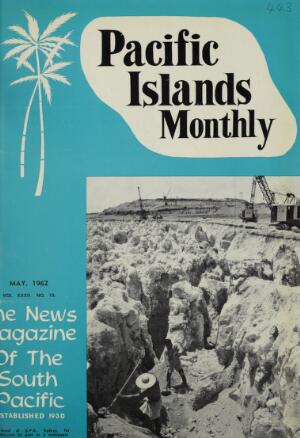
THE COVER: As an Islands scene it's most un-lslandish we know —not a palm tree or lagoon in sight. But to many Nauruans this stark picture of phosphate being removed from pockets in the island's coral pinnacles is just another of those homely scenes that have been around as long as they have. But phosphate mining has brought problems for the Nauruans never theless —see pages 17 and 47 for the details.
Advertisements & other items, pp. 2-4 (3 items)
Sun Bird Sb
FLY
throughout the Territory of Papua/New Guinea and to Australia
Sunbird Services throughout the Territory
TAA operates ‘Sunbird Services’ throughout the Territory of Papua/New Guinea and to adjacent islands. Whether your destination is Mt. Hagen in the New Guinea Highlands, Honiara on Guadalcanal or any other of rhe 40 Territory ports served by TAA you will enjoy friendly service WHEREVER you fly with TAA Sunbird Services.
Sunbird Sendees to Australia Regular TAA services from Lae and Port Moresby to the mainland link the Territory to more than 90 ports throughout Australia. From any location in the Territory you need only one call, one ticket, one airline. TAA operates a huge network of more than 40,000 miles throughout the Territory, to Australia and within Australia.
For your flight to anywhere in Australia, low cost Tourist or Luxury First Class, TAA is the Friendly Way.
SAVE ON TAA TOURIST CLASS FARES BETWEEN PORT MORESBY AND AUSTRALIA For example, you save £B/15/0 (return) when you fly TOURIST to Brisbane with TAA.
Tourist fares from Port Moresby to Brisbane . . . £34/13/0 single, £69/6/0 return.
First Class fares from Port Moresby to Brisbane . . £4l/4/0 single, £7B/1/0 return
Trans-Australia Airlines
TAA is general sales Agent for QANIAS throughout Papua/New Guinea.
BOOKINGS:
GOROKA: Airport. Phone 8 LAE: Coronation Drive. Airport Centre. Phone 2311.
MADANG: Kaislan Avenue, Phone 78 or 166. PORT MORESBY: Musgrave Street. Phone 2101 RABAL'L: Mango Avenue. Phone 2567 or 2702 or any authorised TAA Agent.
TAA 139
Iron in comfort without
fatigue with the new . . . •
oleman
Kerosene Self-Healing IRON j
Pre-heats with methylated spirits in 90 seconds.
Burns for 2 hours on one filling.
Built-in pump and large filler opening.
Easily dismantled for servicing.
Heat is evenly applied over baseplate. r& Model No. 615 Representatives for the Pacific Islands: ROBERT GILLESPIE PTY. LTD., ROBERT GILLESPIE (N.G.) LTD., PEARCE & CO. LTD. 22 Young Street, SYDNEY. Rabaul, Port Moresby, SUVA.
Also 334 Queen Street, BRISBANE. Lae, Madang.
McCORMICK Tf| C ADAUUI CD
INTERNATIONAL I U"D vKAWLtK
'S' m
wife
THIS is your chance to take advantage of McCormick International diesel crawler power —with the TD-5 a compact, sure-footed, 3-point linkage tractor for plantations, farms, contractors and local authorities.
Heavy-duty engineered, the 37-h.p. TD-5 has the proven 4-cylinder B-275 diesel engine that starts easily and gives outstanding economy. TD-s’s features include: fast-acting live hydraulics, full engine power at 540 r.p.m. at the power take-off, high 14" ground clearance yet low centre of gravity. The exclusive IH Torque Amplifier is available as optional equipment, doubling the gear range to 12 speeds. The TD-5 can be fitted with the McCormick International ASG4 angle dozer blade (shown above) as well as a full range of McCormick International 3-point link- j age and trailed equipment. Shown above, fitted to the TD-s’s 3-point linkage, is the McCormick International GL-229 Toolbar.
For low-cost earthmoving jobs use the TD-5 fitted with the Drott 4-in-l %-yard capacity bucket and a rear-mounted scarifier. Contact your IH dealer for further information.
I*:® *8 *• □ KM INTERNATIONAL HARVESTER COMPANY OF AUSTRALIA PTY. LTD.
District Sales Offices in Australian Capital Cities. Works: Dandenong, Geelong and Port Melbourne, Victoria.
DISTRIBUTORS —DUTCH NEW GUINEA: H. Englebert, n.v. Hollandia. SOLOMON ISLANDS: Solomon Motors Pty. Ltd., Honiara. TAHITI: Hintze & Company, Papeete. NEW HEBRIDES: Kerr Bros. Limited, Sydney. FIJI: Niranjan’s Service Station, Suva. PAPUA AND NEW GUINEA: Steamships Trading Company Limited, Port Moresby and Samarai. Dealers; New Guinea Goldfields Ltd., Wau; N.G.G. Trading Co., Lae; Rabaul Trading Co. Ltd., Rabaul.
1
’ I F I C ISLANDS MONTHLY MAY, 1962
2
MAY, 1962 PACIFIC ISLANDS MONTH!
Pacific Islands Monthly
üblisher: R. W. ROBSON.
Editors:
Y Tudor Stuart Inder
\anager: SELWYN HUGHES.
Phones; Ma 9197, Ma7Ioi,
MA 4369.
1.P.0. Box 3408, Sydney,
phic Address: PACPUB, Sydney.
4Ual Subscription Rates:
I. currency; includes surface postage) Is. —P.-N.G., Fiji, Samoa, Norfolk, j, 8.5.1., Cook Is., Tonga, G.&E.
Niue, New Hebrides, and other acific Is £1 4 0 Pacific Territories and Dutch Guinea £1 7 0 ia and N.Z £1 10 0 ritish Commonwealth and Foreign Stg.) £2 10 0 and U.S. Pacific Territories 0 U.S.) £3 1 3 Copies (postage extra) 2 6
Vnch Office In Papua-Ng
Publications (NG) Ltd., Theatre 3, Fourth St., LAE. Tel.: 2577. ss Pat Robertson, Manager.
{Ranch Office In Fiji:
; iji Times Building, 20 Gordon St.
Tel.: 4043.
Tepresentative In N.Z.:
Whitcombe, P.O. Box 5179, Auckland. Tel.: 22.570.
Presentative In Hawaii:
Spencer, 203 Yap Bldg., 3465 ! Ave., Honolulu. Tel.: 775538.
Epresentative In U.S.A.;
Craib, Pacific Publications P/L, i 55, San Francisco 1, California.
Tel.: Mission 8-1075.
Representatives In U.K.:
Ashburn, 13 Rood Lane, London, i. Tel.: Mincing Lane 8633.
Mackenzie, 4A Bloomsbury Square, i, W.C.I. Tel.: Holborn 3779.
JRNE OFFICE: Newspaper House, ' Collins St. Tel.: 63.7053. 5: All main trading firms and res in the Pacific Islands.
Publications Pty. Ltd., is the ian agent for THE FIJI TIMES.
Contents
No. To, Vol. Xxxii.
May, 1962
People 5
UN Mission to New Guinea Hears Varied Views 15 More Hot Words on Netherlands New Guinea 16 Queen Salote is Home Again 17 Nauruans Uneasy Following UN Visit 17 New Administrator for Nauru 17 New Hebrideans Can Drink 18 Coastwatcher Evans Takes Another Look 18 US Will Buy Fiji Sugar 18 Deficit in Western Samoa 19 Bomb Tests "Unfortunate But Neces sary" 20 Fiji's Chief Justice Sworn In 20 All Roads to the Easter Show 21 Lenormand Back in New Caledonia 21 Could Haste in NG Mean More Alder Cases? 21
Commentary 23
The Editors' Mailbag 25
Canberra Commentary 26
Norfolk in the Air on its Aviation Future 28
TERRITORIES TALK-TALK, with Tolala 29 New Guinea Gets an Information Centre 35 Fewer Mosquitoes at the Drive-in 35 The West Samoan Scene 37 Canning Industry Possible in New Guinea 41 Trouble in Fiji Teachers' College ... 43 A Nauruan Speaks Out: Rehabilitation, Not Resettlement 47 Australia Finds Phosphate Deposits 49 American Samoa is Booming at Last 51 SYDNEYSIDER At Home Base 56
They're Digging into Polynesian
Origins 61 Along Fiji's Hibiscus Highway 63 What Future for the South Pacific Commission? 69 Rabaul Handles a Thorny Medical Problem 70
Magazine Section 73
Pacific Shipping And Yachts 99
Pacific Report 117
In a Nutshell 140 Deaths of Island People 141
Travel Talk 142
Shipping, Airways Timetables 145 Commerce and Produce 153
Advertisements & other items, pp. 5-6 (3 items)
A Product of Pacific Publications Pty. Ltd., 29 Alberta Street, Sydney
4
MAY. 1962 PACIFIC ISLANDS MONTH
W. Kopsen
★ AUSTRALIA'S LEADING MARINE SPECIALISTS ★
& CO.
PTY. LTD
Present
Volvo-Penta Diesel
MD47 ir
The Ideal Marine Diesel for Island Conditions.
This Power Packed engine has a marine output of 82 B.H.P. at 2,500 R.P.AA. It is a 6 cylinder direct-injection diesel engine with a displacement of 4.7 litres. Water cooled by fresh and sea water system. A 2:1 or 3:1 reduction gear can be supplied with reverse gear. The AAD47 is suitable for medium-sized utility or pleasure craft. • Compact • Light 9 Reliable • Quiet • Power Packed.
I ★ A full range of Volvo-Penta Marine Engines are available, write for details.
4 the Boatman
• TRITON PLASTIC PUMPS:
These imported plastic pumps are very pop lar with every modern feature and are s cheap. Finished in a yellow plastic, the float, are not affected by petrol, oil < chemicals and are exceptionally strong. Th portable lightweight pump is a must f( your boat or around the house. Size 12 in., 24 in., 40 in.
• IMPORTED FENDERS:
Healy Hansen fenders from Norway in Foam plastic. Very soft and strong, colour orange, in three sizes. Also Polva from Sweden. A hallow type fender made in a new rubber plastic material. Sizes in blue and white. Screw cap for liquid.
OR
• DEKOL PRESERVER:
Prevents decay and guards against the ravages of white ants, borers, dry rot, mildew, etc., in wood and canvas. It is easily applied with a brush and is ideal for Island condtions. Prevention is better than cure.
SURFERS PARADISE WATERSKIS:
A full range of first class water skis, all guaranteed. Including Olympic Slaloms, Square and Shaped back learners skis, trick and child's skis, etc. SABA brand waterskis also available in all styles.
W. KOPSEN & CO. PTY. LTD.
876-382 Kent St., Sydney
Phone: 29-6311 (11 lines) Cables: "Kopsen" Sydney
COUPON
Please post further details on [ 1 Vol Penta starke Type MD47 [ ] Triton Pum t ] Imported Fenders [ 1 Water Ski [ ] Dekol to: —
NAME
ADDRESS
P.I.M.
Methodist mission in BSIP
ipporters in Australia and New id are this year celebrating the inniversary of the arrival in New ia of two pioneer Methodist naries—the Rev. John Goldie ie Rev. Ray Rooney, in 1902. se courageous men, at a time the Solomons were in their al primitive state, were sent out Methodist Church in Australia. years ago the Methodist h in New Zealand took over le responsibility of this mission t of the western Solomons and inville, and since then there ;en a steady stream of teachers ledical workers from NZ. Mr. : continued there for 50 years, his retirement in 1952.
ie Gay were the names chosen r. and Mrs. John Kaputin, of Moresby, for their first-born, kaputin is a Tolai and his wife West Australian schoolteacher named him in Port Moresby Jar. The baby takes the name iputin’s mother and has thick curls and fair skin. “We’ve forgiven her for not being a said the attractive Mrs. Kaputin her baby was born in Port by in April. * * * and Mrs. N. H. Foxcroft, who :ars have been doing a monu -1 job of work for ex-Pacific s people living in Sydney, sailed r Europe in April on a long y. Mr. Foxcroft is president of acific Islands Society and Mrs.
Dft of the New Guinea Women’s Appropriate gifts were made
businessman John K. Dowling created resting diversion for passers-by when e the entire length of Rabaul's Mango Avenue on this midget tractor.
;m by both organisations before were sent off with the best s of a host of friends. Both the and society will carry on under vice-presidents while the Fox are away. At the April meet l the Pacific Islands Society, Mr.
Lane, executive secretary of the Visitors Bureau, was the guest sr. * * ♦ ade unionism in P-NG—formerly »f the unmentionable subjects— »een given a shot in the arm the P-NG Legislative Council irch passed legislation allowing registration. In April, secretary : P-NG Workers’ Union, Sinaka i, announced that people would be able to see concrete examples ionism—his union would issue tickets and badges. The badge have a blue background (for acific), two brown men shaking , a white cross (for Christianity) map of P-NG.
:k Richmond, a 21-year-old can student of the University awaii, announced in Apia in that he plans to sail a 41 ft ssian double canoe from Hawaii st Samoa. The canoe is already st Samoa, where he has built it :he last seven months, and he to ship it to Hawaii. He said i first planned to sail the canoe awaii until he realised winds make the job “almost im le”. He reproduced the design studying old-time Polynesian > in museums. He thinks it’s the ype used by Polynesian voyagers years ago. Said Mark: “I it by doing this I might arouse of the old enthusiasm that is lost in some sectors of Poly
Sydney for the first time in April jian Joe S. George, a clerk with the [?]Pacific Insurance Company in Suva, [?]nd it cold in the mornings, he said, found a temporary warm spot at the d of one of "Pacific Islands Monthly's" s when he called in to see how "PIM" was produced.
n life. At the time these canoes used people had guts. Now -5 there are still a few people wrth but we are losing this virtue.”
\nzac Day—April 25—was kept i Noumea as usual this year, the commanders of the French ;s in the Pacific taking part in /reath laying ceremonies for the But there was one difference, grumbling among themselves Australian residents sent the ving dispatch to PIM “Aus n residents are thinking seri of taking up a collection to buy iple of Australian flags for the verished Australian consulate to iy at future Anzac Day cere es. The Australian flag is always licuous by its absence,”
ien New Zealand Minister for d Affairs, Mr. F. L. A. Gotz, re d home in April after his first to the Cook Islands as Minister id something to say about his trip, the South Pacific generally, to ;eting of the Tin Hat Club of Christchurch Returned Services’
Nation. He said when he asked Cook Islands youth what he sd the Government to do for sland, the youth had answered, Gotz, leave us alone. We ain’t no ulcers.” Mr. Gotz added; 3ng these people there have been w evil ones. We know them. live there. They spread the ine of the evil Western civilisa-
d recently in the Rabaul Memorial popular Sister Helen Hopkins and Mr.
Dyer. They will live in Kavieng.
d at the United Church, Boroko, Port [?]y, in April—Miss J. Steele and Mr.
B. Folett.—Papuan Prints.
Some evil influences in the 5 are spreading subversive litera md an evil doctrine. And they orking there right in our midst, re impelled by one pernicious ne of world revolution and the lation of the world by the nunist philosophy.” * * * en Monseigneur Michael Bar er, in Noumea, on April 26, onsecrated Bishop of the Wallis ’utuna Islands, it was the fourth a Bishop has been consecrated w Caledonia. People came from trners of the territory for the ony. “There certainly does not to be any slackening of religious here,” said a correspondent.
glican Bishop of New Guinea, ev. Phillip Strong, said in New , NSW, in April, that he was essed” by signs that Australia’s ' of self-determination for :rlands New Guinea was “weak- He said Australia’s support ently began to weaken when the 1 did not receive full support other countries. Her weakening undoubtedly encouraged Indo in the belief that it would not great opposition in its efforts ain possession of NNG. The p’s statement aroused a row in al Parliament (see Canberra nentary, p. 26) when it was sug- I, incorrectly, that the ABC removed a report of the state from one of its bulletins be of Government pressure. * * * isengers on the northbound o from Sydney in April had own Anzac Day service con d by the master, Captain Bill ng. The vessel was over the spot, iles east of Brisbane, where the
lo Rabaul refreshed after three months with her family in Sydney is Mrs. Jack el. Husband Jack learned of his pro to District Officer just before going on leave last January.
>ital ship Centaur was sunk ost 19 years ago. A Japanese sub ine torpedoed the vessel, which ied the usual Red Cross markings which sailed openly with lights ing. The Japs could have been in doubt what sort of a ship it was, 299 lives were lost on her, in ling those of many Australian ty nurses.
l Papuan summonsed before a t Moresby magistrate’s court for ing failed to pay water and 3age rates to the Hanuabada ive Local Council, indignantly ex ned that he should not have to water rates because he never hed. His domestic arrangements n’t sway the court. Fined 5/-. ♦ * Tie announcement by the Minister Terri tones, Mr. Hasluck, in April, t Mr. Justice R. T. Gore is retir from the P-NG Supreme Court ich came as no surprise in New inea. Mr. Justice Gore, who is in 74th year, has considered retiring some time. He has been in the ritory since 1924, when he became ma’s first Crown Law Officer, and » appointed a Judge in 1928. In a h tribute to his work, Mr. Hasluck i, “Probably no other Australian had such a long and distinguished jciation with our nation’s achieve in t or worked so wisely and iently for the people of the Terri y. He was tolerant and painstaking I tempered justice with understand-
led in Sydney recently at St. Jude's Ch, Randwick, were Mr. Donald Potts, of Moresby, and Miss Joyce Fisher, of ee, Sydney. The couple are now living ort Moresby. Mr. Potts has lived in Fiji and W. Samoa.
Advertisements & other items, pp. 7-16 (9 items)
5
IFIC ISLANDS MONTHLY MAY, 1062
(arnation Milk
in its most convenient form!
Here’s the most convenient way to keep plenty of fresh cow’s milk always on hand .. . stock up with double-rich CARNATION.
Pasteurised and sterilised for your protection, CARNATION Milk is pure, rich cow’s milk reduced to extra creaminess . . . and it needs the addition of only H times its own volume of water to be instantly ready for drinking.
CARNATION’S wonderful for cooking too !
CARNATION blends better than ordinary milk . . . combines better with other ingredients . . . gives you better results every time. And so quick and easy to use ... no tiresome mixing, you just punch and pour CARNATION straight from the can.
Remember . . . for fresh liquid milk whenever you’re ready to use it, you can rely on
CARNATION.
i
SVAPORATSf
MilK
..-. . V .• . .v>.w2«
(arnation Milk
from contented cows
6 oz. or economy oz. cans. 48 to the carton.
Make sure you serve yours
illed right with
XT - V m
TEMPRITE
BEVERAGE COOLERS
a quality product of
Your barmen can pull more beer
faster and cooler—with a Tempri
Self Contained Beverage Cooler
The colder your beer, and the faster you serve it, happier your customers will be. And your profits dep on the happiness of your customers. Temprite equipn
will keep them happy.
Temprite:
• Keeps the beer at the correct temperature all the t —stops wastage from beer drawn too warm too cool. • Takes only a few minutes to clean—no special che cals needed, no chance of your beer having a t to it. • Doesn’t waste electricity—cuts in only when requ to maintain the correct temperature. • Cools and delivers beer as fast as any barman handle it . . . provides multiple serving points.
This self-contained unit is attractively designed, suitable for behind or under the bar or in lounge serveries in hotels, motels and clubs. You can hire them out to catering services for social functions. No plumbing, no water lines required.
Model BC2/60.
Height: 3'2J"; width: l'8i"; depth: 2'4"
AUSTRALIA LIMITED
ADELAIDE • MELBOURNE • SYDNEY • BRISBANE
PERTH
lift
ts
MILK
m *c< oM I
Wry's
BfL • • • because there Is a glass md a half of pure, fresh, full-cream milk in every half pound of Cadbury’s Dairy MMk Chocolate
MD2S/HP/9
M ’ m '3m tr U 1
MARINE
" PROPULSIOI
MARINE
AUXILIARY
DIESEL
ENGINES
Sydney Motor Tug GOLDEN FLEECE Powered by GARDNER BLj Diesel Engine 8 Cylinders b.h.p. at 900 -V ... - The GARDNER BL3B Marine Diesel Engine, 200 b.h.p. at 1,000 r.p.m.
FOR IMMERIATE DELIVERY
GARDNER 4L3 Series 76 b.h.p. at 900 r.p.m.
GARDNER 6LX Series 110 b.h.p. at 1,300 r.p.m.
GARDNER LW Series 28 to 94 b.h.p. 2 to 6 cylinders COMPLETE STOCKS OF SPARE PARTS AND REPLACEMENTS FOR ALL GARDNER MARINE
DIESEL ENGINES—IMMEDIATELY AVAILABLE.
Mno Sole Agents for Papua-New Guinea and South West Pacific Islands
FERRIER & DICKINSON
Telegrams: "FERREOUS", Sydney. • Telephone: 43-1215.
SALES SERVICE SPARE PARTS: POSTAL ADDRESS:
Herbert Street, Artarmon, N.S.W., Australia P.O. Box 21, Artarmon, N.S.W. Austr
GI IV Gilbey’s Gin is one of those travelled people you will meet everywhere ... a true international, the same in all lands, not least Australia.
Gilbey’s Gin is an accommodating spirit, happy to be consumed in many ways.
It can be drunk with water and with bitters, with lime juice or ginger ale, with tonic water or that popular newcomer, bitter lemon, and in a host of cocktails, chief of them the ever-popular Martini, not forgetting the new Gilbey’s and Dubonnet.
In mixed drinks Gilbey’s Gin is supreme whether you are an old timer from Out East thirsting for a Singapore Sling or a hostess meditating what to serve
PERSONALITY
OF THE
MONTH
at a young people’s party when heavy drinks and potent drinks are definitely out.
To lace a fruit cup, a very discreet quantity of Gilbey’s will provide a beverage to please everyone, harmless yet sophisticated, refreshing as a breeze off the sea on a summer night.
Everywhere young people are coming to recognize a hostess who doesn’t believe in the “do it yourself” system for her guests, who is willing to go to just that little extra trouble with a good mixed drink.
The basis of the best mixed drinks of the world, for tycoons or for teenagers, is Gilbey’s Gin.
Try it yourself ... we know you’ll agree.
GILBEY’S LIMITED
24 energy breakfasts like this in
every packet of Weet-Bix
HA / >■ Vl*
I kV
«a "S \r M. <% P.*: •W * ./ ¥ A ..•X •.
Sffsr-
BIX K
“Itcu <r>; Here is the energy food youngsters need straight from Australia’s golden wheatfields! Toasted to tempting crispness. Served in a second and rich in true grain flavour, they keep your energy level up for hours! Great value, too, with 24 man-sized breakfasts in each large packet...about a serving!
You will find big, fi colour picture plates your boys and girls every packet. Wal packets, too, for spec “surprise" offers
Serve weet-bix for teizperific*energy
V that s the number of creamy rich caramels you enjoy in every > long packet of 1 3 ,
MAC. ROBERTSON’S
Columbines
BUY ENERGY RICH . . . GLUCOSE RICH
“COLUMBINES” TODAY . . .
SOLE PACIFIC AGENTS:
S. E. TATHAM & CO. PTY. LTD. 414 Collins Street, Melbourne Z 716
Australia's Finest Generating Equipment now Market
and Serviced Through Authorised T. P. N. G. Agent
DUN LITE
POWER PLAI
\ 240 volt A.C Powered by world-famous Lister Diesel Engines offe economical, trouble free power supply for radio, radiog tape recorders, movie and sound projectors, fluorescent lig and automatic appliances. 1.75 K.V.A. with Manual Control £3Ol.
Also available from Remote or fully Automatic Control.
PRICES QUOTED ARE PACKED AND DELIVERED FREE-
MAIN PACIFIC PORTS.
By far the largest Manufacturer of Power Plants ir Southern Hemisphere, the Dunlite Electrical Co. Ltd. specialised for over 30 years in the design and manufc of electrical generating equipment ideally suited to opei in remote areas. World acclaim has been won by D Power Plants for low cost, dependable power supply long life with the absolute minimum of maintenance, p in the field under all climatic conditions.
Dunlite design a compact, attractive, single unit Power that eliminates belt and coupling worries. Simplicity of con: tion provides a robust, permanently aligned and totall’ closed unit, resulting in ease of installation and mainter and a superior generating efficiency for low cost power ge tion. 4 K.V.A. with Manual Control £406. 6 K.V.A with Manual Control £517.
Complete range of Power Plants from 1 to 60 K.V.A. Remote control or Fully Automatic Control available on ALL Models.
Dunlite Power Plants are exciting and self-regulatin( moving parts so no opei adjustments are necessary, trol Panels are the simplest designed and offer fool operation.
Every Dunlite unit is fully run in and thoro load tested before despatch, and is a com ready to run, packaged unit with no specii stallation requirements.
LET DUNLITE QUOTE FOR ANY PLANT TO
YOUR PARTICULAR REQUIREMENTS.
A complete range of Dunlite belt-driven Alternate also available allowing you to operate your 240 vol power supply from an existing engine.
Manufacturing by:
DUNLITE ELECTRICAL CO. LTD.
Distributed by-
RURAL SERVICES PTY. LTD.
65 Ipswich Road, Woolloongabba, Queensland 21/27 Tavistock Street, Adelaide, South Australia. and in T.P.N.G.—STEAMSHIPS TRADING CO. LTD. Port Moresl N.G.6. TRADING COMPANY, Lae. NEW BRITAIN ELECTRICAL C Rabaul.
m * rtna w - \\wfcj^/// p K*
pov
V\JQOftk
PiccaninNY
PREPARED WAX
PREPARED WAX
FLOOR POLISH
FOR UNO. FLOORS, FURNITURE. LEATHER e MOTOR CARS "Twice the shine in half the time Piccaninny imparts a glow of youth and beauty to floor surfaces that might otherwise soon begin to show their age. There is nothing more perfect for linoleum or natural wood floors.
Piccaninny's tough wax skin protects surfaces from tropical moisture, wear and tear —saves you hours of work and gives Twice the Shine in Half the Time! r i i i i L
ASK FOR
PICCANINNY
BROWN STAIN FLOOR POLISH
For Jarrah, Cedar, Stained Floors & Woodwork J Piccaninny Polishes are manufactured by
PICCANINNY MANUFACTURING CO.
254 Pittwater Road, Manly, N.S.W,, Australia
The world-wide organisation of
British Paints Limited
presents the world famous range of
Including-.
Brilliant 1 Gloss Marine Enamel,
General Purpose Oil Painf,
Gloss Hull Paint, Non-Skid Deck Paint,
"Brillspar" Marine Varnish,
Engine Enamel Primers, Undercoats,
"Koplastik" Anti-Fouling,
"Giant" Brand Anti-Fouling,
Copper Bronze Anti-Fouling,
Water-Rinsable Degreaser,
Strip-Masta Paint and Varnish Remover,
6Ptu/nX4
Jl ISSTTi
I w®Riluiant gloss
FREE “LITTLE SHIP” HANDBOOK
Ask your British Paints authorised "LITTLE SHIP" agent for a FREE "LITTLE SHIP" HANDBOOK and COLOUR CARD. Complete painting specifications for all marine craft and useful, practical hints on all craft care. jr Exclusive, GUARANTEED Products to PROTECT A AND beautify all marine ckaft
SOLD AND RECOMMENDED BY:
Burns Philp (New Guinea) Limited: Port Moresby.
Burns Philp (New Guinea] Limited; Samarai.
Burns Philp (New Guinea) Limited: Wau.
Burns Philp (New Guinea) Limited: Bulolo.
Burns Philp (New Guinea) Limited: Lae.
Burns Philp (New Guinea) Limited: Madang.
Burns Philp (New Guinea) Limited: Goroka.
Burns Philp (New Guinea) Limited: Wewak.
Burns Philp (New Guinea) Limited: Kavieng.
Burns Philp (New Guinea) Limited: Rabaul.
Burns Philp (New Guinea) Limited: Kokopo.
Burns Philp (New Guinea) Limited: Daru.
Burns Philp (New Guinea) Limited: Kainantu.
Steamships Trading Company: Port Moresby.
Kam Hong: Lae.
Scotts New Guinea: Lae.
Tang Mow: Wewak.
Laurie Chan: Rabaul.
Wong You: Buka Passage-Bougainville.
HONIARA, 8.5.1. P.
ft. C. Blair Ltd., Honiara R. C. Symes Pty. Ltd., Honiara.
FIJI
Burns Philp (South Sea) Co. Ltd., Suva.
Burns Philp (South Sea) Co. Ltd., Lautoka.
Narain Construction Co., Suva.
NORFOLK ISLAND
Burns Philp (South Sea) Co. Ltd., Norfol Island. 824
6
MAY, 1962 PACIFIC ISLANDS MONTI
7
I F I C ISLANDS MONTHLY MAY, 1P62
8
MAY. 1962 PACIFIC ISLANDS MONTH
9
CIFIC ISLANDS MONTHLY MAY, 1962
11
CIFIC ISLANDS MONTHLY MAY, 1962
12
MAY, 1962 PACIFIC ISLANDS MONTE
13
CIFIC ISLANDS MONTHLY MAY, 1962
Un Mission To Ng
Is Impressive
Prom “PIM’s” Rabaul Correspondent Ranging from a request that they be permitted to visit newly independent nations to a desire to be “taken over” by America, New Guinea natives presented their various platforms to the visiting UN Mission in April.
LMOST entirely requests by • indigenes reflected a con ausness of the need for more »nomic development and higher ication before they were equipped even consider self-determination— alone self-government. [n Rabaul Sir Hugh Foot, leader the Mission, said that he was pressed by the “extreme honesty 1 shrewdness” of the natives, rhose familiar with the Tolai will dw what Sir Hugh means by irewdness”. As to honesty this i be explained as candour, a virtue which most natives excel. \nd anyone once having seen the 4 Mission leader in action would /e no doubt that here was a man exceptional honesty and acuteness.
Highly intelligent and quick led, Sir Hugh is unlikely to have • wool pulled over his eyes by any f-seeking platform speaker. At nadidir he and Mission members eated in the sun for upwards of 3 hours while various native incillors addressed the Mission.
Dn-the-ball fellow Mission mem •s Nucker, Bhadkamkar and amanca missed little, allowing for s translation from Pidgin, but it is übtful if a single innuendo passed Hugh.
He impressed as a man of keen nd, mindful of misrepresentation
and determined to collect the fullest possible picture in the shortest time.
An instance in point was pro vided by the Matupis, most sophisticated among the sophisticated Tolais of the Gazelle Peninsula.
Present in force at Vunadidir, the
Matupis were represented by To Titimoa who protested that his people were not receiving full value from the Europeans for their copra and cocoa and that government surveyors were unlawfully trespassing on Matupi land.
The first charge was quickly dis posed of by Sir Hugh, who pointed out that copra and cocoa prices were controlled throughout the world.
The second was as effectively quashed by New Britain District Commissioner, John Foldi, whose department has had recent trouble with Matupis resentful of land surveyors’ pegs. (The survey being to complete maps prior to giving the Matupis schools, etc., Mr. Foldi produced at Vunadidir a leaflet ex plaining the survey’s purpose which had been circulated to the Matupis prior to the survey being carried out).
Addresses by To Lawrence, of Ramalmal, Vin Tobaining, MLC, and Stanis Boramilat, contained much that was sound in reasoning and all conveyed unquestionably their conviction that New Guineans were not yet capable of assuming the burden of self-government.
Laying it down letter by letter, ex-mission teacher Stanis Boramilat read in fluent English from a pre pared speech, drawing attention to a need for education (“in Admini stration departments we would not have a native staff officer yet able to become ADO or DO”), to economic affairs (“if Papua and New Guinea are ever to govern themselves they must be prepared to support themselves economically.
They can never do that unless they
Sir Hugh Foot.
At left, native leaders address the visiting UN Mission at Vunadidir. In the centre, back row, Stanis Boramilat reads from a prepared speech. At right, when the mission first set foot in the Territory at Rabaul Sir Hugh Foot (in civilian clothes) inspected a police guard of honour.
plant all their available lands with cocoa, coconuts, coffee, rubber and cash crops”), to population (“25 per cent, of our people are still opposed to the system of native local government”) to self-defence (“without the Australian police, army, navy and air force our country could do no more than surrender to any nation which wants to invade us”).
He concluded with a request that a delegation of indigenes be allowed to visit newly independent countries, for such a delegation would “learn more from this visit than you could give them in years of lectures about self-government”.
At Wakunai and Kuba (Bougain ville) and at Talasea and Valoka (New Britain) the UN Mission heard like sentiments perhaps not so fluently expressed but as full of con viction—the people of New Guinea do not yet have the knowledge or confidence to discuss self-government —let alone practise it.
An appreciation of Australia’s role as patient hand-in-perpetual pocket coloniser came from almost every speaker and without doubt the indigene is grateful—if sady con scious of the little he has achieved in spite of such help.
Still fresh and unconfused when interviewed in Rabaul after the first two weeks of the Mission, Sir Hugh Foot still had a month of investigat ing, listening, probing and assessing before him.
As leader-spokesman he refused, albeit courteously, to drop a single fruitful hint on his Mission’s find ings, opinions or impressions. On the grounds that to do so would be sub judice before the Mission held discussions with the Australian Government and delivered its reports to the UN, Sir Hugh spoke in generalities of the responsibility of the Mission as a whole, the “excit ing” task before it, the rigors of Territory travel ... and so on.
Speaking with this ambassador from the UK, a former governor
of Cyprus, one was left with little doubt of a conclusion Sir Hugh would take back to New York—that despite the pinpricking in Trustee ship Council sessions, the Trust Ter ritory of New Guinea has small hope of achieving self-determination within a few short years.
If the New Britain Tolai, regarded as the Territory’s most advanced native, is unprepared to discuss self-determination it is unlikely the Mission will encounter different attitudes from mainland indigenes.
They are more likely to have these first impressions verified if not accentuated by further discussions.
As Australian special representa tive Dudley McCarthy himself put it at the 27th session of the Trustee ship Council apropos employing indigenes in administrative positions, the Administration’s problem “was not that of training indigenous personnel but of bringing indigenous persons up to a level where they can be trained”.
Whether the best that can be done has indeed been done in that regard is for UNO to say after reflecting upon the reports of this Mission.
But it is the sad crux of the self government question and one that the Mission must now realise.
And realising it they should keep in mind that the UN’s demand for acceleration of effort toward self government imposes an almost impossible burden—not on the Aus tralian Government but upon an indigenous population which must assume in perhaps less than a quarter century the responsibilities of a democratic civilisation which took 20,000 years to evolve.
(Continued on p. 138)
It was at Kieta, on Bougainville, that the Mission was first asked that the United States instead of Aus tralia should be made the Administer ing Authority for New Guinea. A gathering of about 1,000 natives at tended the meeting at which the pro posal was made. The recommenda tion was opposed by other natives at the meeting. Mr. Nucker explained the UN policy of encouraging self determination as early as possible for all Trust Territories and emphasised that self-effort was essential. Later the same proposal was made at two meetings.
Other points made to the Mission during its tour of New Guinea: ® Stanis Boramilat said in Rabaul: “I know of no other country but Aus tralia which could have done as good a job in New Guinea.” • Some Bougainville natives
claimed that the lack of industrj and technical knowledge encourasi the Cargo Cult. • Directors of the New Irelai Native Societies Association a vocated, almost unanimously, th natives be given unrestricted right drink liquor, and strong requests ] lift drink restrictions were also mai in the Sepik. • Epineri Titimur, in Rabat told the Mission that the Territoi was ready for self-government at asked that a target date for se] government be stated immediately. • Some Chinese residents ; Rabaul sought assurances from tl Mission regarding the security < their capital and land after self-ga eminent was established. 9 Dissatisfaction with wages w< expressed by natives in several area • Mr. R. Levi, chairman of tt Kokopo Town Advisory Counci raised the question of West Ne’
Guinea and said he considered th UN should intervene. He was suj ported by native speakers. A numbe of native speakers in the Sepik are also expressed concern about th Indonesian situation. • In New Ireland and the Sepi it was suggested to the Mission tha Papua and New Guinea become on country under the control of Aus tralia.
Advertisements & other items, p. 17 (1 item)
15
ACIFIC ISLANDS MONTHLY MAY, 1962
Members
The Mission Members
The UN Visiting Mission to New Guinea has been visiting all districts of the Trust Terri tory. It arrived from Nauru on April 8 and will leave for Can berra on May 14. Its members are Sir Hugh Foot {Chairman), Ambassador Carlos Salamanca {Bolivia), Mr. Ashok Balkrishna Bhadkamkar {lndia), and Mr.
Delmas H. Nucker {USA).
Pacific Report
Look For These In Pacific Report
New Cure Claim for Filaria; Malaria Warning; Fiji Makes Wide Range of Goods, 117. Banno Case Settled, 119. Bob Hewlett Corrects Fiji Miliary Record, 120.
Norfolk Census Figures; Urban Fijians Become ‘Pub Loungers’, 121.
Rev. Wesley Button Leaves NG, 122. Copra Prices Down; Mis carriage of Justice, 123. Sydney Debut for Rabaul Artist, 125.
Polynesia’s New Bishop, 126.
Long Range Forecasting of Eruptions, 127.
Land Seminar in Fiji, 130. Fiji Flu Epidemic Wanes; Politics with a Bang in Noumea, 131.
Islands’ Aero Club Thrives; Catalina Crashes in Papua; D.
J. Gubbay Takes Over BSI Trading Corporation, 133. Roy MacGregor Goes Finish, 134. A Tolai Asks for a Phone; Norfolk Hotel Sold, 135. Cable Laying Begins: Improvements at Nausori, 137.
More Hot Words On Dutch N
Dutch N. Guinea
April on the West New Gum front brought forth the usual tone of words (although the “secret talk were not resumed ); and the Bunk Plan, which proposes that the Dut, should hand over West New Guin to the Indonesians over a two ye period and with the UN guard teeing eventual self-determination the West New Guinea natives.
THE talks between Indonesia a; Holland, with an American, ]V Ellsworth Bunker, as a third pari were “temporarily” suspended i March 23, and neither Indonesia n Holland seems anxious to resumed One Indonesian reason is that s does not intend to wait two years f West New Guinea (as Mr. Bunk proposed); she intends to have it “I the end of this year”, or else.
In a fiery speech to a mass ral on April 29, President Soekarno sa that further talks would not resur while Holland continued to reinfor its armed forces in NNG where is calculated there are now B,o' Dutch troops. He also said that t Indonesian “Governor” of NNG w already in “secret headquarters” ne Hollandia. (The Dutch subsequently stat that they would stop sending troo to NNG as “soon as an agreeme under UN supervision” is reached.' Reports from Djakarta clai heavy fighting on Waigeo Islan north of the NG mainland, whi( they say has been taken by the I donesians as a “springboard of £ tack” on NNG.
The Dutch describe the reports “pure nonsense and silly childii propaganda”, but say that they ha recently captured over 100 Indon sian infiltrators. About 30 Indon sian sympathisers—mostly people i Indonesian descent but some nativ also—were arrested near Holland during April.
Meantime, West New Guin< natives who want none of the Indi nesians are said to have drafted referendum on the future of tl whole of New Guinea which th( will submit to the natives of Austn lian New Guinea for endorsement.
Although few Australian N* natives have any real idea of the in plications of the Indonesians’ on NNG, it is unlikely that the would, under existing conditions, 1 happy about throwing in their 1( with the NNG people who imagit that they can go it alone.
Queen Salote Is Home Again
Queen Salote received a royal welcome when she arrived back home in Nukualofa, Tonga, on April 9 after five months holiday in New Zealand and Australia. She had spent Christmas in Sydney.
A royal salute was fired by the shore battery when the Tofua, from Auckland, berthed and the Queen drove to the palace through lines of school children who threw flowers in the path of the huge royal limousine. A police motor cyclist led the car through the packed crowds, which were greatest outside the Customs office. The Police Band added to the colour and gaiety of the occasion. — Photos: Tulua Bros.
Nauruans Uneasy Following
UN Mission's Visit
From “PlM’s” Nauru Correspondent Nauru is filled with rumour and speculation following the visit in early April of the United Nations Mission under Sir Hugh Foot. The Mission has left the impression here that it favours the Australian plan to move the Nauruans to the Aus tralian mainland, where they will lose their identity.
AS a result some surprising things are being put forward publicly.
Nauruans have suggested that the phosphate be sold to other countries, that it should be stopped from leav ing Nauru (there has even been talk of using arms!), and that legal and political assistance should be sought in Australia.
What it all amounts to is that many Nauruans are becoming more con vinced that the chance of obtaining a new island, and with it independ ence, is becoming less a reality. And as opportunity appears to recede, so does Australian popularity.
The Mission left the impression that it did not feel the Nauruans were able to govern themselves, and that the Nauruans needed some sense drummed into them. Individual members in private discussions on social occasions were very strongly in support of the Australian proposal —especially the Bolivian delegate, Ambassador Salamanca. Some mem bers of the Nauru Local Government Council got the impression that Mission members think the Nauruans don’t really know what they want and that they are perhaps a little stupid.
Mr. Dudley McCarthy, an Assist ant Secretary of the Australian De partment of Territories, who accom panied the Mission, told one meeting of Nauruans that the Australian Gov ernment would never agree to Nauruan independence on an island in the vicinity of the Australian main-
All-in-all, the Nauruans are realis ing that it is going to be a crisis year for Nauru, and they are not very happy at the anticipation.
The UN Mission arrived on April 4 by TAA chartered Sky master from Sydney and left on April 7 by the same aircraft for Rabaul, to begin its New Guinea visit. The Mission mem bers held several talks. Many points were raised by the Nauruans (includ ing the phosphate dust menace, future of the air strip, liquor, and phos phate royalties) but the main question undoubtedly was on the matter of finding a suitable new home. Sir
Hugh Foot stressed that this was the main question exercising the minds of the Mission members.
One meeting with the Council members was held out of doors at night, with no record of the proceed ings being taken. Everybody was en couraged to talk freely—and they did.
The Nauruans are still convinced that they must find an island home of their own. Council members will look at other islands later in the year, and two that they want to look at are Woodlark, in Papua, and Groote Island, in Australia’s Gulf of Car pentaria.
As reported in PIM, Head Chief De Robert and councillor Joseph Detsimea, in February, made a visit of inspection to Prince of Wales Island and Fraser Island. They flew in a chartered flying boat, accom panied by a senior officer of the De partment of Territories. They made a scanty examination, and saw ex cessive sand and mangroves, and a lack of harbour, but they feel a longer and closer investigation must be made later. They asked Mr.
Hasluck to arrange further inspections of other islands—although one hopes these inspections won’t be made with the same secrecy that surrounded the February inspections.
New Administrator
Mr. R. S. Leydin, Administrator of Nauru from 1954 to 1958, has been appointed Administrator again. He will take up his new post in May, For the last four years Mr. Leydin, 56, has been Administrator of Norfolk Island.
In some quarters it is felt that Mr.
Leydin’s appointment shows the importance with which the Australian Government views the Nauruan problem. With his intimate know ledge of island personalities he can help put over the Australian point of view. Mr. Leydin will have as his official Government Secretary in Nauru, Mr. John Powell, who held that position in Norfolk under Mr.
Leydin until a few months ago. The two work well as a team.
No announcement has been made of Mr. Leydin’s successor on Norfolk Island, or what position is to be given to Mr. Leydin’s predecessor on Nauru, Mr. J. P. White.
Advertisements & other items, p. 19 (1 item)
17
CIFIC ISLANDS MONTHLY MAY, 1962
New Hebrideans
Can Drink
The ban on New Hebrides natives drinking intoxicating liquor has been relaxed. In a joint statement, British and French Resident Commissioners of the Condominium have an nounced that in future New Heb rideans, of either sex, over 21, will be able to buy beer or wine, from off-licences, for drinking at home; will be able to drink beer or wine at public functions where liquor is served; and be able to drink beer or wine with meals in licensed restaurants. How ever, they will not be able to drink in bars, and all cases of public drunkenness will be pro secuted “with vigour”.
The statement said the relaxa tion was an interim measure and the position would be reviewed during the year. It added that it should be “an aim of policy to remove restrictions on the con sumption of alcohol by natives entirely in due course”.
The statement follows findings of a committee set up in 1960 to advise on New Hebrides liquor policy.
Fiji Sugar
Better News: US To Buy Fiji Sugar
Prom a Suva Correspondent One of the best pieces of news that Fiji has had for some time is that the United States will buy 5,000 short tons (2,000 lb to a short ton) of Fiji sugar from the 1962 crush. The sale will be worth well over the £lOO,OOO mark, perhaps not a great deal in the annual sugar earnings of about £8,000,000, but at least it is a leg in to one of the best sugar markets in the world. news, plus the fact that more than 10,000 farmers have signed the new contract which will run till 1970, puts a more favourable light on the economic hopes of Fiji.
The news of the sugar sale goes back about 18 months, when the United States started to re-allocate quotas that formally Cuba had.
The Fiji Financial Secretary (Mr.
Harry Ritchie) made a hurried trip to Washington last year when the annual US Sugar Act was about to expire, and the CSR also made an effort to get Fiji on to the band wagon. Unfortunately for Fiji, but understandably because of hemis pheric interests, most of the re-allo cation went to Latin American sugar producers, and the West Indies. Aus tralia and India were two areas out side the Americas to also benefit.
The story moved on a few months when the Government agreed to let brown rice from America into Fiji at concession rates.
Little was said of the reason for this, but high CSR officials admitted that it was in an attempt to get a leg into the United States sugar mar ket. The CSR marketing division kept hammering away in Washington, and early this year Mr. Ritchie, on his way back to Fiji from a success
ful loan raising mission in Lorn spoke up on behalf of Fiji.
The CSR Company must have t confident there would be an oi for extra sugar somewhere whei raised the 1962 target to 250,000 1 of sugar—sl,ooo tons more t needed for assured markets, and was before Cuba torpedoed International Sugar Agreement, even that has had no apparent ef for the announced target for 196: 235,000 tons, still 36,000 tons ab the assured market figure.
Mr. J. C. Potts, managing direc of South Pacific Sugar Mills Ltd., CSR Fiji subsidiary, warned that allocation of the 5,000 tons was o a single allocation, and not o tinuing. But, he added, when present US Sugar Act expires June 30 next, negotiations would a tinue to secure further allocations As the allocation has to come fr< the 1962 crush the two biggest m in Fiji, Lautoka and Rarawai, v open on May 1. The sugar has to delivered to the United States June 30, so it should not be diffic to meet the target.
Manus As Satellite Base
Manus, New Guinea wartime base, may become an international satellite tracking station. Manus was first looked at by the US a couple of years ago as a possible station for Project Mercury, but rejected. Re cently a team of US and Australian officials has been surveying Manus again and have reported it as being “reasonably suitable”. The party was led by Mr. M. I. Homewood of the Australian Department of Supply.
Coastwatcher Evans
Takes Another Look
Former Australian Coastwatcher Re Evans—the man who has becom famous for his part in the wartim rescue of President John Kennedy headed back to the scene of th operation on April 30 for the first tim since 1943. He accompanied America TV star Jack Paar, and cameraman, o a tour of the Kolombangara an Blackett Strait areas of the Solomon[?] From Munda they planned to travel i the chartered MV "Kingfisher" to allot the Americans to get shots of the seen for showing in America. Mr. Evan now lives in Sydney. "It will b interesting to see the old stampini grounds again", he said on departure The last time he was in the BSII was in 1945, but then only at Honiara
Advertisements & other items, p. 20 (1 item)
18
MAY, 1062 PACIFIC ISLANDS MONTHL
Deficit In West Samoa; New
Plans For Economy
From “PlM’s” Apia Correspondent As predicted, Western Samoa’s first budget following dependence shows a deficit. It’s £260,800, which will have be met from very slim reserves. Development expenditure s been cut drastically to less than half that allocated for last ar. Yet the general position is better than last year’s.
I Budget, the first since Inde pendence in January, was intro -1 into the Legislative Assembly ic Minister of Finance, Mr. G.
Betham. Departmental receipts £1,423,400 (compared with 3,671 last year) and this figure to meet recurrent maintenance of the Government by £142,000. imated revenue from Income is down from £139,059 to 000, and interest on investments, Customs receipts are also down, tal estimated receipts are 6,950 and total expenditure is 2,750, made up of £1,565,950 aintenance and £176,800 in de ment. The deficit will have to net from reserves of around 000. . Betham said, “There is no for complacency.” said the Government was i resolved to achieve economic ity. It was evident that the )my could not support such a heavy Administrative structure, a UN exoert in public admini nn, Mr. H. Elvins, would arrive e end of April to carry out a of the Public Service. When sport was received the Govern would introduce reforms to te maximum efficiency at the num of cost.”
Thanks to NZ . Betham expressed thanks to New Zealand Government for s of £400,000 for education d over five years from 1960; ‘lO,OOO towards Avele Agricul- College maintenance, £3,000 *ublic Relations, £7,150 towards Aviation, £5,500 towards plebi costs, and the recent annual for the next few years to y the allowances of seconded nnel above local basic salary £22,500 is expected to be ered this year under this grant. . Betham said the present ses -3f the Assembly would be asked prove in principle to the raising £lOO,OOO development loan.
Ithough our rate of progress depend on no small measure
from the aid likely to be obtained from the UN and its specialised agencies, and from friendly nations and organisations with whom the Government has been communicat ing, one inescapable fact is that we must demonstrate, by our own deter mination to help ourselves, that we are worthy of outside aid,” Mr.
Betham said.
While there is little about the Budget to encourage future optimism, trade prospects for 1962 are hope ful.
“The excellent recovery in our
export trade late last year continues, and a healthy resuscitation in our exports for the first quarter of 1962 brings a welcome air of buoyancy,” said Mr. Betham.
The prospects for copra were not much better than last year with about 13,000 tons estimated for export, but the potential for bananas and cocoa was very encouraging, he said.
“The cocoa potential for 1962 is equally exciting and inspiring.”
(Continued on p. 139)
IT’S HER DAY. As pretty as a picture is Miss Teuila Wendt, of Suva, at her coming-of-age party at the Grand Pacific Hotel, Suva, on April 7. A week later she was off to Honolulu on a fortnight's cruise in the “Orsova”, designed as both a holiday and as a familiarisation trip (she is employed as a hostess with a Suva travel service ). During last year’s Fiji Hibiscus Festival, “The Fiji Times” created the pretty Miss Wendt as “Miss Print”.
e claimed that with the 400 tons xporters’ sheds awaiting shipment a earnings for the first quarter his year are over 60% of the ; income of £597,592 derived i the 4,101 tons exported in [.
“If present trends continue and expectations are realised for a bountiful mid-year harvest, almost totally absent last year because of storm damage, it is probable that cocoa will play a vital part in swelling the national income appreciably this year ”
Earlier, on March 25, the Prime Minister, Fiame Mataafa, made an important statement on the air about Samoa’s economic development.
He said that following discussions with advisers overseas, and a consideration of last year’s report of the Economic Committee, the Government felt it had to launch an energetic campaign of economic development.
Trade relations with other coun tries would be reviewed, a bill was being prepared to encourage develop ment (with both local and overseas enterprise) of selected secondary industries; credit schemes for agri cultural development would be investigated. Effort would also be made to increase agricultural produc tion, possibly with assistance to plant ers, and to “slightly increase” tourism.
The Government would look into fisheries development, the training of an adequate supply of tradesmen and also investigate the need for more adequate public relations.
A committee has been set up consisting of the Prime Minister as chairman, the Minister of Finance
and Economic Development (Mr.
G. F. D. Betham) as deputy chair man and convenor, the Minister of Agriculture (Asiata Logologo) and the Minister of Education (Tuataga loa Teo) together with their depart ment heads, Messrs. B. Parham and C. J. Williams, to co-ordinate econo mic development in all departments.
They will also consider matters of financial aid and requests for aid, and will have as their responsibility the drawing up of a five-year plan and its priorities, with power to re convene the Economic Development and Advisory Committee appointed last year.
Speaking on the aid already re ceived from United Nations, the Prime Minister mentioned the educa tion report prepared in January by Professor T. L. Green, from the University of Singapore, and the economic survey by Mr. Harry Spence, Regional Representative for South East Asia of the United Nations Technical Assistance Board and Special Fund.
He said that Mr. Spence recom mended and the Government fully agreed that the following matters should receive first attention: • An immediate and thorough study of the Public Service leading to adjustments to create the maxi mum efficiency at the minimum of cost. A United Nations ex pert in Public Administration, Mr. H. C. Elvins, would arrive at the end of April to carry out this study. • To make agriculture, which is basic to the economy, more pro ductive, expert assistance and guidance is needed. Three agri cultural experts from United Nations are due to arrive in July. • Organised Local Government should be established. • A complete economic assessment should be made of the country’s natural and human resources, ac companied by a determination of priorities and financial require ments for the future. This should be carried out by the World Bank, or through the UN Tech nical Assistance programme. An expert in Development Economics may be provided by the United Nations and may assist the Prime Minister during a trip overseas to obtain further financial assist ance when the economic survey has been completed.
I Education should be given every support possible within the exist ing financial resources. One education expert will be provided by the United Nations.
"Recall Governor!"
Noumea Demand
The Lenormand-domlnated New Caledonian Assemblee Territorial on April 26 successfully moved that France be invited to recall Governor Pechoux. That night a bomb exploded outside the office of Lenormand’s party newspaper and the Government clamped down security measures, forbidding public assembly for 15 days. “The stage is set for another political drama”, reports the “PIM” correspondent.
See pp. 21, 23 for background.
Advertisements & other items, p. 21 (1 item)
19
' I F I C ISLANDS MONTHLY MAY, 1962
But Necessary"
Tests "Unfortunate But Necessary"
Although proximity to the Ameri can nuclear testing grounds in the Pacific makes the new tests that com menced there in late April of acute practical concern to some Islands people, most have accepted them as inevitable.
ISLANDS like Fanning and Wash ington are right next door and the islands of the Northern Cooks, like Penrhyn, Manihiki and Raka hanga, are within a few hundred miles.
Mr, L. Gotz, New Zealand Min ister for Island Territories, put the thing in a nutshell when making his first visit, as Minister, to Rarotonga, in late March. The tests, he said, were unfortunate but “necessary,” in order to achieve parity with the Russians.
Mr. Gotz said that although there were many alarmist reports following the last tests at Christmas Island, in fact no damage was done to the Cook Islands. In the present tests, New Zealand, with the full co-operation of the UK and the USA, would take responsibility for the care and pro tection of the Cook Islands Group.
Radio officers, medical officers and others in the Cooks will make con tinuous tests for nuclear fall-out, especially in relation to food.
Late in March a party of American scientists arrived in Rarotonga. They will be stationed there and on Penrhyn, where they will independ ently carry out all the necessary
safe-guarding tests.
Other American scientists were scattered widely throughout the Islands as far west as Fiji to make tests during the bomb explosions.
In late April when Mr. Gotz re turned from his Cook Islands tour, he told a public meeting in Christ church that in the Cooks he had heard that “evil people” were “trying to frighten simple natives into the be lief that nuclear tests in the Pacific would destroy their foodstuffs and, more important to them, their pro creative ability”.
He said on Penrhyn people had been frightened over the effects of nuclear bombs, but the United States was not moving people from islands much closer to the nuclear tests be cause they were confident they were safe.
Despite the Minister’s assurances, protests at the tests in late April were widespread in the South Seas, with most Islands newspapers throwing their columns open to discussion on the matter.
Fiji's Chief Justice
Sworn In
Meeting members of the Fiji Bar Association at Government House, Suva, in April is Fiji's new Chief Justice, Mr.
John Macduff. Mr. Justice Macduff had just been sworn-in in succession to Sir George Lowe, who has retired.
The new Chief Justice is a New Zealander and is a former Chief Magistrate in Fiji. He is shaking hands here with Mr. Robert Crompton, a Suva solicitor. On the right is Mr.
Justice Hammett, who has been acting Chief Justice.
'Tofua' As Floating
NZ Trade Fair
New Zealand manufac turers will use the Union
Steam Ship Company’s
2,800 ton Tofua as a float ing South Seas trade fair in
July and August.
THIS will be the first time a NZ ship has been used as a trade mission. The mission is being organ ised by the NZ Manufacturers Fed eration in conjunction with the NZ Government. Representatives of NZ manufacturers will take part in the mission to boost NZ goods.
Tofua will call at Fiji, Tonga, American and Western Samoa and Niue. She will carry general passen gers but she will be specially fitted out for displays. First call will be at Suva where in the first week in July TEAL will fly mission members, who will arrange an exhibition at the Town Hall before the Tofua arrives.
Mission members will also be flown to New Caledonia, by TAI, and will visit Tahiti and the New Hebrides.
See TIM for April, p. 130, for other details.
"Increased"
Red Interest In South Seas
From a Suva Correspondent I Fiji’s Attorney-General, Que* Counsel Ashley Greenwood, drop a bombshell at the April session the Legislative Council when announced that last year a Chir Communist cell had been discove at Ba.
CERTAINLY there had been sc suspicion in the public mind 1 there were some sort of subven activities in the area following conviction last year of Chinese possessing prohibited literature.
Mr, Greenwood was speaking c ing a debate on a bill to pro for the registration and deportal of aliens. After carefully empha ing that the main class of aliens made up of about 1,600 Chir most of whom, he said, were k subjects, although they were British nationals, he went on to that there were indications that loyalty, unfortunately, was absolutely universal.
He admitted the Government 3 received a “bit of a jolt” wher was found last year there was Communist cell at Ba, the rr populous area of the Colony. 1 police discovered a lot of C( munist literature, a lot of it f hibited literature.
The Special Branch (Securi Police in their inquiries had foi that this cell of Chinese aliens 1 in touch with Communist Ps organisations in China and in vari parts of the Commonwealth, “It shows that we must not too complacent in Fiji,” Mr. Gre wood said.
He went on to say it was knc that Communist countries were t ing a greater interest in this part the world. There were more vi from their ships, and more cont in general from Commui countries, Mr. Greenwood left a lot members thoughtfully rubbing tt chins and he went on to deal v other aspects of the bill.
His disclosure made the announ ment last year of the formation o Fijian Communist Party of mil significance. The party, wh called itself the Bula Tale Co munist Party, has since changed name, and is now trying to oper as an ordinary co-operative sock
Advertisements & other items, p. 22 (1 item)
20
MAY, 1962 PACIFIC ISLANDS MONTHLI
All Roads Lead to the Easter Show
Easter Show
The Papua-New Guinea display at Sydney’s Royal Easter Show is luickly becoming a meeting ground for New Guinea people. At this year’s lisplay in April, hundreds of New Guinea residents, past and present, dropped n to say a few words to the New Guinea officials on hand. One officer ommented: “What we should do next year is start a New Guinea Visitors’ look. We even had one visitor who was a patrol officer in the Papuan ervlce before the turn of the century”. In the photos below, from top, ,n inquirer talks about career opportunities in the Territory with ADO :en Brown; Assistant Patrol Officer Noel Levi—one of 10 assistant PO’s n P-NG—discusses a point with a visitor, and William Rauela, Territory ipprentice of the Year, answers questions.
normand Back In New Caledonia
New Caledonia
1 result of New Caledonia’s m on April 15 was the-mixture ore, only more so.
Maurice Lenormand’S
party, Union Caledonienne, with an increase of two It now has 18 seats out of the the Assemblee Territoriale, in g six of the 10 seats in the ea area which have hitherto the preserve of more conserva arties. other parties contested the elec -15 per cent, of the votes went : Union Caledonienne; 25 per to the UNR (the New Cale i offshoot of the de Gaullists tropolitan France); and 20 per to Senator Lafleur’s party, managed to retain only two The other 10 per cent, was •etween the other four parties, natives again showed that they lieir civic duties more seriously the Europeans. In Noumea, the greater part of the Euro >opulation lives, 45 per cent, of who were registered as voters to vote; in the country districts 15 per cent, failed to vote, ther reason why so many did not vote was the govern decision to disallow absentee In the case of some people Loyalty Islanders working in “a —it was impossible to return to vote. result is regarded locally as y defeat for business (meaning Co.) interests and for the i administration. The last As e was dissolved because the lor and M. Lenormand’s party not agree on assistance to the Co. by way of an exemption lort duty. The Governor con -1 the Nickel Co.’s request able; M. Lenormand did not.
Alder Cases?
PO Alder Acquitted
Could Haste In
Ng Mean More
Alder Cases?
From a Port Moresby Correspondent New Guinea Patrol Officer Otto Kenneth Alder in April was acquitted of a charge of having unlawfully burned native houses. Previously, the P-NG Crown Law Department had dropped a charge against him of un lawfully wounding a native. The Alder case caused considerable public comment in Papua-New Guinea (“ PIM”, April, p. 21.) T'HE house burning incidents took A place last year, when PO Alder was on patrol in uncontrolled Ku kukuku country south-east of Wone ara and was attacked by hostile natives.
He told the P-NG Supreme Court, sitting at Kainantu in April, that he was 22 at the time, and had not been told officially by the Department of Native Affairs how he should treat wild natives, how he should pacify them if they fought or how he should act if he or his patrol were attacked.
Native Police Constable Gorabe, who was with the patrol, said that while the patrol was restricted to a ndgetop footpath, scores of hostile natives began firing arrows from hill side vantage points.
Gorabe said that he had made many patrols with Australian officers and sometimes the officers had burned native houses as a reprisal after at tack by natives. He had come to re gard it as standard practice.
PO Alder’s explanation was that he had burned the houses because he thought they might contain weapons that could be turned against his patrol.
In acquitting him, Mr. Justice Mann said that Alder’s reputation had not been tarnished by the proceed ings. But he criticised him for not entering in his monthly patrol report the fact that he had burned the huts.
After the case concluded, Mr.
Alder returned to Australia to con tinue the leave that was interrupted last December when police began in vestigations and recalled him to New Guinea.
Some wild talk that filled the air when the Alder case first received prominence a month or two ago has meanwhile subsided.
Patrol officers, men in their early twenties and those most likely to be affected by the outcome of the
(Continued on p. 139)
s findings were the most voci -5 when the circumstances first headlines. ne patrol officers averred that if with situations similar to that anting Alder they would back rather than jeopardise their rs by taking action which might in censure by Administration, ire seasoned officers in the field, sympathetic, maintain that such ions can usually be handled discretion and wisdom, e such senior officer, recalling wn experiences, told of working lously for three years to bring a in a restricted area under con only to have his entire work ed while he was on leave by the is of a young patrol officer, ere are a number of precedents e Alder case and some officers, ly censured for their actions, fallen by the wayside. Others [ill gaining in strength. One such, experiencing similar trouble in , is now a District Officer. It tie who quickly came to the res by starting a £5OO fund for r’s defence, and an amount in is of £9OO was almost spon iusly contributed, donors being
ly Native Affairs personnel.
Ik that Alder’s career will be ly affected now he is acquitted Dt be anything but supposition, is it likely, as has been sug d, that the initiative of young irs in the field will be adversely ;d. iefings to patrol officers and ;s indicate the profound respon ty that is theirs. Though courage, tive and resourcefulness need to be called upon, the A’s and if conduct when faced with resis ; are firmly laid down, ic question paramount in the r case remains unanswered and is the Administration’s own con ce in regard to its “hurry-up” ramme. could be that an insistence on ig all areas of the Territory un control by a certain date is the m why young men are sent into tions which they are too inex mced to handle.
Advertisements & other items, pp. 23-24 (3 items)
21
IFIC ISLANDS MONTHLY MAY, 1962
22
MAY, 1962 PACIFIC ISLANDS MONTH
Morris Hedstrom Ltd.
General Merchants, Produce Buyers, Importers and
Exporters, Ship Owners, Plantation Owners, Commission
and Insurance Agents.
HEAD OFFICE :: SUVA, FIJI
AUSTRALIAN REPRESENTATIVE: LONDON OFFICE:
Morris Hedstrom (Aust.) Pty. Limited, Morris Hedstrom Limited,
Wales House, Barclay's Bank Buildings,
27 O'Connell Street, 73 Cheapside,
SYDNEY LONDON, E.C.2
REGISTERED CABLE ADDRESS:
Deuba—Suva, Morrished—Levuka, Morstrom—Sydney, Suvamark—London, AAorrisco—Nukualofa, Deuba—Apia.
CODES: Ail.
SOLE AGENTS FOR:
A. B. Bahco Primus Products British Drug Houses Ltd.
China Navigation Co. ‘Chula’ Copra Dryers Electrolux Limited Ford Motor Co.
General Electric Co., Ltd.
Goodyear Tyre & Rubber Co.
Morris Hedstrom Limited are Imperial Chemical Industries Ltd.
Matson Navigation Company Max Factor & Co., Inc.
Pacific Islands Transport Line Ransomes Sims & Jefferies Ltd.
Rootes Ltd.
Vacuum Oil Co. Pty. Ltd.
Yorkshire Imperial Metals i’S AGENTS in Fiji and Samoa For Friendly Service and Complete Satisfaction it’s Morris Hedstrom Limited in
FIJI - SAMOA - TONGA
Commentary
nderstanding And
te Screens on Nauru
T of the heartburning that has ttended the proposal of the ian Government to resettle uruans elsewhere might have /oided if some of the reasons it had been given, and all the of the problem thrown open ;ood public airing. This, after not a cloak and dagger job; simple peacetime proposition ve several thousand people remote Pacific Island which )r 40 years will not be able >ort them in the manner to hey have become accustomed, ecrecy has attended the whole ight from the first public an nent last year of Australia’s I to move the Nauruans to the an mainland. It turned out ■ Nauruans had already indi ) the Australian Government y didn’t want to become New ans and they repeated it again len the matter became public, ave made visits to Canberra ss the problem, and even got flying boat and inspected a )f islands in Australia’s north, his has also been shrouded in No Government spokesman fitted anything about the de nts of the last six months or virtually only PIM readers en aware of the strong feel the subject among the Nau here in this issue, Ludwig , a Nauruan university stu pes his solution to the prob ; rehabilitation of Nauru to fit for Nauruans to live on. the obvious solution to the of course. So obvious that ;edingly unlikely that the Ad ng Authority has not already ;d it and, for good reasons, down. ig suggests that the ships that ; phosphate out of Nauru re n Australia with loads of soil a that was rejected about 10 ) when an Indian representa- JN suggested it; nor can he Nauru cannot develop a xport industry, copra produc side industries such as oil soap making, or a fishery. 3f these things is impossible, they practicable? is a tiny speck in mid-Paci q. miles in area, right off al shipping and air lanes. It lative population of about
2,500 which has doubled itself in the last 30 years, a rainfall that averages about 75 inches a year but in some years falls to a quarter of that.
It is fringed by a narrow coastal strip of beach and fertile land that rises to 30 ft in height and in places is up to a quarter of a mile wide. Be yond that, in the centre of the island, is the plateau of phosphatic rock.
Most of the villages are around the fertile coastal fringe which has no phosphate deposits and remains un disturbed, The remaining four-fifths of the island is phosphate bearing, grows few food plants naturally al though food-bearing trees have been planted on some of it. It is this four fifths that has, over the last 44 years, been whittled away for the enrich ment of Australian and New Zea land agriculture.
But that is only part of the story.
It was a two-way trade and the Nauruans have done pretty well out of it. Royalty is paid to individual land-owners for every ton of phos phate mined; compensation is made for each acre of land used and each tree destroyed; housing funds are also financed by fees on each ton of phosphate.
Other fees from phosphate have produced the Long Term Investment Fund which is now well over £200,000; with a similar amount in the Rehabilitation Fund.
All fine while it lasts, but when the phosphate peters out around the year 2000, Nauru is back where it was in 1900. The big income from royalties and other fees is finished, all that is left is a string of villages around the fertile coastal strip, and no communications with the outside world.
Would the Nauruans be wise to spend the money that then stands to their credit in Rehabilitation and Trust funds to try to invent another economy? Or would they be better to leave the place and try somewhere else, closer to civilisation?
The Australian Government has obviously decided they would be wiser to leave—and it is prob ably right.
But no one can blame a couple of thousand Nauruans not wanting to lose their identity amongst 10,000,000 Australians. The best solu tion seemed to be the compromise one of another island. The problem is which island—there are few left in the Pacific that are both suitable and available.
A lot of common sense and fore bearance on both sides will be neces
sary before the Nauruans and the Administration find a solution to this conundrum—but little will be gained by the Government maintaining its lofty mother-knows-best attitude, and keeping all its moves secret. All that has resulted from it so far is that the Nauruans feel that somehow they are being got at. ☆ ☆ ☆
Round the Vicious
Circle in N. Caledonia
TN view of the issues at stake, the * result of New Caledonia’s snap election on Sunday, April 15, might be considered a mild surprise, al- : though not even the most optimistic of opposition parties could have been too hopeful of whittling M. Maurice : Lenormand’s Union Caledonienrie down to the size that they would, like.
M. Lenormand and his left-wing party have been a big pill for both conservative New Caledonians and the French administration to swallow since 1957; but no matter what tac tics they have adopted, the Lenor mand pill tends to get bigger all the time.
The last New Caledonia Assemblee Territoriale was dissolved when the Governor exercised his right of veto in March, because he and M.
Lenormand could not agree on finan cial assistance to the Nickel Co.
The Nickel Co. bolstered the Governor’s stand by closing down • part of its smelters and laying off men. This, it was thought in some : quarters, might cause some of M. 7 Lenormand’s workers to desert him/ on the principle that a vote for the opposition might help the Nickel Co/ to change its plans for retrenchment.
In the event nothing of the sort happened and the Union Caledon ienne now has 18 seats in the As semblee instead of the 16 it previously enjoyed.
This possibly can be regarded as a triumph of principle over expedi ency and certainly it is a triumph for the natives’ sense of political unity and maybe even civic duty.
An unofficial estimate is that 75 per cent, of them voted, while less than half of the Europeans bothered.
The million franc question in New Caledonia now is not so much who voted for whom—but where does the country and its government go from here. When the Assemblee reassembles, the Governor will be confronted with almost the same set up that he dissolved in early March, except that M. Lenormand is now slightly stronger. (Over)
Furthermore, the new Conseil du Government, a sort of Executive Council, will be stacked against him because the majority party will have the privilege of choosing most of the members.
The Governor does, however, have the power to veto any legislation passed by the Assemblee, although this in itself, as shown by the re cent election, can sometimes lead only in circles.
And where does M. Lenormand go? Although he always sees the Nickel Company as the Big Bad Wolf, at present it represents New Caledonia’s main export income.
It may be a fine thing, in principle, to refuse to subsidise its operations from New Caledonian taxpayers’ funds, but if the economy loses any more of its markets, at a time when there is a world slump in nickel, New Caledonia and M.
Lenormand’s supporters could face economic ruin.
Presumably M. Lenormand has socialistic ideas of what could be done with the country’s mam in dustry but whether they would pro duce better results is open to doubt.
New Caledonia has, in miniature, all the elements that produced poli tical chaos in Metropolitan France between 1940 and the re-entry of de Gaulle to the political scene a few years ago.
One tense situation has followed another for a decade and affairs have been little improved since the inauguration of modified common roll voting in 1957. There then were over 32,000 people entitled to vote, more than half of them natives, and the first election resulted then, as in the most recent election, in 18 seats for the Union Caledonienne party, the rest of the 16 seats being distributed between half a dozen different parties all more or less supported by business and industrial interests.
There have been four elections since—all with similar results, and all producing the same sort of sec tional friction.
In addition to discord between the two groups, there is also the local New Caledonian dislike of fonction naires—public servants from Metro politan France —and the result of the recent elections is being hailed in some quarters as a slap in the face for them also.
The fonctionnaires have had, nevertheless, a traditionally important role in French government every where. They are the constant fac tor, carrying on regardless, no mat
ter which political dog is consuming other political dogs and thus fre quently saving administration from utter chaos. ☆ ☆ ☆
Fiji Baits the Hook
For Transistor Tourists
AS Shakespeare once said —or maybe it was Australian writer Frank Clune—travel broadens the mind and lightens the pocket-book.
And the pocket-books that some people in Fiji would most like to lighten are those of American tourists who are alleged to find bargains that “cost even hundreds of pounds” abso lutely irresistible.
With this end in view some sections of the community want to make Fiji a Little Aden of the Pacific: A tourist’s delight of cheap Japanese transistor radios and cameras, Scotch whisky, French perfume and Swiss watches.
Fiji already has gone a long way in this direction. It has its duty free shop at Nadi Interantional Airport where people who don’t have to spend more than half an hour in the country can buy all the desirable goods mentioned, at prices lower than most (although not always).
For others who have talked them selves into spending a couple of days in the darned place, there are facil ities for draw-back of duty on the same items. But this, say the quid nuncs, is not enough. Too cumber some, Much better if there is an open-go, so Fiji can get a reputa tion as a Pacific shopping centre.
If this cynical view is correct — that it isn’t the lure of far-away places that matters, but the price of transistor radio s—then the Fiji Visitors Bureau has been wasting its time for years. Instead of churning out pieces about the yaqona ceremony and the significance of the tabua or whale’s tooth, and in trying to lure people out to look at reefs in glass bottomed boats, or to inspect Fijian villages, it should have been getting itself some good agencies for Scotch whisky and Japanese radios.
Fiji isn’t the first and won’t be the last to bait her tourist trap with duty free, so-called luxury goods. Duty free shops stretch right round the world from Shannon, Ireland, to Syd ney, Australia—each selling the same line of goods of universal appeal. In the end they cancel one another out.
There might be more dividends in the Fiji tourist industry if someone came up with an original thought occasionally; or considered the pro position that all tourists are not necessarily morons.
Lord Maugham 'Salves'
The 'Joyita' Mystery
LORD MAUGHAM, nephew Somerset Maugham, and pn owner of the notorious Joyita ai recent visitor to Fiji, has now g his solution—syndicated—to mystery of what overtook her in on a trip between Apia, Wei Samoa and the Tokelaus.
So far as Sydney was concei it came in three instalments in Sunday Sun-Herald, a triumph o genuity and imagination that without a doubt leave the widow relatives of the late Dr. A. D. sons very unhappy. (Dr. Parsons a West Samoa medical officer disappeared with the rest of people who were on Joyita).
Maugham’s theory is that the ran into a storm and during it sons ordered Captain “Dusty” IV to return to Apia. When Mille fused, there was a scuffle in v Miller fell off the bridge onto deck below, was knocked uncons and sustained a gaping head w which Parsons sewed up.
At this stage the ship has tak so much water the rest of the plement feel she is going to sinl They—including Dr. Parsons to the rafts immediately and cas leaving the unconscious Miller o deck with his faithful Gilbertese vant. The rafts are set off the by a current and the people in
eventually perish.
Meantime Joyita drifts and s time within the next weeks, a anese fishing boat sights and b her, finds the Gilbertese still but guarding the dead body of IV In a fight, the Gilbertese falls board. The Japs throw the bot Miller after him and loot the All very entertaining of cou and already being spoken of as pel truth “because it appeared i paper”. It would nonetheless b teresting to know why Maugham imagines that the people on the vessel t all have gone off and left unconscious man and a native b( a vessel that they believed woulc within minutes. It is even hard imagine why Dr. Parsons, \ whole training was for the prei tion of life, would do such a tl The normal procedure under circumstances would have been 1 the injured man into the raft / and it will take more tffi Maugham to convince anyone knew any of these people thai would not have been done.
Maugham expose therefore ! nothing and is merely another tion to the growing fiction 01
subject.
Advertisements & other items, pp. 25-26 (2 items)
23
IC ISLANDS MONTHLY MAY, 1962
24
MAY, 1962 PACIFIC ISLANDS MONT
The Editors Maillag
ibute to New Guinea's
inces Seeto
1 reader who wants to be known y as an ex-Angauite (and date ng his letter “Anzac Day”) has to say about the subject of the tt Hilder profile, page 76, April 4: Tiis item inadequately describes sterling and untiring nursing ser ;s this devoted woman gave her ow evacuees and the local popula i of Mussau Island during the ertain war years. ls a result of privations suffered ing the Jap occupation of New and, the majority of evacuees e afflicted with malnutrition, de ;ncy diseases, malaria, etc. Fran- Seeto —or Seeto Fung Ho—was call day and night and her unsel and untiring efforts were an leasurable assistance in keeping morale. i a world of destructive war she just a little woman on a little ific island, but she quietly and erously contributed her best, ny people who knew her would, sure, like to join me in wishing a “thousand and one summers”, c and happiness.
Jio Entertainment
d Advertising
’ossing literary lightning bolts, Mr.
McCready, of Lautoka, Fiji, gets r the Fiji Broadcasting Commis i, particularly for the fact that iough a listener’s licence costs -, this does not prevent listeners ing their ears assaulted by adver igays he: Subscribers are expertly trapped the lure of only a 25/- licence not realising that the advertisers the balance to ensure our listen attention to their endlessly re ted slogans. Has the Commission right to batter our sensibilities i advertising slogans, when they spt our fees for entertainment?
Several brands of cigarettes ad :ised are all the ‘BEST EVER’ in each has its turn for adula i. All soaps and patent medi is, whatever the brand, are the ST EVER’ too, and this is pro med by broadcasters who private might not tolerate any of them.
Those of us who fortunately have isistors, tune into the national ions in Australia or New Zea
land and thus retain our sanity, otherwise the soaps with creamy lather and gentle olive oil, the tooth pastes that get into hidden crevices, and rival patent medicines with their universal panaceas, would reduce us all to cretins.
“There must be a psychological reason why slogans are never altered and endlessly thrown at our ear drums like the Chinese torture of drops of water falling on the same spot on a person’s skull until re sistance gives way.”
The reason that Mr. McCready has to suffer is £.s.d. At the end of 1961 there were 26,102 listeners’ licences issued in Fiji, which would bring in revenue of about £33,000; in the same year, revenue from ad vertising was £61,000 —and the Fiji Government still made a grant of £26,000 to the Commission and paid a subsidy of nearly £9,000 to make FBC ends meet. In 1962 the grant will be £28,500 but the subsidy will be very small.
In Australia a radio listener’s licence is £2/15/- and a TV licence is £5 where there is a population of 10,000,000 to help pay the bill for national non-advertising stations.
Strangely, from Mr. McCready’s point of view, the great majority of listeners and viewers apparently pre fer to take their entertainment along with the tooth pastes that get into hidden crevices and the soaps with the added lanoline.
Most radio and TV advertising is aimed at the lowest-common-denomi nator in the community, but because sponsors obviously get results (why else would they go on paying the extraordinarily high rates for this sort of advertising?) they probably have good reason to believe that the mental age of the average listener or viewer is about 12.
Good Pacific Maps
For those people who were com plaining about the lack of good Pacific maps in November PIM. we have this piece of information from Mr. R. D. Morrel, of Butterfield & Swire (Japan) Ltd., Tokyo: “A map that I have found quite useful is the National Geographic Magazine’s ‘Pacific Ocean’ map. It covers the whole Pacific but has nu merous insets giving enlarged maps of separate islands and island groups.
“I found this a useful map in con nection with my company’s South Pacific Service, which operates to
New Guinea and the South Pacific.” [Warning to Jumpers to Conclu sions’. Mr. Morrel does not mean that the China Navigation Co. ships sail over the Pacific with the aid of a National Geographic map. He means that he finds it is easier to pin-point their position from this 4ft. by 3ft. map than to spread the whole of the navigation charts of the China Sea and SW Pacific all over his office.]
Workers in the
Lord's Vineyard
Not everyone thinks PIM has a Roman Catholic bias (see letter in April, p. 32). The Rev. R. E. S.
Taylor, a retired Methodist mission ary from Papua, writes to tell us so, and say some pleasant things about the Catholic Mission in Papua.
He recalls nostalgically his first arrival in Papua 43 years ago on the old S.S. Marsina which, as BP ships did in those days, called at Yule Island, RC Mission headquar ters. He said the missionaries in vited him to morning tea and showed him their establishment, and he still remembers it as a pleasant memory.
Later he exchanged letters with the Bishop on Yule Island and he felt that there was a fellowship be tween them in the service of taking Christianity to the Papuans. (Mr. Taylor now lives at Port Macquarie, NSW.)
BACK HOME: Lovely Chinese lass Nancy Seeto, of Rabaul, NG, is back home again after a six months Continental tour. She crossed the Continent by bus from Marseilles and later went on to Hongkong and Japan. "A wonderful £6OO worth", said Nancy.
Advertisements & other items, p. 27 (1 item)
25
CIFIC ISLANDS MONTHLY MAY, 1962
Canberra
Commentary
From our Canberra Correspondent The Government’s announce ment of its education plans for Papua-New Guinea took the steam out of the Opposition urgency debate on the question in the House of Reps.
TWO days before the debate was due, Territories Minister Paul Hasluck announced that the Govern ment planned a university college in June Valley, Port Moresby, within four or five years.
He also announced other propo sals, made by an inter-departmental committee last August, and accepted by the Government.
These included: • A central residential administra tive college; • A multi-racial, full-standard teachers college; • A higher technical training insti tution; and • Expansion of secondary education to bring more native people to university standard.
Mr. Hasluck said that a site in lune Valley would be developed for higher educational development gen erally.
The main institutions would be grouped in this area to make the best use of libraries, sports grounds and residential accommodation.
Mr. Kim Beazley (Labour, WA), who led the Opposition attack, criti cised the Minister’s statement as a continuation of his “rather leisurely approach to this problem.”
He said that the proposal for a aniversity college only did not meet Labour objections: moreover, it seemed to have been discussed only within the Administration and not submitted to the Australian Univer sities Commission.
Mr. Beazley suggested, too, that a vice-chancellor or interim council should be appointed to set up the aniversity and that this task should aot be left to the Administration.
In his reply in the House to Mr.
Jeazley, Mr. Hasluck admitted that he proposals were based on the eport of an inter-departmental com nittee presented last August—and ‘adopted immediately by the Gov ;rnment on presentation.”
One Labour member, Mr. Len Reynolds (NSW), drew attention to
a weakness in the Minister’s argu ments thus revealed.
Why, he asked, had the Minister waited from August until April, and then made his announcement after Mr. Beazley had given notice that the Opposition proposed to move for the establishment of a university in
P-Ng?
It was a pertinent point. The Minister’s silence could not have been for lack of opportunity. Last Octo ber, in a Parliamentary statement obviously aimed at the Trusteeship Council, the Minister reported on current planning in educational, so cial and economic advancement.
This, he said, was in accordance with Australia’s undertaking to give realistic target dates, but his state ment made no reference to university training.
It gave estimates of the number of students expected in post-primary and secondary schools, technical schools, and teacher training schools at the end of five years. He also referred to special attention being given to teacher training.
But since the departmental con mittee’s report was already adopte< it should not have been too difll cult for him to give some hint c the fact that a university was und( consideration, even if no decision o detail had been made at the time. 1 It would surely have been a be ter answer to those UN critics wh are constantly attacking the spec at which Australia is moving in N( The Minister’s reticence left tt impression that the plan for tertiai education would still be gatherir dog-ears in departmental files ha the electors not administered such sharp rebuke to the Government la December.
This impression was heightene by memories of what the Ministi had said on one of his rare teli vision appearances a few weel earlier.
Then, discussing the part of native elite in the development ( P-NG he said: “I hate that ten ‘elite’; it’s usually associated wit someone who wears a white colh and has been to a university.
ir own experience in the Aus i democracy is that some of nost notable leaders have been of the mob, and it is exactly une in New Guinea today.” ; Parliamentary debate was the ter’s second brush on educa vithin a couple of weeks, her, the NSW Teachers’ Fed n had taken him to task over andards required in his “crash imme” to train teachers, der this scheme, teachers are recruited at Intermediate Cer ; level, trained for six months alaguna Training College, Ra then sent into the field as ry school teachers, ; Federation pointed out that qualifications would not ensure rmanent career, because they not qualify for admission to teaching services. ; Minister rejected the Federa protest. He said that the need achers was urgent, but in view ; shortage of teachers in Aus insufficient recruits were forth gan emergency measure, it had decided to recruit single men a minimum of Intermediate cate and give them a six is’ intensive course to fit them dive primary schools, is is an emergency attempt to )ut larger numbers of children :an read, write and count, and 3e taken further by trained rs,” he said. ry encouragement was given to rs to advance themselves by r training. ♦ ♦ ♦ liet influence” by the Admini •, Sir Donald Cleland, is one i ways the P-NG Administra s combating racial discrimina- Minister for Territories re
vealed this in the House of Repre sentatives in reply to questioning by Mr. Ward (Labour, NSW).
He said that all Territory laws were being examined under a policy direction that they should apply equally to all P-NG inhabitants.
The only exceptions would be special provisions to guard the well being of the people in defined cir cumstances or to respect their cus toms.
So far 13 ordinances had been amended, and several bills were in hand for introduction at the next meeting of the Legislative Council.
Any other forms of discrimina tion arose from the conduct of indi viduals or businesses.
The Administration continually watched, and, if an offence against Territory law was involved, action was taken.
In other cases, the Administrator sought by “quiet influence” to have the practice discontinued.
Hs * * Critics of Prime Minister Menzies have often claimed that he would sooner lose a friend than a chance to make a wisecrack.
But seldom has he let slip such a bloomer as when he made an unfortunate reference to the well respected Bishop of New Guinea, the Rt. Rev. P. N. Strong.
During Parliamentary discussion of the Australian Broadcasting Com mission’s omission of a news item containing a criticism by the Bishop of the Government’s West New Guinea policy, Mr. Menzies referred to: “. . . some comment by some body called Bishop Strong”
He did not apologise when given the opportunity during an Opposi tion attack on him for the use of the offensive phrase.
The incident presumably wouldn’t have gained friends for Mr. Menzies among the many people who appre ciate the work the bishop has done in a quarter of a century in P-NG.
In his criticism, the Bishop, who was speaking at Newcastle, NSW, said that he was “distressed” be cause it appeared to him that the Australian Gov ernment was weakening in its support for a policy of self determination for the people of West New Guinea. This
would be a shock to New Guinea natives, who trusted Australia.
Mr. Paul Hasluck.
Bishop Strong.
Work Begins on P-NG Nursing College
Work has started in Port Moresby on the first stage of a P-NG Medical School—a training college for 300 student nurses. It is being built alongside the Port Moresby Hospital at Taurama, and the first stage will cost more than £348,000. The Common wealth Department of Works, which is supervising the contract, had the task of designing a cei.tre which would train girls aged about 16 coming from native villages and therefore with little contact with Europeans. The centre will be as self-contained as possible.
The college will include three dormitory blocks. Successful tender for the project was Barclay Bros. ( NG ) Ltd. In this picture, Sister J. Drysdale lectures infant nurse welfare trainees at the present nurses’ college, which is part of the hospital.
Advertisements & other items, pp. 28-30 (3 items)
26
MAY, 1962 PACIFIC ISLANDS MONTHL
27
I F I C ISLANDS MONTHLY MAY, 1962
Pretty Hair
Advertisement
Ban Crowsfeet
When care is exercised you need have no fear of crowsfeet even if your skin is fine and sensitive.
Every night before bed, pat in ulan vitalising night cream. The vitamin oils will check any premature ageing of the skin, nourishing and smoothing as they work. Base your make-up on an oil of ulan foundation, paying special attention to the crowsfeet area to protect against wrinkle dryness during the day.
By the way, do not forget to smooth in a little extra oil of ulan if you are being outdoors for the day.
Margaret Merril.
WHITES PICTORIAL REFERENCE
OF NEW ZEALAND
A superb complete visual reference of New Zealand of over 400 pages of whole page representative aerial views of cities, towns and counties, with informative and usefu! text and maps. Standard binding, ENZ6/6-. De Luxe presentation, ENZ7/7/-.
Also available 10 in. x 8 in. (NZ7/6d) ° r i 3 n , aer . ial . b| ack and white prints Norfolk Island, Apia, Rarotonga, Papeete Moorea. Coloured enlargements suitable decoration—send for full price list.
WHITES AVIATION LTD.
C.P.O. Box 2040, AUCKLAND,
New Zealand
Advertisement
Pretty Hair
To have hair that is alive with glistening highlights, follow this simple plan. Always prepare the scalp for a shampoo by moist ulan oiling. Then, just before the hair is dry, pat on lemon delph freshener. This brings out the highlights because it removes film from the tresses. The freshener also aids setting and quicker drying of the hair. You will rejoice in pretty sparkling hair and a dandruff-free scalp.
Margaret Merril.
——— Advertisement
For a Lovely
Neck
You will be amazed how the appearance of your neck will improve by this simple toning and smoothing method. First pat the lemon delph freshener over the neck to wipe away all traces of dullness. Then just smooth on your moist oil of ulan. The toning, fairing and smoothing effect of this treatment will make your neck one of your finest features. It will give the skin that becoming dewy look and will protect against wrinkle dryness.
Margaret Merril.
QUEENSLAND
INSURANCE
CO. LTD.
(Incorporated 1886 in Australia) Assets Exceed £15,500,000.
Head Office:
QUEENSLAND INSURANCE
BUILDING, 80-82 PITT STREET,
SYDNEY.
Specialists in South Sea Fire, Marine & Accident Insurance Apply to:— FlJl—Branch Office, Suva: R.
Quartermaine, Manager and at
LAUTOKA BA LEVUKA
LABASA.
Burns Philp (South Sea) Co.
Limited.
NOUMEA—W. Johnston.
VlLA—Burns Philp (New Hebrides) Limited.
SANTO—Burns Philp (New Hebrides) Limited.
PAPUA & NEW GUINEA
PORT MORESBY—R. D. Kennedy,
Manager for Papua & New Guinea.
PORT MORESBY—SAMARAI—LAE
—MAD ANG—RABAUL—
KAVIENG.
Burns Philp (New Guinea) Limited.
Resident Officer at Rabaul: R. P. Hiley.
Resident Officer at Lae: D. J. Granter.
HONIARA (8.5.1. P.)
Wm. Breckwoldt & Company.
PAGO PAGO:
Burns Philp (South Sea) Co. Ltd.
O. H. C. Reid & Co.
OTHER SOUTH SEA ISLANDS:
Burns Philp (South Sea) Co. Ltd.
Also to any of the Company’s Offices in Australia or N.Z.
Norfolk Up In The Air On Its
Aviation Future
From a Norfolk Island Correspondent The matter of additional air services to Norfolk Island subject which the Norfolk Island Council has been pressing for last two years—has come up again.
THE Council at its March meeting heard a statement by Mr. W. N.
Selby Newbald that Pan-American would fly from Fiji to Norfolk if it could obtain landing rights. He also mentioned the French airline, TAI, and NZ internal NAC, as likely starters in a possible air race to Norfolk.
But the obvious favourite, as far as anybody can judge here, is still Australia’s Ansett-ANA.
The present service to Norfolk from Australia is being supplied by Qantas, which uses Skymasters. The flight also connects with NZ—the same aircraft being used but flying under charter to TEAL on this leg.
The recent discussions have led some people to believe locally that alterations in the service are planned, especially as a Fokker Friendship of the Australian Department of Civil Aviation came whistling in a few days ago from Sydney, loaded with Departmental officials, including the Regional Director for NSW. The Director, Mr. Doubleday, said the team was on a visit to inspect aero drome facilities and procedures.
Qantas Loss When Australia’s Minister for Civil Aviation, Senator Paltridge, visited Norfolk in August, 1960, the Council asked him to grant landing rights to TAI and PAA. The Coun cil envisaged lifting by air cargo some of Norfolk’s surplus farm pro ducts.
The Senator promised he would examine the question, although he pointed out that the Qantas service was running at a heavy loss and already had to receive a £20,000 subsidy from the Government to keep it in the air. He could have told the Council also that Qantas wanted very much to pull out of the uneconomic Norfolk service. He did say he thought it unlikely that the French Government would sub sidise a TAI service to Norfolk.
The Council continued to press the matter of new landing rights, and last September said it under
stood that Ansett-ANA’s applicai to operate services to Norfolk not been officially rejected, and ui the Australian Government to gi this licence.
Senator Paltridge replied Ansett-ANA had been told that as long as Qantas continued to ] vide a service to Norfolk and to NZ, another operator would be given a licence to operate Norfolk.
Councillor Newbald went < the history of the airline applicat: at the March meeting.
“Why can’t landing rights granted to Ansett-ANA?” asked Newbald, brandishing his notes. ‘ cause there are wheels within wh —that’s why!”.
Nobody at the meeting seemec know what Mr. Newbald meant this.
There have been rumours— tainly unconfirmed—that TAA i: take over the Norfolk run f Qantas, but if this is correct, v a glorious opening it will be for Reg. Ansett, TAA’s competitor, would insist in getting his cut, and it is generally assumed that Ansett does not want the Nor service for itself alone, but for chance it will give him of gettic leg in NZ by the back door, sett’s have airline interests in but they have no trans-Tasi rights, and it is unlikely that ei NZ or Australia will give them him.
What everybody seems to 1 forgotten about this subject of P.
TAI and everyone else, is the of Norfolk’s strip. It cannot 1 a jet aircraft and it is restricted using nothing much larger than i masters. It is this restriction wl has given both Qantas and TE so many headaches.
Meanwhile Qantas DC4’s conti to lumber amiably in and out Norfolk Island, apparently oblivi of all these grandiose schemes turning the local airstrip into a ond Idlewild or Kingsford Smith.
Advertisements & other items, p. 30 (1 item)
28
MAY, 1962 PACIFIC ISLANDS MONTH
erritories TALK'TALK
With Tolala
The other day I met up with CSIRO Senior Research fficer M. D. Murray, who is trying to track down how and hen the blow-fly Chrysomyia bezziana, responsible for “fly rike” amongst P-NG cattle, came to the Territory.
I tells me the fly is not preva lent in Australia and would inly not be a welcomed impor n. Was it in the TNG prior Var 11, or was it a Jap fellow dler with their invasion? Such the questions Mr. Murray is ig. He spent a short while in Moresby and Lae, but did not to Rabaul. ggs of the fly, so he told me, are on the edge of any wound, where hatch within 24 hours; then maggots (screw worms) burrow the wound, causing blood and m to ooze; the reaction is con •able and the skin around the nd becomes thickened and lened. The smell is very power “Of particular interest to us,” ;ays, “is the presence of maggots ;he navels of calves within 48 rs of birth.” [r. Murray would like to hear i any pre-War II planters who cattle as to whether this parti r fly was noticed in early days, address is: M. D. Murray, Mc :ter Animal Health Laboratory, ate Bag 1, Glebe, NSW. .s a matter of interest to cattle ded folk, in 1913 (during the man time) there were 3,067
cattle and 225 buffaloes or zebu; in 1958 official figures give total cattle as 10,250. Much of the stock was lost during the Jap occupation, of course.
The 1958 official report states: “The control of the screw-worm fly with newer insecticides has reduced the incidence of strike to negligible proportions.”
Let’s hope that’s true.
Bop's
Many readers, I expect, will not even know to what those initials re fer: Birds of Paradise. Recently I was reading an article, which was, incidentally, by E. Thomas Gilliard, mentioned by Judy Tudor in April PIM (p. 85), about those gay birds, their possible extermination and the glory of their plumage when—lo, and behold—l picked up my Sydney morning paper and saw the picture of a local socialite at a “hat par ade”, wearing a “turban of dull gold mesh, trimmed with birds of para dise feathers . . .”
There was a time when even be ing in possession of these plumes was an offence. During the early years of War I (1915-17) it was a
common sight in Sydney to see with these exotic p i ume s. They had been sent from NG by the troops up there for their wives, sweethearts, et al.
And then authority clamped down on their importation. Some enthusi astic RSPCA member got busy, thinking the plumes came from the female birds and that their deaths meant neglected bairns in the nest, which is not the case at all. Its the ma^e which has the sought-after plumes, Looking back at some of the old
re Sf Jg
item from the old German colony, Tn iQn_the vear before War l— out of
Many uninformed people have the idea that educating the native people of P-NG started only after World War . This photograph was taken during the German days in 1908 at the Methodist Mission station at Watnabara in the Duke of York Group. The two Sisters are Miss Nickle (left) and Miss McKee. The pupils are the wives and children of students attending the George Brown Teachers' Training College at Watnabara. Miss Nickle later became Mrs. "Tolala" and Miss McKee married a Methodist Minister, Rev. Cannon.
What the well-dressed lady wears—a hat trimmed with birds of paradise feathers. This one is from the hands of a Melbourne designer and was shown at the Auckland Easter Show last year. See "Tolala's" comment.
crop for the Highlands natives w they reach the stage of discan their feathery headgear for pj streamers and labels from tin meat, in order to keep abreast of civilisation.
It is not generally known, the majority of the small estates the mainland, from Madang to V mo, were financed by BOP plu in the German days.
A Thought on the Wearing of Clothes It was that old-time philosop Elbert Hubbard who wrote: “Ci sation is the art of wearing o shirt within the confines of o trousers.” That, of course, was v ten before the days of the flamboj Hawaiian shirts. But it gives to think.
In earlier NG days all Europe wore their shirts carefully tuc in their pants, and the Asians, the most part, wore their’s outs But now the Winds of Change h caused a reversal of fashion, is the Asian who appears dres spick and span, while only too ol does one see even top-level offic attending ceremonies in their sh sleeves and carelessly-attired, thi mg, perhaps, that being formi dressed and maintaining the digi of office they are showing a tende towards segregation. Could be.
I give full marks to the Singap RC Church and Army author! who, according to Sydney repo are against European women wc ing shorts in public.
“They offend Asian modesty The general impression is that fc inine folk who wear shorts out doors come from a very low cl without any respect for themseh the good name of Britain, or people of Singapore. If your a of morals is so low, at least do i show it in other countries. Pie respect the moral code and religi< feelings of the local population,” says the report.
Disregard of local customs a standards causes more trouble multi-racial countries than we j aware. Simply because of our norance.
It reminds me of an incident Buka some 50 years ago. I v squatting on a beach at Lontis w a crowd of men, attired mostly their birthday dress, when a pai of women approached, laden w: baskets of taro and yams, trudgi along the beach at a lower level th we were sitting.
They wore only their kuruka pandanus hood to cover their ha reaching just beneath their shoulder
a tahu (a small bunch of dried r es covering their genital organs), h man rose as the women ap ached and gazed around him chalantly while I, in my ignor e, remained seated, inly later did I discover I had imitted a serious breach of eti tte by not rising while the women ?ed. In my sitting position I ht have seen beneath the swing tahus as they passed along. It k. me many moons to become ndly again with those Lontis ves over this incident.
I said at the start: It is just thought. It could cause some : to ponder, even in the Year Grace, 1962.
Time ords t was a happy thought of PlM’s it editor, Stuart Inder, to bring ng to me one day last month a ind copy of the old Rabaul Re d, which he had picked up in a Iney book-shop. It dates from :ember 22, 1915, to December, 8. fhe first two issues appeared un the title Namanula Times (the iting office was located there) I the price: “A piece of Christmas e. The third issue, titled The haul Record was dated March 1, 6, and was on more ambitious ;s; the cost was 6d and consisted 12 quarto pages, basically it was just an Army maga e, closely censored (as is always case) but full of interesting ords of local garrison life of AN & MEF members, together h informative articles, written by ponsible officers filling the posi as of DO’s and ADO’s at the le, on descriptions of outstation
areas such as “Kaewieng,” “Eitape,”
Buka, and so forth: One of the most prolific contribu tors was Capt. J. Lyng, who later wrote Our New Possession (late German New Guinea), published in Melbourne in 1919, and Island Films : Reminiscences of “German New Guinea ”, published in Sydney in 1925. Lyng was a linguist and as such obtained much cf his mate rial from the German records; thus his articles gave an accurate picture of the days during that regime.
Should there ever be an argument over land ownership on Pak Island (in the Manus Group) there is an interesting letter from the original German purchasers (the Walun Ge sellschaft mbH) giving details of the purchase price which had, appar ently, been incorrectly stated in a previous article in the magazine by Major A. L, Roberts. Tliis could be of interest to the Lands Office folk of our own generation, as land records seem to be often incomplete.
For me theie were many nostalgic memories when I read the names of those whom I had known, but who have mostly nassed on. There are but a few of those mentioned who still remain (to my knowledge): Ted Taylor, Vic Pennefather, Tex Rob erts, Bob Jolley, Mrs. Kroening, Mrs, Miller.
Well, the year 1918 was 44 years ago and tempus does fugit, doesn’t it?
And Did You Know?
Here are some bits and pieces culled from The Rabaul Record which may interest readers: The Commonwealth Bank was first established in Rabaul on Saturday, April 15, 1916. The official open
World
Health
The World Health Organisation this year is campaigning on the necessity of protecting your eyesight. Here, P-NG Public Health Department Ophthalmo logist Dr. J. Loshdorfer (left) checks a patient with his assistant, Grayson Kuki, of Popondetta, who has been with him for the past five years. The photograph was taken at the Port Moresby General Hospital.— Administration Official Photo.
was performed by the Admini tor (Colonel S. A. Pethebridge). head office accountant (Mr. H.
Armitage, who in 1941 became bank’s Governor) responded to Administrator’s opening speech, first manager was Mr. T. H. yer, who came from Mary- Dugh, Q., and the accountant Mr. D. W. Gray, from Sydney, hi January 1, 1914, “expatriate” ulation figures for German New nea were; Europeans (including anese and half-caste Samoans) 10; Chinese 1,377; Malays and Ired races 232. Of the Euro ns, 562 resided in New Britain; in New Ireland; 56 in the Ad alty Group (Manus); 74 in the man Solomons (Buka and Bou iville) and 309 on the mainland New Guinea. lice Gesture 'erritory officialdom is so obsessed se days in pulling out all the )s of the publicity organ to boost ial integration, advancement of native people and the high stan d of civilisation being attained them, that it was a pleasant ;rsion when a pioneer European nan was accorded some official Dgnition and to read in NG Times urier (28/3/62) of the presence Mrs. Hazel Cresswell at the sentation in Rabaul of engraved ;lds of the Cresswell Coronation >phy to the four most efficient icemen in the years 1958 to 1961.
A. H. Cresswell was a well-known
pioneer resident of TNG with both mining and plantation interests. He died about 18 months ago, following an operation at the Mayo Clinic in the USA.) Her presence at the ceremony was most opportune, and I for one appreciate officialdom’s recognition of the valuable work she performed on the goldfields in caring for the sick patients, regardless of colour, and for her sterling qualities which aided the development of both the mining and planting industries of the Territory in the early days.
To these pioneer women there is a debt owing which it is hard to pay. ( See p,119 for photograph.)
A Worth-while
Campaign
* , . , The health of a people has, to always been the most beneficial feature of our intrusion upon the primitive races of the world and thrusting our own civilisation ( SI Q) upon them. It is encouraging, there- £ ore ’ t 0 r ® a( * °£ success which has attended the present malaria eradication campaign in P-NG.
P-NG’s Director of Health, Dr. R.
Scragg, points out in an article in the Australian Medical Journal that in one area in P-NG the malaria rate was 72 per cent, before spraying, but after three years the percentage
dropped to 7.9. That is good goi i3r. J. J. Saave, who is in cha of the campaign, is quoted as s ing that last year £190,000 was sp on the job but “nobody has z doubt that anti-malaria work in Territory will be an expensive ejs cise.”
It is not expensive when one o siders the astronomical sums pended on education and the o struction of buildings to hoi teachers and the schools. But wh; the use of teaching sick people' There is also the extravagant er tion of Army establishments z Naval depots (what has happei to the palatial buildings on Manus Granted, these come under Defei grants, but it’s still money from Australian taxpayer.
Good luck to the campaign. A I hope the Forgotten Islands rece their quota of attention. And these I mean the Western Islan west by north from the Mai group: Hermits, Ninigo, Aua a Maty, Invariably down the ye these smaller groups have be neglected and that was the reas why H. R. Wahlen was able to wi in to such a remunerative kingdc It was Parkinson (author Dreissig Jahre in der Sudsee ) the turn of the century who fi pointed out the high rate of m tality in these islands, and it v Wahlen who later realised the natr were in-breeding and imported soi hefty Buka lads to improve 1 stock.
Nevertheless, tucked away up the miles away from a Governme established post, these people—me Micronesian than Melanesian—ha nearly always remained the Forg ten People, notwithstanding moi graphs turned out by Pitt-Rivers a Margaret Mead.
Dr. J. J. Saave.
Advertisements & other items, pp. 31-36 (4 items)
29
CIFIC ISLANDS MONTHLY MAY, 1962
30
MAY, 1962 PACIFIC ISLANDS MONTHL
Shopping
9
SYDNEY
PERSONAL
SHOPPING
BUREAU
This is the way to easier shopping FARMER S, the biggest single department store in Sydney, is where you can purchase everything you need from clothing to household needs—by mail order. When you use our mail order P.S.B. plan, you get the same prompt attention as you would expect if shopping personally at Farmer’s. Write to Elizabeth Nugent and describe what you’d like to buy. She will send a trained shopper through the store to choose your goods, have them sent without
delay.
W lif
WRITE BOX 497, G.P.O.
SYDNEY. AUSTRALIA.
Advertisement
Pretty Clear
Eyes
A teaspoonful of ordinary kitchen salt in a pint of boiled water makes an excellent eye clearer. Let the solution cool and give your eyes a bath with it and take out the sting and dullness that comes of glare, dust and late nights. It you have time, shut your eyes and relax for a moment with delph freshener-soaked pads over the lids. Now complete with the nourishing protection of oil of ulan around the eyes to check strain showing in this delicate skin tissue.
Margaret Merril.
The Pacific Islands Society
(Founded 1937) Visitors from the Pacific Islands to Sydney, or persons interested in Islands affairs, are invited to communicate with the Honorary Secretary of the above Society which was formed to constitute a social and cultural centre for those interested in the Pacific Islands.
Regular meetings and social gatherings, with lectures, are held at the Feminist Club Rooms, 7th Floor. 77 King St., Sydney, on the last Thursday of each month, at 8 p.m.
Address for correspondence:—
THE PACIFIC ISLANDS SOCIETY,
Box 2434, G.P.0., Sydney.
Furnished
Serviced
Suites
In Sydney
Kanirabla Hall, 19-29 Tusculum St., Potts Point, 5 minutes city, next Kings Cross, modern, 9 floors, harbour views, restaurant, S.C., furn. serviced suites with separate Lounge, Bed and Bath Rms. and Kitchenettes, Refrig., H.W., from £3/3/- daily for 1, plus £l/1/- extra per day for each extra person. Some leased flats for longer periods from £l7/17/- weekly. Write or Phone: FL4141 (9 lines); after hours, PL 4149.
Telegrams: ‘Kanlmblahall”, Sydney.
THE NEW
4i A 3 Capacities: Dryweight V/2-VA tons 3-3 V 2 tons 4V2-5V2 tons
ALL FOR ELECTRIC OR DIESEL DRIVE
All
COPRA DRYEI
CONTROLLED DRYING
PRODUCES BETTER
COPRA
ECONOMICAL TO RUN
... CUTS DOWN
OVERHEAD COSTS
REDUCES
ATTENDANCE LABOUR
After many years of succes:
FORCED HOT AIR DRYERS—SPECIFICATIONS
Diesel or Electric Drives can be fitted. (I,OOOW. 240 V. AC alternator supplied with diesel units.) fully designing Cocoa Dryer: ASP with their wealth c experience have now turned t Copra Dryers. These are eff cient and economical, easy t install and require a minimur of labour to load and operate These Forced Hot Air Copra Dryers are already working to full capacity at several plantations.
WRITE FOR FULL DETAILS
AND SPECIFICATIONS
P.I.M.
FEATURES OF THE FORCED HOT AIR COPRA DRYER: • Direct fired oil heaters for maximum economy and minimum maintenance • High capacity a system for fastest drying o Recirculation to any degree for maximum efficiency ® Fully insulated ove panels to conserve heat and minimise losses • Loading and unloading with minimum labour i shortest time • Fully modulating temperature control • Easy to assemble and simple to operate. a N.R.M.A. HOUSE isde Agents for T.P. and N.G. 26 Ridge Street JA.S.P. (N.G.) LIMITED NORTH SYDNEY, N.S.W. jßox 166, P. 0., RABAUL, T.N.G Cables: "Chatspa," Sydney j Cables: "Chatspa," Rabaul
'SWAT
Why Shoulder
Extra Worries ?
The Minding your own business is a full-time job that leaves no room for extra responsibilities passed on by relatives and friends. Few people have the time and experience, much less the specialised knowledge, to act as Executor, Trustee or Attorney. It is far more practical to decline such obligations and recommend that they be entrusted to the professional care of Burns Philp Trust Company Limited.
This commonsense move achieves much more than freeing your own hands. It safeguards every asset at stake, and makes certain that the Company will act promptly and efficiently at all times.
All the Company’s services are explained in a free, 20page booklet. It is available at any branch of Burns Philp (South Sea) Limited, Burns Philp (New Guinea) Limited, Bums Philp (New Hebrides) Limited, or from the Trust Company’s nearest office.
DIRECTORS: James Burns Joseph Mitchell P. T. W. Black Eric Priestley Lee MANAGER: L. S. Parker
SECRETARY: E. R. Overton, F.A.S.A.
BURNS PHILP TRUST
Telegraphic Address; “BCRNSTRUST”, Sydney. Box 543, G.P.O Tel.: 2-0547 Also Registered Offices at Melbourne, Brisbane, Port Moresby (Papua), and Vila (New Hebrides). Canberra Agent: Bums Philp Trustee Company (Canberra) Limited.
COMPANY LIMITED
Executor • Trustee • Attorney Custodian Trustee • Administrator Head Office: 7 Bridge Street, Sydney.
LIQUID PETROLEUM
GAS WASH BOILER
Operated by safe, clean, non- Efficient Economical Caf© poisonous, portable gas, this CTTIC,enT economical S3Te Malleys wash boiler gives efficient, economical service.
Low installation costs. Instant lighting—simply turn the tap and light. Capacity 12 gallons.
Finished in vitreous porcelain enamel in Cream, Green or White. 33£ in. high x 22£ in. wide x 25\ in. deep. Approved by Australian Local Authorities.
Suitable for all liquefied petroleum gases.
cnsnß
KEROSENE
WASH BOILER
Uses only 1£ pints of low-cost kerosene to boil a full copper of clothes in less than 45 minutes! No installation costs.
No moving parts to wear out.
No pressure or pumping. Approximately 12 gallon capacity. Beautifully finished in Cream porcelain enamel.
Provide gallons of hot water for only a few pence. o wbhbhhhlW
KEROSENE
BATH
HEATER
Steaming hot water in minutes Easy to install, regulate and clean.
Works on high and low water pressure systems. Compact design, only 11 in. diameter. Two-tone Cream and Bronze baked enamel finish, or chrome-plated on copper. Available with or without shower.
Order through your usual Islands’ Agents
BUILT BETTER TO SERVE YOU BEST
Sydney • Melbourne • Brisbane • Adelaide V 194
31
ICIFIC ISLANDS MONTHLY MAY, 1962
Bar In The Air
Sydney’s Kingsford Smith irport is adopting fancy mea ires to control birds which light otherwise interfere with \r traffic.
The Department of Civil viation announced in April lat it planned to control birds ithout killing them unneces irily. To do it, it would get ixidermists to prepare stuffed \rds and leave them in “dis essed” attitudes around the inways. Later it might record nd amplify bird cries from ucks. But in the meantime would put a man on full-time uty with a shotgun and blank nmunition. The noise should ?ep them off —but there would e an occasional live round be iuse “overseas experience had wwn birds become accustomed ) loud but harmless noises.”
Advertisements & other items, pp. 35-36 (2 items)
33
CIFIC ISLANDS MONTHLY MAY, 1662
34
MAY, 1062 PACIFIC ISLANDS MONTHL
New Guinea Gets
A UN Centre
A United Nations Information Zentre was due to open in Port Moresby at the end of April —to serve the Trust Territory if New Guinea. It is the first uch centre for the Territory and ollows moves made in the UN ome time ago.
Abdel Salam Dajani, a mem ber of the UN Secretariat, said n Port Moresby on April 16 hat the centre would have as ts director a UN information ’Xpert—“but he would remain \s director only until a Papua- Vew Guinea native with suitable jualifications can be found to ake over.”
Mr. Dajani said tne UN direc or would employ native staff ind travel extensively.
All UN General Assembly eports would be filed in the *ort Moresby office and where iccessary reports would be ranslated into local dialects so hat natives could be induced o take a greater interest in what he UN thought about their o untry.
Mr. Dajani added: "It will not )e the director's job to report to he UN on social and political ispects of the territory.”
[?]Ey're Driving Out The
Drive-In Mossies
rom a Port Moresby Correspondent y ort Moresby's up-to-date, drive movie theatre, the Sky-Line (which ? the first in the South Pacific ), r recently taken a tropical twist in war against mosquitoes. Mos toes are a drive-in hazard even in Iney and Brisbane (some patrons ng equipped with a pressure-pak ect spray); but at times in Port fresby they can be hell.
HE mosquito menace here is always at its worst around the ly months of the year (wet son) and Ward’s Strip, where the ve-in is situated, is the birthplace all of them. (Outsizes a specialty.) rhe management originally had a y impressive, but singularly in :ctive, spraying unit, which used back up and down the rows of s at interval, giving drivers palpita is as it narrowly missed children I bumper bars.
However, it achieved very little
else, and many motorists took to bringing their own nets, which they rigged up, over car and all, then proceeded to crawl in, caterpillar-like, for the duration of the show.
All these methods are now archaic.
As your ticket is purchased at the entrance, the uniformed attendant smartly hands out a mosquito coil with your change. Whether or not you acquire a metal stand on which to balance it depends on whether you arrive early or near the tail-end.
However, such a minor set-back as no coil-stand does not deter a Territorian-true. The coil hangs nicely on
a knob of the dash-board—prefer ably on the lights, as this helps as a reminder to turn them on when making that frantic get-away, 30 seconds before the film appears about to end.
The coil burns slowly, spells “death” to mosquitoes, scatters a minimum of ash on the floor, and doesn’t really make the car any more unbearably hot than it normally is.
As far as many Moresby people are concerned, it makes the difference between enjoying the drive-in, and not going at all. Voted definitely a good invention.
Advertisements & other items, pp. 37-38 (3 items)
35
CIFIC ISLANDS MONTHLY MAY, 1962
Warnock Bros. Limited
AUCKLAND, N.Z.
Manufacturers of well known brands of Laundry Soap
KIA ORA" AND "NATURU"
Also: "Foam" Soap Powder Detergent "Electric" Pumice Sand Soap Obtainable from Auckland and Island Merchants
n
LIFELONG" Packaged Carden Furniture
BB £3/15/ & £3/10/ from £7 £6/8/-
Easily
assembled by
any unskilled
labour.
£l2/18/- Packed in strong boxes complete with instructions.
Prices quoted are ex-Sydney Retail Shops. from £4/13/6 Also available sembled and enamelled in colours.
Trade enquiries invited. Send for brochures.
D. F. DODD and COMPANY
Box 2180, G.P.0., Sydney, Australia.
Cables: "Doogdodd", Sydney
m
LAE : PORT MORESBY
F I J J >1 il I I V I
CATERPILLAR
No. 12. SERIES E
MOTOR
GRADER
UG DS
HASTINGS DEERING (NEW GUINEA) PTY. LTD.
HDI2E
Are You a Regular Subscriber?
PACIFIC ISLANDS MONTHLY I
.. . keeps you abreast of news and developments in all the I Islands Territories. Recognised as THE News-Magazine of the I South Seas, PIM provides a complete coverage of affairs and I events, and presents their significance against the wider back- I ground of the entire Pacific scene. If Place your order with:
PACIFIC PUBLICATIONS PTY
Technipress House, 29 Alberta St., Sydney, Australia, G.P.O.
ANNUAL SEAMAIL
SUBSCRIPTION RATES:
British Pacific Islands, 24/- Aust.; Australia and New Zealand, 30/- Aust.; French Pacific Territories and Dutch New Guinea, 27/- Aust.; U.S.A. and U.S. Pacific Territories, $7 U.S.; Elsewhere, 50/- Aust. (40/- Stg.).
LTD.
Box 3408, Sydney
36
MAY, 1962 PACIFIC ISLANDS MONTHL
Test Their Suspicions
The West Samoan Scene
Banana grousers Can now Test Their Suspicions
The banana industry in Samoa received a boost in April with the announcement of a price increase later in the year, and advice of a gift from Fruit Distributors Ltd. of a pilot cool store and ripening plant to be erected in Apia.
HHE installation of a cool store L and ripening plant will enable the spot observation to be made the storing and ripening laviour of Samoan bananas pro zed under various conditions of 1, fertiliser and disease treatment,” d Mr. I. Franklin, Apia manager Fruit Distributors Ltd., who have Government granted monopoly on i importation of bananas into New aland.
Like all primary producers far re ived from their market, Samoan lana growers always treat with picion reports that their fruit has ched New Zealand in poor con ion. Now they will be able to nove random cases from ship nts and ripen them under identical iditions as the shipment and see ■ themselves the storage behaviour their fruit and the damaging ;cts of sap staining and bruising. \nd like most primary producers, noan growers feel they have not tn getting enough from the sale bananas which are still the :apest fruit on the New Zealand rket. In discussions between binet and Fruit Distributors, which re clouded under the usual oud of secrecy, Samoa reportedly ed for an increase of 5/- a case in the end accepted Fruit Distri ors counter offer of 2/- a case m August 1 to December 6. At present time f.o.b. price is 23/- :ase with growers receiving about f 6. The increase will apply to same period in future years until urther review is made. ‘The purpose of the increase is encourage further development of Samoan banana trade and to :ourage production during the iod in New Zealand when there little other fresh fruit available, i there is a very keen demand bananas,” said Mr. Franklin, fhis price increase could result growers earning an extra £30,000 h year. Total exports for the t six months of 1959 totalled
300,000 cases; 1960, 280,000 cases; and 1961, 254,000 cases. With more favourable weather, near record ship ments are expected this year. * * *
Overseas Representation
THE Minister of Health, Hon.
Tufuga Fatu, leaves by air on April 29 to attend the WHO con ference in Geneva early in May. He is travelling at the invitation of WHO and the fare of over £6OO is being met by that organisation.
The purpose of his trip is to present the application of the Samoan Gov ernment for membership of the World Health Organisation. If the
A round-up of events in the independent State of Western Samoa, from PIAA's Apia correspondent.
application is accepted, the con ference will forward recommenda tion to the General Assembly of the United Nations for their formal approval.
Secretary to the Government, Mr.
H. A. Levestam, explained that it was necessary to belong to a specialised agency of the United Nations before a country could be come eligible for United Nations aid.
“Having regard to the close as sociation Samoa has had with WHO for a number of years, it is natural that this should be the specialised agency Samoa would like to join,” he said.
Several years ago WHO com pleted a successful campaign against yaws in Samoa and a WHO specialist.
Dr. Han, is currently co-operating with the Health Department in a campaign against tuberculosis. (Ov-r)
While the Minister of Health pr pares for his trip and a number similar trips are in the offing, son criticism has been voiced that tl Government is not making the me of these opportunities in gaining ne knowledge and valuable experience Many were surprised to learn th Samoa’s representative to the i cently concluded South Pad] Economic Development conferen was none other than Mrs. Feta Mataafa. wife of the Prime Minisb She caught the last three days the conference after attending church conference held in Noum at the same time (see below).
With the Budget coming u Minister of Finance Hon. G. F. ] Betham, and Financial Secretary Heller, were too busy to alter Few people would question that Mi Mataafa is a leading feminine i fluence in the country, but, mai claim, the country would have be better served by the presence at t conference by one or two of t more knowledgeable members of t Legislative Assembly. Most obvio choice would have been Chairman the Accounts Committee, Afoafouva Misimoa (Mr. Harry Moors), others of his committee.
Final decision on who makes the trips reportedly rests upon the Prir Minister. * * *
No Moonlight Romances
ARE the churches playing an i creasingly positive role in tl lives of people throughout tl Pacific? Definitely yes, says Mi Fetaui Mataafa, wife of Samoa Prime Minister, after returning fro Noumea.
She attended the second meetii of the Continuation Committee s up by the Conference of Church and Missions held at Malua, Westei Samoa last year. The Committ will meet once a year for five yea to carry out the resolutions of tl Conference and to consider furth problems raised at Malua, and p forward recommendations.
“One of the Conference resol tions was to investigate further tl weaknesses of the ministry,” said Mi Mataafa. “The Committee decid< that the immediate problem lies the lack of devotional life in tl ministry and recommended a freshe ing up of devotional life by holdii more retreats and giving great opportunity for devotional develo ment.”
Another of the problems discuss*
Noumea was the relationship of rism to the Church in the Pacific, eport from an investigating corn tee on tourism in Tahiti was dis ;ed at the meeting. Recommenda s made were that tourist litera i should be closer to reality, with emphasis on the “moonlight romance”. It was also suggested churches make provision for •ists to share in worship if they lesire.
We try to approach these things n the positive side,” said Mrs. ;aafa. * * *
Rld Earthquake Warnings
SEISMOLOGIST of the United States Coast and Geodetic /ey Department, Mr. J. N. lan, is visiting Samoa in con ion with the installation of ultra itive seismographic instruments ffiamalu, in the hills behind Apia, i part of a world wide network to ird and analyse earthquakes, ilar instruments are being in ed at 125 stations in 65 countries islands to provide the first precise brm data scientists have had on nature, location and frequency earthquakes. le said that Afiamalu is expected be the best oceanic station in world, being situated high up on e solid rock and away from rference by wave action that :ts most island seismographs, will be one of the most signi it stations in the world for itivity”, he said. busing for the equipment is jcted to be completed by May er the supervision of Mr. G. es, observer-in-charge at Mulinuu wvatory. The 4,000 lb consign it of the seismic instruments then be from the ted States to be installed by two erican geophysicists. The equip it, worth about $40,000, is being ded over by the United States to New Zealand and Samoan Gov nents. he data collected from the 125 ons will be collated at Washing where it will be stored on rofilm. “There will be a com ely free exchange of informa ”, said Mr. Jordan, “and scientists n any country in the world will welcome to use our records”.
The results hoped for from the em are warnings of earthquakes seismic ocean waves,” he added. * * * econded officers in Western 10a, mostly New Zealanders, have lly formed their own association, ’s called the Western Samoa rseas Officers’ Association. The
aims are to “co-operate with the Government of Western Samoa in promoting the efficiency and status of the overseas officers” and “to promote the general wellbeing of members”.
The association is open to all officers domiciled overseas and has a membership of about 80. Chairman is Mr. J. H. Robinson, and sec retary is Mr. K. F. W. Smith.
The association is at present engaged in a vigorous campaign against new Customs laws in New Zealand. These would cause heavy losses to seconded officers, who would have to pay prohibitive duty on cars purchased in Samoa and taken back with them to New Zealand on completion of their term. ♦ * ♦ After a very successful tour of Samoa, the Waikato Maori Rugby Team returned to New Zealand on April 8. The team had five matches —losing two, drawing two and winning one. They lost to a Town Fifteen 8-9, beat Saleimo 15-0, drew with Colts 5-all, lost to a Country Fifteen 12-13 and drew with Samoa 3-all. The Maori team was the most popular team ever to visit Samoa and visits between Samoa and Waikato are almost certain to be come regular fixtures.
Speaking of the tour, Maori Captain M. Raureti, who toured Samoa in 1960 with the Maori All Blacks, said the standard of Samoan rugby since then had improved at least 50 per cent.
“Now the players know what they are doing and there is a pattern to their play. They are playing more constructive football,” he said. He thought that Samoan players centre Keli Tuatagaloa and half back Pulusila Muagututia were out standing.
One pleasing aspect was the almost total absence of dirty play through out the tour. * * * A handsome addition to Apia’s growing fleet of small craft was made in April with the launching of local businessman Vernon MacKenzie’s newly completed 19ft. V-bottom out board motor boat. The first kit set ever assembled in Samoa, the boat was supplied from New York and is built of marine ply. It is powered by a Mercury 50-hp motor and is capable of 25 knots, which is fast enough for anybody. It was built over the last six months by Mr. Mac- Kenzie and Superintendent of Police Alphonse Philipp. On its first trip the party caught 15 bonito. “It be haves perfectly,” said the happy owner.
Samoan Independence—in Pennsylvania
In March—more than three months after Western Samoa attained her independence—fellow students of an Apia boy, Lalomilo Kamu, helped him celebrate the event at Moravian College, Bethlehem, Pennsylvania, where he is studying for an Arts degree. Milo is the son of the Rev. Kamu Taga’olo, Methodist Minister and district superintendent of the Methodist Church at Matafele. He plans to take a degree of Bachelor of Divinity at Drew University, Madison, NJ—he will be the first Western Samoan to hold this degree—and then return to Samoa to teach in a school for ministers.
Milo first went to America six years ago with a scholarship from the Methodist Church, and has continued his studies with financial help from a family who heard him speak in a Pennsylvania Church, and from the Moravian College. The undergraduate body of 850 attended the Independence celebrations at Moravian. Main speaker on the occasion was author James Mitchener, seen in the photo (at left) with Milo and the president of Moravian College, Dr. Raymond S. Haupert. They are holding the West Samoan flag which will hang in the college union building.
Advertisements & other items, pp. 39-42 (5 items)
37
ICIFIC ISLANDS MONTHLY-MAY. 1962
38
mat. 1962 PACIFIC ISLANDS MONTHL
Skin Balm
LEASE A
VOLKSWAGEN
FOR YOUR WHOLE LEAVE
Enjoy Worry-Free Motoring
and Save Money For those shortly to take leave in Sydney there are Volkswagens available for lease (or purchase). Reasonable leasing rate of £6O per month charged no extra for mileage, travel as far as you like no limitations applied.
Wire or write date of arrival and length of leave. Bookings should be accompanied by £lO deposit.
FRESHWATER MOTORS
254 CONDAMINE STREET
MANLY VALE, SYDNEY
PHONE: 945108 942078 947581
After Hours: 931387
IN JARS
SKIN
BALM
X#‘
OR TUBES
your hands
deserve the
PROTECTION of
PARKE-OAVIS
SKIN BALM
Available from Your Chemist
YOUR NEXT
LEAVE
Modern up to the minute homes between Dee Why and Palm Beach available to Island Residents for Holidays.
Write for information to:—
J. T. STAPLETON
PTY. LTD.,
i
ESTATE AGENTS,
133 PITT STREET, SYDNEY.
BL 5305, BL 1737
or any of the Branch Offices located at Dee Why, Narrabeen, Mona Vale, Avalon or Palm Beach.
"Vs Specialising in Pacific
Islands Insurances
FIRE—MOTOR VEHICLE—MARINE
—HULLS AND CARGO-
EMPLOYER’S LIABILITY.
BONDS—in accordance with Administration Ordinance—COPßA insured from drier to buyer—and all other classes arranged at lowest current rates.
Established Agencies throughout the Territory of Papua and New Guinea.
RABAUL, T.N.G.
Managing Agents: New Guinea Co.
Ltd.
Island Representative: Q. D. A. Kent, Rabaul Branch.
SUVA, FIJI.
Colony of Fiji Branch Office: McGowan’s Building, Margaret St., Suva.
Branch Manager: L. M. Rolls.
Southern Pacific Insurance
Co., Ltd.
Head Office: The Wales House, 66 Pitt St., Sydney.
A NEW ENGINE
FOR WORK BOATS
Without doubt the greatest value
ever offered on the
Australian marine market!
i ■ 01 Off 1 the new rolls-royce falcon engine, hailed by British fishermen, now offered in Australia. 137 S.H.P. at 1,800 R.P.M. (160 max.) • Capitol hydraulic reverse—reduction gears • Specific fuel consumption only .345 lbs. per B.H.P. per hour • Overall length 77" • Weight 3,200 lbs.
TRADITIONAL ROLLS-ROYCE EXCELLENCE AT ONLY:
A£ 1,948 Keel Cooled 12 ; 1 reduction standard equipment A£2,200 Heat-exchanger Cooled [(other ratios from H : 1 to 4 : 1 available) If your application calls for higher horsepower, other Rolls-Royce marine units are priced equally attractively.
Cific Islands Monthly May, 1962
40
MAY, 1962 PACIFIC ISLANDS MONTHL
Canning Industry
Possible In N.G.
From a Rabaul Correspondent Vhile Territories Minister Hasluck the one hand advises Territorians ‘make friends” with the indigenous pie as a means of ensuring urity of their investments —a ious sidestepping of the urgent stion in the minds of all who e invested in the Territory— ther body is busily investigating v it can interest new investors. 3E recent visit of Mr. John van der Muelen, lecturer in agri ;ural marketing at New England iversity, Armidale, NSW, is a 2 in point.
Vhile in the Territory Mr. van Muelen has made wide and lied observations on the market and distribution of fish, visiting turn Port Moresby, Eastern and stern Highlands, Samarai, Lae, iruku, Rabaul, Wewak, Madang 1 Daru. travelling under a grant provided the Rural Credits Development id, which in turn is administered the Reserve Bank, Mr. van der lelen said that he would furnish report on his findings and this ort would be available to all nested parties. (See PIM, Mar., 123).
This Territory imports half a million pounds worth of fish annually —while its coasts abound in quality canning fish.
Mr. van der Muelen envisages a canned fish industry for New Guinea providing capital is forthcoming for trawlers and plant. Papuan crayfish and barramundi could find a market in Australia, he said.
Native consumption of cheap canned fish could be redirected to a liking for locally smoked fish, Mr. van der Muelen said. Natives could be taught to smoke catches from
their own coastal waters, using copra dryers to smoke them.
It goes without saying that the fishing industry has untried potential in the Territory—as elsewhere in the Islands. BSIP has already taken its first steps in organising the industry by its purchase of the 45 ft trawler San Juanita. This was a Govern ment purchase.
Territorians will wonder what assurances of stability will be given any private concern which may be interested in starting a fishing in dustry here.
J. van der Muelen, marketing expert, foresees a profitable future for a fishing industry in New Guinea.
Advertisements & other items, pp. 43-44 (3 items)
41
CIFIC ISLANDS MONTHLY— MAY, 1962
Kiwi
F_ w [ For that
special occasion-
- or for any occasion. Under any conditions Kiwi Shoe Polish, Black or Tan, is best lor your shoes! Kiwi protects against moisture and gives a shine that lasts the whole day through. rS V i 1 sa
KIWI
SHOE POLISH
CLYDE "DRYPAK"
THE ULTIMATE IN CAR, TRUCK AND TRACTOR
BATTERIES
WILL NOT GO FLAT IN STORAGE
NO CHARGING NECESSARY IN TROPICAL AREAS
WILL ONLY COME TO LIFE WHEN ACID IS ADDED Write for particulars to Sole Pacific Islands Distributors —
KERR BROS. PTY. LIMITED
4 O'Connell Street, Sydney P.O. Box 3838, G.P.0., Sydney Cable Address: "Carefulness'
AUSTRALIA
PACIFIC
WEST
LINE
* - • ■■ M
Linking
PACIFIC
SAMC
with the FAR EAST and AUSTRALIA Further particulars may be obtained from: MANAGING AGENTS IN AUSTRALIA: WILH. WILHELMSEN AGENCY PTY. LTD., 13-15 Bridge St., Sydney. Phone: 27-6301.
Branch Office at Melbourne: 51 William St. Phone: MA 3031.
AUSTRALIAN AGENTS: Brisbane & Adelaide—Gibbs, Bright & Co.
ISLAND AGENTS: Madang (New Guinea) —B. J. &J. R. Back. Lae (New Guinea)—A. H. Bunting Ltd. Rabaul (New Britain)—T Transport Limited. Honiara (Solomon Islands) —British Solomon Islands Trading Corporation. Espiritu Santo (New Hebrides) —D Gubbay and Co. (New Hebrides) Pty. Ltd. Vila (New Hebrides)—Burns Philp (N.H.) Ltd.
FAR EASTERN AGENTS: Japan and Hong Kong—Dodwell & Co Ltd.
He'd do better with a
HANOI
KERO-PET
Stormproof
LANTERN
Twice as bright as electric light!
HANOI —The handiest and most reliable lantern you can possibly buy! Its 300 candle power will give you brilliant lighting everywhere and anywhere; indoors or outdoors—and it's absolutely stormproof! Pressure operated—one filling of kerosene will last for at least 12 hours —it's simple to operate, efficient and safe.
The attractively finished, rustproofed HANOI Pressure Lantern is available in either kerosene or petrol burning models from your local store or direct from the manufacturers.
Other quality HANOI products for comfortable, convenient outdoor living include: The HANOI Portable Twin Burner Stovette and the HANOI Pumpless Petrol Iron.
Ask for them—you can't buy better! 1 4 \ \ X / I / \ ✓ \
(H.L.I)
rTTTTTTT
WORKS
Compo Road, Rocklea, Phone 47 212
BRISBANE QUEENSLAND AUSTRALIA
42
MAY, 1962 PACIFIC ISLANDS MONTHI
Teachers' College
Students Strike: Trouble In Fiji Teachers' College
From a Correspondent lie “strike” of students at inu Teachers College, near
a, in April, was something
e than a deplorable incident lin the framework of Fiji’s inistration. also was a striking example of how difficult it is to restore r and discipline in a small com ity, whether a college or a try, once constituted authority weakened, and the forces of dis • run free. e teachers’ training college is properly regarded in Fiji—as iy other similar country—as a important and significant insti i. The character of the futurt nry is influenced, to a degree, e quality of the school teachers iced in the training college, the course of long years of wise , the Fiji training college earned id reputation. But deterioration some years ago. s students number between 200 500. They represent all Fiji’s but they are predominantly and Indian. Youths and young ire trained together. The whole s borne by the Colony, discipline became relaxed, re of “doings” at the college ie more frequent. These re were current in Suva four or ears ago; and they increased mber and frequency until, in the Education Department's Brass —which must have been for a long time—were stirred ivity.
Where the Blame? s difficult to say where the *ay—primarily, one supposes, the Education Department who were far too slow to act. v Zealander, Mr. C. S. Broc fho had been college principal e years, returned to NZ in 1962, and the job was taken y Mr. J. L. Stevens, another ealander, who has been in Fiji t from lack of discipline the college itself, the mis lours reported indicated far uch weekend leave for stu irunkenness and disorderliness the male students; and much i
immoral relationship between the sexes—high authority has admitted that eleven female students have been sent away in recent years be cause they were pregnant. . The Acting Director of Educa tion, Mr. Maurice McGrath, and the new principal, Mr. Stevens, went into action in February-March with great vigour; and within a few weeks their new rules created a rebellion among the students. Here are some of the rules to which furious objec tion was taken : ® Saturday leave to end at 945 pm, instead of 11.30 pm. • Queueing for meals, instead of meals being placed on the tables. (The last few in the queue generally
missed out under the new system.) • Weekend leaves once in three weeks, instead of every week. • Segregation of the sexes at recreation. •. College uniform to be worn at all times outside the college, instead of “easy” dress.
Mr. McGrath at the beginning of the school year, personally outlined the new regulations to the students.
The students gave them an un favourable reception. They formed themselves into some sort of union which formally protested to the principal. When there was no re laxation, 216 of them “went on strike”—they refused to attend lec tures and obey the new rules. (Over)
Mr. McGrath returned to the c lege and heard the students’ repres tations. Then he had a consultat with senior officials and the coll staff. He called the students toget again, said that some relaxati could be granted, but nothing m would be done until the stud< returned to work, and their re] sentations as a whole could be ( sidered.
The students hooted the offi( and resolved to continue the strik Next day, Mr. McGrath, acc panied by two MLC’s (Ratu Edv Cakobau was one) went back a to the college, and tried to re: with the students. They were they must return to work be their case could be further conside Hotheads among the students sisted that the strike continue, there was a deadlock. On second day of the strike police out 10 men armed with baton case of trouble.
This was the measure of the terioration which had taken ] in the college. Drastic action needed.
The Education Department cided to close the college for fortnight’s term holidays—one rr earlier than normal—and reopei the second term on April 24. those students who gave a fc undertaking that they would h forth obey the college rules v be re-admitted to the college. D that fortnight they must bf themselves if they wanted admission.
Within the two or three day fore the college was closed on 6, the students reacted here they demonstrated, erected inflai tory notices at the college and then addressed a petition t Governor, which was signed t Indians, 79 Fijians and two otl 177 altogether.
A good many students wh< not support the strike left IS of their own accord before 6. It was noted that as so< the trouble started a number < dian girl students were taken by their parents.
It is hoped that the cooli period will allow for the order assembly of students on Apr but opportunity may be taken rid of some trouble-makers.
Generally, the drastic action by the Department is approv the Colony. The “rotten spot to be rooted out. But great is directed to the high official; permitted this deterioration tc tinue over the years, long aft danger signals were flying.
Advertisements & other items, pp. 45-48 (5 items)
43
ISLANDS MONTHLY-MAY. 1 f162
•» pays to QUALIFY!
£7. ss
!TT “7 „ ■ „.7 ***«■ business. ' "* S ° me ° f the tan « ible of success in need to qualify as an executive accountant. J y iAn Organization to help YOU prepared 1 *?*£ 2SS“S IT??., h *l taduTngn C o t e« Ve b r Lks R t o l ' tuition f° f ‘"T* P™ l^' £3 Vttl r° ut S IbPit! umi| f^ou nd a4 MJtxessiui. me H.R.I. training plan works for snrrpsc in put'yourself ahe”d!“ Accountanc >' >™ r *«*■« career and
UNDER H.R.I. YOU MAKE NO EXPERIMENT
Take the initiative post the coupon today for your copy of "Guide to Careers in Accountancy"
FREE!
Interested in.
Name Address 3 Hem in gw ai, Robertso Institute !
Education for Business since 1897 BANK house, bank place
BARRACK HOUSE, 16 BARRACK
MELBOURNE
ST.. SYDNEY
Remember
\o »\o® On\oto^' ro9 100 ;^J V^*u\»o\ 0^ iO nkOl •" wm vour
forget
about
Molorio
'Nivaquine'
trade marA
CHLOROQUINE SULPHATE
%) An M&B branu medical produr From your chemist 10-tablet pack 4 fl. oz. syrup for children Manufactured by MAY & BAKER LTD Distributor;- may & BAKER < AUSTRALIA) PTY LTD me. m n.s.w.
P O BOX 41 • FOOTSCRAY W.ll • VICTORIA
TEL: MM 66-9441
10-14 YOUNG STREET SYDNEY TEL: BU 3621
Electrolux
A M.
erosene
>eep Freezer
olux kerosene-operated deep freezer conserves up to 100 lb. dry weight of •ozen packaged foods for many weeks in tropical ambient temperatures as as 100 deg. Fahr. (38 deg. Cent.) or even higher, provided there is a drop ght. Even fresh foods (meat, game, fish, vegetables, butter, etc.) may be kept everal weeks or many times longer in C 80 than in an ordinary refrigerator, no ice or electricity. The Electrolux C 80 operates anywhere by kerosene, economically and with high efficiency.
ywhere
the
)pics . . ■ I (.
Jr A
I M \ I
NEW GUINEA CO. LTD.
Rabaul, Madang, Lae, Kavieng, Kokopo 5.C.1.E., Noumea
BURNS PHILP (N.H.) LTD.,
Vila, Santo
ISLAND PRODUCTS LTD.
Port Moresby 8.5.1. P. TRADING CORP., Honiara, Gizo F.J.R. SIMMONDS, Norfolk Island
ij#jO
as A
f,ou> CcM
SWEDISH
Electrolux
Specially designed to give more cooling power from less electricity, the new range of Electrolux refrigerators is the ideal choice.
These elegant refrigerators have many luxury features and all are fitted with the economical new Electrolux cooling unit to keep down running costs.
And there's a size of cabinet in this superb Electrolux range that's just right for you — come to our showrooms and choose it now!
We also have available a full range of Swedish Electrolux electric and kerosene operated refrigerators as well as a complete range of household appliances. (P u* ** & 4 Distributed by:
NEW GUINEA CO. LTD.
ISLAND PRODUCTS LTD
Rabaul, Madang, Lae, Kavieng, Kokopo 5.C.1.E., Noumea
BURNS PHILP (N.H.) LTD., Vila, Santo
Port Moresby 8.5.1. P. TRADING CORP., Honiara, Giro F.J.R. SIMMONDS, Norfolk Island
May, 196 2 Pacific Islands
45
IFIC ISLANDS MONTHLY MAY 1962
46
MAY. 1962 PACIFIC ISLANDS MONTH
Nauru Need Rehabilitation
A Nauruan Speaks Out!
Nauru Need Rehabilitation Not Resettlement
By Ludwig Dowong
Why must the Nauruan people resettle at all? Why should ot the island to be rehabilitated and continue to be a home for he Nauruan people?
> a Nauruan, I certainly do not like the idea of leaving my home I hope I am to be permitted to •ess my view. How would any y like to be deported from his le, for deportation is what it is. iru has meant happiness for the iruan people—life has been peace -in many ways it has been para . Even if it weren’t, there is no e like home, and that alone is dent excuse to work hard at re ing it. have taken a great interest in question of resettlement and the aban people have been a lesson ne. These, the Ocean Islanders, a resettlement problem facing n in exactly the same circum ces as the Nauruans, a few years So they bought another island abi—in the Fiji group, and moved e in 1948. In 1957 and 1959 I the opportunity of visiting Rabi, I learned there that for the last years the Banabans have been unhappiest people on earth, re is nothing on Rabi but misery,
"Unhealthy"
/ith the exception of one village, iang, where there are brick ses, the rest of the island lives iirty, unhealthy huts. There are roads, no amenities. The people ply live “in the bush”, lothing has come of promises le to them and the result is that Banabans are lost—stranded ild be a better word—on Rabi. iw 70 of these people taken to ’.B. hospital in Suva in 1960.
Tiese were the people who were e happy in their own homeland, who allowed themselves to be red by hopes of a better re [ement “somewhere”, md may I ask what is happen to many of the thousands of rants who have come to Australia n Europe in the last few years? i pick up a newspaper and find ; hundreds make their way back ic. Why? Because they have
found that resettlement is not the answer to their problems. They thought they would be happy, but they were not. They found no homes or jobs and were frustrated.
Is this the kind of resettlement scheme the Nauruans want?
During the Pacific war the Japan ese invaders deported about half the Nauruan population to Truk, where they first experienced real suffering.
Many of those people today do not want to experience that kind of suf fering again.
Resettlement may be the easiest way for the Administering authority to solve its problem, but it is not the solution for the Nauruan. And in the end it won’t be a satisfactory result for anybody concerned.
What Nauru needs is a Rehabilita tion Director, working with a team of experts in various fields.
This team should investigate ways of developing other industries on Nauru itself. This will not be easy.
Nauru is not another Papua-New Guinea with an abundance of natural resources. But it will be a wonderful gesture by the Australian —(Over)
yernment if it really shows that vants to investigate every possi tys there a possibility of a cement jstry on the island?
Wiat are the opportunities for culture? The Japanese were very :essful at this in the war and duced an abundance of tropical t and vegetables. With trained ionnel and with modern science help there should be a future in culture. Little Niue Island, east Tonga, is virtually nothing more i a coral outcrop with pockets soil, but the Niueans are very :essful agriculturists and export anas to NZ. ig ships regularly take phosphate n Nauru. Why should not the e ships return with loads of soil n Australia, to be dumped on island after the rock pinnacles t after the phosphate is extracted) been levelled off? In other ds, bring back the soil to Nauru!
Why Not Copra?
he Gilbert and Ellice Islanders reported to be concentrating on easing copra production now that Ocean Island phosphate supplies dwindling, like Nauru’s. So why ildn’t Nauru go in for a big mut replanting scheme? Coconuts v everywhere on Nauru, ftth copra growing, side industries d be established. Fiji has its factory for making biscuits, oils soaps, Nauru could perhaps do same, with markets in Australia, i Zealand and Britain the
countries which have been taking the phosphate.
And what of the fishing industry on Nauru? The idea has been tried, but it met with little success. Yet there are fish by the millions around Nauru.
There is no natural harbour on Nauru, we know, but can’t something be done by reef blasting? The reef could be blasted at Anibare Bay to make it big and deep enough to accommodate a fishing fleet.
Such a scheme needs proper in vestigation and it is merely one of the things that the Director of Re habilitation and his team would look at.
Other possibilities may eventuate.
Surely it is worth the effort and the money to find out?
And is finance such a huge prob lem? What will it cost to purchase and prepare an island for resettle ment, to bring it up to a standard which will accept the Nauruans?
Surely to bring an island, from nothing, up to a suitable standard of civilisation will cost much more than improving the present one? There is money put aside for resettlement.
And I submit that the old island, remade, will have less terrors for the Nauruans than another “home”, yet to be selected, yet to be tried.
The answer to the Nauruan prob lem is surely rehabilitation, not re settlement.
New babies in the maternity ward of the Nauru General Hospital—what will be their future home?
It's a carefree life for this healthy young Nauruan, here displaying his catch of tilapia.
The Writer
of this article, Ludwig Dowong, is a 27-year-old Nauruan, a graduate in dentistry from the Central Medical School, Suva.
After working in Nauru last year as an assistant dental officer, he is now in Brisbane, studying for a Bachelor of Dentistry degree at the University of Queensland. His parents still live in Nauru. Dur ing the war, as a boy, Mr. Dowong was one of those Nauruans who experienced life under the Japanese at Truk Island. He re ceived his secondary education in Sydney. He wrote this article for “PIM” after reading what he described as the “interesting survey” of the Nauruan situation published in February. His argu ments do not take into account Nauru’s frequent water shortages (rain fall varies from 12 to 182 inches a year) but his views are worth stating. It is an example of the great interest which Nauruans have Li this perplexing problem of finding a new home when the phosphate deposits are worked out in 30 to 40 years. The Rabi islanders will be Invited next month to reply to his criticism of their island.
Malo For The Nauruans
“/ know most of the islands of the South Pacific, and I can think of no more suitable home for the Nauruans than Mala, in the New Hebrides group ”
THE speaker was Pastor A. J.
Stewart, of the Seventh-day Adventist Church, who, in the course of many years of active work, probably was the best-known travelling director of missionary enterprises in the Pacific Islands. He is now retired and living quietly in Sydney.
Malo is a well-wooded, wellwatered, fairly hilly island near Santo, in the New Hebrides—34 miles in circumference—and almost all cultivable. It is separated from Santo only by the narrow Segond Channel. Except that it has a few
European-owned plantations, and native villagers numbering perhaps 300, it is unpopulated and undeve loped. In Pastor Stewart’s opinion, i t wou ld be an ideal and healthy home for the Nauruans *h e nussionary did not comment on one objection to the plan namely, that the New Hebrides is a Condominium, jealously guarded by the British and French, with Aus tralian enterprise peculiarly suspect.
Nevertheless, Britain has as much interest in Nauru as Australia has.
Advertisements & other items, pp. 49-50 (3 items)
47
CIFIC ISLANDS MONTHLY MAY, 1862
48
MAY, 1962 PACIFIC ISLANDS MONTHL
Diesel Electric Set
EXPORTERS. . . Catering to the South Pacific
C. SULLIVAN (EXPORT) PTY. LTD.
66 Pitt Street, Sydney (Corner of O’Connell and Pitt Streets) Telephone: 8L5071 (6 lines). Telegrams & Cables: CHASULL, Sydney.
C. SULLIVAN (Queensland) PTY. LTD. 318 Adelaide Street, Brisbane Telephone: B 4958. Telegrams & Cables: CHASULL, Brisbane.
C. SULLIVAN (N.Z.) LTD.
Windsor House, Queen Street, Auckland Telephone: 43-307. Telegrams & Cables: CHASULL, Auckland.
Offices at: London, San Francisco, Hong Kong, and at Suva and Lautoka, Fiji; Rabaul and Lae, New Guinea
BUYERS OF ISLANDS PRODUCE
THE "BRAYBON" 2 K.V.A. 240 VOLT A.C. 1,500 R.P.M. FULLY SELF-CONTAINED . . .
DIESEL ELECTRIC SET
Designed to give . . .
INTERFERENCE FREE OPERATION
ON RADIO OR TELEVISION, ETC.
Excellent motor starting capacity, will operate all standard domestic A.C. appliances. Available as manual start, remote start and stop, or fully automatic.
PRICE: £312/-/-, f.o.b. (manual start) Write for further details and leaflet
BRAYBON BROS. PTY. LTD.
27-33 Washington Street, Sydney.
Telephone: MA 6853 Telegrams: "BRAYBONIAN", Sydney Distributed by:
TUTT BRYANT (PACIFIC) LTD.,
Port Moresby, Rabaul, Goroka.
Australian Phosphate Discovery
Australia announced on April 1 that it had found its own deposits f phosphate—the first high-grade phosphate rock to be found on the lainland of Australia.
IE deposits are near the Rum Jungle uranium ore field in the them Territory. The discovery made last year when Australian itists were searching for further ssits of uranium near Rum Jungle, 'as found that certain rocks were itly radioactive, and a closer :k revealed that these samples ained phosphate. Four separate ipects of phosphate were found • a distance of two miles, and e may exist. joint announcement by the ister for National Development, dor W. H. Spooner, and the ister for Territories, Mr. Paul luck, said if the deposits should r e to be of commercial size and le they were particularly well ited for exploitation. They were
near road and rail, and close to the Rum Jungle treatment plant, which has facilities for the manufacture of sulphuric acid, the essential chemical used in producing superphosphate.
Work is now j ahead to estab . lish the size and potential of the phospha te discovery.
Practically all Australia’s present requirements are imported from Nauru, Ocean Island and Christmas Island. Australian, British and NZ scientists for some time have been surveying other Pacific Islands in the hope of obtaining more supplies before the Nauru and Ocean Island reserves are worked out in 30 to 40 years ( PIM , May, 1961, p. 49). Bel lona, BSIP, has appeared the most likely possibility so far.
Advertisements & other items, pp. 51-52 (2 items)
49
CIFIC ISLANDS MONTHLY MAY, 1962
Safeguard your home for a lifetime
•-» K ¥
with Wunderlith Building Materials
“DURAWALL” A vertically grooved wall sheet which gives glorious shadow contrasts.
“DURABESTOS” flat sheets— Ideal for interior and exterior walls, gable ends, eaves linings.
“New Deep” CORRUGATED—A
Durabestos asbestos-cement roofing which lasts a lifetime.
ALUMINIUM WINDOWS
Trouble free, require no maintenance. Available in all wanted sizes. No painting everl
STAINLESS STEEL
SINKS Full range available; high shine polish highlights any kitchen. i I •‘DURAWALL" vertically grooved sheeting
‘DURABESTOS’
flat sheets "New Deep ”
CORRUGATED
ALUMINIUM WINDOWS
FREE BOOKLET
Head Office and Showroom— -393 Cleveland Street, Redfern. 'Phone 69-241? containing Architect-designed Home Plans available, from Dept. ACD, Wunderlich Limited, Box 474, G.P.0., Sydney.
B
Booming At Last
Governor Lee Gets Cracking!
American Samoa Is Booming At Last
From Ralph Craib In San Francisco A new era has dawned in American Samoa. Its driving orce and architect is an imaginative civil servant, H. Rex Lee, vho was appointed Governor only 11 months ago and who has ince shaken Pago Pago out of its sleepy lethargy.
E is rapidly making up for years of neglect and penny-pinching gets. And he is almost certain to remembered in the future as one the most able administrators the has sent to the Pacific, rovernor Lee was installed at Pago 0 on May 27 last year. Within ;w weeks, he had flown back to jhington to argue for a budget in ise of $5 million as a supplemental ropriation. For years, the terri had scrimped along on $1.5 to million annually. /hat the Governor had been ap ited to amend has subjected the ted States to criticism throughout Pacific. For he found: An education system with only one out of some 300 teachers qualified to teach in US mainland schools; An economy so weak that liter ally thousands of American Poly nesians had migrated to the mainland or to Hawaii seeking jobs; A medical system which simply did not treat some patients—for instance, those with cancer—but which sent them back to their villages to die; A woebegone and bedraggled utilities and road system, with no sewage facilities, coral-topped dusty and hole-pocked roads, and an electric plant in Pago Pago that was subject to frequent, lengthy breakdowns, fhe Governor immediately began a Stic overhaul—and obtained sup t and backing from his cabinet mber, Secretary of the Interior wart L. Udall, and members of Congress. Congressmen, the vernor says, were frankly ocked” with what he had to tell m. fhey have responded by giving 1 the finances he requested—and budget for the financial year be
ginning this July 1 will probably be about $l3 million.
This money is being spent in a variety of ways.
The most imaginative project will be the installation of three television transmitters, a key to revamping the Samoan educational system.
“We have this force of Samoan teachers,” the Governor told Pacific Islands Monthly. “Many have been teaching for 20 to 25 years. They teach in English and yet I had difficulty in understanding some. I could not even consider dismissing them after their long, loyal service. Nor could I possibly afford to replace them with qualified teachers from the mainland; there isn’t enough money for that. So it seemed logical to me to study the possibility of television.”
The $1.6 million approved this
year for TV will provide for con struction of studios, transmitters, equipment and some 60 staff houses, operation in the first year, the television educational programmes provide for three simultaneous programmes, or classes, taught by teachers m Pago Pago studios and carried into every American Samoan village school.
The equipment will be powerful enough to reach Western Samoan re ceivers too. Educational programmes will be broadcast to adults in the evenings. Three additional channels will probably be added in 1963-64, making possible six simultaneous pro grammes.
As part of the overhaul of the
Governor Lee is negotiating for another tuna canning venture, which he hopes will result in another 50 Japanese tuna boats for Pago Pago—like this one unloading at the factory.
Governor H. Rex Lee.
00l system, another $2 million is eduled to be spent to rebuild ry school building, with materials plied by the Government and our supplied by villagers. Dead ; for completion of this programme fuly, 1963. fhe medical service of the territory already been improved, and both ntal and cancer patients have been t to Hawaii for treatment, fhe Hawaiian Medical Society has ne to the Governor’s assistance 1 has sent four surgeons down to noa to “pick up the problem es”, he said. The doctors have ved without payment, being pro ed only transport and accommoda i by the territory government.
Salaries are a stumbling block to the recruitment of physicians. But the Governor has added two registered nurses to the medical staff to train Samoan girls and he is seek ing a medical director.
The work of revamping public utilities and roads is also well under way. A new 2,000 kilovolt generator will be installed in Pago Pago before the South Pacific Conference in July —if the West Coast US shipping strike does not prevent its shipment.
Next year, another 4,000 kilovolt capacity will be added. “We will then have electrical power in every village in American Samoa,” the Gov ernor said.
“This is urgent, chiefly for nutri tional reasons. Fish spoil very rapidly as does any sort of meat in this climate. On stormy days, people simply go hungry. They live a feast or famine existence and this results in quite a bit of malnutrition, particu larly in youngsters up to two years of age.”
Road work has also been pushed— with the new road from airport to Pago Pago scheduled for completion before the South Pacific Conference.
Sixteen-thousand barrels of asphalt were unloaded at Pago Pago early in March for surfacing.
The Governor adopted some un conventional means to get his road
nerica is spending money in other parts of the Pacific besides American Samoa. This cent aerial photograph shows Kwajalein Island, in the Marshalls, which is being turned to a Nike-Zeus anti-missile missile base in the largest Pacific construction project ever dertaken in peace time. Details were given in March "PIM", p. 17. The airstrip and new cilities are in the lower part of the picture. Kwajalein is only six-tenths of a mile at its widest point, and 1½ miles long. It contains 515 acres.
huge inflatable building, 360-ft long and t wide, is being used as a warehouse Kwajalein during building operations. It entirely supported by air, with an airlock each end which keeps the pressure con [?]t. Both photos on this page are US Army pictures.
k and airport work done. “We e used to spending a few hundred asands dollars—and suddenly we millions,” he said. With the ference approaching, action was ded. fovernor Lee went to Pearl Har r and borrowed “top flight Navy pie” to boss his engineering staff, some construction equipment also n the Navy and went to work. [e has promised chiefs of outlying iges that they’ll have roads too— the Samoans are busy working on r roads, much as New Guinea fie have done ever since the end Vorld War 11. he new airport, he said, will be y for daylight use in June and tour use in July. When construc equipment is no longer required afuna, he will put it to work on Is already started by the Samoan gers, who have voluntarily ited rights-of-way as well as ur. ■eparations for the South Pacific ference include construction of i new senior high schools, two of ;h have been completed. These give students their eighth or i through their 12th year of oling, erection of 27 houses, and ling of a huge “fali” conference and theatre. iis large auditorium—in tra nal Samoan building style—will sed after the conference for stage /s, dances and movies, hat’s ahead for American Samoa? le Governor says that the flight be Samoan to the mainland and aii has greatly slowed down as suit of this booming activity of new programmes—but he is fly concerned over the problems providing economic opportunity” the people. e is negotiating for another tuna ing venture, which may result in oning of another 50 Japanese s at Pago Pago and would pro more jobs for Samoans, e is also negotiating for a copra essing plant, a pulp squeezing ation for the processing of fresh a. It would process copra from ?a, West Samoa and American oa, he said. The plant would out premium grade oil, as well variety of by-products and would i jobs for 75 to 100 Samoans, mrism is another area that he can be developed.
Ve will have a hotel before the of the year,” he said. “It won’t rooming house either.” s has talked over this problem, ays, “with dozens of people” and tiations are continuing. ie Governor is supported in his
desire to build up tourism by the US Department of the Interior, which has formally requested that the Civil Aeronautics Board require any American airline flying into the South Pacific to stop at Samoa. South Pacific Airlines has already started to do this.
The Department will also urge the CAB to require Qantas Empire Air ways to serve Tafuna if it is granted a new route to the United States via Tahiti.
Governor Lee—a compact and de cisive man—has forced himself to follow a gruelling schedule to change American Samoa. In San Francisco in mid-March, for instance, he had appointments from 7.30 a.m. until long after midnight, with a long stream of business callers, a stream
so steady that he went without dinner.
And after bidding his last caller goodbye at 2.45 a.m., he was up and on his way to an appointment at 8.30 a.m. the next day.
He is following this pace out of a deep conviction that “time is run ning out for us down there”. The eyes of the world, he believes, are watching what the United States does to and for its dependent peoples.
Retiring from Fiji to live in Queensland are Mr and Mrs. W. A.
Barton. Mr. Barton went to Fiji in 1927 from Scotland to join the staff of Morris Hedstrom Ltd., and has just completed 35 years’ service with that firm. He was merchandise man ager at Suva when he retired.
Advertisements & other items, pp. 53-58 (5 items)
51
C me ISLANDS MONTHLY MAY, 1962
52
MAY, 1962 PACIFIC ISLANDS MONTHL
Steamships Trading Company
PORT MORESBY, SAMARAI and POPONDETTA
Wholesale Cr Retail Merchants, Shipowners, Planters, Sawmillers, Slipway Proprietors, Shipping, Customs and Insurance Agents
LTI
Engines
AGENCIES;
NEW GUINEA-AUSTRALIA LINE
CHINA NAVIGATION CO. LTD.
LOLORUA RUBBER ESTATES LTD.
HARVEY TRINDER (N.G.) LTD.
SOLE DISTRIBUTORS for:
HILLMAN, HUMBER AND SUNBEAM CARS
INTERNATIONAL HARVESTER CO. OF AUST. LI
International Motor Trucks.
MANAGING AGENTS for:
COCOALANDS LTD.
MARIBOI RUBBER LTD.
RUBBERLANDS LTD.
KEREMA RUBBER LTD.
ARMSTRONG-HOLLAND TTY. LTD.
Earth Moving and Logging Equipment.
FOWLER ENGINEERING PTY. LTD.
Transportation and Material Handling Equipment.
WILLYS-OVERLAND EXPORT CORPORATION
Jeep Vehicles.
International Industrial Tractors and Equipment.
McCormick-International Farm Tractors and Equipm
Australian Agents:
NELSON & ROBERTSON PTY. LTD., 197 Clarence St., Sydney and Stanley St., South Brisbane
Swallow & Ariell's Biscuits that prove what
QUALITY MEANS . . .
cm Club Cheese—tangy cheese flavoured, ideal with drinks.
Eat straight from the pack.
The nibblers' choice! ft * Butter Crunch —the family favourite—with lashings of butter and a sprinkling of nuts.
Cool Top—crisp shortbread biscuit with raspberry, lime, chocolate and banana icing —sprinkled with coconut.
S: N
top
SE-104
Advertisement
Cockroach
Watcher Advises
The man who has spent years watching the habits of cockroaches to find out how best to control them says: “You must cockroach proof every nook and cranny in your home with a long-lasting insecticide. By attacking and killing those you see, you only get to a fraction of those present. To guard against night intruders, sprinkle Pea Beu Powder on sheets of newspaper and place on the kitchen floor.
This enables you to use the powder over and over again. Pea Beu Powder is the finest cockroach proofer you can use for this purpose as it is everlasting, non-poisonous and odourless.
TYPEWRITERS
£l5, £2O, £25 to £44
Two Years" Guarantee Best Makes, New and Reconditioned, Table Models and Portables, suitable for every typing purpose in Business or Professional Office or for Home, Student, Traveller. Various carriage lengths and type faces.
J. C. WOOLF TYPEWRITERS
PTY. LTD.
7th Floor, 310 George St., Sydney Opposite Wynyard. Same address 25 years.
We are specialists in all types of
FRESH FROZEN
FOODS
Amongst others we are agents for the Pacific Islands for ; Danish PELICAN Fish.
Norwegian FRIONOR Fish.
Dutch IGLO Vegetables and Fruit. (in Bulk and Decorated Consumer Packs)
MEVRA PTY. LTD.
182 Collins Street, Melbourne.
Telephone: 63-2392, 63-5620.
The finest presents available this year, include many Philips products. These Philips domestic appliances are wonderful presents because theyare so useful.
They are essential to every modern housewife working in a modern home.
Philips food mixer HM 3000, light weight, solid construction, simple operation. A highly appreciated help in the kitchen. i Philips table fan HA 2720. Noiseless operation, no vibration, maximum airdisplacement.
DU IH IDC household appliances
* ■■ i fci needed in every home!
These Philips products are fine presents for yet another reason: they are so elegant. They render outstanding services in the home, and please by their fine appearance. Go to your Philips dealer and choose your presents from his range of Philips products.
Philips table fan HA 2732. Famous for maximum air-displacement at minimum current consumption.
Philips light-weight iron HA 2751 with automatic temperature selector and pilot lamp.
Philips infraphil for home treatment of strains, chapped skin, sprains, boils and other skin inflammations, burns, rheumatic pains, colds, badly healing wounds, bruises.
For Philips ’ Agents/Distributors see page 57.
BURNS PHILP (New Hebrides) LTD.
REGISTERED Office: VILA, NEW HEBRIDES
Branch office at SANTO
Exporters, Importers and General Merchants
Commission, Shipping and Customs Agents
Representatives for BURNS PHILP TRUST CO. LTD., QUEENS- LAND INSURANCE CO. LTD., and LLOYD’S OF LONDON, Agents for SOCIETE DES PETROLES SHELL DES ILES FRANCAISES DU PACIFIQUE, and numerous overseas manufacturers of all classes of merchandise.
Sydney Agents: BURNS, PHILP & CO., LTD., 7 Bridge St.
San Francisco Agents: BURNS-PHILP CO. OF SAN FRANCISCO INC., 215 Market St.
J.ondon_Agents: BURNS. PHILP & CO.. LTD., 35 Crutched Friars, E.C.3.
Established Cable Address:
1870 “ WEYSEAS, SYDNEY"
Place yourselves in the hands of Specialists for your requirements in
FRESH FRUIT & VEGETABLES
POTATOES & ONIONS
★ We invite your enquiries WEYMARK & SON (Overseas) Pty. Ltd.
14-18 STEAMMIU STREET, SYDNEY, N.S.W.
COOL,
REFRESHING-
The lager that really satisfies...
53
I C 1 F I c ISLANDS MONTHLY MAY, 1062
55
HIFIC ISLANDS MONTHLY MAY, 196 2
Tasman, Please
Sydneysider At Home Base No Hands Across The Tasman, Please
Neutrals in Fiji and elsewhere have probably been laughin their heads off since the New Zealand storm broke on the poo deluded fellow—a New Zealander, to boot—who suggested the New Zealand become the seventh State of Australia.
THE idea in Fiji amongst the neutrals (such as Englishmen), is that Australians and New Zealand ers hate each other’s guts—which just shows their ignorance.
If they lived in Australia for a while they’d know that there was the same sort of brotherly antagon ism between Victorians and New South Welshmen. (NSW citizens think Victorians are stuffy and that Melbourne’s Yarra River smells; Victorians feel NSW has no “culture” and that Sydney’s old Bridge is ter ribly common.) The man who started the recent NZ-Australia riot is Sir John Allum who, in an article in the Auckland Star, suggested that the entry of Britain into the Common Market would force New Zealand and Aus tralia into a customs union and eventually into political union.
The flood of letters to the editor of the Star showed that New Zea landers were less than luke-warm about the idea. They shudder at the thought of New Zealand sinking its identity in that of the larger neigh bour, as they shuddered back in 1901 at the time the Australian States federated and New Zealand was asked to join.
It is said that the New Zealand parliament debated the proposition at that time and came to the conclusion that the New Zealander was superior to the Australian and that New Zea land had distinct advantages in going it alone.
A Royal Commission set up in New Zealand in 1900 to investigate the same question decided that the 1200 miles of Tasman Sea between the two countries was a good reason why New Zealand should remain in dependent. [There is more than twice 1200 miles between Perth, Western Australia, and Canberra, the Austra lian Federal Capital. And the five or six days that it took to cross the Tasman in 1900, by ship, have now
been reduced to less than four hou by air.] A couple of generations of Ne Zealanders since 1900 have carrif on the notion that New Zealande are “different” and probably bette They subscribe to the belief th Australians are rough-necks wil that terrible, strident accent; ar they are not above making refe ences to penal settlement origins.
They think Australians are extn verts and, although they really kno better, are apt to think of tl country as hot, arid and infested wil snakes, A lot of this came out in the le ters to the Star editor, after Sir Jot Allum made his horrifying propos tion.
Wrong Side of the Tasman What about the reaction in Au tralia? Some of the newspape; have kicked the idea around bi there has been no reader-reactioi One Sydney daily interviewed son people in the street and the peop. in the street were about as devoi of ideas as people in Sydney stree generally are.
Most thought it was something f< the New Zealanders to decide.
In the unlikely event that New Zealand made the 7th Australian State, this suggested as a good design for a new Co of Arms. Blame for it is taken by an arti of the Sydney "Daily Mirror".
r hat do Australians think of New anders? That they are terrible ►verts, of course. A bit stuffy xhaps; and certainly pro-English sickening degree. But on the [e they are tolerant and rather f for them because they were on the wrong side of the Tas hen they think of the country think of earthquakes—for half ntury the Sydney Bulletin never red to New Zealand as anything but the Shaky Isles, cause most New Zealanders leave home to make their for ; come first to Sydney, there large community of New Zea ;rs here, but so long as they go around insisting that they £iwis no one will recognise that are different from anyone else, they are newspapermen, being wi is the best passport to getting 3 see the man who does the g, as NZ-trained journalists are Dsed to have the edge on any variety. (NZ has more good ncial newspapers and cadets all sides of newspaper produc »
i Dropping
w Zealanders have escaped the ; aspects of the Australian accent v NZ-ers drop their aitches or “ ’Ow yer doin’, mate?”—and how the educational authorities made a better fist of teaching children correct grammatical h, Some pupils at even so -1 “good” schools in Australia consider it sissy to speak cor t if Kiwis imagine that they English with an English accent, are kidding themselves. Decant iucated Australian and a New nder onto a foreign strand, and eutral will be able to tell the snce. [Hint for neutrals: When 3ubt always ask “Are you a Zealander?” While the Austra won’t care much about being ken for a Kiwi, the Kiwi will bly be infuriated at being mis for an Aussie. Similarly, of i, if you cannot distinguish be a Canadian and an American, s make “Are you a Canadian?” opening gambit. Americans mind being taken for Cana but the reverse case drives most lians to an apoplexy.] onol Characteristics spite of cousinly backbiting the Tasman, Australians and Zealanders have more in com han any two countries on earth. have a common pioneering ge of the land, sheep-breeding
and gold mining; a love of the outdoors, beer, sport and race-horses.
For 60 years they have been fighting side-by-side in wars—of other people’s making—and when they have, it’s been the Aussies and the Kiwis who have ganged together against all other Allies.
There have been so many migrations back and forth across the Tasman in the last century that blood as well as sentiment tie together families in both countries, But there is such a thing as a national character, and it is unlikely that until things get much worse on
the economic front, New Zealand will be willing to join Big Brother in a customs union or anything else, But never? That’s a long time, Two years ago it would have been hard to believe that Britain would be willing to sink her identity in an economic union in Europe that must. if she is sincere in her approach, lead inevitably to political union, Nothing could be more nationally typical than the different attitudes, of Australia and New Zealand to- Britain’s proposed European adven ture.
For two generations New Zealand
had recurring trade troubles; currency restrictions and import ols have been almost continuous the past 20 years. The inion’s export trade, all primary ace, is entirely to Britain, and in’s entry into the Common :et, without the necessary safe is, could spell economic annihi i. it NZ has said “Yes” to Britain’s , and her Prime Minister, some back, said primly—and evident hamed at the way Big-Brother -the-Tasman is carrying on— he saw no point in New Zea rushing off to state its case; ras perfectly confident that the would do the right thing in the istralia, on the other hand, has yelling its head off since the was first mentioned, although Commonwealth is in a better Dmic position than NZ. It has g reluctant permission to be he spot when negotiations that ;rn Australia are being discussed; sent off her Minister for e, Mr. J. McEwen, to bluntly the case in Washington, to lint the leaders of the Inner Six where Australia stands, and to hrough the platitudinous assur ; of the Macmillan Government an angry buzz-saw. iat Australia is doing might be dered slightly Non-U on the side of the Tasman but Kiwis rest comfortably sure that the ; of the South Pacific will it. otnote : In case you are inter —“Sydneysider” was born in Zealand, went to school and up there; now has earned the to travel on an Australian pass and when abroad can shed a nental tear for both The Maori’s veil and Waltzing Matilda.
Advertisements & other items, pp. 58-60 (4 items)
May, 1962 Pacific Islands Monthl
57
21IIC ISLANDS MONTHLY-MAY, 1962
Philips
FOR A HOLIDAY
IN THE HEART
OF SYDNEY
STAY AT
HOTEL SYDNEY
Reasonable tariffs, proximity to transport, large stores, theatres and many other places of interest makes Hotel Sydney an ideal choice for your stay in Sydney. Here you will receive Pacific Islands newspapers and journals; and you’ll appreciate the excellent cuisine, attentive service, quiet lounges and a comfortable single, twin or double bedroom. Convention rooms available for special functions.
Book now— -432 Pitt Street, Sydney. Cable: “Otelsydne. tl. a
PHILIPS
PHILIPS
Representatives in the South Pacific area British Solomon Islands Trading Corp. Honiara, S Burns Philp (New Guinea) Ltd., Samarat.
Burns Philp (New Hebrides) Ltd., Vila and Lugar Burns Philp (South Sea) Co Ltd., Nuku Alofa, V&'vau and Burns Philp (South Sea) Co. Ltd , Pago Pago, Eastern S< Burns Philp (South Sea) Co. Ltd , Apia, Western J>oinoa< Comptoirs Franrjais des Nouvelles Hebrides, Vila arid Luqcmvu Etablissements Ballande, Noumea, New Caledonia, Fiji Trading Co. Ltd., Suva, Fiji Islands:, Rarotonga Wholesalers, Rorotonga. ■. * Robert Gillespie (New Guinea> ltd., Robotil, Port Mores* Societe Franco Oceanlenne, Papeete, Tahiti v ' ' Nlglmij N.V., Hollandia, Fak-Fak, Meraukej Sarong, Manokwari, Biak, Serael
A. k kM.
acts
designed for your
your home, yen
f; pal si and si See Advertisement on page 54.
ICI .22 Rimfires embody the indispensable qualities of deadly accuracy, controlled penetration and great shocking power. There’s an ICI Rimfire cartridge to meet all requirements of both field and target shooters.
LONG RIFLE SOLID.'CIVIC
'IMPERIAL" HOLLOW POINT
Shotgun cartridges include the world-famous ‘Grand Prix’ specially developed for lighter types of game, particularly wild pigeons; and ‘Blue Star’, a top-grade waterproof cartridge suitable for both trap and field.
'GRANDPRIX'—'BLUE
A full range of ‘Kynoch’, ‘Dominion’ and ‘lmperial’
Centre-fire Metallics is available in all popular calibres. Also re-loading components.
ICI CENTRE-FIRE CART
The ‘Maximum’ Rifled Slug is effective and accurate up to 100 yards and is most suitable for crocodile shooting.
'MAXIMUM'
Contact your usual supplier for ICI Manufactured and distributed by Sporting Ammunition
IMPERIAL CHEMICAL INDUSTRIES
OF AUSTRALIA AND NEW ZEALAND LIMITED
58
MAY, 1962 PACIFIC ISLANDS MONTI
Sip Mining Still Not
Off The Ground
e British Solomon Islands, i has virtually all of its economic in the one basket—copra—has trying desperately for years to ;st overseas mining companies cal prospecting. A number of ;sted parties have arrived to the Solomons over, but have departed. e latest disappointment was a team from the West African tion Trust which in March had rn down a proposition in North ita. e team had arrived in investi
gate the occurrence of heavy minerals there but although they found the source rock it was of no economic importance.
The team has now departed but the company it represents will con tinue to take an interest in anything worthwhile that the Protectorate’s Geological Survey Department turns up.
One member of the West African Selection Trust team already knew the BSIP well. He is Mr. A. M.
McLeod-Smith, who has recently retired from the Colonial Service.
He was Financial Secretary to the
West Pacific High Commission from 1952 until 1957 when he was trans ferred to Sierra Leone.
About the same time as the West African party was there, a Canadian mining consultant, Mr. D. Sharp stone, was in the BSIP inspecting manganese deposits at Hanesavo, nickeliferous laterites on St. George and copper sulphine deposits on Guadalcanal.
Representatives of the Common wealth Geophysical Company were also in the Protectorate making a further inspection of the copper sulphine deposits.
Advertisements & other items, pp. 61-62 (3 items)
59
CIFIC ISLANDS MONTHLY MAY, 1962
A. B. Donald Ltd.
dutch
precision
ERRES
mm
imt
P.0.80X 1591 • AMSTERDAM • HOLLAND
TAHITI: Paul Conscience, Papeete PAPUA & NEW GUINEA: Global Agencies (N.G.) Ltd., P. Moresby NOUVELLE CALEDON IE: Electric Radio, Noumea NOUVELLES HEBRIDES: Agence Pentecost, Port Vila WESTERN SAMOA: H. & J. Retzlaff, Apia RABAUL, N.G.: Colyer Watson (N.G.) Ltd.
FIJI: Kapadia & Co. Ltd., Suva; Ferko Radio - Lautoka Enquiries invited for Santo, N.H., Tonga, Solomon Isl.
A. B. DONALD LTD.
AUCKLAND, NEW ZEALAND
Cables and T'grams.; "KINGDOM" Auckland. P.O. Box 1509.
Fruit, Grain Cr Produce Merchants. General Merchants. Shipowners & Island Traders
PACIFIC ISLANDS BRANCHES
General Merchants (Wholesale & Retail) & Shipowners Importers & Exporters
ETABLISSEMENIS DONALD TAHITI
QUAI DU COMMERCE, PAPEETE. Telegraphic address: "DONALD, PAPEETE"
Branches throughout the Marquesas Islands
A. B. DONALD LTD.
RAROTONGA COOK ISLANDS
Branches throughout the Cook Islands
NEDERLAND LINE ROYAL DUTCH MAIL ROYAL ROTTERDAM LLOYD
AMSTERDAM, HOLLAND ROTTERDAM, HOLLAND
Regular sailings by Fast, Modern, Cargo Vessels from
EUROPEAN PORTS and U.K. via PANAMA
to
PAPEETE, NOUMEA, HONIARA, PORT MORESBY, RABAUL
LAE and MADANG
Vessels are equipped with refrigerated and (deep) freezing cargo space.
Also equipped with facilities for self-loading and discharging of heavy cargo of up to 240 tons.
Most vessels are equipped with comfortable, air-conditioned, passenger accommodation.
For further particulars apply to Agents — ETS. DONALD TAHITI, AGENCE MARITIME PENTECOST, BURNS PHILP (NEW GUINEA) LTD., Papeete. Noumea. Port Moresby and Lae.
WM. BRECKWOLDT & CO., NEW GUINEA COMPANY LTD., Honiara. Rabaul and Madang.
DO THE JOB QUICKER
with LESS EFFORT
with
Standard Details
RADIAL ARM SAW
Model: 14“ Saw, 17" Stroke of Other Models available. i m y V: Additional versatility and accuracy, plus Radial Arm flexibility. Speed through cross cuts, mitres, bevel cuts, rafter and creeper cuts, tenons, straight and angle trenching with the Islands' most popular "NOLEX" Radial Arm Saw.
and the RED-FOX ►
THICKNESS PLANER
POWER FEED,
PRECISION
A rugged machine that enables you to dress your own timber to the highest mill finish. Handles both hard and softwoods.
CAPACITY: 12 in. x 4 in. FEED RATE: 22 ft. per minute.
MAX. DEPTH OF CUT: J in.
Full details of these machines forwarded upon request
H. P. GREGORY & CO. LTD.
Engineers and Machinery Merchants
74 CLARENCE STREET, SYDNEY
60
MAY. 1962 PACIFIC ISLANDS MONTHI
Polynesian Origins
they'll Be Digging Into Polynesian Origins
■ mystery of the origin and Hons of Pacific peoples may be cleared up when a project, soon '■ undertaken by the Bishop im in Honolulu, is completed.
Bishop Museum has been en isled by the American National e Foundation to organise the of archaeology and research in ; Islands, and the Museum in n has passed some of the work to New Zealand scientists. 2am from Auckland University’s ment of anthropology will go r estern Samoa in the next :rn summer; a group from the bury Museum will visit Ram in the Cook Islands; and the group, from Otago Museum, lake studies on Pitcairn Island, the same time, teams from the • Museum will be sent to >ciety Islands, and an archae will visit Samoa, the teams will carry out sur nd excavations with a view to ; the puzzle of the origin of dynesians, and of their migra which ended about 500 years s are also in hand for a similar inated investigation into the lesian and Melanesian peoples, iree great branches of Pacific rs have apparently different s but each has influenced the and they have some things in >n. as always been supposed that temmed from the same root sqmewhere in Malayasia, ;h in recent years there have )ther experts who claim that dynesians have affinities with iginal South Americans.
American National Science ation’s grant of $77,200 will a pay the cost of finding the of the matter—if it can be after all these centuries.
He Thinks Maoris
Came from China
e preparations into next r’s digging into Polynesian go on, another scientist from bury Museum, NZ, Dr. Roger has just returned after 11 i in the East, He now has a that the Maoris got into the via China. few Zealand, in March, he told
an AAP-Reuter correspondent that he considered that the jumping-off point from the Asian mainland of the ancestors of the Maoris was on the Chinese coast between Canton , nf In/ ,E art p Ul? n St^ Udy hl*Q 1 ! y mnnthc d i th ® Pacific dur g Ins 11 months m Asia.
The first makers of the distinctive family of adzes traced by Dr. Duff from China to New Zealand, lived on the Fukien Coast about 2,500 to 3,°00 years ago, he believes.
This did not mean, however, that the Maoris were of Chinese descent.
The indications were that the people living on the South China coast at that time were non-Chinese peoples speaking a Malayo-Polynesian language.
Th e ancestors of the Maori, Dr.
Duff believes, apparently reached New Zealand after many generations by way of Formosa, the Philippines, the Caroline and Marshall Islands and Tahltl *
His main evidence for this was in the size of the stone adzes, although there were also language and other evidence.
The evidence for the language presumed spoken by the ancient People of the Chinese coast, for ex ample, was in the tongues of the hill tribes of Formosa and the related languages which persisted in parts of Indo-China, as well as the major languages of South-East Asia and the Philippines.
At the other end of the migration line, he had observed interesting links between the Maori language spoken today and the language spoken 1,000 years ago by the Tahitians and still preserved in their ancient chants.
The ev jj ence f rom t k e ac j zeSj Dr.
Duff said, pointed strongly to Tahiti and the Society Islands generally as the centre of dispersion of the Poly nesian peoples of Eastern Polynesia, including Hawaii and New Zealand but not Tonga and Samoa.
Advertisements & other items, pp. 63-64 (3 items)
61
FIC ISLANDS MONTHLY MAY, 1862
Mungo Scott Pty. Ltd.
Established 1894
AUSTRALIAN
ce UJ
mum
SYDNEY
AUSTRALIA
FLOUR MILLERS
SUMMER HILL, NEW SOUTH WALES
Cables & Telegraphic Address: SUPERB, Sydney
Always ask for the best...
CREAMY VALLEY
CONDENSED MILK
LOGS TO LUMBER
atAAIMIMU/lAcost:
A M %• B^ \\ All Caterpillar track-type Tractors are available with Hyster Towing Winches, for increased pull and easier logging even across hills or swamps. The further addition of a Hyster Logging Arch allows a greater volume to be hauled faster and cleaner. » A f fr o
CATERPILLAR
For loading logs, Caterpillar builds log and lumber lift forks, lirterchangeable with the buckets of its Traxcavators. The buckets are useful in road building, sawdust handling and many other jobs.
Whether powering a tractor or a sawmill, a Cat Diesel Engine It a real profit-maker. It burns non-premium fuel without fouling, and it responds quickly to load changes. Its component parts are made for the most severe duty.
The proper choice, application and maintenance of machinery help the logger to operate at minimum cost. Our equipment specialists will gladly supply the facts for your consideration.
Caterpillar and Cat are Registered Trademarks of Caterpillar Tractor Co..
Hastings deemnG
Full information & prices from
HASTINGS PEERING
(NEW GUINEA) PTY. LIMITED
HD437 • Milford Haven Road, Lae, New Guinea Box No. 61 Telephone: Lae 2487 • Port Moresby, Papua Box No. 138 lelephone: Kone 4328
62
MAY, 1962 PACIFIC ISLANDS MONTH
Highway
Hong The Hibiscus Highway
I remember that when the late Harold Gatty started his ji Airways 10 years ago the wise guys said: “Who’d travel those —at that price?” Today the answer is “Plenty”—in anes slightly different from those , at fares somewhat higher an they were 10 years back.
}HT now you can whip over in 50 minutes to Savusavu, on the rside of Vanua Levu, leaving ori, outside of Suva, heading out the sea across Ovalau, taking a hand turn when you hit the !S of Savusavu Bay and making ectacular approach to the air- You can pick up a car and lother hour be at Buca Bay, at ither end of the Hibiscus Highthe good old days, the journey these places to Suva was a sr of bucketing about for days nail cutters or local smallships probably being poured off at ;nd, half dead with seasickness.
Dr are the passengers all “rich” ters or even tourists; about 80 :ent. are Indians and Fijians. it in spite of the six-days-a-week
air service, the Hibiscus Highway (that most locals call a white elephant), and the new overseas wharf (that hasn t had an overseas ship in the several years of its existence), there is plenty about Savu savu that hasn’t changed since the Chiefs of Fiji ceded the Group to Britain in 1874. This is what most of the people who live there and the few unusual tourists who go there seeking peace and quiet, like about it, West along Savusavu Bay and east along the Hibiscus Highway from the township are strung out some of the oldest-established coconut plantations in the group, although you may fail to recognise them as such if you have been brought up to the Solomon Is.-Lever Bros., or New Guinea- German idea of what a plantation should look like.
In the BSIP and in P-NG planting is Big Business; at Savusavu, it’s a family affair, passed down over several generations. Nor is there any of those sissy ideas that coconuts should be planted in diagonal patterns of regimental straightness, so that whichever way you look there are your trees running off in lines, like guardsmen on parade.
Planted in the Dark With a few exceptions, Savusavu coconuts look as though they have been planted by a drunken sailor on a dark night. What’s more, hurri canes at various times have twisted them in the ground, and pushed the trunks into crazy shapes. Recurring copra depressions have resulted in nuts being allowed to germinate and grow where they fall; and underneath the lot of it, guava and other weeds grow in dense thickets. How to re trieve even half the nuts for copra cutting must be a recurring planters’ nightmare—or would be to anyone not bred to Savusavu conditions.
The “planted” plantations are, in fact, largely indistinguishable from the natural Fijian groves, and al though the parcels of land held by individuals may be as large as an average New Guinea plantation, only a fraction of it is usually planted up —mostly because, apart from the coastal verge, there is no really flat land anywhere. Production from an estate of even 500 acres may there fore be only 30 or 60 tons per year (not per month).
As many of these places are actu ally worked by a family or by Fijians on a sort of share-farming basis, in times of copra boom they are eco nomic units. In these circumstances, planters retire into the middle of their own green acres and sit mightily content. They listen to the world’s
Look, Cooking —No Gas!
springs in a hot climate are pretty useless —or so it seem. These are at Savusavu, a few hundred feet back [?]he shore. In a cold climate they might be used to heat arby hotel, but they serve no more useful purpose here [?]o boil a few Fijian vegetables. There are three vents them at boiling point. In the last year, a geophysical team has tried to use them for distilling salt from a water of Savusavu Bay. The project has been aban —they reckon it’s cheaper to import salt into Fiji than ke it in this way—and so another promising idea comes nght. That is David Parr, of Muanicula Estate, standing s cemented pool. The lump in the middle of the pool is [?]e’s dinner being cooked. Savusavu’s hot springs aren’t a tourist attraction —the whole area is neglected and But someone may see a gimmick in them yet—such fancy turkish bath where unwanted tourist avoirdupois melted down.
Unusual markings in a formation through a cutting on a new development road between Labasa and Saraqa on Vanua Levu. The road passes through much talasiga country—a Fijian term which signifies dry sun burnt country com prising undulating land under grass or reeds, or ferns and shrubs. For genera tions this land has been fired and burnt in the dry season.— Photo: Rob Wright.
)les on the radio and thank God they are well out of it. lis tends to produce a breed of le with one foot in the past. ; of the folk hereabouts have
not been away from the Colony for years—some for 30 or 40, some for a lifetime —and this is held to be a virtue. (But when outsiders come in and try, in effect, to teach grand mothers to suck eggs—or grow coco nuts—they are smartly cut down to size.) In times of low copra prices, as at present, there is scarcely a living in these small places, although ready cash is still needed for things like taxes, education or doctor’s bills. Planters reckon that under pre sent conditions they are held in a cleft-stick.
The difference in price paid for first and second grade copra is such (they say), that it isn’t worthwhile making an effort, so they smoke-dry it in coconut-frond smoke-houses and take the lower price. With plantation labour expensive—about 12/6 per day—they can’t afford unproductive work, like weedcutting on their plan tations. (But one plantation along the Hibiscus Highway stands out literally like a clearing in the jungle.
Only a lawn-like grass grows under this man’s coconuts and he says that in the first year after this “unpro ductive” work was completed, his pro duction of copra rose from 60 to 90 tons.) Tourists Go Back For More So much for plantations. What about the other milk in Savusavu’s coconut?
The Hibiscus Highway was offici ally opened in 1958 and now goes all the 40-odd miles to Buca Bay.
It is still regarded as something of a lost cause in Fiji because it hasn’t done what it was originally believed it would do: Open up new areas for plantations and encourage swarms of tourists. It is probably too soon to ex pect either, yet. The land that could be opened up is all native-owned land, and the gods who take care of that, in the Native Lands Trust Board, grind exceeding slow; and most of the tourist boost in Fiji is still based on keeping visitors on the main island of Viti Levu.
Nonetheless, some selective tourists do find their way to Savusavu and those who do tend to stay longer than the average Viti Levu tourist, and to come back for more.
There is no wild surge of tourist enthusiasm in Savusavu, anyhow, ex cept from two quarters—the new proprietor of the Hot Springs Hotel in Savusavu; and the Parr family of Muanicula Estate.
The Parrs run a small family coco nut plantation and have a couple of attractive guest bures under the palms which have a superb view of reef
sea. And here, although the it may be conscious that the daily ie to Suva can be caught just t miles away, he will otherwise in an atmosphere that hasn’t iged in essentials since this land originally acquired from the ms away back about the time of sion. his isn’t the place for people who manufactured pleasures seriously for those who like an occasional 1 of peace and tranquility, un
commercialised Fijian villages and happy, unspoiled people they could go further and fare worse. two pounds to my weight in as many days. While this may be no asset to calorie-counting tourists, for me it was not only good, but something like a miracle.
Savusavu may someday get its rightful quota of those 45,000 tourists a year that the Fiji Visitors Bureau expects, but in the forseeable future at least, this part of the Colony is likely to retain its own peculiar charm. An anachronism perhaps, but in this H-bomb age, anachronisms
are something we could use a lot more of! —Judy Tudor.
Land Settlement Scheme
p or Panna'c Gulf “ The P-NG Administration is to put in a pilot land settlement scheme at Murua, nine miles from Kerema, in Papua’s Gulf District. The land will be sub-divided into farm blocks for leasing to native farmers, and will be the first settlement project estab lished in the Gulf District. The Ad ministration plans to encourage simi lar settlements in other parts of the district.
Advertisements & other items, pp. 65-66 (3 items)
63
C I F 1 C ISLANDS MONTHLY MAY, 1962
64
MAY, 1962 PACIFIC ISLANDS MONTHL
W. H. Grove & Sons Ltd.
Established 1896
Island Merchants
16-18 FANSHAWE STREET, AUCKLAND
Telegraphic and Cable Address: “Grove”, Auckland. P.O. Box 490, Auckland, New Zealand Entrust your requirements to the firm with more than 60 years' practical experience in the Island trade.
REPRESENTING MANUFACTURERS
THROUGHOUT FIJI, SAMOA, TONGA, NEW HEBRIDES, NEW CALEDONIA, SOLOMON ISLANDS, SOCIETY ISLANDS, COOK ISLANDS, NIUE, PAPUA,
NEW GUINEA, ETC.
SHIPPERS OF ALL CLASSES OF NEW ZEALAND MANUFACTURES AND PRODUCTS SPECIALLY PREPARED FOR THE ISLAND TRADE WE HANDLE ALL KINDS OF ISLAND PRODUCE IN FIJI as: W. H. GROVE & SONS (FIJI) LIMITED
EASY WAY TO KILL
COCKROACHES & ANTS
BEDBUGS, FLEAS, TICKS
JOHNSTON'S NO-ROACH:
•II
K/IIS
|OACHES-ANg
Simply brush No-Roach on chairs, beds, and furniture to kill bedbugs.
Brush on cabinets and sinks to kill cockroaches. Apply to table legs and windowsills to control ants.
Brush on bookshelves to kill silverfish. Brush where dogs lie, and dab on fur, to kill ticks and fleas. Colourless, odourless coating is effective for months. No need to move dishes or breathe harmful sprays, when you apply No-Roach, the modem way to control household insects. Available in 8 ounce, and pint bottles.
Also ask for Johnston's HADABUG—the safe to breathe, pleasantly scented fly and mosquito killer.
Brush on once lasts for months.
Distributed exclusively by:
BURNS PHILP CO., INC
Available at All Branches.
Manufactured by: Gaston Johnston Corporation, LIC 3, N.Y., U.S.A
Tapa —Called
Masi
Tapa in Fiji is called masi— asi being the local name for le paper mulberry from which the irk-cloth is made. They were aking masi in one of the villages le day we drove along the Hibis is Highway but the demonstra on you see in this photograph is le end-product, arranged for our ;nefit.
The real activity that day was om a woman sitting cross-legged i the floor of a hut beating strips f paper-mulberry bark stretched it on a rounded piece of timber, he bark is about six inches wide hen the beating begins but is attened out to 18 to 20 inches ide. Pieces of bark are fused to ether by the beating process to take the desired length of masi.
Once it’s dry it then goes to the ecorator, who in this case, any ay, was working with stencils cut ut of banana leaf. The colours tie used were the traditional black nd reddish brown —the black eing made from the carbon craped out of the cylinder of a iesel engine. (The traditional ray is to burn a candle-nut or iece of gum and catch the soot n a piece of shell.) The red-brown ras the real McCoy—a red ochre arth which they said was ob ainable only in certain spots.
Masi has a practical as well as , ceremonial use—in partitions in a louse, as bed covers, mosquito cur ains and decoration.
Some is printed, as shown iere, but a lot of it is used plain, n its natural off-white colour.
Advertisements & other items, pp. 67-68 (3 items)
65
CIFIC ISLANDS MONTHLY MAY, 1962
QuicklyGurbed
Mm
Mirtn
If you cough, wheeze, can’t breathe or sleep well due to Asthma, Catarrh or Bronchitis attacks, get MENDACO from your chemist or store today.
MENDACO works through the blood and bronchial tubes to dissolve and remove offending phlegm congestion. Then your cough Is curbed, you can breathe freely, sleep like a baby, and regain natural energy. Satisfaction or money back Is guaranteed. Save this notice.
Rid Kidneys ot
PDisonsiAdds
If you suffer from Rheumatism Sleepless Nights, Leg Pains Backache, Lumbago, Nervousness, Headaches and Colds Dizziness, Circles Under Eyes, Swollen Ankles, Loss of Appetite or Energy, you should know that your system is being poisoned because germs are impairing the vital process of your kidneys Ordinary medicines can’t help much, because you must kill the germs which cause these troubles, and blood can’t be pure till kidneys function normally.
Stop troubles by attacking cause with Cystex—the new scientific discovery which starts benefit in 2 hours. Cystex must prove entirely satisfactory and be exactly the medicine you need or money back is guaranteed. Get Cystex 'Tom your chemist or store todav
Fiery Eczema
QuicklyGurbed
Don’t let ugly, disfiguring Pimples, Eczema, Acne, Ringworm, Psoriasis, Blackheads or Itching, Cracking, Peeling, Burning Skin Troubles make life miserable and spoil your fun.
Don’t be embarrassed and feel inferior because of a bad skin.
Now every chemist has a new American Hospital Discovery called Nixoderm that stops the itch in 7 minutes, kills germs and fungus and in 24 hours begins to heal the skin clear, soft and smooth. No matter how long you have suffered or what you have tried, get Nixoderm from your chemist to-day under positive guarantee to return your money if not entirely satisfied
QUALITY HURRICANE LANTERNS
FEUER
v
HAND
I
exclusively sold by:
Wm. Breckivoldt & Co.
RABAUL
P.O. Box 222 Tel: 2143
HONIARA
P.O. Box 136 Tel: 84
SUVA
P.O. Box 369 Tel: 3254
APIA
P.O. Box 47 Tel: 76-3 R
NOUMEA
B.P. 352 Tel: 3506 m
The
ft I
stands out
for service in the Islands
Throughout the islands you’ll find Bank of New Zealand branches and agencies giving a complete commercial and personal banking service. The 8.N.Z., the Dominion’s Leading Bank, has been serving the Islands since 1876.
BANKof New Zealand
FuU branches at: SUVA. LAUTOKA. LAB AS A, NADI. BA (Fiji) Agencies in Fiji at: MARKS ST. (Suva). NAUSORI, NADI AIRPORT. TAVUA Represented at Apia (Bank of Western Samoa).
Establish* in tl Pad!
Islam 4 since 187' lAA.9
66
MAY, 1962 PACIFIC ISLANDS MONTHL
Islands Are
Now Scarce
Two of the islands of Fiji, Rabi id Kioa, have been sold to foreign landers In the last 20 years, oth, for almost a century before lat, were European-owned so it in be said that the Fijians eren’t losing anything, anyway.
But it’s lucky for the foreigners -Ocean Islanders or Banabans on abi and Ellice Islanders on Kioa -that they bought when they did. i recent years the Fijians have jveloped a passion for buying ick land that had been alienated merations ago. There probably on’t be any more Fijian islands >r anyone to buy.
The Banabans live an exclusive dstence on Rabi, they take no art in Fiji life and outsiders are iccluded. The island is fertile and ley have something like 3,000 cres under coconuts. Rabi is bout five miles off the tip of atewa Peninsula, Vanua Levu.
The Ellice people from Kioa iriginally from Vaitupu, an over opulated atoll in the Ellice dands), are not nearly so exclu ive, probably because Kioa is mailer and not so productive, and ecause it is tucked right into uca Bay, Vanua Levu, and it’s asy to get back and forth to the lainland. The manager of Mr. A. . Ward’s store at Buca Bay is n Ellice man from Kioa; and tiere are plenty of Kioa custo lers including these two girls who ad just popped over for the bread nd the paper when the photo bove, was taken.
Advertisements & other items, pp. 69-70 (3 items)
67
(! ! F I C ISLANDS MONTHLY MAY, 1962
Sealed
TRIPLE
fertile
The superior quality of Foumain Self-Raising Flour is maintained from the mill to your kitchen by the special 3-individual wrap-
ping-for-the-tropics packs. 2 lb.
packets or 2 lb. and 7 lb. tins.
FOUNTAIN Self-Raising FLOUR
Fountain Self-Raising Flour is a FIRS!
PRIZE WINNER at the ROYAL EASTER
SHOW, SYDNEY.
Try this Prize-Winning
Recipe for Scones 3 cups Fountain Self-Raising Flour 1 teaspoon of salt 1 teaspoon of butter, f pint of milk Sift flour three times with salt added. Rub in butter with fingertips. Mix with a knife.
Knead well and bake for 15 minutes in a moderate oven.
W. C. DOUGLASS LIMITED, FOVEAUX STREET, SYDNEY, AUSTRALIA. 112
TEAL
TEAL pioneered air travel through the South Pacific and provides swift, frequent air services in pressurised airliners from fabulous Tahiti
FROM TAHITI
to the friendly and colourful islands of Fiji; from serene Norfolk Island
TO FIJI, NORFOLK
through to Cosmopolitan Australia, a vast and varied vacationland,
AUSTRALIA AND
and to luxuriant evergreen New Zealand where there are
NEW ZEALAND
more scenic surprises per square mile than any place under the sun. mi New Zealand’s International Airline
SERVING THE SOUTH PACIFIC
AP5 P 86
68
MAY, 1962 PACIFIC ISLANDS MONTHL
The South Pacific
What Future For The South Pacific Commision?
Well-informed opinion is that
“review conference” of the ath Pacific Commission will
e place soon—perhaps before
end of 1962. Its probable •poses will be to consider: I The accomplishments of the nmission since its establishment years ago. > Whether the six member na is (Britain, France, United States, herlands, Australia, New Zealand) ti to continue the organisation. > If it is to be continued, should •e be changes in its structure and authority. he Commission costs over £200,per annum, of which Australia s 30 per cent., Britain, France, New Zealand each 15 per cent., Netherlands and USA each 121 cent. ts activities are almost entirely the field of research. It main s a Research Council, with per cent officials in charge of three ions, respectively examining Ith, economic development and al development. It has produced enormous amount of printed terial, in English and French, ch is at the disposal of the six Tiber governments and of the ;ral organisations maintained by United Nations, t also organises, every three years, outh Pacific Conference of dele :s representing all the communities the various territories controlled the six member nations, ach member nation, in turn, has a nominating a chief executive :er, the Secretary-General. The was supplied by Australia; the md by Britain; the third by ted States; and the term of the rth (Mr. T. R. Smith) expires t year. wo reasons for the abolition of Commission that have been ex >sed are— > The Commission has no execu authority. It merely submits, member governments, recommen ons based on its research activi ; and there is little evidence that governments generally give effect such recommendations, or make real effort to “digest” the masses valuable data assembled by the earch Council.
I There has been a big change,
in the last ten or twelve years, in the way in which the six nations with administrative responsibilities in the South Pacific Islands visualise their task—the direct result of the post-war campaign against “colonial ism” carried on by the United States.
It appears that the future of the Commission really lies with Austra lia, which contributes over £60,000 a year towards the cost. It is argued that a country which gives from £l2 millions to £l5 millions per annum to Papua and New Guinea, and many more millions to the Colombo Plan, is not going to worry about the £60,000 per annum that keeps the Commission function ing.
"Alarming" Incidence of
Prostitution in Noumea
Prostitution amongst native women in Noumea was reaching alarming proportions according to the social committee of the Protestant Evange lique Church in Noumea. Even young girls of 13 and 14 are involved.
A Noumea correspondent points out that local newspapers have said the same thing. He says there is a great number of well-dressed women in Noumea who appear to do nothing at all, and apparently are kept, one way or another, by the unattached sailors and soldiers who are present in Noumea in large numbers.
Advertisements & other items, pp. 71-72 (2 items)
69
iCIFIC ISLANDS MONTHLY MAY, 1962
Crown Brand
hellaßY g,w Lr 0 • M 0 m
HELLABY’S
canned mdats R. & AT H ELLA B LTD.
l AUCKIIaND
What rust resisting
miracle lies in this
plastic tube ?
Actually
doubles the life of
new rainwater tanks!
Simply hang a TECT-A-TANK unit inside each new tank before its first filling. As water flows in, the unit becomes activated to deposit a lasting anti-corrosive film on the inside walls. Cannot harm water in any way.
Never needs replacing. Costs only a few shillings. At all plumbers and hardware stores.
LYSAGHT
ORB
Trade Enquiries: John Lysaght (Australia) Limited, Head Office: 50 Young Street, Sydney N.S.W.
TTB6MC
Thorny Problem
Medical Opposition: Rabaui Handies A Thorny Problem
From a Rabaul Correspondent A threatening contretemps among Rabaul’s medical profession, bof private and administrative, w a avoided in April by admirable r strain! on the part of Town Advisoi councillors.
THE situation arose when private practitioner sough reported 1 y on behalf of other GP in the town, for the sole right t treat non-native patients unless i the doctors’ opinion they require specialist attention from Administri tion doctors.
As the situation stood, and sti stands, non-native patients—Eun peans, Asians and Euronesians were free to choose whether th« should be treated by Administrate medical officers (among whom a some highly qualified specialists ! fields not covered by private pra tice) or by one of the town’s fo private practitioners.
Framed in the form of a questioi “Is it Government’s policy to j into opposition against private ente prise?” it is understood a priva practitioner took the matter to Ca berra and also to the Administrat in Port Moresby. Landed with hot potato he apparently did n
P-NG Director of Health, Dr. R. Scragg.
w how to handle, the Health Di or, Dr. R. Scragg, passed it g to the District Commissioner, r Britain, Mr. John Foldi. ommissioner Foldi’s move was to lest advice from the Town Ad ry Council on the feeling of the Lie towards the question, he council, whose members are Anted, not elected, would scarcely m appropriate body to approach a cross section of public opinion, on this occasion they were made r aware of the public’s feelings, petition signed by 403 persons forwarded to the council and read at the meeting. It asked he most direct terms that medi services should be allowed to ain as they were, that the privi of** consulting Administration ialists was appreciated and that signees wished to continue doing ther letters received and read council voiced the same senti ts if not more strongly. One r signed by two private titioners stated that they had [uarrel with the prevailing medical ition and they disassociated them ;s from any connection with r doctors who did. ware of the intense interest in question, town councillors, for first time in many months, at ed the meeting in full strength, ent and flanking the lone woman iber, Mrs. Pat Hopper, were ly appointed councillors F. Wicks K. Gosper. pening the matter from the r, Mr. Les Corbett stated that greed with a newspaper’s opinion ed that week, that councillors ; not truly in a position to repre public opinion. However, an yer was required to the District
Commissioner and this answer should be both clearcut and concise without putting the matter to public debate.
Councillor John Chipper immedi ately endorsed the chairman’s sug gestion, moving that the question be not debated and that medical services to all European, Asian and Euro esian members of the public remain unaltered.
His motion was approved without comment.
Claps and sighs of relief from observers at the back of the hall greeted the decision and it was obvi ous that public opinion had been satisfied.
Those who had hoped for the spectacle of a juicy medical debate were disappointed—but the majority present hailed the councillors’ good sense and restraint in dealing so delicately with a thorny subject.
It now only remains for the coun cil’s recommendation to be passed on to Moresby. It is then up to Ad ministration to either accept or reject the council’s findings.
Leader of the Chinese Community in Honiara for a number of years, Mr. Chan Chee, has retired after 33 years in the Solomons. He will return to his family in Hongkong.
Britain District Commissioner, Mr.
J. R. Foldi.
Advertisements & other items, pp. 72-74 (4 items)
70
MAY, 1962 PACIFIC ISLANDS MONTHI
71
CIFIC ISLANDS MONTHLY MAY, 1962
Nuts?
Unlike the monkey in our illustration, whose service is somewhat whimsical, we, at Colyer Watson, offer a service which you can thoroughly rely on.
Also, unlike the monkey, we are able to offer you a complete range of first class products to satisfy your every need. So, if you do want nuts, you can have them; but, if you want a car too (Humber, Hillman or Sunbeam) it's yours—through Colyer Watson, of course.
Our prices are most competitive, tool A LU3 **ur Colyer Watson for —Efficient Service —Top Quality Products
—FOR EVERYTHING YOU NEED
Distributors of: Humber, Hillman and Sunbeam Cars. Commer Trucks. Willys Jeeps and Trucks. Bentall Coffee Machinery. Coventry-Victor Diesel Engines. Metters Refrigerators. Sherwin- Williams Paints. Killrust Paints. Primus Appliances. Vaughan Radio-Telephones.
V.B.W. Tools. Rental Soaps. British Ropes Ltd. Ushers Green Stripe Scotch Whisky.
COLYER WATSON (oA) LTD.
L J RABAUL • MADANG • GOROKA • LAE
GENERAL MERCHANTS
PLANTATION PROPRIETORS
SHIP OWNERS
ASSOCIATED WITH:
Colyer Watson Pty. Ltd., Sydney, Melbourne.
Brisbane, Fremantle Colyer Watson & Co. ltd., Wellington, Auckland, Christchurch
Matt-finish Plastic Paint for •T* ii inside and outside Dries in 20 minutes No sealers or undercoats required Scrubbable
Mour.fr*
gaydec
Brushes wash clean under the tap . . . ALL THIS PLUS THE FACT THAT . . . \
T AU BMANS
Duo-PLastiC
m - <*v/i
you
the
TAUBMANS
See the beautiful, ready-mixed colours on the Duo-Plastic Gaydec Spectrocolor Card
SPECTROCOLOR
new, exciting paint colours that stay fresh year after year
TB9BOB
72
MAY. 1962 PACIFIC ISLANDS MONTHL
Magazine Section
Pacific Islands Monthly
The Strange Case Of The Pool Of Death
By "Dr. Watson", in the "Melanesian Messenger".
In the year 1899 I chanced to meet a missionary from the savage Solomons, and told him of a visit Sherlock Holmes and I had paid to that strange group a few years before. He was interested and asked me to write down the story of our visit in simple English that the Islanders could read. I fear I have not been able to do this as he would have wished. Here, however, is the story.
iRLOCK HOLMES had been very seriously ill, worn out by following case, most of them [ers he had indeed dis ed the criminals, but at a terrible to his own health and strength, olmes,” I said, “you must take ig holiday, six months at least, wise you will break down.” nd where does Dr. Watson sug [ should go?” said my friend, lon’t know why, but suddenly the nons came to my mind, prob as furthest away and least sed.
Til you go with me?” said les. f course I will, my dear fellow, must have a doctor with you.” was settled, month later we went to Sydney n Orient steamship, and after a there of a few weeks took ship small Burns Philp steamer lling horribly of copra), and in ays came to Tulagi, the seat of rnment of the Solomons, indeed capital, consisting of one Euro house on a hill, in which the lent Commissioner lived, with native police to assist him.
The Resident Commissioner was Mr, Charles Woodford, a big black bearded man and an excellent naturalist, with whom Holmes found much common ground. As for other Europeans in the group there were a few traders, planters, and mission aries scattered among the islands. It was a wild group.
“You know,” said Mr. Woodford, “the islanders are still savages, and murder is quite common. I cannot allow you to go exploring on your own. But I am expecting any day a trader who recruits labour for plan tations.
He Lives on Ugi “He lives on a small island called Ugi, 120 miles from here, at a station called Alangaula. He is a rough fellow, but he has a very decent little partner, who keeps the station going while Roxley is recruiting labour, and I think you would be happy with him.
He is something of a scholar, who has come here to improve his health after a long illness. If you like I will speak to Roxley when his schooner comes in.”
We agreed to Mr. Woodford’s sug
gestion, and a few days later Roxley arrived.
He certainly was a rough fellow, quite my idea of a South Seas trader; and a more ugly lot of Malaita men as crew I could not imagine. How ever, Mr. Woodford assured us we should be perfectly safe with him, and as he was usually away recruiting labour, most of our time would be spent with Arthur Binton, his partner, whom we were sure to like. Holmes was already looking much more his old self and I felt quite happy about him.
In the end we made satisfactory arrangements with Roxley and set off for Ugi. The next few days, beat ing into a stiff south-east trade wind, I hardly remember, spending it flat on my back in my bunk. Holmes, how ever, seemed to enjoy it, making
Dr. C. E. Fox , at 82, is celebrating his sixtieth year i Melanesia. The famous missionary-scholar, author of "The [?]reshold of the Pacific" (1924), has just published his auto iography, which is reviewed on p.83. The following story, [?]hich he wrote under a pen-name, is a sample of his ersatility. It is extracted from "Melanesian Messenger", a elanesian Mission magazine which Dr. Fox edits.
friends with the wild Malaita men of the crew, Alangaula proved to be the loveliest bay of the small coral island of Ugi, perfectly sheltered from the south east trades, with a white sand beach just below Roxley’s house. As our boat reached the shore Arthur Binton came down to meet us.
He was a small man in contrast to Roxley’s 6 ft. 3 in., and had been a Fellow at one of the Oxford Colleges, and for some whim, I know not what, had come to live in this island in the South Seas and run a small coco nut plantation, for which his partner recruited the labour on Malaita Island.
Their house was only a small affair of split betel palm planks with a sago palm roof, two small rooms and one large one, and a separate kitchen at the back, with coconut palms all round the house and no garden at all. But Arthur Binton had managed to make the large room quite com fortable and had a fine collection of tropical shells ranged along one wall.
Unknown Islands Roxley gave up his room to Holmes and myself and made shift with a bed in Binton’s room. We spent the evening in talk about life in these almost unknown islands and then turned in.
Holmes was soon asleep but I seldom can sleep on the first night ashore, in a strange bed under a mosquito net. Roxley and Binton were talking in the next room and not at all in a friendly way.
Binton seemed to be accusing Rox ley of brutal treatment of the labour boys and Roxley answering rather angrily that you could not handle Malaita men with kid gloves.
As I dozed off I seemed to hear Binton speak of reporting Roxley to Mr. Woodford, but that was the last I heard, and I was soon dreaming
of a huge Malaita man, whose face was that of Roxley, threatening me with a long-handled tomahawk, while Binton said he might have to tell Mr.
Woodford about it.
I woke to a sunny morning and Holmes and I were soon enjoying a dip in the clear water of the bay.
After breakfast Roxley was soon off again to Malaita, and we had 10 de lightful, peaceful days with Arthur Binton.
He showed us his collection of shells, of which he was very proud, and he had quite a good small library, including some of R. L. Stevenson’s stories, so that the days passed quickly and peacefully.
Holmes wandered about on the reef, and made friends with the plan tation boys, and picked up rapidly Pidgin English, a wonderful talk which I could never get hold of.
Holmes seemed so much better that I felt satisfied with my plan for get ting him right away from all talk of murders and criminals.
My diary tells me that on July 15 Roxley returned, but again it was only for one night, and then he was off again, this time to Kirakira on San Cristoval. The very next day was the day of the tragedy which I shall never forget.
Arthur Binton went off alone, as he often did, collecting shells in the reef pools to the right of our little beach. Holmes and I followed him slowly along the sands.
Suddenly we heard a shout and Arthur came stumbling ashore, but he never reached it. As we ran to wards him he fell on the reef and when we got to him I saw at once that he was dead.
We carried him to the house, and I examined his body. There was no
thing to tell me what had caused t death, but there was a small punctu on his right hand as if something the pool had bitten him. We search the pool, but I could see nothi there to cause death, no sea sna or poisonous creature. It seemed complete mystery.
The native boys wrapped him mats and we buried him near t house among the palms. The nati boys had plainly loved him and w( in tears. It was a sad end to c holiday and we dreaded to have tell Roxley of his partner’s death.
It was a week before he turned i obviously very distressed by our ne’i “Poor Arthur,” he said, “he was a soft for this job, but a good chap.’
I think we both felt restk Holmes wandered about among i pools on the reef, useless of com as whatever bit Arthur must hi gone to sea in the high tides. Sor times he pulled himself in the ding to the schooner and seemed to en his talks in Pidgin with the crew, could not read, and merely wand© about unhappily. Roxley said vi little. The days passed slowly, "Binton's Grave"
Mr. Woodford had promised to < for us on the 20th of the month his small steamer, the Belama, i on that day he duly arrived. We t him the sad news, and Roxley t< him to Binton’s grave, on which had set a cross, carved by himseli We were to leave in the morni and that evening Holmes and I dii with Mr. Woodford on the Belai After dinner we settled down smoke and Mr. Woodford remaf how sad a death it was.
Holmes suddenly sat up. “It 1 murder, sir.”
Mr. Woodford gasped.
“Here, sir, is the criminal,” s Holmes, putting on the table a sn cone shell, beautifully marl “Watson may remember my mo graph on the poisonous species molluscs. This is the most dangert Conus textile, if you handle carelei a live one you will not reach shore.
“You see, sir, Binton knew li of shells, though he collected th This one was in his collection, brou to him by the boys who were f of him from Malaita. It is not foi on Ugi. The boys told me this I tested all the pools within a t and found none, but in this p
us I found 10 living Conus e. [ow did they get there? The crew me that on his trip to Malaita ey gave tobacco for 10 live which he said he was going to to Binton. He never gave them, "e kept them in a bucket of water, and on the night he left lan Cristoval he went ashore, so rew tell me, with the bucket of ;, and then returned to the mer and weighed anchor. He Dubt put them in the pool, know linton collected there, inton had decided to report Rox cruel treatment of one of the irers, whom he flogged so severely the boy died a few days later, can easily get proof of all that re said.” :xt day we left in the Belama Tom Roxley and the witnesses les had given us. Roxley, when I with the charge had rushed ;ely at Holmes; but I was once mateur boxer of some repute, a quick left and right laid him and Mr. Woodford’s police did est.
Ugi passed out of sight Holmes to me: “Watson, your little holi las been a success! I feel a new After all there are great future bilities in the Solomons.” he story is fiction, it is not true, never were these men on Ugi. ips readers would like to write stories for the Messenger. —C. 3X.) mus textile. —The bite of this will kill a person in five minutes.
Advertisements & other items, pp. 75-76 (2 items)
73
1 I F I C ISLANDS MONTHLY MAY, 1962
'Here Is The Criminal!' Said Holmes
74
MAY, 1962 PACIFIC ISLANDS MONTHI
'Here Is The Criminal!' Said Holmes (Continued from previous page)
Spearmen Display Their Skill
Fijian spearmen of Kia Island, traditional fishermen for the Macuata coast of Vanua Leva, recently gave a display of their skill to the Governor, Sir Kenneth Maddocks.
They took a launch to the main reef, donned small goggles, then leapt into water 30ft. deep with 15ft. wooden spears.
The story is told in these pictures by Rob Wright, Fiji Public Relations photographer. The fishermen rapidly filled a box with fish.
Advertisements & other items, p. 77 (1 item)
75
CIFIC ISLANDS MONTHLY MAY, 1962
Yesterday
What was happening in the
South Pacific 20 years ago this
month? Here are some extracts
from “PIM” of May, 1942:
The New Caledonian Chamber of Agriculture was discussing repatriation of Tonkinese (now Vietnamese) working as labourers, and adopted a resolution calling on the Government to pass a law to allow them to remain in employment “for the duration of the war”. Most Vietnamese in New Caledonia were finally re patriated only at the end of last year. * ♦ ♦ The "Western Samoa Mall”, a weekly newspaper established in Apia in 1901, suspended publica tion on March 28. Owner editor J. W. Liston said the suspension was caused by circumstances over which he had no control—the war.
There was a growing paper short age and skilled men were going to the war. * ♦ * At a public meeting in Sydney on May 14 the Pacific Territories Association was formed. It was a mutual-help organisation of evacuees of Pacific Territories. The chair was taken temporarily on behalf of the convenors by Mr.
R. W. Robson, who said that the Association would help evacuees obtain the assistance and con sideration that was due to them in Australia, and help with such matters as war damage, and, eventually, re-establishment of the population after the war. • • • Coconut planters throughout what was left of the South Seas were reported to be "doing their utmost to produce every possible bag of copra, to take advantage of the exceptional price”. But the increase in output was very far behind the demands of the united nations and that position "is likely to remain”^ * * * Among the escape stories was an account by Capt. T. C. Doughty who was on auxiliary ketch "Helena A” in the lagoon at Tarawa when the Japanese machine-gunned it. Two natives dived overboard but Capt.
Doughty lay flat on the deck till the firing ceased. He and 24 other Europeans escaped in a motor launch and a life boat. * » • Squadron Leader Raymond Gurney, formally chief pilot in New Guinea for Guinea Air ways Ltd., and who had flown more than one million miles with that firm and with Qantas, was killed while serving with the
Raap.
Surely There WAS A Pinaki Treasure?
Pinaki Treasure?
• It's an Old Tale of Treasure Trove, But This Auckland Correspondent Won't Let it Lie Down
From F. N. Robson, in Auckland How can we be sure that there is no buried treasure on the little atoll of Pinaki, in the Gambier group of French Polynesia? Sydney writer Robert Langdon, in PIM of February (p. 21), does not appear to believe that this treasure trove is authentic, because he says there is no contemporary docu mentary support. But there is evidence to indicate that the Pinaki treasure trove was genuine.
THE story includes piracy and murder on the high seas, and the principal actors ended their days in Australia. The last survivor died in Sydney Public Hospital, where he is reported to have handed to a friend a rough map of the treasure buried on Pinaki.
That Pjnaki treasure has fascinated me over the years. I refuse to write it off the slate so easily. From memory I offer the following frag ments. I do not even remember which parts of the story came from which sources —but I cannot help be lieving that here is one treasure which might bear further investigation.
I think it was in a magazine section of the Los Angeles Times early in the 1930’s that I first read of the Pinaki treasure under the general heading of “Authenticated Treasure Troves”—or something to that effect.
Four soldiers of fortune, hiding under a church in one of the South American republics at a time when Bolivar the Liberator was on the march, discovered a large cache (I think it was 20 or more boxes) of church treasure in the form of ingots of gold and what-not.
Hidden Near Coast The adventurers removed the treasure and hid it near the coast.
They then made their way to Panama, where they chartered a small schooner to sail back whence they had come.
Safely at sea, they murdered the captain and his two crew members, and threw them overboard.
Having recovered their booty the quartet set sail for Australia. On the way, they stopped and buried their treasure (with the exception of four boxes of gold bullion, which they took with them) on Pinaki.
On arrival in Australia, they
scuttled their ship off the coast Victoria and went ashore in the shi dory. For some years they led hectic life in Sydney and Melbour until at last their gold was exhaust They still had their vast hoard Pinaki, but neded a ship to get th there. In an endeavour to raise necessary stake, all four went to Victorian goldfields, then boomi Here they became embroiled in brawl. I think one or two were kill and the others were sent to gi where one died.
Years later the sole survivor, r old and broken, became a well-kno figure on Sydney waterfront, wh he was befriended by a young man casual acquaintance.
Given a Map When he was dying in Syd: Public Hospital the last of the qua sent for his young friend, told 1 the story of the Pinaki treasure, i gave him a rough map showing wh it was buried. At first the young n and his friends were inclined to regard the story; but eventually it 1 checked, and found to be suppoi by various records.
I forget just how far the .
Angeles Times’ story took us in matter, but I recall that either story, or a later one in a Syd newspaper, recorded that an expi tion was organised in Sydney sailed to Pinaki in search of buried treasure. The expedition conducted with secrecy to a\ trouble with the French, whose ju diction included Pinaki.
It was found that, although general features of the atoll c formed to the map, a great deal drifted sand would have to be mo’ and the expedition had insuffic water or resources for the job.
e expedition returned to Sydney, ling to refit and return. But 1 War I intervened. ;eem to recall that somewhere 1930 a further story appeared e of the Sydney papers—was it ’s or The Daily Guardian? —to feet that another expedition was fitted out to go after the Pinaki ire-trove. I don’t know whether xpedition ever sailed.
I do, however, recall that some years later, possibly late in the 30’s, a cabled news item in the New Zealand Herald reported that an ex pedition had found, in some small island near Tahiti, golden treasure t G th e value of over £3,000,000.
Could this have been the Pinaki hoard?
I, for one, would like to know more before the Pinaki hoard is added to the list of fictitious treasures.
Advertisements & other items, p. 78 (1 item)
76
MAY. 19 6 2 -PACIFIC ISLANDS MONTHI
On Hat Island?
aid What Of The Treasure On Hat Island?
From Capt. S. B. Brown, in Suva.
Recent reports of the sale of Vatu Vara, or Hat Island, in ;o an American syndicate by agents Tennant & Co., of Suva, renewed conjecture as to the existence of treasure on the i. The previous owner was Jim Kerrigan of Suva.
RIFS of the treasure have een varied but persistent >hout the years. “Authentic” ; I have heard claim the owner : treasure as any one of a not number of navigators that have sed the Pacific, including Ma and “Bully” Hayes, vever, a pattern does emerge among the many stories and Is, which tells of the arrival of men who did have treasure with The story is also told by old s from the neighbouring island cata, and has been investigated •. A, G. McCown, of Levuka, : men arrived when a three -1 barquentine was wrecked on
the island during a hurricane. (Other reports say the men arrived in a longboat after the barquentine was wrecked at sea.) The remainder of the crew were rescued and taken to Suva. The men brought chests ashore which were buried on the island.
One man, Thompson, was said to have killed the other two and was then rescued from the island and eventually returned to the U.S.A.
He stayed away for some years, dur ing which a series of hurricanes caused much damage to the island through landslides and erosion. When Thompson returned to Fiji he went to live on Vatu Vara in company with a Line Island woman, the name that was often used in those days to denote persons of the Gilbertese race.
Thompson was said to have be come a religious fanatic and never subsequently left the island, although he did tell the woman the story of the treasure and of how he had killed his two companions. He would never allow any Fijians to land on the island because of the treasure.
He became very ill, but still would not allow the woman to get assistance or to leave the island.
When he died he was buried under the beaten earth floor of the house, as the woman was unable to carry the corpse outside. She became demented and was finally taken off the island by a passing copra trader.
After treatment in Suva she re covered and is alleged to have told her story.
Over the years there have been several attempts to locate this buried treasure without success. One at tempt was made by Mr. McCown.
I have heard several variations of this story, one being that “Bully”
Hayes buried treasure on the top of the island—which would have been some climb! Even now the story is being added to. One theory that I have heard recently is that Chris.
Legge, recently retired Commission er, Eastern Division, who made a long and involved study of early Fijian history, came across evidence of the existence of the treasure and when he retired to America formed a company to buy the island.
This story will no doubt amuse Mr. Legge if he still sees PIM in America.
There appears to be no evidence that a barquentine has ever been wrecked near the island.
The new owners of Vatu Vara have not yet visited the island and it is unlikely that buried treasure was the reason for its purchase.
The island lies about 135 miles east-north-east of Suva. It is steep to the fringing reef and a partial barrier reef enclosing a small lagoon drops almost perpendicularly into deep water and offers no anchorage to ships. In rough weather there is no lee as the swell works round the circular coastline. There is no passage into the small lagoon that it suitable even for boats.
The unusual hat shape of the island and the fact that it may hide buried treasure are at present its chief claims to distinction.
Perhaps PIM readers have some thing to add to the story, or even a completely different story to tell?
If so, by all means let them tell it. The Pacific Islands have too few stories of buried treasure.
Fiji's Vatu Vara, or Hat Island, in the Lau group.
Nothing But
Legends?
'he “Pacific Islands Year k” refers to both the Pinaki Hat Island treasure hoards, doesn’t appear to take them seriously.
' says many searchers have ?d to find the Pinaki treasure. •/ Hat Island it says: “It is illy uninhabited although at time an American seaman, Thompson, lived there. He ned to have a supply of gold 15 and the legend grew that sure was buried there. When mpson died insane his secret any) died with him”.
Advertisements & other items, p. 79 (1 item)
77
FIC ISLANDS MONTHLY MAY, 1962
Bsi Trading
New Boss Of The
Corporation
Donald J. Gubbay of Santo, despite his youth, is one of the leading businessmen of the New Hebrides; and this is a tough assignment, for a man needs to be ambidexterous and bi-lingual at least.
Donald was born in Noumea in 1927, his father being the well-known Dal Gubbay, now of Sydney, and his mother was Simone Wilmot.
Amongst the grandparents was a Miss Kerr of Glasgow. The family had settled in New Caledonia by 1890, extending to the New Hebrides in 1900 as Gubbay Freres.
Don started school at Vila in French, before going to College La Perouse at Noumea. He left there owing to political differences, being an ardent supporter of General de Gaulle. His final education was at St. Joseph’s College in Sydney.
From there he joined his father’s trading organisation, but this firm withdrew from the Islands at the end of the war. Don then worked in promoting Brian Monkton’s Trans Oceanic Airways to the New Hebrides and New Caledonia. In 1947 Don gave up his connection with the flying-boats, and devoted his energies to general contracting, stevedoring, trucking and the salvage of war disposals at Santo. This last
activity involved the purchase of the old vessel El Retiro.
Since then Don has become D. I.
Gubbay & Co. (N.H.) Ltd., engaged in civil engineering and general con tracting, working on such projects as the South Pacific Fishery base at Santo, the wharf at Santo, the bank and the new Burns Philp store, as well as Shell Company oil installa tions at Noumea and Santo. Future projects he has an eye on include the Vila wharf, the Santo cannery, and a BSIP whaling station.
In March his company was an nounced as the successful tenderer of the British Solomon Islands Trad ing Corporation.
In 1947 Donald married Denyse
Kuter, whose father was Fre; Resident Commissioner in the > Hebrides from 1941 to 1947. T have three children, Denyse-Anne school in Sydney, Philippe at Sa and a baby son Carl, born in 1!
Apart from travel and work, D hobbies include water ski-ing, te: and judo.
He is a member of the New I rides Advisory Council, and in tri-lingual forum he is in favoui an economic Federation of Melanesian Islands (Solomons, 1 Caledonia and New Hebrides), m taining that there are no real ri differences, and that there is r for industrial development and d: sification, providing that the pior are given a free hand. —Brett Hi
A Brett Hilder Profile
Papuan Tattoo Is An Aid To Beauty
From an AAP-Reuter Correspondent in Port Moresby
Thousands of Papuan native girls still are inclined to think a good tattoo is a better beauty aid than cosmetics in their search for a husband.
But some of them go through agony to get tattoos. Not all of them have a choice. In some central Papuan tribes, tattooing is traditional.
Each design tells a story, and if the story is grand enough the girl wearing it will have many suitors.
Authoritative anthropologists have been unable to find the origin of tattooing in Papua. There are no legends, and no records.
But everyone knows that a girl wearing an ornate, all-covering tattoo has an important father and an im portant family.
“We mark them in special ways to commemorate the great deeds of their parents and to remember the great feasts they gave,” an elderly male Papuan told researchers.
“And we mark a V on a woman’s neck when she marries to warn young men that she must now be faithful to her husband . . . We have always done this,” he said.
A lovelorn swain sees beauty in every line and the true history of the girl’s family, the number and importance of feasts given by her father, and the number of success ful trading expeditions he made to the faraway Gulf of Papua.
A husband knows that his girl children will carry the tattoo records of the great deeds of his lifetime.
When old enough for the first tat tooing, a girl is taken, sometimes protestingly, to the hut of the woman who is keeper of the tattooing lore.
A pandanus mat is the open table, and the instruments ar< old as Papua-New Guinea’s civ tion.
With quick strokes with a I made from the mid-rib of a coc frond, the clan’s traditional em is painted on the girl’s belly.
The thorn of a native lemc the needle, and the hammer fragment of heavy clam wrapped in dried pandanus leave The tattoo expert flickers a the painted pattern, piercing the just enough to bring occasional ( of blood.
Firm hands hold down the as she writhes.
If she has been brave, and be to an important family, a few lines are drawn on the foreheai the chin and on the cheeks.
The patterns on the foreheac drawn close to the hairlines—o account must a child be tattooe the centre of the face unless father has been the leader of a cessful and dangerous trading e? tion in a canoe.
Surplus ink is rubbed into pinprick wounds.
Years pass and the girl re puberty—and the time for her ond series of tattoo designs, time her back is covered, fror armpits to the top of the breast Her legs are tattooed only some time in village history father was a donor of a great fe; Later, when she reaches mar able age, the girl’s thighs are tatl and when she marries, she re a V design at the neck.
Papuan men are tattooed or exceptional circumstances —and confess it’s the way they prefe
Advertisements & other items, pp. 80-84 (5 items)
78
MAY, 1962 PACIFIC ISLANDS MONT
He China Navigation Co. Ltd
(A British Company incorporated within the United Kingdom) s \ Passenger Liners:
M.S. "SINKIANG"
WI.S. "SHANSI"
NI.S. "SOOCHOW"
Regular services between Australia, Papua-New Guinea and Solomon Islands. tegular monthly service with he modern motorships:
'CHENGTU"
"CHUNGKING"
"CHEKIANG"
Cargo only) Connecting Japan, Hong Kong, Jew Guinea, Solomon Islands, New lebrides, New Caledonia, Fiji and onga, returning Japan direct. or further particulars please apply to Agents or refer to the weekly advertisements in the “South Pacific Post'
AGENTS:
•APUA: Steamships Trading Co. Ltd., Port Moresby, Samarai.
Cables; "Steamships". lEW GUINEA: Colyer Watson (N.G.) Ltd., Lae, Madang, Rabaul.
Cables: "Colyeram".
KAVIENG: New Guinea Co. Ltd. WEWAK: lan A. Simpson Ltd. lOUMEA: Etablissements Ballande Rue de L'Alma, Boite Postale 18, Noumea. lONIARA: British Solomon Islands Trading Corportation.
MLA: Les Comptoirs Francaise des Nouvelles-Hebrides.
JAPAN: Butterfield & Swire (Japan) Ltd., Tokyo, Yokohama, Osaka, Kobe. Cables: "Swire".
FIJI; Morris Hedstrom Ltd.
SANTO: Les Comptoirs Francaise des Nouvelles-Hebrides.
APIA: Morris Hedstrom Ltd.
NUKUALOFA: Morris Hedstrom Ltd.
TAHITI: Establissements Donald.
EASTERN MANAGERS: Butterfield & Swire Ltd., 9 Connaught Road Central, Hong Kong. Cables: "Swire".
General Agents in Australia
& yuill pty. ltd.
BEREC
BATTERIES
&a t terieA
ivith
XcHyer
HI -Ar
BEREC
DEMKA
D.A.K. BRAN
CANNED MEA
DANISH
picnic!
PICNIC
PROO UCT Of KM MARK
M
D.A.K. BRAND
Quality can meats are sel from Denm finest stock, are packed the most hyc methods and fresh and deli at all times.
'A
LUNCHEON MEA'
limit E 0 Sales Promotional Representatives
Shell House. 2-12 Corrini
FOR THE BEST I
ESSENCES
"Specialists in Service " to the SOUTH PACIFIC
MANUFACTURERS OF
SPLASHE" and "CITRACLOUD"
ige of flavours h as :
ange, Lemon,
mdarin. Pineapple,
apefruit, Passionfruit
• expert help approach:
. J. BUSH (AUSTRALIA)
PTY. LIMITED
Sydney 144 i #1 wm : < All Glass Distillation Plant t, Sydney. Cable Address: "DEMKAY", Sydney
GENERAL MERCHANTS AND SHIPOWNERS
SHIPPING , CUSTOMS AND FORWA AGENTS
BRANCHES
Agents for:—
AGENTS AND REPRESENTATIVES
QUEENSLAND INSURANCE CO. LTD.
BURNS PHILP TRUST CO. LTD.
SHELL COMPANY (P. 1.) LTD.
Shipping Agents for:
THE NEW ZEALAND SHIPPING CO. LTD.
(Regular First Class. One Class and Tourist Class Passenger Service from NEW ZEALAND PORTS to UNITED KINGDOM, via PANAMA.)
SHAW SAVILL & ALBION CO. LTD.
(Regular First Class. One Class and Tourist Class Passenger Services from NEW ZEALAND PORTS to the UNITED KINGDOM, via PANAMA; and via AUSTRALIAN PORTS and SOUTH
AFRICA.)
PORT LINE LTD.
(One Class Passenger Service from NEW ZEALAND PORTS
to UNITED KINGDOM, via PANAMA.)
BANK LINE LIMITED
GENERAL STEAMSHIP CORPORATION LTD.
(Pacific Islands Transport Line. M.V. "Thor I" and M.V.
"Thorsisle".)
BLUE STAR LINE
(Regular One Class Passenger Service to UNITED KINGDOM.)
CUNARD LINE
(General Passenger Agents for Trans-Atlantic Services, Canada and U.S.A., to and from Europe.)
COMPAGNIE DES MESSAGERIES MARITIMES
(Regular First Class and Tourist Class Passenger Services from FRENCH OCEANIA to MARSEILLES, via PANAMA.)
BRITISH INDIA STEAM NAVIGATION CO. LTD.
ROYAL INTEROCEAN LINES
(Regular sailings to U.K./EUROPE, via PANAMA and SUEZ.
First Class, Tourist Class and One Class Passenger Services.)
FOR:-
N.V. Appelton Pty. Ltd. (Naco Sunsash Louvres).
Ardath Tobacco Co.
Bradford Insulation Industries Pty. Ltd.
Brush International Ltd.
A. J. Caley & Sons.
Dunlop Rubber Co. Ltd.
General Motors-Holden's Ltd.
Hercules Cycle & Motor Co. Ltd.
Charles Hope Ltd. (Cold Flame Refrigerators).
Huntley & Palmers Ltd.
Joseph Lucas (Exp.) Ltd.
Massey-Ferguson (Export) Ltd.
S. Maw Son & Sons (Surgical Dressings).
McAlpine Refrigeration Ltd.
McLeay Duff & Co.
Mullard (Overseas) Ltd.
O'Cedar Ltd.
Robinson, Thomas & Son Pty. Ltd.
S.F. Appliances Ltd.
Slazengers (Aust.) Pty. Ltd.
Sleepmakers Pty. Ltd.
Standard Motor Co.
Stewart & Lloyds (Aust.) Pty. Ltd.
INTERNATIONAL AIR TRANSPORT ASSOCIATION REPRESENTATIVES for
QANTAS EMPIRE AIRWAYS LTD, TASMAN EMPIRE AIRWAYS LTD.
TRANSPORTS AERIENS ALITALIA
REGISTERED OFFICE; SUVA, FIJI
Code Address: "BURNSOUTH
80
MAY, 1962 PACIFIC ISLANDS MONTHL
81
I F I C ISLANDS MONTHLY MAY 1962
82
MAY, 1962 PACIFIC ISLANDS MONTH
An Octogenarian Sprite Makes
The Month's New Reading
With Judy Tudor
An Octogenarian Sprite Makes The Solomons Look Easy
Obviously in the view of many people, the life of Charles ox has been extremely eccentric. But out of his years of :rvice in Melanesia, he has evolved the right recipe for success il missionary service: He has identified himself 100 per cent, ith the native people.
IS year of 1962 is an important one in the life of the Rev. Canon •les Elliott Fox, MBE, MA, D he completes his 60th year ie service of the Melanesian Mis and there must have been very missionaries either in or out of jwn Anglican church to have put such a cricket score, arch, the same month that Dr. celebrated his Diamond Jubilee, also the publication of his book
QYYiovciy within whose sprightly
;s lie the formula for his suc e has written other works— e, learned tomes on Solomon ids languages and culture—but one is something different, a onal account of his long years ing the Melanesians of the SW ific. In it he displays a pixie wit, lown-to-earth knowledge of the pie of the Islands, and a robust >yment of life as* he chose to it.
Charles Fox joined the Melanesian sion from New Zealand —accordto a photograph of the time, as mall dark man with a moustache a cloth cap. The Melanesian ision school was then at Norfolk nd and he went there as a dier in 1902. In the following r he was ordained and spent some e in the Banks Group.
Je went to the Solomons, to San stoval, in 1908 and later began a 00l there and remained for 15 irs. 3 eople and languages always m ;sted him—he compiled a diction ’ and a grammar of the western i Cristoval language and for some ie lived with the villagers, having names” with a young ef called Takibaina.
With the name change went some the obligations and the debts and ; problems of being a Melanesian. ;ars later, when he revisited the lage where he had lived, the chief
was dead. He was taken to see the grave, where they had set up a cross, with the words: Charles Fox, Died June 15, 1919.
Fox describes the life he lived with the villagers, how at night they would lie down on the beds of slats made from betel-nut palm with their lap-laps spread over them. “About four in the morning, when the first cocks crow,” he says, “ a cold wind would come along the river valley and some or all of us would wake. Be tween each bed was a small fire but the fire had long gone out. Some one would blow on the embers until the house became bright with the blaze, and all of us would cluster
round it and have a smoke. At such times they would chat freely about all sorts of things. Usually I would simply listen, sometimes catch ing a word I did not know, making a mental note of it, and asking the meaning later in the day.”
At one period of 11 years he was a member of the Melanesian Brother
Dr. Charles Fox —a recent photograph.
hood, the only white man amongst 100 Melanesians, wearing their dress of loin-cloth and sash and working under the leadership of a Guadalcanal native.
Fox has many entertaining stories of Bishops and lesser clergy. At one time he set a Bishop and his chaplain (just out from England) to walk across San Cristoval, a journey that took the nimble Fox four hours.
The Bishop and his Chaplain took 10, at first in their new brown shoes, but later without—which was worse.
When they came to the last descent, of rough mountain scoria, the Bishop’s feet were not up to it. He sat down and slid.
“This removed the part of his pants
he was sitting on,” records Fox, “and it was very embarrassing because at the bottom was the village, two rows of houses at right angles to the sea, and the people standing at the doors to welcome him, and he was not in a fit state to be seen. Hold ing on to what was left, he trotted steadily between the people, straight into the sea, and sat down in the water. The village teacher approached him nervously.
“ ‘Father, the people are all wait ing to shake hands.’
“The Bishop replied, ‘Tell the people to go inside and shut their doors and the Bishop will come out of the sea,’ ”
On another occasion, in his earlier
days on San Cristoval, he an archdeacon—also fresh out fi England—to accompany him or peace mission to a hostile mounl chief. It was raining in torrents Fox and the archdeacon took I everything but their boots and g their clothes to two lads to ca At one point they came to a stn and there was no way to cross except by a convenient branch o tree. Fox went across upright the archdeacon crawled. “It ’ quite a new sight to me,” he si “A tall archdeacon with nothing about 10 feet above my head, cn ing along a slippery bough \ somewhat the motion of a la white caterpillar, and with a I of horror on his face. The lei clergy should not see these thing!
But worse was in store. As t approached the village, Fox sugges that as the chief was expecting high dignitary of the Church t should put on their clothes forthw to make a good impression. T] it was found that the boy who ] been carrying the archdeacon’s clot had beat it back to camp. There i nothing to be done except wrap archdeacon in a large bath towel.
“He wrapped it round him gloc ily and we went on. . . . The cl was sitting on a kind of dais, v some minor chiefs around him, i as we came in he looked very h; at the archdeacon. Of course, was expecting something unusual, even so he seemed surprised, spoke to me in the native tongi ‘ls that an archdeacon?’
“‘Yes,’ I said, keeping carefi to the native tongue. ‘They alwi dress in a special way.’ Which course is true enough.”
Marching Rule
Towards the end of his book I Fox gives one of the clearest ( planations that have been made the effect of the war on the Solom Islands natives and the nationalis movement that later developed Masinga Rulu or Marching Rule.
At the beginning of the war th( were, all told, a few hundred Eui peans in the Solomons. The worn were evacuated, the men who we left took to the hills in the face the Japanese invasion. They had profound influence on the peof immediately around them, and lat when coastwatching and other scoi ing services were required by ti Americans they played a big p£ in the war. But when the Ja invaded they were powerless.
Later came the American count invasion and with it thousands i
can soldiers, millions of dol nd many millions in equipment.
Islanders were not slow to the obvious conclusions. Fur 3re, although at home the cans might have their Little and the Mason-Dixon Line, in fiomons they showed no racial Most Englishmen, however, Charles Fox, continue to believe ir hearts that they are superior other races. •ching Rule, Fox believes, was nerican and anti-British, but it leeper than a respect for Ameri aods and dollars. natives liked the Americans icy expected them to come back ;ive them independence. The vas fostered by the fact that the main force of the Ameri yithdrew, they left behind small 5 and planes. He thinks that 5 had not happened, Marching would never have got going, is the basis of extraordinary i of Americans having come unknown to the Government — hey were living in caves in the ir, that their footsteps had been )n the beaches. uy of the Americans had been ritish, critical of colonialism ivhat they believed it meant, talked a lot of nonsense about I its “wickedness” to the Solo- Islanders, says Fox, because they 0 idea of the other side of the e—what the British Govern had done for the people, [ says he found the ordinary ican far more illiterate and un ted than the New Zealanders also served in the BSIP. They nothing of the world outside IS. 5 Government and the Mission dithered in relation to March lule. The Government didn’t whether to encourage it as a al expression of nationalistic ition or to stamp it out by gaol ill and sundry. Finally new came into the Government, new ideas, and Marching Rule down. The people are still, ver, nationalistic—at least Dr. believes so. the language of western San aval, Kakamora means a small lievous sprite and, say his pub s, it was the author’s nickname, rtainly suits him and his book tiough the whole idea could be a publishers’ device. It seems he is more generally known by 'idgin pronunciation of his name kis—to rhyme with bokis mean -1 box.
IKAMORA. Published by Hodder & iton. Price 22/6.)
All About Samoan —And Samoan Ties
The Teach Yourself books that cover just about every language there is, from Afrikaans to Welsh, in 50 volumes, has added the 51sf to its repertoire. It’s “Teach Yourself Samoan,” and its author is C. C.
Marsack, until recently Chief Judge in Western Samoa, and now living in retirement in Fiji
JUDGE MARSACK wrote another book, published last year, called Samoan Medley, the result of his many years in the country. There is probably no one better fitted to compile this language book whose purpose is to provide the student with a working knowledge of Samoan.
As there are probably no more than 140,000 people in the two Samoas and in the Samoan colonies in New Zealand, the Pacific Coast of the US and Hawaii, that there is a Teach Yourself Samoan at all must be attributed to a spirit of high adventure on the part of the pub lishers. Nonetheless, to those who require to learn Samoan it will be a great boon. Virtually the only way to learn most Pacific languages is to go to the islands themselves and do it the hard way.
It is close to impossible in a book of this sort for the author to intro
duce any of the astringent wit that was evident in Samoan Medley. At the same time, the Judge has managed to work into his translation exer cises a few facts about the country, and some of its customs. For ex ample (from Teacher, who has gone shopping): And I want a new tie, too; have you got a plain one?
Here is a pretty one, sir. (From Paul, the shop-assistant.) Oh no, that is not plain. I do noi like those with pictures of girls or them.
I am sorry, sir, we have no plair ties. Everyone wants a tie with girls or flowers on it.
And there we must leave Teacher Paul and the painless road to fluen Samoan.
(Teach Yourself Samoan. Pub
lished by The English Universities Pres Ltd., 102 Newgate Street, London ECI UK price 10/6.)
Advertisements & other items, p. 85 (1 item)
83
iv c I F 1C ISLANDS MONTHLY MAY, 1962
Strong Women And Tough Country
Apparently determined to keep her hand in, in the medium that struck her first literary pay-dirt, Catherine Gaskin has returned to early Australia for her latest novel, “I Know My Love”.
ALTHOUGH Miss Gaskin is usually referred to as an Aus tralian writer, cosmopolitan would be a better word. She was born in Ireland, went to Australia as a small child and was brought up there, be same something of a literary prodigy by the time she was 19 and, since the war, has been constantly abroad, mostly in England. She is now mar ried and in New York.
From each of the places where she has lived has come at least one novel—of the early settlement of New South Wales; of smugglers in the Romney Marsh country; of Big Busi ness in America. But most of her novels have one thing in common: Women of strong character.
In time, her new story follows after Sara Dane, the Australian novel that put her in the best-selling class, and takes eight vital years out of the lives of Emma Brown, the Langleys and the Maguires—and out of the in fant State of Victoria.
The years are 1852-64; they in clude the Ballarat gold rush, the Eureka Stockade, the beginnings of the dusty town that grew into the city of Melbourne.
The State of Victoria was not yet 20 years old, the dim outlines of a land-owning aristrocracy were just forming, but the roots of the families who would be rich and powerful were down, and spreading.
Like her other Australian heroine, Sara Dane, Emmy had had the humblest beginnings. When she joined the rebellious Irish Maguires on the goldfields she was running away from a tavern keeper who had raped her
and whom she had accidentally shot with his own pistol.
She shared their stew across the camp fire at the diggings, saw a mem ber of the family fall when the diggers challenged authority behind the stockade at Eureka. Small and plain in comparison with Rosa, the beauty of the family, she nonetheless became the rock to which they all clung.
When the scene shifts to the wider one of Melbourne, Emmy becomes the city’s first businesswoman and keeper not only of the Maguire conscience but of the wealthy Lang ley conscience as well.
This is a story of women—as most of the Gaskin novels have been—in which there are men in plenty but mainly as props for the desires, whims and plans of women.
There is no mealy-mouthed subjec tion about these strong females Miss Gaskin creates. She has them steer a nice path between virtue and neces sity—and sometimes has them dis pense with steering altogether.
The result is a story that is real and robust and which proves again that it is not necessary to go to the American West for red-blooded tales of pioneer ing enterprise.
This novel was presumably written in New York. Its early Victoria back ground is none the less authentic for that. The writer may have been ab sent from Australia for many years but she is still able to conjure up the old familiar atmosphere. (I KNOW MY LOVE. Published by Wm. Collins Ltd. Price, 22/6.)
Advertisements & other items, p. 86 (1 item)
84
MAY, 1962 PACIFIC ISLANDS MONTHL
How Right Was John T. Lang?
For those concerned with human progress, the develop ment of Western civilisation, and the uncompromising struggle between individualism and totalitarianism, there is no more fascinating subject than that of international finance.
MONEY originally was designed as a medium of exchange. It was based on the value of gold, because in the course of ages gold has become established as mankind’s precious metal.
Within the last hundred years or so, two things of international sig nificance occurred to dislocate the world’s money system. The first was the gradual appearance of a class of people whose business it is to control
the world’s money system for their private profit. The second was that two World Wars forced the world’s currencies off the gold basis, and permitted “inflation” on a scale never dreamed of in the 19th century. In flation, in turn, enormously expanded and strengthened the finance empire controlled by the money barons.
As our international money system was the backbone of our Western civilisation, and as the inflationary processes apparently cannot be halted, there are those who argue that the Western system must collapse, and will be replaced by totalitarianism in some shape or other—probably, Muscovite Communism. Those who live for another 20 or 30 years prob ably will know the answer.
Students of such subjects will be
deeply interested in a new book, The Great Bust, by J. T. Lang, former premier of New South Wales. This is the second of three books in which one of Australia’s most doughty political fighters describes what he says are the causes of the 1891 and 1930 Depressions, and how and why he took up arms against the money barons.
In his first book, / Remember, published two or three years ago, Mr. Lang began the story of how he entered Australian politics and be came a Labour leader. In the present volume the causes of world depres sion and of the acute financial em barrassments of New South Wales are outlined; and it is shown that these evils came to a head just as Mr. Lang became the State’s Premier, over 30 years ago.
"Repudiation"
The 1930 Depression deprived the State of so much of its ordinary revenues that it could not meet its current obligations, so long as those obligations included the transfer over seas of some millions of pounds to pay annual interest on overseas loans.
Mr. Lang claims that his choice was either pay the overseas money barons, or repudiate the loans, retain the money and feed the countless un employed.
In defiance of the Commonwealth and all the other State Governments, he chose “repudiation” and, by measures then without precedent, was dismissed from office by the Gover nor. In a general election, Mr. Lang’s policy was overwhelmingly rejected, and the bondholders were paid.
The uproar split the Australian Labour Party—the issue was “Is Lang Right?”—and destroyed the State Savings Bank.
This volume stops at the point where Mr. Lang is at grips with the Commonwealth Government and the banks. Next volume presumably will describe the downfall of his State Government, and of how he carried the war into the Commonwealth Parliament.
In The Great Bust, Mr. Lang opens only a little window on a very wide and tortured world. But he tells a
Jack Lang—in his hey day.
hat is strangely significant; and ;s it with a forthright honesty, :ountless bright memories of •rgotten politicians, and with a of literary skill that make the ok (over 400 pages) a pleasure 1 Australian newspapers, and the ibour commentators, tied many
tin kettles to the tail of the rebellious Mr. Lang in the ’Thirties. Now Mr.
Lang, with great heartiness, reverses the process. Here is real entertain ment, plus a lot of politico-economic instruction, for the average reader.
R.W.R.
(THE GREAT BUST, by J. T. Lang.
Published by Angus and Robertson, Sydney. 38/6.)
Advertisements & other items, pp. 87-88 (3 items)
85
3IFIC ISLANDS MONTHLY MAY, 1962
86
MAY, 1962 PACIFIC ISLANDS MONTH
Gold Badge
To Islands Cordial-makers . . . Pastrycooks .
FOLLOW THE EXAMPLE OF
AUSTRALIA'S LEADING FOOD PROCESSORS
Confectioners . . . Canners .
WHO FOR 30 YEARS HAVE CONSISTENTLY USED
GOLD BADGE
FINE QUALITY
ESSENCES and EDIBLE COLOURS
BA DC
FI BRAND
AND
CO, LTD.
Samples are available foi manufacturers We are Flavouring Specialists producing highly concentrated soluble essences for the f industries and invite your enquiries, either cirect or through your usual buying channel
KEITH HARRIS & CO. LTD
Sefton Road, Thornleigh, N.S.W.
Cables: Kehar, Sydney 1015 Ann Street, Valley N. 1., \ Cables: Keharbris, Brisbane
GROVE
88!1DW0S
W. H. GROVE
& SONS LTD.
Established 1896
P.O. BOX 490, AUCKLAND
NEW ZEALAND.
ISLAND
MERCHANTS
REPRESENTING
MANUFACTURERS
THROUGHOUT THE
PACIFIC ISLANDS
In Fiji as:
W. H. GROVE & SONS
(FIJI) LTD.
And Enpredish
How To Be Envuigar
If you have noticed a recent improvement in the standard PIM English it is probably only because of an ardent ilication to Current English Usage—A Concise Dictionary, Dr. F. T. Wood.
author is an English school taster, a recognised inter al authority on English lar and usage but manages to asonably unpedantic with it. dw has over a dozen learned looks and other works to his rent English Usage isn’t a aar book and it isn’t a lary, in the ordinary sense. It with points of syntax, punctua style, idiom, spelling and n usage and in this way is a companion to F. Howard s’ Authors’ and Printers’ nary, which is standard equip around newspaper offices. while Collins compiled for sional word-slingers, Dr. Wood at a larger audience and onally scolds it like an old ned Scots governess, this mood he warns British s and speakers to use British ;h and avoid Americanisms he plague. Similarly, although nay say flu, fridge, lab, lino or one should never write them, “dainty” words* like hankie, e, pinny, tummy, are suitable for women’s magazines (which, lagine, is the good doctor’s way nsigning them to the dirt-can); vulgarisms—like advert., gent, or appro—are everlastingly out. not good form to write Prof, id of Professor or Xmas instead hristmas, and if you see them :n, say them right out. To sx-mas is not only vulgar but right illiterate. gue words (and phrases), are a plague upon the English iage, springing up and being ed to death for a short time.
“A writer”, says Dr. Wood, “should keep a wary eye on vogue words of his own day, and then think twice before he uses them”. (Nothing dates them more).
This is a good book to dip into (said she, with the preposition per missably at the end of the sentence. vide Dr. Wood), and as such will provide endless entertainment for anyone cast away in a jungle out post. Let’s do a little dipping; On page 77: DUMB: In the sense of “stupid”, is an Americanism, not recognised in British English.
Etymologically it has no con nection with the normal English word dumb. It is the German
dumm (stupid) introduced into America in the speech of German immigrants in the latter part of last century, and then spelt dumb by analogy, or confusion, with the word meaning “unable to speak”.
Or on page 207: SCOT-FREE: So spelt. Not scott. A scot was the name of an old tax, so that to “get off scot-free” originally meant to get off without having to pay the tax.
Or on page 133: LADY: WOMAN. For the mere indication of sex use
an: Woman teacher, woman »r, women students, women rs . . . Lady is a courtesy and should be employed (i) for direct address and only in the plural, as ?s and Gentlemen. (lady for this purpose is a irism; the singular is im). Charlady, saleslady forelady are vulgar affecta , and lady cat, lady dog ish euphemisms.
Wood has about 270 pages with such pieces of advice formation. An encyclopaedia lish might have been a better ;o use for it than dictionary.
Rent English Usage. Pub
»y Macmillan. Price, 25/-.)
it People in
shouses
>eople used to the English or merican idiom, foreign novels, 'hen their translators have done iest, are an acquired taste —like i films. new Heinemann venture, The s assport Series, which aims to t contemporary, foreign lan novels in their English trans , is unlikely to make its mark e casual reader—the one who as an exercise in escapism—
although some of them are well worth the attention of the connoisseur.
Saturday to Monday, the latest in the series by a young German woman, Ruth Rehmann, is an excellent piece of character-building that spells out the usual message of the Continental novel—that life is real, earnest and terrifying.
The hallmark of every Contemporary novel, no matter which language it comes in, is its message of doom—why be Contemporary if you have no message?—but Continentaltype doom has a way of being just
a little more doomful than the British or American varieties.
Saturday to Monday dissects the characters and observes the motives of four people, the occupants of one office in a glass and ferro-concrete skyscraper. The observer is a circus performer turned window - cleaner, who spends most of his time sus pended between heaven and earth on the outside figuratively and actually looking in, Inside the glass cell is Theresa, the 19-year-old typist whose varied sex-life would already fill a Kinsey
but who currently is being from herself by Christopher, interested only in her soul— dering situation for formerly licated Theresa. t is Frau Schramm, over 60, 1 secretary to the director, who oted her life to the company 0 is about to be compulsorily and in between there is 40- 1 Carmen Viol, midway in ►etween Theresa and Frau tn, still looking for a man her from following in Frau m’s footsteps and marrying •k. mething of a minor key there Westermann, doomed to a üburban domesticity and nine tor, as it’s Germany, eight-to ice routine. The weekend that ivel covers gives all four ;rs a chance to face the fate raits them.
RDAY TO MONDAY. Published ;mann Ltd. Price 20/-.)
New Ones
ime
.E is no sex discrimination in : business of writing crime The girls are right up with a in this department, and this we have one from each he Busy Body, by Elizabeth ; and the Case of the Terrified by Erie Stanley Gardner.
BUSY BODY. Elizabeth , although a newer arrival on :ne of British crime writers is though she could, in J;he as prolific as Agatha Christie ;aio Marsh. This is the 18th novels and she now is a r-writer of Collins Crime Ties.
Ngaio Marsh, her plots are ated rather than ingenious, • saving talent is in characteri- Busy Body concerns the lat unconvincing antics of a identical twins and the con anguish of Anne Lindsay, as married to one of them, r her twin was as lily-white suggested is a matter that leared up until the final pages.
Case Of The Terrified
f. This must be the Gardner all Gardners because, at last, Mason loses a case to that o be pitied character, District y Hamilton Burger, case begins when Perry hires typist for a special job. She y nervous and disappears
without warning, leaving behind her a couple of diamonds stuck under her desk with chewing-gum (good old American habit, although the gum doesn’t usually contain diamonds).
A few days later Perry is hired to defend a man accused of murder and, against all the former rules of the Perry Mason game, the man is found guilty. Perry handles the situation with nonchalance but it certainly is The Case that the fans have been waiting for. (THE BUSY BODY. Published by Wm.
Collins Ltd. Price, 15/6. THE CASE
Of The Terrified Typist. Published
by Heinemann. Price, 16/-.)
Novels With The
French Touch
PSYCHOLOGICAL character study takes the place of crime solution in The Widower, by Simenon (trans lated by Robert Baldick), who is better known as the inventor of Maigret, the Paris detective who has now done his psychological best in over a dozen books.
Simenon divides his writing time between the adventures of Maigret and stories of other French characters who have kinks and problems.
Designer Jeantet lived a very ordered existence with a limited
of acquaintances, his own in being centred on his wife, , who—old-fashioned, French -was an ex-prostitute whom he scued. evening when he came home, was gone and his life was i pieces. The string of events up to the moment when she d dead in a seedy hotel, and e reacts to the new situation le basis of Simenon’s novel.
WIDOWER. Published by Hamish n. 15/6.)
iat from Moscow
Caroline Cherie
►E who have followed other ventures of Caroline de Salan hrough many countries and beds, will no doubt like to her into Cecil Saint Laurent’s episode in The Intrigues of e Cherie. rder to further her husband’s r own career, Caroline some erforms deeds beyond the call /, and although by now she ig to be something of a mature , her talents are unimpaired, ag survived (in other books in ies) the perils of the French ion, Regency England and the tween Napoleon and Spain, in st novel she is sent by Talley »n a secret mission to the : Court. ■e the mission is completed, Dn marches on Moscow and nvolved in the famous retreat, d as a French soldier, story finally ends in Spain, in factory manner for all ctfn mgh one may assume that i Napoleonic times the Con )f Europe had its troubles, it ;ant to reflect that boisterous ers like Caroline, unlike the ;rs in the ultra Contemporary of today refuse to see life Life might have been short, ertainly had its moments.
Intrigues Of Caroline
Published by Heinemanns. Price
)dern Novel About
toly
iW Italian writer, Liane de cci, has the advantage of an education and an American and her first novel Venetian thus appears in English with necessity of translation, background of the novel is ic—based on the fact that her andfather had possessed a re le voice but was never allowed
to sing in opera because “no gentle man” could do such a thing.
It is the story of two aristocratic Italian families in the late 19th century of the poverty - stricken Cortis, managed by the formidable and domineering widowed Baronessa who is determined that nothing shall stand in the way of getting her children suitably established; and of the wealthy neighbouring family of Count Salvi.
Against a background of ancient Venetian palaces, opera houses and the glittering salons of the nobility, individual Cortis and Salvis play out their stories but the central figure is always Lorenzo, who Baronessa Corti had manoeuvred into the legal pro fession as one of the few ways in which a gentleman might earn a living.
Lorenzo, however, had a voice made for opera and unlike the author’s grandfather, was determined to use it.
This is a smooth and accomplished modern novel about a side of Conti nental life that even yet has not en tirely disappeared. (VENETIAN YEARS. Published by Hodder & Stoughton. 26/-.)
Get Them Together
But Keep it Short
Associations (why do so many go phut) and meetings (what to say and how to say it), are the subjects of two small Australian publications which should be invalu able to the public-spirited.
How To Make Your Asso
CIATION PROSPER is by Austin Donnelly, who is an accountant by profession and a shot-in-the-arm man for moribund societies and associa tions by inclination. Ele has raised dozens of them practically from the dead.
His book is a how-to-do-it-yourself guide for those people who cannot retain his personal services and con tains such resuscitation methods as how to get the right people for office bearers, how to capture and hold member interest and how to encourage the active participation of members —all minor miracles in themselves.
MR. CHAIRMAN is by Marjorie Puregger. It includes Parliamentary procedures, the importance of standing-orders, not only for Par liament but for the most modest of organisations, how to propose a vote of thanks, how to keep a minute book—in fact it’s a concise encyclo paedia for everyone who is ever likely to open their mouths in public.
It contains, in addition, informa tion on how to address Archbishops; the fact that one should use only white or grey notepaper and enve lopes (with no fancy trimmings); and
that although a Governor-General
rates a lady’s curtsey, a State Gov ernor does not.
But perhaps the advice that I
liked best of all was the constant admonition to speech makers to “keep it short.” As one who has been bored to tears by practically every speech that was ever made, this I can really endorse. (Both books published by Jacaranda Press. Price 8/6 each.)
What’s New in Paper Backs
Commander Burt Op Scotland
YARD, by himself. This is the auto biography of Commander Leonard Burt, CVO, CBE, a real life Scotland Yard character who outdid anything concocted by a Whodunnit writer. Burt began life as a constable on a London beat and ended it as Commander Special Branch.
It was part of his job, at the end of the last war, to arrest in Europe and escort back to England—and the hang man’s noose—two traitors. One was William Joyce—better known as Lord Haw-Haw. The other was John Amery, not remembered so frequently these days, but whose defection was even more re markable than Joyce’s (He was the son of Leonard Amery, Conservative MP and many times Cabinet Minister between 1911-45; and brother of Julian Amery the present Conservative MP and Minister).
Burt later arrested Nunn May and Fuchs, the atom spies, and in the course of his career had first-hand acquaintance with royalty and other VlP’s. As well as being a top ranking sleuth Burt does a good job with the pen. The real thing, as he tells it, is quite as exciting as fictionalised crime. (Great Pan.)
Murder In Mesopotamia, By
Agatha Christie, who is married to an archaeologist and who is interested in the business herself. This is one of several thrillers she wrote with a Middle Eastern background. (Fontana.) A FULL LIFE, by Lt.-General Sir Brian Horrocks. This is another version of the war in North Africa and Europe by one of the important soldiers of World War 11. Horrocks was born into the profession of soldiering, his father having been a British Army medical officer.
In the Second World War he was one of Montgomery’s trusted Corps Com manders and after the war he became the Gentleman Usher of the Black Rod in the House of Lords, in which job he has a whole list of ceremonial duties and is charged with keeping order in the visitors’ galleries and on the floor of the House.
He has also become a commentator on BBC radio and TV. (Fontana.)
The White South And The Trojan
HORSE, by Hammond Innes. There is a hint of Shackelton’s adventures in the former, which concerns a whaling ship caught in the grip of Antarctic ice and a whale boat journey to South Georgia, in the Falkland Islands. Five hundred men were on the ship—and two women, who provide the sex interest. The second Innes epic is an early war model, about Nazi spies, Jewish refugees and (good old movie stuff) a wild chase through the sewers of London. (Fontana.) THE GOLDEN DEED, by Andrew Garve. A suspense-thriller written in this
author’s rather off-hand fashion, bul experienced readers of this type of will drop on the solution befor final revelation. Garve writes o theory that “it could happen to an The reader has to decide whetl could. (Fontana.)
The Man Who Walked Awi
Charlotte Jay. When rich, fat, ugl offer beautiful girls a life of lux usually means trouble. It did for Graham, who did what she did f fatherless son, Simon, and then herself at the wrong end of a i plot. (Fontana.)
Blood On The Moon, By Luke
About a man who had a gun travelled. A Western, of cour those who like them. (Fontana.)
The Loving Heart, By Lucy 1
Incredible as it may seem, it’s “fabulously wealthy Grant Jarvis employs a girl to accompany I Australia as his fiancee, to prevenl designing females from pursuing You’ve guessed it —the pseudo does her block over him. (Fontai BELOVED ENEMY, by Charles ton. Pritchard was taken POW fall of Hongkong, sent to a Js prison camp, escaped and wa friended by a Japanese family ■ beautiful daughter. As his i returns, he has plenty of time to on the contrast between love Japanese countryside and brutality Japanese prison camp. (Fontana.)
Whiteoak Harvest, By Mazo
Roche, who struck the jackpot w first of her Whiteoaks novels, “ in 1927. By the time of the a death last year, something like 12 of her novels had been sold, writer’s inspiration had been the of retired military and naval : which established themselves in Si Ontario and clung determinet British traditions. None of the : could have been so extraordinary Whiteoaks, however; their s individual habits have provided g: 15 novels. (Pan Giant.)
These Old Shades, By G(
Heyer. This was the novel—publii far back as 1926—which put this on the map as a spinner of 1 tales. Thirty-six years later she at it, but this is the one with she will always be identified in th( of her early fans. (Pan Giant.) (Our copies from Wm. Collins seas) Ltd. Australian prices: 1 4/-; Great Pan 4/-; Pan Giant
The Autumn 'Quadran'
The Australian literary qu
Quadrant is now appearing in
and more attractive cover, br
tinues to contain the usual gc
sortment of material.
Everything from verse to i on economics can be found
new Autumn number—in sh
pre-digested literary meal f(
aspiring cultivated mind.
There is a short-story by 1
White, who in April won the
Franklin Award for his new
Riders in the Chariot. Quad)
5/- Australian per issue, or 2(
annum, post free.
Advertisements & other items, pp. 89-90 (3 items)
87
JIFIC ISLANDS MONTHLY MAY, 1962
Proofing
Advertisement
Easy Cockroach
The discovery of an everlasting system of cockroach proofing has put an end to the old nuisance of continually battling with these loathsome pests. The treatment is non-poisonous and odourless, so it can be used with safety throughout the home. In addition to long-lasting cockroach proofing of shelves, cupboards, radio and range, the latest method is to sprinkle Pea Beu Powder on sheets of newspaper which can be laid on the floor each evening and re-used over and over again. This wipes out the night intruders and cockroach problems are gone forever.
SEWARD'S FOR BOOKS
We search the world successfully for rare and out of print books.
AMONG THE SAVAGES OF THE SOUTH SEAS—MEMOIRS OF MICRONESIA 1862-1868 (A. Tetens), illust., £2. Post 1/6, VAN DIEMEN’S LAND CORRESPONDENT (T. E. Burns & J. R. Skemp)—Letters from R C Gunn R W Lawrence, J. Jorgenson, Sir John Franklin and others to Sir Wm. Hooker’ during 1827/49, illust., £l/10/-. Post 2/-.
DAUGHTER OF PARIS—LIFE STORY OF CELESTE MOGADOR (C. Haldene)—Story of a most famous courtesan and a sequal of her life in the gold-rush years in Melbourne, Aust. £l/11/-. Post 1/6.
A TREASURY OF AUSTRALIAN FRONTIER TALES (edited Bill Wannan), £l/15/-.
Post 2/-.
ANARE—AUSTRALIA’S ANTARCTIC OUTPOSTS (Phillip Law & John Bechervase) A record of life and work, superb col. and B/W plates, £3 reduced to 15/-, Post 5/-.
BEEKEEPING IN THE TROPICS (F. G. Smith), illust., £3/8/-. Post 2/-.
Also new and secondhand books on Australia, Art, Natural History, Gardening, Orchids, Biographies & General Literature. Lists free.
We are Specialists in Microscopes, Prismatic Binoculars, Telescopes, Magnifiers, Compasses, Barometers, etc.
N. H. SEWARD PTY. LTD.
457 Bourke Street, Melbourne, Australia. MU 6129.
T ri pie-wrapped
moisture-proof packets
Qrnotts
Biscuits
O M ■ ; ■ \ \ * N x. <o£ O £>> <2? 50 a\ O <2 << y
... for extra energy
There is no Substitute for Quality
88
MAY, 1962 PACIFIC ISLANDS MONTI
[?]ign, in the Australian
Manner
f ustrial design, aimed at a psychological and visual as well as a functional one, tew art —and newer still in alia. “Design,” a small et by Colin Barrie, in the in Australia series, shows ztorial form how far Aus has got in this department short while, ything can be pleasing to 'rye and practical as well— ing from a tart plate to a light, a garden sprinkler piece of printed fabric, lustrial designing is a pro in which analytical think days a large part —but so a knowledge of manufac » techniques. At its best a marriage of art and prac application and the illustra in this book show that r alian designers have added sh quality of their own to basic requirements.
SIGN. Published by Longmans, & Co. Ltd. Price 6/-.)
Advertisements & other items, pp. 91-95 (6 items)
89
I F I C ISLANDS MONTHLY MAY, 1962
Thanks To Glaxo Baby Food
r m A HEALTHY CHILD . . .
Glaxo milk-food gave me the right •Urt to a healthy, happy childhood.
It's pure, nourishing and easily digested. There's no check to baby's steady progress with Glaxw.
PERFECT MILK-FOOD FOR BABIES
GLAXO LABORATORIES (N.Z.) LTD., PALMERSTON NORTH. N.Z. b
I ■ ' ■ ■ -
fresh ...
sparkling ...
cooling
RESCH’S
SPECIAL EXPORT
PILSENER
Specially brewed for tropical climates . . . never affected by even the hottest temperatures . . . refreshing , . . cooling . . . invigorating.
Vile have been providing efficient:
vrjj-: i 1
W. S. TAIT & C
PTY. LTD.
ING
22 Jamison Stree Sydney Cables: "SUCCESS'
SELLI
WE specialise in the requirements of the Pacific Islands.
The experience of 70 years blended with the vigour of youth offers YOU a world-wide buying and selling network which cannot be excelled.
SERVICE
Since 1890
I
COHD^ 1
milk
4 lib.nett
iRc \eSia6tt
TS J fm*us£
The Famous "ANCHOR" Family includes . . .
• ANCHOR UNSWEETENED (EVAPORATED)
CONDENSED MILK
• ANCHOR FULL CREAM MILK POWDER
• ANCHOR SKIM MILK POWDER
• ANCHOR PAT BUTTER
• ANCHOR CHEDDAR CHEESE
Also ACORN BUTTER (in tins) and SNOWFLAKE
UNSWEETENED CONDENSED MILK
SOLE DISTRIBUTORS: AMALGAMATED DAIRIES LTD.,
AUCKLAND, N.Z.
HOT PACKS
16-oz. Vegetables & Steak. 16-oz. Steak & Kidney Pudding. 16-oz. Irish Stew. 16-oz. Vegetables & Sausages. 8-oz. Irish Stew. 8-oz. Vegetables & Steak. 8-oz. Vegetables & Sausages.
COLD MEATS
12-oz. Trim (Pork & Beef). 12-oz. Camp Pie. 12-oz. Corned Beef W/C 12-oz. Taper Corned Beef. 6-lb. Taper Corned Beef W/C. 6-Ib. Taper Corned Beef. 12-oz. Taper Corned Beef W/C. 12-oz. Al-Tayib Halal Corned Mutton. 12 oz. Al-Tayib Halal Curried Mutton.
SAUSAGES
16-ow Beef Sausages. 16-oz. Oxford Sausages. 16-oz. Cambridge Sausages. 16-oz. Pork Sausages. 8-oz. Vienna Sausages. 4-oz. Vienna Sausages. 8-oz. Frankfurters.
TONGUES
12-oz. 12-oz. 12-oz. 12-oz. 2-lb.
Sheep Tongues.
Lamb Tongues.
Calves' Tongues.
Lunch Tongues.
Ox Tongues.
CONDENSED MILK
14-oz. Sweetened Condensed Milk.
Unsweetened Evaporated Milk. 12-oz. Chocream. 8-oz, Reduced Cream. 14-oz. Natural Milk. 7-oz. Tubes Sweetened Condensed Milk.
CANNED FISH
12-oz. Flair Fish Cutlets.
MUSHROOMS
-oz. Sliced Mushrooms.
W ANCLISS
16-oz. 16-oz. 16-oz. 16-oz. 16-oz. 16-oz. 16-oz. 16-oz. 16-oz. 16-oz. 29-oz. 29-oz. 29-oz. 29-oz. 29- 30-
CANNED FRUITS
Peaches.
Pears Apricots.
Grapes.
Two Fruits.
Cherries.
Loganberries.
Gooseberries.
Raspberries.
Solid Pack Apple.
Peaches.
Pears.
Apricots.
Two Fruits.
Grapes.
Crushed Apples,
FRUIT JUICES
16-oz. 30-oz. 16-oz. 30-oz. 16-oz. 30-oz. 16-oz. 30-oz.
"Berri" Tomato Juice.
"Berri" Tomato Juice.
"Berri" Orange Juice.
"Berri" Orange Juice.
"Berri" Grapefruit Juice.
"Berri" Grapefruit Juice.
"Berri" Apricot Nectar.
"Berri" Apricot Nectar.
MARGARINE
56-lb. 56-lb. boxes Cake Margarine, boxes Pastry Margarine
"RIVERMEDE" BUTTER
56-lb. boxes Bulk Butter. 1-lb. pats Butter. £-lb. pats Butter. 12-oz. tins Butter. 16-oz. tins Butter.
DRIPPING
16-oz. Tins Dripping. 37-lb. Tins Dripping.
PEEK FREANS BISCUITS
In 4-lb Tins and 8-oz Packets.
Caramel Crunch, Cheddar Crackers, Digestive Ovals, Ginger Slice, Honey Snaps, Lattice, Vita Wheat, Wafers, Dairy Milk Arrowroot, Wheat Crunch, Dainty Creams, Mocha Creams, Custard Creams, Coquette Creams, Petite Creams.
AGENCIES: EASTERN TASMA
FISHERMAN'S CO.OP. SOCIETY.
Canned Fish). TONGALA MILK COt Victoria. {"Jersey Cow" and "Mont Condensed Milk). PORT HUON
GROWERS CO-OP. ASSOCIATION
Tasmania. ("Huoncry" Canned Fru
Jams). PEEK FREAN (AUST.) PTY
(Biscuit Manufacturers).
THE JERSEY COW
POWDERED MILK
This fine quality cream powdered milk now available in Pacific Islands. Econom and convenient for hoi hold, and cooking poses. Wonderful a< food for infants. Anol famous Tongala Prod
& CO. (AUST.) PTY. LTD;
RIVERSTONE MEAT CO. PTY. LTD.
"Imperial" House, 255-257 George Street
Sydney. N.S.W.
REDBANK MEAT WORKS PTY. LTD.
154-206 Stanley Street ’
South Brisbane. Queensland
covi
SPfcM
t yp cent V*
WU.C*
MU
PLAIN AND
SELF RAISING
FLOUR,
CUk fob -ct/
ESTABLISHED 1868
Agents for Fiji, Tonga and Samoa: C. SULLIVAN (PACIFIC ISLANDS) LTD., Suva, Fiji
TURNERS & GROWERS LTD.
AUCTIONEERS FRUIT & PRODUCE MERCHANTS
AUCKLAND NEW ZEALAND
WE SPECIALISE IN THE EXPORT TO THE TROPICS OF NEW ZEALAND PRODUCE , POTATOES , ONIONS ,
APPLES AND FRUITS IN SEASON
All Inquiries to our Export Organisation:
Turners Supply Company Limited
Box 1370, Cables: Auckland, N.Z. “Tusco”, Auckland.
90
MAY. 1962 PACIFIC ISLANDS MONTI
91
FIC ISLANDS MONTHLY MAY, 1962
92
MAY, 1962 PACIFIC ISLANDS MONT
93
FIC ISLANDS MONTHLY MAY, 1962
By Thistle
Wildflowers, By Thistle
You can wonder what Mr. and Mrs. Harris were thinking about when they named their baby daughter “Thistle”. But as things have turned out, it was a lucky choice—Thistle Y. Harris has written a book about wildflowers, and no coincidence could be happier than that.
The wildflowers Thistle Y. has written about are those of Eastern Australia, which while they may not be as prolific as those of Western Australia are still numerous and very beauti ful.
Seen at their best in spring and early summer the spectacular waratah, the shy fringed violet, the pink boronia and the wild rose, the flannel-flower and the Christmas bell are all native of the sandstone country of New South Wales. These and dozens more are illustrated in full colour in the booklet, which should be of interest to all bush loving Australians and to visitors from overseas. (Published by Angus and Robertson Ltd. for the Wild Life Preservation Society of Australia. Price 5/-.)
Advertisements & other items, pp. 96-100 (6 items)
94
MAY, 1962 PACIFIC ISLANDS MONT
95
FIC ISLANDS MONTHLY MAY, 1962
&U Paints
KEEP ON
KEEPING ON!
D&IQ01
FULL GLOSS
ENAMEL
KW V *7 A
OR BATHROOMS, KITCHENS,
WOODWORK ANYWHERE
vv^on.
The only enamel guaranteed steamproof, greaseproof and completely washable. Anywhere a full-gloss enamel finish is wanted inside or out on doors, cupboards, walls or woodwork, choose Berger Full Gloss Enamel. It gives the glossiest gloss, is tough and durable, and offers a range of fresh, clean colours.
WASHABLE PLASTIC
WALL PAINT
You’ll marvel at the ease of Breeze!
Goes on like a breeze . . . needs no sealers or undercoats . . . almost halves painting time ... is touch dry in 10 to 15 minutes . . . can be scrubbed as soon as dry! Clean up is easy, too; brushes wash clean in cold water. Available in a glorious range of fresh, clean colours.
TS: BURNS PHILP (N.G.) LTD. . BURNS PHILP (S.SEAS) CO. LTD. . COYLER WATSON (NEW GUINEA) LTD.
Xll5
STOP BAD BREATH
with COLGATE while you
FIGHT TOOTH DECAY
ALL DAY!
Colgate Dental Cream CLEANS YOUR BREATH
while It CLEANS YOUR TEETH
To stop bad breath, to fight tooth decay all day, use Colgate Dental Cream ... its active, penetrating foam gets into hidden crevices between your teeth, removing food particles, the cause of much bad breath and tooth decay. To stop bad breath, to keep your teeth sparkling white, brush your teeth with Colgate. Children love its extra minty flavour! You will love it, too!
ONLY THE
COLGATE WAY IS
THE SURE, SAFE
WAY TO STOP BAD
BREATH AND FIGHT
TOOTH DECAY
That’s why more people buy L Colgate than any other dental cream in the world Just one brushing with Colgate
STOPS BAD BREATH INSTANTLY FIGHTS TOOTH
DECAY as no other toothpaste can—ANY COLOUR, ANY KIND
WHEN YOU MOVE ON WHEELS—GOODYEAR MAKES THE TYRES YOU NEED •£ $ mm * m L m
Built with
SAFETY-ACTION TREAD
and REALLY TOUCH
SIDEWALLS
3*T Tyres by
One look at the deep, tough tread of a Goodyear tyre shows why it grips better for starts, stops and swinging round a sweeping curve, even at speed. The best combination of tread rubber and tread design ensures grip, safety and long mileage. The 3*T Cord body— and only Goodyear has 3*T—means freedom from sidewall cracks, resistance to bruisebreaks and blowouts, greater strength and more retreads. And they cost no more than ordinary tyres! Your best—and most economical—tyre buy is Goodyear. See your Motor Tyre Service Store, your Goodyear Dealer, or Garages or Service Stations with the Goodyear sign.
good/^ear
PEOPLE. THE WORLD OVER, RIDE ON GOODYEAR TYRES THAN ON ANY OTHER MAKE
TAIKOO DOCKYARD
HONG KONG
1 ir- 1 Rial
SHIP AND ENGINE
BUILDERS AND REPAIRERS
(DOXFORD AND SULZER LICENCEES)
SALVAGE OPERATORS
Above: M.V.
"HERVAR", one of two motor cargo vessels built for Messrs.
Bruusgaard Kiosterud Drammen, Norway. r ;; ■ Left: M.V.
"TARAWERA",
all refrigerated motor cargo vessel built for the Union Steam Ship Co. of New Zealand Ltd.
Right: "LUNG SHAN 77 , one of two bunkering vessels built to the order of Shell Tankers Ltd., for use In Hong Kong, supplying fuel and lubricating oils to ships at harbour moorings. it m 111 f :„ r .
General Representatives:
AUSTRALIA: NEW ZEALAND:
SWIRE & YUILL PTY. LTD. C. W. F. HAMILTON & CO., LTD 6 Bridge Street, Lunns Road, Middleton,
SYDNEY CHRISTCHURCH
96
MAY, 1962 - PACIFIC ISLANDS MONTH
97
I F I C ISLANDS MONTHLY MAY, 1962
98
MAY, 1962 PACIFIC ISLANDS MONTI
Pacific Shipping And sing Yachts
sing Yachts
On April 1, New Caledonia lost another of its local vessels the 66-ton M.V. Lakeleo. She was out of Mare Island and iding for Noumea with a crew of nine, three passengers and :argo of copra, when she went ashore on the island of Kie, the entrance to Havanah Passage, which gives access to mmea.
[ tide was nearly at full. First essel to answer the SOS was ickel Company’s Quebec, which mce been in a similar situation f at the inner end of Havanah ge on Porcupine Island. The ?c and a local tug attempted in to shift the vessel off the reef, nally all hands were taken off the vessel, plus cargo, aban- L She has a gaping hole in nil. : vessel is owned by Messrs, ious and Mariette, and was the command of Capt. Grassi.
Floating Schoolroom:
%iate Rebel, 124 ft schooner ng a crew of American students schoolroom world cruise, has visiting Madang, New Guinea, was built as a luxury racing in California in 1927. Ten ington college students bought in 1959 by each contributing ; £A4,000. They sailed frmn »a, Florida, in early 1960, on rid cruise, but ran into financial le. The problem was solved the parents of one of the 10 it Collegiate Rebel and chartered back to the students and an iation—Collegiate Rebel Asso n Incorporated. The associa aim is the cultivation of lite social and cultural attributes 5 members. e schooner’s captain is Robert swig. Only three of the original Washington students are still rd, and the vessel takes other ngers to help finances.
Madang Collegiate Rebel had janese film unit, which promptly off into the New Guinea High i on a filming expedition, ily woman aboard is Helen les, wife of one of the original biology graduate Gary Bairnes.
Bairnes has been collecting ore on this voyage, ley arrived in Madang via Tokio. leo, the Philippines and Nether
lands New Guinea. She will soon sail for Hongkong for a complete refit before making an oceanographic survey of the Pacific, according to an AAP-Reuter report from Madang. • FRENCH VISIT: The French corvette La Capricieuse, with 87 offi cers and men, was in Sydney in April, being refitted at Cockatoo Dock. Her crew meanwhile took some training at the RAN Torpedo/ Anti-Submarine School in Sydney.
La Capricieuse is based in Noumea.
• New One For Bsip: The
BSIP Government has paid a deposit in Australia on a new fisheries ves sel, the 45ft. San Juanita, built in 1959 and used as a trawler for commercial fishing. A Solomons crew will bring her back to Honiara after modifications have been made to her. She’ll be used as a local training vessel and to investigate po tential for a fishing industry in the
Bsip.
• In Trouble Again: Geic
auxiliary ketch Kiakia, which in Feb ruary was in trouble, struck trouble again in late March when she went aground near the entrance to Buta ritari lagoon with a smashed propel-
ler. Ninikoria went to the rescue, pulled her off and towed her back to Tarawa. In the February inci dent, Kiakia was adrift off Butaritari with a broken gearbox. MV Tun gam went to the rescue that time, and after a lot of trouble got her back to Betio after a 30-hour tow.
Kiakia is a Co-operative Society ves sel.
• Blast Those Reefs: The
Royal Navy reef-blasting team by this should have just about finished their first job in the GElC—which was to be at Nui’s treacherous reef.
They expected to start blasting a passage at the end of March or early April and to take about four weeks on the job.
• Almost Completed: Shaw
Savill’s new one-class 22,000-ton Northern Star, now building at Newcastle-on-Tyne, appears to be coming along fine. She recently got her funnel and finishing touches are now going on. Northern Star is the only passenger liner now building at a British shipyard and she is sche
The Karlander Line's 750-ton "Slagen" in Rabaul. It was announced last month that she will make Honiara a port of call after completing the regular cargo service from Melbourne and Sydney to New Guinea ports.
She will arrive at Honiara at five or six weekly intervals.
to sail from Southampton on 10, and arrive at Australian in August.
Conversion Job: Hmas
y has now been converted an aircraft carrier to a fast transport and will take to the sea in exercises in her new or the first time in May. She’ll t for about 10 days.
BSIP WHARVES: Money has granted for the extension of Vuki wharf, BSIP, and grants been promised to BSIP Local rnment Councils to meet cost nstruction of wharves at select aces throughout the Protector ccording to an official announce from Honiara. The new /es will be sited in areas with lerable copra potential, so that ig can be centralised there for ing to the main copra export ;s. Total cost of the deep-water planned for Honiara (at pre there is merely a stub wharf) :imated to be about £165,000.
Government is attempting to :e it now, and has warned the iber of Commerce that its con ion would almost certainly an increase in port dues. The iber gave the go-ahead never is. It wants that full-scale
Captain Legras Bows
: Jovial Captain Charles Legras, r pilot in the New Caledonian ng service and one of New Gale ’s best known maritime per ities, has retired. After a life of hard work—carried out with siasm and good cheer—he says now going to take it easy and up on his fishing, ptain Legras joined the pilot ser in 1934 after a career in the tiant service. He hauled nickel from New Caledonian mining es to the smelters and skippered il Company coal and coke ships i plied between New Caledonia Australian ports. Among his aands were the St. Vincent de and St. Joseph. He was chief r on other vessels, including the Polynesian. all his experiences the one the in enjoys telling about most is one that involves a piece of ry.
September, 1940, Noumea was ferment. The population was ipen revolt against the Vichy irities, when word arrived that ;rnor Henri Sautot, French resi in the New Hebrides, had been inted by General de Gaulle to command of New Caledonia in
the name of Free France. Governor Sautot went aboard the Australian cruiser HMAS Adelaide, which cruised outside of Noumea. In the harbour was the sleek Vichy sloop Dumont d’Urville, her guns follow ing every move of the Adelaide.
After talks with the Free French
committee, Captain Legras and his crew took the pilot boat out to the Australian cruiser and brought Gov vernor Sautot back to the wharf, which was only a stone’s throw from the Dumont d’Urville. From there onwards the gallant Sautot success fully took over the helm of the “revolution”. Captain Legras was condemned to death by the Vichy court at Saigon for his act. This little-known incident probably altered the course of the Pacific war. If Captain Legras had not landed Sautot, the HMAS Adelaide would have taken him back to the New Hebrides and there might have been no sec ond chance for the Free French in New Caledonia. Captain Legras has never hidden his great admiration for the British. He was originally married to a New Zealand girl, who died some years ago, and now has a Welsh wife, Jane. His many friends wish both of them well.
• Charles H. Gilbert Re
TURNS: The American Fisheries Research vessel Charles H. Gilbert returned to Honolulu on April 3 after her two and a half months South Pacific cruise studying tuna
Captain Charles Legras—now retired. See below.—Photo: Fred Dunn.
New Caledonia, Fiji, the Islands, Tonga and Samoa. The of Commercial Fisheries re that the Charles H. Gilbert’s “aroused wide interest and mch Press and radio comment South Pacific. Recent develop in such places as Samoa and ;w Hebrides have made the rs aware of the economic po of the fishery resources around awhile, the Bureau announced il that a new oceanographic Series research vessel to be uring the year for the Bureau be named the Townsend >ell, after a Bureau oceano r who made important contri ; to scientific knowledge in ;ntral Pacific, and who died air crash in 1958, aged 35, on his way to join another ion to the Equatorial Pacific.
Commodore Retires:
odore of the Orient Line fleet, odore A. E. Coles, at present imand of Oriana, will retire Oriana arrives in Southampton n May. He obtained his early lining with the Mac Andrews id won his Master’s Certificate 6.
Believe It Or Not: The
ifficial News Sheet reported in the story of a guided vessel, a canoe which belonged to a : in the village of Posarae, ul. The teacher had left the in his village after he was ed on Gatokae, at the south- „ i end of the New Georgia 150 miles away across the sea. While he was away the was borrowed without permis y a man who anchored it one and found in the morning that gone. It was not seen again he teacher, Philip Piko, was y letter that it had been lost, ee months later Piko was div i the sea near the Gatokae when a canoe came drifting is him. He swam to it and it was his own canoe with a paddle and other things which >een left in it when it broke Added the News Sheet: “Piko fery upset, because the canoe pparently sought him out of its volition and he thought it might been guided by an evil spirit >e a forecast of a disaster for If or his family. But he has lad the canoe for seven months so far nothing untoward has ned.”
TUNA SUCCESS: It’s taken est of the Pacific a long time
to get started after the Japanese led the way, but apparently there is going to be money in tuna fishing for others as well. With the first eight weeks of the South Australian tuna season producing a catch nearly double that of the same period last year, the Australian Minister for Primary Industry, Mr. C. F. Ader mann, described on April 3 the Aus tralian tuna industry’s progress as “astonishing”. He said that South Australia was now the largest pro ducer of Australian tuna, having overtaken NSW. The Australian tuna industry began in the early
1940’5. Tuna is fished off the Southern coast of NSW from Aug ust to January and off South Aus tralia from January to May. There is a demand for all the tuna Austra lia can catch, said Mr. Adermann, and already it was one of Australia’s most rewarding fisheries. A market for Australian frozen raw tuna has developed in the US.
New Guinea people will hope that that territory will be allowed to take part in this “astonishing” progress, and many people are awaiting with interest the report of Mr. John van der Meulen, lecturer in agricultural
ng at the University of New 1, Armidale, NSW, who began reeks’ tour of P-NG in early to investigate increased fishing ities, including hopes for tuna, s reported to abound in the ET the Milne Bay area of
Merican Visit: The 20Th
celebration of the Battle of al Sea brought four American nd 1,000 US Navy men to ia this year. Each year the ans visit Australian ports for ined celebration of the occa len Australian and American from May 4-8, 1942, stopped icmy advance through the Pacific. Guest of honour at ;ar’s celebration is General O’Donnell, Jr., Commander t of US Pacific Air Forces. iur ships, all from the US Fleet, are the guided missile ;r USS Towers, the submarine egundo, the fleet oiler USS ia and the attack cargo ship dshburn. The ships are visit en ports. The submarine has redited with capturing a Jap submarine only a few days World War II ended. The an attack cargo ship, in case n’t know, is to provide equip veapons and food to amphibi iops during an assault.
Iechanical Problem:
o you land a crate weighing 5 from a ship anchored in the when the biggest crane avail n shore can lift only seven This was the problem con g the BSIP Ports Authority the MV Roepat arrived at a. The crate contained a [or the Honiara power station, a’s power consumption has Towing at the rate of 16 per year and by the end of 1962 a’s present four generators ve reached maximum capacity, ifth is therefore needed ur answer to the freight problem, ked out by Ray Murdock and Dowling of the Ports Auth :n conjunction with Don Saun- Lon Davies and Bert McGregor, D, was to use a steel landing which had been quietly rusting on the beach for many years. was repaired, strengthened, rutted, to receive PWD’s big eled trailer—minus its front wheels, which could not be to fit snugly into the bows. barge with the trailer inside wed to the ship, and the ship’s o” gear lowered the big box lace on the trailer. The barge
was then towed under the seven-ton crane on the wharf, and the front end of the trailer was lifted (with some effort) high enough for the bogie wheels to be replaced, together with a wooden ramp which now projected over the bows.
Next, the barge was moored bowson to a small stone jetty and a PWD “Traxcavator” made fast a heavy towing wire to the trailer. As the trailer was pulled forward in the bows, the altered trim craftily lowered the ramp down on to the jetty, and the trailer with its 15-ton burden rolled ashore.
There was one anxious moment when the rear wheels looked like
bogging down in a soft patch at the shorewards end of the jetty, but an extra heave pulled the rig clear and the big box was safely on its way to the power station. Exercise complete. No errors. Full marks, • FATE OF RUNIC : Shaw Savill line officials said in Sydney in April they expected to announce soon the fate of the 13,000 ton, £2i-million, freighter Runic, which has been aground on Middleton Reef, 120 miles from Lord Howe since Feb ruary last year. Efforts to salvage her failed. At one stage a boarding party camped in her, hoping to cash in, but they were unsuccessful, and
Yachts At
Auckland
Photographed in Auck land recently were these groups. Top picture shows the "Taurangi", 42 ft ketch, built by three young men at Invercargill. On the outside is "Ben Gunn".
See p. 113 for details of both. In the centre is Captain Hank Horn, with his daughter Nathalie (Niki) in the cockpit of "Ben Gunn". Auckland waterfront audiences were intrigued at Niki's agility in shinning aloft to give Dad a hand. Bottom is "Fair weather", US schooner which was expected to sail north to Hong kong in April. In port at the same time was "Yankee Doodle", which later sailed with "Ben Gunn" for Whangarei.
December Shaw Savill called for her disposal. Shaw Savill ms her, but an option taken her purchase, presumably as was expected to come due in when a decision would be 3ne way or another.
Lore Miena History:
I. Carfax-Foster, of Nadi, Fiji, etails in the January shipping i of some of the wartime ex es of the trading schooner (still featured on the BSIP’s tip) he started something. Mr. -Foster was the skipper of the during one of her wartime The present owner of Mr. J. W. R. Richmond, of lortlands, wrote to us last (April, p. 109) and reported iena was up for sale and still lot of fight left in her. Now e a note from Alan Reynolds, Russell Street, Oatley, NSW, fas skipper of the Melanesia she and the Miena got into together in NG, Mr. Rey recollects that the Melanesia lena were anchored at Douglas ir, when three Jap planes the camp ashore. When they icy flew low over the two ind “the fire from Miena and f sia definitely hit one plane,
which started to falter and fall. But later it picked up speed and depart ed.” The Miena left for Morobe the same day and an Australian army ship joined Melanesia at anchor. The next morning 13 Jap planes strafed both ships; the Army trawler caught fire and sank and the Melanesia had to be beached. She was salvaged later. Mr. Reynolds had taken over Melanesia from Mick Gunning, who had brought her from Sydney. Af ter the war he took over the Marie Rose (later changed to Kokoda) from Bob Cruickshank, and later he worked Tol Plantation, New Britain.
From Sydney he is very happy to hear about the old timers through
Pim.
• No Fun In China: There
was an unusual spot of waterside trouble in Sydney in April when half the crew of a British ship walked off and refused to sail for China with a load of wheat. They said they were fed up with trading to Communist-controlled ports, that the authorities in these places used pin pricking tactics against them, and there were no facilities ashore for relaxation. —(Over)
NE. Two well known craft in Fiji re the "Vuniwai" (Medicine Man), and
gi-Mai-Ra" (Southern Breeze). The
(top picture) is a ketch operated Medical Department and which trans ersonnel and medicine to virtually pulated island in the group. The i-Ra" is the official Government vessel Commissioner Eastern and plies regu the waters of Macuata and [?]e provinces carrying Government She was built by the Public Works ent in Suva.— Photos: Rob Wright.
officers, six seamen and four boys from the Hannington were involved in the walk-out. as one maritime incident that jd-controlled Australian Sea- Union ignored—a spokesman i effect, that they didn’t be —taking the view, apparently, very good unionist seaman love to go to Communist adults amongst the walk-out vere charged before a Sydney and sentenced to a month’s though the Radio Officer was aken in custody back to his id made to sail with her, (Un tion 223 (4) of the Merchant ig Act, shipowners can apply indispensable member of a ) be returned to his ship even s serving a prison term.) ;her old friend who has been something of Communist ports y —but without any tantrums im Shortall, ex-PIM shipping ondent, now on a ship trading Tokyo. las been to Whampoa, on the River 10 miles below Canton, 3 Campha, North Vietnam, s a lot to say about both which will be interesting lly to Viets in New Caledonia e New Hebrides, writes: “A few miles below 3oa we were boarded by a of police and Customs; the as searched pretty thoroughly e Chinese aboard were separ
ately cross-examined—all of which took about two hours. We then moved to our berth.
“I went ashore twice while we were unloading our phosphate, but there is little to see. There is a gloomy seamen’s club and store— full of art treasures probably owned by the wealthy class once, but now for sale to foreign seamen.
“I also walked a mile up the road the chief engineer, but everyone shies clear of foreigners, and there is no possibility of speaking to any one even if he can speak English.
The only people who spoke to us were the attendants in the club, and then they would discuss only the price of goods.
“The river traffic is exceedingly interesting . . . but there is no town at all at Whampoa. There is no private enterprise since the Com munists took over and what were once stores are now used for hous ing people. Everything is rationed and issued from government ware houses. There is nothing to see in the way of shops, no places of enter tainment and, apart from lorries, no cars at all except for a few for Government officials.”
Of the visit to Campha, Jim Shortall says: “We picked up the usual pilot and police off Haipong and proceeded along the coast through a maze of over 1,000 rocky islands—one of the great sights of the Seven Seas I should say and a potential tourist
ntinuing growth of Rabaul as a port of commerce was typified in April when no an five ships were being worked simultaneously at the wharf. Ships in the picture om left, "Cedarbank", "Sungei Bila", "Malacca" and (bridge visible at right) A touch of drama was provided when the latter two vessels had a neck-and-neck Simpson Harbour for the privilege of berthing alongside. "Malacca" won but then stole a march by berthing before her at 6 a.m.—only to be moved in nce with the "first come, first served" principle applying to non-trunk vessels.
delight—but our cameras wer locked away, so no photograp “We loaded coal from the cut mine near Campha and il women who came aboard to it in the holds—a tough, dust that must be hell in summer.' Vietnamese seem nice people a least haven’t yet forgotten he smile, as seems to be the ca Whampoa.
“Campha is a poor place again there is nothing to see a The shops have been shut dowi converted into dwellings, only a area is accessible to foreign s< and notices everywhere in s languages warn you off.
There is a so-called sea club, which is really a \ ganda centre full of Comr posters and literature. You cai a cup of tea or a bottle of but no one will speak to you. simply put up with us because need to export their coal and have no ships of their own to with.”
• “Caution” On
Some practices in marine pa being followed overseas shoul “viewed with caution”, accordi Mr. Michael Moore, senior cl of the Red Hand Compositions a subsidiary of Taubmans Indi Ltd., Australian paint mai turers. Mr. Moore, who re returned to Australia after vis England and the USA, said a in many shipbuilding and firms was to use two coats (p and finish coat) instead of a n four coats. He felt this was mature. “It is extremely doul he said, “that formulation of n paints has anywhere progress( the stage where a manufacture safely claim that two coats wil adequate protection without the for more frequent recoating”.
9 All For
Home to Rabaul with a big gri some brand-new qualifications i pocket is diesel engineer Pang Wai—“Pang” to all those wh( to sea in (sometimes) limping Pang, who gained his Aust naturalisation at Christmas, ha years wanted to go to Sydne the purpose of attending an ir fied course in high-power engini Pang’s chance came early this after his naturalisation as an tralian when he hied himself t huge marine engine workshop Ferrier & Dickinson.
As a result of his studies is now qualified to work on er up to 480 bhp, including the high speed up to 200 bhp m
Mission services and NG Ad ation are installing in their experience he has gained south ortant both to Pang and his for he numbers among his cus more than 50 vessels stretch m Manus in the north to BSIP south. in Rabaul, Pang is one of brothers all of whom were to labour for the Japanese the World War II occupation, aps his best-known brother is her “Pang” (Edward Pang Shing) whose unruly forelock or years been the most ent feature behind the bar of ’s New Guinea Club, ng the Pang family on strength idently no sinecure for Nip id it’s debatable whether the g paste Pang I put in their engines’ sumps or the other ionable substances Pang II their rice (he was impressed )ok) did the greater harm to orale. war’s conclusion Pang gave away for a time and took a fitter and turner with Admin.
Department, Then he teamed le Director of Shipping for ars, after which he launched his own. d what he liked about Aus- Pang said without demur: riendliness of the people. I stay home watching TV—I it to meet and talk to people, w many of the big factories ejects, including the Warra dam. Everywhere I went made me welcome.” e leaving Sydney Pang took * give the right steer to two Rabaul-Chinese who have
joined F & D’s upon leaving school as diesel engineer apprentices.
They are Stephen Chow (brother of Rabaul shipwright Henry Chow) and Ludwig Leong, son of F. L.
Kwock Cheong.
Both are fine lads, and according to Pang, are doing splendidly.
“I only wish a few more of our boys would settle down to learning a trade in Australia while they have the chance,” Pang said. • UNDER ARREST: The British Resident of Tanna in the New Heb rides, detained a Chinese fishing boat in April when it was found to be trochus fishing off Aneityum. The Resident, Mr. H. Wilkins, was on a
voyage of inspection when he sighted the vessel, which was from Formosa.
The crew offered no resistance and a guard was placed aboard the ves sel. For good measure Mr. Wilkins took part of the motor. The Con dominium decided that the vessel had to be taken to Vila to be searched and six French naval ratings under an officer were flown in from Nou mea to take the vessel to Vila. It was expected that the cargo would be seized and the vessel escorted out of New Hebrides waters and forbid den to return. Before the war the law was read differently. On a couple of occasions both the cargoes and ships were seized and sold at auction. —(Over)
in typical pose—working on one of is well-loved Gardner engines.
In The News This Month
Adelaide Ninikoria Abacus Northern Star Aotea Oriana Ben Gunn Omieron Charles H. Gilbert Polynesian Collegiate Rebel Quebec Dumont d’Urville Roepat Diana Runic Euskalduna Rakino Flying Cloud St. Vincent de Paul Fairweather St. Joseph Hannington Court Seguindo John Hanna San Juanita Kiakia Sydney Kehua Solo Lakeleo Taurangi La Capricleuse Townsend CromweU Miena Towers Melanesia Tungaru Marie Rose Te Rapunga Moaia Washburn Navasota
Advertisements & other items, pp. 101-114 (15 items)
99
DIFIC ISLANDS MONTHLY MAY, 1962
100
may, 1962 PACIFIC ISLANDS MONTHL
Tested And Proved
★ Columbine Caramels ★ Macßobertson's Confectionery ★ Lifeguard Condensed Milk ★ Keidon Canned Meat ★ Preservene Soap Products . ★ Mac's Lilydale Cider ★ Twisties Cheese Krackle Snaps ★ Wing Lee Chinese Foods Available at all Leading Stores throughout the Pacific Export- Agents for Pacific Islands: S. E. TATHAM & CO. PTY. LTD.
Phone: 60-1125 414 COLLINS STREET, MELBOURNE
★ Buyers and Shippers ★ Pacific Island Cables; "Set", Melbourne T raders
TESTED AND PROVED
Photo shows the 60 feet "K"
Class Copra Vessel "Keba", built by us for Steamships Trading Co. Ltd. of Port Moresby.
This is the seventh "K" boat built for this company and the fourteenth built in recent times.
Is any better recommendation needed?
These vessels and also 40 feet Army Workboats are in regular production in our yards.
For all types of Island vessels
BJARNE HALVORSEN LTD.
John Street, North Sydney, N.S.W. Cable Address: "BERRYSBOAT", Sydney.
Specialists in Building all Kinds of Vessels
Up to 300 feet in Length
★ Since the War over 270 vessels and small ships have been built for: Singapore, Thailand, B. N.
Borneo, Brunei, Solomon Islands, Korea, United States of America, Malaya, Indonesia, Sarawak, Vietnam, Australia, Marshall islands. ★ - M.V. "MOANA RAOI", Twin Screw Wholesale Vessel for Government of Gilbert and Ellice Islands Colony. Delivered July, 1958.
CHEOY LEE SHIPYARD
KOWLOON, HONG KONG
Cable Address: "CHEOYLEE", Hongkong.
REPRESENTATIVE IN AUSTRALIA
F. H. Stephens (Vic.) Pty. Ltd., off 544 Flinders Street, Melbourne C.l, Victoria, Australia.
Always ask for the ...
TOORALAC
CONDENSED MILK
You can Depend on
CRAMMOND
The Crammond CTR2S is designed to operate as a mobile unit or a fixed land station, providing long distance communication for all Marine Services, Flying Doctor, Bush Fire Control, Geological and Oil Search Parties, Pastoral Properties, Outpost Radio and similar
Services in the Pacific Islands.
CTR2S TRANSCEIVER
TRANSISTOR POWERED
P.M.G. approval
throughout
Australia
Papua and
New Guinea
Width: 17 in.
Height: 10 in.
Depth: 11 in.
Weight: 30 lbs.
Special Features
of
CRAMMOND CTR2S
1. Transmission on any of five crystal controlled channels in the tuning range of 1.6 to 10 megacycles. 2. Switched Noise Limiter designed to suppress static, ignition, and other noises of the impulsive type. 3. The receiver tunes the broadcast band, 540 to 1,600 Kc’s, 2-6 Megacycles, and 6-18 megacycles. 4. Meter for efficient transmitter tuning. 5. Provision for the connection of extension speakers. 6. Pi tuning network for leading all types of aerials. 7. The CTR2S is completely self-contained and is enclosed in a robust steel cabinet for protection against entry of dust and moisture. The cabinet is cadmium plated, primed, and finished in a hammerdoc lacquer. 8. The receiver is equipped with a slow motion dial, having a ratio of 55 to 1. 9. Reverse polarity relay protection device to prevent accidental damage to the transistors from reverse connection to the primary supply, which can have either a "Negative” or “Positive” earth. The change-over being carried out in seconds. 10. Standby-by switch saves power when the receiver only is operating. 11. The Carbon microphone with “Press to Talk” switch clips to a bracket on the side of the cabinet.
Designed and Engineered by
CRAMMOND RADIO
MNFG. CO. PTY. LTD.,
463 Vulture Street,
BRISBANE, QUEENSLAND.
Territory Distributors
AMALGAMATED ELECTRONICS LTD.
PORT MORESBY
NEW BRITAIN ELECTRONICS RABAUL.
NEW GUINEA ELECTRONICS LAE.
CAPTAIN W. L. KENNEDY
(Established 1931)
SHIPBROKERS, BUSINESS & REAL ESTATE
32-34 Bridge Street, Sydney
Phone: BU 3797. Cables: “CAPKEN” Sydney.
STEEL CARGO VESSEL, carry about 220 tons cargo, diesel, with good accommodation aft, suitable some passengers. This vessel is in full Class, £26,500.
TWIN SCREW DIESEL CARGO VESSEL, about 200 tons dwt., engine aft, 2 holds/ hatches, 2 winches/derricks, accommodation suitable Island Trading, 2 lifeboats and equipment, condition generally good throughout, £7,350 Aust.
TRADING VESSEL, 66 x 17, very strongly built of wood, copper sheathed powered by H. D. Gardner diesel, BK, has carried over 600 bags copra below decks, spacious deck accommodation aft, roomy galley, mess, 2 toilets, shower, etc., complete with two surf boats with outboards. Owner will consider delivery to any part of the Pacific for all-in price, £13,000.
WORKBOAT, 66 x 18,-100 h.p. diesel, carry about 40 tons, in Survey, £7,000.
TRAWLER TYPE WORKBOAT, 36 x 11.6, 40 h.p. Ruston Hornsby marine diesel near new. This vessel is strongly constructed and is copper sheathed, £3,500.
LAUNCH, 30 x 12, good carrier, diesel powered, large cockpit, £2 500.
WE HAVE SEVERAL HULLS, under construction from 25 to 45 ft. In some cases these can be finished to buyers’ requirements. Further details on application.
We shall be pleased to obtain independent Surveys of any craft we offer and subsequently arrange delivery either on ship’s deck or sea as desired.
HONGKONG & WHAMPOA DOCK CO., LTD.
(Founded 1863)
KOWLOON DOCKS, HONG KONG
SHIPBUILDERS
SHIP REPAIRERS
FIVE BUILDING
BERTHS
FOUR DRY DOCKS
• Cable Address:
KOWLOONDOCKS,
HONGKONG
Representatives in Australia
GOLLIN & CO.
LTD.
40-50 Clarence St., Sydney, N.S.W. i mLJU. 4 M.V. "Nivanga". Twin Screw Passenger & Cargo Vessel for Government of Gilbert and Ellice Islands Colony. Delivered 1961.
All-round view of a Scientist
m 5- 'rv: I
IW NS.
Meet Mr. Fox, a Shell scientist in England who doesn’t really look like this at all. This picture showing front, back and sides all at the one time was taken with a special camera which he uses in his job with Shell Research.
It is called the “Periphery Camera” because it takes “full-circle” pictures (with the one exposure) of round objects such as car engine pistons, bearings and gears. The result is an “ironed-out” view of the part being tested, such as the hypoid pinion gear (inset), which is shown on the left as it really is and on the right as seen through the eye of the periphery camera.
This camera makes it easy for Shell research men to study the behaviour of lubricants under varying conditions and so develop better and better motor oils. You can benefit from Shell’s “all-round” research by using Ash-Free Shell X-100 Multigrade and Shell Retinax multi-purpose grease in your car they’re available at Shell Dealers everywhere.
SHELL
It’s got to be good to be Shell
QC622/F
Sr*'** u m gl Jii */'■ A • mm Ballina, Richmond River, N.S.W.
WOOD AND STEEL SHIP BUILDING
SHIP REPAIRS
AND ALL FORMS OF MARINE
AND GENERAL ENGINEERING
Cargo, Copra, island vessels, fishing boats and yachts, cargo winches and windlasses, etc.
QUOTATIONS INVITED
Ships slipped up to 300 tons Owned by:
S. G. WHITE PTY. LIMITED
WORKS:
10 Lookes Ave., Balmain, N.S.W.
Phones: WB 2170, WB 2171, WB 2119 Diesel and General Engineers
SYDNEY
CITY OFFICE;
30 Grosvenor St., Sydney.
Phone; BU 5062
PHOENIX SHIPBUILDING &
ENGINEERING Co. Pty. Ltd.
Shipbuilders & Repairers in Steel
& Wood
BUILDING CAPACITY UP TO 150' LENGTH, FOUR
SLIPWAYS OF UP TO 700 TONS
Marine & General Engineering Cr Steel Fabrication
WOODS POINT, DEVONPORT, TASMANIA
FOR OVER 50 YEARS . .
FOR OVER 50 YEARS
tough, reliable S. & L.
PIPES and FITTINGS have been specially made for gas, water, steam, etc.
STEEL MERCHANTS and
DISTRIBUTORS also of
GALVANISED IRON
plain or corrugated
ELECTRODES and WELD-
ING EQUIPMENT JOHN
VALVES and SAUNDERS
VALVES (specially suited for difficult fluids).
STEWARTS ANE> LLOYDS
(DISTRIBUTORS) PTY. LIMITED
Agents for Now Guinea Territory.
Burns Philp (N.G.) Ltd.
Fiji Agents:
Burns Philp (S.S.) Co. Ltd., Suva
MBB 3-PHASE SQUIRREL CAGE MOTORS
Totally enclosed, fan-cooled, 100% dust and dirt proof. Available in a range of mountings in horsepowers from 1/3 to 15 h.p. Other sizes from stock up to 165 h.p.
ASEA-BARLOW GEARED MOTORS
3-phase, totally enclosed, fan-cooled with single, double or triple reduction gear boxes.
From 4 to 18 h.p. Combine all essential features . . . Helical gears; Highest efficiency; Quiet running; Long, dependable life.
ASEA PROVIDES THE MOST ECONOMI-
CAL ANSWER TO ALL ELECTRIC MOTOR
INSTALLATIONS
makes the world’s finest
ELECTRIC MOTORS
W?y Since ASEA engineers invented the 3-phase electrical system ASEA has led the world in electric motor design. From the vast Melbourne factory come electric motors for use in agriculture and industry throughout Australia and the Pacific Area.
ASEA ELECTRIC (AUST.) PTY. LTD.
Melbourne, Sydney, Brisbane.
AE2I.HP
Represented throughout the Islands by
NELSON & ROBERTSON PTY. LTD
"Plantation House", 197 Clarence Street, Sydne
Cables: "IVAN", Sydney
ar s
ED 50 TR
tke
GILLESPIES
Gillespie’s Anchor Flou milled from selected quality Australian wheats is entoleted for purity, consistent high quality made it the best-known, asked-for brand of flour 1 Islands. (Entoletion Is a special pur process which reduces the of insect infection).
FLOUR
GILLESPIE BROS. PTY. LTD., ANCHOR FLOUR MILLS, SYDNE Cable Address: Gillespie, Sydney
THE
YORKSHIRE
INSURANCE
CO. LTD.
(Incorporated in England)
ALL CLASSES OF
INSURANCE
Including Fire Accident Guarantee Motor Workers Marine
PAPUA AND NEW GUINEA BRANCH
James Arcade, Cuthbertson St., Port Moresby.
Manager, K. S. Ewing.
CHIEF ISLAND REPRESENTATIVES
Port Moresby . . . E. A. James & Co.
Rabaul A.S.P. (N.G.) Ltd.
Lae Paul Hyman Madang Roy Macgregor Manus ... Edgell & Whiteley Ltd.
Honiara, 8.5.1. P. . . E. V. Lawson, Ltd.
Suva Williams & Gosling Ltd.
Noumea R. Laubreaux Norfolk Island A. E. Martin Apia E. A. Coxon & Co.
iUKIWBIINO
Vigour Renewed
WITHOUT OPERATION
If you feel old before your time or suffer from nerves, brain and physical weakness, veu will find new happiness and health In an American medical discovery which restores youthful vim and vigour Quicker than eland operation. It Is a simple home treatment in tablet form, discovered by an American doctor. Absolutely harmless and easy to take, but the newest and most powerful invlgorator known to science. It acts directly on your glands, nerves and vital organs, builds new pure blood, and works so fast that you can see and feel new body power and vigour In 24 to 48 hours. Because of Its natural action on glands and nerves, your power and memory often Improve amaaingly.
And this amasing new eland and vigour restorer, called VI- -Btlm, has been tested and proved by thousands In America, and is now available at all chemists here. Oet Vl-Btlm from your chemist to-day. Put It to the test. See the big Improvement In 24 hours. Take the full bottle under the guarantee that It must make you full of vim, vigour and energy, and feel 10 to 20 years younger, or money back. bv* I* reelere
Vi-Stimi-
LOCK UP WITH
m
for top security..
Don’t take risks when your valuable
and often irreplaceable possessions are
at stake. Invest in a first class padlock—
a Lockwood—for “top security”.
Up to 78,000 different key combinations
ensures that only your key will open your padlock. The shackles are of casehardened steel or all brass, and are
available in various lengths. Most
Lockwood pin-tumbler padlocks can be
“master-keyed”.
No. 100 night latches.
Sturdy, reliable mechanum- Avadable with or without smb. Nos. IW, 201 and 206 illustrated.
STREAM LATCHES.
Many popular du ™ble fimsjjj- No. 211 illustrated. No. 200 Nar rostile” also available.
?'"'*• cylinder mortic
locks.
Precision, dcpenc
ability, security Moving parts soli, brass Over 30 ap i Plications in Available a . a master-key* system.
it, ~*^N~oo^rTsu^
” LATCH.
Jus 1 push door to open, pull it to close I Easy to install and features strong snib.
NO*« 300, 300/101 LATCH
Sturdy. Attract- ° H Iv e• Can be snibbed from in- «de. 300/101 “as exterior lever handles
PNEUMATIC CLOSER NO.
401. For all doors up to 40 lbs. weight.
NO’s 403, 404 HYDRAULIC
CLOSERS.
[Vi For all doors. Brackets and arms for every installation.
OGDEN INDUSTRIES PTY. LIMITED
Edward Street, Huntingdale, Victoria.
Largest manufacturers of cylinder locks in the Southern Hemisphere.
MORRIS HEDSTROM
(AUST.) PTY. LTD.
We are Australian Agents for:
MORRIS HEDSTROM LTD., Fiji, Tonga,
West Samoa.
W. R. CARPENTER (FIJI) & CO. LTD., Suva.
MILLERS LTD., Fiji.
NEW GUINEA CO. LTD., Rabaul, Kavieng, Madang, Lae.
ISLAND PRODUCTS LTD., Port Moresby.
8.5.1. TRADING CORPORATION, Honiara,
Guadalcanal.
G.&E.I.C. WHOLESALE SOCIETY, Tarawa.
MORRIS HEDSTROM
(AUST.) PTY. LTD.
ISLAND MERCHANTS
Wales House, 27 O'Connell St., Sydney Box No. 2512, G.P.0., Sydney. Phone: BL 5421 Cable Address: "Morstrom", Sydney Bank of New Zealand, Sydney; Bank of New South Wales, Sydney.
“SEAFOAM”
“DOMINION”
“SILVER SPRAY
MILLED FROM PRIME SELECTED QUEENSLAND WHEATS.
QUALITY ENSURED BY CAREFUL BLENDING AND TESTING IN OUR MODERN
LABORATORY.
ENTOLETED FOR PURITY.
FLOUR AND MEALS AVAILABLE THROUGH YOUR
IN ALL PACKS INCLUDING LOCAL MERCHANT OR
TINS AND DRUMS. QUEENSLAND BUYER.
Flours
THE QUEENSLAND CO-OPERATIVE MILLING ASSOC. LTD., Sth. Brisbane
CABLE ADDRESS: "DOMINION", BRISBANE.
Attention, Essence Users!
BLUE ARK" ESSENCES WILL PRODU(
A BETTER PRODUCT
Established 1882 Unsurpassed for— * o </> 4«.
I r •9 v u O
★ AERATED WATERS AND CORDIALS
★ SYRUPS
★ CONFECTIONERY
★ CAKES, BISCUITS AND PASTRY
Orders should be placed through your usual Islands' Agents
ALFRED LAWRENCE
Cr COMPANY PTY. LTD.,
437 Kent Street, Sydney, Australia World-wide Suppliers of Essences and Edible Colours
101
3IFIC ISLANDS MONTHLY MAY, 1862
102
MAY, 1962 PACIFIC ISLANDS MONTH
103
IFIC ISLANDS MONTHLY MAY. 1962
104
MAY, 1962 PACIFIC ISLANDS MONTHI
105
IFIC ISLANDS MONTHLY MAY, 1962
106
MAY, 1 9 6 2 PACIFIC ISLANDS MONTH
107
FIC ISLANDS MONTHLY MAY, 1962
108
MAY, 1962 PACIFIC ISLANDS MONT
109
FIC ISLANDS MONTHLY MAY, 1962
110
MAY, 1962 PACIFIC ISLANDS MONTI
111
FIC ISLANDS MONTHLY MAY, 1962
112
MAY. 1962 PACIFIC ISLANDS MONTI
[?]s of Cruising Yachts
BEN GUNN, 41ft. ketch, with ■lorn family—Henry (Hank), lie (Niki), and young Carlile ie), at present in Whangarei, 'here Hank has a teaching job, ding north again in May. This t’s finish. Ben Gunn has been Pacific since 1960, after leav fystic, Connecticut, in May, Ben Gunn crossed from Gala to the Marquesas in 36 days rious passage, they remember, e helm was tended only 72 and spent three months in iciety Islands before going on •otonga, Tonga and Suva, ar in Auckland in October, 1960. as given a major overhaul at Bay, including installation of two-cylinder Fetter diesel, ■e was discovered the mean : Kiwi hospitality,” reported recently. “It is hoped that lay some member of the Royal la Yacht Club may visit the Island Yacht Club in Mystic, and perhaps then the grati fy the Ben Gunn crew can be ” In April last year Ben Gunn another trip, to Tahiti, Raro- Niue, and Fiji. But May ark the beginning of the last r the Horn family. Reported “Money and time are running d after a short visit to the ;s, Tuamotus and the Mar our fine little yacht will be for sale in Honolulu. The to reality of the white col e and shoes, dresses and >x schools—and worst of all, nd ice—will constitute a diffi ;adjustment. But all good must come to an end.” Ben was built in 1931 and is 1 with white cedar below the long leaf yellow pine topside ak frames. Bulwarks and ire of teak. [OAIA, a block island ketch, iz and Ray Overton, arrived Marquesas on March 18 after ly crossing from Manzanillo, BACUS, yacht, with Park and Shorthose, is expected to leave lu for Papeete about May 1. )HN HANNA, ketch, with J. man and C. K. Wing, are leave San Pedro, California, Dut May 1 for the Marquesas.
LYING CLOUD, 65ft. stay looner, was in Auckland in With owner C. J. Daniels :rew of five, Flying Cloud is e-year round-the-world cruise.
Mr. Daniels hopes to spend a year in New Zealand. Flying Cloud left Los Angeles last November and called at the Marquesas and Tahiti. • DIANA, 43ft, yawl, owned by 70-year-old Englishman Norman Young, reached Sydney in early April from NZ. The yawl’s crew of four joined in NZ—all are single migrants from Britain who found it hard to settle down. But they plan to re turn to the Pacific at the end of four years, during which Diana will sail to Britain via Durban and then head back via the Panama Canal.
It is the second circumnavigation in Diana for Mr. Young and he says he hopes to continue cruising “for the next 20 years”. Mr. Young
retired in 1954 as Comptroller- General of Britain’s National Debt Office. From Sydney Diana will head for the Great Barrier Reef. • TAURANGI, 42ft, double ender yetch, should be in Sydney ex-Auckland by the time this is in print. She was built by owners Jack Crooks, Peter Baxter and Jack Har greaves, all of Invercargill. They did the job in their spare time. In Sydney the owners expect to seek jobs before sailing on for new hori zons. • RAKINO, 28ft. ketch, left Auckland in early April for Sydney on the first leg of a round-the-world cruise. Aboard were Bill Mitchin
son, David Scott and Micky Dagg.
Dagg plans to go only as far as Sydney. Owner-builder is Mitchin son, 28, who had the Rakino de signed on the lines of the Marco Polo. Scott is aged 21. Both have had plenty of yachting experience. • OMIERON, 20ft. yacht (also reported as being spelled Omicron) also headed out of Auckland in April for Suva and thence New Guinea via ports of call. Owners David Field, a Vancouver electrician, and his friend Joseph Saunders, a car penter, of Auckland, are in no hurry.
They say a couple of years to New Guinea will do. The small yacht is Auckland built. • AOTEA, 32ft. yawl, owner built by T. Riley, aged 20, a Hawera boat-builder, will be lone-handed to Sydney from New Plymouth some time soon. Riley then expects to turn around and sail her back again.
The Tasman is certainly getting busy, • EUSKALDUNA, Hongkong built sloop, after braving her way through two typhoons, reached Ra baul in April on her way to Chile {PIM, April, p. 109). She afterwards left for Honiara, on the South Pacific crossing.
Owned and skippered by two Spanish-born Guatemalan bachelors, Manuel Carvajal and Alfredo Caza lis, Euskalduna had made a long and dramatic voyage from her starting point, Hongkong.
Leaving the colony in July, 1961, Euskalduna ran headlong into Typhoon Flossie, was battered and beaten before mountainous seas, lost her dinghy and eventually drifted for seven days before being towed into Taepei.
In almost as bad shape as their ship Carvajal and Cazalis spent several months in Taepei and Taiwan.
Euskalduna meanwhile went through
repairs and was almost seaworthy again when the second typhoon struck.
Of 500 small boats in Taiwan all received some damage—more than half were demolished. Euskalduna received another beating, being flung up on to the pier where she is shown in PlM’s picture with a des pondent Cazalis alongside.
Again there were more repairs and more stretching of the bank accounts before the sloop was ready to put to sea again.
After the typhoons came good sail ing all the way down to Manila, Hollandia, Madang and finally Ra baul—where Euskalduna went on the slips again to have her prop repaired.
Ten feet in beam with five foot draft, the 29-foot sloop looked like a harbour toy on the cradle—far too small for the long voyage ahead of her to Chile and Guatemala.
Without a dinghy, with a bilge-drain ing cockpit (but no bilge pump!) and only a two-cylinder engine for emer gencies, only expert seamanship— and probably some luck —will get her through.
Admitting to only a rudimentary knowledge of celestial navigation Carvajal and Cazalis have had phenomenal luck so far. Neither can read a sextant but they are still making the desired landfalls. When they sailed bravely out of Rabaul their plans were BSIP, Samoa, Fiji, the Marquesas, Chile and finally home to Guatemala.
• SOLO, 57-ft steel yawl known on the Tasman, left S on April 13 with owner Vic ! on a 12,000-mile round-Au trip. Solo cruised from Sydt Tahiti last year. • KEHUA, 30 ft ketch whii been frequently mentioned i last three years, has been s< Auckland, new owners unknow consequently future cruising pla known. She had 17,000 miles c water cruising in her log. Co-c were Selwyn Matheson and Ashcroft. • Nukualofa’s “Yellow Pier” to have taken on the role of basin now that the main s along the waterfront has beet pleted, says PlM’s Nukualofa pondent. He adds there ha; an enthusiastic increase in yi locally, with several small yachts on the scene and more built from kit sets. Other era! appeared with new coats of pai more are being overhauled.
9 Te Rapunga, 32Ft.
known in the South Seas, si St. Marys Bay, Auckland, in after completing its first voyagi being refitted. The ketch ar owner, 73-year-old Captain < Dibbern, had sailed to Kaw farewell the American yacht Captain Dibbern was undetern the ketch was refloated and < for inspection.
Typhoon whirled down on Taiwan Harbour, hurling the "Euskalduna" on to the Even more unfortunate were the scores of sampans shown beached and broken on opposite shores. See story below.
Advertisements & other items, p. 115 (2 items)
113
FIC ISLANDS MONTHLY MAY, 1962
km!k(j
THE
Cuts fine lawn and jungle growth with equal ease!
• Instant Height Adjustor
• Foldaway Handle • Safety Ring Guard • 3.6 H.P. Victa Engine Obtainable from: SUVA MOTORS LTD., Suva, Lautoka.
ISLAND PRODUCTS LTD., Port Moresby.
NEW GUINEA CO. LTD., Rabaul, Madang, Lae, Kavieng, Kokopo.
Where Are You?
Where are you, yachtsman?
How long will you be there?
Where are you headed for next?
What are the names of your crew? “PlM’s” yachting columns are for the convenience of yachts cruising the South Pacific.
For years they have been a post office in which cruising yachts men keep in touch with each other’s movements. The best way to have the movements of your yacht listed in “PIM” is to drop us a line regularly yourself. Do it from port to port. A few lines on a card will do.
Tell others, through “PIM”!
Advertisements & other items, pp. 116-118 (4 items)
114
may. 1962 PACIFIC ISLANDS MONT
115
I F I C ISLANDS MONTHLY MAY. 1962
Kriewaldt’S
NAULT DAUPHINE AND PEUGEOT 403 CAN BE WHATEVER YOU WANT THEM TO BE. Count up the sons why the Dauphine and Peugeot 403 are two of the most versatile “performance” cars in the world: W “AEROSTABLE” SUSPENSION on Dauphine and TRANSVERSE FRONT SUSPENSION on Peugeot ten the bumps; economy running; park and manoeuvre easily; 4 DOORS . . . easy in, easy out; RALLY- NNING PERFORMANCE in some of the toughest tests in the worid; you get trouble-free motoring; the st comprehensive new car service; a full six months’ warranty regardless of mileage . . . INCLUDING EE LABOUR AND PARTS. Whatever your driving likes, nothing’s quite so likely to please you as the nualt Dauphine and Peugeot 403. A test drive will prove that you can’t get as much unless you pay a at deal more. Why not come in, see for yourself, at . . .
RENAULT DAUPHINE
PEUGEOT 403
3696/FP
KRIEWALDT’S
PORT MORESBY, PAPUA, NEW GUINEA. PHONES: 5388, 5256
LOOK FOR AUSTRALIA’S FAVOURITES
KJNKA^A
and
TTlotheM Choice!.
Quality has made these brand names famous in Australia for over 60 years.
Now Kinkara Tea and Mother’s Choice products are available in your store.
Mother’s Choice Self Raising Flour has been proved best for the Tropics and you’ll find Mother’s Choice kitchentested recipes on every pack.
Mother’s Choice cool desserts and jellies are delicious and in a variety of flavours. Instant Fluffy Frosting makes perfect frosting for cakes and tarts and there are 6 satisfying flavours in Mother’s Choice thirst quenching cordial bases. s N Enjoy the fresher, livelier flavour of Kinkara Tea ... the tea that keeps its lively flavour fresh to the last cup. Economical, too—more flavour means more cups to the pound. / «7 4 VifortUM
tNWCTO
I
Jss?
p I A a Si fW
LVIO3/62
--v- -w I ••c Va, 'O.
VS.
A
116
MAY, 1962 PACIFIC ISLANDS MONTH
Pacific Report
The month’s round-up of news and pictures of people and ents, from P/M correspondents in the South Pacihc.
' Drug Claimed as
i for Fiiaria
search units based on the Medi :hool of the University of Otago, are claiming a great victory opical medicine. They report they have found a drug which :ure filariasis—the disease which ch a scourge throughout Poly , and to some extent in Fiji, ariasis often develops as ele dasis—sufferers being incapaci by grossly swollen limbs, long has been known as a uito-borne disease, and it also known that there was a sort of reaction between the mosquitoes human beings, under which tiny is become lodged in the lym c glands, leading to incapacity grave sickness. It could be re i, but not cured, e New Zealand researchers have busy in the Cook Islands, where
there is a great deal of filariasis, and the drug which has had a spec tacular effect against the disease is one that was evolved by an American doctor in his battle against sleeping sickness in Africa.
French medical teams, m Tahiti, have done a great deal of work against filariasis, and many will regret that they did not get the satisfaction of making this discovery.
However, their contribution has been substantial. The late Mr. D. W.
Amos also did a great deal of anti filariasis work in Fiji.
It is worth noting that, 30 years ago, there were four dangerous or debilitating diseases in the South Pacific Islands —malaria, in the South-west Pacific; scrub typhus, in New Guinea; hookworm, generally; and filariasis, in Polynesia.
Within that period of 30 years, hookworm has been almost entirely wiped out —the accomplishment of the American, the late Dr. S. M.
Lambert; new drugs have conquered scrub typhus; through the introduc tion of new drugs the incidence and virulence of malaria have lost much of their terror, although people liv ing in Melanesia may still catch malaria; and now filariasis apparent ly has been conquered.
Fiji Makes a Wide
Range of Goods for Herself
The Government of Fiji, not long after a visit by an Australian trade mission, and under promise of a similar trade mission from New Zea land in August, has issued a list of “products manufactured in Fiji”.
The pamphlet advocates, in large type: “Help yourself by helping Fiji —Give employment to your fellow countrymen.”
The list is impressive—it is shown that about 30 products, manufactured in Fiji, are now available for sale there.
Foodstuffs include biscuits, honey, butter and cheese, dressed poultry,
preserved meats, aerated waters and cordials.
Goods which are manufactured on a small scale include small craft, but tons, shoes, Venetian blinds, paints, mirrors, joinery, wrought iron and steel work, farm implements, con crete articles, printers’ blocks, per fumery, fertilisers.
Large factories have been estab lished in recent years for the pro duction of coconut oil and meal, soap, beer, cigarettes, cement and matches.
The small factories have been established and are run by indivi duals; but the big Australian cor porations mostly have supplied the capital for the larger factories—the brewery, cigarette factories, cement works, copra mill.
The argument is that if Fiji cannot find a market for primary products —from the proceeds of which she will purchase and import foodstuffs for her growing population—she will herself manufacture for her own con sumption all possible goods which, hitherto, she has been importing.
Generally, Fiji prefers primary production and the sale of her foodstuffs overseas; but if the latter markets languish, then she will try to provide her own requirements.
RABAUL IMPROVEMENT. The dilapidated post-war tar-paper house at top served Rabaul as a Welfare Clinic for several years and was the subject of protracted newspaper criticism on the grounds of lack of hygiene and general decrepity. Below is the newly erected two storey Chinese-built shop into which the Welfare Clinic will move in May.
The change of premises is a tribute to the dogged persistency of Regional Medical Officer Dr. Charles Haszler, who it is believed will not be completely satisfied until Rabaul has a self-contained Government-owned health clinic.
> Bros. Fiji
Settled on Terms
Akhil Mines-Banno Bros. )0 action in the Supreme of Fiji ended in March in snt on terms not disclosed, iblic hearing of the case lasted ays and cost several thousand in legal fees, parties got together then and two days hammering out de as said later that the terms [ement were for a sum a few id pounds higher than the I claim, in which Banno Bros, a court order to enforce Akhil to sell their mining rights, etc., no Oceania Ltd. for £375,000. y IM, April, p. 126.) i side had a Queen’s Counsel 1 its case.
H. Cresswell at
lony at Rabaul
i recent ceremony which re tire deeds of a Territorian- Mrs. H. Cresswell, now of presented a back-lag of four to the most efficient constables New Britain Police force. dw of Mr. A. H. Cresswell, Cresswell, aided by District issioner John Foldi, presented shields of the Cresswell Coro- Trophy to Sergeant Bapi efficiency winner), Senior Con- Sinsinga (1959), Constable Class Torikiam (1960), and nt Mabura (1961). linating in 1953 the Cresswell ation Trophy is now a memo- Englishman Arthur Cresswell war and pioneering history in erritory have become part of :rritory legend. [916, at the age of 16, Cress nlisted and was sent to France machine-gunner He was pre t the taking of Mont St. Quen d was duly recommended for ition. ir demobilisation Cresswell’s ;t turned to the Islands and H he became plantation over br the Ex-pro. Board, serving them in Kavieng, Manus and Britain. eral years later he made his o the goldfields at Edie Creek Kaindi. A successful miner, veil next purchased Lilinakaia ition in the Bainings, leaving the declaration of World War serve with the AIF in the e East. er Cresswell served with the ion Islands Defence Forces and
with ANGAU in New Guinea.
A few years later Lilinakaia, along with other lease holdings, was sold to the Catholic Mission.
In 1960 Arthur Cresswell, lover of the fruits of discipline—prompt ness, obedience and efficiency—died in the Mayo Clinic. His ashes were scattered over his old Edie Creek claim.
The Cresswell Coronation Trophy, now in its tenth year, perpetuates a soldiering man’s strong sense of duty —a fine incentive to New Britain’s native police force.
In New Caledonia the
"Ouis" Had It
With the rest of the French Union, New Caledonia and its dependencies were asked to vote on the recent
referendum on the future of Algeria. They might be said to have given only a half “Oui”, as only 20,000 out of the 37,000 registered voters bothered to cast a vote.
Of the 20,192 who voted 18,462 said “Oui” and 1,730 voted “Non”.
Although local papers screamed “New Caledonia votes 91 per cent.
Oui”, in headlines it is certain that in Paris the results have been re ceived very bleakly indeed.
From an analysis of the results it would seem that the native voters carried out their duties better than the Europeans. Noumea itself had the greatest number of abstentions and, of course, the greatest number of “Nons”. It would seem also that the majority of the “Nons” were Metropolitan Frenchmen rather than local New Caledonians. The local just doesn’t care what might take place in Algeria whereas the Metro politan does, and it is surprising the dislike many Metropolitan Frenchmen there have for de Gaulle.
In the Wallis and Futuna Group the result was as could be expected —herd-voting. Of 3,500 enrolled, 3,109 voted, and of these 3,102 voted “Oui” and seven voted “Non”. (Very probably these latter are still being chased around the islands).
The Wallis result was, of course, ridiculous. They must have been told how to vote by the Administra
Senior Contable Sinsinga receives his replica of the Cresswell Coronation Trophy from Mrs.
H. Creswell in Rabaull. Behind her is Mr. J. Foldi, New Britain District Commissioner.
tion or by the Church, and j ahead—except for the seven I sheep.
Just how one could expect I people, few of whom speak Fn to weigh and deliberate the i of the Algerian crisis is be common sense. Probably in Fi itself very few understood the i of the referendum. They ] “Oui” because it was the only to end the Algerian war.
Hewlett Puts Them
Right About FMF
Mr. R. A. Hewlett, one-time retary of the Fiji Visitors Bi got himself a double column sj in The Sydney Morning Herai April in defence of the war r< of the Fiji Military Forces in j and Bougainville.
Bob Hewlett was referring t( previous Sunday’s episode “ANZAC”, which has been rui for weeks on the Herald’s TV st< ATN Channel 7, and he sai( part: “Mention was made of the : Battalion, Fiji Infantry Regimer being the only Fijian troops Bougainville. In effect, during period covered by the epi December, 1943, to July, 1944, were four units serving on Ton —the First Battalion, the Battalion, the Second Comm Unit and the Fiji Dock Compai “The omission of most coi to me was that no mention j made of the award of the Vic Cross, posthumous, to Cor Sukanivalu of the Third Battalic “This was the only VC awi to a member of the forces ol Crown Colonies and we of Fijian Infantry Regiment intensely proud of it. Cor] Sukanivalu gave his life in t: to save members of his patrol being wiped out by a Jap< machine-gun post.
“The commentary also infi that the Fijians were part of Third Division, Second NZEF. fact, the Fiji Infantry Regiment part of the Fiji Military Forces operated under control of Fourteenth Army Corps, US A We did have a number of Zealand officers and NCO’s atta to us and they did a very fine “During the entire campaigi the Solomons, the Fijians fough Guadalcanal, New Georg Kolombangara and Bougain and their record in regard to limited numbers is probably ut in any theatre of war.
“Honours won were one Vid
three DSO’s, two OBE’s, four 12 MC’s, four DCM’s, 19 two BEM’s and 54 MlD’s, of seven were posthumous. US included five Silver Stars and mze Stars.” iite of the name of the senes which should, by refer only to the men of istralian and New Zealand Corps who landed on li in 1915 —it concerns the of Australian and New servicemen in World War a basis of 90 per cent. Aus and 10 per cent. NZ. commentary that goes with i is, on the whole, superficial parts puerile, but the most inting thing about it is that oducers fell for the same listic line as producers of an war films. me coming to earth straight dars without any knowledge it history would assume, from this series, that the Aus alone fought the Pacific War, at the Kiwis took on Hitler Vlussolini single-handed in Africa and Southern Europe. a series about Australasians , of course; but a few more :es to the other people who ighting the same war would one nothing to harm it.
“ANZAC” series, although zs longer, is not in the same y as the short ABC series on istralians in the Middle East was seen over Sydney’s :1 2 last year. The commentary tat was done by Dudley thy, an assistant secretary of rritories Department in Can and it was a mature and ic piece of work.
tin Painting
ss £17,000 Gauguin’s famous painting top half of a panelled door £17,000 when it was sold tion at Sotheby’s, London, in painting, which Gauguin did liti to repay a native friend’s ss, was one of 34 impressionist gs which Sotheby’s auctioned ;hor Somerset Maugham. whole collection netted 50. gham bought the Gauguin g for 200 francs when he Tahiti in 1916 to gather il for his novel “The Moon ixpence”, which was broadly on Gauguin’s life. (See PIM, > P- 73). a foreword to Sotheby’s
catalogue, Maugham, who is nearly 90, said he was selling his paintings because of the irksome security precautions he had to take against thieves at his villa in the south of France His secretary said after the sale that most of the proceeds would go to a fund that Maugham had established for struggling authors.
Urban Fijians Becoming
1 'j
"Race of Pub Loungers
~, . , What to do with idle youth and hundreds of youngsters leaving school with little prospects of finding useful employment, is a question worrying thoughtful minds m Fiji.
The Government last year set up a committee to study youth problems.
The committee’s report was preseated a few months ago but presumably contained too many suggestions for a financially harassed Government to tackle. There has been no official announcement about any proposed action.
Mr. Alf Marlow, managing director of Fiji Builders Ltd., touched on the subject at a Suva Chamber of Commerce meeting in March, when he complained that he was not allowed, under the law, to employ anyone under 15. He had already done so, and was fined for employing a young boy to sort nails.
With a recent raising of school fees, many parents, unable to meet their commitments, have had to take their children away from school.
This early leaving has swelled the ranks of idlers round the streets of the main centres.
It would be better if these idle youths could be placed in some sort of light employment till they were ready for something solid later on.
However, Mr. John Stannage, manager of the Fiji Broadcasting Commission, probably thinking of the industrial revolution, expressed horror at the thought of “child labour”, although he modified his statement later by suggesting that re sponsible employers, such as Fiji Builders, could take young men in hand and look after them till they reached “working age”.
Right now, in Suva, they are tell ing this story to illustrate the feck lessness of local Fijians: Some months ago a committee in the Lami area, as an example of good neigh bourliness, ran a series of functions to raise money to buy amenities for the Fijians of the nearby Suvavou village. With the money they raised they bought a fishing net so that the villagers could use it to catch extra fish for sale.
Time went on and then one day a Fijian approached one of the com mittee and told him that the net was
worn out, and that the F wanted another.
He was taken aback when h( told that the net had been b( so they could catch fish for sa earn enough money to buy mon and so on till they had built regular income from fishing.
All that was said at the Cha of Commerce meeting and all tl said in the street is borne out b report of Fiji’s Chief Prot Officer (the Rev. N. H. Wright cently published.
Mr. Wright comments on th( that it is only necessary to down any Suva street, any day see groups of half a dozen F lounging against shop windows blocking entrances.
He feels that this unused power could be used on comni projects for the Fijians thems and takes a Fijian settlement in as an example. Here, when it he says, the roads and paths be sheets of mud. Many youths ! in the village have not workei long periods yet none of then had the initiative or energy t( stone to make proper paths.
The lack of leadership am these urbanised Fijians is blanu village life, tasks are alloted b Chief who sees that they are a out. Most Fijians without this ance seem to become drifters.
At the moment, said Mr. W young men are being educated are being kept out of mischi youth clubs where they learn to up their bodies by boxing and \ ling. The only result of he thinks, is that they then are fit than ever to go out to get mischief. Many of them end r having no other aim in life thj congregate in hotels.
Reverend Wesley Lutton (
Finish from New Guinea
A flying world tour is one o rewards Rev. Wesley Lutton is ing forward to when he goes from Rabaul, NG, in May aft< years’ mission service.
Another is to be reunited wit family which has already prei him south.
The world tour will include a 1 visit to Northern Ireland whic has not seen for 22 years, a toi the Bible lands and a visit to M dist missions in India, concluding a visit to Canada and USA thence back to Australia via the fic.
Arriving in New Britain as a sionary to Raluana in 1949 Mr. ton succeeded to the chairmansh the Methodist Overseas Missio
and is now concluding his ;rm of office. ells have been accorded him Slakanai area, Galum in the , at Raluana and at the Duke : Islands where enthusiastic ;owed a bulamakau from one i another for a farewell feast, usly touched by their gener r. Lutton has received a num ifts from natives —tapa cloth, jags, axes, weapons and a ized battle charm, besides the nventional gifts, sw job will be to superintend it End Methodist Mission in In Rabaul Reverend J. >f Raluana will become acting n of the Overseas Mission un iting of the Methodist Over jsion Board is held in Sydney st.
Prices Are
the Doldrums
price paid for copra shipped Papua-New Guinea Copra ng Board during April was i a c.i.f. price of £Stg.sB/7/6; ing the average price fixed Copra Association for iverage price showed a rise of over the previous month, i it still is not sufficient to lanters throw their hats in the copra is finding its way to from Indonesia; and Philip opra, on which world price is s expected to show some de scause of dry conditions. None neither fact has had any ible effect on the demand for edible oils have declined in
price in recent months —vegetable oils are down and so is whale oil.
The first of the 1962 whale oil sold at £Stg.so per ton —a drop of <£Stg.23 per ton on the price at the beginning of the 1961 season. Greatly increased supplies of fish oil from South America have had a depressing effect on the whale oil market although less is available this year.
Figures released by the P-NG Marketing Board for the first three months of 1962 show that more and more planters in the Territory, are producing hot air grade copra.
In the first three months of this year 12,318 tons of hot air grade copra was produced; 9,347 tons of FMS; grade; and only 4,177 tons of smoke grade. In the same period last year the figures were 10,709, 10,333, and 4,715 tons respectively.
The tentative main port prices be ing paid in P-NG are £.A54/10/ per ton for hot air; £AS4 for FMS; and £AS2 for smoke.
No Dragging in
The Dirt for PIR
Australian Minister for the Army, Mr. O. Cramer, had nothing but praise for the Pacific Islands Regi ment when he visited their barracks at Taurama, near Port Moresby, in April —an “amazingly successful Army project” is the way he put it.
But Major-General R. Wade (Northern Command), who was with him, must have recollected that with riots and a mutiny in the last few years, local Territorians have not always thought so. He said: “We dare not lower the standard just to allow natives to become officers—to lower the standard would drag it down into the dirt again”.
It was a follow-up to Mr.
Cramer’s statement that it was im portant to the PIR to have its own native officers. He said that two had applied to enter the Portsea (Victoria) Officer Cadet School last year but they were rejected because they did not have the educational standards.
Army Chiefs were now looking for two more P-NG native men who might have the necessary educational background to pass the Portsea course and become second lieutenants. The highest rank attained so far by native members of the PIR is sergeant.
Mr. Cramer, on the same occasion, announced another with drawal from the once great Manus base. This is the 200 strong PIR unit that has been established at Nutt Point, opposite Lombrum, for some years. The unit will be trans
ferred to Moem, near Wewak, where new barracks have recently been built. (The barracks at Nutt Point, like a lot of other things in the old Base, have been white-anted).
"Miscarriage of Justice";
Murder Conviction Quashed
The Fiji Court of Appeal in April left no doubt about what it thought of a conviction for murder and subsequent sentence of life im prisonment imposed by Mr. Justice McCaskie in the High Commissioner’s Court in the Gilbert and Ellice Islands.
The appeal was by Binatake Tekai, who was alleged to have murdered a man named Tebeibei on October 30, 1960.
The appellate court in May, 1961, heard an appeal by Binatake and directed that a new trial be held. The second trial resulted in the convic tion and life sentence, so Bikatake lodged a second appeal.
The grounds of appeal were a com plaint of serious irregularities in the conduct of the trial, amounting in all to a substantial miscarriage of justice; and also one of misdirection
Rev. Wesley Lutton.
by the trial judge on the law ing to provocation.
The counsel for the Crowi K. C. Gajadhar) showed at th set what he thought of the d by conceding that the con could not be supported.
He conceded: 9 There were serious irregul through which Binatake was d< of a fair trial and the possibl securing an acquittal; 9 There had been a subs miscarriage of justice; and • In all the circumstanc Crown felt it would not be prc ask for a new trial.
The Appeal Court said th concessions were very sweepii it was necessary to examii grounds on which they were b< The irregularities were seven 9 The absence of Binatake the court made a view of the of the alleged murder; • Consultation between th judge and the assessors before ment; @ Production of a plan no perly proved in evidence; • Lack of proper identifical the body examined by the n officers; • Cross-examination by the cution of its own witness at previously inconsistent unsworn ment when the witness had no declared hostile; • Failure to observe the or rules of procedure in criminal about the examination, cross' ination and re-examination o nesses; and • A finding by the trial judj in the final encounter between take and Tebeibei, Tebeibei adopted a “defensive attitude”, such a finding was totally unsup by the evidence.
The Appeal Court held th( judge had no power to allo\ part of the trial to take place absence of Binatake.
The judges said that in their o the consultation of the trial with the assessors, and a stat in his judgment that his decisio reached after a consultation them, amounted to a great deal than a procedural irregularity.
“The appellant was, in fact, by a tribunal consisting of a and two assessors,” they said, is a direct contravention of th< visions of the Order-in-Council clearly indicates that the decis to be the decision of the judge This, in our view, is a fatal fla [The Order-in-Council referr was the Pacific Order-in-O which deals with court trial.] , As far as the plan was cone
iound that the original was the court and another was i some extent from memory, some extent on the basis of immediately before the trial. This had very little .1 value, but could not be materially have altered the f the trial.
Appeal Court said there was nee to establish that the body 1 by medical officers was that ibei. idges said the trial judge was tied to make an order per an examination of a witness, ; cross-examination was con an a previous statement made olice. This so-called re-exam liffered in one or two material from that given in his ex m-in-chief. The judge had ome reliance on that witness, aur opinion, the procedure constituted a serious irregu id amounted to a miscarriage e,” they said. continued that there were in where the normal procedure tie examination of witnesses been followed by the trial >ut it was not necessary for » give detailed consideration procedural defects, said there was no evidence y a finding by the trial judge ;beibei had adopted a de attitude. matter is one of consider portance, as the appellant has ed throughout that he was aggressor,” they said. “Of it » would not be so grave as te the trial and conviction; nust be taken into account in tion with the other irregu
larities of which complaint has been made.”
In the result the court considered that the concessions by the crown were justified, and that a substantial miscarriage of justice took place, The appeal judges said they considered it would not be consistent with natural justice to order a third trial. They then directed that the conviction be quashed and that an acquittal be entered.
The appeal judges were Mr. Justice Marsack, formerly Chief Justice of Western Samoa, and Mr. Acting Justice Knox-Mawer of the Fiji Supreme Court.
Sydney Debut SOOH for
1 . : .
Rabaul Artist
A Ra b a ul, NG, artist whose can- V ases perpetuate the legend of the tropical paradise is at present in Syd n preparing for her first one-man s how.
The artist is Mrs Qus Kuster, who - s j iar( j at wor k on 60 paintings which w ju be shown in Anthony Hordern’s gallery in July.
Mrs. Kuster told The Sydney Morn ing Herald some of the history of her painting career—plus her own personal history which is at least as colourful as her artwork. (Over)
The mother of seven and th of a New Britain planter, Mrs." was born Annie Munster ol Polynesian, part-German pare; From her birthplace of ( Java (east of the Solomons); Annie was taken to Rabaul she became a protege of * Emma.
At Vunapope mission scho learned to paint the delicate scenes for which she is so well in Rabaul. Island canoes met in detail, glowing birds of pi sea, harbour and sunset scape prise most of her themes, thou Sydney exhibit will include paintings of historical interest Among these will be the oil ing (reproduced in PIM, Jan., of long-gone German Kokopo which Mrs. Kuster remembers her childhood days. There wi be a painting of the last native built on Anchorite Island. The was sent to the Berlin Museun this century by Henry Whale Mrs. Kuster’s father, Charles ster. Her painting is a copy of man painting of the canoe.
Also on show will be so Mrs. Kuster’s extensive shell tion made throughout the Islat Recalling some of her pas Kuster told the Sydney readei she used to dive for trochus am shell in the Western Islands, her first marriage to Ludwig F she lived on the Wau go! where three of her children born.
Now that her family is aim grown up Annie Kuster has back to her painting, recalling i cately beautiful colours some fast-disappearing aspects of ' life.
Said a Rabaul correspo “Islands artists join in wishh every success with her southen bition—and applaud her decis give 10 per cent, of the procee( charity.”
New Anglican Bishop
And His "Large Room"
For his sermon following 1 thronement on March 21, at Trinity Cathedral Church, Suv new Bishop in Polynesia, the Rev. John Charles Vockler, two texts—both singularly ap] ate.
They were from the Psalm they were “Thou . . . has si feet in a large room,” and “T is fallen unto me in a fair gi yea, I have a goodly heritage.
The new Bishop said: “Just now in this Cathedral C dedicated to the glory of the e
ndivided Trinity, I have been nd lawfully inducted, installed, ithroned as your Bishop, and I but be conscious of the im y of the task which confronts ether in the Diocese of Poly with its 11,500,000 square and its varied peoples and s and governments. ; are indeed ‘set in a large The challenges which face us hilarating and humbling. They loth deepen our awareness of ;d to depend upon God and His ficient mercy and, at the same :all us to such a dedication of icrgies and talents as will en s all, bishop, priests, and lay , to make a worthy response vocation God has committed We may be assured that God lot lay upon us responsibilities fer us opportunities without a nsation of grace, which, if we thful, will enable Him to work ill through us.” vent on to outline the problems the Christian world in general ose of a missionary Diocese in ilar and to pay tribute to his essor, Leonard Stanley Kemp , whose years of service to the e of Polynesia were more in r than the years of the new ’s life. enthronement of Bishop :r (who was previously Co r Bishop of Adelaide, SA) was ned by the Archbishop of New d, the Most Rev. L. A. Lesser, i Kempthorne was Bishop in isia for 39 years. He and Mrs. home now live in retirement a.
To Go
Jet
f Zealand’s own airline, Tas impire Airways Ltd., will be in larket soon for some pure-jet t. At present TEAL is using it Electras, one reason being "JZ has no airport capable of the big jets.
However, it expects to have the new jet airport at Mangere, near Auckland, ready for jet operations in 1964. Work on the £2,800,000 project will commence this month— about the same time that TEAL will recommend to the NZ Government what kind of jets the company would like.
At the time Qantas, Australia’s international airline, bought Boeing 707 jets, they were accused by some interests in New Zealand of un- British activities. Some people thought Qantas should have bought British Comets.
It will be interesting to see what New Zealand does about the same patriotic question. The British Air craft Corporation’s new VC-10, Boe ing 707-120 or 7208, or the Douglas DCB have all been mentioned as possibles. The most practical solu tion might be for them to follow Qantas’ lead and buy Boeings as then there could be flexibility be tween the two airlines.
At present TEAL operates Electras on its Tasman, Tahiti and Fiji ser vices. On the Tahiti service it is in direct competition with the French airline TAI, which operates DCBs.
It is felt that if TEAL really wants to compete, and to expand from Tahiti to the US Pacific coast as hoped, jets are a must.
TAI has meanwhile announced in creased services in the north Pacific, The Papeete-Honolulu service will be increased to twice weekly (instead of once weekly, as at present); and the direct Papeete-Los Angeles service will also go up from once to twice a week.
Long-Range Forecasting
Of Volcanic Eruptions
A new means of forecasting vol canic eruptions may be the outcome of studies made by Monsieur C.
Blot, of the Geophysics Division of the Institut Francais d’Oceanie, in Noumea, New Caledonia.
Instruments in Noumea have re corded the sound waves emanating from submarine earthquakes below the areas of the volcanoes of Am brym, Karua and Lopevi, in the New Hebrides, and subsequently they have erupted.
In the 1951 and 1953 eruptions on Ambrym, the relevant shock waves had been recorded five months previously. Four months after the shock waves had been recorded from Lopevi (a small island between Am brym and Epi) there was the cata clysmic eruption of 1960.
A great deal of work still needs to be done on past seismic records but it is thought that it could lead to a method of prediction of erup tions with a confidence hitherto im possible to achieve.
M. Blot was a member of a small party of geologists who met in Vila.
Others were Mr. I. C. Grover, Chief Geologist of the BSIP, Mr. R.
Priam, of the New Hebrides Mines Service, and Dr. R. Curtis, of the Geological Survey.
The party visited Lopevi, to see the areas affected by the 1960 erup tion and to observe gas emanations and temperatures. Hundreds of thousands of dead tree trunks stand
Bowlers In
Suva
A party of 31 Aus tralian bowlers paid a short visit to Suva on April 16 while en route to the United States for an international bowling tournament. In this photo, J. Morgan (NSW) is ready to put a bowl down at the Suva Bowling Club. In the background, from left, are H. Ragg (Suva), W. Passmore (Victoria), P. Madden (NSW) and K. Littlejohn (Suva).
Shark Catch
There was wide interest in this 9 ft shark caught off the King's Wharf, Suva, on April 9, by Mr. James Dunn, of Toorak, Suva.
on the slopes that were blasted ; eruption and vegetation has ;t begun to grow on the lava Temperature is still high— C—but there is less fumerole y than a year ago. geologists visited the Fourari nese mine and also Erromanga where exploratory drilling for nese is being undertaken. Be he party dispersed, some dis is were held on cyclone warn diich it is believed could also de by seismological means. ; believed that standing waves in the sea at the chaotic centre ; “eye” of the cyclone are sible for the waxing and wan ect of storm microseisms which e detected by seisometers up €0 miles distant, ditudes of microseisms at ;a and Vila have been corre with the actual paths of ic disturbances. It is now be that other instruments, wisely and calibrated over a period, lead to a system of cyclone ig hour-by-hour over the Coral id surrounding areas, would be of particular interest v Caledonia and New Hebrides are subjected to these tropical in the Southern summer s. The BSIP is generally out cyclone belt.
Caledonian "Inertia"
New Business
mea businessman Andrea , writing in Noumea’s Bulletin mimerce, castigates the New mian administration for what cribes as its inertia in attract w industries to New Caledonia, said the administration even ed to discourage them when ’ere attracted, and he cited the of two businessmen, one ise and one American, who 1 to establish a cold storage n Noumea and export frozen and later build a cannery, was also a suggestion that a :ulture centre be established. two concerns, he said, were faiyo Fishery Company, of , and Bumblebee Sea Foods, of a. The projects had been ied for nearly six years, but vere at present in exactly the position as they were six years Mr. Castex said the two busi ;n had later gone on to Aus and it was probable that New )nia had now lost them.
Castex added that two ise who went to New Cale last year wanting to start a culture industry had later gone
on to Queensland because of lack of administrative co-operation in New Caledonia. They were now working with an Australian group pearl farming near Thursday Island.
P NG Child Welfare
Is Australian Style
According to the official handout, Papua-New Guinea’s new Child Weifare Ordinance, which came into operation in mid-April, is based on the most up-to-date Australian model.
The Child Welfare Bill was passed by the P-NG Legislative Council in June, 1961.
The ordinance covers almost every thing connected with child welfare.
It provides for licensing of child minding centres; the care of mentally deficient children; Children’s Courts; the care of destitute, neglected, in corrigible and uncontrollable chil dren; and the adoption of children.
It is a far-reaching and necessary piece of legislation; and it is an in cidental indication of the different view one must take of P-NG today, A generation or so ago, all Euro peans who went to the Territory were assumed to be of the type who did not need services of this kind; while the native people were assumed—
perhaps wrongly—to be able to take care of these matters within their own cultural framework.
A Director of Child Welfare is to be appointed but Mr. R. Thomson, of the P-NG Department of Native Affairs, is acting in that capacity for the time being.
Hush-hush Seminar on
Fiji Land Problems
From whatever angle one looks at Fiji and its future one always comes back to the land, and how to develop it to cater for a rapidly increasing population in a multiracial community. In general terms the Fijians own the land, while the land hungry Indian community has
to be content with leases on short, and sometimes long-term bases, Fiji’s recently appointed Develop ment Commissioner (Mr. Eric Bevington) has made land develop ment one of his main tasks. To him has fallen the work of trying to find some way through a myriad of land laws to settle farmers on small, but economic holdings in various parts to help sort out th e p ro biem Mr.
Bevington late in March called a land development seminar, but there was no fanfare of trumpets. The first the public knew about it was when they read an opening speech by the Governor, It was all “hush hush”. It was for the benefit of heads of departments,
representatives of statutory b( such as the Native Land 1 Board and of the Fiji Develop Co, Ltd. (the Colonial Develop Corporation offshoot in Fiji), j Any outsider lucky enough t< his head inside the door would noticed the conspicuous absenc private individuals and Indians.
If any decisions were to be i they were to be made by official without the assistance of pi interests who have the pra know-how.
The Governor (Sir Kei Maddocks) opened the seminal a copy of his speech was rel to the public later.
Sir Kenneth made a few t points, but he mentioned little had not been the subject of i debate for years. He said tha rural population had become of listening to repeated exhorts to make better use of the lan< The usual reply was, “Give n capital” from the Fijians, and the Indians, “We lack the lei What was needed was an orgs tion which could devote the > of its time to providing leadership and constant, steady to settle new farmers on ui land, and to increase the produc of existing small holdings.
Sir Kenneth said there apparently been little effort a ordinating land matters in the but did not mention that this because of the assortment of control authorities. He did ref the “peculiarly intractable tenure situation prevailing in I For example, the Lands D< ment has control of some land Native Land Trust Board coi most, there is freehold land, there is Crown land. On top oi the Agriculture and Forestry D< ments have some say about usage.
How to sort out all these va methods of control to enable Bevington to bring about a sn transition to farming for hungry Indians, and to set indrv Fijians up in profitable land ven was the main task of the semina Towards the end of the confe a speech by the chairman ol Native Lands and Fisheries < mission (Mr. J. S. Thomson) on problems was released.
Then, after the wind up, Public Relations Office came to with a couple of releases which exactly nothing about any deci made. Instead there were phrases, as “Frank expression opinion”, “free exchange of i< and “utterances of honest critic
a sop, there were brief reports address by Mr. A. E. Muir, entative of an overseas fruit ing firm, on the need for top l products. The Commerce Industries Officer, Mr. Ray ison, also had part of his ;s released—it referred to the ution of local products for ts. there was nothing in the re that was not already known. 7 iji Times aptly summed them icn it called the final statement isterpiece of futile fatuity”. 1 the public knows nothing of may be in store for them as lit of the seminar.
: lu Epidemic
le Wane
influenza epidemic which raged ;hout Fiji from early this year 1 to wane early in April. The as not of a serious type, but it ifficient to lay a person low for r three days. ! schools were badly hit early new school year, with absentee s high as 75 per cent, in some The best advice the Medical tment could give was “stay at if you have it”. : biggest number of cases d in one week was 7,022, so ighest figure was probably well d that as many cases would not tified. At the end of March the y figure was down to 1,614.
ics Go With
ng in Noumea
ction time can always be excit i New Caledonia and no one
was much surprised when a New Caledonian native recently reported finding a bag containing 99 sticks °* , an( * a . lve . m °rtar shell while fishing in a river 30 miles from Noumea.
The bag was turned over to the police, who were already engaged on another mysterious explosives case— a dynamite explosion in the Assemblee Territoriale building in March.
The only clue is that nearby residents reported hearing the characteristic sound of a Citroen car being driven away soon after the blast. But as there are about 1,800
of these cars in New Caledonia, as a lead, it was not very helpful, It is |oca „ y accepted that the explosion was engineered to help the French Minister for Overseas Terri tories to make up his mind to dis solve the Assemblee—which he did on March 9.
The same tactics were used some years ago to hasten the decision to repatriate the Vietnamese—several Viet-owned cars were blown up dur *n 8 this time, There have been 13 dynamite “outrages” in Noumea since 1900 and only three of the culprits were ever brought to justice.
LEGS. But Pedro, of Lae, NG, was th four. Last year he developed a inter in one of them and the leg be amputated or else he had to be d. The amputation was a great Pedro is owned by Mrs. N. Palmer, He is described as "a kind of and he is a great eater of meat pies.—Photo: Pat Robertson.
Duty Free Gimmick
Urged for Fiji
The Government of Fiji has been under constant pressure for some months to allow luxury goods which catch the eye of the tourist into the Colony free of duty. The articles in clude transistor radios, watches, jewellery, cameras, projectors, etc., which are well beyond the reach of the average resident of Fiji. The idea is to build up a name for Fiji as a shopping Mecca for the tourist, and increase the amount of money in circulation.
An article which can be bought duty-free, even though it may cost hundreds of pounds, is almost irre sistible to wealthy American tourists, or so the theory goes.
Those in favour of such duty-free sales argue that the Colony revenue won’t lose a penny—in fact the public would gain through income tax what it might lose through duty-free sales.
At present most of these articles are bought by tourists under a system of drawback of duty, a system which is clumsy and laborious, and costs hundreds of man-hours filling in various forms in duplicate, trip licate and quadruplicate. So far the Government has not budged, Mr. Ken Witherington, a Suva manufacturer’s representative, at the April meeting of the Suva Chamber of Commerce, did not mince his words when he suggested that an approach should be made to the Board of Trade or the Colonial Office in London to have the duty removed from luxury goods. He said that Fiji was missing out on an attractive gimmick with places like Hongkong, Aden, Shannon, etc.
He said the tourist trade could be the next biggest thing to sugar as an earner of overseas exchange if de veloped properly. He asserted that the Chamber would get nowhere in an approach to the Fiji Government.
If an approach was made to London
no doubt pressure would be brought in the right quarter.
The Chamber agreed to have the matters raised by Mr. Witherington aired at a meeting of a tourist con ference committee, and also decided to raise the question of an exorbitant rent sought for the duty-free shop at Nadi Airport.
The duty-free shop there is likely to become a duty-free shop in name only under a new lease sought by the New Zealand Civil Aviation De partment, which controls the airport.
They want £4OO a month rent, plus a 15 per cent, rake-off of gross turnover.
It does not require a mathematician to work out with such an overhead, the lessee would be forced to charge prices which could not compete with outside traders who although they have to pay duty can get a drawback if they sell an article to an overseas tourist.
US Shipping Strike
Over—" Temporarily"
The US West Coast month-long shipping strike ended on April 18 when President Kennedy invoked the Taft-Hartley Act—which provides
for a compulsory 80-day “cool off period” in labour disputes. > seamen, firemen cooks and stew back, movement of ships eased i and other shortages in Hawaii— was welcome news for Governor Rex Lee, of American Samoa.
Governor Lee had a large urgently-needed consignment ofbi ing materials caught aboard the 1 son freighter Ventura in San F cisco when the strike began, cargo included roofing for the auditorium “fali” under construe at Pago Pago for use of S( Pacific Conference delegates July. ( PIM, April, p. 127). i Ventura cleared Los Angeles April 20.
Maritime employers and lal spokesmen indicated in San F cisco that the strike would be tinued once the 80-day court-ord truce period was over. The stri want pay increases.
Price War Over Fiji
And Tongan Bananas?
Fiji and Tonga could engage price war to secure entry of \ bananas to the lucrative Japa market, reported PlM’s Suva c< spondent. For some months now said, negotiation have been goinj behind the scenes, in Suva Nukualofa, and Tonga was firs come up with something cone Late in April a party of four anese visited Tonga to make arra ments for the first shipment Tongan bananas to Japan in bunc There must have been some pi fast work somewhere for withi few hours of their arrival news gone out to growers to prepare 1 bananas for the ship, which was at Nukualofa on May 2 or 3.
Round about the same time, Fiji Government announced that Development Commissioner, Mr.
Tonga High
School
The first stage of Tonga's new high school at Nukualofa will be completed in time for the official opening on June 4, which is the centenary of Emancipation. This photograph, taken in April, shows how quickly the work has advanced. (For details see April, p. 125). — Photo: Tulua Bros.
Emergency
Flight
A Taa B
freighter in April an emergency coil a steam generator Melbourne to the Moresby Hospital, aircraft made a trip from New Gi especially to pick the coil, which been assembled after engineers worked round the for three days, coil, needed for water and sterilisi was loaded into freighter with a i ance of only hal inch. TAA Brist operate only in Guinea.
gton) and the manager of the übsidiary of the Colonial De nent Corporation (Mr. G. I. ton-Williams) would go to to explore the possibility of ntering into the trade, irtly before their scheduled de e there arrived in Fiji a very rable report about samples sent Dan. There were also reports of »n demand for bananas from ’s 90,000,000 people, ire were hopes that Fiji might quota of 120,000 bunches a i, which could earn something £1,000,000 a year from Japan . Add to this about £.150,000 ar earned from the sale of las to New Zealand, and bananas I jump into third or fourth place, d sugar and copra, and perhaps aurist industry, as an earner of 'n exchange. e only fly in the ointment was Longa for some reason or other price which reportedly had been d between Tonga and Fiji. If a could produce enough to fill ble quotas from the two island ups, Messrs. Bevington and ston-Williams were starting from id scratch long before they left nanas were loaded into the lan ship, Cap Domingo, when visited Suva in March, but Mr.
G. (Tui) Johnson, managing tor of W. R. Carpenter and Co.
Ltd., agents for the German would say nothing about it. ic ship operates between NZ and
/ Guinea Islands Aero
) is Thriving
corporated lb months ago and g like a train, the impressive ding Bismarck Archipelago and >ainville Aero Club is now only ) short of its target of £4,000 re id for its first aircraft, ised in Rabaul the club is now ping around for a suitable train craft. “We want a good metal s or four seater craft,” treasurer : Honey said. “We are also in the ket for a flying instructor. As to the club the successful appli will be a full-time salaried er.” emarkably financial after such a t time the club is being enthusias ly supported by its 70 members energetic committee headed by ident John Chipper, MLC. d least four licensed pilots are on committee, among them Doug I who with three other members intly bought themselves the Tiger th pictured here.
Widespread interest is being shown
in the club and numbers of letters are being received from outlying dis tricts anxious to build light aircraft strips.
Keen member Clem Dowie, of Karlai Plantation, has already cleared the old wartime strip at Tol in Wide Bay. Subject to its being passed by a DCA inspector the old strip could again resound to the sound of plane take-offs and landings.
A Bainings member was not so fortunate in his choice of a possible strip. Declared unsuitable by a DCA inspector a second choice was made only to discover it was on native trust land. Bainings residents, depen dent on speed and workboat trans port to Rabaul, are now searching for another strip site.
New Hanover, New Ireland and Bougainville residents, including mis sions, are also keenly interested m putting down strips capable of taking the club’s aircraft.
In Rabaul the club has successfully tendered for several CWD dongas.
They now propose to erect them as operations buildings and club rooms on a site granted them by DCA at Lakunai airport.
Meanwhile the BA&BA Club goes
on with its fund-raising. As a foot note of interest, a boat donated to the club by Mrs. Una Adams was sold and now is the “smartest little workboat in Kavieng” according to ]vi ax Honey. Its new owners, Croy don and Meahan, paid £6OO for the boa t, giving the club a healthy start j n f un ds.
Q J QubbaV Takes Over
1
BSI Trading Corporation
After somethjng , ike 16 years in the retail trading business in the BSIP, the BSIP Government bows out and private enterprise fr m across the water bows in.
Tenders for the BSI Trading Corporation as a going concern closed at end of January and at end G f March the successful bidders were announced—D. J. Gubbay and Co. (New Hebrides) Pty., Ltd.
The Trading Corporation came into be i ng shortly after the Pacific W ar, when the United Kingdom, under a Socialist Government, was ma king things difficult for the re establishment of private enterprise in British colonies like the BSIP. Burns p bdp & Co. Ltd. and W. R.
Carpenter Co. Ltd., which had been esta blished in the Solomons before tbe war but w jped out during it, did pot f ee i encouraged to return. (In add i t i on? there was no war damage compe nsation in the Solomons as there was in p . NG To fill the gap , tbe BSIP government created a retail and wholesa i e instrumentality called h Trade Scheme. In recent years name was ch d to the Trad- Corporation with a board of management—but its functions have »- ■» According to the BSIP Financial Secretary, Mr. A. M. Wilkie, the Government has believed for some time that it should not be engaging
Doug Bird (right) arrives at Lakunai from Wewak with the Tiger Moth purchased by himself and three other Aero Club pilots.
in trade—hence the decision to pose of the Corporation.
Although many uncomplimer things have been said over the y about both the Trade Scheme the newer Corporation, it appear have grown on a few BSIP resid and there were some lamentat from both Europeans and Soloi Island members of the Legish Council at the Council’s last mee in December.
One native member said that natives regarded it as theirs hoped some day to run it th selves.
Although fears were expressed that meeting about “outsiders” o ing in to take over the Corporal it is probably a good thing that has now happened. The BSIP has little or no new blood in comma since the war.
The Gubbay organisation ue the direction of D. J. Gubbay, \ is still on the right side of 40, i with its headquarters in the nei bouring group of the New Hebri< has shown vigorous enterprise i far-sightedness in the last 10 yeai D. J. Gubbay (New Hebrides) I Ltd. is concerned mostly with tradi construction and contracting w< from headquarters at Santo. It is, well, connected with two Japan and one American firm in the ti fishery that is based at Palikulo I at the entrance to the Segc Channel, Santo.
Mr. Gubbay, accompanied by I Naoe, a director of Mitsui & ( (Australia) Ltd., arrived in Honi; on April 9 for discussions on Trading Corporation’s future. He s the company had no intention making staff changes. The compa hoped to expand orders and he i pected a ship would visit the BS soon to make a trading and shippi survey, and to check on the possit ities of catching live bait for sk jack, bonito and yellow fin tuna fi< ing in the Solomons. He said t matter of whether live bait could obtained was one of considerable ii portance in the establishment of commercial fishing industry.
Roy MacGregor "Goes
Finish" from New Guinea
Mr. Roy MacGregor, Madai resident and New Guinea Territory from way back, “went finish” fro: the Territory in April. Well, almo finish anyway. He says he’ll be bac occasionally—such as to attend tl Rugby match between Papua an New Guinea in July.
He has disposed of all his interes except his coconut plantations, an
would sell those too if it were ley are not saleable under conditions. his brother Bill, who was as well known before he died ;ars ago, he tried the Solomons the Territory where he has 36 years as planter, native r and trader. He’s a veteran wars and during the last his ; knowledge of the Madang )ik Districts made him an in ; member of ANGAU. Like erritorians, he lost everything ied but was one of the first n the job after the fighting ;r. In the immediate post-war Madang, when the only trans is by salvaged Jeep, when the vere not yet functioning, Roy :gor’s tar-paper house-cum tecame something of a ren and social centre, ays the Territory is not what and he’s glad to leave it. But could spend all those years n good times, bad times and thout leaving a good slice of irt behind. Roy MacGregor 1 like a sad man when he left, s are out of fashion these f course, but when this silly s over maybe the Roy and acGregors will get their real i history.
MacGregor left the Territory ir and they now will live in ;nt in Pennant Hills, an outer suburb.
sad Tolai
is for Phone
ing before his almost com- European-style home. To :e of Ramalmal, Rabaul, New has plenty to justify his look faction. -ahead Tolai, To Lawrence is nission schoolteacher who is accepting the European way lome at Malaguna on the out f Rabaul is the first European louse to be built in the town r a native and will soon be d with a telephone if To Law application, lodged in April, essful. To Lawrence is also ng director of the flourishing nal Trading Company, of a number of native leaders quitted themselves with credit the visiting UN Mission’s nee at Vunadidir in April, To ce has a shan? business head, sly through his efforts the old nal Advancement Society has I new lease of life. Now regis s the Ramalmal Trading Com a limited liability concern, it rade store, transport and t produce interests.
A six-ton Nissan truck forms part of the company’s equipment. Erec tion of a business office and enlarge ments to the trade store are in pro gress.
An opening ceremony is expected to take place later on with DC John Foldi officiating.
When asked about his smart new home (two bedrooms, dining, kitchen and conveniences), and his applica tion for a telephone connection, To Lawrence said he hoped soon to be able to call up and entertain his Euro pean friends to cups of tea—“ Eur opean style!”
Sydney Syndicate
Buys Norfolk's Hotel
The Hotel Paradise, Norfolk Island’s only hotel, has been sold.
Mr. Jim Hamilton was in Sydney in April signing the final papers with a Sydney syndicate who will take over the hotel as a going concern in the first week of June.
Mr. Hamilton said the sale price “was in the vicinity of £50.000”.
The sale includes the right of a lease of the former residence of the Super intendent of Convicts, known as No. 3 Quality Row. This will be restored within the next 12 months and be used as extra hotel accommodation.
It is alsongside the hotel. Mr. Hamil ton intends to remain in Norfolk and says he is contemplating taking an interest in commercial fishing. In 1956 he built the whaling and fish ing factory for Anderson’s Meat In dustry, and was its general manager until 1957.
When improvements are made to the Quality Row building, the hotel
will have accomodation for 72-SO guests.
New owners are Mr. and Mrs.
R. D. George and Mr. and Mrs. Eric Semple, all of Sydney. Mrs. George operates an employment agency in Sydney called George and Cope Em ployment Agency. Mr. Semple is a building contractor. Mrs. George said members of the syndicate had had no previous hotel experience. The members would live on Norfolk after arrangements were completed.
“Tourist traffic is increasing on Norfolk, and Qantas has now decided to continue weekly services,” she said.
“We hope to grow with the tourist traffic.”
Mr. Ritchie is Fiji
Financial Sec.—at Last
After several long periods as Act ing Financial Secretary of Fiji, Mr.
Harry Ritchie has been confirmed in the post. He was first an “actor” be tween the departure of Mr. Howard Davidson in 1958 and the arrival of Mr. Eric Bevington, and was largely responsible for drawing up the “hor ror” budget presented in December, 1958.
That budget increased income tax, port and customs service tax, and excise duty on beer and tobacco. It was generally agreed at the time, and it has been confirmed since, that the stern measures were neces sary.
Mr. Bevington held the post of Financial Secretary for a little more than a year, but late in 1960 he became Acting Colonial Secretary while the substantive holder of the
Any European would be proud to own this well-constructed home—the property of To Lawrence, of Ramalmal, a Tolai with progressive ideas. See story.
was on leave, and later while Colonial Secretary was Acting ernor. ius Mr. Ritchie had to present 1960 budget, which contained ing outstanding. Then in 1961 -everted to his substantive post Deputy Financial Secretary for it a week when the Colonial Sec ■y returned from leave and Mr. ngton stepped down one post. 3 Mr. Bevington became De pment Commissioner so it was i grade for Mr. Ritchie again, tie 1961 Budget, the first £10,000,budget in Fiji’s history, was in Ritchie’s hands. In it he hit the ker, beer drinker and driver, with increase in excise and customs es on tobacco, liquor and petrol, e again the measures were neces to help a Colony to provide sssary services for a rapidly ex
iing population.
Ir. Ritchie, with his Irish brogue, id never be described as an out ding speaker, but he does talk t of common-sense. Fiji’s finances ear to be in safe hands.
w Cable Laying Starts:
[ter P-NG Service
apua-New Guinea will have better s with the world as a result of Commonwealth coaxial cable n Australia to Malaya and Hong g.
'he £27 million cable will pass up east coast of Australia to P-NG, tish North Borneo and Singapore, ti a spur from North Borneo to ngkong. t will be joined to the new cable ich the cable ship Retriever began lay in April between Australia I New Zealand, and to the cable ich by the end of 1963 will be npleted between NZ, Canada and UK.
Work on the Sydney-Singapore ngkong cable is expected to start the end of this year and to be npleted by 1967. fhe cable will provide high quality
sphone, telegraph, photo-telegraph
i telex (teletype) channels.
rther Improvements
r Nausori Airport
A regional airport built on land be reclaimed at Suva Point, only mile and a half from the heart of va remains a dream. The matter is hotly discussed a year ago, and perts were imported from Australia make a report on the proposal.
The outcome was that they esti ated the cost at £500,000, whereas further develop Nausori, which is
14 miles from Suva, would cost
Anonoo
'Because' of the lack of money a decision has been postponed for five years. . .
In the meantime Fiji has received a grant of £63,000 from Britain through Colonial Development and Welfare funds towards a £70,000 scheme for improvements at Nausori.
Fiji will have to provide the remainine £7 000.
The improvements include bitumen sealing the existing gravel base of the runway at £30,000; a new control tower and navigation aids at £30,000; and drainage at £lO,OOO. In 1961, improvements at Nausori cost £25,000, including lengthening the runway from 3,600 feet to 4,000 feet laying a temporary gravel strip 100 feet wide and providing a safety ramp According to the Fiji Controller of Transport and Civil Aviation, Mr.
George Smith, a new control tower is necessary because the present tower is too close to the runway, and could represent a danger. Electrie lighting will be provided to make Nausori operational at night, and other aids will assist navigation in bad weather.
So for another five years at least air travellers from Suva face the long 14-mile haul, taking about 35 minutes
before boarding their aircraft. By air from Nausori to Nadi is about 35 minutes, so passengers spend about as much time on the road as they do in the air.
Australian Army
Builds NG Bridges
An engineer unit of the Australian Citizen Military Forces had a “camp ’ in New Guinea this year. During it, the men not only saw some of the country their fathers went to war in, but did something useful besides: They built a 100-ft wooden bridge across the Brandi River, about 12 miles from Wewak.
Thus encouraged, the Army authorities have promised that 90 CMF men from the 21st Construc tion Squadron, Victoria, will go to the Territory next year and join regular soldiers for two weeks prac tical training. (Regular soldiers of the Royal Australian Engineers have been in NG for the past nine months carrying out engineering tasks for the P-NG Administration).
Australian Army personnel in the Wewak area are stationed at Moem Point, near Wewak, where the Minister for the Army, Mr. J. O.
Cramer, officially opened a new barracks in mid-April.
The Minister visited this area dur
ing a four-day visit to the Territory.
He inspected other installations at Port Moresby, Rabaul and Goroka.
The new barracks are part of a building programme for P-NG’s own Pacific Islands Regiment.
NG Skilled Tradesmen
On the Increase
Papua-New Guinea’s force of fully trained indigenous tradesmen rose to 103 in April when five native appren tices received their certificates in a presentation ceremony at the Depart ment of Public Works, Rabaul.
The five New Britain boys, Beniona Towalaun, Arnold Tomralua Mode, Bartholomew Topae, Lari Dpa and Levo Simoa, graduated in :arpentry, mechanical and plumbing rades.
In an earlier ceremony in Port Moresby 32 natives, including one prl, 8010 Tutara, received their ;raduation certificates.
Addressing the Port Moresby iraduates Sir Donald Cleland pointed »ut that of 400 who had begun ap irenticeships, 103 had now graduated.
In Rabaul MLC John Chipper, in resenting certificates to the success ul apprentices, stressed responsibility f the small band of indigenous ■adesmen to their country’s econo lic future.
Present during the graduation ceremony were District Commis sioner John Foldi, Port Moresby Apprenticeship Board officers Messrs.
Newton and Linton, East New Britain DO Harry West and about 50 others.
Warning on Malaria
Malaria
The official British "News ier” issued by the British 'sidency in the New Hebrides aws attention to a letter in ? British medical journal "The meet” The letter stressed the cessity for people to take ophylactic drugs for one com ?te month after leaving mala d areas of the tropics. The r iter had seen 60 cases of alignant malaria in England, ur of which resulted in death. each case the patient had opped taking suppressives on rival in England. The "News tter” warned New Hebrides sidents departing from the ter nary on leave to inform their ictors they had been in a mo rtal area should they develop fever.
Advertisements & other items, pp. 119-120 (3 items)
117
CIFIC ISLANDS MONTHLY MAY. 1962
118
MAY, 1962 PACIFIC ISLANDS MONTHL
Cummins Marine Diesels
VEXING CRAY BOAT RE-POWERED WITH TW*
%■ ::: 7- ' : .
A. .
I I 09*ru g U£$A z?*s. ...
Mr. F. Correia’s 62-ft. craft now has two Cummins NHS-6M engines of 190 S.H.P. each and a speed of 10 1 A knots This 65-ton Cray Boat, after one year’s operation, was repowered with CUMMINS Diesel Engines fitted with Twin Disc hydraulic forward and reverse marine gears (MG-512). She is 17 ft. beam, 6 ft. 6 in. draft and is operating out of Fremantle, Western Australia. With 190 h.p. at 1,850 r.p.m. on each shaft, “Miss Portuguesa’s” top speed has been raised to 10.44 knots.
Here is yet another Australian example of an experienced boat owner choosing Cummins Diesels for the kind of power he needs. Cummins build a complete line of rugged lightweight marine diesels in 24 models from 100 h.p. to 1,120 h.p., with correctly matched power to type of boat, size, speed, and type of work. The exclusive Cummins PT fuel system ensures greater reliability and fuel economy than in any other type of engine.
Ask your nearest Cummins Sales Office for complete specifications of the Cummins marine engine most suitable to your boat. CM3/61
CUMMINS DIESEL SALES & SERVICE
(AUSTRALIA) PTY. LIMITED
SYDNEY:
52-54 Phillip St., Sydney. 27-4721/22.
MELBOURNE:
Princes Highway, North Clayton. 746-8691.
BRISBANE:
Links Avenue, Eagle Farm. 68-2146.
ADELAIDE:
Cavan Road, Kilburn. 62-1936.
PERTH:
Norma Industrial Esta Melville. 30-2106.
HOBART: P.O. Box 824 H.
UFO Over Fiji
They’ve been seeing UFO’s over Fiji again. An unidentified flying object was seen on three successive nights in April over Taveuni. A number of people saw it, according to the official Government news sheet. They described it as “like the hull of a canoe” and either lemon or orange coloured. It was travel ling at a considerable speed from south to north.
Advertisements & other items, pp. 121-122 (3 items)
119
I F I C ISLANDS MONTHLY— MAY, 1962
120
MAY, 1962 PACIFIC ISLANDS MONTH
secure ytim
imMm |W mm m '
The wise way to
OPEN A CONVENIENT
A.N.Z. SAVINGS BANK ACCOUNT
Wise people save regular amounts each week for special purposes; education, holidays or a bicycle are some of the good things savings can provide. Your “nest egg” grows bigger when you save with A.N.Z. Savings Bank as interest at current rates is added each year. Keep your “nest egg” safe and make it grow by regular saving at your nearest branch of A.N.Z. Savings Bank.
Call at any of the following A.N.Z. Bank branches and see how easily you can start an A.N.Z. Savings Bank Account Port Moresby: Mr. C. G. Teitzel, Manager Lae: Mr. G. P. Poulsen, Manager Rabaul: Mr. K. J. Macnish, Manager Suva: Mr. A. K. Jackson, Manager Lautoka: Mr. J. A. Mace, Manager
AN Z BANK
AUSTRALIA AND NEW ZEALAND BANK LIMITED
AUSTRALIA AND NEW ZEALAND SAVINGS BANK LIMITED r ; i
The Fascinating Facts of Norfolk’s
Census
The only residents of Norfolk Island who are increasing in numbers are those who have been divorced. This is shown in a detailed analysis of the island’s population, made at the June, 1961, census, and just issued by the Commonwealth Statistician, Mr. K. M.
Archer The census showed the Norfolk Island population at 844, a decrease of 98 on the 1954 census.
Of these, 357 had never married, a decrease of 19. The “un marrieds” included 232 under the age of 15.
There were 376 married people (a decrease of 64), 14 married but permanently separated (-6), 75 widowed (-14) and 22 divorced, an increase of six.
The island must have the best-balanced population (as between the sexes) of all the States and Territories. There were 421 males and 423 females.
Mr. Archer comments on the high proportion of older people, 14.5 per cent, of the population being over 65 years of age.
Less than half the population (217 males and 179 females) were born on the island. The island’s 14 foreign citizens comprise eight Americans, four French, one Belgian and one German.
Main occupations of the 235 men and 76 women who work on the island were: Primary production, 91; commerce, 44; public authority, 37; transport and communication, 30; community and business services, 27; amusement, hotels, accommodation and cafes, 27; building, 25; and manufacturing, 15.
The census showed that of the 356 houses on the island, 71 were unoccupied, and that only 27 houses had been built since June, 1954.
Advertisements & other items, pp. 123-124 (3 items)
121
[FIC ISLANDS MONTHLY MAY, 1962
122
MAY, 1962 PACIFIC ISLANDS MONTH
Camoquin
Ss
PARKE-DAVIS
Effective Single Dose Treatment for
MALARIA
SPECIALLY FLAVOURED TABLETS AVAILABLE FOR
CHILDREN
Adult Dose —2 Tablets to be taken on the same day of every week.
CHILDREN:
Infants and Toddlers— Up to 2 years of age—V 2 tablet (50 mgm) of INFANT FORMULA CAMOQUIN, as a single weekly dose. —From 3 to 4 years—l tablet (100 mgm) of INFANT FORMULA CAMOQUIN, as a single weekly dose..
Older Children _7 to 10 years—l ADULT FORMULA Tablet as a single weekly dose. —ll to 16 years—iy 2 ADULT FORMULA Tablets as a single weekly dose. —Over 16 years—2 ADULT FORMULA Tablets as a single weekly dose.
IMPORTANT: —CAMOQUIN should be taken immediately after or during a full meal.
Obtainable from all chemists and suppliers of
PARKE-DAVIS products
PARKE, DAVIS & CO., SYDNEY
They’re Hoping For
A Trip to Perth
A Papuan trainee-teacher who dominated a Northern Queens land inter-school athletics car nival last year is likely to repre sent Papua-New Guinea this year at the Perth Empire games.
She is Raka Boto, who ran a record 11,9 for the 100 and won the 50, 75 and 220-yard events last year at Charters Towers while attending Black heath College.
Raka is Papua’s outstanding girl athlete, and probably better than most rivals from the Trust Territory of New Guinea, ac cording to amateur athletics offi cials in Port Moresby.
Meanwhile, on the New Guinea side, the wild Kukukuku natives are reported to be amazed at the prowess of Patrol Officer Tony Heriot, 21, in hurling a javelin long distances.
Heriot has been practising for a place at the Perth Games at his patrol post in the Kuku kuku country, and has been reaching 19 5 ft. Heriot was win ner of Victoria’s junior javelin throw (175//.) in 1958. Scores of natives watch the patrol of ficer’s sessions.
Advertisements & other items, pp. 125-126 (3 items)
123
F I C ISLANDS MONTHLY MAY, 1962
124
MAY. 1962 PACIFIC ISLANDS MONTI
Savings Bank
I m
Thinking
of
Leave?
If you're planning a trip don't overlook the money angle.
Start a "Holiday Account" at the Commonwealth Savings Bank.
Save something every week.
That's the way to ensure your money lasts longer than your leave. ■ V. iX 0 ~*c- \
COMMONWEALTH
SAVINGS BANK
■ -SC .
[?]i Protects Its
Raintrees
s raintrees are a prohibit ion now, unless exported official permission. The overnment has announced nthout control Fiji’s rain upplies are likely to dis , as did sandalwood, itree is a beautifully d timber that is being to make curios for the trade in Fiji. But for ime it has been exported to i, which has exhausted its supplies, and there have een demands from Hong md Japan. However, there be any “rigid” control of s at this stage, says an I statement.
Advertisements & other items, pp. 127-134 (9 items)
125
FIC ISLANDS MONTHLY MAY, 1062
Cheaper
THE KEROSINE-OPERATED
9 n
* § f;*: • A Challenger kerosine-operated Bath Heater means genuine pay-as-you-go economy ... 3 to 4 steaming hot baths and numerous showers from one single quart of kerosine . . . no unpleasant quarterly electricity or gas bills. • The Challenger is heavily plated in gleaming nickel over sturdy, corrosion-proof and brass construction for durability and trouble-free operation. • Challenger is attractive . . . easy to instal . . . and suitable for tank or mains supply. • Price complete with flu and cowl, £22/7/6 F.O.R. Sydney. 11 OBTAINABLE FROM THE BATH HEATER DEPT. OF YOUR
LOCAL STORE
Manufactured by:
EVERYDAY PRODUCTS PTY. LTD.
105 RESERVE ROAD, ARTARMON, N.S.W.
STATISTICS
Over 22 years of research and manufacturing technique are your guarantee that all A.CM. products are made from only highest quality raw materials. A.C.M. cater to the ever-increasing demands of the buying publics needs for durability, longer life, strength and extra comfort from your products. Remember, when you think of cotton, think of A.C.M.
• FLOCK AND GARNETTED WADDING
Supplied: In rolls or to your specifications from all NEW high-grade material.
• GLAZED WADDING AND BORDER WADDING
Supplied: Single or double glazed—in rolls or to suit your specifications from all NEW material.
• NU-FELT (approved)
Supplied: From only ALL NEW material —to your specifications or in rolls.
E 2
for COTTON WASTE, CLEANING CLOTH,
STOCKINETS, TEASED FIBRE, FIBRE PADS
AUSTRALIAN COTTON
MANUFACTURING CO. LTD.
90-92 O'RIORDAN ST., ALEXANDRIA.
Phones: MU 2505-6-7, MU 1301-2-3.
NAME OR COMPANY
ADDRESS
FOR DETAILS OF AGENCY PLEASE SEND ME CONDITIONS
32 COLOURS
SPECIALLY
MANUFACTURED
FOR TROPICAL
CONDITIONS
COLORAMIC GLOSS
★ A superb alkyd enamel, flows smoothly, evenly. ★ Brilliant gloss finish. ★ Outstanding durability, both outside and inside. ★ Captivating range of modern colours.
C 3
22 COLOURS
COLORAMIC SATIN
★ An outstanding satin finish. ★ Steam resistant, washable, quick drying. ★ Ideal for Children's rooms, kitchens, bathrooms. ★ Matching shades in matt and gloss.
s *TIN ALKYD ENAMEL
THE WALPAMUR CO. (N.G.) LID.
LAWES ROAD, PORT MORESBY
A MEMBER OF THE WORLD-WIDE WALPAMUR GROUP OF PAINT COMPANIES.
in a t O (J4i • o o o o ■■v
BANK OF NEW SOUTH WALES
SAVINGS BANK
LIMITED
(INCORPORATED IN NEW SOUTH WALES)
SHIPWRIGHTS AND SAILMAKERS
ENGINEERS AND BOILERMAKERS
MOTOR DEALERS AND MECHANICS
HARDWARE MERCHANTS
JOINERY AND FURNITURE MANUFACTURERS
TIMBER MERCHANTS
BUILDING CONTRACTORS
PLUMBERS
No job is too big nor too small for
us to tackle
A KEEN PRICE AND FIRST-CLASS WORKMANSHIP
GUARANTEED
Sole Distributors for:-
Vauxhall Cars Bedford Trucks Chevrolet Cars Rover Cars Land Rovers Frigidaire Refrigerators Johnson Outboard Motors Firestone Tyres Vesta Batteries Coseley Prefab, Buildings Allis Chalmers Tractors McKinnon Rice, Cocoa, Coffee and Sugar Milling Machinery Nu-Swift Fire Extinguishers
MILLERS LIMITED,
<5.P.0. Box 296, Suva Pioneer Chain Saws Telehoist Tipping Gear Cressi Underwater Gear Priestman Excavators Coles Diesel Electric Cranes Gallon Graders Arborite Panels Broomwade Compressors Ruston & Hornsby Engines Hoover Appliances Belling Electric Stoves B.A.L.M. Paints Pye Radios S.K.F. Ball Bearings
Suva & Lautoka, Fiji
Cables: "LUMBA", Suva
' i
GROCERY
ORDERS
FOR
EXPORT
... a specialty of Sydney's leading
Export Grocery and Provision House
PTY. LTD
mm
(FORMERLY TRADING AS McILRATH'S PTY. LTD.)
A comprehensive range of well-known brands always available All orders carefully assembled and packed by experienced personnel.
Write for a copy of our complete price list —it will be sent post free by return mail.
Prices are f.o.b. Sydney . . . No buying commission or additional charges for ordinary cases or packing.
GROCERY WHOLESALERS Pty. Ltd.
ROSS AND HEREFORD STREETS, GLEBE, SYDNEY, AUSTRALIA
126
MAY, 1962 PACIFIC ISLANDS MONT
127
I F I C ISLANDS MONTHLY MAY, 1962
128
MAY, 1962 PACIFIC ISLANDS MONTH
129
I F I C ISLANDS MONTHLY MAY, 1962
130
MAY, 1962 PACIFIC ISLANDS MONTI
131
I F I C ISLANDS MONTHLY MAY. 1962
132
MAY, 1962 PACIFIC ISLANDS MONTH
Catalina
Crashes
Six passengers and five crew members were rescued by a launch from a fast sinking TAA Catalina flying boat when it was holed on landing on Daru, Wes tern Papua, on April 26. The aircraft sank in 15 ft of water.
First reports said it was not known what caused the holing.
All mail was saved.
Loss of the Catalina will seriously affect air services to outlying districts of Papua, in cluding Samarai.
Advertisements & other items, pp. 135-141 (8 items)
133
CIFIC ISLANDS MONTHLY MAY, 1962
134
may, 1962 PACIFIC ISLANDS MONTHL
A Marvellous Job On A Plantation
S) WITH THE
Ll5O
it&j.
<yjS_
kA^r
4t CA*n 4P*.
Jt. 06 Ol 4t M UP M A* 1< xc A Landmaster LISO is the 4 h.p. machine that does many different jobs from ploughing to transporting and has been developed under searching tests in the hottest climates and the toughest soil conditions in the world. Users are always writing to tell us how good Landmaster LISO is. For example, Capt. J. H, Bailey, Director of Morro Estates Ltd., is enthusiastic over having cultivated 175 acres of coffee in 525 hours for a fuel consumption of one gallon per acre. “A marvellous job,” he says. This machine is ready to do a marvellous job for you, too.
GARDENMASTER SBO the Landmaster machine for the home garden Perfect for tr?mm , ?mA w^ ding ' cultivating/hedoe ROUG M H N GRASS W C N UT^Na' NG ' P ” G '
NEW GUINEA
\f Send off the coupon V* below for full information about the 21 job versatility of the landmaster 1150 and the Gardenmaster SBO.
DISTRIBUTORS: TOM LEONARD, GENERAL ENGINEERS, BOX 8, PORT MORESBY 9903 Island Distribution from Company's Plant, Ballarat, Victoria
LANDMASTER 1150 & GARDENMASTER S
Produced in Ballarat. Victoria, by
FIRTH CLEVELAND S
LANDMASTER DIVISION
To: FIRTH CLEVELAND PTY. LTD.,
- p O- BOX 198, BALLARAT, VIC., AUSTRALIA Please send me, completely free and without obligation, details of the Land master L 150 and Gardenmaster S 80
NAME
ADDRESS
PC B
■ % i a *
MFS6O TOOLBAR
MF63B TILLER
MF564 DISC P
HERE’S THE TRACTQR/IMPLEMENT TEAM TO TACKLE
MORE OF YOUR WORK AND MAKE A BETTER
JOB OF IT FROM ST
MF527 SUBSOILER
MFSBI OFFSET DISC HARROW
MFSI2 JIB
You can do much more work, more economically with Massey-Ferguson 35 or 65 tractors because of the unequalled versatility of the Ferguson System. They're backed with the widest range of matched equipment in the world ploughs, harrows, drills, planters, hay and utility tools, some of which you see here. All are designed to give you faster working and keep costs low.
All work as integrated units with the tractors, giving the kind of performance and running economy you can get only with Ferguson System.
If you're thinking of getting new machinery, have a chat with your Massey-Ferguson distributor. He'll be able to tell you what is most suitable for your land and fix a working demonstration on your property. mm -*
MFSOI POST HOLE DIGGER
MFS2I MULTI-PURPOSE BLADE
MF532 M
Look, compare, you’ll see why MASSEY-FERGUSON
is the world leader in farm mechanisation
DISTRIBUTORS;
MF3'
SPECIAL ...
English "Goldsworthy" high quality EMERY CLOTH
sheets 15in. x 1 Sin. Grades 1 and 3. Price 11/- dozen, F. 0.8., Sydney.
Special price for lots over 10 gross DIESEL ENGINES AT ALMOST HALF THE USUAL PRICES—NEW! NEW! 54 H.P. "Lister" Diesel Engine, with or without Clutch. 18 H.P. "Lister" Diesel Engine. 9 H.P. "Lister" Diesel Engine. 4 and H.P. Kerosene Running. Petrol Start. 1.75 and 1 H.P. "Jap." Engines. 25 c.c. "Villiers" motors.
The above as new at considerably reduced prices. Ask for specific quotations.
SECOND HAND— "GARDNER" 6 LW 90 H.P. full Marine Diesel Engine, Reverse Gear, thoroughly overhauled, good running order —Price £9OO Australian, c.i.f., any Port South West Pacific.
JOHN CAMPBELL & CO. PTY. LTD.
195 Sussex Street, SYDNEY. BOX 410 GPO. "LORN" Sydney.
Agents for—Cridland & Allen Pty. Ltd.—Engineers & Boilermakers, Heavy Lifting Gear.
:- : y-V:-Sv Always ask for the ...
■' mtop—
TF3
POWDERED MILK
WEBSTER'S
WORK
WONDERS WITH
ARROWROOT
eas 3ntl GVen taste » t°P off Webster’s Milk Arrowroot biscuits with your own spreads or borrow our
he only glucose-
riched milk arrowroot biscuit.
“Hello people! I’m a WEBSTER’S Milk Arrowroot biscuit . . . full of health and flavour and glucose-enriched. I’m good fun, too: even butter, jam or honey combines with me to give you a bright and exciting taste: and to be really gay, try me with butter and honey, sprinkled with nuts. Or two of me, stuck together with chocolate icing ... or try my special party-dress for kiddies: honey or jam sprinkled with hundreds and thousands. Webster’s MILK ARROWROOT . . . ask for me by name or look for my pack at your store.
Webster’s MILK ARROWROOT . . . my manufacturers guarantee my quality . . . and oh yes ... I taste better.”
fIILK ARROWROOT BISCUIT!
If quality Is Important to you, Insist on Webster’s quality-first biscuits from DAVID WEBSTER & SOI
PTY. LIMITED, BRISBANE, QUEENSLAND.
THE
HANDBOOK
wm m
Stilly
Available
•r
PAPUA
Al#
NEW GUINEA i
'HANDBOOK OF
PAPUA AND
NEW GUINEA''
The Handbook of Papua and New Guinea, 3rd Edition, was published in mid-1961. Price is 15/- (posted: 1/3 extra within British Commonwealth; Foreign, 2/3) or $2 U.S. (posted). It may be ordered direct, or obtained from booksellers throughout the Islands and Australia.
Comprising over 300 pages, with special map of the two Territories, it contains all details of the Administration and commercial organisations in both Papua and New Guinea, plus a complete list of all European residents.
There is a description of each of the 15 Districts, with some local maps; a list of all Departmental officers, showing correct names, titles and positions; lists of all trading firms in each District; details of all communications —shipping and air services, radiophone networks, etc.; lists of fees and taxes; Customs tariff.
The structure of the Administration is described with an outline of the activities and responsibilities of each Department.
A section is devoted to the Statistics of the combined Territory.
There are particulars of commerce and industry and of the Missions.
Available from Papua-New Guinea stores or direct from:
PACIFIC PUBLICATIONS PTY. LTD.
Technipress House, 29 Alberta Street (G.P.O. Box 3408), Sydney or from the Papua-New Guinea agents: PACIFIC PUBLICATIONS (N.G.) LTD., Theatre Block, Fourth St., Lae N.G.
IN MELBOURNE: Pacific Publications Pty., Ltd., Newspaper House, 247 Collins St.
135
t F I C ISLANDS MONTHLY MAY, 1962
136
MAY, 1962 PACIFIC ISLANDS MONTI
137
ACIFIC ISLANDS MONTHLY MAY, 1962
UN Mission
138
may, 1962 PACIFIC ISLANDS MONTHL
UN Mission (from p. 16)
Samoa's Budget
139
CIFIC ISLANDS MONTHLY MAY, 1962
Samoa's Budget (from p. 19)
Alder Case (from p. 21)
Nutshell
In A Nutshell
In Port Moresby in April it was reported that of 260 Buka natives who were gaoled during the Court sittings at Sohano Island in February for having taken part in the Buka riots, 80 had now served their sen tences. Another 180 were still in gaol serving from three to ten months. * * * Captain Joe Shephard, TEAL’s famous South Pacific flying boat captain, who earlier this year took up a new post with the International Civil Aviation Organisation in Mon treal, wrote from blizzardly cold Canada in April with the news that he was finding it a long way from the sunny South Seas, with snow, ice and temperatures ranging from minus 15 degrees to 36 degrees. But he likes the novelty, nevertheless, and has been meeting old friends, includ ing Peter Summers, who was in the Nadi meteorological office for two years, and is now working for a private meteorological firm which supplies forecasts to anybody who wants them. * * * Former Australian Olympics team captain Kevan Gosper will be asked to manage Papua-New Guinea’s team at the Perth Empire Games in No vember. The P-NG Empire Games Committee decided on April 10 to ask him. Gosper, who works in Rabaul, has been in P-NG for several months and has spent a great deal of time training native athletes. * * * There hasn’t been much rest in recent months for the High Com missioner for the Western Pacific, Mr. D. C. C. Trench, CMG, MC.
In mid-March he was visiting out port districts of Guadalcanal; at the end of the month he left Honiara for Vila and a tour of the New Hebrides, and followed that up with attendance at a meeting of the British Phosphate Commission in Melbourne, Victoria. Part of Mr Trench’s kingdom is the Gilbert and Ellice Islands Colony and part of the G & EIC is phosphate-producing Ocean Island. * * * P-NG in April had a visit from an Australian official tennis team.
which played a series of exhibi matches at Port Moresby. Ti manager Alf Cade said he he the team would return for mat< in other centres next year and Australia, as the champion tei nation, should sponsor team t< in its territories and neighboui countries, similar to sporting t< sponsored by the US Governmen * * * Early in April the vanguard c United States observation team rived in Fiji to watch for ra» active fall-out during the nuclear t at Christmas Island. They and tl equipment arrived at Nadi by gi Globemaster transport aircraft. * * * In early April a Fiji Aimv Heron made a charter flight fi Nausori to Rarotonga with a gn of Seventh-day Adventist missi aries. The plane carried two fami who had been unable since Janu to get shipping berths. * * * Papua-New Guinea’s Nauti School will go into operation Napa Napa, near Moresby, on N 1. Eight trainees will take seam ship and marine engineering in first course of 12 months. 1 school is similar to the Nauti School Hollandia, West New Guin where some P-NG sailors hi already been trained. * * * The volcano on Manam Island, the Madang Coast, NG, which 1 been in continuous action for a lo time, seemed to be building up to major explosion in mid-Ap: P-NG’s Senior Geologist, Mr. G.
Taylor, says that there is no cai for alarm yet, but he has placed special watch on the current la flow from the southern crater. * * * Work is progressing on Suva’s n< Civic Centre, to replace the To\ Hall which has been the home the local government at Suva sin it was built early in the century. T first stage will cost £54,000. F Builders Ltd. are the contractors the building which is in Suva’s ma thoroughfare, Victoria Parade. * * * A threatened strike by airlii pilots employed in Papua-Ne Guinea by Ansett-MAL was calk off in early April pending negotii tions and because the company ha agreed to an interim increase i salaries and allowances ranging froi £2OO to £l,OOO per annum. The piloi want the same service conditions a TAA pilots employed in P-NG.
Advertisements & other items, p. 142 (1 item)
140
may, 1962 PACIFIC ISLANDS MONTHL
Deaths Of Islands People
Miss May Anderson is May Cecilia Anderson, who it Suva on April 13, at the age , was one of the pioneer nurses ji, and was closely associated he development of the Colony’s ig system. was born at Sigatoka in 1874 :ar of Cession, and just 20 years became a nurse-in-training at Id Suva Hospital, vas in 1901 when nursing train as started for Fijian girls that Anderson was asked what I be done to train them. It was r suggestion that good types of were chosen for training in ifery, to be sent back to their its to give proper treatment to irs and babies. ; first six girls trained did so that the scheme was extended, nurses were accepted in the ;s as guides and philosophers, is Anderson also played an im it part in training Fijian medical its in the days before the al Medical School at Tamavua stablished. 1920 Miss Anderson was led the RRC, a Red Cross ation. her funeral two buses had to be ed to carry the large number of s who wished to attend.
Mr. S. Maharaj . Sadanand Maharaj, MBE, a :r member of the Executive and lative Councils of Fiji, died at on April 8, at the age of 86. the previous 24 years he had living at Wairuku, Rakiraki. . Maharaj served on the Legis and Executive Councils from to 1953. He was a keen scout was a Scout Commissioner in istrict. was awarded the MBE in 1959.
Mr. H. W. (Wes) Scope e death occured in Sydney in of Henry Wesley (Wes) Scope, Regional Electrical Engineer for ul. Mr. Scope was killed in a r accident. dely known throughout the tory, Wes Scope left behind friends who knew him back in idie Creek and Wau goldfields the post-war years he joined c Works Department and was ly instrumental in providing ul with its power supply, using and pieces left over from the lese occupation.
A sportsman, a humorist and a great raconteur, Wes Scope was pro minent in Rabaul RSL Sub-branch and in New Guinea Rugby League quarters having held the position of president in the latter until two years ago.
He is survived by his widow, Philomena, and a step-daughter.
Timothy Loe
The death has occurred in the BSIP of Timothy Loe, believed to be aged about 80, who until he re tired about 1952, was for 40 years the “engineer-in-chief” of small ships of the Methodist Mission.
Timothy came from the volcanic island of Kolombangara; was one of three Solomon Islanders whom the mission took on a trip to Australia in 1916. It was on this trip that Timothy developed his great interest in engines after he had been invited into the cab of a steam locomotive by the engine-driver. Timothy was appointed to assist the European engineer on the mission schooner Tandanya and after some training he was put in charge of the engine.
He was buried at the mission head quarters at Munda recently with full ceremony.
Mr. J. Peacock The death has occurred in Bris bane of Mr. Jack Peacock, 77, who was well known in New Guinea, usually as “The Old Soldier”.
“The Old Soldier” served in the First World War with commissioned rank and was an original Anzac.
After the evacuation finished the Gallipoli campaign he transferred to the Pioneer Battalion and was in front-line service in France when he was badly wounded and taken prisoner of war by the Germans, He was later decorated for bravery.
Prior to the Pacific War he was employed at Wau, New Guinea, by New Guinea Goldfields, Ltd.
Shortly after the v/ar he became a ganger with the Commonwealth De partment of Works and was stationed at Gurakor, on the Wau/Lae road for a number of years. He left this job about five years ago, and lived in retirement in Brisbane.
Captain E. W. Harness Captain E. W. (Teddy) Harness, who died in Auckland on April 20, aged 54, was well known in Fiji, where he was born, and in the Gilbert and Ellice Islands. He left Fiji late in 1958 to live at Auckland after serving for TO years as Harbour
Master at Suva.
In 1935, Captain Harness was appointed chief officer of the Nimanoa in the service of the Wes tern Pacific High Commission, and became master of that ship in 1939.
He was in the GEIC when Japan entered the war and with other Euro peans he was made a prisoner at Tarawa. With several companions he escaped in a powered life-boat through Jap infested waters to Non outi, where the Fiji Government ship, Degei, picked them up.
After the Americans had captured Tarawa, Captain Harness returned to Butaritari, where the Americans made good use of his extensive know ledge of local waters.
Captain Harness was involved in a serious motor accident at Auckland some weeks before his death, but im proved sufficiently to leave hospital and return home.
He left a widow, two sons and a daughter.
Mrs. Alice Wilson The death occurred in the French Hospital, Vila, in March, of Mrs.
Alice Wilson, wife of Mr. G. G.
Wilson, manager of Burns Philp in the New Hebrides. She had been ill for some time. The late Mrs.
Wilson was a member of the pioneer McCoy family of Norfolk Island. A very big crowd attended her funeral in Vila.
Mr. P. R. Osborne The death occurred in Brisbane, Qld., on April 8 of Mr. P. R. Os borne, before his retirement a very well-known resident of Papua where he lived for 40 years.
He is survived by two daughters, Mrs. J, Jenks, of New Zealand, and Mrs. L. Beeston, of Brisbane.
The late Captain E. W. Harness, as Captain Brett Milder saw him.
Advertisements & other items, p. 143 (1 item)
141
)IFIC ISLANDS MONTHLY MAY, 1962
Tax Clearances and Entry
Permits are Off and On
In April there were two new documentation changes that affect the travel world—one good and one not so good. The first was the decision of the Australian Government to abolish taxation clearances for travellers. The other was the details of the process under which Commonwealth citizens will be allowed into the United Kingdom after July this year.
THE removal of the necessity to get a tax clearance before leaving Australia produced sighs of relief all round because this applied not only to Australians going overseas but to visitors as well.
The clearance was introduced in Australia about 30 years ago when an absconding financier managed to escape his tax obligations by bolting to New Zealand.
Other South Pacific countries fol lowed Australia’s lead—including New Zealand, Fiji and Papua-New Guinea—and it is to be hoped now that they, too, will see the light.
This tax affliction is peculiar to this part of the world. All countries have income tax but few make nui sances of themselves about it, and travellers can wander all over Europe, the UK, America and most parts of Asia without going through tax hoops of any sort.
For Australians tax clearances were quite a rigmarole; for visitors a formality but something that had to be attended to nonetheless.
Entry into UK After July citizens of British Com monwealth countries will no longer enjoy their former right of free entry into the United Kingdom.
This follows the passing of the controversial Commonwealth Immi grants Act in the UK last year.
Primarily it was designed to regulate
the flow of West Indians who have been flooding into England at the rate of about 60,000 per annum and some of whom have become a charge upon the Welfare State. (It is cal culated that there are currently in Britain about 40,000 coloured people who are completely unemployable.)
Pakistanis, Indians and West Africans are also pouring into the UK—a pretty odd comm entary on human nature. As the Colonies be come independent,
the more their citizens seem to want to leave home and live in England.
In order not to lay themselves open to a charge of making the restrictions on a racial basis, the UK has ex tended the Act to include all Com monwealth citizens Australians, Canadians, Rhodesians, New Zea landers, Fiji residents, etc.
The new restrictions have in furiated most Commonwealth citizens but particularly Australians who, nursing very tender feelings about the UK’s proposed entry into the Com mon Market just now, feel that the immigration restrictions are the last straw.
Up till now the UK has been a wonderful place to visit—no fuss, no questions, no forms to fill in, just buy your ticket and that was that.
Now, judging by some of the n paper comments, many feel that. tralia might as well secede from Commonwealth and be done wit This will pass, but it is a fact from now on, it will be less tro for a Commonwealth citizen to a Continental country than to Britain; and if the UK does join Common Market, it will be easiei a Continental citizen to go to the to work than for a New Zealand* an Australian.
Procedure: All Commonwealth citizens g to the UK should now apply either of two sorts of documents: an Entry Certificate; or (b) a V Voucher in categories A, B, or ( Entry Certificates are for tou: businessmen and students and a cation should be made to the High Commissioner, or approp official, in the country in which are living. It is possible to lam the UK without these Certificates travellers are advised to get ther avoid hold-up at the UK v immigration officers find out why are in the country and whether can maintain yourself there. 1 have the power to refuse your e or restrict your stay. Entry Ce cates are valid for 12 months.
Work Vouchers: Category A— people with a definite offer of ployment in the UK—this vou must be obtained in the UK by prospective employer and sent to employee before embarkation.
Category B.—For people special technical or professional s
—including versity gradu; nurses, engic skilled stei raphers, teacl Application these Vouc should go to 3 local UK I
Commissioner or equivalent off who will endorse and forward i the Ministry of Labour, London.
Category C Vouchers are for tl not possessing special skills qualifications. Application for tl must be made direct to The Mini of Labour, 26-28 Kings Street, I don, SWI.
All categories of Work Voucl are valid for six months.
Certain people are exempt fi having to obtain Work Voucl (such as Civil Servants), pers going for short term engagements less than two months (such as m cians and entertainers), Ministers Religion and holiday makers \ take short-term work incidental their holiday.
the "Pacific Islands Monthly" is a member of the Australian National Travel Association (ANTA) and the Pacific Area Travel Association (PATA), which are pledged to promote tourist travel in their areas.
t Round the
Fic in Luxury Plus
e Matson Lines of the Oceanic nship Company are now offering nprehensive round voyage in the ic that takes in a sample of y well everything this part of the 1 has to offer—with civilisation ch end in the way of San Fran , Los Angeles, Sydney and Auck e route of Matson’s big liners Dosa and Monterey out of ty now is as follows: iumea, New Caledonia; Suva, Niuafo’ou, Tonga (this is so- I Tin Can Island and the vessel tiangs off and on for an hour the mail is dropped in a sealed Pago Pago, American Samoa; lulu, Hawaii and San Francisco, •n, southbound, is from San :isco to Los Angeles; Bora Bora, :h Polynesia; Papeete, Tahiti; onga. Cook Islands; Auckland, md Sydney. Stop off privileges ; you wish. sse 20,000 ton liners carry un -00 passengers, all in first class, are air-conditioned throughout are equipped with gyro-stabil- For those who want to travel nerican-type luxury, this is it. ■es vary according to cabin, and rom £A622/15/- return for a ed, inside room to £1024/10/in outside, twin-bedded room, s rooms are from £1024/10/-, , to £1,227/10/- outside. All ith private bath, etc.
Amenities at )lk Island rfolk Island, only a few hours 1 few £’s away from either Syd- NSW, or Auckland, New Zea is making a bigger bid for ts. This island, midway between alia and New Zealand has much tract the visitor who wants a n amount of tranquility. It has cellent climate, an abundance of tropical produce, historical as ions and a growing number of t amenities. . lan Kenny, who with his wife started a Volkswagen mini-bus service in 1961, has now had a glass bottomed motor boat— c—built locally for the enter ent of visitors to Norfolk. ; boat will cruise in calm water mily and Slaughter Bays and :tions will be made of the coral
reef off Kingston. Although not as spectacular as coral in the real tropics, stag-horn, brain and flat corals are in abundance, and so are angel-fish and all the coloured small fry that live in the reef. Occasionally Norfolk Island’s own Rainbow Fish or P’ove shows up as a star per former. (This brightly coloured fish is soon to be featured on one of Nl’s new stamps.) Mystic will also be available for fishing trips and private charters.
Otherwise the owners will use her for “Coral Wonderland” cruises and for inclusive sea and land tours in con junction with their mini-bus. (AIR FARES from Sydney-Nor folk—£A49/10/- return; Auckland- Norfolk—NZ3s/11/- return.) More Pacific Cruises The P&O-Orient Company an nounced in mid-March that it would run two “Spring cruises” from Syd ney. In April three Christmas cruises were announced.
The first will be on the 28,790 tons Orsova which will make an eight-day cruise from Sydney, departing Sep tember 29.
Most of the eight days will be at sea, although there will be some in shore cruising off Lord Howe Island and off Tanna, in the Southern New Hebrides. Tanna has an active vol cano which occassionally puts on a display. After Tanna a call will be made at Noumea on October 3 and the homeward route will be close by Norfolk Island.
Cost of the cruise will be from £AS9 in tourist class; and from £AB2 in first class.
The second cruise will be longer and not confined so much to “just looking”—calls will be made at Hay man Island, Queensland Barrier Reef, Noumea, New Caledonia, Suva, Fiji, and Auckland, NZ. On the last leg of the voyage back to Sydney the vessel will sail close to Norfolk Island and Lord Howe.
The 28,000 ton Oronsay will make this cruise leaving Sydney on October 6 and returning on October 21.
Cost of this cruise is from £AIIS in tourist class; and £AIS6 in first class.
The Christmas cruises are as fol lows: The 42,000 tons liner Oriana leaves Sydney December 21 for a 14 day cruise to Suva, Fiji, Auckland and Picton, New Zealand; and Hobart, Tasmania, returning to Sydney on January 4. Oriana carries 572 first class passengers and 1,136 tourist; there are three swimming pools, a cinema, ball rooms, libraries, veran dah cafes, taverns, restaurants and modern cabin accommodation. She is
fully air-conditioned and stabilised against rolling. Fares for the cruise are from £AI6B, first class and £AIII, tourist.
The 24,000 tons Orion will leave Sydney on December 23 for a 12 days cruise to Port Chalmers, Lyttel ton, Picton and Pelorus Sound, New Zealand. Fares range from £AIO9, cabin class; and £ABB tourist class.
The third cruise is by Oronsay which will be away 12 days from Sydney and will call at Bay of Islands, NZ; Hobart, Tasmania; and Melbourne, Vic., before returning on January 26.
Fares are from £AI24, first class and £A9I, tourist class.
Advertisements & other items, pp. 144-146 (4 items)
142
MAY, 1962 PACIFIC ISLANDS MONTHI
143
I F I C ISLANDS MONTHLY MAY, 1062
Announcement!
THE
"AUSTRALIAN HOLIDAY CENTRE"
is now open and, we will be pleased to arrange accommodation bookings free for visitors to Australia.
To be run in conjunction with the well-
known "AUSTRALIAN HOTEL GUIDES".
The "HOLIDAY CENTRE" will book only with approved Hotels, Motels and Private Hotels, etc., featured in the Guides and whose standards of Accommodation are checked regularly by the Proprietor and Publisher, Mrs. D. G. Bremner.
Write to: G.P.O. Box 2231, Sydney, Aust.
Phone: 29-5338. Telegrams: "Hotelguides".
Member Australian National Travel Association.
then stay at the Metropole.
Wonderful service, fine food, you’ll revel in comfort.
ROOM TARIFF —Single from 40/-; with bath, 70/-.
Double from 75/-; with bath, from 115/-.
Rates that cut travel costs!
Bent Street, Sydney. 'Phone: B 0522.
Telegrams: Metropole, Sydney.
MAGNIFICENT RELAXING LUXURIOUS
CAREFREE ENCHANTING GLAMOROUS
A Matson voyage is a never-to-be-forgotten experience.
You’ll relax and discover Matson luxury with your 339 (never more) all-first class, fellow passengers.
You’ll be delighted with the vast menu of skilfully prepared dishes, your air-conditioned stateroom, the 24-hour room service (have a steak at 4 a.m.!), the carefree, casual atmosphere.
Come cruising with Matson on the S.S. Mariposa or S.S. Monterey, the leisurely way to the U.S.A. or Australia.
Regular sailings from Sydney to —Auckland, Fiji, Pago Pago, Hawaii, San Francisco and Los Angeles.
For complete sailing schedule see page 146 Regular sailing from San Francisco and Los Angeles to —Tahiti, Rarotonga, Auckland and Sydney.
Bookings and Information.
PAGO PAGO: B. F. Kneubuhl.
SUVA: Morris Hedstron Ltd.
PAPEETE: Etablissements Baldwin.
AUCKLAND: Matson Lines, 73 Queen Street San Francisco Los Angeles i ■. ' : i Noumea r , :: Sydney Auckland „ Rarotonga 4549 FP
144
MAY, 1962 PACIFIC ISLANDS MONTHI
Ping Time-Tables
Iney-Papua-N. Guinea
lings are approximate and may y by as ranch as two weeks. ila sails from Sydney for Nth Qld. ports, Pt. Moresby, ’ Lae Madang. Alexishafen.
Pt. Moresby, Sydney. Next sailings: May 16, July 7 (approx.), a sails from Sydney, Bns n. Moresby, Samarai, Rabaul, Lombrum, Lorengau, Wewak, Lae, Samarai, Brisbane Sydney, dney sailings; May 8, June 26, (approx.). sails about every six weeks; Brisbane. Nth. Qld. ports, Port Samarai, Lae. Madang, Rabaul, Pt Moresby. Next Sydney sali ne 6, July 18 (approx.), ro sails from Melbourne for Brisbane, Nth. Qld. ports, Pt. , Rabaul, Wewak, Madang, Lae, esby. Next Sydney sailings: May 28 (approx.). 5 from Burns, Philp and Co., Ltd . e Street, Sydney (B 0547). ng: Leaves Sydney for Brisbane, >resby, Samarai, Rabaul, Madang, rt Moresby, Sydney. Next Sydney June 2 (omits Samarai). i; Leaves Melbourne about every •ks for Sydney, Brisbane. Port . Samarai, Lae. Madang, Wewak, ’ Rabaul, Pt. Moresby, Sydney, dney sailing: June 5 (approx.). 5 irom New Guinea Australia Line and Yuill Pty.. Ltd., agents). 6 St., Sydney (BU 1712).
Navigation Co. Ltd. vessels and Anshun call at Pt. Moresby, on their way north from Sydney gkong. n: Dep. Sydney May 23, Pt.
June 1-3, thence Manila and ig. g; Dep. Sydney June 14, Pt.
June 21-23, thence Manila ngkong. s from Swire and Yuill Pty. Ltd., 6 Bridge St.. Sydney. (BU1712). eth Boye: Leaves Sydney ap tely every five weeks for Port , Rabaul, Wewak, Madang. Lae ydney sailings: May 11, June 8 .). : Leaves Sydney monthly for esby, Lae, Madang (if inducement) ,baul (calling Lord Howe Is. en ccasionally). Next Sydney sailings: , June 20 (approx.), s from Karlander NG Line (F. tiens Pty., Ltd., agents), 13 Bridge Iney. (BU8311). sia Line vessels run between an ports (turn round at Adelaide) pua-New Guinea, with every third extending to Borneo, ca; From Sydney due Pt. Moresby Rabaul May 19, Madang May 23, y 25, return to Sydney direct. )i: Dep. Tanjong Mani (Nth.
May 16 for Sydney direct; thence at southern Australian ports, delaide June 12, Melbourne June Sydney June 24-29, Brisbane July Moresby July 6, Rabaul July 11, y 15, Madang July 17, thence Nth. ports. Will go on to Singapore docking, then return to Borneo, ingong Mani Aug. 12 for Sydney.
Malacca: Dep. Sydney June 15 for Brisbane June 17-18, Pt. Moresby June 23, Rabaul June 28, Madang July 2, Lae July 4, return to Sydney direct.
Details from Blue Star Line (Aust.i Pty.
Ltd., 17-19 Bridge St., Sydney. (BU 1271)
Sydney-NG-Far East
Australia-West Pacific Line’s motor vessels maintain services between Aus tralia and Japan via Islands ports.
Southbound vessels call at: NG, BSI (quarterly), New Hebrides (irregularly), and Australian ports. Northbound vessels from Sydney call regularly at NG ports.
Samos: From Japan, Nth. Borneo and Japen Is. (NNG), due Rabaul May 10-11, Lae May 12-13, Brisbane May 17-18, Sydney May 21; due sail Sydney May 23 for loading southern Australian ports.
returning June 8. Due dep. Sydney June 11 for Brisbane June 13-14, then direct to Japan.
Milos: Dep. Sydney May 19 for Bris bane May 21-22, Lae May 26-28, Madang May 29-30, Rabaul May 31-June 2, Manila, Hongkong and Japan, arr. Moji June 16.
Dep. Japan (Kobe) July 3 direct to Sydney.
Tenos: Dep. Japan (Moji) May 25 for Hongkong, Nth. Borneo, Madang June 10, Lae June 11-12, Rabaul June 13-14, Honiara June 16-17 Vanikoro June 19-20, Brisbane June 24-26, Sydney June 28.
Delos: Dep. Sydney June 1 for Bris bane June 3-5, Lae June 9-11, Madang June 12-13, Rabaul June 14-16, Manila, Hongkong and Japan (dry-docking at Tamano). Dep. Japan (Kobe) Aug. 3 direct to Sydney.
Details from Wilh. Wilhelmsen Agency, 13 Bridge St., Sydney. (BD 6301).
Australia-NZ-Fiji-Canada-USA
USA-Eastern Pacific-NZ-Sydney-Central Pacific-Hawaii
Cwjnm/ Dci D Kip
jyuiicy - DJI - r-liV7 Soochow (NG Australia Line) leaves Melbourne about every five weeks for Sydney, Brisbane, Honiara (BSI). Rabaul Madang, Lae, Samarai, Pt. Moresby, Sydney. Current voyage: From Sydney] at Honiara May 12-14, Rabaul May 16-17] Samarai May SS; p*t. ae Moresby 2 May 27 Slagen ydl (Kar'laSriPr’ Un P i
bourne aboiß e\ery SydJSy'
Pt. Moresby Honiara mill Madang Lae Sydney Next Svdnev sailings Mav 30 JuTv fi (annr L f yd]Qey sailings. May 30, July 8 (approx.).
C ur J nQ .. Ma^UrtrlJ/> up
bydney-NetherlandS NG
rour weeks service by Dutch motor vessels carrying passengers and cargo Blak and S l *?.v P .°r? S ,£ H NNG thencf°Mamlft aia 0 ™ 1 , 8 '
thence West S' fnTmu'rn"^'
tralia. Next Sydney sailings: Van Waerwijck May 19, Van Cloon July 7 (appr °x) Details from Royal Interocean Lines, 255 George St., Sydney. (BU 6771). j_, , ,
bVdtieV-Tahltl-EurnnP
Nederland Line Royal Dutch Mail’s Johan Van Oldenbarnevelt and Oranje sail regularly from Sydney for Europe via NZ, Suva (irregularly), Papeete and Panama Canal; occasionally calls are made at Papeete on southbound trips.
Next outward voyage: JVO dep. Sydney May 10 (at Papeete May 22-23).
Details from Royal Interocean Lines, 255 George St., Sydney. (BU 6771). .._.j x I • •
New Zealand-Tahltl
New Zealand Shipping Co. Ltd. vessels. operating between NZ and UK, via
?am.r™und and°'southbound!" 11 “
London, due Papeete June 12 dpprcui.K* wSlta^t n o°n t^, o nT ( sfl V T ge i Ran f git ? to ex - N 7 Rht nni Pe n JUn t^ 22 '
CustomhonS on,? Ltd ”
Customhouse Quay, Wellington, NZ.
Regular two-monthly calls at Papeete and occasionally at Suva are made by Tasman Pacific Service (a West German owned shipping company) with its vessels Cap Corlentes and Cap Domingo, running between NZ ports (including Napier; and the west coast of USA.
Netherlands NG - P-NG
MV Karossa (Dutch KPM Line) operates from Singapore about every three months to Portuguese Timor, Netherlands New Guinea ports (Sorong. Manokwari, Biak, Seroei, Sarmi, Hollandia, Fak-Fak, Kaimana, Kokonao, Merauke), and Port Moresby in P-NG; return by same route.
MV’s Kaloekoe and Kasimbar, three monthly service on route as above—but omitting call at Port Moresby.
MV Sungei Bila operates from Manokwari to Geelvink Bay ports; and occasionally from Hollandia to Wewak, Madang, Lae and Rabaul. in P-NG.
UK-Papua-NG-BSI
Bank Line operates a direct service from Europe to P-NG and BSI, vessels going on to Australia for cargo-loading and returning to UK via Suez. Next vessels: Cloverbank: From Continent, dep.
London May 11 for Pt. Moresby June 15, Samarai June 16, Lae June 18, Madang June 20, Wewak June 21, Rabaul June 23, Kavieng (opt.), Honiara June 26.
Wlllowbank: From Continent. dep.
London June 7 for Pt. Moresby July 11, Samarai July 13, Lae July 14, Madang July 16, Wewak July 18, Rabaul July 19, Kavieng (opt.), Honiara July 22.
Details from Bank Line (A/asla.) Pty.
Ltd., 269 George St., Sydney. (BU2041).
Europe-Papeete-Noumea-
BSI-P-NG-Netherlands NG
A regular service from the Continent and UK, via Panama, to Tahiti, New Caledonia, BSI, P-NO and NNO is operated jointly by Nederland Line Royal
Dutch Mail and Royal Rotterdam Schelde Lloyd (RL): From Coi and UK, due Papeete May 24, ] June 1, Honiara June 5, Pt. I June 9, Rabaul June 13, Lae Ji Madang June 17, Alexishafen Ji Wewak June 19, Hollandia June 2 June 28, Manokwari July 2, Soroi 7.
Rotti (NL): Prom Continent London May 28, due Papeete Ji Noumea July 5, Honiara July Moresby July 13, Rabaul July 1 July 19, Madang July 21, Holland 22, Biak July 30, Manokwari 1 Sorong Aug. 9.
Details Irom Royal Interoceani 255 George St., Sydney. (BU 6771
NZ-West Pacific-Far E<
Cargo vessels of Crusader Shippi (UK), running between New 5 and Japan, call at Noumea (Nev donia), and Pt. Moresby (Papui occasionally Lae and Rabaul (K their northbound run; and Vila Hebrides) on the southbound trip.
Current northbound voyage: l from Auckland due Noumea M Rabaul May 18-19, Pt. Moresby a thence Singapore.
Next south-bound vessel; Crusac call Vila on May 21.
Details from Shaw, Savill Line, 101 Queen St., Auckland. (Tel. 3i
Far East-Sth. West. & Ct
Pacific
China Navigation Co., Ltd., maintain monthly service from southwards through P-NG, BSI Hebrides, Fiji and N. Caledonia; return to Japan direct.
Chungking: From Japan, due May 9, Kavieng May 12, Madang 1 Lae May 17, Pt. Moresby May 22, ] May 25, Santo May 27, Noumea I Suva/Lautoka June 4, Apia (open arr. Japan for docking June 24.
Chekiang: Dep. Japan May Madang, Wewak June 1, Madan 4, Lae June 7, Rabaul June Moresby June 18, Honiara June 21 Lautoka June 25, Nukualofa Noumea July 4, due arr. Japan J Chengtu; Dep. Japan June 5 for kong, Madang June 21, Lae Ju Rabaul June 27, Samarai July Moresby July 7, Santo July 11, Vi 13, Suva/Lautoka July 16, Noume 25, due arr. Japan Aug. 12.
Details from China Navigation Ci (Swire and Yuill Ptv. Ltd age: Bridge St., Sydney. (BU1712).
Sydney-New Hebrides-E
Bougainville, Etc.
MV Tulagi makes a round trip : Is., Vila. Santo. Honiara and BSI Bougainville ports, leaving Sydney once every six weeks. Next Sydne ings: May 14, June 28, Aug. 9 (af Details from Burns, Philp and C( 7 Bridge Street, Sydney, (B 0547).
Sydney-New Caledonii
New Hebrides-Tahiti
Vessels of Messageries Maritimet from Marseilles, via West Indie Panama, call about every six we< Papeete. Vila, Noumea and Sydne; return by same route.
Next outwards voyage, ex-Sydney Tahltlen: Dep. Sydney Jur Noumea June 10-13, Vila June Papeete June 28-July 3.
ĥSydney
Auckland
Suva
Honolulu
Vancouver
depart arr/dep
Canberra
May 20 May 23-24
Oronsay
June 4 June 7
Oriana
June 27 June 30
Arcadia
July 8 thence arr/dep arr/dep arr/dep May 30 June 10 June 15 June 20-21 July 3 July 7 July 11-12 Par East July 31 Aug. 5-6
San Francisco
arr/dep June 23-26 July 14-15 Aug. 8-9
Los Angeles
arr/dep •June 4-5 June 27 July 16 Aug. 10
Honolulu
arr/dep thence July 2 thence Aug. 15
Suv A
arr/dep UK via thence UK. via thence
Auckland
arr/dep Panama to Far Panama Far East
Sydney
arrive Canal • Long Beach East Canal Sept. 10 Details from P. and O.-Orlent Lines of Aust. Pty., Ltd., 2-6 Spring St., Sydney. (B 0532)
Monterey
Mariposa
Monterey
Mariposa
San Francisco
depart May 2 May 23 June 20 July 8
Los Anoeles
arr/dep May 3 May 24 June 21 July 9
Bora Bora
arr/dep — — July 17
Papeete
arr/dep May 11-13 June 1-3 Jne 29-Jly 1 July 18-20
Rarotonga
arr/dep May 14 June 4 July 2 July 21
Auckland
arr/dep May 19 June 9 July 7 July 26-27
Sydney
arr/dep May 22-25 June 12-15 July 10-13 Jly. 30-Aug. 2
Auckland
arr/dep May 28-29 June 18-19 July 16-17 —
Noumea
arr/dep Aug. 5
Suva
arr/dep June 1 June 22 July 20 Aug. 7
N1Uapoou
arr/dep Aug. 8
Pago Pago
arr/dep June 2 June 23 July 21 Aug. 8
Honolulu
arr/dep June 7-8 June 28-29 July 26-27 Aug. 13-14
San Francisco
arrive June 13 July 4 Aug. 1 Aug. 19 Details from Matson Lines, Berger House, 82 Elizabeth St., Sydney. (BU 4272).
inwards voyage, ex-Marseilles: leslen: Papeete July 8-12, Vila July Noumea July 23-27, Sydney July esle maintains monthly passenger between Sydney. Noumea. Vila ,nto. Next Sydney sailings; May e 8, June 29.
Is from Messageries Maritlmes, 36 tor St., Sydney. (BU 2654).
Sydney-NI-Noumea-
N. Hebrides
tdo del Mar (owned by Societe e Caledonienne, Noumea), carry ?o only, makes a regular monthly from Sydney to Norfolk Is., New ia (Noumea) and New Hebrides Santo and outports as required), tyages from Sydney: May 7, June s* X from F. H. Stephens Pty. Ltd., ge St., Sydney. (BU8311).
irope-Sydney-Noumea
vessels of Messageries Marl un monthly between France and via Fr. East Africa and Australian From Sydney, vessels go to s and Noumea; return to France itralian coastal ports, sailings from Sydney; Vosges June loumea June 5), Vivarais June 28 imea July 5).
MM vessels run between France rdney, via Panama Canal and ports. Next vessel; ery Due Papeete June 12, Noumea , Melbourne June 29. Sydney July July 8, Noumea July 11. return- Dunkirk via Australian ports and s from Messageries Maritlmes, 36 or St., Sydney. (8U2654).
NZ-Fiji-Tonga-Samoa
maintains a service from Auck i Suva, Nukualofa, Vavau, Niue, ago, Apia, Suva and return to d. Next Auckland sailings; June 10. t maintains a service from d to Lautoka, Suva, Nukualofa, Suva, and return to Auckland, ickland sailings; May 24, June 19. s trom Union Steam Ship Co.
Quav and Commerce Sts., Auck <TeJ. 49-430).
Tonga-Fiji-Samoa
, Shipping Agency operates a and passenger service between ifa and Fiji (Suva, Lautoka, n, Rotuma) with MV Aoniu (500 Calls are also made as required at N. Samoa) and Pago Pago (Am.
Turn-round in Suva is usually s. and the Agents there are W. R. er (Fiji) Ltd.
ydney-Pacific Ports-
Panama-UK
ern Cross makes four round-the oyages per year, two west-bound, ro east-bound, calling at Fiji and every trip. iroyage: Dep. Southampton May 24, Africa, at Sydney June 29-July 1, ;on July 4-5, Auckland July 7-8, ily 11, Papeete July 15-16. thence ama Canal to UK, arr. Southamp (. 10. is from Shaw Savlll Line, 8a agh St., Sydney. (BW 1828).
New Zealand-Cook Is.
NZGS Moana Roa (40 passengers) makes approximately monthly voyages from Auckland (NZ) to Rarotonga (Cook Islands), with calls at Niue and some other Cook Islands when cargo warrants.
Details from NZ Department of Island Territories, Wellington (Tel. 45-117), or any office of Union SS Co. of NZ, Ltd.
N. America Tahiti-Central
Pacific-NG
Pacific Islands Transport Line’s vessels Thorsisle and Thor I maintain approxi mately six weeks service from West Coast Nth. American ports to Pacific Islands.
Thorsisle; From USA, due Apia May 15-16. Nukualofa May 19-21, Suva May 22-23, Noumea May 25-28, Townsville June 1-4, Apia (open), Pago Pago June
12-14, Los Angeles June 28-30, San Francisco July 1. Due dep. San Francisco southbound again July 25.
Thor I: Dep. San Francisco May 21.
Los Angeles May 22-24, Papeete June 3-5, Pago Pago June 9-12, Apia June 15-16, Suva June 19-20, Noumea June 22-25, Rabaul June 29-July 2, Apia (open), Pago Pago July 10-13, Los Angeles July 24-27, San Francisco July 28.
Details from General Steamships Cor poration Ltd., 432 California St., San Francisco, USA, and Islands Agents.
US-Tahiti-Pago Pago-Fiji-
Australia
Matson-Oceanic Line of San Francisco operates a regular five-weeks passenger cargo service from Los Angeles with the Sonoma, Sierra and Ventura. Terminal ports, in Australia, vary with cargoes
offering. Vessels call at Papeete, Pago Pago, Suva, Sydney, Brisbane, etc.
Current trans-Paciflc voyage: Ventura (after settlement of US Maritime strike) was on her way south to Australia in early May. She will leave Brisbane on her next trans-Pacific trip to USA via ports on June 23 (approx.).
Details from Matson Lines, 82 Elizabeth St., Sydney. (BU 4272).
American Pioneer Line has seven ships (Pioneer Gem, Isle, Glen, Reef, Surf. Star Tide) on US Atlantic Coast-Panama- Sydney service with periodical calls at Tahiti on southbound voyage. Next Papeete calls: Pioneer Glen May 28, Pioneer Surf July 7.
Details from Wilh Wilhelmsen Agency, 13 Bridge St.. Sydney. (BU 6301).
Sydney-Fiji-Vancouver
Pacific Shipowners, Ltd., of Suva (sub sidiary of W. R. Carpenter and Co.) operate a service three times yearly with the 10,000 ton. 98-passenger vessel Lakemba along the above route with calls at Suva, Lautoka and Honolulu. Next Sydney sailing: May 31 (approx.).
Details from American Trading and Shipping Co. Pty., Ltd., 19 Bridge St..
Sydney. (8U4147).
Sydney-Fiji
MV Rona (4,500 tons) leaves Sydney approximately every three weeks for Suva and Lautoka with cargo and passengers (accommodation for eight). Next Svdney sailing: June 1 approx, (after docking in Sydney).
Details from Colonial Sugar Refining Co Ltd., 9 Bent St., Sydney. (B 0151).
Sydney-Fiji-Tonga-Samoa
Union Steam Ship Co of NZ Ltd. maintains regular monthly services from Melbourne and Sydney, and periodically from Adelaide, to Lautoka, Suva (in cluding transhipments for Vavau and Niue) Apia and Nukualofa.
Next sailing: Walana May 30 (approx.).
Details from Union Steam Ship Co. of NZ Ltd., 247 George Street, Sydney (B 0528); or other branches and agents.
Sydney-(or NZ)-North
America
Carso vessels Walhemo and Waltomo, operated by the Union Steam Ship Co. of NZ. Ltd., maintain a two-monthly service across the Pacific, from Melbourne and Svdney to Vancouver and USA ports.
Occasionally calls are made at Fanning Island, en route.
Next sailing: Waitomo May 18 (approx.).
Waitemata. from NZ ports, makes three or four trips yearly to Vancouver (via Rarotonga and Papeete).
Details from Union Steam Ship Co. of NZ Ltd.. 247 G p orge St.. Sydney (B 0528): and other branches and agents.
UK-Panama-Samoa-Fiji
The Fiji Direct Service is maintained by Conference vessels, sailing at regular monthly intervals out of London, via Panama, for Apia, Suva and Lautoka, Bethell. Gwyn and Co., Ltd., act as Load ing Brokers in London.
Far East-Fiji-NZ-Sydney
Royal Interocean Lines operate a service from Singapore to Fiji, NZ, and Aus
tralia, with three vessels (Van < Van Noort and Van Neck) c periodically at Suva and/or Lai Next calls at Fiji: Van Cloon May Van Noort June 18-19.
Details from Royal Interocean Line George Street, Sydney. (8U6771).
Advertisements & other items, pp. 147-149 (4 items)
145
IHC ISLANDS MONTHLY MAY, 1962
Pacific Islands Transport Line
Owners: Thor Dahls Hvalfangerselskap A/S Sandefjord, Norway Motor Vessels "THORSISLE" and 'THOR I"
Regular Freight and Passenger Service between Pacific Coast Ports of U.S.A. and Canada and TAHITI - SAMOA - TONGA - FIJI - NEW CALEDONIA
NEW HEBRIDES - NEW GUINEA
GENERAL STEAMSHIP CORPORATION LTD.
General Agents 432 California Street, San Francisco 4, California, U.S.A.
PAPEETE —Etablissements Donald Tahiti. SUVA —Burns Philp (South Sea) Company, PAGO PAGO—G. H. C. Reid & Co. Ltd.
APIA —Burns Philp (South Sea) Company, LAE/RABAUL —Borns Philp (New Guinea) Ltd. Ltd.
NOUMEA —Etablissements Ballande. PORT VILA-Comptoirs Francais des Nouvelles SYDNEY—Birt & Co. (Pty.) Ltd. Hebrides.
FIJI DIRECT SERVICE
VIA PANAMA
Regular Sailings from
London to Suva & Lautoka
Through Bills of Lading to LABASA - LEVUKA - APIA - PAGO PAGO
NUKUALOFA - VAVAU - NIUE
For further particulars apply to BETHELL, GWYN & CO. LTD. BURNS PHILP 138 LeadenhaU Street (SOUTH SEA) CO. LTD.
London E.C.3 Suva
S.S. SOUTHERN CROSS
m ' :
EUROPE, WEST INDIES,
NEW ZEALAND, AUSTRALIA
AND SOUTH AFRICA
The 20,000 tons all Tourist Class liner s.i. SOUTHERN CROSS emphasises the modem trend in travel with the latest in amenities: • Every cabin air-conditioned • Two swimming pools • Unencumbered sports decks • Children's play rooms and deck • Spacious lounges • Airconditioned Dining Rooms • Orchestra • Cinema Theatre • Stabilisers.
TwAAtC Shaw
For full particulars apply FIJI—Any branch or agency of Burns Philp (South Sea Co. Ltd.).
Cable Address: Burphil. TAHlTl—AAessageries Maritime*, Papeete. Cable Address: Messagerie, Papeete.
146
MAY, 1962 PACIFIC ISLANDS MONTH
147
HC ISLANDS MONTHLY MAY, 1862
Airways Time-Tabi
Transpacific Servk
1. Australia (or NZ)-Fiji
Hawaii-N. America
By Qantas Empire Airwai
(Boeing 707 V-Jets)
Northbound
Tues.. Thurs. and Sun.: Sydney (( p.m.), Nadi (arr. 12.35 a.m., de] a.m.), Honolulu, San Francisco.
Mon., Wed. and Sat.; Sydney 7 p.m.), Nadi (arr. 12.35 a.m. 1.20 a.m.), Honolulu, San Fra: New York, London.
Pn Sydney (dep. 7 p.m.), Nadi 12.35 a.m., dep. 1.20 a.m.), Hoi San Francisco, extending to Van<
Southbound
Mon., Wed. and Fri.: London, New San Francisco, Honolulu, Nadi 3.40 a.m., dep. 4.30 a.m.), £ (arr. 6.45 a.m.).
Tues., Thurs. and Sun.: San Fra: Honolulu, Nadi (arr. 3.40 a.m. 4.30 a.m.), Sydney (arr. 6.45 a.n Sat.: Vancouver, San Francisco, Hoi
li (arr. 3.40 a.m., dep. 4.30 a.m.), ney (arr. 6.45 a.m.). •rnational Dateline is crossed be- Nadi and Honolulu.) ;as/TEAL Electra International Mk. iraft from Auckland connect at Nadi ;d., Fri., Sat., Sun. and Mon. and Christchurch on Thurs. with Qantas .ound flights, and on Thurs., Fri., Sun. and Tues. for Auckland and for Christchurch with Qantas ound flights. (See Tables 18 and
It Pan American Airways
intercontinental Jet Clippers*) Thurs. and Sun.: Dep. Sydney 5.30 . for Nadi (arr. 11.15 p.m., dep. 9 p.m.), Honolulu and Los Angeles r. Tues., Thurs., Sun. 5.30 p.m.). inections at Honolulu for San ncisco, Portland and Seattle.
Fri. and Sun.: Dep Los Angeles > p.m. for Honolulu, Nadi (arr. 5.15 i. Thurs., Sun., Tues., dep. 6 a.m.) I Sydney (arr. 8.20 a.m., Thurs., 1., Tues.). ernational Dateline is crossed be- Nadi and Honolulu.) lA use DC7C aircraft on connecting ;s Auckland, Nadi, Tafuna (Am. i), and Honolulu (see table 21).
Canadian Pacific Airlines
Bristol Britannia and DCS Jet) Dep. Sydney 11 a.m. by Britannia Auckland (arr. 4.50 p.m., dep. 5.35 x.), Nadi (arr. 9.40 p.m., dep. 10.35 1. Honolulu (arr. Sat. 10 a.m., >. Sun. 9 a.m. by DCS), Vancouver, isterdam (arr. Mon. 1.45 p.m.).
Dep. Amsterdam 2 p.m. by DCS Vancouver, Honolulu (arr. Sun. 5 p.m., dep. Sun. 10.35 p.m. by itannia), Nadi (arr. Tues. 6 a.m., ). 6.45 a.m.), Auckland (arr. 10.55 1., dep. 11.45 a.m), Sydney (arr. es. 2.15 p.m.). ;ernational Dateline is crossed be- Nadi and Honolulu.)
Far East Service
A. Sydney-Pt. Moresby-
Manila
1Y Qantas Empire Airways
(Super Constellation) Dep. Sydney 11.30 p.m., Pt. Moresby r. 6.10 a.m. (Mon.), dep. 7.10 a.m., mila arr. 2.50 p.m. (Mon.). ; Dep. Manila 12 midnight, Pt. >resby arr. 12.10 p.m. (Wed.), dep. 0 p.m., Sydney arr. 7.55 p.m. »te: This is an International service atas is not permitted to carry ;y-Pt. Moresby or Pt. Moresby-Sydney nger traffic.]
Ectional Services In
Pacific
2. Sydney-New Guinea
ins Australia Airlines and Ansett-ANA ite from Sydney to Lae and return DC6B’s. TAA runs the service lays, Wednesdays, Saturdays; Ansett- Tuesdays, Thursdays, Fridays.
Northbound
Mon., Wed. and Sat. (TAA) )ep. Arr. ey. 9.45 p.m. Brisbane, 11.50 p.m. , Thurs., Sun. Tues., Thurs., Sun. )ep. Arr. •ane, 12.40 a.m. Pt. Moresby, 6.10 a.m.
Dep. Arr.
Pt. Moresby, 7 a.m. Lae. 8 a.m.
Tues., Thurs. and Fri. (Ansett) Dep. Arr.
Sydney, 9.45 p.m. Brisbane, 11.45 p.m Wed., Fri., Sat. Wed., Fri., Sat.
Dep. Arr.
Brisbane, 12.45 a.m. Pt. Moresby, 6 a.m.
Dep. Arr.
Pt. Moresby, 6.45 a.m. Lae, 7.45 a.m.
Southbound
Tues., Thurs., and Sun. (TAA) Dep. Arr.
Lae, 9.15 a.m. Pt. Moresby, 10.15 a.m.
Dep. Arr.
Pt. Moresby, 11 a.m. Brisbane, 4.15 p.m.
Dep. Arr.
Brisbane, 4.50 p.m. Sydney, 6.55 p.m.
Wed., Fri. and Sat. (Ansett) Dep. Arr.
Lae, 9.15 a.m. Pt. Moresby, 10.15 a.m.
Dep. Arr.
Pt. Moresby, 11 a.m. Brisbane, 10 p.m.
Dep. Arr.
Brisbane, 4.50 p.m. Sydney. 6.55 p.m.
2A. Qld.-New Guinea
Townsville-P-Ng-Townsville
TAA, with Fokker Friendship Prop-Jet Alt. Mon.: Dep. Townsville 12.40 p.m., Cairns arr. 1.40 p.m., dep. 2.45 p.m., arr. Pt. Moresby 5.05 p.m. (May 14, 28, June 11, 25, July 9, 23, etc.).
Alt. Wed.: Dep. Lae 12.30 p.m., Pt.
Moresby arr. 1.30 p.m., dep. 2.15 p.m., Cairns arr. 4.45 p.m., dep. 5.30 p.m., arr. Townsville 6.30 p.m. (May 16, 30, June 13, 27, July 11, 25, etc.).
Cairns-Pt. Moresby-Cairns
Ansett, with Fokker Friendship Prop-Jet Alt. Sat.: Dep. Cairns 3.35 p.m., arr. Pt.
Moresby 5.45 p.m. (May 19, June 2, 16, 30, July 14, 28, etc.).
Alt. Sun.: Dep. Pt. Moresby 9.05 a.m., arr. Cairns 11.15 a.m. (May 20, June 3, 17, July 1, 15, 29, etc.).
Cairns-Pt. Moresby-Brisbane
Ansett, with DC4 (Air Cargo Only) Alt. Moai.: Dep. Cairns 6.30 a.m.. arrive Pt. Moresby 9.25 a.m. Dep. Pt. Moresby 11.30 a.m. (same day), arr. Brisbane 6 p.m. (May 21, June 4, 18, July 2, 16, 30, etc.).
3. P NG Internal Services
Operated by TAA
Pt. Moresby-Lae
(Fokker Friendship Prop-Jet) Alt Tues.: Dep. Pt. Moresby 6 a m., art Lae 7 a.m. (May 15, 29, June 12, 26 July 10, 24, etc.).
LAE-RABAIJL-LAE (Fokker Prop-Jet) Alt Tues.; Dep. Lae 8.45 am. Rabaul arr 10.45 a.m. (May 15, 29, June 12, 26 July 10, 24, etc.).
Alt. Wed.: Dep. Rabaul 10.10 a.m., Lae arr. 12 noon (May 16, 30, June 13 27, July 11, 25, etc.).
Port Moresby-Baimuru-Kikori
(Catalina) Wed.; Dep. Pt. Moresby 8 a.m. for Kerema, Baimuru, Kikori, returning same day via Baimuru, Kerema.
Port Moresby-Daru (Dcs)
Alt. Fri.: Dep. Pt. Moresby 8.45 a.m. for Daru, returning same day via Balimo (May 18, June 1, 15, 29, July 13, 27, etc.). (Catalina) Alt. Thurs.: Dep. Port Moresby 6 a.m. for Daru, Lake Murray, D’Albertis, returning same day via Daru. Kerema (May 24, June 7, 21, July 5, 19, etc.).
Port Moresby-Samarai (Catalina)
Each fourth Mon., dep. Port Moresby 8 a.m. for Samarai. returning same day (May 21, June 18, July 16, etc.).
Alt. Mon.; Dep. Port Moresby 8 a.m. for Samarai, Esa’ala, returning same day (May 14, 28, June 11, 25, July 9, 23, etc.).
Each fourth Monday, dep. Port Moresby 8 a.m. for Samarai, Deboyne, return ing same day (June 4, July 2, etc.).
Lae-Madang-Wewak-Manus
Kavieng-Rabaul Service (Dcs)
Mon., Pri.: Dep. Lae 7 a.m. for Madang Wewak, Manus, Kavieng, Rabaul, arr. 3.45 p.m.
Tues., Sat.: Dep. Rabaul 7 a.m. for Kaviemg, Manus, Wewak, Madang, Lae, arr. 3.55 p.m.
Sun.; Dep. Lae 8.50 a.m. for Madang, Wewak, arr. 11.55 a.m.
Tues.: Dep. Wewak 6 a.m. for Madang, Lae, arr. 8.45 a.m.
Central Highlands (Dcs)
Fri.: Dep. Lae 7 a.m. for Wabag, calling
at any of: Goroka, Minj, Banz, Hagen, Balyer River, Wapenamt Wabag, and return.
Lower Highlands (Dh Otter
Tues.: Dep. Lae 7.30 a.m. for Go: calling at any of: Aiyura, KaJ Wantoat, Kainantu, Gusap, Go: Arona, and return. (Note: Fortnii calls at Dumpu—May 15, 29, Jun 26, July 10, 24, etc.).
Pt. Moresby-Wau-Bulolo-Lae (
Thurs., Sun.: Dep. Ft. Moresby 10.30 for Wau, Bulolo Lae, arr. 12.45 ] Thurs., Sun.: Dep. Lae 7 a.m. for Bi Wau, Ft. Moresby, arr. 9.25 a.m.
Madang-Mt. Hagen (Dcs)
Wed.: Dep. Madang 3 p.m., arr.
Hagen 4 p.m.
Fri.: Dep. Madang 9.30 a.m. for Hagen, arr. 10.25 a.m.
Fri.: Dep. Mt. Hagen 11 a.m., Madang 11.55 a.m.
Lae-Goroka-Madang (Dcs)
Tues.: Dep. Lae 9 a.m. for Goroka, ] Banz, Hagen, Madang, arr. 1.30 ]
Pt. Moresby-Goroka-Madang (I
Sun., Tues., Thurs.: Dep. Ft. Moresl a.m. for Goroka, Madang, arr. a.m.
Sun., Tues., Thurs.: Dep. Madang 7 for Goroka, Ft. Moresby, arr. a.m.
Lae-Rabaul-Lae (Dcs)
Tues., Thurs., Sun.; Dep. Lae 9.30 arr. Rabaul 12.05 p.m.
Sun., Tues., Thurs.: Dep. Rabaul 6 i arr. Lae 8.35 a.m.
Sat.: Dep. Rabaul 8 a.m. for Jacqi Bay, Hoskins, Talasea, Finschhi Lae, arr. 12.25 a.m.
Thurs.; Dep. Lae 9.45 a.m. for Fir hafen, Talasea, Hoskins, Jacqi Bay, Rabaul, arr. 2.30 p.m.
Mt. Hagen-Lae (Dcs)
Thurs.: Dep. Mt. Hagen 6 a.m.
Banz, Minj, Goroka, Lae arr. 8.45
Lae-Finschhafen (Cessna)
Tues.: Dep. Lae 7.15 a.m. for Fin hafen, Lae, arr. 8.45 a.m.
Rabaul-Buin-Rabaul (Dcs)
Fri. and alt. Mon. (May 14, 28, June 25, July 9, 23, etc.): Dep. Rabaul 7 for Buka, Wakanai, Aropa, I Aropa, Wakanai, Buka, Rabaul 3.30 p.m.
Operated by Ansett-Mandated Air Li: Ansett-MAL DC3’s, connect at Lae the Sydney-Lae-Sydney DC6B services follows: Wed.: Dep. Lae 8.55 a.m. for Gor Madang, Wewak, arr. 12.15 p.m.
Wed., Sat.: Dep. Madang 7 a.m.
Goroka, Lae, arr. 8.45 a.m.
Wed., Fri., Sat.: Dep. Rabaul 5.45 i for Lae, arr. 8.25 a.m.
Wed., Fri., Sat.: Dep. Lae 9.20 a.m.
Rabaul, arr. 12 noon.
Fri.: Dep. Lae 8.55 a.m. for Wau, Mads arr. 10.55 a.m.
Fri. (Piaggio): Dep. Lae 9.05 a.m.
Kainantu. Goroka. Minj, Banz, Hagen, Wabag, arr. 12.35 p.m.
Fri.: Dep. Wewak 6.15 a.m. for Madi Lae, arr. 8.50 a.m.
Fri. (Piaggio): Dep. Goroka 7.30 a.m.
Lae, arr. 8.25 a.m.
Sat.: Dep. Lae 8.55 a.m. for Gon Madang, arr. 10.35 a.m.
Other Ansett-MAL scheduled intei P-NG services (mainly by DCS) inch Mon.: Dep. Lae 6.30 a.m. for Gore Madang, Wewak. Rabaul, arr. 2.25 I Dep. Lae 6.30 a.m. for Gore Kainantu, Wau. Ft. Moresby, arr. 1 a.m., dep. 11.30 a.m., Wau, Gore Lae, arr. 3 p.m.
Tues.: Dep. Rabaul 7 a.m. for Mada Wewak, Madang, Goroka, Lae, I 3.40 p.m.
Wed.; Dep. Lae 8.55 a.m. for Gore Madang, Wewak, arr. 12.15 p.m.
Dep. (Plaggio) Mt. Hagen 9.30 a.m. r Mendl, Kagua, Erave, lalibu, Mt. igen, arr. 12 noon.
Dep. (Piaggio) Mt. Hagen 6.30 a.m. r Bamz, Goroka, Mt. Hagen, arr. 10 a.m.
Dep. (Norseman) Wewak 8.30 a.m. r Lumi, Nuku, Wewak, arr. 11.05 a.m.
Dep. (Cessna) Wewak 1 p.m. for iprik, Yangoru, Wewak, arr. 2.45 n.
Dep. (Cessna) Wewak 8 a.m. for ilefomin, Wewak, arr. 11.10 a.m.
Fri.: Dep. Madang 8 a.m. for Mt. igen, Banz, Minj, Madang, arr. 11.45 Dep. Goroka 7.50 a.m. for Wau, Pt. aresby, arr. 10.25 a.m.
Dep. Lae 6.30 a.m. for Goroka, adang, Wewak, Momote, Kavieng, ibaul, arr. 4 p.m.
Dep. Lae 6.30 a.m. for Goroka, Wau, . Moresby, arr. 10.25 a.m., dep. 11.10 m„ Wau, Goroka, Kalnantu (Fri. ily), Lae arr. 2.35 p.m. (3 p.m. i.). , Fri., Sat.: Dep. Rabaul 5.45 a.m. r Lae, arr. 8.25 a.m., dep. 9.20 a.m. ibaul, arr. 12 noon. , Sat.: Dep. Madang 7 a.m. for sroka, Lae, arr. 8.45 a.m. s.: Dep. (Piaggio) Mt. Hagen 1.30 m. for Banz, Minj, Goroka, arr. 2.50 m.
Dep. Madang 7.30 a.m. for Goroka, au, Pt. Moresby, arr. 10.55 a.m., dep. .40 a.m., Wau, Goroka, Madang, arr. 50 p.m.
Dep. (Norseman) Wewak 8 a.m. for tape, Vanimo, Sissano, Aitape, igua, Wewak, arr. 12.05 p.m. s., Sat.; Dep. Rabaul 7 a.m. for avieng, Momote, Wewak, Madang, oroka, Lae, arr. 4.40 p.m.
Dep. Wewak 6.15 a.m. for Madang, le, arr. 8.50 a.m., dep. 8.55 a.m., au, Madang, arr. 10.55 a.m.
Dep. (Piaggio) Goroka 10.40 a.m. r Minj, Banz, Hagen, Wabag, Hagea, inz, Minj, Goroka, arr. 2.55 p.m.
Dep. (Cessna) Mt. Hagen 9.30 a.m. r Mendi, Kagua, Erave, lalibu, Mt. agen, arr. 12.30 p.m.
Dep. (Cessna) Wewak 8 a.m. for ngoram, Wewak, arr. 9 a.m.
Dep. Lae 8.55 a.m. for Goroka, adang, arr. 10.35 a.m.
Dep. (Cessna) Mt. Hagen 8.30 a.m. ir Mendi, Tari, Mendi, Mt. Hagen, •r. 11.45 a.m.
Dep. (Cessna) Wewak 9.30 a.m. for tnbunti, Berui, Maprik, Wewak, arr. .35 a.m.
\. P-NG - Netherlands NG
E-HOLLANDIA (Neth. New Guinea) TAA. with DCS aircraft Lae 6 a.m. alt. Fri. (May 18, June 15, 29, July 13, 29, etc.) for Madang. r ewak, Hollandia arr. 10.35 a.m.
Hollandia 11.35 a.m. same dav ir Wewak, Madang, Lae arr. 5.05 ,m.
Biak (Nng)-Lae
NNG Airlines with DCS Aircraft Kroonduif NV (Netherlands New tea Airlines) maintains a fortnightly ce between Biak, Hollandia and Lae DCS aircraft. It connects with C’s DCS service to Europe (see table 4).
Thurs. (May 24, June 7, 21, July 5, 9, etc.): Dep. Biak 6 a.m., tollandia arr. 8.10 a.m., dep. 9.10 .m.. arr. Lae 1.10 p.m.
Fri. (May 25, June 8, 22, July 6, 0, etc.): Dep. Lae 9.15 a.m., Hollandia rr. 12.05 p.m., dep. 1.05 p.m., arr. liak 3.10 p.m.
Nng Internal Services
NNG Airlines 23 aircraft link Biak with Hollandia above), Sorong, Merauke, Tenah ah, Kaimana, Manokwari, Kebar, nena, Ransiki, Genjem; Twin Pioneer eroei, Steenkool, Manokwari, Noemfoer,
Inawatan, Teminabuan, Sorong, Wasior, Nabiri, Wissel Lakes, Kokanao; Beaver to Fakfak, Kaimana, Teminabuan, Ajamaroe, Inawatan.
4. Aust.-Netherlands NG
KLM Royal Dutch Airlines Weekly DCS service between Sydney (dep. Fri. 10.45 a.m.) and Holland, calling at Biak, NNG (arr. Fri. 3.40 p.m., dep. 4.40 p.m.), Manila (Philippines) and Amsterdam (arr. Sat. 11.50 p.m.). Dep.
Amsterdam Wed. 1 p.m., via Manila and Biak (arr. Fri. 12.20 a.m.) for Sydney (arr. Fri. 7.30 a.m.).
DC7C aircraft dep. Biak Mon. (9.45 a.m.) and Fri. (5.15 p.m.) for Japan, en route to Amsterdam (arr. Tues. 6 p.m. and Sat. 12.10 p.m.). Dep.
Amsterdam Tues. and Fri. 9 p.m. for Japan and Biak, arr. Thurs. and Sun. 11.59 p.m.
5. N. Guinea-Solomons
TAA, with Fokker Friendship Prop-Jet and DCS Aircraft Alt. Mon.: Dep. Lae (Fokker) 6 a.m. for Rabaul, Buka, Munda, Yandima, Honiara arr. 4.20 p.m. (May 21, June 4, 18, July 2, 16, 30, etc.).
Alt. Tues.; Dep. Honiara (Fokker) 7 a.m. for Yandina, Munda, Buka, Rabaul.
Lae arr. 3.05 p.m. (May 22, June 5, 19, July 3, 17, 31, etc.).
Alt. Tues.: Dep. Lae (DC3) 8.45 a.m. for Rabaul, Buka, Munda, Honiara arr. 4.10 p.m. (May 15, 29, June 12, 26, July 10, 24, etc.).
Alt. Wed.: Dep. Honiara (DCS) 6.45 a.m. for Mumda, Buka, Rabaul, Lae arr. 12 noon (May 16, 30, June 13, 27, July 11, 25, etc.).
6 Sydney-Noumea
QANTAS, with Boeing 707 Jet Thurs.: Dep. Sydney 11 a.m., arr. Noumea 2.20 p.m.
Thurs.: Dep. Noumea 3.45 p.m., arr.
Sydney 5.30 p.m.
7. Paris-Sydney-Noumea-Fiji-
Tahiti-USA-Paris
TAI. with DCS Jet Aircraft Dep. Paris Mon. 6.45 p.m., eastbound for Athens, Beirut, Karachi, Bangkok, Saigon, Darwin, Sydney (arr. Wed. 8.15 a.m.).
Dep. Sydney Wed. 9.30 a.m. for Noumea (arr. 1.05 a.m., dep. 3.30 p.m.), Nadi (arr. 6.20 p.m., dep. 7.10 p.m.), crosses International Dateline, Papeete (arr.
Wed. 1.20 a.m., dep. Wed. and Fri. 10 a.m.), Los Angeles, Montreal, Paris (arr. Thurs. 8.30 p.m.).
Dep. Paris Wed. 12.20 p.m. westbound for Montreal, Los Angeles, Papeete (arr. Thurs. and Sat. 6.10 a.m., dep.
Sun. 1.40 a.m.), crosses International Dateline, Nadi (arr. Mon. 4.25 a.m., dep. 5.25 a.m.), Noumea (arr. Mon. 6.30 a.m., dep. 8.30 a.m.), Sydney (arr. 10.25 a.m.).
Dep. Sydney Mon. 11.40 a.m. for Darwin, Djakarta, Saigon, Rangoon, Teheran, Rome, Paris (arr. Tues. 11.45 a.m.).
7A. Tahiti-Hawaii
TAI. with DCB Jet Aircraft Thurs., Sat.; Dep. Papeete 11.15 a.m. for Honolulu, arr. 4.50 p.m.
Thurs., Sat.: Dep. Honolulu 6.20 p.m. for Papeete, arr. 11.55 p.m.
78. Tahiti-USA
TAI, with DCS Jet Aircraft Wed., Fri.; Dep. Papeete 10 a.m. for Los Angeles, arr. 9 p.m.
Thurs., Sat.; Dep. Los Angeles 1 a.m. for Papeete, arr. 6.10 a.m.
8. Sydney-Lord Howe Is.
Ansett Flying Boat Services Pty. Ltd. with Sandringham Flyingboats Regular return flight from Rose Bay base each Tues. and Sat. (with extra flight Thurs. as required).
9. Sydney-Norfolk Is.
QANTAS, with Skymaster DC4 aircraft Sat. (to June 2, them fortnightly—June 16, 30, etc.): Dep. Sydney 8 a.m., arr. NI 2.45 p.m.; dep. NI next day, Sun., 2.45 p.m. for Sydney, arr. 6.45 p.m. Flight extends NI-Auckland-Nl. (See table 12).
10. New Caledonia-New
Hebrides
TAI with DC4 aircraft Tues., Fri.; Dep. Noumea (N. Cal.) 7 a.m. for Vila (arr. 8.55 a.m., dep. 9.30 a.m.), Santo (arr. 10.45 a.m., dep. 12.15 p.m.), Vila (arr. 1.30 p.m., dep. 2.05 p.m.), Noumea (arr. 4 p.m.).
11. New Caledonia-Wallis Is.
TAI with DC4 aircraft Monthly (second Wednesday), dep.
Noumea May 9, June 13, July 11, etc.
Dep. Noumea, Wed., 7 a.m., arr. Wallis Is. 2.30 p.m.; dep. Wallis Is. Thurs. 11.30 a.m., arr. Noumea 5 p.m.
12. Norfolk Is.-Auckland
TEAL, by Qantas Skymaster (Charter) Sat. (to June 2, then fortnightly—June 16, 30, etc.): Dep. Norfolk 4 p.m., arr. Auckland 7.45 p.m. Ret. next day, Sun.; dep. Auckland 10.30 a.m., arr. Norfolk 1.30 p.m. (See Table 9).
13. Sydney-Auckland
QANTAS and TEAL jointly, with Electra International Mk. ll’s Daily (except Thurs.): Dep. Auckland 9 а. arr. Sydney 11.20 a.m.
Wed., Sat., Sun.*; Dep. Auckland 6.30 p.m., arr. Sydney 8.50 p.m.
Thurs.; Dep. Auckland 10.30 a.m., arr.
Sydney 12.50 p.m.
Daily: Dep. Sydney 1 p.m., arr. Auckland б. p.m.
Wed., Fri.: Dep. Sydney 12.30 a.m., arr.
Auckland 6.05 a.m.
Sat.f: Dep. Sydney 10 a.m., arr. Auckland 3.35 p.m. * Extra service same times May 21. t Extra service same times May 20.
14. Sydney-Christchurch
QANTAS and TEAL jointly, with Electra International Mk. ll’s Mon.: Dep. Sydney 9 a.m., arr. Christ church 2.50 p.m.
Thurs.. Fri., Sun.: Dep. Sydney 12.15 p.m., arr. Christchurch 6.05 p.m.
Tues.: Dep. Christchurch 4 p.m., arr.
Sydney 6.20 p.m.
Thurs., Fri., Sun.: Dep. Christchurch 7 p.m., arr. Sydney 9.20 p.m.
15. Christchurch-Melbourne
QANTAS and TEAL jointly, with Electra International Mk. II Mon.: Dep. Christchurch 4 p.m., arr.
Melbourne 6.55 p.m.
Tues.; Dep. Melbourne 8.30 a.m., arr.
Christchurch 2.40 p.m.
16. Sydney-Wellington
QANTAS and TEAL jointly, with Electra International Mk. II Daily: Dep. Sydney 9.30 a.m., arr.
Wellington 3.30 p.m.
Daily: Dep. Wellington 4.30 p.m., arr Sydney 7.05 p.m.
17. Auckland-AAelbourne
QANTAS and TEAL jointly, with Electra International Mk. II Tues., Fri.; Dep. Auckland 6.30 p.m., arr Melbourne 9.50 p.m.
Sat.: Dep. Auckland 10.30 a.m., arr. Mel bourne 1.50 p.m.
Wed., Sun.: Dep. Melbourne 11 a.m., arr.
Auckland 5.25 p.m.
Fri.: Dep. Melbourne 11.59 p.m., arr Auckland 6.25 a.m. (Sat.).
17A. Brisbane-Auckland
QANTAS and TEAL jointly, with Electra International Mk. II Sat.: Dep. Brisbane 1.30 p.m., arr. Auck land 7.25 p.m.
Sat.: Dep. Auckland 9.45 p.m., arr. Bris bane 12.20 p.m.
18. Auckland-Fiji
TEAL, with Electra International Mk. ll’s Daily (except Mon.)*: Dep. Auckland 8.30 p.m., arr. Nadi 12.15 a.m.
Wed.*, Fri., Sun.*: Dep. Nadi 8.45 a.m., arr. Auckland 12.35 p.m.
Tues.: Dep. Nadi 1.30 p.m., arr. Auckland 5.20 p.m.
Thurs.*, Sat.*, Sun.*: Dep. Nadi 5.30 a.m., arr. Auckland 9.20 a.m. * Tues., Wed.. Fri., Sat. flights ex- Auckland, and Wed., Thurs., Sat., Sun. flights ex-Nadi are operated by Qantas under charter to TEAL.
19. Fiji-Christchurch
TEAL, with Electra International Mk. II Wed.*: Dep. Nadi 8.45 a.m., arr. Auckland 12.35 p.m., dep. Auckland 2.20 p.m arr. Christchurch 4 p.m.
Wed.*: Dep. Christchurch 6 p.m., arr Auckland 7.30 p.m., dep. Auckland 8.30
p.m., arr. Nadi 12.15 a.m. * Operated by Qantas under charter to TEAL.
20. Fiji-Am. Samoa-Tahiti
TEAL, with Electra International Mk. II Mon.: Dep. Nadi 3.30 a.m., crosses Inter national Dateline, arr. Tafuna Sun 7.10 a.m., dep. 7.45 a.m., arr. Papeete Sun. 12.50 p.m.
Mon.: Dep. Papeete 7 a.m., arr. Tafuna 10.25 a.m., dep. 11 a.m., crosses Date line, arr. Nadi Tues. 12.40 p.m.
21. NZ-Fiji-Am. Samoa-
Hawaii
PAA, with DC7C Aircraft Sun. and Thurs.: Dep. Auckland 5,30 p.m., arr. Nadi 10.15 p.m.; dep. Nadi Mon. only 12 noon, crosses International Dateline, arr. Tafuna (American Samoa) 4.05 p.m., Sun., dep. Tafuna 5 p.m., arr. Honolulu 5 a.m. Mon.
Tues.: Dep. Honolulu 12.45 a.m., arr.
Tafuna 8.30 a.m. Tues., dep. Tafuna 9.15 a.m., crosses International Date line, arr. Nadi 11.20 a.m. Wed., dep.
Nadi 7.15 a.m. Sun., Thurs., arr. Auck land 12.05 p.m. Sun., Thurs.
22. Fiji Internal Services
Fiji Airways, Ltd., with Heron Aircraft and Beaver Amphibian Suva-Nadi-Suva: Two flights daily (Wed., Fri. and Sun. morning timetables 30 mins, earlier): Dep. Suva 8 a.m., arr.
Nadi 8.45 a.m., dep. Nadi 9.15 a.m., arr. Suva 10.05 a.m.; and dep. Suva 3 p.m., arr. Nadi 3.45 p.m,, dep. Nadi 4.10 p.m., arr. Suva 5 p.m.
Suva-Labasa-Suva: Dep. 11 a.m. Wed., Thurs., alt. Fri. (May 18, June 1, 15, 29, July 13, 27, etc.) and Sat.
Suva-Labasa-Savusavu-Labasa-Suva: Dep. 11 a.m. Tues.
Suva-Savusavu-Matei-Suva: Dep. 11 a.m.
Mon.
Suva-Savusavu-Matei-Savusavu-Suva: Dep. 11 a.m. Wed.
Suva - Savusavu - Labasa - Savusavu - Suva: Dep. 11 a.m. Thurs., Sat., Sun.
Suva-Ura-Suva; Dep. 7.45 a.m. Thurs., Sun.
Suva-Labasa-Matei-Labasa-Suva; Dep. 11 a.m. Mon and alt. Fri, (May 25, June 8, 22, July 6, 20, etc.).
Suva-Matei-Labasa-Matei-Suva: Dep. 11 a.m. alt. Fri. (May 18, June 1, 15, 29, July 13, 27, etc.).
Suva-Levuka-Suva; Dep. 8 a.m. Tues., Thurs.
Suva-Kadavu-Suva: Alternate Fri., dep. 2.30 p.m. (May 18, June 1, 15, 29, July 13, 27, etc.) and alternate Mon. dep. 8 a.m. (May 21, June 4, 18, July 2, 16, 30, etc.).
Details from Fiji Airways, Ltd., Victoria Arcade, Suva.
23. Fiji-Tonga
Fiji Airways. Ltd., with Heron aircraft Alt. Thurs.: Dep. Suva (Nausori) 7 a.m., arr. Nukualofa (Fua'amotu airfield, Tomgatapu) 11.15 a.m. (May 17, 31, June 14, 28, July 12, 26, etc.).
Alt. Fri.: Dep. Suva 7 a.m., Nukualofa arr. 11.15 a.m., dep. 12.30 p.m., arr.
Suva 2.45 p.m. (May 25, June 8, 22, July 6, 20, etc.).
Alt. Sat.: Dep. Nukualofa 9.30 a.m., arr.
Suva 11.45 a.m. (May 19, June 2, 16, 30. July 14, 28, etc.).
Details from Fiji Airways, Ltd., Victoria Arcade, Suva.
24. Fiji-Western Samoa
Fiji Airways Ltd., with Heron aircraft Alt. Thurs. (May 24, June 7, 21, July 5, 19, etc.): Dep. Suva 7.45 a.m., crosses International Dateline, arr. Apia
(Faleolo Airfield, Upolu) 1.25 p.m Wed. (May 23, June 6, 20, July I etc.).
Alt. Thurs. (May 24, June 7, 21, Ji 19, etc.): Dep. Apia 10 a.m. c: International Dateline, arr. Suva Fri. (May 25, June 8, 22, July I etc.).
25. Fiji-New Hebrides-B!
Fiji Airways Ltd., with Heron ain Alt. Sun. (May 20, June 3, 17, July 29, etc.): Dep. Nausori 8.30 a.m., arr. 9.15 a.m., dep. 10 a.m., Vila 1 p.m. Next day (alt. Mon.) Vila 8 a.m., Santo arr. 9.20 a.m., 10 a.m., Honiara arr. 2.45 p.m.
Alt. Tues. (May 21. June 4, 18, July 30, etc.): Dep. Honiara 8 a.m., i arr. 12.45 p.m., dep. 1.30 p.m., arr. 2.50 p.m. Next day (alt. 1 dep. Vila 8 a.m., Nadi arr. 1 p.m., I. p.m., Nausori arr. 2.35 p.m.
26. Hawaii-Tahiti-Am. Sai
South Pacific Air Lines with Su; Constellation aircraft Weekly from Honolulu to Faaa ] national Airport, Papeete; fortni from Papeete to Tafuna Airport, Pago (Am. Samoa).
Wed.: Dep. Honolulu 10 p.m., arr. Pa Thurs. 7.30 a.m.
Alt. Sat.: Dep. Papeete 10 p.m..
Honolulu Sun. 7.30 a.m. (May 19 2, 16, 30, July 14, 28, etc.).
Alt. Sat.: Dep. Papeete 7 a.m., Pago arr. 11 a.m., dep. 2 p.m.. I lulu arr. 11.59 p.m. (May 26, Ju 23, July 7, 21, etc.).
Details from South Pacific Air I 311 California St., San Francisco. U
27. New Caledonia-NZ
TAI with DC4 Aircraft Sun.: Dep. Noumea 9.45 a.m. for Auck arr. 4.25 p.m.
Mon.: Dep. Auckland 9.30 a.m.
Noumea arr. 2.30 p.m.
28. Samoan Inter-Island
Polynesian Airlines Ltd., with Pei Prince aircraft Between Western Samoa (Faleolo air and American Samoa (Tafuna aerodn Dep. Faleolo (W. Samoa): Sun. 1.30 Mon. 9 a.m., 2 p.m.; Tues. 8 Wed., Thurs. 10 a.m.; Fri. 10 2 p.m.; Sat. 10 a.m., 3 p.m.
Dep. Tafuna (Am. Samoa): Sun. a.m., 4.30 p.m.; Mon. 11 a.m., 3.15 Tues. 9.30 a.m.; Wed., Thurs. a.m.; Fri. 11.15 a.m., 3.15 p.m.; 11. a.m.
Booking agents: Gold Star Travel Sei Apia; R. E. Pritchard, Pago Pago.
29. French Polynesia
Resean Aerien Interinsnlaire with Bermuda flyingboat Services to the Leeward Group ( Sous le Vent), Society Islands.
Sun.: Dep. Papeete 7.30 a.m. for Rail Bora Bora, arr. 9.30 a.m., dep. 3 ] Raiatea, Papeete, arr. 4.30 p.m.
Mon.: Dep. Bora Bora 10.30 a.m.
Raiatea. Papeete, arr. 12.05.
Tues.: Dep. Papeete 7.30 a.m. for Rail Bora Bora, arr. 9.30, dep. 3 ] Raiatea, Papeete, arr. 4.30 p.m.
Wed.: Dep. Bora Bora 3 p.m.
Raiatea, Papeete, arr. 4.30 p.m.
Thurs.: Dep. Papeete 7.30 a.m. for ; Bora, arr. 8.25 a.m., dep. 8.45 s Raiatea, Papeete, arr. 10.15 a.m.
Sat.: Dep. Papeete 1 p.m. for Rah Bora Bora, arr. 2.30 p.m., dep. 3 I Raiatea, Papeete, arr. 4.30 p.m.
Details from RAI. Quai Bir Hak Papeete, or any TAI office.
Advertisements & other items, pp. 150-154 (6 items)
148
MAY, 1962 PACIFIC ISLANDS MONTI
The "Pacific's Most Modern ~
The "Pacific's Most Modern
Consign reirigerated ana general carg Crusader, ror ast, efficient delivery to le Pacific Ports.
Regular services connect
incW ZEALAND, PACIFIC SLANDS, NEW GU
iAPAN, SINGAPORE, MALAYA, INDONESIA,
MONG KONG, MANILA
Apply to Managing Agents
iHAW SAVILI & ALBiON CO. LTD.
branches and Agents throughout the Pacific. £ * £ I
SHIPPING CO. LTD.
■ ... r? - ; ff > - * ' r r I
i Jm
4
UNION STEAM SHIP CO. OF N.Z.
LIMITED
Serving the Pacific since 1875.
Regular Sailings by Modern Vessels
From Melbourne and Sydney (periodically Adelaide) to Lautoka, Suva (including transhipments for Vavau and Niue), Apia and Nukualofa.
Also from Auckland to Lautoka, Suva, Nukualofa, Vavau, Niue, Pago Pago and Apia.
Ship your cargo by a Union Company Vessel.
BRANCHES AT ALL MAIN AUSTRALIAN, NEW ZEALAND AND ISLAND PORTS.
East or West
•< BMC JETS
Choose from 31 European Stopover Cities on your way to U.K. or Stopover in Honolulu and
North America
Whether you fly East or West to Britain from Hong Kong choose the magnificent luxury of BOAC Jets. Westbound, break your journey at Beirut, Gateway to the Mediterranean; then Athens . . . Rome . . the Riviera! By BOAC and associated airlines you can choose from 31 European stopover cities at no extra airfare ! mi * & hi 3 Eastbound, stopover in Honolulu, San Francisco, New York. For full details of BOAC first class and economy services, stopover and “fly now— pay later” facilities contact your local BOAC Travel Agent, or Airline Office.
ALL OVER
THE WORLD
OM
TAKES GOOD
CARE OF YOU
BRITISH OVERSEAS AIRWAYS CORPORATION
'n association with Air India. Qantas and Teal.
A75.AU.84
ENGLAND - U.S.A. - EUROPE
CANADA - SOUTH AMERICA -
JAPAN
Burness will arrange steamer and air reservations on all principal services for travel anywhere.
BOOK NOW FOR 1962 AND 1963.
No service fees charged To see AMERICA travel GREYHOUND
STEAMER AIR RAIL
GREYHOUND RESERVATIONS
COMPLETED.
Itineraries Prepared Free Tour Planning, Maps and Brochures
Supplied
Book Now With
JAMES BURNESS TRAVEL
Direction: John Rigg
ST. JAMES BUILDING,
tQ7 Elizabeth Street, Sydney, N.S.W.
Phone BW 1417
OFFICIAL PASSENGER BOOKING AGENTS
149
CIFIC ISLANDS MONTHLY MAY, 1962
150
may. 1962 PACIFIC ISLANDS MONTH
151
CIFIC ISLANDS MONTHLY MAY, 1962
152
MAY, 1962 PACIFIC ISLANDS MONTH
Pacific Commerce and Produce
[?]P , CSR to Make New Issues
ivo of the biggest Islands Danies, Burns Philp and Co.
and Colonial Sugar Refining
Ltd. in April announced osals for new share issues. will make a l-for-5 bonus ssue. CSR has a double-barrel to split its unwieldy £2O shares £1 units and then make a cash issue to shareholders at a ium of 50 per cent, cause public company regula in NSW now require the pub an of consolidated accounts, BP be first time will this year make n its total assets and group ng strength. Last year, the -man Mr. James Burns, indica that this would be a big and :ate job for the BP empire that the annual accounts, usually d in May, would be delayed for al months. ice then, the close examination s assets and the holdings of its ;rous subsidiaries (there are 25 known off-shoot corn 's) clearly showed the board in idge St., Sydney, that there was for a revaluation of assets, ils of the write-up have not been jsed, but against it will be set issue of 1,200,000 £1 ordinary ;s in the ratio of l-for-5 held ctober 31 next. * have made four previous is issues—l-for-5 in 1959, 1-for -1958, 2-for-21 in 1918, and 1in 1911. The present one will paid capital from £6,000,000 to 30,000. The new shares will for dividend to be declared [ay, 1963. le company announced its final lend for the year ended March 1962, as a steady five per cent., ble May 30, making 10 per cent, the full year (which has been over the previous nine years), i BP shares at a market price of nd 94/6, the yield is about 2h cent. (lowing the news of the bonus issue, interesting disclosures have been ; in the Sydney Press concerning the r holders of BP shares. Biggest eholder (10 per cent.) Is Burns pth and Co. Ltd., a family company ed by Sir James Burns and his
partner, general manager and fellow Scotsman, Adam Forsyth. All the directors are substantial shareholders, too.
The Presbyterian Church Property Trust, the main endowment of the Burnside Home for Children given by Sir James Burns years ago and helped along since then by further gifts from the Burns family, holds 78,600 shares.
Almost as big as the Presbyterian holding is that of a P & O Steam Navigation Co. subsidiary, British India Steam Navigation Co. Until recently BISN’s chairman, Sir William Crawford Currie, was a BP director.
Bums Philp’s chief competitor, W. R.
Carpenter and Co. Ltd., through its holding company and its subsidiary Southern Pacific Insurance Co. Ltd., held 118,400 BP shares, according to WRC’s last annual company return. In addition, members of the Carpenter family have large personal holdings.
Csr’S Debenture Commitments
In its first cash issue to shareholders in 12 years, Colonial Sugar Refining Co.
Ltd., after subdividing the £2O shares in £ 1 units, will increase its capital by l-for-7 £1 shares held on July 31, at a 10/- premium. Payment of the 30/a share will be in two parts—on October 31 next, 15/- (10/- capital, 5/- premium): and April 1, 1963, 15/- (10/- capital, 5/- premium).
Directors said the new issue follows a review of the company’s capital require ments, in view of the fact that £7,000,000 five per cent, debenture stock is due for repayment over the next 18 months. Some £4,000,000 is payable on September 30 next, and £3,000,000 on September 30, 1963.
The new issue will raise £4,535,575 (£1,511,858 by the premium), thus tak ing care of this year’s debenture com mitment. To meet next year’s redemp tion, directors “will consider further the extent to which existing debentures will be replaced by new debentures or other borrowings, and the manner in which this may be done”, said the announcement.
Directors expect to continue the present nine per cent, dividend rate on the enlarged capital. The new shares will rank for dividend from October 1, on the capital called up, and thus will participate in CSR’s interim dividend payable next December.
Present paid-up capital is £21,166,020 in £2O ordinary shares: after the new issue capital will be £24,189,737 in £1 shares. At the time of the announce ment, CSR £2O shares were quoted on Sydney Stock Exchange at £54/10/-; thus the value of £1 units would be 54/6.
Former BGD Manager
Joins PI Mines Board
Mr. Lars Bergstrand, formerly general manager of Bulolo Gold Dredging Ltd., has joined the board of Pacific Island
Mines Limited. He takes the place of Mr. K. H. Waterhouse, a director of the company since its inception in 1957, who has now resigned.
Taking his degrees in engineering in Sweden, Mr. Bergstrand in 1926 went to USA, then in 1931 joined BGD, New Guinea, and set up its dredges and other mining equipment. During the Jap. invasion he had to supervise the destruction of about £1,500,000 worth of NG miming plant to prevent its falling into enemy hands. He returned to Bulolo in 1944 and had the plant back in opera tion three years later.
Pacific Island Mines Ltd. has recently completed exploratory work ooi its leases at Misima Island, off the south-eastern coast of Papua. It is now planning an intensification of its mining operations.
Profit Well Down, Dylup
Plantations Cut Dividend
Dylup Plantations Ltd., New Guinea, suffered a steep fall in profit for the year ended January 31 and has cut its divi dend from 20 to 14 per cent. Profit dropped from £49,904 to £30,482 and is insufficient to cover dividend require ments.
Result is after £3,223 tax (down £5.922) and £11,121 depreciation (down £2,455). Copra price adjustments of £11,265 (last year unstated) are included in latest profit; corresponding adjust ments to be shown in current year’s ac counts are estimated at £lO,OOO.
Plantation development expenditure was £ 18,804 and cocoa plantation rehabilita tion expenditure was £7.532—a total of £26,336, an allowable tax deduction.
Production of copra and cocoa was slightly in excess of the previous year, although some cocoa trees on the com pany’s plantation properties, along with
Mr. Lars Bergstrand.
other plantations in the territory, were affected by “die back” (a wilt disease that attacks healthy growing tissue).
Palgrave Increases Interim
Dividend Despite Loss
Owners of an assortment of assets, including Korfena Plantation in Eastern Highlands, New Guinea, which it describes as “the largest and best coffee plantation in the Territory”, Palgrave Corporation Ltd., Sydney, had a dis appointing six months to December 31 last. In spite of a loss, however, interim dividend of five per cent, will be paid from accumulated profits.
Last year, the company earned con solidated net profit of £81,965, and the interim dividend was four per cent., with a final five. Profit was equal to 12.3 per cent, on capital employed—up from 2.79 in 1956.
At June 30 last reserves and accumula ted profits stood at £213,179. The interim dividend will take £43,837.
Issued capital is £876,745.
In addition to its NG coffee planta tion, Palgrave is reported to have a large interest in one of the smaller Islands trading firms, as well as a string of subsidiaries and shareholdings that give it a footing in such diversified industries as printing, baking and milling machinery, oils and greases, cast iron pipes, and real estate.
Steamships Tr. Co.
to Convert Prefs.
When directors of Steamships Trading Co. Ltd., Papua, rejected a take-over bid by W. R. Carpenter Holdings Ltd. in early April, they indicated that they were considering a reconstruction of the company’s capital and also a split of the £1 shares to 5/- units.
A later announcement stated they are examining proposals for converting the 50,000 fully-paid £ 1 cumulative seven per cent, preference shares to ordinary stock. No mention was made, however, of the terms of the conversion or any likely compensation to ordinary stock holders who have the 1,176,316 issued ordinary £1 shares.
Terms of the WRC offer were 16 ordinary 5/- shares in Carpenter’s for each 10 £ 1 Steamships Trading shares, plus 5/- cash per share. Based on the then ruling rate of 33/- for WRC shares the exchange with 5/- cash was worth around 58/- for each Steamships share (quoted at 40/6 on ’Change). Steam ships’ directors were to remain on the board and continue in their company’s employment. Shareholders were to re ceive the 6V2 per cent, interim dividend payable on May 8, while their WRC allotments would rank for dividend from May 1.
Steamships’ directors stated they con sidered the offer too low and “not reflecting the true worth of the com pany’s shares”. Because the STC direc tors would not recommend the offer.
Carpenter’s withdrew it. They were seeking 51 per cent, acceptance by April The depressed market value of STC
shares during the past few months was only to be expected from the adverse publicity given to the company’s territory (Papua) by the activities of the Indo nesiams in Dutch New Guinea, directors stated.
They said that “they themselves have no immediate fears for Papua’s safety and believe there will be always a place for Australian companies to continue merchandising, planting, shipping and other activities in the Territory”.
Provided present profitability con tinues, directors expect results for the year ending June 30 will be the company’s highest so far.
Sandy Ck. Gold Sluicing
Take-Over Completed
Shareholders of Sandy Creek Gold Sluicing Ltd. (which ceased operations in New Guinea some time ago) at a meeting on April 18 agreed to accept a take-over offer made by Roland Walton and Company, stockbrokers, on behalf of a Sydney syndicate.
The offer was 2y 2 d a share for 75 per cent, of individual shareholdings, after the distribution of proceeds from the sale of the company’s net assets.
The meeting also declared a dividend of £14,880 (payable to those holding shares on April 3) wholly out of NG goldmming profits. The dividend will be satisfied by the issue to shareholders of 59,520 fully paid 5/- shares in Hardware and General Supplies Pty. Ltd., of Brook vale, Sydney.
On April 19, the directors of Sandy Ck. (Messrs. H. G. Hyde, J. W. Hinks, and W. J. MacGregor) retired, and a new board was appointed—namely, Messrs. H.
H. Stitt, L. F. McEachem, and F. N.
McEachern.
The take-over development is of in terest to Papua-New Guinea residents— Mr. Francis Knibbs McEachern and his son, Mr. Leonard Francis McEachern, are known in the Territory in connection with the activities of Harvey Trinder (NSW) Pty. Ltd. and Hamac Holdings Ltd. Mr. Harrie Hamilton Stitt is a Sydney chartered accountant. The three of them comprise the syndicate that has taken over Sandy Ck. Company.
APC's Future Oil
Plans in Papua
Recommended future activities of Aus tralasian Petroleum Co. Pty. Ltd., made after a lengthy and comprehensive study of all the data by De Golyer and MacNaughton Inc., geological consultants to the company, are now being considered and the cost of resuming drilling in Papua is being estimated. This was stated in mid-April by Oil Search Ltd. which now holds some 80 per cent, interest in APC.
De Golyer and MacNaughton’s detailed programmes for APC cover the Fly River - Oriomo and Paibuna areas, and an announcement of APC directors’ decision is expected shortly.
Investigations are still going on by the Burmah-Murphy group into the com mercial possibilities of APC’s gas reserves in Papua.
The reconstruction of Australas Petroleum Co., following the decision British Petroleum Co. and Vacuum Co., to withdraw, is proceeding, and Vacuum (now trading as Mobil Australia) have transferred 20.87 J fully paid £1 shares to Oil Search L
Advertisements & other items, pp. 155-156 (2 items)
153
CIFIC ISLANDS MONTHLY MAY. 1962
Clarence Degenhardt & Co.
Stock & Share Brokers
C. HUMPHREYS J. W. DUNCAN
MEMBERS OF THE SYDNEY STOCK EXCHANGE
Mercantile Mutual Building, 117 Pitt Street, Sydney.
Telephones: BW 1751 (5 lines). BL 3327 (3 lines) Telegrams: WARDANKO, Sydney. Cable Address: OGIANI, Sydney
A. B. S. WHITE & CO,
Stock and Sharebrokers H, S, LLOYD, E. C. S, WHITE, O. B. LLOYD,
J. L. KING, K. H. WATERHOUSE.
MEMBERS OF THE SYDNEY STOCK EXCHANGE
16 S l r , e „ et ,’„ Sydney - 181 Church Street, Parramatta.
BL 6111, BW 1246 YL 0478
CABLES <Ss TELEGRAMS: “WHITLOYD”, SYDNEY.
Economic Outlook
APRIL proved to be dull for st trading generally and the index the month’s end was a little b< March’s.
Oil stocks received most attention, they have in the last few months, selling wave on April 25, after a re] from Australian Oil and Gas that t ing at its Moonie No. 3 well down 5,848 ft had been “tight and r productive”, sent most oil comp shares tumbling. But 36 hours latei further report said that oil had flo at the rate of 1,500 barrels a day w tests had been resumed and the ( was two feet lower.
Those two feet cost the AOG pi sellers seven and a half million poui on paper.
Next day AOG, and the oth climbed back almost to former levels, the experts evaluated the new strike virtually trebling the proven produc area of the Moonie field.
On the political front, Mr. J. McE\ Minister for Trade, has returned to I tralia after having very bluntly Australia’s case before USA, UK, Europe about the effects of Britain’s ji ing the Common Market. He indict that nothing less than permanent si guards for Australia’s trade with Bril would be acceptable—but while they expressed “concern”, he was not able obtain any guarantees, and the out! is not good.
Sydney Sales Prices
Mar. 6. ’62 Anr. 27 Bali Plantations . 4 /- 4/3 Burns Phllp ... 100/- 101/- Burns Philp (SS) . . 48/- 51/- Cholseul Plntn. . . . bl72/6 bl77/fl
C.S.R. Co. . .
£ 58/10/' - £57/- Dylup Plantations . 6/8 6/9 Fiji Industries . . . 17/6 16/- Hackshall’s . . 15/llVb 16/- Kauri Timber . . 12/3 10/3 Kerema Rubber . 6/9 5/9 Koitaki Rubber . . . 14/6 12/3 Lolorua Rubber . . . 9/6 8/- Makurapau Plntn. . b2/3 2/3 Maribol Rubber . . . b8/- 5/6 Norfolk Is. Whaling . 2/5 2/1 Pacific Is. Timbers . 4/- 3/6 Palgrave 4/8 4/5 Plantation Holdings . 2/9 2/4 Queensland Insurance 125/- 115/ Rubberlands ... 5/9 4/1: Sangara 2/6 3/6 Sogerl Rubber . . . 8/9 7/6 Sthn. Pac. Insurance 40/- 38/3 Steamships Trading . 39/6 51/- W. R. Carpenter Hold. 34/3 33/K Watkins Consolidated 6/- 4/3 Timor Oil 4/3 3/-
Oil And Mining Shares
Dec. 4, ’58 Mar. 6, ’62 Apr. 27, Emperor . . b9/- S7/11 b5/- Loloma . . b30/b51/b52/ Bulolo G.D. b32/b70/6 b71/ N.G.G. Ltd. b2/3 bl/3 bl/9 Oil Search . b9/9 b3/4 b3/2 Ent. of N.Q. slid b7d b2d Pac. I. Mines — b88/b2/2' Papuan Apln. b4/6 b6/ll b5/2 Placer Dev. b91/b227/b226/ * £5 shares now divided into 2/6 uni
Advertisements & other items, p. 156 (1 item)
154
MAY, 1962 PACIFIC ISLANDS MONTHL
Ands Produce
css otherwise stated, quotations are itralian currency. Aust. £ equals imately 16/- Stg., NZ, or W ; 18/- Fiji; 20/- Tonga, Solomons & areas; 196 Pac. Frs.; SUS 2 25.)
Copra
British Ministry of Pood 9-years ct which governed copra prices G, Fiji. W. Samoa, BSI, and Gilbert lllice Is. (and to some extent, in and Cook Is.) expired on De • 31, 1957; since when each Terri as made its own arrangements for ion and marketing of copra. [JA - NEW GUINEA:—AII production [vered to Copra Marketing Board, led by six members, including three rs’ representatives; and the Board distribution and sales, and makes nts to the producers. Production nainly to (a) Unilever, in UK, (b) 11a for local consumption, (c) ng-mill in Rabaul, and (d) Japan js as available). Prices generally vlth ruling rate in Philippines, with ims for hot-air dried. y Board’s Tentative Purchase for copra delivered main ports are: ,r Dried, £AS4/10/- per ton; FMS, per ton; Smoke-Dried, £AS2 per :—No Government control —producers here they wish. Bulk of copra goes ishing-mills in Suva. On Apr. 30 were HAD £P47/5/-, FM 15/-.
STERN SAMOA:—Official Copra takes all production, sells same and payments to producers. It goes r to Abels Ltd., NZ crushers, and ilever, UK. fGA:—Sales are under Government 1. Part of production goes to Europe, arrangement with Unilever con [ by Philippines prices, and part open market.
OMON IS.:—All production marketed :h official BSI Copra Board, at prices on Philippines rates. Output goes ilever, UK; to Australian crushers; he balance on to the open market price in Apr. was: Ist grade, /-; 2nd grade, £47/10/-; 3rd grade, /- per ton, f.0.b., BSIP ports.
BERT AND ELLlCE:—Production ted in Europe through official Copra , at prices based on Philippines less freight, etc. The Govt, pays /10/- per ton subsidy.
V HEBRIDES:—On Apr. 30, the copra was approximately £A37/15/- (7,550 :rancs) per ton delivered Vila/Santo. b price then was 82 heavy , per metric ton, c.i.f., Marseilles. )K IS.: —Copra goes to Abels, Ltd., ickland, who operate the only NZ crushing mill. Price paid is average •n price for previous three months, landling charges. Price for second sr of 1962 was £NZ49/17/7 Ist grade, 8/12/7 standard grade—both f.0.b., onga.
Other Produce
20 A; —lslands prices are usually oai the rates for Ghana cocoa which pr. 27 had dropped to £ Stg.l66/5/on, c.i.f., Sydney.
SAMOA:—Season almost ended nominal prices quoted in Sydney late Apr.: grade 1 £ Stg.2Bo, 2 £ 5tg.265, f.0.b., Apia. tf.G.; Apr. 27—Quote No. 1; In store
Rabaul, export quality, £215; quote No. 2: best quality, in store Islands ports, £2OO.
COFFEE,—P.-N.G.: Apr. 27, good quality A grade, per lb, 4/- to 4/2; B grade, 4/-; C grade, 2/6 to 3/-, c.i.f., Sydney.
Overseas c.i.f. coffee prices were reported Apr. 27 as: Kenya A, f.a.q., £ 5tg.465, B £ Stg.4oo, C £ Stg.34o; Tanganyika AA £ 5tg.375, A £ Stg.36o, B £Stg.33o; Buguishu AA £ Stg.33o; Uganda Robusta £ Stg. 169/-/-.
Peanuts: P.-N.G.: F.0.B., Lae, Apr. 27
Kernels: White Spanish, 1/4 lb; Red Spanish, 1/2; Virginia Bunch, 1/7, in shell 1/1.
RUBBER:—P.-N.G price is based on Singapore rate, which on Apr. 26 was: No. 1 RSS, Spot, 79 Straits cents per lb (27.86 d Aust.).
VANILLA BEANS: Victor Karp. Tulk &■ Co., Sydney, reported Apr. 27: White and yellow label, processed, standard packs 41/-, green label 40/-, c.i.f., Sydney.
RICE (Aust.): Prices as from May. 1962—P.-N.G.: Dry brown and dressed, 112 lb bags. 5 tons and over, £59/-/- per ton, f.0.w.; under 5 tons £59/10/-. Vitamised and enriched white, 112 lb bags, 5 tons and over, £65/15/f.0.w.; under 5 tons, £66/5/-. Other Pac. Islands: Dry, white or brown, etc., £67/10/- (any quantity), f.0.w., Sydney or Melbourne.
PEARL SHELL.—Quotations for Aus tralian M.O.P. Shell on Apr. 27 by Sydney Independent shell agents were; Sound £ A 825, D £ASSO, E £A3OO. EE £AI9O (in store Sydney). Cook Islands: Penrhyn £NZSOO (approx.), f.0.b., Raro tonga.
TROCHUS: Quote No. I—Papua
£125 per ton, f.0.b., Sydney: N.G. — £125 per ton, c.1.f., Sydney; £l4O per ton, f.0.b., Sydney. Quote No. 2: Papua— £l3s per ton; NG, £125 per ton.
Green Snail Shell.—Quote No 1.
£265 per ton; Quote No. 2; £325 (best quality).
CROCODILE SKINS: 12 in. and over, first quality: P.-N.G. —Quote No. 1 15/per in., small scale (salt water), 10/per in. large scale (fresh water), f.0.b., P-NG port; Quote No. 2 16/-; 8.5.1. — Quote No. 1 16/- per in. (small scale) del. Sydney; Quote No. 2 16/- (small scale).
PAPUAN GUM: £95 per ton delivered buyer’s store, Sydney.
BECHE-DE-MER: Chang Sing Loong Co., Suva, quote F 2- to F 4- lb for well processed commercial varieties.
SHARK FINS: Suva merchants offer F3/per lb for well-dried fins of commercial quality.
London and US Quotations
Copra: LONDON, Apr. 26, Philippines, in bulk, $175 US per long ton, c.i.f., UK/ Nth. European ports. Malayan, FMS, delivered weights, c.i.f. UK/Nth. European ports—not quoted for some weeks. NEW YORK; Apr. 26, Philippines $l5O US per short ton, c.i.f. Pacific Coast ports.
CEYLON: 910 Rupees per ton, c.i.f.
Coconut Oil: LONDON, Apr. 26, Ceylon, 1%, in bulk, £Stg.9s/10/- per ton, c.i.f., UK/North European ports. Straits, 3%, £Stg.BB/10/-, c.i.f.
Rubber: LONDON, Apr, 26, c.i.f., RSS No. 1, Spot, 23 7 /sd. Stg. lb; July/Sept. ship ment 25%d. Stg. lb; May shipment 23-3/16d. Stg. per lb. (£1 Australian is equal to about 2.25 US Dollars or IOVz Rupees).
Advertisements & other items, pp. 157-158 (3 items)
155
I F I C ISLANDS MONTHLY MAY, 1962
Ventura Trading Co. Pty. Ltd.
PRING, DEAN & CO.
H. H. Dean, V. J. Berner, W. L. Hunt, J, A. Hudson Members of the Sydney Stock Exchange
STOCK AND SHARE BROKERS
Level 9, Kindersley House, 20 O’Connell Street, and 33 Bligh Street, Sydney.
Telephonas: BW 4011, BW 5505 (6 lines).
Telegrams Address: Prlng Stock Exchange, Sydney. Cable Address: Llnwar, Sydney.
VENTURA TRADING CO. PTY. LTD.
247 GEORGE STREET, SYDNEY
Island Merchants and Buying Agents
SOLE AGENTS FOR;
• ARMSTRONG SIDDELEY DIESEL ENGINES
• AJAX LIQUID ALARM RELAYS
• NORMAN PETROL ENGINES
• DUNEDIN ENGINE TESTING EQUIPMENT
• HOLLANDIA CANNED FISH
Distributors for all plantation, farm, trade requirements and merchandise.
Highest Prices obtained for Cocoa, Coffee, Shell and other produce handled on consignment.
Write direct to our Islands Export Manager with over 35 years experience in the Islands .
CABLES: VENTURA SYDNEY
Classified Advertisements
Per line, 4/~; Minimum rate, 4 lines.
FOR SALE
SHIPBROKERS (AUCKLAND) LTD. Sale
and Purchase Brokers for Island passenger and trading craft, tugs, lighters and pleasure craft. Box 1679, Auckland.
Cables: “Shipsales”. T. B. Blakey, Agent, Phone 4850, Suva.
FLEETS, beamy 50 ft. general purpose carvel, built 1960, hardwood hull, beech decks, big deck accom., 150 h.p., mar. diesel Installed new, big refrig, hold, 2 way radio, echo sounder, elec, winch, flares, rockets, etc., £12,500. Also 32 ft schooner £3,000, 66 ft. landing barge, In survey, £8,500, 500 ton steam trawler, built 1954, £13,500 (Stg.).
Fleets, Rowe’s Building, Edward Street, Brisbane, Qld., Australia. Cable: "Fleets”, Brisbane.
STAMPS
SEND 10 TO 100 PACIFIC ISLAND
STAMPS, receive similar quantity equivalent value Australian. Mention particular Australian required when replying. Will also buy Island stamps. Send details to; M. A. Pacey, 25 Third Ave., Epping, N.S.W., Australia.
TOP PRICES PAID FOR ISLAND
STAMPS. Current issues, old accumulations (used or unused), covers, collections.
Seven Seas Stamps Pty. Ltd., Sterling Street. Dubbo, N.S.W., Aust.
PENFRIENDS WANTED
FIJI—“The Crossroads of the Pacific”.
Headquarters, World’s leading Society (Est. 1933) providing world-wide correspondents Interested in British Colonies and Pacific Islands study and friendly exchange of ideas and hobbles as Philately, Conchology, etc. Write for specimen copy Club journal “Island Life” and application form, to Secretary, South Sea Island Correspondence Club, Natuvu, FIJI Is. —■ ■■ '
BOOKS, MAGAZINES
ALL BOOKS AND JOURNALS ON AUS-
TRALASIA AND THE PACIFIC BOUGHT
AND SOLD. Catalogues issued and sent free on application. Correspondence invited. Berkelouw, 114 King St., Sydney.
Telephone: BW 7874.
ACCOMMODATION
FURNISHED FLATS, Cremorne, Sydney Water frontage, large, comfortable, two bedrooms, linen and cutlery, 10 minutes to city. Enquiries; Nelson & Robertson Pty. Ltd., G.P.O. Box 5316, Sydney. Aust.
FURNISHED FLATS, Mermaid Beach, Gold Coast, Q’ld., large, comfortable, linen and cutlery supplied. Rental from £lO/10/- weekly. Write: Mrs. Everingham, 39 Bank Road, Graceville, QTd., Aust.
TRADE ENQUIRIES
MAIL ORDER. Whatever you might want from Hong Kong (Photographic and Cine Equipment, Transistor Radios, Household Appliances, Chinese Brocades, Plastic Flowers, Mikimoto Pearls, etc.) we can supply you. Right prices and personal care assured. Please write us for quotations. Film© Depot Ltd., 313, Marina House, Hong Kong. Established in Hong Kong since 1936.
C. S. & JOHNSON YOUNG CO., P.O. Box 3038, Hong Kong. Export Hong Kong Chinese manufactured goods. Import Island produce. Enquiries welcome.
WANTED
OLD COINS, currency, tokens, prirr moneys. Excellent condition only. 1 details and prices desired before sen Mrs. J. C. Ostheimer, 811 West 7th Los Angeles 17, California, U.S.A.
WANTED
STAMPS washed or on piec CRAFTS native art, weapons, e
PROMPT CASH
TREASURE ISLAND, 119 Town & Coun
Village, Palo Alto, Calif., U.S.A.
KT"""'”"'
READERS
Order a Folder for Your
Copies of
"Pacific Islands Monthly"
A folder in which you can bind 11 copies of “Pacific Islands Monthly’ yourself. The folder—similar to tht illustration alongside—has a dart green plastic cloth cover with “Pacific Islands Monthly” in gold letters on the back. It will keep your copies of “P.1.M.” in theii original condition and make a hands reference library of Pacific Islands affairs. A handsome addition to anj library.
Price 18/6 post tree
PACIFIC PUBLICATIONS PTY. LTD.
Box 3408, G.P.0., Sydney, Australia
THE FIJI TIMES
Established 1869 Published Every Morning Except Sunday, The Fiji Times is the onlj English Language Daily Newspaper in the Southern Pacific Islands. I is Distributed by Fiji Airways and Road Bus Services, Every Day, al over Fiji.
Details of this Effective Advertising Medium and of Shanti Dut (Hind weekly) and Nai Lalakai (Fijian weekly) may be obtained at the Australian Office— PACIFIC PUBLICATIONS PTY. LTD., 29 Alberts Street, Sydney, and 247 Collins Street, Melbourne.
Proprietors: FIJI TIMES AND HERALD LTD. 20 Gordon St.. Suva, Fiji
156
MAY, 1962 PACIFIC ISLANDS MONTH
Index to Advertisers
Industries 27, 28, 31, 53, 87 nated Dairies Ltd. 91 W., & Co 92 k.N.A 160 Bank Ltd 120 William, Pty. Ltd. .. 88 Overseas) Pty. Ltd. . 32 Zotton Manufacturing Ltd 126
an Holiday Centre,
143
ex (Nederland) NV .. 59
Slipway & Eng. Co. 106
F N.S.W 129
f N.Z 66 BO Lewis & Sons (Aust.) Ltd 95 Gwyn & Co. Ltd. 145 l5O i Bros. Pty. Ltd. .. 48 )ldt & Co. Wm. ..66 Paints Ltd 14 United Dairies 61, 101, 137 i & Co 93 , J. (Travel) Pty. Ltd. 151 W. J. & Co. (Aust.) Ltd 81 .. 33, 55, 82, cov. iii r-Fry-Fascall Pty. Ltd. 7 11, John & Co. Ltd. 137 an Company Pty. Ltd. 5 er Ltd. 45, 46, cov. iv Lee Shipyard .. ..101 Palmolive Pty. Ltd. 96 Watson (NG) Ltd. .. 71 iwealth Bank of Aust. 124 >nd Radio Co 102 ir Shipping Co. .. 148
Cummins Diesel Sales & Service (Aust.) Pty. Ltd. 118 Cvs,ax 65
Dcgenhardt, C.‘, &' Co'.' !! 153
Dodd, D. F. & Company .. 35 Donald, A B Ltd ... 59 Douglass, W. C, Ltd 67 Everyday Products Pty. Ltd. 125 y 7 Farmer & Co 30 Firth Cleveland Pty. Ltd. .. 134 Freshwater Garages .. .. 38 Gardner Engineering .. 8, 157 Gilbey, W. & A., Ltd. .. 9 Gillespie Bros. Pty. Ltd. .. 108 Gillespie, R., Pty. Ltd. .. 1 Glaxo Labs. (NZ) Ltd. .. 89 Goodyear Tyre & Rubber Co. (Aust.) Ltd 97
wholesaled PU Ud' &
Ltd 64, 86 Halvorsen, 8., Ltd 100 Handi-Works Co 42 Harris, Keith & Co. Ltd. . . 86 p De fl 9 36, % HeminLav Robertson In- He !?UK y Robertso 43 u- S n „k nnn i whamnoa Dock Ho ?9 ko " g & Whampoa W>clc 103 H t MrtmnnlV 143 u . , P 57 Mole sya ey lrl A N Z Ltd 58 ln C t‘inational Harvester' Co. 2 Johnston, Gaston Corporation 64
Kanimbla Hall 31 Kennedy, Capt 103 SSmS?. p* Ltd! - -.. :: 4?
Pty*' Ltd* '..
Kriewaldt, E. E. & Co. Ltd. 115 Lawrence , Alfred , & Co . P/L 112 Love, J R & Co Pty Ltd. 116 Lysaght ' John (AuSt ) Ltd ' ** 70 Mac Robertson Pty Ltd. n Malleys Ltd 34, 159 Markwell, Smith & Co. Pty.
Ltd. .. . .. .. 40 Massey-Ferguson (Aust.) Ltd. 136 Matson Lines 144 May & Baker Ltd 44 Mendaco 65 Mevra Pty. Ltd 53 Millers Ltd 130 Morris Hedstrom Ltd. . 22,111 Mungo Scott Pty. Ltd. .. 61 Nederland Line & Royal
Pty! Ltd. ,S
NG Ausf yne 79 Nixoderm 65 Ogden Industries Pty. Ltd. . 110 oa a Pacific Islands Transport Line 145 Pacific Islands Society .. 31 Parke, Davis & Co. .. 38,122 Philips Electrical Industries Pty. Ltd 54, 57 Phoenix Shipbuilding Co. .. 107 Piccaninny Manufacturing Co. 13 Pring, Dean & Co 155 n , . r ...
““Sng Asfoc Ltd., The 112 Qld. Insurance Co. Ltd. .. 28
Rural Services Pty. Ltd. .. 12 u ... c .
“n m y H ' a,,h . Food . .. .o ShawSatiMS. Ltd. 147 Shell Co. of Aust. Ltd., The 104 * T. Pty Ltd. !. 39 Stewarts & Lloyd Pty. Ltd. 107 Steamships Trading Co. Ltd. 52 Sthn. Pac. Ins. Co 39 £ u,ll ,Y an , Ltd - .**-'• .;; *8 Swallows B.scu.ts Pty. Ltd. 52 T.A.A cov. n Taubman's Ltd. 72 Taikoo Dockyard 98 Tait, W. S. & Co. P/L .. 90 Tatham, S, E. & Co. P/L .. 100
T.E.A.L. .. 68
Tooth & Co. Ltd 90 Turners Supply Co. Ltd. .. 93 ST "" " * 149 N.Z. Ltd 149 Ventura Trading Co. P/L .. 155 Victa Mowers 113 Vi-Stim 109 Walpamur, Co. (NG) Ltd., The 128 Warnock Bros. Ltd 35 Webster, David, & Sons P/L 138 Weymark Pty. Ltd 55 White, A. B. S. & Co. .. 154 Whites Aviation 27 Wilhelmsen, W., Agency, P/L 42 Woolf, J. C., Typewriters, Pty. Ltd 53 Wunderlich Ltd 50 Yorkshire Insurance Co. Ltd. 109
Advertisements & other items, pp. 159-164 (5 items)
157
DIFIC ISLANDS MONTHLY MAY. 1962
Inflatable Liferafts
Vessels equipped with
DUNLOP
are prepared for ANY emergency
e British Ministry of Transport has made Inflatable Liferafts rt of the mandatory safety equipment for vessels over 50ft. r smaller vessels, the same essential life-saving equipment available in the Dunlop “Seafarer" (4 man capacity) and e “Seamaster" (4 to 23 man sizes). unching is done by throwing overboard the raft in its ntainer, giving a sharp pull on the operating lanyard. This leases carbon dioxide stored in a cylinder on the raft using automatic inflation of the liferaft and its canopy, ability in rough seas, drogue, flares, paddles, etc., and otection for survivors are some of the features of Dunlop flatable Liferafts —for maximum “Safety at Sea"!
Closer Stowing / All enquiries within Australia, New Guinea and the Pacific Islands to:
FERRIER & DICKSON PTY. LTD.
HERBERT ST., ARTARMON, N.S.W. TELEPHONE: 43 1215 Postal Address: P.O. Box 21, Artarmon, N.S.W. Cables: “FERREOUS", Sydney
Ybii
tire
in
the most
experienced Jet hands
when you fly Pan Am!
The hands at the controls of your Pan American Jet Clipper make a world of difference—and that difference is experience.
Pan American has flown more jets to more places than any other airline. To date, a million and a quarter international jet passengers!
You can recognize this superior flying experience on every single Pan American Jet flight. It shows in the smoothness, the quietness of the flight itself ... the care that goes into Pan Am’s famous cuisine . . , the way Pan Am stewardesses make you feel completely at home.
And only Pan American offers you the giant Boeing Intercontinental Jet Clippers —the largest, most luxurious jets from Australia to Hawaii . . . the U.S. West Coast, London and on to major cities in Europe!
The next time you fly, remember—no other airline in the world can match Pan Americans Jet Fleet—in size, equipment, world-wide coverage—and experience.
See your Travel Agent about your next trip. Or, you can make your reservations by calling Pan American: Berger House, 82 Elizabeth St, Sydney. Tel. 28 2621 85 Collins Street, Melbourne. Tel. 63 6351 Pan American World Airways, Inc. Ltd, Incorporated in U.S.A.
Clipper, Trade Mark, Reg. U.S. Pat. Off.
WORLD'S MOST
EXPERIENCED AIRUNE
PA275
I <Eme«*ald
STAINLESS STEEL SINKS
*ep their loveliness for
de from high-quality nickel-chrome steel, / simply cannot rust or become discoloured. v\ and drainer are formed in one piece, with nded corners no ledges or corners to ect grease or to harbour germs. Flat-top ng gives extra convenience and safety smallest glass won’t tip over. Gentle slope ards bowl ensures positive drainage. Deep ;sses prevent water spill-over. Choose a [leys Emerald sink to make your kitchen a hter place!
A FULL RANGE OF POPULAR
ES AND TYPES
FRE BOWL MODELS in 4 ft., 4 ft. 6 in., 5 ft., . 6 in. and 6 ft. lengths.
BOWL MODELS (with choice of left or righti bowl) in 4 ft. and 4 ft. 6 in. lengths.
IBLE BOWL MODELS in 5 ft., 5 ft. 6 in. and 6 engths.
Ice of 2 bowl sizes for all Centre Bowl sinks (except ): 18 in. x 12\ in. or 14 in. x 12\ in. All other els have 18 in. bowl.
a lifetime
CENTRE BOWL
END BOWL
DOUBLE BOWL
MALLEYS
STAINLESS STEEL LAUNDRY UNITS
ADD GLAMOUR AND CONVENIENCE
TO YOUR LAUNDRY
tless stainless steel tubs that will never ish, never mark your clothes, housed in a dsome steel cabinet, beautifully finished in gloss oven-baked enamel. Gives the advanof a handy storage cupboard for soap ders, etc. Complete with chromium-plated ;s and washers. (Tubs available without inets). inet colours: Single-tub Model, White, am, Pink. Twin-tub Model, White.
TWIN-TUB
42" wide x 20" front to back x 34 1/6" high
SINGLE-TUB
25" wide x 17" front to back X 341/2" high
MALLEYS
BUILT BETTER TO SERVE YOU BEST
Sydney • Melbourne • Brisbane • Adelaide ORDER through
YOUR USUAL
ISLANDS' AGENTS
vT»
sUb*
FINEST SERVICE TO THE MAINLAND
ANSETTANA
GOLDEN ORCHID SERVICE
m
ANSETTANA
You'll love the luxury of the big Ansett-ANA DC6B airliners , and the delicious Golden Orchid Service meals. 3 flights weekly to Brisbane and Sydney by big DC6B aircraft. Plus speedy jet Fokker Friendship services to Cairns and Townsville. 5180
GOLDEN ORCHID SERVICI
... every time
Corner 4th Street and Coronation Drive, Lae , Phone 2291 Champion Parade, Port Moresby, Phone 2113 .
URNS PHILP (NEW GUINEA) LTD.
NERAL MERCHANTS
NERAL SHIPPING
CUSTOMS AGENTS
Agents for: ns Philp (South Sea) Co. Ltd. is Philp (New Hebrides) Ltd. is Philp Trust Co. Ltd. ensland Insurance Co. Ltd.
Shell Co. of Australia Ltd. ds of London varts & Lloyds (Distributors) ty. Ltd.
Australian Agents: ns, Philp & Co. Ltd. (All States) London Agents: ns Philp & Co. Ltd., London, .C. 3.
San Francisco Agents: ns Philp Co. of San Francisco
EXPORTERS OF:
FFEE BEANS, COCOA
*NS, PEANUTS, RUBBER
i TROCAS SHELL
OVERSEAS
TRADE
ENQUIRIES
INVITED
DEPOTS:
Kainantu Popondetto For service throughout the Islands
HEAD OFFICE:
PORT MORESBY
BRANCHES:
Port Moresby Kainantu Samarai Madang Kovieng Kokopo Wewak \ Goroka f \ Rabaul / \ Bulolo / \ Doru /
\ Wau / .
T Ffi ATU-IStR
Sfj' «/> G Oo BP
ELECTRICAL
GOODS
TRACTORS
AND
AND 7 s
machinery
STATIONERY
FLOOR COVERINGS
Sugar
URNS PHILP (NEW GUINEA) LTD.
to
2 4 MAY 19621]
m t n i u g i
APITAL £10,000,000
ASSOCIATED
COMPANIES:
GENERAL MERCHANT
Forty-six years of Development and Service in th Pacific Islands
NEW GUINEA:
New Guinea Co. Ltd., Rabaul, Madang, Lae, Kavieng.
Coconut Products Ltd., Rabaul.
PAPUA:
Island Products Ltd., Port Moresby.
Wholesalers and Retailers.
Buyers for Island trade of ail classes of merchandise from World Markets.
Buyers of Island Produce: Copra, Cocoa and Coffeebeans, etc.
Agents for Australi European and Ameri Manufacturers includi Electrolux, Chrysler, Fo McCallum's Whisky, Vic Mowers, Enfield Engin
FIJI:
W. R. Carpenter & Co. (Fiji) Ltd.
Morris Hedstrom Ltd., Suva.
Suva Motors Ltd., Suva.
Island Industries Ltd., Suva.
BUYING ENQUIRIES
LONDON: Morris Hedstrom Ltd., 73 Cheapside, London, E.C.2.
SYDNEY: Morris Hedstrom (Australia) Pty. Ltd., 27 O'Conr St., Sydney.
W. R
CARPENTER & CO. LTD
27 O'Connell St., Sydney, Australia Established 1914 Cable Address:
"CAMOHE"
Telephone: BL 5421 Postal Address G.P.O. Box 168, Syd
158
may, 1962 PACIFIC ISLANDS MONTHL
159
IFIC ISLANDS MONTHLY MAY, 1962
160
MAY, 1962 PACIFIC ISLANDS MONTH
Published by PACIFIC PUBLICATIONS PTY. LTD., 29 Alberta Street, Sydney. (Telephone: MA9197). Wholly set up am printed in Australia by the Fryfj ley and Melbourne Publishing Co. Pty. Ltd.. 29 Alberta Street, Sydney.
Page scans (164)
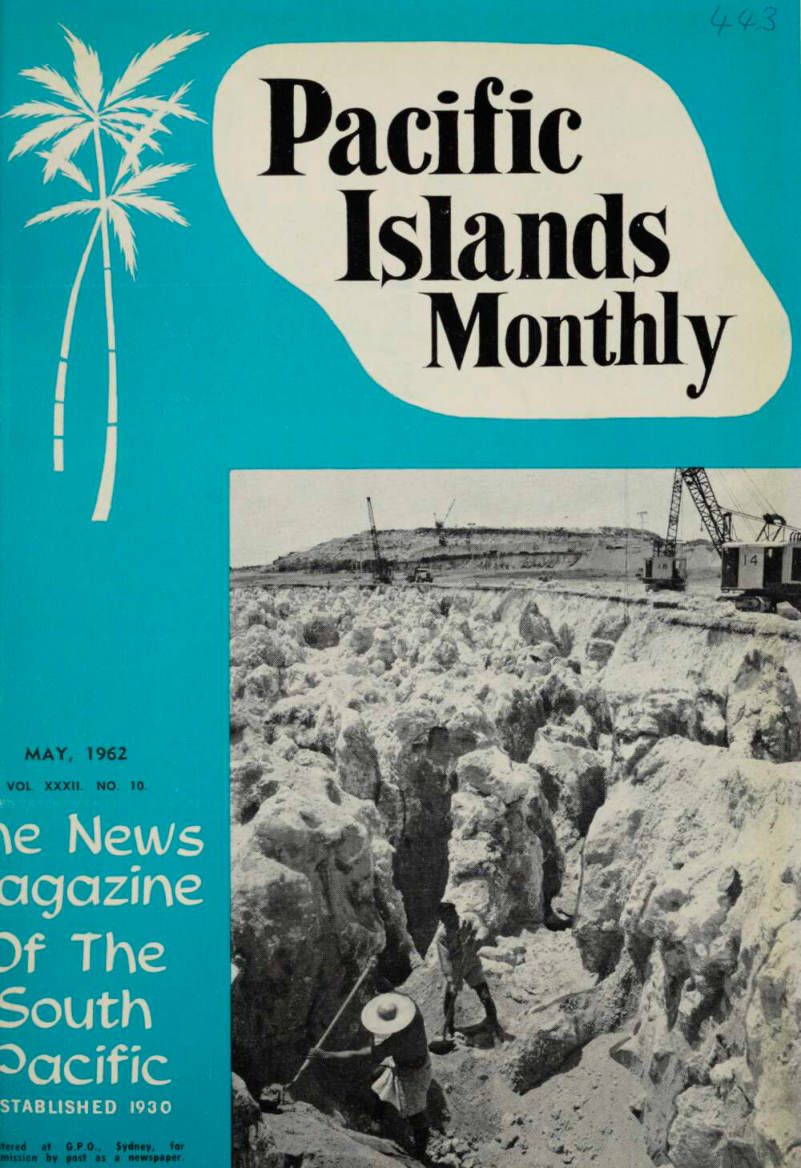 1
1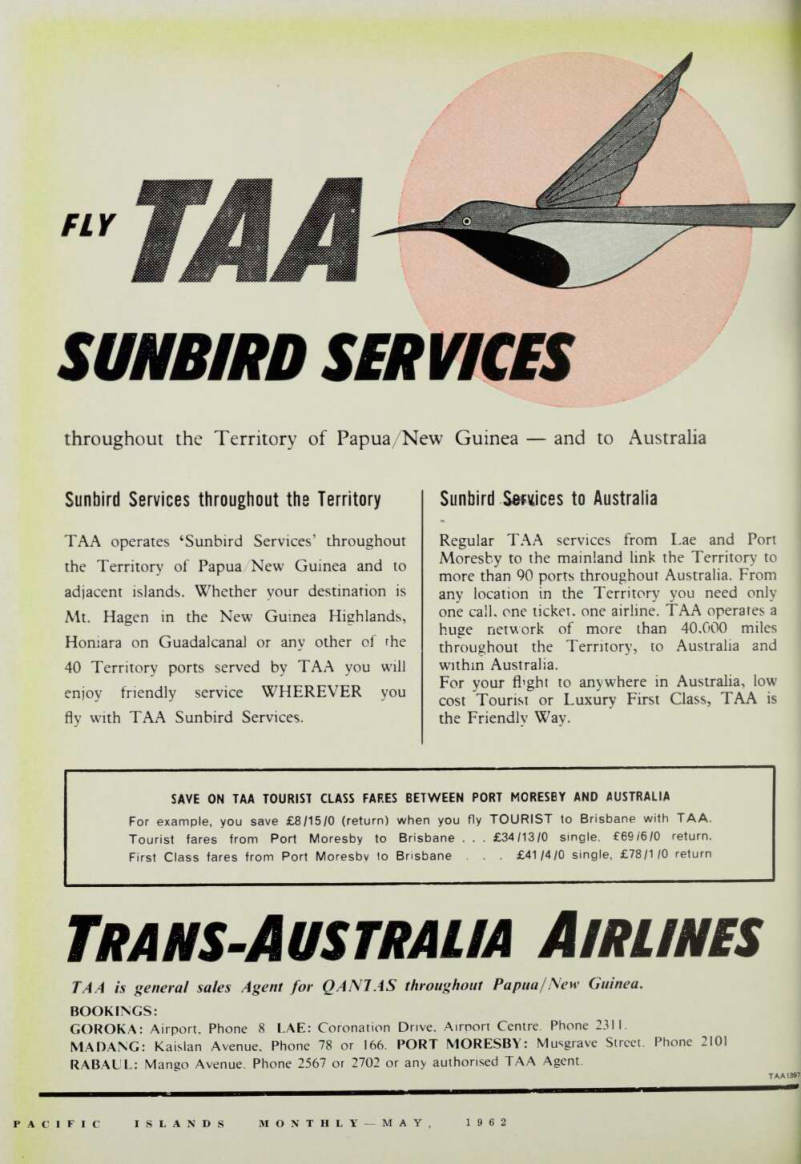 2
2 3
3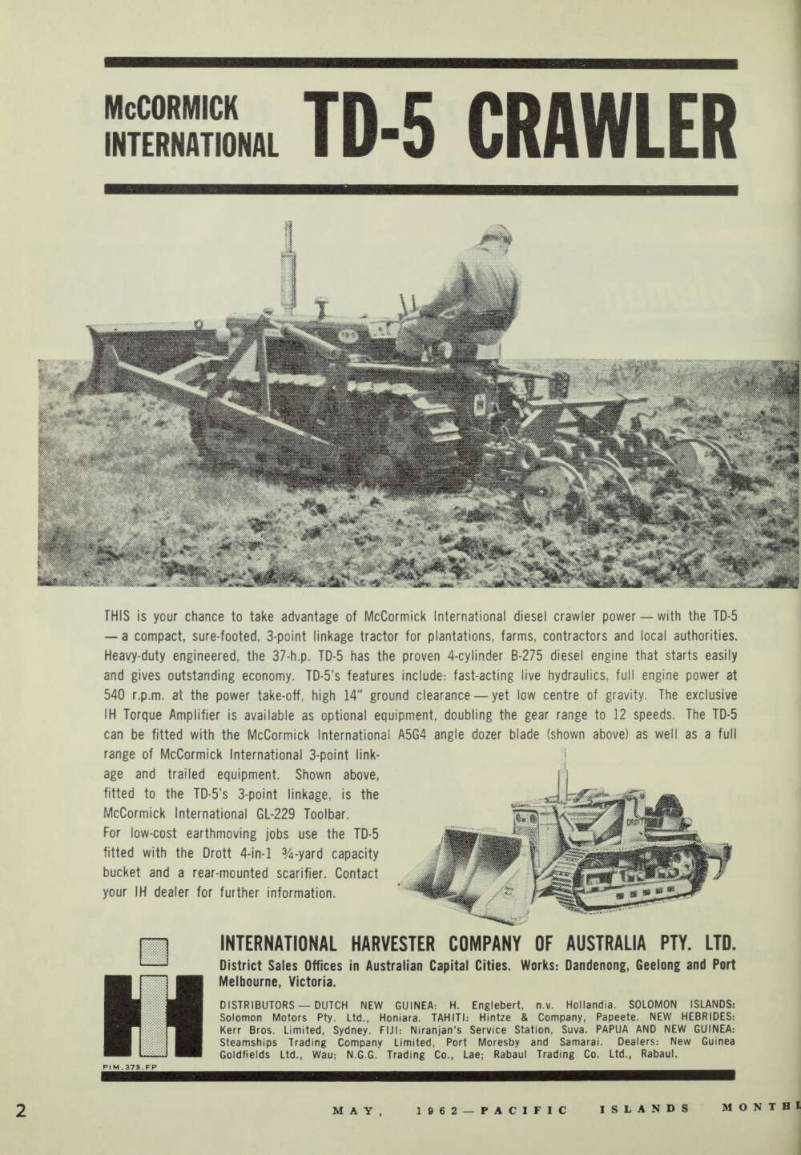 4
4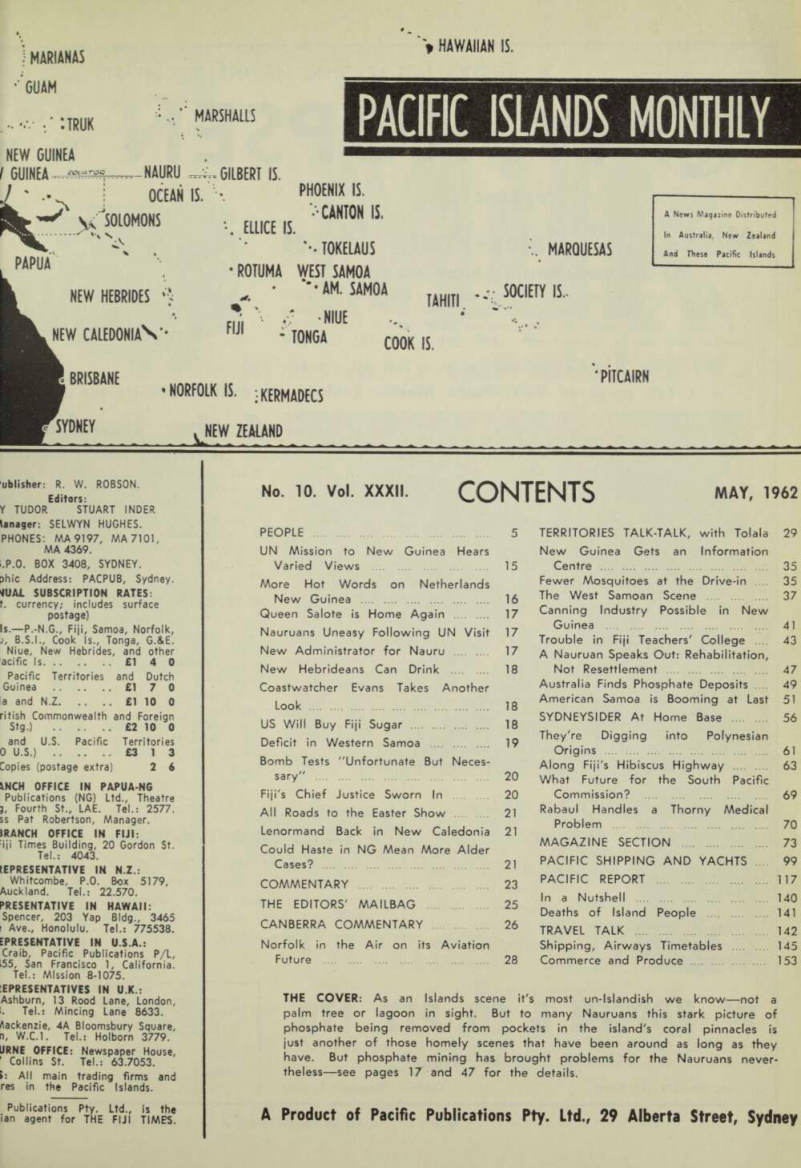 5
5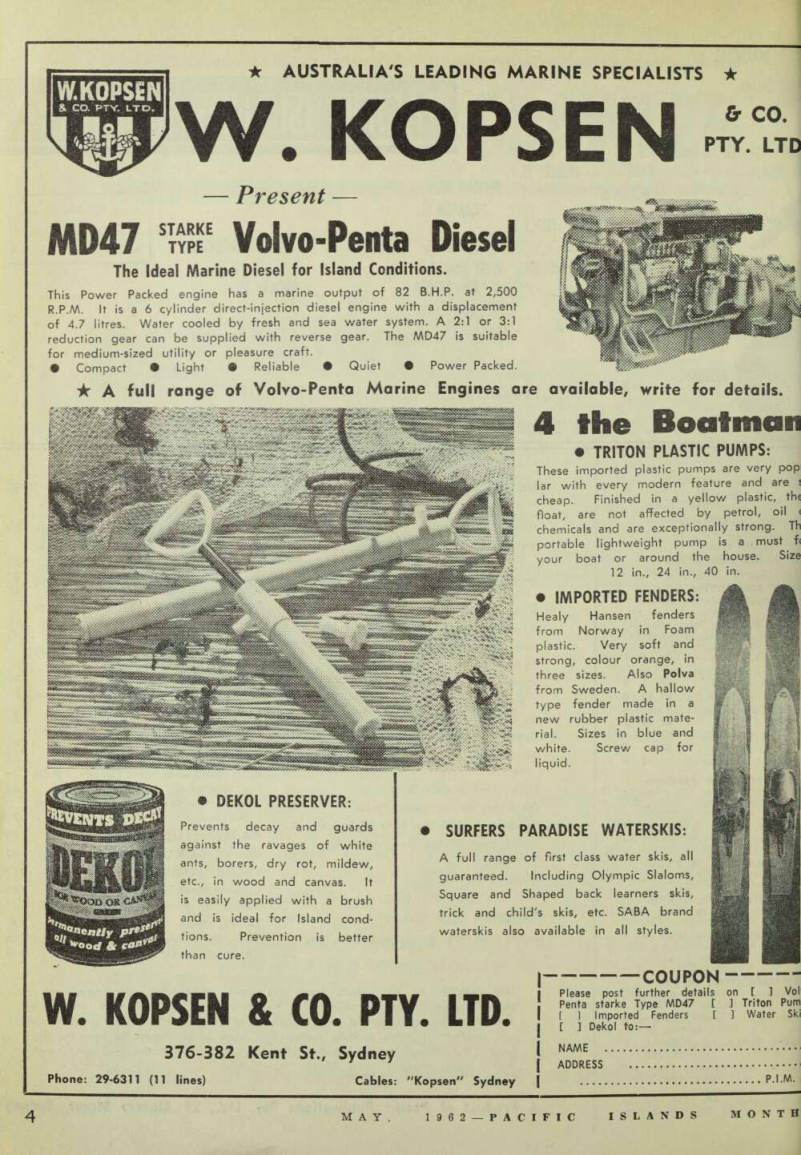 6
6 7
7 8
8 9
9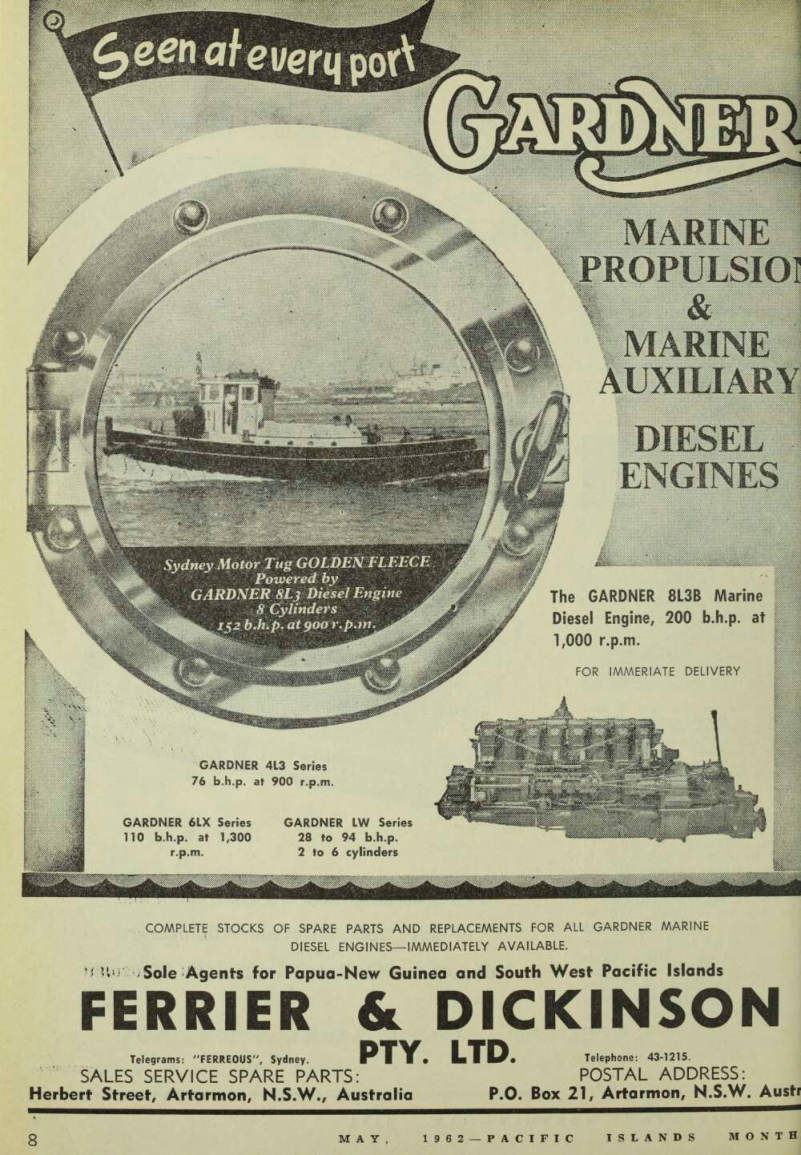 10
10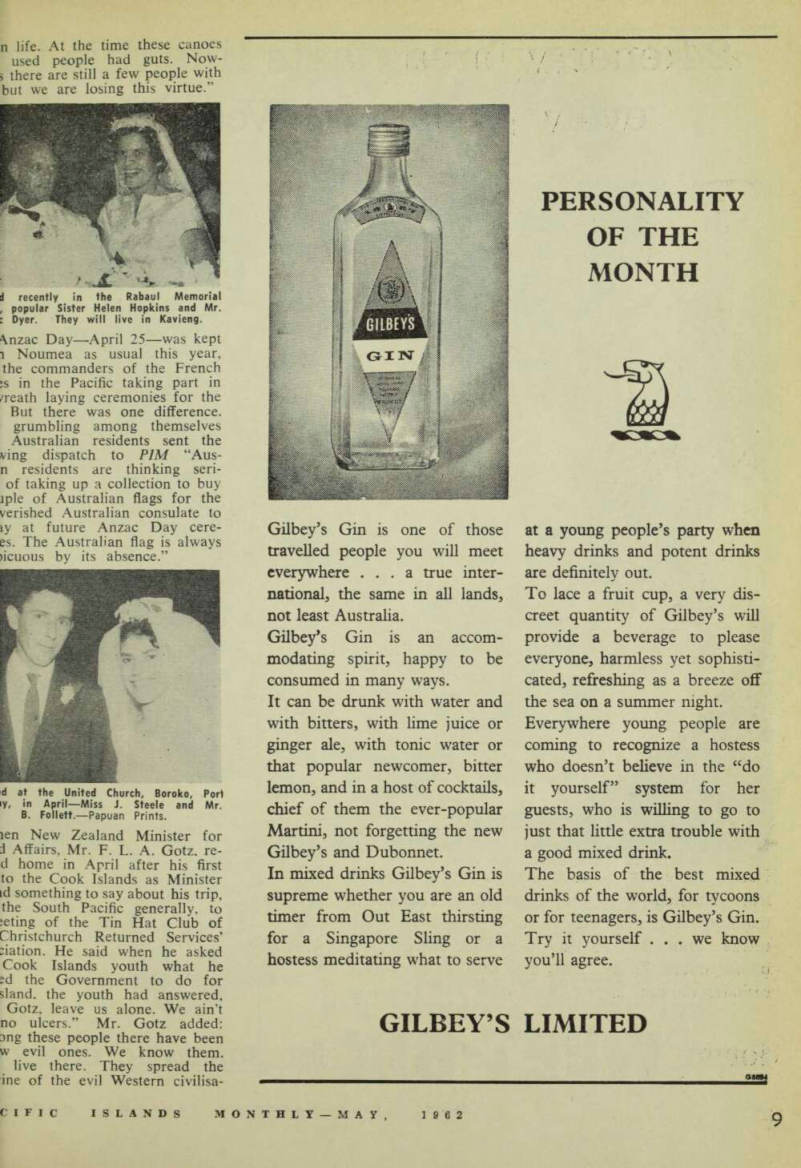 11
11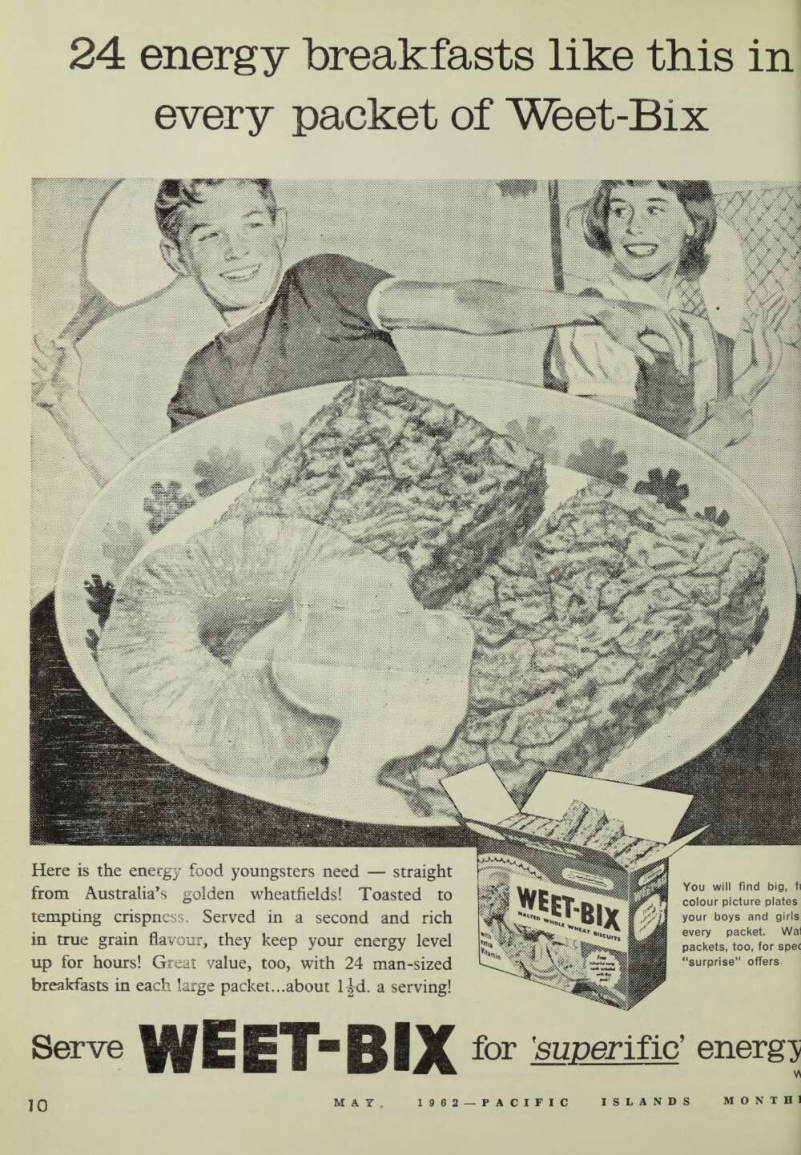 12
12 13
13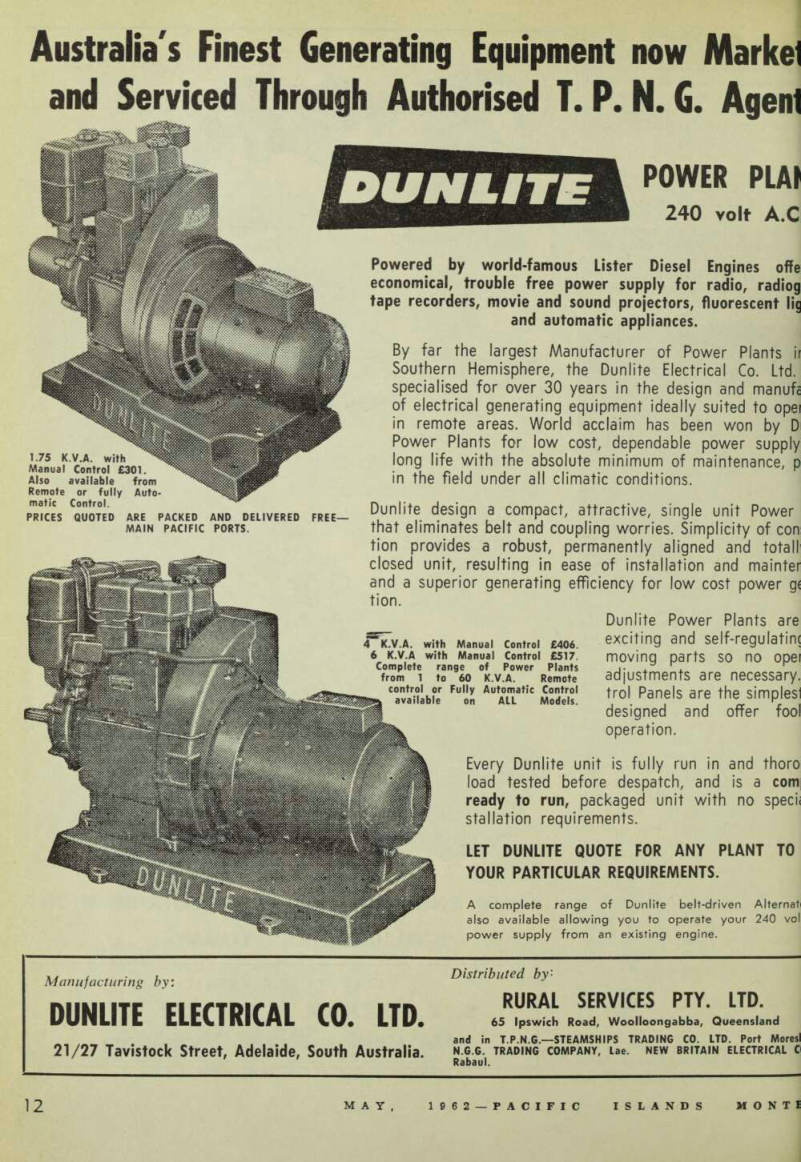 14
14 15
15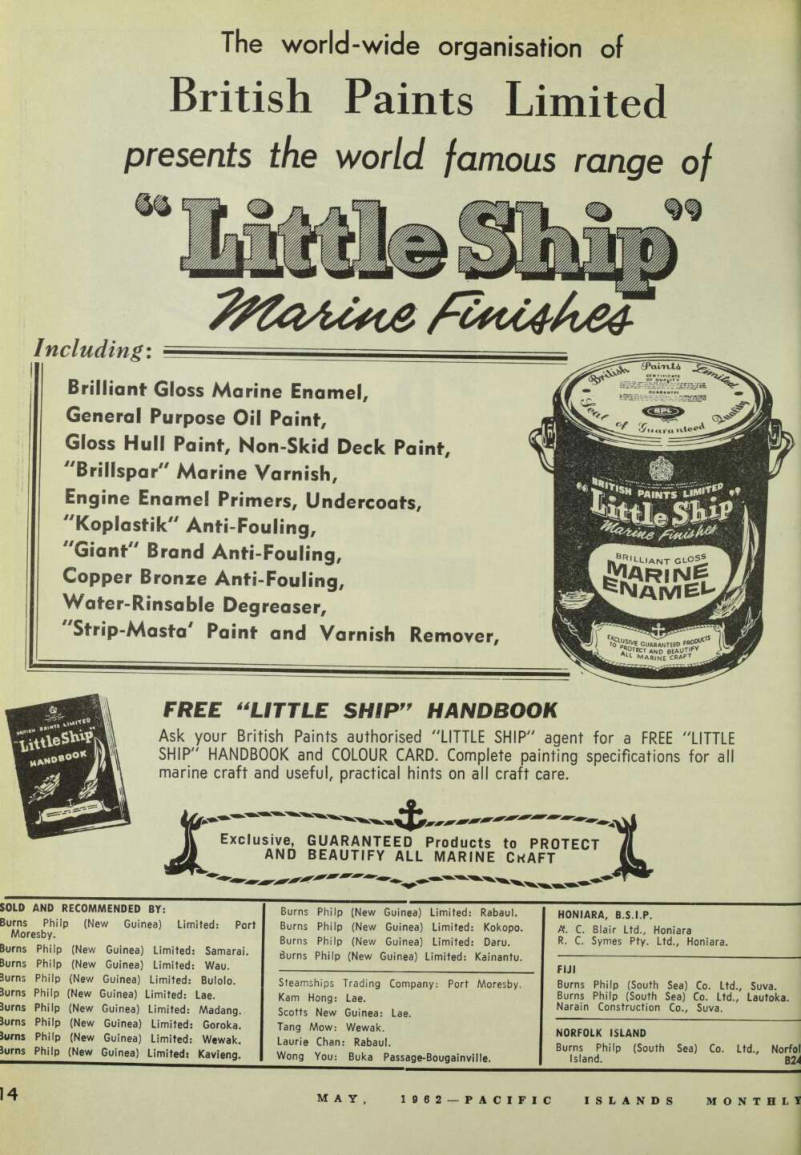 16
16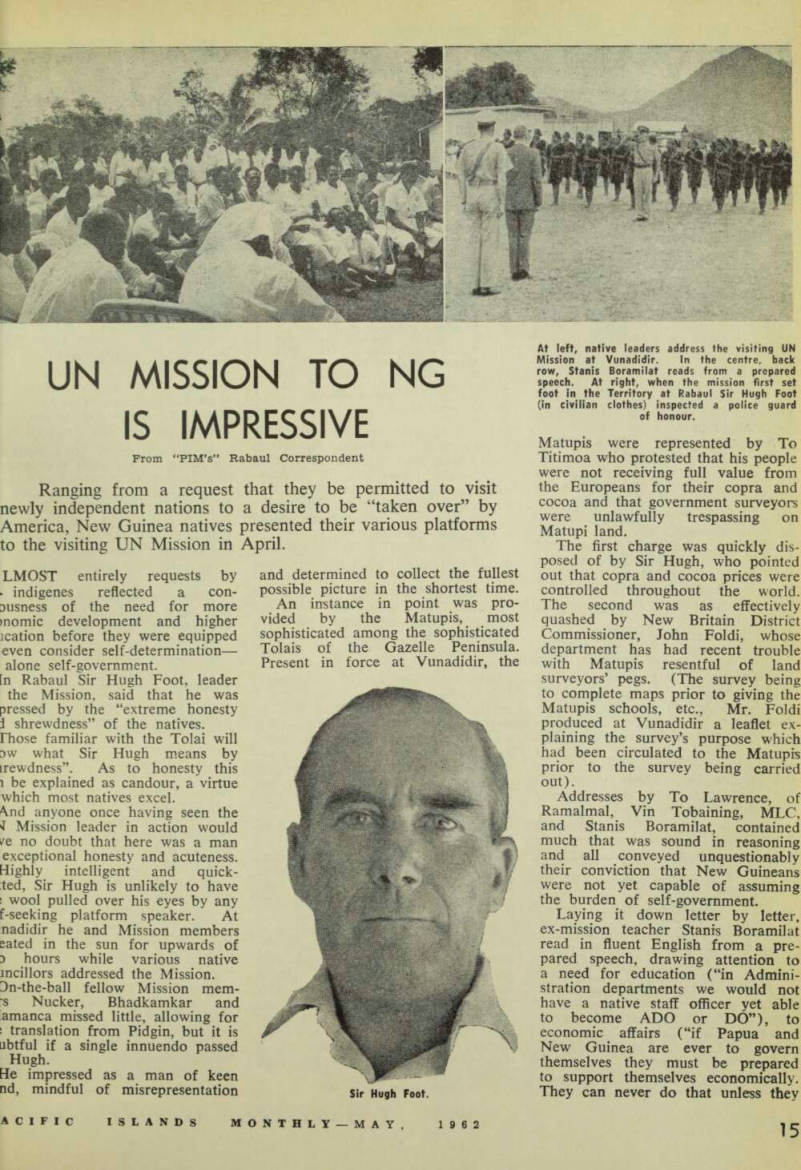 17
17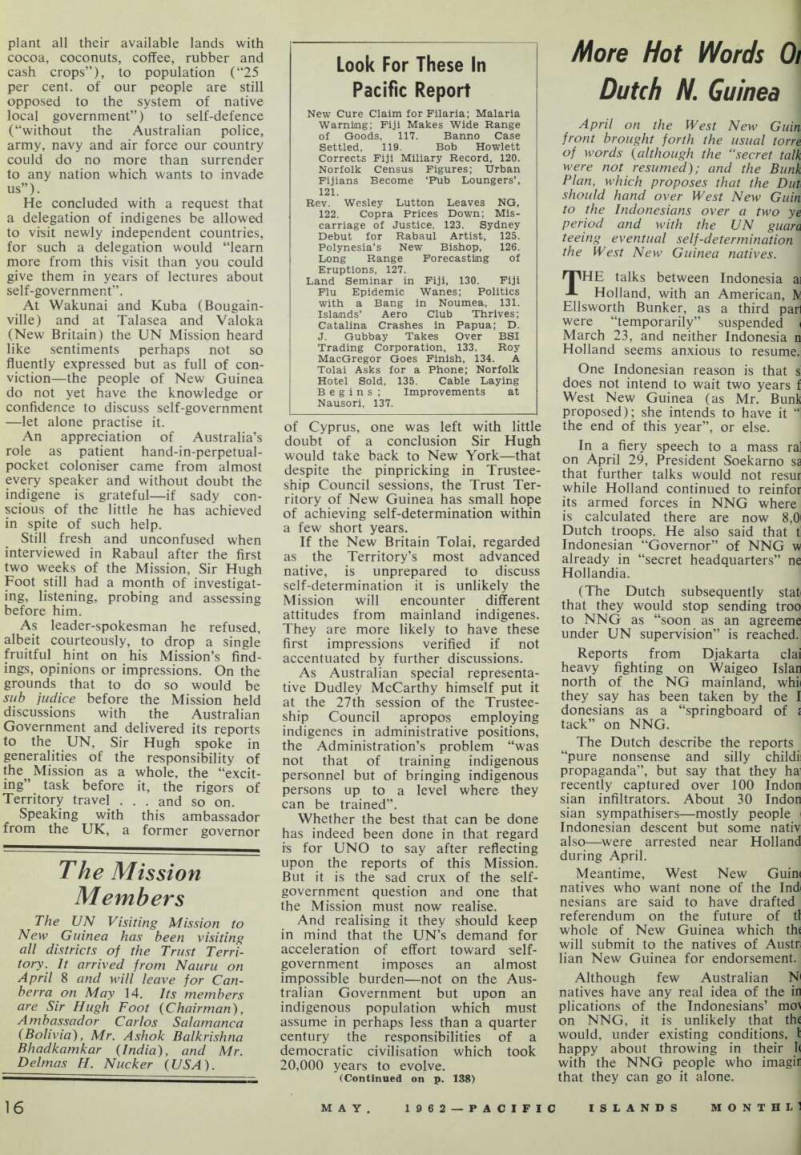 18
18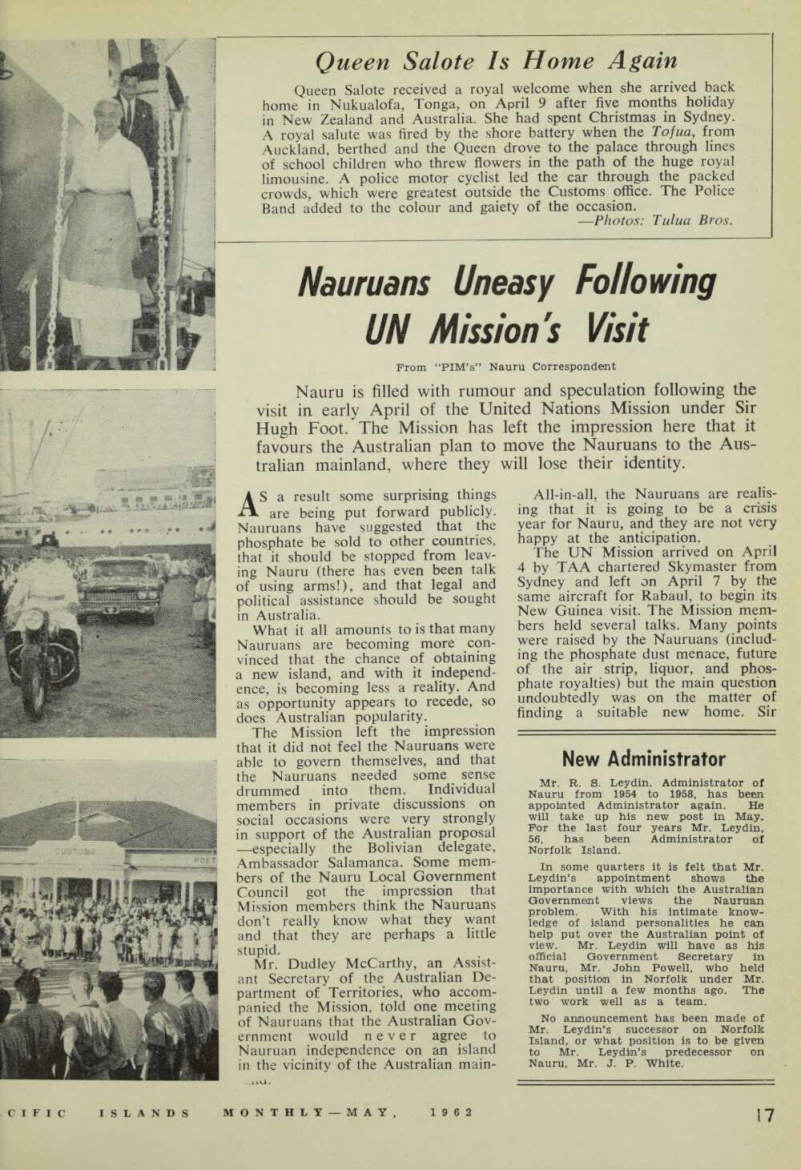 19
19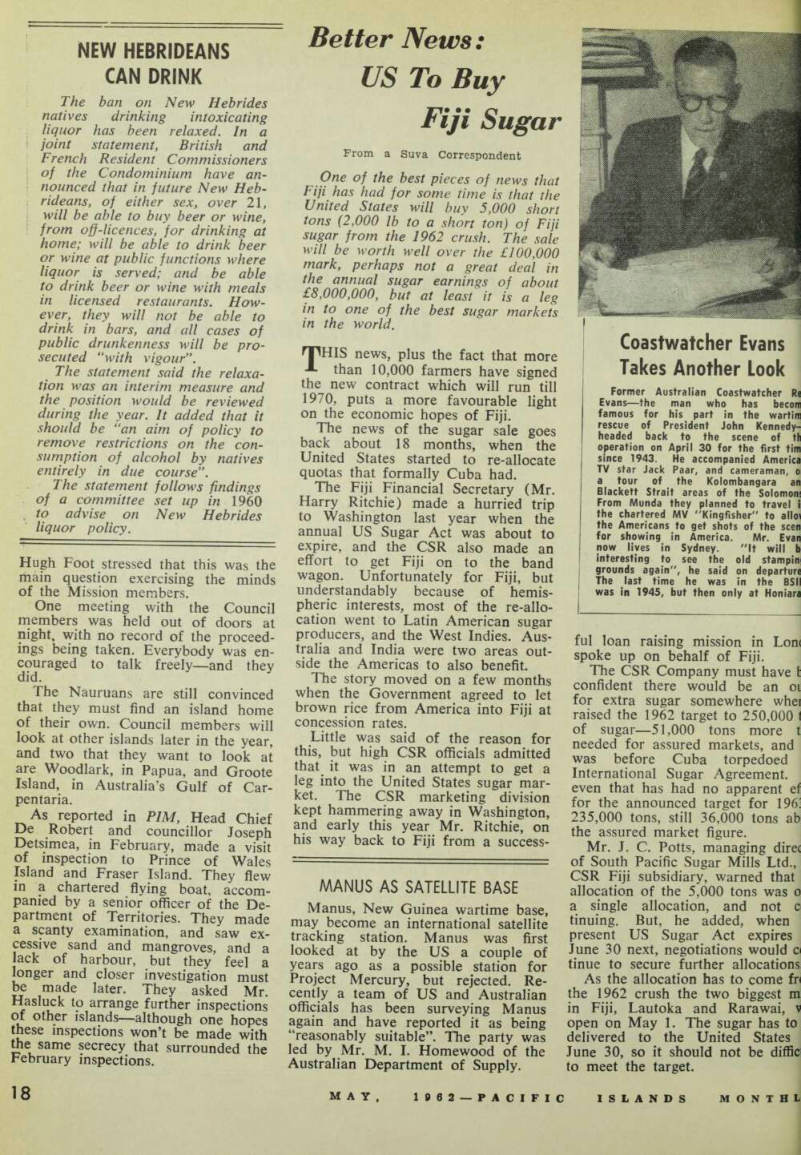 20
20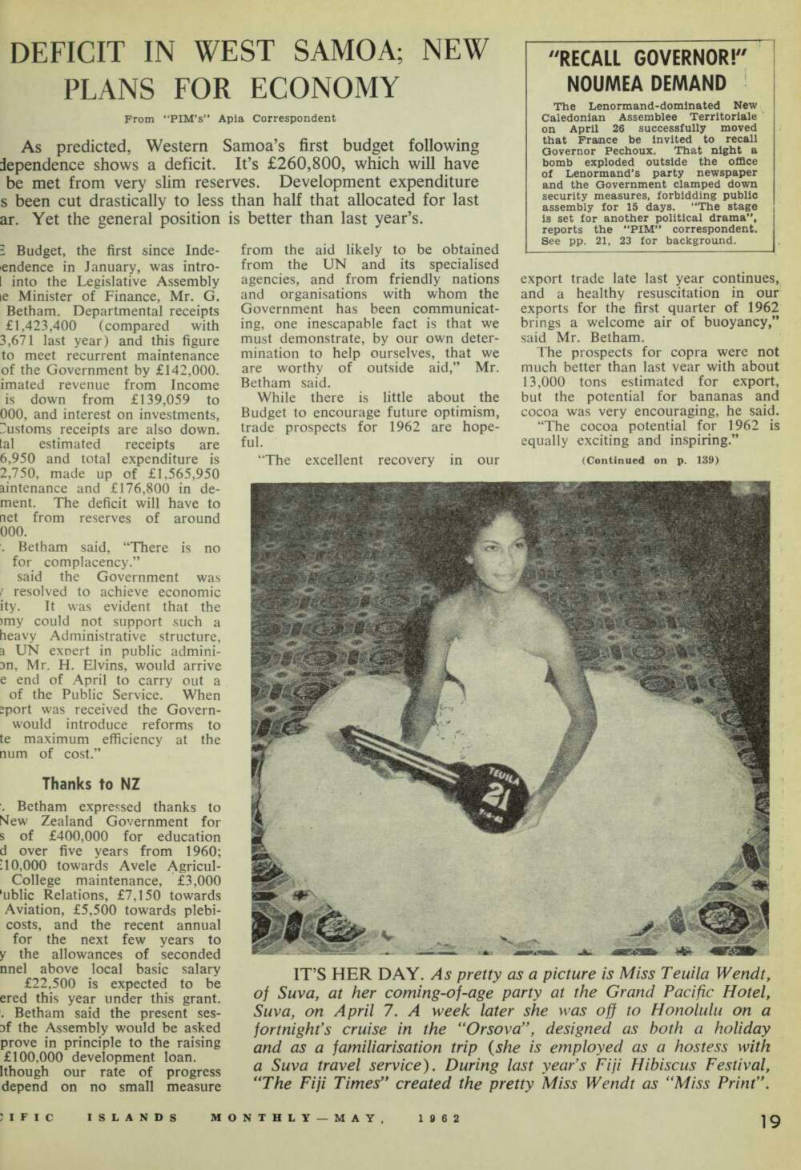 21
21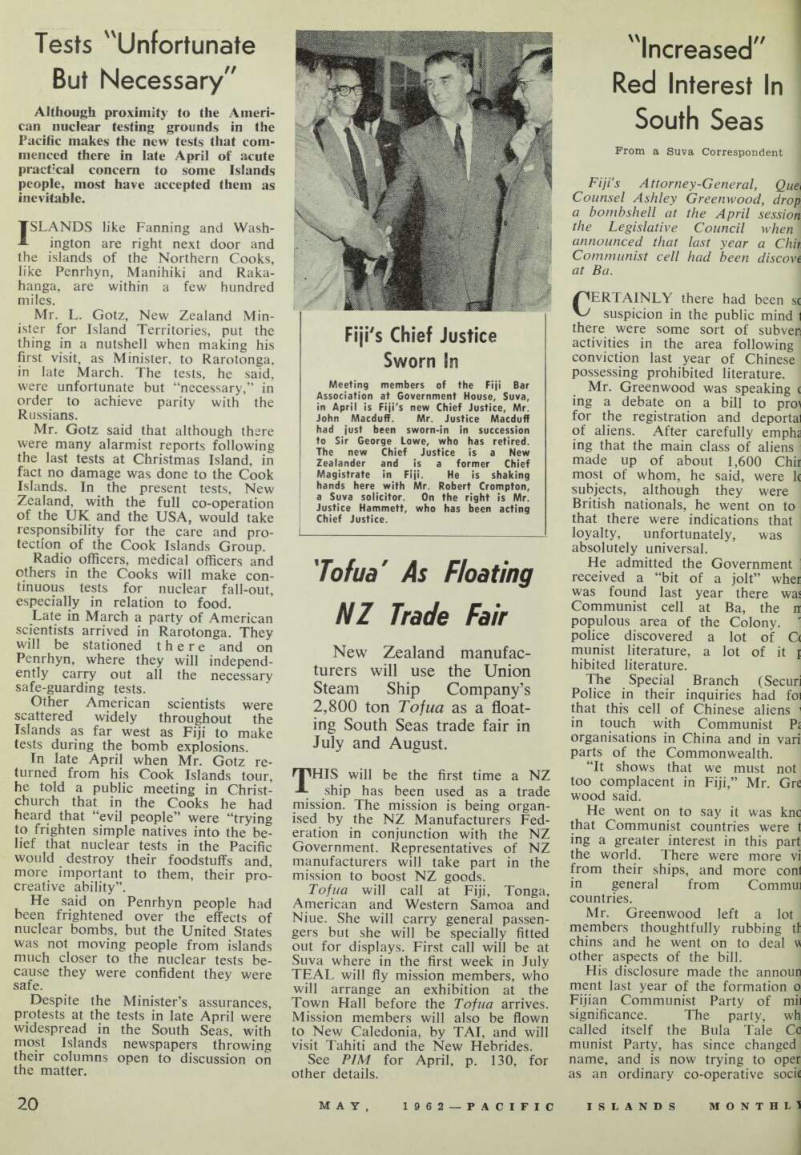 22
22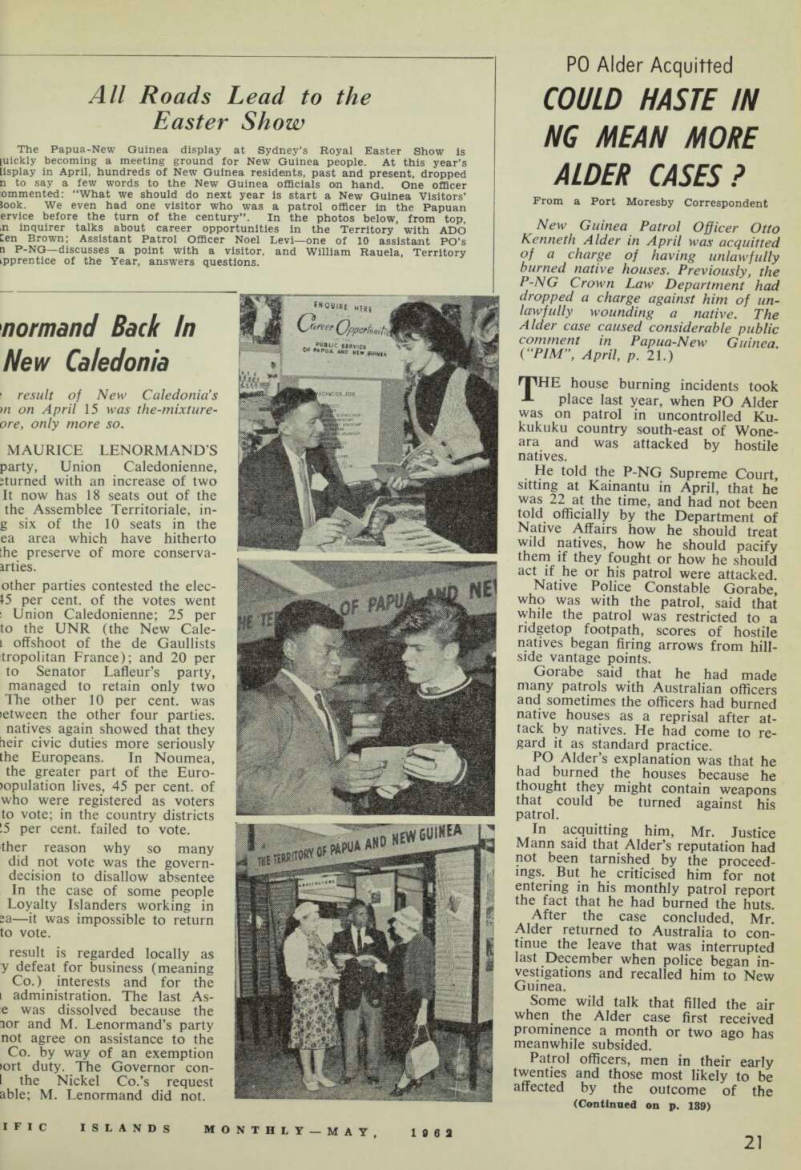 23
23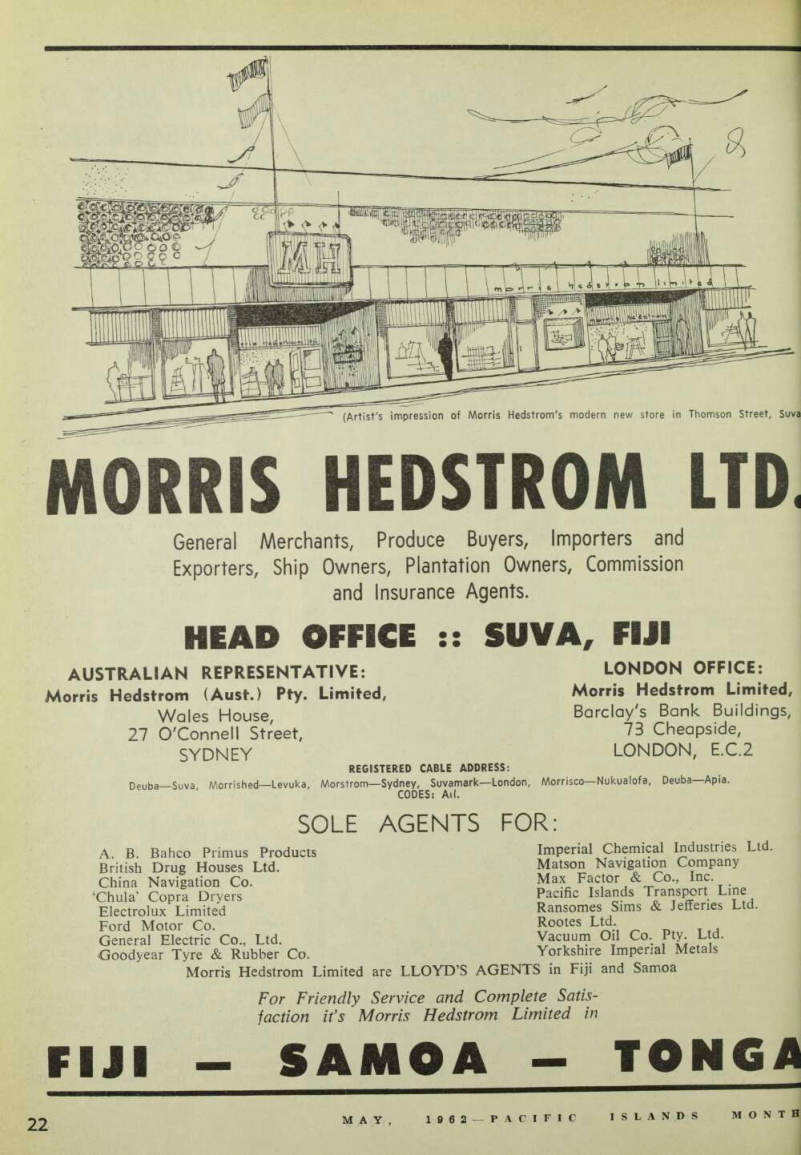 24
24 25
25 26
26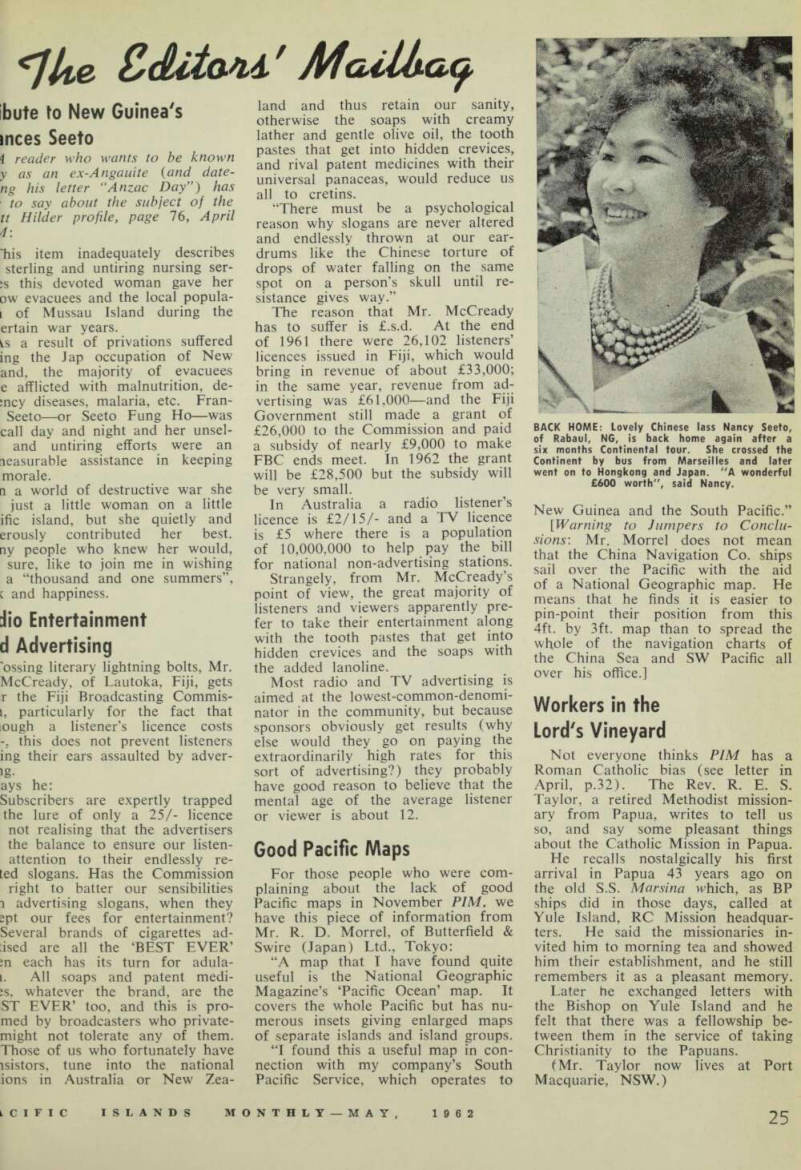 27
27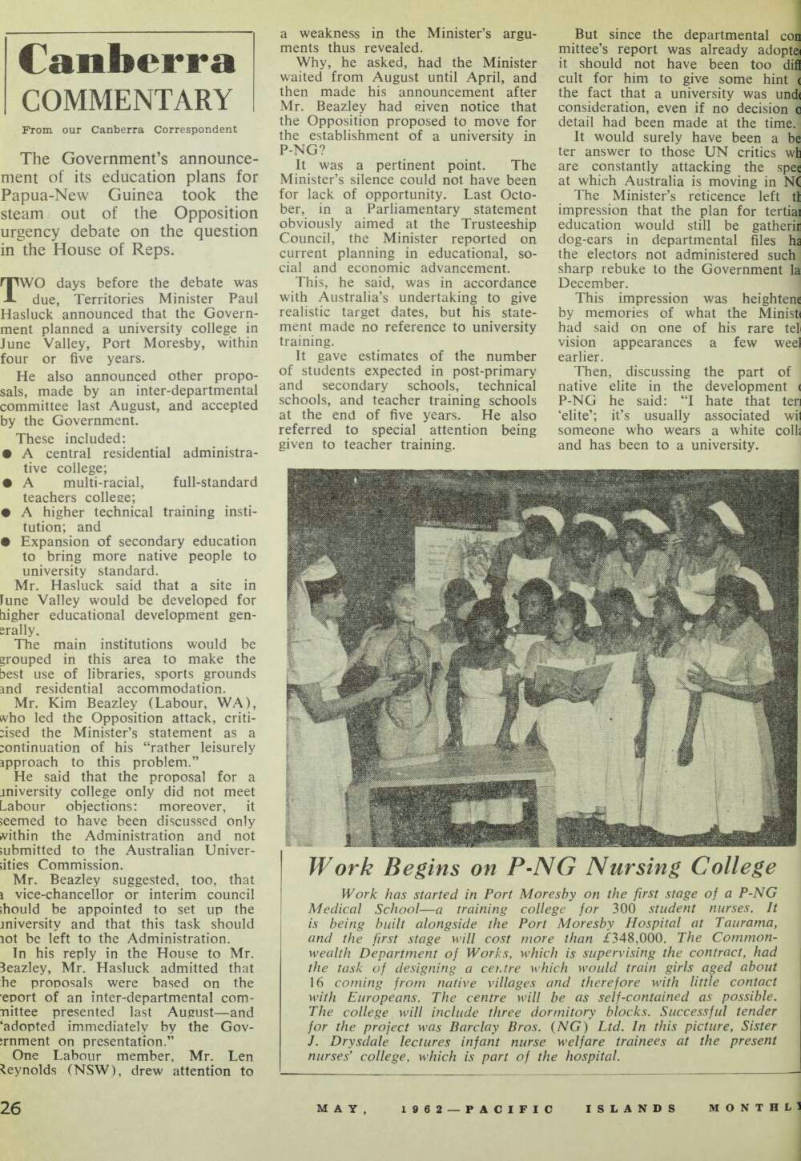 28
28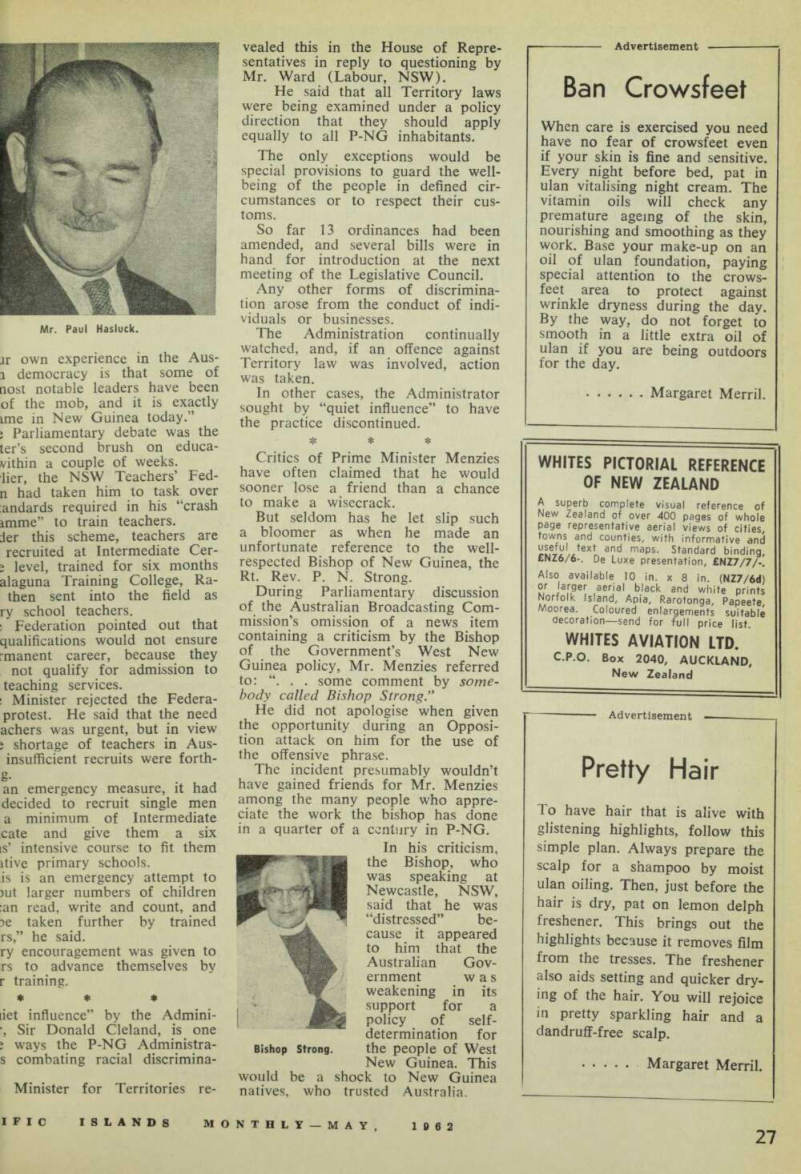 29
29 30
30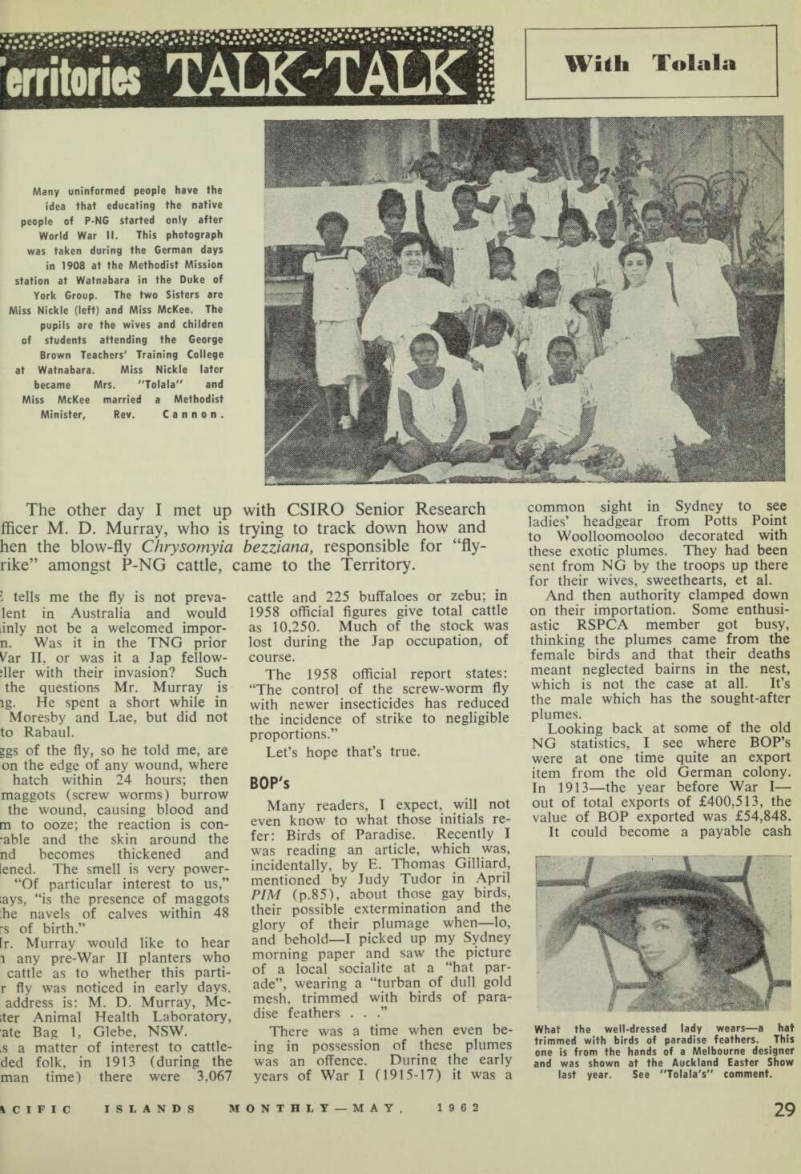 31
31 32
32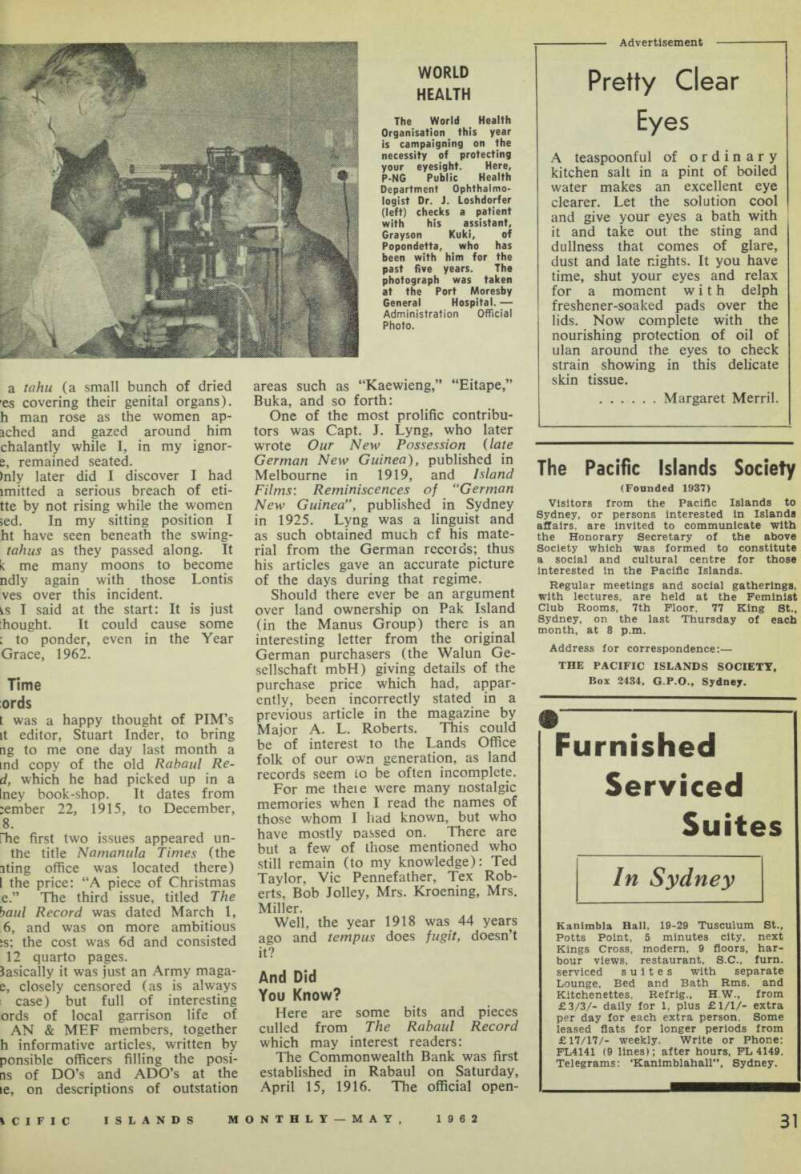 33
33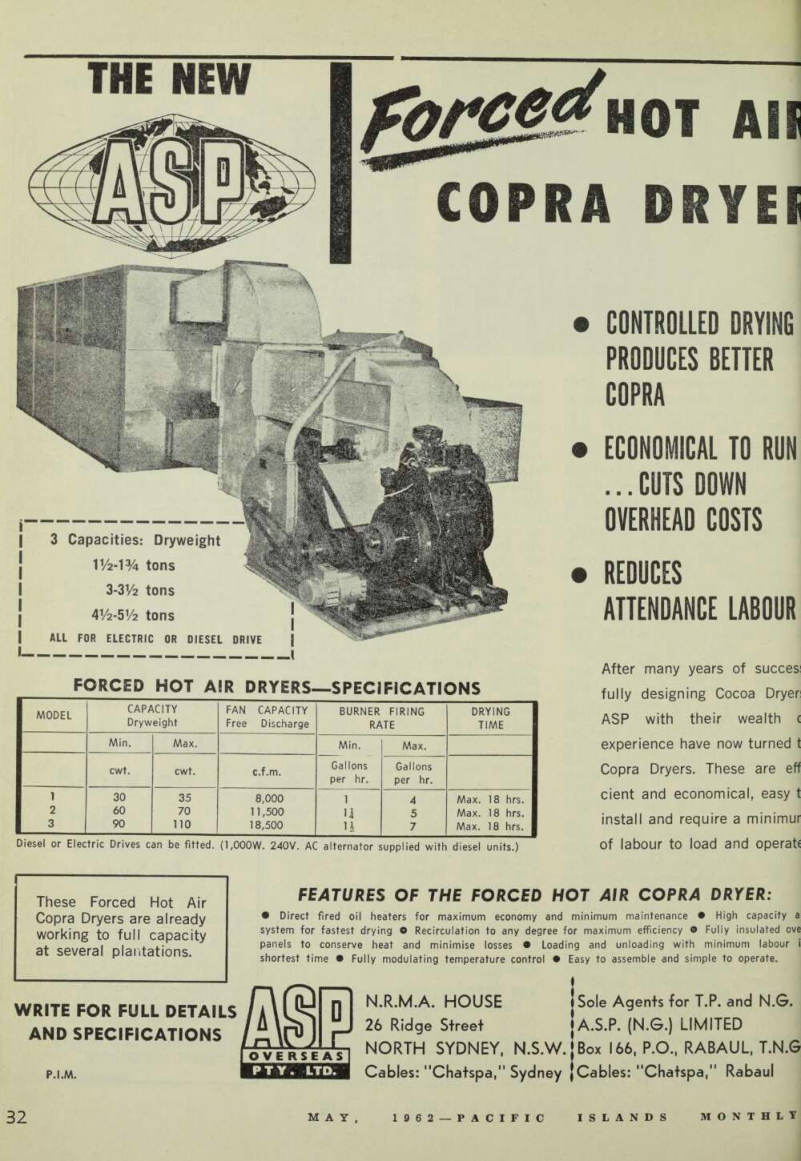 34
34 35
35 36
36 37
37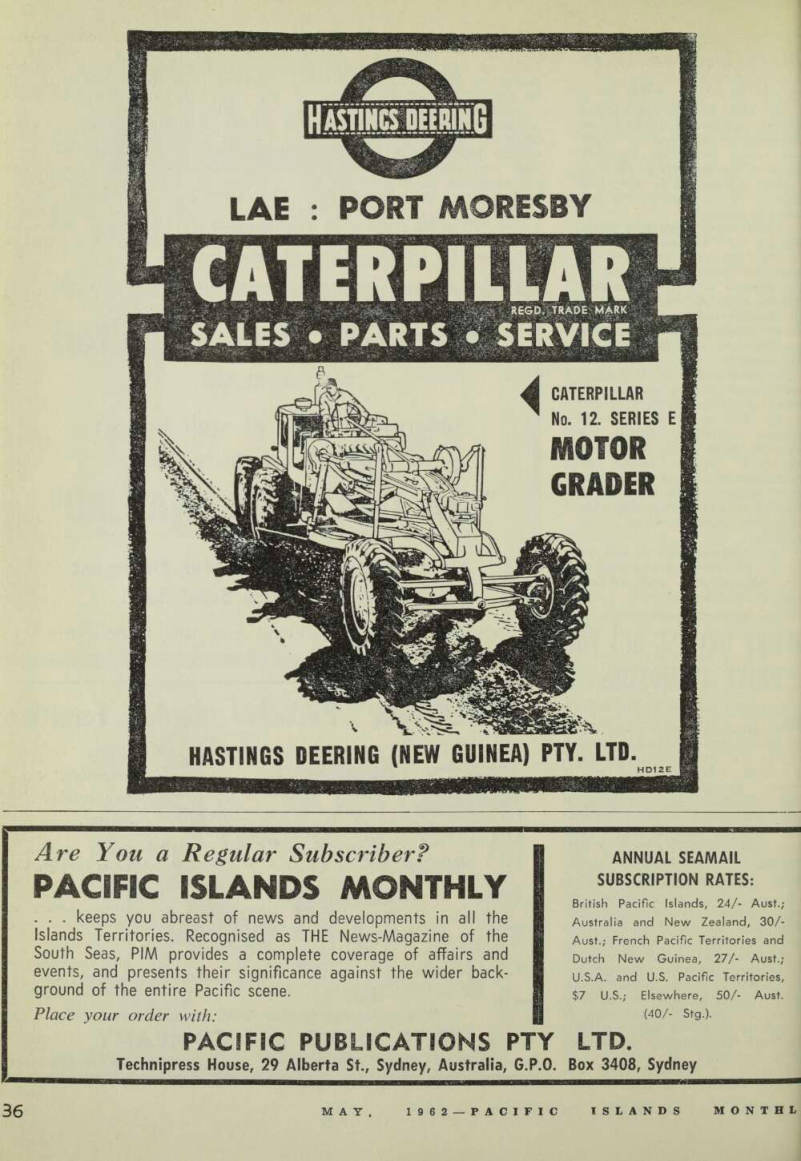 38
38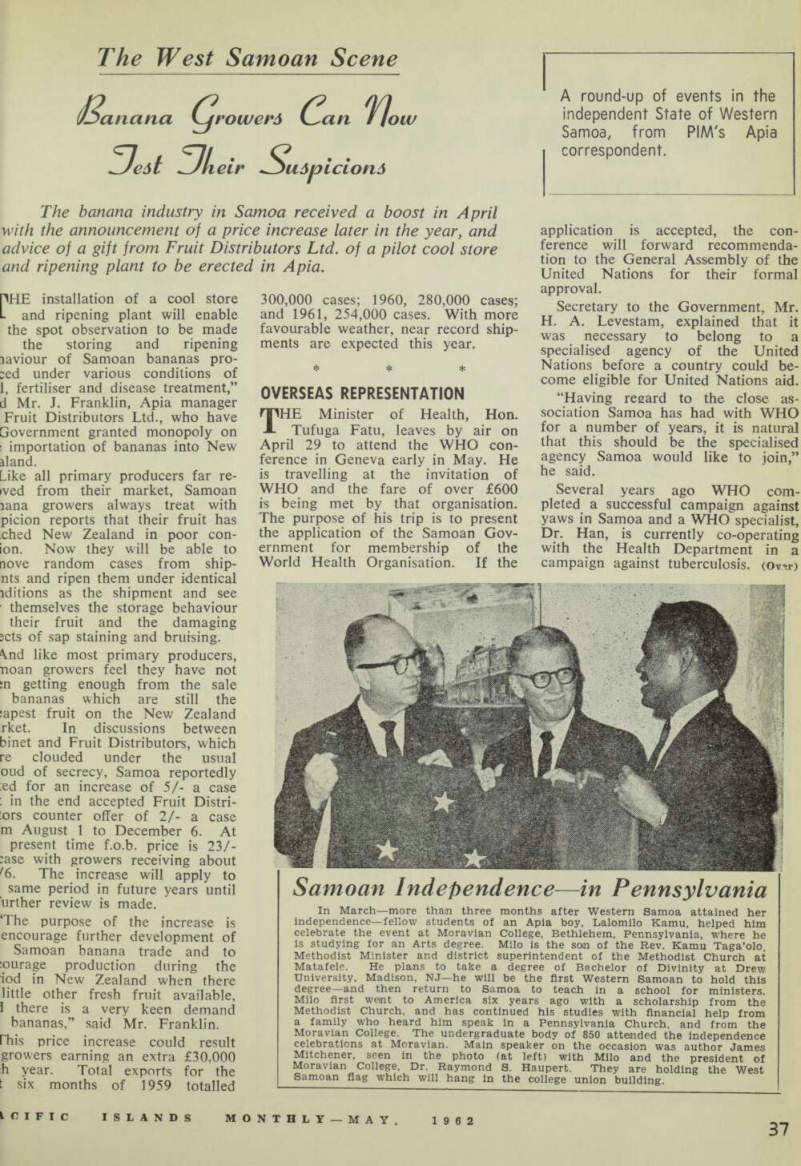 39
39 40
40 41
41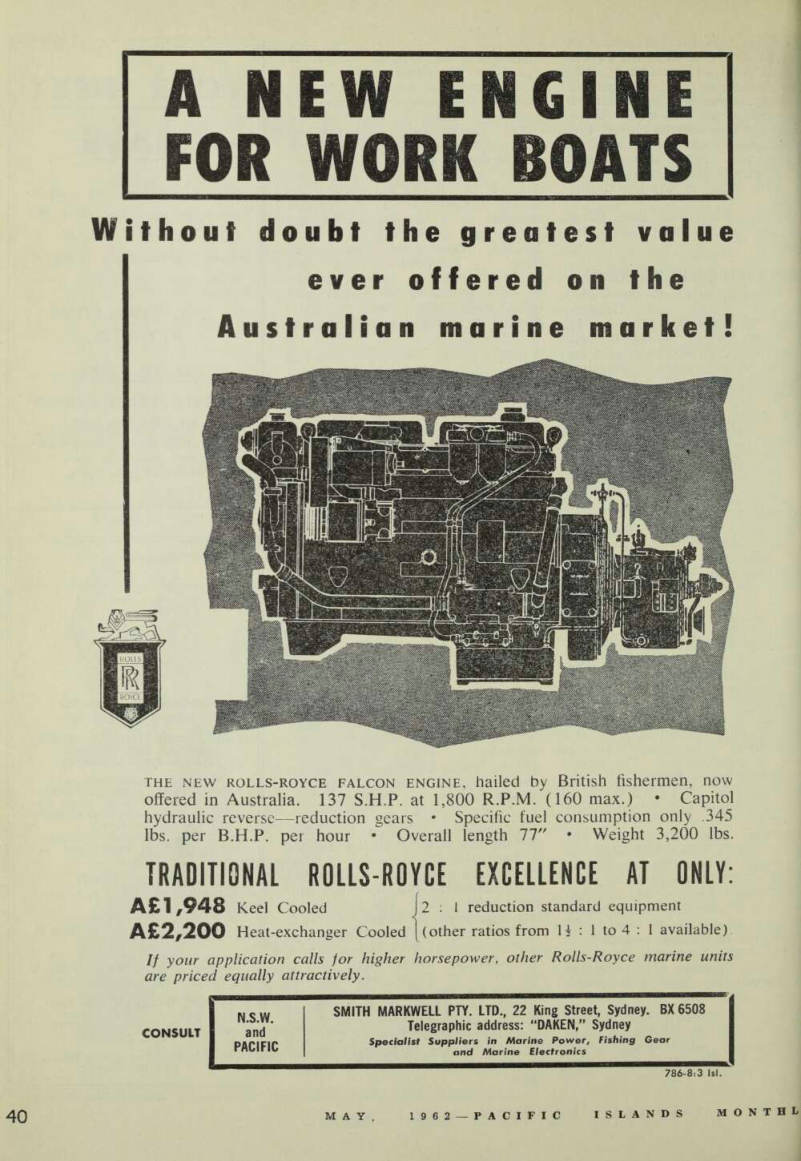 42
42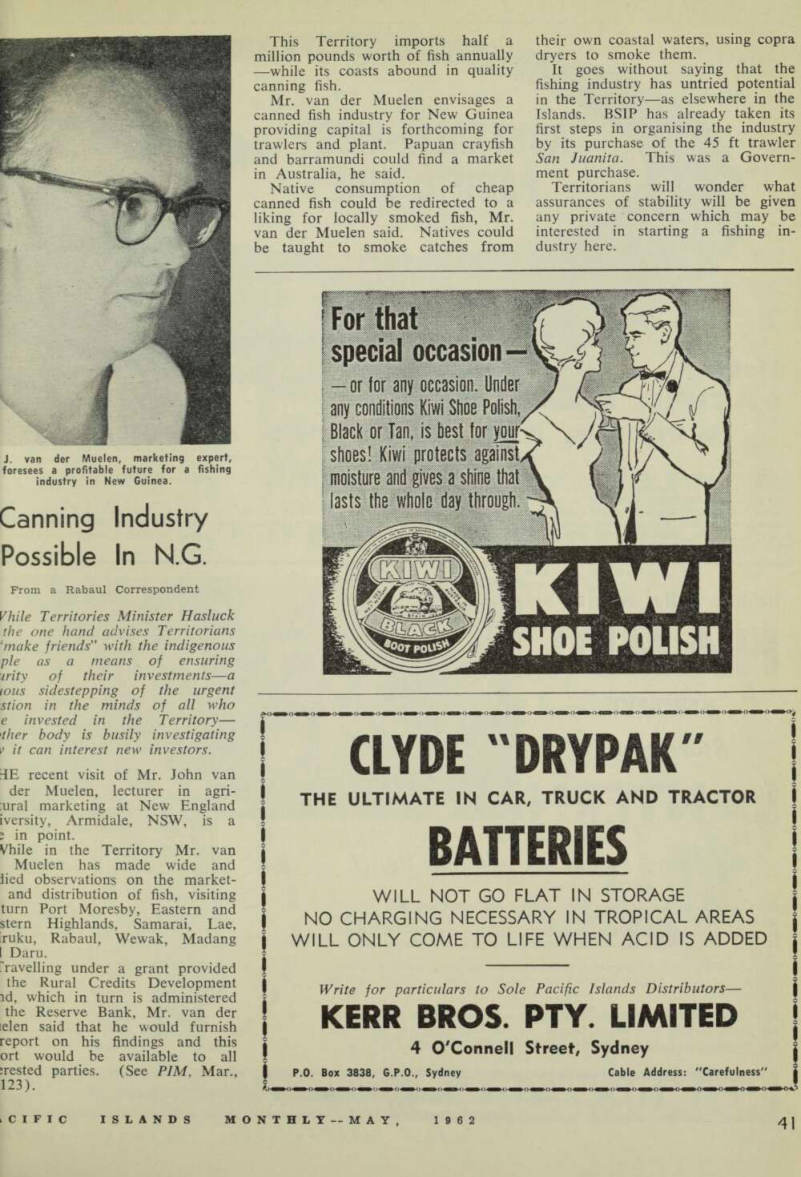 43
43 44
44 45
45 46
46 47
47 48
48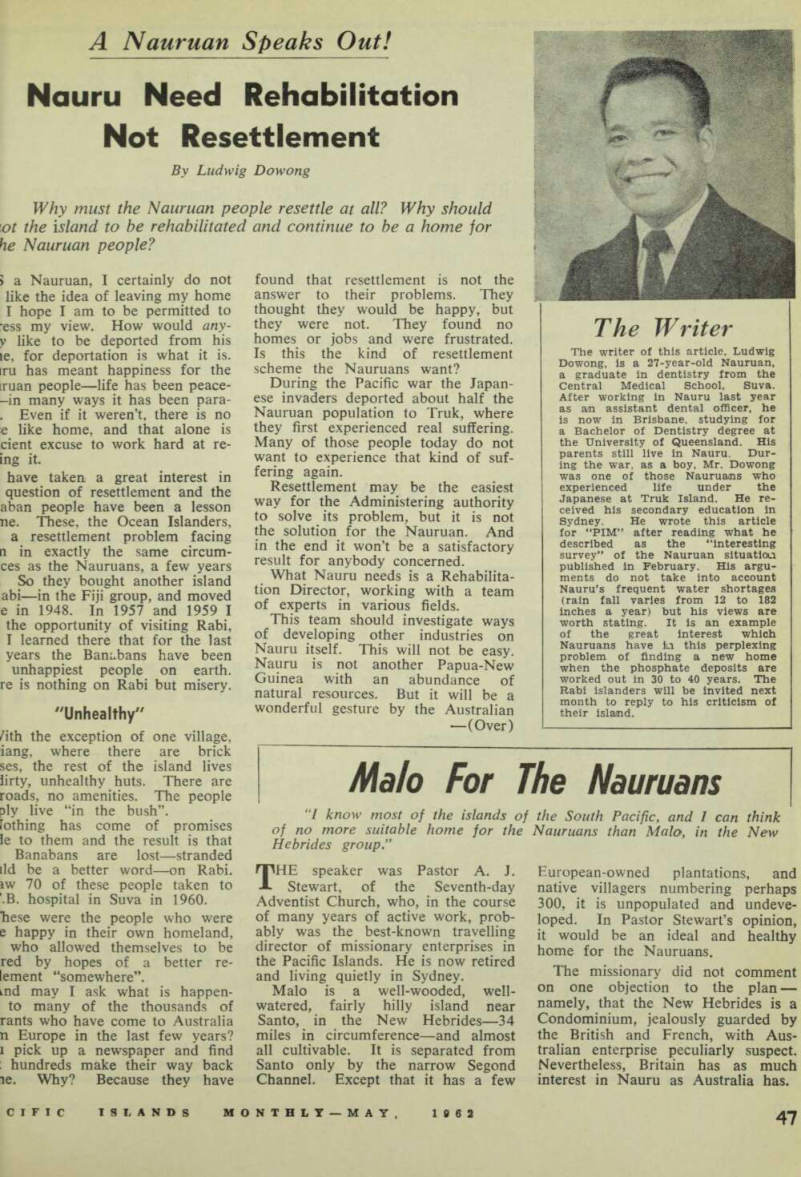 49
49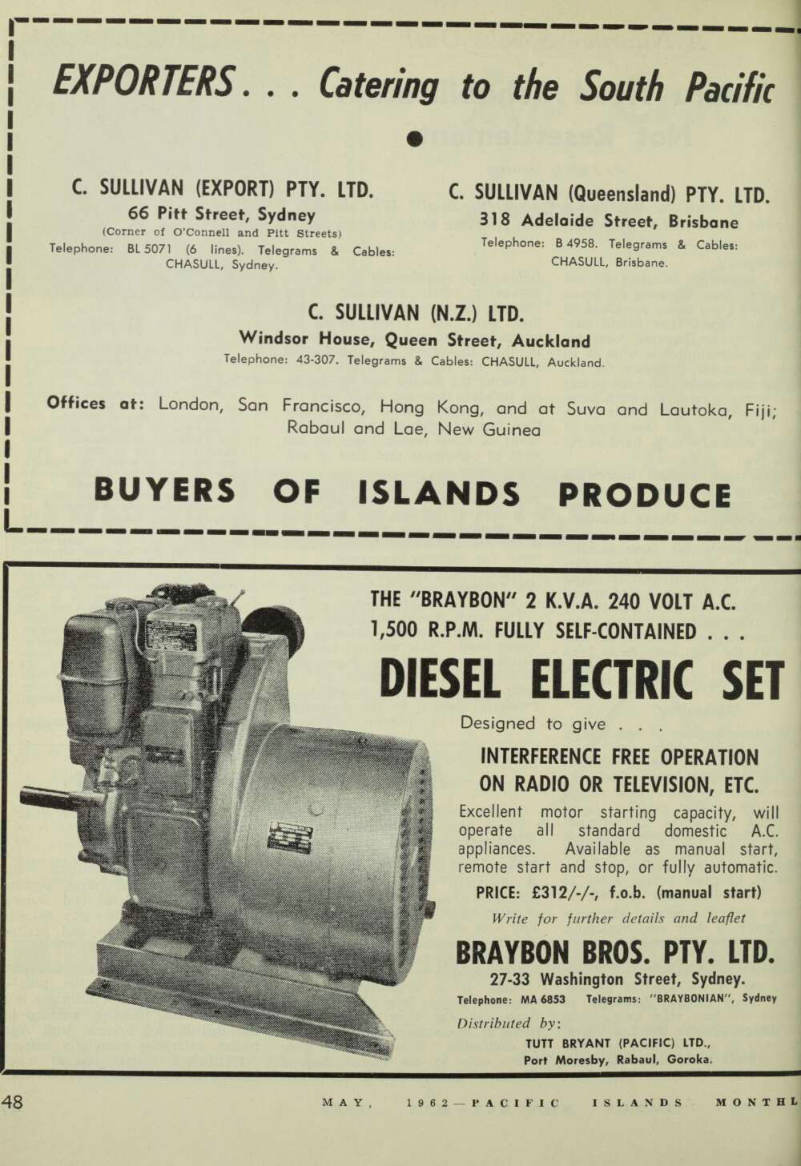 50
50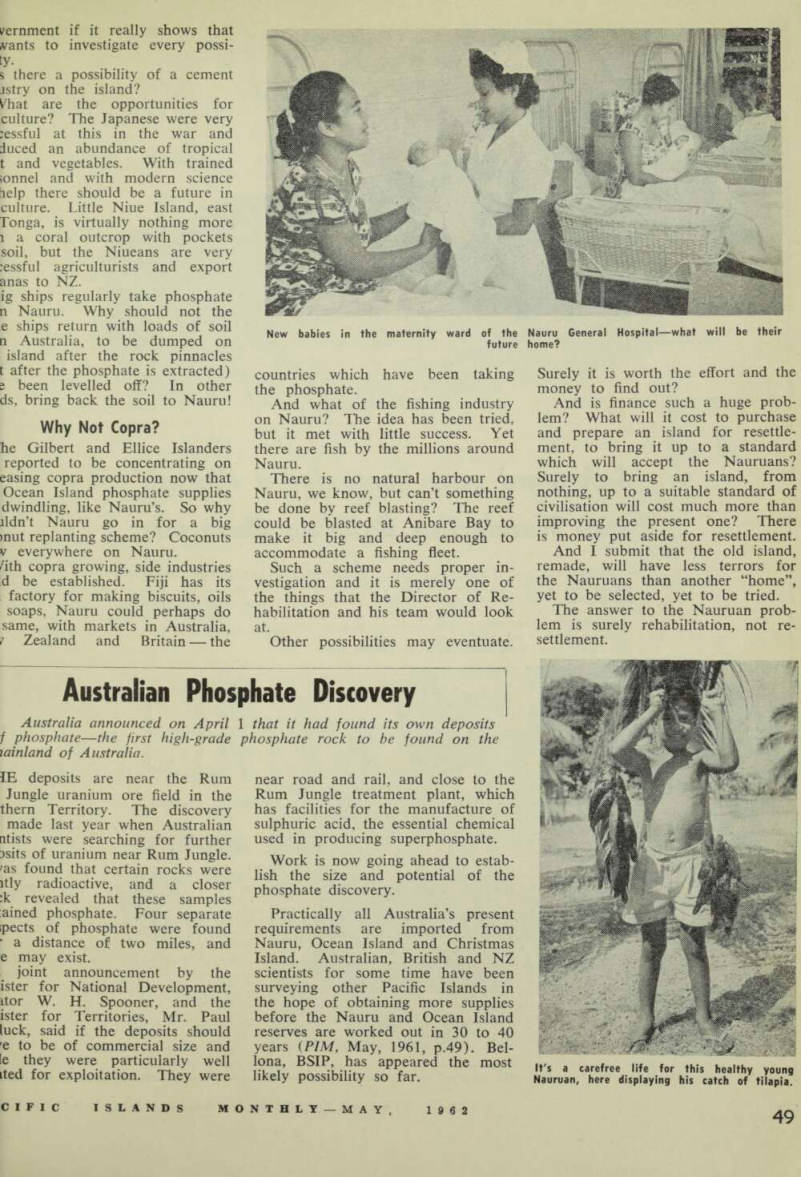 51
51 52
52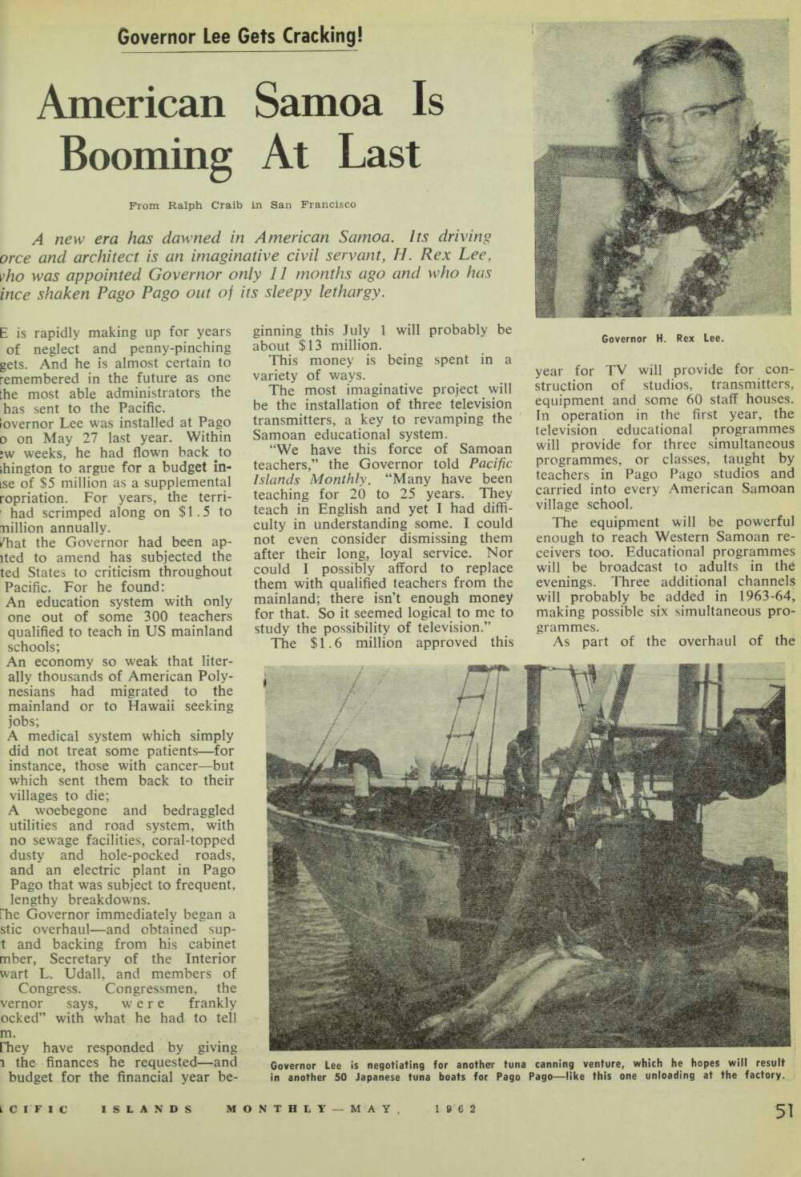 53
53 54
54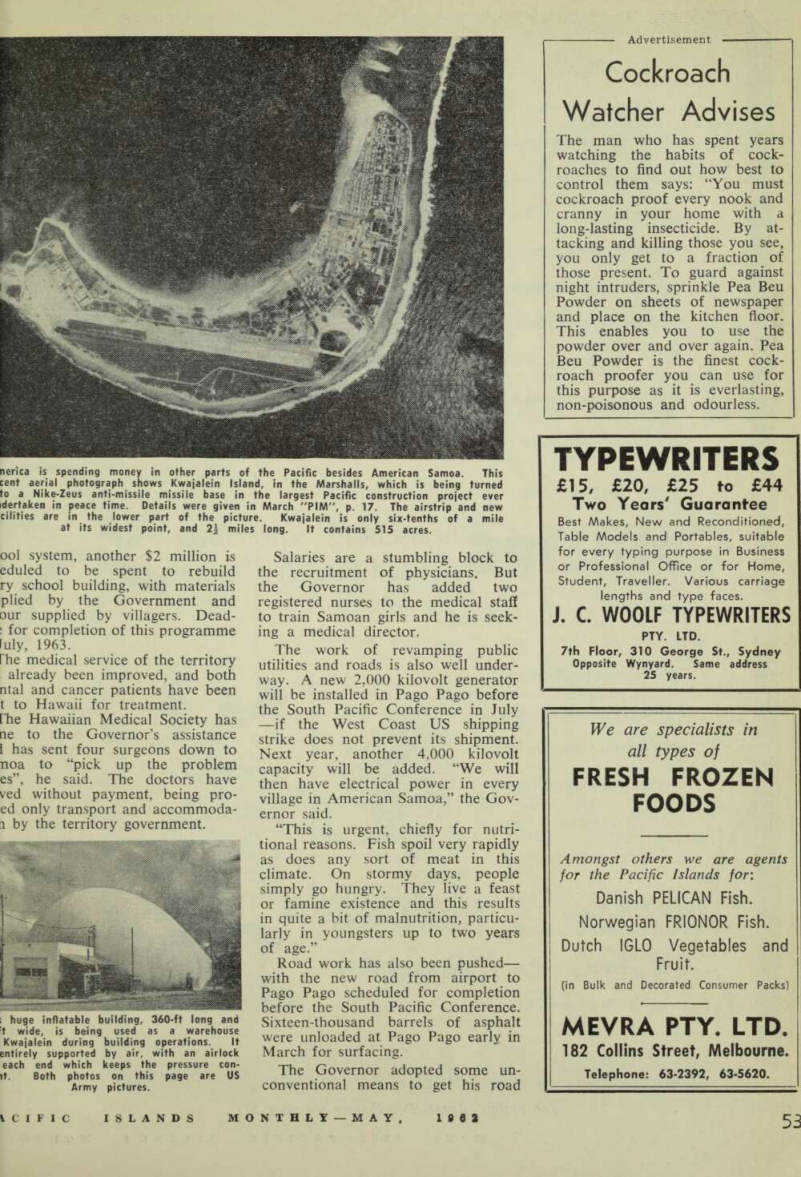 55
55 56
56 57
57 58
58 59
59 60
60 61
61 62
62 63
63 64
64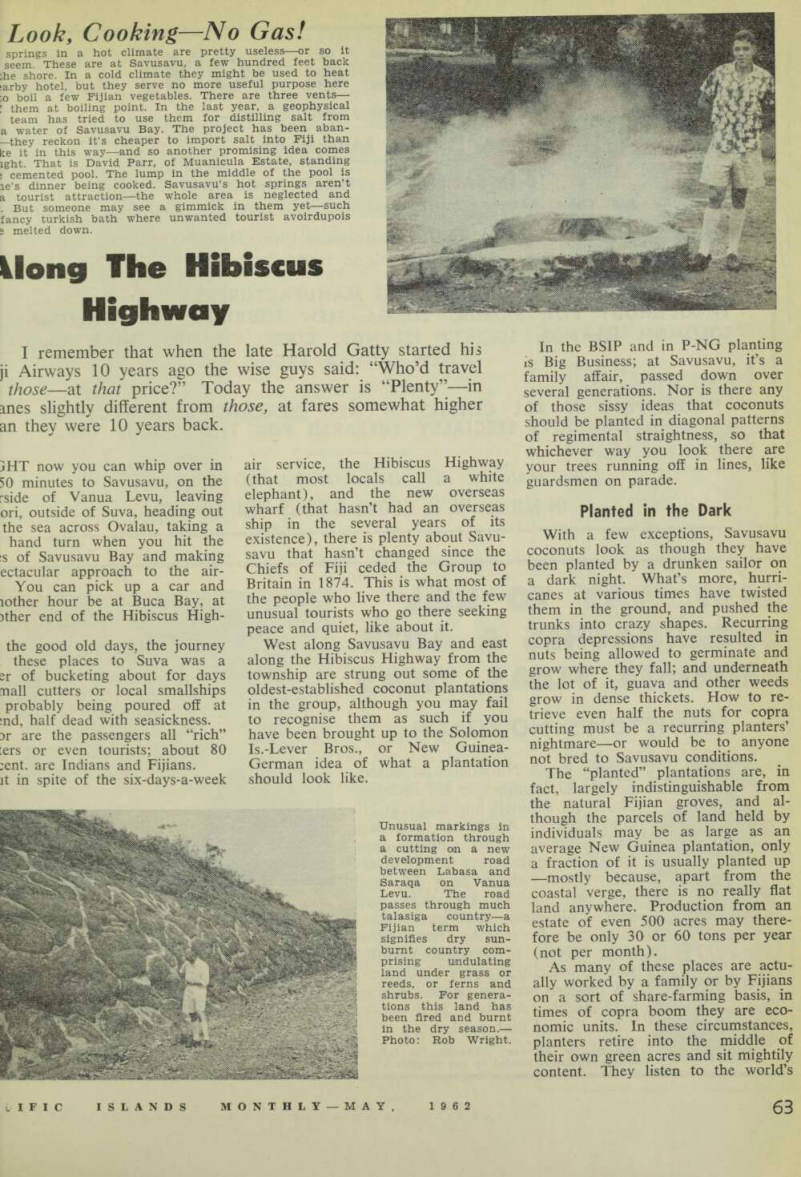 65
65 66
66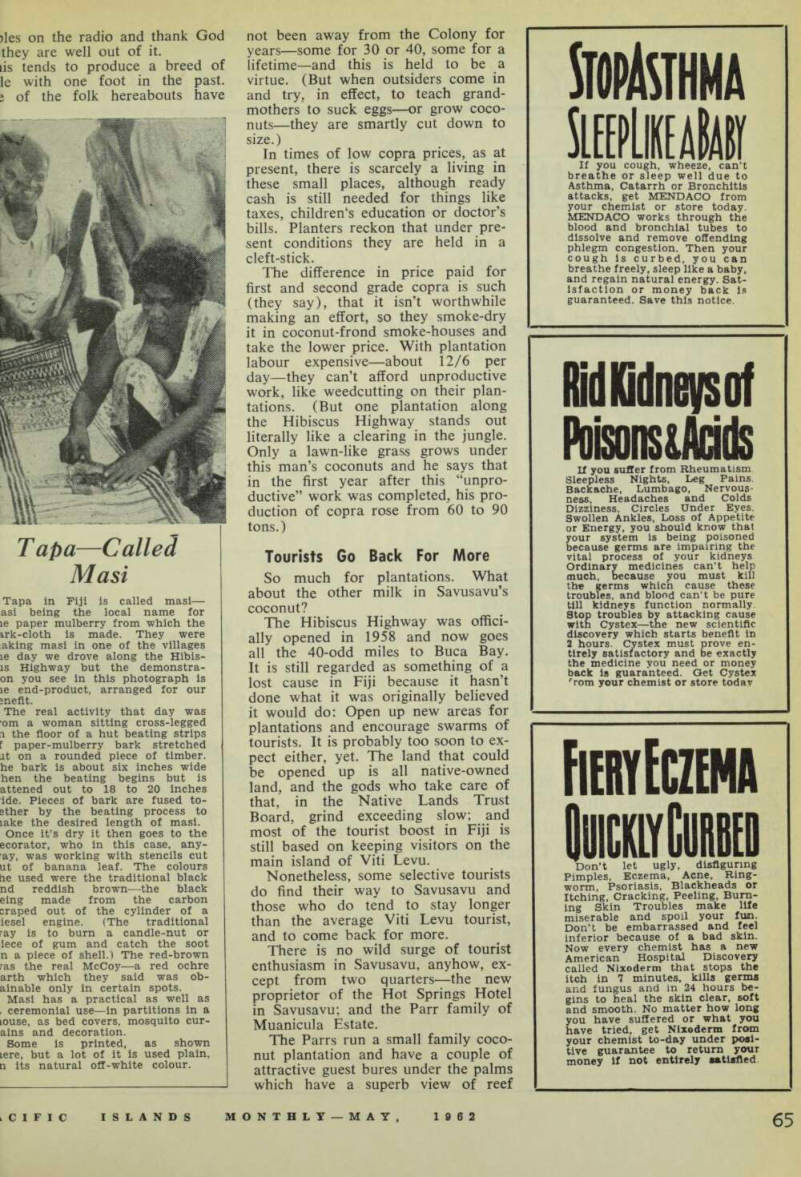 67
67 68
68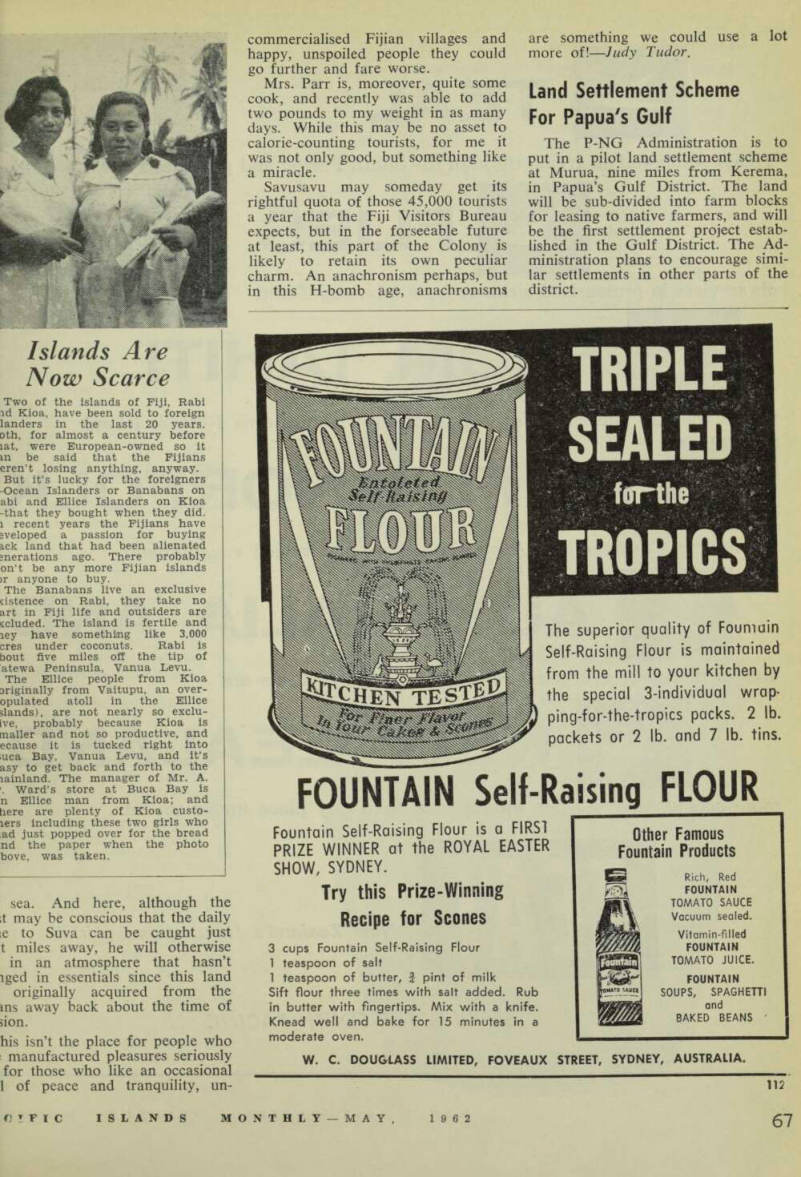 69
69 70
70 71
71 72
72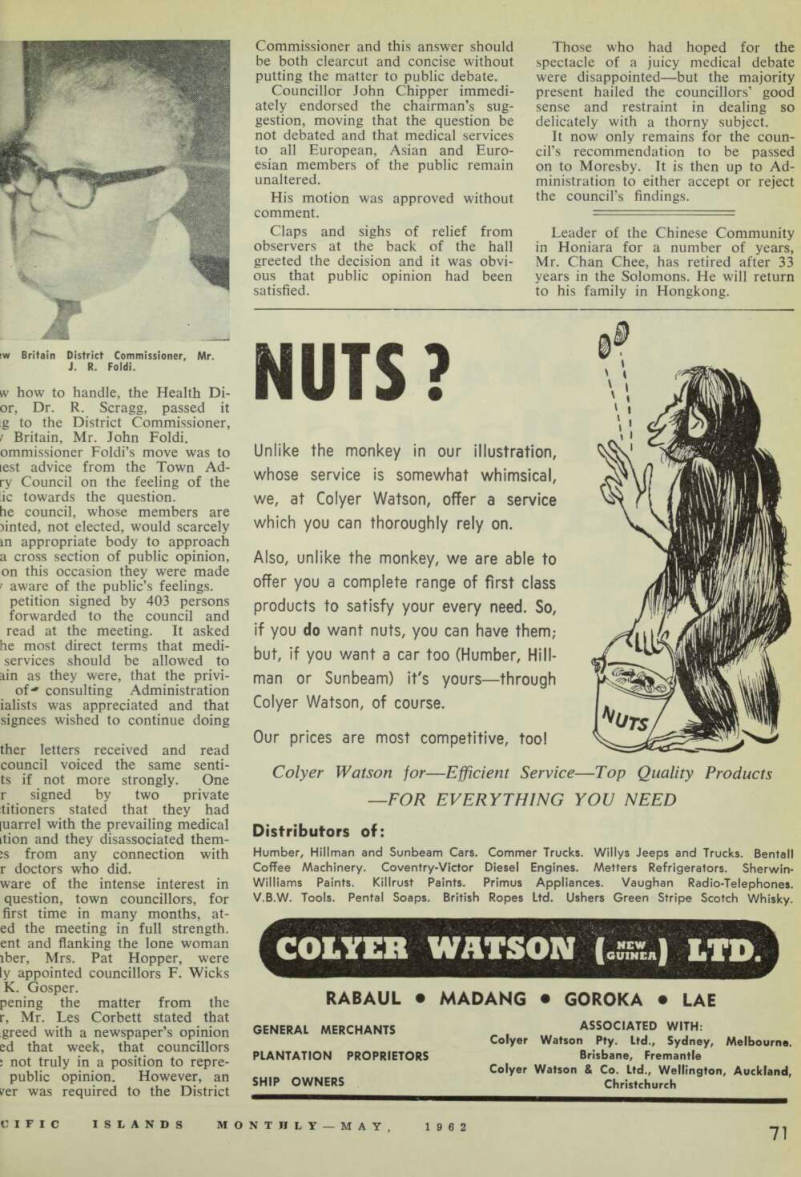 73
73 74
74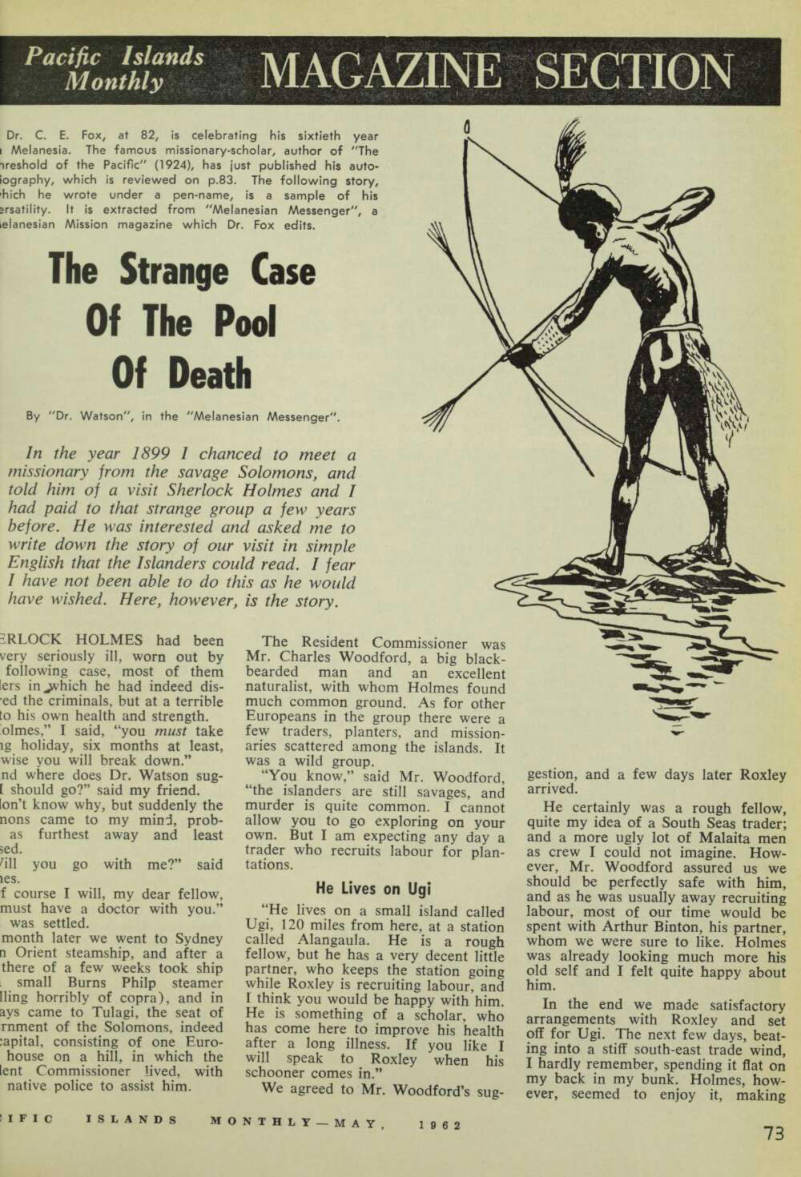 75
75 76
76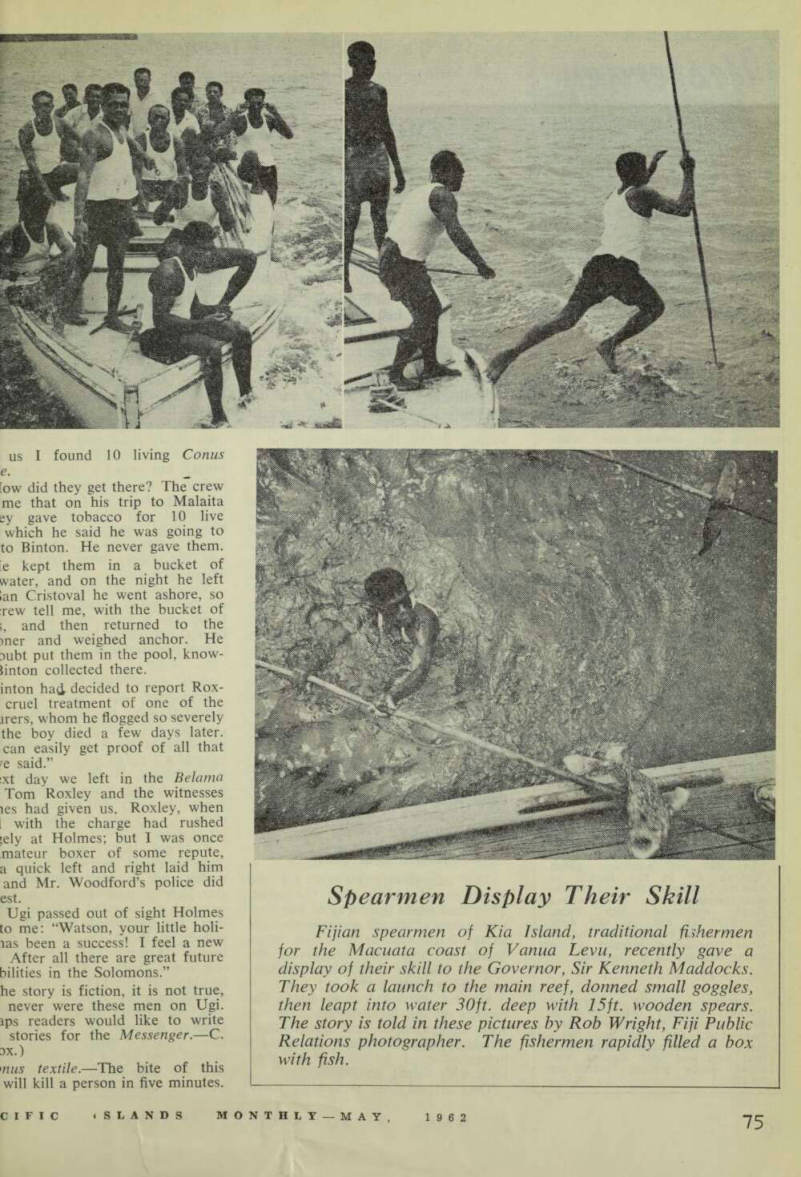 77
77 78
78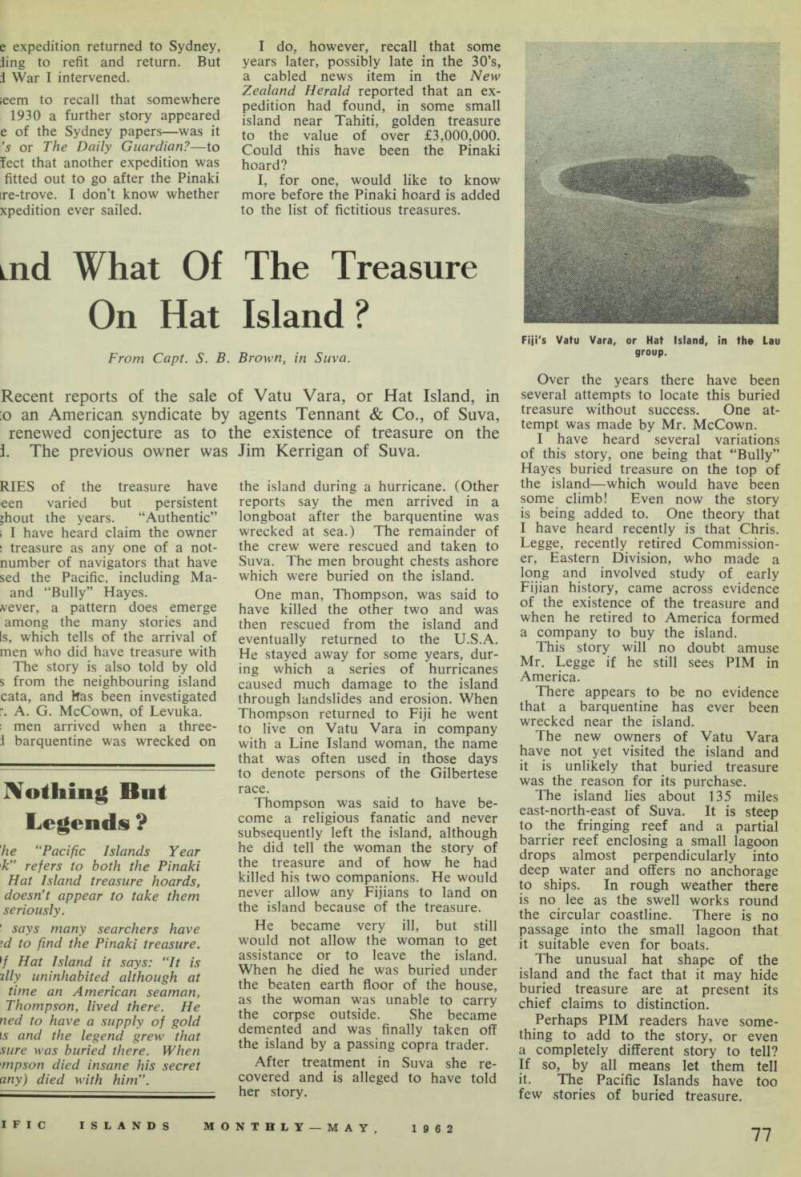 79
79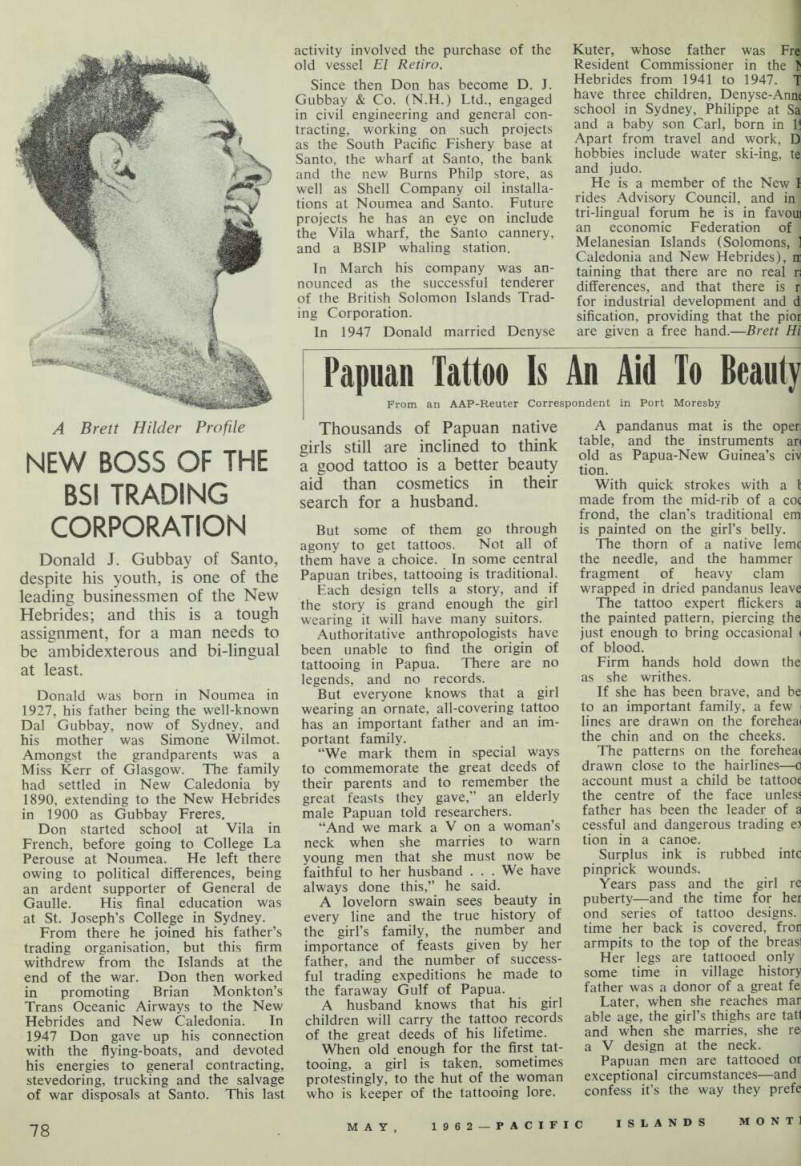 80
80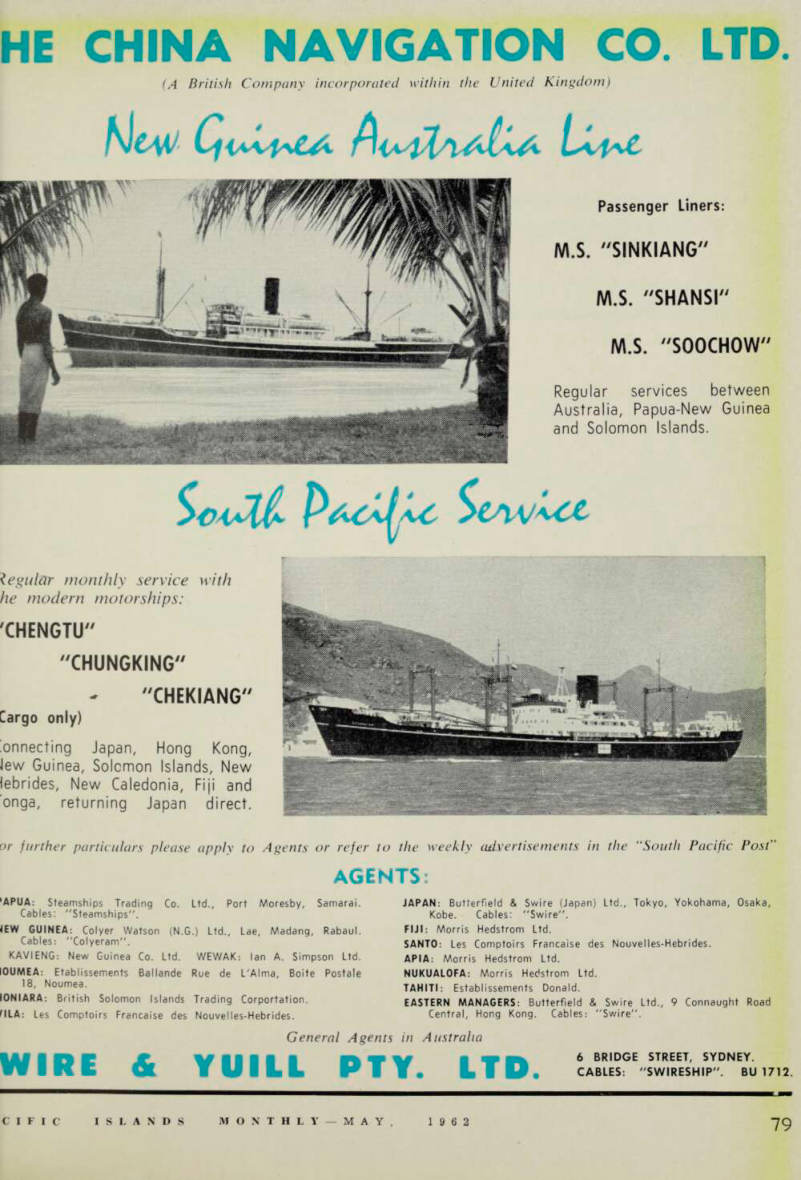 81
81 82
82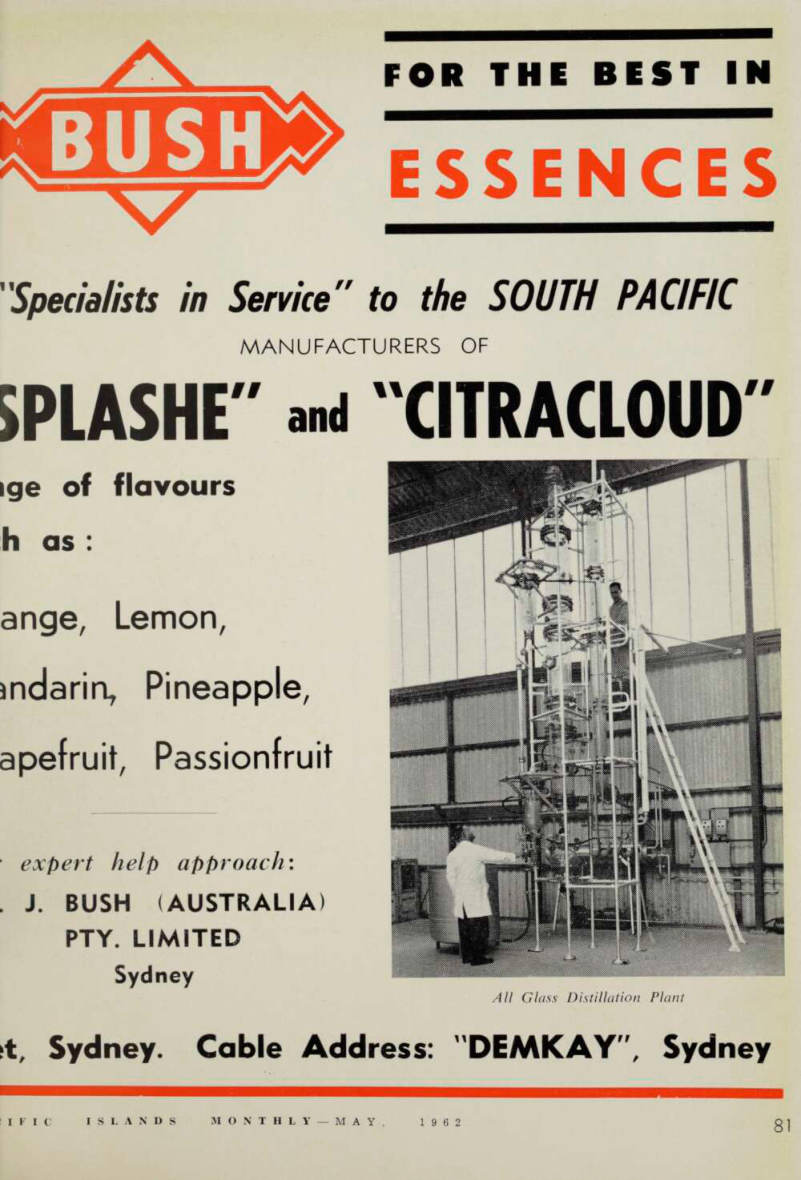 83
83 84
84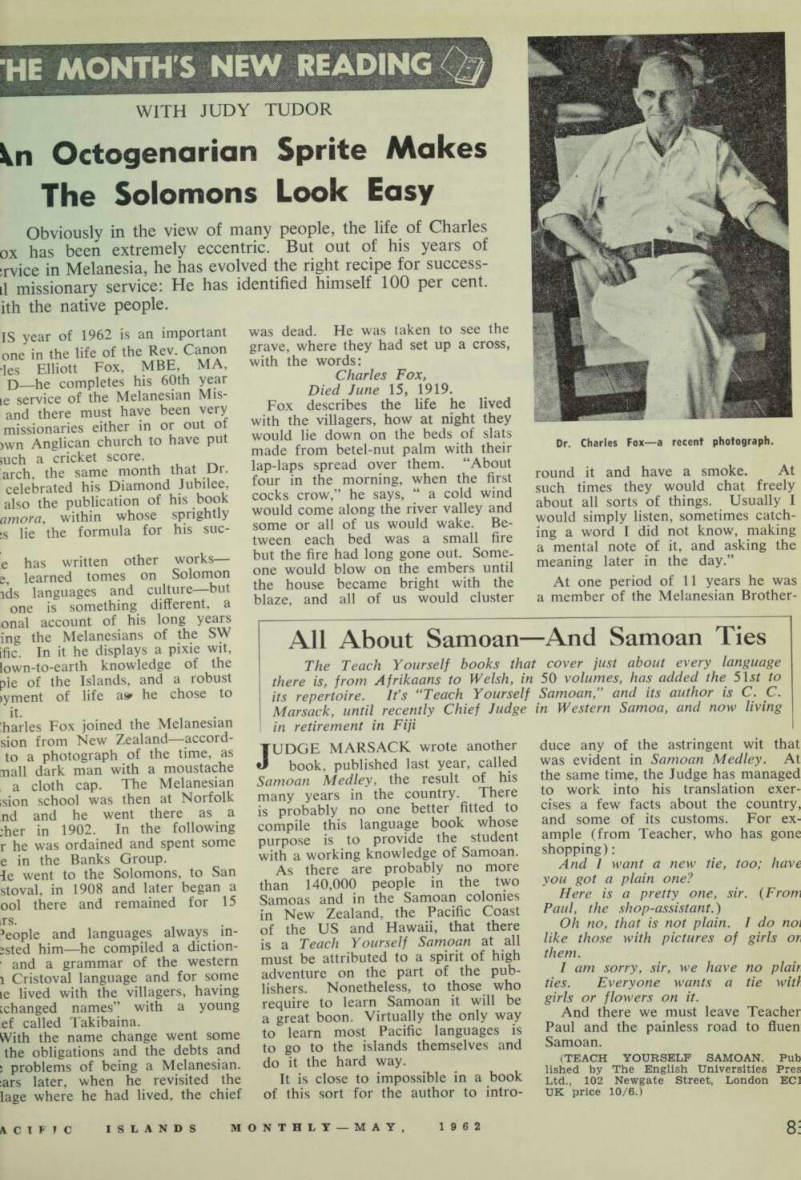 85
85 86
86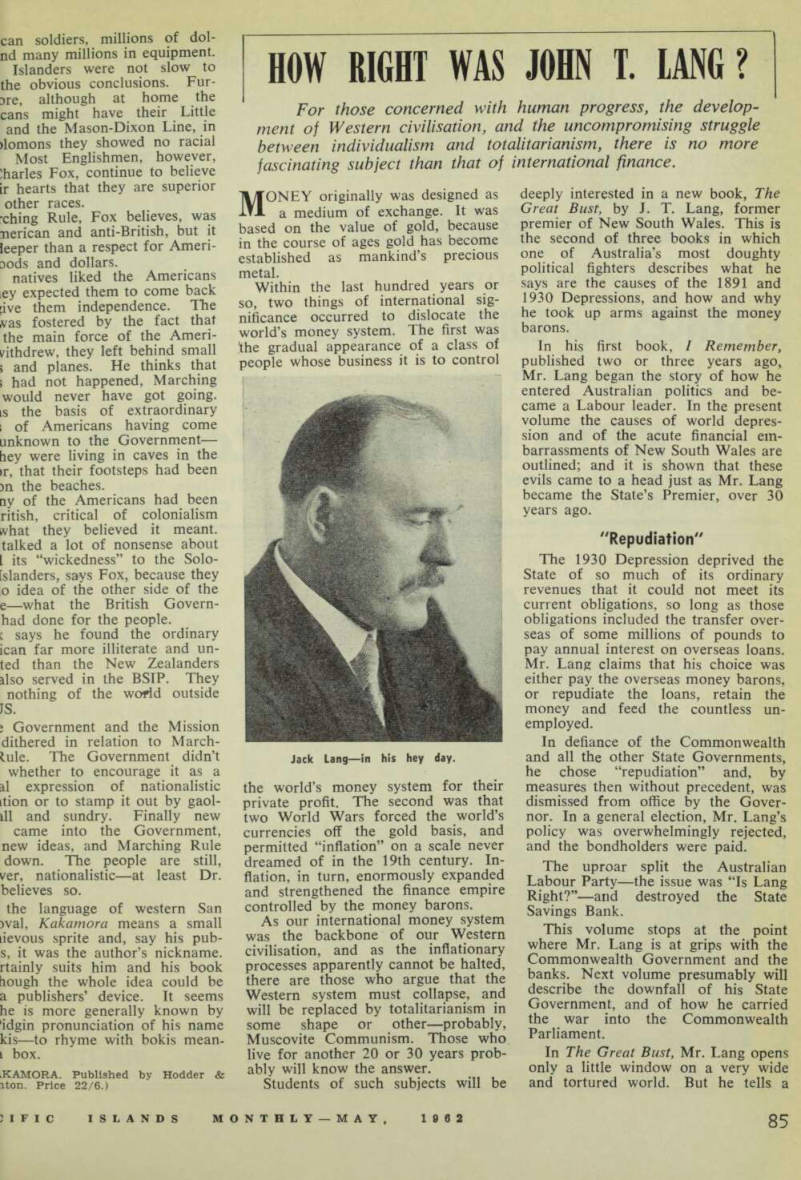 87
87 88
88 89
89 90
90 91
91 92
92 93
93 94
94 95
95 96
96 97
97 98
98 99
99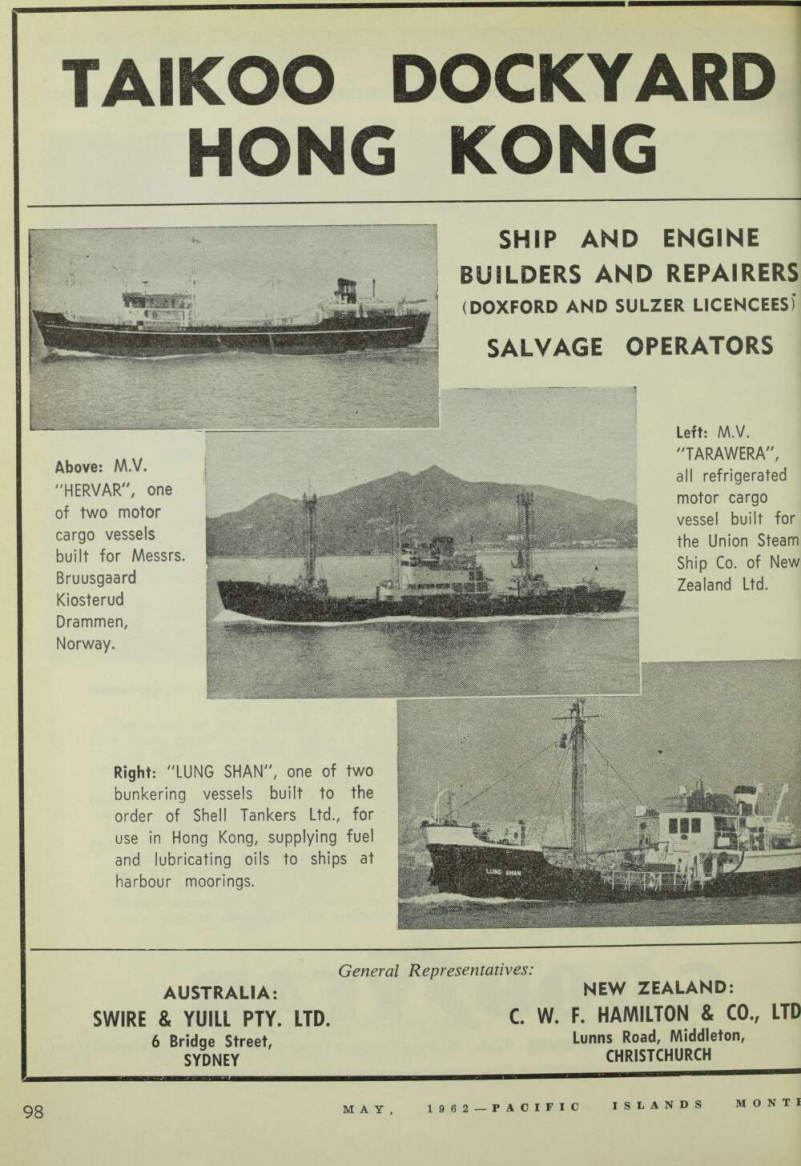 100
100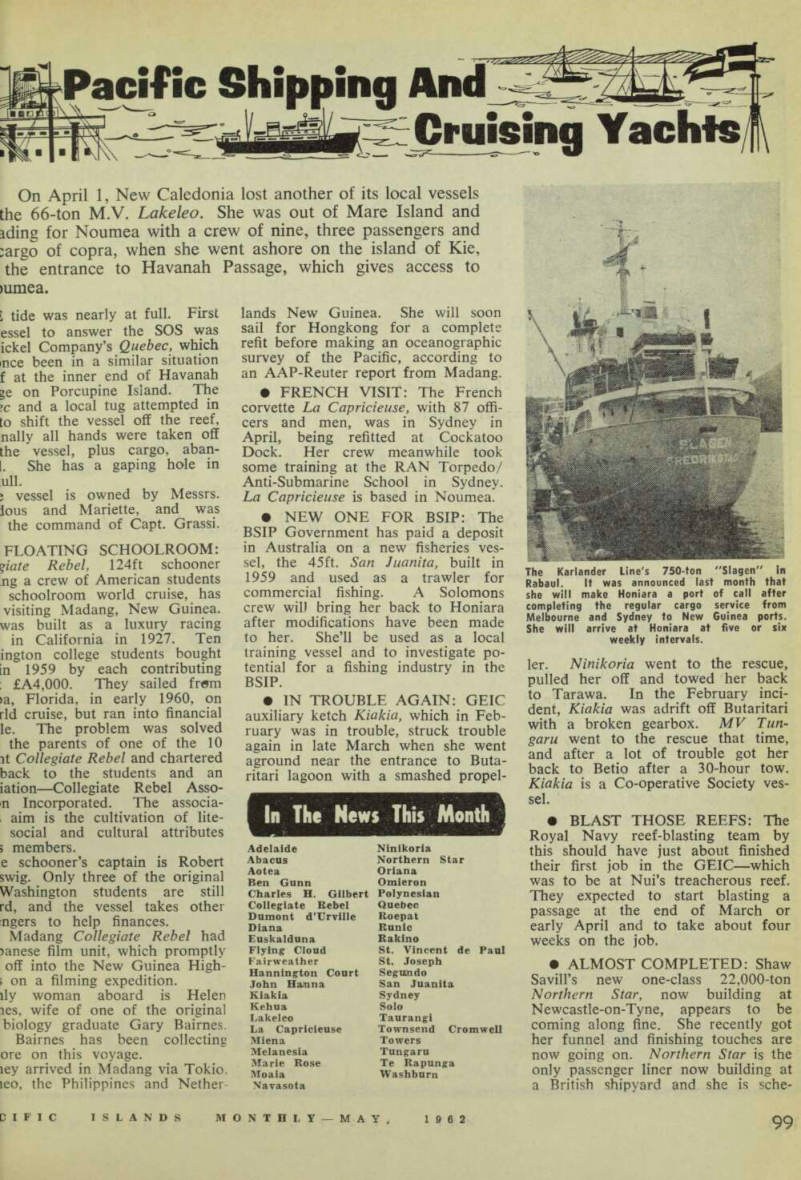 101
101 102
102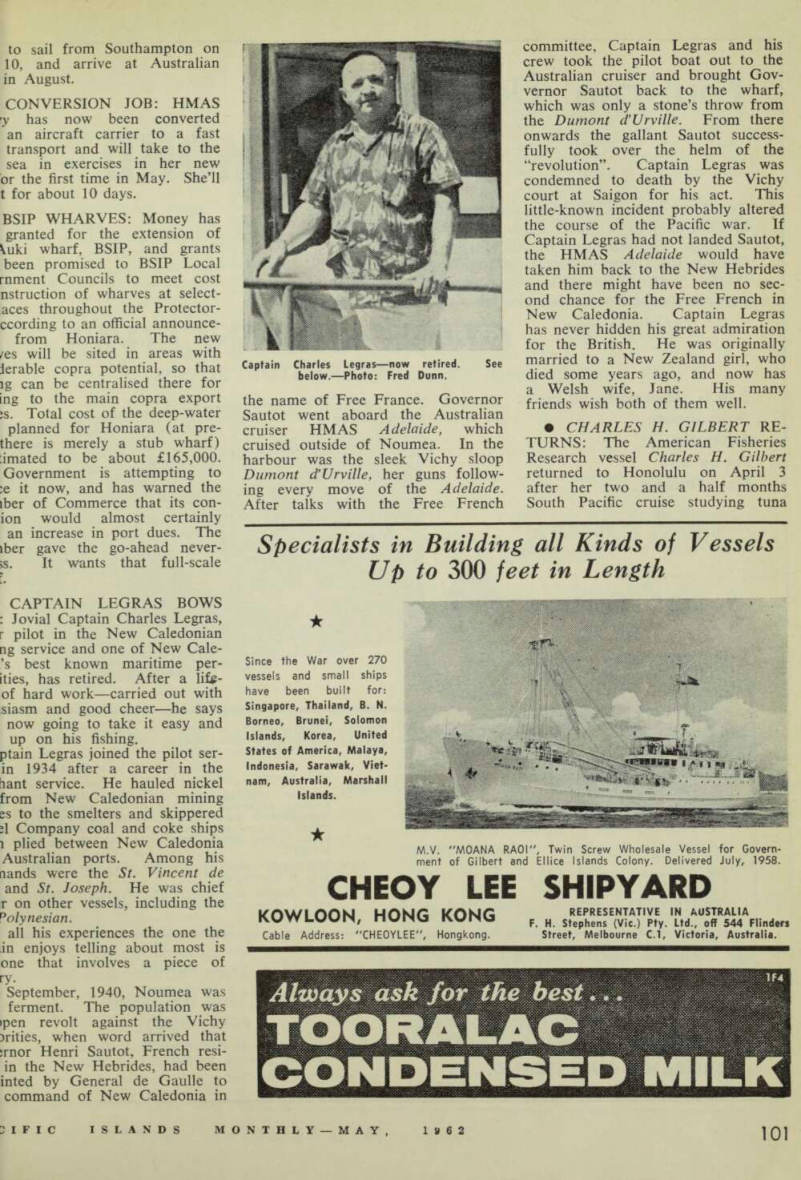 103
103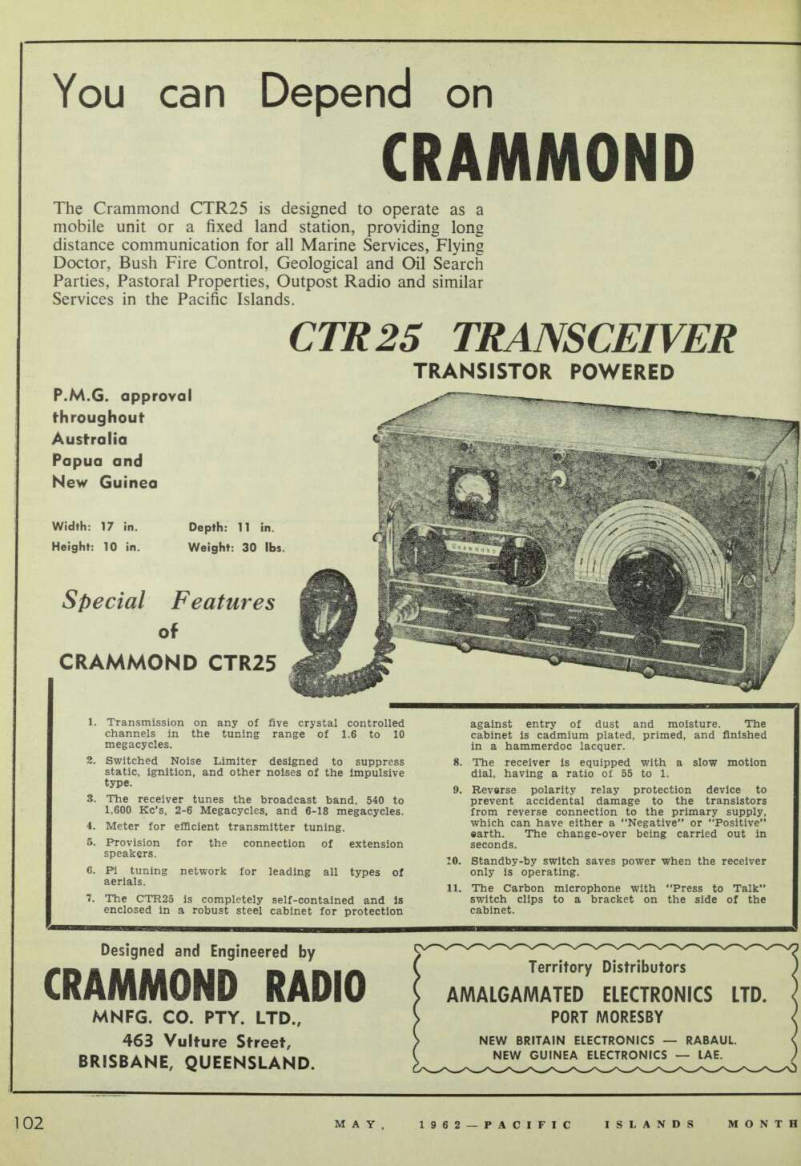 104
104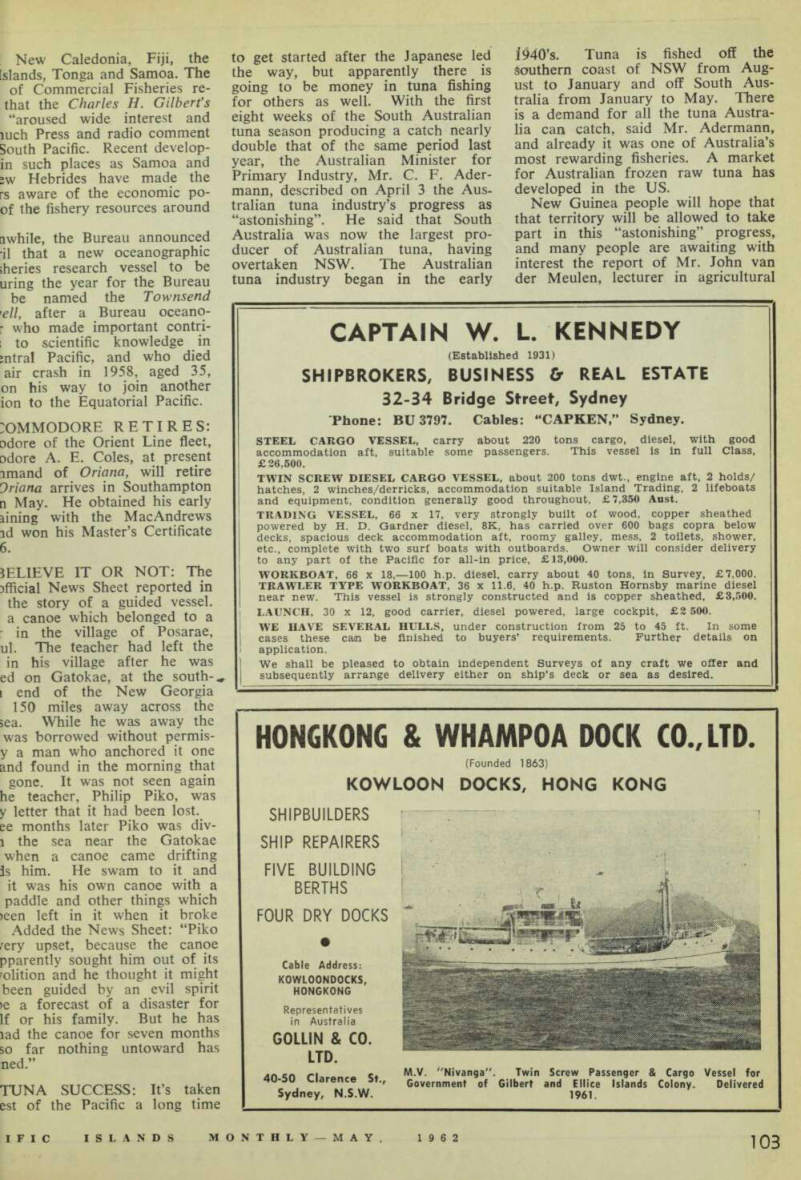 105
105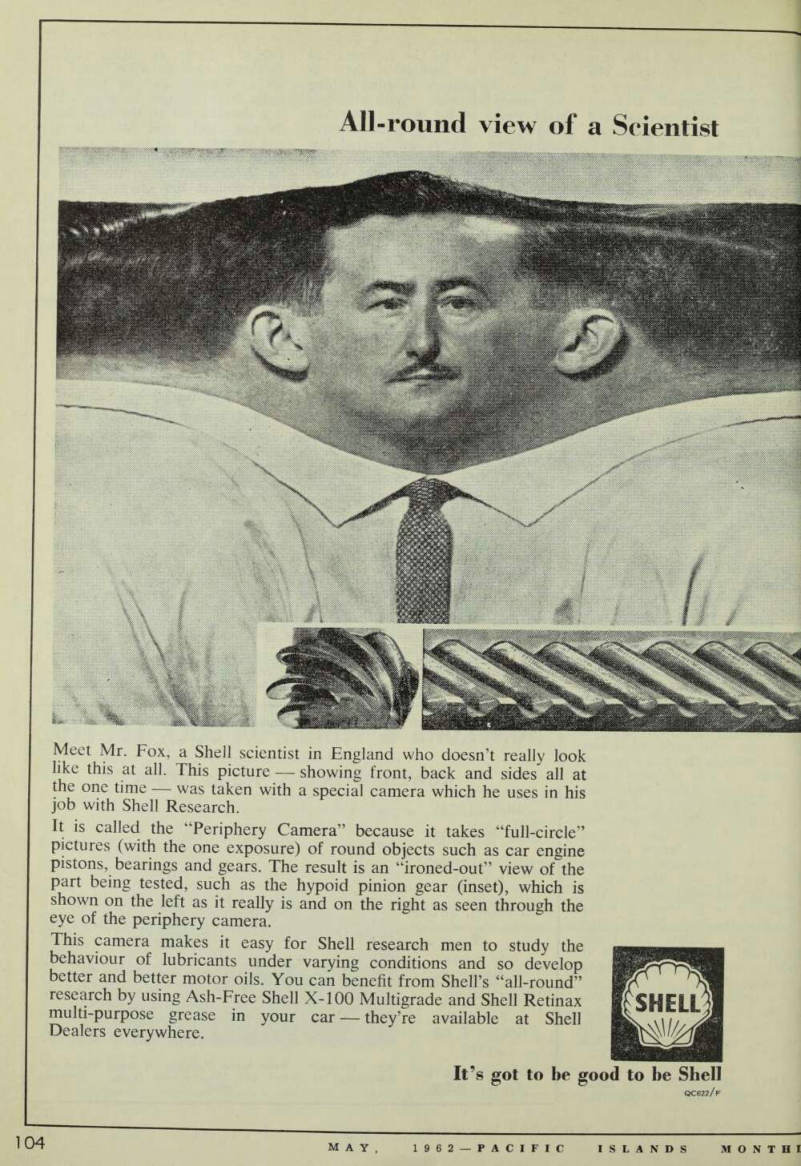 106
106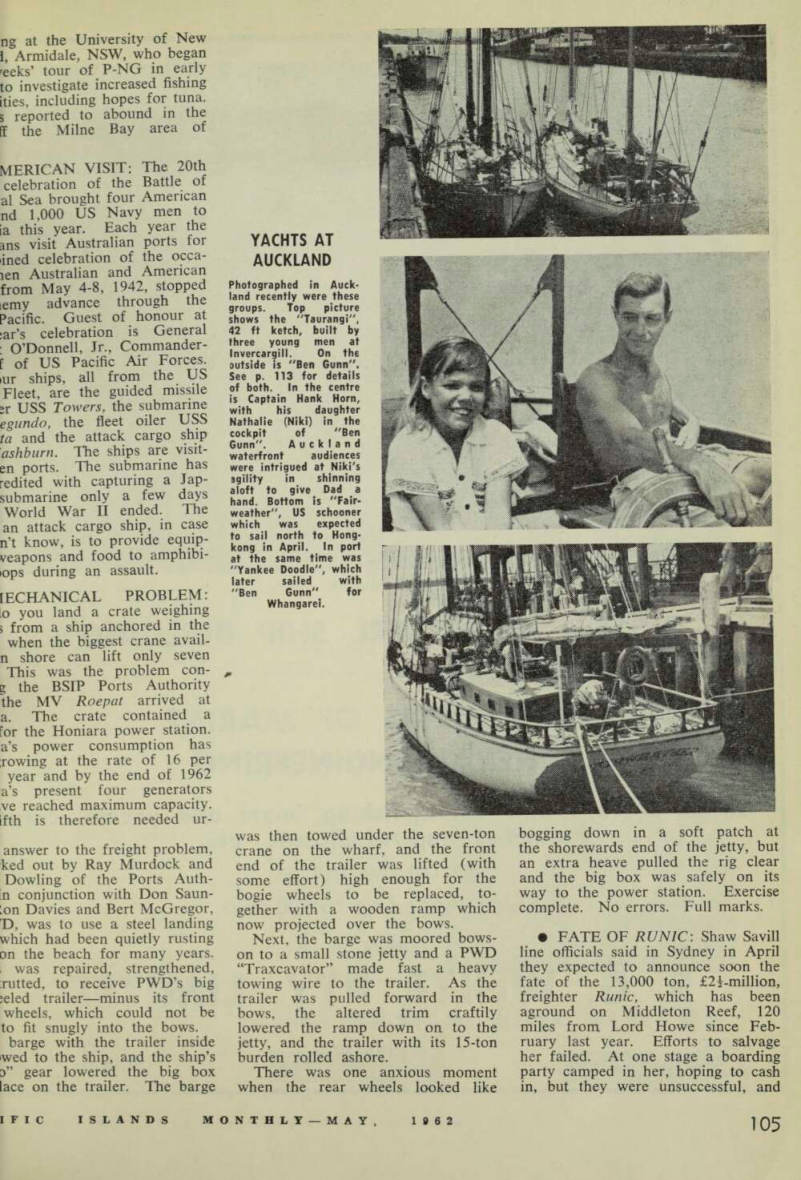 107
107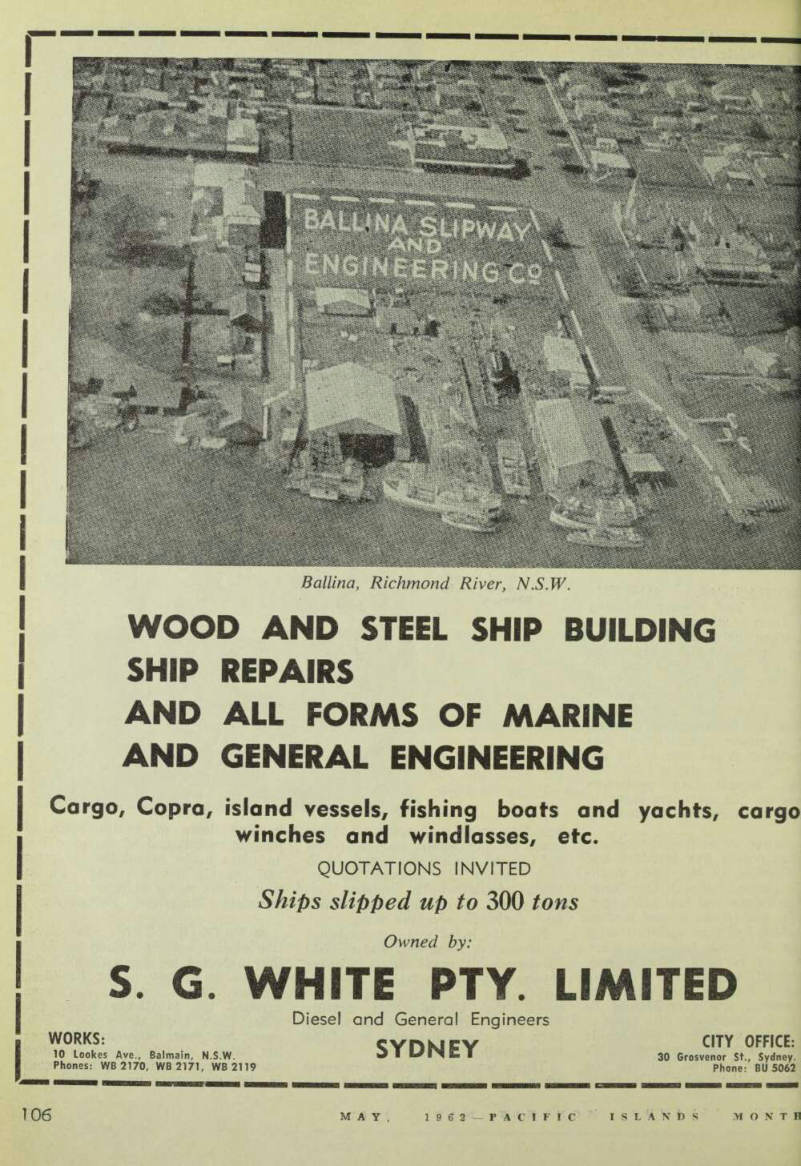 108
108 109
109 110
110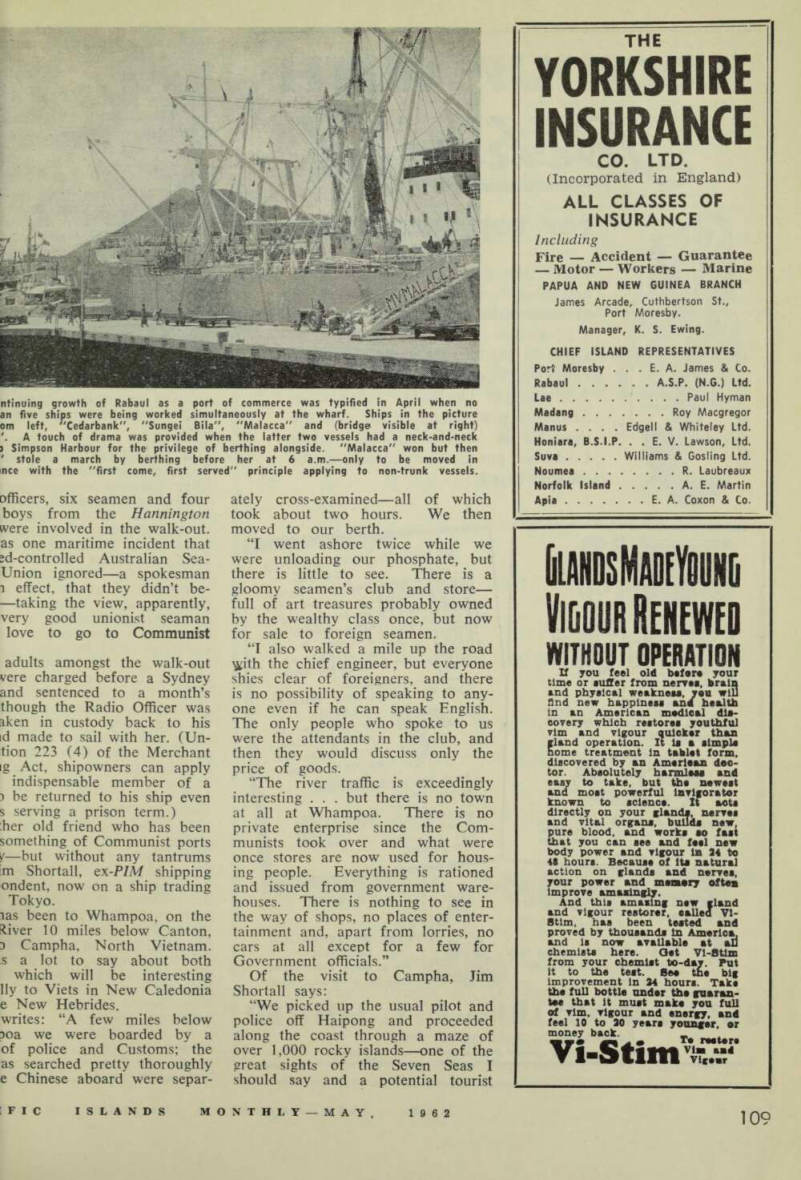 111
111 112
112 113
113 114
114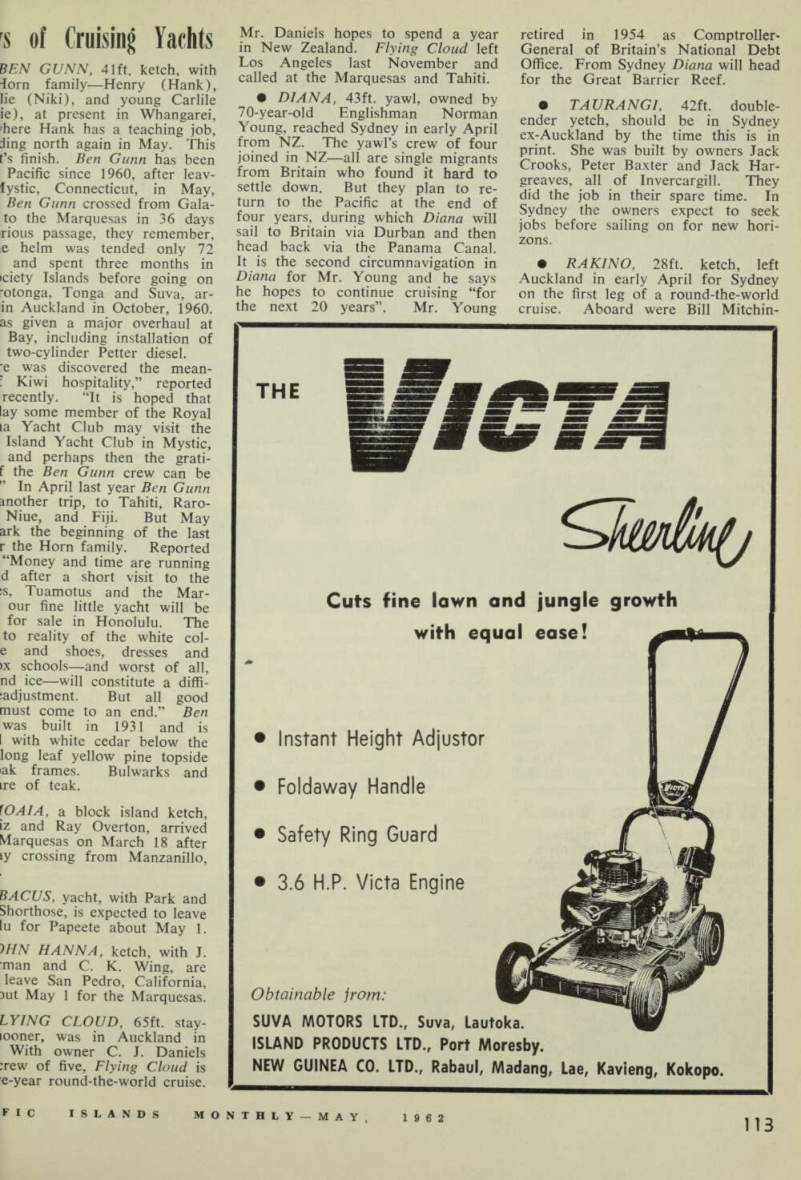 115
115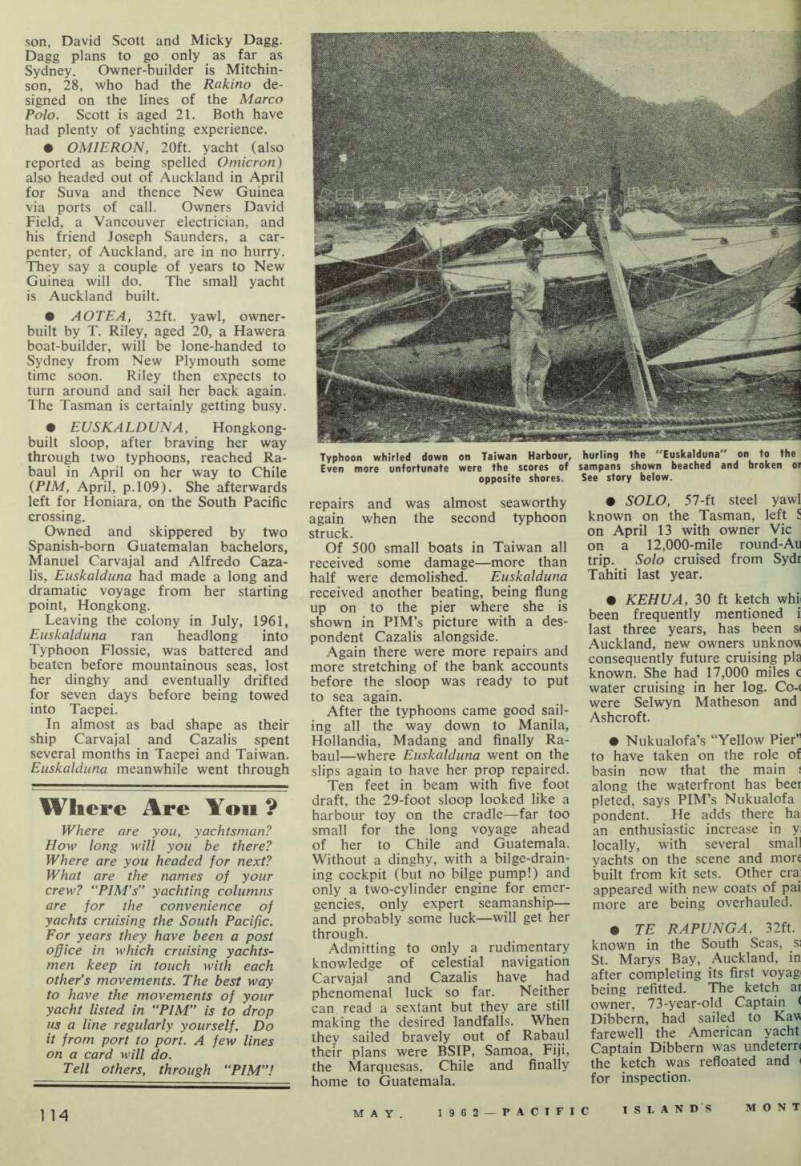 116
116 117
117 118
118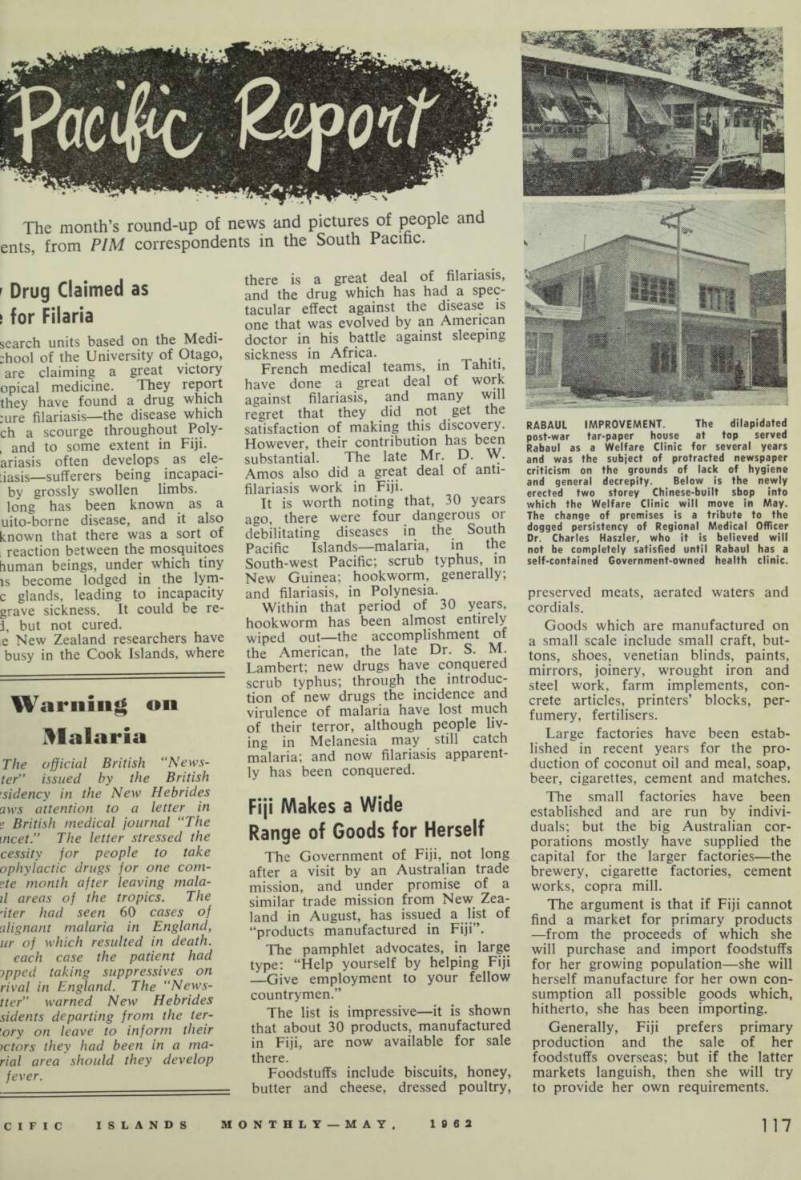 119
119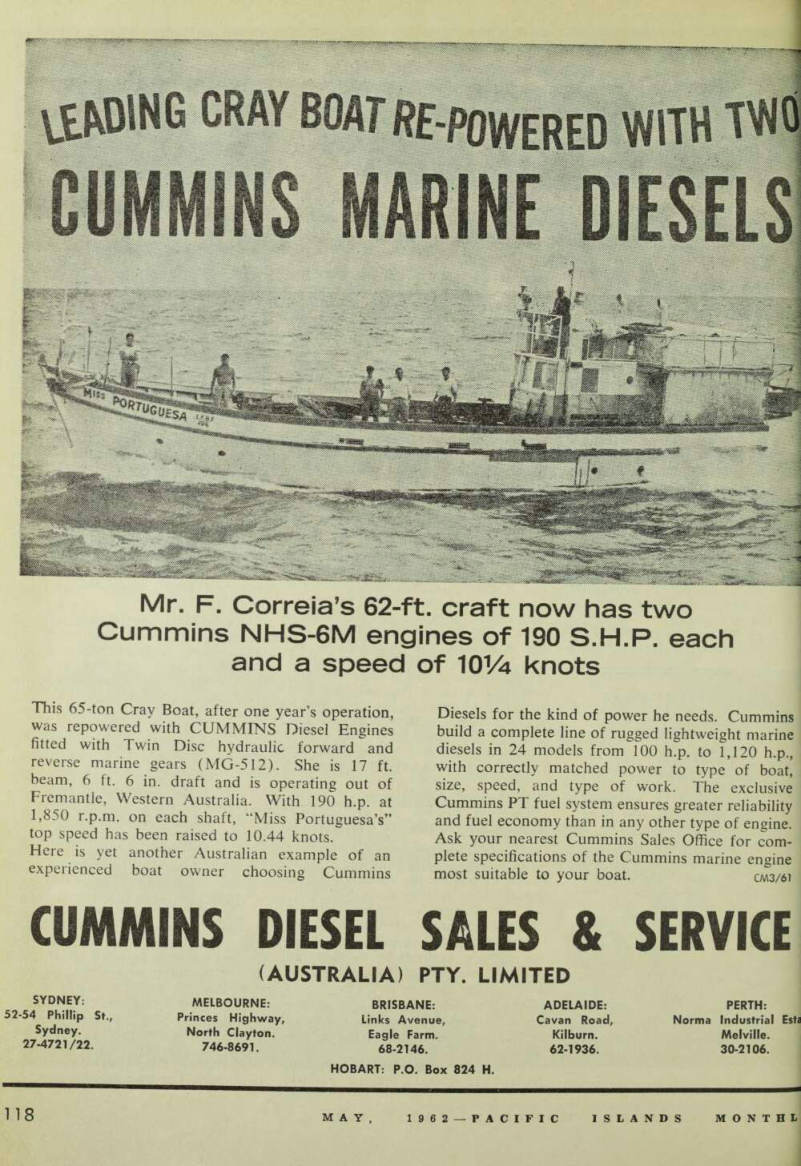 120
120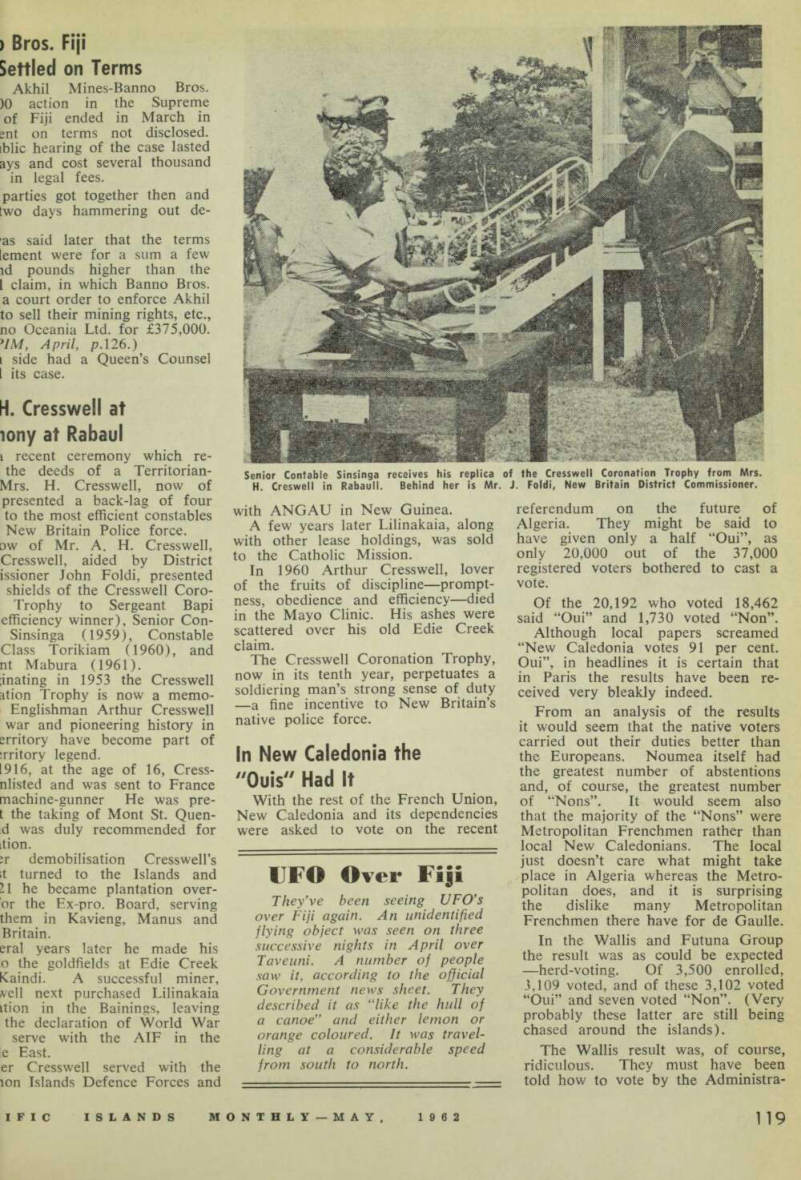 121
121 122
122 123
123 124
124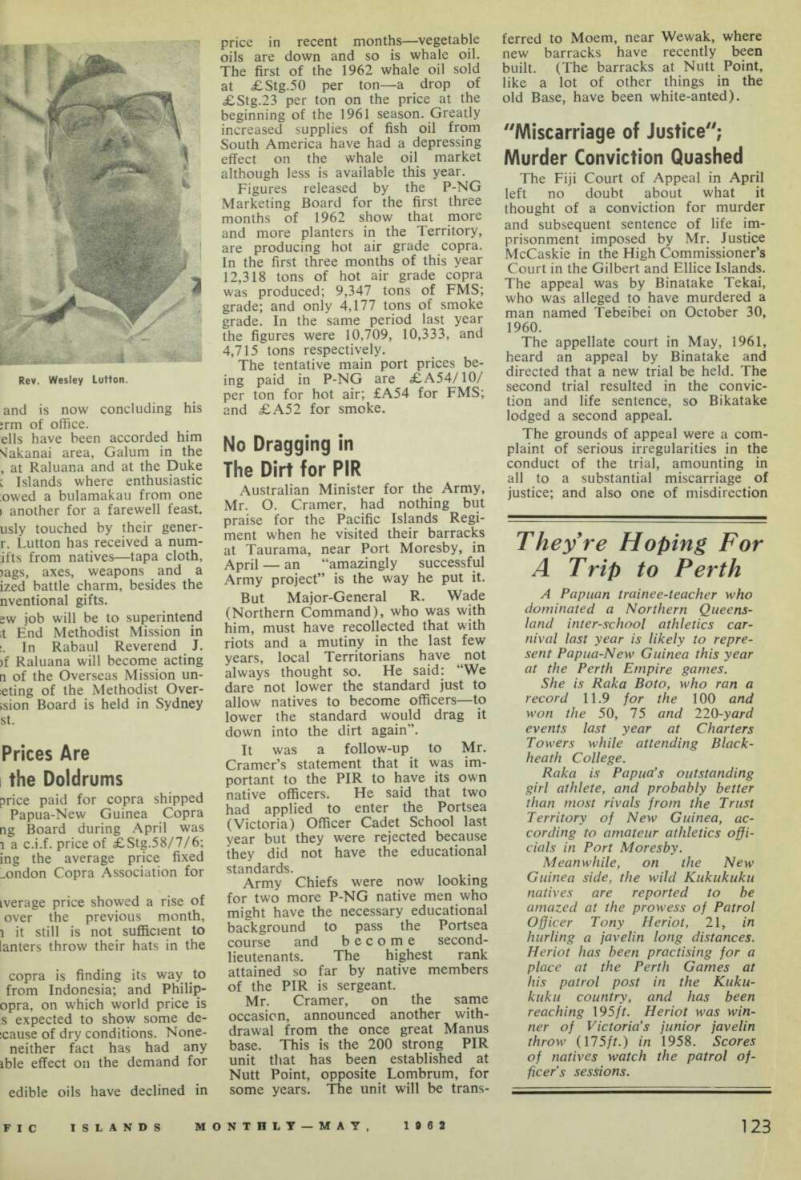 125
125 126
126 127
127 128
128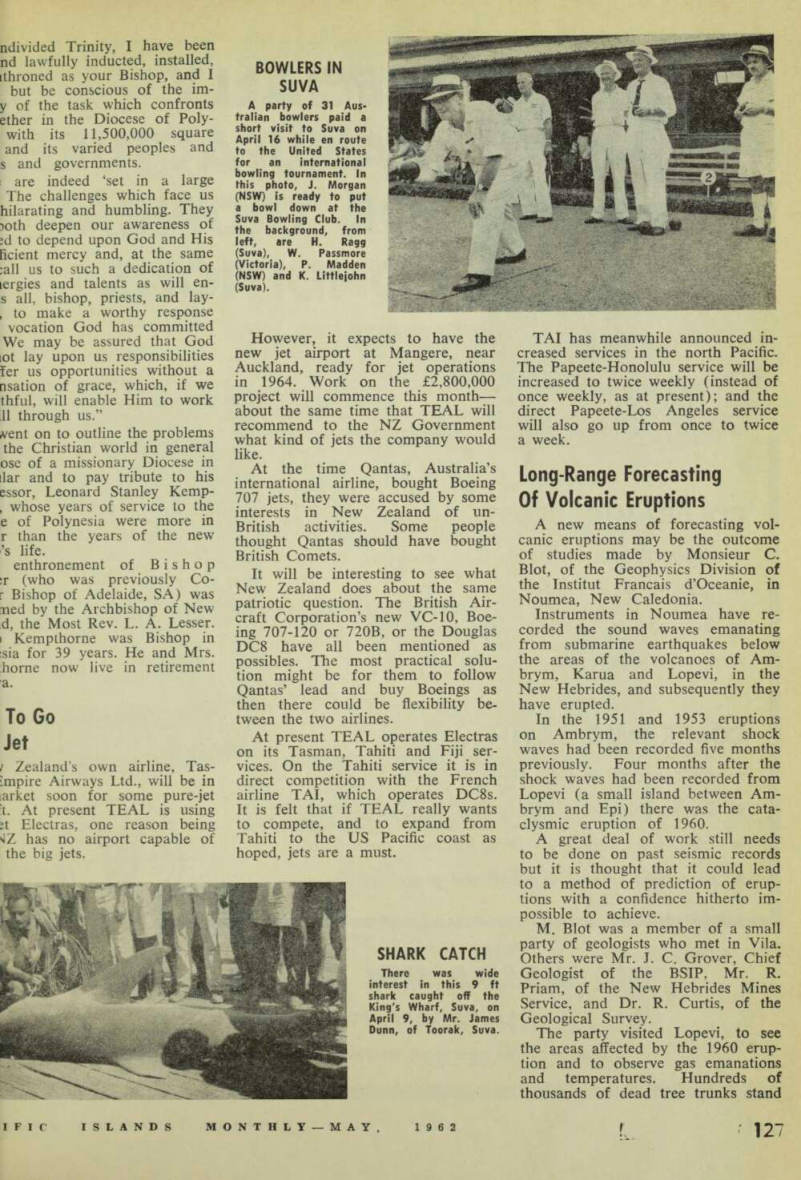 129
129 130
130 131
131 132
132 133
133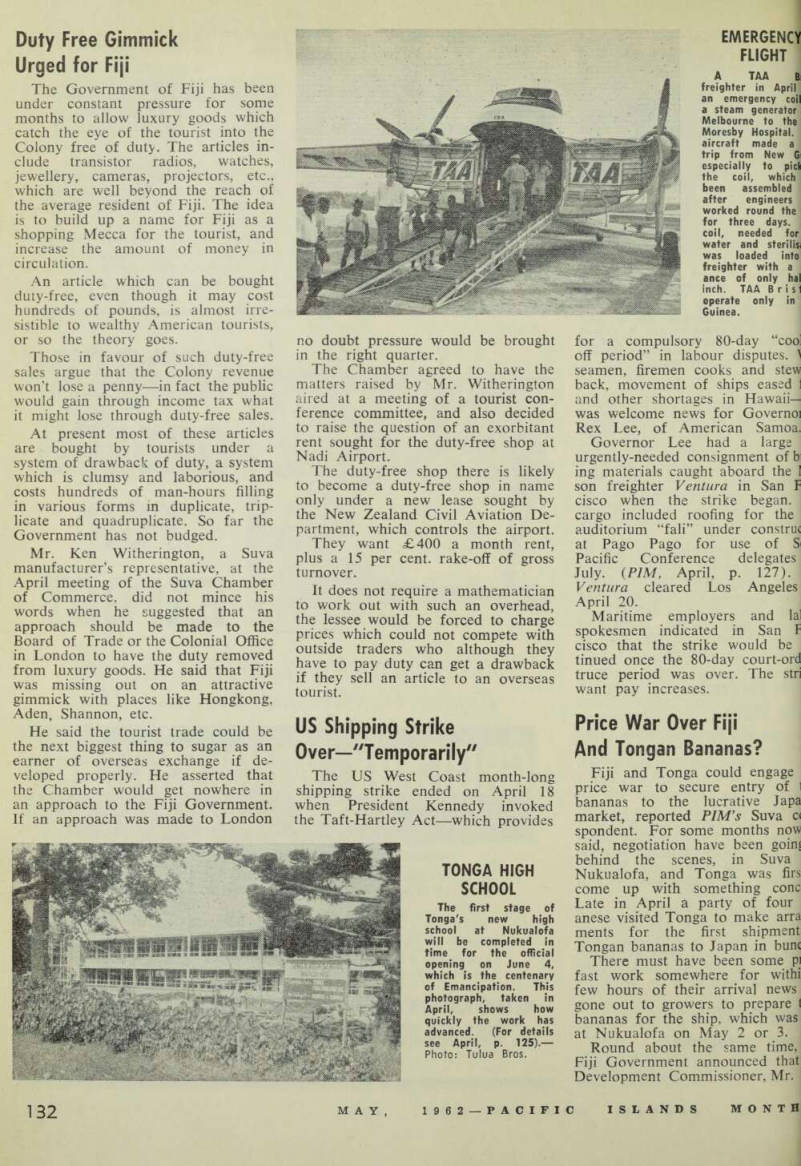 134
134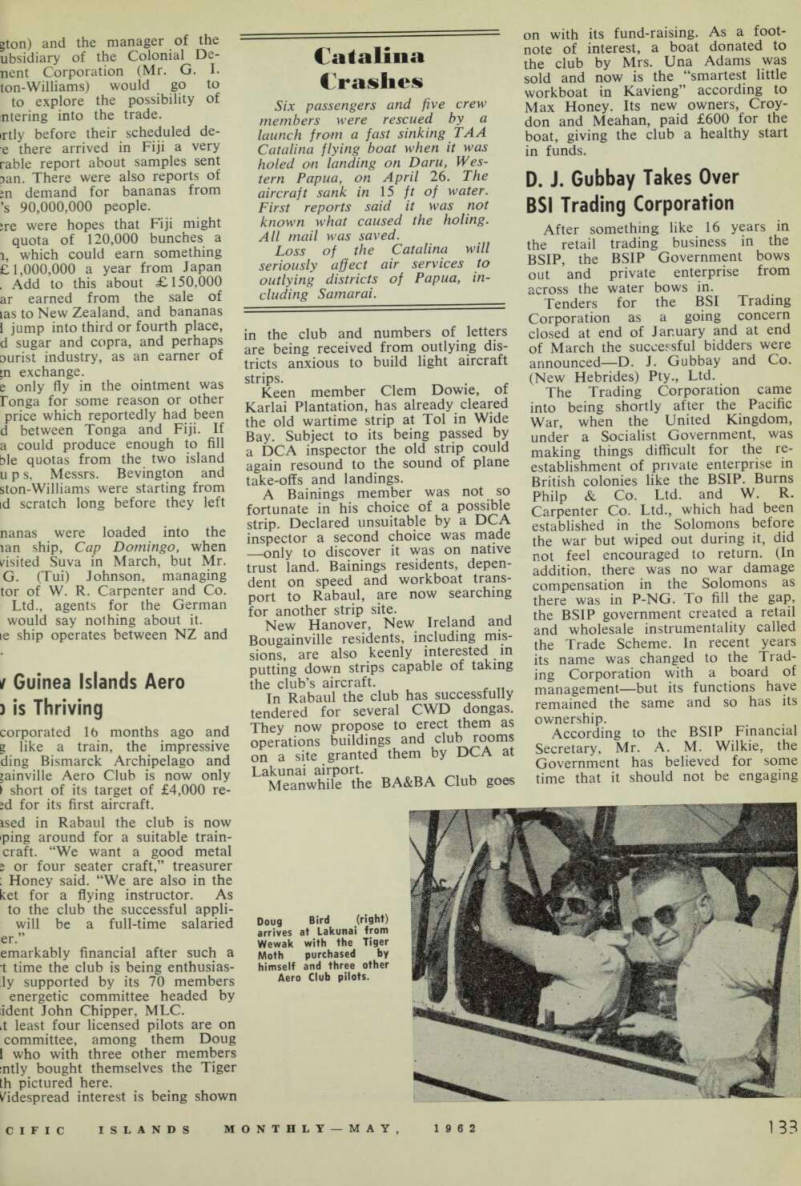 135
135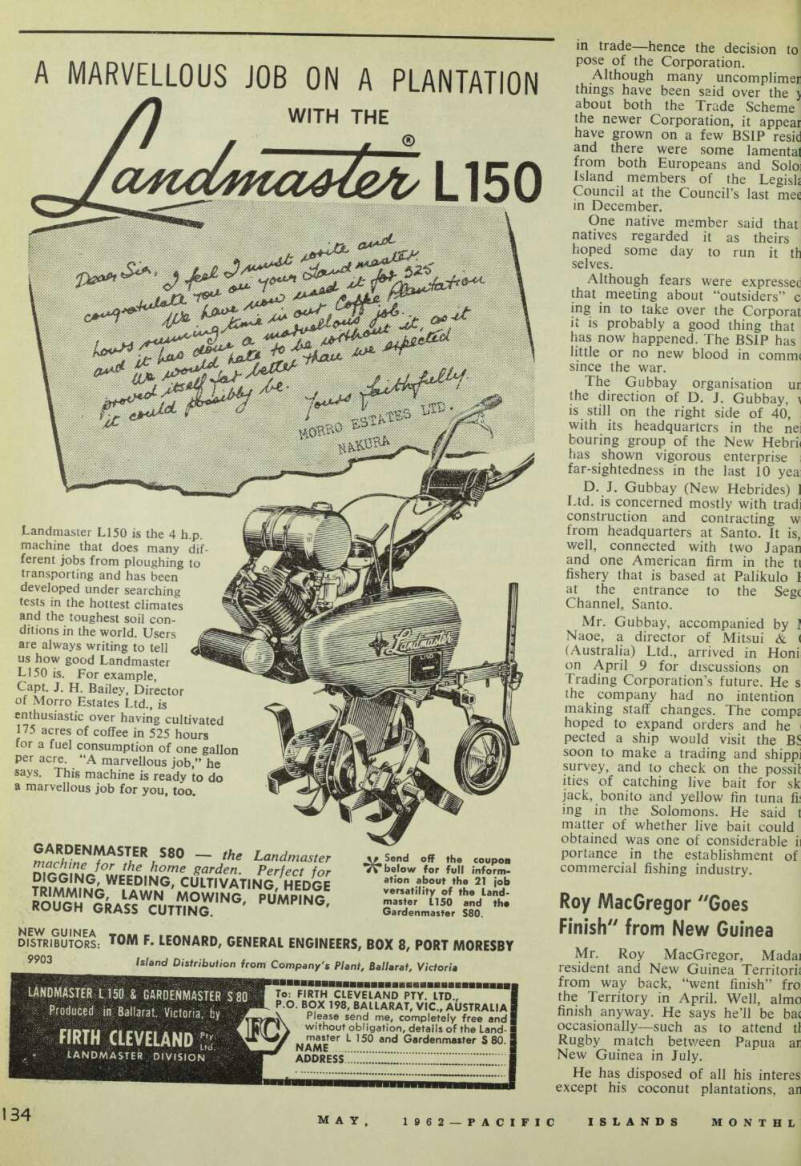 136
136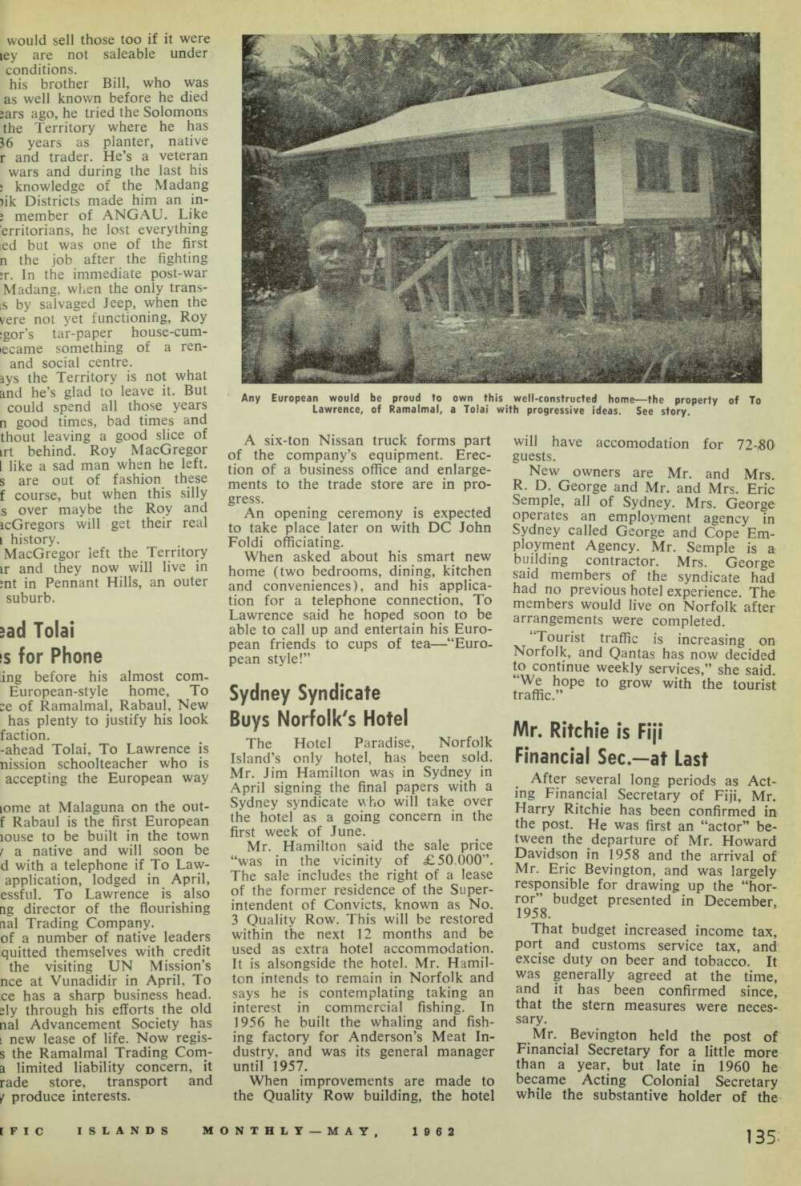 137
137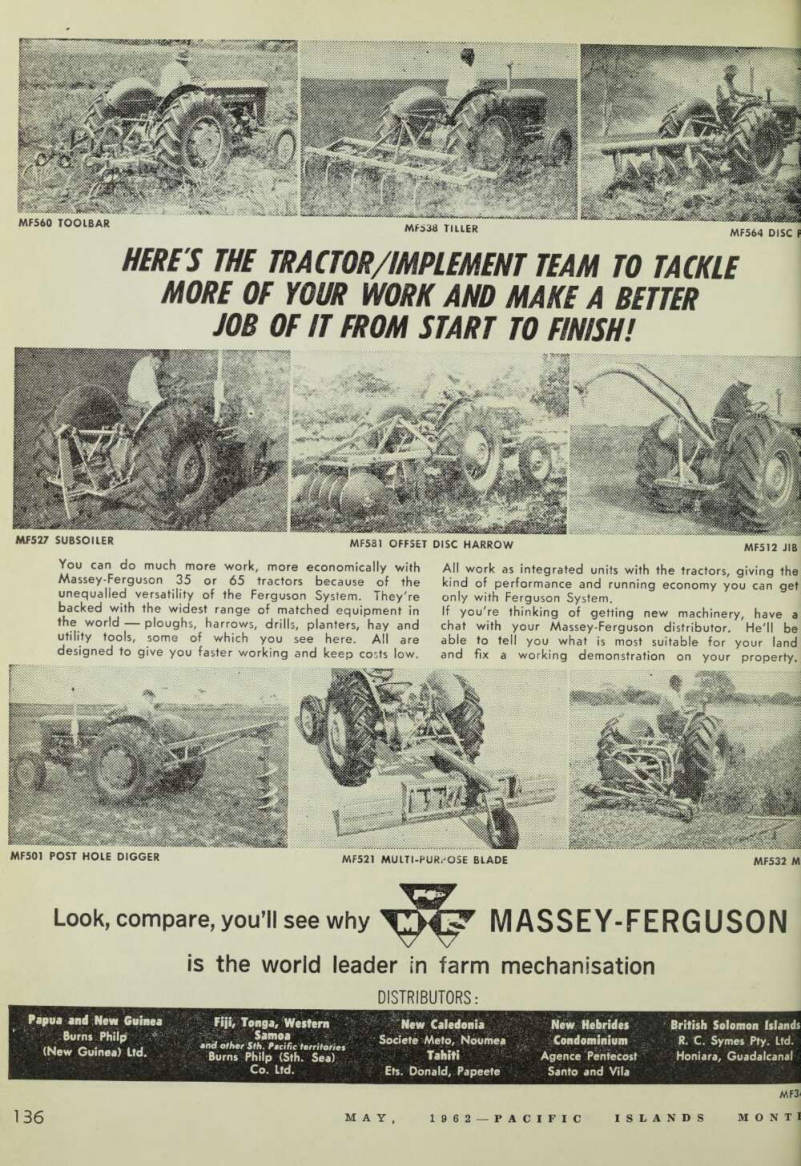 138
138 139
139 140
140 141
141 142
142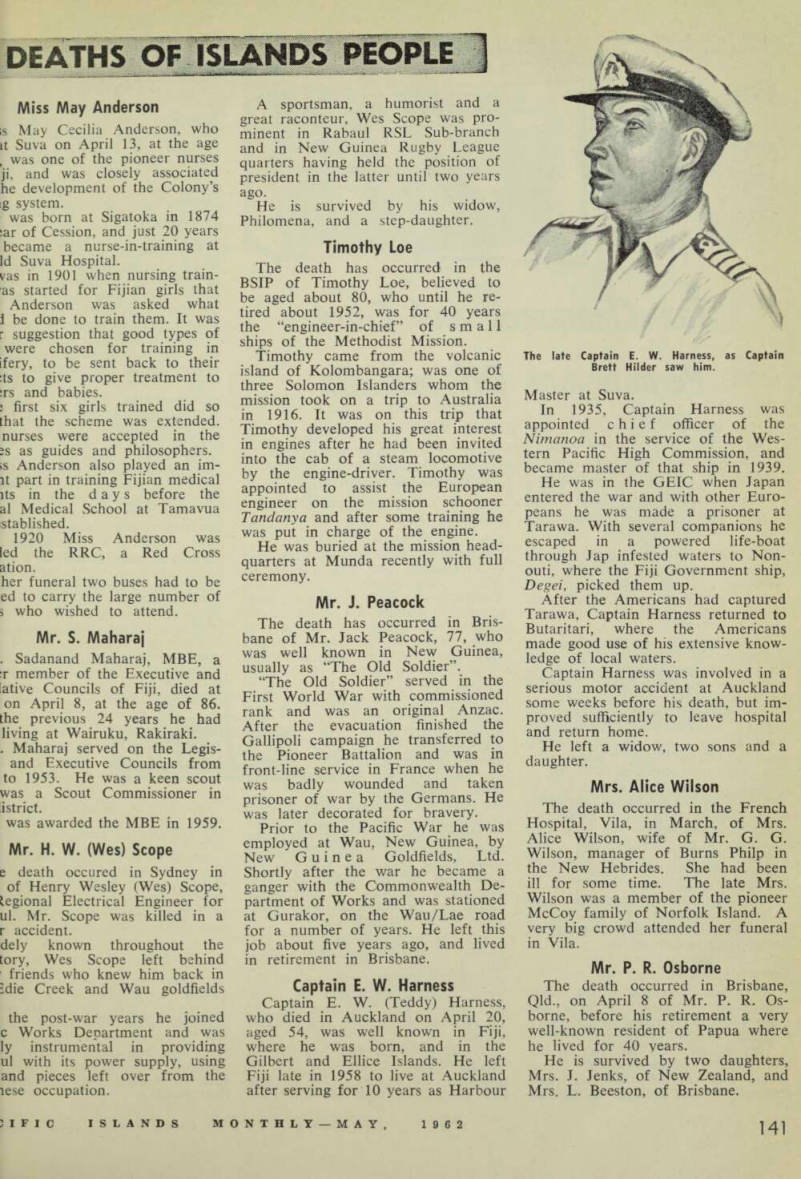 143
143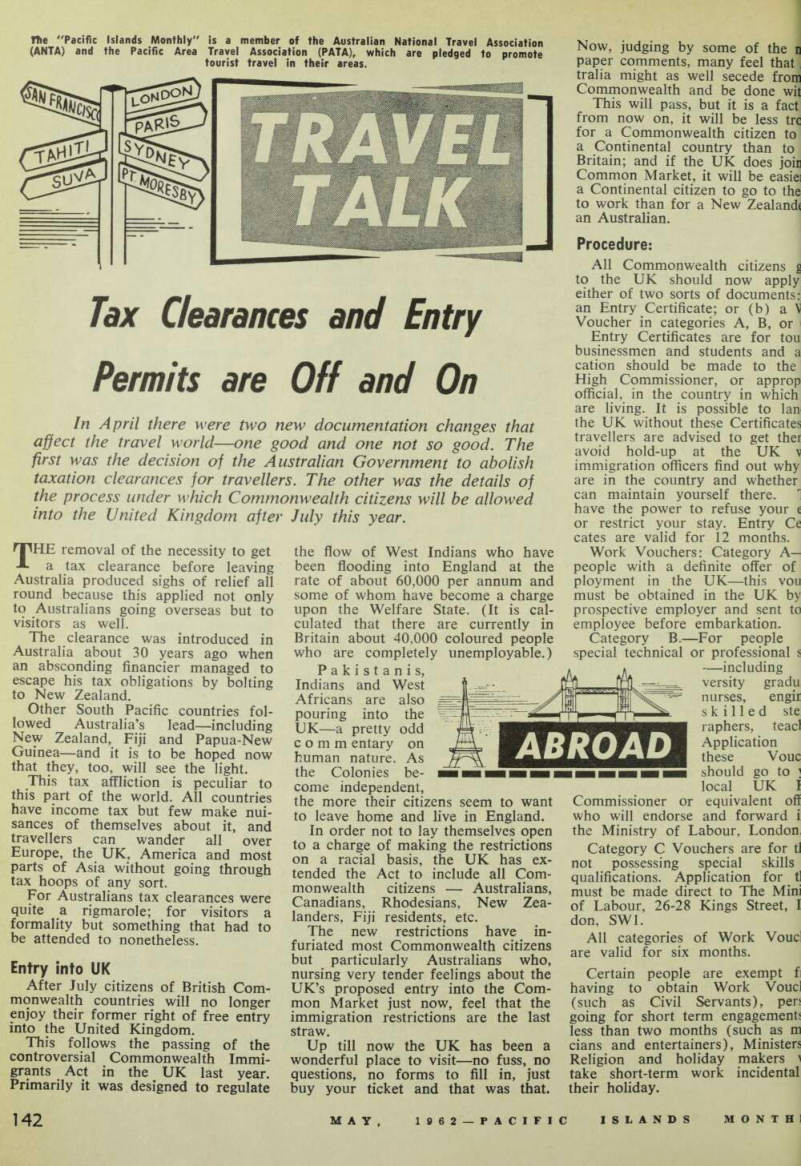 144
144 145
145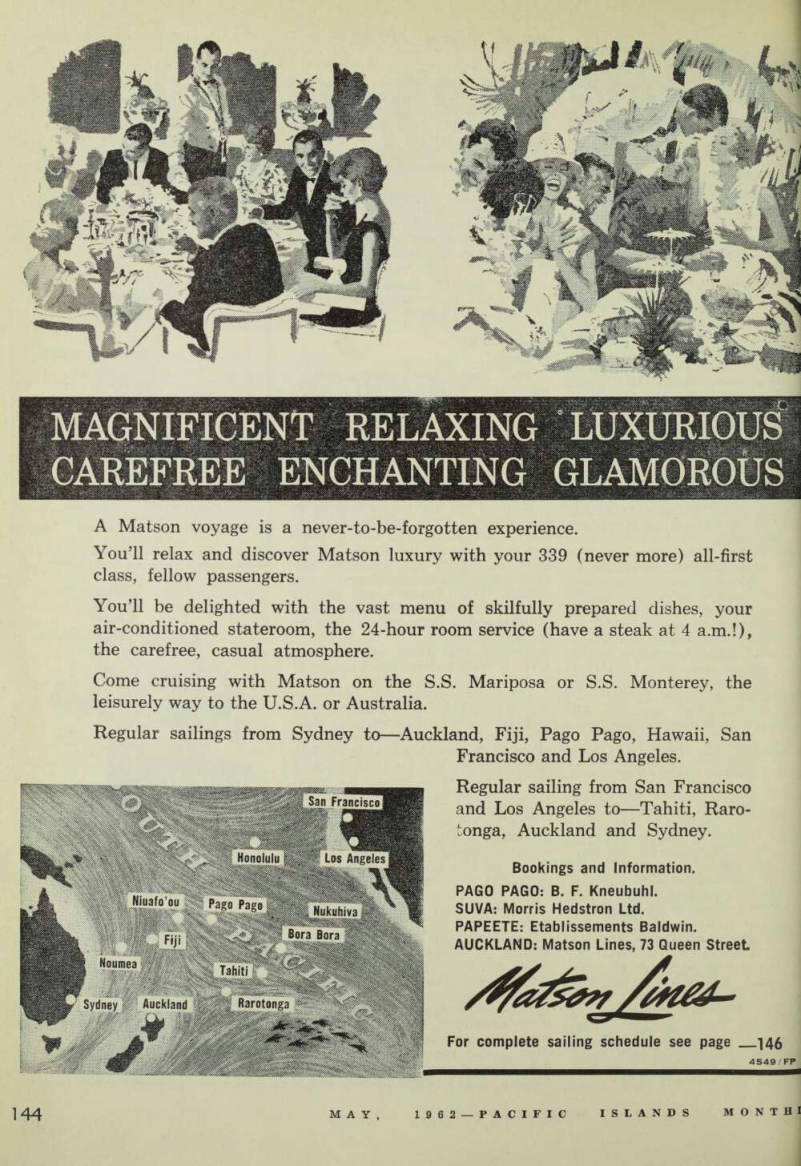 146
146 147
147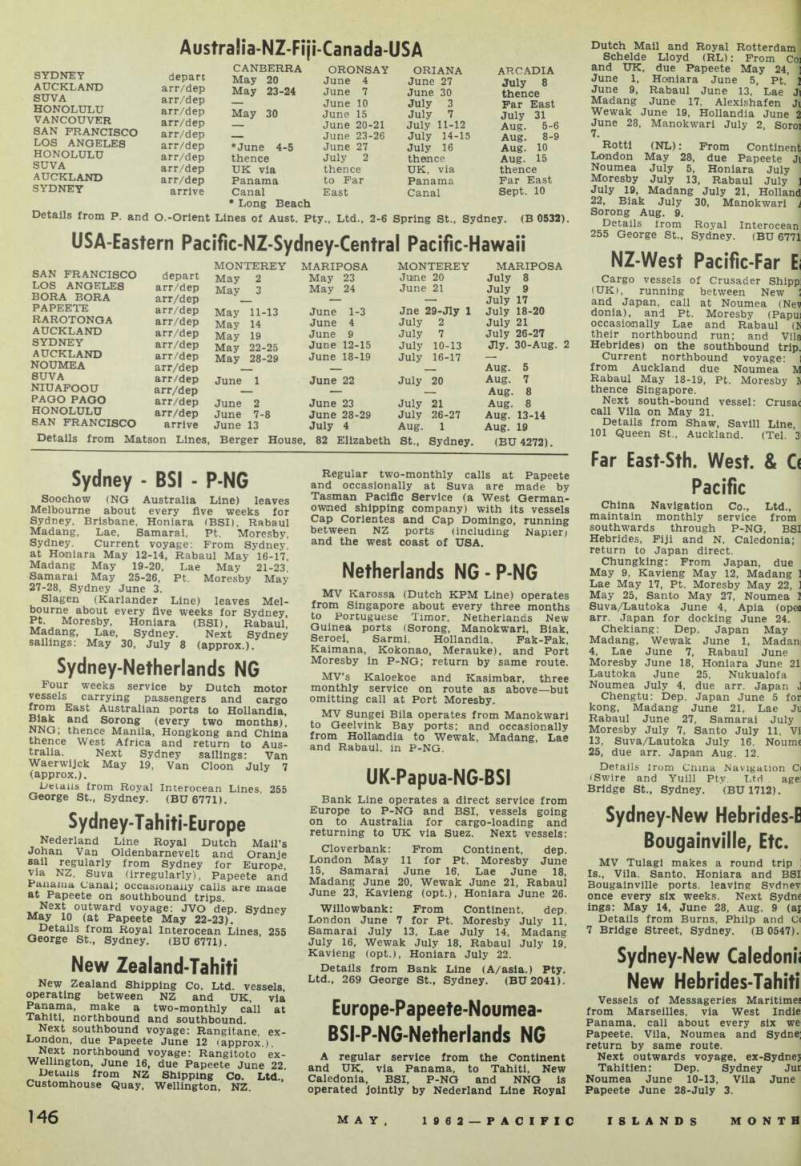 148
148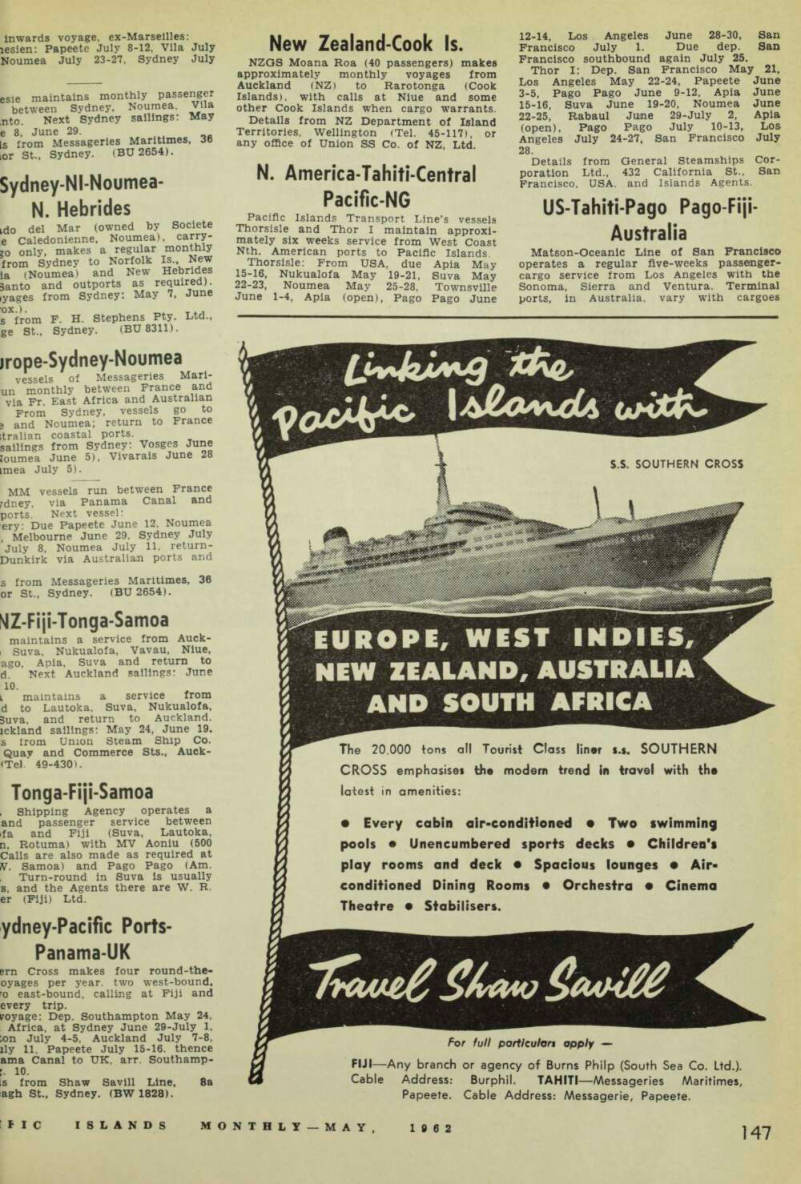 149
149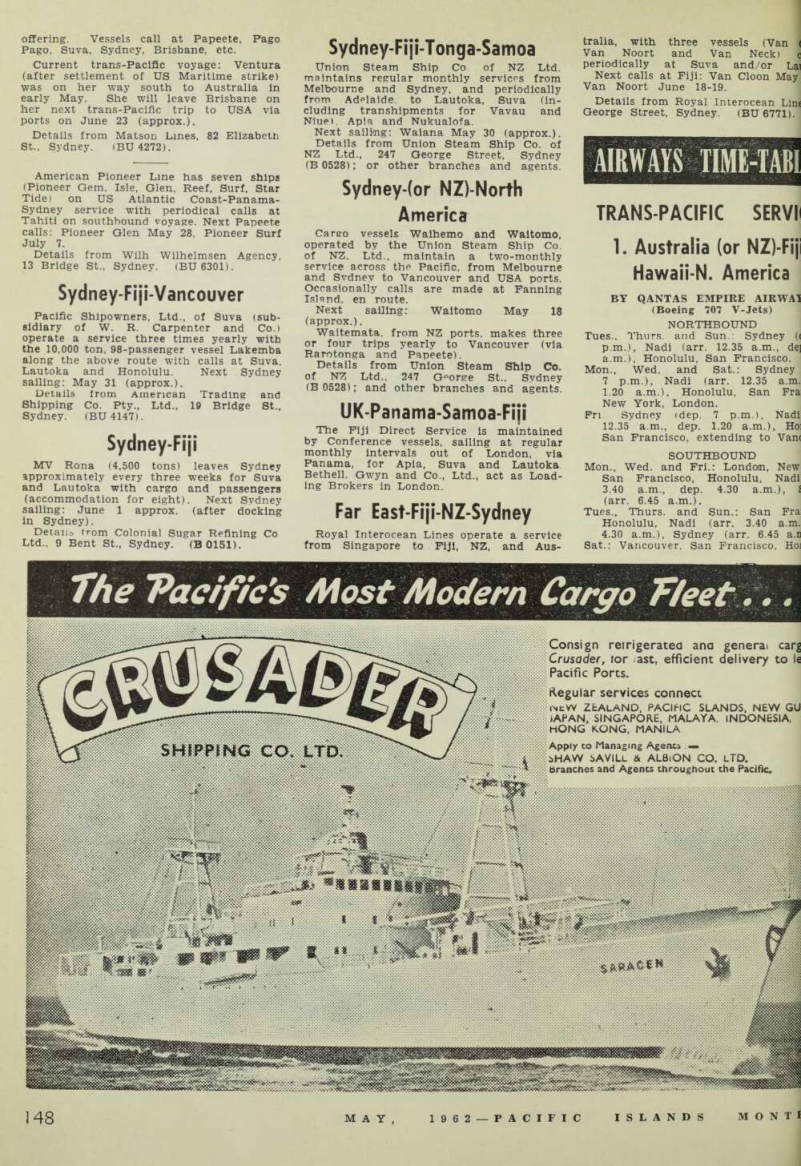 150
150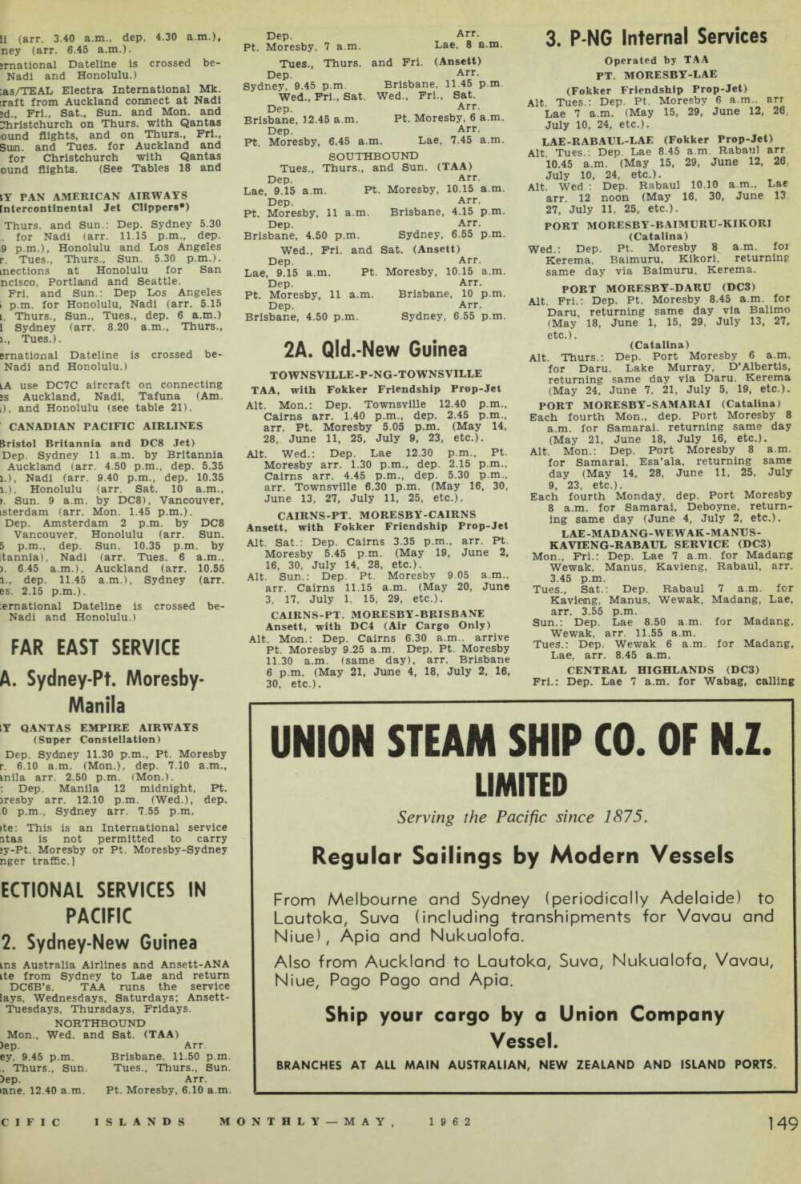 151
151 152
152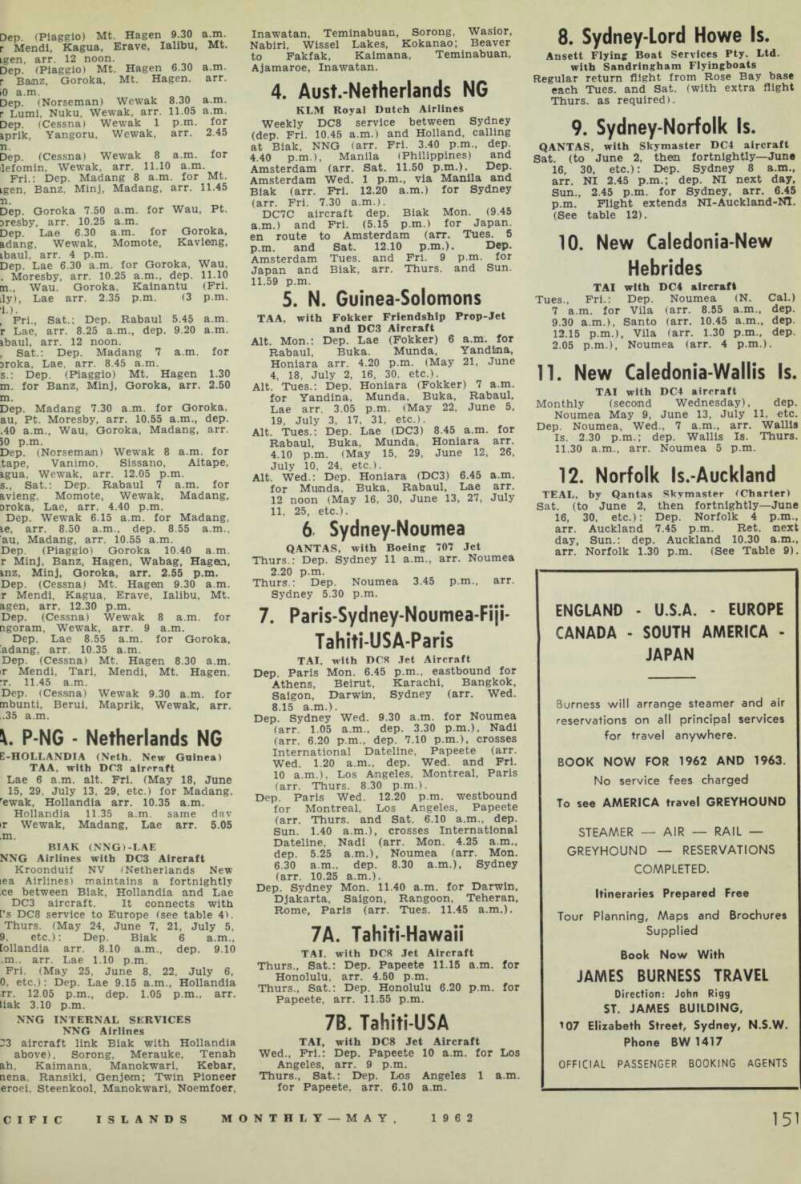 153
153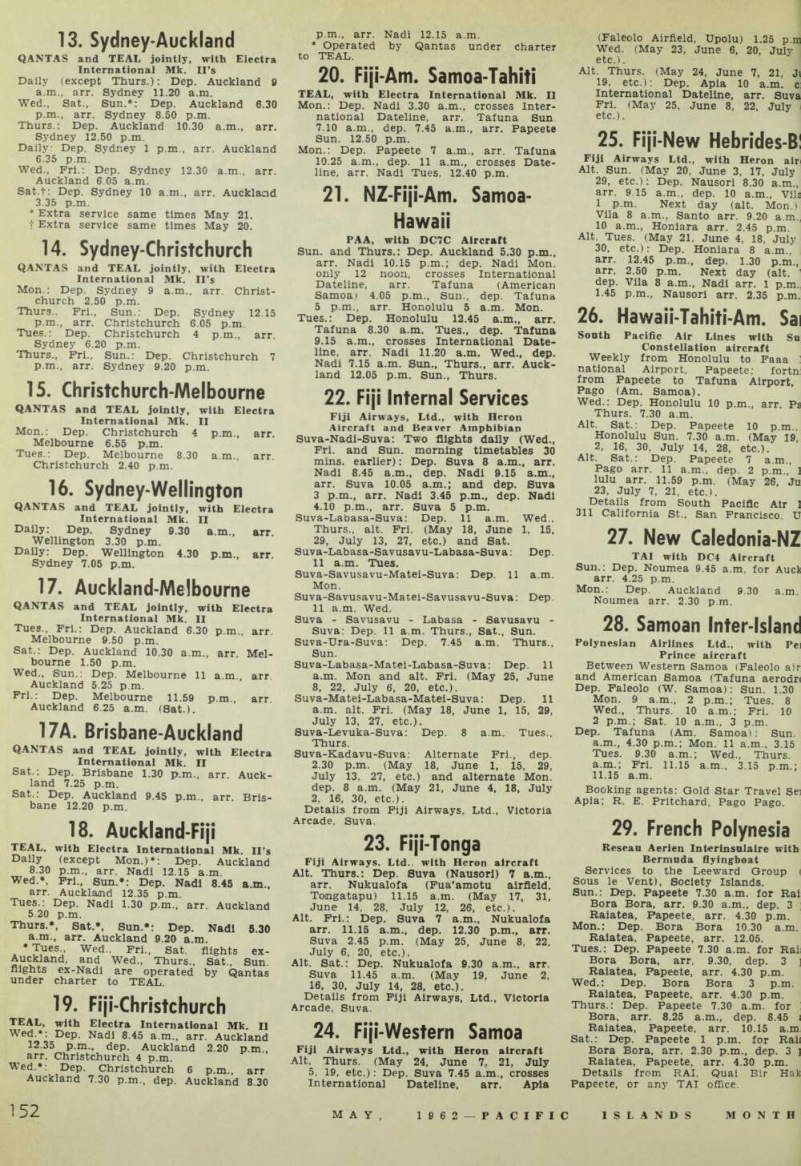 154
154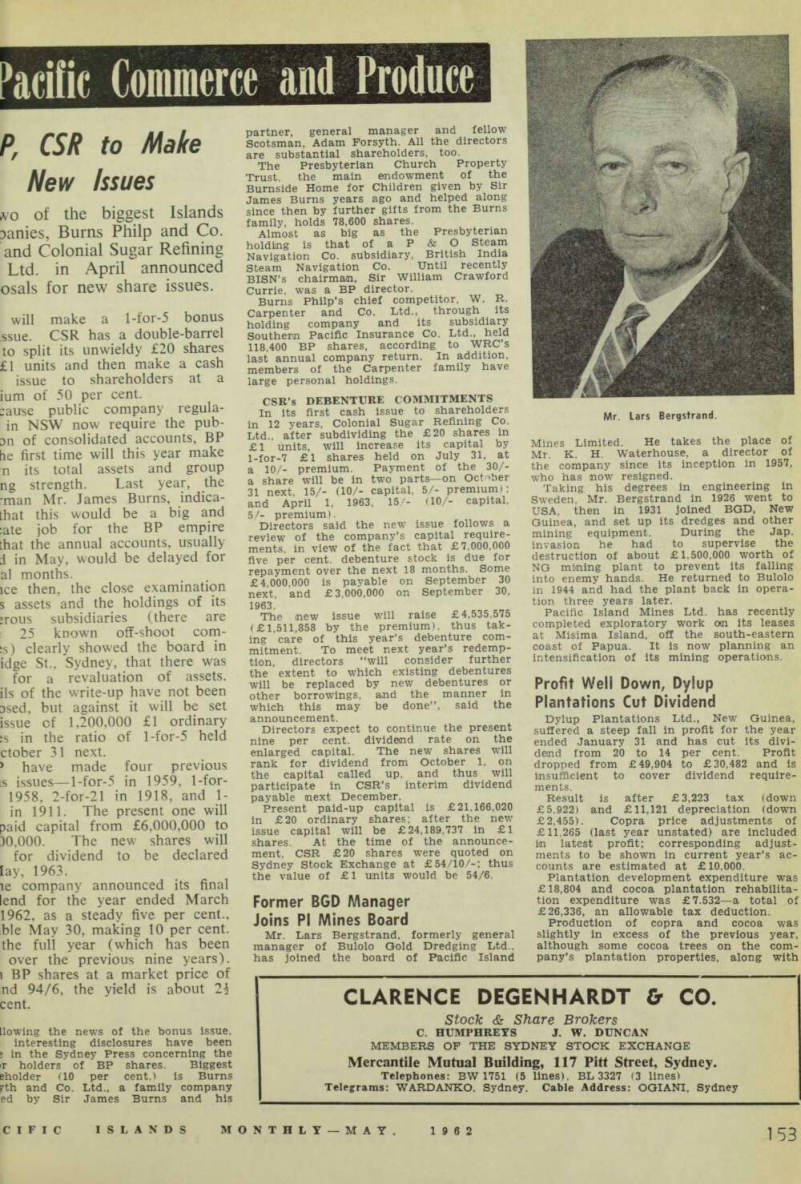 155
155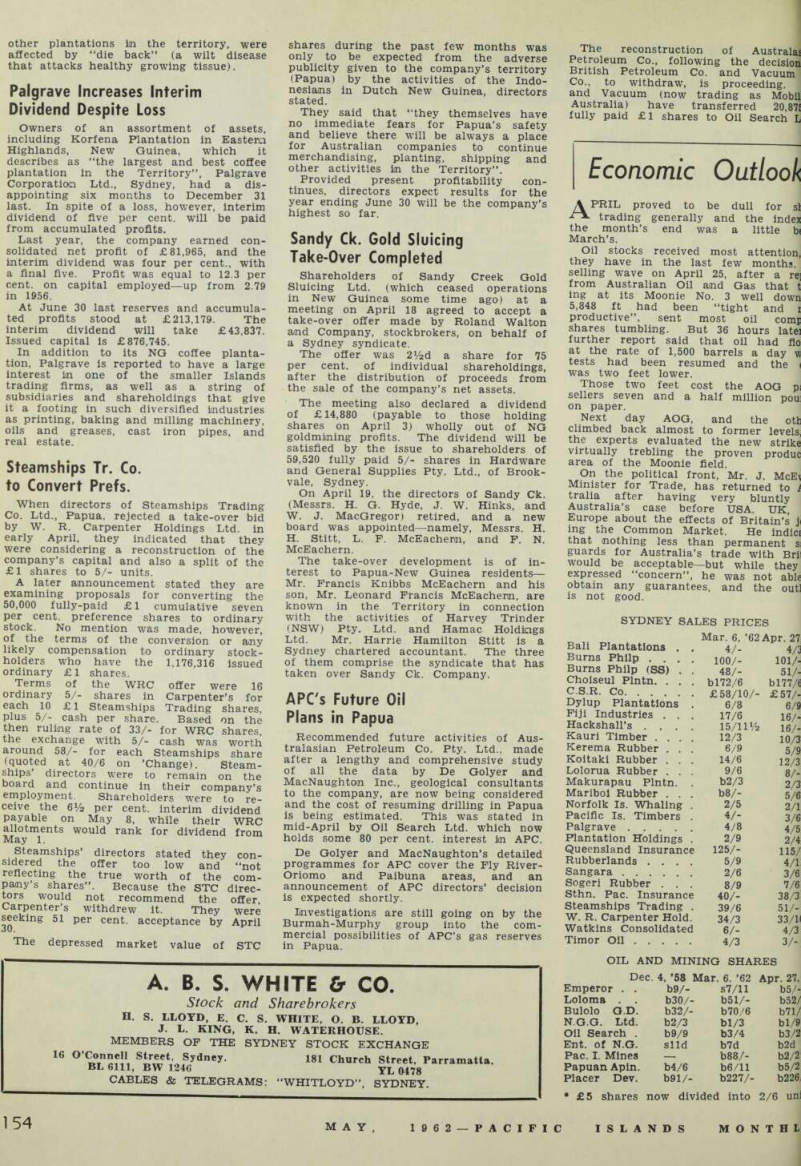 156
156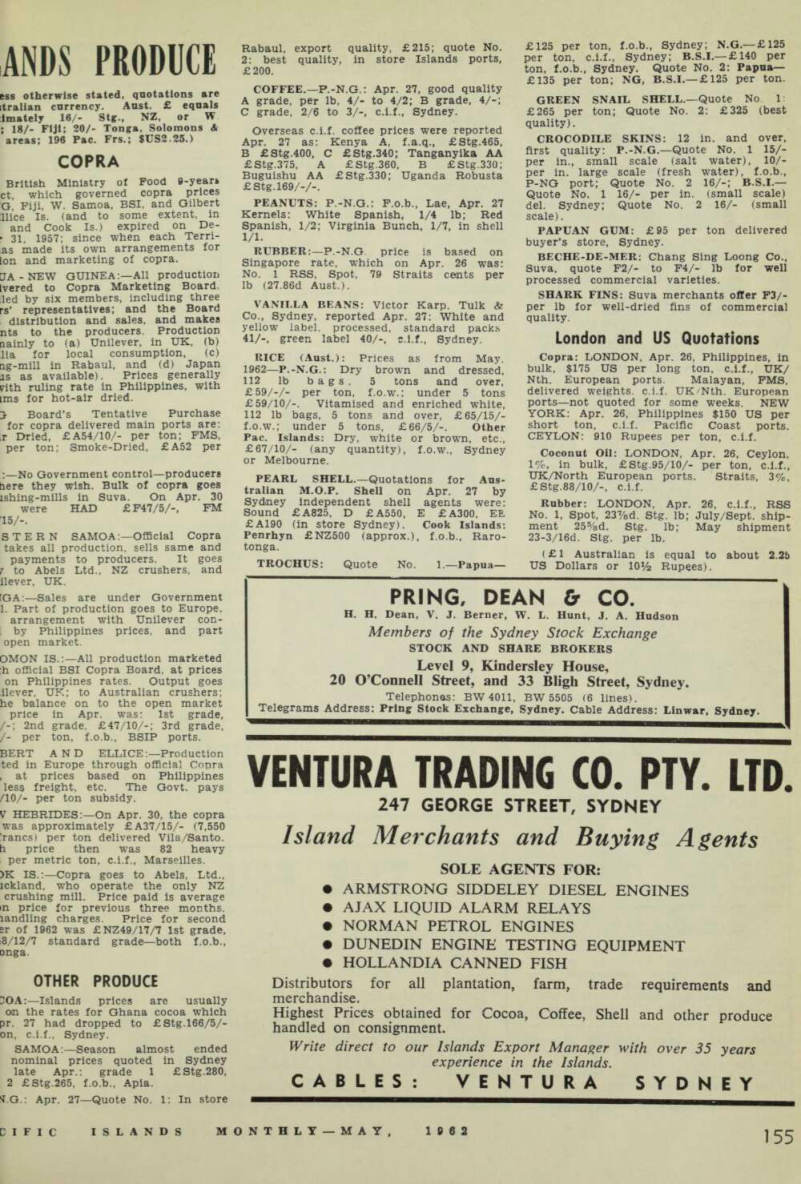 157
157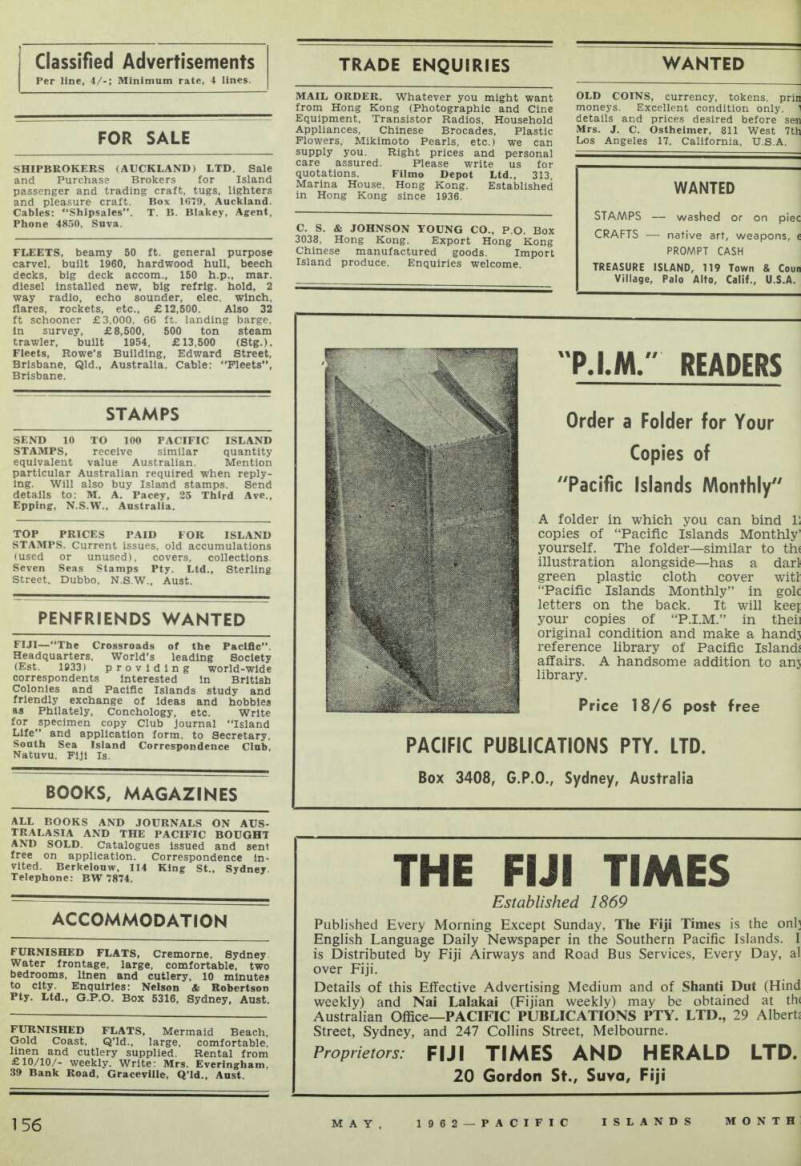 158
158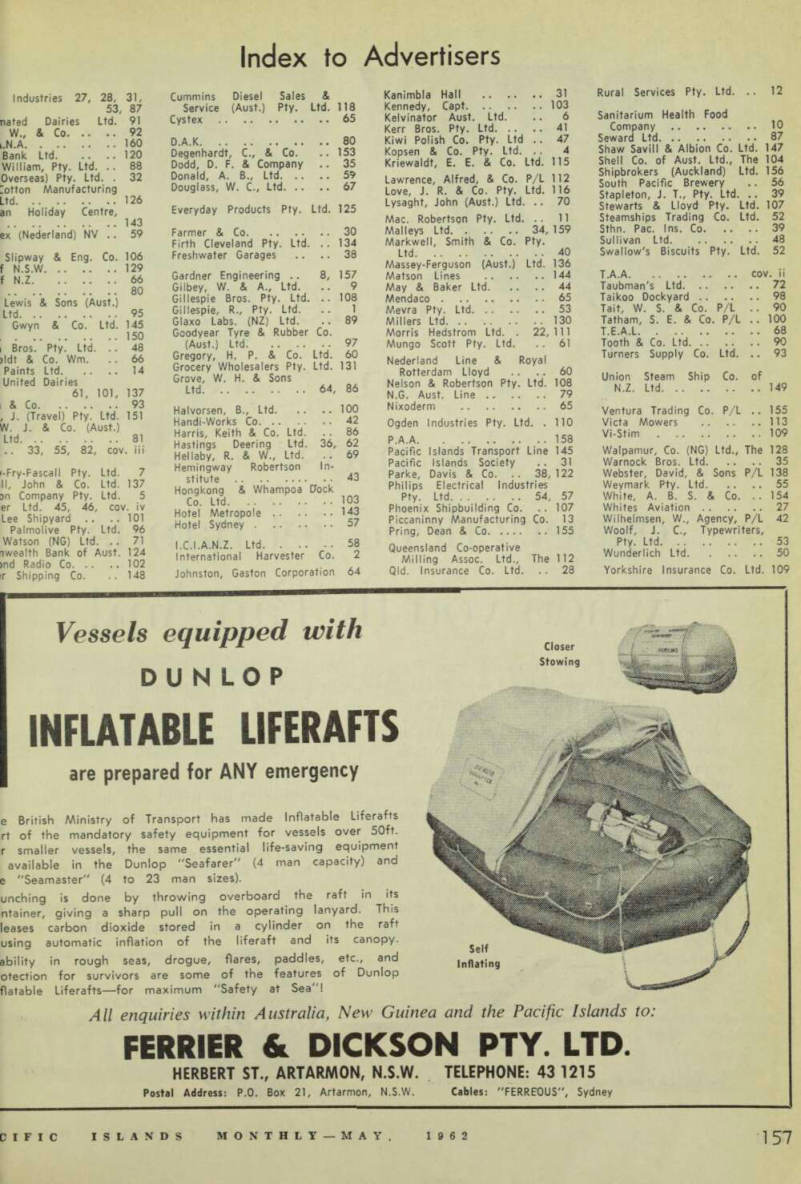 159
159 160
160 161
161 162
162 163
163 164
164