Tapa —Called
p. 67 · Read in the full issue
Masi
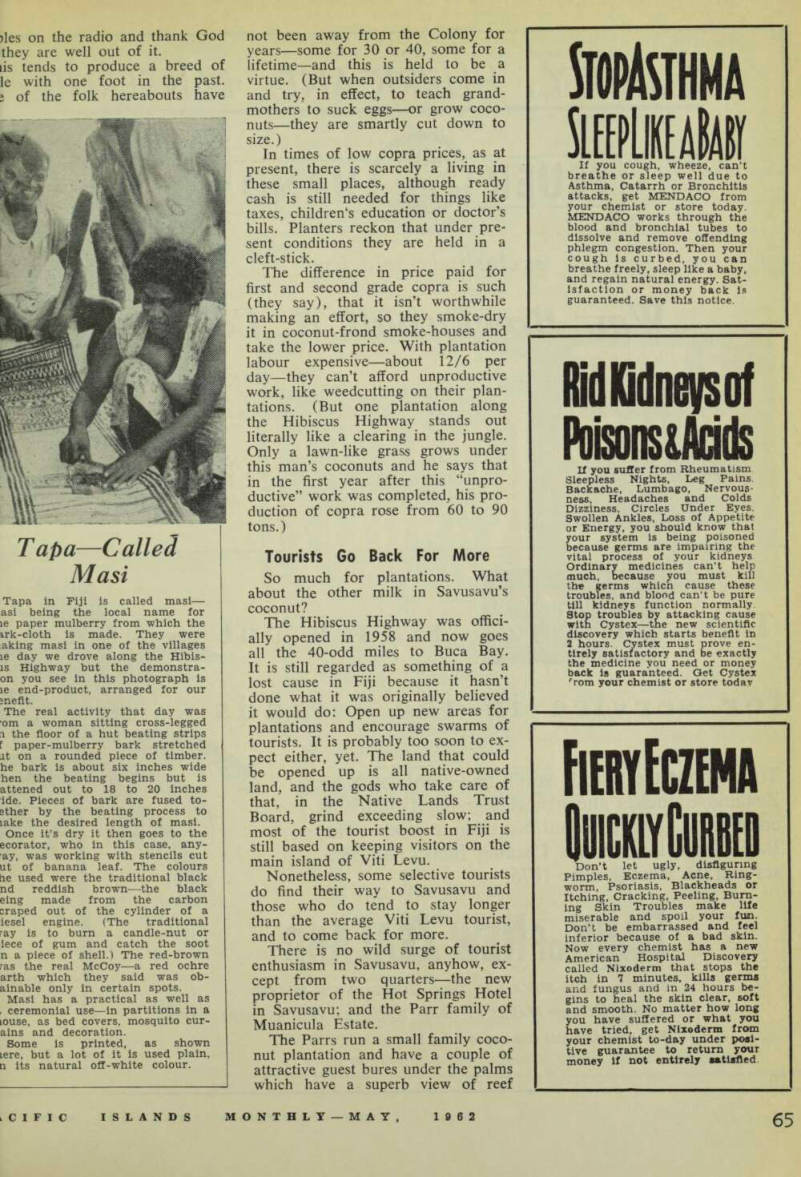
Tapa in Fiji is called masi— asi being the local name for le paper mulberry from which the irk-cloth is made. They were aking masi in one of the villages le day we drove along the Hibis is Highway but the demonstra on you see in this photograph is le end-product, arranged for our ;nefit.
The real activity that day was om a woman sitting cross-legged i the floor of a hut beating strips f paper-mulberry bark stretched it on a rounded piece of timber, he bark is about six inches wide hen the beating begins but is attened out to 18 to 20 inches ide. Pieces of bark are fused to ether by the beating process to take the desired length of masi.
Once it’s dry it then goes to the ecorator, who in this case, any ay, was working with stencils cut ut of banana leaf. The colours tie used were the traditional black nd reddish brown —the black eing made from the carbon craped out of the cylinder of a iesel engine. (The traditional ray is to burn a candle-nut or iece of gum and catch the soot n a piece of shell.) The red-brown ras the real McCoy—a red ochre arth which they said was ob ainable only in certain spots.
Masi has a practical as well as , ceremonial use—in partitions in a louse, as bed covers, mosquito cur ains and decoration.
Some is printed, as shown iere, but a lot of it is used plain, n its natural off-white colour.