A Night In Puka Puka
pp. 47-48 · Read in the full issue
From W. H. Percival, in Rarotonga The barbaric sound of Island drums thudded through the ed air and a group of men and women dancers jerked and fed to the fast, exhilarating rhythm. The night was hot, and id with the threat of storm. The brown bodies of the male ;ers gleamed, and fans wagged vigorously among the packed ;s of the audience.
E dance they watched so in tently was the Upa Vaeau, a lopment of the drum dance intro d during the 19th century from
Tahiti to Puka Puka, a remote northern atoll of the Cook Group.
Under their “heathen skirts” of shredded palm leaves the men wore white trousers, and the girls’ white dresses were adorned with the fern titi, the hula skirt.
The scene was a jam-packed theatre in Rarotonga recently, when some of the traditional dances, chants and folk-tales of Puka Puka atoll were being revived.
The performers were members of the Puka Puka Settlement in Raro tonga, a normally retiring group of people who had not previously per formed in public. Now, by popular request, they were giving the first of three repeat performances of their show, “A Night in Puka Puka”—rated by local critics as Rarotonga’s “best show of the year”.
Why were they doing it? The reason was prosaic enough—to raise funds to support their water supply scheme. How were they doing it so successfully?
Mainly because of the organising ability and skilful leadership of Mrs.
Carl Hebenstreit —better known by her maiden name of Johnny Frisbie.
Johnny, an attractive young lady of 29, is the daughter of an American father and a Polynesian mother. Her father, Robert Dean Frisbie, once lived in Tahiti with his friends and contemporaries, writers Nordhoff and
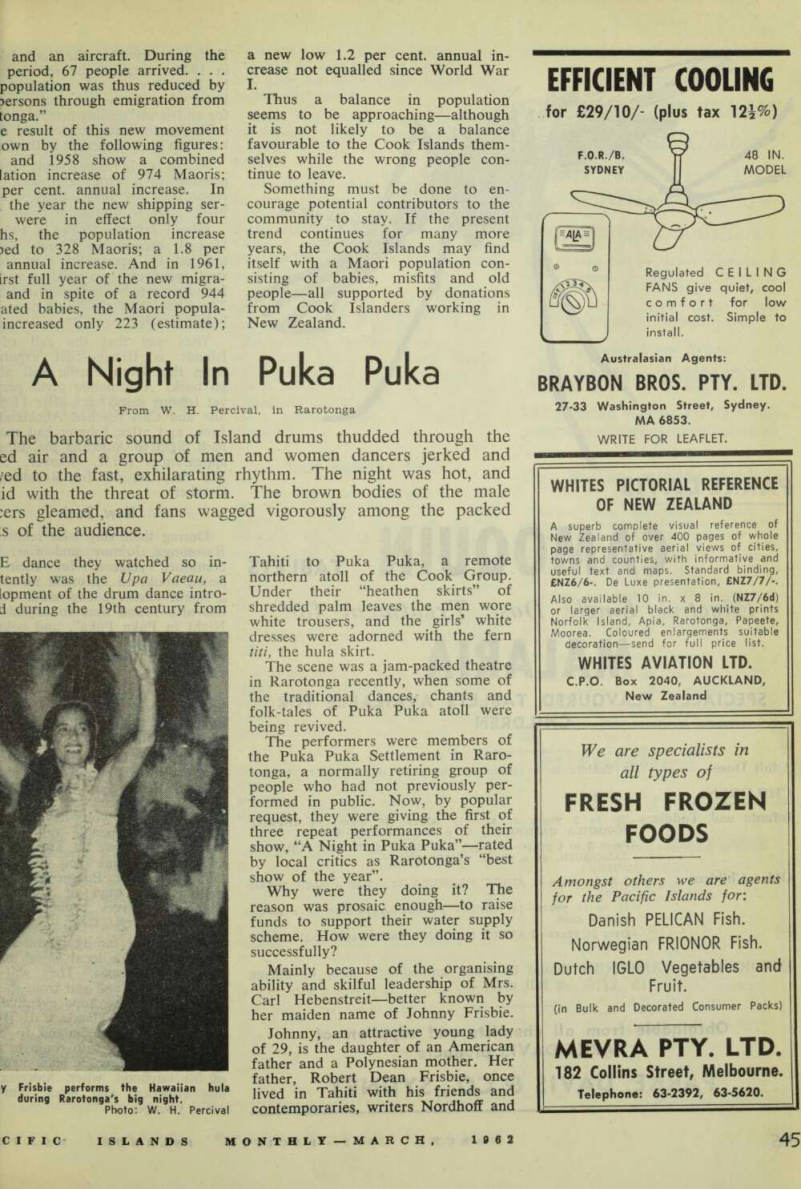
y Frisbie performs the Hawaiian hula during Rarotonga's big night.
Photo: W. H. Percival
Hall, but arrived in the Cook Islai in 1924, to spend the remainder his life, 28 years. He settled at Pi Puka where he was branch mana for an Islands’ trading firm, and wh he began to write articles and bo based on his experiences in the Coc At an early age Johnny sho\ promise as a writer and, aided ; encouraged by her father, wrote book, Miss Ulysses from Puka Pi Johnny left the Cooks in 1950 Hawaii, became an Islands’ dan married TV personality Carl Het streit, produced two children and j found time to write her second be The Frisbies of the South Seas, p lished in 1960.
They say that the call of Islands is strong—that expatrii from the South Pacific will ah* go back. A romantic myth perhi yet Johnny came back after 11 ye She and Carl reached Auckland June, and after Johnny had mad rush flight to Australia for some appearances ( PIM , October, ’6l, 17) they set off for Rarotonga October.
New Book During their stay with relative: Rarotonga Johnny and Carl t continued research for their ] posed book, an historical novel > a South Pacific background. Joh has also found time to organise Night in Puka Puka”, and colou with her exotic Hawaiian dance something new for Raroto audiences.
The first performance of the si brought forth praise from a leae member of the community who wi as follows in the local news-sheet: “I would like to congratulate give praise to ‘Johnny’ and the P Puka Settlement for the most en able performance last night. \ done, Johnny, you have certa brought your people out of ti shells . . . above all, after 11 yi away from home you have m tained the true Polynesian link customs and ways of your pe( which I am very proud of .
Makea Nui Ariki, CBE.”
Johnny and family intend to 1 Puka Puka by a local vessel and turn to Rarotonga. They will t travel to Auckland and from then Hawaii, but they hope eventually settle in New Zealand. Carl Het streit found New Zealand to be beautiful country with room to m around in”. It brought back memo of his boyhood, when America 1 less crowded, and made him : years younger.