[?]C Chairman
p. 49 · Read in the full issue
ÒOks At Fiji
From a Correspondent
Suva.
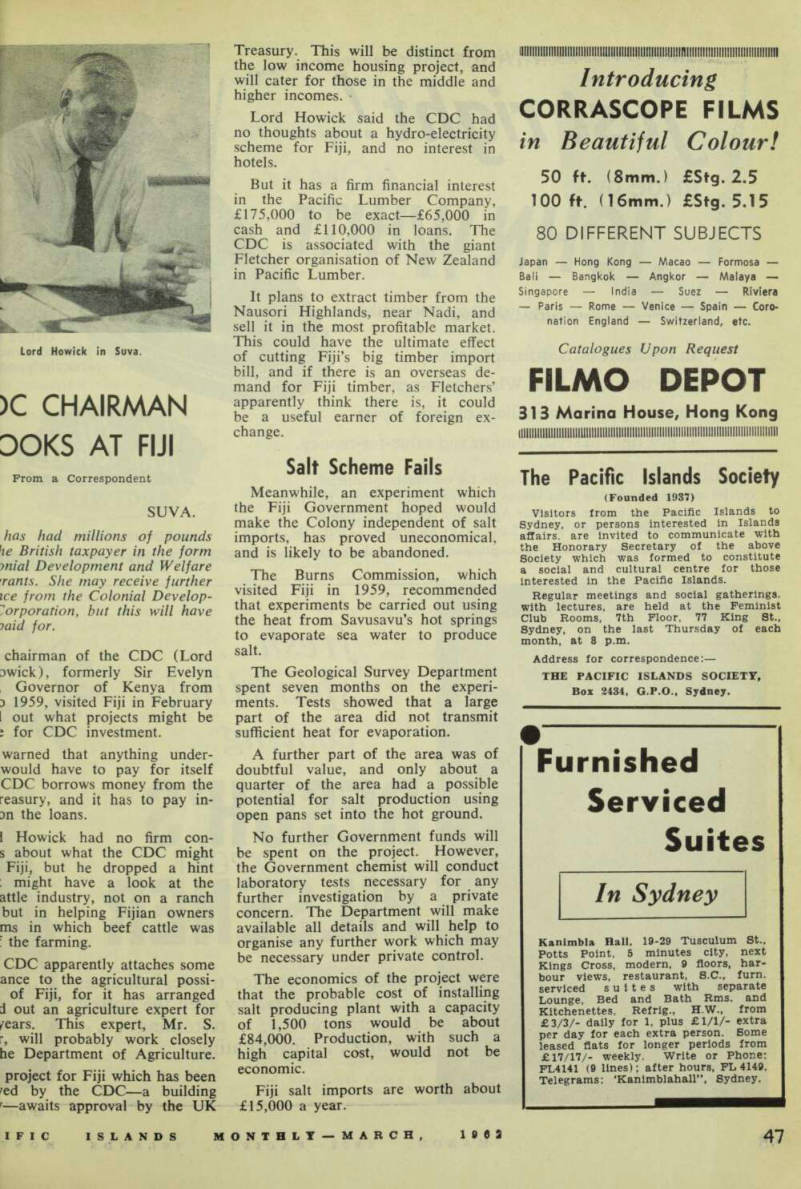
has had millions of pounds he British taxpayer in the form mial Development and Welfare rants. She may receive further ice from the Colonial Develop- Zorporation , but this will have laid for. chairman of the CDC (Lord awick), formerly Sir Evelyn Governor of Kenya from 3 1959, visited Fiji in February [ out what projects might be i for CDC investment. warned that anything under would have to pay for itself CDC borrows money from the reasury, and it has to pay in -3n the loans. 1 Howick had no firm con s about what the CDC might Fiji, but he dropped a hint ; might have a look at the attle industry, not on a ranch but in helping Fijian owners ms in which beef cattle was : the farming.
CDC apparently attaches some ance to the agricultural possi of Fiji, for it has arranged d out an agriculture expert for This expert, Mr. S. r, will probably work closely he Department of Agriculture. project for Fiji which has been 'ed by the CDC—a building r —awaits approval by the UK
Treasury. This will be distinct from the low income housing project, and will cater for those in the middle and higher incomes.
Lord Howick said the CDC had no thoughts about a hydro-electricity scheme for Fiji, and no interest in hotels.
But it has a firm financial interest in the Pacific Lumber Company, £175,000 to be exact—£6s,ooo in cash and £llO,OOO in loans. The CDC is associated with the giant Fletcher organisation of New Zealand in Pacific Lumber.
It plans to extract timber from the Nausori Highlands, near Nadi, and sell it in the most profitable market.
This could have the ultimate effect of cutting Fiji’s big timber import bill, and if there is an overseas de mand for Fiji timber, as Fletchers’ apparently think there is, it could be a useful earner of foreign ex change.
Salt Scheme Fails
Meanwhile, an experiment which the Fiji Government hoped would make the Colony independent of salt imports, has proved uneconomical, and is likely to be abandoned.
The Burns Commission, which visited Fiji in 1959, recommended that experiments be carried out using the heat from Savusavu’s hot springs to evaporate sea water to produce salt.
The Geological Survey Department spent seven months on the experi ments. Tests showed that a large part of the area did not transmit sufficient heat for evaporation.
A further part of the area was of doubtful value, and only about a quarter of the area had a possible potential for salt production using open pans set into the hot ground.
No further Government funds will be spent on the project. However, the Government chemist will conduct laboratory tests necessary for any further investigation by a private concern. The Department will make available all details and will help to organise any further work which may be necessary under private control.
The economics of the project were that the probable cost of installing salt producing plant with a capacity of 1,500 tons would be about £84,000. Production, with such a high capital cost, would not be economic.
Fiji salt imports are worth about £15,000 a year.
Lord Howick in Suva.