Emigration Offsets The Cook
pp. 45-47 · Read in the full issue

But New Problems Ahead Emigration Offsets The Cook Islands' Baby Boom
From Johnny Frisbie and Carl Hebenstreit, in Rarotonga The Cook Islands’ big population explosion that had Adminis n officers wondering where they would put all the people by is levelling off.
> new factors influencing popu ition have come into play that a profound effect on both pre nd the future: Hie phenomenal and gratifying e in the infant mortality rate; The sudden and unparalleled in emigration from the Cooks w Zealand. the end of 1962, these two should have cancelled each leaving a fairly stable popu —but a population with a new :m! ; impact of better health care >een reported in PIM (Nov., p. 137). The infant mortality ras shown in that report to have ed from 269 per 1,000 births in to a new low of 34 per 1,000 60. But while the baby boom d the population by nearly in the five years between the »es of 1956 and 1961, the s are misleading. 5 real growth took place be -1957 and 1959 when the popu jumped 1,361 in just 36 is; a yearly rate of 2.7 per But this runaway growth was iort as the levelling factor of ation began to take increased til September, 1960, emigration regligible, and the pressure of ers waiting to migrate to New id continued to build. Union i Ship Company, operating Id Maui Pomare, was booked r a year in advance and could accept additional reservations, slightly over 200 Maoris were ging to migrate each year. ;n, simultaneously, two new ies opened up: the 40 passenger a Roa replaced the Pomare and >n began its once-every-three ; calls of the Monterey and wsa on the southbound leg of "ahiti-Auckland route. . R. Gerard Ward, of London ;rsity, wrote in the Polynesian al that the first month of this ined new service saw 109 Cook
Islanders leave for New Zealand— about six times the normal monthly average up till then. The population pressure began to ease as a new migration boom was launched.
But a new problem was created.
The majority of emigrants are the very people the Cook Islands need to keep to develop the depressed economy. They are the young—the talented—the productive.
Seventy-nine per cent, of all Cook Islanders now living in New Zealand are between the ages of 15 and 45.
In the Cooks themselves, only 38 per cent, remain in this critical produc tive age group. And who can blame a Maori schoolteacher or clerk earn ing £4 weekly in the Cooks, for leaving at the end of his contract to earn £lB a week in New Zealand as an unskilled labourer?
And so a great exodus is under way, limited only by available trans-
port. In 1960, 638 Maoris left—an estimated 822 migrated in 1961. And the great number departing is not offset by the few who return.
The Cook Island News of Decem ber, 1961, reports: “Between Novem ber 30 and December 17, a period of only two and half weeks, 189 pas sengers have left Rarotonga on five
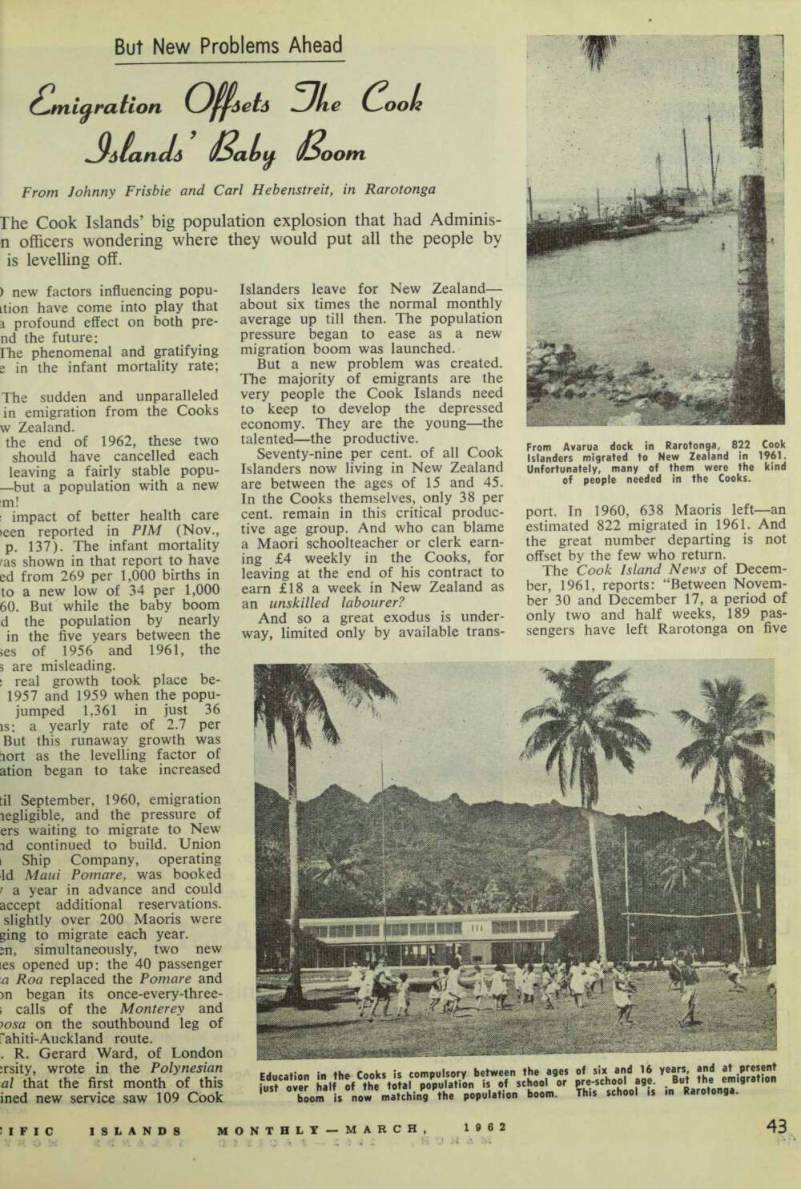
From Avarua dock in Rarotonga, 822 Cook Islanders migrated to New Zealand in 1961.
Unfortunately, many of them were the kind of people needed in the Cooks.
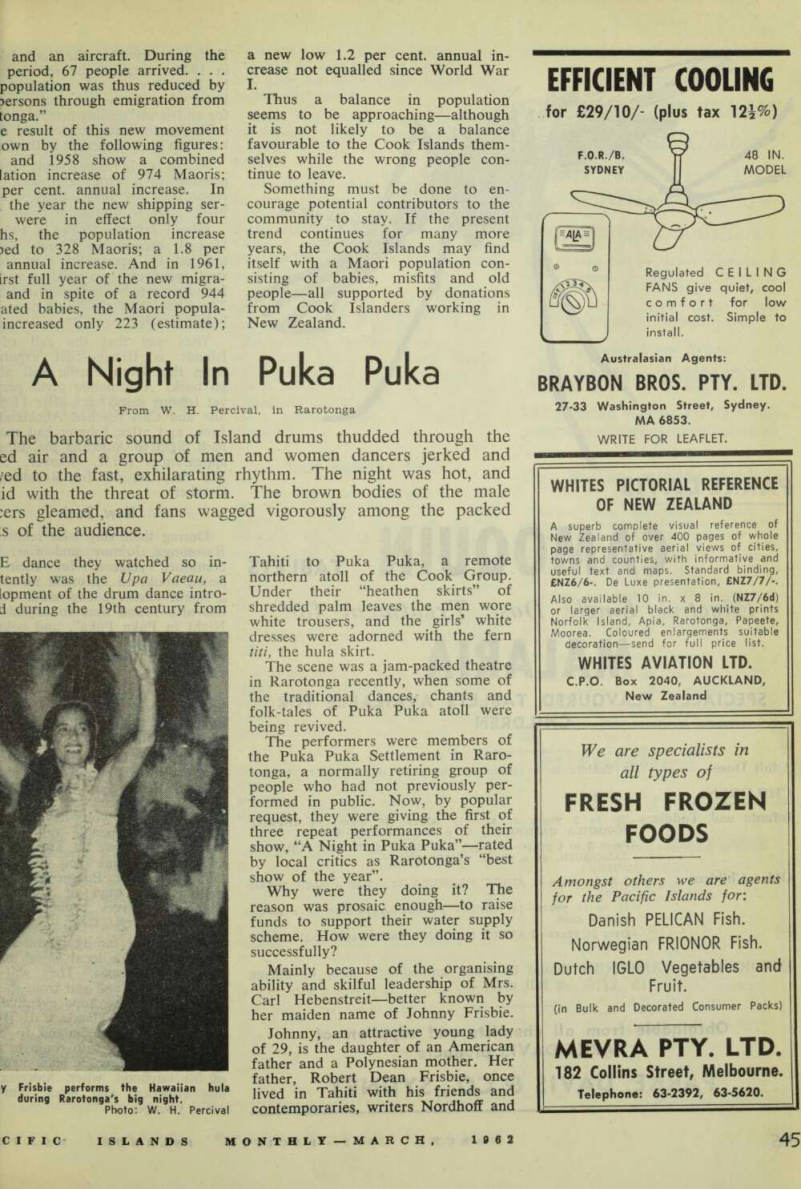
Education in the Cooks is compulsory between the ages of six and 16 years, and of present just over half of the total population is of scool or pre-scool age. But the emigration boom is now matching the population boom. This school is in Karotonga.
and an aircraft. During the period, 67 people arrived. . . . population was thus reduced by jersons through emigration from tonga.” e result of this new movement own by the following figures: and 1958 show a combined lation increase of 974 Maoris; per cent, annual increase. In the year the new shipping ser were in effect only four hs, the population increase )ed to 328 Maoris; a 1.8 per annual increase. And in 1961, irst full year of the new migra and in spite of a record 944 ated babies, the Maori popula increased only 223 (estimate);
a new low 1.2 per cent, annual in crease not equalled since World War I.
Thus a balance in population seems to be approaching—although it is not likely to be a balance favourable to the Cook Islands them selves while the wrong people con tinue to leave.
Something must be done to en courage potential contributors to the community to stay. If the present trend continues for many more years, the Cook Islands may find itself with a Maori population con sisting of babies, misfits and old people—all supported by donations from Cook Islanders working in New Zealand.