The Editors' Mailbag
p. 27 · Read in the full issue
c Toe-Holds For
Oncoming Reds?
i a former Islander now living tensland: January PI M’s account of ks in the Fiji Legco was es ' interesting. Well, may the be thoughtful—and think well >a now has its independence vithout an Army or Navy, and an economy capable of g the governmental structure uld be a sitting shot for the >s. a is there beside Samoa. Be them, they provide the Reds n easy toe-hold against the Territories—and against Aus- Do these baby nations realise ul present-day implications of nding word “Independence”?
Fiji out of it. I’ve been ig Ratu Penaia. He was a good soldier, and I think he’s brains to see the traps in the around him. implication is that the British d Office has the capacity to iji on the right set of political greed—provided the Fiji Ad ition can feed Fiji’s rapidly r 400,000. But the Colony is an economic crisis created by 7 Office fumbling and blun over the last ten or fifteen
New Guinea
Industry
iin G. O. Gatehouse, of the Sleigh, formerly well-known ! Guinea, wants to know if has started up that rattan rniture industry which the P partment of Forests offered to vith advice) six months ago. )ctober, page 119.) Director of Forests, Mr, W. R. said on that occasion that with tal outlay of from £5,000i and Territory rattan, a >0 per annum export trade •e worked up. iin Gatehouse says that it is cessary to prove that cane e can be made in the Terri ers, Hal Evans, who was liv- Madang and Kavieng in the ) years after the war, has proved it. made some fine chairs, tables
and lounge suites from locally grown rattan and there must still be samples of her work in the Territory,” he says. “She also used local kapok for the cushions that went with the suites.
I have often had to buy rattan fur niture in Singapore in recent years and none of it is in any way better than that which Mrs. Evans produced, either in styling or durability.” [Mr. and Mrs. Hal Evans “went finish” from NG about three years ago and now live in Sydney—with a few pieces of the original NG cane furniture still around them. In those first post-war years of scarcity, Linda Evans decided to make some “Manila furniture” out of local cane. The ex periment was so successful that her friends begged her to make some for them and, before she realised it, she was in business. Towards the end, after they had been stationed in Kavieng for some time, they found it difficult to get good supplies of cane and even more difficult to get the local natives to produce the coir fibre from coconut husks for the cushion fillings. The kapok fillings that Capt. Gatehouse mentions were used in their own cushions only be cause they had kapok trees in their own garden. There was also, about 1953-54, a maker of cane furniture in Port Moresby, but the business seems to have long since disappeared.]
Fiji's Radio Correspondent
Mr. John Stannage, manager of the Fiji Broadcasting Commission, sends us a note about the PIM reader who complained in February Mailbag about the objectivity of the Australian Broadcasting Commission’s news ser vice. The reader in February said the ABC used the staff of the FBC as news correspondents. Says Mr.
Stannage: “Your correspondent is misinformed when he states that the FBC acts as correspondent for the ABC. His statement has no basis in fact whatever.”
The New Guinea Scene
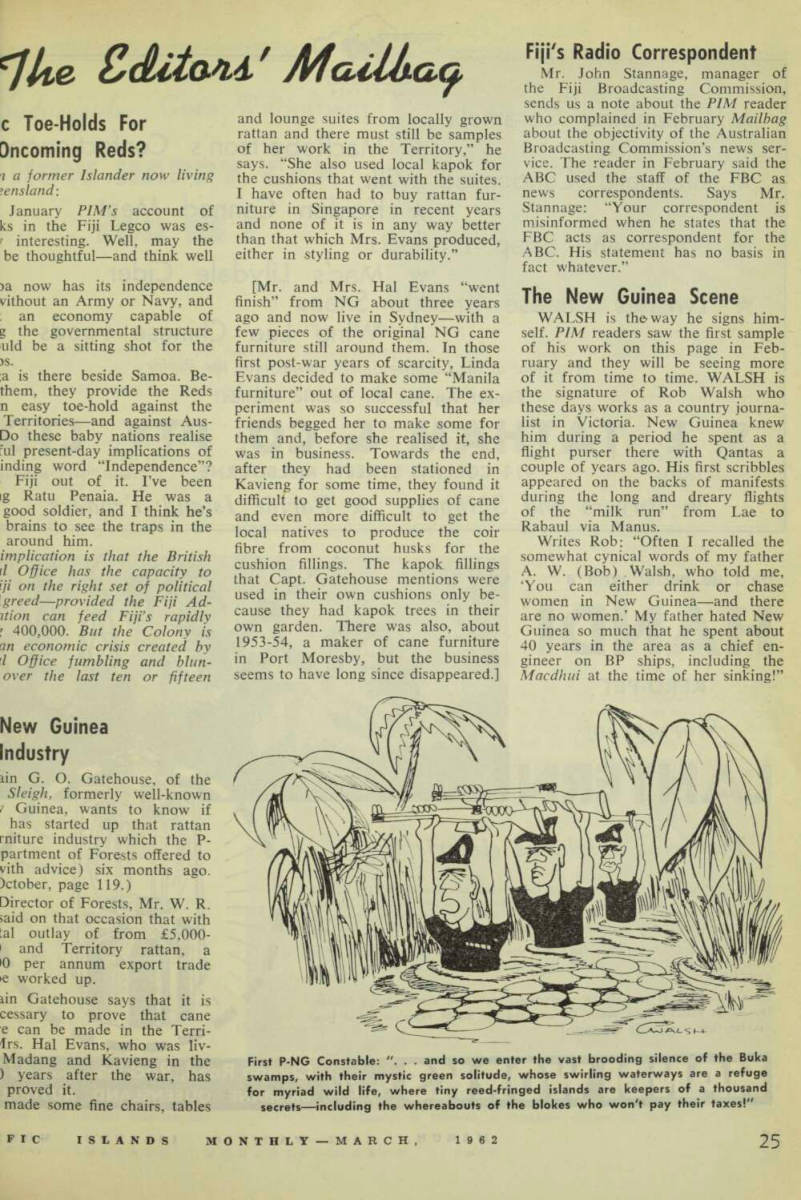
WALSH is the way he signs him self. PIM readers saw the first sample of his work on this page in Feb ruary and they will be seeing more of it from time to time. WALSH is the signature of Rob Walsh who these days works as a country journa list in Victoria. New Guinea knew him during a period he spent as a flight purser there with Qantas a couple of years ago. His first scribbles appeared on the backs of manifests during the long and dreary flights of the “milk run” from Lae to Rabaul via Manus.
Writes Rob: “Often I recalled the somewhat cynical words of my father A. W. (Bob) Walsh, who told me, ‘You can either drink or chase women in New Guinea—and there are no women.’ My father hated New Guinea so much that he spent about 40 years in the area as a chief en gineer on BP ships, including the Macdhui at the time of her sinking!”
First P-NG Constable:"... and so we enter the vast brooding silence of the Buka swamps, with their mystic green solitude, whose swirling waterways are a refuge, for myriad wild life, where tiny reed-fringed islands are keepers of a thousand secrets —including the whereabouts of the blokes who won't pay their taxes!"