How Happy Can
pp. 29-30 · Read in the full issue
Sydneysider Goes Walkabout
You Be?
Suva, February 28.
In many respects Fiji has become the back-bitingest place he Pacific —which is saying something in the Islands area re it is traditional for everyone to hate everyone else’s guts.
tY dependent territory by its ture has spasms of adjustment icontent as did Papua-New in 1960, when it first began the message of “independence >n rather than too late”. And having its acute attack of tiolia just at present, planters are unhappy because low price of copra; because ven’t got a Copra Board which help to sell some copra over head of to the local mill, ;ome think is not paying them ; and most of all because they j new Development Commis doesn’t like them and is mak dead set at them and their : trees, by “asking us to cut own”. all part of the proposed sub coconut replanting scheme. As I can see, the Development ssioner doesn’t intend to cut ;e until there is another one in its place, but as a piece of d legislation, it is breaking all for creating general mayhem, misunderstanding and heart amongst the planting fra de the planters’ own par little hell, there is the Civil with everyone outside it cur having a hate-session against e who is in it—and particu ;ainst those officers who have been designated as “ex s”, get a 25 per cent, salary 1 other privileges retrospective 1, 1961. original form, the new system gnated officers was a simple by the Government to at ecialist officers from overseas jobs that carried salaries un
attractive on world scales. But now that it has been bent and generally fiddled with to fit it more perfectly to local desires, Mr. Webster would have to do some fancy bending him self to get the word expatriate into its original place in his dictionary. (See PIM, February, page 115.) The salary increase costs the Fiji taxpayer nothing—the bill is paid by the UK Government—but, as the locals cunningly point out, the new salaries are wholly pensionable and Fiji has to pay for its share of that.
Whatever are the pros and cons of the expatriates’ new salaries, the scheme has already created feeling in the service between those hundreds who benefit and the thousands who do not, and some adjustment to salaries of the latter (paid by Fiji) is inevitable.
Nor are all expatriates happy.
Many of them spend an inordinate amount of their time calculating how soon they can get out for good on the increased pensions to which the new conditions allow—for the scheme is a two-edged sword: It may entice men into the service who would not ordinarily have come, but it allows those who have set a pension target to escape much sooner.
Part of the discontent may be local; much of it is symptomatic of the times. With colonial empires disinte grating around their ears, who can blame them if they see Fiji as the end of the line?
When 1 first visited this Colony towards the end of the war it was a gay, bright community—or I thought so after the wartime austerity of Aus tralia. Fiji was all Outpost of Empire, with no problems to be solved except a war to be won, with women dress ing in long gowns to eat dinner in
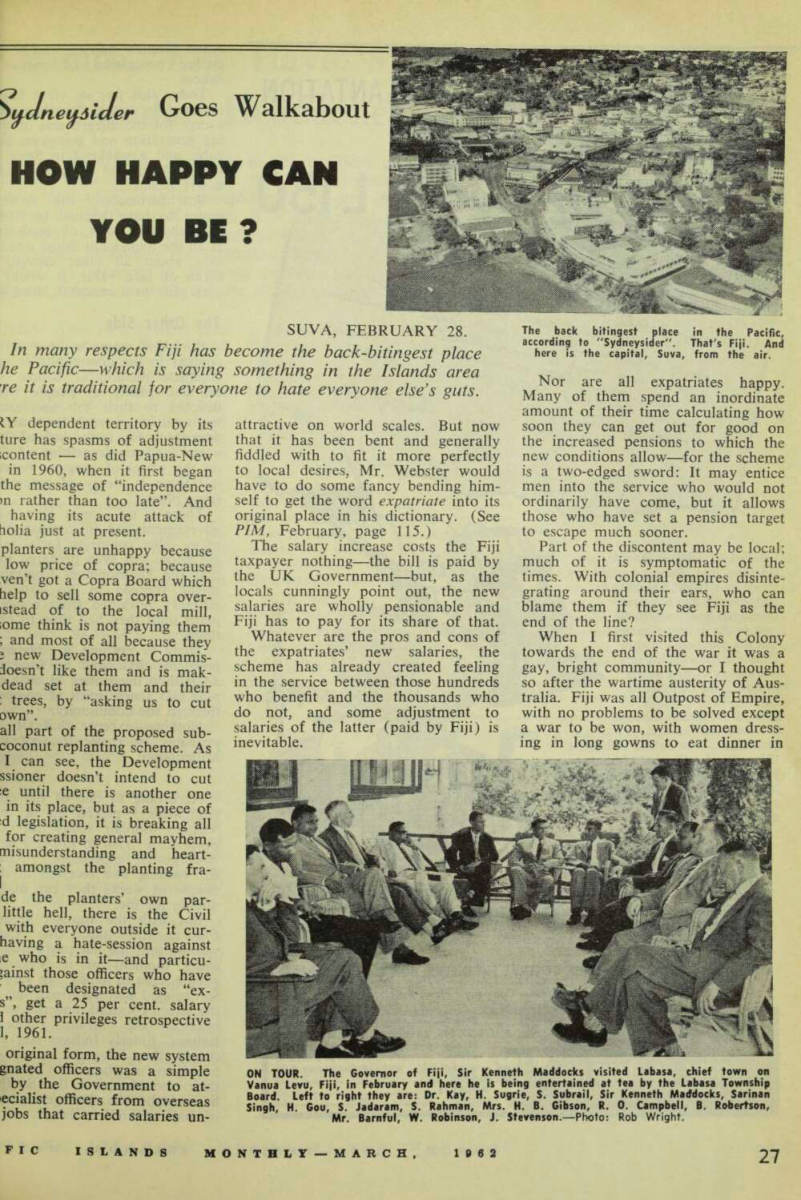
The back bitingest place in the Pacific, according to "Sydneysider". That's Fiji. And here is the capital, Suva, from the air.
ON TOUR. The Governor of Fiji, Sir Kenneth Maddocks visited Labasa, chief town on Vanua Levu, Fiji, in February and here he is being entertained at tea by the Labasa Township Board. Left to right they are: Dr. Kay, H. Sugrie, S. Subrail, Sir Kenneth Maddocks, Sarinan Singh, H. Gou, S. Jadaram, S. Rahman, Mrs. H. B. Gibson, R. O. Campbell, B. Robertson, Mr. Barnful, W. Robinson, J. Stevenson. Photo: Rob Wright.
other people’s houses, and a ending procession of parties ; dances.
Today this joie de vivre has b replaced by a staid suburban outlc except for the alleged sins of the ing generation and goings-on in t cabs; and a weekend in Suva is next best thing to being wrecked c desert island.
But fortunately the commu seems to have learned to live its universal habit of teeth-sink If all the unpleasant things one cit says about all other citizens \ taken at face value, it would b social life to a complete, dead sto The Other Side But what seems to be general content in the community is not complete picture, of course. T are still plenty of people who devoted to their job and attacl with missionary zeal; there are rr who think Fiji is the hub of the verse (and are something of a s\ on the wheel of progress becausi it); there is plenty of enterprise some places.
There is no scream here for government and in comparison many other countries, racial relal are good. I’m even prepared to 1 that the Development Commissi might succeed in his task if citizenry refrained from condem plans until they had time to exai them.
There is nothing to solving ] problems that can’t be fixed wii £1 million investment in birth-coi pills and a new spirit of co-open through the community.
Nothing—except that it w probably be easier to wait for Millennium. * * * According to one of the colo pamphlets I picked up at the Visitors Bureau today for anc purpose, a “Visit to Fiji is a neve be-forgotten experience”. After ear bashing I’ve received in the couple of weeks they can make double for me.
But with the tourists themse Fiji is still tops. One Cana woman told me her party was lo every moment of it “because people seem so happy”. In view o] foregoing I was surprised, but oi the street I looked, and she was ] because she meant Fijians Indians. Elderly Indians still 100 though they have the weight of problems of the Sub-Continent their shoulders but the South has taught the younger genen of Indians how to laugh.