of "Doctor”
p. 33 · Read in the full issue
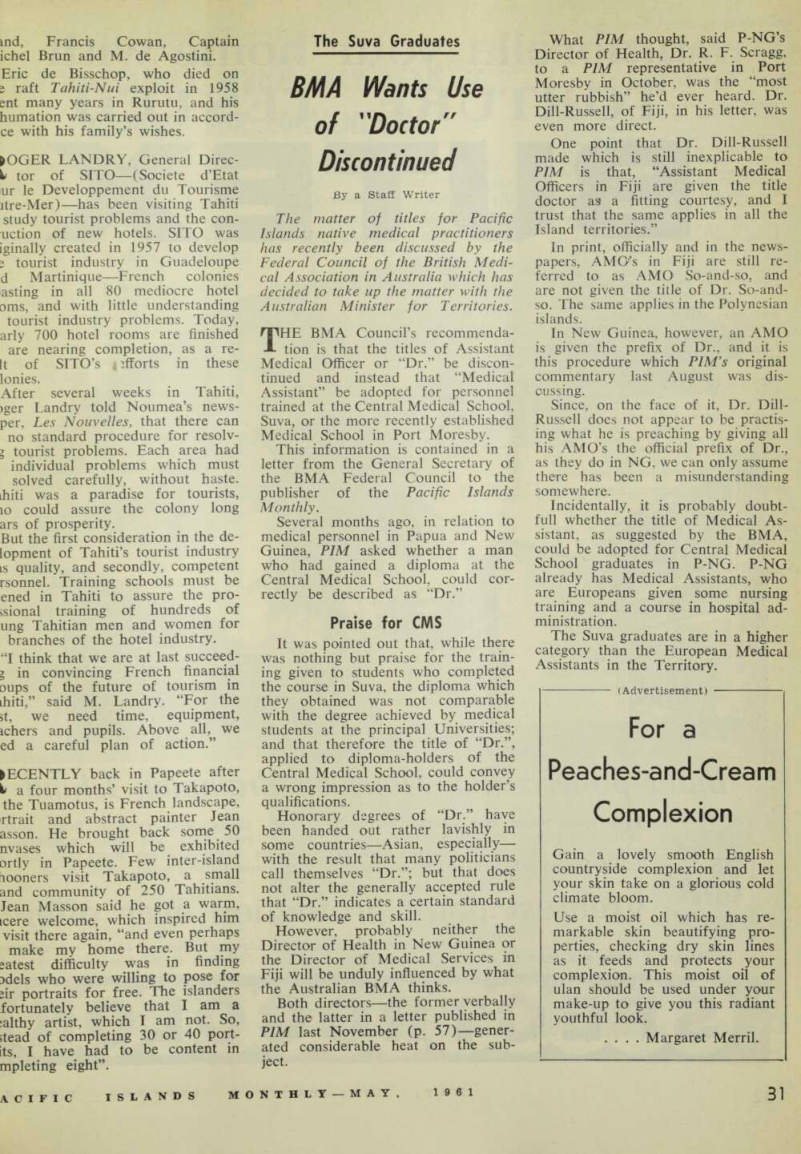
The Suva Graduates BMA Wants Use of "Doctor”
Discontinued
By a Staff Writer
The matter of titles for Pacific Islands native medical practitioners has recently been discussed by the Federal Council of the British Medi cal Association in Australia which has decided to take up the matter with the Australian Minister for Territories .
THE BMA Council’s recommenda tion is that the titles of Assistant Medical Officer or “Dr.” be discon tinued and instead that “Medical Assistant” be adopted for personnel trained at the Central Medical School, Suva, or the more recently established Medical School in Port Moresby.
This information is contained in a letter from the General Secretary of the BMA Federal Council to the publisher of the Pacific Islands Monthly.
Several months ago, in relation to medical personnel in Papua and New Guinea, PIM asked whether a man who had gained a diploma at the Central Medical School, could cor rectly be described as “Dr.”
Praise for CMS It was pointed out that, while there was nothing but praise for the train ing given to students who completed the course in Suva, the diploma which they obtained was not comparable with the degree achieved by medical students at the principal Universities; and that therefore the title of “Dr.”, applied to diploma-holders of the Central Medical School, could convey a wrong impression as to the holder’s qualifications.
Honorary degrees of “Dr.” have been handed out rather lavishly in some countries—Asian, especially— with the result that many politicians call themselves “Dr.”; but that does not alter the generally accepted rule that “Dr.” indicates a certain standard of knowledge and skill.
However, probably neither the Director of Health in New Guinea or the Director of Medical Services in Fiji will be unduly influenced by what the Australian BMA thinks.
Both directors —the former verbally and the latter in a letter published in PIM last November (p. 57) —generated considerable heat on the sub ject.
What PIM thought, said P-NG’s Director of Health, Dr. R. F. Scragg, to a PIM representative in Port Moresby in October, was the “most utter rubbish” he’d ever heard. Dr.
Dill-Russell, of Fiji, in his letter, was even more direct.
One point that Dr. Dill-Russell made which is still inexplicable to PIM is that, “Assistant Medical Officers in Fiji are given the title doctor asi a fitting courtesy, and I trust that the same applies in all the Island territories.”
In print, officially and in the news papers, AMO’s in Fiji are still re ferred to as AMO So-and-so, and are not given the title of Dr. So-and so. The same applies in the Polynesian islands.
In New Guinea, however, an AMO is given the prefix of Dr., and it is this procedure which PlM’s original commentary last August was dis cussing.
Since, on the face of it, Dr. Dill- Russell does not appear to be practis ing what he is preaching by giving all his AMO’s the official prefix of Dr,, as they do in NG, we can only assume there has been a misunderstanding somewhere.
Incidentally, it is probably doubt full whether the title of Medical As sistant, as suggested by the BMA, could be adopted for Central Medical School graduates in P-NG. P-NG already has Medical Assistants, who are Europeans given some nursing training and a course in hospital ad ministration.
The Suva graduates are in a higher category than the European Medical Assistants in the Territory.