Request For Convention
pp. 35-37 · Read in the full issue
Unhappy Prospects in Fiji
Circumstances Which May Lead To
In the Fiji Legislative Council in April, the Fijian representa ves, supported by the European non-officials, flatly and unequivoc ly rejected proposals submitted by the Governor for reform in the iministrative system—the selection and training of Members to tcome “Ministers” — and, inferentially, for a change in the constitu onal powers of the Government.
in 1961, in a similar uncom- J promising way, the Fijians refused accept the major recommendations the Burns Report—recommenda )ns designed to meet grave problems eated by a rapidF increasing popu tion and non-availability of land.
Because of these developments, Fiji -in the opinion of experienced servers—is facing a political and onomic situation of great difficulty.
There was a deal of talk in Legco >out these matters—sufficient to )scure some of the main issues, and make it difficult for outside servers to understand some of the guments.
It seems clear that the Fijians will >t accept any changes which they ar may open their flank to Indian metration, and thus endanger the ghts and privileges they enjoy under e Deed of Cession signed by the ritish Crown and the Fijian Chiefs 1874.
In particular, the Fijians jealously lard the agreement under which the vnership of their lands was re rved to them, for all time.
The new factor in Fiji, forcing a view of the Constitutional position the Indian community.
There were no Indians in Fiji in $74. They were brought in subse jently, to provide labour for the
igar plantations. Sugar production
iw is Fiji’s main industry.
Compared with a community of iout 170,000 Fijians, who generally ve close to the lands which they own, lere now are about 200,000 Indians, amorous for land to farm, and for pportunities to live and develop.
The situation in Fiji is, funda lentally, as simple as that. The two immunities, Fijian and Indian, do ot coalesce, and the Fijians will not ust the Indians.
At the moment, the Colony is faced ith a racial, political and economic eadlock. No one offers a solution, fo solution seems possible unless the iree main communities can iron out ieir racial differences and mutual
suspicions, and go forward as a united nation.
The talent needed to solve these difficulties should —in fact, must —be provided by the country itself. But in that respect, Fiji is painfully lack ing.
The communities, for far too long, have lived in the comfortable shelter of the British Colonial Office. The conditions have not been conducive to the development of leadership.
The Fiji Government, in the final analysis, consists of a small handful of public servants, trained in many Colonies by the British Colonial Office. They are competent, dedicated, incorruptible, but definitely not of the stuff from which come leaders capable of planning for Fiji the new adminis tration and the co-ordinated develop ment programme necessary if Fiji is to cope with the embarrassments of today, and the urgent and terrifying problems of tomorrow.
Fiji, with 400,000 rapidly increas ing people, is now too big for the suit made for her by the conscienti ous tailors of the British Colonial Office in the quiet decades after 1874.
In response to the Legco demand made in 1952, the conscientious Eng lish tailors offered the Burns plan.
The plan was rejected.
So, now, who is to tailor the new suit?
At this moment the picture is de pressing: • The Fijian spokesmen, having ex pressed themselves very clearly and effectively in Legco, now are sitting back, awaiting the next move. They offer nothing. They hold the aces. (Over)
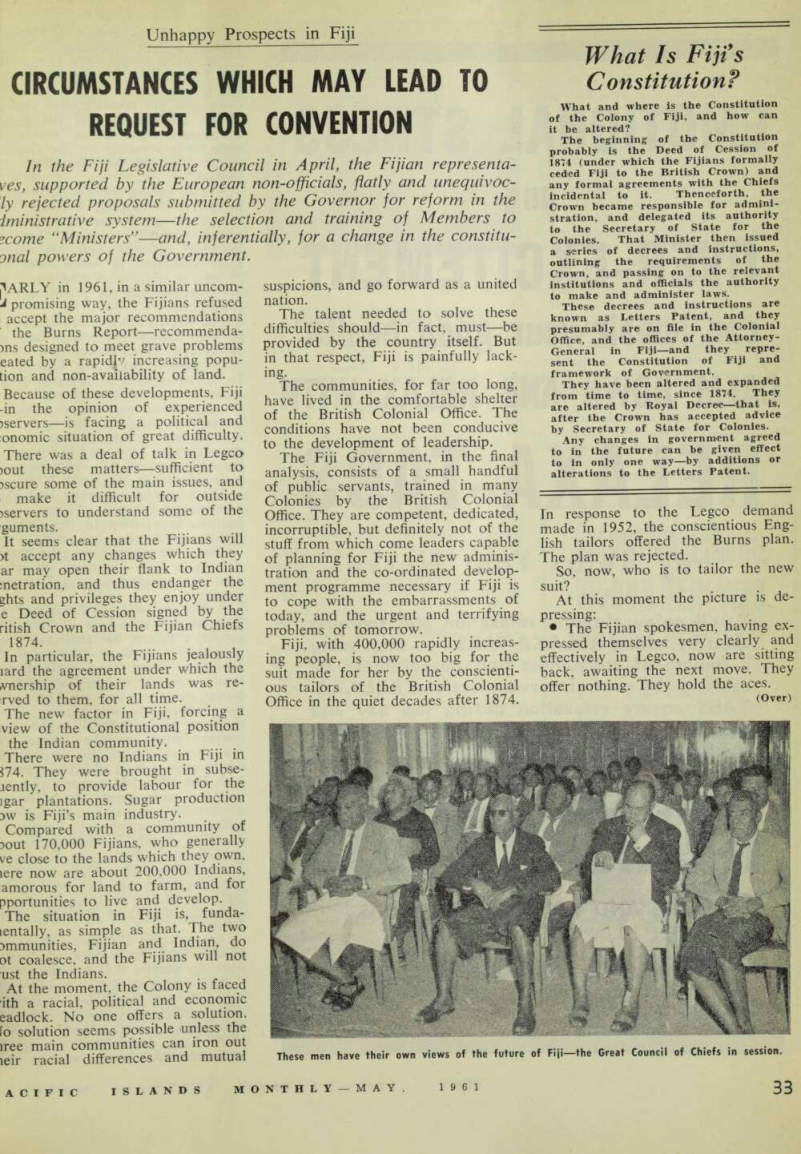
These men have their own views of the future of Fiji—the Great Council of Chiefs in session.
“We wish to remain an integral part of Britain,” they say, in effect.
“We stand by the 1874 Treaty with the British. We are content to live and grow as we have done since 1874 —we seek no constitutional change.
If the establishment of the Indian community here is an embarrass ment, it is a matter for the Govern ment. We did not introduce the Indians.” • The Indians have little to say— little that is helpful, anyway. They recognise the country’s economic plight—naturally, because they are the chief sufferers—and they express their readiness to work with the Fijians in relation to land usage and development; but the Fijians are not reciprocal.
The Fijians are not actively hostile to the Indians—but they fear the future and Indian fecundity.
In contrast with the Fijians, the Indian community is split deeply into some irreconcilable sections. Even as this is written, one section (which is implacably anti-CSR Co.) is terroris ing another section (good-class cane growers) who have tried to respond to the CSR’s appeal for much-increased cane-planting in the North West.
These conditions make any early agreement between Fijians and Indians, in relation to the Colony’s future, practically impossible.
There are many very good Indian citizens in Fiji—but there are others who are unscrupulous and untrust worthy. ® The non-official Europeans are increasingly anxious about the country’s future, but contribute little politically towards a solution of the problems. They have little oppor tunity, apart from some insignificant power exercised through Legco. But their influence is great because among them are the merchants, bankers and lawyers who are the advisers of the several Australian corporations which control most of Fiji’s economy. * The official Europeans who con trol the government, direct the ad ministration and advise the Colonial Office are ill-equipped to handle this situation, simply because there is no rule-of-thumb method to be applied here. The system which worked a quarter-century ago has been pushed right out of gear by the establishment and rapid growth of the Indian popu lation.
Among these disunited sections, the Fijians, with their Deed of Cession contract, control the situation.
The Colonial Office men, quite sincerely, are doing their damnedest —but nothing they can do in present circumstances can achieve unity of races here; and without unity this well-endowed, lovely country will
ice disaster.
Facilities must be provided under hich this 400,000 population can ed, house and clothe itself—and that ills for a lot of capital expenditure, id a well-based, co-ordinated plan ; development. At the moment, fither is in sight.
The Government has announced ;w capital expenditures running into illions —new docks at Suva, new hools, new hospitals—a bit here for icouraging planting, a bit there for imulating timber-getting—bits and eces which will provide some con derable employment for the ever creasing ranks of the workless, but hich contribute little or nothing to living over-riding problems of over jpulaton and under-development.
Even if all this money were brought >gether in one co-ordinated develop ient plan, it would not be enough.
The old bureaucratic machine orks slowly and ponderously.
An increasing number of com ment observers now are inclined to le view that the only way out of tis impasse is that of setting up a onvention completely representative f Fiji’s several races and numerous derests, to hammer out a plan of mstitutional and administrative re >rm, calculated to achieve racial aity and take care of Fiji’s future, >r presentation to the Government ad the Colonial Office.
Petition Proposed
One proposal is that a group of iji citizens, after consultation with s many interests as possible, will raft a petition to the Governor, ask ig for such a Convention, and set ng out reasons for same.
The petition would urge that— • The Convention be so broadly ased that it would be truly repre mtative of the Colony; • Members of the Convention aould be partly elected by the com mnities, and partly nominated by ic Government; • No expense be spared in prq iding that the Convention should sit ntil the various racial and sectional ifferences have been reconciled, and plan of government and develop lent produced, for submission to the Government, to which all races and lasses could subscribe; • That, pending a settlement along tiese lines, urgent temporary steps e taken by a recognised group of itizens to support the Government in laintaining order and preparing the r ay for Colony-wide development, i accordance with a co-ordinated lan.