Pacific
Islands Monthly
May, 1961
Vol. Xxxi. No. 10.
r\e News lagazine Of The South Pacific
Established 1930
istered at G.P.0., Sydney, for ismission by post as a newspaper.
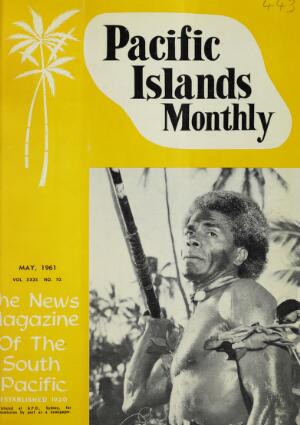
THE COVER: His hair powdered, his arms gleaming with coco nut oil, a muscular Fijian warrior is about to throw his spear.
But don't worry. He is demonstrating a spear dance for the benefit of tourists, and while he and his fellow dancers may seemingly work themselves into a state when their spears will surely come whistling into the crowd, the spears won't really.
Rob Wright took the photograph.
Advertisements & other items, pp. 2-4 (3 items)
P Av I F I C Islands Monthly May, 19C1
operates
.» m m »f n
I m M
Top Australian Airline
operates
4.^
THE SUNBIRD SERVICE
to 44 places in Papua, New Guinea and the neighbouring Islands.
fZK %AA THE FRIENDLY WAY
Iron in comfort without
fatigue with the new . . . u
Kerosene Self-Heating IRON
• Pre-heats with methylated spirits in 90 seconds. • Burns for 2 hours on one filling • Built-in pump and large filler opening. • Easily dismantled for servicing.
Representatives for the Pacific Islands: 4 Model No. 61 5.
ROBERT GILLESPIE PTY. LTD., ROBERT GILLESPIE 1N.C.1 LTD., PEARCE & CO. LTD., 22 Young Street, SYDNEY. Rabaul, Port Moresby. SUVA, also 334 Queen Street, BRISBANE Lae, Madang,
f
Pke Perfect PL
our
SNOWSTREAM STARCH REDUCED FLOUR
WHEATMEALS FOR EVERY PURPOSE
SHARPS OF HIGHEST QUALITY
STOCK AND POULTRY FOODS
E F
THE
P if WHITE ROSE FLOUR MILLING CO. PTY. LTD.
ULTIMO. SYDNEY. N.S.W.. 8A4027.
CABLES: "WHITEROSE", SYDNEY
May. 1961 Pacific Islands Monthli
Pacific Islands Monthly
Publisher: R. W. ROBSON.
Editors:
Judy Tudor Stuart Inder
Manager: SELWYN HUGHES. .EPHONES: General Business, Editorial,
Ma 9197-8, Aaa 7101, Ma 4369.
G.P.O. Box 3408, Sydney,
‘graphic Address: PACPUB, Sydney.
Annual Subscription Rates:
(Includes surface postage) Pacific Is. —Papua-N.G., iji, Samoa, Norfolk, lauru, 8.5.1., Cook Is., onga, G.&E. Grp., Niue, lew Hebrides, and other Ir. Pacific Islands . .. £1 4 0 nch Pacific Territories and >utch N.G £1 7 0 Australia and N.Z. . £1 10 0 U.K., British Common i/ e a It h Countries, and breign (40/- Stg.) . £2 10 0 U.S.A. and U.S. Pacific erritories ($6.00 U.S.) . £2 12 6 gle Copies (postage extra) 2 6
Branch Office In Papua-Ng
;ific Publications (NG) Ltd., Theatre Building, Fourth St., LAE.
Tel.: 2577.
Miss Pat Robertson, Manager.
Branch Offices In Fiji:
a: Fiji Times Building, 20 Gordon St.
Tel.; 4043. itoka: A. J. C. Foster, Vitogo Pde.
Tel.: 38.
Representative In N.Z.:
I. D. Whitcombe, P.O. Box 5179, Auckland. Tel.: 22.570.
Representative In U.K.:
D. Ashburn, 13 Rood Lane, London, E. Tel.; Mincing Lane 8633.
LBOURNE OFFICE; Newspaper House, 247 Collins St. Tel.: 63.7053.
ENTS: All main trading firms and stores in the Pacific Islands. :ific Publications Pty., Ltd., is the stralian agent for THE FIJI TIMES.
Contents
No. 10. Vol. XXXI.
May, 1961
People 5
Australia Tips Her Hand on West New Guinea 17 TEAL Is On Its Own 18 Ocean Island Phosphate Strike Settled 18 Anti-CSR Gangs on the Fiji Warpath 19 The "Pandora" Story: "Bunkum!" 19 Labour Decision Causes NG Storm 20 P-NG Political Party Is "Dead" 20 West Samoa Votes Yes 20 Wool Fashions for the Islands 21 Copra Goes Down, and Down 22 No New American Samoa Governor Yet 22 Melanesians Will Share the Thrill of the One-armed Bandit 23 Soviet Ships "Should be Watched" 23
Commentary 25
Canberra Commentary 27
Who's Making Poison in New Guinea? 27 Beryl Sawyer Reports from Papeete 29 BMA Discusses the Title of Doctor 31
Unhappy Prospects in Fiji 33 An Analysis of Fiji's Gloom 35 TERRITORIES TALK-TALK, with Tolala 37 New Guinea Airline Battle "Will Get Worse" 42 Nadi's New Hotel 43 The Tireless Mayor of Suva 45 They're Trying to Beat a Fool's Paradise 49 New Guinea Coffee Report 51 Fiji Looks at its Beverages 55
Sydneysider Goes Walkabout .. 59
Shocking Fiji Housing 65 Report from the Dutch New Guinea Council 69 This Noumea Artist Makes Money . 73
Magazine Section 75-100
News of Pacific Shipping 101
Pacific Report 117
Obituaries 145
Travel Talk 146
Shipping, Airways Timetables 149 Commerce and Produce 157
Advertisements & other items, pp. 5-6 (2 items)
A Product of Pacific Publications Pty. Ltd., 29 Alberta Street, Sydney
W. Ancliss
9 * -m, an
HOT PACKS
16-oz. Vegetables & Steak. 16-oz. Steak & Kidney Pudding. 16-oz. Irish Stew. 16-oz. Vegetables & Sausages. 8-oz. Irish Stew. 8-oz. Vegetables & Steak, 8-oz. Vegetables & Sausages.
COLD MEATS
12-oz. Trim (Pork & Beef). 12-oz. Camp Pie. 12-oz. Corned Beef W/C 12-oz. Taper Corned Beef. 6-lb. Taper Corned Beef W/C. 6-lb. Taper Corned Beef. 12-oz. Taper Corned Beef W/C. |2-oz. Al-Tayib Halal Corned Mutton. 12 oz. Al-Tayib Halal Curried Mutton.
SAUSAGES
16-ow Beef Sausages. 16-oz. Oxford Sausages. 16-oz. Cambridge Sausages. 16-oz. Pork Sausages. 8-oz. Vienna Sausages. 4-oz. Vienna Sausages. 8-oz. Frankfurters.
TONGUES
12-oz. Sheep Tongues. 12-oz. Lamb Tongues. 12-oz. Calves' Tongues. 12-oz. Lunch Tongues. 2-lb. Ox Tongues.
CONDENSED MILK
14-oz. Sweetened Condensed Milk.
Unsweetened Evaporated Milk. 12-oz. Chocream. -oz. Reduced Cream. 14-oz. Natural Milk. 7- Tubes Sweetened Condensed Milk.
POWDERED MILK
12-oz. "Jersey Cow" Full Cream Powered
MUSHROOMS
8- Sliced Mushrooms.
CANNED FISH
12-oz. Flair Fish Cutlets.
CANNED PRUITS
16-oz. Peaches. 16-oz. Pears 16-oz. Apricots. 16-oz. Grapes. 16-oz. Two Fruits. 16-oz. Cherries. 16-oz. Loganberries. 16-oz. Gooseberries. 16-oz. Raspberries. 16-oz. Solid Pack Apple. 29-oz. Peaches. 29-oz. Pears. 29-oz. Apricots. 29-oz. Two Fruits. 29- Grapes. 30- Crushed Apples.
"RIVERMEDE" BUTTER
56-lb. boxes Bulk Butter. 1-lb. pats Butter.
Hb. pats Butter. 12-oz. tins Butter. 16-oz. tins Butter.
PEEK FREANS BISCUITS
In 4-lb Tins and 8-oz Packets.
Caramel Crunch, Cheddar Crackers, Digestive Ovals, Ginger Slice, Honey Snaps, Lattice, Vita Wheat, Wafers, Dairy Milk Arrowroot, Wheat Crunch, Dainty Creams, Mocha Creams, Custard Creams, Coquette Creams, Petite Creams. 16-oz. 30-oz. 16-oz. 30-oz. 16-oz. 30-oz. 16-oz. 30-oz.
FRUIT JUICES
'Bern'" Tomato Juice.
"Berri" Tomato Juice.
"Berri" Orange Juice.
'Berri" Orange Juice.
'Berri" Grapefruit Juice.
"Berri" Grapefruit Juice.
'Bern" Apricot Nectar.
"Berri" Apricot Nectar.
MARGARINE
56-lb. boxes Cake Margarine. 56-lb. boxes Pastry Margarine.
DRIPPING
16-oz. Tins Dripping. 37-lb. Tins Dripping.
AGENCIES: EASTERN TASMANIAN
FISHERMAN'S CO.OP. SOCIETY. (Flair
Canned Fish). TONGALA MILK COMPANY
("Jersey Cow" and "Mont Blanc" Condensed
Milk). PORT HUON FRUITGROWERS CO.OP.
ASSOCIATION LTD. ("Huoncry" Canned Fruit
and Jams). PEEK FREAN (AUST.) PTY.
LTD. (Biscuit Manufacturers). MORAY
PARK CANNED FRUITS.
THE JERSEY COW
POWDERED MILK
This fine quality full cream powdered milk is now available in the Pacific Islands. Economical and convenient for household, and cooking purposes. Wonderful as a food for infants. Another famous Tongala Product. m
RVtO
i
MJU.C*
w fO
W. ANCLISS
& CO. (AUST.) PTY. LTD.
RIVERSTONE MEAT CO. PTY. LTD.
"Imperial" House, 255-257 George Street
Sydney, N.S.W.
REDBANK MEAT WORKS PTY. LTD
154-206 Stanley Street South Brisbane, Queensland
People
Discussing tourism in the Fiji Legis ive Council in April, Indian mem r, B. D. Lakshman, mentioned tat is a sore point with many people Fiji—that “tourism should be de ioped in other areas besides Suva”. : went on to deplore three other >ects of tourism in Fiji: “Too many :is, aggressive beggars, and aggres e peddlers in the streets.” tn the same debate, Mr. H. B. bson, who represents one of the :er islands, argued that the outer mds had a lot more to offer irists than any part of the main md of Viti Levu (on which Suva situated). And Dr. A. H. Sahu an complained t f lat there were ny people who seemed to think t Suva was Fiji, and what’s more, t he suspected a lot of members the Fiji Visitors’ Bureau held the le opinion.
lie 1961 conception of Papua-New inea as a “multi-racial society” is ig pushed from every level, includ the top. And this notwithstanding last year, the opinion at the top that the native people would be shed with nothing less than “full -government,” and the Europeans Id stay “only if they were good”.
John Gunther, P-NG Assistant
Judy Wong, eldest daughter of Mr. and Wong York Lun, of Suva, plans to write [?]esis on the history of Chinese migration [?]iji for her MA degree, which she is now [?]g at Sydney University. She has a Commonwealth scholarship.
Photo: C. L. Cheng
Iministrator, undoubtedly was voic- I current Administration opinion ten as guest speaker at the in gural dinner of the Port Moresby nior Chamber of Commerce, on jril 28, he called for an end of all rms of racial discrimination in NG.
The Territory was a “multi-racial riety”, he said, and no one would ;1 comfortable in its unless every ssible barrier that marked man >m man was broken down. The sistant Administrator’s speech was cresting in another way, too—it s one of the few times that any of : Administration top brass has ad tted that there is discrimination. Of jrse, there is discrimination in —the very stupid kind, based purely racial lines, that prevents European taking an educated puan into a hotel. with him for a ial; and the more general discrim dion based on economic and social Kinds that exists in every country the world.
rhe possibilities of some loose form federation between Melanesian ritories was a topic that was being lely discussed, the Secretary for )tectorate Affairs, Mr. V. J. Ander i, said in Honiara in April after •resenting the Solomons at the ming of the reconstituted P-NG pslative Council in Port Moresby. . Andersen said there was no in ation as yet as to the form such federation might take, if it took ce at all. Mr. Andersen was ompanied to the ceremony by iriano Kelesi, president of the daita Council. * ♦ ♦ "ook Islander Teapa Teapa has illy lost his seat in the Pukapuka md Council after holding it for a ord time—since 1924, without a ak. Teapa Teapa is aged more n 70, and a local report says that
[?]a gathering of the Polynesian Association Sydney—George Little, formerly of Lautoka, Fiji, and George Sue, of Vatukoula.
Photo: A. E. Ray
iad it not been for his age” there is no doubt he would have regained e seat at the elections. * * * Love will find a way, according to Kandrian (New Britain) houseboy med Atupisa, who in a Rabaul >urt in May was fined £2 for ad [nistering what he apparently hoped is a “love potion” to his attractive linese girl employer. The charge id that Atupisa had “added a reign substance” (believed to be tive hair lotion) to the girl’s drink l water, unknown to her. He ad tted he wanted to attract her by sans of this “charm”, and accord % to the evidence it wasn’t the first ae, either. A previous “potion” had :luded methylated spirit.
Mr. Val Savage retired from the ok Islands administration in April er 40 years’ service as a teacher, i was at the Avarua School from 21 to 1956. The Cooks know Val /age not merely for his teaching lity, but also for his sporting ivities, his piano tuning ac nplishments and as a repairer of cks and typewriters. * * * P-NG’s controversial “eras h ’ cher training course (officially de flated the E for Emergency Course) e first fruits on May 1 when 56 dents graduated from Rabaul’s daguna Teachers’ College after six nths’ intensive lectures and studies, e next day they were flown out Rabaul to take up teacher posts at age schools throughout the Terri y. With them went final exhorta ns of P-NG Director of Education, . G. Roscoe: “Don’t paint a rosy ture of the task before you. You setting out on an arduous and de nding occupation.” * * * "iji’s Superintendent of Prisons, jor Basil Sellers, reported in April
[?]ried at the Methodist Church, Rabaul, NG, [?]ntly—Mr. Wong Shiu Hung and Miss Seeto [?]g. Photo: C. H. Meen
at crimes of violence in Fiji were arkedly increasing. During 1959 ey had been far out of proportion to e increase in the number of isoners. Fiji seemed to be follow g a general tendency in this regard i said, and added: “The winds of ime in the Pacific, although not srhaps yet at hurricane force, are Ttainly more than a gentle breeze.”
MARRIED: Miss Pamela Gillespie, lighter of well-known Islands’ ;rchant, Mr. Robert Gillespie, to r. Roger Gray, in Sydney, on May . Mr. Gray has been with Robert llespie Pty.. Ltd. in Sydney for some le and on May 12 he and his bride w to Papua, where Mr. Gray has :ome Pt. Moresby manager of the ;w Guinea company. * * *
About To Marry: Miss
argaret Wilde, daughter of the late >rman R. Wilde, of Wau, NG, and Mrs. Eileen Wilde, of Macalister, >W, to Mr. Percy Whittle, in Lon n on May 19. They will live in •lombo, where Mr. Whittle is an ctrical engineer. The late Norman ilde once worked the Cliffside min * lease in partnership with his sister, rs. Doris Booth. He had a dis guished aviation record in peace d war, and helped get civilians out NG when the Japs invaded in 1942. ; received the US Bronze Star for i service in the Philippines. Mrs. ilde now lives with her son Bruce, lo has a small sheep and grain jperty.
[?]n Lai, vice-captain of the Fiji Soccer Team [?]ring NSW in April, took time off to call "Pacific Islands Monthly's" Sydney head [?]rters and watch the technical side at work, [?]n has a special interest; back in Suva he [?] compositor with a PIM sister publication, daily "Fiji Times". Operating the lino type is Barri O'Neill.
Tasmanian Attorney-General, F. R. agan, unveiled Tasmania’s memorial ) the late Harold Gatty, of Fiji, in ite March. The memorial is at Campbell Town, birthplace of the tan who made the first round-the orld flight (with Wiley Post) in 1931, tid who founded Fiji Airways. The lemorial is in the form of a 20 ft eel column, topped with a globe see PIM, Feb., p. 52). Donations om Fiji helped erect the memorial, it most support came from Tas anians themselves, happy to per- Jtuate the memory of a distinguished dive son.
Two of the famous Trapp Family igers went home to the United ites in March after four years as ssionary teachers in Papua. They ; Misses Maria and Rosemary app, who have been working with : Roman Catholic Order of the :red Heart. The Trapp Family sir broke up several years ago en four members married and two iers died. During their last concert Sydney the Misses Trapp met a ssionary priest, Father Kevin irphy, who encouraged them to rk in the islands. * * * \n assurance that Britain had no lire to delay the independence of f of her overseas dependencies was en by Mr. Duncan Sandys, Secre y of State for Commonwealth lations, at the Sierra Leone inde
[?]r designed, no less, is this new uniform [?] being worn by air hostesses with TEAL, playing both jacket and topcoat are hostesses Mary Ashcroft and Pam Salmon.
dence celebrations, in Freetown, \pril. le told a Press conference, “You take it that throughout the De dencies of Britain the same pro : you have seen brought to corn ion here is going on.’’ t was Britain’s intention to lead ry one of them without exception ndependence and there was no de to delay the process.
leaning behind the police lines letio, Tarawa, the other day, a >ner saw a pair of shoes jutting i the sand. He removed the sand uncovered the skeleton of an •rican marine, complete with dis rated machine gun and two r bottles. Police buried the re is in Betio cemetery.
[?]elbourne on a week's tour, New Guinea [?]girl Barnaba Komik, from a village near [?]ng, with Sister Maryangela Spellacy, of [?]hafen Mission. Barnaba, who was [?]d at the Divine Word Mission, Alexishafen, the trip as a prize in a handwriting [?]etition. A Fiji winner was Mun Swamy, [?]f Nadi. Sister Maryangela, Brisbane born, [?] lawyer before she joined the sisterhood.
[?]arry Heatley, with Mr. and Mrs. T. De' [?]e, dined at the Hotel Papua recently all three of them "went finish" from [?]erritory—the De' Hesselles to Brisbane, and Mr. Heatley to Auckland. —Papuan Prints
Advertisements & other items, pp. 7-18 (9 items)
5
i C I F I C ISLANDS MONTHLY MAY, 1961
Columbines
r AI
r* m that s the number of creamy rich caramels you enjoy in every a long packet of V \
MAC. ROBERTSON’S
Columbines
BUY ENERGY RICH . . . GLUCOSE RICH
“COLUMBINES” TODAY . . .
SOLE PACIFIC AGENTS:
S. E. TATHAM & CO. PTY. LTD. 414 Collins Street, Melbourne Z 716
a truly modem rotary dryer
for the progressive planter
designed specifically for the
drying of cocoa !
L THE NEW 1961 A.S.P. ROTARY COCOA DRYER
for diesel or electric drive
• Every A.S.P. Unit is backed by a FULL GUARANTEE! • Capacity is 7,000 lbs. of wet beans. • Drive with either diesel or electric power.
Ask also for particulars of the A.S.P. UNIVERSAL SUN/FORCED HOT-AIR SLIDING
ROOF COCOA DRYERS
26 Ridge Street,
North Sydney,
N.S.W.
Telephone: 92-0271 Telegrams: "Chatspa", Sydney.
Sole Agents for Papua & New Guinea: A.S.P. (NG) LTD., Box 166, Rabaul, T.N.G. o To: A.S.P. (Overseas) Pty. Ltd., Please send me full information on your ROTARY COCOA DRYERS [ ] and/or SUN/FORCED HOT-AIR SLIDING ROOF COCOA DRYERS [ ] (tick in squares for information required).
NAME
ADDRESS
P.1.M.3
Night coughs
Voice hoarseness
Winter colds
Sore throat
DEMAND
oods
GREAT
PEPPERMINT
COMPOUND
Gives soothing relief to the distressing symptoms of all forms of coughs and colds.
Always keep a bottle in the home , W. 72 n»-i
THE
FAMILY
REMEDY
profit by new standards of pumping efficiency with the MODERN, totally enclosed, self oiling
SOUTHERN CROSS PUMPHEADS
that save servicing time
I f 'di t As an auxiliary to your windmill. Special windmill attachment available.
As a complete unit with a As a complete unit powered SOUTHERN CROSS Electric b Y one of the new SOUTHERN Motor. CROSS Air Cooled Diesel Engines.
The "HD" PATTERN PUMPHEADS are enclosed in clean-cut cast iron gear boxes. The mechanism is fully protected from dust, rain or tampering, adding years to their efficient operation. Built for continuous heavy-duty work without constant
attention, these self-oiling, totally-enclosed pumpheads will
save you time and money.
Table at right shows the sizes available and their maximum capacities.
ENJOY Manufacturer's own nation-wide Free Advisory Service, After-Sales Service, Parts Service—Finance Plan
TOOWOOMBA FOUNDRY SALES PTY. LTD
Please send full details of your Pumpheads.
NAME
ADDRESS
PIM/PH6I
Cn. Campbell & Ruthven Sts.,
Toowoomba, Qld.
SOUTHERN CROSS MACHINERY PTY. LIMITED,
1 Grand Avenue, Granville, N.S.W.
LOCAL DISTRIBUTORS—
J. L. Chipper & Co., RABAUL T. F. Leonard, PORT MORESBY (Upper Port Road) V. Bryant, LAE (Cnr. 15th & 17th Sts.)
m
YOUR FAMILY
NEEDS VITAMIN B 1
EVERY DAY!
Get Vitamin B 1 in many different
ways, with delicious:
VEGEMITE
SPREADS so SMOOTHLY on toast DELICIOUS on biscuits SO NOURISHING in sandwiches Every member of the family needs Vitamin B x every day for
VITALITY.
Vegemite is the only pure concentrated yeast extract, and yeast is the richest known natural source of Vitamin the vitality vitamin.
But remember! The body cannot store up Vitamin B 1 —it needs
a fresh supply daily. So enjoy
Vegemite every day—for Vitality.
ENRICHES gravies KR3
STOP BAD BREATH
»“ COLGATE
WHILE YOU
Fight Tooth Decay All Day!
3 / \ / '■v S-< \ m
JUST ONE BRUSHING
WITH COLGATE
STOPS BAD BREATH INSTANTLY
FIGHTS TOOTH DECAY ALL DAY
AS NO OTHER TOOTHPASTE CAN
any colour, ANY KIND
Colgate Dental Cream
CLEANS YOUR BREATH
while it
CLEANS YOUR TEETH
Use Colgate Dental Cream to stop bad breath and fight tooth decay. Colgate’s active, penetrating foam gets into hidden crevices between your teeth, removing decaying food particles, the cause of much bad breath and tooth decay.
Protect your teeth the Colgate way.
To stop bad breath, to fight tooth decay, to keep your teeth sparkling white, brush your teeth with Colgate.
Children love its extra minty flavour.
You will love it too.
FOR
WHITE
TEETH
AND
FRESH BREATH . . . MORE
PEOPLE BUY COLGATE
THAN ANY OTHER DENTAL
CREAM IN THE WORLD!
(3171
GILBEYS /
,3
PERSONALITY
OF THE
MONTH
Here is a personality with many aspects a Gilbey Liqueur and in a new dress, too.
A Gilbey Liqueur is a bland friendly fellow the ideal companion after a good lunch or a good dinner, worldly, warmhearted, with just the right touch of sophistication.
Gilbeys Liqueurs come in many forms to suit all palates the man of the world or the charming lady who is your guest. This is the Gilbey range Advocaat, Creme de Menthe, Cherry Brandy, White Curacao, Blue Curacao, Orange Curacao, Apricot Brandy, Anisette, Kummel, Creme de Cacao.
The names themselves suggest good things the little extra that rounds off the occasion, sets the seal on a good meal and makes all the difference between run-of-the-mill gatherings and those which send everyone away with a feeling of well-being and satisfaction.
What’s more, Gilbey Liqueurs are presented to you now in an entirely redesigned, sleek, streamlined bottle, easy to hold, even in a lady’s hand, easy to pour. It is a bottle that looks nice, feels nice and is of standard height, to sit comfortably on your shelves.
Gilbeys feel that this is the way a liqueur ought to be presented, in a shapely clean-lined container matching the distinctive, high-quality product within.
So we have a new form of bottle for a range of traditional quality drinks a range that you will be proud to display and pleased to handle.
GILBEYS LIMITED
9240 L
to tame
Lightning!
to save the wealth of
the South Pacific
It takes fifteen years for a coconut palm to become full productive. It takes less than a second for lightning t reduce it to a charred stump.
This lesson was quickly learnt by the Lever men, wb pioneered the copra industry in the South Pacific. Cons< quently, wherever possible, they planted their palms in so containing ironstone. They worked on the theory that th ironstone would help to disperse and tame the tremendoi electrical charges and thus save the trees.
Of course there were many other hazards plant diseasi insect pests, and the devastation of war.
But through the years, hazards and uncertainty, particular! economic uncertainty, have been pushed steadily into th background. This is due in great measure to the role playe by the Unilever organisation in developing the economy of th islands. By promoting the world-wide sale of products mad from copra, Unilever is working to make the future of thi area more secure.
Each year the bulk of all copra exported from the Pacific i bought by Unilever. And each year, ships that take out th copra bring in a wide range of famous Unilever products ranging from toilet soaps to packaged foods . . . product synonymous with good health and better living the world ovei Unilever’s simultaneous export and import, a uniqui two-way traffic, assures for the Pacific area continuec prosperity and future progress.
These famous Unilever products are available through wholesale, retail and indent houses in all areas Representatives for the Unilever Organisation, Lever Brothers Pty. Ltd., J. Kitchen & Sons Pty. Ltd. and World Brands Pty. Ltd.
EXPORT DIVISION,
J. KITCHEN & SONS PTY. LTD
RINSO
LUX TOILET SOAP
LUX FLAKES
LUX LIQUID
LIFEBUOY
SUNLIGHT SOAP
PERSIL
SURF
VELVET
PEARS SOAP
SOL VOL
PEPSODENT
REXONA
CONTINENTAL SOUPS
MELLAH DESSERTS
JK.62FPI
A.C.M. PRODUCTS
keep on giving
all through the years . . .
• First QUALITY Raw Materials.
• All NEW Materials,
• Products CUT to your Specifications.
You'll find by using A.C.M.'s materials your
products can be economically produced and
will give life-long durability and service.
FLOCK AND GARNETTED WADDING
SUPPLIED: In rolls or to your specifications from all NEW high-grade material.
GLAZED WADDING, BORDER WADDING
(single or double glazed).
SUPPLIED: In rolls or to your specifications, from all NEW material.
NU-FELT
(approved).
SUPPLIED; In rolls from all NEW materials.
TEASED FIBRE FIBRE PADS
INSULATING AND CARPET UNDERFELT
COTTON WASTE CLEANING CLOTH
STOCKINETTE
H
AUSTRALIAN COTTON
MANUFACTURING Co. Ltd.
90-92 O’Riordan Street Alexandria, N.S.W.
Choose the product, choose the time and you'll find A.C.M.'s prompt delivery equally matches their products' quality.
CO./NAME
ADDRESS
For details of agency, please send me conditions.
I
COLLAR,
SLEEVE
AM)
STYLE
JEST
EIGHT
It’s a BVD minimumiron shirt, so of course they’re right. You’ll always get the right sleeve length there are 33 to choose from —and the right collar size. Just 39/11 buys a smart-as-paint BVD business shirt. Buy the best, buy BVD.
NLI94/60
hqht & Po*er
*‘'J —[AfUEDC
WHERE YOU
WANT IT!
2 KVA
ELECTRIC START
DIESEL SET
£325 F. 0.8., Sydney m *o ►
1,500 WATT DIESEL SET
£249/10/- F. 0.8., Sydney All plants illustrated are 240 volt single phase A.C. current suitable for lighting and power for domestic requirements. Write for pamphlets.
1,000 WATT
"MINOR"
£146/10/- F. 0.8., Sydney
1,500 WATT "MAJORS
£166/10/- F. 0.8., Sydney
BRAYBON BROS.
PTY. LTD.
27-33 Washington Street, Sydney. Telephone: MA 6853 DISTRIBUTORS: Tutt Bryant (Pacific) Ltd., Port Moresby and Rabaul.
Completely eliminates waxing and polishing!
awvu nl»r Lii i»n* r 'tish Paints (0 % Dior application
British Paints Limited
FioorPlastik
Interior Brilliant Gloss Clear Liquid Plastic Coating
THE MODERN TREATMENT
FOR LONG-LASTING BEAUTY
Floor-Plastik is not a wax or polish. It is a specially formulated liquid plastic coating for application by brush on interior surfaces such as NEW Timber or Newly-sanded Wooden Floor, New Cork Tiles, Furniture and Panelling.
Floor Plastik’s brilliant gloss provides a permanent, durable surface which stands up to the heaviest floor traffic without scratching or scuffing and Floor-Plastik requires no waxing or polishing each time the floor is cleaned Floor-Plastik’s dazzling shine gleams as if it were just applied. It does away with the continual drudgery of waxing and polishing and saves you time and money.
Ask your local British Paints Limited authorised agent for a free Floor-Plastik technical leaflet. ( Warning! Floor-Plastik is not formulated for use over new or
used linoleum.)
MAXIMUM RESISTANCE TO MOULD AND FUNGUS.
Manufactured to withstand all tropical conditions
FOR COMPLETE PROTECTION
OF ALL METAL SURFACES
% British Paints Limited
Brilliant Aluminium Enamel
• SILVAR’S hard, glossy surface actually resists dust and dirt collection. When applied on roofing, SILVAR’S heat-reflective “aluminium” will reduce internal temperatures by at least 10°. • Silvar is non-poisonous and is harmless to drinking water.
Srfda/c
• SILVAR BRILLIANT ALU-
MINIUM ENAMEL is easy to apply with either brush or spray and withstands tropical sun, lashing rain, dust-laden winds and salt sea spray. rvleeA
brilliant
EL
MAXIMUM RESISTANCE TO
MOULD AND FUNGUS.
SOLD AND RECOMMENDED BY:
Burns Philp (New Guinea) Limited: Samarai.
Burns Philp (New Guinea) Limited: Port Moresby.
Burns Philp (New Guinea) Limited: Wau.
Burns Philp (New Guinea) Limited: Bulolo.
Burns Philp (New Guinea) Limited: Lae.
Burns Philp (New Guinea) Limited: Madang.
Burns Philp (New Guinea) Limited: Goroka.
Burns Philp (New Guinea) Limited: Wewak.
Burns Philp (New Guinea) Limited: Kavieng.
Burns Philp (New Guinea) Limited: Rabaul.
Burns Philp (New Guinea) Limited: Kokopo.
Burns Philp (New Guinea) Limited: Daru.
Burns Philp (New Guinea) Limited: Kainantu.
Steamships Trading Company: Port Moresby.
Kam Hong: Lae.
Scotts New Guinea: Lae.
Tang Mow: Wewak.
Laurie Chan: Rabaul.
Wong You: Buka Passage-Bougainville.
HONIARA, 8.5.1. P.
A. C. Blair Ltd., Honiara F. C. Symes Pty. Ltd., Honiara Burn Philp (South Sea) Co. Ltd., Suva.
Burns Philp (South Sea) Co. Ltd., Lautoka
NORFOLK ISLAND
Burns Philp (South Sea) Co. Ltd., Norfolk Island. 8231
7
CIFIC ISLANDS MONTHLY MAY, 1961
8
MAY, 1961 PACIFIC ISLANDS MONTHLI
9
CIFIC ISLANDS MONTHLY MAY, 1961
11
ACIFIC ISLANDS MONTHLY MAY, 1961
12
MAY, 1961 PACIFIC ISLANDS M O N T H L 1
13
ICIFIC ISLANDS MONTHLY MAY, 1961
15
DIFIC ISLANDS MONTHLY MAY, 1961
Australia Finally Tips Its Hand
On West New Guinea
From our Canberra Correspondent Australia has no direct or indirect military commitment with the tch in West New Guinea, BUT if a shooting war should break out ween the Indonesians and the Dutch we can scarcely expect to »id being involved.
lAT is the clear implication of the policy statement which the Prime lister, Mr. Menzies, made to Fed- Parliament after his talks with Indonesian Minister for National euri t y, General Abdul Haris ution, in April. wice in his statement Mr. Menzies )hasised that Australia had no tary commitment with the Nether 1s over West New Guinea, md in a third reference he said there was no military commit it “beyond those involved in the irter of the United Nations,” lut he amplified these statements. 1 General Nasution could hardly e failed to have perceived the sage and carried it back with him Djakarta.
What He Said his is what the Prime Minister I: “Armed conflict in West New nea, whether arising from mass ision or limited guerilla episodes ited by armed infiltration, would sent Australia—in common with er countries—with a grave problem.
Any such conflict could certainly be ignored by the United Nations.
It would engage the attention — )fu! or otherwise—of the great vers.
It would threaten world peace, could well bring disaster to th-East Asia by its encouragement Communist activity and interven- If military conflicts arose from se differences new and grave blems would arise for many ons, including our own.
For this reason, the renewed as mces of peaceful pursuit of Indo ia’s claims made by General ;ution are of such profound ins tance and international value.”
Clearest Yet ir. Menzies’ statement was the irest and most forceful exposition Australian attitudes toward West v Guinea that has ever been made.
The pity is that the Government waited so many years before making it.
Indeed, the Deputy Opposition Leader, Mr. Gough Whitlam, went so far as to say that had our policy been stated with similar clarity and vigour in the 1950’s we would have secured much more international support than we have.
Here, for the record, is the Gov ernment’s view on self-determination, which is the fundamental point at issue between Indonesia and Aus tralia. It is as outlined by Mr.
Menzies in his statement to Parlia ment. • Our policy in our own New Guinea territories is—by steady de grees and to the limits of our financial and administrative capacity—to pro mote the advancement of the people so that ultimately they will choose for themselves their own constitution and their future relationship with us.
We will respect their choice, what ever it may be.
This policy arises from our sense of responsibility, which cannot be suddenly or prematurely abandoned if our trusteeship is to be honourably performed.
• Having regard to these undoubted facts, Indonesia cannot reasonably ex pect Australia to take—nor will Aus tralia take—an initiative in a pro cedure designed to lead to handing over of sovereignty and the abandon ment of the right of self-determina tion in West New Guinea.
That is why Australia is most definitely not prepared to put pressure on the Netherlands to negotiate for the transfer of sovereignty and the abandonment of self-determination.
We recognise Dutch sovereignty and we approve the Netherlands policy
Mission
Conference
Two members of the BSIP Legislative Council, Rev. L. Alafurai, and Francis Bugoto, were among 70 mission repre sentatives from Angli can, Methodist, Lutheran, Presbyterian and LMS churches which met in Apia in early May to discuss common problems. This photograph was taken in Sydney while they were on their way to the conference, which was regarded as a milestone in Protestant co operation in the South Pacific.
of ultimate self-determination.
If Indonesia regards this as par tisanship, we point out that it favours the recognition of sovereignty and the objective of self-determination, to both of which Australia is inevitably attached. ° The Netherlands, as the sov engn power, will quite freely make its own decisions, which we will re spect. • We are on most friendly terms with Dutch; we are also close to and friendly with Indonesia.
When West New Guinea has been discussed in UN we have supported sovereignty and domestic jurisdiction.
Sovereignty is basic for Australia, no less than for others, including Indonesia.
Not Hostile to Indonesia None of this, said Mr. Menzies, was hostile to Indonesia, and it ought not to be thought so.
The Prime Minister said that Gen eral Nasution had put the proposi tion, “with great force and obvious sincerity”, that West New Guinea was part of Indonesia and that there was no more reason for granting self determination to it than to any other social group or geographical area in Indonesia.
General Nasution, in his farewell Press interview in Sydney, announced, somewhat negatively, that his visit to Australia had “not been a failure”.
But a careful study of the Prime Minister’s statement suggests that General Nasution failed in his basic mission.
To quote the Prime Minister; “Gen eral Nasution said that ... in any discussions between the Netherlands and Indonesia about West New Guinea Australia should be strictly neutral.
“Australia should not support and encourage the Dutch either generally or in the UN. This, as he made clear, was the great thing he wanted to establish with us.”
(Continued on p. 145)
that were the General’s sole n, then Mr. Menzies’ statement the endorsement of it by the ition Leader, Mr. Calwell— not make very happy reading karta, luse the Prime Minister made r to him that Australia sup- Dutch sovereignty, believed was proper to do so in the
UN, and believed that Dutch and Australian policies in West and Eastern New Guinea were broadlv similar.
On that ground the General said correctly that the Indonesian people would not be “wholly satisfied with the Australian attitude”.
But on practically every other ground, General Nasution should have gone home feeling well pleased that his visit had been a success.
He made a remarkably good im pact on the Australian Government and appeared to get closer to the
Prime Minister than the Indonesian Foreign Minister (Dr. Subandrio).
Those in the know say that Mr.
Menzies tribute to the General’s frankness and personality was no idle compliment.
And in Mr. Menzies own words: He has left Australia after faith fully and ably representing his country, with, I am certain, a con fidence in his own mind that, while his visit may not have changed our policies, it has certainly made a powerful contribution to our common understanding and goodwill.”
Pacific Report
Turn to these inside pages
for more highlights of the
month’s news: NZ Gov.-Gen. for Cooks —117- Cooks Leper Cases Return Home; Second “Crash” Scheme for W.
Samoan Officials—l 77. Senator Under Fire from NG —118. Lopevi Volcano Details; New Guinea Revenue and PS Up—ll 9.
Mr. Chipper at P-NG Legco—l2l.
N. Caledonia Farmers Protest at Imports—l 22. Port Moresby Girl Wins Breach of Promise —123.
Question of Salvation Army Hostel—l2s.
Fiji Lottery Idea Condemned —127.
Aust. Coffee Standards Attacked —127. Japs at Wewak; Fiji Fears Loss if Laucala Bay Closes Down—l2B. Noumea’s Teenage Problem; Better Radio Service in BSIP —129. Nadi Chamber Criticised —130.
Tonga’s Hurricane—l 33. Honour for Golpak—l34. Fiji Under water Eruptions—l3s. More Bad Luck for PAT; Further Hamac Moves —137. Case of the Irish Magistrate—l3B. The President Meets Mr. Evans; BP’s in Coastal Trade; Viet Repatriation Scheme Stops—l4l.
Advertisements & other items, p. 19 (1 item)
17
CIFIC ISLANDS MONTHLY MAY. 1961
Its Own
TEAL is On Its Own
It was confirmed on April 27 that the Australian Government has sold its half share in TEAL to the NZ Government ( PIM, April, p. 21) for £A 1,014,250 which is par value of the Australian held shares. The deal will be dated back to April 1.
QANTAS has been given the right to compete across the Tasman, until now a TEAL monopoly, and will be able to fly to and through Auck land, Wellington and Christchurch.
TEAL will have the right to fly to and through Sydney, Melbourne, Brisbane and Norfolk Island, The Tasman services will be ration alised so that TEAL will carry more than half the traffic.
Australia’s Civil Aviation Minister, Senator Paltridge, stressed that the agreement did not envisage the sale of TEAL to “any outside interest”. This was a reference to Ansett efforts to buy into TEAL.
Ownership of Fiji Airways, in which Australia and NZ both have interests, is not affected. The pro posed Fiji Airways fortnightly ser vice between Suva and Honiara, via the New Hebrides, was still not in operation in early May. The only factor delaying it was the fact that the British Colonial Office still had not decided whether to grant a subsidy to the airline. It will not operate without one.
REJECTED: The Federal Govern ment, on Tariff Board advice, has re jected a request from Australian growers for increased protection against peanuts from P-NG. It has also rejected a Territories Depart ment request for a £5 a ton duty on copra from sources other than P-NG.
For War
Dead
This was the scene in Noumea on Anzac Day—April 25—the day which, in Australia and NZ and many Islands of the South Pacific, is set aside to commemorate the war dead. The Australian Consul in New Caledonia, Mr. K. Douglas- Scott, accompanied by Dr. Richard Seddon, acting secretary-general of the SPC, place wreaths on the memorial. French naval ratings and army troops provided a guard of honour.
Photo: Fred Dunn
“Explosion"
Phosphate Workers ' Strike
Averted Oni
Ocean Is.
From a Honiara Correspondent The strike of the Gilbert and Elhce labourers at the British
Phosphate Commission’s estab
lishments on Ocean Island andl Nauru, which looked in mid-
April as though it could produce?
a mid-Pacific explosion, ended! amicably by the end of the; month. nPHE Ocean Island strike, over de mands which included higher pay, commenced on April 7 and a week later seemed to be getting out of hand. The 800 G & E labourers there had, by that time, split up into factions, and there could have been open war between those who wanted to return to work and those who did not.
If this had happened, the 32 Gil bert and Ellice police on the island would have been powerless to deal with the situation. On April 14, the British Solomon Islands Protectorate ship Coral Queen left Honiara carry ing 27 BSIP police, under the com mand of Deputy Chief of Police, D.
Morgan. Other reinforcements were sent from Tarawa.
"Pukaki" Sent Mr. A. H. Pickwoad, BSIP Com missioner of Labour, went along on the Coral Queen, in case an indepen dent negotiator were needed. On April 13, one of the three Com missioners of the BPC, Mr. R. B.
Tennent. of New Zealand, with the General Manager of BPC, arrived at j Ocean Is.
The RNZN frigate Pukaki was de spatched from Auckland and in structed to “wait over the horizon” I in case she were needed.
All this activity must have im- i pressed the strikers. By April 20 the atmosphere was reported “calm”, the strikers had formed a committee of representation and had returned to work pending negotiations.
On April 24 negotiations between the BPC and the strike committee “concluded successfully”. Coral j Queen returned to Honiara with BSIP \
(Continued on p. 1421
police and Mr. Pickwoad (Mr. Mo; gan remained behind as Chief Polic Officer pending the return of th regular man, who was absent from tt Colony).
The BPC representatives went o to Nauru where the G & E labourei were still on strike. Negotiations fc settlement there concluded succes fully on April 27.
The position on Nauru, 200 mill west of Ocean, an Australia] administered British Trust Territor where the G & E labourers came oi in sympathy with Ocean Island c April 8, was never as serious as c Ocean. The G & E labourers c Nauru are only part of the woi force, the rest being about 6C Chinese from the Colony of Hon; kong who are there on short-ten contracts.
Labourers in the employ of tl BPC receive an agreed scale i rations, medical services, quarter etc., plus wages.
The Warpath
[?]tacks on Fiji's Major Industry
Nti-Csr Gangs On
By a Staff Correspondent
Suva, May 2.
Again, there is danger of üble in the Fiji sugar industry, d again it is caused by an irre icilable element in Northwest ti Levu which apparently wants fight the CSR company, irre jctive of the issue.
FEW weeks ago, the CSR, re - viewing world sugar prospects and Fiji cane position, urged the ie-farmers to plant more cane for 1962 harvesting, so that Fiji could sure of meeting its share of the imated world demand. A section cane-growers proceeded to plant.
But certain Indian leaders (and y are close to the same people o led the disastrous strike of cane >wers during 1960) have circulated /ice to the cane-growers, not to nt. ‘Do not plant until we have the »ort of the Sugar Commission and ow what is recommended,” they “The CSR already has agreed buy all the cane planted in 1960, you will lose nothing by waiting they must buy all the cane planted 1961.”
It is a cunning move, calculated to embarrass the CSR.
But, ignoring the advice, certain Indian farmers have continued plant ing. Whereupon they have been at tacked—mostly at night—by terrorist gangs who mostly ride horses, destroy property and discharge fire-arms at the houses of the farmers. Some of the latter have had narrow escapes.
Police are out in the Nadi-Siga toka area inquiring into “incidents”.
Within the past fortnight, shoot ings, burning of cane crops, mysteri ous burning of bures and vehicles, intimidation of intending planters, have been reported.
Consequently, new cane plantings are insignificant. It is a clear policy of non-co-operation with the CSR, in spite of clear instructions and de finite promises.
We have interviewed some of the farmers concerned. None will talk.
There is evidence of reprisals.
The policy appears to be organised.
No direct orders not to plant were quoted—but growers acknowledge that the suggestion had been made by “some men” who “accidentally’ happened to be in the vicinity and “accidentally started to talk about planting”; and they dared not refuse.
To cap this outbreak of terrorism, there comes the broadcast statement made by the Chairman of the CSR Co. (Mr. Dunlop) in Auckland, that the company is not happy about its investment in Fiji.
Surely, it is time for the Govern ment to protect Fiji’s major industry
(Continued on p. 145)
siting Fiji in April—as part of a tour in which he inspected New Zealand defence stations was the NZ Minister for Defence, Mr. Dean Eyre, photographed with the Fiji Police Commissioner, Mr. R. H. Beaumont, and the Deputy Commissioner, Mr. T. A. Handford Photo: Rob Wright
nst the attacks of a small and ?ably subversive section of Indian ble-makers. nless there is new planting, the I and 1963 prospects are bad. i addition, high officialdom is being asked about an Indian ar expert” named Mathur. who :ars to be closely associated with A. D. Patel and conditions in North West. r. Mathur was brought from i to advise Mr. Patel’s factions ig the Sugar Commission sittings., inquiry ended long since, but Mathur is still with us and, be ; of his activities, responsible le are asking: Has his mission a ical as well as a technical pur • Who pays Mr. Mathur and Mr. lur’s expenses? In view of the way in which it now is treating newcomers, how does the Im ition Department regard the con i stay in Fiji of Mr. Mathur?
Pushing Starts June 6
e dates for the opening of the ing season, and the estimated ities of cane in sight, are: tons
e 6—-Lautoka . . . 705,000
e 6—Rarawai . . . 490,000
e 6—Labasa . 250,000 V 4 —Penang 75,000
Whose Bell
Wreck Story "All Bunkum", But . . .
Whose Bell Is It ?
By Robert Langdon
The widely publicised story
about an old wreck having been found off the northern coast of Queensland late last year is “all bunkum”, according to a front page story in Brisbane’s Sunday
Truth recently.
NOT only was no wreck ever found, Truth said, but a bell which was said to have been re covered from it was the same bell that had been at the Lockhart River Mission for years.
The wreck story first hit the head lines on December 24 when a Darwin businessman, Alan Darcy, claimed that he and three other men had found the remains of an old wooden vessel while cruising to Darwin in his racing yacht Alvis.
The wreck, he said, was five miles offshore, 200 miles north of Cairns, in six fathoms.
It had been found when one of his crew, Donald Smith, had dived to investigate when the Alvis’s anchor had become snagged on something.
Darcy added that a bell recovered from the wreck bore the inscription: “The gift of Lady Herbert, daughter of Sir John Knatchbull, of Mearchim Hatch, in Kent, in the Kingdom of England, November 30, 1711.”
“I hope to organise an expedition to salvage the wreck,” he said.
“Aboard might be old books or papers still readable. There might even be a sunken treasure.”
“Sensation"
In an article in the Adelaide Advertiser on December 28, I hazarded the opinion that the wreck was probably that of HMS Pandora, which had gone down on the Great Barrier Reef in 1791 while taking 14 mutineers of the Bounty from Tahiti to England for trial.
The publication of my Pandora theory created something of a sensa tion. Next day the Sydney Sun fol lowed it up, splashing a story about the Pandora on its front page and spilling inside.
The Sun quoted author-historian Dr. Colin Roderick as saying that he,
(Continued on p. 142)
too, believed the wreck might be that of the Pandora.
It also published a detailed and colourful version of the finding of the wreck by Donald Smith.
The Sun’s story was republished by several other Australian papers and was also given prominence in the British national Press. Then the fun really started.
English angles on the story were cabled back to Australia; Australian Cabinet Ministers and high Govern ment officials discussed whether the wreck-finders would be legally entitled to salvage the wreck if it really was the Pandora; and a Sydney maritime authority, Capt. Finlay Murchison, said that if it was the Pandora it “ought to be preserved for historical interest”.
Not Pleased All this did not seem to please Messrs. Darcy and Smith. During the next two weeks, Darcy, in Darwin, and Smith, in Sydney, denied empha tically that the wreck was that of the Pandora and insisted that it was probably that of a galleon or privateer laden with gold or silver.
They even “quoted” Admiralty ex perts to support them, although most of the experts’ alleged statements were demonstrably absurd.
Then the two men apparently went quiet. Nothing further seemed to be heard from them until March 26 when Smith bobbed up in Brisbane and told the Sunday Mail that he was on his way to Cairns to head a six-man diving team to investigate the wreck.
Despite the fact that Darcy had stated on January 8 that the Ad miralty “thought it certain that the wreck was not the Pandora ”, Smith said that “London enquiries” indi cated that the wreck would prove to be “either the Pandora or a privateer . . . possibly loaded with silver or gold”.
Two days later, Darcy said in Dar win that the Admiralty had now told him that the description of the bell that he took from the wreck fitted that of a bell “known to be aboard a ship which was last heard of in Timor in 1711”.
This, for me, was the last straw, for if the bell had been presented in England on November 30, 1711, the ship obviously could not have reached Timor until at least 1712.
I sat down immediately and wrote an article for a Sydney paper, listing
some of the demonstrably false and absurd statements that Darcy and Smith had made and hinting that there was something odd about their continual talk about sunken treasure.
This article apparently set the sleuths of Brisbane’s Sunday Truth on the warpath.
Next week-end, that paper’s crime reporter John Burton claimed in at article that he had been supplied Witt “a top-level report to police” which branded the discovery of a wreck Darcy and Smith as a “pack of lies”
Truth also quoted a radio messag( from the Lockhart River Missioi which stated that the much pub licised bell had not been found b] Darcy and Smith, but had mereb been shown to them when they calle< at the mission for repairs to the Alvis Truth claimed that the wreck stor was a stunt.
Assuming the accuracy of Truth’ story, it has yet to be explained ho\ the Lockhart River Mission acquire the bell, who found it, where it wa found, and, above all, what ship i last belonged to.
Everything still seems to sugges that the bell belonged to the Pandorc particularly as the Lockhart Rive Mission is only 50 or 60 miles sout of where the Pandora went dowi and the Pandora is the only shi likely to have a bell with an 18t century inscription that is known t have sunk off the Queensland coas
he precise demands of the strikers both Ocean Is. and Nauru have been officially stated, jt back in Auckland on May 9, NZ Commissioner, Mr. Tennent the workers had been given pay , and also that the BPC would d £A 1,875,000, on new labour for them, s said workers received from £20a month plus bonuses. They d get a 23 per cent, wage in ;e, and weekly child allowances, r. Tennent said the settlement been “mutually satisfactory” and was “very happy”. He was led there would be no more lie in the islands for “a very time, if ever”, he added, iginally. the workers had de d that if the BPC did not grant demands then they wished to be dated, with the wages that would accrued to them had they led their contracts, ic Islanders are recruited ally for the phosphate workings as this gives the able-bodied of these small islands a chance do not normally have of earning cash, a period on Ocean Island auru is highly regarded, len the strikers split into oppos factions in mid-April, it was ly due to the fact that the anti : faction was being urged on by ams from the folks back home were all for their getting back e job.
“They’re Trying to Beat a Fool’s ise”, p. 49.
Advertisements & other items, p. 21 (1 item)
19
lOIFIC ISLANDS MONTHLY MAY, 1961
Decision Causes
Ng Storm
The method adopted by the Chair man of the Native Employment Board of Papua-New Guinea, in settling a difference of opinion between em ployees and employers, caused the first real storm in Territory labour relations in late April.
HHHE Papua and New Guinea Workers’ Assn., through its spokesman, the P-NG Public Soli citor, Mr. W. A. Lalor, was nego tiating with Burns Philp (NG) Ltd. for extension of the Urban Cash Wage agreement (£3 per week) to stevedoring operations in Rabaul and Lae.
When negotiations “broke down”
Mr. F. D. C. Caterson, Chairman of the Board, gave the decision to the association.
A spokesman for Burns Philp (NG) Ltd. said later that negotia tions broke down only because of the unbending attitude of Mr. Lalor and that demands made by him on behalf of the association were “unreason able”.
Employers apparently see the deci sion of the Chairman of the Board as the thin end of the wedge. They ask what kind of impartial treat ment can they expect, when as soon as negotiations become difficult, the decision is given to the employees.
The negotiations for extension of the rural wage had nothing to do with the agreement in respect of Port Moresby stevedores which came into operation earlier in April.
Non-official European members of the Legislative Council at the April meeting, all attacked the Administra tion’s piecemeal method of dealing with the Territory’s labour problems.
They said that the Administration’s apparent inability to plan for a wage structure that the Territory economy can afford, could land P-NG in a financial morass.
Organised Labour Gets Results The report of the Tripartite Mission on Labour, which was reported at some length in the February issue of PIM, warned on this same peril, and stated that wages scales were the crux of future development of the Terri tory.
All of the Mission’s recommenda tions seem, however, now to be for gotten.
For an infant organisation, the
(Continued on p. 143)
COVER GIRL. These four figures will brighten a new issue of Papua-New Guinea stamps to be released on July 26. First-day covers will be issued. The head of the girl on the penny stamp was "PIM's" cover girl of March The photograph was taken by Mr. N. V. Salt, of Rabaul, and depicts a young native girl of the Goroka area. "PIM" commented at the time that it liked the dignity and character shown in her face.
Papua-New Guinea Workers’ Associa tion is doing pretty well for itself.
Due to its efforts, a new wage agree ment giving Port Moresby waterside workers substantial pay increases came into effect on April 20.
The agreement was negotiated be tween the association and the two local stevedoring companies—Burns Philp (NG) Ltd. and Steamships Trading Co. Ltd.
Until now the rate for wharf labour has been 8/- per shift, day or night, with no penalty rates.
The new rates give a 50 per cent, boost to day shifts (12/-), with 18/for night shifts plus overtime at 2/3 an hour. Work on Sundays and holidays will be at 24/- day shift and 36/- for night shift, with overtime
at 4/6 per hour.
In all cases meals and transport will be provided.
This is the association’s second triumph this year. In January a basic wage of £3 per week for un skilled labour in Port Moresby, Rabaul and Lae came into operation due to the association’s efforts.
Although the increase in wages may be regarded as a victory for organised labour as opposed to the dumb, driven kind, the end result, of course, is going to be added costs for Territory residents as a whole.
Shipping companies in Port Moresby have already increased wharf handling charges to take care of the wage increases.
West Samoa
Says Yes
West Samoa on May 9 voted over whelmingly for her new Constitution, and for independence next January 1.
TOOTING was at the UN-supervised 1 , Plebiscite. Full figures still had to be announced as this issue of PIM went to press, but an early report gave the voting on the second ques tion, that of independence, as 26 766 for independence, 4,666 against, and 2,645 informal. 28,151 endorsed the Constitution and 4,453 were against.
The overwhelming Yes vote was ex pected, as there was only weak and unorganised opposition to the Yes campaign. Opposition was mainly centered around Apia.
Apia Broadcasting Station 2AP gave air time for debates, but only supporters of the Yes vote took ad vantage of the privilege.
Of 110,000 inhabitants of Western Samoa, some 46,000 were entitled to vote, and only 38,000 of these were registered. It was possible for those not registered to vote if they applied at any of the 150 polling booths.
Voting day was a public holiday.
Complete results were not expected to be available until May 19.
P-NG Party
And What of the Sepik?
P-NG Party Is "Dead"
From a Port Moresby Correspondent Papua-New Guinea’s first ano
so far only political party, the
United Progress Party, seems to be dead and buried—at least foi the life of the 1961-64 Legis lative Council. fpHAT half of the six elected Euro A pean members now in Counci stood on the Party ticket is now helc to be in spite of the Party rathen than because of it. (Two of them were elected unopposed).
What leaks out from the private meetings of these six elected members is that there, too, the Party is re garded as a dead duck. Indications are that, as in the past, these elected members will show a united front on vital questions and that Party affilia tions won’t come into it.
Although some thought and pre-, paration may have gone into the formation of the Party, it always appeared to be a spur-of-the-moment job, born during the Legislative Council meeting of October 1960, out of the political uncertainty of that time.
Didn't Want It Few Territorians were convinced that any sort of a political party was necessary at this time; and the way I they voted gave emphasis to that opinion.
It was formed by Don Barrett, I R. F. Bunting and Simogun Peta, All were MFC’s at that time. None of them now is. Mr. Barrett was beaten in the New Britain electorate by Mr.
I. L. Chipper. Simogun, who had been a nominated member in the last Council, stood as native candidate for the New Guinea mainland elec torate and was beaten by Simoi Sigob, of Finschhafen.
Mr. Bunting was also a nominated member of the last Council. He did not offer himself as an elected mem ber in the present Council, and did not secure a seat as a nominated member either—in the circumstances not surprising, as the Administration was unlikely to offer this to anyone affiliated with a political party.
Amongst the political accidents that befell these three founding members
(Continued on p. 143)
of the Party, the most unfortunate was that which embroiled Simogun.
Under existing conditions, the huge Sepik district of 28,000 square miles is virtually disfranchised—as was pointed out at the April meeting of the Council by Mr. Lloyd Hurrell in whose electorate (New Guinea main land), the Sepik is. There are abour 800 Europeans in the Sepik, not suf ficient perhaps to warrant a European member for themselves, although this figure does not fall much, if any, short of the European population of New Guinea Islands and Eastern Papua electorates.
But there are 251,000 natives, and in the present Council their only rep resentative is Bonjui, one of the two nominated native members chosen to represent the “less advanced native population”.
It was stated in an official hand out that Bonjui lived at Korogo, near Ambunti, on the Sepik River, and exerts an influence over the 12,000 people of the Burui-Kunai and Chambri Lakes area.
That leaves about 240,000 people living in other parts of the Sepik where his writ doesn’t run—and where they are unlikely to have even heard of him.
Although it is next door to im possible to get anyone in the less developed districts of P-NG who can even remotely be described as a dis trict figure, it seems obvious that a huge area like the Sepik would have been better served by having an ad vanced native in the Council to speak for it, than to have one who is known only around the Pagui school area and the Chambri Lakes.
Bonjui, of course, doesn’t represent only the “less advanced” natives of the Sepik, but is one of two members
o represent all “less advanced” iple of the whole of Papua and w Guinea. t might have been a better scheme have a “very advanced” native— leone like Papua’s Reuben Taureka o is ambitious to weld P-NG into “nation”—to represent backward pie. And to chase him off often ugh amongst them for all con ied to learn about one another.
They'd Like
These In The Islands
By a Staff Reporter
Australia is to make its first de termined assault on the South Pacific market in August, when a trade mission tours the Islands.
THE mission will call in at New Caledonia, Fiji, Tonga, Samoa, Tahiti and New Zealand, and will especially push a range of items of capital equipment and manufactures needed for development.
What, at the moment, they don't intend to sell, are the Australian wool fashions seen on this page, and what a waste of some beautiful talent!
I’m one man who thinks that an Australian fashion parade would go over big in the Islands, and especially would be an eye-opener in New Cale donia and French Polynesia. It would hit ’em where it hurts!
In Auckland, in April, I saw for myself the reactions that the fashions depicted here had on the New Zea landers. Four lovely NZ models dis played 40 Australian wool garments at the Auckland Easter Show. The de signs—many of them Wool Fashion Awards for 1961—were by Aus tralians, making use of new Aus
tralian manufacturing techniques with
light-weight wool, and both the de signs and the materials were for ex port.
Each session of the parade was packed, and so great was the demand
latest covered-up look in swim suits—this in Australian wool, on a New Zealand beach girl.
These Australian fashions were seen in Auckland, in April, where they attracted big crowds. Why not send the same show to the Islands? All the designs were made in Australia, from Australian woollen materials, and most of them make use of the new light-weight materials suitable for the tropics. Some of the garments were given the new permanent pleating technique —guaranteed not to come out. The gentleman in the lower picture insists on testing the theory for himself.
that extra shows had to be put on, and the models later went to Wellington by special request.
One NZ fashion writer described it as “the most wearable collection seen here”. The lightweight wools include a 2i oz. will-o’-the wisp, the lightest wool made in Australia, and quite suitable for the tropics.
It can be used for playwear, even ing and cocktail garments, and just about anything, formal or informal.
“What the Australian Department of Trade should do,” I said to Miss Judy Stenberg, the Department’s Exhibition officer at the show, “is send this collection into the South Pacific to accompany that mid-year trade drive. It would be a wow”.
Miss Stenberg agreed, but she doesn’t make all the decisions.
Whoever does, might now like to make this one, SEAWAVES ; Seismic seawaves have recently caused damage to vil lages on San Cristoval, and Guadal canal, BSIP, and there has been considerable underwater seismic activity off Vanikoro,
Advertisements & other items, p. 23 (1 item)
21
LCIFIC ISLANDS MONTHLY MAY 3961
Copra Goes Down,
Down and Down
The price of Philippines copra dropped again in April, taking it down to a record post-war low of £Stg.sl /17 /5 c.i.f., London, Nth.
European ports on April 11.
THE market recovered somewhat towards the end of the month and the average for April was £Stg.sB/15/-. This is away below that “sensible price” of £Stg.63 c.i.f. which the big consumers in Europe set over a year ago when the copra boom was just beginning to taper off. At that figure, they intimated, they would again become interested in copra for the manufacture of margarine.
Tire current low seems to indicate that that interest is now well overdue.
The April price is also well below the price where, according to the Chairman of the Papua-New Guinea Copra Marketing Board, Mr. lan McDonald, they would have to look seriously at P-NG “tentative” prices For May, however, the Board has de cided to allow them to stand al £AS4/10/-; £AS3 and £AS2 for the three grades.
The London price on May 3 had recovered to £Stg.s9/18/7 c.i.f.
Air Over
Still In The
A Govern
From a Correspondent in Pago Pago American Samoa has received a great deal of notice in US newspapers in the past two months over the possible selection of a woman as Governor. There has been a storm of opinions.
NOTED anthropologist Felix Keesing, of Stanford University, voiced his disapproval. Numerous Samoan chiefs likewise felt that a woman would make them a laughing stock in the eyes of their neighbours and women did not usually sit in dur ing kava ceremonies.
The candidate herself, Miss Marie Berger, a Chicago lawyer, referred scathingly to Prof. Keesing and other critics as “Republican enemies”. She added that she could handle the situation in Samoa. She also felt it needed a general cleaning up.
As for titles and partaking of kava, she claimed to have tried both. She did not give her title or where it was received, but it is believed the honour was awarded her on one of the small islands in Western Samoa.
Trask Out?
Another candidate from Hawaii— Rep. David Trask—seems to have dropped from the race after a strong beginning. Washington mentions that an interim selection will soon be made of a “career employes”, name as yet unknown.
Meantime, Governor Peter T. Cole man goes on with his work in Samoa,
seemingly paying scant attention to the possible change. He told his staff and he will submit his resignation whenever Washington wants it. He has been promised a job in the Majuro region of the Trust Terri tories at a salary slightly higher than his present one. During his absence in Washington for two months the situation here was uncertain, but things have quietened down since.
The three District Governors, Le’iato, Tuitele and Lefiti, never wavered in their loyalty to Governor Coleman, and this had an effect on some, so that several chiefs who once backed Trask are now strong for Gov ernor Coleman’s continuation in office.
Meanwhile, the Seventh Legislature of American Samoa has finished a four-week session and passed approxi mately 50 bills and resolutions.
They want a local salary tax; a study of the possibility of improving harbour facilities in Manua or of building an air base there; a plan to restore a Naval station to Samoa, more utilities and a better telephone service.
Court Reversal Legislators did receive one setback from the High Court. The House of Representatives had refused to admit Rep. Mautu Su’esu’e Ta’oto’oto, claiming he was not an American Samoan.
He took his case to court just when the Government held a special elec tion for a successor. The election went off before the court met, and Edward R. Meredith won the seat.
On April 10, however, Judge Arthur A. Morrow, having heard Ta’oto’oto’s case, decided that his re moval had been illegal and void.
Ta’oto’oto was still a member of the House!
Governor Peter Coleman ratifies the first bill presented to him by the new legislature of American Samoa in April. The bill creates a Sports Commission. With him, from left, are American Samoa Secretary, Mr. A. M. MacQuarrie; the President of the Senate, Rapi Sotoa; the Speaker of the House of Representatives, Faatamala Muagututi'a, and a visiting official from Washington DC, Mr. Bernard Meyer.
They'll Share The Thrill
Thrill Of The One Armed Bandit
From a Honiara Correspondent BSIP’s newly-established Legis e Council is all set to discuss evils of gambling. A bill which Council will have before it at its nd meeting on May 31, offers a approach on the subject—gamb is not to be banned, it is to be •gre gated!
E new Gaming and Lotteries Bill, 1961, seeks to make poker lines legal for everyone —black white —but it also aims at taking Hachines out of the bars of Hon s two hotels, ant keep them in sd only in private clubs, t the moment, Honiara’s chief 1, Ken Dairy mple-Hay’s Hotel dana has three poker machines; latown’s Kwong Chow Hotel, :h is frequented these days mainly Melanesians and Asians, has two, the Guadalcanal Club, Honiara, the Auki Club, on Malaita, have each. This is the extent of poker hine ownership in the Solomons.
Not Illegal
hey are not illegal, naturally, but Europeans are allowed to oper them. Under the new bill, natives use them but they will have to be ibers of a registered club, and at moment the Guadalcanal and i Clubs each have only one Mela an member, and there’s probably ' little chance of there being a increase of native membership in near future. ruadalcanal Club’s lone Mela an member is Francis Bugotu, an :ated man who is an inspector of >ols for the Melanesian Mission, i was admitted only this year r a general meeting had discussed details of the new Gaming and teries Bill have now been publicly ulated so as to give people time to uss the matter and tell Legco nbers what they think about it.
'he official Press release explain the subject, written in simple Eng for the benefit of Melanesians, is th reporting almost in full. Here lie greatest change which the Gov ment proposes in the new law is t there should be one law for ryone, both Solomon Islanders and
(Continued on p. 143)
scans, instead of two different as there are at present. The new would for the first time allow ion Islanders to play some ling games in the same way as seans without breaking the law )eing taken to Court. 2 new law would not allow all 5 of chance to be played. There I still be many kinds of gambling i would be against the law be of the evil results which come them. For these kinds of gamb i person could still be brought J a court and be fined or sent son. * important things in the new 'Quid be that— io young person less than 18 ears old will be allowed to amble _in any way unless his ather is present or agrees; 0 one will be allowed to gamble 1 a public or open place, which
means that usually a man can play a gambling game only in his own or a friend’s house; (3) no one will be allowed to play a gambling game which is not straight because everyone must have the same chance to win; (4) no one will be allowed to run a gambling school and make a profit for himself or charge any one a fee for taking part.
One very important part of the bill deals with gaming machines or “poker” machines. Under the present law no Solomon Islander can play these machines at all, but a European is allowed to play them.
Under the new law, if it is agreed to by the Legislative Council, Solo mon Islanders and Europeans will be allowed to play these machines but the machines will not be allowed in hotels or bars or in any other public place.
They will oply be allowed in private houses or clubs and if the owner does not make any profit for himself. This law about “poker” machines is the same as the law in England but there are many countries where these machines are not allowed at all.
Another part of the bill allows small lotteries, raffles or sweepstakes to be held and small gambling games at fetes and other entertainments if permission is first obtained from the District Commissioner. No one is allowed to make a profit for himself by running lotteries or games of this kind and all the profits must be spent on prizes or given to some charity such as the Red Cross Society.
This proposed new law is the same as the latest law in England.
Soviet Ships ‘Siioeld
Be Watched’
By a Staff Reporter
Soviet survey ships active in the South Pacific should be “closely watched’’, according to Sir Wilfred Kent Hughes, chairman of the Australian Parliamentary Foreign Affairs Committee. He urged this in April before leaving Australia on a world “fact-finding” tour.
WHAT he thought might be discovered in a “close watch”, he didn’t say, but there is no doubt that the Russians have been increasingly active in the South Pacific in the last year or two, and nobody really knows what they are doing. Some of their activities have certainly been centred on Russian rocket exneriments.
About the same time Sir Wilfred made his statement, the big Russian research ship Shokalskiy was paying its second visit to Suva within a few months. She carries 97 people, majority of them scientists.
Her previous visit had been last December, when she hit the news because she allegedly “disappeared” from Suva 24 hours ahead of schedule and nobody could find her. (Her departure was quite legitimate, however.) About that time a Soviet submarine had been sighted near the Gilberts. It was officially announced by Tass that Shokalskiy had earlier launched a rocket into the tropical atmospheric belt as an experiment.
Russian vessels were first reported
in the Pacific in connection with the IGY surveys of 1957. One of these, which made several calls at the more important ports, was the Vitiaz, which created a great deal of interest and which contained 12 laboratories and 70 scientists. i r The South Pacific has also fre quently seen the three-masted schooner Zarja (meaning Dawn) and a number of radar tracking vessels, . ,
Mystery Lights
Some “mysterious” light flashes and flying objects reported from Fiji m recent months were blamed on some of these vessels operating farther north.
The biggest ships, when making official calls at South Pacific ports, have made visitors welcome and have generally been very friendly. A year or two ago there were reports that some ships made a habit of calling at isolated atolls and handing out cigarettes to the natives, but there have been no recent instances of this
reported.
The Soviet research ship "Shokalskiy", in Suva in April on her second visit.
Photo: Rob Wright
Advertisements & other items, pp. 25-26 (2 items)
23
LCIFIC ISLANDS MONTHLY MAY, 1961
Morris Hedstrom Ltd.
yt-
CUD®
L fel (Artist's impression of Morris Hedstrom's modern new store in Thomson Street, Suva.)
MORRIS HEDSTROM LTD.
General Merchants, Produce Buyers, Importers and
Exporters, Ship Owners, Plantation Owners, Commission
and Insurance Agents.
HEAD OFEICE :: SUVA, FIJI
AUSTRALIAN REPRESENTATIVE: LONDON OFFICE:
Morris Hedstrom (Aust.) Pty. Limited, Wales House, 27 O'Connell Street,
SYDNEY
REGISTERED CABLE ADDRESS;
Morris Hedstrom Limited, Barclay's Bank Buildings,
73 Cheapside,
LONDON, E.C.2.
Deuba—Suva, Morrished —Levuka, Morstrom—Sydney, Suvamark—London, Morrisco —Nukualofa, Deuba —Apia
CODES: All.
SOLE AGENTS FOR:
A. B. Bahco Primus Products British Drug Houses Ltd.
China Navigation Co. ‘Chula’ Copra Dryers Electrolux Limited Ford Motor Co.
General Electric Co.. Ltd.
Goodyear Tyre & Rubber Co, Morris Hedstrom Limited are Imperial Chemical Industries Ltd.
Matson Navigation Company Max Factor & Co., Inc.
Pacific Islands Transport Line Ransomes Sims & Jefferies Ltd.
Rootes Ltd.
Vacuum Oil Co. Pty. Ltd.
Yorkshire Imperial Metals i’S AGENTS in Fiji and Samoa For Friendly Service and Complete Satisfaction it's Morris Hedstrom Limited in
FIJI - SAMOA - TONGA
Bloomy Outlook
Commentary
■ West Samoa
VERY old resident of Western Samoa summarises the present 30k there as he sees it, under the Government system: 'estern Samoa faces a very dif t financial position. r e must earn money from over in order to maintain this gov lental machinery, and the pects for 1961 are poor. ic prices we are getting for cocoa copra are low; copra production ;creasing and there is little cocoa Dme in in the fiKt half of 1961. ar banana exports to New Zea are meeting increasing competi from Fiji and Tonga, while our uction is increasing, dministration will take all the ey we’ve got, and there will be ing for new development.
M agrees that the old resident ntitled to feel gloomy. It is tinly an unhappy state of rs that W. Samoa should be 1 with recession at a time when pendence is almost on her. it all winds of change blow hot cold, and independence is more raising a new flag and throwing hat in the air. 3w Samoa’s new Government les the pressing problems that dready on her will be a measure s fitness. ☆ ☆ ☆
iy Indonesia's Leaders
VIP Treatment
E month’s developments relating d Indonesia have been quaint, or Ling, or revealing. It would not ise for South Pacific dwellers to e them. donesia is sprawled across Aus i’s northwest frontiers, with t 85,000,000 people, saved from ical anarchy by the dictatorship flayboy Soekarno, and from amic collapse by some rich oil and by foreign loans (mostly USA, which has supplied Indo with about 650 million dollars the republic was established 11 ago). the republic collapses, it will be pied by the Communists, and the
South Pacific will have a Red propa ganda centre right on its doorstep— just as USA now has one on its door step, in Cuba.
That explains why President Soekarno, who is one of the cheapest and tawdriest kinds of politicians, got VIP treatment when he set off in April on one of his frequent world tours. Photographs showed him being greeted in Bangkok by Siam’s King; frivolling heartily with playboys—and playgirls, of course—in Hollywood; and being ceremoniously received at the White House by President Kennedy.
Mr. Soekarno, we are told, gets very peeved if he is not accorded the full red-carpet treatment. So, as part of the Cold War process of checking the tireless Red mischief-makers in their southwards thrust Laos, Vietnam, Afghanistan, Persia, Iraq, etc. —he is received as if he were someone of intrinsic worth.
There have been similar happen ings in Australia.
General Nasution head of the In donesian army, has been making a formal visit to Sydney and Canberra, and he also has been given VIP treatment—guards of honour, guest of the Commonwealth at Kirribilli House, formal conferences at the cap ital with the Prime Minister..
Nasution appeared on the national TV—a nice-looking, courteous young man, with good English—and was treated respectfully while he talked the usual platitudinous nonsense about West New Guinea.
Then a curious thing happened.
Nasution was on his way back to Djakarta from a brief visit to New Zealand; and Mr. Menzies, on April 24, postponed a Cabinet meeting in Canberra, to fly to Sydney for another talk with Nasution, Nasution departed that right for Indonesia, with the remark that he was not satisfied with Australia’s attitude on West New Guinea.
Next night, Mr. Menzies made a statement in Parliament to clarify the situation. Its object and its purpose are shown by our report from Can berra, on another page.
Something—no one knows what it was—happened between Nasution’s visit to Canberra on April 18-19, and April 24, to make it desirable that Mr. Menzies should have another talk with Indonesia’s military chief; and this time there was no possibility of
misunderstanding.
By April’s end, the Indonesian news-sheets were screeching at us.
“Do the Australians think that In donesians are second-class people? ' demanded one editor. Australia, said his paper, wanted a promise that In donesia would not use force in New Guinea, while it refused to put pressure on the Dutch to enter into talks on NG, “Such logic”, declared the newspaper, “stabs Indonesia in the back”.
“Australia,” argued another Djakarta writer, “should know what ‘colonialism’ means because Australia herself once suffered under it.”
The picture thus relayed from Djakarta is in many ways a remark able spectacle but the Western statesmen who have the job of guid ing and shaping SEATO find it
Child Psychology for Moderns—as a New Guinea artist sees it.
neither quaint nor amusing.
The propping-up of Indonesia, so as to maintain the East Indies barrier against Communism, and against the danger that Asians may one day swarm southwards, is one of the un welcome, thankless tasks which now adays we perform in the name of security.
We keep on with it, but it is a hopeless prospect. These Indonesians are incapable of establishing a stable government. At present, trying to keep the eyes of their hungry masses off their domestic woes, they are equipping, with fiery gestures towards New Guinea, a large army; and, for the equipment, they have accepted a .gift of $450,000,000 from Russia. . . ☆ ☆ $
Urgent Call for Fiji
Leadership
DO the citizens of Fiji, of all races, really understand the Colony’s constitutional position?
The debates of the Legislative Council, when in April it virtually re jected the Governor’s plan for in troducing “Ministers” into the administrative system, suggests that Councillors generally had not grasped the real implications of the proposal.
The plan is that selected members of Legco shall—if not already there —become members of Executive Council; and then should be given authority to superintend and, to a degree, direct the activities of certain Government Departments. After a period—vaguely indicated as two oi three years—these “Members” would be given the status of “Ministers”; should then presumably have the right to sit as a body—Executive Council or Cabinet—with the Gov ernor, and advise the Governor re garding policy and administration.
At this stage—and this is the point which most commentators appear to have missed, probably because it never has been adequately explained by the Governor or anyone else—the Governor is obliged to accept the ad vice of his Cabinet or Council of Ministers. If he refuses to do so (and he will retain that right), he must defend his refusal to the British Colonial Office.
This arrangement would require an alteration in the Letters Patent (see page 33) under which Fiji is gov erned. It would mean that the Gov ernor, instead of being an absolute monarch, as now, would be a Con stitutional monarch, like most Gov ernors in self-governing units of the British Commonwealth.
This would represent a big step
forward. It would mean that the rep resentatives of the Fiji people would have a real, authoritative voice in government. At present, they have a voice, but no real authority.
Inevitably, such a Constitutional change will raise in Fiji questions about the status and ability of “Min isters”. Under what method will they go into Legco as representatives of the people? What will be the system of selection or election?
This angle was apparently very much in the minds of the half-dozen able young Fijians who spoke in the debate. They want no “common roll” (through which all other races could be dominated by the Indians), and they will not tolerate any weakening of the authority of the British Crown.
Anyone, knowing the history of the Colony, will be in full sympathy with the Fijians’ viewpoint.
But that does not mean that the present impasse should continue in Fiji. That way lies disaster. Most Fijian and Indian members, in that notable debate in April showed them selves to be reasonable, tolerant men, who understand that the present posi tion cannot be allowed to continue.
A plan of Constitutional revision and reform, which preserves and fully protects the fundamental rights of the Fijians— and of any other race or interest which has acknowledged rights in Fiji—is surely possible.
As a first step in that direction, some move should be made towards setting up an all-Fiji Convention, where sectional difficulties may be hammered out, racial viewpoints re conciled and practical advice given to the Governor, on a basis of unity, for necessary reforms in the Consti tutional and administrative systems.
Early reforms are necessary. Agree ment between racial, commercial and political interest must precede re forms.
What a call there is for leadership in Fiji—and what an opportunity to give the harassed Colony real service through leadership!
A Shot in the Arm For
New Hebrides Education
THE brief report from Vila th month that the British half j the New Hebrides Condominium! to go ahead with plans for a ne Central Teacher Training School (si p. 138) is important news.
The establishment of the schot means that for the first time Britai will have some general, uniforf teacher training in the New Hebride There is no Condominium Educatio Department. Britain has left educ: tion matters virtually in the hanii of the missions, who do remarkab work, but who have been hand capped through lack of trained peop and finance. Also their work in til educational field has not been unifom Things looked brighter in Se? tember, 1959, when a British Educ: tion Officer arranged a conference j all British agencies engaged in educ: tional work. At this conference ear establishment of a training collej was recommended by the delegate as the New Hebrides’ most importai need.
In November, 1960, the first mee ing of the newly formed Britis Education Advisory Committee ei; dorsed this recommendation.
Now that the school is not far cc there is no doubt great enthusiasm among the British missions who har worked so hard and long in the ii terests of New Hebrides education.
Without doubt there would be eve more enthusiasm if the Australia Government would offer to relier the education burden from tH missions still further by offerin teacher training scholarships, an other training facilities in Australii Australia spends millions under tH Colombo Plan for just this kind f aid to her friends in South East Asii Only in March it opened its doo< to the first group of Korean student who will be trained in Australia in variety of fields. Twenty Koreans wr be trained each year—and the fin group includes a young jouraalit who will be given Australian newv paper experience.
Korea is not a participant in tH Colombo Plan, and this training h;i been offered under a special schem inaugurated only last September..
If Australia can afford to help trail Korean journalists—and there is n reason why it shouldn’t—it can alsJ offer to train teachers from the Nes Hebrides. The South Seas are om domain. Charity should begin muo nearer home.
Advertisements & other items, p. 27 (1 item)
25
I F I C ISLANDS MONTHLY MAY. 1961
Why Your Magazine
Looks Different
PIM this month is using a new type face. Previously PIM has been set in 7 point lonic— the same type in which this panel is set. Our new type is 8 point Times Roman—a type originally designed especially for the London Times and used exclusively by them for years before being released to other publishers. Times Roman will be easier on your eyes.
Canberra
Commentary
From our Canberra Correspondent Natives would be the dominant
;ment in Papua-New Guinea
ten the Territory achieved self termination, the Minister for ;rritories, Mr. Hasluck, told the
Duse of Representatives.
HE Minister was outlining Aus tralian policy following a daration by the South African me Minister, Dr. Verwoerd, that stralia was practising the same ial policy in P-NG as South Africa s practising.
Ede declined to comment on Dr. rwoerd’s statement on the ground t he did not have an authentic t. 3ut he made it clear that Aus lia clearly recognised the major tor in self-determination would be native population. \nd in the short-term situation, stralia had embarked on a course removing all forms of discrimina i. fhe policy was that unless it could shown that a law was necessary protect the customs of the native )ple or to protect them from ary, there was to be complete lality before the law for all Terri y inhabitants. * * * [n the Senate, the Minister for the vy, Senator Gorton, who assists : Prime Minister, Mr. Menzies, in ninistration of the External Affairs •tfolio, was even more definite.
Ede went right out on a limb in ►wering Dr. Verwoerd.
There is no social discrimination P-NG,” he said. “All the people ng there, whether Chinese, puans or others, belong to the ne clubs and no of 1 kind is shown against them.”
Fhat might well be the ultimate al in P-NG, but as a statement present fact, it seems a trifle rry-eyed, as reaction in NG showed. 3y an unfortunate coincidence, >ut the same time that Senator rton was extolling this happy ion, Australian National University torian Allan Healy was putting a itrary view. de wrote to The Sydney Morning raid describing the “Europeans y” sign on Port Moresby’s Ela ach, within 30 yards of a war
memorial and 100 yards of the Administration’s sub-district office.
And in Port Moresby Mr. Maori Kiki was complaining that he had been refused admission to a football stand because of his race (see p. 118). jj- , , . •Yf r - wo ™ r l crac ks about apartheid m P-NG seemed to stem from misinterpretation of remarks which Mr. Menzies made after the Prime Ministers’ Conference in Lon- .
Not that Dr. Verwoerd was alone in putting a false construction on Mr.
Menzies’ statements. The pity of it was that Mr. Menzies took so long to set the record straight and ensure
the world clearly understood his statements on South Africa and the British Commonwealth did not mean he condoned apartheid, It was not until Mr. Menzies re turned to Australia and became aware of the strength of public opinion that he put the issue beyond doubt in jii s statement to Federal Parliament, , , , .
The " ( he made himself clear: I was ,. n ?‘ c .°. n f™ ed . to d ? fend apartheid, which I condemn he said.
My great object was to defend the interests, as I saw them, of my own country.
“I am against apartheid. . . It seems to me to be doomed to a most terrible disaster. The policy, if it con
tinues to be applied as it is now, will end in the most frightful dis aster. . . .
“The more zealously the Union builds up the minds and bodies of the Bantu, the more certain will it be that the day will come when, con scious of their own human dignityj their capacity and their strength, they will no longer tolerate the status of second-class citizens.
“When that day comes they will demand their due, not in an atmos phere of evolving friendship, but with hostility, and, for all I know, violence.] “The ultimate conflict may be bloody and devastating”. * * ik Persistent questioning in Parlia ment brought the disclosure from Territories Minister Paul Hasluck that there was a divergence between the P-NG Administration and the World Health Organisation on anti malarial measures.
WHO is aiming at eradication of malaria throughout the world, Hasluck said that there was a dif ference of opinion between experts as to whether eradication or control was the best method of tackling the problem. He was confident in his own men’s judgment.
He told the House that the Admin istration did not intend to accept any additional aid from WHO in malaria control.
A little tartly, he added that the Administration had “the potential to establish its own Territory-wide pro gramme, although in many areas local technical knowledge still has to be accumulated”.
Who's Making Poison In New Guinea?
Papua-New Guinea may be on the brink of getting itself a reputation for the things it does to visiting VlP’s
ONE of Western Samoa’s two Fautua, High Chief Malietoa Tanumafili 11, who represented his country at the opening of the Legislative Councils in Nether lands New Guinea and in P-NG in April, returned to Sydney and went straight into hospital.
He was there some weeks. In early May, he was discharged and went to New Zealand where he will stay another two weeks be fore going back to Apia.
Why was the Hon. Malietoa in hospital? None of the available sources in Sydney could say. In fact, no one outside the New Zea land Government representatives in Sydney seemed to know that he was there.
An Apia newspaper, Samoa Bulletin, said in an issue of late April that he had been admitted as a “critical case” and was “at tended by four specialists”.
The newspaper went on in its usual, unique journalistic style: “What puzzles us, however, is the Samoan Government’s silence on the matter. ... Is not this worthy citizen, our Fautua, deserving of Governmental mention of his ill ness? We can only say that if Government do not care—we, the public, do!”
That’s telling them. The Hon.
Malietoa will probably clear the mystery up himself when he gets back.
Meanwhile, for the record: When a PIM staff member went to call on the High Chief and the NZ Minister for Island Territories
in Port Moresby, in early April, Malietoa was unavailable. As we understand it, he was upstairs having a sudden nose-bleed. A doctor was called and fixed him up, and none of his party attached much significance to the incident.
He attended the opening of the Legislative Council, plus other fes tivities, and returned to Australia the following day. But we gath ered, from people who had been with him during the tour of NNG and P-NG, that he had got more worry out of it than pleasure.
It might be remembered that some years ago Australian Prime Minister Menzies finished up an overseas tour with some days in P-NG. It nearly killed him.
He returned to Australia and had about the only illness since becoming PM and somehow we got the impression that the Prime Minister didn’t care if he never saw NG again.
Last October, Viscount Dun rossil, Governor-General of Aus tralia, went to the Territory for a few days, picked up a wog and on return to Canberra was ad mitted to hospital. When he died a few months later it was authori tatively stated that the NG illness had “definitely shortened his life”.
It seems a pity that the local witch doctors can’t concentrate on “making poison” (the local equi valent of. pointing the bone), against the thousands of unim portant people who pass in and out of the Territory each year without getting any wogs, and give the VlP’s a break for a while.
Advertisements & other items, p. 29 (1 item)
27
ACIFIC ISLANDS MONTHLY MAY, 1961
Far Apart, But They
Were Much Alike
The publisher of PIM gazed upon the front page of South Pacific Post, of Port Moresby, and sniffed. Instead of the words “Friday, May 5”, the Post was conspicuously dated “Friday, April 5”. The other pages were correctly dated.
“Been asleep, I suppose,” said the publisher, complacently.
Then he turned to The Fiji Times, of Suva. There, on the front page, which should have read “Wednesday, May 3,” were the words “Wednesday, April 3”, —although all the other pages were correctly labelled.
A unique coincidence? PlM’s tired old publisher gave it another name.
Tropicitis.
Advertisements & other items, p. 30 (2 items)
28
MAY. 1961 PACIFIC ISLANDS MON'iHLY
PICCANINNY "Pic-a-lyptus
V:; Concentrated Germicide A /C £
Mfr
yoe
*r.
Australia's
Best Selling
GERM
KILLER
now comes to you!
PICCANINNY "Pic-a-lyptus
a Fresh as a new day Piccaninny’s new disinfectant brings protection to your home. Every time you clean use Piccaninny Pic-a-lyptus. Australia’s most popular germ-killer, is now available to you in the large economy priced bottle.
Powerful, safe and fragrant.
AT ALL ISLAND STORES
Made by Piccaninny Manufacturing Company, Manly, N.S.W., Australia. . . a disinfectant and deodorant
PIC-A-LYPTUS
France Reminds The World
Beryl Sawyer Reports From Tahiti
That Paradise Is French
In a laudable effort ( to keep Tahiti French’, the French dministration recently started a campaign to enforce a decree tted October, 1959, which prohibits signs printed or painted any language other than French.
NS in French, BOLD-TYPE, are, however, allowed to have a lation in foreign language under i in small type. cal policemen went from shop hop in downtown Papeete re ing the removal within 10 days )ffending signs, notices, travel rs etc, op-keepers were advised that a could be expected for non fiance. Calendars from major es, stickers for cars and bicycles, signs in English for the benefit lilingual tourists—all were erased rown into the trash can. ared by the enforcement were ally registered trade names such ainn’s Tahitian Hut, Royal Tahi- Hotel, etc.
Photographer For The Us
magazine Time wanted to photo i Emile Gauguin, son of the us French painter Paul Gauguin.
Emile was nowhere to be found, jsual corner of Papeete’s water where he sits making bamboo traps for tourists was deserted, aconut radio’ informed the Time agrapher that Emile was at Raia visiting one of his vahines and of his countless children. So a
telegram was sent to Raiatea, care of the local gendarme. Emile saw the cop coming and started to run for his life.
But his blubber slowed him down, the cop delivered the message, Emile was put on the boat to Papeete, and Time organised its photograph, taken at the old site of Paul Gaugin’s home in Punaauia, west of Papeete.
Emile, as he posed with eight of his Papeete children, had a big smile— and 1,000 francs in his pocket.
TROUBLE came to Papeete with the arrival of the Welsh freighter Llandrysant, home port Cardiff. Crew members were full of admiration for MGM’s replica of the Bounty.
Armed with wrenches, members of Llandrysant’s crew boarded Bounty one dark night in order to grab a few souvenirs for their Welsh vahines. The 72-year-old Bounty night watchman, armed with a belaying pin, set about the Welshmen and yelled for help from the sleeping Canadian crew.
The battle of the Bounty was fought —and won. But not before one serious casualty—a fractured skull— was suffered by one of the boarding party.
APRIL 5 the mortal remains of Eric de Bisschop, famous Pacific sailor and navigator, were transferred from the National Marine vault at Tipaerui Cemetery, near Papeete, and conveyed aboard the schooner Tamara on their last voyage to the island of Rurutu. The flower-bedecked coffin was solemnly escorted to the waiting ship by ten French sailors.
Numerous friends of Eric de Biss chop were present at the exhumation ceremony including Commandant Jean Dupont, Admiral Durand de St.
Front, Colonel Louis Castex, Consul for Chile Carlos Palacios, Consul for France in San Francisco M. Ber-
Tahiti Village is one of the many new hotels now being built in Tahiti, with separate bungalows.
This one expects to open in June.
Most of the signs are in French, in accordance with Tahiti's new edict. —TEAL photo
The late Eric de Bisschop, sailor and navigator, who has now been given a final resting place.
md, Francis Cowan, Captain ichel Brun and M. de Agostini.
Eric de Bisschop, who died on t raft Tahiti-Nui exploit in 1958 ent many years in Rurutu, and his humation was carried out in accord ce with his family’s wishes. >OGER LANDRY, General Direc ts tor of SlTO—(Societe d’Etat ur le Developpement du Tourisme itre-Mer) —has been visiting Tahiti study tourist problems and the con uction of new hotels. SITO was iginally created in 1957 to develop 2 tourist industry in Guadeloupe d Martinique—French colonies asting in all 80 mediocre hotel □ms, and with little understanding tourist industry problems. Today, arly 700 hotel rooms are finished are nearing completion, as a re lt of SITO’s i efforts in these lonies.
After several weeks in Tahiti, >ger Landry told Noumea’s news per, Les Nouvelles , that there can no standard procedure for resolv l tourist problems. Each area had individual problems which must solved carefully, without haste, ihiti was a paradise for tourists, io could assure the colony long ars of prosperity.
But the first consideration in the de lopment of Tahiti’s tourist industry is quality, and secondly, competent rsonnel. Training schools must be ened in Tahiti to assure the pro >sional training of hundreds of ung Tahitian men and women for branches of the hotel industry.
“I think that we are at last succeed l in convincing French financial □ups of the future of tourism in ihiti,” said M. Landry. “For the st, we need time, equipment, ichers and pupils. Above all, we ed a careful plan of action.”
RECENTLY back in Papeete after i a four months’ visit to Takapoto, the Tuamotus, is French landscape, rtrait and abstract painter Jean asson. He brought back some 50 nvases which will be exhibited ortly in Papeete. Few inter-island □ooners visit Takapoto, a small and community of 250 Tahitians.
Jean Masson said he got a warm, icere welcome, which inspired him visit there again, “and even perhaps make my home there. But my latest difficulty was in finding Ddels who were willing to pose for ;ir portraits for free. The islanders fortunately believe that I am a :althy artist, which I am not. So, dead of completing 30 or 40 port its, I have had to be content in mpleting eight”.
Advertisements & other items, pp. 31-32 (3 items)
29
I F I C ISLANDS MONTHLY— MAY IU6I
30
MAY, 1961 PACIFIC ISLANDS MONTHL
Hotel.
IN SYDNEY OR CANBERRA
* m
FOR BUSINESS OR PLEASURE
.£2 £
HOTEL.
ON A
\ HOTELS/
IN SYDNEY
THE CARLTON-REX. In the heart ot Sydney. Fully air-conditioned. All suites and bedrooms with private bath, TV. radio and phone.
THE HOTEL REX, KING'S CROSS. In
cosmopolitan Macleay Street. Continental cuisine, luxury lounges, nightly entertainment in the Canberra Lounge.
THE REX AT BONDI. Executive’s choice for top-level conventions and functions, catering for up to 400 guests.
IN CANBERRA
“THE REX AT CANBERRA" HOTEL
Fully air-conditioned. All suites and bedrooms with private bath, radio and phone.
“THE AINSLIE-REX HOTEL" Spacious
suites, bedrooms and lounges. Ideal facilities for receptions, conventions, weddings.
THE REX MOTEL, CANBERRA. Unique
in the motel field . . . Table and wine list comparable with the Nation’s finest hotels. 8
RESERVATIONS
CENTRAL BOOKING OFFICE:
CARLTON-REX HOTEL, 56 Castlereagh Street, Sydney. Phone: 28-5541.
Telegrams: “HOCAR.”
CANBERRA BOOKING OFFICE:
‘■THE REX AT CANBERRA” HOTEL,
Northbourne Avenue, Braddon, A.C.T.
Phone; 4-5311. Cables: ‘‘REXBRAD.’ or through your usual Travel Agent
of "Doctor”
The Suva Graduates BMA Wants Use of "Doctor”
Discontinued
By a Staff Writer
The matter of titles for Pacific Islands native medical practitioners has recently been discussed by the Federal Council of the British Medi cal Association in Australia which has decided to take up the matter with the Australian Minister for Territories .
THE BMA Council’s recommenda tion is that the titles of Assistant Medical Officer or “Dr.” be discon tinued and instead that “Medical Assistant” be adopted for personnel trained at the Central Medical School, Suva, or the more recently established Medical School in Port Moresby.
This information is contained in a letter from the General Secretary of the BMA Federal Council to the publisher of the Pacific Islands Monthly.
Several months ago, in relation to medical personnel in Papua and New Guinea, PIM asked whether a man who had gained a diploma at the Central Medical School, could cor rectly be described as “Dr.”
Praise for CMS It was pointed out that, while there was nothing but praise for the train ing given to students who completed the course in Suva, the diploma which they obtained was not comparable with the degree achieved by medical students at the principal Universities; and that therefore the title of “Dr.”, applied to diploma-holders of the Central Medical School, could convey a wrong impression as to the holder’s qualifications.
Honorary degrees of “Dr.” have been handed out rather lavishly in some countries—Asian, especially— with the result that many politicians call themselves “Dr.”; but that does not alter the generally accepted rule that “Dr.” indicates a certain standard of knowledge and skill.
However, probably neither the Director of Health in New Guinea or the Director of Medical Services in Fiji will be unduly influenced by what the Australian BMA thinks.
Both directors —the former verbally and the latter in a letter published in PIM last November (p. 57) —generated considerable heat on the sub ject.
What PIM thought, said P-NG’s Director of Health, Dr. R. F. Scragg, to a PIM representative in Port Moresby in October, was the “most utter rubbish” he’d ever heard. Dr.
Dill-Russell, of Fiji, in his letter, was even more direct.
One point that Dr. Dill-Russell made which is still inexplicable to PIM is that, “Assistant Medical Officers in Fiji are given the title doctor asi a fitting courtesy, and I trust that the same applies in all the Island territories.”
In print, officially and in the news papers, AMO’s in Fiji are still re ferred to as AMO So-and-so, and are not given the title of Dr. So-and so. The same applies in the Polynesian islands.
In New Guinea, however, an AMO is given the prefix of Dr., and it is this procedure which PlM’s original commentary last August was dis cussing.
Since, on the face of it, Dr. Dill- Russell does not appear to be practis ing what he is preaching by giving all his AMO’s the official prefix of Dr,, as they do in NG, we can only assume there has been a misunderstanding somewhere.
Incidentally, it is probably doubt full whether the title of Medical As sistant, as suggested by the BMA, could be adopted for Central Medical School graduates in P-NG. P-NG already has Medical Assistants, who are Europeans given some nursing training and a course in hospital ad ministration.
The Suva graduates are in a higher category than the European Medical Assistants in the Territory.
Advertisements & other items, pp. 33-34 (2 items)
31
ACIFIC ISLANDS MONTHLY MAY. 1961
Complexion
(Advertisement)
For a
Peaches-and-Cream
Complexion
Gain a lovely smooth English countryside complexion and let your skin take on a glorious cold climate bloom.
Use a moist oil which has remarkable skin beautifying properties, checking dry skin lines as it feeds and protects your complexion. This moist oil of ulan should be used under your make-up to give you this radiant youthful look. ... Margaret Merril.
umbrella your home with
TORTURE TESTED
mm Butex protects this Motel on Brampton Island Facts speak louder than words! Despite the Ltd., glisten with dazzling Butex colours, tortures of brilliant tropical sunshine, salt air, Give your home this same protection. No ||p| tropical rains, these smart villas on Brampton matter where you live Butex will give you I Island, Queensland, built by Carapark Motels the most durable paint finish of all. taubmans
UTE greatest paint protection ever offered
Colours never before possible! Lilacs, soft blues, strawberry red, cyclamen— ALL TAUBMANS PAINTS ARE NOW IN "tricky” colours once—can be used. Taubmans colour process makes it possible!
Request For Convention
Unhappy Prospects in Fiji
Circumstances Which May Lead To
In the Fiji Legislative Council in April, the Fijian representa ves, supported by the European non-officials, flatly and unequivoc ly rejected proposals submitted by the Governor for reform in the iministrative system—the selection and training of Members to tcome “Ministers” — and, inferentially, for a change in the constitu onal powers of the Government.
in 1961, in a similar uncom- J promising way, the Fijians refused accept the major recommendations the Burns Report—recommenda )ns designed to meet grave problems eated by a rapidF increasing popu tion and non-availability of land.
Because of these developments, Fiji -in the opinion of experienced servers—is facing a political and onomic situation of great difficulty.
There was a deal of talk in Legco >out these matters—sufficient to )scure some of the main issues, and make it difficult for outside servers to understand some of the guments.
It seems clear that the Fijians will >t accept any changes which they ar may open their flank to Indian metration, and thus endanger the ghts and privileges they enjoy under e Deed of Cession signed by the ritish Crown and the Fijian Chiefs 1874.
In particular, the Fijians jealously lard the agreement under which the vnership of their lands was re rved to them, for all time.
The new factor in Fiji, forcing a view of the Constitutional position the Indian community.
There were no Indians in Fiji in $74. They were brought in subse jently, to provide labour for the
igar plantations. Sugar production
iw is Fiji’s main industry.
Compared with a community of iout 170,000 Fijians, who generally ve close to the lands which they own, lere now are about 200,000 Indians, amorous for land to farm, and for pportunities to live and develop.
The situation in Fiji is, funda lentally, as simple as that. The two immunities, Fijian and Indian, do ot coalesce, and the Fijians will not ust the Indians.
At the moment, the Colony is faced ith a racial, political and economic eadlock. No one offers a solution, fo solution seems possible unless the iree main communities can iron out ieir racial differences and mutual
suspicions, and go forward as a united nation.
The talent needed to solve these difficulties should —in fact, must —be provided by the country itself. But in that respect, Fiji is painfully lack ing.
The communities, for far too long, have lived in the comfortable shelter of the British Colonial Office. The conditions have not been conducive to the development of leadership.
The Fiji Government, in the final analysis, consists of a small handful of public servants, trained in many Colonies by the British Colonial Office. They are competent, dedicated, incorruptible, but definitely not of the stuff from which come leaders capable of planning for Fiji the new adminis tration and the co-ordinated develop ment programme necessary if Fiji is to cope with the embarrassments of today, and the urgent and terrifying problems of tomorrow.
Fiji, with 400,000 rapidly increas ing people, is now too big for the suit made for her by the conscienti ous tailors of the British Colonial Office in the quiet decades after 1874.
In response to the Legco demand made in 1952, the conscientious Eng lish tailors offered the Burns plan.
The plan was rejected.
So, now, who is to tailor the new suit?
At this moment the picture is de pressing: • The Fijian spokesmen, having ex pressed themselves very clearly and effectively in Legco, now are sitting back, awaiting the next move. They offer nothing. They hold the aces. (Over)
These men have their own views of the future of Fiji—the Great Council of Chiefs in session.
“We wish to remain an integral part of Britain,” they say, in effect.
“We stand by the 1874 Treaty with the British. We are content to live and grow as we have done since 1874 —we seek no constitutional change.
If the establishment of the Indian community here is an embarrass ment, it is a matter for the Govern ment. We did not introduce the Indians.” • The Indians have little to say— little that is helpful, anyway. They recognise the country’s economic plight—naturally, because they are the chief sufferers—and they express their readiness to work with the Fijians in relation to land usage and development; but the Fijians are not reciprocal.
The Fijians are not actively hostile to the Indians—but they fear the future and Indian fecundity.
In contrast with the Fijians, the Indian community is split deeply into some irreconcilable sections. Even as this is written, one section (which is implacably anti-CSR Co.) is terroris ing another section (good-class cane growers) who have tried to respond to the CSR’s appeal for much-increased cane-planting in the North West.
These conditions make any early agreement between Fijians and Indians, in relation to the Colony’s future, practically impossible.
There are many very good Indian citizens in Fiji—but there are others who are unscrupulous and untrust worthy. ® The non-official Europeans are increasingly anxious about the country’s future, but contribute little politically towards a solution of the problems. They have little oppor tunity, apart from some insignificant power exercised through Legco. But their influence is great because among them are the merchants, bankers and lawyers who are the advisers of the several Australian corporations which control most of Fiji’s economy. * The official Europeans who con trol the government, direct the ad ministration and advise the Colonial Office are ill-equipped to handle this situation, simply because there is no rule-of-thumb method to be applied here. The system which worked a quarter-century ago has been pushed right out of gear by the establishment and rapid growth of the Indian popu lation.
Among these disunited sections, the Fijians, with their Deed of Cession contract, control the situation.
The Colonial Office men, quite sincerely, are doing their damnedest —but nothing they can do in present circumstances can achieve unity of races here; and without unity this well-endowed, lovely country will
ice disaster.
Facilities must be provided under hich this 400,000 population can ed, house and clothe itself—and that ills for a lot of capital expenditure, id a well-based, co-ordinated plan ; development. At the moment, fither is in sight.
The Government has announced ;w capital expenditures running into illions —new docks at Suva, new hools, new hospitals—a bit here for icouraging planting, a bit there for imulating timber-getting—bits and eces which will provide some con derable employment for the ever creasing ranks of the workless, but hich contribute little or nothing to living over-riding problems of over jpulaton and under-development.
Even if all this money were brought >gether in one co-ordinated develop ient plan, it would not be enough.
The old bureaucratic machine orks slowly and ponderously.
An increasing number of com ment observers now are inclined to le view that the only way out of tis impasse is that of setting up a onvention completely representative f Fiji’s several races and numerous derests, to hammer out a plan of mstitutional and administrative re >rm, calculated to achieve racial aity and take care of Fiji’s future, >r presentation to the Government ad the Colonial Office.
Petition Proposed
One proposal is that a group of iji citizens, after consultation with s many interests as possible, will raft a petition to the Governor, ask ig for such a Convention, and set ng out reasons for same.
The petition would urge that— • The Convention be so broadly ased that it would be truly repre mtative of the Colony; • Members of the Convention aould be partly elected by the com mnities, and partly nominated by ic Government; • No expense be spared in prq iding that the Convention should sit ntil the various racial and sectional ifferences have been reconciled, and plan of government and develop lent produced, for submission to the Government, to which all races and lasses could subscribe; • That, pending a settlement along tiese lines, urgent temporary steps e taken by a recognised group of itizens to support the Government in laintaining order and preparing the r ay for Colony-wide development, i accordance with a co-ordinated lan.
Constitution?
What Is Fiji’s Constitution?
What and where is the Constitution of the Colony of Fiji, and how can it be altered?
The beginning of the Constitution probably is the Deed of Cession of 1874 (under which the Fijians formally ceded Fiji to the British Crown) and any formal agreements with the Chiefs incidental to it. Thenceforth, the Crown became responsible for admini stration, and delegated its authority to the Secretary of State for the Colonies. That Minister then issued a series of decrees and instructions, outlining the requirements of the Crown, and passing on to the relevant institutions and officials the authority to make and administer laws.
These decrees and instructions are known as Letters Patent, and they presumably are on file in the Colonial Office, and the offices of the Attorney- General in Fiji—and they repre sent the Constitution of Fiji and framework of Government.
They have been altered and expanded from time to time, since 1874. They are altered by Royal Decree—that is, after the Crown has accepted advice by Secretary of State for Colonies.
Any changes in government agreed to in the future can be given effect to in only one way—by additions or alterations to the Letters Patent.
Advertisements & other items, pp. 35-36 (2 items)
33
ACIFIC ISLANDS MONTHLY MAY. 1961
Relaxa-Tabs
EMOTIONAL STRESS
and
OVER-EXCITEMENT
can impair your good health
CALM DOWN AND RELAX WITH
RELAXA-TABS
They Relax Your Nerves You'll enjoy absolute relaxation and soothing calm by taking RELAXA-TABS . . . they bring a feeling of restfulness and peacefulness by calming the central nervous system. RELAXA- TABS ensure relaxation during the day and gentle, natural sleep at night. Ask your Pharmacist today for . . .
RELAXA-TABS
SAFE AND NON-HABIT-FORMING
AT ALL PHARMACISTS
WR49.24
An Analysis
Of Fiji's Gloom
By a Staff Writer in Fiji
The picture of Fiji, as I see it today, is gloomy. I see unem
ployment, poverty in places, poor
rice crops, inadequate housing,
empty shops in the larger towns,
grim looks on the shopkeepers’
faces, shocking roads, unculti
vated land, unweeded sugarcane.
ADDED to this—an unpleasant factor in my eyes—are ex pressions of hostility or distaste on the faces of both Indians and Fijians —which I never have seen before.
Travelling the country districts, 1 have noticed a feeling of depression prevailing in such towns as Ba, which is at the centre of one of the richest districts in Fiji. The merchants seem pessimistic, they see no future, they are losing interest in the Colony.
Shops are loaded with trashy trifles.
Transistor radios, cheap Japanese goods, cheap Swiss watches. In one row of shop windows in Lautoka this week I counted 118 radios—and 753 watches at prices from £.2/18/upwards. How many of these two articles are on sale in Fiji, if this is the count in only ten shops? These shops are also drapers and general merchants.
In the streets almost all day, close to the hotels, are drunks, reeling around, making a nuisance of them selves. In Suva, some streets are not safe at night from these hooligans.
This problem is extending to Lautoka and other towns.
All this is the direct result of the
failure of development to take care of a rapidly-growing population.
A sorry picture, to look at this Colony today and compare it with the early ’Fifties. Where are we head ing and who is to blame?
Unimaginative Government
Fiji today is what the European population, the European and Indian trading firms, and—most of all—the Government have made of it. It has deteriorated into a loosely-bound community, with few, if any, com mon interests, beyond that of making a profit for the lucky few.
The old example of the “haves” and the “have nots” has never been more evident than it is today. I at tribute the surly looks, the lack of courtesy, the unwillingness to help, to this cause.
To blame the Governmental system entirely is an easy way out. But I think the major blame lies there— although other parties must bear a part of it.
This administration, directed and controlled by the British Colonial Office, has done nothing—nothing discernible, anyway—to bind the races into a prosperous community. (Over)
A man with problems—Fiji's Governor, Sir Kenneth Maddocks.
Government has turned a blind eye to the paramount need of this Colony —namely, leadership. The country needs the leadership of capable, energetic, imaginative men, dedicated to the task of making Fiji work, and work together, for the greater benefit of the whole community.
These communities need a man at their head, who is capable of being tough and ruthless, both with racial customs and with vested interests—a man who will cut red tape, go places, and push all the races hard, even to the point of enmity, to achieve his purpose. Perhaps this man is hard to find. Fiji may even need two, or three of this type. Where are they?
Just what is the Government pro gramme? I see in The Fiji Times proposed expenditure of a thousand here and a thousand there, to en courage coffee and cocoa growing, land and soil analysis. A few hundred thousands for roads. Millions for wharves, slipways, technical schools, secondary schools which are all worthy objects, but are they needed now?
Apart from the obvious labour benefits of these schemes, which may take a few thousand fortunates into temporary employment, what is the productive value of those spent millions? How many additional
people will they permanently feed?
It is time that Government recog nised that such amenities are not what Fiji wants. We can get by with the present facilities, even if they are slightly dilapidated.
The Government proposes to tap the loan market this year for part of the cost of the Suva wharf. It will probably secure the money. But how much more useful would this loan be if it were destined for a land develop ment scheme; or low-cost housing for the poor; or for a fishing industry?
Coffee, cocoa, sisal, cotton, cloves, kapok, ginger, tobacco, tumeric, rum, methylated spirits— most are “pos sible” export commodities, but which need the hard cash of sponsorship.
What is being done as part of a co-ordinated plan to bring up our ex ports? Literally nothing! And nothing appears to be intended—except for certain sops to appearances, con cerned with the recommendations of the Burns Commission. A few paltry thousands, where millions are needed!
Blind Eye
The Government should take the old telescope from its half-blind eye and seek some instrument to give a wider vision of the Colony. A sharp focus is needed, not upon pet schemes with little productive value, and fostered by interested parties, but upon the broader plan of making Fiji a prosperous country—a heritage that is there to be enjoyed if only someone will take the lead. And finds money for production, rather than for amenities.
All races should share the call for work; but surely the first lead—and the second lead, too, if necessary— should come from the Government and the European leaders of business in the Colony. Let them make haste!
Education, wharves, hospitals, even secondary roads, could safely be left static, while this flood of money which the Government proposes to spend is turned into channels where it will directly create or foster—by direct subsidy if necessary the primary and secondary industries of the Colony.
Advertisements & other items, pp. 37-38 (2 items)
35
ACIFIC ISLANDS MONTHLY MAY, 1961
OlandsMadeYgunq
Vigour Renewed
WITHOUT OPERATION
If you feel old before your time or suffer from nerves, brain and physical weakness, you will find new happiness and health In an American medical discovery which restores youthful vim and vigour quicker than gland operation. It is a simple home treatment In tablet form, discovered by an American doctor. Absolutely harmless and easy to take, but the newest and most powerful invlgorator known to science. It acts directly on your glands, nerves and vital organs, builds new. pure blood, and works so fast that you can see and feel new body power and vigour In 24 to 48 hours. Because of Its natural action on glands and nerves, your power and memery often improve amazingly.
And this amazing new aland and vigour restorer, called VI- Stim. has been tested and proved by thousands In America, and is now available at all chemists here. Oet Vl-Stlm from your chemist to-day. Put it to the test. See the big improvement In 34 hours. Take the full bottle under the guarantee that It must make you full of vim, vigour and energy, and feel 10 to 20 years younger, or money back.
Vi-Stim-
■ter* and Virenr
FOR ALL CATTLE
SHIPMENTS
: jv'S • ; • '
Mi " ' J ,^.r. f. x ■*. os*. ‘.Ar. .-Afv mftMLl.il * % % % % * ft - «f
THE NEW M.V. "SLEVIK"
Specially fitted in accordance with Australian Government Regulations
CONTACT
F. H. STEPHENS PTY. LTD.
176-182 Day Street, Sydney, Australia
PHONE: BM 6601 (25 LINES)
Diving Expert's Visit
New Caledonia expects this year to receive a visit from Commander Cousteau, diving expert and inventor of the aqualung, who will bring with him his “diving saucer”. Commander Cousteau will assist members of a coral exploration team which has been operating in New Caledonia since last July, studying coral reefs.
Territories TALK-TALK
With Tolala
New Guima has always been and, no doubt, will ever re main, a fertile country for furphies, bush grape-vines (white or black ) call ’em what you may.
jWEN with radio reception now J laid on to every isolated place, iere are always abundant local imours bruited about to kill the onotony and tickle up the imagina an to be discussed over a cold drink [ the clubs and pubs, over a bid orgy the village, and speculated upon by 1 and sundry.
Recent correspondence from NG lent these wild and wonderful imours carries me back to 1914 hen in Bougainville, even after abaul had been captured by the N&MEF, we were left out on a mb until three months after the ipitulation of Rabaul. There came ong, in October, 1914, to some Ger lans making a survey of the property was managing at the time, a radio sws sheet (in German) and which was able to peruse.
It had a most depressing effect. It as the first news we had received nee July. The Crown Prince was ing of Paris; the British Fleet bad sen bottled up in the Thames which was more difficult to imagine) id the Cunard liner Lusitania had sen torpedoed by a German sub larine! (The last item was prophetic, ir the liner was torpedoed seven lonths later; but this news was dated imetime in October, 1914.) So much for furphies—even 47 sars ago. It just goes to show that le gentle art of public relations is no ew thing.
ooking Back
I turned the clock back twelve ears the other day when, riffling irough the pages of a PIM of May, 949. I came upon a Talk-Talk par, 'hich said it was fairly evident that 1G would become a bone of con mtion in the forthcoming elections, nd referred to the Liberal Party’s ederal Rural Convention at Wagga: The director of the Party's Federal ecretariat is Don Cleland, a former hairman of the PCB in New Guinea nd he is plugging for the Territory's evelopment by private enterprise. . . ays Don Cleland, inter alia, “The resent government policy means
stagnation and ignores the vast po tentialities of the Territories.” 1 seem to have heard that phrase before somewhere.
Another par. of the same date re fers to a pronouncement by A. A.
Conlon, of the School of Pacific Ad ministration. Says he: “Right throughout NG there is a thirst for knowledge. These people are no longer living in Paradise.” The com ment is: True too much! NG, like the Gar den of Eden, loses its paradise when the Fruit of Knowledge is tasted.
And, like the serpent, we will persist
in making the inhabitants taste it.
“In sorrow shalt thou eat of it all the days of thy life. . ” How very true.
The overall pattern doesn’t change much as time marches on.
Across the Border There has been much more talk lately about a future federation of the Melanesian-Papuan areas. Could be. But ... I have not noticed any comparative statistics regarding the BSIP’s chief product—copra—so I wrote to a friend who has intimate knowledge of the “Sorrowfuls” and his reply was somewhat disturbing.
This is what he said, inter alia: “You would be shocked to see the Shortlands today. Lofung, Faisi, Harapa, Ballalai, Kepiai, Nusavvy, Kokinai, etc., are all abandoned. The same story of abandoned plantations is true throughout the Solomons.
“Shortlands, including Fauro and Mono produce just over 700 tons a year ... Some European families are living harder and under worse conditions than in any slums in Syd
ney. . . . The wealthy natives of the Shortlands are not as well off as they were in your day [1916] in spite of their having abandoned plantations to harvest if they wish.”
He then referred to plantations in the New Ireland district, older than those in the Solomons and in similar soil and deteriorating, “but the little planter is busy replanting and fer tilising his coconuts; ploughing back his money into the country. The natives have their groves clean and copra harvested. They have trucks, businesses and co-operatives. There are roads and they are prosperous”.
There seems to be something wrong somewhere down in the BSIP.
Government apathy? Native indo lence? Or both?
The Wind of
Change
So one-time Co-operative Officer Cooper failed in his application to appeal over his conviction for utter ing seditious words.
Now he has to serve the balance of his sentence in the Port Moresby boob or, as it is euphemistically termed, institute of correction. One can be forgiven for wondering exactly what his “labour” will be in this Land of No Discrimination.
My memory travels back along Time’s Highway to 50 years ago in New Guinea’s German days when preservation of white prestige was so great that there was no European gaol at all!
If and when a European committed an offence warranting incarceration, and not a fine, he was promptly given the good oil to get out. Usually he disappeared by the next outgoing steamer. This invariably worked, and the sacred prestige was upheld!
There were two occasions, however, which I recall that created complica tions. One was that of a local-born lady with European status who horse whipped an officer of the German Navy, who had been too attentive to the lady’s sister. This mis demeanour could not be overlooked.
It was an insult not merely to the individual but to the Imperial uni form so, despite an appeal, the lady lost out and served her sentence under “house arrest”. The natives (supposedly) knew nothing about the incident.
The other one was a bit more complicated. A recruiter had adopted the practice of “pulling recruits” by posing as a Government official, with members of his boatcrew attired as police-boys.
He would land at an island, erect
lag-pole, run up the German ensign ile his “police boys” ceremoniously ;sented arms, and then the re nter would line the inhabitants d tell the chief that the Govern ;nt required so many boys to serve the Police Force. The sturdiest lies on the line would be ordered bout turn, quick march” and put oard.
But the Government caught up th him, and he was given the drum “vamoose”, which he attempted do by way of the British Solo ms.
Unfortunately for him, he was eady known in the Solomons (as matter-of-fact he had been featured Jack London in one of his recent oks) and was promptly turfed out, spite his hazardous trip in a mon >m Buin to Faisi, carrying a bag of vereigns.
He wended his back to Bou inville and Rabaul, where he stood al and received a sentence to be :ved as an honorary Road Master an isolated district. But . . . whilst sre he selected some good planting nd and on his release turned it into flourishing plantation! (He was lied during the Jap occupation.) So much for the old-time preserva m of white prestige. Like bustles d buggies and elastic-sided boots it s gone into the discard.
In these days it is the nearest thing subversion and, in my own private •inion, the need for its extermina >n is being greatly over-emphasised.
But we won’t enter into that argu ent here, except to say that in many stances the natives themselves don’t irticularly want it, but accept it as co-ordinating factor in their own Ivancement in present-day affairs.
There is no greater respecter of ste than the coloured gentleman mself. It’s not a case of colour so uch as caste, culture and custom at are difficulties to integration.
apped Down
For some time now it seems there is existed a certain animus between e Paternal Government at Port loresby and the Town Advisory ouncil at Kokopo.
The former has reacted in the ;ual pompous manner to adverse iticism of its actions (or lack of ;tion) by pulling its rank, “slapping 3wn”, and giving the orthodox meral treatment to recalcitrant •ganisations, whilst the latter, not maturally, take umbrage at the at tude adopted toward them, couched biting officialese, and consider the overnment attitude quite uncalled >r.
Outspoken Chairman Ron Levi pulls no punches when he rises to speak, and more power to him.
There is much talk in the Territory these days about the equality of man and Ron is one who apparently believes it should be carried out in its entirety, including Town Advisory Councils, which should be given their proper regard and respect in the present democratic building-up. He is quite correct. But ...
Because some of the Councils do not keep in step with Bureaucracy in Moresby and/or Canberra it does not mean they should be any the less vocal in airing their opinions. Possibly—probably—were they pre
dominantly native voices they would receive a better hearing.
Is one to assume that this recently vaunted New Deal of Legislation in P-NG is to be selective and only to apply to the indigenous people? Hu man equality applies equally to the non-natives as it does to the natives.
Otherwise there is bound to be trouble.
"Pulling Their
Rank"
Regarding this phrase (which, so far as I remember, was coined by the Yanks in War II) it is rather in teresting to note that the chappies
Iding that power both in Papua d New Guinea for the last forty d years, with only one exception, ve been men with military rank, or least military titles, [n Papua we had Colonel J. H. P. irray (later more commonly 3wn as Judge, and later still as Hubert); following him was the e civilian; Leonard Murray. n New Guinea we start off with lonel Holmes who took over the ony from the Germans and later ame Major-General, followed by lonel Pethebridge (later rose to g.-General and was knighted). fhere was an Acting Administra from October, 1917, to April, 8, Lieut-Colonel Seaforth Mac izie (a Judge), then came Brig.tieral Johnston (later Major icral); followed <jy Brig. General n Griffiths up until 1921 when itary occupation ceased and he : relieved by Brig.-General Evan ;dom.
'om Griffiths had a further term d ’33 to ’34 when he was relieved Brig.-General McNicoll (later ?hted) who was the last in TNG Dre the Japs came in 1942. Sub aent to War II for the amalga ed territories we have had Colonel C Murray and Brigadier D. M. and. urely an impressive array of Top ss and, incidentally, something is usually anathema to the age Australian and before whom average native is prepared to iflect. he question arises: Is this the type of professional man to e at the head of an administra dealing with—on the one hand large population of ex-service , who have put on their “bowler and a primitive people who t someone to understand them their way of life not just a inating figure-head disseminating berra edicts?
□logical
llation here is fancy spelling of local Guinea words going to end? mutilated version of lava-lava lap) has come to stay it seems, >ugh I did notice in a Gov icnt tender advertisement some ago that the correct spelling, lava, was employed. And now ave “houseboi” which is certainly may be called an “integration ”, embracing as it does the Euro
pean and the Pidgin.
I noticed recently that old Ravalien plantation, out Kokopo way, was spelt “Revalion”. Yet this is a purely Tolai word meaning “the beach” (Ra Valien). Is it the idea to lose the derivation of old names altogether?
It does not take much imagination to hear the Rabaul Quiz Kids in a few years’ time being faced with the question: What is the derivation of Revalion?
In a Pidgin newspaper supplement recently I espied the word “Mesa” being used for “Mr.”
Isn’t it about time there was some standardisation of native words in stead of it being left to the vagaries of individual native writers putting into print words according to their own tribal enunciation? This philolo gical confusion I note was commented on, indirectly, in a story about dak and fok in a pidgin supplement in April.
Is this something about which our educators could not care less? Or is it ignorance? And what the “crash” teachers will do with local names is nobody’s business.
Early Golf In Papua
Golfers who now enjoy the amenities of Port Moresby’s reasonably modern course need not be reminded that it was not ever thus.
This photograph, sent along by Papuan old-timer G. A.
Loudon (now a resident of the pleasant Narrabeen area of North Sydney) represents a snapshot taken at the official opening of the Port Moresby Golf Club, at the old Wireless Station, at Konedobu by the late Sir Hubert Murray, some 40 years ago.
“This club,” says Mr. Loudon, “was formed through the energy and keen interest of Dr. Hars, Chief Medical Officer; but the course was constructed by wharf gangs provided by the BNG Development Co., Burns Philp & Co. Ltd., and Steamships Trading Co. Ltd., carefully supervised by Club Secretary Anderson (of Government Printing Office).
Photo shows (left to right): Mrs. G. A. Loudon, two un identified figures in background, Mr. G. A. Loudon, the late Mr.
“Billy” Dupain (BP manager in PM), and (extreme right) Sir Hubert Murray, wearing the inevitable old felt hat.
There is another photograph, showing Messrs. Gustav Sabine, A S. Bloomfield and G. A. Loudon playing the Territory’s first golf—on Ela Beach in 1916—but, unhappily, it is not clear enough for reproduction.
Advertisements & other items, pp. 40-44 (3 items)
l&c/uv&oct
LOCK UP WITH
Ot \ >1
for top security..
Don’t take risks when your valuable and often irreplaceable possessions are at stake. Invest in a first class padlock—
a Lockwood—for “top security”.
Up to 78,000 different key combinations
ensures that only your key will open your padlock. The shackles are of casehardened steel or all brass, and are available in various lengths. Most
Lockwood pin-tumbler padlocks can be
“master-keyed”.
CYUNDE "mort,c,
LOCKS.
Precision, depend security] Roving parts soJid bmss Over 30 applications in Jj Available a* a master-key' system.
NIGHT LATCHES.
Sturdy, reliable mechanism. Available with or without snib. Nos. UW. 201 and 206 illustrated.
STREAM LATCHES.
Many popular durable fimsh«- No. 211 illustrated. No. 200 *Narrostile” also available. 307
“ LATCH.
Jusf door to open, puli it to close! f* sy to install and features strong snib.
NO’. 300, 300/lfll LATCH purdy. Attract- H f v e. Can be smbbed from in- —THk «de. 300/101 ? as exterior ■ever handles.
PNEUMATIC CLOSER NO.
401. For all doors up to 40 lbs. weight.
NO’. 403, 404 HYDRAULIC
CLOSERS.
For all doors. Brackets and arms for every installation.
OGDEN INDUSTRIES PTY. LIMITED
Edward Street, Huntingdale, Victoria.
Largest manufacturers of cylinder locks in the Southern Hemisphere.
NUTS?
Unlike the monkey in our illustration, whose service is somewhat whimsical, we, at Colyer Watson, offer a service which you can thoroughly rely on.
Also, unlike the monkey, we are able to offer you a complete range of first class products to satisfy your every need. So, if you do want nuts, you can have them; but, if you want a car too (Humber, Hillman or Sunbeam) it's yours—through Colyer Watson, of course.
Our prices are most competitive, too!
' i A i t 2 3 Up
VUts
Colyer Watson for —Efficient Service —Top Quality Products
—FOR EVERYTHING YOU NEED
Distributors of: Humber, Hillman and Sunbeam Cars. Commer Trucks. Willys Jeeps and Trucks. Bentall Coffee Machinery. Coventry-Victor Diesel Engines. Metters Refrigerators. Sherwin- Williams Paints. Killrust Paints. Primus Appliances. Vaughan Radio-Telephones.
V.B.W. Tools. Rental Soaps. British Ropes Ltd. Ushers Green Stripe Scotch Whisky.
COLYER WATSON (£.) LTD.
l m " A RABAUL • MADANG • GOROKA • LAE
GENERAL MERCHANTS
PLANTATION PROPRIETORS
SHIP OWNERS
ASSOCIATED WITH:
Colyer Watson Pty. Ltd., Sydney, Melbourne, Brisbane, Fremantle Colyer Watson & Co. Ltd., Wellington, Auckland, Christchurch
HAWAIIAN IS
MARQUESAS
NEW CALEDONIA FIJI .
PITCAIRN
NEW ZE-ALAND
Introducing
H. C. COULTER
PTY. LTD.
GENERAL MERCHANTS
32 Regent Street, Sydney.
Phone: 61 1883
With outstanding offers in quality
and value. All goods guaranteed as
advertised.
Feet per coil 678 900 678 720 180
NEW SISAL ROPE
Outside of Coil slightly soiled). Cut lengths if desired.
Circ. Size 2 inch tarred 2 inch plain 2 inch tropic or rot proofed inch tropic or rot proofed 3 inch tropic or rot proofed NEW i INCH CIRC. FLAX, 750 ft. lengths contained m sealed cartons.
NEW WIRE ROPE GRIPS (Galv. I NEW NETS & Black). Full range of sizes 5 2 inch circ - Sisal R ope, 11 inch from 3/16 inch dia. mesh. Made originally for hanging lover the side of ships for troop disembarkment. Sizes: 8 ft. x 8 range ot sizes. ■ ft-/ 10 ft- x 8 ft., 18 ft. x 16 I ft., 26 ft. x 10 ft.
(UNITS)
MANILLA ROPE
5 INCH HAWSERS FITTED with 2\ inch Circ.
Galv. Flex Wire Rope Tail Lines: 120 ft. one end, 18 ft. the other. 6 INCH MANILLA ROPE, side towing springs 60 ft- 'ong. One end fitted with 2 % inch circ. x 6/37 con. galv. flex wire rope 24 ft. long with wipped 6 ft. eye in wire and manilla. 8 IN MANILLA ROPE Head Towing Springs 48 ft. long. Fitted with 2| in. circ. galv flex wire rope 210 ft. long with 6 ft. eye.
Above items as new.
NEW COIR ROPE
CIRC. SIZE 5 INCH, 678 feet per coil (fitted with Strop & Inglefield.
CIRC. SIZE 6 INCH, 678 feet per coil. (A) NEW SUSPENSION OR TOWING CLAMPS (Galv.) to suit 7/16 in., \ in., 9/16 in., dia. material. (B) NEW CROSS CONNECTOR CLAMPS (Galv.) to suit \ in., 9/16 in., dia. (C) NEW SUSPENSION GRIPS (GALV.) TWISTED EYE to suit 5/8 in., in. dia. The above are all forged articles and are applicable for use of materials of the diameter shown (wire rope, steel rod, etc.).
Used primarily for the construction and suspension of nets. Also applicable for towing, suspension bridges, reinforcing, joining, bracing, etc. i j
new FLOATING STRAINERS
GALV.
With cork block (canvas covered) to keep strainer bouyant. Fittings attached: in. brass tail and nut, in. elbow, galv. strainer, bore type foot valve (as illustrated), inside strainer. Useful for waterholes, tanks and irrigation purposes. -I I I
SPLIT LINK COUPLINGS
New, Galv. or Black (Inglefield Clips). Ideal for use where quick release is required: Logging, Towing, etc.
GALV. WIRE ROPE SLINGS
(4 Leg). Perfect, as new, condition.
Overall length: 10 ft. from bearing point of I thimble to end of socket (dismantled will give 1 x 20 ft. x U in. dia. and 1 x 19 ft. 6 in. I x a in. dia. sling. Sockets each end.
I I I I TURNBUCKLES GALV. (Perfect, as new). 8 in. x \ in. thread. Hook and swivel eye with or without 9 ft. x 1 in. dia. galv. semi-flex wire rope attached.
I NEW BORE TYPE FOOT-
I VALVES GALV., J in.
diameter.
NEW WIRE ROPE
(Galv.)
J Flexible
1/16 in. dia. x 4/7 constr.
I h in. dia. x 6/7 constr. 5 a in. dia. x 5/19 constr.
I I in. x 6/19 constr.
I % in. x 6/24 constr. 13/16 in. x 6/19 constr.
Semi-Flexible I in. x 4/4 constr. 5/32 in. x 7/19 constr..
Carbon Steel —extra flex, a in. x 4/7 constr., Galv.
P.V.C. covering. 3/64 in. x 7 Strand Stainless Steel aerial wire.
PLEASE NOTE
ALL TRADE ENQUIRIES THROUGH
YOUR ISLANDS BUYING AGENTS
All over the world Smart people —
START the day right
with a Kiwi Shine
From New York to Timbuctoo— From Birmingham to Hawaii— From London to Papua Smart people shine daily with Kiwi.
Kiwi puts a gleam on your - shoes that lasts all day.
“They're well worn, but they’ve " worn well, thanks to
KIWI”
A. B. DONALD LTD.
AUCKLAND, NEW ZEALAND
Cables and T'grams.: ''KINGDOM" Auckland. P.O. Box 1509.
Fruit, Groin Cr Produce Merchants. General Merchants. Shipowners Cr Island Traders
PACIFIC ISLANDS BRANCHES
General Merchants (Wholesale & Retail) & Shipowners Importers & Exporters
ETABLISSEMENTS DONALD TAHITI
QUA! DU COMMERCE, PAPEETE . Telegraphic address; "DONALD, PAPEETE"
Branches throughout the Marquesas Islands.
A. B. DONALD LTD.
RAROTONGA COOK ISLANDS
Branches throughout the Cook Islands.
V
only
For total n of its cost you can a home make your 1 cooler 15
WITH ALUMINIUM FOIL I
PRODUCT
ANOTHiI
AUSTRALIAN SISALKRAFT PTY. LTD.
Arthur Street, Homebush, N.S.W., Australia.
SKIN
BALM
fN JARS
OR TUBES
your hands
deserve the
|r PROTECTION of
PARKE-DAVIS
SKIN BALM
Available from Your Chemist
39
ACIFIC ISLANDS M O N T H L Y M A Y 1961
41
DIFIC ISLANDS MONTHLY MAY, 1961
Troubles Will Be
N. Guinea Airline Troubles Will Be Worse Yet
By a Staff Reporter
Territorians were convinced in April that the air transport situ ation in Papua-New Guinea will get worse before it is better. The Australian Department of Civil Aviation had, a month earlier, announced restrictions on the take-off weights of DCS aircraft and it was anticipated that othei “reforms” would also be intro : duced, THE fact that one of the two bij airlines was introducing a ba service on some internal flights, am the other was introducing Chinesi air-hostesses (as a local paper pu it, you could take your choice be tween grog and sex), wasn’t divertinj any minds from freighting troubles.
Improved passenger comfort i overdue in the Territory, but it is minor consideration compared witl the fact that some districts, such a Eastern, Western and Southern High lands, depend entirely on air tram port, and that the whole economy c the Territory is affected in some d« gree by it.
Rightly or wrongly, the Australia Pilots’ Association is being parti blamed for the new conditions. Terr torians are quick to point out tin there was none of this trouble whe Qantas was the big operator in th Territory; that Qantas pilots r< garded their tour of duty in th Territory as training for internatiom service, and thus were prepared t fly how, when and as required.
More Danger, More Money
Some of the people who are usir that argument helped oust QantJ from the Territory, nonetheless thei is something in what they say.
To the present pilots in the Ten tory, P-NG is only an extension i Australia and they probably see r reason why their flying conditioi should be different.
Mr. lan Downs took this argume: a bit further in the P-NG Legislate Council in April when he said th the pioneering days were over ai that NG could no longer depend c air transport for development no
ien there were “ordinary men” in ; cockpits.
It’s doubtful whether the pilots will ce any more kindly to being de ibed as “ordinary men” than they i to the suggestion allegedly made Mr. Downs previously that, as ing in P-NG was regarded as more ngerous, the trouble might be got er by paying pilots “danger >ney”.
Mr. Downs said that the pilots’ )ly to this in the newspapers was sterical —and that they had antici ted what was suggested, anyway. ; said that in view of the amount technical skill necessary, it was vious that an airline pilot’s salary s partly compounded of payment • danger. Why not more money for ire danger?
He said that it Was significant that trictions had been imposed against ?3 aircraft, and that no attempt 1 been made to solve the problem the safety margin on take-off for gle-engined planes.
Further, if the Territory had grown to the extent it was supposed to /e done, it should be capable of de ing local safety measures for it- P. :f the DCA had known about the iger of DC3’s for 14 years—a iod in which these aircraft had ;rated safely within the Territory— hould have consulted the Adminis tion and tried to solve the problem l problem that had been aggravated the Director and his officers who t P-NG representatives and had hing to offer by way of solution, ie said that because the Highlands as depended absolutely on air isportation it had been difficult to ;ct an economic crop for develop nt. Finally a crop had been chosen offee; but it was unlikely that n this would be able to survive h the steeply increased transpor on costs that seemed inevitable.
U 1 members of the Legislative .incil were unanimous in April that only answer to P-NG’s develop at in the future was to forget air isport and concentrate on roads. , official members and unofficial, Iged support for a road building gramme. However, in the Terri f roads aren’t constructed in five lutes and in the time-lag between will and the deed, aircraft will e to fill the gap. t is anticipated that as well as re gions of DC3 take-off weights, flying hours of pilots will shortly curtailed and that it will be re •ed also to load all freight for
(Continued next page)
ward of passengers. At present, in freighter-passenger planes, the freight is carried in the centre of the plane and the passengers sit along each side.
No Forewarning
Whatever may have been discussed between the Department of CivilJ Aviation and the Department of Territories in Canberra ( PIM, April, I p. 45) the Administration of P-NG had no forewarning of the restrictions on DC3’s.
Dr. John Gunther, Assistant Ad-1 ministrator, made this quite clear in April. At the same time, he said, the Director-General of Civil Aviation was concerned only with safety; he had no obligation to the Administra tion and was acting entirely within his rights—and so he hoped that no one was going to quote him out of context on what he was going to say next.
He then outlined a few of the “direct results” of the restrictions.
They were; • Highlands people would probably have to pay 25 per cent, more for all commodities; • There would be an overall in crease of fares and freight rates; • The Highlands coffee industry would be in peril; • The new pyrethrum industry would likely be still-born; • The passion-fruit industry could fail; and • Highlands labour on coastal plan tations, etc., could become too ex pensive to recruit.
He said that in 1947 the DCA made an interim agreement for 10 years in respect of the safety factor for DC3 aircraft in the Territory. The 10 years passed, and the old decision to have a lesser standard than in Aus tralia, stood. In that time, a coastal base for cargo for the Highlands shifted from Lae to Madang because of the shorter haul involved, although it was quite generally recognised that the Madang airstrip was bad and dangerous.
Under the new restrictions, the take-off weights on coastal airstrips are to full Australian standards, and take-off weights from Highlands strips even less. This is not because High lands strips are too short or sub standard. It is simply a matter of altitude.
Dr. Gunther said that up to mid- April, DCA had not given any in dication of what alternative aircraft might get over the difficulties, but that the air companies had been very helpful indeed both with suggestions of alternative aircraft and the possi bilities of jet-assisted-take-off.
Advertisements & other items, p. 44 (1 item)
42
MAY 1961-PACIFIC islands monthl
New Nadi
Hotel
A new landmark fast rising in Fiji’s North West is the Fiji Mocambo, a new air con ditioned hotel being built on a hill at Namaka, overlooking Nadi.
THERE are extensive views over a big area of cane field country towards Nadi international airport and the bay. Part of the view is seen in the top picture, with the founda tions of the hotel in the left-hand corner.
Construction workers are on the job seven days a week to have the hotel in operation by August. In the first stage of building there will be 64 rooms and suites.
Among amenities, will be a large outside covered patio leading to the swimming pool.
At left is Mr. Barry Philp, proprietor of the new Hotel Mocambo, which replaces the old well known hotel of the same name at the Nadi airport.
Photo: Stinsons
Advertisements & other items, pp. 45-46 (2 items)
, C I F I C Islands Monthly May, 1961
\
EC L M dM =S! . . . because there is a glass and a half of pure, fresh, full-cream milk in every half pound of Cadbury’s Dairy Milk Chocolate woa/apc/s
[?]iayor Of Suva
The Tireless [?]iayor Of Suva
By a Staff Reporter
In Suva today, between the >uth of the Nubukalou Creek, Awards to the area behind the ble office, a vast reclamation the harbour foreshore is tak
-5 shape.
LREADY, the tidal waters, which > used to lap the foreshore on the oon side of Victoria Parade, have :n pushed out a couple of hundred ds, to where a heavy wall has been istructed from broken stone brought die from the widening of Edinburgh ive.
Steadily and quite quickly, the area ween the edge of Victoria Parade I the new stone wall is being filled Within months, Suva will see there vide, level park, extending far out lind the Cable office fire station, »al Theatre, Central Building and ik of New South Wales, h-obably, the citizens of Suva will unanimous in calling it Stinson k. Others share the credit for the nirable plan; but the thing really taken shape under the ceaseless ye and enthusiasm of Charles ison, while he has been Mayor of ra.
Suva has been served by some worthy, devoted Mayors in the past quarter-century; but it was lucky that Charles Stinson developed his quality of public service just at a time when problems were being created by the rapid growth of the capital, and by the willingness of the Fiji races, other than European, to serve the muni cipality.
Many Problems
Sooner or later, when the swinging pendulum provides us with a less forceful type of European, Suva will have as Mayor a Fijian, or an Indian, or a part-European, or a Chinese, But, at the moment, all the races— and all are represented on the Council
—are well content with Mayor Stin son. He gets things done, and he is trusted to a remarkable degree by all the communities.
Charles Alexander Stinson was born in eastern Fiji, the son of a coconut planter, 42 years ago; was educated at Levuka, and at the Suva Grammar School; and—there being nine children in the family and a Depression still on in his early teens —he went early to work.
He became a professional photo grapher; and, today, through long years of industry and shrewd man agement, he has the largest photo graphy and camera business in Fiji, In World War 11, Stinson served in the Navy; and at Flinders Base, in
Mr. C. A. Stinson.
ustralia, he met and married Miss ollie Dean, an Australian WAAF.
They have three attractive children id Suva has a pretty and gracious ayoress, who matches her husband public service.
Charles Stinson went into the City □uncil in 1952, and now is serving s second term as Mayor. Meanwhile, tanges in the Council’s composition e pending. Next year, the Council ill consist of six Fijians, six Indians, c Europeans, and one Chinese (nom ated).
Whatever happens, when the Coun [ elects its Mayor, Mr. Stinson, by s fairness in a difficult job, his tire -58 activity, and his ability to get ings done, will have set a high mdard of service for the next Mayor.
Mrs. C. A. Stinson.
Advertisements & other items, pp. 47-48 (2 items)
45
ICIFIC ISLANDS MONTHLY MAY, 1961
/mdeinaris
in
emarCs
Table Wines
Scoop the Pool
At the 1961 Sydney Royal Easter Show Special Trophies Awarded for
• BEST DRY WHITE TABLE
WINE.
• BEST DRY RED TABLE
WINE.
• MOST SUCCESSFUL EX-
HIBITOR IN ALL TABLE
WINE CLASSES.
/mdeinaris
Australia's Greatest Prize Winner. cawarra
CLARET
Sole Distributors Pacific Islands:
ALSO
Lindeman's Private Bin Chablis Claret Burgundy White Burgundy Riesling Traminer Hock and
Porphyry
TALLERMAN & CO. PTY. LTD.
60-62 York Street, Sydney, Australia Cables: "FRESHET", Sydney. Phone: 8X341T.
• To Islands Cordial-makers . . . Pastrycooks . . . Confectioners . . . Canners . . .
FOLLOW THE EXAMPLE OF
AUSTRALIA'S LEADING FOOD PROCESSORS
WHO FOR 30 YEARS HAVE CONSISTENTLY USED
GOLD BADGE
FINE QUALITY
ESSENCES and EDIBLE COLOURS
COLD
BADGE
BRAND
AND
CO, LTD.
Samples are available for manufacturers We are Flavouring Specialists producing highly concentrated soluble essences for the food industries and invite your enquiries, either direct or through your usual buying channels.
KEITH HARRIS & CO. LTD.
Sefton Road, Thornleigh, N.S.W.
Cables: Kehar, Sydney 1015 Ann Street, Valley N. 1., Qld.
Cables: Keharbris, Brisbane
DEUTZ POWERS AUSTRALIAN EQUIPMENT
Used for . . .
• VIBRATING ROLLERS
• TRACTORS (DEUTZ)
• TRUCKS (Magirus-Deutz)
• EXCAVATORS
• DUMPERS
• COMPRESSORS
• WELDERS
• POWER PLANTS
• ROCK CRUSHERS
• LIGHTING PLANTS
mcEQDrrz2
For further details, contact DEUTZ PLANT & EQUIPMENT (AUST.) PTY. LTD. 56 Clarendon St., South Melbourne, Victoria. MX 2117; 10 O'Connell St., Sydney, N.S.W. BW 3897; Steamship Trading Co. Ltd., Port Moresby. m
Swan A La Mode
Last year Sir Edward Hall strom gave the Lae (New Guinea) Botanical Gardens six West Australian black swans.
They were for “educational and aesthetic interest”, particularly for the native people.
But how aesthetic can a native get? One morning in April it was found that there were only five swans and police found no trace of the missing bird.
A senior Administration offi cer said later, more in sorrow than in anger: “The culprits took the swan, presumably, for culin ary reasons.”
For a New Guinean what better reason can there be? Any one who can come at dog, pos sum or black cockatoo would find imported swan a delicacy.
Advertisements & other items, pp. 49-50 (2 items)
47
ACIFIC ISLANDS MONTHLY MAY. 1961
Yorkshire
WANTED
MOUTON TOKENS or TOKENS USED
by other traders in New Guinea or anywhere in the PACIFIC, metal or paper. Also FIJI NOTES OF 1870's.
Would welcome correspondence.
S. V. Hagley, 20 Garden Ave., Beaumont, South Australia.
THE
YORKSHIRE
INSURANCE
CO. LTD.
(Incorporated in England)
ALL CLASSES OF
INSURANCE
Including
Fire Accident Guarantee Motor Workers Marine
PAPUA AND NEW GUINEA BRANCH
James Arcade, Cuthbertson St., Port Moresby.
Manager, 0. S. Pudney.
CHIEF ISLAND REPRESENTATIVES
Port Moresby . . . E. A. James & Co.
Rabaul A.S.P. (N.G.) Ltd.
Lae Paul Hyman Madang Roy Macgregor Manus ... Edgell & Whiteley Ltd.
Honiara, 8.5.1. P. . . E. V. Lawson, Ltd.
Suva Williams & Gosling Ltd.
Noumea R. Laubreaux Norfolk Island A. E. Martin Apia E. A. Coxon & Co.
The Pacific Islands Society
(Founded 1937) Visitors from the Pacific Islands to Sydney, or persons interested in Islands affairs, are invited to communicate with the Honorary Secretary of the above Society which was formed to constitute a social and cultural centre for those interested in the Pacific Islands.
Regular meetings and social gatherings, with lectures, are held at the Feminist Club Rooms, 7th Floor, 77 King St., Sydney, on the last Thursday of each month, at 8 p.m.
Address for correspondence:—
THE PACIFIC ISLANDS SOCIETY,
Box 2434, G.P.0., Sydney.
TRAVEL TROUBLE FREE
IN SYDNEY
s RENT A CAR from a modern fleet of vehicles and know the exact cost.
Take advantage of: • DELIVERY ON ARRIVAL • COMPREHENSIVE SERVICE.
® FULL INSURANCE. • MODERATE CHARGES.
• COLLECTION ON DEPARTURE. • ACCURATE QUOTING (guaranteed).
ACADEMY DRIVE YOURSELF PTY. LTD.
110 Pacific Highway, North Sydney, Aust.
PHONE: XB 2693.
EASY WAY TO KILL
COCKROACHES A ANTS
BEDBUGS, FLEAS, TICKS
JOHNSTON'S NO-ROACH:
Simply brush No-Roach on chairs, beds, and furniture to kill bedbugs.
Brush on cabinets and sinks to kill cockroaches. Apply to table legs and windowsills to control ants.
Brush on bookshelves to kill silverfish. Brush where dogs lie, and dab on fur, to kill ticks and fleas. Colourless, odourless coating is effective for months. No need to move dishes or breathe harmful sprays, when you apply No-Roach, the modern way to control household insects. Available in 8 ounce, and pint bottles.
KILLS
Brush on once lasts for months.
Distributed by:
BURNS-PHILP CO., LTD.
Fiji and Port Moresby Manufactured by: Gaston Johnston Corporation, Long Island City 3, New York.
ADDITIONAL DISTRIBUTORS WANTED.
ATTRACTS ALL TYPES OP
TRADE ENQUIRIES—
W. L. Wilson & Co., 662 Riversdale Road, South Box Hill, E.ll, Victoria, Australia.
They're Trying To Beat
A Fool's Paradise
By a Staff Correspondent
The strike of phosphate workers at Ocean Island and Nauru in April turns the spotlight on the future of the South Pacific’s phosphate supplies. And this in turn pinpoints the name of Bellona Island, in the southern Solomons.
THE British Phosphate Commission - is examining the possibility of a ng-term development of Bellona.
Bellona is the most promising ospect of about 100 islands investiited in a three-year survey of the acific made by the Australian Govnment’s Bureau of Mineral Re- »urces, in conjunction with the ritish Overseas Geological Surveys, id the New Zealand Geological Sur- ;y, Impetus for the survey came from le need to find new phosphate sources » replace existing deposits, all of hich have only a limited life.
Geologists have been emphasising ►r years that the Pacific is something f a fool’s phosphate paradise, bemse the present supply of high-grade aosphates cannot last indefinitely.
Ocean Island, producing about 500,000 tons annually, will last less lan 28 years. n .. ... -incz Bellona Deposits in IVoo Nauru, yielding 1,600,000 tons, will ist only another 40 years.
And in the Indian Ocean, Christmas iland (production about 400,000 ms) is expected to be good for only 5 or 50 years, although its reserves ave not yet been fully tested.
The Bellona deposits are among le most recent discovered.
They were found in 1956 by the hief geologist of the British Solomons reological Services, Mr. J. C. Grover, A further investigation was made 'hen the Bureau of Mineral Re-
sources assessed all known and re ported deposits in its three-year sur vey, and the most recent examination was made last November by the British Phosphate Commission m conjunction with the BMR.
Bellona is a raised atoll, six miles long and li miles wide, with 100 ft cliffs around the coast, The phosphate deposits are in the centre of the old lagoon, and were apparently formed in the pleistocene (i C e) age by rainwater running down from seabird droppings on the cliffs and reacting with the limestone, Geologists believe that the ocean currents in the pleistocene era brought phosp h a tes to the surface from the bed of the ocean . This led in turn tQ the f ormat ion of vast quantities of p i an ]<ton, providing food for fish on which myr i ads G f seabirds fed. similar currents feed the birds which in more recent deposits have made the guano deposits on islands off the South American west coast.
The Bellona deposits comprise about 4,500,000 tons of low-grade aluminous phosphate overlying about 700,000 tons of higher grade calcium
phosphate. . .
The British Phosphate Commission is assessing the possibility of pro cessing the Bellona higher grade and some material from Christmas Island to make phosphoric acid, and from that triple-super. This is a fertiliser well known in the United States, but not used so far in Australia and New Zealand.
The deposits are very small pota* toes compared with those being worked on Nauru, Ocean and Christ mas Islands.
But Australia has to face the fact that they are the only known worth while supplements to existing work ings.
And before we found the Nauru- Ocean Island deposits we were glad to work mere 3 ft deposits of sand phosphatised by bird droppings on islands in the Admiralty Group.
Even the higher-grade calcium phosphate at Bellona is of much lower quality than Ocean-Nauru Island phosphates.
If a process were discovered which would enable the aluminous phosphate to be treated economically, Bellona would become much more important.
But even then, the island’s total of around six million tons is a flea bite alongside current consumption.
The best anchorage, off the northern tip of the island, would mean a five-mile land haul from the richest phosphate deposit.
Although deep-sea ships can get close in, the anchorage, as is usual around similar islands, is not good.
But it is sheltered from the pre vailing south-westerlies, and an altern ative is available on the west coast nearby in a change of wind.
Bellona is an island of extreme fertility. This is attributed to the presence of the phosphate.
Geologists investigating the de posits have found roots of coconut palms—normally surface-rooted trees —at depths of 22 ft.
Because of the fertile land, and good fishing, the 500 Bellonese are of exceptional physique..
They are Polynesians, and can trace their royal family back through 22 generations to the time when their ancestors migrated from Polynesia to conquer the original inhabitants of Bellona and nearby Rennell Island.
They have all the natural food they need, but like other advancing peoples of the South Pacific they have a hankering for bicycles, sewing machines and the other trappings of civilisation.
Those who have visited them be lieve they would welcome the work ing of their phosphate deposits to provide them with both employment and cash income from royalties.
Because the islanders have a well defined system of land tenure, negoti ations on mineral rights would be simpler than in less well-organised communities.
Nauru's phosphate deposits, some of which are seen here being loaded in the "Trienza", will last only another 40 years—what then?
Scientists are on the job, as this report tells.
Advertisements & other items, pp. 51-52 (2 items)
49
A C I F I C ISLANDS MONTHLY MAY, 1961
Oust Out/
THE NEW
MAXIMUM’
RIFLED SLUG
% ■m Q U m tw z\ M <2^ 3^ m ljcE Here’s the latest ICI winner— a cartridge for hunting larger types of game, giving good penetration at ranges up to 100 yards with extreme accuracy.
Suitable for wild pig, wild goat, deer and even crocodiles and brumbies.
For best results, use Rifled Slug Cartridges in open or cylinder barrels in preference to choked barrels.
AM 1402
SPORTING CARTRIDGES
Manufactured by IMPERIAL CHEMICAL INDUSTRIES OF AUSTRALIA AND NEW ZEALAND LIMITED
Coffee Report
[?]e New Guinea Coffee Report
'’rom our Canberra Correspondent „ survey of the Papua-New Guinea ee industry just completed by the tralian Bureau of Agricultural nomics will not cause growers to i handsprings among their young s—which is all right, because »t growers don’t feel like doing these days, anyhow. -IE report contains some valuable information and also confirms ly things growers learned for nselves. For instance, the Bureau no quick fortunes from coffee— at the best, only a reasonable re i for years of work, md at the worst, it warns of the ils of an industry in which pro tion already outruns demand, hi the world outlook, the Bureau Is: “Exportable output is still atly in excess of current demand, less drastic action is taken to re el production, the gap will be even ater in future.”
"he report is based on surveys de by the Government last year, owing representations by NG wers.
Native Growers n the report, the Bureau attributes expansion in native-grown coffee the encouragement of the Admin ation, and points out that Admin ation policy is now to discourage ive promotion of coffee planting il the market position is clarified, s growers also know this very well, 1 have complained about it (PIM, ril, p. 22). rhe Bureau’s information on who drinking what kind of coffee, and 0 isn’t, will hold most interest for >wers. For instance: People are drinking their coffee aker, partly because “instant” coffee ivides up to 30 per cent, more cups >m a pound of green beans than Hind coffee.
In 1949, the average number of ps from a pound of raw coffee was , but ten years later this had in ;ased to 64.
With world production increasing
lidly, demand appears to be reach -1 saturation point in North nerica and Western Europe, and /eral factors are delaying increased age in other potential markets, such Eastern Europe and Asia. (Over)
The Territory’s best prospects lie n Australia, the Bureau says.
Up to the present almost the total mtput from P-NG, small by world tandards,. has been placed in Aus ralia.
The International Coffee Agree aent regulates shipments to estab ished markets, so that competition or new markets will become more ntense as world surpluses accumu ate.
Australian coffee consumption has isen from .6 lb a head before the var to 2.2 lb in 1960, and Australia s now using around 10.000 tons of offee a year.
The Bureau estimates that if con umption rose to 2.5 lb a head, we vould need 12,600 tons by 1965 and 4,000 tons by 1970.
Migrant Influence
The Bureau says that the influence >f European migrants on coffee Irinking can be exaggerated, but sug gests that they could be responsible or about half the difference in coffee mports.
Other factors tending to increase offee drinking are TV viewing and he great increase in the number of ispresso bars and cafes.
The Bureau reaches the conclusion hat the Territory could dispose of nost of its crop on the Australian narket if only it could supplant East Africa as a main source of supply.
This competitive situation might
not arise if, because of special bean characteristics, a significant propertion of output can attract a premium and compete directly with higher quality coffee from other than East African sources.
The industry will have to determine whether such an approach is practicable.
If it is not confident that it can do so it will soon have to establish overseas markets for part of its output.
The Bureau says that because native output will be greater than that from plantations, it will play a big part in determining the reputation of Territory coffee.
Territory production of dry coffee
beans rose from 1,000 tons in 1958- 59 to 2,000 tons in 1960, and is csti mated to reach 7,000 tons by 1965, and at least 12,000 tons by 1970.
Estimated crop for 1961 is 3,000 tons.
A survey of existing plantations showed that 25 out of 30 had a pos itive return on their capital. Eight were returning more than 20 per cent. and 17 more than 10 per cent, The Bureau prepared a budget for establishing a 100-acre plantation in
the Highlands.
It estimated establishment costs at £.55,700 over six years, and sug gested that when the plantation reached full production it would re turn from 10 to 15 per cent, on capital. (See also "Pacific Report" section)
Advertisements & other items, pp. 53-54 (2 items)
51
ACIFIC ISLANDS MONTHLY MAY, 1961
Ttctatank
What rust resisting
miracle lies in this
plastic tube?
Actually
doubles the life of
new rainwater tanks!
Simply hang a TECT-A-TANK unit inside each new tank before its first filling. As water flows in, the unit becomes activated to deposit a lasting anti-corrosive film on the inside walls. Cannot harm water in any way.
Never needs replacing. Costs only a few shillings. At all plumbers and hardware stores
LYSAGHT
ORB
TtCTATANK
Trade Enquiries: John Lysaght (Australia) Limited, Head Office: 50 Young Street, Sydney N.S.W.
TTB6MC
STEAMSHIPS TRADING COMPANY LTD.
PORT MORESBY, SAMARAI and POPONDETTA
Wholesale & Retail Merchants, Shipowners, Planters, Sawmillers, Slipway Proprietors, Engineers, Shipping, Customs and Insurance Agents
MANAGING AGENTS for:
COCOALANDS LTD.
MARIBOI RUBBER LTD.
RUBBERLANDS LTD.
KEREMA RUBBER LTD.
AGENCIES;
NEW GUINEA-AUSTRALIA LINE
CHINA NAVIGATION CO. LTD.
LOLORUA RUBBER ESTATES LTD.
HARVEY TRINDER (N.G.) LTD.
ARMSTRONG-HOLLAND PTY. LTD.
Earth Moving and Logging Equipment.
FOWLER ENGINEERING PTY. LTD.
Transportation and Material Handling Equipment.
WILLYS-OVERLAND EXPORT CORPORATION
Jeep Vehicles.
HILLMAN, HUMBER AND SUNBEAM CARS
SOLE DISTRIBUTORS for;
INTERNATIONAL HARVESTER CO. OF AUST. LTD.
International Motor Trucks.
International Industrial Tractors and Equipment.
Farm Tractors and McCormick-International Equipment.
Australian Agents : NELSON & ROBERTSON PTY. LTD., 197 Clarence St., Sydney and Stanley St., South Brisbane
through to
a qualified
ACCOUNTANT
it
to QUALIFY!
Spend only a short time training ... be well-paid, successful and secure for the rest of your life. . . .
Business success is frequently measured by the practical yard-stick of weekly income.
A home of your own, money for emergencies, a car . . . these are some of the tangible rewards of success m business. 6 There is one sure, proven approach to advancement in business Accountancy qualification. In Accountancy —as in any other profession you must be qualified to rise to the senior executive positions. A few hours set aside each week for study is all you need to qualify as an executive accountant.
Hemingway Robertson Institute, the most experienced business training organization in the southern hemisphere has, since 1897, been preparing people for the top positions in the Accountancy field.
You too, can train quickly, surely and conveniently through H.R Take the initiative—post the coupon for FREE informative literature today!
UNDER H.R.I. YOU MAKE NO EXPERIMENT
/#i etfftiuttf Kohfrison institute*
Consulting Accountants - - - Professional Tutors
126 BANK HOUSE, BANK PLACE, MELBOURNE
126 BARRACK HOUSE. 16 BARRACK ST„ SYDNEY rs; 26/8313
Coffee Publicity
Bureau?
Although more Australians than ever are drinking coffee in their homes and in coffee lounges, the promotion of coffee drinking at present rests with the manufacturers of instant coffee and with coffee merchants.
According to the Sydney trade monthly, “Confectioner and Restaurant Journal”, the best chance for New Guinea growers to increase their share of the Australian coffee market would be to encourage more coffee drinking in Australia.
“If some method could be evolved for the financing of a coffee publicity‘ bureau in Aus tralia, providing Press, Radio and TV publicity as well as ad vice to coffee bar proprietors, then growers, merchants and the restaurant trade could all look forward to an increasing demand for coffee,” says the “Journal”.
Advertisements & other items, pp. 55-56 (1 item)
Bank Of New South Wales
■% ar m 3T : •• Sand castles are an expression of a child’s desire to build, to create something solid. Their castles in the air their dreams of the future will have much more chance of coming true if they learn to save while they are young.
It’s always easier to realise ambitions if you have some money behind you, and the surest way of achieving this is to start saving now.
SAVINGS BANK
LIMITED
(Incorporated in New South Wales)
Make
kitchen
fit for
a
princess
the
use^
vi- How to turn an ordinary kitchen into a palace a princess would love? It's easy! Decorate it with brilliantly glossy, smooth DULUX Super-Enamel!
It's as glossy as tiles, and stays just as glistening-clean. It's easy to use, too, and dries hard overnight!
It's so washable, just like tiles . . . dust and grease just can't penetrate the glass-hard surface.
.< m ij ■
And what beautiful, delicate new pastels modern trend in decorating colours!
When you've glamourised your kitchen, extend the magic of DULUX Super-Enamel to the bathroom, laundry, refrigerator, furniture, toys, car!
DULUX Super-Enamel glistens!
You’ll be happier with
HI-GLOSS on your home!
fidure shook
or, fa *»/!£>
DULUX Hi-Gloss House Paint will give your home a glowing beauty that lasts for years. It’s weatherproof, tough, durable; and so easy and quick to apply!
m-GLOS 5
h O«*E PRINT
< so DULUX Super-Latex dries
GOSSAMER
stop mould spoiling
€ your home!.. us
HOUSE
DULUX Linseed Oil House Paint is a highly efficient, mould-resistant paint which dries to an extremely hard, smooth,
Beverages
Coffee, Cocoa and Tea
Fiji Looks At
The Three
Beverages
From a Suva Correspondent i the reasonably near future should become self-support in coffee—in that its export cans will cancel out its im bill for the processed coffee. ie Acting Deputy Director of :ulture, Mr. G. B. Gregory, said in April, explaining that the de i in the Cole* y would not ant the establishing of a local sssing plant. ji’s best prospect, Mr. Gregory :s, is to build up a steady pro on and concentrate on the New and market. )ffee is in the news here, be -5 the Agriculture Department is I cautiously optimistic about the e industry following encourag eports from New Zealand coffee alists on samples sent for test ic samples came from a Fijian in Ra province, where there is zable area of semi-abandoned e plantations. Some of these rehabilitated by the Department agriculture some years ago and since been yielding a small itity of coffee for local sale, t first, it seems there are good pects for an export industry for it 50 tons a year, which would r orth about £lO,OOO. Fiji’s coffee >rt bill for 1958 was £24,500, for 1959, £30,567. iite a lot of land on the two i Fiji islands of Viti Levu and ja Levu is suitable for the produc of coffee, particularly the more y Robusta. Although Robusta not command as big a price as )ica it has a bigger yield per acre, can more than make up for the rence in price.
Rewa Interest ie interest of farmers in the Rewa , where cane farming has now discontinued, has been encourag- Rice is still their main crop they are learning to diversify. lot of these Indian farmers are ous to learn new methods, and proper planting one Indian in Rewa has obtained 280 cases of mas to the acre, which compares
with the average Fijian production of 70 cases to the acre).
However, Mr. Gregory thinks Fiji will know more about its coffee prospects when it tests a few cwts from the coffee now being harvested —a much better test of the export market than the samples previously sent, he says.
Meanwhile he is even more optimistic about the prospects for cocoa in Fiji. He feels the Colony is on to a “certainty” there.
Like coffee which can be grown as a windbreak round it, cocoa should flourish on quite large areas of both Viti Levu and Vanua Levu, as well as Taveuni, where Morris Hedstrom’s
are growing cocoa on a plantation scale.
Any -/ a u m^ r Ca ? gr ° W coffee, if he is a farmer. T y looking a^ter 18 t 0 tamed, says Mr. Gregory.
Fiji has about 1,000 acres of cocoa at the moment, compared with only about 50 acres of coffee.
The Colony exported five cwt. of cocoa, worth about £5O, at the end G f j ast yea r, but like coffee the amount should rise appreciably in the next few years as new plants come into bearing.
“We might get a couple of tons this year between the Agriculture De partment and Morris Hedstrom’s and
gressively more, and at £2OO a that is quite a cheering prospect,” ks Mr. Gregory.
A present the department pays a ranteed price for cocoa and coffee carrries out the fermenting and ng at various centres. Later on it 2s to be able to hand this pro ing over to the farmers, lould Fiji ever achieve something a production of 500 tons of •a, it would on present prices of )0 a ton, be worth £lOO,OOO to Colony. And the small farmer Id benefit proportionately, ccording to Mr. Gregory, a icr with ten acres growing, say ; acres of bananas, as well as e, cocoa and food crops should ible to net about £lO a week, veil as providing most of his ly’s food from his own land. £lO a Week fom his three acres of bananas lould net £250 a year, the coffee cocoa should be worth about to £3O a year per acre, and inning a couple of pigs and sell lis surplus food crops his farm d be able to bring him in that i,” Mr. Gregory thinks. . Gregory is not nearly so opti : about the prospects for tea as ; the other two beverages., comparison, the capital outlay is bigger, wages in Fiji would it difficult to compete with other ries, and as always, there is the -m of obtaining enough land, vould seem that Fiji, at least at ;tage, would do better to con ite on coffee and cocoa, h the world demand for cocoa, the prospect of New Zealand iming out with an instant-coffee of its own, these two have ;e prospects where tea would an imponderable.
Advertisements & other items, pp. 57-58 (2 items)
55
CIFIC ISLANDS MONTHLY MAY, 1961
iete p
comp
Service
Always send your grocery order to:
McILRATH'S
Sydney's leading export grocery and provision store
FOR QUALITY, PRICE AND SERVICE
202 Pitt Street, Sydney, Australia Cable Address: “ROTUNDA”, Sydney Our efficient Island order staff specialise in attention to every order —large or small—and your requirements have the same personal attention, as if you shopped in person.
We stock and supply a complete selection of quality groceries and provisions at competitive prices—together with leading brands of Australian ales, wines, spirits, tobacco and cigarettes at competitive “in bond ” prices.
Wheat, bran, pollard, laying mash, poultry pellets, potatoes and onions also available.
ALL PRICES F. 0.8. SYDNEY—NO BUYING COMMISSION OR ADDITIONAL CHARGE FOR ORDINARY CASES OR PACKING.
Special Order Forms Post Free on Request
r Only TWO
heaped tablespoons
make a PINT of
FULL
MILK!
TOORALAC
FULL CR
POWDERED MILK
Manufactured by:
BRITISH UNITED DAIRIES
PTY. LTD.
141 OSBORNE ST., SOUTH YARRA,
VICTORIA, AUSTRALIA,
cables “HANDBURY" MELBOURNE.
OJU US
Available in Enjoy full-cream, full-flavoured milk whenever you want it!
Simply sprinkle two heaped tablespoons Tooralac Full Cream Powdered Milk on a pint of cold or tepid water, whisk for a few seconds . . . and you’ve delicious fresh-tasting milk for economical cooking or drinking! Comes in easy-to-open tins . . . made only from pasteurised full-cream milk in one of the world’s most modem factories at Toora, Victoria.
Enquiries direct or through our Sales Promotional Representatives for the Pacific Islands:
DEMKA PIY. LIMITED
2-12 Carrington St., Sydney, New South Wales, Aust. lb & 2 oz tins
He'd do better with a
HANOI
KERO-PET
Stormproof
LANTERN !
Twice as bright as electric Don't put up with dim, eye-straining light get a HANOI Pressure Lantern for brilliant 300 candle-power lighting in your home, caravan, for fishing, boating ANYWHERE!
The HANOI is completely stormproof, easy, safe to use and one filling gives you approximately 12 hours of brilliant lighting.
Beautifully finished, rustproofed. You can pay a lot more for a lantern, but you can't buy better.
AVAILABLE IN KEROSENE AND PETROL MODELS
Other HANOI quality products include: The HANOI Portable Jwin- Burner Stovette and the HANOI Pumpless Petrol Iron. Ask for HANOI! m % % i I I \ i V / m.L.2)
CUTE
WORKS
Compo Road, Rocklea, Phone 47 2121
Viy.L+d. BRISBANE QUEENSLAND AUSTRALIA
[?]Hat Again?
[?]Here Was
jeography Lessons Re ed” was the lucid caption by the Cook Islands News, •neod daily news sheet, pro d by the Administration in )tonga, when reporting a i item which had been heard * in a Radio New Zealand dcast. offending item; “Another I hurricane which last night centred 200 miles west of ete, the capital of Tonga, ow moving south-easterly from the Cook Islands.”
British Grants
Money From 25
Four territories in the Western Pacific—Fiji, the New Hebrides the Gilbert and Ellice Islands, and the British Solomons Islands—will share a total of £341,900 sterling from 25 grants made under the British Colonial Development and Welfare Act.
The grants are among 177 approved avSir ebr £^9 an 3^ Mar ,e h i mak i ng avauaoie 4,979,302 sterling for schemes to help Britain’s overseas territories. So far this year. Colonial
Development and Welfare grants and loans total £9,727,177 sterling.
The largest of the grants to the Western Pacific area was £106,872 sterling for the establishment of a central teachers’ training college in Vila, New Hebrides (see elsewhere).
Among ten grants, totalling £174,798 sterling for Fiji, were £56,270 tow'ards the overseas {scholar ship scheme and £39,264 for the student farming scheme at Navuso Agricultural School.
Eight grants approved for the Gil bert and Ellice group totalled £42,524, including £11,345 for an extension to the Teachers’ Training College, Tarawa.
Advertisements & other items, pp. 59-60 (3 items)
Pic Islands Monthly-May, 1961
Cuts fine lawn and jungle growth
with eq -' 1 *
• Instant Height Adjustor
• Foldaway Handle • Safety Ring Guard • 3.6 H.P. Victa Engine Obtainable from:
SUVA MOTORS LTD., Suva, Laut
ISLAND PRODUCTS LTD., Port Moresby.
NEW GUINEA CO. LTD., Rabaul, Madang, Lae, Kavieng, Kokopo.
COKB
ILK
Vk mr
HU ieltoSu
The Famous "ANCHOR" Family includes . . .
• ANCHOR UNSWEETENED (EVAPORATED)
CONDENSED MILK
• ANCHOR FULL CREAM MILK POWDER
• ANCHOR SKIM MILK POWDER
» ANCHOR PAT BUTTER
• ANCHOR CHEDDAR CHEESE
Also ACORN BUTTER (in tins) and SNOWFLAKE
UNSWEETENED CONDENSED MILK
SOLE DISTRIBUTORS: AMALGAMATED DAIRIES LTD.,
AUCKLAND, N.Z.
58
MAY, 1961-PACIFIC ISLANDS MONTH
Women Are
Sudneysider Goes Walkabout
People
It S doubtful if this should belong to the Walkabout series s it concerns, primarily, a prolonged sitabout and hangabout! uve days ot it, at the early April inaugural meeting of Parma- Jew Guinea reconstituted Legislative Council. P
OM the point of view of the people who sat in the Press :ry (which also has been recon ted since the October meeting so ) give pressmen a better view and :r listening facilities) it was about dullest and most unspectacular ing since 1951. id this, notwithstanding the fact at least three of the elected bers have proved themselves, in >ast, capable of throwing political b-shells and producing verbal technics. it, although it made mostly deadly ling, it was undoubtedly the right >ach in the current P-NG mood et us go forward together”. The ber for New Britain, Mr. John per, said that he had been in ted by his electorate to “take it , and if other elected European bers had not been similarly in-
structed by their electorates, they acted like it.
But with individualists like Messrs.
Downs, Chipper and Hurrell in the European “opposition”, future meet ings are unlikely to be conducted in this atmosphere of church-guild knit ting-bee. Some day we may even look back on the first meeting of the new Council as a honeymoon—while it lasted.
In the prevailing gentlemanly at mosphere it was impossible, without some hind-sight, to see any political personalities emerging. This, is doubly so in respect of native members, be cause in common with most Mel anesians they have the God-given gift of being able to pull a meta phorical shutter down over their faces.
What goes on behind this look of utter blankness can sometimes be nothing; but it is not always safe to bet on it.
John Guise, native elected member for Eastern Papua, stood out as cer tainly the most articulate of the six native elected members. Probably, also, he is the most able and, some say, the most potentially dangerous, if for no other reason than because, politically, he is completely lacking in a sense of humour.
A/lan With The Mostest The only personality boy, amongst elected and nominated natives, was Kondom Agaundo, elected member for Highlands. He’s got a number of claims to fame and is one of the few members of any existing British Par liament who has nine wives (and the umpteen children that go with them).
He is a small, gnome-like man and outside his nine wives (or is it seven?) no one is likely to suggest that he is handsome. He says himself that his
English is non-existent and that his Pidgin is bad, and in this he speaks nothing but the truth—his Pidgin is terrible and as he speaks down in his chest in a low monotone, exceedingly hard to follow. But Kondom’s humble sincerity and his obvious loyalty to the Government surround him like a rosy pink cloud.
This cloud of virtues could, of course, smother his value as a pol itician, but if he escapes this fate he could be of value to the Council as his naive manner evidently hides an inner man of considerable character.
Kondom comes from near Kun diawa, in the Eastern Highlands, and as I’ve been told it, he was orphaned early. Two uncles looked after his interests and considerable lands until he was of an age to manage things for himself—which was just before the outbreak of the Pacific war.
Administration penetration of the Highlands areas was very slight up to that time, and the Highlands were, m fact, closed to non-Administration Europeans until some time after the war. E. Highlands, therefore, had had slight contact with Europeans, and when Civil Administration ceased to exist in 1942, the local lads simply reverted to type and smartly.
Only Kondom remained, as they say, “true to the word”. By force of personality he kept his own people loyal to the Administration and such of the new ideas of peace, law and order that had penetrated to Kun diawa before the balloon went up— not an easy task, we imagine, when the Europeans who had propounded those ideas were now at war them- SdveS - (Over)
[?]n Chipper, one of 12 elected members [?]s new Legislative Council, who is noted plain speaking, was instructed by his [?]e to "take it easy" during the Council opening.
Official Legislative Council member Ivan Champion, P-NG's Commissioner for Native Lands and one-time NG explorer, took time off from the Council in April to christen this Trans-Australia Airlines' DC3, the "Ivan Champion". Mr. Champion is in the centre, with Mr. Gerald Packer of Australian National Airlines Commission, left, and Captain Lionel Thrift, TAA NG manager, on the right. The DC3 is being used in inter-island service.
Papuan Prints
hen peace and the Administra returned to Kundiawa after the they found Kondom and his le ready to carry on where they left off in 1942 and from thereon
ever was forward-looking and
ressive, Kondom was for it and meed his people in the right tion.
Council, Kondom made two en speeches. He had apparently ipted to learn the first one off mrt, but along the way “lost his and what he said was all but y incomprehensible. made better headway at the d attempt a few days later, he spoke off the cuff. He did nderstand English and his Pidgin )ad, he said. He could not read apers and bills that were put on esk each morning, so he could Jturn to his people and tell them was in them. But even this, he sted, unfortunate as it was, was a passing phase. He would die anyway, and after him would children who could read and and make themselves under in any company. bably the most interesting angle e native representation in the Council is not the fluency of Guise or the humility of Kon \gaundo—or even Yin Tobain >f New Britain, and his affec or the Pidgin phrase “bugger but the fact that the electoral i could have thrown up six who, in total, represent such ate views.
No Steam Rollers ; hows that the P-NG natives ot more sense than many people lem credit for; and that it pre even through the extraordinary locutions of the electoral col stem of voting with which they a contend in the first steps s representative government, i in the days when, as a tion member put it, the P-NG five Council was little more
than a glorified debating society, the European residents of the Territory
were well served by their elected rep resentatives who carried out a thank less task in the face of public in difference. The six present members give every indication of carrying on that job so well begun.
The four from the New Guinea side I’ve known, personally, for years; all are pre-war residents and all have become men of substance in the New Guinea community by hard work and ability. Three of them have been MLC’s on previous Councils—two of them briefly, when each made a maiden speech that rocked the Legco of that particular day to its founda tions.
Such shock tactics were out at this meeting, perhaps because they believe
P-NG's Legislative Coun cil in session. The
Administrator, Brigadier
D. M. Cleland, is in the chair.
it there are more ways of crushing peanut than using a steam-roller.
The fourth member of the team ►m the NG side doesn’t need to irn caution. He has it built in. He’s ul Mason, coconut planter, dis guished ex-Coastwatcher and now litician.
His new role is not yet run-in. and ;n at the end of the session I think was still wondering how be got nself into it. He says quite frankly t all he wanted to do in the New inea Islands electorate was organ opposition to the candidate the 1y had put up—and he found him hoist by his own petard.
J aul went to the Solomons as a of 14, and his life ever since has n spent lone-handing on coconut ntations and out-stations. Even ing the war, which brought mass ng to most men, he became a istwatcher, isolated behind Jap ;s in Bougainville. a result of this background he generally slow to translate his ughts and feelings into words— lough quick thinking has saved his k many times. t was typical that he made his den speech in Council near the
end of proceedings and that it was brief, sound and well based on over 40 years experience in the Pacific.
I doubt if during the life. of this Council, we can expect fiery oratory from Paul Mason, but his influence will be considerable.
Finally, this Council has two women members. They are not the first, as some people with short memories seem to think; that honour belongs to Mrs. Doris Booth, who was a member of the first two Coun cils up to 1957. But it is the first time that there has been a Papuan woman member.
The two members, Mrs. Roma Bates and Miss Alice Wedega, pre sumably are there to hold a watching brief on “women’s interests”, Even to day, when women overseas are crash ing the sound barrier or holding top diplomatic and scientific posts, it is a peculiar Australian belief that they still belong to some sub-species, fit only to care for babies.
Neither of the new members had a chance to show her paces at the April meeting, but here’s hoping that before this Council quits this life, in 1964, they prove that women are also people.
Advertisements & other items, pp. 61-64 (4 items)
59
1F I C ISLANDS MONTHLY-MAY. 1 961
gill
The
stands out
for service in the Islands
Throughout the islands you’ll find Bank of New Zealand branches and agencies giving a complete commercial and personal banking service. The 8.N.Z., the Dominion’s Leading Bank, has been serving the Islands since 1876.
Centennial Year 1861 1961
BNZ
BANKof New Zealand
Full branches at: SUVA. LAUTOKA. LABASA. NADI. BA (Fiji) Agencies in Fiji at: MARKS ST. (Suva). NAUSORI, NADI AIRPORT. TAVUA Represented at Apia (Bank of Western Samoa).
Establishes in th Pacifi Island since 187£
PIM.9
eereC
BEREC
radio batteries with longer life —they save you mor FACTORY REPRESENTATIVES:— DEMKA AGENCIES PTY LTD SHELL HOUSE 2-12 CARRINGTON ST SYDNEY
This Executor
Knows All
"The Ropes"
c, * * The
jlft
As few men possess the knowledge and exnerienrp— whom you al kh°to h toieflt d 3S? £*S PMp Trust SS na Sr“ ° ffe ' red by Burns lo^a P g °“bo g oklet S available a at *“g Company’s oSe*™ Ca “ ™
every Tou Sgf £
a°^ SU obh a g a S tlor TrUSt ° fflCer - y ° U can d ° s ° wTthout DIRECTORS: James Burns Joseph Mitchell P. T. W. Black Eric Priestley Lee MANAGER: L. S. Parker
SECRETARY: E. R. Overton, F.A.S.A,
burns philp trust company
LIMITED
F.xecuror • Trustee • Attorney Custodian Trustee • Administrator Head Office: 7 Bridge Street, Sydney.
Telegraphic Address: “BURNSTRUST”, Also Registered Offices at Melbourne <Papua), and Vila (New Sydney. Box 543, G.P.O.
Brisbane, Port Moresby Hebrides).
8.1. FIBERTEX Insulating Materials are available for . . .
Home and Building . . .
Insulation \ . Sound Control and Acoustic Correction Sectional Pipe Insulation (4 p
For every
Island need
in HEAT... COLD
and SOUND
INSULATION
there's a . m
ROCKWOOL
INSULATING MATERIAL
No matter what your insulation requirement, there's an everlastinc fireproof 8.1. Fibertex insulating material to do the job efficiently and economically.
It may be for air conditioning insulation of offices, homes, hospitals schools, stores or clubs.
It may be for refrigerated cold rooms, cold stores . . . for steam and hot water pipes and vessels ... for sound insulation and acoustic correction.
Whatever it is, there's a 8.1. Fibertex or allied product available for every heat , . . cold . . . and sound insulation requirement.
For prompt attention fill in and post coupon - 8.1. Styrene Foam for Low Temperature insulation
BRADFORD INSULATION
INDUSTRIES PTY. LTD.
Percy Road, Auburn, N.S.W.
Please send me literature about 8.1, FIBERTEX ROCKWOOL PRODUCTS, tor S (Type of Application) s Name Address
Pic Islands Monthly-May, I 961
62
MAY, 19 61 PACIFIC ISLANDS MONTH
The System
Last year when discussing the com position of the then proposed re constituted Legislative Council of P-NG, I remarked to a couple of European residents that, for some time, it was probably inevitable that native members would have to come from the Administration. They wouldn’t have it, but insisted that there were just as many “clued-up” natives outside the Administration as in it.
They may be right, but the Ad ministration evidently doesn’t think so. The best way to become a nominated member of Legco is to have given “valuable service to the Administration” as indicated by these brief case histories: REUBEN TAUREKA, Suva Central Medical School trained, now an Assis tant Medical Practitioner. ALICE WEDEGA, field staff of the Agri cultural Dept. EPHRAIM JUBILEE, an Administration supervisory school teacher. MANETO KURADAL, an Administrative clerk. KIBUNKI, now a Luluai but the Administration’s man since 1938, first through Asst.
District Officer, J. L. Taylor, then as interpreter in ANGAU, followed by sight years in Administration. BONJUI, now a Luluai and regarded as having “rendered invaluable service to the Administration since the war”.
The elected members, too, tend to run in a pattern: Three presidents )f Native Local Government Councils; me Co-operative Society storekeeper, me Native Affairs clerk, ex-policeman; me Administration interpreter, ex mliceman.
There is nothing wrong in this; et’s say it is just the result of the System and that it’s a System that urely works. —“Sydneysider”.
Advertisements & other items, pp. 65-66 (3 items)
Oific Islands Monthly - May. 1961
Turners Supply Company Limited
FOR OVER 50 YEARS
FOR OVER 50 YEARS
tough, reliable S. & L.
PIPES and FITTINGS have been specially made for gas, water, steam, etc.
STEEL MERCHANTS and
DISTRIPUTORS also of
GALVANISED IRON
plain or corrugated
ELECTRODES and WELD-
ING EQUIPMENT JOHN
VALVES and SAUNDERS
VALVES (specially suited for difficult fluids).
STEWARTS AND LLOYDS
(DISTRIBUTORS) PTY. LIMITED
Agent* for Gurnee Territory:
Burns Phllp (N.G.) Ltd.
Fiji Agents:
Burns Philp (S.S.) Co. Ltd., Suva
TURNERS & GROWERS LTD.
AUCTIONEERS FRUIT & PRODUCE merchants
AUCKLAND NEW ZEALAND
WE SPECIALISE IN THE EXPORT TO THE TROPICS
OF NEW ZEALAND PRODUCE, POTATOES, ONIONS.
APPLES AND FRUITS IN SEASON
All Inquiries to our Export Organisation:
Turners Supply Company Limited
Box 1370 > Cables: Auckland, N.Z. “Tusco”, Auckland.
THE6OTHIC
i* o The trend today is for the laundry to be complete. Capable of washing, drying, and finishing linen on the premises in all weather. "Gothic" offers the greatest range of laundry machinery in Australia and Pacific Islands.
"Gothic" products are used more extensively than any other Australian made laundry equipment.
Light Commercial Laundry Equipment as used throughout Australia and Pacific Islands, by Public Hospitals, Institutions, Motels, Mission Stations, Hotels, etc.
◄ Gothic Washer—Model "23"
STAINLESS STEEL panels, basket and tub.
Length 4 ft. 2 in., Height 3 ft., Depth 2 ft.
HOURLY WASH; Approx. 60 Single Sheets or 150 Slips or 80 Towels.
REVERSING WASHER: 10 turns each direction, no roping or tangles.
STEAM HEATING: No extra.
MECHANICAL and ELECTRICAL Door Interlock.
WASHES RINSES HYDRO-SPINS.
Price: £395 f.o.b. Sydney.
i Gothic
Height 5 ft. 9 in., Depth 2 ft. 6 in., Width 2 ft. 6 in.
Fully Automatic MOTOR: i h.p., 3-phase HEATING: Electric or Steam Safety door switch
Dryer
Reversing action, 10 revolutions each direction.
STEAM or ELECTRIC
heating Needs no attention after switching on 18-23 lb. dry weight Price: £325 f.o.b. Sydney
4 Gothic ironer
• Length of Roller 48 in., 56 in. or 76 in. ® Motor: i h.p., 3 phase. • Elements: 6 Kilowatt, 240 volts. • Thermostat Range: 1 60-250 deg. Fahr. © Safety Control on feed-in-table.
Price: £345 f.o.r Sydney.
THE GOTHIC PTY. LTD.
Manufacturers
6-12 BURT STREET, ROZELLE, SYDNEY.
Cable: GOTHIC, Sydney.
64
MAY. 196 1 PACIFIC IS * * P S MON TH L
Thousands Live
In These Fiji Shanties
By A. J. C. FOSTER, of Lautoka, a former builder.
A Practical Man's Plea for a New Approach To An Urgent Problem
rpHESE are termed low cost housing. But, are they, in truth, low cost? In my opinion, they definitely are not, since they are all, basically, standard houses, with nothing at all revolutionary in constructional details to complicate them. They are built by out side builders at a profit.
In general, all the buildings so far completed are of fair quality, but with minimum finish. Some money has been saved by group ing them to simplify drainage and sewerage. But that is about all.
The £3-per-Week Labourer No effort has been made to put a house within the reach of the £.3-a-week man, the labourer.
This class—in some ways the backbone of the Colony—is today either living in cramped single rooms in town—sometimes two adults and several children to a ten-foot-square room—or appal ling shanties on the edges of the towns.
Others have a little land, often rented at high prices, and have put up huts from odd materials found around dumps. Walls of beaten out oil drums, with thatched roof, are common. No bath room, no water, no toilet except the canefield, no cooking facilities except an open fire. Thousands live under these conditions.
Is it possible to raise good citizens from these dumps?
What has the Government done for these unfortunates? Noth ing! And why? Because no finance is available in Fiji, and there is no action because there is no finance!
No one is concerned with the matter. No one will move until the subject is given so much publicity that the Government will have to do something about it.
Housing of these low-paid men must be first priority. Given sufficient Government interest, the problem can be solved.
I have heard it said these people “don’t want better houses and would not know how to look after them if they had them”.
What nonsense! I watch every day, with increasing interest, the spectacle of cleanly-dressed children emerging from these hovels, on the way to school. They come in neat uniforms from mud and filth. People who can do this want help. It is ridiculous to say they cannot be aided to better living.
One problem is that many of these labourers will not take kindly to housing estates, with partly communal living. Apart from any other consideration, where they have a little land they can grow enough food to lift their standard of living from bare subsistence level, to which they have been forced by appallingly low wages. And, of course, many are on casual or seasonal em
Housing for the masses—a major problem all [?]er the world—is being tackled in Fiji, after many [?]ars of dithering, by a Government Housing Com [?]ission. In Suva and Lautoka, small estates have [?]en built and are being occupied by workers in the [?] to £l2 per week classes. These estates comprise [?]mi-detached houses, two storied flats and ctesiphon [?]pe huts.
These photos are a sample of some of the shocking hovels that are "home" thousands. Second photo from the top shows quarters for workers at Nadi international airport. The bottom photo, taken elsewhere, shows a bath-house and laundry which is used by eight families.
oyment, probably averaging less an £2 weekly during the year.
How to house these under ivileged is a Government-sized task, r any scheme of selling or renting mses to them is faced with the re lyment question. How can they ford it, with such uncertain wages turn?
How It Can Be Done So any housing plan must take ese factors into account: (a) Separate [aiders, which can be built in scat hed localities, (b) A finance plan lich will enable these houses to be iught and rented by persons in the kv-wage, uncertain-income group.
I think that competent and in vested people in Fiji will agree with ; following conditions.
The Government, or possibly the ilonial Development Corporation, even a large group of contractors, jst attack the problem.
Building standards must be scaled wn. A four-inch wall can be re ced to three inch, with added brac l, to reduce timber costs. The same plies to rafters and studs and plates, lere is no need for such high mdards. Glass windows can be minated in favour of shutters. The alth aspect can be provided for by mbining these with fixed plastic ■eens.
A simple-type septic tank can re ice the pit latrine and, where rain iter is not available, use well water, rough a small pump, a tank and a v feet of pipe.
There are endless means of reduc l the cost of houses, not the least ing the remission of import taxes building materials associated with sse schemes.
Local timber, chemically treated, ould be used instead of high-priced inadian Oregon.
Intense investigation should be ide into substitute materials, Hard ard, cheaper by far than Oregon, operly painted when fitted, is more during than weatherboard as a ill-covering. Lightweight concrete nels are possible. A team of earnest m, who should be practical ilders—not law clerks and similar ople—should explore all these pos lilities.
Pre-Fabricate Pre-fabrication by a central organ tion, with continuity of orders, pre ably on a Government-sponsored ancial plan, with profit limited to i lowest practicable margin, could ing down timber houses to half the ices now charged.
Houses of about 300 square feet, timber and wallboard, with iron
roof, sitting on concrete piles, can definitely be pre-fabbed as a “pack age house”, to be sold at £3OO, with a small profit included. This house, with panels of varying sizes, adaptable to variable partitioning, could be de livered to the man at his site, who would then erect it himself. A simple floor plan, which would be changed within limits to suit the occupier, pre sents no difficulties.
I have seen detailed quantity lists for such a house, complete with a 400-gallon tank, outside toilet over a simplified septic tank, kitchen, bath room as an annexe, living-room and two bedrooms. Painted, with all bolts, delivered as a “package” for £355.
Total area, just over 320 square feet, to house two adults and up to six children.
Pre-fabbed houses, preferably done by a non-profit organisation, or one content with a nominal profit, could be rented at reasonable returns, or sold over a 20 to 30 years period, at 5 per cent, interest.
I may be a lone man, crying in the wilderness, about this.
Better housing for the real poor— the £3 a week man—means better citizens; and continuance of the pre sent neglect must lead to trouble.
Now is the time to put such a scheme into action, when Fiji has a large surplus of labour, which could be employed usefully all over the Colony on this most necessary task.
The Finance Angle As for finance necessary: Let me say that from all viewpoints money could be better spent on this project than on many of the non-productive schemes which the Fiji Government has in hand.
I will not believe that there is no money available for a well-thought out housing project of far-reaching proportions, if it can be shown to be even moderately self-supporting. And it can be.
Banks offer about 3 per cent, for loaned money. Surely this scheme could offer 5 per cent.? It only needs the right men in the right places.
I am positive—and I can name other businessmen, who are also pos itive—that such a scheme, with about £2,000,000 to back it, would build about 7,000 houses for a start, and earn the necessary 5 per cent, interest which the financial interests will de mand.
Prove this in Fiji, and another £2,000,000 would be easy to obtain in a year or two.
What about it, Government?
EDITORIAL NOTE —And even if it does not return 5 per cent, it still is worthy of Governmental backing.
Advertisements & other items, pp. 67-70 (4 items)
65
VGIFIC ISLANDS MONTHLY MAY, 1961
66
MAY, 1961 PACIFIC ISLANDS MONTHL
from
five
,more
monier
Masonry Blocks, Pre-cast Concrete
Drainage Pipes,
Sewerage Pipes, Septic
Tanks, Step Treads,
Paving Flags, Pre-cast
Flooring Units and all forms of pre-cast concrete work.
Available from Monier Faciory, 6 Mile, Pori Moresby House built of Monier pre-cost M-type building blocks at Boroko. Builder: Karl Sckrierer.
Enquiries to the Manager —
MONIER PIPE CO. PTY. LIMITED
Box 328, P. 0., Port Moresby, Papua. Telephone 5334 & * a Monier Pipes being supplied for drainage at Jackson Airfield for Commonwealth Department of Works.
SBSSjS S
Trade store at Koki. Builder: D. G. Watkins.
Monier Pipes for sub-divisional roads at Boroko. Builder: Hornibrook Constructions Ltd.
Monier pre-cast grandstand at Boroko Oval Builder: John Stubbs.
DUNLOPj Much more for your money
DUNLOP B 5
CAR TYRES
The exclusive, scientifically staggered tooth design ensures longer, even tyre wear and gives better grip on all surfaces.
DUNLOP
WINTERTREAD TYRES
Designed to give dry-weather traction on wet, greasy highways.
It's dry-charged!
DUNLOP
BATTERY
The lowest-priced top-grade battery. New, long life permic separators. Its life and guarantee do not begin until installed in your vehicle.
TOUGH,
LONG WEARING
DUNLOP
TRUCK TYRES
All Dunlop truck tyres have the exclusive Vultanic Tread to give slow, even wear under' the toughest conditions. For miles more service choose from this Dunlop range . . . Dunlop Lug, Highway, Roadster and Roadtrak Major. For your ute there are Highway and Roadtrak Major Light Truck Tyres, m
Today you’ll use a (punlop) product
"Vs, Specialising in Pacific Islands Insurances.
FIRE—MOTOR VEHICLE—MARINE
—HULLS AND CARGO-
EMPLOYER’S LIABILITY.
BONDS—in accordance with Administration Ordinance—COPßA insured from drier to buyer—and all other classes arranged at lowest current rates.
Established Agencies throughout the Territory of Papua and New Guinea.
RABAUL, T.N.G.
Managing Agents: New Guinea Co., Ltd.
Island Representative; G. D. A. Kent, Rabaul Branch.
SUVA, FIJI.
Colony of Fiji Branch Office; McGowan’s Building, Margaret St., Suva.
Branch Manager; L. M. Rolls.
Southern Pacific Insurance
Co., Ltd.
Head Office: The Wales House, 66 Pitt St., Sydney.
(Advertisement)
Beauty Lemons
Here is news of a certain type of beauty lemon that gives the complexion radiant loveliness.
It refines and tones the skin, fades away sallowness, removes grime, make-up and lipstick as if by magic. It unclogs pores and clears spots and blemishes.
Brushed on the hair it imparts the brilliance of diamonds as it helps setting.
Delph lemon in freshener form can be ordered through chemists specially bottled for beauty needs.
run
innyic
AUTOMATIC
PHOTOGRAPHY
Completely automatic exposure control with filter compensation does away with all exposure worries and makes photo technical knowledge unnecessary. Black and white or color with the fully automatic ROLLEI-MAGIC requires simply: a glance, a click for a perfect ROLLEI picture. Nothing could be easier or quicker.
Every problem is solved for you. No guessing about sharpness or composition. The future picture is seen on the super clear focusing screen with bright corners, clear and full of color. 11 is sharp and in full size just as itwill appear finally as it is automatically photographed by
ROLLEI-MAGIC.
AUTOMATIC
PR OJ ECTOR
The new ROLLEI PROJECTOR for all sizes of slides, from miniature to 6x6 cm image size.
Further ROLLEI programs; ROLLEI- FLEX T • 3.5 F • 2.8 F TELE-ROLLEI-
FLEX • ROLLEI RENTA PRISM
ROLLEI MICRO ATTACHMENT
Visit your photo dealer, he will gladly advise you. ; • QoUei ///;;«//>
(Rollei
YOU SEE WHAT YOU GET
FRANKE & HEIDECKE • BRAUNSCHWEIG . GERMANY
Now! Your
soft drinks cun
capture the flavour
of fresh fruit
choose from the House of Bush range of true-to-the-fruit flavours, made with the finest oils, extracts and juices.
The large Bush range includes Lemon, Orange, Lime, Mandarin and Pineapple fruit flavours, plus many other essences. For full information, contact: —v —
W. J. BUSH & CO.
(AUSTRALIA) PTY. LTD.
129 Parramatta Rd., Five Dock
ISLAND REPRESENTATIVES;
DEMKA PTY. LTD.
2-12 Carrington St,, Sydney %
MSB44
67
CIFIC ISLANDS MONTHLY MAY. 1961
Indonesia’S Eggs Are Now
Scrambled
From a Hollandia Correspondent As predicted, April saw the Did war over possession of West ew Guinea heating up. Presi
snt Soekarno visited Washing
>n for talks with President
ennedy; and Indonesia’s Army
hief of Staff, General Abdul asution, visited Canberra for Iks with Australian Prime finister Menzies. It all added id to the fire. lndonesians reiterated the ■ foundation of their claim to West ew Guinea—the influences that the iltans of the Indies had in that part the world 300 or 400 years ago. ley agreed their claim was not a ?al one, but political and historic, it they were always quick to add at they made no claim to the irtuguese half of Timor, the Aus dian half of NG or the British half Borneo, no matter what Indonesian Itans may have been doing in the e-European past.
Those who appear now to be turn l a more favourable eye on Indo
nesia’s claim are, in any event, blind to another event of April—the first step towards the independence of NNG. Independence may sound ridiculous in connection with NNG, but as a famous politician once said, scrambled eggs are almost impossible to unscramble.
Scrambled Eggs
Indonesia’s eggs in West NG appear to have been impossibly scrambled by the setting up of the New Guinea Council, and whatever motives might be attributed to the Dutch for doing this, it is going to be very difficult for nations who have pinned their faith in an anti-colonial policy to fly in the face of the result.
The Dutch in NNG have deliber ately inculcated the idea of self-de termination—just as the Australians arc deliberately planting the same seeds in their part of NG. The simple act of inaugurating the Council has given point to this Dutch policy and anyone doubting how the NNG natives are taking it, should read some of the statements made at the inaugural meeting in April.
Mr. N. Jouwe, an elected member from Hollandia, made the point that the political development of the Terri tory was “well in advance” of its economic and cultural development.
Papuans hoped that the Nether
[?]e scene at the inaugural session of the New Guinea Council in April. Administration [?]eads, led by the Governor, are at the far end, with distinguished visitors on the right. —KVR photo
nds Government would devote its ne to building up these other needs.
He added: “We should stimulate e investment of foreign capital lere necessary, by giving guarantees.
"Higher Education"
“We must also keep pressing the avernment to enable talented chil en to receive higher education at s expense of the Government. It is cessary right now to enable as many puans as possible to receive :ondary education, not only in NNG t also in the Netherlands. Other se there might be a dangerous gap ?arating the political advance from anomic, educative and cultural Ids.
“This situation might also carry the nger of the inhabitants of this Terri •y being compelled to take up in national begging, and we Papuans ve been able to look around us and : how dangerous this can be.
“Certain international political arters regard the presence of the itch as a continuation of colonial n. We Papuans now possess proof sitive that this is not the case, and : are pleased that other countries 5 today in a position to satisfy ;mselves of this fact.
“Therefore we Papuans feel dis jointed and aggrieved that the lited States, which calls itself the ampion of democracy and the right self-determination, and in which jntry we peoples of the Pacific ye always placed much confidence, not represented on this occasion. i do hope, however, to be in a dtion in the near future to per lally convince also the United ites.” iead between the lines, please. Mr. iwe is not worrying about Indo ►ia—he is concerned with NNG— h nationalism. \nother Papuan member, Mr. rman Womsiwor (who is an pointed member to represent pri e enterprise) warned that material [fare was a subject of high interest 1 would doubtless be of great im tance during the discussions in the w Guinea Council.
"History Not Kind" ‘Nobody will claim that history and ure have been too kind to my >ple and a certain impatience to ch a better standard of living will re to be understood by those who re luckier in this respect,” he said, added that the natural resources NNG, as far as was known, were overwhelming, with the exception the timber industry. Lack of cap , trained manpower, transport and iper roads had meant that the
potential timber riches had not been exploited, and part of the reason for this was the adverse opinions of some countries which made foreign in vestors in NNG hesitant.
But, he said, there were indications that international private business, looking for new ventures, was becom ing more confident about NNG.
Government research might also soon produce results. There was a big rubber planting project, and com munity cocoa plans, which were very favourable. Big scale geological ex plorations would start this year, and other exports, such as nutmeg, copra and even cocoa, were showing a steady progress.
Mr. Womsiwor recommended the government investigate international development programmes, such as the United Nations Special Fund and the many opportunities for receiving extra technical assistance.
An Experiment?
The elected member for Hollandia city, Dr. O. J. de Rijke, a Hollandia lawyer, said some people considered the inauguration of the New Guinea Council too hurried a step, estab lished because of external political factors. They had some reserve over its establishment.
“This would not seem to be com pletely unfounded,” he said, “because
a political development which is not deeply rooted in an economic and cultural soil might prove unable to standi the forces of the wind, and especially of a storm springing up from the west.”
Dr. Rijke said that it was, how ever, only seldom allowed to man to create something great at a pace which would best suit the purpose. It was inevitable that perfection might be forced to give way to utility, and seen in this light there should be appreciation rather than scepticism over the establishment of the Council.
If the experiment should fail the responsibility of Council members would be very heavy, as the failure would encourage those who tried to make the world believe that by estab lishing the Council the Netherlands Government intended a mockery
Colonial Designs
It was, he said, a fact that “noth ing can be undertaken in this terri tory without colonial designs being imputed to it”.
It was true that the Netherlands was little appreciated for its work in NNG. This was due to the fact that Indonesia had advanced its claims to the territory in an increasingly louder voice, based on ever poorer arguments. But that portion of the NNG native population which was conscious of what was going on, was
grateful to the Netherlands for its having been unwilling “to yield to pressure which has gradually become almost unbearable”.
Dr. Rijke added: “First, the solemnly established Netherlands-Indonesian Union was unilaterally denounced. Next all
Dutch interests were confiscated witl out any compensation. Thereupon a Dutch nationals were forced to lea\ Indonesia in a* hurry, the nati\ country of many of them. And final! all diplomatic relations were severe* “These developments altogeth* have cost the Netherlands natic billions of guilders, but neverthele: the Government has quietly pn ceeded on its way.”
There was more to all this tha mere words. There is nationalisi taken seed in NNG, and before lon it will have grown so quickly that an attack on NNG from outside will in mediately be looked upon by th Western world as an attack on a emerging nation.
The Netherlands State Secretar for Home Affairs, Dr. Th. H. Bo in his address to the inaugural Coui cil, said he was aware of the di Acuities of mental development i NNG. It was a fact that the progre; of political as well as economic an technical development proceeded at more rapid pace than the process c human adjustment. However, a fir condition for all development was th will to help oneself.
Independence When?
He continued: “In the light of this essentiall temporary nature of the Netherlanc administration in New Guinea I no 1 formally invite you—as the Nethei lands Government already announce in the autumn of 1960, in the Nethei lands States General—that you nc later than one year from today mak
Those who saw Hollandia during the war wouldn't recognise it now. This aerial picture gives an idea of growth. The block of buildings in the centre of the picture is the Governor's palace. — KVR photo
lown to the Government, and dis iss in a way to be determined later, >ur views as to the manner in which id the possible desirability of fixing term within which your right of If-determination is to be realised.
“This should take place against the ickground of the ten-year plan awn up by the Government, show i g the consequences for the onomic, social and cultural build • of your country.”
Dr. Bot said that Netherlands knew would be difficult to receive a de led reply on such a complex matter, t the Government expected to get •tainly a provisional answer—such the question of what were the nimum conditions th e Council nted.
Dr. Bot said the ten-year plan was t meant to be a target date for 1f - determination, but it was sential” to the Netherlands Gov iment that self-determination, in spirit and in the letter of the ited Nations, be achieved at a >rt date.
Constitutional Revision further revision of the Consti on, the main outlines of which aid shortly be presented for the ancil’s consideration, would reflect ie said that “it might be conceived” t in the near future an executive ncil would be instituted, most of 3se members would be natives. )r. Bot said that the Council uld bear in mind that not only mans themselves, plus the Nether ds Government, but also foreign operation was indispensible for G’s future.
If no appropriate measures are 'P in time for the anchoring, in international field, of your future ipendence and co-operation in the place with your natural partners, r future will be uncertain,” he >r. Bot added that the Nether- Is believed it was entitled “to the tinued respect and the active sup : of all nations who really are :erned with the right of self-de u’nation and progress of all sle, not only in speech but also ction.” n April 24 the full session of the ncil came up with its interim 'point—that it wanted the Dutch •emain in NNG until self-deter ation; that meanwhile the Dutch eminent was “no longer free” to ify NNG’s status without prior ent of the Council. It was put -he form of a resolution and
)ted unanimously.
Advertisements & other items, pp. 71-74 (4 items)
69
ACIFIC ISLANDS MONTHLY MAY, 1961
Minna
M into
If you cough, wheeze, can’t breathe or sleep well due to Asthma, Catarrh or Bronchitis attack*, get MENDAOO from your chemist or atore today.
MENDAOO works through the blood and bronchial tubes to dissolve and remove offending phlegm congestion. Then your cough 1* curbed, you can breathe freely, sleep like a baby, and regain natural energy. Satisfaction or money back is guaranteed. Save this notice.
Mdneyscf
Poisons&Acids
If you suffer from Rheumatism Sleepless Nights, Leg Pains Backache, Lumbago, Nervous ness, Headaches and Colds Dizziness, Circles Under Eyes Swollen Ankles, Loss of Appetite or Energy, you should know that your system is being poisoned because germs are impairing the vital process of your kidneys Ordinary medicines can’t help much, because you must kill the germs which cause these troubles, and blood can’t be pure till kidneys function normally Stop troubles by attacking cause with Cystex—the new scientific discovery which starts benefit in 2 hours. Cystex must prove entirely satisfactory and be exactly the medicine you need or money back is guaranteed. Get Cystex f rom your chemist or store today
Fiery Eczema
Quickly Curbed
Don’t let ugly, disfiguring Pimples, Eczema, Acne, Ringworm, Psoriasis, Blackheads or Itching, Cracking, Peeling, Burning Skin Troubles make life miserable and spoil your fun.
Don’t be embarrassed and feel inferior because of a bad skin.
Now every chemist has a new American Hospital Discovery called Nixoderm that stops the itch in 7 minutes, kills germs and fungus and in 24 hours begins to heal the skin clear, soft and smooth. No matter how long you have suffered or what you have tried, get Nixoderm from your chemist to-day under positive guarantee to return your money if not entirely satisfied
Most regular travellers 9 fly
ANSETTANA
... every time For helpful , cheerful , reliable service ring Ansett-ANA or any Travel Agent 2300
LA t-r m
HELLABY’S
CROWN BRAND
canned meats
R.& tR HELLA B LTD.
AUCKLAND
MUNGO SCOTT PTY. LTD.
Established 1894
AUSTRALIAN
Ofi tM
SYDNEY
AUSTRALIA
FLOUR MILLERS
SUMMER HILL, NEW SOUTH WALES
Cables & Telegraphic Address: SUPERB, Sydney
70
MAY. 1961 PACIFIC ISLANDS MONTHL
71
CIFIC ISLANDS MONTHLY MAY, 1961
He's Painting His Clouds
With. Silver
From Fred Dunn, in Noumea New Caledonian native artist David Diake is now in the money.
The oil painting he is displaying in the top picture was sold recently in Noumea for £A9o—and a number of others went for lesser sums. The pamtings were displayed in a Noumea paint shop, and the sales handled by the Tourist Bureau. J David comes from the east coast coffee centre of Canala, and was for some years a native pastor. He was educated at the Protestant mission school at Doneva, and when “PIM” first reported on him (May 1958 p 19) the average price of his paintings was about £A7. David who doesn’t go in for large splashes of colour, began painting without having had any lessons One of the earlier samples of his work, a New Caledonian village scene is reproduced below. ’
The man behind the counter in the top photograph is the owner of the paint shop in which David displayed his recent work. If he looks a little unhappy it is because as a painter and decorator, he gets considerably less per square foot for his paintwork than David does. y
Advertisements & other items, pp. 75-76 (2 items)
Cific Islands Monthly May, 1961
Foster's Lager
You've earned it
s Ys s> \J. m
enjoy it!
FOSTER'S LAGER
Magazine Section
Pacific Islands Monthly
The Mysterious Spoof Of " Captain Lawson"
By a Staff Writer
Ever hear of the moolah —the Papuan tiger? Or Mt. Hercules, 32,000 ft. Papuan peak?
They are the creations of Captain J. A. Lawson who wrote Wanderings in the Interior of New Guinea, published by Chapman and Hall, London in 1875, and thereby created a mystery that has remained unsolved for 86 years.
Today no one is able to positively identify the mysterious Captain; nor to decide whether the publication of this book was a deliberate spoof, perpetrated with the connivance of the publishers. Or whether the author was an opportunist trying to cash in on the great interest there was, at that period, in strange explorations.
publishers of the book, a re - putable firm, gave it all the arks of authenticity with a coloured production of “Mt. Hercules”, as a ontispiece, and with a folding map the back marked with dates, lati des, rivers, mountains and cem ents. The book is a collector’s piece -but copies turn up with reasonable equency and it is not yet officially garded as “scarce”.
In 1880 Lawson published another »ok called The Wandering Natura t—A Story of Adventure. This is carce”, and probably non-existent, le Mitchell Library in Sydney has me, and it is believed that the only lown copy was destroyed in London iring the blitz.
The RM's Father The story of Lawson with the per nial question that he and his mythi l wanderings pose, has been re shed at intervals since 1875. Within ; last few months, Mr. Walter W. me, of the Book Collectors’ Society Australia, has written at some igth on the subject in the newssheet the Society, and in asking who ptain Lawson was, pieces together summary the source of most that 5 been published on the mystery n and his books.
Mr. Stone writes: ‘My interest in the book was first •used some years ago when, in con sation with a retired New Guinea gistrate, Mr. Armit, the talk turned books about that country. He men icd “Captain Lawson” and his nderings in New Guinea and said t it had been written by his father a leg-pull—and with the conni ice of the publishers. I did not
follow the matter up as I had not read the book at the time but shortly after wards, on acquiring a copy, found that it belonged to the “Imaginary Travels” section.
“The narrative, which begins in Sydney, where the urge to explore New Guinea first overtook Lawson, was perfectly straightforward and un adorned with fanciful language. He
A Letter To The Editors
Gentlemen : Enclosed is my cheque for renewal of my subscription.
I also enclose a print of a photo I made back in December, 1943. We were circling over Rabaul Harbour on one of our many raids up that way, and I shot the picture from the window of our B-24 bomber.
Rabaul was pretty well beat up by the time this picture was taken I imagine that it is an entirely different looking place these days; and I would certainly like to take a trip back through that part of the Pacific. Maybe, someday.
Acme Photo Service Inc., Ocean Springs, Missouri.
Yours sincerely, Wm. T. Dunn.
did let himself go when he described the snow near the top of Mount Her cules as ‘being arranged in all manner of fantastic patterns, like the frosting on top of a gigantic bride-cake’.
“His fight with a moolah, the Papuan tiger (unseen since 1872 when Lawson ‘killed one with a lucky dagger thrust’) is reminiscent of Jack Harkaway at his best and is told with that hero’s usual restraint.
“Of his assistants and porters on his trip, all coloured men, only two survived. Aboo, the Papuan, was paid off on reaching his native village.
Billy, an Australian aborigine, dis gusted Lawson during the latter’s pro tracted dysentery attack of two months duration, by avoiding his master who heard that ‘he was almost constantly in a state of beastly intoxi cation’. Lawson so far forgave Billy as to pay his fare back to Sydney.”
Mr. Stone goes on to refer to articles in the Sydney Sunday Herald, in 1953, in which the question of the authorship of the book was raised and for which Miss Mander Jones, then Mitchell Librarian, had compiled a list of references to the Captain and his book, dating from 1875.
What They Said Here they are, in brief; Geographical Magazine, Vol. 2, 1875: This journal took the book as gospel and stated: “We understand that the author brought back to Eng land several trophies of the chase, and we trust that he will be persuaded to exhibit them and read a paper at an early meeting of the Royal Geogra phical Society”.
The Times, in reviewing the book at the same period, was of the opinion that “the work appears to be an ima ginary account.”
The Athenaeum, in its review, April 17, 1875, did not believe it either. Their reviewer asserted that, according to the Admiralty Charts, the spot assigned to Houtree, the Papuan village Lawson said he used as a base, would be situated in the sea.
To this Lawson came smartly back, in the issue of May 1, saying that the Admiralty had never made an accu rate chart of Papua, anyhow (an as sertion that is still true of many parts of P-NG and adjacent waters in 1961).
The Athenaeum was not to be put off. It challenged Lawson to produce the moolah skin. Lawson replied, still on the offensive, but ignored any ref erence to Papuan tigers and their skins.
Captain John Moresby, RN, who had been in New Guinea waters in
1873 (a year after Captain Lawson’s alleged adventures), then weighed in with his two cent’s worth—and Law son rebuked him for his disbelief but paid tribute to Moresby’s discoveries as “equal to his own”.
The next reference to Captain Law son does not appear for many years.
Then, in the September, 1905, issue of an English journal called Notes and Queries, an Edward Smith went on record claiming that he had dis covered the author of Wanderings in New Guinea —a Huntingdonshire cripple who, “unable to compete fairly in life with other young men, dabbled in books when not wandering about with his gun”.
Mr. E. A. Petherick, a noted collec tor of Australiana, saw this item and asked Smith through the columns of
Notes and Queries for the name c the cripple. The reply is not recordec although Petherick wrote at the tim that he had laughed heartily wit Fred Chapman, of the publishin firm, at those who had taken Wandei ings seriously, and added: “I have note that someone said the author Wc a Lieutenant Robert Armit.”
In November, 1951, in Monthi Magazine, published in Queenslan< the Rev. William H. Macfarlane, wh had been a missionary in the Torn Strait Islands for many years, wroi that, at the end of 1933, when he w; visiting Port Moresby, he had met government official who haile originally from Cooktown. He he happened to mention Wanderings i New Guinea and the government ofl cial had laughed. “My father was tf author,” he said. “He wrote it for joke—someone bet him he couldr produce a fictitious travel book th would take in English readers.” (Mi Jones wrote to Mr. Macfarlane askh for the name of the Governme official, but he replied that he cou not remember it.) After the Sydney Sunday Hera articles in 1953, Mr. Stanley .
Greenland, pre-war Inspector of tl Papuan Native Affairs Departmei wrote to say that he understood th Lawson, whoever he was, wrote tl book for a £lOO wager made in I London club.
That is as far as Miss Jones’ nol tions went—although it is perha worthwhile recording that in a sm; booklet called Explorations in Ni Guinea, issued by Oxford Universi Press and reviewed in PIM a couf of years ago, Lawson is lumped with “cunning people” who wrote fictitious explorations from Euro] hoping to make money. They say ! identity was never known.
(Continued on p. 97)
But that, in two of the three books that H. H. Romilly wrote, brief refer ence is made to “Lawson” and his book. In 1883 Romilly notes that “Mr. A”, one of two “Commis sioners” of Australian newspapers, had arrived in NG, and that “ ‘A’ deserves to be eaten” for having earlier written a book under the name of Lawson. In 1889 he makes some joking remarks about Wanderings but does not mention the author.
Mr. Stone ends his article saying: “The important thing to be noted about the quest for ‘Lawson’ is how unreliable verbal evidence is after a lapse of but a few years. Pether ick’s note should have some substance as he was a great collector of material relating to Australia, and his library was one of the important acquisitions made by the National Library—be fore it went to Canberra. Petherick jokes with the publisher about the book, writes as though he knew him well enough to ask how the author was, and yet can only come up with “somebody” in support of a notation he has made.
I, myself, relied on Mr. Armit’s word, always hoping that I’d have a chance to meet him again. He died somewhere about 1950.”
It seems likely that the Armit re ferred to as a “Resident Magistrate” and a “Government official” was Mr.
L. P. Armit, whose last job be fore retiring from the Administration of Papua was as chief clerk in the Department of Government. At an earlier period he may have been a
Rm Or Arm.
I met him during the war at meet ings in Sydney of the Pacific Terri tories’ Assn., where I went on busi ness and he probably for something to do. He was an elderly, mouse-like (Over)
vho looked and acted as though 'hole world had collapsed be him—as it probably had. ause he was attracted to literary —through his father who, he lad been a correspondent for the >n Times —he occasionally came ny office. ing these sessions, he might have told me of the alleged •ship of Wanderings in New a (which I had then not heard ut all I recall now is that his had first gone to Papua to an exploration financed by the newspaper of Melbourne, m a mutual friend, I later i that the whole Armit family, illy of Cooktown, Qld., was in Port Moresby before World , and that they had been very -as well they might have been y were supported by nothing than Armit Snr.’s earnings h freelance journalism. Lionel the son, married late in World ' and returned to Port Moresby, he had a house, about 1946.
Lawson into Armit '/ does the picture of the re ble Captain Lawson and his rings fit into this background? ould judge that Lionel Armit )orn about 1887—about 12 after Captain Lawson’s book iblished in London. It is ob that “Capt. Lawson”, or a ti, was in London in 1875 to the reviewer in Athenaeum— months in those days to get an by mail from Australia. Was Snr. in London at that time? - were English-born, it is pos lat he was, and that he wrote iginary adventures years before ng to Australia and founding ly. But if he was, as I have surmised, from a family in wn, it seems unlikely that he her in London or the author book.
Argus expedition took place ', the year of the abortive an n of Papua, by the Queensland iment, and a year before the an ti by Britain that stuck. Little ded about it except in a few lies that were printed at the the now defunct Argus. pears that Armit was the ex 1, or the only European in it, it he was chosen because, al he had not been to Papua, been a policeman in Queens d used to tough assignments, s that he explored the Astro mge that parallels the coast f Port Moresby; and, if you
look at the map of Papua, you will see also that due north of Ihu on the Gulf, there is the Armit Range.
Whether Armit explored here also, or whether it was subsequently named after him by other explorers, I don’t know.
But could Armit have written a fic titious account of adventures in Papua and then, years later, followed it up with the real thing?
After 86 years, it may be im possible to find out who Captain Law son really was. But it shouldn’t be too difficult to find out whether Armit Snr. could have been the culprit.
There are many people still alive who remember the Armit family of Port
Moresby; and a search of the births, deaths and marriages registers of Cooktown, Qld., in the third quarter of the 19th century, should provide some leads.
It is hard to believe that the news paper reporters of 1875—mild though they might have been in comparison with today’s—would have left the Lawson controversy alone. Perhaps the mystery was solved—as Romilly’s brief treatment of it seems to suggest —and the solution subsequently for gotten.
In which event it may not be Cap tain Lawson who remains the mystery, but the reason for the split-personality of “Mr. A.”
Advertisements & other items, p. 77 (1 item)
75
CIFIC ISLANDS MONTHLY MAY, 1961
The Kite Shape
Court House With The Kite Shape
The strange looking building in the accompanying photograph is an architect’s model of the new Court House to be erected at Popondetta, in Papua.
The design is based on the tradi tional “long house” of Papua although most of the long-houses were found in the Western part of Papua and not so much in the Northern District of which Popon detta is headquarters.
The Popondetta Court House will be a prototype for a number of others to be erected all over the Territory. , .
A feature of this building is what they call a kite-shaped roof, which can be seen quite clearly in the photograph. The roof will be of galvanised iron, the two end walls of cement bricks and the long side walls will consist of alternate panels of plywood and coloured enamel louvres.
Advertisements & other items, p. 78 (1 item)
76
MAY, 1961 PACIFIC ISLANDS MONTHL
143 Visitors
The Night We Had 143 Visitors
The worst hurricane in Tonga within living memory, in \arch devastated the Vavau and Haapai groups, killing two people and injuring a dozen others, wiping out large areas F food crops and coconuts and promising the islanders a lean time in the next 18 months. r orst hit was Vavau, where in the town of Neiafu more than half of nearly 500 houses were impletely demolished. And it is from Vavau that comes this personal story of what the irricane meant for one American woman, her Scots doctor husband, and children, and 143 ongan villagers. Mrs. Matheson (seen at right with Dr.
Matheson on a hill overlooking vau harbour) is well known as writer Patricia Ledyard, author of "Friendly Island".
By Patricia Matheson
For the past 12 years, my husband and have lived in the title village of ’Utulei on Vavau harbour. Here, in our white louse on the cape, our daughter Tami was born about eight and r half years ago. Up the hill in the village about the same time vas born her little Tongan friend, Topou, who for over a year low has been the fourth member of our household.
those 12 years, both our home md ’Utulei has seen many changes, king as our own carpenters, ters, plumbers, etc., we had, with isional help from the villagers, ly managed to turn a ramshackle shell of a house into what, for purposes, was a perfect dwelling. 1 addition to the main house, 2 was a one-room school build where, each morning, I did •ns with the girls. Close beside it my study where I kept my type 2r, reference books, and what writing I was doing at the time, ae back of the house was a work which housed my husband’s I on e side was a tiny greenhouse h was always full of cuttings
and seedlings; for both the girls and myself were interested in gardening.
While our house was a-building, Utulei, too, was undergoing changes.
The untidy looking bush had been cut back and, largely through the efforts of the local women’s com mittee, improvements had been made m the individual apis until each one of the 200 people in our village had a clean and decent place to live.
A Garden Village I found that plenty of my neigh bours shared my enthusiasm for gardening, so most houses were, like ours, surrounded by flowering shrubs and trees. When at the end of last year, the annual village inspections, under the charge of AMO Ma’afu,
gave ’Utulei top place among the villages of Vavau, we shared the pride and happiness of all the ‘Utulei people.
And so we came to the night of March 15.
On that night, it was dark and windy, so soon after dinner the four of us went into the library and settled down for an evening of reading, A hurricane warning was already out, but we did not know of it. The villagers, coming home from Neiafu, seeing our library light, supposed we would get the news on our radio and did not bother to tell us.
For some reason, we had not turned the radio on—so we tucked the girls into bed and eventually went to sleep ourselves, still totally ignorant of what was coming our way.
Sometime in the early hours, we were awakened by the howling of the wind and the restless sound of the sea and being unable to sleep again, we got up and made a cup of tea and talked until dawn.
Then I went outside and discovered that an abnormally high tide had sent the sea over the sea wall at the side of our house. Water was swirl ing around the frangipani trees at the fence line and waves were break ing into the garden and reaching my treasured hibiscus.
By that time, I was finding it hard to stand up against the wind. I re alised we could not have school down at our little school house so, getting
a big plastic bag, I tumbled all the school books and papers into it and ran into the main house.
His Roof Was Going Shortly after breakfast, one of the village men came asking for nails with which to fasten down his roof.
From him we learned for the first time that there was a hurricane warn ing out.
As the sea was too rough and the wind too high for my husband to make his usual daily trip across the harbour to Neiafu hospital, he began to nail up our windows and I took the girls into the dining room and began school.
Half-way through arithmetic, tree branches started banging against the house and the roof above our heads shook with what sounded like a thousand cannon balls, but was, in reality, all our avocado crop which the wind had stripped from the tree and flung against the house.
The girls were beginning to be frightened by the noise, our young house girl who had come in earlier, had commenced to cry, so I gave up school and took the three of them off to my bedroom where I found a jigsaw puzzle and set them to work ing it.
My husband was looking out the front window to the beach where our boat, and one belonging to the ’Utulei church, were pulled up right to the fence to be safely out of the reach
of any high tide. As we watched, the wind lifted the church boat—a heavy 16-foot dinghy, and carried it over our boat, as lightly as if it had been a piece of paper. It came to rest with one side leaning so heavily against our boat that we feared another gust of wind might make the two smash .against each other.
The front door had been boarded up so we ran round through the back and down to the beach where, after a few moments tugging, we managed to separate the boats. We might have spared ourselves the trouble. When next we looked out, both boats had disappeared, (We found them after the storm, in several hundred pieces!) The Family Comes We had not been long back in the house when our neighbour who’d borrowed the nails, came to ask if he could come and bring his family.
While he was on his roof, trying to nail it down, he’d seen that the walls were starting to collapse and had screamed to his family inside the house to jump out.
Just in time, his mother-in-law, his wife and their five children all leapt from a window and he jumped from the roof. They ran to the church, but had no more than reached it when it, too, began to collapse.
We brought them in and I found warm clothes for the children, who were soaking wet and shivering with cold and fright.
Shortly afterwards, our kitchen door opened again and another family whose house had collapsed came to ask for shelter. It was then about 11 ©clock and we heard from our radio that the centre of the storm was due to pass over Vavau about noon.
By the time it had passed, our door had opened many times and had let in 143 of the 200 people who live in our village. (Of the rest some crowded into a tiny Tongan house which stood throughout the storm and the others spent the time shelter ing in water tanks).
The House Suffers Some of the people carried sewing machines, primus stoves, Bibles and other precious possessions, but most of them came with nothing but the soaking windtorn clothes that covered them.
Accommodating so many un expected guests was somewhat of a problem particularly as our own house had, by then, suffered consider ably.
In the noise and confusion of the storm, we could not know exactly
(Continued on p. 93)
when it was that the roof was ripped off our bedroom and its walls col lapsed, but that room was gone com pletely long before dark.
The library roof followed soon and we had some busy moments dur ing which the children who were in the house shifted all the books to what—at the time, seemed a safe spot. (They were to be moved foui times before the storm was over).
In the meantime, my husband saw that the front wall of the living room was beginning to fall in. As the liv ing room is a large central room, he knew that, if it went the whole house would have gone.
He and the men brought in heavy timbers (the ground was conveniently littered with them) and braced the wall. All during the night, shifts of
leaned against those timbers to :t the room. r chimney fell down early so we not able to light our big stove, brtunately there was no other ge to the kitchen and we had our is and plenty of kerosene. :ding 143 unexpected guests is vhat of a problem. Luckily, we ust bought a case of milk and able to make hot drinks for Dne, had, too, a good supply of rice we cooked a great pot of it, a bit of fish and filled a heap late for each family. ir everyone had been fed, we V down—our 143 visitors filled ining room, the hallways, the room and the living room! ; four of us were in the guest which had several inches of on the floor and more dripping ough the ceiling every minute, ut the twin beds together and )wn with our clothes on. id Tami’s blonde head snuggled it one of my shoulders and i’s black one against the other, held on to us as tightly as they and soon, in spite of the storm, ttle eight-year-olds were asleep, le two of us, sleep was impos- From far down the harbour, we hear each fresh blast of the roaring up like some gigantic jr. n there’d be a moment of calm e whole house would shake and From outside came the thud ling trees, the howl of wind, ikle of broken glass. . . 36 Terrible Hours us the storm lasted about 36 (after the centre had passed ind seemed as strong as ever mch of the damage that was was done then). r as not until Saturday morning was able to get across the ir to Neiafu to buy supplies y household, and it was not Monday that our 143 guests )ff to search for the pieces of and iron that had been their and to put together for them some temporary shelters, beauty of Vavau has gone, irden I treasured is a tangled
•f wreckage.
t is more serious, all the food lave been destroyed. The bread ees lie uprooted on the ground erywhere coconuts have fallen, is no shade because the leaves one from every tree and bush, help comes, the people of will, when the three weeks’ of food that is at hand, has dc faced with starvation, beauty of Vavau has gone, but
its spirit has not. Already shelters are up. Already spaces have been cleared and whatever can be planted, has been planted.
And everywhere, friend greets friend, Tongan and papalangi alike, with a heartfelt, “Malo mo’ui”— thanks for being alive!
Advertisements & other items, p. 79 (1 item)
77
CIF I C ISLANDS MONTHLY-MAY. 1961
Yesterday
The Balkan situation was bad, British resistance in the Western Desert was slowing up
the German advance through
Libya, British and American
newspapers were featuring
stories of the resistance against
overwhelming odds being put
up by Australian and NZ
troops in Greece—that was the
war picture 20 years ago this month.
At the same time, these were the main events in the South Pacific, according to “PIM” of May, 1941: In Wau, New Guinea, the strike of European miners employed by New Guinea Goldfields Ltd. against their working conditions was about to collapse. Earlier attempts to settle it by the Administrator, Sir Walter McNicoll, who had made a personal trip to Wau, had failed. * * * Governor-General Richard Brunot, special envoy of General de Gaulle to the French possessions in the Pacific, had arrived in Noumea after visiting NZ. A correspondent reported his visit had greatly improved the spirits of the French people, who had been fighting their own battle in the Pacific against the last remnants of the Vichy forces. * * * Five months after the South Pacific Copra Conference had sat in Sydney to consider the whole position of the Pacific copra in dustry and the effects on it of the war. there were still no details made available to the ordinary planters, who were now shouting for information. And worse, nobody had done anything about putting the provisions into opera tion. * * * “It is exnected,” said “PIM”.
“that work will commence soon on the electric lighting of Port Vila bv the Unelco Company of Noumea.
This work has been temporarily retarded because of the war”. * * * West Samoa had a new graduated salary tax, and the Administration was busily stressing that the new taxes would be borne by those ‘‘most able to meet them”. A correspondent said that considering the present economic condition of West Samoa, which was the result of restricted exports, it was doubt ful whether the Government would get as much out of the new taxes as it expected. * * Eighteen people were reported missing from the nine ton Fijian launch Rogovoka wrecked between Vanua Levu and Viti Levu. One survivor, John Miller, swam and drifted 25 miles to Vanua Levu with the news of the tragedy.
Advertisements & other items, p. 80 (2 items)
78
MAY, 1961 PACIFIC ISLANDS MONTHL
Once Busy
Norfolk Was
A hundred years ago Norfolk Island did a regular trade with Auckland where today there is hardly any sea connection.
This extract from the shipping columns of the NZ Herald of 1865 was typical; Arrived September 7, cutter Lapwing, 34 tons, Captain Edwards, with 52 casks black oil, 20 casks pork, 20 hides, 3 cases butter, 2 cases cheese, 8,000 pines, 500 plants, 2 cases tallow, 8 casks beef, 20 bunches bananas, 60 fowls, 1 case curiosities, 10 bags potatoes, 4 pieces coral, and the following passengers: A.
Quintall, F. Hobbs, B. Christian, J. Evans, F. Bates, and J. Robinson.
The master reported that the Mission schooner Southern Cross (No. 2) with Bishop Patteson aboard, had sailed from Norfolk for the Feejees while Lapwing was loading. The whaling barque Adeline Gihhs was operating off the island.
The Bounty Sails Again
By Frank Ryland
A new captain paces the deck of the Bounty as it sails around p Matavai Bay, Papeete, where Captain Bligh spent five months r 2 years ago, just before the mutiny.
FE is Captain Ellsworth Coggins, L from Halifax, Nova Scotia, at’s where MGM studios last year I a replica of Bligh’s famous unty built at a cost of more than (ialf million dollars.
Captain Coggins and his crew 3cked a year or two off Captain gh’s time in getting the Bounty m the Atlantic to Tahiti. They through the Panama Canal to hiti in their 480 ton ship in a tter of 33 days.
Hie voyage, with its crew of 21 nadians and one American, was wentful save for a minor fire »ard, said Captain Coggins. Then, an apparent after thought, “and a iple of 70 miles-per-hour breezes”. )n a visit from Sydney in April, was invited aboard the Bounty - n it was tied up at the Papeete erfront after its daily sail outside reef for shooting scenes off Point ms. )n deck I stepped back into the ti century on a ship contain -400,000 board feet of timber, t is the real thing, with masts
that carry the beauty of 10,000 square feet of canvas. 10 Miles of Rope There is 10 miles of various ropes aboard, nearly 200 double and single rigging blocks, and hundreds of belaying pins. In fancy, one might hear Bligh bark: “You’ll hang for this Mr. Christian”.
Captain Coggins invited me down below.
We descended a dozen steps down the companionway—and entered the 20th century!
Above decks had been the beauty of tall masts and rigging and the nostalgia of a bygone day, but below, all the efficiency and tinsel of Holly wood.
All the cabins are air-conditioned!
There is radio and radar, and all the latest navigational aids.
Still further below are two 200 hp diesel engines that move the new Bounty along at about 10 knots, sail or no sail.
Of course there have been the
times—for the film’s sake—when the vessel has had to be purposely becalmed.
Then cursing British salts have had to lower the boats, and bend their backs as they pretended to pull the Bounty out of the doldrums.
Down below in the skipper’s com fortable cabin there is only one picture on the walls.
It is a framed picture of His Majesty’s ship Bounty in full sail.
Captain Coggins, a former com mander in the Canadian Royal Navy, is serving 12 months on the Bounty.
He is looking forward to returning home shortly to Dartmouth, Nova Scotia.
"Monotonous"
“It gets very monotonous here,” he said.
“There’s very little entertainment, and the crew are bored most of the time.”
He recalled that the night before they had screened movies down below.
I asked him what the film was.
“Mutiny on the Bounty,” he replied with a smile. “The original one—
There's a new captain in the "Bounty"—and a new "Bounty", too. Captain Ellsworth Coggins (above) is successor to Bligh and Christian in MGM's specially built "Bounty", seen here under sail. —Studio Mackenzie
with Charles Laughton as Bligh, and Clark Gable as Fletcher Christian.”
Captain Coggins felt that Bligh had been painted as too much of a villian.
“He was really a fine captain, and the mutiny was inevitable—it would have happened under anybody else,” he told me.
“I have read Bligh’s logs, and read most that has been written about him.
“I have a great admiration for Bligh. I think he did the best he could, and that he even had con sideration for his men in the circum stances.”
The Bounty is such a surprise as it ties up each evening at Papeete that there are always swarms of visitors ready and willing to clamber up the single board gangway and look her over. One gathers that they are something of a trial for those aboard, because of the questions they ask.
Most of Captain Coggins’ crew come from Nova Scotia.
None of them has been allowed to have a haircut for five months, hence their long hair.
The Bounty is dwarfed when the New Zealand liner Ruahine is tied up alongside. Still more when the big French vessel Tahitien is berthed.
Perhaps a stranger contrast still is to be seen every Saturday morning, as TEAL’s incoming Electra circles over the Bounty, before gliding in for a landing on the new 11,000 feet strip where 172 years ago, Captain Bligh anchored in Matavai Bay.
Advertisements & other items, p. 81 (1 item)
79
CIFIC ISLANDS MONTHLY MAY. 1961
Bounty ?
Whither The Bounty ?
The “Bounty” will shortly get a face lift and be changed, into the frigate ‘Pandora”, which came searching for the “Bounty” mutineers.
Its ultimate fate is uncertain.
Canadian newspapers want to start a subscription list to buy it for Nova Scotia as a tourist attraction.
In April, the New Zealand Government was reported to have made an offer for the vessel.
The NSW State Government is also stated to be interested in its purchase.
Whatever happens to her eventually, there is a good chance that before she is finally disposed of by MGM she may be sailed around the world as a publicity stunt for the film.
Profilist
Profile Of A Profilist
By Marie Hill
“You’ll like Captain Milder,” they told me at "the shipping office. “He’s an artist”. But 1 wasn’t much interested in hear ing about artists. My Sydney practice as an anaesthetist had kept me occupied to the point ol exhaustion, and what I wanted now was a holiday.
A friend fixed me up for a voyage as ship’s surgeon in the Malaita, which does the New Guinea islands run from Sydney, and now, it seemed, I was to be faced with a long-haired, aesthetic, opinionated, artist-cum- Captain!
IWAS wrong. Captain Hilder wasn’t like that. Once we were at sea, the grey anonymous passengers around the captain’s table emerged as colourful individuals of agreeable diversity, and in several cases, of dis tinguished attainment. There was a geologist, a scientist, an engineer, a planter and a couple of cheerful missionaries. It was a kind of South Pacific brains trust, and at the head of the table co-ordinating this highly intelligent group, and unhesitatingly recognised as an equal in their several fields, was Captain Brett Hilder.
There were stimulating discussions on subjects I had often dismissed as boring, wrongly it turned out —subjects ranging through all the sciences, language, history and religion to current affairs.
Father an Artist Brett Hilder was born in Sydney in 1911, the younger son of I. J.
Hilder, a well-known Australian water colour artist, who died at the age of 34 when his son was only five. His widow had a struggle to bring up her two boys, and Brett had an indifferent education to Intermediate Certificate standard at Cleveland Boys’ High School, Sydney, and went to sea at the age of 16.
Navigation was his primary
objective because he had become in terested in astronomy at school anc probably devoted more time to it that he should have.
His marine examinations appearec to have given him no problems, foi he gained his tickets in less that average time and even the Extrz Master’s Certificate was achieved without any formal lectures or coach ing. This was regarded as unique.
He married at 21; at the age oi 27 he was in command of his owr ship and his habit of study continued to develop during his next years oi command. Until this day he spends very little time on reading fiction— it is always something heavier. He gradually became an expert on the Pacific, as he made his own plans for anchorages and charted sections of coastline himself to fill in the gaps in the maps.
He has amassed a considerable contribution to the hydrography ol the South Pacific, with his charts in corporated into the maps issued by the Admiralty. In 1957, a small group of islands was named the Hilder Group after him.
When World War II began he be came instructor in navigation in the Royal Australian Air Force. In characteristic fashion he began to in
(Continued on p. 95)
A self-portrait.
vent and modify his course of in struction as he went along.
He was also called on to investi gate a series of air crashes, and made such a good job of it (after indulging
in some hair-raising practical experi ments to test his theories) that the RAAF ear-marked him as permanent president of Courts of Inquiry into aircraft crashes.
But his determination got him out of that, and war’s end found him with the rank of Wing Commander with extensive experience with a Catalina squadron laying mines in the waters of North Australia.
Back at sea after the war he acquired a new reputation as an authority on hurricanes, which was merely one of his many interests.
He has been interested in the method of working the ancient navi gation stones set up in ages past by
latives of Arorae (and has come /ith the only explanation so far 2d); he has made an extensive :tion of shells and talks of even specimens by their complicated names (and has constructed beautiful works of art from , including a pearly galleon ntically detailed); he makes a lot iderwater swimming expeditions, g which he collects tropical fish returns them to a Sydney ium in special tanks (he knows about fish because he corn ed a trawler once, and has been haling expeditions off Norfolk); ves volcanoes and is always in ating them; and a current topic absorbs him is that of marine florescence and its possible re ship to radar (he has contributed ific papers on the subject).
The Viking Hilders 3ther subject of major interest ptain Brett Hilder is genealogy e has compiled a record of the * family of the dimensions of an e. He can trace his own lines ly back to the 1600’s, and has a pile of information of Viking •s and Anglo-Saxon Hilders. has a Dutch wife, a grown-up nd three blonde daughters. He Dutch, as well as some French, and Pidgin, with a ring of various Polynesian and esian languages, all of which him in his anthropological He is always publishing 5 in various types of journals on it variety of subjects, lis conversations he is full of >tes and he is having a racy if autobiography published in n. t Hilder does not remember been taught to draw. He ;s the profiles of Pacific peoples ■e regularly seen in PIM with :hing block lightly held in his nd, and with complete concen lon’t care how many people me, so long as they don’t joggle ow,” he says.
Iraws them in pencil, then pro i shabby school-room paint box egins to spread big sloppy ills of paint over the sketch in arently haphazard manner. ;rcolour is his favourite \ but he also does pen and ink ions, sculpts in stone and md makes designs for postage He has had several water exhibitions in Sydney, Mel and New York (where Rocke •ought a lovely painting of a ?irl’s head for his own private >n). he Captain’s table, on the
Malaita nobody is intimidated by this formidable list of Brett Hilder’s achievements. Certainly he talks a lot —on history, the arts, sciences—de scribes at length exploits or episodes extraordinary, heroic or funny, analyses, theorises and speculates, yet he never sounds like the club bore.
This is partly due to his casual, direct manner of speech, rich in Aus tralian slang, and delivered in an accent peculiarly endearing to fellow Australians. It is also partly due to the fact that being essentially gregari ous he enjoys the discharge of his social obligations as captain.
As the shipping agent said, you like the captain.
Advertisements & other items, pp. 82-86 (4 items)
80
MAY, 1961 PACIFIC ISLANDS MONTHL
81
A.CIFIC ISLANDS MONTHLY MAY, 1961
Scs)A/*Ct
CHE CHINA NAVIGATION CO. LTD.
(A British Company incorporated within the United Kingdom) Passenger Liners:
M.S. "SINKIANG"
M.S. "SHANSI"
M.S. "SOOCHOW"
Regular services between Australia, Papua-New Guinea and Solomon Islands.
SCS)A/*Ct
Regular monthly service with the modern motorships:
"CHENGTU"
"CHEFOO"
"CHEKIANG"
(Cargo only)
Connecting Japan, Hong Kong,
New Guinea, Solomon Islands, New Hebrides, New Caledonia, Fiji and
Tonga, returning Japan direct.
Mi I \ For further particulars please apply to Agents or refer to the weekly advertisements in the “South Pacific Post
AGENTS
PAPUA: Steamships Trading Co. Ltd., Pert Moresby, Samarai.
Cables: "Steamships".
NEW GUINEA: Colyer Watson (N.G.) Ltd., Lae, Madang, Rabaul Cables: "Colyeram".
NOUMEA: Etablissements Ballande, Rue de L'Alma, Boite Postale 18, Noumea.
HONIARA: British So'omon Islands Trading Corporation.
VILA: Les Comptoirs Francaise des Nouvelles-Hebrides.
JAPAN: Butterfield & Swire (Japan) Ltd., Tokyo, Yokohama, Osaka, Kobe. Cables; "Swire".
FIJI: Morris Hedstrom Ltd.
SANTO: Les Comptoirs Francaise des Nouvelles-Hebrides.
APIA; Morris Hedstrom Ltd.
NUKUALOFA: Morris Hedstrom Ltd.
TAHITI: Etablissements Donald.
EASTERN MANAGERS: Butterfield & Swire Ltd., 9 Connaught Road Central, Hong Kong. Cables: "Swire".
General Agents in Australia
6 BRIDGE STREET, SYDNEY.
CABLES: "SWIRESHIP". BU 1712,
Bringing
you
the best
of the world's products
BLACK & WHITE
SCOTCH WHISKY
BUCK
WHITE
UCHIN
KING
Wr
PRODUCTS
REFRIGERATORS
WASHING MACHINES
LAWN MOWERS
K&WH
BUNO o' K y
fl Cf olo SCOTCH WHIS K or< * whisky oistat* 1 * 5 '■ > io~oo«
ROBERT GILLESPIE PT
ROBERT GILLESPIE (N.G.) LTD.
LAE, MADANG, RABAUL, P
• JAMES BUCHANAN & CO. LTD. Black & White Whisky. • COLEMAN Lanterns, Stoves, Irons, Water Heaters, Room Conditioners. • JOHN FISCHLE & SONS. "Sunnyside" Canned Fruits and Juices. • F. W. GREEN & CO. PTY. LTD. "Storm Line" Louvres. • MASSE. Car and Homelighting Batteries. • NAMCO FURNITURE PTY. LTD. Tubular Steel Household Furniture, Office Equipment and Aluminium Windows. • POPE PRODUCTS LTD. Electrical Refrigerators, Washing Machines, Mowers, Garden Equipment. • R. J. REYNOLDS TOBACCO COMPANY. Camel, Winston & Salem Cigarettes Prince Albert & Carter Hall Tobaccos. • LAWLER & SONS PTY. LTD. Lotusland and Simmons Matresses and Bedding. • SIMPSON BROS. LTD. Food Products. • TOOTH & CO. LTD. Pilsener, KB, & DA Beers.
Gitkupi&i
ftfiSmm
BY 22 Young Street, SYDNEY n ,„, B„ 2221, C.U., "Me, 334 Queer. Street, BRISBANE, Q'LD. P be„„ 2 , 7778 . CoMei:
ROBERT GILLESPIE (FIJI) LTD.
Victoria Parade, SUVA, FIJI
GENERAL MERCHANTS AND SHIPOWNERS
SHIPPING, , CUSTOMS AND FORWARDING AGENTS
Fiji:—
SUVA.
LEVUKA.
LAUTOKA.
LABASA.
SAVU SAVU.
BA.
SIGATOKA.
TAVUA.
ROTUMA ISLAND.
TAVEUNI.
BRANCHES
Samoa:—
APIA.
PAGO PAGO.
Tonga;—
NUKUALOFA.
HAAPAI,
VAVAU.
NORFOLK ISLAND.
NIUE ISLAND.
REGISTERED OFFICE: SUVA, FIJI
Code Address: "BURNSOUTH"
83
AC IFIC ISLANDS MONTHLY MAY, 1961
How Ohio Saved Malta
The Month S New Reading
With Judy Tudor
There must be no part of the Second World War that has escaped the attention of book writers—and still the stories come. Yet, and in spite of the assorted skills of the authors, few are ever boring or lack interest. ‘ ‘Malta Convoy”, by Peter Shankland and Anthony Hunter, does nothing to break that record.
HANKLAND was a Lieutenant RNVR in HMS Speedy, which lyed a conspicuous part in the latter ges of Operation Pedestal; and inter was a Spitfire pilot. With this :kground, they have produced a iry about the last and the most al of the Malta convoys that is as dl-binding as a thriller.
By August, 1942, the beseiged md of Malta was reckoned to have ee weeks of life left. It was a iple calculation based on three nmodities —flour, oil and ammuni n. Without oil for aircraft and ps, Malta could no longer be a irn in the side of Axis forces in ir North African campaigns; with t food, the island could not stay in s fight at all.
Fhe convoy of June, 1942, had ;n a disastrous failure, and there s grave doubt in the minds of those ecting the Allied war effort ether there was any point in to supply Malta further.
Finally it was decided to try a t throw of the dice during the onless period of the month of gust. This was Operation Pedestal.
Jn August 10, a convoy of 14 mer mtmen, protected by two battle rs, four aircraft carriers, 12 isers, 40 destroyers and eight sub rines passed through the Straits of jraltar, heading for Malta. in the midst of the armada, 5 the crux of the whole mission— oil tanker Ohio, borrowed from Americans because it was then the y tanker in the world capable of ing at speed in that company. Her w was British. f Ohio and the oil that she carried not get through, Malta must render, and Ohio therefore be les the sometimes flighty heroine the story. he Axis High Command was as 1 aware as the Allies of Ohio’s role, the vital part she and the convoy
played in their war. Every effort was therefore made to destroy her and for three days and nights every trick they had was directed at her, and every new fangled bomb, torpedo and shell was thrown her way.
Seventy miles from port in Valetta, Ohio was engineless, rudderless, holed and waterlogged aft, cut almost in half and held together only by her bottom plates. Paint was scorched and blackened where fire had taken hold, and a broken Ger man bomber lay on her forepeak, one of its wings wrapped around the side of the bridge. Freeboard had shrunk to a couple of feet, and her crew was dazed and red eyed from lack of sleep.
At that stage three of the food ships had got through, and the Navy’s attentions were directed to getting Ohio home. They tried towing her, but to no avail, and Ohio was aban doned by her crew twice—and twice reboarded.
The Navy then tried various com binations of towing and pushing, with
a destroyer lashed to one side of her; and finally settled down to some suc cess with destroyers Penn and Bram ham, supporting her on each side, acting as a splint to her cracks. In a combined effort, they nudged her along at four knots.
Like all heroines in the best regu lated stories, Ohio made it at last— only to expire and sink as the last of her oil was pumped ashore alongside Valetta docks. (MALTA CONVOY. Published by Wm.
Collins Ltd. 22/6.)
The Case Of Mason
Versus it ii rr
Television has some shocking im pacts on modern life. Before TV came to this country and I read about Perry Mason only, in Erie Stanley Gardner’s books, I always saw him as a tall, suave George Sanders type, plus a toothbrush moustache; his con fidential secretary, Della Street, as a clued-up, sophisticated blonde; and Paul Drake, of the Drake Detective Agency, as the typical American private-eye.
T THOUGHT Paul probably put his A feet on his desk, chewed cigars and wore a hat on the back of his head, indoors and out.
Now I know better. I see them all in the flesh, each Tuesday night, 8.30 to 9.30, all mixed up with invisible hair lacquer (it “nourishes the hair with lanalin esters”); and pressure pak insecticide (“if you know a good thing, stick to it”).
After the nightly TV report from the Sydney Weather Bureau, it is my favourite programme and through it I know that Perry is wide rather
than tall—about three feet across the shoulders; has a Mona Lisa smile, never defends anyone who could pos sibly be guilty; and looks exactly like one-time, bit-part movie actor Ray mond Burr.
Della, far from being a glamorous blonde, is brunette; and is kind hearted rather than sophisticated.
While Paul is a great hunk of blond man, who keeps his feet on the ground and never wears a hat.
All of it makes for good mid-week entertainment; the conflict begins when annual or bi-annual efforts of Mr. Gardner himself come along to confuse the issue—as now, in The Case of the Glamorous Ghost.
Perry Mason of the book still seems sharper, tougher, more in human than Mr. Burr; a fellow who runs ice-water in his veins and has kept the beautiful Della dangling through no less than 20 books and about as many years.
In the current Case, Perry Mason fights his way through lies, amnesia, smuggling, murder and general hocus pocus—and again makes the District Attorney look like a first-year ap prentice.
(The Case Of The Glamorous
GHOST. Published by Heinemann. 15/6.)
Life In A Tea Garden
There is a certain elusive charm about Burner Godden’s “ Thus Far and No Further”—although people who like their i’s dotted and their t’s crossed will probably be irritated by the fact that it is about as endless, beginningless and formless as one of l peak '° UdS ° n ° ne ° f her Himalayan UNDER the title of Rungli- Rungliot, the book (a “distillation” from her private diary) was first published in 1946. Both titles mean the same thing.
Tn, , , . . , Th e whole action of the book—if you could call it action—takes place on a tea estate on a spur of the Himalayas near Darjeeling, but why Rumer is there, the reader has to work out
for himself. She may have been run ning away from her husband (she had her two infant daughters with her); or from the war (one feels instinctively that she is agin’ war in any shape or form). Or maybe she was just a poor mixed up kid at the time Whether the few months in the North Bengal mountains straightened h . e . r 9 ut ’ [t woul . d be hard to tell— -1! j - 1 . 8 an ,j X^sc^ e delicate prose and d would be foolhardy to take it ln ,f T ny 8f h i er Wa T • Nonetheless, it still manages to B lv e an excellent account of pre-In dependence life on an isolated tea estate that peeped into both Nepal and Sikkim. F
Ftttttci
lished by MacmSSn. °25/?) R ‘ Pub '
Advertisements & other items, p. 87 (1 item)
85
CIFIC ISLANDS MONTHLY MAY. 1961
Case History Of A “Lady Doctor”
Those who prefer fact to flamboyant fiction would prob ably do well to take as their medical treat this month Memories of a Doctor in War and Peace, rather than The Interns (which is also reviewed, below).
Isabel Hutton, Cbe, Md, A
pioneer woman doctor, wrote the Memories shortly before she died last year. Although she was probably a better doctor than she is a writer— a professional would undoubtedly have made something more of her colourful life than she has herself— nonetheless, the calmness of under statement also has its place in this over-written world.
After the First World War she married Major Thomas Hutton who later was Knighted, but in 1905, as 16-years-old Isabel Emslie, daughter of the deputy Keeper of the Privy Seal of Scotland, she began her medical career at Edinburgh Uni versity.
It was a period when aspiring “lady doctors” were regarded as un
femininine freaks, carefully segregat from the rest of the medical studei and allowed within the sacred pi cincts of New University buildir only for the professional examit tions.
The fact that women were ps mitted to train as doctors at all w regarded as a giant step forwai although when she started her stud: in 1905 there were few avenues op after graduation.
The description of life—and p; ticularly the life of these advanc young women—at Edinburgh U: versity in the early years of tl century is perhaps the most intere ing part of the bock.
This University, unlike its me famous sister institutions in Englar had a tradition of Scottish “Pride a Poverty”, and little else. Few of t students came from affluent horr and Meal Monday was still a holid given in the middle of each sessi so that students might walk to th< homes in the country over the lo week-end and “trudge back with thi poke of meal to make porridge a pease-brose on which they had large subsisted at a still earlier period.”
For the Scots of the time, educ tion was a religion only slightly, any, less important than their nati Presbyterianism. The University pi vided the means of acquiring kno ledge; it was unconcerned how where the students lived or what se of a social life they led.
As a result, most became self-i liant, responsible citizens when lit more than adolescents.
After graduation, young Dr. Ems was lured into psychiatry, a bran of medicine then only in infancy. Tl career was interrupted by the w< when she joined the Scottish Womei Hospitals in France and Salonika ai accompanied the Serbian Army on 1918 advance. After the war w officially over, she attached herself the White Army in the Crimea.
Following her marriage, she settl down as a psychiatrist in Lond( until 1938 when she accompanied h husband to India. During World W II he was Chief of the General St£ there and she became Director of tl Indian Red Cross Welfare Service.
Apart from her medical caree Lady Hutton took a keen interest
wide variety of unrelated subjects -travel, ballet, painting and music sing only a few of them.
The greatest merit of this book is obably not what it tells or how it told, but the fact that it is written r a so obviously well-adjusted id completely integrated person, ad, judging by some of the “books” at we are called on to read these tys, that is sufficiently unusual in it- If!
(Memories Of A Doctor In War
ID PEACE. Published by Heinemann 1. 31/-.)
)ne With An
ish Accent
IENDER and charming have been words used to describe Kathleen tyle’s novels, and the latest of them, •een Grow the Rushes, keeps up the idition. It is Georgette Heyer type, th an Irish brogue.
The time is that of George III; i place Ulster. The heroine has the usual name of Oenone, but from ;re on, the mixture is well tested d tried. Oenone has an impover icd Earl for a grandfather, a istrel Viscount for a father and is •n away from her first love, rence, owner of a stud farm, and r own exceptional interest in horses, make her debut in Dublin.
The objective of this manoeuvre is attract the attention of a choosey chelor Marquess. This she does but thoress Fovle’s fans will be pleased d not very surprised to know that ; story has a happy-ever-after end l, with the Marquess turning out be a real friend and Terence win ig the girl.
Green Grow The Rushes. Pub
led by Peter Davies. 18/9.)
For Railway
Reading !
PS specially written for reading on the British nationalised railway item —it says so on the cover. And slapstick seems to be called for in s connection, that’s what A Tidy [ of Brass turns out to be. It’s itten by P. M. Learoyd, who dedi es it to his wife, so it’s probably first book.
The English come in two moods: at of understatement and that of Hedy, and when it’s comedy, it’s : old-fashioned, slap-stick kind nplete with policemen, widows, ►thers-in-law. The works.
Mr. Learoyd’s epic concerns a imp, middle-aged widow who’d
made a bit of brass running a beauty salon, and her two suitors, the local police sergeant and the local grocer.
The plot is complicated by the facts that the sergeant has a daughter who was last year’s Miss Rockpool; the widow has a son who is a grown-up child delinquent; and the grocer has a daughter who is a man-eater.
Complicated, too, by the facts that the grocer has had “1,000 nicker” planted on him by a couple of small
time bank robbers, has had it lifted from him by the widow’s son who gives it to the sergeant’s daughter who uses it to buy the widow’s beauty salon.
For those who weren’t born in Yorkshire, the fact that the charac ters were is an additional complica tion. Real Peter Sellars stuff. Without Peter, ( A tidy bit of brass. Published by Peter Davies. 18/9.)
The Stethoscope
Through The Wrong End Of The Stethoscope
The perennial interest of a majority of people in their own and others’ innards is the foundation on which numerous novelists have built modest fortunes.
Using the technical language of the profession, stuffing them as full of clinical details as the layman can absorb, presenting the characters as so human, yet paradoxically god-like, these novels do a good public relations job in their build-up of the medical profession. To such an extent that it comes as a jolt when you look up from the pages to reflect that most of the GP’s you have met on a journey through life, are about as god-like as plumbers. No more and no less.
The Americans go in for the fanciest medical novels and The Interns, by Richard Frede, follows a well-worn tradition.
An intern, according to the American dictionary, is an apprentice doctor, who, having graduated from a licence to practise medicine. , Those we are concerned with here were interned” in the New North Hospital and divide their time between acting like child delinquents
and acting like junior geniuses,
According to this book it is a mixed-up period of too little cash, too much work; fear that (a) you can’t make the grade or (b) that you are cleverer than the real doctors, A period of being tortured by the uncertainty of the future, and frustrated by a sex-life that is a matter of fleeting moments in de serted operating theatres or cloak room cupboards, In short, and in one way and another, it is clear that internship is sheer hell and the wonder of it is that America manages to produce so many normal and efficient doctors'— and that the survival rate in US hos- Pi* als * sf ?' o P d l t ° „ no "% . , hi „„ .
In the clm.cal department this novel C ?P. . ®‘ v f. - OLI cancers, abortions, f, Po s Fg rad uate course and has all the hall marks of being as popular as
Morton Thompson’s best selling
j^ ot s a stranger. (THE interns. Published by Wm.
Heinemann Ltd. 22/6.)
Advertisements & other items, p. 88 (1 item)
86
MAY, 1961 PACIFIC ISLANDS MONTHL
Outspanning With Cloete
There is probably some sort of moral to be drawn from the fact that Stuart Cloete, one of the few survivors of a once flourishing race of novelists who specialised in Africa, now lives in New Orleans.
Even more, perhaps, in that, for his latest novel {The Fiercest Heart ) he has to go back again to the 1830’s.
AFRICA has always had problems but those of the early 19th century were basically simpler for novelists, and others, to solve.
Cloete was born in France, educated in the United States, served in an English regiment during World War I, and then spent 15 years on the land in the Transvaal.
But in spite of this international background, he has chosen to write of Africa—occasionally of contem porary Africa, but more notably about the 19th century Boers and their long treks, vainly, as it turned out, to get away from the English, The Fiercest Heart follows the tradition of the three early novels with which he established himself as a writer of this type of fiction ( The Turning Wheels, Watch for the Dawn and Hill of Doves). It is a story of one group of families who took part in the great 1,000 miles Boer trek from the settled Cape Province, north into the wilderness of veldt and moun tain, to seek a new Promised Land.
Their leader was Willem Prinsloo and with him went his gigantic sister in-law, Tante Maria, who had the gift of second sight; and his teenage grand-daughter Francina, whose boyish behaviour and clothes were camouflage for total female within.
He led them for 12 months, and with them they took their flocks and their herds, their servants, their goods and their chattels. Ponderously, the trek moved on, five, sometimes 10 miles, a day; sometimes none at all as the waggons outspanned to rest people and beasts.
TTieir way was marked by the graves' of some; and children were conceived, born or died on the journey. Sickness, heat, fear, fierce natives and predatory animals, all had to be contended with. They
made history. But why did they go?
For some “trek Boers” this semi-nomadic life appeared to be an end in itself. But the great treks were not of these; they were, as Oom Willem said, solid men, with many beasts and rich farms.
But they chased that will-p’-the wisp freedom. “We want no more taxes”, said the Beyers brothers, “no laws but our own which are the laws of God. We wish to build a republic in the wilderness, where we can live in our fashion as farmers and hunters.
Just look at what the English have done. They have freed our slaves.
They have allowed servants to testify against their masters. They have taken away our language, and tax us for the land which we have tamed. And this is only the begin ning. First one law, then another...”
Figuratively, the Boers—the Afri kaaners of today—are still trekking; and although they have finally been quit of the English, it is only to find the whole world sticking its nose into their business.
They are people with long memories, and in case they forget, they have built that extraordinary Voortrekkers Monument outside Pre toria: A bas relief reproduction, in reinforced concrete, of the laager— the closed ring of tented-waggons into which the trekkers outspanned as a protection against the night, the natives and the wild beasts.
This is a fast-moving novel of ad venture, written with humour and insight and a sense of proportion. It is a story that can be read for itself; or for the answers to some of the whys that are asked about today’s South Africa—a land and a people who deserve more than they are probably now going to get. (THE FIERCEST HEART. Published by Wm. Collins. 22/6.)
Advertisements & other items, pp. 89-90 (2 items)
87
CIFIC ISLANDS MONTHLY MAY, 1961
Tropical And Subtropical
AGRICULTURE...
For many years there has been an increasing need for a reference work on tropical and subtropical crops, one that would be compact and selective and that would incorporate a thorough, up-to-date, scientific and practical account of every major tropical and subtropical crop as well as those of regional importance. Now, after ten years of extensive research, writing, rewriting and editing, four prominent men in the field have combined their knowledge in these two valuable volumes. ... moW" 16 ’to-n's"' 1 ", $ •***& ,aoa° aS rv.V Coffee, crov-
»*■ ’ss*. i
,la 'i r'e's' w ®;. SuV “ 4 fl«W C '° P W um ' ‘ e fAa\xe, Each crop is handled separately. Its scientific name is followed by a list of its regional and popular names in English, Spanish, Dutch, German, French and Portuguese. The description of each crop follows a similar pattern: general information including world production, botany, botanical description, varieties, breeding and selection, climatic and soil requirements, culture, harvesting, processing and uses. 2 Volumes, Boxed . . . ($35.00), £l2/5/- Sterling,
EAI4/17/6.
J. J. Ochse is Professor of Applied Tropical Botany and Research Consultant in Economic Botany at the University of Miami. Dr. Ochse was Head of the Division of Agriculture of the Netherlands East Indies.
M. J. Soule, Jr. is Associate Professor of Fruit Crops, University of Florida.
M, J. Dijkman is Professor of Applied Tropical Botany and Genetics at the University of Miami, Consultant to the Netherlands Indies Government.
C. Wehlburg is Assistant Plant Pathologist at the Everglades Experiment Station of the University of Florida, specialising in sugar cane agriculture.
N Order through your bookseller or write pr further information to:
MACMILLAN • NEW Yf>RK
60 FIFTH AVE., NEW YORK 11, NY. 149 CASTLEREAGH ST., SYDNEY, N.S.W
Across The Gibber Plains
A few women combine a life of adventure with great service to imanity. A tiny minority of these manage to record something of that e and amongst them is Elizabeth Burchill.
ISS BURCHILL has written two books— Labrador Memories and e recently, Innamincka. In chron ical order, that was putting the before the horse as her Inna cka experiences came years be she worked in Labrador, but two modest books do show the extremes to which a nursing er took this remarkable woman, ny resemblance between Inna :ka, 300 miles from the nearest lead in Central Australia, where summer temperature soars to 120 in the shade, and the frozen es of Labrador, is certainly not ;raphical. listorically, Innamincka is where Bourke and Wills trans-Australia dition ended tragically with the h of Bourke in December, 1860). stween and after her Innamincka Labrador adventures. Miss :hill has nursed in England, been ember of a medical unit caring refugee children in Spain during Civil War, served in the Aus m Army Nursing Service with 2nd AIF in Palestine and Egypt, a radio announcer in Victoria a Plunkett nurse in New Zealand. )resent she is in charge of the J Welfare Clinic at Thursday d. lamincka sits where the borders three Australian States meet, reds of miles from anywhere on ?are gibber-strewn plains of sand salt bush. In 1930-32, when beth Burchill and her companion, Currey, newly double-certificated ing Sister from Melbourne’s best itals, were the sole medical staff e Elizabeth Symon Nursing Home , it merited the name of “town”, addition to the Australian Inland ion nursing home, there was a e-station, a store and an hotel e famous bottle heap of “empties” ed an acre or more and was aony to the thirsts of passing ders. t the real reason for Inna ka’s existence was the station of ;ame name, separated from the by four miles of stock route hooper’s Creek. It had an area of '0 sq. miles, had been bought in by Sir Sidney Kidman for 000, and was only one of a string 1 stations that this extraordinary cter owned. Through them he ed his vast herds of cattle in a game of chess against the d’s biggest enemy—drought.
Today all that remains of In namincka is the station. The hospital, store, pub and police-station have all gone.
Miss Burchill’s story is not only of two youngsters on their first nurs ing assignment but of the Australian Inland Mission itself. From the con ception of a Presbyterian parson, the Rev. John Flynn, that the Inlanders should have health services, communi
cation with the outside world, educa tion and spiritual comfort when they wanted it, grew the AIM hospitals, the first pedal wireless communication between isolated stations and their bush centres, the Flying Doctor ser vices and the School of the Air. (INNAMINCKA. Published by Hodder and Stoughton Ltd. 18/9.)
Three ]l<»oks For
The Young
THREE excellent “young” novels have been issued by Macmillans this month. All are suitable for youngsters in the 12-years-old and
upwards group, by which time mos? children have developed some literary discrimination and can appreciate good writing and a story well told. T
Storm On Kildoney Is By
Meta Mayne Reid whose family hat lived in Northern Ireland for 25b years. She therefore is well equipped to write about the Atlantic tossed island of Kildoney and the advenn tures that befell Meg, Henrietta antr Toby during the summer (17/-) I
The Well-Wishers, By Ef
ward Eager. The same characters thas appeared in a previous book, Magi or Not?, return in this one, bin whether they are old friends or nob readers will be intrigued with the youngsters who had a wishing-wefe somewhere at the bottom of the gab den. Mystery and hilarity are equal! compounded and the amusing draw ings of N. M. Bodecker are ai added attraction. (15/6.)
Guardian Of Honour Is B(C
John Bancroft, who specialises iii books for the slightly older teen-ager Journalist James Steele is sent td France by his paper to investigafj the case of Raoul de la Paine whir has been charged with plotting again! the French Government. With him goes his young cousin, James, whir tells the story of how the newspaper man, after he and James have hair many adventures, proves the Frenclji man’s innocence. (20/6.)
What's New in Paper Back?
The Woman In The Bag?
SEAT, by Marguerite Steen, 1 slightly turgid triangular roman® between Ellen, her second husbani Paul, and her teenage daughter Lavinia. Paul was French —and yqo know what Frenchmen are. As Padr said, if it hadn’t been Lavinia, I would probably have been Mary 8) Tania. (Fontana).
Reflections On The Psalms]
Four other of Professor C. S. Lewtr books have been published in thri Fontana series on religion. In thjr particular book, he attacks the subp ject, so he says, as a Church of En®, land layman and relates the Psalmr against their triple background —the ancient Judaic religiipn thai produced them; the Christian era which gave them new meaning; anm the modern world. The Psalms, M says, were written by poets at manfri different dates, and as poems anm lyrics, with all the licence anm hyperbole that that literary form allows, they should be read. (Fom tana), THE LION OF SPARTA, by Johlfi Burke. This is the story of the film: that shows why Spartans gaw
r name to a certain kind of born courage. gives a first-hand account of battle at Thermopylae, the ow pass where Leonidas, King parta and 300 men, defied the it of the Persian army long [gh to put their names among immortals. (Great Pan).
Cpense Account, By Joe
*an. A warning to all post-war s who make life worth living ashing those old swindle-sheets, r Cody lived split-level fashion e level where everything went the expense account; the other le suburbs amongst the peeling t, an harassed wife and grow fids. It was when it tried to get levels onto the same plane he bought into big trouble, at Pan).
Ie Land God Gave To
ff, by Hammond Innes. This an intriguing story with ithing of the style of the late I Shute about it, set in the h land of Labrador. (Fontana).
Thread Of Scarlet, By
e Marshall. Donald Dunwhinnie pbell’s name stood out con lously amongst the Byrnes and Ryans at his ordination, but theless he became, in time, a [inal Archbishop. In between 3, this amusing and satirical I tells something of Father pbell’s life in a Scottish parish as he rose through the ranks, ds excursions abroad as well, tana).
YROLL, by Derek Bickerton. d on the popular post-war sh crime of hi-jacking payrolls, ;s out to show that accomplish ; is easy but that the after i, when the participants have to ow and trust one another, is erous. This story has recently filmed. (Great Pan).
[E Stone Of Chastity And
I LILLYWHITE, both by ;ery Sharp, practiced writer of fiction. The first is a pre-war ‘l, concerning the discoveries rofessor Isaac Pounce, folk-lore alist, and how he subsequently m old Norse legend to a test — surprising results. The second out Lise, 17 years old, brought i France but taken to England rante Amelie for one reason —to catch the eye of the most )le bachelor. (Fontana).
Ie Resurrection O F
IST, by A. M. Ramsey, Arch ►p of York. This is an attempt ivel lay readers a simple and scholarly account of the place he Resurrection in Christian . Archbishop Ramsay has had tinguished career as a church and a scholar. Since this m was published he has, >urse, been named as successor e present Archbishop of Canter when the latter shortly re (Fontana).
September Moon, By John
Moore. A romantic novel of the harvest season in the Herefordshire hop-fields—with some unromantic types introduced from Wales and the Midlands and some country style language to give it zest. (Fontana).
LOST GIRL, by John Boswell, a story of impersonation on a big scale and a newspaper photographer who took on crazy assignments. This habit finally took him to Port Moresby. And that’s crazy enough for anyone. (Fontana).
THE MARK, by Charles E. Israel.
A modern American novel, complete with psychiatrist who sounds just
like one of the boys, and a hero who, although he has paid his debt to society (five years), has a guilt complex. Recently filmed. (Great Pan.)
Paying Guest In Siberia,
an autobiography by Maria Hadow, who insisted on going into exile in Siberia with her mother. It proves that even this gruelling sort of life is endurable and that, if one can judge by the picture on the cover, a beautiful woman remains so even after years on a collective farm on the Steppes of Kazakhstan. But then, her story had a fairy-tale, ending. (Fontana). (Over)
Ie Listerdale Mystery
1 11 other stories) by Agatha stie. First published in 1934 and ung, if nothing else, that the d has got 37 years older and ‘ sophisticated since then. And, le same author, PERIL AT END rSE, published first in 1932 and republished for the umteenth This is a Poirot story—in the ■ days when he employed Hast as his Dr. Watson. (Fontana).
[E Devil At Four O’Clock,
pthing is possible in a modern er, and especially one written lax Catto. We reviewed this a couple of years ago when it first published. Readers may mber that it concerned a fist ing missionary, a Euronesian and lecherous Europeans, all yed on a volcanic eruption on jland in French Polynesia. It iemed unbelievable in the first 'n; it seems no less so in the -back. (Great Pan).
E PISTOL, by James Jones, "eviewed here a couple of years A short, short novel and one ite classical conception by the •r of “From Here To Eternity” with an output of about two > per dozen years, is obviously joing to make writing best ; too much of a habit. (Fon- VN OF D-DAY, by David rth. The landing of the forces on the Normandy es on June 6, 1944, has been n about ad nauseam —but J by Generals, War Corre ents and Statesmen. Howarth •Id the story through the men were actually there —the 's, sailors and airmen, British, can, German and French, to it wasn’t a matter of grand ?y or tactics, but one of bullets, and death. The author de > about 30 individual men’s D (xperiences, and overall gives cellent account of this most cated of military operations, ma).
? Greengage Summer, By
' Godden, an amusing, atmos story of English adolescents ad their first brush with adult the Champagne country of - —with surprising and Gallic . This novel has recently been into a film, with Kenneth Danielle Darrieux and lah York in the lead parts.
Pan).
Counterfeit Traitor
Bxander Klein. This is the tic story of one of the most aus spies of World War 11, "ickson. Born in Brooklyn, he r ing in Stockholm, a natural yedish citizen, when war came s enlisted as a spy in 1939 :hroughout the war was sed by his friends who be
lieved him a Nazi convert. For four years he gathered information in the heart of Hitler’s Reich that helped the Allied airforces to cripple German oil refineries. (Great Pan).
Always Another Door.
Douglas Keay tells the story of Pamela Russel and her husband Douglas Cross—one who had been crippled in a riding accident and the other in a plane crash—and their struggle to build new careers, Pamela on TV and Michael as a test pilot. (Great Pan).
MANDINGO, by Kyle Onstott.
The best selling novel about the high peak of slavery in the Ameri can South, when the Maxwells of Falconhurst bred the finest slave strain money could buy—Mandingo blood. (Pan Giant).
DRIVIN’ WOMAN, by Elizabeth Chevalier. Also of the Old South, but 40 years later, after the Civil War to free the slaves and when Mandingo blood was no longer im portant. (Fontana Monarch).
AVALANCHE, by Joseph Wechs berg, is a minute by minute account of an alpine disaster that proves that fact can sometimes be more exciting than fiction. (Great Pan).
Sir Francis Drake (By J A
Williamson); SIR ISAAC NEWTON (by E. N. da C. Andrade); and QUEEN ELIZABETH I (by Milton Waldman), are three interesting additions to Fontana’s “Short Biographies” series. All are aimed at the general reader and while be ing easy to assimilate do not “talk down.” (Fontana).
THE V.1.P., by Elleston Trevor.
An ex-King steps down from a plane at London airport and disappears on his way into tS ho city. Iron
curtain thuggery takes over and turns life into a nightmare of terror for a girl who had been only an innocent bystander. (Great Pan).
Good Speaking, By Mrs. A. M.
Henderson, who tells you how to cope when you are called upon to “say a few words” or indulge in more extended forms of oratory.
This, however, is the end result. The real purpose of this book is to in struct in good speaking, good speechmaking comes later. (Great Pan). (Our copies from W. M. Collins (Over seas) Ltd. Great Pan and Fontana at A3/9; Fontana Monarch, A7/6. All prices in the book section are Australian unless otherwise specified.)
Advertisements & other items, pp. 91-102 (13 items)
89
I F I C ISLANDS MONTHLY MAY, 1961
frigate
If its a
BETTER RUM
you're wanting...
nxz
frigate
Overproof, underproof, in // / / ’ quarts, pints and 5 02. flasks D/6tfCf€Cf £ F 4 6 Jy joczxy
Warnock Bros. Limited
AUCKLAND, N.Z.
Manufacturers of well known brands of Laundry Soap
KIA ORA" AND NATURU"
Also: "Foam" Soap Powder Detergent "Electric" Pumice Sand Soap Obtainable from Auckland and Island Merchants
M
Thinking
of
Leave?
If you're planning a trip don't overlook the money angle.
Start a "Holiday Account" at the Commonwealth Savings Bank.
Save something every week.
That's the way to ensure your money lasts longer than your leave. $ -JS &
COMMONWEALTH
SAVINGS BANK
s e fM A HEALTHY CHILD . . .
THANKS TO GLAXO BABY FOOD
Glaxo milk-food gave me the right •tart to a healthy, happy childhood It's pure, nourishing and easily digested. There's no check to baby's steady progress with Glaxu,
PERFECT MILK-FOOD FOR BABIES
1.8 GLAXO LABORATORIES (N.Z.) LTD., PALMERSTON NORTH, N.Z. a#
LOGS TO LUMBER
atAAIMIMUAAcost!
%• u 9^ All Caterpillar track-type Tractors are available with Hyster Towing Winches, for increased pull and easier logging even across hills or swamps. The further addition of a Hyster Logging Arch allows a greater volume to be hauled faster and cleaner. o 1 *
CATERPILLAR
Caterpillar and Cal are Registered Trademarks of Caterpillar Tractor Co., O.S.A.
HD437 For loading logs, Caterpillar builds log and lumber lift forks, interchangeable with the buckets of its Traxcavators. The buckets are useful in road building, sawdust handling and many other jobs.
Whether powering a tractor or a sawmill, a Cat Diesel Engine is a real profit-maker. It burns non-premium fuel without fouling, and it responds quickly to load changes. Its component parts are made for the most severe duty.
The proper choice, application and maintenance of machinery help the logger to operate at minimum cost. Our equipment specialists will gladly supply the facts for your consideration.
Full information & prices from
HASTINGS DEERING
(NEW GUINEA) PTY. LIMITED
Milford Haven Road, Lae, New Guinea Box No. 61 Telephone: Lae 2487 Port Moresby, Papua Box No. 138 Telephone: Kone 4328
Book Miscellany
We search the world successfully for rare and out of print books. <S - D ' POrte " S> - A study ° f the Australian ™/4/-,”po s t V6 MAN (A ‘ an B “ rgeSSl ' Herolc story o f «•<*« Aylward. Illustrated.
THE BEST of henry MILLER (edited L. Burrell). £l/17/3. Post. 2/3 PW’ Tl £ C i/ 6 LLAII (GraCe Melalious >- Latest novel by author' of “Peyton PEROUSE-The Vanishing Frenchman -- Ai r S ISLAND (N ° rdhoff & Hall) - Complete and unabridged. 4/-. Post. 9d. (A - G - Moyes) - Masterful HISTORY OF AUSTRALIAN AVIATION (S. Brogden). Illustrated. £l/15/- Post 1/6 Biographies 1 1 literature! «2T and Day and Nlsht As t r °no m lcal
N. H. SEWARD PTY. LTD.
457 Bourke St., Melbourne, Australia. MU 6129
W. H. GROVE & SONS LTD.
Established 1896.
Island Merchants
16-18 FANSHAWE STREET, AUCKLAND
Telegraphic and Cable Address: “Grove”, Auckland. P.O. Box 490, Auckland, New Zealand Entrust your requirements to the firm with more than 60 years' practical experience in the Island trade.
REPRESENTING MANUFACTURERS
THROUGHOUT FIJI, SAMOA, TONGA, NEW HEBRIDES, NEW CALEDONIA, SOLOMON ISLANDS, SOCIETY ISLANDS, COOK ISLANDS, NIUE, PAPUA,
NEW GUINEA, ETC.
SHIPPERS OF ALL CLASSES OF NEW ZEALAND MANUFACTURES AND PRODUCTS SPECIALLY PREPARED FOR THE ISLAND TRADE WE HANDLE ALL KINDS OF ISLAND PRODUCE IN FIJI as: W. H. GROVE & SONS (FIJI) LIMITED
From THIS to THIS -4
/ in 15 minutes!
Completely self contained, folds up to fit carrier box 12 in. x 48 in. x 96 in.!
Wooden floor, airy, completely weatherproof! • Economical, rugged and durable!
Portable The ideal transportable accommodation unit —so easily erected (and taken r down) in 15 minutes by anybody and no tools needed!
Provides comfortable, 8 ft. x 8 ft., all-weather accommodation for men r who are required to live on the job such as Construction Gangs, Geological li Exploration Parties, stc.
Made in Australia from tested high-grade materials, the BILLY HUT, light—l weight yet strong, has proved highly satisfactory under most adverse condi—i tions.
WRITE NOW FOR ILLUSTRATED BROCHURE AND PRICES.
Manufactured and Distributed by
Seismic supply (aust.) pty. ltd.
DUNCAN & KURILPA STS., WEST END, BRISBANE
>:»y*y.v.v.v .*.* • * A SO
FULL CREAM
POWDERED MILK
Safe! Fresh!
whatever the weather Recommended for children 54712.12
, J * Reg. U.S. Pat. Off. and foreign countries. 3, ‘8.V.D." is a registered trade mark of the B.V.D. Company, Inc.
COLLAR,
AND
STYLE
JUST
RIGHT
It’s a BVD minimumiron shirt, so of course they’re right. You’ll always get the right sleeve length there are 33 to choose from —and the right collar size. Just 39/11 buys a smart-as-paint BVD business shirt. Buy the best, buy BVD.
NU94/«
Introducing
CORRASCOPE FILMS
in Beautiful Colour!
50 ft. (Bmm.) £Stg.2.s 100 ft. (16mm.) £Stg. 5.15
80 DIFFERENT SUBJECTS
Japan Hong Kong Macao Formosa Bali Bangkok Angkor Malaya Singapore India - Suez Riviera Paris Rome Venice Spain Coronation England Switzerland, etc.
Catalogues Upon Request
FILMO DEPOT
313 Marina House, Hong Kong
WHITES PICTORIAL REFERENCE
OF NEW ZEALAND
A superb complete visual reference of New Zealand of over 400 pages of whole page representative aerial views of cities, towns and counties, with informative and useful text and maps. Standard binding, ENZ6/6-. De Luxe presentation, CNZ7/7/-.
Also available 10 in. x 8 in. (NZ7/6d) or larger aerial black and white prints Norfolk Island, Apia, Rarotonga, Papeete, Moorea. Coloured enlargements suitable decoration—send for full price list.
WHITES AVIATION LTD.
C.P.O. Box 2040, AUCKLAND,
New Zealand
YOUR NEXT
LEAVE
Modern up to the minute homes between Dee Why and Palm Beach available to Island Residents for Holidays.
Write for information to:—
J. T. STAPLETON
PTY. LTD.,
ESTATE AGENTS,
133 PITT STREET, SYDNEY.
BL 5305, BL 1737
or any of the Branch Offices located at Dee Why, Narrabeen, Mona Vale, Avalon or Palm Beach.
~W£l
SINCE 1924
★ Columbine Caramels ★ Macßobertson's Confectionery ★ Lifeguard Condensed Milk ★ Keidon Canned Meat ★ Preservene Soap Products ★ Mac's Lilydale Cider ★ Twisties Cheese Krackle Snaps ★ Wing Lee Chinese Foods Available at all Leading Stores throughout the Pacific Export Agents for Pacific Islands: S. E. TATHAM & CO. PTY. LTD.
Phone; 60-1125 414 COLLINS STREET, MELBOURNE Cables: "Set", Melbourne ★ Buyers and Shippers ★ Pacific Island Traders
SEAFOAM”
DOMINION
Flours
“SILVER SPRAY” j
MILLED FROM PRIME SELECTED QUEENSLAND WHEATS.
QUALITY ENSURED BY CAREFUL BLENDING AND TESTING IN OUR MODERN
LABORATORY.
ENTOLETED FOR PURITY.
FLOUR AND MEALS AVAILABLE THROUGH YOUR
IN ALL PACKS INCLUDING LOCAL MERCHANT OR
TINS AND DRUMS. QUEENSLAND BUYER.
THE QUEENSLAND CO-OPERATIVE MILLING ASSOC. LTD., Sth. Brisbane
CABLE ADDRESS; "DOMINION", BRISBANE.
Established Cable Address:
1870 “ WEYSEAS, SYDNEY
Place yourselves in the hands of Specialists for your requirements in
FRESH FRUIT & VEGETABLES
POTATOES & ONIONS
★ We invite your enquiries WEYMARK & SON (Overseas) Pty. Ltd.
14-18 STEAMMILL STREET, SYDNEY, N.S.W.
If you buy tyres
You cannot buy BETTER QUALITY than
HARDIE
. . . the BEST TYRE for miles Prices are keenly competitive and the range includes passenger, truck, tractor, grader and industrial tyres in all wanted sizes.
Write for details!
Sole distributors throughout the Pacific Islands:
KERR BROS. PTY. LTD.
4 O’CONNELL STREET, SYDNEY
P.O. Box 3838, G.P.0., Sydney. Cable Address: “Carefulness”.
TAIKOO DOCKYARD
HONG KONG
trri mm - - ' ' ' ' v" : - - - - * 1 Above: M.V.
"HERVAR", one of two motor cargo vessels built for Messrs.
Bruusgaard Kiosterud Drammen, Norway.
SHIP AND ENGINE
BUILDERS AND REPAIRERS
(DOXFORD AND SULZER LICENCEES)
SALVAGE OPERATORS
Left: M.V.
"TARAWERA",
all refrigerated motor cargo vessel built for the Union Steam Ship Co. of New Zealand Ltd. ■ Right: "LUNG SHAN", one of two bunkering vessels built to the order of Shell Tankers Ltd., for use in Hong Kong, supplying fuel and lubricating oils to ships at harbour moorings.
Ka
AUSTRALIA:
SWIRE & mil PTY. LTD.
6 Bridge Street,
SYDNEY
General Representatives :
NEW ZEALAND:
C. W. F. HAMILTON & CO., LTD.
Lunns Road, Middleton,
CHRISTCHURCH
90
MAY, 1961 PACIFIC ISLANDS MONTHLI
91
DIFIC ISLANDS MONTHLY-MAY. 1961
92
MAY, 1961 PACIFIC ISLANDS MONTH IF
Hurricane!
93
Hurricane! (Continued from p. 78)
FIC ISLANDS MONTHLY MAY, 1961
94
MAY, 1961-PACIFIC ISLANDS MONTHI
Milder Profile
(Continued from p. 80)
FIC ISLANDS MONTHLY MAY, 1961
96
MAY, 1961 PACIFIC ISLANDS MONTHL
Lawson Mystery
97
Lawson Mystery (Continued from p. 76)
FIC ISLANDS MONTHLY MAY, 1961
98
MAY, 1961 PACIFIC ISLANDS MONTHS
Fic Islands Monthly May, 1961
100
MAY, 1961 PACIFIC ISLANDS MONTH
Pacific Shipping And Cruising Yachts
Does the Shaw Savill company still retain ownership of its andoned freighter “Runic”, aground on Middleton Reef since bruary 19, 120 miles north of Lord Howe Island? The com ny claims armed men aboard the “Runic” representing the Hany Bay Shipping Co. are “trespassing”. According to the >tany Bay Co., Shaw Savill abandoned the “Runic” on a reef er which no sovereignty exists, and they have a right to be *re.
Sydney manager of Shaw avill, Mr. J. D. Stilwell said he icard about a half dozen dif legal opinions, but was satisfied haw Savill were still the owners Runic. He could not say if any action would be taken against len on board who were there it the company’s permission, pokesman for the Botany Bay ng Co. had previously told the y Press that men on board were as representatives of overseas e companies still interested in ing the Runic. His company as agent for several Far East present the Runic’s holds and rooms are flooded, r in the last few weeks has legal opinions supporting Shaw » stand, and others supporting respassers”, and it will be in ig to find out who is right, es y as two other recent reports lad it that men representing a Tebrides salvage company had ; d the Runic ; and that a a” of Hongkong salvage ships racing towards Middleton Botany Bay Co. believes the is worth between £250,000 and 00 as scrap in Japan.
To replace her, Shaw Savill will have to spend about £2,000,000.
• Soviet Ship Back: The
Russian research ship Shokalsky (1,440 tons net) returned to Suva for the second time on April 21 to take on food supplies and give the crew a break.
Personnel on board number 97, including women. The commander, Victor Rogonovich, said the ship was employed on meteorological research work in the Central Pacific.
Professor Alexy Murozev, who left the ship after its last voyage, is now in Moscow writing a book about it.
Shokalsky made news in December when she was reported missing and then to have joined an unidentified submarine testing an undersea missile near Fiji.
The ship was due to leave on April 25 for Central Pacific, expected back in home port Vladivostok by the end of May.
• Naval Invasion: Four Us
destroyers, Somers, Southerland, Gurke and Rowan, were visiting Aus tralia in early May for the Battle of Coral Sea celebrations, an annual hands-across-the-sea function, after calling in on Suva on April 21 and
22 to refuel. Commander of the de stroyer division is Captain T. S. King, Jnr., in the Somers.
The four destroyers will go north to Manus Island, NG, on May 21 and May 22. • NEW SHIPS: Australian Navy launched two new ships in April, in Sydney and Melbourne, which are the final two of four fast anti-sub marine frigates ordered for the RAN.
The two ships, Derwent and Stuart, complement Yarra and Parramatta, at present receiving final fittings before joining the fleet in July.
Derwent, the first of her line in RAN, carries on the tradition of the first British Derwent, built in 1807, which took part in the Napoleonic Wars. She is the 54th ship built by
[?]here was great interest in Suva during the visit of this squadron of four [?]estroyers in late April. They called there on their way to Sydney to help stralia celebrate another anniversary of the Battle of the Coral Sea. The yers are part of the US Pacific fleet, [?], three have just berthed and the fourth seen making its turn in the distance.
Photo: Rob Wright
Naval Dockyard at Williamstown, oria. uart perpetuates the name of a ous World War II destroyer, er of the “Scrap Iron Flotilla” in Mediterranean. She was built at katoo Dock, Sydney.
NEAR DISASTER: A fishing for five Europeans and a native lan nearly turned into disaster n their 26 ft launch was wrecked i reef at Idia Island, 20 miles from Moresby during April. iving on a slice of cheese and a r of lemon, exhausted by ex ire, thirst and hunger, they ist gave up hope of rescue after days. ortunately, police went into action n the boat was reported overdue despatched the Marine Depart t vessel Hekaha to the rescue. i the party were Mr. and Mrs.
G. de Koff, five-year-old ;hter, Elcia; Mrs. de K'off’s sister, ia Kooyman; Mr. Alan Cherry, oka; and a native housegirl, name lown.
Marine Certificates:
Legislative Council has approved easure by Fiji Marine Board in •uary which makes compulsory surrender of Marine Board Gerti es after they have expired. Some
owners of vessels had continued to use their craft after their certificates
had expired.
• SEA BOFFINS; A conference of oceanographers and meteorologists was held in April at Rancho Santa Fe, near San Diego, USA, to discuss abnormal conditions, principally un usually high water temperatures, ob served in the central and eastern north Pacific ocean this year.
Although the warmth of the water would not be noticed by a swimmer, it is of intense interest to students of the climate of both air above and the waters of the Pacific.
The abundance of marine organ
isms can be possibly affected by varia tions in oceanic temperature.
E Elusive Chinese: A 100
ton Chinese vessel Yung Chine No. 3 en route from Formosa to Tonga made calls at Tanna, Futuna, and Aneityum islands during February and March, without having visited an authorised port of entry. She is sus pected of fishing for trochus shell (prohibited by the Joint Rules in the New Hebrides) and reports in New Hebrides indicated that extensive diving was carried out with the help of aqualungs. French Navy Lancaster from Tontouta flew over the ship in March and told her to put into Aneit-
Officials travelled to the island cinante but found the ship had eports have been sent to other territories about the elusive e.
Copra For Venezuela:
lanish cargo vessel Lotte Shoe 1,000 tons of copra for the American Republic of Vene it Santo wharf recently.
Bumped Wharf; Around
the same time at Santo the ►eries Maritime cargo vessel gsi struck Santo wharf while alongside. The bow was badly nd the concrete facing of the damaged. She was able to load md frozen fish at Palekula and ent to Noumea for temporary
•Leven Months’ Drift:
las reached PIM that a bottle overboard from Shaw Savill’s m Cross between Suva and on January 29, 1960, was up on Maina Island. Cooks, cember 28 last. Finder was Joseph, clerk in the Adminis office, Atitutaki. Bottle r was J. Gibson, 38 Rostalring Edinburgh, Scotland. We as the bottle was completely as no dour Scot would throw one overboard.
' T RAT H A I RD WITH- N: The 30 years’ old P&O trathaird (22,500 tons) will be
withdrawn from service when she arrives in London on June 18. Its withdrawal will more or less coincide with the introduction to the Austra lian run of the 45,000-ton Canberra which will make her maiden voyage on June 2, and be seen on her first Pacific voyage leaving Sydney for the US on July 1.
When she first commenced service in 1932 Strathaird was with her sister ship Strathnaver, one of the “white sisters” with their white hulls and three yellow funnels, which marked the departure from the traditional black hulls and stone coloured upper works of the P&O passenger fleet.
• Hurricane Recalled:
The hurricane which struck Apia and wrecked several German and Ameri can warships in 1889 was recalled when Dr. C. S. P. Hamilton, of Glen ageary, Eire, presented a pewter medal to the Maritime Institute Museum, Dun Laoghaire. The medal was one of a number presented to the crew of the British sloop Calliope by the citizens of Apia.
The Calliope was the only ship to sail for the open sea when the hurri cane struck. The others threw out extra anchors and attempted to ride out the storm. Some foundered and others were driven ashore.
After the hurricane the Calliope returned. Her Irish commander, Cap tain Kane, and his crew set to work to bring order out of the destruction
in the harbour. The leading residents of Apia gave the captain a silver medal, and each member of the crew a pewter medal.
One of these pewter medals, which was given to an Irish sailor, even tually came into the possession of Dr.
Hamilton.
• Canberra Is Coming!
That’s what the adverts are shouting (including the exclamation mark) in the Australian newspapers, to pre pare the way for her maiden Pacific voyage. Here’s a sample: “This revolutionary new liner . . . biggest vessel in the world’s largest passenger line . . , starts her maiden Pacific voyage from Sydney, July 1.
There’s room for you to share in the delights! This remarkable new ship . . . with an overall length of 820 ft and carrying 550 first class and 1,685 tourist class passengers . . . stabilised, and, of course, fully air conditioned , . . stands as tall as a 15-storey building; and her enormous power (85,000 shaft hp) will enable her 45,000 tons of beauty and effi ciency to cruise at 27i knots.
“But it is not size and power alone which make Canberra so remarkable.
Within are endless new and unex pected delights for your eye, your comfort and your amusement. Among them a cinema occupying two decks; a sprung dance floor; the “Cricketers’
Tavern”, so called for its decoration with numerous historic items of cricketing gear; closed circuit TV . . .
[?]ow the bows of the "Kouangsi" locked
[?]he had struck the modern concrete
[?]t Santo while berthing. See below.
Photo: Reece Discombe
the “Pop Inn” for teenagers, in ist class, with its juke box and drink dispensers.” ’s all very nice, of course, but this ne time that Suva people won’t any of the unexpected delights ss they board her at Auckland fly back from the States. She ’t be calling at Suva.
SOME ODD FISH: If you have i fishing lately and haven’t man -1 to land a Bathypterois or a anchus griseus don’t throw away rod and reel, because sly old lypterois has been caught only in uently in the past 100 years, he University of California’s pps Institution of Oceanography arch vessel Argo recently pulled ly out of the water after a deep 1, south of NZ. is a deep dwelling creature 3st two feet long, remarkable for ng fins almost as long as its body, rails these fins along mud as it es by. It may even use them to ) it from sinking into the ooze • which it lives. he Bathypterois caught off New and will be preserved and added he Scripps’ extensive fish collec which hitherto did not have a imen. he Argo left San Diego on a isoon Expedition in August, 1960. was due back in March after con ing geological and geophysical ies of the Western Pacific and an Ocean.
IM’s other fish story concerning anchus griseus comes from Raro ;a where this giant bulldog shark recently caught off Avatiu at the optional depth of 380 fathoms ,80 ft). his fellow can grow up to 25 ft length, and is usually caught at ths of 200 fathoms. The speci i caught off Rarotonga weighed r 450 lb.
• CITOS BURNT: It took three fire brigades to put out a fire in the Swedish motor ship Citos (operated by Australia-West Pacific) when she caught fire in the NSW State Dock yard, Newcastle, in April.
The fire broke out in the refrigera tor room and firemen had to use oxy torches to cut through steel sheets.
Slight damage was reported to the 3,877 ton vessel which arrived for a
general inspection.
• SUVA’S SLIPWAY; Chamber of Commerce has asked Fiji Govern ment to advertise “round the Pacific” the cost of slipway charges and the date of the opening of the new slip way at Suva, also to make materials used in repair of ships from over seas duty free.
• Woollambvs Troubles.
The lamb ship Woollambi, zx-Delfino, Qx-Westralia, wasn’t exactly doing as well as most people thought on its lamb runs to America from Sydney.
There were rumours that her owners, International Shipping and Import Agency Pty. Limited, were in some financial difficulties, but an idea of the extent of it didn’t come out until an Equity Court case was heard in Sydney in April when the Standard Insurance Company, of NZ, sought the winding up of International Ship ping and two other companies, H & S Credits Ltd., and H&S Credits (Syd ney) Pty. Ltd. According to evidence.
International Shipping owed Standard Insurance £926,359. A little while after this Court case, it was obvious that Standard itself had crashed, and the wreckage is still being sifted through.
In the Equity Court, Mr. Samuel Harp, a director of International Shipping, said the main activity of the company was the operation under charter of Delfino, and losses on the first three voyages had exceeded £600,000. A “substantial loss” had occured on the fourth voyage.
• New Hebrides Move
MENTS. There have been some in teresting moves in the New Hebrides lately. Athol Rusden’s Tonga-regis tered 120-ton ketch Trade Winds, which has been in the New Hebrides- New Caledonia area, has been sold to the French Government, and a Vila report says it is to be re-named
[?]he "Canberra", 45,000-tons, which will begin her maiden Pacific voyage from Sydney on July 1. But Suva won't see her. See below.
"Sierra", formerly the "Hawaiian Banker", which began work in the South Pacific in April for Matson. "Sierra", and two others, "Sonoma" and "Ventura" (formerly the "Hawaiian Wholesaler" and the "Hawaiian Pilot") take over from the four smaller freighters which have been operating for Matson between Australia and the west coast of America. The larger ships, which were all formerly in the Hawaiian trade, will each carry between 700 and 1,000-tons of refrigerated cargo, a service which the replaced freighters could not provide.
There is increasing demand in America for Australian foodstuffs. "Sonoma" and "Ventura" will also each take 12 passengers. The previous vessels carried the same names, and the additional freighter was the "Alameda". (See April, p. 99).
mdy (or perhaps Normandie ). vhile Rusden is reported in ea buying Captain Savoie’s i del Mar, which he will re- Trade Winds. The 239-ton md-built Sorana del Mar was Dsalie before she was sold to Caledonia some years ago and recently was owned by Mr.
Mouledous. She recently had refit below the waterline in r , plus a further fitting in ?a. 434-ton Yanawai arrived in i late April from Suva to re he 248-ton Nikau, for Islands . The colourful old Nikau is • be too small for New Heb leeds. She was built in 1909; mawai in 1937. What is to to Nikau now, we haven’t TOR DUTCH NG: Danish it of 100 tons is expected to )rtly for Geelvink Bay, NNG, it will serve as a base for a c expedition from Copenhagen ; ity. scientists taking part in the ex i will carry out botanical and :al research on islands in the visit to Biak is included in the ime, but we haven’t been tie name of the ship.
Alt Water Drinkers:
rafts in the RAN are to be d with solar stills for the con of salt water into drinking iach 20 man raft will be sup ith six stills. portable stills weigh only two each and are intended to ent emergency water supplies, icy packs will continue to canned drinking water but in weather the use of stills ase the drain on supplies. On sunny day each still could 2i pints of water, sufficient men. Nearly 500 stills will be
provided on the 81 life rafts carried on flagship HMAS Melbourne. • INTERESTED: Kaponga, Union Steam Ship freighter of 2,772 tons which has been lying in stream at Auckland so long as to be thought a permanent fixture, has caught the eye of Mr. James Lee, managing director, Australia Pacific Shipping Co. Ltd. He inspected her before leaving for Hongkong.
Kaponga ex Woodland was built in 1949 and laid up only because of lack of trade. Many parties have ex pressed interest in her but no deals have been made yet. (Over)
Philp 's "Nikau", 248-tons, 51-year-old former NZ coaster, which BP's acquired in [?]nd transferred to the New Hebrides after an initial period in Fiji waters, has been replaced by the "Yanawai", 434-tons. See below.
“skipper”, Mr. Alfred Dun 4, watchman for the last two had one of the loneliest jobs on aterfront. Anchored 500 yards are the ship was his home for iys a week. He left to get d!
Survivors Honoured:
survivors of the gunboat HMS ' have been honoured by one Japanese who sank their ship nghai, 1941. A former Japanese officer has sent his medals to n in time for their first reunion, imander of the Peterel was Lt. n Polkinghorn, an Englishman, faster of the BP’s Suva based ai, which was recently trans to the New Hebrides, story of the gallant action of terel was told in a book pub two years ago. As virtually dis wireless station for the British a *e in Shanghai, Peterel nre on the Japanese cruiser i less than 1,000 yards away >nly armament being two ie guns. After ten minutes she 'ith five of her 21 crew dead. , more died as POW’s but one 1 and acted as a spy in Shang-
An On Transistors: The
transistor radios in RAAF air urmg flight has been banned it is feared they could cause ence with aircraft electronics, mt of this information to PIM is that shipping correspondent lortall (now en route to Hong pointed out some time ago the ! dangers of using transistor ships.
Ongan Troubles: The
le Which did so much damage = a in March {PIM, April, p.
23) gave small ships a lot of trouble.
Hifofua, which had been en route to Vavau from Nukualofa, steamed west towards Fiji when news came through, but she managed to work her way around the trouble and arrive at Neiafu, Vavau, without damage.
But Fangailifuka, the ocean-going launch of the Governor of Haapai, was not so lucky.
The launch was at Haafeva, in what was considered a sheltered anchorage, but the crew laid two anchors when the wind force increased and finally ran the engines to keep the head into the wind. But the anchor chains parted, the launch was swept ashore as the “abandon ship”
order came. The crew were washed up, shaken but without injury, on the eastern beach of the island, the vessel having originally been anchored on the other side!
There were plenty of stories of near-misses among smallcraft in Haapai, as the seas went as high as 100 yds beyond normal highwater mark, but very few were lost. • A WHOPPER: The largest squid caught in the Cook Islands, as far as anybody can tell, is more than two feet long, and was recently taken from the stomach of an ono, at Mauke. Most squid in the Cooks are only a quarter the size of this one
so the new specimen, which has been preserved in formalin, will go into the Cooks Museum, when it is eventu ally built at Rarotonga (there is a drive going on for funds now).
Squids are found in all seas. They propel themselves by jet propulsion and predate jet engines by at least four million years.
Cooks’ Fisheries Officer R. Powell recently reported that when he and a companion were fishing outside the reef at Manihiki at night last year, a squid flew high over the boat, and they picked it up in a net. Tentacles of some squids have been known to reach 60 ft in length.
• Slow Boat To China; The
former Islands trader Maui Pomare (1,200 tons) got away from Auck land for Hongkong all right on April 5 (as reported briefly in PIM for April, p. 7) with the 37-year-old Herekino in tow, but three days out from Auckland she was reported to be making pretty heavy weather before
an easterly gale. She was expected to take about 40 days on the direct run to Hongkong, during which nobody will be aboard the old Herekino, which is sealed up. An automatic light was rigged on her, to come on during dark.
Maui Pomare has been renamed
Mayflower by her new owners, j tralia Pacific Shipping Comp which bought her for £ll,OOO, she will be used on runs from Hi kong to the Philippines, N Borneo and Formosa. However, company had to pay out ano £l.OOO to replace 450 ft of am
In Auckland before departure in April, some of the crew of Captain Hugh Williams' new "Apanui". From left, Tangi Araiti, of Takuvaune, Tere Tete and Rangi Torarama, both of Tupapa, Rarotonga.
Photo: D. C. Berry
which the old ship lost at Raro last year on her last voyage. :ype of chain was unprocurable ickland so had to be brought Brisbane. j master of the Maui Pomare I the Hongkong trip is, of j, Captain Leslie Boulton, who ier captain for 25 years in the Is, and radio officer is Jim ill, PlM’s Auckland shipping pondent and one-time staff based on Suva. Jim hasn’t any e plans as to what he will do he gets to Hongkong—he might ick to Auckland “soon”, or it be 12 months hence.
NOTABLE: Maui Pomare’s suc , Moana Roa, has had some ;m since she took over last year, fact that the London publica >hipping World, has described ; “one of the notable ships of is of special interest. Moana the smallest of 18 so named as ile” by the paper. “Ship of the was Oriana.
Euphrosyne Launched:
3-ft New Hebrides British tour ssel Euphrosyne was launched Ikraft’s Boatyard, Brisbane, by dacaskie, wife of Mr. C. F. C. kie, who served on several oc ; as British Judge of the Joint Among those at the launching ier master, Captain H. Kirk- Mrs. C. H. Allan; Mr, Arthur vinfield, the naval architect esigned the vessel; Mr. Oscar in, of Tisman, Malekula; and Neil Rennie. A reception for 30 guests was held afterwards Hotel Cecil. The Euphrosyne -cted to arrive in Vila about idle of May. r attending the launching cere- Captain Kirkwood went to Fiji he recruited locally certificated and engineers for Euphrosyne '■ second touring vessel now be lt in Sydney. He spent a week i at the beginning of April, which he interviewed appli-
cants for the ships’ crews, and left on the 6th to attend Euphrosyne’s trials in Brisbane.
Captain Kirkwood, OBE, DSC, RN (Retd.) will take charge of the British Service Marine Section, New Heb rides. Captain Kirkwood retired with the rank of Captain, after distin guished service in the Royal Navy, to which he transferred from the Royal Navy Reserve in 1938 after beginning his career in the Merchant Navy. In 1953 he joined the Discovery expedi tion for scientific research and hydro graphy in Antarctica. He commanded various ships during World War 11, including the frigate Calpe. In 1947- 48 he was in command of the sub marine depot ship Wolfe. In 1956-58 Captain Kirkwood was lent to the Royal New Zealand Navy and acted as Marine Adviser to the New Zea land Government on various aspects of the Trans-Antarctic Expedition.
He commanded HMNZS Endeavour, which supported the expedition. Sub sequently he was in command of the Naval Shore base at Singapore.
Appointments to the Euphrosyne from Fiji were Joape Kuinikoro, chief engineer, and Saimoni Nabukavou, bosun. They were farewelled by the Fiji Naval Association on April 17.
• Heading For Cooks:
Captain Hugh Williams’ newly bought steel motor ship Apanui (296 tons), was due to arrive in Raro tonga from Auckland before the end of April. Apanui, has two forward holds capable of carrying 200 tons cargo each and with deep freeze facilities she certainly promises to be a good acquisition for the Cooks.
Passenger cabin space exists for 16 passengers. Speed is 8 knots and with a draught of about six feet Apanui can get right up to the Avarua wharf at Rarotonga. © PEDAL POWER: Tax officers, usually alert to any angle to lighten the public’s purse (there was once a window tax in colonial Sydney) are keeping high the standards of the service in the Islands.
The Cook Islands crew of the
Dohiri, riding their registered bicycles around the Auckland waterfront, at tracted the attention of the New Zea landers.
The Cook Islanders displayed the plates on their machines which are compulsory and cost money.
The New Zealand riders shuddered at the thought. • WANDERER 111, skippered by sailor-author Eric Hiscock left Russell, New Zealand, on April 5, with Mrs. Hiscock aboard for the journey home to Yarmouth, Isle of Wight.
Wanderer 111 -ill go via New
[?]del Mar", formerly the "Rosalie", to be renamed "Trade Winds". See p. 107.
Captain Hugh Williams (right) was aboard the "Mayflower" (formerly the "Maui Pomare") just before its departure from Auckland in April, to say farewell to Jim Shortall, below, who is radio officer on the voyage to Hongkong. And Jim, who does not know his movements after he arrives at Hongkong, wished Captain Williams bon voyage in his new "Apanui", berthed nearby getting ready for the trip to the Cooks. The "PIM" staff man who took these photographs wished bon voyage to both of them!
iia, Papua-New Guinea and Is. before crossing the Indian for the Red Sea. The His ope to winter in Egypt.
EBEL, 30-ft sloop, formerly by Mr. and Mrs. John Smith, id, has been sold in Honolulu, liths will return to NZ aboard \kee Doodle as crew sometime . Rebel had left Papeete for lu last November and planned e in Canadian and US waters awaii.
NEW BAR: The Port / sailing season got going on 6, three weeks earlier than 'here was no official sail past, that will probably be held three months when the Port ' Yacht Club’s club house has al opening for its extensions, tensions, costing £7,500, in concrete suspended floor and )ar, among other things. The i-to of the club house has lied down.
HENCE, owned by Gordon berta Lopez, is still moored Yuising Yacht Club, Sydney.
There has been an addition to the crew, Liz Anne Lopez now has a baby brother. • AWAHNEE, 53 ft American owned Bermuda cutter was one of the first away in the Brisbane to Gladstone yacht race but finished well back in the field. Dr. Robert Griffiths and crew are on their way back to the States via the Great Barrier Reef, after not long in Australia. They finished seventh in the trans-Tasman race. • RENDEZVOUS, 31 ft ketch left Sydney on April 11 for a world cruise skippered by Alan Lucas, aged 24, and a crew of “sea going tramps”: John Williams, ex merchant navy, engin
eer; Brick Pudham; bos’n Arthur Cole; and cook, Peter Andrews.
Lucas, who designed and built the ketch at a cost of £2,000, does not know whether he will ever return to Australia. Rendezvous is to sail , north to Queensland and then somehow to Madagascar. • POSEIDON is leaving Hono lulu. Mrs. Leah Wheeler, who has been PlM’s cruising yacht correspon dent in Hawaii for the last year, handed the job over to a successor at the end of April, and the Wheelers —Mr., Mrs. and the kids—are sailing Poseidon back to the States for a holiday. When they return to Hawaii in July they won’t be living in Hono lulu.
[?], Gordon and Roberta Lopez, is still [?]y. But there has been an addition to the crew. See below.
In The News This Month
Argo Apanui Awahnee Canberra Calliope Citos Constellation Derwent Dobiri Diana Euphrosyne Fangailifuka Gurke Hekaha Hifofua Kouangsi Kaponga Lotte Skoe Melbourne Mayflower Moana Roa Nikau Oriana Parramatta
Peterel Poseidon Runic Rowan Rocinante Rebel Rendezvous Shokalsky Somers Southerland Stuart Southern Cross Strathaird Strathnaver Solquest Sorana del Mar Trade Winds Wanderer 111 Whence Woollambi Yarra Yung Chine No.
Yanawal
Advertisements & other items, pp. 103-104 (3 items)
101
IFIC ISLANDS MONTHLY MAY, 196 1
102
MAY, 1961 PACIFIC ISLANDS MONTHL
Cargo Vessels
EXPORTERS . . . Catering to the South Pacific
C. SULLIVAN (EXPORT) PTY. LTD.
66 Pitt Street, Sydney (Corner of O’Connell and Pitt Streets) Telephone: 8L5071 (6 lines). Telegrams & Cables: CHASULL, Sydney.
C. SULLIVAN (Queensland) PTY. LTD. 318 Adelaide Street, Brisbane Telephone: B 4958. Telegrams & Cables: CHASULL, Brisbane.
C. SULLIVAN (N.Z.) LTD.
Windsor House, Queen Street, Auckland Telephone: 43-307. Telegrams & Cables: CHASULL, Auckland.
Offices at: London, San Francisco, Hong Kong, and at Suva and Lautoka, Fiji; Rabaul and Lae, New Guinea
BUYERS OF ISLANDS PRODUCE
CARGO VESSELS
.. ~A:mss£mmmsM Photo shows the 60 feet K Class Copra Vessel, built by us for Steamships Trading Co. Ltd. of Port Moresby, here carrying 420 bags of copra on a draft of only S feet 6 inches These vessels and also 40 feet Army Workboats are in regular production in our yards.
For all types of Island vessels
BJARNE HALVORSEN LTD.
John Street, North Sydney, N.S.W. Cable Address: "BERRYSBOAT". Sydney.
The Navy?
Was Grand-dad In The Navy?
Anyone knowing the where bouts of a 95-year-old, ex-able *aman, preferably with black atch and wooden leg, who saw irvice with the Royal Australian r avy on July 10, 1911, please immunicate with the Secretary f the Navy in Canberra.
The RAN, which is celebrating s jubilee this year, is anxious > discover surviving members of s “pioneer” fleet. Naval records f 1911 show that there were 370 fficers and men in the per \anent naval forces on July 11. ut no existing records show leir whereabouts now.
Optimistically, a naval PRO iggested that surviving sailors ould be aged between 68 and 5 years old!
Souvenir booklets and a pos ble invitation to the celebra ons are open to these old sea DgS.
Advertisements & other items, pp. 105-112 (9 items)
103
CIFIC ISLANDS MONTHLY MAY, 19 61
For Sale
OR CHARTER
M.V. MALITA
t * . -*> : 111 Fast Passenger-Cargo Vessel 77 7 x 16 7 x 7 7 with J Type Gardner Solid Injection Reversing Two Stroke Diesel.
APPLY:
BURNS PHILP & CO.
Cairns, N.Q., Aust.
★ AUSTRALIA’S LEADING MARINE SUPPLIERS—SINCE 1878
W. KOPSEN & CO. PTY. LTD.
376-882 KENT ST., SYDNEY
i I 55 Cables- /2V2Z KOPSEN", Sydney Phone; 8X6331 —1 1 lines.
THE WORLD'S FINEST PRECISION BUILT
OUTBOARDS
★ PENTA *
of Sweden NOW THESE 6 H.P. OUTBOARD MOTORS ARE AVAILABL
FOR IMMEDIATE DELIVERY
• Twin Cylinder ® Water Cooled ® Fast ® Efficient ® Well Styled ® Reliable Bronze Underwater Gear
FOR RELIABLE SERVICE UNDER TROPICAL CONDITIONS
A Ful Range of Penta Engines is Available Inboard or Outboard
—WRITE FOR FULL DETAILS—
YACHT LOGS
Walker's Yacht and Ships Logs provide indication of distance run in tenths of a mile up to 100 miles or 1,000 miles.
Supplied complete in box with rotator, log line and spare parts. Brochure available.
NAVIGATION LAMPS
The best copper lamps available for Port, Starboard, Stern & Masthead, Sizes 4", 5", 6" and 10"
Oil or Electric, all in Copper.
I I I I I I I SOMETHING ★ SPECIAL ★ —A must for your boot
A Fibreglass Boat Covering
IREVAHNO
The ideal covering for wooden boats, decks, cabin tops, etc. It eliminate: maintenance. Easily applied with resin and will leave a natural wood finis! or can be painted. * CABLE OR WRITE FOR ANY MARINE NEEDS "KOPSEN", SYDNEY.
Specialists in Building all Kinds of Vessels
Up to 300 feet Length
Since the War over 270 vessels and small ships have been built for: Singapore, Thailand, B. N.
Borneo, Brunei, Solomon Islands, Korea, United States of America, Malaya, Indonesia, Sarawak, Vietnam, Australia, Marshall Islands. \ 4 ■ n««?r «« «i w w: m Ferry "PULAU AMAN", launched February, 1959, for Penang, Malaya. Seats 460 passengers, 32 cars. Voith-Schneider propulsion.
CHEOY LEE SHIPYARD
KOWLOON, HONG KONG
Cable Address: "CHEOYLEE", Hongkong.
REPRESENTATIVE IN AUSTRALIA
F. H. Stephens (Vic.) Pty. Ltd., off 544 Flinders Street, Melbourne C.l, Victoria, Australia.
1 if i«i«i . -.-- : 1 Ballina, Richmond River, N.S.W.
WOOD AND STEEL SHIP BUILDING.
SHIP REPAIRS
AND ALL FORMS OF MARINE
AND GENERAL ENGINEERING
Cargo, Copra, island vessels, fishing boats and yachts, cargo winches and windlasses, etc.
QUOTATIONS INVITED
Ships slipped up to 300 tons Owned by:
S. G. WHITE PTY. LIMITED
WORKS:
10 Lookes five Balmain NSW Phones: WB 2170, W 8 2171, WB 2119 Diesel and General Engineers
SYDNEY
CITY OFFICE:
30 Grosvenor St., Sydney.
Phone: BU 5062.
r mm
W. H. GROVE
& SONS LTD.
Established 1896.
P.O. BOX 490, AUCKLAND,
NEW ZEALAND.
ISLAND
MERCHANTS
representing
MANUFACTURERS
THROUGHOUT THE
PACIFIC ISLANDS
In Fiji as:
W. H. GROVE & SONS
(FIJI) LTD.
* tw
IcHferasyw/fke
How refreshing to sit at ease with a glass of sparkling cool K.B. Lager . . . truly "lager as you like it" . . . truly the favourite of men and women everywhere!
Tooth's
KB
Lagei
IREWED AND BOTTLED BY IOOTH & CO. LIMITED I
CAPTAIN W. L. KENNEDY
(Established 1931)
SHIPBROKERS, BUSINESS & REAL ESTATE
32-34 Bridge Street, Sydney
’Phone: BU 3797. Cables: “CAPKEN,” Sydney.
J^ E C H A iI OFF u R SE Y ERAL STEEL DIESEL CARGO VESSELS from 300 to 850 well maintained, in Survey and working. Further details will be supplied on request.
TWIN SCREW DIESEL CARGO VESSEL, about 300 tons dwt., one hold/hatch, 4 derricks. Owner definite seller. Consider offer, £12,000 CARGO KETCH 96 x 23 powered with BL3 Gardner Diesel, carry about 100 tons At present working, £12,000. Consider offer.
Uilt t 0 high standard s 65 x 18, Gardner Diesel, copper sheathed, carry 600 bags copra below decks—good deck accommodation for 12 radio, two surf boats with outboards, £13,650. £6 > 300 B ° AT ’ 45 x 16 x 5.6, built 1956, 100 h.p. diesel, flush deck, in full Survey, 33 x 1L6 ’ heay y dut y diesel - lar ge cockpit and cabin, auxiliary WORKBOAT, 30 x 10, large cockpit, wheelhouse, Lister Diesel £2 250.
NEAR NEW LAUNCH, 19 x 7, twin Simplex, strong, £B5O.
WE HAVE SEVERAL HULLS, under construction, from 38 to 45 ft. In some cases these can be finished to buyers’ requirements. Further details on application.
We shall be pleased to obtain independent Surveys of any craft we offer and subsequently arrange delivery either on ship’s deck or sea as desired.
• TUGS
a PUNTS
9 BARGES
9 LAUNCHES
9 COASTERS
9 PONTOONS
9 WORKBOATS
One of four Dumb Barges 60 ft. long by 20 ft. beam.
Send your enquiries to:
WALKERS LIMITED
SMALL CRAFT SECTION
P.O. Box 211, Maryborough, Qld., Aust.
NEW
HEAVY
MARINE
DIESEL
DNE
L3B Series
- As Shown: 8-CYLINDER L3B 200 B.H.P. at 1,000 R.P.M.
Also: 6-CYLINDER L3B 150 B.H.P. at 1,000 R.P.M.
THE ENGINE THAT CAN BE RELIED UPON T(
SET ENDURING PERFORMANCE RECORDS IN
GARDNER marine diesel engines enjoy a reputation of reliability by users in all parts of the world. Full details on tha husky GARD- NER L3B are available upon request.
HEAVY DUTY MARINE WORI
Twenty years continuous service throughout the Pacific Island and even longer periods in other parts of the world, have prove the long term superiority of GARDNER marine diesel engine This world wide preference for a proven engine can be accepte as a sure guide when selecting an engine for your craft. A wic range of GARDNER engines suitable for craft of all sizes j available, of which the two illustrated are popular examples, j Sole Agents for Papua-New Guinea and South West Pacific Islands
FERRIER & DICKINSON
Telegrams: "FERREOUS", Sydney.
PTY. LTD.
Telephone: 43-1215.
SALES SERVICE SPARE PARTS: POSTAL ADDRESS:
Herbert Street, Artarmon, N.S.W., Australia P.O. Box 21, Artarmon, N.S.W., Australiii
104
MAY. 1961 PACIFIC ISLANDS MONTHL Y
105
FIC ISLANDS MONTHLY MAY, 1961
106
MAY, 1961 PACIFIC ISLANDS MONTHLj
107
CIFIC ISLANDS MONTHLY MAY, 1961
108
MAY, 1961 pacific isiands MONTHLf
Fic Islands Monthly May, 1961
110
MAY, 1961 PACIFIC ISLANDS MONTH M
Atea?
[?]Ybody Seen
’he father of a Rarotongan , A tea Kongo, who boarded US yacht “Constellation” in iti is anxious to hear from 7 hen last heard of the yacht off Minorca, an island on the coast of Spain, ny information about this dering boy should be sent to B. Thorogood, LMS don , Rarotonga, tea should have some good ies to tell when he comes ie.
Advertisements & other items, pp. 113-118 (7 items)
111
FIC ISLANDS MONTHLY MAY, 1961
Efficiency : Stuart: Reliability
MARINE DIESELS
For the discriminating owner who wants the utmost efficiency in normal or auxiliary power, we offer the STUART 100 per cent. Marine Diesel Engine rated 9/11 h.p.
This unit is of typical STUART high quality and finish. It is smooth running, quiet and has no smell, objectionable fumes or overheating problems.
It is compact, yet extremely accessible, with wide crank case doors. It is equipped with electric starting and easy raised hand starting.
As Is customary throughout the world with STUART engines, these units are supplied complete with all equipment for installation. Controls are simple and maintenance is light.
GENERATING SETS
STUART Generating Sets are 100 per cent, marine units built to last and will not cause excessive vibration and noise.
Petrol sets 300 to 1,500 watts. Diesel sets 4 to 5 K.W.
m A M
AMPLE SPARES AVAILABLE
THORNYCROFT (Aust.) PTY. LTD.
Box 2622, G.P.0., Sydney. FF4224. Cables: "Thornmotor", Sydney.
I
DEPTH
INDICATOR
A compact, all-transistor instrument, the DIVER 60 meets all requirements of inshore and off-shore navigation. Ranges of 0-60 feet and 0-60 fathoms, giving equal accuracy in each range.
Depth variations of 6 inches and a half a fathom are readily indicated on the large 5 inch dial.
Power supply from batteries or the ship's 12/24 volt supply.
PRICE £9O plus tax
PROUD'S OVERSEAS PTY. LTD
35 Pitt St., SYDNEY. BU 3260
SHOWROOM: No. 4 Crane Place. m
DEPTH WARN!
DEVICE
/ which can be set to g audible and visual sigi any depth between l feet and 6-36 fathor audibly it may be use* where in the vessel, c ing the need for co: watch on the dial.
Literature giving
specifications and
other details sent on\ request.
B R
COLONIAL
N So T E se‘ P P (ve
MtfTtC?
CORNED
u
BRONTE'' & "COLONIAL'' BRAND
SPECIALLY PACKED EOR THE PACIFIC ISLANDS
CORNED BEEF CORNED MUTTON SHEEP TONGI
CORNED BEEF with CEREAL ROAST MUTTON OX TONGUE
MINCED BEEF LOAF CURRIED MUTTON
ROAST BEEF
CURRIED BEEF
Available in 12-ozl6-oz. and 2db. cans.
Products of THE COLONIAL WHOLESALE MEAT CO. PTY. LTD.
Canning Factory:
STATE ABATTOIRS. HOMEBUSH. SYDNEY
NSW., AUSTRALIA
TELEPHONE: 76-0397. CABLES: "WOOLMILL", SYDNEY.
—RELIABILITY
That's what you get with Blaxland
Chapman marine engines.
Renowned for over 50 years for their economical power and smooth operation, Blaxland Chapman engines are designed to give top performance in all climates under all conditions. There are 9 models to choose from to suit all craft from 9 ft, to 40 ft. and each is completely equipped and ready for installation.
Sole Pacific Distributors:
10 H.P. SEADOG
KERR BROTHERS PTY. LTD. 4 oco s ™ E N V TREET Box 3838, G.P.O.
Cables: "Carefulness”, Sydney KB 3
BURNS PHILP (New Hebrides) LTD.
Registered Office; VILA, NEW HEBRIDES Branch office at SANTO
Exporters, Importers and General Merchants
Commission, Shipping and Customs Agents
. for BURNS PHILP TRUST CO. LTD., QUEENS- J- A N c9,^o F CO LTD - and LLOYD’S OF LONDON, Agents nit S BBTROLES SHELL DES ILES FRANCAISES lmj rACIrIQUE, and numerous overseas manufacturers of all classes of merchandise.
Sydney Agents: BURNS PHILP & CO., LTD., 7 Bridge St San Francisco Agents: BURNS-PHILP CO. OF SAN FRANCISCO INC 215 Market St.
London Agents; BURNS. PHILP & CO., LTD., 35 Crutched Friars. E.C.3.
ARNOTTS
TRIPEE-WRAPPED
MOISTURE-PROOF'
PACKETS J
m sm m m % h St 0 $ Si 0 i v
WHEN NOT IN USE
KEEP IN A CLOSED
TIN TO MAINTAIN
CRISP FRESHNESS
Qrnotts
Biscuits
There is no Substitute for Quality
X/EXS/5
112
MAY, 1961 PACIFIC I S I \ N D S MONTH®
113
FIC ISLANDS MONTHLY-MAY. 1961
114
MAY, 1961 PACIFIC ISLANDS MONTfI
115
FIC ISLANDS MONTHLY MAV loci
116
MAY, 1961-PACIFIC ISLANDS MONTH
verybody
Pacific Report
The month’s round-up of news and pictures of people and svents, from PIM correspondents in the South Pacific.
Jov.-General
F he Cooks
i Cobham, NZ Governor al, will make an official visit to >ok Islands in August, travelling LNZN vessel. jrary includes Rarotonga, Mam Vlauke, Mitiaro and Atiu.
Vlitiaro the vice-regal party will ) ashore, but islanders will be i aboard to meet Lord Cobham.
ong Years
Home
Cook Islanders who between have spent a total of 34 years 7 iji leper colony, arrived back unexpectedly in April, three had been at the Makogai station—Hagai Kitai for 13 Tuao Tu for 14 years, and fuiti for seven years. They all from Aitutaki. Seven Cook ;rs still remain at Makogai, one m due to return home soon. three who returned in April ;uch a long time away, all re that life at Makogai was very it, but it was nice to be home, le at the colony Hagai Kitai for the distribution Istuffs and clothing to the other Islands’ patients—all from par om home. The Cooks have a rts Fund for Makogai, the only territory which does organise i scheme for its own patients
srt With Something
verybody
celebrated Australian prima la, now living in Papua, will :op billing with a rock ’n’ roll in a Port Moresby open air concert for charity in May. ballerina is Miss Elaine Fifield, former leading dancer with s Wells in London.
r c e S^u r i S 9° e ’ Sydney, an established Australian television and stage star.
Miss Fifield has been allotted 20 minutes of the two and a half hour concert, to be held at a local football g roU nd on May 17.
She w ju dance the dying swan scene f rom Swan Lake and two scenes from the Sleeping Princess to recorded music on a wood and canvas s( , The organisers of the concert, m aid of the Red Cross, do not yet know what songs Mr. Joye will sing.
T , Three years ago Miss Fifield was considered one of the brightest stars in ballet. she surprised her friends when s he turned her back on the dancing world to marry a New Guinea copra p i anter> Mr . Les Farley, 35. The couple now live at Cape Rodney, 80 miles south-east of Port Moresby.
Miss Fifield was reported to have
refused an offer of £12,500 last year to return to London.
The chairman of the Port Moresby Red Cross Appeal Fund, Mr. George Jones, said: “We were delighted when Mrs. Farley said she would take part in the concert. She didn’t mind a bit appearing on the same show as a rock ’n’ roll singer.”
Second 'Crash' Scheme
For Samoan Officials
“There is a vast amount of good will towards Western Samoa in the New Zealand Public Service,” the Secretary of NZ Island Territories, Mr. J. M. McEwen, said in April when he opened the introductory seminar for Western Samoan public servants with administrative respon sibilities.
Mr. McEwen was deputising for the Minister of Island Territories, Mr.
F. L. A. Gotz, who had been visiting New Guinea.
Nine senior public servants from Western Samoa are in New Zealand for four months’ advanced training in administration and supervision. A similar course was held last year.
Each trainee is attached to the department corresponding to the one he works for in Western Samoa.
Under the guidance of senior officers of his “host” department, he takes part in a training programme de signed to meet the needs. From time to time trainees meet for group courses.
The provision of training of this
Following the success of West Samoa's "Crash Training Scheme" last year, a second team of senior West Samoa public servants is now undergoing a concentrated course of training in New Zealand. They are front (l. to r.) A. Stanley (Customs), E. Williams (Post Office), Auelua E. (Justice), S. Atoa (Public Service Commission), back: A. Repine (Prime Ministers Depart ment), J. Va'ili (Public Works), T. Faleafaga (Immigration), J. Wendt (Treasury) and Lavea L. (Broadcasting). Most of the trainees will spend four months in New Zealand. Salaries are being paid by the Samoan Government but all other expenses are being met from the New Zealand Government educational grant. Photo: Samoana
sort is one of New Zealand’s obllg tions under the Western Samo: Trusteeship Agreement.
A Financial Future
For "Cook Islands' News"
The Cook Islands’ News announc on April 1 that it was getting its on to a sounder financial basis—l would still keep faith with its 5 readers.
The News, issued daily by t Social Development Department Rarotonga, is the Cooks’ daily nev paper, despite the fact that it Government-owned.
The informative and bright lit newspaper is roneod, and contai weather information, mail notic shipping news, both local and ov seas news, and classified adverti ments.
In 1957 it was a one-page sheet, 1 it has long since grown, and thi days is rarely less than five paj roneod on both sides. But subscribe ever since inception, have been g ting their whole week’s issues for !
As from April 1, the weekly ner paper bill will go up by 3d, charg to subscribers through the Treasi Department every six months by de note.
The 3d extra a week will me that subscribers will have delivr guaranteed, and it will allow i provements including photograph For 1/- a week, Cook Island! were still getting newspaper value.
The Senator Under
Fire from New Guinea
Two Papuans in April voiced o agreement at a statement by the A tralian Minister for the Navy, Senat Gorton, on Australia’s policy Papua-New Guinea.
Senator Gorton, speaking in Senate, claimed that there was social discrimination in the Territc Senator Gorton said: “All people living in Papua-New Guiir whether Chinese, Papuans or othe belong to the same clubs. No <> crimination of any kind is sho: against them.”
Senator Cooke had asked Senas Gorton to comment on a statemr by the South African Prime Minis?
Dr. Verwoerd, that Australia practii a policy in Papua-New Guhi similar to the Union’s apartheid.
In Port Moresby, ReuT Taureka, MLC, an assistant medil officer, said Senator Gorton’s remae were “uninformed”.
“There is social discriminatt
t coloured people in P-NG,” he could name quite a few ex > to Senator Gorton.” reka is a nominated member Legislative Council and pre of the P-NG Workers’ Asso was supported by M. Maori president of the Kerema Wel tssociation. i, who a week earlier had d a colour bar kept natives out grandstand at Port Moresby’s a Football Ground, said: I discrimination does exist here > quite a large extent. Senator i should visit the football 1 and see where the native sit in relation to the white tors.” 1 said it was “silly” to say eid existed in the Territory, it is just as silly to say there ocial discrimination,” he added. ; and black will have to learn ; together here or there will be 2 in the future.”
her Look at
A Volcano
'ecent inspection of the New les’ Lopevi volcano, which d fiercely in July last year g the evacuation of the native tants of the island, has shown ?e now dormant, inspection was made by the senior geologist in the NH, , E. Williams, and the Condo n Mines Officer, Monsieur
Robert Priam. They found that all of the 12 craters which had been active during the eruption had now fallen in, including the large crater from which the nuee ardente had issued in the initial stages. Nuee ardente is the heavy cloud of fumes and ashes and lava which kills every thing in its path.
However, a three foot wide gas vent was producing a large volume of gas during the inspection and when a stone was dropped down the vent, the scientists could not hear it hit the bottom.
Lopevi is not likely to see the re turn of its inhabitants, who have now been re-settled at Drummond Bay, Epi, and on Paama.
NG Revenue and
PS on Up and Up
Australia’s slight recession has had happy results up north—or that seemed to be the burden of the song of P-NG Treasurer, Mr. H. H. Reeve, in April when he announced triumphantly that “recruitment in terest in the P-NG Public Service had recently been keen.”
As a result of this keenness, 600 new public servants have been netted in the last nine months—bringing the grand total up to 4,600.
This is a lot of public servants for a country that has £7i millions of internal revenue, and gives a lot of point to what has been said by Mr.
J. L, Chipper, MLC, about the Ter ritory floating along on Australia’s wool and wheat economy, (see p. 121.)
[?]nd people from the French Polynesian islands, or those interested in the islands—have [?]ly formed the Tahiti-Nui Club in Auckland. Here, at a recent social function, club [?]rs and visitors appreciate the dancing of this team, Pauline Martin, Joy Bone, Monica Legge and (in front) Janice Goodey.
a result of the increase in staff, dnents to native wages during period, and increased cost of is (canned meat up from £3 to >er case and the Administration 100,000 cases annually), 1.000 more than estimated will eded this financial year for PS ss. s will eat up a large slice of the onal revenue that will run into dministration coffers, ticipated revenue for the current ial year was <£14,500,000 from alian grants; £6,958,000 from internal revenue; and £550,000 the second Territory loan. ; Australian grant remains the but internal revenue will bly total £7,479,800, although »an has not yet made its target, reased internal revenue came buoyant import duty collections will probably produce about 30.000 by end of June—a record; rom income tax, . Reeve said that taxpayers, they were required to estimate income for 1959-60 (to provide >asis for provisional-tax) were ervative”. They will have to up the balance this year and it I probably amount to about
I,Ooo.
; amount of Territory loan up to early April (£387,000 out le anticipated £550,000) was jointing and it was a challenge rritorians to show faith in their ory. So said Mr. Reeve, s the opinion of some observers, that in the climate created e flat-footed; unco-operative at of the Adminstration during self-determination panic from une onwards, the Treasury was lucky to get Territorians suf ly interested in that loan to bute even £387,000.
per Petrol
ianto, Too
rk has started at Luganville, New Hebrides, on bulk fuel e installations for the Shell any which will cost more than ),000. Four tanks are being d with a total capacity of 5,000 Work is expected to be com this year, following which there :ly to be “a substantial reduc in the local prices of petroleum :ts. companies have been making r installations right throughout )uth Pacific in the last year or md petrol prices have dropped cases.
P-NG and That
Australian Bull
The promise made in Canberra in April that native members of the P-NG Legislative Council should be taken on frequent visits to Federal Parliament didn’t get much support in the Territory.
Most Territorians believe the native MLCs haven’t got much to learn from party politics in full blast; and that Parliamentary manners in the Port Moresby Legco are im peccable in comparison with the Can berra brand.
Mr. J. L. Chipper, European mem ber for New Britain, took the argu
ment a step further. He said that the native members who had visited Hollandia for the opening of the NNG Council in April had had their eyes opened to the problem there should the Dutch pull out, and they must now realise the problem they themselves would have if Australia left them with an economy they couldn’t support.
He said that it would be better to take them to India to see how the other half lives, rather than to Australia. Any visit to the outside world would give them an apprecia tion of what Australia has done for them.
In Mr. Chipper’s opinion, the Ter
ritory does not exist on a copra ar cocoa economy at all—but on tl Australian wheat and wool economi “We give no thought,” he said. “ J the effect in this Territory if whe: and wool collapsed and the Au tralian Treasurer said that, instead! the <£15,000,000 grant that was give to us last year, we had to make c with £3,000,000.”
At this stage Mr. Chipper began describe a cartoon he would draw if he were a cartoonist. It would hal an Australian cow in the middle I it, with Papuan cowboys milking it There would be this up in the lef hand corner; and that down hi tJ right—and when the thing had begi to assume the proportions of a ful scale mural, he paused dramatical and said: “And underneath, I’d ha! this caption ”
Before he could finish, across froi the Official benches on the other sic of the house came loudly the won “Bull!”
On this note the President for afternoon tea recess.
Although most Territorians woul agree that Mr. Chipper is a lous cartoonist, most conceded that in tt matter of P-NG’s razor-edge econom he spoke nothing but the truth.
Share-and-Share Alike
At Rakahanga
Mataitiko they call it, and it hasd been done in the Northern Cod Island of Rakahanga since 1942. Br after a heavy storm struck Rakahang recently the Island Council decide; it was time again for Mataitiko, am instructed the men of the island to g; and husk all the storm-scattered cocl nuts found along the beach on thi Rahui motu.
The men were organised into twf groups of 50, and in three days, the; found and husked 69,000 coconuts!
Ten open boats were used to tail the coconuts from the motu to Rakl hanga and each boat crew was give* 200 husked nuts as payment. Thu others were shared among everybody on the island, including the babies!
The result of the share-and-sharr alike scheme was that each persoji received 143 husked nuts, the heaii teacher and his family got 2,000, am the Island Council received 2,000 t( help them with funds.
New Caledonian Farmers
Protest at Imports
New Caledonia farmers have proc tested at the recent arrival of big quantities of fruit and vegetable; 1 from Australia and France.
t a meeting called to discuss the ;er they also criticised broadcasts i Radio Noumea on the qualities Tench fruit and vegetables. They this is an encouragement for im ers to seek the goods in France, roneod news-sheet has also come m the side of the farmers, by :esting that if imports are to inue on such a scale it would be od idea to do away with the local :ultural service.
Government official has replied the news the farmers wanted to •—that as soon as New Caledonia vers can fill the local demand, seas imports of fruit and vege -2s will stop. correspondent reports that this ild be easy to do with the Aus an supplies, for it would be >ssary only to stop foreign ex ige, but it would be a more dif t job to stop imports from ice. here have recently been some lages of fruit and vegetables in
New Caledonia. Shortages are usual for the time of the year, but this year it is much more severe because of rain damage to gardens, and also because of the absence of many Vietnamese who have always looked after the market gardens.
The newspapers have declared that the country can do without the Viets’ gardening efforts, but the housewives are not so sure now that they are paying prices such as 4/- a lb for Shapes, 2/6 a lb for apples, and 3/.a lb for cauliflower. , ,
Port Moresby Girl Wins
D . n • a *• Breach Ot rromise Action In an unusual case in the P-NG Supreme Court, Port Moresby, in
April, Mr. Justice Gore awarded an attractive young mixed-race woman £.500 damages for breach of promise, The woman, Miss Elizabeth English, 25, had sought £5,000 from John Read, 28, an Australian plant operator with the Commonwealth Department G f Works, Miss English, who lives with her parents in the native village of Han uabada, claimed that Read was the father of her five-months-old son. she sajd evjdence that she had kept company with Read for about two months from December 1, 1959, to February, 1960. During this time he had several times promised to marry her and buy her a home in Port Moresby.
Miss English said that because of
[?]big Yate Dam in New Caledonia last [?] was filled for the first time, because [?]rricane weather. Bottom picture shows [?]ater right to the top. The picture on [?]hows what happened to an office building garage when the water crept up towards [?]oad. The dam builders never calculated these buildings would be isolated.
Photos: Fred Dunn
3mises she had let Read seduce >he had later found she was mt, but Read then refused to her, said she had given birth to a in November, 1960. d in evidence denied he had •remised Miss English that he marry her. here had been a promise, he sen released from it by Miss i herself. had taken place in February, vhen Miss English had accused going out with other women, [• . , is judgment, Mr. Justice Gore ‘ found that there had been a e to marry.
“I cannot regard that incident as any more than a lovers’ quarrel and not as a mutual discharge of the pro mise to marry,”
Mr. Justice Gore said that in con sidering damages he had given con sideration to plaintiff’s lessened prospects of marriage, “She was a girl of good character living with her parents in an environ ment of decency,” he said, “She was of mixed-blood and educated to a standard equivalent to her station in life.
“She was a business girl working for a well-known business house in Port Moresby.
“Her prospects of marrying some one above or equal to her station in life have, in my view, been lessened by the birth of the child.”
M .r. Justice Go . re added: “One may consider the circumstances which aggravate the damages, such as the social position of defendant and his pecuniary condition. in “Defendant is a European and it can be said that Plaintiff, as a mixed blood, might have entered a society higher than her own by marrying de fendant “Defendant promised her, she said, a h° use i n town, no doubt in an en vironment on a higher plane than that which she had been used to in Han uabada.”
He also awarded costs against Read.
You Can't Dn
That Here!
mid recently^la^th” 6^ 8 bak - erS about* 50 of flour frUTust'r" 8 Ha to make some experiments in an
effort to further improve the quality of his bread.
He normally imports big quantities of flour from France every year, and he decided to import the Australian flour at his own expense, with his own foreign exchange.
But the baker ran up against a brick wall of regulations, and the iron hand of officialdom. He was forced to re-export the flour to Aus tralia.
A local paper has pointed out that where the baker made his mistake was in importing flour from Austra lia. If he had imported whisky or girls (such as from the Sydney Tivoli) all would have been well. But flour!
Good Results From
Yaws Programme
A re-survey of yaws cases among the inhabitants of three islands in the New Hebrides has revealed only one case. The survey was made by AMO Joseph Marseu and Dresser Thompson following the initial yaws campaign in the New Hebrides.
They returned to Vila in April after visiting the islands of Epi, Paama, and Emae, travelling by ship, launch, canoe, truck, and on foot during a two months’ period. In that time they saw and inspected 3,635 people.
Some Questions About
Salvation Army's Hostel
The Salvation Army is to get another grant] from the Papua-New Guinea Administration to build at Lae, New Guinea, a hostel for native
ellers and temporary guests. The t will be for £25,000 and the Lae si it will build will be after the of the Army’s hostel at Koki, Moresby, which opened for less in 1958. le Administration made money able for the Koki hostel also, at that time, Father J. Dwyer, a Catholic Mission member of Legislative Council, had some ; to say about it. the April, 1961, meeting of the j Legislative Council, the Bishop ew Gunea, the Rt. Rev. P. N. W. ig, sought information, lile giving full credit to the Sal n Army for the work they were 5 at Koki, he suggested that some le other missions would, with inistration help, also like to lish Native hostels. He said he •stood that the Lutheran Mission ilanned to build a hostel at Lae. a statement, later, the Assistant nistrator, Dr. John Gunther, said the Administraton had under , in 1958, to make a grant to alvation Army for a Lae hostel i funds became available.” They )ecome available in the 1960-61 :ial year, and the Administration 1 now honour its promise. said that other missions have t similar assistance in regard to s and these were being con d.
ottery Idea
emned
suggestion made to the Fiji nment by the Nadi Chamber mmefce that a “State Lottery” 1 be promoted, brought un able reactions from the dist Church. The plan was con d in round terms, in both radio es and sermons. re has been no answer from the ament. re is evidence that large sums Fiji each week for overseas ; s and race meetings. A figure 500 per week has been men us applying to one small town emment lotteries, under Eng iw, are frowned upon. Fiji ntly is subject to an English 1934, so that lotteries having ;ir object a benefit to charity 3 wed under police supervision. 3 British countries receive i through State lotteries—for e, Irish Hospitals and Malta ment lotteries. And, of course, ire various “consultations” in ia.
Coffee Standards
Attacked
Australian users of coffee have “abandoned their earlier attempt to improve the standard of coffee offered to the Australian public”, the official journal of the New Guinea Highlands Farmers and Settlers’ Association, Highlands Quarterly Bulletin, claims in its April issue.
The journal, which is the voice of New Guinea coffee growers, discusses the coffee conference held in Sydney in March between growers and users (the users being such people as manu facturers and distributors).
It says the rise in Australian im
ports of roasted and ground coffee, and instants which had failed to sell well in their places of origin, “and which are of a much lower standard than those being produced in Aus tralia”, was the natural consequence of the lifting of Australian import controls.
Now the users were “raising the mumbo jumbo of blending needs”, although the record showed that blending presented no problem to the users if the coffee was cheap.
The journal says that when the users at the March conference left some 800 tons of New Guinea coffee unsold out of a total of 2,800 tons they “closed an era of voluntary
agreement and made a challenge which growers had to accept”.
Adding that it exempts the two major processers in Australia from any charge of not doing their part the Bulletin concludes: “It has been customary at thes< meetings with the Australian users— to which we now say a fond farewel —for the growers to sit and listei to criticism of our coffee, our pro cessing, our marketing methods an< almost of our mere existence. Thi is the traditional role of a seller a a voluntary meeting.
“We, in the past, have not taken uj the time of such conferences with an criticism of the Australian users. W have concentrated upon positive pui suasion and the refutation of an] thing untrue. In the future, if w meet again, it will be in a differei kind of arena.” (See p. 51, thi issue.)
The Japs Start
Work at Wewak
In April, work began by a Japand salvage company in removing wzj time wrecks from Boram Bay ai| Wewak Harbour, in NG’s Sepik. 1 A Wewak correspondent report! that the work would probably tal up to six months, and obtain abo 5,000 tons of scrap metal.
The Matsekura company’s Shin Maru arrived in Wewak j April 23 from Kavieng, towing a 5 ton salvage barge, a tug boat ai three diver boats. The tow was coi pleted in three days without any dii culty, thanks to calm weather tl whole time.
The master in charge of the opei tion was Captain Iwa Moto.
Thirty-six Japanese, including fi divers, were in Wewak in early M and a further 24 Japanese were i pected to arrive there after loadil 1,200 tons of scrap at Kavieng, a cleaning up the New Ireland cal site.
Fiji Fears Loss of
Rich NZ Funds
Most serious for Fiji generally. £ for Suva in particular, is the p sibility of the closing down of Lauc Bay flying-boat base by the RNZ/ This is quite on the cards andl would mean a loss to Fiji of o: £1,000,000 per annum, from NZ Without committing himself, I Dean Eyre (NZ’s Minister of I fence) did hint at the possibility RNZAF basing land planes at Ns “New Zealand’s sphere of respt sibility”, will continue to include B
ild New Zealand take her away from Fiji, the Colony be rather exposed, under war ons. It has neither naval nor :es. withdrawal of the Sunderland >oats from service in this area oidable in the future. Mr. Eyre, questioned about the rescue nation, and the “mercy flights” quently carried out by the F with Sunderlands, replied ie Fiji Airways’ Beaver am could take over this work, what about the more remote not within range of the Are these to be abandoned? ie Search and Air-Sea rescue ation based on Nadi—is this iven up when no Sunderlands ilable? These questions are he ed in Fiji. her loss to Fiji of overseas rill come when the Fiji Gov t presently assumes respon for the operation of Nadi
ional airport.
td against the present unstable y, such losses are serious, even the same amount of money spent by Fiji Government on ort.
)e Problem
lea police in April arrested a youths, aged from 15 to 20
and accused them of smashing street lamps, breaking and entering, steal ing money and the spare wheels from cars, and generally making a nuisance of themselves. The gang has also been accused of having wantonly slaught ered a celebrated pet deer owned by a Noumea householder who used to parade it in the main street for the benefit of tourist ships.
More and Better Radio
In The Solomons
The Solomon Islands Broadcasting Service, from May 1, has extended its programme schedule to give more news and better reception to the neighbouring territories of Papua- New Guinea, New Hebrides, Gilbert and Ellice Islands and New Caledonia.
More time has been given for spot announcements and sponsored features. . But listeners in the Solomons want ing to keep up-to-date on their local news will need to curtail their social activities, according to a cor respondent, who says 8.30 p.m. and 10.10 p.m.—the new times given for the news broadcast—are “most in convenient.”
“With cocktail parties before 7 p.m., and dinner parties and movies at 8 p.m. only the stay-at-homes, who are few and far between, will benefit,”
[?]tent of the RNZAF base at Laucala Bay, Suva, is seen in this photograph. The RNZAF [?]gs are in the foreground, and in the background is Suva and Suva Harbour. See below.
Photo: Rob Wright
the correspondent says. Previously news broadcasts were at 6.55 p.m. and 9.30 p.m., but it seems that owing to technical difficulties and staff problems nothing can be done about the time change.
The Solomon Islands Broadcasting station was built at a cost of £41,000 and is fully air-conditioned with one very large studio, one small studio and a combined control room and studio.
Local people want a further ex tension of broadcast times, as even at present the broadcast hours are only 3i hours a day.
A mid-day session, incorporating more local news, has been suggested by some.
Nadi is Criticised—
And Forgiven
The move of Nadi Chamber of Commerce, in asking the Fiji Gov ernment to consider a limitation on imports of luxury goods, so as to con serve overseas funds, and which was associated with an allegation that cer tain firms in Fiji were enjoying un duly wide margins of profit, aroused severe criticism from the Suva Chamber. The latter’s delegates moved a censure against Nadi at the Federated Chamber meeting in April.
After lengthy discussion, the censure motion was dropped. Nadi Chamber explained its viewpoint and
suggested a procedure for future case This was later proposed as a motic by Suva and adopted unanimously I the Federated Chambers.
The Dutch Buy
Scottish
The local air transport company ] Netherlands New Guinea, Kroondu NV, has ordered a third Tw Pioneer aircraft from its make] Scottish Aviation, of Prestwick, Sc< land.
The aircraft will be delivered abo the middle of this year.
The new plane will have mo powerful engines that the first tw and will require a very small landi ground. It is expected that the t\ older planes will later be re-equipp with the new type engines.
These two-engined planes carry] passengers and are expected to hast the opening up of the interior. At fir they will be employed on services] the Wissel Lakes and the Balic Valley; services will later be extend to the Vogelkop Peninsula.
They Can Take
Their Pick
The Netherlands New Guinj Council (inaugurated on April 5) v not have the same language problei that exist in the P-NG Legislati Council, where a team of interpret are on duty the whole time the Col cil is in session.
Dutch and Malay are the t 1 official languages to be used in NNG Council and as all memra are bi-lingual, each may choose whi of the two he will use in his speed]
Death Oaths and
Black Magic
How far under the surface, in the most advanced Pacific Islan lurks superstition and a belief!
magic? I
If recent court cases in West] Samoa and Fiji are any criterion; isn’t very far.
Of the four petitions heard in Aj High Court in March, ailed irregularities in certain elector* during the February elections, I oddest angle came out in the app of a former Minister of Agriculti The ex-Minister, Tualaulelei Mai appealed against the outcome off election in Palauli East, where he t defeated by prominent Apia bi nessman, Mr. Harry Moors, who v standing as a Samoan under the I Afoafouvale Misimoa.
Tualaulelei alleged that undue! fluence had been brought upon el
by Seumanufeagai, a leading of Vaitoomuli village, of using death oath” against voters of that e if Afoafouvale was not elected, le death oath was the severest iition that could be placed on le,” Tualaulelei told the Court, s only used as a last resort to admission from a wrongdoer the fear of death, describing the procedure of the Tualaulelei said that the in al is forced to dress in white ie down on sleeping mats with p at his head and a bouquet of s on his breast. He is then made *ar the truth upon a Bible and ie consequence of death should -hood be persisted in. /as claimed by Tualaulelei that meeting at Vaitoomuli a few before the election, it was sug by Seumanufeagai that if juvale were defeated, the death hould be used to find out who against him, and the offenders be banished from the village. ;f Judge C. C. Marsack dis the appeal on the grounds that dent evidence had been pre to prove that the remark had influenced the outcome of the a. uva, in mid-April, an 18-year lian, Dwarka Prasad, appeared a Magistrate’s Court on a of having murdered an eight id boy for his head, which was ly to be used for witchcraft was the second witchcraft alleged within a month in le first being in the Sigatoka where another Indian was 1 of beheadng his elder brother same purpose. e allegations against an ad people make the efforts of the ~i tain natives, who merely wait *ange submarines and heli seem like kid stuff.
’ower Supply
{i Town
of Fiji’s largest towns, Labasa nua Levu) is to get a public ty supply provided by Labasa ity Company Limited, founded H. B. Gibson and Mr. Vijay fhe company will supply elec -3 Labasa township and Labasa new system, which cost 0, was to be switched on on rto, there has been no public ty supply in Labasa. The CSR crated its own supply, and also 1 free electricity for the Hospital.
3a Gets Help
r Hurricane
nga’s hurricane of March—the within living memory—has up onga’s copra production at least 1963.
Vavau, worst hit of the two •s which took the full brunt of blow (the other was Haapai), production for 1961 will be about half of the annual average )00 tons. 2 hurricane lasted from about h 16 till March 18 for the people ivau, who were exposed to wind rain for more than 36 hours, ig it impossible for them to do ing more than seek refuge, homes all around them were swept away. ny villages lost up to 70 per of their houses.. In the village tungake. Vavau, 68 out of 71 s were destroyed, and 43 out of ouses were destroyed in the e of Leimatu.
Neiafu, principal town of Vavau,
239 houses out of 454 were de molished and 31 rendered uninhabit able.
After the hurricane Vavau pre sented a “matchstick horizon” with leaves and foliage stripped from trees.
The two deaths caused during the hurricane were both at Vavau.
Another dozen people were admitted to hospital with injuries.
The damage to buildings in the Haapai area was only little less severe than Vavau and most mission build ing and schools were demolished or badly damaged.
The breadfruit trees at Haapai, an important item of food crops in the group, have nearly all been up rooted at a time when they were just maturing.
Help for stricken Tonga has come from many parts of the Pacific, in cluding Australia and New Zealand.
Governments have made big dona tions, and in Australia the Methodist Church launched a nation-wide appeal for food and money. Australian newspapers devoted much space to
news and photographs of the catastrophe, and in Federal Parlia ment a member pointed out the many close connections between Australia and Tonga, including the fact that the Prime Minister, Prince Tungi, was educated in Sydney.
Many big manufacturing firms with sales in the South Pacific made dona tions of food stuffs—including, R. & W. Hellaby, Ltd., of Auckland, who immediately consigned 50 cases of corned beef, and the Sydney firms of Gillespie Brothers and Southern Cross Mills, who each donated one ton of flour. Other gifts included to bacco, rice, nails, reduced shipping freight rates (from the Union Line), milk powder—all designed to help the people of Haapai and Vavau over the lean time that now threatens them. (See PIM, April, p. 23.)
New Japanese
Pearling Agreement
The Federal Government has negotiated a three-year agreement with Japan, permitting the Japanese pearling fleet to operate in North Australian waters.
As in previous years, the Japanese will operate only in the eastern grounds of the Northern Territory division and west of Torres Strait in the Queensland division.
The Japanese fleet will be limited to 12 luggers and 415 tons of shell
These aerial photographs of Vavau show some of the damage of the Tongan hurricane. At top, is the big concrete hospital at Neiafu, partly unroofed, and below, the scene of desolation nearby. Photos: S. A. Whippy
Under a similar arrangement la: year, the Japanese fleet took 385 tor of shell, while Australian fleets too 1,430 tons.
The three-year arrangement wi obviate the need for annual negotii tions.
Primary Industry Minister Charlj Adermann pointed out recently th; the improved quality of plastic shi buttons had cut deeply into wbj had been the most important marls for pearl shell and for trochus. I This had meant a fall in averaj prices and a fall-off in dollar salt The United States took 72 per cei of Australian shell in 1957-58, b only 20 per cent, in 1959-60.
Adermann said that the 363-ti increase in Australian shell product! in 1959-60 was due mainly 1 Thursday Island pearlers develop!] new deep-water techniques for tl Darnley Island area.
They Paid Honour
To Golpak
At Pomio patrol-post, on Jacquit Bay, New Britain, on May 6, rep sentatives of the armed services, oy seas organisations and some of old comrades took part in the i veiling of a memorial to Paramoi Luluai Golpak, MBE. Golpak, of 1 Mengen people, died early in 1959 The memorial, to the cost of whi peoples all over P-NG subscribed, 1 a simple bronze plaque which real An Outstanding Leader and a Firm Friend.
He placed His Loyalty above his own life.
Golpak was a gnome-like, insignifid looking little man whose name, 1 tween 1941 and 1944, became kno to thousands of Australian a American troops operating in j New Guinea area. With his follow he ranged up and down New Briti and together they assisted in evacuation of civilians, shekel crashed airmen, recruited carriers guerilla forces and operated a s cessful espionage system. ■ Golpak worked with the CoJ watchers, and especially with Mr. R Skinner, now a P-NG Native Aff£ Department executive officer, j then the commander of an All Intelligence Bureau unit on N
Britain. J
Mr. Skinner was at the unveil ceremony, which was performed Mr. J. K. McCarthy, now Director Native Affairs, who also had a < tinguished war career in New Brit and elsewhere. I Present at Pomio on May 6 \ Group-Captain W. E. Townsend,! the RAAF, Williamstown, NSW, v
one of the men rescued by pak’s scouts when as CO, 22 idron, his plane was shot down Jacquinot Bay by a Jap Zero, and his companion managed to *gle ashore where they hid in the i. After some hide-and-seek with Japs, Golpak had them guided to the other side of the island re the then Major Skinner was ating. Skinner arranged the air ’s evacuation by submarine. Gp t. Townsend is now president of Australian branch of the Royal Forces Escapers’ Society, olpak received his MBE in 1945 his outstanding service; and in !, the Escapers’ Society awarded its Certificate of Merit.
lerwater Eruptions
i Fiji Bay
nderwater eruptions sent columns team and water shooting up in isavu Bay, off Fiji’s second largest d, Vanua Levu, recently. Dis
trict Officer Dennis Williams, de scribed the phenomena: “The disturbances covered an area about a mile square. The columns of water and steam had every appear ance of a slow-motion bomb blast.
The concentrated column would rise slowly to a height of about 50 feet over a period of about 30 seconds, and then vaporise as steam, to a height of about 100 feet. Each in dividual column lasted 10 to 15 minutes before subsiding. Then other columns would rise in the adjacent area. At any one time there were always four or five columns observ able.
“The Savusavu Indian School is built almost on top of the Nakama
hotsprings, and the children at the school were sent home in case the activity spread to the hotsprings, but they were not affected.
“Fiji Airways planes reported that large flocks of birds circled the area —presumably to harvest the many dead fish thrown up by the disturb ances.
“The disturbances ended quite abruptly after 2i hours of continu ous activity.”
Official Geologist R. E. Houtz re ported: “The eruptions need not be viewed with alarm. I infer that the eruptions are not deeply seated but merely represent an additional out break of the Savusavu hotsprings system.” (Over)
Luck Continues
og PAT
six weeks of bad luck that has 1 Papuan Air Transport since 8, when their Piaggio aircraft Jared on a routine flight over /en Stanley Ranges, culminated >ril 18 when the Department il Aviation suspended all PAT ons he ban was imposed at 6 p.m., ted after 17 hours, the reason was imposed at all remains J. PAT is not a fly-by-night mpany but has been firmly hed and based in Port Moresby ars. Energetic management terprise put it in the position king next in importance after a big internal air operators in then, in March this year, bad Larted to come in large-sized On the Bth of that month aggio—a two-engined aircraft jd from Italy in 1959—and its leoffrey Wallace, vanished over 'en Stanleys and no trace has ound since. :arly April, a DC3 aircraft ng to the company and by Captain Miles Lewis, made and landing at Bereina, Central , while on a charter flight to wa. Eastern Highlands, carry dical stores. It broke in half rned out. ain Lewis said that while they t 13,000 ft something in the [ stores began to smoke or give les and fill cabin and cockpit, quiry into the whole incident en held, but the conclusions t be known for some time), days later, on April 18, a gined Piper Aztec aircraft that ad rented from a Sydney firm, /ed into the ground on take n sloping Tapini airtsrip in the mountains. One passenger
was injured, and another and the pilot escaped unhurt. The aircraft was badly damaged.
In late April the company was continuing to operate with a DC3 chartered from Trans-Australia Air lines, while the managing-director of PAT was in Australia negotiating for the purchase a new aircraft.
Queer Flying in the
US U2 Planes
Main interest of the spectators who were watching the departure from Nadi of the USAF U2 planes, of Pro ject Crowflite, in May, was in the preparation of the pilots for high altitude flying.
Project Crowflite is the code name for the team of high altitude re search fliers who are carrying out work in Australia for the Australian Government.
The pilots, picked personnel, first don a suit of long-sleeved and long legged underwear, then a three-layers suit of extra fine material, laced, zipped and rubber-tubed to a skin tight fit.
The rubber tubes, down legs, arms and body, are connected in the plane to seat tanks of air under com pression; so that if the pressurised cockpit fails, the suit is automatically pressured. Otherwise, the pilot would be dead in a few seconds, literally exploding.
All the dressing is done in an air conditioned room, and the pilot is connected (through a glass-fronted helmet, hermetically sealed to the suit) with a small tube of oxygen, which he carries out with him to the plane.
All exertion at this stage is for bidden, to avoid perspiration. The pilot is carried out the few yards to his aircraft on a truck, fitted wth a seat-parachute, and is hoisted into the
plane immediately.
As is shown by photo, the U2 looks rather like a large glider, fitted with
a jet engine. This gives enormous power at take-off; and at extreme heights (reputed to be at times above 80.000 feet) gives a range of some 4.000 miles.
The U2’s are escorted and tended by a large number of other types, noteworthy being several C 124 Globe masters, a squadron of 857 Can berras, with a total personnel of over 160 engaged.
Among the gear unloaded from the Globemasters at Nadi was a 30 cwt. truck, huge spare wheels and jacks, and several air-conditioning units and battery trucks. It is interesting to speculate upon the cost of so much equipment and personnel, to keep three planes in the air.
Further Moves
On Hamac
A further bid to stay the liquidation of the Hamac group of companies in Papua-New Guinea has been made through the High Court in Sydney ( PIM , April, p. 23).
An appeal was lodged on May 8 against the refusal of the Chief Justice of the Supreme Court in Port Moresby to sanction a scheme for re moving Hamac companies from liquidation. At the time that the Chief Justice gave his decision, he made a stay of liquidation for three weeks in order to allow time for an appeal.
The Hamac Group was ordered into liquidation by the P-NG Supreme Court on April 1, 1961. The Papua-
One of the three U2 high altitude aircraft which called at Nadi in May, en route to Australia.
Behind it is a Globemaster transport.
Photo: Rob Wright
New Guinea Development Company was formed later that year with the object of taking over the Hamac group of companies. The recent case before the Supreme Court in Port Moresby was brought by PNGDC in order to take the Hamac companies out of liquidation and make them again going concerns. This was opposed by some of the unsecured creditors of Hamac, who felt they would have a better chance of collect ing their money if the Group went into liquidation.
Documents for the appeal were prepared by Bartier, Perry and Purcell, solicitors of Sydney, and grounds for asking leave to appeal
are believed to be the contention that the Chief Justice wrongly used his discretion in refusing to sanction the attempt to take the companies out of liquidation.
It is hoped that the appeal will be dealt with within a month.
Teacher Training Plan
In the New Hebrides
A vital new step which will speed up British efforts in the New Hebrides on education has just been announced —formal approval has been received for a British Central Teacher Training College to be built in Vila.
Britain is making avai 1a b £A133,590 from CD&W Funds f the college, which will be built ( land bought from the late Mr.
Dupertuis, at Malapoa. The buildi will be started soon, and the fi intake of 36 students is expected eai in 1962.
There will be four lecture roor plus administrative, assembly, libn and common rooms and full resident facilities for up to 64 men and women students, and a staff of fiv< Students educated in schools of t Presbyterian Church of the N Hebrides, and of the Melanesi; Churches of Christ, and Aposto Church Missions will undergo a tv year training course, and then ta up teaching posts in village school Schools near Vila will be used give practice training during t course.
Three Years For
£12,000 In the Supreme Court in Lae, N( Guinea, on May 5, Mr. Justice Gc sentenced Basil Seeto Cheong S( 32, to three years with hard labo for stealing £Sstg. 12,000 (£A15,00( Seeto pleaded not guilty at fi but on the second day of the hei ing changed his plea to guilty.
He had been employed as a cash by Burns Philp (NG) Ltd. and I tween 1958 and 1961 had manipu ted the firm’s books for his oa gain. At the stage where he h diverted about £5tg.5,500 into his pockets, a Bank inspection failed uncover the fraud(, and he w thus encouraged to greater effor driven on, so the Judge said, by pressing gambling urge.
Fascinating Case of
The Irish Magistrate
The people of Suva were might intrigued on the morning of April when John Francis Willie Judge barrister-at-law of King’s Inn, Dubl appeared as plaintiff in a Magistral Court to support charges agaii Romuald Michael Ambrose (likew a barrister-at-law of King’s Ii Dublin) to the effect that— • Ambrose had threatened be Judge and Mrs. Judge with inte to cause them alarm; • Had threatened to kill Judge, cause him alarm; • Had made a similar threat j Mrs. Judge about her husband’s li to cause her alarm; • Had assaulted Judge, occasic ing him actual bodily harm.
0 Had entered Judge’s property h intent to intimidate Judge.
Vlr. Judge is well known as a mer Magistrate, and is now a awn Prosecutor; and Mr., Ambrose 1 been in charge of the Suva igistrate’s Court for two years, th are well-liked—both are Irish *n Colonial Office officials. Mr. ibrose, especially, has social alities which have endowed him with Hilarity and some fame. ‘What is all this about?” asked Suva gossip-mongers, with noses tching. But they never got the de s.
Counsel for the two parties faced court at 9 a.m.; and the wise irt, after hearing a little skirmish , adjourned the case for a week, iomething happened swiftly, be d the scenes. All 11 a.m., the case 5 re-called, the police said there > a “reconciliation”, and the rges were withdrawn, lie embarrassed Government then lounced that Mr. Ambrose had re led his post on March 29; that departure of Mr. Ambrose and family had been booked immedi y thereafter; and the Ambrose lily left Suva for Nadi and over -3 on April 5. *lr. Ambrose, through the Fiji
Times, said cheerfully that he carried away happy memories, no malice, and a hope that one day he would return.
Mr. Ambrose’s career in Fiji as a magistrate will not soon be forgotten.
One day, after he had dealt with about 25 “drunks”, he called them all back into court (some had already gone to gaol) and lectured them severely on the evils of drink. On another occasion, he ordered the birch for Fijians convicted of frequent
drunkenness—but a higher authority
cancelled that. He called the publicans together, when their licences were due for renewal, and gave them
some advice on how to conduct their establishments.
One evening, for some reason never explained, while enjoying a social occasion, Magistrate Ambrose led a startling procession of eight or nine joyful Fijians through the main street, from the Garrick to the Club Hotel. This was a fortnight before he resigned.
They said he was “a really nice Irish lad, but a wee bit impetuous”, He might have been happy in a European community; but he was dif ficult to explain to people of other races—especially those whom he had to meet in Court. (Over)
SYDNEY. At a recent meeting of the [?]nesian Association (top): Pauline Karika, of [?]tonga, Lionel Krone, of Apia and Blanch thews, of NZ. Below, is Miss Maria [?]ppy, a member of a well known Suva [?]ly, with Mr. & Mrs. George Griffen, also Suva. Photos: E. A. Ray
i Firm on Unusual
isiness Charge
in a case which created wide in sst in Fiji, a Lautoka magistrate, . M. Saunders, fined a Lautoka n of agents, J. Prasad 8r05.,, a il of £F6OO, in default 18 months’ >risonment, for alleged offences mected with the price of imported ►ds.
Evidence was that the firm took ers from customers for washing e from the UK at 122/6 per cwt B London, when the price was gedly 111/- FOB London. The i was charged on three counts of ing prepared false documents; was victed on two of them and uitted on the third. It has given ce of appeal.
3 President Meets
. Evans
here has been a happy ending to long story of how. in 1943, stwatcher A. R. Evans, now of aey, rescued Lieutenant John nedy, now of the White House, hington, DC. x-Coastwatcher and ex-N a v y tenant met at the White House in April while Mr. Evans was on lort visit to the United States, ier, in Sydney, he had received a r from President Kennedy; and e in the States he got the full ment from Press, radio and tele n. is visit to the States was sponsored *ress interests there and in Syd and he left Australia, and arrived ie US, in a burst of “exclusive” ri e s about how the rescue made. But they added little that new to the story Mr. Evans told
PIM last December—and which was published in full in January. (Anyone interested in following the full account of how Mr. Evans finally was “discovered”, should read the issues of PIM from September, 1960 to April, 1961).
At the same time that Mr. Evans was in America, Captain Goro Nakajima, who was the navigator of the Japanese destroyer which ran down Lieut. Kennedy’s PT boat in Blackett Strait, BSIP in 1943, was in Fremantle, WA. Captain Nakajima is now master of the freighter Ikushima Maru.
Late in the night of August 2, 1943, he was on duty in the chart room of the destroyer when the watch sighted the American PT boat. The destroyer’s Commander ordered him to plot a collision course, which he successfully did. They did not stop for survivors, because (so he says), they did not think there would be any.
As everyone now knows, Lieut.
Kennedy and some of his men escaped and reached a small islet. It was from there that Coastwatcher Evans had some of his native scouts rescue Kennedy in a canoe. Another PT boat, guided by Kennedy, later rescued the other survivors.,
BP's Back In The
Coastal Trade
Off and on for years, businessmen in the North Queensland towns of Townsville and Cairns have been re gretting that they have no shipping link with Papua-New Guinea as used to be the case up until the late 1930’5.
But when Burns Philp and Co. Ltd. renewed the link recently, with their MV Montoro, and a couple of other ships, there were yells from another direction.
The complaints came from another shipping company, John Burke Ltd., who have lodged a protest with the Federal Government against what they regard as BP’s entry to the Queensland coastal trade.
John Burke Ltd. at present runs four ships, all of them under 2,000 tons, on the Australian coast; two operate out of Sydney, one out of Melbourne and one out of Brisbane, all terminating at North Queensland ports.
The once flourishing Australian coastal trade has now dwindled away The latest withdrawal was AUSN and Burkes say that, at the time that BP started calls at Cairns and Towns ville, they were preparing to “meet the demand for more shipping space”.
It is a pretty reliable waterfront story that BP’s won’t go looking for
coastal freight, but that they will take it, if it is offering.
It is difficult to see what would attract any shipowner to the almost defunct coastal trade. But Burns Philp are probably in a better position than most to enter it.
Some of their ships’ crews are on foreign articles—a sore point with Australian maritime unions who have all but wrecked other shipping en terprises on the coast. But more im portant still is the diversification of BP activity and the fact that their ships have always been used to service their own far-flung empire as much as to act as general carriers.
BP would probably do better rout ing their smaller vessels through Nth.
Queensland ports than they do now with operations like that of the Bulolo which, with Australian pay scales and overtime rates, never makes a profit. Bulolo carries over 200 passengers on the Sydney-P-NG service; she is of over 6,000 tons gross and was regarded as a pocket
[?]twatcher Evans, with the diary he kept [?]n those more adventurous days.
ISLANDS' INTEREST. After their marriage in the United Church, Port Moresby, in April— Mr. & Mrs. Donald Gallaher (top). Mr.
Gallaher is with the P-NG Health Department, and the bride was formerly Miss Mary Noonan. (Papuan Prints). Lower picture shows Miss Sandra Barnfather, before her marriage in Auckland in April to Mr. Robert Haycock. The bride was born in Suva, and later with her parents went to Honiara, where she was one of the first pupils of the Honiara Government School.
sized luxury liner when she left her builders in 1938.
The rumour that she is for sale has persisted too long to be ignored.
When and if she finds a new owner it is unlikely that BP will invest in a replacement passenger carrier of similar dimensions.
Viet Repatriation
Scheme Stops—Suddenly
The repatriation scheme for the Vietnamese has broken down.
The Eastern Queen, chartered from Hongkong to repatriate New Cale donian and New Hebrides Viets to North Vietnam, sailed for Hongkong empty on April 28, and it has been officially announced that the scheme has been “postponed indefinitely”.
The Eastern Queen had already made three voyages to Haiphong from Noumea, carrying more than 1,500 Viets, and was back in Noumea in April en route to Vila to embark the first contingent of about 400 Viets from the New Hebrides. A second contingent was to embark from Santo in a later voyage and then the re patriation plan was to be reviewed.
However, the ship remained in Noumea in April and all sorts of rumours were rife.
An announcement in early April said the first New Hebrides shipment had been postponed, but stressed it had not been cancelled.
When the ship didn’t turn up in the New Hebrides, waiting Viets in Vila, who had already given up their jobs and homes waiting to embark, became extremely restless.
The Viets at one time actually had their luggage on a lighter, waiting for the ship which was to show up next day—and never did.
As time went on some of them were re-employed, and distribution of food was made.
Following the official announce ment in late April of the indefinite postponement, the Viets started to buy back their possessions, which they had sold at give-away prices, but many of them had to pay top prices.
Land-Rovers which had been sold at £A3SO were being bought back for as much as £6OO.
The upset has had such a bad effect on the Viets that undoubtedly many of them would not go back to Vietnam if they were given a new opportunity to do so tomorrow.
There has been no official an nouncement to explain all the trouble, but it seems clear that there has been pressure from South Vietnam, which has objected to people with very little contact with their old country being sent to the Communists.
Advertisements & other items, pp. 120-126 (4 items)
118
MAY. 1961 PACIFIC ISLANDS MONTHI
It's Kodak
Super
Size
Kodacolor prints
REDUCED
in price
IT'S KODAK
FOR COLOUR
Any camera, even a simple box type, becomes a colour camera when you use Kodacolor Film. There’s no mystery or difficulty to it, either; merely use it the way you now use black and white, either in daylight or with flash and be assured you’ll see glorious natural colours when your prints come back. Public acceptance and demand for Kodacolor has been so great, Kodak is now pleased to announce that Super Size Kodacolor prints have been reduced in price Ask your Kodak Dealer for full details.
KODACHROME AND EKTACHROME FILM
Kodachrome is the world’s most popular general-purpose colour film for all 35mm. and 828 size cameras, as well as Bmm. and 16mm. movie cameras. Kodachrome is so easy to use and your colourful transparencies or sparkling movies will never fail to thrill you, your family and friends, every time you show them.
Ektachrome Film gives you extra speed and extra range for full colour transparencies. Available in 32 and 160 ASA ratings, Ektachrome
gives you transparencies never
before possible with superb
quality and sparkling defini-
tion. Even “available light” colour shots are possible Available in 20 exp. maga zines for 35mm cameras
From Kodak Dealers
throughout the Islands
KODAK (AUSTRALASIA) PTY. LTD.
IfYOOtM
YOOUIOM
LAG £R
\EXPORT SPECIAL/
nr/Trot
WAYS
and you'll* 0 ** 11 fie difference
Choose Your Power!
INTERNATIONAL
B-250 or B-275 tractors
The popular McCormick International B-250 tractor or the NEW B-275. The B-250 has been widely used throughout the Islands and its equipment includes:— 30 H.P. 4 cylinder diesel engine, 6-speed gearbox—the B-275 has a 35 H.P. 4 cylinder diesel engine and 10 speed gearbox.
Both tractors have as standard equipment, live hydraulics, dual 3 point linkage, “diff-lock”, disc brakes, hand brake, adjustable wheel tracks and 11.00 x 28 rear tyres and on the front 5.50 x 16—wheel weights are available. Certainly two very fine McCormick International tractors to choose from in the 30 H.P. or 35 H.P. sizes.
Special equipment for these tractors includes
TRAILERS, TOOLBARS, SCOOPS, PLOUGHS,
ROTARY MOWERS, POST HOLE DIGGERS,
HARROWS, GRADER BLADES and FRONT-END
LOADERS.
The McCormick International B-250 and B-275 tractors are equipped ready for work with a big range of equipment to suit them and a complete range of spare parts available to service them over the years ahead.
See your International distributor or write to us direct for illustrated catalogues.
B-250
30 H.P. DIESEL
6 SPEED GEARBOX
i m 9 B-275
35 H.P. DIESEL
10 SPEED GEARBOX
DISTRIBUTORS:
DUTCH NEW GUINEA: H. Englebert n.v., Hollandia. SOLOMON ISLANDS: Mr. K. H. Dalrymple Hay, Honiara. NEW CALEDONIA: Agence Automobile, Noumea. TAHITI: Hintze & Company, Papeete. NEW HEBRIDES: Kerr Bros. Limited, Sydney. FIJI: Niranjan's Service Station, Suva. PAPUA AND NEW GUINEA: Steamships Trading Company Limited, Port Moresby and Samarai. Dealers N.G.G. Trading Co., Wau and Lae. Rabaul Trading Co. Ltd., Rabaul.
INTERNATIONAL HARVESTER
International Harvester Company of Australia Pty. Ltd. District Sales Offices in Capital Cities of Australia. Works: Dandenong, Geelong and Port Melbourne, Victoria.
Love the fragrance of
YARD LEY
yardley 0 n April Violets Skin Perfume.
Lavender Perfume.
Red Roses Talc.
Lavender Hand Soap. ‘Bond Street’ Perfume. ‘Bond Street’ Skin Perfume.
YARDLEY • LONDON • SYDNEY • PARIS • NEW YORK
PARKE-DAVIS
CAMOQUIN ...
Effective Single Dose Treatment for
MALARIA
SPECIALLY FLAVOURED TABLETS AVAILABLE FOR
CHILDREN
2 Tablets to be taken on the same day of every week.
Adult Dose
CHILDREN:
Infants and Toddlers— Up to 2 years of age—y 2 tablet (50 mgm) of INPAN 1 FORMULA CAMOQUIN, as a single weekly dose. —Prom 3 to 4 years—l tablet (100 mgm) of INFANT FORMUL.
CAMOQUIN, as a single weekly dose.
Older Children -7 to 10 years—l ADULT FORMULA Tablet as a single weekl dose. —ll to 16 years— ll/2 ADULT FORMULA Tablets as a sine] weekly dose. B -Over 16 years 2 ADULT FORMULA Tablets as a single weekl IMPORTANT;— CAMOQUIN should be taken immediately after or during a full meal.
Obtainable from all chemists and suppliers of
PARKE-DAVIS products
PARKE, DAVIS & CO., SYDNEY
THE BEST DRINK
Satisfies the most discriminating! o % I j- Lager Products of perfect fermentation!
CARLTON BREWERY (FIJI) LTD.
SUVA, FIJI
why you
should use a
SHELL
SOIL FUMIGANT
Shell soil fumigants are formulated to control the life-robbing nematodes that cause interference to the roots of plants. Damage by nematodes is due to their feeding on plant tissues, thereby robbing the plant of essential growth nutriments and this could eventually kill the plant.
Soil fumigation helps keep land free of these nematodes which could easily infest an entire property if not checked.
Nematode-free plants have a better chance of withstanding the effects of drought and disease. These facts point up the vital importance of using Shell soil fumigants. Effective nematode control means higher yields and bigger profits.
Ask your Shell Chemical agent about the latest developments in Shell soil fumigants.
IN EVERY FIELD, YOU CAN BE SURE OF
SHELL CHEMICALS
w 4 S £I LL ( AUS TRALIA) PTY, LTD. (Inc. in Victoria) An W,llia - St- ' Melbourr| e. Vic. Branches in all States.
An Affiliate of The Shell Co. of Aust. Ltd. and Registered User of its Trade Marks.
122
MAY, 1961 PACIFIC ISLANDS MONTHLI
123
CIFIC ISLANDS MONTHLY MAY, 1961
It Was The Good Oil!
Two Suva Customs officers earned themselves rewards in [?]ril after a successful raid on the Hongkong registered ship, [?]aisei”. They seized a quantity of watches, transistor radios, camera, a pair of binoculars, cigarette lighters, etc., plus an scene film, valued in all between £1,000 and £2,000.
The officers, M. N. Buksh and W. Pickering, supposed to searching for opium (after a tip-off ), came across a 44-gallon drum. Mr. Buksh casually placed a dip stick in the drum, and his surprise, found it went only halfway down.
Closer investigation revealed a false bottom with a slide [?]ough which goods could be passed. And there was the contraband! The investigations led to the appearance of a [?]inese cook in the Suva Magistrate’s Court, and a fine of £125.
Under the Customs Ordinance, the officers are entitled to [?]f the fine and half the net proceeds of the goods forfeited, [?]h a maximum of £ 100 for each.
In the photograph, Mr. Buksh points to the false bottom of
drum. Photo: S. A. W hippy
Bongo Beat
[?]inister With The Bongo Beat
good time was had by all \e Red Cross Ball held in mg, New Guinea, on April mark the opening of the big £662,000 general hospital, the most newsworthy event e night was the fact that the 'ter for Territories, Mr. Paul ick, laid aside Ministerial and took over the playing e drums in the band. an Australian newspaper ter put it: ", . . He found from the heavy respon ses he faces in bringing the d Territory through to self nination”. -ouple of days later, in Port sby, Mr. Hasluck said y: “I really enjoyed myself”.
Advertisements & other items, pp. 127-136 (11 items)
125
FIC ISLANDS MONTHLY-MAY. 1 96 l
126
MAY, 1961 PACIFIC ISLANDS MONTH!
Milk Arrowroot Biscuit
RADIO
COMMUNICATION
ANY TIME—ANY PLACE
UNDER ANY CONDITIONS
s O '
CTR 8
SHIP-TO-SHIP
SHIP-TO-SHORE
INTER-ISLAND
CTR 14
CRAMMONDS "CTR 8"
Range of more than 500 miles. Most powerful and operates under most hazardous conditions.
Twelve volt D.C. Can be supplied with 1 to 4 fixed frequencies for transmitting.
CRAMMONDS "CTR 14"
This transciever provides amazing results when used on coastal fishing boats and pleasurecraft. Most suited, too, for inter-island communication. It will receive and transmit up to and over 300 miles. Operated on 12 volt D.C.
CRAMMOND RADIO MNFG. CO. PTY. LTD.
463 VULTURE STREET, EAST BRISBANE,
QUEENSLAND.
TERRITORY DISTRIBUTORS:
AMALGAMATED ELECTRONICS LTD.
PORT MORESBY
NEW BRITAIN ELECTRONICS RABAUL
NEW GUINEA ELECTRONICS LAE
m m
WEBSTER'S
WORK
WONDERS Will
ARROWROOT
. . . and for even brighter taste, top off ideas . . .
The only glucose-
enriched milk arrowroot biscuit.
Webster’s Milk Arrowroot biscuits with your own spreads or borrow o “Hello people! I’m a WEBSTER’S Milk Arrowroot biscuit . . . full of hea and flavour and glucose-enriched. I’m good fun, too: even butter, jam or ho combines with me to give you a bright and exciting taste: and to be really g try me with butter and honey, sprinkled with nuts. Or two of me, stuck j gether with chocolate icing ... or try my special party-dress for kidd honey or jam sprinkled with hundreds and thousands. Webster s Ml ARROWROOT . . . ask for me by name or look for my pack at your st( Webster’s MILK ARROWROOT ... my manufacturers guarantee my qua: . . . and oh yes ... I taste better.”
MILK ARROWROOT BISCUIT
If quality is important to you, insist on Webster’s quality-first biscuits from DAVID WEBSTER &
PTY. LIMITED, BRISBANE, QUEENSLAND.
THE KEROSINE-OPERATED
rin 9 s y° u
pay-as-you-go
HOT-WATER COMFORT
\ A Challenger kerosine-operated Bath Heater means genuine pay-as-you-go economy ... 3 to 4 steaming hot baths and numerous showers from one single quart of kerosine . , . no unpleasant quarterly electricity or gas bills. • The Challenger is heavily plated in gleaming nickel over sturdy, corrosion-proof and brass construction for durability and trouble-free operation. • Challenger is attractive . . . easy to instal . . . and suitable for tank or mains supply. • Price complete with flu and cowl, £22/7/6 F.O.R. Sydney.
OBTAINABLE FROM THE BATH HEATER DEPT OF YOUR
, LOCAL STORE
Manufactured by:
EVERYDAY PRODUCTS PTY. LTD.
105 RESERVE ROAD, ARTARMON, N.S.W.
fascinating cheese flavours
»KRAFT SPREADS
for quick-spreading on sandwiches and savouries Kraft Kraft
Gorgonzola
cheese spread
kraft
Cream
Cheese
Blue
Spread
spread
cheese Cream Cheese Spread Gorgonzola Cheese Spread Blue Cheese Spread
KRAFT 7 !
Smokay
last* pread cheese Smokay Cheese Spread Cheddar Cheese Spread These Kraft Spreads come in slim and attractive re-usable glasses which will prove very handy.
KRAFT
Cheddar
Just look! 5 easy-to-spread treats all deliciously different. Kraft Spreads bring new, tasty variety to party savouries —or spread on toast fingers or biscuits for quick snacks ideal for sandwiches, too.
Be sure you always have Kraft Spreads in your pantry there’s a flavour to delight every member of your family.
KRI
Furnished
Serviced
Kanimbla Hall, 19-29 Tusculum St., Potts Point, 5 minutes city, next Kings Cross, modern, 9 floors, harbour views, restaurant, S.C., furn. serviced suites with separate Lounge, Bed and Bath Rms. and Kitchenettes, Refrig., H.W., from £3/3/- dally for 1, plus £l/1/- extra per day for each extra person. Some leased flats for longer periods from £l7/17/- weekly. Write or Phone: FL4141 (9 lines); after hours, PL 4149 Telegrams: ‘Kanimblahall”. Sydney.
Suites
Sydney
QUEENSLAND
INSURANCE
CO. LTD.
(Incorporated 1886 In Australia)
Assets Exceed £13,000,000
Head Office:
QUEENSLAND INSURANCE
BUILDING, 80-82 PITT STREET,
SYDNEY.
Specialists in South Sea Fire,
Marine & Accident Insurance
Apply to:— FIJI-—Branch Office: J. F. Drury, Manager.
Burns Phllp (South Sea) Co. Ltd.
NOUMEA,—W. Johnston.
VlLA.—Burns Phllp (N.H.) Ltd.
SANTO.—Burns Phllp (N.H.) Ltd.
NEW GUlNEA.—Manager for the Territory of Papua and New Guinea, R. D. Kennedy.
PORT MORESBY—SAMARAI—LAE
—MADANG—KAVIENG—RABAUL.
Burns Phllp (New Guinea) Ltd.
Resident Officer at Rabaul: K. Johnson.
Resident Officer at Lae: D. J. Granter.
HONIARA (8.5.1. P.)
Wm. Breckwoldt & Company.
PAGO PAGO.
Burns Phllp (South Sea) Co. Ltd- O- H. C. Reid & Co.
OTHER SOUTH SEA ISLANDS
Burns Phllp (South Sea) Co. Ltd.
Also to any of the Company’s Offices in Australia or N.Z,
15th
tf.stEJß
EN
TRIPLE
SEALED
for the
TROPICS
The superior quality of Fountain Self-Raising Flour is maintained from the mill to your kitchen by the special 3-individual wrap-
ping-for-the-tropics packs. 2 lb.
packets or 2 lb. and 7 lb. tins.
FOUNTAIN Self-Raising FLOUR
Fountain Self-Raising Flour is a FIRST
PRIZE WINNER at the ROYAL EASTER
SHOW, SYDNEY.
Try this Prize-Winning
Recipe for Scones 3 cups Fountain Self-Raising Flour 1 teaspoon of salt 1 teaspoon of butter, f pint of milk Sift flour three times with salt added. Rub in butter with fingertips. Mix with a knife. Knead well and bake for 15 minutes in a moderate oven.
Other Famous Fountain Products Rich, Red
FOUNTAIN
TOMATO SAUCE
Vacuum sealed.
Vitamin-filled
FOUNTAIN
TOMATO JUICE.
FOUNTAIN
SOUPS, SPAGHETTI
and
BAKED BEANS
W. C. DOUGLASS LIMITED, FOVEAUX STREET, SYDNEY, AUSTRALIA.
I Ilf?
PLANTATION OWNERS
MANAGER, aged 42 years, experienced copra, cocoa, small ships, building, etc., interested in leasing plantation specified period, or managing for owner on incentive basis.
Object in view: to improve plantation and make money.
Please reply: J. G. HENDERSON, 25 Anne Crescent, North Brighton, Melbourne, Victoria, Australia.
PLAIN AND
SELF RAISING
FLOUR,
CMc ftfr 4#/
ESTABLISHED 1868
Agents for Fiji, Tonga and Samoa: C. SULLIVAN (PACIFIC ISLANDS) LTD., Sava, FIJI.
Refrigeration
We Carry Spare Parts for
"PRESTCOLD" and "McALPINE"
REFRIGERATORS
ALSO AVAILABLE ARCTON FRIGEN
AND DUPONT REFRIGERANTS
Consult Us For Your Problems
BURNS PHILP (South Sea) COMPANY LTD.
SUVA, FIJI
Attention, Esse
"BLUE ARK" ESSENCES WILL PRODUCI
A BETTER PRODUCT !
Established 1882 * 1 G H * tP O «A U.
I *n < <9 V °y r Unsurpassed for—
★ AERATED WATERS AND CORDIALS
★ SYRUPS
★ CONFECTIONERY
★ CAKES, BISCUITS AND PASTRY
Orders should be placed through your usual Islands' Agents
ALFRED LAWRENCE
& COMPANY PTY. LTD.,
437 Kent Street, Sydney, Australia World-wide Suppliers of Essences and Edible Colours
We have been providing efficient:
BUYING
:% specialise in the requirements of the Pacific Islands.
The experience of 70 years blended with the vigour of youth offers YOU a world-wide buying and selling network which cannot be excelled
W. S. TAIT & CO
PTY. LTD.
8 Spring Street Sydney Cables: "SUCCESS
I SELL!
Since 1890
■ (Advertisement)
A 10 Seconds
Beauty Bath
If you have to hurry away without time for your beauty bath, it is an easy matter to freshen up in a few seconds by simply smoothing the body over with your lemon delph freshener. This will ensure a dainty freshness, besides the beneficial toning that your lemon delph freshener will give you.
Margaret Merril.
You name the job...
2H™
L l5O does it!
No matter what the season or the task, Landmaster L 150 will make of the toughest jobs you can give it. bandmaster's
rugged 4 h.p. engine will
work at any angle and deliver power continuously under all climatic conditions.
Balanced reversib plough cuts through the soil so easily and so smoothly it's not jtse** s3 ike work <atat all.
light work
n
PUMPING
m S
BRASS & €ROPCUTTING
36” Cutter Bar mak quick work for
crop cutting, , rSjSj
rough grass cutting, etc.
Fit tines or hoe blades and other static tools 'o the Landmaster fool Bar for borough harrowing.
I I—
TRANSPORTING
GET DETAILS OF LANDMASTER Ll5O
AND GARDENMASTER SBO THE
LANDMASTER MACHINE FOR THE HOME GARDEN
NEW GUINEA DISTRIBUTORS:
llimo Farm Products, Port Moresby.
ISLAND DISTRIBUTION
from Company's Plant, Ballarat. Victoria Ml-purpose carting up -> 7 cwts. capacity. >ong angle iron frame
LANDMASTER Ll5O & GARDENMASTER SBO
Produced in Ballarat, Victoria, by
FIRTH CLEVELAND £
MAIL THIS COUPON NOW!
Please forward me, completely free nd without obligation, detail* of he Landmaster Ll5O and Gardenmaster SBO.
NAME
ADDRESS
8311
Fic Islands Monthly-May. 1 96 1
128
MAY. 1961-PACIFIC ISLANDS MONTH
Fic Islands Monthly May, 1961
130
MAY, 1961-PACIFIC ISLANDS MONTH^
Fic Islands Monthly May, 1961
132
MAY, 1961-PACIFIC ISLANDS MONTH
133
IFIC ISLANDS MONTHLY MAY. 1961
134
MAY, 1961-PACIFIC ISLANDS MONTHI
Again
That Ghost Again
The ghost of Kira Kira, San ristoval, BSIP, which has not anifested itself for some time, active again.
That’s what the official BSIP overnment news sheet reported April.
According to locals, a woman ho once hanged herself on a myan tree near the District ommissioner’s house, haunted e tree until it was cut down, hereupon the spirit moved to a °e farther along the beach.
The news sheet takes up the ory : “A Fijian couple who lyed in the old District Com issioner’s house on their arrival i April 5, were awakened at ght by the sound of footsteps i the verandah. Doors were iened, tables and chairs dragged ross the room, and the ghost speared as a woman dressed in hite. On Monday llth, they oved to another house.
“However, at 9.30 the same ening, the spectre was seen liking in the direction of the iw empty house by a second mple, who also reported hear g the noise of furniture being oved.”
That’s what the official BSIP ’tvs sheet says.
Advertisements & other items, pp. 137-146 (8 items)
135
CIFIC ISLANDS MONTHLY MAY, 1961
Morris Hedstrom
(AUST.) PTY. LTD.
We are Australian Agents for:
MORRIS HEDSTROM LTD., Fiji, Tonga,
West Samoa.
W. R. CARPENTER (FIJI) & CO. LTD., Suva.
MILLERS LTD., Fiji.
NEW GUINEA CO. LTD., Rabaul, Kavieng, Madang, Lae.
ISLAND PRODUCTS LTD., Port Moresby.
8.5.1. TRADING CORPORATION, Honiara,
Guadalcanal.
G.&E.I.C. WHOLESALE SOCIETY, Tarawa.
MORRIS HEDSTROM
(AUST.) PTY. LTD.
ISLAND MERCHANTS
Wales House, 27 O'Connell Sf., Sydney Box No. 2512, G.P.0., Sydney. Phone: 8L5421 Cable Address: "Morstrom", Sydney Bank of New Zealand, Sydney; Bank of New South Wales, Sydney.
FLY ONE JEJUNE
vakTaK
AROUND
THE WORLD
OLHTAS
AUSTRALIA'S ROUND-THE-WORLD AIRLINE
Q 50.74.119
i Advertisement!
The Way To
Beauty
Use the cooler months to give your skin a real peaches-andcream English bloom. Instead of letting the weather dry out and contract your skin, use the climate to gain complexion loveliness by moist oiling. Simply smooth on your oil of ulan as a powder base before you make up and it will keep its beautifying film to the complexion the whole day through. Even on the first day your face and neck will take on a glorious youthful bloom.
Margaret Merril.
SHIPWRIGHTS AND SAILMAKERS
ENGINEERS AND BOILERMAKERS
MOTOR DEALERS AND MECHANICS
HARDWARE MERCHANTS
JOINERY AND FURNITURE MANUFACTURERS
TIMBER MERCHANTS
BUILDING CONTRACTORS
PLUMBERS
No job is too big nor too small for
A KEEN PRICE AND FIRST-CLASS WORKMANSHIP
GUARANTEED
Sole Distributors for: —
MILLERS LIMITED, Suva & Lautoka, Fiji
us to tackle
Vauxhall Cars Bedford Trucks Chevrolet Cars Rover Cars Land Rovers Frigidaire Refrigerators Johnson Outboard Motors Firestone Tyres Vesta Batteries Cosley Prefab, Buildings Allis Chalmers Tractors McKinnon Rice, Cocoa, Coffee and Pioneer Chain Saws Telehoist Tipping Gear Cressi Underwater Fishing Gear Priestman Excavators “Coles" Diesel Electric Cranes Gallon Graders Taylor “Jumbo" Cranes Broomwade Compressors Ruston & Hornsby Engines Hoover Appliances Belling Electric Stoves B.A.L.M. Paints G.E.C. Radios S.K.F. Ball Bearings Sugar Milling Machinery Nu-Swift Fire Extinguishers G.P.O. Box 296, Suva Cables: "LUMBA", Suva
Copy Now
"HANDBOOK OF
PAPUA AND
NEW GUINEA"
3rd Edition
The Handbook of Papua and New Guinea, 3rd Edition, was published in May. Price is 15/- (posted; 1/3 extra within British Empire; Foreign, 2/3) or $2 U.S. (including postage). It may be ordered direct, or obtained from booksellers throughout the Islands and Australia.
Comprising over 300 pages, with special map of the two Territories, it contains all details of the Administration and commercial organisations in both Papua and New Guinea, plus a complete list of all European residents.
There is a description of each of the 15 Districts, with some local maps; a list of all Departmental officers, showing correct names, titles and positions; lists of all trading firms in each District; details of all communications—shipping and air services, radiophone networks, etc.; lists of fees and taxes; Customs tariff.
The structure of the Administration is described with an outline of the activities and responsibilities of each Department.
A section is devoted to the Statistics of the combined Territory.
There are particulars of commerce and industry and of the Missions.
Available from:
PACIFIC PUBLICATIONS PTY. LTD.
Technipress House, 29 Alberta Street (P.O. Box 3408), Sydney or from the Papua-New Guinea agents: PACIFIC PUBLICATIONS (N.G.) LTD., Theatre Block, Fourth St., Lae N.G.
IN MELBOURNE: Pacific Publications Pty., Ltd., Newspaper House, 247 Collins St.
THE
HANDBOOK
PAPUA
m
NEW GUINEA
You too,tan save
on your milk bills!
TOORALAC
FULL CREAM
POWDERED
MILK
Available in 3-lb. & 12-oz.
TINS
Enquiries direct or through our Sales Promotional Representatives for the Pacific Islands:
DEMKA
PTY. LIMITED
2-12 Carrington Street, Sydney, New South Wales, Aust.
Enjoy full-cream, fullflavoured milk whenever you want it! Simply sprinkle two heaped tablespoons Tooralac Full Cream Powdered Milk on a pint of cold or tepid water, whisk for a few seconds . . . and you’ve delicious freshtasting milk for economical cooking or drinking! Comes in easy-to-open tins . . . made only from pasteurised full-cream milk in one of the world’s most modern factories at Toora, Victoria.
Manufactured by: BRITISH UNITED DAIRIES PTY. LTD. 141 OSBORNE ST., SOUTH YARRA, VICTORIA. AUSTRALIA.
Cable* "HANDBURY" MELBOURNE. Q JU 14
[VJU
POWDER^
MW-* lll*' Iff 1
AND*
GILLESPIES
Gillespie’s Anchor Flour Is milled from selected high quality Australian wheats and Is entoleted for purity. Its consistent high quality has made it the best-known, most asked-for brand of flour In the Islands. (Entoletion is a special purifying process which reduces the risk of insect Infection).
NCHOR
FLOUR
GILLESPIE BROS. PTY. LTD., ANCHOR FLOUR MILLS, SYDNEY Cable Address: Gillespie. Sydney
ELECTROLUX
m m
<izj
... the refrigerator
with a difference...
ELECTROLUX
the universal
refrigerator
for every
household need.
MODEL LSI
• A convenient full-width frozen storage section. • Trays with easy release handles for ice cubes, ice cream, frozen desserts. • Rustless food shelves with special provision for upright bottle storage. • Vita Users to keep fruit and vegetables fresh and dewy crisp. • Glacier blue porcelain enamel lining with oven-baked enamel exterior in Cream or Polar White. • A special compartment in the door for butter or cheese . . . racks for eggs and for bottles. Chrome plated cover strips protect the front edges of these racks. • The cabinet interior is illuminated with an electric light which comes on and goes off automatically when the cabinet door is opened or shut. The light can be connected to a 6v. or 12v. battery ... to your own homelighting plant ... or to a town supply.
Motorless, ever-silent freezing unit has no moving parts and is guaranteed
for FIVE (5) YEARS.
See your local Electrolux agent now: NEW GUINEA CO. LTD., Rabaul, Madang, Lae, Kavieng, Kokopo. ISLAND PRODUCTS LTD., Port Moresby. 5.C.1.E., Noumea. 8.5.1. P. TRADING CORP., Honiara, Gizo. BURNS PHILP (N.H.) LTD., Vila, Santo. F. J. R. SIMMONDS, Norfolk Island
W. R. CARPENTER & CO. LTD.
THE WALES HOUSE, 27 O'CONNELL STREET, SYDNEY, NSW PHONE BL 5421
137
FIC ISLANDS MONTHLY MAY, 1961
138
MAY, 1961 PACIFIC ISLANDS MONTHL
141
IFIC ISLANDS MONTHLY-MAY. 1 96 l
Phosphate Strike
142
Phosphate Strike (from p. 18)
MAY, 1961-PACIFIC ISLANDS MONTHL
'Pandora' Story (from p. 19)
P-NG Labour
143
The NG Party (from p. 20)
P-NG Labour (from p. 20)
IFIC ISLANDS MONTHLY-MAY, 1961
BANDITS!
(from p. 23)
144
MAY, 1961 PACIFIC ISLANDS MONTHL
Deaths Of Islands People
Mr. H. W. Hardy Mr. Herbert William Hardy, a former Registrar-General of Papua- New Guinea, died at the Port Moresby General Hospital on May 2.
He was 66, Mr. Hardy was born in Melbourne m 1894, and first went to Papua in 1913. He became Chief Clerk in the Department of Lands and subse quently Collector of Customs at Port Moresby and then Samarai; he was appointed Registrar-General of Papua in 1937.
During the War he was with the Australian Ship Building Board in Syd ney. He returned to the Territory in 1945 as Registrar-General of the com bined territories, and retired in 1959 after 45 years service. His length of service as a permanent officer of the Public Service has been unequalled in the Territory.
Prior to the war he was well known as a sportsman in Papua., He is survived by his widow, Lillian Hardy, of Port Moresby, and son Phillip, who is an Assistant Dis trict Officer in the Department of Native Affairs.
Hon. Ahome'e
The Hon. Ahome’e, a former Gov ernor of Haapai, Tonga, and the father-in-law of Crown Prince Tungi, died at Nukualofa on March 20 aged 62.
Hon. Ahome’e first entered the Tongan Government service in 1919, as a telegraph messenger. He was
Governor of Haapai from 1946 until last year, when he was appointed Minister of Police. Over many years Ahome’e, with his capable wife.
Heuifange, had graciously and gener ously given hospitality to visitors to Haapai. He will long be remembered for his constant efforts to promote the welfare of Haapai’s people.
He was the chief of the Tongan village of Haavakatolo, where he was buried on March 21. Queen Salote and more than 2,000 other people at tended.
He is survived by his wife, two sons and six daughters, including his eldest, now Princess Mataaho.
Mrs. Margaret Lock Mrs. Margaret Elsie Lock, wife of Pastor W. N. Lock, of the Seventh day Adventist Church, died at Kurd Kurd, NSW, on March 2. With her husband she went to Papua as a missionary in 1923 and continued there for 17 years.
Pastor and Mrs. Lock, with Nurse E. Heise, commenced their service at Efogi, in the Owen Stanley Ranges, Mrs. Lock and Miss Heise being the first European women to negotiate the Kokoda trail.
One son, Maynard, with his wife and family, died in the Mount Lam ington eruption some years ago.
Another son, who has spent most of his life in New Guinea, and some years in the Solomons, is Pastor Lester Lock, now stationed in Lae, New Guinea. .
The late Hon. Ahome'e, with his eldest daughter, the Princess Mataaho, and his wife.
Advertisements & other items, p. 147 (1 item)
Sugar Industry
145
FIC ISLANDS MONTHLY-MAY. 1 96 l
West N. Guinea (from p. 18)
Sugar Industry (from p. 19)
Travel
Talk
For most travellers and holiday-makers, the busy tourist hotel is the answer to everything. But for a jew who like peace, complete freedom of movement and reasonable isolation from fellow humans, the hotel will fill the bill for no more than a few days.
UNFORTUNATELY, in the South Seas, the dream of a little grass shack under the palms that is so fas cinating from the distance of San Francisco or Sydney, often in reality turns out to be so infernally uncom fortable that any desire to return closer to nature quickly withers and dies.
One of the best compromises we have seen in the South Pacific Islands is a small establishment near Siga toka, Fiji. Locally referred to as “Bill Baxter’s cottages”, officially it is called Sandy Point, and it is owned and maintained by Mr. and Mrs. W.
W. Baxter.
There are three cottages which ac commodate three; and one larger family unit that has an extra bedroom with two, double-decker bunks. The cottages are solidly built and inside they sparkle with new paint, good
taste, bright colours and efficient maintenance.
The smaller cottages have a twin bedroom opening into a large bath room-dressing room. There is a big sitting-room separated from the kit chenette by a breakfast-bar and the unit is completed by a shady veran dah along the front and a car-port at the side. There is a divan in the sitting-room—providing sleeping ac commodation for the third person, if required. These units are thus suitable for a couple, a couple and a child, or three adults who are sufficiently well
adjusted not to get in one an other’s hair.
The large family unit is basically similar, plus the four bunk bedroom.
The cottages are set in natural bush and coconut trees with a green lawn in front running down to the yellow sand beach. Each cottage has its own outside barbeque, and the off-shore reef shelters the beach and provides safe bathing and excellent fishing.
There is a continuous electricity and hot and cold water supply. Each cottage is equipped with electric stove, refrigerator, linen and crockery.
A maid comes each morning to sweep, clean and wash the break fast dishes and, if you wish, the proprietors will have provisions pur chased for you and delivered to the cottage.
Sandy Point is four miles on the Suva side of the township of Siga toka (on what might be regarded as Fiji’s “sunshine coast”) and on the main bus route between Lautoka, Nadi and Suva.
Rental is approximately £F22 per
week for two people; if there is i third, an extra £F3 per week i charged.
The sort of holiday that Sand Point provides is strictly for th minority who can get sufficient entei tainment out of loafing, readinj hiking, swimming, fishing and beac barbeques to make it worthwhile.
People who get their stimuli from crowds, would do better to gi\ it a miss and stick to a hotel.
Address for correspondence; W. V Baxter, Sandy Point, Sigatoka, Fij American Tour Plans For P-NG It could be that whether Papu New Guinea is willing or not, ( whether ready or not, it might wal up some day to find itself with tourist industry.
At least two American West Co£ travel agents are planning to sei tourist parties through the Territo this year.
One is Mr. James Walton, of / World Tours of San Diego, Ca fornia, who spent some time in t Territory last year and is enthusias about it. He already has some diet on the way on extended tours tl include P-NG in their itinerary. 1 also has available a 56-days air to in connection with Qantas, TEA TAA and Ansett, that takes cliei
from the 1 West Coast do l through Hono lu, Fiji, N Zealand a Australia and turns th( through Papi
New Guinea (where a week is spei to Hongkong, Tokyo and back to 1 US. (The 56 days includes a wee tour in the US and this part of i tour is optional.) The inclusive c of the whole 56 days’ tour is S2,S (£A1,320).
Mr. Walton says that he is go ahead with a plan for setting up agency in Port Moresby “regardles And he is still interested in build a tourist hotel there.
Another US travel man interes in P-NG tourism is Mr. Bert He phill, who also was in the Territ last year. His first tour to inch P-NG will leave the US about middle of this year. The Hemp agency has, in the past, been insl mental in routing many tour through Africa. But the current p tical problems in Africa have mad' unacceptable to many Americt This could be P-NG’s opportunity fill that tourist gap.
Mr. James Walton, an American who wants to do something for the P-NG tourist industry. —Papuan Prints
Advertisements & other items, p. 148 (1 item)
146
MAY, 1961 PACIFIC ISLANDS MONTH
Abroad
Can Travel
pe Cheaply
tnpiled by a young Staff member, done it.) you are young, and hardy, and to travel on the cheap in Europe arc a number of methods you use. e method is to join the Inter nal Youth Hostels Association you get to London. This enables 0 make use of cheap accommo -1 in hostels throughout the r a very low joining fee, you will hat you can then stay overnight stels for as little as 3/6 a night, num of three nights stay, if you mind sleeping in a dormitory, three-night rule is often relaxed f season, or by arrangement with r H “father”.) word of warning though—in nd, hostels are open only to le walkers and cyclists. You’ll le old heave-ho if you roll up motor scooter or in a car. Other •can countries admit you if you by any means of locomotion •rovide parking space for your e. The English are strict about ile and won’t change their rules t anyone. Consequently, you see 5 parking cars in back streets, len, attired as walkers, strolling English hostels, standards of accommodation considerably, depending on European country you are visit n the whole, French hostels are par, although some Auberge Jeunnesse, in the main tourist 5 are comfortable and even s provides one celebrated where both sexes share the dormitory and tap. While this morning ablutions rather jolly, nsibilities of non-Latins some receive a jolt. :h and German hostels have station for being among the /hile there are some very good n Scandinavia, particularly in irk. wegian hostels tend to be primi it clean, while Swedish hostels ten in schools closed for the wedish summer holidays. (The '■ahem in Sweden are not really but government subsidised hostels, used by all.)
Italian hostels are a mixture. Some, such as the one in Florence, being very good while others are not.
Spanish hostels are for men only, and are few and far between. In Spain it is better to patronise pensions which are very reasonable.
Apart from pensions, there are plenty of cheap hotels in Europe.
Some of these have “atmosphere”, particularly on the left bank in Paris.
For £1 a night, shared between two, you can get a fine view of Notre Dame Cathedral, from the Sphinx Hotel near the Boulevard San Michel, Just down the street is the Kangaroo Bar, run by two Algerians. This whole area is due for demolition soon—hence the low prices.
Can You Get It Duty Free?
Few people travel abroad and re turn without some souvenirs of the hunt, and a large part of the con versation on homeward bound vessels and aircraft revolves on “what can be got through Customs”.
While most people are modest in their overseas purchases, some apparently travel abroad for no other
purpose than to acquire goods “cheaper than you can get back home”. Their stratagems for coping with Customs are numerous and varied but rarely so original that gen erations of Customs officers have not been on to them.
But while we leave the big buyers sweating it out, what are travellers* duty-free privileges?
They vary from country to country and range from nil to a considerable sum. Italy and Japan (and some other countries) have no automatic exemp tion—that’s up to the Customs officer.
UK and French residents are allowed less than £5 worth of duty free foreign goods; Germans, Dutch and Belgians about £5 worth; Swiss about £9; Swedes and Danes about £25; Canadians may take in £122 worth of foreign goods annually and South Africans about £56.
Americans, of course, top the poll with an allowance of $5OO, or about £2OO in Australian money. Recently President Kennedy’s administration has threatened to cut this to $lOO and there is a howl about it, especially from US travel agents.
How do Australians fare at the hands of their Customs officers? The official last word on the subject is: Goods to the value of £A3O, duty free; plus another £ABO worth at a maximum of 25 per cent. However, if the total of goods brought in is over £AIIO in value, the whole is dutiable (no £3O exemption) as it is held that goods are then being im ported in “commercial quantities”.
New Ways to Go Now that P & O-Orient has the two big new liners Oriana and Canberra on the Australia-UK service, their older vessels are being employed on unusual variations of the same theme.
Iberia (29,600 tons), Oronsay (29,000 tons) and Himalaya (28,000 tons), will all make unusual home bound voyages in the coming off season (with off-season fares to match).
Iberia leaves Sydney on November 21 for Auckland, Suva, Honolulu, Acapulco (Mexican tourist resort), Panama, Trinidad, Lisbon and Lon don (December 26).
Himalaya leaves Sydney on Decem ber 6 for Melbourne, Adelaide, Fre mantle, Mahe (Seychelles Islands), Mombasa (two days for big game see ing in Kenya), Aden, Suez, Naples, Barcelona and London (January 10).
Oronsay leaves Sydney December 7 for Hobart, Melbourne, Adelaide, Fremantle, Bali (the “garden of the Indies”), Singapore, Colombo, Bom bay, Aden, Suez, Naples, Marseilles, Gibraltar and London (January 14).
Uncle Sam Wants
Tourists, but —
The United States attempt to attract tourists by slashing away some of the red tape from visa procedure has had a lot of publicity recently. Nonethe less, when you get down to cases, most British subjects who are used to travelling over most of the rest of the world without worrying about visas will find it irksome enough.
Before applying for a visa at a US Consulate you will need (a) a valid passport: (b) a photo of your self; (c) three separate letters. The first letter will be from your bank manager or someone who knows your financial situation who will state that you have sufficient money to keep you while in the US. The second letter will be from your travel agent who will confirm that you have an air or sea booking to get you out of the Place. And the third will be from a JP or a solicitor—or the manage ment of your firm—to state that you have “ties compelling you to return” to your place of domicile. (if, of course, you enjoy independent means and have no ties to compel you to return anywhere, the position obviously
becomes difficult).
The early March issue of the US Travel Agents Magazine, commenting sourly on the tough row Uncle Sam is going to have to hoe in attracting overseas tourists, says that the “‘day of the simple tourist identity card is obviously far distant”. They go on: Repeal of the transportation tax is unlikely; tour groups and independent travellers coming here without pre paying the various air, rail and bus portions of their American itinerary are subject to the 10 per cent. levy”.
Advertisements & other items, pp. 149-150 (3 items)
[Fic Islands Monthly-May, 1 96 1
148
MAY, 1961 PACIFIC ISLANDS MONTH
Australia-West
NEDERLAND LINE ROYAL DUTCH MAIL ROYAL ROTTERDAM LLOYD
AMSTERDAM, HOLLAND ROTTERDAM, HOLLAND
Regular sailings by Fast, Modern, Cargo Vessels from
EUROPEAN PORTS and U.K. via PANAMA
to
PAPEETE, NOUMEA, HONIARA, PORT MORESBY, RABAUL
LAE and MADANG
Vessels are equipped with refrigerated and (deep) freezing cargo space.
Also equipped with facilities for self-loading and discharging of heavy cargo of up to 240 tons.
For further particulars apply to Agents — ETS. DONALD TAHITI, AGENCE MARITIME PENTECOST, BURNS PHILP (NEW GUINEA) LTD., Papeete. Noumea. Port Moresby and Lae.
WM. BREKCWOLDT & CO., NEW GUINEA COMPANY LTD., Honiara. Rabaul and Madang.
AUSTRALIA-WEST
PACIFIC LINE
a
Linking
PACIFIC ISLANDS
M.V. “SAMC
with the FAR EAST and AUSTRALIA
Further particulars may he obtained from: MANAGING AGENTS IN AUSTRALIA: WILH. WILHELMSEN AGENCY PTY. LTD., 13-15 Bridge St., Sydney. Phone: 27-6301.
Branch Office at Melbourne: 51 William St. Phone: MA 3031.
AUSTRALIAN AGENTS: Brisbane & Adelaide—Gibbs, Bright & Co. , . , „.. . .
ISLAND AGENTS: Madang (New Guinea)—B. J. &J. R. Back. Lae (New Guinea)—A. H. Bunting Ltd. Rabaul (New Britain)—T Transport Limited. Honiara (Solomon Islands)—British Solomon Islands Trading Corporation. Espiritu Santo (New Hebrides)—U Gubbay and Co. (New Hebrides) Pty. Ltd. Vila (New Hebrides) —Burns Philp (N.H.) Ltd.
FAR EASTERN AGENTS: Japan and Hong Kong—Dodwell & Co. Ltd. Manila—Everett Steamship Corporation.
Hipping Time-Tables
sydney-Papua-N. Guinea
1 sailings are approximate and may vary by as ranch as two weeks.
T Malekula sails from Sydney for lane, Townsville, Port Moresby, ul, Kavieng, Alexishafen, Madang, Sydney. Last Sydney sailing: Apr.
Next Sydney sailing: June 6 (approx.), r Malaita sails from Sydney, Bris- Cairns, Port Moresby, Samarai, ul, Lombrum, Lorengau, Madang, Lae, irai, Brisbane, Sydney. Next Sydney igs: May 31, July 8 (approx.). r Bulolo sails about every six weeks, sy, Brisbane, Nth. Qld. ports, Port sby, Samarai, Lae, Madang, Rabaul.
Sydney sailing: May 1. Next Sydney gs; June 13, July 26 (approx.).
Montoro sails from Melbourne for jy, Brisbane, Nth. Qld. ports, Port sby, Samarai, Rabaul, Wewak, ng, Lae, Port Moresby. Next Sydney gs: June 9, Aug. 9 (approx.), ails from Burns, Philp and Co., Ltd., dge Street, Sydney (B 0547). insi; Leaves Melbourne about every weeks for Sydney, Brisbane, Port sby, Samarai, Lae, Madang, Wewak, mg, Rabaul, Port Moresby, Sydney.
Sydney sailings: May 25, July 7 ox.). ling: Leaves Sydney for Brisbane, Pt. >by, Samarai, Rabaul, Lae, Madang, ,k, thence Hongkong. Next Sydney g; June 7. ails from New Guinea Australia Line e and Yuill Ptv.. Ltd., agents). 6 e St., Sydney (BU 1712). ;abeth Boye; Leaves Sydney ap nately every five weeks for Port by, Lae, Madang, Rabaul. Next y sailings: May 25, June 26 (ap dk: Leaves Sydney monthly for Moresby, Lae and Rabaul (calling Howe Is. en route, occasionally).
Sydney sailing: June 7 (approx.), docking in Sydney, ails from Karlander (NG) Line (P. ephens Ptv.. Ltd agentst. 176 Day ydney. (BM 6601). s Malacca and Matupi (Austasia maintain a regular service between ilian ports (turn round at Adelaide), -New Guinea, and Borneo, acca; Dep. Sydney June 5 for Bris- June 7-10, Pt. Moresby June 15, il June 20, Lae June 24, Madang 26, thence Borneo and Sarawak arr. Labuan July 22 for turn-round ithwards voyage. upi: Dep. Labuan (Nth. Borneo) vards June 4, due Singapore for >cking June 12; thence direct to ilian ports for loading. Next north trip commences from Adelaide on !0; at Sydney July 30 to August 3. lils from Blue Star Line (Aust.) Pty.. .7-19 Bridge St., Sydney. (BU1271).
rdney - Papua-NG - BSI
Sinkiang: Leaves Sydney for Bris- Port Moresby, Samarai, Honiara, I, Madang, Lae, Port Moresby, T - Next Sydney sailing: June 23; on charter to British Phosphate ission for voyage to Ocean Is. and Soochow; Leaves Melbourne for r < Brisbane, Pt. Moresby, Samarai a, Rabaul, Madang, Lae, Port
Moresby, Sydney. Last Sydney sailing: May 6. Next Sydney sailings: June 28, July 28 (approx.).
Details from New Guinea Australia Line (Swire and Yuill Pty.. Ltd., agents), 6 Bridge St., Sydney. (BU1712).
Far Fact
jyaney-rapua-INIJ-rar taST
Australia-West Pacific Line’s motorvessels maintain services between Australian ports and Japan. Southbound vessels call at: Hongkong, Manila, Sandakan, NG, BSI (quarterly), New Hebrides (irregularly), Brisbane, Sydney, Melbourne and Adelaide.
Northbound vessels from Sydney call regularly at NG ports, Manila and Hongkong; and occasionally at Islands ports. 22 D 2 e 3 l0 vn« r °M ! ,v Ne H^ ebrld Q (Sant T ° Ma 7 22-23, Vila May 24), due Sydney June 1.
Thence southern Australian coastal ports
until dep. Sydney June 23 for Brisbane June 25-28, Lae July 2-3, Madang (opt.), Rabaul July 4-5, Manila, Hongkong and Japan. Dep. Kobe (Japan), southwards, Au &- 3 direct to Sydney, due Aug. 15.
Aros; Dep. Hongkong May 30, Nth.
Borneo ports June 2-7, Tarakan (for bun kering), Rabaul June 14-15, Lae June 16-18, Brisbane June 22-24. Sydney June ™’ rts thenCe Australian southern coastal p Milos: Loading at southern Australian coastal ports in second half May/early June; dep. Sydney June 15 for Japan, via Brisbane (omitting Islands ports), Dep. Moji (Japan) July 7 for Hongkong, Sandakan, Rabaul July 25-26 and Lae July 27 - then Brisbane, and Sydney, arr. Aug 6 (approx.).
Detalls from Wllh Wilhelmsen Agency Pty.. Ltd., 13 Bridge St.. Sydney fBU 6301), and Islands Agents. *
Australia-NZ-Fiji-Canada-USA
USA-Tahiti-Cook Is.-NZ-Sydney-Fiji-Samoa-Hawaii
f J m K\r
byaney-NernGnanaS Ww
Four weeks service by Dutch motor vessels carrying passengers and cargo from East Australian ports to Holla.ndia Biak and Sorong NNG (with call at Manokwari alternate trips), thence Borneo, Ba-gkct. Singapore thence Australia direct. Next Sydney sailings. Schouten June 20, Tjitarum July 17, Roggeveen , . _.
Details from Royal Interocean Lines, 255 George St., Sydney. (8U6771). , , , ...
Netherlands NG—Papua-NG
r The Dutch KPM Line operates MV Arf ak (70 tons) from Hollandia NNU or the sth of each month (approx.) to Wewak Madang and Lae. in P-NG; and MV Karossa (2,000 tons) from Merauke (south coast of NNG) about every six weeks to Port Moresby (P-NG), Sorong (NNG), Dill (Portuguese Timor), and Singapore. hi/ n ha nn
UK-rapUa-NG-bbl
r Bank Line (Andrew Weir & Co. Ltd.) operates a direct service from Europe to Papua-New Guinea and British Solomon Is., vessels going on to Australia for cargoloading and returning to UK via Suez.
Loading brokers in London are Bethell, Gwyn and Co. Ltd. Burns Philp (NG) Ltd., act as agents in P-NG, and BSI Trading Corporation in the Solomons.
Ashbank: From Continent and UK, due Pt. Moresby June 14, Samarai June 15, Lae June 16, Madang June 19, Rabaul June 21, Kavieng (opt.), Honiara June 24 Dartbank: From Continent, dep. London June 2, due Pt. Moresby July 7 Samarai July 8, Lae July 10, Madang July 12 Rabaul July 15, Kavieng (opt ), Honiara
July i 9 ’’ a
Detalis from Bank Line (A/asia.) Pty Ltd., 269 George St., Sydney (BU 20411 ’ * y r T M
Europe-1 anm-NOUmea-Bbl-
P-NG - Netherlands NG
w Itmcnaimj IW A regular service from the Continent a , j v * a Panama . to Tahiti, New Caledonia, BSI, P-NG and Netherlands NG
is operated jointly by Nederlands Line Royal Dutch Mail and Royal Rotterdam Karachi (NL): Prom Continent and United Kingdom> due p ap eete June 16, Noumea June 24, Honiara June 28, Pt.
Moresby July 1, Rabaul July 4, Lae July „ M i j ulv n Hollandia lulv 14 r„i v 2*5• thpnrp Fnmnp via Far TTncf- Schie ’ Lloyd (RL) . prom Continent dep .
London June 20, due Papeete July 15, Noumea July 2 3, Honiara July 27, Pt.
Moresby July 30, Rabaul Aug. 2, Lae Aug. 5, Madang Aug. 9, Hollandia Aug. 12> Biak Au &- 17 > Manokwari Aug. 20, Sorong Aug. 23: thence Europe via Far East.
Details from RoyaJ Interocean Lines> 2 55 George St., Sydney. (BU 6771). n ,
Nzrr3Pu3“N. Guimcd
* Cargo vessels of Crusader Shipping Co. (UK), running between New Zealand and Japan, now call on a trial basis at Pt. Moresby (Papua) and Rabaul (New Guinea) on their northbound run.
Next vessel: MV Turakina dep. Auckland j un e 17 and, subject to inducement, will call at Pt. Moresby June 23 (approx.) and Rabaul June 26 (approx.), Details from Shaw, Savill Line, agents, ioi Queen St., Auckland. (Tel. 30-310). r r_ * C t L IA/oct Si Tontral lal CaSTOlil, VVcST. Of V.erllTal
P3Citic
China Navigation Co Ltd. vessels Chefoo, Chekiang and Chengtu maintain a ® to 6 ™ eeks ’ servi ° e fr ° m Japan 1° kon s lienee southwards through P-NG po , ta ’ ® SI, Hel ? ndes - and Ne w Ca l? donia: usually return to Japan direct.
Chengtu; Dep. Japan June 6 for Hong k°n|, J " ne , 14 ’ Ma^ an J June , 2 ?’ La ™ JU £ 6 25, Ral3aid June 28. Samarai June 30, Pt.
Moresby July 3, Honiara July 5. Santo July 8, Levuka July 11, Noumea July 16, thence direct to Japan, arr. Aug. 9.
Chefoo: After voyage through Pacific early May> due Ja P an June 9 Then goes on j apan . A ustralia shuttle service for one voyage, omitting Islands ports.
Next trip through Pacific: Dep. Japan Aug. 31 for Hongkong Sept. 8, Madang
Sept. 16, Lae Sept. 19, Rabaul Sept. 22 Samarai Sept. 24, Pt. Moresby Oct. 1 Honiara Oct. 3, Santo Oct. 6, Suva Lautoka Oct. 9, Noumea Oct. 16, then© direct to Japan, arr. Nov. 11.
Chungking (replacing Chefoo for on voyage): Dep. Japan June 30 for Hong kong July 8, Madang July 16, Lae Jul; 19, Kavieng July 22, Rabaul July 24, Pt Moresby Aug. 3, Honiara Aug. 5, Sant Aug. 8, Suva/Lautoka Aug. 11, Noume: Aug. 18, thence direct to Japan, an Sept. 9.
Chekiang: Dep. Japan July 31 for Hong kong Aug. 8, Wewak Aug. 16, Madan Aug. 19, Lae Aug. 22, Rabaul Aug. 21 Pt. Moresby Sept. 4, Honiara Sept. ( Santo Sept. 9, Suva/Lautoka Sept. 15 Noumea Sept. 19, thence Japan direct, an Oct. 9.
Details from China Navigation Co., Ltt (Swire and Yuill Pty.. Ltd., agents), Bridge St., Sydney. (BU 1712).
Sydney-New Hebrides-BSI-
Bougainville, Etc.
MV Tulagi makes a round trip Norfol Is., Vila, Santo, Honiara and BSI port Bougainville ports, leaving Sydney aboi once every six weeks. Last Sydney sail ing: May 11. Next Sydney sailings: Jun 22, Aug. 10 (approx.).
Details from Burns, Philp and Co., Bridge Street, Sydney. (B 0547).
Sydney-New Caledonia-
New Hebrldes-Tahlti
Vessels of Messagerles Marltimes Lim from Marseilles, via West Indies an Panama, call about every six weeks a Papeete, Vila, Noumea and Sydney, an return by same route.
Next inwards voyages, ex-Marseilles- Caledonien: Papeete July 7-11, Vila Jul 18-19, Noumea July 20-24, Sydney July 2' Tahitien; Papeete Aug. 17-21, Vila Au§ 28-29, Noumea Aug. 30-Sept. 3, Sydne Sept. 6.
Next outwards voyages, ex-Sydney- Melanesien: Dep. Sydney June 25 Noumea June 26-30, Vila July 1-J Papeete July 16-21. Caledonien: Dei Sydney Aug. 1, Noumea Aug. 4-7, Vil Aug. 8-16, Papeete Aug. 22-27.
Polynesie (Messageries Maritimes maintains about monthly passenger sail ings between Sydney, Noumea and Nei Hebrides (Vila and Santo). Next Sydne sailings: June 9, June 30, July 21.
Details from Messageries Maritimes, 3 Grosvenor St., Sydney. (8U2654).
Europe-Sydney-Noumea
Past cargo vessels of Messageries Marl times Line maintain a regular monthl service between Dunkirk (France) an Noumea (New Caledonia), via French Eas Africa, Ceylon and Australian ports. Eac has accommodation for 6 to 12 passenger: From Sydney, vessels go to Brisbane an Noumea: then return to France via Aus tralian coastal ports.
Next sailings from Sydney for Noumea Vanoise June 2, Kouang-Sl July 2.
Details from Messageries Maritimes, 3 Grosvenor St., Sydney. (8U2654).
NZ-Fiji-Tonga-Samoa
Tofua maintains a service from Auck land to Suva, Nukualofa, Vavau, Niue Pago Pago, Apia, Suva and return t Auckland. Next Auckland sailings: Jun 20, July 18.
Matua maintains a service fron
hm, m
Oriana
Orsova
Canberra
Oronsay
Sydney
depart June 14 June 26 July 1 From
Auckland
arr/dep June 17 on July 4 UK, via
Suva
arr/dep June 20 tourist — Panama
Honolulu
arr/dep June 24 cruise July 10-11 Canal
Vancouver
arr/dep June 28-29 to July 15-16 Sept. 3t
San Francisco
arr/dep July 1-2 Port July 18-20 Sept. 4-5
Los Angeles
arr/dep July 3 Moresby July 21-22 Sept. 7-8tt
Honolulu
arr/dep thence and July 26 Sept. 13
Suva
arr/dep UK New — Sept. 20
Auckland
arr/dep via Caledonia Aug. 3* Sept. 23
Sydney
arrive Panama July 8 Aug. 6 Sept. 26 * Wellington instead of Auckland. t Los Angeles. ft Vancouver.
Details from P. and O.-Orient Lines of Aust.
Pty., Ltd., 2-6 Spring St., Sydney. (B 0540)
Mariposa
Monterey
Mariposa
Monterey
San Francisco
depart May 21 June 18 July 5 Aug. 2
Los Angeles
arr/dep May 22 June 19 July 6 Aug. 3
Papeete
arr/dep May 30/June 1 June 27-29 July 14-16 Aug. 11-13
Rarotonga
arr/dep June 3 July 1 July 18 Aug. 15
Auckland
arr/dep June 7-8 July 5-6 July 22 Aug. 19
Sydney
arr/dep June 11-14 July 9-12 July 25-28 Aug. 22-25
Auckland
arr/dep June 17 July 15 July 31-Aug. 1 Aug. 28-29
Suva
arr/dep June 20 July 18 Aug. 4 Sept. 1
Pago Pago
arr/dep June 21 July 19 Aug. 5 Sept. 2
Honolulu
arr/dep June 26-27 July 24-25 Aug. 10-11 Sept. 7-8
San Francisco
arrive July 2 July 30 Aug. 16 Sept. 13 Details from Matson Lines, , Berger House, 82 Elizabeth St..
Sydney. (BU 4272).
ckland to Lautoka, Suva, Nukualofa, a, Suva, Lyttelton, Wellington and re a to Auckland. Next Auckland sailings: e 8, July 8. •etails from Union Steam Ship Co.
NZ, Quay and Commerce Sts., Auck i. (Tel. 49-430).
Sydney-Pacific Ports-
Panama-UK
aaw Savill’s one-class all-passenger r Southern Cross makes four round world voyages per year, two west ad. then two east-bound, calling at and Tahiti every trip, esent voyage: From United Kingdom, South Africa at Sydney June 30-July Wellington July 5-6, Auckland July 8, i July 11, Papeete July 15-16 thence Panama to Liverpool, arr. Aug. 9. :xt voyage: From UK, at Sydney 13- Suva Oct. 24, Papeete Oct. 9. etails from Shaw Savill Line, 8a Jereagh St., Sydney. (BW 1828).
New Zealand-Cook Is.
SGS Moana Roa (40 passengers) makes •oximately monthly voyages from eland (NZ) to Rarotonga (Cook ids), with calls at Niue and some r Cook Islands when cargo warrants, itails from NZ Department of Island itories, Wellington (Tel. 45-117), or office of Union SS Co. of NZ, Ltd.
1. America-Tahiti-Central
Pacific-NG
eifle Islands Transport Line’s vessels sisle and Thor I maintain a regular ce from Pacific Coast North American 5 to Central and Western Pacific ids, with sailings every alternate ;h. or 1: Southbound through Pacific, at May 28-30, Lautoka May 31-June lumea June 3-6, Vila June 7-8, Santo 9-10, Honiara June 11-12, Rabaul 14- Lae June 19-21, Apia (open), Pago June 28-July 1, Los Angeles 13-15, San Francisco July 16-17. orsisle: Dep. Vancouver June 7, San cisco June 19-22, Los Angeles June 5, Papeete July 7-10, Pago Pago July I Apia July 18-20, Suva July 23-24, Dka July 25-26, Noumea July 28-31, (open), Pago Pago Aug. 7-10, Los les Aug. 24-26, San Francisco Aug. -alls from General Steamships Cor don Ltd., 432 California St., San cisco, USA, and Islands Agents.
)S-Tahiti-Pago Pago-Fiji-
Australia
tson-Oceanic Line of San Francisco tes a regular five-weeks passenger service from Los Angeles with the na. Sierra and Ventura. Terminal in Australia, vary with cargoes ng. Vessels call at Papeete, Pago Suva, Sydney and Brisbane, ct trans-Pacific sailings, from Bris- Ventura June 14 (approx.), Sonoma 24 (approx.). ails from Matson Lines, 82 Elizabeth Sydney. (8U4272). erican Pioneer Line has seven ships eer Gem, Isle, Glen, Reef, Surf, Star on US Atlantic Coast-Panama ;y service with periodical calls at i on southbound voyage. Next Papeete Pioneer Tide May 29, Pioneer Star
Details from Wilh Wilhelmsen Agency Pty. Ltd., 13 Bridge St., Sydney (BU 6301).
Sydney-Fiji-Vancouver
Pacific Shipowners, Ltd., of Suva (sub sidiary of W. R. Carpenter and Co.) operate a service three times yearly with the 10,000 ton, 98-passenger vessel Lakemba along the above route. Accommodation is entirely first class, two-berth cabins, with calls at Suva, Lautoka and Honolulu Last Sydney sailing: May 5. Next Sydney sailing; Aug. 31 (approx.).
Details from American Trading and Shipping Co. Pty., Ltd., 19 Bridge St., Sydney. (8U4147).
Sydney-Fiji
MV Rona (4,500 tons) leaves Sydney approximately every three weeks for Suva
and Lautoka with cargo and passengers (accommodation for eight). Next Sydney sailing: June 3 (after docking).
Details from Colonial Sugar Refining Co Ltd., 9 Bent St., Sydney. (B 0151).
Sydney-(or NZ)-North
America
Cargo vessels Waihemo and Waitomo, and others, operated by the Union Steam Ship Company of NZ, Ltd., main tain a monthly service across the Pacific, from Sydney to Vancouver and USA ports, via Suva, Lautoka, Nukualofa and Apia, as cargoes offer. Occasional calls are made at Fanning Island. They have limited passenger accommodation.
Next Sydney sailings for USA, via Islands ports: Waihemo May 23 (approx.), Waitomo June 30.
The Waitemata, from NZ ports, makes
3-4 trips yearly to Vancouver (via Raro tonga and Papeete).
Details from Union Steam Ship Co. of NZ Ltd., 247 George St., Sydney.
UK-Panama-Samoa-Fiji
The Fiji Direct Service is maintained by Conference vessels, sailing at regular monthly intervals out of London, via Panama, for Apia, Suva and Lautoka.
Bethell, Gwyn and Co., Ltd., act as Load ing Brokers in London, and Burns Philp (South Sea) Co., Ltd., are agents in Fiji.
Cargo for transhipment at Suva for Tonga is handled onwards by Union SS Co.
Sailing dates from London for 1961 (subject to alteration without notice) are as follows; June 8, July 20, Aug. 31.
Far Easf-Fiji-NZ
Royal Interocean Lines operate a service from Singapore to Fiji, NZ, and Aus tralia, with three vessels (Van Cloon, Van Noort and Van Neck) calling periodically at Suva and/or Lautoka.
Next call at Fiji: Van Cloon Lautoka June 26. Suva June 28.
Details from Royal Interocean Lines, 255 George Street, Sydney. (BU 6771).
Sydney-Tahiti-Europe
The Nederland Line Royal Dutch Mail’s MV Johan van Oldenbarnevelt and MV Oranje sail irregularly from Sydney for Europe, via NZ, Fiji, Tahiti and Panama Canal, giving Sydney-Papeete connection; occasionally calls are made at Papeete on southbound trips.
Next outwards voyage: Johan van Oldenbarnevelt at Suva May 27, Papeete May 31-June 1. Following voyage: Dep.
Sydney Aug. 25 (Suva Sept. 4, Papeete Sept. 8-9).
Next inwards call at Papeete; Oranje June 6-7.
Details from Royal Interocean Lines, 255 George St., Sydney. (8U6771).
The Italian Sitmar Line (Panama flag) vessels sail from Sydney for Europe, via NZ and Panama at irregular intervals, with eastbound calls two or three times yearly at Tahiti.
Next outwards Sydney sailing; Fairsky Dec. 27 (Papeete Jan. 5-6).
Details from Navcot Aust. Pty.. Ltd. 58 Margaret St., Sydney. (8U3464).
NZ-Tahiti-UK
New Zealand Shipping Co. Ltd. vessels, operating between NZ and UK, via Panama, make a two-monthly call at Tahiti, northbound and southbound.
Next northbound voyages: Rangitane, ex-Wellington, due Papeete May 31 (ap prox.). Ruahine den. Wellington July 28, due Papeete Aug. 3.
Next southbound voyages: Ruahine, ex- London, due Papeete June 1 (approx.), Rangitoto dep. London June 30, due Papeete July 26 (approx.).
Details from NZ Shipping Co. Ltd Customhouse Quay, Wellington, NZ.
Tonga-Fiji Shipping Service
The Tonga Shipping Agency, as agents for the Tonga Copra Board, operates a regular monthly cargo and passenger service between Nukualofa and Fiji (Suva and Lautoka) with MV Aonlu, 500 tons gross. Calls are made, as required at Haapai, Vavau, Niuatoputapu and Niuafoou; also occasionally at Apia Western Samoa. Turn-round in Suva is usually two days, and the Agents there are W. R. Carpenter (Fiji) Ltd Next scheduled voyages from Nukualofa are: June 17 (Suva June 19-20, Lautoka June 21); June 23 (Apia June 29)
Advertisements & other items, pp. 151-153 (4 items)
Cific Islands Monthly May, 1961
Pacific Isiams Transport Line
Owners: Thor Dahls Hvalfangerselskap A/S Sandefjord, Norway
Motor Vessels "THORSISLE" and "THOR I"
Regular Freight and Passenger Service between Pacific
Coast Ports of U.S.A. and Canada
and
TAHITI SAMOA TONGA FIJI NEW CALEDONIA
NEW HEBRIDES - NEW GUINEA
GENERAL STEAMSHIP CORPORATION LTD.
432 California Street, San Francisco 4, California, U.S.A.
General Agents PAPEETE—Etablissements Donald Tahiti.
PAGO PAGO—G. H. C. Reid & Co.
APlA—Bums Philp (South Sea) Company, SUVA—Burns Philp (South Sea) Company, Ltd.
LAE/RABAUL —Burns Philp (New Guinea) Ltd.
PORT VlLA—Comptoirs Francais des Nouvelles HU.
NOUMEA—Etablissements Ballande.
SYDNEY—Birt & Co. (Pty.) Ltd.
Hebrides.
FIJI DIRECT SERVICE
VIA PA NAMA
Regular Sailings from
London to Suva & Lautoka
Through Bills of Lading to LABASA - LEVUKA- APIA - PAGO PAGO
NUKUALOFA - VAVAU - NIUE
For further particulars apply to
BETHELL, GWYN & CO. LTD.
138 Leadenhall Street London E.C.3
BURNS PHILP
(SOUTH SEA) CO. LTD,
Suva
S.S. SOUTHERN CROSS
EUROPE, WEST INDIES,
NEW ZEALAND, AUSTRALIA
AND SOUTH AFRICA
The 20,000 tons all Tourist Class liner s.s. SOUTHERN CROSS emphasises the modem trend in travel with the latest in amenities: • Every cabin air-conditioned • Two swimming pools • Unencumbered sports decks • Children's play rooms and deck • Spacious lounges • Airconditioned Dining Rooms • Orchestra • Cinema Theatre • Stabilisers.
For full particulars apply FIJI—Any branch or agency of Burns Philp (South Sea Co. Ltd.).
Cable Address: Burphil. TAHlTl—Messageries Maritimes, Papeete. Cable Address: Messagerie, Papeete.
150
MAY. 1961 PACIFIC ISLANDS MONTHLI
151
3 I F I C ISLANDS MONTHLY MAY, 196 1
Airways Time-Tables
Transpacific Services
1. Australia (or NZ)-Fiji-
Hawaii-N. America
(First and Economy Classes)
By Qantas Empire Airways
(Boeing 707 Jets)
Northbound
Tues., Thurs. and Sun.; Sydney (dep. 7 p.m.), Nadi (arr. 12.45 a.m. dep. 1.40 a.m.), Honolulu, San Francisco.
Wed. and Sat.: Sydney (dep. 7 p.m.), Nadi (arr. 12.45 a.m., dep. 1.40 a.m.), Hono lulu, San Francisco, New York, London.
Fri.: Sydney (dep. 7 p.m.), Nadi (arr. 12.45 a.m., dep. 1.40 a.m.), Honolulu, San Francisco, extending to Vancouver.
Southbound
Mon. and Fri.: London, New York, San Francisco, Honolulu, Nadi (arr. 4.30 a.m., dep. 5.20 a.m.), Sydney (arr. 8 a.m.).
Tues., Thurs. and Sun.: San Francisco, Honolulu, Nadi (arr. 4.30 a.m., dep. 5.20 a.m.), Sydney (arr. 8 a.m.).
Sat.: Vancouver. San Francisco, Honolulu, Nadi (arr. 4.30 a.m., dep. 5.20 a.m.), Sydney (arr. 8 a.m.). (International Dateline is crossed be tween Nadi and Honolulu.) Qantas Lockheed Electra aircraft, under charter to TEAL, from Melbourne and Auckland, connect at Nadi on Wednes day and Friday with Qantas northbound flights, and on Thursday and Saturday with southbound flights (see Table 17).
TEAL Electra aircraft from Auck land, New Zealand, connect with Qantas northbound flights at Nadi on Tuesday and Thursday (from Auckland) and Saturday (from Christchurch) and at Nadi on Wednesday (to Auckland) and Monday (to Christchurch) for southbound flights.
By Pan American Airways
(Intercontinental Jet Clippers*) Tues., Thurs. and Sun.; Dep. Sydney 5 p.m. for Nadi (arr. 10.50 p.m., dep. 11.59 p.m.), Honolulu and Los Angeles (arr.
Tues., Thurs. and Sun. 5.35 p.m.). Con nections at Honolulu for San Francisco, Portland and Seattle.
Tues., Fri. and Sun.: Dep. Los Angeles 9.30 p.m. for Honolulu, Nadi (arr. 5.20 a.m.
Thurs., Sun. and Tues., dep. 6.30 a.m.) and Sydney (arr. 8.45 a.m., Thurs., Sun. and Tues.). (International Dateline is crossed be tween Nadi and Honolulu.) • Pan American DC7C is used on connecting services Auckland, Nadi, Tafuna (American Samoa), and Honolulu (see table 20).
By Canadian Pacific Airlines
(Super DC6B and DCS Jet) Every Sat.: Dep. Sydney (11 a.m.) by DC6B for Auckland, Nadi (arr. Sat. 11.59 p.m., dep. Sun. 1 a.m.), Honolulu (arr. Sat. 3 p.m.). Dep. Honolulu (Sun. 12 noon) by DCS for Vancouver, Edmon ton, Amsterdam (arr. Mon. 4.50 p.m.).
Every Sat.: Dep. Amsterdam (5.30 p.m.) by DCS for Edmonton, Vancouver, Honolulu (arr. Sun. 1 a.m.). Dep. Hono lulu (Sun. 1.30 p.m.) by DC6B for Nadi (arr. Mon. 11.59 p.m., dep. Tues. 1 a.m.), Auckland, Sydney (arr. 11 a.m.). (International Dateline is crossed be tween Nadi and Honolulu.)
Sectional Services In
Pacific
2. Sydney-New Guinea
Trans Australia Airlines and Ansett-AI operate from Sydney to Lae and retn with DC6B’s. TAA runs the servi Saturdays, Mondays, Wednesdays; Ansel ANA Tuesdays, Thursdays, Fridays.
Northbound
First and Tourist Classes Sat. and Mon. (TAA) Dep. Arr.
Sydney, 9.45 p.m. Brisbane, 11.45 p.: Sun., Tues. Sun., Tues.
Dep. Arr.
Brisbane, 12.45 a.m. Pt. Moresby, 6.15 a.: Dep. Arr.
Pt. Moresby, 7 a.m. Lae, 8 a.i First and Tourist Classes Tues., Thurs., and Fri. (A/ANA) Dep. Arr.
Sydney. 9.45 p.m. Brisbane, 11.45 p.: Wed., Fri., Sat. Wed., Fri., Sat.
Dep. Arr.
Brisbane, 12.45 a.m. Pt. Moresby, 6 a.
Dep. Arr.
Pt. Moresby, 6.45 a.m. Lae. 7.45 a.: First and Tourist Classes Wed. (TAA) Dep. Arr.
Sydney, 8.20 p.m. Brisbane, 10 20 p.
Wed. Thurs.
Dep. Arr.
Brisbane, 11.20 p.m. Townsville, 2.15 a.: Thurs.
Dep. Arr.
Townsville, 3.15 a.m. Pt. Moresby, 6.15 a.: Dep. Arr Pt. Moresby, 7 a.m. Lae, 8 a.:
Southbound
First and Tourist Classes Tues., Thurs., and Sun. (TAA) Dep. Arr Lae, 9.30 a.m. Pt. Moresby, 10.30 a.i Dep. Arr.
Pt. Moresby, 11.30 a.m. Brisbane, 4.45 p.i Dep. Arr.
Brisbane, 5.30 p.m. Sydney, 7.35 p.i First and Tourist Classes Wed. and Sat. (A/ANA) Dep. Arr.
Lae. 9.30 a.m. Pt. Moresby, 10.30 a.i Dep. Arr.
Pt. Moresby, 11.30 a.m. Brisbane, 4.45 p.i Dep. Arr.
Brisbane, 5.30 p.m. Sydney, 7.35 p.i First and Tourist Classes
Fri. (A/Ana)
Dep. Arr.
Lae, 9.30 a.m. Pt. Moresby, 10.30 a.i Dep. Arr.
Pt. Moresby, 11.30 a.m. Townsville, 2.15 p.r Dep. Arr.
Townsville, 2.55 p.m. Brisbane. 5.40 p.i Dep. Arr.
Brisbane, 6.25 p.m. Sydney, 8.30 p.i
2A. Qld.-New Guinea
Cairns-Pt. Moresby-Townsville
TAA, with Fokker Friendship (First Class Only) Alt. Mon.: Dep. Cairns 3.10 p.m., arr. P Moresby 5.30 p.m. (May 29, June 1 26, July 10, 24, etc.).
Alt. Wed.: Dep. Pt. Moresby 2.15 p.m arr. Cairns 4.45 p.m., dep. 5.30 p.m arr. Townsville 6.30 p.m. (May 3 June 14. 28, July 12, 26, etc.).
Cairns-Pt. Moresby-Brisbane
A/ANA. with DC4 (Air Cargo Only) Alt. Mon. (June 5, 19, July 3, 17, 31 etc.): Dep. Cairns 6.30 a.m., arrive Poi Moresby 9.25 a.m. Dep. Port Moresb 11.30 a.m. (same day), arr. Brisban 6 p.m.
3. P NG Internal Services
Operated by TAA AE-RABAUL-LAE (Fokker Friendship Prop-Jet) Tues.; Dep. Lae 6 a.m., Rabaul arr. 3 a.m. (May 30, June 13, 27, July 11, 15. etc.).
Wed.; Dep. Rabaul 10.10 a.m., Lae irr. 12 noon (May 31, June 14, 28, July 12, 26, etc.).
Port Moresby-Ihu (Dh Otter)
Prl.: Port Moresby, Kerema, Ihu, •eturning same day (June 2, 16, 30, Fuly 14, 28, etc.).
•Ort Moresby-Baimuru-Kikori
(DH Otter) s.: Port Moresby, Yule Is., Kerema, Jaimuru, Kikori, returning same day ia Baimuru, Kerema, Yule Is.
Thurs.: Port Moresby, Ihu. Baimuru, Gkori; returning via Baimuru, Ihu the ame day (June 1, 15, 29, July 13, 27, itc.).
Port Moresby-Daru (Dcs)
Baimuru; Alt. Fri., returning same ay via Balimo (June 2, 16, 30, July 4, 28. etc.). (DH Otter) Kerema, Baimuru: Alt. Wed. (June 7, 1, July 5, 19, etc.), returning alt. Fri.
June 9, 23, July 7, 21, etc.).
Rt Moresby-Samarai (Dh Otter)
Moresby, Abau, Samarai each Mon., eparting Port Moresby 8.15 a.m., re rniing same day.
Wed.: Port Moresby, Samarai. depart ig Port Moresby 8.15 a.m., returning ime day (May 31, June 14, 28, July 1, 26, etc.).
Sat.: Port Moresby. Samarai, depart g Port Moresby 8.15 a.m., returning .me day (June 10, 24, July 8, 22, c.).
Sat.; Port Moresby, Samarai, Esa’ala. sparting Port Moresby 8.15 a.m., re rning same day (June 3, 17, July 15, 29, etc.).
Lae-Madang-Wewak-Manus
Tvieng-Rabaul Service (Dcs)
*: Dep. Lae 6.30 a.m., Madang arr. !5 a.m. Wewak, Manus, Kavieng, ibaul, arr. 3.45 p.m.
Dep. Rabaul 6.30 a.m., Kavieng anus, Wewak, Awar (on request) adang. Lae. arr. 3.55 p.m. s.; Dep. Lae 6.30 a.m., Madang, Wewak, Manus, Kavieng, Rabaul r. 3.45 p.m.
Dep. Rabaul 6.30 a.m. Kavieng, inus, Wewak, Awar (on request) idang, Lae, arr. 3.55 p.m. alls Awar on request for school en only.
Ntral Highlands (Dh Otter)
Dep. Lae 7 a.m. for Wabag, calling at Y of: Goroka, Nonougl, Minj, Banz, . Hagen. Baiyer River, Wapena mda, Wabag. Arrival back at Lae lends on stops made.
Ower Highlands (Dh Otter)
Dep. Lae 7.30 a.m. for Goroka, hng at any of: Aiyura, Kaiapit, inantu, Gusap, Goroka, Arona. rival back at Lae depends on stops de.
Ioresby-Wau-Bulolo-Lae (Dcs)
, Sun.: Dep. Pt. Moresby 10.45 a.m., u arr. n. 40 a.m., dep. 12 noon 010 arr. 12.15 p.m., dep. 12.30 p.m arr. 1 p.m. , Sun.: Dep. Lae 7.30 a.m., Bulolo 8 a.m., dep. 8.15 a.m., Wau arr 1 a m., dep. 8.50 a.m., Pt. Moresby 9.55 a.m.
Madang-Goroka (Dcs)
Sat.: Dep. Madang 12 noon, via
Mt. Hagen, Banz and Minj, Goroka arr. 3 p.m.
Madang-Lae (Dcs)
Thurs.: Dep. Madang 2.45 p.m., arr. Lae 5.15 p.m.
Lae-Goroka-Madang (Dcs)
Thurs.; Dep. Lae 8.30 a.m., Goroka 9.25 a.m., then via Minj, Banz, Mt. Hagen, arr. Madang 1.25 p.m.
Mon., Thurs.: Dep. Goroka 3.20 p.m., Madang arr. 3.55 p.m.
Pt. Moresby-Mt. Hagen-Madang
(Dcs)
Tues.: Dep. Pt. Moresby 7.30 a.m., via Goroka, Minj, and Banz, arr. Mt.
Hagen 11.50 a.m., dep. for Madang (direct or via airfields as required) 12.20 p.m.
Pt. Moresby-Goroka-Madang (Dcs)
Sun., Thurs.: Dep. Pt. Moresby 7.30 a.m., Goroka arr. 9.20 a.m., dep. 9.50 a.m., Madang arr. 10.25 a.m.
Tues. and Sun.: Dep. Madang 7.30 a.m..
Goroka arr. 8.05 a.m., dep. 8.30 a.m., Port Moresby arr. 10.20 a.m.
Thurs.; Dep. Madang 7 a.m., Goroka arr 7.35 a.m., dep. 8 a.m., Kainantu arr. 8.25 a.m., dep. 8.45 a m., Pt. Moresby arr. 10.25 a.m.
Lae-Rabaul-Lae (Dcs)
Alt. Mon.; Dep. Lae 6 a.m., Rabaul arr. 8.40 a.m. (June 5, 19, July 3, 17, etc.).
Wed.: Dep. Rabaul 6.15 a.m., Flnschhafen 8.40 a.m., arr. Lae 9.15 a.m.
Alt. Tues.: Dep. Rabaul 1.05 p.m.. arr.
Lae 3.25 p.m. (June 6, 20, July 4, 18, etc.).
Pri.: Dep. Lae 9.15 a.m., Finschhafen 10.05 a.m., arr. Rabaul 12.25 p.m.
Thurs.*, Sat., Sun.: Dep. Lae 9.15 a.m., arr. Rabaul 11.55 a.m.
Sun., Tues., Thurs.; Dep. Rabaul 6.15 a.m., arr. Lae 8.55 a.m.
Fri.: Dep. Rabaul 6.15 a.m., Hoskings 7.45 a.m., Finschhafen 9.20 a.m., arr. Lae 9.55 a.m.
Wed.: Dep. Lae 9.15 a.m., Finschhafen 10.05 a.m., Hoskins 12.35 p.m.. Rabaul 12.55 p.m. * Calls at Jacquinot Bay (New Britain), Thurs., on request.
Rabaul-Buin-Rabaul (Dcs)
Mon., Fri.; Dep. Rabaul 6.30 a.m., Buka, Wakanai, Aropa, Buin arr. 10.30 a.m., dep. 11 a.m., Aropa, Wakanai, Buka, Rabaul arr. 3 p.m.
Madang-Wewak-Madang (Dcs)
Thurs.: Dep. Madang 11 a.m., Wewak arr. 12.20 p.m., dep. 12.55 p.m., Madang arr. 2.15 p.m.
Operated by Ansett-Mandated Air Lines Specially fitted Ansett-MAL DC3’s. con nect at Lae with the Sydney-Lae-Sydney DC6B services as follows: Wed., Fri., Sat.; Dep. Rabaul 5.45 a.m., Lae arr. 8.25 a.m., dep. 9.20 a.m , Rabaul arr. 12 noon.
Wed., Fri., Sat.; Dep. Madang 7 a.m., Lae arr. 8.45 a.m., dep. 8.55 a.m., Madang arr. 10.35 a.m. (11 a.m. Fri ) Wed., Sat.: Dep. Goroka 7.55 a.m., Lae arr. 8.45 a.m., dep. 8.55 a.m., Goroka arr. 9.45 a.m.
Fri.: Dep. Wau 8.15 a.m., Lae arr. 8.45 a.m., dep. 8.55 a.m., Wau arr. 9.25 a m Other Ansett-MAL scheduled internal P-NG services (by DC3 unless otherwise stated) include: Mon.; Dep. Lae 7 a.m. for Goroka, Wau Pt. Moresby, Wau, Goroka, Lae.
Dep. Lae 7 a.m. for Goroka. Madang Wewak, Rabaul.
Tues.; Dep. Rabaul 7 a.m. for Madang Wewak, Madang. Goroka, Lae.
Dep. Minj (by Norseman) 2.30 p m for Goroka, and return Minj.
Wed : Dep. Lae 7 a.m. for Goroka, Wau Pt. Moresby, Wau, Goroka Lae
Dep. Lae 8.55 a.m. for Goroka, Madang.
Dep. Lae 7 a.m. for Goroka, Madang, Wewak, Momote, Kavieng, Rabaul.
Dep. Madang 8 a.m. for Minj, Banz, Mt. Hagen, Wabag, Mt. Hagen, Madang.
Dep. Wewak (by Norseman) 8.30 a.m. for Lami, Nuku, Wewak.
Dep. Wewak (by Cessna) 8.30 a.m. for Maprik, Yangoru, Wewak.
Thurs.: Dep. Madang 7.30 a.m. for Goroka, Wau, Pt. Moresby, Wau, Goroka, Madang.
Dep. Rabaul 7 a.m. for Kavieng, Momote, Wewak, Madang, Goroka, Lae!
Dep. Wewak (by Cessna) 8 a.m. for Telefomin, and return Wewak.
Fri.: Dep. Lae 7 a.m. for Goroka, Wau Pt. Moresby, Wau, Goroka, Lae.
Dep. Lae 8.55 a.m. for Wau, Madang.
Dep. Lae 7 a.m. for Goroka, Madang Wewak, Momote, Kavieng. Rabaul Dep. Madang 8 a.m. for Minj, Banz Mt. Hagen, Madang.
Dep. Minj (by Norseman) 7.30 a m for Mendi, Erave, Kagua. lalibu Mendi, Minj.
Dep. Wewak (by Norseman) 8 a.m. for Aitape, Vanimo, Sissano, Aitape Dagua, Wewak. P ’
Dep. Wewak (by Cessna) 8 a.m for Angoram, and return Wewak Dep. Wewak (by Cessna) 9.30 am for Ambunti, Burui, Wewak.
Sa Mad?ns: LSe 855 al "' lor GOr ° ka ’
Dep Minj (by Norseman) 7.30 a m for Mendi, Tari, Mendi, Minj. */r Dep l Ral3aul 7 am. for Kavieng Momote. Wewak, Madang, Goroka. Lae.
3A. P NG - Netherlands NG
LAE-HOLLANDIA (Neth. New Guinea) TAA, with DCS aircraft Dep. Lae 9 a.m. alt. Sun. (June 4, 18.
July 2, 16, 30, etc.), calls at Madang and Wewak, and arr. Hollandia 1.35 p.m.
Dep. Hollandia 10 a.m. alt. Mon. (June 5, 19, July 3, 17, 31, etc.) and with calls at Wewak and Madang, arr. Lae 350 p.m.
Biak (Nng)-Lae
NNG Airlines with DCS Aircraft De Kroonduif NV (Netherlands New Guinea Airlines) maintains a fortnightly service between Biak. Hollandia and Lae wfS SS?. ta T? C 3 aircraft - « connects LMs DCB service to Europe (see 13,016 4 ), Alt. Sat. (June 10, 24, July 8, 22 etc ) • Dep. Biak 2 p.m., arr. Hollandia 4.10 P.m; next day (alt. Sun.) dep Aif HO A/r andia 8,30 am - arr - Lae 12 30 P-m Alt. Mon. (June 12, 26, July 10. 24’ am> arr ‘ Hollandia 9.05 a.m., dep. 10 a.m., arr. Biak 12.05
Nng Internal Services
NNG Airlines DC3 aircraft link Biak with Hollandia.
A/rf^u See «- a^ ove) ’ Soron g. Merauke. Tenah Merah, Kaimana, Manokwarl, Noemfoer, S ar ’ D , Wamen ?’ Ra nslkl and Oenjem; Twin pioneer to Seroel; and Beaver to Soro^° 01 a Fakfak ’ Kaimana - Teminabuan.
SSSf* Ajamaroe. Napan, Wisselmeren, Kokonao, and Inawatan.
4. Aust.-Netherlands NG
, , KLM Royal D «tch Airlines Weekly DCB service between Sydney ( ? e P-. Mon. 9 a.m.) and Holland, calling at Blak > NNG (arr. Mon. 2.05 p.m., dep. 2.50 p.m.), Manila (Philippines) and Amsterdam (arr. Tues. 10.30 a.m.) Dep Amsterdam Sat. 10 a.m., via Manila and Biak (arr. Sun. 10 p.m.) for Sydney (arr. Mon. 6 a.m.).
DC7 aircraft dep. Biak Mon. 3.10 p.m and Thurs. 9.45 a.m. for Japan en rout to Amsterdam (arr. Tues. 9.35 p.m. am Fri. 4.40 p.m.). Dep. Amsterdam Mon and Fri. 7.30 p.m. for Japan and Bial (arr. 10.30 p.m. Wed. and Sun.).
5. N. Guinea-Solomons
TAA, with Fokker Friendship Prop-Jet and DCS Aircraft Alt. Tues. (Fokker): Dep. Lae 8.45 a.rr for Rabaul, Munda (BSD, Honiara an 4.50 p.m. (May 30, June 13, 27, Jul 11, 25, etc.).
Alt. Wed. (Fokker); Dep. Honiara а. for Munda, Buka, Rabaul (NG] Lae arr. 12 noon (May 31, June 1‘ 28, July 12, 26, etc.).
Alt. Mon. (DCS): Dep. Lae 6 a.m. f( Rabaul, Buka, Munda, Yandini Honiara arr. 4.40 p.m. same day (Jun 5, 19, July 3, 17, 31, etc.).
Alt. Tues. (DC3): Dep. Honiara 7 a.m., f( Yandina, Munda, Buka, Rabaul, La arr. 3.25 p.m. same day (June 6. 2( July 4, 18, Aug. 1, etc.).
6. Sydney-Noumea
Qantas, with Eiectra International Fri.; Dep. Sydney 10 a.m., arr. Noume 2.30 p.m.
Fri.: Dep. Noumea 4 p.m., arr. Sydne 7 p.m.
7. Paris-Sydney-Noumea-Fiji
Tahiti-USA
TAI, with DCS Jet Aircraft Dep. Paris Mon. 1.10 p.m., eastbound fc Athens, Teheran, Karachi, Bangkol Saigon. Djakarta, Darwin, Sydney (ar Wed. 7.05 a.m.).
Dep. Sydney Wed. 8.05 a.m. for Noume (arr. 11.40 a.m., dep. 3 p.m.), Nadi (ar; 5.50 p.m., dep. 6.50 p.m.), crossc International Dateline, Papeete (ar Wed. 1 a.m., dep. 2.25 p.m.), Honoluli Los Angeles, Montreal, Paris (arr. Fr 8 a.m.).
Dep. Paris Wed. 5.30 p.m., westbound fc Montreal, Los Angeles. Honoluli Papeete (arr. Thurs. 6.35 p.m., de] Sat. 1.40 a.m.), crosses Internatiom Dateline, Nadi (arr. Sun. 4.25 a.m dep. 5.25 a.m.), Noumea (arr. Sui б. a.m., dep. 8.30 a.m.), Sydney (ar 10.40 a.m.).
Dep. Sydney Sun. 11.40 p.m. for Darwn Djakarta, Saigon, Bangkok, Karach Teheran, Rome, Paris (arr. Fri. 1 p.m.
7A. Tahiti-USA
TAI, with DCS Jet Aircraft Thurs.: Dep. Papeete 9.30 p.m. for L< Angeles, arr. Fri. 8.30 a.m.
Fri.: Dep. Los Angeles 12.30 a.m. f< Papeete, arr. 5.30 p.m. same day.
8. Sydney-lord Howe Is.
Ansett Flying Boat Services Pty. Ltd. with Sandringham Flyingboats Regular return flight from Rose Bay ba! each Tuesday and Saturday (with exti flight Thursday as required).
9. Sydney-Norfolk Is.
Qantas, with Skymaster DC4 aircraft Alt. Sat. (June 3. 17, July 1, 15, 29, etc.' Dep. Sydney 8 a.m., arr. NI 2.45 p.m dep. NI next day, alt. Sun. June 18, July 2, 16, 30, etc.) 2.45 p.m. fc Sydney, arr. 6.45 p.m. (Flight extern Nl-Auckland-NI. (See table page 154.]
10. New Caledonia-New
Hebrides
TAI with DC4 aircraft a., Fri.: Dep. Noumea (N. Cal.) J a.m. for Vila (arr. 8.55 a.m., dep. 1.30 a.m.), Santo (arr. 10.45 a.m., dep. 12.15 p.m.), Vila (arr. 1.30 p.m., dep. 5.05 p.m.), Noumea (arr. 4 p.m.).
1. N. Caledonia-Wallis Is.
TAI with DC4 aircraft ithly (second Saturday), from Noumea »n June 10, July 8, Aug. 12, etc. . Noumea, Sat., 7 a.m., arr. Wallis s. 2.30 p.m.; dep. Wallis Is. Sun. 11.30 ..m., arr. Noumea 5 p.m. same day.
12. Norfolk Is.-Auckland
AL, by Qantas Skymaster (Charter) Sat. (June 10, 24, July 8, 22, etc.). )ep. Norfolk 4 p.m., arr. Auckland .45 p.m. Ret. next day, Sun. (June 1, 25, July 9, 23, etc.), dep. Auckland .0.30 a.m., arr. Norfolk 1.30 p.m.
13. Auckland-Sydney
LL, with Jet-Prop. Lockheed Electras y, except Tues., Fri.: Dep. Auck ind 9 a.m., arr. Sydney 11.05 a.m. Fri.: Dep. Auckland 5 p.m., arr. lydney 7.05 p.m. Sat., Sun.: Dep. Sydney 12.15 p.m., .rr. Auckland 5.50 p.m. i., Wed., Thurs., Fri.: Dep. Sydney 10 .m., arr. Auckland 3.35 p.m.
13A. Auckland-Brisbane
LL, with Jet-Prop. Lockheed Electra Dep. Auckland 8.30 p.m., arr. Bris ine 10.50 p.m.
Dep. Brisbane 12.30 a.m., arr. uckland 6.20 a.m.
14. Sydney-Christchurch
LL, with Jet-Prop. Lockheed Electras , Thurs.: Dep. Sydney 12.15 p.m., rr. Christchurch 6 p.m. , Wed., Fri.: Dep. Christchurch 7 p.m., rr. Sydney 9.05 p.m.
Dep. Sydney 9 a.m., arr. Christ lurch 2.45 p.m.
i. Christchurch-A/lelbourne
LL, with Jet-Prop. Lockheed Electra s.: Dep. Christchurch 7 p.m., arr. elbourne 9.35 p.m.
Dep. Melbourne 11.30 a.m., arr. iristchurch 5.40 p.m.
16. Sydney-Wellington
EAL, with Douglas DC6 Aircraft except Wed., Fri.; Dep. Sydney 30 a.m., arr. Wellington 3.20 p.m. except Wed., Fri.: Dep. Wellington 30 p.m., arr. Sydney 6.45 p.m.
17. Melbourne-NZ-Fiji
L, with Lockheed Electra chartered from Qantas Fri.: Dep. Melbourne 10 a.m., arr. ickland 6 p.m., dep. Auckland 7 n., arr. Nadi 12.15 a.m., Thurs., Sat. turn, same route, Thurs. and Sat. nnects at Nadi with Qantas Boeing it service from Sydney to USA.)
18. Auckland-Fiji
TEAL, with Jet-Prop. Lockheed Electras and Qantas Lockheed Electras Tues., Thurs.: Dep. Auckland 7 p.m., arr. Nadi 10.45 p.m.
Wed., Fri.*; Dep. Auckland 8.30 p.m., arr.
Nadi 12.15 a.m.
Wed., Fri.; Dep. Nadi 9.30 a.m., arr.
Auckland 1.25 p.m.
Thurs, Sat.*: Dep. Nadi 5.30 a.m., arr.
Auckland 9.25 a.m. * Wed., Fri. flights ex-Auckland, and Thurs., Sat. flights ex-Nadi are operated by Qantas under charter to TEAL.
19. Christchurch-Fiji
TEAL, with Jet-Prop. Lockheed Electra Sat.: Dep. Christchurch 4.30 p.m., arr.
Auckland 6 p.m., dep. Auckland 7 p.m., arr. Nadi 10.45 p.m.
Mon.: Dep. Nadi 9.30 a.m., arr. Auckland 1.25 a.m. dep. Auckland 2.30 p.m.. arr. Christchurch 4.05 p.m.
20. NZ-Fiji-Am. Samoa-
Hawaii
PAA, with DC7C Aircraft Dep. Auckland 5.30 p.m., Sun. and Thurs., arr. Nadi 10.15 p.m.; dep. Nadi Mon. only 12 noon, crosses International Dateline, arr. Tafuna (American Samoa) 4.05 p.m., Sun., dep. Tafuna 5 p.m., arr. Honolulu 5 a.m. Mon.
Dep. Honolulu 12.15 a.m. Tues., arr. Tafuna 8 a.m. Tues.; dep. Tafuna 8.45 a.m., crosses International Dateline, arr. Nadi 10.50 a.m. Wed.; dep. Nadi 6.45 a.m.
Sun., Thurs., arr. Auckland 11.35 a.m.
21. Fiji-Tahiti
TEAL, with Jet-Prop. Lockheed Electra Sat.: Dep. Nadi 11.59 p.m., crosses Inter national Dateline, arr. Papeete Sat. 8 a.m.
Sun.: Dep. Papeete 2 a.m., crosses Inter national Dateline, arr. Nadi Mon. 6.40 a.m.
22. Fiji Internal Services
Fiji Airways, Ltd., with Heron and Drover Aircraft and Beaver Amphibian Suva (Nausori) Nadl-Suva: Two flights daily (dep. Suva 8 a.m., arr. Nadi 8.45 a.m., dep. Nadi 9.15 a.m., arr. Suva 10.05 a.m.; and dep. Suva 3 p.m., arr.
Nadi 3.45 p.m., dep. Nadi 4.10 p.m., arr. Suva 5 p.m.).
Suva-Labasa-Suva: One flight dally, except Tues., Sun.
Suva-Savusavu-Matei (Taveuni), Savu savu-Suva: One flight—Wed., Fri.
Suva - Savusavu - Labasa - Savusavu - Suva: One flight—Thurs., Sat., Sun.
Suva-Savusavu-Suva: One flight—Mon.
Suva-Ura (Taveuni)-Suva: One flight Thurs., Sun.
Suva - Labasa - Savusavu - Labasa - Suva: One flight—Tues.
Suva - Matei - Labasa - Matei - Suva: One flight—Mon.
Suva-Levuka-Suva: Return flights Tues and Thurs.
Suva-Kadavu-Suva: Return flights alter nate Fri. afternoons (June 9, 23, July 7, 21, etc.) and alternate Mon.
mornings (May 29, June 12, 26, July 10, 24, etc.).
Details from Fiji Airways, Ltd., Victoria Arcade, Suva.
22A. Fiji-Tonga
Fiji Airways, Ltd., with Heron aircraft Dep. Suva (Nausori) 7. a.m. alternate Thurs. (June 1, 15, 29, July 13, 27, etc.) arr. Nukualofa (Fua’amotu airfield on Tongatapu) 11.15 a.m.
Dep. Nukualofa 9.30 a.m. on return flight alternate Sat. (June 3, 17, July 1, 15, 29, etc.), arr. Suva 11.45 a.m.
Details from Fiji Airways, Ltd., Victoria Arcade, Suva.
23. Hawaii-Tahiti
South Pacific Air Lines, of Honolulu, with Super-G Constellation aircraft Weekly service by American airline, South Pacific Air Lines, from Honolulu to Faaa International Airport. Papeete.
Fri.; Dep. Honolulu 10 p.m.. arr. Papeete Sat. 7.30 a.m.
Sat.: Dep. Papeete 10 p.m., arr. Honolulu Sun 7.30 a.m.
Details from South Pacific Air Lines Hotel Stuart, Quay Bir Hackelm, Papeete’
Tahiti, or 311 California St., San Fran cisco, USA.
24. New Caledonia-New
Zealand
TAI with DC4 Aircraft Mon.; Dep. Noumea 5 p.m. for Auckland, arr. 11.40 p.m.
Tues.: Dep. Auckland 11.50 a.m. for Noumea, arr. 4.50 p.m.
25. N. Caledonia-Loyalty Is.
Internal Services
TRANSPAC, with Herons and Rapides Noumea-Mare: Tues. and Fri. dep. Noumea 2 p.m., dep. Mare 4 p.m.
Noumea-Ouvea: Tues., dep. Noumea 11 a.m., dep. Ouvea 1.30 p.m.: Sat. dep. Noumea 8 a.m., dep. Ouvea 10 30 a.m.
Noumea-Llfou: Tues., Wed., Fri. (dep Noumea 8 a.m., dep. Llfou 10 a.m.)!
Noumea-Kounie (Isle of Pines): Wed., Sat dep. Noumea 10.30 a.m., dep. Kounie noon.
Noumea-Koumac: Wed., Sat., dep. Noumea 1 p.m., dep. Koumac 4 p.m.
26. French Polynesia Inter-
Island Service
Reseau Aerien Interinsulaire with Bermuda flylngboat Service to the Leeward Group (Isles Sous le Vent).
Mon., Wed., Thurs.: Dep Papeete 7.30 a.m., Raiatea arr. 8.30 a.m., dep.
Raiatea 9.15 a.m., Bora Bora arr. 9.30 a.m., dep. 10.15 a.m., Raiatea arr. 10.30 a.m., dep. 11 a.m., Papeete arr. 12 noon. a S en ts in Tahiti: Messageries Mantlmes, Quai Bir Hakeim, Papeete.
27. Samoan Inter-Island
Services
Polynesian Airlines Ltd., of Apia, Western Samoa, has recommenced its regular air service between Western Samoa
(Faleolo airfield) and American Samoa (Tafuna aerodrome).
Booking agents: Gold Star Travel Service Apia; R. E. Pritchard, Pago Pago.
28. Micronesia
Trans Ocean Airways Using Grumman Albatross twin-motore< amphibian fiyingboats, TOA operates ) service throughout the Trust Territory o Micronesia (Caroline, Marshall am Mariana groups) on behalf of the U!
Government.
Details from Trans Ocean Airway Agana, Guam.
Advertisements & other items, pp. 154-158 (5 items)
152
MAY, 1961 PACIFIC ISLANDS MONTHLI
Ific Islands Monthly May, 1961
154
MAY, 1961 PACIFIC ISLANDS MONTHL
Holiday
on
your
way
to U.K.
Stop-over at your choice of Eastern and Continental cities en route.
mmt'
mi nun*
HUM
mill
NO EXTRA AIR FARE!
Whether you fly West by fast, smooth BOAC Comet from Sydney, or East by magnificent BOAC Boeing 707 from Honolulu, you fly the all-British Airline and have a wide choice of interesting stop-overs. Break your journey wherever you wish, as long as you wish in Eastern or Continental cities en route at no extra air fare. Enjoy, too, the superb luxury of BOAC jet travel . . . Luxury or economy services.
For bookings and information consult your BOAC Travel Agent , or Qantas Empire Airways Ltd.
WORLD LEADER IN JET TRAVEL
BRITISH OVERSEAS AIRWAYS CORPORATION IN ASSOCIATION WITH
AIR-INDIA, QANTAS AND TEAL.
A2c.84
CAMBRIDGE
CREDIT
CORPORATION LIMITED
(Incorporated under the Companies Act of New South Wales on Bth March, 1950.)
91 fW PER ANNUM i ANNUM
2/0 10 YEARS SP yo 4
REGISTERED
FIRST MORTGAGE
DEBENTURE STOCK
CC 77 Funds may be withdrawn in a personal emergency, Increased interest rates apply on renewal of investments.
Interest paid quarterly FREE OF EXCHANGE through the
BANK of N.S.W.
Obtain prospectus and application forms from all branches of the Bank of N.S.W.; any member of a recognised Stock Exchange; the Company’s Offices, Suite 53a, sth Floor, T & G.
Building, Queen Street, Brisbane. Phone 24 509, 26 981.
Underwriting Brokers: Ralph W. King & Yuill, 340 Queen Street, Brisbane (Members of the Sydney Stock Exchange) Corrie & Co., 400 Queen Street, Brisbane (Members of the Brisbane Stock Exchange) Leonard G. May & Son (Members of the Stock Exchange of Melbourne) Trustee for Stockholders: Bankers and Traders’ Insurance Company Limited Investigating Accountants for the Underwriting Brokers: Smith Johnson & Co.
Registrar: Bank of N.S.W. Nominees Pty. Ltd.
Registers: Brisbane, Sydney, Melbourne, Adelaide, Canberra Applications for the debenture stock accepted only on one of the forms of application attached to a printed copy of the prospectus. • Clip and Post Coupon I Cambridge Credit Corporation Limited, CC7I Box 1168 P, G.P.0., Brisbane. ■ Please send me without obligation a copy of the prospectus • with application forms.
j NAME .
ADDRESS-
155
OIFIC ISLANDS MONTHLY MAY, 1961
Samoa On The Coral Route
Coral Route
Tasman Airways plans to resum its Coral Route run through Samo some time in June calling £ Tafuna, American Samoa, in add tion to its stops at Nadi and Papeet< TEAL general manager, Mr. F. A Reeves, announced this in April.
Local feeder services by Polynesia Airlines Ltd. will provide connection between Tafuna and Apia. TEAL i using Electras. The new service mear that of the old Coral Route servic by flying-boats, only the Cook Island remain without an air service.
Pacific Air Fares
(Approximate Only)
[NOTE: Exchange rates for equivaler of Australian currency in other Territories Aust. £1 equals approximately 16/- Stg NZ, or West Samoa; 18/- Fiji; 20/- Tongs Solomons and WPHC areas; 196 Pac Frs 8U52.25.]
Fares quoted are First Class. Cheape Economy Class fares are available to s«m ports.
From Sydney (Aust.
currency) TO— Single Return Table £ s. d. £ s. d.
No.
Moresby . . . 48 14 0 92 5 0 2 Lae 59 13 0 112 19 0 2 Rabaul . . . . 69 18 0 130 9 0 2, Noumea . . 56 18 0 102 8 0 6.
Honiara . . . 91 14 0 169 13 0 2.
Norfolk Is. . . 27 10 0 49 10 0 9 Lord Howe . . 16 9 0 32 18 0 8 Nadi 85 9 0 153 17 0 1.
Suva 92 0 0 167 0 0 1-2!
Auckland . . . 53 15 0 96 15 0 13 Christchurch . 53 15 0 96 15 0 14 Wellington . . 53 15 0 96 15 0 16 Honolulu . . . 282 12 0 508 14 0 1, San Francisco 350 9 0 630 17 0 1 Vancouver . . 350 9 0 630 17 0 1 Papeete . . . 181 5 0 326 5 0 1-21.
Biak 103 15 0 186 15 0 4
From Auckland (Nz
currency) TO— Nadi 41 7 0 74 9 0 18 Norfolk Is. . . 19 15 0 35 11 0 12 Papeete . . . 114 10 0 206 2 0 18-2]
From Suva (Fiji
currency) TO— Nadi 5 16 0 11 12 0 22 Levuka . . . 5 17 0 11 14 0 22 Nukualofa . . 18 10 0 34 0 0 22a
From Nadi (Fiji
currency) TO— Noumea ... 32 13 0 58 16 0 7 Papeete . . . 87 0 5 157 1 0 7, 2
Pacific Commerce and Produce
Wants Support
For Fiji Loans
Fiji plans to raise an internal loan £1,750,000 in 1961. The Govem nt, through the Acting Financial iretary, Mr. Harry Ritchie, has >ealed to local business organisa is to give more support to local ns than they have done in the past. fITH several major works pro grammes coming up, including £2,500,000 Suva dock scheme, Government needs money badly, /elopment works will, to some ex t, put a brake on mounting unem yment, and give the government a athing space to look round for able ways of keeping gainfully Moyed the increasing numbers ling on to the labour market each r. 7M has urged more local invest it in Fiji, and has suggested that Australian corporations that have le big profits in the Colony over years, should be prepared to igh some of that money back for good of Fiji.. ut since the troubles of December, 9, and the prolonged sugar dis ‘ of 1960, investors have been y of making any positive move sr to set up the secondary in ries urgently needed, or to put icy into primary industries, such :ocoa, coffee, etc. (One exception lis has been the interest of Morris strom Ltd. in developing cocoa), iji needs the money the new loan bring and to encourage investors, Government had reduced the mum subscription from £5O to >. be loan will be raised late in June arly in July.
Strength of Burns
Philp Empire
[E balance-sheet for the year ended March 31 has been issued lurns Philp & Co. Ltd., of Sydney lich is the central arch of a very 5 structure now covering Islands ng, Islands planting, Islands ship
, Australian retail distribution,
a score of allied interests. ie profit is £930,623, which is •3,449 less than last year—but h provides ample funds wh^re
with to maintain the usual 10 per cent, dividend.
There was a little dullness of trading in some of the fields covered by BP’s but that may not have caused the slight fall in profits. Only a small proportion of income now comes from Head Office trading—much is from the dividends of subsidiaries., There have been many internal ad justments—for example, the profit in cludes a sum of £187,000 written back from reserves.
It is impossible, in the circum stances, to analyse the big company’s operations. All we know is that they are so extensive that they affect trade and commerce generally throughout the South Pacific Islands.
A bad BP year inevitably is reflected badly in the Islands. Some features of this balance-sheet:
Provision for shipping replacement
has gone up from £lOO,OOO to <£250,000. The directors say, again, that shipping now is unprofitable; but as this form of transportation is an integral part of many of their opera tions, the fleet must be maintained.
The volume of merchandising again has increased.
Reserves now are just under £4 millions. The Co.’s total assets are now just over £22 millions. Shares, loans and Government securities held total nearly £ll millions; invest ment in subsidiaries is close to £4 millions.
BP (South Sea) Ltd.—Fiji Co.
With a Lot of Cash The profits of Burns Philp (South Sea) Co. Ltd., in the year ended January 31, were down by about £16,000, to £146,863 (about equal to the 1958-9 profit). That was a good record, considering the lower copra prices and the long disturbance of the sugar industry in 1960.
With £103,759 brought forward from 1960, there was £250,623 in the P/L Account—which allowed the Directors to recommend the usual 10 per cent, dividend, put £50,000 into reserve and carry forward £100,623—as pretty a picture as may be found among balance sheets anywhere.
It is 41 years since this section of the Burns Philp empire was registered in Fiji; and now its issued capital of
£1,000,000 is more than equalled by reserves of £1,314,000, plus the P/L balance. The Co. nowadays has far more cash saved up than it needs for its trading operations; but there are only limited opportunities for sound invest ments among Fiji enterprises; so no less than £1,090,000 is invested in “shares in other companies, Government loans, etc”. ‘Cash on hand and in banks” totals £214,000.
The Directors are Messrs. H. Maurice Scott (of Fiji, chairman), James Burns, Joseph Mitchell and P. T. W. Black (of the Sydney headquarters staff), G. R.
Simpson, R. C. Kerkham and J. Y.
Stewart (top Suva executives).
At present this Co. has 10 branches in Fiji, three in Tonga, two in Samoa and one each in Norfolk Island and Niue.
Trade Commissioner on Tour
Australia’s Trade Commissioner for the Pacific, Mr. K. W. Davies, whose head quarters are in Auckland, is to make one of his periodical tours through the Central Pacific Islands in May and early June.
Mr. Davies will be at the Grand Pacific Hotel, Suva, on May 8-9. and May 20-29; in Nukualofa, Tonga, from May 11 to 20; at the Rainmaker Hotel, Pago Pago Eastern Samoa, on May 28; at the Casino Hotel, Apia, Western Samoa, from May 29 to June 5; and at Lautoka and Nadi, Fiji, on June 7-8.
A Trade Mission, organised by the same Australian Department, will leave Sydney for New Caledonia and Fiji early in August.
New P-NG Loan Opened
A new Papua-New Guinea Loan opened on April 20. Premium Securities, to be known as Series T 2, will have a currency of about seven years, maturing July 1, 1968. Interest will be payable half yearly, at the rate of five per cent, until June, 1963, 5V2 per cent, from then until June, 1965, and 5% per cent, until maturity. Interest will be regarded as a tax free capital accretion.
New Savings Certificates will also be issued shortly. They will bear interest at five per cent, for three years and then at 5% per cent, for the 4th and sth year.
The loan that was expected to raise £550,000 in the 1960-61 financial year totalled only £387,000 to early April. An additional £50.000 from the Copra Fund was then being negotiated with the Copra Industry Stabilisation Board and if successful would help fill the gap.
More Taxation Deductions
in Dutch NG
The 33-1/3 per cent, deduction from profits before taxation, which hitherto applied only to mining companies in Netherlands New Guinea, has been ex tended to other commercial companies (a) the conducting of their business re quiries larger capital investments; (b) they are prone to more than normal risks; or (c) the nature of the business fits into the economic policy of the country.
Tobacco Co. Defers
Dividend
Associated Tobacco Manufacturers (Holdings) Ltd., which owns as a sub sidiary the New Guinea Tobacco Co., New Guinea, has deferred payment of interim dividend.
At the annual meeting in December, an eight per cent, dividend was forecast.
Volume of sales for the 12 months to December 31, 1960, showed a slight falling off but results for the full year are expected to be about the same as last year.
Directors state that plans for expansion of the company’s New Guinea subsidiary are well advanced.
PI Mines Pilot Plant
Pays Dividends
Paid-up capital in Pacific Island Mines Ltd. is now £49.145, and the latest report issued by directors indicates that invest ment could be an interesting speculation.
Others apparently feel so also; sales of the £5 fully paid up ordinaries have been bringing £5/15/-.
The company now has a pilot plant operating and this has already proved its worth. Good samples of heavy and wire gold have been recovered from what was regarded previously (after more con ventional panning methods of prospecting), as worthless overburden. Values of 15/per cubic yard have been obtained in this overburden.
Bulolo Gold Dredging Ltd.
BGD Ltd. estimates that there will be a profit of $220,000 Canadian, from operations in New Guinea and Australia for the nine months ending February 28.
This takes into account tax at $70,000 and depreciation $157,800.
In addition to this, there will be dividends from Commonwealth-New Guinea Timbers totalling s26B.ooo—in spite of the fact that Australia’s credit squeeze slowed down sales of plywood there.
Will Make Pearls
A joint venture by Australian and Japanese interests will begin a cultured pearl industry at Goode Island near Thursday Island.
The interested companies are Aus tralasian Pearlers Pty. Ltd. and Union Pearl Company of Japan.
By 1964 the new joint company expects to be exporting £lOO,OOO worth of pearls to Japan annually.
No Restrictions of
Plywood and Timber
It was announced in Canberra on April 20 that the Australian Government would not refer the question of temporary pro tection for the timber and plywood industries to the Tariff Board.
Australian timber and plywood industries had asked for this.
The problems of the industries, said the Minister for Trade who was making the announcement, were not the result of inadequate tariff protection.
There have been three Tariff Board inquiries into the timber and plywood industries in the last six years—the last of them after the removal of import controls in April, i 960. This last inquiry had found that increased protection against imported timber and plywood was not warranted, and the Australian Gov ernment accepted the finding.
Slight Fall in
Dylup Profits
The profit of Dylup Plantations Ltd., copra and cocoa planters, NG, shows a slight fall of £3,416 to £49,904 for the year ended January 31. Result is after tax £9,145 (up £1,645) and depreciation £13.576 (up £340).
Copra price adjustment for the year ended December 31 is estimated at £ll,OOO.
The company’s interest in Island Finance Co. has been sold, because directors con sidered the investment “not in the best interests of shareholders”.
Sydney Firm Offers
Take-over of Korfena
It was announced in May that Land mark Ltd., of Sydney had made an offer to acquire all the shares in Korfena Plantations (NG) Ltd. (16 miles from Goroka, Eastern Highlands) and that 90 per cent, of Korfena shareholders had agreed.
The offer was for a one-for-one share exchange: or shareholders could take half their shareholding in 10 per cent, debentures, redeemable in three years.
Mr. lan Downs, member of P-NG Legislative Council, is manager of Korfena hnd a director. Mr. Stanley Eskell, an MLC of NSW, and chairman of South Pacific Post Ltd., Port Moresby, is also on the directorate.
In the announcement, Korfena is described as the ‘“biggest and best” coffee plantation in New Guinea.
Landmark Ltd. was floated last year on the Sydney stock exchange as a land sub-division company. Chairman is Mr.
A. E. Armstrong, MLC. of NSW. The market quotations for 5/- Landmark shares on the day previous to the announcement were 4/9. However, within recent months they have been down to 1/- under that.
Tl's Largest Pearling
Company Folds Up
Bowden Pearling Company, founded in 1887 (it was one of Australia’s pioneer pearling companies) went into voluntary liquidation early in May. It employed about 160 natives and 20 Europeans.
Mr. J. I. Dunwoodie, Bowden’s manager, said the present credit restrictions in Australia had forced the company’s liquidation. It was the biggest pearling firm operating from Thursday Island.
Its fleet of 17 luggers, now tied up at TI, has been offered for sale, leaving fewer than 30 luggers operating from the island.
Gloomy Outlook in
Western Samoa
On present indications, Western Samoa will face a serious economic recession during the remainder of 1961, affecting the main agricultural industries—cocoa, copra and bananas.
The Legislative Assembly. which interrupted its Budget Session because of the Plebiscite to May 16, has a strong economy-minded majority and is deter mined to cut all non-essential Govern ment expenditure, particularly develop ment items and set same aside until the financial position has materially improved.
The effects of the March hurricane on Samoan plantations have been disastrous, particularly on Savai’i.
The quarterly returns of the Bank of Western Samoa showing the position of aggregate reserves, aggregate advances and
aggregate deposits as at March 31, 1961 reveal a continuing drop in Reserve! which at £214,095 are at lowest level sine incorporation.
Advertisements & other items, p. 159 (2 items)
157
3 1 F I C ISLANDS MONTHLY MAY, 1961
Clarence Degenhardt & Co.
Stock & Share Brokers
C. HUMPHREYS J. W. DUNCAN
MEMBERS OP THE SYDNEY STOCK EXCHANGE
Mercantile Mutual Building, 117 Pitt Street, Sydney.
Telephones: BW 1751 (5 lines), BL 3327 (3 lines) elegrams: WARDANKO, Sydney. Cable Address: OGIANI, Sydney
Economic Outlook
A SEE-SAWING index of “Ordinaries’ under and over the 300 marl indicates the character of trading o Sydney Stock Exchange over the past foi weeks.
An oil strike at Cabawin No. 1 wel Tara, Queensland, sparked off a mine boom in oil shares at the beginning ( May. That is, until the Minister f< National Development, Senator W. 1 Spooner, visited the site and warned tha although 65 barrels were being produce daily, “it did not appear to be commercial proposition”. That fact wi later supported by the company.
Even Papuan Apinaipi company, P-NG, felt the wave of buying—apparent because it has an interest in a concei with a prospecting area adjacent Cabawin.
Other factors causing shares to ri have been the recovery in wool pric (though they came too late in the seas( to have any significant effect on tl national economy), and the Feder Government’s surprise decision to aband< its plan to tax interest on borrow* funds. This latter measure was aim* at curbing the borrowing of hire-purcha and land development companies but, practice, it had restricted expansion public companies generally.
Sydney Sales Prices
Apr. 12, ’61 May 10, '( Ball Plantations . . 10/6 11/- Burns Philp ... 93/3 86/6 Burns Philp (SS) . . 52/- 52/- Choiseul — 110/-
C.S R £80/10/-
£76/10/- Dylup Plantations . 8/3 7/6 Fiji Industries . . . 12/6 13/- Hackshall’s ... 13/6 14/6 Kauri Timber ... 16/3 16/- Kerema Rubber . . . 6/9 6/9 Koltaki 15/6 15/6 Lolorua 8/9 7/- Makurapau ... 4/1 3/9 Mariboi 7/6 8/- Norfolk Is. Whaling . 4/6 4/6 Ditto Notes (5/-) .. 5/6 4/6 Pacific Is. Timbers . 6/- 5/9 Plantation Holdings . 3/9 4/- Queensland Insurance 83/6 85/6 Rubberlands ... 6/3 6/3 Sangara — 3/- Sthn. Pac. Insurance 24/- 25/- Steamships Trading . 47/6 42/- W. R. Carpenter Hold. 31/3 31/9 Watkins Consolidated 5/- 4/6 Timor Oil 4/- 4/2
Oil And Mining Shares
Fiji
July 9, ’58 Ar>r. 12, May 1 Emperor . . b5/9 b3/5 b2/2 Loloma . . — S42/9 538/-
Papua-New
Guinea
Bulolo . . . 535/- 555/b55/- N.G.G. Ltd. bl/BVSi bl/9 bl/9 Oil Search . 52/6 b2/2 b2/l Oriomo Oil . — — bid Ent. of N.G. l>7d s2 Va d s2d Pac. I. Mines — bll5/bl07/6 Papuan Apin. bOd b2/10 b3/6 do. opt. . 56Vfed b3d hlVzd Placer Dev. b86/6 bl61/bl70/- Sandy Creek b4d b4d b3d
Advertisements & other items, p. 160 (1 item)
158
MAY, 1961 PACIFIC ISLANDS MONTHL
Slands Produce
Unless otherwise stated, quotations are Australian currency. Aust. £ equals roximately 16/- Stg., NZ, or W. 10a; 18/- Fiji; 20/- Tonga, Solomons & HC areas; 196 Pac. Frs.; JU52.25.)
Copra
he British Ministry of Food 9-years tract, which governed Copra prices s apua and New Guinea, Fiji, Western 10a, Solomon Islands, and Gilbert and :e Colony (and. to some extent, In ga and Cook Islands) expired on De ber 31, 1957; since when each Terrl has made its own arrangements for sction and marketing of copra.
IPUA - NEW GUINEA:—AII production lelivered to Copra Marketing Board, rolled by six members, including three ters’ representatives; and the Board cts distribution and sales, and makes nents to the producers. Production mainly to (a) Unilever (30,000 tons :r contract covering 1961), (b) Aus a (30,000 tons for local consumption), crushing-mill in Rabaul (40,000 tons), (d) Japan (300 tons per month or > if available). Prices generally ar ed in accordance with ruling rate In ppines market, with premiums for air dried. om January 1, 1961, P-NG Copra •d’s Tentative Purchase Prices, for a delivered main ports: Hot-Air Dried 4/10/- per ton; FMS, £AS3 per ton; ke-Dried, £AS2 per ton.
JI: —No Government control —producers where they wish. Bulk of copra goes rushing-mills in Suva. On May 8 (S were: HAD £F4B/10/-, FM 5/-/-.
E STERN SAMOA:—Official Copra d takes all production, sells same and ;s payments to producers. In 1961, -4,000 tons will go to Abels Ltd., NZ iers, and about 6,000 tons to Unilever, out of an estimated 15,000 tons pro on, under this year’s contracts. •NQA: —Sales are under Government rol. Part of production goes to Europe, r arrangement with Unilever con 'd by Philippines prices, and part 0 open market.
LOMON IS.;—All production marketed igh official BSI Copra Board, at prices 1 on Philippines rates. Of the sctorate’s 1961 output (about 20,000 . 14,000 tons will go to Unilever, 4,000 tons to Australian crushers; the balance sold on the open market. price (which is partly financed from yes) for May; Ist grade, £A49/-10/-, grade, £A4B; 3rd grade, £45/10/-, ton, f.0.b., BSIP ports.
AND ELLICE :-Productlon ■eted in Europe through official Copra a, at prices based on Philippines , less “stabilisation fund” charges.
W HEBRIDES:—In early May, et was described as “very weak” was approx. £A34 (6,800 Pac’. s) per ton delivered Vila/Santo ;n price on May 5 was 82,500 met s per metric ton, c.i.f., Marseilles." 3K IS.:—Subject to the copra act provisions between Cook Is ers and Abels, Ltd., of Auckland' operate the only NZ copra crushing the price paid is average London for previous three months, less i“g charges. Price fixed for first " 1961: £ NZS6/0/2 Ist grade •4/15/2 standard grade—both fob onga. ‘ ’
SELA.US: Price is based on the ge London price for the month prior Ipment to Auckland crushers.
Other Produce
T , , COCOA:—lslands prices are based on the rate for Ghana cocoa which on May 10 was £ Stg. 179/15/- per ton, c.i.f., Sydney.
W. SAMOA:—Nominal price quoted in Sydney on May 5: £S2IO, f.0.b., Apia, S rade !• P.-N.G.: May 11—Quote No. 1; £2OO (top grade), £l9O (medium), £lBO (low).
Quote No. 2. £l9O (medium quality).
COFFEE.—P.-N.G.: May 11, good quality A grade, per lb, 4/-; B grade, 3/10; C grade, 3/- c.i.f., Sydney—end of season coffee; new crop not yet available.
End of season overseas coffee prices r^> e aJ e^^ ted ° n May 12 as: Tanganyika A £ 5tg.345 per ton; B £Stg.33o; Ungraded £Stg.3lo; Kenya A £Stg.4oo; B £stg.3ss; Ungraded £Stg.3lo; Uganda Robusta £ Stg. 145.
Peanuts: P.-N.G.: F.0.B., Lae May 11
Kernels; White Spanish 1/5 lb - Red Spanish, 1/2; Virginia Bunch, 1/7. In Shell, 1/- lb. (del. buyer’s store. Sydney).
SiSor?rTt P e: N^ich Pr on May’TVs’■ 9Ol/4 Straits cents per c VA g IFLA BEANS: Victor Karp, Tulk & Si«5 y 1 n S y ; reported Ma y 11; White and yellow label processed, standard packs. 49/9; green label, 47/9, c.i.f., Sydney. iq?i IC p vr" st T T : Rrice£ L as from May ’
*s^n»-a?%srttz l .':r.r
‘ill
lb bags, 5 tons and over £63 fow ■ under 5 tons, £63/10/-.’ other Pac!
Islands: Dry, brown, etc., 5 tons and over, £64/10/- (down £l/10/-); under 5 tons £65 per ton, f.0.w., Sydney or Melbourne PEARL SHELL.-Quotations for Aus-
tralian M.O.P, Shell on May 11 by Sydney independent shell agents were: Sound £AB2S, D £ASSO E £A3OO EE £AI9O (in store Sydney), Cook Islands: Penrhyn £NZSOO (approx.), f.0.b., Raro tonga.
TROCHUS: Quote No. I.—Papua-N.G. —£l4o per ton, c.i.f., Sydney; 8.5.1. £145 per ton > cif * Sydney. Quote No. 2: Papua-NG, 8.5.1. £145/£l5O per ton.
Green Snail Shell.—£4Bo Per Ton;
* n s^or t supply.
CROCODILE SKINS: 12 in. and over. small-scale, first quality: P.-N.G.—l2/per in.; 8.5.1.—15/- per in.
PAPUAN GUM: £95 per ton delivered buyer's store, Sydney. delivered
Rfrhf Nf *
q®* nw!’, Sln * Lo , ong Co q?ote F2/ ‘,\° p V- lb for well processed commercial varieties.
SH ,I: R ? FINS: Suva merchants offer F3/per ,.; b for wel i' dr ied fins of commercial QUa lty '
London and US Quotations
M f y 3 in Nth. European ports. ooB Malayan, *’’ PMs( ports. £Stg.S^/IS/I'^er^ong 1 ton EUr °lSw YORK: May 10. Philippines $157.50 US per short ton, c.i.f. Pacific Coast Softs CEYLON; 860 Rupees per ton c.i.f „ Australia n is equal to about 2.25 & £l A,Mt equa,s io^
I .fr"u° U X^Te r ‘“i
£St B -92 per ton, c.i.f., UK/ £Stg 88/10 P ° rtS ‘ BtraltS ’ 3% * Rubber: LONDON - May 11, c.i.f., RSS t! 0, I, < Spot> 261/ad - Stg. per lb.; RSS Oct./ lb. Stg ‘ shlpment 26%d -
Advertisements & other items, p. 161 (2 items)
159
CIF I C ISLANDS MONTHLY MAY, 1961
Ventura Trading Co. Pty. Ltd.
Members of The Sydney Stock Exchange
RALPH W. KING & YUILL
33 BLIGH ST., SYDNEY. 2-0137 • 84 WILLIAM ST., MELBOURNE 67-5089 • 340 QUEEN STREET, BRISBANE. 31-2191 Telegrams and Cables: “Ralphking,” Sydney, Melbourne, Brisbane, Grafton and Armidale
VENTURA TRADING CO. PTY. LTD.
247 GEORGE STREET, SYDNEY
Island Merchants and Buying Agents
SOLE AGENTS FOR:
• ARMSTRONG SIDDELEY DIESEL ENGINES
• AJAX LIQUID ALARM RELAYS
• NORMAN PETROL ENGINES
• DUNEDIN ENGINE TESTING EQUIPMENT
• HOLLA NDIA CANNED FISH
Distributors for all plantation, farm, trade requirements and merchandise.
Highest Prices obtained for Cocoa, Coffee, Shell and other produce handled on consignment.
Write direct to our Islands Export Manager with over 35 years experience in the Islands.
CABLES: VENTURA SYDNEY
Index to Advertisers
Academy Drive Yourself . . 47 Adams Industries 29, 67, 133, 137 Angliss, W., & Co 4 Amal. Dairies 58 Ansett-A.N.A 70 Arnott, Wm 116 A. 6 Aust. Cotton Co. Ltd 13 Ballina Slipway 106 B. Paints 54 Bank of N.S.W 53 Bank of N.Z 60 Berec 60 Bethell, Gwyn & Co. Ltd. . . 149 Blaxland-Rae 115 8.0.A.C 154 Bradford Installations .. 62 Braybon Bros. Pty. Ltd. . . 15 British Dairies .. .. 56,140 British Paints Ltd 16 Brunton & Co 131 Bush, W. J 68 B.P. . . 61, 84, 115, 131, cov. iii Cadbury 44 Cambridge Credit .. .. 156 Carlton Breweries . .. 74,123 Carpenter Ltd. 144, 162, cov. iv Commonwealth Bank . . 90 Cheoy Lee 105 Colgate 10 Colonial Meat 114 Colyer Watson 39 Concrete Industries .. 66 Coulter, H. C 40 Crammond Co 126 Cystex 69 Degenhardt, C 157
Deutz 46 Donald Ltd 41 Douglas, W., Co 130 Dunlop Rubber 66 Everyday Products .. ..127 Filmo Depot 97 Firth Cleveland 134 Franke & Heidecke . . .. 68 Frigate Rum 89 Gardner Eng 110 Gilbey, W. & A 11 Gillespie Bros 140 Gillespie, R., Pty. Ltd. 1,82,83 Glaxo Lab 91 Goodyear Tyre Co 164 The Gothic Pty. Ltd 64 Grove Ltd 94, 108 Hagley, S. V 47 Haivorsen, B 102 Handi-Works Co 56 Hari, G. B 14 Harris, K 46 Hastings Diesels 92 Hellaby Ltd 71 Hemingway Robertson In stitute 52 Henderson, J. G 131
1.C.1.-A.N.Z. Ltd 50
Industrial Enterprises . . 8 International Harvester . . 120 Johnston G 48 Kanimbla Hall 129 Kerr Bros 99
Capt. Kennedy 109 J. Kitchen & Son .. .. 12 Kiwi Polish 41 King & Yuill 159 Kodak 118 Kopsen & Co 104 Kraft Food Co 9, 128 Lawrence, A 132 Lysaght, J 51 Mac. Millan 88 Mac. Robertson 5 Mcllrath's 55 Malleys Ltd 160 Mendaco 69 Millers Ltd 138 M. H. Ltd 24,135 Mungo Scott 72 Nestles 95 N. Aust. Line 81 Nile Products 14 Nixoderm 69 Ogden Industries 38 Pacific Islands Transport Line 149 Parke Davis 42, 122 P. I. Society 47 Piccaninny Wax 28 Prouds 112 Qantas 136 Qld. Insurance 129 Qld. Milling 98 Rex Hotels 30 Royal Interocean Lines .. 148
Seismic Supply 9 Seward Ltd 9 Shaw Savill 15 Shell Chemical Co 12 Ship for sale 10 Sisalcraft 4 S. P. Brewery 11 Stapleton, J 9 Steamships Tr 5 Stephens, F. H 3 Stewarts Lloyd 6 Sthn. Pac. Ins 6 Sullivan Ltd 10 T. cov. i Taikoo Dockyard 10 Tait, W. S 13 Tallerman 4 Tatham, S. E 9 Taubman's Ltd 3
T.E.A.L Id
Thornycroft Co 11 Tooth & Co 10 Turners Supply Co d Victa Mowers * Vega Displays i Ventura Id Vi-Stim j Walkers Ltd 1C Warnock Bros £ Webster, D 12 Weymark Pty. Ltd 9 White Rose Whites Aviation Wilhelmsen, W 1 Woods, W. E 7, Yardley 1 Yorkshire Ins '
Advertisements & other items, pp. 162-168 (6 items)
160
MAY, 1961 PACIFIC ISLANDS MONTHL
Malleys
Fully Automatic Clothes Washer
FEATURES
DOES MOST OF YOUR
WASHDAY WORK
Built-in water heater will not operate until the washing drum con-
MALLEYS Fully Automatic
DOES MOST OF YOUR
Save time and energy, and be thrilled with a really clean wash. Just sort out the clothes and load them into your AAalleys Fully Automatic Washer for a big 12 lb. wash. Dial the washing time required (1 to 15 minutes), select the desired temperature and push the button. Your AAalleys will pre-soak the clothes, heat the water to the right temperature, wash for the exact time, pump out the dirty water and rinse thoroughly three times. Finally, it will spin dry your clothes and switch itself off.
SYDNEY • MELBOURNE • BRISBANE • ADELAIDE
FEATURES
Built-in water heater will not operate until the washing drum contains water.
'Swirl motion' washing action removes every speck of dirt.
Automatic fabric control you select the water temperature to suit the fabric.
Quiet, vibration-free operation.
Beautiful two-tone colours Pink with Charcoal trim. White with Blue trim.
MALLEYS
MALLEYS SEMI-AUTOMATIC CLOTHES WASHER ALSO AVAILABLE
BUILT BETTER
TO SERVE YOU BEST
Order through
your usual Islands’ Agents
Ilassified Advertisements
'er line, 4/-; Minimum rate, 4 lines.
POSITION WANTED
DER, with mechanical and structural experience, wants position in the Is, tropic or sub tropic. Regular der at work, sober habits, physically Please apply: Box E. A. J., c/fic Islands Monthly”, Box 3408, >., Sydney, Aust.
TRADE ENQUIRIES
2 PURCHASES THROUGH MAIL.
song house handling all lines includailoring will efficiently supply your lites to your satisfaction. Prompt tch. Write for quotations for your ements to P. 0., Box 13202, Hong RT CONSUMER GOODS; apparel. ;ar, foodstuffs. Import Islands :ts. Please apply: Mercantile Trading a .O. Box 131, Hong Kong. Cable: tcomy.
AGENTS WANTED
RTERS require agents or importers 1 Islands to handle an excellent of canned foods. Reply to: Empire ium, Box 2124, Auckland. N.Z.
ACCOMMODATION
SHED FLATS, Cremorne, Sydney frontage, large, comfortable, two ns. linen and cutlery, 10 minutes r • Enquiries: Nelson & Robertson td., Q.P.O. Box 5316, Sydney. Aust AY FLATS, at famous Manly Beach, Comfortable two bedroom units 11 facilities and handy to Sydney.
Flats, P.O. Box 92, Manly, N.S.W.,
FOR SALE
MAKE OFFER ON PROPERTY. Two
Adjacent Blocks Land, two roods each, Town Water Front, close Administration Offices and Wharf. Home furnished, adjacent store. Small cottage furnished, Flag Pole, Out Kitchen, Boy House, workshop 20 x 30, shed 30 x 40. Galv.
Iron and Timber. Battery “set-up” and town electricity. Hand Saw Set, Tropical fruits. On Daru, Western Papua.
Please enquire to: L. Maidment, 172 Vimiera Road, Eastwood, N.S.W.
NORFOLK ISLAND. Furnished house, three bedrooms, lounge, dining room, kitchen, etc., 13 acres freehold with bananas, orange trees, etc. Self supporting. T. F. Buffett, Norfolk Is.
FLEETS. New 40 ft carvel bridge deck cruiser, new mar. diesel £9,000. Shallow draft, 160 ft twin screw, diesel, steel general purpose ship £50,000. Diesel draft 160 ft twin screw, diesel, steel with opening bow, £90,000. Fleets: Rowe’s Building, Edward St., Brisbane, Qld Aust. Cable: “FLEETS”, Brisbane
SHIPBROKERS (AUCKLAND) LTD., offer
a wide range of craft. Consult us for your requirements. Post Office, Box 1679, Auckland, N.Z. Cables and Telegrams: “Shipsales”, Auckland.
PENFRIENDS WANTED
Fl Jl—‘The Crossroads of the Pacific”.
Headquarters, World’s leading Society (Est. 1933) providing world-wide correspondents interested in British Colonies and Pacific Islands study and friendly exchange of ideas and hobbles as Philately, Conchology, etc. Write for copy Club journal “Island Life and application form, to Secretary, South Sea Island Correspondence Club Natuvu. Fiji is.
STAMPS WANTED
TOP PRICES PAID FOR ISLAND
STAMPS. Current issues, old accumulations (used or unused), covers, collections.
Seven Seas Stamps Pty. Ltd., Sterling Street, Dubbo, N.S.W., Aust.
LOOK! We pay good prices for bulk copies Pacific Islands stamps on/off paper, any quantity. For prices please write; “Aucos”, Box 1946, G.P.O. Sydney Aust.
CAR HIRE IN ENGLAND
1959/61 Cars, 8/25 h.p. to drive yourself, from £3B per month (May/ Sept.) including comprehensive insurance and A.A. membership. Delivered to docks or airport.
Martins Selfdrive, 49/50 High St., Winchester, England.
DRIVE YOURSELF CARS
FIJI HIRE - DRIVE LTD. Modern cars accommodating 5. 6 and 9 passengers.
Minimum formalities. Rates Include insurance and free mileage plan. Aircraft and ships met. Queen’s Road, Walu Bay, Suva (P.O. Box 299). Cables: “Hiredrlve”, Suva. Also at Lautoka.
BOOKS, MAGAZINES
ALL BOOKS AND JOURNALS ON AUS-
TRALASIA AND THE PACIFIC BOUGHT
AND SOLD. Catalogues issued and sent free on application. Correspondence invited. Berkelouw, 114 King St., Sydney.
Telephone: BW 7874.
“PACIFIC ISLANDS YEAR BOOK”. World
famous work of reference. A “must” for all who have interests in the Pacific Islands. Pacific Publications Pty. Ltd , Box 3408, G.P.0., Sydney, Aust.
WANTED TO BUY
PRIMITIVE CURIOS, weapons, war clubs, carvings in wood, stone or ivory, etc.
Write: Park Lane Antiques, 515 Howe St., Vancouver, Canada.
EDUCATIONAL
SYDNEY, North Shore, full secretarial training, Pitman’s Shorthand, short courses. Lindfield Secretarial Training Centre, 12 Milray St., Lindfield, NSW Australia.
TUDOR HALL
beth Bay, Sydney Harbour Views, and tray or breakfast, from 25/bay, special tariff for longer stay, ounge, 5 minutes city.
R HALL, 106 Elizabeth Bay Road, Sydney, Australia. FL 3603
THE FIJI TIMES
Established 1869 FnS e ? Every Corning Except Sunda V. The Fiji Times is the only Distrfhmert' hi**' • A y News P a P er J>t ‘he South Pacific Islands. It is ovej Fiji d tV F J Alrways and Road Bus Services, Every Day, all Colljnl P sl!' MHWuimf S ‘" Sydne N and Newspaper House, Proprietors: FIJI TIMES AND HERALD LTD. 20 Gordon St., Suva,
v not take out a subytion to “Pacific Islands ithly” for your friends. nost welcome gift for all p 1 e interested in Pacific ds affairs.
CBD
3ft •V / f I
Fresh Foods
The C 80 will conserve up to 100 lb. dry weight of pre-frozen packaged foods.
Even fresh foods may be kept for several weeks or many times longer in the CBO than in an ordinary refrigerator.
Cold Drinks
Up to 80 bottles can be stored in the four wire baskets supplied with the C 80; beer and all kinds of soft drinks are rapidly and economically cooled even in places where there is no electricity available.
The C 80 cooling unit carries a 5-year guarantee; the chest and other parts are guaranteed for one year.
KEROSENE-
OPERATED
The C 80 is the first cooler in the world to operate without electricity or blocks of ice. Economic in use pays for itself in a short time.
ELECTROLUX
W. R. CARPENTER & CO. LTD., The Wales House, 27 O'Connell St., Sydney. BL 5421 AGENTS: New Guinea Co. Ltd., Rabaul, Madang, tae, Kavieng, Kokopo. Island Products Ltd., Port Moresby. 5.C.1.E., Moumea. 8.5.1. P. Trading Corporation, Honiara, Gizo. Burns Phi Ip (NH) Ltd., Vila, Santo. F. J. R.
Simmonds, Norfolk Island.
Uclcc lux A Swedish quality product
TEAL
EAL pioneered air travel through the South Pacific and provides swift, frequent r services in pressurised airliners from fabulous Tahiti
FROM TAHITI
the friendly and colourful islands of Fiji; from serene Norfolk Island
TO FIJI, NORFOLK
rough to Cosmopolitan Australia, a vast and varied vacationland,
AUSTRALIA AND
d to luxuriant evergreen New Zealand where there are
NEW ZEALAND
>re scenic surprises per square mile than any place under the sun. mi New Zealand’s International Airline
SERVING THE SOUTH PACIFIC
Play
W it D r r WL r f-y?.- ■' v-- •
This is
Australia’s finest, SAFEST tyre
If you want a larger measure of security when you drive a wider margin of safety drive on Goodyear Imperial Nylon Tyres. Tread, cord and body of this tyre are engineered by Goodyear world’s biggest, most experienced rubber company to meet the hot, twisting strains of high-speed driving. The self-adjusting tread gives fulltime, positive traction and responds instantly to brake or accelerator.
The cord body, acknowledged the strongest in the industry, is built with Goodyear’s exclusive 3'T Nylon cord, tempered like steel to give greater resistance to bruise damage, high-speed tyre heat and constant flexing. The extra strength and safety of 3T nylon costs but little more than ordinary tyres. Why be satisfied with less?
See your Goodyear dealer, garage or Service Station.
» GOODYEAR
' e'thil nu(cn
N264D
BURNS PHILP (NEW GUINEA) LTD
GENERAL MERCHANTS
GENERAL SHIPPING
i CUSTOMS AGENTS
Agents for: lurns Philp (South Sea) Co. Ltd. lurns Philp (New Hebrides) Ltd. iurns Philp Trust Co. Ltd. lueensland Insurance Co. Ltd. he Shell Co. of Australia Ltd. loyds of London tewarts & Lloyds (Distributors) Pty. Ltd.
Australian Agents: urns, Philp & Co. Ltd. (All States) London Agents urns, Philp & Co. Ltd., London, E.C.3.
Son Francisco Agents: jrns Philp Co. of San Francisco
EXPORTERS OF:
DFFEE BEANS, COCOA
:ANS, PEANUTS, RUBBER
id TROCAS SHELI
OVERSEAS
TRADE
ENQUIRIES
INVITED
For service throughout The Islands
HEAD OFFICE:
PORT MORESBY
BRANCHES:
Port Moresby Kainantu Samara!
Madang Kavieng Kokopo , Wewak y \ Goroka / \ Rabaul / \ Bulolo /
\ Daru /
\ Wau / .
Lae dULo ••O ,
FERTILISER
no^ 6* *o* G o & BP ,?** electrical
GOODS
CP *5
TRACTORS
AN D
MACHINERY
Or
STATIONERY
111 °A So floor coverings Sugar O'*
SURNS PHILP (NEW GUINEA) LTD.
ASSOCIATED
COMPANIES:
GENERAL MERCHANT!
Forty-six years of Development and Service in the Pacific Islands
NEW GUINEA:
New Guinea Co. Ltd., Rabaul, Madang, Lae, Kavieng. , Coconut Products Ltd., Rabaul.
PAPUA:
Island Products Ltd., Port Moresby.
FIJI:
W. R. Carpenter & Co. (Fiji) Ltd.
Morris Hedstrom Ltd., Suva.
Suva Motors Ltd., Suva.
Island Industries Ltd., Suva.
Wholesalers and Retailers.
Buyers for Island trade of all classes of merchandise from World Markets.
Buyers of Island Produce-.
Copra, Cocoa and Coffeebeans, etc.
BUYING ENQUIRIES
Agents for Australia European and Americ Manufacturers includin' Electrolux, Chrysler, For McCallum's Whisky, Vic Mowers, Enfield Engine; LONDON: Morris Hedstrom Ltd., 73 Cheapside, London, E.C.2.
SYDNEY: Morris Hedstrom (Australia) Pty. Ltd., 27 O'Conn St., Sydney.
CARPENTER & CO. LTD
27 O'Connell St., Sydney, Australia Established 1914 Cable Address;
"CAMOHE"
Telephone: BL 5421 Postal Address: G.P.O. Box 168, Syd
161
FIC ISLANDS MONTHLY MAY, 1961
162
MAY, 1961 PACIFIC ISLANDS MONTH!
Ific Islands Monthly May, 1961
Published by PACIFIC PUBLICATIONS PTY. LTD., 29 Alberta Street, Sydney. (Telephone: MA9197). Wholly set up an( printed
printed in AustrWa by the Sydney and Melbourne Publishing Co. Pty. Ltd., 29 Alberta Street, Sydney.
Page scans (168)
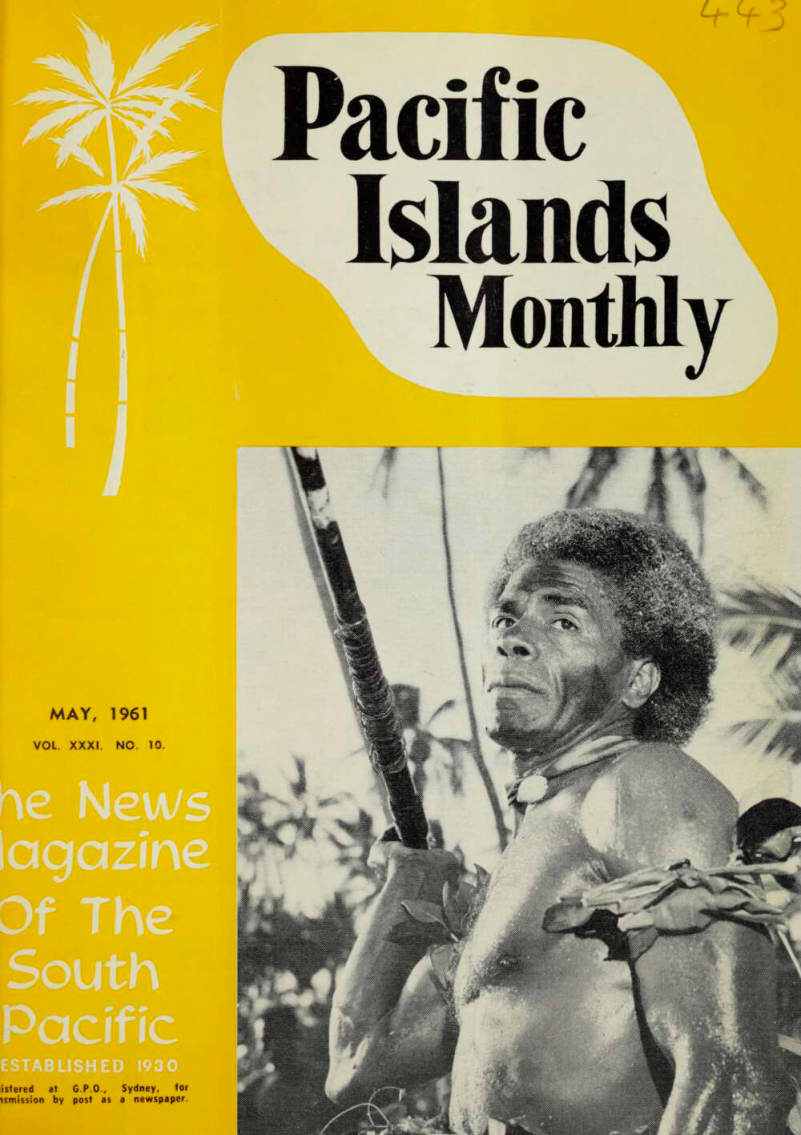 1
1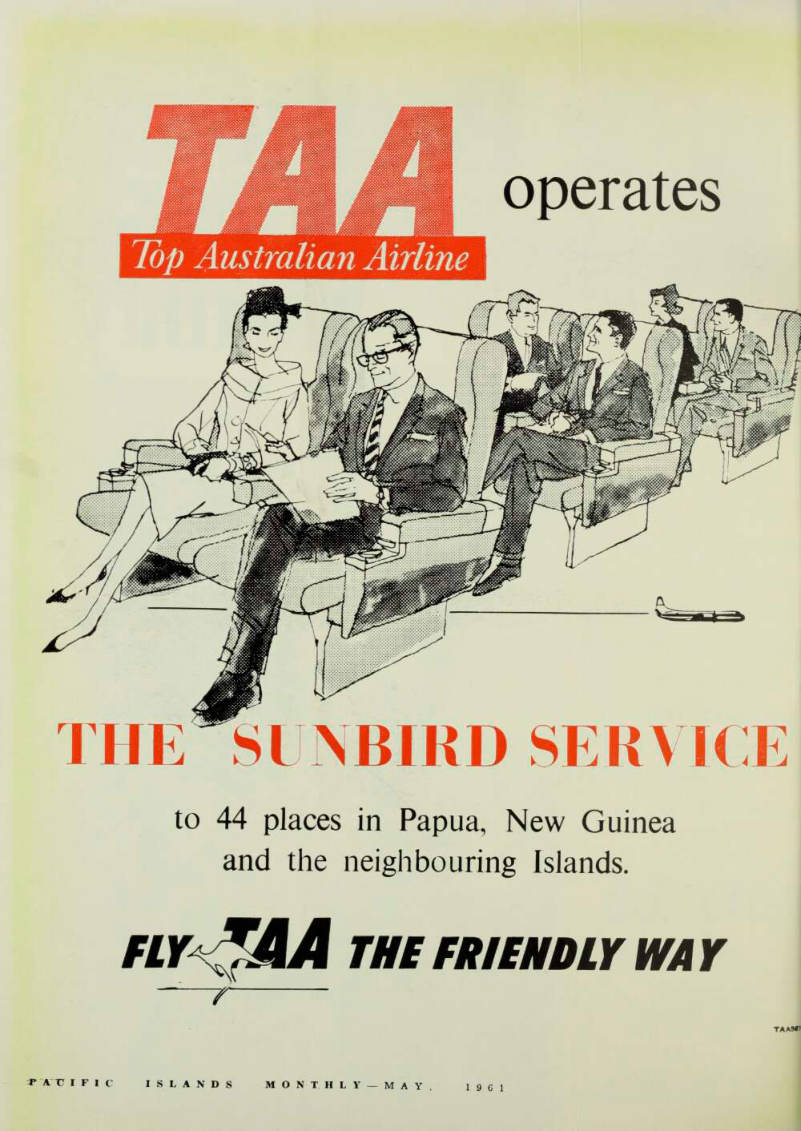 2
2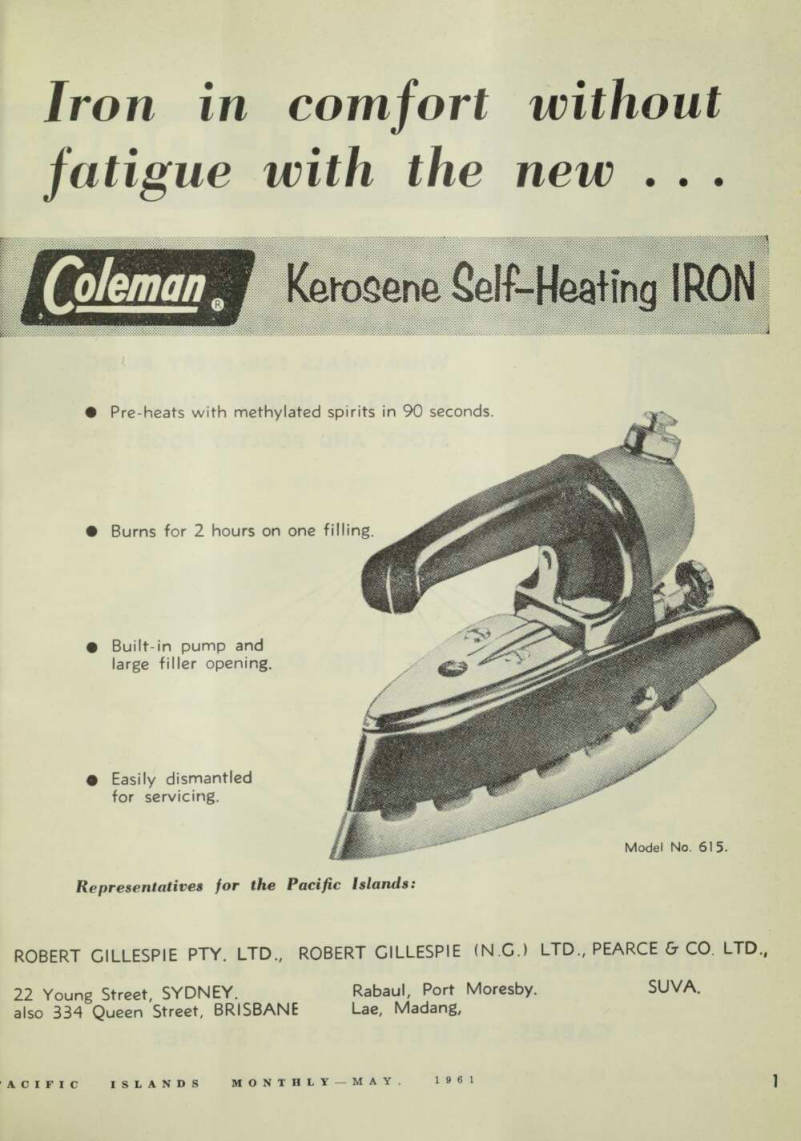 3
3 4
4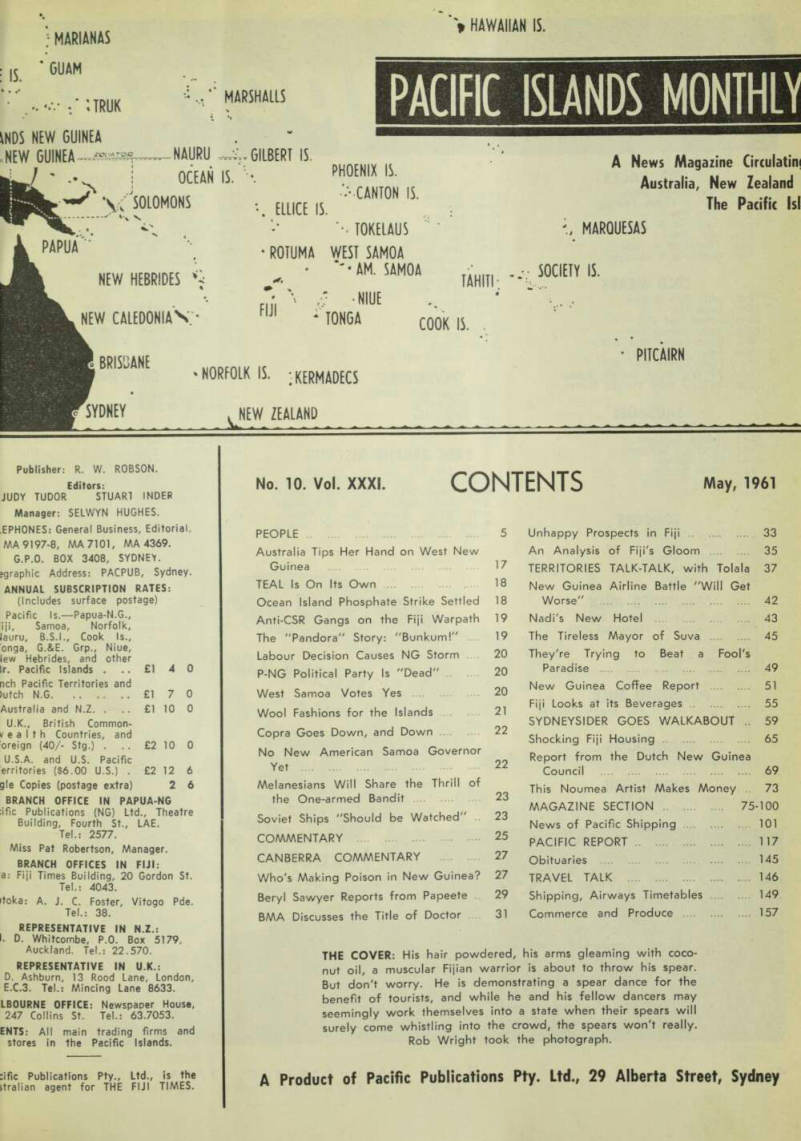 5
5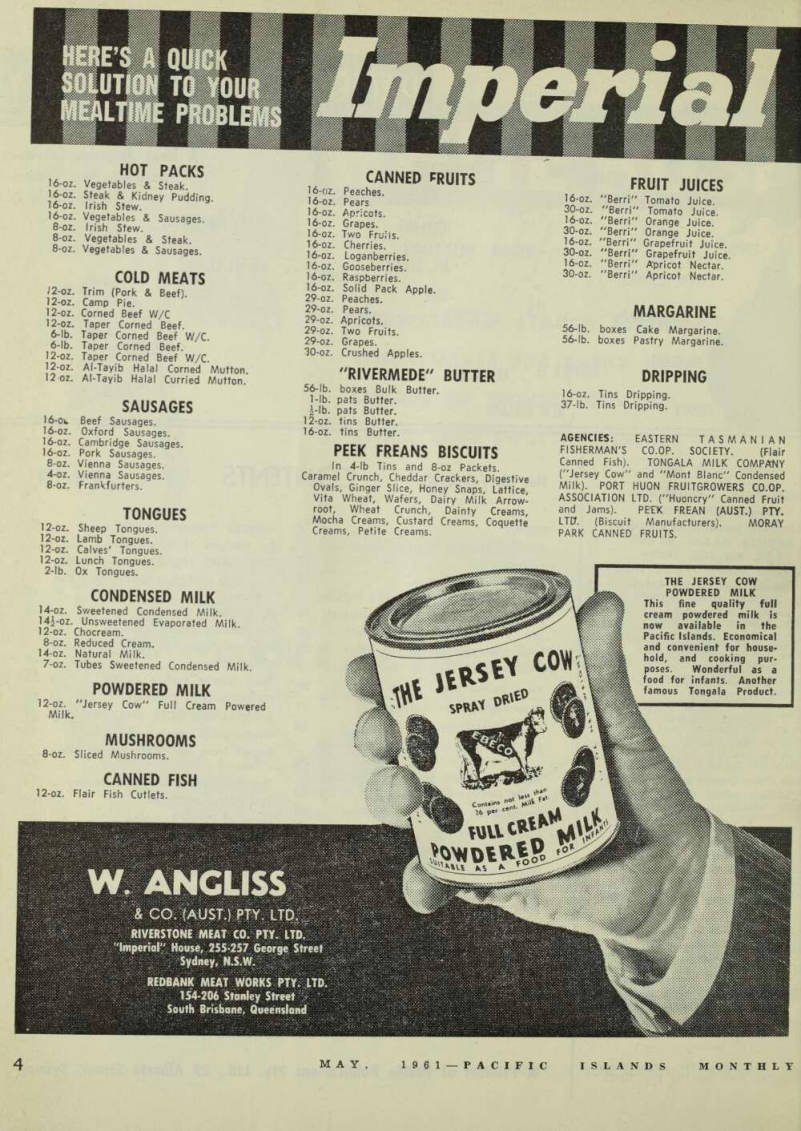 6
6 7
7 8
8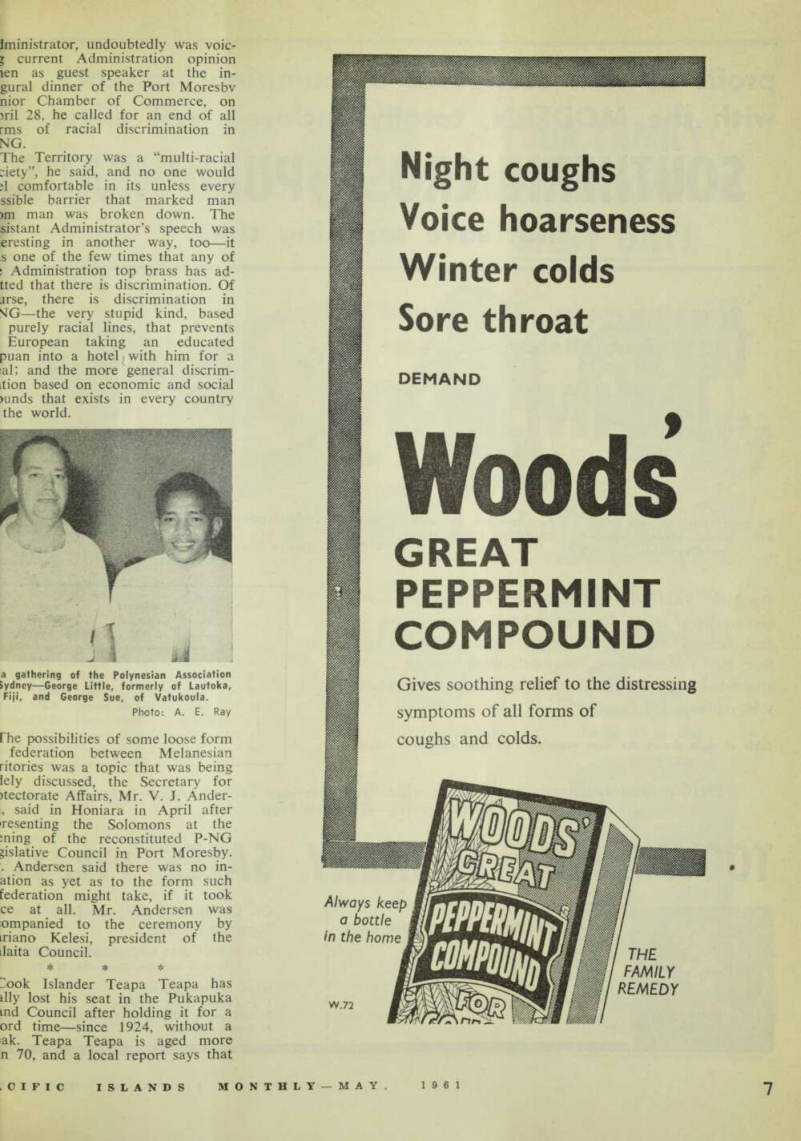 9
9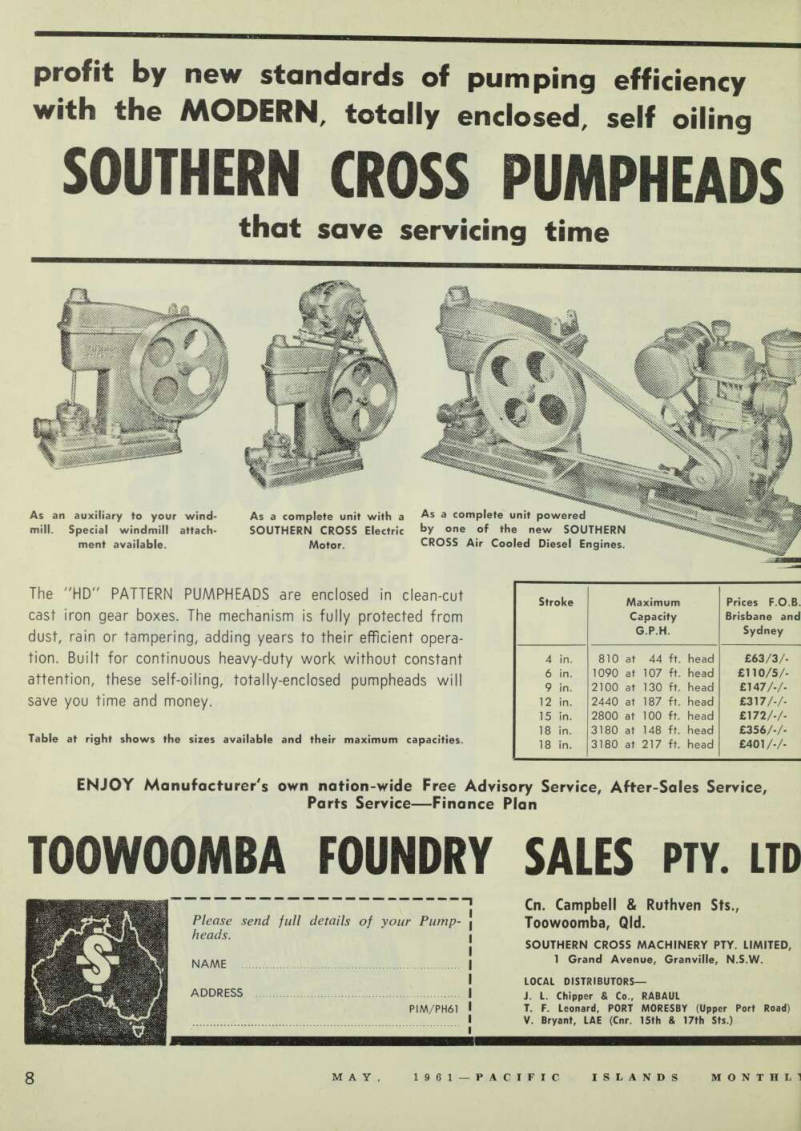 10
10 11
11 12
12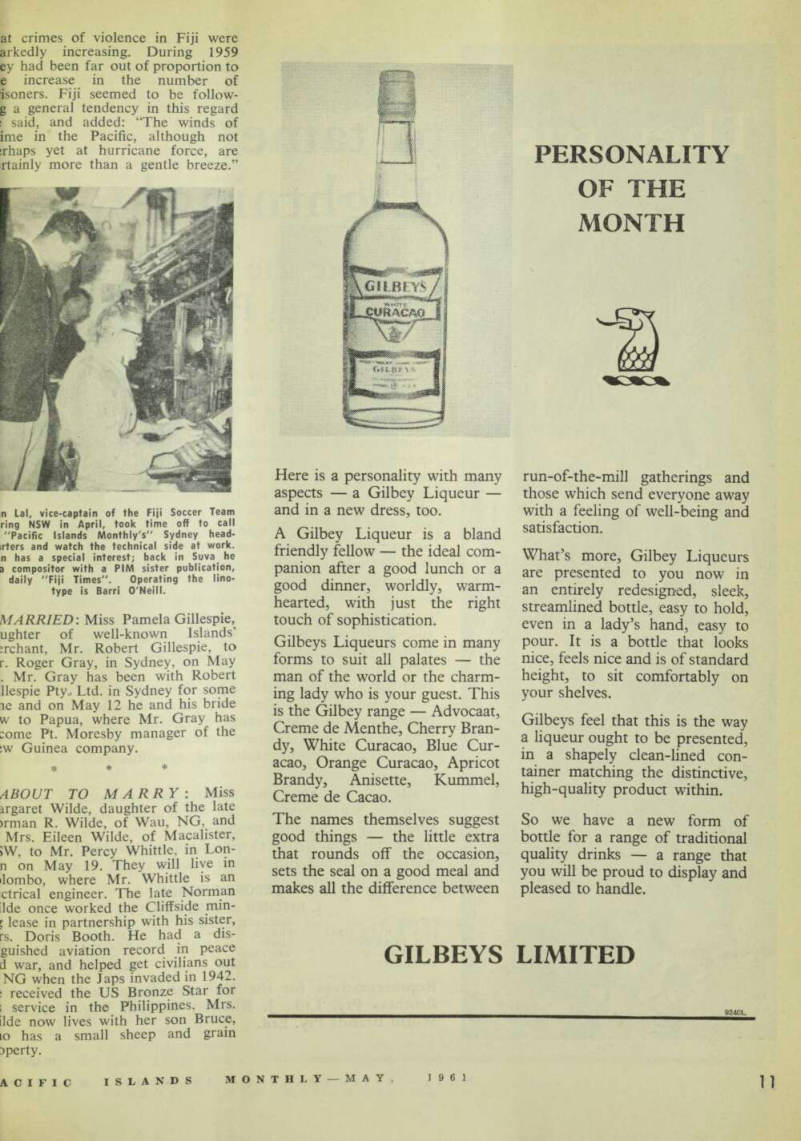 13
13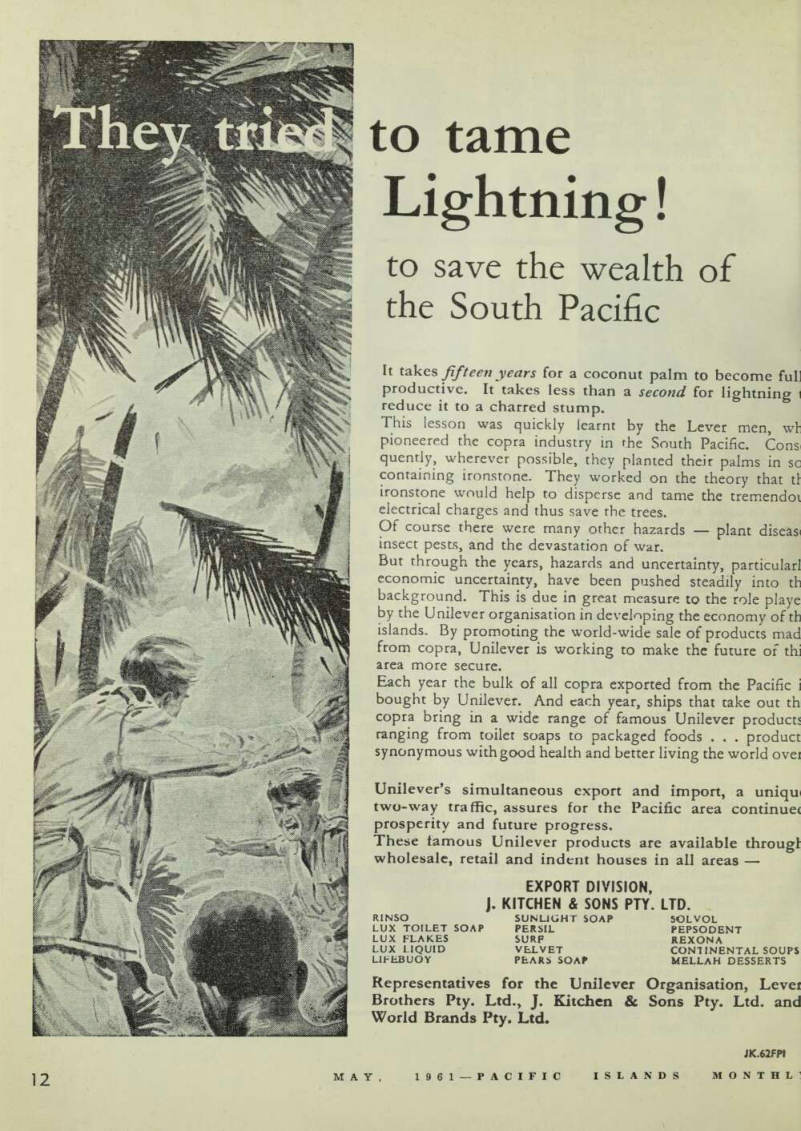 14
14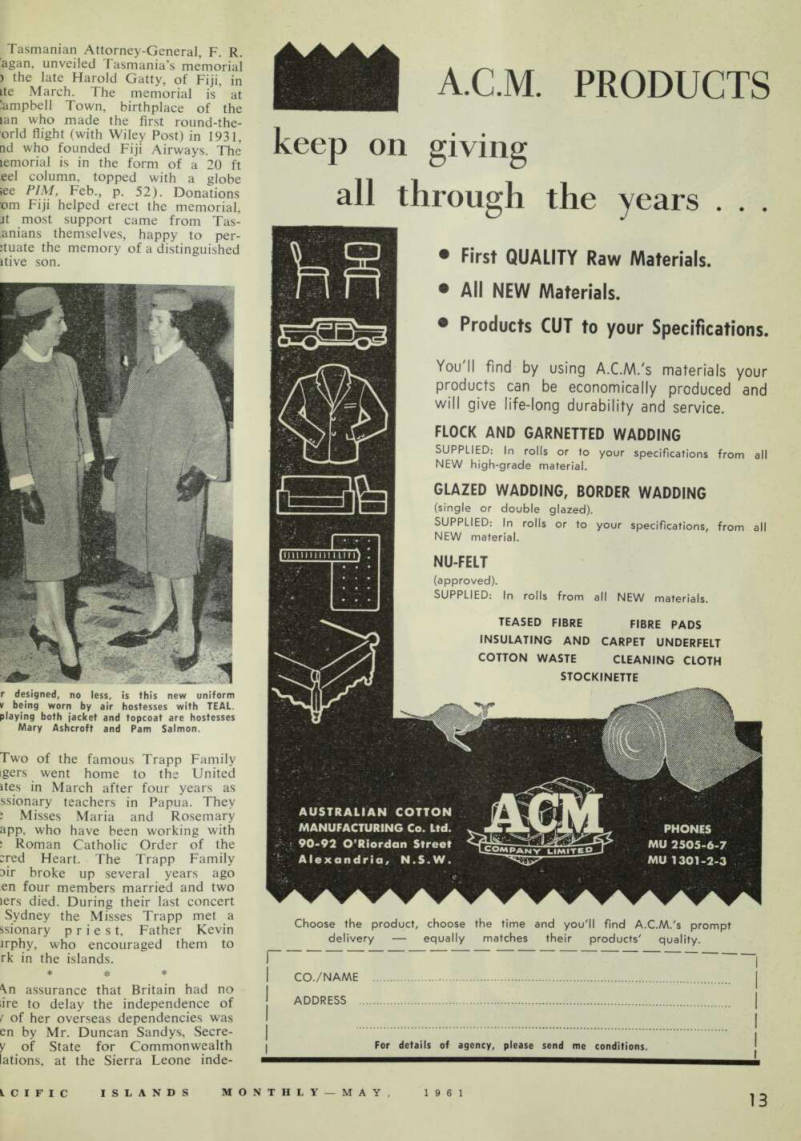 15
15 16
16 17
17 18
18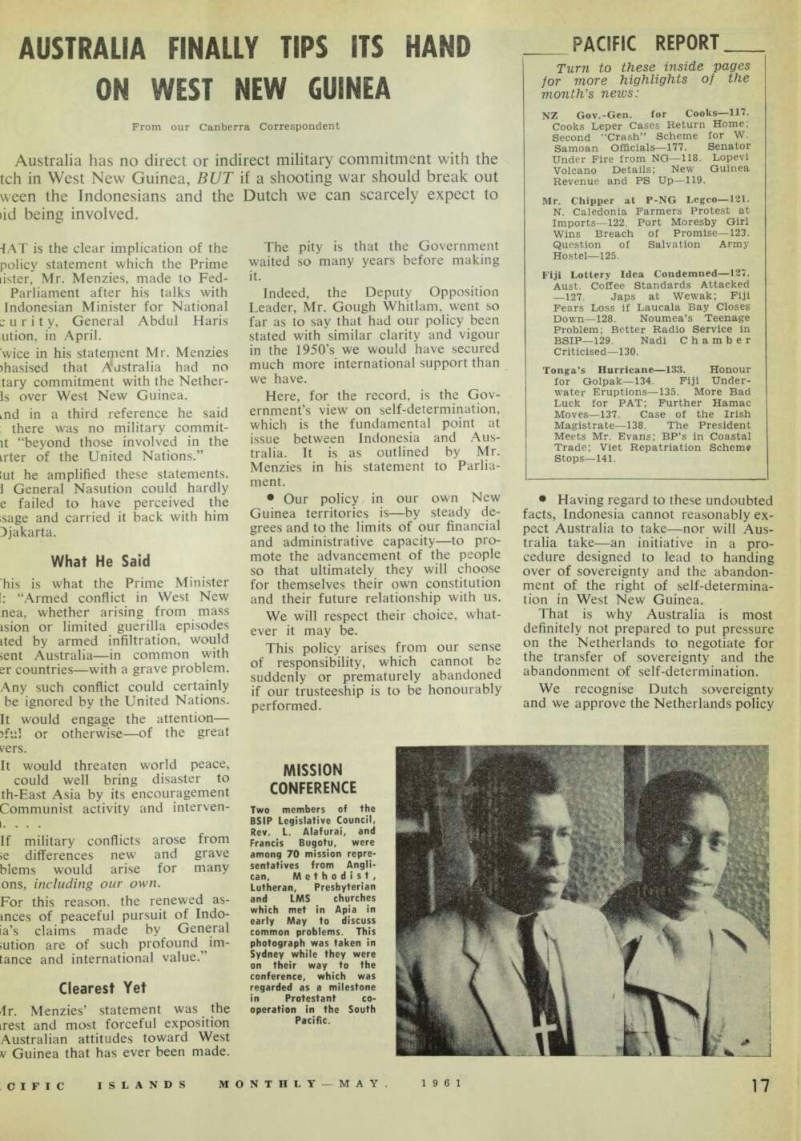 19
19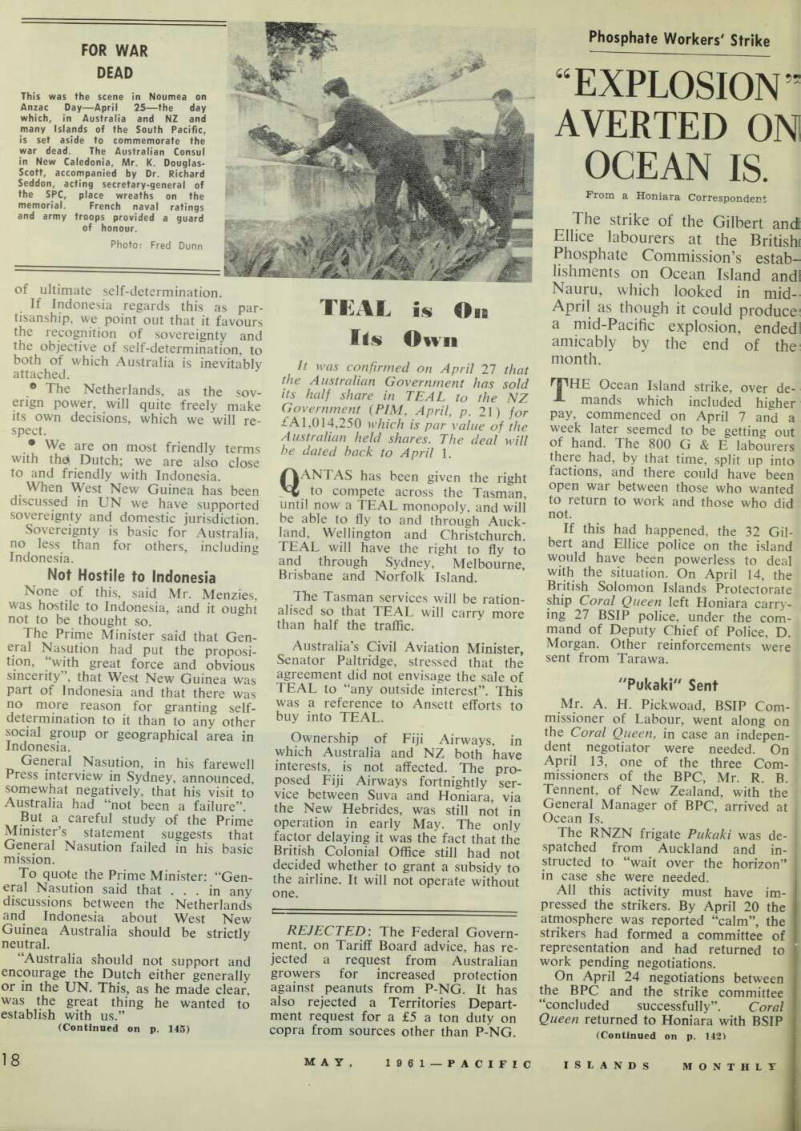 20
20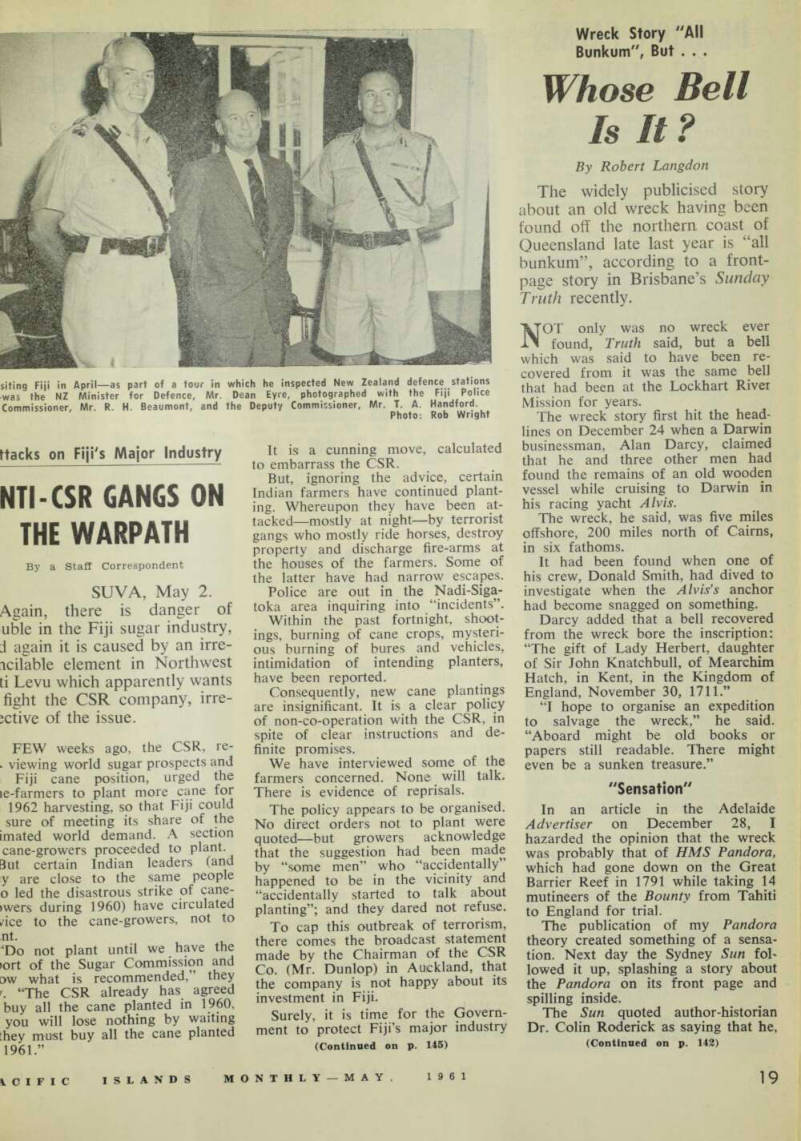 21
21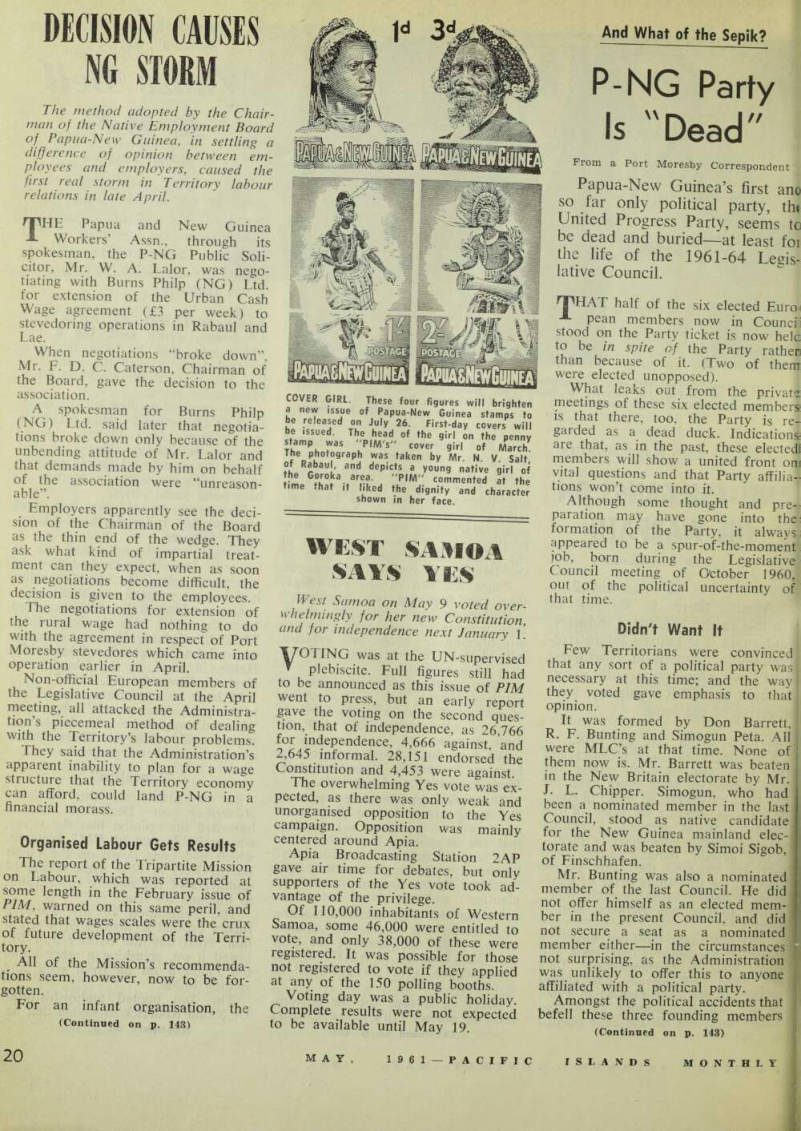 22
22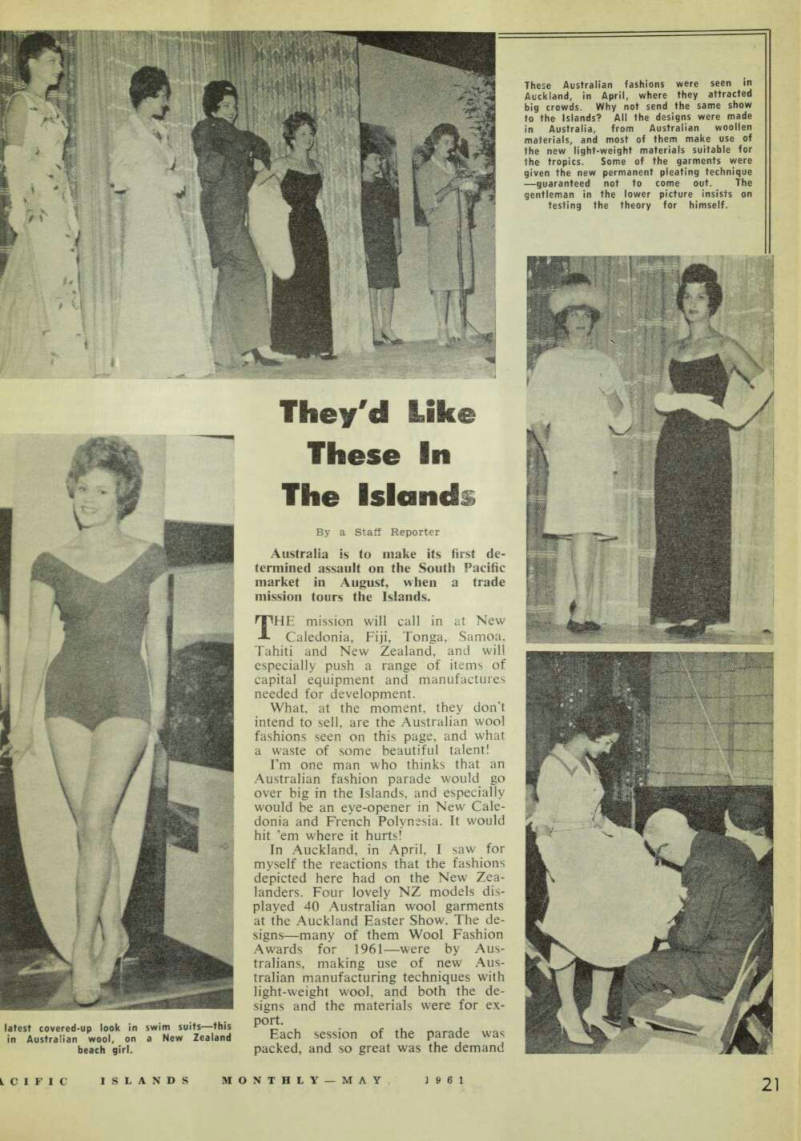 23
23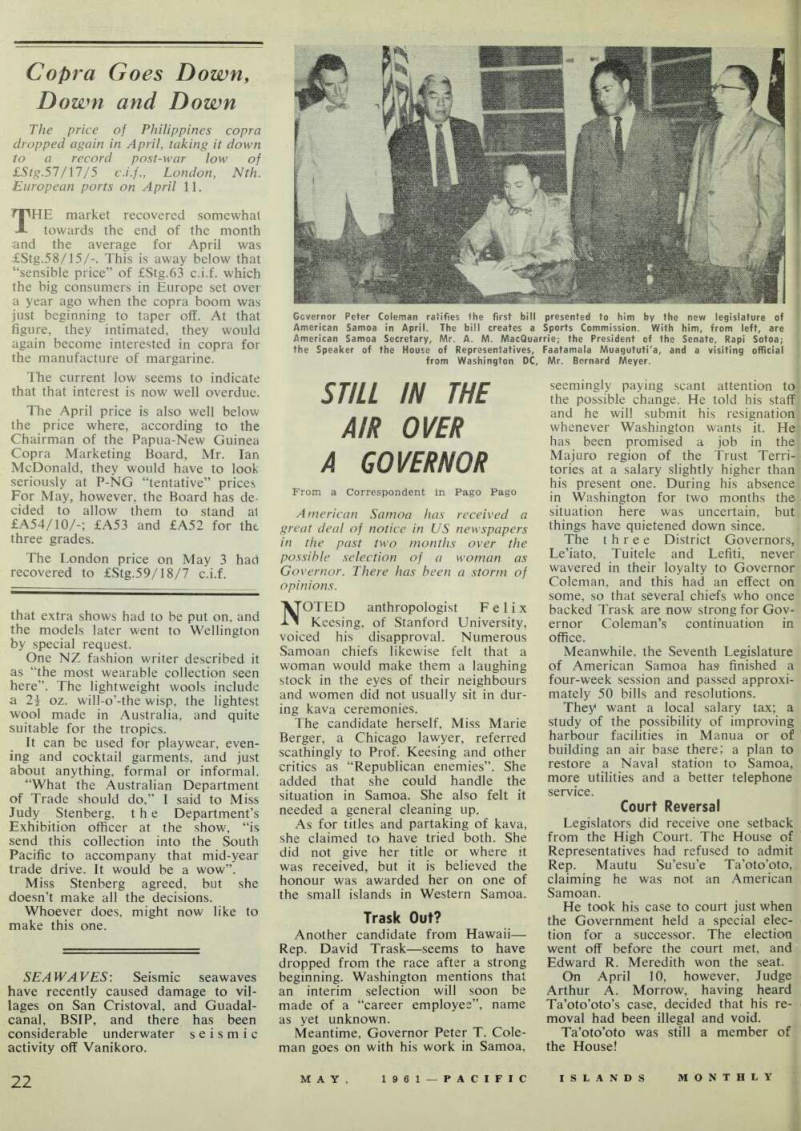 24
24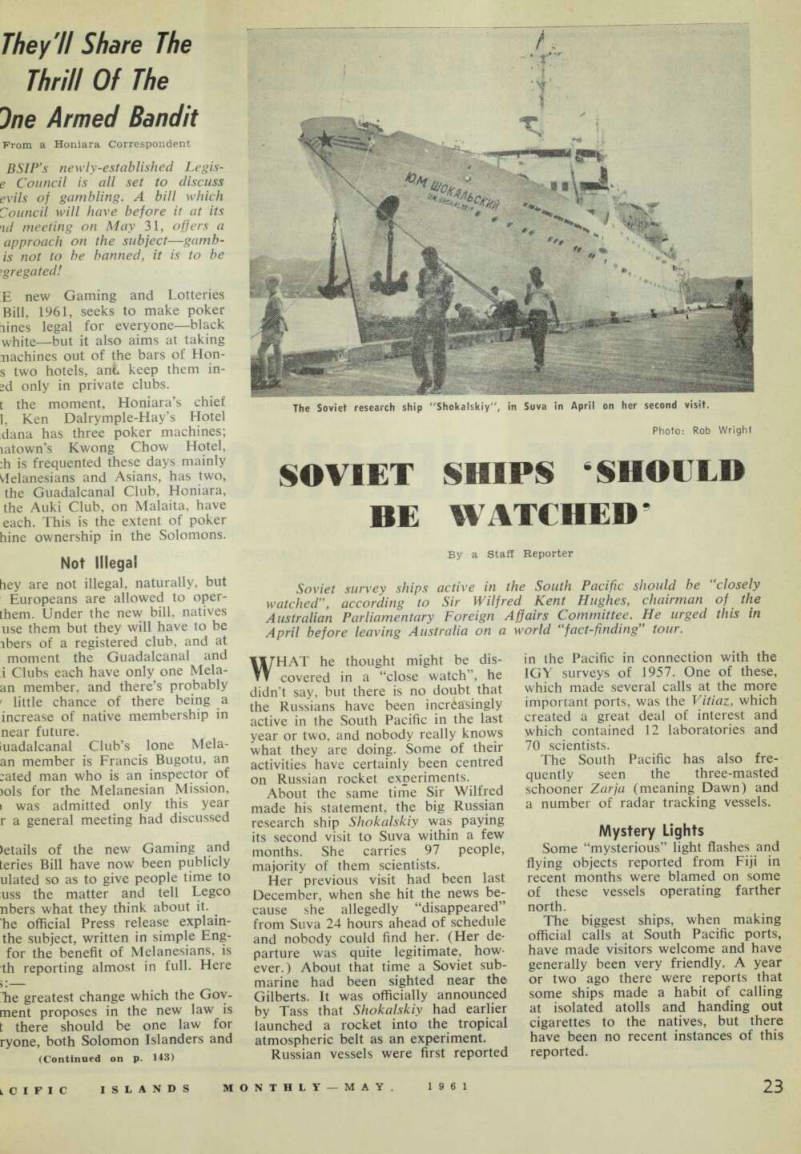 25
25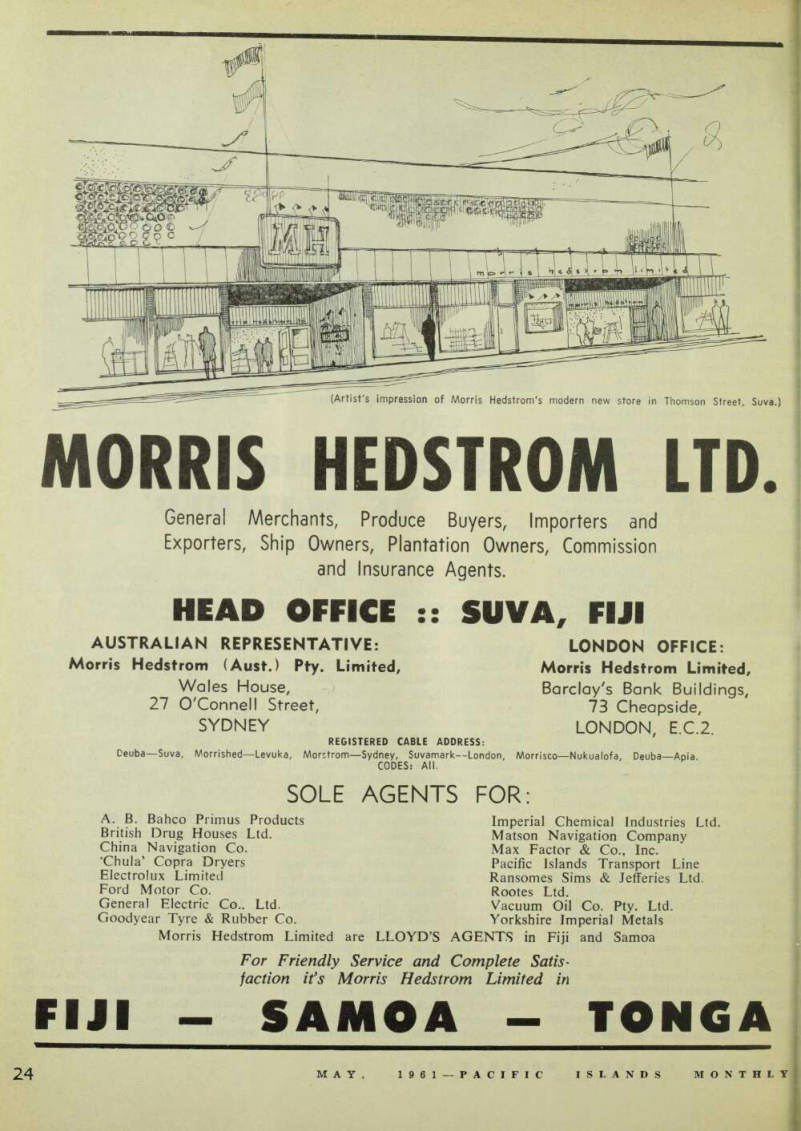 26
26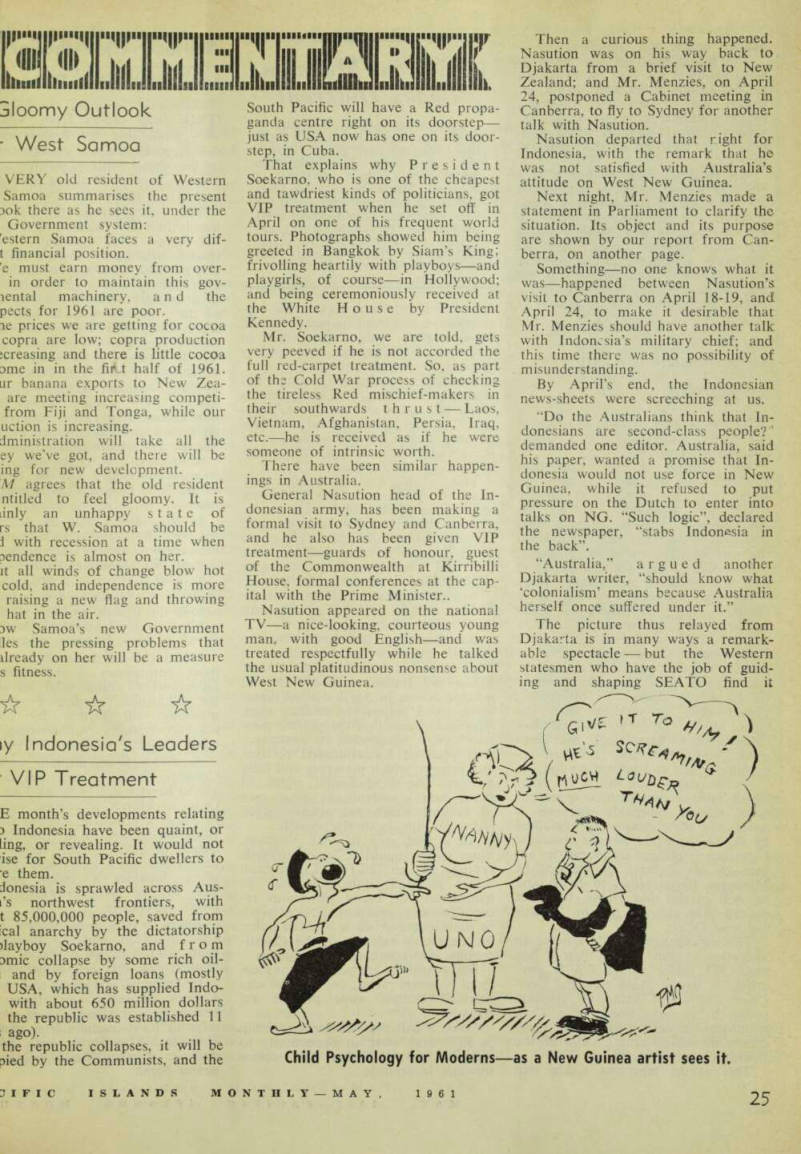 27
27 28
28 29
29 30
30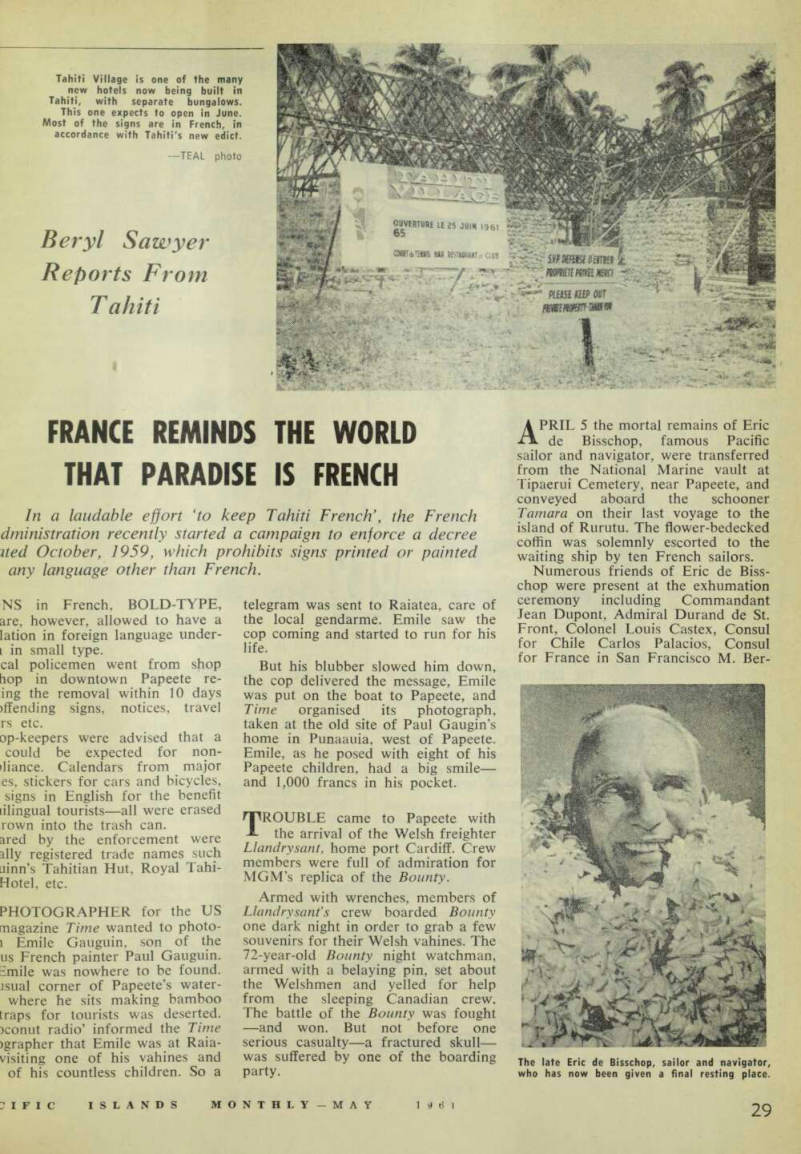 31
31 32
32 33
33 34
34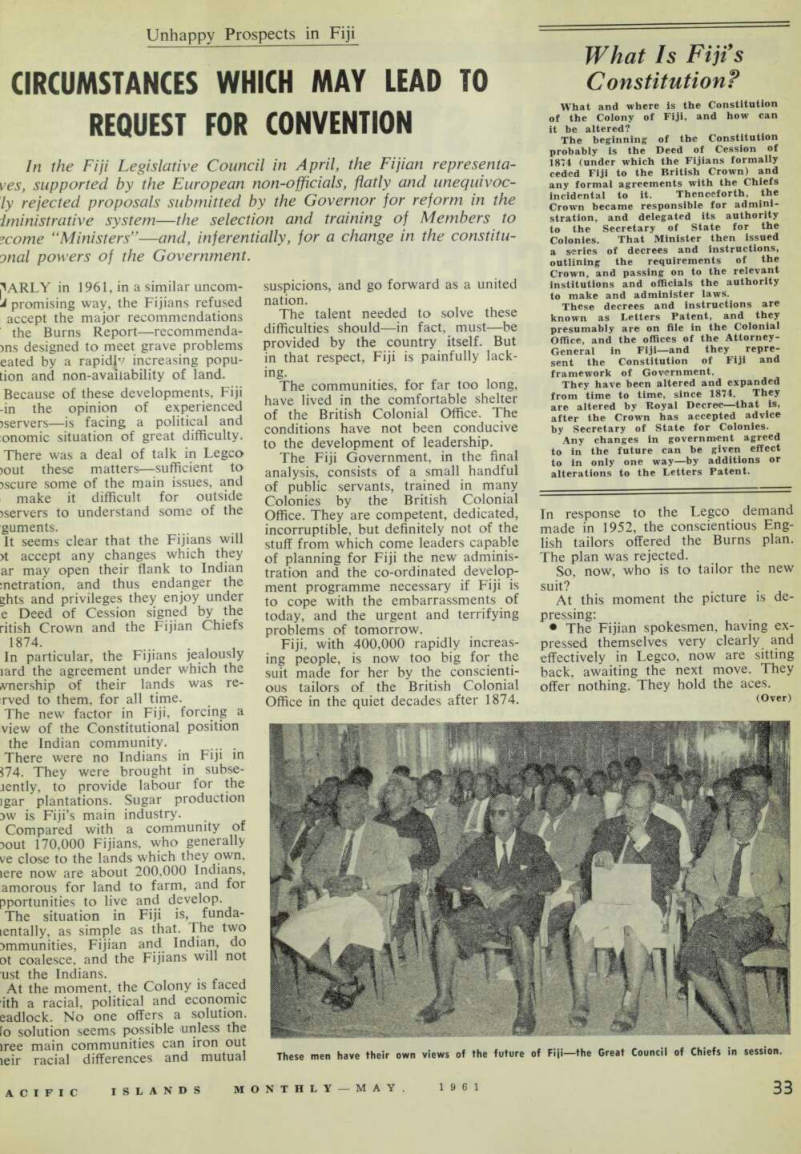 35
35 36
36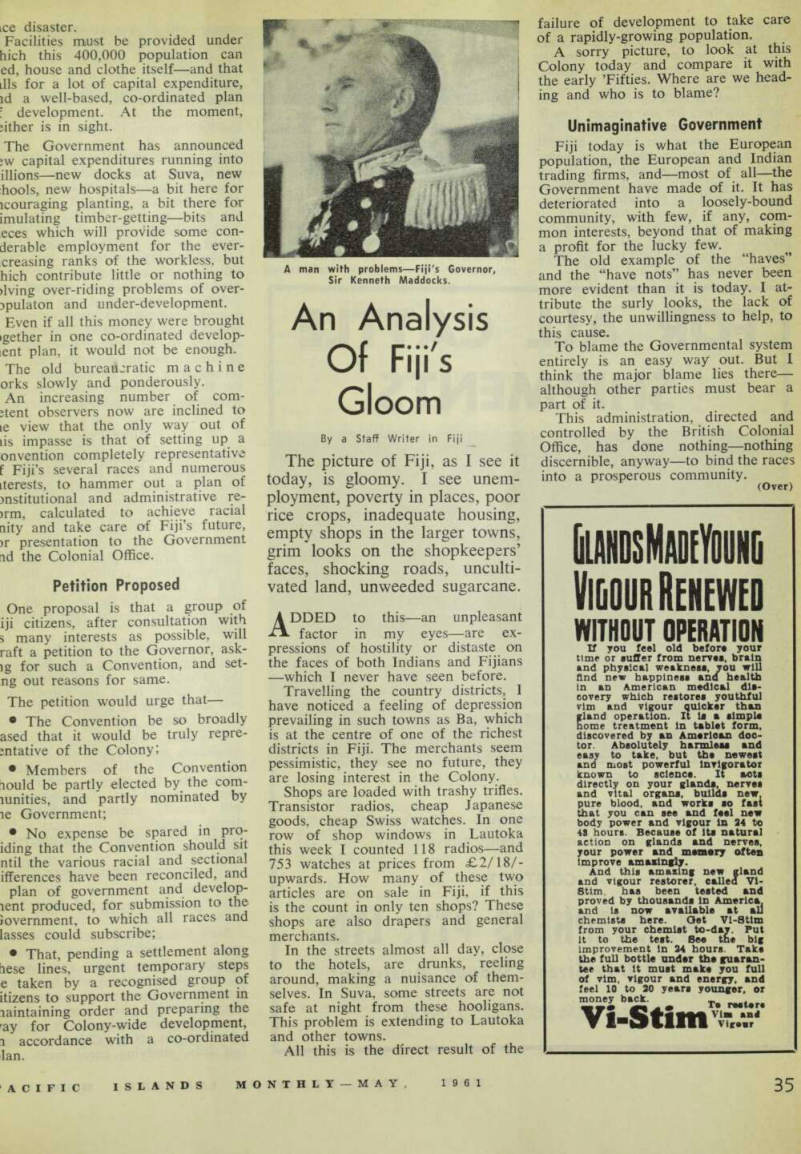 37
37 38
38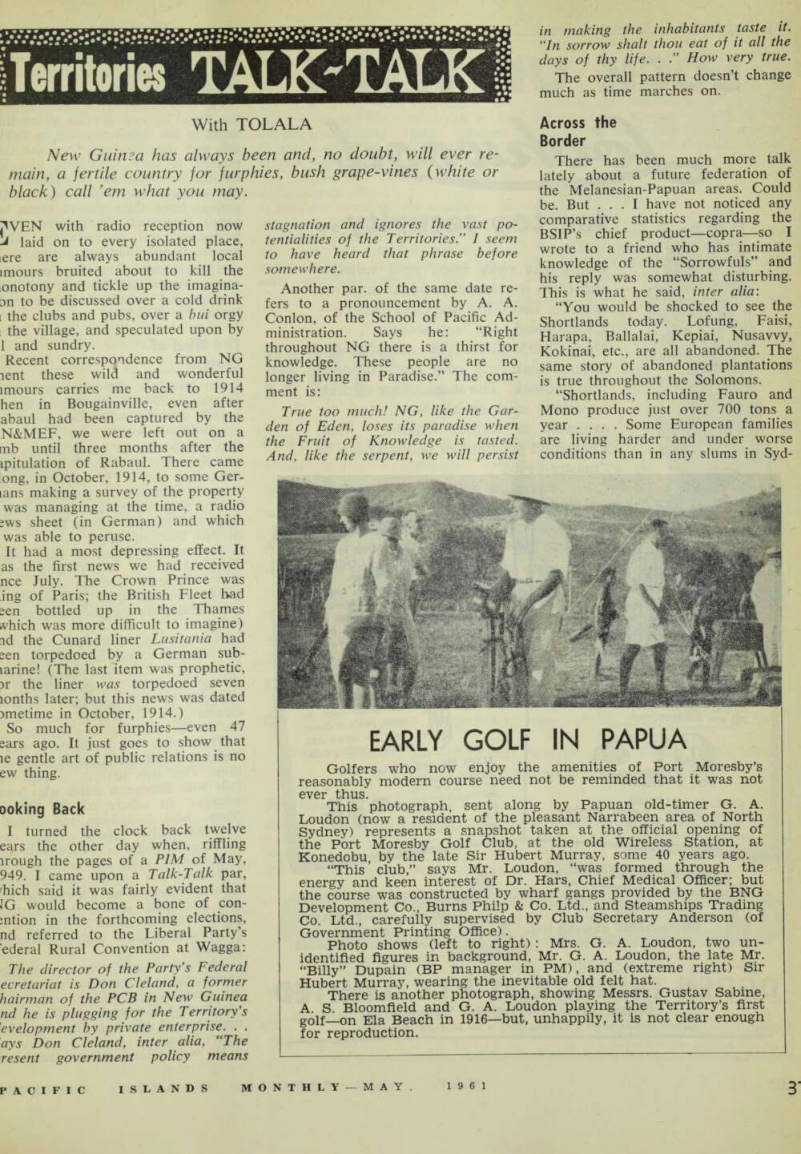 39
39 40
40 41
41 42
42 43
43 44
44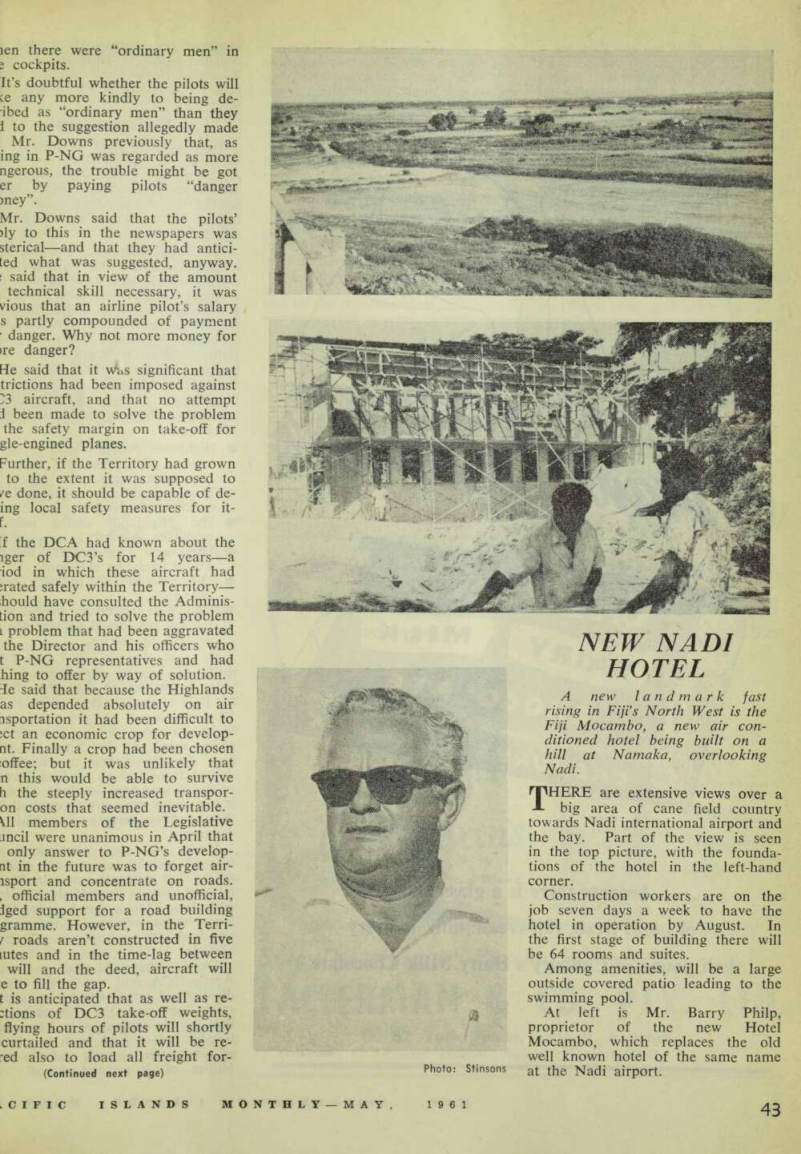 45
45 46
46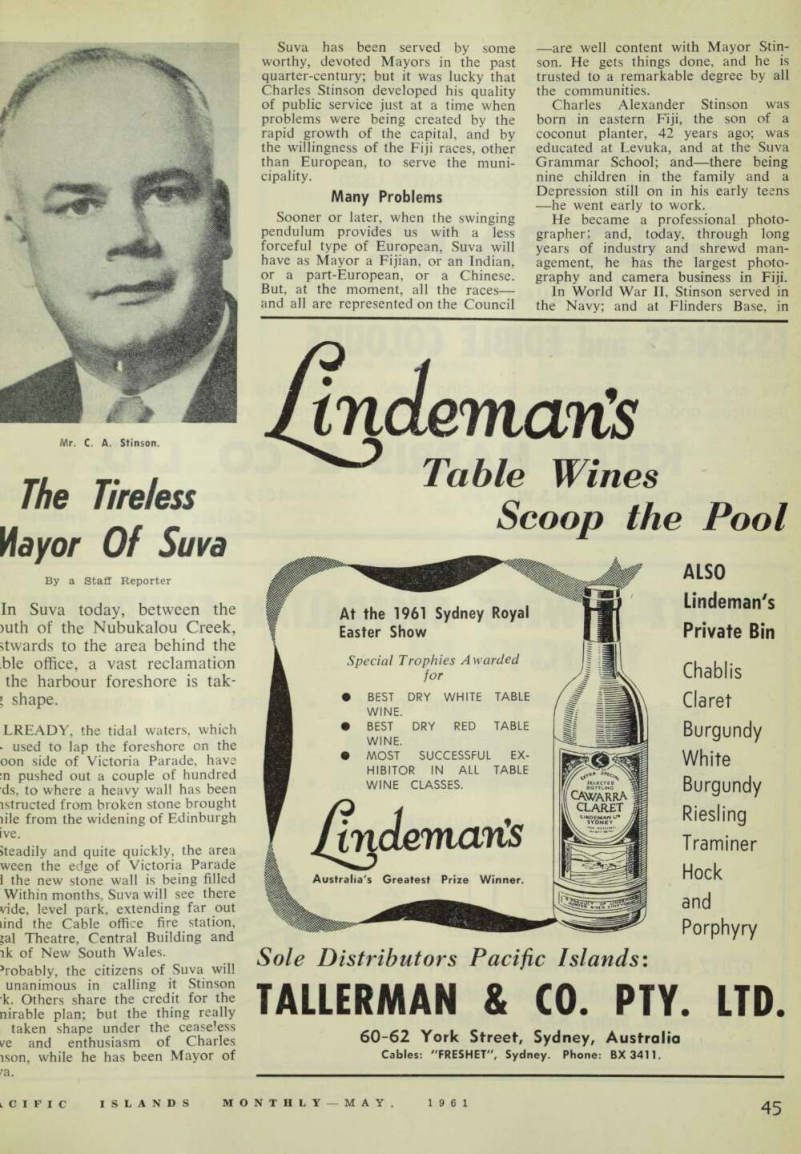 47
47 48
48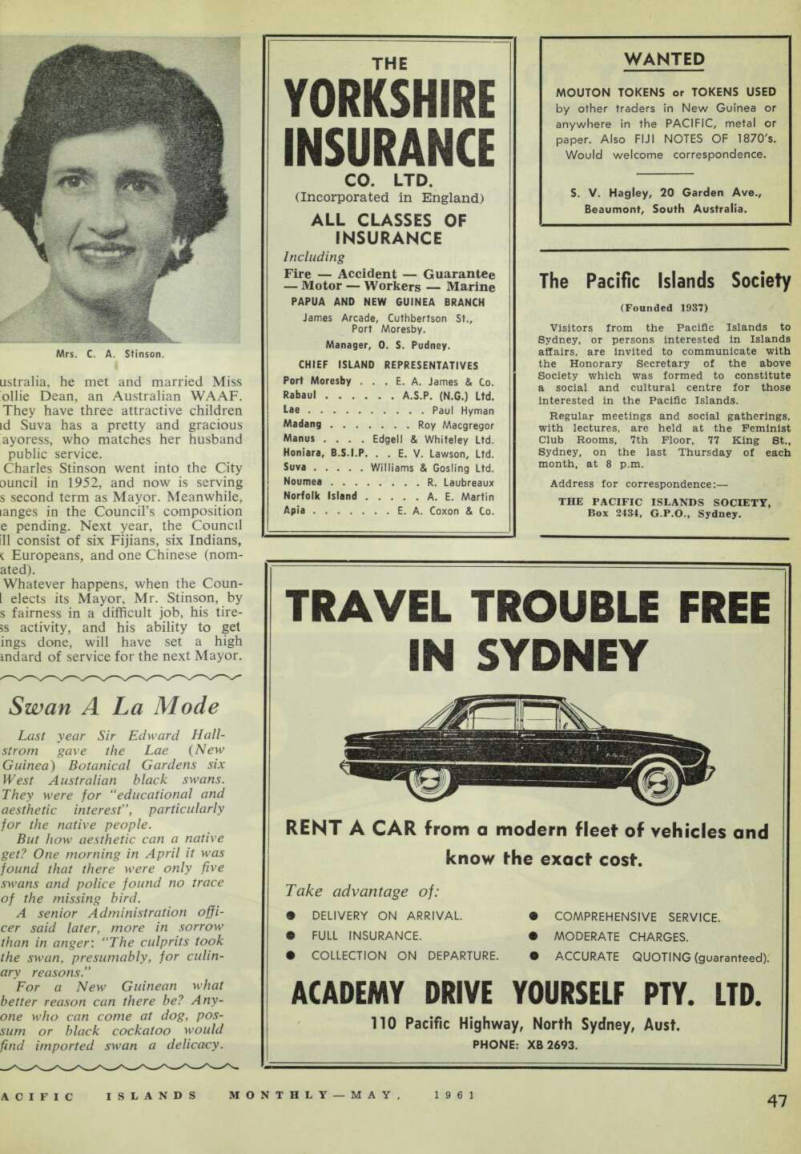 49
49 50
50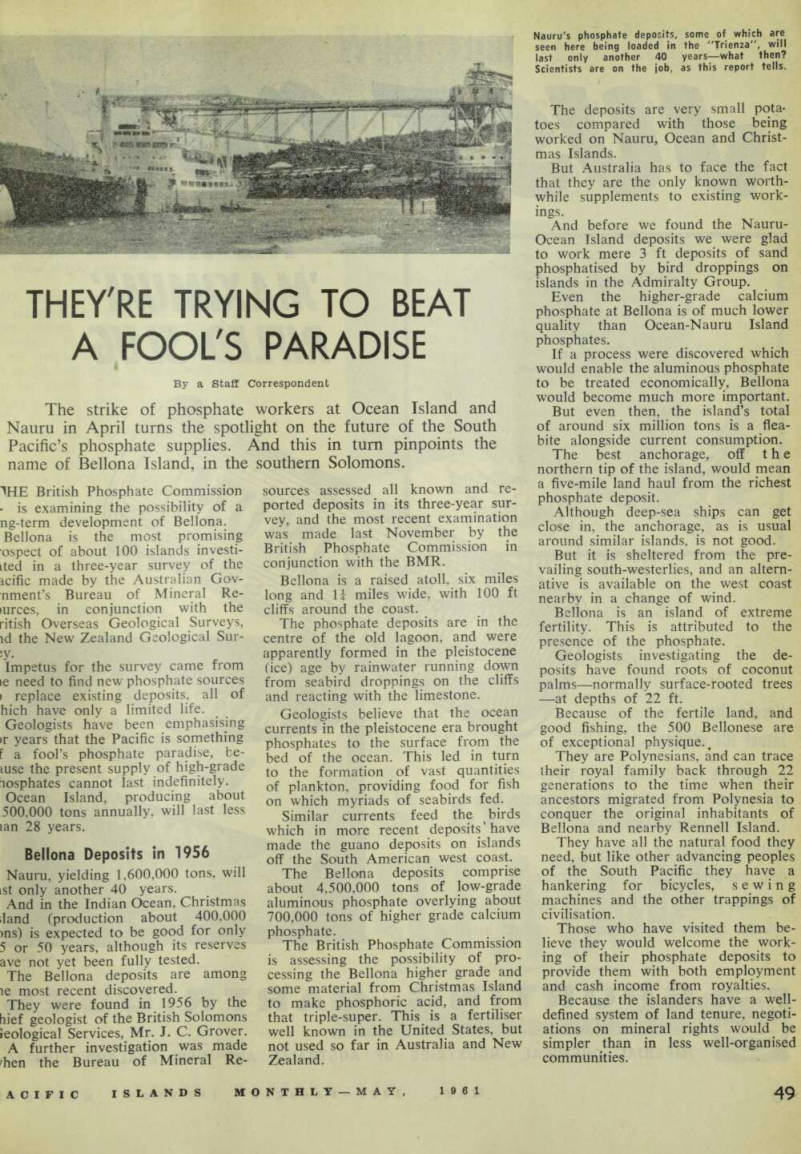 51
51 52
52 53
53 54
54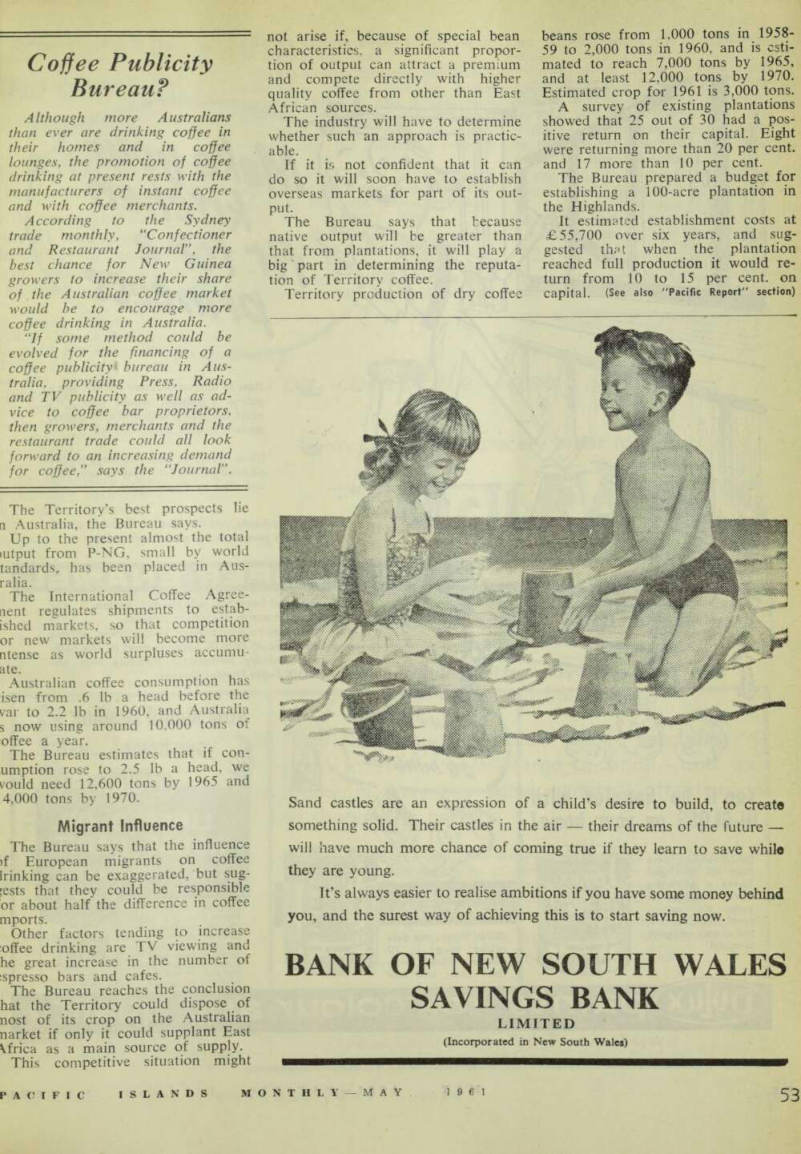 55
55 56
56 57
57 58
58 59
59 60
60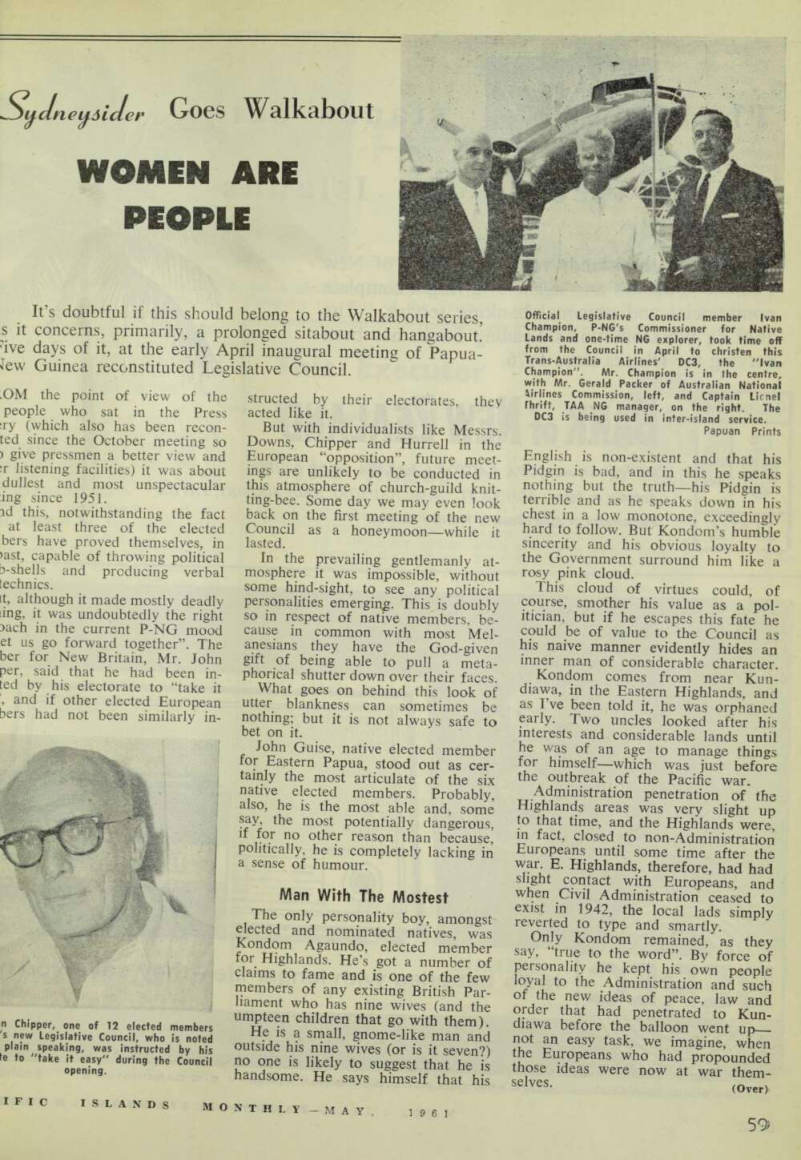 61
61 62
62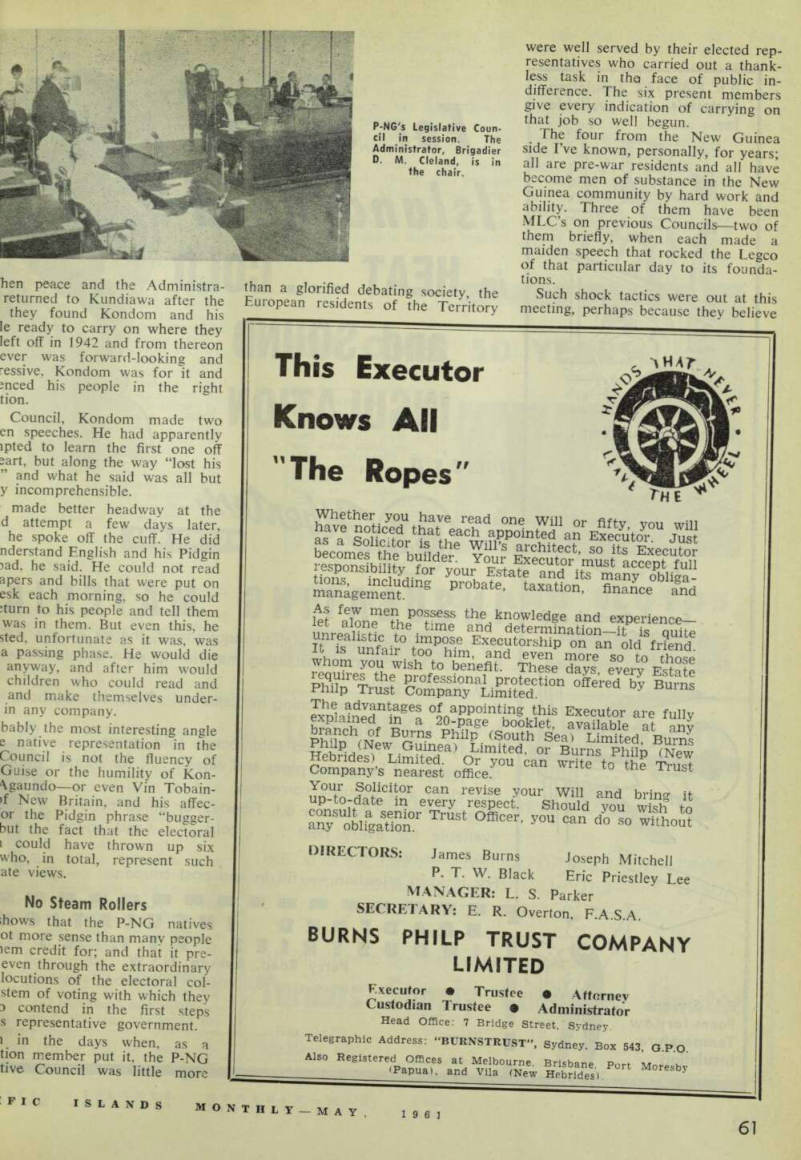 63
63 64
64 65
65 66
66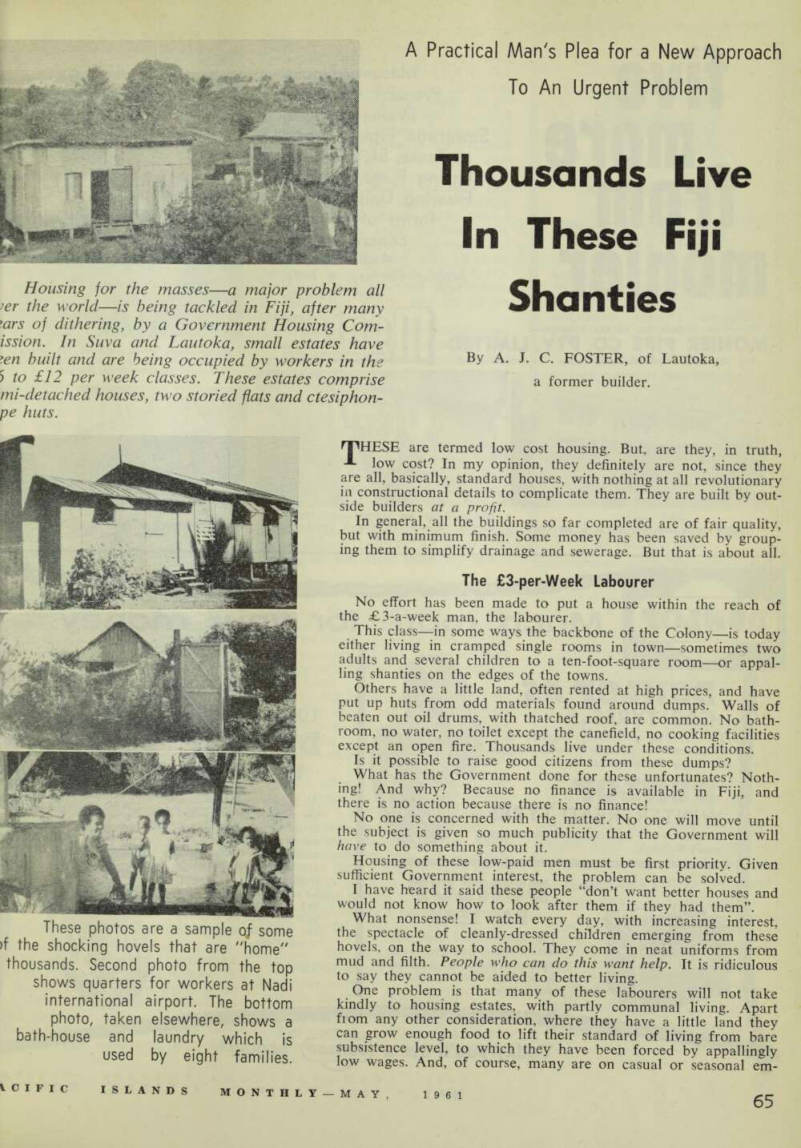 67
67 68
68 69
69 70
70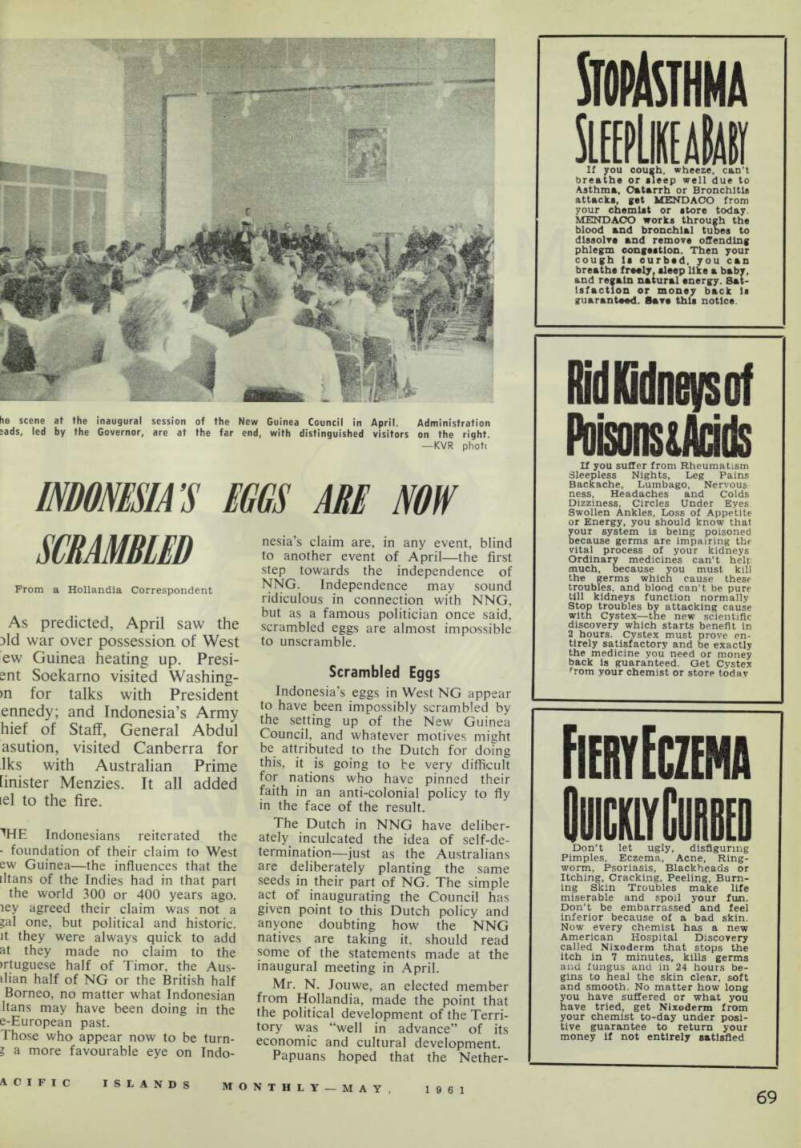 71
71 72
72 73
73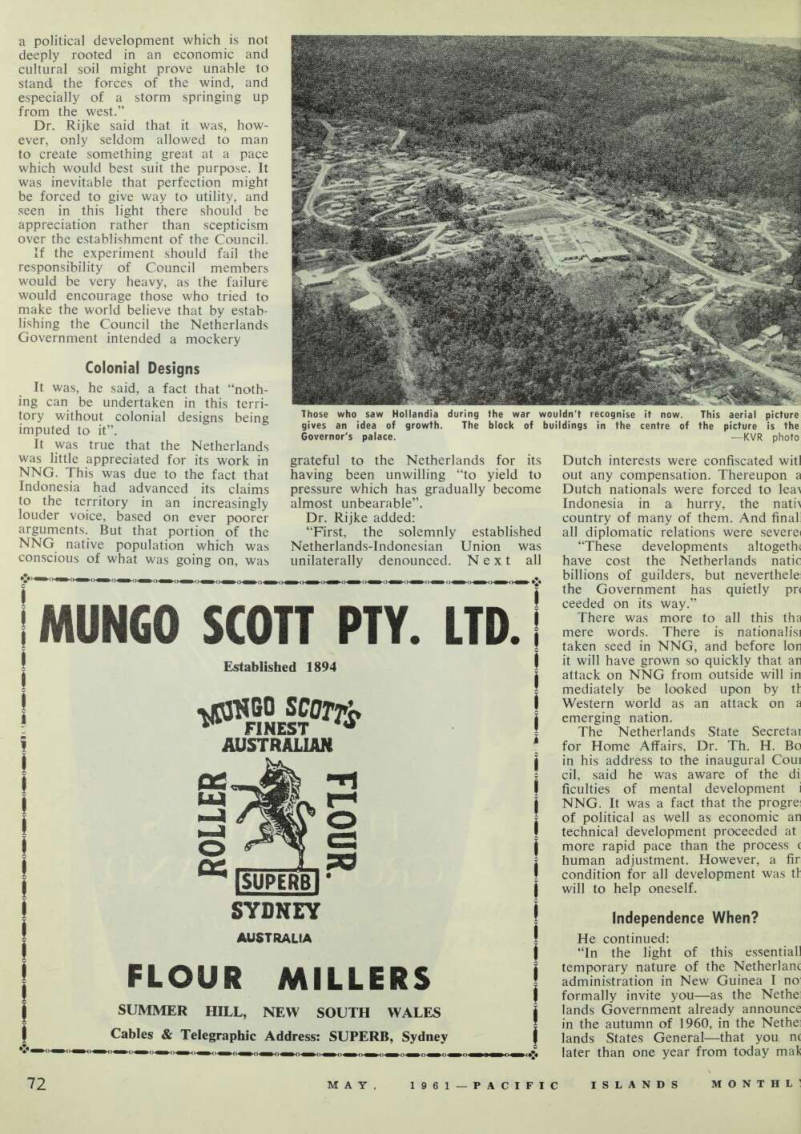 74
74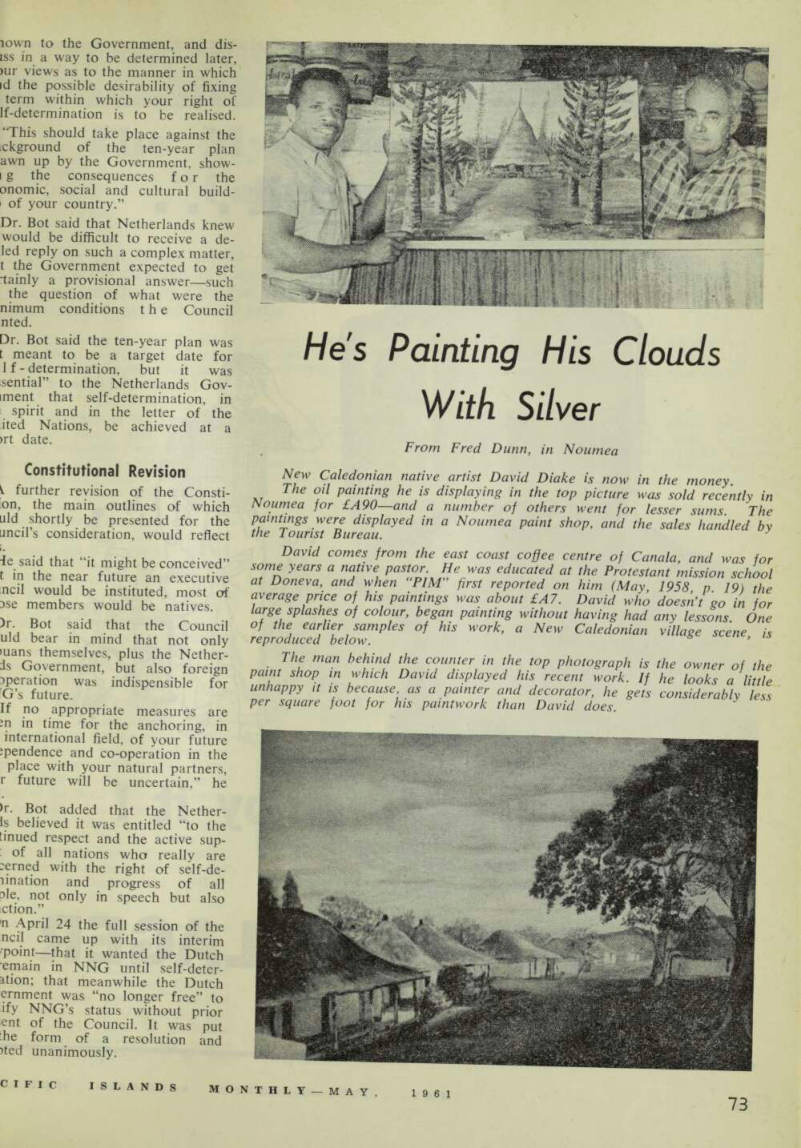 75
75 76
76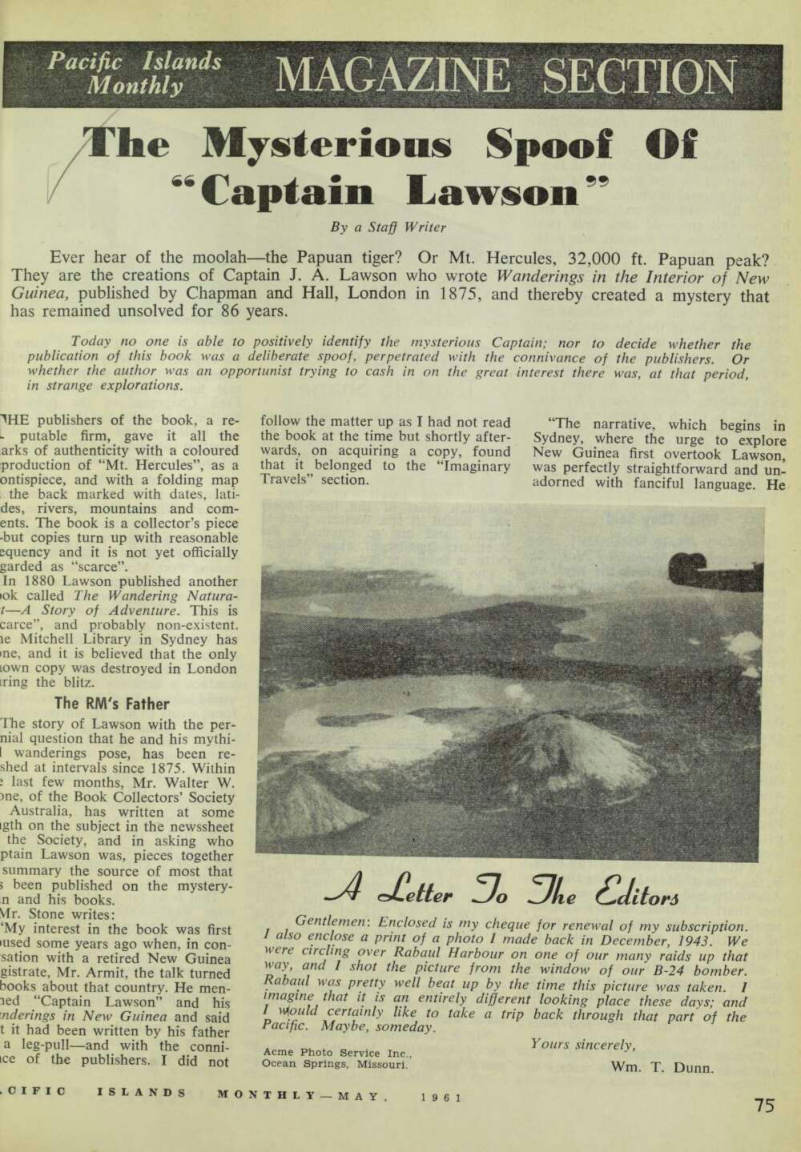 77
77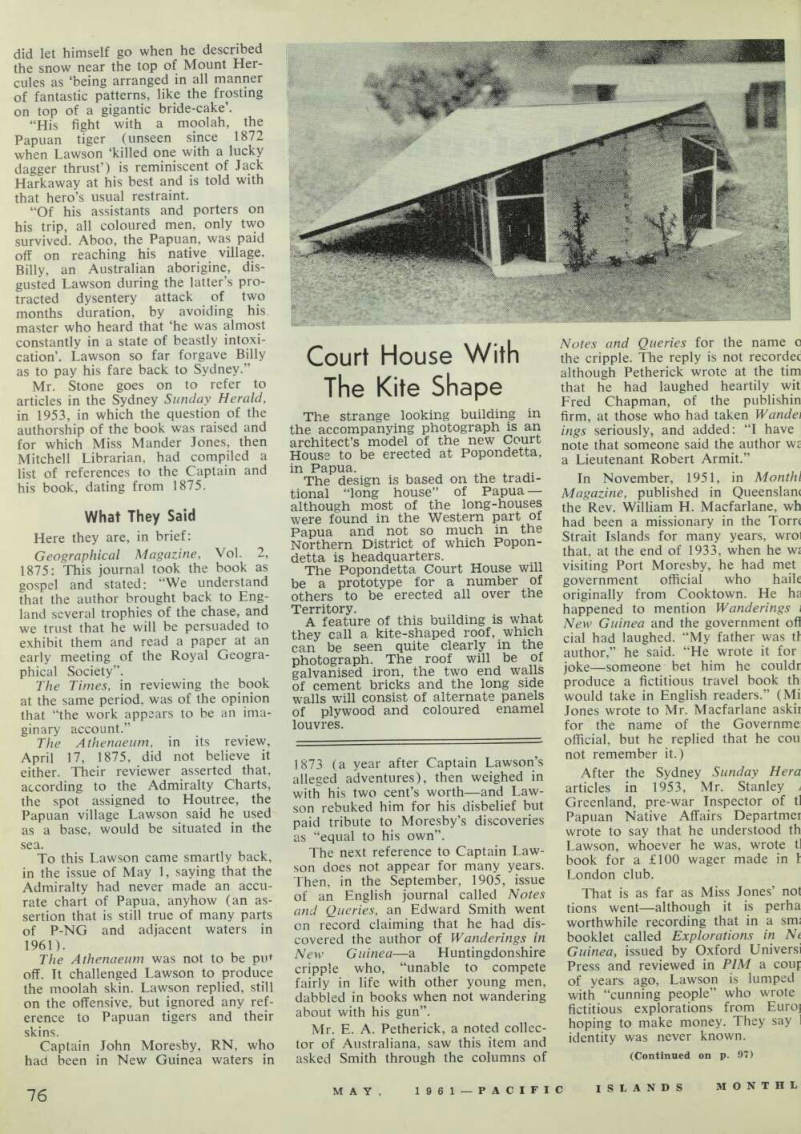 78
78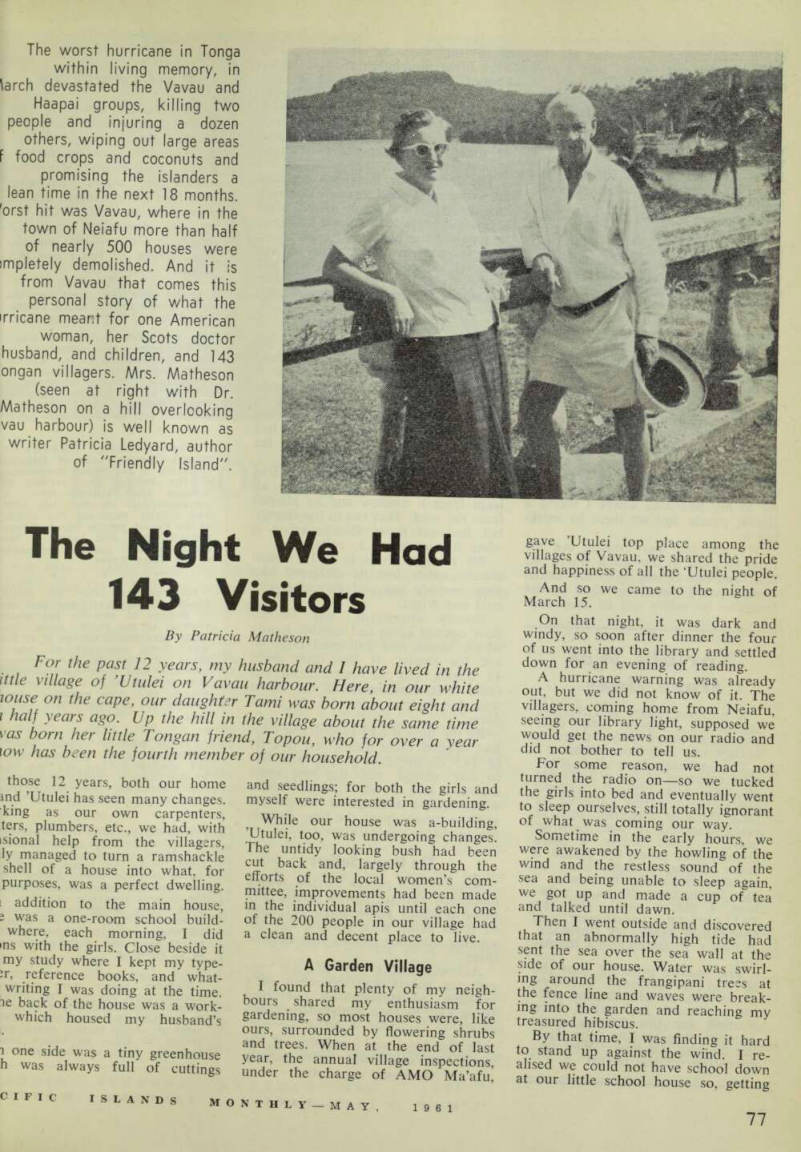 79
79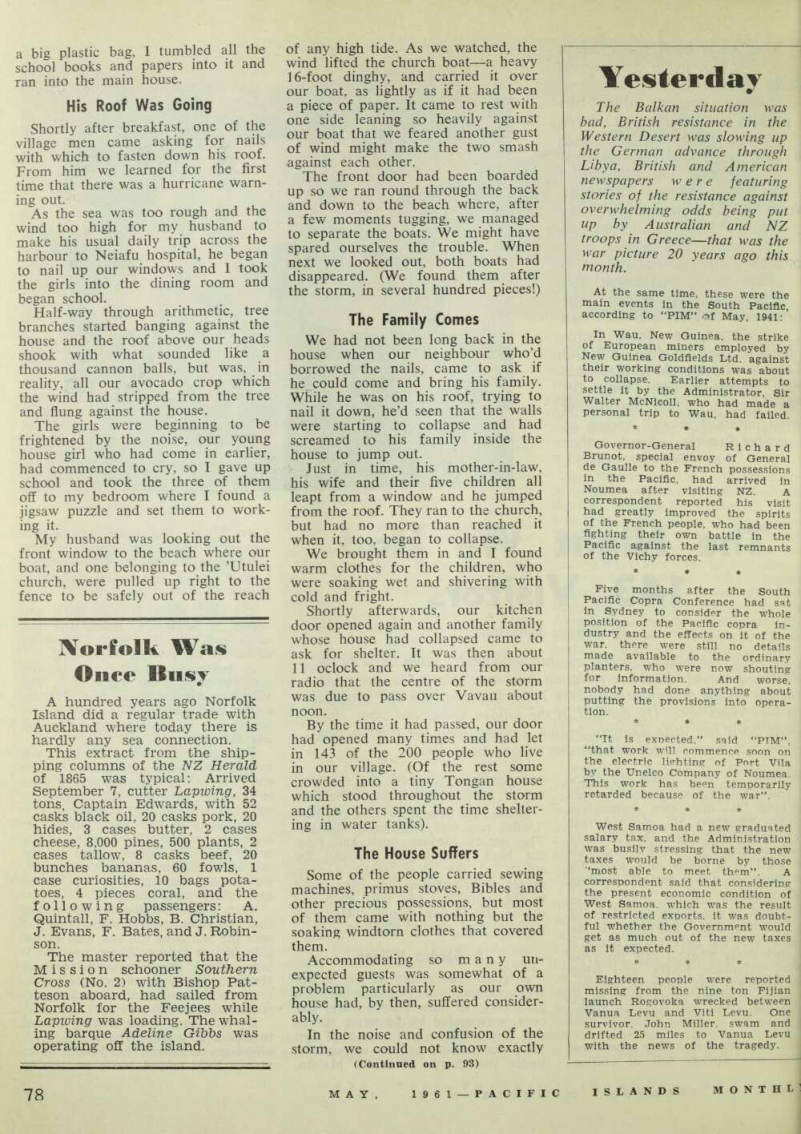 80
80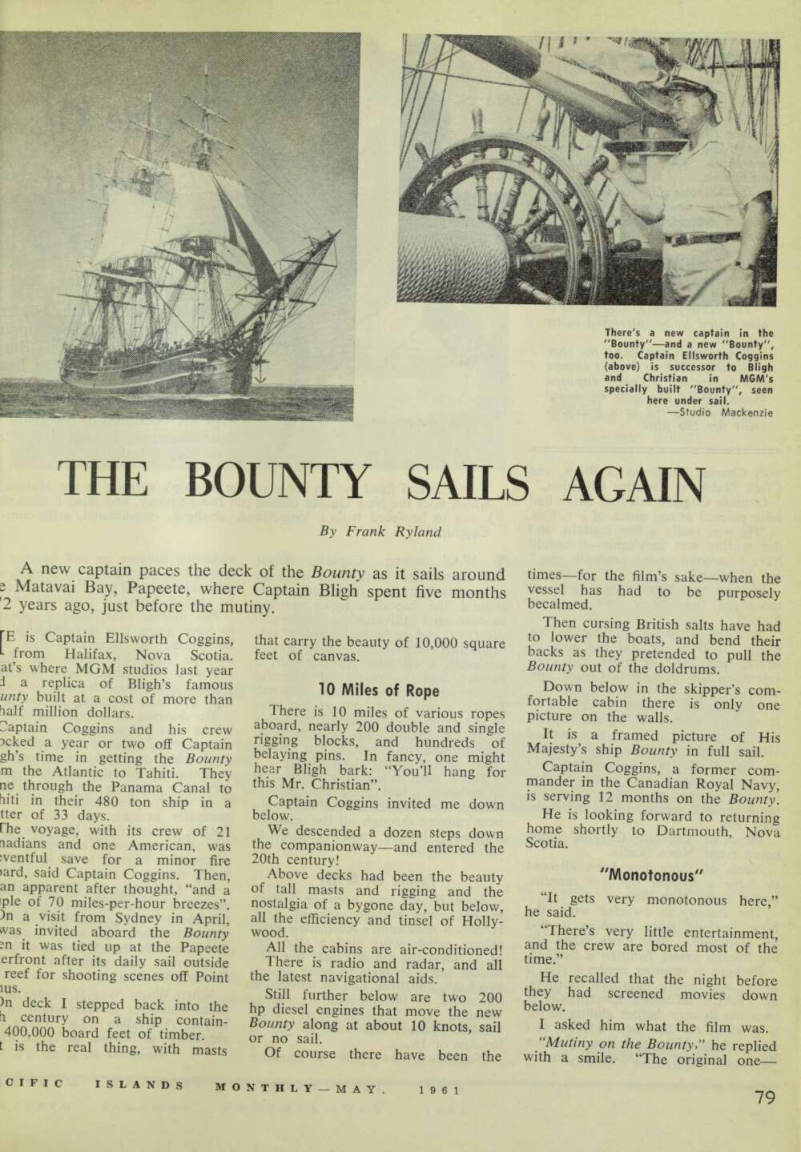 81
81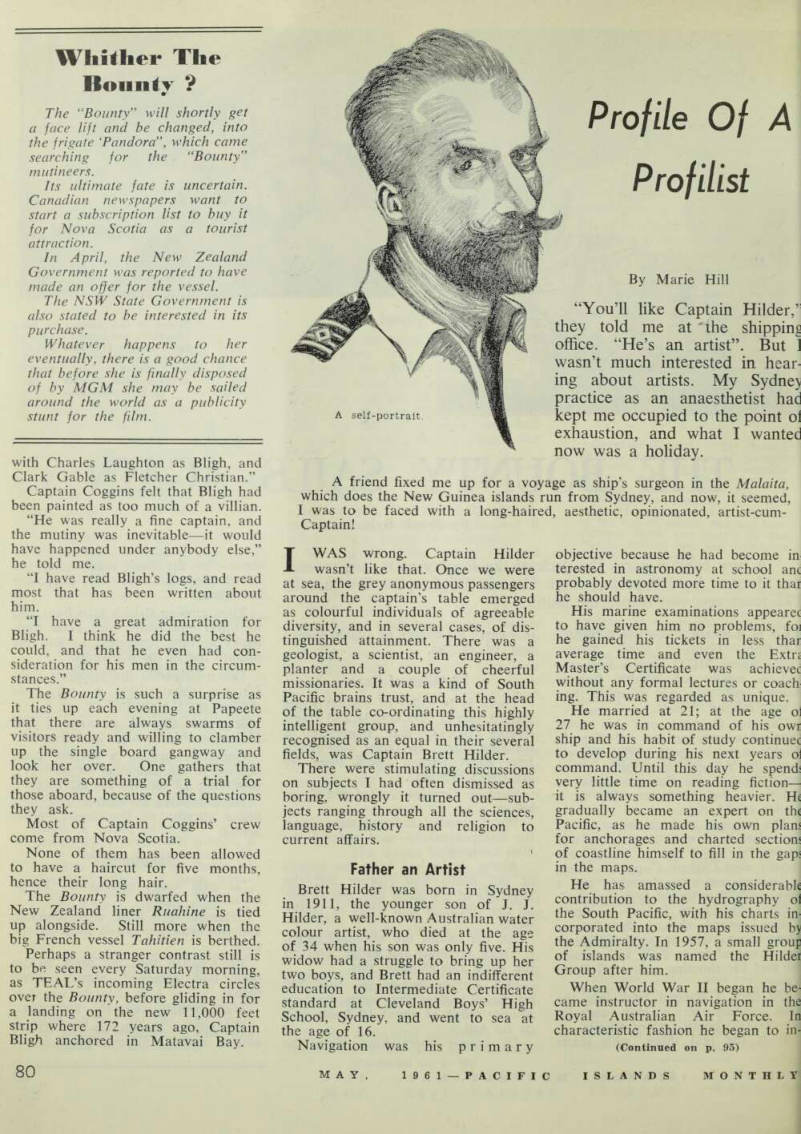 82
82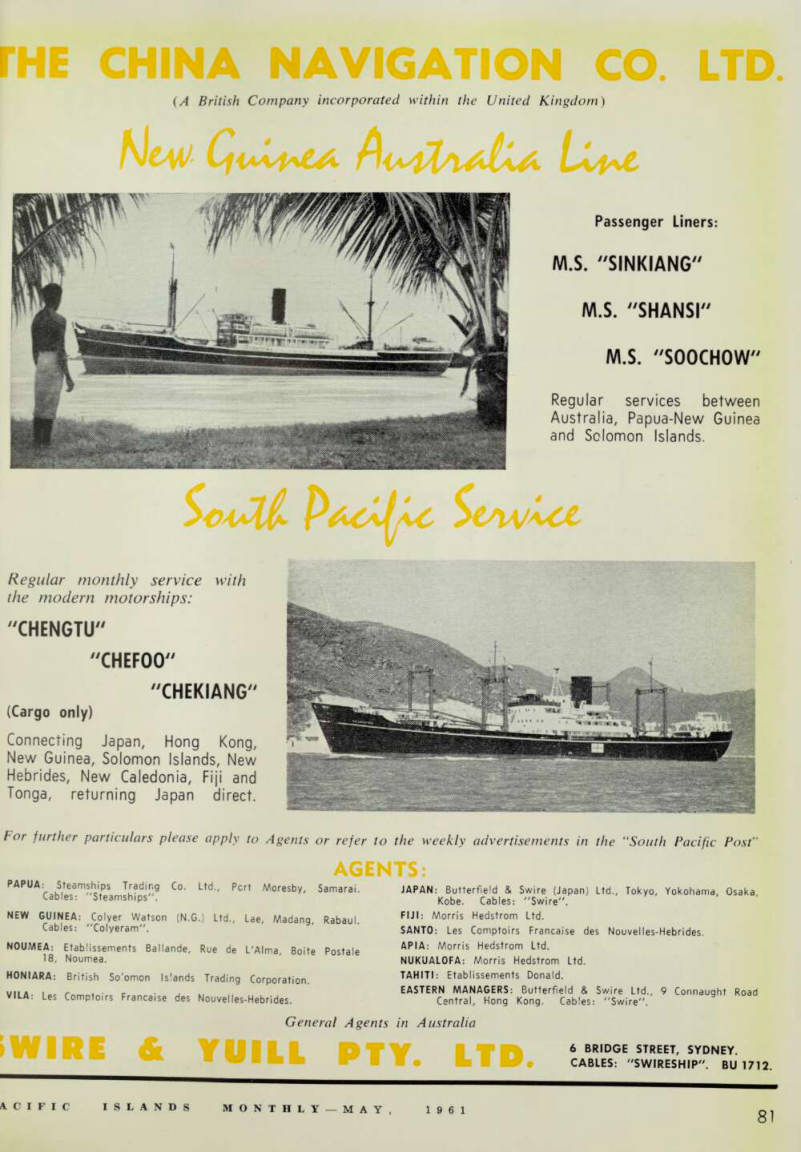 83
83 84
84 85
85 86
86 87
87 88
88 89
89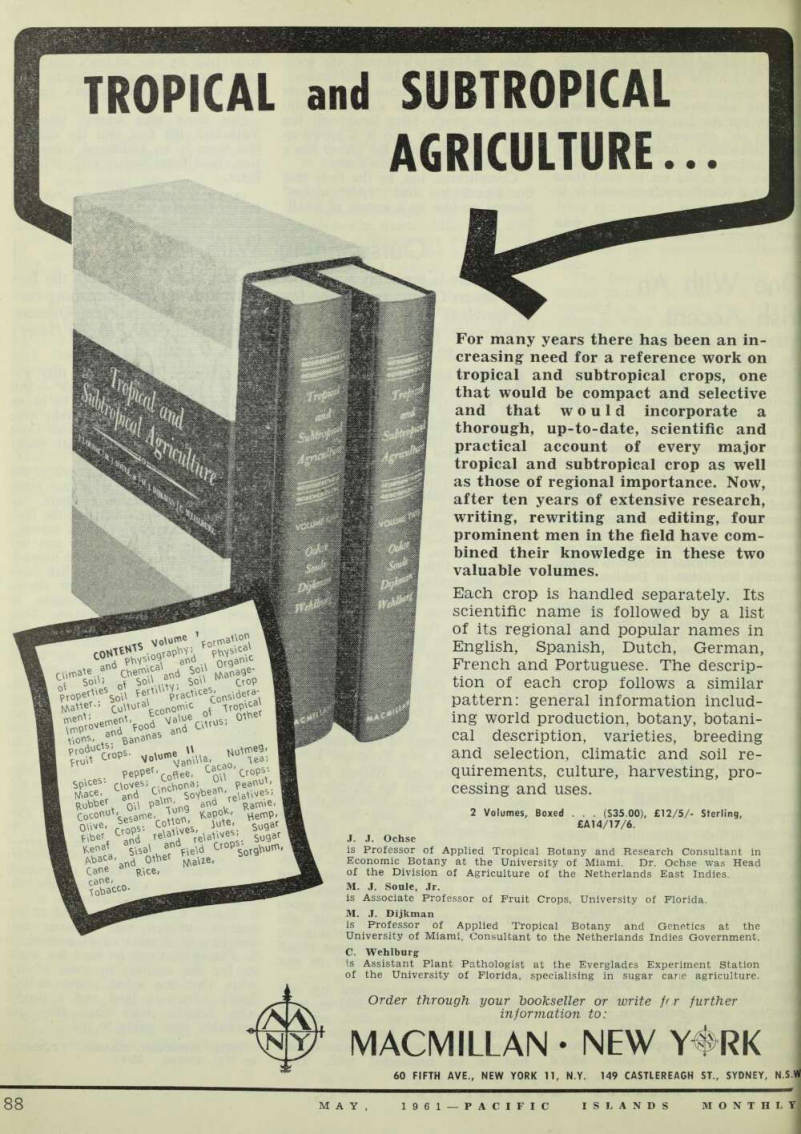 90
90 91
91 92
92 93
93 94
94 95
95 96
96 97
97 98
98 99
99 100
100 101
101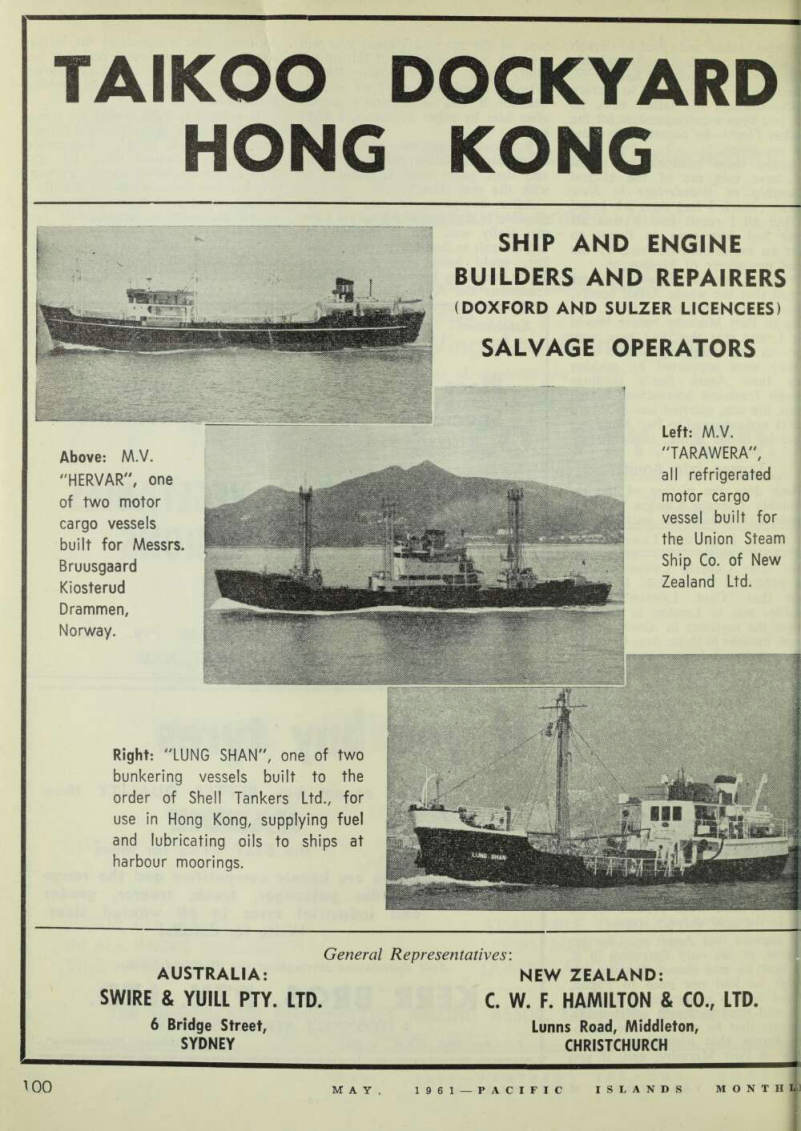 102
102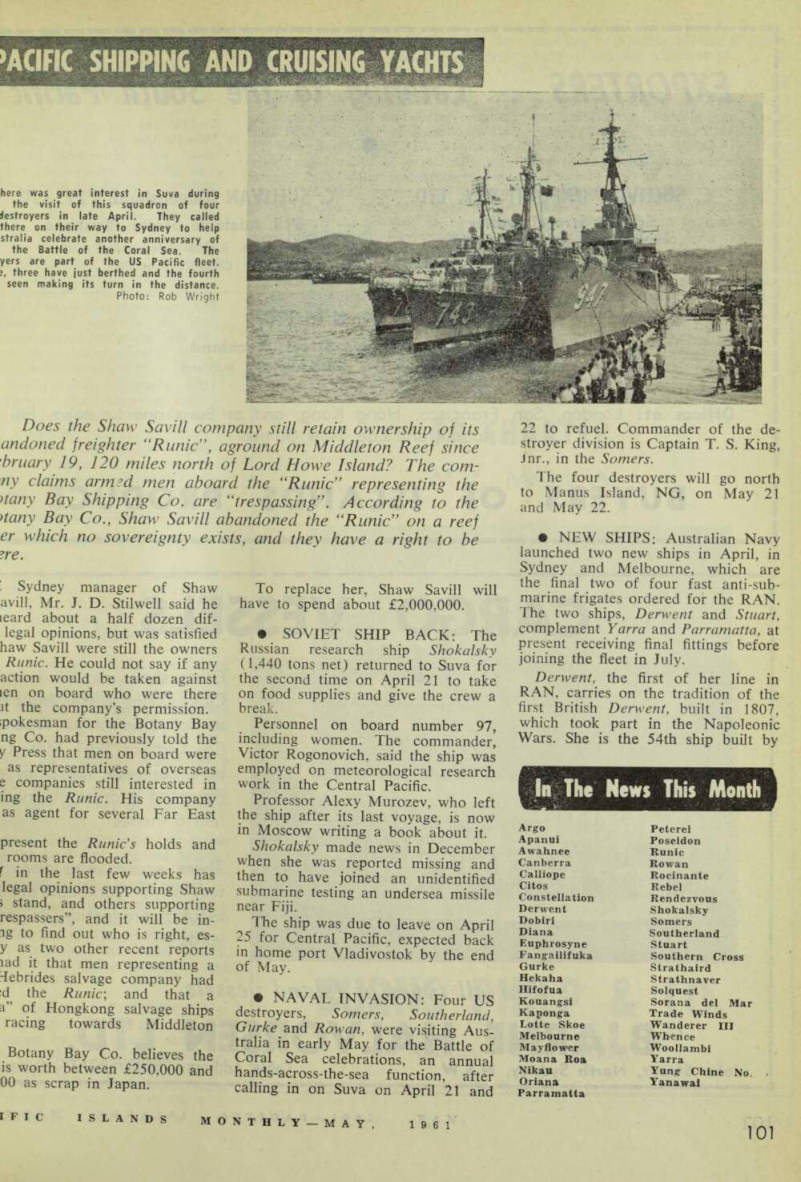 103
103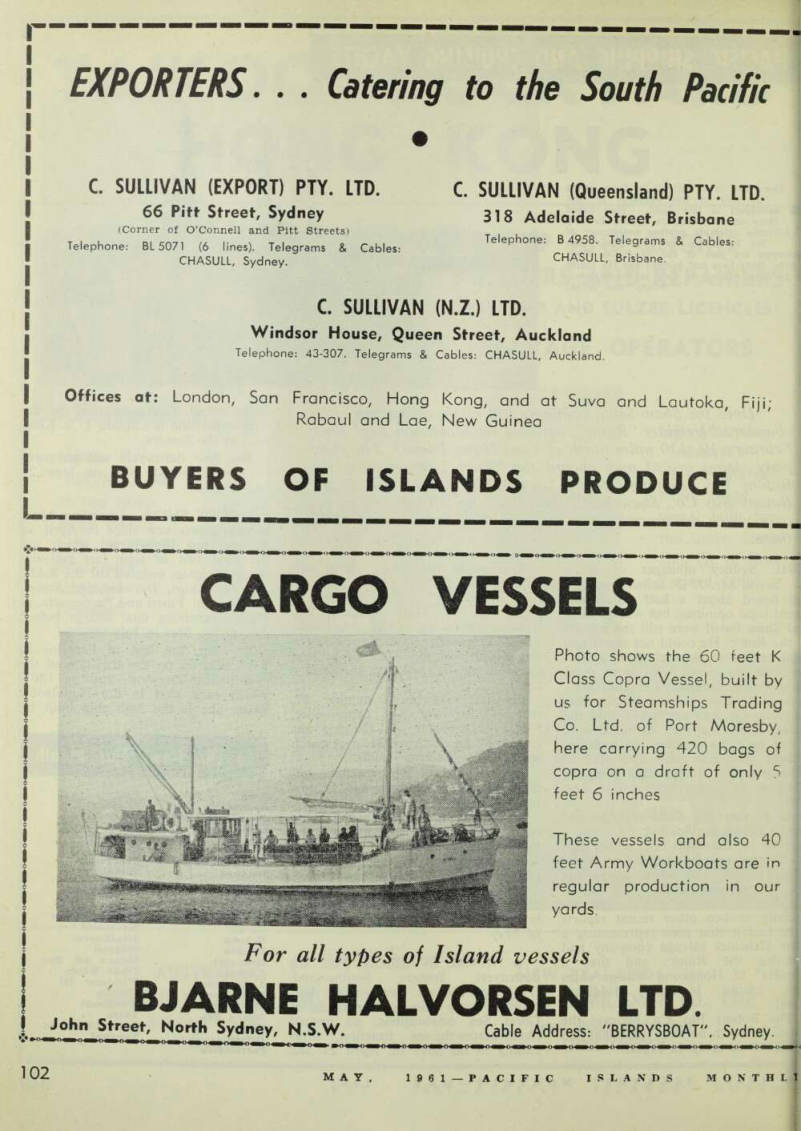 104
104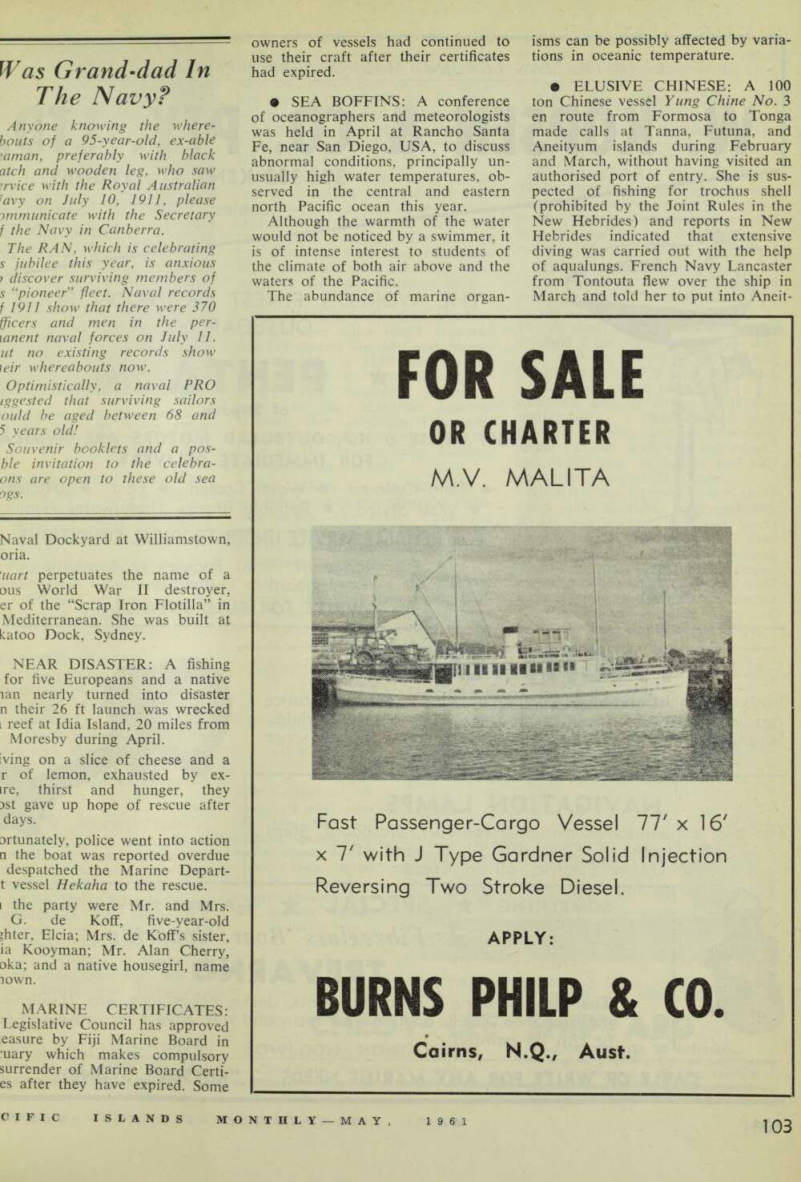 105
105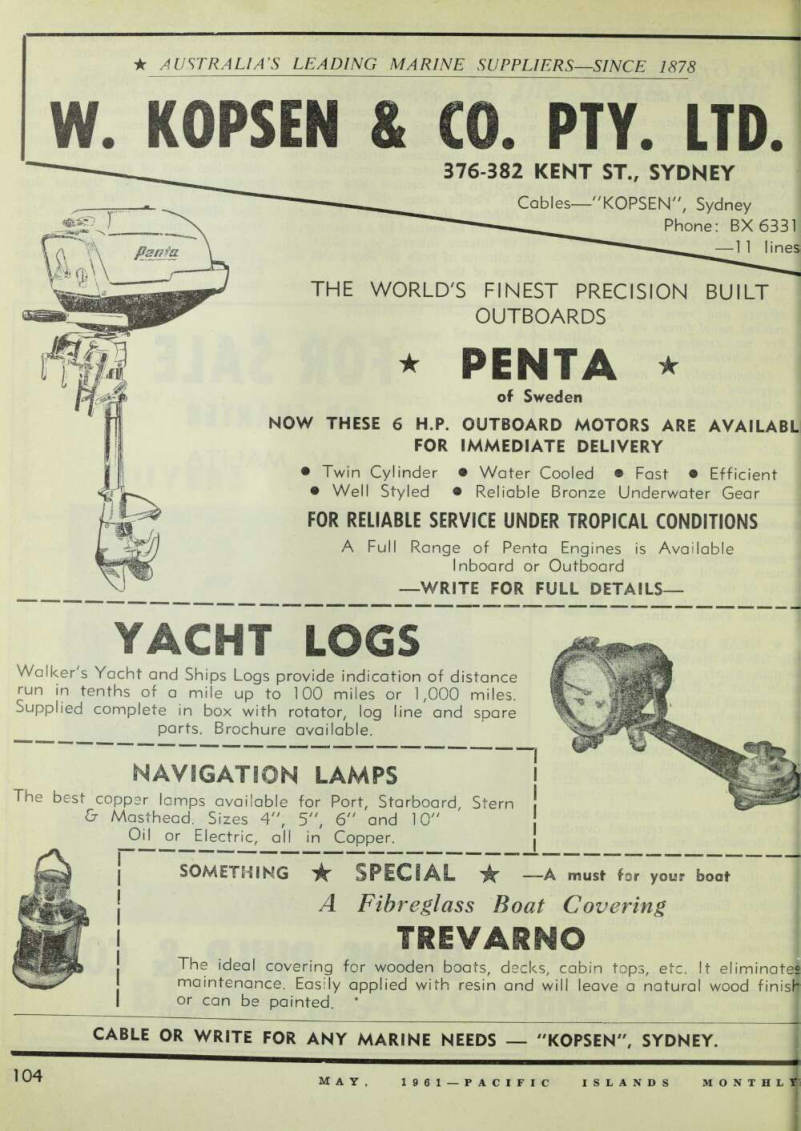 106
106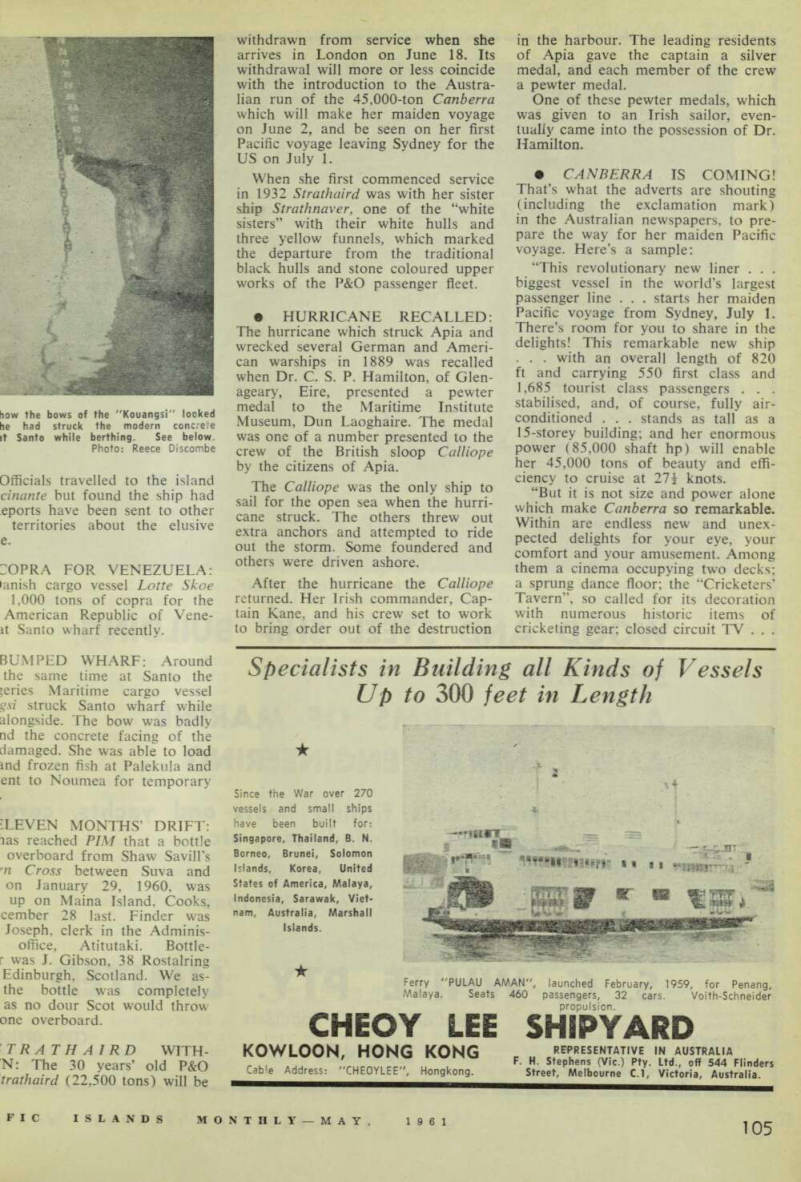 107
107 108
108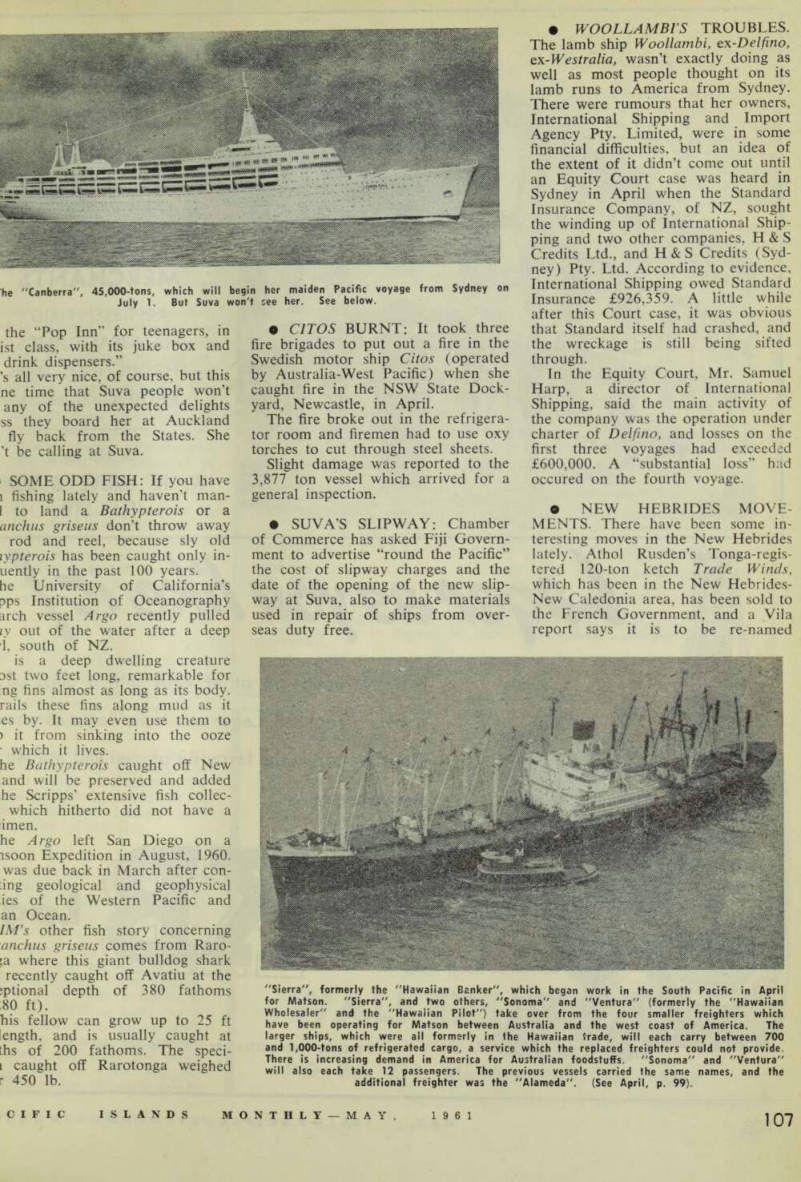 109
109 110
110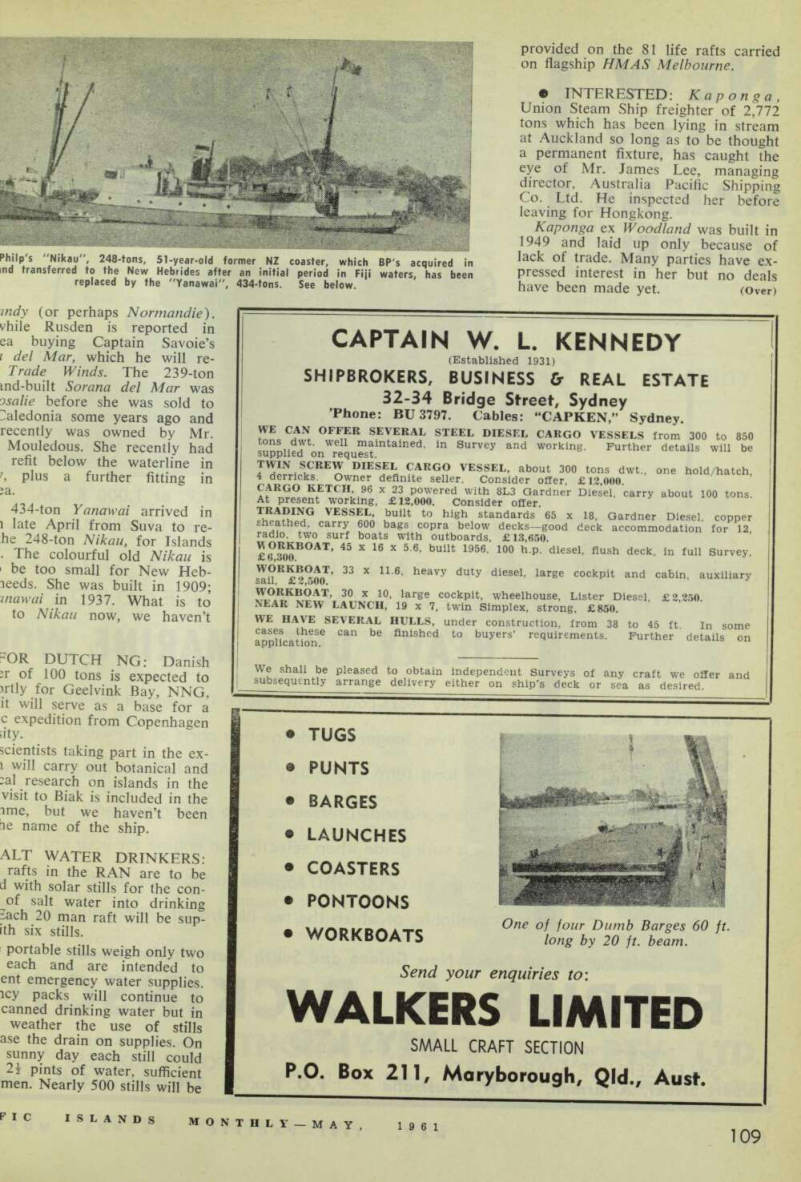 111
111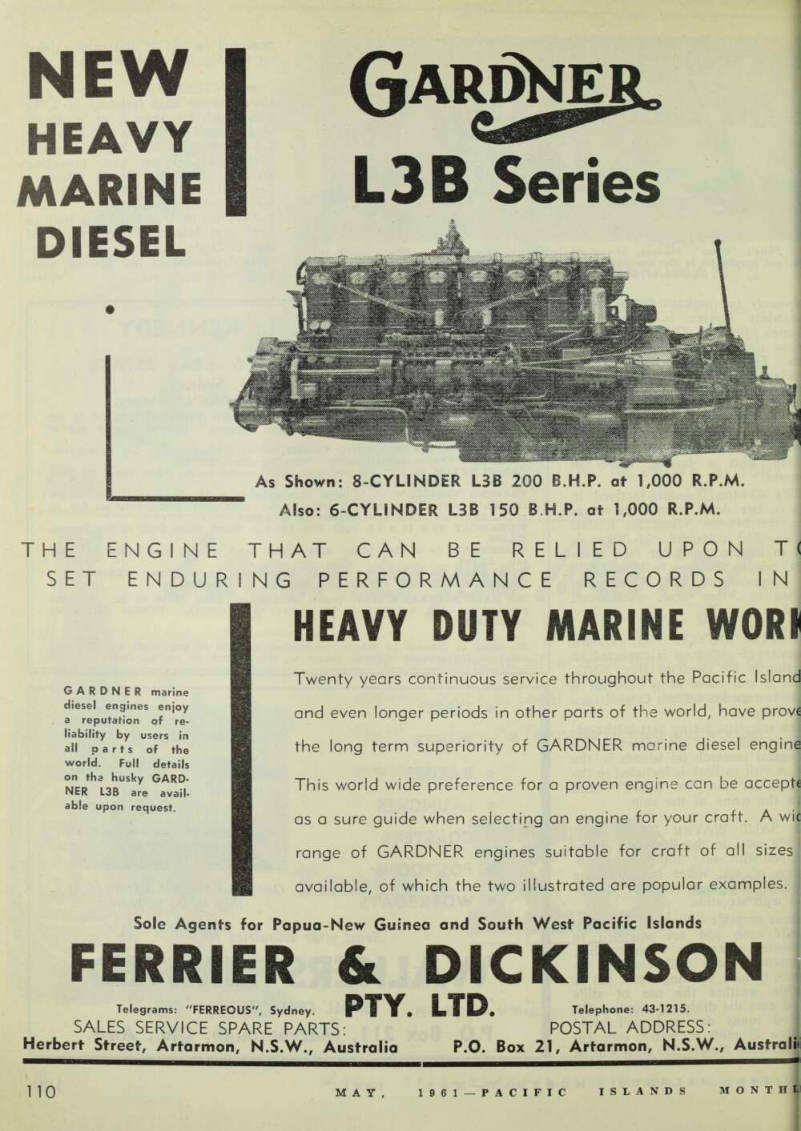 112
112 113
113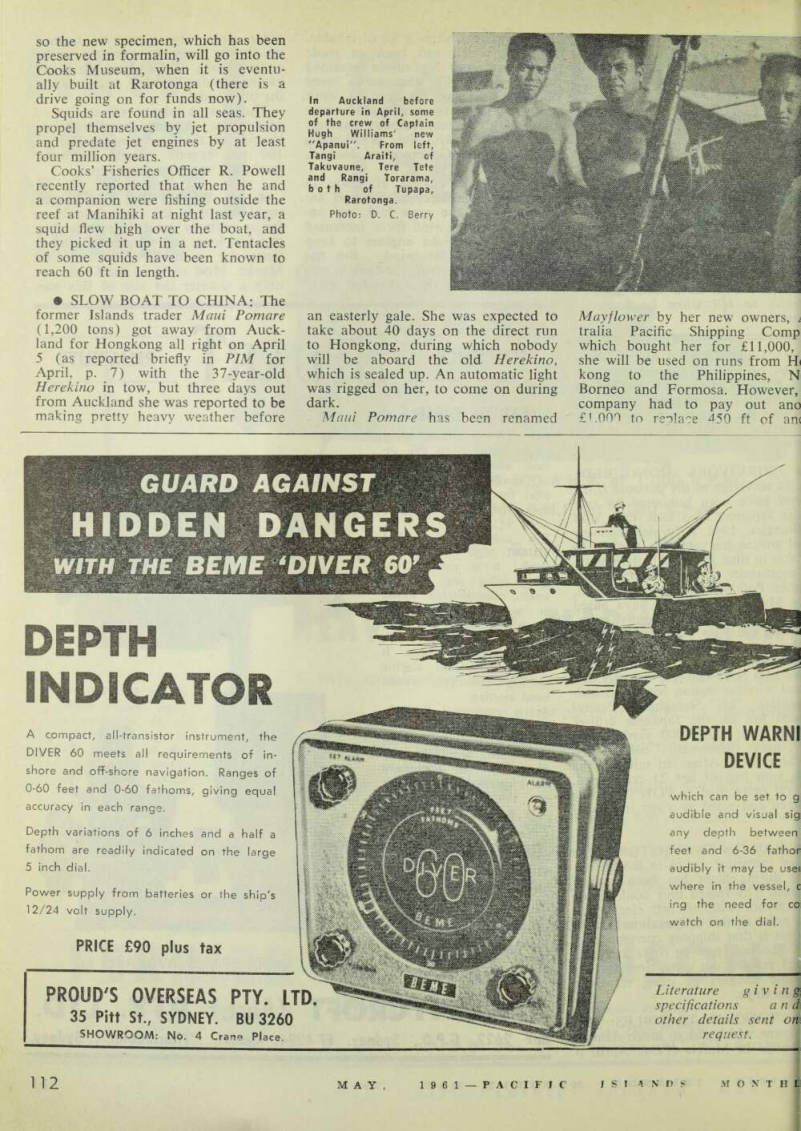 114
114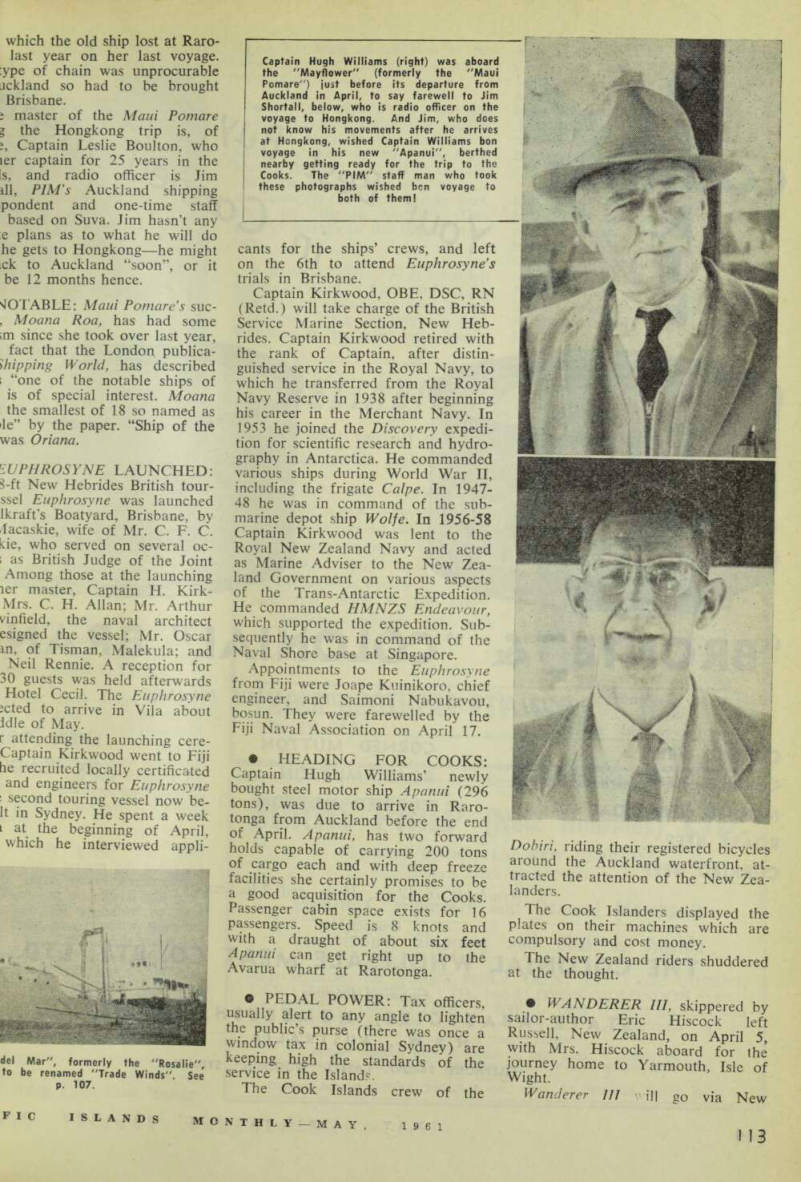 115
115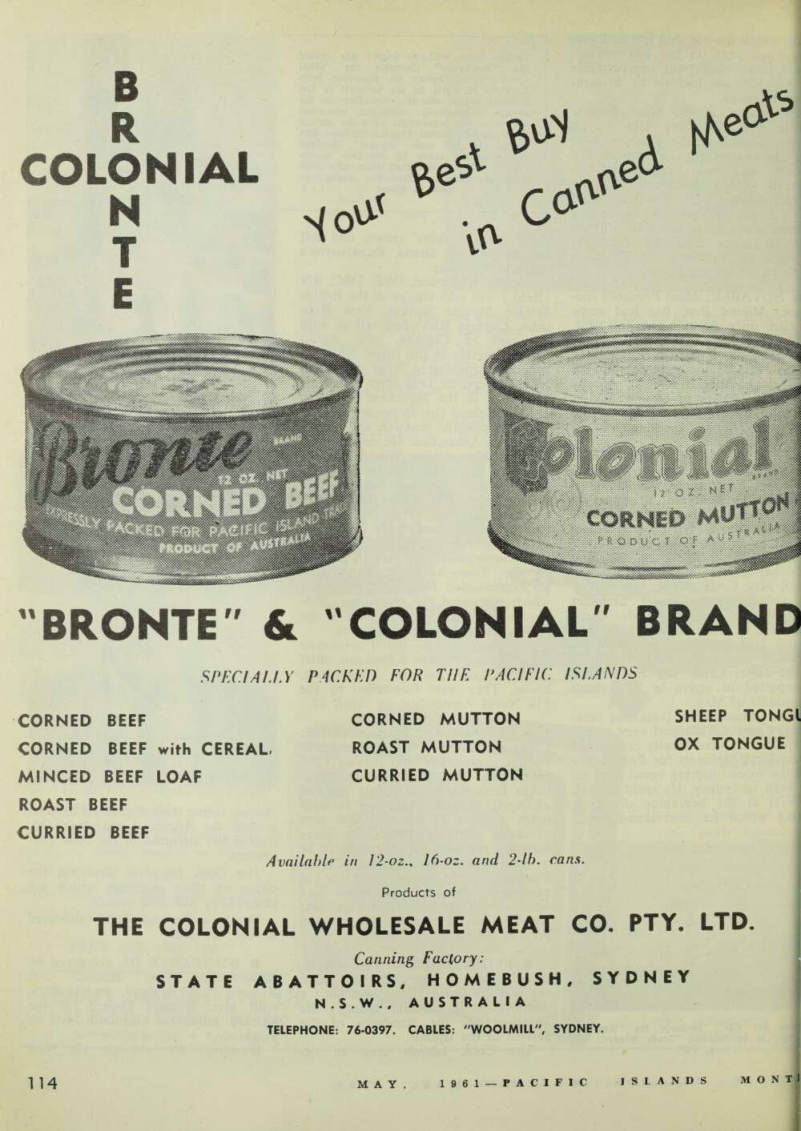 116
116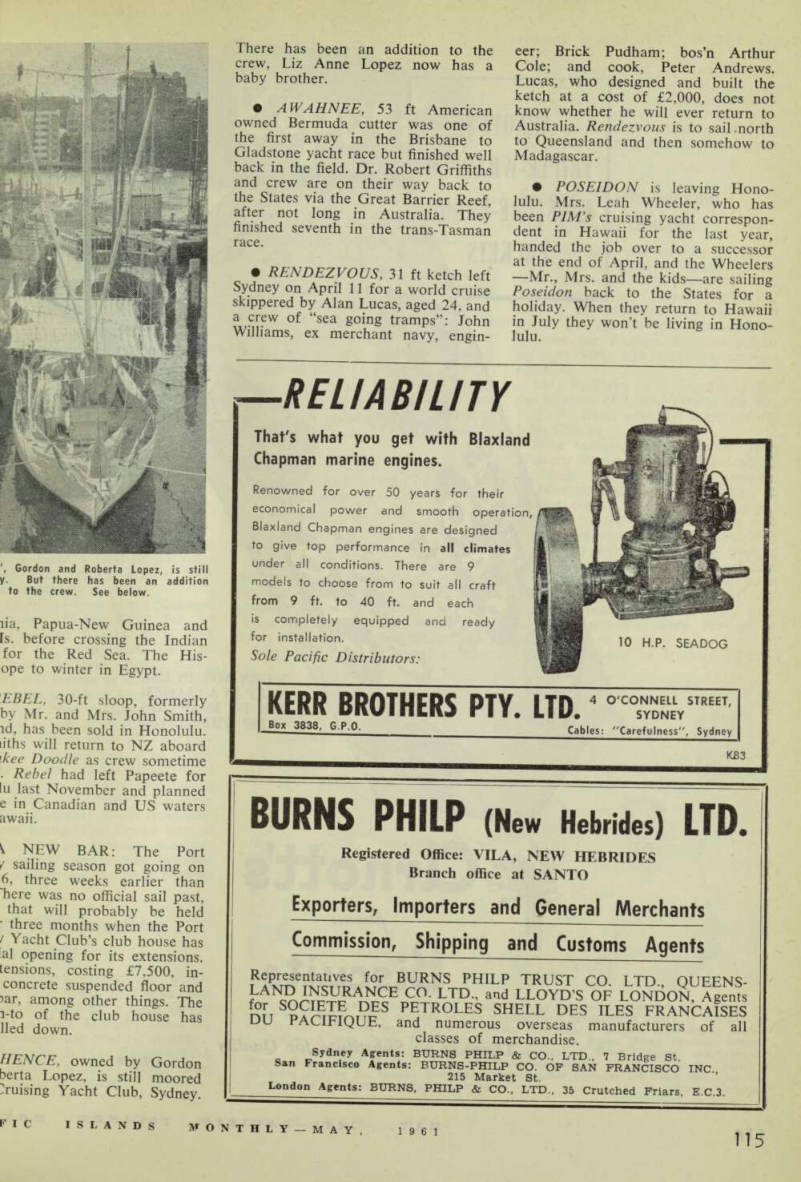 117
117 118
118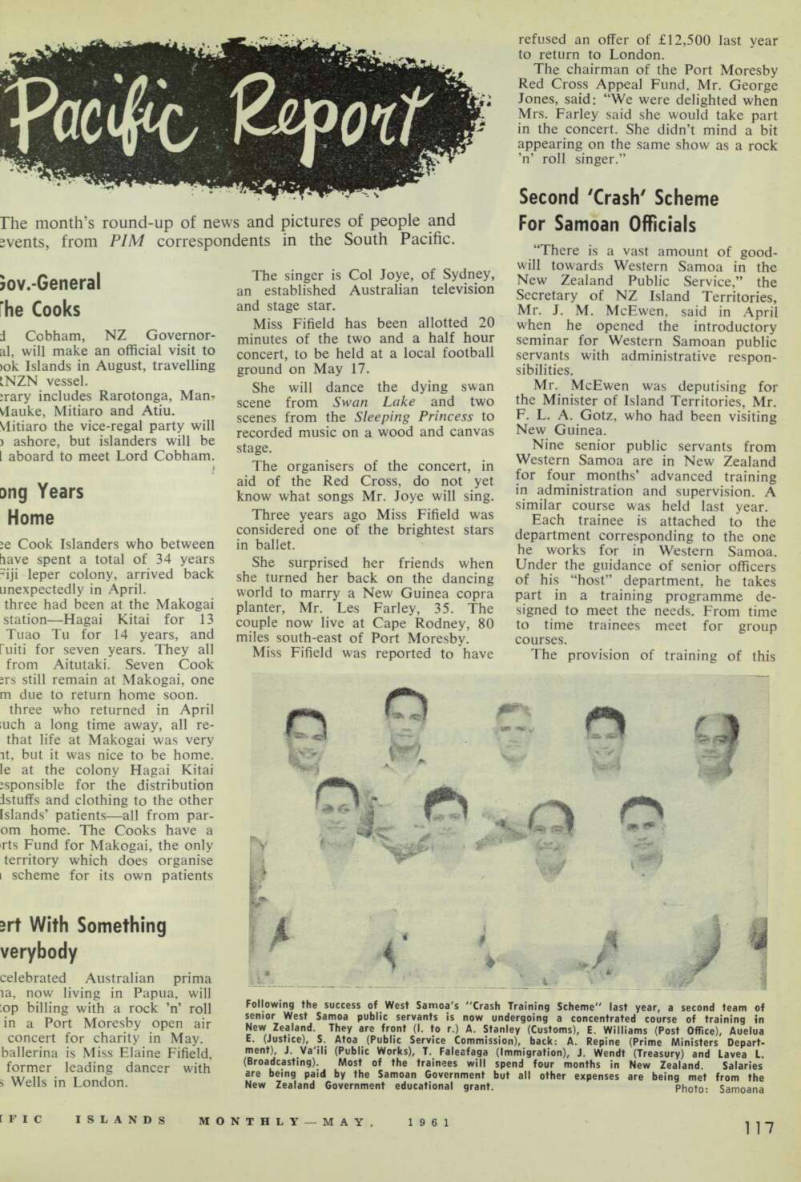 119
119 120
120 121
121 122
122 123
123 124
124 125
125 126
126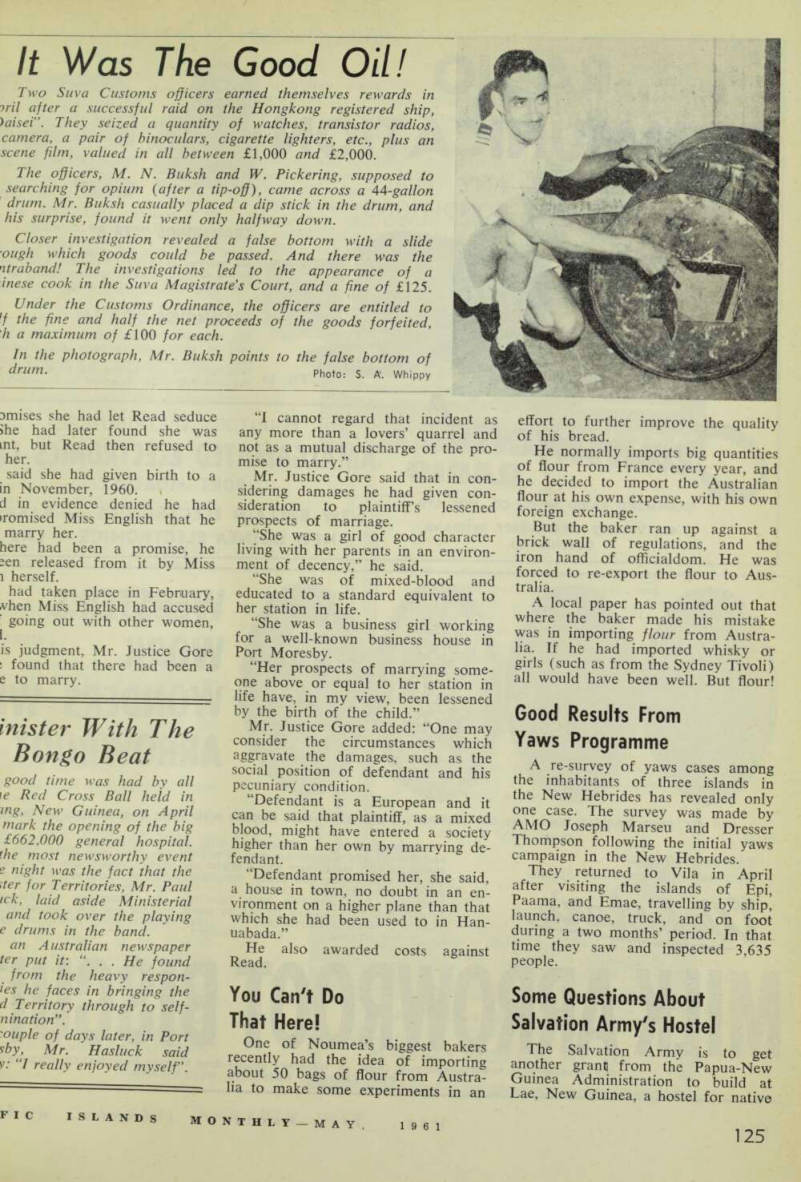 127
127 128
128 129
129 130
130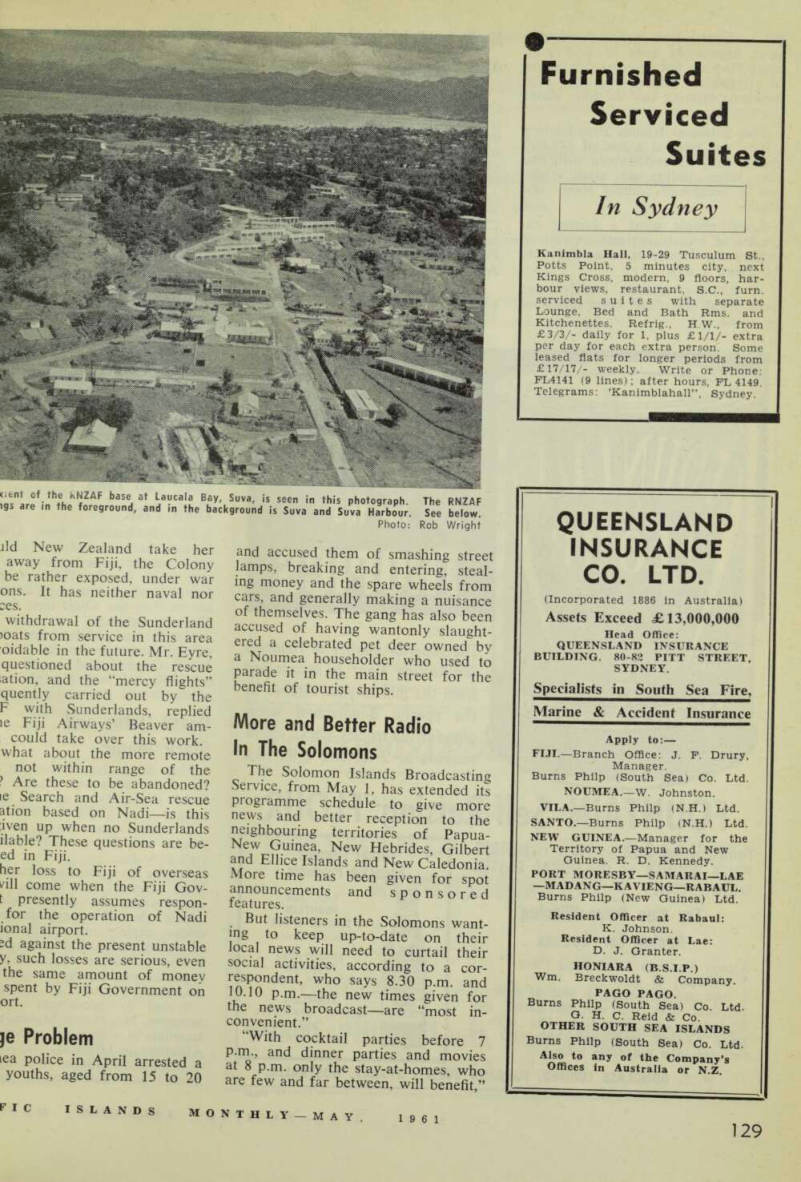 131
131 132
132 133
133 134
134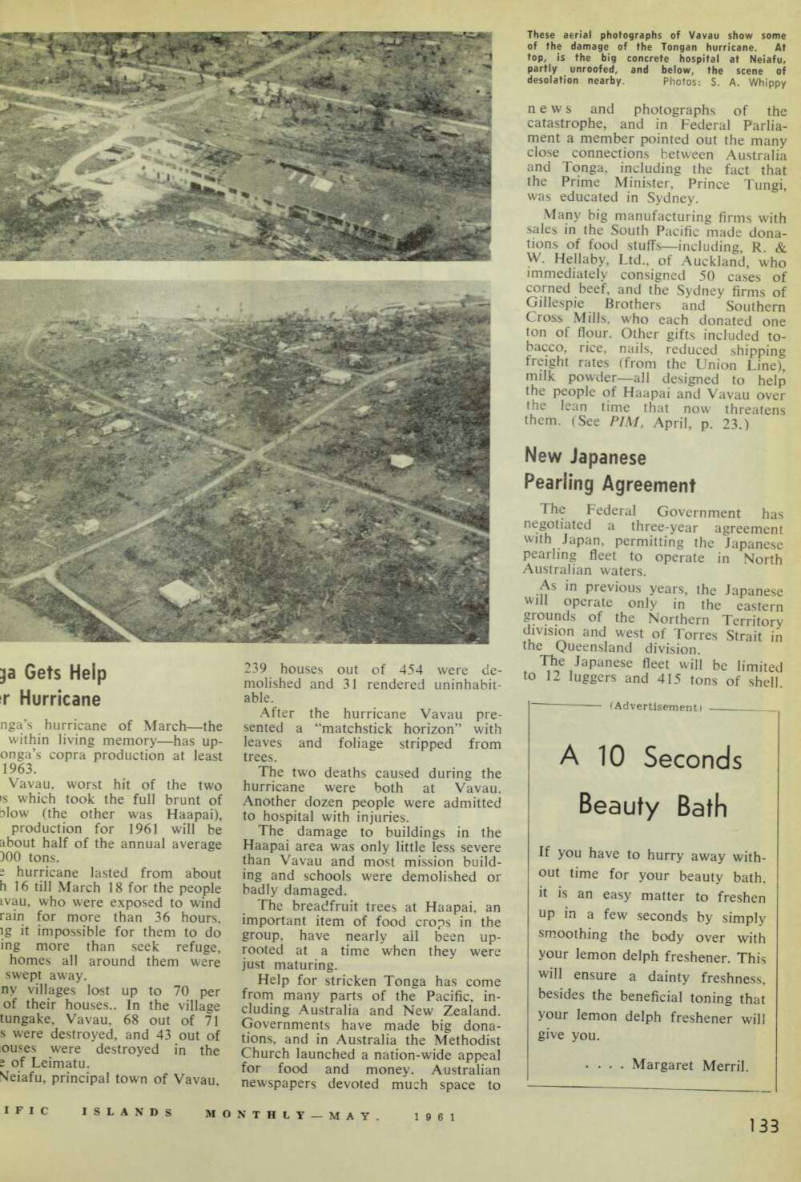 135
135 136
136 137
137 138
138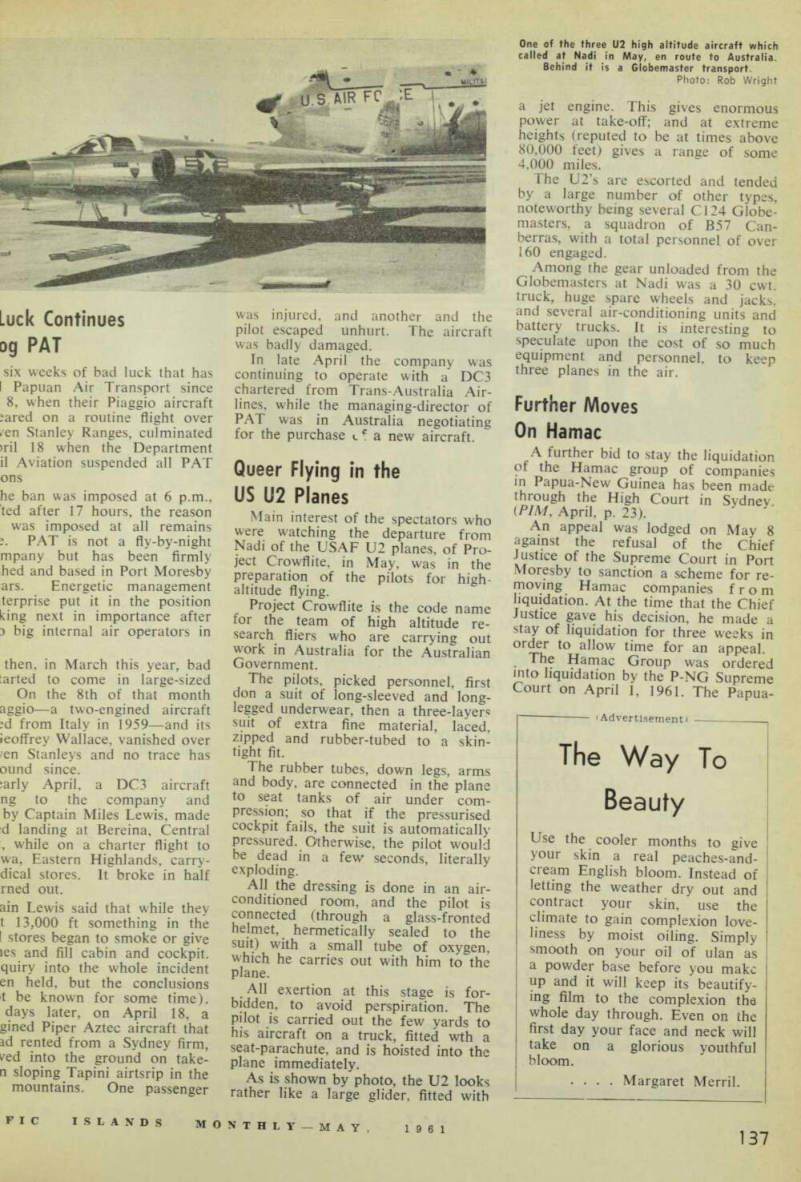 139
139 140
140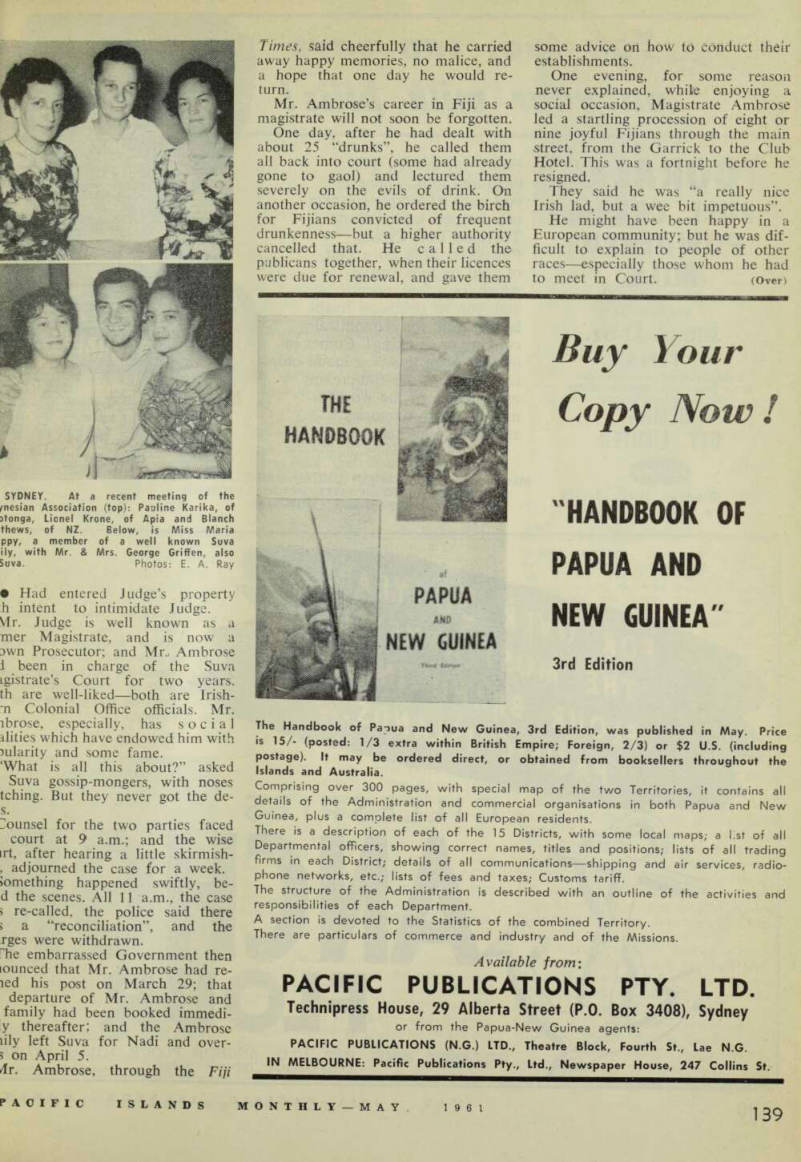 141
141 142
142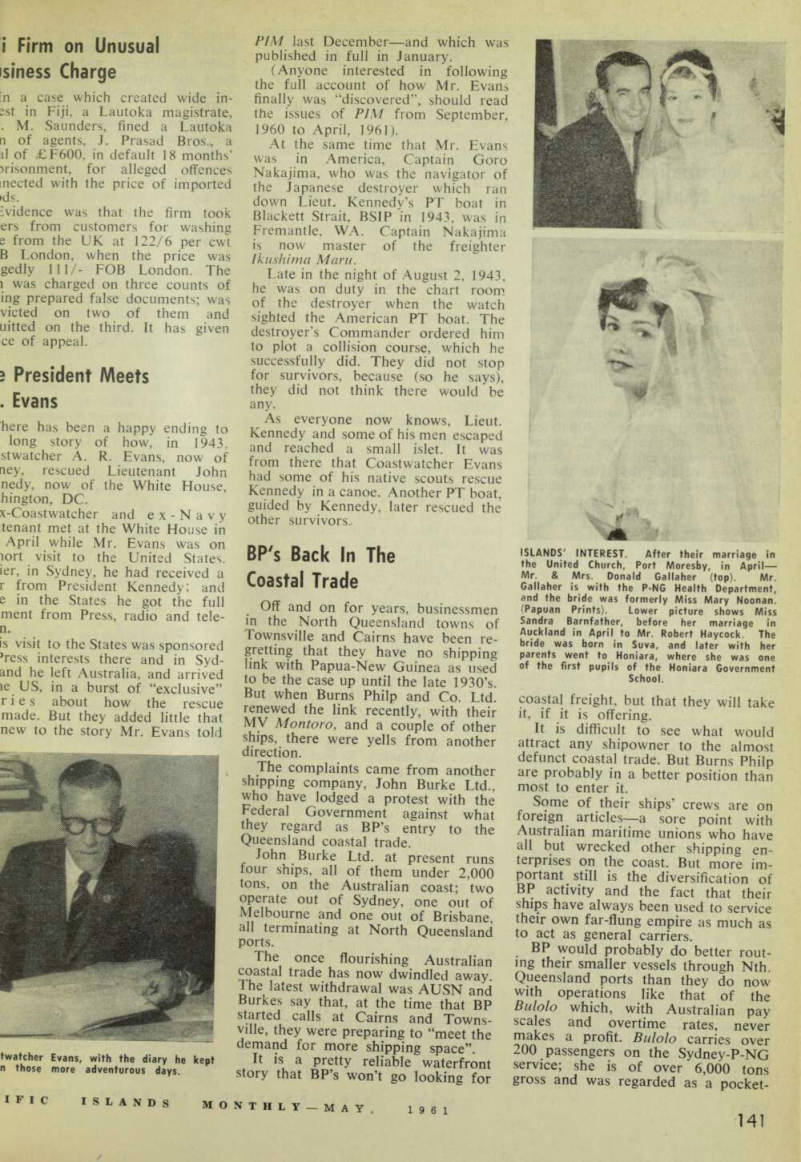 143
143 144
144 145
145 146
146 147
147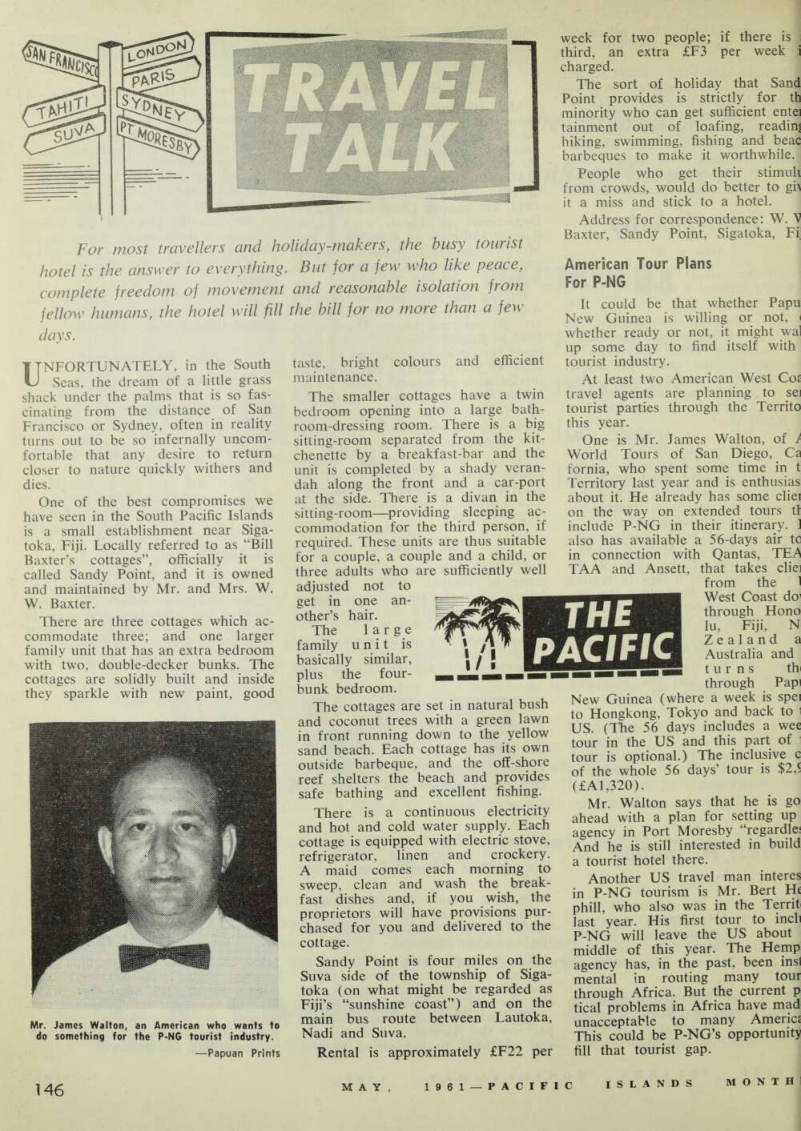 148
148 149
149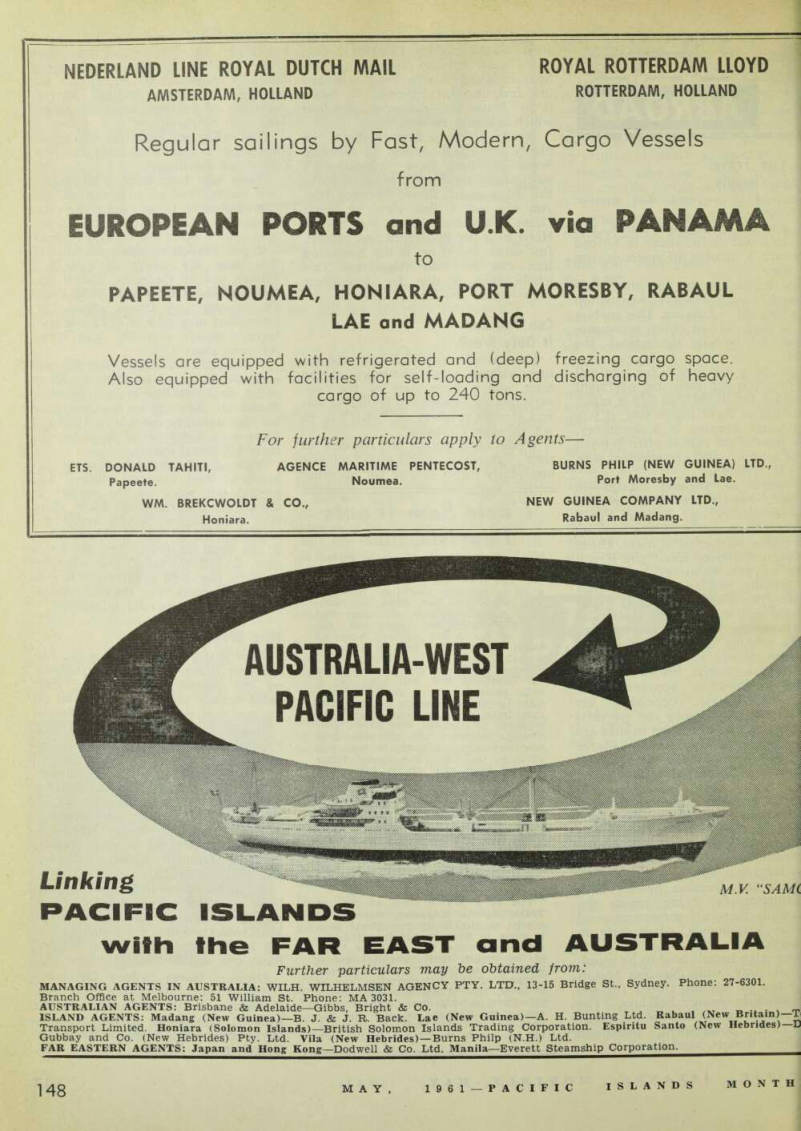 150
150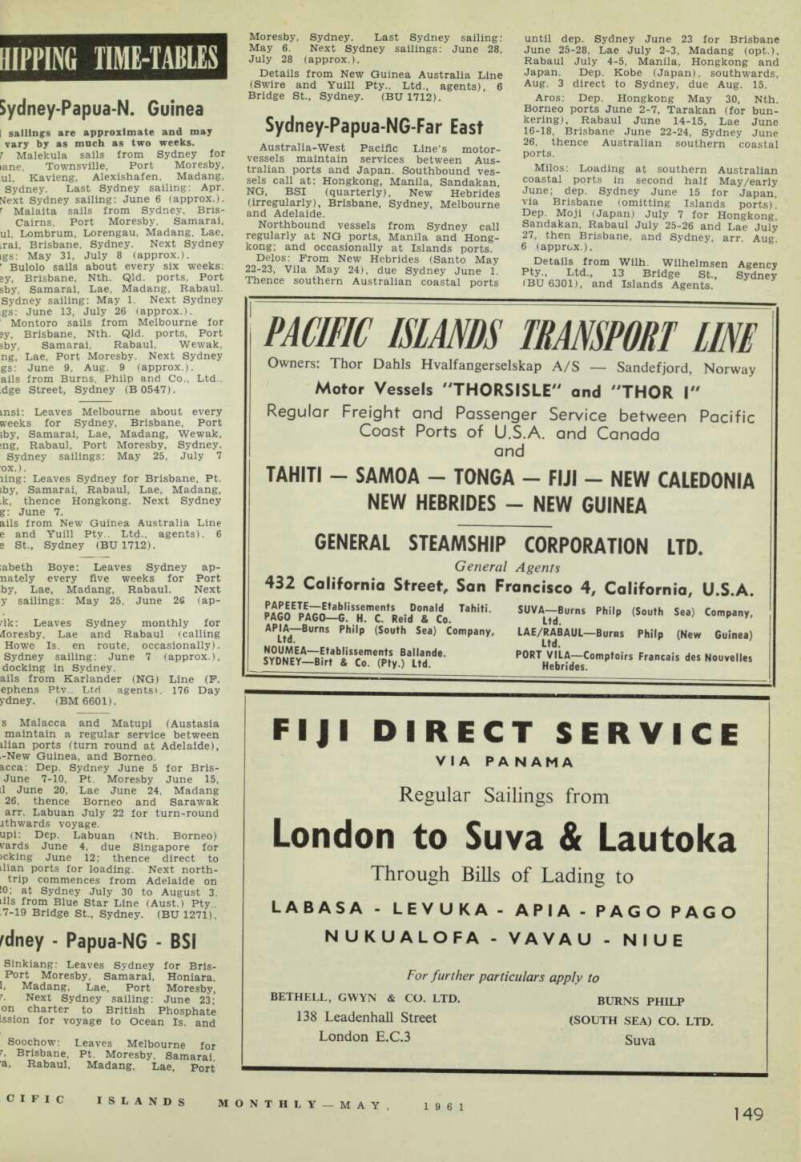 151
151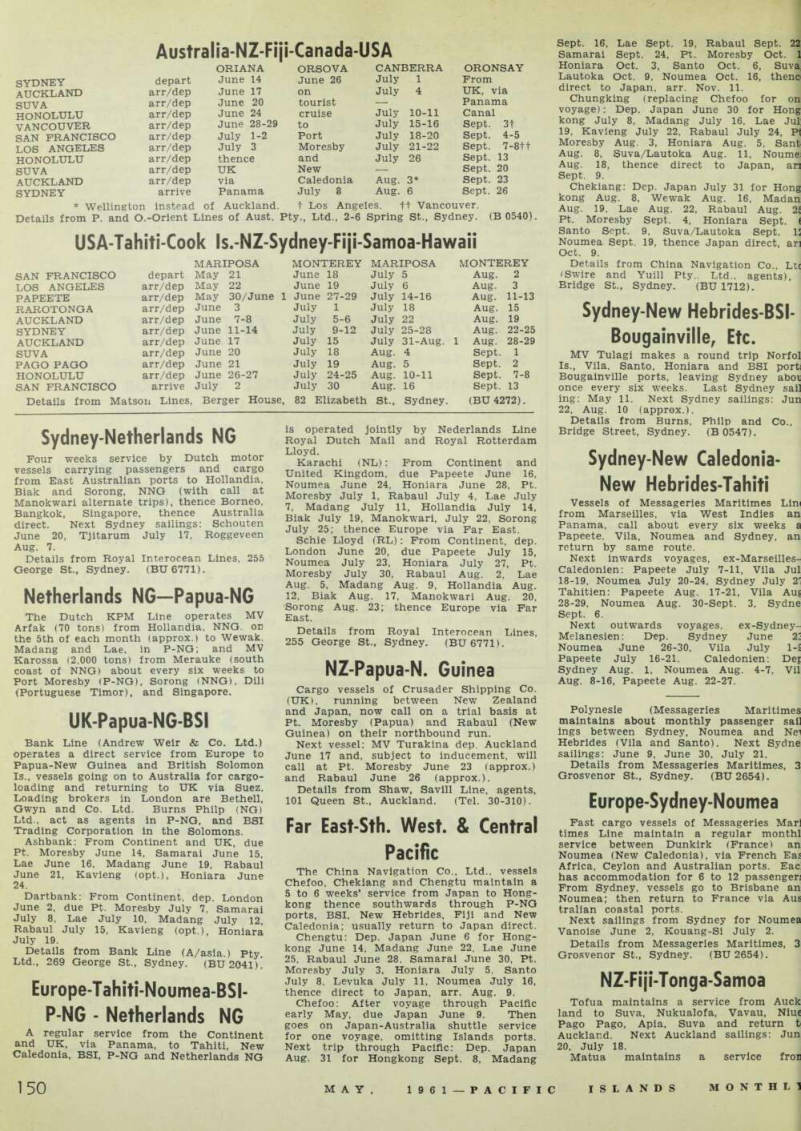 152
152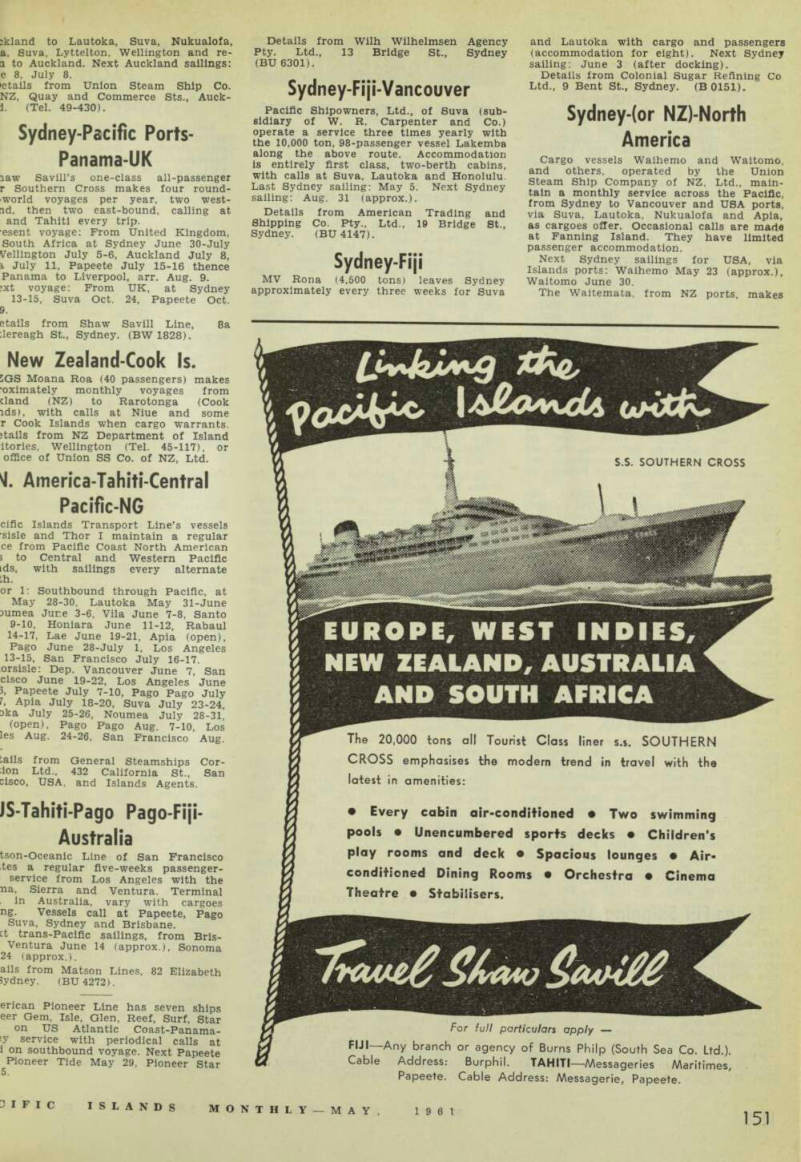 153
153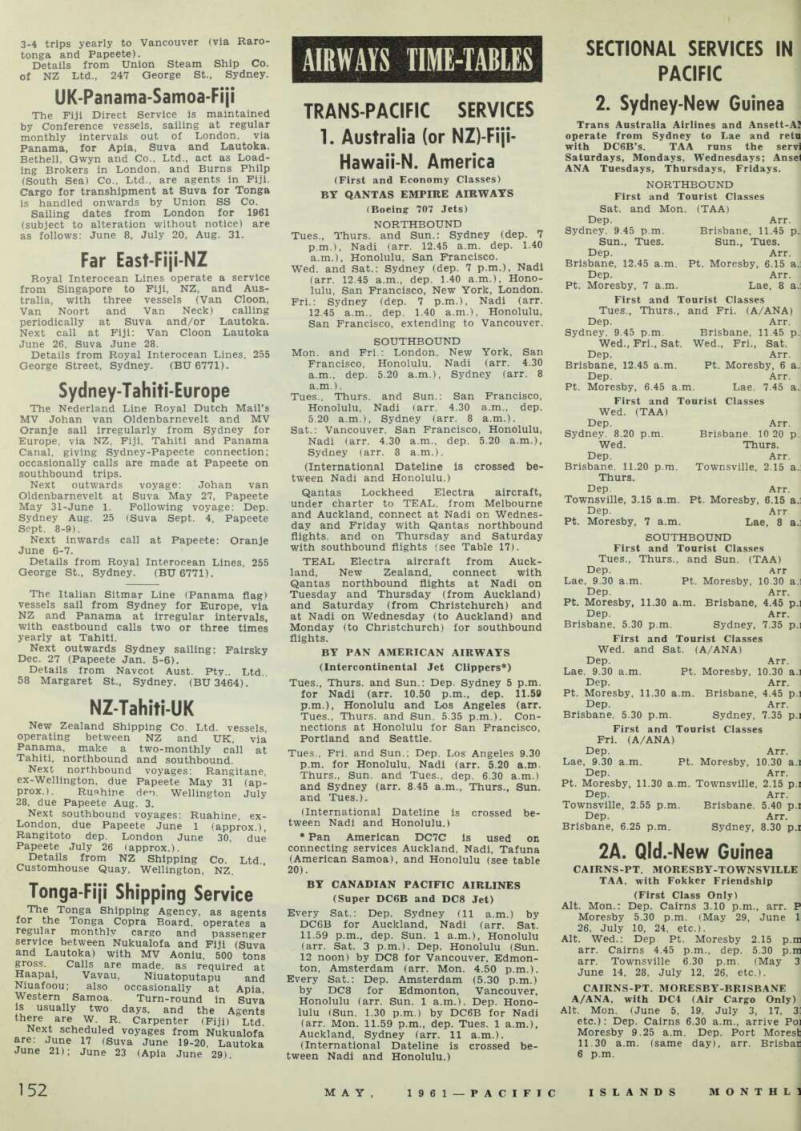 154
154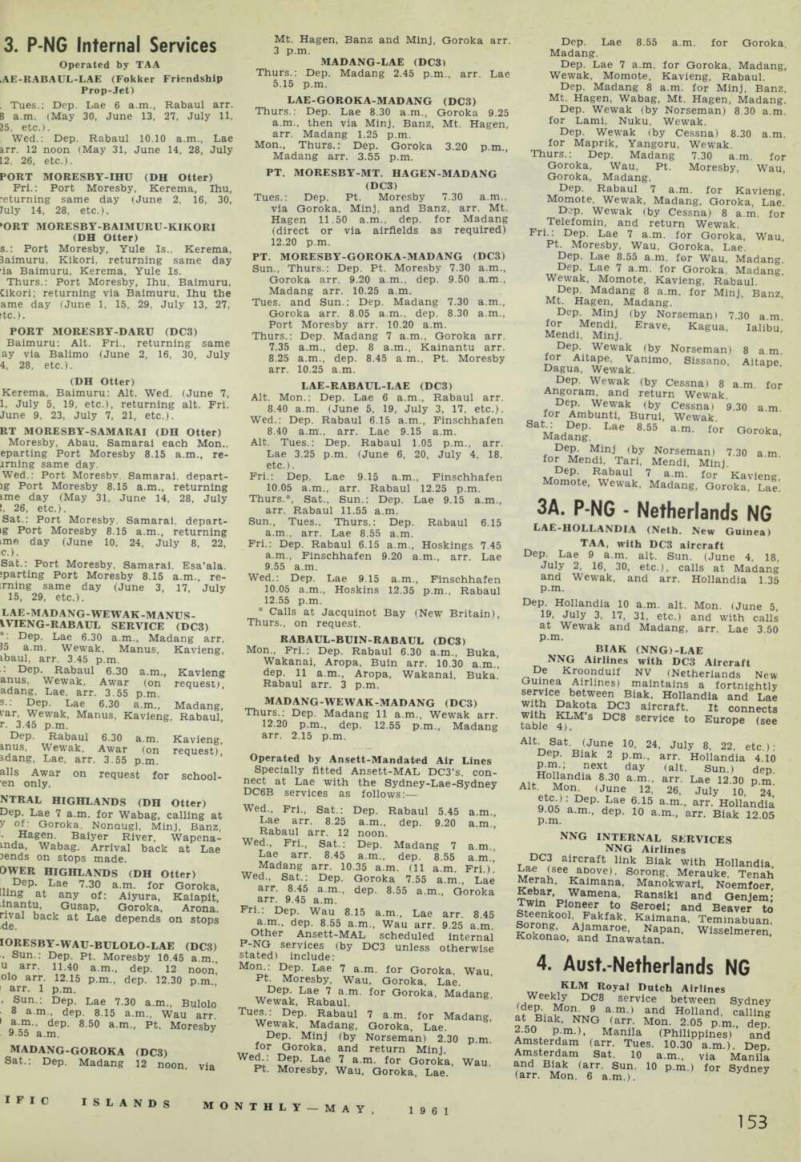 155
155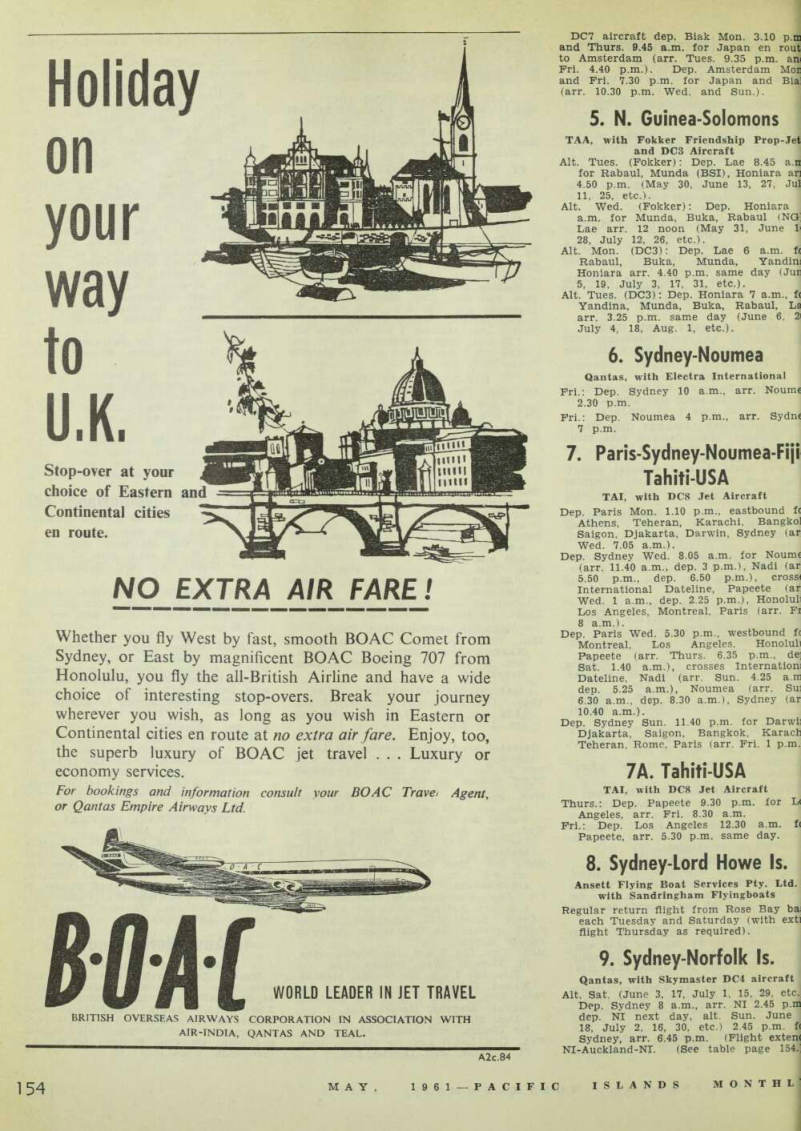 156
156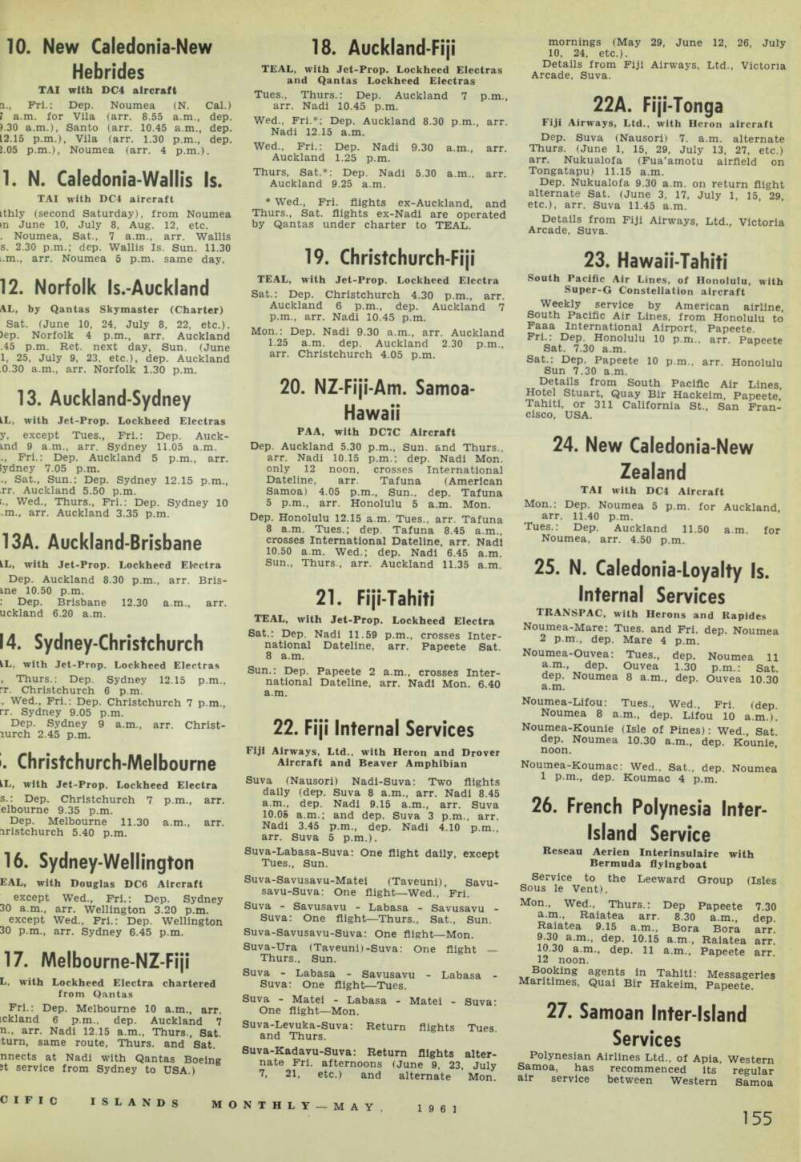 157
157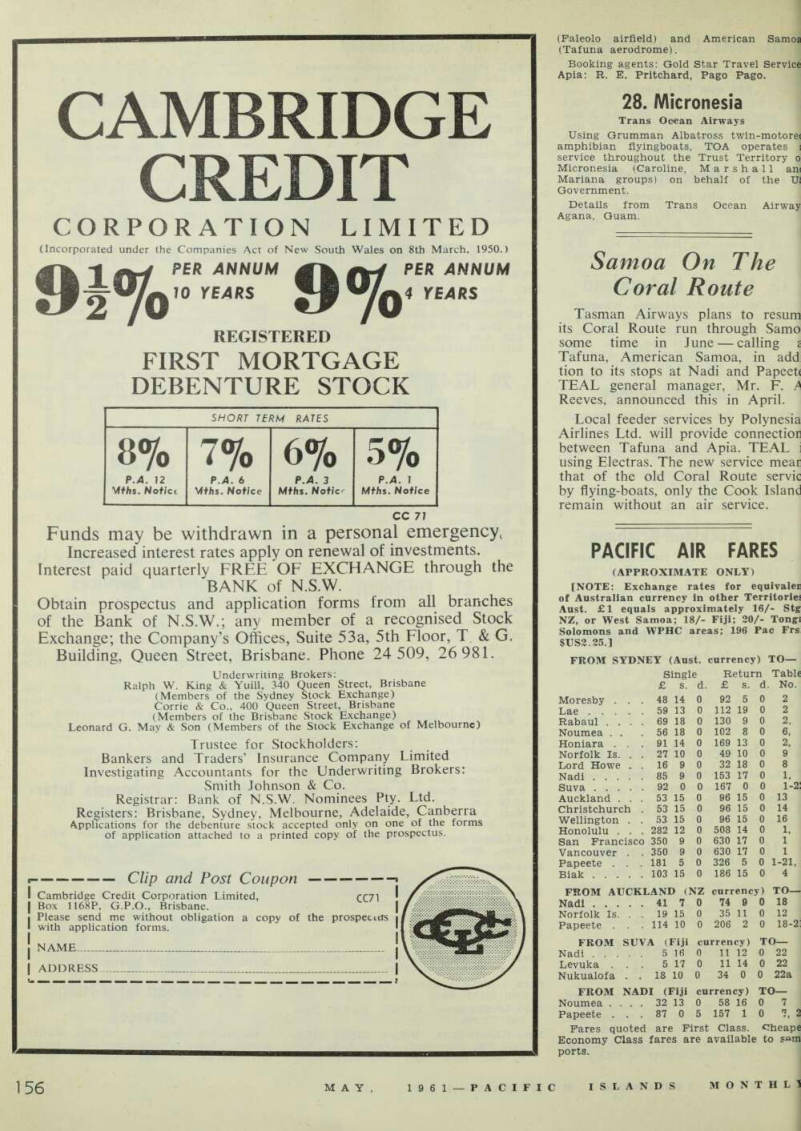 158
158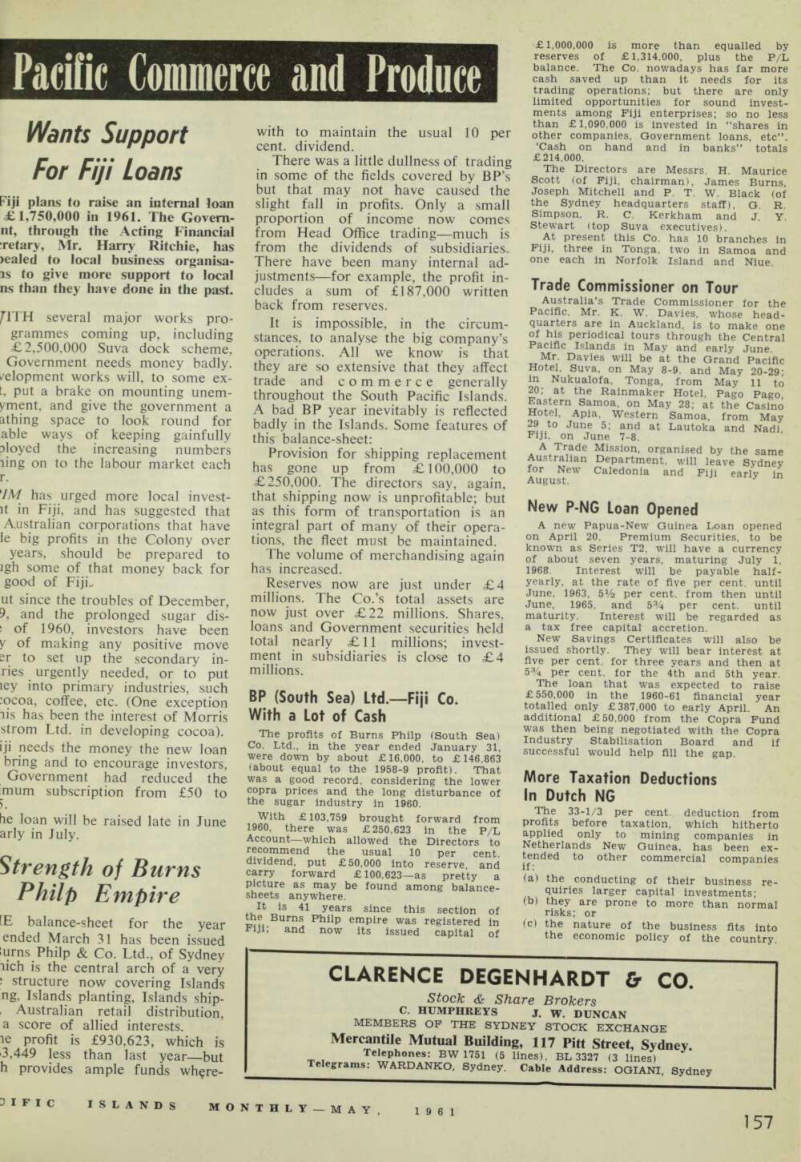 159
159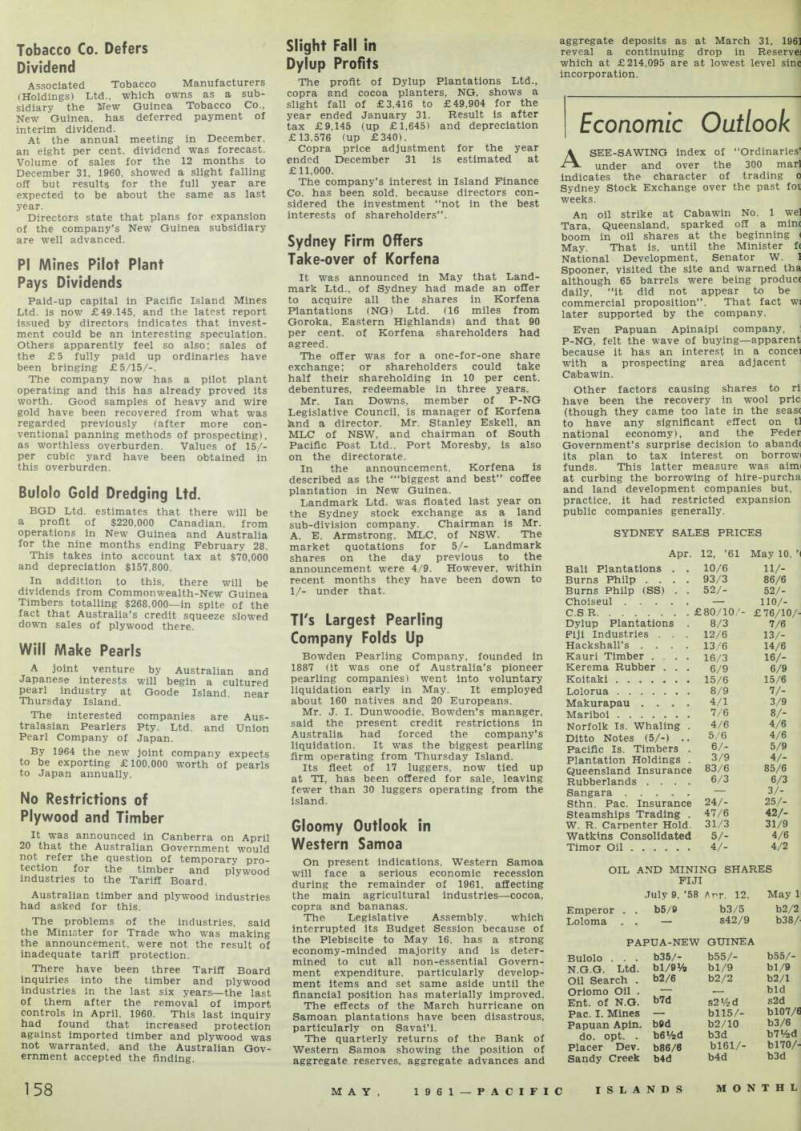 160
160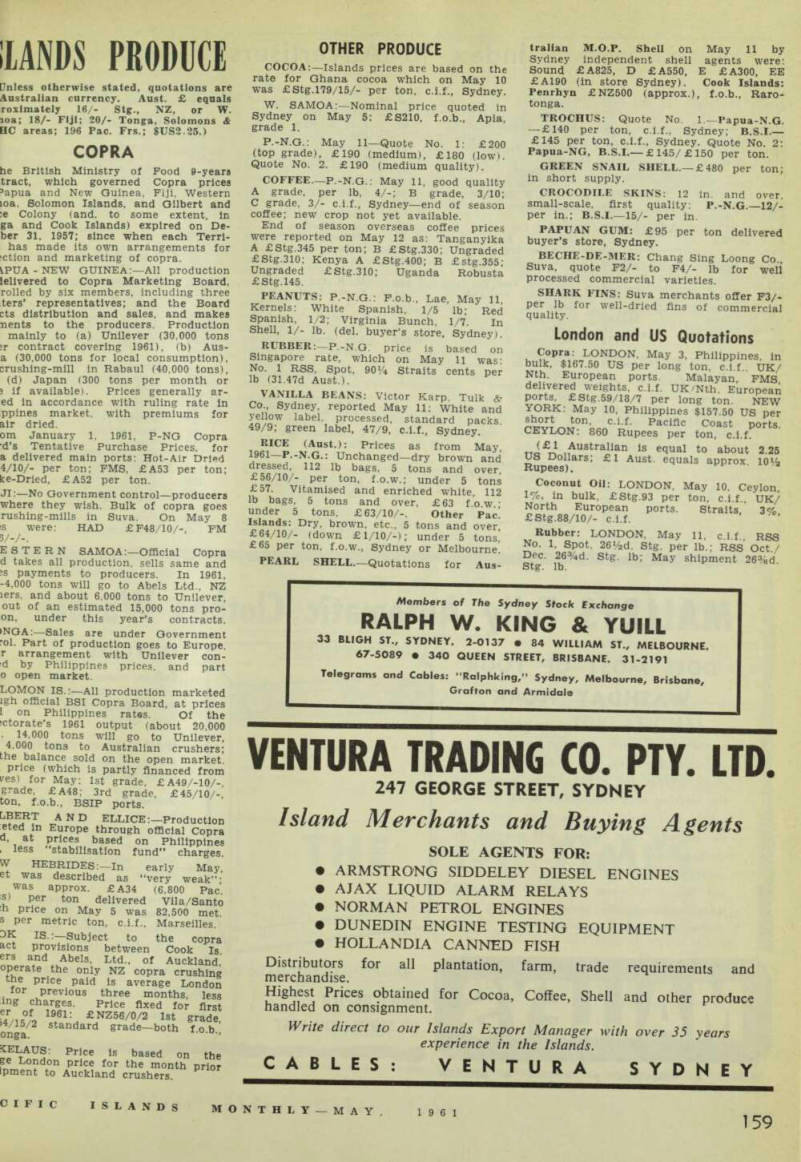 161
161 162
162 163
163 164
164 165
165 166
166 167
167 168
168