
Monthly
Pacific Islands Monthly
April, 1961
Vol. Xxxi. No. 9.
le New/s yqazine )f The south Pacific
Tablished 1930
ed at G.P.0., Sydney, for >sion by post as a newspaper.
THE COVER: In September, 1959, the "RIM" cover girl was Tauave, from Funafuti Island, who was photographed on Tarawa by Mr. A. C. Atkinson. The Ellice girl on the cover this month is Tauave's sister laeli. She was also photographed by Mr. Atkinson, who sends the photograph from Scotland, where he is now living.
Advertisements & other items, pp. 2-4 (3 items)
operates
—i am ja MA
Top Australian Airline
SERVICE
to 44 places in Papua, New Guinea and the neighbouring Islands.
FLY TAA THE WA Y
Iron in comfort without
fatigue with the new . . .
Qqkman
0 • Pre-heats with methylated spirits in 90 seconds • Burns for 2 hours on one filling • Built-in pump and large filler opening. • Easily dismantled for servicing. 4 > W Model No. 615.
Representatives for the Pacific Islands: ROBERT GILLESPIE PTY. LTD., ROBERT GILLESPIE (N.C.) LTD., PEARCE & CO. LTD., 12 Young Street, SYDNEY. Rabaul, Port Moresby. SUVA, also 334 Queen Street, BRISBANE Lae, Madang,
Jsw \ 5 ; TN
SHELL weeds them out
Weeds come in many forms and varieties, each capable of choking crops and ruining pasture land. Chemical application is a practical, effective and economic way to control weeds and Shell Chemical Weedkillers are scientifically prepared and tested under actual field conditions to select only the weed or weeds infesting a particular area. There is a Shell Chemical Weedkiller for your weed problems.
Contact your Shell Chemical Agent for advice on your weed problem and he can recommend the Weedkiller for the job.
IN EVERY FIELD, YOU CAN BE SURE OF
SHELL CHEMICALS
SHELL CHEMICAL (AUSTRALIA) PTY. LTD. (Inc. in Victoria) Head Office: 155 William St., Melbourne, Vic. Branches in all Stales.
An Affiliate of The Shell Co. of Aust. Ltd. and Registered User of its Trade Marks. *3 <4 5C663/4fl/61
1
2IPIC ISLANDS MONTHLY APRIL, 1961
2
APRIL, 1961 PACIFIC ISLANDS MONTHL
Pacific Islands Monthly
Publisher: R. W. ROBSON.
Editors:
Udy Tudor Stuart Inder
Manager: SELWYN HUGHES.
PHONES: General Business, Editorial,
Aa 9197-8, Aaa 7101, Ma 4369.
G.P.O. Box 3408, Sydney,
iraphic Address: PACPUB, Sydney.
Annual Subscription Rates;
(Includes surface postage) ’acific Is. —Papua-N.G., i, Samoa, Norfolk, uru, 8.5.1., Cook Is., nga, G.&E. Grp., Niue, w Hebrides, and other Pacific Islands . £1 4 0 h Pacific Territories and tch N.G £l7 0 jstralia and N.Z. . £llO 0 1.K., British Common ja 11 h Countries, and eign (40/- Stg.) . .. £2 10 0 •S.A. and U.S. Pacific ritories ($6.00 U.S.) . £2 12 6 i Copies (postage extra) 2 6
Ranch Office In Papua-Ng
c Publications (NG) Ltd., Theatre Building, Fourth St., LAE.
Tel.: 2577.
Miss Pat Robertson, Manager.
Branch Offices In Fiji;
Fiji Times Building, 20 Gordon St.
Tel.: 4043. ka: A. J. C. Foster, Vitogo Pde.
Tel.: 38.
Representative In N.Z.:
D. Whitcombe, P.O. Box 5179 Auckland. Tel.: 22.570.
Representative In U.K.:
Ashburn, 13 Rood Lane, London, C. 3. Tel.; Mincing Lane 8633.
OURNE OFFICE: Newspaper House 17 Collins St. Tel.: 63.7053. fS: All main trading firms and lores in the Pacific Islands : Publications Pty., Ltd., is the Jlian agent for THE FIJI TIMES.
Contents
No. 9. Vol. XXXI.
April, 1961
People 5
P-NG Opens Its Reconstituted Legis lative Council 17 New Faces in P-NG Council 18 America Criticised in New Guinea Raad 19 Vital Samoan Plebiscite Near 19 Fiji Wins the Battle of the Sulu 20 Fiji Sugar Industry Agreement 20 New Horizons Open for TEAL 21 New Zealand Islands Minister is an Old Hand 21 New Guinea Coffee Growers Will Seek Tariff Protection 22 Noumea Shut Down by Strike 22 Hurricane Devastates Parts of Tonga 23 Another Chapter in the New Guinea Hamac Story 23
Commentary 25
The Editors' Mailbag 27 Mick Leahy's Fight Against Bureau cracy 29 Fiji Toads Love Science 31 TERRITORIES TALK-TALK, with Tolala 33
Canberra Commentary 37
The Most Beautiful Islands Schooner 40
Sydneysider Goes Walkabout ... 41
P-NG Flying May be Different Soon .. 45 P-NG Prefers Pop-Tunes 47 Cooks Want Tourists Without Tears .. 49 Cooks' Co-op. Buys Hervey Islands .. 50 Pictures of "Orsova's" Visit to Tonga 51 South Pacific Games for Suva 53 Beryl Sawyer Reports from Papeete .. 57 Fiji Competes with Low Wage Countries 61 Fiji Students Learn Farming 63 Suva Stages an "Unemployed" March 65 Tonga Radio Has Excellent Coverage 65 Pearce Home for the Suva Aged ... 67 Melanesian Mission Keeps an Anni versary 69 Cinderella Timber Comes into its Own 69 Canberra Scientists Discuss the NG Politician 71
Magazine Section 75- 95
News of Pacific Shipping 97
Pacific Report 113
Obituaries 145
Travel Talk 146
Shipping, Airways Timetables 149 Commerce and Produce 157
Advertisements & other items, pp. 5-6 (3 items)
A Product of Pacific Publications Pty. Ltd., 29 Alberta Street, Sydney
4
APRIL. 1961 PACIFIC ISLANDS MONTHL
anchor
COHO** 5 * 1
btemed
ILK
Hb.Mll I
Ike feltaMe
TS\e*su£
The Famous "ANCHOR" Family includes . . .
• ANCHOR UNSWEETENED (EVAPORATED)
CONDENSED MILK
• ANCHOR FULL CREAM MILK POWDER
• ANCHOR SKIM MILK POWDER
• ANCHOR PAT BUTTER
• ANCHOR CHEDDAR CHEESE
Also ACORN BUTTER (in tins) and SNOWFLAKE
UNSWEETENED CONDENSED MILK
SOLE DISTRIBUTORS: AMALGAMATED DAIRIES LTD.
AUCKLAND, N.Z.
People
Mr. J. Wattle, managing director J. Wattie Canneries Ltd., of NZ, id in March that New Zealand’s opard Breweries Ltd. and his firm uld combine in a canned beer ature, which would sell beer in w Zealand and also push export es to the Islands. It would be irketed under Leopard Breweries n name. Mr. Wattie added that jr can manufacture was highly ihnical, because the can had to coated inside with a special imel to prevent contact with the ital. Drinkers were “fastidious” )ut tainted beer.
TIAL’s Captain Joe Shepherd was k in London in April for the t time since 1944, when he ferried idringhams for the RAF. This e Joe, the South Pacific’s best >wn pilot because of his long ex ience with TEAL’S flying-boats Dre they were honourably dis rged at the end of last year, was London’s famous Guildhall re ring the Brackley Memorial 3hy for outstanding airlines ser ;, from the hands of the Duke of nburgh. With him was his wife, cing her first trip to London, happily admitted before his de ture from Auckland that he a’t own a dress suit for the Guild
P. P. Heller, with his wife, expected to [?]e NZ for Apia in early April to take up new appointment as Financial Secretary Economic Adviser to Western Samoa. Until [?]tly he was Senior Executive Officer for Transport in the NZ Civil Aviation Ad stration. Mr. Heller has the difficult task directing West Samoa's financial policy, will be responsible to the Finance Minister.
Heller emigrated to NZ in 1939 from [?]na, where he had studied law and [?]omics practised as a barrister and solicitor, written several law text books. Mrs. [?]er is a qualified social welfare worker and physical education instructor.
hall banquet but that he arranged to hire one at Moss E Captain Joe has almost finished conversion course to Electras, hopes soon to be back in his South Pacific stamping ground * * * When all set to show colour si of Papua-New Guinea in Canbe on April 1, Major and Mrs. A Rumpf were dismayed to disci that 150 transparencies and camera had been stolen from back of their car. Other slides to be substituted for the screen Major and Mrs. Rumpf are known in Port Moresby, where 1 have been in charge of the Sa tion Army hostel.
Suggestions from the US t American Samoa might have woman to replace Peter Colemar Governor, brought some rumbli from America’s South Pacific te tory in March. The woman is D Marie Cole Berger, Chicago law who worked in American Sar about five years ago and preser a study on the territory to the terior Department, Miss Berger i in March that some of the atta made on her impending nominal as Governor were due to the J that she had criticised Sam conditions under Republican adrr istration. “The place is a slum”, said. “Nothing has been done th for years.” * * * A Rabaul Tolai, Epinery Titen farmer and contractor, who m news 18 months ago by calling Australia to get out of New Guir has changed his views. He told election meeting in Rabaul, March, that he was now convin that Australia should remain many years yet because it y essential for full development of native races. Epinery said he fre admitted he had been wrong calling on Australia to leave IS
Lae businessman, Mr. S. E. Goodie in March presented with a silver tray, and an inscr[?] framed replica of the Sydney War Me[?] by Mr. R. Bunting (right), P-NG State Pres of the RSL. This was the first time the Soldiers' League had given a certificate non-exserviceman but Mr. Goudie was tol[?] had done more to assist the League than h[?] lot of ex-servicemen.
inea, although his motive had n solely for what he believed 3 the welfare of the native people.
i. R. W. Robson, publisher of r, recently had a welcome call i 81-years-old H. L. Cameron, reported himself in good order condition, and likely to make century. Mr. Cameron was for ly years the owner of large itations in the Islands, but re i several years ago to settle n to a quiet life in Australia.
iere were more than 300 people Auckland's Marsden wharf on .1 5 when the old Maui Pomare, rell known on the Cook Islands
[?]graphed aboard the Matson liner "Mari [?] in Sydney recently just before it sailed [?]uva, en route to Nukualofa, were Tonga's Justice, Mr. Justice Hunter, and Mrs. [?]er. They had spent a six months' holiday in Australia.
Hunter, wife of Tonga's Chief Justice.
See above.
n before being replaced by the wna Roa last year, headed north d out of the South Pacific, In nmand was Captain L. C. Boulton, io was her master for 25 years til he retired about six years ago mi Pomare has been sold and is iking a direct voyage to Hong tig, with the 37-year-old Here to in tow. Travelling as radio cer on Maui Pomare is PI M’s ckland shipping correspondent i Shortall, who plans to spend a t months in Hongkong waters tting the feel of the place”.
ien marine zoologist Dr. Anna
en, of Cambridge University,
ed in Rabaul (NG) in April the idea of looking for the rare y nautilus on Vulcan Island ound she was 24 years too late, in Island was involved in 1937 eruption, and since it has been joined to the main and is covered in vegetation. 395, another English zoologist 3amped on Vulcan Island, and Bidden was following up his However, Dr. Bidden will ex the earlier search for the lus over a much larger stretch astline. * * * old friend of PlM’s, Loloma general merchant, of alofa, Tonga, sends a letter ex ng loyalty to both the British he Tongan Royal families and
[?]seph Williams, 26, of Aitutaki, a Cook [?]er who is the first Maori from NZ island [?]ries to take his medical degree under
[?]Z , Government scholarship scheme in
[?]d in 1947, has now begun his house [?]n 's year at Dannevirke Hospital, NZ. He [?]d for five years at the Otago Medical and spent a sixth year at Christchurch. other Cook Islanders, Tere Mataio, 26, [?]otonga, and Metuakore Sadaraka, 26, of [?]ki have been the first under the scheme [?]alify respectively as solicitor and for a Master of Arts degree.
‘at admiration for sentiments re itly expressed by Dr. Fisher when iring from the post of Archbishop Canterbury. Mataele takes a »ly interest in public affairs. In entally, Mataele makes a cialty of selling oil paintings le in Tonga, for which art col tors here and there have shown interest. Anyone seeking such hires should write to him in fcualofa.
ambers of Auckland’s recently tituted Tahiti-Nui Club, which 3een formed by former residents rench Polynesia, were at Auck ’s Whenupai airport in April 'eet a number of leading Tahiti ;1 agents paying a visit to New md as guests of TEAL. TEAL, arch, inaugurated new jet-prop ra services into Tahiti and it :ts a big increase in the flow nerican tourists through Tahiti z.
[?]el J. B. Harrison, former military secretary [?]e NZ Governor-General, Lord Cobham, has [?] TEAL, with the task of arranging re [?]n of VIP passengers, and of liaison work Government, diplomatic and official groups [?]ellington, where he will be stationed, [?]el Harrison was born in India, and served [?]ars in the Indian army. In 1938 on a [?]aineering expedition to the Himalayas [?]rrowly escaped death when an avalanche [?]ed his advance camp at 25,000 ft. He went to New Zealand in 1948.
[?] in Rabaul (NG) recently by the New District Commissioner, Mr. J. R. Foldi, Mr. Emmerich Schlorser and Miss Judy Mrs. Schlorser came from Port Moresby. Photo . C. H. Meen .
A Sydney man, Mr. Maurice sher, of Rockdale, complained in letter to the Sydney Morning irald in March that on a recent lit to Noumea he had bought a ass table lamp manufactured in B East which was later found by electrician to be a “death trap” ten plugged in. It had a maze of ;ernal wires unsuitable for Aus -lia’s 240 volts and there was an nost Complete lack -of insula n. Mr. Fisher warned Australian irists to be careful of what they ight on Islands visits.
r. R. O. Campbell, for the past lonths the District Officer, Nadi, was given a series of farewell ies and presentations on his de ure for India on a furlough :h will be combined with a y course in the Indian languages, s to stay with an Indian family Jenares for three months. Mr. pbell has been a popular figure and has accomplished a t deal of work for the town . He is responsible for the estab nent of Prince Andrew Park children’s playground, among r things. * * * my people in Papua-New lea have the wrong idea about in neighbouring Honiara, chief
photograph, published recently in a United [?]s magazine, shows Miss Clelia Windrum, 18 years old, who is filling a job at [?]nt in Houston, but who moves on shortly [?]e University of Texas. She is in an [?]s dancing dress. Miss Windrum is a [?]ter of Mr. J. E. Windrum, formerly in [?]ritish Colonial Service in Fiji, and she is [?]d to some old Fiji families. Mr. Windrum British Agent and Consul in Tonga six ago, when Queen Elizabeth and Prince [?] visited Queen Salote at Nukualofa; and [?], although only 12, met the Royal visitors there.
town in the BSIP. In fact it ha< “very friendly atmosphere”, r comment came from Mr. C Zander, who left Honiara in Ma with his wife and young fan after relieving for a time as SI Company manager there. In Honi the Zanders had a busy social ] After leave, he will be appoin to Lae, NG.
Mr. W. N. Allison, form editorial and publication assisl of the South Pacific Commis literature bureau in Sydney, been appointed Director of Edi tion, Nauru, He took up his post in March.
Mr. and Mrs. E. Chin, with flower girl [?] Chow, photographed after their wedding in recently. Mrs. Chin was formerly Miss [?] dine Seeto.
Photo: L.
Recent visitors to the Polynesian Associ of Sydney, all from Fiji, were Mr. W. S Mr. Jim Bentley, Mr. William Matthias, Lennox Robinson and Mr. Sam McCaig Photo: A. P.
Former P-NG Administration Coo peratives officer Brian Leonard looper, 24, will serve his full two lonths gaol sentence for having ttered seditious words to New ruinea natives. Cooper was con- Icted and sentenced in February y the Chief Justice of P-NG, Mr. ustice Mann, but was released on ail in Sydney following an applica on to the High Court of Australia ►r leave to appeal. The High Court l April refused his application, he judges said it was true that uch inadmissable evidence had fen given at his trial, but they d not think it affected the result Iversely. The curious fact had nerged that some of the evidence as not against Cooper, but in his vour, because it helped to explain s conduct. Cooper will serve his ntence in Port Moresby.
rhe BSIP was “on the brink of
portant developments,” said the
w High Commissioner for the astern Pacific, Mr. David Trench, Honiara, in March. He said the HP now had to do all it could produce goods for sale abroad, it could do this it would go ead fast. The High Commissioner s due to leave Honiara in early ril aboard the Coral Queen for i first visit to the New Hebrides ce his recent appointment. * * * Hr. H. C. Templeton, formerly •st Secretary to the NZ High mmissioner in West Samoa, has - n appointed Deputy High Com ssioner. Mr. Templeton, a Rhodes lolar, was previously on the staff the NZ External Affairs Depart nt, Wellington,
[?]ce Tungi, Crown Prince and Prime Minister Tonga, in March paid a short unofficial visit Western Samoa. He stayed with the Samoan Prime Minister, Fiame Mataafa.
Photo: Hettig.
Advertisements & other items, pp. 7-18 (13 items)
5
CIFIC ISLANDS MONTHLY APRIL, 1961
Kraft Cheddar
A «STra
MAN
1
KRAFT
Australia’s finest
processed cheese
KRAFT CHEDDAR
AVAILABLE IN 2 OZ., 4 OZ., 12 OZ.
BLUE CANS, AND 8 OZ. BLUE CARTONS > I KR.2
to ensure
maximum tank life
You can get years of extra life from your new rainwater tank. Simply hang a Lysaght lECT-A-TANK unit inside as shown above.
The first filling will then activate the unit to deposit an effective anti-corrosive film on the inside walls. Guaranteed not to affect water. Costs only shillings. From all and hardware merchants.
B LYSAGHT
Trade Enquiries: John Lysaght (Australia) Limited, Head Office: 50 Young Street, Sydney N.S.W.
TTB7MC
that s the number of creamy rich caramels you enjoy in every long packet of > r:
MAC. ROBERTSON'S
Columbines
BUY ENERGY RICH . . . GLUCOSE RICH
“COLUMBINES” TODAY . . .
SOLE PACIFIC AGENTS:
S. E. TATHAM & CO. PTY. LTD. 414 Collins Street, Melbourne 2716
diamond hard
diamond bright
paint with Taubmans
RE VE LITE
ENAMEL
W chip-proof U scuff-proof steam-prooWscrubbal
Revelite Full-Gloss for gleam on woodwork and walls . . . toughest, most durable Full-Gloss Enamel. Amongst ourselves at Taubmans we call Revelite the paint for perfectionists. It flows over any wall or woodwork which has a smooth surface. It doesn’t curtain. New surfaces, or non-smooth surfaces, require an undercoat. Particularly in Revelite Full-Gloss the finished effect is superb— diamond-hard and diamond-bright. Scrubbable. Steam-proof. That’s why Full-Gloss comes into its own for kitchen and bathroom.
Revelite "Glistening White" • “Glistening White” is the whitest white paint ever made. So white it seems fluorescent under electric light.
A diamond-hard, diamond-bright white that won’t “yellow”—even in a steamy bathroom or where sun streams through a window. Chip-proof.
Scuff-proof. Steam-proof. Scrubbable.
Revelite Semi-Gloss. Here again . . . diamond-hard washability ... for living rooms, bedrooms and halls—for a lustre or subdued gloss.
Revelite Flat. Exquisite is the word for this “flat” which brings out utmost beauty in Taubmans wonderful Spectrocolors. Perfect colour match between all 3 Taubmans finishes.
.TAUBMANS
Reveliti
ANOTHER TAUBMANS PAINT IN
IB
FOR AN EASIER WAY TO PAY BILLS /I „ V tß\ & Oo use a convenient
A.N.Z. BANK
CHEQUE ACCOUNT
and save time, money and effort
Husband or housewife . . . seventeen or seventy a ? A.N.Z. Bank Cheque Account enables you to pay bills without tiresome travelling and queueing. Safer too, because you need not keep large sums of money with you.
Call at any of the following A.N.Z. Bank branches and see how easily you can start an A.N.Z. Bank Cheque Account.
Port Moresby Lae Rabaui - Suva Lautoka
ANZ
Mr. C. G. Teitzel, Manager Mr. G. P. Poulsen, Manager Mr. G. M. White, Manager Mr. A. K, Jackson, Manager Mr. J. A. Mace, Manager
you'dt HdcA, hemlcing ode
W A-N-Z BANK
AUSTRALIA AND NEW ZEALAND BANK LIMITED
AUSTRALIA AND NEW ZEALAND SAVINGS BANK LIMITED Cheque Accounts —Savings Accounts
This extra heavily galvanized
sheet lasts longer, costs far less in
the long run!
o
ALSO AVAILABLE:
In the tropics it is expensive to gamble with unproven building materials. That is why Lysaght RED ORB Steel Sheet, proved superior with its extra heavy zinc coating of 1.75 ozs. or 2 ozs. to the square foot (in accordance with Australian Standard Specifications), must be the logical choice for all
your new building projects.
After all, it is the zinc coating that protects the underlying steel sheet and an inferior sheet with a lighter coating must have a shorter life must cost you more in the long run.
In addition, Lysaght RED ORB Steel Sheet is made especially rigid for roofing purposes, is
completely weatherproof, fireproof and vermin
proof. It can be erected quickly and easily by unskilled labour and can be re-used time and time again. Available throughout the Territory.
Trade Enquiries:
JOHN LYSAGHT (AUSTRALIA) LIMITED
Head Office: 50 Young Street Sydney, N.S.W.
Lysaght BLUE ORB Corrugated Steel Sheet, carrying the same heavy galvanized coating as Lysaght RED ORB Corrugated Steel Sheet but made more ductile and especially suitable for the construction of rainwater tanks and where cuiving is necessary.
Lysaght QUEEN’S HEAD Flat Steel Sheet, also heavily zinc coated for maximum service under tropical conditions and essential for forming guttering, downpipes and general rainwater goods.
mm mm
GN23M
YOUR FAMILY
NEEDS VITAMIN B 1
EVERY DAY!
Get Vitamin B 1 in many different
ways, with delicious:
VEGEMITE
SPREADS so SMOOTHLY on toast * m % DELICIOUS on biscuits SO NOURISHING in sandwiches Every member of the family needs Vitamin every day for
VITALITY.
Vegemite is the only pure concentrated yeast extract, and yeast is the richest known natural source of Vitamin Bi the vitality vitamin.
But remember! The body cannot store up Vitamin B x —it needs a fresh supply daily. So enjoy Vegemite every day —for Vitality.
ENRICHES gravies
IN SYDNEY OR
CANBERRA
* 23= Si
FOR
HOTEL
A
\HOTE LSf
IN SYDNEY
THE CARLTON-REX. In the heart ol Sydney. Fully air-conditioned. All suites and bedrooms with private bath, TV, radio and phone.
THE HOTEL REX, KING’S CROSS, m
cosmopolitan Macleay Street. Continental cuisine, luxury lounges, nightly entertainment in the Canberra Lounge.
THE REX AT BONDI. Executive’s choice for top-level conventions and functions, catering for up to 400 guests.
IN CANBERRA
“THE REX AT CANBERRA” HOTEL
Fully air-conditioned. All suites and bedrooms with private bath, radio and phone.
“THE AINSLIE-REX HOTEL” Spacious
suites, bedrooms and lounges. Ideal facilities for receptions, conventions, weddings.
THE REX MOTEL, CANBERRA. Unique
in the motel field . . . Table and wine list comparable with the Nation’s finest hotels. §
RESERVATIONS
CENTRAL BOOKING OFFICE:
CARLTON-REX HOTEL, 56 Castlereagh Street, Sydney. Phone: 28-5541.
Telegrams: “HOCAR.”
CANBERRA BOOKING OFFICE:
“THE REX AT CANBERRA’’ HOTEL,
Northbourne Avenue. Braddon, A.C.T.
Phone; 4-5311. Cables: “REXBRAD." or through your usual Travel Agent T
WHERE YOU
WANT IT!
2 KVA
ELECTRIC START
DIESEL SET
£325 F. 0.8., Sydney Bo ►
1,500 WATT DIESEL SET
£249/10/- F. 0.8., Sydney All plants illustrated are 240 volt single phase A.C. current suitable for lighting and power for domestic requirements. Write for pamphlets.
1,000 WATT
"MINOR"
£146/10/- F. 0.8., Sydney
1,500 WATT "MAJOR'
£166/10/- F. 0.8., Sydney
BRAYBON BROS.
pry. ltd.
27-33 Washington Street, Sydney. Telephone: MA 6853 DISTRIBUTORS: Tutt Bryant (Pacific) Ltd., Port Moresby and Rabaul.
C H *
Pour on Carnation
for the best dessert
you ever tasted!
You’ll love the way creaming with CARNATION MILK brings out that delicious, fruity flavour. Pure, fresh, “double-rich” CARNATION is so rich it actually whips! No wonder it gives desserts such a smooth, rich, luxury taste a taste you can’t get any other way.
And it’s so simple just punch and pour straight from the can.
Try creaming your desserts this new, easy way with convenient economical CARNATION. It’s the quickest way there is to turn a dessert into a treat. ■ >4 Creaming with
CARNATION is
real economy—costs you less than hal) the price o) ordinary cream
INII.K
(arnation [ Milk
From contented cows. p :Si rich, So rich, it even whips.
MILK IN ITS MOST CONVENIENT FORM
DUBONNET
What’s Dubonnet? Dubonnet is the soul of Paris, the incarnation of gaiety and good living, graciousness and style.
Dubonnet is also a drink, Europe’s best known aperitif, a drink to take before a meal, or at any other time, straight, on the rocks, with gin or whisky or in a dozen other ways.
To everyone who sees it, the tall bottle with the cat on the label summons up thoughts of Paris and the springtime of little boulevard cafes and the proud Seine gliding beneath its arches, of chestnuts in bloom and beautiful women, of Maurice Chevalier singing and the life of Europe gliding by . . .
Dubonnet is made from wine red and white wine to a secret
PERSONALITY
OF THE
MONTH
formula. The wine is good Australian wine, pressed at Horndale winery in Happy Valley, South Australia, where it undergoes an exacting traditional treatment and is enriched by special ingredients from France.
To blend all these things in smooth perfection the French Dubonnet people and Gilbeys Limited set up a special company and brought experts from France to initiate the process, and make the true, the veritable Dubonnet.
Dubonnet is the ideal (its price is moderate) summer or winter drink. When you want something different, something stylish, something new ... try Dubonnet ... we know you’ll like it.
GILBEYS LIMITED
D 8876
MANUFACTURED TO GIVE
LONG LASTING BEAUTY & PROTECTIOI
UNDER ALL TROPICAL
CONDITIONS
You Won't Repaint
For Years
if You Paint With
K w l, Sh Paints limi
exteiSsS
£NAM
GLOSS
So
COLOURS
BRITISH PAINTS
LIMITED
r V ' / 1 > \ ft
Kupalusta
SUPALUSTA will stand up to the most rigorous climatic conditions.
SUPALUSTA is reinforced with the new sensational resin, Penta-Alkyd, w guarantees longer lustre life—a toughness and flexibility which prevents pee and cracking under the harshest weather conditions.
SUPALUSTA gives the easiest brushing of all enamelised finishes. Its smo porcelain-like finish that resists dust and dirt, is the highest, finest gleaming lu of any exterior house paint.
It actually washes clean every time it rains.
SUPALUSTA withstands burning sun and salt sea spray, and is highly resistanl all fungus and mould growth.
See the delightful range of colour fast shades at your nea British Paints Limited depot or store.
IMPORTANT;
For maximum protection against fungus and mould growth alv treat new or previously painted surfaces with British Paints Limit anti-mould solution.
Enquiries are invited from storekeepers to act as authorised ag for British Paints quality products.
EXTERIOR GLOSS PAINT
Write to British Paints Limited, Box 43, P. 0., Bankstown, N.S.W., Australia.
SOLD AND RECOMMENDED BY:
Burns Philp (New Guinea) Limited: Port Moresby.
Burns Philp (New Guinea) Limited: Samarai.
Burns Philp (New Guinea) Limited: Wau.
Burns Philp (New Guinea) Limited: Bulolo.
Burns Philp (New Guinea) Limited: Lae.
Burns Philp (New Guinea) Limited; Madang.
Burns Philp (New Guinea) Limited: Goroka.
Burns Philp (New Guinea) Limited: Wewak.
Burns Philp (New Guinea) Limited: Kavieng.
Burns Philp (New Guinea) Limited: Rabaul.
Burns Philp (New Guinea) Limited: Kokopo.
Burns Philp (New Guinea) Limited: Daru.
Burns Philp (New Guinea) Limited: Kainantu.
Steamships Trading Company: Port Moresby.
Kam Hong: Lae.
Scotts New Guinea: Lae.
Tang Mow: Wewak.
Laurie Chan: Rabaul.
Wong You: Buka Passage —Bougainville.
HONIARA, 8.5.1. P.
A. C. Blair Ltd., Honiara.
R. C. Symes Pty. Ltd., Honiara.
FIJI
Burns Philp (South Sea) Co. Ltd., Suva.
Burns Philp (South Sea) Co. Ltd., Lautoki Narain Construction Co., Suva.
NORFOLK ISLAND
Burns Philp (South Sea) Co. Ltd., Nor Island.
6
APRIL 1961 PACIFIC ISLANDS MONTHI
7
CIFIC ISLANDS MONTHLY APRIL, 1961
8
APRIL, 1961 PACIFIC ISLANDS MONTHL
9
1 FI C ISLANDS MONTHLY APRIL, 1961
April, 1961 Pacific Islands Monti
11
IFIC ISLANDS MONTHLY APRIL, 1961
12
APRIL, 1961-PACIFIC ISLANDS MONTH
13
D I F I C ISLANDS MONTHLY APRIL, 1961
14
APRIL, 1961 PACIFIC ISLANDS MONTH
15
CIFIC ISLANJDS MONTHLY APRIL, 1961
16
APRIL, 1961 PACIFIC ISLANDS MONTH
Some Unknown Quantities
At P-NG Council Opening
From Judy Tudor in Port Moresby April 10.
Bands played today, the ladies in the upper brackets of local society broke out new hats, and visiting Parliamentary dele gations presented appropriate gifts—to wit, one hour-glass and a guest-book. In short, the reconstituted Legislative Council of Papua-New Guinea opened with a bang that, as a number of speakers suggested, lit another tiny candle of democracy to add its glimmer to the darkness of this bad, old world.
rOMORROW, distinguished guests —or most of them —having gone their ways, the Council may jet down to work.
But only maybe. This meeting is i sort of grinding-in process, to illow members to size one another
up. There will be no contentious legislation introduced and very little of any sort.
With luck, the whole thing may be over by week’s end with the pro mise of another meeting in early June.
Not all new members will make prepared maiden speeches, as was the case at the last meeting in October. A fact that, considering that there are only a few familiar faces on the non-official side of the fence, is probably a mercy.
However, some will be making their official debut in the speech making department, and according to the local grapevine, John Douglas Guise, elected native member for Eastern Papua, is cooking up some thing tasty.
John Guise Is There
Mr. Guise, although he claims to be one-quarter descended from a French nobleman, is regarded as distinctly pro-native—if not actively anti-European—and it wouldn’t be surprising, even judging on today’s performance, if he did not steal some of the mana that has hitherto hung around Administration favoured Reuben Taureka.
Today that one-quarter French Count was uppermost. Suave, speak ing perfect English in a pleasant voice, doing all the very correct things with considerable savoir faire, John Guise got more than the apportioned amount of attention.
He is a man of much personal ambition, I should judge, and who could be a tower of strength to the orderly progress towards self government. Alternatively, with wrong handling, he no doubt could be a pain in the neck.
Before the war he was a police man and during it he served with distinction. I am told by someone who knows him well, that the fact that the Japs made their Milne Bay landing in an inextricable swamp instead of where they had planned, was largely due to Guise’s efforts in organising every native village and hamlet to preserve complete blackout on the vital night and pro vide no guiding light for the m
vaders.
John Guise has resigned from the Administration to devote his time to politics. There is no salary at tached to being a MLC—yet—but there is an annual allowance of £2OO for elected members plus £lO per day when sitting in Council.
First Lawyer?
One of Guise’s sons—or so the story goes—is being educated at his own expense in Australia with the object of being the Territory’s first native lawyer.
It would be an excellent thing if Guise —or any of the other native members—proved capable of dealing with contentious matters in an adult fashion, if for no other reason than to give European non-official members opportunity to reply in kind.
So far, native members of the P-NG Council have never been able to rise above parish-pump politics.
Some have been virtually inarticu late or simply poured out a flood of mealy-mouthed platitudes.
As a result, the tradition has grown up that no European mem ber may ever say anything likely to be construed as “nasty” in reply to a native member.
Others Unknown
Until such time as members can get down to a frank and open dis cussion of matters that really affect this Territory, and the native mem bers have to take as well as give, it’s unlikely that P-NG will develop those virile politicians which Terri tories Minister Hasluck says are the country’s top priority requirement.
[?]ATING THE HEAT: Noumea, New Caledonia, [?]s been experiencing some very hot weather [?]tely, but these two knew how to beat it. [?]e Vietnamese preferred champagne as he
[?]rewelled his friends being repatriated by
[?]ip to North Vietnam. The little lady in the bikini settled for a soft drink.
Photos: Fred Dunn.
Pacific Report
Turn to these inside pages
for more highlights of the
month’s news: Progress of Fiji Burns Report—ll 3; Gaol for NNG Subversion; Cook Islanders Can’t Beat Drums; Bird Bander Strikes it Lucky— -113. Norfolk’s Survey Troubles; BSIP’s New Union —115. That Man and His Chimp—ll 7.
Samoan Election Dispute—llB.
Madang Natives Want More Wages; Rabaul Housing Loans— -119. Samoan Newspaper Suit Judgment—l2o. Scheme for Treating New Caledonia’s Nickel —l2l. New Guinea Down on Canvas; Cooks Want a Museum— -122.
West Samoa Faces Gloomy Year— -123. Scholarship Men Make an Impression; Lautoka’s New Wharf—l2s. Bulk Petrol for BSIP—I26. Future of P-NG, NNG Discussed—l 27. Death of Trobriands Chief; Has NG the Mau-Mau Jitters?—l2B. NG Patrol Hazards—l3l.
Suva’s Gaol Escapee Recaptured— -133; Fiji discusses Distinction in Staff; Does Niue Provide a Sur vival Clue?—l33. Copra Prices Reach New Low—l3s. Acid Comment on Fiji’s Sugar; NNG Election Names—l 36. Norfolk Battle Continues—l 37. P-NG Aviation Crashes—l3B.
Advertisements & other items, p. 19 (1 item)
17
ACIFIC ISLANDS MONTHLY APRIL, 1961
“Cabinet”
P-NG's New “Cabinet”
The Administrator of Papua- New Guinea announced in the Legislative Council on April 10 the names of the six members who will comprise the first Ad ministrator’s Council (this takes the place of the old Executive Council).
The members are: Dr. John Gunther, Assistant Administrator; Mr. H. H. Reeve, P-NG Treasurer; Mr. J. K.
McCarthy, Director of Native Affairs; Mr. B. E. Fairfax-Ross (a nominated member of the Legco); Mr. lan F. G. Downs (elected); Mr. John Guise (elected).
The rest of the new native mem bers, on today’s showing, are still an unknown quantity, although it is pretty obvious that some are in away above their depth, in spite of the fact that, for this April occa sion, they have all blossomed out in dark city-suits.
All these men have been to school in the last few weeks, learning Par liamentary procedure, and, from all accounts, with many it has been an uphill battle.
In this connection it would be interesting to know what genius conceived the idea that the “Less Advanced Native People” could be best served by Less Advanced Native Members. What these latter will make out of the strange mixture of tradition, expediency and plain flap doodle that goes to make up the British Parliamentary system, is anyone’s guess.
Most Legislative Council meetings have a distinct individuality. The only meeting of the Fourth Legis lative Council, which took place in October last, created for itself an atmosphere of frustration and un certainty born out of the new idea of self-government, “sooner rather than too late”, and nurtured by the official attitude in the Territory, at that time, that Europeans had better be good boys or else.
Self-Government Flap
It is too soon yet to know what kind of an atmosphere this meeting will produce—although I should not be surprised if the self-government flap has not reached rock-bottom, and that the official key-note—for the moment, anyhow—is that there is a place for all and that all sections should pull together for the good of the Territory.
Recent utterances by the Min ister, enjoining Papua-New Guinea to show the world how well a multi racial society can work, seem to bear out this slight shift of official
wind, as did certain items in the “speech from the throne” of the Administrator of the Common wealth, Sir Dallas Brooks, who opened the Territory’s Fifth Legis lative Council today.
Time will tell.
Not even officialdom could be blind to the effect that the last 9 months’ period of uncertainty has had on the economy of this Territory.
Everybody There
Distinguished delegations from overseas attended the opening cere mony. New Zealand’s Minister for Internal Affairs, Civil Defence and Island Territories, Mr. F. L. A. Gotz, was there with Malietoa Tanumafili II of Western Samoa; there were French representatives, others from BSIP, the United Kingdom and Holland.
The only South Pacific Commis sion Member Government repre sentative missing was that of the United States.
The largest delegation was from the Australian Parliament and there was a large contingent from Netherlands New Guinea led by the Governor, Dr. P. J. Platteel.
Sir Alister McMullen, President of the Australian Senate, led the Australian delegation and presented the Council with an elaborate hour glass—something like an outsize egg-timer—which is not to tick off the minutes of members’ speeches, but to mark the time for division bells.
The President of the new Nether lands Council, Mr. J. Gelpke, pre sented the Council with a leather bound visitors’ book.
Port Moresby, April 11.
Those who expected fire and brimstone from Mr. John Guise’s maiden speech (delivered this afternoon) must have been disappointed. In fact it fol lowed the current concilatory line, looked into the future to see P-NG taking its rightful place in the Commonwealth of nations under our Queen, with “Australia acting as a brother to us”.
It also pledged political and economic security to “those Australian friends” who make their home in P-NG—an answer to a question asked in October by Fr. Dwyer of the then native members and which, at that time, produced quite dif ferent reactions.
Guise spoke also of racial dis crimination. Said there was no place for it in this Territory and remarked that “the native people of my electorate” can not understand how anyone who feels like that can bear to stay in the Territory.
Fair enough.
New Faces
In P-Ng
Counci[?]
The elections for the Leg;
lative Council of Papua and Ne
Guinea, which took place (
March 18, produced a few sv
prises and a lot of new fac(
particularly on the native side.
THE Territory’s first attempt at political party, the United Pi gress Party, managed to £ three of its European represent tives in—two of them unopposec but the founding fathers of t party (Messrs. Don Barrett, R.
Bunting and Simogun Peta) will seen no more, not in this 1961- Council anyway.
Mr. Barrett and Simogun w( beaten at the polls and Mr. Bui ing, who has always sat as a noi mated member, was not appoint for this Council—possibly at 1 own request.
Many Territorians were of t opinion that a political party of a sort was premature in the Territc at this stage, and that it is si necessary for non-official memb< to “stick together” and that diff( ences along party lines would or hinder this.
Planters Elected
Amongst the elected Europe members, Messrs. J. R. Stuntz, Eastern Papua; S. R. Slaughter, Western Papua, and Paul Mason, Bougainville, are making their fi: appearance. All are plantei Although lan Downs and J.
Chipper were not members of t last Council they have been mei bers previously.
Amongst the native elected mei bers, John Guise, of part-Europe descent who claims a French Con as an ancestor; and Kondc Agaundo, of the NG Highlands, w was an observer at the 1959 Sou Pacific Conference in Rabaul, a the best known.
Amongst the nominated membe the appointments that pleased m( were those of Mr. B. E. Fairfax-R( who has been a member of the Leg since its inception in 1951; and tti of Mrs. Roma I. Bates, widow of t late Charles Bates a popular D: trict Commissioner. Mrs. Bates h been a New Guinea resident sir the early 1930’s and is a woman great charm and ability.
In this Council the first nati woman member also makes h i appearance Miss Alice Wedef
(Continued on p. 144)
who looks after women’s Interests with the Administration.
The full Legislative Council 1961- 64 membership is as follows: President The Administrator, Brigadier D. M. Cleland.
Official Members
Dr. J. T. Gunther, Assistant Ad ministrator; Mr. I. F. Champion, Chief Native Lands Commissioner; Mr. H . H. Reeve, Treasurer and Director of Finance; Mr. D. E.
Macinnis, Director of Lands, Sur veys and Mines; Mr. W. W. Watkins, Secretary for Law; Dr. R. F. R.
Scragg, Director of Public Health; Mr. J. Glen, Director of Public Works; Mr. G. T. Roscoe, Director of Education; Mr. W. F. Carter, Director of Posts and Telegraphs; Mr. H. L. R. Niall, District Com missioner, Morobe District; Mr. F. C.
Henderson, Director of Agriculture, Stock and Fisheries; Mr. J. K.
McCarthy, Director of Native Affairs; Mr. J. R. Foldi, District Commissioner, New Britain; Mr.
K. M. Chambers, Acting Chief Col lector of Customs.
Non-Official Members
Elected Members;
Mr. J. R. Stuntz and Mr. John Guise, Eastern Papua Electorate; Mr. S. R. Slaughter and Mr. Simoi Paradi, Western Papua; Mr. A. L.
Hurrell and Mr. Somu Sigob, New Guinea Coastal; Mr. Paul Mason and Mr. Nicholas Brokam, New Guinea Islands; Mr. J. L. Chipper and Mr. Vin Tobaining, New Britain; Mr. I. F. G. Downs and Mr. Kondom Agaundo, Highlands.
Nominated Members:
Mr. B. E. Fairfax-Ross, Port Moresby; Mrs. R. I. Bates, Madang; Right Rev. P. N. W. Strong, Bishop of New Guinea; Rev. Father J. G.
McGhee, Sideia, Milne Bay District; I Dr. Reuben Taureka, Port Moresby; Miss Alice Wedega, Milne Bay; Mr.
Ephraim Jubilee, Raba u 1; Mr.
Maneto Kuradal, Madang; Mr.
Kibunki, Wabag; Mr. Bonjui, Korogo, Sepik District,
Advertisements & other items, p. 20 (1 item)
18
APRIL, 1961 PACIFIC ISLANDS MONTHL
But America
Everybody Was There
From Ralph Craib, in Hollandia Netherlands New Guinea took its first formal step towards self wemment on April 5. But the step seemed to shock some Aus alian visitors, and it was a step which was officially shunned by e United States.
IHE opening of the New-Guinea . Raad a Parliament with a better than three to one native majority, is a dignified state occasion. But ere were a lot of other elements rown in, too.
Hollandia threw off its torpor for e big event. With guests from istralia, Holland, the United States id elsewhere, accommodation was a premium. The government, in ct, rented the big KPM freighter isirribar for use as a floating hotel, lose* aboard it enjoyed the only commodation with air condition g in the city!
Heads of various delegations in ided the Netherlands Minister for iternal Affairs, Mr. Theo Toxopeiis, id the State Secretary, Theo Bot; e Australian Minister for Terri ries, Mr. Paul Hasluck; the New saland Minister for Island Terri ries, Mr. F. L. A. Gotz, delega ms from the Australian and Dutch irliaments, and from the Papua ew Guinea Legislative Council.
The dignitaries and a large group Pressmen were treated to a num ir of receptions, tours, a fair and fireworks show, the latter un
doubtedly the biggest in New Guinea since World War 11.
The actual opening of the new Council was an event of colour and contrasts. It included Naval officers in formal whites carrying sabres, the Netherlands New Guinea Gov ernor, Dr. Platteel in formal gold brocaded uniform; the Chief Justice of Papua-New Guinea, Mr. A. H.
Mann, in his wig and red robes; his Dutch opposite numbers in black robes with grilled bibs and ruffled berets, and a large group of visitors sweating out .the proceedings in business suits.
Temporary Building
The Council opening was held in the new temporary meeting place, an auditorium flanked by new and as yet unoccupied shops in the centre of the Hollandia downtown business area.
A band of Air Force men from the Biak airport tootled light tunes as a procession of cars arrived with those privileged to have tickets.
And a large throng of Papuans lined the streets to witness the comings and goings. (Next page)
Phosphate Strike. An Auck
land report in April said the NZ frigate Pukaki left Auckland on April 14 for Ocean Island to stand by because of a reported strike there by phosphate workers.
Here, in the inaugural meeting of the New Guinea Raad, Nicholas Youwe, the Council's second [?]ice-chairman, attacks America for not attending. Council president J. H. P. Gelpke is in the centre, and first vice-chairman, M. W. Kaisiepo, is wearing earphones.
Plebiscite
Vital Samoan Plebiscite Is Near
From our Apia Correspondent Apia, March 24.
With the electoral rolls for the
plebiscite on West Samoan inde
pendence closing on March 30,
there are still 9,000 eligible
voters not registered out of an
estimated total of 41,000.
OFFICIALS in charge of the plebiscite are making a deter mined effort to induce the out standing voters to enrol. The local newspapers and the broadcasting station are filled with exhortations to enrol.
The plebiscite is on May 9.
All Samoan citizens over the age of 21 will be asked two questions; • Do you agree with the Consti tution adopted by the constitutional convention on October 28, 1960? • Do you agree that on January 1, 1962, Western Samoa should be come an independent state on the basis of that Constitution?
Will Vote Yes It is confidently expected here that an overwhelming majority of the Samoans will vote Yes, despite many objections against the Con stitution.
The important Falealili district favoured a waiting period of at least ten years before independence, and during the enrolment cam paign, the chiefs of Lufilufi village, on the east coast of Upolu, which is a seat of the influential political power Tumua and Pule, refused to enrol for the plebiscite on the ground that Tumua and Pule had not been recognised by the Consti tution.
There was also opposition to en rolment in the Palauli district of Savaii.
Apart from those who do not enrol there will certainly be a con siderable section of voters who vote No because they object to the fact that the Constitution does not pro vide for universal franchise in future Parliamentary elections, thus depriving untitled Samoans of the chance of getting a seat in Parlia ment.
The Dutch Government messages left not a shred of doubt about the intentions for the future. A tape recorded message from Queen Juliana said that “this is the first step on the road that leads to the right of self-determination of your people. May this road prove a short one.”
Australian visitors interpreted this to mean that the Dutch are preparing to withdraw from New Guinea. There is little doubt that this is a valid conclusion.
However, no date has been set as yet and official plans are, at the moment, based on a 10-year pro gramme of economic development and of replacement of Dutch ad ministrators by Papuans.
Criticism of US
The absence of the United States at the event drew heated comment from one speaker, Nicholas Youwe, a native member of the Council and its second vice-chairman. He told the Council that the refusal of the U.S. to attend shocked him.
“The United States, which calls itself the champion of democracy, is not represented,” he said. “This is unbelievable. We start the road to self-government without the re cognition of a country which should be supporting us. And we can not believe that those who made this decision understood what would happen here today.”
Private Dutch opinion was also shocked at the US refusal to be represented. All other member nations of the South Pacific Com mission were present.
Dutch blamed the American indifference on Indonesian pressure and said that “this will get the Americans nowhere.”
And Dutchmen repeatedly asked the American newspapermen pre sent in Hollandia “what would you have us do that we are not doing already?” The question went un answered.
A principal event of the Council opening was a fair held on the old concrete floors of huge war-time
(Continued on p. 145)
warehouses which have long since been torn down.
Government agencies, the missions, businesses and the Territory of Papua and New Guinea all had dis plays—and there were competing Heineken’s and Amstel beer gardens.
The fair drew large crowds of native and European spectators on each night of its five-night run and some large shipments of native art work, particularly from the head hunting South Coast Asmat people, were easily disposed of..
One item noted by the visitors: The Dutch do not believe that hot water is an essential in the tropics; a belief they acquired in centuries of life in the East Indies. Visitors were not quick to adapt themselves nor to like the cold water bath and shave.
And the Dutch tabl e— most typically slices of bread with meat, cheese, peanut butter, etc., for breakfast and dinner with rice, a small amount of meat and vege tables for lunch—had many of the Australians unhappy—out of earshot of their hosts—of course. “I can hardly wait,” said one, “to get back to Moresby and some bloody steak and eggs. I’m starving here.”
Advertisements & other items, p. 21 (1 item)
19
ACIFIC ISLANDS MONTHLY APRIL, 1961
Agreement In Fiji Sugar Industry
Fiji Sugar Industry
An audible sigh of relief went from all classes in Fiji on Ma 27, when it was announced that agreement covering the 1961 ca crushing season had been arri at, and ratified, by all interes parties—the Colonial Sugar Re} ing Co., and the several organi tions of canegrowers.
THE agreement names amounts to be paid for cs and molasses, and time £ method of payment.
It is expected that cane-cutt will begin not later than mid-Ju and will extend into January, long, good season will do someth towards countering the severe los the industry suffered in 1960.
The CSR has announced, d. that it will take enough cane 1962 to produce 235,000 tons of r sugar—which is 18 per cent, mi than the 1960 quota, which \ 199,000 tons.
There was a bumper cane crop 1960, and cutting was to begin mid-June. But there were aci misunderstandings between Cl and the associations of car growers; and there was no car cutting in June and July, or limited operations in August a September—there was full harve ing only from October until t season ended in January.
All parties lost heavily—especia the growers. The CSR was able cash in on very substantial resen of raw sugar, and generally mai tain export quotas, but the growe income (and therefore the incoi of the many thousands depende on the growers) must have be reduced by at least 50 per cent.
Lingering Effect of Strike
The strike by a section of t growers was maintained for ma: weeks longer than seemed reaso able or necessary, through the i: fluence of a small clique of irreco: cilable Indians.
Probably, the most significant r suit of the 1960 strike was tl creation of a deep political gulf b tween the Fijian and the Indu communities. This had caused tl Government acute embarrassmei in relation to constitutional ar other administrative changes whit had been planned.
The gulf may tend to disappear peace is maintained in the sugar ii dustry. The new agreement seen to promise peace—at least betwe* CSR and cane-growers.
But Fiji still has to hear fro Mr. B. D. Lakshman and his unioi of organised mill-workers. At tl
(Continued on p. 145)
Tradition Wins
Fiji officials in March announced they planned to take the Fijian police out of their famous sulus and put them into shorts, except for ceremonial occasions, on the ground that the sulu wasn't prac ticable for everyday police work. But they reckoned without public opinion.
So great was the outcry throughout Fiji, as the public made it clear the sulu was a famous Fijian tradition and a great tourist attraction, that officialdom ran for cover. The result is that the Fiji police man will retain his sulu. At top is a policeman wearing one; lower picture shows another form of it which was re cently adopted by a Suva travel agency as a uniform for tour guides. Mrs. B. Warner is wearing it. —-Photos: Rob Wright and Stinsons.
The picture every tourist takes—a Fijian police man in his sulu in Suva's main street.
oment, there is no indication of ouble. But neither is there any larantee that, when the mills re )en, there will be no demands for gher wages.
New System of Control
However, this aspect of the situa m may be covered by the pending ;w system of control over the gar industry.
The Sugar Inquiry Commission mpleted most of its work by the id of March, and its members ready are back in London. It is :ely that its report and recom sndations will be in the hands of e Governor in June.
One of the recommendations is rtain to provide for the creation a Sugar Industry Control Board, d another will give the board wer to enforce its decisions.
Lhe board will not only control e relations between millers and nc-growers, but also the relations tween millers and mill-workers. [f the Fiji Government deals amptly with the report, that new ;tem of control could be in opera n by the end of June. And that uld take care of the mill-workers, rhe cane-growers already are mded for, for the 1961 season, by * agreement announced on March
3ood Influence of Commission
[■here was no obligation upon the gar Inquiry Commission to ange this new agreement. But, dously an agreement was vital, ;he growers were to get ready for ! coming and future harvests Growers and millers could not iply sit down to await the sub >sion and implementation of the nmission’s report. ’here was credit due to all parties the way in which they met pri ely, and devoted themselves to formulation of an agreement. It > no easy task. luch praise has been given to barristers who signed the agree at—R. G. Kermode, for the CSR; M. N. McFarlane, A. D. Patel I J. N. Falvey for groups of cane wers; and Messrs. Patel and Farlane jointly on behalf of the ba Sangh. he unexpected spirit of good and compromise which domin -3 these proceedings is attributed the personal influence of the amissioners, and especially to chairman, Sir Malcolm Trustram , QC, who worked tirelessly to an agreement. iji still is faced with most dif- It problems in the fields of lomics and politics; but at least sugar industry seems to be com under control —and Fiji may 3 some comfort out of that.
Advertisements & other items, p. 22 (1 item)
20
APRIL, 1961 PACIFIC ISLANDS MONTHI
New Horizons For Teal
From Stuart Inder, in Auckland , April 3.
When the major results of the most extensive re-thinking of ith Pacific air routes since the war are made known in the next iple of weeks, TEAL, New Zealand’s international airline, will illy have come of age.
SAL’S 21st birthday is on April 30 (it will be 21 years since TEAL made the first com •cial flight across the Tasman) I the joint government announce it should be a real birthday pre t. mong the top executives of TEAL ! week, despite the busy, almost assed, time they are having—l e found an enthusiasm for the ire that could almost be de bed as bubbling.
EAL will go it alone, but nobody this side of the Tasman is the it concerned that the outcome I’t be successful, he forthcoming government an ncement will, of course, be to effect that New Zealand will 3 over full ownership of TEAL, ch has been hitherto a 50-50 tralian-NZ partnership. That ; has been an open secret for ly weeks.
Aviation Reshuffle
ut there is much more to it a that. There will be an aviation mffle, and it may take many iths before the full extent of it mown. ilateral agreements have been lied with care, and decisions ch have yet to be taken by the ted States (which has been :ing at the whole Pacific basin) e had to be brought into account.
EAL and Qantas will compete the trans-Tasman crossing, ic h has previously been a ative TEAL monopoly. But there be nothing cut-throat about the competition. The services will rationalised. antas, too, will be able to com -5 on TEAL’s Coral Route service Fahiti.
Some rationalisation can also be expected on that, because the most important thing that has come out of recent talks is that the British Commonwealth intends to stick to
gether in the South Pacific, and preserve as much of it as possible from the French and Americans.
BO AC, which left the South Pacific Islands when it pulled out of TEAL in 1954, will, come back into the picture, probably through Honolulu and Tahiti, although no extensive plans involving BOAC are likely to be announced immediately.
(Continued on p. 141)
TEAL on March 25 inaugurated a new Electra jet service on the Coral Route, which flies weekly from NZ to Tahiti via Fiji. Here the first Electra puts down on Papeete's new jet airport built on the coral at Faaa; and the scene a few minutes later as the crowd wel comes VIPs on the inaugural flight.
I gather here that the BOAC Imputation which has recently been bsiting NZ and Australia, went iway with a small flea in its ear.
In effect it was told, “You pulled •ut, and you can’t expect us to hrow everything to you on a plate low.”
But BOAC certainly will be back ti the South Pacific picture in the text few years, as part of the “fly
British” plan.
TEAL has always regarded the louth Pacific Islands as its own pecial province, and is jealous of be high reputation it has built up here the hard way since the war.
It regards its present by-passing f such islands as Samoa and the ! ooks as only temporary—some ting that has been forced on it by •s equipment problems—and it will et back on the full Coral Route as x»n as it can.
New Zealand will retain its pre-
sent interest in Fiji Airways which, of course, is being used increasingly on international routes, but the all- NZ owned TEAL flag will be kept flying even higher.
TEAL sees Tafuna airport, in American Samoa, as an important cog in the wheel.
Future is Freight But the really rich future pick ings, as the New Zealanders see it, will not be with passengers, but with freight.
New Zealand’s trade troubles of the last few years, especially its trade relations with Britain, have been something of a shock here and the Government has realised finally
that this country is really on her own when it comes to commerce and that it can expect no favours from anybody.
To make her own way in the big world of business, she must have her own transport services, and the future for transport in the South Pacific, New Zealand is convinced, is by air.
Big jet transports flying at terrific speeds will make the carriage of trade goods no dearer than trans port by ship.
New Zealand, through a fully owned TEAL, will go about this job the way it wants without the bogey of interference from outside gov ernments—meaning Australia.
Admittedly, New Zealand’s avia tion relations with Australia (i.e., TEAL’S relations with Qantas) have not always been completely smooth. At the same time they have not been nearly as rough as might be indicated by New Zealand Press comments over the years.
As one TEAL official told me, “We will always be grateful to Qantas.
They have looked after us very well, and done many things for us that we could not do for ourselves. Now we have grown up.”
It was Qantas, of course, which received the full brunt of New Zea land public criticism when TEAL was re-equipped with Electras.
TEAL wanted Comets, and when it ended with the Electras the Qantas name was mud over here.
The New Zealand Government never bothered to explain to the irate public that Qantas’ interest in the matter was only one-third of the story.
Three Reasons
It was certainly true that Aus tralia wanted TEAL to have the Electras, because of a package deal.
But also, New Zealand, which was going through a bad economic time, did not have the money for the Comets, or to bring up to jet standard its airports.
The decision would have been the same probably if Australia had had nothing to say in the matter.
But New Zealand is now going ahead fast with the £7.5 million in ternational airport at Mangere, outside of Auckland. The new air port will have a 6,000 ft runway and the Government wants it operational as soon as possible.
Mangere is the whole key to TEAL’s future international opera tions, and it must be ready by the time TEAL re-equips with the full jets which will replace the present Electras.
In March, Mr . R. M. Ansett, managing director of Ansett Trans port Industries, won a great deal of publicity on both sides of the Tasman by making public a £2 million offer for a controlling in terest in TEAL.
Mr. Ansett said that under his
NEW AIRCRAFT. There has been wide interest in the Sepik area of New Guinea recently in the arrival of this Dornier Do 27 aircraft—the first of its kind in the Territory. It is based at Wewak with the Catholic Mission of the Divine Word. Two more Dorniers are due to arrive shortly in Goroka, one for Territory Airlines and the other for Bishop Schilling.
The Wewak aircraft has been modified. The top of the cabin has been covered in, instead of showing clear perspex, which is not suitable for tropical work. Top speed is 115 knots, maximum range six hours, minimum runway 300 yards, pay-load between 950-1,200 lb and altitude at full load is 10,500 ft. The aircraft was shipped out from Germany and assembled under the supervision of Father Ivo Ruiter, SVD, who recently underwent a three months' course at the Dornier factory.
Photos: D. W. Hawksley.
plan, TEAL would be able to carry out its international obligations without interference.
However, nobody took Mr. Ansett seriously. He had already made an offer of the same sort to New Zea land last year and this had been rejected. His latest offer was re garded both in Wellington and Can berra as a means of getting some publicity for the Ansett Airways empire, which includes a big in terest in the New Zealand internal airline, South Pacific Airlines of NZ.
But there have been no hard feel ings.
Mr. Ansett is regarded as both an astute and popular businessman, and if he wants to ride on the band waggon without doing anybody any harm, nobody has had any objec tions.
In fact, it seems likely that Mr.
Ansett will get an even bigger share of New Zealand’s internal air services and tourist traffic, just as he is doing throughout Australia and in P-NG.
But it is most unlikely he will get an opportunity to break into in ternational aviation—certainly not across the Tasman, via Norfolk Island or any other direction.
Polynesian Airlines
Polynesian Airlines, of Apia, was expecting to receive its two new aircraft via Singapore and Australia in early April, and planned to make two trips daily between Apia and American Samoa.
The American Samoan Airlines is now regarded as definitely finished.
It is still possible for another U.S. airline to take over Samoa’s licence, but with Polynesian Airlines operat ing satisfactorily with two aircraft it would be very doubtful if it would be considered economical for any other operator to try to break in on the run.
Fokker Friendships
After many months delay, TAA in early April finally began operating its Fokker Friendship service be tween Lae and Honiara, BSIP, with stops at Rabaul and Munda. The first flight was received with great enthusiasm at the Honiara end, where the promised Fokker service was regarded as being like tomorrow —it would never come.
The Fokker replaces the DCS
Weight Controversy
The P-NG airline weight con troversy (see p. 35) took a bitter turn in March following a sugges tion that pilots should be paid danger money.
The suggestion, made by the pre sident of the P-NG Highlands Farmers and Settlers’ Association, Mr. lan Downs, brought a tart re tort from the manager of the Aus
tralian Air Pilots’ Federation, Mr.
Bruce Crofts.
Mr. Crofts, who was a patrol officer in the Territory after the war, hotly attacked the proposal as arrogant.
“Perhaps Mr. Downs envisages that he, personally, will hand the danger cheque to the widow of a pilot unable to collect it himself, and in his conscience feel a fair price has been paid,” he\ said.
“He may even wish to call upon the relatives of the unfortunate passengers.”
Mr. Crofts wrote to the Minister for Civil Aviation, Senator Paltridge, saying that pilots took the strongest exception to suggestions that economic considerations should be placed before safety, and said pilots supported the new Territory safety standards.
NZ Minister An Islands Man
From Judy Tudor, in Port Moresby Mr. F. L. A. Gotz (pronounced Gertz), has not lived permanently in the tropics since 1936, hut he still seems to fit into the Islands scene .
Mr. Gotz is NZ Minister for Internal Affairs, Defence and\ Island Territories.
WITH Malietoa Tanumafili 11, one of the two Fautua of Western Samoa, he was New Zealand’s representative at the opening of the new Legislative Council in Nether lands New Guinea and of the re constituted Legislative Council in Papua-New Guinea in early April.
He visited Papua-New Guinea briefly and privately last year (be fore his Government came to office in NZ), and spent a couple of months wandering around the Solomons on a small mission boat with the Bishop of Melanesia.
For six years before 1936 he was manager of NZ Reparation Estates in Western Samoa and before that was a rubber planter in Malaya.
Territorian Outlook
At present his other two portfolios in the NZ Cabinet outweigh his duties in respect of NZ’s Island Ter ritories. With Samoan independence next year his kingdom is a dwindling one in that department.
With that tropical background it probably shouldn’t be surprising that he sees New Guinea —and its 64 million dollar question of in dependence —more with the eyes of
a Territorian than in the way we have come to expect of Australian politicians.
He did not say so, but probably feels grateful that the problems, in ternational and domestic, of wet nursing P-NG in the years immedi ately ahead are Australia’s respon sibility and not New Zealand’s.
In comparison with bringing Western Samoa to self-government, he feels that Australia’s problems are tremendous.
There is not the same human material to work with to begin with; and the need to educate the disunited Papuans and New Guineans is a huge task in itself.
With Territorians he believes that this pressure for self-government comes from without and that left alone the people will work out their own destiny in their own good time.
He sees New Guinea as having great economic potential if develop ment capital is encouraged from outside the Territory.
Few European Territorians would disagree with that. The trouble at present, of course, being that of persuading prospective investors that P-NG is still a safe bet.
Advertisements & other items, p. 23 (1 item)
21
CIFIC ISLANDS MONTHL Y, r APRIL, 1961
N. Guinea Coffee Growers To Seek Tariff Protection
Seek Tariff Protection
By a Staff Reporter
New Guinea coffee planters are planning to seek Tariff Board protection so that the infant New Guinea industry can remain alive.
THERE has been increasing agita tion among the planters for this kind of protection—a protec tion which has stabilised the Papua rubber industry in recent years— but a definite move is now likely following developments at this year’s coffee conference between users and growers, held in Sydney on March 22, The New Guinea growers emerged from the conference with a caning, after having been shown the hard facts of life. It was the old story again of supply and demand.
For the first time since voluntary price agreement started three years ago, the buyers in March refused to take New Guinea’s entire coffee production, and on the lower grades they refused to agree to a price at all. The buyers indicated that they could get cheaper coffee from over seas.
Estimated NG coffee production for 1961 was given at 2,800 tons.
The buyers agreed to accept 2,000 tons of this.
They agreed to pay 4/3 lb for A grade, 4/- for B grade and 3/9 for X grade (which is clean, un graded coffee).
They would not give a price for grades lower than X.
The growers had asked 4/3 for A grade, 4/- for B, and 3/11 for X.
Last year the conference had agreed to take the full estimated production of 1,500 tons (in fact, there were 1,750 tons) at a general minimum price of 4/- lb. Some of the users last year, however, did not honour their promises, although some other users took more than their quota.
Delegates
Representatives who attended the Con ference were; Department of Territories C. R. Lambert, CBE (chairman); W.
Scott; I. Cartledge.
Papua and New Guinea Administration W. L. Conroy, Chief of Division of Extension and Marketing, Department of Agriculture, Port Moresby.
Growers I. F. G. Downs and J. L. Leahy, presi dent and vice-president respectively of the Highland Farmers and Settlers’ Assn., Goroka, NG; R. Gibbes; F. M. Hewitt, MLC; J. M. Ireland: A. S. Norquay, sec retary, National Farmers’ Union of Australia.
Users J. Andronicus, Andronicus Bros. Pty.
Ltd., Sydney: T. F. Bagot and R. Etty, Bushells Pty. Ltd., Sydney: J. Dimattina, Mocopan Pood Processing Co., Melbourne; V. J. Edwards, Robert Timms Pty. Ltd , Melbourne; B. M. Hall, E. W. Bolin Ltd., Adelaide: W. S. Hoy, Hoy’s T. and C.
Products, Sydney; H. H. Leschen, chair man, Australian Tea and Coffee Traders’
Assn.. Melbourne: K. I. McClelland. E.
H. Harris and Co. Pty. Ltd., Sydney; C. C. Matthes, Quist’s Danish Coffee Shop, Melbourne: G. L. Otick, Henry Berry and Co. Ltd., Melbourne; Dr. G. D. Repin, Repin’s Pty. Ltd., Sydney; R. A. Wilson and V. P. Calnan, The Nestle Company (Australia) Ltd., Sydney. (Apologies were received from Griffiths Bros. Ltd., of Melbourne, and P. A.
Southwick & Son Pty. Ltd., Brisbane.) Australian Department of Trade W. B. Keough.
Producers 'Unhappy"
Following the conference, Mr.
Downs said that the New Guinea producers were very “unhappy”.
He said apparently the import of soluble instant coffee was making inroads into the market, to the detriment of New Guinea’s green beans.
Six hundred tons of American in stant coffee had arrived in Aus tralia in cans in the last six months.
Six hundred tons of instant coffee represented 2,400 tons of beans, as the ratio of beans to instant coffee was four to one.
In addition, Brazilian coffee beans had been dumped in Australia at 1/11S a lb, duty paid, he said.
It was quite evident that a number of people now in the coffee trade were not represented at the conference, and these people could make any arrangements they wanted, said Mr. Downs.
“That there are those in the in dustry who are unrepresented at the conference is a fact of growing importance, and it is one of the reasons why this year we have met resistance for the first time,” Mr.
Downs said.
Must All Agree
“Manufacturers can get cheaper coffee from overseas, and I think that the days of voluntary agree ment are over. The time has come for the New Guinea industry to go to the Tariff Board and ask for pro tection.
(Continued on p. 144)
“There is no use some people agreeing and others not. Every body has to be concerned.”
Mr. Downs probably could have stated the growers’ position in much stronger terms than he did.
There are, of course, two sides to the question, but an indication of how the New Guinea growers have been viewing it these last few months is given in an editorial in the Highlands Quarterly Bulletin , which is published by the Highlands Farmers and Settlers’ Association, of which Mr. Downs is president.
The editorial, published before the March conference, pointed out that New Guinea natives had to be given a share in their country’s re sources if they were to “emerge”.
But a common marketing front, involving both European and native growers, was in danger because of the failure of Australian coffee users to purchase New Guinea coffee, the Bulletin said.
Natives Destroying Trees Australians had encouraged the native growers to become producers and had included them in the marketing agreements, yet in recent weeks several discouraged native small holders with unpurchased coffee in Australia, and hundreds more unable to sell locally, had been talking grimly of destroying their coffee trees and going back to sub sistence agriculture.
Some had actually cut down their trees.
The editorial added; "The cause of this dangerous situation rests mainly upon the failure of Australian coffee users to honour their obligations to purchase the 1960 coffee crop by a series of individual agreements made in Canberra in March, 1960.
"Not only have there been a num ber of individual failures to meet the quotas indicated at that time, but users as a whole, contrary to the incorrect report circulated by them, have failed to take up the total tonnage.
“Even had the total tonnage been taken up, we can see no ethical ex cuse for those who have not kept their promises to hide behind the fact that at least one user has pur chased more than he estimated as his needs.
Credit Squeeze
“Agents have reacted to the credit squeeze in the face of large unsold stocks by being unable to make further advances.
“This, in turn, has limited the purchasing power of Australians who normally buy the native parch ment crop.
"And so, at the end of the line, high in the mountains of Gena, above Kerowagi, you have those who have cut down coffee trees wich axes.
“It is as simple as that.
“While some Australians whittle at Australia’s political influence in New Guinea, you have other Aus tralians happy to destroy the economic ties which may soon be the only link between our two countries.
“While Metropolitan powers in Europe and America see to it that the dependent countries of Africa and South America have their traditional markets for coffee main tained, you have a virtual abandon ment of New Guinea coffee by Aus tralians eager to import overseas undergrade junk, without regard for Australia’s foreign exchange.
“The days of effortless exploita tion of tropical crops are gone.
“We are in the midst of cut throat international competition.
Tropical countries which can dump poor quality coffee at under-cost because of government purchase at guaranteed prices are a threat to our future no less than those who buy from them.
I
"Hostile Situation"
“Australian consumption of the type and class of coffee which we produce in New Guinea is currently more than twice our output.
“The price we ask Australian buyers to pay for this class of coffee is manifestly less than the value put upon it by overseas buyers.
“We face a hostile situation in
Australia unrelated to world prices.
“We, as well as wool growers wheat growers and dairy farmers are producing a product important to the Australian economy.
“The Government has already stated that it regards the primary producers of this Territory as de serving of the same help and assist ance which primary producers on the mainland enjoy.
“Government action is now needed.” (For a survey of the question, see 'Commentary", p. 25.)
Americans Spend
Most in Fiji
American tourists stay for a average period of five days i Fiji, and spend about £l2O eacl New Zealanders remain 10 da% and spend £lOO each. Au& tralians stay for an average c only seven days, and eac spends £lOO.
These interesting calculation have been made by the Fi Visitors’ Bureau, in relation i 1960 figures. That year, it is re ported, visitors to Fiji spen £1,172J08.
Down By
Noumea Shu[?] Down By Strike
From a Noumea Correspondent
A four-day strike complet
paralysed Noumea from Mai
21-24.
IT involved at least 3,000 work and the industrial and co mercial life of Noumea came a standstill. There were some u incidents.
The strike began over a work* retirement scheme. The scheme \ to be paid for mainly by employ* with employees paying a small s into a fund.
Deputy Lenormand’s party pusl the scheme through the reci Budget session of the Territory x sembly, the opposition abstaini apparently not daring to v against a project for the workei The workers took it for gran that the Governor would give signature to the bill to make legal, but he went on holidays Paris without doing this.
Two days after he had left, statement released by his depu the Secretary-General, said that 1 Governor had refused to sign 1 bill, that the Assembly had ad illegally and that the matter woi be placed before the Minister : Overseas Territories in Paris.
The official statement exhoii the locals to be calm and not to influenced by agitators.
Unions Act
The unions called out all th members and all big shops a business houses closed. Workers the Nickel Co. banked the furna< and left only security staff.
Mobs of strikers went the rour
(Continued on p. 143)
of the town, threatening shops which had not already closed.
They appeared to be unmolested for the most part, and at the offices of the Bank of Indo China, where staff was working behind locked doors, strikers became violently abusive and smashed the wooden shutters on the windows.
The staff was sent home.
The next day saw armed police in the town and warnings were issued on the radio that anybody
found making a disturbance would be dealt with.
These warnings were heeded. The strikers went away fishing to fill their empty larders, but since they had already made their point, they seemed contented enough to be out of the town.
All bars were closed by order “for the duration”.
On the third day of the strike the public servants became involved when their association called them out in sympathy.
Trouble Ends
The trouble ended when the Min ister in Paris suggested that six members representing the striking unions, and a delegation from the Employers’ Federation, all fly to Paris to discuss the matter with him. All expenses were to be borne by the Government.
As the workers returned to work, delegates prepared for their free trip “to Paris in the spring”.
What the strike cost workers, business houses, and the Nickel Company has not been estimated, but whatever it was it probably wasn’t worth it!
Advertisements & other items, p. 24 (1 item)
22
APRIL, 1961 PACIFIC ISLANDS MONTHL
Hurricane-Damaged Tonga
Picks Up The Pieces
The number of homeless and the amount of damage done n the worst hurricane ever to hit the northern groups of Tonga vas still being ascertained in early April.
JT early figures seem to indicate that the hurricane, which devastated Vavau and Haapai ing March 15-17, made more n 8,000 Tongans homeless, wiped a majority of the food and ext crops in the northern groups, . killed at least two people, both ;hem in Vavau. i Vavau alone (which has a ulation of 14,000 in 37 villages) per cent, of the buildings were lolished, and many of the render were damaged, including big hospital, which was partly oofed. he Postmaster at Vavau esti- ;ed there was more than £1 iion worth of damage done to rernment property alone. The toms shed and everything in it blown into the harbour, and mg other buildings lost were 30 mtly completed cottages for Govm «L£ ffiCerS> 6aCh ° f WhiCh had a hmricane er6d fUU ° f hurricane.
Vavau Worst Hit mong the losses in Haapai was £lO,OOO Government launch. malofa on the southern island of igatapu, was battened down but blow there was not SeriOUS.
Vavau, the worst hit, is entirely dependent on its copra and banana exports and on its food gardens, There was extensive damage to schools and churches, and what schools were left were closed to pro vide sleeping accommodation for the homeless.
One of the few big buildings to survive in Neiafu, Vavau, was a large new £200,000 college dorm itory building, built of timber by a Sydney man, which sheltered more than 200 girls and many other people from the village during the hurricane.
Appeals for help were launched in New Zealand, Fiji and Australia, Fiji sent a reconstruction team of 20 men with equipment to help re build houses and the Fiji Red Cross despatched clothing and food,
Help From Everywhere
The Methodist Church in Aus cane relief, which met with a quick response.
The New Zealand Government made offers of help of food and technical assistance, Mrs. F. Matheson, wife of D .
(Continued on p. 141)
Mr. Roger Probert, quartermaster of the Fiji branch of the British Red Cross Society, attaches stickers to the first consignment of food and clothing to leave Fiji for Tonga hurricane victims. Fiji business firms co-operated with the packing and shipment.
Photo: Rob Wright.
Matheson, of Vavau, reported to PIM in late March that although the beauty of Vavau had gone, its spirit had not. Already shelters were up and Tongans were planting whatever they could to help ward off the difficult time ahead.
“At the moment there is only three weeks’ supply of food here,” she said. “But everybody is grateful for being alive. Should anybody outside want to help, the best aid ivould be milk powder or the money to buy it, for the coming months ivill be especially hard on babies, poung children, the aged and the sick.”
At the height of the storm, 143 Fongans sheltered in the Matheson oome, which was partly wrecked. \ll one night shifts of men braced ;he walls by leaning against them.
Another Chapter
On Hamac
By a Staff Reporter
The extraordinary story of Hamac Holdings Limited, of Papua and New Guinea (for full details see “PIM” November, 1959) was ad vanced a further step in Port Moresby on March 22, when an attempt was made to sell, by public auction, Ela Services Ltd.—one of the companies of the Hamac group. ) r!ERE was no sale at auction, but it was reported then that “private negotiations” were in progress.
On April 10, the Territory’s Supreme Court was still dealing with an application for the removal of the order for the liquidation of Hamac, issued by the Court last year.
The story begins several years ago, when Mr. F. K. McEachern (then, and still, a highly-respected insurance broker of Sydney) entered into alliance with Harvey Tripder Ltd., of London, to handle Lloyd’s Insurance in NSW, and formed Harvey Trinder (NSW) Ltd.
The latter concern prospered.
Eventually Mr. McEachern and his son, Mr. Leonard F. McEachern, were at the head of a big Sydney company and held 49 per cent, of issued shares.
After World War 11, Harvey Trinder extended operations to Papua-New Guinea, registered as a local company, and again prospered—mostly under the per son a 1 direction of Mr. L. F.
McEachern.
Mr. McEachern was interested in the formation in P-NG of trading and developmental companies. Pre sently, these were brought together in Hamac Holdings Limited. There were eight companies, concerned with motor-car selling and service, hotels, transport, planting, cattle farming. (See end of this article.) Because of the McEachern con nection, it had been supposed that the Hamac group was a Harvey Trinder enterprise. But when finance difficulties developed in the late ’Fifties, it was indicated that the various P-NG enterprises were the responsibility mostly of Mr. L. F.
McEachern.
Big Sums Involved
Although there was no legal link between Hamac and Harvey Trinder, the London and Sydney directors of the latter companies became con cerned with events in P-NG, and forced an investigation.
Published statements said that Hamac’s liabilities were between £400,000 and £500,000, of which
(Continued on p. 142)
£330,000 was owing to the Harvey Trinder companies.
The Messrs. McEachern (father and son) resigned from the Harvey Trinder companies, and the latter commenced a series of actions against them.
For example, on October 16, 1959, they appeared in court, on charges laid by Harvey Trinder interests, that they had improperly made use of Harvey Trinder funds, between mid-1956 and January, 1959. This case was listed for hearing for several months.
In January, 1960, Harvey Trinder (NSW) Ltd. moved for the liquidation of Hamac. The Messrs McEachern, in March, 1960, moved for the liquidation of Harvey Trinder (NSW). On April 1, 1960. the P-NG Supreme Court ordered Hamac into liquidation.
A few weeks later (in April) the fraud charges against the McEacherns were withdrawn, and there was a settlement described at the time as “satisfactory” to all parties.
New Co. is Formed
Details of the settlement were not published. But in a document filed in the P-NG Supreme Court on March 6, 1961, it is stated that, some time in 1960, debts totalling £325,170, owing to Harvey Trinder interests by the Hamac group of companies, were assigned to Mr. L. F.
McEachern; that the latter under took that those debts would be “de ferred” until “all other creditors”" have been paid in full; and that Papua and New Guinea Develop ment Corporation Limited was formed and registered in 1960 “with the object of taking over the Hamac group of companies.” The company (PNGDC) is regarded as favourable to Mr. L. F. McEachern’s interests.
It has been assumed that the Messrs, McEachern parted with übstantial share interest in Harvey frinder, as part of the settlement.
Viscount Lymington, eldest son if the Earl of Portsmouth, and now i resident of Australia (where he s closely associated with a group if companies headed by Latec finance Pty. Ltd.) became chair nan of the P-NG Development Cor joration.
Proceedings during the latter half if 1960 appeared to develop as a truggle for position between the ecured and the unsecured creditors if the Hamac group, and a fight ly P-NG Development Corporation 0 keep the companies “alive”. some of the unsecured creditors .rgued that liquidation would give hem a better chance of collecting heir money; while the PNGDC ried to persuade them to have nercy.
Eventually, both the Eriama and he Ela Services companies (in both 1 which cases the secured creditor s the National Bank) were forced o an auction sale. The Eriama sale ame on in February last, and 14.000 was bid for the stock by the
>Ngdc.
All these companies were put into iquidation early in 1960; so appar ntly the official liquidators were in harge of all proceedings.
Pressure on Ela Services Ltd.
Ela Services Ltd. (motor agencies nd service) is one of the Hamac roup; and the National Bank of mstralasia, Port Moresby, financed !la. Early in 1961, Ela owed the ank £16,000. The loan was secured.
The bank gave Ela until March 2 to repay the loan; otherwise the ssets of Ela Services Ltd. would e sold at auction. Efforts to raise 16.000 failed, and the auction took lace.
Among those present at the auction rere Viscount Lymington; Mr. laurice Cohen, of Melbourne, the orporation’s solicitor; other repre mtatives of the corporation; and tie Port Moresby Manager of the rational Bank.
Bidding rose from £28,000 to 34,000, for the company’s assets, ithout a sale resulting. A current, nconfirmed, report says the reserve rice was £35,000.
In March and early April the spresentatives in the Territory of NGDC were before the Supreme hurt with an application to re love the Hamac group from liqui ation; and, in the belief that, if le great majority of creditors of le companies concerned would ignify approval, the Court would rant the application, the PNGDC eople were working hard among le creditors, seeking such approval.
The matter was still before the ourt in mid-April.
The following shows the approxi late position of the Hamac com anies on March 6:
(I)—ANZ Bank. (2) and (3)—National Bank. (4)—Bank of NSW, £9,008; Mrs P. S. Stewart, £16,200. (s)—Bank of NSW, £15,611; South Pacific Brewery £5,000. (6)—ANZ Bank
Debts taken over by Mr. L. F.
Secured Reg’d. Co.
McEachern Debts £ £ Aroana Estates 2,508 6.676(1) Ela Services 89,102 15,385(2) Eriama Estates 94,955 8,598(3) Eriama Shipping 62,438 Hamac Holdings 3,480 184 Hotel Cecil .. 58,015 25,208(4) Morobe Hotels 11.934 20,611(5) Warrigela Pltns. 2.738 4,052(6) Totals .. 325,170 80.714
Advertisements & other items, pp. 25-26 (3 items)
23
CIFIC ISLANDS MONTHLY APRIL, 1961
24
APRIL. 1961 PACIFIC ISLANDS MONTHL
Morris Hedstrom Ltd.
A T* a* V /> >
UwS
(Artist's impression of Morris Hedstrom's modern new store in Thomson Street, Suva.
MORRIS HEDSTROM LTD.
General Merchants, Produce Buyers, Importers and
Exporters, Ship Owners, Plantation Owners, Commission
and Insurance Agents.
HEAD OFFICE :: SUVA, FIJI
AUSTRALIAN REPRESENTATIVE:
Morris Hedstrom (Aust.) Pty. Limited, Wales House, 27 O'Connell Street,
SYDNEY
REGISTERED CABLE ADDRESS;
Deuba —Suva, Morrished—Levuka, Morstrom—Sydney, Suvamark—London,
CODES: All
LONDON OFFICE:
Morris Hedstrom Limited,
Barclay's Bank Buildings,
73 Cheapside,
LONDON, E.C.2.
Morrisco —Nukualofa, Deuba —Apia.
SOLE AGENTS FOR:
A. B. Bahco Primus Products British Drug Houses Ltd.
China Navigation Co. ‘Chula’ Copra Dryers Electrolux Limited Ford Motor Co.
General Electric Co., Ltd Goodyear Tyre & Rubber Co.
Morris Hedstrom Limited are Imperial Chemical Industries Ltd.
Matson Navigation Company Max Factor & Co., Inc.
Pacific Islands Transport Line Ransomes Sims & Jefferies Ltd.
Rootes Ltd.
Vacuum Oil Co. Pty. Ltd.
Yorkshire Imperial Metals >’S AGENTS in Fiji and Samoa For Friendly Service and Complete Satisfaction it’s Morris Hedstrom Limited in
FIJI - SAMOA - TONGA
Commentary
Coffee Industry
eds Help Now
-OBABLY the biggest factor in the New Guinea coffee confer ence ending the way it did, in ley, in March—with buyers re ig to guarantee to take more 2,000 tons of this year’s crop, NG planters “very unhappy” page 22) was the survey made year by the Commonwealth au of Agricultural Economics, e Bureau’s survey of the coffee stry came up with the estimate by 1970, about 7,000 tons of 3 per year would be coming out apua-New Guinea—an amount t equal to Australia’s total nt annual consumption, is information was circulated 1 Australian coffee buyers and ey took fright and decided to n their heels right then, while was still time, it was a natural ?h reaction. en the buyers’ association first nteed to take all of the Terri coffee, the Territory was pro g about 900 tons a year. Last production was 1,750 tons; and iroduction is estimated at 2,800 The buyers have guaranteed ce only 2,000 tons of this, but price that under the circum -3s seems more than reasonable. ■ crux of the whole situation course, that the availability of in Australia is far in excess ; demand; that although the roducers have not got all they d in fixed prices, they are con bly more than the price at Brazilian coffee can be landed stralia. buyers say they don’t mind > NG coffee at world price but ’eel that the NG planters are istic in wanting to fix their rice; they don’t see why they be expected to subsidise the ost structure and air freight rrangements of the NG in is one side. There is another growers’. They were en ed to plant coffee at a time world demand outstripped ; and when Australian import ng and dollar restrictions >d considerable protection, in the years that the coffee aturing, the situation changed, tificial protections have been Jd and world supply is now excess of demand. Unfor ty, in New Guinea there is r factor—the cost of produc ts gone up and not down, and estion now arises as to just mch responsibility Australia assume in seeing that the
Territory coffee producers not only don’t go insolvent but make a reasonable return on their invest ment.
It seems generally accepted in principle these days that all Euro pean settlers in a native country are expendable, but (probably for tunately for the European coffee planters) the Australian govern ment through the P-NG Adminis tration has got a vested interest in seeing that the native producers— who are responsible for a large slice of P-NG’s exported coffee—are not economically disillusioned by the present impasse in the coffee in dustry.
An illiterate native who was per suaded that coffee was an excellent investment in 1956 cannot see why, in 1961, it should not be worth the trouble of picking and processing.
It is the sort of unexplainable economic situation that could have far-reaching repercussions quite un connected with a mere coffee slump.
The planters themselves have already pointed this out.
The only remedy the Australian government has at hand is through a subsidy (and it is anti-subsidy); or through the Tariff Board, which could recommend a customs duty on foreign coffee.
It was the indirect result of Tariff Board recommendations that the Papuan rubber industry was eventu ally put on a firm basis. These de liberations stretched over about three years.
If anything like this period is spent backing and filling over NG coffee, this important NG in dustry could end up as dead as the once promising kenaf industry. ☆ ☆ ☆
How P-NG Bureaucracy
Rewards Its Pioneers
rE case of Michael J. Leahy (see p. 29) should remain per manently in the records of Papua and New Guinea as a warn ing to all pioneers, and to private enterprise generally.
“Mick” Leahy was a goldminer in the Morobe area about 35 years ago.
Also, he was an explorer—he and his brother Dan were with James L.
Taylor in 1931, when they discovered the New Guinea Highlands. When the Japs invaded, in 1942, Mick and his brothers gave notable service as soldier-scouts, in the New Guinea jungles.
After the war, the Leahy brothers re-invested all. they owned in New Guinea, as planters. Mick chose cattle-farming, on the plateaus me? Mdrkham Valley.
Cattle-farming was one of the in dustries that New Guinea’s highest officialdom advocated, before it be came bemused with plans for forc ing all primary production into the hands of natives, and chasing white settlers away.
Practical Leahy, knowing that cattle tick infection in New Guinea was inevitable, made his own plans for “tick control”. Administration theorists, believing they could keep the tick out, forced him to adopt other measures.
In the end, Leahy was justified.
His cattle herds became infected, under the conditions enforced by officialdom, and he was faced with the prospect of losses from red water fever (which develops when tick infestation is not controlled).
He put the issue clearly before the Departmental czars, but they still demanded “eradication” measures and forced Leahy to comply.
The end was that Leahy’s herd were affected by redwater, and he lost thousands of pounds worth of stock.
The long struggle, extending over years, naturally had produced bitter feeling between Leahy and Depart ment. Mick Leahy never minces words. He carried his grievance to law, and sued the Administration for damages. The Chief Justice of the Territory’s Supreme Court, after careful review of the evidence, awarded him £4,000, and costs.
The Administration appealed to the High Court of Australia and, on legal technicalities, the verdict was reversed.
All who know the circumstances will agree that the Supreme Court verdict represented justice, and the High Court decision a mechanical— if perfectly correct—interpretation of the law, bereft of merely human considerations.
Mr. Leahy has given New Guinea a lifetime of service—as a goldfields pioneer, explorer, soldier-scout, and cattle-farming pioneer. Surely, when he suffered heavy losses because of the Administration’s default, he was entitled to compensation. That, at any rate, was the opinion of Leahy’s contemporaries and of the Terri tory’s principal judicial authority.
But the Administration, on legal technicalities, has escaped from its liability. It snarls angrily at planters and traders who, having succeeded in their enterprises, take their money out of the country. But here, when it had a chance to show gratitude in a practical way to one of the few who have ploughed their profits back into New Guinea, it ducked and dodged away from its moral obligations.
The point of it is that the Leahy case should never have got as far as the courts.
Whatever the legal considerations, 9 n the grounds of humanity and justice, the Administration could have compensated Mr. Leahy for losses which it caused him. A pay
ment of £4,000 would have been u mere drop in the more-than £2O millions per annum which it spends —and partially wastes—each year on “administration”.
Yet, what is the use of harsh comment at this stage! The matter may be safely left to history. ☆ ☆ ☆
£l2m. For Development:
But Plans Obscure
IN a way that suggested timidity and lack of confidence, the Fiji Government in March announced a “development plan” under which a sum of £12,192,000 would be spent in the five years from now until 1965.
At first glimpse, it is a pleasant sight. The Colony is faced with two clamant needs—more jobs for a con stantly increasing number of unem ployed, and much more develop ment, expertly calculated, to feed a rapidly growing population which now exceeds 400,000. £12,000,000 of special expenditure could achieve much.
But an examination of the details of the plan—admittedly difficult, because the Government’s announce ments were in a series of ill-con nected pieces, and attended by many provisos raises dou b ts as to whether the plan is what the Colony so urgently needs now.
For example, it looks as if a large proportion of the suggested £12,000,000 will be earmarked for the reconstruction of the Suva docks. New docks are needed, but not so urgently as is large-scale de velopmental activities, planned so this large population can be adequately fed and sheltered.
Following its 1959 inquiry, the Burns Commission submitted a plan designed most carefully to take care of Fiji’s needs between 1960-1970; proposing expenditure of over £12,000,000 between 1960 and 1965; submitting an order of priority for the various public works; and in sisting that if its plan was to be effective, it must be carried out as a whole.
An essential part of the plan was that a Development Commissioner should be appointed to guide, co ordinate, and fix priorities in accordance with the over-all scheme.
As everyone knows, the Burns plan was thrown aside because of the refusal of the Fijians to accept some of its most important recom mendations. The Fiji Government insists it has accepted more than 90 per cent, of the Burns plan and that its latest developmental plan is in accordance with the Burns report. That is quibbling. The small number of Burns recommendations rejected are the major ones; and the idea that a developmental plan on Burns lines can be implemented
by the Colonial Office officials who now serve as the Government of Fiji, instead of by a qualified De velopment Commissioner, is fan tastic.
Evidence of that is seen in the recent series of disconnected an nouncements about development.
The Government says, at one stage, that £2,500,000 will be spent on Suva docks between now and the end of 1964 out of the Colonial Development Fund. It announces in another place that the builders of the new Lautoka docks have been authorised to proceed with the Suva docks. Then it says, elsewhere, that Britain will provide half the money for the docks on condition that Fiji provides the remainder with a local loan!
There is no real indication that £12,000,000 will be available.
Classing the need to feed the growing Fiji population as of para mount importance, the Burns Com mission recommended measures to make much more land available for primary industries, and for this, new roads were given first priority.
The Colony’s road system now is shockingly poor and inefficient.
But out of the suggested £12,000,000 which the Government put in the forefront of its develop mental plan, only £713,000 is ear marked for roads between 1961 and 1965, and there is no real indica tion of whether they are to be de velopmental roads.
Conning over the Government’s various announcements, it can be assumed that the Government’s heart is in the right place.
For example, it proposes to make up to £lOO,OOO available for subsidis ing new planting of coconuts, and coconut planters will be allowed to deduct their expenditure on new planting from their taxable incomes.
It proposes to give substantial financial help to a New Zealand group which plans the development of a timber industry on a big scale.
It offers limited subsidies to the Emperor Goldmining group, to en courage it to undertake an approxi mate £750,000 expenditure needed to develop apparently rich lodes at deep levels (although it has so far refused to carry on with the sub sidies it has made to this goldmining industry in the past, and which the Emperor interests apparently expect to continue if they are going to pro ceed with development).
These plans are all to the good.
The Government’s obvious inten tions are admirable—but this manner in which it is proceeding with the colossal task of co-ordinating a practical development plan with the finance made available by the Colonial Developmental Fund, and with solution of the embarrassing economic and political problems created by rapid over-population, gives rise to despair.
The Colony has reached a stage
where it no longer can be compl managed by the kind of boss r available for this class of Cover ship under the Colonial C system.
It needs a general manager, Development Commissione someone of that class, who is < petent by character and experj to guide and shape the Adminii tion of this kind of country, w there is still only limited talen self-government, but where a raj growing population demands penditure of very large ove: funds on developmental actn calculated to produce more food employment.
The Colonial Office system v, applies to Colonies like Fiji, t adequate, and sometimes reir ably successful, in the past, reached the end of its practical fulness. The officials who have < to high authority and emolun as a reward for long servic clerical and administrative have not got the qualifica essential in a general manager tough, competitive world; and 1 are the qualifications now ne in the Government of Fiji.
Sincerity, courtesy, probity charming hospitality—qua which distinguish most Col Office servants—are not suffici Fiji’s Administration is 1 carried on very much in the ma of the last 50 years—just as i crisis had been created by < population, and just as if that < had not been recognised planned against by the experie men of the Burns Commission.
One wonders where it will e; The Fiji Colonial Secretar just returning from the long tro leave which is peculiar to the Administration. During his abs the Finance Secretary actec Colonial Secretary and someone acted as Finance Secretary. Nex Governor is due shortly to depa long leave. Presumably, the Col Secretary will act as Gove while the Finance Secretary wil as Colonial Secretary, and som else will act as Finance Secre These are the three principal in the Government of Fiji. Fu: comment is not needed. ☆ ☆ ☆
Those Niue Supermen
WHAT distinguished physicis Ernest Marsden has had h recently about the appj ability of the Niue Islander withstand the high radiatior their little island (see p. 133 very interesting. Unfortum some Australian newspapers gone completely off the deep and insisted that what Sir Ei has really discovered is a new of supermen. What rubbish! > super grins those Niueans mm displaying!
Advertisements & other items, pp. 27-28 (2 items)
25
F I C’ ISLANDS MONTHLY a¥i! i L , 1 £1 6 1
26
APRIL, 1981 PACIFIC ISLANDS MONTH
The Editors' Mailbag
fho Broke Alick's
iving Record?
John Metcalfe, writing from ankston, Victoria, answers our estion about Alick Wickham, who alleged to have taught Aus ilians how to crawl (swimming riety), and asks another. \s we said in a paragraph in Feb ary PIM (page 85) Alick Wick m, a “native lad from the lomons”, visited Melbourne 60 ars ago and created a high-diving jord that lasted 37 years. We nted to know what happened to ,ck. Mr. Metcalfe says he went :k to the Solomons and is still jre, but what he wants to know who at the end of those 37 years, )ke Alick’s record dive of 205 ft nches. )an someone tell him?
Uick Wickham, we are told, lives the Roviana Lagoon, New orgia, within stone-throwing tance of Munda airstrip. Mr. tcalfe says that although he has Dwn of him since the 1920’5, he > rarely seen him as he lived a ;ive type of life and never sought minence. He says that he is not e whether it was Alick or Harry ckham who introduced the crawl Australia—both were famous mmers —but it was certainly sk who made the famous dive,
cific History in
Yellow Booklet
•efore Mrs. A. A. Innes sailed off Oriana from Sydney the other r , for a year’s wandering in ■ope, she sent us a yellowing old klet of printed testimonials to s May Anderson, RRC, one of early nursing trainees of the a Hospital. [rs. Innes thinks we might like ise the information in the book -should occasion arise, s far as we are concerned, there io occasion like the present. Miss ierson, now over 90, is living in rement in Suva—64 years after gentlemen who signed them es G. W. A. Lynch, MB., Bac., g., Camb., and B. Glanvill ney, MRCS, Eng., certified that 7 Christina Anderson had corn ed her three years of training had satisfied the Examiners of competence as a Surgical and lical Nurse. ne of the testimonials in the £ is from Miss Frances Webster iderburn, then matron of the pital (she later became a Mrs. mbe) who had been one of the ses personally selected for Fiji,
at Colonial Office request, by Miss Florence Nightingale. (Mrs. Innes recalls that when she met Mrs. Stroube, then an old lady, in Lautoka in 1914, she showed her a bundle of letters from Miss Nightingale and Mrs, Innes wonders what happened to them subsequently).
The mantle of Miss Webster- Wedderburn finally fell on Miss Anderson and towards the end of the book there is a letter from H. J.
Vansittart Neale who, “commanded by my Lords Commissioners of the Admiralty,” thanked Miss Ander son and her staff for the “assist ance rendered to the sick and wounded transferred to Suva Hos pital from Her Majesty’s ships dur ing the disturbances in Samoa from June to September, 1899”.
Finally Mr. Vansittart Neale tells Miss Anderson that, on the recom mendations of their Lordships, Her Majesty the Queen has been “graci ously pleased to confer on you the Order of the Royal Red Cross”. That was in August. 1900.
Know Any
Navy Graves?
If you have a Navy grave on your island, Rear-Admiral Peter Phipps, Chief of Navy Staff, Navy Office, Wellington, NZ, would like to hear about it.
It seems that the NZ Navy is en gaged on a project to locate all the British Navy officers and ratings buried in New Zealand.
Rear-Admiral Phipps now wants to extend the idea further and locate any NZ Navy personnel who might be buried on Pacific Islands.
The NZ Navy is particularly in terested in the following Groups: Fiji, Samoa, Tonga, Cook Islands, Gilbert and Ellice, Hawaii, Norfolk Is., Kermadecs, and French Poly nesia.
Any information about old graves, with perhaps photographs of same, would be appreciated.
Memories of Once
Colourful Levuka
We are indebted for some valu able historical material to Dr, Richard W. D. Maxwell, now a mem ber of the staff of the NSW De partment of Public Health, but who was for 22 years a medical officer in Fiji, and for three years in Western Samoa.
In sending along some of this material Dr. Maxwell says: “It came to me many years ago through J. T.
Swanson of Levuka, together with
some other old papers and photo graphs which had belonged to Cap tain David Robbie.
“Captain Robbie was a bosom companion of my mother’s father, Dr. David Blyth, when both were members of the old Bailie Club in Levuka, away back in the 1880’s.
“The club’s whisky was Bailie Nicol Jarvie, I was stationed in Levuka as a District Medical Officer in the 30’s and I knew Captain Robbie well—then a wonderful old man in his late 80’s, and a legend in Levuka in his own lifetime.”
NZ Has Preserved
Those Maori Records
Lew Friday’s article on page 41 of the December issue, about the things the late Australian composer Alfred Hill did for native music, in terested Mr. C. R. H. Taylor, chief librarian at the renowned Welling ton (NZ) Alexander Turnbull Library.
Mr. Taylor, however, says he wants to make a correction on the statement by Mr. Friday concern ing the Edison cylinder recordings
of Maori music made after World War I.
The article said that the record ings, which Hill considered price less, had been buried away for 30 years in NZ Government pigeon holes and allowed to crumble away.
Mr. Taylor writes; These recordings were definitely not destroyed, but over 170 of them are held by the Turnbull Library.
There has been no neglect, but the experimentation to re-record them on permanent discs has been a dif ficult process.
Some have been sent to the United States for processing (suc cessfully) and Miss Mary Martin, of the Music Department of Otago
University, has been working with us for some years on the salvaging of the texts and songs A catalogue of the collection has been compiled by another musical scholar, and the Department of In ternal Affairs has made available any funds necessary to ensure the fullest preservation of the songs karakia and chants contained in this quite extensive collection.
Authorities who have heard the re-recordings have been able to recognise even the voices of old tohungas who had recorded their chants long ago, and the texts themselves can usually be followed fairly well.
The conditions of recordings, with
no amplification, and often in open air, have not helped to mi for clarity or freedom from ba ground noise, but a large proport will be salvaged.
Some texts, incidentally, go bi to years before 1910, before Alf Hill’s influence was felt in this fii The point is worth making, 1 that since 1045, the New Zea h Government has achieved a gr deal in recording by modi methods, as much as possible Maori chants, etc., by sending fi equipped vans into the remc areas where the older lore still s vived.
The Maori Affairs Departrm the Maori Purposes Fund Board £ the Broadcasting Service have been assiduous in this program] and I would think it fair to i that much that could have b saved in this century has been p served.
Nayacakalou
In Reply
The following letter to the Ed\ was received in mid-March, just late for inclusion in the Ma issue: On page 142 of your Febru issue one of your Staff Cor spondents quoted briefly from address to the Suva Rotary C (published in full in the Fiji Tii of January 30) so as to make appear that I am rigid in my vi( against any change in “the Fij way of life”.
Actually, I was putting a quest mark on all the blurb about p servation of the Fijian way of 1 urging closer scrutiny of the ci tents of such views and suggest the avoidance of blanket-terms si as “culture” —quite the opposite what your Staff Correspondent ! now attributed to me.
How he came to construe views in the way he did is unknc to me. But, as far as I can gu he must be only one of two thin either he was only deliberately n representing my views for the 1 of doing so; or he is a drongo, i able to receive the message. For sake I hope he was merely former, for such a fault he co have helped!
I am, etc.,
R. R. Nayacakalou[?]
Suva.
PI M’S COMMENT: We refer this back to the Staff Writer. : latter, obviously puzzled, asked to read the full report of : Nayacakalou’s speech. We read Our Staff Writer’s comment February seems fair enough. So also are in the Drongo class. He ever, Mr. Nayacakalou now made his meaning quite clear —j it is one we heartily endorse.
White House
Word From the White House
Some time ago we got busy with the editorial scissors, clipped all those articles that have appeared in “PIM” in re cent months about President Kennedy, his war-time exploits and those of his rescuer, Coast watcher A. R. Evans, and sent them to the Press Secretary at the White House.
We didn’t really expect them to get past the first waste paper-basket in the seventh ante-room. But in March we re ceived a charming letter from Press Secretary Pierre Salinger.
It appears, from Mr. Salinger’s letter, that the President is go ing to write to Mr. Evans (we presume when the Laos situa tion is cleaned up!) and that if Evans ever gets to the United States there will be a welcome mat out for him at the White House.
Incidentally there is nothing wrong with the President’s five handwriting experts, as we—and the rest of the Press—inferred (March “PIM”, p. 26). Mr.
Salinger tells us that they did in fact come up with the answer that the signature on the note that the President keeps in his office is “A. R. Evans”—which is correct.
Apparently the Press' messages fouled it up into R. R. Evans.
Advertisements & other items, pp. 29-30 (3 items)
27
CIFIC ISLANDS MONTHLY APRIL, 1961
28
APRIL, 1961 - PACIFIC ISLANDS MONTH
dun I It
is a "must" for
tropical baking
% *SSf Aunt Mary's Baking Powder is always fresh and maintains its full strength. It never deteriorates in its airtight container, that’s why your cakes and pastries will have an extra lightness and stay fresh longer when you use Aunt Mary’s Baking Powder. You also cook with the important, and in the tropics, the vital advantage of adding the rising agent when you do your mixing—that is the right time—the best time for sure results.
You’re in for a wonderful treat when you try Aunt Mary’s Tomato Sauce, Tomato Juice, Jellies, Custard, Baked Beans, Spaghetti, Lemon Butter and Canned Soup.
The Battle Against
Bureaucracy
That well known pioneer -settler of New Guinea, Mr. Michael J. Leahy because [?]f the March verdict of the Australian High Court, not only loses the £4,055 [?]warded him as damages against the P-NG Administration—he also is called upon [?] pay thousands of pounds of legal costs. As this incident in future probably [?]ill be regarded as a marking-place in the history of the deterioration of private [?]terprise in New Guinea (see commentary on p. 25 of this issue) we here give [?]he history of the Leahy cattle case.
By R. W. Robson
Four brothers named Leahy (Michael, James, Dan and Paddy) were nong the first Australians to enter unexplored New Guinea, when it was ken over under mandate by Australia, after World War I. During the ;tween-wars period, they were mostly gold-diggers, and they did well. They ere also explorers. Mick and Dan, with Jim Taylor, actually discovered e Highlands in 1930.
'ROM the Jap invasion (early 1942) until the recovery of the Territory in 1946, they were rvicemen—and much will be found war records about their jungle hievements.
After the war, three of the four others—Mick, Jim and Danny— came notable pioneer-settlers in e NG Highlands. Mick started ttle-farming at Zenag, just up off p MnrkVmrn Vniipv rim e Markham Valley Jim estabhed a successful coffee plantation ar Goroka; Danny has a mixed ™ an ? P lantatlon on the slopes Mount Hagen.
Until the starry-eyed idealists of b latter-day UNO took over Dund 1950, to make silken-purse •mer-politicians out of tne primve gentlemen who still are in the begory of sow’s ears, Messrs. ck, Jim and Dan Leahy were lerally lauded for their enterprise, Jir loyalty to New Guinea, and ur courage in committing their -ure to the raw Territory’s unived natural resources. n the view of old-fashioned nkers like me, those three Leahys )uld have got titular honours and istantial practical aid from a
grateful country. But all they received was negative.
Here is Mick Leahv’s experiencew cn , r . . ‘ sougnt ana was grantea alter £he wai f J lease over 640 acres of at Z v f l l ag (ab ove A/rovJ^ arkhan i Y^ b^ ween . be Markham and the Bulolo region). . 1 OV JI r *1 lth lo Mlc s ?i!p , in be s - bac * c l eare d the kunai grass off some narrow niateai]<; and was Irvin? to rstahlish on a soil impregnated w th tU^ d ° tones lm P re B nated wlth CI “J ana s “ le “- He was filled with enthusiasm. I remember that I lookad around, saw how the kunai was fighting back to push out Mick’s introduced grasses —and decided that there must be a lot of lion-heart in the Leahy breed.
Mick knew a lot about cattle. The cattle in the Bulolo area before the war had been tick-infested. He decided, for safety’s sake, to bring in stock from tick-infested North Queensland, “control” the tick, and so have animals which had achieved a record of immunity to redwater fever (a disease caused by ticks carrying the redwater wog),
He told the Department of Agri culture what he planned. They in sisted that, in the interests of future cattle-farming, he bring in cattle from a tick-free area of NSW. He reluctantly comp 1 i e d—although NSW cattle cost him, in Zenag, a third more than those from N.
Queensland. The NSW cattle did well at Zenag.
In 1948, en route South, Mick met Mrs. Doris Booth at Lae. She asked if she could send her pre-war dairy cows, still running on her property in the Bulolo Valley, to the dairy bull he had estabished at Zenag.
He warned her that her Bulolo cattle might bring ticks to Zenag, and said he would discuss the matter with the Department of Agricul ture.
Next day. in Moresby, Mr.
Grainger, of Agriculture, urgently warned Mick that Mrs. Booth’s cattle could infect his clean herd at Zenag; and he (Mr. Grainger) pro mised to immediately warn her not to send the cows to Zenag.
Some time later, Mick received a letter from Zenag, to the effect that Mrs. Booth’s cows had arrived that the cattle tick had been intro duced; and that at Zenag they now were trying to arrest the infestation.
Mick, thoroughly angry, radioed the Department from Sydney: “Now you have allowed the ticks onto my property get them out”.
Battles in Moresby
Agriculture showed the liveliest concern; and finally it was arranged that there should be a two-years’ period of intensive spraying, etc.— Mr. Leahy providing the labour, and the Department the insecticide and the equipment. (over)
These are some of Mick Leahy's cattle at Zenag - the subject of his long fight with official dom. The picture of Mr. Leahy at top was taken in Sydney re cently, when he ap peared on a TV panel to discuss the future of NG.
Then Mr. Marley became head of the Departmental section, and re fused to continue the supply of in secticide. Mick appealed personally in Moresby to (then) Deputy Ad ministator Cleland; and the supply of insecticide was resumed.
It presently (says Mick) became apparent that tick eradication was impossible with the Department’s method and equipment, and Mick then made up his mind to build his own cattle-dip and establish a system of control (as practised in Queensland and Northern NSW), in place of the Department’s eradica tion system.
He went to Moresby and told them his decision: and there was another fight with the Department, and then (according to statements sub
sequently made in evidence by Mr.
Leahy) Mr. Marley undertook, on June 7, 1954, “to thoroughly and skilfully spray the stock”—which, Mr. Leahy claims, would have totally eliminated the risk of redwater fever developing in the cattle 12 months later.
Lengthy Litigation
The Department took over and, according to Mr. Leahy, owing to inefficiency and persistent drunken ness on the part of certain men allocated to the job, the treatment (from June, 1954, to July, 1955) was ineffective, and he lost cattle worth about £lO,OOO.
After that, Mick took proceedings (which extended over years) against
the Department and the Admin: tration; and finally got from Ch Justice Mann, in the Territor Supreme Court, a verdict order! the Administration to pay h: £4,055 by way of damages, plus 1 legal costs.
That was in 1959. The Admin: tration appealed to the Austral!
High Court. The latter heard t appeal in mid-1960; but did r give its decision—upholding t appeal and reversing the verdict until March, 1961.
A most important point in all tl lengthy argument and litigation w the difference between the tern tick eradication and tick contro Mr. Leahy was prepared himsi to undertake “control’—which mea that he would treat his cattle intervals, to keep the infestati down to such proportions that would not cause redwater fever a: the death of the animals.
This was within his means. 1 pointed out that “Control” was e ervised in this way in the infest areas of Australia.
But the Department insisted, aga and again, that its policy w “eradication”, Leahy said he had n the means to provide the equipme and organisation needed for erac cation. The Department thereupc he claimed, undertook to carry i the eradication campaign on co dition that he provided the nece sary labour. That arrangement w agreed to on June 7, 1954. IV Dudley Jones (Mr. Leahy’s counse argued that this was a contrat and that the contract was brok through the neglect and incompt ence of the Department’s office] and the Territory’s Chief Justice, the Supreme Court (after a clc review of evidence and argumen accepted that view.
The three judges of the Hi; Court were unanimous in their d cison that the “arrangement” ma on June 7, 1954, was not a contra Points from Judgment A perusal of the individual Hi] Court judgments suggests that t sympathies of the Court were di tinctly with Mr. Leahy; but the was no doubt in the judges’ min that the arrangement made betwe* the Agriculture Department ai Leahy to eradicate the ticks frc Leahy’s property was not a form contract, and therefore his clai could not succeed.
Said Mr. Justice McTiernan: “T loss suffered by Leahy through t death of his cattle from redwat fever was due to tick infestatic The officers of the Department e ercised their powers for a period a very inefficient manner, throui not carrying out the treatment pr perly. However, the cause of the 1c was not the default of the Admi: istration, but a natural cause— tl tick infestation —and therefore t] respondent has not proved that t] (see opposit
appellant has broken a duty of care, leading to loss on his part.”
Administration Neglect
Chief Justice Dixon said at one stage he was “inclined to explore the possibility” that Leahy could recover damages from the Adminis tration because there had been neglect, leading to loss, on the part if the Administration’s officers. But tie turned from that possibility be cause of the shape the proceedings took in the Territory’s Supreme 3ourt, and because it would be im lossible on the evidence to trace to those particular acts or omissions, my identifiable part of the damages claimed by Leahy.
Mr. Justice Kitto made a very thorough analysis of evidence and the judgment and concluded: “From first to last the Depart nent showed itself to be doing no nore than giving effect to a gen ial policy of dispensing aid to m iividual cattle owners as a means of toping with a recognised menace to an important part of the Terri ory’s economy. And the respondent’s ittitude throughout was that of a irivate person appealing for gov ;mment assistance on the ground that the Department, by doing for lim what it insisted ought to be lone on his property, would be per forming a function of government n accordance with its settled lolicy.”
Fiji toads love these—one of the electric insect killers now in operation at the Korolevu Hotel.
Advertisements & other items, pp. 31-32 (3 items)
29
CIPIC ISLANDS MONTHLY A P P I L , 1961
30
APRIL, 1961 PACIFIC ISLANDS MONTHL
Your Copy
I
PACIFIC ISLANDS
YEAR BOOK
By R. W. ROBSON
EIGHTH
rr\mmi H PUBLISHERS; PACIFIC PUBLICATIONS PIY„ LTD tUIIIUNB lECHNIPRESS HOUSE, 29 ALBERTA ST.. SYDNEY
OBTAIN
YOUR COPY
NOW_[
PACIFIC ISLANDS
YEAR BOOK
Bth Edn.
Price: 37/6
(Add postage, packing, etc., British Commonwealth, 2/3; Foreign, 4/-) when ordering direct (in U.S. currency, $5.00, including postage).
The "Pacific Islands Year Book" provides authentic information relating to Administrations, Geography, History, Industries, Trade and Commerce (full statistics and lists of main Trading Firms) of the Pacific Islands. Also included are many maps and indices plus many Special Sections, such as: Communications; Notable Developments in the 1940-59 period; Islands Po. r Facilities; Chronology of the Pacific War (1941-45); etc.
Available from leading booksellers in Australia and New Zealand and at the main Pacific Islands stores and booksellers, as well as from the publishers
PACIFIC PUBLICATIONS PTY. LTD.
Technipress House, 29 Alberta St., Sydney
(Box 3408, G.P.0., Sydney, N.S.W., Australia.)
Fiji Toads Love
Insect-O-Cutors
If you are strolling after dark in the very tropical gardens around the Korolevu Hotel (a super-holiday resort on the South Coast of Viti Levu, Fiji) you presently will come upon an illuminated, aluminium square, hanging from a palmtree, some 10 feet above the ground.
IF you are reasonably observant, you will stop dead and ex claim: “Now, that is a very odd thing.”
The inside of the square is filled with parallel wires, almost touch ing. On each side of the wires, in front and behind, there is a glowing white neon light.
The wires sputter continuously— a sound like rain falling on a hot stove. With each sputter there is a tiny flash on the wires.
Sometimes, the wires are a mass of flashes. Sometimes, there is only an occasional flash.
Sooner or later, along will come a big night moth. It heads straight for the neon light. There is a flash on the wires, and the body of the moth usually hangs there, in candescent, until it is burned to a black cinder.
There is your clue. Those wires carry an electrical charge. Each flash represents an insect that has flown to the neon lights, dashed against the wires, and been in stantly electrocuted. Most fall to the ground.
This is an Insect-O-Cutor—some thing new in these latitudes and very effective.
Gift to the Toads But, if you still are observant, you will see an even odder sight.
On the ground, directly beneath the Insect-O-cutor, hard to see at first because of the semi-dark, is a close-packed mass of Hawaiian toads.
The toads were brought in years ago to eat certain insects which attacked Fiji’s sugar-crops They did the job magnificently—and they are still there, competing for every night-flying insect within reach of the ground.
When night falls, they appear in millions, all over Fiji.
No one previously had guessed it, but it now is clear that this Fiji generation of toads likes its insects fricasseed. The Insect-O-Cutors were installed only at last year’s end; but already, in toad calculation, they are the Colony’s finest institution.
Each night, under each of the 11 Insect-O-Cutors installed m the hotel grounds, you may find three or four square yards of toads, packed shoulder to shoulder, eageny snapping up the stunned or roasted
insects, as they fall from the illum inated gadget above them.
The big, boss toads are in the middle, directly under the light. The creatures become smaller, and the mass looser, towards the perimeter of the eager, snapping circle.
Solution of a Problem
When the hotel settled down among its lawns, shrubberies and gardens, it soon was discovered that this lush valley-mouth, facing the quiet beach, was the happy hunt ing-ground of every kind of night flying insect known to tropical Fiji and particularly of mosquitoes.
Visitors like to sit out under the trees, and gaze at the lagoon—but they could be driven inside by mosquitoes. And inside, every light that was not screened was beset by the usual insects that swarm around lights in the tropics at night.
The management tackled the mosquitoes first, in the usual way— breeding-places treated, stagnant water oiled or given over to larvae eating fish. But with only partial success.
Someone read about a new American gadget, the Insect-O- Cutor—£Bo Fijian for a big one, smaller ones less. There was a suc cessful test, and so 11 were installed, and connected with a low voltage.
The effect has been remarkable.
The gadgets every night electrocute or stun countless thousands of the insects, and there now are fewer in sects around the lights in Korolevu than you would see in sub-tropical places like Sydney or Miami.
But neither manufacturer nor hotel management anticipated the sequel—the thousands of toads con gregated under the Insecto-O- Cutors, enjoying a nightly menu of fricasseed moth, have to be seen to be believed.
Advertisements & other items, pp. 33-34 (3 items)
The Leahy Case
31
The Leahy Case (From opposite page)
PACIFIC ISLANDS MONTHLT A P R I L . 1981
Face Spots
(Advertisement)
The quickest and easiest way to remedy these little skin blemishes and pimples is to dab them over with lemon delph and then, before powdering or making up, see that they are protected against possible infection and the entry of acne germs by smoothing on your oil of ulan. This, in itself, is mildly antiseptic and covers the area with a protective film. You will be delighted to see how quickly your skin will clear using this method.
Margaret Merril.
ige
in
AUSTRALIA
To give better service and to meet ever-increasing demand, Prestige Gr< Limited have expanded into Austra Stocks of Prestige and Skyline Housewc are held in Sydney and our Isl: Friends can now be assured of ; shipment.
PRESTIGE
PRODUCTS
AUSTRALIA PTY. LTD.
60-62 York St., Sydney, N.SJ
CABLES: "FRESHET".
I -
32
•A PR IL," ' l'-9 6 A ! GW* G I S L'A'N' D. S MO' N THE:
[?]erritories TALK-TALK
With Tolala
T/ie tumult and the shouting has died and some Old-time Captains d Kings have departed, making way for other Old-time Captains d Kings.
short, the brouhaha of the 1961 >-NG elections is over. Losers re licking their wounds and jrs girding up their loins and, hope, amongst the non-official, :ed members at least, there is 11-feeling still existing. they can be like lawyers in urt of law, who tear each other rt then get together over a jin or two then all may still be . May this spirit prevail among Legislators: and may the same it prevail amongst the native iidates. Unsuccessful native iidates are as yet an unknown itity. But time will tell, le appointment of two women ibers to the Council has the :oval of all. But, parenthetically despite the reports in Sydney ning papers, it is no innovation, some years, Mrs. Doris Booth, 5, “the Angel of Bulolo”, was a iber and she was the first to be Dinted to the post-war Council, e Wedega is most certainly the native woman member, and influence on the Council will nteresting to watch, espite the great representation tative sections of the community majority of two over the white
membership—which has been so much emphasised by Australia, Territories Department still holds all the aces in the pack, as it does in the Northern Territory Legis lative Council. If the unofficial members put through a measure contrary to the wishes of the De partment, then the Ministerial veto comes into play and official approval is withheld. So you really can’t win anyway.
If that is “free” democracy where do you go from here?
Heads in the Sand?
Considerable publicity has been achieved both in local P-NG papers as well as Sydney newspapers —of the alleged revival of a so called “Iniid” cult amongst the Tolai natives which has been re sponsible, so it is reported, for the fantastic “helicopter”, “submarine” and “setting of eggs” incidents de scribed generally as “cargo cult”. (See p. 128, this issue).
Dr. J. Gunther (Assistant Admin istrator) is playing it down. He has made some good points in an en deavour to allay apprehension amongst the European population, sections of which visualise a repeti tion of what has happened in other parts of the world.
On the other hand, the concerted opinion of the Vunapope Mission, consisting of members with many years experience of local Tolais, cannot be lightly disregarded. In fact. I would be inclined to back their knowledge and deductions against those of Dr, Gunther who has no extensive personal know ledge of the Tolai. The Vunapope Mission Fathers have made it prac tically a life study.
However, be that as it may, we also have local Acting DO Jack Emanuel, who goes on record to say that Father Reischl (who first in vestigated Mission enquiries on the matter) “is regarded as an entirely reliable sou r c e”, and that he (Emanuel), is determined to try to put a stop to the cult. , . , Mr. Paul Mason, newly elected MLC, is also reported to urge the Administration to take quick action to stop the spread of “Iniid” stories and propaganda.
“We all tend to take these things too lightly”, he said, and added that in his experience native unrest had grown substantially during recent months.
I agree that we are inclined to take these things too lightly and that too often this has brought tragedy in its wake. In these matters it’s not what we, as civilised whites believe, but it’s what the natives believe, that matters.
The word Iniid has me puzzled. I know of Iniet and Ingiat, both off shoots of the Duk Duk secret society, but Iniid is a new one on me.
Is This Dangerous?
According to a Sydney afternoon paper “that most personable of wizards” is preparing to tour New Guinea and Papua with his magic show.
With my old-time B 4 appre hensions, I immediately wondered how this would affect his native audiences and exactly what con struction they would put on the various demonstrations when he started to saw humans in halves and skewer people with sabres.
Could be as the wizard himself has said: “They’ll probably think me some kind of god.”
What influence is all that going to have on the native mind? Is he going back to his leaf hut or fibre house to dismiss the weird and wonderful spectacles he has wit nessed? Or is he going to start wondering about the omnipotence of the white race and if that is the way the “cargo” disappears?
To me these “wizards” represent a potential danger to the Territory, and I’ll leave it at that. ( Editor’s Note : Another “wizard” visited P-NG centres at the end of
Roma Bates, now a member of P-NG's [?]ged Legislative Council, as Brett Milder sees her.
"Johnno" Johnstone—now the subject of a book, "Johnno the Diver". "Tolala" mentions it this month.
l as t year, played to big audiei SS? , dld not cause any incide What the natives really bel about this form of “magic” is course, unknown).
"Johnno the Diver"
There were few more popular r sonahties in post-war Rabaul t Diver Johnstone of Niagara fa ( He salvaged m million worth gold bars from the vessel which wrecked off the NZ coast by a G man mine).
In the First War, being a Ne Reservist, he went back to Engla took a course at a Naval Div bchool, and became a Naval di during that stoush. ..Lately he has been operating the Japanese firm of Matsukura Kavieng and Wewak.
Harraps, the publishers, of L don, are turning out a book ab a former RN Commam entitled Johnno the Diver, specii written for boys. It should m good reading even for elderly b< Coincidentally, Rabaul’s post-'V I diver was J. H. J. John (Jimmy) who was equally popr in those halcyon days. He was tached to the Public Works I partment in Rabaul. Jimmy was deep sea diver though.
Primary Products
Coffee producers in P-NG do 3 appear to be too happy over A tralia’s attitude towards the mark mg of their produce and from reports they have something worry about.
Cartels and tariffs are not p; ticularly noted for mixing sentirm with business and the encouraj ment of P-NG’s coffee indust which is of all-high interest both Europeans and native growe is a mere detail compared cheaper coffee and reciproi tariffs to buy into the South Ame can trade—a drive that has 01 recently been launched to step Australian exports.
The outcome of the present po tion will surely be a timely indie tion of how sincere Australia is its desire to further primary pi duction in the Territory.
Past history indicates that P-In interests must not interfere wi Australian interests which perha is only natural. For instance, are of the NG Mainland are the natui home of some of the world’s be sugar cane. Hawaiian cane growe have periodically gone to NG obtain specimens for plant breedii and improvements of strains, y nothing has ever been done to fost such an industry in NG.
Should the bottom drop out the coffee market, officialdom is g< ing to have a few headaches e; plaining to native growers the h tricacies of international trad agreements.
ustralian Territories"
! have seen for the first time a >y of the periodical published by > Department of Territories, and ich is the successor to the well )wn South Pacific, published by i ASOPA, which died in October, 9. and whose death caused no le comment, being referred to in I Federal House and in various stralian newspaper articles, te all that as it may; the new iodical —the No. 2 issue, pub led in February this year—is >ut the best thing I have seen the publicity line from that De tment and the editor whoever he she may be, can take a bow. It well produced, typographically id, well illustrated and carries in esting articles dealing with a le range of Territorial subjects, m NT to Christmas Island. was particularly interested in article headed, “Montevideo Maru lyth or Merchantman”, by A. J. eeting, the senior Research Officer the Official War History. (See Dk Review section, this issue). ncidentally there is a discrep ;y between the figures given by gadier A. E. Brown (War Graves omission), as quoted in PIM in mary, and Mr. Sweeting’s figures. )wn, according to that article, re the total of Australians on board 1503, while Sweeting’s figure is 3. (Looks as though there has n a typing error somewhere). I inclined to back Sweeting’s ires. ’hat must surely be the last word w on the Montevideo Maru ?edy.
Realistic
Ihropologist?
n reading a report of a talk en by anthropologist Dr. A. L. >tein to the NG Society at Can ra recently on the Tolai people struck me, that for an anthro ogist, he is far more realistic n many of his predecessors in 5 field of research, ome of his remarks were down earth compared with some of the ry-towered ideas expressed by ervers a few years ago.
Commenting on their social ad icement, he said they had taken r many aspects of the European V of life, yet still adhered to ny of their own customs and ues. Despite the fact that the ai had been undergoing changes ce their first contact with Euro ms, now nearly a century ago, se changes did not attack the acture of Tolai society at its Lit. le infers that we are expecting high a standard of Western ilisation from these natives so en they exhibit signs of their old ural culture we are disappointed 1 liable to become alarmed.
A Change of Venue
So the New Guinea Bar at Ushers’ is closing down—along with the hotel itself. It will be missed sadly by old-time New Guinea residents.
It was a handy spot to duck into while the Missus did her shopping.
Islanders have always had a fav ourite rendezvous when in Sydney (as well as other capital cities, no doubt).
I remember when the Twenties, and even earlier, Belfields, at the corner of King and George, was the popular meeting place and then came Usher’s and, of course, Ethel who was the rock on which the NG Bar was founded.
There were then no business-like registers with names and messages as of late years—Ethel was the source of all information and in
many, many cases assisted un financial Islanders with a loan to see them home again. She told me that never once was a loan not re paid.
The idea of Aaron’s being the pro jected new rendezvous is, of course, a good one. But is it central enough, and handy to feeding places and shops?
Australian Senator McCallum told a meeting of Liberal Party mem bers in Albury, NSW, in March, that he advocated another 100 years’ training for New Guinea natives be fore granting them self-government.
Native officials needed to establish a heritage of Western thinking be fore they could properly fashion civilised governments, he said.
Advertisements & other items, pp. 35-38 (5 items)
33
CIFIC ISLANDS MONTHLY APRIL, 1961
34
APRIL, 1961 PACIFIC ISLANDS MONTHL
Marmite
IkbuAmdA ayotj it
emifdof..
\ \ -J \ i
• ... IOMWMWJtJMWi'®®^
MARMITE
Olb tk& WWtUf tboAt
Delight YOUR man with this tangy breakfast treat toast’n’ Marmite! He’ll hoe in like a happy youngster the moment he discovers what a delicious difference Marmite makes to toast. The zest it adds! The enjoyment it brings!
More than that, Marmite will start him off in top gear, fortified with the doubly rich nourishment of yeast AND vegetable extracts. Only Marmite has this double richness, and that’s why there is no substitute for this finest of all spreads.
Economical ? Of course ! Just a smear on each slice of toast is enough.
How about toast’n’Marmite all round for breakfast tomorrow ?
More spreads per jar
A perfect blending of both
yeast and vegetable extracts
M4a
BURNS PHILP (New Hebrides) LTD.
Registered Office: VILA, NEW HEBRIDES Branch office at SANTO
Exporters, Importers and General Merchants
Commission, Shipping and Customs Agents
Representatives for BURNS PHILP TRUST CO. LTD., QUEENS- LAND INSURANCE CO. LTD., and LLOYD’S OF LONDON, Agents for SOCIETE DES PETROLES SHELL DES ILES FRANCAISES DU PACIFIQUE, and numerous overseas manufacturers of all classes of merchandise.
Sydney Agents: BURNS PHILP & CO., LTD., 7 Bridge St.
San Francisco Agents: BURNS-PHILP CO. OF SAN FRANCISCO INC., 215 Market St.
London Agents: BURNS, PHILP & CO.. LTD.. 35 Crutched Friars, E.C.3.
FOR OVER 50 YEARS
FOR OVER 50 YEARS
tough, reliable S. & L.
PIPES and FITTINGS have been specially made for gas, water, steam, etc.
STEEL MERCHANTS and
DISTRIBUTORS also of
GALVANISED IRON
plain or corrugated
ELECTRODES and WELD-
ING EQUIPMENT JOHN
VALVES and SAUNDERS
VALVES (specially suited for difficult fluids).
STEWARTS AND LLOYDS
(DISTRIBUTORS) PTY. LIMITED
Agent* for Nrw Guinea Territory: Burns Philp (N.G.) Ltd.
Fiji Agents:
Burns Philp (S.S.) Co. Ltd., Suva
& & Over 60 Years Experience as
SHIP OWNERS - ISLAND MERCHANTS -
IMPORTERS & EXPORTERS
Merchandise Purchased For Clients From All Parts Of The World At Best Factory & Wholesale Prices.
Original invoices supplied
SOLE AGENTS FOR:
Skandia Diesel Engines.
Archimedes Outboard Motors.
Aster Canned Fish.
El Trust Shot Guns.
Avrika Axes.
New Hudson Bicycles.
Take Advantage of Our Branch Office: NELSON & ROBERTSON PTY. LIMITED, Stanley Street, South Brisbane—Cables: “Ivan”, Brisbane. or our N.G. Representatives RABAUL TRADING CO. LIMITED, Rabaul and Lae, New Guinea-Cables: “Ivan”. Rabaul; “Ivan”, Lae.
Cocoa Beans, Coffee, Trocas Shell and All Island Produce Sold On World Markets At Best Prices. -Quotations on request.
DISTRIBUTORS OF:
• Trade Blankets. • Bush Knives. • Cotton Piece Goods. • Rayon Piece Goods. • Copra Sacks. • And All Trade Requirements.
NELSON and ROBERTSON PTY. LTD.
PLANTATION HOUSE, 197 CLARENCE ST., SYDNEY. BOX 5316 G.P.O.
Cables: “Ivan”, Sydney.
r v« \ r
Make 1961
A CAREER TRAINING YEAR . . .
ACCOUNTANCY, BANKING, COSTING.
SECRETARYSHIP. SALES MANAGEMENT. ADVERTISING
Throughout its history since 1897 the Hemingway Robertson Institute has provided instruction in business subjects to residents overseas in the Pacific territories. The business training comprises a
two-way plan;
1. H.R.I. Plan of Study at home Personal-Individual Method of home study tuition. 2. H.R.I. Plan of Study in Australia Full-time daytime supervised study.
Every H.R.I. student enjoys a host of special privileges. These include: •Personal-Individual tuition. *Fixed all-inclusive fee —no text books to buy. •No time limit. of tuition success.
H.R.I. Career Training includes: ACCOUNTANCY • SECRETARYSHIP • COST ACCOUNTANCY • BOOKKEEPING • ADVERTISING • SELLING AND SALES MANAGEMENT • BUSINESS ADMINISTRATION • ALL KEY BUSINESS SUBJECTS.
Take the initiative—post the coupon for FREE informative literature today!
UNDER H.R.I. YOU MAKE NO EXPERIMENT
Hemingway Rabertsan Mnsiiiute
Consulting Accountants - - - Professional Tutors 126 BANK HOUSE. BANK PLACE, MELBOURNE Wpy 126 BARRACK HOUSE, 16 BARRACK ST.. SYDNEY Name Age- Address Interested in. 126/8294
35
CIFIC ISLANDS MONTHLY APRIL. 1961
36
APRIL. 1961 PACIFIC ISLANDS MONTHL
Canberra
Commentary
From our Canberra Correspondent For a Parliament in which
rious debates raged in 1960 on
ch matters as the exclusion of ofessor Max Gluckman from
NG, Prime Minister Menzies’
€tter - too - soon - than - too - :e” statement, and plans for constitution of the P-NG
jgislative Council, 1961 opened
nely indeed.
>-NG rated only the barest men tions; other parts of the South Pacific none at all.
Fhe Administrator, Sir Dallas ooks, opening the first Federal rliamentary session ever opened an Administrator (the Governor meral died in office in February) 2W attention to the PNG elections d the opening of the enlarged
gislative Council.
Dpenmg of new Departments of hour and Trade and Industry in > PNG Administration showed j increasing emphasis being given the Government to training for iployment and to the encourage >nt of industrial development, trketing and trade promotion, he d. * * * London reports that the Dutch reign Minister, Dr. Joseph Luns, d produced a proposal for an in national commission comprising stralia, Malaya and India to ad nister the whole of New Guinea • the UN might have been ex ited to stir our legislators into >re than passing interest, tfot a bit of it. rhere was one isolated question, e Attorney-General and Acting nister for External Affairs, Sir rfield Barwick, fobbed it off. ie said that he had no informa n which would enable him to say ether there was any basis for the ndon speculation. 3ut no-one followed it up, prob y much to Barwick’s relief, be ise no acting Minister would want buy into that one before Prime nister Menzies arrived home m London with a full report. although the Prime Min er’s statements on South Africa i apartheid brought silent, em 'rassed disapproval from many of own followers and angry Opposi n speeches about the effect on an opinion, nothing was said of ; impact Mr. Menzies’ speech ?ht have in the South and South ist Pacific. rhere were passing references tD
lesser matters.
Territories Minister Paul Hasluck refused to order a departmental investigation into a Madang magistrate’s action in varying a maintenance order made by a Brisbane court against a Madang hotelkeeper. Senator Benn (Labour, Q’ld.) had suggested that there should be an investigation into the relationship between the magistrate and the hotelkeeper. ± . . . * The Minister took a back-handed swipe at the gaol sentences imposed on the natives in the Rabaul trial of natives involved in the “helicopter cult” disturbances.
He said that the sentences were
“perhaps a little heavier than we administratively thought necessary”, but conceded that the sentences were a matter for the magistrate, But he dodged replying to a ques tion on the PHI riot at Taurama Barracks . . . * * * Mr. Hasluck found himself in trouble with the Chair when he sought to intervene in the suspension of the Minister for Social Services, Mr. Roberton—the second Minister to be suspended in Federal history, He was trying to get his fellow Minister off the hook by blaming the acoustics of the Chamber. (Mr.
Speaker McLeay had claimed he heard Mr. Roberton describe Deputy
iposition Leader Gough Whitlam a “dirty old man”, and Mr. toerton refused to withdraw nothing he claimed he was in pable of saying.) But Mr. Speaker was unimpressed, i accused Mr. Hasluck of reflecting the accuracy of what he had id and of discourtesy to the Chair. 3o Mr. Hasluck, as Minister in arge of the House at the time, m had to move for the suspension his colleague. * * * Vlr. Hasluck tangled in Parlia snt with the fortnightly review tion over the closing of South cific, the journal once published the School of Pacific Adminis ition. 3e was replying to a blatant orothy Dix” question asked by *. Cresby (Liberal, Q’ld.), a mem • who has not hitherto shown any table interest in P-NG affairs, t who conveniently sits directly lind the Minister, fhe Minister took exception to an ;icle in Nation suggesting that j Dutch had complained about 3 tone of material in South cific and that two Dutch officials d visited the School to complain.
IM, Mar. p. 11).
Sasluck sought to suggest that 3 article was “a piece of fiction”, d added fuel with some gratuit sly disparaging remarks about tion. 3e said that there were no refer ees “in departmental files” to itch complaints or to any par ular article published in South cific.
'Jow Nation has cracked back. :n March it challenged the Min er to allow it to submit its “care ly gathered evidence” confidenti y to senior counsel to arbitrate the question of “fiction” —so long Hasluck will offer an apology if 3 verdict is against him!
Divil Aviation Minister Shane Itridge told the Senate that the sett £2-million offer for Tasman ipire Airways Limited was not idsaged when the Australian and w Zealand Governments began kering over the sale of the Aus ,lian share of TEAL, fhe Ansett offer is not taken very iously in Canberra, rhe £2 million offered would be a t-cheap price for the TEAL fleet three Electras, quite apart from 3 company’s ground assets, fhe offer completely discounts 3 valuable landing rights which IAL has in Tahiti and San Fran co and takes no account of New aland’s national pride in owning own international airline.
Australia would not be anxi -5 to have a private Australian orator competing with its nation y-owned Qantas on the Pacific ite.
Reports reaching Canberra suggest that R. M. Ansett has been making an impact on New Zealand domestic aviation through the small airline in which he has bought an
merest.
He has introduced New Zealanders to such novelties as hostesses and smoking in aircraft.
Until now, smoking has been forbidden in New Zealand internal air lin e s, apparently because the National Airways Corporation estimated the cost of emptying ashtrays at £BO a year for each aircraft. * * The only legislation passed so far this year, the Marriage Bill, does
not apply to Australia’s external territories, other than Norfolk Island, whose council, oddly enough, said last year it didn’t want it.
The bill, passed by the House of Representatives but still undebated in the Senate, provides a minimum marriage age of 18 for boys and 16 for girls.
When' he introduced it, the Attornsy-G ener a 1, Sir Garfield Barwick, pointed out that a law which was suitable for the main land and Norfolk Island would probably prove inapt in the other island territories.
However, the marriages it enables and the legitimation of children which it effects will be valid throughout all territories.
Advertisements & other items, pp. 39-42 (3 items)
37
IICIFIC ISLANDS MONTHLY APRIL. 1961
Shipments
FOR ALL CATTLE
m f* i m w
THE NEW M.V. "SLEVIK
Specially fitted in accordance with Australian Government Regulations
CONTACT
F. H. STEPHENS PTY. LTD.
176-182 Day Street, Sydney, Australia
PHONE: BM 6601 (25 LINES)
CENTRE OF ENTERTAINMENT
for the
ultra-modern
family
tr y m *
PHILIPS
I, H Vr 7 r~ m ■(. % a:.
Watch a truly modern family enjoying itself... living, relaxing, entertaining in ultra-modern style.
You don’t have to look far to discover one of the essential features of modern family life: upto-date home entertainment equipment - the stereo radiogram, transistor radios, the tape recorder, the portable record player.
In today’s world, that means Philips - a complete range of superb instruments, world-famous for modern design, for advanced techniques, for outstanding value, above all, for dependability.
Your family should be enjoying life the modern way - with Philips.
PHILIPS
PHILIPS value for
money
Names of Philips Agents/Distributors can be found on page 127.
MILLERS LIMITED
Suva & Lautoka Announce their Appointment as Concessionaires for
NU-SWIFT
FIRE EXTINGUISHERS
FOR THE FOLLOWING TERRITORIES
FIJI BRITISH SOLOMON ISLANDS
GILBERT AND ELLICE ISLANDS
TONGA SAMOA
* Nu Swift Ltd., is recognised universally as the World's leading designer and manufacturer of portable Fire Extinguishers. * Nu Swift Extinguishers are installed in every ship of the Royal Navy. * An Extinguisher (and Refills) for every class of fire available ex-stock. enquiries welcome
MILLERS LIMITED SUVA & LAUTOKA, FIJI
P.O. Box 296, Suva. Cables: "Lumba", Suva.
Influenza colds
Children’s coughs
Rasping throat
Croup
CHECKED INSTANTLY WITH
Woods
GREAT
PEPPERMINT
COMPOUND
Provides wonderful relief and is completely free from habit forming drugs.
Always keep a bottle in the home
THE
FAMILY
REMEDY
W. 71
39
ICIFIC ISLANDS MONTHLY APRIL, 1961
"Most Beautiful
Schooner Ever"
The photo on this page is of t Doris Crane, which hasn’t be seen in the Pacific now since 19 when she was lost by fire north Honolulu while on a voyage fn Fanning Island. Our interest in 1: here is because, according to Ca tain Fred Klebingat, of Californ research associate of the San Fra cisco Maritime Museum, she v, “the most beautiful islands schoor ever built”, and thus we are hap to show her.
Captain Klebingat says she w of 351 tons and was built by W.
Stone and Son, of Oakland, Ca fornia, for Fanning Island Ltd., London, and was named after M Crane, the daughter of Mr. Wigl man, of Wightman Crane and Cor pany, who were agents for Fanni: Island Ltd., and previously for t Greig family.
Doris Crane left San Francis on her maiden voyage in Decembi 1920, and thus sailed the seas or six years before she was lost.
Captain Klebingat is the read who sent us the photo of the blac birder Tahiti, which we used < p. 76 of the December issue. On( 270 Gilbert Islanders died in her.
Capt. Klebingat mentioned passing that he hopes that somebo< in the GEIC who saw that pho might recall some of those blac] birding days and supply some info mation on a subject about whic he says, there has been litt written.
Advertisements & other items, p. 42 (1 item)
40
APRIL, 196 1- PACIFIC ISLANDS MONTHL
So Cute
Sydneysider Goes Walkabout
Fiji Is Now
If you dropped out of a space capsule, right into the ining room of the Korolevu Beach Hotel, Fiji, any Saturday ight it would be a matter of “three guesses, where am I?”
7 this season of the year it could be any place in the world on the American tourist beat—Bali, gkok, Benares or Berlin. Even food is pseudo-American —or Australasian, anyhow. Only the m waiters indicate that you are iji. all goes to prove what the 'es periodically issued by the Visitors’ Bureau have been say for the last five years—that in the tourist sense, has ed. has some excellent hotels of four-star grading (and some merit no stars at all) and is jnised internationally as a re- This has all been done in the 10 years, and by hard work not mirrors, as some Pacific ;ories who pay lip service to dea of tourism (without doing i about it), seem to imagine, good proportion of the US sts that are currently arriving ji have already been in Tahiti, however much Tahiti seems to vided on the matter of whether Jts are hateful or not, that > to be the developing travel rn—Tahiti and Fiji to New nd and Australia and then re to Hongkong and Japan or le Middle East and Europe. ; trick in this sort of tourism, arse, is to appear to give some new or unique while still pro
viding all those four-star comforts —and this comes just about as high priced in Fiji as any place else on earth.
One result of this cost structure is that—judging by the “American season”, anyhow—the Pacific
islands are becoming the play ground of the ageing and aged.
In four days at Korolevu recently I saw one teenage American girl in a family party; two Australian girl tourists who were living in the annex at cheapest rates and who spent their time mooning about the beach like shipwrecked sailors; and my own 21-year-old niece.
The sole presentable represent ative of young European, masculine gender, was an engineer en route between a job in Pakistan and another in Canada. He had a grey haired mamma in tow and she never let him out of her sight.
Things may be different in the “Australian and New Zealand” season, which occurs in the Southern winter, but I seriously
DOWN THE LAZY RIVER. The river is Fiji’s Navua, and for £4 a head you have a Fiji guide, a picnic hamper and a bundle of yaqona as a ceremonial offering to the chief in the village you will visit.
abt it. It is a far better travel •gain for youngsters to do the v recognised two years’ working iday in Europe; or if they must ly for a while in the tropics to to the far cheaper resorts in rth Queensland. In either case y will find companions of the >osite sex in their own age groups.
By’ll be lucky to do so in Fiji.
All the Romance
ny girl who has read about the nance” of the South Seas in ks and would like to sample ie, would do better to invest in round trip on the Bulolo to lua-New Guinea, where there are hundreds of young, white, ible unattached males—a com lity that is shorter in supply in than hens’ teeth. :ost of the elderly American •ists, however, do find the ific terribly cute, and even igh the cost is high, they get r money’s worth. But even in department you can’t please yone all the time, and the last r I spent in Suva while waiting a plane was by appointment i a 60-odd-year-old, male Can n who had come all that way see “aboriginal life” and was :rly disappointed. What he ted to know from me was what ould do about it; and would he the kind of thing he wanted in Guinea if he went there, le kind of thing he wanted was go out with the forest rangers” without wishing him on my -suffering friends in the Native irs Department, in New Guinea, is able to tell him that very sionally a special visitor was a along on a jeep patrol. the end of the interview he i if it were true that some r es in New Guinea still went t without clothes, and when I able to assure him that it was :d so, he registered keen ure. I gathered that the only essed, wild life he’d seen in Fiji been American, left me, still cogitating, to a date with a travel agent, had promised to ship him off five-days cruise to the outer is in a cutter—an experiment could well cure the most ardent r after new experiences.
4 —All in with the Yaqona
iba Beach Comber Hotel, ugh it belongs to the same i and is closer to Suva, lives ‘ the shadow of the more •ate Korolevu Hotel these days. ■t does have in its repertoire rip up the Navua River, ou are a tourist and you want what Fiji is like away from the road this is as easy a way of it as any. For £4 per head you >e provided with a Fiji guide, lie hamper, and a newspaper e of yaqona root as a cere
monial offering to the chief. Most of the cash, I understand, goes to the village which is your host and which provides the transport—a long, narrow, flat-bottomed boat with outboard motor.
The expedition, which takes the best part of a day, is not up to the standard of being out with the forest rangers that our Canadian friend desired, but there is enough hit and miss about it to make it seem like adventure to tourists.
There is no communication with the up-stream village except by these long-boats or over the local broadcasting station in Suva, which
sends out a call during the daily Fijian session. The village then arranges to send a boat down on the designated day.
Life on a Canoe You join it a couple of miles up stream from Navua township. The boat itself, although a very modem outboard motor is clamped to its rear, is a bit beat-up, and although you find in the course of a couple of hours that it is not as precari ous as a powered Sepik canoe, where you just about have to have a centre hair part to keep your equilibrium, it has its moments. (Over)
There is about an inch of water over the floor boards when you get in and this level is maintained throughout—due to your guide con siderately putting his big toe over a small leak up forward, and one of the two-man crew bailing con tinually both going and coming.
I should imagine that in very dry “seasons it is necessary to get out and push over certain upper reaches but on this day there was a fresh in the river and something like an 8-knot current with which our out ward coped with a high-powered roar.
The stream remains wide and tumbled right up to the village. It twists and turns and climbs by many rapids, with occasionally its
banks levelling out but more often towering right and left and spout ing waterfalls.
When the sun is out you frizzle and fry and when it rains you get wet but come what may, the serious faced youngster, who is O/C opera tions, steers with uncanny know ledge and precision and lands you in the village in just under two hours from take-off. (The return voyage, downhill, takes 45 break neck minutes).
Admire the Pin-ups
After the ceremonial kava in Ratu Tavita’s house, you admire his pin-ups that range from Winston Churchill, through past and pre
sent members of the Royal fami. right down to his own brother w! is serving with the NZ Navy.
You stroll in the village and fii that one of the village industri is the cultivation and export to t coast of yaqona, the roots of whit are the makings of kava, and y< realise that in that newspap bundle of same which was broug: up from the coast on your behs and off-handedly tossed to Ra Tavita at the end of the kava drin ing, it was indeed the kind thoug behind it and not the gift th mattered.
After lunch we visit the schO' and are told that, after the ch. dren have sung for us, it would in order to offer suitable gifts.
We hadn’t been briefed about tt one, but we had brought some swe€ for the kids. Some money, perhap Yes, that seemed satisfactory.
A swift accounting amongst ensures that we’ll be able to do tl right thing when the time comes and the sweets, too, after all a also accepted with acclamation.
And on this note our visit to tl inland village comes to its close. ' this event, the party was of thr phlegmatic Australians without i isn’t-it-cute among them. It is som times otherwise.
A Riot, Sometimes
During the wet season a par goes to the village only about thr or four times a month. At oth seasons it can be as many times p w r eek and up to six long-boats together.
It must be quite a riot, to s nothing of disrupting village a] educational activity—it it does sh( that there are pickings in the tour: industry not only for the Indii taxi driver and the European hoi keeper but for the stray Fiji; village as well.
In the ultimate analysis probably adds up to more and bett outboard motors —and that’s pr gress.
Who would want to pole a pu up those 18 miles of river, anyhow
Up And Down With The Storcks
and Mrs. Vince Storck, of Suva, own two boats—“Oo-100-loo” and ‘ 00-la-la”—in which they take parties of tourists up the Rewa River or out cruising around Suva Harbour’s reefs and islands By some extraordinary gift, they seem to be able to bring a fresh approach to the job with each batch of tourists, although no doubt each day’s little lot asks the same number of fool questions , The Storcks work very hard and put everything they’ve got into their enterprise and provide, amongst other things on the cruise of the glass-bottomed “00-100-loo” fantastic morning tea. This includes a banana cake whose fame has travelled all over the Pacific (The recipe is given away at the end of the cruise—but sorry, I’ve lost mine) Mr. Storck and I had met before—7oo feet underground as he put it. In 1945, when I first visited Vatukoula, I was told by the then manager of Emperor and Loloma mines that the company didn’t approve of women going underground.
That suited me, but for some reason I’ve never been able to fathom, his offsider who was showing me around was determined otherwise. He lured me into a cage and without more ado we fell straight down 700 feet in about as many seconds, unheralded and unsung into a group of Fijian miners and European overseers The whole thing scared the living daylights out of me and my recollection of subsequent proceedings is dim, but if Mr. Storck re members it after all these years, it must have made some sort of impression on the assembled company. — “Sydneysider”.
Advertisements & other items, pp. 43-46 (4 items)
41
IFIC ISLANDS MONTHLY APRIL, 1961
42
APRIL. 1961 PACIFIC ISLANDS MONTH
Choose Your Power!
The popular McCormick International B-250 tractor or the NEW B-275. The B-250 has been widely used throughout the Islands and its equipment includes:— 30 H.P. 4 cylinder diesel engine, 6-speed gearbox—the B-275 has a 35 H.P, 4 cylinder diesel engine and 10 speed gearbox.
Both tractors have as standard equipment, live hydraulics, dual 3 point linkage, “diff-lock”, disc brakes, hand brake, adjustable wheel tracks and 11.00 x 28 rear tyres and on the front 5.50 x 16—wheel weights are available. Certainly two very fine McCormick International tractors to choose from in the 30 H.P. or 35 H.P. sizes.
Special equipment for these tractors includes
TRAILERS, TOOLBARS, SCOOPS, PLOUGHS,
ROTARY MOWERS, POST HOLE DIGGERS,
HARROWS, GRADER BLADES and FRONT-END
LOADERS.
The McCormick International B-250 and B-275 tractors are equipped ready for work with a big range of equipment to suit them and a complete range of spare parts available to service them over the years ahead.
See your International distributor or write to us direct for illustrated catalogues.
B-250
30 H.P. DIESEL
6 SPEED GEARBOX
9 B-275 □
35 H.P. DIESEL
10 SPEED GEARBOX
DISTRIBUTORS:
DUTCH NEW GUINEA: H. Engleberl n.v., Hollandia. SOLOMON ISLANDS: Mr. K. H. Dalrymple Hay, Honiara. NEW CALEDONIA Agence Automobile, Noumea. TAHITI: Hintze & Company Papeete. NEW HEBRIDES: Kerr Bros. Limited, Sydney. FIJI Niranjan's Service Station, Suva. PAPUA AND NEW GUINEA Steamships Trading Company Limited, Port Moresby and Samarai. Dealers N.G.G. Trading Co., Wau and Lae. Rabaul Trading Co. Ltd., Rabaul.
INTERNATIONAL HARVESTER
International Harvester Company of Australia Pty. Ltd. District Sales Offices in Capital Cities of Australia. Works: Dandenong, Geelong and Port Melbourne, Victoria.
/A
FULL CREAM
POWDERED MILK
Safe! Fresh!
whatever the weather M urn I* Recommended for children 54712.12
This Executor
Knows All
"The Ropes"
Whether you have read one Will or fifty, you will have noticed that each appointed an Executor. Just as a Solicitor is the Will’s architect, so its Executor becomes the builder. Your Executor must accept full responsibility for your Estate and its many obligations, including probate, taxation, finance and management.
As few men possess the knowledge and experience— let alone the time and determination —it is quite unrealistic to impose Executorship on an old friend.
It is unfair too him, and even more so to those whom you wish to benefit. These days, every Estate requires the professional protection offered by Burns Philp Trust Company Limited.
The advantages of appointing this Executor are fully explained in a 20-page booklet, available at any branch of Burns Philp (South Sea) Limited, Burns Philp (New Guinea) Limited, or Burns Philp (New Hebrides) Limited. Or you can write to the Trust Company’s nearest office.
Your Solicitor can revise your Will and bring it up-to-date in every respect. Should you wish to consult a senior Trust Officer, you can do so without any obligation.
DIRECTORS: James Burns Joseph Mitchell P. T. W. Black Eric Priestley Lee MANAGER: L. S. Parker
SECRETARY: E. R. Overton, F.A.S.A.
BURNS PHILP TRUST COMPANY
LIMITED
Executor • Trustee • Attorney Custodian Trustee • Administrator Head Office: 7 Bridge Street. Sydney.
Telegraphic Address: “BURNSTRUST”, Sydney. Box 543, G.P.O.
Also Registered Offices at Melbourne. Brisbane, Port Moresby (Papua), and Vila (New Hebrides>
A HAT*
CHt
Ific Islands Monthly April, 1061
New Hotel For Vil[?]
Gets Under Way
The site of a new hotel on t edge of the Erakor Lagoon, ne Vila, New Hebrides, has been mark out, says a Vila report.
A company has recently be formed, named the Societe Hotelie d’Efate (SHEF) for the hotel co struction.
A share prospectus is bei: issued. The hotel is to be built Polynesian lines with a centi building, and restaurant with dan floor.
The Vila reports say that it hoped that an initial capital £A50,000 will be found locally.
[?] AVIATION FUTURE. Another recent ad [?]e in South Pacific aviation has been the [?]ing of 10 Fijian youths to train in Aus [?]a and New Zealand. They may take over [?]rol of Nadi airport one day. [?]ght lads, between 16 and 20, have begun [?]ive-year course as radio technicians at [?]ane airport. Two have started courses in [?]ington. [?]e youths have been sent to Australia and by the South Pacific Air Council, on [?]h the Governments of Australia, Fiji, [?]da. New Zealand and the UK are rep [?]ted. [?]e photograph above, taken by Rob Wright, [?]s nine of the lads before their departure Fiji.
Advertisements & other items, p. 46 (1 item)
44
APRIL, 1961 PACIFIC ISLANDS MONTH!
NG Flying May
Be Different Soon
! 'rom Correspondents in Canberra and Port Moresby -ivil aviation methods in »ua-New Guinea may have to entirely revised as a result of
higher safety standards re
tly imposed by the Depart
it of Civil Aviation. iTTONALISATION of flying net works and changed cargo methods are being suggested to 1 airlines in the Territory absorb added costs imposed by smaller oads. le Civil Aviation Department begun a survey of types of air t which could be used to replace 1935-designed DCS, now the fliorse of Territory flying.
T>es under examination are: , DC6, Fokker Friendship, bou, Hercules and Bristol ghter.
"Revolutionised 7 ter reviewing the performance lese aircraft in relation to Terri conditions, a departmental team report to Territory airline ators in mid-April, the larger types were adopted ing flying practices would have e revolutionised, ley could lead to the use of big re airstrips from which sup could be trans-shipped to
smaller aircraft for ferrying to out stations.
This would be a complete change from the present practice of land ing DC3’s on as many airstrips as possible.
Other changes which might be looked at include; • Better loading methods to cut turn-round times; • Drastic changes in packaging methods, as, for instance, general acceptance of cartons to speed handling and make loading easier; and (Over)
• More vigorous methods to back-loading for charter flights.
P-NG is Different
These changes could be forced! the airlines because the econon of aviation in the Territory quite different from those on mainland.
In Australia, airlines can fly tB freight aircraft 20 hours a day s maintain them in the other foi But under Papua-New Guij conditions planes can be flown c in daylight—and daylight hours cut even shorter by bad weathi It is now clear that despite howl from Territory users of s craft (PIM, Mar., p. 125) there is chance of the Department of C Aviation relaxing its new payl! standards.
The Administrator, Brig. D.
Cleland, complained bitterly t the Administration had not b consulted on the plans.
However somebody obviously 3 put him in a spot. The question ■ raised at top-level consultations tween the Departments of Te; tories and Civil Aviation weeks fore any move was made.
Safety Only Concern
At those talks, Territories c ceded that flying safety was tirely the province of Civil Ai tion.
The Civil Aviation Departm meanwhile insists that the cuts payload were dictated by sal factors alone.
To reinforce its arguments it pointed to an incident at Mt. Hai only a few weeks before the i standards were announced.
A DCS which had a run-a T propeller on take-off was only ; able to land.
The plane was empty—but c because the party of natives it ! landed to pick up had not arri at the airstrip.
The experts doubt whether plane would have been able to 1; safely had it been loaded as tended.
The Civil Aviation Departm “bogeymen” who have had to t the brunt of the Territory crii ism for tightening safety stands are all men who know Papua-E Guinea conditions.
Director-General Don Ander was a war-time DCS captain Papua-New Guinea. He was one the pilots who flew in reinfoi ments when the Battle of Wau being fought just off the end! the Wau strip.
Director of Flying Operations .
Stone is another transport p whose wide experience inclu DCS’s. He is Australian represe ative on the eight-man councill International Civil Aviation Org* sation, the UN agency response for maintaining world fly standards.
\nd Papua-New Guinea Regional rector Arthur Affleck, a pioneer a tor in the Flying Doctor Service, s the man who set down the de opmental standards for Territory hg 10 years ago and which have y now been revised.
Advertisements & other items, pp. 47-48 (3 items)
45
CIFIC ISLANDS MONTHLY APRIL, 1961
Thanks To Glaxo Baby Food
& S I & I'M A HEALTHY CHILD . . .
Glaxo milk-food gave me the right ■tart to a healthy, happy childhood.
It's pure, nourishing and easily digested. There's no check to baby's steady progress with Glaxu.
PER. ECT MILK-FOOD FOR BABIES
1.8 GLAXO LABORATORIES (N.Z.) LTD . PALMERSTON NORTH, N.Z.
A.C.M. PRODUCTS
keep on giving
all through the years . . .
• First QUALITY Raw Materials.
® All NEW Materials.
® Products CUT to your Specifications.
You'll find by using A.C.M.'s materials your
products can be economically produced and
will give life-long durability and service.
FLOCK AND GARNETTED WADDING
SUPPLIED: In rolls or to your specifications from al NEW high-grade material.
GLAZED WADDING, BORDER WADDING
(single or double glazed).
SUPPLIED: In rolls or to your specifications, from al NEW material. i a
NU-FELT
(approved).
SUPPLIED: In ro
from all NEW materials
TEASED FIBRE FIBRE PADS
INSULATING AND CARPET UNDERFELT
COTTON WASTE CLEANING CLOTH
STOCKINETTE
y tk
AUSTRALIAN COTTON
MANUFACTURING Co. Ltd.
90-92 O’Riordan Street Alexandria, N.S.W.
U a Choose the product, choose the time and you'll find A.C.M.'s prompt delivery equally matches their products' quality.
CO./NAME
ADDRESS
For details of agency, please send me conditions.
46
APRIL, 1061 PACIFIC ISLANDS MONTH
ally-prepaml E^TessLrt
Letter to the Editor
[?]Op Tunes Are
Preferred
n article on page 80 of Feb ry “PIM”, based on a despatch n Port Moresby by Reuter’s espondent there, has raised the of Mr. Douglas Channell, Man * of the Australian Broadcasting imission in Papua and New nea. e lists the article’s sins of com mon and omission after saying he was surprised that the 1 was not mentioned at all. ie correspondent did mention ion 9PA which, while being only of the ABC set-up, means ABC lost laymen. (The ABC conducts only broadcasting service in G.) r. Channell goes on: JCH of the information con tained in the article was in correct and none of it was ined from the ABC. ABC activ were confused with those of Broadcasts Section of the Ad strator’s Department and I Id like to clarify the part ?d by both organisations in itory broadcasting, including famines for natives, iterial for native news, sport sessions and some other pro xies, is compiled by European native officers of the Admin :ion Broadcasts section, ur article further confuses the by stating incorrectly that r Europeans and 12 natives on staff of 9PA’s ‘Native Broad- Section’ do most of the trans ? and broadcasting”. 9PA is the sign of the ABC’s medium transmitter in Port Moresby s not connected with the Ad itration Broadcasts Section. 3 ABC employs both Euro > and natives who are respon for preparing and broadcasting e programmes which are now fated with general programmes bast by the ABC, not only over tmt also over shortwave trans rs VLT6 and VLT9. The co tion of the Administration’s leasts Section is welcomed by BC which recognises the good done by officers of that section )viding some of the programme ■ial used. ir article places the native ing audience in the Territory
tempt to provide even an approxi" mation. Listener strength fs ™ cognised intangible of / anywhere but more L tmg the Ten-itorv Particularly in
an^ e o1 B ?r
orthe^TeSf 6 he “ broadcasUng a daily series
ally-prepaml E^TessLrt
assist teachers and school children.
the^A^C's^ain^functional
municate with as man? people dhde^t?a^The 8 ° th6r e occasion arises.
i A t f her ‘J a . ccura <:y in your article if. contamed in the statement that t . he Programme, “Your Questions Answered”, enjoys great popularity, This programme has beefi replaced SS lefc^ ers TVT a y e * r mostly from Papuans p^ulaT^'" 6 * * S reqUeStlng -- c ' The H Pacific Commission’s nZT?- tech ™ cal mating on co- P “ attended
.^ eeSflf^mi
held in Port Moresby in 1958.
Advertisements & other items, pp. 49-50 (3 items)
47
IFIC ISLANDS M O N T H L Y A P R I L . 1961
In Sydney
PLANTATION OWNERS
MANAGER, aged 42 years, experienced copra, cocoa, small ships, building, etc., Interested in leasing plantation specified period, or managing for owner on incentive basis.
Object in view: to Improve plantation and make money.
Please reply: J. G. HENDERSON, 25 Anne Crescent, North Brighton, Melbourne, Victoria, Australia.
TRAVEL TROUBLE FREE
IN SYDNEY
RENT A CAR from a modern fleet of vehicles and know the exact cost.
Take advantage of:
• DELIVERY ON ARRIVAL
• FULL INSURANCE.
• COLLECTION ON DEPARTURE.
• COMPREHENSIVE SERVICE.
• MODERATE CHARGES.
• ACCURATE QUOTING (guaranteed).
ACADEMY DRIVE YOURSELF PTY. LTD.
110 Pacific Highway, North Sydney, Aust.
PHONE: XB 2693.
AUSTRALIA-WEST PACIFIC LINE
or
mrnimrt.
M.V. “MILOS
Linking PACIFIC ISLANDS
with
the FAR EAST and AUSTRALIA
Further particulars may be obtained from : 30 Pitt St., Sydney. Phone; 27-6301.
MANAGING AGENTS IN AUSTRALIA: WILH. WILHELMSEN AGENCY PTY. LTD.
Branch Office at Melbourne: 51 William St. Phone; MA 3031.
AUSTRALIAN AGENTS: Brisbane & Adelaide: Gibbs, Bright & Co.
ISLAND AGENTS: Madang (New Guinea)—B. J. and J. R. Back. Lae (New Guinea)—A. H. Bunting Ltd. Rabaul (New Britain) —Town Transport Limited. Honiara (Solomon Islands) —British Solomon Islands Trading Corporation. Espiritu Santo (New Hebrides)—D. J. Gubbay and Co. (New Hebrides) Pty. Ltd. Vila (New Hebrides)—Burns Philp (N.G.) Ltd.
FAR EASTERN AGENTS: Dodwell & Co. Ltd., Manila. Hong Kong & Japan.
WEBSTER'S
WORK
WONDERS WIT
ARROWROOT
. . . and for even brighter taste, top ideas . . .
The only glucose-
enriched milk arrowroot biscuit.
off Webster’s Milk Arrowroot biscuits with your own spreads or borrow ‘‘Hello people! I’m a WEBSTER’S Milk Arrowroot biscuit . . . full of he and flavour and glucose-enriched. I’m good fun, too: even butter, jam or h combines with me to give you a bright and exciting taste: and to be really try me with butter and honey, sprinkled with nuts. Or two of me, stuck gether with chocolate icing ... or try my special party-dress for kid< honey or jam sprinkled with hundreds and thousands. Webster’s V.
ARROWROOT . . . ask for me by name or look for my pack at your s Webster’s MILK ARROWROOT ... my manufacturers guarantee my qu . . and oh yes ... I taste better.”
MILK ARROWROOT BISCUIT
quality ,s important .0 yotl 'p^lY St L jJ^ l !^£^ t^^|gg^ l yjE* t QUEEN^LAND om DA '’ ID WEBSTER &
48
APRIL, 1961 PACIFIC ISLANDS MONTH L
Cooks Want Tourists
Without Tears
From a Rarotonga Correspondent
How far can Rarotonga go in attracting tourists without >sing its self-respect? The beautiful main island of the Cooks as recently found itself in this dilemma.
R. J. A. Ingram told the Rarotonga Island Council that the Chamber of Commerce was xis to stimulate the tourist in :y, and had discussed the pros of publishing a booklet for :1 agents and others. But be lt went ahead it wanted to r if the council supported tour- If it did support it, the iber wanted to know whether ouncil would help with the cost brochure, and whether it would in getting more ships and sts to the island. e council, after lengthy dis 3n, decided to vote £5O to the iber to assist in the publication e tourist booklet, but agreed to the question of tourism gener ic the incoming council (which elected a week later).
Discussion Points
ring the discussion some coun s made it clear that they did avour “glamourising” the island aurists. They wanted the pre arrangement where concert shore parties went aboard st ships in the stream, and the island atmosphere remained )iled. ae councillors also said they 2d shore parties chosen from
various villages, and not just the same two parties every time.
The council president, Resident Commissioner A. O. Dare, pointed out that tourism did not mean just a vessel calling. He said tourism could mean hotels being set up, in dustry for curios, more employment, etc. A number of people were pre pared to put money into enterprises to attract tourists, but they were
waiting for a lead from the council, he said.
Mr. Dare agreed that the better type of tourist was wanted, and he said that the Minister, Mr, Gotz, was very much in favour of tourists.
Mr. Dare added that the question appeared to be whether the Raro tonga Council could encourage tourists “and the island still retain its self-respect.” j
Bright Prospects
Meanwhile, an Auckland report says the prospect of establishing a tourist industry in the Cook Islands seems brighter today than it has since the Union Steam Ship Com pany discontinued its trans-Pacific passenger ship service in the 1930’5.
The Matson Line certainly seems to be taking Rarotonga under its tourist wing, and is opening up the possibility of passengers south bound from the United States hav ing a three-weeks’ stopover at Raro tonga if they so desire—and there seems very little doubt that a good many would desire, if the accom modation is available ashore.
Though Matson is not yet accept ing bookings to Rarotonga—due to the fact that with no harbour avail able there is always the possibility of passengers having to be over carried in bad weather —regular
Because Rarotonga has no wharf, tourists as a rule don’t come ashore from the big ships—so the Cook Islanders go out to them. Here is a concert party which recently went out to entertain 600 tourists, mostly Australian, who arrived on the “Oranje.”
Photo: R. D. Moore
calls continue to be made and far It has not been necessary to pass the island.
Latest move in what appears be a Matson plan to give furt tourist publicity to Rarotonga a: port along this route, is an app for high quality photograph thousands of them, including coL negatives—of Rarotonga life a scenery, suitable for publicity p poses.
The two dancing teams whi have had the monopoly as ent tainment parties for visiting sh are from the Aitutaki Youth C and from the Titikaveka You Women’s Centre. They take it turns.
New Incomes
With the Matson visits, islai families are getting a new source income. They are making gc money by weaving fans, hats, hi skirts and paper eis. This is a giving young people incentive practise local crafts.
The post office continues to good business with stamps, and 1 Press Office has a standing on for 200 copies of the Cook Islar News each time a ship comes in But, as Resident Commissioi Dare suggests: How do you deve] large-scale tourism in this isla without making concessions in otl ways?
Beautiful
Rarotonga
Rarotonga is one of the most picturesque islands in the South Pacific. This aerial photograph does not give a true indication of how rugged is its centre. Two of its peaks are more than 2,000 ft high.
Cooks Co-ops Buy
Hervey Islands
The Cook Islands Co-operatr have bought the Hervey Islands Manuae and Teatuotou (also spel] Te Au-O-Tu) 130 miles north Rarotonga.
The two islands, joined by reef, have a coconut plantati of about 85,000 trees on about l,f acres of land. Annual copra yield 180 tons, and the gross income 1; been from £9,500 to £14,500 a ye The first meeting of the Manu Development Co-operative Socie was due to take place at Raroton in early March.
The Hervey Islands were d covered by Cook in 1773 and nam after Captain Hervey, RN, one the Lords of the Admiralty. Co revisited the islands in 1777.
For many years the islands we controlled by the Ui Ariki of Ait taki, who appointed caretakers ui til about 1890 when the island w leased to John Strickland.
The lease was held by Manu: Plantation Company, Melbourn with A. B. Donald as the managi agents, and a labour force of copra workers, with manager Kai Anderson. Mr. Anderson was the about nine years.
It is because the lease has ju expired, that the co-operative h: been able to acquire the islands.
Advertisements & other items, p. 52 (2 items)
50
APRIL, 1961 PACIFIC ISLANDS MONTH L
Lock Up With
dev as
for top security..
Don’t take risks when your valuable
and often irreplaceable possessions are
at stake. Invest in a first class padlock—
a Lockwood—for “top security”.
Up to 78,000 different key combinations
ensures that only your key will open your padlock. The shackles are of casehardened steel or all brass, and are
available in various lengths. Most
Lockwood pin-tumbler padlocks can be
“master-keyed”.
BINDER „o, T „
IfM P . Loc *s UV ,f==Ssf?S| Precis, o n, deper ULi ,1m ablJi «y. securit T| l M Moving p arts soJ i Tr|—J I brass Over 30 ai •I I » @> I p,lca t)ons in aJ
fff J ( Av ailab!e as
master-key’ systetx No C 100 No 201 206 307 night latches.
Sturdy, reliable mechanism. Available with or without smb. Nos. IW. 201 and 206 illustrated.
LATCH.
•lust push door open, puij it to do; ' w wioj Easy to install a features strong sa
NO'. 300. 300/101 LATCM
Sturdy. Attract- CH ‘ 1 be
S bed -aan
fever SS° r
STREAM LATCHES.
Many popular No. 211 illustrated. No. 200 Nar rostile” also available.
O s 403
PNEUMATIC CLOSER NO
401. For all doors up to 40 lbs. weight.
404 HYDRAULIC
CLOSERS.
For all doors. Brackets and arms for every installation.
OGDEN INDUSTRIES PTY. LIMITED
Edward Street, Huntingdale, Victoria.
Largest manufacturers of cylinder locks in the Southern Hemisphere.
Tonga's Welcome
It was a holiday occasion in Nukualofa, Tonga’s pretty capital, in late February when the P & O hner Orsova visited there on an islands cruise from bydney. Passengers agreed that the Friendly islands were jam-packed with friendly islanders, as some of these scenes, taken by Tulua Bros., show.
At left, the Orsova comes in close to the Royal Palace, with its fringe of Norfolk pines, the palace is just out of sight on the left. Left centre, a pretty Tongan lass offers wares ranging from hats to grass skirts to slippers. Immediately below, passengers seat themselves on the grass to watch the dancing, although some of the more avid amateur photographers weren’t content to stay on the sidelines (lower left) but ran into the centre for a close-up. Lower right, a group of dancers in black perform an action song. These dancers were, in fact, practising for the entertainment of the Royal children, shortly due home from NZ on their holidays, so the tourists saw the genuine article.
Advertisements & other items, pp. 53-54 (3 items)
51
I F I C ISLANDS MONTHLY APRIL, 1961
52
APRIL, 1961 PACIFIC ISLANDS MONTHL
from
lift your game with DUNLOP
DUNLOP
VOLLEY‘O.C.’ TENNIS SHOES
65
GOLF BALLS
Famous With 32 different colour spot and number combinations for easy identification.
Used to win 13 out of 16 British ‘Opens’.
Non-slip soles, posture-corrected insoles. Available in all full and V 2 sizes. /
GOLF GLOBS
WATERPROOF FOOTWEAR
Peter Thomson Designed and used by Peter Thomson . . . tested and proved to add 10% to your distance.
For work or play . . . Dunlop footwear makes life more bearable during wet spells.
Select the type of footwear to suit the occasion.
I
TENNIS BALLS
The new Dunlop ‘6o’ balls, used in most major world tournaments, ensure extra wear, livelier play and controlled accuracy
Precision BOWLS
Perfect, precision-built bowls with ‘live’ feel and extra grip.
Also ask about Dunlop carrying cases and bowling shoes and jackets.
TENNIS RACQUETS
Famous ‘Maxply’ and ‘Lew Hoad’ racquets with non-split frames. Also full range of junior and senior models.
five
, more
from
monier
Masonry Blocks,
Pre-cast Concrete
Drainage Pipes,
Sewerage Pipes, Septic
Tanks, Step Treads,
Paving Flags, Pre-cast
Flooring Units and all forms of pre-cast concrete work.
Available from Monier Factory, 6 Mile, Port Moresby House built of Monier pre-cost M-type building blocks at Boroko. Builder: Karl Sckrierer.
Enquiries to the Manager —
MONIER PIPE CO. PTY. LIMITED
Box 328, P. 0., Port Moresby, Papua. Telephone 5334 mm mm Monier Pipes being supplied for drainage at Jackson Airfield for Commonwealth Department of Works. 1\ Trade store at Koki. Builder: D. G. Watkins.
Monier Pipes for sub-divisional roads at Boroko. Builder: Hornibrook Constructions Ltd.
Monier pre-cast grandstand at Boroko Oval.
Suva, 1968
New Era Begins
[?]Uth Pacific
Games For
Suva, 1968
\n idea which began in the
ith Pacific Conference in
?aul in 1959 will come to
tion in Suva in 1963, when
first South Pacific games take
he field.
IE Suva games will be the first of a series of South Pacific Olympic Games to be held every ;e years at a different locale in South Pacific. new body called the South ific Games Council is to be ted to organise the series, le Council will probably be n a small yearly grant by the :h Pacific Commission to cover •unning costs. lese decisions were made at a erence in Noumea in March, ’h was called by the SPC to ass the setting up of the Games, degates attended from Ameri and Western Samoa, French nesia, the Cooks, Fiji, New donia, New Hebrides, P-NG and T. r. Alwyn Moon, secretary of the fiand Amateur Sports Associa- NZ, attended as an adviser.
Mr. L. O. Simpson, hon. secretary he Fiji Amateur Athletic As ition and Fiji Amateur Sports ciation, was chairman. ie conference agreed that all itories eligible to send delegates ie regular South Pacific Confer s (which are attended by native le) should be included in the es.
Wide Area
is means that participants come from P-NG, Nauru, New donia and its dependencies, is and Futuna Islands, French nesia, NNG, American and ern Samoa, the Tokelaus, the s, Niue, Fiji, BSIP, GEIC, n, the US Trust Territory of Pacific, the New Hebrides and a. ey must be amateurs. neral feeling at the Noumea srence was that the number of
sports for the first Games be re stricted, and that the participation of women be encouraged.
The official sports selected for the first Games are soccer, athletics and lawn tennis.
Tennis events are to be team games, not individual contests Athletic events will follow as closely as possible those listed for the Olympics.
Swimming, basketball and cycl ing were suggested for inclusion in future Games.
The conference was very interested in finding, for inclusion in the Games, some sport typical of the South Pacific, but nobody could come up with any ideas.
Most sports discussed were not common to all, or even most, Terri tories. However, it was felt that canoe racing probably was the best suggestion, although no final de cision was made.
After a long and spirited dis cussion it was decided that in digenous people would be eligible at all times to represent the Territory of their birth, irrespective of their race. Thus an Indian or European may represent Fiji, a Japanese may represent the US Trust Territory, a Chinese may represent any one of a number of Territories, or a Tongan may represent, say, Samoa or Fiji. (Over)
If indigenous people were born tside the South Pacific Games ?ion, then at their choice they ly represent the Territory of her parent.
Before a competitor becomes gible to compete for another rritory he will have to live in that rritory for at least six months ior to the Games, However, ex triates must have lived in the rritory they represent for at least 0 years before the Games.
Indigenous Definition
:t is worth noting that the con ence’s definition of indigenous *e means a person born within ;erritory irrespective of race, and : necessarily aboriginal, expatriates are those born out e the South Pacific Games region, ther of whose parents were born bin the region.
"he conference decided to ask the C to agree to the giving of a nt to the host country of each mes, to help in its organisation, 1 to ask that metropolitan gov iments give assistance, in the m of coaches and athletes on >rt-term visits to stimulate local erest. ’inances for the games are also >ected to be helped by gate re pts and such things as the sale TV film and other rights, and by eipts from perhaps a Pacific mds Concert to be staged by the ticipating territories.
Must Affiliate
Linong the technical problems mssed was the need for terri ies not affiliated to any inter ional sports body to arrange liation. This is because those ritories which are affiliated, can compete against non-affiliated 'itories. t was decided to fix the date of first Games as 1963 to give •itories plenty of time to handle technical difficulties and also honour any commitments they V already have for international nter-territorial games, he host territory for the Games be empowered to choose the e of the year for them in order take into account weather and
immodation problems,
uring discussion on where the > Games would be held, the pos lities of Auckland and Sydney e mentioned before Suva was lly selected. (It was the Fiji gation at the Rabaul South ific Conference in 1959 that pro id a Games be organised). ae Noumea meeting decided ; Territories should use their officials wherever possible so " may gain experience, but as mce from the metropolitan gov nents might be required in pro ig specialist officials, such as rees and time-keepers.
For the first Games, the Noumea meeting laid down that the lawn tennis competition would comprise two men’s singles, two women’s singles, one men’s doubles, one women’s, and two mixed doubles.
Games Details
The athletics programme will be as far as possible: MEN—IOO metres; 200 m; 400 nr 800 m; 1,500 m; 5,000 m; 10,000 m; 3,000 m steeplechase; marathon -110 m hurdles; 400 m hurdles; pole vault; high jump; long jump; hop, step and jump; shot putt; hammer, discus and javelin; 4 x 100 m relay and 4 x 400 m relay. It was stipu lated that the marathon must not
be run during the hottest period of the day.
Women—Ioo M; 200 M; 800 M;
80 m hurdles; high jump; long jump; shot putt; discus; javelin; 4 x 100 m relay. It is possible the programme may be added to or altered, and the organising com mitee of the host Territory may add extra sports “unofficially” to the events, if it gives at least 12 months’ notice.
Territories will not be allowed to enter more than three competitors in each individual event, and only one team in the team events.
The South Pacific Games Council will have complete control of the policy of the games.
Advertisements & other items, pp. 55-58 (5 items)
53
' I F I C ISLANDS MONTHLY APRIL, 1961
Yard Ley
Love the fragrance of
IW
S YARDLEY
y e> April Violets Skin Perfume.
Lavender Perfume.
Red Roses Talc.
Lavender Hand Soap. ‘Bond Street’ Perfume, ‘Bond Street’ Skin Perfume.
YARDLEY • LONDON • SYDNEY • PARIS • NEW YORK
I
HOT PACKS
16-oz. Vegetables & Steak. 16-oz. Steak & Kidney Pudding. 16-oz. Irish Stew. 16-oz. Vegetables & Sausages. 8-oz. Irish Stew. 8-oz. Vegetables & Steak. 8-oz. Vegetables & Sausages.
COLD MEATS
J2-oz. Trim (Pork & Beef). 12-oz. Camp Pie. 12-oz. Corned Beef W/C 12-oz. Taper Corned Beef. 6-lb. Taper Corned Beef W/C. 6- Taper Corned Beef. 12-oz. Taper Corned Beef W/C. 12-oz. Al-Tayib Halal Corned Mutton. 12-oz. Al-Tayib Halal Curried Mutton.
SAUSAGES
16-oz. Beef Sausages. 16-oz. Oxford Sausages. 16-oz. Cambridge Sausages. 16-oz. Pork Sausages. 8-oz. Vienna Sausages. 4-oz. Vienna Sausages. 8-oz. Frankfurters.
TONGUES
12-oz. Sheep Tongues. 12-oz. Lamb Tongues. 12-oz. Calves' Tongues. 12-oz. Lunch Tongues. 2-Ib. Ox Tongues.
CONDENSED MILK
14-oz. Sweetened Condensed Milk.
Unsweetened Evaporated Milk. 12-oz. Chocream. 8-oz. Reduced Cream. 14-oz. Natural Milk. 7- Tubes Sweetened Condensed Milk.
POWDERED MILK
12-oz. "Jersey Cow" Full Cream Powered Milk.
MUSHROOMS
8- Sliced Mushrooms.
CANNED FISH
12-oz. Flair Fish Cutlets.
CANNED FRUITS
16-nz. Peaches. 16-oz. Pears 16-oz. Apricots. 16-oz. Grapes. 16-oz. Two Fruits. 16-oz. Cherries. 16-oz. Loganberries. 16-oz. Gooseberries. 16-oz. Raspberries. 16-oz. Solid Pack Apple. 29-oz. Peaches. 29-oz. Pears. 29-oz. Apricots. 29-oz. Two Fruits. 29- Grapes. 30- Crushed Apples.
"RIVERMEDE" BUTTER
56-lb. boxes Bulk Butter. 1-lb. pats Butter. £-Ib. pats Butter. 12-oz. tins Butter. 16-oz. tins Butter.
PEEK FREANS BISCUITS
In 4-lb Tins and 8-oz Packets.
Caramel Crunch, Cheddar Crackers, Digestive Ovals, Ginger Slice, Honey Snaps, Lattice, Vita Wheat, Wafers, Dairy Milk Arrowroot, Wheat Crunch, Dainty Creams, Mocha Creams, Custard Creams, Coquette Creams, Petite Creams.
FRUIT JUICES
16-oz. "Berri" Tomato Juice. 30-oz. "Berri" Tomato Juice. 16-oz. "Berri" Orange Juice. 30-oz. "Berri" Orange Juice. 16-oz. "Berri" Grapefruit Juice. 30-oz. "Berri" Grapefruit Juice. 16-oz. "Berri" Apricot Nectar. 30-oz. "Berri" Apricot Nectar.
MARGARINE
56-lb. boxes Cake Margarine. 56-lb. boxes Pastry Margarine.
DRIPPING
16-oz. Tins Dripping. 37-lb. Tins Dripping.
AGENCIES: EASTERN TASMANIAN
FISHERMAN'S CO.OP. SOCIETY. (Flair
Canned Fish). TONGALA MILK COMPANY
("Jersey Cow" and "Mont Blanc" Condensed
Milk). PORT HUON FRUITGROWERS CO.OP.
ASSOCIATION LTD. ("Huoncry" Canned Fruit
and Jams), PE'EK FREAN (AUST.) PTY.
LTD. (Biscuit Manufacturers). MORAY
PARK CANNED FRUITS.
MORAY PARK
CANNED FRUITS
Australia's top quality Conned Fruits, grown and canned in the famous Renmark Valley Orchards of South Australia, are now available in the Pacific Islands. Moray Park —for the best in Canned Fruits. mm HI
W. ANCLISS
& CO. (AUST.) PTY. LTD
RIVERSTONE MEAT CO. PTY. iTO.
Imperial" House, 255-257 George Street
Sydney, N.S.W.
REDBANK MEAT WORKS PTY. LTD.
154-206 Stanley Street South Brisbane, Queensland/
MORRIS HEDSTROM
(AUST.) PTY. LTD.
We are Australian Agents for:
MORRIS HEDSTROM LTD., Fiji, Tonga,
West Samoa.
W. R. CARPENTER (FIJI) & CO. LTD., Suva.
MILLERS LTD., Fiji.
NEW GUINEA CO. LTD., Rabaul, Kavieng, Madang, Lae.
ISLAND PRODUCTS LTD., Port Moresby.
8.5.1. TRADING CORPORATION, Honiara,
Guadalcanal.
G.&E.I.C. WHOLESALE SOCIETY, Tarawa.
MORRIS HEDSTROM
(AUST.) PTY. LTD.
ISLAND MERCHANTS
Wales House, 27 O'Connell St., Sydney Box No. 2512, G.P.0., Sydney. Phone: BL 5421 Cable Address: "Morstrom", Sydney Bank of New Zealand, Sydney; Bank of New South Wales, Sydney.
pty. ltd.
LANE'S LTD.
U\ ACRE PROPERTY AT BANKSTOWN, N.S.W.
ARE PLEASED TO
ANNOUNCE THE APPOINTMENT OF;
W. R. CARPENTER & CO. (Fiji) LTD.
AS THEIR
EXCLUSIVE AGENTS FOR FIJI
LANE'S PRODUCTS INCLUDE: INSECTICIDES, FUNGICIDES, WEED-
KILLERS, FERTILIZERS, IN FACT, ALL THE CHEMICALS REQUIRED ON PLANTATIONS OR IN AGRICULTURE. SUPPLIES OF THESE CHEMICALS
ARE AT CARPENTER'S IN FIJI
LANE'S PTY. LTD.
NORTHAM PARK, BANKSTOWN, SYDNEY, N.S.W., AUSTRALIA
April, 1961 Pacific Islands Monthi
55
IFIC ISLANDS MONTHLY APRIL, 1961
56
APRIL. 1961 PACIFIC ISLANDS MONTHL
Milestone
Report From
Tahiti
It Was An Aviation
Milestone
From Beryl Sawyer, in Papeete Another aviation milestone was passed on March 5 with ie arrival at Papeete-Faaa airport of a Transports Aeriens itercontmentaux Douglas DCS jet with some 60 French and American aviation officials aboard.
was the first jet to land at apeete, and the record-making on-stop direct flight from Los des was accomplished in eight s and 25 minutes. The flight almost entirely over water. spite of intermittent rain, sands of Tahitians lined the way leading to the 12,000 ft air > an d all vantage points were ded with sightseers hours be the scheduled 8.30 a.m. jet ng. ey skies greeted the Douglas when it was first sighted, its nihar long-nosed, streamlined nette sharply defined in the as it approached Tahiti, ice and loudspeakers warned ssembled crowd in French and lesian languages not to run ird and to keep well behind barriers when the aircraft d, and the cry was taken up by rowd —“les gendarmes sont des -pieds!”— “the cops are a nuis —-tp be followed by cries of ah!” as the jet approached for the landing.
Bora Bora Too Short ore the surprised Tahitians climb on the roofs of “les for a better view, or hoist brown children on their lers, the plane landed gently perfectly, easing itself and mg speed before coming to a at a point two-thirds the ■ of the runway, imented Jacques Sutton, TAI entative in Tahiti: “All went my. It was a most well sed flight.” hours after landing at te-Faaa, the Douglas DCS flew a Bora on a second test flight.
Bora Bora airstrip will be used by jets as an emergency ground only.
Although a jet with a full passenger load could land there safely, it was discovered that the airstrip is too short for a loaded jet to make a safe take-off. Should an emergency landing ever be made at Bora Bora, passengers will be flown to Papeete by regular flying-boat service.
The Douglas DCS left Papeete March 8 en route to Christmas Island—the emergency landing field between Honolulu and Papeete—Los Angeles, Montreal and Paris.
The purpose of these test flights was to test available airstrips in
preparation for the new jet passenger service between Los Angeles and Papeete which, when approved by French and American authorities, is scheduled to start on May 3.
Aboard the test flight were Mrs, Donald Douglas representing her husband; Jean Mathieu r general secretary of the TAI, Paris and Colonel Louis Castex, former President of the Commission of Civil Aviation and one of the lead ing promoters for the construction of the new Papeete airport.
In an interview with Papeete’s daily newspaper Les Nouvelies Castex said, “As far as the airport is concerned, we are ready and able to transport the many tourists who hope to visit Tahiti this year. But as far as the hotels are concerned I doubt if we are ready to accommo date all those who will descend upon us by DCS and Boeing jets.”
Asked his opinion on whether the French financial corporations were yet convinced of the future of
THE jet which in March made a non stop flight from Los Angeles to Papeete—the first jet to land at the new international airport.
In the news again in Papeete in March—despite the fact that he is still servina a sentence in France for arson and illegal possession of arms—was Pouvanaa a Oopa. This photograph was taken during his arrest in 1958, as he entered the police van.
hiti’s tourist industry, Colonel stex replied that they are still decided and were “failing to look sad”. The shock would come later en the regular jet flights would ng thousands of tourists each sk to Tahiti.
Lsked if a tourist industry for tiiti was desirable, Castex stated .t, in view of a recession in the
ra and phosphate industries,
rism was not only desirable, but the utmost importance to the ire of Tahiti.
Want French Investments [t is to be hoped that Tahiti will 'act major investment companies referably French,” he added rench Deputy Claude Roux ed that, in his opinion, tourism aid become the number one re •ce of the territory to offer more • to Tahitians. e announced the arrival in iti shortly of M. Landry, director lITO (Society for the Financing Developing of Tourism) who Id study the possibility of new ■1 construction in French Poly a.
MOTHER “first” for Tahiti was the arrival of two bright red helicopters, the first ever to be in the skies of Tahiti, icy were Sikorski HSR-3 planes i the United States cruiser iy Vale, on a mercy mission fly a sick crew member to Papeete ital for emergency surgery, ission accomplished, the heli er crews flew low around ;ete and the neighbouring dis s for a bird’s eye view of Tahiti.
D yet another “first” for Tahiti!
Hie first dance marathon— in d naturally a Tahitian ure” dance—was staged at the tian roadhouse “Lafayette”, m couples took part, ter two and a half hours of stop dancing to orchestra and ograph the judges were ex ted. But the dancers were not. wever, two couples who were i on their bare feet by centi > had to retire from the st. The winners—all 18 of —each received a welcome
; of iced champagne.
been election time once again Papeete, this time for a new esident of the Territorial As y. The results produced some s! a first vote, Pouvanaa a Oopa, ■ r leader of the Leftist party— -assemblent Democratiques des ations Tahitiennes (RDPT), s now serving the third year eight year gaol sentence for and the illegal possession of and forbidden to live in te until 1974, gained 17 votes. defunct Queen Pomare IV i nine votes, and Jacques a, outgoing President, one. a second vote, Pouvanaa a
TOters W who S a?s'n b J m , ne &rd h c°ount SO oSrto & XtoS by a majority vote for Councillor Franz Vamzette of the opposition Democratic Union (UTD) IT’S Ipqc pcrcrc nnH u lettuce for the average Tahitian family with dozSPand lettuce a T S 3M 12 francs (£l/10/-) a pound francs An average workman earns from 200-300 francsa dav R h P still buy 1 a pound d half of fresh tu y na a fo^40 nd fra a nc d s (4/“«1 string of eight red schnappers for 60 francs (6/-).
PAp'P'prp-pu hncm’foi u *l4.
APEETE s hospital, built as a military hospital in 1844 and used as a civilian hospital from 1854, is finally to go! Funds have been provided for a new one.
The present hospital consists of a surgical unit, a tuberculosis ward with 70 beds, general hospital wards with 280 beds and a newly constructed throat, ears and eyes ward with eight beds.
There are at present eight doctors and surgeons headed by the Chief of the Health Department, Dr. a^ d a , st aff, mainly Tahitians, of 85 male and female nurses and orderlies. Newly recruited staff members have a two-year training . an sxtra year of additional training before they can diplon ? as ’ mak mg them eligible to accept nursing
P osts a ‘ Papeete hospital, Taravao h ° SPital " Mamao DiSpenSar y- Not Larae Enouah „ 9 9 But the hospital is neither large enough or modern enough to take care of local patients and the needs of a growing population A i thou B? l the plans for a new “ odern hospital,, to be built at Mamao just outside Papeete, have seen5 een a PP r oved, it will be three or four years before th e hospital is “» d and read y receive P —T The new hospital will be a single' building with five storeys—the highest building yet planned in Tahiti. There will be emergency' wards, an out-patients department Pharmacy, X-ray centre and four large surgical wards on the top floors— served by an elevator, (This will be elevator number two f° r Papeete, for elevator number one is still doing veteran service at fhe old Grand Hotel in down-town Papeete).
The new hospital, which will be the central hospital for 111 of French Polynesia, will have 350 beds plus a private section for those able to pay Everyone hopes the new hosnital will attract top surgeons able to deal with delicate operations so as to eliminate the present ’ costly journey to Paris by patients needing complicated surgery. s
Advertisements & other items, pp. 59-62 (5 items)
57
IFIC ISLANDS MONTHLY APRIL, 1961
April, 1961-Pacific Islands Month!
handy cans
beer in
FOSTER’S LAGER
VICTORIA BITTER
mm Enjoy the convenience of beer in cans. HANDY CANS are ideal for all occasions, especially out-of-doors, because they’re light to carry, compact, and unbreakable. HANDY CANS are quick to chill, too, and retain all the world famous flavour of Foster’s Lager and Victoria Bitter. You’ll like them.
Distributed throughout the Pacific Islands by:— Burns Philp Cr Co. Ltd., W. R. Carpenter Cr Co. Ltd., Morris, Hedstrom Ltd., Nelson Cr Robertson Pty. Ltd., Steamships Trading Co. Ltd.
9
SKIN
BALM
fN JARS
OR TUBES
your hands
deserve the
PROTECTION of
PARKE - DAVIS
SKIN BALM
Available from Your Chemist
EASY WAY TO KILL
COCKROACHES & ANTS
BEDBUGS, FLEAS, TICKS
JOHNSTON'S NO-ROACH:
KILLS
Caches -an|
delfts Simply brush No-Roach on chairs, beds, and furniture to kill bedbugs.
Brush on cabinets and sinks to kill cockroaches. Apply to table legs and windowsills to control ants.
Brush on bookshelves to kill silverfish. Brush where dogs lie, and dab on fur, to kill ticks and fleas. Colourless, odourless coating is effective for months. No need to move dishes or breathe harmful sprays, when you apply No-Roach, the modem way to control household insects. Available in 8 ounce, and pint bottles.
Brush on once lasts for months.
Distributed by:
BURNS-PHILP CO., LTD.
Fiji and Port Moresby Manufactured by: Gaston Johnston Corporation, Long Island City 3, New York.
ADDITIONAL DISTRIBUTORS WANTED.
• Completely self-contained, folds up to fit carrier box 12 in. x 48 in. x 96 in.! • Erected in 15 minutes! • Wooden floor, airy, completely weather-
proof!
• Anybody can erect it! No tools needed! ...»
mmakMhmmmrm
Ideal for OiiMMliving
Portable™
This is the very latest and most successful development in "on location" living and is the answer to the problem of providing easily transportable, comfortable, all-weather accommodation to men who are required to live on the job.
The BILLY-HUT, with a floor space of 8 ft. x 8 ft., provides ample living room for two with double-tier bunk, table and two chairs and double clothes locker or ample sleeping room for four.
Made in Australia from tested high-grade materials; the BILLY-HUT, lightweight yet strong, has proved highly satisfactory under most adverse conditions.
WRITE NOW FOR ILLUSTRATED BROCHURE AND PRICE.
Manufactured and Distributed by —
Seismic supply (aust.) pty. ltd.
DUNCAN & KURILPA STS., WEST END, BRISBANE
59
1 F I C ISLANDS MONTHLY APRIL, 1961
60
APRIL, 1961 PACIFIC ISLANDS MONTHL
Fiji Competes
With Low- Wage
Countries
From a Suva Correspondent Hd you know that, according to latest available figures, Mexican m labourers were getting 4 - to a day? Did you know that on latest figures the labourer in ia earned about 2/-a day and t the tea-picker in Ceylon was ■ing just over 5/-?
JI Director of Agriculture, Mr.
J. Watson, knows these figures.
He knows them because these the countries with which Fiji Id have to compete in the ex ; market of any tropical crops i as coffee and cotton, r. Watson is quite aware of the that in any discussion of es, wages and conditions in Fiji, always Australia and New Zea -1 figures that are quoted, kit they are totally irrelevant our problems,” exclaimed Mr. son when I dropped in on him. 3 big question in Fiji is: How our farm labourers, with wages )/- to 12/- a day, going to com with these other tropical tries with dense populations on r wages?
Te may well find, even with a yield of cotton, that it would :heaper for us to buy cotton India!” ere are also different attitudes een Fiji farmers and those other tropical countries, says Watson. ther farmers are prepared to their own food, not buy it, the Fiji farmer, if he makes profit from any crop, whether ’, rice or anything else, spends food which he could grow him-
Fiji's Trouble
a a larger scale that is what ens to the whole Colony,” says Watson. “We earn large sums our sugar, copra and bananas, what happens? We spend half llion pounds on rice that we well be growing ourselves, id pulses—we spent £106,000 'ting them in 1959, yet they beautifully near Nadi, to men just one place. id sharps. Certainly, we could iroduce the wheat; but maize lx with it grows very well in Yet in 1959, sharps cost us 00, nearly three times the cost inning the Agricultural De lent for a year. And people ley don’t know what crops to a country of growing popula the first consideration must
be to feed ourselves and cut down this import bill.”
Mr. Watson said it was difficult to bring home this lesson to the farmer, because he had been utterly spoiled by the two easiest crops in the world, sugar and coconuts, and it was an uphill battle to persuade him to grow anything else that re quired real farming.
Too Much Sugar
The Colony’s preoccupation with sugar, even at a time of world over production, is indicated by the fact that the Suva Indian Chamber of Commerce at its March meeting even while deciding that an in crease in the duty on rice should be used to increase the production of rice in Fiji, passed a resolution ask ing that the sugar industry be as widely distributed as possible to give employment in all districts of Fiji, and that the Government should give help to re-establish the sugar industry in Rewa.
Labasa farmers at least have apparently woken up to the fact that if they grow their own rice,
they will not starve, whatever hap pens to the sugar industry. Every bit of spare land there not occupied by sugar seems to have turned to rice recently.
On the future of cotton growing in Fiji, which has aroused quite a lot of interest in the local Press lately, Mr. Watson is not really very optimistic.
He does not deny that Fiji cotton enjoyed a high reputation overseas during the American Civil War when prices were so high that even a very low yield was still very pro fitable.
Tracing its history in Fiji, Mr.
Watson said in 1875 cotton earned £22,406, by 1880 its income was £30,070, but by 1900 it had dwindled to £7O/13/9.
The reason, Mr. Watson said, waS that while the quality was un doubtedly good, the yield was ex tremely poor, so that as soon as America re-entered the market in force, prices fell.
About 1922-1923, said Mr. Watson, cotton ginneries were set up at Lautoka and Sigatoka, and an over
is cotton expert experimented th Sea Island cotton, only to find i yield was very low, and then issed the Sea Island cotton with w Guinea kidney cotton.
Low Cotton Yield Phis meant a poorer quality but did achieve a better yield. How r, the grower received only about an acre and just gravitated rards the more rewarding sugar, n 1958, Mr. Watson said, he him r planted four sample varieties had received from the director ;he Empire Cotton Growing Cor ation Research Station, in mda, as being thought suitable Fiji. [ planted them out on fertilised siga soils near Labasa, and I ,’t know why, but they did not’ d well at all,” said Mr. Watson, said he then consulted one of world’s most famous cotton eticists, Dr. Harland (now re el) who strongly advised him to worry about a quality cotton, to try for a short staple cotton, n Dr. Harland’s advice, Mr. ;son contacted the CSIRO in tralia, and was sent two Queens l varieties which he is now try out at Sigatoka. n hey look very well, but have flowered yet. I am also keeping ouch with other cotton-growing s in an effort to find out which ety, if any, is really suitable for ” he added. it present with the information lable to me, reports of yields, I could not recommend, that Government spend a lot of ey on cotton research. ►ne of the most significant ments against it to my mind, is fact that the Mr. Watson who a member of the Burns Corn ion, and who had himself been ctor of Agriculture in Uganda, ably the Empire’s biggest cotton ucer, never mentioned cotton is report on Fiji, can’t help feeling that with iis experience, he was alive to fact that this is not a cotton try—not at present anyway.”
Advertisements & other items, pp. 63-64 (2 items)
61
I F I C ISLANDS MONTHLY APRIL, 1961
For Sale
Beautiful
Beach Front
Home in
F* • • (One mile from Korolevu Beach Hotel and 63 miles from Suva.)
TWO STOREY CONCRETE RESIDENCE
ARCHITECT DESIGNED
This beautiful home is 1,700 square faet and consists of 2 bedrooms, combined dining and lounge room, large kitchen, spare room (third bedroom), 2 bathrooms, and large verandah and separate laundry, workshop, boatshed and garage.
The property is of one acre, the land being level with good soil and is attractively planted in coconut trees, fruit trees, and ornamental trees including a wide variety of hibiscus plants as well as orchids and various tropical and semitropical plants. Wide, white sandy beach—good fishing and swimming.
This desirable property is offered fully furnished and the price of £5,000 Fijian currency (walk-in-walk-out) also includes a Hillman Estate Car in good condition, also 10 ft. boat with 3 h.p. outboard engine and fully rigged Solomon Islands outrigger canoe. This property (which is only 8 years old) is a most attractive proposition for anyone interested in retiring in the Islands or as an executive residence for company personnel.
For full details please reply after May 1: MR. J. SCHMIDT, c/- Korolevu Beach Hotel, Korolevu, Fiji
X / \ 9
Fresh Foods
The C 80 will conserve up to 100 lb. dry weight of pre-frozen packaged foods.
Even fresh foods may be kept for several weeks or many times longer in the CBO than in an ordinary refrigerator.
Cold Drinks
Up to 80 bottles can be stored in the four wire baskets supplied with the C 80; beer and all kinds of soft drinks are rapidly and economically cooled even in places where there it no electricity available.
The C 80 cooling unit carries a 5-year guarantee; the chest and other pam are guaranteed for one year.
KEROSENE-
OPERATED
The C 80 is the tint cooler in the world to operate without electricity or blocks of ice. Economic in use pays for itself in a short time.
ELECTROLUX
W. R. CARPENTER & CO. LTD., The Wales House, 27 O'Connell St., Sydney. BL 5421 AGENTS: New Guinea Co. Ltd., Rabaul, Madang, Lae, Kavieng, Kokopo. Island Products Ltd., Port Moresby. 5.C.1.E., Moumea. 8.5.1. P. Trading Corporation, Honiara, Gizo. Burns Philp (NH) Ltd., Vila, Santo. F. J. R.
Simmonds, Norfolk Island. (Ire
IUK
A Swedish quality product
They're Learning
To Be Fiji Farmers
Navuso Agriculture School in Fiji has started a student farmer scheme , and 12 students have already started on a three year course.
THE boys at Navuso and others from the Ratu Kadavulevu School have cleared and levelled sites in difficult bush country near Navuso and erected, as part of the school’s trade course, small three-roomed houses for occupation by the student farmers.
Two farmers will jointly occupv each house, and each student will farm about eight acres of subsist ance crops and cash crops, includ ing bananas, cocoa and coffee. Each boy will also have 48 head of poultry.
The boys receive a monthly allow ance and all farm produce will be costed. Any profits will be banked in trust for the students. It is hoped the farms will be fully productive in seven years.
The photos show (top) student farmer Matia Tokalolo surveying the property he will share with Epeli Naiseku. Centre: the Gov ernor, Sir Kenneth Maddocks, and his party climb a steep bush track on the way to visit the farmers re cently and (bottom) Sir Kenneth shakes hands with the 12 young farmers.
Photos: Rob Wright
Advertisements & other items, pp. 65-66 (3 items)
63
IFIC ISLANDS MONTHLY APRIL, 1961
64
APRIL, 1961-PACIFIC ISLANDS MONTHL
Buying
1 n / / / i m 0 Australia's best selling non-electric Iron! For reliability, ease of handling, and excellence of quality at a low price, you can't beat the HANOI! It's simplicity itself to operate—NO PUMPING IS REQUIRED. IT'S IMPOSSIBLE TO OVERFILL THE FUEL TANK and one filling does approximately 2 hours effortless ironing. Attractively finished in nickel plate. Spare parts always available.
The PORTABLE OUTDOORS COOKER at a sensible price!
Twin independent burners for fast cooking. Twin tanks tor doub capacity. Steel case, when opened, acts as triple-wind shield. Rus proof. Noisy or silent burners as required. Small or large porcelai enamel ovens also available separately. HANOI —the lowest prict QUALITY Twin Burner Portable!
Better buy HANDI! Available at leading stores or direct from manufacturers:-
WORKS n yM
Compo Road, Rocklea, phone 47 2121
BRISBANE QUEENSLAND AUSTRALIA
v ' ■' ■ ■ '
IVe have been providing efficient:
BUYING
W. S. TAIT Cr CO.
PTY. LTD.
8 Spring Street, Sydney Cables: "SUCCESS"
WE specialise in the requirements of the Pacific Islands.
The experience of 70 years blended with the vigour of youth offers YOU a world-wide buying and selling network which cannot be excelled.
SELL)
k L
SERVICE
£
Since 1890
The Suva Shopkeepers
Were Nervous
From a Suva Correspondent Nervous shop owners put up wooden shutters and con servative elements deplored the fact that permission had been given for a march of unemployed through Suva streets on March 7. But the march passed off quietly and the eye-brow raising was reserved for the lone European who occupied the front rank with Fiji trade union leaders.
PHE stranger was Dr. B. L.
Bernard, a visitor of a few weeks only to Fiji, and a self onfessed member of the British 'abian Society.
He also attended the meeting in be Century Theatre that preceded he march, when he advocated that omething constructive should be ut before the Government.
He was for freeing credit and a rogramme of works, such as build ig municipal baths, major roads, tc., to keep men employed.
The meeting, which had heard Ir. Mohammed Tora speak in Inglish and Fijian on the unem loyment situation for 40 minutes, heered Dr. Bernard loudly, and )st no time in appointing him to a eputation of unemployed and lembers of the Wholesale and Re lil Workers’ General Union, which lanned to wait on the Acting blonial Secretary, Mr. Eric Beving >n, and present him with a number f resolutions.
So Dr. Bernard became one of the )0 or 700 who joined the “unem- Joyed” march —although “unem loyed” was not quite correct as ir as the marchers were concerned, Dr many of them were in work. In ict, the Union delayed the march ntil after 5 p.m., so that members DUld join after knock-off time.
The few nervous shopkeepers who barricaded their shops no doubt feared a repetition of the events of December, 1959, when there were two days of rioting.
At the front, a steady 20 yards ahead of the marchers, was a police
car, just ahead of the front rank were a dozen or so sturdy police men, while large numbers of police patrolled the length of the march.
The Police Helped
Mr. Tor a, as union president, had earlier told the theatre meeting that the Commissioner of Police, Mr. R. H. T. Beaumont, had told him he would provide police “to help with the march”, in spite of Tora’s protests that the police were not necessary.
The police “helped” to such an extent that some onlookers reckoned that there were more police than unemployed.
Mr. Bevington met the deputa tion at the Government offices, heard their views (with Dr. Ber nard expounding freely on a num ber of plans to solve the problem), promised nothing—except to pass
“We are peaceful demonstrators.
We demand justice and fair play from our Government” and “Our wives and children are starving! What is Govern ment doing?” These were among the banners carried on a march through Suva on March 7. British Fabian B. L. Bernard can be seen second from the right in the front row—the little man in light coloured clothing.
the resolution on to the Governor next day—and virtually had it eat ing out of his hand.
He then agreed to go outside the Government Buildings, where about 1,500 men had gathered, and make a short speech. He again repeated his promise to pass the resolutions on to the Governor who, at the time, was in Lautoka.
In fact, Mr. Bevington did an ex cellent piece of public relations work, something which is all too often lacking among departmental heads in Fiji in their dealings with the public.
Serious Problem
Although this march may have turned out to be a bit of a damp squib, there is no doubt that the unemployment problem in Fiji is serious. And it is likely to become worse.
With a stagnant economy, in spite of much lip service on the need to attract new capital, little has been done, and it is difficult to see bright times ahead.
Mr. Bevington told the delegation that Fiji was overdrawn in London to the extent of £2,000,000 in order :o keep current works going, while loping to raise more loans in Lon don later this year.
The UK has guaranteed £5,000,000 n loans and grants between now md 1964 for the continuation of he development work in Fiji, but t still won’t be enough.
The delegation suggested to Mr.
Bevington that Australia and New Zealand be asked to take unem ployed from Fiji for contract work, this suggestion is not likely to neet much favour from trade unionists in those two countries, )articularly Australia, where local inemployment is a much discussed übject—although few people seem o be without jobs. In New Zealand here is a chronic shortage of abour, both skilled and unskilled, nd a man seeking work can vir ually write his own ticket.
The delegation also asked for un mployment benefits of £2 a week or married men, and £1 for single aen—without suggesting where the aoney might come from.
A demand was also made for the eplacement of the Commissioner of iabour, Mr. John Amputch, with omeone who had a more “realistic nd sympathetic” approach to the jaemployment problems—a demand hat was perhaps unfair to Mr. Am tutch, who has devoted a lot of ime to the problem, admittedly nthout much success.
Where Mr. Amputch has merited nticism *s in his apparent reticence bout wb vt he has tried to do for he growing army of unemployed— ut that is probably only another xample cf poor public relations on ae part of his particular depart lent.
Tonga Radio Has "Excellent" Cover
The Tonga Broadcasting Commission’s 10-kilowatt broadcasting station ZCO at Nukualofa —on 1020 kc/s—was officially opened by Queen Salote on the occasion of her birthday on March 13.
The station had been carrying out test transmissions at various times of the day from mid-February.
Probably due to its location on an island of no great size sur rounded by open oceans, the station appears to have a\ very ex cellent coverage. Certainly in Auckland it provides better signal strength than many New Zealand stations of comparative power located to the south of that city.
For the Tongans of Auckland it will provide a very real link with home. Reception is likely to be even better through the winter.
Programmes so far have been a very pleasant mixture of Tongan vocal music and European music of the more restrained type, with no advertising, though it is understood that sponsored programmes will be introduced.
Occasional news items have been given but up to March 18 there did not appear to be any organised local news service, at least during the evening programme which was then being heard from 0600 to 0900 GMT (7 p.m. to 10 p.m. Tonga time).
A news service will be keenly awaited by Tongan listeners outside Tonga.
Advertisements & other items, pp. 68-70 (3 items)
Island need
8.1. FIBERTEX Insulating Materials are available for . . .
Home and Building Insulation
T/fl
. . . Sound Control and Acoustic Correction Sectional Pipe Insulation 14
For every
Island need
in HEAT... COLD
and SOUND
INSULATION
there's a .. .
ROCKWOOL
INSULATING MATERIAL
No matter what your insulation requirement, there's an everlasting fireproof 8.1. Fibertex insulating material to do the job efficiently and economically.
It may be for air conditioning insulation of offices, homes, hospitals, schools, stores or clubs.
It may be for refrigerated cold rooms, cold stores . . . for steam and hot water pipes and vessels ... for sound insulation and acoustic correction.
Whatever it is, there's a 8.1. Fibertex or allied product available for every heat . . . cold . . . and sound insulation requirement.
For prompt attention fill in and post coupon * J 8.1. Styrene Foam for Low Temperature Insulation
BRADFORD INSULATION
INDUSTRIES PTY. LTD.
Percy Road, Auburn, N.S.W.
Please send me literature about 8.1. FIBERTEX ROCKWOOL PRODUCTS, for — .7. (Type of Application) Name ■a Address
i' ‘ mMOm ms -i V' ' x ■ ■
He Gave
Home To
Suva’s Aged
Suva businessman A. E. Pearce in March handed over to Fiji this fully furnished home for old people. He built it and furnished it at his own expense (about Fijian £15,000 ) to replace an old building known as the Cottage Home, which has sheltered distressed Europeans in Suva since the 1880’s.
The new building has been named the Pearce Home. The original Cottage Home was also built by public goodwill. A group of public-spirited people raised funds for it, and public generosity has persisted throughout the years.
After the Governor, Sir Kenneth Maddocks, officially opened the Home, Lady Maddocks opened the front door with a special key. Said Sir Kenneth: “Mr. Pearce’s donation of this home has been an extraordinary act of generosity.”
The photos show the lounge of the new home, and Mr.
Pearce handing the key to Lady Maddocks at the official opening.
Photos: Rob Wright
NEDERLAND LINE ROYAL DUTCH MAIL ROYAL ROTTERDAM LLOYD
AMSTERDAM, HOLLAND ROTTERDAM, HOLLAND
Regular sailings by Fast, Modern, Cargo Vessels from
EUROPEAN PORTS and U.K. via PANAMA
to
PAPEETE, NOUMEA, HONIARA, PORT MORESBY, RABAUL
LAE and MADANG
Vessels are equipped with refrigerated and (deep) freezing cargo space.
Also equipped with facilities for self-loading and discharging of heavy cargo of up to 240 tons.
ETS.
For further particulars apply to Agents — DONALD TAHITI, AGENCE MARITIME PENTECOST, BURNS PHILP (NEW GUINEA) LTD., Papeete. Noumea. Port Moresby and Lae.
WM. BREKCWOLDT & CO., NEW GUINEA COMPANY LTD., Honiara. Rabaul and Madang.
¥ V
BEREC j;
batteries ;;; with longer life— ;;;
they save :£!
you ;;;j;
money;;; 9D 7 I m m 73 m m
BEREC
TRADE
MARK
STORY REPRESENTATIVES:— DEMKA AGENCIES PTY LTD
SHELL HOUSE
2-12 CARRINGTON ST
67
ACIFIC ISLANDS MONTHLY APRIL. 1961
68
APRIL, 1961 PACIFIC ISLANDS MONTHLT
Martyred Bishop
Remembered
Special church services have been held in the Solomons to mark the centenary of the con secration of the first Bishop of Melanesia, John Patteson.
Bishop Patteson’s episcopate of 10 years came to an end in 1871 on Nukapu, in the Reef Islands, where he was mistaken for a blackbirder dressed in the garb of a priest, and was killed.
The casket in which is pre served the burial mat which was wrapped around the body of the martyred bishop, as well as the paten and chalice given for his use in the Western Pacific, is still kept in All Saints’ Cathedral, Honiara.
Patteson made his first missionary journey to the Solomons in 1856, prior to his consecration.
Cinderella Timber
Comes Into Its Own
Previously the Cinderella of
ji’s building timbers, kauvula
at last coming into its own. [THEN Mr. C. S. Sibley Elliot, r assistant chief of Forest Pro ducts Division of the Common alth Scientific and Industrial ganisation spent a week in the lony recently, kauvula was one of 3 main objects of his scrutiny.
Costing about £4/10/- a hundred per feet, as against about £6 for ported Oregon, kauvula is an idous way of utilising a natural ource as well as getting a cheaper use and furniture.
Fiji’s Forestry Department has m pushing it for years, as an ernative to the more expensive kua and Oregon, but until recently had been used only for cases and ;h like.
Uthough it needs treatment —the restry Department has installed plant at Colo-i-Suva —kauvula is 11 worthwhile because it is reason y prolific and fast-growing. £r. Elliot was able to investigate use in a Methodist Boys’ School d in houses on the Raiwaqa :ate. A lot of the timber had come m Kadavu, although kauvula can
o^ S( fv. n long , Queen’s Road, „ 6 i Forestry Department now nas a plantation at Colo-i-Suva.
Mr. Elliot’s coming to the Colony demonstrated the good sense and foresight of the department in allocating £2,250 of its Colonial Development and Welfare grant for timber research by the CSIRO TTnr tviof -cm n L thp hplfi! Wlll * h ?£ e vast t pSTßn’c f fi?Pst r H® o^c 1 - CeS f° f he dI V SIon for pvtlonmpr t and dustrv Pm6nt ° f the FIJI tlmber m "
Uui>L Y ‘
“Even identification is quite a job in itself. There are a lot of local timbers we don’t know anything
about yet. Now, we can send speci mens to Melbourne for identifica tion, and then decide what is best for the future. We are trying to en courage the local timber industry and cut down imports if we can,” said a Forestry Department Officer ln Suva.
“Mr. Elliot came to have a look at our problems for himself, and he has now £° ne back with a much Nearer picture than he would have had if he had not made the trip .”
In the week after his arrival on February 22, Mr. Elliot explored forest projects in the western division of Viti Levu and visited various sawmills along the Queen’s Road.
Advertisements & other items, pp. 71-72 (2 items)
69
CIFIC ISLANDS MONTHLY APRIL, 1961
Nuts?
Unlike the monkey in our illustration, whose service is somewhat whimsical, we, at Colyer Watson, offer a service which you can thoroughly rely on.
Also, unlike the monkey, we are able to offer you a complete range of first class if you do want nuts, you can have them; but, if you want a car too (Humber, Hill- Colyer Watson, of course.
Our prices are most competitive, too!
Colyer Watson for —Efficient Service—Top Quality Products
—FOR EVERYTHING YOU NEED
Coffee Machinery. Coventry-Victor Diesel Engines. Metters Refrigerators. Sherwin- Williams Paints. Killrust Paints. Primus Appliances. Vaughan Radio-Telephones.
V.B.W. Tools. Rental Soaps. British Ropes Ltd. Ushers Green Stripe Scotch Whisky.
RABAUL • MADANG • GOROKA • LAE products to satisfy your every need. So, man or Sunbeam) it's yours—through Distributors of: Humber, Hillman and Sunbeam Cars. Commer Trucks. Willys Jeeps and Trucks. Bentall
COLYER WATSON (a) LTD
GENERAL MERCHANTS
ASSOCIATED WITH:
SHIP OWNERS
PLANTATION PROPRIETORS
Colyer Watson Pty. Ltd., Sydney, Melbourne, Brisbane, Fremantle Colyer Watson & Co. Ltd., Wellington, Auckland, Christchurch
STOP BAD BREATH
«|>* COLGATE
WHILE YOU
Fight Tooth Decay Ail Day!
-J
ISS*
JUST ONE BRUSHING
WITH COLGATE
STOPS BAD BREATH INSTANTLY
FIGHTS TOOTH DECAY ALL DAY
AS NO OTHER TOOTHPASTE CAN
any colour, ANY KIND.
Colgate Dental Cream
CLEANS YOUR BREATH
while it
CLEANS YOUR TEETH
Use Colgate Dental Cream to stop bad breath and fight tooth decay. Colgate’s active, penetrating foam gets into hidden crevices between your teeth, removing decaying food particles, the cause of much bad breath and tooth decay.
Protect your teeth the Colgate way.
To stop bad breath, to fight tooth decay, to keep your teeth sparkling white, brush your teeth with Colgate.
Children love its extra minty flavour.
You will love it too.
FOR WHITE TEETH AND
FRESH BREATH . . . MORE
PEOPLE BUY COLGATE
THAN ANY OTHER DENTAL
CREAM IN THE WORLD!
Ql7l
Politician Need?
What Does A Native
From our Canberra Correspondent Do Papuans need formal education to be politically effective?
r[REE Australian National Uni versity Research workers dif fered on this point at a forum irganised by the Canberra New Guinea Society on: “New Guinea— rast or Slow?”
The head of the Department of ’acific History, Professor Jim )avidson, told the forum it was prong to assume that an effective lolitician must have a high level of
formal education.
He was replying to one of the main speakers, Mr. A. H. Healy, a research scholar at the school who recently spent some months doing field work in P-NG.
Won't Justify Hopes
Professor Davidson challenged a claim by Mr. Healy that it was doubtful whether any of the mem bers of the Hanuabada Local Gov ernment Council who had stood for the Legislative Council would be “able to justify the hopes of those electing them”.
Mr. Healy said that none of the present Hanuabada councillors had any but elementary education.
He said that if education had been allowed to develop years ago throughout the Territory and the people given Local Government as soon as they were ready for it, they would now be in a better position to fend for themselves.
Professor Davidson said that if the Hanuabadans disappointed their electors it would be because the Government was not giving them a lead and because they had not had the opportunity of acquiring the sort of knowledge a politician needed.
Mr. Healy replied that the argu ment that Local Government councils were giving the people the sort of political training they needed did not hold water.
The Local Government councils were an Administration instru mentality.
Not Political
It was possible that the councils might give Papuans some training in the mechanics of administra tion, but they provided no oppor
[?]e's from the NG Eastern Highlands and she [?]s mud and pig grease in her hair, which fashionable there. Can people like this be politically effective?
P-NG's new Legislative Council chambers in Port Moresby are depicted on this new 5d stamp, released in April to coincide with the opening of P-NG's enlarged Legislative Council. It is also available in the 2/3 denomination.
Photo: M. R. Hayes
tunity for Papuans to exercise political functions.
Although a politician might not need a high level of education he must have a certain amount if he ivas to profit from his other jxperiences.
The other main speaker, Dr. A. j. Epstein, an anthropologist and i former student of Professor Max >luckman, recently spent a year mong the Tolai people of the Jazelle Peninsula, possibly the most ophisticated and most prosperous eople in P-NG. He is returning d Rabaul in April.
He also criticised the Local Gov rnment Councils as a means of iving Papuans political experience The Councils, although useful, did ot cope with national or territorial roblems which transcended the irely village level, he said.
Conservatives
Members were drawn mainly from ie conservative elements of village ciety and no Tolai had emerged 10 had been able to command ly substantial following.
There were recent signs that new okesmen were emerging, and as tisions increased younger spokes m would appear. rhese would be no longer content work within a paternalistic imework of Government, and they uld be unimpressed by the Gov iment’s policy of “even develop ing’. rhey would not want to wait ile the backward areas of P-NG ight up with the Gazelle imsula.
The Main Points
)ther points made in the forum luded:—
’ Retiring Age: Mr. Healy
i that lack of co-operation be ien Administration services at the age level might be due to officers ) were “too old or too old moned” for co-ordinated effort, hese men had been brought up the pre-war tradition of direct -man administration, allure to adjust ideas and hods quickly could be strous. his lack of co-ordination was marked contrast to attitudes in British colonial service, where ages were much lower than
P-Ng.
POLICIES : Mr. Healy bitterly eked the even-development nes of Territories Minister I Hasluck as unreal.
Caste inevitably involves risks,”
said. “But does it involve ter risks than the policies at ent being followed?” istralian policies differed from e followed by Britain in post- Africa, but were similar to 3, of “one or two former ual powers”.
Mr. Healy did not develop this point specifically, but his other references made it clear that Belgium was one power he had in mind.
NS J ON u S: Dr - Epstein said tnat land shortage was already causing social tensions among the Tolai, especially with the develop ment of larger cocoa areas The activities of the “more enterprising or the more grasping” m competition for land threatened the unity of kinship groups of native society.
Since the population was likelv to double itself in a generation social tensions caused by land pressure would mount.
BSIP customs men are to go into uniform-one based on that worn by the British Navy in the tropics It consists of white shirt and shorts and peaked cap with distinguishing shoulder badges and buttons
Anti-Tb Campaign
In French Polynesia
IN Tahiti on a four months visit is Dr. Hillel Beham, sent by the World Health Organisation to re-organise and aid French Oceania’s programme against tuber culosis.
Ninety per cent, of the popula tion has come forward to take anti tubercular tests, and persons under 20 years of age—3o per cent, of the population have been vaccinated with BCG as an anti-tubercular measure.
Last year a total of 1,287 school children were vaccinated together with some 400 newly-born infants.
Anti-tubercular programmes con tinue in the outer islands the Marqueses, the Australs and the Tuamotus. It is hoped that by 1970, tuberculosis will be completely con trolled. For TB sufferers there is a modern programme of treatment and control together with free drugs and free medical consultations.
Advertisements & other items, pp. 73-76 (4 items)
71
ACIFIC ISLANDS MONTHLY APRIL. I9fll
Furnished
lIIIIIIIIIIIIIIIIIIIIIIIIIIIIIIIIIIIIIIIIIIIIIIIIIIIIIIIIM
Introducing
CORRASCOPE FILMS
in Beautiful Colour!
50 ft. (Bmm.) £Stg. 2.5 100 ft. (16mm.) £Stg. 5.15
80 DIFFERENT SUBJECTS
Japan Hong Kong Macao Formosa Bali Bangkok Angkor Malaya Singapore India Suez Riviera Paris Rome Venice Spain Coronation England Switzerland, etc.
Catalogues Upon Request
FILMO DEPOT
313 Marina House, Hong Kong iiiiiiiiiiiiiiiiiiiiiiiiiiiiiiiiiiiiiiiiiiiiHiiiiiiiiiiiiiiiiiiiiiiiiiiiiiiiiiiiiiiiiiiiiiinii
The Pacific Islands Society
(Founded 1937) Visitors from the Pacific Islands to Sydney, or persons interested in Islands affairs, are invited to communicate with the Honorary Secretary of the above Society which was formed to constitute a social and cultural centre for those interested in the Pacific Islands.
Regular meetings and social gatherings, with lectures, are held at the Feminist Club Rooms, 7th Floor, 77 King St..
Sydney, on the last Thursday of each month, at 8 p.m.
Address for correspondence:—
THE PACIFIC ISLANDS SOCIETY,
Box 2434, G.P.0., Sydney.
Furnished
Serviced
Suites
In Sydney
Kanlmbla Hall, 19-20 Tusculum St., Potts Point, 5 minutes city, next Kings Cross, modern, 9 floors, harbour views, restaurant. S.C.. furn. serviced suites with separate Lounge, Bed and Bath Rms. and Kitchenettes. Refrig., H.W.. from £2/15/- daily for 2, from £3/15/for 3. Under new management.
Write or Phone: FL 4141 (0 lines); after hours. FL 4149. Telegrams: “Kanlmblahall”, Sydney.
“My Dairyman lives in Australia
. . . but I have no worries about
PURE FULL CREAM MILK!"
TOORALAC
FULL CREAM
POWDERED
MILK
MANUFACTURED BY
BRITISH UNITED DAIRIES PTY. LTD.
141 Osborne Street, South Yarra, Victoria, Australia.
Cable Address: "Handbury" Melbourne.
Enquiries direct or through our Sales Promotional Representatives for the Pacific Islands: Tooralac Full Cream Powdered Milk is my choice, because it tastes so fresh and creamy . . made from pure, pasteurised country milk in one of Australia’s richest dairying districts.
I use it in tea, coffee, and in all my cooking . . . with wonderful results.
Tooralac Full Cream Powdered Milk is all the dairy I need !
Available in 12-oz., 3-lb. and 28-lb. tins.
DEMKA PTY. LIMITED
2-12 CARRINGTON ST., SYDNEY, NEW SOUTH WALES, AUST. wm fUU Ml\> it**
OJUIS
AUTOMATIC
PHOTOGRAPHY
Completely automatic exposure control with filter compensation does away with all exposure worries and makes photo technical knowledge unnecessary. Black and white or color with the fully automatic ROLLEI - MAG 1C requires simply: a glance, a click for a perfect ROLLEI picture. Nothing could be easier or quicker.
Every problem is solved for you. No guessing about sharpness or composition. The future picture is seen on the super clear focusing screen with bright corners, clear and full of color. It is sharp and in full size just as itwill appear finally as it is automatically photographed by
ROLLEI - MAG IC.
AUTOMATIC
PR OJ ECTOR
The new ROLLEI PROJECTOR for all sizes of slides, from miniature to 6x6 cm image size.
Further ROLLEI programs: ROLLEI- FLEX T • 3.5 F • 2.8 F TELE-ROLLEI-
FLEX ■ ROLLEI RENTA PRISM
ROLLEI MICRO ATTACHMENT
Visit your photo dealer, he will gladly advise you.
Qollei
YOU SEE WHATYOU GET
FRANKE & HEIDECKE . BRAUNSCHWEIG • GERMANY
PLAIN AND
SELF RAISING
FLOUR
ESTABLISHED 1868
t Dts for W Tonga and Samoa:
SULLIVAN (PACIFIC ISLANDS) LTD., Suva, Flj
Warnock Bros. Limited
AUCKLAND, N.Z.
Manufacturers of well known brands of Laundry Soap
"KIA ORA" AND "NATUPU"
Also: "Foam' 7 Soap Powder Detergent "'Electric 77 Pumice Sand Soap Obtainable from Auckland and Island Merchants
G.B.HARIs
special Service
at NO EXTRA Charge!
Your suits or slacks can be tailored within six hours Df your placing the order. Your entire satisfaction is guaranteed. vVhen passing through or visiting Suva and Lautoka, :all at G. B. Hari's for your selection from their wide 'ange of materials.
Wail orders promptly attended.
Bend for samples and self-measurement charts. •• ►v £1 F Onn n
G. B. HARI & COMPANY LTD.
G.P.O. Box 170. Renwick Rd., Suva, Fiji G.P.O. Box 20. Naviti St. (0 PP . The Market) Phone: 4039 Uo,oka ' „„„ ,«». pl ’« nei 666
Cif 1 C Islands Monthly April, 1961
April. 1961-Pacific Islands Monthl
Magazine Section
Pacific Islands Monthly
Ancient Cornish Inn Is Link With The Bounty
There seems to be almost no end to the discoveries you can make connected with the famous mutiny on the "Bounty" of 172 years ago.
By Robert Langdon
One such discovery that I made recently is that at Rest ronguet Creek, near Falmouth, Cornwall, there is an ancient inn that was once owned by one of the principal characters in the Bounty story. And the present owner is still interested in the Bounty.
r[E earlier owner was the notori ous Capt. Edward Edwards, commander of HMS Pandora, who was sent to the Pacific in 1790 to find and arrest the Bounty mutineers.
The Pandora, as every student of the Bounty story knows, was wrecked on the Great Barrier Reef on August 28, 1791, while returning to England with 14 members of the Bounty’s crew whom Capt. Edwards had arrested in Tahiti.
Four of the Bounty people were drowned when the Pandora sank.
The rest barely escaped with their lives, for Edwards had imprisoned
them in fetters in a roundhouse on the quarter deck, and he refused to have mercy on them even when his ship was sinking.
Courtmartialled
When Edwards got back to Eng land with the 10 survivors, he was courtmartialled for losing the Pandora but was honorably acquitted.
He was then a man of 50 and was apparently considered too old for further active service.
In these circumstances, he bought the inn at Restronguet Creek, and he lived there on half-pay for the rest of his days.
The inn, a thatch-roof building about 1250 AD, was then called The Ship.
But Edwards renamed it Pandora after his last, ill-fated com mand, and this is the name it still bears today.
Edwards had a model made of the Pandora which he installed at the inn as an ornament.
The model, which is still in exist ence, is believed to have been made either by a man who served in the Pandora or who helped in the build ing of her.
Made Him Admiral Whether Edwards was a more genial fellow as an innkeeper than he was as a naval officer, I have been unable to find out.
But he was certainly an unusual one, for when he died in 1815 he was almost Admiral of the Fleet In his day, naval officers could (Over)
This model of HMS “Pan ora” is in Cornwall's Pandora [?]nn, near Falmouth (seen be [?]w). The commanding officer [?]f HMS Pandora” lived there [?]fter playing his part in the [?]rama of the mutiny on the Bounty”, and he also erected [?]e model. The original “Pan ora” was wrecked on the Great [?]arrier Reef in 1791.
not be retired, and they received promotions automatically when those ahead of them in the service died.
Edwards, who had been a post captain for nine years when he be gan his voyage in the Pandora, was promoted rear-admiral in 1799, vice admiral in 1805, and admiral in 1810.
There were then three grades of admiral in each rank—blue, white and red. The most junior admiral was a rear-admiral of the blue, and the most senior, admiral of the red.
Edwards died as an admiral of the white, so he was just two steps short of being Admiral of the Fleet!
Airman Owns It Now The present owner of Pandora Inn is Mr. Peter Howard-Williams, one of the Battle of Britain “Few”, and a former Assistant Air Attache at the British Embassy in Pans.
Mr Howard-Williams and I have exchanged several letters recently about the Bounty, Capt. Edwards and the Pandora, and in one of his letters to me he enclosed the two
photographs reproduced with this
Describing the model of the Pan dora, Mr. Howard-Williams said; “It is approximately 6 ft by 6 tt and has the most tremendous amount of detail.
“People come from all over the world to see it.
“The model has Pandora caived across the stern, and it has been much admired by experts.”
Mr. Howard-Williams is greatly interested in an old wreck which was found off the northern coast of Queensland last November, and which I suggested in January PIM might be that of HMS Pandora.
If the wreck is ever raised, and if it should prove to be the Pandora, Mr. Howard-Williams says he would like to obtain a piece of it for the Pandora Inn.
Advertisements & other items, p. 77 (1 item)
75
C 1 F I c ISLANDS MONTHLY APRIL, 1961
The Day We Jacked Up!
By Doug Askew
The first European strike in the Islands happened on Vanikoro in the Eastern Solomons about 1929. I know, be cause I was in it.
rJSRE were about 32 of us em ployed on Vanikoro by a Mel bourne concern in those days, and we could muster 11 nationalities.
There we were, for better or worse, on a two-years’ contract —the most isolated group of men in the Islands. Vanikoro is just a mountain
ous place, completely surrounded by reef and covered with beautiful kauri pine—and these were not just saplings, either.
The largest tree I felled there measured 38 ft around the girth, 10 ft off the ground: and I cut ten 12 ft logs out of it before coming to the branches.
For the first year, everything went pretty well. We left the beach at seven in the morning on the log train, which ran inland on the flat about three miles, and then we climbed the mountains to where the kauri commenced at 2,000 ft.
Self-respecting Bushmen
We did not receive the food any self-respecting Australian bushman would consider necessary to start the day’s toil, such as porridge with a hunk of butter, plus a slab of steak with a few eggs, and lashings of toast and tea. That kind of food just didn’t exist on Vanikoro!
But we got by—losing weight steadily, and beset by malaria and blackwater fever.
There came the day when we farewelled our Westralian manager, who had served his two years. He was popular—“a scholar and a gentleman”, as we say in the bush.
We got in his place a roughneck type who breezed ashore and started to lay the law down about how he expected things done.
He was not the manager type.
Especially for a place like Vanikoro. (What we needed, I guess, was a cover like Dag Hammarskjold!) So, up went our hackles against the, oppressor with his trivial rules, until his final order carpe: “All bushmem MUST be up in the hills ready to swing the axe at 7 a.m. and NOT—repeat NOT—just leaving the beach.”
“To hell with that!” we said. We told ourselves that he had just landed, full of New Zealand fat, as you might say, and that by this time we were a pretty debilitated lot of wrecks, in our second year. I had dropped down from a nice solid 12 stone to 10 stone.
We Jacked Up
So we all jacked up and went fishing. It’s funny to look back on it now. Another Nino Culotta would have been in his element, for we were a “weird mob”, by any standard. , The new manager shot on radio messages all over the place. We held a meeting (during which he got pushed off the wharf into salt water).
Well* Melbourne office droppe us, and backed the new boss.
We expected it, anyway, but w did not expect the Resident Corn missioner to arrive from Tulagi o the Government yacht Ranadi , ph his offsiders and a contingent c native police!
Maybe, they expected a Cong situation, or a Eureka Stockade ac and were surprised perhaps to fin nary a corpse around!
The good ship Calula breezed i shortly after that, and we took o for South with whoops of joy an certain appropriate gestures.
The fare to Melbourne was on] £l5, and I reckon that each of i ate about £4O worth of tucker o the trip, after being half-starve on Vanikoro.
That lovely grub—with the Chines stewards lashing it out to us, the: eyes popping at the spectacle ( really hungry men.
That was the highlight of my ir troduction to the Isles of Illusion and it was a tough place.
D. S. Askew, on Vanikoro, with the large[?] kauri tree he felled there—38 ft around t[?] girth, 10 ft off the ground.
Advertisements & other items, p. 78 (1 item)
'Bounty' Link
APRIL. 1861 PACIFIC ISLA N D S M O N T H L
'Bounty' Link (from previous page)
Remember ?
Do You Remember ?
The British and French Pacific
were getting together in 1941. They
had a common enemy in Europe now, and were soon to get one in the East. The South Pacific of 20 years ago was, in fact, realising for the first time that it was a
geographical entity of its own and
that it had to stick together.
Here are extracts from “PIM” of April, 1941 : Canberra announced that a Pacific Copra Marketing Board was to be estab lished with headquarters in Sydney It would represent, Australia, NZ, Fiji and the Western Pacific High Commission; and bring all the copra of British and French Territories into the one pool However, the announcement gave no hint as to what would be done about the
shipping shortage.
• * * Mr. t. Flower had just commenced vork on a timber getting enterprise in valley Reach, Papua, and expected to hip 200,000 ft of logs a month to Lustralian and American markets. * * * From all around the Pacific there eemed to come persistent reports that taunt Felix von Luckner was in com aand of German raiders “somewhere” in tie Pacific. ♦ * * Underground miners employed by New uinea Goldfields, Wau, were on strike •r a 44-hour week and an increase in iy per shift. They brought a large amber of alluvial miners out with them. * * • From Apia the names of the first 25 'lunteers for overseas military service id been announced. Eleven were from 5 and Australia, and 14 were Euro sians. The Administration had recently aiv e d the regulations requiring lunteers to have more than half iropean blood and many of half lynesian blood were being accepted, iwever, prohibition against men of more in half-Polynesian blood was arousing lignation and Euronesians had petitioned ? NZ Prime Minister to further modifv 5 recruiting regulations. * * • strange craft presented itself at rotonga—a modernised Chinese junk. h . en £ J Ho ”’ , owned by Mrs. Archbold, it of the millionaire leader of the Nev inea Archbold expeditions. • * * •^' ern Th° m Pson, sole survivor of “Wing On” tragedy, had just arrived k at her home in Los Angeles, her id still a blank as to what had ipened. The “Wing On” had made rs when it foundered on a reef off after having sailed from California a pearl hunting expedition. The ketch Mrs. Thompson’s husband and ther couple, all of whom died of vation, and Mrs. Thompson was ued In a demented condition.
The Marchese and Marchesa Pucci.
A sample of Pucci's work—a fully draped evening dress in solid silk jersey.
Collection
Island Ideas For Italian Collection
From Dorothy Baxter, in Suva It really takes something to
impress the sophisticated palate
of a Florentine, especially a
mature ex-pilot, sportsman, man
about-town like dress designer
Marchese Emilio Pucci Di Bar sento.
BUT the natural elegance of the Chinese girls in Hawaii, Tahiti and Fiji when he saw them re cently, brought the Mediterranean maestro of la mode to a quick stop , In , fac t so impressed was the Marchese that he is thinking of en listing four or five Chinese models for his next Florence collection in duly.
“They are so feminine and graceful. I think they would be a great success” Pucci confided dur ing a brief sojourn at Suva’s Grand Pacific Hotel, in March.
Likewise Pucci’s far from un femmine Marchesa Cristina was in the mood to rave.
The Loveliest
“The Chinese girls are certainly the loveliest to look at but all the island girls have a wonderful charm about them and such friendly dis positions,’’said the willowy Marchesa relaxing in one of her husband’s deceptively simple silk jersey frocks that fetches a mere 100 dollars or so on the US market.
Actually the Puccis were island hopping not in search of girls but for ideas for his coming show—he has one in January and July each year.
“I like to get out among people and get the feel of things. You can not go on creating if you are for ever in an ivory tower” Pucci said.
And since he’s contemplating a tropical experiment—i.e. a ward robe designed specifically for torrid climes—he thought it best to mingle with the people of the islands, Hawaii, Tahiti, Fiji and later Bali and Ceylon.
While there had been several adaptations of native styles, there had never been a collection de signed specifically for the tropics.
Even the women of Brazil, the most fashion-conscious of all in the sun drenched sphere, had to malie do with what they could fossick out of collections designed for temperate zones, he said.
'Over)
Now that air travel is making the romantic-sounding but formerly far-away tropics so much more accessible Pucci thinks it is time something was done to meet the growing demand.
So that it’s quite likely his mannequins will be parading models tagged “Fiji”, “Suva”, “Papeete”, etc., before the high-fashion Press of the world at their July preview.
The Marchese certainly is high fashion. In fact his clientele is so elite that he is quite bashful about them.
“Look at the embarrassment poor Mrs. Kennedy has had because she used to get her clothes from over seas designers” sighed the Marchese without saying whether he had been one of the culprits.
But he did admit to architecting a geranium silk jersey evening dress for Queen Sirikit of Thailand, and running up a few seams for Mrs.
Henry Ford, and “many film stars”, including Sophia Loren, Paulette Goddard and Audrey Hepburn.
The 46 years old Marchese who turns out about 500 models a year, designs his own fabrics and has his own silk factory as well as calling in other local plants.
The man whose ancestors were recorded for posterity by such artists as Botticelli and Leonardo da Vinci has been designing for only about 10 years but now exports to 51 countries including Australia.
Footnote: He did not say where he would recruit his Chinese mannequins if he does finally de cide on them so there could be a chancg for any comely island-born Chinese girl who happens to knock on the palace door of Palazzo Pucci, Via de Pucci 6, Florence, Italy, be tween now and July!
Marchese Emilio Pucci.
Advertisements & other items, p. 79 (1 item)
77
CIPIC ISLANDS MONTHLY APRIL, 1961
The La Perouse Men
Theory on a Fascinating Subject A Clue To The Fate Of The La Perouse Men
By C. Jack-Hinton
The fate of the vessel which the survivors of the La Perouse expedition constructed, and in which they set sail from Vanikoro as explained in R. A. Langdon’s excellent article, is a fascinating one.
D’URVILLE himself, after his visit to Vanikoro, in 1828, concluded that they would have directed their course towards New Ireland in an attempt to reach the Philip pines or Moluccas, following the known routes either of Carteret or Bougainville.
That they would have followed the route of Bougainville rather than Carteret seems likely in view of the prevailing winds and known coastlines.
As D’Urville wrote, “it was then the only route which offered any chance of success to a vessel as in secure and as ill-equipped as they would have been able to construct on Vanikoro, for one must assume that the French had been singularly weakened by fever and their con flicts with the natives”.
He added that he considered it most likely, if any traces were to be found at all, that they would be found on the west coast of the Solomons, “in the vicinity of the space known by the name Bay of Indians, between Capes Deception and Satisfaction”.
This was the part of the archi pelago of the Solomons which Shortland had discovered in August, 1788, the name “Indian Bay” having been given by him to the apparent bay between “Cape Deception” (Rendova land “Cape Satisfaction” (Simbo).
Only a Coincidence?
It may be nothing more than coincidence that the only references to wreckage being sighted during the years immediately following the departure of the survivors from Vanikoro, relate to this particular section of the archipelago men tioned by D’Urville.
Captain George Bowen stated in a deposition to the Justice of the Peace at Morlaix that, whilst sail ing from Port Jackson to Bombay in command of the Albemarle, in December, 1791, he saw “upon the coast of New Georgia” (by which he meant the whole archipelago of
the Solomons) “pieces of the wreck of a ship floating upon the water”
He had seen the wreckage “by the help of a great fire lighted upon the land near the middle of the night of the 30th December, 1791” and that, without this fire, he would
irobably have “run upon the rocks if Cape Deception”.
He identified the wreckage as of 'rench construction, and added that stives who had come aboard had ignified their acquaintance with luropean vessels.
The second account, obtained by rUrville himself in Hobart in 1827, ame from James Hobbs, first officer f the Union, commanded by Cap lin J. Nicholls.
He stated that whilst bound for enang, in April, 1811, the Union as becalmed “off New Georgia or olomon Islands”. He went ashore ith four lascars and an English lilor to obtain fruit for the crew i an island situated in 8 3 18’S, >6°3o’E (Simbo), which he did not link was inhabited since it was so nail.
Wreckage Seen
As he neared the island he noticed channel running into the island which he saw “quite distinctly” e wreckage of a European vessel. : the same time he saw a large imber of natives who attempted entice him to land. Having iled to do this they attacked and e boat only escaped with difficulty.
Bowen had himself stated in his position that he knew for certain only a few vessels which had ssed the Solomons prior to his r n passage and that none of them is known to have been wrecked.
Nevertheless, the French tended the view that Bowen’s story was spect and only seem to have pub ned it in order to discredit it. that time, however, they were t aware of the fact that the :vivors had constructed a boat on nikoro and had set sail in it. [n this respect at least Bowen’s
Story seems more valuable than Hobbs’. ®y the time Hobbs sailed near the Solomons it is quite possible that one whaler at least had been wrecked on these relatively un charted shores.
In 1791, however, when Bowen sailed past the Solomons, the whal ing fleet was only just beginning to creep into the Western Pacific; the European vessels which had been there recently were known, and, with the exception of those of La Perouse, were all accounted for.
I would be distinctly reluctant to suggest that any conclusions might even be hazarded on this evidence.
It is, however, interesting that the only wreckage known to have been sighted—if it was wreckage— was sighted in an area on the probable route of the survivors and where they might well have come to grief.
Admiral Manby’s report of the probable landing on Vanikoro of the crew of a whaler is of impor tance, not only in relation to the La Perouse question, but also in relation to the general question of European activity in the Solomons during the early years of the nineteenth century.
That it was Vanikoro, rather than another island on which the survivors were again wrecked, is perhaps indicated by the islanders’ reference to the ship’s size and the contents washed ashore from it.
Assuming that the whaler did land on Vanikoro, then the account is important, not only for its relevance to Dillon’s claim to being the discoverer of La Perouse’s fate, but also as a reference to probably the first European contact with the natives of Vanikoro after the ship wreck of La Perouse.
No Landing Before 1788 No record appears to exist of a European landing prior to La Perouse in 1788, though the island was sighted on several occasions.
Mendana probably sighted it in 1595 and assumed that it formed one island with Utupua, whilst
(Continued on p. 93)
A chart of the area in the Solomons to which this article refers.
This 9 ft anchor from the "Astrolabe” was one of those recovered in 1958 by a combined French-British expedition to Vanikoro. A leading member of the expedition, New Zealander Reece Discombe, of Vila, took the photograph shortly after the old anchor, in a precarious state of preservation, was hauled aboard.
arteret certainly saw it in 1766 ad named it New Alderney or .
Following the shipwreck of La erouse in 1788 it was subsequently on by Captain Edwards in August, 91, when he named it Pitt’s land; by Captain Bond in 1792; i D’Entrecasteaux in 1793; by aptain Hogan in 1796; possibly \ Captain Simpson in 1801; by ’Urville in 1823 when sailing with aptain Duperrey in the Coquille, id by Dillon in 1826.
On none of these occasions was landing made, and it is possible at other vessels may similarly ive sighted the island, particularly lalers, which were considerably ore active in Solomons waters the early years of the nineteenth
century than is generally supposed, If the whaler referred to by Manby did visit Vanikoro, then, that it was the first vessel to visit Vanikoro after La Perouse, is probably indicated by the apparent absence of any other reports, Even allowing for the notorious failure of whaling skippers to pro vide reports of their activities and discoveries (other than some from New England who briefly published the results of their voyages in the Boston press), it is unlikely that any European would have landed at Vanikoro without noticing some trace of La Perouse, traces which were immediately apparent to Dillon and Manby’s whaler, In view of the considerable interest in the fate of La Perouse,
it is even more unlikely that he would have failed to publicise his discovery.
As Mr. Langdon has pointed out, the position of relative in significance into which Manby’s re port has been pushed, is due primarily to D’Urville’s irritation and his attempt to discredit its authenticity.
Nevertheless, the record of Manby’s report does exist, and ap pears to be the only record of a probable landing prior to Dillon in 1827.
Such considerations do not, how ever, exclude the possibility of a previous landing; particularly by a whaler, of which no record exists, though they would seem to exclude its probability.
From 1944 he was sea transport officer in Holland, Belgium and Germany, ending active Naval ser vice at Cuxhaven in January, 1946.
After this war service Frog re turned to Malaya, but found still no peace. Back in Penang he re organised the ferry service to the mainland, and as an auxiliary police officer he “jungle bashed” and saw action in various parts of Malaya, attached to the military forces for five exciting years. He was awarded the VRD, and the General Service Medal, Malaya, in 1949.
In 1951 he tried very hard to settle in Australia, but could find no suitable employment. He tried his hand at various shore occupa tions in turn, until in January, 1953, he was appointed manager of the
Papua and New Guinea Shipping Service.
He had the difficult job of re organising and then closing down this service the next year, and for the excellent job he made of it was awarded the MBE.
He was appointed harbour master at Port Moresby in 1955, and transferred soon afterwards to Madang, where he has been serving ever since, and again doing a very fine job. He is still a Lieutenant- Commander on the supplementary
Rnvr.
Since he has left Malaya he has written some amusing short stories of his adventures, some of which have been published in Blackwood’s
and other magazines.
Brett
Hilder.
The Story
Was Captain Peter Dillon the first man to discover the fate oi La Perouse's two ships after they were wrecked at Vanikoro ir 1788? R. A. Langdon, author o\ "Island of Love", raised some doubts in an article written foi PIM in February. He gave some facts which indicated that an Eng lish whale ship had apparently found evidence of the Frenchmar before Dillon made his discovery.
However, Langdon's story pointed out that a mystery thal still had to be solved was the fate of those of La Perouse's men whc were not drowned or killed at Vani koro. These men had built a two masted ship from the wreckage oi their vessel and had sailed away —"never to be seen again".
In this article for PIM, C. Jack Hinton suggests an explanation foi the disappearance of those men Mr. Jack-Hinton is a former Distric Officer, Malaita (BSIP), and is nov a research scholar with the Depart ment of Pacific History, Australiar National University, Canberra. H( is working on the history of the dis covery of the Solomons.
Advertisements & other items, p. 81 (1 item)
79
ACIFIC ISLANDS MONTHLY APRIL. 1961
Sewer-Like
No More That
Smell?
From a Cook Islands Correspondent Avarua’s rare durian tree, whose fruit has been compared to
“French custard passed through
a sewer pipe”, has been struck
by lightning, and its days may
be numbered!
A LIGHTNING bolt stripped a piece of bark from top to bottom of the trunk and although there was no burning, the leaves are withering and dropping off and it is feared the tree has had such a shock that it will die.
Avarua’s rare specimen which is growing at the Government experi mental farm Rarotonga, first re ceived prominence in 1931 when Dr.
Gerrit P. Wilder wrote about it in his Flora of Rarotonga, published by the Bishop Museum. He said the specimen had been introduced from the East, but had neither flowers nor fruit. Its botanical name was Durio zibethinus murray, but it was well known as the Durian tree in the East Indies and Malaya.
In 1953, when a Dutch professor wrote to Rarotonga asking about the tree, the government was able to report that it was growing well and producing flowers and fruit.
What it Looks Like Dr. Gerrit gives this description of the durian tree in his book: “A very large, stately, upright tree, indigenous to Malaya, but now seldom found in a wild state, com monly cultivated in the Straits, Burma, Java, etc., for the sake of its celebrated fruit.
“The latter, produced on strong, mature branches, varies somewhat in shape from round to ovoid, is yellow when ripe and usually weighs from 6 to 8 lb, sometimes as much as 10 lb or more.
“It is armed with thickly set, sharp pointed spikes about half an inch long, and possesses when mature a very offensive odour, more especially so on first acquaintance.
The white custard-like pulp sur rounding the seed is highly relished and regarded as an aphrodisiac by Malays and others; it is also esteemed by some Europeans who acquire a taste for it once the smell is overcome.
“It has been described as ‘re sembling blanc-mange, delicious as the finest cream’, whilst according to Russel Wallace ‘the sensation of eating durians is worth a voyage to the East’.
“Others have compared it to French custard passed through a sewer-pipe.”
Through A Glass, Darkly
The first field-glasses seen in the New Hebrides brought bitter disappointment. As one of the mission clergy was walking along the shore, the native at his side pointed out a tiny figure in the distance.
“There goes one of my enemies!” he said.
The white man drew out his field-glasses, adjusted the focus, then handed them to his companion, who gazed through them in excited amazement, beholding his foe apparently close at hand.
Dropping the glasses, he seized his arrows and looked again.
The enemy was as far away as at first.
Once more he snatched the magic glasses, once more exchanged them for his arrows, and once more was baffled.
A bright thought suddenly occurred to him.
“You hold the glasses,” he said to the priest, “and I’ll shoot him!”
From “Islands Of Enchantment”,
by Florence Coombe, published by MacMillan, London, 1911.
The Colourful
A Brett Hilder Profile
Harbour Master
Captain “Frog” Evans, har
bour master at Madang, has had
an unusually colourful life.
HE was born at Portsmouth in 1908 and baptised Joseph Horace. His father, who hailed from Holywell in Wales, served his whole life at sea in the Royal Navy, and became deputy King’s Harbour Master of Malta in 1918.
“Frog” says that it was here that he got his first experience in hand ling ships, when he spent all his spare time on Navy paddle wheel and twin screw tugs; the Maltese skippers obligingly letting him work the telegraphs and correcting him only if he was likely to ram a battleship or sink the Admiral’s pinnace.
“Frog” was then sent to England to be educated at Weybridge Park College, and then went to sea in 1925 at the age of sixteen as a cadet on the training ship Wangaratta, on the England-Australia run. He passed for second mate in 1929 and resumed service with the British India Steam Navigation Co. on ships running round India and Bur ma, and was then put on the mail run in the Persian Gulf.
Command in Singapore
On leave in 1931 he passed for first mate and returned to the East, serving this time in Malayan waters.
He passed for master in 1935 and accepted a short command of the Governor’s yacht Sea Bell II at Singapore to qualify him for a
shore appointment.
He was appointed as assistant superintendent of the Penang Har bour Board and became superin tendent in 1938. During his period
ashore he joined the Straits Settle ment RNVR and as an acting sub lieutenant instructed more senioi officers in navigation and seaman ship, but at the outbreak of war, as a lieutenant, he was given com mand of the minesweeping flotilla in North Malayan waters.
Hoping to transfer into the Fleel Air Arm for more lively duty he qualified as a pilot under the Malayan Volunteer Air Force train ing scheme.
When the Japanese landed, Frog’s flotilla got the desired lively opera tion around Johore, Singapore and the Rio Straits, and he was ther ordered to Java to serve with the Royal Dutch Navy at Batavia, bul having navigated the minefield or verbal advice and no chart the Dutch NOIC declared him a pilot and he was given the job of bring ing in the ships with evacuees frorr Singapore.
Frog was then ordered to South
(Continue# on p. 95)
Java for minesweeping duties, but was caught and bombed whilst in the minefield off Batavia, and his ships, having only surface guns, were damaged.
He describes this as his most amusing and exciting action; he had no room to manoeuvre and gave the order to open fire, and when asked where, he said, “anywhere, just to make a lot of noise, and we won’t know theirs from ours”.
The result was that the attack was from a higher level, but he hates to think where his shells fell and whom he frightened most.
Frog was then caught in the Banka Strait (“Bomb Alley”), the graveyard of so many Allied and Australian ships, but eventually limped into Tjilatjap at four knots, with his remaining ships looking like pepper pots. It was here that his active seafaring days with the Royal Navy ended, as the Dutch sank two of his sweepers as block ships. The only one with any speed made a dash for Australia, but was never heard of again.
Tjilatjap was a trap left open by ihe Japanese: of about 28 ships vhich left, about five got through Dnce out of sight of land. Frog and lis crew got away on the last ship, :he Tuwali, and eventually arrived n Colombo after twice narrowly ;vading capture or sinking by Jap anese naval patrols. They picked up ►urvivors from other sunken ships m this voyage.
From Colombo he went to South Africa, and as the Straits Settle ments unit had been wiped out he oined the South African Air Force.
But at the last minute after ap >ointment to the Johannesburg air tation the Navy indicated that they lad a prior claim on his services, tnd he was sent to Cape Town and >ut in the Sea Transport Service ittached to the Fleet Air Arm.
Advertisements & other items, pp. 83-86 (1 item)
The China Navigation Co. Ltd
(A British Company incorporated within the United Kingdom) \ I Passenger Liners:
M.S. "SINKIANG"
M.S."SHANSI"
M.S. "SOOCHOW"
Regular services between Australia, Papua-New Guinea and Solomon Islands.
Regular monthly service with the modern motorships:
"CHENGTU"
'CHEFOO"
''CHEKIANG'
(Cargo only) Connecting Japan, Hong Kong, New Guinea, Solomon Islands, New Hebrides, New Caledonia, Fiji and Tonga, returning Japan direct. ma For further particulars please apply to Agents or refer to the weekly advertisements in the “South Pacific Post ”
AGENTS:
PAPUA: Steamships Trading Co. Ltd., Pert Moresby, Samarai. JAPAN: Butterfie'd & Swire (Japan) Ltd., Tokyo, Yokohama, Osaka, Cables; "Steamships". Kobe. Cables: "Swire".
NEW GUINEA: Colyer Watson (N.G.) Ltd., Lae, Madang, Rabaul. FIJ,: Morris Hedstrom Ltd Cables: "Colyeram". SANTO: Les Comptoirs Francaise des Nouvelles-Hebrides.
APIA: Morris Hedstrom Ltd.
NUKUALOFA: Morris Hedstrom Ltd.
TAHITI: Etablissements Donald.
NOUMEA: Etablissements Ballande, Rue de L'Alma, Boite Postale 18, Noumea.
HONIARA: British Solomon Islands Trading Corporation VILA: Les Comptoirs Francaise des Nouvelles-Hebrides.
EASTERN MANAGERS: Butterfield & Swire Ltd., 9 Connaught Road Central, Hong Kong. Cables: "Swire".
General Agents in Australia
SWIRE & YUILL PTY. LTD
6 BRIDGE STREET, SYDNEY.
CABLES: "SWIRESHIP". BU 1712.
Bringing
you
the best
of the world's products .
otACK
*HITE
Man**
"h. o, SCOTI*"*
B Uck 4 WHI^
Ch whisky oiSTH 11
BLACK & WHITE
SCOTCH WHISKY
PRODUCTS
REFRIGERATORS
WASHING MACHINES
LAWN MOWERS
ROBERT GILLESPIE (N.G.) LTD.
LAE, MADANG, RABAUL, P
• JAMES BUCHANAN & CO. LTD. Black & White Whisky. • COLEMAN Lanterns, Stoves, Irons, Water Heaters, Room Conditioners. • JOHN FISCHLE & SONS. "Sunnyside" Canned Fruits and Juices. • F. W. GREEN & CO. PTY. LTD. "Storm Line" Louvres. • MASSE. Car and Homelighting Batteries. • NAMCO FURNITURE PTY. LTD. Tubular Steel Household Furniture, Office Equipment and Aluminium Windows. • POPE PRODUCTS LTD. Electrical Refrigerators, Washing Machines, Mowers Garden Equipment.
R. J. REYNOIDS TOBACCO COMPANY. Camel, Winston & Salem Cigarettes Prince Albert & Carter Hell Tobaccos. • LAWLER & SONS PTY. LTD. Lotusland and Simmons Matresses and Bedding. • SIMPSON BROS. LTD. Food Products. • TOOTH & CO. LTD. Pilsener, KB, & DA Beers. m V * f 22 Young Street, SYDNEY Phone: BU 2221. Cables: "RobergiM". 334 Queen Street, BRISBANE, Q'LD. Phone: 2.7778. Cobles: "Robergill
ROBERT GILLESPIE (FIJI) LTD.
ESBY
Victoria Parade, SUVA, FIJI
BURNS PHILP (SOUTH SEA) CO. LTD.
GENERAL MERCHANTS AND SHIPOWNERS
SHIPPING, CUSTOMS AND FORWARDING AGENTS
Fiji:—
SUVA.
LEVUKA.
LAUTOKA.
LABASA.
SAVU SAVU.
BA.
SIGATOKA.
TAVUA.
ROTUMA ISLAND.
TAVEUNI.
BRANCHES
Samoa:—
APIA.
PAGO PAGO.
Agents for: —
QUEENSLAND INSURANCE CO. LTD.
BURNS PHILP TRUST CO. LTD.
SHELL COMPANY (P. 1.) LTD.
Shipping Agents for:
THE NEW ZEALAND SHIPPING CO. LTD.
(Regular First Class. One Class and Tourist Class Passenger Services from NEW ZEALAND PORTS to UNITED KINGDOM, via PANAMA.)
SHAW SAVILL & ALBION CO. LTD.
(Regular First Class. One Class and Tourist Class Passenger Services from NEW ZEALAND PORTS to the UNITED KINGDOM, via PANAMA; and via AUSTRALIAN PORTS and SOUTH
AFRICA.)
PORT LINE LTD.
(One Class Passenger Service from NTW ZEALAND PORTS
to UNITED KINGDOM, via PANAMA.)
BANK LINE LIMITED
GENERAL STEAMSHIP CORPORATION LTD.
(Pacific Islands Transport Line. M.V. “Thor I" and M.V.
“Thorsisle".)
BLUE STAR LINE
(Regular One Class Passenger Service to UNITED KINGDOM.)
CUNARD LINE
(General Passenger Agents for Trans-Atlantic Services, Canada and U.S.A., to and from Europe.)
COMPAGNIE DES MESSAGERIES MARITIMES
(Regular First Class and Tourist Class Passenger Services from FRENCH OCEANIA to MARSEILLES, via PANAMA.)
BRITISH INDIA STEAM NAVIGATION CO. LTD.
ROYAL INTEROCEAN LINES
(Regular sailings to U.K./EUROPE, via PANAMA and SUEZ.
First Class, Tourist Class and One Class Passenger Services.)
Tonga:—
NUKUALOFA.
HAAPAI.
VAVAU.
NORFOLK ISLAND.
NIUE ISLAND.
AGENTS AND REPRESENTATIVES
FOR:—
N.V. Appelton Pty. Ltd. (Naco Sunsash
Louvres).
Ardath Tobacco Co.
Bradford Insulation Industries Pty. Ltd.
Brush International Ltd.
A. J. Caley & Sons.
Dunlop Rubber Co. Ltd.
General Motors-Holden's Ltd.
Hercules Cycle & Motor Co. Ltd.
Charles Hope Ltd. (Cold Flame Refrigerators).
Huntley & Palmers Ltd.
Joseph Lucas (Exp.) Ltd.
Massey-Ferguson (Export) Ltd.
S. Maw Son & Sons (Surgical Dressings).
McAlpine Refrigeration Ltd.
McLeay Duff & Co.
Mullard (Overseas) Ltd.
O'Cedar Ltd.
Robinson, Thomas & Son Pty. Ltd.
S.F. Appliances Ltd.
Slazengers (Aust.) Pty. Ltd.
Sleepmakers Pty. Ltd.
Standard Motor Co.
Stewart & Lloyds (Aust.) Pty. Ltd.
INTERNATIONAL AIR TRANSPORT ASSOCIATION REPRESENTATIVES for
QANTAS EMPIRE AIRWAYS LTD. :: TASMAN EMPIRE AIRWAYS LTD.
TRANSPORTS AERIENS INTERCONTINENTAL^
REGISTERED OFFICE: SUVA, FIJI
Code Address: BURNbOU I n
The Month's New Reading
With Judy Tudor
Sex That Excites Scientists
It was no surprise to find that American anthropologist, Dr. Donald Marshall, chose sex for intensive investigation on Ra’ivavae, instead of, as he might have done, craftsmanship, art, music, oral literature or dancing.
JJEX may not quite make the world j spin on its axis, but it’s what sells books. (I’ve been told by a espected colleague that when once equired to write a story about a javel-pit he was “able to introduce ome sex into it” —which seems to pitomise the requirements of modern journalism so effectively ’ve never spoiled the story by ask ng how it was done).
The appeal of sex being what it 3 then, I shouldn’t be surprised if la’ivavae doesn’t become the first nthropological best-seller since Malinowski’s Sexual Life of Savages, /hich was required reading for first ear anthropology at Sydney Uni. or so long—and maybe still is.
It’s to the credit of the publishers, Lowever, that they haven’t called t Sex Orgies in the South Seas; or iut a semi-nude hula dancer on the over. Moreover, the words Paradise nd Love don’t appear anywhere; hey have confined themselves to aying their piece on the flaps of he dust-jacket.
This is the background: Some ears ago, the American Museum of latural History, sponsored by the ‘eabody Museum, undertook a long erm study of human behaviour ased on reports made on a Poly tesian island by J. Frank Stimson.
Stimson, who had lived for many ears in French Polynesia, had written voluminously on the ancient ex practices of the natives of La’ivavae and it was Marshall’s job o find out whether what Stimson ad recorded was fact, or whether itimson was—as many of his critics laimed —simply carried a\£ay by n inordinate interest in sex.
Marshall also had the additional ask of trying to equate the ancient ex practices of the Ra’ivavaeans to he behaviour of modern Western lan (and woman).
Marshall does this to his entire atisfaction in the epilogue. If, owever, the reader, like this re iewer, feels that the fact that the ncient Ra’ivaveans indulged in rgies of sex, in public, at certain mes of the year has little real earing on his own current be aviour, he will still get something ut of this book by studying the bought processes of the Western nthropologist.
The idea that man is an emotion ally fettered creature, forced along a certain line of behaviour by things beyond his control, is a currently popular device among the pseudo scientific, and as good a way of escaping individual responsibility as most.
Sex Cults
But back to our Ra’ivavaeans. It appears that in pre-European times these people had some sort of sex cult based on an active private and public interest in the genitals of both sexes.
With the idea of enlargement, these were manipulated in children from the tenderest years and if you think that nothing much could be done in the female department— well, read the book.
But these things were all well in the past when Marshall and his party arrived on Ra’ivavae to spend several months.
A century or more of Christianity and colonial rule had washed over these people since those far-off halcyon days.
The population, from the diseases
that Europeans had introduced in the early 19th century, had been reduced from vigorous thousands to six or seven hundred sober citizens of France, who had moved out of their old villages to be near the church.
Politically they are unambitious; few realise the significance of being a French citizen although they know the Government as a be nevolent, if generally unseen, force that provides free education and medical help and sends a gendarme all the way from Paris to keep law and order.
Their chief, although he still exists and is paid by the Govern ment, has lost most of his powers and is regarded as a bit of a joke.
Only in matters of church and re ligion is there any vigor; they for get, or pretend to forget, old pagan practices which are now regarded as sinful.
In religion they are Fundamsnt
alists, believing in the literal word ing of the Bible and ruling their lives according to the Christian ethic—with one exception.
The exception is pre-marital sex relations, but even this, according to them, is “according to the Book ’.
Although the Bible does forbid adultery (which the Polynesians always considered a sin, anyway) it does not specifically forbid sexual adventures before marriage, and on Ra’ivavae as elsewhere in Poly nesia, these are freely partaken of by all youngsters.
It is this description of life amongst the modern Ra’ivavaeans that makes it worthwhile, for me anyway—a statement that, I’ve no doubt, lays me open to a charge by Dr. Marshall of having missed the point entirely.
Doubtless the alleged sex practices of the ancient Ra’ivavaeans is excit ing to scientists and certain readers after a cheap thrill—and the blurb that has been issued about this book makes it clear that there is a deliberate appeal to this sort of reader.
But most adults are fully attuned to the fact that sex is, and that there are as many longitudinal and latitudinal variations of it as there are regional recipes for cooking fish —so why the fuss?
The sex aspect investigations into primitive life has been done to death and is boring in the extreme, yet it is the one thing that never fails to stir anthropologists to their greatest agitation.
In this connection, it is interest ing to see that Alan Seabrook, who was one of the party and at first had been Marshall’s alter ego in the investigations, is noted on page 267 as having “quit collaborating”, be cause he believed that an “un healthy interest in sex was evident”.
Borrowing from Polynesia
It always seems extraordinary to me that in these days, when one is almost called upon to apologise for having a white skin, the most diligent researches by whole bands of scientists and anthropologists have failed to unearth one piece of Afro, Asian or Islands primitive culture that Western man has wanted to graft into his own—ex cept one: The Polynesian’s freedom in sexual matters.
To that extent perhaps you can say that Dr. Marshall has made one of his points.
Having read the book with some thoroughness I’m still in two minds as to whether it is to be regarded as a serious scientific work, or merely for popular reading.
Malinowski’s effort on behalf of the Trobriand Islanders, written in the early 1920’s was quite clearly a text-book; Ra’ivavae is attractively and competently written in con temporary American and is guaran
teed not to strain the patience of the most unliterary reader.
In short, it is an interesting account of life on a remote island in modern Polynesia, with ex cursions back into the past.
Excursions, I might add, that still leave me trying to work out what possible significance it can have for me (as a representative of Modern Western Woman) that, at a time when my own ancestors were bound ing over the Skye heather in their kilts, trying to push the McLeods back into the drink, the virgins of Ra’ivavae were having public gynaecological inspections! (RATVAVAE. Published by Doubleday.
US price, $4.95.)
Mystery Within
A Mystery
A mystery within a mystery and much plain and fancy writing go to make up “Twice Lost”, by Phyllis Paul. The sum total of it is to prove —if proof is necessary—that human beings, by and large, are pretty miserable creatures.
WESTERN art and culture is, of course, entirely miserable; no writer who has any pretentions in these directions ever sees any thing except through a glass, darkly.
Anything that suggests that human beings can sometimes be happy, is
regarded as bucolic. Mere peasant stuff.
It can be gathered, then, that Miss Paul’s piece is an atmospheric novel and no whodunit.
The story covers a number of but begins with the un explained disappearance of a not very attractive small girl. This dis appearance, in the years that fol lowed, produced extraordinary guilt complexes in a number of people: In her step-mother, who had been rather bored with the child; in Christine, the teenager who had accompanied her home on the fatal evening; in Thomas Antequin, the ageing novelist whose house seemed to have some connection with the mystery; and in his son Keith who was professionally devoted to his father.
When the girl seems to have appeared again, now 12 years later as a young woman, and then dis appears once more, there is a fresh seething and a swarming of con sciences.
The key to the mystery lies in several pages that, torn from a diary and discarded had got into wrong hands. But this, although it rounds out the story, is not all. It is not intended to be by the author whose primary object is to show the cause of one individual’s be haviour and its effect upon that of others. (TWICE LOST. Puublished by Wm.
Heinemann Ltd. Australian price, 20/-.)
Samoan Book
Available
Mr. R. D. Taylor, whose “Poly nesian Paradise'’, a colourful account of missionary work in modern Samoa was reviewed on page 86, December “PlMin forms us that the hook can now he purchased in Australia. (It was published in thei United States).
Supplies are available from: Book and Bible House, 8 Yarra St., Hawthorn, Victoria, E 2; or 84 The Boulevarde, Strathfield, NSW. Australian price is 32/plus 1/5 postage.
If It’s Censored - Fiji Has It
If Fiji has any book censorship laws then they aren’t readily dis cernible to the naked eye. And all this is a very great delight to visitors from less enlightened countries —hence this advertisement that appeared in a local Fiji newspaper recently: POCKET BOOKS: Lady Chatterley’s Lover; Lolita; No, I am Not Afraid’, Return to Peyton Place; The Chinese Room; Confidential Love Letters, with Replies; The Bramble Bush; Nobody Cries For Me; Shadows of Shame; The Hard Blue Sky and many more Science Fiction books always available.
It’s the first time I’ve heard old Chatterley described as Science Fiction—it gives her quite an aura of respectability.
American paper-backs are also freely available in Fiji, at astronomical prices. When I bought an lan Fleming thriller in Suva in March it cost 7/- Fijian, although its companion-piece in an English Pan, which we had here last year, cost 3/9 Aust. Printed into the cover was/ the orginal American price tag—3s cents.
According to my arithmetic that’s about 3/3 Australian and less than three bob Fijian.
Apparently there is some fierce Customs duty on them in Fiji to jack them up to that price. UK paper-backs sell at normal prices.
Australian or New Zealand tourists—whom Fiji generally affects to despise because they don’t throw their money around like drunken sailors—fall for this sort of thing only once. But those poor old Yanks!
Travel certainly must broaden their minds in more ways than one.^JT.
Advertisements & other items, p. 87 (1 item)
85
ACIFIC ISLANDS MONTHLY APRIL. 1961
The Women Aren't Brash
In a combined operation that sounds like a prescription for a pill and a potion, publishers Macmillan and Penguin have sent out Scenes from Married Life and Scenes from Provincial Life, both by William Cooper, as a package-deal.
A covering letter says that they feel that, for maximum enjoy ment, the books “should be taken together”.
1T is hard to tell the real result of this gambit because, by the time you have ploughed through Provincial Life and embarked on Married Life, you are naturally in two minds as to whether the whole thing is growing on you; or whether the latter is really a better book than the former.
Both are the continuing story of Joe Lunn, in first person, written (and published) 10 years apart.
Thus, in Provincial Life, we find a young Joe in 1939, a Science Master in a Provincial grammar school — which appears to be the lowest type of British secondary education: while in 1949, at the time of Married Life, he has weathered the war in London as a Civil Servant, while producing several not-bestselling novels.
He is now not so young—in fact, 10 years older—but his extra-curricular activities are the same—to wit, the pursuit of sex.
In 1939, Joe liked to sleep with his girl, Myrtle, but he was deter mined not to marry her. That was the fashion of the time and fair enough; but 10 years later, at 39, when marriage had again become the done thing, Joe was stuck in a rut in that although he still liked to sleep with his girl—by this time, Sybil—the thought of marriage, per manent and respectable, made him as jittery as a pedigreed race horse.
Even when he met Elspeth and said This is for Me, he went through the old routine of having her along to sleep only at week ends, while poor Elspeth palpitated visibly with anticipation of the question being put.
Author Cooper’s women are pain fully made all in the same mould; Not a brash one amongst the lot to demand to be made an honest woman of; and, although ardently desiring matrimony, they deliver
rhat Joe wants at weekly inter als, or more frequently as required, rhile waiting patiently for his for lal proposal.
This quiescence may, of course, be tie outcome of living in a society rhere there are five women to every iur men, although it probably r on’t strike any observant Anti odean as an accurate judgment of tie character of the Englishwoman.
When Joe finally worked himself p to the point of matrimony he nd his Elspeth were deliciously appy in a union based on the same rinciples as their former liaison— 3X.
Tables—No Diagrams
According to C, P. Snow, eminent ritic of the Sunday Times, Wiliam boper is “hilariouly funny”— hich, if true, simply means that [r. Snow and I are working with Liferent dictionaries.
There are numerous grins and a ;w chuckles in these novels, but ot hilarious, rolling-in-the-aisles, elly laughs. They both are, in their ay, quite excellent examples of hat we believe is the English ilent for understatement; and both re mixed with quiet satire.
They may, however, miss their tark in “poking fun at English iboos of class”—at least in Colonial >ciety. Joe had a modest family ackground—a father who was a [ethodist parson and a mother who sed up a tiny legacy to send him ) Cambridge. This sort of set-up is jgarded in England, amongst those ho matter, as distinctly Non-U. i our society, of course, a Metho ist parson may not only be quite and a community leader in his vn right, but could turn out, as ell, to be a coast-to-coast TV srsonality—and to dizzier heights 0 one could hope to aspire.
Nor is its sex likely (as the jacket tys) to shock anyone who has be >me used to contemporary Ameri tn novels where sex is given the ill treatment short of coloured dia rams.
It’s a sort of Upper Civil Servant nd of sex, even when poor Joe, aunted by the newly-married lestion of how often, gets out of 3d to consult a table in the manual 1 Sexual Behaviour in the Adult uman Male and, for his appro bate age of 40, comes up with the aswer of 2.3 per week.
And the gentle reader may well )are him a tear for his predica ient, when, having persuaded Els 3th to go to bed with him for le first time, he lies there in a anic and a sweat wondering if, for ice, his mind hasn’t made an ap lintment that his body can’t keep.
(Scenes From Provincial Life,
spublished by Penguin. Australian
•Ice, 5/-. Scenes From Married
:FE. Published by Macmillan. Australian ice, 20/-.)
Is Interesting
Territories Magazine Is Interesting
Australian Territories, the new monthly magazine pro duced by the Department of Territories in Canberra, is a far more pretentious journal than South Pacific (which was pro duced by ASOPA) and which it supersedes.
AND, although it still contains some of those obscure articles on linguistics in native areas— which are Greek to everyone but trained anthropologists—it is much more interesting to the layman.
Issue number 2, which is the last we have received, has some infor mation on the development pros pects in the Northern Territory— which for the adventurous is a far safer bet than P-NG these days. NT will some day achieve full Aus tralian Statehood but the bogey of “independence” can’t hang over it.
Of particular interest to P-NG Territorians are two articles—one by J. L. Taylor, now a coffee planter near Goroka; and the other byA.J.
Sweeting, a research officer of the Australian Official War History.
Jim Taylor tells of his patrol from Mt. Hagen, in what is now the Western Highlands, to the Sepik between March, 1938 and June, 1939.
It was the last long patrol in the Territory as post-war development of air transport and roads makes it unnecessary for men to be out for anything like that length of time.
He was accompanied on this marathon journey by J. N. O. Black.
Both, in those days, were Adminis tration officers; both have subse quently left the service.
Montevideo Maru Sinking
A. J. Sweeting’s article concerns the Montevideo Maru on which 208 civilians and 845 POW’s lost their lives on July 1, 1942.
The fate of these men, and in fact, the very existence of this vessel, was questioned by Bishop Leo Scharmach, of Vunapope, near Rabaul, in his book, This Crowd Bedts Us All.
However, the Bishop’s opinion was a minority one and both American and Japanese reports show quite clearly that there was such a ship, that she was sunk by the American submarine Sturgeon off Lingayen Gulf, and that only 10 crew men survived. ( PIM , Oct. to Dec., 1960).
Moreover, all the circumstantial evidence is there to show that the men sailed on her as planned and later reported in Japanese records.
The only missing piece to the jig saw is that no one now living actu ally saw the men embark in Rabaul.
There is no reason to suppose that they did not, for if they did not go down with Montevideo Maru. where are they? The disposal of
1,000 men in the Rabaul area un detected would be a physical impos sibility even for the Japanese.
In his article, Mr. Sweeting says (in part) : “War-time Japanose documents which were produced revealed that on July 20, 1942, the Japanese Navy Department officially notified the owners of the ship’s loss; on January 6, 1943, it forwarded details of the sinking to the PW Informa tion Bureau, together with a com plete nominal roll of those on board and presumed lost. Other docu ments told of the last days of the Montevideo Maru.
“On charter to the Japanese Navy, she left Rabaul bound for Hainan on June 22, 1942, carrying 845 PW, 208 civilians, the crew and a naval guard of an ensign, a medical orderly and 63 naval ratings. Before dawn on July 1, while proceeding without escort, she was torpedoed about 7 miles off Bojeador Light house, on the NW corner of Luzon.
Some Survivors
“A party of ‘more than 10’ of the crew, the only survivors, got ashore at Bojeador where most of them, including the ship’s captain, were killed by guerilla forces. Five escaped and set out on foot for Manila, two dying en route. At Manila the survivors reported the sinking, whereupon ‘an immediate search was ordered, but due to the lapse of time no trace of either ship or men could be found’.
“The nominal roll obtained from the Navy Department was in Jap anese characters, representing phonetic spellings of the prisoners’ names. After transliteration a copy was sent to the Central Army Records Office, Melbourne and checked, or course, against the prisoners’ personal documents. This information formed the basis for subsequent notification of next-of kin.
“Independently a roll of civilians who embarked on the Montevideo Maru was compiled, presumably largely from memory, by Messrs. A.
Creswick and Gordon Thomas, two civilians who had remained in the Rabaul area throughout. The roll forms part of the archives of the Australian War Memorial, where also the remainder of the informa tion on which this article is based may be found.”
Advertisements & other items, pp. 89-90 (2 items)
87
ACIPIC ISLANDS MONTHLY APRIL, 1961
Tooralac
FUU CRtAU
POWDERED MILK
OJUI3
VM\- V
I.**' Inquiries direct or through our Sales Promotional Representatives for the Pacific Islands:
DEMKA PTY. LIMITED
2-12 Carrington St., Sydney, New South Wales, Aust.
"My Dairyman
lives in Australia . . .
yet I'm never without
supplies of
PURE FULL CREAM
MILK!'' J
My friends and family enjoy my cooking ... I always use TOORALAC Full Cream Powdered Milk ! It’s so de-
liciously creamy, always fresh-
tasting, and I make it as I need it. Made in Australia from pure, pasteurised country milk, Tooralac is economical, with full milk values .. delicious for cooking and drinking!
Available in 12-oz., 3-lb. and 28-lb. tins.
Manufactured by BRITISH UNITED DAIRIES PTY. LTD. 141 OSBORNE ST., SOUTH YARRA, VICTORIA, AUSTRALIA
Cables; “HANDBURY”, MELBOURNE
W. H. GROVE & SONS LTD.
Established 1896.
Island Merchants
16-18 FANSHAWE STREET, AUCKLAND
Telegraphic and Cable Address: “Grove”, Auckland. P.O. Box 490, Auckland, New Zealand Entrust your requirements to the firm with more than 60 years' practical experience in the Island trade.
REPRESENTING MANUFACTURERS
THROUGHOUT FIJI, SAMOA, TONGA, NEW HEBRIDES, NEW CALEDONIA, SOLOMON ISLANDS, SOCIETY ISLANDS, COOK ISLANDS, NIUE, PAPUA,
NEW GUINEA, ETC.
SHIPPERS OF ALL CLASSES OF NEW ZEALAND MANUFACTURES AND PRODUCTS SPECIALLY PREPARED FOR THE ISLAND TRADE WE HANDLE ALL KINDS OF ISLAND PRODUCE IN FIJI as; W. H. GROVE & SONS (FIJI) LIMITED
Something For Christmas
We should imagine that “The Singing Dolphin and the Three Cavaliers—Two Plays For Children”, would have a limited appeal in the Pacific Islands generally, as none of the Islands, so far as we know, has a Children’s Theatre movement.
HOWEVER, if any of the various art groups—such as those in Fiji or P-NG—would like to put on something special for the youngsters when they are home for the Christmas holidays this year, either of these two bright plays would do admirably.
Beverley Cross, who has written the plays, is a successful playwright for adult and juvenile theatre; both plays are designed as Christmas entertainment —a time in England when West End theatres and those in the Provinces make special efforts with pantomime, ballet and plays for the young.
Except for a teenage girl and a midshipman, the casts are adult in both plays; they are in two and three acts, respectively. The first, The Singing Dolphin, is a rollicking sort of extravaganza about an eccentric band of pirates aboard a eutter on the Spanish Main. The :ime is Christmas, 1760.
The time of the second play, The Three Cavaliers, is around Christmas Ll 2 years earlier, when the young, ?xiled Princess Elizabeth tries to rescue her brother Charles from ;he castle where he is held by the Roundheads.
The scene changes between France md England, the plot is amusing ind exciting and the kids will jrobably love it. But some of the sharacters are required to do a bit )f nimble fencing, so they should >e warned in time.
Amateur and professional per orrhing rights are protected, but he address of the author’s agents, vhere permission may be obtained, s given in the book/
(Two Plays For Children. Pub
shed by Rupert Hart-Davis Ltd. Aus ralian price, 18/9.)
Vhat Did We Do To
Irown Brother ?
As we remember it, Victor Carell nd his wife Beth Dean were, until few years ago, merely experts on he dance. It was this expertise that ook them to North and Central .ustralia to study aboriginal danc ig (from which came their book, Dust For the Dancers”); and later ) New Guinea (from which trip ime “Softly, Wild Drums”). >UT from being experts on native 3 dancing they now appear to have become experts on native people -or Carell has. The latest book,
Naked We Are Born, is a solo per formance.
He probably hopes—or his pub lishers probably hope for him—that this series of “before and after” (the white man) episodes will make some significant contribution to what they call “one of the most urgent problems of our day”.
The world, unfortunately, is full of people who have made significant contributions to universal under standing, with the result that there is more sectional friction, more in ternational ill-will, more howling down of the other fellow’s point of view, more misunderstood motives, more selfishness today than ever be fore in history.
The air waves seethe with so called experts ponderously solving everyone else’s problem but their own; and so does the Press and TV.
If there could be a blanket shut down on communication media for just three months, probably nine tenths of the world’s present troubles would solve themselves.
Mr. Carell writes about Australian aborigines, New Guinea natives and New Zealand Maoris. There are two stories in each section—one before the advent of the European in that particular society; and one after.
But it is hard to tell from any of them whether or not the author be lieves these natives were better off before civilisation caught up with them.
In any event, the urgent problem
in the Pacific today is not the Euro pean impact on natives. As history has now recorded, that impact in the 19th century was deadly, but for the last two generations at least the Pacific people have got on top of it, and have even recovered from it.
The problem facing them today is one we all face —of living in an international world where there is not one European opinion but a dozen trends of thought; and where Asian and African opinion, although it may not yet be quite so important, is 10 times as vociferous.
Nonetheless, Mr, Carell writes well enough if you happen to like that semi-fableised type of story about native people. As his publishers say, he is a sensitive observer, and thus is probably more prone to over romanticise the pre-European native period than the rest of us.
For my money, natives have always seemed pretty much like the rest of us—fairly evenly divided be tween solid citizens and plain pains in the neck. (NAKED WE ARE BORN. Published by Ure Smith Pty. Ltd., Sydney. Aus tralian price, 22/6.)
What is a Fair
Retail Profit?
IT always has seemed to this re viewer that there is something cockeyed about the cost of the retail distribution of goods.
Again and again, one sees the cost of an article that, at the factory or wholesaling level, would repre sent quite a reasonable price to the ultimate owner, boosted to a quite unreasonable level by the retailer.
The great majority of retailers use a rule-of-thumb method to cal culate what they regard as the
legitimate cost of retailing. For ex ample, many of them simply add 50 per cent, to the cost-in-store.
The article, on their shelves, has cost them, say, 1/-. The charge to the customer then becomes 1/6. Of the 1/6, one-third (namely, 6d.) is the retailer’s profit; and two-thirds (namely, 1/-) goes back to pay for (a) production and (b) wholesale distribution.
The cost of production may have been Bd, wholesaling may have been 4d; and retailing has cost 6d. Yet the producer probably would be quite happy to sell directly to the consumer for Bd, if some short circuit in distribution were possible.
Why should a camera, for ex ample, which occupies so little space in storage and handling, be loaded with a heavy retailing charge, which is found by taking the usual “thirty-three-and-one third per cent” on the high cost of production? Yet the cost of retail ing a bag of potatoes, bulky and heavy, is only a few shillings. Should not tha cost of retailing a small camera, or a wristlet watch, or a transistor—small, expensive things like that—be a mere bagatelle com pared with the cost of their produc tion?
The retailers, on the other hand, insist that it is not the work of handling, but the cost of the large finance involved, which makes it necessary to maintain the high re tailing charge. The retailer has to buy the goods, and hold them on his shelves until he can find a buyer; and then perhaps allow the buyer lengthy credit, before he can get his money back. They contend that anything less than the sacred “thirty three and ons-third” repre sents risky storekeeping.
Economists have looked at this problem countless times in the last century. There have grown up two schools of thought—t hose who favour fundamental changes in the machinery of distribution, and those who furiously support resale price maintenance (“RPM”).
Messrs. Macmillan and Co. pub lishers, of London, now have pro duced a book which states the case in favour of RPM, as set out by two distinguished English econom ists. It is a very interesting argu ment, and a distinct contribution to current world controversies but probably a little too academic for the average retailer, and for the great majority of politicians to whom the retailers carry their woes.
—Rwr.
FAIR TRADE—Resale Price Maintenance Re-examined: by P. W. S. Andrews and Prank A. Friday. 10/-. Macmillan & Co.
Ltd., St. Martins St., London, WC2.
West From Ohan
ANYTHING can happen—and
often does, according to Caught, by Philip Gaskell —in the wide
moors and hidden glens and lochs of Westerr, Scotland.
Western Scotland is about the nearest approach in the British Isles to wide open spaces, and in this case it provides an excellent background to an exciting story of international intrigue and dark doings—all suitable for early Teen reading.
Peter’s adventures began the day he arrived in Oban, Argyllshire, at the commencement of his Summer walking holiday, and saw the school science master abducted in front of his eyes.
From there on the trail led to a lonely cottage on Mull and a fight for his own survival. (caught! Published by Rupert Hart- Davis. Australian price, i5/6o
nn 1 O ± • r?
1 lirCC StOVICS FrOfU
* 0 ,
A Specialist
T IKE some of the best of World’s ±J Work’s books for children, The Rachel Field Story Book can be said to have been translated into English, too—in so far as good American s’s have been converted into British £sd.
Although this gesture towards better international understanding is probably unnecessary for modern children who start viewing Ameri can films at an early age, the Story Book itself contains three stories (illustrated by Adrienne Adams), that are completely captivating.
In her own country Rachel Field
i > regarded as a specialist in the ivenile book field, although in ►ritish countries she is probably etter known as the author of the dult novel, All This and Heaven do.
The three stories in Story Book originally appeared about 30 years Rgo as separate stories. The present edition, with its amusing illustra tions, was published in the US in 1958 and in the UK in 1960.
Although written over a genera tion ago, the stories are quite un dated and will have universal appeal amongst the six-to-nine year-old brigade.
(The Rachel Field Story Book
Published 'by World’s Work Ltd. Aus tralian price, 15/6.)
Making Sweef
Music Together
If you have budding musicians in * the family—in the under-10 age group—“A Song Is Born”, by Beatrice and Ferrin Fraser, will provide something for them to get their teeth into.
LIKE all the children’s books from World’s Work Ltd., it is beauti fully produced and, in this case, instructive as well. It has the right approach to get a child interested in music—even if it extends no further than beating a drum or blowing a penny whistle or lifting up his own voice to sing.
To make music is a good thing.
As it explains in the book, it is im possible to be cross and cranky and to sing at the same time—a recipe for domestic peace and harmony which, we feel, some families of our acquaintance could well paste in their collective hats. Illustrations by Nora S. Unwin. (A SONG IS BORN. Published by World’s Works Ltd. Australian price, 15/6.)
Advertisements & other items, pp. 91-94 (3 items)
89
ACIFIC ISLANDS MONTHLY APRIL, 1961
Books for Everyday Reading
We search the world successfully for rare and out of print books.
SYDNEY’S FIRST FOUR YEARS; being a reprint of a narrative “ A Narrative of an Expedition to Botany Bay” and “Complete Account of the Settlement at Port Jackson” (Capt. W. Teuch). Map. £2/10/-. Post 2/-.
THE FRISBIES OF THE SOUTH SEAS (Johnny Frlsbie) —A charming off-beat memoir of an unusual upbringing in the South Sea Islands. £ 1/2/6. Post 1/9.
TRIUMPH IN THE TROPICS—An Historical Sketch of Queensland, Australia (compiled by Sir Raphael Cilento). Map. Illustrated £l/11/-. Post 2/3.
THE STORY OF THE CAMERA IN AUSTRALIA (Jack Cato)—Prom its infancy to present day. 75 plates. Special price £6/6/- reduced to £l/17/6. Post 5/-.
TROPICAL AND SUBTROPICAL AGRICULTURE (Ochse, Soule, Dijkman & Wehlburg).
Illustrated 2 vols. £l4/16/9. Post 10/-.
EXPLORING THE PLANETS (R. A. Gallant)—Book of General Knowledge. B/W & Col. plates. 10/-, Post 2/-.
OURSELVES TO KNOW (John O’Hara). New novel. £l/6/-. Post 1/9.
Also new and secondhand books on Australia, Art, Natural History, Gardening, Orchids, Biographies & General Literature. Lists free.
We are Specialists in Microscopes, Prismatic Binoculars and Day and Night Astronomical Telescopes, Magnifiers, Compasses, Barometers, etc.
N. H. SEWARD PTY. LTD.
457 Bourke St., Melbourne, Australia. MU 6129
CATERPILLAR
VTi *m CD \ when, where and the way you need it! . . . No, you'll not need mechanical service on Cat Diesel Tractors very often, but, when you do, service is close by. Give us a call, and our factory-trained serviceman will be there in short order, equipped with labour-and-money-saving tools to cut your down time to a minimum. He'll carry the Caterpillar spare parts you need for a perfect repair job, too. And these parts have the precision fit and fitness of ones that came on your Caterpillar Diesel Tractor.
CATERPiILAR
Caterpillar and Cat are Registered Trademarks of Caterpillar Tractor Ca. U.SA
HMngOMhG
HD425 Full information & prices from
HASTINGS DEERING
(NEW GUINEA) PTY. LIMITED
. Milford Haven Road, Lae, New Guinea Box No. 61 Telephone: Lae 2487 Port Moresby, Papua Box No. 138 Telephone: Kone 4328
THE
Cuts fine lawn and jungle growth with equal ease!
• Instant Height Adjustor
• Foldaway Handle
® Safety Ring Guard
® 3.6 H.P. Victa Engine ft * V "5 Obtainable from: SUVA MOTORS LTD., Suva, Lautoka.
ISLAND PRODUCTS LTD., Port Moresby.
NEW GUINEA CO. LTD., Rabaul, Madang, Lae, Kavieng, Kokopo.
Attention, Essence Users!
BLUE ARK" ESSENCES WILL PRODUCE
A BETTER PRODUCT !
Established 1882 G * O •A U. «/ *9 v °U R Unsurpassed for—
★ AERATED WATERS AND CORDIALS
* SYRUPS
★ CONFECTIONERY
* CAKES, BISCUITS AND PASTRY
Orders should be placed through your usual Islands' Agents
ALFRED LAWRENCE
& COMPANY PTY. LTD.,
437 Kent Street, Sydney, Australia World-wide Suppliers of Essences and Edible Colours
for
GILLESPIES
Gillespie’s Anchor Floor Is milled from selected high quality Australian wheats and Is entoleted for parity. Its consistent high quality has made it the best-known, most ssked-for brand of flour In the Islands. (Entoletion is a special purifying process which reduces the risk of insect infection).
FLOUR
GILLESPIE BROS. PTY. LTD., ANCHOR FLOUR MILLS, SYDNEY Cable Address: Gillespie, Sydney.
91
ACIFIC ISLANDS MONTHLY APRIL. 1961
Without Trying
How To Travel
As British Transport endlessly reminds you, the way to see London is from the top of a bus. Now an American organ isation, Color slide Travel Pro gram, is suggesting that the way to see the world is from the top of your head.
This sounds like alarming news for those Pacific Terri tories awaiting for an influx of tourists, for the idea behind this new American plan is for armchair tourists to see the Pacific, hear about it and read about it without leaving their chairs.
Each month these “tourists” re ceive 32 brilliant, full-colour pictures of the world’s most ex citing places, plus a 7 inch, long-playing record on which a distinguished commentator such as Charles Boyer or Edward R. Murrow describes the places you visit. All this comes together with a large, hard bound, illustrated guide book.
“You are there” . . . thunders the advance publicity, “when you subscribe to the Panorama travel programme which en ables your family to visit France, Mexico, etc. . .”
Advertisements & other items, pp. 95-98 (3 items)
Mystery Of La Perouse's Missing Men
93
Mystery Of La Perouse's Missing Men (Continued from p. 79)
CIFIC ISLANDS MONTHLY APRIL, 1961
fffiAYS
If/OOIM
YOl/IUOVC
GOIPW
lager
afXPOBTSPEOAi
mtrfo*
fffiAYS
a n</yoo7/*oft& tie J/Yfereflce
*** I ” Reg. U.S. Pat. Off. and foreign countries. ’“B.V.D." is a registered trade mark of the B.V.D. Company, Inc.
COLLAE,
SLEEVE
M)
STYLE
JUST
EIGHT
It's a BVD minimumiron shirt, so of course they’re right. You’ll always get the right sleeve length there are 33 to choose from —and the right collar size. Just 39/11 buys a smart-as-paint BVD business shirt. Buy the best, buy BVD.
NLI94/60
HELLABY’S
GROWN BRAND
* canned meats
R. &fr HELLA B LTD.
AUCKLAND
TAIKOO DOCKYARD
HONG KONG
m mw Above: AA.V.
"HERVAR", one of two motor cargo vessels built for Messrs.
Bruusgaard Kiosterud Drammen, Norway. m W
SHIP AND ENGINE
BUILDERS AND REPAIRERS
(DOXFORD AND SULZER LICENCEES)
SALVAGE OPERATORS
Left: M.V.
"TARAWERA",
all refrigerated motor cargo vessel built for the Union Steam Ship Co. of New Zealand Ltd.
Right: "LUNG SHAN", one of two bunkering vessels built to the order of Shell Tankers Ltd., for use in Hong Kong, supplying fuel and lubricating oils to ships at harbour moorings. ■ , •f, - ‘ -. r: H •: •• • ill s a i < I
AUSTRALIA:
General Representatives :
NEW ZEALAND:
SWIRE & YUILL PTY. LTD.
C. W. F. HAMILTON & CO., LTD. 6 Bridge Street,
SYDNEY
Lunns Road, Middleton,
CHRISTCHURCH
HHder Profile
95
* A C I F I C ISLANDS MONTHLY APRIL, 1961
HHder Profile (Continued from p. 80)
Pacific Shippig Adn Cruising Yachts
wsseT' “Aolij*” Porcupine reef near Noumea, the BP to%eZ% tTTdetZf Z%V’ ShiPPinß laSt month would have iesn
I ARCH was one of the worst months for Pacific shipping in years. Fortunately, no lives re lost.
Hie sinking of the Verao, on irch 18, 190 miles east of Bris tle followed a dramatic wireless .1 for help. Several plates sprang heavy seas at 10 p.m. on the previ -5 day. The ship listed badly and 1 a.m. Saturday, most of the w had abandoned the ship.
Vn Australian Neptune bomber ived overhead in time to see the rao plunge to the bottom. ?he 15 survivors, five Europeans i 10 Fijians, spent 16 exhausting irs in an open lifeboat, before tig rescued by the BHP ore ner Iron Flinders. The RAAF i guided the vessel to the spot I later the men were transferred the charter cruiser Olive R at mouth of Moreton Bay. ■he Verao, under the command Captain D. K. Matheson, had ti sailing from Bundaberg, Jensland, to New Zealand with a =° of molasses. She was owned Messrs. P. Dent and W. E. den, fter the crew had abandoned ship, Captain Matheson and his :ers remained on board for three rs pumping out molasses and ining the bilge pumps, y a strange co-incidence, Cap i Matheson had another islands stered ship sink under him not r far from where the Verao went n. This was the Nukalau, South
ific Shipping Co.’s Suva-regist
l, 407-ton, wooden motor vessel, fli sprang a leak and sank on e 13, 1954. On that occasion the
CSR owned Fiona came to the rescue of the 13-man crew.
The Verao registered in Suva, was formerly Ransdorp. She was built in Holland in 1935, designed for the transport of bulk liquids. It was 166 ft long and had a capacity of 100,000 gallons stored in 12 tanks.
The ship was commandeered by the Nazis during World War n, and used for refuelling German submarines at sea.
According to J. P. Shortall, tankers with their watertight com partments are considered the safest type of ship on the sea, but Verao was a tanker with a difference.
Her molasses tanks were not part of the ship but were separate tanks set in the holds of a cargo vessel.
With these tanks full of molasses, the ship would sink if the remain ing hold space were flooded. The only way to retain buoyancy would be to discharge molasses from the tanks, but getting rid of this thick, slow-flowing fluid would not be a quick job in an emergency.
Surveyed Recently
Verao was one of three islands registered ships in the trans-Tas man trade. The others are South Pacific Shipping Co.’s Taranui (954 tons ) and Babinda (655 tons) in the timber and pole trade, manned mostly by Fijians.
Verao only 18 months ago under went a special Lloyds survey and was classed as 100-AI for the run it was engaged on.
Our man in Noumea, interviewing
Captain Emile Savoie (Societe Mari time Caledonienne) was told that the Maria del Mar was in a very bad way. Engine room and holds were flooded and there wasn’t much hope of saving the hull. The ship was wrecked on the night of March 19, during a moderate cyclonic de pression which may have caught the ship unawares.
Maria del Mar, third ship to bear this name, was formerly the twin screw Marua, purchased by Captain Savoie in NZ in 1959. She was a 230-ton, steel framed wooden vessel built during the war for American forces use.
The "Quebec"
No details of the cause of the grounding of the Quebec, a 3,000ton ore and coal carrier for the Nickel Co., have been released. But a crew member is reported as say ing that a broken steam pipe put the steering gear motor out of action.
The Quebec went aground on Porcupine reef on the night of March 18, a few miles down from
Above, Captain D. K. Matheson, master of the "Verao", which sank east of Brisbane in March.
At left, the "Maria del Mar", wrecked near Santo in March. And that wasn't all!
See story.
Noumea and only a mile or two off the coast in a lagoon. The vessel was empty and heading for the port of Thio to load nickel ore Bad visibility may have contributed to the accident.
The Quebec was refloated on March 21. with the help of a sistsr ship, Caronte, which off-loaded an amount of nickel ore into the after hold of the Quebec, which thus lifted the bow considerably. The Quebec was drawn off the reef and towed to Noumea for temporary re pairs and then headed for Syd ney for drydocking. • STUCK FAST: The Burns vessel Aolele was reported as ituck hard and fast on a reef in harbour, Western Samoa, on blarch 26.
She is aground in almost the ame place as the Union Company’s teamer Waitomo was stranded last r ear.
Heavy seas were pounding the lort side as efforts were made to ree the Aolele from the reef. • RUNIC FOR SALE: Grounded •haw Savill freighter Runic which ias been declared a total loss on Ilddleton Reef, 120 miles north of •ord Howe Island, is up for sale.
The ship went aground on Feb jary 19, and had defied all efforts ) move her. Holds and engine room re full of water. Valuable radar luipment, compasses and chron meters will be recovered from the lip.
Runic was launched in 1950 for le UK-Anstralian-NZ run and re lacement of the 13,587-ton vessel is rpected to cost over £3,000,000.
The boom defence vessel Karangl, hich was chartered from the AN to shift the Runic returned to fdney with boiler trouble. The /dney tug, Woona, and the Bris me tug, Wooree, which early went the stricken ship’s aid, have re rned to Australia.
• The Mothball Line:
nerican President Lines have re ntly purchased a P-2 type vessel 946 vintage) for use on the San ancisco-Orient passenger trade. present in mothballs, the ship 11 be converted to a modern ssenger liner. The Line paid 200,000 for the vessel.
Fhe P-2 class of ship is about 00 tons gross and 11,800 tons dead ight with a pair of steam tur les driving a single shaft. They J substantially smaller than the itson Line Pacific liners, Mari ta and Monterey. * FOR SALE: The Damadora del ' r (former Australian coaster mar a) purchased by Captain /oie in 1956, is reported to be up sale. She is a 751-ton steel, gle-screw vesel built in Glasgow 1937.
• Ships Change, Nam F C
h 7' A ivt ’ h the three vessels of the Matson-Oceanic Company which have created the trans-Pacific cargo service in post-war years are now being replaced, their names will re main on the run. vo" 1 ? 10 - lar Ks r c “ 3-t yP e ships now replacing them are taking over the will thus become the third vessels of the company to bear these names.
The original Sierra, Sonoma, and Ventura were twin-screw coal burning steamers built in 1900 so are most unlikely to still remain afloat under other names.
Sierra was at one stage named Gdansk. They were units of the Oceanic Company fleet which
merged with Matson Line, and were sold in 1934.
The names were not taken up again until 1947 when the war time-built C-2-type ships Stokes, White Squall, and Todd, were acquired and renamed Sierra, Sonoma, and Ventura respectively.
The C-3-type ships now replacing these three are actually about the same age as the C-2’s, but they are larger and faster.
The latest Sierra— first of the three to appear south of the Line— was built as Sea Centaur, in 1945, and became Hawaiian Banker when purchased by Matson two years later.
The new Sonoma was launched as Burleigh and was re-named
Hawaiian Pilot, and the new Ven tura was launched as Hanover and became Hawaiian Wholesaler.
All were built in 1944-45 and were part of a fleet of 18 similar ships on the Hawaii-US West Coast Mat son service.
They have a dead-weight capacity of approximately 12,500 tons as compared with the C-2’s 10,600 tons.
They are also fitted with large re frigerated containers which can be quickly discharged through side ports or hatches.
They have tanks for the carriage of molasses and are also equipped to carry raw sugar from Hawaii.
• Lamb Liner For Sale: The
Dne-time Australian coastal pas senger vessel Woollambi the Sydney newspapers still list her as Delfino though she was renamed nonths ago—lying idle at an up larbour Sydney mooring for a long :ime past, is now offered for sale it a figure of £350,000, according :o the listings of a leading Sydney
ship-broking firm.
The owners, Asian & Pacific Ship ping Company of Hongkong, are said to be withdrawing entirely Torn the livestock trade.
Formerly Westralia of the Suddart Parker Line, this ship was :he second of two large passenger vessels to make a rather brief ap- Jearance in an entirely new trans pacific trade—the transport of live stock from New Zealand and Australia to the United States.
The Panama-flag Hongkong )wned 6,923-ton Catusha —formerly ; he British ship Cavina, made a run Tom Tauranga, NZ, to San Diego n mid-1958 with 1,225 steers, of vhich 109 died during the 30-day voyage.
A coal-burner consuming 85 tons per day, this former banana carrier in the West Indies-UK trade was totally unsuited to the livestock trade and in fact went to the Hongkong shipbreakers after this single voyage. She was 35 years old.
Delfino , a motor vessel, now listed as of 6,388-tons gross—she was measured at 8,174-tons when in the passenger trade entered the Sydney-San Diego lamb trade in 1959.
She proved quite satisfactory after stock accommodation, ventilation and feeding problems had been solved following the first voyage.
In later voyages losses were in significant—but other problems ap parently killed the trade and her
owners were reported to be in financial difficulties recently.
Reason for the recent name change is unknown, but it may have been at the request of the American stock man, James Delfino, who had organised the importation of the stock in the case of both vessels.
With the ship out of the stock trade the Delfino association ceased.
Now 32 years old, Woollambi cannot be very far from the breakers’ hands.
• For Lighterage Duties:
The 584-ton 35-year-old steel twin screw Australian coaster Bergalia was recently purchased by Societe du Chalandage of Noumea for use as a cargo lighter on the New Caledonia coast. (Over)
The "Woollambi"—she was formerly the "Delfino" and people still stick to the old name [?]—is still in Sydney for sale for a reputed £350,000. See below.
The new owners handle most of the cargo lighterage work at the main ports of that French territory.
A collier operating on the New South Wales coast under the owner ship of Coastal Coal and Shipping Co. of Sydney, Bergalia was a coal burning steamer.
• Mothership Plans For
1961: Japanese tuna mothership fleet operations in South Pacific waters in 1961 will be the same as last year. The Taiyo Company will send three expeditions, Nippon Suisan will send one, and the jointly owned company, Hokkaido Gryogyo Kosha will send one. As in recent years, Taiyo’s Tenyo Maru Wo. 3 with 45 longliners will leave Japan in early May and will return acme late August.
Nippon’s Nojima Maru with 45 ongliners will head south about nid-May and end her cruise early September.
Taiyo’s Koyo Maru with 55 long iners and Hokkaido’s Jinyo Maru vith 45 longliners will both arrive >n the scene early in September ind will operate until late Novem )er.
Taiyo’s Tenyo Maru No. 3 will hen come south on her second :ruise—the same as last year—and dll operate until mid-March of 962.
In addition to the mothership leet harvest there is to be added he catch of the many independent ongliners operating from Japan and hat of the shore bases at Pago >ago and Pallikulo.
Mothership longliners must perate west of a line passing up he central Tasman Sea along 160 ] to 25 S, thence eastward to 170 E nd north to the Equator. The order line thus passes just east f the New Hebrides.
As usual, it is expected that the lothership fleets will commence perations just west of the Gilbert nd Ellice Islands and, as the outhern winter progresses, gradu lly move south, west of Fiji, to a outhern limit of about 30 S —with le longliners ranging as far south s the latitude of northern New ealand.
There will be the usual mother lip visits to Suva for bunkering, atering, and transfer of fish to jfrigerated vessels for transport ) the United States, Hawaii, and apan.
• Pleasing Purchase: Mr.
Bambridge’s Namoiata the >rmer New Zealand coaster Foxton, -has been very busy since she itered the French Polynesia inter land trade late last June.
In the 153 succeeding days the >9-ton twin screw wooden vessel ad spent 126 days at sea and aly 27 in port. She had cruised >,969 miles, calling at 135 islands ;tween which she had moved 354 issengers and 1,280-tons of copra.
The main engines had been operat ing for 2,107 hours.
The owners have lately been in vestigating the purchase of another vessel to share the load.
• Second Russian Visit:
Said to be a weather research ship, and of the same type as Shokalsky which called late in December, the Russian naval auxiliary Voeykov made a brief call at Suva for bunkers and supplies in February.
She reported her last port as Vladivostok.
A vessel of about 3,500-tons gross,
she carries considerable radar equipment for keeping track of balloons and rockets launched from the ship—or any Russian sputniks or space ships which happen to be launched in her direction.
• Another In Trouble: The
6,909-ton British freighter Cape Ortegal, on charter to British Phosphate Commission, suffered damage at Makatea Island, French Polynesia early in March. Approach ing the phosphate cantilever load ing berth to commence loading a cargo for New Zealand, the Lyle
Shipping Company vessel grounded on the edge of the steep-to reef.
She got off again, but the damage was sufficient to prevent her load ing and to send her off to Honolulu for dry docking and repairs, and to cause the termination of the charter.
• Hurricane Delays: Dur
ing the March hurricane weather around Tonga and Western Samoa the Japanese cargo vessel Daisen had to shelter when approaching Apia. The vessel carried a large cargo of Japanese cement for Western Samoa and arrived with it a week late.
The cargo vessel Trevaylor from London direct to Apia with general cargo, had to cancel her call at Apia during this same bad spell of weather and discharged her cargo at Suva, where it was trans-shipped by another vessel to Apia.
• LONG WAIT: “If anyone is thinking of paying a visit to the Cook Islands they had better make sure they have a return passage”, said a NZ Department of Island Territories official recently. “There is a waiting list of several hundred people there trying to get to NZ”.
To make things worse, the Moana Roa missed a round trip to the islands in February. The ship had some hatch cover modifications made in NZ at the end of February.
Its previous covers were too slow and had to be made to operate faster so as to protect fruit from sudden rain in the islands.
• Trans-Tasman Cable: The
laying and maintenance of the
trans-Tasman cable, which will be part of the trans-Pacific cable will be done by two cable ships, the Monarch and Retriever.
Monarch is the largest of its kind in the world and was used to lay the trans-Atlantic cable.
She is scheduled to leave Sydney in May, 1962, with a full load of cable on board. She will steam non-stop across the Tasman to Auckland, paying out cable all the way. Laying a cable in a single operation is a terrific job.
In the old days cables had to be laid piecemeal. The cable ships laid all the cable they had on board and then returned to port to get more and start again. The sec
tions of the cable were joined at sea.
But a cable of such expense and importance cannot be laid without provision for its maintenance, especially now that traffic has in creased so much. As part of the project a new cable repair ship, the Retriever, was launched from the yards of Cammel Laird and Company at Birkenhead, England, last December.
The Retriever is the first cable repair ship designed to handle coaxial cable with rigid repeaters as well as ordinary telegraph cable; and to recover it for repair at great depths.
She is due to be commissioned in April, and probably about this time next year she will be based at Suva and used for maintaining COMPAC cable and other telegraph cables in the area.
• The Things They Do: The
things they do during fishing re search have often been reported m PIM, for fishing is a real science in the South Pacific these days.
This report of the US Fish and Wild Life Service, dealing with a recent cruise of the Charles H.
Gilbert from Honolulu down through Christmas Island to Tahiti and the Marquesas, is another example of the things the backroom fishing boys studies of tuna schools: Seven skipjack schools and two mixed schools of yellowfin and skipjack were fished for experi
mental purposes. Motion pictures
of the tuna were obtained from a stern underwater observation cham ber during fishing. Tape recordings of sounds received by an underwater hydrophone positioned in the nsn ing area were obtained at five hsn ing stations. Biological sounds (porpoise noise and squid noise) were transmitted via this hydro phone from one fishing station.
That exclamation mark is ours.
• Facts You Didn’T Know;
Tanker fleets now comprise more than 30 per cent, of the worlds merchant shipping, and the fleets are growing in number and in dividual size. Oil is now the largest single commodity in volume carried oetween countries, and each day more than 17 million tons of crude ail and petroleum are at sea. Three Thousand tankers carry these :argoes, and their average size is 18,000 tons dead weight, but nearly 200 of them are 40,000 tons or more.
The two largest, one of 104,520 tons and the other of 106,400 tons, :ame from Japanese shipyards in :he last two years. Two more of :hese giants, each of 106,500 tons, ire being built in the United States Still larger tankers will be pro luced in the next two years. Two L30,000-ton vessels have been ordered n Japan. They will be more than
950 ft long, 141 ft wide, and 73 ft deep, and each will be capable of carrying two million tons of crude oil a year.
About 400 new tankers are either under construction or on order, and in terms of carrying capacity the new tonnage will be about 50 per cent, more efficient ton for ton than those built before the war.
Tankers now travel much faster than their pre-war predecessors and save time in port with better pumping facilities. Japanese designers expect that the running costs of their 130,000-ton tankers will be 30 per cent, lower than the operating costs of even the post-war 45,000-ton tankers. ,„ A
• Another Mishap: A 7,000-
ton British freighter, Inchstaffa, was towed into Rabaul, New Guinea, on March 30 after suffering a major engine breakdown north of Townsville.
The freighter was towed by the Ardee, a 6,000-ton vessel on the Hongkong register which trades between Japan and Australia.
Ardee answered Inchstaffa’s distress call and began the arduous five days tow of the disabled vessel, Latest advice was that Ardee was standing by to see if Inchstaffa’s engine could be repaired in Rabaul, but if facilities there proved insufflcient, the tow will resume to another port—possibly even as far as Hongkong.
• Visited By The Stork:
The New Guinea coastal vessel Sepik in March was the scene of the birth of triplets. The vessel was
travelling between New Ireland and Rabaul, when the first two babies were born to a native woman on an old copra sack on the deck—with two Chinese, Kam Yin Lee and John Wong, acting as midwives. The Sepik called at the Duke of Yorks, where it picked up Sister J. Barrett, who delivered the third baby aboard while the Sepik continued to Rabaul. Triplets are rare among New Guinea natives. (Later; One of the babies died in a Rabaul hospital on March 22). \r i j
JNCWS 01 inilSlllg YdChtS
o • CRAIG J, 20 ft ketch of Los Angeles, with Dayton J. La Londe i o ne handing, was wrecked on Cape Karikari in the extreme northeast 0 f New Zealand on the night of March 2-3.
La Londe got ashore but the yacht, one of the smallest to cross the Pacific in recent years, is a total loss.
The yacht was built in California in 1942 and the present voyage commenced on June 4, 1959.
Craig J, which was not fitted with any motor, was the cause of inquiries when sighted on March 28-29, 1960, during the course of the air search for the missing Tongan tuna longliner Teiko. The yacht, which had cleared Apia on March 20, was in the general area where any survivors from Teiko might well have been.
Later Craig J was the cause of a warning to yachtsmen in general by the Fiji authorities as the result of an unauthorised call
Displaying commendable confidence, Mr. Dick Meredith, well known Apia businessman and fishing enthusiast, recently accomplished the first voyage ever from Apia to Pago Pago by a small boat with an outboard motor. It's an 84 mile sea voyage between the two points, but the 40 mile stretch separating the islands of Upolu and Tutuila is regarded as treacherous.
Mr. Meredith used this 18 ft Seafair Phaeton, and twin 40 hp Johnsons. Mr. Meredith (on the right) was accompanied by (from left) A, Stanley, J. Hunter and T. Yandall, all of Apia. Fishing and boating with outboard glass boats is becoming popular in Western Samoa.
Photo: Samoana
at Matuku which is not a port of entry in that Group. This little yacht reached Sydney, May 27. 1960.
Bound for Auckland at the time of the disaster, La Londe had estimated that he would not approach any land before 9 a.m. when he turned in for a sleep soon after midnight, leaving the yacht to sail herself—the usual custom.
The yacht struck the rugged coastline at 5.30 a.m. La Londe got ashore in a pair of shorts and walked 15 miles to the nearest road, where a motorist took him to the town of Kaitaia.
During the course of the cruise Craig J had been dismasted four times, and was aground near Noumea after sailing for Sydney last year.
So ends another lone-handed cruise. • SOLACES voyage round the worid mdudmg the 11-months’ rebuilding operation at Palmerston Island following stranding there in
November, 1954, has been told by owner Commander Victor Clark DSC, RN (Rtd) in the book On the Wind of a Dream, which should be on sale in the UK by the time this appears. Hutchinson is the publisher • STARDRIFT, no details avail able, is outward bound for the Pacific from Dover with dentist ex journalist Bill Howell, who formerly cruised to the Pacific in Wanderer II in 1951-52. Covering that cruise Howell wrote White Cliffs to Coral Reefs. • YANKEE (Mk. Ill) and the Irving Johnsons have been having a wonderful cruise through the waterways of Europe and will be off again for more when this appears
The big shallow-draught yacht'
specially designed for this type of cruising as well as for ocean work was lying at Ischia, in the Gulf of
Heading For A
New Life!
"Maui Pomare"—she'll probably be renamed "Mayflower" when this appears—looking spick and span in the colours of her new owners, Australia-Pacific Shipping Co. (HK) Ltd., prior to departure from Auckland in April.
The grey hull is now white, the buff masts and upperworks are yellow ochre, the waterline scarlet. The white-centred blue square on her funnel bears the initials of her owners, APS.
The 34-year-old fruit ship was to tow the 37-year-old, 465-ton New Zealand coaster "Herekino" to Hongkong direct; a job that would take not less than a month—and perhaps a lot longer. Photo: J. P. Shortall
Naples, in January and the Johnson were back home in the US on lecture tour. • TZU HANG and Miles an Beryl Smeeton of England, at Ibiz in the Balearic Islands through th northern winter months, were to fc on the move again in March, firs for the Greek Islands and the through Suez to the Indian Oceai Miles has just completed his thir book which will soon be in th hands of the publishers. • TE MATANGI and the Fergu sons of Nevada, based on Aucklan for many months past—thoug Jacques and Lonny returned to th US leaving Jack in charge for th time being—should be on the mov again by May, heading back fc Tahiti, then perhaps westwar through other Island groups an back to Auckland by next summer • TI HURON, of Santa Barbari and owner Ed. Vessey, were sti in Auckland in March. • MARINERO, 38-ft ketch o; Coronado, Cal., with Floyd an Doris Christenson, were in Papeet in January. Plans unknown. • AWAHNEE is in Sydney afte sailing 20,000 miles through th Pacific from San F rancisco wit Dr. Robert L. Griffiths, a vet er inary surgeon, and his 11 year-old daughter, Melouise. Navi gator was Mrs. Lindsay Higgin assisted by Maynard Cohick, 22, linotype operator, who joined th crew in Hawaii, and Lyle Hine a motor racing engineer, from Cali fornia.
Awahnee competed in the Trans
The Hepworths' "Arthur Rogers".
Tasman yacht race and finished seventh in the held. Dr. Griffiths had not done any extensive deep water sailing before. The 53-ft yacht left in early March for the return trip through the Great Barrier Reef. • Recent visitor to Honiara was Captain T. Hepworth, whose ketch, the Arthur Rogers, has been sail ing the South Pacific for the last 10 years. The official BSIP monthly news-sheet in February gave these facts about his present existence: The captain’s home is on an island 100 yards long and 100 yards wide, mown as Pigeon Island, where he md his family settled after many fears of cruising.
After the war he and his wife iecided to buy the Arthur Rogers, it that time the Falmouth pilot poat. They sailed in easy stages Tom England to New Zealand via Panama and Tahiti with various :rews including a crew of five girls.
N. Y. B. Crealock, who accompanied hem for part of the trip, wrote a >ook about the voyage entitled, Towards Tahiti”.
Mrs. Diana Hepworth, former ashion model in London, a keen linghy sailor and expert carpenter described by her husband as a sea ook with long hair) enjoys life on hgeon Island in spite of its isolation, nd the fact that the nearest tiedical dresser is three miles away y canoe. So too does their two ear-old daughter Natasha, who ravelled with them on the ketch ntil she was 12 months old.
• Marie Celine, Of Nan
acket, schooner, arrived Honolulu ebruary 22, according to the dpper, 13 days out of Tai-o-hae, larquesas. • AAFJE, 60-ft schooner, left for an Francisco from Kauai, Hawaii, i early March.
• Flying Walrus, 37-Ft
ketch of Vancouver, BC, which arrived Papeete in early February from the South, was sold by John and Diane Wells to Warren and Molly Roll, of Honolulu. Boat will remain there for the present. • ON THE WAY: A young Eng lishman, Godfrey Decker, is reported to have sailed from Hobart on March 30, for NZ, in a 20-ft yawl (not named). This is the second leg of his voyage, which originated in Adelaide, SA.
Apanui", the 296-ton German-built New Zealand coaster which Captain Hugh Williams of Rarotonga, purchased from the Northern Steanships Company for April delivery. Coptain Williams "Dobiri" and the new purchase were expected to sail in company from Auckland for Rarotonga about mid-April. "Apanui" will be the first vessel in class with Lloyds to enter the Cooks inter-island trade following the promise of a Government subsidy for classed ships as a move to improve safety standards.
Photo: J. P. Shortall
"Quebec" ashore on Porcupine Island, New Caledonia. See page 97. Why the island is so named is evident from the photograph. The strange trees are called Auracaria cookii, named after Captain Cook who cut down some of them for spars when he first visited the Isle of Pines, which is not very far from Porcupine Island. They proved useless for his purpose, and they were not of much use to the "Quebec's" captain either, although the vessel was refloated on March 21.
In The News This Month
Aolele Awahnee Arthur Rogers Aafje Bergalia Catusha Cape Ortegal Craig J Charles H. Gilbert Damadora del Mar Flying Walrus Iron Flinders Jinuo Maru Karanai Koyo Maru Maria del Mar Monarch Moana Roa Mariner© Marie Celine Namoiata Nojima Maru
Olive R Quebec Runic Retriever Sierra Sonoma Shokalsky Sepik Solace Stardrift Tenyo Maru No. 3 Teiko Te Matangi Tiburon Tzu Hang Verao Ventura Voeykov Woona Wmllambi Wanderer Yankee
Advertisements & other items, pp. 100-106 (6 items)
98
APRIL, 1961-PACIFIC ISLANDS MONTHI
Cargo Vessels
Only Mons/ Shafting
Gives You All These Advantages
CORROSION-RESISTANT..NON-RUSTING
and 72 to 105% STRONGER . . 42% STIFFER . . OVER 85% TOUGHER . . . 57% HARDER . . . than shafting of other materials.
In your boat, you want a propeller shaft on which you can always depend—no other shafting offers such an outstanding combination of properties as Monel.* So ... if you're building a new boat or replacing a shaft, make sure your new shaft is just as safe and dependable as possible by specifying MONEL.
Further information about Monel propeller shafting will gladly he forwarded by: WRIGHT fir COMPANY PTY. LTD., 81 Clarence Sh, Sydney Sole Australian Distributors of Monel :: :: Phone; BX 1211 (Six Lines) • Monel is a registered trade-mark covering a rich nickel alloy, mined in Canada and rolled in Great Britain.
CARGO VESSELS
h mm j* l I Photo shows the 60 feet K Class Copra Vessel, built by us for Steamships Trading Co. Ltd. of Port Moresby, here carrying 420 bags of copra on a draft of only 5 feet 6 inches These vessels and also 40 feet Army Workboats are in regular production in our yards.
For all types of Island vessels
BJARNE HALVORSEN LTD,
John Street, North Sydney, N.S.W. Cable Address: BERRYSBOAT , Sydney.
KERR BROTHERS FOR BLAXLAND CHAPMAN LAUNCHES
You have the choice of nine sturdy Blaxland Chapman engines to power your Chapman Launch.
Modern, sleek Chapman Launches hold unchallenged supremacy for reliable and long trouble free service in all climates under all conditions. They are clinker built in 12 ft., 14 ft. and 16 ft. open and 16 ft. and 18 ft. half cabin deluxe models.
Sole Pacific Distributors:
KERR BROS. PTY. LTD.
Box 3838, G.P.O.
4 O'CONNELL ST.,
SYDNEY
Cables: "Carefulness", Sydney.
KB2
ADVT
DNE
mn
Marine Propulsion
DIESEL ENGINES
GARDNER 4L3 MARINE
ENGINE ... 76 B.H.P. at 900
R.P.M. with reversing and reducing gears.
L 3 SERIES—S SIZES
57,76, 95, 114 and 152 B.H.P, Prompt Delivery I fli i % ssSWS .
M.V. “Neptune”. Owner: Mr. G. Rolland, Vila , New Hebrides. Architects: Ekilin and Doherty, Sydney. Powered by Twin 4L3 Gardner 76 B.H.P. Engines.
LW SERIES —5 SIZES. 28, 42, 56, 76 and 84 B.H.P. at 1300 R.P.M.
Prompt Delivery Sole Agents for Papua-New Guinea Cr South West Pacific Islands
FERRIER & DICKINSON PTY. LTD.
POSTAL ADDRESS: P.O. Box 21, Artarmon, N.S.W., Australia Telegrams; "FERREOUS" Sydney. Telephone: 43.1215
HERBERT ST., ARTARMON, N.S.W., AUSTRALIA
SS&IEN trsTEJS
SEALED
for the
TROPICS
The superior quality of Fountain Self-Raising Flour is maintained from the mill to your kitchen by the special 3-individual wrap-
ping-for-the-tropics packs. 2 lb.
packets or 2 lb. and 7 lb. tins.
FOUNTAIN Self-Raising FLOUR
Fountain Self-Raising Flour is a FIRST
PRIZE WINNER at the ROYAL EASTER
SHOW, SYDNEY.
Try this Prize-Winning
Recipe for Scones
3 cups Fountain Self-Raising Flour 1 teaspoon of salt 1 teaspoon of butter, f pint of milk Sift flour three times with salt added. Rub in butter with fingertips. Mix with a knife. Knead well and bake for 15 minutes in a moderate oven.
W. C. DOUGLASS LIMITED, FOVEAUX STREET, SYDNEY, AUSTRALIA.
Other Famous Fountain Products
UJC|
Rich, Red
FOUNTAIN
TOMATO SAUCE
Vacuum sealed.
Vitamin-filled
FOUNTAIN
TOMATO JUICE.
FOUNTAIN
SOUPS, SPAGHETTI
and
BAKED BEANS
ii«i r
m :
W. H. GROVE
& SONS LTD.
Established 1896.
P.O. BOX 490, AUCKLAND,
NEW ZEALAND.
ISLAND
MERCHANTS
REPRESENTING
MANUFACTURERS
THROUGHOUT THE
PACIFIC ISLANDS
In Fiji as:
W. H. GROVE & SONS
(FIJI) LTD.
■ ■ m ; mm ; ■ P & O - Orient’s superliner, “ORIANA” a symbol of grace and supremacy at sea. Now in service on the P & O - Orient Lines’ world-wide routes between the United Kingdom, Australia, New Zealand, Pacific Islands and North America . . . and shortly to be joined by her splendid sister ship,
“CANBERRA,” 45,000
tons.
MM • -'v'- * I mm ?: . -A- “ ORIANA”, 42,000 tons, berthed in Sydney Cove on her recent Maiden Voyage.
PtO - ORIENT LINES
Specialists in Building all Kinds of Vessels
Up to 300 feet in Length
/"i, 4
. oJkavmA
saiirs^
i m * Since the War ove; 270 vessels and small ships have been built for: Singapore, Thailand, B. N.
Borneo, Brunei, Solomon Islands, Korea, United States of America, Malaya, Indonesia, Sarawak, Vietnam, Australia, Marshall Islands.
M.V. "AKTlNA"—Lighthouse and Buoy Vessel for the Federation of Malaya, Penng. Delivered to Penang on 25/6/1958.
CHEOY LEE SHIPYARD
KOWLOON, HONG KONG representative in Australia
fM r U T F - H - Ste P hens (Vic) p ty- Ltd., off 544 Flinders Cable Address: "CHEOYLEE", Hongkong. Street, Melbourne C.l, Victoria, Australia.
TURNERS & GROWERS LTD.
AUCTIONEERS FRUIT & PRODUCE merchants
AUCKLAND NEW ZEALAND
WE SPECIALISE IN THE EXPORT TO THE TROPICS
OF NEW ZEALAND PRODUCE, POTATOES, ONIONS.
APPLES AND FRUITS IN SEASON
All Inquiries to our Export Organisation:
Turners Supply Company Limited
Box 1370, Cables: Auckland, N.Z. “Tusco”, Auckland.
So Typical Lawnmower Engine with vertical drive shaft
many
Standard Engine with horizontal drive shaft
uses
Briggs&Stratton
MItWAUKIi.WIS.U.S.A.
for 4-stroke
engines
The big name in engine power is Briggs & Stratton, the engine that is used all over the world by manufacturers of self-powered equipment. If you demand reliability, efficiency and performance, look for Briggs & Stratton 4-stroke power. Here is power at its best— the power you’ll find now in high-quality Australian-made products.
Insist that a Briggs & Stratton engine powers the equipment you buy. Efficient and speedy service is available throughout the Commonwealth.
LAWNMOWERS [
COMPRESSORS [_
PUMPING UNITS
GENERATOR AND LIGHTING SETS [
GRAIN AUGERS [
ROTARY SLASHERS [
CROP SPRAYING EQUIPMENT [
PORTABLE POST HOLE DIGGERS [
SHEEP SHEARING PLANT [
WELDING SETS [
CONCRETE MIXERS [
FIRE FIGHTING EQUIPMENT [
WASHING MACHINES Q
INBOARD MARINE ENGINES Q]
POWER FLOATS
BUILDING HOISTS [
i
• ROTARY ROLLERS Q
PORTABLE SAWS £
HAY BALERS [
FIXED SAWS AND MOST OTHER .
SELF-POWERED OR PORTABLE
EQUIPMENT I — l
CALI
A division
of ca^j^gD
Call Perkins Steel & Engineering for full details of the 51 Briggs & Stratton Engines available, from 1 to 9 h.p.
Australian National Industries
PERKINS STEEL & ENGINEERING PTY. LTD.
(Sole Australian Distributor for Briggs & Stratton Engines) 16 Parramatta Road, Lidcombe, N.S.W. YX 2951 Capel & Queensberry Sts., North Melbourne, Vic. FY 2231 112 Montague Road, South Brisbane, Qld. 4-4141 138 Port Road, Alberton, Adelaide, S.A. J 2831 265-267 Great Eastern H’way, Rivervale, Perth, W.A. 3316 95 Salamanca Place, Hobart, Tas. 2-5566 WRITE FOR THE NAME OF YOUR NEAREST DEALER /9540
99
CIFIC ISLANDS MONTHLY APRIL, 1961
100
APRIL, 1961 PACIFIC ISLANDS MONTHL
101
* A C I F I C ISLANDS MONTHLY APRIL, 19 6 1,
103
ACIFIC ISLANDS MONTHLY APRIL, 1961
Did It Drift or Was It Pushed?
Was It Pushed?
After a gay week-end in Suva, what could be nicer than to glide gracefully home to one’s village by punt?
But whose punt?
It’s still only a theory, but Suva authorities are getting more and more intrigued by the monotonous regularity with which small boats, said to have been found adrift, are being brought into the Harbour master’s office on a Monday morning with a claim for a reward.
Owners who have to fork out a reward (10!- if the boat is found inside the harbour, and £1 if found outside), often complain that their craft were securely moored with sturdy ropes, or well-beached, and they cannot fathom how they could drift away, unless given a little help.
It has been suggested that some of the “finders” might have been stuck for a ride home from Suva and “borrowed” a boat, bringing it back on the Monday and claiming the reward.
Although, as assistant har bourmaster Captain P. G.
Hough, commented, many boats are poorly moored by their owners “with something like a bit of string” and that it is no wonder they work free, the regular Monday morning re turn is puzzling.
Authorities have warned that anyone found “borrowing” a boat is liable to a penalty, and the police are studying the situation but the Monday boats are still turning up.
Advertisements & other items, pp. 107-110 (2 items)
105
•ACIFIC ISLANDS MONTHLY APRIL. 1961
Efficiency : Stuart: Reliability
MARINE DIESELS
For the discriminating owner who wants the utmost efficiency in normal or auxiliary power, we offer the STUART 100 per cent. Marine Diesel Engine rated 9/11 h.p.
This unit is of typical STUART high quality and finish. It is smooth running, quiet and has no smell, objectionable fumes or overheating problems.
It is compact, yet extremely accessible, with wide crank case doors. It is equipped with electric starting and easy raised hand starting.
As is customary throughout the world with STUART engines, these units are supplied complete with all equipment for installation. Controls are simple and maintenance is light.
GENERATING SETS
STUART Generating Sets are 100 per cent, marine units built to last and will not cause excessive vibration and noise.
Petrol sets 300 to 1,500 watts. Diesel sets 4 to 5 K.W. ft mm
AMPLE SPARES AVAILABLE
THORNYCROFT (Aust.) PTY. LTD.
Box 2622, G.P.0., Sydney. FF 4224. Cables: "Thornmotor", Sydney.
■trm Ballina, Richmond River, N.S.W.
WOOD AND STEEL SHIP BUILDING,
SHIP REPAIRS
AND ALL FORMS OF MARINE
AND GENERAL ENGINEERING
Cargo, Copra, island vessels, fishing boats and yachts, cargo winches and windlasses, etc.
QUOTATIONS INVITED
Ships slipped up to 300 tons Owned by:
S. G. WHITE PTY. LIMITED
WORKS:
10 Lookes Ave., Balmain, N.S.W.
Phones: WB 2170, W 82171, WB 2119.
Diesel and General Engineers
SYDNEY
CITY OFFICE:
30 Grosvenor St., Sydney.
Phone; BU 5062.
m
layer as/oafike
How refreshing to sit at ease with a glass of sparkling cool K.B. Lager . . . truly "lager as you like it" . . . truly the favourite of men and women everywhere!
Tooth's
KB
Logo
IREWED AND BOTTLED BY TOOTH & CO. LIMITED
KB.ISB.HP
ATTRACTS ALL TYPES OP
m. W A © /
TRADE ENQUIRIES—
W. L. Wilson & Co., 662 Riversdale Road, South Box Hill, E.ll, Victoria, Australia.
Uruguayans Still
Going Strong
“Alferez Campora”, the big Uruguayan yacht which left Montevideo in January last year on a world cruise, and which has been seen recently in Papeete and Suva, was in Vila, Honiara and Lae, in February- March.
In Honiara a crew member, Lt.
Jose Firpo, gave a broadcast about the cruise and later they went crocodile hunting.
The “Alferez Campora” is commanded by Lt. Jorge Nader, and the other member of the three-man crew is Lt. Carlos Costa.
The purpose of the cruise is to test marine equipment under tropical conditions, and to pro mote friendly relations with foreign countries. All three crew members are Uruguayan naval officers.
Four men were to have made a I trip under Alferez (Lt.) Adolfo Campora, but he died following an appendix opera tion before the expedition set out, so the yacht was renamed in his memory.
Lt. Firpo said in his Honiara broadcast that the new crew had met with a warm welcome and been given every assistance.
He said the tiny storeroom of the yacht was crammed with souvenirs, including drums from Tahiti, tapa from Fiji and a poison tip spear from the Amazon. (But it has no crocodile skin as a souvenir from the
Solomons!)
Advertisements & other items, pp. 111-114 (5 items)
109
ACIFIC ISLANDS MONTHLY APRIL, 1961
Thornburgh
PRESBYTERIAN AND METHODIST SCHOOLS' ASSOCIATION
AND
BIACKHEATH COHERES
CHARTERS TOWERS, NORTH QUEENSLAND
For BOYS AND GIRLS from GRADE 3-UNIVERSITY-MATRICULATION
Courses available:—ACADEMlC, COMMERCIAL, INDUSTRIAL, HOME SCIENCE
MUSIC and ART OF SPEECH taught.
Excellent sporting facilities, swimming pool, good climate.
Second term of 1961 commences on May 16 Prospectus from the Principal, G. E. Thomson, 8.C0m., or Secretary, City Mutual Bigs., 90 Queen Street, Brisbane, Queensland.
\ K L vc* • • . because there Is a glass and a half of pure, fresh, full-cream milk in every half pound of Cadbury’s Dairy Milk Chocolate
MDZS/2FC / P
Mthma
If vou cough, wheeze, can’t breathe or sleep well due to Asthma, Catarrh or Bronchitis attacks, get MENDACO from your chemist or store today MENDACO works through the blood and bronchial tubes to dissolve and remove offending phlegm congestion. Then your cough Is curbed, you can breathe freely, sleep like a baby, and regain natural energy. Satisfaction or money back la guaranteed. Save this notice.
SKIN ITCH
MriNns
Don’t let ugly, disfiguring Pimple*, Eczema, Acne, Ringworm, Psoriasis, Blackheads or Itching, Cracking, Peeling, Burning Skin Troubles make life miserable and spoil your fun.
Don’t be embarrassed and feel inferior because of a bad skin.
Now every chemist has a new American Hospital Discovery called Nizoderm that stops the Itch In 7 minute*, kills germs and fungus and in 24 hours begins to heal the skin clear, soft and smooth. No matter how long you have suffered or what you have tried, get Nixoderm from your chemist to-day under positive guarantee to return your money if not entirely satisfied
Stop Kidney
Poissh!ngTo9ay
If you suffer from Rheumatism, Sleepless Nights, Leg Pains, Backache, Lumbago, Nervousness, Headaches and Colds, Dizziness, Circles under Eyes, Swollen Ankles, Loss of Appetite or Energy, you should know that your system is being poisoned because germs are impairing the vital process of your kidneys.
Ordinary medicines can’t help much, because you must kill the germs which cause these troubles, and blood can’t be pure till kidneys function normally Stop troubles by attacking cause with Cystex—the new scientific discovery which starts benefit in 2 hours. Cystex must prove entirely satisfactory and be exactly the medicine you need or money back is guaranteed. Get Cystex ' r ora your chemist or store today
E R
COLONIAL
N So T E -■» m » c 4 c<^ &> »#***
CORNED
BRONTE” & "COLONIAL” BRAND
SPECIAU.YPACKED FOR THE PACIFIC ISLANDS
CORNED BEEF CORNED MUTTON SHEEP TONGU
CORNED BEEF with CEREAL ROAST MUTTON OX TONGUE
MINCED BEEF LOAF CURRIED MUTTON
ROAST BEEF
CURRIED BEEF
Available in 12-0 z .% 16-oz. and 2-lb. cans.
Products of THE COLONIAL WHOLESALE MEAT CO. PTY. LTD.
Canning Factory:
STATE ABATTOIRS, HOMEBUSH, SYDNEY
N.S.W.. AUSTRALIA
TELEPHONE: 76-0397. CABLES: "WOOLMILL", SYDNEY.
110
APRIL, 1961 PACIFIC ISLANDS MONTHL
111
ACIFIC ISLANDS MONTHLY APRIL. 1961
112
APRIL, 1961 PACIFIC ISLANDS MONTBL
Pacific Report
The month’s round-up of news and pictures of people and events, from PIM correspondents in the South Pacific.
'Won't Carry Ouf
Fiji Burns Report
Latest news suggested that very few of the more important recom mendations of the 1960 Burns Re port on Fiji could be carried out, Dr. R. F. Waters, lecturer in geography at Victoria University, told the Canterbury branch of the New Zealand Geographical Society in March.
If this were so, things would grow worse than they were already, he said.
One of the worst features was the racial tension between the Indians md native Fijians.
This was not visible immediately ;o the tourist at Suva, but there was i cold hatred between the two races md often a hot hatred.
The Indians regarded their cul ture as superior to that of the rijians, and looked down on them, vhile the Fijians resented the jresence of the Indians and were rery jealous of the “paramount josition” in the islands which had >een guaranteed them in the Deed •f Cession and subsequent legisla ion.
The Indians clung to a declara ion in Queen Victoria’s time that heir rights were to be in no way nferior to those of other races.
>aol for Subversion
n Dutch New Guinea
A 38-year-old Indonesian was entenced to four years gaol in the follandia District Court in March 3r having founded a secret sub ersive pro-Indonesian organisation.
The court was told that Willem ohannes Pakashy came to West few Guinea in 1949, and in 1958 mnded an organisation called Fentara Tjendrawasi Tenjagan”
Army of the Heroic Paradise Bird), hich was to prepare for an Indo esian invasion.
To attract natives to the organ ation he sold amulets which made le buyer “invulnerable”.
Pakashy denied pro-Indonesian itentions and said he wanted to ither information about the organ ation for the Dutch authorities.
Two crown witnesses, co-members
of the organisation, Frits Werluken and Rafael Maselkosu, some months ago were gaoled for five years.
The prosecutor, Mr. Frans Jansen, told the court that secret pro-Indo nesian organisations which had been started in 1958 had now been broken up.
They Can't Beat
That There Drum!
Rarotonga, it now turns out, doesn’t altogether condone the time honoured practice of its theatre owners in throwing advertising leaf lets from moving trucks, and of banging drums to attract atten tion.
It made up its mind about this in February at a meeting of the Raro tonga Island Council.
The subject had been raised at
earlier meetings when some coun cil members had said they thought picture drumming was dangerous and should be stopped. The council was told that the Medical Depart ment had complained that the throwing of leaflets from moving trucks exposed children to injury when they ran on the road after them.
The council formed a select com mittee empowered to discuss the matter with authorities and pos sibly draft a by-law to stop the practice.
The February council meeting heard the select committee’s re port.
The report recommended that no by-law be introduced at present to stop the throwing of advertising matter or the banging of drums.
However, the Resident Commis sioner should “officially request” proprietors to stop the practice.
If this didn’t produce results, it was pointed out that offenders could be prosecuted under present regulations. But only as a last re sort should a special by-law be in troduced, said the select committee.
The council adopted the com mittee’s report.
Bird-bander Strikes
One From the Deep South
One of the more rewarding of hobbies—it could be so on many Pacific Islands—is bird-banding, at-
There seems to be no question where their loyalty lies, says Noumea correspondent Fred Dunn, who took this photograph of New Caledonian Vietnamese recently celebrating the Chinese New Year. In this picture are the Chinese Red Star, and, on the altar, a picture of North Vietnam's leader Ho Chi Mien. New Caledonia has recently repatriated several shiploads of Vietnamese to Communist Vietnam, and in April a shipload is expected to depart from the New Hebrides. (See elsewhere).
tachmg a tiny aluminium band with a registered identifying number to the legs of migrattpry birds in the hope that some time, somewhere, someone will recover the band and return it from some distant country.
That bird-banding produces far more results than, for instance, the launching of ocean drift-bottles, is made clear in a report in March from Dr. Stuart Houston, MD of Saskatoon, Canada. It was Dr Houston who banded the common tern recently found dead at Aitutaki Island (as reported in PIM, Mar p. 121).
Over a period of years Dr.
Houston has, as a hobby of scientific interest, banded some 19,700 birds of 143 species and no less than 800odd of those bands have been re turned to the US Fish and Wildlife Service, But of the 350 common terns banded this was only the second from which a band has come back, and—more interesting still—this was the first band from the southern hemisphere. The other tern was caught in Mexico.
Most of Dr. Houston’s birds have not got further than the North American continent or the Carrib bean islands.
Many bands have come back from pintail ducks and little juncos caught in Alaska, or from teal and coots captured in Cuba, Jamaica Cayman Island, and Puerto Rico!
Two teal got as far south as Colombia but did not cross the equator.
Many birds from Alaska and Siberia pass down through the Islands to as far south as New Zea land each year.
Some of these tire on the journey and remain in the Islands instead of moving further south, or north.
Surveyors' lot
An Unhappy One
It’s hard work surveying Norfolk Island, according to government surveyors who are now involved in that task. They say that 70 per cent, of Norfolk is now covered with lantana and other scrub, which
makes survey work “slow and ardu ous”.
The survey going on is to provide a basis for the introduction of the easier Torrens system of land titles in the territory. Norfolk at present operates on the old system of titles, which means deeds have to be checked for at least 40 years back before legal title can be established.
The BSIP Now
Has a Union
The BSIP Government has given its blessing to the formation of a Solomon Islands Workers’ Union which will organise port and plant ation workers in the Protectorate.
The movement started off in Malaita, and rules were drawn up with the help of the BSIP Com missioner of Labour, Mr. A. Pick woad. But it was agreed by the in terested parties that it should be extended.
The union will interest itself in wages and work conditions, and it should be operating in April.
Advertisements & other items, pp. 115-118 (5 items)
Acific Islands Monthly April, 1961
114
APRIL, 1961 PACIFIC ISLANDS MONTHL
Radio-Communication
STEAMSHIPS TRADING COMPANY LTD.
PORT MORESBY, SAMARAI and POPONDETTA
Wholesale tr Retail Merchants, Shipowners, Planters, Sawmillers, Slipway Proprietors, Engineers Shipping, Customs and Insurance Agents
AGENCIES:
NEW GUINEA-AUSTRALIA LINE
CHINA NAVIGATION CO. LTD.
LOLORUA RUBBER ESTATES LTD.
HARVEY TRINDER (N.G.) LTD.
SOLE DISTRIBUTORS for;
INTERNATIONAL HARVESTER CO. OF AUST. LTD
MANAGING AGENTS for:
COCOALANDS LTD.
MARIBOI RUBBER LTD.
RUBBERLANDS LTD.
KEREMA RUBBER LTD.
ARMSTRONG-HOLLAND PTY. LTD.
Earth Moving and Logging Equipment.
FOWLER ENGINEERING PTY. LTD.
Transportation and Material Handling Equipment.
WILLYS-OVERLAND EXPORT CORPORATION
Jeep Vehicles.
HILLMAN, HUMBER AND SUNBEAM CARS
International Motor Trucks.
International Industrial Tractors and Equipment.
McCormick-International Farm Tractors am Equipment.
Australian Agents : NELSON & ROBERTSON PTY. LTD., 197 Clarence St., Sydney and Stanley St., South Brisbane
SHIP-TO-SHIP
SHIP-TO-SHORE
INTER-ISLAND
RADIO-COMMUNICATION
is an Essential BE SURE WITH THE FINEST EQUIPMENT AVAILABLE
CRAMMONDS "CTR 20"
NEW BRITAIN ELECTRONICS RABAUL
Latest in the Crammond range is that 50 watt CTR 20, the most powerful radio telephone manufactured. It is designed and built specially for the Fishing Industry. Available in 24 volt D.C., 240 volt A.C.
CRAMMOND
RADIO
Manufacturing Co. Pty., Ltd.,
463 VULTURE ST., EAST BRISBANE,
QUEENSLAND
TERRITORY DISTRIBUTORS:
AMALGAMATED ELECTRONICS LTD.
PORT MORESBY
NEW GUINEA ELECTRONICS LAE
hcrroqraph
RECORDING ECHO SOUNDER
OPERATING VERTICALLY
H °*IZONTAUY
Here is a version of the popular Ferrograph "Inshore" indicating model. The "Offshore" has a range of 50 fathoms in three ranges, with 5 fathom overlap and information is printed on 4?" wide recording paper at any one of four speeds, between 10" and 60" per hour, providing a graphic recording of sea bottom contour and fish shoals. For nightwork the unit is fitted with internal illumination.
Of robust construction equipment consists of 3 units: Wheelhouse recording unit, electronic unit and new design underwater transducer, with separate elements for transmitting and receiving.
Literature giving specifications and other details sent on request.
Price: £135 indicator models now available at NEW price: £72. (Prices plus sales tax if applicable)
OR LATERALLY
SINCE 19 24
★ Columbine Caramels ★ Macßobertson's Confectionery ★ Lifeguard Condensed Milk ★ Keidon Canned Meat ★ Preservene Soap Products ★ Mac's Lilydale Cider ★ Twisties Cheese Krackle Snaps ★ Wing Lee Chinese Foods Available at all Leading Stores throughout the Pacific Export Agents for Pacific Islands: S. E. TATHAM & CO. PTY. LTD.
Phone: 60-1125 414 COLLINS STREET, MELBOURNE Cables: "Set", Melbourne ★ Buyers and Shippers ★ Pacific Island Traders
Now! Your
soft drinks can
capture the flavour
of fresh fruit
choose from the House of Bush range of true-to-the-fruit flavours, made with the finest oils , extracts and juices.
The large Bush range includes Lemon, Orange, Lime, Mandarin and Pineapple fruit flavours, plus many other essences. For full information, contact:
<srmge>
W. J. BUSH & CO.
(AUSTRALIA) PTY. LTD.
129 Parramatta Rd., Five Dock
ISLAND REPRESENTATIVES;
DEMKA PTY. LTD.
2-12 Carrington St,, Sydney
115
ACIFIC ISLANDS MONTHLY APRIL, 1 9 6 J
116
APRIL, 1961 PACIFIC ISLANDS MONTHL
His Chimp Again
It's That Man and His Chimp Again
Robert Tomarchin, who made world headlines in 1957 when he was marooned by request on Hen derson Island with his chimpanzee, Moko (or Mr. Moko) was in trouble again in late March—this time in St. Louis, USA.
Tomarchin, it appears, sold Moko to the zoo there, in December, 1959.
Two months later, when he found he could not bear to be parted from the ape, he kidnapped it, left 1,000 dollars in its cage, and an lOU for 2,000 dollars. He took the animal to Miami.
A St. Louis jury in March found him guilty of breaking into the zoo and stealing Moko. The judge refused to put Tomarchin on pro bation (he had refused on oifer of probation before the trial on condi tion that he would return the animal to the zoo), but Tomarchin was freed on bail, pending an appeal.
When Tomarchin became a seven days’ Pacific wonder in 1957 he claimed that the chimpanzee, who was his constant companion, was able to talk and he used the animal in some sort of vaudeville act.
The world first heard about him through a report on September 7, 1957, from the liner Corinthic, which in the course of a Pacific voyage reported that it had sighted a man wandering about on Hender son Island, a usually uninhabited
SP tSS> ( !i«J?Jf c ls near l . P if cairn Island - ™, orld Pr |ss had never heard ol Henderson Island but immedi- .VL was full cry after this mysterious castaway, and all sorts of extraordinary theories were advanced. it tooK some time for the real story to emerge but apparently Tomarchin had been staying for some time in Tahiti and then about July of that year, had hitched a ride south with a young couple on the cruising yacht Flying Walrus.
When j* lo yacht was in the vicinity Henderson,Tom archin had asked that he and the chimpanzee be put ashore. With him was landed all sorts of gear and it was suggested
later by another yachtsman that Tomarchln had heard that there was a buried treasure on Hender son, and he apparently had ideas about searching for it.
When the authorities heard of his unauthorised landing on this island —which is in the jurisdiction of Fiji —there was a certain amount of annoyance. The day is long past when anyone may land indiscrim inately on any island, and there are strict rules about the quarantine of animals.
Tomarchin and his ape were picked up by the American freighter Pioneer Isle at the request of the authorities but although the cap tain offered the man a passage to
Robert Tomarchin, in the Pacific, with a friend.
the United States he refused tc take the chimpanzee. Tomarchir refused to be separated from his pet and both were landed or neighbouring Pitcairn Island.
Finally Tomarchin was persuader to leave Pitcairn Island on the Rangitiki, to—as he put it—“avoir embarrassment between Pitcairr Island and Fiji”. Moko stayed be hind on Pitcairn until Tomarchir made the necessary arrangements to land the animal in the Uniter States.
That was the last we heard oi Mr. Tomarchin or Mr. Moko bul apparently they were reunited suc cessfully at some subsequent date.
250 Years for
The Government
In mid-March the Australian* Gov ernment announced that Loyal Ser vice Awards had been made to eight natives of Papua-New Guinea whc between them had given 250 years of service to the P-NG Administra tion.
Three of the natives are from Papua, three from the New Guinea Mainland and one each from New Britain and Bougainville. They in clude a trawler master, two medical orderlies, a mechanical assistant, a storeman and two native local gov ernment councillors. Their lengths of service range between 26 and 41 years.
Results of Samoan
Elections in Dispute
After the results of the Western Samoa Legislative Assembly elec tions, held on February 4, 1961, had been announced, four petitions were submitted to the Apia High Court, asking for an investigation of the elections in three Samoan elec torates and of the election of Euro pean candidates. It was alleged that certain irregularities had occurred in these electorates which materially affected the outcome of the elections.
The petition of Mr. William F.
Betham, an unsuccessful European candidate, asking for the European elections to be declared void, was dismissed by Chief Judge C. C.
Marsack. The judge found that the complaint that 55 electors had been added by the registrar of voters after the closing of the main elec toral roll, did not constitute an irregularity, and would not have affected materially the outcome of the European elections. The petition was therefore dismissed.
A petition by the former Min ister of Agriculture, Mr. Tualaulelei Mauri, alleging that voters had been threatened and intimidated in the Palauli West District, where he was defeated by Mr. Afoavale Misimoa (Mr. H. W. Moors) by 46 against 42
votes, was also dismissed by the Court, as the evidence in the case was conflicting and contradictory.
A third petition concerning the election in the Faasaleleaga I dis trict of Savaii, where Mr. Magele Ate, as the only candidate nomin ated, was declared elected, succeeded and the election was declared void.
In consequence, a by-election is to be held in this electorate on June 10, 1961.
A fourth petition against the elec tion result in the district of Faleata West had not been heard up to late March.
Madang Natives Want
To Be In It
The three-towns basic wage agree ment for unskilled native workers, which came into effect in Papua- New Guinea earlier this year, is now having repercussions further afield.
The basic wage was for £3 a week and applied to Port Moresby, Lae and Rabaul only. Now Madang native workers want to get into the act.
A native organisation represent ing 450 workers announced in late March that it will negotiate with employers in Madang for the same wage—that is, a rise of about £2/10/- a week.
The chairman of the Native Em ployment Board, Mr. F. C. Caterson, said in Port Moresby on March 22 that Madang employers had agreed to discuss the natives’ claim.
The native organisation calls it self the Madang Workers’ Associa tion and has an executive com mittee of 12, with Stahl Salum as its president. Salum was recently appointed to the Papua-New Guinea Copra Marketing Board as its first native member.
Madang natives at present come under the rural workers’ award which sets a minimum wage of 32/6 per month, plus food, housing, medical care, etc. The natives would, however, prefer to be included in the basic wage that was fixed for the three other big towns—£3 a week without rations or other benefits.
If no agreement can be reached between the Madang employers and the natives, the issue will go before the P-NG Employment Board for settlement.
Housing Loans for
Reputable Rabaul Citizens
The announcement in mid-March of housing loans to low-income ?roup residents of the Rabaul area of New Guinea, was the “first real ray of hope for the Euronesian community”, according to one of its leaders, Mr. Harry Lewerissa.
Most of the Euronesian residents Df Rabaul live in Malaytown, which las come in for a lot of adverse
publicity in recent months. Severa hundreds of people of mixed rac live there, mostly in shacks mad from old war-time scrap.
The scheme, which is availabl to any reputable resident regardles of race, provides for a loan of u to £2,750 when the applicant caj provide £195. The loan may be usei either to build or to buy a hous; and repayments are spread over 2 years with interest at 5%.
Smaller deposits will be accepter in cases where the loan sought i less than the maximum £2,750.
However, there is a trick to it borrowers must have land whid can be mortgaged, and so far a Malaytown is concerned, this i causing concern. A survey of th area has been delayed, and very fe> suitable alternate building block with adequate title are available ii Rabaul.
Judgment in Samoan
Newspaper Suit
Judgment was given in the Apr High Court on March 9 in the libe action brought by one of Wester] Samoa’s weekly newspapers agains the other.
Samoa Newspapers Ltd., pub lishers of Samoana had claime< £2,000 damages from the Samo; Printing and Publishing Compan; Ltd., publishers of Samoa Bulletin and Mr. R. F. Rankin, editor o Samoana had claimed a simila sum.
In his judgment, Chief Judg C. C. Marsack dismissed the sui brought by Samoa Newspapers Ltd. but found in favour of Mr. Rankir and assessed the damages recover able against defendant at £IOC together with disbursements am expenses.
The local newspaper war arose ou of letters signed by a corresponden who called himself “Citizen”, whicl were published in the Samoa Bui letin of December 23, 1960, and Jan uary 6, 1961.
The letters strongly criticised th< action of Mr. Rankin, editor of tin rival newspaper, alleging he had re fused to use the process-block mak ing machinery, owned by Samoana to make a block for an advertise] in the Samoa Bulletin.
In the course of the letters som< uncomplimentary personal thing! were said about Mr. Rankin and i was also alleged that Mr. Rankir and his company had not paid the correct customs duty on the block making machinery when it hac been imported.
Chief Judge Marsack said, in hi! judgment, that he dismissed the suii brought by Samoa Newspaper!
Limited as the statements com plained of did not refer to an in corporated company but only to Mr Rankin as an individual.
The remarks made about Mr
fcankin, however, were clearly de amatory and were not based upon , true statement of fact. The de ence claim of a fair comment herefore failed.
In rendering judgment, the Judge aid he took into consideration the act that the solicitor for the de endant company had tried to settle he matter out of court, but that he plaintiff had rejected all over ares.
cheme for Treating
IC's Low-grade Nickel
The plan of a Canadian in ustrialist, Mr. D. W. Heller, to :eat New Caledonia’s low grade ickel ore at a West Coast plant, as caused a lot of interest in New aledonia. It has also caused some :epticism.
Mr. Heller spent some time in ew Caledonia making a survey of >w-grade (2%) nickel deposits. He len returned to Canada where he ivestigated a new process for re
fining this type of ore. He subsequently announced that he and the mterests he represents will erect, at the West Coast port of Nepoui, a P^ capable of treating 5,000 tons of ore per day. However, there were some “buts” in it. He said that before going into the affair he would need certain guarantees from the New Caledonian Administration. Cost of erecting the treatment plant would be around $25,000,000, and it could be run either by conventional power or from an atomic pile. In addition, the passage through the reef off Nepoui would need to be enlarged to permit the entry of 7,000-ton g hips.
Mr. Heller said that his plans
would give special consideration to the small miner who would be sup plied with mechanical equipment and interest-free loans repayment for which would be made in ore.
Mr. Heller said that his group is willing to invest $5O million in New Caledonia.
Noumea’s reliable newspaper, Bulletin du Commerce calls the scheme “grandiose”—and obviously not without reason. But even if only a part of the plan is realised it would give a boost to New Cale donia’s economy. The island has tremendous reserves of low-grade ore which are useless unless some revolutionary process—such as that claimed by Mr. Heller—can deal with them. (Over)
[?]HE PORT MORESBY SCENE. Port Moresby [?]adio announcer David Cole and Miss Kathie [?]ndre were married quietly in Port Moresby [?] March, and the same evening celebrated [?]ith dinner at the Papua Hotel (top). Lower [?]icture shows Mr. & Mrs. B. Goodsell, at the [?]pening of Burns Philp's new men's mess in [?]ermadec Street, Port Moresby, in March. [?]r. Goodsell is a general-manager of Burns [?]hilp (NG) Ltd. Photo: Papuan Prints.
New Caledonian citizens who ai adopting a policy of wait-and-sei recall another North American min ing venture of some years ago, Thi company, called Calmet, als operated at Nepoui, where it set u a big treatment plant to recove chrome from the sands of the rive flats nearby.
A large amount of money wa spent in equipment, including dredge, but after producing abou 1,000 tons of 52% chrome, it wa found that the whole project wa uneconomic and the compan folded up. The concentration plan was bought by the Nickel Compam
Cooks Want Their
Own Museum, Library
Rarotonga has formed a com mittee to organise the establishmen of a museum and library for th Cook Islands. It will be erected o: Rarotonga.
In early March a first donatio] of £22 was received for the museuri fund, the money collected by th Teacher Trainees’ Association.
Resident Commissioner A. O. Dar is one of the leading exponents o the need for a museum, and is giv ing the scheme every encourage ment.
Getting NG Down
On Canvas
A cartoonist of the London even ing newspaper, The Star, think: that he will live in a New Guinej native village for several month: later this year and draw native in habitants for an exhibition in Lon don.
He is Mr. Fred Joss and he ha; just made a flying visit to th< Territory en route to Hongkong. H( has not chosen the village in whicl he will live yet, but it could hi in the Highlands or in the
Mr. A. O. Dare, who supports moves for a museum for the Cooks. See above.
Trobrlands, off the Milne Bay area of Papua.
He says that he wants to “in troduce the New Guinea villager to the world”.
He said in Port Moresby in mid- March that from the artist’s point of view, New Guinea was com pletely unexploited, and that he wanted to return and get his im pressions down on canvas while the native’s present way of life still exists.
New Caledonia Was
Never Like This
Letters are now reaching New Caledonia from Vietnamese repatri ates who went back to North Viet nam in recent months. Reports of conditions there, according to the letters, are conflicting, the highest praise being that “life is hard”.
The writers obviously might have more to say about the conditions as they find them if it were not for the fact that the letters might be censored.
One letter of instructions from a head of one family to his married daughter still waiting repatriation in New Caledonia, tells her not in any circumstances to bring money with her, but to bring as much merchandise as possible.
This particular man left on the first repatriation voyage, and in order to go gave up a magnificent market garden which he had created out of the wilderness a few miles from Noumea. Before he left he sold it for the equivalent of £A7,500.
The Eastern Queen was due back in Noumea on April 3 to lift about SO Vietnamese who originally came from the New Hebrides. The vessel sailed later to Vila, New Hebrides, where about 450 Vietnamese will embark for Haiphong.
W. Samoa Faces
Sloomy 1961
The economic position of Western Samoa during 1960, according to official figures, deteriorated con siderably, and for the first time for pears the value of imports exceeded :he value of exports by about £40,000.
This was mainly due to the drop n the market prices for main ex ports—cocoa and copra—and a de crease in the production of copra.
At the beginning of 1961 it was •ealised that export values in 1961 vould be decreasing and that there vere no prospects of an appreciable mprovement in these values in .961. The edge of a hurricane, which vas felt in W. Samoa on March 12 lid very appreciable damage to the .961 prospects for the main com nodities, too, and the results will )e felt during the whole of the lurrent year. (Over)
The new cocoa crop which was coming on well, has been practically wiped out by the strong winds and heavy rains, the flowers and young pods being blown off or turned black. There will be hardly any cocoa for export until the end of the current year.
The banana plantations suffered heavily and most of the plants were blown down. Banana exports to New Zealand will probably reach only two-thirds of last year’s exports of 400,000 cases.
As Tonga’s bananas have been more severely affected by hurricane damage, Fiji’s banana growers may benefit from the misfortune of Samoan and Tongan growers which is the reverse of the case of i few years back when Fiji banana production was so badly affected by lurricanes.
It has been suggested that, in )rder to cope with the dangerous ow level of Western Samoa’s over seas funds, the Government may )e forced to introduce import con ;rol.
As the spending power of the Samoan people will be greatly imited in the foreseeable future, mporters will anyhow be compelled o reduce their imports.
The Samoan Government, and >articularly the new Minister of r inance, the Hon. G. F. D. Betham, faced with a particularly dif icult task in preparing the 1961 Judget which is to be submitted to he Legislative Assembly budget ession commencing on April 11.
For years now, the Budget has be ome more and more top heavy and nrealistic for a small country like Vestern Samoa with only 100,000 ihabitants.
The Public Service with a salary ill of about £8.750,000 is particularly nwieldly, and at present requires lore than half of the ordinary evenue of the Samoan Government.
When a similar, but much milder, Bcession was experienced in 1957, ie Government had to resort to ismissal of hundreds of school jachers and other public servants.
It is at present not known what ?medies the Government will sug sst to cope with the unfortunate nancial setback in 1961. It is also reatly regrettable that an economic Jcession should face W. Samoa at time when it is looking forward > Independence on January 1, 1962.
S Scholarship Men
lake an Impression
“The three young men with us at •esent are making a fine im •ession both with faculty and wnsmen. They are laying the oundwork for ready acceptance of ture applicants.”
This was the tribute paid to Fiji’s ■st three scholarship winners to e East-West centre at the Uni rsity of Hawaii, by the Acting
Dean of the International Colleg Mr. Leonard D. Tuthill, in a lett< to Fiji’s Director of Education, M J. G. Rodger, in March.
The three students, who left F; at the end of January, are Mar Tupou, formerly Fiji Visitoi Bureau representative at Nad James Surendra Jagi, student Lelean Memorial School, and Jam Anthony, secretary of the Whol sale and Retail General Worke] Union. (See PIM, Mar., p. 45).
Mr. Rodger had written inquirii how many more of East-West Cent scholarships would be available Fiji, as the scheme came in operation only last October.
In his reply, Mr. Tuthill said only four scholarships were ava: able to the Pacific territories (e: eluding US Trust territories) f 1960-61, and as Fiji had alrea( been awarded three of these, it d not seem likely that the Coloi would be granted the only one le: Next year, however, eight schola ships would be available to the territories, and it was more th; likely that Fiji would be success! in gaining its share of them.
Mr. Tuthill said in all, 250 schola ships would be awarded for 1961and by 1965, the total will ha reached 1,000.
In the hope that Fiji’s allocate will increase annually, Mr. Rodg said consideration was being giv to the selection procedure necessa to cope with the large number prospective students expected apply.
And although it is to be expect that the more populous Asii countries will gain the bulk of t! scholarships, a Suva corresponde says it is good that Fiji is keepu a weather eye on what’s offeru for its part of the world—and th its pioneer students are makii such a good impression.
Bulk Petroleum Products
For Bsip
Work will commence shortly < the erection of the first oil su installation built in the Briti Solomon Islands.
The installation, costing £llO,Ol will be erected by the Shell Co. i its present site in Honiara. T storage capacity will exceed 1,500,0 gallons of petroleum products.
Bulk supplies will come fre Singapore by 18,000-ton tankers, t biggest ever to visit Honiara. Fi will be pumped ashore through submerged pipeline.
Since bulk petrol was introduc by Shell on a small scale in M£ 1960, the price of motor spirit ai distillate has dropped by 7d. p gallon. The present Shell install tion has a bulk storage capacity 75,000 gallons, and stocks are from the company’s Rabaul dep< being transported to Honiara small tankers.
With the commissioning of the 'W installation early in 1962, a rther price reduction can be ex cted. The present bowser price is U per gallon.
While plans are being finalised • Shell’s enlarged installation, the 'Cuum Oil Co. Ltd. has almost npleted the erection of its first >tallation in the BSIP which >0 is like Shell’s in Honiara.
Jnder the supervision of Vacuum’s istruction engineer, Mr. C. V. >rris this installation is expected be completed by the end of April,
months after coLtrnrti™ U £ four MiMorrri sa w tb» f h» T began. isfiPH he ™ as sat “
considering the s?te Tpotat C°raz
was originally a swamp which had to be reclaimed before erection could be started.
When asked about marketing arrangements, Mr. Morris made no SSSSSS’ lTto e theT § ive nO . in ;
VacTTse?virP Tw 0f
V HoT r r[s ser?Thv tT?
statfon* Vi nf XnIT thr fe service nrnrfTf; a Jls f whlc - h market . shell nf d any * n p. rea se in the litToH 1 " service stations must be unmeet.
It is believed that Vacuum will be supplied by the tanker Pacific En terprise, which will draw from Vacuum’s depot at Lae, New Guinea.
PlR's Big Part
To Play
Critics of Papua-New Guinea’s Pacific Island Regiment were probably interested in the mid- March announcement that Australia spent more on her Army units in P-NG than on any other units in the Commonwealth.
This information was given by Major-General R. E. Wade, GOC
Northern Command, who had ji completed a ten-day familiarisati tour of the Territory.
At a press conference in P( Moresby he claimed that he h been “most impressed”, especia by the PIR which he described a “fine body of soldiers with a 1 part to play in this countr future”.
Trobriands Lose
A Powerful Chief
The death has occurred in t Trobriand Islands, east of Papi in March, of Mitakata, chief of t Tabalu clan of about 3,000 peopl He is survived by 13 wives, children and an estimated 40 grar children, plus 9,000 other Trobria Islanders who have all gone ii mourning for him.
The mourning period is expect to last some months as Mitaks was regarded almost as a god. : was about 75 years old and had important place in the Trobria scheme of things for the last years. He was one of the Grou most respected and powerful me:
Bond For Young
NB Native
A 13-year-old New Britain nat: boy was given a 12 months’ go behaviour bond in the Supre] Court at Kandrian in late Man He was found guilty of killing ] five-year-old brother with a fi£ spear.
The Crown alleged that at t time of the brother’s death, be boys had been on their way to mission feast. While they wt crossing a river the younger brotl began to cry because he thought was being left behind. The elc struck him with a fish-spear quieten him, and when the youni boy attempted to swim away ] elder brother had reversed his spe and thrown it. The spear enter the young child’s groin and he di almost instantly.
In a second hearing, the bo step-father, Anuk, the village chi was acquitted on a charge of ha ing attempted to pervert the car of justice. The Crown alleged tt Anuk had tried to bribe witness of the boy’s death not to report t incident.
Chief Justice Mann, who v hearing the case, accepted the c fence’s plea that allegations were conspiracy by certain villagers have Anuk removed from power I cause he was reputed to be sorcerer.
Has NG Got Mau-Mau
Or Just Jitters?
Just how serious is a so-call Mau Mau type cult in New Guin
vas the centre of a controversy in March —with the clergy on one side md Government officials on the >ther.
The clergy said it was serious md something should be done ibout it. The Administration said t wasn’t serious, and that they had tad their eye on it for some time, nyhow.
The cult is called Iniid.
A Roman Catholic missionary, 'ather J. Reischl, of Rabaul, a nest of many years experience in Few Guinea, reported the existence f the cult to the authorities in ebruary (PIM, Mar. 7).
According to Dr. John Gunther,
.ssistant Administrator, the natives
ivolved were “Teddy Boy” types, ho just needed a spanking.
The great mass of the native eople of New Britain resented ;hese fools”, he said.
“They also would bitterly resent ay suggestion that there is real Dposition to the Australian Admin tration, or that white people need • have fears.”
Dr. Gunther was making an Bcial statement on reports of the leged secret native cult whose embers were sworn to kill all hite men.
The cult was reported to be build s' up among the Tolai people of ew Britain and spreading to the bw Guinea mainland.
Dr. Gunther said the Administra- Jn had known “for some time’ at a secret society—one that Junshed back in the German days had been revived.
He ridiculed the idea that any iti-European bias it might have is of significance. He said the re lt of the March 18 elections— len only native candidates who mpaigned for closer native-Euro an co-operation succeeded—gave e lie to that. [ngiat was one of three native 2ret societies which flourished ring the German rule of New linea, Dr. Gunther said.
Ft was banned at the turn of the atury after a planter’s wife and r children were murdered in re lation for desecration of an Ingiat nee ground.
“The Administration is closely watching its activities,” he said “Today there is no fear of Ingiat acting in any way to the detriment of the Australian or Tolai people.
“Any public statements to the contrary are gross exaggerations and looking for sensationalism.”
Dr. Gunther said that Adminis tration officers in Rabaul were actively following all cult rumours.
“We can’t stop these people mak ing fools of themselves until they are a danger to society,” he said.
“When they do this then the law steps in.”
However, two weeks after Dr.
Gunther’s statement at end of March, Fr. Reischl was still con vinced that there was, as he put it, a “secret government of terror”
amongst local Gazelle Peninsula natives.
He said that he believed the majority of natives, while not Iniid adherents, had been intimidated, through fear of sorcery, into aiding the cultists.
Cashier Faces NG
Theft Charge
Basil Seeto Sek Cheong, 32, in March was committed for trial at the next sitting of the Supreme Court in Lae on a charge of steal ing during the past two years £12,057/14/9 from his former em ployers, Burns Philp (N.G.) Ltd., at Lae, for whom he worked as a cashier. Seeto is married with two children.
Dr. John Gunther.
Spear-Fishermen Blamed
For Noumea Fish Shortage
The increase in the numbers of amateurs spear-fishing has been blamed for the scarcity of fish caught in recent years by pro fessional fishermen around the coast of New Caledonia.
In a letter to a Noumea news paper, Mr. Emile Castex stated that a few years ago commercial fisher nen could be certain of filling their vessels locally with enough fish to satisfy Noumea’s demand. Now they ire forced to go a lot farther afield ll u^i.i even en they are not sure yhether they will catch sufficient ish for the demand.
Mr. Castex and a number of other :ommercial fishermen have made a lose study of the situation in the ast three years and their opinion s that around the fishing grounds hat are frequented by spear ishermen, the fish have virtually lisappeared.
Underwater sport of this type fas, of course, virtually invented y the French but even the spear- Lshermen themselves are being fleeted by the scarcity of fish round Noumea these days. People mo take part in the numerous pear-fishing competitions now have \ go much further afield them slves to capture anything worth inle.
Other amateur fishermen who ever did anything more adventur es than dangle a line at various x>ts around Noumea harbour also iport now that they have to sit •nger for fewer fish.
Mr. Castex is particularly critical : the so-called spear-fishing cham tonships which caused huge nounts of fish to be caught and len thrown back into the sea once le spear-fishermen had posed for lotographs in front of the catch.
G Patrol Hazards—
annibalism and Japs
A patrol of 54 days has recently sen completed in the country south 5St of Lake Kutubu, in Papua. It as carried out by Native Affairs srsonnel under the leadership of itrol Officer F. J. Howard.
The first patrol through this so iled Bosavi area was made by the lamson-Champion patrol, in 1936, id Lake Kutubu station was opened 1937.
There have been other subsequent xrols and Mr. Howard was able report at the end of the most sent one that although tribal sputes still occur and there e some cases of cannibalism, Ad mistration influence is growing.
With one exception the patrol is well received in all hamlets d on several occasions the people Id dances to welcome the party, hers had built new rest houses
and police quarters before the patrols arrival, and an abundance of native food was offered for sale to the party.
The one attempt made to influ ence the patrol to leave a hamlet occurred at Ferisa. After camp had been made a villager arrived on the run and announced that Japanese troops had stayed the night at a nearby village and might visit the Ferisa hamlet soon. Mr. Howard comments that this report was probably invented in the expecta tion that on its announcement the patrol would immediately move on.
The informant was advised that the patrol knew there were no Jap anese troops in the Territory, and the people then made no further
effort to induce the patrol to break camp. Mr. Howard said that as no Japanese were ever anywhere near the area during the war, reports of Japanese troops in the country dur ing the war had probably come through from men of the Kikori area who had served with the Forces.
The patrol found that the popula tion had ample supplies of native produce and supplemented this with wild game, cassowary, wild pig and pigeons, which abound in the dis trict. The Bosavi men are par ticularly fine and accurate bowmen.
A full set of arrows for a huntsman consists of six different types, each with its own purpose and used on one particular type of game only.
The Bosavi bows are widely sought ter and are traded far into the iri area of the Southern High ids. Most Bosavi men appear to end at least half of their time inting.
Bosavi houses seen by the patrol ire exceptionally good and of a sign unique to the area. When ilding a house a Bosavi first finds clump of trees with the correct acing to serve as supports. The ies are then cut off sometimes 30 40 feet from the ground and the imps used as uprights. Mr. Howard v some uprights as large as eight it in diameter. The roof is made sago leaves with curved side and i gables so that the shape is lilar to an upturned boat. The iise are communal homes in ich the women of the clan live quarters partitioned from the itral hall, which is occupied by i men.
i Discusses a
iff Distinction
l beneath-the-surface struggle 5 going on in Fiji in early April ween those who wish to accept a tish Government proposition for her rewards for overseas civil pants in Fiji, and those who mgly resist the idea, ondon has pointed out that ian administration needs a lot .killed officials and that Fiji, hav a limited budget, cannot afford pay the high, and increasing iries of all the officials it needs, isequently, a number of import posts remain vacant, ondon therefore has offered to vide the difference between what can pay these officials, and it the officials require before they accept service in Fiji. A system lew rates, representing increased )luments. would apply to all ex riate officials in the Fiji public dee. he Fiji Government, being corn ed —as to the dominant majority \ senior expatriate civil servants enthusiastically in favour of
the plan. It argued that this system of bringing in more skilled and ex perienced officials would greatly assist in the urgent task of develop ing Fiji’s resources, to take care of the rapidly increasing population.
But the high officials ran into
trouble immediately.
It was part of the plan that only officials from overseas should re ceive these additional emoluments.
The increasing number of officials who are rated as “residents” of Fiji would continue to receive only what is called the Fiji rates of pay.
That, of course, was political dynamite and the non-Govern mental persons who learned of the plan told the Governor so, in simple terms. The Fiji Times was outspoken on the subject.
Also, it was manifest injustice.
Why should residents of Fiji be paid less for their services than residents of England or Australia?
Why should a person be penalised because he is a resident of Fiji— always provided, of course, that the service he gives is comparable with the service supplied by the expatri ate?
Everyone agrees that Fiji needs— now, more than ever before —skilled and experienced administrative officers. Since the Colonial Office is in a generous mood, it would be folly not to take advantage of the offer.
So why not accept the offer —on condition that all officials, expatri ate or resident, got the benefit of the higher rates?
The Fiji Government seemed to baulk at that. Probably, it was re luctant to seem to bargain with the Colonial Office.
But it was pointed out, in Suva, that a similar position arose re cently in Kenya; and was solved by an agreement that the higher rates, as provided by the Colonial Office, should be paid to all officials, whether local or exoatriate.
At this moment, the ball is in the air. and none knows where it will fall. It is being very anxiously watched by those overseas officials who are in Fiji merely because they
are serving “a term of duty” there.
However, the belief was current in Suva early in April that the Government ultimately would re commend something similar to the Kenya plan to the Colonial Office.
Suva's Most Celebrated
Gael Escapee Recaptured
An armed party of Suva police captured Sairusi Nabogibogi, who escaped from Lautoka Gaol on May 28, last year.
They took the prisoner in his father’s house at Raiwai, a Suva suburb, in early April.
Acting Senior Superintendent Stan Gullidge, formerly of the South Australian Police Force, led the police party.
Two Fijian policemen smashed a door down and found Sairusi with a group of seven other Fijians drink ing kava.
A .22 calibre rifle was beside Sairusi, but he surrendered quietly.
Seven other Fijians were charged with harbouring a prisoner.
Sairusi at the time of his escape was serving sentences totalling 13 years for crimes which included robbery with violence. \
Does Niue Provide
A Survival Clue?
Niue Islanders might provide the key to the future of mankind in the atomic age. British physicist Sir Ernest Marsden said in Wellington in April, He said research into the ability of the islanders to withstand abnormally high natural radiation on their unique volcanic island—a New Zealand dependency 300 miles
In Sydney
These four young ladies from Fiji were at a re cent Polynesian Asso ciation gathering in Sydney. From left.
Hazel Curtis, Grace Miller, Kiti Cokanasiga and Grace Smith. Hazel is a business secretary, the two Graces and Kiti are nursing.
ast of the Tonga group—might trovide clues to the ability of man ;ind to withstand the horrors of luclear warfare.
Sir Ernest said that at present iologists at Cambridge University rere working on material from Niue sland.
It was hoped this research would nable scientists to find how these eople had been affected by living Dr so many years on an island in arts 20 times more radio-active ban normal.
“We have already discovered this nvironment has evolved a race lore resistant to radio-activity,” ir Ernest said.
“We are on the verge of interest ig new discoveries.”
The work would be linked with le effect of radiation on chromo >mes and genes microscopic articles that determined hereditary ictors.
Sir Ernest said Niue Islanders ad evolved under their prcjsent mditions by a process of survival f the fittest.
Stillbirth had reduced those un ble to withstand the abnormally igh radiations of parts of the iland.
iji Subscribes
0 Gatty Memorial
A small number of Fiji citizens 1 response to an appeal by the iji Times, sent in subscriptions to le Harold Gatty Memorial Fund nd, at the end of March, Fiji imes sent the sum of £34, thus mtributed, to the Secretary of the und, Town Council Office, Camp ell Town, Tasmania. Campbell own is the birthplace of the late Lr. Harold Gatty, and the memorial being erected there. (See PIM, lar., p. 57).
opra Prices
each a New Low
Copra prices reached a new low i March when the average price, i.f. UK/Continent was £Stg.6o/15/er ton.
This has been reflected in adjust lents to prices paid producers in acific Islands—notably in Fiji and le Solomons.
The BSIP Copra Board adjusted its rices down to the tune of £B/10/er ton, making the three grades \5l/10/-, £ASO and £A47/10/-. Fiji rice at the beginning of April was F49/10/- and £F47 for their two grades.
The chairman of the Papua-New •uinea Copra Marketing Board has ;ated in his monthly report to pro acers that he hopes an average of 3tg.61 per ton will be maintained ) that it will not be necessary to ary the tentative P-NG price hich at present is £AS4/10/-, £AS3, ad £AS2/10/- respectively for the
three grades. However, he Indicates that the safety margin is now pretty narrow.
Other points made by the chair man in his report are that “un fortunately for copra producers” they are now on the other end of the swing from where they were several years ago when copra and coconut oil were in very short supply.
Before manufacturing formulae can be altered, long-term produc tion and price potentialities must be considered. Manufacturers are well aware that both soya bean and cotton seed production can be in creased sharply without mu c n trouble, whereas there is no quick means of increasing copra produc tion —“Hence the cagey approach” to any sudden change in manufac turing formulae.
The chairman thinks that it is a good omen for the copra market later this year that 155,000 tons of the current season’s Antarctic whale oil catch has already been sold. The price was £Stg.73/10/- per ton ex ships, to Unilevers, on behalf of Norwegian, Japanese and British Whalers. (Over)
Some Acid Comment
On Fiji Sugar
The Commission of Inquiry into the sugar industry in Fiji ended late in March with some notes of sharp criticism of the CSR Co. by some of the experts advising groups of cane-growers.
Mr. R. s. Kay, a chartered accountant assisting one group, was supported by the chairman (Sir Malcolm Trustram Eve) when he insisted that the company had shown reluctance in answering questions about what became of a sum of £1,380,000 which at one period appeared in the Depreciation Account, and then disappeared with out trace or explanation.
Mr. H. G. Nicholls, a CSR official, submitted in writing a rather com plicated reply which the chairman said was not comprehensible. “It may be an accountant’s answer, but we want a straight answer,” was his summary.
Mr. A. D. Patel also hammered at the mysterious figure; and then argued that the CSR was “cheat ing” the growers in relation to pay ment for molasses. He called for Government, instead of monopoly control, of the sugar industry in Fiji; and he advocated a system under which the growers could pro cess their own cane.
Mr. D. M. N. Macfarlane, repre senting other cane-growers, con demned the “remote control” of the Fiji industry by the CSR. He argued
that the cost of managing the h dustry in Fiji from Australia ws between £300,000 and £400,000 p. annum—“and that is too much ” I declared.
Mr. B. D. Lakshman said that tt figures given to the Commission 1; the CSR showed that the compar could pay bigger wages to mil workers; and if the present “deac lock ’ on wages was not resolved s the next crushing season the resu could be disastrous”
In replying to all this for th CSR, Mr. R. G. Kermode said th company had grave doubts whethe the constitution of a Sugar Boar to control the industry really wa the answer to the problem in Fij The company advocated, instea( improved control and operation c unions and associations, and a mor scrupulous regard for agreement!
Any disadvantages of “remote con trol” were more than outweighed by the benefits the CSR in Fr received from its association wit] the very big sugar industry in Aus tralia.
So far as the demand for highe wages at the mills was concerned the company considered that th present wage structure already wa more than fair and equitable. Th idea of growers processing cane fo themselves was completely im practicable, under present work conditions.
As reported, on p. 20, the Com' mission's sitting ended happily wit! an agreement covering the 196' cane-cutting.
Members of NNG's
New Council
With the announcement ir Hollandia in late March of the names of the 12 appointed members of the New Guinea Raad, NNG was all set to hold the inaugural meet ing on April 4 (see p. 19). The New Guinea Raad has 28 members, 16 elected and 12 appointed.
These were the elected members:
Hollandia, Mr. N. Jouwe;
Hollandia-City, Dr. O. J. De
Rijke; NIMBORAN, Mr. Manasse
Suwae, Schouten Islands, Mr.
M. W. Kaisiepo, Mr. B. Mofu; JAP
En-Waropen, Mr. M. B. Ram
andey, Mr. E. J. Bonay; MANOR WARI, Mr. H. F. W. Gosewich;
Ransiki, Mr. P. Torey; Radja
AMPAT, Mr. Abdulla Arf a n ; SORONG, Mr. A. van Zeeland;
Teminaboean, Mr. A. Onim;
AJAMARU, Mr. Daud Deda; FAK FAK, Mr. N. Tanggahma; MER AUKE, Mr. A. Kendau Gebse; KAIMANA, Mohamad Achmad.
The appointed members are: Mr.
V. Maturbongs, Mr. F. Poana, Mr.
Kiriwaib, Mr. Thontji Mezeth, Mr.
Simon Samkakai, Mr. Dominicus Walab, Mr. Bertus Burwos, Rev. Dr.
F. Kamma. Father Dr. L. J. van de Berg, Mr. Karel Gobai, Mr. Herman Womsiwor (private enterprise), Mrs.
Dorkas Tokoro-Hanasbey (women’s representative).
Mr. J. H. F. Sollewijn Gelpke is Chairman of the first Council.
They Want PIR
Moved Out
The Papua-New Guinea State branch of the Returned Soldiers’
League decided at its congress at Lae, in March, to recommend that the Pacific Islands Regiment training establishment (for native soldiers) 3e moved out of Port Moresby.
Delegates said there were a lot of
indesirable natives living in Port Moresby who had influenced young PIR troops, and this had been shown n recent riots involving the troops.
The congress also decided that it vas unsatisfactory for the Army to 30st its European officers to the PIR for short periods, and that periods should be lengthened or nade permanent.
The congress decided to press for naugura.tion of an all-race volunteer ntizen force in P-NG, and to ask ;he Commonwealth Government to extend citizenship and passports to nixed-blood people born and living n the Territory.
Fhe Council Battle
Dn Norfolk Island
Norfolk Island’s internal politics ook an interesting turn in March ollowing the election to the Nor olk Island Council of Mr. A. Bathie n place of Mr. Leo Nola, whose )ffice was declared vacant because le was absent from three meetings )f the Council.
Mr. Bathie has been one of the nost outspoken critics of the Council, which was elected last year n place of the old Advisory Council.
Ever since the Council took office the community has been split on whether it has been doing a satisfactory job or not.
Mr. Bathie’s first move following his election was to have a special Council meeting called for discussions with the Administrator on Norfolk’s financial problems.
At the next regular Council meeting, on March 14, Mr. Bathie asked the president, Mr. F. J. Needham, for an adjournment on the ground that proper notices of the meeting in accordance with the Ordinance had not been sent out.
The president refused and Mr.
Bathie took the matter to the Chief Magistrate in early April, asking for a ruling that the meeting had
not been properly convened, and for a direction to the Council to set out properly the nature of its busi ness at future meetings.
He won his case, The verdict has aroused a lot of speculation on Norfolk. The fact that one meeting has been ruled improperly convened may mean that earlier meetings were, too.
And if all meetings were im properly convened, Councillor Nola may have been improperly removed from office!
Reported one Norfolk Island cor respondent; “General opinion is that the Gilbert and Sullivan comic opera regularly being performed at Rawson Hall is rapidly developing into a tragedy for Norfolk Island.”
[?]he Australian Minister for Repatriation, Mr. [?]. M. Osborne, with Mrs. Osborne, arrives in ae to attend the RSL State Congress in March.
The Minister later made a P-NG tour.
Photo: "New Guinea Times-Courier".
Tragedy, and Near
Tragedy, in the Air
Two crewmen and a hostes* scrambled from a DCS freighte: minutes before it broke in half anc burned fiercely after an emergence landing in the New Guinea High lands in early April.
Medical equipment worth £10,00( was destroyed in the fire.
The £30,000 aircraft, which burnec for more than 24 hours, has beer written off as a total loss.
The aircraft, owned by Papuar Air Transport, had been chartered by the Administration to take 4,30 C lb of medical equipment to Kun diawa, in the Eastern Highlands.
The pilot, Miles Lewis, 36, said: “We were at about 13,000 feet. 1 smelled something—l don’t know just what it was—and went back to investigate.
“There was smoke or fumes com ing from one of the boxes and the plane was filling quickly.”
Lewis said he headed in a long, shallow dive for nearby Bereina air strip.
Four minutes later he touched down and taxied the smoke-filled aircraft off the main runway.
He and the air hostess, Miss Pat Gollum, 21, jumped to the ground from the emergency escape door.
First Officer Bill Vink, 40, blanketed the smoking boxes with foam from an extinguisher before jumping clear.
Minutes later the roof of the air craft’s fuselage caved in and the plane broke in half.
The aircraft was the second that Papuan Air Transport has lost in the last month.
On March 8, a twin-engined Piaggio and its pilot, Geoffrey Wallace, vanished on a 90-mile flight from Popondetta to Port Moresby.
An intense air and ground search failed to find any trace of the air craft.
However, a patrol did find the re mains of four bodies in a crashed war-time American Mitchell bomber, and some of the identifica tion tags could easily be read.
The Show Crowds
Liked the Coffee
Over a hundredweight of coffee and cocoa beans were souvenired by the public from the Papua-New Guinea display at Sydney’s big Royal Easter Show.
The beans were sampled by the kids who took them home to paste in their “project” books.
Several new panels of enlarged photographs were added to the P-NG stand this year to illustrate the development of coffee and cocoa growing in the Territories, Other murals which attracted the : public’s attention showed the re cent political advances of the New
Guineans, social progress, work of the missions and advancement of women.
Administration officials, assisted by two New Guineans, had a hectic time answering all the queries from the public.
Most questions were intelligent ones, showing the Australian man in the street’s interest in the Terri tory.
Although the overall attendance at the Show dropped this year, P-NG stand officials said they had experienced the biggest crowds yet.
Maybe next year New Guinea coffee growers should get into the sample bag business and really pro mote the interests of New Guinea coffee to the million-odd show visitors!
New Support
For Suva Airport
The plan to establish an airport at Suva Point, on the edge of Suva city, is being vigorously supported by an organisation of Suva citizens.
Dr. K. M. E. Bradfield, a high official in Civil Aviation in Aus tralia, and Mr. A, Reiher, of the Australian Department of Works, were in Fiji at the end of March to report upon the plan.
Suva’s present airport is at Nausori, on a low-lying section of the Rewa Delta; and the 12-miles long road-connection between Suva and Nausori airfield is through a series of growing Indian and Fijian villages. (See PIM, Feb., p. 138).
Seven Out of 10 Natives
Won't Reach Five
The task of bringing help to Papua-New Guinea was so great that it would never ba overtaken until Australians had the partner ship of the indigenous people, the Minister for Territories, Mr. Hasluck, said in Madang on April 7.
Mr. Hasluck was opening the new £662,000 Madang District Hospital.
“In this task,” he said, “people of all races and variety of talents will be required.
“It is not only in this field we will make a triumph where in other parts of the world there has been human tragedy but in others as well we may be able to do suc cessfully what has never been done anywhere else.”
The Director of Public Health, Dr. Roy Scragg, said that now only four per cent, of those who died in the Territory received hospital treatment when they died.
Dr, Scragg said seven out of 10 children never reached the age of five, whereas in Australia 39 chil dren out of 40 lived beyond the age of five.
A woman had one chance in 10 of dying in one of her pregnancies.
He was glad to see a hospital established which would lift the standard of health in the district.
A native, Liwa Kolau, president of Ambenon, the native Local Gov ernment Council, clad in shirt, tie and laplap made a speech in Pidgin in which he thanked the people of Australia for paying “big fella taxes” to pay for the hospital.
The native people would have to pay them back and they could best do that by working hard together with the Administration for the ad vancement of all, he said.
Important New Radio
Telephone Link
A new radio-telephone service, which provides a new and highly efficient telephone link between Suva, Lautoka and Nadi was in
The P-NG stand at this year's Sydney Royal Easter Show.
augurated by the Governor of Fiji late in March.
To perform the opening ceremony, Sir Kenneth Maddocks climbed to South Ridge, a 3,500 ft unroaded peak in the interior of the island of Viti Levu, where a repeater station has been built as one of the important links in this VHF ser vice.
The new telephone link repre sents a great improvement in the telephone services linking the main centres of Fiji. Suva and Lautoka can now call each other quickly and efficiently, where on the old service there were long and exasperating delays.
Advertisements & other items, pp. 119-126 (6 items)
117
PACIFIC ISLANDS MO NT HH.-APRU, 1961
MILLERS LIMITED, Suva & Lautoka, Fiji
SHIPWRIGHTS AND SAILMAKERS
ENGINEERS AND BOILERMAKERS
MOTOR DEALERS AND MECHANICS
HARDWARE MERCHANTS
JOINERY AND FURNITURE MANUFACTURERS
TIMBER MERCHANTS
BUILDING CONTRACTORS
PLUMBERS
No job is too big nor too small for
us to tackle
A KEEN PRICE AND FIRST-CLASS WORKMANSHIP
GUARANTEED
Sole Distributors for: —
MILLERS LIMITED, Suva & Lautoka, Fiji
Vauxhall Cars Bedford Trucks Chevrolet Cars Rover Cars Land Rovers Frigidaire Refrigerators Johnson Outboard Motors Firestone Tyres Vesta Batteries Cosley Prefab, Buildings Allis Chalmers Tractors McKinnon Rice, Cocoa, Coffee and Pioneer Chain Saws Telehoist Tipping Gear Cressi Underwater Fishing Gear Priestman Excavators "Coles" Diesel Electric Cranes Galion Graders Taylor "Jumbo" Cranes Broomwade Compressors Ruston & Hornsby Engines Hoover Appliances Belling Electric Stoves B.A.L.M. Paints G.E.C. Radios S.K.F. Ball Bearings Sugar Milling Machinery Nu-Swift Fire Extinguishers G.P.O. Box 296, Suva Cables: "LUMBA", Suva
S.:>. , ■ WBm W W m Concentrated Germicide A *C *Or '7S&.
MS II w
PICCANINNY
Australia's
Best Selling
GERM
KILLER
now comes to you!
-a-lyptus
Fresh as a new day Piccaninny’s new disinfectant brings ‘Hospital-clean’ protection to your home. Every time you clean use Piccaninny Pic-a-lyptus. Australia’s most popular germ-killer, is now available to you in the large economy priced bottle.
Powerful, safe and fragrant.
AT ALL ISLAND STORES
Made by Piccaninny Manufacturing Company, Manly, N.S.W., Australia PIC-A-LYPTUS ... a disinfectant and deodorant
EMOTIONAL STRESS
and
OVER-EXCITEMENT
can impair your good health
CALM DOWN AND RELAX W!TH
RELAXA-TABS
They Relax Your Nerves You'll enjoy absolute relaxation and soothing calm by taking RELAXA-TABS . . . they bring a feeling of restfulness and peacefulness by calming the central nervous system. RELAXA- TABS ensure relaxation during the day and gentle, natural sleep at night. Ask your Pharmacist today for . . •
RELAXA-TABS
SAFE AND NON-HABIT-FORMING
AT ALL PHARMACISTS
WR49.24
You name the job...
Ll5O does it!
No matter what the season or the task, Landmaster L 150 will make light work
of the toughest jobs you
can give it. Landmaster's
rugged 4 h.p. engine will
work at any angle and
deliver power continuously
under all climatic condi-
tions.
GET DETAILS OF LANDMASTER Ll5O
AND GARDENMASTER SBO THE
LANDMASTER MACHINE FOR THE HOME GARDEN
NEW GUINEA DISTRIBUTORS:
llimo Farm Products, Port Moresby.
ISLAND DISTRIBUTION
from Company's Plant, Ballarat, Victoria
5 s
PLOUGHING
balanced reversible plough cuts through the soil so easily and so smoothly it's not Ike work at all.
SEEDING
Completely automatic single or twin unit seeder plants the finest grasses and coarser seed, e.g., peas and :orn.
y' DIGGING
WEEDING
MULCHING
CULTIVATING
from the roughesr ninny o the finest seed bed preparation. Car adjusted from 7V: 2" jp to 44" cultivation. 2K Super efficient self-primng pump will lift 6,000 gallons per hour. More than enough for your ... every need.
SDHKI
36" Cutter Bar makes quick work for crop cutting, rough grass cutting, etc.
HARROWING
Fit tines or hoe blades and other static tools to the Landmaster Tool Bar for, thorough harrowing.
TRANSPORTING
Mi-purpose carting up a 7 cwts. capacity, 'rong angle iron frame
LANDMASTER 1150 & GARDENMASTER S
Produced in Ballarat. Victoria, by
FIRTH CLEVELAND 5-
LANDMASTER DIVISION
MAIL THIS COUPON NOW!
Please forward me, completely free and without obligation, details of the Landmaster Ll5O and Gardenmaster SBO.
NAME
ADDRESS
8311
Established 1870 Cable Address:
WEYSEAS, SYDNEY”.
Place yourselves in the hands of Specialists for your requirements in
FRESH FRUIT & VEGETABLES
POTATOES & ONIONS
★ We invite your enquiries
WEYMARK & SON (Overseas) Pty. Ltd.
14-18 STEAMMILL STREET, SYDNEY, N.S.W.
HIGH COST OF HAIRCUTS!
IT'S EASY TO CUT HAIR AT HOME!!
For practically no cost at all it is so easy to have well trimmed hair all the time. The cutting of hair at home is becoming more popular every day and with modern “Bosclip" Electric Hairclipper and Plastic "Snap-on-Combs" attachment which automatically measure the length of the hair to be cut, ensures a professional finish without unsightly “gapping".
FREE CUTTING
ADVICE
(Open Sat. morning) and for all Hairdressing Equipment contact
BOSELEY CLIPPER CO. PTY. LTD.
45-47 MEEKS RD., MARRICKVILLE, N.S.W. LA 4765
3
mmi\
Frauds Bacon Benjamin Franklin Isaac Newton
SK
Why were these men great?
How does anyone—man or woman—achieve greatness? Is it not by mastery of the powers within ourselves?
Know the mysterious world within you! Attune yourself to the wisdom of the ages! Grasp the inner power of your mind!
Learn the secrets of a full and peaceful life!
Benjamin Franklin, statesman and inventor . . . Isaac Newton, discoverer of the Law of Gravitation . . . Francis Bacon, philosopher and scientist . . . like many other learned and great men and women . were Rosicrucians. The Rosicrucians (NOT a religious organisation) have been in existence for centuries. To-day, headquarters of the Rosicrucians send over seven million pieces of mail annually to all parts of the world. Address: Scribe SEM
The ROSICRUCIANS
Box 3988, G.P.O. (AMORC) Sydney, Australia Scribe SEM
The ROSICRUCIANS (AMORC)
Box 3988, G.P.0., Sydney, Australia Please send me the free book, The Mastery of Life, which explains how I may learn to use my faculties and powers of mind.
Name Address State.
,v For only n of fotol its cost you con A make your home 15° cooler
fj WITH ALUMINIUM FOIL
AMOTHIk
PIOOUCT
AUSTRALIAN SISALKRAFT PTY. LTD.
Arthur Street, Homebush, N.S.W., Australia.
MUNGO SCOTT PTY. LTD.
Established 1894
AUSTRALIAN
OS uj
h mm
SYDNEY
AUSTRALIA
FLOUR MILLERS
SUMMER HILL, NEW SOUTH WALES
Cables & Telegraphic Address: SUPERB, Sydney
FLY ONE JEJUNE
AHA
iiiT»i t i t t ~,,, d4n fA 1
AROUND
THE WORLD
BANTAS
AUSTRALIA'S ROUND-THE-WORLD AIRLINE
Q 50.74.119
119
ACIFIC ISLANDS MONTHLY APRIL, 1961
120
APRIL, 1961 PACIFIC ISLANDS MONTHL
121
ACIFIC ISLANDS MONTHLY APRIL, 196]
124
APRIL, 1961 PACIFIC ISLANDS MONTHLY
I ■< f : . . . ,r . ■ '.v - .
New Wharf For Lautoka
Lautoka, second largest port in Fiji and gateway to Fiji’s No. 1 industry—the growing and processing of sugar-cane—came into its own on March 13, with the opening—by the Governor, Sir Kenneth Maddocks—of the new £11 million wharf.
Construction was commenced in 1959 after tenders had been invited from 16 international firms. Successful contractor was the Danish-Malaya consortium of Christiani-Nielsen and Gammon Ltd.
Government’s consulting engineers were Messrs. Wilton and Bell, of London.
The wharf takes its place in the history of dock design and construction in one special way. A new design of hollow pre stressed pile was developed by Christiani-Nielsen in Copenhagen specifically for use at the Lautoka project. It has now been named the “Fiji pile” and is also being used in Malaya.
The Union Steam Ship Company’s vessel “Matua” was given the honour of being the first ship alongside the new wharf. The “Matua”, almost alone, maintained Fiji’s lifeline to New Zealand during the war years. She has been running to Fiji regularly for more than 25 years.
Photos, by Bob Wright , show a section of the spacious wharf sheds, and a line-up of local small craft which took advantage of the new wharf on the opening day.
Advertisements & other items, pp. 127-128 (3 items)
125
ACIFIC ISLANDS MONTHLY— APRIL, 1961
126
APRIL, 1061 PACIFIC ISLANDS MONTHL
Camoquin Tablets
PARKE-DAVIS
Effective Single Dose Treatment for
MALARIA
SPECIALLY FLAVOURED TABLETS AVAILABLE FOR
CHILDREN
Adult Dose
CHILDREN:
-2 Tablets to be taken on the same day of every week.
Infants and Toddlers—Up to 2 years of age—y 2 tablet (50 mgm) of INFANT FORMULA CAMOQUIN, as a single weekly dose. —From 3 to 4 years—l tablet (100 mgm) of INFANT FORMULA CAMOQUIN, as a single weekly dose.
Older Children —7 to 10 years—l ADULT FORMULA Tablet as a single weekly dose. —ll to 16 years— iy 2 ADULT FORMULA Tablets as a single weekly dose. —Over 16 years—2 ADULT FORMULA Tablets as a single weekly dose.
IMPORTANT:— CAMOQUIN should be taken immediately after or during a full meal.
Obtainable from all chemists and suppliers of
PARKE-DAVIS products
PARKE, DAVIS & CO., SYDNEY
NNG, Too!
All This And NNG, Too!
The native people of Aus tralian and Netherlands New Guinea would welcome federa tion of the two territories according to A. M. P. Reuben Taureka, recently nominated to the Legislative Council of Papua- New Guinea and already pre sident of the P-NG’s Workers’
Association, the Territory’s first native trade union.
Taureka said that he was not just speaking for himself when he said this, but that it was “the general feeling of educated natives on both sides of the border”, that both New Guineas should become one.
Taureka had been asked to comment on a statement made by Dr. Joseph Luns, Nether lands Foreign Minister, after Luns’ recent meeting in Holland with the Australian Prime Min ister.
Dr. Luns said then that a federated New Guinea was “cer tainly a possibility”.
Taureka said that the Workers’
Association had been in “con stant contact” with various native organisations and political groups in West New Guinea, and that “generally, we think along the same lines.”
Most observers of the New Guinea scene would probaby agree that both Taureka and Dr. Luns are talking about 20 years prematurely. Taureka’s Workers’ Association represents a tiny minority of the Papua- New Guinea population, and there was far more common sense and down-to-earth reality in the comment made by “a senior Administration spokes man”.
This unknown but practical gentleman said: “A federation is something that the natives themselves will have to decide when they attain independence. ■ . . Australia has a big enough burden developing Papua-New Guinea without tackling, on a joint basis with the Dutch, West New Guinea, too.”
Advertisements & other items, pp. 129-140 (9 items)
127
CIFIC ISLANDS MONTHLY APRIL, 1961
If you buy tyres
You cannot buy BETTER QUALITY than
HARDIE
. . . the BEST TYRE for miles Prices ore keenly competitive and the range includes passenger, truck, tractor, grader and industrial tyres in all wanted sizes.
Write for details!
Sole distributors throughout the Pacific Islands:
KERR BROS. PTY. LTD.
4 O’CONNELL STREET, SYDNEY
P.O. Box 3838, G.P.0., Sydney. Cable Address: “Carefulness”.
PHILIPS
PHILIPS
designed tor your
your home, .y
i nr
Representatives in the South Pacific areal 1 British Solomon Islands Trading Cotp. Honiara, Solad|6n Burns Philp (New Guinea) Ltd., Samara*.
Burns Philp (New Hebrides) Ltd., Vila and Lugar||ilfO.
Burns Philp (South Sea) Co. Ltd., Nuku Alofa, Vavau and Burns Philp (South Sea) Co. Ltd , Pago Pago, Eastern S< Burns Philp (South Sea) Co. Ltd , Apia/Western SMnoa ComptoSrs Franpais des Nouvelles Hebrides, Vila arid'Lugonytfle Etablissements Ballande, Noumeo, New Caledonia.
Fiji Trading Co. Ltd., Suva, Fiji Islands:.
Rarotonga Wholesalers, Rarotonga.
Robert Gillespie (New Guinea/ Ltd., Rabat!l, Port Mores Societe Franco Oceanletwe* Papeete, Tahiti.
Merauko, Sarong, Manokwarl, Biak Nlgimij N.V., Hollandia, Fgk-Fak,
ucts
£ See also I at Seroeu advertisement on page 38.
PLANTATION OWNER!
For advice and time-saving hints on the proper maintenance of your machinery you need "Power Farming and Better Farming Digest".
In addition to a comprehensive coverage of farm machinery developments, this journal provides readers with a free advice service on their mechanical problems.
Subscription rate is 37/6 (British Commonwealth) or 43/- (Foreign) for 12 issues post free. If you prefer, write for a sample copy to: "POWER FARMING", BOX 1813, G.P.0., SYDNEY, AUSTRALIA
Going places?
Your trip will be much happier if you know that every detail has been settled in advance but there is no need to do it yourself. Much time and trouble can be saved by letting the Bank of New South Wales Travel Department assist you.
What the 44 Wales” Travel Department offers you Whether your journey is in Australia or overseas, the “Wales’ will gladly plan itineraries, make transport bookings and hotel reservations, arrange travel finance, and, for trips overseas, advise on passport, visa, and taxation clearance procedure.
Travel finance The modern way to carry money safely is by Bank of New South Wales Travellers’ Cheques, which are readily accepted by all banki and by principal tourist bureaux, transport offices, hotels, restaurants and stores.
FIRST AND LARGEST TRADING BANK OPERATING IN AUSTRALIA.
NEW ZEALAND, FIJI, PAPUA AND NEW GUINEA These services are available through
BANK OF
SOUTH WALES
all branches of the
NEW
( INCORPORATED IN NBW SOPTH WALKS WITM LIMITBD LIABILITY *M47o
THE BEST DRINK
Satisfies the most discriminating! m*. % * jlager Products of perfect fermentation!
CARLTON BREWERY (FIJI) LTD.
SUVA, FIJI
iSScy SOUTHERN CROSS
11
PLEASURE MOWING
NEW 20" CUT 4 STROKE
ROTARY MOWER
gets rid of starting, handling
and power problems
SEND FOR FULLY INFORMATIVE LEAFLET
ON "PLEASURE MOWING"
Orthodox 4-stroke engine starts easily—has reserve power for tough going. Big 20 in. cut gets job done faster! Made from materials used in the big SOUTHERN CROSS industrial engines—yet light, perfectly balanced and easy to handle, these mowers will give long reliable service. Exclusive power and speed selection, quick height adjustment, fold-away handles, deep protective apron, switch emergency stopping —it's pleasure mowing with a SOUTHERN CROSS—backed by warranty and the manufacturer's own finance plan for the best of terms.
£63/16/- EASY TERMS
F. 0.8. Brisbane and Sydney.
TOOWOOMBA FOUNDRY SALES Pty. Lie
NAME
ADDRESS
Please send full details of your 4/stroke Mower.
PIM/M/61
Cnr. Campbell & Ruthven Sts.,
Toowoomba, Qld.
SOUTHERN CROSS MACHINERY PTY. LIMITED,
1 Grand Avenue, GRANVILLE, N.S.W.
LOCAL DISTRIBUTORS—
J. L. Chipper & Co., RABAUL.
T. F. Leonard, PORT MORESBY (Upper Port Roi V. Bryant, LAE (Cnr. 15th and 17th Sts.).
All over the world Smart people —
START the day right
with a Kiwi Shine
/ From New York to Timbuctoo— From Birmingham to Hawaii— From London to Papua Smart people shine daily with Kiwi.
Kiwi puts a gleam on your - shoes that lasts all day. ‘They’re well worn, but they’ve worn well, thanks to
KIWI”
8156
Refrigeration
We Carry Spare Parts for
"PRESTCOLD" and "McALPINE"
REFRIGERATORS
ALSO AVAILABLE ARCTON FRIGEN
AND DUPONT REFRIGERANTS
Consult Us For Your Problems
BURNS PHILP (South Sea) COMPANY LTD.
SUVA, FIJI
For a
long cool
drink on
SJ
a long
A
not day
f * Never any risk of running out of soda-water with a Sparklets syphon. You make the soda yourself—the easy way. Just fill the syphon with water, screw on a Sparklets bulb . . . and up comes the soda, crisp and lively. And you know without doubt that it’s fresh and pure. if you keep your new Sparklets syphon in your refrigerator you’ll have a supply of ice-cold soda always ready. There's a fine range of colours to choose from and it makes a wonderful gift.
Sparklets syphons
THE BRITISH OXYGEN COMPANY LTD
SPARKLETS WORKS ■ LONDON N. 17 • ENGLAND
The Fiji Times
Established 1869 Published Every Morning Except Sunday, The Fiji Times is the only English Language Daily Newspaper in the South Pacific Islands. It is Distributed by Fiji Airways and Road Bus Services, Every Day, all ove* Fiji.
Details of this Effective Advertising Medium May Be Obtained at The Fiji Times' Australian Office PACIFIC
PUBLICATIONS PTY. LTD.,
Technipress House, 29 Alberta St., Sydney, and Newspaper House, Collins St., Melbourne.
Proprietors:
FIJI TIMES AND HERALD LTD.
Gordon St., Suva, Fiji
QUEENSLAND
INSURANCE
CO. LTD.
(Incorporated 1886 in Australia) Assets Exceed <£13,000,000 Head Office:
QUEENSLAND INSURANCE
BUILDING. 80-82 PITT STREET.
SYDNEY.
Specialists in South Sea _Fire.
Marine & Accident Insurance Apply to:— FlJl.—Branch Office; J. F. Drury.
Manager.
Burns Philp (South Sea) Co. Ltd.
NOUMEA.—W. Johnston.
VILA. —Burns Philp (NH.) Ltd SANTO. —Burns Philp <N.H.) Ltd.
NEW GUINEA.— Manager for the Territory of Papua and New Guinea. R. D. Kennedy.
PORT MORESBY—SAMARAI— LAE
—MADANG—KAVIENG— RABAUL.
Burns Philp (New Guinea) Ltd.
Resident Officer at Rabaul: K. Johnson.
Resident Officer at Lae: D. J. Granter.
HONIARA (8.5.1. P.)
Wm. Breckwoldt & Company.
PAGO PAGO.
Burns Philp (South Sea) Co. Ltd G. H. C. Reid & Co.
OTHER SOUTH SEA ISLANDS
Burns Philp (South Sea) Co. Ltd Also to any of the Company’s Offices in Australia or N.Z.
(Advertisement)
Elbow Softening
It is so easy to improve the elbows should they have that “crinkled” crepe paper look.
This shows that they are in need of a rich vitamin oil, so work in ulan night cream regularly before retiring. When making up, do not forget your elbows when applying your youth retaining film of oil of ulan; apply liberally on the elbows and work well in. You should see an immediate improvement. Your chemist will have oil of ulan. . . Margaret Merril.
Most regular travellers fly
ANSETTANA
... every time For helpful , cheerful , reliable service ring Ansett-ANA or any Travel Agent 2300
(Advertisement)
Soak Out
Wrinkles
The secret of smoothing out wrinkles is to simply saturate the skin with moist oil. Smoothe it on layer upon layer. You will be amazed how much the skin will absorb until the furrows are swelled out with moisture.
Have this saturation treatment once or twice a week and make sure you use this oil under your make-up every day. This will enable the moist oil of ulan to protect against further wrinkle dryness besides eradicating any damage already done. Your cosmetic counter will have oil of ulan.
Margaret Merril.
w. c
This Old Established Firm offers you
special Plantation Forms which might
be of considerable interest. Write and
ask for samples—we stock:—
Plantation Return Sheets Plantation Return Sheets Daily Distribution of Labour Sheets Daily Distribution of Labour Sheets ..
Monthly Trade Store Return Sheets .
Cash Statement Sheets Labour Monthly Wages Register Sheets Cocoa General Cocoa General General General General (All these 32/6 per pad of 50 sheets) Plantation Stocks and Issues Record Sheets. (40/- per pad of 50 sheets) Plantation Monthly Report Sheets. (45/- per pad of 50 sheets) A stout pair of covers with brass interscrews is available for each of these pads at 25/6 per pair.
Also Daily Native Roll Book priced at 40/- per book of 120 leaves.
KEROSENE BATH HEATER with SHOWER
41 All the hot water you want for bath or shower in a minu
Amazingly simple to install:
you can do it yourself in next both high and low pressure water supply systems. Compact design, only 11 in. diameter, height 28i in. (35 in. with fuel tank). Two-tone Cream and Bronze baked enamel finish, or chrome-plated on copper.
Available with or without shower. to no time. Easily regulated and cleaned. For use with Order through your usual Islands' Agents.
BUILT BETTER TO SERVE YOU BEST
SYDNEY • MELBOURNE • BRISBANE • ADELAIDE
jamps
burn
brighter
longer!
★ 100% BRITISH.
★ SOLID BRASS CONTAINER.
★ HIGHLY-POLISHED PLATED FINISH.
★ BURNS 12 HOURS ON H PINTS OF KEROSENE.
★ 300 BRILLIANT CANDLEPOWER.
★ FEW SPARES NEEDED.
If you have an difficulty In obtaining TILLEY Products, please contact your nearest representative for further information.
REPRESENTATIVES
Mr. K. WITHERINGTON. 2 Burns Philp Building, SUVA.
AUSTRALIA & NEW GUINEA:
j BENTLEY Pty. LTD. 1092 Mt. Alexander Rd., Etsendon, Victoria
Thinking
of
Leave?
If you're planning a trip don't overlook the money angle.
Start a "Holiday Account'' at the Commonwealth Savings Bank.
Save something every week.
That's the way to ensure your money lasts longer than your leave.
128
APRIL, 1961 PACIFIC ISLANDS MONTHL
129
ISLANDS MONTHLY— APRIL, 196 1
131
l C I F I C ISLANDS MONTHLY APRIL, 1061
132
APRIL, 1961 PACIFIC ISLANDS MONTHL
133
CIP I C . ISLANDS MONTHLY APRIL, 1961
134
APRIL. 1961 PACIFIC ISLANDS MONTHL
135
ACIFIC ISLANDS MONTHLY APRIL, 1961
Contributors,
Note
Would contributors please address all editorial matter to the Editor, and not to in dividual members of the editorial staff.
“PIM” has two editors, and frequently one or other of them is absent from Sydney headquarters.
If editorial matter is addressed to either personally, it can remain unopened and therefore unattended to for weeks, and in some cases, months.
If you wish, address either editor personally “inside” the envelope, and if available, that editor will then attend to the matter. But please address the outside envelope simply to:
The Editor.
This will allow the contents to be attended to promptly.
Advertisements & other items, pp. 141-146 (5 items)
Wesley College
c\ C INs Specialising in Pacific Islands Insurances.
FIRE—MOTOR VEHICLE—MARINE
—HULLS AND CARGO-
EMPLOYER’S LIABILITY.
BONDS —in accordance with Administration Ordinance —COPRA insured from drier to buyer—and all other classes arranged at lowest current rates.
Established Agencies throughout the Territory of Papua and Nev, Guinea.
RABAUL, T.N.G.
Managing Agents: New Guinea Co., Ltd.
Island Representative: G. D. A. Kent, Rabaul Branch.
SUVA, FIJI.
Colony of Fiji Branch Office: McGowan’s Building, Margaret St., Suva.
Branch Manager: L. M. Rolls.
Southern Pacific Insurance
Co., Ltd.
Head Office: The Wales House, 66 Pitt St., Sydney.
WESLEY COLLEGE
Paerato, N.Z.
A Boarding School for Boys,
Forms 111 to VI.
ROLL: 160 TO 180 BOARDERS.
COURSES: Academic, General, Agricultural.
Boys are prepared for the following Examinations: School Certificate, University Entrance, Junior University Scholarship.
The College is set in beautiful surroundings, 28 miles south of Auckland, with a farm of 400 acres attached, providing a source of revenue and an excellent training ground for Agricultural students. The school is well-equipped, with modern classrooms, excellent hostel facilities, firstclass playing-fields. All staff are residential.
Fees; £73/6/8 per Term, plus "extras".
Write for Prospectus and Enrolment Forms to The Principal, Wesley College, P.O. Box 58, Pukekohe, New Zealand.
mi / \ •m tm m 3 yrSm smooths out travel in the South Pacific
with 300 m.p.h. PRESSURISED AIRLINERS
Rounding the rough edges off South Pacific travel. Shrinking distance, stretching time.
Turning widely separate peoples into “near neighbours. This has been TEAL’s purpose ir the South Pacific. It still is! Your TEAL office or agent is on the spot to serve you. mi
New Zealand's International Airline
SERVING THE SOUTH PACIFIC
AUCKLAND . WELLINGTON • CHRISTCHURCH • SYDNEY • MELBOURNE . BRISBANE . FIJI • NORFOLK ISLAND • TAHITI
AP56.97U005C
ORDER NOW!
Handbook of Papua
& New Guinea
The Handbook of Papua and New Guinea, 3rd Edition, will be published in May and will shortly be on sale throughout the Pacific Islands and Australia. Price is 15/- (posted: 1/3 extra within British Empire; Foreign, 2/3) or $2 U.S. (including postage).
Comprising over 300 pages, with special map of the two Territories, it contains all details of the Administration and commercial organisations in both Papua and New Guinea, plus a complete list of all European residents.
There is a description of each of the 15 Districts, with some local maps; a list of all Departmental officers, showing correct names, titles and positions; lists of all trading firms in each District; details of all communications—shipping and air services, radiophone networks, etc.; lists of fees and taxes; Customs tariff.
The structure of the Administration is described with an outline of the activities and responsibilities of each Department.
A section is devoted to the Statistics of the combined Territory.
There are particulars of commerce and industry and of the Missions.
Pacific Publications Pty. Ltd.
Technipress House, 29 Alberta Street, (P.O. Box 3408), Sydney. or from the Papua-New Guinea agents: Pacific Publications (NG) Ltd., Theatre Block, Fourth St., Lae, NG.
In Melbourne: Pacific Publications Pty., Ltd., Newspaper House, 247 Collins St. 111
THE
HANDBOOK
PAPUA
NEW GUINEA
3rd Edition
PUBLISHED BY:
If it s a
BETTER RUM
you're wanting...
frigate
Overproof, underproof, in quarts, pints and 5 oz. flasks ifs 6/etn/ed It Z* till I til 11 HiJC 11 mf rTTTty
A. B. DONALD LTD.
AUCKLAND, NEW ZEALAND
Cables and T'grams.: ' KINGDOM" Auckland. P.O. Box 1509.
Fruit, Grain & Produce Merchants. General Merchants. Shipowners Cr Island Traders
PACIFIC ISLANDS BRANCHES
General Merchants (Wholesale & Retail) & Shipowners Importers & Exporters
ETABLISSEMENTS DONALD TAHITI
QUAI DU COMMERCE, PAPEETE. Telegraphic address: "DONALD, PAPEETE"
Branches throughout the Marquesas Islands.
A. B. DONALD LTD.
RAROTONGA COOK ISLANDS
Branches throughout the Cook Islands
Tonga Hurricane
141
ACIPIC ISLANDS MONTHLY'— APRIL, 1961
The TEAL Deal (Continued from p. 21)
Tonga Hurricane (Continued from p. 23)
Hamac Story
142
Hamac Story (Continued from p. 23)
APRIL, 1961 PACIFIC ISLANDS MONTHLY
Noumea Strike
143
Noumea Strike (Continued from p. 22)
ACIPIC ISLANDS MONTHLY APRIL. 1961
NG Elections
144
APRIL, 1961 PACIFIC INLANDS M Q , N, t T H L T
NG Elections (Continued from p. 18)
Coffee Tariff (Continued from p. 22)
Deaths Of Islands People
Mrs. R. A. Crompton The death on April 6 in Suva War Memorial Hospital of Mrs R. A. Crompton, after a long illness removed a pioneer citizen who was widely known and much esteemed.
Mrs. Crompton was the second daughter of the late Sir Maynard Hedstrom, and she therefore was the sister of Mr. James Maynard Hedstrom, of Suva, and Mr. Keith Hedstrom, of Lautoka. A sister, Mrs J. Chapman, resides in Christchurch NZ.
Sir Maynard Hedstrom was born in Levuka in 1872, and he married Miss Grace Eastgate, also a mem ber of a well known Fiji pioneer family.
Mrs. Crompton married R. A.
Crompton—also a member of a Fiji pioneer family—when Mr. Cromp ton was a Fiji District Commis sioner, and before he went to Eng land to take his law examinations, and qualify to join his father (the late Mr. Robert Crompton, KC) in the well known Suva law firm.
Philip Mackenzie
With the death in Papeete of Philip Mackenzie, at the age of 60, the South Pacific lost one of its most competent professional photo graphers. Studio Mackenzie, Papeete, has been an honoured name since the war and one that has done more than any other to publicise the charms of Tahiti.
Mr. Mackenzie, who originally cams from Vermont, USA, visited Papeete with his wife, Hazel, before the war as a tourist. After two trips they both returned to Papeete per manently in 1947, where he set up his photographic business.
“This is it,” he told his wife at the time. “This is where I’m going to stay and where I would like to die.”
Mr. Mackenzie was ill for some months before his death, and he was buried at Punaauia, a spot where he loved to take pictures.
Mrs. Mackenzie is continuing the business with the help of three Tahitian girls.
Mrs. Jenny Lotomua Gaudin
Mrs. Lotomua Gaudin (nee Kron feld), wife of the late Walter J.
Gaudin, died in Auckland on March 22, following a long illness.
Born in Tonga, and with Tongan noble blood on her mother’s side, Mrs. Gaudin was a daughter of the well-known Kronfeld family of Tonga and Samoa. She is survived by a son and daughter in New Zea land.
Queen Salote gave a traditional mat for the burial and also sent a beautiful hibiscus wreath.
Adi Susu Adi Susu, widow of the late Tui Cakau and mother of the present Tui Cakau (Ratu Josefa Lalabalabu) of Taveuni, died in Suva on April 5, after a long period of ill-health.
Adi Susu was a well-known mem ber of the leading chiefly families of Fiji.
Advertisements & other items, p. 147 (2 items)
Sugar Agreement
145
New Guinea Raad (Continued from p. 20)
CIFIC ISLANDS MONTHLY APRIL, 1961
Sugar Agreement (Continued from p. 20)
A Beauty Hint
(Advertisement)
Give your skin a delightful bloom to last through the harshness of summer. It’s the simple trick, for a tired skin, damp a cloth in the cold water from your frig, and smooth it over your face and neck or better still cool your bottle of lemon delph and use this. Feel the skin relish the toning, and the lemon delph refining action.
Now to nourish and to hold the bloom, smooth on your oil of ulan and keep it there always under your make-up to protect against the weather and to give the skin that dewy look.
Margaret Merril.
Travel
Talk
This is a new department with ideas, facts and figures for those who want to travel ... or for those who just dream about it. For those wanting to visit the South Pacific there are details enough here—with the spotlight this month on Fiji. And for Islanders who want to go abroad there are some details of the Overseas Visitors’ Club.
Pacific
The
THE day when Fiji’s tourist in dustry was bottlenecked by a hotel shortage is now past tense and although it is still wise to book in advance and although there are rush periods—such as to Korolevu at week-ends—most tourists seem to be suited according to their in dividual requirements.
Most American tourists follow a well-worn trail and have every last detail tee-ed up and paid for before they leave home. They simply enter the mill at one end, are passed along from person to person across the world like a well-addressed parcel, and probably are right back home before most of what they have done and seen begins to register.
The following notes about the sort of accommodation Fiji can offer visitors will therefore be of more use to those who travel under their own steam.
Fiji has 27 hotels and guest houses and they range from the simple country pub to first-class in ternational hotels. Their prices are graded accordingly. And with this ‘‘double occupancy” business it is, as we said in respect of Tahiti last month, much cheaper to travel with a husband or wife, even if you have to borrow one for the occasion.
All prices are in Fiji currency. £FI is equal to approximately 17/6 New Zealand and Stg., 22/6 Aus tralian, and US $2.53.
In Suva: The Grand PaciAc Hotel, built in a beautiful garden on the harbour side is the South Paciffc’s only “famous name” hotel and belongs in the same historical niche as Singapore’s Raffles and Colombo’s Galle Face. Fortunately for tourists, the GPH has not remained merely historical. It has been renovated completely in the last few years and has
added a new, air-conditioned garden wing. The new wing, although it offends the aesthetic tastes of some Suvaites by its outside appearance is actually architecturally excellent for a hot country climate and the bedroom accommodation it contains is Arst class. Tariff (bed and breakfast) from £3/10/- ($8.92) single; ($12.1) to £6/5/- ($15.05) double in old building. (Some rooms have air conditioning, some private bathrooms and prices vary accordingly). In new wing, twin bedroom, air-conditioned, private bath, etc., is £7/7/- ($18.73) double occupancy; £4/15/- ($12.10) single occupancy.
Club Hotel is a modern hotel in the business centre of Suva. All rooms are air-conditioned, with private bath, etc.
There is a roof garden and a special banquet room which may be hired for private functions. Tariff (bed and breakfast): single from £2/10/- ($6.37) to £3 ($7.64) per night; twin rooms £3 ($7.64) per person per night; suite, £5 ($12.74) per person per night.
Hotel Suva is newly built, in the busiest part of Suva. Tariff (bed and breakfast): single, £2/5/- ($5.73) or if air-conditioned, with shower, etc., £2/15/- ($7); double: £4 ($10.19) or if air-conditioned, shower, etc., £5 ($12.74).
Other hotels in Suva are the Garrick, tariff, including all meals, from £2/5/- ($5.73) to £2/10/- ($6.37) per person per day; Metropole, tariff, including all meals, £2/10/- ($5.73) per person per day; and Melbourne, tariff, including all meals, £2 ($4.99) per day.
In Lautoka: (17 miles from Nadi Airport) The Lautoka Hotel is long established, and daily tariff, including meals is from £2/10/- ($6.37) to £6/10/- ($16.57) single, according to facilities: and from £5 ($12.74) to £8 ($20.39) double.
South PaciAc Hotel is newly built. All bedrooms are air-conditioned with shower and toilet. Tariff (bed and breakfast): £4 ($10.19) single: £6/10/- ($16.57) double. Suites higher.
Adjacent Nadi Airport Nadi Hotel, four miles from airport, in Nadi township. Tariff, including meals, in rooms with shower and toilet, from £3/10/- ($7.86) to £6 ($15.29) single; from £6/10/- ($16.57) to £7/10/- ($19.11) double.
Macambo, in airport area. This used to be US Officers’ Club during the war and when new Macambo, outside the
airport, is built, will be demolishet Tariff, including meals, from £2 ($4.99 to £3 ($7.64) single, and from £3 ($7.64 to £5 ($12.74) double Sky Lodge, also In airport ground!
Motel type accommodation. Tariff, wit meals, £5 ($12.74) per person per daj room only, £3.10/- ($8.92) per person.
Resort Hotels: Beach Comber Hotel, Deuba. Thi hotel is situated right on the bead 35 miles along Queen’s Road from Suvs Swimming, Ashing excursions availabh Tariff, including meals, is from £2/15/ ($7) in a single room without bathrooi to £6 ($15.29) per day, with double rate from £5/10/- (($l4) to £8 ($20.39).
Korolevu Beach Hotel. This is th resort to which all real tourists go—an love it. Here you can live in a luxur bure (or Fijian type house, but with a!
American plumbing and Axings) for £1 ($28.03) double, or £lO ($25.49) singb per day.
The older type bures, without the plus Axings, cost £8 double or £6 singl ($20.39 and $15.29) per day. And room in the new main building of the hote range from £8 ($20.39) single and £1 double occupancy up to suites at £ 1 ($30.52) double occupancy or £lO per da if you want a suite all on your owr All meals included in above prices.
Country Hotels (Viti Levu): There are very good to adequate countr hotels in other parts of Viti Levu, Fiji' main island. Meals are included i tariff, and we quote only single occupancy Double occupancy is less.
Sigatoka Hotel Sigatoka, 90 mile from Suva, along Queen’s Rd. Tari: from £2/5/- to £4/10/- per day.
Ba Hotel, Ba, 181 miles from Suvs King’s Rd. £2/5/- to £4.
Tavua Hotel. Tavua, 198 miles fror Suva, King’s Rd. £3/10/- to £4/10/- Rakiraki Hotel, Rakiraki, 102 miles frot Suva, King’s Rd. £2/5/- to £5/10/-.
Tailevu Hotel, 35 miles from Suva King’s Rd. £2/1/- per day.
Rewa Hotel, Nausori, 12 miles fror Suva. £2 per day.
Hotels on Other Islands: Grand Eastern Hotel, Labasa, Vanu Levu. On bank of river with privat swimming pool. Tariff from £2 to £ per day, per person, meals included.
Hot Springs Hotel, Savusavu, Vanu Levu. Overlooks Savusavu harboui Tariff £l/15/- per day including meals Royal Hotel, Levuka, on Ovalau Island Tariff £2/7/6 per person, includin meals.
Private Hotels, in Suva: Oceanic, casual and permanent guest taken. Casual, including meals, £2 pe day.
Southern Cross. Tariff, £l/17/6 pe day, with breakfast and dinner only.
St. Laurence House. Tariff 30/- to 35/ per day. (A small self-contained privat Aat in this hotel is also available; wil accommodate three).
Fairview House. Room and breakfas only, £2/10/- double and 25/- to 30/ for single. Long term guests taken.
Something Different: Muanicula Estate. This is for peopl who want to live something approximat ing a real Island life. It is situated 9Vi miles from Savusavu township (Vanui Levu) and is part of a coconut estate Two bures, with own shower, etc., an available and meals are provided. Tarif £2/10/- per person per day.
Hibiscus Festival
For those who like to see a country len it is en fete, a date you might ;ep is Fiji’s annual Hibiscus stival which will be held this year tween September 16 and 23.
A. M]isS Hibiscus competition is held connection with this week of iety which is culminated with a rade of colourful floats through b streets of Suva.
Next Month
Dne of the best ways to get to ow a country is to become a nporary resident—that is, rent a use and settle down for a few eks. One of the easiest ways to this is to hire a cottage from Mr. d Mrs. W. W. Baxter, of Sandy int, near Sigatoka. They have a mber of very modern units. We’ll blish more about them next »nth.
Advertisements & other items, p. 148 (1 item)
146
APRIL, 1961 PACIFIC ISLANDS MONTHLI
Abroad
For Those With
Slim Purses
LTHOUGH the elderly still dom . inate the scene In the high ced tourist resorts of the world, 3 of the phenomena of the >t-war era is the number of young )ple who travel to Europe from ; British Dominions. And, as part that phenomena, in a sort of )-group all on its own, is an ex ordinary organisation called the erseas Visitors’ Club.
Phis organisation is one of the ,1 success stories of the age and i full account would fill a book, re we can give only the barest ;line. As with all success stories, nion tends to be either very pro- C, or very anti. Another organ tion with a vaguely similar name > gone on record as deeply re tting the fact. Some staid and )urban souls may feel that such ge groups of young people as the C encourages, makes for Bohemi >; others have said that the anisers “must have made a ;ket”. Still others that, as it was rted by South Africans, it must shot through with colour pre- Lice. )n the other hand, OVC has lething like 50,000 satisfied mem s, about one-third of whom, in ent years, have been in the over age groups. (Australia’s • long vice leave requirements of three nths for 20 years’ work is one son for this).
"he OVC developed in London of the post-war urge of youth travel and the difficulties of find modest-priced accommodation
in war-torn London.
In the early 1950’5, two young South Africans, Max and Monica Wilson, went to London, experienced all the usual troubles, but finally found a flat. To it came other young Dominion friends, seeking help in obtaining accommodation that suited their purses, for advice and just for companionship. From this came the idea of providing all these things for more people and making it pay for itself.
On borrowed capital, a typical London house, in a row of similar houses, was bought at 3 Templeton Place, a street paralleling Earl’s Court Road. In 1955, the Overseas Visitors’ Club, as such, was founded, and today the organisation has over 20 buildings, mostly in the Kensington-Earl’s Court area, with some in the West End.
In these buildings they provide temporary accommodation to suit all pockets, from a modest 12/6 per night for bed and breakfast with a shared room in a building without a lift; to £2 per night in a West End Hotel in a single room with private bath. In between is the “Courtfield Branch”, created specially for the over-40 group, where rooms with bath cost something like 27/6 single and less if shared; and rooms with out considerably less.
This branch has its own Club Centre with restaurant, cocktail and TV lounges, and in all over 500 members can be accommodated in the Courtfield Branch.
The Club guarantees three weeks temporary accommodation in these grades, after that members are in a position to judge what they need on a more permanent basis.
The OVC has in the “permanent field” about 500 bed-sitting rooms in the Earl’s Court vicinity. These range in price from 30/- to 45/- per week, sharing; and from 47/6 to 65/- single. Residents can cook for themselves in modern communal kitchens. The Club also has Out side Accommodation Officers who will arrange alternative accommo dation if required.
A limited number of self-con tained flats are available for periods of six months or longer, and the Club is developing a scheme to pro vide more. Each flat accommodates about four and costs from £lO to £l2/12/- per week. Each is equipped with wall-to-wall carpeting, refrig erator, TV, telephone, crockery, linen, blankets, etc.
Apart from the Courtfield Branch Club Centre and restaurant, there is a big general Club, where there is nightly dancing and entertain ment, TV and cocktail lounges, reading and writing rooms, Sunday films, and a beer garden.
The Club is not a travel agency but because of the numbers it com mands it is able to arrange con cession rates on European tours.
It charters whole liners from South Africa for its members and
on the Australian run it takes block bookings of two-thirds of the accommodation on the 25,000 tons Greek vessel Patris. The Patris makes six voyages a year between Australian ports and Athens, and fares range from £ABO (in six-berth cabin) to £A2IO (for two-berth cabin) on the off-season; and £B5 to £225 for March, May, July sail ings from Sydney.
The fares include two days in Athens and rail travel from Athens to London and a week’s accom modation at the OVC there. For an extra £25, the journey from Athens to London can be done as an eight day coach tour.
A club representative meets every ship arriving at Tilbury or South ampton with 10 or more members on board and takes them by coach to London. The Club has facilities for car hire, baggage storage, medical attention and finding em ployment.
New This Year Its new services for 1961 will in clude a residential club in Paris and another in Edinburgh. A children’s wing at one of the London estab lishments where children may be left in skilled care for anything from an hour to two weeks.
A residential branch of the Club is being built in a Johannesburg suburb which will consist of 10(> self-contained bachelor fiatets. A residential club was established in Toronto, Canada, in 1959 where members can be accommodated for from $7 to $lO per week; it also has its out-of-town mountain resort.
The OVC is best known of all in South Africa and Rhodesia; about 40% of membership comes from those countries. Another 40% comes from Australia; and the remainder from Canada and New Zealand.
Membership is restricted to those who have South African, Rhodesian, New Zealand, Australian or Canadian passports. This automatically takes care of the racial question—i.e., NZ Maoris or any Australian citizen, no matter what his racial descent, are accepted.
There is a branch of the OVC in Auckland and Wellington, NZ; and one each in all Australian State capitals except Hobart. Head quarters in London are: Overseas Visitors’ Club, 180 Earl’s Court Road, London, SWS.
Intending members are advised, to join before leaving home and for Island folks, Sydney is as good a place as any. The address is Suite 216, 35 Pitt Street, Sydney (near the Quay). Literature is supplied on request.
Entrance fee, which includes the £Stg.l/l/- annual subscription, is £AIO/10/- for a single person and £AIS/15/- for married couples if they will arrive in UK between Jan uary 1 and June 30; and £A9/17/and £l4/9/- respectively if arrival is between July 1 and December 3L
Advertisements & other items, pp. 149-153 (2 items)
147
CIFIC ISLANDS MONTHLY - APRIL, 1961
“just g
Consider the difference
between luxury
cruising with Matson
or
“just g
oin
55
SCHEDULE OF SAILINGS
Sydney ...
Auckland ...
Auckland .. .
Suva Pago Pago . .
Honolulu ...
Honolulu .. .
Sin Francisco, San Francisco, Los Angeles Los Angeles .
Papeete P peete Auckland Auckland Sydney * Also calls Honolulu Southbound arriving Sept. 22, 9 a.m., dep. midnight
MATSON LINES
Contact: SYDNEY: 82 Elizabeth Street, FIJI: Morris Hedstrom Ltd., Suva. AUCKLAND: 73 Queen Street. SAMOA; B. F.
Kneubuhl, Pago Pago. TAHITI: Etablissements Baldwin, Papeete. * Golden Gate Voyages at 25% fare reduction.
In a world of changing values, "luxury" is a word too freely used. Where can you now find its true meaning? At sea on a Matson ship. These all First Class, yacht-like ships limit the luxury to 340 passengers each sailing. They sail every three weeks from Sydney and Auckland to San Francisco and Los Angeles. Space will not permit us to tell you all the
things which distinguish Luxury
Cruising with Matson from "just going by sea," but we most strongly advise you to find out more about this incomparable lifetime adventure by asking any Matson Office listed before making your plans.
SEA/AIR ITINERARIES
with benefit of Round Trip fare saving are easy to arrange. Matson ships link with all Pacific air services.
FARES
include accommodation and meals between embarkation and destination on Matson Lines.
HAWAII TO CALIFORNIA
There's a 4-ship service between Honolulu and San Francisco or Los
Angeles LURLINE, MATSONIA,
MARIPOSA and MONTEREY provide a sailing every 5 or 6 djys. it m 1257/64
A TRADITION OF LUXURY
PACIFIC ISLANDS TRANSPORT LINE
Owners: Thor Dahls Hvalfangerselskap A/S Sandefjord, Norway Motor Vessels "THORSISLE" and "THOR l #/ Regular Freight and Passenger Service between Pacific Coast Ports of U.S.A. and Canada and TAHITI - SAMOA - TONGA - FIJI - NEW CALEDONIA
NEW HEBRIDES - NEW GUINEA
GENERAL STEAMSHIP CORPORATION LTD.
General Agents 432 California Street, San Francisco 4, California, U.S.A.
PAPEETE —Etablissements Donald Tahiti. SUVA—Burns Philp (South Sea) Company, PAGO PAGO—G. H. C. Reid & Co. Ltd.
APIA —Burns Philp (South Sea) Company, LAE/RABAUL —Burns Philp (New Guinea) Ltd. Ltd.
NOUMEA —Etablissements Ballande. PORT VILA —Comptoirs Francais des Nouvelles SYDNEY—Birt & Co. (Pty.) Ltd. Hebrides.
FIJI DIRECT SERVICE
VIA PA N AMA
Regular Sailings from
London to Suva & Lautoka
Through Bills of Lading to LABASA - LEVUKA- APIA - PAGO PAGO
NUKUALOFA - VAVAU - NIUE
For further particulars apply to BETHELL, GWYN & CO. LTD. BURNS PHILP 138 Leadenhall Street (SOUTH SEA) CO. LTD.
London E.C.3 Suva
S.S. SOUTHERN CROSS
EUROPE, WEST INDIES,
NEW ZEALAND, AUSTRALIA
AND SOUTH AFRICA
The 20,000 tons all Tourist Class liner s.s. SOUTHERN CROSS emphasises the modem trend in travel with the latest in amenities: • Every cabin air-conditioned • Two swimming pools ® Unencumbered sports decks • Children’s play rooms and deck • Spacious lounges • Airconditioned Dining Rooms • Orchestra • Cinema Theatre • Stabilisers.
For full particulars apply FIJI Any branch or agency of Burns Philp (South Sea Co. Ltd.).
Cable Address: Burphil. TAHITI Etablissement* Donald Tahiti.
Papeete. Cable Address: Donald, Papeete.
Shipping Time-Tables
Sydney-Papua-N. Guinea
All sailings are approximate and may vary by as much as two weeks.
MV Malekula sails from Sydney for isbane, Port Moresby, Samaral, Lae, ,baul, Wewak, Alexishafen, Madang, Lae, dney. Last Sydney sailing; Apr. 21 (fol ring three weeks’ delay at Madang ow ' to broken cam-shaft). Next Sydney ling: June 4 (approx.).
MV Malaita sails from Sydney, Bris ne, Port Moresby, Samarai, Rabaul, tnbrum, Lorengau, Madang, Lae, Samarai, isbane, Sydney. Last Sydney sailing: r. 12. Next Sydney sailing: May 31 pprox.).
MV Bulolo sails about every six weeks: dney, Brisbane, Port Moresby, Samarai. e, Madang, Lombrum, Rabaul. Next dney sailings: Apr. 26, June 9 (approx.).
MV Montoro sails from Melbourne for dney, Brisbane, Port Moresby, Samarai, haul, Kavieng, Wewak, Madang, Lae. rt Moresby. Last Sydney sailing: Apr. 7. xt Sydney sailing; June 7 (approx).
Details from Burns, Philo and Co Ltd Bridge Street, Sydney (B 0547).
Shansi: Leaves Melbourne about every weeks for Sydney, Brisbane, Port iresby, Samarai, Lae, Madang, Wewak, ,vieng, Rabaul, Port Moresby, Sydney, st Sydney sailing: Apr. 12. Next Sydney ling: May 25. tuning: Leaves Sydney for Brisbane, Pt. iresby, Samarai, Rabaul, Lae, Madang, iwak, thence Hongkong. Next Sydney ling: June 7.
Details from New Guinea Australia Line wire and Yuill Ptv. Ltd., agents). 6 Idge St., Sydney (BU 1712).
Elizabeth Boye: Leaves Sydney ap >ximately every five weeks for Port iresby, Lae, Madang, Rabaul. Next dney sailings: Apr. 28, May 26 (ap >x.). 31evik: Leaves Sydney monthly for rd Howe Is., Pt. Moresby, Lae. Next dney sailing; May 8 (approx.).
Details from Karlander (NG) Line (P.
Stephens Ptv.. Ltd agents i. 176 Day Sydney. (BM 6601).
MV’s Malacca and Matupi (Austasia le) maintain a regular service between stralian ports (turn round at Adelaide), pua-New Guinea, and Borneo.
Matupi: From Sydney, due Rabaul Apr.
Madang May 2, Lae May 4, Pt. Moresby iy 8, thence Borneo and Sarawak ports; e Singapore for dry-docking, June 12.
Malacca: On northbound voyage, due buan May 4, then turns round for ithwards voyage, via Wallace Bay, Isbane to Sydney, arr. May 28, dep. iy 31 for southern Australian coastal rts, returning to Sydney June 17. Due a. Sydney on next northbound trip, ae 21.
Details from Blue Star Line (Aust.) Pty., i., 17-19 Bridge St., Sydney. (BU1271).
Sydney - Papua-NG - BSI
MV Sinkiang: Leaves Sydney for Bris 3e, Port Moresby, Samarai, Honiara, haul, Madang, Lae, Port Moresby, dney. Next Sydney sailings: Apr. 25, ae 23 (approx.).
MV Soochow: Leaves Melbourne for Sydney, Brisbane, Pt. Moresby, Samarai, Honiara, Rabaul, Madang, Lae. Port Moresby, Sydney. Next Sydney sailings: May 5, June 28 (approx.).
Details from New Guinea Australia Line (Swire and Yuill Pty., Ltd., agents), 6 Bridge St., Sydney. (BU1712).
C..J p» >im r .
jydney-rapUa-NG-Far East
Australia-West Pacific Line’s motor-
ISTan Dortfaid AUS ’
tralian ports and Japan. Southbound ves- NG Ca BSI t: Tauanerlv) M& Niw Sa ” d^^ n ’ mS’ hSwi ~H l ? b rides inH AHPlifriP Brlsbane ’ s y dne y. Melbourne " Northbound vessels from Sydney call regularly at NG ports, Manila and Hong kong; and occasionally at Islands ports Citos: Dep. Sydney Apr. 26, after docking, for Brisbane (Apr. 28-29), and Jap-
anese ports. At Kobe, May 15, she will go on time charter.
Milos: Dep. Japan (Yawata) May 2 southwards for Hongkong May 6-7, Lae May 15-16, Brisbane 20-22, Sydney May 24-26.
Delos: Ex-Japan: Madang May 12, Lae May 13-14, Rabaul May 15-16, Honiara 18-19, Vanikoro May 21-22, Santo May 23, vila May 24, Brisbane 27-30, Sydney Aros - Den Svdnev Mnv in ■Rri<:hnnp
Ml/ IMB. Madang May
io Rabaul Mav 90 Manila Mav 90-97 turn round at Hongkong May 29-30, Nth.
Borneo ports June 2-7, Tarakan (for bun kering), Rabaul June 14-15, Lae June 22 ’ By-iey JUne 24 Samos and Tenos: On Sydney-Brisbane- Japan run, omitting Islands ports, Details from Wllh. Wilhelmsen Agency
Australia-NZ-Fiji-Canada-USA
tw .. , . * Wellington Instead of Auckland Details from P. and 0.-Orient Lines of Aust. Pty., Ltd., 2-6 Spring St.. Sydney. (B 0540).
USA-Tahiti-Cook Is.-NZ-Sydney-Fiji-Samoa-Hawaii
Details from Matson Lines, Berger House, 82 Elizabeth St., Sydney. (8U4272).
Pty., Ltd., 13 Bridge St., Sydney (BU 6301), and Islands Agents.
Sydney-Netherlands NG
Four weeks service by Dutch motor vessels carrying passengers and cargo from East Australian ports to Hollandia, Biak and Sorong, NNG (with call at Manokwari alternate trips), thence Borneo, Bangkok, Singapore, thence Australia direct. Next Sydney sailings: Siblgo May 11, Schouten June 7, Tjitarum July 7.
Details from Royal Interocean Lines, 255 George St., Sydney. (8U6771).
Netherlands NG—Papua-NG
The Dutch KPM Line operates MV Arfak (70 tons) from Hollandia, NNG. on the sth of each month (approx.) to Wewak, Madang and Lae, in P-NG; and MV Karossa (2,000 tons) from Merauke (south coast of NNG) about every six weeks to Port Moresby (P-NG), Sorong (NNG), Dill (Portuguese Timor), and Singapore.
UK-Papua-NG-BSI
Bank Line (Andrew Weir & Co. Ltd.) operates a direct service from Europe to Papua-New Guinea and British Solomon Is., vessels going on to Australia for cargo loading and returning to UK via Suez.
Loading brokers in London are Bethell, Gwyn and Co. Ltd. Burns Philp (NG) Ltd., act as agents in P-NG, and BSI Trading Corporation in the Solomons.
Foylebank: From London Apr. 6, due Pt.
Moresby May 18, Samarai May 20, Lae May 22, Madang May 24, Rabaul May 27, Kavieng (if inducement), Honiara May 31.
Ashbank: Dep. London May 10, due Pt.
Moresby June 14, Samarai June 15, Lae June 16, Madang June 19, Rabaul June 21, Kavieng (if inducement), Honiara June 24.
Details from Bank Line (A/asia.) Pty.
Ltd., 269 George St., Sydney. (BU2041).
Europe-Tahiti-Noumea-BSI-
P-NG - Netherlands NG
A regular service from the Continent and UK, via Panama, to Tahiti, New
Caledonia, BSI, P-NG and Netherlands NG is operated jointly by Nederlands Line Royal Dutch Mail and Royal Rotterdam Lloyd.
Karachi (NL); From Continent, dep.
London May 20, due Papeete June 16, Noumea June 24, Honiara June 28-29 Pt. Moresby July 1, Rabaul July 4, Lae July 7, Madang July 11-12, Hollandia July 14, Biak July 19, Manokwari, July 22, Sorong July 25-28; thence Europe via Far East.
Wonosobo (RL): From European ports and London due Papeete on May 17 Noumea May 25, Honiara May 29, Pt' Moresby June 2, Rabaul June 5, Lae June 8, Madang June 11, Hollandia June 14.
Biak June 19, Manokwari June 22, Sorong June 25; thence Europe via Far East.
Details from Royal Interocean Lines 255 George St., Sydney. (BU 6771).
NZ-Papua-N. Guinea
Vessels of Crusader Shipping Co. (London), running between New Zealand and Japan, now call on a trial basis at Pt. Moresby (Papua) and Rabaul (New Guinea) on their northbound run.
Next vessel: MV Crusader due Pt.
Moresby Apr. 27; following call, (subject to inducement) is scheduled for July 21.
Details from Shaw, Savill Line, agents, 101 Queen St., Auckland (Tele. 30-310).
Far East-Sth. West. & Central
Pacific
The China Navigation Co.. Ltd. vessels Chefoo, Chekiang and Chengtu maintain a 5 to 6 weeks’ service from Japan to Hong kong thence southwards through P-NG ports, BSI. New Hebrides, Fiji and New Caledonia: usually return to Japan direct.
Chefoo: From Japan due Pt. Moresby May 3, Honiara May 5, Santo May 8, Suva/Lautoka May 11, Noumea May 18, thence direct to Japan, arr.
June 9. Next southbound voyage will be Japan-Australia direct and return. Then dep. Japan, southbound, via Islands ports, Aug. 31.
Chekiang: Dep. Japan Apr. 31 for Hon kong, Wewak May 15, Madang May ] Lae May 21, Rabaul May 24, Pt. Mores!
May 31, Honiara June 2, Santo June Suva/Lautoka June 8, Noumea June 1 thence direct to Japan, arr, July 9.
Chengtu: Dep. Japan May 31, for Hon kong, Madang June 16, Lae June 1 Rabaul June 22, Samarai June 24 F Moresby July 1, Honiara July 3, San Juiy 6, Suva/Lautoka July 9, Noumea Ju 16, thence direct to Japan, arr. Aug. 8 Details from China Navigation Co Li nZ 1 ™ a Y 2 UI Pty ' Ltd - agents).
Bridge St., Sydney. (BU1712),
Sydney-New Hebrides-BSI-
Bougainville, Etc.
MV Tulagi makes a round trip Norfo Is., Vila, Santo, Honiara and BSI port Bougainville ports, leaving Sydney aboi once every six weeks. Next Sydney sai mgs: May 11, June 22 (approx.).
Details from Burns, Phllp and Co..
Bridge Street, Sydney. (80547).
Sydney-New Caledonia-
New Hebrides-Tahiti
Vessels of Messageries Maritimes Lin from Marseilles, via West Indies an Panama, call about every six weeks a Papeete, Vila, Noumea and Sydney, an return by same route.
Next inwards voyages, ex-Marseilles- Melanesian: Papeete May 30-June : Vila June 12-13, Noumea June 14-1 J Sydney June 21. Caledonien: Papeete Jul 7-11, Vila July 18-19, Noumea July 20-24 Sydney July 27.
Next Sydney sailings: Tahitien May (Noumea May 4-7, Vila May 8-16, Papeet May 22-27). Melanesien June 2 (Noumea June 26-30, Vila July l-£ Papeete July 16-21).
Polynesie (Messageries Maritimes maintains about monthly passenger sail ings between Sydney, Noumea and Ne\ Hebrides (Vila and Santo). Next Sydne l sailings: May 12, June 9, June 30.
Details from Messageries Maritimes, 3( Grosvenor St., Sydney. (8U2654).
Europe-Sydney-Noumea
Fast cargo vessels of Messageries Marl times Line maintain a regular monthh service between Dunkirk (France) ant Noumea (New Caledonia), via French Eas Africa, Ceylon and Australian ports. Eacl has accommodation for 6 to 12 passengers From Sydney, vessels go to Brisbane anc Noumea; then return to France via Aus tralian coastal ports.
Next sailings from Sydney for Noumea; Vivarais May 5, Vanoise June 2.
Details from Messageries Maritimes, 36 Grosvenor St., Sydney. (BU 2654).
NZ-Fiji-Tonga-Samoa
Tofua maintains a service from Auck land to Suva, Nukualofa, Vavau, Niue, Pago Pago, Apia, Suva and return to Auckland. Next Auckland sailing: May 16.
Matua maintains a service from Auckland to Lautoka, Suva, Nukualofa, Apia, Suva, Lyttelton, Wellington and re turn to Auckland. Next Auckland sailings: May 4, June 8.
Details from Union Steam Ship Co. of NZ, Quay and Commerce Sts., Auck land. (Tel. 49-430).
SYDNEY depart Say"** Maf™ Jun™t
ADCKDAND arr/dep Ma£ 11 Ma£ Is SSe 1? Sg 1 SUVA arr/dep May 14 Mav is Tnn<» on VANCOUVER ISdS }« „ thence* SSS 24 ™ y 10-u
§sf“ sp if lr if IP
SUVA arr/dep June 6 East ttw y StoSy® ftrr/£ ! ep June 9 via Tus 3* SYDNEY arrive June 11 June 26 Panama Aui! 6
San Pranrr<?M M°Nterey Mariposa Monterey Mariposa
SAN r RANCISCO depart May 3 May 21 limp ir * ANGELES arr / de P May 4 May 22 j££ {% JS I MROTmJPA arr/dep May 12-14 May 30/June 1 June 27-29 July 14-16 RAROTONGA arr/dep May 16 June 3 Julv 1 Tniv i« AUCKLANO arr/dep May 20 June 7-8 July 5-6 July 22 SYDNEY arr/dep May 23-26 June 11-14 July 9-12 Julv oi or AUCKLAND arr/dep May 29-30 June 17 Jul? 15 Jnll 3l'-Au* 1 SUVA arr/dep June 2 June 20 July 18 Aue 4 PAGO PAGO arr/dep June 3 June 21 July 19 Auf t HONOLULU arr/dep June 8-9 June 26-27 Ju y Auf‘ 11 SAN FRANCISCO arrive June 14 July 2 Sly 30 lug. 16
Sydney-Pacific Ports-
Panama-UK
Shaw Savill’s one-class all-passenger ier Southern Cross makes four round e-world voyages per year, two west und, then two east-bound, calling at Ji and Tahiti every trip.
Next voyage; Dep. Southampton May via Sth. Africa, Sydney June 30-July Wellington July 5-6, Auckland July 8, iva July 11, Papeete July 15-16 thence i Panama to Liverpool, arr. Aug. 9.
Details from Shaw Savill Line, 8a istlereagh St., Sydney. (BW 1828).
New Zealand-Cook Is.
NZGS Moana Roa (40 passengers) makes iproximately monthly voyages from ickland (NZ) to Rarotonga (Cook lands), with calls at Niue and some her Cook Islands when cargo warrants.
Details from NZ Department of Island irritories, Wellington (Tel. 45-117), or ty office of Union SS Co. of NZ, Ltd.
N. America-Tahiti-Central
Pacific-NG
Pacific Islands Transport Line’s vessels lorsisle and Thor I maintain a regular rvice from Pacific Coast North American rts to Central and Western Pacific lands, with sailings every alternate anth.
Thor 1: From USA, due Papeete May -15, Pago Pago May 19-22, Apia May -25, Suva May 28-30, Lautoka May 31ne 1, Noumea June 3-6, Vila June 7-8, nto June 9-10, Honiara June 11-12, ibaul June 14-17, Apia (open), Pago ,go June 22-27, Los Angeles July 9-11, n Francisco July 12-13.
Thorslsle: Dep. Vancouver June 7, San ancisco June 19-22, Los Angeles June -26, Papeete July 7-10, Pago Pago July -17, Apia July 18-20, Suva July 23-24, •urnea July 26-28, Apia (open), Pago .go Aug. 4-8, Los Angeles Aug. 22-23, ,n Francisco Aug. 24-25.
Details from General Steamships Cor ratlon Ltd., 432 California St.. San ancisco, USA, and Islands Agents.
US-Tahiti-Pago Pago-Fiji-
Australia
Matson-Oceanic Line of San Francisco crates a regular five-weeks passenger rgo service from Los Angeles with the noma, Sierra and Ventura. Terminal rts, in Australia, vary with cargoes fenng. Vessels call at Papeete, Pago igo, Suva, Sydney and Brisbane.
Next trans-Paciflc sailings, from Bris ne; Sierra May 11, Ventura June 6 pprox.).
American Pioneer Line has seven ships ’ioneer Gem, Isle, Glen, Reef, Surf, Star de) on US Atlantic Coast-Panama dney service with periodical calls at ihiti on southbound voyage. Next Papeete 11: Pioneer Tide May 28.
Details from Wilh Wilhelmsen Agency y. Ltd., 13 Bridge St., Sydney (U 6301).
Sydney-Fiji-Vancouver
Pacific Shipowners, Ltd., of Suva (sub llary of W. R. Carpenter and Co.) •erate a service three times yearly with
the 10,000 ton, 98-passenger vessel Lakemba along the above route. Accommodation is entirely first class, two-berth cabins, with calls at Suva, Lautoka and Honolulu.
Next Sydney sailings: Apr. 27, late Aug.
Details from American Trading and Shipping Co. Pty.. Ltd.. 10 Bridge St..
Sydney. (8U4147).
Sydney-Fiji
MV Rona (4,500 tonst leaves Sydney approximately every three weeks for Suva and Lautoka with cargo and passengers (accommodation for eight). Last Sydney sailing: Apr. 11—on her return to Sydney she will enter dry dock, then make her next trip late May. Tambua (cargo only) will substitute for her on the voyage leav ing Sydney May 4.
Details from Colonial Sugar Refining Co Ltd., 9 Bent St., Sydney. (B 0151).
Sydney-(or NZ)-North
America
Cargo vessels Waihemo and Waitomo, and others, operated by the Union Steam Ship Company of NZ, Ltd., main tain a monthly service across the Pacific, from Sydney to Vancouver and USA ports, via Suva, Lautoka, Nukualofa and Apia, as cargoes offer. Occasional calls are made at Fanning Island. They have limited passenger accommodation.
Next Sydney sailing for USA, via Island ports; Waihemo May 11 (approx.).
Waitomo, after docking at Vancouver, has re-entered the service and is due to leave Los Angeles for Australia, via Raro tonga, late April. She is due Sydney early in June.
The Waitemata, from NZ ports, makes
3-4 trips yearly to Vancouver (via Raro tonga and Papeete).
Details from Union Steam Ship Co. of NZ Ltd., 247 George St., Sydney. (B 0528).
UK-Panama-Samoa-Fiji
The Fiji Direct Service is maintained by Conference vessels, sailing at regular monthly intervals out of London, via Panama, for Apia, Suva and Lautoka.
Bethell, Gwyn and Co., Ltd., act as Load ing Brokers in London, and Burns Philp (South Sea) Co., Ltd., are agents in Fiji.
Cargo for transhipment at Suva for Tonga is handled onwards by the Union Steam Ship Co. of NZ Ltd.
Sailing dates from London for 1961 (subject to alteration without notice) are as follows: June 8, July 20, Aug. 31.
Far East-Fiji-NZ
Royal Interocean Lines operate a service from Singapore to Fiji, NZ, and Aus tralia, with three vessels (Van Cloon, Van Nort and Van Neck) calling periodically at Suva and/or Lautoka.
Next call at Fiji: Van Cloon Lautoka June 15, Suva June 16.
Details from Royal Interocean Lines, 255 George Street, Sydney. (8U6771).
Sydney-Tahiti-Europe
The Nederland Line Royal Dutch Mall’s MV Johan van Oldenbarnevelt and MV Oranje sail irregularly from Sydney for Europe, via NZ, Tahiti and Panama Canal, giving Sydney-Papeete connection; occasionally calls are made at Papeete on southbound trips.
Next outwards Sydney sailing: Johan van Oldenbarnevelt May 17 (Suva May 27, Papeete May 31-June 1).
Next inwards call at Papeete; Oranje June 6-7.
Details from Royal Interocean Lines, 255 George St., Sydney. (BU 6771).
The Italian Sitmar Line (Panama flag) vessels sail from Sydney for Europe, via NZ and Panama at irregular intervals, with eastbound calls two or three times yearly at Tahiti.
Next outwards Sydney sailing: Fairsky Dec. 27 (Papeete Jan. 5-6).
Details from Navcot Aust. Pty.. Ltd., 58 Margaret St., Sydney. (8U3464).
NZ-Tahiti-UK
New Zealand Shipping Co. Ltd. vessels, operating between NZ and UK, via Panama, make a two-monthly call at Tahiti, northbound and southbound.
Next northbound voyage: Rangitane dep. Wellington May 25, due Papeete May 31 (approx.).
Next southbound voyage: Rangitoto dep.
London June 2, due Papeete June 28 (approx.).
Details from NZ Shipping Co. Ltd., Customhouse Quay, Wellington, NZ. (Tel. 45 496).
Tonga-Fiji Shipping Service
The Tonga Shipping Agency, as agents for the Tonga Copra Boafcd, operates a regular monthly cargo and passenger service between Nukualofa and Fiji (Suva and Lautoka) with MV Aoniu, 500 tons gross. Calls are made, as required at Haapai, Vavau, Niuatoputapu and Niuafoou; also occasionally at Apia,
Western Samoa. Turn-round in Suva is usually two days, and the Agents there are W. R. Carpenter and Co. (Fiji).
Ltd.
Next scheduled voyages from Nukualofa are: May 20 (Lautoka May 22, Suva May 23-24, Apia May 26); June 17 (Suva June 19-20, Lautoka June 21); June 23 (Apia June 29).
Advertisements & other items, pp. 151-153 (2 items)
149
ACIFIC ISLANDS MONTHLY APRIL, 1961
151
ACIFIC ISLANDS MONTHLY APRIL, 1961
Airways Time-Tables
Transpacific Services
1. Australia (or NZ)-Fiji-
Hawaii-N. America
(First and Economy Classes)
By Qantas Empire Airways
(Boeing 707 Jets)
Northbound
Tues., Thurs. and Sun.: Sydney (dep. 7 p.m.), Nadi (arr. 12.55 a.m. dep. 1.45 a.m.), Honolulu, San Francisco.
Wed. and Sat.: Sydney (dep. 7 p.m.), Nadi (arr. 12.55 a.m., dep. 1.45 a.m.), Hono lulu, San Francisco, New York, London.
Pri.; Sydney (dep. 7 p.m.), Nadi (arr. 12.55 a.m., dep. 1.45 a.m.), Honolulu, San Francisco, extending to Vanvouver.
Southbound
Mon. and Fri.: London, New York, Ssn Francisco, Honolulu, Nadi (arr. 5.35 a.m., dep. 6.25 a.m.), Sydney (arr. 9 а. .
Tues. Thurs. and Sun.: San Francisco, Honolulu, Nadi (arr. 5.35 a.m., dep. б. a.m.), Sydney (arr. 9 a.m.).
Sat.; Vancouver. San Francisco, Honolulu, Nadi (arr. 5.35 a.m., dep. 6.25 a.m.), Sydney (arr. 9 a.m.). (International Dateline is crossed be tween Nadi and Honolulu.) Qantas Super-Constellation aircraft, under charter to TEAL, from Melbourne and Auckland, connect at Nadi on Wednes day and Friday with Qantas northbound flights, and on Thursday and Saturday with southbound flights (see Table 17).
TEAL Electra aircraft from Auck land, New Zealand, connect with Qantas northbound flights at Nadi on Tuesday and Thursday (from Auckland) and Saturday (from Christchurch) and at Nadi on Wednesday (to Auckland) and Monday (to Christchurch) for southbound flights.
By Pan American Airways
(Intercontinental Jet Clippers*) Tues., Thurs. and Sun.: Dep. Sydney 5 p.m. for Nadi (arr. 10.50 p.m., dep. 11.59 p.m.), Honolulu and Los Angeles (arr.
Tues., Thurs. and Sun. 4.35 p.m.). Con nections at Honolulu for San Francisco, Portland and Seattle.
Tues., Fri. and Sun.: Dep. Los Angeles 8.30 p.m. for Honolulu, Nadi (arr. 5.20 a.m.
Thurs., Sun. and Tues., dep. 6.30 a.m.) and Sydney (arr. 8.45 a.m., Thurs., Sun. and Tues.). (International Dateline is crossed be tween Nadi and Honolulu.) • Pan American DC7C is used on connecting services Auckland, Nadi, Tafuna (American Samoa), and Honolulu (see table 20).
By Canadian Pacific Airlines
(Super DC6B and DCS Jet) From April 29 Every Sat.: Dep. Sydney (11 a.m.) by
DC6B for Auckland, Nadi (arr. Sai 11.59 p.m., dep. Sun. 1 a.m.), Honolul (arr. Sat. 3 p.m.). Dep. Honolulu (Sur 12 noon) by DCS for Vancouver, Edmon ton, Amsterdam (arr. Mon. 4.50 p.m.] Every Sat.: Dep. Amsterdam (5.30 p.m. by DCS for Edmonton, Vancouvei Honolulu (arr. Sun. 1 a.m.). Dep. Hono lulu (Sun. 1.30 p.m.) by DC6B for Nac (arr. Mon. 11.59 p.m., dep. Tues. 1 a.m ) Auckland, Sydney (arr. 11 a.m.). (International Dateline is crossed be tween Nadi and Honolulu.)
Sectional Services In
Pacific
2. Sydney-New Guinea
Trans Australia Airlines and Ansett-ANi operate from Sydney to Lae and retun with DC6B’s. TAA runs the servic( Saturdays, Mondays, Wednesdays; Ansett ANA Tuesdays, Thursdays, Fridays.
Northbound
First and Tourist Classes Sat. and Mon. (TAA) Dep. Arr.
Sydney, 9.45 p.m. Brisbane, 11.45 p.m Sun., Tues. sun., Tues.
Dep. Arr Brisbane, 12.45 a.m. Pt. Moresby, 6.15 a.m, Dep. Arr Pt. Moresby, 7 a.m. Lae, 8 a.m, First and Tourist Classes Tues., Thurs., and Pri. (A/ANA) Dep. Arr.
Sydney, 9.45 p.m. Brisbane, 11.45 p.m.
Wed., Pri., Sat. Wed., Pri., Sat.
Dep. Arr.
Brisbane, 12.45 a.m. Pt. Moresby, 6 a.m.
Dep. Arr.
Pt. Moresby, 6.45 a.m. Lae. 7.45 a.m.
First and Tourist Classes Wed. (TAA) Dep. Arr.
Sydney. 8.20 p.m. Brisbane. 10 20 p m.
Wed. Thurs.
Dep. Arr.
Brisbane, 11.20 p.m. Townsville, 2.15 a.m Thurs.
Dep. Arr.
Townsville, 3.15 a.m. Pt. Moresby, 6.15 a m Dep. Arr Pt. Moresby, 7 a.m. Lae, 8 a.m.
Southbound
First and Tourist Classes Tues., Thurs., and Sun. (TAA) r D n e ?; Arr Lae, 9.30 a.m. pt. Moresby, 10.30 a.m.
Dep. Arr Pt. Moresby, 11.30 a.m. Brisbane, 4.45 p.m.
Dep. Arr.
Brisbane, 5.30 p.m. Sydney, 7.35 p.m.
First and Tourist Classes Wed. and Sat. (A/ANA) Dep. Arr.
Lae. 9.30 a.m. pt. Moresby. 10.30 a.m.
Dep. Arr Pt. Moresby, 11.30 a.m. Brisbane, 4.45 p.m
. P ep - Arr.
Brisbane, 5.30 p.m. Sydney, 7.35 p.m.
First and Tourist Classes
Fri. (A/Ana)
Dep. Arr.
Lae, 9.30 a.m. Pt. Moresby, 10.30 a.m.
Dep. Arr.
Pt. Moresby, 11.30 a.m. Townsville, 2.15 p.m.
Dep. Arr.
Townsville, 2.55 p.m. Brisbane. 5.40 p.m.
Dep. Arr.
Brisbane, 6.25 p.m. Sydney, 8.30 p.m.
2A. Qld.-New Guinea
Cairns-Pt. Moresby-Townsville
TAA, with Fokker Friendship (First Class Only) It. Mon.: Dep. Cairns 3.10 p.m., arr. Pt.
Moresby 5.30 p.m. (May 1, 15, 29, June 12, 26, etc.), it. Wed.: Dep. Pt. Moresby 2.15 p.m., arr. Cairns 4.45 p.m., dep. 5.30 p.m., arr. Townsville 6.30 p.m. (May 3, 17, 31, June 14, 28, etc.).
Cairns-Pt. Moresby-Brisbane
A/ANA, with DC4 Airfreighter (Air Cargo Only) it. Mon. (May 8, 22, June 5, 19, etc.): Dep. Cairns 6.30 a.m., arrive Port Moresby 9.25 a.m. Dep. Port Moresby 11.30 a.m. (same day), arr. Brisbane 6 p.m.
3. P-NG Internal Services
Operated by TAA
Port More Sby-Ihu (Dh Otter)
[t. Fri.: Port Moresby, Kerema, Ihu, returning same day (May 5, 19, June 2, 16, 30, etc.).
Port Moresby-Baimuru-Kikori
(DH Otter) lies.; Port Moresby, Yule Is., Kerema, Baimuru, Kikori, returning same day via Baimuru, Kerema, Yule Is. [t. Thurs.: Port Moresby, Ihu, Baimuru, Kikori: returning via Baimuru, Ihu the same day (May 4, 18, June 1, 15, 29, etc.).
Port Moresby-Daru (Dcs)
la Baimuru: Alt. Thurs., returning same day via Balimo (May 4, 18, June 1, 15, 29, etc.). (DH Otter) la Kerema, Baimuru: Alt. Wed. (May 10, 24, June 7, 21, etc.), returning alt. Fri. (May 12, 26, June 9, 23, etc.).
*Ort Moresby-Samarai (Dh Otter)
irt Moresby, Abau, Samaral each Mon., departing Port Moresby 8.15 a.m., re turning same day. ,t. Wed.: Port Moresby. Samaral. depart ing Port Moresby 8.15 a.m., returning same day (May 3, 17, 31, June 14, 28, etc.).
It. Sat.; Port Moresby, Samaral, depart ing Port Moresby 8.15 a.m., returning same day (Apr. 29, May 13, 27, June 10, 24, etc.).
It. Sat.: Port Moresby, Samaral. Esa’ala. departing Port Moresby 8.15 a.m., re turning same day (May 6, 20, June 3, 17, etc.).
Lae-Madang-Wewak-Manus
Kavieng-Rabaul Service (Dcs)
on.*: Dep. Lae 6.30 a.m., Madang arr. 7.35 a.m. Wewak, Manus, Kavieng, Rabaul, arr. 3.45 p.m ues.; Dep. Rabaul 6.30 a.m., Kavieng Manus, Wewak, Awar (on request), Madang, Lae, arr. 3.55 p.m. burs.: Dep. Lae 6.30 a.m., Madang, Awar, Wewak, Manus, Kavieng, Rabaul. arr. 4.05 p.m. rl.: Dep. Rabaul 6.30 a.m. Kavieng, Manus, Wewak, Awar (on request), Madang, Lae, arr. 3.55 p.m. • Calls Awar on request for school lildren only.
Central Highlands (Dh Otter)
ri.: Dep. Lae 7 a.m. for Wabag, calling at anv of- Goroka. Nondugl. Mini, Banz.
Mt. Hagen. Baiyer River, Wapena manda, Wabag. Arrival back at Lae depends on stops made.
Lower Highlands (Dh Otter)
ues.: Dep- Lae 7.30 a.m. for Goroka, calling at any of; Aiyura, Kalapit, Kainantu, Gusap, Goroka, Arena.
Arrival back at Lae depends on stops made.
Lae-Bulolo-Wau (Dcs And Dh Otter)
Wed.: DC3 dep. Lae 8.30 a.m., Wau arr. 9.10 a.m., dep. 9.45 a.m., Bulolo arr. 10 a.m., dep. 10.15 a.m., Lae arr. 10.45 a.m.
Mon., Fri.: DH Otter dep. Lae 8.30 a.m., Wau arr. 9.10 a.m., dep. 9.25 a.m., Bulolo arr. 9.40 a.m., dep. 9.55 a.m., Lae arr. 10.25 a.m.
Pt. Moresby-Wau-Bulolo (Dcs)
Wed., Sun.: Dep. Pt. Moresby 7.20 am., arr. Bulolo 8.30 a.m.
Wed., Sun.; Dep. Bulolo 8.50 a.m., arr. Wau 9.05 a.m., dep. Wau 9.35 a.m., arr.
Pt. Moresby 10.40 a.m.
Madang-Goroka-Madang (Dcs)
Mon., Thurs.: Dep. Madang 12 noon, via Mt. Hagen, Banz and Minj, Goroka arr. 3 p.m., dep. 3.20 p.m., Madang arr. 3.55 p.m.
Madang-Lae (Dcs)
Sun.: Dep. Madang 4 p.m., arr. Lae 5.05 p.m.
Lae-Goroka-Madang (Dcs)
Tues.: Dep. Lae 7.30 a.m., Goroka 9 a.m., Madang arr. 9.35 a.m.
Mon., Thurs.: Dep. Goroka 3.20 p.m., Madang arr. 3.55 p.m.
Pt. Moresby-Mt. Hagen-Madang
(Dcs)
Tues. and Fri.: Dep. Pt. Moresby 7.30 a.m., via Goroka, Minj, and Banz, arr. Mt.
Hagen 11.50 a.m., dep. for Madang (direct or via airfields as required) 12.20 p.m.
Sun.: Dep. Pt. Moresby 12 noon, Kainantu arr. 1.40 p.m., dep. 2 p.m. Goroka arr. 2.25 p.m., dep. 2.55 p.m., Madang arr. 3.30 p.m.
Madang-Pt. Moresby (Dcs)
Fri. and Sun.: Dep. Madang 7.30 a.m., Goroka arr. 7.35 a.m., dep. 8 a.m.. Port Moresby arr. 10.20 a.m.
Tues.: Dep. Madang 7 a.m., Goroka arr. 7.35 a.m., dep. 8 a.m., Kainantu arr. 8.25 a.m., dep. 8.45 am., Pt. Moresby arr. 10.25 a.m.
Lae-Rabaul-Lae (Dcs)
Mon.: Dep. Lae 6 a.m., Rabaul arr. 8.40 a.m.
Tues., Frl.: Dep. Rabaul 5.45 a.m., Pinsch hafen 8.10 a.m., arrive Lae 8.45 a.m.
Tues.: Dep. Rabaul 1.05 a.m., Lae arr. 3.45 a.m.
Tues., Fri.: Dep. Lae 10 a.m., Finsch hafen 11 a.m., Rabaul arr. 1.15 p.m.
Thurs.,* Sat., Sun.: Dep. Lae 10 a.m., arr. Rabaul 12.40 p.m.
Thurs., Sat., Sun.: Dep. Rabaul 5.45 a.m., direct to Lae, arr. 8.25 a.m.
Wed.: Dep. Rabaul 6.10 a.m., Hoskins 7.05 a.m., Lae arr. 8.50 a.m.
Wed.: Dep. Lae 10 a.m., Finschhafen 11 a.m., Hoskins 12.35 p.m., Rabaul 1.45 p.m. * Calls Jacquinot Bay, on request, Thurs.
Rabadl-Bdin-Rabaul (Dcs)
Mon.: Dep. Rabaul 6.30 a.m., Buka, Wakanai, Aropa, Buin arr. 10.30 a.m., dep. 11 a.m., Aropa, Wakanai, Buka, Rabaul arr. 3 p.m.
Alt. Thurs.; Dep. Rabaul 1.45 p.m., Buka, arr. 3.05 p.m., dep. 3.35 p.m., Rabaul arr. 5 p.m. (Apr. 27, May 11, 25, June 8, 22, etc.).
Service By Ansett-Mandated
Air Lines
(Scheduled flights with DCS Aircraft) Mon.: Depart Lae 7 a.m. for Goroka,
Madang, Wewak, Madang, Rabaul— remaining overnight.
Dep. Lae 7.30 a.m. for Goroka, Wau, Pt. Moresby, Wau, Goroka, Lae.
Tues.: Depart Rabaul 7 a.m. for Madang, Wewak, Madang, Goroka, Lae.
Wed.: Depart Lae 7 a.m. for Goroka, Madang, Boram, Momote, Kavieng, Rabaul.
Dep. Lae 7 a.m. for Goroka, Wau, Pt.
Moresby, Wau, Goroka, Lae.
Dep. Madang 8 a.m. for Minj, Banz, Mt. Hagen, Madang.
Thurs.; Depart Rabaul 7 a.m. for Kavieng, Manus, Wewak, Madang, Goroka, Lae.
Dep. Madang 7 a.m. for Goroka, Wau, Pt. Moresby, Wau, Goroka, Madang.
Frl.: Dep. Lae 7 a.m. for Goroka, Madang, Wewak, Momote, Kavieng, Rabaul.
Dep. Lae 7 a.m. for Goroka, Wau, Pt.
Moresby, Wau, Goroka, Lae.
Dep. Madang 7 a.m. for Minj, Banz, Mt. Hagen, Madang.
Sat.: Dep. Rabaul 7 a.m. for Kavieng, Momote, Wewak, Madang Goroka, Lae.
New services with specially fitted DC3s, and carrying hostesses, will commence on April 19 connecting Rabaul, Madang, Goroka, Wau and Lae with Ansett-ANA “Golden Orchid’’ DC6B service Pt Moresby-Sydney.
3A. P-NG - Netherlands NG
LAE-HOLLANDIA (Neth. New Guinea) TAA, with DCS aircraft Dep. Lae 9 a.m. alt. Sat. (May 6, 20, June 3, 17, etc.), calls at Madang and Wewak, and arr. Hollandia 1.30 p.m.
Dep. Hollandia 10 a.m. alt. Sun. (May 7, 21, June 4, 18, etc.) and with calls at Wewak and Madang, arr. Lae 3.50 p.m.
Biak (Nng)-Lae
Netherlands New Guinea Airlines, with DCS aircraft De Kroonduif NV (Netherlands New Guinea Airlines) maintains a fortnightly service between Biak. Hollandia and Lae with Dakota DC3 aircraft. It connects with KLM’s DCS service to Europe (see table 4).
Alt. Sat. (Apr. 29, May 13, 27, June 10 24, etc.): Dep. Biak 2 p.m., arr!
Hollandia 4.10 p.m.; next day (alt.
Sun.) dep. Hollandia 8.30 a.m., arr Lae 12.30 p.m.
Alt. Mon. (May 1, 15, 29, June 12, 26, etc.): Dep. Lae 6.15 a.m., arr. Hollandia 9.05 a.m., dep. 10 a.m., arr. Biak 12 05 p.m.
Nng Internal Services
Netherlands New Guinea Airlines DC3 aircraft link Biak with Hollandia, Lae (see above), Sorong, Merauke, Tenah Merah, Kalmana, Manokwarl, Noemfoer, Kebar, Wamena, Ransiki and Genjem; Twin Pioneer to Seroei; and Beaver to Steenkool, Fakfak, Kaimana, Temlnabuan.
Sorong, Ajamaroe, Napan, Wisselmeren, Kokonao, and Inawatan.
4. Aust.-Netherlands NG
KLM Royal Dutch Airlines
(Dcs)
A weekly service between Sydney (dep.
Mon. 9 a.m.) and Holland with calls at Biak, NNG (arr. Mon. 2.05 p.m., dep. 2.50 p.m.), Manila (Philippines) and Amsterdam (arr. Tues. 10.30 a.m.). Dep.
Amsterdam Fri. 10 a.m., via Manila and Biak (arr. Sat. 10 p.m.) for Sydney (arr. Sun. 6 a.m.).
DC7 aircraft dep. Biak Mon. 3.10 p.m. and Thurs. 9.45 a.m. for Japan en route to Amsterdam (arr. Tues. 9.35 p.m. and Frl. 4.40 p.m.). Dep. Amsterdam Thurs. and Sun. 7.30 p.m. for Japan and Biak (arr. 10.30 p.m. Sat. and Tues.).
5. N. Guinea-Solomons
TAA, with Fokker Friendship Prop-Jet and DCS Aircraft Commenced Apr. 4 Ait. Tues (Fokker): Dep. Lae 8.45 a.m for Rahani, Munda (BSD, Honiara arr 4.05 p.m. (May 2, 16, 30, June 13, 27 etc.).
Alt. Wed. (Fokker): Dep. Honiara ( a m. for Munda, Rabaul (NG), Lae arr etc ) n °° n (May 3 ’ 17 ’ 31, June 14 ’ 28 A!t Mon. (DC3): Dep. Lae 6 a.m. foi Rabaul, Buka, Munda, Yandina 8 STSne": l s 9) Pm ' day ,Ma!
Alt. Yues. (DC3): Dep. Honiara 7 a.m., foi Yandina, Munda, Buka, Rabaul, Lae June 3 6 45 20) m ’ Sam 6 day (May ' 9 ’ 23
6. Sydney-Noumea
Qantas, with Electra International Weekly service, every Pri. with First (sleeper-chairs) and Economy classes.
Dep Sydney Pri. 9.15 a.m., arr. Noumea 2 p.m. same day.
Dep. Noumea same day (Pri.) 3.15 pm arr. Sydney 6.30 p.m.
7. Paris-Sydney-Noumea-Fiji-
Tahiti-USA
TAI, with DCS jet and DC7C aircraft* Dep. Paris by DCS every Mon. for Athens Teheran, Karachi, Bangkok, Saigon Darwin. Sydney (arr. Wed. 7.05 a.m.,’ dep. 8.05 a.m.), Noumea (arr. 11 40 a.m.).
Dep. Noumea by DC7C every Wed. 4.30 p.m.), for Nadi (arr. 8.30 p.m., dep. 9.30 p.m.) crosses International Date line, Papeete (arr. Wed. 7 a.m., dep.
Thurs. 10 p.m.), Honolulu, Los Angeles.
Dep. Los Angeles by DC7C on return flight Sat. 2 p.m. for Honolulu, Papeete (arr. Sun. 8.30 a.m., dep. Tues. 12.15 a.m.), crosses International Dateline Nadi (arr. Wed. 6.15 a.m., dep. 7.30 a.m.), Noumea (arr. Wed. 945 a.m.).
Dep. Noumea by DCS every Thurs. 8.30 a.m. for Sydney (arr. 10.40 a.m., dep. 11.40 p.m.) for Darwin, Djakarta, Saigon, Bangkok, Karachi, Teheran, Athens and Paris (arr. Fri. 1 p.m.). * After May 3, through DCS jet service Paris-Los Angeles and return.
8. Sydney-Lord Howe Is.
Ansett Flying Boat Services Pty. Ltd. with Sandringham Flyingboats Regular return flight from Rose Bay base each Tuesday and Saturday (with extra flight Thursday as required).
9. Sydney-Norfolk Is.
Qantas, with Skymaster DC4 aircraft Alt. Sat. (May 6, 20, June 3, 17, etc.); Dep. Sydney 8 a.m., arr. NI 2.45 p.m.; dep. NI next day, alt. Sun. (May 7, 21, June 4, 18, etc.) 2.45 p.m. for Sydney, arr. 6.45 p.m. (Plight extends NI-Auckland-NI. (See table 12 below.)
10. New Caledonia-New
Hebrides
TAI with DC4 aircraft Tues. and Thurs.: Dep. Tontouta (N. Cal.) at 7 a.m., arr. Vila 8.55 a.m., dep.
Vila 9.30 a.m., arr. Santo 10.45 a.m., dep. 12.15 p.m., arr. Vila 1.30 p.m., dep. j Vila 2.05 p.m., arr. Tontouta 4 p.m.
11. N. Caledonia-Wallis Is.
TAI with DC4 aircraft Monthly (second Sunday), from Noumea on May 14, June 11, July 9, etc.
Dep. Noumea, Sun., 6.30 a.m., arr. Wallis Is. 2 p.m.; dep. Wallis Is. Mon. 12 noon, arr. Noumea 5.30 p.m. same day.
12. Norfolk Is.-Auckland
TEAL, by Qantas Skymaster (Charter) yt. Sat. (May 13, 27, June 10, 24, etc.).
Dep. Norfolk 4 p.m., arr. Auckland 7.45 p.m. Ret. next day, Sun. (May 14, 28, June 11, 25, etc.), dep. Auckland 10.30 a.m., arr. Norfolk 1.30 p.m.
13. Auckland-Sydney
TEAL, with Jet-Prop. Lockheed Electras Daily, except Tues., Fri.; Dep. Auck land 9 a.m. arr Sydney 11.05 a.m.
Wed., Fri.: Dep. Auckland 5 p.m., arr.
Sydney 7.05 p.m.
Mon., Sat., Sun.: Dep. Sydney 12.15 p.m., arr. Auckland 5.50 p.m. rues., Wed., Thurs., Fri.: Dep. Sydney 10 a.m., arr. Auckland 3.35 p.m.
14. Sydney-Christchurch
TEAL, with Jet-Prop. Lockheed Electras Wed., Thurs., Sat.: Dep. Sydney 12.15 p.m., arr. Christchurch 6 p.m.
Mon., Wed., Fri.; Dep. Christchurch 7 p.m., arr. Sydney 9.05 p.m.
Sat.; Dep. Sydney 9 a.m., arr. Christ church 2.45 p.m.
15. Christchurch-Melbourne
TEAL, with Jet-Prop. Lockheed Electra rhurs.; Dep. Christchurch 7 p.m., arr.
Melbourne 9.35 p.m.
Fri.: Dep. Melbourne 11.30 a.m., arr.
Christchurch 5.40 p.m.
16. Sydney-Wellington
TEAL, with Douglas DC6 Aircraft Daily except Wed., Fri.; Dep. Sydney 9.30 a.m., arr, Wellington 3.20 p.m.
Daily except Wed., Fri.: Dep. Wellington 4.30 p.m., arr. Sydney 6.45 p.m.
17. Melbourne-NZ-Fiji
lEAL, with Super Constellation chartered from Qantas Wed., Fri.: Dep. Melbourne 10 a.m., arr.
Auckland 6 p.m., dep. Auckland 7 p.m., arr. Nadi 12.15 a.m., Thurs., Sat.
Return, same route, Thurs. and Sat. (Connects at Nadi with Qantas Boeing 707 jet service from Sydney to USA.)
18. Auckland-Fiji
TEAL, with Jet-Prop. Lockheed Electras and Qantas Super Constellations Tues., Thurs.: Dep. Auckland 7 p.m., arr. Nadi 10.45 p.m.
Wed., Fri.*: Dep. Auckland 7 p.m., arr.
Nadi 12.15 a.m.
Wed., Fri.: Dep. Nadi 9.30 a.m., arr.
Auckland 1.25 p.m.
Thurs., Sat.*: Dep. Nadi 7 a.m., arr. Auck land 12.15 p.m. * Wed., Fri. flights ex-Auckland, and Thurs., Sat. flights ex-Nadi are operated ay Qantas under charter to TEAL.
19. Christchurch-Fiji
TEAL, with Douglas DC6 Aircraft Sat.: Dep. Christchurch 4.30 p.m., arr.
Auckland 6 p.m., dep. Auckland 7 p.m., arr. Nadi 10.45 p.m.
Mon.; Dep. Nadi 9.30 a.m., arr. Auckland 1.25 a.m. dep Auckland 2.30 p.m., arr. Christchurch 4.05 p.m.
20. NZ-Fiji-Am. Samoa-
Hawaii
PAA, with DC7C Aircraft Dep. Auckland 5.30 p.m.. Sun. and Thurs., arr. Nadi 10.15 p.m.; dep. Nadi Mon. only 12 noon, crosses International Dateline, arr. Tafuna (American Samoa) 4.05 p.m., Sun., dep. Tafuna 5 p.m., arr. Honolulu 5 a.m. Mon.
Dep, Honolulu 12.15 a m. Tues., arr. Tafuna 8 a.m. Tues.; dep. Tafuna 8.45 a.m., crosses International Dateline, arr. Nadi 10.50 a.m. Wed.; dep. Nadi 6.45 a.m.
Sun., Thurs., arr. Auckland 11.35 a.m.
21. Fiji-Tahiti
TEAL, with Jet-Prop. Lockheed Electra Sat.; Dep. Nadi 11.59 p.m., crosses Inter national Dateline, arr. Papeete Sat. 8 a.m.
Sun.; Dep. Papeete 2 a.m., crosses Inter national Dateline, arr. Nadi Mon. 6.40 a.m.
22. Fiji Internal Services
Fiji Airways, Ltd., with Heron and Drover Aircraft and Beaver Amphibian Suva-Nadi-Suva; Two flights daily (dep.
Suva 8 a.m., arr. Nadi 8.45 a.m., dep.
Nadi 9.15 a.m., arr. Suva 10.05 a.m.; and dep. Suva 3 p.m., arr. Nadi 3.45 p.m., dep. Nadi 4.10 p.m., arr. Suva 5 p.m.).
Suva-Labasa-Suva: One flight daily, except Sun.
Suva-Labasa-Suva (via Matei, Taveuni): One flight—Mon.
Suva-Labasa-Suva (via Savusavu): One flight—Thurs., Sat., Sun.
Suva-Savusavu-Suva: One flight—Mon.
Suva-Ura (Taveuni)-Suva: One flight Wed., Sun.
Suva-Matei-Suva: One flight—Sat.
Suva - Savusavu - Labasa - Savusavu - Matei - Suva: One flight—Tues.
Suva - Matei - Labasa - Matei - Savusavu - Suva: One flight—Fri.
Suva-Levuka-Suva; Return flights Tues. and Thurs.
Suva-Kadavu-Suva: Return flights alter nate Fri. afternoons (Apr. 28, May 12, 26, June 9, 23, etc.) and alternate Mon. mornings (May 1, 15, 29, June 12, 26, etc.).
Details from Fiji Airways, Ltd., Victoria Arcade, Suva.
22A. Fiji-Tonga
Fiji Airways, Ltd., with Heron aircraft Dep. Nausori (Suva) 7 am. alternate Thurs. (May 4, 18, June 1, 15, 29, etc.) arr. Fua’amotu (outside Nukualofa on Tongatapu) 11.15 a.m.
Dep. Fua’amotu 9.30 a.m. on return flight alternate Sat. (May 6, June 3, 17, July 1, etc.), arr. Nausori (Suva) 11.45 a.m.
Details from Fiji Airways, Ltd., Victoria Arcade, Suva.
23. Hawaii-Tahiti
South Pacific Air Lines, of Honolulu, with Super-G Constellation aircraft Weekly service by American airline, South Pacific Air Lines, from Honolulu to Faaa International Airport, Papeete.
Fri.: Dep. Honolulu 10 p.m.. arr. Papeete Sat. 7.30 a.m.
Sat.: Dep. Papeete 10 p.m., arr. Honolulu Sun 7.30 a.m.
Details from South Pacific Air Lines, Hotel Stuart, Quay Bir Hackeim, Papeete, Tahiti, or 311 California St., San Fran cisco, USA.
24. N. Caledonia-Loyalty Is.
Internal Services
TRANSPAC, with Herons and Rapides Noumea-Mare: Tues. and Fri. dep. Noumea 2 p.m., dep Mare 4 p.m.
Noumea-Ouvea: Tues., dep. Noumea 11 a.m., dep. Ouvea 1.30 p.m.: Sat. dep. Noumea 8 a.m., dep. Ouvea 10.30 a.m.
Noumea-Lifou: Tues., Wed. Fri. (dep.
Noumea 8 a.m., dep. Lifou 10 a.m.).
Noumea-Kounie (Isle of Pines); Wed., Sat. dep. Noumea 10.30 a.m., dep. Kounie, noon.
Noumea-Koumac: Wed., Sat., dep Noumea 1 p.m., dep. Koumac 4 p.m.
25. French Polynesia Inter-
Island Service
Reseau Aerien Interinsulaire with Bermuda flyingboat Service to the Leeward Group (Isles Sous le Vent).
Mon., Wed., Thurs.: Dep Papeete 7.30 a.m., Raiatea arr. 8.30 a.m., dep.
Raiatea 9.15 a.m., Bora Bora arr. 9.30 a.m., dep. 10.15 a.m , Raiatea arr. 10.30 a.m., dep 11 a.m., Papeete arr. 12 noon.
Booking agents in Tahiti; Messageries Maritimes, Quai Bir Hakeim, Papeete.
Advertisements & other items, pp. 155-156 (2 items)
153
AOIFIC ISLANDS MONTHLY APRIL, 1961
Holiday
on
your
way
to U.K.
Stop-over at your choice of Eastern and Continental cities en route. -cafi min min
NO EXTRA AIR FARE!
Whether you fly West by fast, smooth BOAC Comet from Sydney, or East by magnificent BOAC Boeing 707 from Honolulu, you fly the all-British Airline and have a wide choice of interesting stop-overs. Break your journey wherever you wish, as long as you wish in Eastern or Continental cities en route at no extra air fare. Enjoy, too, the superb luxury of BOAC jet travel . . . Luxury or economy services.
For bookings and information consult your BOAC Travel Agent , or Qantas Empire Airways Ltd.
A C
WORLD LEADER IN JET TRAVEL
BRITISH OVERSEAS AIRWAYS CORPORATION IN ASSOCIATION WITH
AIR-INDIA, QANTAS AND TEAL.
A2c.84
Pacific Air Fares
(Approximate Only)
[NOTE: Exchange rates for equivalent of Australian currency in other Territories: Aust. £1 equals approximately 16/- Stg., NZ, or West Samoa; 18/- Fiji; 20/- Tonga, Solomons and WPHC areas; 196 Pac Frs.; $U52.25.] FROM SYDNEY (Aust. currency) TO
Single Return Table £ s. d. £ s. d.
No.
Moresby . . . 48 14 0 92 5 0 2 Lae 59 13 0 112 19 0 2 Rabaul ... 69 18 0 130 9 0 2, 3 Noumea ... 56 18 0 102 8 0 6, 7 Honiara . . . 91 14 0 169 13 0 2. 5 Norfolk Is. . . 27 10 0 49 10 0 9 Lord Howe . . 16 9 0 32 18 0 8 Nadi 85 9 0 153 17 0 1, 7 Suva 92 0 0 167 0 0 1-22 Auckland . . . 53 15 0 96 15 0 13 Christchurch . 53 15 0 96 15 0 14 Wellington . . 53 15 0 96 15 0 16 Honolulu . . . 282 12 0 508 14 0 1, 7 San Francisco 350 9 0 630 17 0 1 Vancouver . . 350 9 0 630 17 0 1 Papeete . . . 181 5 0 326 5 0 1-21, 7 Biak 103 15 0 186 15 0 4
From Auckland (Nz
currency) TO— Nadi 41 7 0 74 9 0 18 Norfolk Is. . . 19 15 0 35 11 0 12 Papeete . . . 114 10 0 206 2 0 18-21
From Suva (1
Fiji currency) TO— Nadi 5 16 0 11 12 0 22 Levuka . . . 5 17 0 11 14 0 22 Nukualofa . . 18 10 0 34 0 0 22a
From Nadi (Fiji
currency) TO— Noumea ... 32 13 0 58 16 0 7 Papeete . . . 87 0 5 157 1 0 7, 21
Pares quoted
are First Class.
Cheaper Economy Class fares are available to some ports.
Advertisements & other items, p. 158 (1 item)
Vigour Renewed
Consult the man who
can advise you on
your investments . . . ■ He will tell you how to increase your income.
Invest in Cambridge Credit Corporation Limited, First Mortgage Debenture Stock. 91% 9%
P.A. 10 YEARS
P.A. 4 YEARS
INTEREST PAID QUARTERLY
FREE OF EXCHANGE
SHORT TERM RATES
8% P.A. 12 MONTHS' NOTICE
7% P.A. 6 MONTHS' NOTICE
6% P.A. 3 MONTHS' NOTICE
5% P.A. 1 MONTH'S NOTICE
RENEWAL INTEREST RATES apply to all investments. FUNDS MAY BE WITHDRAWN in a personal emergency.
For PROSPECTUS ond APPLICATION FORMS. CALL of. or WRITE to
BANK OF NEW SOUTH WALES FI
ANY MEMBER of a Recognised Stock Exchange
THE COMPANY'S OFFICES,
Suite 53A, sth Floor, T, & G. Building, Queen St., Brisbane.
Box 1168 P, G.P.0., Brisbane.
DAln UNDERWRITING BROKERS
COR RIF rn NG MA & lUILLI UILL i M f Tlbe D rs u of tbe Sydney Stock Exchange) i roN4Dn^r (MErnbf s of the Brisbane Stock Exchange) LEONARD G. MAY & SON (Members of the Stock Exchange of Melbourne) Applications for the debenture stock accepted only on one of the forms of application attached to a printed copy of the Prospectus.
CAMBRIDGE
CREDIT
CORPORATION LIMITED
YOUR NEXT
LEAVE
Modern up to the minute homes between Dee Why and Palm Beach available to Island Residents for Holidays.
Write for information to:—
J. T. STAPLETON
PTY. LTD.,
ESTATE AGENTS,
133 PITT STREET, SYDNEY.
BL 5305, BL 1737
or any of the Branch Offices located at Dee Why, Narrabeen, Mona Vale, Avalon or Palm Beach.
Vigour Renewed
WITHOUT OPERATION
If you feel old before your time or suffer from nervee, brain and physical weakness, you will find new happiness and health in an American medical discovery which restores youthful vim and vigour quicker than gland operation. It Is a simple home treatment In tablet form, discovered by an American doctor. Absolutely harmless and easy to take, but the newest and most powerful invlgorator known to science. It acts directly on your glands, nerves and vital organs, builds new, pure blood, and works so fast that you can see and feel new body power and vigour in 24 to 43 hours. Because of its natural action on glands and nerves, your power and memory often Improve amaslnglj.
And this amazing new gland and vigour restorer, called VI- Stim, has been tested and proved by thousands In America and is now available at ali chemists here. Get Vl-Btlm from your chemist to-day Put It to the test. See the big improvement In 24 hours. Take the full bottle under the guarantee that It must make you full of vim, vigour and energy, and feel 10 to 20 years younger, or money back. •we mj, • Te restore
Pacific Commerce and Produce
Big Noumea Hotel Plan
Following a report in PIU in larch of the luxury hotel lanned for Noumea, Mr. C. V. barter, a director of the Aus alian interests in the hotel, has
iven some more details.
HHE estimated cost of the flve- L floor project will be £354,000. (not £200,000, as stated). The ame of the hotel will be Hotel des [ers du Sud (South Seas Hotel) id it is being formed in Noumea ith a capital of £500,000 (100,000,000 francs).
The scheme, so far, has received ivourable support from the Govern ent, Mr. Carter says, and it will i the first such project submitted the authorities in Paris.
The hotel will be built overlook g the Bay de Citron and every om will have a balcony. A swim g pool and club bar will be pro ved and also a separate space for ivate functions.
A nightclub to accommodate 500 ople will be incorporated. There 11 be all facilities for meals and 24-hour room service will be pro led.
The residential section of the tel will contain 96 bedrooms, each th two lounge-type beds which 11 be converted to lounges when t in use as beds.
Fhe night club and dining room 11 be air conditioned. Mr. Carter it was hoped work would com mce on the project no later than iy.
.ustralian Trade
lission for Pacific
PONSORED by the Australian Junior Chambers of Commerce, a trade mission comprising of to 20 businessmen, bankers and lorters will visit the South cific in August. This is the ssion about which PIM reported
t December (p. 21).
Tie mission will investigate or isolidate markets for Australian mary and secondary products, tecent surveys by trade com isioners and businessmen have icated that, while Australia en s a substantial trade in the mds, the volume could be bi ased appreciably by greater local
publicity in the Territories and by
packaging and designing specially
to catch the South Seas market.
The mission will visit New Cale
donia and Fiji, before dividing into
groups to visit Tonga, Tahiti, American Samoa and other centres.
Australia now holds about 18 per cent, of the £4O million import trade in the Territories the mission will visit.
Revaluation of the
Netherlands NG Guilder
Of interest to Australian trading firms having business dealings with Netherlands New Guinea was the announcement on March 6 that the Dutch Government had revalued the Netherlands guilder by 4.74 per cent. This move has altered the old exchange rate of approximately BMs guilders to the £ 1 Australian to a new working quotation of approximately 8 guilders to £AI.
The official unit in Netherlands New Guinea is called the New Guinea Guilder, and it is on a par with the Netherlands guilder. It is divided into 100 cents.
Coins in NNG are both bronze and nickel—the lowest denomination being 1/100 guilder or one cent (bronze), then rising to 5 cents (bronze), 10 cents (nickel), and 25 cents (nickel). Notes are in values of guilders as follows: 1, 2Vfe 5, 10, 25, 100, and 500.
Often the guilder is referred to by its alternative name of “florin”—but there is no difference in value, of course.
PI Mines (Misima) May
Take a Partner
It is now apparent that the Misima goldfield of Pacific Island Mines Ltd. will constitute “four or five major lodes in which the aggregate tonnage will prove to be very large”, shareholders were told at the third annual general meeting in Sydney on March 16.
A large proportion of this tonnage would be amenable to open cut operation, according to a report made by Mr. A. G.
Palmer, consulting mining engineer.
If the deposits are to be investigated as fully as warranted it might be neces sary for the company to expand its opera tions and, perhaps, introduce a partner to effect this expansion. Meanwhile, the company will concentrate on increasing pilot plant production to 50 tons per day, with a resultant Increase in gold pro duction, whilst at the same time continu ing with a vigorous programme of pros pecting, necessary for the continued holding of its Exclusive Prospecting Licence.
The company’s pilot plant which com
menced mining in February is a simple one comprising an Impact crusher, blanket strakes, amalgam barrel and pump unit; but it is proving an effective tool for the testing of the softer lode types and country rock.
Preliminary clearing, grading and drainage of an airstrip at Misima has been commenced with voluntary native labour, but would take two years to com plete by these methods. An airstrip could be built in three to four months at a cost of £lO,OOO using mechanical equip ment and methods of financing this work are under review, both by the company and the P-NG Administration.
Fall in BSIP Copra
Production Last Year
There was a fall of eight and half per cent, in the BSIP’s copra production last financial year, according to figures released in Honiara. More than 20,000 tons were produced last year, when prices declined rapidly from March onwards Average price paid by the Copra Board for first grade copra during the year was £ A74/18/6. The quality was maintained, according to London, but freight rates to London went up from Stg. £8 a ton to £B/15/- a ton.
March prices were, first grade £6O - grade £5B/10/-; third grade £56/10/-. (Over)
NNG's Oil Fields
Are "Drying Up"
Because it had lost £50,000,000 the Netherlands New Guinea Petroleum Co. is preparing to leave the Territory. Dr. H.
H. Brons, head of the company, said in March that the existing wells were “drying up” and production was declining by 3 per cent, a month.
At one time, NNGP had 90 producing wells in Netherlands New Guinea. It has exported oil worth £ 10,000,000 —but it has spent £60,000,000 to get it.
One field which was producing 750 tons a day has dropped to 50 tons and another producing 1,200 tons has dropped to 600. Production will be tapered off gradually and the oil fields will continue steadily declining production for another five years.
The company (owned by the Royal Dutch Shell Group, Standard Vacuum and Caltex) has already sold many of its installations in the Sorong area, in cluding a hospital, wharves, and the com pany telephone system, to the Govern ment.
Rubber-lands 7 Profit Goes Higher
The profit made by Rubberlands Ltd. (one of a group of Papuan plantation companies controlled by Steamships Trad ing Company) in the year ended December 31, was £20,832, which was substantially higher than that of the previous year.
The estate’s production of 417,930 pounds of dry rubber was over 37,000 pounds more than in 1959, while the average price received, 40.7 per pound, was 7d per pound better than 1959.
The company brought forward £12,223 in P/L Account in 1960, added £20,832 profit for 1960, pays out un changed dividend at the rate of 10 per cent, (on an issued capital of £100,000), and carries forward £18,056.
Naturally, the directors have nothing to complain about—except a decrease in re cent months, in the world price of rubber.
They have £20,000 in a general reserve, and a balance of £lB,OOO of unappro priated funds in the P/L Account.
The directors are Messrs. E. V. Crisp, W. B. Molloy, L. A. Willis, H. D. Under wood, G. M. Cadden and R. J. Paul.
Which is Best Cook Is. Shell?
The recent announcement that Manihiki lagoon will be re-opened this year for shell-fishing has been welcomed in the Cook Islands, for it restores a valuable source of earning power for the Group, writes an Islands correspondent interested in pearl shell trade.
The development lets the overseas market know that —for the next few years, anyway—not more than 100 tons of Mani hiki blacklip MOP will be coming on to the market.
This could have the effect of boosting prices. It has been shown that there is still a definite market for this grade of shell, where plastics have made serious inroads in the white shell market.
It is a curious fact that some overseas shell-buyers have wrongly discriminated against Cook Islands blacklip which does not come from Manihiki. Shell of equal quality can be fished at Penrhyn; and there are indications that Suwarrow shell is superior, if anything, to that of Mani hiki.
Well founded opinion in the Cooks is that if Penrhyn were “hard-dived” for some years, to clean the lagoon of weed and boring parasites, Penrhyn shell would be fully as good as Manihiki’s.
In post-war years—or, at least, since 1950—the Manihiki shell harvest averaged about 300 tons in the years that the lagoon was fished; so an annual level of 100 tons should be easily achieved.
NNG Timber Co. Developments
Industrial and General Credits Ltd., Sydney, an unlisted public company, has, according to a leaflet circulating in Sydney in March, announced an issue of £lOO,OOO registered first mortgage debenture stock at par (£5O) to obtain funds to develop its subsidiary ADI Timber Development Pty. Ltd.
ADI is the first Australian company to obtain a timber concession in Netherlands New Guinea, the grant running for 30 years. According to the IGC announce ment, the timber company has already sent its first shipment to Australia, realis ing gross receipts of nearly £40,600.
The timber was tested and apparently found satisfactory for use in the plywood industry as veneer facings, centre cores and back panels. Orders are in hand for the April shipment to return £67,500, and overseas sales are expected to gross £190,000 before June, said the IGC an nouncement.
However, following reports in the Sydney Press in early April that 14 Australian employees of ADI Timber Development were stranded without food or wages on Adi Island and that the captain and crew of the company’s supply ship Janis B were “stranded” in Darwin, PIM con tacted Industrial and General Credits in Sydney for a statement.
PIM was told that the Press story was “inaccurate” and that the company was “quite sound”. However, two of the six directors of ADI had applied to the Court in Sydney for an order to wind up ADI, and this aoplication was set down for April 24, PIM was told.
An officer of the company said also that the April shipment of timber would not now be received until a little later.
New developments will certainly be awaited with interest by those who have received the circulars or the prospectus seeking more money for the Adi Company.
Now is the Time for
Other Coconut Products
Now that copra prices are low, it might be well worth-while Islands governments making a concentrated effort to find other, profitable uses for coconut products.
Hawaii has been a pioneer in this field of production. Shredded coconut, coco nut syrup, and frozen coconut milk are produced there for export to USA.
At present research is going on in Hawaii and in India into the production of a coconut milk concentrate which will keep over long periods and which can be used as a base in many food industries.
Judging by retail prices of some of these coconut products in Hawaii, they could prove to be a good deal more lucrative than copra once a market had been de veloped.
More Exported, But Value
Less for NNG's 1960 Trade
Though there was a rise in quantity of Netherlands New Guinea exports from 261,919 metric tons in 1959 to 271,828 metric tons in 1960, the value dropped from Fls. 23,776,000 f £A2,797,200) in 1959 to Fls. 23,275,000 ( £A2,738,200) last year.
Copra returns declined considerably (in spite of an 800 tons rise in production), as also did the value of crude oil shipments and the export of dammar gum, copal (resin), shell and crocodile skins. In creases were made in timber, mace, nut meg and cocoa, but were not sufficient to counter the main fall of Fls. 1,250,000 (£A147,250) in crude oil consignments.
NNG’s principal markets were Australia (crude oil), Japan (oil, timber and scrap), and Netherlands (copra and produce).
Papuan Oil Search Goes On
The search for oil in Papua by Aus tralasian Petroleum Pty. Company is about to be resumed after a lapse of some months following the failure of the lehi deep bore and withdrawal of financial backing by the overseas partners, British Petroleum and Standard Vacuum.
APC directors, on April 12, announced that marine seismic reflection traverses were to start in mid-April in the entrances of the Turama and Fly rivers in the Gulf of Papua.
Advertisements & other items, p. 159 (2 items)
157
CIFIC ISLANDS MONTHLY APRIL, 1961
Gold, Silver
Purchasers at Full Market Prices on Assay Value of
and PLATINUM
Also Platinum Group Metals Some of Our Services:
ASSAYERS & ANALYSTS.—Assays
of Bullion, Ores. etc. Analyses of Metals, Minerals, Alloys, etc.
SCIENTIFIC AND INDUSTRIAL
METALLURGISTS* —Our range of precious metal manufactures covers all industries Gold and Silversmiths, Electrical Trades, Dental Profession, Glass Silverers, Electro- Platers, etc., etc.
REFINERS. —Purchasers and Re flners of Bullion, Scrap, Mining By-Products, and Trade Residues of every description carrying Precious Metals.
GARRETT, DAVIDSON &
MATTHEY PTY., LTD.,
824 George St., Sydney. Works: Surry Hills & Chippendale, N.S.W.
Official Assayers to Bank of N.S.W.
Gazetted Agents of Commonwealth Bank, under the Gold Regulations of the National Security Act.
CLARENCE DEGENHARDT & CO.
Stock & Share Brokers
C. HUMPHREYS J. W. DUNCAN
MEMBERS OP THE SYDNEY STOCK EXCHANGE
Mercantile Mutual Building, 117 Pitt Street, Sydney.
Telephones: BW 1751 (5 lines), BL 3327 (3 lines) Telegrams: WARDANKO, Sydney. Cable Address: OGIANI, Sydney
Economic Outlook
TRADING on Sydney Stock Exchangt during the month has shown a de cisive upswing, with heavy buying forcing prices of leading shares higher ’Change opened on April 14 with “Ordinaries” index at 299.68, the highesl this year. Exchanges in London and New York too have experienced buoyant trad ing in April, without being able to pin point any single factor as cause of the market’s changed mood.
A step in the Federal Government’s de termination to help increase overseas earn ings was a bill introduced in Parliament on April 14 to improve credit facilities for Australian exporters. It allows Exporl Payments Insurance Corporation to ex pand the present export payments in surance over a wider range of trans actions. EPIC is an independent, statu tory body financed by the Government; one of its main functions is to reimburse exporters if buyers in other countries cannot meet their commitments. The new measure lends important aid to exporters by giving them a guarantee of payment.
Sydney Sales Prices
Mar. 7, ’61 Apr. 12, ’61 Bali Plantations . . 13/- 10/6 Burns Philp ... 91/9 93/3 Burns Philp (SS) . . 55/- 52/-
C.S.R £79/10/-
£80/10/- Dylup Plantations . 10/5 8/3 Fiji Industries . . . 15/6 12/6 13/6 16/3 6/9 15/6 Hackshall's ...
Kauri Timber . . .
Kerema Rubber . . . 12/6 17/9 6/8 Koltakt 18/6 Lolorua 9/6 8/9 Makurapau ... 4/4 4/1 Maribol 9/6 7/6 Norfolk Is. Whaling . 4/11 4/6 Ditto Notes (5/-) .. 5/5 5/6 Pacific Is. Timbers . 7/- 6/- Plantation Holdings . 4/8 3/9 Queensland Insurance 88/- 83/6 Rubberlands ... 7/- 6/3 Sthn. Pac. Insurance 24/- 24/- Steamships Trading . 47/6 47/6 W. R. Carpenter Hold. 31/6 31/3 Watkins Consolidated 5/- 5/- Timor Oil 5/3 4/-
Oil And Mining Shares
Fiji
July 8. ’58 Mar. 7, ’61 Apr. 12, Emperor . . b5/B b3/5 b3/5 Loloma ... — s43/- S42/9
Papua-New
Guinea
Bulolo . . . b35/b51/b55/- N.G.G. Ltd. bl/9% bl/9 bl/9 Oil Search . b2/6 b2/4 b2/2 Ent. of N.O. h7d b2 Va d s2 Vs d Pac. I. Mines — bll5/bll5/- Papuan Apln. bed b2/b2/10 do. opt. . b6Vfed b3d b3d Placer Dev b86/6 bl47/6 bl61/-j Sandy Creek b4d bSMzd b4d
[?]Slands Produce
(Unless otherwise stated, quotations are i Australian currency. Aust. £ equals pprozlmately 16/- Stg., NZ, or W. amoa; 18/- FIJI; 20/- Tonga, Solomons & rPHC areas; 196 Pac. Frs.; SUS2.25.)
Copra
The British Ministry of Food 9-yeara ontract, which governed Copra prices Papua and New Guinea, Fiji, Western amoa, Solomon Islands, and Gilbert and Ulce Colony (and, to some extent, In onga and Cook Islands) expired on De jmber 31, 1957; since when each Terrl ry has made its own arrangements for Election and marketing of copra.
PAPUA - NEW GUINEA:—All production delivered to Copra Marketing Board ntrolled by six members, including three anters’ representatives; and the Board rects distribution and sales, and makes lyments to the producers. Production ies mainly to (a) Unilever (30,000 tons ider contract covering 1961), (b) Aus alia (30,000 tons for local consumption), ) crushlng-mlll in Rabaul (40,000 tons), id (d) Japan (300 tons per month or are If available). Prices generally ar nged in accordance with ruling rate In lilippines market, with premiums for t-air dried.
Prom January 1, 1961, P-NG Copra lard’s Tentative Purchase Prices, for pra delivered main ports: Hot-Air Dried A54/10/- per ton; FMS, £A53 per ton; loke-Dried, £A52 per ton.
FIJI:—No Government control—producers 1 where they wish. Bulk of copra goes crushing-mills in Suva. On April 10 ices were: HAD £F47/15/-, FM P45/5/-.
WESTERN SAMOA:—Official Copra ard takes all production, sells same and ikes payments to producers. In 1961, 00-4,000 tons will go to Abels Ltd., NZ ishers, and about 6,000 tons to Unilever, IT, out of an estimated 15,000 tons pro ction, under this year’s contracts, ices last year were: Hot-Air Dried, 367/13/8 per ton, Sun-Dried No. 1, 365/3/8, Sun-Dried No. 2. £861/13/8. e 1961 prices have not been made olic yet. rONGA: —Sales are under Government atrol. Part of production goes to Europe, der arrangement with Unilever con ned by Philippines prices, and part to open market.
SOLOMON IS.: —All production marketed ough official BSI Copra Board, at prices :ed on Philippines rates. Of the >tectorate’s 1961 output (about 20,000 is), 14,000 tons will go to Unilever, i; 4,000 tons to Australian crushers; i the balance sold on the open market. :al price (which is partly financed from erves) for April: 1st grade. £A51/10/-, I grade, £A50; 3rd grade, £A47/10/ton, f.o.b., BSIP ports.
HUBERT AND ELLICE:—Production rketed In Europe through official Copra ard, at prices based on Philippines es, less “stabilisation fund" charges. • SAMOA:—Producers receive 7 cents lb. rS156.8 or £ A 70/4/6 approx, per long ). Periodic bonus, if average proceeds eed Govt, buvlng price and expenses.
JEW HEBRIDES:—In early April, rket was described as “very weak”; :e was approx. £A34 (7,000 Pac. ncs) per ton delivered Vila/Santo nch price on Apr. 7 was 81 heavy ncs per metric ton, c.i.f., Marseilles.
OOK IS.: —Subject to the copra tract provisions between Cook Is. apers and Abels, Ltd., of Auckland. • operate the only NZ copra crushing , the price paid is average London :e for previous three months, less
handling charges. Price fixed for first quarter of 1961: £NZS6/0/2 Ist grade, £NZS4/15/2 standard grade—both fob Rarotonga.
TOKELAUS: Price is based on the average London price for the month prior to shipment to Auckland crushers.
Other Produce
COCOA:—lslands prices are based on the rate for Ghana cocoa which on Apr 13 was £ Stg. 170 per ton c.i.f., Sydney.
W. SAMOA;—Nominal price quoted in Sydney on Apr. 13: £SIBS, f.0.b., Apia grade 1; £SI7S, grade 2.
P.-N.G.: Apr. 13—Quote No. 1: £2OO (top grade), £l9O (medium), £IBO (low).
Quote No. 2. £l9O (medium quality).
COFFEE.—P.-N.G.: Apr. 13, good quality A grade, per lb, 4/1; B grade 4/-; C grade, 3/- c.i.f., Sydney.
Overseas coffee prices were reported on Apr. 12 as: Tanganyika A £ 5tg.345 per ton, B £Stg.33o; Ungraded £Stg.3lo Kenya A £Stg.4oo, B £Stg.3ss; Ungraded £Stg.3lo; Uganda Robusta Stg.l4s.
Peanuts: P.N.G.: F.0.B., Lae, Apr. 12,
Kernels: White Spanish 1/4 lb; Red Spanish, 1/1; Virginia Bunch, 1/6. In Shell, 1/- lb. (del. buyer’s store, Sydney).
RUBBER;—P.-N.G price is based on Singapore rate, which on Apr. 11 was: No. 1 RSS, Spot, 88 Va Straits cents per lb (30.86 and Aust.).
VANILLA BEANS: Victor Karp Tulk & Cos., Sydney, reported Apr. 14: White and yellow label, processed, standard packs. 49/9; green label, 47/9, c.i.f., Sydney.
RICE (Aust.): Prices as from May 1960—P.-N.G.: Dry brown and dressed, 112 lb bags, 5 tons and over, £56/10/per ton, f.0.w.; under 5 tons £57 per ton. Vltamised and enriched white, 112 lb bags, 5 tons and over, £63 per ton f.0.w.; under 5 tons, £63/10/- per ton.
Other Pac. Islands: Dry, brown, etc., £66 per ton f.0.w., Sydney or Melbourne
PEARL SHELL.—Quotations for Aus tralian M.O.P. Shell on Apr. 14 by Sydney independent shell agents were; Sound £ A 825, D £ASSO, E £A3OO, EE £AI9O (in store Sydney). Cook Islands: Penrhyn £NZSOO (approx.), f.0.b., Raro tonga.
TROCHUS: Quote No. I.—Papua-N.G. £l3s per ton, c.i.f., Sydney; 8.5.1. £145 per ton, c.i.f., Sydney. Quote No. 2: Papua-NG, 8.5.1,—£ 145/£ 150 per ton.
GREEN SNAIL short supply; £4BO per ton.
CROCODILE SKINS: 12 in. and over, small-scale, first quality: P.-N.G.—l2/per in.; 8.5.1.—15/- per in.
PAPUAN GUM: £95 per ton delivered buyer’s store, Sydney.
BECHE-DE-MER: Chang Sing Loong Cos.
Suva, quote P 2- to F 4- lb for well processed commercial varieties.
SHARK FINS: Suva merchants offer P3/per lb for well-dried fins of commercial quality.
London and US Quotations
Copra: LONDON, Apr. 13, Philippines, in bulk, $169 US per long ton, c.i.f., UK/ Nth. European ports. Malayan, ’ FMS delivered weights, c.i.f. UK/Nth. European £ Stg.63/10/- per long ton. NEW YORK; Apr. 13, Philippines $157.50 US per short ton, c.i.f. Pacific Coast ports.
CEYLON: 860 Rupees per ton, c.i.f. (£1 Australian is equal to about 2.25 US Dollars; £1 Aust. equals approx lOVa Rupees).
Coconut Oil: LONDON, Apr. 13, Ceylon, 1%, in bulk, £Stg.96 per ton, c.i.f., UK/ North European ports. Straits, 3% £Stg.9o c.i.f.
Rubber: LONDON, Apr. 11, c.i.f., RSS No. 1, Spot, 26d. Stg. per lb.; RSS July/ Sept. 26Vad. Stg. lb.; May shipment 25%d.
Stg. lb.
Advertisements & other items, p. 161 (2 items)
159
CIFIC ISLANDS MONTHLY APRIL, 1961
Ventura Trading Co. Pty. Ltd.
PRING, DEAN & CO.
H. H. Dean, V. J. Berner, W. L. Hunt, J. A. Hudson Members of the Sydney Stock Exchange
STOCK AND SHARE BROKERS
Level 9, Kindersley House, 20 O’Connell Street, and 33 Bligh Street, Sydney.
Telephones: BW 4011, BW 5505 (6 lines).
Telegrams Address: Pring Stock Exchange, Sydney. Cable Address: Linwar, Sydney.
VENTURA TRADING CO. PTY. LTD.
247 GEORGE STREET, SYDNEY
Island Merchants and Buying Agents
SOLE AGENTS FOR:
• ARMSTRONG SIDDELEY DIESEL ENGINES
• AJAX LIQUID ALARM RELAYS
• NORMAN PETROL ENGINES
• DUNEDIN ENGINE TESTING EQUIPMENT
• HOLLA NDIA CANNED FISH
Distributors for all plantation, farm, trade requirements and merchandise.
Highest Prices obtained for Cocoa, Coffee, Shell and other produce handled on consignment.
Write direct to our Islands Export Manager with over 35 years experience in the Islands.
CABLES: VENTURA SYDNEY
Index to Advertisers
Academy Drive Yourself .. 47 Adams Industries 31, 133, 135, 145 Angliss, W„ & Co 54 Amal. Dairies 4 Ansett-A.N.A 134 A. Bank 9 Arnott, Wm 162 Aust. Cotton 46 Aust. Nat. Industries . . .. 104 Ballina Slipway 106 Bank of N.S.W 128 Berec 68 Bethell, Gwyn 149 Blaxland-Rae 99 B. 154 Bosley Clipper Co 121 Bradford Installations . 66 Braybon Bros 13 British Dairies . . 72, 88 British Paints 16 Brunton & Co 73 Bush, W. J 116 B.P. .. 35, 44, 84, 131, cov. iii Cadbury 110 Cambridge Credit 156 Carlton Breweries . 58, 129 Carpenter Ltd. 62, 164, cov. iv Carnation Milk Co 14 Commonwealth Bank .. .. 138 Cheoy Lee 103 Colgate 70 Colonial Meat 112 Colyer Watson 69 Concrete Industries 52 Crammond Co 114 Cystex 111
Degenhardt, C 157 Donald Ltd 143 Douglas, W., Co 101 Dunlop Rubber 52 Filmo Depot 71 Firth Cleveland 120 Franke & Heidecke .. 72 Frigate Rum 143 Gardner Eng 100 Garrett, D. & M 157 Gilbey, W. & A 15 Gillespie Bros 92 Gillespie, R. . .. 1, 82, 83 Glaxo Lab 45 Grove Ltd 88, 102 Halvorsen, B 98 Handi-Works Co 64 Hari, G. B 74 Hastings Diesels 90 Hellaby Ltd 95 Hemingway Robertson In stitute 36 Henderson, J. G 47 Industrial Enterprises .. .. 130 International Harvester . . 42 Johnston G. 60 Kanimbla Hall 71 Kerr Bros 127 Kiwi Polish 131 Kopsen & Co 163 Kraft Food Co 5, 11 Lanes Pty. Ltd 56 Lawrence, A 92 Lysaght, J 6, 10
Mac. Robertson 7 Mai leys Ltd 136 Matson Line 148 Mendaco Ill Millers Ltd 117 M. H. Ltd 24, 55 Mungo Scott 123 Nestles 43 N. Aust. Line 81 Nile Products 94 Nixoderm Ill N. & R 36 Ogden Industries 50 Pacific Islands Transport Line 149 Parke Davis 59,126 Penfold, W. C, & Co. . ..135 Philips 38, 127 P. I. Society 71 Piccaninny Wax 118 P. and 0. Orient 102 Pring Dean 159 Prouds 115 Qantas 124 Qld. Insurance 132 Rex Hotels .. 12 Rosicrucians, The 122 Royal Interocean Lines . .. 68 Sanitarium 34 Schmidt, J 61 Seismic Supply 60 Seward Ltd 89 Shaw Savill 151 Shell Chemical Co 2 Sisalcraft 123 S. P. Brewery 93
Sparklets i; Stapleton, J li Steamships Tr T Stephens, F. H ; Stewarts Lloyd ; Sthn. Pac. Ins l: Sullivan Ltd ]< T.A'.A cov.
Taikoo dockyard ' Tait, W. S ( Tallerman ; Tatham, S. E 1 1 Taubman's Ltd
T.E.A.L 1.
Thornycroft Co H Tilley Lamp Co i; Thornburgh College .. .. ll Ti I lock & Co : Tooth & Co H Turners Supply Co K United Insurance 1: Victa Mowers . .. , . . .. 1 Vega Displays li Ventura T Vi-Stim 1; Walkers Ltd 1 Warnock Bros Webster, D Wesley College 1: Weymark Pty. Ltd 1: Whites Aviation h Wilhelmsen, W Woods, W. E 40, 1 Wright and Co Yardley Yorkshire Ins li
Advertisements & other items, pp. 162-168 (6 items)
160
APRIL, 1961 PACIFIC ISLANDS MONTHL
EXPORTERS. . . Catering to the South Pacific
C. SULLIVAN (EXPORT) PTY. LTD.
66 Pitt- Street, Sydney (Corner of O’Connell and Pitt Streets) Telephone: 8L5071 (6 lines). Telegrams & Cables: CHASULL, Sydney.
C. SULLIVAN (Queensland) PTY. LTD. 318 Adelaide Street, Brisbane Telephone: B 4958. Telegrams & Cables: CHASULL, Brisbane.
C. SULLIVAN (N.Z.) LTD.
Windsor House, Queen Street, Auckland Telephone: 43-307. Telegrams & Cables: CHASULL, Auckland.
Offices at: London, San Francisco, Hong Kong, and at Suva and Lautoka, Fiji; Rabaul and Lae, New Guinea
BUYERS OF ISLANDS PRODUCE
Classified Advertisements Per line. 4/-: Minimum rate. 4 lines.
CAR HIRE IN ENGLAND
1959/61 Cars, 8/25 h.p. to drive yourself, from £3B per month (May/ Sept.) including comprehensive insurance and A.A. membership. Delivered to docks or airport.
Martins Selfdrive, 49/50 High St., Winchester, England.
FOR SALE
MAKE OFFER ON PROPERTY. Two
Adjacent Blocks Land, two roods each, Town Water Front, close Administration Offices and Wharf. Home furnished, adjacent store. Small cottage furnished, Flag Pole, Out Kitchen, Boy House, workshop 20 x 30, shed 30 x 40. Galv!
Iron and Timber. Battery “set-up” and town electricity. Hand Saw Set, Tropical fruits. On Daru, Western Papua.
Please enquire to: L. Maidment, 172 Vimiera Road, Eastwood, N.S.W.
SHIPBROKERS (AUCKLAND) LTD., offer
a wide range of craft. Consult us for your requirements. Post Office, Box 1679, Auckland, N.Z. Cables and Telegrams: “Shipsales”, Auckland.
FLEETS. New 40 ft carvel bridge deck cruiser, new mar. diesel £9,000. Shallow draft, 160 ft twin screw, diesel, steel general purpose ship £50,000. Diesel draft 160 ft twin screw, diesel, steel with opening bow, £90,000. Fleets: Rowe’s Building, Edward St., Brisbane, Qld., Aust. Cable: “FLEETS”. Brisbane.
TRADE ENQUIRIES
HONGKONG EXPORTING HOUSE holding
many important exclusive agencies and handling all Hongkong and Japan products wishes to appoint Agents. Free samples supplied. Interested parties write direct to P. 0., Box 13202, Hong Kong.
EXPORT CONSUMER GOODS; apparel,
footwear, foodstuffs. Import Islands products. Please apply: Mercantile Trading Co., P.O. Box 131, Hong Kong. Cable: Mertracomy.
AGENTS WANTED
EXPORTERS require agents or importers on all Islands to handle an excellent brand of canned foods. Reply to: Empire Emporium, Box 2124, Auckland, N.Z.
STAMPS WANTED
TOP PRICES PAID FOR ISLAND
STAMPS. Current issues, old accumulations (used or unused), covers, collections.
Seven Seas Stamps Pty. Ltd., Sterling Street, Dubbo, N.S.W., Aust.
STAMPS
AUSTRALIA COMPLETE USED, from 1945
on, as listed in Gibbons Part 1, on approval ($11.20 or £4 deposit required from overseas). Apply: L. K. Stoddart, Jr., Box 1539 M, G.P.0., Adelaide, S.A.
BOOKS, MAGAZINES
ALL BOOKS AND JOURNALS ON AUS-
TRALASIA AND THE PACIFIC BOUGHT
AND SOLD. Catalogues issued and sent free on application. Correspondence invited. Berkelouw, 114 King St,, Sydney.
Telephone: BW 7874.
TENDERS
SNDERS in envelopes endorsed DAM JNSTRUCTION PLANT, close at 10.30 m. on May 4, 1961, with the Water mservation and Irrigation Commission, ix 2708, G.P.0., SYDNEY, N.S.W., for e purchase “as is where is’’ of the llowing major items of plant located Keepit Dam, approximately 320 miles rth of Sydney and 25 miles from arest rail head at Gunnedah, N.S.W. ch item of plant to be sold separately d must be removed by the successful aderer within two (2) months of the te notified by the Commission in letter acceptance of tender.
GENERATING PLANT Composite EAM and DIESEL generating plant, ree (3) Babcock and Wilcox boilers, 0 (2) Beilis and Morcom Steam engines ving two (2) Allegemeine 6,600 volt ernators, total 700 K. Watts, five (5) rrlees —Brush Diesel engine driven 415 t alternators feeding through step-up nsformers to 6,600 volts total 977 K.
itts. TOTAL CAPACITY OF STATION
'7 KILO-WATTS. Multi panelled tchboard with synchronising for all en (7) units. —CABLEWAYS —Two Cableways each h high and low gears, span 1,600 feet ween 80 ft. high steel head and tail rers, made by Perry Engineering Co., ;laide (at present dismantled and red under cover), -SPARE PARTS for the above plant, 1 for Aggregate Screening, Grading, ishing and Washing Plant, Scalping nt and Concrete Mixing and Batching nt which have already been disposed are also available for disposal f or ch separate prices are required. Sales where appropriate will be charged on spare parts, ecurity deposit of 5 per cent, of dered price must accompany each ler and will be forfeited should the :essful tenderer fail to meet conons regarding payment and removal; osits returned to unsuccessful lerers.
I particulars of plant for sale obtaini from the Commission’s Principal hanical Engineer (Phone B 0535 Ext. i and from the Resident Engineer, at pit Dam. A. J. QUILTY, Secretary.
RIVE YOURSELF CARS
[ HIRE - DRIVE LTD. Modern cars immodating 5, 6 and 9 passengers.
Imum formalities. Rates include inmce and free mileage plan. Aircraft ships met. Queen’s Road, Walu Bay, * (P.O. Box 299). Cables: “Hiredrive”, a. Also at Lautoka.
PENFRIENDS WANTED
I —" The Crossroads of the Pacific”. dquarters, World's leading Society :. 1933) providing world-wide espondents interested in British inles and Pacific Islands study and ndly exchange of Ideas and hobbles Philately, Conchology, etc. Write specimen copy Club journal "Island and application form, to Secretary, th Sea Island Correspondence Club, uvu. Pill Is.
WANTED TO BUY
PRIMITIVE CURIOS, weapons, war clubs, carvings in wood, stone or ivory, etc.
Write: Park Lane Antiques, 515 Howe St., Vancouver, Canada.
EDUCATIONAL
SYDNEY, North Shore, full secretarial training, Pitman’s Shorthand. short courses. Lindfield Secretarial Training Centre, 12 Milray St., Lindfield, N.S.W., Australia.
ACCOMMODATION
FURNISHED FLATS, Cremorne, Sydney Water frontage, large, comfortable, two bedrooms, linen and cutlery, 10 minutes to city. Enquiries: Nelson & Robertson Pty. Ltd., Q.P.O. Box 5316, Sydney, Aust.
THE
YORKSHIRE
INSURANCE
CO. LTD.
(Incorporated in England)
ALL CLASSES OF
INSURANCE
Including Fire Accident Guarantee Motor Workers Marine
PAPUA AND NEW GUINEA BRANCH
James Arcade, Cuthbertson St., Port Moresby.
Manager, 0. S. Pudney.
CHIEF ISLAND REPRESENTATIVES
Port Moresby . . . E. A. James & Co.
Rabaul A.S.P. (N.G.) Ltd.
Lae Paul Hyman Madang Roy Macgregor Manus ... Edgell & Whiteley Ltd.
Honiara, 8.5.1. P. . . E. V. Lawson, Ltd.
Suva Williams & Gosling Ltd.
Noumea R. Laubreaux Norfolk Island A. E. Martin Apia E. A. Coxon & Co.
* * * m
TRIPLE-WRAPPED
MOISTURE-PROOF
PACKETS
P& iliiriir '
WMmfM $ * 0 o m K B i>- T N * * ?? * * «3 * * * * #;
WHEN NOT IN USE,
KEEP IN A CLOSED
TIN TO MAINTAIN
CRISP FRESHNESS
Qrnott's
fiunou*
Biscuits
There is no Substitute for Quality
X/EXMA/I
* AUSTRALIA’S LEADING MARINE SUPPLIERS SINCE 1878
W. KOPSEN & (0. PTY. LTD
W m *a H
376-382 KENT ST., SYDNEY
Cables—"KOPSEN", Sydney
Phone: 8X6331 ■1 1 lines Take the Wishiri out of Fishiri
WITH NEW
SONARSCOPE
FISH FINDER
Sonarscope operates on an ultrasonic wave developed by the navy and will gauge the depth from 0 to 160 ft. in salt or fresh water. It is a valuable depth indicator, hazard locator and fish spotter, all register clearly on the screen. Gimbal-mounted, it is suitable for all boats.
MADE IN THE U.S.A.
vow.
AN INBOARD - OUTBOARD
VOLVO-PENTA
t AQIIAMATIC ★
e is something new for boating, a power package that combines the t features of an inboard and an outboard. It has swept America h over 14,000 units being sold in the first production yea'-, and now available in Australia and the Islands. Built in Sweden it is a 4 stroke engine with reverse gears, 80 h.p. and great manoeuvrability.
It's easily installed. • Most attractive. • Power packed. • Efficient and Quiet. • Compact, little maintenance.
With half the fuel consumption of an outboard in the same size.
C.Q.R. ANCHORS
e British Plow Anchors have terrific holding power and only third of the weight of ordinary anchors is required. Sizes from 5 lbs. to 170 lbs. o * o 1. tilt protection, trailer mobility 2. high-transom safety 3. a counterbalanced transom (no engine bed) 4. steering with propeller 5. compact installation allows more space in your boat
DEKOL
Wood and Canvas Preserver. Made in two grades. For wood it will positively protect timber and plywood against dry rot, decay, white ants, borers, teredo. For canvas it will stop mildew, rot, decay, and will give a waterproof seal.
Made in green or colourless. Pts., Qts., \ gal., 1 gal. or 4 gal. tins available.
R ALL YOUR MARINE REQUIREMENTS, WRITE OR CABLE W. KOPSEN & CO. PTY. LTD.
ELECTROLUX
*•> M £2 m <C-J
MODEL L5l
... the refrigerator
with a difference..
ELECTROLUX
the universal
refrigerator
for every
household need.
• A convenient full-width frozen storage section. • Trays with easy release handles for ice cubes, ice cream, frozen desserts. • Rustless food shelves with special provision for upright bottle storage. • Vitalises to keep fruit and vegetables fresh and dewy crisp. • Glacier blue porcelain enamel lining with oven-baked enamel exterior in Cream or Polar White. • A special compartment in the door for butter or cheese . . . racks for eggs and for bottles. Chrome plated cover strips protect the front edges of these racks. • The cabinet interior is illuminated with an electric light which comes on and goes off automatically when the cabinet door is opened or shut. The light can be connected to a 6v. or 12v. battery ... to your own homelighting plant ... or to a town supply.
Motorless, ever-silent freezing unit has no moving parts and is guaranteed
for FIVE (5) YEARS.
See your local Electrolux agent now: NEW GUINEA CO. LTD., Rabaul, Madang, Lae, Kavleng, Kokopo. ISLAND PRODUCTS LTD., Port Moresby. 5.C.1.E., Noumea. 8.5.1. P. TRADING CORP., Honiara, Gizo. BURNS PHILP (N.H.) LTD., Vila, Santo. F. J. R. SIMMONDS, Norfolk Island
W. R. CARPENTER & CO. LTD.
THE WALES HOUSE, 27 O'CONNELL STREET, SYDNEY, NSW PHONE BL 5421
BURNS PHILP (NEW GUINEA) LTD.
GENERAL MERCHANTS
GENERAL SHIPPING
& CUSTOMS AGENTS
Agents for; Burns Philp (South Sea) Co. Ltd.
Burns Philp (New Hebrides) Ltd.
Burns Philp Trust Co. Ltd.
Queensland Insurance Co. Ltd.
The Shell Co. of Australia Ltd.
Lloyds of London Stewarts & Lloyds (Distributors) Pty. Ltd.
Australian Agents: Burns, Philp & Co. Ltd. (All States) London Agents Burns, Philp & Co. Ltd., London, E.C.3.
San Francisco Agents: Burns Philp Co. of San Francisco
EXPORTERS OF:
COFFEE BEANS, COCOA
BEANS, PEANUTS, RUBBER
and TROCAS SHELL
OVERSEAS
TRADE
ENQUIRIES
NVITED
For service throughout the Islands
HEAD OFFICE:
PORT MORESBY
BRANCHES;
Port Moresby Kainantu Samarai Madang Kavieng Kokopo Wewak t Goroko / \ Rabaul / \ Bulolo /
\ Daru /
\\WauL
Lae IttK / \* Buco
T FERTILISER
% °o 8P ov
ELECTRICAL
GOODS
TRACTORS
AND
MACHINERY
41 o r ,
STATIONERY
W/A-- Sa
DRAPtR*Y
Or
FLOOR COVERINGS
Sugar
BURNS PHILP (NEW GUINEA) LTD.
t
iifi
APITAL £10,000,000
J3XSST
w. “ ~— tme^m
ASSOCIATED
COMPANIES:
NEW GUINEA:
New Guinea Co. Ltd., Rabaul, Madang, Lae, Kavieng.
Coconut Products Ltd., Rabaul.
PAPUA:
Island Products Ltd., Port Moresby.
FIJI:
W. R. Carpenter & Co. (Fiji) Ltd.
Morris Hedstrom Ltd., Suva.
Suva Motors Ltd., Suva.
Island Industries Ltd., Suva.
GENERAL MERCHANTS
Forty-six years of Development and Service in the Pacific Islands Wholesalers and Retailers.
Buyers for Island trade of all classes of merchandise from World Markets.
Buyers of Island Produce: Copra, Cocoa and Coffeebeans, etc.
Agents for Australian European and American
Manufacturers including
Electrolux, Chrysler, Ford, McCallum's Whisky, Victa Mowers, Enfield Engines.
BUYING ENQUIRIES
LONDON: Morris Hedstrom Ltd., 73 Cheapside, London, E.C.2.
SYDNEY: Morris Hedstrom (Australia) Pty. Ltd., 27 O'Connell St., Sydney.
CARPENTER & CO. LTD
27 O'Connell St., Sydney, Australia Established 1914 Cable Address:
"CAMOHE"
Telephone: BL 5421 Postal Address; G.P.O. Box 168, Sydney'
161
CIFIC ISLANDS MONTHLY— APRIL, 1961
162
APRIL, 1961 PACIFIC ISLANDS MONTHL
163
CIFIC ISLANDS MONTHLY APRIL, 1961
Published by PACIFIC PUBLICATIONS PTY. LTD., 29 Alberta Street. Sydney. (Telephone: MA9197). Wholly set up and printed
printed In Australia by the Sydney and Melbourne Publishing Co. Pty. Ltd.. 29 Alberta Street. Sydnev.
Page scans (168)
 1
1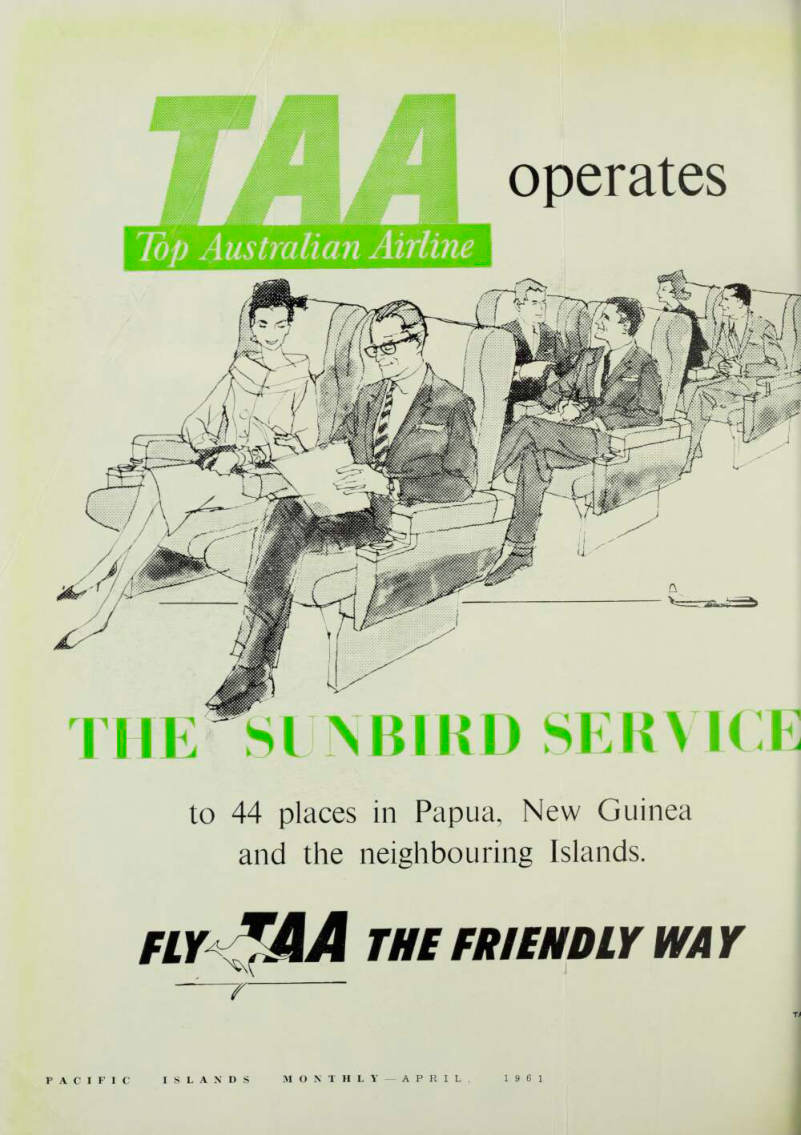 2
2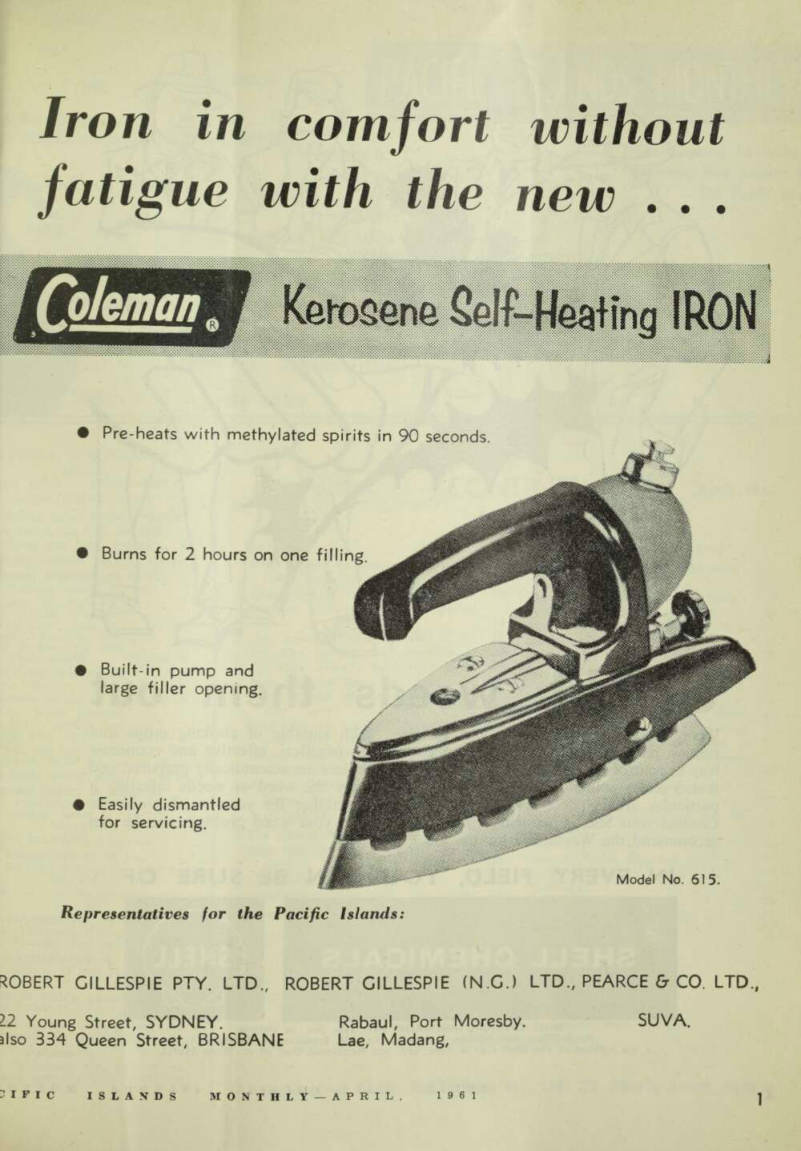 3
3 4
4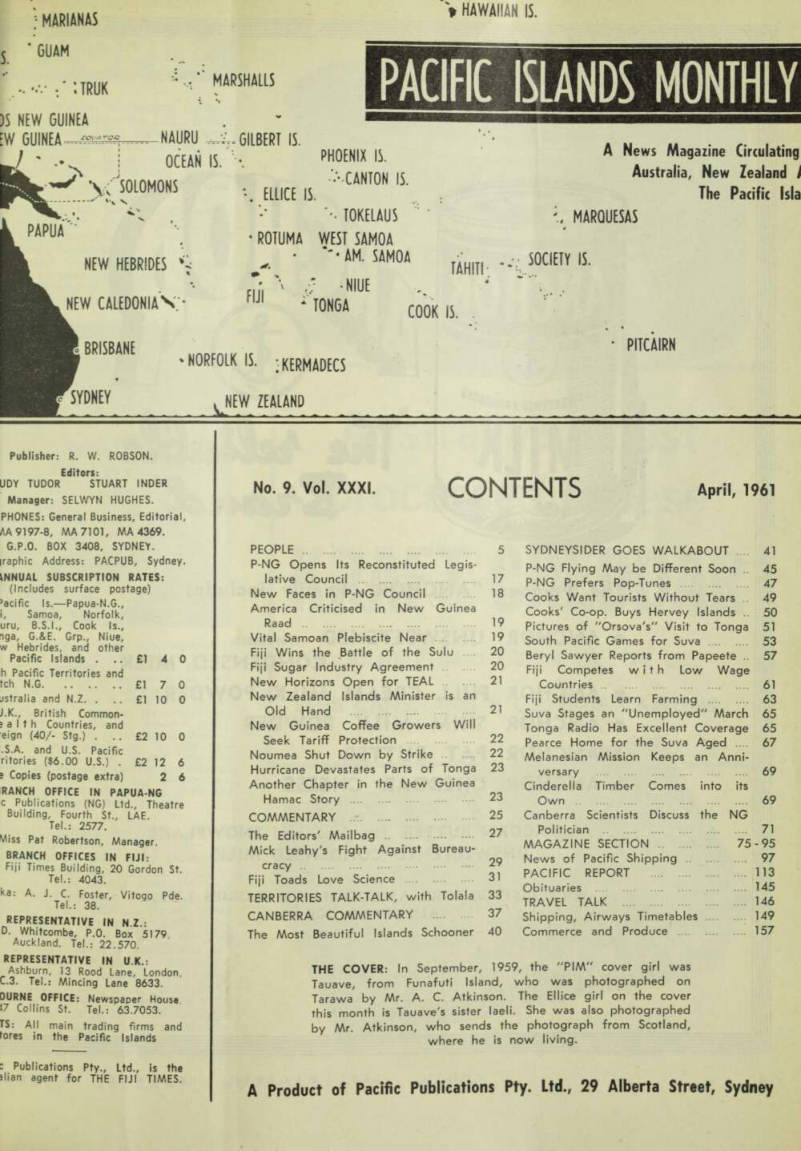 5
5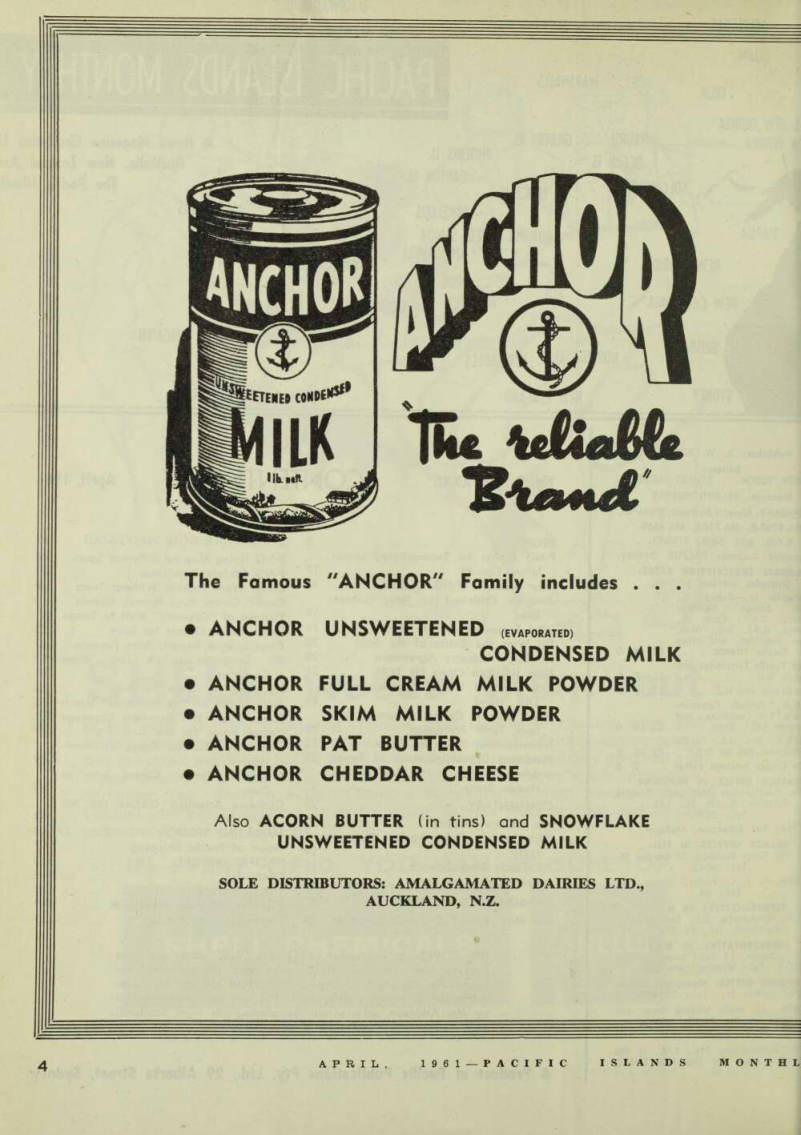 6
6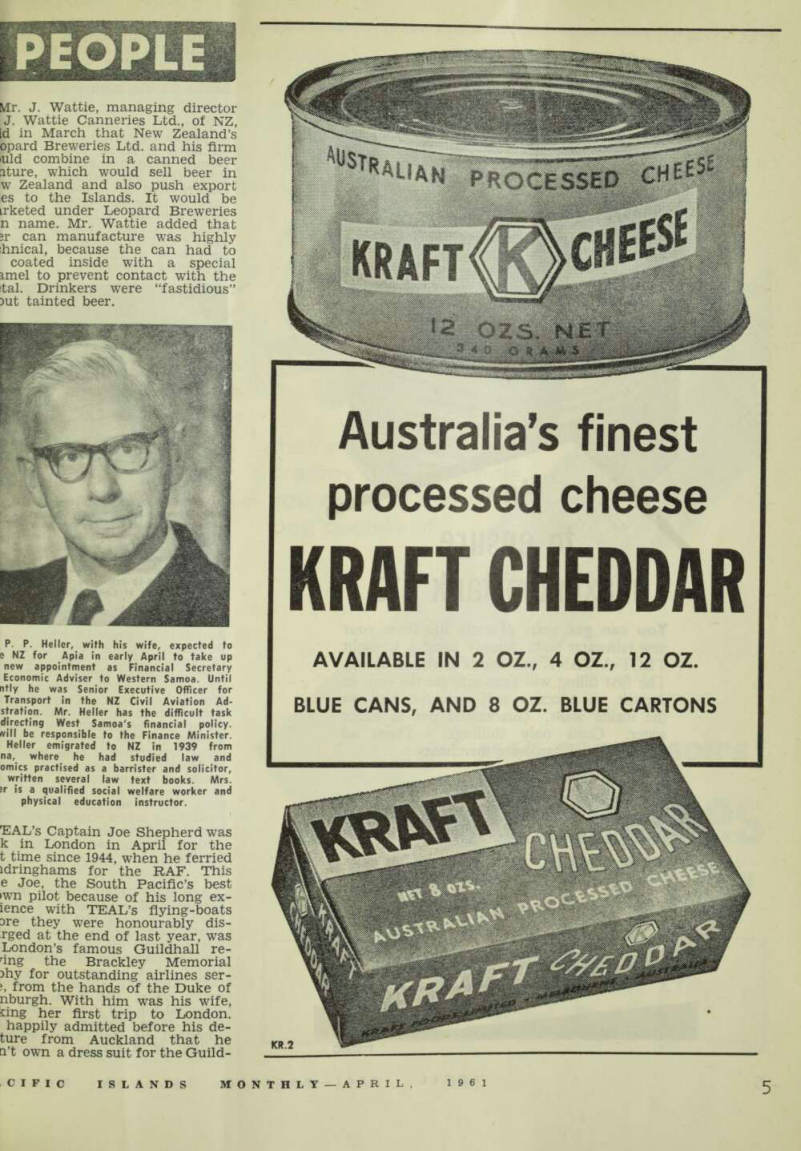 7
7 8
8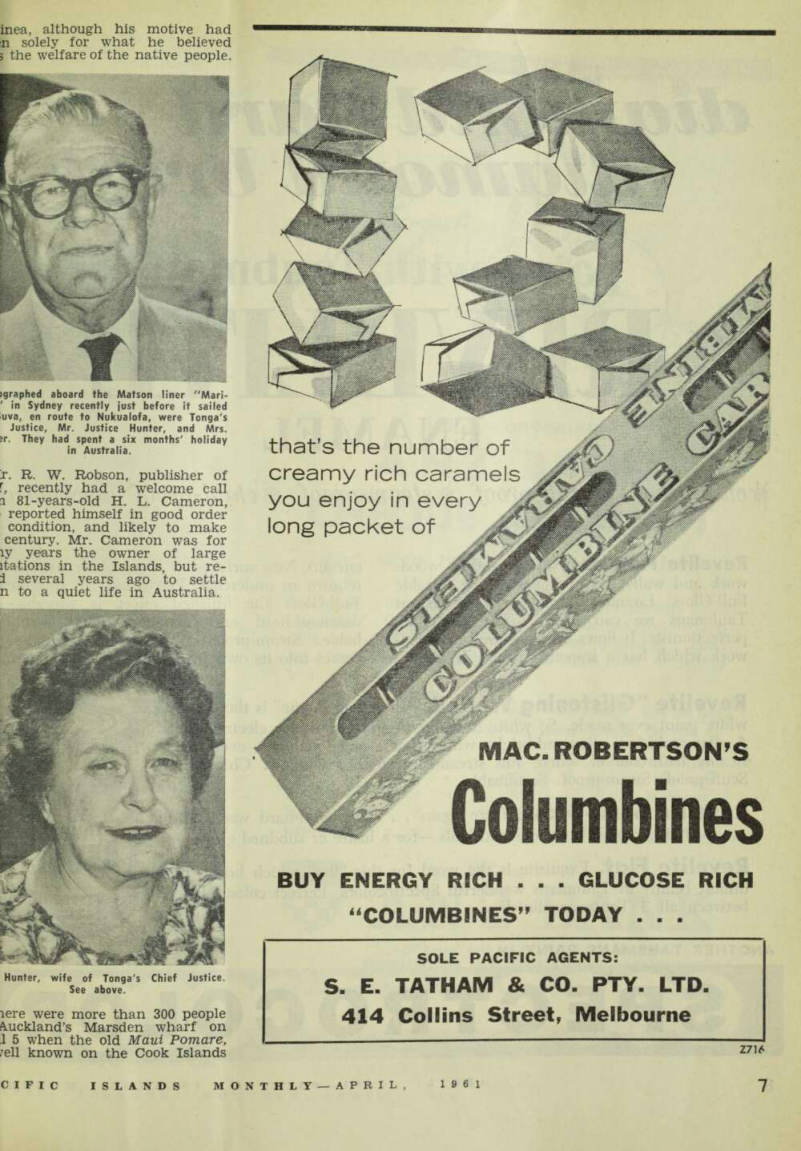 9
9 10
10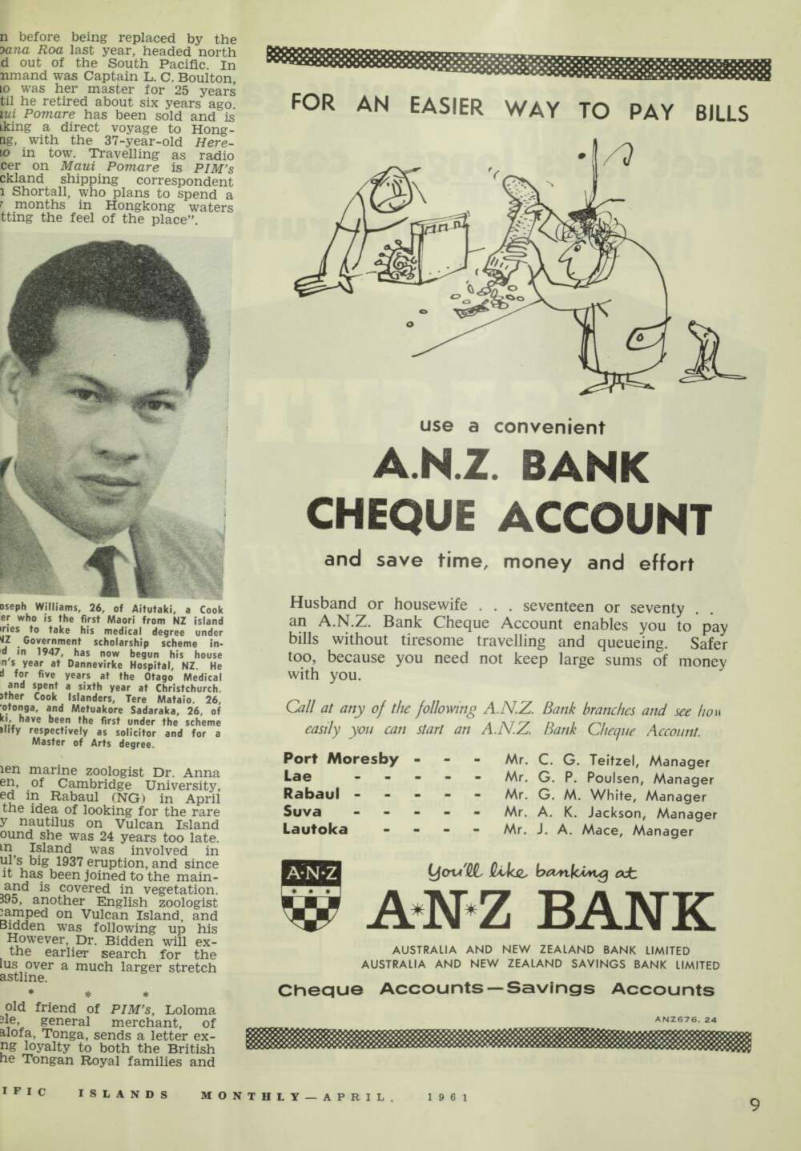 11
11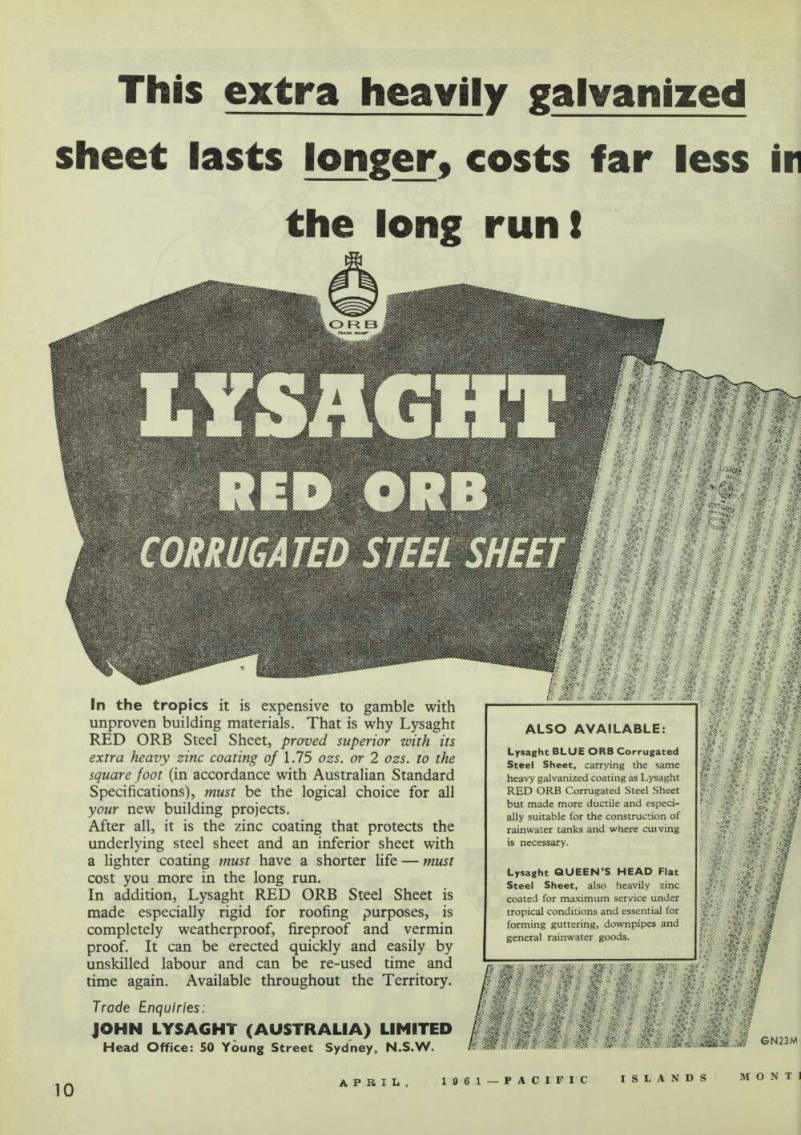 12
12 13
13 14
14 15
15 16
16 17
17 18
18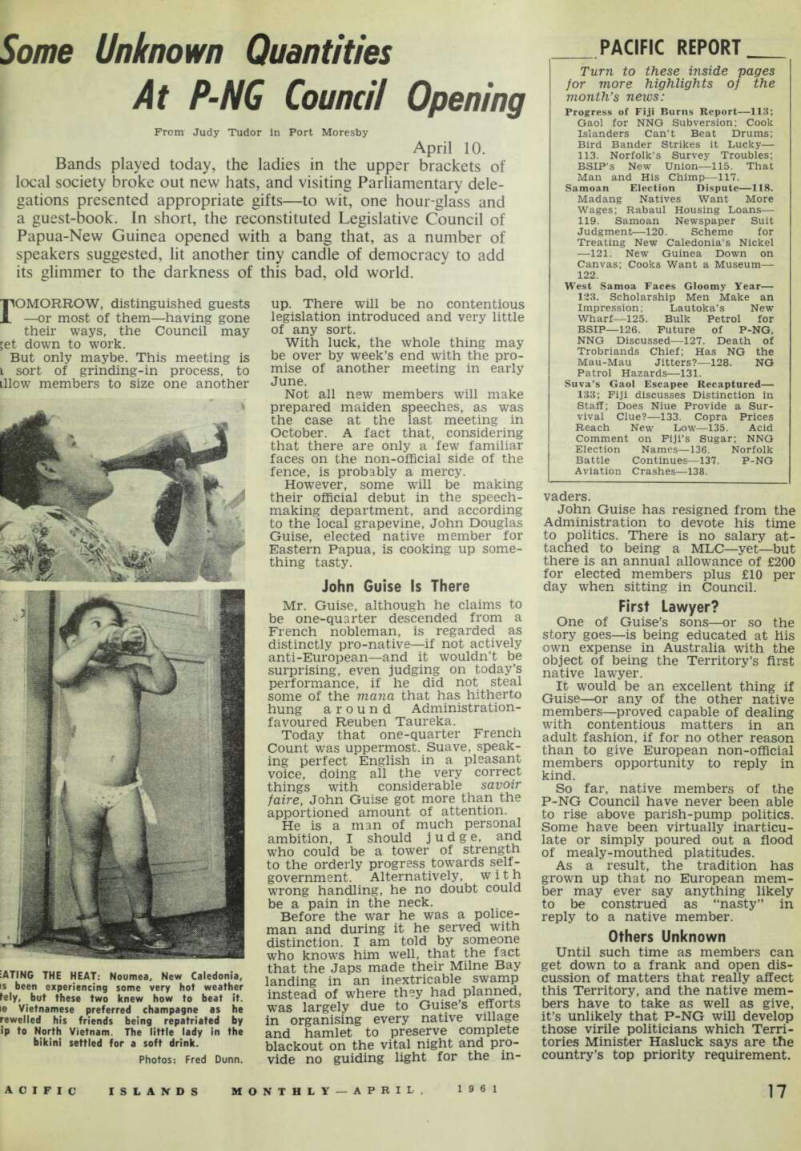 19
19 20
20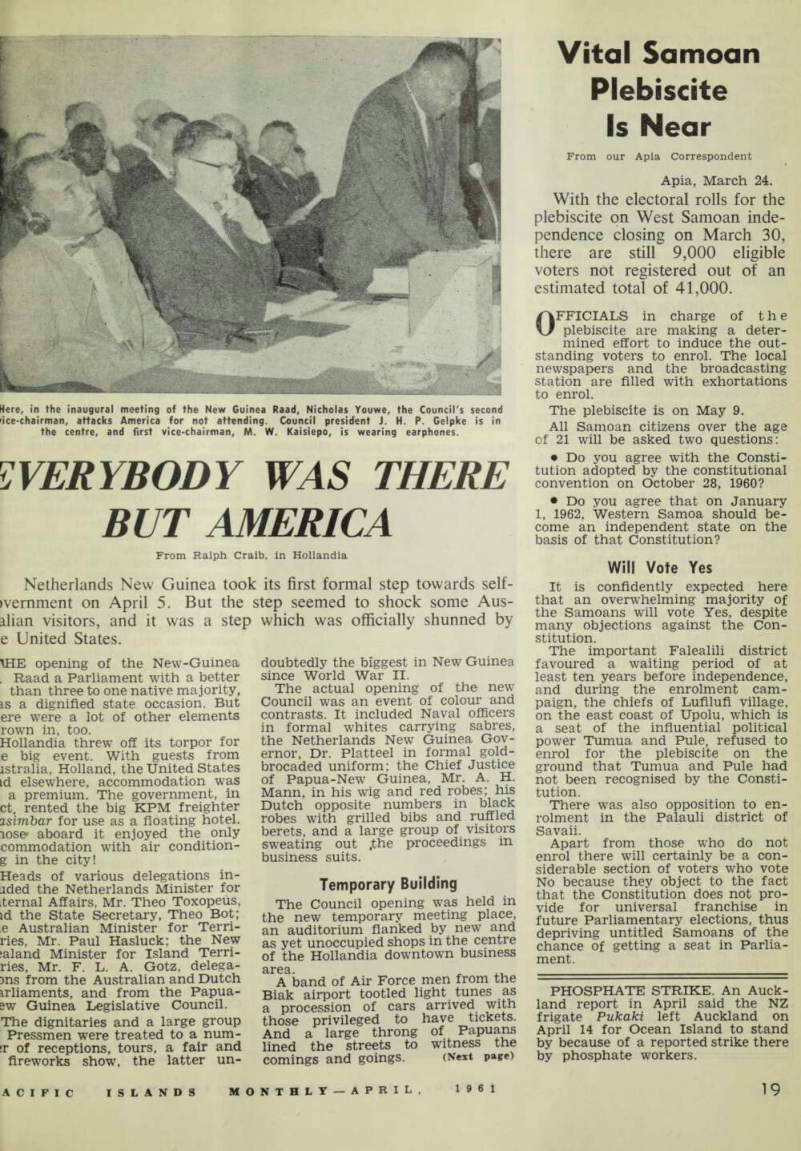 21
21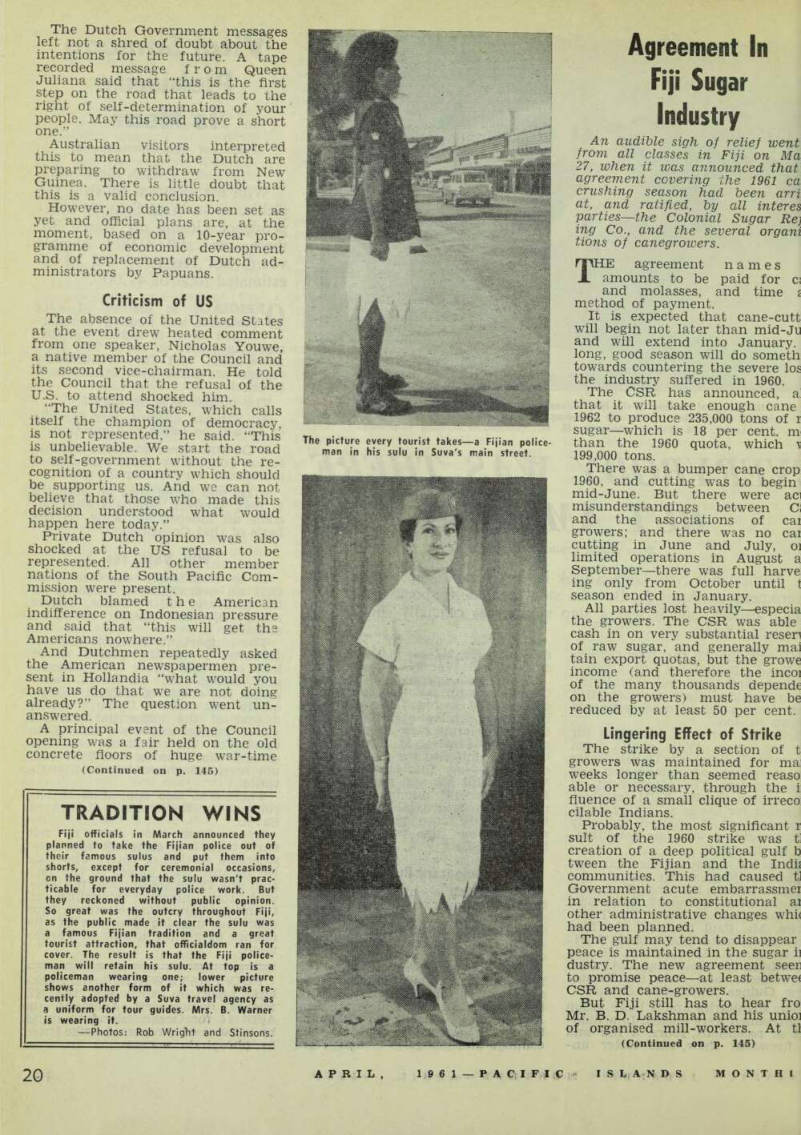 22
22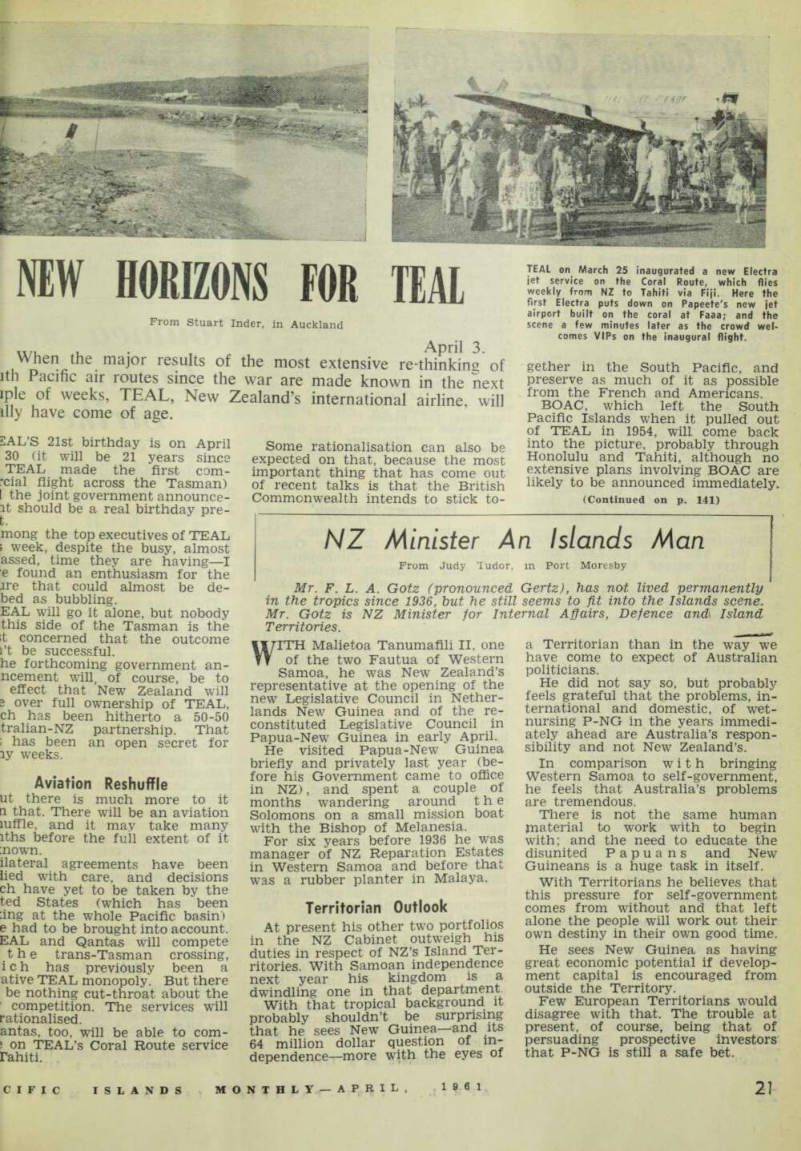 23
23 24
24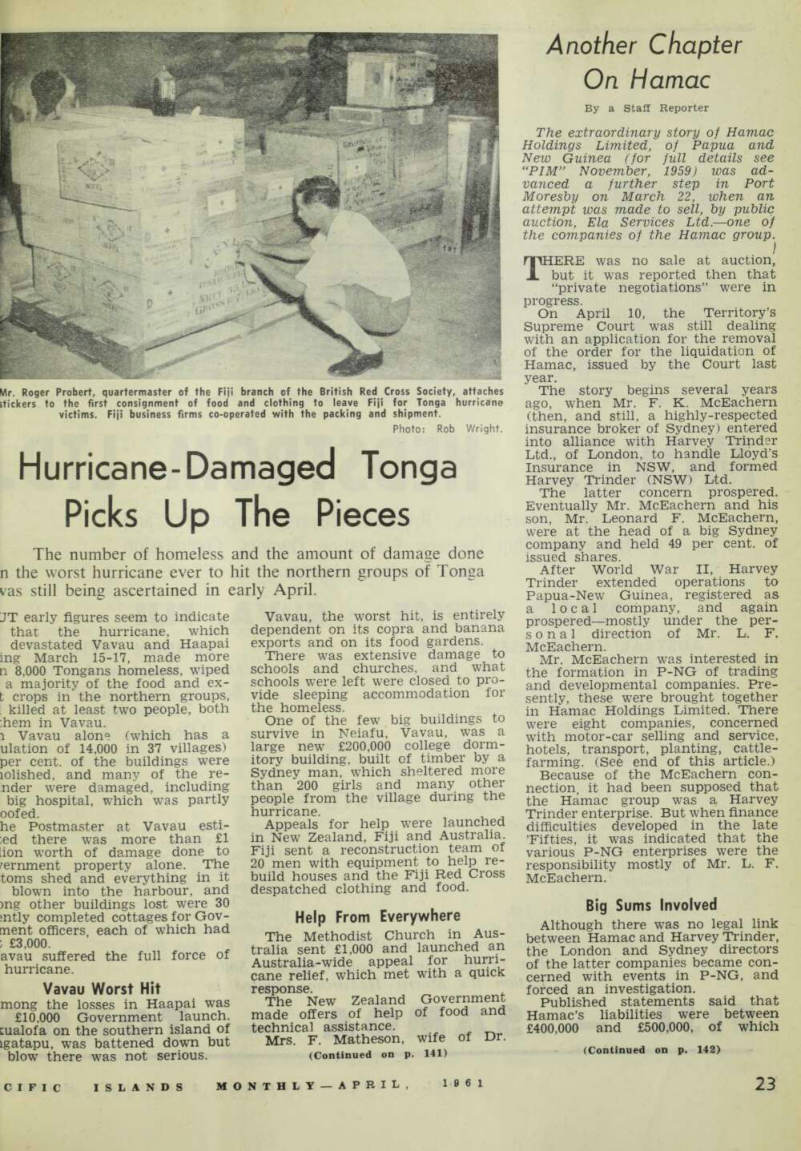 25
25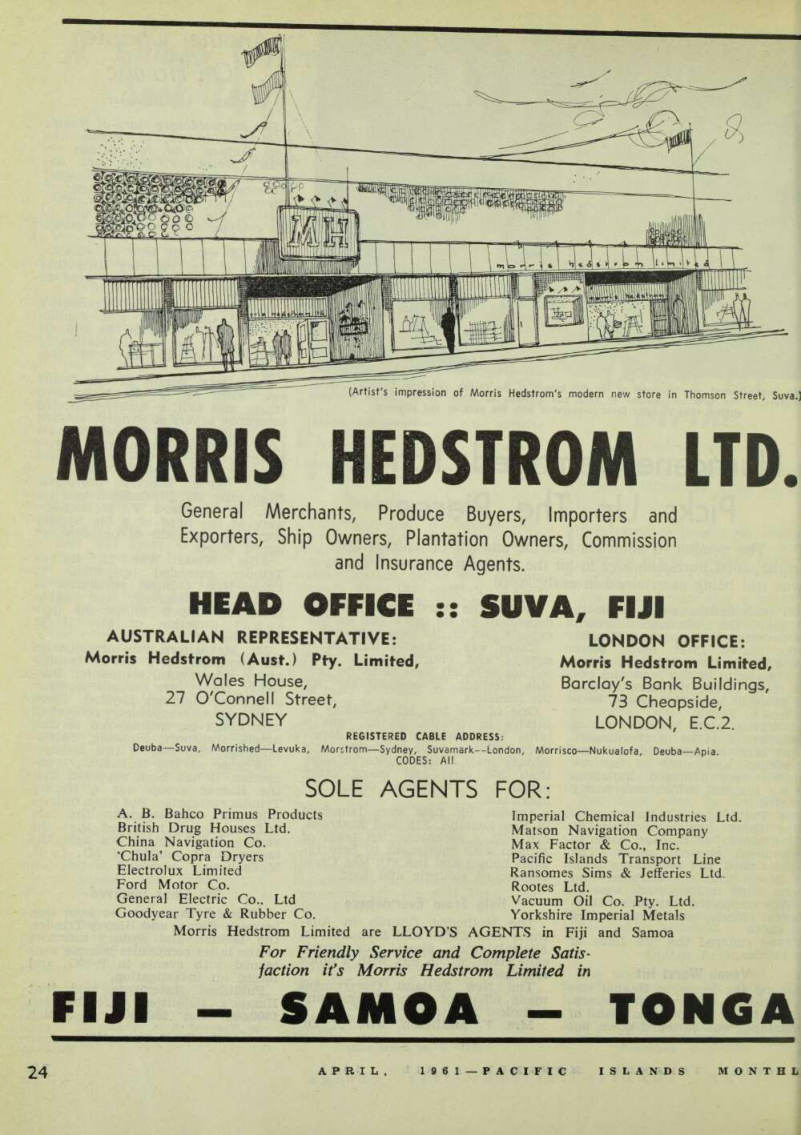 26
26 27
27 28
28 29
29 30
30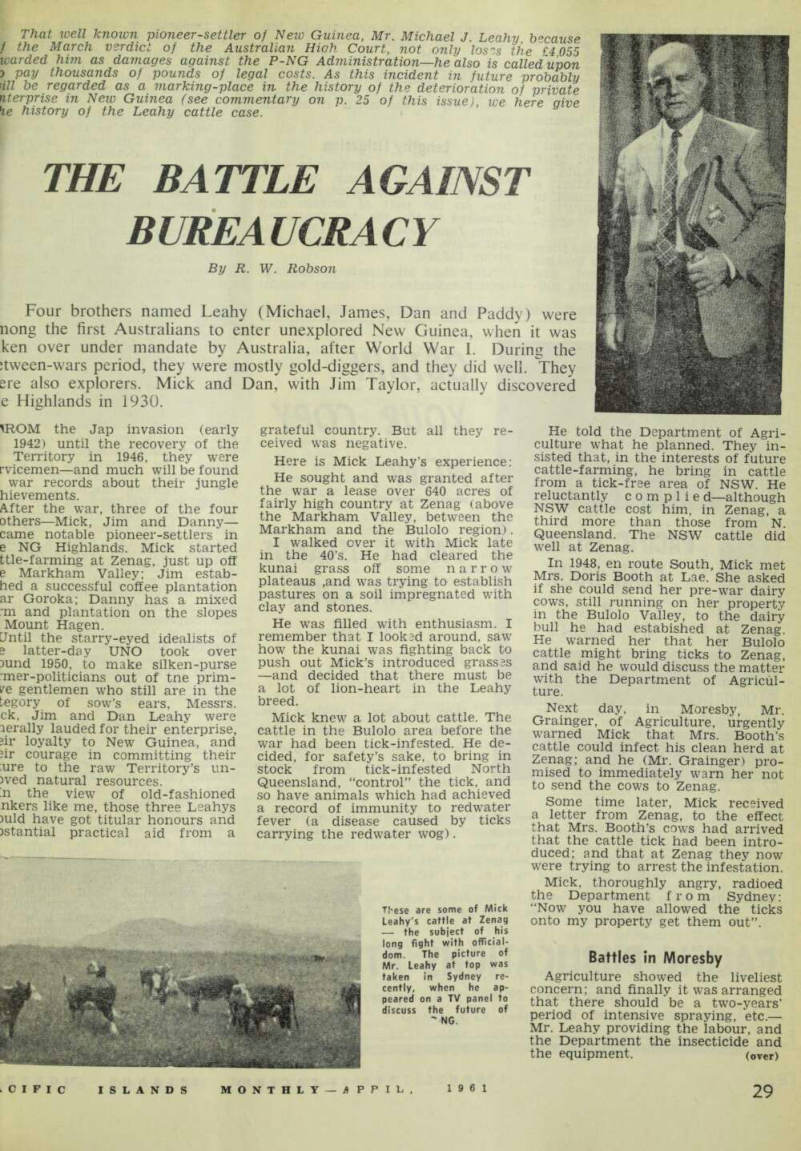 31
31 32
32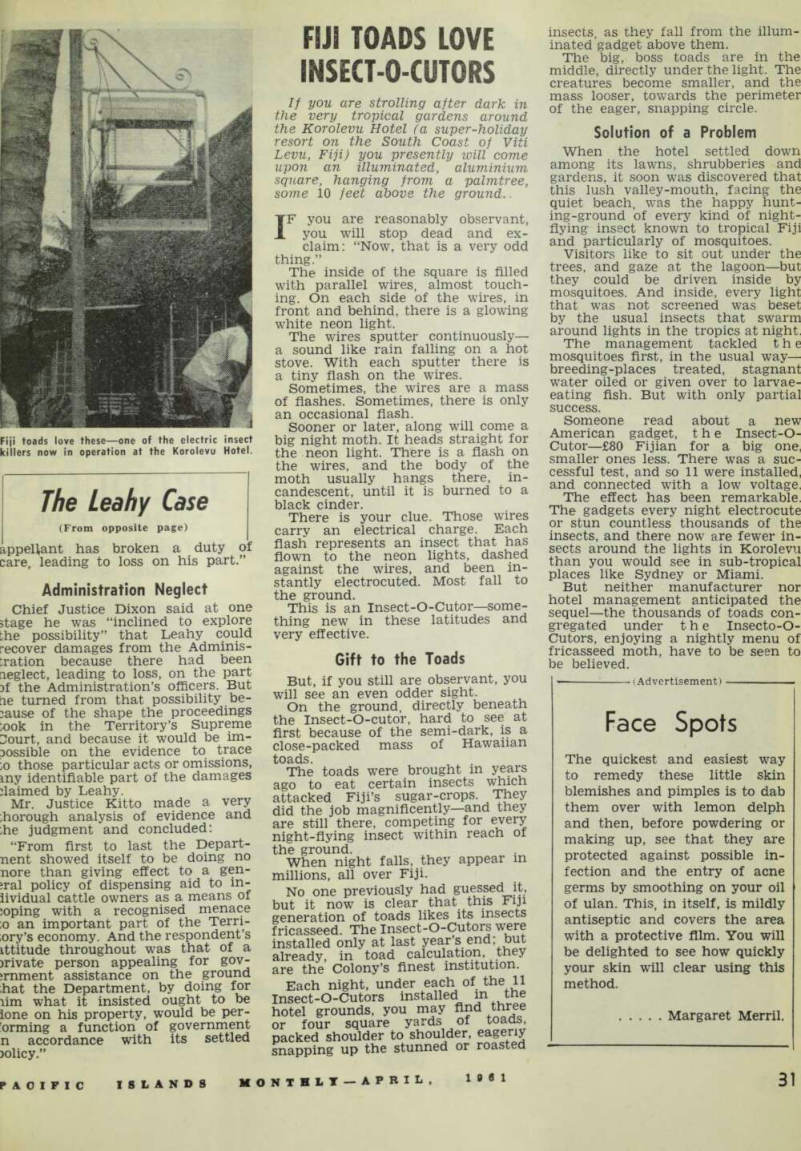 33
33 34
34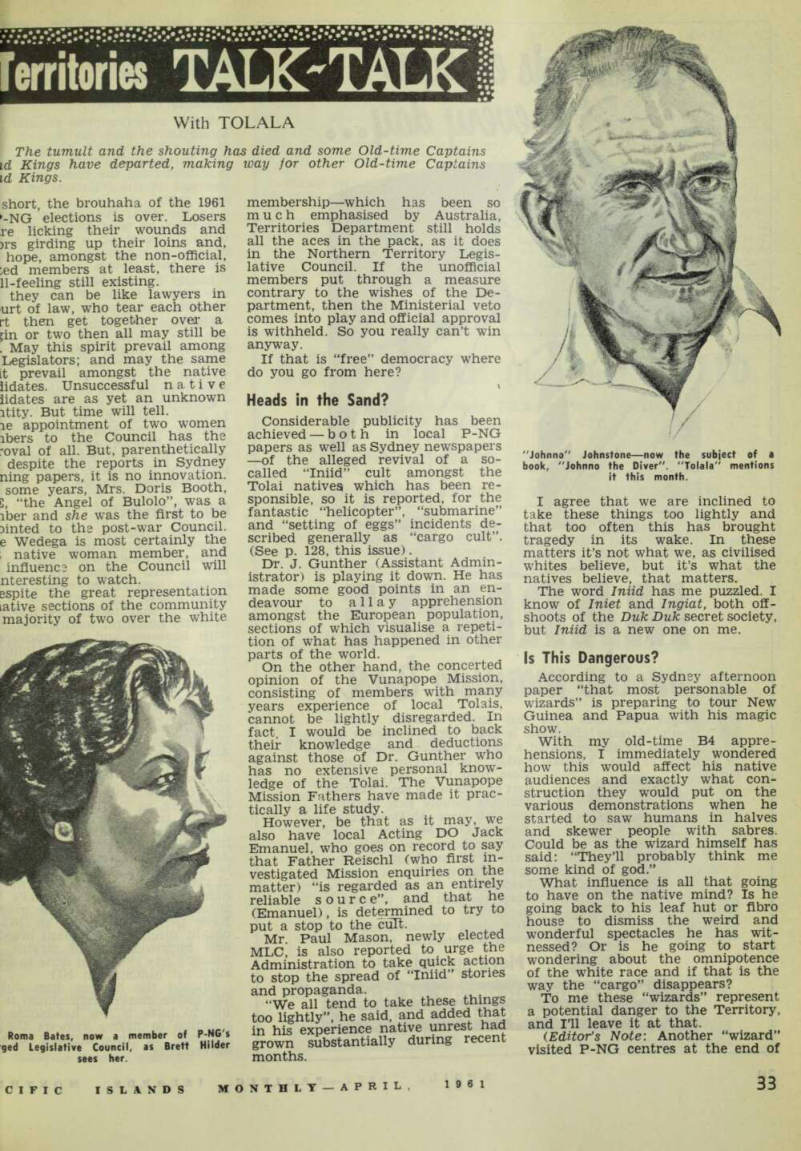 35
35 36
36 37
37 38
38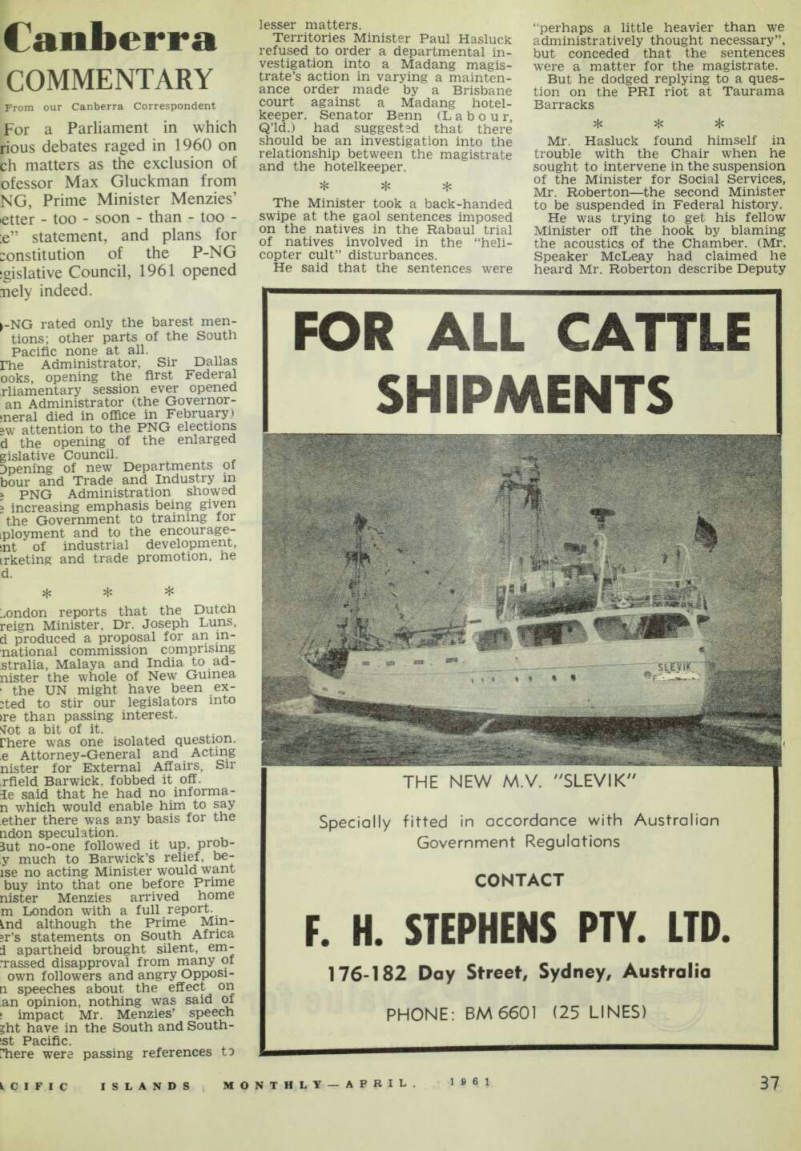 39
39 40
40 41
41 42
42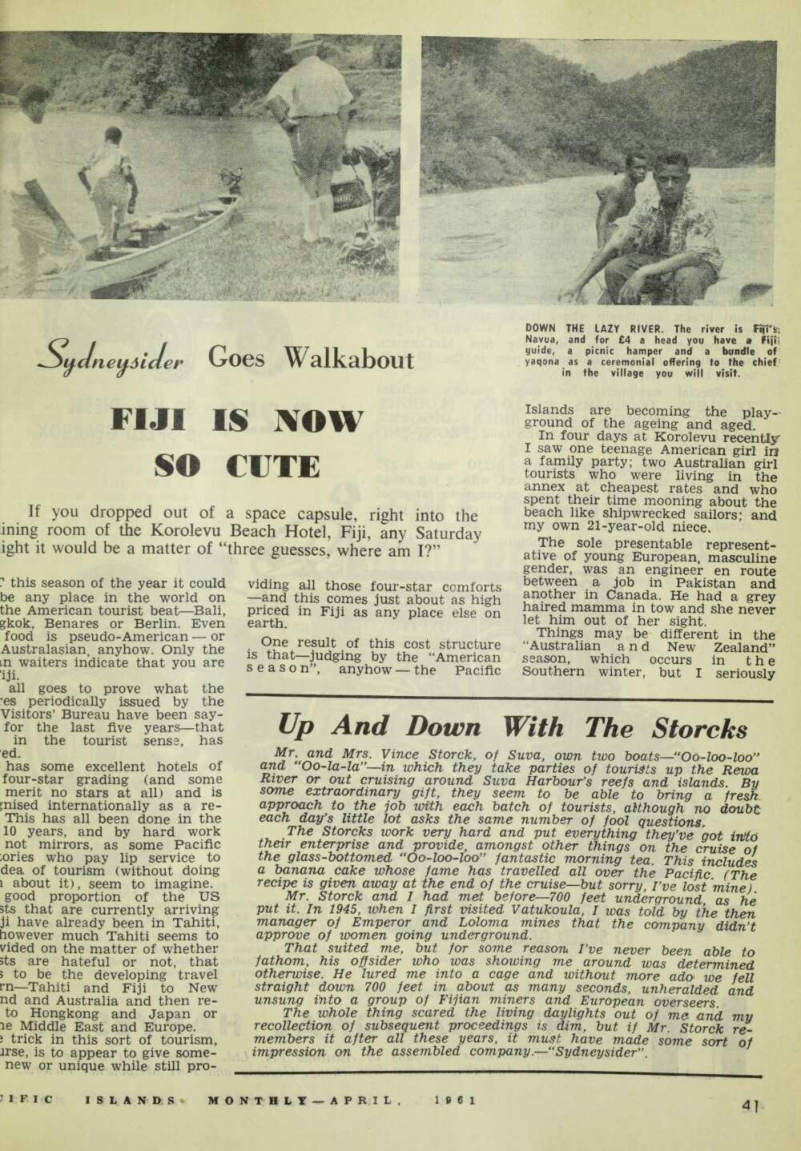 43
43 44
44 45
45 46
46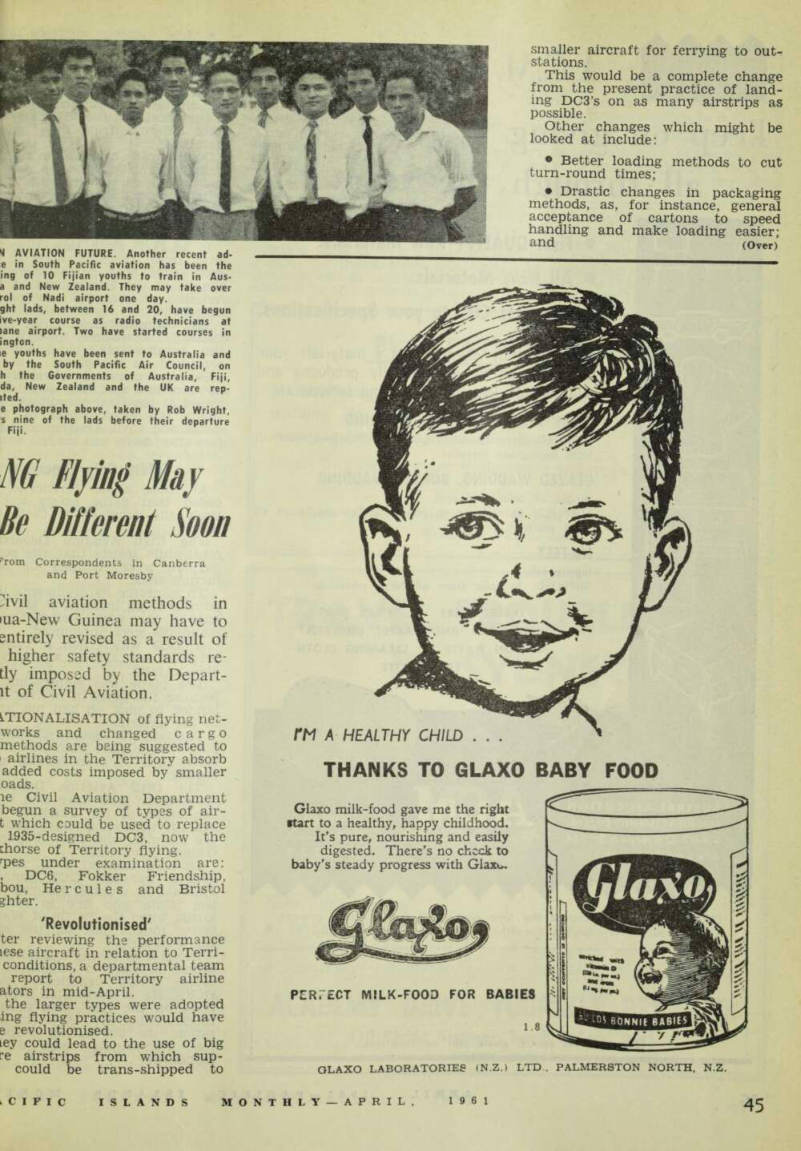 47
47 48
48 49
49 50
50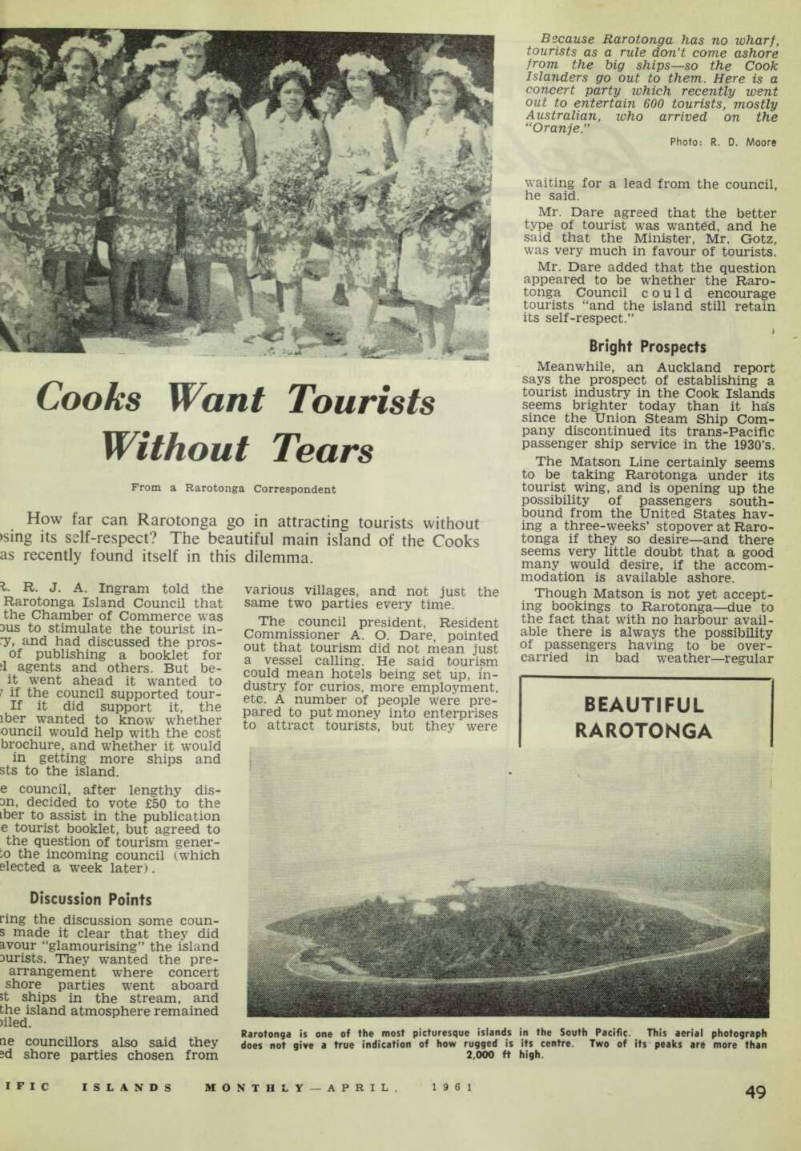 51
51 52
52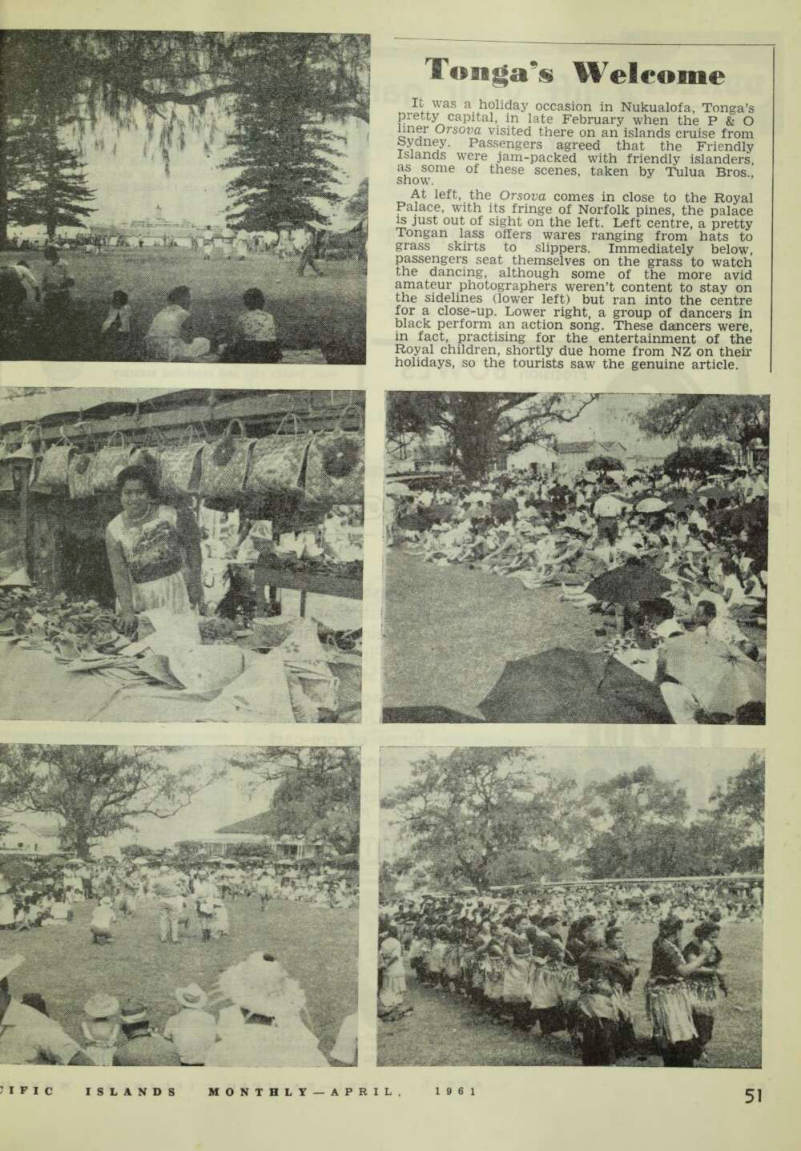 53
53 54
54 55
55 56
56 57
57 58
58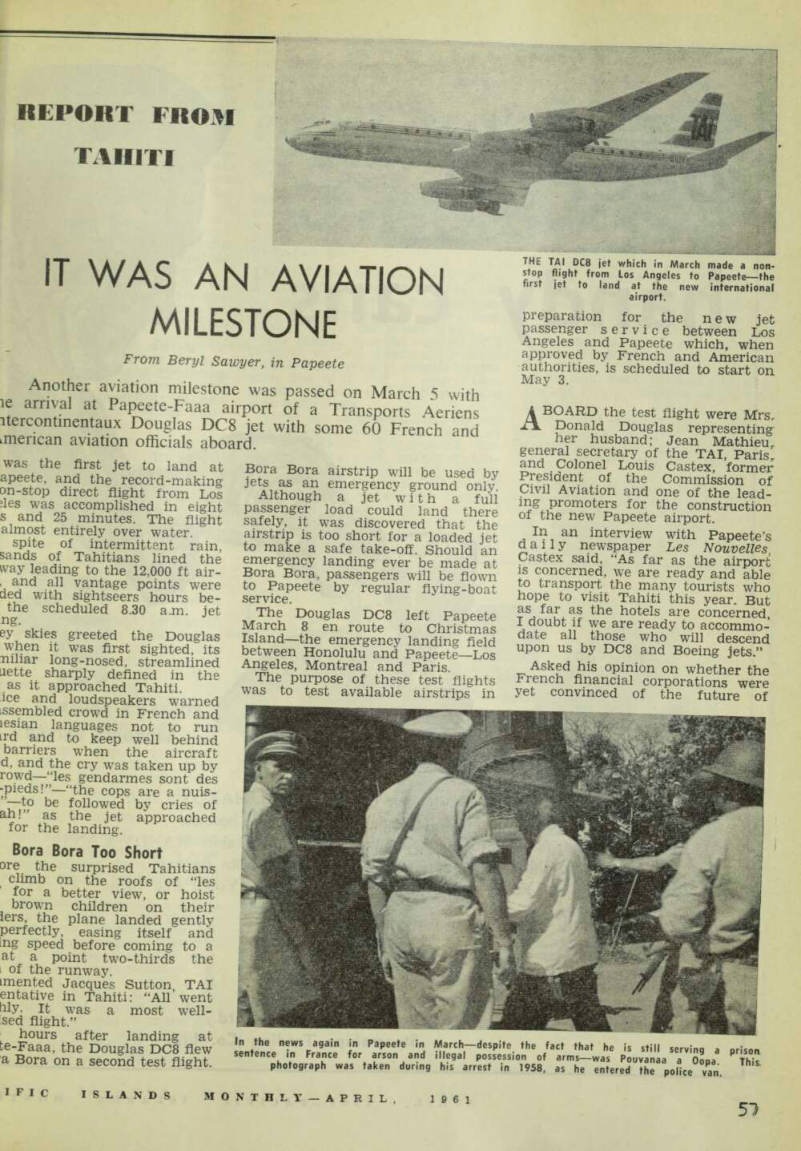 59
59 60
60 61
61 62
62 63
63 64
64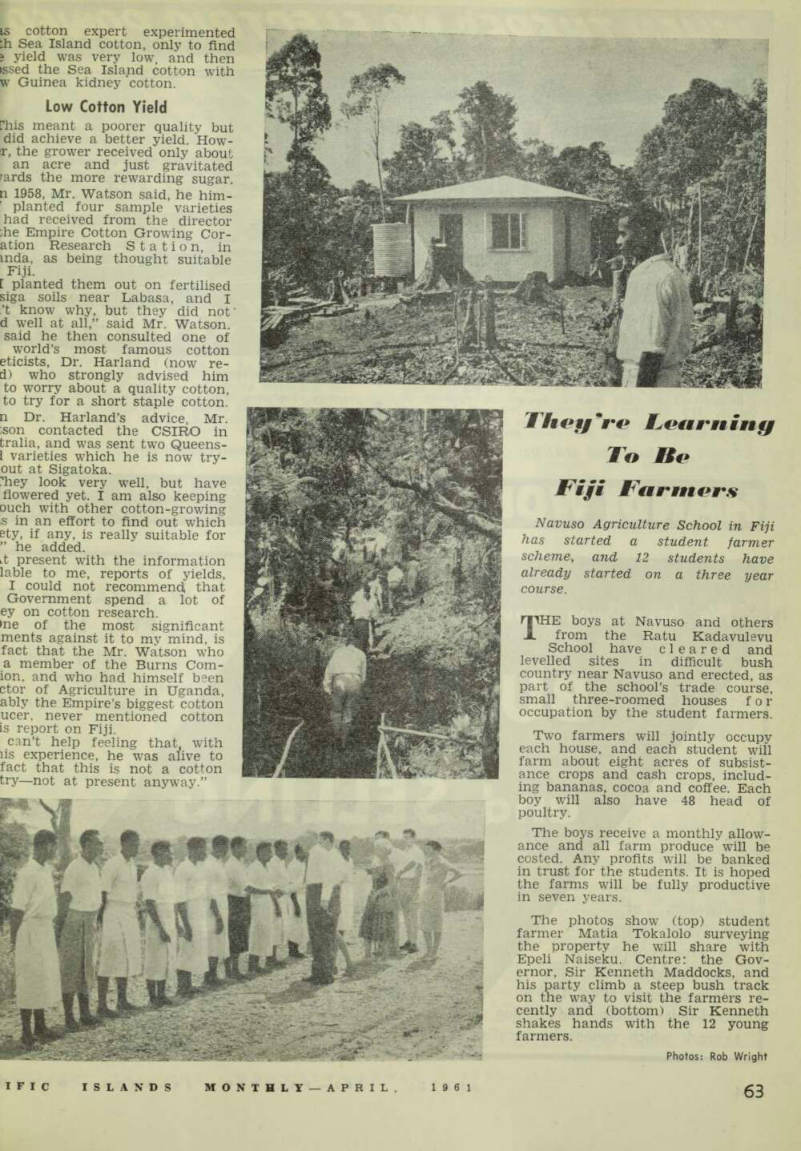 65
65 66
66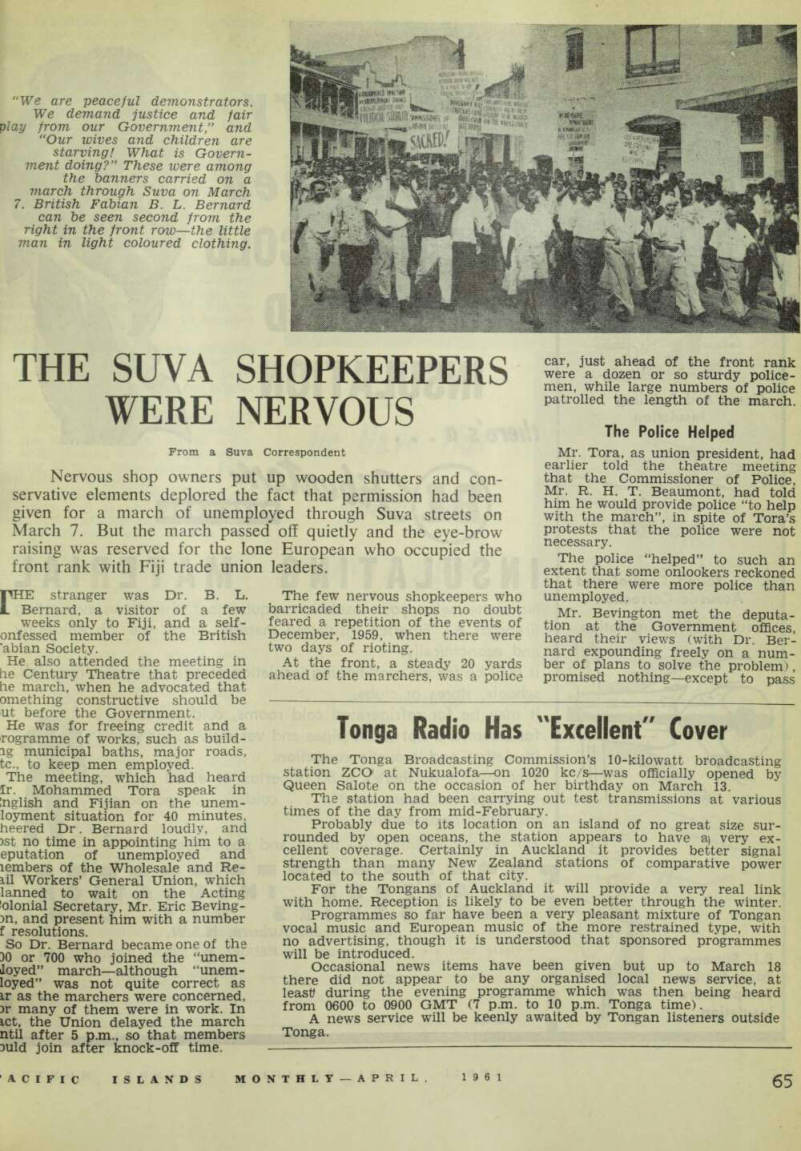 67
67 68
68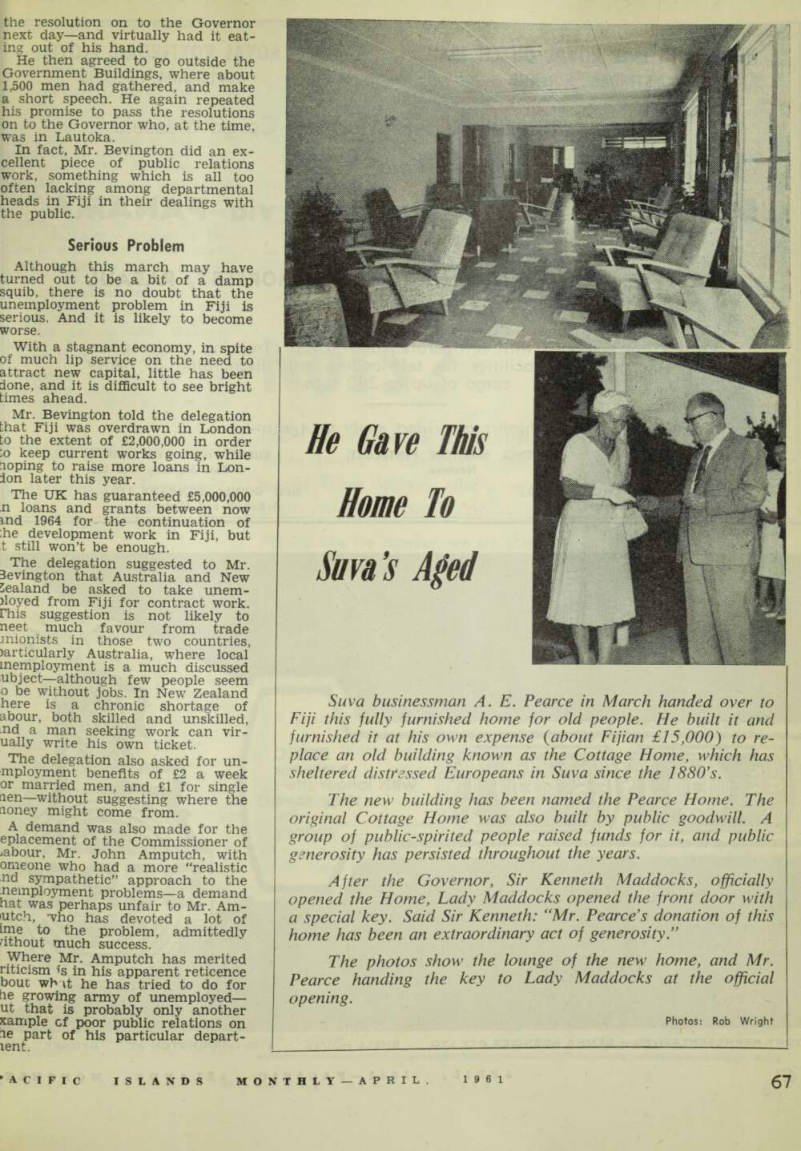 69
69 70
70 71
71 72
72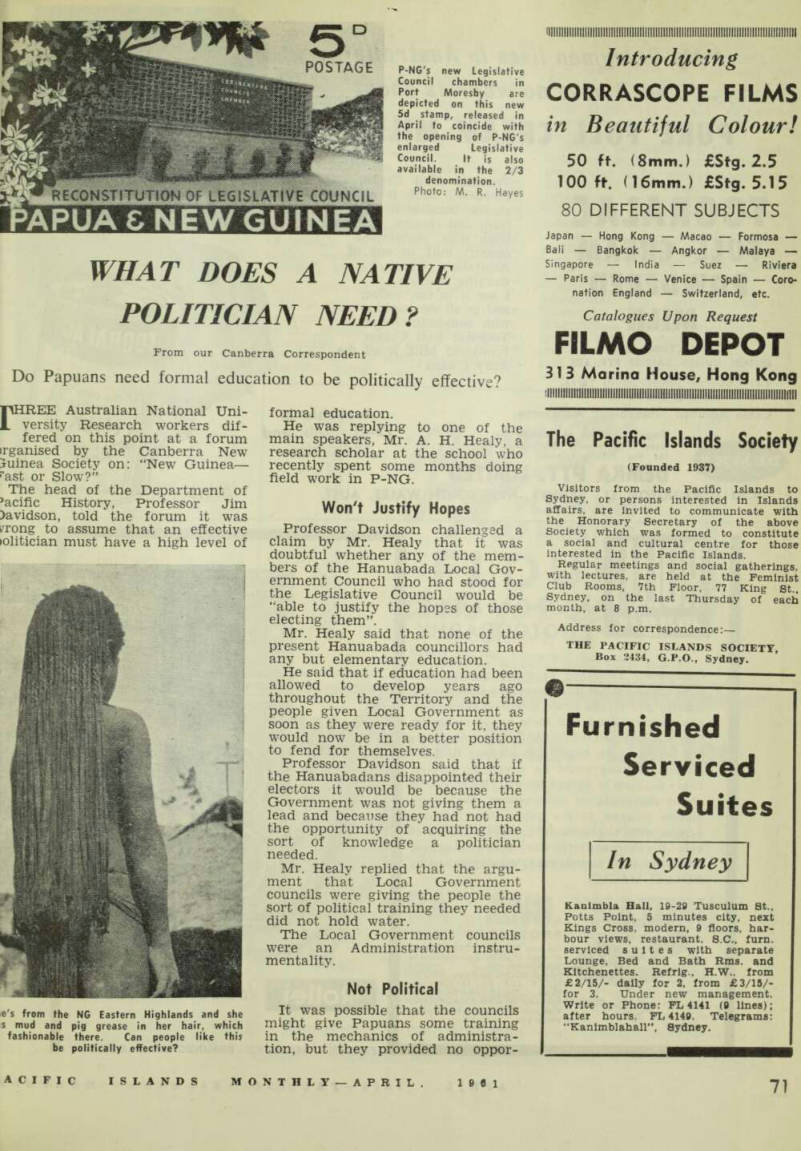 73
73 74
74 75
75 76
76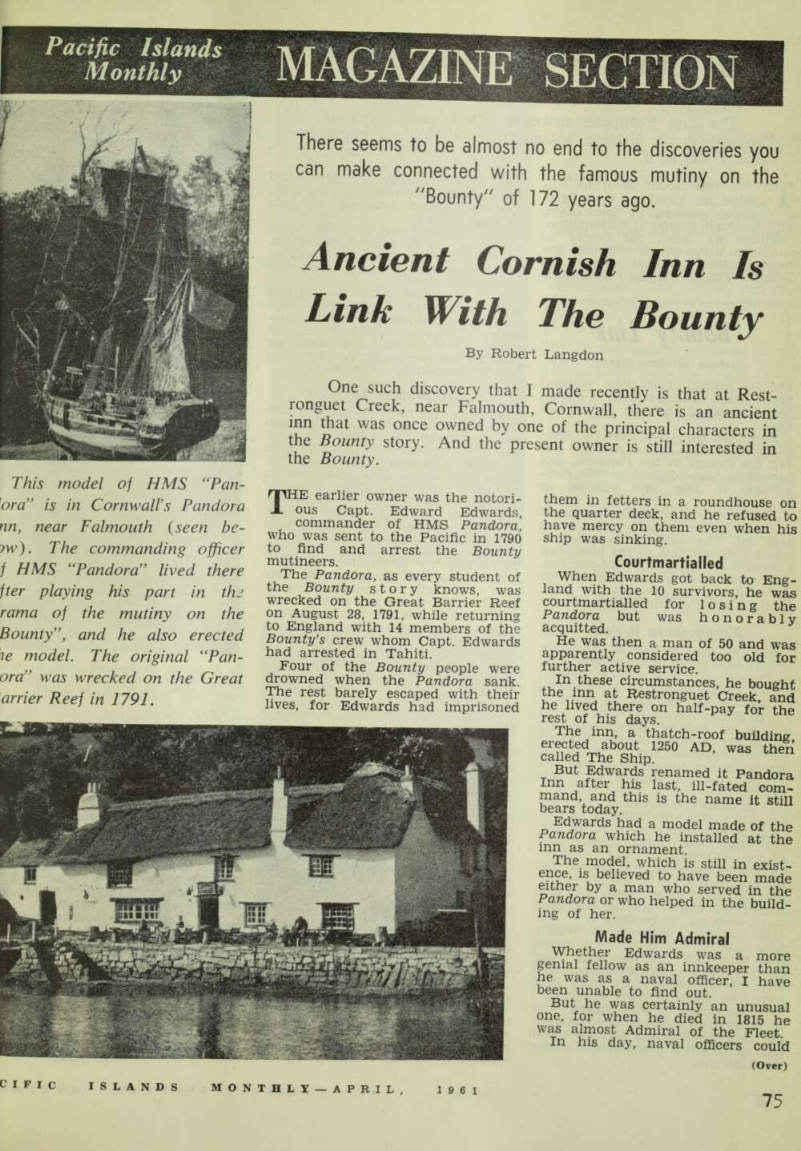 77
77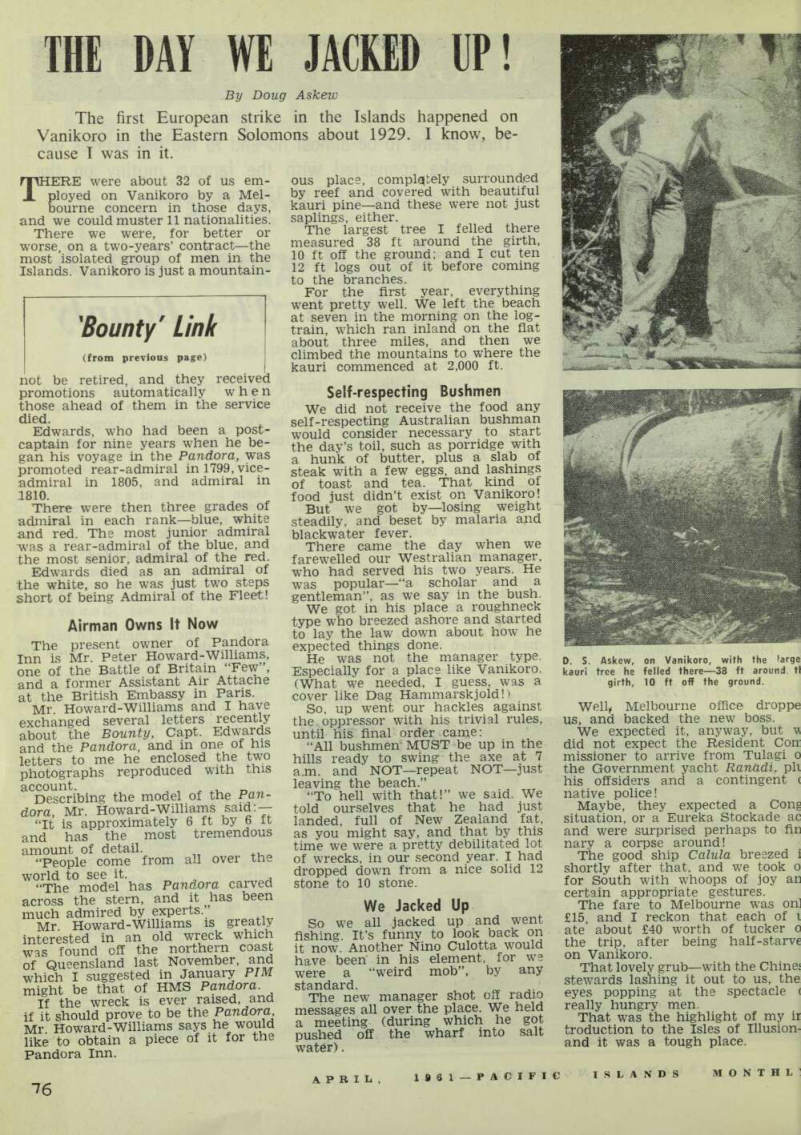 78
78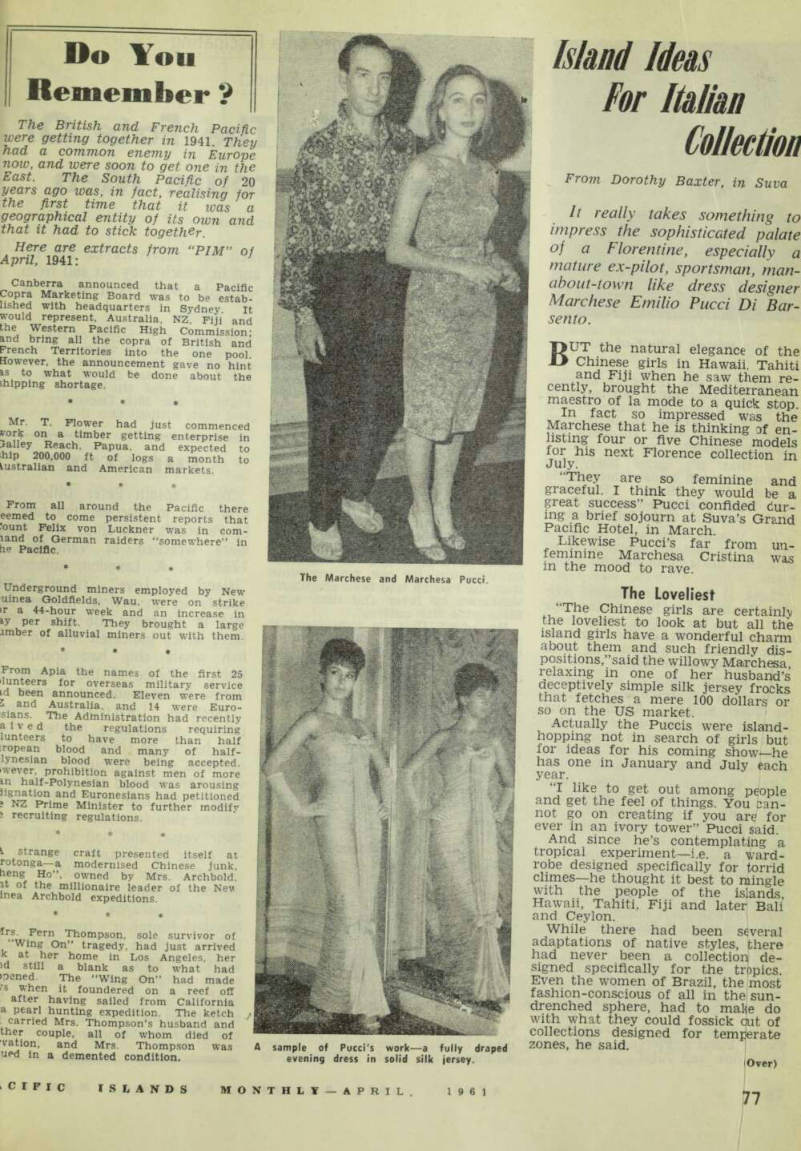 79
79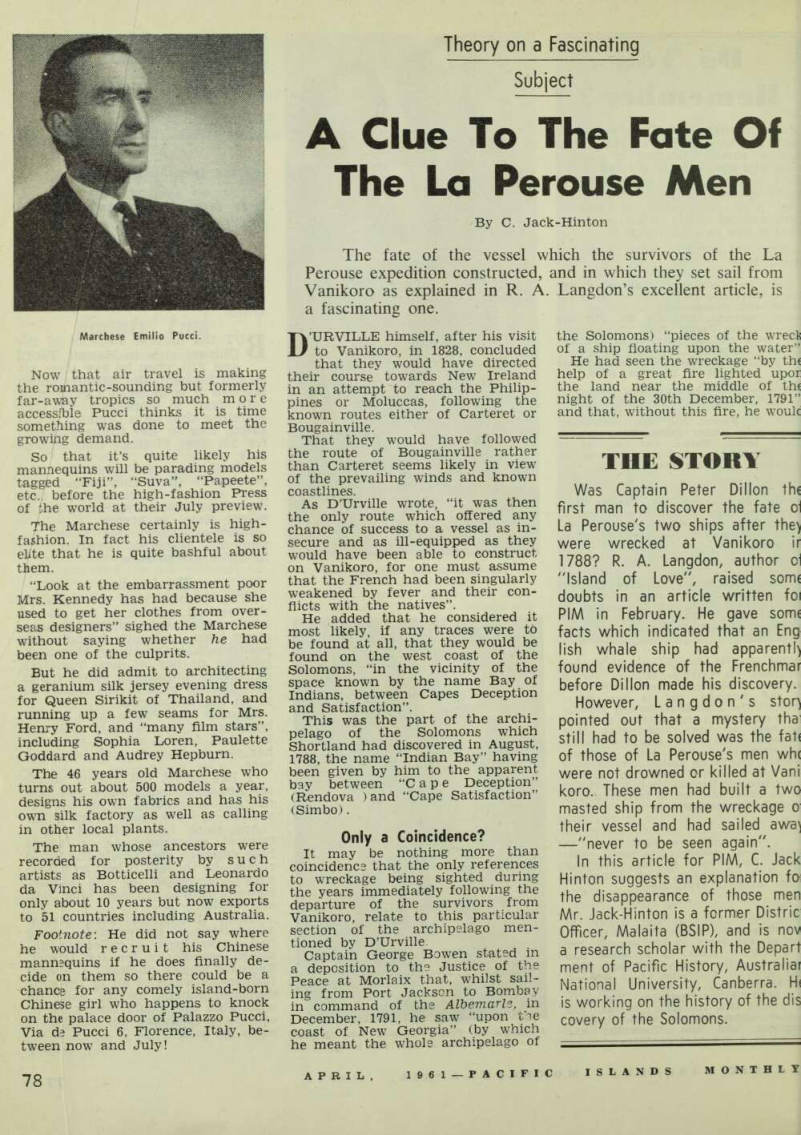 80
80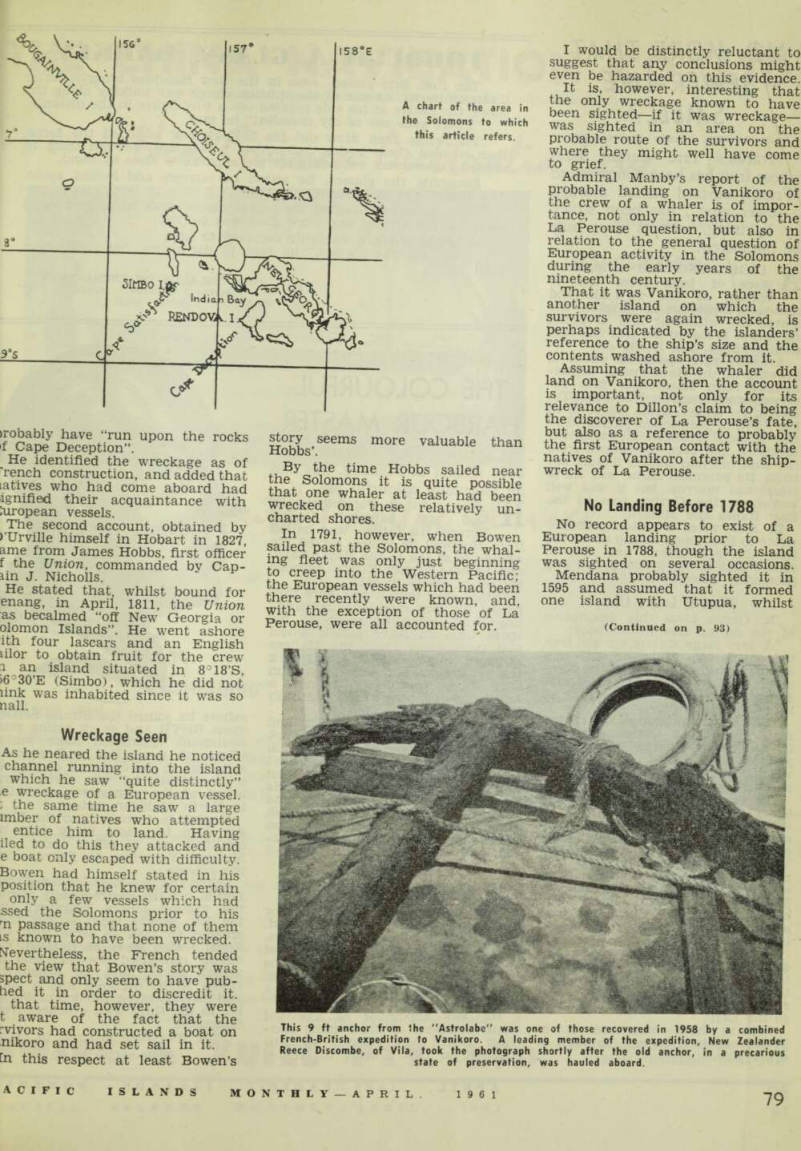 81
81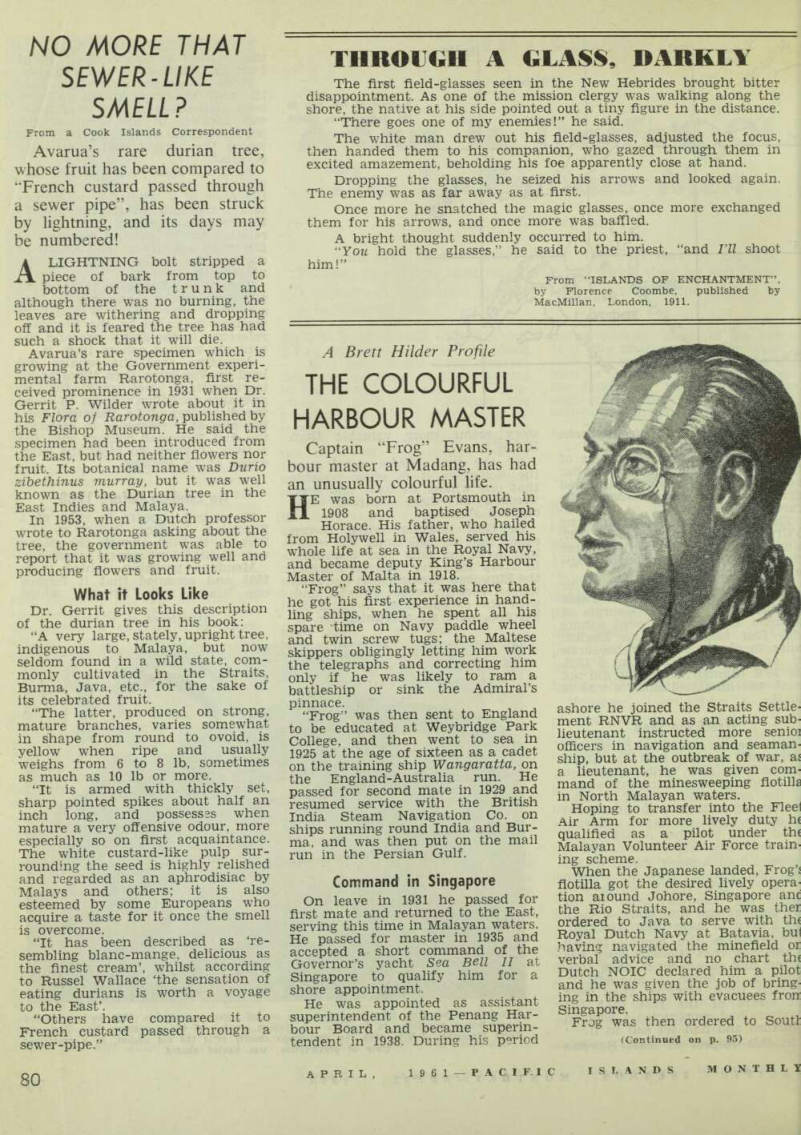 82
82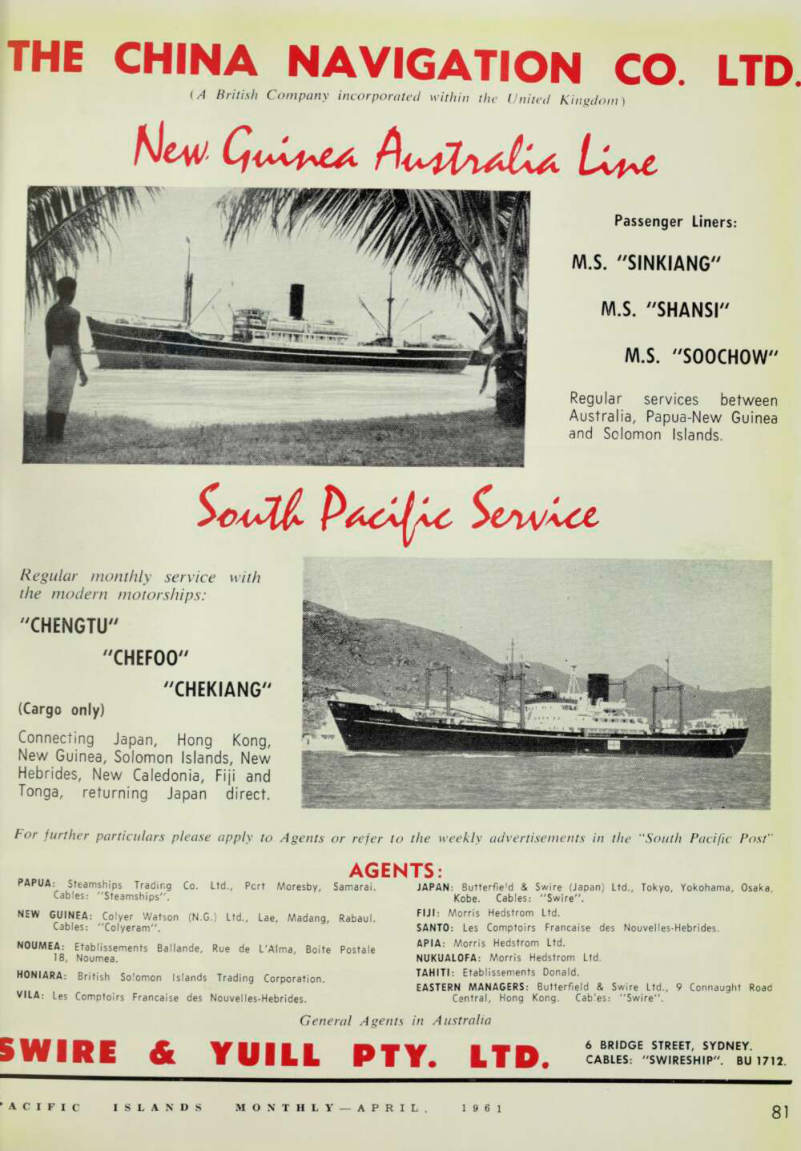 83
83 84
84 85
85 86
86 87
87 88
88 89
89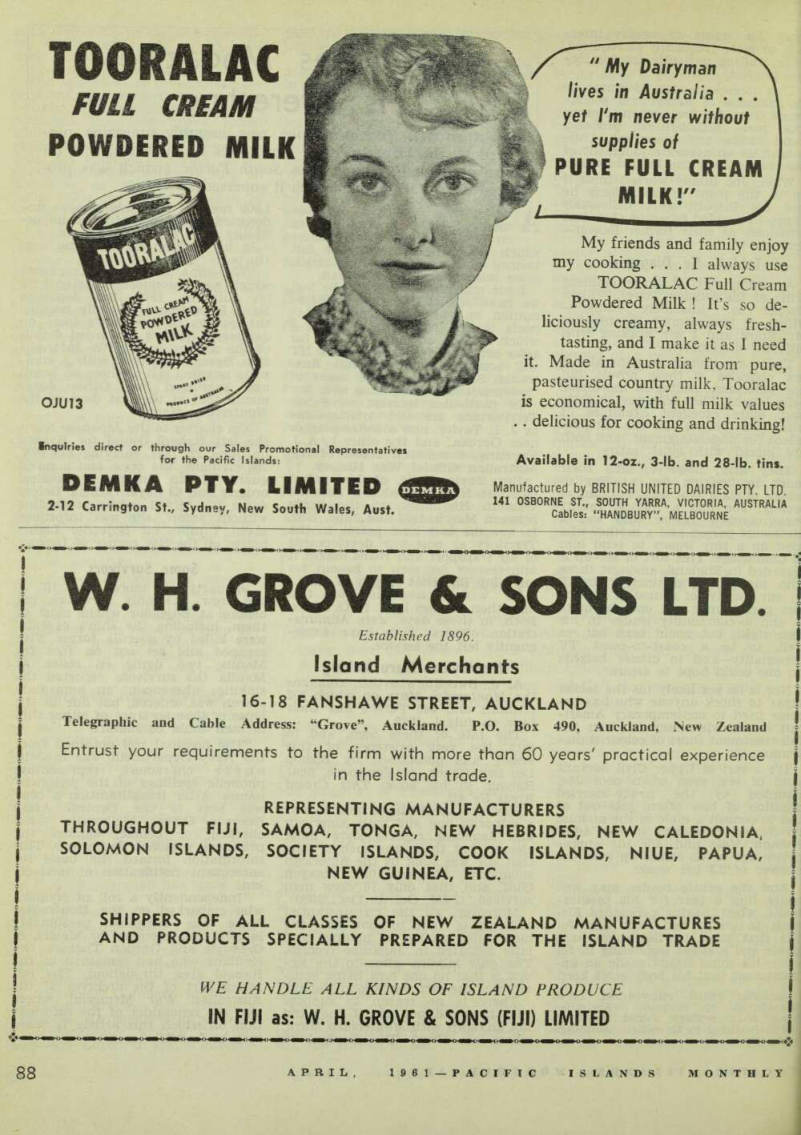 90
90 91
91 92
92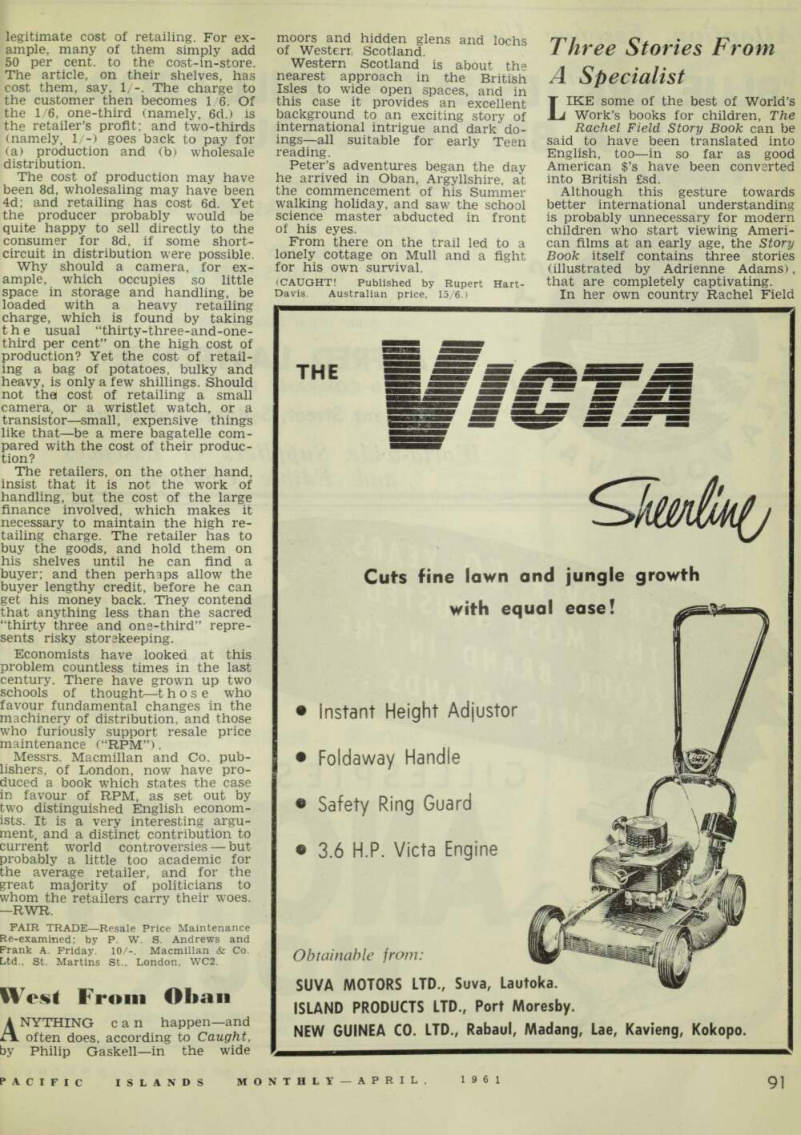 93
93 94
94 95
95 96
96 97
97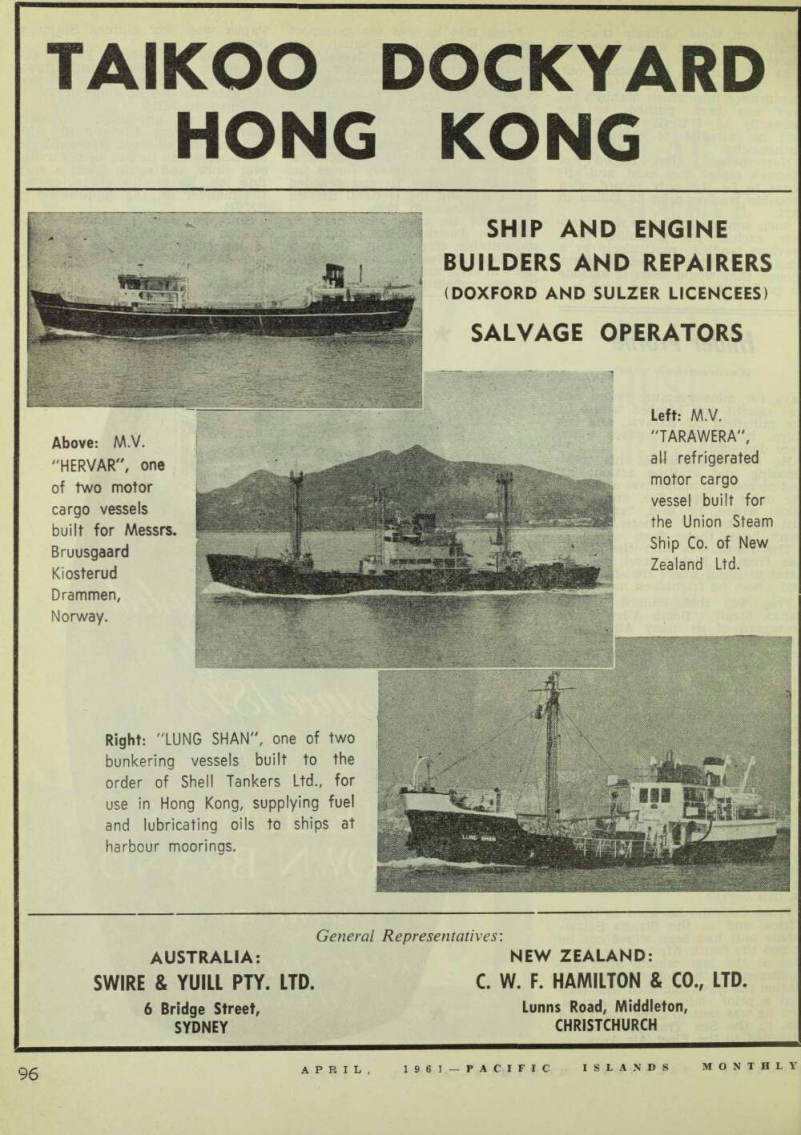 98
98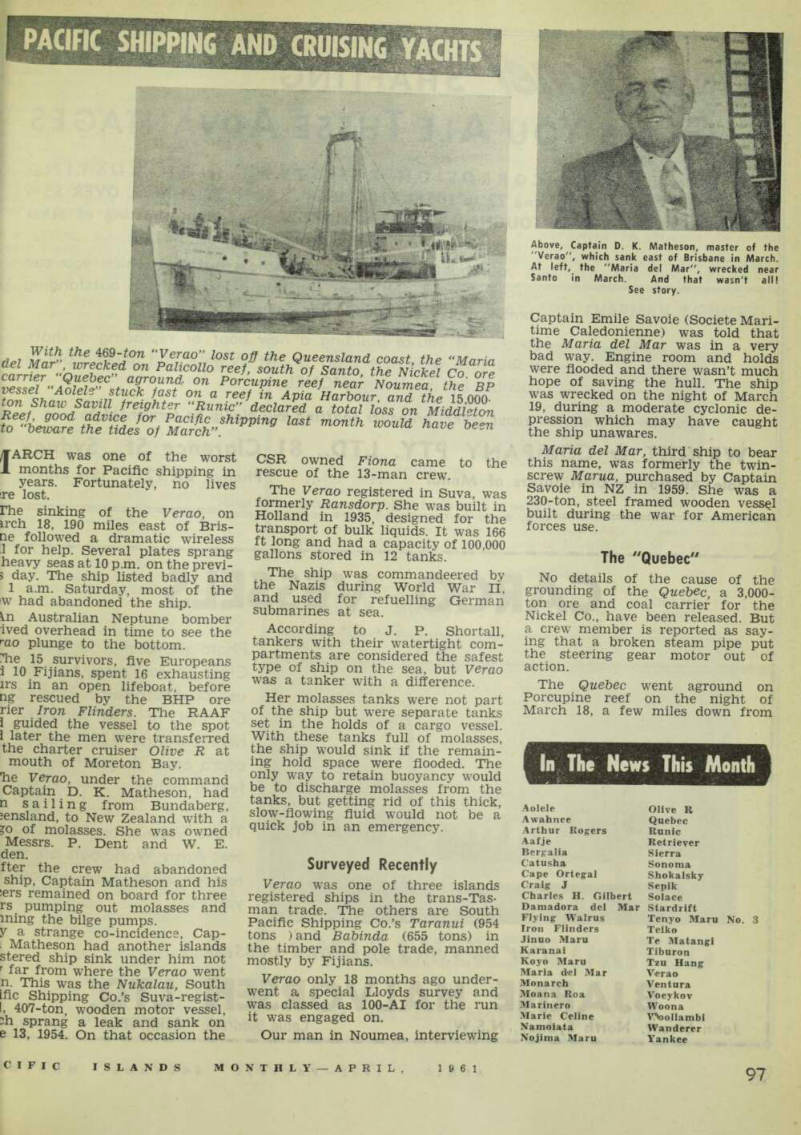 99
99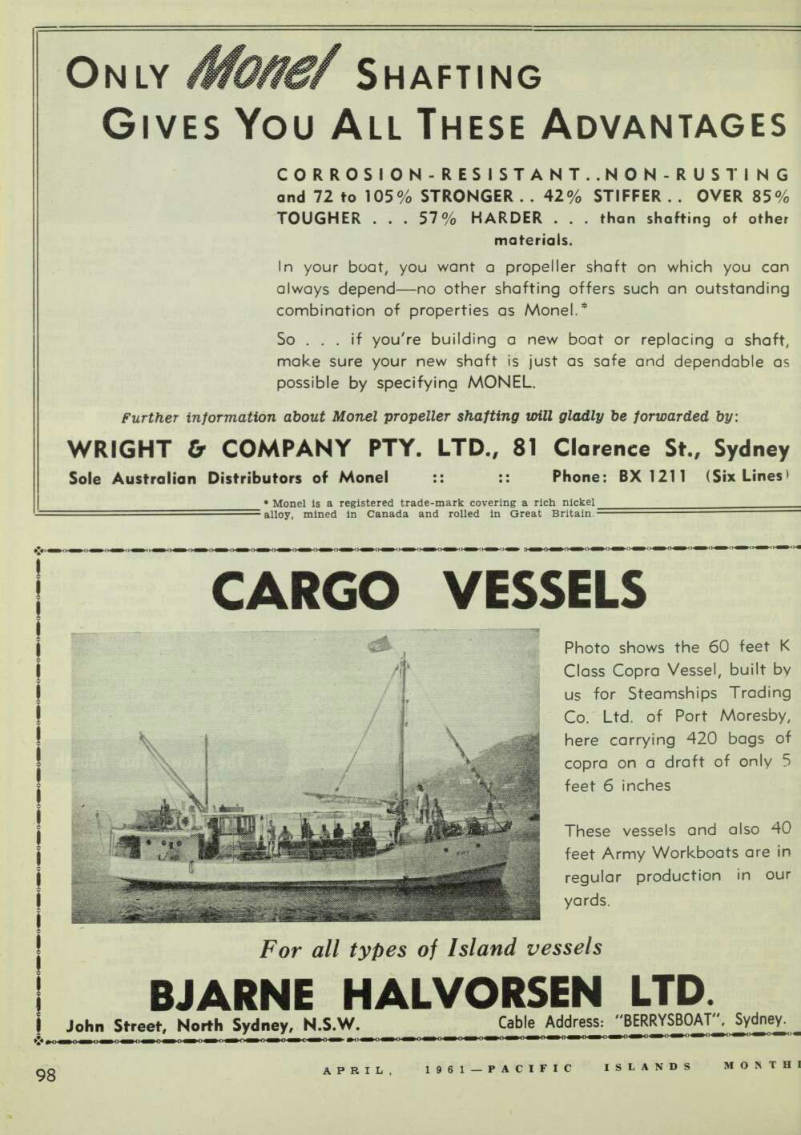 100
100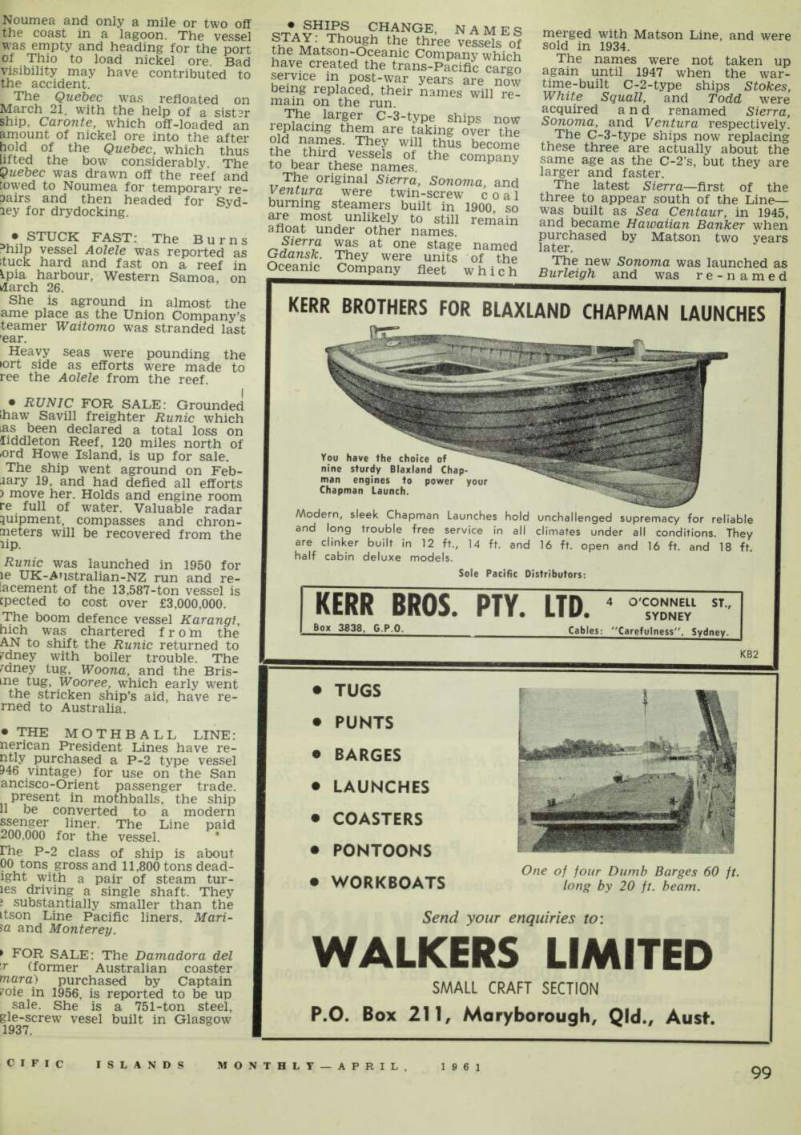 101
101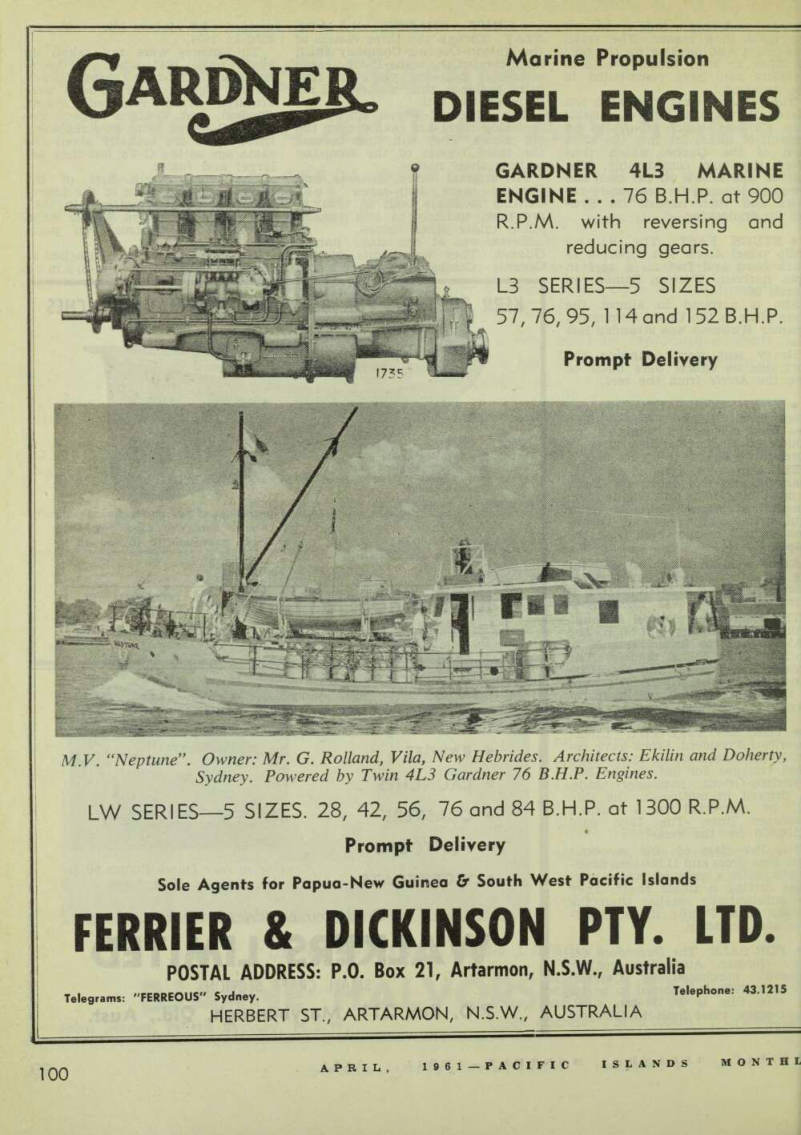 102
102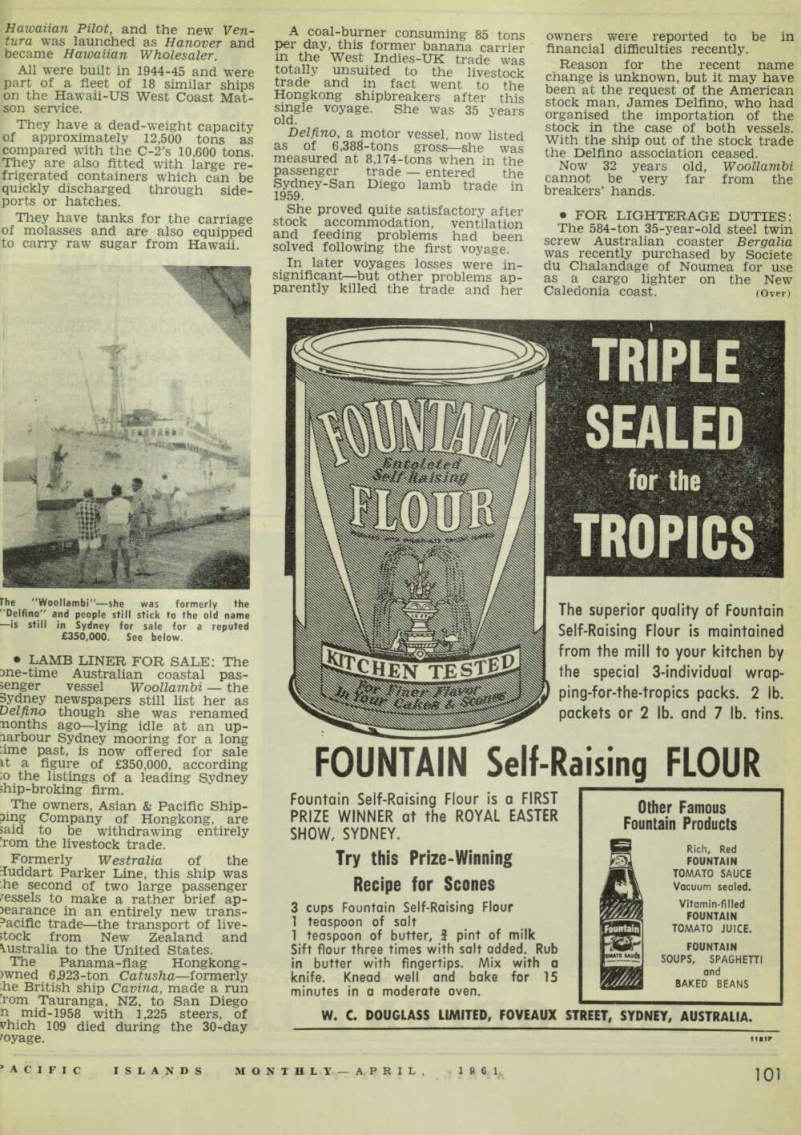 103
103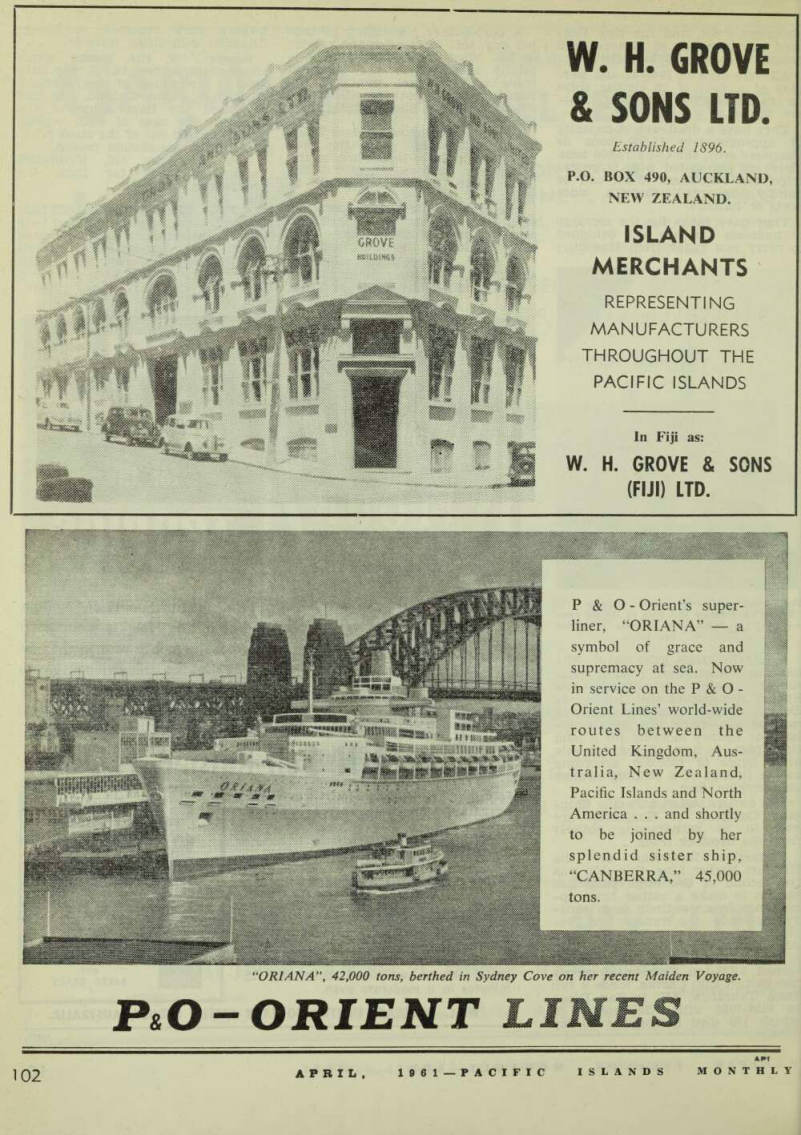 104
104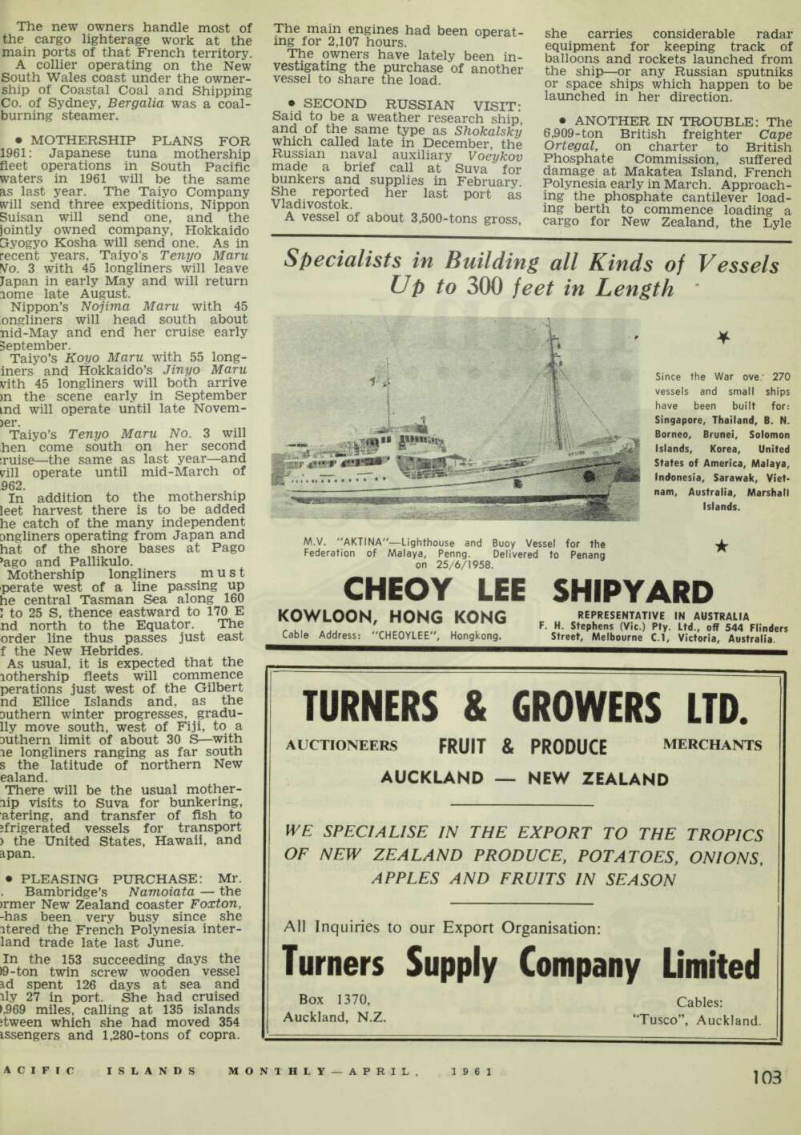 105
105 106
106 107
107 108
108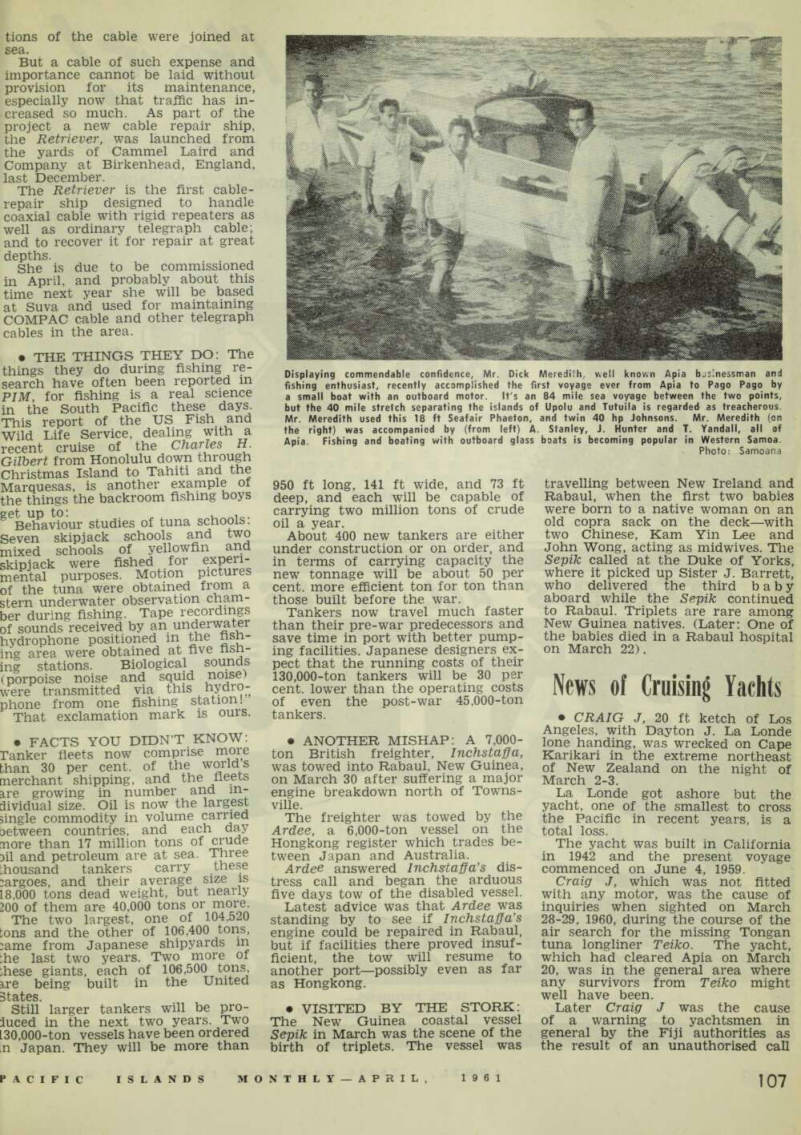 109
109 110
110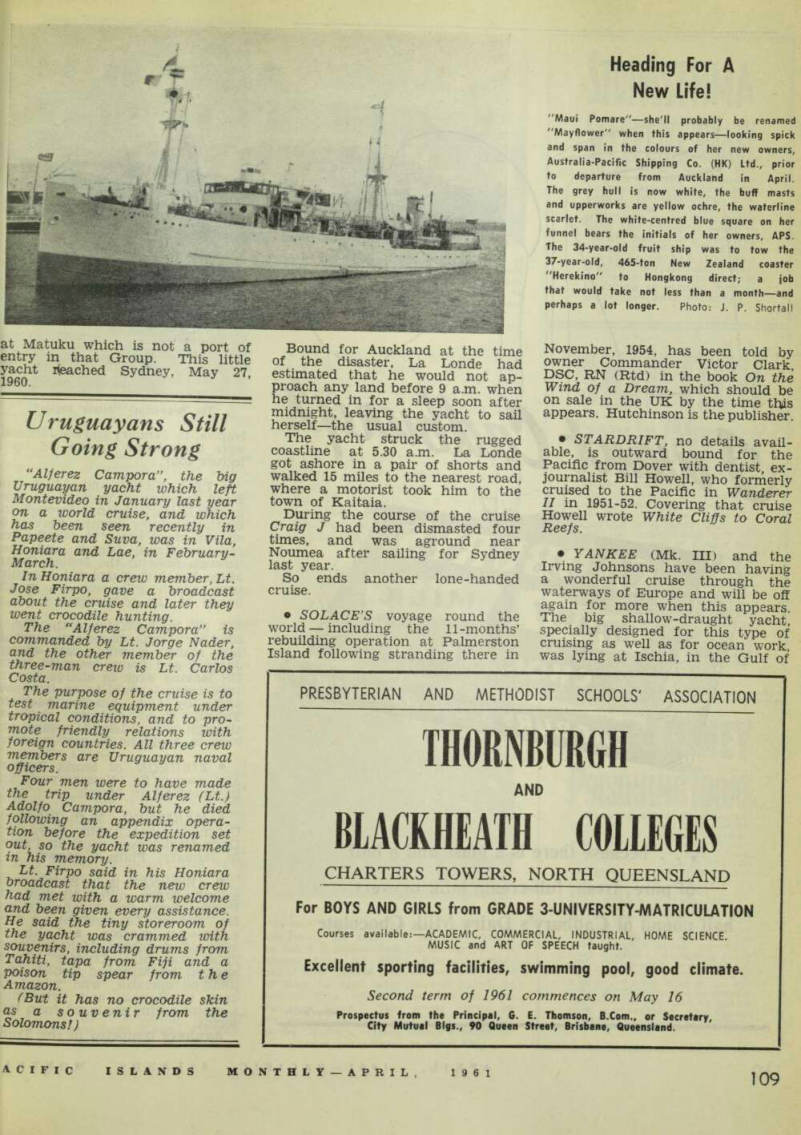 111
111 112
112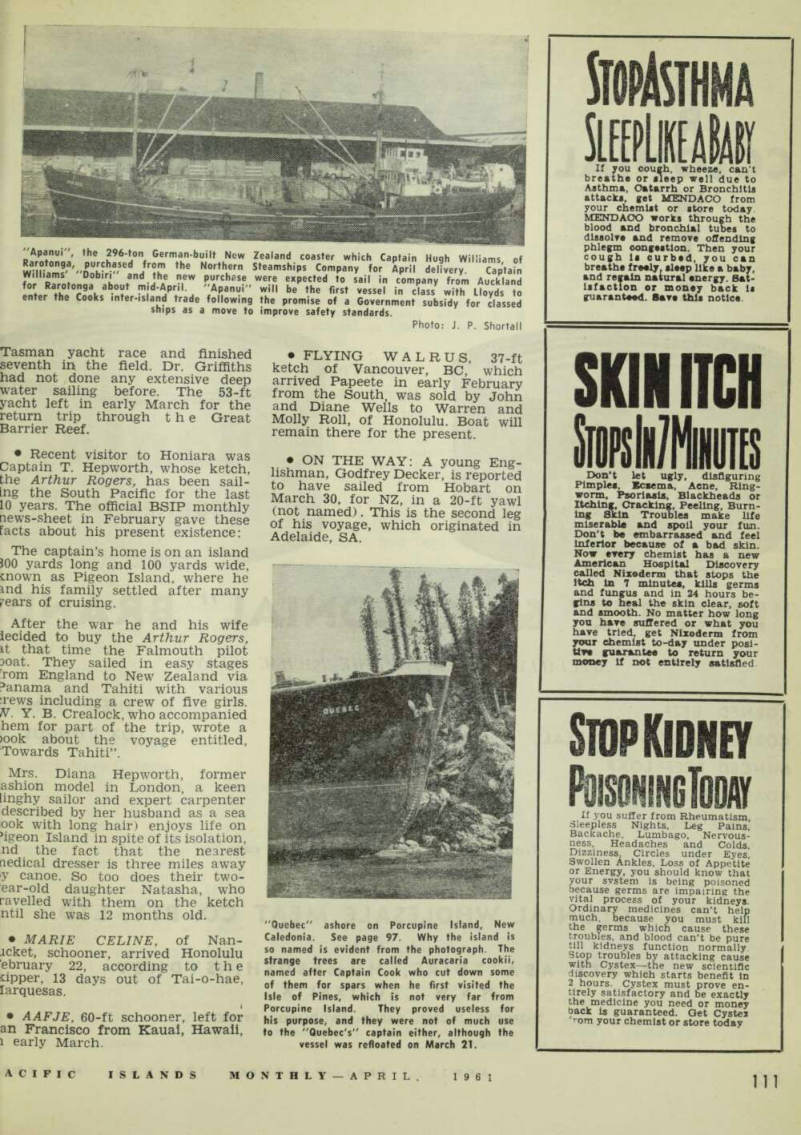 113
113 114
114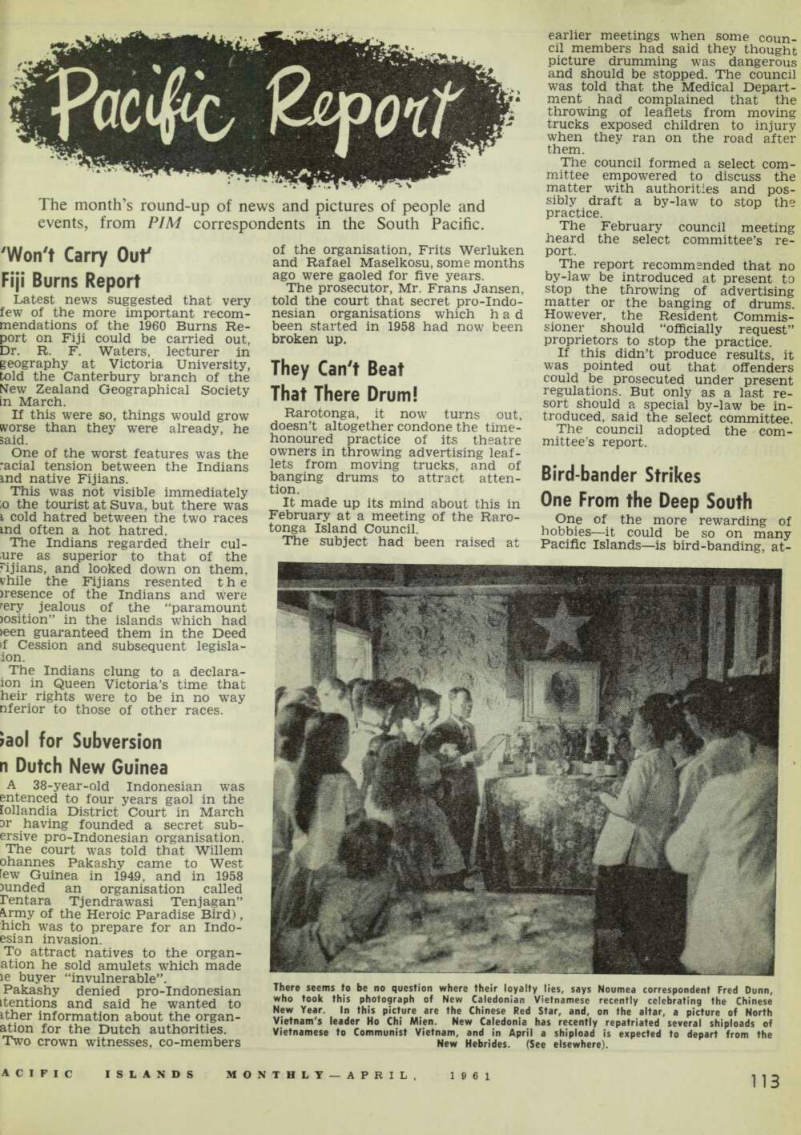 115
115 116
116 117
117 118
118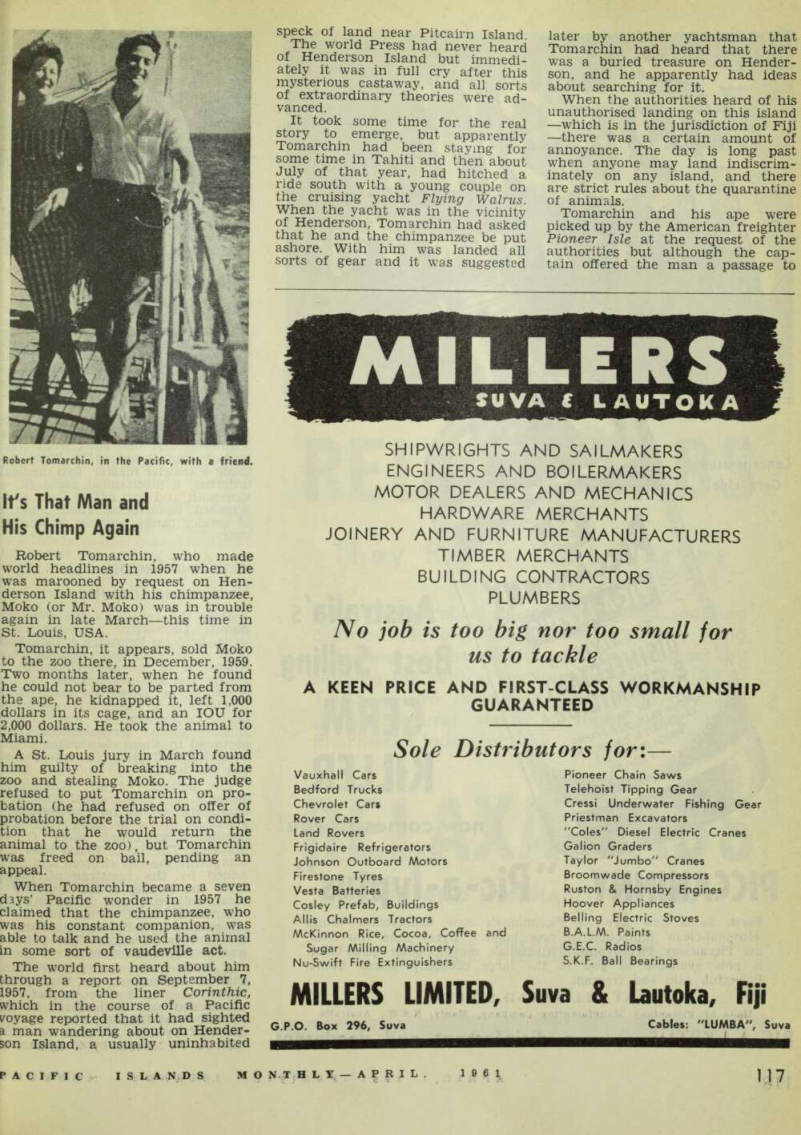 119
119 120
120 121
121 122
122 123
123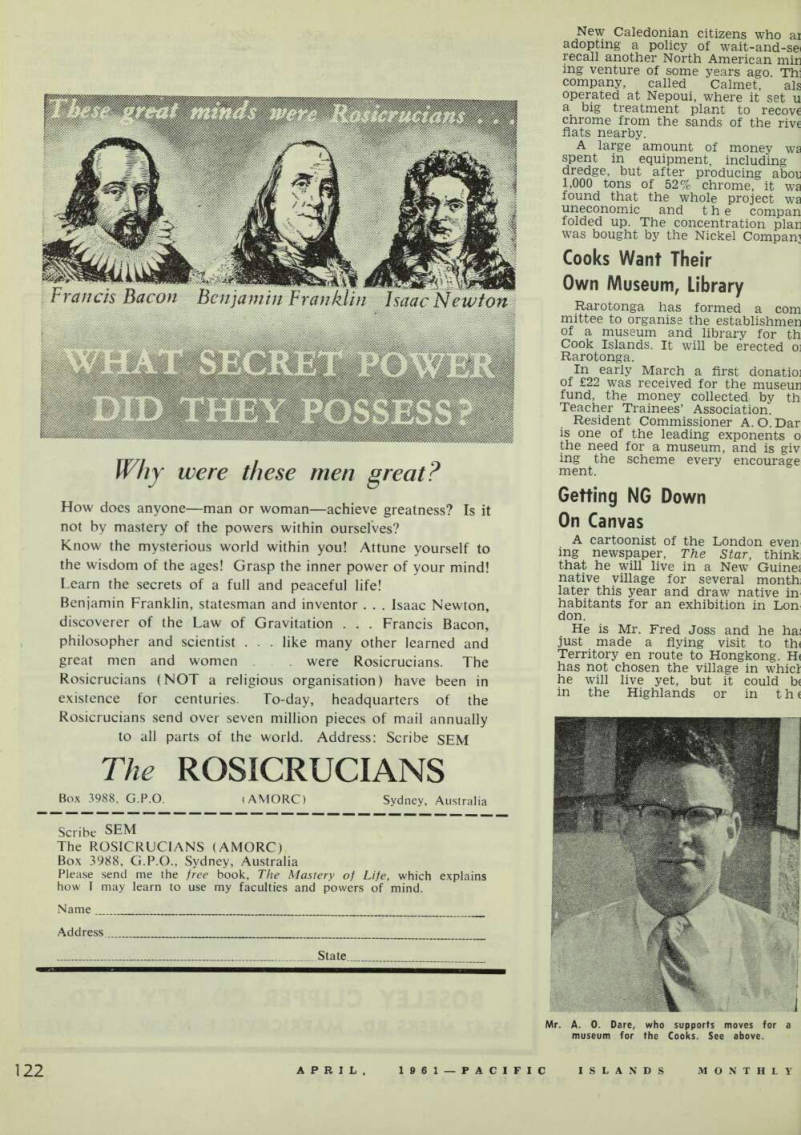 124
124 125
125 126
126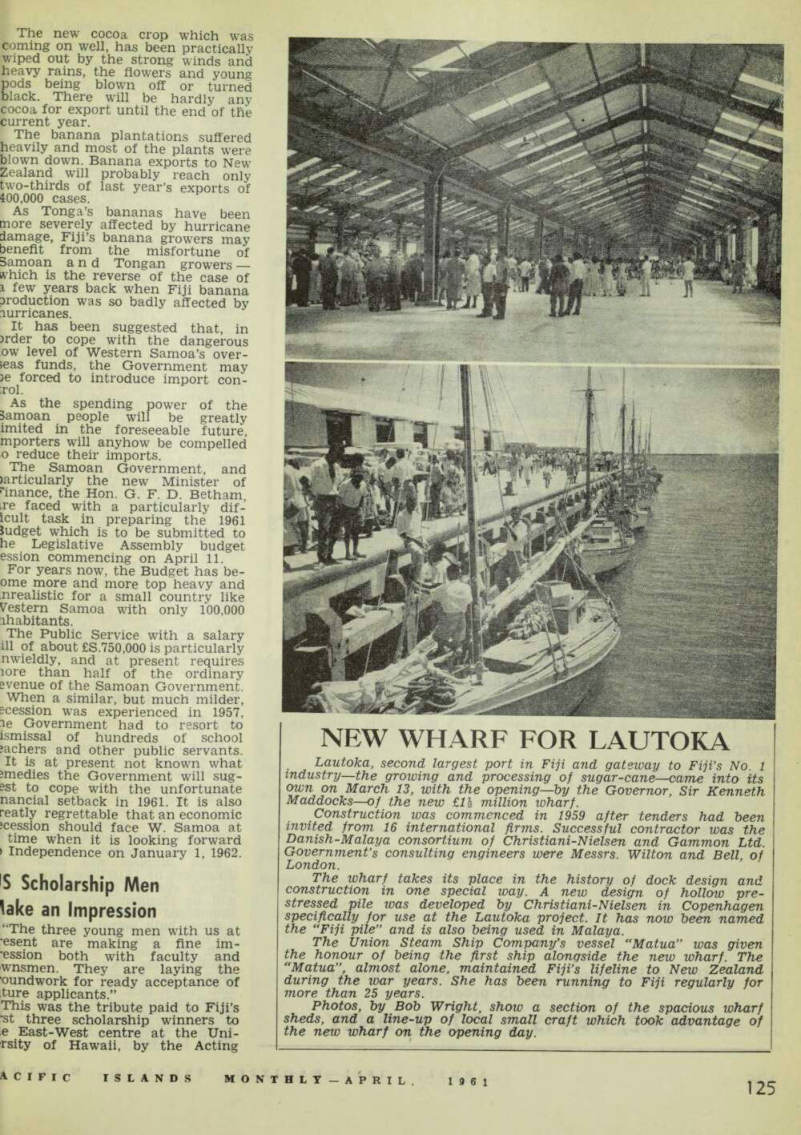 127
127 128
128 129
129 130
130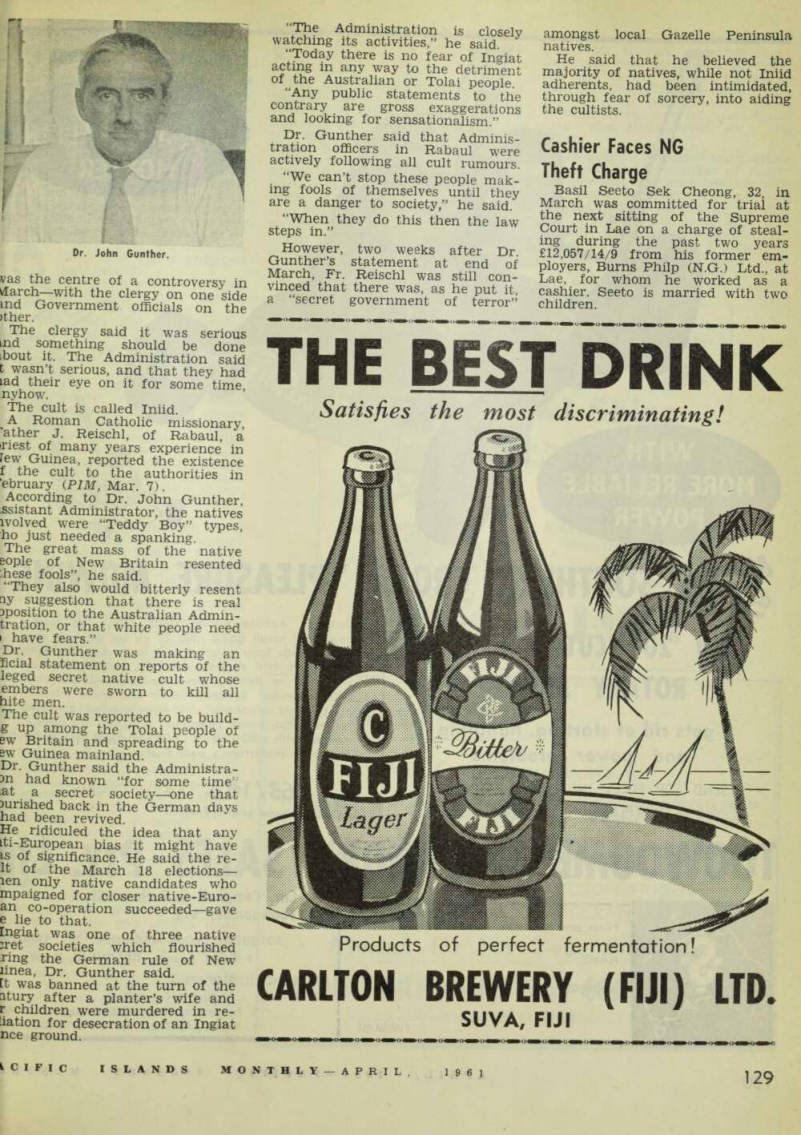 131
131 132
132 133
133 134
134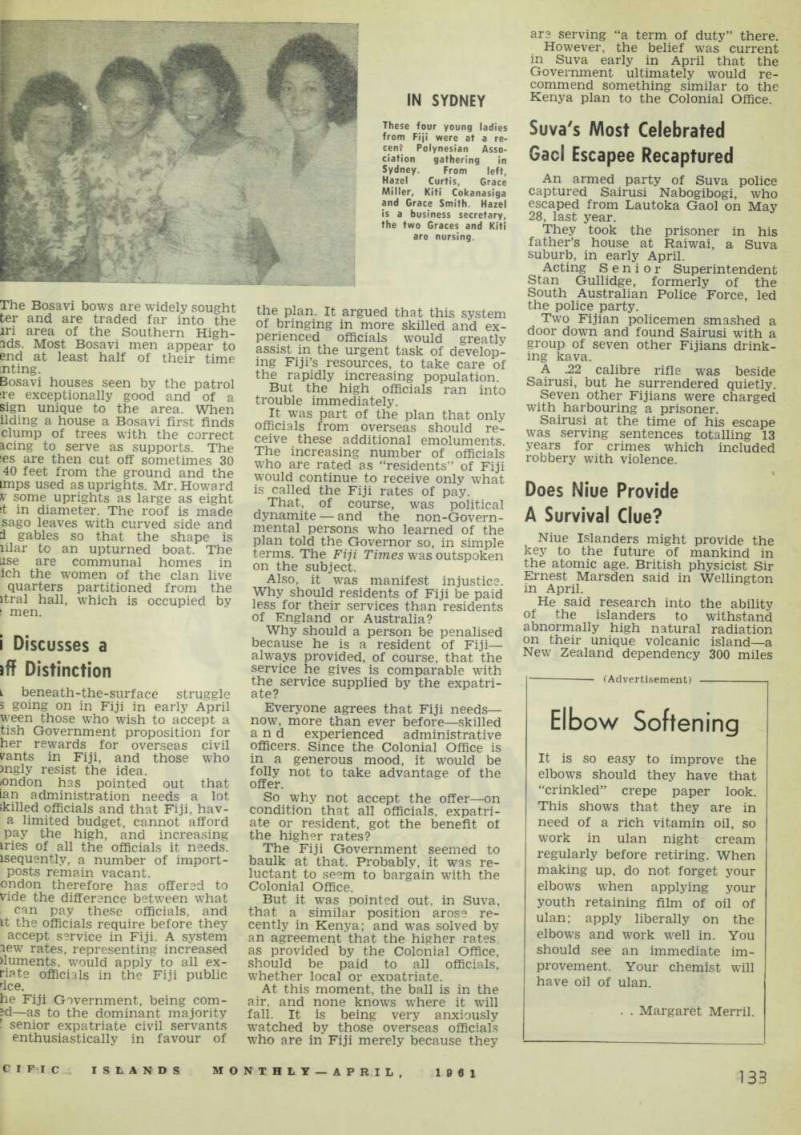 135
135 136
136 137
137 138
138 139
139 140
140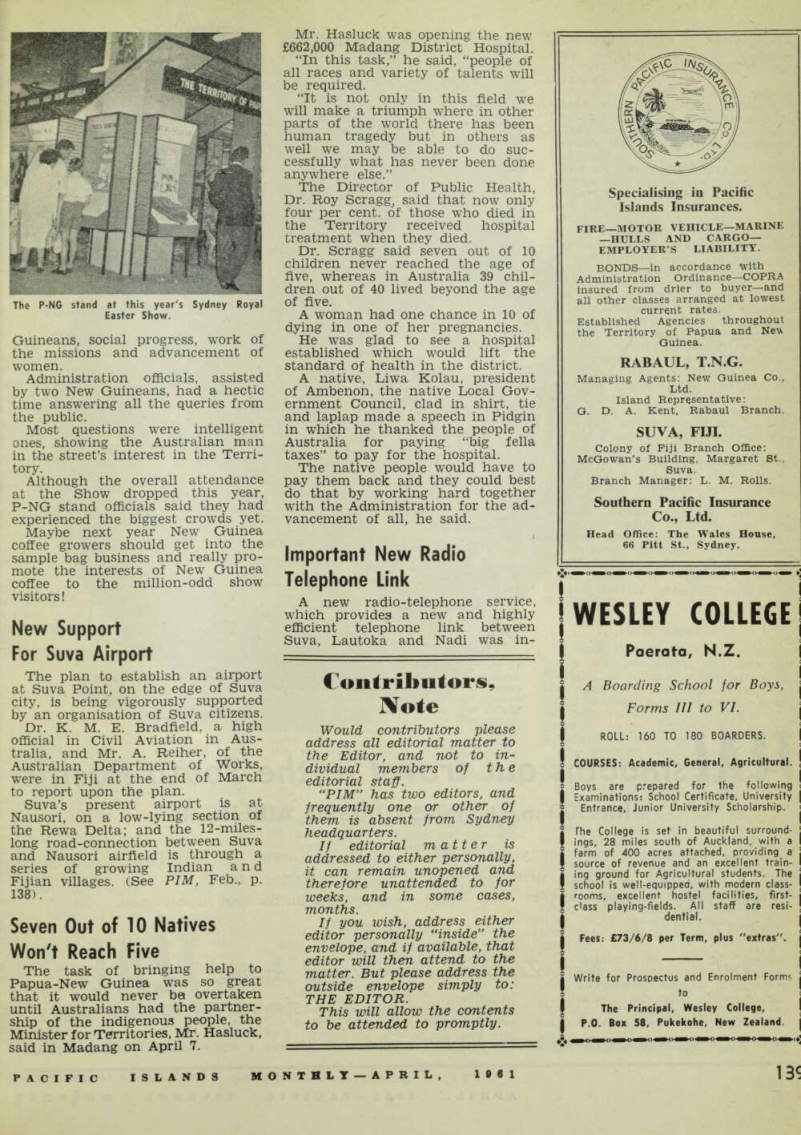 141
141 142
142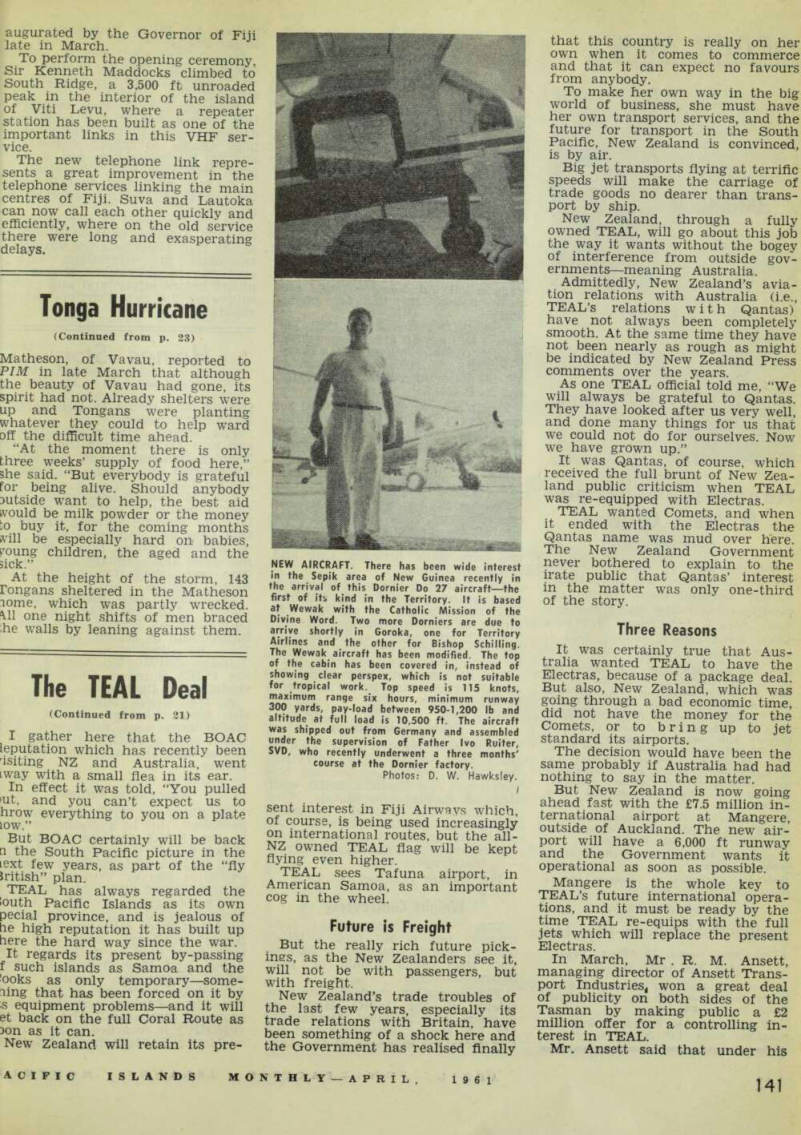 143
143 144
144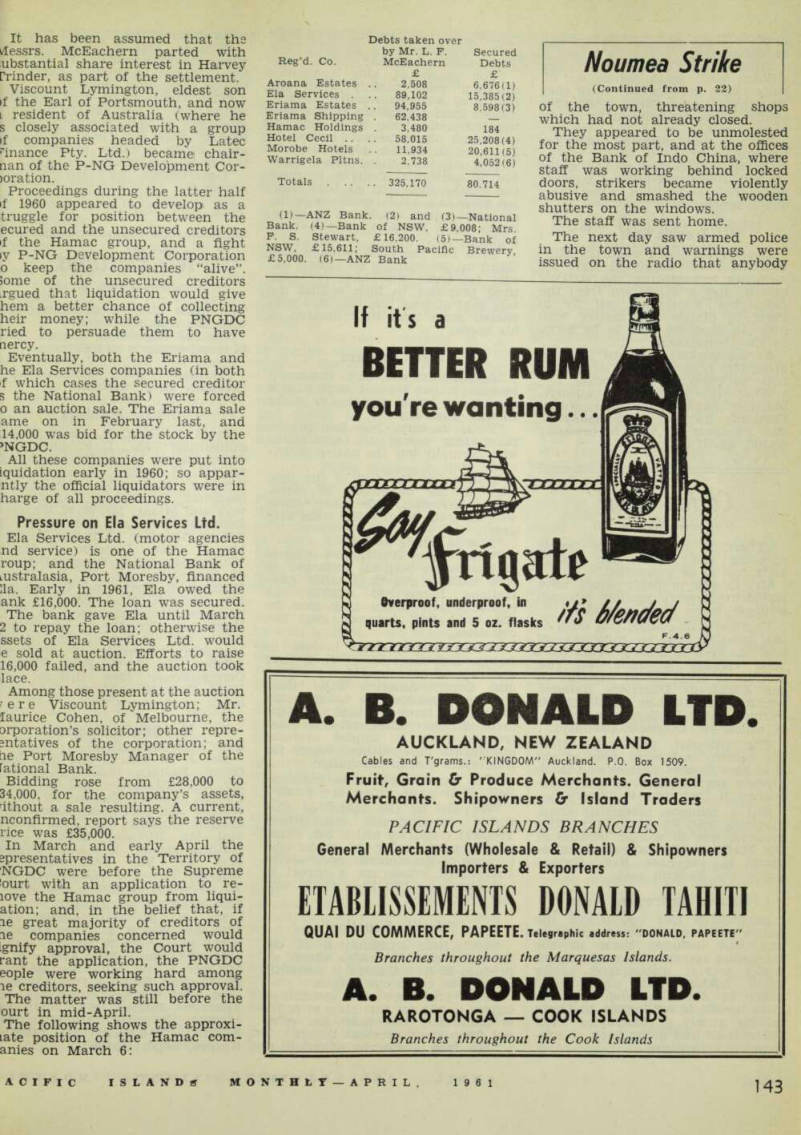 145
145 146
146 147
147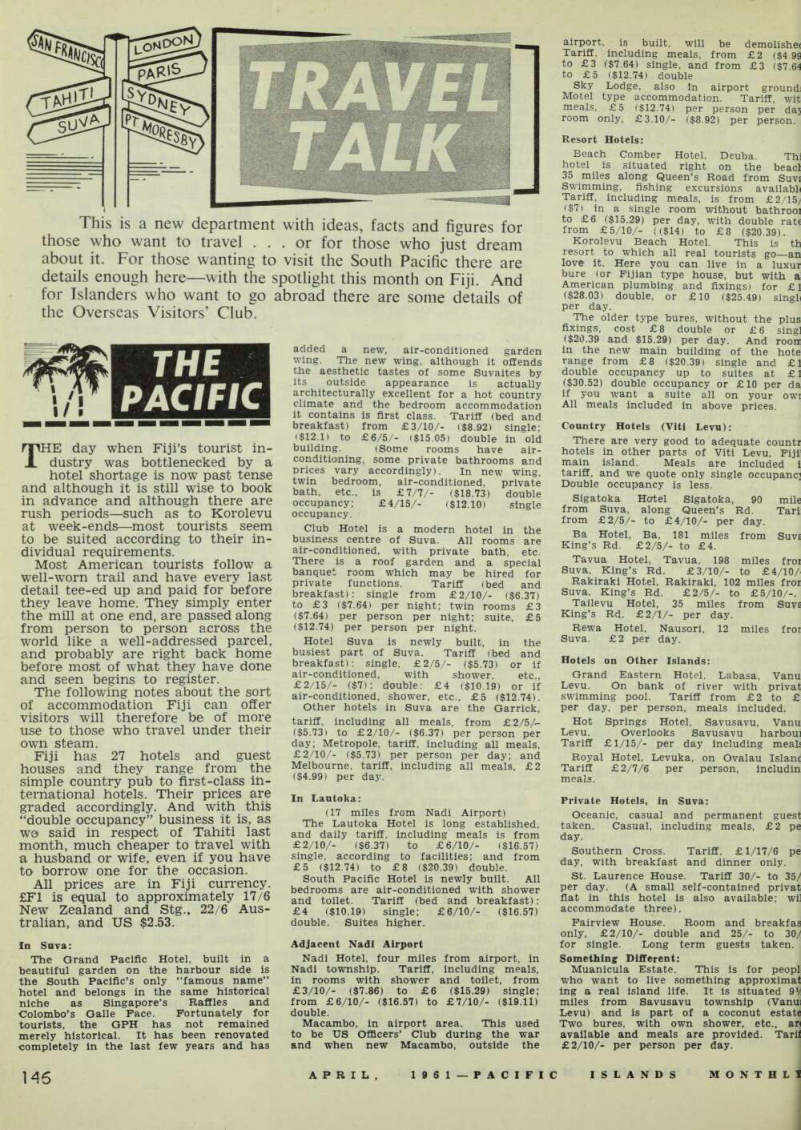 148
148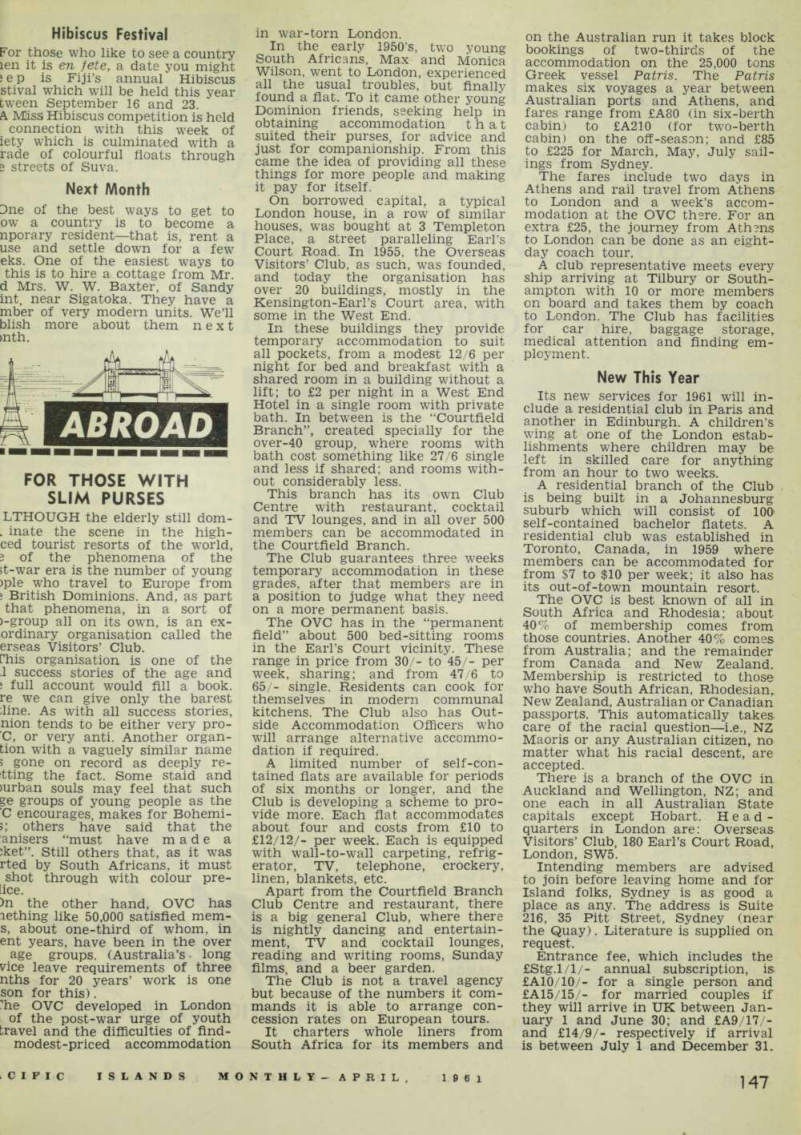 149
149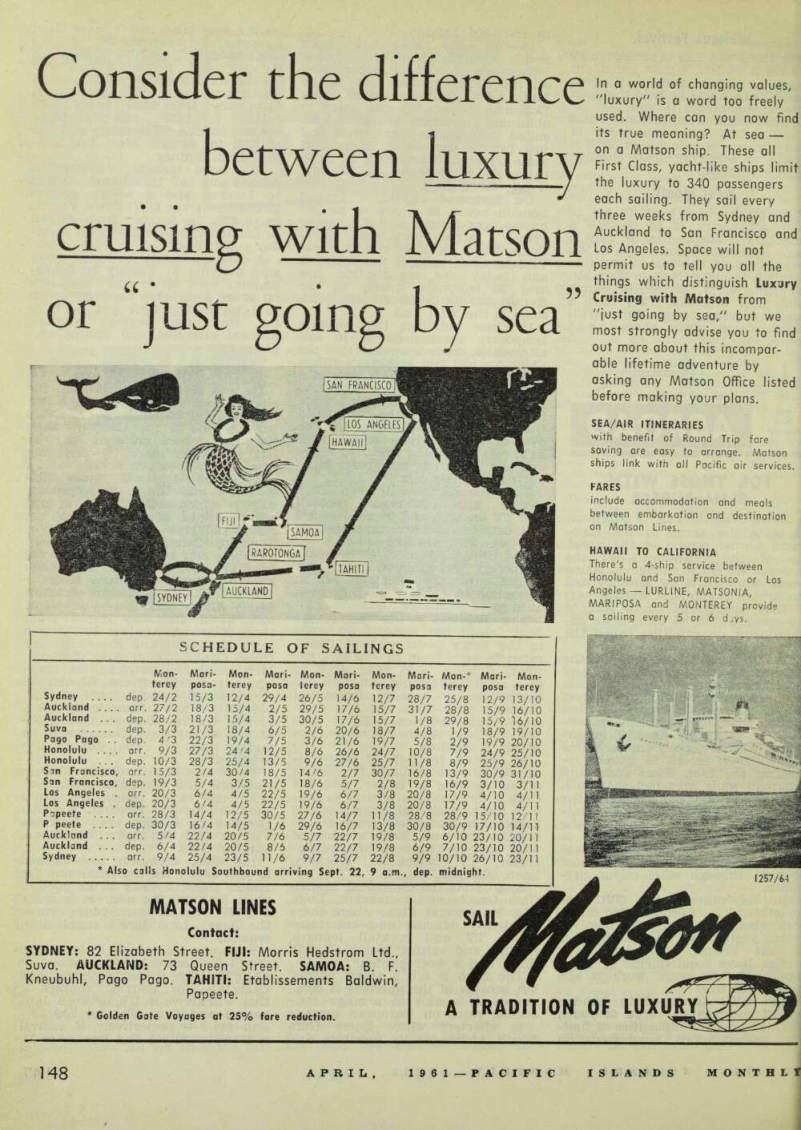 150
150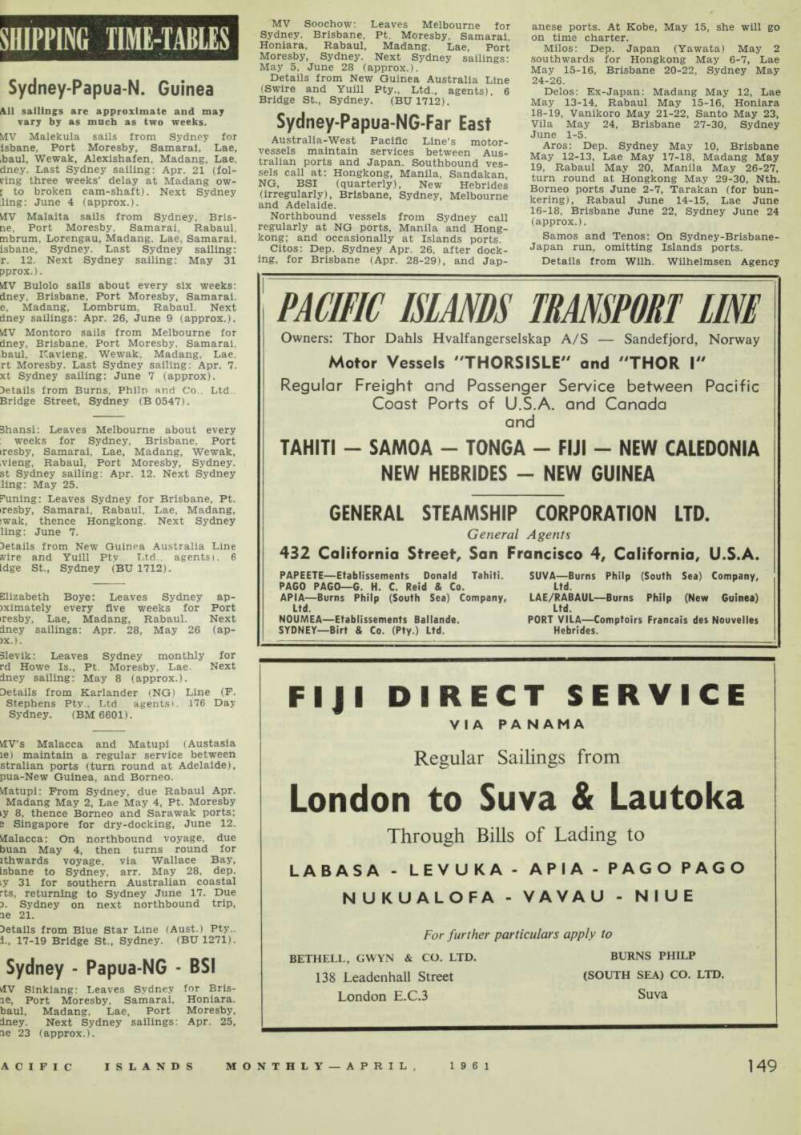 151
151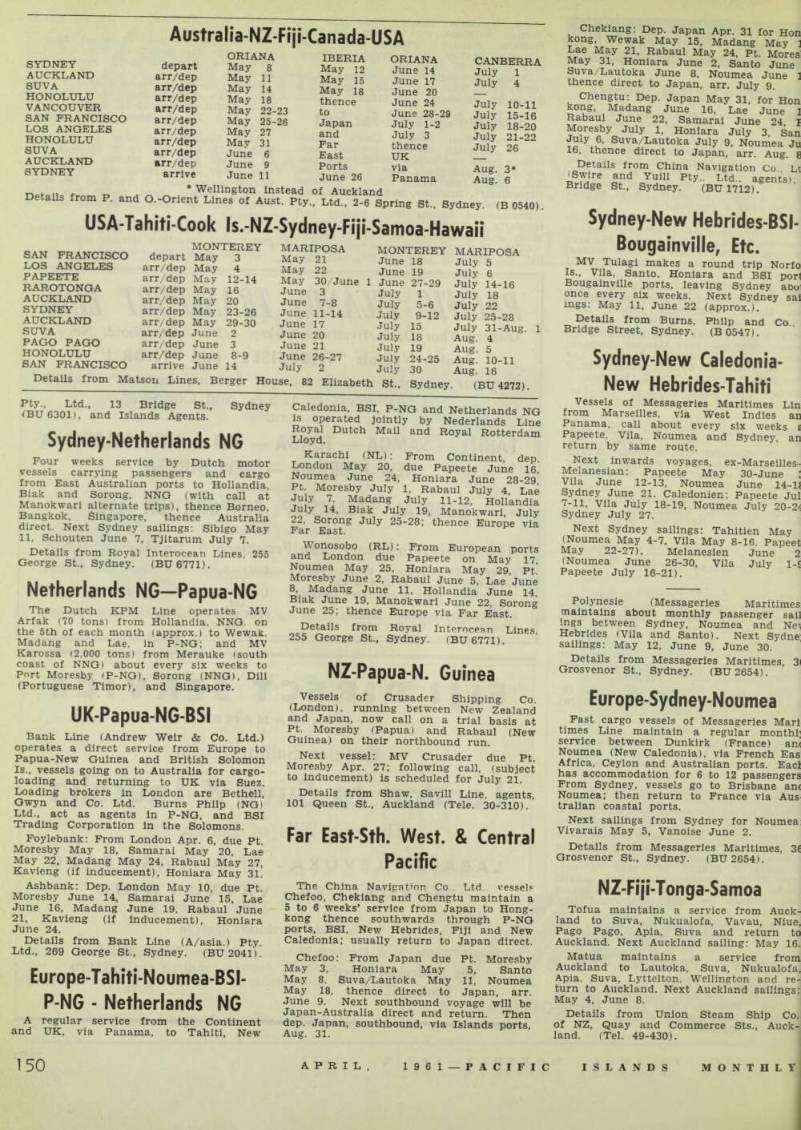 152
152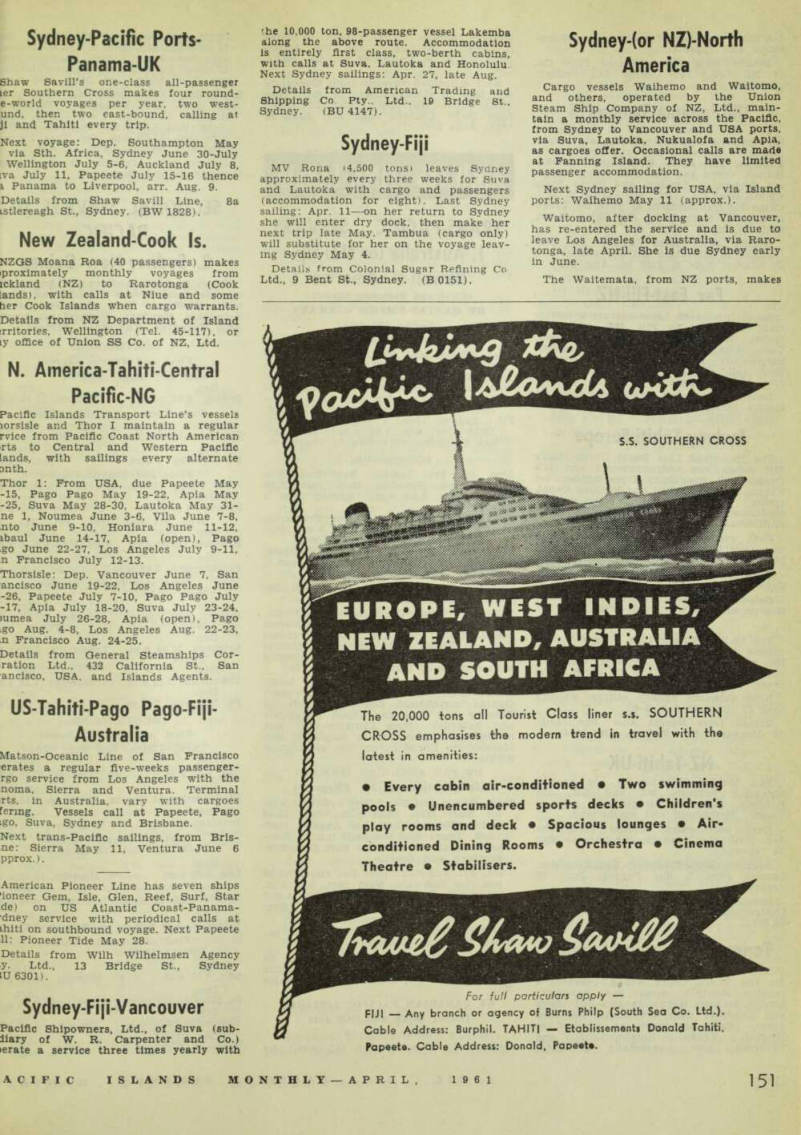 153
153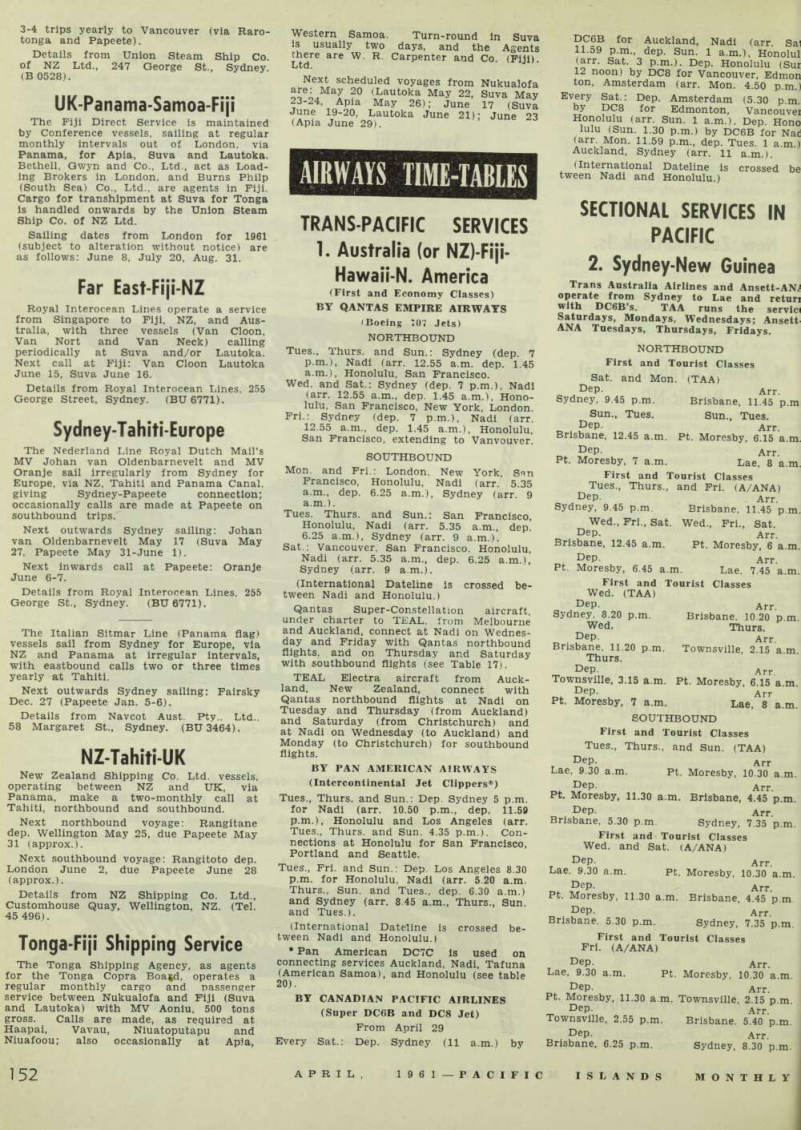 154
154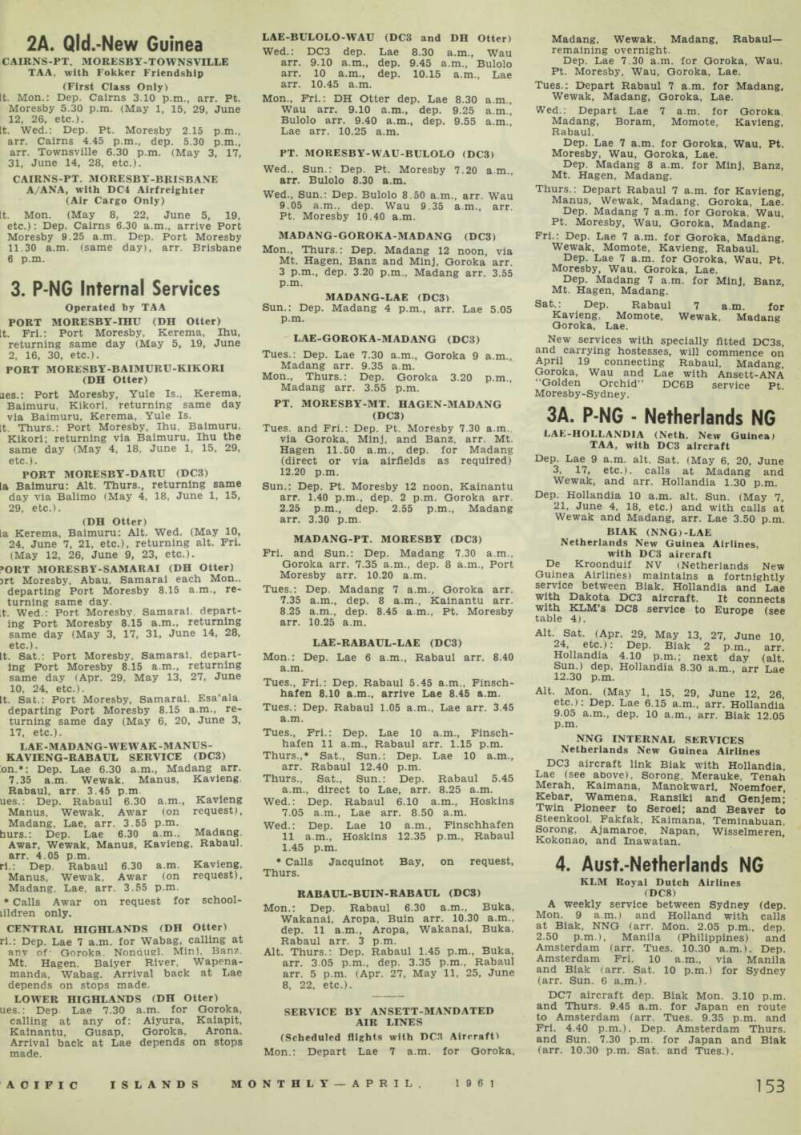 155
155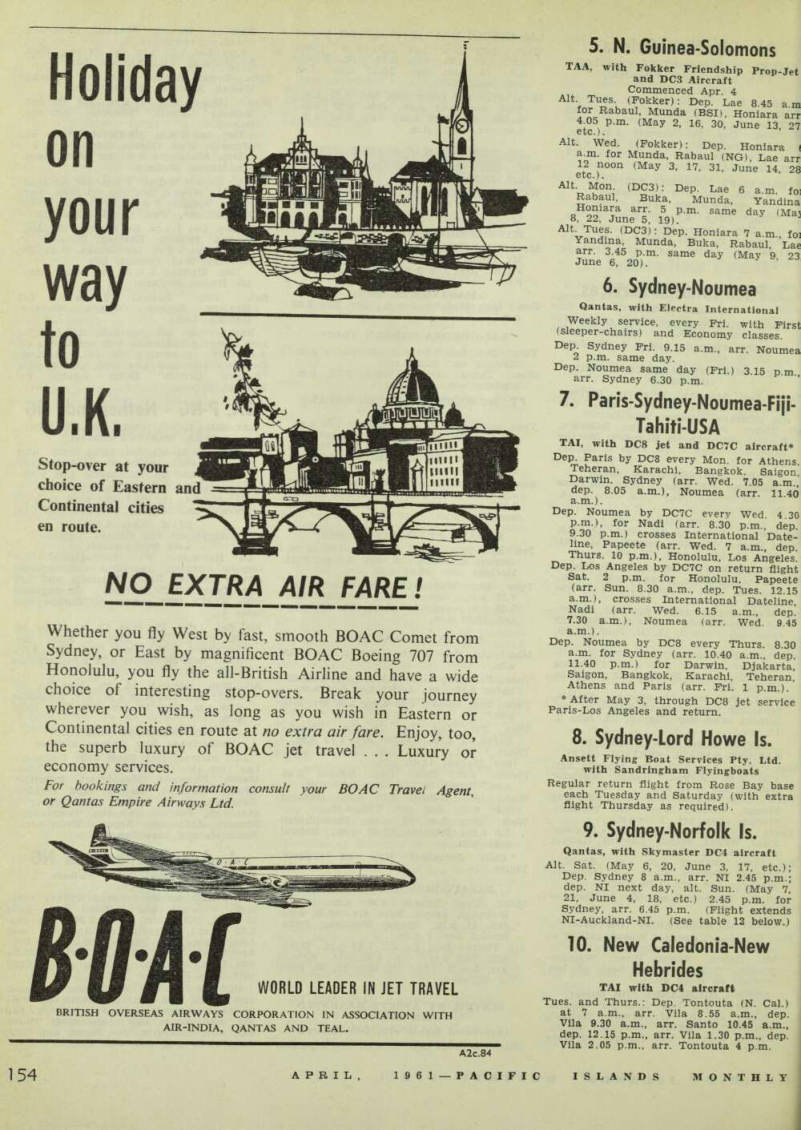 156
156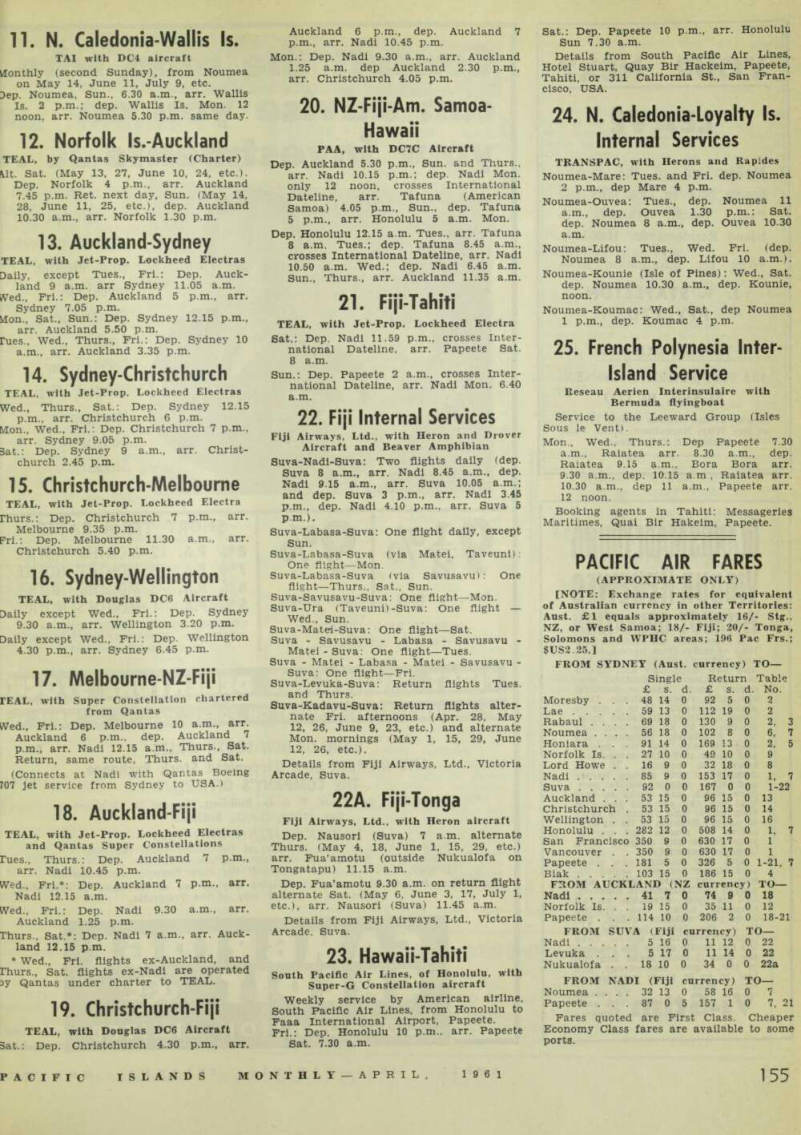 157
157 158
158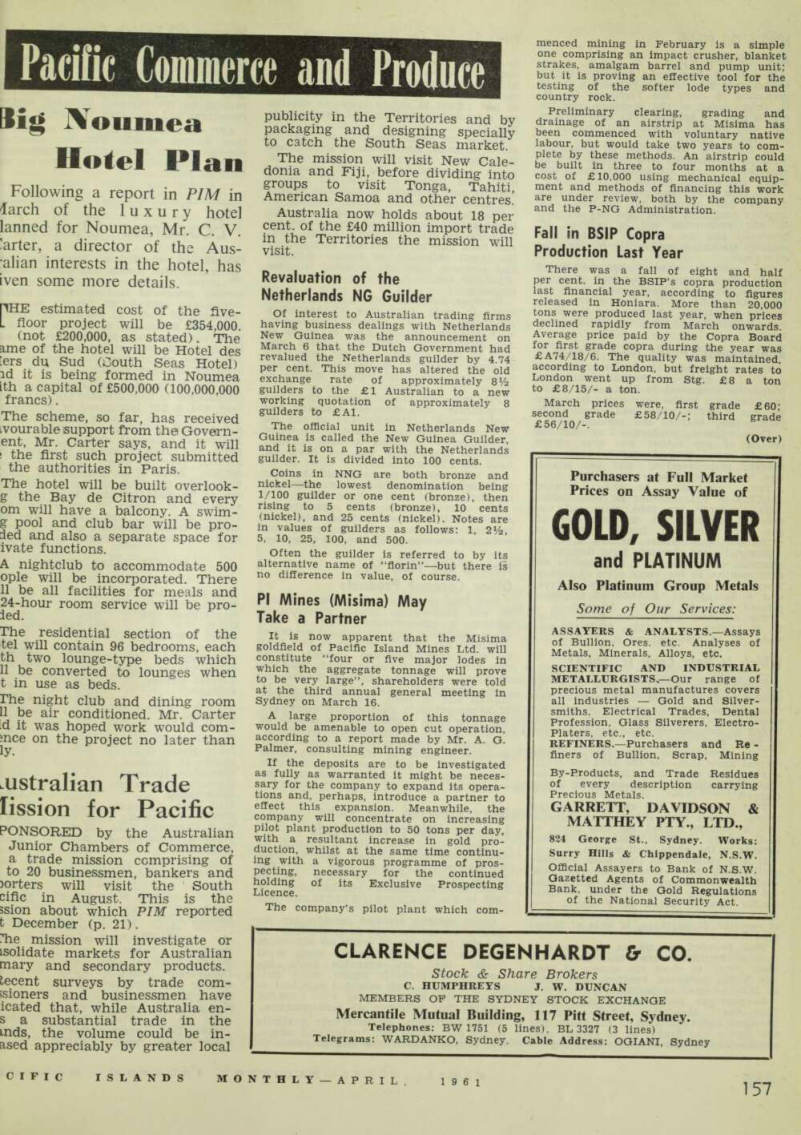 159
159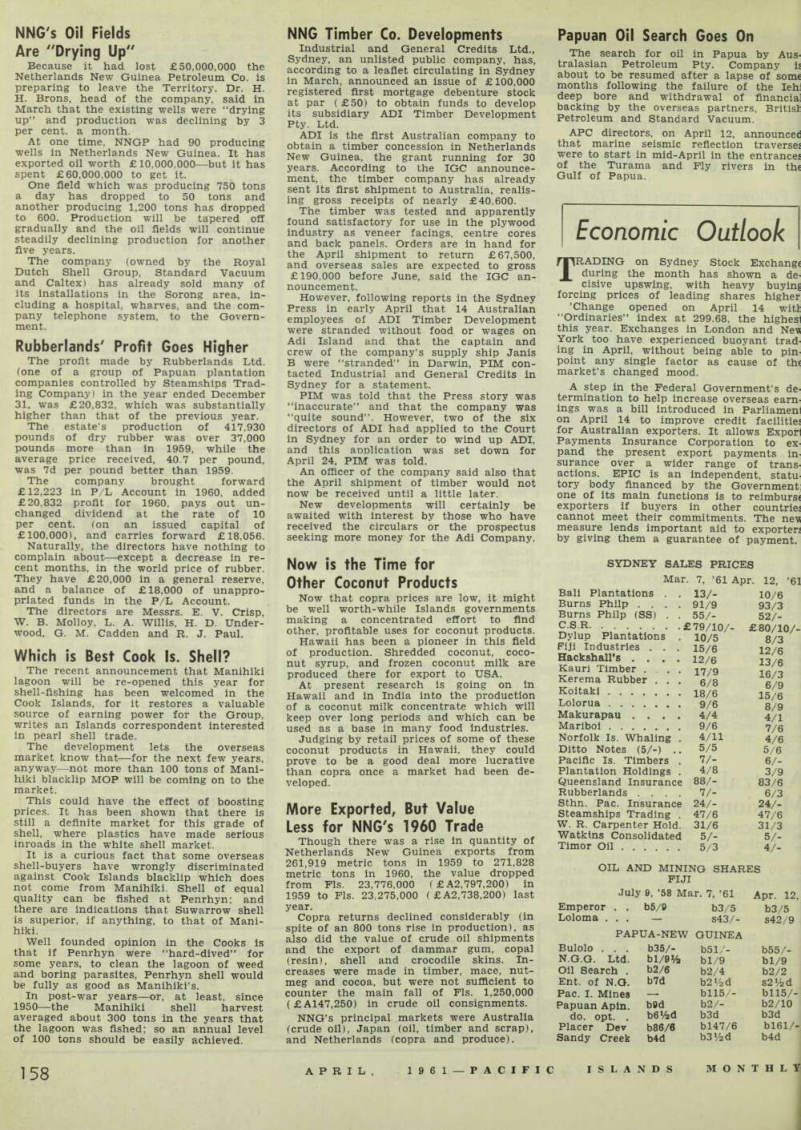 160
160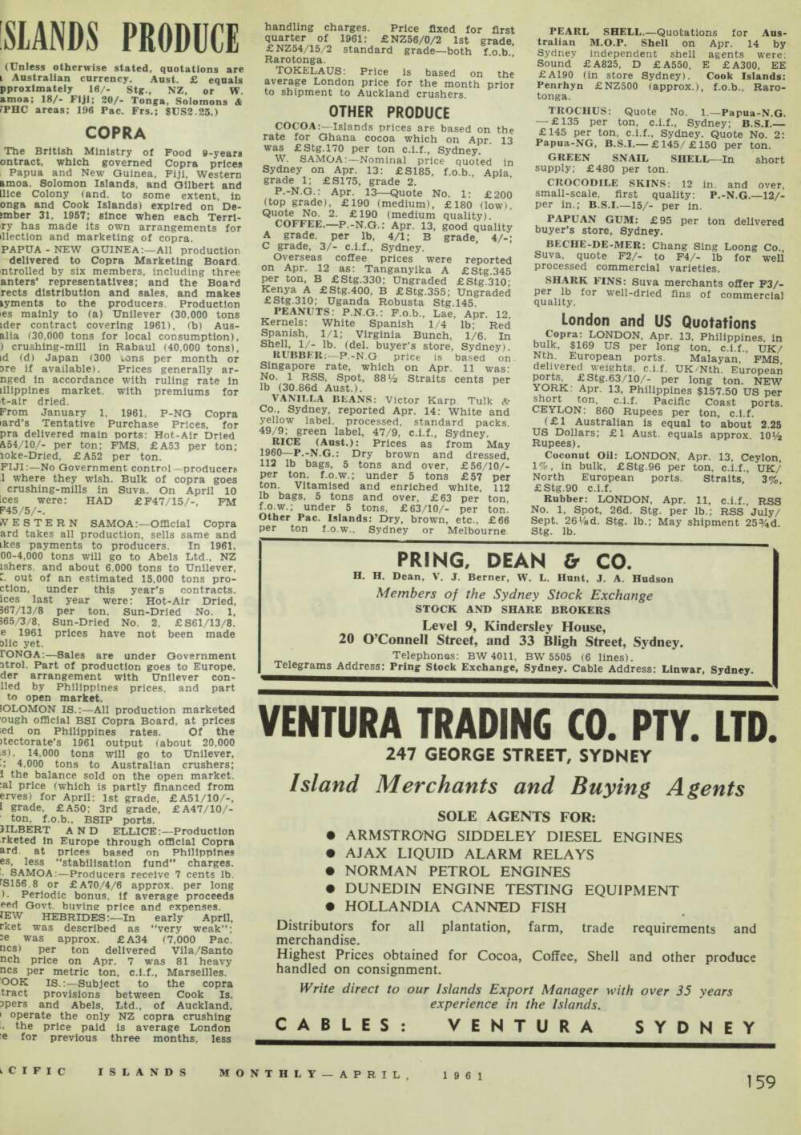 161
161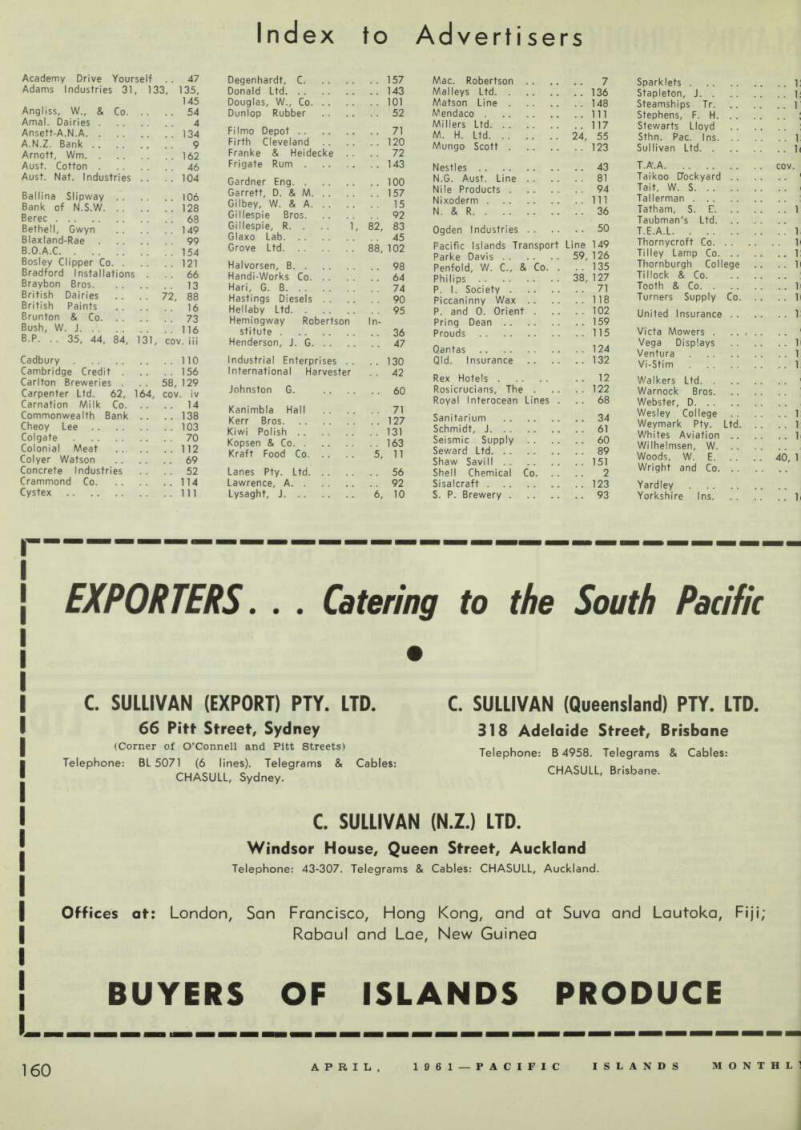 162
162 163
163 164
164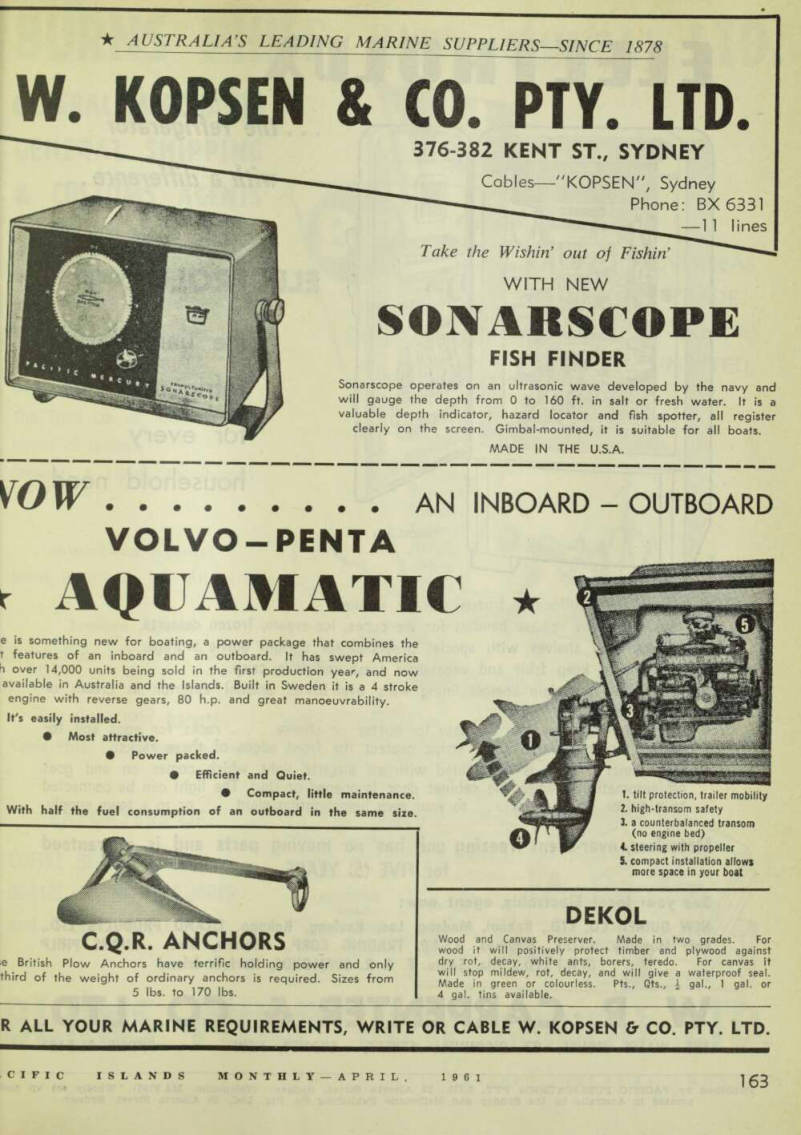 165
165 166
166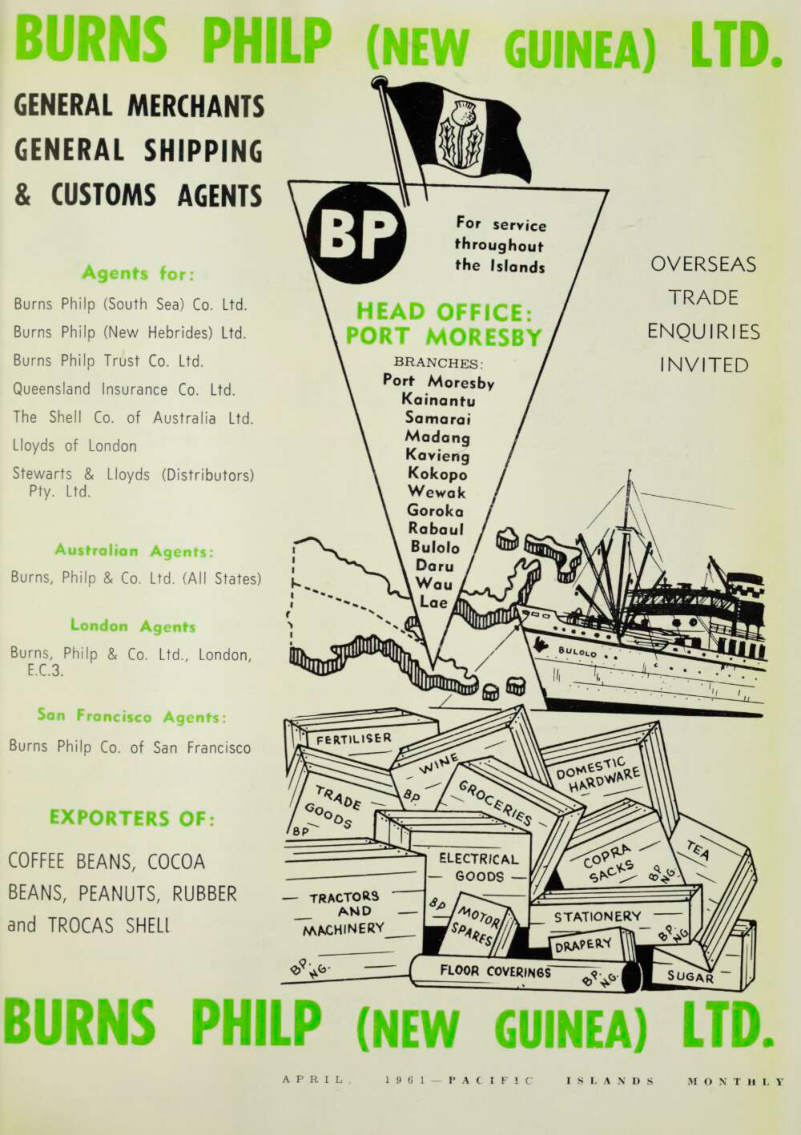 167
167 168
168