France Reminds The World
pp. 31-33 · Read in the full issue
Beryl Sawyer Reports From Tahiti
That Paradise Is French
In a laudable effort ( to keep Tahiti French’, the French dministration recently started a campaign to enforce a decree tted October, 1959, which prohibits signs printed or painted any language other than French.
NS in French, BOLD-TYPE, are, however, allowed to have a lation in foreign language under i in small type. cal policemen went from shop hop in downtown Papeete re ing the removal within 10 days )ffending signs, notices, travel rs etc, op-keepers were advised that a could be expected for non fiance. Calendars from major es, stickers for cars and bicycles, signs in English for the benefit lilingual tourists—all were erased rown into the trash can. ared by the enforcement were ally registered trade names such ainn’s Tahitian Hut, Royal Tahi- Hotel, etc.
Photographer For The Us
magazine Time wanted to photo i Emile Gauguin, son of the us French painter Paul Gauguin.
Emile was nowhere to be found, jsual corner of Papeete’s water where he sits making bamboo traps for tourists was deserted, aconut radio’ informed the Time agrapher that Emile was at Raia visiting one of his vahines and of his countless children. So a
telegram was sent to Raiatea, care of the local gendarme. Emile saw the cop coming and started to run for his life.
But his blubber slowed him down, the cop delivered the message, Emile was put on the boat to Papeete, and Time organised its photograph, taken at the old site of Paul Gaugin’s home in Punaauia, west of Papeete.
Emile, as he posed with eight of his Papeete children, had a big smile— and 1,000 francs in his pocket.
TROUBLE came to Papeete with the arrival of the Welsh freighter Llandrysant, home port Cardiff. Crew members were full of admiration for MGM’s replica of the Bounty.
Armed with wrenches, members of Llandrysant’s crew boarded Bounty one dark night in order to grab a few souvenirs for their Welsh vahines. The 72-year-old Bounty night watchman, armed with a belaying pin, set about the Welshmen and yelled for help from the sleeping Canadian crew.
The battle of the Bounty was fought —and won. But not before one serious casualty—a fractured skull— was suffered by one of the boarding party.
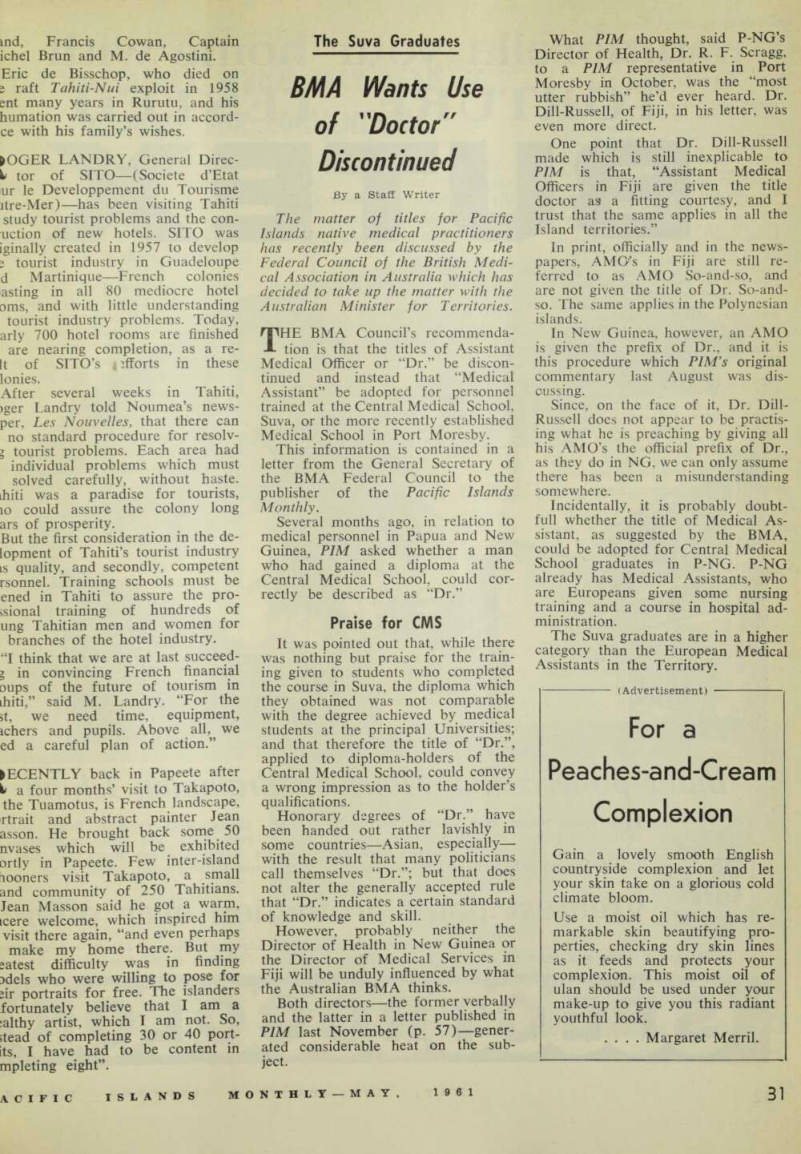
APRIL 5 the mortal remains of Eric de Bisschop, famous Pacific sailor and navigator, were transferred from the National Marine vault at Tipaerui Cemetery, near Papeete, and conveyed aboard the schooner Tamara on their last voyage to the island of Rurutu. The flower-bedecked coffin was solemnly escorted to the waiting ship by ten French sailors.
Numerous friends of Eric de Biss chop were present at the exhumation ceremony including Commandant Jean Dupont, Admiral Durand de St.
Front, Colonel Louis Castex, Consul for Chile Carlos Palacios, Consul for France in San Francisco M. Ber-
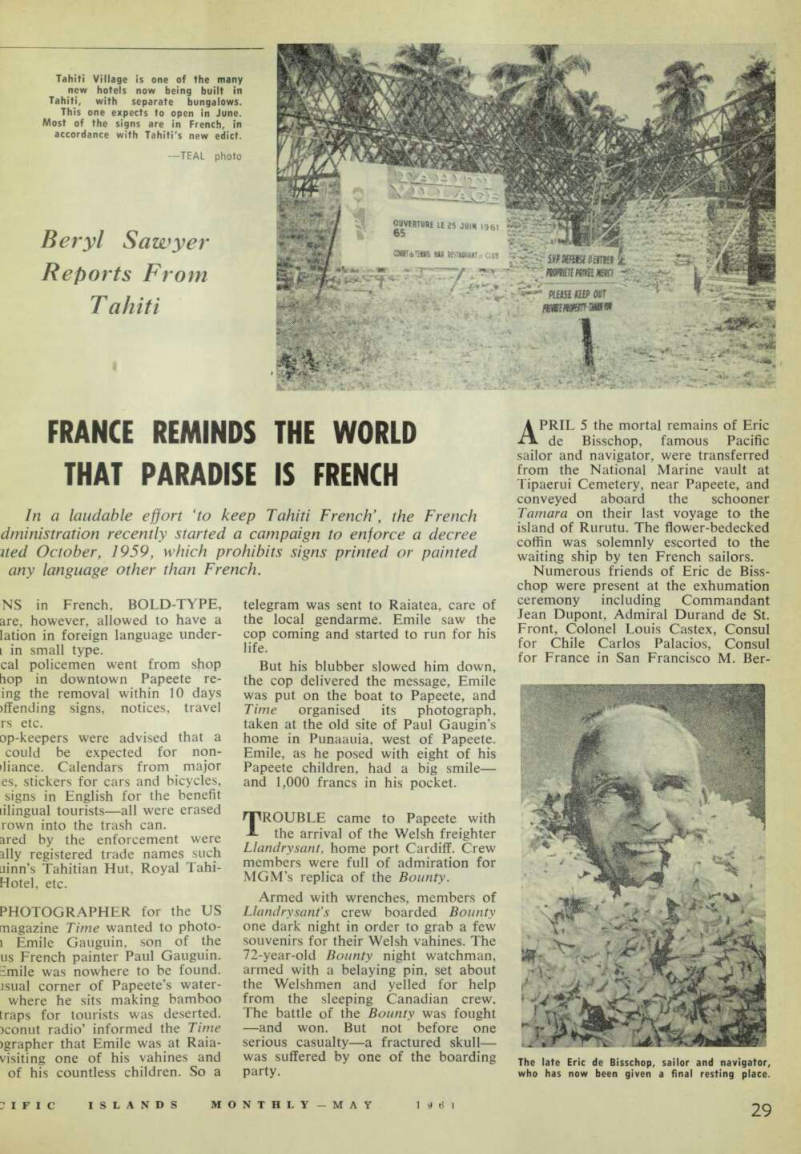
Tahiti Village is one of the many new hotels now being built in Tahiti, with separate bungalows.
This one expects to open in June.
Most of the signs are in French, in accordance with Tahiti's new edict. —TEAL photo
The late Eric de Bisschop, sailor and navigator, who has now been given a final resting place.
md, Francis Cowan, Captain ichel Brun and M. de Agostini.
Eric de Bisschop, who died on t raft Tahiti-Nui exploit in 1958 ent many years in Rurutu, and his humation was carried out in accord ce with his family’s wishes. >OGER LANDRY, General Direc ts tor of SlTO—(Societe d’Etat ur le Developpement du Tourisme itre-Mer) —has been visiting Tahiti study tourist problems and the con uction of new hotels. SITO was iginally created in 1957 to develop 2 tourist industry in Guadeloupe d Martinique—French colonies asting in all 80 mediocre hotel □ms, and with little understanding tourist industry problems. Today, arly 700 hotel rooms are finished are nearing completion, as a re lt of SITO’s i efforts in these lonies.
After several weeks in Tahiti, >ger Landry told Noumea’s news per, Les Nouvelles , that there can no standard procedure for resolv l tourist problems. Each area had individual problems which must solved carefully, without haste, ihiti was a paradise for tourists, io could assure the colony long ars of prosperity.
But the first consideration in the de lopment of Tahiti’s tourist industry is quality, and secondly, competent rsonnel. Training schools must be ened in Tahiti to assure the pro >sional training of hundreds of ung Tahitian men and women for branches of the hotel industry.
“I think that we are at last succeed l in convincing French financial □ups of the future of tourism in ihiti,” said M. Landry. “For the st, we need time, equipment, ichers and pupils. Above all, we ed a careful plan of action.”
RECENTLY back in Papeete after i a four months’ visit to Takapoto, the Tuamotus, is French landscape, rtrait and abstract painter Jean asson. He brought back some 50 nvases which will be exhibited ortly in Papeete. Few inter-island □ooners visit Takapoto, a small and community of 250 Tahitians.
Jean Masson said he got a warm, icere welcome, which inspired him visit there again, “and even perhaps make my home there. But my latest difficulty was in finding Ddels who were willing to pose for ;ir portraits for free. The islanders fortunately believe that I am a :althy artist, which I am not. So, dead of completing 30 or 40 port its, I have had to be content in mpleting eight”.