Fiji Toads Love
p. 33 · Read in the full issue
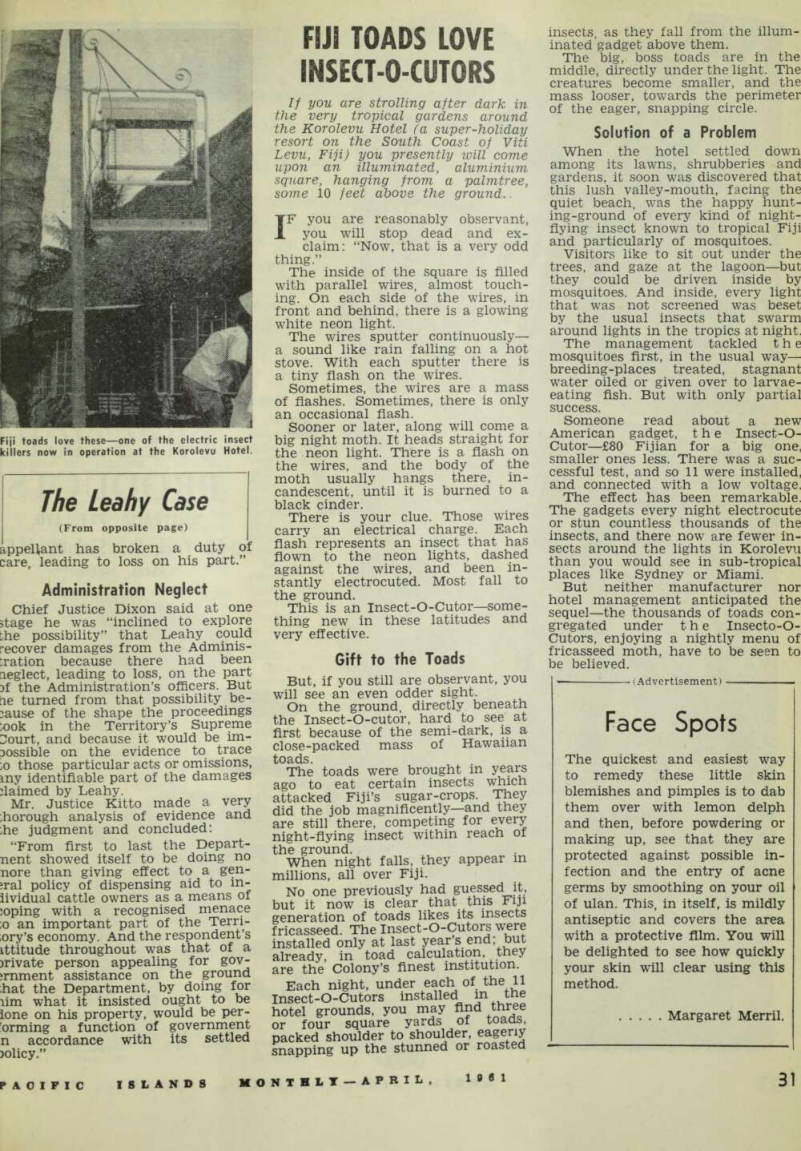
Insect-O-Cutors
If you are strolling after dark in the very tropical gardens around the Korolevu Hotel (a super-holiday resort on the South Coast of Viti Levu, Fiji) you presently will come upon an illuminated, aluminium square, hanging from a palmtree, some 10 feet above the ground.
IF you are reasonably observant, you will stop dead and ex claim: “Now, that is a very odd thing.”
The inside of the square is filled with parallel wires, almost touch ing. On each side of the wires, in front and behind, there is a glowing white neon light.
The wires sputter continuously— a sound like rain falling on a hot stove. With each sputter there is a tiny flash on the wires.
Sometimes, the wires are a mass of flashes. Sometimes, there is only an occasional flash.
Sooner or later, along will come a big night moth. It heads straight for the neon light. There is a flash on the wires, and the body of the moth usually hangs there, in candescent, until it is burned to a black cinder.
There is your clue. Those wires carry an electrical charge. Each flash represents an insect that has flown to the neon lights, dashed against the wires, and been in stantly electrocuted. Most fall to the ground.
This is an Insect-O-Cutor—some thing new in these latitudes and very effective.
Gift to the Toads But, if you still are observant, you will see an even odder sight.
On the ground, directly beneath the Insect-O-cutor, hard to see at first because of the semi-dark, is a close-packed mass of Hawaiian toads.
The toads were brought in years ago to eat certain insects which attacked Fiji’s sugar-crops They did the job magnificently—and they are still there, competing for every night-flying insect within reach of the ground.
When night falls, they appear in millions, all over Fiji.
No one previously had guessed it, but it now is clear that this Fiji generation of toads likes its insects fricasseed. The Insect-O-Cutors were installed only at last year’s end; but already, in toad calculation, they are the Colony’s finest institution.
Each night, under each of the 11 Insect-O-Cutors installed m the hotel grounds, you may find three or four square yards of toads, packed shoulder to shoulder, eageny snapping up the stunned or roasted
insects, as they fall from the illum inated gadget above them.
The big, boss toads are in the middle, directly under the light. The creatures become smaller, and the mass looser, towards the perimeter of the eager, snapping circle.
Solution of a Problem
When the hotel settled down among its lawns, shrubberies and gardens, it soon was discovered that this lush valley-mouth, facing the quiet beach, was the happy hunt ing-ground of every kind of night flying insect known to tropical Fiji and particularly of mosquitoes.
Visitors like to sit out under the trees, and gaze at the lagoon—but they could be driven inside by mosquitoes. And inside, every light that was not screened was beset by the usual insects that swarm around lights in the tropics at night.
The management tackled the mosquitoes first, in the usual way— breeding-places treated, stagnant water oiled or given over to larvae eating fish. But with only partial success.
Someone read about a new American gadget, the Insect-O- Cutor—£Bo Fijian for a big one, smaller ones less. There was a suc cessful test, and so 11 were installed, and connected with a low voltage.
The effect has been remarkable.
The gadgets every night electrocute or stun countless thousands of the insects, and there now are fewer in sects around the lights in Korolevu than you would see in sub-tropical places like Sydney or Miami.
But neither manufacturer nor hotel management anticipated the sequel—the thousands of toads con gregated under the Insecto-O- Cutors, enjoying a nightly menu of fricasseed moth, have to be seen to be believed.