The Battle Against
pp. 31-33 · Read in the full issue
Bureaucracy
That well known pioneer -settler of New Guinea, Mr. Michael J. Leahy because [?]f the March verdict of the Australian High Court, not only loses the £4,055 [?]warded him as damages against the P-NG Administration—he also is called upon [?] pay thousands of pounds of legal costs. As this incident in future probably [?]ill be regarded as a marking-place in the history of the deterioration of private [?]terprise in New Guinea (see commentary on p. 25 of this issue) we here give [?]he history of the Leahy cattle case.
By R. W. Robson
Four brothers named Leahy (Michael, James, Dan and Paddy) were nong the first Australians to enter unexplored New Guinea, when it was ken over under mandate by Australia, after World War I. During the ;tween-wars period, they were mostly gold-diggers, and they did well. They ere also explorers. Mick and Dan, with Jim Taylor, actually discovered e Highlands in 1930.
'ROM the Jap invasion (early 1942) until the recovery of the Territory in 1946, they were rvicemen—and much will be found war records about their jungle hievements.
After the war, three of the four others—Mick, Jim and Danny— came notable pioneer-settlers in e NG Highlands. Mick started ttle-farming at Zenag, just up off p MnrkVmrn Vniipv rim e Markham Valley Jim estabhed a successful coffee plantation ar Goroka; Danny has a mixed ™ an ? P lantatlon on the slopes Mount Hagen.
Until the starry-eyed idealists of b latter-day UNO took over Dund 1950, to make silken-purse •mer-politicians out of tne primve gentlemen who still are in the begory of sow’s ears, Messrs. ck, Jim and Dan Leahy were lerally lauded for their enterprise, Jir loyalty to New Guinea, and ur courage in committing their -ure to the raw Territory’s unived natural resources. n the view of old-fashioned nkers like me, those three Leahys )uld have got titular honours and istantial practical aid from a
grateful country. But all they received was negative.
Here is Mick Leahv’s experiencew cn , r . . ‘ sougnt ana was grantea alter £he wai f J lease over 640 acres of at Z v f l l ag (ab ove A/rovJ^ arkhan i Y^ b^ ween . be Markham and the Bulolo region). . 1 OV JI r *1 lth lo Mlc s ?i!p , in be s - bac * c l eare d the kunai grass off some narrow niateai]<; and was Irvin? to rstahlish on a soil impregnated w th tU^ d ° tones lm P re B nated wlth CI “J ana s “ le “- He was filled with enthusiasm. I remember that I lookad around, saw how the kunai was fighting back to push out Mick’s introduced grasses —and decided that there must be a lot of lion-heart in the Leahy breed.
Mick knew a lot about cattle. The cattle in the Bulolo area before the war had been tick-infested. He decided, for safety’s sake, to bring in stock from tick-infested North Queensland, “control” the tick, and so have animals which had achieved a record of immunity to redwater fever (a disease caused by ticks carrying the redwater wog),
He told the Department of Agri culture what he planned. They in sisted that, in the interests of future cattle-farming, he bring in cattle from a tick-free area of NSW. He reluctantly comp 1 i e d—although NSW cattle cost him, in Zenag, a third more than those from N.
Queensland. The NSW cattle did well at Zenag.
In 1948, en route South, Mick met Mrs. Doris Booth at Lae. She asked if she could send her pre-war dairy cows, still running on her property in the Bulolo Valley, to the dairy bull he had estabished at Zenag.
He warned her that her Bulolo cattle might bring ticks to Zenag, and said he would discuss the matter with the Department of Agricul ture.
Next day. in Moresby, Mr.
Grainger, of Agriculture, urgently warned Mick that Mrs. Booth’s cattle could infect his clean herd at Zenag; and he (Mr. Grainger) pro mised to immediately warn her not to send the cows to Zenag.
Some time later, Mick received a letter from Zenag, to the effect that Mrs. Booth’s cows had arrived that the cattle tick had been intro duced; and that at Zenag they now were trying to arrest the infestation.
Mick, thoroughly angry, radioed the Department from Sydney: “Now you have allowed the ticks onto my property get them out”.
Battles in Moresby
Agriculture showed the liveliest concern; and finally it was arranged that there should be a two-years’ period of intensive spraying, etc.— Mr. Leahy providing the labour, and the Department the insecticide and the equipment. (over)
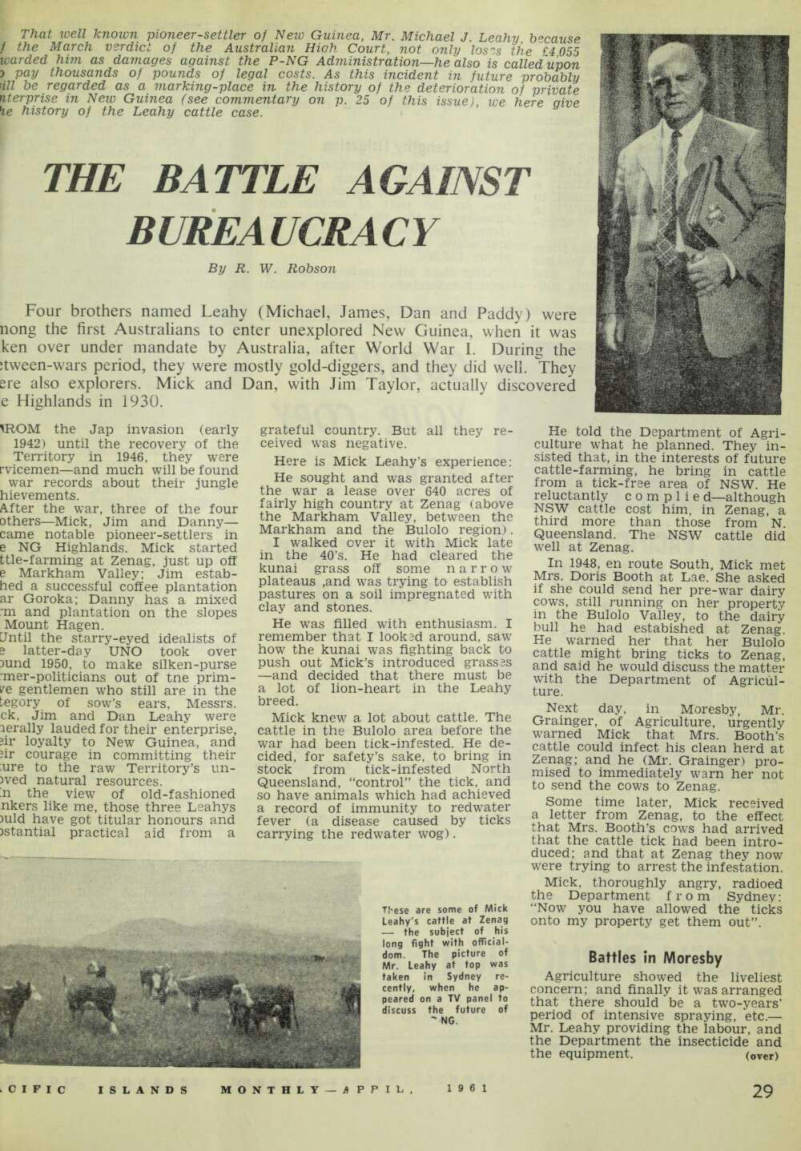
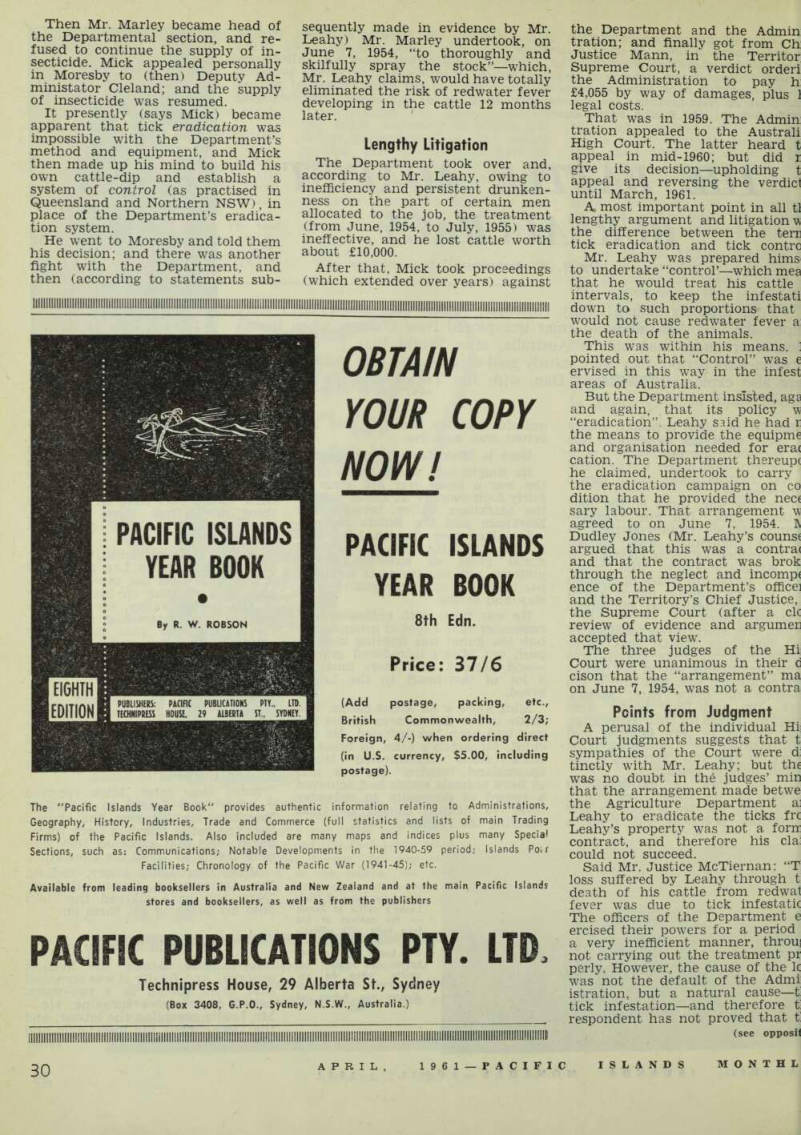
These are some of Mick Leahy's cattle at Zenag - the subject of his long fight with official dom. The picture of Mr. Leahy at top was taken in Sydney re cently, when he ap peared on a TV panel to discuss the future of NG.
Then Mr. Marley became head of the Departmental section, and re fused to continue the supply of in secticide. Mick appealed personally in Moresby to (then) Deputy Ad ministator Cleland; and the supply of insecticide was resumed.
It presently (says Mick) became apparent that tick eradication was impossible with the Department’s method and equipment, and Mick then made up his mind to build his own cattle-dip and establish a system of control (as practised in Queensland and Northern NSW), in place of the Department’s eradica tion system.
He went to Moresby and told them his decision: and there was another fight with the Department, and then (according to statements sub
sequently made in evidence by Mr.
Leahy) Mr. Marley undertook, on June 7, 1954, “to thoroughly and skilfully spray the stock”—which, Mr. Leahy claims, would have totally eliminated the risk of redwater fever developing in the cattle 12 months later.
Lengthy Litigation
The Department took over and, according to Mr. Leahy, owing to inefficiency and persistent drunken ness on the part of certain men allocated to the job, the treatment (from June, 1954, to July, 1955) was ineffective, and he lost cattle worth about £lO,OOO.
After that, Mick took proceedings (which extended over years) against
the Department and the Admin: tration; and finally got from Ch Justice Mann, in the Territor Supreme Court, a verdict order! the Administration to pay h: £4,055 by way of damages, plus 1 legal costs.
That was in 1959. The Admin: tration appealed to the Austral!
High Court. The latter heard t appeal in mid-1960; but did r give its decision—upholding t appeal and reversing the verdict until March, 1961.
A most important point in all tl lengthy argument and litigation w the difference between the tern tick eradication and tick contro Mr. Leahy was prepared himsi to undertake “control’—which mea that he would treat his cattle intervals, to keep the infestati down to such proportions that would not cause redwater fever a: the death of the animals.
This was within his means. 1 pointed out that “Control” was e ervised in this way in the infest areas of Australia.
But the Department insisted, aga and again, that its policy w “eradication”, Leahy said he had n the means to provide the equipme and organisation needed for erac cation. The Department thereupc he claimed, undertook to carry i the eradication campaign on co dition that he provided the nece sary labour. That arrangement w agreed to on June 7, 1954. IV Dudley Jones (Mr. Leahy’s counse argued that this was a contrat and that the contract was brok through the neglect and incompt ence of the Department’s office] and the Territory’s Chief Justice, the Supreme Court (after a clc review of evidence and argumen accepted that view.
The three judges of the Hi; Court were unanimous in their d cison that the “arrangement” ma on June 7, 1954, was not a contra Points from Judgment A perusal of the individual Hi] Court judgments suggests that t sympathies of the Court were di tinctly with Mr. Leahy; but the was no doubt in the judges’ min that the arrangement made betwe* the Agriculture Department ai Leahy to eradicate the ticks frc Leahy’s property was not a form contract, and therefore his clai could not succeed.
Said Mr. Justice McTiernan: “T loss suffered by Leahy through t death of his cattle from redwat fever was due to tick infestatic The officers of the Department e ercised their powers for a period a very inefficient manner, throui not carrying out the treatment pr perly. However, the cause of the 1c was not the default of the Admi: istration, but a natural cause— tl tick infestation —and therefore t] respondent has not proved that t] (see opposit
appellant has broken a duty of care, leading to loss on his part.”
Administration Neglect
Chief Justice Dixon said at one stage he was “inclined to explore the possibility” that Leahy could recover damages from the Adminis tration because there had been neglect, leading to loss, on the part if the Administration’s officers. But tie turned from that possibility be cause of the shape the proceedings took in the Territory’s Supreme 3ourt, and because it would be im lossible on the evidence to trace to those particular acts or omissions, my identifiable part of the damages claimed by Leahy.
Mr. Justice Kitto made a very thorough analysis of evidence and the judgment and concluded: “From first to last the Depart nent showed itself to be doing no nore than giving effect to a gen ial policy of dispensing aid to m iividual cattle owners as a means of toping with a recognised menace to an important part of the Terri ory’s economy. And the respondent’s ittitude throughout was that of a irivate person appealing for gov ;mment assistance on the ground that the Department, by doing for lim what it insisted ought to be lone on his property, would be per forming a function of government n accordance with its settled lolicy.”
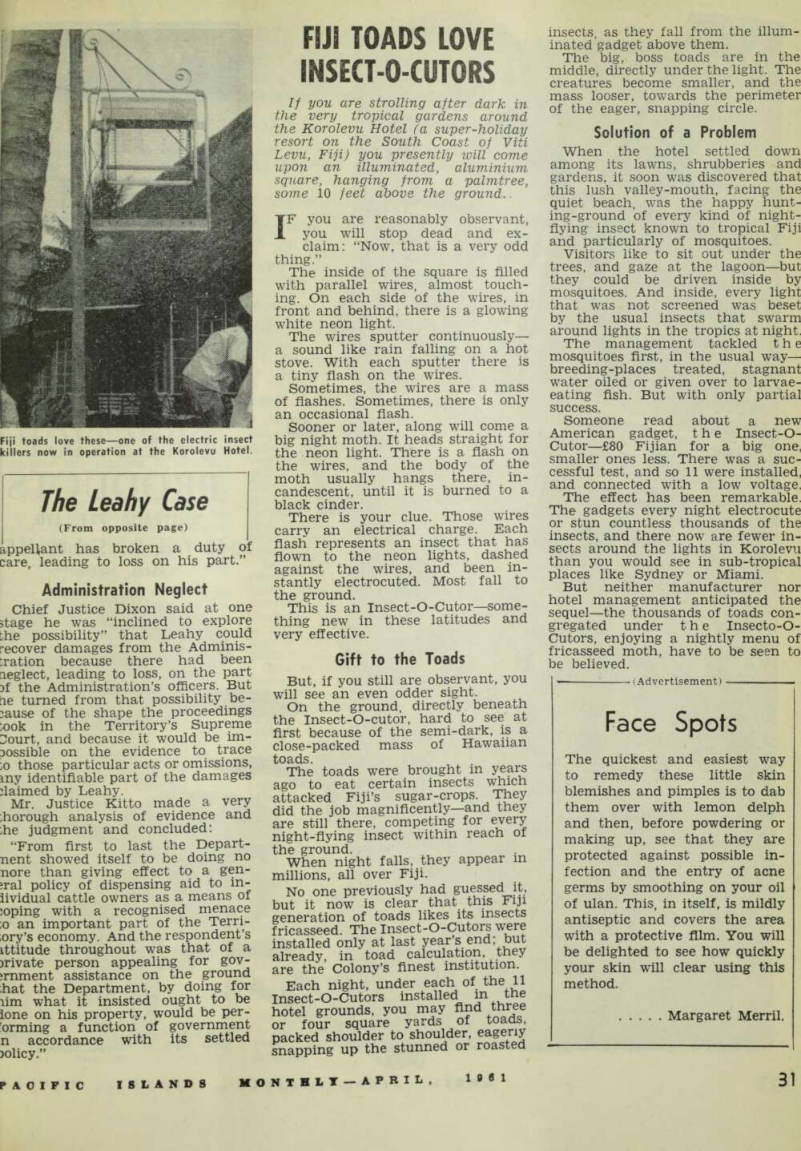
Fiji toads love these—one of the electric insect killers now in operation at the Korolevu Hotel.