[?]erritories TALK-TALK
pp. 35-37 · Read in the full issue
With Tolala
T/ie tumult and the shouting has died and some Old-time Captains d Kings have departed, making way for other Old-time Captains d Kings.
short, the brouhaha of the 1961 >-NG elections is over. Losers re licking their wounds and jrs girding up their loins and, hope, amongst the non-official, :ed members at least, there is 11-feeling still existing. they can be like lawyers in urt of law, who tear each other rt then get together over a jin or two then all may still be . May this spirit prevail among Legislators: and may the same it prevail amongst the native iidates. Unsuccessful native iidates are as yet an unknown itity. But time will tell, le appointment of two women ibers to the Council has the :oval of all. But, parenthetically despite the reports in Sydney ning papers, it is no innovation, some years, Mrs. Doris Booth, 5, “the Angel of Bulolo”, was a iber and she was the first to be Dinted to the post-war Council, e Wedega is most certainly the native woman member, and influence on the Council will nteresting to watch, espite the great representation tative sections of the community majority of two over the white
membership—which has been so much emphasised by Australia, Territories Department still holds all the aces in the pack, as it does in the Northern Territory Legis lative Council. If the unofficial members put through a measure contrary to the wishes of the De partment, then the Ministerial veto comes into play and official approval is withheld. So you really can’t win anyway.
If that is “free” democracy where do you go from here?
Heads in the Sand?
Considerable publicity has been achieved both in local P-NG papers as well as Sydney newspapers —of the alleged revival of a so called “Iniid” cult amongst the Tolai natives which has been re sponsible, so it is reported, for the fantastic “helicopter”, “submarine” and “setting of eggs” incidents de scribed generally as “cargo cult”. (See p. 128, this issue).
Dr. J. Gunther (Assistant Admin istrator) is playing it down. He has made some good points in an en deavour to allay apprehension amongst the European population, sections of which visualise a repeti tion of what has happened in other parts of the world.
On the other hand, the concerted opinion of the Vunapope Mission, consisting of members with many years experience of local Tolais, cannot be lightly disregarded. In fact. I would be inclined to back their knowledge and deductions against those of Dr, Gunther who has no extensive personal know ledge of the Tolai. The Vunapope Mission Fathers have made it prac tically a life study.
However, be that as it may, we also have local Acting DO Jack Emanuel, who goes on record to say that Father Reischl (who first in vestigated Mission enquiries on the matter) “is regarded as an entirely reliable sou r c e”, and that he (Emanuel), is determined to try to put a stop to the cult. , . , Mr. Paul Mason, newly elected MLC, is also reported to urge the Administration to take quick action to stop the spread of “Iniid” stories and propaganda.
“We all tend to take these things too lightly”, he said, and added that in his experience native unrest had grown substantially during recent months.
I agree that we are inclined to take these things too lightly and that too often this has brought tragedy in its wake. In these matters it’s not what we, as civilised whites believe, but it’s what the natives believe, that matters.
The word Iniid has me puzzled. I know of Iniet and Ingiat, both off shoots of the Duk Duk secret society, but Iniid is a new one on me.
Is This Dangerous?
According to a Sydney afternoon paper “that most personable of wizards” is preparing to tour New Guinea and Papua with his magic show.
With my old-time B 4 appre hensions, I immediately wondered how this would affect his native audiences and exactly what con struction they would put on the various demonstrations when he started to saw humans in halves and skewer people with sabres.
Could be as the wizard himself has said: “They’ll probably think me some kind of god.”
What influence is all that going to have on the native mind? Is he going back to his leaf hut or fibre house to dismiss the weird and wonderful spectacles he has wit nessed? Or is he going to start wondering about the omnipotence of the white race and if that is the way the “cargo” disappears?
To me these “wizards” represent a potential danger to the Territory, and I’ll leave it at that. ( Editor’s Note : Another “wizard” visited P-NG centres at the end of
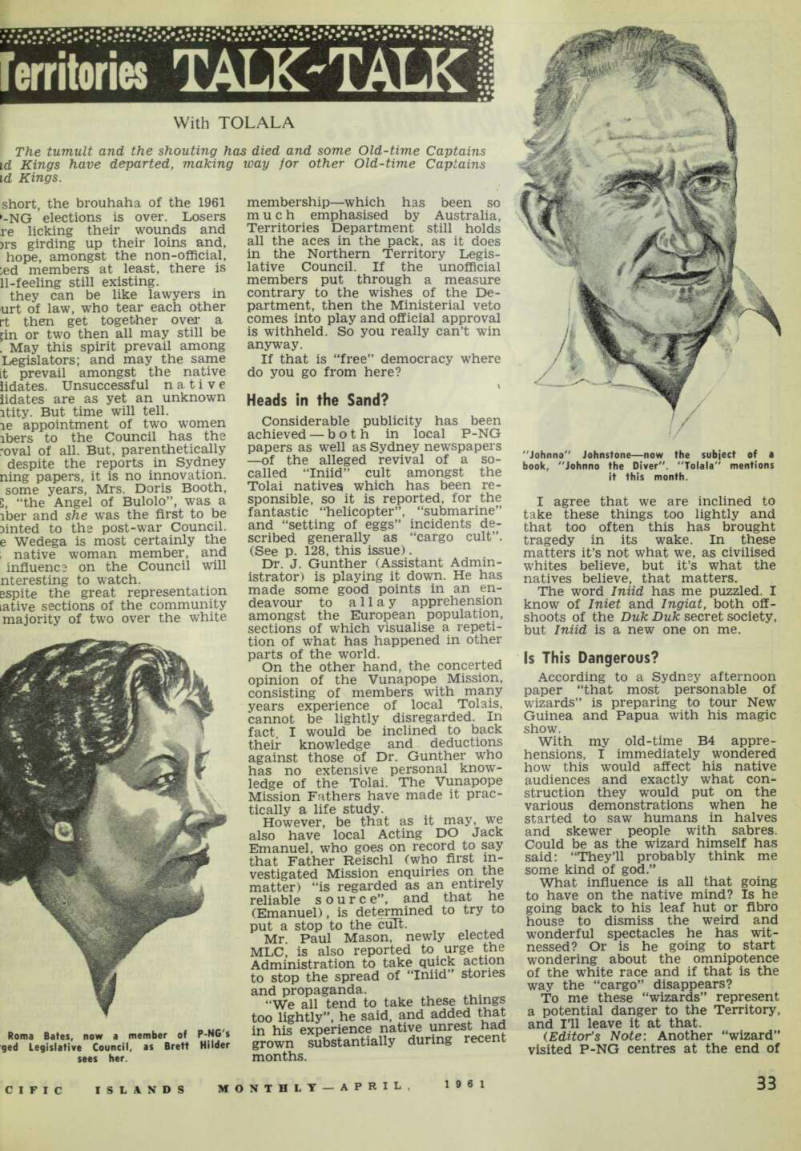
Roma Bates, now a member of P-NG's [?]ged Legislative Council, as Brett Milder sees her.
"Johnno" Johnstone—now the subject of a book, "Johnno the Diver". "Tolala" mentions it this month.
l as t year, played to big audiei SS? , dld not cause any incide What the natives really bel about this form of “magic” is course, unknown).
"Johnno the Diver"
There were few more popular r sonahties in post-war Rabaul t Diver Johnstone of Niagara fa ( He salvaged m million worth gold bars from the vessel which wrecked off the NZ coast by a G man mine).
In the First War, being a Ne Reservist, he went back to Engla took a course at a Naval Div bchool, and became a Naval di during that stoush. ..Lately he has been operating the Japanese firm of Matsukura Kavieng and Wewak.
Harraps, the publishers, of L don, are turning out a book ab a former RN Commam entitled Johnno the Diver, specii written for boys. It should m good reading even for elderly b< Coincidentally, Rabaul’s post-'V I diver was J. H. J. John (Jimmy) who was equally popr in those halcyon days. He was tached to the Public Works I partment in Rabaul. Jimmy was deep sea diver though.
Primary Products
Coffee producers in P-NG do 3 appear to be too happy over A tralia’s attitude towards the mark mg of their produce and from reports they have something worry about.
Cartels and tariffs are not p; ticularly noted for mixing sentirm with business and the encouraj ment of P-NG’s coffee indust which is of all-high interest both Europeans and native growe is a mere detail compared cheaper coffee and reciproi tariffs to buy into the South Ame can trade—a drive that has 01 recently been launched to step Australian exports.
The outcome of the present po tion will surely be a timely indie tion of how sincere Australia is its desire to further primary pi duction in the Territory.
Past history indicates that P-In interests must not interfere wi Australian interests which perha is only natural. For instance, are of the NG Mainland are the natui home of some of the world’s be sugar cane. Hawaiian cane growe have periodically gone to NG obtain specimens for plant breedii and improvements of strains, y nothing has ever been done to fost such an industry in NG.
Should the bottom drop out the coffee market, officialdom is g< ing to have a few headaches e; plaining to native growers the h tricacies of international trad agreements.
ustralian Territories"
! have seen for the first time a >y of the periodical published by > Department of Territories, and ich is the successor to the well )wn South Pacific, published by i ASOPA, which died in October, 9. and whose death caused no le comment, being referred to in I Federal House and in various stralian newspaper articles, te all that as it may; the new iodical —the No. 2 issue, pub led in February this year—is >ut the best thing I have seen the publicity line from that De tment and the editor whoever he she may be, can take a bow. It well produced, typographically id, well illustrated and carries in esting articles dealing with a le range of Territorial subjects, m NT to Christmas Island. was particularly interested in article headed, “Montevideo Maru lyth or Merchantman”, by A. J. eeting, the senior Research Officer the Official War History. (See Dk Review section, this issue). ncidentally there is a discrep ;y between the figures given by gadier A. E. Brown (War Graves omission), as quoted in PIM in mary, and Mr. Sweeting’s figures. )wn, according to that article, re the total of Australians on board 1503, while Sweeting’s figure is 3. (Looks as though there has n a typing error somewhere). I inclined to back Sweeting’s ires. ’hat must surely be the last word w on the Montevideo Maru ?edy.
Realistic
Ihropologist?
n reading a report of a talk en by anthropologist Dr. A. L. >tein to the NG Society at Can ra recently on the Tolai people struck me, that for an anthro ogist, he is far more realistic n many of his predecessors in 5 field of research, ome of his remarks were down earth compared with some of the ry-towered ideas expressed by ervers a few years ago.
Commenting on their social ad icement, he said they had taken r many aspects of the European V of life, yet still adhered to ny of their own customs and ues. Despite the fact that the ai had been undergoing changes ce their first contact with Euro ms, now nearly a century ago, se changes did not attack the acture of Tolai society at its Lit. le infers that we are expecting high a standard of Western ilisation from these natives so en they exhibit signs of their old ural culture we are disappointed 1 liable to become alarmed.
A Change of Venue
So the New Guinea Bar at Ushers’ is closing down—along with the hotel itself. It will be missed sadly by old-time New Guinea residents.
It was a handy spot to duck into while the Missus did her shopping.
Islanders have always had a fav ourite rendezvous when in Sydney (as well as other capital cities, no doubt).
I remember when the Twenties, and even earlier, Belfields, at the corner of King and George, was the popular meeting place and then came Usher’s and, of course, Ethel who was the rock on which the NG Bar was founded.
There were then no business-like registers with names and messages as of late years—Ethel was the source of all information and in
many, many cases assisted un financial Islanders with a loan to see them home again. She told me that never once was a loan not re paid.
The idea of Aaron’s being the pro jected new rendezvous is, of course, a good one. But is it central enough, and handy to feeding places and shops?
Australian Senator McCallum told a meeting of Liberal Party mem bers in Albury, NSW, in March, that he advocated another 100 years’ training for New Guinea natives be fore granting them self-government.
Native officials needed to establish a heritage of Western thinking be fore they could properly fashion civilised governments, he said.