Agreement In Fiji Sugar Industry
pp. 22-147 · Read in the full issue
Fiji Sugar Industry
An audible sigh of relief went from all classes in Fiji on Ma 27, when it was announced that agreement covering the 1961 ca crushing season had been arri at, and ratified, by all interes parties—the Colonial Sugar Re} ing Co., and the several organi tions of canegrowers.
THE agreement names amounts to be paid for cs and molasses, and time £ method of payment.
It is expected that cane-cutt will begin not later than mid-Ju and will extend into January, long, good season will do someth towards countering the severe los the industry suffered in 1960.
The CSR has announced, d. that it will take enough cane 1962 to produce 235,000 tons of r sugar—which is 18 per cent, mi than the 1960 quota, which \ 199,000 tons.
There was a bumper cane crop 1960, and cutting was to begin mid-June. But there were aci misunderstandings between Cl and the associations of car growers; and there was no car cutting in June and July, or limited operations in August a September—there was full harve ing only from October until t season ended in January.
All parties lost heavily—especia the growers. The CSR was able cash in on very substantial resen of raw sugar, and generally mai tain export quotas, but the growe income (and therefore the incoi of the many thousands depende on the growers) must have be reduced by at least 50 per cent.
Lingering Effect of Strike
The strike by a section of t growers was maintained for ma: weeks longer than seemed reaso able or necessary, through the i: fluence of a small clique of irreco: cilable Indians.
Probably, the most significant r suit of the 1960 strike was tl creation of a deep political gulf b tween the Fijian and the Indu communities. This had caused tl Government acute embarrassmei in relation to constitutional ar other administrative changes whit had been planned.
The gulf may tend to disappear peace is maintained in the sugar ii dustry. The new agreement seen to promise peace—at least betwe* CSR and cane-growers.
But Fiji still has to hear fro Mr. B. D. Lakshman and his unioi of organised mill-workers. At tl
(Continued on p. 145)
Tradition Wins
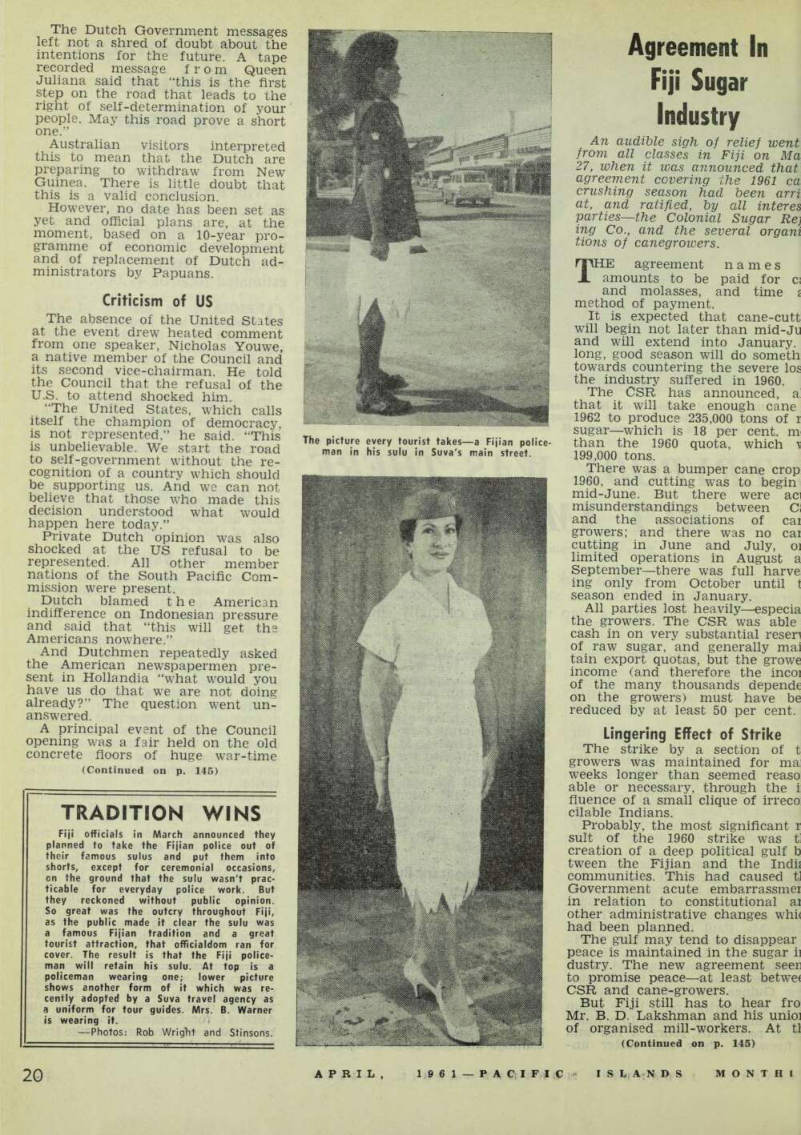
Fiji officials in March announced they planned to take the Fijian police out of their famous sulus and put them into shorts, except for ceremonial occasions, on the ground that the sulu wasn't prac ticable for everyday police work. But they reckoned without public opinion.
So great was the outcry throughout Fiji, as the public made it clear the sulu was a famous Fijian tradition and a great tourist attraction, that officialdom ran for cover. The result is that the Fiji police man will retain his sulu. At top is a policeman wearing one; lower picture shows another form of it which was re cently adopted by a Suva travel agency as a uniform for tour guides. Mrs. B. Warner is wearing it. —-Photos: Rob Wright and Stinsons.
The picture every tourist takes—a Fijian police man in his sulu in Suva's main street.
oment, there is no indication of ouble. But neither is there any larantee that, when the mills re )en, there will be no demands for gher wages.
New System of Control
However, this aspect of the situa m may be covered by the pending ;w system of control over the gar industry.
The Sugar Inquiry Commission mpleted most of its work by the id of March, and its members ready are back in London. It is :ely that its report and recom sndations will be in the hands of e Governor in June.
One of the recommendations is rtain to provide for the creation a Sugar Industry Control Board, d another will give the board wer to enforce its decisions.
Lhe board will not only control e relations between millers and nc-growers, but also the relations tween millers and mill-workers. [f the Fiji Government deals amptly with the report, that new ;tem of control could be in opera n by the end of June. And that uld take care of the mill-workers, rhe cane-growers already are mded for, for the 1961 season, by * agreement announced on March
3ood Influence of Commission
[■here was no obligation upon the gar Inquiry Commission to ange this new agreement. But, dously an agreement was vital, ;he growers were to get ready for ! coming and future harvests Growers and millers could not iply sit down to await the sub >sion and implementation of the nmission’s report. ’here was credit due to all parties the way in which they met pri ely, and devoted themselves to formulation of an agreement. It > no easy task. luch praise has been given to barristers who signed the agree at—R. G. Kermode, for the CSR; M. N. McFarlane, A. D. Patel I J. N. Falvey for groups of cane wers; and Messrs. Patel and Farlane jointly on behalf of the ba Sangh. he unexpected spirit of good and compromise which domin -3 these proceedings is attributed the personal influence of the amissioners, and especially to chairman, Sir Malcolm Trustram , QC, who worked tirelessly to an agreement. iji still is faced with most dif- It problems in the fields of lomics and politics; but at least sugar industry seems to be com under control —and Fiji may 3 some comfort out of that.