Plebiscite
pp. 21-147 · Read in the full issue
Vital Samoan Plebiscite Is Near
From our Apia Correspondent Apia, March 24.
With the electoral rolls for the
plebiscite on West Samoan inde
pendence closing on March 30,
there are still 9,000 eligible
voters not registered out of an
estimated total of 41,000.
OFFICIALS in charge of the plebiscite are making a deter mined effort to induce the out standing voters to enrol. The local newspapers and the broadcasting station are filled with exhortations to enrol.
The plebiscite is on May 9.
All Samoan citizens over the age of 21 will be asked two questions; • Do you agree with the Consti tution adopted by the constitutional convention on October 28, 1960? • Do you agree that on January 1, 1962, Western Samoa should be come an independent state on the basis of that Constitution?
Will Vote Yes It is confidently expected here that an overwhelming majority of the Samoans will vote Yes, despite many objections against the Con stitution.
The important Falealili district favoured a waiting period of at least ten years before independence, and during the enrolment cam paign, the chiefs of Lufilufi village, on the east coast of Upolu, which is a seat of the influential political power Tumua and Pule, refused to enrol for the plebiscite on the ground that Tumua and Pule had not been recognised by the Consti tution.
There was also opposition to en rolment in the Palauli district of Savaii.
Apart from those who do not enrol there will certainly be a con siderable section of voters who vote No because they object to the fact that the Constitution does not pro vide for universal franchise in future Parliamentary elections, thus depriving untitled Samoans of the chance of getting a seat in Parlia ment.
The Dutch Government messages left not a shred of doubt about the intentions for the future. A tape recorded message from Queen Juliana said that “this is the first step on the road that leads to the right of self-determination of your people. May this road prove a short one.”
Australian visitors interpreted this to mean that the Dutch are preparing to withdraw from New Guinea. There is little doubt that this is a valid conclusion.
However, no date has been set as yet and official plans are, at the moment, based on a 10-year pro gramme of economic development and of replacement of Dutch ad ministrators by Papuans.
Criticism of US
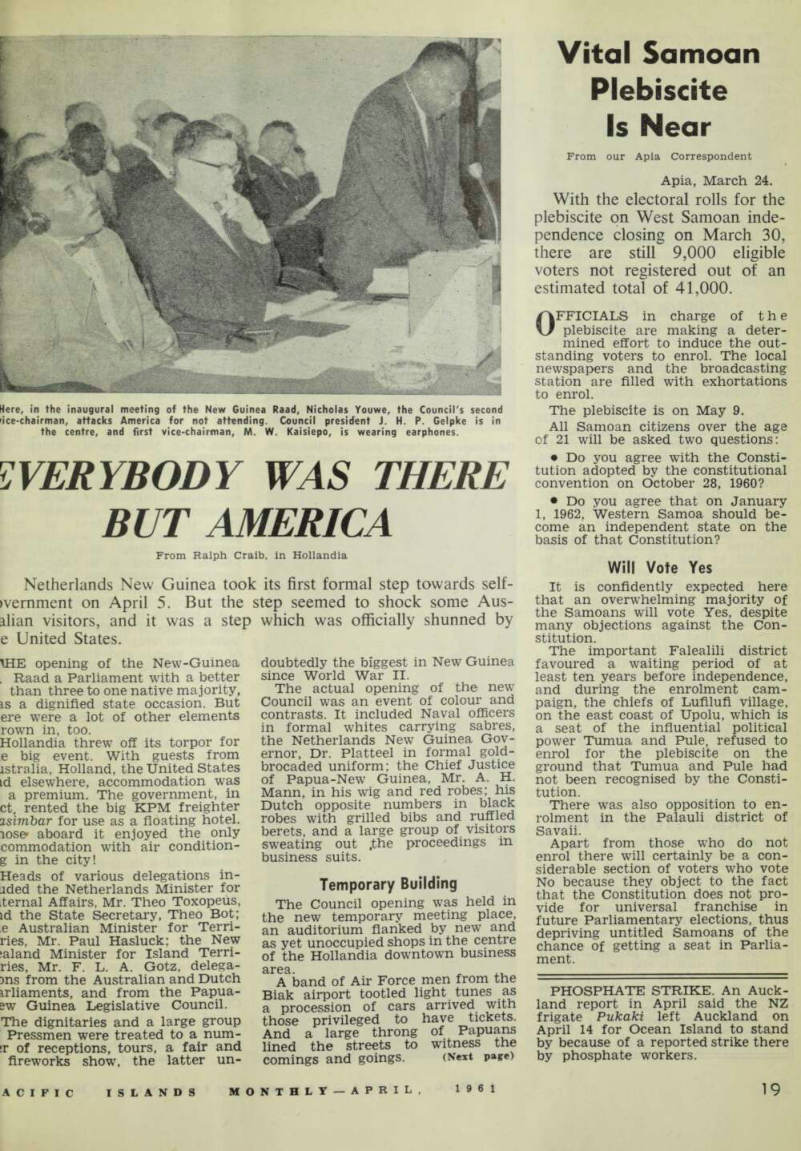
The absence of the United States at the event drew heated comment from one speaker, Nicholas Youwe, a native member of the Council and its second vice-chairman. He told the Council that the refusal of the U.S. to attend shocked him.
“The United States, which calls itself the champion of democracy, is not represented,” he said. “This is unbelievable. We start the road to self-government without the re cognition of a country which should be supporting us. And we can not believe that those who made this decision understood what would happen here today.”
Private Dutch opinion was also shocked at the US refusal to be represented. All other member nations of the South Pacific Com mission were present.
Dutch blamed the American indifference on Indonesian pressure and said that “this will get the Americans nowhere.”
And Dutchmen repeatedly asked the American newspapermen pre sent in Hollandia “what would you have us do that we are not doing already?” The question went un answered.
A principal event of the Council opening was a fair held on the old concrete floors of huge war-time
(Continued on p. 145)
warehouses which have long since been torn down.
Government agencies, the missions, businesses and the Territory of Papua and New Guinea all had dis plays—and there were competing Heineken’s and Amstel beer gardens.
The fair drew large crowds of native and European spectators on each night of its five-night run and some large shipments of native art work, particularly from the head hunting South Coast Asmat people, were easily disposed of..
One item noted by the visitors: The Dutch do not believe that hot water is an essential in the tropics; a belief they acquired in centuries of life in the East Indies. Visitors were not quick to adapt themselves nor to like the cold water bath and shave.
And the Dutch tabl e— most typically slices of bread with meat, cheese, peanut butter, etc., for breakfast and dinner with rice, a small amount of meat and vege tables for lunch—had many of the Australians unhappy—out of earshot of their hosts—of course. “I can hardly wait,” said one, “to get back to Moresby and some bloody steak and eggs. I’m starving here.”