New Horizons For Teal
pp. 23-144 · Read in the full issue
From Stuart Inder, in Auckland , April 3.
When the major results of the most extensive re-thinking of ith Pacific air routes since the war are made known in the next iple of weeks, TEAL, New Zealand’s international airline, will illy have come of age.
SAL’S 21st birthday is on April 30 (it will be 21 years since TEAL made the first com •cial flight across the Tasman) I the joint government announce it should be a real birthday pre t. mong the top executives of TEAL ! week, despite the busy, almost assed, time they are having—l e found an enthusiasm for the ire that could almost be de bed as bubbling.
EAL will go it alone, but nobody this side of the Tasman is the it concerned that the outcome I’t be successful, he forthcoming government an ncement will, of course, be to effect that New Zealand will 3 over full ownership of TEAL, ch has been hitherto a 50-50 tralian-NZ partnership. That ; has been an open secret for ly weeks.
Aviation Reshuffle
ut there is much more to it a that. There will be an aviation mffle, and it may take many iths before the full extent of it mown. ilateral agreements have been lied with care, and decisions ch have yet to be taken by the ted States (which has been :ing at the whole Pacific basin) e had to be brought into account.
EAL and Qantas will compete the trans-Tasman crossing, ic h has previously been a ative TEAL monopoly. But there be nothing cut-throat about the competition. The services will rationalised. antas, too, will be able to com -5 on TEAL’s Coral Route service Fahiti.
Some rationalisation can also be expected on that, because the most important thing that has come out of recent talks is that the British Commonwealth intends to stick to
gether in the South Pacific, and preserve as much of it as possible from the French and Americans.
BO AC, which left the South Pacific Islands when it pulled out of TEAL in 1954, will, come back into the picture, probably through Honolulu and Tahiti, although no extensive plans involving BOAC are likely to be announced immediately.
(Continued on p. 141)
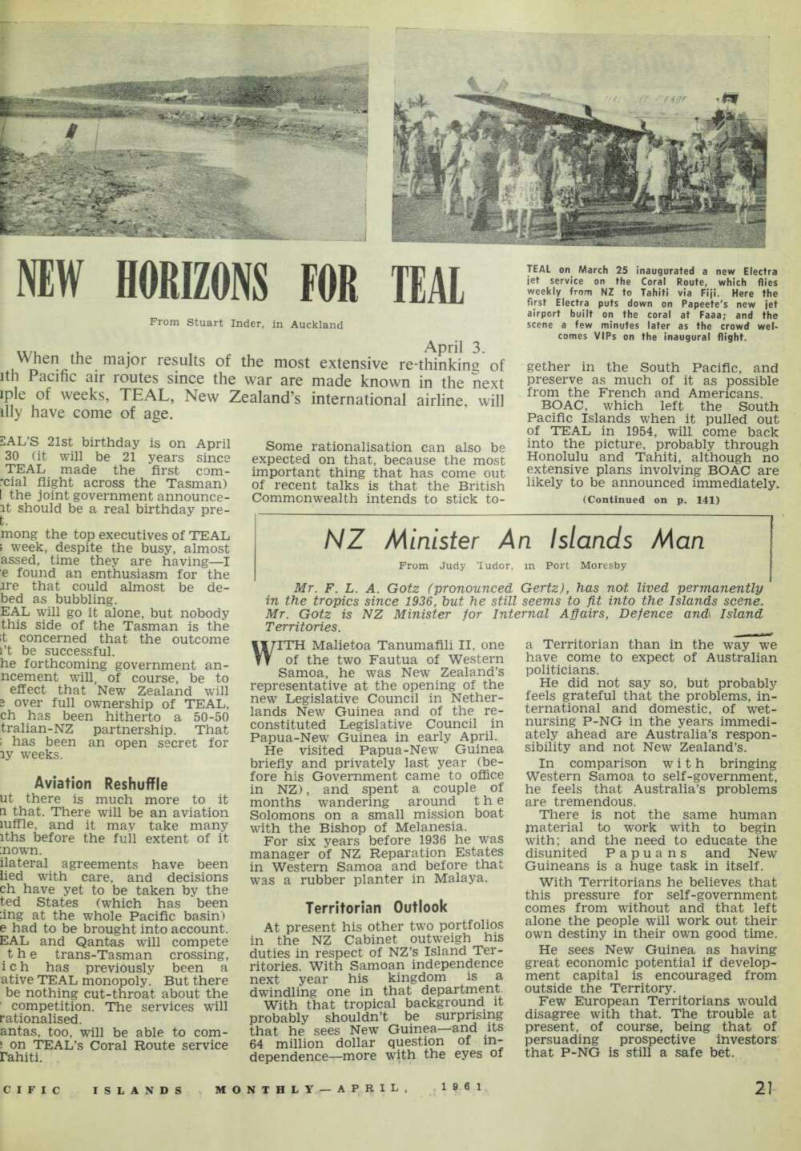
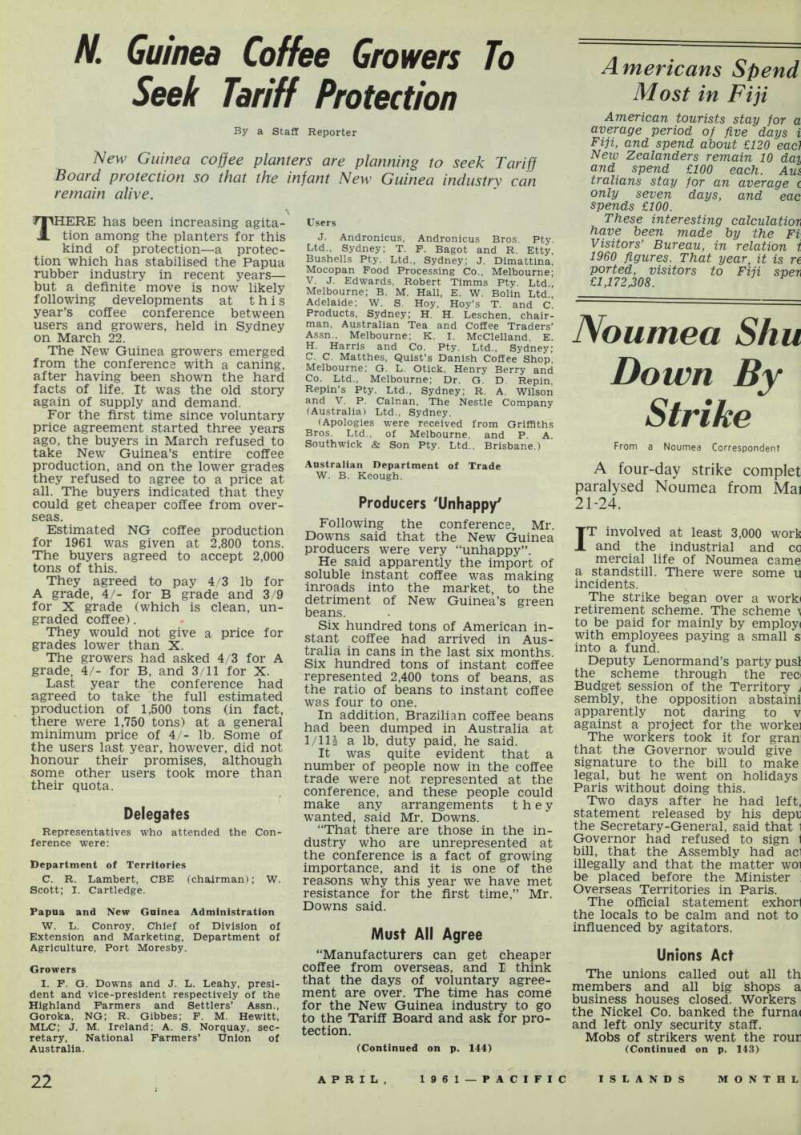
TEAL on March 25 inaugurated a new Electra jet service on the Coral Route, which flies weekly from NZ to Tahiti via Fiji. Here the first Electra puts down on Papeete's new jet airport built on the coral at Faaa; and the scene a few minutes later as the crowd wel comes VIPs on the inaugural flight.
I gather here that the BOAC Imputation which has recently been bsiting NZ and Australia, went iway with a small flea in its ear.
In effect it was told, “You pulled •ut, and you can’t expect us to hrow everything to you on a plate low.”
But BOAC certainly will be back ti the South Pacific picture in the text few years, as part of the “fly
British” plan.
TEAL has always regarded the louth Pacific Islands as its own pecial province, and is jealous of be high reputation it has built up here the hard way since the war.
It regards its present by-passing f such islands as Samoa and the ! ooks as only temporary—some ting that has been forced on it by •s equipment problems—and it will et back on the full Coral Route as x»n as it can.
New Zealand will retain its pre-
sent interest in Fiji Airways which, of course, is being used increasingly on international routes, but the all- NZ owned TEAL flag will be kept flying even higher.
TEAL sees Tafuna airport, in American Samoa, as an important cog in the wheel.
Future is Freight But the really rich future pick ings, as the New Zealanders see it, will not be with passengers, but with freight.
New Zealand’s trade troubles of the last few years, especially its trade relations with Britain, have been something of a shock here and the Government has realised finally
that this country is really on her own when it comes to commerce and that it can expect no favours from anybody.
To make her own way in the big world of business, she must have her own transport services, and the future for transport in the South Pacific, New Zealand is convinced, is by air.
Big jet transports flying at terrific speeds will make the carriage of trade goods no dearer than trans port by ship.
New Zealand, through a fully owned TEAL, will go about this job the way it wants without the bogey of interference from outside gov ernments—meaning Australia.
Admittedly, New Zealand’s avia tion relations with Australia (i.e., TEAL’S relations with Qantas) have not always been completely smooth. At the same time they have not been nearly as rough as might be indicated by New Zealand Press comments over the years.
As one TEAL official told me, “We will always be grateful to Qantas.
They have looked after us very well, and done many things for us that we could not do for ourselves. Now we have grown up.”
It was Qantas, of course, which received the full brunt of New Zea land public criticism when TEAL was re-equipped with Electras.
TEAL wanted Comets, and when it ended with the Electras the Qantas name was mud over here.
The New Zealand Government never bothered to explain to the irate public that Qantas’ interest in the matter was only one-third of the story.
Three Reasons
It was certainly true that Aus tralia wanted TEAL to have the Electras, because of a package deal.
But also, New Zealand, which was going through a bad economic time, did not have the money for the Comets, or to bring up to jet standard its airports.
The decision would have been the same probably if Australia had had nothing to say in the matter.
But New Zealand is now going ahead fast with the £7.5 million in ternational airport at Mangere, outside of Auckland. The new air port will have a 6,000 ft runway and the Government wants it operational as soon as possible.
Mangere is the whole key to TEAL’s future international opera tions, and it must be ready by the time TEAL re-equips with the full jets which will replace the present Electras.
In March, Mr . R. M. Ansett, managing director of Ansett Trans port Industries, won a great deal of publicity on both sides of the Tasman by making public a £2 million offer for a controlling in terest in TEAL.
Mr. Ansett said that under his
NEW AIRCRAFT. There has been wide interest in the Sepik area of New Guinea recently in the arrival of this Dornier Do 27 aircraft—the first of its kind in the Territory. It is based at Wewak with the Catholic Mission of the Divine Word. Two more Dorniers are due to arrive shortly in Goroka, one for Territory Airlines and the other for Bishop Schilling.
The Wewak aircraft has been modified. The top of the cabin has been covered in, instead of showing clear perspex, which is not suitable for tropical work. Top speed is 115 knots, maximum range six hours, minimum runway 300 yards, pay-load between 950-1,200 lb and altitude at full load is 10,500 ft. The aircraft was shipped out from Germany and assembled under the supervision of Father Ivo Ruiter, SVD, who recently underwent a three months' course at the Dornier factory.
Photos: D. W. Hawksley.
plan, TEAL would be able to carry out its international obligations without interference.
However, nobody took Mr. Ansett seriously. He had already made an offer of the same sort to New Zea land last year and this had been rejected. His latest offer was re garded both in Wellington and Can berra as a means of getting some publicity for the Ansett Airways empire, which includes a big in terest in the New Zealand internal airline, South Pacific Airlines of NZ.
But there have been no hard feel ings.
Mr. Ansett is regarded as both an astute and popular businessman, and if he wants to ride on the band waggon without doing anybody any harm, nobody has had any objec tions.
In fact, it seems likely that Mr.
Ansett will get an even bigger share of New Zealand’s internal air services and tourist traffic, just as he is doing throughout Australia and in P-NG.
But it is most unlikely he will get an opportunity to break into in ternational aviation—certainly not across the Tasman, via Norfolk Island or any other direction.
Polynesian Airlines
Polynesian Airlines, of Apia, was expecting to receive its two new aircraft via Singapore and Australia in early April, and planned to make two trips daily between Apia and American Samoa.
The American Samoan Airlines is now regarded as definitely finished.
It is still possible for another U.S. airline to take over Samoa’s licence, but with Polynesian Airlines operat ing satisfactorily with two aircraft it would be very doubtful if it would be considered economical for any other operator to try to break in on the run.
Fokker Friendships
After many months delay, TAA in early April finally began operating its Fokker Friendship service be tween Lae and Honiara, BSIP, with stops at Rabaul and Munda. The first flight was received with great enthusiasm at the Honiara end, where the promised Fokker service was regarded as being like tomorrow —it would never come.
The Fokker replaces the DCS
Weight Controversy
The P-NG airline weight con troversy (see p. 35) took a bitter turn in March following a sugges tion that pilots should be paid danger money.
The suggestion, made by the pre sident of the P-NG Highlands Farmers and Settlers’ Association, Mr. lan Downs, brought a tart re tort from the manager of the Aus
tralian Air Pilots’ Federation, Mr.
Bruce Crofts.
Mr. Crofts, who was a patrol officer in the Territory after the war, hotly attacked the proposal as arrogant.
“Perhaps Mr. Downs envisages that he, personally, will hand the danger cheque to the widow of a pilot unable to collect it himself, and in his conscience feel a fair price has been paid,” he\ said.
“He may even wish to call upon the relatives of the unfortunate passengers.”
Mr. Crofts wrote to the Minister for Civil Aviation, Senator Paltridge, saying that pilots took the strongest exception to suggestions that economic considerations should be placed before safety, and said pilots supported the new Territory safety standards.