Chinatown-My
pp. 89-101 · Read in the full issue
It Must They Lose Their Tradition, He Asks?
Chinatown
By Lew Friday
The Chinese community of New Guinea has least to say, works the irdest and in recent years has prospered most. The writer of this tide looked Rabaul Chinese community over last year, and gives ire his own very personal views.
r ER since 1910, when the Ger mans made their administrative centre on a drained swamp inated by volcanoes. Rabaul has its Chinatown. le Germans had brought in ) coolies for plantation labour, their descendants remained as traders, restaurant lers, tailors, laundrymen and dressers, shipowners and planta managers. le first Chinatown was well m to Australian troops who took in 1914. Captain J. Lyng, who a member of the Australian 3, and wrote a book about it, de )ed it as a tiny East-Asiatic iship transplanted to New ain, a place for these parts both ’ and wicked. )day it is still busy, but it is not ucked any more, le old-type Chinese, according yng, wore his umbrella-like hat; women wore pants and carried : babies slung on their backs, re were Japanese women, too, over-virtuous; and grop shops, bling and opium dens, and a house. rote Captain Lyng: “To the h-born Adam treacherous Eves l the land of the chrysanthemum out open arms.” hile waiting for that victory never came, some of the Ger officials and planters sought lence in Chinatown. They were to be repatriated until 1921. lere followed the Rabaul of be n the wars, the place some old itorians look back on with algia. Magnificent, like cathedral is, were the shady avenues of larina Avenue and Malaguna J; while the verdant Botanical lens running up towards the .lings of the high-up officials on Lanula Hill were, rightly, of more l local fame.
War Again
ie shops-cum-dwellings of China i still gave off their whiff of Orient, but thrift, hard work long working hours were the lot tie inhabitants. len the blow fell. World War viped out Chinatown with the of Rabaul. The place was so ened by Allied bombing that you
couldn’t see even where the streets used to be.
Gone were the Gardens, gone were the trees along the avenues, gone were the people. The Japanese brought in to work for them Chinese from Canton and Indians from Singapore and Malaya. A memorial on the outskirts tells how many hundred local Chinese died then or were executed during the Japanese occupation.
Some of them, accused of helping Australian soldiers make their way down the coasts, were tortured or beheaded. Others went bush, to live as best they could, to start life again when the Japanese capitulated.
A temporary Chinatown grew up in another part of Rabaul (the Matupi Farm area a makeshift place of old iron, so that when the wind blew it set the corrugated sheets flap, flap, flapping). After every big blow in the north-west monsoon season, which lasts from November
to March, few nights passed without at least one family having to move in on already overcrowded neigh bours. because their shack had col lapsed on top of them.
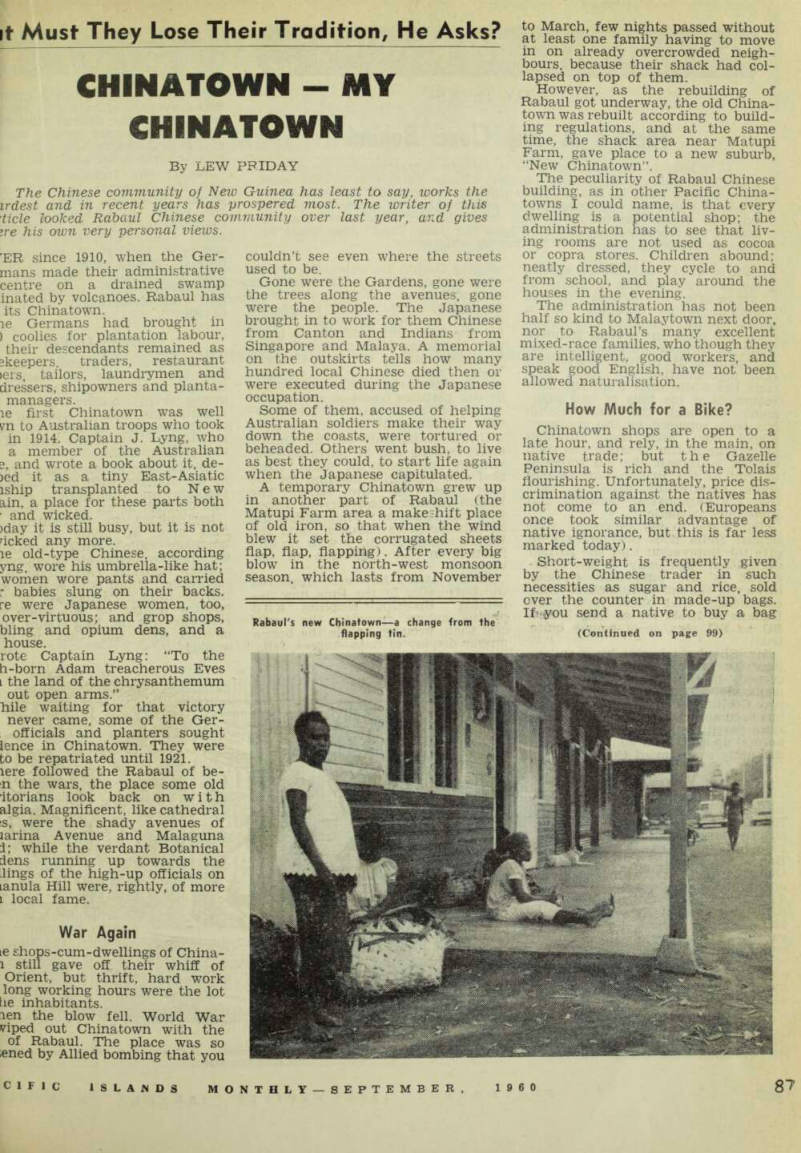
However, as the rebuilding of Rabaul got underway, the old China town was rebuilt according to build ing regulations, and at the same time, the shack area near Matupi Farm, gave place to a new suburb, “New Chinatown”.
The peculiarity of Rabaul Chinese building, as in other Pacific China towns I could name, is that every dwelling is a potential shop; the administration has to see that liv ing rooms are not used as cocoa or copra stores. Children abound; neatly dressed, they cycle to and from school, and play around the houses in the evening.
The administration has not been half so kind to Malaytown next door, nor to Rabaul’s many excellent mixed-race families, who though they are intelligent, good workers, and speak good English, have not been allowed naturalisation.
How Much for a Bike?
Chinatown shops are open to a late hour, and rely, in the main, on native trade; but the Gazelle Peninsula is rich and the Tolais flourishing. Unfortunately, price dis crimination against the natives has not come to an end. (Europeans once took similar advantage of native ignorance, but this is far less marked today).
Short-weight is frequently given by the Chinese trader in such necessities as sugar and rice, sold over the counter in made-up bags.
If? #ou send a native to buy a bag
(Continued on page 99)
Rabaul's new Chinatown —a change from the flapping tin.
vo and weigh them at home will find they only contain 12 oz.
'opeans who buy bicycles from Chinese for their New Guinea iyees pay from £l7/10/- to £lB. [ the native does his own shop he is asked £2O to £2l. ? natives are becoming alive to situation, and ill-feeling is ng. It is a short-sighted policy e part of the Chinese. It would hem to treat the native fairly, mlarly as they are permanent mts in a way that most Euro > are not. ither illegal activity that has > eradicated in Chinatown is ale of sly grog to the natives — ro”, and watered-down Aus n whisky at £2 a bottle, laul’s European stores give the bs fair and honest weight. Their ke, in the business sense, is to European customers first and f turn, so that the natives get and and dilatory service. Yet lative trade brings wealth—a lean store which went out to ;he native real service sold out small fortune, lerally, the European and jse in Rabaul get on well to r. Many of the local-owned ise ships have European masters engineers. It is only the noise ;r that drives Europeans away the fringes of Chinatown.
reaking the Sound Barrier
b assumes the Chinese to be ly deaf. They shout to each throughout the day and night, anted by the blaring of gramo bs, radios at top strength, the ng of roosters, and the barking )gs. In places dogs rush out lark at every car; their howls ® white neighbours all night they are at their worst when loon is full. /as told of a Chinese woman had 24 dogs. She traded them New Guinea boys going back to villages after working out their act. Should the air company re to take a dog because it was properly crated, then the dog to be left behind, to make its aack to the only home it knew, of the original owner, who . then sell it over again, e other characteristic of the
present-day Chinese areas in a town where vegetation flourishes, and the green-lined avenues are flourishing again, is the almost complete absence of trees. Should a tree stand near his fine new house, the first thing the Chinese occupant seems to think to do is to cut it down.
The saddest thing before I left was to see a bulldozer knocking down what must have been Chinatown’s last magnificent grove of bamboos.
One had hoped for the reverence, reflected in the work of Chinese poet and painter through the milleniums, for these lovely, waving feathery adornments of the year.
In becoming Australian citizens, must the Chinese lose all their traditional poetry?