There's A Raj Close Behind
pp. 90-101 · Read in the full issue


The Month's New Reading
With Judy Tudor
It is only to he expected from a foreign correspondent of such a high-hom publication as the London “Daily Telegraph”’, that even when writing what he calls a “light political travel hook”, he should, at times, slip onto the ponderous plane; and that his old typewriter should hash out a sonorous phrase or two where it does least good. But hy and large, Gordon Shepherd’s “Where the Lion Trod” does what he says he designed it to do —it “primarily entertains” .
IN the course of his duties, Shepherd spent four months in India 11 years after the British Raj had departed. If he expected that a decade of independence could oust, neck and crop, the several hundred years of British influence he was disappointed. He found that although skin pigmentation no longer pro tects the white man from the con sequences of his folly or bad judg ment: although the Burra Sahib has been replaced by the grammar school boy; and that although everything in the metaphorical shop window is Indian, the old Imperial imprint of the British Lion is still there, manifesting itself in ways that are paradoxical, amusing and
sometimes pathetic.
That’s not to say, of course, that official India does not now try to give the impression that the British occupation was only a short in cident in the long and glorious history of the sub-continent. (Which, considering that there have been Indians in India for as long before BC as BC goes, is of course quite true).
Mr. Shepherd begins his wander ings (so far as this book is con cerned) in the extreme SW of the peninsula, which used to be Travan core Cochin but in more recent years has been absorbed in Kerala. Kerala, since partition, has had a more than normal up and down political career, including a spasm of Communism.
Sirs Versus Masters Our traveller, however, was more interested in what was once the very British tea planting community— strictly Burra Sahib—of the Travan core hills. Here names like Brooke Bonds Tea remain to remind us of the glory that was; while the man agers and assistant managers are more likely now to be Indian, or foot-loose products of the technical and grammar school, interested in earning a quick and honest buck and moving on, rather than products of public schools who, in past gener ations, dedicated themselves to rai ing tea bushes and carrying the white man’s burden in far Travan core.
There were, too, the Russians who had horned in on the once British preserve of buying tea at the fort
nightly Cochin tea sales. Dressed in open-necked shirts and duck trousers, they still acted as though they were fur-hatted sentries in Eastern Europe, as they outbid the British for the best chests of tea to blend with the twigs they mowed off their own tea bushes back in Georgia.
There was, of course, that anachronism, the club, conceived of British planting tradition and carried on in the same tradition—with re cent Indian admixtures.
Under a portrait of the Queen, both sections ate in harmony—but remote, one from the other, roast beef and Yorkshire pudding for the one; curry for the other. The Indian servants had already coped with the situation: They called the British members “Master”, and the Indian members “Sir”—with no dif ference in the inflection of the voice.
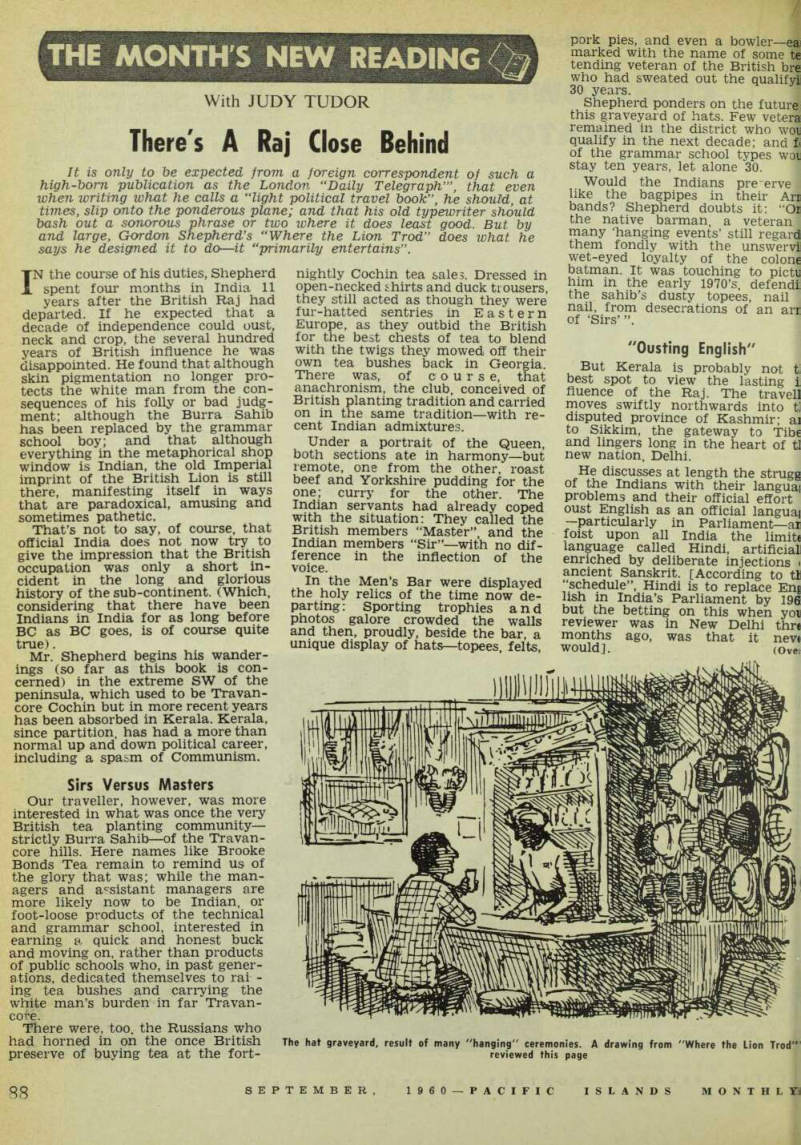
In the Men’s Bar were displayed the holy relics of the time now de parting; Sporting trophies and photos galore crowded the walls and then, proudly, beside the bar, a unique display of hats—topees felts,
pork pies, and even a bowler—eai marked with the name of some te tending veteran of the British bre who had sweated out the qualify! 30 years.
Shepherd ponders on the future: this graveyard of hats. Few vetera remained in the district who wou qualify in the next decade; and ft of the grammar school types won stay ten years, let alone 30.
Would the Indians preserve •. like the bagpipes in their Am bands? Shepherd doubts it: “Or the native barman, a veteran many ‘hanging events’ still regard them fondly with the unswervii wet-eyed loyalty of the colone batman. It was touching to pictu him in the early 1970’5, defend! the sahib’s dusty topees, nail nail, from desecrations of an arr of ‘Sirs’”.
"Ousting English"
But Kerala is probably not t best spot to view the lasting i fluence of the Raj. The travell moves swiftly northwards into tl disputed province of Kashmir; ai to Sikkim, the gateway to Tibe and lingers long in the heart of tl new nation. Delhi.
He discusses at length the strugg of the Indians with their languai problems and their official effort oust English as an official languai —particularly in Parliament—ar foist upon all India the limite language called Hindi, artificial! enriched by deliberate injections « ancient Sanskrit. [According to tB ‘‘schedule”, Hindi is to replace Eng hsh in India’s Parliament by 196 but the betting on this when you reviewer was in New Delhi thre months ago, was that it neve would]. (Ovei
The hat graveyard, result of many "hanging" ceremonies. A drawing from "Where the Lion Trod reviewed this page
)ur traveller looks into one of most extraordinary of modern
ian paradoxes—the British public
001, transplanted to the lofty jhts of a Himalayan foothill, s particular school was founded 1823, for the sons of Euro ns; today its students are ,ost entirely otherwise —yet the X)1 goes through the old motions, uding an Anglican morning ser i in the chapel for a “congrega i of pint-size Hindus, Buddhists, ists and Sikhs”. fficially, this school and others it, are marked down for early ngiilation (as “anachronisms in India of today”) while at the ie time high Indian officialdom imbles to enter its sons for them minute they are born.
Vandering American Widows
hepherd is told, as all visitors to ia are told, that there are more tish in India today than ever, sibly, so, but what sort? Mostly micians in the new industries, inessmen and salesmen. Estim ; in their way, but certainly not Burra Sahibs of the past, and ; is a matter for regret on the t of both Indians and our author, id your reviewer.) his vacuum, unfortunately, has been filled by British tourists > leave India strictly to the ericans who overrun this field —a ural staging point, says Shepherd, veen the pagodas of Bangkok . the pyramids of Egypt, he result is that the Indian on tourist beat is likely to judge Western world today on these rgetic globe trotters and come the conclusion that it consists inly of women over 60, all addicts pills, potions and preventive iicine. he standard candidate for these erican tourist parties is the ow of the business executive Dnsigned to an early grave by iss, strokes and stomach ulcers”), i a couple of the opposite sex d have survived the rat race, iding out like tall poppies— ?nificent in flambuoyant hula 'ts. hey seemed embarras c ed to be re, and silent, too. . . “While the aen chattered away about whether t emerald in Rangoon was glass L whether the water in Calcutta i boiled . . . they just fingered ir cameras, filters and light chines that festooned them, like >adhu selling his beads”. »ur traveller’s description of the erican tourist invasion of every ce between Cairo and Hongkong t has a decent hotel, is so bitterly using and so extraordinarily urate that these passages alone 'e, for me, worth the price of the ole book.
VHERE THE LION TROD. Published Macmillan and Co., Ltd. Australian :e, 29/9.)
Tigers Came When
He Called
AFTER Shepherd’s story of India today, there is no better book to read —in order to get your ideas completely into perspective— that Jim Corbett’s Man Eaters of Kumaon. This story, with one of his other Indian stories, was re cently added to the Oxford Uni versity Press’ World Classic series.
Corbett was the living example of these Burra Sahibs that Shepherd concerned himself about, and with whom today’s tractor assembly plant foreman, in India on two years contract, is like a creature of another species.
Jim Corbett was born in Northern India in 1875; he had five brothers and three sisters; two half-sisters and four half-brothers. Both his parents were survivors of the Indian Mutiny.
In the summer, this large, mixed family, went to the mountains; the rest of the year they lived in the foothills below, at Kaladunghi, and it was here that Corbett learned his first jungle-lore and from an elder brother how to shoot. Even as a small boy he went into the jungle and camped alone; he learned the bird and animal calls and could call up tigers to within a few feet.
He was a prodigious hunter and marksman, and all of this book about man-eating tigers is based on personal experience. He was continu ally under pressure to rid one dis trict or another of some man eater, sometimes credited with hundreds of victims, and he con tinued this gratuitous service until the outbreak of World War 11.
He occasionally hunted for sport, but when in later years he was pre sented with a 16 m.m. Cine-Kodak, he gave it up in favour of stalking game with a camera. He is credited with some of the best Indian and African wild life films. (Now in the Natural History Museum, London).
For over 20 years Corbett earned his living by transhipping goods across the Ganges for pne of the railway companies, and in the 1914 war he raised a labour force of 5,000 in Kumaon and took 500 of them to France. He brought 499 of them back, resettled them in their villages, and spent his gratuity building a canteen for the troops he later fought alongside in Afghanistan.
During the Second World War he raised and trained more troops..
Corbett loved India, its people and even, probably, its man-eating tigers, but after partition in 1947 he and his sister went to live at Nyeri, in Kenya, where he had an interest in a coffee estate. It was Corbett who was with Princess Elizabeth and the Duke of Edinburgh during the fateful night of February 5-6 1952, which they spent at Tree Tops the thatched hut in the branches of a tree in the Kenya forest. Dur
ing that night, the Princess became Queen Elizabeth 11.
He wrote six books—five of them about India —and all in his latter years. Together they tell the story of his life and all, in their way, are classics.
His last book, in 1955, was Tree Tops, an account of the Royal visit to the unique hotel in the trees. In April of that same year Corbett died of a heart attack. (MAN EATERS OF KUMAON. Published by Oxford University Press. Australian price, 12/9.)
The Navy and
Others in Samoa
THE United States Naval Institute has published more than 100 books in its time, most of them relating to Naval history of the United States and other Powers, or to scientific and biographical matters that have a Navy flavour. But their latest publication, Amerika Samoa, by Captain J. A. C. Gray, although hitched to the Navy by virtue of the fact that American Samoa was for half a century administered by the USN, is a straight-out history of the American Territory. The Navy’s part in Samoa (covering the period be tween 1900 and June, 1951), is apportioned its rightful place in this scheme of things.
Captain Gray was the last Senior Naval Medical Officer stationed in Pago Pago, and although he was in the Territory for only a couple of years, he obviously has kept his interest in Pacific affairs since, as well as being something of a student of earlier Samoan history.
A considerable amount of litera ture exists, both in German and English, on the early struggles of World Powers to get a foothold in the Samoan islands, and there is no
of literature on missionary ts there. But most modern srs about these islands have pushing a theory, or have anthropological axe to grind, there have been few attempts a, comprehensive history, and fewer from the American point iew. hen the Samoan islands were ly apportioned between Ger y and the United States at the of last century, the small islands le American share, in compari with Western Samoa, were omically poor to the point of I useless. Between 1900 and when the Navy handed over vil Administration, the economy le territory was based on the that it was a Navy base. The ;enous inhabitants, who had somewhere around 6,000 in ber when the US Navy took , and who had increased to 0 by 1950, made their living by ;ing for or supplying services to tfavy. iis reviewer was in Pago Pago le time the Navy was pulling and can remember the con lation that was felt when it was sed that the fairy godfather had operated in Navy uniform 10 long was really leaving; and they would have to get on as they could with an agricultural omy of which most of them r nothing, and with the pro on of arable land far too in uate for the now increased lation, wever, the Samoans were not ys pro-Navy, and Captain Gray tes quite some space to the ities of the American Samoan that, in combination with a ; administration, caused dis on in that Territory through nost of the 1920’5, e activities of the American Dan Mau got under way before Western Samoan Mau, although s been generally eclipsed by the r which was much more vigor and had far more serious and caching consequences. >st of the Mau troubles in rican Samoa were aggravated if directly inspired by people who not live permanently in the itory and by others who had no ection with it at all except igh half-baked theories—much mstralian academic do-gooders abuses in New Guinea today e, in fact, they don’t exist, one stage the Samoans were 1 to take the view that Samoa really “free” and that the ds had never been ceded. The Dans themselves, at this time, a whole string of petty griev s ranging from the charges 5 at the Navy dispensary to the that US sailors could not marry Dans without the consent of commanding officers, is is a good, straight-forward ry with just one mystery—why
in heaven’s name the author should have called it Amerika Samoa. So far as we know there is no valid reason for this, nor does the writer use this version of “America” in the body of the book. (AMERIKA SAMOA. Published by the US Naval Institute, Annapolis, Maryland, USA. Price, $6.)
The Great Three
Ringed Circus
THE cynical view of politics and politicians taken by most people these days is probably some indication of how far Democracy has slipped its cogs. The popular notion of politics is that they stink; and that politicians don’t smell much better, either. And this
attitude is not helped by the kind of novels Americans write about their own brand of political democracy.
Presumably, there are American novels that set out to show that theirs is the best of all political systems, but they are harder to re call than the many others based on political graft, influence, or mis placed ambition.
Even when the goodies ultimately triumph over the baddies, it leaves a nasty taste in mouths of readers who don’t understand the bally hoo techniques of the American electoral system.
A Fever In the Blood (by William Pearson), is a case in point. And even if it has appeared opportunely in Presidential Election year; and
n if the connivers don’t always mph, it is sufficient to make the i-American wonder how the ural leaders of the community ever rise through the ruck ;ake their rightful place leading peat nation. Things being as 7 are, the choice of American tical leaders interests more than Americans these days, he central figures in Pearson’s el are three men who want to i State Governor —two of them, how, as stepping stones to the ddency. ne of the candidates was the ;h and honest District Attorney; second was a slightly dipso uac State Judge, and the third aged Senator who had already one stroke but wanted to finish career in the gubernatorial seat, was the Senator who had the :anisation” and he set about his ihibited way of removing his anents. The whole campaign was plicated by the fact that a local alite was to be tried for murder, he District Attorney could get mviction before the “primaries”, yould be in. If, however, the trial d be delayed until after the pre 3tion, the delegates by some ex rdinary American type of reason would favour the Senator. It is Senator’s pressure on the Judge, only to withdraw as a candidate, to somehow foul up the trial promise of a Federal Judgeship, ; is the crux of the novel, bis is an extremely well written i but presumably would be more irtaining and comprehensible to jrican readers than to other iterners who are more likely to irritated or befuddled over the ne.
FEVER IN THE BLOOD. Published [acmillan. Australian price, 22/6.)
:rutable East,
:a 1908 this travel-mad world of 1960, when about every tenth person is dashing into print with his ressions of life on foreign nds; and experts on every odd ect under the sun are a dime a sn, you wouldn’t imagine that it Id be necessary to bring out :her (the seventh edition) of a el book that first drew breath 911. vay back before the First World before most of us had drawn th ourselves, a young doctor a job on a tramp vessel as its ical officer. The voyage was i Liverpool, through Suez to aya, Singapore and Japan and i a deviation to the (then) lerlands East Indies, back along same route. ne Doctor was J. Johnston aham, and when he got back to land he wrote a book about what lad seen, and where he had gone, as called The Surgeon’s Log, and n it was launched on an un
sophisticated world back in 1911 it was a thundering success. The publishers, thus encouraged, have been churning out new impressions and new editions ever since, and the doctor has not only gone on to become a successful London surgeon, but has become the author of an imposing string of novels and factual works.
Any resemblance between the South East Asia of 1908 and Mr.
Abraham, and South East Asia, 1960, is purely geographical. In the light of two World Wars; the invention of flying machines, and radio; the wave of nationalism that has swept SE Asia in the last two decades — what he wrote now seems like a museum piece.
But travel was real adventure in those days—something enjoyed by the privileged few—and we have lost a lot of the fresh approach that generation had to it. Junior typists and freshly graduated nurses did not then, as a matter of course, take a trip across the world with the Grand Tour chucked in. There
were no 85,000-ton passenger liners; no stabilisers to smooth out the rag ing main; no seasick pills; no planes to hurl you about the globe at just under the speed of sound. No mass produced, package deal tourist trips, The Chinese crew on the doctor’s ship wore baggy pants and pig-tails; spoke a brand of Pidgin that sounded like something out of a bad movie; and when he got to the East, the rickshaws amazed him, the hissing Japanese confounded him; the colour and exotic life overwhelmed him; the stinks at first appalled him.
These days, of course, we all know that Japs hiss, that rickshaws are just tourist bait; that the colour and exotic life are no more than the travel brochures promised us.
Ctoly the stinks remam the same, All in all, it appears to me, travellers have lost a lot since they became sophisticated and blase and the East gave up being Inscrutable, As a travel guide for 1960 we wouldn’t recommend Surgeon’s Log; but as an exercise in nostalgic read
and the living proof that the has changed (but not always he best) it’s worth a place on bookshelf, even though it seems r that the cost of edition seven out four times that of edition E SURGEON’S LOG. Published by Heinemann, Ltd. Australian price,
at Work
CRE are more things in ladrid’s heaven and earth than per dreamed of in the tourist’s ;ophy, and Paco Never Fails — its French version, Paco Le ique —tells you why. ; author is Andras Laszlo, a arian who now lives in France /ho once lived in Spain long :h to write seven novels in sh. s the tradition in Madrid (or le author says), for young nt girls who have erred to come from the country and hire lelves out as wet-nurses to iy families. Apart from the al sin, it is, we are to believe, lectable and lucrative occupa- Unfortunately, nature usually les only sufficient lactic hment for one child, and after tain period the milk supply up. There is only one way to going again, and this is where comes in. he time we meet him, he is a in middle age, and has been sing his profession for many He brings to it the calm, itional approach of a plumber drain pipes, and his wife keeps >pointment book and receives ients. Sometimes Paco obliges centric tourist who is looking 0 more than diversion, but illy his work is amongst the irses. ible for Paco starts when his >egins to have a child, when ing to Paco’s theories and matics it could not be his. eads the story to end in what dust-jacket calls “dramatic n”. 1 is a book about sex, sex of an rdinary kind, but presented :h a fashion that apparently ven Australian book censors eir susceptibilities disarranged, nade clear that it is the dis ice in Paco’s mind that is the 1 theme of this novel; not the ig description of how he earns ’ing.
O NEVER PAILS. Published by and Warburg. Australian price,
llection Called
.ove ALD KERSH, who might be garded as some sort of latter ly O. Henry, is back again with lection of long short-stories,
which make their bow to the world under the encouraging title of The Ugly Face Of Love.
The book, however, does not, as you might imagine, set out to give 11 versions of the seamier side of sex. It just happens that one of the stories is about a bloke called Love who had an ugly face, and the collection is cannily given its name from that.
The author has his own brash, American style of writing—although many of the pieces in this book have a London background. If you are fond of short stories —and not eve y one is—you might do worse than invest in Mr. Kersh. (THE UGLY FACE OF LOVE. Published by William Heinemann, Ltd. Australian price, 18/9.)
Blessed Are Those
Who Are Happy
ALTHOUGH Evangelist Billy Graham has spoken several million words in his young life, he has written only two books, and Secret Of Happiness is the second.
In this small paper-backed book there are in all, ten essays on how one may get to grips with oneself, with life and with God, and eight of them are based on the Beatitudes.
Graham writes with ease and obvious sincerity in getting his Christian message across.
(The Secret Of Happiness. Pub
lished by World’s Work, Ltd. Australian price, 6/- )
Youth Department
YOUNGSTERS who have improved their geography and their know ledge of sailing craft in other of the Green Sailor series (by Gilbert Hackforth-Jones), will wel come a new adventure, Green Sailors In the Galapagos.
This story is an extension of Green Sailors In the Caribbean, in which Uncle George, the four children, their Canadian friend Loopy and schoolmaster Ted are all in volved in defeating a diamond smuggling racket.
They are allowed by their parents to go on with Uncle George to visit his old friend in the Galapagos, pro viding they do their lessons and don’t have any more excitement.
But, of course, they do —plus learn ing something about these strange islands 800 miles south-west of Panama.
(Green Sailors In The Galapagos.
Published by Hodder and Stoughton, Ltd.
Australian price, 13/3.)
Also Read . . .
THREE novels that we have conscientiously tried to read this month, and on which we have made little impact, are herewith listed for your comment; , DEAR BEAST: by Nancy Hal. (Published by Macmillan, Australian
price, 22/6) : A new twist on the
country mouse who anonymously
writes a novel about the community in which she lives. The twist is that it creates little comment when it is learned who did the dirty deed, and she whizzes off to New York to join an arty-craft set who at first lay on the VIP treatment and waft the authoress along on rosy-pink clouds of delusion.
MALCOLM: By James Purdy. (Published by Seeker and Warburg, Australian price, 18/9) : A pixy creation that delves so far into the realms of fantasy that it leaves your poor, prosaic book-reviewer for dead The thing is that if you liked other novels written by Purdy, you will probably like this one, too. Dame Edith Sitwell (not surprising) and
Dorothy Parker (surprising) did.
Lust For Innocence, By
Dianne Doubtfire. (Published by Peter Davies, Australian price, 18/9): TTiis is the story of the anguishes of an eight-year-old moppet who pushes her sadistic mother under the wheels of a London Underground train, and then is blackmailed into an association with a man who saw it happen and whose ideas are more related to the first word in the book’s title than the last.
What’s New In Paper Backs
COME IN SPINNER, by Dymphna Cusack and Florence James: The novel of war time Sydney which is pretty well unique in AustraHan literature. It is not about wide open spaces nor gum trees, but manages to avoid the arty-craftiness that most Australian novelists imagine is the only alternative. The collaborators pro duced a good, sophisticated novel that could have happened against any big city background, but yet allowed it to have its genuine Australian overtones. (PAN GIANT 5/-.)
The Secret Adversary, By Agatha
Christie: A vintage Christie, first pub lished in 1923, published by Pan Books, Ltd., in 1955. with six printings since.
There should be no surprises in it for any one. It concerns the post-War I and pre marital adventures of Tuppence and Tommy (whose collective ages were around 45), the earliest of Agatha’s sleuths.
(Great Pan, 3/9.)
N OR M?, also by Agatha Christie: Twenty years and about two dozen thrillers after the preceding adventures of Tuppence and Tommy we find them, their combined ages now being twice what they were, relegated to the shelf by both the British Secret Service and their children. Nonetheless they had a World War II adventure just the same. (GREAT
Pan, 3/9.)
FATAL WOMAN, by Patrick Quentin.
What can happen (and fortunately doesn’t often) when your wife takes her sick mother to Jamaica and you befriend a poor, little wallflower at a cocktail party.
Peter Duluth’s poor little wallflower hung herself from his chandelier—and it made for complications, and not only with his wife. (GREAT PAN, 3/9.) THE STRANGE LAND, Hammond Innes, When this book was written—less than 10 years ago—this part of Morocco was still French. Apart from its thriller aspect, it is an interesting account of the little
known land between the Atlas Mountains and the Mediterranean, and of its people.
Of course, the strangest people in Innes’ tale are not the Arabs and the Berbers, but the importations who are engaged on the usual skulduggery. (GREAT PAN, 3/9.)
The Saint Closes The Case And
The Happy Highwayman, By Leslie
Charteris. According to a recent news paper article, Charteris (real name Yin) had a Chinese father and an English mother; his current wife is his fourth; and he is reputed to be a millionaire. The last fact proves that there is money in writing thrillers, especially when as now they are reprinted an infinitum. A good thriller is never “finished”. (Or so pub lishers seem to think.) These first saw the light in 1930 and 1933 respectively, when Simon Templar was presumably a good deal younger, but even then engaging in the same Robin Hood kind of adventures that he has today. (GREAT PAN, 3/9.)
A Penknife In My Heart, By
Nicholas Blake, which is a pseudonym for “one of the foremost poets of the day”.
But Blake doesn’t write thrillers like a poet, and in his example he has two men contracting together to commit a murder but for entirely different reasons. What seemed to both a way out turns out to be something quite different. (FONTANA, 3/9.) HOUSE OF NUMBERS, by Jack Finney:
In California a prisoner can get the d* sentence for just hitting a gaoler. Th what Arnie Jarvis did, and that’s whal was up against. There was just one out—escape—and this is the story of it was planned. (GREAT PAN, 3/9.)
The Wind Cannot Read, By Rid
Mason: The story of a young RAF ofl taking an Intelligence course in India < ing the war and falling in love with Japanese teacher. It was made into a m a few years ago, but unlike Mason’s be known novel—“ The World of Suzie Wo —this one doesn’t have a happy end
(Great Pan, 3/9.)
Fortune Is My Enemy, By Rid
Pape. This “grips the reader in a stran hold of suspense”—horror weapons suicide club, espionage, murder am beautiful girl, all spread out against background of Hitler’s last days in bunker. (GREAT PAN, 3/9.) JUTLAND, by Captain Donald Macini Back to 1916 and another war, and whi now regarded as the biggest naval bi of all time, when Germany’s entire n might met 148 warships of the British to decide who had control of the s
(Great Pan, 3/9.)
RED FOR DANGER, by L. T. C. 1 No one expects these days to die i railway crash (although some still but at one time it was the novel
rite way of removing unwanted cters from the scene. This is a il account of what was behindd the sts’ gimmick—a survey of Britain’s railway disasters between 1840 and and the lessons learned therefrom so British railways are the safest in the
(Great Pan, 3/9.)
r copies from Wm. Collins (Over- Ltd.)