Islands
Pacific
Monthly
September, 1960
Vol. XXXI. No. 2
tablished 1930
at the GJ>.O„ .S'ydneJyCw, v transmission hy post a o newspdj^}.
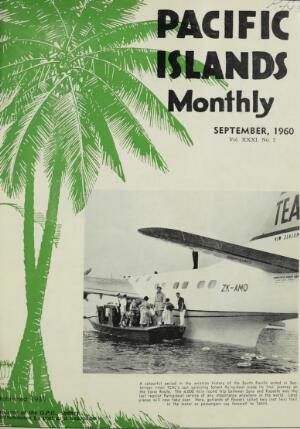
A colourful period in the aviation history of the South Pacific ended in Sep tember when TEAL's last surviving Solent flying-boat made its final journey on the Coral Route. The 4,600 mile round trip between Suva and Papeete was the last regular flying-boat service of any importance anywhere in the world. Land planes will now take over. Here, garlands of flowers called heis (not leis) trail in the water as passengers say farewell to Tahiti.
Advertisements & other items, pp. 2-6 (5 items)
Now.. .TAA serves the Territory
-Ps
NEW GUINEA AND PAPUA
mmm tsa'JU MM u
Now.. .TAA serves the Territory
TAA, Top Australian Airline already the largest domestic airline in the British Commonwealth now flies between Australia and the Territory of Papua and New Guinea, linking with 44 places within Papua, New Guinea, Dutch New Guinea and the neighbouring islands. More people fly TAA to more places on more flights because they know that TAA offers more of everything that “Service” means. Next time you fly, fly TAA. Reservations and information at any authorised Travel Agent or TAA Office.
FLY TAA THE FRIENDLY IVA Y
zz m
Bookings: At authorised Travel Agents, or at TAA, Musgrave Street, Port Moresby, Phone 2101; Airport Centre, Lae, Phone 2311 4
i
fij ff fnpfr ig
Coleman
lANTEPNS. LAMPS
STO VPS AND /PONS
**oo***'" "
LANTERNS;
Petrol or Kerosene. 200, 300 and 500 C.P. t X-J ■ *C'f* <** /HE
THE RESULT
OF OVER
50 YEARS"
EXPERIENCE
f*
TABLE LAMPS:
300 C.P. will give 12 hours light.
IRONS;
Kerosene or petrol. Easy guiding, easy gliding.
SOLUS STOVES:
In silent and roarer types.
Representative for Pacific Islands
ROBERT GILLESPIE PTY. LTD., Sydney
ROBERT GILLESPIE (N.G.) LTD., Loe, Modong, Rabaul, Port Moresby PEARCE fir CO. LTD., Suva for Fiji Islands
ARNOTTS
TIUPLE-WRAPPED
MOISTURE-PROOF
PACKETS
* i I
S!S*X
*** * * * <* «» <* *3 (X ✓ N* •r $ 0 t/ *» y * O 0 a
WHEN NOT IN USE
KEEP IN A CLOSED
TIN TO MAINTAIN
CRISP FRESHNESS
Qrnott's
Biscuits
There is no Substitute for Quality
X/EXS/5
TARGET SHOOTING IS GOOD SPORT!
Si -s* 4 o 9S On the inside of each new ICI .22 Rimfire Cartridge pack there is a practice target.
Your retailer also has free five-bull practice targets. Ask for them each time you buy .22 Rimfires your perfect partner for
good shooting.
The new colourful packs in the ICI range contain the same high-quality .22 Rimfire Cartridges famous the world over for consistent accuracy and excellent performance. sm.
USk
SPORTING CARTRIDGES
Manufactured by
IMPERIAL CHEMICAL INDUSTRIES OF AUSTRALIA & NEW ZEALAND LTD.
AM7791
THE CHINA NAVIGATION CO. LTD.
(A British Company incorporated within the United Kingdom.)
Mad
Passenger Liners:
M.S. "SINKIANG"
M.S. "SHANSI"
M.S. "SOOCHOW"
Regular services between Australia, Papua-New Guinea and Solomon Islands
Regular monthly service with
the modern motor ships:
"CHENGTU"
"CHEFOO"
"CHEKIANG"
(Cargo only)
Connecting Japan, Hong Kong,
New Guinea, New Hebrides, New Caledonia, Fiji and Tonga, thence return Japan direct. <, V ' '' For further particulars please apply to Agents or refer to the weekly advertisements in the “South Pacific Post ”,
AGENTS:
PAPUA; Steamships Trading Co. Ltd., Port Moresby, Samarai.
Cables: "Steamships".
NEW GUINEA: Colyer Watson (N.G.) Ltd... Lae, Madang, Rabaul.
Cables: "Colyeram".
NOUMEA; Etablissements Ballande, Rue de L'Alma, Boite Postale 18, Noumea.
HONIARA: British Islands Trading Corporation.
VILA: Les Comptoirs Francaise des Nouvelles-Hebrides.
JAPAN; Butterfield & Swire (Japan) Ltd., Tokyo, Yokohama, Osaka, Kobe. Cables: "Swire".
FIJI: Morris Hedstrom Ltd.
SANTO: Les Comptoirs Francaise des Nouvelles-Hebrides.
APIA: Morris Hedstrom Ltd.
NUKUALOFA: Morris Hedstrom Ltd.
TAHITI: Etablissements Donald.
EASTERN MANAGERS: Butterfield & Swire Ltd., 1 Connaught Road Central, Hong Kong. Cables: "Swire".
General Agents in Australia
SWIRE & YUILL PTY. LTD.
1
CIFIC ISLANDS MONTHLY SEPTEMBER, 1960
September, 1960 Pacific Islands Monthi
3
4 c I F I C ISLANDS MONTHLY SEPTEMBER, 1960
4
SEPTEMBER, 1960 PACIFIC ISLANDS MONTHL
People
Because the 15th session of the lited Nations General Assembly ening on September 20 in New >rk could produce some con >versial debates the Trustee bjects on the agenda include New tinea and Nauru—a top member the Commonwealth Government, ■ Garfield Barwick, Attorney neral, is leading this year’s dele tion. One of the Advisers to the legation is Mr. G. W. Toogood. ;cutive officer of the Department the Administrator, Port Moresby, e session will last for three nths.
ter completing his three years’ i in Samoa, Mr. C. H. (“Cam”) ler, Director of Broadcasting, med to NZ early in September, er his guidance, 2AP’s pro times developed in a realistic efficient way, particularly with °an language broadcasts. Just : from a refresher training se in NZ, Mr. Frank Brunt, a [ member of 2AP’s staff, is now ng Director of Broadcasting in tern Samoa. * * * • get the current picture, from uhtary point of view, Colonel Murray, US Military Attache in
[?]island's "Gold Coast" is attempting to out [?]the sunny South Pacific Islands as a [?]t attraction. They have now began send [?] heir representatives abroad to show the [?]-and here's one. She's 18-year-old dental [?]J ean Clark, crowned "Princess of Para city",as she arrived in Auckland by TEAL a on the first stage of a New Zealand tour as a "goodwill emissary".
Canberra, flew up to New Guine on an inspection tour during th first week in September. He late went on to Netherlands New Guine to carry out a similar survey. * * * In Melbourne at the end ( August, awaiting a ship to can him home to Nauru, was Re Itubra Amram, first ordaine minister of Nauru Protestai Church. Mr. Amram, who traine for six years at Camden Theologic College, NSW, has just complete a further 12 months of study at tl Union Theological Seminary, Ne York.
Suva legal fraternity, through IV R L. Munro, president of the F Law Society, gave a special welcoi to Mr. Moti Tikaram, first Fi Indian appointed as magistral when he took his place on t Bench at Suva Magistrate’s con on September 1.
Bankers, so their overdn burdened clients say, are seldf friendly people, but in Fiji <► exception was Mr. W. J. (“Jinr Lahore, who was first manager the ANZ Bank Ltd. in Suva. . amiable personality and liw interest in people and places wll he sojourned in Fiji won hinr
Off to Europe on a long holiday with his w[?] and family in August was the popular Sen[?] Customs Officer and Sub-cashier at Santo,N[?] Hebrides, Mr. Jack Holder. Mr. Holder, [?] Australian, has been in the New Hebrides si[?] 1937, the last six years of them in Santo.[?] Santo Customs brings in revenue of £25,[?] a year.
Married at St. Luke's Church, Suva, recent[?] Mr. and Mrs. Desmond Campbell. Mr. Camp[?] is with the CSR, and his bride was form[?] Miss Joy Knapper, tutor sister at the Cem[?] Medical School, Suva.
Photo: C. L. Chif
lost of friends. He was transferred i couple of years ago to the nanagership of the main ANZ Sydney branch. Last month, the lables from Suva were running hot
with congratulatory messages when
te was made the bank’s chief nanager for NSW. * * * Mr. Robert Charles Symes, a well jiown resident of the British lolomon Islands and of New Juinea, and Mrs. Judy Wales, irmerly of New Guinea and widow f the late Mr. Hector Wales, who r as well known in that Territory efore World War 11, in August nnounced their engagement. Mrs.
Tales has been a resident of Aus •alia for some time. It is expected lat the marriage will take place ext January.
A lone traveller who was seen in ; w Zealand, Fiji and Samoa in :ent months was Mr. Berson seph, a Marshall Islander, who is engaged in the study of educa •nal broadcasting on a six months’ lowship awarded by UNESCO.
Mr. Joseph has been identified th Station WSZO in the Marshalls ■ 3! years; in addition, he has en teaching mathematics and ence at the Intermediate School. ■ is a full-blooded Micronesian, Wotho Atoll. * * » Just back in Noumea after an sence of two years is Rev. Father cob, a New Caledonian native est who spent the last two years Rome (where he gained a sological degree) and in a parish Chartres, France. Father Jacob s ordained a priest five years ago ;er completing studies at the mmaire at Paita, 20 miles from umea. He served some time at umea’s Cathedral, “it has been the Church to prove the rth of the New Caledonian
[?]aded for Noumea, but visiting Port Moresby August from Manila, where he was First [?]retary with the Australian Embassy, was [?] Keith Douglas-Scott. In October Mr [?]glas-Scott will take over the post of Aus [?]lian Consul in Noumea from Mr. Rodney [?]dgson, who will be returning to Canberra.
native” (comments a Noumean resi dent). “It is only the Churc which has had the courage to tak a full-blooded native and train hir for a high post. Father Jacob ha pointed the way—there is no reaso why the future should not see nativ lawyers, doctors and scholar There is actually an elite passir through Noumea’s La Perom college which should do honor 1 the New Caledonian race”. * * * A Fijian and an Indian repr< sented the Colony of Fiji at tl Bth Conference of the World Ai sembly of Youth held at Acer Ghana, in mid-August. They we: Ratu Jone Vuiyasawa, of the Fijis Affairs Board staff and president i the Viti Club, and Mr. Shankar Li of the Education Department schools broadcasts unit. Both a members of the Fiji Council < Social Services, and Mr. Lai lat went on to UK to take a pos graduate course in social welfare Swansea University,
New Guinea, just recovering frc a rash of VIP visitors in July a August, is about to steel itself 1 another invasion. The president the Australian Council of Trg Unions, Mr. A. E. Monk, and t ACTU junior vice-president, Mr.
Evans, will fly to New Guinea October. They are members of group reported to be “studying t economic and social position white and coloured people Papua-New Guinea”. Others in t party will be representatives employers and the Federal Govei ment. It will be Mr. Monk’s 4( trip overseas, and he will contin on to Geneva to attend an Int: national Labour Organisation me ing. * * * Miss Fanaafi Ma’ia’i, first Samo woman university graduate, w recently was appointed lecturer education at Victoria Universe
In the Solomons in August were Dr. T. J.
Jamieson (left) and Mr. G. F. Witchell.
Jamieson, Medical Superintendent at Vil[?] Raton Memorial Hospital, was on tour to st[?] hospital construction and organisation in BSIP and P-NG. Mr. Witchell, travelling [?] missioner for the international headquarters the Boy Scouts' Association, is on a five mont[?] tour of the South Pacific, conducting train[?] programmes and checking on Scouting devel ments.
Wellington, NZ, has written a ihildren’s book. Stories of Old lo,moa. It contains the old legends I Western Samoa in attractive orm and has been well received in Few Zealand. ♦ * * Among 23 scientists who paid a uick visit to Papua-New Guinea at le end of August, after an inter ational symposium on chemistry eld in Australia, was a leading ritish professor, Sir Alexander odd. He told reporters that, in his union, meat was more important lan education for the Territory’s itives— they appeared to lack an lequate meat supply in their diet, lucation is very necessary, he freed, but the natives cannot ach their full potential unless ey are properly fed. He urged at the job of developing P-NG ould be tackled by the British unmonwealth rather than by istralia alone, with her limited oney resources.
Ir. and Mrs. Jacques Villeminot sed through Sydney on their / to New Guinea in August to ry out four months’ anthro- Dgical work on behalf of the nch Government. A lecturer at Musee de Paris, Mr. Villeminot, > in Australia in 1955 doing re rch work among Central Aus lian tribes and he has written ee books about the aborigines I Australia generally. * * * Miss Marjorie Stewart, South Pacific Commission’s
[?]nation of a new Boy Scoot Troop at [?]angi, Rarotonga, in August has added in st to Scouting in the Cooks. Rarotonga [?]ously had only one Scout troop but now we are two a keen sense of competition is [?]cted to develop. Here is the investment [?]mony of the new All Saints Troop. Scooter [?]aiau receives his scarf from Scoutmaster [?]n Sullivan, while District Scout Commis sioner J. D. Campbell stands by.
Photo: R. D. Moore.
Women’s Interests Officer who has been in Fiji for the past six months; went on to Tonga in August. Hei work among Fijian women was ar outstanding success—Women’s Clubs have mushroomed all over the Colony, with their attendant pro grammes of hygiene, sewing, cook ing and gardening. From Tonga Miss Stewart will move on to th( US Trust Territory of Micronesia. * * * From the little town of Tugun in South Queensland, three forme] residents send kindly greetings t* some of the old generation o; people in Fiji. They are Mr Christopher Wager, now aged 81 who for long years was a promin ent police official in Fiji; Mi Arthur Freeman, who now is 8‘ years of age but who still defie the withering hand of time an* cherishes many memories of ols friends in Fiji; and Mr. Freeman’ daughter, Mrs. Jane Robertsor who also made many friends in Fij:
Mr. Ron Webb, the South Pacif Commission’s administrative office recently spent a week in Pago Pag inspecting and making plans f« the next South Pacific Conferenc It will be held there in July 196 and Governor Coleman hopes it w; coincide with the completion « the new Tafuna international aij port. The last South Pacific Con ference was in Rabaul in 1959. * * * Commander A. W. Savage, we known in the Pacific through h command of HMAS Tobruk (whit recently made a South Pacific to* together with HMAS Anzac) September was appointed Au tralian Military Adviser’s repn sentative at the SEATO militai planning office, Bangkok. T h appointment will be for two yea from next January, with the actij rank of Captain. He succeeds Gro< Captain G. H. Steege, also W' known in the Islands. * * * Mr. John Wesley Coulter, Pn fessor of Geography at the Ue versity of Cincinatti, well kno'' writer on Pacific subjects—he wro Fiji, Little India of the Pacif in 1942—was in Fiji for a week August after spending three montt in French South Pacific territon studying human geography uno an Association of American Ge graphers’ research grant.
Married at Arorangi, Rarotonga, in August, the London Missionary Society Church —Jimir Wichman to Salome Joannides.
Photo: R. D. Mooi
ZJonrad Dube, French Canadian ppled cyclist who has been mak \ an extensive tour of the South cific over the past year or so, was en a happy send-off from Papeete July when he departed with his ich decorated bicycle aboard a ssageries Maritimes liner for aama and Brazil. Dube made ny friends during his stay in hiti and he was bedecked with vers on his departure.
the High Court of American oa, bank employee Ben Tau of ei. was sentenced to 16 months on a charge of having em led $3OO from Bank of American oa funds.
graphed in Vila in August—well-known Hebrides businessman Oscar Newman, who had large plantation interests there. He how sold his interests and in September [?]ts to leave the New Hebrides “more or permanently" and live in his house near Roseville, Sydney.
O. Simpson a WHO official in Suva he is lecturer at the Central Medical headed a band of enthusiasts who sed a Suva street appeal in August for to send a Fijian Olympic party to Rome.
Here he is, on the job.
Photo: C. L. Cheng.
The Qantas house flag was pullec down at Lae, New Guinea, on Sep tember 1 and TAA’s run up, t« show that a new era in P-NG in ternal air services had begun Qantas officially left New Guinea or that date. TAA general manager Mr. John Hyland, and Mr. Cedrii Oliver. Qantas Islands manager both had nice things to say abou each other’s companies that da: at a hail and farewell luncheon Mr. Hyland added that TAA, witß its New Guinea routes, was nov the biggest domestic airline in th Commonwealth and one of tin world’s biggest.
Former French Finance Ministi Antoine Pinay passed thrmig Noumea with his son and a priva secretary so quickly that he wj gone before most Frenchmen kne he had ever been in New Caledomi Mr Pinay said he was merely mal ing a world holiday tour —and 11 headed for Sydney. * * * It is perhaps fortunate that rw everyone in the world has conscience like Mr. Clive Camera MHR, who recently visited Ne Guinea and now is an expert on tl subject.
What is troubling Mr. Gamer* and a group of natives in tl; Sangara area of Papua, is that 1917 the native owners sold 28,41 acres of land to the Commonweal!
Government for trade goods to tk
Bishop George Bernarding, SVD, newly cons crated Divine Word Missionary Bishop for t[?] Mount Hagen vicariate of New Guinea. T[?] picture was taken at Pittsburgh Cathedral d[?] ing his consecration by Bishop John Wrig[?] Bishop of Pittsburgh. The new Bishop, on[?] episcopal coat-of-arms, has a coconut pa[?] perched atop Mt. Hagen. Coconuts don't gr[?] at Hagen but the palm symbolises the tv[?] coastal vicariates of Wewak and Alexisha[?] from which the Mount Hagen vicariate w[?] formed.
alue of £2BB/11/6. Both Mr. ameron and the present genera on of natives (whose forebears sold ) think it was a lousy deal and ant a judicial inquiry into it.
In Parliament in Canberra in ,te August, the Minister for Terri fies explained to Mr. Cameron lat the £2BB worth of trade goods •including beads, tobacco, rice, ces, etc. —were given as payment s was customary” then and that was apparently acceptable to the eputed owners of the land at that ne and for many years after irds”. However, in 1951, the inister said, a younger generation ade representations and had re wed them since. He didn’t see at there was any case for ap inting a Judge to hold an inquiry.
society wedding with all the immgs took place at All Saints irch, Woollahra, Sydney, in ust, when Julienne, daughter of G Assistant Director of Lands, L. Anthony and Mrs. Anthony, Tied Captain Adrian Clunies 3, son of the late Sir lan Clunies s and of Lady Clunies-Ross. y met in Port Moresby, where oaptain was with the Pacific rids Regiment. Julienne was born labaul. A month before, another a S" bor P gir1 ’ Janet Normoyle, =hter of the P-NG Police Com moner, was married to Mr lan ertson. in Port Moresby, by the lop ?. f J* ew Gui nea, Bishop ►ng who had confirmed her Mr weP known as first
fwill shortly
e the sea for a job in Sydney.
[?] ceremony at the top of New Guinea's [?]m Pass in August, the widow of Patrol [?]e r . Rupert Haviland (top) was present at the [?]iling of a memorial plaque in his honour, [?]as erected by his friends. Rupert Haviland [?]largely responsible for the building of the [?]lands road over the Kasam Pass. He died [?]pectedly in October, 1958, leaving a widow and two children.
Advertisements & other items, pp. 7-16 (10 items)
5
GiriG ISLANDS MONTHLY SEPTEMBER, 1960
IccaninNY
p* 3 t‘Z 4 m
CCA.
pov
&%v>
noo*
<T(X^ <?SS=: nintf! tvaoto
UHQ
IccaninNY
PREPARED WAX
FLOOR POLISH
FOR LINO. FLOORS. FURNITURE. LEATHER e MOTOR CARS Twice the shine in half the time"
Piccaninny imparts a glow of youth and beauty to floor surfaces that might otherwise soon begin to show their age. There is nothing more perfect for linoleum or natural wood floors.
Piccaninny's tough wax skin protects surfaces from tropical moisture, wear and tear —saves you hours of work and gives Twice the Shine in Half the Time!
I
ASK FOR
I PICCANINNY
BROWN STAIN FLOOR POLISH
For Jarrah, Cedar, Stained Floors & Woodwork Piccaninny Polishes are manufactured by
PICCANINNY MANUFACTURING CO.
254 Pittwater Road, Manly, N.S.W., Australia
A
Alii NEW TWIST!
GOLDEN
BIRD
MADE FROM
THE VERY
FINEST
IMPORTED
TOBACCO
Keeps longer! Smokes better in humid conditions long storage life!
First Class Tobacco. Golden Bird special Twist is made from highest grade overseas tobacco leaf as used in expensive pipe tobacco. It is not bitingly strong but smokes sweet and mellow. Any pipe smoker would enjoy Golden Bird in his pipe.
Uniform Quality. Golden Bird is well made by modern, improved machines, each twist being of regular shape and even weight.
Highly Mould Resistant. “Golden Bird” was tested b'. the C.5.1.R.0. Here is the text of the report: “The failure to develop mould growth within four weeks at 90% relative humidity at 77° F. temperature indicates that the samples submitted have manifested a considerable resistance to attack by moulds.” (Mould grows fastest at this temperature).
Special Packing. To guard against the effects of high humidity and to ensure complete smoking satisfaction, Golden Bird is supplied in moisture-proof, sealed polythene bags of 3 lbs. Packed in 30 lb. outers and in 90 lb. shippers.
GOLDEN BIRD fine imported twist tobacco, manufactured by
LEONARD NORMAN PTY. LTD.
15/19 AMELIA ST., WATERLOO, SYDNEY, N.S.W.
Cables and Telegrams: “ SYDNEY.
BUY AUSTRALIAN BUY GOLDEN BIRD
8/6 lb. f.o.b. Sydney Special prices for contract quantities.
I
YOUR FAMILY
NEEDS VITAMIN BI
EVERY DAY!
Get Vitamin Bl in many different
ways, with delicious:
VEGEMITE
SPREADS so SMOOTHLY on toast *r^U: DELICIOUS on biscuits SO NOURISHING in sandwiches Every member of the family needs Vitamin B x every day for
VITALITY.
Vegemite is the only pure concentrated yeast extract, and yeast is the richest known natural source of Vitamin the vitality vitamin.
But remember! The body cannot store up Vitamin Bi —it needs a fresh supply daily. So enjoy Vegemite every day —for Vitality.
ENRICHES gravies KR3
Pour on Carnation
for the best dessert
you ever tasted!
You’ll love the way creaming with CARNATION MILK brings out that delicious, fruity flavour. Pure, fresh, “double-rich” CARNATION is so rich it actually whips! No wonder it gives desserts such a smooth, rich, luxury taste a taste you can’t get any other way.
And it’s so simple just punch and pour straight from the can.
Try creaming your desserts this new, easy way with convenient economical CARNATION. It’s the quickest way there is to turn a dessert into a treat. -•x Creaming with
CARNATION is
real economy—costs you less than halj the price o] ordinary cream
Mil*
Carnation Milk
From contented cows iM rich > So rich, it even whips. v
MILK IN ITS MOST CONVENIENT FORM
For a
long cool
drink on
a long
hot day
P* 0 IC7 Never any risk of running out of soda-water with a Sparklets syphon. You make the soda yourself—the easy way. Just fill the syphon with water, screw on a Sparklets bulb . . . and up comes the soda, crisp and lively. And you know without doubt that it’s fresh and pure. if you keep your new Sparklets syphon in your refrigerator you’ll have a supply of ice-cold soda always ready. There’s a fine range of colours to choose from and it makes a wonderful gift.
Sparklets syphons
SPARKLETS LIMITED LONDON Nl7 ENGLAND
PARKE-DAVIS
CAMOQUIN TABLETS
Effective Single Dose Treatment for
MALARIA
SPECIALLY FLAVOURED TABLETS AVAILABLE FOR
CHILDREN
Adult Dose —2 Tablets to be taken on the same day of every week.
CHILDREN;
Infants and Toddlers-Up to 2 years of age— y 2 tablet (50 mgm) of INFANT FORMULA CAMOQUIN, as a single weekly dose. —From 3to 4 years—l tablet (100 mgm) of INFANT FORMULA CAMOQUIN. as a single weekly dose.
Older Children -7 to 10 years—l ADULT FORMULA Tablet as a single weekly dose. —ll to 16 years—lV2 ADULT FORMULA Tablets as a single weekly dose. —Over 16 years—2 ADULT FORMULA Tablets as a single weekly dose.
IMPORTANT:— CAMOQUIN should be taken immediately after or during a full meal.
Obtainable from all chemists and suppliers of
PARKE-DAVIS products
PARKE, DAVIS & CO., SYDNEY
7mSL
/ / f V. 1a
OJA
t K
nEREADv
trade marks 1
b atter*
Power your flashlight with
EVEREADY
BRAND
050 FLASHLIGHT BATTERIES
UNION CARBIDE AUSTRALIA LIMITED
CONSUMER PRODUCTS DIVISION
"Eveready" and "Nine Lives" with the Cat Symbol are registered trade marks of Union Carbide Australia Ltd., Sydney.
E2BI
\ K Ml L, oM jjji
JrY'S
• • . because there is a glass and a half of pure, fresh, full-cream milk in every half pound of Cadbury’s Dairy Milk Chocolate Wo2s/2FC/ 9
5
fascinating cheese flavours
■ KRAFT SPREADS
for quick-spreading on sandwiches and savouries Blue Cheese Spread
KRAFT
L Blue
c heese soreai kraft
Gorgonzola
c heese spread kraft
Cream Cheese
Spread
y Gorgonzola Cheese Spread Cream Cheese Spread kraft
Smokay
cheese pread Smokay Cheese Spread Cheddar Cheese Spread These Kraft Spreads come in slim and attractive re-usable glasses which will prove very handy. kraft
Cheddar
Ch
Spread
eese Just look! 5 easy-to-spread treats all deliciously different. Kraft Spreads bring new, tasty variety to party savouries —or spread on toast fingers or biscuits for quick snacks ideal for sandwiches, too.
Be sure you always have Kraft Spreads in your pantry there’s a flavour to delight every member of your family.
KRI
(a/nv'ft&pub cofmoi.ivittv i|e%
mlvn(\
P Gay canvas the fashion fabric of outdoor living enjoys a place in the sun no other material can match for smart decoration, lasting beauty, light weight and versatility.
Colourful awnings, cool, absorbent chairs and lounges, canvas wading pools for the children and shade-giving umbrellas are but a few of the many attractive items in canvas.
Ask your local canvas supplier for a free catalogue he will help you choose the ideal canvas accessories to beautify your home. 613
7
ACIFIC ISLANDS MONTHLY SEPTEMBER, 1960
8
SEPTEMBER. 19 6 0 -PACIFIC ISLANDS MONTHI
9
CIFIC ISLANDS MONTHLY— SEPTEMBER, 1960
10
SEPTEMBER, 1960 PACIFIC ISLANDS MONTH L.
11
cIF I C ISLANDS MONTHLY SEPTEMBER, 1960
12
SEPTEMBER, 1960 PACIFIC ISLANDS MONTHL
13
CIFI ° ISLANDS MONTHLY SEPTEMBER, 1960
September, 1960 Pacific Islands Month
Pacific Islands Monthly
A News Magazine Distributed In Australia, New Zealand And These Pacific Islands
Publisher:
R. W. Robson.
Editors:
Tudor Stuart Inder
Manager:
Selwyn Hughes.
NES: General Business, Editorial, Ivertising, Subscriptions:
197-8, Ma 7101, Ma 4369.
'.0. Box 3408, Sydney,
ired Address for Telegrams, ns. Cables: "Pacpub", Sydney.
Ial Subscription Rates;
ides surface postage except where stated) ic Is. —Papua-N.G., Samoa, Norfolk, B.S.I., Cook Is., G.&E. Grp., Niue, lebrides, and other cific Islands . .. £1 4 0 icific Territories (N. lia, Fr. Polynesia); utch N.G £1 7 0 lia and N.Z. . .. £1 10 0 British Common t h Countries, and (40/- Stg.) . .. £2 10 0 . and U.S. Pacific ies ($6.00 U.S.) . £2 12 6 pies (postage extra) 2 6
Anch Office, Papua
New Guinea
jblications (New Guinea) Ltd., luilding. Fourth St., LAE, New Jinea. Tel.; Lae 2577.
Pat Robertson, Manager.
\Nch Office In Fiji:
s Building, Gordon St., Suva.
Tel.: 4043.
*Resentative In N.Z.;
Whitcombe, P.0. Box 5179, Jckland. Tel.: 22.570.
Resentative In U.K.:
hburn, 13 Rood Lane, London, Tel.: Mincing Lane 8633.
HE OFFICE; Newspaper House, ms St., Melbourne, Victoria Tel.: 63.7053.
All main trading firms and i m the Pacific Islands.
Agency In Australia
ublications Pty., Ltd., is the i agent for THE FIJI TIMES, of Suva. Fiji.
Contents
No. 2. Vol. XXXI.
September, 1960
PEOPLE: Personal Paragraphs of Islands' Interest 5 Government "May Relinquish Ma jority" in P-NG Council 17 Fijians Won't Accept Major Part of Burns Plan 17 187 Dutch New Guineans Came Home 18 Julian Amery's Visit; Future of British Pacific 18 Fiji Sugar Deadlock Broken 19 Significant Moves Against Disorder by Fijians 19 Rabaul's Wedding of the Year 19 Lively Interest in Norfolk Island Council 20 Important Change in P-NG Native Wages 20 The Copra War Livens Up 21 No Change in NNG's Status 21 Mr. David Trench is New High Com missioner for the Western Pacific . 22 West Samoa Hammers Out its New Constitution 23 NNG Has a Political Party 23 COMMENTARY; A Look at Pacific and World Affairs 25 The Editors' Mailbag 27 The People You Meet: Stuart Inder's Islands Roundup 29
SYDNEYSIDER at Home Base 37 Death of Mr. Graham Kerr 41
Territories' Talk-Talk 45
Two Who Have Cruised a Year 51 Vietnamese to Leave the New Hebrides 53 On the Trail of the Cargo Cultists .. 57 New BSIP Wet Rice Project 65 Professor Who Collects Pacific Lan guages 67 How a Fiji Mill Got into Operation . 69 Book Review: Pacific Territories Just Happened 73 The Wood Carvers of Bougainville ... 77
Magazine Section:
Brett Hilder's Profile, 81; Tropi calities, 81; Crossquiz, 82; Do You Remember? 82; Life with an Oil Drum, 83; How Tahiti Became French, 84; My Chinatown! 87; Book Reviews 88 This Month's News of Ships and Yachts 103
Pacific Report (Index P. 17) 119
OBITUARIES: W. H. ("Tavua") John son; C. B. Dupertuis; Mr. Frank Allen; Mr. Harold Adcock; Mr. John Price; Mr. Arthur Cresswell; Ratu Eroni Buresova 149 Commerce and Produce 161 Sports Review 151 Shipping and Airways Timetables 153
Advertisements & other items, pp. 17-18 (3 items)
A Product of Pacific Publications Pty. Ltd., 29 Alberta Street, Sydney
(29 Alberta Street is 10 yards from the intersection of Goulburn Street and Wentworth Aventte.)
16
SEPTEMBER, 1960 PACIFIC ISLANDS MONTHL
Supalusta
MANUFACTURED TO GIVE
LONG LASTING BEAUTY & PROTECTION
UNDER ALL TROPICAL
CONDITIONS
You Won't Repaint
For Years
If You Paint With
famU If iiish Paints Lim o*
CXTt»*
!fp>[
EN AM
**IOR
I GLOSS,
COLOURS
SO S' f V ! » \ Supalusta will stand up to the most rigorous climatic conditions.
Supalusta is reinforced with the new sensational resin, Penta-Alkyd, whit guarantees longer lustre life a toughness and flexibility which preverr peeling and cracking under the harshest weather conditions.
Supalusta gives the easiest brushing of all enamelised finishes. Its smoott porcelain-like finish that resists dust and dirt, is the highest, finest gleamin lustre of any exterior house paint.
It actually washes clean every time it rains.
Supalusta withstands burning sun and salt sea spray, and is highly resistat to all fungus and mould growth.
BRITISH PAINTS LIMITED
Supalusta
EXTERIOR GLOSS PAINT
See the delightful range of colour fast shades at your neare British Paints Limited depot or store.
IMPORTANT:
For maximum protection against fungus and mould growth alwas treat new or previously painted surfaces with British Paints Limiteo anti-mould solution.
Enquiries are invited from storekeepers to act i authorised agents for British Paints quality produce Write to British Paints Limited, Box 43, P.O. Bankstown, N.S.W., Australia
[?]overnment "May Relinquish
Majority" In P-NG Council
From a Special Correspondent
Canberra.
The Administration of Papua-New Guinea may possibly lose its official majority in the new Territory Legislative Council.
[”S understood that Cabinet has discussed this important and most surprising proposal, and it an announcement will be made m. \ decision on the composition of 3 new Council will certainly give 3 Territory increased native and ropean representation through increase in electorates, fhe present three electorates, of pua, the New Guinea Mainland d the New Guinea Islands may ih be divided into two, and a tive and a European elected from ;h. rhe composition of the Council is ely to be, if the plan goes through: Pwelve elected members (six native, six European).
Den nominated members (native and European). [Twelve Government members, plus the Administrator.
Dhe new electoral divisions are 3ly to be east and west Papua, ; New Guinea Highlands, the New inea Mainland. New Britain and ; New Guinea Islands.
Such a composition will mean, course, that the elected and ninated members voting to iler can defeat Government legis ion. )ne of the arguments apparently ; forward for this important pro ;al was that the most contentious i vital legislation—that of income ;—had already been put through i Council, and that there was no ter legislation of similar import -3e that could now arrive and s defeat. Such legislation that aid go to the new Council would legislation dealing with internal tters where the local knowledge members can be expected to mt —such as liquor and native our.
Legislation Foreshadowed
n any case, under the new com -ition, important legislation would hably be foreshadowed, and mbers would be given plenty of ice beforehand. Their opinions aid be canvassed behind the nes. If it is obvious the proposed v legislation had no possible mce of being passed because the jority of the unofficial members aid be against it, then the legis on would not be submited, or it aid be amended.
Vith a composition of at least 12 vernment members to 22 un
official members, more than half of the unofficial membership would have to agree on legislation before it could be put through, otherwise the Government would be able to use its strength to out-vote them.
No doubt also the Government could be expected to search for moderates to be nominated to the unofficial membership—men it can depend on to be sympathetic to the Government’s point of view.
But whether it does this or not, such a composition would cer tainly be welcomed in New Guinea as a democratic one and a startling move by the Government. Mr.
Hasluck, it is understood, has had much to do with the planning
Electoral College
The election of native members will probably be undertaken through an electoral college of the type now being operated in Netherlands New Guinea to help establish the New Guinea Council.
Delegates will be elected from each division, who will meet and finally choose the six members to
represent the native viewpoint in the Counqil. There will, presum ably. be nothing to prevent such a college electing a suitable European to represent the native vote.
The next Legislative Council meeting—the first of the new term —will begin in Port Moresby on October 17.
It will be in new Legislative Coun cil chambers, formerly the European Hospital building, which has been completely redesigned and fitted with air-conditioning.
This session will be opened by the Governor-General, Lord Dunrossil.
The Council will probably be prorogued early in its sessions, and the new enlarged Legislative Coun cil should be operating some time next year.
Pacific Report
Turn to these inside pages for more highlights of the month’s news: Big Sea Search Fails—ll 9; Fiji Labour Precedent—ll 9; Death Comes to a Lone Hander; Fiji Stabilisation Fund Problem—l2l Japanese Team Busy in Tonga—l2B-' New Fiji Store is “Islands Largest” —128; Coral Route Plans—l 29; Five Days as Castaways; Former Pago Pago Man on Serious Charge —133; Future of Norfolk’s Air Services—l3s; Cooks Labour Con ditions; Anthropologist Refused P-NG Entry—l 36.
US Will Look at Samoan Economics —139; Anti-Blood Transfusion Pamphlet: NNG Natives to Visit Holland—l 39; Daru Puts on a Show—l 42; Stores Fined for Overcharging Natives—l 43; Mis hap Delays “Malaita”—l44.
Fijians Won't Accept Major Clauses
Of The Bums Plan
Little progress has been made in the adoption by,Fiji of the Bums Plan, published last March, and designed to re-arrange the govern mental structure so as to provide for the demands of a greatly iozcreased —and increasing — population.
A LARGE proportion of the Report’s minor recommendations have been agreed to by the Government; but the few major recommendations—w ith o u t the acceptance of which the Burns Plan is virtually useless—have still to be agreed to. , Council of Fijian Chiefs, after lengthy sessions, informed th e Governor on September 7 that it mission s report for the 8-Dolition ox the Fiji Administration and the merging of its powers in the Central Administration; penal taxation of Fijian-owned lands which are not being effectively used; and other recommendations relating to the use of revenues from lands. The Council by a small majority, accepted in ’ principle the direct election of three Fijian representatives to the
Legislative Council, plus two elected by the Council of Chiefs, The effect of the Council of Chiefs’ decisions is to stultify the Burns Commission’s plan of reform. The Commission in its Report em phasised that its plan must be accepted as a whole.
Expert observers say the refusal of the Fijians to agree to the major
recomme Adations-?especlally refoi-m
of administration and reform of the i nAnffAi nf :n rwnKnKiTr _•__ i probably cripple th ® wh “ e . p J a JV „ The Legislative Council will meet on September 27; but several weeks probably will elapse before it will commence consideration of the Burns Report. This debate would be come one of the most important and critical in the recent history of Fiji.
Advertisements & other items, p. 19 (1 item)
17
ICIFIC ISLANDS MONTHLY SEPTEMBER, 1960
187 Came Home
From Hollandia, NNG, in August came a report of how 187 Papuans “came back” to Dutch territory from Indonesia.
IT happened in April when the people of the small village of Torobi, on Koflau Island, which is in NNG close to the western sea border which divides NNG from Dutch-hating Indonesia, were astonished to see a great number of outrigger canoes heading for shore. All were loaded with people,
plus pigs, goats and other live stock. Soon. 187 men, women and children were walking up the beach.
They were led by a village preacher Willem Wanma, who re ported the fugitives had taken four days to make the crossing from Indonesian territory and on the way a baby had been born, Wanma told how his people had always been seagoing people who had regularly visited what were now the Indonesian islands.
In about 1936, people from the Dutch islands of Numfoor and Biak had settled what is now Indonesia’s island of Obi. where they had worked with a Dutch firm. When war broke out and there was no work, the migrants moved to the small island of Bisa, and around 1945 an entire village of people from Biak and Numfoor had estab lished itself there. The men mixed with the local Indonesian, but Christian, population.
Wanma reported that conditions had deteriorated in the last few years and Chinese shop owners were ordered by the Indonesian Government to close their shops and go to the big cities. Then the New Guinea immigrants made their plans to return home. Officially they were not allowed to go so they had packed up one night and gone.
The NNG Government has assisted the 187 fugitives with food and supplies and has returned them to villages in the Geelvink Bay area, where the elders originated.
These are some of more than 20 outrigger canoes, with 187 people aboard, who escaped over "the Western border".
This young mother was one of the fugitives.
Obviously she has some Indonesian blood in her now.
Pacific Islands
Julian Amery's Visit
Future Of British Pacific Islands Under Examination
There could be considerable significance in this month’s unexpected visit to the South Pacific Territories of Mr. Julian Amery, Parliamentary Under-Secretary of State for the British Colonies, who will be ac companied by Mr. H. P. Hall, head of the Pacific and Indian Ocean Sections of the Colonial Office.
MR. AMERY will arrive in Sydney on September 15, and fly directly to New Zealand; and in Wellington he will have discussions with representatives of the Australian and New Zealand Territories Departments, in relation to the South Pacific countries where Britain has joint interests with the Dominions.
From New Zealand, Mr. Amery and Mr. Hall will fly to Australia; and thence they will fly north tc visit Papua and New Guinea, as guests of the Australian Govern ment.
Mr. Amery will proceed from New Guinea to the British Solomon Islands (due in Honiara on Sep tember 26); and thence to New Hebrides, and on to Fiji.
Important Tour
Mr. Amery will be in Fiji in the early part of October; and the indications are that, from Fiji, he will visit Tonga and the Gilbert and Ellice Islands Colony.
He and his party are due back in London on October 30.
It is considered certain that Mr' Amery will examine, not only the local administrative conditions ir the several Territories and Colonies which they will visit, but also— • The future interests of New Zealand and Australia in relation to Fiji and Tonga. • The future defence of South Pacific Islands against growing anti-West power in South and East Asia. • The future interests of Aus tralia and the Territory of Papus and New Guinea in relation to the British Solomon Islands and the New Hebrides Condominium. • The future of Fiji in relation to (a) the implementation of the recommendations of the Burn,* Report (b) the extent of Australia’s economic interests in Fiji and (cX the need for some degree of con stitutional reform in Fiji, to provide for rapidly changing population ano community changes there.
The outstanding post-war facton
(Continued on page 150)
in the South Pacific Islands is growth of Australia’s strength t influence, and this will be ami the matters discussed by Mr. Am during his Pacific visit. 1 subject includes the future Solomons and New Hebrides, wh —although an expensive respi sibility of the British Coloi Office—is increasingly under influence of Australia.
Developments in the I* Hebrides have been such t Britain and France will shortly hi to get together and decide 1 where the Condominium is heac: Mr. Amery is a young man, of the Right Hon. L. S. Amery. had a very colourful World \ II record—he carried out sc dangerous secret missions in Balkans area; was wounded al he had been parachuted ii Albania to lead a force of esca[ Russian prisoners; and he was w Churchill’s personal representat in the Far East with Chis Kai-shek.
Mills Now Working In Fiji
Sugar Deadlock Broken : All Mills Now Working In Fiji
The four Colonial Sugar Refining Co. sugar-mills in Fiji were in full operation, in mid-September, and the nine-months' war between the company and the Indian cane-farmers was over. Nevertheless, difficulties still lie ahead.
I EITHER side won a victory I worth boasting about.
The company finally got its 11s going, but under conditions lich probably will show little Dfit in the 1960 season, rhe growers will cut and sell ough cane at the 1959 price (con ied to them by the company in e June) to keep them off the jadline; but they will get noth r, to compensate them for the s they sustained when, instead beginning to cut on June 21, they lowed Messrs. A. D. Patel and iya into a wilderness of mean dess argument and screaming •y against the CSR. rhe company had planned to pro ce, between June 21 and early nuary, enough raw sugar to fill J quota of 199,000 tons allowed i under the international agree nt. Even that would have left a ge proportion of the cane stand : in the fields, unwanted and un-
Big Losses
Tow, with 21 months lost in jiment and idleness, it is doubtful ether the quota can be produced The growers stand to lose, not y the cane grown in 1959-60,
(Continued on page 150)
surplus to requirements, but also the cane that should have been cut between June 21 and mid-September, but was not cut because they were led down the garden path by Messrs. Patel and Koya. However, with luck, the growers and the mills might put through the 199,000 tons quota by February 26, which would reduce losses generally.
There was excuse for the attitude of the growers in the first half of 1960.
They had planted up a lot of cane in good faith. Naturally they were resentful when they learned that the company not only could not accept all their cane, but proposed to purchase the 1960 cane at a lower price than that of 1959.
The company itself apparently had been misled by the world’s sugar situation; and it showed some appreciation of the grower’s feel ings in June when it agreed to pay the 1959 price, and made other con cessions.
On that basis, an agreement, and the commencement of cane-cutting, seemed possible in June, and again on July 24; but the bitter anti-CSR influence of the Patel group, although dwindling, kept the cane growers idle all through July and (except for Labasa) through August, until early September.
Patience Paid
During late August and early September, the Patel group tried repeatedly to induce the Governor to intervene between the CSR and growers. Sir Kenneth Maddocks conscientiously heard each plea— —showing so much patience that in the end he was sharply criticised for not showing the firmness and brutality that, in the opinion of many citizens, the Patel tactics really called for.
But patience paid off. While each argument was being carefully con sidered, the farmers were showing discontent and distress, and grow ing weariness with the Patel tactics.
The Government mobilised all reserves and some civilian volunteer troops, to protect growers who de cided to cut. (See p. 69 for a report on Labasa position).
Finally, Fijian growers, and con tract cutters on CSR-owned farms, began to cut cane for the mill at Ba, and on September 1 it began crush ing, with supplies coming in from all the areas, from Penang to Lautoka.
This was the break-throus Within 48 hours, the trickle of cs became a flood. Within 10 days, c! ting was in progress from Sigatc to Raki Raki. and all three in on Viti Levu were in operation It was overwhelming defeat for 1 Patel gang, and some of its me bers reacted in a very ugly w Certain “leaders”, in meetings cane-farmers, urged the farmers a final resort to destroy their ca and use their land for vegetal: and other subsistence crops.
Fearing arson and violence, ■ authorities alerted their gua everywhere.
The 1960 season’s troubles over, for the moment; but gr difficulties lie right ahead. E affected Indian groups almost c tainly will try to — • Interfere with cane-cutt between now and January. • Induce strikes among the m workers. • Discourage planting of cs for the next and following seasc • Wreck pending conferences discuss next year’s cane prices t conditions.
In these matters—especially last two—there is need for grea co-operation and clearer und standing between the Governme the CSR, and the organised ca; growers.
There also is need for r authority, or new laws, to curb ve ous union organisers whose activit while ostensibly for the good of wage-earners, are generally Ir sponsible and, at times, apparer subversive. The Fiji commur must be protected against th gentry—otherwise, the commur will take steps to protect itself.
The History Of
The Deadlock
inuary-June.—Numerous conferences fail to reach agreement on 1960 rates and other conditions governing sale of growers’ cane to CSR Co. me 21.—Instead of opening on this date, four crushing - mills remain closed, and put off many hundreds of millworkers. ily 24.—Verbal agreement reached be tween company and growers on July 23—but minority of growers, directed by Patel group, refuse to sign, ite July.—Definite split between “moderate” and Patel - led cane growers. ngust 10.—Yanua Levu growers began cutting and Labasa mill started crushing on August 11.
“gust 12-31.—Patel group strives to maintain cane-growers’ strike, but— sptember I.—Rarawai (Ba) mill begins crushing. eptember 10.—Penang (Raki Raki) mill begins crushing, eptember 9.—Lautoka mill begins crushing.
Significant Move
Forces Against Disorder
By Fijians In Fiji
By a Staff Writer
There are clear and growing
signs that the Fiji community,
believing that the Fiji Govern
ment has failed to protect
the Colony against “irrespon
sibles”, is preparing to provide
its own protection. r[E Fiji community (Europeans, Fijians, Indians, Chinese, Euronesians) in recent months has seen these things— o Riots last December, caused by mishandling of a strike called by irresponsible young labour-union leaders. Much damage was done in Suva. • Deadlock in the sugar industry, extending over months, caused by a small group of Indians apparently motivated by hatred and prejudice, and some of whom are suspected of subversive associations. • Strong attempt made at end of August by youthful union-leaders to call a general strike, “in protest against the despatch of Police and Army detachments” to the sugar areas. (The attempt failed—rank and file of workers ignored the call).
Demonstration of Loyalty A significant thing happened late in August, A meeting of ex-servicemen was called in Suva, to celebrate some thing or other. A couple of hundred were expected—but no less than 2,000 Fijians, with some Europeans and Euronesians assembled from all over Fiji, and gave an im pressive demonstration of loyalty to the country’s Government, and hatred of disorder.
There also have been some private demonstrations.
The Governor has been told repeatedly, by the Fijian leaders, that he has only to say the word, and he can have all the men hfe
wants to cut sugar cane, or to protect the cutters.
Early in September, there were reports current of the formation among Fijians of a new political party, to take a larger share in the government, and in the maintenance of order.
It is said that this movement is among the younger Fijians, but that it is being approved by the chiefs and the older Fijians, who
hitherto have given their support to the Fijian Administration, rather than the Central Government.
Position of the Indians This new spirit and political activity among the Fijians is, to some extent, anti-Indian. In the view of some old hands here, it cculd extend far and dangerously.
That development is to be deplored. Although Indian agitators held the centre of the stage during the long sugar deadlock, they did not represent Indians generally.
The great majority of Indians, both rural and urban, are as much opposed to disorder and violence as the other communities. But they do lack leadership, and a voice in affairs.
There is no reason why the majority of Indians should not be aligned with Europeans and Fijians in orderly and progessive govern ment. It is mainly a matter of wisdom at the top, and suitable constitutional machinery in be tween.
Wedding Of
The Year
This was Rabaul’s wedding of the year—that stopped the traffic, post poned a race meeting, and dragged an estimated 1,000 white Rabaulites from their homes to see the couple leave the Methodist Church and 400 more into the church to see the Rev. Wesley Lutton perform the ceremony. The District Commis sioner, Mr. J. R. Foldi, was among the guests.
It happened on August 20 when Mr. Patrick Roberts, a planter, married Bougainville girl, Miss Victoria Mah. Our photo shows the couple leaving the church to enter the £2,500 Chevrolet sedan that was the bridegroom’s gift to the bride, and ride off to the reception where champagne flowed like beer usually does in Rabaul.
This isn’t the first time that a European has married a native girl in the Territory—but mostly it has been on the Papuan side, and there has never been a fuss like this, which was made all the more sur prising by the fact that, although Mr. Roberts has been in the Terri tory for many years, he has never shown signs of being “social”.
Some reactionary types (native and European) disapproved the match, but most white Territorians have got themselves nicely adjusted to the world of 1960 and just couldn’t care less.
Photo: M. R. Hayes.
Advertisements & other items, p. 21 (1 item)
19
l C I F I C ISLANDS MONTHLY SEPTEMBER, 1960
Norfolk Council’S Stand
Is A Lively Issue
The Norfolk Island Council’s sit-down strike, begun in July, developed into a lively issue in August after the Council had publicly snubbed visiting Australian Minister for Civil Aviation, Senator Paltridge.
THE Senator, who wasn’t offended at the snub, but just “a little surprised”, later offered the Council some advice about getting on with the job it was elected to do. So did a big public meeting which was called by the islanders to discuss Norfolk’s political goings on.
The troubles of the eight-man Council began after it was elected in June as Norfolk’s first experi ment in local government. Pre viously, Norfolk had an advisory council.
The new Council revolted before it had even begun.
It shot off a petition of sorts to Australian Territories Minister Paul Hasluck, insisting that the new Council wasn’t what the people wanted; Norfolk was tired of re mote control and had to have power to make its own laws (to be ap proved by the Commonwealth) and to have complete control of the budget among other things (PIM, August, p. 20).
Caused a Split
The Council said that until the Norfolk Island Ordinance was amended to give it these and some other things the Council intended
(Continued on page 150)
Here is Norfolk Island's newly-elected Council. Back row, from left: Mr. G. Quintal, Mr. L. Nola, Mr. W. S. Newbald, Mr. S. Nobbs. Front row: Mrs. C. Donkin, Mr. F. C. Christian, Mr. F. J. Need ham (President), Mr. I. Bailey (Deputy President).
Photo: P. R. Hoare.
to take over none of its powers except those of an advisory nature.
This attitude caused quite a split on Norfolk —and within the Council itself.
When Senator Paltridge and Mrs.
Paltridge turned up on the island foi a four day visit, Council presi dent F, R. Needham declined an invitation by the Administrator for the Council to be represented at the airport during their arrival.
After this snub, the Council asked the Minister to meet it to discuss business later in the week. At this meeting, the Council’s one woman member. Cr. Lavinia Donkin said she apologised for the Council’s seeming rudeness at the airport, and added: “As a Norfolk Islander I say that as a people we have always been noted for our courtesy, hospitality, friendliness and loyalty.
It was a very poor show, and for my part absolute ignorance”.
Senator Paltridge said he had never heard of a case before where a community had refused powers it was offered. He suggested the Council take these over before ask ing for additional ones.
Hot on the heels of these activities, 21 islanders—with island women in some strength on the list—called a public meeting to discuss the snub, but more particu larly the refusal of the Council to take over the reins.
Feelings were high, and fireworks were expected, but the meeting was orderly. A resolution was moved that the Council resign if not pre pared to act. This was amended, for the motion to be held until the Council conferred with the convenors of the public meeting.
An announcement on what happened at this later meeting was
expected on September 12.
Meanwhile, the Council resolved to send an apology to Senator Paltridge, who, no doubt, was still wondering how he managed to be come involved in colleague Hasluck’s headache.
New Wage
P-NG Wage Fixing New Wage Will Have Wide Effee
A recommendation for an ir crease in native labour wages i Papua-New Guinea, which is ez pected to be approved shortly, wi mean an important change in Terr tory wage fixing methods.
FOR thousands of Territoi natives the Native Labour Ore inance will cease to have th influence it has held for them ove many years, and the way is opene for wage fixing by negotiation. : may mean a scramble for highe wages, as in Australia.
The recommendation, for a min: mum cash wage of £3 per week fc urban workers in Port Moresb; Rabaul and Lae, was made to tli Native Employment Board by em ployers’ and employees’ represent atives. It was recommended fc single workers only, as an alternate to the system of a weekly wage ph rations, other issues and accora rnodation, and is to come into effec from November, if approved.
The Proposals
Proposals were that the new wag not be applied to workers in primar production or in domestic dutie£ that deductions be made by err ployers of certain amounts for foo and accommodation if it is supplied that overtime be paid, at one-and a-half times the regular rate, i excess of eight hours in a day or 4 hours in a week (double time o Sundays and holidays); that thes rates not be applied to existin agreement workers; and that era ployees’ associations would under take not to seek an extension c the cash wage to other centre within two years (but this woul not affect their right to seek a re view at any time for the thre centres).
The recommendations were mad by the Kerema Welfare Associatio and the P-NG Workers’ Associatio (both representing employees), an for the employers, the Port Moresb Chamber of Commerce, Planter Association of NG, Papuan Planter; Association, Morobe Dist r i c Planters’ and Farmers’ Association Lae Chamber of Commerce am Rabaul Chamber of Commerce.
The recommendation was mad at the end of a long public in quiry into native wages by th Native Employment Board. The in quiry began last September am concluded in July. Evidence fille? nearly 1,800 typewritten pages.
The Board has drafted an overaj
(Continued on page 150)
recommendation on native wages which is now being considered by the Administrator, but it is expected the £3 wage will be approved be cause it has been made by agree ment.
Nevertheless, the new wage raises many sticky problems.
What effect will it have on Ad ministration native employees in other big centres, who will also probably insist on the higher wage?
And what effect will it also have on private industry?
The present agreement worker’s minimum wage is 25/- per month, plus rations and accommodation.
Before the war it was 10/- in Papua and 6/- in New Guinea. In 1946 this was raised to 15/- per month in both Territories and in May. 1956, the wage was increased to its present 25/-. The Board will make proposals on this figure.
Advertisements & other items, p. 22 (1 item)
Fijian Moves
20
Fijian Moves (Continued from previous page)
SEPTEMBER, 1960 PACIFIC ISLANDS MONTHL
Fiji Planters Are Beginning
Copra War Livens Up Fiji Planters Are Beginning To Have Second Thoughts
Frcm Our Fiji Correspondent There are now clear signs that the Fiji copra-crushing mill, operated by a subsidiary of the W. R. Carpenter Co. organisation, is facing a copra supply situation a good deal more restricted than that of recent years, when little or no competition existed in the buying field.
S of August, at least three other buyers had entered the field— Banno Oceania Limited; the Japanese Mitsui organisation rough a New Zealand agent, ;an Trading & Wholesale Co., of llington); and a London buyer h apparently no direct repre tation in Fiji. n the surface it appeared that Suva mill-owners and the Banno pie—buying on behalf of Jap se principals—had reached an eement regarding prices in May, owing a week or so of openly ipetitive trading after Bannos t entered the field, ntil then, Carpenters had ilarly issued prices each Monday ■ning for the three grades of ra for the week ahead.
''hen Bannos started buying, >e prices were withheld for a k. Then again they were issued a, joint, agreed price; and they regularly published, as such, i Monday morning, at it is now no secret that both >e organisations are offering er than the published terms to east the larger producers, and i the entry of additional buyers e May it is clear that competi has become very keen, indeed.
That Other £l4 is now known that at least two he overseas buyers—Bannos and London firm—are ready to buy Suva prices, or better, on the rf at Savusavu, subject only to cient quantities being available lake it worthwhile for an over ship to load there ivusavu has a wharf capable of dling such vessels, though at ent it would only permit work two hatches at a time. Addi al copra storage space might i to be established there before l shipments could commence, but would not seem to be a seri problem. > the differential in the copra ng price between Savusavu and i is at present between £FI3 and l, it is obvious that the Suva ers are going to be faced with ajor problem.
Since the British TVTinistrv nf irri Ml , ni S tr y 01 Food S buying contract ended at the end Of 1957, some Fiji plantation- Owners have maintained that the Fiji mill has not been paying the best price—however that price might (.nmmrp with thof hoimr
Sthe? teriTtoriPs g P
rrrt ,
The Producers Association has been in regular receipt of the London prices; and the planters main tain that, although the local mill stated about the end of 1957 that Fiji producers would receive at least £3 more by selling locally, this has not been the case.
They claimed in August that the differential between the Suva mill price and the London price had recently been about £F2S, which far exceeds the charges that would be involved in shipping direct to the , . , . A , They have stated that they wish to support the Suva mill, provided
the mill is prepared to pay the price that outsiders are offering.
The situation now appears to have reached a showdown insofar as the big Savusavu-Buca Bay-Taveuni producers are concerned and probably one-third of the Colony’s copra is produced by these planters.
Want Copra Board
The Fiji Copra Producers’ Asso ciation held a committee meeting at Diloi Plantation, Savusavu area, in (Over)
August, to discuss the recommenda tions of the Burns Report in rela tion to the copra industry.
After the meeting the president, Mr. R. McGowan, said that it had been decided that the best interest of the industry and of the producers in Fiji would be served by the estab lishment of a Copra Marketing Board, similar to the boards in other Islands territories. Another approach will be made to the government.
One of the reasons given for re jecting the establishment of such a board on an earlier occasion was that it would be creating a monopoly, and that in any case it was not really necessary.
The producers now believe that its necessity has been demonstrated, and say it could co-ordinate the marketing and stabilise the situa tion which is now developing with the entry of new buyers.
The Producers’ Association at pre sent has 89 members, including Fijian and Indian members. The president would make no comment on prices now actually being offered, or say whether these differed from the published weekly prices; but he agreed that the situation was de veloping in favour of the producers and away from the situation under which they had to accept the terms offered by the Suva mill.
The copra grading system under which the local millers and Banno Oceania Ltd. purchase copra, was changed on August 29 from a three grade system which has operated since December 30, 1957, to a two grade system, with the moisture allowance for the top grade—still known as HAD—increased from 6 per cent, to 8 per cent, and the price
differential 30/- between the two grades.
Previously the price differential between HAD and the lowest grading, FM2, was £2/12/6, and the difference between the top and middle grade prices was 27/6.
The new arrangement offers less incentive for the use of expensive copra driers, and is opposed by planters who have invested in them.
This photo was taken after the Fiji Copra Producers' Association committee had held an important meeting at Diloi Plantation in August. Those present are, from left; S. H. Wilson, L. H. Simpson, B. Kesteven (vice-chairman), C. G. 0. Parr (secretary), J. Fenton, H. B. Gibson (legal adviser), R. G.
McGowan (chairman), G. Barratt, D. M. Mackenzie, W. G. Halstead. Absent from the committee meeting were A. G. McCown (vice-president), Ratu Kabakoro (Tui Naweni), and Amara Singh.
Photo: J. P. Shortall.
Nng's Status
No Change In
The Netherlands caused some con fusion among its friends in early Sep tember when it announced that it “favoured placing Netherlands New Guinea under international super vision” through the UN. This ap peared to contradict NNG’s 10-year plan towards self-government.
The statement was first made in The Hague, reportedly by the Prime Minister, and seemingly was confirmed by the Dutch Foreign Minister, Mr. Luns, just before he left for New York. The suggestion was that a UN commission of Australian, Indian and US repre sentative be formed as an advisory body to the Dutch administration.
Nevertheless, in Sydney on September 10, the Netherlands’ new Ambassador to Australia, Dr. J. G. de Beus, denied that any such scheme was in the air.
“The Press has somehow mixed it up,” he said. “There have been no changes.
We still have a 10-year programme to build up NNG towards self government. Naturally we will still keep in close contact with the UN.”
A day later, an official statement was released from The Hague saying exactly the same thing.
The £ s. d. Of Selling Copra
By a Staff Writer
The most important thing to be deduced from the report on Fiji’s current copra situation is that Fiji planters are about three years behind other British Pacific territories in thinking that it is a good idea to have more egg-baskets than one. But judging by some of the ideas that are currently circulating in Fiji about copra, it seems evident that local producers have something to learn about selling overseas, too,
QINCE the end of the UK Ministry
° Unilever a {ias * enter
Arm contractsSchvlar wito most sr territories in the South Pacific for a nronortion of their conra nroduc*tioS their copra pr This company would have entered into a similar contract with Fiji; but at the time Fiji producers could nol dWUiev wlXto S reta?n°a g conr S a nothing was done about selling a nmnnrtinn rvf thp codfr overseas° n and it consequently all went to the local mill which has now geared itself to this intake of COpra.
Someone to Make Contracts As has been suggested lately.
Unilever would, no doubt, still be to make an annuai con tract with Fi J i; but there is no authoritative body with whom the company could make such a con
besuchabadth?mr
?fSr n r! oUlCl not be SUcn a bacl tnmg « has also been suggested that *ls difficulty might be got over by operative. But wricitever the body W3<S called, the requirements would be more or less the same. It would need to have a legal status for mak
(Continued on page 146)
ing firm contracts overseas locally, and to have the necessa stores and office accommodation a: personnel for running what is, aft all, a veiy big enterprise.
All Unilever copra is shipped fre South Pacific territories in Ba Line ships. Naturally, these sht would not call at Savusavu or els where for small quantities of copii and this means that consideral' storage space would be necessar: The price paid by Unilever unc its contracts is current Philippini or world, price. And that, presumab; would be the price it would p: for Fiji copra—“ Suva price, better”, wouldn’t come into calcul tions.
The reported £l4 differential kl tween Savusavu price and Suva m price is difficult to break down in component parts. The mill does n buy in outports. but only ex-whaf Suva, and how the producer gc his copra there is his own busine?
Apparently only about £4 of ti
is freight, and the rest comes ;r about 24 other heads ranging l the twine that is used to sew bags to beetle-tax —some items hich might, it seems to us, more erly be included in cost of pro ion. ipra Boards have worked Dthly enough in other Terri is, but Fiji planters would be ng themselves if they imagined planters in these places had no 3. Each board has its own way working and fixing prices that paid producers, as a glance at ’s monthly produce prices will 7.
August, for example, the P-NG :a Marketing Board was paying intative price of £A6S per ton top grade copra at main ports; BSIP Board was paying £A6O top grade; Western Samoa was ng £Stg.67/13/8 per ton. It is □us that the Samoan Board was ng this price from accumulated its (see p. 145) while P-NG, for nple, was merely paying an trary sum, the final amount to djusted at the end of the year’s ing. le only way to compare the 3S paid in various territories is ake them over a long period, bring into consideration such gs as local taxes (some still pay >rt tax on copra), stabilisation 1 deductions and the like.
Difficult Comparisons
1959, when copra boomed, P-NG lucers were consistently paid a tentative price; but when amts were finally adjusted in
April this year, P-NG producers ended with an average price of £A9O/14/7 per ton for top grade over the whole of 1959.
During that same period, PIM quoted the price that the Suva mill was paying in the first week of every month (although the Suva prices were, in fact, adjusted weekly).
Using these figures, the average mill ex-wharf Suva price over 1959 was £F7B/6/5 per ton for top grade— equivalent to approximately £ABB per ton. It seems likely, therefore, that in the long run, P-NG planters did a little better than Fiji planters; but Fiji planters had some advant age in that they were paid the total amount promptly, while in some cases, P-NG planters had to wait nine months for a final settling up.
Charges Vary
The charges involved in shipping copra in bulk from Pacific Islands ports to Northern Europe varies according to the world price of copra. The cost of a 3 per cent, shrinkage when copra is £lOO per ton is naturally more than when copra is £6O; the same rule applies to insurance. However, the current cost of shipping copra from New Guinea (for example) to UK is cer tainly less than the very generous amount allowed for getting Savu savu copra to the wharf in Suva.
For those who like doing sums it is interesting to compare the Fiji and Philippines prices as quoted for August 8, 1960, in the PIM.
On that date the Suva mill was paying £FS7/7/6; the Philippines
c.i.f. North European price was $193.50 —equal to about £F75.5 At a wild guess, say the freight and other charges amounted to around £Fl3 that leaves around £FS per ton more than the mill was paying—not £25, as some people in Fiji seem to have claimed.
These figures, of course, are so full of unknown quantities that they can be regarded as only approxi mate. Nonetheless, where thousands of tons of copra are involved in the aggregate, even a pound or two adds up to a considerable sum.
One factor that is consistently overlooked in the current Fiji copra situation is that the mill, once hav ing extracted the oil from the copra, has to get it across to the other side of the world before it can benefit from it—and this is not done for nothing. World price can swing considerably between the purchase of the copra at Suva wharf and the arrival of the coconut oil in Europe.
The immediate nigger in the wood pile seems to be that large amount of £l4 which producers in Fiji say it costs them to get a ton of copra to Suva. It is a sum in excess of the current cost of getting the same copra in bulk, all the way from the Pacific to Europe, and therefore is a figure that needs investigating.
Advertisements & other items, p. 23 (1 item)
21
CIFIC ISLANDS MONTHLY 1960
Settling-in Pains
P-NG Airlines Have Settling-in Pains
Lae.
Machines break down and humans make errors, no matter whether they work for Qantas, TAA, or Ansett-ANA.
And those New Guinea Territorians who spent a lot of time complaining about Qantas and who anticipated a modern miracle by way of a perfect time-table from the new companies when they took over are due for a dis appointment.
TAA took over the internal network officially on September 1, and the transition period during take-over has underlined the many problems—large and small —with which Qantas had learned to deal efficiently, and the new companies hope to do, eventually.
But at least they’ve got two big blunders over, and probably won’t re peat them.
Were they embarrassed when the captain’s satchel and documents were left behind at Rabaul the other day and the plane had to return for them!
And more than embarrassment was felt one day in August when the southbound plane went off from Lae without the mail! It was pretty serious because there was no service the following day so all New Guinea mail for south was delayed in Lae for two days.
High Commissioner
Popular Appointment
Mr. David Trench High Commissioner For Western PacifiC
Mr. David Trench, Deputy
Colonial Secretary, Hongkong
will be Britain’s next High Commissioner for the Westerr
Pacific.
HE succeeds Sir John Gutch, wl retires early in the new yea He is expected to take up h appointment soon after Sir Johr departure.
The official announcement ma< by the Queen in August, said thi Mr. Trench would be appointed be a Companion of the Distinguish* Order of St. Michael and St. Joh Mr. Trench has had long exper ence in the British Solomons ar his choice as High Commission will be welcomed as a happy one. I went to the Protectorate as a cad in 1938. He saw military servi from 1942-1946, and attained tl rank of Lt.-Colonel.
Human Touch
He is a man with the hums touch and a sense of humour th shows in the twinkle in his e and a laugh that is never far aw£ The Western Pacific was a tes ing ground for a lot of young a ministrative officers during the wj Following his pre-war Solomo experience he had been posted Tonga as Secretary to the Gover ment.
But after the recapture Guadalcanal, he was sent back the BSIP as District Officer 1 Guadalcanal and given the job “pulling the district back into shapi The way in which he did it described in Harold Coope Among Those Present in th« terms: “He reopened the Dis t r i Treasury, although for mar months it consisted merely of t; safes standing on a trestle in t open air. As the end of the figf ing on Guadalcanal drew near a coastwise schooner journeys cor against be undertaken for otll than military purposes, he beg to visit distant areas to see hi the natives were faring.
“He was agreeably surprised the manner in which they had sto up to the strain of war. Nowlu was there any sign of a collapse i morale. During a period when Gt ernment control had inevitably b(» relaxed, no inter-tribal feuds tJ developed and there had been serious crime.
(Continued on page 147)
“Local chiefs, although deprived of the official support and guidance on which they formerly relied, had everywhere succeeded in preventing disorder. ,
Dealt With Shortages
“One of Trench’s chief headaches was the shortage of food in areas formerly occupied by the enemy.
The Japanese landed on Guadal canal with orders to live on the country and wherever they went they engaged in wholesale looting of gardens. , ..
“Trench set out to get the gardens back into production as Quickly as possible, but m the meantime part-rations (readily pro vided by the Americans on a lease lend basis) had to be issued in one corner of the island where stocks of food were particularly low. The rations were doled out by police patrols which released them only to families able to produce evidence that they had begun replantmg their gardens. - “Perhaps the gravest result of the Japanese invasion was the virtual cessation, over large areas, of that routine medical work which is of such immense importance in tropical territories. . .. .
“The Mission doctors and their staffs had done what they could to keep the work going, and had achieved prodigies, but they could scarcely have been expected to set up their trestles and offer injec
tions in villages adjoining Japanese encampments.
“A pre-war campaign which had promised to bring the Protectorate’s Public Health Enemy No. 1 — yaws—under final control had been interrupted and there had been a fresh outbreak of that disfiguring and debilitating disease. Trench assembled all the natives he could find who had had some experience as dressers or hospital wardsmen and sent them out as a sort of ‘shock’ battalion, with such drugs as were available “His duties as a District Officer having been forcibly increased by the demands of war. Trench sought
to divest himself of lesser respon sibilities. Many of his judicial powers he delegated to headmen, who were given authority to hear certain classes of criminal and civil cases on condition that the parties concerned were willing to submit to their jurisdiction, n, nn . ( Ma PPY Experiment “This experiment produced ex tremely satisfying results, as Trench was confident it would, in view of the excellent record of the headmen when left to their own resources during the occupation, “The simplest of Trench’s ‘war
duties’ was the arranging of lectun on native customs, and the pn paration of pamphlets on natn languages, for the enlightenment < American troops; the most interest ing was the selection, from tl bridges of American warships, 3 bombardment targets along tl enemy-occupied coast; and the mo hazardous was the operation, wil the help of Kennedy and othi officers stationed in the westei islands, of a rescue service fi crashed American airmen.”
In 1950. Trench was transfern to Hongkong, and his reputatk as a practical, down to earth ar human administrator continui there.
He will find it a change to j from the free-spending atmosphe of wealthy Hongkong to tl Treasury-controlled Western Pacii High Commission, but he can r member when things were mui worse, and all concerned can 1 sure that whatever he does will 1 firmly grounded in practic common sense and good humour.
Advertisements & other items, p. 24 (1 item)
22
SEPTEMBER, 1960 PACIFIC ISLANDS MONTH
Its New Constitution
West Samoa Hammers Out Its New Constitution
From “PlM’s” Apia Correspondent The Constitutional Convention of 174 members (10 of them representing the European population), began on August 16, the marathon months task of giving the soon-to-become independent State of Western Samoa a written constitution.
HESE 174 men who, as the New Zealand High Commissioner, Mr. J. B. Wright, said in his ning speech, will go down in tory as the Fathers of the Con ution and thus the guardians of civil rights of the people, have deliver the qompleted, volumin document to the General As ibly of the United Nations by member. or their guidance they have the ift Constitution that was drawn by a Working Committee of the islative Assembly of Western aoa with the help of Prof. J. W. fidson, of the Australian National verity, and Professor C. C. Aik 1, of Victoria University College, ilington, NZ. roceedings got off to a creaky *t, and the first three days were oted to debating the rules of :edure to be followed during session.
Involved Work
uring the first week’s discussions lecame evident that many of members of the Convention id it difficult to understand the etimes intricate and involved ns of the constitutional and ,1 clauses in the draft in spite he additional explanations given Dr. Davidson and Professor nan, gain and again speakers appealed more time for members of the mention to express their views; not to rush proceedings in e of the limited time available ire the constitution in its final a has to go to the United ions. mgthy debates centred on two icular subjects which were of ial interest to the Convention on which many speakers were i to express views, bey were the traditional lority of the “Ali’i and Faipule” : village Councils of Western iqa) which were not specifically itioned amongst the important ponents of the new State in the :t constitution; and the ques of whether capital punish it should be continued or ished. motion asking for the authority he Ali’i and Faipule to be set and safeguarded in the final stitution was later withdrawn. n*ge number of members of the
Convention seemed greatly con cerned to have the rights of these councils of village chiefs the traditional representatives of villages and districts—expressly protected and anchored in the constitution but a compromise motion was later agreed upon. The definition of the authority of the Ali’i and Faipule will be referred to the Legislative Assembly for consideration and early legislation.
PM Quotes Bible
The question of capital punish ment in the new independent State was another controversial subject which was discussed at length and on which widely divergent views were expressed.
While many speakers—and in fact a majority of members—demanded on religious grounds that the death penalty should be abolished altogether, others pointed out that consideration must be given also to the victims and their families.
The debate on this point culmin ated in an impassioned address by the Prime Minister, Mr. Fiame Mataafa, who pleaded with the
(Continued on page 148)
Papua's Reuben Taureka, President of the P-NG Workers' Association, with his wife, a Fijian.
They met in Fiji while Taureka was studying at the Central Medical School, and she is a great support to him in his activities.
convention to sanction the coi tinuance of capital punishment the only effective deterrent to pr vent the unwarranted taking human lives.
The Prime Minister cited tl Bible to support his arguments ai stated that it had been proved th imprisonment in Western Sami could not be considered a satisfa, tory deterrent to murder, as prise life there was quite acceptable many offenders who considered it kind of holiday.
Though no vote was taken on tl issue, a resolution to refer tl matter to the Legislative Assemfc for early consideration and if nece sary, legislation, was passed by large majority of the conventior Election in February The general elections to the n» Legislative Assembly of Weste; Samoa, which were to be held November, have now been postporn to February 4, 1961. The press Legislative Assembly will formally dissolved by the Couni of State on November 11, and t; present Cabinet Ministers will can on as a “caretaker” Governms until the day preceding the appoir; ment of the new Prime Minister The Legislative Assembly held special meeting commencing i August 31 to consider the Suppl mentary Estimates and ot h < legislation. The Assembly sat du. ing the evening hours, while t: Constitutional Convention sat du ing the day. The SupplementaE Estimates provided for an addition] expenditure of some £95,000 for t.: current year.
Political Party
Dutch NG Has A Political Party
Mr. Frits Kirihio, a 26-year-old student at Holland’s Leiden Uni versity, in Hollandia in August where he was on vacation, formed NNG’s first political party the multi-racial National Party.—lt is abbreviated to “Pama”.
PARNA’s programme includes re moval of discrimination between races; possession of all ranks of the NNG Public Service by Papuans by 1970; the opening of the interior with roads; foundation of a People’s Credit Bank which will give loans to Papuans; and leave with pay for all Government officials, whatever colour.
About 500 Papuans, some of them cheering wildly at times, attended the party’s formation meeting at Hamadi. Parna’s president is Mr.
Hermanus Wajoi, from Serui. Mr.
Kirihio (who comes from the same region) will be Parna’s represent ative in Holland and abroad.
P-NG View In Port Moresby, Papuan Reuben Taureka. president of the newly formed P-NG Workers’ Association, said he didn’t think P-NG was ready for political parties yet.
Political consciousness would de velop as the standard of living im proved. At the moment, wages and housing were the most acute problems.
President of NNG's new National Party—Mr Hermanus Wajoi.
Advertisements & other items, pp. 25-26 (3 items)
23
C I F I C ISLANDS MONTHLY SEPTEMBER, 1960
24
SEPTEMBER, 1960 PACIFIC ISLANDS MONTH!
Morris Hedstrom Ltd
yf- GtC W SuTtTc <"<* O ' i 0 c d£>Q B , {Artist's impression of Morris Hedstrom's modem new store in Thomson Street, Suva.)
General Merchants, Produce Buyers, Importers and
Exporters, Ship Owners, Plantation Owners, Commission
and Insurance Agents.
HEAD OFFICE :: SUVA, FIJI
AUSTRALIAN REPRESENTATIVE: LONDON OFFICE:
Morris Hedstrom (Aust.) Pty. Limited, Morris Hedstrom Limited,
Wales House, Barclay's Bank Buildings,
27 O'Connell Street, 73 Cheapside,
SYDNEY LONDON, E.C.2.
REGISTERED CABLE ADDRESS:
Deuba—Suva, Morrished —Levuka, Morstrom —Sydney, Suvamark —London, Morrisco—Nukualofa, Deuba—Apia.
CODES: All.
SOLE AGENTS FOR;
A. B. Bahco Primus Products British Drug Houses Ltd.
China Navigation Co. ‘Chula’ Copra Dryers Electrolux Limited Ford Motor Co.
General Electric Co., Ltd.
Goodyear Tyre & Rubber Co.
Imperial Chemical Industries Ltd.
Matson Navigation Company Max Factor & Co., Inc.
Pacific Islands Transport Line Ransomes Sims & Jefferies Ltd.
Rootes Ltd.
Vacuum Oil Co. Pty. Ltd.
Yorkshire Imperial Metals Morris Hedstrom Limited are LLOYD’S AGENTS in Fiji and Samoa For Friendly Service and Complete Satisfaction ifs Morris Hedstrom Limited in
FIJI - SAMOA - TONGA
Commentary
Ainister Hasluck Sorts
)ut The Tangle
T has been given a lot of publicity, so there is no need to publish here the re-statement of Aus alian policy in Papua and New ninea, made by Australian Terri fies Minister Hasluck on August . Most of it had been said before, recent months.
Mr. Hasluck’s real purpose—in lich he succeeded very well —was straighten out the tangle of inions and comments broadcast June and July (see page 17 of ly PIM ), wherein confusion has sn made more confounded by a s-reading of a statement made Prime Minister Menzies at Mas : Airport on June 20.
Vlr. Menzies was made to say it, in his view, Australia should part from P-NG sooner rather m later. The PM actually said it that; but in a context that anged the meaning somewhat, t the tireless commentators took as a flat contradiction of views t expressed by Mr. Hasluck.
Mr. Hasluck had been saying, in rope and America, that Australia st remain in New Guinea for )ther three or four decades—or lerations —if New Guineans were be left there in a condition where y could govern themselves.) lo the newspapers, and the iticians and the UN visionaries— Dse knowledge of P-NG can best expressed with the minus sign— I a really merry time in July [ust, planning the imminent de ture of Australia from P-NG, I the kind of government that :ht come into power, loth Prime Minister and Terri es Minister were greatly irri ;d. n examination of the full text what Mr. Menzies said on June showed that his meaning was represented. On the contrary, as explained in a speech on July there was no conflict between views and those of Mr. Hasluck. \ had already pointed this out its July issue \ late August, to get the record Mr. Hasluck issued iphlets in a flood, giving the text anous statements made by him and Mr. Menzies. It is a re mng flood. Taken in conjunc with speeches made by Opposi , and Labour leader Calwell, it ;d satisfy property-owners in ua and New Guinea that their Jstments are safe for many ides yet to come, owever, it is a pity that Mr. i C 9 U I ( I not himself have 1 this, in so many words His ? re-statement of policy of
August 23 contains nothing calcu lated directly to cheer and en courage private enterprise one gets comfort only by inference.
Anyone who has studied history and observed conditions in New Guinea over the last 50 years knows that planters and traders do at least as much as Administration and Missions to Europeanise the natives, and encourage them to adopt less primitive standards of life.
But Mr. Hasluck, the conscious Socialist, always avoids that par ticular point. In recent times he has met P-NG planters and traders with a show of affability and good will; but in none of his public statements is there any real ack nowledgment of the debt the Ad ministration owes to private enter prise, or any expressed hope that, in the future, there will be closer co-operation between official and non-official classes. ☆ ☆ ☆
New Moves In Native
Education In P-NG
AFTER decades of dithering, the Australian Government now is making a sweeping frontal at tack upon the problem of introduc ing literacy to the widely differing Melanesian communities which make up the Territory of Papua and New Guinea.
Although Australia generally is exceedingly short of school-teachers, the Department of Territories is now offering special inducements to Australian teachers to go to New Guinea for a brief period of years, to train selected natives to be village school teachers.
The Christian Missions, which have undertaken so large a part of the education task in P-NG for 50 yea(rs, are co-operating with the Department in this extension of activities. The Methodist Church, like the Department, is advertising widely for white teachers to train brown teachers.
This combined effort is entirely praiseworthy. Its effect will be to greatly hasten social progress among the native peoples, from most primitive village life to a con dition where they at least can be prepared for some degree of real self-government.
But why was the effort so long de layed? As has been pointed out dozens of times in this journal, over the last quarter-century, it was im possible to really lift the standards of life in this ‘country unless the natives were provided with some means by which the Administration could instruct and direct them.
In a one-language country, the
task is simple—the Administration learns the language. But what could be done in Papua and New Guinea, where a vast agglomeration or mostly primitive tribes speak at least 500 different languages?
There obviously was only one thing to do—namely, provide machinery through which hundreds of selected natives can be taught simple English, and given enough education to allow them to go out and teach in the village schools.
It was obvious, yet it took 15 years of time, and a lot of screaming by United Nations and other in strumentalities, before the Admin istration really got around to it.
However, better late than never.
The next thing to ensure is that all this preliminary training of teachers is done in the Territory, and not in Australia.
The system of sending Melan esians to Australia for special education, and then returning them to their villages, is cruel and mischievous, and indefensible so long as these people are unable to become permanent residents of Aus tralia.
It is gratifying to see, through out the Territory, increasing evid ence that the whole scheme of native education is being linked with technical training.
Age limitations give Mr. G. T.
Roscoe only a short term as Director of Education; but, already, he has more than justified his appoint ment. ☆ ☆ ☆
A Cyclone in the
Gluckman Teacup
r[E refusal of a permit to enter New Guinea for Professor Max Gluckman of the Department of Anthropology at Manchester University (he has been “visiting” the National University in Canberra for some months) has set off this month’s New Guinea fuss in Aus tralia, and has ended—as New Guinea fusses usually do—with almost everyone involved making fools of themselves. (See Pacific Report, this issue).
All countries, of course, reserve the right to refuse a visa, even for a tourist visit, and without giving reasons; but even if P-NG was doing only this in the Gluckman case, this might have been an occasion, in view of the shortness of the visit and the other circum stances, when an ounce of common sense would have been worth a ton of moral right.
The refusal of the permit cut every academician to the quick; but when neither the Minister for Territories nor the Administrator of P-NG (who is nominally the person who “refuses” permits), would give any reasons for it, Australian news papers got into the act. Led by The
Sydney Morning Herald whose “We Hate Hasluck”, or “Pooh to Paul” policy obscures most of its New Guinea thinking these days— they deplored this travesty of British justice which could damn a man without saying why.
The Professor himself, after initially saying that as a guest in Australia he wouldn’t dream of criticising the Government, went on to give daily “statements” to the Press and to appear in a TV inter view. The Australians must have acted in good faith, he said, on reports from British Security or Northern Rhodesia which “must have been full of lies”, or “only malicious gossip”, or (worse still) “compiled by politically immature people”. He was not anxious to have this “false information made public”.
The Territories Department or the P-NG Administration, could possibly have taken the wind out of the Professor’s sails at this stage by saying why they didn’t want him in the Territory—but they didn’t.
They kept silent, and made another peg for their critics to hang them on.
There have been rat-bags and no-hopers a-plenty who have slipped through the screen and established themselves in the Terri tory, so it is hard to see how a three-weeks’ visit by an expatriate South Africa Professor—who has strong views on racial matters there and elsewhere —could make much difference, one way or another.
Even if he had gone away and said later that Australians treated the natives worse than dogs or that they were unfit to administer a primitive country, it would have been no worse than what Australian politicians, newspaper reporters and ether critics have already said, ad nauseam.
The professor and his permit are, of course, only symptoms of the disease; the disease itself is the permit system, and PIM has been saying so for 15 years. While the system does not prevent the entry into the Territory of undesirables who are guaranteed to give Euro peans a bad name, it does allow others to be kept out for no other reason than that bureaucracy does not like them.
It transpires, from all the recent turmoil about Professor Gluckman, that 15 other people have been re fused permits in the last 10 years.
PIM, of course, can remember back further than that. During the Labour Government and Mr. Eddie Ward’s term as Minister for Terri tories, Mr. R. W. Robson, PlM’s publisher, was refused permission to go to Papua-New Guinea. No reason was given except that it was “not possible, at present, to grant permission”. Shortly after the last refusal, another member of PlM’s editorial staff applied for permission to visit the Territory and this was granted immediately from which
we concluded that the Robsonian sin was simply that of being persona non grata at that time.
The matter was regarded as inconvenient but slightly amusing— not a national calamity or a Party political weapon.
We doubt whether Professor Gluckman’s troubles are national in scope, either. There must be few things left in P-NG that a 40years procession of anthropologists hasn’t dealt with. But, on the other hand, it is unlikely he would have done much harm, either. The Territory has, in its time, received and digested stranger visitors than the professor. ☆ ☆ ☆
Danger! Need For
Reform in Fiji
The end of the sugar deadlock in Fiji, while a great relief to Government and citizens, does not mean the end of the Colony’s troubles. On the contrary, they are just beginning.
Already, they had appeared in the fields of administration and economics, but they have been obscured by the quarrel between mill-owners and cane-growers—a dispute that has been unduly pro longed by an Indian coterie whose motives are not clear, and deeply suspect.
Fiji’s troubles come basically from the fact that Fiji’s administrative system has failed dismally, hereto fore. in providing for a rapid popula tion increase, complicated by com munity unbalance and the difficulty of gearing the land-owning Fijians’ village-communal way of life to the practices and demands of the now more numerous, non-land-owning Indians.
The stark problems created by in creased population and Colonial Office incompetence now have been presented—at least ten years late— by the Burns Commission. Internal reorganisation is demanded, most urgently; the people apparently are reconciled to the idea of far-reach ing changes; but there is a pitiful lack of the machinery needed to shape the necessary reforms, and carry them out, as part of an in tegrated plan.
The present machinery consists only of a Governor with wider powers than perhaps is generally recognised; and a Legislative Coun cil completely dominated by the Governor’s nominees—Departmental heads and selected non-officials. In view of what clearly is coming, that is not enough.
Because they have social and economic grievances which are not adequately taken care of by the present governmental system, the Fiji-born Indians are developing a political consciousness which may not be ignored. In fact, it must be provided for. and soon.
Meanwhile, and unexpectedly, a new generation of Fijians is likewist developing a political consciousness The events of the past year havt greatly stimulated its growth, anc sharply shaped its direction and its thinking. It is not too friendly t( either of the other two dominan races, Europeans and Indians—ant especially the latter.
If the policy of drift and inr guided political growth goes on there easily could be disaster ii sight, in the shape of racial con flict. It would be madness to ignon the signs.
The Burns Report dodged th constitutional issue argued tha the present worn-out system woul< serve for a while yet. That i fallacy. The call is for action befor trouble develops—not afterwards.
Mr. Julian Amery, due very soo: in Fiji, has dealt successfully wit! some very difficult trouble-spots t his Colonial Empire in the past tw years. We believe that he will re cognise in Fiji the need for con stitional change that will be wis« swift and firm.
A benevolent autocracy probabl is the very best form of govern ment for Fiji, under present con ditions. But that calls for wisdon experience, benevolence and strengt in a degree difficult to find. Any way, how can a Colonial Offic autocracy be maintained in a worl that now has gone crazy on the sub ject of self-government for in digenous races?
Advertisements & other items, p. 27 (1 item)
25
C I F I C ISLANDS MONTHLY SEPTEMBER, 1960
They've Censored
Errol’s Book
The English edition (published by Heinemann) of Errol Flynn’s book, “My Wicked, Wicked Ways”, is avail able this month in Australia, and will be reviewed next month in “PIM”. We can, however, put you out of your suspense now about the passages on the imaginary hangings of natives in Madang district (“PIM”, June, page: 113) which appeared in the US editioni and which incensed old Territorial and caused Mr. Ted Taylor, now living in retirement in NSW, to seek legal ad vice some months ago: These passages have been left right out of the UK edition.
The whole section on P-NG is so ridiculous it is hard to take any of it seriously. Flynn has deliberately scrambled names and places, of course,, but apart from that his geography is haywire, his knowledge of elementary things about the Territory is poor, and some of his own alleged adventures so fantastic that if we didn’t know he had been there, we would have said he got it out of a novel about some other place.
Probably about the first and last thing you can say about Flynn and hiia approach to New Guinea was how he regarded the native girls. To him they were all “golden” coloured; with skins “like satin”. The shape of thein breasts drove him to ecstacy—on one occasion to saying that one girl, in this department, was shaped like a “ski run”.
Advertisements & other items, p. 28 (1 item)
26
SEPTEMBER, 1960 PACIFIC ISLANDS MONTH L
The Editars' Maillag
iji's Drum Is Not
eaten Loudly Enough
A blast of protest is in from iva’s Mayor, Mr. Charles A. inson. who, as chairman of the ji Visitors’ Bureau and Tourist rvice, feels that our Publisher’s te, in August (to the effect that ji’s tourist traffic seems less than aal, and that more should be done stimulate tourism) was less than ir to the Bureau. rle says that the tourists in Fiji, ns far in 1960, exceed those of 3 same period in 1959 by 15 per it. That certainly does not in ;ate shrinkage, and we stand Tected.
Dn behalf of the Bureau, he ex ssses resentment of the state nt: “There does not seem to be y authority or agency in Fiji with ; necessary power, or imagination, funds, to really sell Fiji’s tourist ractions to the world.”
Dhis never was intended as critic i of the Bureau. The citizens who e the Bureau so much of their •sonal time and thought are pro ing valuable service and, if given f a chance, will do a bigger and ter job for Fiji in the future, a Lane’s work as Secretary > earned nothing but praise. ’he criticism was aimed much her At the time it was written June) there seemed to be only rickle of tourists through Suva; ereas Fiji in all respects is 'thy of the cool-season streams holidaymakers and sunshine kers seen in Ceylon or Hong ig or Hawaii. But those countries, advertise their attractions, really nd lavishly—and cunningly—and ir publicity hits one in the eye many places. ydney and Melbourne, today, ry stirring messages to potential sellers to visit Queensland, New land. Tasmania; but one looks vain at hoardings and news >ers to see anything much or suasive about Fiji’s appeal. (Ex t occasionally and indirectly Dugh an airline or steamship ipany advertisement), i other words, Fiji—like other ntries with something really lable to sell in tropical beauty 1 pleasure—should have not a eau on a limited budget, but a -blooded Tourist Department i funds adequate for the adver ts messages likely to bring the tors There are three things ch Fiji s Government must re nber.
Fiji’s attractions are equal to those of any other tropical
country likely to interest travellers. • Travellers will not go to Fiji unless they really know about Fiji. • When selling anything under competition, it almost always is necessary to spend money in order to make money.
Concerning Equality and
Freedom in N. Guinea
Paul Mason, Bougainville planter, honoured as a wartime Coastwatcher, says his piece: This winter-time flood of politici ans to New Guinea is again notable for the flow of rot being pushed down the throat of the Australian public.
I met a politician I knew, who had just landed in New Guinea— where he had never been before— and he spent a hour telling me all about the place and its problems.
I could not get a word in edgeways.
We can only hope that events in
the Congo will make people think, and see things in a different light.
Now we have a school of thought which says we should be doing what the Dutch are supposed to be doing —namely, educating the few to be the ruling class in New Guinea.
Although I cannot see anything to lecommend this. I have for years advocated full citizenship rights for all indigenes who are capable of exercising them.
For many years, our Territory natives will have to be protected against non-indigenes and against themselves; but this restricts the freedom of the few who are —or should be —capable of looking after themselves. If we were now to accept such people as our equals they would have no cause to feel we were treating them as inferiors. Frankly, I think they would be with us, and against their own colour, if they were accepted by us.
Around settlements, and European towns, there are natives who have given away their village community life and have accepted ours, but they are frustrated and irritated by the restrictions which are necessary to protect the more primitive people.
Then, again, there are those who have been educated —for example, in Australia —who cannot return to primitive living conditions.
We all know the story. Some of them became leaders, and blame us for the primitive and backward state of their people.
If we accept these people—as they should be accepted—we will find them on our side, and against their own people, if and when neces sary.
Our Territories Minister, and his Administrator, are more race conscious than the average long time white resident of the Terri tory. For some reason, the egalitari an and the sentimental “do gooder” are usually more race conscious than the practical per son.
Why should Government native officers of ability get less pay than the European, for the same work?
Admittedly, under the system where the public servant is a member of a protected class, there would be an anomaly. But why keep him a protected person?
The drink question raises its head again. I have repeatedly pointed out that, although it is a major matter to many, as a symbol of in equality, to me it is one of the less important freedoms denied those people who are unnecessarily pro tected.
I was one who fought hard for the Chinese to be permitted to take out Australian citizenship, if they so desired. Before that, things were getting unpleasant in Rabaul. To day, you have to go to a Chinese “do” to be in the social whirl.
("Mailbag” continued on page 35)
As an addition to our collection of magical monoliths, masalis and tambarans (Mailbag, August) Mr. Bill Moore sends this photograph of a carved stone tam baran at Taliligap near Rabaul, New Guinea. The figure is about 2 ft, 3 in. high, and local natives say that it has been there, wedged in the root of a tree that was exposed in a washaway, longer than men can remember. “The local people say that he is 'poison true'," writes Mr. Moore. “One of the local big-wigs claims he is the custodian of the 'poison' and charges a fee of 5/for anyone wanting to lay a curse; or if you suspect that a curse has been put upon you, 5/- will buy protection."
0 Independence From
d Native Custom"
New Guinea Highlands sionary, who asked us not to use name, also has something to say 1 month about what he terms the ices that can be heard clamour for the independence of New nea”. He writes: hey are voices of foreigners— pie who are foreign to the ritory who know New Guinea )ugh a blitz visit by air but who surely foreign to the conditions 3. They judge by generalising n. the hot house samples they t at Hanuabada, or on the Lk or among the Tolais. But be there is any talk about in mdence, some injustices have je eradicated. )me of these flourish as pro ed flowers under the great an of Native Custom. They are to be found in some unknown i village but in quite frequented ;s with a dense population, here is the selling of little girls marriage—not, mind you, a e marking. The selection of the mts is not influenced by the ities of the future husband but the possessions of his father— icularly by the number of his . The biggest bride payment is le before there is a bride, long time—often years—before girl enters womanhood she is ■sed up and told to go to the sband”. If she refuses there will endless nagging and beatings, mever there is a good feast the will get a bone—No meat until heeds the decision of the mts. Should the girl test the ence of her people too long she be dragged to the husband’s
house—sometimes on a pole, like a Pig.
If she is lucky to have some friends she will escape again and again, to take refuge with them.
In any case she has to live like a hunted animal, or else she will live with one real and one hidden husband as best she can manage.
All this happens even a few yards off the main road, where jeeps and trucks shoot past. Luluais usually stick to the old slogan of Native Custom.
If a married woman is divorced or leaves her husband, often on account of mental and bodily cruelty, she is again at a disad vantage, According to Native Custom she has to leave her chil
dren with her husband.
Visits of UNO officials or Parlia mentarians are not such that they see the real life of the people. They are entertained by colourful dances performed by the natives in obedience to “orders” to entertain some white chief, or performed out of mere curiosity to see a wandering white circus.
Advertisements & other items, pp. 29-30 (3 items)
27
CIFIC ISLANDS MONTHLY SEPTEMBER, 1960
September, 1960-Pacific Islands Month Li
Olympic
m
WHATEVER CAR OR UTILITY YOU DRIVE
/■ A as? o
WHATEVER KIND OF TRUCK YOU OPERATE
$ /; / / \A A
WHATEVER KIND OF TRACTOR YOU USE.
THERE’S AN
Olympic
TYRE TO SUIT EVERY NEED
The All-Australian Tyre I 0327
And The People
The Places You See ...
You Meet
Some Notes Made by STUART INDER Round-and-About the Islands, but Mostly in the Solomons.
“It’s a cow of a river!” said BSIP Public Works Department works supervisor John Schenk, tossing a pebble into Guadalcanal’s troublesome Lunga. “We have had 34 rises of more than three feet in the last three months of building this bridge
ND what’s more—in another L three months period they had to put 11 temporary bridges er that river, because the Lunga iparently made up its mind it dn’t want anything permanent, id kept sweeping the bridges away nly one was lost—otherwise the me bridge was recovered and re aced as soon as it was swept fay).
The Lunga seems to be getting mething permanent, now, how er. I saw a steel bridge going i with a main span 210 ft, with a :ondary span of 160 ft, and a 27 clearance from the centre of the er. One concrete pier goes 19 under the river.
Hie builders insist that this bridge really going to stay there— spite the view of some of the :als who say the piers will be dermined. rhis attitude reminded me of lat the New Guinea locals used say when the Markham River dge was being built near Lae. ie Markham would change course
and leave the bridge out on its own, they said—but the Markham Bridge was still intact when I drove over it a fortnight after I worshipped at the banks of the Lunga.
The Lunga Bridge is important because it connects Honiara with the coastal road, and also the big Henderson Field. This last year the missing bridge has been very inconvenient, and one Of the sore points of life for many BSIP people.
To get across the river now you have to wait on the bank while a makeshift pontoon is laboriously hauled across by six boy-power engine, guided by a pulley arrange ment. The boys merely haul on the rope (cost of the boy-power— £42 per month). It’s a slow busi ness, although it must be deadly dull work for the locomotive power, too.
Since the aircraft have been landing at Kukum, at the Honiara side of the river, Henderson is getting to look a bit neglected— note the photograph. But it shortly should come back into its own.
Honiara people are hoping for really big things when Fiji Air ways begins its projected Fiji- Honiara service, even if it is only a fortnightly one. There has been great enthusiasm engendered at the announcement (I understand there has been a hold up because of some technical argument but the scheme will certainly go through).
This much-needed Pacific link, which will open up an entire new travel route, would have gone through much earlier if not for some prickly international problems that have been associated with the New Hebrides part of the chain.
I predict both the Solomons and the New Hebrides as an up and coming tourist attraction in the South Pacific. Apart from the BSIP’s war story (for some details
see T Topicalities, p. 81) it has the kind of upspoilt charm which was the reason why Rarotonga was voted Number One by those sophisticated American shi p s’ passengers over the last couple of years.
I always thought Honiara people were supposed to be inclined towards stuffed-shirtiness, but wherever I heard that, it was a monstrous slander. Perhaps, if any thing, Honiara might collectively have a slight inferiority complex,
Malaita's Sister Pamela Crawford.
Honiara's main street, Mendana Avenue, with its flame trees, is one of the prettiest streets in the South Pacific. Honiara deserves to rank as a tourist attraction—and probably will soon, when Fiji Airways begin regular services from Fiji. No doubt Honiara airport will get a spring cleaning before then (below).
but that will go when more peop] begin to travel through there.
Mendana Avenue, with its line of flame trees, is one of the pretties streets in the South Pacific, an the views from the nearby ridge are superb. And if the standai of design already seen in one c two of Honiara’s new Governmei buildings is going to be the norr then Honiara will be hard to bea The old quonset-hut look is on tl way out.
One personal criticism: Bulk fu installations are rather necessar especially when they mean cheapi petrol, and they also have to 1 accessible. But they shouldn’t t allowed to take over the pick « the beauty spots, and it might m yet be too late for Honiara 1 keep its approaches free of the kir of eye-sores that ruin so man other places.
AT Honiara I found one of tl most modern little broadcasts studios in the Islands —hea< quarters of the Solomon Islan Broadcasting Service.
It’s all air-conditioned, and tl standard of the programmes is sui that Port Moresby’s VLT6 seems be losing many of its evenii listeners to it —mostly in the Ne Britain and Bougainville ares Honiara Radio also covers the Ne
The Lunga River's six boy-power pontoon fer[?] in operation in August. The rope they ai[?] hauling on spans the river.
Honiara's radio man Ron Calvert.
ebrides, to the south. Its only mdicap at the moment is that the ation has very restricted broad sting hours—2l hours each even g, beginning at 6.55 Solomons ne.
But I gather that moves are afoot increase the hours, and to in ade commercial programmes.
The man who runs VQO Honiara still the man who started it off Ron Calvert. As Chief Wireless Beer with the BSIP Posts and decommunications, Ron, in 1952, ought it would be a good idea give the locals a radio station their own.
With a war scrap 400-watt trans fer pulled out of the bush, he irted in business, using an 8 ft by ft room in the wireless station his “studio”. Ron virtually made i the programmes as he went mg—it was a just a hobby any w—and on the occasions when wanted to put on a live broad st from a local native band the ;udio” would be moved to a nearby randah.
Miss Kay Poole, a South Aus ilian who was and still is formation Officer, used to help a in those days of the “Shoestring twork”, as they called it, and lay Calvert and Miss Poole still rk closely together. He now has 3 title of “Broadcasting Officer” d is occupied full time. £ay Poole handles the news and 'angements for talks. She com es a five-minute bulletin nightly :ept Sunday, plus a pidgin lletin, a weekly news summary in viana and a 15-minute weekly itrict story. ‘People sometimes say to me, ‘You ven’t much to do, compiling five nutes news a day’ ”, observed Kay. ut it isn’t as simple as that”. [t certainly isn’t. Nobody who s not tackled the job can really ow how difficult it sometimes can
be to fill a bulletin when the news isn’t there, and in handling the many other matters that come up.
Kay Poole obviously has her workmg day filled.
SOMEBODY on the roundabout somewhere suggested that since the Australian Government was not averse to using charming models to sell apples in Britain, the missions really ought to consider using charming missionaries to sell the work of the Islands church to the public. He meant the European public, of course—and why not?
Everybody needs a bit of public relations work these days if they are to get their message across, and if what was claimed in the Australian Parliament recently is true —that the Communists are planning to wage a hate campaign against Islands missionaries then the missions could do worse than think about it.
Anyhow, my nomination for a public relations officer is Sister Pamela Crawford, nursing sister in charge of the Melanesian Mission’s
Fauabu leper colony, on the west coast of Malaita, BSIP. Originally from Wanganui, NZ, and still only 34, she has nevertheless been with the mission in the Solomons for 10 years—six of them with the le P ers - Even as a girl Sister Crawford al ways wanted to be a missionary 7“ a , furthermore—she wanted to L ook after le P,ers, too. She certainly work cut out at Fauabu, Wl th 74 in-patients and 70 out- Patients, but she manages to remain both cheerful and attractive and she has no complaints except one.
It seems that neither the chapel at the colony (St. Luke’s) nor at the mission’s general hospital (St.
Francis) not far away, has a decent bell. The bell at the hospital, which chimes the daylight hours and calls twice a day for church and rings for attention in maternity cases has long been cracked. The bell at the colony, used for meetings, for church and to call the people from the gardens, is simply a bomb casing which is struck by a piece of iron. (Over)
[?]is Honiara band is performing in the early [?]ys of the BSIP's "Shoestring Network", [?]ere was no real studio then. They broadcast from a nearby verandah.
Says Sister Crawford, “It would be nice to have two real bells again —an old ship’s bell, a fire bell— anything!” The mission hasn’t any money to spare for bells. r_ , . , .
E name of Tsunesuke Tashiro, the Japanese who worked in New Guinea from 1917 right up to the outbreak of the Pacific war, has entered PI M’s pages a lot in the last few months. Wau (NG) identity “Mum” Bowring told the story of how Tash had turned up on a Japanese warship at Kieta in 1942 and tipped off his pre-war friend Bishop Wade that he should clear off while the going was good.
A discussion followed in the Mailbag columns about whether it
was indeed Tash or a Japanese named Yatoshi, another NG old hand, who had later gone back to Japan. Bishop Wade himself, now in Boston, USA, settled the argu ment in June by saying that the man in question had been Tashiro.
One would think that was the end of it. Yatoshi, somebody wrote, was dead, and Tashiro was living in Tokyo. Yet I heard quite a lot about Tashiro on this trip for his story had been recalled to many Bougainville readers because of PlM’s references. I heard there the story of how Tashiro (who was generally regarded as a “good bloke”) had helped popular Chinese trader Wong You off lightly at Kieta. Wong (who is now an Aussie, incidentally) was being
questioned by a Japanese abou Coastwatcher Paul Mason an v/ouldn’t give any informatior Tashiro had interrupted the in terrogation by saying to th Japanese interrogator “He ha known Mason for 20 years; he ha known you for only five minutes”.
Paul Mason told me when I sa: him on this trip that he ha no doubt that such was Tashiro 1 knowledge of the natives that h could have located Mason.
“In other words,” said Paul, “ think Tashiro could have got me i he had wanted to.”
All this was the more interestin because by accident I locate Tashiro at Santo, in the Ne 1 Hebrides, in August.
Getting on in years, yet remark ably active, he has for the last for years been construction manage with the South Pacific Fishin Company—which operates the tun freezer there.
Santo dentist, Ken Bridges, a Aussie, drove me out to mee Tashiro, although Ken had no moi idea than I did that the populs Japanese at the fisheries was tb same Tashiro of Bougainvib memory—although Ken certain! had been wondering.
Tashiro recalled that he had gor back to Japan from Rabaul in Fefc ruary. 1941, and that he had bee; called up with the Japanese Nav in 1942 to be sent to New Guine with the Japanese forces as ai interpreter and native aff ai: officer. He had been in Rabaul rigH throughout the war, and was the: when Rabaul fell to the Allies. F said he didn’t pass on the messag to the Bishop in person—he did through a French priest, because h “didn’t want to cause the Bisho any embarrassment”.
Footnote: Yatoshi (“Tosh”) w: unfairly killed off by that PL reader. According to Tashiro, If is living in Nagasaki. They st:;
Buka's popular Chinese-born trader Wong You
rite to each other and Tashiro ill keeps in touch with Bishop r ade. >AUL MASON, incidentally, is the president of the recently formed Bougainville Improve mt Association, which appears to ,ve a lot of local backing and )ks like going places. This is be use membership is not confined ly to the European planters, but has native. Chinese and mission ;mbership. It is, as secretary F. R. ;Killop pointed out, “non jtional, and working for the gen ii good of Bougainville”. \.nd Bougainville, as a whole, cer nly needs some general good done ■ it. It gets a disgustingly poor il from the Administration — irely, I suspect, because it’s too ■ from anywhere, and too busy iducing things, to be heard. The ole 4,100 square miles of Bougain le (which produces more copra in Papua, and which has one rticular 40-mile stretch of eastern istline growing more than 5,000 of produce a year) has no arf, no real roads and is given equipment or men to keep the t tracks it has got in repair. I I’t suppose there is a foot of bitu n in the whole of Bougainville, at Boroko, part of Port Moresby’s t-expanding suburbia, I saw one Le strip of sealed road near the pping centre that appeared quite lecessary. How Bougainville could re used it!
Tie difference in the amount of ney being spent in Moresby corn ed with the rest of the Terri 7, and Bougainville in par ilar, is now so great that sud ily, this time, the position seemed be indecent.
It’s painful to have to report as an ex-Moresbyite that what New Britain and the islands have been so bitterly insisting these many years is at last coming true. The islands earn the cash—Port Moresby spends it. On itself. r:E reference to Honiara’s hospitality reminds me of the genuine hospitality that is also Norfolk’s. On “boat days” the island is a busy place, and there is plenty of work going on as the islanders attempt to beat Norfolk’s foul seas and unload the Tulagi with the minimum of loss. Despite this, nothing is too much trouble for the lighterage men in helping out Tulagi’s passengers who attempt to put foot on Norfolk soil from a madly heaving small boat. Often passengers get ashore un ceremoniously with the aid of a cargo sling, as I did, but there is always a helping hand from the islanders.
Thus, it’s all the more surprising that the Norfolk Island Council should have snubbed Senator Paltridge so obviously the other day (see news pages) and then decide to apologise. The snub was not typical, certainly.
When I called, I was struck by the fact that although there was certainly a strong difference of opinion on how the Council should conduct its affairs, with some rip snorting arguments going on in the best tradition, there were no real personal animosities. I got the most polite attention from both sides of the fence.
A humorous sidelight to the present argument is the way Norfolk News, the Administration’s roneoed weekly news-sheet, has been given a thorough pounding by some of its disgruntled readers —mostly Council members.
The editor of the News, I under stand, is Administrator Leydin, who, no doubt, is learning the hard way what it’s like to be an editor and to attempt to please all the people all the time.
Most frequent complaint is that it allegedly quotes out of context parts of Council minutes, which thus can be “misleading”. Others also insist on full publication of various pieces of intelligence, and
Santo's Tsunesuke Tashiro.
Bougainville planter F. R. McKillop has other interests besides the Bougainville Improvement Asso ciation—orchids. At his plantation a few miles north of Kieta he has thousands of orchids growing —the trees are almost swamped with them. He exchanges them with orchid lovers all over the world, and is himself regarded as an expert on the New Guinea varieties. Here he is in his hot house showing some species to a visitor. Miss Jean Keeton.
Norfolk Island's Mr. F. Needham, Council president.
mplain when they can’t be fitted to the News’ pages. There isn’t i editor who hasn’t heard all that fore.
Norfolk News dutifully reports 3st of the complaints of its critics le main story for the issue of igust 25 is headed “Council Not 3ased with Norfolk News”) and inly attempts to point out that is doing the best it can with its lited resources and that it is iking every effort to be impartial.
Ind it is being impartial, and lerally doing a good job, but one i imagine that the Administration Norfolk is hoping fitfully that i day may come when private ;erprises will take from its adders the burdensome respon ilities of newspaper ownership! ncidentally, I heard the same t of thing in the New Hebrides 1 the Solomons —both newspaper ; territories, whose Administra is say they would welcome a vspaper if somebody would offer start one.
Advertisements & other items, pp. 31-36 (7 items)
29
I CIFIC ISLANDS MONTHLY SEPTEMBER, 1960
30
SEPTEMBER, 1960 PACIFIC ISLANDS MONTH
You name the job...
PLOUGHING
Balanced reversible £> plough cuts through the soil so easily and so smoothly it's not like work at all.
L ISO does it!
No matter what the season or the task, Landmaster L 150 will make light work
of the toughest jobs you
can give it. Landmaster's
rugged 4 h.p. engine will
work at any angle and
deliver power continuously
under all climatic condi-
tions.
SEEDING
Completely automatic single or twin unit seeder plants the finest grasses and coarser seed, e.g., peas and corn
WEEDING
MULCHING
CULTIVATING
From the roughest tilling to the finest seed bed At preparation. Can be ia adjusted from 71/2" I up to 44" store# cultivation. m
PUMPING
Super efficient self-prim ing pump will lift 6,000 gallons per hour. More than enough £ JfegTLj for your PTES* -i- -every need.
I
GRASS & CROP CUTTING
36" Cutter Bar makes quick work for crop cutting, rough grass cutting, etc.
mnmm
Fit tines or hoe blad and other static tool to the Landmaster Tool Bar for thorough harrowing.
'SJ
TRANSPORTING
GET DETAILS OF LANDMASTER Ll5O
AND GARDENMASTER SBO THE
LANDMASTER MACHINE FOR THE HOME GARDEN
NEW GUINEA DISTRIBUTORS:
llimo Farm Products, Port Moresby.
ISLAND DISTRIBUTION
from Company's Plant, Ballarat, Victoria.
All-purpose carting up to 7 cwts. capacity.
Strong angle iron frame.
LANDMASTER Ll5O & GARDENMASTER S
Produced in Ballarat. Victoria, by
FIRTH CLEVELAND S;
LANDMASTER DIVISION
MAIL THIS COUPON NOW!
Please forward me, completely free and without obligation, details of the Landmaster Ll5O and Gardenmaster SBO.
NAME
ADDRESS
8311
THE "WOODSTOCK" LINE OF DESKS SPECIALLY BUILT
FOR USE IN TROPICAL COUNTRIES
These desks whilst following the general style of our ordinary desks are built from a first grade natural maple-plastic top which eliminates the necessity for a glass table top.
Steel drawers in place of wooden drawers are fitted with the latest nylon runners and can be supplied in an attractive range of coloured drawer fronts with plastic handles and can be supplied with deep drawers for suspension filing if required.
We suggest the —
Woodstock Executive Desk Size 5' x 3' x 2' 6"
Managers Desk 4' 6" x 2' 6" x 2' 6" with either right or left hand pedestal drawers Typiste Desk 4' x 2' 6" x 2' 6"
Price £65 0 0 Price £55 10 0 Price £52 5 0 All above prices are including exemption free Sales Tax.
SAt -St, PITT STREET. SYDNEY
PHONES BL 3211, 9 LINES
'ty. £tl
Jr
STATIONERS. PRI NTERS & SYSTEMATISES .
u K ■** jr I® Sand castles are an expression of a child’s desire to build, to create something solid. Their castles in the air their dreams of the future will have much more chance of coming true if they learn to save while they are young.
It’s always easier to realise ambitions if you have some money behind you, and the surest way of achieving this is to start saving now.
BANK OF NEW SOUTH WALES
SAVINGS BANK
LIMITED
(Incorporated in New South Wales)
Finest flight south...
ANSETT-ANA
GOLDEN ORCHID FLIGHT
NON-STOP TO
BRISBANE-SYDNEY
ONE BOOKING - CONNECTIONS
ANYWHERE ON AUSTRALIA’S
ANSETT-ANA GOLDEN ORCHID FLIGHTS
LAE - PORT MORESBY - BRISBANE - SYDNEY
EVERY TUESDAY AND ALTERNATE SATURDAY
31
ACIFIC ISLANDS MONTHLY SEPTEMBER, 1960
32
SEPTEMBER, 1960 PACIFIC ISLANDS MONTHL
33
iCIFIC ISLANDS MONTHLY SEPTEMBER, 1960
October, 1960-P A C I F I C Islands Mon T H U
Automatic Phones For Santo
Luganville, Santo, in the New Hebrides was expected to have its automatic telephone system working in late August. The equipment and telephones came from England and he exchange building is not far from the Sarakata Bridge,
Advertisements & other items, pp. 37-38 (3 items)
Editor/ WaiiL 9
35
CIFIC ISLANDS MONTHLY SEPTEMBER, 1960
Editor/ WaiiL 9 (Continued from page 27)
If you buy tyres
All over the world Smart people —
START the day right
with a Kiwi Shine
/ From New York to Timbuctoo— From Birmingham to Hawaii— From London to Papua Smart people start the day right with a Kiwi Shine.
Kiwi puts a gleam on your shoes that lasts all day.
Thifre well worn, but they've worn well, thanks to
KIWI
If you buy tyres
You cannot- buy BETTER QUALITY than
HARDIE
. . . the BEST TYRE for miles Prices are keenly competitive and the range includes passenger, truck, tractor, grader and industrial tyres in all wanted sizes.
Write for details!
Sole distributors throughout the Pacific Islands:
KERR BROS. PTY. LTD.
4 O’CONNELL STREET, SYDNEY
P.O. Box 3838, G.P.0., Sydney. Cable Address: “Carefulness”.
/, **3 Pi
low-cost luxurious walling
for kitchen, laundry, bathroom!
Another new colour has now been added to ‘Duradec’s’ existing colour range—Daffodil—to give new colour beauty to wallings. 'Duradec,' a decorative plastic-coated asbestos-cement sheeting, is priced to fit modest budgets—ask for it to highlight your kitchen, bathroom or laundry.
Six waste-saving sheet sizes available: 6' x 3', 6' x 4', 7’ x 3', 7' x 4', 8' x 3\ 8' x 4'.
EXCITING DURADEC COLOURS. Choose from: DAFFODIL,
GREY, PINK, BLUE, GREEN, BLACK.
FREE BOOKLET from . . .
BAPTIST STREET, REDFERN. MX 2411
mm
September, 19 6 0 -Pacific Islands Monthi
Taking Time Out
Sydneysider At Home Base Taking Time Out For Television
It was Old Territorians’ night at Sydney television station ATN on the last Sunday in August, when four men braved the glaring white light of this medium to try to prove to Mainland Australians that homs and forked-tails are not currently being worn by all Europeans in Papua-New Guinea.
HE brave men were Messrs. Mick Leahy, R. F. Bunting, R. W.
Robson and Graham Kingsford ith. Mr. Kingsford-Smith used 3e a coffee planter at Goroka, but v is a Sydneysider and arranges se discussion panels profession r. He therefore deserves all he 3. tick Leahy, one of the discoverers the New Guinea Highlands in early 1930’5, and now the owner the biggest cattle station in the ritory, has been crossing swords ;ly with all the experts who have n tossing the Territory back to natives. He was filled with sionary zeal, and would have ?d a den of lions to get over his it that some reassurance for the opean settlers in the Territory ild be in order before Australia ked out. ; was the other two who were the ctant dragons—mostly, I suspect, luse they both live for a fair t of the year in Sydney, and as ilar television viewers have seen it of the prominent figures of time cut down to size by the orting process of the TV camera. he previous week, in that same ion, there had been the spectacle the Commonwealth Treasurer, ;old Holt, defending his Budget mst the barbs of Federal Opposi i Leader Calwell.
Tiat the Treasurer said may have ii pure wisdom; but I swear that it viewers were more diverted by
the Holt profile, with which a pixilated TV camera completely filled their screens, and even more so by the Holt ear that, by some third-dimensional trick, appeared to be drawn out of the Holt face like a wind scoop, and actually wiggled and twisted like an animate creature in its own right, as its owner drove home his points, Mr. Holt is a reasonably good looking man and is still on the right side of 60; but, according to that malevolent camera, he could have been 90, and with that great mane of silver hair brushed back he looked like a kookaburra with ears, no mo™. , ™hat then would the cameras do
“ ssssrszsnss e
Or crumple up their faces like old rubber dolls? Magnify each whisker and wart or freckle? Or by some juxtaposition of features and a 100to-one chance, might one o 1 * other of them turn out to be actually telegenic?
Being human, this is probably what they thought as they sweated out the preliminaries in that huge barn-like studio with its miles of trailing wire, its cameras and its pendant microphones, and its white arc-lights beating down on the table where X marked the spot.
The whole place had something of the atmosphere of a hospital theatre before a major operation.
Looking as though they might sud denly take fright like stallions and paw the floor and neigh, they are led off, one by one, to where a phlegmatic, small female encases them in sun-tan pancake make up. paints their eyelids green and the tips of their noses something else and, thus finally prepared for the ordeal, they seat themselves at the table beneath the lights.
Robson Discovers
The Highlands
The three cameras move in for the kill, and Mr. Kingsford-Smith goes into his introductory remarks, followed smartly by a short section of film on New Guinea that is sup posed to get viewers in the right frame of mind. The three other participants brace themselves for the trials to come.
The film speeds on, native pot makers dissolving into what looks like natives digging a hole and then the whole lot dissolving into a seismographic explosion as the film hops the sprockets of the projector and jazzes and leaps to a full stop.
The floor manager yells “cut”; the cameras draw back; and Mr.
Kingsford-Smith produces what could be described as a calming smile. The others look blank.
Fortunately this is being put on video-tape for showing later in the night, so no great harm is done, and after a few minutes they get going again. Mr. Kingsford-Smith again makes his introductory speech, the newsreel takes over and, with only a small shudder at the critical moment, manages to stay on its sprockets; Messrs. Leahy, Bunting, and Robson tense themselves again for the introductions.
Two of them might have tensed themselves a bit more if they had known that at that very moment the cameras were getting their wires crossed, and that Mr. Robson, who obviously didn’t know the gun was loaded, was employing the distin terested look of an Egyptian mummy
Old Territorians' Night on Sydney TV station ATN.
From left, Graham Kingsford- Smith, Bob Bunting, R. W. Robson, Mick Leahy.
while being introduced as “Mr. Mick Leahy, who discovered the Ne'w Guinea Highlands”, And Mr. Leahy, who didn’t knov the camera was on him, either, while suitably composing his face into the right expression for tearing strips off theorists, was being shown to the unseen audience as “Mr. R. W Robson, the founder and publisher o the Pacific Islands Monthly But, after this final sortie, th( gremlins departed and the four mei settled down to a calm and reasonee discussion of the place of Europeai private enterprise in New Guinea and why Australia can’t just do j Congo and pull up stakes and flit.
The minor miracle of these thing —at least as far as the interestei bystander is concerned —is that hav ing spent half of the afternoon i] a dozen apparently unconnectei fiascos, the whole thing should b delivered later that night suspended between shaving-crear advts., certainly—but for all thai neatly packaged into a 25-minute programme that hangs together an actually makes sense.
The $64 question so far as Guinea is concerned, of course, i whether all the trouble which thi entailed for the participants reall pays off. The answer is that it coul hardly fail to do so—so far as it wen There should be more of this soi of thing, better timed and dishe up in various l sugar-coated ways fc today’s viewer or listener.
Ten o’clock on a Sunday nigh when Sydney Suburbia—the sectio that most needs educating aboi P-NG —is likely to be preparing fc bed is not the best time for this tyi of programme. Nor is 30 minute including the sponsor’s soap or flj spray, the introduction and tt warming-up period, sufficient tirr for four men with ideas to produc the kind of verbal bombs that ai likely to jolt viewers from the chairs.
Nonetheless, those who deliberate; set out to see it, and those wt lingered on after the Sunday mov and survived the advertisements ths attended it, could not help bi observe that these men who defende the rights of private enterprise : the Territory had no smell of brim stone about them, but spoke ar acted and (in spite of the worst tU television cameras could do) looke like normal men, and that the arguments were logical.
Picking ’em Up
Putting ’em Down Marathon walking is just like an other kind of walking said ex-pos: man George Lockwood, when I plodded into Sydney during tl month after walking 2,800 mill across the Continent from Fr mantle since mid-March.
According to George, it’s just matter of picking ’em up ar putting ’em down, until you g where you want to go—not that tl:
me hasn’t been ruined, but! >orge had a lot to say about these I girls that natter about eating iss, and not drinking beer, and ving babies at 100. \t about the same time, the old 1 in question—Dr. Barbara Moore vas giving the Australian fruit lustry a big boost in America. In j course of putting on a tantrum the San Francisco Air Terminal, ? pelted Customs oiffcials with the stralian fruit they wouldn’t let : take into the States —amongst ; assortment, “two of the biggest mges” this fruit-and-veg con sseur had ever seen. flDout a day later (such is the age), she was storming the US ibassy in London with six Aus lian lemons and two Australian ties which had somehow escaped • US Customs net. What happened the flora and fauna is not re ded, but Dr. Babs ticked every i off properly about the San incisco do.
Tie modern phenomena of the Barbara Moores are something ponder about in idle moments, t of the darkest period of last pish mid-winter, she sprang ly~fl e dged onto the front pages the sensational Press with the ertion that she would walk from in O’Groats to Land’s End on
nothing more inspirational than honey, nuts and carrot juice.
No sooner had the doctor proved her point, than a teenager took up the challenge and mowed some days off her time; and then holiday-camp tycoon, Billy Butlin, weighed in with handsome cash prizes for the fastest time for the same route. No less than 500 people staggered off into the February mists, snows and gales of northern Scotland to prove that the Second Elizabethan Age did not find the spirit of adventure en tirely dead in Englishmen (or women).
For weeks they strode or limped down the length of the UK, and even at the end of March stragglers were checking into the bleak hotel at the tip of the long nose of Corn wall. These were not, of course, fuelled by carrot juice alone; most of them were doing about 10 miles to the gallon of mild-and-bitter.
That Long,
Long Trail
But though others might better the doctor’s walking, she was always one hop ahead in publicity. She went quickly off to the United States to walk across the North American continent, and when the small centre called Blacktown, on the fringe of Sydney’s metropolitan area, had some sort of anniversary in July, it was Dr. Moore who came all the way out here to provide the piece de resistance.
For the edification of Black townians she promised to walk the 400-odd miles from Albury in a week. Such a stroll, she said, would be a flea-bite. But this was the flea that turned and bit; and as the good doctor plugged on, complaining bitterly of the hard bitumen roads, her poor, sore feet and our ghastly winter weather, one week lengthened into two. Not that she didn’t get a flattering amount of attention: whole towns along the way turned out to see her pass, and panting radio and TV reporters interviewed her on the run.
She had. she claimed, definitely halted the ageing process by her diet of honey and nuts. At 57 she was still capable of having a baby (by which one assumed that she was still —though why go into gynaecological details), but just for the heck of it, she would wait until 100 before she let motherhood overtake her.
She was born in Russia, at one time was Russian champion female motor-cyclist, was currently married to an Englishman, and expected to live to 200.
Her recipe for a long and healthy life included a lot of walking (obvious), nuts, honey and fruit — and no meat, alcohol or sex. It seems to me like the made-to-order re mark to bring forth the classic re tort: Under those circumstances, you don’t live longer—it only seems longer!
Advertisements & other items, pp. 39-40 (3 items)
37
C 1 F I c ISLANDS MONTHLY SEPTEMBER, 1960
September, 1960 Pacific Islands Monthl
Columbines
Enjoy!
a it flM- * > i (3r »a>
the glucose rich caramel that gives quick energy fci i
SOLE PACIFIC AGENTS
S. E. TATHAM & CO. PTY. LTD. 414 Collins St., Melbourne Z 614
Polynesian Restaurant
For Sydney
London’s got one and the United States has some—now Sydney is to follow suit with a Polynesian Restaurant. Sydney’s version has a fair chance of be ing more authentic than the others because Mine Host will be John Hunter, Pacific cruising yachtsman ex “Nirvana” and more recently of “Goodewind” (both owned by Australian-bom London dental surgeon K. W.
Laws).
“ Goodewind” reached Sydney from the UK via Panama and Pacific ports in June, and since then Mr. Hunter, who has been interested in the restaurant busi ness as well as yachts for some time, has been looking around for suitable premises.
He’s found them at King’s Cross but does not expect to be in business there until about February, 1961—and when he is, we’ll be telling you more about it. Sounds like the sort of place that would make the same kind of rendezvous for cruising yachtsmen as Usher’s New Guinea Bar used to be for Terri torians.
“Goodewind” meantime is anchored in Pittwater, Sydney, and will be an entrant in the Montague Island Yacht Race and the Christmas-New Year Sydney-Hobart classic.
Advertisements & other items, pp. 41-42 (2 items)
39
ACIFIC ISLANDS MONTHLY SEPTEMBER, 1960
To Beautify The
BIND YOUR COPIES
OF "P.1.M."
Volume 30 of "Pacific Islands Monthly' was completed with the July, 1960, issue and we now offer an attractive folder (embossed in gold on a green background) to bind the full 12 copies. It has a hard, durable cover and opens out flat for easy access.
PRICE 17/6
(Postage: British Empire, 1/3; Foreign, 2/3.) Send your order and remittance to
PACIFIC PUBLICATIONS PTY. LTD
Box 3408, G.P.0., Sydney, Australia.
METHODIST STUDENTS
HOSTEL
Herberton, North Queensland Established 1924 Providing accommodation and study facilities for girls and boys attending Herberton State High and Primary Schools. Students met at plane in Cairns. Special provision made for holiday periods. Moderate tariff £3/5/- per week.
Applications being received for 1961.
Apply R. Toft, Superintendent, Box 36, Herberton, Nth. Queensland
(Advertisement)
To Beautify The
Neck
In cultivating a beautifully smooth neck, be particularly careful in the warmer weather when the skin contracts and little natural skin oil gets to the surface. Guard against wrinkle-dryness as there is so much movement in the neck skin. The most satisfactory near-natural protector for the neck is your oil of ulan. When you use it for your daily complexion care, don’t forget the neck. For best results, you should bleach, cleanse and tone with lemon delph and protect and nourish with oil of ulan as a regular routine. Ask your chemist or cosmetic supplier for oil of ulan and lemon delph freshener. . . . Margaret Merril
What is a neighbour ?
i c 7/. \ \ Who can say? Definitions change with time. People separated by hundreds of miles ot Pacific Ocean can rightfully claim to be neighbours.
Flying by TEAL you can, in a matter ot hours, visit a distant friend, make an overseas business trip or send merchandise to once remote places in the South Pacific.
TEAL’S business—and pleasure —is serving the South Pacif making near neighbours ot widely separated peoples.
Enquiries or reservations your Travel Agent or nean TEAL office
mi New Zealand's International Airline
SERVING THE SOUTH PACIFIC
IN ASSOCIATION WITH QANTAS AND 8.0.A.C
API6~
With The Old Days
Graham Kerr's Death Breaks A Link With The Old Days
For many years, up until a few :eks ago, the tall figure of Mr. aham L. S. Kerr, snowy-haired and ddy of complexion, had been a niliar one amongst the regular immers at Anse Vata beach, )umea. But his death in Noumea ispital at 87 on August 16 removed t only a well-known local resi nt but also one of the last human ks with the pre-Condominium ;w Hebrides.
FE was born in Whangarei, New L Zealand, of Scots parents— James Walter Kerr and his wife >ra. Flora Kerr’s maiden name s McLeod, and she was a sister the famous Captain Donald Leod, who had established him f in the New Hebrides as a powner and trader in the 1860’s, n 1894, Captain McLeod died and aham, who was then about 21, nt from New Zealand to Vila take over the business. In the lowing year he was joined by his er brother James; and some irs later by his sister Flora and brother Hugh. (Mr. Hugh Kerr d about three years ago in Syda later stage two younger *ts Mary and Agnes, also took interest in the business, mostly the Sydney end, at a time when 7 women had much influence in J business world.
The Kerr brothers and sisters at first carried on the business under the name of McLeod and Company; this later became Kerr Brothers & Company and in 1909, Kerr Brothers Ltd. was registered in Sydney, where a branch office had been opened in 1902.
Between the death of McLeod and World War I, the company, essentially a family one, was speci ally interested in trading in the group, where they founded several trading stations.
Important Fleet
From Vila, a small but important fleet radiated out, reaching as far as Noumea and Sydney.
Among the vessels carrying the firm’s flag were: Mary Anderson, Tamarina (built in New Zealand), Countess of Ranfurly (bought from the New Zealand Government)), Tathra, Flinders, Polynesian, Aoba, Toa, Rosabel, France, Lunawanna, and White Heather.
The Tathra, a fast twin-screw vessel of 600 tons, perfectly adapted to the transport of passengers, met with a tragic end during a hurri cane on the night of January 3-4, 1912, on the coast of Ambrym, when 24 people lost their lives.
Amongst those on board were Mr. and Mrs. Graham Kerr and their first child, Muriel, and Kerr’s sister, Flora, who had married Mr.
James Nicol. Mrs. Kerr was saved, and Mrs. Nicol was also picked up; but Mr. Kerr, with the child in his arms, and a native drifted for 12
Veteran New Hebrides trader Graham Kerr, who died in Noumea in August, was the nephew of pioneer trader Captain Donald McLeod. He took oyer McLeod's business in Vila when Mc- Leod died in 1894. This old photograph shows McLeod's original store at Vila, with McLeod himself at right, holding cap.
duts on a spar, during which time le child died. The native was killed . the surf when the spar finally ashed up on the reef of a small land off the north coast of Male ila, but Mr. Kerr, though cut to bbons on the coral, managed to it ashore. A French planter looked ter him.
Vast Plantation
The company had also, at this ne, established a vast plantation Turtle Bay, on the east coast of into, and with its agency business Sydney continued to prosper. In 27, however, the company sold all ; New Hebrides property to a ench company and ceased for a ne to exist. It was Agnes Kerr, very capable accountant, who in r dney attended to the liquidation.
The name Kerr Brothers (but this ne Pty. Ltd.) was taken up again d re-established in Sydney shortly terwards, with a trading branch Vila. This company dealt as Dkers for New Hebrides planters d traders, and in this capacity 11, of course, exists. [ts first managing director was •aham Kerr and although he ide his new headquarters in Syd y, he travelled extensively in the w Hebrides and elsewhere for his m. He claimed that he had welled more than 1,000,000 miles Europe and America, by sea and air before he retired in 1946.
Seven Children
Because he liked the New Cale nian climate, he went there to s with his wife Muriel and their Lighter Margaret and after 1948 ;ame a well known resident of umea. Old residents of the New brides will remember him not only a straight-shooting business n and pioneer, but as a first-class mis player, a bridge player of ne note and as an enthusiast who ioyed his swim every day. le was very active until only a 7 weeks before his death. )f his marriage to Miss Muriel tton in Sydney in 1909 there were en children: Muriel (1910), who dm the Tathra disaster; Joyce 13). now Mrs. Gillespie, of Lon
don; Muriel (1916), now Mrs. Bogg, of Sydney; Katherine (1917), now Mrs. Caws e y, of Melbourne; Margaret (1919), now attached to the South Pacific Commission in Noumea; Graham (1922), of Sydney; and Nancy (1929), now Mrs. Eling, of London.
Mrs. Kerr, who is still living in Noumea, and all the children with the exception of the first Muriel, survive him. None of the children entered his business.
Mr. Tearii Marsters, a Cook Islander living in Auckland and re cently married, won the first prize of £5,000 in a sweepstake in August.
Tho lato Mr. Graham Kerr, with Mrs. Kerr—
a recent photograph.
Advertisements & other items, pp. 43-46 (5 items)
41
kCIFIC ISLANDS MONTHLY— SEPTEMBER, 1960
Mimu
Mum
If you couffh, wheeze, can’t breathe or sleep well due to Asthma, Catarrh or Bronchitis attacks, get MXNDAOO from your chemist or store today.
MENDACO works through the blood and bronchial tubes to dissolve and remove offending phlegm congestion. Then your cough is curbed, you can breathe freely sleep like a baby, and regain natural energy. Satisfaction or money back is guaranteed. Save this notice.
Rid Kidneys of
Poisons&Adds
If you suffer from Rheumatism.
Sleepless Nights, Leg Pains, Backache, Lumbago, Nervousness, Headaches and Colds Dizziness, Circles Under Eyes, Swollen Ankles, Loss of Appetite or Energy, you should know that your system is being poisoned because germs are impairing the vital process of your kidneys.
Ordinary medicines can’t help much, because you must kill the germs which cause these troubles, and blood can’t be pure till kidneys function normally.
Stop troubles by attacking cause with Cystex—the new scientific discovery which starts benefit in 2 hours. Cystex must prove entirely satisfactory and be exactly the medicine you need or money back is guaranteed. Get Cystex from your chemist or store today
Fiery Eczema
OuicklyCurbed
Don’t let ugly, disflgunng Pimples, Eczema, Acne, Ringworm, Psoriasis, Blackheads or Itching, Cracking, Peeling, Burning Skin Troubles make life miserable and spoil your fun.
Don’t be embarrassed and feel inferior because of a bad skin.
Now every chemist has a new American Hospital Discovery called Nixoderm that stops the itch in 7 minutes, kills germs and fungus and in 24 hours begins to heal the skin clear, soft and smooth. No matter how long you have suffered or what you have tried, get Nixoderm from your chemist to-day under positive guarantee to return your money if not entirely satisfied.
OBTAIN YOUR COPY NOW
PACIFIC ISLANDS YEAR BOOK (Bth Edn.) 37/6 (Add postage, packing, etc., British Commonwealth, 2/3; Foreign, 4/-) when ordering direct (in U.S. currency, $5.00, including postage).
The "Pacific Islands Year Book" provides authentic information relating to Administrations, Geography, History, Industries, Trade and Commerce (full statistics and lists of main Trading Firms) of the Pacific Islands. Also included are many maps and indices plus many Special Sections, such as: Communications; Notable Developments in the 1940-59 period; Islands Port Facilities; Chronology of the Pacific War (1941-45); etc.
Available from leading booksellers in Australia and New Zealand and at the main Pacific Islands stores and booksellers, as well as from the publishers.
PACIFIC PUBLICATIONS Pty. Ltd.
Now you can buy the world’s
Af<x(6 camera
UIUI VIU land
SELF DEVELOPING
CAMERA
prints its own
picture in
sixty seconds!
The Polaroid self-developing camera is the sensatipnal American invention which has revolutionised photography. All you do is snap your picture, and 60 seconds later you take the finished permanent print right out of the back of your camera! So foolproof anybody can use it!
HIGHLANDER 80A £4B/10/-
2|" x 3i" pictures
PRESENTATION 800 £B3/15/-
x 4\" pictures
PATHFINDER 110 A
(professional) 3 i" x 4? £llO pictures We have all Polaroid films and accessories. Lef us demonstrate this fabulous camera for you.
Distributors for Papua and New Guinea
BURNS PHILP (New Guinea) LTD.
•ort Moresby Samara! Madang Rabaul Wau Lae Obtainable in Fiji from
MORRIS HEDSTROM LTD.
SUVA
TURNERS & GROWERS LTD.
AUCTIONEERS FRUIT & PRODUCE merchants
AUCKLAND NEW ZEALAND
WE SPECIALISE IN THE EXPORT TO THE TROPICS
OF NEW ZEALAND PRODUCE, POTATOES, ONIONS,
APPLES AND FRUITS IN SEASON
All Inquiries to our Export Organisation;
Turners Supply Company Limited
Box 1370, Cables: Auckland, N.Z. “Tusco”, Auckland.
FOR OVER
FOR OVER 50 YEARS
tough, reliable S. & L.
PIPES and FITTINGS have been specially made for gas, water, steam, etc.
STEEL MERCHANTS and
DISTRIBUTORS also of
GALVANISED IRON
plain or corrugated
ELECTRODES and WELD-
ING EQUIPMENT JOHN
VALVES and SAUNDERS
VALVES (specially suited for difficult fluids).
50 YEARS
STEWARTS AND LLOYDS
(DISTRIBUTORS) PTY. LIMITED
Agent* for hjcw Guinea Territory;
Burns Philp (N.G.) Ltd.
Fiji Agents:
Burns Philp (S.S.) Co. Ltd., Suva
FLY ONE JETLINE
A IT A
TA
AROUND
THE WORLD
QAHTAS
AUSTRALIA'S ROUND-THE-WORLD AIRLINE
Q 50.74.119
42
SEPTEMBER, 1960 PACIFIC ISLANDS MONTHLI
43
ACIFIC ISLANDS MONTHLY SEPTEMBER, 1960
44
SEPTEMBER, 1960 PACIFIC ISLANDS MONTHL
Territories TALK-TALK
With Tolala
It was somewhat of a coincidence that a friend handed me a copy of The Catholic Weekly during the second week in August last and drew my attention to the start of a serialisation of Bishop Scharmach’s book, “This Crowd Beats Us All”.
|N August 19, 1945, I, with my ' fellow internees, was transferred from the Jap dug-out city of mare (which lay somewhere he ld Kurakakaue plantation on the rth Coast of New Britain) to the tholic Mission “Protectorate 3urity” camp at Ramale —someere behind Tobua plantation.
) Occupation
Rabaul ind now, just 15 years later, I ,d of His Lordship’s record of at happened to the Sacred Heart ssion at Vunapope in those first rs of the Jap occupation, I shall k forward to the time when the )k is published. n a foreword, Bishop Scharmach Jains the title as being taken m a remark of a Jap. He writes; iwards the end of our battle panese) General Staff officers nitted their own defeat in these ■ds: ‘Bishop, we have discussed [ and your missionaries many, ny times. We cannot make you . This crowd beats us all’ hat explains the title, lut whether Bishop Scharmach duly emphasise the great task, ti which he and his executives e faced when the Japs came in, tains to be seen, spent a month in the Ramale ip— ; from a few days after the listice until the Aussies came > New Britain in the middle of tember—and during that period salised what a stupendous task
with which the Bishop had to cope.
Not only as spokesman with the Japanese, but maintaining happy relations between missionary workers from many countries. (And if ever tempers become ragged it is cer tainly during days of long intern ment and nights of incessant bomb ing!) T 0f Ra ™ ale ™ hen 1 a T V f^ Wa L a ha PP mess as - P° sBlbl p- German, .rench. American, Australian, Bel gian, Poles, English—all missionaries from these various countries lived m perfect harmony.
There were in all 331 inhabitants of the Valley on September 1. I got the figure from Father Muller, the so-capable business manager, and these included such internees as the Rundnagels the Tills Mrs Kaumann-Juker ’(who died there on September 2), Mrs Muller Bischoff the Hoerlers, Padre James Benson (who wrote Prisoners Base and Home Again).
Th e recording hv tbp • R i c v lAn v, l ij recordings by the Bishop S®? bef ° re tbe wading fH? 110 .. the outstanding bravery and of these missionaries in remaining at their Post, during the Guinef^ 8 experienced in New
The Musa's
Sister Ship
I was interested in reading about Nusa (“Shipping”. August PIM, p. 107). She has had a varied career.
If I am not mistaken she was cap tured over in the Duke of Yorks by the Australians in a small con cealed harbour with a coconut palm stuck in her funnel! I have an idea Jack Thurston owned her at one time and that later in the ’3o’s she was sold to a syndicate that operated around Samarai.
Her sister ship, Buka, was used by the Kiap in Kieta (Capt. Doellinger) in pre-War I days and was run on firewood. Native villages at appro private anchorages were required to have supplies of cut wood available for the Kiap’s periodical visits. (What a saving in running ex penses!) When war was declared, Buka was taken from Kieta harbour and sunk in deep water a few miles north at Rorovana.
Reports that she had a quantity of bullion aboard prompted the Ad ministration to attempt a salvage and Capt. Komine (the Rabaul Jap anese ship-builder and accredited consul) was on the job but there was too much Pacific Ocean around the spot and nothing was ever accom plished.
That ROW Mail John Watson (“Editors’ Mailbag”, August PIM) would probably get the low-down on the POW mail in Rabaul and dropped over Port Moresby in 1942, from war historian Gavin Long in Canberra. I remember handing in letters on two occasions.
I cannot recall the date the first time we were given the opportunity
sometime in March or April when : were under Army control. The :ond occasion was “towards the d of May ’42” (according to my published MS on Rabaul Boob tys), when a Navy officer told us i could write to our people in istralia and gave us careful in uctions what to put in our letters.
We were sceptical of their ultimate rival in Australia. But I later ard that some of the letters were ;eived by relatives, although mine ver made the grade. I also heard sy were dropped over Moresby but ne bags fell into the sea and were t. I do not know what Jap ladron made the drop. \.s for the old air companies he sntions I cannot recall “Papuan .ways” operating from Salamaua that time. Could he be referring the Pacific Air Transport (PAT) rted by Ray Parer and operating •m Salamaua to Wau? Arthur llins started an air company in haul some time in ’33, I think, b it didn’t last long.
lence the Tolais?
2ecil Hobler, in Port Moresby, ikes some comments on the par DUt the Tolais coming from New
Ireland (June “Talk-Talk”) and mentions that in parts of the West Coast of Southern New Ireland the Blanche Bay dialect is spoken.
“Further, when the Methodist Mission holds its annual ‘Waratibar’ (sic) at Watnabra Mission station some men from New Ireland at tend.”
The New Ireland area referred to by Mr. Hobler used to be (and may still be) know as Topai and, when I was at Watnabra back in 1911, was part of the circuit with head quarters at Watnabra, where the George Brown College was located and all teachers both from New Britain. Duke of York and New Ire land were trained. TTae common language used was the Blanche Bay
dialect, all New Testaments and hymn books were printed in the Tinata Kunua and became a lingua franca amongst Methodists in all districts. The New Ireland and Duke of York natives have their own distinctive languages and dialects. At least they used to have; for I am speaking of nearly 50 years ago.
Mr. Hobler’s reference to “Warati bar” should be Waratabara. The prefix warn before tabara (to give) creates the word “giving” in the Tinata and refers to the annual Methodist May meetings, when the villagers made their gifts in cash for the Good Cause.
In my time on Duke of York they were held at various centres where
7e ral villages would assemble, stage iborate dances, feasts and then ch Church member would donate ; offering by depositing the needful •rman marks (equivalent to about L in those days) in a large white amel basin. }ften several villages would keenly npete with each other and this itest almost reached blows ongst some of the more fanatical mbers. Needless to say, this airy was not discouraged by the ite missionaries.
Veil do I remember the task of nting the harvest of these enamel ins. It amounted to many idreds of pounds. was always careful to pick out bird-of-paradise marks of the New Guinea Kompagnie, and ) the English shillings, of which re was a goodly number, he writer also seeks the deriva i of the word Tolai, stating that word Taulai meaning “married” >ronounced in the same way.
Ithough Tolai is pronounced “tol as he asserts, taulai is pro need “tow” (to rhyme with Wau) cannot say whence Tolai comes, is certainly prefix for a male le. There might be a link up i the word for friend Talai, but t is only a guess, have no Blanche Bay dictionary 3 but there must be many a sionary of New Britain who can ply the answer. My knowledge he Tinata has become hazy with effusion of time. I have no one i whom to use it in this neck he woods!
Roberts-Mah tials tie Public Relations Bureau dling the “Wedding of the Year” labaul last month, certainly did >od job. It made the front pages oth Sydney morning newspapers TV fans had the satisfaction of ng the bridal outfit at their ire. (See elsewhere). regrettable feature surely was ; the caterers were unable to )ly a sufficient number of npagne glasses, and beer glasses to be substituted. Oh, dear. r very non-U! But at least ocratic. should at least be apparent now he Afro-Asian members of the ) that racial discrimination in New Guinea Trusteeship Terri does not exist. Australian □ur politicians should feel less rehensive that a repetition of go incidents might be staged in Territory, at just exactly what impression spasm of leaning over back ds by the whites in regard to gration has on the native’s mind nybody’s guess and personally I
can’t see that it will be too favour able.
If nothing else, the New Guinean —and particularly the Tolais—are born psychologists.
To paraphrase an old adage; He doth lean back too much!
A Query
With P-NG now being accepted as an integral part of Australia by the introduction of income tax, would it not be appropriate to dispense now with customs tariffs, permits for landing and so forth? ”Tis an idea for some legal eagle to work out.
It's Got a Plaque at Last
e Marquis de Rays’ mill-stone has got a plaque at last. ought out by the ill-fated colonists to the Marquis’ settle t at Port Breton, New Ireland, in 1880, to grind the corn .never & rew - it was salvaged and taken to Rabaul in the Thirties and erected outside the Works Department build survived the war, although the original plaque was lost Australian soldiers who relieved Rabaul in 1945 took it e some Japanese memorial (it had Japanese writing on it hat stage). It was re-erected and a new plaque ordered it but this somehow managed to get itself lost in the rinths of Canberra or Port Moresby. Now it- has its In tion which, brief though it is, may encourage visitors (or lents) to do a little research into early New Guinea history. —Photo Gordon Bladen.
Advertisements & other items, p. 48 (2 items)
46
SEPTEMBER. 1960 PACIFIC ISLANDS MONTHL
See Traction In Action
See the one ton 4-wheel-drive International truck , m i 'O' m ! tm~ r m Mi ‘ ii '♦ I Si > 1 -I ■ 1 : ■ ■ Where bad roads and rough tracks make your work difficult then an International all-wheel-drive truck is your answer.
You'll travel safer, too, for the 4-wheel drive gives outstanding traction and as well better control on wet, muddy roads.
Powerful, reliable, 6 cylinder, 135 H.P. engine is flexible, economical, and easy to service. The AA-120 4-wheel-drive model carries one-ton payload and the AA-160 4-wheel-drive model has ton capacity.
Power take-off from both trucks transfer case drives pumps, generators or winches.
Buy a truck designed for rugged conditions. Buy International all-wheel-drive trucks. □ 101 To move big payloads safer, and more reliably in rugged conditions, buy 4-wheel-drive International Trucks.
DISTRIBUTORS:
DUTCH NEW GUINEA: H. Englebert n.v., Hollandia. SOLOMON ISLANDS: Mr. K. H. Dalrymple Hay, Honiara. NEW CALEDONIA; Agence Automobile, Noumea. TAHITI: Hintze & Company, Papeete. NEW HEBRIDES: Kerr Bros. Limited, Sydney. FIJI: Niranjan's Service Station, Suva. PAPUA AND NEW GUINEA: Steamships Trading Company Limited, Port Moresby and Samarai, Dealers; New Guinea Goldfields Ltd., Wau and Lae. Rabaul Trading Co. Ltd., Rabaul.
INTERNATIONAL HARVESTER
International Harvester Cities of Australia.
'ompany of Australia Pty. Ltd. District Sales Offices in Capital Works: Dandenong, Geelong and Port Melbourne, Victoria.
Radio Controlled
Police Cyclist Is Radio Controlled
Sub-Inspector Roy Monaghan, of the Royal Papua-New Guinea Con stabulary, in Rabaul in August operates the first two-way radio to be fitted to a police motor cycle in the Territory. Other police cycles are likely to be fitted if this set is successful. Six cars are al ready fitted with two-way radio in Rabaul. The transmitter on the cycle replaces one of the saddle bags, and a loud-speaker is also attached to the crash bar so the cyclist can be called up while on the move. He pulls out the hand telephone to reply. Sub-Inspector Monaghan is on traffic duty in Rabaul.
Advertisements & other items, pp. 49-50 (2 items)
47
C I F I C ISLANDS MONTHLY SEPTEMBER, 1960
Warnock Bros. Limited
AUCKLAND, N.Z.
Manufacturers of well known brands of Laundry Soap
"KIA ORA" AND "NATURU"
Also: "Foam" Soap Powder Detergent "Electric" Pumice Sand Soap Obtainable from Auckland and Island Merchants
Into the manufacture of this machine has gone many years of experience on hair clippers. 240 V A.C. AND 110 V A.C. 50 Cyc.
Mfs. Bosclip electric hair clippers. • Snap-on combs. • J.B. Clipper oil.
Aust. Distributors of:
• WISS (U.S.A.) BARBER SCISSORS, ETC.
• Agent: BURMAN HAND CLIPPERS.
"BOSCLIP"
ELECTRIC HAIR
CLIPPER
Unlimited power, twin control, tailored balance grips, feather touch adjustable blades for superior tapering, large hanger loop, long life double pole sealed switch. Spare parts always available.
Made in Australia
BOSELEY CLIPPER Co. Pty. Ltd.
45-47 Meeks Road, Marrickville, N.S.W. Cables BOSCLIP
AGENTS AND DISTRIBUTORS WANTED.
For Every Occasion In
Pacific Islands
PARADISE BULA SHIRTS
Dances Parties U-4- 0 >r: i £■
Boating
m j* Holidaying PARADISE Bula Shirts are manufactured by G. B. HARI & COMPANY Ltd., Suva ivailable at drapery stores in Fiji, Samoa, Tonga, Niue, Cook Islands, Tahiti, New Hebrides, New Caledonia, Gilbert and Ellice Islands, New Guinea, Solomon Islands.
Pacific Broadcasting
Increased Interest In
The intention of Tonga to place a fairly powerful broadcast-band transmitter on the air in the near future and to seek advertising from business firms in neighbouring terri tories seems to have stirred some of these territories into improving their own services. Fiji announced plans for improvements some time ago and now Western Samoa has an nounced that its present two kilo watt transmitter will be replaced by a ten kilowatt one next year. Or is this mere coincidence?
Advertisements & other items, pp. 51-52 (3 items)
49
C I F I C ISLANDS MONTHLY SEPTEMBER, 1960
(etc joocl
3
or complete food Service
Send your Christmas Order to:
McILRATH'S
Sydney's leading grocery and provision store
FOR QUALITY, PRICE AND SERVICE
202 Pitt Street, Sydney, Australia Cable Address: “ROTUNDA”, Sydney Our efficient Island order staff specialise in attention to every order—large or small —and your requirements have the same personal attention, as if you shopped in person.
We stock and supply a complete selection of quality groceries and provisions at competitive prices—together with leading brands of Australian ales, wines, spirits, tobacco and cigarettes at competitive “in bond” prices.
UNITED KINGDOM GIFT HAMPERS
An excellent gift for relatives, friends and executives in Great Britain.
Descriptive leaflets air mailed, post free, on request.
Wheat, bran, pollard, laying mash, poultry pellets, potatoes and onions also available.
ALL PRICES F. 0.8. SYDNEY—NO BUYING COMMISSION OR ADDITIONAL CHARGE FOR ORDINARY CASES OR PACKING.
Special Order Forms Post Free on Request
KOPSEN WORKBOATS
22ft. -25 ft.
Powered by
"PENTA",
a*.* t? :
''AI ISA CRAIG'
"SIMPLEX"
or
BOUNDER
MARINE
ENGINES
i r Designed essentially for carrying cargo and stores.
Built to give years of satisfactory service.
Length 22 ft. Beam 8 ft. Draught 2 ft. Length 25 ft. Beam 8i ft. Draught 2 ft.
Specially designed for Island Service
PENTA
THE WORLD'S FINEST MARINE ENGINES
MDI
5 HP, 4 CYCLE
MARINE DIESEL
• WATERCOOLED • WEIGHT 285 LBS.
• REVERSE AND REDUCTION GEAR
Ideal new engine for boats up to 20 ft. or as
auxiliary engine—sailing craft
Write for Details
ADFAST
ALL PURPOSE WATERPROOF ADHESIVE
Can be applied to any material and invaluable for large joints on boats does not get hard or brittle. 3/4 tube, 5/3 pt., 7/10 pt., 12/3 £ gal., 21/- i gal., 39/- gal.
W. KOPSEN & CO. PTY. LTD
Phone: BX 6331 (11 lines)
376-380 Kent St., Sydney
Cables: "KOPSEN", Sydney
50
SEPTEMBER, 1960 PACIFIC ISLANDS MONTHL
hey've Cruised A Year-But Not
Year-But Not For Pleasure
nknown to the 800 Australians on lood-time Islands cruise in the *,r “ Strathnaver” in August, there e two other 'passengers securely ced in a dark artificially-lit four th cabin in the crew’s quarters ) were travelling under less happy umstances—as stateless persons.
IE two men, Samuel Abdullah, aged 24, and Joseph Vaz, aged 22, have been shuffled round the Id in various P and O Line ships the past year, since they first yed away in Strathnaver. hey were found in that vessel ir it had sailed from Colombo Bombay. Though they claimed to Df East Punjab origin they had papers to prove it. They were ised entry to India and were isferred to another ship for re i to Colombo, t Colombo, the authorities there led all knowledge of them and ned that they must have already i in Strathnaver before her val at Colombo. bus commenced a life of mobile risonment.
From Ship to Ship
iey have been moved from ship >hip in port, or held in shore s temporarily, and taken on ses in the direction of countries :h might accept them, le shipping line was hoping ►erately that their story that they lived in Fiji for a time would iccepted and that they would be tved in, but the Suva Immigra authorities, after closely stioning the men, were convinced * they had never been to Fiji ►re and that they had no claim ntry.
Unless someone, somewhere, is prepared to sponsor them and that particular country is prepared to grant them compassionate entry, the outlook now is not particularly bright for either the men or the shipping line. The line would be liable for forfeiture of a substantial bond in most countries if the men gained illegal entry.
According to their own story, told through a barred porthole at Suva, the men were put in a ship trading round the Persian Gulf and over a period of eight months they could have taken the opportunity to slip ashore—but the Persian Gulf looked even less hospitable than a locked cabin so they declined the privilege.
Earlier this year, while in another
P and O ship, they got loose in Marseilles—no doubt to the delight of the company—but a few days later they were in London, again awaiting the hospitality of the ship ping line. They had been promptly sent off by air to London under re straint.
They commenced their second sojourn in Strathnaver early in June.
Officers in Strathnaver think that the men probably are Pakistanis.
Possibly they left just prior to the partition of India, with no evid ence of nationality. They would have been young boys then.
Now they seem to be a genuine case for United Nations attention.
men on a never-ending cruise-Samuel [?]ullah (left) and Joseph Vaz, photographed [?]rd the “Strathnaver" in Suva in August I “PIM" staff correspondent Jim Shortall.
Advertisements & other items, pp. 53-54 (3 items)
51
CIFIC ISLANDS MONTHLY SEPTEMBER, 1960
Steel Mesh
All Sizes for Fencing, Yards, Reinforcing,
Building.
X ID
REINFORCING RODS
Straight or Fabricated, all sizes.
FENCING MATERIALS
Steel Posts; 8 and 10 G. Galvanised Fencing Wire, Barbed Wire (lowa Pattern), Galvanised Wire Netting, Pig Wire.
BUILDING MATERIALS
Steel Fabricated Sheds and Buildings with or without cover to your design or requirements.
Galvanised CORRUGATED or FLAT IRON, new only. STEEL SHEETS and PLATE, all sizes and guages. GALVANISED and BLACK PIPE, new and second hand.
TREE FELLING SAWS
Cuts at any angle for tree felling, logging or bench work. Requires no modification for Ferguson Tractors.
Rotary Slasher attachment available if required.
J. MANNING AND SONS
215 Clarence St., Sydney, Aust.
Box 4774, G.P.0., Sydney. Phone: 29-6449.
Cables and Telegrams: "MANNTRADER", Sydney.
PROVEN TO BE THE. . .
Four Best Performers with Speed
and Sea Worthiness. ••
38 - ft. ’COMMANDER'
37'6”x 12'x 2*9” vvith twin Chrysler 177 HP speed 27MPM Sleeps six in comfort. This boat is offered with custom modification in arrangement where the full balance and basic hull strength scheme are not affected.
16-ft.’SERENA'
l6’x 6’beam, sleeps two. This miniature cruiser is a practical type of hull for rugged all around use. Ideal ski boat with 4oMP outboard motor.
21-ft.’SPORT-CRUISER'
' 21* x 6* beam. This express cruiser is Sk equipped with two berths, toilet, ice box, sink and galley, with Chrysler 177 HP speed 35MPH. £ ss
15-ft.SKIBOAT'
ls’x6 , 6”beam.This outboard runabout has an extremely roomy cockpit for water ski equipment and cruising gear Powered by outboard motors from IoNP to 75HP.
Manufactured by :
SCIENTIFIC SERVICE CO., LTD.
4A7, Alexandra House, Hong Kong, P. O. Box 923
52
SEPTEMBER, 1 9 6 0 ~FACIFIC ISLANDS MONTHL
The Viets Are On
The Way Home
From a Correspondent in Santo, New Hebrides Market-gardening and the operating of taxi cabs look like being two businesses wide open for the asking in the New Hebrides soon. Both are in the hands almost entirely of the Vietnamese and the Vietnamese are going home.
mHE decision to repatriate them has been made recently alter lengthy and involved negotiations between France and Vietnam.
The New Hebrides’ Viets come under the same repatriation scheme as those in New Caledonia, for they all came to the Pacific under the same indentured labour scheme pre-war.
They were brought from French Indo-China (now Vietnam), under five-year contracts, and the repatriation schemes were working satisfactorily until the war. when they broke down. The Viets were allowed to remain as free citizens.
Comparatively few have been repatriated since the war, again because of political conditions. North Vietnam is now under Communist control, and most of the Viets in both New Caledonia and the New Hebrides come from the north.
In July, the New Caledonian Government announced that agreement had at last been reached for the Viets in New Caledonia and the New Hebrides to choose (1) To be repatriated to Haipong (North); (2) To be repatriated to Saigon (South); or (3) Remain where they are. If they choose to remain they lose any rights to be repatriated and must conform to all the requirements of other foreigners.
There are no definite figures
available at the moment, but probably about 5,000-6,000 Viets will be repatriated from both Territories, which is most of them. And virtually all will go to Haipong. There are at least 2,000 Viets in the New Hebrides.
The first repatriates are expected to leave New Caledonia in October, aboard a British ship chartered at Hongkong. That vessel will carry 550 passengers a voyage, at a reported cost of £A50,000 a voyage, the cost to be met by the French Govern ment.
Canned Veg. Again
The ship will sail right to Haipong. and a French and Vietnamese dele gate will accompany each voyage to iron out any difficulties.
The New Hebrides probably hasn’t realised yet the effect the Viets with drawal is going to have, although people are telling themselves that since they once lived on canned vegetables, they can do it again.
Perhaps they can, but fresh vege tables are pretty good, too, and it is not likely that anything like the past supply is going to be available, since the Viets virtually are the market gardens.
Similarly, where are all the plumbers, carpenters, painters, con creters and odd-job men going to come from after the Viets leave?
Everybody complains about the quality of their work—which is pretty rough work —but at least it gets done and there is nobody else to do it. For a wage of £2 or £3 a day a Viet will turn his hand at just about anything.
Being mechanically minded, it was probably not surprising that they took on local work as motor mechanics and that this led to their interest in the taxi cab busi ness. Nearly all of New Hebrides’ cabs are run by the Viets. They operate 86 of them on Santo alone. (Over)
This group of Vietnamese was [?]hotographed in August in their shanty town camp just outside of Luganville, Santo.
Most of the Viets in this camp come from North (Communist) Vietnam, and will probably opt to be repatriated there.
Wanted In New Caledonia! It's Hardly
vable. This 17-year-old Vietnamese lass of [?]nea expects to sail in the first repatriate ship to Vietnam in October.
Photo: Fred Dunn.
ere is, however, one type of less usually blamed on the Viets, h hasn’t won them any credit, is the supplying of sly grog, at litant prices, to New Hebrides es. e natives aren’t legally entitled rink, but like most Islanders r where, they do, and their ,est source of supply has un bedly been the Viets, who are led to buy liquor.
Good Citizens
t all-in-all, the Viets are hard ers who get into little trouble, ;hey are regarded here as useful ns in their own quiet way. 3y don’t have any land of their but live in camps for the most -ugly eye-sores of tin and Their conditions are probably heir fault so much as that of authorities who have allowed to build to such a poor ard. 3 New Hebrides’ Viets appear to ippy, and thus their decision ; repatriated is all the more ising to local people. iy should they want to return to a Communist Government? nmented one local business “ They’ll get a shock. Out here are all small capitalists them
selves, and they can’t really know what life is like under Communism.
It will probably be too late when they find out.”
But the Viets became homesick like anybody else, and there doesn’t seem to be any doubt, into the bargain, that they have been read ing a lot of Red propaganda.
It comes in through their home newspapers, which many of them get sent out, and also by radio.
When a Viet buys a radio in the New Hebrides he usually insists that it should be powerful enough to pick up one of his own stations. Further more. more often than not, he’ll in
sist that the radio set prove that it can do the job, and he will want a free demonstration before he leaves the shop.
Without the Viets, the New Hebrides will certainly not be the same.
Hawaiian Airlines will begin on October 1 the operation of weekly DC-6C flight schedules between California and the Marshall Islands, via Honolulu, under terms of a one year agreement signed by Hawaiian Airlines and Western Electric Com pany, Inc.
Advertisements & other items, pp. 55-56 (2 items)
53
C I F I C ISLANDS MONTHLY— SEPTEMBER, 1960
stay
at
arm iNfc ♦ ft ** tW
Delightfully situated in magnificent grounds overlooking Suva's beautiful harbour, the Granc Pacific Hotel is the social centre of Fiji.
Specially designed for the tropics. Excellent cuisine, at tentive service by trained Indian waiters and servants. Tariff Singles £2/15/- to £3/15/- Doubles £7/10/- to £B/10/- Telephones in every room.
Hotel in the process of complete modernisation.
Under the new Managemen of: CATHAY HOTELS LTD., Singapore
Cables: GRANPACIF SUVA
NEDERLAND LINE ROYAL DUTCH MAIL ROYAL ROTTERDAM LLOYD
AMSTERDAM, HOLLAND ROTTERDAM, HOLLAND
Regular Sailings by Fast, Modern Cargo-Vessels
Between
MADANG, LAE, RABAUL, PORT MORESBY
and HONIARA (8.5.1.)
and SOUTH and NORTH EUROPEAN PORTS, including U.K. and vice versa, either direct or with transhipment in owner's option.
Vessels are equipped with refrigerated and (deep) freezing cargo space.
Also equipped with facilities for self-loading and discharging of heavy cargo of up to 240 tons.
For further particulars apply to the Agent : — BURNS PHILP (NEW GUINEA) LTD. WM. BRECKWOLDT & CO. NEW GUINEA COMPANY LIMITED Port Moresby and Lae Honiara Rabaul and Madang
Pied Pipers of Pentecost
Pentecost
Rats have become a menace n many parts of the South acific, and they are a par icular problem in the lanmawat area of Pentecost, n the New Hebrides, where Irs. J. Smith (above) and er husband are missionaries nth the Church of Christ, 'he rats will attack anything nd eat anything, but the local ats have become so inbred hat they are now useless at eeping the rats down. When Tr. and Mrs. Smith returned ■> Pentecost in August after lave in Australia they took nth them two cats from ydney, in the hope that they nil put new blood—and new ourage into the Pentecost it population, and thus en ble them to tackle the impaging rats.
Advertisements & other items, pp. 57-58 (3 items)
55
11FIC ISLANDS MONTHLY SEPTEMBER, 1960
Take A (Loser Look !
& 'w
If you are looking for a new export market take a close look at New Guinea. Others have and have been enthusiastic with the potential. Enthusiastic, too, with the results they have achieved by placing their distribution in the hands of Colyer Watson. We at Colyer Watson specialise in selling top class merchandise specialise, too, in marketing coffee, cocoa and shell throughout the world.
Distributors of:
Humber, Hillman and Sunbeam Cars. Commer Trucks; Willys Jeeps and Trucks. V.B.W. Tools. Coventry-Victor Engines.
Bentall Coffee Machinery. Mowall Mowers. Blowamist Mister- Dusters. British Ropes Ltd. Rental Soaps. Primus Appliances.
Vaughan Radio-Telephones. Sherwin-Williams Paints. Killrust Paints. Nordex Hardboard. Ushers Green Stripe Scotch Whisky.
Agents for:
The China Navigation Co. Ltd. New Guinea Australia Line.
The Hong Kong New Guinea Line. Lombard Insurance Co. Ltd.
Union Assurance Society Ltd.
'J \ 36 \
COLYER WflTSOltf LTD.
RABAUL • MADANG • GOROKA • LAE
GENERAL MERCHANTS ASSOCIATED WITH:
Colyer Watson Pty. Ltd., Sydney, Melbourne, PLANTATION PROPRIETORS Brisbane, Fremantle Colyer Watson & Co. Ltd., Wellington, Auckland, SHIP OWNERS Christchurch
The Greatest PEST CONTROL UNIT
ever offered to
Primary Producers!
MARINO
MlilVliliJhii
MISTER/DUSTER^^H
This amazingly efficient, completely versatile pest control unit is the one revolutionary advance in 50 years. It is 4 to 8 times faster than old methods in distribution of chemicals because it uses air instead of water as the vehicle of transport. Insects, fungi and weeds are quickly destroyed by the micronized particles of chemicals which lodge in every tiny crevice there is no "run off" because there is no liquid it's a powerful death dealing mist or dust.
A dusting attachment has been specially designed by Marino Products which is easy to attach to the Blowamist or if you prefer it, the unit can be supplied ready for use as a duster.
Principal Ports £92 (Dusting Attachment at small extra cost)
MARINO “MOWALL
The ONE BIG MOWER
that will control all
tropical growths.
It will slash down weeds 1" thick and 6 feet tall or shave the finest lawn to perfection. A sturdy engine delivers amazing power to the cutting blades width of cut is almost 22 inches.
MARINO PRODUCTS
PTY. LTD.
Distributors in New Guinea and Papua PAPUA: Steamship Trading Co. Ltd., Pt. Moresby Samarai.
BAMBIL STREET - BULIMBA - BRISBANE
PHONE : 95 1081
RABAUL, MADANG & GOROKA: Colyer Watson (N 1 Ltd.
LAE & WAU: New Guinea Goldfields Ltd.
56
SEPTEMBER, 19 6 0 -PACIFIC ISLANDS MONTH
Cargo Cultists
On The Trail Of The Cargo Cultists
With Stuart Inder
/ho Adds a Note About Fellows Being Buried Alive “A native uprising on Bougainville is imminent!” he Administration officer said in an urgent report o his superior in Port Moresby. “Is it true that hey buried a Bougainville native alive last week?” isked the planter. “It’s Cargo Cult—the worst mtbreak since the war. There is a nationalist novement growing on Buka,” said the priest.
DUGAINVILLE, New Guinea’s rich yet neglected eastern island, certainly appeared to be in the > of something in August when I sed that way, so I stopped off lave a look. argo Cult is what they were ing it, but that phrase always covered a multitude of native ; not all of them related to the ive belief that the good things he world from the white man’s ;ories are about to arrive for n by the shipload, nly a couple of weeks before, n in the New Hebrides, others been telling me, again, about Jon Frummers, of Tanna —the rgo Cult” movement which was -government and which, they was spreading again. Maybe as, but I didn’t go to Tanna so m’t know. nd in the Solomons they told again, about the “Marching 3” of Malaita, and how it was uning active once more. That’s t some of them said, anyhow, thers told me about the natives Southern Guadalcanal who were ig in holes in the ground or ething; and about that fellow ■ on Santa Ana who was guided the spirits and was anxiously ■ing to be ordained “Bishop of ta Ana”. That fellow (they said) with the Melanesian Mission, the Methodists had been hav their Cargo Cult troubles, too.
Hot Gospeller
hey told me of the Methodist chist on the north-west coast of r Georgia named Silas Ete, who i 11 ? 1861 * up as a Hot Gospeller had built a model village for
his hymn-singing adherents. It was supposed to be a spotlessly clean and well ordered village, beautifully laid out with streets and fences, and he called it Paradaisi.
They said Ete was a problem, but since I never visited Paradaisi —or Malaita, or Santa Ana for that matter, I don’t know. But I did later visit Rabaul, where they told me some of the Tolais had been watch ing for a few nights for a sub marine off the coast that was to bring them cargo, or take them to America, or something.
And what was all this about Cargo Cult on Bougainville?
The natives had been cleaning up the cemeteries, they told me when I arrived at Kieta, on Bougain ville’s east coast.
They had been removing all the crosses and the flowers, so that their ancestors would not be plagued by the new fangled religion, and thus the ground would be prepared for all the cargo that the ancestors were to place in the cemeteries.
September D-Day
The cargo would arrive some time in September, and the Catholics would receive most of it. (Up the coast a bit later, they told me the Catholics had told the Seventh-day Adventists that they could have some of the cargo when it came, but that they would have to pay for their share) There was talk that the natives were saying nasty things about the whites, but nobody had actually heard them saying them.
Some native labour wasn’t turn ing up at work, they told me. It was expected this might have something to do with Cargo Cult, but when
the planters asked their boys why they had been absent, they always seemed to have a reasonable ex planation.
“The trouble is,” said one planter, “that while there may not be any thing much you can exactly put your finger on at the moment, you never know where these things might lead.”
Three native cemeteries near Kieta had been cleaned up. I had a look at one of them. It was bare —except for one solitary white cross like a shining light in the distance.
“Why has that one been left there?” I asked.
“That’s the grave of a native that a Catholic Brother in this district thought a great deal of. When the Brother heard the cemeteries were being cleaned, he made it quite clear that if that particular cross disappeared they’d just better watch out, that’s all! It seems they took the hint!”
Anton Kearei
And for the last three weeks, I heard, some natives had been turn ing up to greet Thursday’s DC3 from Sohano. The natives had explained that they were waiting for Anton Kearei —a “big man” from Sohano, who, it was assumed, had something to do with the cult. Kearei, they said, was a native leader who now worked for the Administration as a kind of unofficial patrol officer. (Over)
One solitary cross marks a grave in this native cemetery just outside of Kieta, Bougainville.
It was photographed in August. All the other crosses had been removed by natives as part of some Cargo Cult activity, so that their an cestors would thus be able to help them master the white man's technique.
"The White Man Gets His Cargo For Nothing"
>n the third Thursday, with 100 ives waiting at the airfield and . no Kearei, the Kiap went out ordered them to stop acting like >ags and to keep away from the trip. he welcoming committee never led up again, and most people ;ed that the Kiap had done the it thing, since the Cargo Cultists earlier spread the talk that Kiap wouldn’t do anything to i them because he was really in area as the secret emissary of rei. heard at Kieta a report that a ve gentleman had been buried e so that he could take the jrtunity of rising again on the d day. But he hadn’t got up, ough when they saw him again lad turned pure white, lat’s the story I heard —and irently it had happened a th previously, although nobody be Kieta area could tell me just re.
"Johnno Knows" lee Johnno, up the coast,” they . “He’s in the middle of it. He vs about the burial, and all rest of it at first hand.” d the coast a day or two later iw Johnno. (Johnno isn’t his e, but what do names matter?) l matter of fact, Johnno didn’t v anything. irtainly, about 20 of his boys had ! missing and there was some it was because of the cult. There been a meeting or two at night be bush, but so what? Johnno heard the report of the fellow had been buried alive, but he irstood it had happened not a th ago but a fortnight ago, and is up the coast somewhere; not i. Charlie, farther up, would v. ben I got to Charlie a couple of later he greeted me first, with, at’s all this about Cargo Cult i the other end? They tell me serious and we will all get our its cut”. on’t you know anything about [e? There’s some talk. Supposed ive buried a bloke up the coast other day but I don’t know e. It’s all down the Kieta end, p around the top. That chap ei is running the show, from i I hear.” i the top of Bougainville, Father knew something about Cargo and he also knew about Anton •ei, who had ioined a Catholic nary before the war, and had afterwards because he decided wasn’t suited to the vocation, it there was nothing happening ie top end exactly. There were
just reports of things happening down at Kieta, like burials for in stance.
“The natives up here are frus trated,” said Father Tom. “They get like this occasionally, but they have been mucked around a lot in the last few years. They are doing some thinking these days, but they are still ignorant and get things mixed up. Some of them want to know why they have to pay for the cargo.
No Real Unity “What they mean is they see us walk into the store and then walk out again with a box of something without any money having changed hands. We put it on the bill, but they don’t know that. They’ve had to pay cash across the counter.
There is something going on, but there is nothing organised, because there is little native unity on Bougainville. They are all bits and pieces.”
Did Father Tom know anything about a native being buried alive?
Yes—it had happened down the end recently, and he couldn’t under stand why the Administration hadn’t investigated it.
So I asked the Administration about that.
“We certainly did investigate it,” they said. “The report is several months old now, and it came from a village in the north. We sent a man out. The chap they buried was dead at the time they buried him, so it’s the best thing they could have done!”
Yes, certainly there was Cargo Cult talk on Bougainville, they said.
They had been hearing about it for months, and had been reporting on it. but there was nothing really special happening that anyone could do much about. These things took their time but there was no cause for alarm. But things always needed watching in case anybody got too silly.
At an Administration office in Sohano I spoke to Anton Kearei.
Officially, he is a clerk. He speaks excellent English.
“The Administration once asked me if I had anything to do with these reports of some nonsense go ing on down the Kieta end,” said Kearei. “It’s all stupid thinking. I have nothing to do with that kind of talk, which is only being carried
This is the pleasant little harbour that is Kieta's. Kieta was occupied by the Japanese during the war and the monument in the foreground is a war memorial. The small stone that can be seen in front of it is a memorial to a loyal luluai, Baros of Sirovi, who gave his life in January, 1943. He was beheaded by the Japanese for refusing, to the last, to give information about the whereabouts of Australian Coastwatchers hidden on Bougainville.
•y a few people anyhow. Most e laugh about it,”
Lopped Their Heads 'ing the Pacific War, added si. there had been an outbreak irgo Cult on Buka. But the lese had fixed that, ey brought the ringleaders over ;o Sohano and beheaded them.
Buka people haven’t forgotten on Kearei is an interesting lality. One way or another we i hear more of him. rlabaul a few days later a man tad heard I had just come from unville grabbed me by the arm xclaimed, “I heard they buried ive alive over there the other jVill they slit all our throats e other day!” I exclaimed. they have been burying s alive on Bougainville for is now—from one end of the to the other!” didn’t take me seriously. This just how ignorant some are. yn Hinina Kearei is a Buka, village of Lonahwn, inville and is probably aged mid-thirties. s married, with two children, 7, and Bruno. 2, and is em . as a clerk with the P-NG istration at Sohano, Bougain- Ithough he says, “I don’t think The idea is to get iking hke a patrol officer ”
Guinea officially has no native whivi? rs ’ althou gh conditions hmS SOme n i lay be appointed hortly expected to be an
nounced. but Kearei certainly does a certain amount of field liaison work for the Administration, contactmg and addressing native groups and generally, assisting European patrol officers in the advanced Buka I j n • .
Trained as Priest He has been doing this work since the beginning of 1959, and it is his second appointment with the Administration—his first being not long after the war. g nou long He originally trained for the priesthood. He began his education as a h°y in 1938 with the Chabai Catholic Mission, Bougainville and went to the Vunapope Sacred Heart
mission near Rabaul in iqai With war that tear anH th£ h ToJvfS? occunation
s£nt the n?xt fewve£s
at the minion. y ’ “ 945 ' They were not allowed to move about much, but there was little or 0I^ C ® him or the 27
Vunapope^wa^^n^thi lll S ecaUse
t ration n? d 2 - tl i e adrmms a7 ° f , German Priests, A war’s end he went to a buThe n ° U^ainvUle ' ios« -ff er * t J le f °Uowmg year, ffis tri 6 iiiing thoUt havmg completed “t 1 decided 1 dldn t llke it,” he says. (Over)
(earei —a leader of the Bukas. See below.
is a hard life and I wasn’t ed. Priests have nothing to do i the world.” y that, he means he could not >me reconciled to life without len. earei went back to his village, in 1947 he began work as an linistration clerk with the gainville education officer, Mr. ik Boisen, who for many years has been in Rabaul. ! helped Boisen produce a roneoed spaper in pidgin for Buka natives )rk which interested Kearei a t deal and he says he is hopeful vill get the opportunity to pro • something of the sort in the re.
Need for News 'he native people need to be ” he says. “They read what they in the New Guinea newspapers, listen to the radio, but they t hear enough. Sometimes they and read things which they ;onfused or distorted. They have y wrong ideas.” larei, one imagines would like much to become a publicist to correct these wrong ideas, already has a “name” in Buka, ictivities there over the last few 5, between his two periods with Administration, have won him . followers and enemies. Un tedly he has more followers enemies. was involved at one stage with organisation of a kind of un al native co-operative, which through and he was also said \ m the background of some le on Buka a couple of years vhen some villages refused to .axes to the Government.
Still Sensitive
s matter was fixed but be of this and other reasons is still regarded by the Ad tration as a sensitive area and ildom has been adopting a policy of hastening slowly. :a natives are shrewd and in ;nt. Although the New Britain ; are roost often publicised as the shrewdest and most ad d (and thus being a potential !al problem) the Buka natives i many ways their equals and ie cases superiors and as Buka >, so thinks Bougainville iy Catholic priests and many ts on Bougainville make no to conceal their belief that ire not happy about the in e that Kea^ e L got with his r§S as V+- 1 ? d J' lla t they distrust (The attitude of the priests, er, seems to have mellowed rin?i^-cf oth^ rs w - h 0 insist dmimstration is taking too hi* ai L m £ erest in Kearei, and cThcvi because some senior in him taken a P ers onal in
iously the Administration is
many taKthatSSrt tes. » hal given him a seat on the Bougainwas also one of the native delegates who spoke to the Territories Min- Iftf r » ?£• Hasluck. recently about
Tw Ui 5 ea-
uvearei says ms view is that New SKioW 6 in the f ands of the Australian Government for many years yet, because it is not nearly
for self-government, and won’t be for a long time.) The fact is that Anton Kearei is a man in transition.
Nobody—private or official—really knows what the future holds for him, and that—at the moment—in cludes Kearei himself.
The Cook Islands—with a popula tion of 18,000—had £237,000 in 8,000 separate accounts in its Post Office Savings Bank at the end of last June. There are no trading banks in the Cooks.
Advertisements & other items, pp. 60-66 (8 items)
58
SEPTEMBER, 1960 PACIFIC ISLANDS MONTH
Qollet
YOU GET WHAT YOU SEE
FRANKE & HEIDECKE - BRAUNSCHWEIG • GERMANY Taking pictures with the ROLLEI is pure joy. Nothing photographic will seem difficult; there will be na trouble in focusing,!!© guesswork ir framing and composing the picture the superbright „Rolleiclear" focusing screen always shows the pre view of the picture to be, alwayj visible in exact negative size, colorful with maximum sharpness, brightanc brilliant, exactly as it will come oull You gef what you see This is the important feature of the ROLLEI. Perfect design, precision and quality are accepted as takei for granted with this world-famou l camera.
Any Rollei Dealer will be glad to demonstrate the entire Rollei line —top models Rolleiflex 3.5 f, 2.8 f and Tele-Rolleiflex. 6X6
DUNLOPJ Much more for your money
DUNLOP B 5
CAR TYRES
The exclusive, scientifically staggered tooth design ensures longer, even tyre wear and gives better grip on all surfaces.
DUNLOP
WINTERTREAD TYRES
Designed to give dry-weather traction on wet, greasy highways.
It's dry-charged!
DUNLOP
BATTERY
The lowest-priced top-grade battery. New, long life permic separators. Its life and guarantee do not begin until installed in your vehicle.
TOUGH,
LONG WEARING
DUNLOP
TRUCK TYRES
All Dunlop truck tyres have the exclusive Vultanic Tread to give slow, even wear under the toughest conditions. For miles more service choose from this Dunlop range . . . Dunlop Lug, Highway, Roadster and Roadtrak Major. For your ute there are Highway and Roadtrak Major Light Truck Tyres.
Today you’ll use a (pbhlop) product
SIMPLEX
THE NAME
YOU TRUSI
WORLD FAMOUS
PERKINS DIESEL MARINE ENGINES
56 (m) six cylinder 75/1 00 H.P.
Standard drive or 2:1 reduction models.
SIMPLEX PERKINS
'P.3." three cylinder, 37 h.p.
'P. four-99" four cylinder, 33 h.p. ►
FOUR CYCLE MARINE ENGINE:
SINGLE CYLINDER 5 H.P.
SINGLE CYLINDER 6 H.P.
Standard reverse, generator only or f Available as direct drive. Clutch only reverse gear models.
TWIN CYLINDER 10/12 H.P.
FOUR CYLINDER 10/20 H.P.
electric models.
Full electric, clutch only or magm ignition models available.
TWO CYCLE 3 H.P. SINGLE CYLINDER ENGINES
SIMPLEX
300 W 12 Volt or 32 Volt
GENERATING SETS
£9O plus packing F. 0.8., Sydney
SIMPLEX
12 Volt 200 W
BATTERY
CHARGING SET
Powered by "Simplex" air cooled, petrol motor, English "Lucas" generator.
Simple charging of your 2, 6 or 12 volt batteries. £5O plus packing F. 0.8., Sydney Manufactured by:
OUTBOARDS
2 H.P. and 4 H.P.
Air Cooled
COMPLETE
CONVERSION KITS
To convert popular car engines for marine use.
Range of
MARINE GEARBOXES
"THRUSTMATIC"
and plate clutch types.
ENGLISH
REVERSE
GEARS
New Wilson Self-Change Hydraulic Boxes, Exstock, with or without 2:1 reductions. Transmits approximately 150 h.p.
Direct Drive: £A375.
With Meadows 2:1 reduction £A675. Sales Tax extra if applicable.
HARDMAN & HALL
m 161 Missenden Rd., Newtown, N.S.W., Aust. Phones: LA 3597, LA 5973. Cables: "SIMPLEXENG", Sydney, Austra
r & I'M A HEALTHY CHILD . . .
THANKS TO GLAXO BABY FOOD
Glaxo milk-food gave me the right •tart to a healthy, happy childhood.
It's pure, nourishing and easily digested. There's no check to baby's steady progress with Glaxo.
FULL CREAM
milk fOOD
jj COt **CT SECOND HOOO
* ,° N ‘UNSHIN* GLAXO AND ft***
° U CMAH MILK
PERFECT MILK-FOOD FOR BABIES
Glaxo Laboratories (N.Z.) Ltd., Palmerston North, N.Z.
DAK
ilr
BY APPOINTMENT TO THE ROYAL DANISH COURT
BRAND
DANISH CANNED MEATS
COOKED BONELESS HAMS
LUNCHEON MEAT
CHOPPED HAM
CHOPPED PORK
CHOPPED HAM & TONGUE
COCKTAIL SAUSAGES
VIENNA SAUSAGES
FRANKFORT SAUSAGES
READY MADE DISHES
and SHOULDERS
PORK IN JUICE
SLICED HAM
DEVILED HAM
PATE DE FOIE
SLICED BACON
LUNCH TONGUES
SMOKED SLAB BACON
SMOKED HAMS
...and many other SPECIALITIES
SUPERIOR QUALITY IN ATTRACTIVE PACKINGS
APPROACH US DIRECT OR THROUGH OUR
REPRESENTATIVES IN THE PACIFIC ISLANDS
DEMKA PTY. LIMITED
2-12 Carrington Street, Sydney, Australia m m
Manufacturers:
DAK MEAT PACKERS LTD. Roskllde Denmark
Telegram*: DAK Roskilde - Telex: 5949 - Telephone: Roskllde 2500
0$ & £ o fp 01 o Over 60 Years Experience as
SHIP OWNERS ISLAND MERCHANTS -
IMPORTERS & EXPORTERS
Cocoa Beans, Coffee, Trocas Shell and All Island Produce Sold On World Markets At Best Prices.
Merchandise Purchased For Clients From All Parts Of The World At Best Factory & Wholesale Prices.
Original invoices supplied—Quotations on request
SOLE AGENTS FOR
Skandia Diesel Engines.
Archimedes Outboard Motors.
Aster Canned Fish.
El Trust Shot Guns.
Avrika Axes.
New Hudson Bicycles.
DISTRIBUTORS OF:
Trade Blankets.
Bush Knives.
Cotton Piece Goods.
Rayon Piece Goods.
Copra Sacks.
And All Trade Requirements.
Take Advantage of Our Branch Office: NELSON & ROBERTSON PTY. LIMITED, Stanley Street, Brisbane—Cables: “Ivan”, Brisbane. or our N.G. Representatives RABAUL TRADING CO. LIMITED, Rabaul and Lae, Guinea—Cables: “Ivan”, Rabaul; “Ivan , Lae, South New
NELSON and ROBERTSON PTY. LTD
PLANTATION HOUSE, 197 CLARENCE ST., SYDNEY. BOX 5316 G.P.O.
Cables: “Ivan”, Sydney.
The World's
Most
Popular
Hand Mower
ansomes
CONQUEST'
12" Cr 14" cut You’ll appreciate this elegant, streamlined mower for the way it keeps your lawns sleek and trim with an absolute minimum of effort. ★ Lightweight, perfectly balanced, with adjustable handle, it is delightfully easy to push. ★ Six cutting blades, instead of the usual five, producing that perfectly smooth satin finish. ★ It cuts right up to edges and borders, just like the more expensive roller motor mower, eliminating hours of laborious hard trimming.
Send for details of the full range of Ransomes mowers to:
MORRIS HEDSTROM
LTD.
Suva, Lautoka and Ba, Levuka, Nukualofa,
Apia.
this unique, popular ly priced mower is years ahead of its time.
Made by RANSOMES SIMS & JEFFERIES LTD., IPSWICH, ENGLAND
Tropic tests” prove extra durability
of Taubmans glossy enamels!
(All Taubmans paints now in Spectrocolor)
pw m IL- #; 'H K % 1
“Weatherometer” test demonstrates tne amazing
durability of Butex Full-Gloss!
Sample panels of Butex Full-Gloss were put in the most severe “climate” an outside paint ever has to endure. In Taubmans Weatherometer, the temperature was turned up to 100°, the humidity to 95%. The panels were bombarded with ultraviolet rays for the equivalent of 5 years 7 ordinary wear! But when the panels were removed, not one showed any sign of flaking or cracking.
Use Butex on any outside surface. Butex is the only paint that gives years more beauty, years more protection against tropical erosion. 40 colours in a full-gloss enamelised finish. Start painting this weekend with Butex Full-Gloss. Easy to use!
A gallon covers approx. 800 sq. ft.
Butex for outside
TAUBMANS
Bute*
“Sun-drench” test demonstrates tne extra tadi
resistance of Revefrte colours!
Sample panels of Revelite and other gloss enamels were left exposed to blazing sun fo months on end more sun than an inside pain would ever meet in years of wear! While othe paints faded, Revelite Full-Gloss and Semi-Glo.‘ stayed colour-bright! .
Revelite enamels are tough, wipe sparklin clean in a minute.
Use Revelite Full-Gloss or Semi-Gloss on a: inside woodwork and on walls and ceilings in th hardest worked rooms in your house kitchen bathroom, children’s rooms. 42 colours in Full-Gloss and Semi- Gloss And both finishes are so easy to apply! A gallon covers approx. 800 square feet.
Revelite for inside
w
TAUBMANS
HEVELItH
ESPECIALLY FORMULATED FOR THE TROPICS
59
CIFIC ISLANDS MONTHLY SEPTEMBER, 1960
September, 1960 Pacific Islands Month Lv
61
ISLANDS MONTHLY— SEPTEMBER, 1960
62
SEPTEMBER. 1960-PACIFIC ISLANDS MONTH
63
IFIC ISLANDS MONTHLY— SEPTEMBER, 1960
64
SEPTEMBER. 1980-PACIFIC ISLANDS MONTH
Bsip Gets Going
On A
[?] Vet Rice Project
From a Honiara Correspondent
ecause somebody discovered
the Nalimbu River, Guadal l, is 25-ft above the level of lin two miles away, Guadal- I has a very good chance of dishing a successful wet rice JCt.
II project will use water directly rom the river, brought there brough a canal and a system ,tes. The channel is now being through two miles of thick e, which was cleared after great alty by a bulldozer and a team m. j rice project is being carried q Ilu farm, outside of Honiara, l is owned by K. Dalrymple Hay. tanager is Mr. Charlie Lawrie, is well known on New Britain he was with a timber concern, s is a case where private prise is working hand-in-hand h the BSIP Government, mple Hay has supplied the and the Government has sup most of the initiative and the ing. The Government has been i a “test area” to play with, e scheme is successful both 1 benefit. r ernment soil surveyor Dr. r Ballantyne is the man be the scheme. He’s surveyed the and found that the Nalimbu was well above the level of ains at Ilu farm. He estimated at least 2,000 acres could be d at the beginning, and there robably a potential of at least ) acres.
All Enthusiasts
Ballantyne, Field Officer John fimer, and Charlie Lawrie all combined in their enthus ►ver the project, and they think hree to five years will prove belief that wet rice can be in the Solomons economically.
They think they may be able to plant rice just before the beginning of the wet, take advantage of the wet for the growing period, and reap it in the dry—thus making full use of mechanisation to cut labour costs.
Their first plantings they hope to begin by November, to take advant age of the first wet.
Charlie Lawrie says he hopes to import a number of varieties to begin with; and the Agricultural Department will conduct its own experiments.
Simple System
In late August, work was just about to start on the actual excava tion of the channel, in a 9,000-feet line from the river.
The area each side of the channel had already been cleared, and the channel itself had been painstak ingly pegged out and all the levels taken. The deepest cut in the channel (which will be about 4 ft wide) will be 9 ft 6 in., but in some spots the ground will have to be built up a few inches.
A very simple system of gates will control the flow, according to the planners. The channel will run directly alongside the field.
Meanwhile. Guadalcanal is show ing a great interest in the scheme which, with its cheap water, seems to be off to a good start.
Along this line, cleared through thick Guadal canal jungle with the aid of a bulldozer and a team of axemen, a canal is being excavated which will tap river water for a rice-growing experiment.
Rotonga Tops The Poll
engers who made this year’s cruise in the Norwegian liner Bergensfjord, for the year in succession voted mga as the most memorable njoyable port of call of the r e round-the-world cruise. isfiord is the only cruise liner g calls at this island but mga is endeavouring to induce liners to call.
Advertisements & other items, pp. 67-70 (7 items)
65
IFIC ISLANDS MONTHLY— SEPTEMBER. 1960
Yorkshire
WESLEY COLLEGE
Paerata, N.Z.
A Boarding School for Boys,
Forms 111 to VI.
ROLL: 160 TO 180 BOARDERS.
COURSES: Academic, General, Agricultural.
Boys are prepared for the following Examinations: School Certificate, University Entrance, Junior University Scholarship.
The College is set in beautiful surroundings, 28 miles south of Auckland, with a farm of 400 acres attached, providing a source of revenue and an excellent training ground for Agricultural students. The school is well-equippea, with modern classrooms, excellent hostel facilities, firstcass playing-fields. All staff are residential.
Fees. £73/6/8 per Term, plus "extras".
Write for Prospectus and Enrolment Forms to The Principal, Wesley College, P.O. Box 58, Pukekohe, New Zealand.
The Pacific Islands Society
(Founded 1937) Visitors from the Pacific Islands to Sydney, or persons interested in Islands affairs, are Invited to communicate with the Honorary Secretary of the above Society which was formed to constitute a social and cultural centre for those Interested in the Pacific Islands.
Regular meetings and social gatherings with lectures, are held at the Feminist Club Rooms, 7th Floor, 77 King St., Sydney, on the last Thursday of each month, at 8 p.m.
Address for correspondence:—
THE PACIFIC ISLANDS SOCIETY,
Box 2434, G.P.0., Sydney.
THE
YORKSHIRE
INSURANCE
CO. LTD.
(Incorporated in England)
ALL CLASSES OF
INSURANCE
Including
Fire Accident Guarantee Motor Workers Marine
PAPUA AND NEW GUINEA BRANCH
James Arcade, Cuthbertson St., Port Moresby.
Manager, 0, S. Pudney.
CHIEF ISLAND REPRESENTATIVES
Port Moresby . . . E. A. James & Co.
Rabaul A.S.P. (N.G.) Ltd. j- ae Paul Hyman Madang Roy Macgregor Manus ... Edgell & Whiteley Ltd.
Honiara, 8.5.1. P. . . E. V. Lawson, Ltd.
Suva Williams & Gosling Ltd.
Noumea R. Laubreaux Norfolk Island A. E. Martin Apia E. A. Coxon & Co.
SEAFOAM”
DOMINION”
SILVER SPRAY
Flours
MILLED FROM PRIME SELECTED QUEENSLAND WHEATS.
QUALITY ENSURED BY CAREFUL BLENDING AND TESTING IN OUR MODERN
LABORATORY.
ENTOLETED FOR PURITY.
FLOUR AND MEALS
IN ALL PACKS INCLUDING
TINS AND DRUMS.
AVAILABLE THROUGH YOUR
LOCAL MERCHANT OR
QUEENSLAND BUYER.
THE QUEENSLAND CO-OPERATIVE MILLING ASSOC. LTD., Sth. Brisbane
CABLE ADDRESS: "DOMINION", BRISBANE.
Attention, Users I
"BLUE ARK" ESSENCES WILL PRODUC
A BETTER PRODUCT !
Established 1882 Unsurpassed for—
★ AERATED WATERS AND CORDIALS
★ SYRUPS
★ CONFECTIONERY
★ CAKES, BISCUITS AND PASTRY
Orders should be placed through your usual Islands’ Agents
ALFRED LAWRENCE
Cr COMPANY PTY. LTD.,
437 Kent Street, Sydney, Australia World-wide Suppliers of Essences O U R '« and Edible Colours
* 1 G ff
* <P O «A u.
I r <7
66
SEPTEMBER, 1960 PACIFIC ISLANDS MONTHI
ssf#*r=i
He Collects Pacific Languages
’ Pacific 'peoples, say most )rities, came down into the c from Asia and travelled east, ■dahl’s theory that the Poly ns migrated west from South ica is not popular. There is I helming evidence in support 5 theory of eastern migration, igh it hasn’t been fully proved NTY of experts are still on ie job, tackling the question om various directions. Dr. A.
I, reader in Oceanic linguistics
ssf#*r=i
out to get a full record of all the Melanesian languages spoken. w °? 15t ami *l® , carries a standard
manage? tfU STM?
new W materfai eS ‘small gSSf and canoes are more familiar forms of trave! to him than ships and airn 4.1 Recently Dr. Capell has been working in the British Solomons and he took some time off on his way back to Sydney in August to
collect some material around the Kieta area of Bougainville, P-NG.
In the Solomons he found three languages quite distinct and separate and not related to each other—and there is a fourth there that is already known.
When Dr. Capell gathers all his material he will align it alongside that already gathered or still being gathered by others in different parte of the Pacific.
But he expects his work may take him a few more years yet.
THE PHOTOS SHOW. Dr. Capell, with his port able tape recorder, sets off from the "Tulagi" in August to gather some more material for his studies. Lower picture shows him inter viewing a native informant. He first checks a word list, and then gets the informant to read a passage into the recorder.
67
FIC ISLANDS MONTHLY— SEPTEMBER, 1960
The Best Drink
Satisfies the most discriminating! c j- Lager Products of perfect fermentation!
CARLTON BREWERY (FIJI) LTD.
SUVA, FIJI
iwe R ■
MONT BLANC
MILK PRODUCTS
Yours For Qualify Flavour and Value
Pasture fresh Products from one of Australia’s
most modern Milk Food Producers.
10NT BLANC and JERSEY COW Sweetened Condensed MILK.
'repared from pure, creamy cow’s milk, keeps its vonderful flavour right to the bottom of the can. iONT BLANC Evaporated unsweetened MILK. t’s richer, creamier and retains all its smooth, farmresh flavour right to the last drop.
SWEETENED condensed MILK in TUBES. itops waste. Just the thing for picnics, boating. ;amping. Keeps for a long period, stays fresh.
TONGALA MILK PRODUCTS LIMITED
MELBOURNE AUSTRALIA
MONT BLANC. Natural pure whole MILK.
Use straight from the can. Sterilised for added purity and long lasting qualities.
MONT BLANC CHOCREAM.
A delicious blend of milk and chocolate that may be used for iced drinks or as a topping for Ice Cream or desserts.
MONT BLANC Reduced Cream.
It’s rich—it’s pure—it’s wholesome —Serve it straight from its flavour-saving gold-lined can.
Associate of BERNESE ALPS MILK CO.,
SWITZERLAND
TMB/240
68
SEPTEMBER, 1960 PACIFIC ISLANDS MONT HI
Got into Operation
How a Fiji Sugar Mill Got into Operation
From J. P. Shortall, “PIM” Staff Correspondent in Fiji, who was an observer on the spot in Vanua Levu.
I watched the Labasa sugar mill at work at the end of August, watched it with a great deal of interest, for while crushing was going n here, pro-Patel agitators were concentrating their attention on the ’inch larger community of cane-growers on Fiji’s main island of T iti Levu, with the result that at the end of August the three mills here (Lautoka, Ba and Penang) were idle. (See news sections).
UT the mill was not idle here on Vanua Levu. It began operations on August 11, and by end of the month had an ndant supply of cane in sight I apparently would continue shing for the remainder of the son (until late January). üble certainly had been expected mid-August, but nothing had pened and more and more ners began cane-cutting. Why this? he fact is that while it has not i easy, it has certainly been able to arrange a breakaway on lua Levu, because the sugar munity here is isolated from Patel and his cohorts at Nadi Lautoka. It is more difficult Viti Levu where the sugar areas )in one another, and where there thousands of farmers along the miles of coastal strip from itoka to Penang. large proportion of these lers would no doubt begin cut if given a free choice. They not allowed a free choice—they in terror of those of their hbours who are under the ct influence of Mr. Patel, le CSR company probably wishes - the Fiji sugar industry was tered over more islands! was clear that even in the asa mill district, in the first weeks of operations, it was thing for a farmer to declare wish to cut his cane, and ;her thing for him to pluck up necessary courage to actually b cutting, while neighbours id about were not prepared to Farmers 7 Fear of Fires ie Labasa mill started up after ) farmers—about two-thirds of farmers in the district>-had sated to the CSR district super 's that they were ready to cut. in the first few days after the started up there were probably than 100 men actually cutting, i very few farms. 3r was the cutting on a racial s. Of the 60 Fijian cane farms,
cane was being cut on only one in the first week. The Fijian farmers do not have a separate union on this island.
All of which seemed to indicate a definite fear of victimisation, even on this island. That fear could probably be magnified several times on Viti Levu where union pressure and exhortation against cutting are much greater. The fear was not so much of violence—at least on Vanua Levu —but that the farmer’s cane, or his house, might be set on fire, perhaps not this year, but next year or at some later date.
There is nothing easier than to set a cane-field alight without fear of detection—a candle set to burn down and start the blaze an hour after the culprit has vanished; or a mongoose soaked in petrol and released with its tail afire to streak off through the cane-field setting acres alight within minutes.
Even in good times these things happen through feuds or jealousy.
But, in such times, priority is usually given by the millers to the acceptance of this cane, which must be crushed within a week or so of
fire going through it. In normal times there is, in fact, a certain amount of deliberate firing, in the hope of gaining such a crushing priority from the millers.
Fighting With Their Tongues
In the days following the commencement of crushing at Labasa (Thursday, August 11) there was little outward sign of any tension.
There were no public meetings in Labasa. Union representatives opposed to cutting travelled about and held small country meetings, presenting arguments as to why the “strike” should continue.
Union representatives in favour of cutting held similar meet ings, and a CSR district supervisor also held meetings.
All of these were on private properties and usually in the open.
Police patrols drove unobtrusively through the countryside so unobtrusively in fact that in many miles of travelling through the sugar areas in the days following the mill opening, I saw the patrols on only two or three occasions.
Still, they were there; and if any farmer had any fears or wanted to report anything he had only to flag down the police Land-Rover. The police in fact had—and have—a dusty, tiring job, lightened perhaps by the beautiful scenery of this Vanua Levu countryside.
A curious feature of the early cutting was that many of the men engaged in the cutting gangs were farmers who were not prepared “yet” to allow their own cane to be
Mr. Girwar Prasad, president of the Vanua Levu Farmers' Union, which in August was still op posed to cane cutting. He's a country store keeper.
The CSR mill at Labasa stokes up the morning that the crushing commenced. The farmers had begun cane cutting.
These men simply said that i 7 would wait for the majority to de to cut, before they would cut r own cane. nother feature of the first few s was that the union in favour cutting was arranging for tiers from distant areas to be ight in to Labasa to actually the mill operating, and to sfy themselves that the propa da by those opposed to cutting untrue.
Millworkers' Grim Outlook axmers in distant areas were g told that the mill was not •ating at all, or that little if cane was coming in. In fact, e was a steady and uninterrupted of cane which kept the mill hing at the rate of at least 50 per hour, right from the start August 11. The mill can handle it 75 tons an hours at full sure.
About 12,600 acres are under cane in the Labasa area this year, and about 2,400 farmers are involved.
But the people who are hit hardest by the hold-up, in this district, as elsewhere, are the mill workers.
One good effect of the strike—if it could be so described—is that farmers this year are growing many food crops which they always could have grown, but did not.
The millworkers, however, in the main, have no land for such subsistence gardening. Many of them here, even in early August, were suffering real hardship; and in Viti Levu it seems certain that these people, who are not members of the striking (or growers’) unions, will require assistance from some quarter before long.
Although there were signs late in August that almost all the Labasa farmers would decide to cut their cane in the weeks ahead, the strongest opposition, in August, was coming from the CSR tenant farmers, probably because they are generally better off than other farmers. They occupy land at nominal rents. They can better afford to remain idle.
Incidentally, the manager of the CSR mill at Labasa, Mr. A. S.
Hermes, has a very close link with New Guinea. He was a member of that gallant little RAAF Wirraway unit which was destroyed when attempting to defend Rabaul from Japanese invasion in 1942, and he was taken prisoner there.
Spencer Weaver’s new Hotel Tahiti, a cottage-type hotel be tween Papeete and the new airport, is now in full operation, though work on the central building is still not completed.
[?]abasa in August, a police patrol has a roadside talk with the cane-cutters. Police were always on hand—but unobtrusively—in the days that followed the opening of the mill.
[?]ijay Singh, MIC, president of the Labasa Sangh—the farmers' union which decided [?] cane - He ' s a lawyer in partnership with Mr. H. B. Gibson.
Advertisements & other items, pp. 71-74 (5 items)
69
CIFIC ISLANDS MONTHLY— SEPTEMBER, 1960
70
SEPTEMBER, 1960 PACIFIC ISLANDS MONTHII
Hand!
W. H. GROVE & SONS LTD.
Established 1896.
Island Merchants
16-18 FANSHAWE STREET, AUCKLAND
Telegraphic and Cable Address; “Grove”, Auckland. P.O. Box 490, Auckland, New Zealand Entrust your requirements to the firm with more than 60 years' practical experience in the Island trade.
REPRESENTING MANUFACTURERS
THROUGHOUT FIJI, SAMOA, TONGA, NEW HEBRIDES, NEW CALEDONIA, SOLOMON ISLANDS, SOCIETY ISLANDS, COOK ISLANDS, NIUE, PAPUA,
NEW GUINEA, ETC.
SHIPPERS OF ALL CLASSES OF NEW ZEALAND MANUFACTURES AND PRODUCTS SPECIALLY PREPARED FOR THE ISLAND TRADE WE HANDLE ALL KINDS OF ISLAND PRODUCE IN FIJI as; W. H. GROVE & SONS (FIJI) LIMITED
He'd do better with a
HAND!
KERO-PET
Stormproof
LANTERN
Twice as bright as electric light!
HANOl—the handiest and most reliable lantern you can possibly buy! Its 300 candle power will give you brilliant lighting everywhere and anywhere; indoors or outdoors —and it's absolutely stormproof! Pressure operated—one filling of kerosene will last for at least 12 hours —it's simple to operate, efficient and safe.
The attractively finished, rustproofed HANOI Pressure Lantern is available in either kerosene or petrol burning models from your local store or direct from the manufacturers.
Other quality HANOI products for comfortable, convenient outdoor living include; The HANOI Portable Twin Burner Stovette and the HANOI Pumpless Petrol Iron.
Ask for them—you can't buy better! * i \ \ / I I / \ / V ✓
(H.L.I)
ITTTTTFT
WORKS
Compo Road, Rocklea, Phone 472121;
BRISBANE QUEENSLAND AUSTRALIA
IFYOOIM
YOOUIOtt
goimn
TiffM w*
JPA/S
s Z/yooV«°** the d/ff ere/,ce
EXPORTERS . . . Catering to the South Pacific
C. SULLIVAN (EXPORT) PTY. LTD.
66 Pitt Street, Sydney (Corner of O’Connell and Pitt Streets) Telephone: 8L5071 (6 lines). Telegrams & Cables: CHASULL, Sydney.
C. SULLIVAN (Queensland) PTY. LTD. 318 Adelaide Street, Brisbane Telephone: B 4958. Telegrams & Cables: CHASULL, Brisbane.
C. SULLIVAN (N.Z.) LTD.
20-22 Swanson Street, Auckland Telephone: 43-307. Telegrams & Cables: CHASULL, Auckland.
Offices at: London, San Francisco, Hong Kong, and at Suva and Lautoka, Fiji; Rabaul and Lae, New Guinea
BUYERS OF ISLANDS PRODUCE
GILLESPIES
Gillespie’s Anchor Floor Is milled from selected highquality Australian wheats and Is entoleted for parity. Itsi consistent high quality haii made It the best-known, mostl asked-for brand of floor In the Islands. (Entoletlon Is a special new; purifying process which reduces the risk of Insect Infection).
FLOUR
GILLESPIE BROS. PTY. LTD., ANCHOR FLOUR MILLS, SYDNEY Cable Address: Gillespie. Sydney.
71
cIF I C ISLANDS MONTHLY— SEPTEMBER, 1960
72
SEPTEMBER, 1960-PACIFIC ISLANDS MONTHL
Just Happened
Not Planned as Nations Pacific Territories Just Happened
s most people know, the colon ion of the South Pacific Islands Europeans was wholly unplanned, uitous, haphazard. 3NCE, the present-day adminis trative and political problems which now are roosting in and md the Islands, to the frequent arrassment of the “South Pacific ’ —Britain, France, USA, Aus :a , New Zealand and The lerlands >r example, there is the clamour it the future of New Guinea, ticians. and so-called experts of dus kinds visit the Territory, and l talk portentously about “our ciousness of this emerging onalism”. What nonsense!
"Political Accidents"
iw —if any—of these people ever ; pointed to the historical fact this line of archipelagoes never planned by nature or by man I self-governing nation, nor to ethnological fact that it con -5 a wide variety of Melanesian II groups, speaking no less than separate languages. pua and New Guinea came to er as an administrative unit be e of a series of political ients, caused mostly by trade ries and European wars, is difficult enough to make a ?d nation out of a one-language, illy united people like the oans—it is far more difficult an area like Papua and New lea, where there is little com ity of interest. lese reflections are induced by a ing of a valuable new book, lin in the Pacific Islands, just Dieted after many years of re ;h by Professor W. P, Morrell, he University of Otago, New md.
Tells How and Why e author’s purpose was to show and why Britain became in td in Pacific Islands responsi es; and, in doing that, he, of ;e, examined the earliest records luropean penetration of these tnerable archipelagoes—as he ■ibes it, an “intrusion that was outcome of the overflowing pes of European civilisation”, us we get from him not only ;count of how Britain came into South Seas, but also an ex dinarily useful record covering irrival. activities and designs of ce, United States, and Ger 7. ere now are a score of Inde ent Colonies, Territories, Pro rates, etc., in the Pacific, all sll in g with administrative [ ems, and none of them really
planned in the beginning for nation hood. This book shows how most of them were created by such things as missionary enterprises, thrusting traders, and war settlements, and it explains all kinds of anomalies.
These anomalies, for example: • Why should the Southern and Central Solomon Islands be admin istered on a shoestring by distant Britain, while the northern Solomons are included with New Guinea to enjoy Australia’s annual gift of £l5 million per annum? • Why should the Samoan archi pelago—all one people and one language—be split in two, one ad ministered from Washington and one now attaining independence under the care of New Zealand? • Why should the large, rich, desirable archipelago of the New Hebrides languish as a “Condo minium”, simply because neither Britain nor France will surrender to the other its tenuous, 50-years old claim to these islands?
• Why should all the problems and headaches of governing modern Fiji remain with Britain, while the whole of the Colony’s economy is owned by Australia, which does not con tribute one penny piece to the Colony’s tightly-drawn budget?
Britain, France, Australia, and the Netherlands especially are now faced with some first-class admin istrative problems among the Territories they hold in the South Pacific. Professor Morrell’s new book does not supply any solutions; but his research has been carried out so thoroughly, and his records pre sented so clearly, that his carefully documented and indexed Britain In the Pacific Islands becomes a “must” for all those serious people who, to day, are trying to arrange the political and economic future of this growing and clamorous Island world.
—Rwr.
(Britain In The Pacific Islands.
Published by Oxford University Press, Melbourne. Australian price, 89/3.)
Advertisements & other items, pp. 75-76 (3 items)
73
IFIC ISLANDS MONTHLY SEPTEMBER. 1960
Flour,
PLAIN AND
SELF RAISING
CiaJc
ESTABLISHED 1868
Agents for Fiji, Tonga and Samoa: C. SULLIVAN (PACIFIC ISLANDS) LTD., Suva, Fiji.
A. B. DONALD LTD.
AUCKLAND, NEW ZEALAND
Cables and T'grams.: "KINGDOM” Auckland. P.O. Box 1509.
Fruit, Grain Cr Produce Merchants. General Merchants. Shipowners & Island Traders
PACIFIC ISLANDS BRANCHES
General Merchants (Wholesale & Retail) & Shipowners Importers & Exporters
ETABIISSEMENTS DONALD TAHITI
OUAI DU COMMERCE, PAPEETE. Telegraphic address: "DONALD, PAPEETE”
Branches throughout the Marquesas Islands.
A. B. DONALD LTD.
RAROTONGA COOK ISLANDS
Branches throughout the Cook Islands.
stands out
for service in the Islands
Throughout the islands you’ll find Bank of New Zealand branches and agencies giving a complete commercial and personal banking service. The 8.N.Z., the Dominion’s Leading Bank, has been serving the Islands since 1876.
BANKof New Zealand
Full branches at: SUVA. LAUTOKA, LABASA, NADI, BA (Fiji) Agencies in Fiji at: MARKS ST. (Suva). NAUSORI, NADI AIRPORT, TAVUA Represented at Apia (Bank of Western Samoa).
BANK
BNZ
1
Only TWO
heaped tablespoons
make a PINT of
FULL CREAM
MILK!
Manufactured by:
BRITISH UNITED DAIRIES
PTY. LTD.
141 OSBORNE ST., SOUTH YARRA,
VICTORIA, AUSTRALIA.
Cables "HANDBURY” MELBOURNE.
Enjoy full-cream, full-flavoured milk whenever you want it!
Simply sprinkle two heaped tablespoons Tooralac Full Cream Powdered Milk on a pint of cold or tepid water, whisk for a few seconds ... and you’ve delicious fresh-tasting milk for economical cooking or drinking! Comes in easy-to-open tins . . . made only from pasteurised full-cream milk in one of the world’s most modern factories at Toora, Victoria.
TOORALAC
FULL CREAM
POWDERED MILK
Available in lb. & 12 oz tins OJU us Enquiries direct or through our Sales Promotional Representatives for the Pacific Islands
DEMKA PTY. LIMITED
0.10 famnaton St.. Svdnev. New South Wales, Au
74
SEPTEMBER, 1960—PACIFIC ISLANDS MONTH
Rewa Rice Results
Not So Bright
From a Staff Correspondent Le to a combination of circum ces the new CSR rice mill at sori, Fiji, processed only 80 tons ce up to the end of harvesting uly. There had been hopes of iling perhaps 3,000 tons.
ASONS given for the poor re mit were resistance by the farmers to a change-over from r cane to rice following the ire of the CSR cane mill last imber, and consequent late ting; less acreage than had hoped; a severe nitrogen iency due to the plowing in of and rotten trash; a drought a period of six weeks in uary-March when rain was needed; and hoarding of paddy by the farmers due to the un iin outlook, plus higher con )tion due to a poor rice harvest ie district in the 1958-59 season, e grower-resistance to planting partly the result of a hope another cane milling company h had been formed would find inance to get itself established, did not happen. The rice crop Id have been in the ground by November. Most of it was not ;ed until February.
March 18 the Commissioner ral issued a statement through Public Relations Office which inter alia “over 8,000 acres of nad been planted” and forecast Dd harvest.
Less Than Announced
August the Department of ;ulture admitted to PIM that ict only 5,536 acres had been ed in all. The normal rice ing in the district is about acres and there has been : 10,000 acres under cane. So about 2,500 acres of cane land converted to rice growing this s manager of the CSR rice diary, Rewa Rice Limited, said agust that those farmers who decided to change over to rice fear had co-operated fully with advice given them by the any and the Department of ulture. The possibility of a e nitrogen deficiency of the esulting from plowing in cane lowever been overlooked. This ency should be less next n, but fertilisers would be re d. 3 average yield per acre was ibly well below the 16 cwt. ted, though it varied widely farm to farm.
Ere seemed to be no immediate s of knowing just how much ¥ was actually produced this n. Some of the crop had L on gone t° one or other of 20-odd small Indian-owned
mills in the district, and some of these were known to be paying £35 per ton for paddy—that is, £5 in excess of the CSR price. It was also likely that a lot of unmilled paddy was being held by the farmers, and some of this might be brought out next season.
Of the 80 tons actually milled by the CSR, about 50 tons came from a group of Fijian farmers in the Tailevu Province who had been urged to grow rice by Ratu George Cakobau (Roko Tui Tailevu). These Fijians were not previously grow ing sugar cane. Next season they intend expanding their rice acre age.
According to a circular issued by the CSR prior to the establishment of the rice mill last year, the company would consider closing down the new mill if the supply did not reach 2,000 tons in 1961.
The mill manager said in August that there were hopes that a very much better result would be achieved in the coming season as there was no reason why planting should not take place at the right time this year. It was also con sidered that many more farmers would change over to rice.
Apart from rice, there were signs that the farmers were also changing over to other crops.
Advertisements & other items, pp. 77-78 (2 items)
75
3 I F I C ISLANDS MONTHLY SEPTEMBER, 1960
visit Tamil
and HA WATT
on your way
to the U S A.
or the U. K.
Now it’s easy to include both the Paradise Isle of French Oceania and Hawaii on your eastbound journey to the United Kingdom or United States —and at only slight added cost!
Fly to Tahiti by the airline of your choice. After an exotic interlude in Tahiti, continue via luxurious South Pacific Air Lines to Hawaii and connecting services to your final destination.
For full information and reservations, see your travel agent.
UTM PA
Am Lin
A Scheduled U.S. Certificated Air Line Fly with the Dollar Flag • Pioneer in Pacific Luxury Travel 9sS % 3 * f
HBMI
f *r I
Fresh Foods
The C 80 will conserve up to 100 lb. dry weight of pre-frozen packaged foods.
Even fresh foods may be kept for several weeks or many times longer in the CBO than in an ordinary refrigerator.
Cold Drinks
Up to 80 bottles can be stored in the four wire baskets supplied with the C 80; beer and all kinds of soft drinks arc rapidly and economically cooled even in places where there is no electricity available.
The C 80 cooling unit carries a 5-yeai guarantee; the chest and other are guaranteed for one year.
KEROSENE-
OPERATED
The C 80 is the first cooler in the world to operate without electricity or blocks of ice. Economic In use pays for itself in a short tin
ELECTROLUX
W. R. CARPENTER & CO. LTD., The Wales House, 27 o#Connell0 Connell St., Sydney. BL 5421 AGENTS: New Guinea Co. Ltd., Rabaul, Madang, Lae, Kavieng, Kokopo. Island Products Ltd., Port Moresby. 5.C.1.E., Moumea. 8.5.1. P. Trading Corporation, Honiara, Gizo. Burns Philp (NH) Ltd., Vila, Santo, r. J. K. c; KlUrfsvlL' Icl and \Utuc luc Simmonds, Norfolk Island.
A Swedish quality product
Genu May Be The Last
Wood-Carvers of Bougainville
Of His Kind
By Brett Hilder
Examples of primitive South Pacific art are scattered all over the world m famous museums and private collections , and in a few years that is where Pacific Islands dwellers will have to go to see Item The art of sculpture in all islands is dying out. * 1 ,ie
THE wooden figures of Buka boys and meris from the village of Rorovana are about the only sculpture from Bougainville that one ever sees. This can hardly be called local native art, for the Rorovana people settled in the district only about two generations ago.
They came from Fauro island in the Shortlands, and a few genera tions before that, from Mono or Treasury Island. I suspect that they came originally from Roviana lagoon on New Georgia, the centre for a fierce race of people who built large war-canoes and raided all the sur rounding islands of the Western Solomons, just as the Vikings did in Western Europe.
This was also a centre of sculpture in ebony, mainly of ancestral figures such as those that graced the prow of each war-canoe. The ebony was
inlaid with mother-of-pearl, and as the natives are as black as ebony,, the figures can look very realistic The legends of the Shortlands tell us that about 1840 the islands of Alu and Fauro were invaded by Poreisi, second son of Telekana, chief of Mono. The present land tenure derives from grants made by Poreisi.
The invasion of the coastal strip of Bougainville just north of Kieta occurred about 1900, and w as mounted from Fauro Island. The invaders called their new home Rorovana, possibly with some refer ence to their ancestral Roviana.
One version of the story of this last invasion is that the Fauro warriors were invited to the area to help fight the hill-men who were raiding the coastal strip, and that after the ensuing war, the Fauro men attacked their allies and occupied the land themselves.
Another version is that the in vasion was in revenge for the killing of a white trader.
Copied the House Posts
The present leading wood-carver of Rorovana is a man of 50 or 60, named Genu. He once told me that his father, Mauki, was born on Fauro, but he now says that he was born at Rorovana, although this would not accord with the date of the invasion.
Genu tells me also that the only old carving he knew was on the posts of the open war-house built at Rorovana, from whence the warriors were sent to battle.
These posts had a man’s head carved at the top where they sup ported the roof. The war-house had no walls. Genu was first inspired to carve similar heads on posts, and he later extended the carving to include the body. The original posts of the war-house were taken by the Germans, who sawed off the heads and took them away in a ship. They might be still in some collection in Europe. There are no speciments of old Rorovana carving in the district today.
There were several wood-carvers amongst the Rorovana about the 1930’5, but Genu is now the only survivor. There are two yolmger men, Auwuko and Matua, aged about
Left, are three figures by Genu. The one on the right, wearing a small string apron, is of polished hardwood and both older and better than the later examples.
Some examples of the work of Genu of Bougainville. At top is one of Genu's rare imaginative pieces. It repre sents a story of a man and a woman who intended to kill a snake as it came down a tree-trunk.
At the critical moment the woman gets scared and wants to run away, while the man stands his ground. The base of the carving is supported by what look like two sets
of police-boys' legs.
The club carried by the man is called a "bakau." The story is not that of Adam and Eve (who are referred to as Matam and Eva). The snake appears to be a python or a tree snake.
ho are disciples of Genu, and do similar carving, s style of the carved figures is n in the photograph of the specimens of Genu’s work, eyes, teeth, belts and arm -3 are cut in and painted white, n the older style these items I have been inset with nautilus coiffure and the bases are red with red powder, which off, and the bodies are painted to resemble the local skin r. The wood used now is said ! Tollis—a light wood of the r of pine. The old figures were lished ebony, or of other hard stained black by immersion angrove swamps.
Built-in Skirts
* figures are generally erect feet apart, and are sometimes i by the addition of a child d by a woman, or standing in of a man. Most of them are but not phallic. ;y are often given a small of cloth or grass when on in European houses, and some ;m now have a similar covering i in the wood. : heads and faces of the figures little difference between males miales, so their nudity is really i to identification, se little wooden figures have erage height of 18 inches, none less than a foot and none three feet. They might be black dolls, though they are too n pose to be thought cuddle- They look more realistic when ?ed in a row, or in a group, tiey strike a distinctive note in ection of native art. iu tells me that he doesn’t use models for his carving, as
SSSJSSKSSS? S°* The fi^ure l do n °t approximate human proportions of a l e to ° shol \ for the torso, and the torso too short ency b * f f2 m T3 the - older ancestral in gl wblpwio e^ Ro T iana war " cana s s * “ S f th f Jl ea( i *2 nearly as bl S RnLvln? 6 ™° d T* • f The Rorovana people are just as vmSr? c S *55? • of v. l the uP°V ga , in " villeans, indeed this blue-black skin colour extends to Choiseul and New Georgia in the Solomons. All these black people have finer features than most Melanesians, suggesting aWl th the Ethiopians rather Genu s parents were both of Jj9. r ° 1S only brother was Kikila. Genu married Akokani and
they have two sons, both of whom are now married with children but with no interest in wood-casing Genu has lived most of his lifp as a Kanaka, equivalent to a ye£ man farmer in England. His only period in European employment was in the early 1930’s when he was a house-boy to General Wisdom, then the Administrator of New Guinea with his home in Rabaul. Genu has never worked on plantations nor has he served in the Police as has offpn been suggested He is now, for a native, an old man, a bit temperamental, and he finds the younger generation dis interested in the traditional lore and art of the tribe. Wood-carving mav disappear from Bougainville when he dies.
Profile of Genu, by Brett Hilder.
Advertisements & other items, pp. 79-82 (5 items)
77
1 C INLANDS M O Nif 6tt—SE P T E M B E 1r 7t ,' 1960
78
SEPTEMBER, 1960 PACIFIC ISLANDS MONI
Comdsidn
Afloat or Ashore Made by one of the largest anti-corrosive paint manufacturers in the world, "BITUMASTIC" protects a wide range of structures, plant, shipping and equipment including the mighty lock gates and the penstocks of the Panama canal, plant used in the Snowy Mountains Hydro-electric scheme, steel reservoirs for the Metropolitan Water, Sewerage and Drainage Board, to mention but a few.
Write or phone for detailed literature and full information to
Australian Representatives:
J. WILDRIDGE & SINCLAIR PTY. LTD.
97 PITT STREET, SYDNEY.
527 COLLINS STREET, MELBOURNE.
FISON AVENUE, EAGLE FARM, BRISBANE.
BW 2392-3-4 MU 5839 MW 2071 Agents: ADELAIDE • PERTH • HOBART • NEWCASTLE.
ginger, brown sugar and secret surprii
Today sfamilies enjoy Websters Ginger-Nuts.,,
made from the original tried and proven recipe Webster’s Ginger-Nuts ... the family Ginger-Ni . . . made today from the original recipe.
Webster’s own secret and new ideas . . . fine gin§ and the world’s best ingredients that’s what t real old-world taste of Webster’s Ginger-Nut: made of ! Find out for yourself ! Look for t pack at your store, or ask for them by nan Webster’s Ginger-Nuts . . . they taste better.
David Webster & Sons Pty.
Brisbane ■»*
GINGER NUT
VV “ Ik /\ :
BISCUITS
S 4 \ / \ / s / » jty.-tOrM- M.
reft r eshinq
ioiu'/t
Cool and crisp
"4711" EAU DE COLOGNE
revives as it refreshes. And for those extra hot days and nights
4711 "ICE" EAU DE COLOGNE
421. r £ntune
EAU DE COLOGNE
W
WHBhhnß
coioc^
EALJDE
m m
GIDCKENGAS';
m Representatives: Robert Blau (Australia) Pty. Ltd., Box 4711, G. P. O. Sydney^
I
COHDk
ILK
Ilk sen Hu The Famous "ANCHOR" Family includes . . .
• ANCHOR UNSWEETENED (EVAPORATED)
CONDENSED MILK
• ANCHOR FULL CREAM MILK POWDER
• ANCHOR SKIM MILK POWDER
• ANCHOR PAT BUTTER
• ANCHOR CHEDDAR CHEESE
Also ACORN BUTTER (in tins) and SNOWFLAKE
UNSWEETENED CONDENSED MILK
SOLE DISTRIBUTORS; AMALGAMATED DAIRIES LTD.
AUCKLAND, N.Z.
79
IFIC ISLANDS MONTHLY SEPTEMBER, 1960
80
SEPTEMBER, 19 6 0 -PACIFIC ISLANDS MONTH
He Yachtsman
Derick Fawcett - Kay Is A
ring yachtsman who filtered into Western Solomons in the yacht about 10 years ago. After a few he was persuaded by Michael Jtti, of Vella Lavella, to exchange for an ugly scow named “Loma”. the charm of this vessel and her s had worn off, Fred sold her to Palmer as a work-horse, and set off another yacht to live aboard while ced around the islands, labaul he found the yacht “Kath up for sale and finally bought her Chinese owners. “Kathleen” was a like “Quest”, but larger, and was lown in Australia after her voyage the world about 1950. new owner returned to his former loat in the Western and Central ns, and has renamed her “Mort- Fred recently spent three months Santa Cruz group shooting croco ith Nich Winter on Nono, and now ; taken up two small plantations unda on New Georgia. One of these dar and the other is the nearby of Banga. hails from Victoria, where he was i business. He spent several years win after the war, in various types imercial activity, but when the ’ arrived in Darwin and was put sale, Fred bought her and set sail w Guinea, leaving all his cares Although he looks like a poet, i fiercely independent soul who is ’ to classify. He likes drifting but objects to being pushed around, e he will now settle down happily ding up his groves of coconuts,—
Hilder.
Tropicalities
Pacific Islands Monthly
Magazine Section
"Do You Know Where The
Solomons Are?"
HONIARA businessman A. c.
Blair would like to see that phrase used as a tourist slogan for the British Solomon Islands Pro tectorate. He would like to see it writ large on tourist publicity over seas. particularly in Australia and New Zealand.
Mr. Blair, an Australian who is a member of the BSIP Advisory Coun cil and vice-chairman of the Honiara Town Council, is merely one man who thinks that the BSIP has a first-class tourist potential, and who is hoping for big things from the projected Fiji Airways link be tween Fiji and Honiara, and from the Trans Australia Airlines take over of the NG-Solomons service in September.
“We have a lot to offer here,” he says. “The war history alone in the Guadalcanal-Savo Island area would bring people in. And Honiara is a very pretty town, and growing.
“But when you talk about the Solomons outside, they haven’t any idea where it is. I have had so much experience of that in Australia, that whenever I am there I make sure I carry a small map in my pocket —and when the question comes up I whip it out and show them where the Solomons are!”’
Another Honiara businessman, Mr.
Alvin Blum, plans to run a tourist bus around the war-time sites that can be seen by road, including, pre sumably, some of the wrecks piled up in view along the Guadalcanal coast. However, these wrecks are fast disappearing as a Japanese salvage team continues to make headway in that area, and there is a good pos sibility of there being nothing left to see. Some Honiara people, as a matter of fact, would like at least one wreck left there as a kind of memorial of the war, as well as tourist bait.
And, of course, there is plenty of hidden history left near Honiara — especially in the 20 miles of sea that separates Honiara from Savo Island which can always be clearly seen from the mainland.
One of the big sea battles of the war was fought there in August, 1942, and in 60 fathoms in what is now known as Ironbottom Sound, there rest the Australian cruiser Canberra, together with the US cruisers
Vincennes . Quincey and Astoria.
Many members of their crews no doubt still lie down there with them.
War history or not, Honiara and places like Gizo can more than hold their own for scenery and general interest, and there is no reason why the Solomons can’t be one of the big tourist areas of the future.—Sl.
P/VTs First Car Engine Would Not Lie Down THE first motor-car into Port Moresby was second-hand, and arrived in 1915. Its owner was very proud of it; but when other cars arrived in 1916-17, he decided it was too shabby, and sold it to a merchant, who had it converted into a delivery truck.
The wooden body, made by a local carpenter, fell to pieces in 1919, and the car went to tough transport work outside the town.
In 1923, the chassis collapsed; but the motor still was good, and was installed in a launch. It failed the launch-owner at a critical time, and he was nearly drowned; so he sold the machine to a sawmiller, who in stalled it in a shed, to drive some thing or other. It was “unreliable”, so the sawmiller sold it to a planter.
It did some work there, and then it was bought by “an engineering experimentalist”.
Finally, after some years of rest and neglect, it was taken over by an ambitious prospector; and in December, 1937 (reported the PIM of that date) it was merrily pump ing water from a creek in a remote corner of Papua.
The Plastic Palms of a Restaurant to Remember Following last month’s Tropicality about the proposed Polynesian restaurant (The Beachcomber) in London, we have now had an on the spot report from Alan Fitzgerald, who has actually been there: FROM the moment you step be tween the Totem Poles at The Beachcomber entrance you walk into another world, according to the Public Relations Officer —a tropical island paradise of over 50 tons of heavy-duty, reinforced plaster.
Dazzled by sufficient bamboo to stretch from London to Brighton,
and bewildered perhaps by the sight of rare Nile crocodiles (brought at “great expense”) you step gingerly over 25 miles of cable and wire, gazing all the time at Terrapins from the Everglades of Florida, and multi-coloured shells from “the four corners of the Pacific”.
Thus May Fair Hotel —the place where a white man’s burden is more likely to be his surtax —announces its £145,000 pastiche of the “lush, heady atmosphere, informality, romance and magic of the South Seas”, which it claims to be the first Polynesian Restaurant in Europe.
Should you by any chance be nostalgic for the old Polynesian triangle, the sound of a friendly Macaw “nodding his greeting” as you make your way to the Castaway’s Corner ought to overwhelm you.
The most philistine of us should be moved to shed a tear over the 40,000 flame-proof plastic leaves and tropical flowers, pondering all the
while on the stringent London County Council fire regulations which caused much of this Pacific to be manufactured, from corner to corner, from Cinemoid, a Celanese plastic.
At the Aloha Bar, where the man agement “extend the traditional greeting of the islands” (everybody duck!) you may sample a Missionary’s’ Downfall, while keep ing a friendly, Christian eye on the “native girls wearing tradtiional Muu Muus”, running bare-foot through the Chicken Po Lo Kai and Kahana moka Salad.
Take your time to consider the panorama of the far-off plastic islands . . . the palate-pleasing Chinese dishes . . . the Angel fish from the Amazon . . . the alligator filled lagoons . . . the 2,000 Honolulu utensils made by the best crafts men in the 50th State of the Union . . . the seashells, tropical palms, fishermen’s net —consider all these things, but for God’s sake try and forget those NILE crocodiles.
Advertisements & other items, p. 83 (1 item)
81
1F 1 C ISLANDS MONTHLY SEPTEMBER, 1960
Crossquiz
(For Solution see page 101)
Across
I. —Around what commodity is the whole financial structure of the island of Nauru built? 7. —What stone is highly valued for cameo-cutting? 8. —Who was the author of "The Last of the Mohicans"? 9. —Which British air ace has since the war become prominent for his unceasing philanthropic work? 10. —Borodin composed an opera about this Pripee? 11. —ln which region did the. explorers • Franklin and Amundsen lose their lives? 12.—What- title has been borne by 13, different popes over the centuries? 17.^—Who created the character, Freddy Eynsford Hill?
21. —What Is the term for a Chinese temple of worship? 22. —" ... is love"? 23. —What emblems were used, by the Houses.of York and Lancaster? : 24. —The waters of Whi£h ' river have been harnessed to supply electric power to almost the whole 6f Eire?
—Do W N
1. —Who composed ,"La Boheme"?, 2. —What is the largest fresh water lake on the globe? 3. —Which Greek hero had to perform "12 labours"? 4. —What js the term for transference of thought from one person to another? 5. —Which Greek dramatist of the sth
century BC wrote the tragedy “Oedipus Rex"? 6. —What is the term for a victory gained at too great a cost? 13. —Of which country is Stockholm the capital? 14. —What is the title of an officer ranking be tween a captain and a lieutenant-colonel? 5 15.—T0 whom has been ascribed the first five Old Testament books? 16. —What have Aus tra'ia and England been fighting for since the famous In Memoriam notice of 1882? 18. —Which golfer won the British Open Championship in 1953° 19. —Whom did Da mon Runyon team with "Dolls"? 20. —Who, in company with a swan, was fre quently the subject of ancient art?
Remember ?
Do You Remember ?
In the European summer ai
early autumn of 1940, German
threw 1,000-plane raids again
Britain, and the RAF went up knock them out of the sky. T:
daily score of RAF triumphs w
the nearest thing we had to Ti cricket that year , and as Septeml
lengthened fear of a Nazi invasii
of Britain faded —at least for th year. Here are some other extraa
from “PIM” of September, 1940:
In the Pacific, while “war” still mes “Europe”, there were fateful events the French Colonies which had been « off from the homeland by the events?
June. By September, and led by M. He: Sautot, who had been French Residi Commissioner in the New Hebrides, tt had all rid themselves of pro-Vic elements and had declared for Free Frai and General de Gaulle. (The plebec held in Tahiti and French Polynesia : suited in 18 votes for Petain’s governme and an overwhelming 5,564 for de Gaull * * * Editorialised “PIM”: “It is becoming t parent that the whole of the Brit; Empire east of Suez—India, Ceylt Malaya, Burma, Australia, New Zealai South and East Africa and the Pac: Islands—are going to be organised Great Britain into a tremendous v machine that will attack Italy and Gi many through the Middle East a Northern Africa.” Wishful thinking p haps; but the interesting thing is ti then Britain had an Empire, and call it such. If a backs-to-the-wall call w out today who would be in it? Austral New Zealand and, of course, the Pae; Islands. * * * Pan American Airways’ giant Boe; Clipper flying-boat was making regui fortnightly flights across the Pacific—£ Francisco, Honolulu? Canton Is., Noun and Auckland—carrying passengers, ms and freight. It was “a development great historic interest”. * * * There might have been a war for h the world, but things went on norma elsewhere. Australian tourists actua cruised to Tahiti in the Matson lii “Monterey” where they were met by “Mariposa”, cruising with Amerio tourists from San Francisco. The tour) then changed ships, returned to their spective homes, leaving Tahiti a v 1 welcome 15,000 dollars better off. * * * Many were the ways in which plant) and other coconut experts in the Soi Seas tried to get the copra industry—jr about down-and-out because there was European demand and no ships to mi it, anyway—onto its feet. Mr. G.
Loudon of Papua came up with the i«i of getting a copra factory-ship that woe service the territories of the SW Paa and at the same time produce oil s other by-products. It was pointed that factory ships attached to whali fleets did precisely this. * * * News had been received from Tal, that proved that the age of chivalry honour—was not dead. Two local Freni men fought a duel, not over a fair lao reputation but because one had called * other a Fifth Columnist. After the latf had been punctured twice in the a?j honour was considered satisfied.
Advertisements & other items, p. 84 (1 item)
82
SEPTEMBER, 1960 PACIFIC ISLANDS MONTHD
Life Would Hove Been Tough
Without Drums And Tins
DOUGLAS ASKEW, of Madang, TNG, who has spent a Lifetime in the Southwest Pacific, Says . . .
Na wanaim tok-tok long dispela bigpela drum belong kerosene.
Ol man e savee im e gutpela—ol man e laikim tumus taru. Im e )kim planty gutpela someting longim. Or ait!
Na mipela laik toklong gutpela long taim before —gutpela taim taru!
Taim ol kerosene more bensin im e come up long bokis bilong . Bokis im e got liklik tin e stap long im. Nau dispela tin e tpela more long ol Masta more boi —im a gutpela tumus taru.
Nau yupela harim tok belong liklik tin —olgedder harim!
AT burst of Pidgin was brought >n after reading an article in jraise of the übiquitous 44n drum (July PIM ). But per you would rather have it in ish, anyway. e writer of the article remarked maybe some of us in the Terri could recollect other uses to i the drums were put. e of the most useful that comes ind was their adaptability in ing culverts —across main roads over the Territory—and on ations. I think you would still them filling that purpose not r out of Lae, for instance, along Tadzab Road, and no doubt in r other places. m how about their use as lining veils? And also for latrines? le way from Darwin to Borneo! yarding the latter I have had rather painful memories eir use as such by the RAAF ;ne Section in the Darwin Area rly 1943. The idea was good— e row of drums lined up with ppropriate opening and every ing the Hygiene bloke would r some Diesoline in, followed piece of lighted paper.
The Hot Seat! j only catch in this was a hot seat for the unwary early rs —and sometimes, to the ernation of the operator, a flown” owing to too liberal use el! ay thousand drums have also utilised as containers for ex ig small scrap metal.
I how about pontoons and 1 Early in the war, we un -1 a Liberty ship off Drysdale i, in the far Nor’-West. Her was 2,000 drums of high e fuel, plus a big load of aerial 3. With the Nips just across on : —and very hostile—it was a >ot at that time, and the Yanks lot waste any time hanging fl! the drums were heaved over
the side to drift ashore—tide will ing—and maybe two-thirds of them did reach the beach. But we got all the bombs ashore on large rafts made from empty 44-gallon drums, plus several big trucks.
However, useful as they were— and still are—l still think we all derived more personal benefit from the pre-war. humble. 4-gallon tin.
We must have used millions of them throughout the Islands in those days.
Two 4-gallon tins in a nicely-planed case, or 8 1-gallon tins in the same size case, either Vacuum or Shell, and look what we did with them.
Anything, Just Anything
First, the cases were carefully opened and the tins taken out.
Then one could join the cases to gether in rows, either horizontally or vertically, and you had a set of cupboards, or book cases, or store shelves—in fact with a bit of in genuity one could make all kinds of household fittings.
I even floored a native-material house once with case timber. A lot of work, but I “had the wood” on my neighbours with their old Limbom floors!
The tins had many uses. With the top end cut out and a fencing wire handle they served as buckets, boilers for clothes, and for cooking.
One removed the laundry and then put in the corned beef or leg of mutton.
With one side removed length wise, and the edges rolled, they made good wash-up dishes and wash-basins.
And how about the 1-gallon tins?
With the side cut out they made excellent bread tins—and I am sure that many old Time Befores will re call using them as such.
Gripes! I nearly forgot one other important service they rendered.
Cut right open, and carefully flat tened out. one could roof a build ing, and make walls also.
And one of the unique ideas
I saw put to use was out in the Kimberleys, on the Ord River where the Army had a roving patrol unit early in the war, ostensibly looking around for Jap spies, etc.
These coves had an over-abund ance of 50-lb tins of Army biscuits, so they built a four-walled barracks with the full tins, with spaces for windows and doors, and then roofed it with flattened tins. It was quite impressive, out there in the mulga.
God knows how many biscuits it contained!
Finally—getting away from drums and tins— let us not forget two other very important things which made our rehabilitation of the Territory so much easier after the war ended, when we all had to start off again from “tors”. These were our old trusty friend the “Mighty Jeep”, and Marsden Matting. The latter had about as many uses as the 44-gallon drums.
Many Parts
He's A Man Of Many Parts
Mr. Howard Farnsworth is seen here aboard the “Tulagi” at Nor folk Island in late July watching a sling go over the side into a wait ing boat. At this moment he hap pens to be engrossed in his job of lighterage manager for Norfolk, but at other moments he can be found somewhere about fulfilling one or other of the post’s of Police Officer, Prosecutor, Sheriff, Bailiff, Customs Officer, Deputy Registrar of Motor Vehicles, Inspector of Boarding Houses and of Food Sales, Inspector of Stock, and a few others. Mr.
Farnsworth has been Norfolk’s man of many parts for three years. As a British policeman in the Mid lands, he visited Australia for a holiday in 1951, liked it so much that he decided to stay. He was with the Commonwealth Investiga tion Service in Canberra for eight years until he went to Norfolk on secondment. He and his wife both like the island life.
Advertisements & other items, p. 85 (1 item)
83
IFIC ISLANDS MONTHLY— SEPTEMBER. 1960
A Sectarian War Destroyed
How Tahiti Became French A Sectarian War Destroyed Pomare’s Throne
Gathered From Old Records By R. W. ROBSON Never had Tahiti appeared more beautiful than on that morning of August 28, 1838, when the French 20-gun frigate "Venus", expertly handled, moved slowly to an anchorage in the sheltered lagoon opposite Papeete town.
THE brilliant sunshine emphasised the colours of the tropical ver dure around the little town. The bare mountains behind stood out sharply against the blue sky.
Tahitians, English and French gathered lazily along the waterfront, to stare at the newcomer. Teams of youths and excited girls manned the canoes, to row out and, in traditional fashion, welcome the visitors with Leis and sweet-smell ing garlands of tiare.
But there was no cordiality on the warship. Under orders from the snarling commander Commodore Du Petit-Thouars, the sailors reluct antly drove off the vivacious vahines, while a ship’s boat was sent ashore.
The officer in the boat sought and found a Belgian merchant, M.
Moerenhout, and took him aboard.
Within the hour a French naval man, in full uniform, was rowed ashore and. guided by Moerenhout and supported by an armed party, he marched to the impressive residence of Queen Pomare IV.
There, he handed over a formal document, bristling with seals..
The Queen was abed. Only a few hours before, she had given birth to a son. She, and her associates, had only a fragmentary knowledge of French —she had been educated
by the Englishmen of the London Missionary Society, who tried con sistently to shape her habits towards Protestantism and her policies towards Britain.
The naval party presented arms, about-turned, and marched back to the waterfront. The young Queen— she was only 25—greatly puzzled by these formal and seemingly un friendly proceedings, sent urgently for George Pritchard, formerly of the English mission organisation, now Acting British Consul, a trader, and her constant adviser. Pritchard brought an interpreter.
The document was signed by Du Petit-Thouars and, in the name of His Imperial Majesty, King Louis Philippe of France, he demanded
that the Queen, within 24 hour • Pay to him the sum of 2„ Piasters (approximately, 2„ Dollars) as compensation for insi and injuries received by the Frei Roman Catholic missionar Fathers Garret and Laval, who 1 been forcibly removed from Tal in December, 1836. (They had ca from the Gambiers in NovemU 1836, and been landed surreptitior from the little schooner of Capt William Hamilton, at Tautir opposite side of Tahiti —and th launched a campaign against English Protestant “heretical” n sionaries.) • Make to him a formal apoll for the wrong done to citizens; France.
This was the scene in the cemetery at Paurani, Papeete, when Marau, the last Queen of Tahiti, was buried on February 4, 1935 . . Marau was the daughter of Princess Taimai (described in this article) and Alexander Salmon, and she married King Hinoi, son of Queen Pomare IV, who was dethroned by the French in 1843.
Pomare was restored by the French soon after wards; but thenceforward she and Hinoi were merely figureheads, and the monarchy dis appeared when Hinoi died.
This pen sketch of Pomare III, "the boy king", was made by an IMS missionary who was one of his teachers. He succeeded to the throne in 1821, when only a child in arms, and he died six years later.
The drawing was discovered and photographed by the late Mr. W. W. Bolton, MA, in 1937.
Salute the French flag with 21 s. nless these things were done, town of Papeete would be ibarded.
The Bigoted Mr. Pritchard :r. Pritchard was an aggressive, table man. It was he, rather i Queen Pomare, who had led fierce campaign against the fil ing “Papist” missionaries in 1836 1837; he who had appealed sionately, but in vain, to Britain, “protection”; he who had com ned so bitterly to Washington inst the pro-Roman Catholic vities of Moerenhout (who had [tered the French missionaries in house in Papeete in 1836), that shington had sacked Moerenhout n the coveted job of United tes Consul in Tahiti, ritchard had fought ceaselessly a in s t Moerenhout —and the ally bigoted Moerenhout, in con lence, had kept the LMS nan Catholic quarrel constantly ler the notice of Paris. Hence arrival of Venus, and the Petit mars ultimatum, ritchard was no coward. He it straight aboard the French ;ate, and furiously pointed out cruelty of Petit-Thouars’ de nds.
The Queen and her new-born ly are ill,” he cried. “She has got 2,000 dollars. She cannot imon her chiefs to a meeting hin 24 hours. She has not got a inch flag. She has only one gun nd powder enough for only five urges. She cannot carry out your nands.” ?he Commodore was icily oolite i completely unyielding. If his nands were not met by 11 o’clock 5 next morning, he would hom 'd certain places, and land troops.
French bluejackets lined up at the gangway, and formally saluted, as the raging Pritchard departed.
Back at the palace. Pritchard found a troubled gathering of the Queen s relations. Close beside her was the very beautiful young Princess Te Riirire Oturau Ma Toarai Ariioehau Taaroarii Ariita mai. For the purposes of this story let us call her Taimai.
The Princess Taimai
She was of Tahiti’s bluest blood.
Her parents represented two of the area’s most aristocratic families —so noble that the Pomares, by com parison, were parvenu. When Tu somehow became Pomare I just be fore the LMS missionaries arrived in 1797, Tati (who was Taimai’s grandfather) already was a senior chief of ancient lineage, and pro tected Pomare.
To appreciate Princess Taimai’s place in this family, perhaps these dates should be noted ; 1797 —“ Duff” disembarked the LMS mis sionaries in Tahiti and, soon after, Pomare I embraced Christianity. 1803—Pomare I died. His son Tu, aged 23. became Pomare 11. 1812—Daughter, Aimata, born to Pomare 11. 1821—Pomare II died. His infant son, became Pomare 111. In same year, Princess Taimai born, and taken into Pomare family, and reared in close intimacy with Princess Aimata. 1827—Pomare 111 (still a child, who was being cared for and educated by LMS missionaries) died. His sister Aimata, pged 16, also trained and educated by LMS missionaries, succeeded as Pomare IV. 1836—French Roman Catholic missionaries arrived and challenged prestige and influence of LMS missionaries.
Always, Aimata (Pomare IV) and Princess Taimai had been close friends, practically sisters; and Mt
was natural that Pritchard should find the two clinging to each other when he reported back from the French warship on August 28, 1838.
There was despair in the royal palace.
But in the town, the Belgian merchant Moerenhout rejoiced— and certain leading Tahitians re joiced with him. At last, they felt, they had curbed the power of the English missionaries. The aggressive Mr. Pritchard had enemies a-plenty, and naturally they became also the enemies of the pliant young Queen.
Enter Alexander Salmon Into the gloom of the palace there walked a handsome young English Jew, Alexander Salmon. He was the well-educated, world-wandering son of a London banker. He had landed in Tahiti a couple of years before this, and had fallen in love with the place.
Also, he had fallen in love with Tahiti’s most beautiful daughter, the Princess Taimai.
I cannot ascertain whether he had married her in 1838, when she was only 17; but he did marry her, and she still is remembered in old Tahiti as the handsome and well beloved Madame Salmon, She died in 1897, aged 76.
Learning of their distress, Salmon went immediately to the aid of Queen Pomare, and his Princess.
He sought urgent counsel with Pritch&i'd Pritchard was of little use. His judgment was dominated and coloured by his hates; and his top priority hates, in order of intensity, were “Papists”, Frenchmen, and Tahitian fornicators Salmon, on the other hand, had no such deep prejudices. He had friends everywhere especially among the polyglot traders along
[?]37, when Pritchard be- British Consul in [?]i, Pomare IV built for a large residence on [?]site. It was there she [?] refuge when she was [?]d out by the French [?]843. The building re [?]ed intact for nearly a [?]ry, but was recon [?]led in the 'Twenties or [?]ies. This photograph The British Consulate" taken about 1936. [?] Pomare's palace was [?] a little way from this [?](beside what after [?] became the French ency and the Treasury)
[?]it practically collapsed
disappeared 80 years ago.
the “beach” —and he took life joy fully.
In Salmon’s view ,the crisis was of Pritchard’s making. If the missionary had not so fanatically pursued the Roman Catholic missionaries, and persuaded the Queen to deport them, the French would not have reacted like this.
He naturally had little sympathy with Pritchard’s determination to protect the rich preserves of the LMS in Tahiti.
However, the Queen and his Princess must be helped, and im mediately.
“Better pay the fine and placate the Frenchmen,” he said. “Other wise. you’ll have them ashore here, taking possession.”
The Queen wailed that she did not have the money. Pritchard con firmed it. “I am sure that England will not permit this outrage,” he de claimed. “But we must have time to appeal to London.”
“You will have to buy time,” snapped the young Londoner. “Get rid of this Frenchman, and then make your appeal.”
“But there is no money.”
“You must make a loan to Her Majesty,” said Salmon. “The LMS must have funds —you have had it all your own way here for 40 years.”
Pritchard protested; but finally he agreed to provide part of the 2,000 dollars, if Salmon would find the rest. Salmon went down among his trader friends on the beach, and raised his share of the “fine” in an hour.
Commodore Loaned the Guns!
Then came the problem of the 21-guns salute. The Queen had neither guns, nor powder, nor flag.
Pritchard was Acting British Consul. Salmon, carrying the 2,000 dollars, took Pritchard with him to the warship, and was able to talk to Du Petit-Thouars, while persuad ing the missionary not to fly at the visitor’s throat.
Salmon arranged it all. The Com modore loaned the Acting Consul five guns, and donated enough powder to load them 21 times, on the understanding that the Consul made them available to the Queen.
He undertook to send ashore a Tri colour.
The flag was displayed: the borrowed guns were fired 21 times; the Commodore received an apology for the manhandling of the priests, written in Pritchard’s best hand, and signed by the Queen. Gallic honour was satisfied.
A few days later the Venus de parted. The Commodore carried with him a copy of a Convention be
tween Tahiti and France, under which any law-abiding Frenchman at any time might establish him self and his business in Tahiti.
Political intrigues now moved swiftly in Papeete—where Moeren hout had become French Consul and Pritchard full British Consul. They were appealing respectively to Paris and London, each for “protection” against the other.
But the two young lovers, Salmon and Taimai, got away from it all when they went to live in a lovely home on the other side of Tahiti, in close association with the noble Tati families.
Pritchard Carries On Urged by Pritchard, the Queen passed a law (November, 1838) that the Gospel as taught by the LMS was the religion of the State—and there would be deportation for any foreigner, and labour on the roads for any native who challenged it.
Lord Palmerston was too busy try ing to get possession of New Zea land for England before the French got there to bother about Tahiti, and refused to intervene.
Egged on by Moerenhout, France sent Captain Laplace, with the frigate Artemise, to Tahiti in June, 1839, to point out very firmly that the law of November, 1838, set at naught the Convention of Sep tember, 1838.
While the poor, badgered young Queen hedged, and the fanatical Pritchard raged, Captain Laplace gave presents generously to the anti- Pomare chiefs now being organised and influenced by Moerenhout; and “his officers feted the Queen’s maids-of-honour”.
The November law was repealed, and there was added to the Sep tember Convention a clause giving to RC missionaries all the freedoms enjoyed by those of the LMS.
In 1840 and 1841, the Pritchard- Moerenhout feud kept the hell’s broth stewing in this earthly para dise. The French, seeing their colonising plans defeated by the Eng lish in Australia and New Zealand, concentrated on Polynesia. The British could not have cared less— all, that is, except Mr. Pritchard.
In 1841, Mr. Pritchard headed for London.
In 1842. Consul Moerenhout com plained to Paris that, owing to the preponderance of British in the country’s economic life, and the position of British Consul Pritchard as chief adviser to the Queen Pomare, the French community (actually, a mere handful) were forced to undergo humiliation and arbitrary ill- treatment.
Some high French officials sa; they would prefer a British pn tectorate there, rather than the ru of Pritchard, who was motivated 1 hatred of the French and the Roms Catholics.
As London remained indifferen Paris moved in again.
Petit-Thouars Returns
Back came Du Petit-Thouars (nc a Rear-Admiral) in September, 184 in a warship. Because there hs been ill-treatment of the Frenc community, France demanded a pa; ment of 10,000 piasters within < hours, or else naval forces woui occupy strategic points.
According to history, there we; not a dozen French families livir in Tahiti at the time. There is i record of anti-French outrages.
Tahitian constable had had a ra with a Frenchman over a dog fight, and another official hs seized some French brandy, alleged] illicit—the Rear-Admiral’s demanc seem to have been based on thing of that kind.
The Queen was over in Eimc Island, having another baby. Hi chiefs—now strongly influenced I the Moerenhout faction—could no pay the fine. They communicate their plight to the Queen, and urge that they seek a French protect orate. Reluctantly, Pomare agreed!
Du Petit-Thouars instant! accepted the request, and Frenc administrative machinery was intro duced forthwith. Paris ratified th “Treaty” in March, 1843.
Pritchard, meanwhile, had bee battering his head against White hall’s indifference to Tahiti’s plight but when rumours of the Frenc: protectorate began to circulate, then was alarm in the new British Colon of New South Wales, and the Gov ernor sent the warship Vindictiv (with Mr. George Pritchard aboard! to Tahiti in February, 1843, to en quire.
Reaction to Protectorate The Tahitians were now awaken ing to the character of the Trend; invasion, and displaying hostility.
The Queen had returned tj Papeete. Pritchard was back, agai:: her “counsellor”. British warship called more frequently. Troubll brewed.
The Vindictive lay for somi months in the lagoon, opposite Papeete. The British refused t: acknowledge the French “adminis tration” and treated Pomare as ai independent sovereign. Tahitianr gathered in camps in the interioc valleys and made war-like gestures; Pomare and Pritchard bombardec Sydney and London with appeall for help.
Princess Taimai was frequentl:! with her foster sister, the distressed Queen. Alexander Salmon, sympaj thetically English but shrewdly Jewish, kept in the background: neutral.
(Continued on page 99)
in the absence of positive moves by either France or Britain, there were many incidents, and increasing hostility between the French and British communities. The majority of Tahitians were with the Queen, pro-British. A small minority sup ported the anti-Pomare (actually, anti-Pritchard) chiefs, Du Petit-Thouars, in Valparaiso, learned in October, 1843, that his “Treaty” had been ratified by France He dropped anchor at Papeete on November 1, and on No vember 3, defying the Queen and the British warship lying there, he
id the French flag at several bs in Tahiti. l November 4, the new French ;rnor, Captain Bruat, arrived, pare went to British Consul hard’s house, and from there d the French. itchard demanded help from British warship (now HMS in) ; but Captain Tucker, hav tio instructions, would not in re. On November 6, the French ally took possession of Tahiti, sed Queen Pomare, seized her ,te property, and took full of government, itchard ceased fighting, pulled i the British Consular flag, and ne a merchant again. Pomare, simply a terrified Tahitian lady, placed aboard a British ketch, '.isk, where she lived for several s. len news of the seizure of ti reached London and Paris 'ebruary, it caused an inter nal sensation. France dis ced the high-handed annexa by Du Petit-Thouars, and re d the “protectorate” file the Chancelleries bickered argued through 1843, 1844 and there was confusion and some ing in Tahiti.
Tahitian seized and disarmed rench sentry, whereupon the ch arrested and gaoled hard, and four days later sent aboard a British warship, with rs not to return. He never did m afterwards, he was a trader British Consul in Samoa. He no longer a missionary—one oses that the LMS had “had”
The French paid him, later, 0 compensation, itish public opinion was hi ed against France in 1843 for y years, and the seizure of ti worsened the situation. There public meetings in London and jydney—the latter on June 7, being very ferocious, and sal of Whitehall, leen Pomare went into hiding laiatea —still part of her own inions—in 1843. Although the ectorate was restored soon wards she remained there. She never accepted the Protectorate, said—she would not live under ch domination.
The Princess Intervenes
ie pro-British and pro-French tians gathered in two hostile is—civil war was imminent, jrnor Bruat gathered his forces prepared for action—which it an attack upon the Pomare ons. adame Salmon—the 22-years- Princess Taimai—was persuaded tier husband to interview the ich Governor. Bruat listened to lady, and agreed to delay his :k for three days, len, with her husband, she was 3n to the various camps; and did persuade the angry groups disperse and return to their
homes. It was the charming voice of Taimai; but it was the judgment and force of Salmon which pre vented slaughter.
But still the Queen would not re turn to Tahiti. There were more than political reasons.
As a child, Princess Aimata had been betrothed to High Chief Tapoa and, as a very young Queen, she was married to him by an LMS missionary. She bore him two or three children. She did not like him much; but, despite her well-known amorous temperament, she was kept generally on the path of domestic rectitude by the unflinching Mr.
Pritchard But Tapoa hated Tahiti, and the arrogant Europeans and, when the international squabbles started, he cleared off to Bora Bora, and re mained there.
When Pomare fled to Raiatea, in 1843, she was mate-less. On Raiatea lived her cousin Tenania, a high chief, and—it has been said—her teen-age lover. Within a few weeks they were married (one presumes the union with Tapoa was somehow dissolved); and, experiencing married love for the first time, Pomare was reluctant to leave Raiatea.
Search for a Queen
All now being quiet in Tahiti, and the French having restored the Protectorate, the Tahitians wanted their queen back in Papeete. The French asked Pomare to return. Her reply was highspirited and undiplo matic.
The French really needed a titular monarch. They talked quietly to Salmon. Would Taimai accept the throne? Salmon referred them to the chiefs. In Tahitian eyes, Taimai ranked higher than Aimata. Yes, they would accept Taimai.
There was a dramatic scene when a delegation of chiefs offered her the Crown. Already, Salmon had warned her of what was afoot “Never!” she cried. “Aimata is my sister and my Queen. Never will I be tray her. Her place is here.”
One can imagine the harassed chiefs saying that that would be fine, if only she would come here.
Madame Salmon then went to Raiatea, and urged Pomare to re turn. But Pompare refused again.
She was happy in Raiatea. She hated the French. She still believed that her repeated appeals to her fellow-Queen, Victoria, would bring the British to her 1 side.
In 1845, in continuation of Anglo- French squabbling, Governor Bruat extended his “protectorate” over the islands of Raiatea. Bora Bora and Huahine, and raised the French flag in each. This move was not con firmed for some years; but it was violently resisted in 1845 by the in
habitants—including Pomare.
Princess Taimai and her husband went to Raiatea to help Pomare, in 1845. She now was so poor (the French had seized all her possessions) that the British Gov ernment planned to provide her with funds. The Salmons helped her to flee from Raiatea to Moorea, where again she sought asylum.
The Raiateans suspected that the Salmons—who still were urging Pomare to return to her throne— were under-cover agents for the French. The Princess was not—but one is not so sure of Salmon, They were in danger of assassination, for a time. The Raiateans were bitterly anti-French.
Pomare did not like Moorea.
Maybe, the first fever of her love match with Tenania had faded.
They were together, on Moorea in 1846 when messengers came again from Princess Taimai. She said the Tahitians desperately needed a Queen, to stand between them and the thrusting and arrogant French.
There was a long message from Alexander Salmon. It now was plain, he said, that the British would not intervene in Oceania, and that France was there to stay.
If Pomare returned, she would be treated as royalty, with all her privileges and adequate allowances.
Pomare IV, penniless and without London aid, admitted defeat, re turned to Papeete, accepted the hated Protectorate, and went back to her throne.
Thenceforward, until her death in 1877. she was merely a puppet in the hands of the French; but she remained to the end a gracious and much-loved leader of the Tahitians.
Princess Taimai’s friendship with Pomare IV endured all their lives.
The daughter of Salmon and Taimai, Marau (who lived until 1935), married the son of Pomare, who be came Pomare V and the last king of Tahiti.
In 1855, Taimai Salmon succeeded her grandfather Tati and was chiefess of Papara for 35 years. She died in 1897. She was a gifted ad ministrator —making the district “one of the richest and most prosper out in Tahiti” —and was succeeded by her son Tati as chief of Papara in 1890.
Alexander and Madame Salmon enjoyed always the confidence and warm friendship of the French.
Advertisements & other items, pp. 86-88 (3 items)
84
SEPTEMBER, 1960 PACIFIC ISLANDS MONTI
85
Icl F I c ISLANDS MONTHLY SEPTEMBER,' 1 ■‘1960
The Young Queen Hedged—And The
Fanatical Pritchard Raged (Continued from previous page)
Chinatown-My
It Must They Lose Their Tradition, He Asks?
Chinatown
By Lew Friday
The Chinese community of New Guinea has least to say, works the irdest and in recent years has prospered most. The writer of this tide looked Rabaul Chinese community over last year, and gives ire his own very personal views.
r ER since 1910, when the Ger mans made their administrative centre on a drained swamp inated by volcanoes. Rabaul has its Chinatown. le Germans had brought in ) coolies for plantation labour, their descendants remained as traders, restaurant lers, tailors, laundrymen and dressers, shipowners and planta managers. le first Chinatown was well m to Australian troops who took in 1914. Captain J. Lyng, who a member of the Australian 3, and wrote a book about it, de )ed it as a tiny East-Asiatic iship transplanted to New ain, a place for these parts both ’ and wicked. )day it is still busy, but it is not ucked any more, le old-type Chinese, according yng, wore his umbrella-like hat; women wore pants and carried : babies slung on their backs, re were Japanese women, too, over-virtuous; and grop shops, bling and opium dens, and a house. rote Captain Lyng: “To the h-born Adam treacherous Eves l the land of the chrysanthemum out open arms.” hile waiting for that victory never came, some of the Ger officials and planters sought lence in Chinatown. They were to be repatriated until 1921. lere followed the Rabaul of be n the wars, the place some old itorians look back on with algia. Magnificent, like cathedral is, were the shady avenues of larina Avenue and Malaguna J; while the verdant Botanical lens running up towards the .lings of the high-up officials on Lanula Hill were, rightly, of more l local fame.
War Again
ie shops-cum-dwellings of China i still gave off their whiff of Orient, but thrift, hard work long working hours were the lot tie inhabitants. len the blow fell. World War viped out Chinatown with the of Rabaul. The place was so ened by Allied bombing that you
couldn’t see even where the streets used to be.
Gone were the Gardens, gone were the trees along the avenues, gone were the people. The Japanese brought in to work for them Chinese from Canton and Indians from Singapore and Malaya. A memorial on the outskirts tells how many hundred local Chinese died then or were executed during the Japanese occupation.
Some of them, accused of helping Australian soldiers make their way down the coasts, were tortured or beheaded. Others went bush, to live as best they could, to start life again when the Japanese capitulated.
A temporary Chinatown grew up in another part of Rabaul (the Matupi Farm area a makeshift place of old iron, so that when the wind blew it set the corrugated sheets flap, flap, flapping). After every big blow in the north-west monsoon season, which lasts from November
to March, few nights passed without at least one family having to move in on already overcrowded neigh bours. because their shack had col lapsed on top of them.
However, as the rebuilding of Rabaul got underway, the old China town was rebuilt according to build ing regulations, and at the same time, the shack area near Matupi Farm, gave place to a new suburb, “New Chinatown”.
The peculiarity of Rabaul Chinese building, as in other Pacific China towns I could name, is that every dwelling is a potential shop; the administration has to see that liv ing rooms are not used as cocoa or copra stores. Children abound; neatly dressed, they cycle to and from school, and play around the houses in the evening.
The administration has not been half so kind to Malaytown next door, nor to Rabaul’s many excellent mixed-race families, who though they are intelligent, good workers, and speak good English, have not been allowed naturalisation.
How Much for a Bike?
Chinatown shops are open to a late hour, and rely, in the main, on native trade; but the Gazelle Peninsula is rich and the Tolais flourishing. Unfortunately, price dis crimination against the natives has not come to an end. (Europeans once took similar advantage of native ignorance, but this is far less marked today).
Short-weight is frequently given by the Chinese trader in such necessities as sugar and rice, sold over the counter in made-up bags.
If? #ou send a native to buy a bag
(Continued on page 99)
Rabaul's new Chinatown —a change from the flapping tin.
vo and weigh them at home will find they only contain 12 oz.
'opeans who buy bicycles from Chinese for their New Guinea iyees pay from £l7/10/- to £lB. [ the native does his own shop he is asked £2O to £2l. ? natives are becoming alive to situation, and ill-feeling is ng. It is a short-sighted policy e part of the Chinese. It would hem to treat the native fairly, mlarly as they are permanent mts in a way that most Euro > are not. ither illegal activity that has > eradicated in Chinatown is ale of sly grog to the natives — ro”, and watered-down Aus n whisky at £2 a bottle, laul’s European stores give the bs fair and honest weight. Their ke, in the business sense, is to European customers first and f turn, so that the natives get and and dilatory service. Yet lative trade brings wealth—a lean store which went out to ;he native real service sold out small fortune, lerally, the European and jse in Rabaul get on well to r. Many of the local-owned ise ships have European masters engineers. It is only the noise ;r that drives Europeans away the fringes of Chinatown.
reaking the Sound Barrier
b assumes the Chinese to be ly deaf. They shout to each throughout the day and night, anted by the blaring of gramo bs, radios at top strength, the ng of roosters, and the barking )gs. In places dogs rush out lark at every car; their howls ® white neighbours all night they are at their worst when loon is full. /as told of a Chinese woman had 24 dogs. She traded them New Guinea boys going back to villages after working out their act. Should the air company re to take a dog because it was properly crated, then the dog to be left behind, to make its aack to the only home it knew, of the original owner, who . then sell it over again, e other characteristic of the
present-day Chinese areas in a town where vegetation flourishes, and the green-lined avenues are flourishing again, is the almost complete absence of trees. Should a tree stand near his fine new house, the first thing the Chinese occupant seems to think to do is to cut it down.
The saddest thing before I left was to see a bulldozer knocking down what must have been Chinatown’s last magnificent grove of bamboos.
One had hoped for the reverence, reflected in the work of Chinese poet and painter through the milleniums, for these lovely, waving feathery adornments of the year.
In becoming Australian citizens, must the Chinese lose all their traditional poetry?
Advertisements & other items, p. 89 (1 item)
87
CIFIC ISLANDS MONTHLY SEPTEMBER, 1960
There's A Raj Close Behind
The Month's New Reading
With Judy Tudor
It is only to he expected from a foreign correspondent of such a high-hom publication as the London “Daily Telegraph”’, that even when writing what he calls a “light political travel hook”, he should, at times, slip onto the ponderous plane; and that his old typewriter should hash out a sonorous phrase or two where it does least good. But hy and large, Gordon Shepherd’s “Where the Lion Trod” does what he says he designed it to do —it “primarily entertains” .
IN the course of his duties, Shepherd spent four months in India 11 years after the British Raj had departed. If he expected that a decade of independence could oust, neck and crop, the several hundred years of British influence he was disappointed. He found that although skin pigmentation no longer pro tects the white man from the con sequences of his folly or bad judg ment: although the Burra Sahib has been replaced by the grammar school boy; and that although everything in the metaphorical shop window is Indian, the old Imperial imprint of the British Lion is still there, manifesting itself in ways that are paradoxical, amusing and
sometimes pathetic.
That’s not to say, of course, that official India does not now try to give the impression that the British occupation was only a short in cident in the long and glorious history of the sub-continent. (Which, considering that there have been Indians in India for as long before BC as BC goes, is of course quite true).
Mr. Shepherd begins his wander ings (so far as this book is con cerned) in the extreme SW of the peninsula, which used to be Travan core Cochin but in more recent years has been absorbed in Kerala. Kerala, since partition, has had a more than normal up and down political career, including a spasm of Communism.
Sirs Versus Masters Our traveller, however, was more interested in what was once the very British tea planting community— strictly Burra Sahib—of the Travan core hills. Here names like Brooke Bonds Tea remain to remind us of the glory that was; while the man agers and assistant managers are more likely now to be Indian, or foot-loose products of the technical and grammar school, interested in earning a quick and honest buck and moving on, rather than products of public schools who, in past gener ations, dedicated themselves to rai ing tea bushes and carrying the white man’s burden in far Travan core.
There were, too, the Russians who had horned in on the once British preserve of buying tea at the fort
nightly Cochin tea sales. Dressed in open-necked shirts and duck trousers, they still acted as though they were fur-hatted sentries in Eastern Europe, as they outbid the British for the best chests of tea to blend with the twigs they mowed off their own tea bushes back in Georgia.
There was, of course, that anachronism, the club, conceived of British planting tradition and carried on in the same tradition—with re cent Indian admixtures.
Under a portrait of the Queen, both sections ate in harmony—but remote, one from the other, roast beef and Yorkshire pudding for the one; curry for the other. The Indian servants had already coped with the situation: They called the British members “Master”, and the Indian members “Sir”—with no dif ference in the inflection of the voice.
In the Men’s Bar were displayed the holy relics of the time now de parting; Sporting trophies and photos galore crowded the walls and then, proudly, beside the bar, a unique display of hats—topees felts,
pork pies, and even a bowler—eai marked with the name of some te tending veteran of the British bre who had sweated out the qualify! 30 years.
Shepherd ponders on the future: this graveyard of hats. Few vetera remained in the district who wou qualify in the next decade; and ft of the grammar school types won stay ten years, let alone 30.
Would the Indians preserve •. like the bagpipes in their Am bands? Shepherd doubts it: “Or the native barman, a veteran many ‘hanging events’ still regard them fondly with the unswervii wet-eyed loyalty of the colone batman. It was touching to pictu him in the early 1970’5, defend! the sahib’s dusty topees, nail nail, from desecrations of an arr of ‘Sirs’”.
"Ousting English"
But Kerala is probably not t best spot to view the lasting i fluence of the Raj. The travell moves swiftly northwards into tl disputed province of Kashmir; ai to Sikkim, the gateway to Tibe and lingers long in the heart of tl new nation. Delhi.
He discusses at length the strugg of the Indians with their languai problems and their official effort oust English as an official languai —particularly in Parliament—ar foist upon all India the limite language called Hindi, artificial! enriched by deliberate injections « ancient Sanskrit. [According to tB ‘‘schedule”, Hindi is to replace Eng hsh in India’s Parliament by 196 but the betting on this when you reviewer was in New Delhi thre months ago, was that it neve would]. (Ovei
The hat graveyard, result of many "hanging" ceremonies. A drawing from "Where the Lion Trod reviewed this page
)ur traveller looks into one of most extraordinary of modern
ian paradoxes—the British public
001, transplanted to the lofty jhts of a Himalayan foothill, s particular school was founded 1823, for the sons of Euro ns; today its students are ,ost entirely otherwise —yet the X)1 goes through the old motions, uding an Anglican morning ser i in the chapel for a “congrega i of pint-size Hindus, Buddhists, ists and Sikhs”. fficially, this school and others it, are marked down for early ngiilation (as “anachronisms in India of today”) while at the ie time high Indian officialdom imbles to enter its sons for them minute they are born.
Vandering American Widows
hepherd is told, as all visitors to ia are told, that there are more tish in India today than ever, sibly, so, but what sort? Mostly micians in the new industries, inessmen and salesmen. Estim ; in their way, but certainly not Burra Sahibs of the past, and ; is a matter for regret on the t of both Indians and our author, id your reviewer.) his vacuum, unfortunately, has been filled by British tourists > leave India strictly to the ericans who overrun this field —a ural staging point, says Shepherd, veen the pagodas of Bangkok . the pyramids of Egypt, he result is that the Indian on tourist beat is likely to judge Western world today on these rgetic globe trotters and come the conclusion that it consists inly of women over 60, all addicts pills, potions and preventive iicine. he standard candidate for these erican tourist parties is the ow of the business executive Dnsigned to an early grave by iss, strokes and stomach ulcers”), i a couple of the opposite sex d have survived the rat race, iding out like tall poppies— ?nificent in flambuoyant hula 'ts. hey seemed embarras c ed to be re, and silent, too. . . “While the aen chattered away about whether t emerald in Rangoon was glass L whether the water in Calcutta i boiled . . . they just fingered ir cameras, filters and light chines that festooned them, like >adhu selling his beads”. »ur traveller’s description of the erican tourist invasion of every ce between Cairo and Hongkong t has a decent hotel, is so bitterly using and so extraordinarily urate that these passages alone 'e, for me, worth the price of the ole book.
VHERE THE LION TROD. Published Macmillan and Co., Ltd. Australian :e, 29/9.)
Tigers Came When
He Called
AFTER Shepherd’s story of India today, there is no better book to read —in order to get your ideas completely into perspective— that Jim Corbett’s Man Eaters of Kumaon. This story, with one of his other Indian stories, was re cently added to the Oxford Uni versity Press’ World Classic series.
Corbett was the living example of these Burra Sahibs that Shepherd concerned himself about, and with whom today’s tractor assembly plant foreman, in India on two years contract, is like a creature of another species.
Jim Corbett was born in Northern India in 1875; he had five brothers and three sisters; two half-sisters and four half-brothers. Both his parents were survivors of the Indian Mutiny.
In the summer, this large, mixed family, went to the mountains; the rest of the year they lived in the foothills below, at Kaladunghi, and it was here that Corbett learned his first jungle-lore and from an elder brother how to shoot. Even as a small boy he went into the jungle and camped alone; he learned the bird and animal calls and could call up tigers to within a few feet.
He was a prodigious hunter and marksman, and all of this book about man-eating tigers is based on personal experience. He was continu ally under pressure to rid one dis trict or another of some man eater, sometimes credited with hundreds of victims, and he con tinued this gratuitous service until the outbreak of World War 11.
He occasionally hunted for sport, but when in later years he was pre sented with a 16 m.m. Cine-Kodak, he gave it up in favour of stalking game with a camera. He is credited with some of the best Indian and African wild life films. (Now in the Natural History Museum, London).
For over 20 years Corbett earned his living by transhipping goods across the Ganges for pne of the railway companies, and in the 1914 war he raised a labour force of 5,000 in Kumaon and took 500 of them to France. He brought 499 of them back, resettled them in their villages, and spent his gratuity building a canteen for the troops he later fought alongside in Afghanistan.
During the Second World War he raised and trained more troops..
Corbett loved India, its people and even, probably, its man-eating tigers, but after partition in 1947 he and his sister went to live at Nyeri, in Kenya, where he had an interest in a coffee estate. It was Corbett who was with Princess Elizabeth and the Duke of Edinburgh during the fateful night of February 5-6 1952, which they spent at Tree Tops the thatched hut in the branches of a tree in the Kenya forest. Dur
ing that night, the Princess became Queen Elizabeth 11.
He wrote six books—five of them about India —and all in his latter years. Together they tell the story of his life and all, in their way, are classics.
His last book, in 1955, was Tree Tops, an account of the Royal visit to the unique hotel in the trees. In April of that same year Corbett died of a heart attack. (MAN EATERS OF KUMAON. Published by Oxford University Press. Australian price, 12/9.)
The Navy and
Others in Samoa
THE United States Naval Institute has published more than 100 books in its time, most of them relating to Naval history of the United States and other Powers, or to scientific and biographical matters that have a Navy flavour. But their latest publication, Amerika Samoa, by Captain J. A. C. Gray, although hitched to the Navy by virtue of the fact that American Samoa was for half a century administered by the USN, is a straight-out history of the American Territory. The Navy’s part in Samoa (covering the period be tween 1900 and June, 1951), is apportioned its rightful place in this scheme of things.
Captain Gray was the last Senior Naval Medical Officer stationed in Pago Pago, and although he was in the Territory for only a couple of years, he obviously has kept his interest in Pacific affairs since, as well as being something of a student of earlier Samoan history.
A considerable amount of litera ture exists, both in German and English, on the early struggles of World Powers to get a foothold in the Samoan islands, and there is no
of literature on missionary ts there. But most modern srs about these islands have pushing a theory, or have anthropological axe to grind, there have been few attempts a, comprehensive history, and fewer from the American point iew. hen the Samoan islands were ly apportioned between Ger y and the United States at the of last century, the small islands le American share, in compari with Western Samoa, were omically poor to the point of I useless. Between 1900 and when the Navy handed over vil Administration, the economy le territory was based on the that it was a Navy base. The ;enous inhabitants, who had somewhere around 6,000 in ber when the US Navy took , and who had increased to 0 by 1950, made their living by ;ing for or supplying services to tfavy. iis reviewer was in Pago Pago le time the Navy was pulling and can remember the con lation that was felt when it was sed that the fairy godfather had operated in Navy uniform 10 long was really leaving; and they would have to get on as they could with an agricultural omy of which most of them r nothing, and with the pro on of arable land far too in uate for the now increased lation, wever, the Samoans were not ys pro-Navy, and Captain Gray tes quite some space to the ities of the American Samoan that, in combination with a ; administration, caused dis on in that Territory through nost of the 1920’5, e activities of the American Dan Mau got under way before Western Samoan Mau, although s been generally eclipsed by the r which was much more vigor and had far more serious and caching consequences. >st of the Mau troubles in rican Samoa were aggravated if directly inspired by people who not live permanently in the itory and by others who had no ection with it at all except igh half-baked theories—much mstralian academic do-gooders abuses in New Guinea today e, in fact, they don’t exist, one stage the Samoans were 1 to take the view that Samoa really “free” and that the ds had never been ceded. The Dans themselves, at this time, a whole string of petty griev s ranging from the charges 5 at the Navy dispensary to the that US sailors could not marry Dans without the consent of commanding officers, is is a good, straight-forward ry with just one mystery—why
in heaven’s name the author should have called it Amerika Samoa. So far as we know there is no valid reason for this, nor does the writer use this version of “America” in the body of the book. (AMERIKA SAMOA. Published by the US Naval Institute, Annapolis, Maryland, USA. Price, $6.)
The Great Three
Ringed Circus
THE cynical view of politics and politicians taken by most people these days is probably some indication of how far Democracy has slipped its cogs. The popular notion of politics is that they stink; and that politicians don’t smell much better, either. And this
attitude is not helped by the kind of novels Americans write about their own brand of political democracy.
Presumably, there are American novels that set out to show that theirs is the best of all political systems, but they are harder to re call than the many others based on political graft, influence, or mis placed ambition.
Even when the goodies ultimately triumph over the baddies, it leaves a nasty taste in mouths of readers who don’t understand the bally hoo techniques of the American electoral system.
A Fever In the Blood (by William Pearson), is a case in point. And even if it has appeared opportunely in Presidential Election year; and
n if the connivers don’t always mph, it is sufficient to make the i-American wonder how the ural leaders of the community ever rise through the ruck ;ake their rightful place leading peat nation. Things being as 7 are, the choice of American tical leaders interests more than Americans these days, he central figures in Pearson’s el are three men who want to i State Governor —two of them, how, as stepping stones to the ddency. ne of the candidates was the ;h and honest District Attorney; second was a slightly dipso uac State Judge, and the third aged Senator who had already one stroke but wanted to finish career in the gubernatorial seat, was the Senator who had the :anisation” and he set about his ihibited way of removing his anents. The whole campaign was plicated by the fact that a local alite was to be tried for murder, he District Attorney could get mviction before the “primaries”, yould be in. If, however, the trial d be delayed until after the pre 3tion, the delegates by some ex rdinary American type of reason would favour the Senator. It is Senator’s pressure on the Judge, only to withdraw as a candidate, to somehow foul up the trial promise of a Federal Judgeship, ; is the crux of the novel, bis is an extremely well written i but presumably would be more irtaining and comprehensible to jrican readers than to other iterners who are more likely to irritated or befuddled over the ne.
FEVER IN THE BLOOD. Published [acmillan. Australian price, 22/6.)
:rutable East,
:a 1908 this travel-mad world of 1960, when about every tenth person is dashing into print with his ressions of life on foreign nds; and experts on every odd ect under the sun are a dime a sn, you wouldn’t imagine that it Id be necessary to bring out :her (the seventh edition) of a el book that first drew breath 911. vay back before the First World before most of us had drawn th ourselves, a young doctor a job on a tramp vessel as its ical officer. The voyage was i Liverpool, through Suez to aya, Singapore and Japan and i a deviation to the (then) lerlands East Indies, back along same route. ne Doctor was J. Johnston aham, and when he got back to land he wrote a book about what lad seen, and where he had gone, as called The Surgeon’s Log, and n it was launched on an un
sophisticated world back in 1911 it was a thundering success. The publishers, thus encouraged, have been churning out new impressions and new editions ever since, and the doctor has not only gone on to become a successful London surgeon, but has become the author of an imposing string of novels and factual works.
Any resemblance between the South East Asia of 1908 and Mr.
Abraham, and South East Asia, 1960, is purely geographical. In the light of two World Wars; the invention of flying machines, and radio; the wave of nationalism that has swept SE Asia in the last two decades — what he wrote now seems like a museum piece.
But travel was real adventure in those days—something enjoyed by the privileged few—and we have lost a lot of the fresh approach that generation had to it. Junior typists and freshly graduated nurses did not then, as a matter of course, take a trip across the world with the Grand Tour chucked in. There
were no 85,000-ton passenger liners; no stabilisers to smooth out the rag ing main; no seasick pills; no planes to hurl you about the globe at just under the speed of sound. No mass produced, package deal tourist trips, The Chinese crew on the doctor’s ship wore baggy pants and pig-tails; spoke a brand of Pidgin that sounded like something out of a bad movie; and when he got to the East, the rickshaws amazed him, the hissing Japanese confounded him; the colour and exotic life overwhelmed him; the stinks at first appalled him.
These days, of course, we all know that Japs hiss, that rickshaws are just tourist bait; that the colour and exotic life are no more than the travel brochures promised us.
Ctoly the stinks remam the same, All in all, it appears to me, travellers have lost a lot since they became sophisticated and blase and the East gave up being Inscrutable, As a travel guide for 1960 we wouldn’t recommend Surgeon’s Log; but as an exercise in nostalgic read
and the living proof that the has changed (but not always he best) it’s worth a place on bookshelf, even though it seems r that the cost of edition seven out four times that of edition E SURGEON’S LOG. Published by Heinemann, Ltd. Australian price,
at Work
CRE are more things in ladrid’s heaven and earth than per dreamed of in the tourist’s ;ophy, and Paco Never Fails — its French version, Paco Le ique —tells you why. ; author is Andras Laszlo, a arian who now lives in France /ho once lived in Spain long :h to write seven novels in sh. s the tradition in Madrid (or le author says), for young nt girls who have erred to come from the country and hire lelves out as wet-nurses to iy families. Apart from the al sin, it is, we are to believe, lectable and lucrative occupa- Unfortunately, nature usually les only sufficient lactic hment for one child, and after tain period the milk supply up. There is only one way to going again, and this is where comes in. he time we meet him, he is a in middle age, and has been sing his profession for many He brings to it the calm, itional approach of a plumber drain pipes, and his wife keeps >pointment book and receives ients. Sometimes Paco obliges centric tourist who is looking 0 more than diversion, but illy his work is amongst the irses. ible for Paco starts when his >egins to have a child, when ing to Paco’s theories and matics it could not be his. eads the story to end in what dust-jacket calls “dramatic n”. 1 is a book about sex, sex of an rdinary kind, but presented :h a fashion that apparently ven Australian book censors eir susceptibilities disarranged, nade clear that it is the dis ice in Paco’s mind that is the 1 theme of this novel; not the ig description of how he earns ’ing.
O NEVER PAILS. Published by and Warburg. Australian price,
llection Called
.ove ALD KERSH, who might be garded as some sort of latter ly O. Henry, is back again with lection of long short-stories,
which make their bow to the world under the encouraging title of The Ugly Face Of Love.
The book, however, does not, as you might imagine, set out to give 11 versions of the seamier side of sex. It just happens that one of the stories is about a bloke called Love who had an ugly face, and the collection is cannily given its name from that.
The author has his own brash, American style of writing—although many of the pieces in this book have a London background. If you are fond of short stories —and not eve y one is—you might do worse than invest in Mr. Kersh. (THE UGLY FACE OF LOVE. Published by William Heinemann, Ltd. Australian price, 18/9.)
Blessed Are Those
Who Are Happy
ALTHOUGH Evangelist Billy Graham has spoken several million words in his young life, he has written only two books, and Secret Of Happiness is the second.
In this small paper-backed book there are in all, ten essays on how one may get to grips with oneself, with life and with God, and eight of them are based on the Beatitudes.
Graham writes with ease and obvious sincerity in getting his Christian message across.
(The Secret Of Happiness. Pub
lished by World’s Work, Ltd. Australian price, 6/- )
Youth Department
YOUNGSTERS who have improved their geography and their know ledge of sailing craft in other of the Green Sailor series (by Gilbert Hackforth-Jones), will wel come a new adventure, Green Sailors In the Galapagos.
This story is an extension of Green Sailors In the Caribbean, in which Uncle George, the four children, their Canadian friend Loopy and schoolmaster Ted are all in volved in defeating a diamond smuggling racket.
They are allowed by their parents to go on with Uncle George to visit his old friend in the Galapagos, pro viding they do their lessons and don’t have any more excitement.
But, of course, they do —plus learn ing something about these strange islands 800 miles south-west of Panama.
(Green Sailors In The Galapagos.
Published by Hodder and Stoughton, Ltd.
Australian price, 13/3.)
Also Read . . .
THREE novels that we have conscientiously tried to read this month, and on which we have made little impact, are herewith listed for your comment; , DEAR BEAST: by Nancy Hal. (Published by Macmillan, Australian
price, 22/6) : A new twist on the
country mouse who anonymously
writes a novel about the community in which she lives. The twist is that it creates little comment when it is learned who did the dirty deed, and she whizzes off to New York to join an arty-craft set who at first lay on the VIP treatment and waft the authoress along on rosy-pink clouds of delusion.
MALCOLM: By James Purdy. (Published by Seeker and Warburg, Australian price, 18/9) : A pixy creation that delves so far into the realms of fantasy that it leaves your poor, prosaic book-reviewer for dead The thing is that if you liked other novels written by Purdy, you will probably like this one, too. Dame Edith Sitwell (not surprising) and
Dorothy Parker (surprising) did.
Lust For Innocence, By
Dianne Doubtfire. (Published by Peter Davies, Australian price, 18/9): TTiis is the story of the anguishes of an eight-year-old moppet who pushes her sadistic mother under the wheels of a London Underground train, and then is blackmailed into an association with a man who saw it happen and whose ideas are more related to the first word in the book’s title than the last.
What’s New In Paper Backs
COME IN SPINNER, by Dymphna Cusack and Florence James: The novel of war time Sydney which is pretty well unique in AustraHan literature. It is not about wide open spaces nor gum trees, but manages to avoid the arty-craftiness that most Australian novelists imagine is the only alternative. The collaborators pro duced a good, sophisticated novel that could have happened against any big city background, but yet allowed it to have its genuine Australian overtones. (PAN GIANT 5/-.)
The Secret Adversary, By Agatha
Christie: A vintage Christie, first pub lished in 1923, published by Pan Books, Ltd., in 1955. with six printings since.
There should be no surprises in it for any one. It concerns the post-War I and pre marital adventures of Tuppence and Tommy (whose collective ages were around 45), the earliest of Agatha’s sleuths.
(Great Pan, 3/9.)
N OR M?, also by Agatha Christie: Twenty years and about two dozen thrillers after the preceding adventures of Tuppence and Tommy we find them, their combined ages now being twice what they were, relegated to the shelf by both the British Secret Service and their children. Nonetheless they had a World War II adventure just the same. (GREAT
Pan, 3/9.)
FATAL WOMAN, by Patrick Quentin.
What can happen (and fortunately doesn’t often) when your wife takes her sick mother to Jamaica and you befriend a poor, little wallflower at a cocktail party.
Peter Duluth’s poor little wallflower hung herself from his chandelier—and it made for complications, and not only with his wife. (GREAT PAN, 3/9.) THE STRANGE LAND, Hammond Innes, When this book was written—less than 10 years ago—this part of Morocco was still French. Apart from its thriller aspect, it is an interesting account of the little
known land between the Atlas Mountains and the Mediterranean, and of its people.
Of course, the strangest people in Innes’ tale are not the Arabs and the Berbers, but the importations who are engaged on the usual skulduggery. (GREAT PAN, 3/9.)
The Saint Closes The Case And
The Happy Highwayman, By Leslie
Charteris. According to a recent news paper article, Charteris (real name Yin) had a Chinese father and an English mother; his current wife is his fourth; and he is reputed to be a millionaire. The last fact proves that there is money in writing thrillers, especially when as now they are reprinted an infinitum. A good thriller is never “finished”. (Or so pub lishers seem to think.) These first saw the light in 1930 and 1933 respectively, when Simon Templar was presumably a good deal younger, but even then engaging in the same Robin Hood kind of adventures that he has today. (GREAT PAN, 3/9.)
A Penknife In My Heart, By
Nicholas Blake, which is a pseudonym for “one of the foremost poets of the day”.
But Blake doesn’t write thrillers like a poet, and in his example he has two men contracting together to commit a murder but for entirely different reasons. What seemed to both a way out turns out to be something quite different. (FONTANA, 3/9.) HOUSE OF NUMBERS, by Jack Finney:
In California a prisoner can get the d* sentence for just hitting a gaoler. Th what Arnie Jarvis did, and that’s whal was up against. There was just one out—escape—and this is the story of it was planned. (GREAT PAN, 3/9.)
The Wind Cannot Read, By Rid
Mason: The story of a young RAF ofl taking an Intelligence course in India < ing the war and falling in love with Japanese teacher. It was made into a m a few years ago, but unlike Mason’s be known novel—“ The World of Suzie Wo —this one doesn’t have a happy end
(Great Pan, 3/9.)
Fortune Is My Enemy, By Rid
Pape. This “grips the reader in a stran hold of suspense”—horror weapons suicide club, espionage, murder am beautiful girl, all spread out against background of Hitler’s last days in bunker. (GREAT PAN, 3/9.) JUTLAND, by Captain Donald Macini Back to 1916 and another war, and whi now regarded as the biggest naval bi of all time, when Germany’s entire n might met 148 warships of the British to decide who had control of the s
(Great Pan, 3/9.)
RED FOR DANGER, by L. T. C. 1 No one expects these days to die i railway crash (although some still but at one time it was the novel
rite way of removing unwanted cters from the scene. This is a il account of what was behindd the sts’ gimmick—a survey of Britain’s railway disasters between 1840 and and the lessons learned therefrom so British railways are the safest in the
(Great Pan, 3/9.)
r copies from Wm. Collins (Over- Ltd.)
Advertisements & other items, pp. 90-99 (10 items)
88
SEPTEMBER, 1960 PACIFIC ISLANDS MONTHLTi
89
CIFIC ISLANDS MONTHLY SEPTEMBER, 1960
Burns Philp (South Sea) Co. Ltd
Registered Office: SUVA, Fiji
Code Address: “BURNSOUTH”.
GENERAL MERCHANTS AND SHIPOWNERS
BRANCHES;
F* • • ■ j ,: - Suva.
Levuka.
Lautoka.
Labasa.
Savu Savu.
Ba.
Sigatoka.
Tavua.
Rotuma Island.
Taveuni.
Norfolk Island.
Samoa
Apia.
Pago Pago.
Niue Island.
Tonga
Nukualofa.
Haapai.
Vavau.
Agents for:—
• Queensand Insurance Co. Ltd. • Burns Philp Trust Co. Ltd.
Shell Company (P. 1.) ltd.
ALSO AGENTS AND REPRESENTATIVES FOR:
• N.V. Appelton Pty. Ltd. (Naco Sunsash Louvres). • Ardath Tobacco Co. • Brush International Ltd. • A. J. Caley & Sons (Confectionery). • Dunlop Rubber Co. Ltd. • General Motors-Holden's Ltd. • Charles Hope Ltd.-Cold Flame
Refrigerators.
• Hercules Cycle & Motor Co. Ltd. • Huntley & Palmers Ltd. (Biscuits). • Joseph Lucas (Exp.) Ltd.
• Massey-Ferguson (Export) Ltd.
Shipping, Customs and_ <.g Agents
Shipping Agents for
•S. Maw Son & Sons (Surgical
Dressings).
• McAlpine Refrigeration Ltd.
• McLeay Duff & Co. (Whisky). • Mullard (Overseas) Ltd. (Radios). • O'Cedar Ltd. (Oils & Mops). • S.F. Appliances Ltd. • Robinson, Thomas & Son Pty. Ltd. • Slazengers (Aust.) Pty. Ltd.
• Sleepmakers Pty. Ltd.
• Standard Motor Co. • Stewarts & Lloyds (Aust.) Pty. Ltd.
THE NEW ZEALAND SHIPPING CO. LTD.
(Regular First Class. One Class and Tourist Class Passenger Services from NEW ZEALAND PORTS to
UNITED KINGDOM, via PANAMA.)
SHAW SAVILL & ALBION CO. LTD.
(Regular First Class. One Class and Tourist Class Passenger Services from NEW ZEALAND PORTS to the UNITED KINGDOM, via PANAMA; and via AUSTRALIAN
PORTS and SOUTH AFRICA.)
PORT LINE LTD.
(One Class Passenger Service from NEW ZEALAND
PORTS to UNITED KINGDOM, via PANAMA.)
BANK LINE LIMITED
GENERAL STEAMSHIP CORPORATION LTD.
(Pacific Islands Transport Line. M.V. “Thor I” and M.V. “Thorsisle”.) Also INTERNATIONAL AIR TRANSPORT ASSOCIATION REPRESENTATIVES for QANTAS EMPIRE AIRWAYS LTD. :: TASMAN EMPIRE AIRWAYS LTD.
TRANSPORTS AERIENS INTERCONTINENTAUX
BLUE STAR LINE
(Regular One Class Passenger Service to UNITED
KINGDOM.)
CUNARD LINE
(General Passenger Agents for Trans-Atlantic Services, Canada and U.S.A.. to and from Europe.)
COMPAGNIE DES MESSAGERIES
MARITIMES
(Regular First Class and Tourist Class Passenger Services from FRENCH OCEANIA to MARSEILLES, via PANAMA.)
BRITISH INDIA STEAM NAVIGATION
CO. LTD.
ROYAL INTEROCEAN LINES
(Regular sailings to U.K./EUROPE, via PANAMA and SUEZ. First Class, Tourist Class and One Class Passenger Services.)
GROVE
Mil&lliCS
W. H. GROVE
& SONS LTD.
Established 1896.
P.O. BOX 490, AUCKLAND,
NEW ZEALAND.
ISLAND
MERCHANTS
REPRESENTING
MANUFACTURERS
THROUGHOUT THE
PACIFIC ISLANDS
In Fiji as;
W. H. GROVE & SONS
(FIJI) LTD.
<5 S' m mtii The longer lasting batteries that really save money!
BEREC
TRADE MARK
Factory Representatives: DEAAKA PTY. LIMITED Shell House, 2-12 Carrington St., Sydney, N.S.W.
(Advertisement)
Lemons for
Beauty
To keep your skin clear and fair and your hair brilliant, you need the natural cleansing and bleaching tonic of lemons.
Ask your chemist or store for a bottle of lemon delph, the latest lemon type skin freshener that beautiful women are now using. Lemon delph bleaches yellowness of the hands and neck, beautifies the complexion as it melts out plugged pores and closes them to a beautifully fine texture. Lemon delph is excellent for a quick cleanse or to quell a greasy nose. A little lemon delph brushed on the hair after your shampoo will give it the glamour of sparkling diamonds.
More people, the world over, ride on Goodyear Tyres than on any other make
Deep, safe Goodyear
tread and 3-x nylon
cord body make this
Australia’s biggest
selling nylon tyre...
f. s
BECAUSE IT HAS
GREATER STOP-START
ROAD GRIP!
No
BECAUSE IT IS
STRONGER. SAFER
AND MORE STABLE
ON ROUGH ROADS
BECAUSE IT GIVES
STEEP
GRADE
BETTER MILEAGE
AND MORE
SAFE RECAPS!
m V* & m & In just 12 months Goodyear Imperial has firmly established itself as the finest car tyre ever built in Australia. Here’s why ... it is stronger than any previous tyre. That means it lasts longer, that it resists bruise breaks and damage. You get more recaps on this tyre. Cooler running Nylon Cord is tempered like steel by the exclusive Goodyear 3-T process for greater strength and longer tread life.
The new tread design gives unequalled traction. adjusts instantly to every condition of driving. No matter where or how you drive you’ll get greater performance, more safety and longer wear from Goodyear Imperial than from any tyre you’ve ever used.
X
AVAILABLE NOW AT YOUR
GOODYEAR DEALER, GARAGE
OR SERVICE STATION
good/Vear
nydort
THE FINEST TYRE EVER BUILT IN AUSTRALIA^ C229S
Few businessmen have the time, and fewer still have the ability to carry out an Executor’s duties efficiently.
Today, practical people realise that professional Executorship is the only solution. If you intend to act in this capacity, the sooner you are relieved of this burden, the better for all concerned.
This is a simple matter for a Solicitor to transfer all your responsibilities to Burns Philp Trust Company Limited.
Full details of the Company’s services are given in a 20-page booklet. Ask for your complimentary copy at any branch of Burns Philp (South Sea) Limited, Burns Philp (New Guinea) Limited, or Burns Philp (New Hebrides) Limited. Or write to the Trust Company’s nearest office.
DIRECTORS: James Burns Joseph Mitchell P. T. W. Black Eric Priestley Lee MANAGER: L. S. Parker
SECRETARY: E. R. Overton, F.A.S.A.
BURNS PHILP TRUST COMPANY
LIMITED
Executor • Trustee • Attorney Head Office: 7 Bridge Street, Sydney.
Telegraphic Address: “BURNSTRUSX”. Box 543, G.P.O.
Also Registered Offices at Melbourne, Brisbane, Port Moresby (Papua), and Vila (New Hebrides).
J ■'■J
NOW! for snapshot cost you can
make your family movie stars with a
BROWNIE MOVIE CAMERA t
BROWNIE Bmm.
f/ 1.9 Movie Camera You’ll take some fine actionpacked Bmm. colour movies when you get behind the Brownie Movie f/1.9 Camera. Simply adjust the lens to the light conditions, then aim and shoot. A built-in exposure guide gives you the correct lens setting.
Also available is the Brownie f/1.9 Three-Lens Turret Movie Camera. It gives you a choice of wide angle, regular or telephoto shots simply by a twist of the lens turret mounted on the front of the camera.
The Brownie //2.3 Automatic Movie Camera with the built-in “magic eye” is another of the Brownie Movie range. This camera automatically adjusts exposure to changing light conditions . . . even while shooting.
And for sparkling projection of your home movies there’s the simple to use, highly efficient, Brownie Eight-58 Projector.
Kodak
llllillllllllllllllllllllllllllllllllllllllllllllllllllllllllllllllli
KODAK (Australasia) PTY. LTD.
FROM KODAK DEALERS
THROUGHOUT THE ISLANDS
THE NEW I U L A COPRA DRYING MACHINE Constructed for capacities between 1,500 lbs. and 13,500 lbs., the new Chula Copra Dryer is built up in units of 1,500 lbs. Thus the capacity of the drying chamber can be increased as required by adding additional units. The design ensures easy loading and unloading, and reversible air-flow control gives uniform drying. An efficient oil burning machine, the new Chula has automatic control and is fully safeguarded against fire risks.
Tyneside Foundry & Engineering Co. Ltd.
also provide:
• Solid FuelCopraDryers (Wood,Husk,etc.)
• Dessicated Coconut Processing Machinery • Rubber Machinery Reduced in cost...
Efficient in operation...
Requires minimum labour You are invited to write for full details and name of your nearest agent ,
TYNESIDE FOUNDRY & ENGINEERING CO. LTD.
NEWCASTLE UPON TYNE, ENGLAND
$%)
iff
YARDItV
Keeps you
fresh and fragrant
Have Yardley I avender always about you. Keep a bottle on your dressing-table, and for your bath and after, use superb Yardley soap and Talc.
YARDLEY
LAVEN DER
ELECTROLUX
_W-
I Waifr
: rj7/ si
err
... the refrigerator
with a difference ...
ELECTROLUX
the universal
refrigerator
for every
household need
MODEL L5l
• A convenient full-width frozen storage section. • Trays with easy release handles for ice cubes, ice cream, frozen desserts. • Rustless food shelves with special provision for upright bottle storage. • Vitalises to keep fruit and vegetables fresh and dewy crisp. • Glacier blue porcelain enamel lining with oven-baked enamel exterior in Cream or Polar White. • A special compartment in the door for butter or cheese . . . racks for eggs and for bottles. Chrome plated cover strips protect the front edges of these racks. • The cabinet interior is illuminated with an electric light which comes on and goes off automatically when the cabinet door is opened or shut. The light can be connected to a 6v. or 12v. battery ... to your own homelighting plant ... or to a town supply.
Motorless, ever-silent freezing unit has no moving parts and is guaranteed
for FIVE (5) YEARS.
See your local Electrolux agent now: NEW GUINEA CO. LTD., Rabaul, Madang, Lae, Kavieng, Kokopo. ISLAND PRODUCTS LTD., Port Moresby. 5.C.1.E., Noumea. 8.5.1. P. TRADING CORP., Honiara, Giro. BURNS PHILP (N.H.) LTD., Vila, Santo. F. J. R. SIMMONOS, Norfolk Island
W. R. CARPENTER & CO. LTD.
THE WALES HOUSE, 27 O'CONNELL STREET, SYDNEY, NSW PHONE 8L5421
r:
makes very
clever
cooks 1 . m A true Indian type curry
H. & R. SPORTS
CENTRE
Stockist of
Australia's largest
range of Guns,
Rifles and Shooting
Accessories,
offer you a chance to purchase your requirements through our World-Wide mail order Department.
Over 1,000 New and Secondhand Firearms to choose from.
SEND 2/- FOR OUR
FULL ILLUSTRATED
CATALOGUE.
Write today!
JACK HOCHSTADT'S, H. & R.
SPORTS CENTRE PTY. LTD..
758 George Street, Sydney, N.S.W.
Phone: MA 3972
91
LCIFIC ISLANDS MONTHLY SEPTEMBER, 1960
92
SEPTEMBER,' 1 9 6 0 -PACIFIC ISLANDS MONTffIF
93
3 I F I C ISLANDS MONTHLY SEPTEMBER, 1960
94
SEPTEMBER, 1960 PACIFIC ISLANDS IMONTHL
95
CIFIC ISLANDS MONTHLY SEPTEMBER, 1960
96
SEPTEMBER, 1960 PACIFIC ISLANDS MONTHII
97
IFIC ISLANDS MONTHLY— SEPTEMBER, 1960
A New Series For Connoisseurs
The first half dozen books in a new series, from the publishing house of William Collins Ltd., has recently become available in Australia. This series is called The Fontana Library, and each volume in it is an important work, hitherto available only in ex pensive editions.
These books are for the student and for those whose tastes in reading go beyond the superficial. The first six in Fontana Library cover a variety of subjects, and new additions in pre paration are even more diverse. The first six are:
Grace And Personality, By John
Oman. The author was born of humble crofter parents in the Orkney Islands, but managed to go to the Edinburgh University and later to Heidelberg where he was greatly influenced by the German school of theology. He was later ordained in the Church of Scotland but is mostly highly regarded now as a writer on theology. This work, published first in 1917, is prob ably his most important. It analyses two approaches to life one by the man who thinks he is captain of fate; and the other who feels he has a total dependence on God and attempts to reconcile them. (8/9.)
The Romantic Agony, By Mario
Praz: A study of the Romantic period in literature and in particular the De cadent Movement at the end of last century. In this the influence of the Marquis de Sade (from which we get
our word "sadistic") is correctly ap portioned. (11/-.)
Lectures In Modern History, ,
collection of lectures that Lord Actoi delivered during his six years as Pro fessor of Modern History at Cam bridge. Acton had an extraordinary background, was out of step with hii own times and has been mon honoured since his death (1902) thai in the 68 years of his life. (8/9.)
The Italian Painters Of Th
RENAISSANCE, by Bernhard Nerensorr who is considered the most know ledgeable art critic and connoisseu who has ever written in the Englisi language. He died in 1959.
The four sections of this book covering the Venetian, Florentine Central Italian and Northern Italiai schools of painting were originall' published separately. They were re vised and combined for this volume which is illustrated with example: from each school. (8/9.) A HISTORY OF EUROPE, by H. A Fisher. This is published in twr volumes the first covering thu period from the earliest times on thii continent until 1713, and the othe: from that time until 1935. Fisher diec in 1940 after a distinguished aca demic and political career aii unusual combination. This history wat completed in 1935, published thu same year, and immediately pro: claimed a great work, in the tradition of Gibbon and Macaulay. (Each volume, 14/-.)
Advertisements & other items, pp. 101-104 (7 items)
My Chinatown
99
Tahiti's Troubles (Continued from page 86)
I F I C ISLANDS MONTHLY— SEPTEMBER, 1960
My Chinatown (Continued from page 87)
with equal ease!
THE
Cuts fine lawn and jungle
• Automatic Height Adjustor • Foldaway Handle • Safety Ring Guard • 3.6 H.P. Victa Engine I Obtainable from: SUVA MOTORS LTD., Suva, Lautoka.
ISLAND PRODUCTS LTD., Port Moresby.
NEW GUINEA CO. LTD., Rabaul, Madang, Lae, Kavieng, Kokopo.
DUTCH NEW GUINEA
V-- ■ ... "
' s *■ > f * *
r at' 111 *1
- ?:.a JW?! i s r ii lit ft « s«3 Nt ■ :th m m mm ■ - >•
BROADSIDE SLIPWAY
Length: 400 ft. Lifting Capacity: Up to 3,500 weight tons
SCHEEPSWERF-KONIJNENBURG, MANOKWARI, NETHERLANDS
NEW GUINEA
Postal Address: Scheepswerf Konijnenburg.
Telegraphic Address: REPAIRS MANOKWARI.
Telephone: 50, 51 and 91.
Code: ABC sixth edition.
Banker: Nederl. Handel Mij N.V. Agentschap Manokwari.
Builders of all kinds of small craft: Lighters, Hopperbarges, Houseboats, Tugs, etc. Repairers for The Royal Dutch Navy, The Dutch New Guinea Government, The Royal Packet Navigation Co. A. S. O.
100
SEPTEMBER, 1960 PACIFIC ISLANDS MONTH!
Crossquiz Solution From P. 82
101
CIFIC ISLANDS MONTHLY SEPTEMBER, 1960
102
SEPTEMBER. 1960 PACIFIC ISLANDS MONTHL
Communication
CARGO VESSELS
Photo shows the 60 feet K Class Copra Vessel, built by us for Steamships Trading Co. Ltd. of Port Moresby, here carrying 420 bags of copra on a draft of only 5 feet 6 inches These vessels and also 40 feet Army Workboats are in regular production in our yards.
For all types of Island vessels
BJARNE HALVORSEN LTD.
John Street, North Sydney, N.S.W. Cable Address; "BERRYSBOAT", Sydney.
E
RADIO
COMMUNICATION
ANY TIME—ANY PLACE
UNDER ANY CONDITIONS
o m
CTR
SHIP-TO-SHIP
SHIP-TO-SHORE
INTER-ISLAND
CTR 14
CRAMMONDS "CTR 8"
Range of more than 500 miles. Most powerful and operates under most hazardous conditions.
Twelve volt D.C. Can be supplied with 1 to 4 fixed frequencies for transmitting.
CRAMMONDS "CTR 14"
This transciever provides amazing results when used on coastal fishing boats and pleasurecraft. Most suited, too, for inter-island communication. It will receive and transmit up to and over 300 miles. Operated on 12 volt D.C.
CRAMMOND RADIO MNFG. CO. PTY. LTD.
PAPUA & NEW GUINEA AGENTS:
PACIFIC RADIO & ELECTRICAL
101 WICKHAM STREET, VALLEY,
QUEENSLAND
P.O. Box 193, Port Moresby
Pacific Shipping And Cruising Yachts
Last month we mentioned that the one-time Fiji Govern ent vessel <( Viti” was to be chartered for an oceanic survey uise to French Polynesian waters. On September 1, HMNZS Endeavour”, New Zealand’s Antarctic supply ship, was also to ive Auckland with four DSIR scientists to visit Raoul, Suva, iue, Apia, Palmerston atoll, Aitutaki, Rarotonga and Mangaia the course of a scientific cruise, involving work afloat and hore.
GNETIC measurements were one of the sea projects.
Obsolete naval ammunition to be landed at several islands ■eef-blasting purposes. >m San Diego, California, the ■ton 213-ft former US Navy e-and-salvage ship Argo, now r control of the University lalifornia’s Scripps Institution ceanography, was to sail late st on what is known as the ;oon Expedition to the Indian n via the South West Pacific. : 20 vessels of several nations ling the USSR will be engaged e Indian Ocean section of this lition in a major drive to as le every kind of information lis little investigated ocean. io has a crew of 31 and a bific party of 24.
DN THE WAY: Off on an lition of another sort in st, the former Union Steam- Company 11,037-ton passenger Monowai was heading for a kong ship-breaker’s yard. The I, whose last commercial voyage
was an Islands cruise in June, was manned at Wellington on August 11 by a Chinese crew of 47, and a European delivery master, Captain S. M. Barling. The ship will probably have completed her final voyage when this appears.
At the other end of her life span, the New Zealand Government vessel Moana Roa for the Cook Islands service was scheduled to commence her delivery voyage from the UK on August 29, arrive at Rarotonga via Panama and Papeete on October 3, and at Auckland on October 12.
It was announced in August that the post of Purser will go to an Aus tralian, Mr. M. L. Boyle, who has spent six years in the supply and secretariat branch of the Royal Australian Navy. He is 28 and has been with a government depart ment in Wellington for the past two years. He was to make a voyage in the retiring vessel Maui Pomare to acquaint himself with the job before joining the new
ship.
Mr. Dan McMahon mentioned in July PIM as possibly joining this ship as Radio Officer for the delivery voyage, reports that he has in fact now joined. At the time of writing from the Grangemouth shipyard he said that he and Mrs.
McMahon—who went to Europe on a holiday trip—had “just done England, Paris, and Ireland, and are now being ‘done’ by the Scots!”
Apart from the cramped radio station Mr. McMahon reports enthusiastically on the new ship and her amenities and general finish.
Over 6,000 visitors toured the vessel when she was open to the public upon completion. She has a cruis ing speed of 11 knots. The 40 passengers for the run out were mainly single men immigrants for New Zealand. • LUCKY CATCH: When the 1,215-ton Maui Pomare hove in her
The 35-ft cruising yacht "Arewa", photo graphed here in Nukualofa, Tonga, in July after a hard passage from Whangarei, NZ.
Aboard were owners, Gerald and Mary Hunter, and crewmen Cliff Cook, Dennis Bolton and Robin Candy. After Tonga they expected to make calls in Samoa, Fiji, New Caledonia, before returning to NZ.
Photo: Blakely.
The "Pacific Enterprise", a new tanker soon to be seen in the South West Pacific. Details are on page 109.
on departure from Aitutaki ily she brought up another r and cable, believed to be one ost herself seven or eight ago. »ig anchor which has not so >een recovered is that lost ;ide the Suva main wharf on it 13, 1959, by the 19,787-ton l liner Johan van Oldenbarne s she was heaving up prior to ture. A diver attached a pilot 0 the anchor immediately to its position, but it was deeply Ided in mud and the cable not be reshackled so the liner without it. subsequent days the 8-ton r sank steadily deeper in the lud, and by the time that the writers had instituted salvage bions it was so deep that no nent available in Suva could ?r it. It is now thought to be ;low the mud surface and may be recovered. The replace value was estimated at £5OO.
’Rawlers And Long
RS; With Japanese fishing s very much in the news in 1 Pacific and Australasian s a great deal of confusion is d by many of the leading )apers referring loosely to all vessels as trawlers. ; vast majority of Japanese ig vessels operating in these s are tuna longliners. They ut their floating lines on the high seas in very deep waters,
and, except for shelter for some particular reason such as to transfer fish to a mothership—they have no need or inducement to fish inshore. Their best earnings lie in tuna-type fish which are available on the open oceans far from land, They do not carry trawling equipment and most of them could not possibly find room for such gear in addition to their longlines, buoys, and bamboo marker beacons. They range from about 80 to 150-tons in the case of boats working with motherships, to 250 to 600-tons for vessels sailing independently from Japan.
Trawlers on the other hand have appeared in New Zealand and Australian nearby waters only since
the beginning of 1959 and there are very few of these operating, These are the only vessels which are likely to want to fish within territorial limits, as their opera tions are carried out to a maximum depth of not much more than 200 fathoms, using nets which either drag along the bottom or are hauled along at some shallower inter mediate depth as mid-water trawls, They are also the only vessels seeking fish of types caught by New Zealand fishermen—though blue-fin tuna fishing is done round Aus tralia by Australian fishermen.
Ranging from 1,000-tons upwards they are considerably larger than the longliners.
In short, it is the operations of
trawlers—the shallow-water s fishing for non-pelagic types sh —which the Australasian men need watch. There is no iary inducement for long to fish for other than tuna, if they were equipped to e other types of fishing; and are not sought in inshore s. gliners may, and do, fish close the coasts of many Pacific is, however, because these Is are almost all devoid of Dastal shallows which form the lental shelves and the best ,ng grounds of Australia and Zealand. Tuna, a migratory ar-ranging fish, will be found inshore under these conditions.
"He Week-End Rush: The
le branch of Fiji Customs rtment—the Harbour Master’s on —is not very happy about ng conditions. Unlike the
Customs section proper, they receive no overtime but work on an all-in system—and are in fact quite literally all-in after a rush of over seas shipping, when they are up at all hours for days on end piloting and berthing, handling lines, etc.
To add to the grievance, all the big rushes seem to come at the week-ends. There were some particularly busy periods in July and August when a large number of calls were made by Japanese motherships and by fishing vessels with damage or sickness, together with other overseas ships. • SALVAGE LIEN: According to a New Zealand report, the “surviv ing” barge of the pair which the
Tonga Government’s tug Hifofua attempted unsuccessfully to tow across the Tasman some time ago, was released to its owners, Cleveland Bridge & Dorman Long Ltd., after an insurance company had posted a bond to cover a salvage claim made by the Tonga Government.
The salvage claim arose from the fact that after the tug lost the barge in heavy weather in mid- Tasman, it relocated it and took it in tow again as salvage—the original towage contract being considered void through Act of God. The owners can now make other arrangements for the delivery of the barge from New Plymouth, NZ, to Tasmania. But there will presumably still be legal argument
[?]b Grant, who suffered severe burns in [?] 1957, in a fire aboard the trading [?]"Ve Tega" in the New Hebrides and [?]er flown to a New Zealand hospital, [?]ports from Honolulu. He married a [?]nurse, Marie Calvert, and the pair, [?]n Auckland yachtsman, sailed from [?]d for Samoa, Tahiti, and Hawaii in [?], 1958, where they are settled with Bob [?]ob, but still living aboard "Typee''. [?]w has a 14-month-old son, seen here [?]m. The Grant family is likely to be the South Pacific again some day.
These were the men manning the [?]ia yacht "Babboon" which cleared Suva [?] late July. From left: Maxwell Hoeflich, MacPherson (sailing master), Charlie [?]n (front), and Gene Laughlin (navigator).
whether salvage can be d by the tug owners.
C”S That Man Again;
i Johnson seems to be head r salt water again—and that mean news, for Mr. John name has always been quite linked with maritime its. The ex-subchaser in he drifted from near Hawaii ir Fiji, now stripped of all s, lies at the Whippy boat in Suva, but the last vessel ich Johnson put to sea from V in March, 1956, the Hong milt fishing junk, ended in small pieces a few hours after Since then Johnson has n the war-surplus business at ale, NSW. low hear that he has acquired 1 hull 41-ft x 13-ft and is ng to fit it out in his spare 10 who knows! The Solomons *e he delivered two other trading craft and sold them— e him again. An argumentive crew provided some diversion liara on the occasion of his sit. 3R VILA: The Whippy yard a was to launch in September t x 10-ft launch of sturdy action for Burns Philp (New les) Ltd. It was to have a carrying capacity of 5-tons 20-hp Simplex petrol engine power unit. The launch will pped to Vila as deck cargo.
• ON THE BEACH: Towed to the breakers yard together with the Johnson boat Tovata (ex Purple Sea ex SC-671) last January, the hull of what was the 140-ton Carpenter vessel Komawai, made another sea voyage in early August which will almost certainly be her , The hull has changed hands several times this year and is now owned by Captain M. Whippy, master of the Fiji vessel Ai Sokula.
He has had the hull towed by a Levuka launch to his Yanutha Island property where he will break it up and make use of the good timber.
• Master Sought: The
British Administration in the New Hebrides was advertising in August
for a master, Foreign Going certificate for preference, for its 68-ft patrol craft. Burns Philp were acting as agents for receiving applications.
• Tanker For Sw Pacific-
A newcomer soon to be seen around the SW Pacific will be the tanker recently acquired by the S. Berg Shipping Pty. Ltd., of Sydney, which will be operated on behalf of the Vacuum Oil Co. (The Berg Company operates the 297-tons Kurimarau out of Suva, mainly in the drum oil trade to nearby groups).
The tanker has been renamed Pacific Enterprise. (Since she was launched eight years ago she has been operating as Harold and registered in Rotterdam). (Over)
[?]cht "Wanderer", which was in a in August. See story on page 117.
Photo: R. D. Moore.
'he tanker will be based at Lae, v Guinea, and will service a nber of outport terminals now ag built in the Islands by mum. She will carry supplies motor gasoline and distillate in k to centres in New Guinea, Gilbert & Ellice Islands, the v Hebrides and the British Dmon Islands. he is 193-feet long and has a ed of 10i-knots. She can carry -tons of petroleum products in cargo tanks and is ideally suited the job because she draws less n 12-feet of water. She carries :rew of 12.
'acific Enterprise arrived in gapore from the United igdom in mid-August for a final t. For a shakedown voyage, she [ carry a cargo of petroleum ducts from Palembang to
Wyndham in the north of Western Australia, before inaugurating the Pacific Islands branch inter-island tanker service in late September or early October.
In the initial stages she will carry fuel in bulk to outport terminals now being built at Wewak and Kavieng in NG, at Tarawa in the Gilbert & Ellice Islands and at Vila and Santo in the New Hebrides. She will also service bulk installations at Gizo, Munda and Yandina in the BSIP.
Pacific Enterprise will call at the outport terminal about once every three months and, to maintain the service, she will probably lift supplies from the Vacuum ocean terminals at Lae, Suva and Ducos (in New Caledonia).
The outport terminal at Wewak will have four bulk tanks—two for aviation gasoline with a capacity of 70,000-gallons each; one for motor gasoline with a capacity of 70,000gallons and the fourth for distillate to hold 35,000-gallons.
The Kavieng terminal will have two tanks 70,000-gallons for distillate and 35,000-gallons for motor gasoline; there will be one tank at Tarawa—B7,soo-gallons for distillate.
In the New Hebrides, Vila and Santo will each have two bulk tanks for motor gasoline and distillate.
Each terminal will be linked to the tanker mooring by a pipeline which will be able to handle dis charge at a rate of up to 30,000gallons an hour.
The terminals will service their local areas with tank trucks and their outcentres with drums for which special cleaning and filling facilities are being installed.
• Busy Time At Raro
TONGA: When the Argentinian Reefer and the Maui Pomare sailed
The new "Slevik", which has been in New Guinea on her maiden voyage. See page 117.
On Slovacek of the Sydney yacht "Janis" is on a lone-handed cruise through the [?]nds. Mr. Slovacek was employed on a [?]-known Papuan rubber plantation a few years ago.
m Rarotonga on August 13, they 1 loaded between them a total of 525 cases of citrus, 23,939 cases tomatoes, and 382 cases of other its. it first it was thought that the ps would not be able to take as ich cargo as they did, and as at ‘ present time there is an mdance of citrus and tomatoes the Cooks, the Rarotongan Radio d for some days been trying to ;ice passing ships to call for aatoes.
JSS Northumberland very nearly swered the call, but at the last ment, after numerous messages ;ween the owners, the captain d Rarotonga, decided not to Dart from her schedule. r ruit picking was restricted, but at was picked was able to be pped.
* More Trouble For
ARDUST ; This Fairmile, owned d skippered by Mr. Richard iith, of Sydney, which first :ered PIM’s pages in mid-1959 en it was announced that a crew amateurs would cruise in her to West Indies from Sydney (she 3 spent most of the time since Fiji), was in trouble again in •ly August in the Cook Islands, jeaving Pago Pago on July 22 ind for Tahiti, Stardust ran into 1 luck as well as bad weather, avy seas loosening her top super ucture and short of fuel and sh water, and 400 miles off irse she headed for Aitutaki, then itinued on to Rarotonga. 5he arrived at Rarotonga late Jdnesday afternoon, August 3, d immediately faced difficulties, ing short of fuel, she could not nply with the Cook Islands Plant arantine Regulations, in that a >sel coming from an area where dnoceros beetle was known to be, ist stand a mile off shore for 2 period from 15 minutes before iset until 15 minutes after sun e. After an anxious couple of urs Mr. Smith was able to obtain 5l and stand off shore as he was luired to do, rhursday also brought its mbles, for when attempting to
weigh anchor in the evening, it was found that it had fouled on the harbour bed. It was suggested that
the skipper leave his anchor marked by a buoy, but reluctant to put to sea without it. Mr. Smith con tinued his efforts to free it. Finally, at 8 p.m. the anchor was abandoned and the vessel put out to sea.
Friday afternoon found Mr.
Smith appearing in the High Court charged with a breach of Quarantine Regulations, in that Stardust did not stand at least a mile off shore for the required period the previous night, and as a result he was fined £3. An Agri cultural Oificer giving evidence said that at the present time Rarotonga was free of Rhinoceros beetle, and breaches of the regulations which could lead to the entry of the beetle into the Cook Islands had to be regarded as serious.
Saturday afternoon, after recover ing its anchor from the Avatiu
[?]rdust" —in the news again. See below.
Photo: R. D. Moore.
rbour bottom, Stardust sailed for tiiti, taking a cargo of tomatoes behalf of the Rarotonga Co irative Marketing Society.
Ir. Smith’s impressions of the )k Islands can well be imagined.
Trawler Delivered: A
year-old standard 45-ft wooden •ttish seine-net fishing trawler tmed by 10 persons arrived at ;kland on August 16 from ithwick, Sussex, having left the er port last November 24. After sing through Panama Canal the sel called at the Galapagos, rquesas, Papeete and Rarotonga, j owner-skipper, Lester Royle, Australian, was accompanied by wife Pamela and eight men cted from 300 applicants for the very trip. he trawler is equipped with a r cylinder 300-hp diesel motor well as auxiliary sails and is j being offered for sale at ;15,000. Originally named innyfold, the craft was renamed rdeen Anzac when purchased the Royles.
For Disposal: The Fiji
was calling tenders in August for its vessels Adi i and Venture. The former was t by the PWD at Suva in 1927, isures 531-ft x 14|-ft x 61-ft and wooden vessel, copper sheathed, i a 72-hp Gardner diesel. She a gross tonnage of 49 and a net aage of 34 and has been used for eral government transport of :ials and cargo. enture, a smaller vessel measur -45-ft x 12*-ft x 51-ft, was built Auckland in 1936 and is of 27- 3 gross and 13 nett. Both craft e been laid up for some months.
Interesting Italian
ITOR: An interesting visitor to :ualofa, Suva, and Noumea in :ust, on a cruise from Melbourne Sydney, was the Genoa stered one-class passenger liner elia, first Italian vessel to ear in the Pacific Islands cruise ie in post-war years—and sibly the first ever, though ian vessels regularly call at ieete on the regular Australia ope passenger run. urelia was built in Germany in l as a cargo-and-passenger ;el for German owners and led Huascaran. When war broke she was converted to service as U-boat mothership, and was ■ioned in Norwegian waters after way fell. At the end of the ' she was seized as a war prize i became the Canadian vessel werhrae in 1947. In 1953 she i purchased by her present lers, Cia, Genovese d’Armamento, Genoa—known as the Cogedar e for short—and completely re lt to the most modern standards. ; is a handsome vessel both in ward appearance, with white 1 and moderately streamlined file, and in her internal appoint
ments. A feature of the decorations are the huge photographs of scenes on the Italian Riviera in the public rooms and companionways.
The ship was commanded by Captain Alessandro Tortora. He said in Suva that the company owns two other similarly converted vessels. One, the 8,000-ton Flaminia (ex Genova) , is on the Australia- West Germany run with Aurelia.
The other is chartered to Messagenes Mari times and operates under the French flag between France and Australia via Pacific ports as Melanesien ex Bianca-C, ex Assuncion, ex Indrapoera, built 1925. She was completely modernised ? n Poc I Q'^ ase Italian company m 1958.
Captain Tortora said that his company plans to build two new ships and to place one of its fleet entirely in the cruise trade. Another
Islands cruise will probably be made next year.
Fares for the present 16-day circuit from Melbourne ranged from £AI2S to £AISO. She carried 650 passengers, mainly Australian, and 185 ship’s personnel, almost all Italian but including a few Germans,
• Improved Safety In
SAMOA: All Home Trade ships and Inter Island trade ships registered in Western Samoa are now required to be equipped with radio trans mitters and receivers. Western Samoa thus probably becomes the first South Pacific territory legally requiring this safety measure.
The necessary radio equipment has been made available by the Government, so there can be no de fault on that score (Over)
• Maiden Voyage Of New
, EVIK : The new Slevik completed r delivery voyage from Europe to
ibaul in August, picked up some
rs from the Thompson and right timber lease at Cape »skins and took them to Sydney. the end of the month she was sparing for her first north-bound page—-this time to Lae, with 100 ad of cattle. rhe smart new vessel was built Germany, can carry 1,000 tons of light and has been specially de ned for carrying cattle (north
and) and logs (southbound).
len and if required she will also :ry some general cargo. Her icers are Norwegian and crew inese. The vessel is owned by rlander (NG) Line and F. H. jphens Pty. Ltd. are Australasian leral managers. Elilzdbeth Boye, the same line, is already operat jin New Guinea waters. (The ginal Slevik was under charter Eriama Estates Ltd. of Papua ■ some time and was also engaged the cattle and timber trade; but 3 was sold to South Australian erests about a year ago).
U present there is one timber mpa n y operating at Cape skins, New Britain, but recently ; Administration put another ge timber lease in the same area for tender. The availability of ship that can go right in and k up logs for transportation ect to Australia would be a big :tor in the plans of any
ispective tenderer.
ws of Cruising Yachts
WILD GOOSE 11, the big Seattle motor ht which was in Papeete recently, is arently a converted American naval S type, similar to the French naval ft now stationed in the South Pacific similar to the Pago Pago vessel NU’A TELE. (For later news of a mis to this vessel see Pacific Report ion.) ADIOS and the Steeles, who passed >ugh the Islands some time back, were Darwin in August and likely to remain re for some time.
STAGHOUND, which cruised westward jugh the Islands as far as Noumea Her this year, was doubling back from re to Papeete in July-August.
MARGARET, the New Zealand yacht ch was reported overdue last month, y arrived at Papeete.
Ina, Galatea, Marie Celine,
Ahnee, Iwa, Kyalami, Te Matai,
SI YE PAMBILI were all reported at icete early in August, i TE MATAI mentioned above, was re ted from the Cooks to be owned by Mr. »ert Fraser of Honolulu and of 78 tons ss. Prior to arriving at Penrhyn the ht had blown out mainsail and jib. i PENELLA, of England, with Group itain W. E. Rankin, RAF, and Mrs. ikin aboard, arrived at Suva August 9, i to do several weeks of local cruising, n head for New Caledonia. The yacht i 40 ft. x 11 ft. x 5 ft. staysail schooner. >up-Captain Rankin trained as a RAAF •t at Point Cook, Victoria, in 1930 I the next year transferred to the RAF ere he served until retirement in 1958,
He married in England and he and his wife Dorrie have five children—two sons in the RAF, and three daughters married and living respectively in Montreal, Melbourne and Capetown. That’s the object of this cruise—to visit the children. Cruise was started from UK in December, 1958, and Pacific was entered at Balboa this January.
Since then they have visited Galapagos, Marquesas, Society Islands, Samoa and Fiji.
Next port will be Noumea and then Aus tralia for six months before leaving for South Africa. • SHAMROCK of Wellington and SILVER CLOUD of Auckland departed for Noumea and Vila respectively from Suva on August 9. • NINA of Auckland cleared Suva August 16 for Noumea. Her owners, the Buck thought family, had £4O stolen from them while at a Fiji beach resort. • AREWA also cleared Suva August 16 for Vila. This 34-ft. cutter with Gerald and Mary Hunter, Clifford Cook, Denis Bolton and Robin Candy aboard, had called at Nukualofa, Pago Pago and Vavau before arriving at Suva. Gerald Hunter cruised to Norfolk Island from Auckland as a crewman in MANAWANUI In 1948. • TIBURON of the US, with Ed Vessey and his new wife aboard, arrived at Suva August 22 when inquiries were about to be made regarding his whereabouts. He had advised Suva from Apia under date of August 8 that he was leaving there within two or three days of that date, so was considered overdue. He had called at Niuafoou, Tonga, en route. • REJOICE, schooner of Santa Barbara; TAHOE of Vancouver; KAREN MAR GRETHE, ketch of San Diego; LANG SU of Newport; and BORRACHITA of Santa Cruz, Mexico, were all in Papeete in mid- August according to a brief report. • WANDERER arrived at Rarotonga on August 15 from Tahiti. Tom Buchanan (skipper) and Pat Ganley, both of Auck land, are on the last stages of their journey home to NZ. The yacht carries one passenger, R. McCarthy, an American.
The yacht intended to leave Rarotonga near the end of August, and will visit Tonga and Fiji before returning to Auck land. Mrs. Buchanan, the skipper’s wife, has flown up from Auckland and will join the yacht in Suva. • WANDERER 111, of England, with owners Eric and Mrs. Hiscock spent a week in Nukualofa mid-August and last report was that they were then heading towards Suva. • KELPIE, 63 ft. schooner from New port, Calif., arrived Honolulu July 25, 13 days out of Bora Bora. Skipper George Minney and crew of six plan on heading back home shortly. Left August 16. • CARLA MANUS departed Honolulu midnight July 27, bound for San Francisco via Kauai. • FREE FLIGHT, 34 ft. Atkins ketch of Newport, Calif., arrived Honolulu 22 days out. Ron Linderman and crew of Allen Desatoff, Pete Smllie, and Bob Silver plan on heading south. • KOAE, ketch, of Seattle, Washington, with Mr. and Mrs. Taylor and Chuck Kennedy aboard arrived Honolulu 30 days out of Bora Bora on July 28. They left for home on August 15. • SEA FEVER, 42 ft. Ed Monk-designed ketch, Larry and Margaret Alexander, son John, 6, and two crewmen aboard, arrived Honolulu July 28. They made the run from
San Diego to Hilo in 17 days. Eventually will continue on to Tahiti and New Zea land. • BLACK DOLPHIN, 40 ft. ketch of San Diego with Bill and Marion Rumsey and sons Tommy and Billy arrived Honolulu 24 days out of San Diego, on July 28. • KOCHAB, 40 ft. ketch of London, with Dr. John Evans and crew Dick Pohe departed Honolulu bound for San Diego on July 31. • ROMAYNE departed Honolulu for Vancouver, BC, on July 31. • STARDUST, 34 ft. ketch of Santa Barbara, Calif., with Louis and Jesse Ben dixsen and crew Kenneth Bendixsen, ar rived Honolulu August 9—22 days out of San Diego. Stardust will remain in Hono lulu for the present. (But there is sure to be some confusion between this one and the converted Fairmile of same name, now in Papeete—see page 113.) • SEPTEMBER SONG: This 33 ft. sloop sailed by an American couple, Dr. and Mrs.
W. M. Lee, which has twice in recent months been reported overdue, was in Madang, NG, on August 22. The slooo was the subject of a search late June when she was thought to be overdue in Wewak from Hollandia. It was called off early July when Hollandia reported that the yacht was headed for Fiji. In early August, ships in BSIP waters were asked to keep a lookout as the vessel had not arrived in Fiji. It appears that after leav ing Hollandia, the yacht ran into a 12-day storm off the New Ireland coast and was swept by westerly currents. The Lees de cided to turn south-west to Wewak and from there were sent on to Madang which has a couple of slipways. It seems they may be there some time while repairs are made. They bought the yacht in Hong kong and left there in April, 1959. Their route after leaving Madang is expected to be through the Barrier Reef to Australia (where they have a daughter), then Fiji, Tahiti, Honolulu, down the US coast, through Panama and across the Atlantic to England. • WHENCE of Florida, left Suva, August 9. for Beqa and Vila, in continuation of the westbound cruise.
The News This Month
;ula inian Reefer en Anzao ;tl i ee Dolphin :hita Manus ?our light a a van Olden levelt vai b mi Margrethe Su vai
Moana Roa Maui Pomare Melanesien Margaret Marie Celine Northumberland Nina Pacific Enterprise Penella Rejoice Romayne Stardust (Yacht) Stardust (Fairmile) Slevik Staghound Si Ye Pambili Shamrock Silver Cloud Sea Fever September Song Tovata Te Matai Tiburon Tahoe Viti Venture Wild Goose II Wanderer Wanderer 111 Whence
Advertisements & other items, pp. 105-106 (3 items)
103
3 I F I C ISLANDS MONTHLY SEPTEMBER, 1960
104
SEPTEMBER, 196 0 PACIFIC ISLANDS MONTHI
S. G. White Pty. Limited
i a i H Ballina, Richmond River , N.S.W.
WOOD AND STEEL SHIP BUILDING,
SHIP REPAIRS
AND ALL FORMS OF MARINE
AND GENERAL ENGINEERING
Cargo, Copra, island vessels, fishing boats and yachts, cargo winches and windlasses, etc.
QUOTATIONS INVITED
Ships slipped up to 300 tons Owned by:
S. G. WHITE PTY. LIMITED
WORKS:
10 Lookes Ave.. Balmain, N.S.W.
Phones: WB 2170, WB 2171, WB 2119.
Diesel and General Engineers
SYDNEY
CITY OFFICE:
30 Grosvenor St., Sydney.
Phone: BU 5062.
[?]g Watch, 1960
'le Annual Dog Watch, 1960 el, was published in August the Shiplovers’ Society of oria for the Shiplovers ’ eties of Australia. It con s, as all the previous issues 2 done, an interesting collec of yarns and articles gned for and written by e who are interested in the and in ships, ancient or ern. \e indefatigable Captain :t Milder, of BP’s " Tulagi”, tributes to this issue, too, i on article on “Shellwork ; Hobby”. lis is the 17th Dog Watch. No. ode its appearance in 1943 roneoed fob with a printed r but no pictures. The 1960 Ition to the family is a vastly irior effort —well printed, full pictures, and of course, irtisennents. But like every g else, the price has got er, too. Five shillings is the e this year, and not after such a vast amount for a 'azine of this sort in 1960. ies may be obtained from csellers or direct from the olovers’ Society of Victoria, ), Box 1169 K, Melbourne,
Advertisements & other items, pp. 107-120 (14 items)
105
IFIC ISLANDS MONTHLY SEPTEMBER, 1960
Walkers Limited
• TUGS
• PUNTS
• BARGES
• LAUNCHES
• COASTERS
• PONTOONS
• WORKBOATS
I • !
One of four Dumb Barges 60 ft. long by 20 ft. beam.
Send your enquiries to:
WALKERS LIMITED
SMALL CRAFT SECTION
P.O. Box 211, Maryborough, Qld., Aust.
PHOENIX SHIPBUILDING &
ENGINEERING Co. Pty. Ltd.
Shipbuilders & Repairers in Steel
& Wood
BUILDING CAPACITY UP TO 150' LENGTH. FOUR
SLIPWAYS OF UP TO 700 TONS
Marine & General Engineering & Steel Fabrication
WOODS POINT, DEVONPORT, TASMANIA
m ~v m 1755
Marine Propulsion
DIESEL ENGINES
GARDNER 4L3 MARINE
ENGINE ... 76 B.H.P. at 900
R.P.M. with reversing and reducing gears.
L 3 SERIES—S SIZES
57,76, 95, 114 and 152 B.H.P.
Prompt Delivery * si M.V. “Neptune”. Owner: Mr. G. Holland, Vila, New Hebrides. Architects: Ekilin and Doherty, Sydney. Powered by Twin 4L3 Gardner 76 B.H.P. Engines.
LW SERIES—S SIZES. 28, 42, 56, 70 and 84 B.H.P. at 1300 R.P.M.
Prompt Delivery Sole Agents for Papua-New Guinea and South West Pacific Islands
FERRIER & DICKINSON PTY. LTD.
POSTAL ADDRESS: P.O. Box 21, Artarmon, N.S.W., Australia Telegrams: “FERREOUS”, Sydney Telephone: 43.1215 SALES SERVICE SPARE PARTS: Herbert Street, St. Leonards, N.S.W., Aust.
SHIPWRIGHTS AND SAILMAKERS
ENGINEERS AND BOILERMAKERS
MOTOR DEALERS AND MECHANICS
HARDWARE MERCHANTS
JOINERY AND FURNITURE MANUFACTURERS
TIMBER MERCHANTS
BUILDING CONTRACTORS
PLUMBERS
No job is too big nor too small for us to tackle
A KEEN PRICE AND FIRST-CLASS WORKMANSHIP
GUARANTEED
Sole Distributors for: —
Vauxhall Cars Bedford Trucks Chevrolet Cars Rover Cars Land Rovers Frigidaire Refrigerators Johnson Outboard Motors Firestone Tyres Vesta Batteries Coseley Prefab. Buildings Allis Chalmers Tractors
MILLERS LIMITED,
G.P.O. Box 296, Suva Priestman Excavators "Coles" Diesel Electric Cranes Galion Graders Taylor "Jumbo" Cranes Broomwade Compressors Ruston & Hornsby Engines Hoover Appliances Belling Electric Stoves B.A.L.M. Paints G.E.C. Radios S.K.F. Ball Bearings
Suva & Lautoka, Fiji
Cables: “LUMBA”, Suva
You too, tan save
on your milk bills!
TOORALAC
FULL CREAM
POWDERED
MILK
Available in 3-lb. & 12-oz.
TINS
Enquiries direct or through our Sales Promotional Representatives for the Pacific Islands:
DEMKA
PTY. LIMITED
2-12 Carrington Street, Sydney, New South Wales, Aust.
Enjoy full-cream, fullflavoured milk whenever you want it! Simply sprinkle two heaped tablespoons Tooralac Full Cream Powdered Milk on a pint of cold or tepid water, whisk for a few seconds . . . and you’ve delicious freshtasting milk for economical cooking or drinking! Comes in easy-to-open tins . . . made only from pasteurised full-cream milk in one of the world’s most modern factories at Toora, Victoria.
Manufactured by: BRITISH UNITED DAIRIES PTY. LTD. 141 OSBORNE ST., SOUTH YARRA, VICTORIA. AUSTRALIA.
Cables "HANDBURY" MELBOURNE. QJU 14
mw: \ i 5-Sr ■ wu c RtA v n
POWDER*?
Ml\>
You can qualify for
a big future through
Merchants, Bankers and business ■ m B| organisations are always seeking the MjP fully qualified man. YOU can be that man successful prosperous, with a bright future simply by studying at home in your spare time. The Hemingway Robertson Institute will gladly assist you in your ambition. Since 1897, H.R.I. has been preparing ambitious men and women for all business positions. Our tuition is simple, practical and modern and up-to-the-minute with the latest, thus ensuring success. f'nder il.n.i. Yobi Make Wo Experiment To H.R.l.—Please send me informative literature FREE
H.R.I. S» eeeS Cove%
tra» nin9 ship Co*' ° ,9 *-naV.o<« 6*""s .■xi \nsV-'“' e „
verataf'
\ Go ver l a U OaW \ VS*** daxc® \ad'«'„ ■ Bx" ne Sa\e^ B " S^V l o' a - -
TieV«*
aad n 9 T ia\\ P' aC ' Is e fcus'J'®** a n- Vi»' r * IV>U 5 TS V/r» Vin A ercb and ' S, °Sab\ ecU *
HvmiMtytvuy Miobertson Mnstiittiv
Consulting Accountants Professional Tutors 126 BANK HOUSE - BANK PLACE - MELBOURNE Offices all Capital Cities, Newcastle and Launceston Name Interested in Address A ge.
“Better have a Gin”^
A <k n ■j \
Better still, have a
GORDONS"
It’s Gordon’s for choice with men and women everywhere who appreciate a better gin because Gordon’s* has that full smoothness and fine, distinctive flavour that only perfect distilling can achieve. m
lICIN
*ASK FOR IT BY NAME
GORDON’S STANDS SUPREME
IMPORTED FROM LONDON, ENGLAND
8713
TAIKOO DOCKYARD
HONG KONG
1 TD „ Above: AA.V.
"HERVAR", one of two motor cargo vessels built for Messrs.
Bruusgaard Kiosterud Drammen, Norway.
SHIP AND ENGINE
BUILDERS AND REPAIRERS
(DOXFORD AND SULZER LICENCEES)
SALVAGE OPERATORS
Leif: M.V.
"TARAWERA",
all refrigerated motor cargo vessel built for the Union Steam Ship Co. of New Zealand Ltd. ■ '.’-Vi . , 111 Right: "LUNG SHAN", one of two bunkering vessels built to the order of Shell Tankers Ltd., for use in Hong Kong, supplying fuel and lubricating oils to ships at harbour moorings.
AUSTRALIA:
SWIRE & YUILL PTY. LTD
6 Bridge Street,
SYDNEY
General Representatives:
NEW ZEALAND:
C. W. F. HAMILTON & CO., LTD.
Lunns Road, Middleton,
CHRISTCHURCH
Prices are cheapest
in Hong Kong
NEW ! ! BELL & HOWELL
"ELECTRIC EYE" Cameras available in 8 mm. and 16 mm. Cine AND Photo Models 1 BELL & HOWELL 8 mm. and 16 mm. Silent and Sound Projectors and latest models Slide-projectors, etc.
GAMI 16 mm. Subminiature Cameras. 35 mm. AKAREX & ARETTE Cameras.
CASTLE
Home Movie Films.
Please write for catalogue and prices.
Sole Agents
FILMO DEPOT
313 Marina House, Hong Kong
WHITES PICTORIAL REFERENCE
OF NEW ZEALAND
A superb complete visual reference of New Zealand of over 400 pages of whole page representative aerial views of cities, towns and counties, with informative and useful text and maps. Standard binding, ENZ6/6-. De Luxe presentation, ENZ7/7/-.
Also available 10 in. x 8 in. (NZ7/6d) or larger aerial black and white prints Norfolk Island, Apia, Rarotonga, Papeete, Moorea. Coloured enlargements suitable decoration—send for full price list.
WHITES AVIATION LTD.
C.P.O. Box 2040, AUCKLAND,
New Zealand
BOAT DESIGNS
FOR THE
AMATEUR
Over 100 Plans of
All Types of Craft
Work Boots, Launches, Runabouts, Ski-boats, Sailing Yachts, Dinghies, etc.
Send 2/6 plus 8 d postage for fully illustrated catalogue to:—
NAUTICAL SERVICES PTY. LTD.
Ist Floor, 3 Castlereagh St., Sydney. 'Phone BW 5177
Philips Model AG 9124 I* a 4-speed gramophone ol outstanding quality, with a simply operated universal record-changer and a high quality amplifier and loudspeaker. 2 <27
Three in Harmony
It’s the perfect combination lor home entertainment • a radio, a record player, and a collection of your favourite records.
Everyone has his own favourites in music and in artists, and no radio station can cater for every taste all the time. That's
PHILIPS
VALUE FOR MONEY
why many radio sets have a pick-up connection • so that you can play the music of your choice, when you want it.
Make use of the pick-up sockets in your radio ■ plug in a Philips record playerl
STEREO TOO
It's so easy to gel stereo reproduction in your home, with the tremendous choice of instruments in the Philips range Even the most inexpensive combinations of Philips equipment give a remarkably lifelike performance • you can find that out for yourself by asking your Philips dealer for a demonstration Inexpensive stereo from gramophone AG 9119 with radio B 4 X 85 A.
Names of Philips’ Agents/Distributors can be found on page 142.
We have been providing efficient
BUYING
W. S. TAIT fir CO.
PTY. LTD.
8 Spring Street, Sydney Cables: "SUCCESS'
and
WE specialise the quirements of the Pacific Islands.
The experience of 70 years blended with the vigour of youth offers YOU a world-wide buying and selling network which cannot be excelled.
SELLING
SERVICE
Since 1890
TRIPLE
SEALED
for the
TROPICS
The superior quality of Fountain Self-Raising Flour is maintained from the mill to your kitchen by the special 3-individual wrap-
ping-for-the-tropics packs. 2 lb.
packets or 2 lb. and 7 lb. tins.
FOUNTAIN Self-Raising FLOUR
fountain Self-Raising Flour is a FIRST
PRIZE WINNER at the ROYAL EASTER
SHOW, SYDNEY.
Try this Prize-Winning
Recipe for Scones 3 cups Fountain Self-Raising Flour 1 teaspoon of salt 1 teaspoon of butter, f pint of milk Sift flour three times with salt added. Rub in butter with fingertips. Mix with a knife. Knead well and bake for 15 minutes in a moderate oven.
Other Famous W. C. DOUGLASS LIMITED, FOVEAUX STREET, SYDNEY, AUSTRALIA. ii«»*
B R
COLONIAL
N E $0» . & VOiv« S 2 gT
CORNED MU
"BRONTE" & "COLONIAL" BRAND
SPECIALLY PACKED FOR THE PACIFIC ISLANDS
CORNED BEEF CORNED MUTTON SHEEP TONGt
CORNED BEEF with CEREAL. ROAST MUTTON OX TONGUE
MINCED BEEF LOAF CURRIED MUTTON
ROAST BEEF
CURRIED BEEF
Available in 12-ozl6-oz. and 2-lb. cans.
Products of THE COLONIAL WHOLESALE MEAT CO. PTY. LTD.
Canning Factory:
STATE ABATTOIRS, HOMEBUSH, SYDNEY
N.S.W., AUSTRALIA
TELEPHONE: UM 8436. CABLES: "WOOLMILL," SYDNEY
BURNS PHILP (New Hebrides) LTD.
Registered Office: VILA, NEW HEBRIDES Branch office at SANTO
Exporters, Importers and General Merchants
Commission, Shipping and Customs Agents
Representatives for BURNS PHILP TRUST CO. LTD., QUEENS- LAND INSURANCE CO. LTD., and LLOYD’S OF LONDON, Agents for SOCIETE DES PETROLES SHELL DES ILES FRANCAISES DU PACIFIQUE, and numerous overseas manufacturers of all classes of merchandise.
Sydney Agents: BURNS PHILP & CO., LTD., 7 Bridge St.
San Francisco Agents: EURNS-PHILP CO. OF SAN FRANCISCO INC., 215 Market St.
London Agents: BURNS, PHILP & CO., LTD., 35 Crutched Friars, E.C.3.
-RELIABILITY
That's what you get with Blaxland
Chapman marine engines.
Renowned for over 50 years for their economical power and smooth operation Blaxland Chapman engines are designed to give top performance in all climates under all conditions. There are 9 models to choose from to suit all craft from 9 ft. to 40 ft. and each is completely equipped and ready for installation.
Sole Pacific Distributors:
10 H.P. SEADOG
KERR BROTHERS PTY. LTD.
Box 3838, G.P.O.
4 O'CONNELL STREET,
SYDNEY
Cables: "Carefulness", Sydney.
KBS
£cfcfe/ , #syoufike
How refreshing to sit at ease with a glass of sparkling cool K.B. Lager . . . truly "lager as you like it" ... truly the favourite of men and women everywhere!
Tooth's
KB
Lage
IREWED AND BOTTLED BY TOOTH & CO. LIMITED
STEAMSHIPS TRADING COMPANY LTD
PORT MORESBY, SAMARA! and POPONDETTA
Wholesale & Retail Merchants, Shipowners, Sawmillers, Slipway Proprietors, Engineer Shipping, Customs and Insurance Agents
AGENCIES:
NEW GUINEA-AUSTRALIA LINE
CHINA NAVIGATION CO. LTD.
LOLORUA RUBBER ESTATES LTD.
HARVEY TRINDER (N.G.) LTD.
SOLE DISTRIBUTORS for:
INTERNATIONAL HARVESTER CO. OF AUST. LTI
MANAGING AGENTS for:
COCOALANDS LTD.
MARIBOI RUBBER LTD.
RUBBERLANDS LTD.
KEREMA RUBBER LTD.
ARMSTRONG-HOLLAND PTY. LTD.
Earth Moving and Logging Equipment.
FOWLER ENGINEERING PTY. LTD.
Transportation and Material Handling Equipment.
WILLYS-OVERLAND EXPORT CORPORATION
Jeep Vehicles.
HILLMAN, HUMBER AND SUNBEAM CARS
International Motor Trucks.
International Industrial Tractors and Equipment.
McCormick-International Farm Tractors an Equipment.
Australian Agents :
NELSON & ROBERTSON PTY. LTD., 197 Clarence St., Sydney and Stanley St., South Brisbane
TOM WHITWORTH & CO.
PTY. LTD.
Queensland’s Leading Real
Estate Agents
SELLS QUEENSLAND FROM
COOLANGATTA TO CAIRNS
• SUBDIVISIONAL LAND
9 INVESTMENTS
• BUSINESSES, FLATS
• HOUSES
• FARMS incl. Cane Farms
• INDUSTRIAL PROPERTIES
• CITY BUILDINGS
Write or call to
TOM WHITWORTH & CO.
PTY. LTD.
360 Queen Street, Brisbane Phone 31-2331, 10 lines Branches at Surfers Paradise, Coolangatta, Tweed Heads (phone Tweed Heads 1127), Coolum.
Next to myself I like B.V.D. best
106
SEPTEMBER, 1960 PACIFIC ISLANDS MONTH
107
I F I C ISLANDS MONTHLY SEPTEMBER, 1960
108
SEPTEMBER, 1960 PACIFIC ISLANDS MONTHM
109
IFIC ISLANDS MONTHLY SEPTEMBER, 1960
110
SEPTEMBER, 1960 PACIFIC ISLANDS MONTH
111
C I F I c ISLANDS MONTHLY SEPTEMBER, 1960
112
SEPTEMBER, 1960 PACIFIC ISLANDS MONTHU
113
iCIFIC ISLANDS MONTHLY SEPTEMBER, 1960
114
SEPTEMBER, 1960 PACIFIC ISLANDS MONTH
115
CIFIC ISLANDS MONTHLY SEPTEMBER, 1960
116
SEPTEMBER, 1960 PACIFIC I S I. A N D S MONTHL
117
ICIFIC ISLANDS MONTHLY SEPTEMBER, 1960
Pacific Report
The month’s round-up of news and pictures of people and ;vents, from PIM correspondents in the South Pacific.
Lost: Big Sea
arch Fails
,NZAF Sunderland flying-boats
n Laucala Bay, Fiji, and from jsonville, Auckland, made a wide 'unsuccessful search for a vessel the Japan Marine Products ;hership tuna fleet south of Fiji the end of July and the begin -- of August. She carried 22 men. ue to some misunderstanding in request for the search made to RNZAF by the Japanese Gov ment, it was wrongly reported b two fishing vessels were miss flien the mothership Nojima -it, came in to Suva for bunkos August 2 it was learned that the sing vessel was the modern, steel, ;on Chitose Maru No. 1, corn ed only in April, he had sailed for the South iflc from her home port of ihama on June 9, had discharged irgo of fish into the mothership t of Fiji on July 18, and had i headed south to an area about miles south south-west of Suva 400 miles roughly north of New land. .. , 0 radio contact with the vessel been expected by the mother > for the first 24 hours, but some cern was felt when she failed nake contact on the second day. he longliner was also supposed iave a regular daily contact direct 1 her home station in Japan, he business manager of the hership fleet. Mr. Yukio Kato, I in Suva that there was no ex lation of the loss. The vessel equipped to the most modern idards. She had separate main emergency transmitters, and i if these failed she was equipped i three or four radio beacon ys with low-power transmitters. ; weather at the time of the arent loss of the ship was fine i only very light breezes, he chief refrigeration engineer he mothership said that the only Able explanation of the loss eared to be an explosion, and t the only likely cause of such explosion seemed to be from nonia gas used in the refrigera l machinery. hitose Maru No. 1, unlike many ;r fishing vessels, had such
equipment. Such explosions, he said, were extremely rare, but they might explain this and other similar losses.
Last season the same mothership lost the 99-ton, six-year-old Kasugu Maru south of Ocean Island under almost identical circumstances —she failed to make radio contact after leaving the mothership. This did not explain the complete absence of wreckage over both the search areas, unless perhaps a big hole was blown in the bottom of the ship causing her to sink very quickly with all her glass floats and other floatable gear still securely lashed so that it could not break adrift.
This would be logical in the case of a vessel not actually fishing.
It Was Nice To Be
Without The Bedbugs, Too
The BSIP has begun a malarial eradication programme after the same style as the mosquito spraying
programme now going on in Papua- New Guinea. The entire Solomons will be done eventually.
First work has already been com pleted in the Shortlands, which are close enough to be seen from the New Guinea territory of Bougain ville. There is quite a lot of native movements between the two areas, despite difference in Government, so the BSIP and P-NG Governments got together on a combined scheme to help both areas at once.
Spraying teams will work through the Western Solomons to the other areas. They spray the inside walls of houses.
After the Shortlands spraying was finished, a local Government newsletter commented, “The villagers in the Shortlands noticed some very good things soon after the spraying finished, because the medicine killed a great many flies, cockroaches and bed bugs These will come back but it is nice to be without them, even for a few weeks.”
Important Precedent
For Fiji Labour
Following some months of quiet negotiation between the Fiji Public Works Department Employee’s Union and the PWD, an agreement involving important improvements in labour conditions for the Depart ment’s workers was announced on August 6.
As a result of the dispute in the oil distribution industry last year, and the subsequent award of im proved conditions in that private
SANTO SCENE; Work has begun on a new store for Burns Philp, at Santo, New Nebndes. lt will replace one destroyed by fire last year, and has a pleasant outlook Son to will cost about £60,000. Burns Philp in the New Hebrides is also spending another £30,000 to build five new homes for employees in the Condominium. One at Vila, was lost in the hurricane at the beginning of the year.
ustry, the PWD agreed to an rease in the basic rate of pay its employees. Such improve rs were inevitable. The PWD •kers were seeking other im vements in conditions and, owing lengthy negotiations, have r been granted some of them, erhaps the most important ad ce is the introduction of umulated sick leave for hourly i workers. Where formerly such worker became an in-patient in ospital he received no compensa i at all. nother clause covers pay rates workmen who are transferred a one job to another within the lartment. bonus rate has also been intro ed for men working under wet or ;cially dirty conditions, and *e is a similar bonus rate for i handling certain special tools, he new concessions can be scted to have their repercussions jrivate industry.
>ks Co-operatives "An
imple To Others"
r V. D. Stace, economist for South Pacific Commission and t author of the economic and al survey of the Cook Islands, le together with Professor Bel v in 1955, revisited the group in mainly to study progress in sing and in co-operatives, r Stace said before leaving otonga that the sound basis and dy expansion of co-operatives in Cooks under the wise and ex enced leadership of Mr. J. L. kes (now retired) had already vn other territories that co •ation has a very important part >lay in the Pacific Islands, feel I should mention especially enlightened attitude of some of trading firms in the Cook ads towards the development of •peratives,” Mr. Stace said.
This attitude is refreshingly dif nt from the entrenched opposi sometimes encountered else re.” r. Stace also noted that this is only Pacific territory where the ciples and methods of co-opera were taught in the schools, r. Stace expressed the hope that re many months the first steps Id be taken to establish the De pment Committee in line with recommendations made in 1955, reby there could be closer liaison reen government departmental is in co-ordinating policies and slopment activities, r. Stace was also making a gen survey of capital formation in 3PC territories. 5 part of this he has been in igating the promotion of savings investment among Islanders bv ial methods; the provision of term loans for productive pur :s; the use of development Is. marketing boards, special s for development purposes, etc.;
special help to Islanders in agri culture; methods of encouraging in vestment in local industries to pro mote employment for Islanders; co operative societies, credit unions, etc., and the direct use of labour in capital formation on plantations.
Death Comes to a
Lone Hander
Guy Clabaut, doughty French “lone-handed yachtsman” who sailed from Morocco to New Cale donia alone in his tiny Eole via Tahiti and Rarotonga, in Noumea in late August sailed on his last voyage. He passed away at the Noumean hospital where he had been a patient for two months.
Death was due to the privations of his voyage.
Guy Clabaut during the war fought with the Free French naval forces and was badly wounded. He spent three years in hospital and never regained his former good health.
In Morocco he built a small vessel, 30 feet by 9 ft, called it Eole (God of the Wind) and decided to sail around the world alone.
He crossed the Atlantic and arrived at Tahiti last year where ill health forced a stay of eight months.
After convalescence Clabaut set sail for New Caledonia touching at Rarotonga on the way.
On June 24 he landed at Mare Island, southernmost of the Loyal ties, gravely ill.
He was flown urgently to Noumea where in hospital he showed signs of improvement. However the strain and hardships of the lone voyage was too much for his war broken health, and he died on August 22.
Clabaut’s body was temporarily laid to rest in the Noumea cemetery until it can be sent home to Morocco. His funeral service was attended by French Naval ratings and officers and also delegations from New Caledonian sporting clubs.
Eole strained at her moorings in the yacht club bay near Noumea, under the first stirrings of the Trade Winds.
Controversy Over
Stabilisation Money?
When the CSR Company’s Nausori sugar mill closed down at the end of the 1959-60 cane season, there arose the question of refund ing moneys which had been deducted from the cane proceeds
French Naval ratings carry the coffin of lone hander, Guy Clabaut, from Noumea's Roman Catholic Cathedral in August.
Photo: Fred Dunn.
contributions to a stabilisation i over a number of years. There signs that a controversy may cuilding up over the system of nd which has been adopted by government. i all there is about £102,000 for nd and 750 farms are involved, :ing an average payout per farm about £sB—according to figures n in the Fiji Legislative Council ;he Financial Secretary in April, he point at issue is that while •e are 750 farms involved, there apparently a good many more ners. Farm have changed ds during the period, and others ;rted to Native Land reserves on iry of lease. Thus varying amts of the fund belong to the ;essive lessees. The government id that to investigate the situa for each of the 750 farms would out of the question and the sion was made to pay the full l to the farmer actually in session and registered with the ers as a cane supplier on ember 10, 1959. his could mean that in some is a farmer who had taken over lediately before this date would entitled to receive the full £5B, his predecessor of a number of rs who supplied most or all of cane would receive nothing. correspondent reports that in ’s present political and industrial late this could represent the dngs of yet another dispute ;n the payout commences in r ember.
ituku Gets a
idical Once-over
'he high island of Matuku in the i group of Fiji was the object of intense medical survey in August, ry man, woman, and child being sely examined, blood-tested, and terally given a thorough health ick.
A team of medical practitioners and medical students from all parts of the Pacific who are based at the Central Medical School at Suva, made the survey. It was the third survey of its type in the Fiji Group.
The island of Gau was surveyed in 1958, and Naviti, in the Yasawas, was selected last year.
In addition to checking the health of the population a careful survey of housing, sanitation, and the general environment was also being made.
It is expected that a good deal will be learned when the individual islands are re-surveyed after a lapse of several years.
Tourist Consultant
Takes a Look
An American economic consultant, Mr. John F. Child, Jnr., a director of the associated firms of John Child and Co. of Honolulu and Child and Waters Inc. of New York, who specialise in the development of tourist resorts, was taking a look through the South Pacific in August.
Mr. Child was mainly interested in Australia and New Zealand but he was taking the opportunity to hold discussions with government and private interests in Fiji, New Caledonia, and Tahiti and to look over possibilities in these areas.
Mr. Child’s firm, which has acted as consultant for some of the largest American tourist interests, has now opened an office in Sydney,
TV Importers Receive
A Short Circuit
A good many people returning to New Zealand from Fiji have been buying English television receivers under bond at Suva and landing them as personal effects at a cost
far below that of the New Zealand made sets.
The sets have been subject only to three per cent, import duty. They could be purchased in Fiji for only £7O-£BO Fijian currency. Other sets were being purchased in the duty free stores aboard the big passenger liners by New Zealand passengers.
The “leak” raised a howl from the New Zealand manufacturers and in July parliament passed a revision to the Customs regulations raising the duty to 33-1/3 per cent, and charging a 20 per cent, sales tax. In addition all such sets are being impounded unless their owners produce a New Zealand import licence, which would pre sumably only be granted if the sets are bona fide personal effects and perhaps of a certain duration of ownership.
To cap it all, as from August all TV set owners in the Auckland area have to pay an annual licence fee of £4. The TV service there is on very restricted hours, and as the hours are extended the fee will also be increased.
Italian Cruise Ship
The first Italian liner to appear in the Pacific Island cruise trade since the war—the Genoa registered "Aurelia" was in Nukualofa, Suva, and Noumea in August. During the war she was a U-boat mothership, but since then she has been completely modernised. Her Italian owners intend to make more Islands cruises.
See page 115.
rlon Turns The
ids in Tahiti
ahiti’s prettiest and most nted girls have been swooning over the place lately, hoping to :h the eye of the ex-GI film star •lon Brando who has been there :ing a leading lady for the new \iny of the Bounty film. 3me preliminary shooting was ig done and researchers were r busy at the home of the late man Hall of the Hall and doff team which wrote a trilogy :he mutiny upon which the most ous Bounty film to date was 3d. Mrs. Hall owns an extensive ary of books on the mutiny ected by her late husband. ; is understood that a model of S Bounty will be brought to liti for the shooting of the main les next year. eople who met Brando in Tahiti July-August were surprised to I him a much blonder type than films have lead them to believe, jy also found him pleasant and iroachable. He was stopping at ley Gooding’s new Hotel Lotus Punaauia.
je's Woven Goods
)de is Expanding
■here is every indication that the nufacture of baskets, table mats, I other similar woven goods at ie Island is at last headed for le degree of prosperity, ome months ago, through the
initiative of a government official in taking samples of goods directly to New Zealand firms and in subsequently organising a Niue Weaver’s Association to control production, marketing, and quality of goods, a valuable connection was established with a Christchurch, NZ, firm.
The firm gave a trial order for £250 worth of goods a month. It is anticipated the order will be increased in the near future.
Other outlets are being investigated in New Zealand and also in the United Kingdom, where samples have been taken by another salesman for the Island’s goods who was travelling there on vacation.
Apart from the shopping baskets, sewing baskets, clothes baskets and table mats which have long ’been produced by Niue there would seem to be definite openings in other lines like waste-paper baskets, office correspondence trays fem-stand baskets for Islands hotels to give an Islands atmosphere. Woven screens for use in cafes or restaurants and large woven lampshades might be other possibilities, Two enterprising young men in Fiji have established a profitable busi ness in wrought iron furniture sold largely to hotels. There may be equal opportunities there and perhaps even in Tahiti, for the Niue weavers. (Over)
Saw the Error
Of Their Ways
At the Seventh-day Adventi outstation at Hambuari, in tl Southern Highlands District Papua, there was a celebration mark the decision of this “figh ingest” of the Huli clans to fini with war. The chief had asked Past L. T. Grieve of the Mission arrange for the Assistant Distr: Officer, Mr. W. Crellin, to be prese and witness the destruction of th( bows and arrows as a public r nunciation.
In his speech, the chief, Pingi, tc the gathering that for a long tir he and his people had been wea of their former ways, especially the constant alarms of war and : consequences. They had by this tir learned something of the laws of t white man and wanted to abide ' them. For this reason they h chosen the mission to provide the with a teacher to help them chan their ways and become law-abidi] people.
Responding with appropriate r minders of the benefits of peace ai the keeping of the law, Mr. Crell congratulated the people on th( decision to renounce war, and e: pressed the hope that many oth groups would follow their example The bundle of weapons, includii women’s arms, was then taken in the centre of the assembly and young man who had undoubted joined in many battles and probab enjoyed every one of them, pr ceeded to cut them up with tomahawk.
When all were rendered useles they were placed in a forked sti« by the side of the main road, I which the station is built, for s passers-by to see the sign of tl people’s renunciation of war.
This is a sign apparently w« understood by the Huli people mean that no armed man can $ by or through that area; arm* men now go around by devious jung tracks in obedience to the messaj of the sign.
Big New Grants For
Fiji Institutions
Two substantial grants for F; from the Colonial Development Fur have been made by Britain —£162,0( for additions to the War Memorii Hospital in Suva, and £152,000 assist in building the new tecß nical school in Suva (total estimate cost £169,000).
Fiji is going ahead with plai for training its own local-born higll class technicians, and discouragin the introduction of trained pe:; sonnel from abroad.
The new grant brought a wa from Lautoka, where a new hospit: is urgently needed. The Goveric ment replied that provision woifj
made in the new developmental is for 1961-70 for a new hospital Lautoka to cost £500,000.
ia Company Seeks
reased Quota
he Taiyo Gyogyo (Ocean lery) Comnany of Tokyo, largest ing company in the world, ch operates one of the two tuna :hership fleets in the South :ific each year, has applied to Japan Fishery Agency for an reased South Pacific tuna quota ; year.
'he business manager of the thership Tenyo Maru No. 3 said Suva on August 24 that the ipany was seeking an increase of 10 tons to its permit. The quota present stands at 11,400 tons for 3 company and a similar amount the opposition Nippon Suisan pan Marine Products) Company.
T enyo Maru No. 3 was to hand r her fishing fleet to the cipany’s mothership Koya Maru the end of August and return to >an, but if the additional quota is nted she will probably return the Fiji area on a second assign nt in November.
Japanese University Team
Busy in Tonga
A seven man Kyoto University Explorer Club research team which arrived at Nukualofa on July 10 is busily engaged in its research project in Tonga.
According to a Tonga Govern ment statement the programme calls for research into land usage, the collection of botanical speci mens, marine life, and archaelogical specimens, the study of folklore, traditional ceremonies, community productivity, arts and crafts, and the Tongan educational system.
In addition the anthropologist in the group, Mr. Yosinaru Huziuka, is
to conduct a survey of human weights and heights using what is known as the Rorshach technique.
The project will include a large number of the Tongan islands in its scope, and is expected to be completed by early October when the students will return to Japan.
The party is headed by Professor Yoshihiki Yabuuchi. Professor of Geography, and includes the anthropologist mentioned above, also Mr. Takashi Hasegawa, B.Ag. (specialising in agricultural en gineering) ; Mr. Mitsuru Hotta, B.Ag. (specialising in botanical subjects); Mr. Hiroshi lida, student of geographical subjects; Mr.
Naomichi Ishige, archaeologist; and Mr. Bin Okada, educationist and sociologist.
Tonga Broadcasting Soon,
Plus Radio Aids
The 200 ft, aerial mast f Nukualofa’s first broadcast!] station was being erected in Augu and the 10 k/w transmitter whii had arrived from Australia w being installed.
When the station comes on t: air with test transmissions in t near future it will be heard « 1,020 kc/s in the broadcast band.
A bill to establish a Toni Broadcasting Commission was ii troduced in the Legislative AssemU in August.
Meanwhile, the Tonga Gover ment has ordered from the Unit Kingdom a medium-frequency rac beacon transmitter and a mob radio telephone transmitter to £ in the safe navigation of aircn in the Tongatapu area.
The beacon will be used by eith flying-boats or land aircraft locating the island in poor visibilii and the mobile transmitter can used either in a control launch 1 flying-boats, or in a Land-Rover Fua’amotu Airport for landplane
Fiji Council of Chiefs
Considers Burns Report
The Fiji Council of Chiefs met session from August 16 to Augu 27 and a statement was issued lat which said that five days had bei taken up in considering the Bur Commission recommendations. Ott subjects listed included the sug industry crisis, housing, and educ tional problem.
All resolutions are submitted the Governor and are eventual published as a Council Paper, i sessions of the Council are in p: vate.
New Suva Store Is
"The Islands' Largest"
Claimed to be the largest sto in the Pacific Islands, Morris He strom Limited’s new Suva sto was opened on September 1.
Under construction for the ps two years, the store occupies ti site of the old Carpenter premia on the Thomson Street fronts and extends back through the blcr to occupy what used to be tl Walter Horne drapery premises Ren wick Road.
The new building thus adjoin the old MH building which extern along the bank of the NubukalC creek to provide the subject matt for the “Venice of the South Ses photographs. This old building w now be rebuilt to form part of ti one large new building.
The new structure is a two-ston building, with offices and bulk sto age on the upper floor, and tl ground floor laid out with nume, ous display counters and racks
I modem department-store style, [’he new store incorporates a new rellery department, Morris Hed oms having bought out the well Dwn business of Mr. T. C. Widdow i opposite the post office and nsferred the stock to the new re. rhe sales gtfis wear bright yellow iforms—saris in the case of the nan attendants. rhe new building was designed by rnck and Derrick, and built by ‘ Reddy Construction Company of va.
ral Route Moves: Latest
i The Airlines
rEAL’S last surviving Solent fly r-boat made its final flight the Coral Route from Fiji to hiti via Western Samoa and the oks on September 1.
Fhereafter until Electras are ailabie for this route about next irch the old DC6’s. brought out mothballs (where they were
ced following breakdown of a r sale to an American airline lier in the year) will fly from jkland to Bora Bora via Nadi, alls will be made at Aitutaki in Cooks on the return flight only, jrmittently. No calls will be made Samoa. removal of the flying-boat from route will mean that seven air v and 27 other staff, plus families, illing in all about 43 persons liv in Fiji, will be transferred to v Zealand. >nly a very few TEAL people will stationed at Nadi. Staff equip at and some buildings will also involved at Faleolo (Western noa) and Aitutaki. although the new Papeete airport expected to be ready for Electra rations in October, the TEAL ctra fleet has to undergo modi itions in line with recommenda is made as the result of over s air disasters, and this will mean ,t aircraft will not be available the TEAL Coral Route sooner ,n March. The DC6’s will also be rating trans-Tasman services for ;ime.
Intil August, it appeared that stern Samoa’s only air connec i with the outside world after i withdrawal of the flying-boat, nld be by way of the two local er-Samoa air services to Tafuna, lerican Samoa, where there is at isent a regular Pan American ways connection with Nadi and nolulu and beyond. On August 22, vever, Fiji Airways announced it they were making application ‘ permission to operate a Nausori-
Faleolo Heron either fortnightly or weekly, flying to Samoa on one day and returning the next in daylight flights. The permit was sought to cover a period of seven years.
Fiji Airways also has made application to operate scheduled services from Suva to Tonga and Honiara. The intention to seek permission was published on July 14 but up to August 23 the applications had not been dealt with by the licensing authorities. The nominal commencing date had in these cases been given as August 15. The airline is already operating a monthly non-scheduled service to Tonga.
It is possible that one or other of the local Samoan airlines might oppose such an application though they do not appear to be in a position at present to offer a similar air
connection. In August, in fact, both were temporarily grounded, Polynesian Airlines’ pilot, Cap tain R. Barnewall, had suffered a stomach injury when he fell from a ladder while making an aircraft inspection, and Samoan Airlines Limited’s sole DCS suffered an engine breakdown. The absence of an air link between Western Samoa and Fiji would presumably boost traffic loadings on the Tafuna-Faleolo route.
The Heron aircraft would be capable of carrying eight adult passengers and their baggage quota on the Nausori-Faleolo route, with the possibility of higher loadings under certain conditions, Fiji Airways said late in August that it was probable that their application for the Solomons, Tonga,
d Samoa services would all be isidered at the same session of ; licensing authority.
Vith the removal of TEAL’S ;e establishment from Fiji, Suva 1 be missing some well known :es and none more than that of ptain “Joe” Shephard, DFC, who 5 been on the Coral Route service m start to finish, le piloted the last flying-boat on j Tasman service in June, 1954, I he made the last Coral ute flight and the last flight from i to New Zealand. laptain Shephard is understood have put in about 14,000 hours flying-boats; he flew Sunderlands i Catalinas in the RAF and [ZAF during the war. le is now “converting” to Electras, ; in future will be alternating ween Tasman and Islands routes i will not be stationed in Fiji.
moa Doesn't Want
(vice on Birth Control
rhe West Samoa Legislative As nbly in August debated at length important report by Dr. P. Dill ssell, Inspector-General of the nth Pacific Health Services, iling with a long term plan for astern Samoa’s health services.
Dr. Dill-Russell’s report criticises jsent conditions of Samoa’s health ■vices, particularly the organisa n of the Apia Government ispital. It makes concrete recom mdations for improvement.
During the debate, some members d that some of the recommenda ns were not applicable to con ions in West Samoa. It would t, for instance, be possible to ild a completely new hospital at iia in the near future. There was II great difficulty in obtaining rior medical staff from overseas, d there were only four senior jdical practitioners on the staff at ssent.
Fhe Assembly passed a resolution posing the suggestion by Dr. 11-Russell for the Health Depart snt to give advice on family inning and birth control to those io wanted it.
ve Days As
istaways
A. terrifying story of castaways is revealed from the Catholic ission Station at St. Louis, 10 lies from Noumea, in August.
Three natives from the Isle of len, a small island on New iledonia’s southern tip, left the and in an outrigger canoe at 5 d. on August 14 to attend ligious ceremonies at St. Louis e next day.
Two hours out, the canoe psized, and the outrigger was st. The three men clung to e upturned hull all through that ght, through the next day and to
the morning of the 16th —the prey of winds and currents. Once they found themselves near a lighthouse but too far off to attempt to swim.
Finally on the morning of the 16th they risked swimming to a small reef—and found they had just sufficient strength to make it.
The reef is uncovered at low tide, but at high tide it is covered by 4 ft of water.
From the morning of Tuesday 16th, to Friday 19th at midday, the three natives remained on the reef —sleeping there in a crouched position at low tide, and subsisting on shell fish. At high tide, they were compelled to stand in four feet of water. Finally, the half dead trio managed to attract the atten tion of a fishing boat.
The Catholic parish newspaper Semeur in reporting the details, said that only faith in God had kept the natives alive. They had prayed continuously, and had encouraged each other.
US Motor Yacht
In Trouble
The big twin-screw wooden con verted US Navy “Yard Mine sweeper” (YMS) motor yacht Wild Goose 11, of Seattle, USA. was re ported leaking badly 290 miles south of Honolulu en route from Papeete to Honolulu via Penrhyn on Sep tember 1.
A US Coastguard plane from Hawaii dropped pumping equipment to the yacht and she was later re ported to be in no danger and con tinuing her voyage.
Wild Goose 11, commanded by Captain J. Blackburn, and with owner Max Wyman and crew and guests totalling 17 persons, called at Christmas Island, Penrhyn, and the Societies south-bound from Hono lulu in May. Northbound in August the yacht had picked up the four year-old adopted daughter of Mr. and Mrs, M. MacCauley, of Penrhyn —Mr. MacCauley has been Resident Agent there since March—to under go a heart operation at Seattle.
Former Islands Man
On Serious Charge
In the Court of Petty Sessions in Sydney on August 31, Alfred Vercoe, 43, photographer, now of Newcastle, NSW, pleaded guilty to a charge of having attempted to obtain by false pretences about £25,000 from the father of the 8-year-old boy, Graeme Thorne who was kidnapped on July 7 and subsequently found murdered.
Vercoe was committed for sentence at the Sydney Quarter Sessions on October 4. , .
Vercoe is an Australian by birth but worked as a photographer in Apia, Western Samoa, for some years after 1949; and subsequently, in the same capacity in Pago Pago,
icrican Samoa. He left there last ir.
Lt the Sydney court, a statement *ged to have been made by Vercoe 3 tendered by police. A great a of this had nothing to do with i Thorne kidnapping case but was extraordinarily involved account Vercoe’s alleged attempts to nggle watch parts and opium into jtralia after he arrived back re. r ercoe said that a man named usen had paid him £1,300 to get x h parts and opium and he had ie d unsuccessfully to do so ough the Fijian and Noumean ws of certain ships.
Vhen Clausen began pressing him the opium, he stalled by telling i that he had some floating in air-tight tin in the Hunter River Hexham (Newcastle). He went re with Clausen in the latter’s but had first tipped off the stems Department in the hope ,t the appearance of police or stems officers would scare Clausen I give Vercoe more time to pro :e the opium (according to •coe’s alleged statement).
The boy, Graeme Thorne, was napped shortly after he left his ne for school on July 7. Within ouple of hours, a man contacted mother by phone, demanding ,000 for his return, but by this ie Mrs. Thorne had already in med the police of the boy’s dis jearance and a police-sergeant 3 with her. The sergeant spoke the phone to the kidnapper and s may have caused those con ned to panic. The Thornes were rer again contacted by the kid- Dper—or kidnappers—but the •tly-decomposed body of the boy 3 found about a month later on vacant piece of bush-covered d. ?his kidnapping case was the
first of its kind in Australia and has shocked Australians in the same way that the Lindbergh kidnapping once shocked Americans.
During the month that the search for the child went on, the Thorne family was plagued not only by eccentrics of various sorts, but by others who sought to extract money from them by pretending they knew the whereabouts of their son.] According to the statement pre sented in court in Sydney, Vercoe said he read in the papers about go-betweens in the Thorne case. At first he did not think about getting money from Thorne; he just “wanted to make myself big in confronting Thorne”. He was actu ally at home in Newcastle the day the boy disappeared and did not even know where the Thornes lived.
He went to Sydney and contracted Mr. Thorne through a newspaper office. They met out ide the New town station on August 4 (a few days before the child’s body was found). He told Thorne that he had been in the street when two other men, relatives of his, had taken the boy. He said that the boy was alright, except for a cut on the face, and that he was in Queens land. Vercoe is alleged to have said in his statement; “I told him that he would need to have £5,000 in American dollars which would have to be handed to the Catholic priest at Cessnock and when he paid the other £20,000 to the priest his boy would be taken to Cessnock and handed to the priest.” .
A statement made by Mr. B. H. P.
Thorne, father of the boy, was also tendered to the court. In the course of the statement, Thorne said that conversations he had with Vercoe at their meeting caused him to doubt that Vercoe knew anything about the boy. He drove Vercoe back into the city and asked him to ring him at his home that night. Vercoe did not ring.
Vercoe appeared in the Newcastle Court on August 19 and was re manded on bail until August 26 when his counsel caused a sensa tion by alleging that Vercoe had been beaten up by police; the Court adjourned while photographs could be taken of his alleged bruises and injuries.
When the case was resumed in Sydney on August 31, Vercoe said that he had not been beaten at all, but that the story that he had was “entirely a fabrication” on his counsel’s part.
Just an Old Dreamboat,
After All!
An outbreak of Cargo Cult in the Rabaul area of New Britain in August was really a “submarine cult” but in the end it turned out to be a “dreamboat cult”.
It all started when a young Tolai, named Leonard, lured 200 men 40 miles from Rabaul to board the sub marine, and left the party stranded and hungry. The submarine, which Leonard had told his followers would take them to America, wasn’t where he said it would be.
Leonard collected his followers
At The
Beach
According to the lines which came with the photograph from Hono lulu, this is one of the most charming new ad ditions to the Waikiki Beach scene. She is Miss Penny Hunt of Hawaiian Airlines Wai kiki sales office, who is well known in Fiji where she was born 20 years ago. Her father is Harvey Hunt of Suva.
The attractive Miss Hunt was runner-up in Fiji's Miss Hibiscus com petition in 1958. But what is she doing wjth the ukelele?
after a vivid dream about the submarine. Most of his followers didn’t believe him exactly but they went along anyhow on the chance that something might turn up.
But all that happened was that they went hungry, were forced to buy food from local natives at high prices or steal from market gardens, When a Government patrol, headed by ADO Jack Emmanuel with PO M. Cockburn left Rabaul to follow the dreamboat force, they found them alright—disillusioned in a temporary camp on the coast.
But Leonard was missing. He had escaped into heavily timbered country only a few hours before the patrol arrived. (See “On the Trail of the Cargo Cuitists”, page 57.)
n. nrtK i r.-l, i* KepOil On LOOK IS.
I ahnni* fnnrlitmnc
Ladour Lonqitioiis
The results of an investigation into labour conditions in the Cook Islands made by a special com mittee set up by the Administration some months ago, were made avail able to the Legislative Council in July.
The main points of the report were: • As the system of industrial agreements operating under the Cook Islands Industrial Union Regulations, 1947, had worked satis factorily no major changes in the machinery for the settlement of industrial disputes was necessary or desirable.
• A single union had operate satisfactorily in the past an appeared more suitable for loc: conditions than a number ( separate unions. • A recommendation that thei should be a minimum wage fixed 1J law to apply to all workers over : years of age. • A recommendation for legish tion covering a 40-hour weei holiday pay for regularly employe workers on more than three montli engagements. ® A recommendation for legisls tion laying down minimum requin ments for safety, health, an welfare of workers. • A recommendation for legisls tion regarding conditions < employment of women and childre; • The desirability of Worker Compensation and the impracti( ability of it unless employers cou'. cover their liability by insurance Moving the adoptiion of the r» port, the Treasurer of the Coc Islands said that it was felt in son quarters in New Zealand that tt Cook Islands did not have adequa legislation dealing with tt employment of workers. The in vestigating committee had four that New Zealand laid down cor ditions of employment by law whii the Cook Islands laid them dow by agreement between employer ar employee. The committee had four that the Cook Islands system ws the best for local conditions, was agreed that Worker’s Con pensation and minimum wag should be covered by legislation The report was adopted.
They're Cracking Down
On Noumea's Motorists
Noumea is still cracking down a negligent motorists. In the secon quarter of this year, 75 more licence were suspended—the period c suspension ranging from one wee to periods up to a year, with eigh licences suspended indefinitely, ant one for life. In the first quarter c the year, 85 driving licences wen suspended. Thus this year’s tots already is 160 compared with 140 fo the whole of 1959.
Anthropologist Refused
Entry to P NG
When, in August, Professor Mat Gluckman was refused a Permit ft Enter Papua-New Guinea for three-week visit, it caused consider able comment in Australia anr elsewhere. (See Commentary). I was alleged that (a) he was thru unable to cany out important won for the National University in Carr berra; and (b) that because n reason was given for the refusal the Professor was put in an invidiJ ous position.
Professor Gluckman is a Soutt African, but is now attached to thi
irtment of Anthropology at the rersity of Manchester. He holds ig views on South African and r African racial policies and irently has had a great deal to about these things in the past, jays he isn’t a Communist. »r some months he has been at ed to the Australian National rersity in Canberra but is soon eturn to Manchester. for Permits to Enter na-New Guinea are nominally rred to the Administrator of aa-New Guinea. The Minister Territories and the Prime Min ■ of Australia have both stated the Administrator turned down essor Gluckman’s application, three have refused to comment he reason for refusal, although r as hinted by the Minister for itories that it was on grounds ecurity. le Commonwealth Government itains a security officer in the •itory. It is understood that the ent officer is an Englishman has had previous experience in of the African colonies. l September, Professor Gluck l applied for a visa to visit lerlands New Guinea, but this ;ed another minor international lent, this time behind the scenes, Prof, Gluckman withdrew the iication presumably to save and and Australia from an iment.
anese "Floating Fair"
the South Pacific
Japanese “floating fair” might at Rabaul early in November the course of a trade-seeking
cruise to 13 ports in New Zealand, Australia, and South East Asia.
The 7,733-ton twin screw motor vessel Aki Maru of the Nippon Yusen Kaisha fleet has been chartered by the Japanese Industry Floating Fair Commission to show off Japanese machinery, electronic goods, cars, textiles, jewellery, and other wares.
Twelve officials will accompany the display, and about 80 salesmen representing the companies dis playing goods will follow the vessel as air passengers.
This will be the third such exhibition ship that Japan has sent overseas in recent years. One went to South East Asia and another, last year, to Central and South America.
Aki Maru’s first scheduled South Pacific port is given as Wellington, where she is due to arrive on November 14.
Electric Power
For Labasa Soon
Labasa, largest town on Fiji’s second-largest island of Vanua Levu, has no public electric power supply, but the indications are that it might have one soon.
Mr. H. B. Gibson, MLC, who operates the town’s Grand Eastern Hotel and is partner in a leading legal practice, was the successful tenderer for an electric power installation which until recently was supplying the requirements of Nadi
Airport and its expanding coi munity. Tenders were called • the six diesel alternator sets by 1 Civil Aviation Administration.
Mr. Gibson is now faced with t problem of getting the mass : equipment off the airport within reasonable time and delivered Labasa.
The new installation should very welcome, if only to supi street lighting.
New P-NG Plan to
Speed Up Education
The P-NG Administration early September announced dets of a five-year plan to speed native education in Papua-N Guinea.
The plan aims at boosting by f tunes the present number of & ministration-trained native teache increasing native school enrolnu by 53,000 and setting up 608 n schools.
The Director of Education, I G. T. Roscoe, said the scheme v, a major step forward in the ter tory’s development.
The main feature of the plan the recruiting from Australia es year of batches of unqualified mi primary school teachers.
Applicants need have only intermediate or junior certifici and be aged between 18 and They will be given a six mont special training course and placed in charge of native prims schools.
He Wants To Work
In Australia
Fijian-born Indian Ram Jat got some support from Sydu workmates when the Australi Immigration Department in Augr threatened to deport him as prohibited immigrant.
Jatan, 23, came to Australia fro New Zealand about 15 months s and has been working in Sydney a carpenter—his present job bei on the construction of a buildi for the University of New Sou Wales School for Wool Technolo< The Immigration Department t* Jatan that he could remain in At tralia only as a student, but Jati said he wanted to work.
Jatan’s union made approaches? the Immigration Department or several months in the hope stopping the deportation, witho success, so his workmates decid: to lend their weight.
In early September they a pointed a carpenter and a paini to accompany Jatan and a uni official to Canberra to see it Minister for Immigration M Downer himself, Jatan told the Sydney Prr meanwhile that his two brothers ; Fiji had offered to support hr during his studies in Australia 11
[id not want to accept their help they had enough to do with r money. It was a “bad time”
Fiji at present and he didn’t t to go back there. 5 added that he was a British ect, but if he wasn’t allowed to in Australia he would try to to England.
Will Look More
sely at Samoan Economics
ie US Senate in July agreed to aside $20,000 to finance a study tied at improving American oa’s economic position, nator Murray told the Senate little or no effort had been e to develop a self-sustaining Lomy, living standards and rity in American Samoa since administration of the islands ted from the US Navy to the artment of the Interior. 3 added, “The political situation tiade more acute by the fact . in neighbouring West Samoa, 1 self-government and the Lomy have developed to the t where the West Samoans attain full and complete in cidence in 1961.”
n Guinea Residents Being
oed Through the Mail Box
Listralia’s Minister for Terri 3S, Mr. Hasluck, is apparently ting back in an effort to con le New Guinea residents that ■e is no insecurity in the ritory for them. Residents, of *se, have been saying, with good ion, that they do feel insecure, i late August, two 15-page iphlets setting out Australia’s cy for the political future of i Guinea began appearing in the 1 boxes of Territory residents, he pamphlets were printed by Commonwealth Government iter, and one of them bears the ds “Issued under the Authority
of the Minister for Territories .
The pamphlets emphasise the need to clear away misunderstand ing and they carry excerpts from statements by the Prime Minister and by Mr. Hasluck in recent months. One of the statements was made by Mr. Hasluck to native leaders in Rabaul, Lae and Moresby in July, when he said, So long as you want us to stay you can depend on us not to desert y °The second pamphlet presents the full text of the statement of Aus tralia’s New Guinea policy made by Mr. Hasluck in Parliament last month.
Anti-Blood Transfusion
Pamphlet Upsets P-NG
A pamphlet condemning blood transfusions and sponsored by the Jehovah’s Witnesses sect, caused some trouble in Papua-New Guinea in August. The pamphlet, published in Sydney and outlining the sect s usual arguments against blood transfusions, has recently been dis tributed among natives by sect members in Port Moresby. It was doubtful whether most natives who read it could understand it; never theless the Administrator, Brigadier D. M. Cleland, roundly condemned it as stupid and dangerous and issued a request to natives to ignore the arguments put forward.
The President of the P-NG Red Cross, Mr. C. Normoyle, who happens to be the Police Com missioner, also issued a warning about the dangers of the pamphlet.
P-NG’s Crown Law authorities agreed they were unable to take any action against the pa.mphlet. (The authorities are. in fact, un able to take any action against members of the sect on some of their other activities. There have been reports that natives at picture theatres have been recently refus ing to stand for the National Anthem, and that this has some thing to do with the teachings of
the sect. However, there are others who think that the explanation to tliis is that the natives have simply not recognised the Anthem or re alised the picture being flashed on the screen at that moment happens to be the Queen.) Following Brigadier Cleland’s con demnation of the pamphlet the matter was mentioned by some members of the New South Wales Parliament. Members described the propaganda as “mischievous” and suggested NSW should do something about the pamphlet.
Natives Jump
BGD Claim
Five New Guinea natives got gaol sentences of between two and six months each in August for a determined effort at claim jumping.
The “claim” that they jumped happened to belong to Bulolo Gold Dredging—in fact, was part of a BGD lease in the Bulolo River.
The natives were warned several times after they began operating there about six months ago, but persisted. They were arrested in June. At one time they had 13 sluice boxes working and were em ploying about 50 native labourers at 30/- per month.
During the court proceedings it was stated that it was impossible to say how much gold had been taken out by the claim jumpers, but that it had been estimated from bullion records that it was worth at least £1,200.
NNG Natives Will Have
A Look at Holland
Seven outstanding native officials from various Government depart ments in NNG will leave there on September 13 on a two months visit to Holland. All except one speak Dutch fluently. This is part of Holland’s plan to speed up Papuan development in NNG. (Over)
Japanese
Leftovers
Rabaul fire officer Ken Bonnett examines a cache of Japanese aerial bombs recently found in an old Japanese tunnel about a mile from Rabaul. Bombs like this frequently turn up in that area.
Photo: M. Russell Hayes.
le men were chosen because of r close contact with the native ilation. The natives will be the its of the Dutch Government, will show them around to er, and then give them an jrtunity to study in the dif nt fields in which they have rest. le men are Marcus Kaisiepo, lericus Poana, Aquila Krey. mon Jufuway, Hendrik Joku, >b Taran and Ismail Bauw. Mr. iway is the first Papuan author ave contributed in the scientific thly Nieuw Guinea Studien v Guinea Studies). He wrote tory on the forbidden native ritual.
i Meat-and-Veg. Troubles
New Caledonia
sw Caledonia was having a lot ood troubles in August. By that ; it was obvious that the Colony’s ito crop was going to be an ost complete failure this year, to excessive rain that had caused potatoes to rot in the ground. d do something for the growers, Government decided to increase subsidy it usually pays on seed itoes (which are purchased Australia or France) from four ics per kilo to nine francs. Funds this subsidy come from one of many local taxes on liquor.
Lost other vegetables are in poor ply this year in New Caledonia .though in the cool months there usually excellent local cabbages, liflowers beans and tomatoes, 'fficially, New Caledonia’s meat
strike is still dragging on, too— although most people seem to be getting meat anyway. Quantities of Australian mutton and lamb are coming in on ships trading be tween Noumea and Australia.
Graziers stated earlier in August that they wouldn’t supply beef to butchers under 60 francs a kilo— which is 20 francs above the Gov eminent.fixed price. However, there were indications that some of the smaller producers were supplying some Noumea butchers with meat ne£ Hl fix^ d price and later, when the biggest pastoral company, that also owns the biggest butchery
business in New Caledonia, found that it was losing customers, it also followed suit.
NZ Scientists Begin
Research in the Pacific
Research officers from four branches of NZ’s Department of Scientific and Industrial Research made up the scientific team in HMNZS Endeavour when it sailed from Auckland in September to make calls at islands over a wide area of the South Pacific.
Endeavour’s missions will include carrying explosives to Western Samoa, Niue, Aitutaki, Mangaia and Rarotonga to blast gaps in coral reefs, delivering medical supplies and mail to remote islands, and landing scientists on research missions.
The four research officers are Mr.
J. M. Hoy, principal scientific officer, Entomology Division, Palmerston North; Mr. J. C.
Schofield, scientific officer, Geologi cal Survey, Otahuhu; Mr. A. Hanley,
Carrier At
Hollandia
The Royal Netherlands Navy's aircraft carrier "Karel Doorman" drew many visitors in Hol landia last month dur ing its show-the - flag visit (which caused some repercussions in Indo nesia). Natives in par ticular thronged the ship's flight-deck and studied the Seahawk jets.
Lopevi In Eruption
The Lopevi volcano in the New Hebrides was still rumbling away in August after its violent eruption of July, during which the entire popu lation of the island—about 250 people—had to be evacuated. They will not now return but will be given land elsewhere. The initial ex plosion sent up a mushroom cloud to 30,000 ft., visible from Vila, 85 miles to the south. By the greatest good luck a lethal nuee cloud— (probably the most terrible of all volcanic manifestations, consisting of glowing cinders and ash supported in a cloud of hot ashes) — missed one village by a matter of a few hundred yards. The lethal cloud killed goats and cattle. Eruptions of Lopevi have been reported since 1864—the previous one being in 1939.
This photo shows the nuee rolling down from the top of the main crater of Lopevi.
Photo: Reece Discombe.
scientific officer, Geophysicial SurellingtC ? n; a 4 d J^ r * C ' Gl cSi i ch ’ sen 3£s • officer, So *J. B £. reau ’ Christchurch Mr. Hoy will collect scale insects from various cipoia inccnfc
lre m b”d
established citrus ninnintirmo throughout the Pacific. The collection of specimens will enable wider comparisons to be made.
Mr. Schofield will investigate terrace levels on islands where there is evidence that suggests there have been world-wide fluctuations of sea level with major stand-stills at various heights above sea level.
Mr. Hanley will carry out a
reconnaissance gravity survey while the ship is at Suva > complete the gravity survey of Samoa, and take measurements on other islands.
Mr Vnrpfipb win ivir. vucetich will examine soil
SSaSg^aSTW
ciassmcauion, and will take mea surements of soil radioactivity,
N&W GiiinPA Chnw
INCW oumea inow
Exhibit fnr Anctralia
CAmuir ror An extensive exhibit prepared by the Administration of P-NG and the Australian Department of Territories gained much attention
and flattering comments at t Brisbane Show in August.
It was so arranged as 1 emphasise the progress made in j sections of the Administration especially native affairs—in rece years. Two native officials of the A ministration (Messrs. Buani Ke 1 and Kamea Gabe) were among t: officials who explained the exhibi to spectators.
On August 17, in the Australii Parliament, Senator Scott appeal to the Minister for Territories ‘ arrange that the exhibit shor appear at the principal Agricultui and Industrial Exhibitions in t: other capital cities of Australia; a; the reply was that the requt would be sympathetically co sidered.
Daru Shows It
Can Do It, Too
Daru, capital of the Weste District of Papua, joined the ma; other districts in Papua-Nt Guinea by putting on a Show 1959. In late August this year show that it was no fluke, but like to remain an annual event staged its second Show which 3,0 people attended.
The Western District, as t: Administrator who opened the She said, in an area of contrasts, its southern seacoast, it has be; longer in contact with Austral than any other part of the Ten tory. But at the same time, it an area of vast swamps and u: inhabited regions, and in parts the mighty Fly River and tributaries, and in the mountai: some of the most primitive peor dwell.
The Western District does n produce large quantities of cop or rubber or cocoa or coffee —pr ducts that made many of the oth districts of P-NG rich; nor has any goldfields or other minen resources.
Nonetheless it managed to p on a display that no one in ti District needed to be ashamed • Most of the other Shows in tl.
Territory are dominated by whi Europeans can produce; the Da Show, however, was predominant a native affair—showing what tin. can do with European guidano even when their environment pretty much against them.
Native artifacts from little know regions, crocodile skins (and on e: hibition, one live baby croc.), den antlers from the Morehead Distrit and building and cabinet makin timbers from the Oriomo sawmi were features of the Show.
P-NG Thinks Canberra
Grant Is Too Small
After the publicity that Nea Guinea has received in Au s : tra 1 i a and elsewhere recent!;! and the great pressure that is o
;ralia to develop the Territory ediateiy—and if possible even er—Territorians were generally ppointed in the grant that Aus a made to Papua-New Guinea 1960-61. lis grant of £14,500,000—£1,500,000 ? than in 1959-60 —was an iced by the Federal Treasurer, H. Holt, when he presented his get in Canberra in mid-August, it although some Territorians ‘ disappointed, and said so, rs pointed out that P-NG has ly been able to spend in one the revenues that were avail and that at the end of June i year, those moneys remaining Dent in that 12 months, simply t back into Australian consoli :d revenue. le grant was out of tune with ent-day demands, Mr. H. H.
Dbs, vice-president of the Port esby Chamber of Commerce, there on August 17.
The grant is unrealistic when the is for a speed-up in develop it,” he said. “It should have i a lot higher if progress is to ihead in the Territory.” r. Stubbs said the rise would Dnly just high enough to cover e Administration’s increased es bill for the year, e was supported by Papua’s ted member to the Legislative
Council, Port Moresby solicitor, Mr.
C. P. Kirke, who said that the grant is hopelessly inadequate.
“The Territory needs much more than that to meet all things which need doing now,” he said, but added that he believed, however, that the Administration was not geared to spend large sums of money on de velopment. “It’s no good outlaying a lot of expense on schools if you can’t get enough teachers, and that mainly is how things stand in the Territory at present.”
Legislative Council mission mem ber, the Rev. D. Ure, said the grant was “most disappointing.”
“Most people in the Territory ex pected an increase of at least £5,000,000,” he said.
Former MLC, Mr. E. A. James, emphasised that although the in crease was small, the Administration would probably not have been able to handle a larger increase without having planned for it.
Messrs. Kirke, Stubbs and James all agreed that the Administration should try to “spend to the limit” this year to avoid last year’s posi tion where the grant was under spent by about £500,000.
Ridding P NG Administration
Of Sorcerers
The District Advisory Council of the Gulf District of Papua has urged that a drive against sorcerers
should be made at an elementary level—in the primary schools.
The Council has recommended that courses of instruction explain ing disease and natural phenomena (which sorcerers claim they can control) should be added to the school syllabus.
A member, Mr. P. Preece, said this would be one of the ’ most effective ways of fighting sorcery, “the Territory’s most paralysing force”.
The Council’s recommendation has gone to the Administration for investigation.
Another member, Mr. J. Cribb, told the Council that the view that education was a long-range cure was correct. “But some immediate preventative action to lessen the
effects, and not so much the belief, is essential,” he said.
“Dismissing reputed sorcerers from Administration employ will not lessen public belief in their powers. But it will help to remove the fear that people have of bring ing evidence against such sorcerers and would help to align the Admin istration as obviously against sorcery in the eyes of the people.”
The Council chairman, Mr. K.
Jackson, said he had heard of a native Court Interpreter at Kikori who was renowned as a sorcerer.
“Local people have often joked with me about his being a sorcerer,” he said. “But I think a serious at titude should be taken by all people, particularly the Administration. If this man has practised sorcery he
should be dismissed from his ei ployment”
A Council proposal urging mo positive steps to eradicate sorce was turned down by the Admim tration earlier this year.
The Council had suggested tti a list be compiled of known sorcen and a careful watch be kept them.
In a statement, the Administratl said this had “undesirable p< sibilities” as it would give peoj who dislike a man the opportum of a “persecuting witch hunt”.;!
Education bringing understau ing was the only real solution sorcery, the statement added.
"Malaita" Mishap: Long
Delay Expected
As this issue went to press, t Burns Philp Line motor-vesi Malaita was coming slowly down t Australian coast to Sydney. S broke down in August in Pc Moresby harbour while moving fro her anchorage to the wharf. She carrying passengers, 1,000 tons cargo and is using six of her eig cylinders.
The breakdown was caused by mishap to one cylinder which thn the crankshaft out of alignmei She is expected to be about thn months in dock in Sydney.
The BP ship Tulagi broke cylinder lining while at Gizo, BSI in August, and was delayed at Kie for several days while her enginee worked round the clock to repla it.
New Hebrides Will Look
At Its Liquor Laws
The New Hebrides Condominin. in August held the first meetiii of a special inquiry into the N* Hebrides liquor laws.
The inquiry, which sat in Vila, hi been appointed by the Reside Commissioners to examine and n port on the liquor situation as affects New Hebrideans and to advi on any measures which appear d sirable.
The committee consists of foe New Hebrideans (all members of t'i Advisory Council). three British ai three French citizens, and is pr sided over by the Registrar of tl; Joint Court. Mr. Edmond Buter 1 ;
Mr. Lloyd Hurrell
Wins Morobe Seat
As Minister for Territories Haslua is fond of pointing out, Papua-Ne Guinea is politically apathetic—be residents were more than ordinal* so when it came to choosing tk three European elected membea for the next Legislative Council- Only one candidate nominate for each of the Papuan an New Guinea Islands Electorate
?srs. C. P. W. Kirke and D. •ett respectively) and these i therefore elected unopposed, the New Guinea Mainland elec te, four candidates were nomin —but there the enthusiasm ped. Only 1,313 people had aselves put on the electoral roll of these only about 38 per cent, ally voted on August 27. le general attitude was “What . it matter who gets in—no one take any notice of him, any ” This attitude, which has tys been in evidence in P-NG, been intensified over the last nonths when, after two lots of of elected members the income tax issue, the Coun las been limping along like a 3 duck. It is known, too, that the High Court has decided income tax laws in the Terri are valid, the life of the new ncil will be brief and that tly the Minister for Territories announce its recomposition, me the less, the election of Mr. d Hurrell, well-known Wau tier, as member for the New aea Mainland was very popular.
Hurrell. who was at one time Assistant District Officer, left Administration some years ago
and since, through sheer hard work and initiative, has built up one of the best agricultural properties in Wau.
Mr. Hurrell polled 304 votes; Mr.
Paul Hyman polled 109, and Messrs.
S. Barker and K. C. Watkins will probably be lucky to get their de posits back.
The new Legislative Council meets in Port Moresby in the new Legis lative Council Chambers (it used to be the old European Hospital) on October 17.
Western Samoa in
Copra Trouble
The Western Samoa Copra Board has been in serious trouble since
June due to a fall off in the rate of deliveries of copra. So severe is this fall off that the Territory is having great difficulty in fulfilling its firm contracts with the UK and NZ, and has had to turn down offers from South America at better than world price, Samoans are not cutting the usual amount of copra and although there are several contributing reasons, the main one is thought to be the drop in world price.
At the same time, the publica tion of a financial statement cover ing January-August, 1960, by the Board in August, shows how the Board has been caught in a vicious circle.
The statement shows that during that period, the Board took in
copra to the f.o.b. value i £5tg.725,000. and dispersed evei penny of it. Nothing at all h; gone into reserves this year, ar had it not been for interest < investments and sale of 2,500 to) on the open market (mostly South America) the Board wou have eaten into the reserves bui up over previous years.
The two factors (falling pr duction and falling price) probafc explain the mystery that has bei remarked upon by planters in F elsewhere—why the Samoan Boa in August was paying a f.o.b. pri to producers that was within a f< £’s of the London c.i.f. price, wh producers in other Territories we getting from £lB to £2O less.
Apparently the Samoan Boa feels that if it does not pay pr ducers at the highest possible re over this difficult period (th leaving nothing at all for adju£ ment at the end of the accountii period) copra deliveries will fall j even more.
Cooks Almost Free
Of Yaws Now
The Cook Islands have be successful in controlling a i virtually eradicating yaws over t past three years through a co certed drive by the medical depa; ment with the aid of mode penicillin compounds.
This was stated by Dr. Friedri Tross of the World Health C ganisation, who made a persor survey of most of the inhabit islands of the group in July. 1 Tross said that the improveme had come about through the who> hearted co-operation between t people and the Administration.
Advertisements & other items, pp. 121-126 (7 items)
119
CIFIC ISLANDS MONTHLY SEPTEMBER, 1960
120
SEPTEMBER, 1960 PACIFIC ISLANDS MONTHLT
power
SINCE 1924
★ Columbine Caramels ★ Macßobertson's Confectionery ★ Lifeguard Condensed Milk ★ Keidon Canned Meat ★ Preservene Soap Products ★ Mac's Lilydale Cider ★ Twisties Cheese Krackle Snaps ★ Wing Lee Chinese Foods Available at all Leading Stores throughout the Pacific Export Agents for Pacific Islands: S. E. TATHAM & CO. PTY. LTD.
Phone: 60-1125 414 COLLINS STREET, MELBOURNE Cables: "Set", Melbourne ★ Buyers and Shippers ★ Pacific Island Traders
FOR THE COMFORT AND CONVENIENCE OF
power
/ OQ We feature here one of our most popular diesel sets for application to the average bungalow, which is available in 240 or 110 volts A.C. current. All sets are tropic-
proofed electrically and are simple
to install Skilled labour is not red req
jt BRAYBON
P BROS Pty. Ltd.
27-33 WASHINGTON ST„ SYDNEY
Telephone MA 6853
PRICE: £325
TELEGRAMS: "Brayboman F. 0.8. Sydney. (Push Button, Electric Start Model.) i PLEASE WRITE DIRECT FOR FURTHER INFORMATION
CAPTAIN W. L. KENNEDY
(Established 1931)
SHIPBROKERS, BUSINESS Cr REAL ESTATE
32-34 Bridge Street, Sydney
'Phone: BU 3797. Cables: “CAPKEN,” Sydney.
LISTING:
CARGO VESSEL, steel, 220 tons deadweight cargo, Heavy Duty diesel aft, 9.5 knots, two electric winches, two hatches, one hold. In Class, £15,000. Owner w negotiate to deliver to buyers’ port.
CARGO VESSEL, 115 ft. x 25 ft., aux. Ketch, excellent accommodation aft, H.D. diesel aft, hold 10,000 cu. ft., two large hatches, hydraulic winch, in Commonwealth Survey, £20,000, consider offer.
AUXILIARY CARGO KETCH, carry about 100 tons, BL3 Gardner diesel With bridge control. Until recently held Commonwealth Certificate, £5,000.
CARGO KETCH, 56 ft. x 15 ft., in excellent condition, diesel engine aft, large hatch, copper sheathed, £8,500.
EX-ARMY TYPE WORKBOAT, 40 ft. x 12.6 ft., 6LW Gardner marine diesel, sheathed, in good all-round condition, £2,750.
WE HAVE SEVERAL NEW 40 FT, HULLS under construction. In some these can be finished to buyers requirements. Further details on application.
We shall be pleased to obtain independent Surveys subsequently arrange delivery either on ship s of any craft we offer and deck or sea as desired.
You’ve earned it...
* iis D i c Ld
enjoy it !
FOSTER'S LAGER
— (Advertisement)
Wonder Beautifier
Exciting news! Wonderful new complexion beautifier used by cosmeticians can give you soft, new, milky, line free skin.
This wonder milk ‘Entration’ purifies the skin, brightens the complexion and melts out all facial dullness. Entration Milk smoothed onto the skin penetrates deeply and on contact with moisture flows out in a gentle milk carrying away all harmful impurities such as blackheads, stale cosmetic pigments and grease plugs, leaving a finer textured, softer, smoother, more beautiful skin than you have ever known.
You will be amazed at the remarkable difference in your complexion after entration treatment, your skin will no longer be dull and patchy but will have taken on a complete new appearance, full of life, wonderfully soft and velvety smooth.
Entration does not leave an oil film or dry your skin and it can be used as often as you wish, on all types of skin and by women of all ages. Your chemist or cosmetic supplier has entration milk.
LOGS TO LUMBER
atAAIMIMUMcost!
!& %> WF k\ ss /\ All Caterpillar track-type Tractors are available with Hyster Towing Winches, for increased pull and easier logging even across hills or swamps. The further addition of a Hyster Logging Arch allows a greater volume to be hauled faster and cleaner. £A it i JV o
CATERPILLAR
Caterpillar and Cal are Registered Trademarks of Caterpillar Tractor Co., O.SA.
For loading logs, Caterpillar builds log and lumber lift forks, interchangeable with the buckets of its Traxcavators. The buckets are useful In road building, sawdust handling and many other jobs.
Whether powering a tractor or a sawmill, a Cat Diesel Engine is a real profit-maker. It burns non-premium fuel without fouling, and it responds quickly to load changes. Its component parts are made for the most severe duty.
The proper choice, application and maintenance of machinery help the logger to operate at minimum cost. Our equipment specialists will gladly supply the facts for your consideration.
HastingOeerini;
Full information
HASTINGS
(NEW GUINEA)
&l prices from
PEERING
PTY. LIMITED
HD437 Milford Haven Road, Box No. 61 Port Moresby, Papua Box No. 138 Lae, New Guinea Telephone: Lae 2487 Telephone: Kone 4328
121
C I F I C ISLANDS MONTHLY SEPTEMBER, 1960
122
SEPTEMBER, 1960 PACIFIC ISLANDS MONTHL
123
CIFIC ISLANDS MONTHLY SEPTEMBER, 1960
124
SEPTEMBER, 1960 PACIFIC ISLANDS MONTHL
They'll Make Their
Own Transistors
Surely the only co-operative f its kind in the South Pacific, ie Cook Islands Radio Manu icturing Co-operative Society td. was registered at Rarotonga \ July.
Prime mover in the co-opera ve is Mr. S. G. Kingan who has derated classes in radio theory, * actice , and operating over the ist year or so and has had >me keen support by Cook landers.
Some of this group have now voided to go into business with r. Kingan in producing a low est type of transistor receiving t suitable for listening to the arotonga broadcasting station id overseas shortwave stations id within the financial means '■ the average Cook Islander. lans are to produce 200 of the ts, which operate on five andard torch cells, this year.
The co-operative will also irry out general radio servic g work.
Advertisements & other items, pp. 127-128 (3 items)
125
LY SEPTEMBER, 1960
CIFIC ISLANDS MON
Uunl fltabif'i-
is a "must" for
tropical baking
% Aunt Mary’s Baking Powder is always fresh and maintains its full strength. It never deteriorates in its airtight container, that’s why your cakes and pastries will have an extra lightness and stay fresh longer when you use Aunt Mary’s Baking Powder. You also cook with the important, and in the tropics, the vital advantage of adding the rising agent when you do your mixing—that is the right time—the best time for sure results.
You’re in for a wonderful treat when you try Aunt Mary’s Tomato Sauce, Tomato Juice, Jellies, Custard, Baked Beans, Spaghetti, Lemon Butter and Canned Soup.
If it’s your deal lead with a bottle of Gilbey’s Gin and take tricks for the rest of the evening. There’s something about the clean , fresh taste of Gilbey’s that goes with the game. In the tall bottle or the cool glass — that’s Gin !
order the GILBEY’S!
THE INTERNATIONAL GIN
FreeJ Oilhey s Guide to Cocktails and long drinks that break the ice.
Write to Gilbey’s Limited, Rosslyn Street, West Melbourne, Australia, for your copy.
DON’T SAY GIN—-SAY GILBEY’S
by the bottle . . .by the case u
126
SEPTEMBER, 1960 PACIFIC ISLANDS MONTHL
Hovercraft
May Build His Own Hovercraft
Fiji may have the South acific’s first hovercraft next ear—somebody hopes.
Mr. Peter Allan, of Suva, who instructed his own Benson esigned gyroglider early this ear, was off to the Farnborough Ircraft display late in August -it takes place in September— rid he said that he would be iking a close look at aviation’s test arrival, the hovercraft, ith the idea of building one of is own.
Mr. Allan, who is head of iternational Aeradio Co. in iji—the company which pro des radio communications at iji’s smaller airports—said that ve laws governing the flying f aircraft had considerably mited his gyroglider operations, e was only permitted to make thered flights.
The gyroglider derives its ower from a towing vehicle, if the pilot is properly lalified he can release the tow t sufficient altitude and carry i in free flight.
Mr. Allan thinks that the overcraft, which only rises a no inches above the water irface, will be free of limiting igulations and will offer more wrt to an unlicensed pilot.
However, he may be wrong iere, as the hovercraft pilot ill probably need to be :ensed.
Advertisements & other items, pp. 129-130 (3 items)
127
LCIFIC ISLANDS MONTHLY SEPTEMBER, 1960
paUDac
For only make home cooler
WITH ALUMINIUM
SISALATION
ANOTHER
PRODUCT
SISALKRAFT DISTRIBUTORS PTY. LTD.
for the
UNDERWEIGHT CHILD
PARKE-DAVIS
paUDac
DELICIOUS ORANGE-FLAVOURED
VITAMIN SYRUP FOR CHILDREN
One teaspoonful each day supplies nine important vitamins to promote healthy growth and improve the appetite.
Get Paladac from Your Chemist
r/n?//a/u/
m
HELLABY’S
CROWN BRAND
canned meats
R. &AT HELLA LTD.
AUCKLAND
128
SEPTEMBER. 1960 PACIFIC ISLANDS MONTH II
BSIP'S Copra Advice:
Go On With the Cooking
With the copra market Jail ing, a sign of the times that Dill bring back some unhappy nemories of pre-war planters is L .his recent announcement in the *Western News”, a monthly lewsletter published by the government in the Western District of the BSIP, mainly for he benefit of the native people: “Now that the price of copra las come down to £65 a ton for Jrade I and £6l a ton for Grade II (August price was £6O for Jrade I), many people are ask ng why the price changes so nuch, and why it was necessary o alter it in the middle of the nonth. Some even say that the rresent price is no good, and hat they will not cook much '.opra until it is worth more.
Vhis is foolish talk, because at '.65 a ton the price is still quite rood. Try to remember how nuch a ton was paid for copra lefore the war, or ask some of he older men, then you will see oday’s price is very much letter. . . .
“Nobody complains when copra foes up, and everybody com plains when it comes down, but emember, even at £6O a ton you an still make a lot of money iy cooking copra”
The Western District last year rroduced 41 per cent, of the Protectorate’s entire copra out put, and 72.8 per cent, of this listrict’s production was grown iy the natives.
Advertisements & other items, pp. 131-132 (2 items)
129
ACIFIC ISLANDS MONTHLY SEPTEMBER, 1960
Lock Up With
9.DF* qOEVa I
S?T«AUA
for top sscurity..
Don’t take risks when your valuable
and often irreplaceable possessions are
at stake. Invest in a first class padlock—
a Lockwood —for “top security”.
Up to 78,000 different key combinations
ensures that only your key will open your padlock. The shackles are of casehardened steel or all brass, and are
available in various lengths. Most
Lockwood pin-tumbler padlocks can be
“master-keyed”.
No Q i 100 No 201 W l Stirdy, reliable n ' echa ““ m v J able with or without smb. Nos. 100. 201 and 206 illustrated. ■SB-.'* rostile” also available. cyl,nder mortici
* LOCKS.
Precision, depend
ability, security Moving parts solid brass Over 30 ap- (£h I Plications in all Available as a
‘master-key’ system.
307 SCREEN
latch.
Just push door to open, pull it toclosel Easy to install and features strong snib.
NO’. 300, 300/101 LATCH.
Sturdy. Attract- 1 v e . Can be snibbed from in- mSHk side. 300/101 has exterior lever handles.
PNEUMATIC CLOSER NO.
401. For all doors up to 40 lbs. weight.
NO’. 403. 404 HYDRAULIC
CLOSERS.
For all doors. Brackets and arms for every installation.
OGDEN INDUSTRIES PTY. LIMITED
Edward Street, Huntingdale, Victoria.
Largest manufacturers of cylinder locks in the Southern Hemisphere.
f i m
HERE’S A QilK I
SOLUTION TOUOUR
I
HOT PACKS
16-oz. Vegetables & Steak. 16-oz. Steak & Kidney Pudding. 16-oz. Irish Stew. 16-oz. Vegetables & Sausages. 8-oz. Irish Stew. 8-oz. Vegetables & Steak. 8-oz. Vegetables & Sausages.
COLD MEATS
12-oz. Trim (Pork & Beef). 12-oz. Camp Pie. 12-oz. Corned Beef W/C 12-oz. Taper Corned Beef. 6-lb. Taper Corned Beef W/C. 6-lb. Taper Corned Beef. 12-oz. Taper Corned Beef W/C. 12-oz. Al-Tayib Halal Corned Mutton. 12-oz. Al-Tayib Halal Curried Mutton.
CANNED FRUITS
16-oz. Peaches. 16-oz. Pears. 16-oz. Apricots. 16-oz. Grapes. 16-oz. Two Fruits. 16-oz. Cherries. 16-oz. Loganberries. 16-oz. Gooseberries. 16-oz. Raspberries. 16-oz. Solid Pack Apple. 29-oz. Peaches. 29-oz. Pears. 29-oz. Apricots. 29-oz. Two Fruits. 29- Grapes. 30- Crushed Apples.
"RIVERMEDE" BUTTER
FRUIT JUICES
16-oz. "Berri" Tomato Juice. 30-oz. "Berri" Tomato Juice. 16-oz. "Berri" Orange Juice. 30-oz. "Berri" Orange Juice. 16-oz. "Berri" Grapefruit Juice. 30-oz. "Berri" Grapefruit Juice. 16-oz. "Berri" Apricot Nectar. 30-oz. "Berri" Apricot Nectar.
MARGARINE
56-lb. boxes Cake Margarine. 56-lb. boxes Pastry Margarine.
DRIPPING
16-oz. Tins Dripping. 37-lb. Tins Dripping.
SAUSAGES
16-oz. Beef Sausages. 16-oz. Oxford Sausages. 16-oz. Cambridge Sausages. 16-oz. Pork Sausages. 8-oz. Vienna Sausages. 4-oz. Vienna Sausages. 8-oz. Frankfurters.
TONGUES
12-oz. Sheep Tongues. 12-oz. Lamb Tongues. 12-oz. Calves' Tongues. 12-oz. Lunch Tongues. 2-lb. Ox Tongues.
CONDENSED MILK
14-oz. Sweetened Condensed Milk.
Unsweetened Evaporated Milk. 12-oz. Chocream. 8-oz. Reduced Cream. 14-oz. Natural Milk. 7- Tubes Sweetened Condensed Milk
CANNED FISH
12-oz. Flair Fish Cutlets.
MUSHROOMS
8- Sliced Mushrooms. 56-lb. boxes Bulk Butter. 1-lb. pats Butter. pats Butter. 12-oz. tins Butter. 16-oz. tins Butter.
PEEK FREANS BISCUITS
In 4-lb Tins and 8-oz Packets.
Caramel Crunch, Cheddar Crackers, Digestive Ovals, Ginger Slice, Honey Snaps, Lattice, Vita Wheat, Wafers, Dairy Milk Arrowroot, Wheat Crunch, Dainty Creams, Mocha Creams, Custard Creams, Coquette Creams, Petite Creams.
AGENCIES: EASTERN TASMANIAN
FISHERMAN'S CO-OP. SOCIETY, Tasmania.
(Flair Canned Fish). TONGALA MILK COMPANY, Victoria. ("Jersey Cow" and "Mont Blane" Condensed Milk). PORT
HUON FRUITGROWERS CO-OP. ASSOCIATION
LTD., Tasmania. ("Huoncry" Canned Fruit
and James). PEEK FREAN (AUST.) PTY.
LTD. (Biscuit Manufacturers).
HOT NEWS
Economical, convenient 8-oz. cans are now available in the Pacific Islands.
Choose your favourite dish from Irish Stew, Vegetables and Steak, Vegetables and Sausages.
W. ANCLISS
& GO, (AUST.) PTY. LTD.
RIVERSTONE MEAT CO. PTY. LTD.
"Imperial" House, 255-257 George Street
Sydney, N.S.W.
REOBANK MEAT WORKS PTY. LTD.
154-206 Stanley Street South Brisbane, Queensland
NZAF Sunderlands
Until 1962
The RNZAF Sunderland ying-boats stationed at Suva nd Auckland will he in service or at least another two years, ccording to a New Zealand re ort, and the aircraft to replace hem then has still not been ho sen.
The choice lies between an ircraft with the best military har act eristics and one with the hility to carry out the many seful peacetime duties that the underlands are capable of oing.
The second of these choices
leans a flying-boat—and the
nly available flying-boat with nything like the sa m e ipabilities is the American lartin PSM.
Of the landplanes, types that light find favour include the lilitary version of the Electra , he Canadair Argus, the Avro hackleton Mk. 111, and the 'eptune P2V.
Even if ordered immediately, ; is considered that the order or any of these could not be lied before some time in 1962.
Advertisements & other items, pp. 133-136 (4 items)
131
ACIFIC ISLANDS MONTHLY SEPTEMBER, 1960
All-Steel Bathroom Cabinets
m
NO. 2 CABINET
NO. 1 CABINET with
ALL-ANGLE MIRROR
Features large mirror, two shelves, plastic door-knob, cream or white baked enamel finish. Size 11" x 18" x 6".
This handsome steel cabinet offers new convenience. You can ad|ust the full-size mirror door to any angle, to catch the maximum light.
It can be built in or fixed to a wall: is large enough for use as a combined bathroom cabinet and medicine chest: 3 a^ ustabl ® , she ' V ®!‘ Baked enamel finish in White, Blue or Pink. Size: 17* x 13* x 34 • Also available . NO. 3 CABINET, as No. 2, with additional 4" bottom shelf below mirror door for extra storage.
Order through your usual Islands Agents.
SYDNEY
MELBOURNE
BRISBANE
ADELAIDE
keep pace with modern construction needs! ’ii $ * 1/
aumiaste/u
PORTABLE
The Builder’s Machine
Designed especially
for today's and
tomorrow's need for
speed and accuracy
on the Building Project,
the Joinery and
Furniture Factory.
Petrol and Electric Motors Interchangeable making it equally efficient in y< workshop or on a site far remoc from power. fva* £s*o
NCC
acc ded Vi©"
V !wded prVXV' iYvr e . a\t\6 AaV« eve AO ve viac Sole distributors for Pacific Islands — W. S. TAIT & Co. Pty. Ltc 8 Spring Street, Sydney. Cables: "Success"
Box 5315, G.P.0., Sydney
PORTABILITY. P , us
single phase electric or petrol engine power enables the Sawmaster to be used on the site.
Manufactured by
ANGLO-AUSTRALIAN ENGINEERING CO ; PTY. LTH
Exceller Avenue, Bankstown, Sydney Australia
Specialising in Pacific Islands Insurances.
FIRE—MOTOR VEHICLE—MARINE
—HULLS AND CARGO-
EMPLOYER’S LIABILITY.
BONDS—in accordance with Administration Ordinance—COPßA insured from drier to buyer—and all other classes arranged at lowest current rates.
Established Agencies throughout the Territory of Papua and New Guinea.
RABAUL, T.N.G.
Managing Agents; New Guinea Co., Ltd.
Island Representative: G. D. A. Kent, Rabaul Branch.
SUVA, FIJI.
Colony of Fiji Branch Office: W. R. Carpenter & Co. (Fiji), Ltd., Bldg., Suva.
Branch Manager: R. W. Connolly.
Southern Pacific Insurance
Co., Ltd.
Head Office; The Wales House, 66 Pitt St., Sydney.
OiandsMadeYoung
Vigour Renewed
WITHOUT OPERATION
If you feel old before your time or suffer from nerves, brain and physical weakness, vou will find new happiness and health in an American medical discovery which restores youthful vim and vigour quicker than gland operation. It is a simple home treatment In tablet form, discovered by an American doctor. Absolutely harmless and easy to take, but the newest and most powerful Invlgorator known to science. It acts directly on your glands, nerves and vital organs, builds new. pure blood, and works so fast that you can see and feel new body power and vigour In 24 to 48 hours. Because of Its natural action on glands and nerves, your power and memory often Improve amaslngly.
And this amazing new aland and vigour restorer, called VI- Stim. has been tested and proved by thousands in America, and Is now available at all chemists here. Get Vl-Stlm from your chemist to-day. Put It to the test. See the big improvement In 24 hours. Take the full bottle under the guarantee that It must make you full of vim, vigour and energy, and feel 10 to 20 years younger, or money back. restore Vim and Vitear money >1
Vl-Stlm
SWISS CARE
SWISSAIR
lN* - C^te. at, - . „,,,--
WORLD WIDE!
Make the most of your “Long Leave.” Fly world wide with Swissair, stopping off wherever you like. Ask your travel agent about the Swissair “Extra Cities” plan.
For instance, start at HONG KONG, take a fascinating tour through the MIDDLE and FAR EAST, holiday in beautiful SWITZERLAND, continuing on through EUROPE and right around the globe or returning by an alternate route; for
the one ALL-INCLUSIVE FARE.
All this is yours on the Swissair “Extra Cities” planall this plus the comfort of world-acknowledged Swissair service standards.
SWITZERLAND
NEW YORK CAIRO HONG KONG
fly SWISSAIR
enjoy "SWISS CARE" WORLD WIDE
SWISS AIR TRANSPORT COMPANY LTD.
General Agents in New Zealand, Fiji, Samoa, Tahiti—TEAL.
Head Office for South Pacific Area—SWISSAIR, 62 Margaret St., Sydney.
AUSTRALIA-WEST PACIFIC LINE
I • r *■■»•*« «*
“M.V. MILOS”
Linking PACIFIC ISLANDS
with
the FAR EAST and AUSTRALIA
Further particulars may be obtained jrom:
MANAGING AGENTS IN AUSTRALIA; WILH. WILHELMSEN AGENCY PTY. LTD., 30-32 Pitt St., Sydney. Phone: BU 6301.
Branch Office at Melbourne: 51 William St. Phone: MA 3031.
AUSTRALIAN AGENTS: Brisbane & Adelaide: Gibbs. Bright & Co.
ISLAND AGENTS: Madang (New Guinea)— Strachan & Strachan. Lae (New Guinea)— Buntings. Rabaul (New Britain';— Town Transport Limited. Honiara (Solomon Islands) —British Solomon Islands Trading Corporation. Espiritu Santo (New Hebrides) — D. J. Gubbay and Co. (New Hebrides) Pty. Ltd. Vila (New Hebrides)— Wm. Breckwoldt & Co.
FAR EASTERN AGENTS: Dodwell & Co. Ltd., Manila, Hong Kong & Japan.
132
SEPTEMBER, 1960 PACIFIC ISLANDS MONTH
133
ACIFIC ISLANDS MONTHLY— SEPTEMBER, 1960
[?]orfolk Air Service
Will Remain
Qantas has decided not to de rive Norfolk Island of its ortnightly DC4 service between Australia and New Zealand. It is tow unlikely that either TA.A rr Ansett-ANA will be invited o take over the service.
This possibility was on the ■ards because of the increased mrden placed on Qantas with he removal of its DC4 services n P-NG. It is uneconomic for Qantas to operate only one 'ortnightly DC4, although the company is already being granted a £20,000 a year subsidy l o keep the NI service going.
The Minister for Aviation, Senator Paltridge, told the Nor folk Island Council in August, In answer to a question, that he iid not think either PAA or TAI would be interested in ex tending their services to Norfolk.
Advertisements & other items, pp. 137-138 (3 items)
135
ACIFIC ISLANDS MONTHLY SEPTEMBER, 1960
136
SEPTEMBER, 1960 PACIFIC ISLANDS MONTHL
Morris Hedstrom
(AUST.) PTY. LTD.
We are Australian Agents for:
MORRIS HEDSTROM LTD., Fiji, Tonga,
West Samoa.
W. R. CARPENTER (FIJI) & CO. LTD., Suva.
MILLERS LTD., Fiji.
NEW GUINEA CO. LTD., Rabaul, Kavieng, Madang, Lae.
ISLAND PRODUCTS LTD., Port Moresby.
MANDATED AIRLINES LTD., Lae.
8.5.1. TRADING CORPORATION, Honiara,
Guadalcanal.
G.&E.I.C. WHOLESALE SOCIETY, Tarawa.
MORRIS HEDSTROM
(AUST.) PTY. LTD.
ISLAND MERCHANTS
Wales House, 27 O'Connell St., Sydney Box No. 2512, G.P.0., Sydney. Phone: BL 5421 Cable Address: "Morstrom", Sydney Bank of New Zealand, Sydney; Bank of New South Wales, Sydney.
driving Under The (Betel
Nut) Influence
Traffic 'police in New Guinea we an added hazard to con nd with —natives who drive otor vehicles under the in ience of betel nut.
The whole thing was dis used learnedly at a Rabaul mn Advisory Council meeting cently, when medical opinion is given that over-indulgence betel nut could have similar f ects to that of morphia—it med up the reflexes and died the senses.
Most NG natives chew betel it, of course, and it seems to i little harm one way or .other, but employers of native hour know what it is like on a onday morning when the b our turns into a line of )mbies after a week-end betel it jag.
But how the local police are ing to change an ingrained dive custom into a must-not cording to the traffic code, unds like quite a problem.
Advertisements & other items, pp. 139-144 (4 items)
137
CIFIC ISLANDS MONTHLY SEPTEMBER, 1960
96 (towJL
NESTLCs
V. .s> * \\ * N 446-59
SheafferS
PEN
The only pen that gives you.. • the filling tube that extends to drink the ink... withdraws when full S • exclusive wrap-around precious metal point...for greater strength, smoother writing • humidor cap to keep point moist...for immediate writing • inner spring clip to prevent loss Remember: any pen writes best with the world’s largest selling writing fluid. Sheaffer’s C* /.
s Shup
s m mm. i Gift-boxed ensemble includes matching pencil.
Identified by the White Dot of Distinction.
Available from all
Leading Stores
(Advertisement) .
Beautify Your
Complexion
Every time you wash you drain off valuable skin oils. The result is a gradual tendency for the skin to develop dry wrinkles. This loss of skin oil and moisture is so easy to stop.
To check this, every day and all day see that your complexion is well protected with your oil of ulan. It will check further wrinkles and do much to smooth away past damage.
Your store or chemist will have oil of ulan.
. . . Margaret Mernl
to tame
Lightning!
to save the wealth of
the South Pacific
It takes fifteen years for a coconut palm to become fuf productive. It takes less than a second for lightning i reduce it to a charred stump.
This lesson was quickly learnt by the Lever men, wb pioneered the copra industry in the South Pacific. Cons quently, wherever possible, they planted their palms in sc containing ironstone. They worked on the theory that tH ironstone would help to disperse and tame the tremendov electrical charges and thus save the trees.
Of course there were many other hazards plant diseas insect pests, and the devastation of war.
But through the years, hazards and uncertainty, particular, economic uncertainty, have been pushed steadily into tb background. This is due in great measure to the role playe by the Unilever organisation in developing the economy of tb islands. By promoting the world-wide sale of products mac from copra, Unilever is working to make the future of thi area more secure.
Each year the bulk of all copra exported from the Pacific bought by Unilever. And each year, ships that take out th copra bring in a wide range of famous Unilever product, ranging from toilet soaps to packaged foods . . . product synonymous with good health and better living the world ove Unilever’s simultaneous export and import, a uniqu two-way traffic, assures for the Pacific area continue* prosperity and future progress.
These famous Unilever products are available througl wholesale, retail and indent houses in all areas Representatives for the Unilever Organisation, Leve; Brothers Pty. Ltd., J. Kitchen & Sons Pty. Ltd. ano World Brands Pty. Ltd.
EXPORT DIVISION,
J. KITCHEN & SONS PTY. LTD.
RINSO
LUX TOILET SOAP
LUX FLAKES
LUX LIQUID
LIFEBUOY
SUNLIGHT SOAP
PERSIL
SURF
VELVET
PEARS SOAP
SOLVOL
PEPSODENT
REXONA
CONTINENTAL SOUPS
MELLAH DESSERTS
JK.62FPI
if it s a
BETTER RUM
you're wanting...
& xa .
frigate
Overproof, underproof, in quarts, pints and 5 oz. flasks
its 6/ended
F. 4.6
> ZJUL^^^CJL^ICJLj^LjLJUUiJUUC^XjLXjCXXy 7
PHILIPS
4?
PHILIPS
designed fop
your home
Representatives in the South Pacific area British Solomon Islands Trading Corp. Honiara, Sol- Burns Philp (New Guinea) Ltd., Samarai.
Burns Philp (Hew Hebrides) Ltd., Vila and Luga Burns Philp (South Sea) Co, Ltd., Nuku Alofa, Vi Burns Philp (South Sea) Co, Ltd., P«qo Pago, Eastern Burns Philp (South Sea) Co. Ltd , Western Comptoirs Franpais des Nouvelles Etablissements Ballande, Noumea, New Caledonia.
Fiji Trading Co. Ltd., Suva, Fiji Islands.
Rarotonga Wholesalers, Rarotonga.
Robert Gillespie (New Guinea) Ltd., Rctbaul; Societe Franco Oceantenne, Papeete, TaHl Nlglmij N.V., Hollahdia, Fqk-Fak, Merauk#, See also advertisement on page 112.
CCS
d«r f f |tf I and pal au oa nv» Mono I, Biak, orong
139
CIFIC ISLANDS MONTHLY SEPTEMBER, 1060
142
SEPTEMBER, 1960 PACIFIC ISLANDS MONTHL
Overcharged
Natives Overcharged
The P-NG Prices Commis mer, Mr. H. H. Reeve, in gust launched prosecutions jinst ten Port Moresby trade >res for alleged irregularities dealing with native customers, fifteen summonses against » stores were set down for iring in Port Moresby Petty ssions Court.
Sight of the summonses eged short weight. Four that ids were sold at a higher ice to natives than to Euro ins The other three alleged over arging. The items involved re sugar, rice and butter. r he prosecutions followed the ense investigation by prices vpectors in July of reports it natives were being ex cited by trade stores.
Some of the cases were dealt th in court on August 30. and a result three trade stores d two native employees were led a total of £44. The stores re owned by Steamships Trad -7 Co. Ltd.
Two charges against the Motu ading Company were with awn and charges against ven other stores were pend 7, a spokesman for the Croion ,w Department said after the aring.
Advertisements & other items, pp. 145-146 (3 items)
143
CIFIC ISLANDS MONTHLY SEPTEMBER, 1960
(\ brings you
THE KEROSINE-OPERATED
pay-as-you-go
HOT-WATER COMFORT
A Challenger kerosine-operated Bath Heater means genuine payas-you-go economy ... 3 to 4 steaming hot baths and numerous showers from one single quart of kerosine ... no unpleasant quarterly electricity or gas bills.
The Challenger is heavily plated in gleaming nickel over sturdy, corrosion-proof and brass construction for durability and trouble-free operation.
Challenger is attractive . . . easy to instal . . . and suitable for tank or mains supply.
Price complete with flu and cowl. £22/7/6 F.O.R. Sydney.
I II J I
OBTAINABLE FROM CITY AND COUNTRY STORES
Manufactured by :
EVERYDAY PRODUCTS PTY. LTD.
105 RESERVE RD., ARTARMON, N.S.W.
KEROSENE
TILLEY
PRESSURE
lamps
burn
brighter
longer!
★ 100% BRITISH.
★ SOLID BRASS CONTAINER.
★ HIGHLY-POLISHED PLATED FINISH.
★ BURNS 12 HOURS ON I* PINTS OF KEROSENE.
★ 300 BRILLIANT CANDLEPOWER.
★ FEW SPARES NEEDED.
If you have an~ difficulty In obtaining TILLEY Products , pilose contact your nearest representative for further information.
REPRESENTATIVES
FIJI:
Mr. K. WITHERINGTON, 2 Burns Philp Buildings. SUVA.
AUSTRALIA & NEW GUINEA:
j |_j BENTLEY Pty. LTD. 1092 Mt. Alexander Rd. t Essendon, Victoria
144
SEPTEMBER, 1960 PACIFIC ISLANDS MONTHL
of Coastwatchers
Memorial to Director of Coastwatchers
A committee has been set up Australia to commemorate e memory of Commander R.
M. Long, QBE, who was rector of Naval Intelligence ring World War II and as ch had so much to do with e South-West Pacific Coast ttchers.
Commander Long died in 'dney on January 8 this year.
The memorial to him will take e form of a portrait painted well known Australian artist ther Paterson. This will be inted from photographs lich are in existence. In dition Lt.-Commander George irmon Gill, the Royal Aus ilian Navy historian, has reed to write a biography.
Donations to the memorial nd should be sent to the Hon. cretary , R. B. M. Long emorial Fund, 201 a George reet, Sydney.
The committee, of which the airman is Commander J. C. B. cManus, OBE, has asked >nors to send also, any ecdote or incident connected th Commander Long that they \ght remember. This will help e biographer in his job.
Every subscriber will receive a py of the biography; the por lit will hang in a place where can be seen by the majority his friends.
Advertisements & other items, pp. 147-148 (3 items)
145
CIFIC ISLANDS MONTHLY SEPTEMBER, 1960
STuarT
MARINE DIESEL ENGINES
We offer a range of Marine Diesels—l 2 to 145 H.P. 16 B.HP. 2-cylinder. Robust, positive, 2-1 Reverse Reduction gear. Simple Automatic Hand Starting. Fresh Water Cooling. Very accessible. CAV Equipment.
Economical and easily operated. Accepted by Lloyds
& M.O.T.
This 100 per cent. Marine Diesel engine has been based on the design of the Worldfamous Handybilly petrol kerosene engine which has proved so successful over the past 20/25 years and retains all the most desirable features and characteristics. Ideal for Islands operation.
Type RJD2
• GOOD DELIVERIES
• AMPLE SPARES AVAILABLE
STuarT
For the discriminating owner who wants the utmost efficiency in normal or auxiliary power, we offer the STUART 100 per cent. Marine Diesel Engine rated 9/11 h.p.
This unit is of typical STUART high quality and finish. It is smooth running, quiet and has no smeli, objectionable fumes or overheating problems.
It is compact, yet extremely accessible, with wide crank case doors. It is equipped with electric starting and easy raised hand starting.
THORNYCROFT (Aust.) PTY. LTD
Box 2622, G.P.0., Sydney. FF 4224. Cables; "Thornmotor", Sydney. % X m
e«
04WAS
v
your
please!
. . Announcing the departure of flight No. 335 on the Bird of Paradise route to Sydney via . . .** Going south this year? A mainland furlough, meeting old friends or seeing your children at school, is an event to look forward to.
Make it a carefree holiday. Let the Commonwealth Savings Bank’s Travellers’ Cash System take care of all your holiday finances.
Call at any of the following branches for further information: — Port Moresby Goro\a Madang Rabaul Kavieng Wewa\ Honiara Bulolo Lae Norfolk Island % k k'i k'i
SAVINGS BANK
SB.l 28.83
£s. d. Of Copra
146
£s. d. Of Copra (Continued from page 21)
SEPTEMBER, 1960 PACIFIC ISLANDS MONTHU
P-Ng Control Put Off For
Another Three Years
Reasons for the postponement of the date for bringing the whole Papua-New Guinea under control —new target in end of 1963 —has \en put down to “unexpected difficulties” and the desire not to acrifice sound and prudent action for the sake of a plan” according a Ministerial announcement from Canberra on September 1.
The first plan for bringing the whole of the Territory under control is announced in 1956, and the target date then set was end of 1959. ; the time that this plan was announced, there was some Criticism the target in the Territory on the grounds that there was no point leaving some bolder areas unconsolidated in order to push on into rw areas just for the sake of putting up a good show for Australia’s itics.
The new target that the Minister has announced (December 31, 63) —which will require the setting up of 18 new patrol posts—is obably a much more realistic one. But the postponement underlines e complete unwisdom of setting target dates for anything in a Tern ry of the size and primitive nature of Papua-New Guinea.
There is no real point in spreading existing P-NG facilities — com unications, personnel, health, education and other services—even ore thinly than they are at the moment, simply in order to be able tell the United Nations that, at last, Australia has done it and at every man, woman and child in the Territory is in direct line r receiving all the benefits of our style civilisation.
It is expected that in this financial year, five new patrol posts will established and 36,000 people in 5,900 square miles of country brought ider control in 1961-62, 31,800 people and 6,450 square miles of country ll be similarly benefited ; and in the following 18 months, 13,765 square miles of country and 53,000 people
Advertisements & other items, pp. 149-150 (3 items)
New Wphc
147
(Continued from page 22)
CIFIC ISLANDS MONTHLY SEPTEMBER, 1960
Samoa's Constitution
148
Samoa's Constitution (Continued from page 23)
SEPTEMBER, 1960 PACIFIC ISLANDS MONTHL
Hungry
between
& H'. */. *%£ f n v%
meals?
Chew healthful, delicious Gum. You’ll ™ find it satisfies but won’t spoil *your appetite.
US"
KIO
Established Cable Address:
1870 “ WEYSEAS , SYDNEY
Place yourselves in the hands of Specialists for your requirements in
FRESH FRUIT & VEGETABLES
POTATOES & ONIONS
★ We invite your enquiries WEYMARK & SON (Overseas) Pty. Ltd.
14-18 STEAMMILL STREET, SYDNEY, N.S.W.
Deaths Of Islands People
W. H. (“Tavua”) Johnson
e of the old pioneers of Fiji, William Henry Johnson, known tionately by all as “Tavua”, at his home in Suva on August i his 99th year. :n in Lake Erie district, Canada, rew up in a hard school, fol g a variety of professions and s, among them cigar-making, ligrated to Australia in 1891, in the tobacco industry in i Queensland and in Sydney, threw it up to go to Levuka, to grow tobacco.
Levuka, he married an Aus n girl, Miss Blanche Wadeson. i he left Ovalau, he took up ng at Tailevu, on Viti Levu, .rtnership with Rev. Floyd the ter at his wedding, ving to Tavua, in 1893, the prising Mr. Johnson obtained ge area of land, leased most to Indian farmers for growing its and maize, and then opened rge general store. Another •taking was maintaining boat lunication with Levuka, for were no overland roads on Viti in those days. *ause of his championing of little northern settlement he for himself the nickname xa”, and it stuck to him all fe. 1907 he sold much of his land igs to the CSR, his trading ists to Picker Bros, and went Canada with his wife and f son William Granger, on a holiday. er returning to Fiji, he settled e growing township of Suva, i had superseded Levuka as il, and he engaged in the de ment of residential property, be end of World War I, he reached middle-age and as a rty-owner and investor took lore easily, devoting much of ime to the civic activities of Municipal Council and his e hours at Suva Bowling Club, igh the years, he maintained iterest in public affairs, is survived by his only son, V. G. (“Tui”) Johnson, who is ging director of W. R. Car r & Co. (Fiji) Ltd and allied anies. His wife died in 1938.
Mr. C. B. Dupertuis
irles Bernard Dupertuis ended ? and distinguished life in the e of his adopted country, the Hebrides, in August. He was 81.
Charles Trautwein, he was in Switzerland in August, 1879, was educated there and in . He was ordained in 1904 and ' same year went to the Gilbert Ellice Islands Colony as a mary. left the mission in 1918 and
married, taking at the same time the name of his mother’s family as Charles Bernard Dupertuis. For some time he and his wife lived in Australia, where their only child was born. The family then went to hve in the New Hebrides, where Mr.
Dupertuis opted for British nation ality and where he held numerous positions. For a time he was in terpreter at the Joint Court, and for a short time a teacher of agronomy in New Zealand, and at another he was British Resident in one of the New Hebrides Districts.
His main interest, however, was in entomology and his great con tribution to New Hebrides economic life was the study of the insects that ravaged the coconut trees, par ticularly that of Promethoca, a sort of stick-insect that skeletonises the fronds of this palm and causes loss of production.
In 1935, he was in consultation with two British entomologists in Lau, Fiji, where the same coco nut problem was being experienced, and in 1937 he went to Java to visit the famous Dutch institution of Buitenzorg. He took with him back to Vila, parasites that were known to attack the Promethoca insect.
In 1939, Dupertuis visited New Guinea and the Solomons at the time that the latter was having a great deal of trouble with prema ture nutfall in its plantations.
The war interrupted his research, and for some years before his death he was living in retirement in Santo, He is survived by his daughter, Cecilia, wife of Mr. Jean Ratard, of Santo.
Mr. Frank Allen
Mr. Frank Edwin Allen, who died while visiting relatives in Western Australia on August 8, was well known in Fiji, where his association with the Colony went back to 1906.
An accountant, he was with CSR Co. at Sigatoka in the period be fore World War I; then he was stationed at Lautoka until 1920. He married a local girl, Miss Queenie Berry, niece of Sir John Thurston, then Governor of Fiji, and they had one son, Peter.
Later. Mr. Allen, was CSR man ager at Adelaide, then at Mel bourne. He retired in 1942; but joined the Australian Ministry of Supply in Queensland during the war.
Finally, in 1952. he returned to Fiji and made his home at Lautoka, where his residence became a garden show-place.
Mr. Harold Adcock
An Englishman who had lived in Fiji for over 30 years, Mr. Harold Adcock died suddenly in Suva on August 11. aged 70.
Going to Fiji from Australia in the late 1920’5, he followed his trade as a draper at Levuka, with Burns Philp (SS) Co. Ltd. Then, he went to the drapery department of Morris Hedstrom Ltd., Suva, for some years. Apart from a period with Fiji Customs Department, at Suva wharf, he was employed’ by one or other of the Big Firms in Fiji all his life.
A skilful and keen bowler, he lived at the Suva Bowling Club house and was SBC s publicity officer for some 20 years—his reports and comments on bowling in the Colony, written under the pseudonym of “Jack High” were a regular feature of the Fiji Times.
Mr. John Price
The death of Mr. John Price occurred suddenly at Savu Savu, Fiji, on August 6, at the age of 73 years.
In Mr. Price the district has lost one of its oldest and best-regarded residents. He had lived at Savu Savu for about 36 years.
Mr. Price was born in Wales and, as a young man, migrated to New Zealand and made his home at Morrinsville. There he met and married Miss Rosella Knight, of Fiji.
In 1924, Mr. Price moved to Fiji to take over “Qaranikula” c£>pra plantation at Savu Savu West, and the property has remained the family homestead to this day.
Travellers on the roadless coast of that portion of Savu Savu Bay will recall the hospitality extended to them over many years by the Price family. Mr. Price was renowned as a vocal entertainer.
He is survived by Mrs. Price; son Jack (second-officer on MV John Williams ); and his daughter, Mrs.
Lema Low (of Norfolk Island) His younger son, Teddy, was killed in action in North Africa while serving with the NZ Forces in World War 11.
Arthur H. Cresswell
As this issue goes to press, word comes from USA that Mr. Arthur H. Cresswell, of Rabaul, aged 60, died on September 6, at the Mayo Cliniq, after an operation for a double tumour of the brain.
Ratu Eroni Buresova
A Fijian who had a notable career as a Native Medical Practitioner, Ratu Eroni Buresova, died at Rewa on September 3. aged 87.
He was among the first Fijians chosen to train in hospital work and. after qualifying as an NMP, served for 36 years in the Medical Department.
Ratu Eroni was NMP delegate to the Council of Chiefs and, after he retired from the Government in 1924, he continued to serve the Council as representative for Rewa Province.
Advertisements & other items, pp. 151-152 (2 items)
149
IFIC ISLANDS MONTHLY SEPTEMBER, 1960
Sugar Deadlock
150
Mr. Amery's Visit (Continued from page 18)
SEPTEMBER, 1960 PACIFIC ISLANDS MONTH!
Sugar Deadlock (Continued from page 19)
Norfolk Council (Continued from page 20)
N. G. WAGES
(Continued from page 20)
Sports Review
ther Fiji Honour
"Kam”
Ir. K. C. Gajadhar has fallen 3 honour of being the first dian to manage overseas an es Fiji sports team. Mr. lar, “Kam” to his friends, is and practical sports admin r. and managed the Fiji team August-September tour of nd province. s the secretary of the con l bodies of hockey and cricket , still plays cricket regularly idopts the role of hockey ! during the winter, for his initiative in making jroach to NSW, the January ry Fiji cricket tour may have taken place.
He worked hard behind the scenes with president Hugh Bromley to ensure the hockey tour would be a success.
It is a tribute to his popularity that even though he won the hockey managership by one vote only, his selection was warmly acclaimed by all races.
“Kam” obtained his law degree at Victoria University College, Well ington, NZ. in the early 50’s, and on tour of the Dominion, when man agerial duties permitted, he re newed many acquaintances.
Till recently in private practice, he is now a Crown Counsel in the Attorney-General’s Department, Suva.
They Don't Give
It To Jo, Now
Prom Norman Baxter, in Suva JO LEVULA, long-striding rugby wing three-quarter, as well known in the Eastern States of Australia, as well as in his home land of Fiji, has lost the kick which made him a warm favourite with crowds wherever he played.
Now nearing the end of his tether as a footballer, Jo still plays at Nadi, and this season had the honour of captaining the repre sentative team from that district.
But, sadly, gone are those thrilling runs down the wing which used to bring the crowds to their feet, screaming encouragement.
Crowds fickle in their admiration, now have new heroes, and no longer does the cry, “Give it to Jo”, echo from the sideline.
In his heyday, Jo toured Aus tralia and New Zealand twice, and Tonga once, as well as playing as
far afield as Hongkong and Bangkok while he served in Malaya with the Fiji Battalion.
Jo, as boyish and likeable as ever, can look back on his career with satisfaction.
But for concentrating on rugby, he may have made a big name for himself as a sprinter. He did run seriously for a season or two and clocked better than even time for the 100 yards.
Sports fans will regret that his spectacular career is now drawing to a close.
The Best Men Won
(Undoubtedly)
A TONG A rugby man, who wants to be referred to as “Fair Play” for diplomatic reasons, in a letter to the Sports Editor, goes scone hot over a July Sports Review item, which he says suggests that Tonga’s victory in the recent Maori test in Tonga could possibly be credited to Maori injuries.
He says. “We won it fair and square—Tonga defeated the Maoris by being the better side.”
“Fair Play” says that during the four matches in Nukualofa only one Maori player left the field through injuries and thus only in one match did the Maoris not have their full complement because of injury.
Fair enough, “Fair Play”, Tonga rugby players are the greatest.
was represented at the Olympic [?]s as usual. And, also as usual, public found a lot of the money to the delegation, thanks to a devoted [?]of sports enthusiasts. Mr. L. O. son organised a Suva street appeal creditable results. Here a Fijian medical student gets a contribu from Geoff Kemp, Suva business- Who is also prominent at bowls.
Photo: C. L. Cheng.
Hollandia Yachts In Action
Hollandia's Yacht Club, in Netherlands New Guinea, is one of the most progressive in the South Pacific—and its clubhouse certainly the most modern. Photographs of it appeared be fore in "PIM". Visitors receive honorary membership. The club has 16 yachts—and here are most of them out for a day's sailing on the broad waters of Humboldt Bay.
No Skill
Needed!
Norfolk Island one day in August held a progressive triples bowls tourney, for trophies pre sented by the General Manager of the Norfolk Whaling Com pany, Mr. E. Coles.
Play was still in progress when night fell —and it found four teams still battling in a play-off. Matches were struck to see who was holding the shot, and similar vital factors.
This proved rather fruitless.
Finally it was decided to draw the winner from a hat!
Norfolk bowlers say they can’t see it happening again. The club hopes to have lights on the green shortly!
Advertisements & other items, pp. 153-154 (3 items)
151
1 F 1 C ISLANDS MONTHLY SEPTEMBER, 1960
152
SEPTEMBER, 1960 PACIFIC ISLANDS MONTH
mmms
Step on board for
the time of your life
yj \ '
to and from America
m
S.S. MARIPOSA S.S. MONTEREY
Matson service makes you feel you’re America’s special guest. Life on board these yacht-like ships is the peak in sheer travel pleasure. Each stateroom is blessed with its own hi-fi, private bath and toilet, push-button air-conditioning.
The food’s marvellous, the entertainment is fun of the first order. It’s First Class comfort all the way in these stabilized ships superb travelvalue for your money.
See your Travel Agent or Sydney: 82 Elizabeth Street . Fiji: Morris Hedstrom Ltd., Suva Auckland: 73 Queen Street . Samoa: B. F. Kneubuhl, Pago Pago Tahiti: Etablissements Baldwin, Papeete m ...
mmms
Shipping Time-Tables
dney-Papua-N. Guinea
allings are approximate and may iry by as much as two weeks.
Montoro sails from Melbourne for , Brisbane, Port Moresby. Samarai, , Kavieng, Wewak. Madang, Lae, [oresby. Last Sydney sailing: Sept, st Sydney sailing; Nov. 11.
Malekula sails from Sydney for ie, Port Moresby, Samarai, Rabaul l , Wewak, Alexishafen, Madang, ydney. Next Sydney sailings; Oct. . 29.
Malaita, usually on Sydney, Bris- Port Moresby, Samarai, Rabaul, m, Lorengau, Madang, Lae, Samarai, ie, Sydney run, developed engine early in Sept., at Port Moresby, and has been withdrawn from until 1961.
Julolo sails about every six weeks; Brisbane, Port Moresby, Samarai, ladang, Lombrum, Rabaul. Last sailing: Sept. 21. Next Sydney sail ct. 31, Dec. 12.
Is from Burns, Philp and Co., Ltd., e Street, Sydney.
Soochow: Leaves Melbourne for Brisbane, Pt. Moresby, Samarai, Kavieng, Madang, Lae, Port 7, Sydney. Next Sydney sailings: L, Nov. 10 (approx.). bansi; Leaves Melbourne for Sydney, e, Port Moresby, Samarai. Lae, :, Wewak, Kavieng, Rabaul, Port 7. Sydney. Next Sydney sailings: Dec. 2 (approx.).
Sinkiang: Leaves Sydney for Bris- Port Moresby, Samarai, Honiara Rabaul, Madang, Lae, Port 7, Sydney. Next Sydney sailings: Dec. 21. ,s from New Guinea Australia Line and Yuill Pty., Ltd., agents), 6 St.. Sydney.
Elizabeth Boye: Leaves Sydney ive weeks for Port Moresby, Lae, Last Sydney sailing: Sept. 13. rdney sailing: Oct. 17 (approx.).
Ilevik; Leaves Sydney monthly for owe Is., Port Moresby, Lae. Next sailing: Sept. 26. s from Karlander (NG) Line (F. ihens Pty., Ltd., agents), 176 Day ney.
Malacca and Matupi maintain a service between Australian ports, 'lew Guinea, and Borneo. >i: Dep. Sydney Oct. 19, Brisbane Port Moresby Oct. 27, Rabaul Nov.
Nov. 5, Madang Nov. 7, thence an and Borneo ports. Returns o coastal Australian ports for turn it Adelaide. :ca: Dep. Sydney Nov. 23, Brisbane , Port Moresby Dec. 1, Rabaul Dec.
Dec. 10, Madang Dec. 12, thence an and Borneo ports. Returns to Australian coastal ports for und at Adelaide.
Is from Blue Star Line (Aust.) Pty., gents), 17-19 Bridge St., Sydney.
Sydney-Netherlands NG
Three weeks service by MV’s Sigll, Silin doeng, Sibigo and Sinabang carrying pas sengers and cargo from East Australian ports to Hollandia, Biak and Sorong, NNG (with call at Manokwari alternate trips), thence Borneo, Bangkok, Singapore, thence Australia direct. Next Sydney sailings: Silindoeng Oct. 8, Sibigo Nov. 4, Sigli Nov. 25, Sinabang Dec. 20.
Details from Royal Interocean Lines, 255 George St., Sydney.
Netherlands NG—Papua-NG
The Dutch KPM Line operates MV Arfak (70 tons) from Hollandia, NNG, on the sth of each month (approx.) to Wewak, Madang and Lae, in P-NG; and MV Karossa (2,000 tons) from Merauke (south
coast of NNG) about every six weeks to Port Moresby (P-NG), Sorong (NNG), Dill (Portuguese Timor), and Singapore, with passengers and cargo.
United Kingdom-Australia-
Port Moresby
The Federal Steam Navigation Co., Ltd., has extended its regular quarterly UK- Australia service to Port Moresby.
The vessels sail from Liverpool via Suez to Sydney, Brisbane, Townsville, Cairns, Port Moresby. Next vessels: MV Middlesex: Port Moresby, arr. Oct. 6.
MV Durham: Port Moresby, arr. Dec. 31 (approx.), Sydney agents: Birt and Co. Pty., Ltd., 4 Bridge St. Port Moresby agents; Burns Philp (New Guinea), Ltd.
Europe - Tahiti ■ BSI - Papua-
NG - Netherlands NG
A direct service from the Continent and London, via Panama Canal to Tahiti, BSI, Papua-New Guinea and Netherlands New Guinea is operated jointly by Nederlands Line Royal Dutch Mail and Royal Rotter dam Lloyd. There is an approximate four weeks schedule.
MV Bintang; From Continent dep. London Sept. 17, due Papeete Oct. 21, Honiara Oct. 31, Port Moresby Nov. 4, Rabaul Nov. 6, Lae Nov. 8, Madang Nov. 10, Hollandia Nov. 12. Biak Nov. 17, Manokwari Nov. 20, Sorong Nov. 23; thence Europe, via Singa pore.
MV Schelde Lloyd: From Continent dep.
London Oct. 15, due Papeete Nov. 15, Honiara Nov. 23, Port Moresby Nov. 27, Rabaul Nov. 29, Lae Dec. 1, Madang Dec. 3, Hollandia Dec. 5, Biak Dec. 10, Manok-
Australia-NZ-Fiji-Canada-USA
Sailings of P. & O. and Orient Line Passenger Ships
wari Dec. 13, Sorong Dec. 16; thence Eu: via Singapore.
MV Batu: From Continent, dep. Loi Nov. 19, due Papeete Dec. 22, Honiara I, Port Moresby Jan. 5, Rabaul Jan Lae Jan. 9, Madang Jan. 11, Holla; Jan 13, Biak Jan. 18, Manokwari Jan.
Sorong Jan. 24; thence Europe via Sii pore.
Details from Royal Interocean LI 255 George St., Sydney.
Far East-Sth. West. & Cent
Pacific
The China Navigation Co.. Ltd., ve Chefoo, Chekiang and Chengtu mainta 5 to 6 weeks’ service from Japan to H kong thence southwards through P ports, BSI, New Hebrides, Fiji and Caledonia: usually return to Japan di: Chengtu: From Japan, via Hongk due Rabaul Sept. 24, Madang Sept. 27, Sept. 30. Port Moresby Oct. 7, Santo 11, Suva/Lautoka Oct. 14, Noumea Oct thence direct to Japan, arr. Nov. 9.
Chefoo: Dep. Japan Oct. 3, via Hi kong, Kavieng Oct. 20, Rabaul Madang Oct. 26, Lae Oct. 29, Port Mor Nov. 5, Honiara Nov. 8, Santo Nov.
Suva/Lautoka Nov. 15. Noumea Nov. thence direct to Japan, arr. Dec. 22.
Chekiang; Dep. Japan Nov. 1, via Hi kong, Rabaul Nov. 19, Madang Nov.
Lae Nov. 26, Port Moresby Dec. 3, Horn Dec. 6. Santo Dec. 10, Suva/Lautoka 13, Noumea Dec. 21, thence direct: Japan, arr. Jan. 13.
Details from China Navigation Co., I Swire and Yuill Pty., Ltd., agents) Bridge St., Sydney.
The Australia-West Pacific Line K Aros, Citos, Delos, Milos and Samos mi tain regular services between Austras ports and Japan. Southbound vessels ft Japan call at: Hongkong, Manila, Sar kan, NG ports, BSI ports (quarterly), Hebrides (irregularly), Brisbane, Sydf Melbourne and Adelaide; northbo vessels from Sydney call at Manila Hongkong.
Aros: From Japan, via Hongkong North Borneo ports, due Lae Sept.
Brisbane Oct. 6, Sydney Oct. 10; Sydney Nov. 2, Lae Nov. 9, Rabaul Novi thence Manila and Hongkong. Dep. Hi: kong Nov. 25 for Lae Dec. 11, Brisli Dec. 17, Sydney Dec. 21; dep. Sydney i II for Japan, arr. Jan. 28.
Milos; Dep. Japan Sept. 19, via Hd kong and North Borneo ports, Mad) Oct. 7. Rabaul Oct. 9, Honiara Oct.-.
Orsova
Iberia
Orcades
Arc
Adi
Sydney
depart From Oct. 8 From Dec. 10
Auckland
arr/dep Japan and Oct. 11 Japan and Dec. 13
Suva
arr/dep Far East Oct. 14 Far East T>pp
Honolulu
arr/dep Sept. 27 Oct. 19 Dec. 2 Dec. 21
Vancouver
arr/dep Oct. 2-3 Oct. 24-25 Dec. 7-8 Tlan Off « SAN FRANCISCO arr/dep Oct. 5-6 Oct. 27-28 Dec. 10-11 Dec. 29-1
Los Angeles
arr/dep Oct. 7 Oct. 29 Dec. 12 Dec. 31
Honolulu
arr/dep Oct. 12 Nov. 3 Dec. 17 jan. 5
Suva
arr/dep Oct. 19 thence Japan Dec. 24 12
Auckland
arr/dep Oct. 22 and Far East Dec. 27 Jan 15
Sydney
arrive Oct. 25 Nov. 30 Dec. 30 Jan. 18 Details from agents: P. and O.-Orient Lines of Aust. Pty. . Ltd., 2-6 Spring St., 1 3ydi
wro Oct. 14, Santo Oct. 17, Vila Oct. risbane Oct. 23, Sydney Oct. 26; dep. ;y Nov. 12, for Japan, arr. Nov. 30. aos: On first voyage in Pacific, dep. >y Oct. 29, arr. Japan Nov. 13; dep. i Nov. 21, via Hongkong and North >o ports, Madang Dec. 4, Rabaul Dec. niara Dec. 9, Vanikoro Dec. 12, Santo 16, Vila Dec. 18, Brisbane Dec. 21, :y Dec. 24. >s: Dep. Japan Oct. 4, via Hongkong.
Borneo ports, Rabaul Oct. 26, Lae 19, Brisbane Nov. 11, Sydney Nov. 14; Sydney Nov. 28 for Japan, via Manila [ongkong, arr. Dec. 25. 3s; Dep. Japan Nov. 5 for Lae Nov. risbane Nov. 29, Sydney Dec. 3. Dep. y Dec. 31 for Japan. ails from Wilh. Wilhelmsen Agency Ltd., 30 Pitt St., Sydney, and Islands s.
ydney-New Hebrides-BSI-
Bougainville, Etc.
Tulagi makes a round trip Norfolk ila, Santo, Honiara and BSI ports, inville ports, leaving Sydney about (very six weeks. Next Sydney sailings: !0, Dec. 5 (approx.), ills from Burns, Philp and Co., 7 ; Street. Sydney.
iydney-New Caledonia-
New Hebrides-Tahiti
sels of Messageries Maritimes Line, g from Marseilles, via West Indies Manama, call about every six weexs peete, Vila (New Hebrides). Noumea Sydney, and return by same route, esent on this run are the motor- Tahitlen and Caledonien and a ■red vessel, Melanesien. Next Sydney *s: Melanesien Sept. 28 (at Noumea L-5, Vila Oct. 6-14, Papeete Oct. 21- Nov. 7 (at Noumea Nov.
Vila Nov. 14-22, Papeete Nov. 28- !), Tahitien Dec. 15 (at Noumea Dec.
Vila Dec. 22-30, Papeete Jan. 5-10).
Polynesie (Messageries Maritimes) ains about monthly passenger sail between Sydney and Noumea and ew Hebrides (Vila and Santo). Next y sailings: Sept. 23, Oct. 21, Nov. 11, ills from Sydney agents: Messageries Imes, 36 Qrosvenor Street, Sydney.
Europe-Sydney-Noumea
t cargo vessels of Messageries Mari- Line maintain a regular monthly e between Dunkirk (France) and ea (New Caledonia), via French East Ceylon and Australian ports. Each ccommodation for 6 to 12 passengers.
Sydney, vessels go to Brisbane and ea; then return to France via Aus a coastal ports. t sailings from Sydney for Noumea: rery Oct. 14, Vosges Nov. 7, Vivarais 7. ails from Sydney Agents: Messageries imes, 36 Grosvenor Street, Sydney.
Zealand-Fiji-Tonga-Samoa
Tofua maintains a service from and to Suva, Nukualofa, Vavau, Pago Pago, Apia, Suva and return ckland. Next Auckland sailings: Oct.
J. 1, Nov. 26.
Matua maintains a service from and to Lautoka, Suva, Nukualofa, Suva, Lyttelton, Wellington and re
turn to Auckland. Next Auckland sailings: Sept. 23, Oct. 21, Nov. 18.
Details from all offices of Union Steam Ship Co. of NZ.
Sydney-Pacific Ports-
Panama-UK
Shaw Savill’s one-class all-passenger liner Southern Cross makes four round the-world voyages per year, two west oound. then two east-bound, calling at Fiji and Tahiti every trip. Present voyage from Southampton, via Capetown; Sydney Oct. 14-16, Wellington Oct. 19-21, Suva Oct. 25, Papeete Oct. 29-30, thence via Panama Canal to Southampton, arr.
Nov. 23. Next voyage: Dep. Southamp ton Dec. 6 (Papeete Dec. 30, Suva Jan. 5).
Details from Shaw Savill Line, 8a Castle reagh St., Sydney.
N. Zealand-Cook Is.
The passenger vessel Maul Pomare maintains a monthly (approx.) service be tween Auckland, NZ, and Cook Group islands.
Details from NZ Government Department of Island Territories, Wellington, or any office of the Union SS Co. of NZ, Ltd.
N. America-Tahiti-Central
Pacific-NG
Pacific Islands Transport Line’s vessels Thorsisle and Thor I maintain a regular service from Pacific Coast North American ports, with sailings every alternate month.
Some ports depend on cargoes offering.
Thor I: Dep. San Francisco Oct. 6, Los Angeles Oct. 7-11, Papeete Oct. 21-24, Pago Pago Oct. 28-31, Apia Oct. 31- Nov. 2, Suva Nov. 5-7, Lautoka Nov. 8-9, Noumea Nov. 11-14, Vila Nov. 15-16, Townsville (opt.) Nov. 20-21, Rabaul/Lae (open), Apia (open), Pago Pago Nov. 28-30, Los Angeles Dec. 12-14, San Francisco Dec. 15.
Thorsisle: Dep. San Francisco Nov. 30, Los Angeles Dec. 1-3, Papeete Dec. 14-17, Pago Pago Dec. 21-23. Apia Dec. 24-27, Suva Dec. 30-31, Noumea Jan. 4-6, Apia (open), Pago Pago Jan. 11-13, Los Angeles Jan. 27-28, San Francisco Jan. 29.
Details from General Steamships Cor poration Ltd., 432 California St., San Francisco, USA, and Islands Agents.
US-Tahiti-Pago Pago-Fiji-
Australia
Matson-Oceanic Line of San Francisco operates a regular five-weeks passenger cargo service from Los Angeles with the Ventura, Sierra, Sonoma and Alameda, Southern terminal ports, in Australia, vary with cargoes offering. Vessels call at Papeete, Pago Pago, Suva, Sydney, Bris bane and other Australian ports depending on cargoes.
Next Sydney sailings from USA: Ventura Oct. 7 (approx.), Alameda Oct. 19 (approx.).
American Pioneer Line has eight ships (Pioneer Gem, Isle, Glen, Reef, Cove, Star, Tide, Gulf) on Australia - Panama -US Atlantic Coast service with calls at Papeete on southbound voyage. Sailings approx, every 3 weeks.
Sydney-Fiji-Vancouver
Pacific Shipowners, Ltd., of Suva (sub sidiary of W. R. Carpenter and Co.) operate a service three times yearly with the 10,000 ton. 98-passenger vessel Lakemba along the above route. Accommodation
is entirely first class, two-berth cabins, with calls at Suva, Lautoka and Honolulu.
Next Sydney sailing: Late Nov.
Details from American Trading and Shipping Co. Pty., Ltd., 19 Bridge St..
Sydney.
Sydney-Fiji
MV Rona (4,500 tons) leaves Sydney approximately every three weeks for Suva and Lautoka, with cargo and passengers (first class accommodation for eight). Last Sydney sailing: Sept. 14. Next Sydney sailing; Oct. 13 (approx.).
Details from Colonial Sugar Refining Co.
Ltd., 9 Bent St., Sydney.
Sydney-(or NZ)-North
America
Cargo vessels Waihemo and Waitomo, and others, operated by the Union Steam Ship Company of NZ, Ltd., main tain a monthly service across the Pacific, from Sydney to Vancouver and USA ports, via Suva, Lautoka, Nukualofa and Apia, as cargoes offer. Occasional calls are made at Panning Island. They have limited passenger accommodation. Next Sydney sailing: Waitomo Sept. 22.
The Waitemata, from NZ ports, makes 3-4 trips yearly to Vancouver (via Raro tonga and Papeete).
UK-Panama-Fiji
The Fiji Direct Service, with various vessels, maintains sailings at regular monthly intervals out of London, via Panama, for Suva, Fiji, and occasionally to Lautoka. Bethell, Gwyn and Co., Ltd., act as Loading Brokers in London, and Burns Philp (South Sea) Co., Ltd., are agents in Fiji. Cargo for transhipment at Suva to Samoa and Tonga is handled on wards by the Union Steam Ship Co. of NZ Ltd.
Sailing dates from London for 1960 (sub ject to alteration without notice) are as follows: Oct. 20, Nov. 17, and Dec. 15.
North America-Tahiti-N.Z.-
Sydney-Fiji-Samoa-Hawaii
Matson Line’s Mariposa and Monterey make round passenger trips from US Pacific Coast ports to New Zealand and Australia, via Pacific Islands ports.
Mariposa: Dep. San Francisco Oct. 2, Los Angeles Oct. 3, Papeete Oct. 11-13, Auckland Oct. 19-20, Sydney Oct. 23-26, Auckland Oct. 29, Suva Nov. 1, Pago Pago Nov. 2, Honolulu Nov. 7-8, San Francisco Nov. 13.
Monterey: Dep. San Francisco Oct. 22, Los Angeles Oct. 23-24, Honolulu Oct. 29, Papeete Nov. 4-6, Auckland Nov. 12, Sydney Nov. 15-18, Auckland Nov. 21-22, Suva Nov. 25, Pago Pago Nov. 26, Honolulu Dec. 1-2, San Francisco Dec. 7.
Details from Matson Lines, Berger House, 82 Elizabeth Street, Sydney.
Far East-Fiji-NZ
Royal Interocean Lines operate a service from the Far East (Singapore) to Fiji, NZ, and Australia, with three vessels call ing periodically at Suva and/or Lautoka.
They are Van Cloon, Van Nort, and Van Neck. Next calls at Fiji: Van Cloon Lautoka Oct. 15, Suva Oct. 16; Van Nort Lautoka Nov. 27, Suva Nov. 28; Van Neck Lautoka Dec. 13, Suva Dec. 14.
Details from Royal Interocean Lines, 255 George Street, Sydney.
Sydney-Tahiti-Europe
The Nederland Line Royal Dutch Mi MV Johan van Oldenbarnevelt andl Oranje sail irregularly from Sydney Europe, via NZ, Tahiti and Panama Cai giving Sydney-Papeete connection in e bound direction only. Next Sydney s ings: Oranje Oct. 11 (Papeete Oct. 18- Oranje Jan. 15 (Papeete Jan. 22-23).
Details from Royal Interocean Lines, George St., Sydney.
The Italian Sitmar Line (Panama f MV’s Fairsea and Castel Felice sail f Sydney for Europe, via NZ, Papeete Panama at irregular intervals, with e bound calls at Tahiti. Next Sydney saill Fairsea Jan. 12, 1961.
Details from Navcot Aust. Pty., I 58 Margaret St., Sydney.
Tonga-Fiji Shipping Servic
The Tonga Shipping Agency, as agi for the Tonga Copra Board, operate regular monthly cargo and passei service between Nukualofa and Suva i MV Aoniu, 500 tons gross. Turn-rounc Suva is usually two days, and the Ag there are W. R. Carpenter and Co. (F Ltd.
Next scheduled departure dates f Nukualofa are: Oct. 8, Nov. 5, Dec (leaving Suva about four days ’ later each case).
Advertisements & other items, pp. 155-158 (4 items)
153
I FI C ISLANDS MONTHLY SEPTEMBER, 1960
Pacific Islands Transport Line
FIJI DIRECT SERVICE
VIA PANAMA
Regular Sailings every four weeks
London to Suva & Lautoka
Through Bills of Lading to LABASA - LEVUKA - APIA - PAGO PAGO
NUKUALOFA - VAVAU - NIUE
For further particulars apply to BETHELL, GWYN & CO. LTD. BURNS PHILP 138 Leadenhall Street (south sea) co. ltd.
London E.C.3 Suva
PACIFIC ISLANDS TRANSPORT LINE
Owners: Thor Dahls Hvalfangerselskap A/S Sandefjord, Norway Motor Vessels "THORSISLE" and "THOR I"
Regular Freight and Passenger Service between Pacific Coast Ports of U.S.A. and Canada and TAHITI SAMOA - TONGA - FIJI - NEW CALEDONIA
NEW HEBRIDES - NEW GUINEA
GENERAL STEAMSHIP CORPORATION LTD.
General Agents 432 California Street, San Francisco 4, California, U.S.A.
PAPEETE —Etablissements Donald Tahiti. APIA —Burns Philp (South Sea) Company, SUVA—Borns Philp (South Sea) Company, Ltd Lt( j NOUMEA —Etablissements Ballande.
PORT VlLA—Comptoirs Francais des Nouvelles LAE—Burns Philp (New Guinea) Ltd.
Hebrides. SYDNEY —Birt & Co. (Pty.) Ltd.
- IP
EUROPE, WEST INDIES,
NEW ZEALAND, AUSTRALIA
AND SOUTH AFRICA
The 20,000 tons all Tourist Class liner s.s. SOUTHERN CROSS emphasises the modern trend in travel with the latest in amenities: • Every cabin air-conditioned • Two swimming pools • Unencumbered sports decks • Children's play rooms and deck • Spacious lounges • Airconditioned Dining Rooms • Orchestra • Cinema Theatre • Stabilisers.
For full particulars apply FIJI Any branch or agency of Burns Philp (South Sea Co. Ltd.).
Cable Address: Burphil. TAHITI Etablissements Donald Tahiti, Papeete. Cable Address: Donald, Papeete.
BO'kl
‘stopover’ plan
gives you a choice of
27 EUROPEAN
CITIES
... at little or no extra air fare!
ROME • NAPLES • VENICE
MILAN . GENEVA • ZURICH
BASLE • MADRID . LISBON
BARCELONA • VALENCIA
PARIS • NICE . BRUSSELS
LYONS • LONDON • VIENNA
MARSEILLES • ATHENS
LUXEMBOURG • ISTANBUL
AMSTERDAM • SALZBURG
FRANKFURT . INNSBRUCK
DUSSELDORF . MUNICH
Fly BOAC by Rolls-Royce powered Comet jetliner to London via the colourful East and Continental Europe—and enjoy a
fascinating sightseeing tour on
your way. By BOAC and associated airlines you can visit a selection of these cities and break your journey at little or no extra air fare. 5 Comet services weekly from Sydney—3 from Melbourne.
For full details of Luxury or Lowfare services , see your Travel Agent or Qantas Empire Airways Ltd., C BOAC General Sales Agents in Australia ).
BOAC
WORLD LEADER IN JET TRAVEL
BRITISH OVERSEAS AIRWAYS CORPORATION WITH AIR-INDIA, QANTAS, TEAL,
S.A.A. AND C.A.A.
A49.AUB4N
154
SEPTEMBER, 1960 PACIFIC ISLANDS MONTH!
155
CIFIC ISLANDS MONTHLY SEPTEMBER, 1960
Airways Time-Table
Transpacific Service
1. Australia (or NZ)-Fiji-
Hawaii-N. America
(First and Tourist Class available betw Australia and North America; First Economy between San Francisco and L
By Qantas Empire Airways
(Boeing: 707 Jets) Effective October 1
Northbound
Tues. and Sun.: Sydney (dep. 5 pj Nadi (arr. 10.55 p.m., dep 11.40 p.i Honolulu, San Francisco.
Wed. and Sat.; Sydney (dep. 5 p.m.), H (arr. 10.55 p.m., dep. 11.40 p.m.), Ho lulu, San Francisco, New York, Lon< Thurs.: Sydney (dep. 5.30 p.m.), Nadi 0 11.25 p.m., dep. Fri. 12.10 a.m.), Ho lulu, San Francisco.
Fri.: Sydney (dep. 5 p.m.l, Nadi (' 10.55 p.m., dep. 11.40 p.m.), Honolt San Francisco, extending to Vancou
Southbound
Mon. and Fri.: London, New York, Francisco, Honolulu, Nadi (arr. l a.m., dep. 6.40 a.m.), Sydney (arr. 1 a.m.).
Tues., Thurs. and Sun.: San Francii Honolulu, Nadi (arr. 5.45 a.m., dep t a.m.), Sydney (arr. 9.20 a.m.).
Sat.; Vancouver, San Francisco, Honolt Nadi (arr. 5.45 a.m., dep. 6.40 a.i Sydney (arr. 9.20 a.m.). (International Dateline is crossed tween Nadi and Honolulu.) Qantas Super-Constellation aircn under charter to TEAL, from Melbow and Auckland, connect at Nadi on Wedrl day and Friday with Qantas northboc
i, and on Thursday and Saturday outhbound flights (see table 17).
X Jet-Prop. Lockheed Electra air from Auckland, NZ, connect with s northbound flights at Nadi on ay and Saturday (from Christchurch) t Nadi on Wednesday (to Auckland) lunday (to Christchurch) for south flights. tas Fri. service ex-Sydney connects BOAC London service at San Fran (dep. Sat.).
C service ex-London Mon. connects n Francisco Tues. with southbound s service; ex-London Sat. connects 3 southbound ex-San Francisco Sun.
5Y Pan American Airways
th Intercontinental Jet Clippers*) ind Thurs.: Dep. Sydney 5 p.m. for li (arr. 10.40 p.m., dep. 11.55 p.m.), lolulu and Los Angeles (arr. Mon.
Thurs. 5.25 p.m.). Connections at lolulu for San Francisco, Portland Seattle. and Sat.; Dep. Los Angeles 9.30 p.m.
Honolulu, Nadi (arr. 5.10 a.m. irs. and Mon., dep. 6.30 a.m. Thurs.
Mon.) and Sydney (arr. 8.50 a.m. irs. and Mon.). jrnational Dateline is crossed be- Nadi and Honolulu.) i American B-377 (Stratocruiser) i on connecting services Auckland, Tafuna (American Samoa), and ilu (see table 20).
Canadian Pacific Airlines
(With Super DC-6B Aircraft) Fri.: Sydney (dep. 1 p.m.), Auck 1, Nadi (arr. Sat. 3 am., dep. 4 .), Honolulu, Vancouver, (thence by ;annia aircraft on to Amsterdam, Mon 11.35 a.m.).
Sat.: Dep. Amsterdam (by Britannia) LI p.m. for Vancouver (dep. by DC -1.30 p.m. Sun.), Honolulu, Nadi •• Wed. 6 a.m., dep. 7 a.m.), Auck i, Sydney (arr. Wed. 5 p.m.). e: Crosses International Dateline en
Ctional Services In
Pacific
!. Sydney-New Guinea
s Australia Airlines and Ansett-ANA ; from Sydney to Lae and return C6B’s. TAA runs the service Satur- Tuesdays; Ansett-ANA Mondays, lays. Each operates the Friday alternately.
Northbound
First and Tourist Classes sat. (TAA) p. Arr. , 9.45 p.m. Brisbane, 11.45 p.m.
Sun. Sun.
P- Arr. le, 12.45 a.m. Pt. Moresby, 6 a.m. p. Arr. resby, 6.45 a.m. Lae, 7.45 a.m.
First and Tourist Classes
Jon. (A/Ana)
p. Arr. , 9.45 p.m. Brisbane, 11.45 p.m. rues. Tues.
P- Arr. re, 12.45 a.m. Pt. Moresby, 6 a.m.
P- Arr. resby, 6.45 a.m. Lae, 7.45 a.m.
First and Tourist Classes rues. (TAA) P- Arr. , 9.45 p.m. Brisbane, 11.45 p.m.
Wed. Wed.
Dep. Arr.
Brisbane, 12.45 a.m. Pt. Moresby, 6 a.m.
Dep. Arr.
Pt. Moresby, 6.45 a.m. Lae, 7.45 a.m.
First and Tourist Classes Thurs. (A/ANA) Dep. Arr.
Sydney, 8.20 p.m. Brisbane, 10.20 p.m.
Thurs. Fri.
Dep. Arr.
Brisbane, 11.20 p.m. Townsville, 2.15 a.m.
Fri.
Dep. Arr.
Townsville, 3.15 a.m. Pt. Moresby, 6 a.m.
Dep. Arr.
Pt. Moresby, 6.45 a.m. Lae, 7.45 a.m.
First and Tourist Classes Fri* Dep. Arr.
Sydney, 9.45 p.m. Brisbane, 11.45 p.m.
Sat. Sat.
Dep. Arr.
Brisbane, 12.45 a.m. Pt. Moresby, 6 a.m.
Dep. Arr.
Pt. Moresby, 6.45 a.m. Lae, 7.45 a.m. * TAA: Sept. 30, Oct. 14, 28. Nov. 11, 25, etc.; A/ANA: Sept. 23, Oct. 7, 21, Nov. 4, 18, etc.
Southbound
First and Tourist Classes Sun. (TAA) Dep. Arr.
Lae, 9.30 a.m. Pt. Moresby, 10.30 a.m.
Dep. Arr.
Pt. Moresby, 11.30 a.m. Brisbane, 4.45 p.m.
Dep. Arr.
Brisbane, 5.30 p.m. Sydney, 7.35 p.m.
First and Tourist Classes Tues. (A/ANA) Dep. Arr.
Lae, 9.30 a.m. Pt. Moresby, 10.30 a.m.
Dep. Arr.
Pt. Moresby, 11.30 a.m. Brisbane, 4.45 p.m.
Dep. Arr.
Brisbane, 5.30 p.m. Sydney, 7.35 p.m.
First and Tourist Classes Wed. (TAA) Dep. Arr.
Lae, 9.30 a.m. Pt. Moresby, 10.30 a.m.
Dep. Arr.
Pt. Moresby, 11.30 a.m. Brisbane, 4.45 p.m.
Dep. Arr.
Brisbane, 5.30 p.m. Sydney, 7.35 p.m.
First and Tourist Classes
Fri. (A/Ana)
Dep. Arr.
Lae, 9.30 a.m. Pt. Moresby, 10.30 a.m.
Dep. Arr.
Pt. Moresby, 11.30 a.m. Townsville, 2.15 p.m.
Dep. Arr.
Townsville, 2.55 p.m. Brisbane, 5.40 p.m.
Dep. Arr.
Brisbane, 6.25 p.m. Sydney, 8.30 p.m.
First and Tourist Classes Sat.* Dep. Arr.
Lae, 9.30 a.m. Pt. Moresby, 10.30 a.m.
Dep. Arr.
Pt. Moresby, 11.30 a.m. Brisbane, 4.45 p.m.
Dep. Arr.
Brisbane, 5.30 p.m. Sydney, 7.35 p.m. * TAA: Oct. 1, 15, 29, Nov. 12, 26, etc.; A/ANA: Sept. 24, Oct. 8, 22, Nov. 5, 19, etc.
2A. Qld.-New Guinea
Cairns-Pt. Moresby-Cairns
TAA, with Fokker Friendship (First Class Only) Alt. Mon.: Dep. Cairns 3.10 a.m., arr. Pt.
Moresby 5.30 p.m. (Oct. 3, 17, 31, Nov. 14, 28, etc.).
Alt. Tues.: Dep. Pt. Moresby 7.35 a.m., arr. Cairns 10.05 a.m. (Oct. 4, 18, Nov. 1, 15, 29, etc.).
Cairns-Pt. Moresby-Brisbane
A/ANA, with DC4 Airfreighter (Air Cargo Only) Alt. Mon. (Sept. 26, Oct. 10, 24, Nov. 14, 28): Dep. Cairns 6.30 a.m., arr. Port Moresby 9.25 a.m. Dep. Port Moresby 11.30 a.m. (same day), arr. Brisbane 6 p.m.
3. P-NG Internal Services
Operated by TAA
Port Moresbt-Kikori-Baimuru
(DH Otter) Via Yule Island, Kerema, Baimuru, Kikorl: Alt. Tues.. returning same day via Baimuru, Kerema, Yule Is. (Oct. 4, 18, Nov. 1, 15. 29, etc.).
Port Moresby-Kikori (Dh Otter)
Via Yule Is., Baimuru: Alt. Tues. return ing same day (Sept. 27, Oct. 11, 25, Nov. 8, 22, etc.).
Via Ihu, Baimuru, Kikori: Alternate Thurs. (Sept. 22, Oct. 6. 20, Nov. 3, 17, etc.), returning via Baimuru, Kerema the same day.
Port Moresby-Daru (Dcs)
Via Baimuru: Alt. Thurs, returning same day via Balimo (Sept. 22, Oct. 6, 20, Nov. 3, 17, etc.).
Via Kerema, Baimuru: Alt. Wed. (Sept. 28, Oct. 12, 26, Nov. 9, 23, etc.), returning alt. Fri. (Sept. 30, Oct. 14, 28, Nov. 11, 25, etc.).
Port Moresby-Samarai (Dh Otter)
Port Moresby, Abau, Samara! each Mon., departing Port Moresby 8.15 a.m., re turning same day.
Alt. Wed.: Port Moresby, Samaral, depart ing Port Moresby 8.15 a.m., returning same day (Oct. 5, 19, Nov. 2, 16, 30, etc.).
Alt. Sat.: Port Moresby, Samarai, depart ing Port Moresby 8.15 a.m.. returning same day (Oct. 1, 15, 29, Nov. 12, 26, etc.).
Alt. Sat.; Port Moresby, Samarai, Esa’ala. departing Port Moresby 8 15 a.m.. re turning same day (Sept. 24, Oct. 8, 22, Nov. 5, 19, etc.).
L Ae-Madang-We Wak-M Anus
Kavieng-Rabaul Service
(Dcs)
Mon.: Dep. Lae 6.30 a.m., Madang arr. 7.35 a.m. Wewak. Manus. Kavieng.
Rabaul, arr. 3.45 p.m.
Tues.: Dep. Rabaul 6.30 a.m., Kavieng.
Manus. Wewak, Madang, Lae. arr 3.55 p.m.
Thurs.: Dep. Lae 6.30 a.m., Madang.
Awar, Wewak, Manus, Kavieng, Rabaul. arr. 4.05 p.m.
Fri.: Dep. Rabaul 6.30 a.m. Kavieng, Manus, Wewak, Madang. Lae. arr. 3.55 p.m.
Central Highlands (Dh Otter)
Fri.: Lae (7.45 a.m.) to Wabag, calling at any of: Goroka, Nondugl, Minj, Banz, Mt. Hagen. Baiyer River, Kainantu, Wapenamunda. Wabag. Arrival back at Lae depends on stops made.
Lower Highlands
(DH Otter) Tues : Lae (7.30 a.m.) to Goroka, calling at any of Aiyura, Kaiapit, Rintebe, Kainantu, Goroka, Arena. Arrival back at Lae depends on stops made.
Lae-Bulolo-Wau
(DH Otter) Mon.: Dep. Lae 7.30 a.m., arr. Wau 8.10 a.m.
Mon.: Dep. Wau 8.25 a.m., via Bulolo, arr.
Lae 9.25 a.m.
Wed.. Sat.: Dep. Wau 925 a.m., via Bulolo, arr. Lae 10.25 a.m.
Wed., Sat.: Dep. Lae 8.30 a.m., arr. Wau 9.10 a.m.
Pt. Moresby-Wau-Bulolo (Dcs)
Wed., Sun.: Dep. Pt. Moresby 7.20 a.m., arr. Bulolo 8.30 a.m.
Wed., Sun.: Dep. Bulolo 8.50 a.m., arr. Wau 9.05 a.m., dep. Wau 9.35 a.m., arr.
Pt. Moresby 10.40 a.m.
Madang-Goroka-Madang (Dcs)
Mon.. Thurs.; Dep. Madang 10.30 a.m., via Mt. Hagen, Minj, and Banz, arr. Goroka 1.30 p.m., dep. Goroka 1.50 p.m., arr.
Madang 2.25 p.m.
Madang-Lae (Dcs)
Sun.; Dep. Madang 7 a.m., arr. Lae 8.05 a.m.
Pt. Moresby-Mt. Hagen-Mad Ano
(Dcs)
Tues. and Fri.: Dep. Pt. Moresby 7.30 a.m., via Goroka, Minj, and Banz, arr. Mt.
Hagen 11.50 a.m., dep. for Madang (either direct or via airfields as re quired) 12.20 p.m.
Sun.; Dep. Pt. Moresby 12 noon, Goroka arr. 1.50 p.m., dep. 2.20 p.m., Madang arr. 2.55 p.m.
Madang-Pt. Moresby (Dcs)
Tues., Fri. and Sun.: Dep. Madang 7.30 a.m., via Goroka, arr. Port Moresby 10.20 a.m.
New Guinea-New Britain
(Dcs)
Tues., Fri.: Dep. Rabaul 5.45 a.m.. Finsch hafen 8.10 a.m., arrive Lae 8.45 a.m.
Tues., Wed.*, Fri., Sun.: Dep. Lae 10.30 a.m., Finschhafen 11.30 a.m., Rabaul arr. 1.45 p.m.
Wed., Sat. and Sun.: Dep. Rabaul 5.45 a.m., direct to Lae, arr. 8.15 a.m. * Calls Hoskins and Jacquinot Bay before Rabaul, on request, on Wed.
Rabaul-Buin-Rabaul (Dcs)
Thurs.: Dep. Rabaul 6.30 a.m.. Buka, Wakanai, Aropa, arr. Buin 10.30 a.m.,
dep. Buin 11 a.m., Aropa, Wakenai, Buka, arr. Rabaul 3 p.m.
Rabaul-Hoskins-Rabaul (Dcs)
Alt. Mon.; Dep. Rabaul 9 a.m., via Jacquinot Bay. arr. Hoskins 10.55 a m., dep. Hoskins 11.15 a.m., arr. Rabaul 12.20 p.m. (Sept. 26, Oct. 10, 24, Nov. 14, 28, etc.).
Services By Mandated Airlines
(Scheduled flights with DCS Aircraft) Mon.: Depart Lae 7 a.m. for Goroka, Madang, Wewak Madang, Rabaul— remaining overnight.
Dep. Lae 7 a.m. for Goroka, Wau, Pt.
Moresby, Wau, Lae.
Tues.: Depart Rabaul 7 a.m. for Madang, Wewak, Madang, Goroka, Lae.
Wed.: Depart Lae 7 am. for Goroka, Madang. Wewak, Momote, Kavieng, Rabaul.
Dep. Lae 7 a.m. for Goroka, Wau, Pt.
Moresby, Wau, Goroka, Lae.
Dep. Madang 7 a.m. for Minj, Banz, Mt. Hagen, Madang.
Thurs.: Depart Rabaul 7 a.m. for Kavieng.
Momote. Wewak, Madang. Goroka, Lae.
Dep. Madang 7.30 a.m. for Goroka!
Wau, Pt. Moresby, Wau, Goroka, Lae.
Fri.: Dep. Lae 7 a.m. for Goroka, Madang, Wewak, Momote, Kavieng, Rabaul.
Dep. Lae 7 a.m. for Goroka, Wau, Pt.
Moresby, Wau, Goroka, Lae.
Dep. Madang 7 a.m. for Minj, Banz, Mt. Hagen, Madang.
Sab.: Dep. Rabaul 7 a.m. for Kavieng. Momote, Wewak, Madang Goroka, Lae.
3A. P-NG - Netherlands NG
LAE-HOLLANDIA (Neth. New Guinea) TAA, with DCS aircraft Dep. Lae 11 a.m. alt. Wed. (Sept. 26, Oct. 12, 26, Nov. 9, 23, etc.), calls at Madang and Wewak, and arr. Hollandia 3.30 p.m.
Dep. Hollandia 10 a.m. alt. Thurs. (Sept. 29, Oct. 13, 27, Nov. 10, 24, etc.) and with calls at Wewak and Madang. arr.
Lae 3.50 p.m.
Biak (Nng)-Lae
Netherlands New Guinea Airlines, with DCS aircraft De Kroonduif NV (Netherlands New Guinea Airlines) maintains a fortnightly service between Biak, Hollandia and Lae with Dakota DCS aircraft. The airline is a private company operated with the assistance of the Dutch Government.
Dep. Biak, alt. Thurs. 6 a.m., arr. Hollandia 8.10 a.m.; dep. Hollandia, 12.30 p.m., arr.
Lae 4.30 p.m.
Dep. Lae alt. Fri.. 10 a.m., arr. Hollandia 1 p.m., dep. Hollandia 2 p.m., arr.
Biak 4.10 p.m. (Dep. Biak Oct. 6, 20, Nov. 3, 17, etc.; dep. Lae Oct. 7, 21, Nov. 4, 18, etc.)
Nng Internal Services
Netherlands New Guinea Airlines DCS aircraft link Biak with Hollandia.
Lae (see above), Sorong. Merauke. Tenah Merah, Kaimana, Manokwari, Noemfoer, Kebar and Ransiki; Twin Pioneer to Seroei, Genjem and Wamena; and Beaver to Steenkool, Fakfak, Kaimana, Teminabuan, Sorong, Ajamaroe, Napan, Wisselmeren, Kokonao, Wasior, Inawatan, Nabire, Arso, and Kokas.
4. Aust.-Netherlands NG
KLM Royal Dutch Airlines (Super Constellation Service) A weekly service between Sydney (dep.
Fri. 3.45 p.m.) and Holland with calls at
Biak, NNG (arr. Sat. 1.05 a.m., dep 2 a.m.), Manila (Philippines) and Amst dam (arr. Sun. 3.20 pm.). Dep. Amst dam Sat. 6.35 p.m., via Manila and B (arr. Tues. 12.05 a.m.) for Sydney (j Tues. 12.20 p.m.), DC7C aircraft dep. Biak Tues. and S at 2.45 a.m. for Japan, Alaska and Amst dam (arr. Wed., Sun., 1 p.m.). Dep. a sterdam Wed. and Sat. 10.50 p.m.
Alaska, Japan and Biak (arr. Sat , Ti 12.25 a.m.).
5. N. Guinea-Solomons
TAA, with DCS aircraft Mon.: Dep. Lae 6 a.m. for Rabaul. Bu Munda, Yandina, Honiara (ESI), i 5 p.m. same day.
Tues.: Dep. Honiara 7 a.m. for Yandi Munda, Buka. Rabaul, Lae, arr.
P-m. same day.
6. Sydney-Noumea
Qantas, with Electra International Fortnightly service, every alt. Fri.. v tourist and first (sleeper-chairs) classes Dep. Sydney alt. Fri. (Oct. 14, 28, Nov. 25, etc.) 9.15 a.m., arr. Noumea 2 t same day.
Dep. Noumea same day (alt. Fri.) ■ p.m., arr. Sydney Fri. 6.30 p.m.
7. Paris-Sydney-Noumea-Fi
Fr. Polynesia-USA
TAI, with DCS jet and DC7C aircral Dep. Paris by DCS every Mon. for Atht Teheran, Karachi, Bangkok, Saig Darwin, Sydney (arr. Wed. 7.30 a, dep. 9 a.m.), Noumea (arr. 12.35 pi Dep. Noumea by DC7C every Wed. 4 p.m. for Nadi (arr. 8.30 p.m., dep. £ p.m.), Bora Bora (arr. Wed. 6.25 s —connection with Papeete by 1 flyingboat, see Table 24), Honolulu, Angeles.
Dep. Los Angeles by DC7C on return fli 4.50 p.m. Sat. for Honolulu, Bora E (arr. Sun. 9.05 a.m., dep. 10.30 a.n connecting with Papeete by RAI flyi boat—see Table 24), Nadi (arr. Vf 3.20 a.m., dep. 4.20 a.m.), Nour (arr. Tues. 6.30 a.m.).
Dep. Noumea by DCS every Thurs. f a.m. for Sydney (arr. 11 a.m., « 12.30 p.m.) for Darwin, Saigon, Bas kok, Karachi, Teheran, Athens Paris (arr. Fri. 1.30 p.m.). (Note; Crosses International Dateline tween Nadi, Fiji, and Bora Bora, Fre; Polynesia.)
8. Sydney-Lord Howe Is.
Ansett Flying Boat Services Pty. Ltd) with Sandringham Flyingboats Regular return flight from Rose Bay ti each Tuesday and Saturday (with ex flight Thursday as required).
9. Sydney-Norfolk Is.
Qantas, with Skymaster DC4 aircraft Alt. Sat. (Sept. 24, Oct. 8, 22, Nov. 5, ' etc.); dep. Sydney 8 a.m., arr. NI 2 p.m.; dep. NI next day, alt. Sun (Sic 25, Oct. 9, 23, Nov. 6, 20) 2.45 pi for Sydney, arr. 6.45 p.m. (Flight tends NI-Auckland-NI. See table:)' below.)
). New Caledonia-New
Hebrides
TAI with DC4 aircraft and Thurs.: Dep. Tontouta (N. Cal.) 7 a.m., arr. Vila 8.55 a.m., dep. i 9.30 a.m., arr. Santo 10.45 a.m., . 12.15 p.m., arr. Vila 1.30 p.m., dep. i 2.05 p.m., arr. Tontouta 4 p.m.
1. New Caledonia-Fiji-
Wallis Is.
TAI with DC4 aircraft ly, from Noumea on Oct. 9, Nov. 13, . 11, etc.
Noumea, Sun., 6.30 a.m., arr. Nadi 15 a.m., dep. 12.55 p.m., arr. Wallis 3.45 p.m. Dep. Wallis 7 a.m. Mon., Nadi 9.50 a.m., dep. 11.10 p.m., Noumea 2.15 p.m. same day.
!. Norfolk Is.-Auckland
L, by Qantas Skymaster (Charter) it. (Sept. 24, Oct. 8, 22, Nov. 5, 19. ). Dep. Norfolk 4 p.m., arr. Auck -1 7.45 p.m. Ret. next day, Sun. pt. 25, Oct. 9, 23, Nov. 6, 20, etc.), i. Auckland 10.30 a.m., arr. Norfolk ) p.m.
13. Auckland-Sydney
i, with Jet-Prop. Lockheed Electras (except Sun.): Dep. Auckland 9.30 arr. Sydney 11.55 a.m. (except Fri. and Sun.): Dep. Sydney 3 p.m., arr. Auckland 7.25 p.m.
Sun.: Dep. Sydney 10 a.m., arr. ;kland 3.55 p.m.
3A. Auckland-Brisbane
i. with Jet-Prop. Lockheed Electra Dep. Auckland 8.30 a.m., arr. Bris e 11 a.m.
Dep. Brisbane 12 noon, arr. Auck d 6.30 p.m.
I. Sydney-Christchurch
with Jet-Prop. Lockheed Electras Thurs., Sat.: Dep. Sydney 1 p.m., . Christchurch 7 p.m.
Thurs., Sun.; Dep. Christchurch 8 1., arr. Sydney 10.25 p.m.
Christchurch-Melbourne
.j, with Jet-Prop. Lockheed Electra Dep. Christchurch 8 p.m., arr. Mel irne 11 p.m.
Dep. Melbourne 12.30 a.m., arr. ristchurch 7 p.m.
16. Sydney-Wellington
Li, with Jet-Prop. Lockheed Electra Wed., Fri., Sat.: Dep. Sydney 9 1., arr. Wellington 3.10 p.m.
Wed., Fri., Sat.; Dep. Wellington 0 p.m., arr. Sydney 7.10 p.m.
17. Melbourne-NZ-Fiji
with Super Constellation chartered from Qantas Fri.: Dep. Melbourne 8.15 a.m., arr. ckland 4.15 p.m., dep. Auckland 5.15 a., arr. Nadi 10.30 p.m. Return, same xte, Thurs. and Sat. nnects at Nadi with Qantas Boeing st service from Sydney to USA.)
18. Auckland-Fiji
TEAL, with Jet-Prop. Lockheed Electras and Qantas Super Constellations Tues.; Dep. Auckland 6.30 p.m., arr.
Nadi 10.25 p.m.
Wed., Fri.*: Dep. Auckland 5.15 p.m., arr.
Nadi 10.30 p.m.
Fri.; Dep. Auckland 11 a.m., arr. Nadi 2.55 p.m.
Wed.: Dep. Nadi 9.30 a.m., arr. Auckland 1.30 p.m.
Thurs.. Sat.*: Dep. Nadi 7 a.m., arr. Auck land 12.15 p.m.
Fri.: Dep. Nadi 9.30 p.m., arr. Auckland 1.30 p.m. * Wed. and Fri. flights ex-Auckland, and Thurs. and Sat. flights ex-Nadi are operated by Qantas under charter to
Teal.
19. Chrisfchurch-Fiji
TEAL, with Jet-Prop. Lockheed Electra Thurs.: Dep. Christchurch 7.15 a.m., arr.
Auckland 3 p.m. dep. Auckland 4 p.m., arr. Nadi 8.55 p.m.
Wed.: Dep. Nadi 9.30 a.m., arr. Auckland 1.30 p.m., dep. Auckland 2.30 p.m., arr.
Christchurch 4.15 p.m.
20. NZ-Fiji-Am. Samoa-
Hawaii
PAA, with 8377 (Stratocruiser) aircraft Dep. Auckland 4.45 p.m., Mon. and Thurs., arr. Nadi 10.10 p.m.; dep. Nadi Tues. only 11.30 a m., crosses International Dateline, arr. Tafuna (American Samoa) 3.50 p.m. Mon.; dep. Tafuna 5 p.m., arr. Honolulu 6.20 a.m. Tues.
Dep. Honolulu 10 p.m. Mon., arr. Tafuna 9.05 a.m. Tues.; dep. Tafuna 10 a.m., crosses International Dateline, arr. Nadi Wed. 12.45 p.m.; dep. Nadi 6 a.m., Thurs. and Mon., arr. Auckland 11.40 a.m.
21. Fiji-Tahiti
TEAL, with DC6 aircraft Effective in October Sat.: Dep. Nadi 11.59 p.m., crosses Inter national Dateline, arr. Papeete (Faaa airport) Sat. 10.25 p.m.
Sun.; Dep. Papeete 1 a.m., crosses Inter national Dateline, arr. Nadi Mon. 7.45 a.m. (Note: Will turn round at Bora Bora (Fr. Polynesia) on Sept, and early Oct. flights until Faaa airport, Papeete, is in use.)
22. Fiji Internal Airways
Fiji Airways, Ltd., with Heron and Drover Aircraft and Beaver Amphibian Suva-Nadi-Suva; Two flights daily morning and afternoon.
Suva-Labasa-Suva: One flight daily.
Suva-Labasa-Suva (via Matei, Taveuni): One flight—Mon.
Suva-Labasa-Suva (via Savusavu): One flight—Thurs., Sat., Sun.
Suva-Savusavu-Suva: One flight—Mon.
Suva-Ura (Taveuni)-Suva: One flight Wed., Sun.
Suva-Matel-Suva; One flight—Sat.
Suva - Savusavu - Labasa - Savusavu - Matei-Suva: One flight—Tues.
Suva - Matei - Labasa - Matei - Savusavu - Suva; One flight—Fri.
Suva-Levuka-Suva: Return flights Tues. and Thurs.
Suva-Kadavu-Suva: Return flights alternate Mon. mornings (Oct. 3, 17, 31, Nov. 14, 28, etc.) and alternate Fri. afternoons (Sept. 30, Oct. 14, 28, Nov. 11, 25, etc.).
22A. Fiji-Tonga
Fiji Airways, Ltd., with Heron aircraft On a non-scheduled basis, with flights generally departing Nausori (near Suva) on the morning of each fourth Thursday (Oct. 6, Nov. 3, Dec. 1, etc.) and depart ing Fua’amotu, Tongatapu on return flight on the following Saturday morning (Oct. 8.
Nov. 5, Dec. 3, etc.). Flying time is about three hours each way. Tourist Class only.
Details from Fiji Airways, Ltd., Suva.
23. N. Caledonia-Loyalty Is.
Internal Service
TRANSPAC, with Herons and Rapides Noumea-Mare: Tues. (dep. Noumea 2 p.m., arr. Mare 4 p.m.) and Thurs. (dep.
Noumea 8 a.m., arr. Mare 10 a.m.).
Noumea-Ouvea: Wed., Thurs. and Sat. (dep. Noumea 8 a.m., dep. Ouvea 10.30 a.m.).
Noumea-Lifou: Tues., Wed., Sat., (dep.
Noumea 8 a.m., dep. Lifou 10 a.m.), Thurs. (dep. Noumea 11 a.m., dep. Lifou 1 p.m.).
Noumea-Kounie (Isle of Pines): Mon., Wed., Sat. (dep. Noumea 10.30 am., dep, Kounle, noon).
Noumea-Koumac: Mon., Sat. (dep. Noumea 1 p.m., dep. Koumac 4 p.m.); Wed. (dep. Noumea 2 p.m., dep. Koumac 5 p.m.). Note: On this flight a call will be made at Plaine des Gaiacs if re quired.
24. French Polynesia Inter-
Island Service
Rescan Aerien Interinsnlalre with Bermuda flyingboats Service to the Leeward Group (Isles Sous le Vent).
Sun.: One morning (dep. 7 a.m.) flight Papeete-Raiatea-Bora Bora (arr. 8.45 a.m.); and one morning (dep. 10 a.m.) return flight Bora Bora-Papeete-Bora Bora (arr. 4.15 p.m.).
Mon.; One morning (dep. 8 a.m.) flight Bora Bora-Raiatea-Papeete (arr. 10 a.m.).
Wed.: One morning (dep. 6.30 a.m.) return flight Papeete - Raiatea - Bora Bora - Papeete (arr. 10.45 a.m.).
Thurs.: One afternoon (dep. 3 p.m.) flight, Papeete-Bora Bora (arr. 4.15 p.m.).
Fri : One morning (dep. 7.30 a.m.) flight Papeete-Raiatea-Bora Bora (arr. 8.45 a.m ) and one afternoon flight (dep. 12.15 p.m.) Bora Bora-Raiatea-Papeete (arr. 2 p.m.).
Booking agents in Tahiti; Messageries Maritimes, Quai Bir Hakeim, Papeete.
25. Hawaii-Tahiti
South Pacific Air Lines, of Honolulu, with Super-G Constellation aircraft Effective in October Weekly service by American airline, South Pacific Air Lines, from Honolulu to Faaa International Airport, Papeete.
Fri.: Dep. Honolulu 10 p.m., arr. Papeete Sat. 7.30 p.m.
Sat.: Dep. Papeete 10 p.m., arr. Honolulu Sun 7.30 a.m. (Note: Until Faaa airport is in use, SPAL will operate from Honolulu to Bora Bora, and the final 140 miles of the route will be by RAI Bermuda flyingboat to Papeete and return; see Table 24.) Details from South Pacific Air Lines, Rue Collette, Papeete, Tahiti.
Advertisements & other items, pp. 158-162 (6 items)
156
SEPTEMBER, 1960 PACIFIC ISLANDS MONTH!
157
IFIC ISLANDS MONTHLY SEPTEMBER, 1960
Ship - Air - Rail
5
*>PRV V
TOURS PLANNED
EXCURSIONS
HOTELS
TRAVEL SERVICE
For all shipping and airlines to and from the Pacific, Australia, Europe, U.S.A., Japan, etc.
Our Expert Advice Free :
EUROPEAN EXPRESS
COMPANY
Dalton House, 115 Pitt Street,
SYDNEY
Telephone BW 8663-4
INTRODUCING
II
PARKE
The world’s most advanced pen...
\ i W f
itself
itself
I * NEWNESS is the very essence of the magnificent Parker 61, the first really different fountain pen in years. The Parker 61 fills itself— by itself—in just seconds! It is filled from the end of the pen opposite the point. There are no moving parts at all! The filling is done by capillary action alone, and when you lift this pen from the ink it comes out dry—little or no wiping is needed.
Together with its exclusive qualities the 61 retains traditional Parker features—precision-made elegance, beautiful proportions, satin smooth writing from its almost ageless electro-polished nib.
Choice of five distinctive colours for personal preference. See the magnificent Parker 61 range at your retailers.
Parker 61: Classic ... £9/5/0 Jet Flighter ... £lO/14/0 Custom...£l3/16/0 Heirloom...£l6/19/0 Insignia...£lB/10/0 Matching Pencils for every model. Parker Pens, including the famous Parker 51 Pen, Gift Sets, Ball points and Pencils are available in every price range.
Distributor and Repair Service Station : Brown & Bureau Ltd., James Arcade, Pt. Moresby.
A PRODUCTOF
4>
THE PARKER PEN COMPANY
158
SEPTEMBER, 1960 PACIFIC ISLANDS MONTH!
159
CIFIC ISLANDS MONTHLY SEPTEMBER, 1960
160
SEPTEMBER, 1960 PACIFIC ISLANDS MONTH
Pacific Commerce and Produce
Caledonian Oil
French Experts
"he search for oil in New
edonia has been abandoned
the large French Company,
iete de Reserche en Nou e Caledonie, formed a few rs ago to carry out explora and research.
DECENT announcement from aris stated that no indica ons of oil had been found here in the group and it can ken as practically certain that il deposits will ever be dis sd in the French Colony. ) company had a capital of 50 n francs (£250,000 Aust.), >n of which was subscribed by Slew Caledonian Government, tperts conducted an extensive 1 for oil indications and made vey of the Noumea foreshores.
Ibumea businessman, Mr. Rene ;ux, has been appointed ator to wind up the company.
w Co. To Enter
i Copra-Buying
%de 'nTEW company, Uno Limited, as registered in Suva, Fiji, at le end of August, with the ts listed as “merchants and mtal”, but it is understood that nportant branch of its activ will be the purchase of copra. ? registered capital is £lOO,OOO 1 shares, and directors are as Tom Luey, of Suva, 500 s; Linda Luey, 300 shares; s Luey, of Wellington, NZ. 100 s; and Leslie R. Martin, of 100 shares. The registered is in Victoria Arcade, Suva.
Tom Luey is a director of 1 Trading Company of Well n, NZ. agents for the big Jap- Mitsui organisation, on whose f, it is believed, the new corn will be operating in the Fiji , market. Mr. Martin is a well n Suva businessman with wide lercial interests, i trade statistics for 1959 pub i in August, show that the ly produced 29,932 tons of 1,064 tons of which was ex d and the remainder processed le two Suva mills, le per cent, was graded HAD, ;r cent was FM-1, and 44 per was FM-2. The remaining 22 :ent. was graded sub-standard.
Cl Growers Want Copra Board
Cook Islands copra producers wish to revert to marketing copra on a six monthly price basis, rather than on the monthly arrangement which came into force with Abels, Ltd., the NZ crushers, at the beginning of 1960.
That appeared to be the unanimous view of speakers at the recent Cl Legislative Council.
There also appeared to be firm support for the establishment of a Copra Board, as in other Island Territories, which could fix a minimum buying price and make an adjustment with producers later, on the basis of the actual price received — if the present monthly price adjustments are to continue.
The Cl Treasurer said that at present local buyers do not know exactly what to pay and the growers are not sure what they are entitled to receive. This could have an adverse effect on the industry.
Emperor Buys Out
Loloma and Dolphin Mines
The “big three” of Tavua goldfield, Northern Viti Levu, Fiji, in 1935-36 were Emperor, Loloma and Dolphin mines. The latter two ceased production some years ago but Emperor has continued to win gold (and pay good dividends) ever since.
Now Emperor Mines, Ltd., is to buy the remaining mining interests (stores, plant, housing and mining leases) of Loloma (Fiji) Gold Mines NL and Dolphin Mines, Ltd.
The purchase is to be made through the operating subsidiary, Emperor Gold Min ing Co., Ltd.
Cost will be met by the issue of 1/shares in Emperor Mines, Ltd., at a premium of 4/- a share. On this basis, Loloma will receive 234,000 shares, and Dolphin Mines 78,000 shares. At 5/- a share the total deal is worth £78,000.
Face value of the allotments will raise Emperor paid up capital by £15,600 to £111,350.
Nl Whaling Station
Is Filling Its Quota
Of the season’s quota of 170 whales for its Nl station, 150 have already been taken, stated directors of Norfolk Is. and Byron Bay Whaling Co., Ltd., early in September.
Operations from Barrier Is., NZ, have been “disappointing and below expecta tions”, though 135 whales were captured.
Byron Bay station, NSW, has accounted for 101, with 49 of the quota still to be taken.
Steamships Trading Co.
Maintains 12i Per Cent. Dividend
Steamships Trading Co., Ltd., old established merchants and shipowners of Port Moresby and Samarai, Papua, made a net profit of £197,405 to June 30, 1960 —a rise of £16,218 over 1959 results.
Profit was reached after providing for income tax for the first time (£45,000) and for £61,500 depreciation (up £ 1,2781.
Ordinary dividend, held at 12V2 per cent, on capital increased by bonus and cash issues, requires £117,973. Preference charge, 10 per cent., is £5,000.
Reserve gains £64,365, making a total of £1,100,000.
Of the two directors due to retire, Messrs. D. M. Spence and L. A. Willis, Mr.
Spence will not seek re-election at the annual meeting on October 10. Nomina tion has been received for the appointment of Mr. N. V. Johnson to the Board.
Enterprise of NG Refused
Oil Prospecting Permit
Enterprise of New Guinea Gold and Petroleum Development NL has been re fused a petroleum prospecting permit for an area covering about 3,600 sq. miles in Northern New Guinea (adjacent to the Dutch border).
Directors say that the Administrator refused the permit because the company was unable to satisfy him that it had the necessary financial resources.
They added that reference to the financial resources was apparently based on the limited support by shareholders to the last capital issue.
The company applied for the permit on May 8, 1959, and was then required to comply to a number of conditions —one of which was adequate finance for the tasks involved. The company had previously abandoned its Permit Area 21 on the Sepik River because of the difficulty of access and the large amount of capital required for thorough exploration.
Grounded Helicopters Hold
Up APCs Oil Drilling
Australasian Petroleum Co.’s lehi well has been deepened from 2,432 ft. to 4,612 ft. and has entered cretaceous mudstones.
13% in. casing has been cemented at 2,428 Drilling operations were temporarily shut down in early August due to bad weather and because the helicopters which supply the drilling rig’s requirements of bits, mud chemicals, fuel and casing were grounded until new rotor blades were air freighted from USA.
Netherlands NG Trade
Gap Narrowed
The excess trade balance of imports over exports from Netherlands New Guinea was tightened from 26 million guilders (£ A 3,058,820) in 1958 to 7 million guilders (£ A 823.530) in 1959. The 1959 trade figures were released in Hollandia in August.
Major outlets for NNG products were- Australia, mostly crude oil, valued at 6 million guilders (£A705,880), Japan 5 million guilders (£A588,250), Holland 4 million guilders (£A470.590). Chief pro ducts exported were crude oil, 13 million guilders (£A1,529.410), copra 3 million guilders (£ A 352.940), and nutmegs 2 million guilders (£A235,290).
Naturally, Holland was the main sup plier of goods, worth 39 million guilders (£ A 4,588,240), with Singapore next at 11 million guilders (£A1,294,120), then Aus tralia with 7 million guilders (£AB23 530) Principal imports were foodstuffs, grains' cereals, petrol and lubricants.
Plantation Holdings Acquire
Two More Valuable Estates
Plantation Holdings, Ltd., Rabaul, last month paid Rowe Bros. (NG) Ltd £40.000 cash and 85.000 fully pkid 5/- PH shares for Matanatar and Ravalien copra plantations at Kokopo. Par value for the sale was over £60.000 but, with Plantation Holdings shares at a market value of 7/6 on Sydney Stock Exchange, the deal was then worth over £70,000.
To finance the cash portion of the pur icnLprice’ Plantation Holdings will issue 160.000 new 5/- shares to existing share holders in proportion of one for one.
The new plantations have an excellent potential for copra production. The com pany already has Tobera and Matala plan tations. New Britain, and Mageh estate, New Ireland. It also owns a large general store in Rabaul.
Fiji Exports, imports
Down Last Year
Fiji’s exports in 1959 totalled £13,822 232 according to figures just released. This was £729,725 less than in 1958 (£1,892 167 less than the record year, 1957).
Imports were valued at £16,856,088, second highest figure ever recorded. Value was £746.639 less than the record figure of 1958, but exceeded 1957 by £1,640.082 Increase in imports is an indication of the considerable development work carried out in the Colony during 1959.
The Colony’s unfavourable balance of visible trade was £3,033,856 compared with £3,050,770 in 1958, and a favourable trade balance of £498,393 in 1957.
The Colony’s total trade for the year amounted to £30,678,320—£ 1,476,364 less than in 1958.
UK, Canada, NZ, Australia and Western Samoa, in that order, remained the principal customers, with Japan next. The latter country more than doubled its im ports from Fiji—£3B7,344 as compared with £172,353 in 1958. Next in order in 1959 came Tonga, USA, G.&E. Colony, Western Germany, and Hongkong with many other lesser destinations follow ing.
Vacuum Co. Extends Its
Oil Terminal Services
A vigorous programme of oil terminal building in the Pacific has been undertaken by Vacuum Oil Co. to tie in with its in auguration of a tanker service, based on Lae. New Guinea, carried on by the “Pacific Enterprise” (see Shipping Section, page 109).
Wewak’s new installation in northern New Guinea will cost £70,000 and work has started on a six-acres site (formerly swamp land), iy 4 miles south of Wewak township. It will be completed early next year.
On New Ireland, Kavieng terminal, with two bulk storage tanks, will be built on the southern outskirts of the town at a cost of £29,000.
A Fiji building firm, Bish Ltd., has the contract to erect a terminal and ancillary facilities at Tarawa, Gilbert and Ellice Is.
It will be situated on Tarawa atoll, along the eastern foreshore of Betio Harbour, and will cost £15,750.
Other terminals will be located at Vila and Santo, New Hebrides.
No Export Duty On
BSI Cocoa Until 1968
Introduced commercially to BSI in 1952, cocoa-growing is an industry that the Pro tectorate Government is putting a lot of faith and effort into. As a measure of assistance, the Colonial Office in 1956 agreed that no export duty would be levied on cocoa for a minimum of eight years from January, 1957.
Although the duty-free period does not end until December, 1964, the matter of an extension was raised and discussed in BSI Advisory Council last November. The Government agreed to take up the question with the Secretary of State.
At the end of August, the Western Pacific High Commission announced that no export duty will be levied on BSI cocoa for a further three years—until December, 1967. After that, export duty will be on a sliding scale for six years. Minimum and maximum percentages and the f.o.b. price range to which they will apply will then be fixed on the basis that there should be a fair margin of profit to producers before duty becomes effective.
Gold Exploration on Misima
Active exploration operations on Misima Island, Eastern Papua, by Pacific Island Mines, Ltd., are still going on satis factorily. The chairman, Mr. G. W. Noe, in the third report to shareholders, says: “The operations, since the last report to shareholders on May 20, have been con centrated in the East Imgubinaina area, and have located further extensions to the three lode structures mentioned in the re port.
“Since the commencement of the com pany’s current operations on Misima in December, 1959, some 15,500 ft. of costean ing have been completed. This entailed the excavation of approximately 7,000 tons of ground at the very favourable direct labour cost of 2/3 per ton.
“Continued testing in the oxidised zone has shown that the combined surface length of the three lodes is at least 2,700 ft., with exposed widths ranging from 5 to 45 ft. Most of this work has been con centrated on the No. 1 lode —a well defined structure which has now been traced over a horizontal distance of some 2,200 ft. and vertical range of 300 ft.
“The results of these operations have indicated that the three lodes together contain prospective reserves of 200,000 to 300,000 tons above creek level, all of which could be cheaply developed by adits. The bulk of the gold content of the lodes
occurs free as fine gold, whilst thi mainder as inclusions in small amoui residual base metal sulphides in qi The grade of these reserves will be t mined under operating conditions pilot plant. Given reasonably favou weather conditions, sections of the plant should be operating towards thi of the year.
Advertisements & other items, p. 163 (2 items)
161
’ I F I C ISLANDS MONTHLY SEPTEMBER, 1960
Queensland
INSURANCE
CO. LTD.
(Incorporated 1886 in Australia)
Assets Exceed £13,000,000
Head Office:
QUEENSLAND INSURANCE
BUILDING. 80-82 PITT STREET,
SYDNEY,
Specialists in South__Sea__Fire,
Marine & Accident Insurance
Apply to;— FIJI. —Branch Office: J. P- Drury, Manager.
Burns Philp (South Sea) Co. Ltd.
NOUMEA.—W. Johnston.
VILA. —Burns Philp (N.H.) Ltd.
SANTO. —Burns Philp (N.H.) Ltd.
NEW GUINEA.— Manager for the Territory of Papua and New Guinea. R. D. Kennedy.
PORT MORESBY—SAMARAI— LAE
MADANG —KAVIENG —RABAUL.
Burns Philp (New Guinea) Ltd.
Resident Officer at Rabaul: K. Johnson.
Resident Officer at Lae: D. J. Granter.
HONIARA (8.5.1. P.)
Wm. Breckwoldt & Company.
PAGO PAGO.
Burns Philp (South Sea) Co. Ltd- G. H. C. Reid & Co.
OTHER SOUTH SEA ISLANDS
Burns Philp (South Sea) Co. Ltd.
Also to any of the Company’s Offices in Australia or N.Z.
Economic Outtoo.
TTOWEVER apprehensively Mr. Av -*■ Man views such indications a: current decline in wool pric< around 50d (58d last year), a £lO4 rr import bill in August (highest since and an expected drop of close tol million in Australia’s international serves, the Sydney Stock Market doe share his anxieties.
Its assessment of the present situ was another boom peak on Septemh when the ordinaries index rose to : on September 13 (it was pushing 1 year ago).
On ’Change, it has been a mon take-over bids (Woolworths have o to buy out Mcllrath’s grocery chain, counter to Coles’ recent purchas Mathew Thompson’s 200-odd food si and the conservative department Parmer’s, has bid for Western S richest country store chain in * There have also been good profits showed £2.3 million profit and h dozen other industrial leaders anno record results), and bonus share (notably BHP, with l-for-2).
Investors, generally, are riding with no thought of a September sai answer to the critics, they point t* undeniable fact that there is certain slackening in industry’s expansion pis
Sydney Sales Prices
Aug. 8, ’60 Se Ball Plantations . . 14/6 16 Burns Philp ... 96/6 94 Burns Philp (SS) . . 64/- 62
C.S R
£83 £81 Dylup Plantations . 12/6 12 Fiji Industries . . . 18/- 16 Hackshalls 16/- 16 Kauri Timber ... 22/- 21 Kerema Rubber . . . 11/- 10 Koitaki 30/- 36 Lolorua 12/- 11 Mariboi 10/9 11 Norfolk Is. Whaling . 7/7 e Pacific Is. Timbers . 8/- T Plantation Holdings . 9/6 n i ditto. Rights . . . t Queensland Insurance 97/- 94 Rubberlands ... 7/6 7 Sthn. Pac. Insurance 25/9 21 ditto, New ... 23/- 22 Steamships Trading . 55/3 51 ditto, New ... 5£ W. R. Carpenter Hold. 30/9 25 Timor Oil 4/6 4
Oil And Mining Shares
Fiji
July 0. ’58 Aug. 8. ’60 Sej; Emperor . . b5/0 b3/9 b‘< Loloma ... — S43/9 s4^
Papua-New
Guinea
Bulolo . . . b35/b41/b‘( N.G.G. Ltd. bl/0Va b2/3 b2.
Oil Search . b2/6 b5/b4( Ent. of N.G. b7d b4d b!
Pac. I. Mines —■ s!20/sll Papuan Apin. bBd b3/10 bL do. opt. . bGVad bSVad b'c Placer Dev. b86/6 bll5/b.( Sandy Creek b4d b3d bit
Advertisements & other items, p. 164 (1 item)
162
SEPTEMBER, 1960 PACIFIC ISLANDS MONT
Ands Produce
less otherwise stated, quotations are stralian currency. Aust. £ equals cimately 16/- Stg., NZ, or W. r, 18/- Fiji; 2ft/- Tonga. Solomons & areas; 196 Pac. Frs.; $U52.25.)
Copra
British Ministry of Pood 9-years ict, which governed Copra prices >ua and New Guinea. Fiii. Western . Solomon Islands, and Gilbert and Colony (and to some extent, in and Cook Islands) expired on De r 31. 1957; since when each Terrl as made its own arrangements for ion and marketing of copra.
CTA - NEW GUINEA;—AII production ivered to Copra Marketing Board, lied by six members, including three rs’ representatives: and the Board i distribution and sales, and makes nts to the producers. Production nalnly to (a> Unilever (under con covering 1960), (b) Australia (for consumption) and (c) crushing-mill haul. Prices generally arranged in ance with ruling rate in Philippines t. with premiums for hot-air dried, i July 1, 1960, P-NG Copra s Tentative Purchase Prices, for delivered main ports: Hot-Air Dried, per ton; FMS, £A63/10/- per ton; -Dried, £A62/10/- per ton. :—No Government control—producers here they wish. Bulk of copra goes ishing-mills in Suva. On Sept. 12 were; HAD £FSI/2/6, FM 12/6.
STERN SAMOA;—Official Copra receives all production, and sells and makes payments to producers. proportion goes to Unilever, at pines PM grade rates, plus pre up to £S3 per ton for hnt ied. Prices since March, 1959. have Hot-air dried, £867/13/8 per ton; led No. 1, £865/3/8; sun-dried £B6l/13/8.
FOA;—Sales are under Government l. Part of production goes to Europe, arrangement with Unilever con by Philippines prices, and part open market.
OMONS; —All production marketed :h official Copra Board, at prices on Philippines market. Price de as from Sept. 1: Ist grade. £A6S; rade, £ASB/10/-; 3rd grade, £AS6 n, f.0.b., BSIP ports.
BERT AND ELLlCE:—Production ted in Europe through official Copra , at prices based on Philippines less “stabilisation fund” charges, AMOA; —Producers receive 7 cents lb. 56.8 or £ A7O/4/6 approx, per long Periodic bonus, if average proceeds Govt, buying price and exnenses. / HEBRIDES:—Price on Sept. 9 was (8.000 Pac. francs) per ton de l Vila/Santo. French price on Sept, i 88,750 Metrop. francs per metric .i.f., Marseilles. >K IS. AND NIUE IS : Subject to pra contract provisions between Cook d Niue shippers and Abels. Ltd., of ind, who operate the only NZ copra ng mill, the price paid is average n price for previous month, less ing charges. Actual price paid to cers varies widely from island to , ranging from £NZ3O to £NZSO m.
CELAUS; Price is based on the ?e London price for the month prior pment to Auckland crushers.
Other Produce
COCOA:—lslands prices are based on the rate for Ghana cocoa which on Sept. 14 was £ Stg.2l7/10/- per ton c.i.f. Sydney.
W. SAMOA: —Nominal price quoted in Sydney on Sept. 12; £S2IS, f.0.b., Apia, grade 1; £S2IO, grade 2.
P.-N.G.: Sept. 12.—Quote No. 1; £255- 260 (best quality). Quote No. 2: £250 (medium grade).
COFFEE:—P.-N.G.: Sept. 12, good quality A grade, per lb, 4/2 to 4/3; B grade, 4/1; C grade, 4/- c.i.f., Sydney.
In early September world coffee market reports showed; Tanganyika—no supplies available: Kenya A, £Stg.39o, B. £Stg.3ss; Uganda Robusta, £ Stg.l37; all per ton, c.i.f., Sydney.
PEANUTS: P.-N.G., Sept. 12, Kernels: White Spanish 1/6 lb del. buyer’s store; Red Spanish, 1/4; Virginia Bunch, 1/7.
In Shell, 1/- lb.
RUBBER;—P.-N.G. price is based on Singapore rate, which on Sept. 8 was: No. 1 RSS, spot, 99V 2 Straits cents per lb (35.24 d Aust.).
VANILLA BEANS: Victor Karp, Tulk & Co., Sydney, advised Sept. 12: White and yellow label, processed, standard packs, 43/6; green label, 42/6, c.i.f., Sydney.
RICE (Aust.): Prices as from May 1960 —P.-N.G.; Dry brown and dressed, 112 lb bags, 5 tons and over, £56/10/per ton, f.0.w.; under 5 tons £57 per ton. Vitamised and enriched white, 112 lb bags, 5 tons and over, £63 per ton, f.0.w.; under 5 tons, £63/10/- per ton.
Other Pac. Islands: Dry, brown, etc., £66 per ton f.0.w., Sydney or Melbourne.
PEARL SHELL.—Quotations for Aus tralian White M.O.P. Shell in Sept, by Sydney independent shell agents were: Sound £ AB5O, D £A6OO, E £A3OO, EE £A2OO (in store Sydney). Demand re ported to be falling off. Penrhyn Island: Approx. £ NZSOO, f.0.b., Rarotonga. Mani hiki Island: Lagoon closed.
TROCHUS: Quote No. 1.-Papua-N.G. and 8.5.1. £l7O per ton, c.i.f., Sydney.
Quote No. 2; £175 per ton.
GREEN SNAIL SHELL. —Buyers are offering up to £475 per ton, but supplies are lagging.
CROCODILE SKINS: 12 in. and over, small-scale, first quality No. 1 quote: 12/per in. No. 2 quote; 11/6 per in.
PAPUAN GUM: £BO per ton del. buyer’s store, Sydney.
BECHE-DE-MER: Chang Sing Loong Co., Suva, quote 2/- to 4/- lb for well processed commercial varieties.
SHARK FINS: Suva merchants offer 3/per lb for well-dried fins of commercial quality.
London and US Quotations
Copra: London, Sept. 9, Philippines, in bulk, $177 US per long ton, c.i.f., UK/ Nth. European ports. Straits/Borneo, FMS, delivered weights, c.i.f. UK/Nth. European ports, £Stg.66/10/- per long ton. (£1 Australian is equal to about 2.25 US Dollars.) Coconut Oil: London, Sept. 9, Ceylon, 1%, in bulk, £Stg.loo per ton, c.i.f., UK/Nth.
European ports. Straits, 3%, £Stg.9s c.i.f.
Rubber: London, c.i.f., Sept. 8, RSS No. 1, Spot, SOVsd Stg. per lb. 28 3 / 4 d Stg. lb.
Oct./Nov. 28d Stg. lb. July, 1961, 28y s d Stg. lb.
Advertisements & other items, pp. 165-166 (2 items)
163
I F I C ISLANDS MONTHLY SEPTEMBER, 1960
Ventura Trading Co. Pty. Ltd.
RALPH W. KING & YUILL
Members of the Sydney Stock Exchange
113 PITT STREET, SYDNEY. BL 5771-2-3
Cables and Telegrams: "Ralphking" Sydney and Melbourne 84 WILLIAM STREET, MELBOURNE. 67-5089, 67-5080, 67-5127.
Branches at Grafton and Armidale
VENTURA TRADING CO. PTY. LTD.
247 GEORGE STREET, SYDNEY
Island Merchants and Buying Agents
SOLE AGENTS FOR:
• ARMSTRONG SIDDELEY DIESEL ENGINES
• AJAX LIQUID ALARM RELAYS
• NORMAN PETROL ENGINES
• DUNEDIN ENGINE TESTING EQUIPMENT
• HOLLANDIA CANNED FISH
Distributors for all plantation, farm, trade requirements and HighesTprices obtained for Cocoa, Coffee, Shell and other produce handled on consignment.
Write direct to our Islands Export Manager with over 35 years experience in the Islands.
CABLES: VENTURA SY DNEY
MUNGO SCOTT PTY. LTD.
Established 1894
AUSTRALIAN
cc U 4 mm
SYDNEY
AUSTRALIA
FLOUR MILLERS
SUMMER HILL, NEW SOUTH WALES
Cables & Telegraphic Address: SUPERB, Sydney
the original RIGA recipe
Index to Advertise
Adams Industries 39, 91, 123, 139 Amal. Dairies . . 80 Angliss, W., & Co. 130 Ansett-A.N.A. ... 34 Arnott, Wm. ... 2 Aust. Canvas ... 14 Ballina Slipway . 104 Bank of N.S.W. . . 32 Bank of N.Z. . . 74 Berec Ltd 90 Bethel I, Gwyn . . 153 Blau, Robt. ... 79 Blaxland-Rae . . 115 8.0.A.C 156 Bosley Clipper Co. 47 Bradford Cotton Mills Ltd. . . 166 Braybon Bros. . 120 British Dairies 74, 108 British Paints . . 16 Brunton & Co. . . 73 B.P. . 89, 93, 115, cov. iii Cadbury 12 Carlton Breweries 67, 122 Carpenter Ltd. . 76, 96, cov. iv Carnation Milk Co. 8 C'wealth. Bank . 146 Colonial Meat . 114 Colyer Watson . . 55 Crammond Co. . 102 Cystex 41 D.A.K. Meat Packers ... 62 Donald Ltd. ... 73 Douglas, W., Co. 113 Dunlop Rubber . . 58 European Express 157 Everyday Products 143 Filmo Depot . . 11l Firth Cleveland . 30 Franke & Heidecke 58 Frigate Rum . . 142 Gardner Eng. . . 106 Gilbey, W. & A l . 126 Gillespie Bros. . . 72 Gillespie, R. . 1, 167 Glaxo Lab. ... 61 Goodyear Tyre Co. 92 Gordon's Gin . . 109 G.P.H. (Suva) . . 54 Greenson Photo graphies ... 42 Grove Ltd. . . 70, 90 Halvorsen, B. . . 102 Hardman & Hall . 60 Hari, G. B. . . . 48 Handi-Works Co. . 70 Hastings Diesels 124 Hellaby Ltd. . . 128 Hemingway Robert son Institute . 108 Hockstadt, J. . . 97 1.C.1 3 International Harvester ... 46 Kanimbla Hall . 165 Kennedy, Capt. . 121 Kerr Bros. . . 35, 168 Kitchen, J. . . 140 King & Yuill . . 163 Kiwi Polish ... 35 Kodak 94 Kopsen & Co. , . 50 Kraft Food Co. . 7, 13 Lawrence, A. . . 66 Mcllrath's ... 49 Mac. Robertson . 38
Mai leys Ltd. . .] Manning, J. . / ,
Manokwari Slip-*
way . . . . 1 Marino Products ..
Matson Lines .
Mendaco . . . , Methodist Hostel Millers Ltd. . . .i M. H. Ltd. . 24, Mungo Scott . .1 Nathan & Wyeth Nautical Services Nestles . . . .
N. Co. ... ; N.G. Aust. Line
Nile Products . .]
Nixoderm . . . ;
Norman, Leonard ' N. & R Ogden Olympic Tyre Co, Pacific Islands Transport Line Parke Davis . 10,, Parker Pen Co. .
Penfold, W. C. .
Philips . . 112, Phoenix Ship. Co.
P. I. Society . .
Piccaninny Wax Qantas . . . .
Old. Co-op. Millin' Qld. Insurance .
Ransomes, Sims & Jeffries Ltd. .
Reckitt & Colemar Scientific Service Co Seward Ltd. . .
Shaw Savill . .
Sheaffer Pen Co.
Sisalcraft ...
South Pacific Air lines Sparklets . . .
S. P. Brewery . .
Stapleton, J. . .
Steamships Tr. .
Stewarts Lloyd .
Sthn. Pac. Ins. .
Sullivan Ltd. . ..
Swissair ...
T. . . . coi Taikoo Dockyard Tait, W. S. . 112,, Tatham, S. E. .
Taubman's Ltd. .
T.E.A.L
Thornycroft Co. .
Tilley Lamp Co. .
Til lock & Co. . .
Tooth & Co. . .
Tongala Milk . ..
Turners Supply Cot Tyneside Eng. . .
Union Carbide Co.' Victa Mowers . ..
Vi-Stim ...
Ventura ...
Warnock Bros. .
Walkers Ltd. . .
Webster, D. . . „ Wesley College . , Weymark P/L . .
Whites Aviation .
Whitworth & Co.
Wilkes, E. F. . .4 Wildbridge & Sinclair . . . ■ Wilhelmsen, W. .
Wrigley's . . .
Wunderlich . .
Yardley . . . .
Yorkshire Ins. . I
Advertisements & other items, pp. 166-172 (6 items)
164
SEPTEMBER, 1960 PACIFIC ISLANDS MONTH E
165
IPIC ISLANDS MONTHLY SEPTEMBER, 1960
Furnished
assified Advertisements r line, 4/-; Minimum rate, 4 lines.
FOR SALE
FLEETS. New 47 ft. by 15 ft. 6 ins. by 6 ft. carvel general purpose boat, very faithfully built, iy 2 inch hardwood planking, beech decks, new 61W Gardner marine diesel, 2:1 reduction, 400 gal. fuel capacity, 2 inch s.s. propeller shaft, 4y 2 ton Onazote insulated ice box, Kelvin Hughes M.S. 28 echo sounder, compass, deck and foc’sle accommodation, gas stove, s.s. sink, anchor gear. Rigid inspection invited. £9,000. Fleets, 2nd. Floor, Rowe’s Building, Edward St., Bris., Q’ld. Aust Cable: “Fleets”, Brisbane.
STAMPS WANTED
WANTED SOUTH SEA ISLAND used
stamps 100-2,000 lots. Wristwatches, pocket watches, Kodak 127 reflex cameras, folding fieldglasses, 5 power telescopes, manicure sets, 45 r.p.m. records, nylon stockings to size, ballpens, comic books. Robert Kahn, 1330 45th Street, Brooklyn 19 New York, U.S.A.
ENFRIENDS WANTED
“The Crossroads of the Pacific” uarters, World’s leading Society 1933) providing world-wide oondents interested in British es and Pacific Islands study and ly exchange of ideas and hobbles illately, Conchology, etc. Write lecimen copy Club journal “Island and application form, to Secretary.
Sea Island Correspondence Club l. Fiji Is.
YOUR NEXT
LEAVE
Modern up to the minute homes between Dee Why and Palm Beach available to Island Residents for Holidays.
Write for information to:—
J. T. STAPLETON
PTY. LTD.,
ESTATE AGENTS,
133 PITT STREET, SYDNEY.
BL 5305, BL 1737
or any of the Branch Offices located at Dee Why, Narrabeen, Mona Vale, Avalon or Palm Beach.
JOOKS, MAGAZINES
iOOKS AND JOURNALS ON AUS-
>SIA AND THE PACIFIC BOUGH I
SOLD. Catalogues issued and sent n application. Correspondence In- Berk elouw. 114 King St., Sydney, one: BW 7874.
AND POST FREE—64 page illus- Bargain Catalogue. Stern’s (Dept. 200 George St.. Sydney, Australia.
Furnished
Serviced
Suites
In Sydney
Kanlmbla Hall, 19-28 Tusculum St.
Potts Point, 5 minutes city, next Kings Cross, modern, 9 floors, harbour views, restaurant. S.C., furn serviced suites with separate Lounge, Bed and Bath Rms. and Kitchenettes. Refrig., H.W.. from £2/15/- dally for 2, from £3/15/for 3. TT«,der new management.
Write or Phone: PL 4141 (9 lines); after hours. PL 4149. Telegrams; ‘‘KanlmblahaU”, Sydney.
TRADE ENQUIRIES
k JOHNSON YOUNG CO.. P.O. Box
long Kong. Cable address: “Cisij”.
Kong Manufacturers’ Representa- Inquiries cordially solicited. Prices ilication. Samples available.
VE YOURSELF CARS
lIRE - DRIVE LTD. Modern cars lodating 5, 6 and 9 passengers, im formalities. Rates include in- -2 and free mileage plan. Aircraft ips met. Queen’s Road, Walu Bay, P.O. Box 299). Cables; “Hiredrive”, Also at Lautoka.
BOOK MISCELLANY
We Search the World Successfully for Rare and Out-of-print Books ANTHROPOLOGY AND NUTRITION (Charles P. Mountford) Vol. 2. Records of the American/Australian Scientific Expedition to Arnhem Land—just published. Illustrated. £6/6/-, postage 5/-.
WHITE MAN’S SHOES (Olaf Reehen). New novel of the Pacific Islands. 18/9, postage 1/6.
IMPRINTS OF THE FIJI CATHOLIC MISSION, Including the Loreto Press. Limited edition. Illustrated. £2/15/-, Postage 1/-.
NEW HEBRIDEAN PAPERS—Scientific Results of the Oxford University Expedition to the New Hebrides, 1933-34 (Baker, Harrison and Others). Includes the following subjects —Botany, Ornithology, Natural History, etc. Illustrated. Bound together. £2/7/-, postage 3/9.
COP THIS LOT (Nino Culotta). Hilarious sequel to “Weird Mob’’. 17/6, postage 1/6.
Also new and secondhand Books on Australia, Art, Natural History. Gardening, Orchids.
Biographies, and General Literature. Lists free.
We are Specialists in Microscopes, Prismatic Binoculars and Day and Night Astronomical Telescopes, Magnifiers, Compasses, Barometers, etc.
N. H. SEWARD PTY. LTD.
457 Bourke Street, Melbourne, Australia. MU 6129
ACCOMMODATION
SHED FLATS, Cremorne. Sydney frontage, large, comfortable, two ns, linen and cutlery. 10 minutes Enquiries: Nelson & Robertson ;d., 0.P.0. Box 5316, Sydney. Aust.
EDUCATIONAL
Y, North Shore, full secretarial g, Pitman’s Shorthand, short Lindfield Secretarial Training 12 Milray St., Lindfield, N.S.W., ia.
’OSITION WANTED
SHMAN, single, aged 46, of good ex R.A.F. and R N.Z.A.F., served ea, Middle East, Solomons, seeks i in Pacific Islands. Good organiser lowledge of Sales, Radio, Electrical, oving Machinery, Boats. Pit and nsider any position. Please reply R., c/o Box 3408, G.P.0., Sydney,
For a lifetime of hard wear in all types of weather insist on only Genuine WARDEN proofed Duck The protection of your property is assured because WARDEN is guaranteed
waterproof, rotproof and colourfast.
Your guarantee is branded on the selvedge.
GithipMA S
Buying Agents for all Pacific Territories
and Authorised Agents for
LOTUSLAND
INNERSPRING
MATTRESS
The Lotusland "40"
Winker Innerspring Mattress has soft, flexible prebuilt borders which cannot sag or break down with use; attractive, uniform button tufting. The spring unit is manufactured entirely in the Lotusland Factory. Look for the "40" Winker label.
POPE
PRODUCTS
Pope products are made in the largest and most modern organisation of its kind in the Southern Hemisphere. They include: Washing Machines, Wringmaster Wringers, Refrigerators, Wimbledon Lawn Mowers and Electric Motors.
MASSE
DRY-FRESH
BATTERIES
They're One-Pak. Everything including drycharged battery, polythene bottles, each with its own pourer, containing acid of correct specific gravity ready to pour.
Springs into life immediately acid is added. Has Permassep Separators and Massaloy Plate grids.
GHhjpid ffii Sewice
22 ROBERT GILLESPIE Pty. ltd. “-SSi-
Associate Companies ROBERT GILLESPIE (N.G.) LTD. ROBERT GILLESPIE (FIJI) LTD.
Lae, Madang, Rabaul, Port Moresby Victoria Parade, Suva
Before you buy canvas
ask yourself is it tough? . . waterproof ? . . long-lasting ? .
is it ‘Kuralon’ ?
i n /\ For complete protection, insist on KURALON Synthetic Waterproof Canvas. Three times stronger than cotton, Kuralon has undergone the most rigorous tests for strength and durability. Tests have also proved that Kuralon is mould and acid resistant, completely water repellent and impervious to salt water.
KURALON ■RMlliiiiilM PHC KURALON
jymiiciit vvuicipiuui luiivuj. iii luiid h llieved ■ t\UrC, 55 yds. x 36" wide. Boat awnings, I too! Strong, light and flexible hatch covers and tarpaulins made to specification. I under all conditions.
Available in three colours: Waterproof White, Waterproof Green, I Waterproof Khaki. * For complete technical information and free quotations, contact Pacific Islands sole distributors: KERR BROS. PTY. LTD. 4 O'Connell street, SYDNEY
{URNS PHILP (NEW GUINEA) LTD.
ENERAL MERCHANTS
ENERAL SHIPPING
CUSTOMS AGENTS
Agents for: rns Philp (South Sea) Co. Ltd. rns Philp (New Hebrides) Ltd. rns Philp Trust Co. Ltd. eensland Insurance Co. Ltd. e Shell Co. of Australia Ltd.
Iyds of London jwarts & Lloyds (Distributors) Pty. Ltd.
Australian Agents: rns, Philp & Co. Ltd. (All States) London Agents rns, Philp & Co. Ltd., London, E.C.3.
San Francisco Agents: rns Philp Co. of San Francisco
EXPORTERS OF:
IFFEE BEANS, COCOA
ANS, PEANUTS, RUBBER
d TROCAS SHELL
OVERSEAS
TRADE
ENQUIRIES
INVITED
For service throughout the Islands
HEAD OFFICE:
PORT MORESBY
BRANCHES:
y Port Moresby / \ Kainantu / \ Samarai / \ Madang / \ Kcvieng / \ Kokopo / \ Wewak / \ Goroka / \ Rabaul / r'X
\ Bulolo j Si
\ Daru j fiQi
\\Wau F
L Bulo
1 FERTILISER
Njsl' BP O?
ELECTRICAL
GOODS
TRACTORS
AND
machinery
STATIONERY
So
O P^PER.Y
FLOOR COVERINGS
Sugar
■URNS PHILP (NEW GUINEA) LTD.
m & c n
CAPITAL £10,000,000
w- 'CkL
ASSOCIATED
COMPANIES:
NEW GUINEA:
New Guinea Co. Ltd., Rabaul, Madang, Lae, Kavieng.
Mandated Airlines Ltd., Lae.
Coconut Products Ltd., Rabaul.
PAPUA:
Island Products Ltd., Port Moresby.
FIJI:
W. R. Carpenter & Co. (Fiji) Ltd.
Morris Hedstrom Ltd., Suva.
Suva Motors Ltd., Suva.
Island Industries Ltd., Suva.
Established 1914
GENERAL MERCHANT!
Foity-six years of Development and Service in the Pacific Wholesalers and Retailers.
Buyers for Island trade of all classes of merchandise from World Markets.
Buyers of Island Produce: Copra, Cocoa and Coffeebeans, etc.
Islands Agents for Australia European and Americ.
Manufacturers includin Electrolux, Chrysler, For McCallum's Whisky, Vic Mowers, Enfield Engine 1
BUYING ENQUIRIES
LONDON: Morris Hedstrom Ltd., 73 Cheapside, London, E.C.2.
SYDNEY: Morris Hedstrom (Australia) Pty. Ltd., 27 O'Conn St., Sydney.
CARPENTER & CO. LTI
27 O'Connell St., Sydney, Australia Cable Address:
"CAMOHE"
Telephone: BL 5421 Postal Address: G.P.O. Box 168, Sydil
166
SEPTEMBER, 1960 PACIFIC ISLANDS MONTH
167
CIFIC ISLANDS MONTHLY— SEPTEMBER. 196 0
Published by PACIFIC PUBLICATIONS PTY. LTD., 29 Alberta Street, Sydney. (Telephone: MA9197). Wholly set up andb
printed In Australia by the Sydney and Melbourne Publishing Co. Pty. Ltd., 29 Alberta Street, Sydney.
Page scans (172)
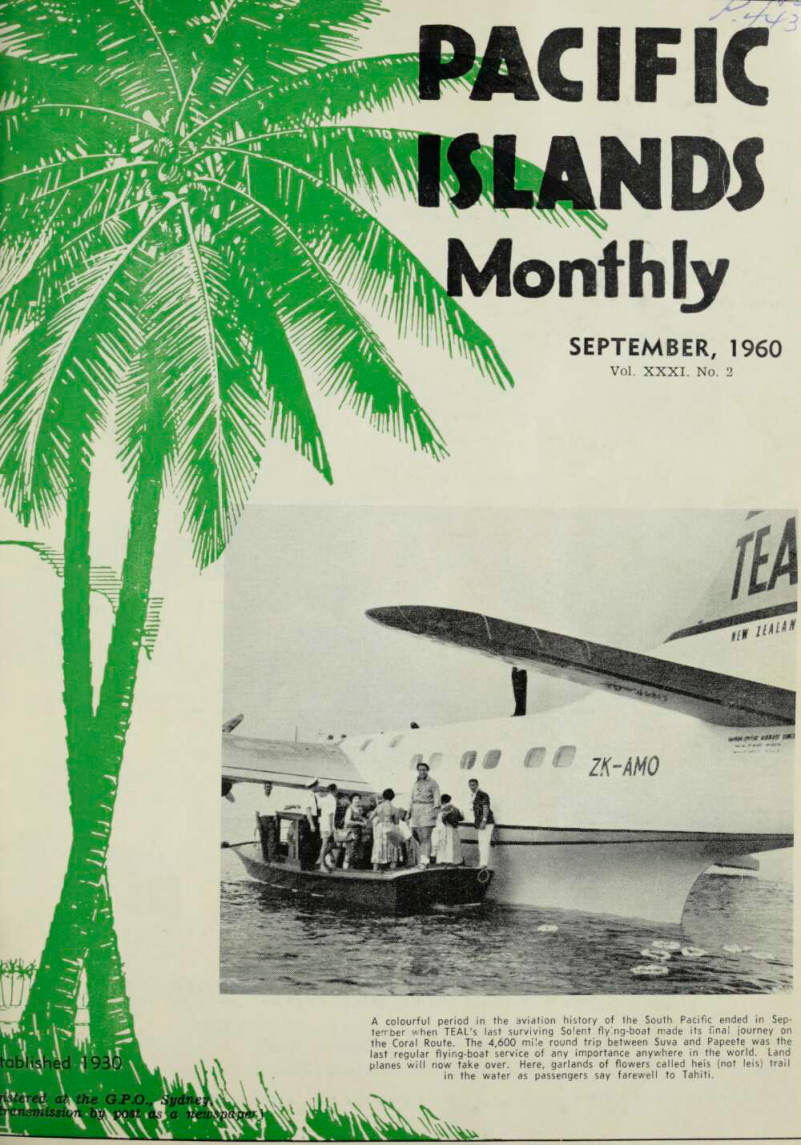 1
1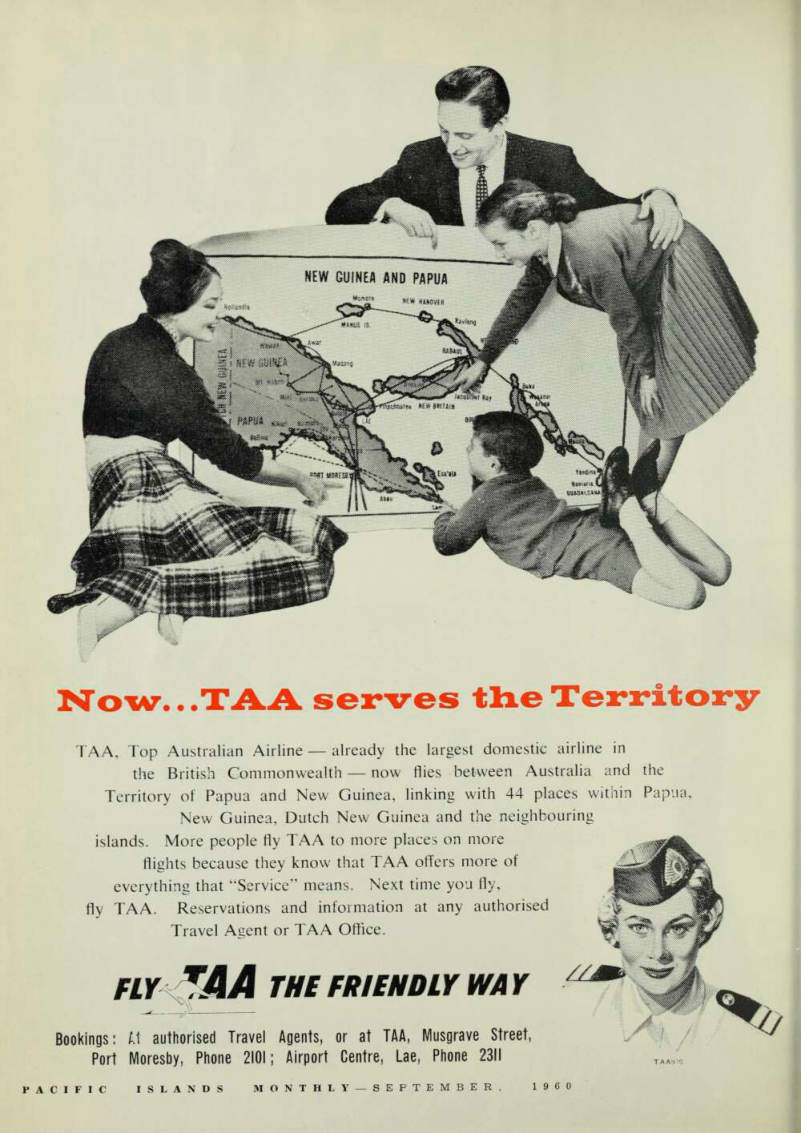 2
2 3
3 4
4 5
5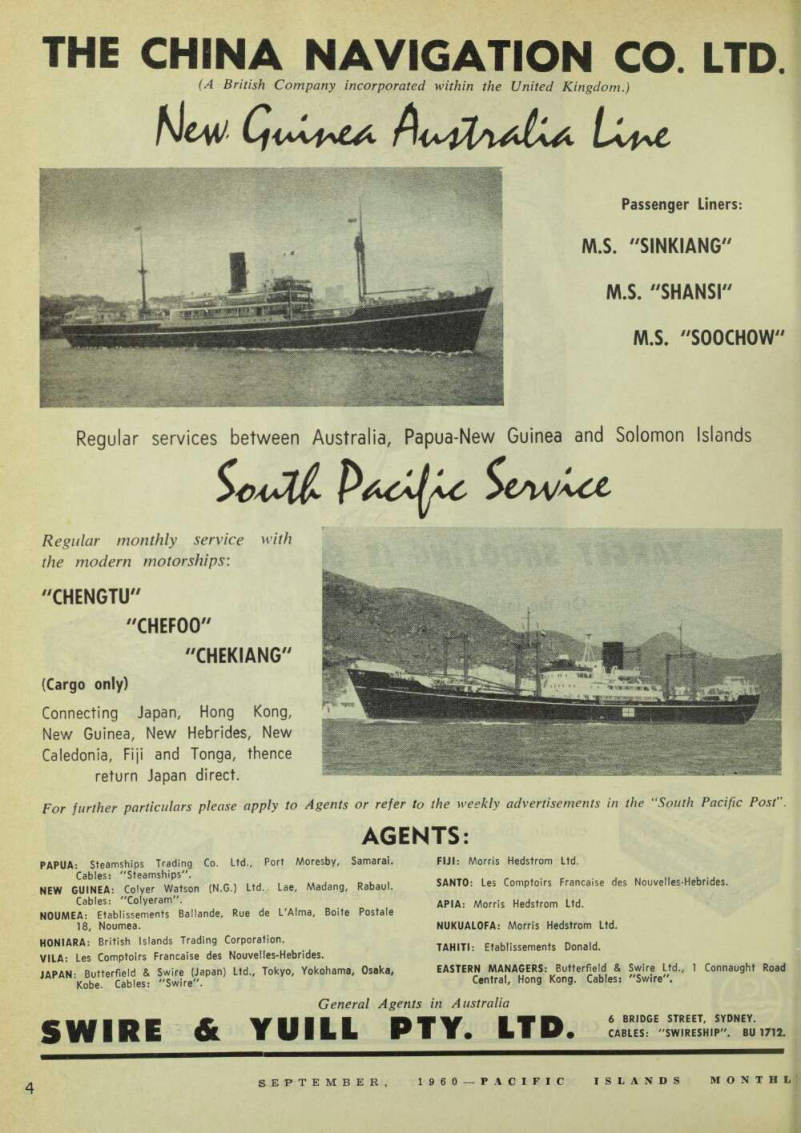 6
6 7
7 8
8 9
9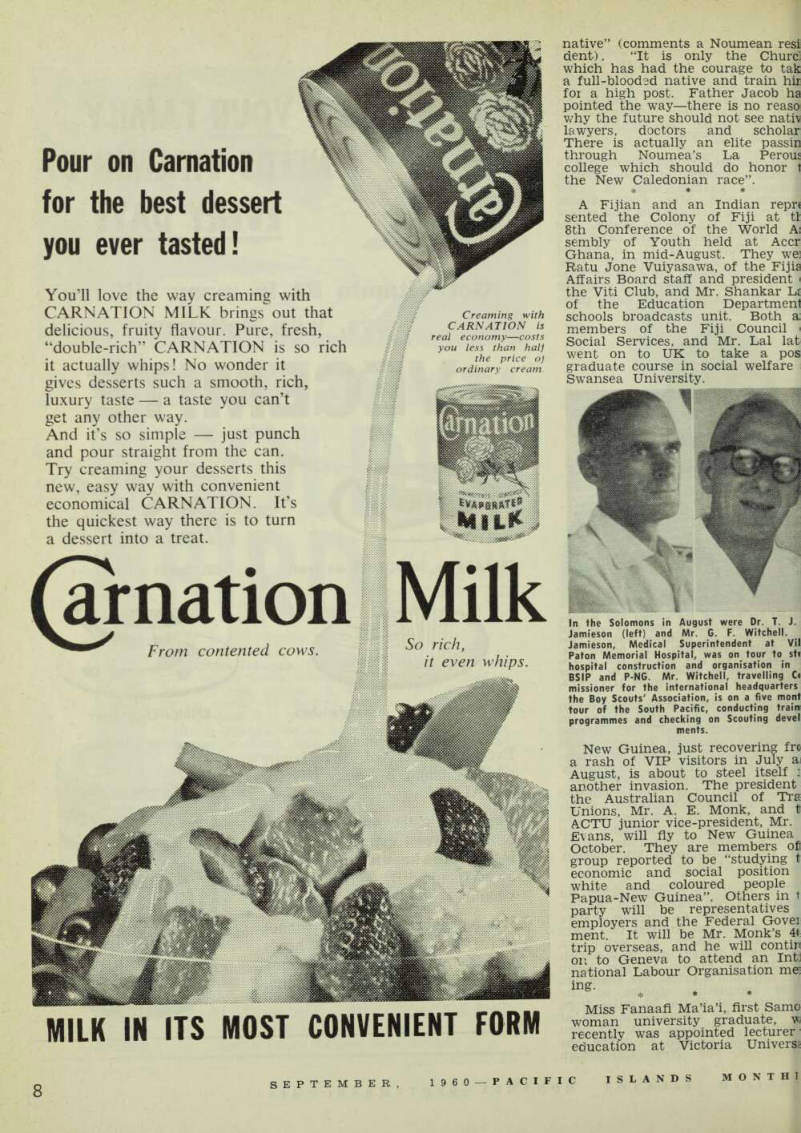 10
10 11
11 12
12 13
13 14
14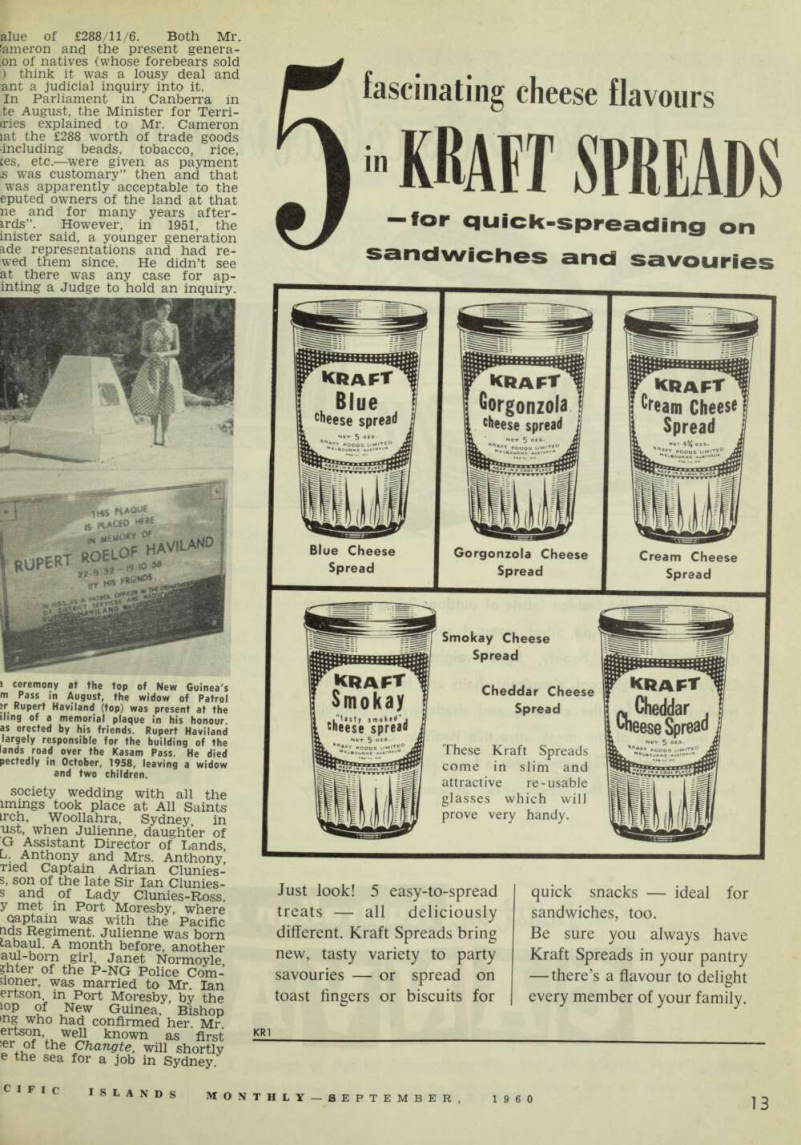 15
15 16
16 17
17 18
18 19
19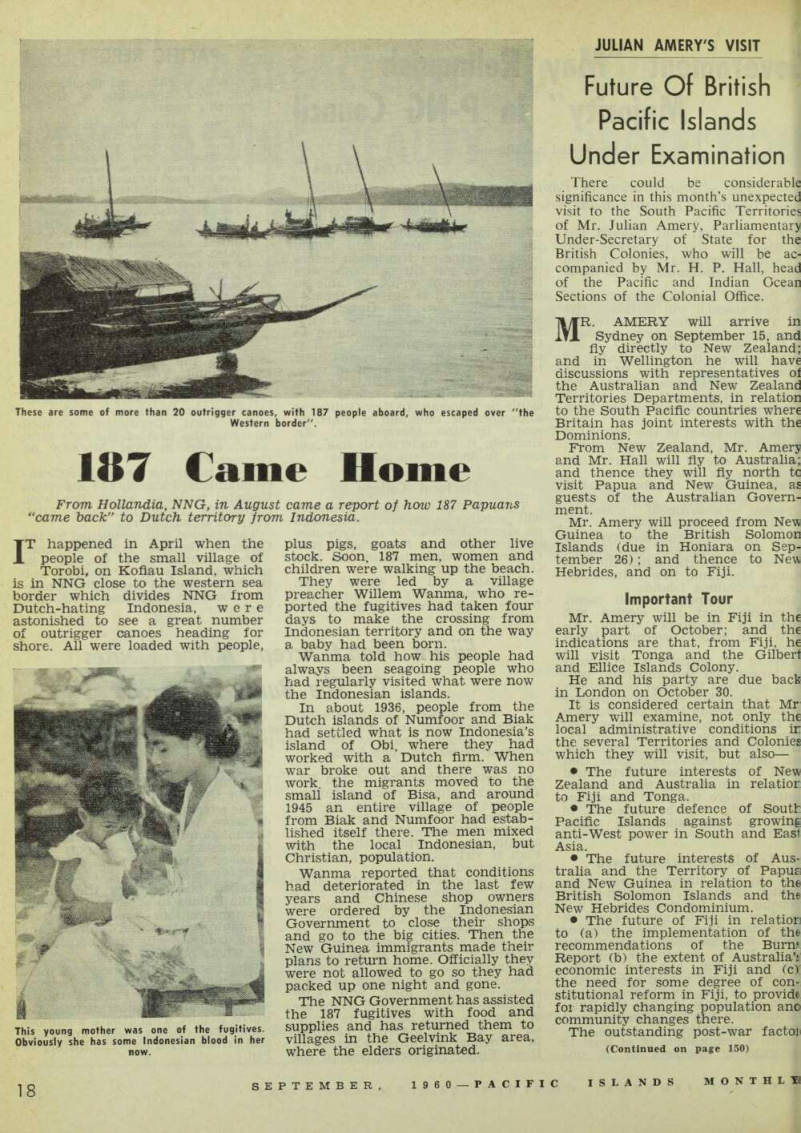 20
20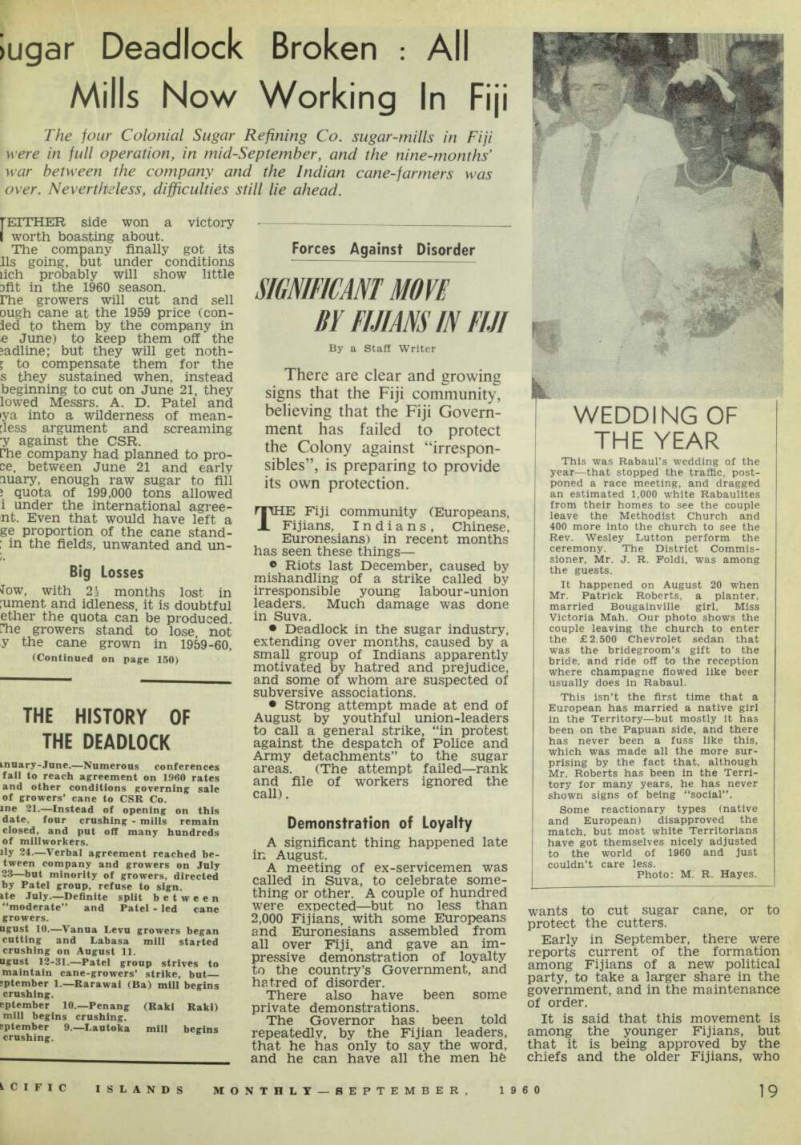 21
21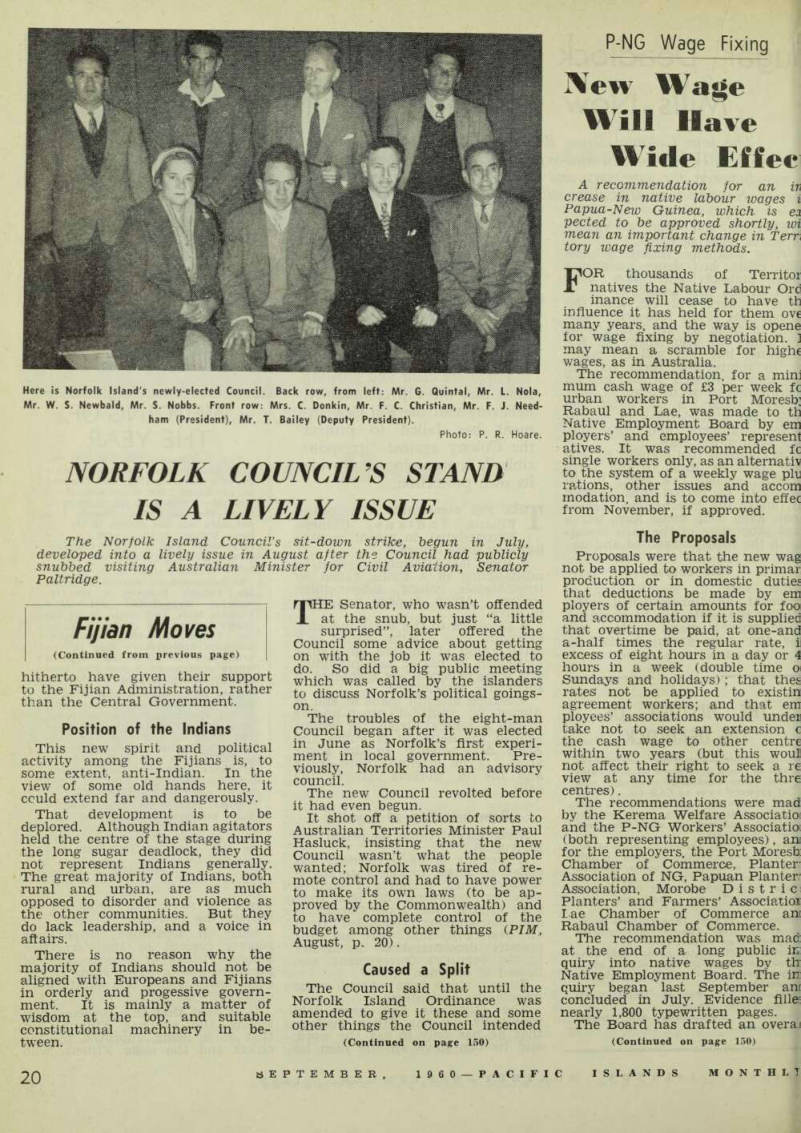 22
22 23
23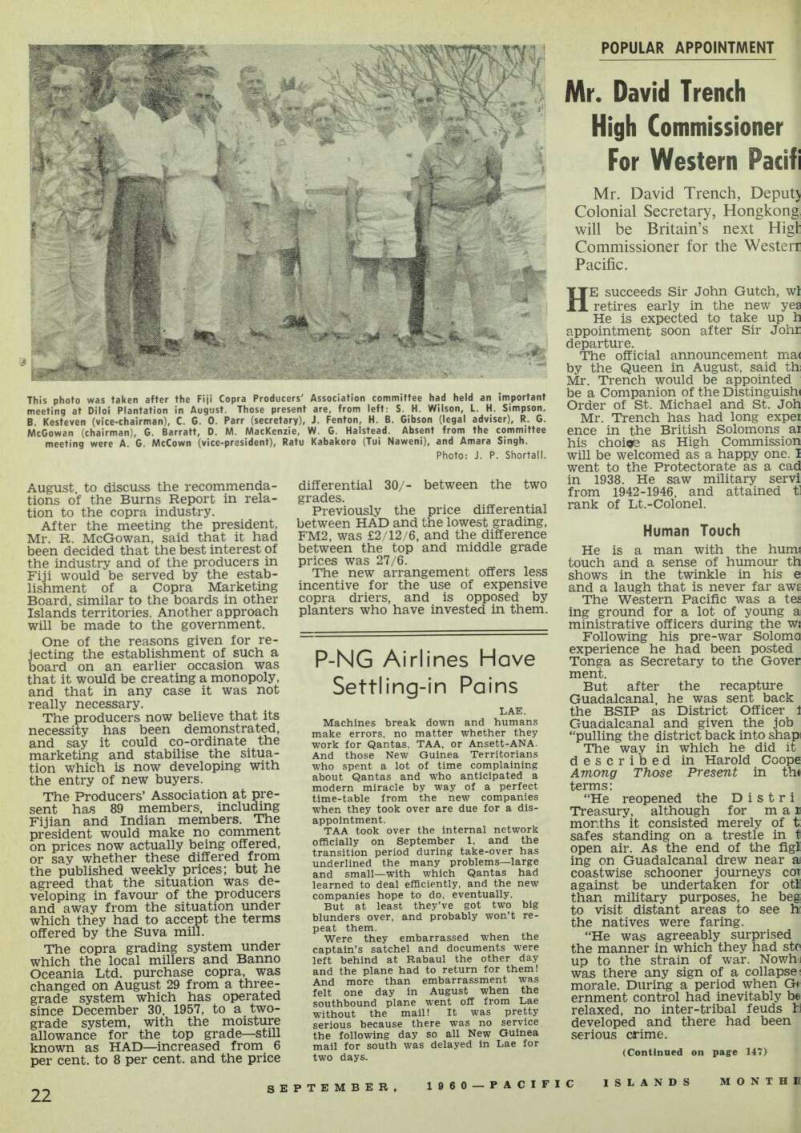 24
24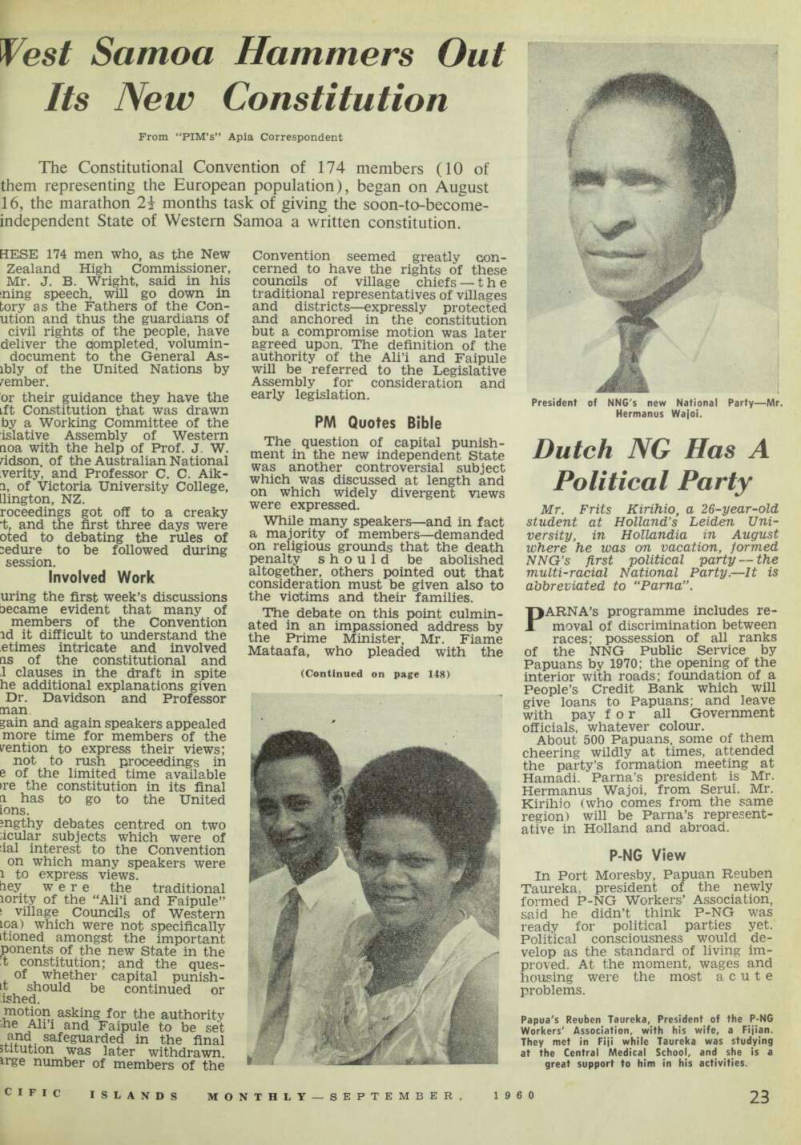 25
25 26
26 27
27 28
28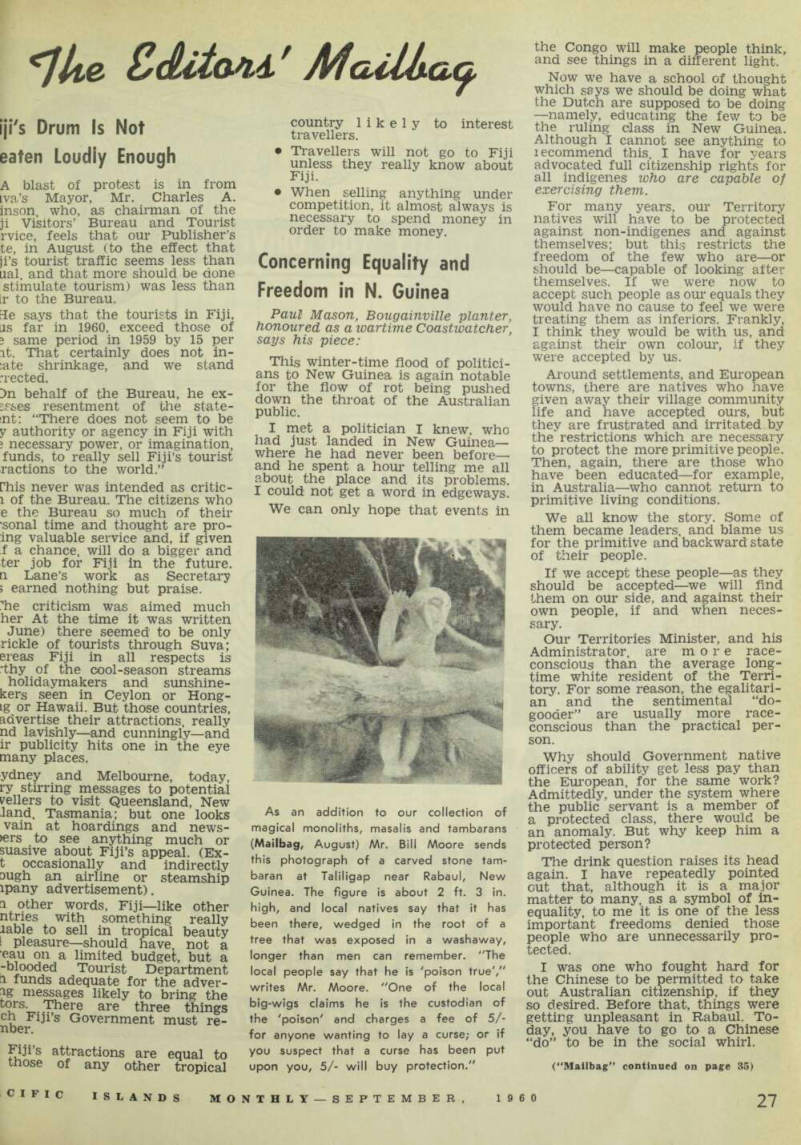 29
29 30
30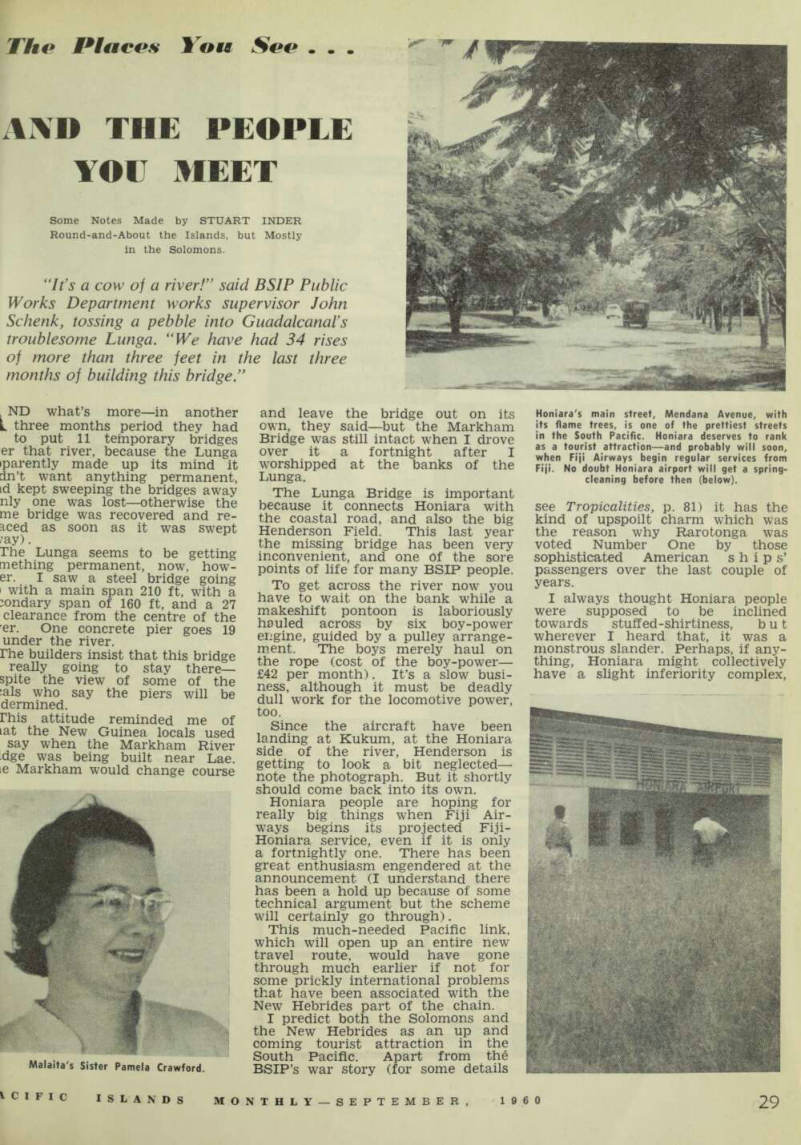 31
31 32
32 33
33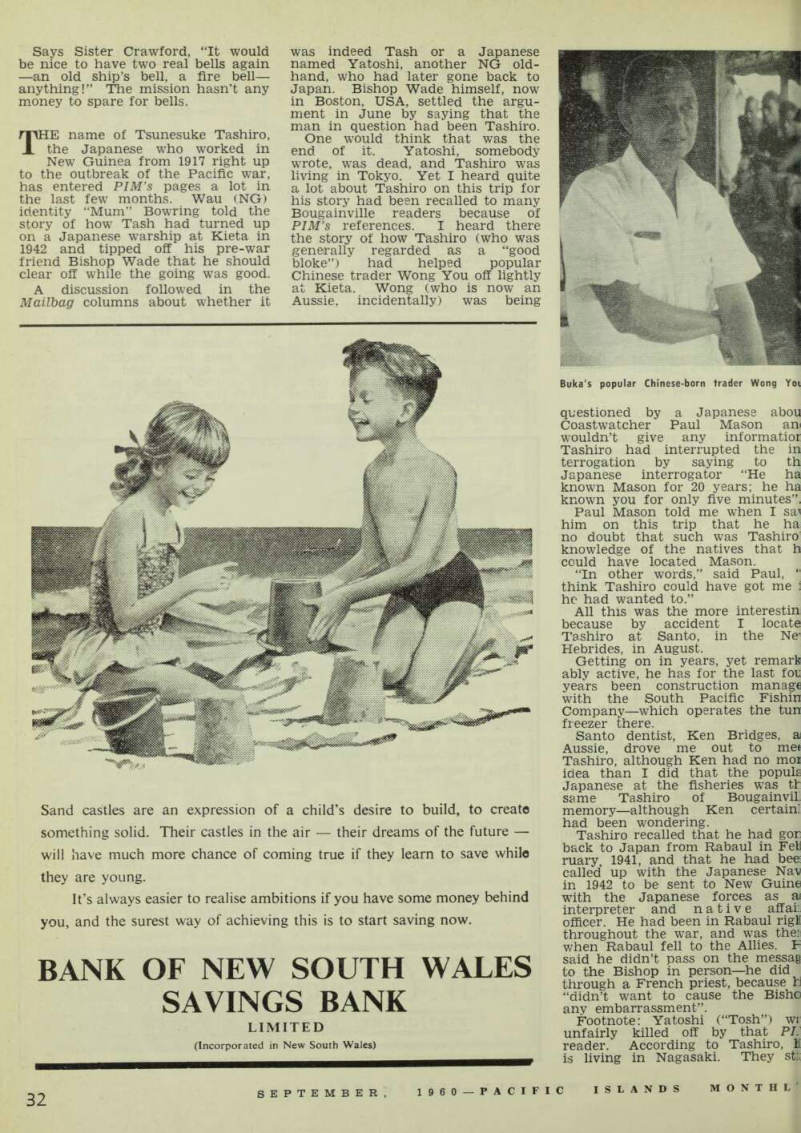 34
34 35
35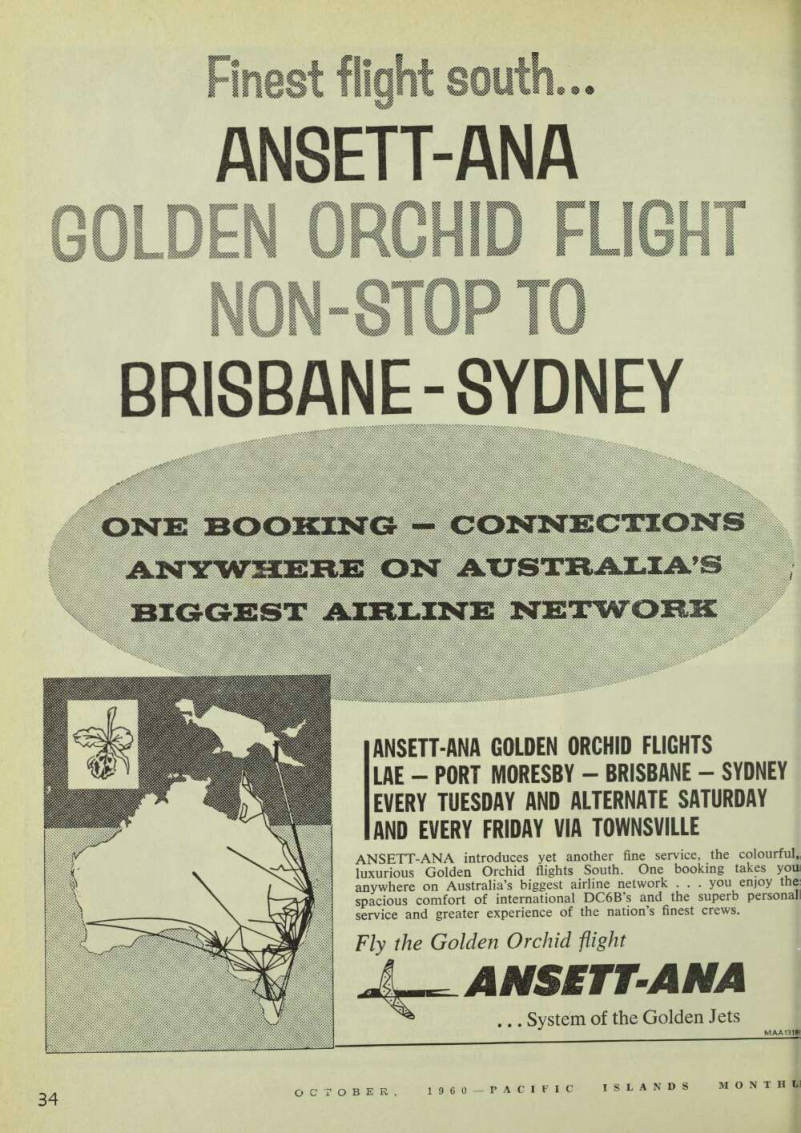 36
36 37
37 38
38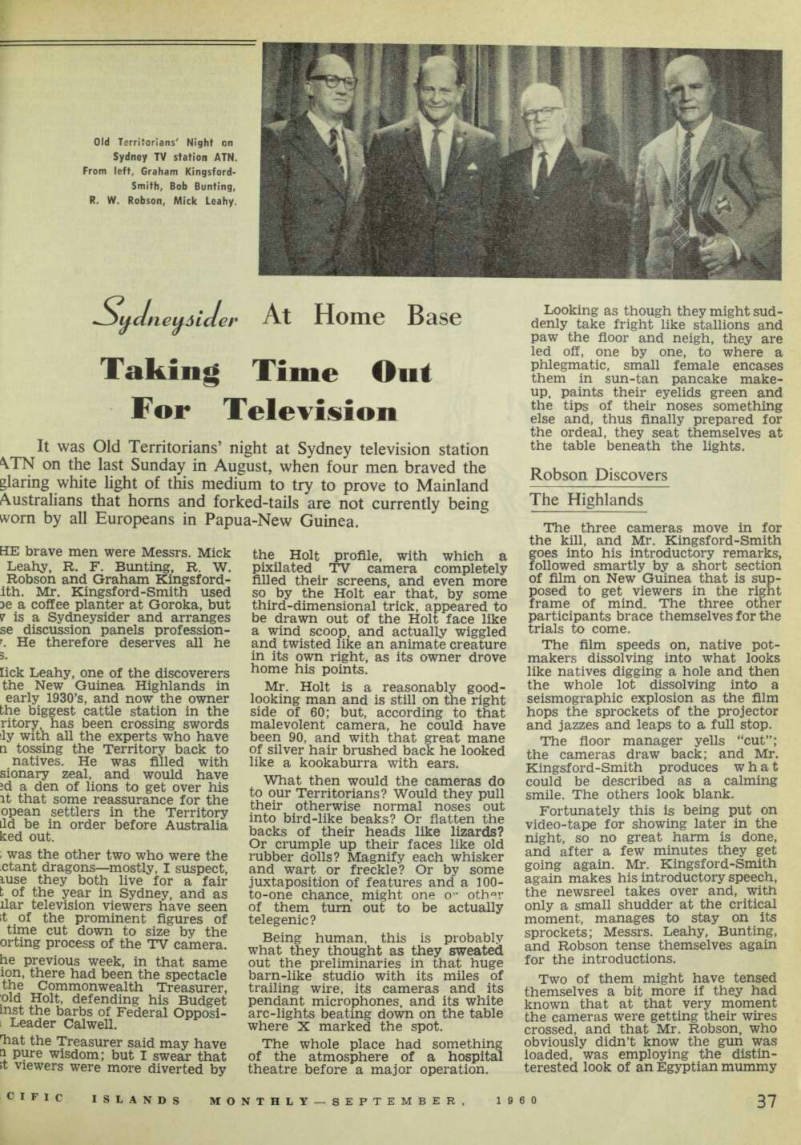 39
39 40
40 41
41 42
42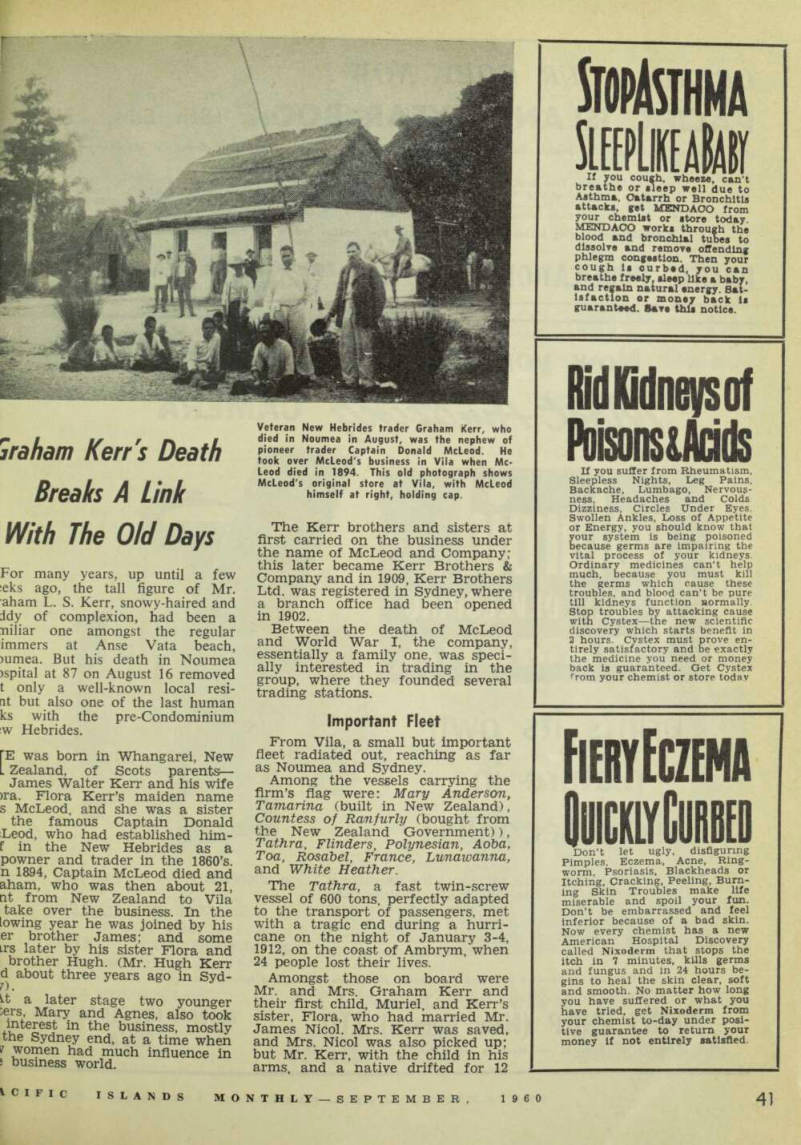 43
43 44
44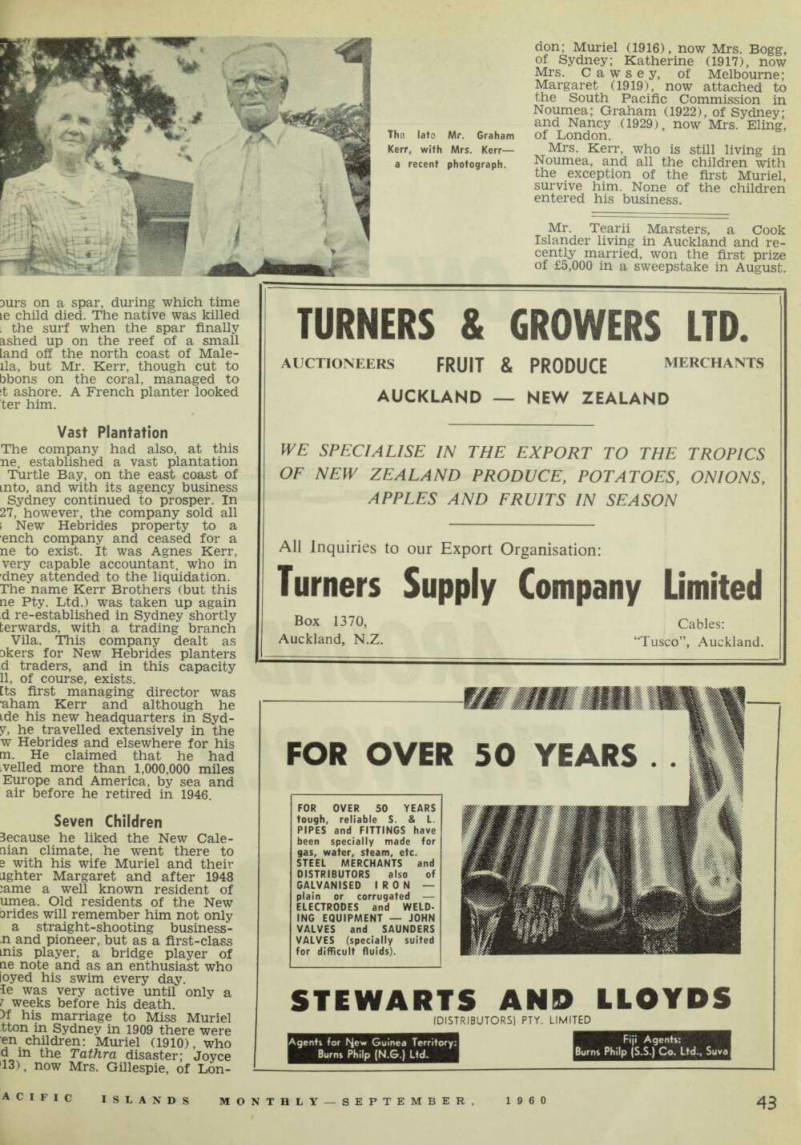 45
45 46
46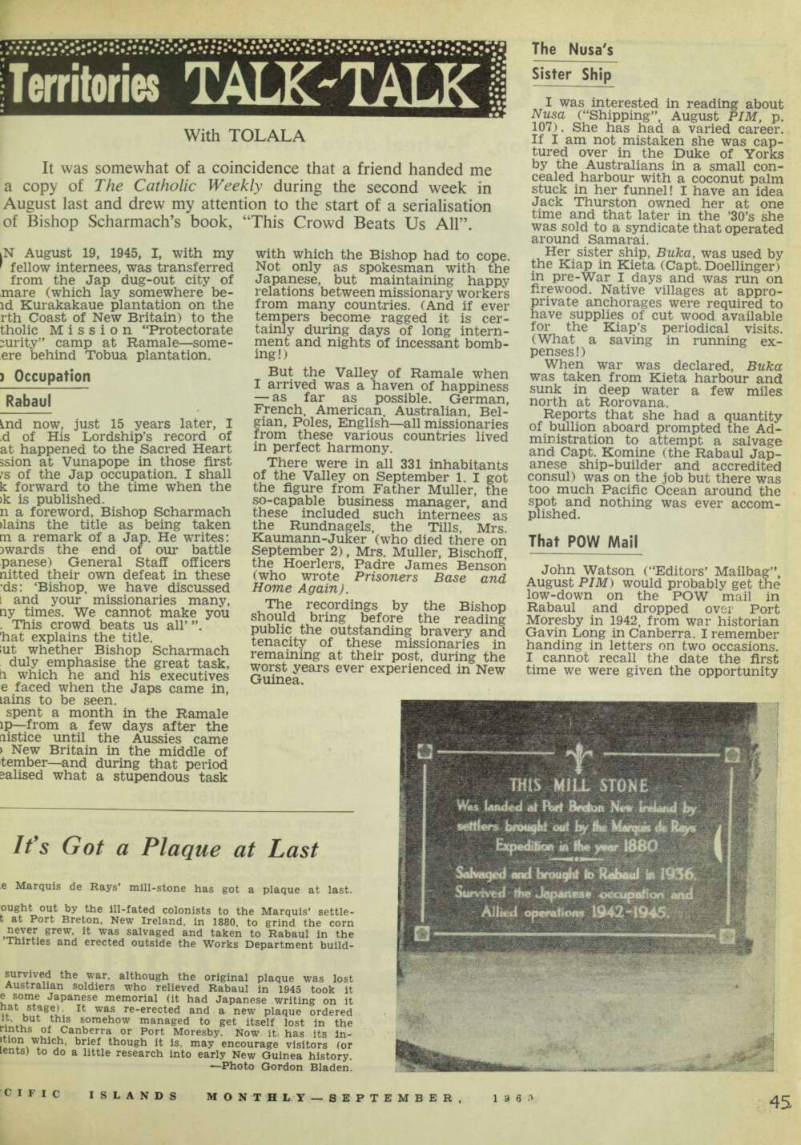 47
47 48
48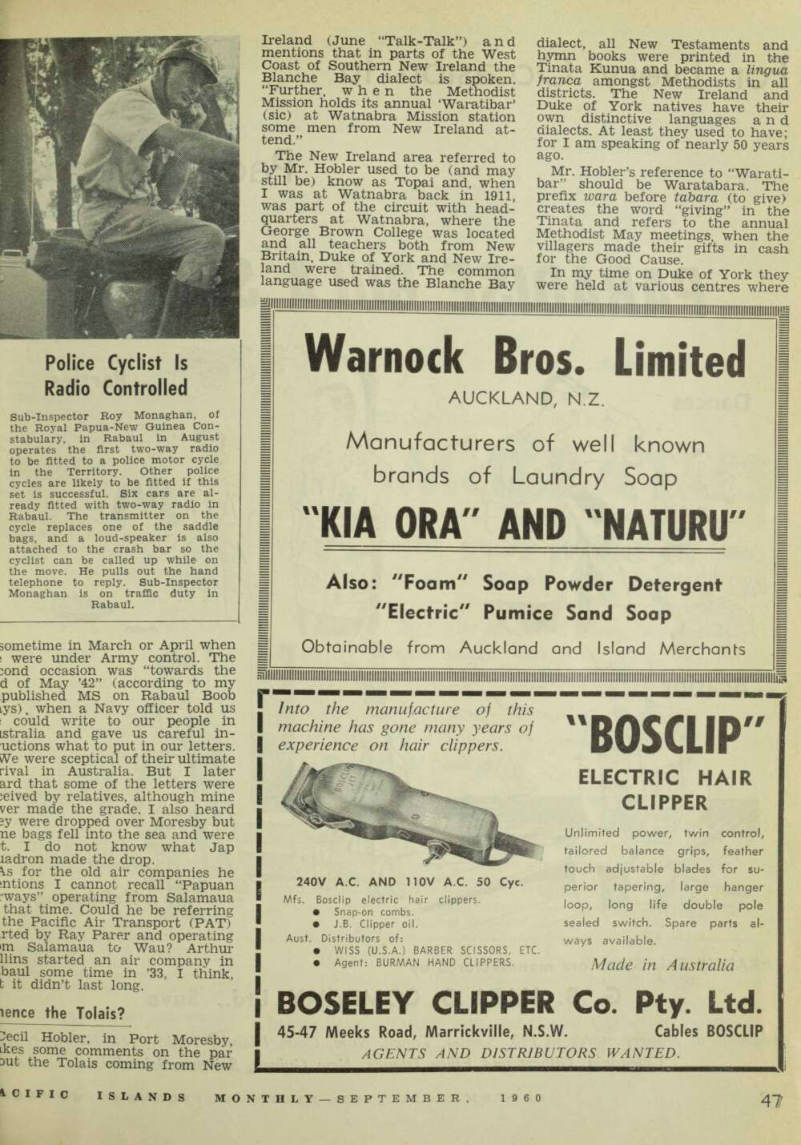 49
49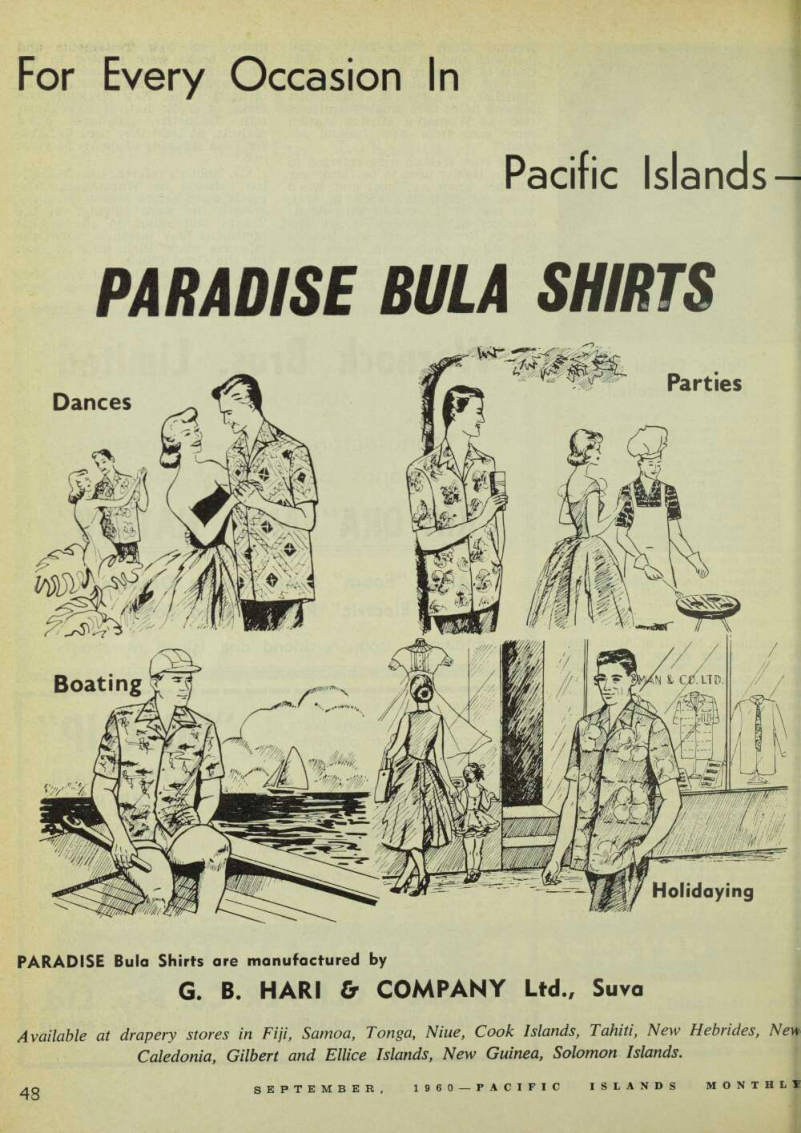 50
50 51
51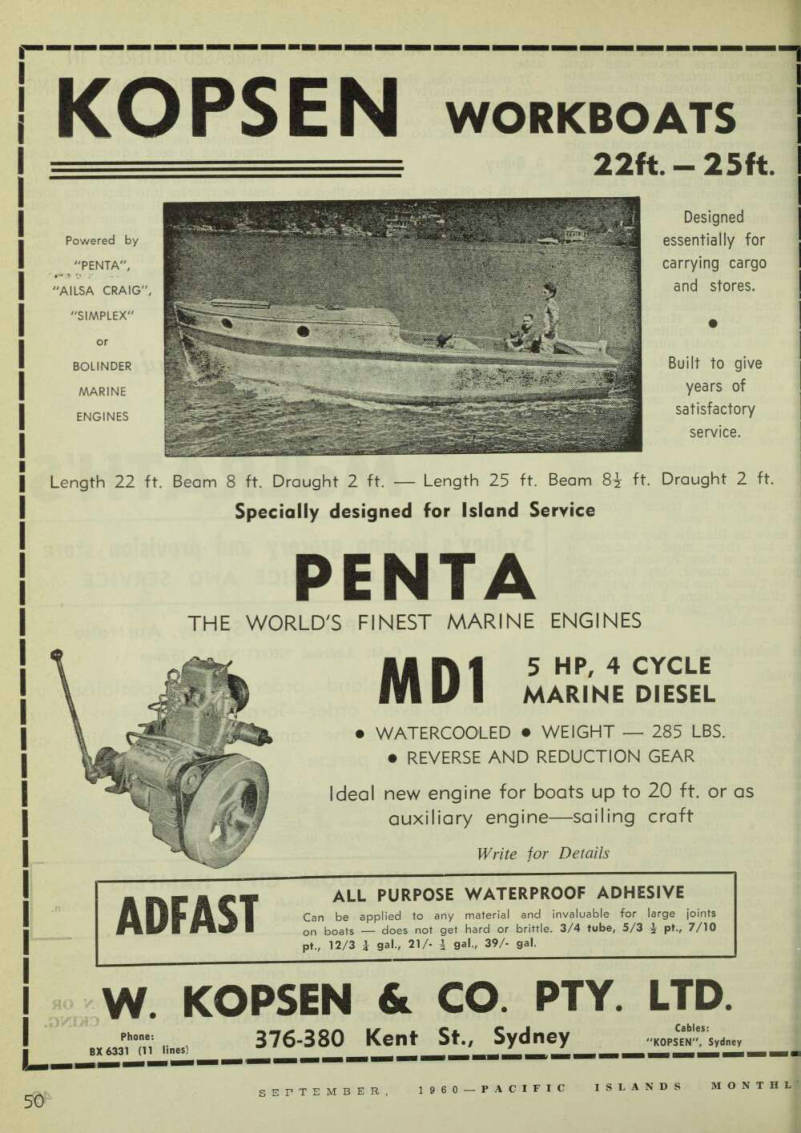 52
52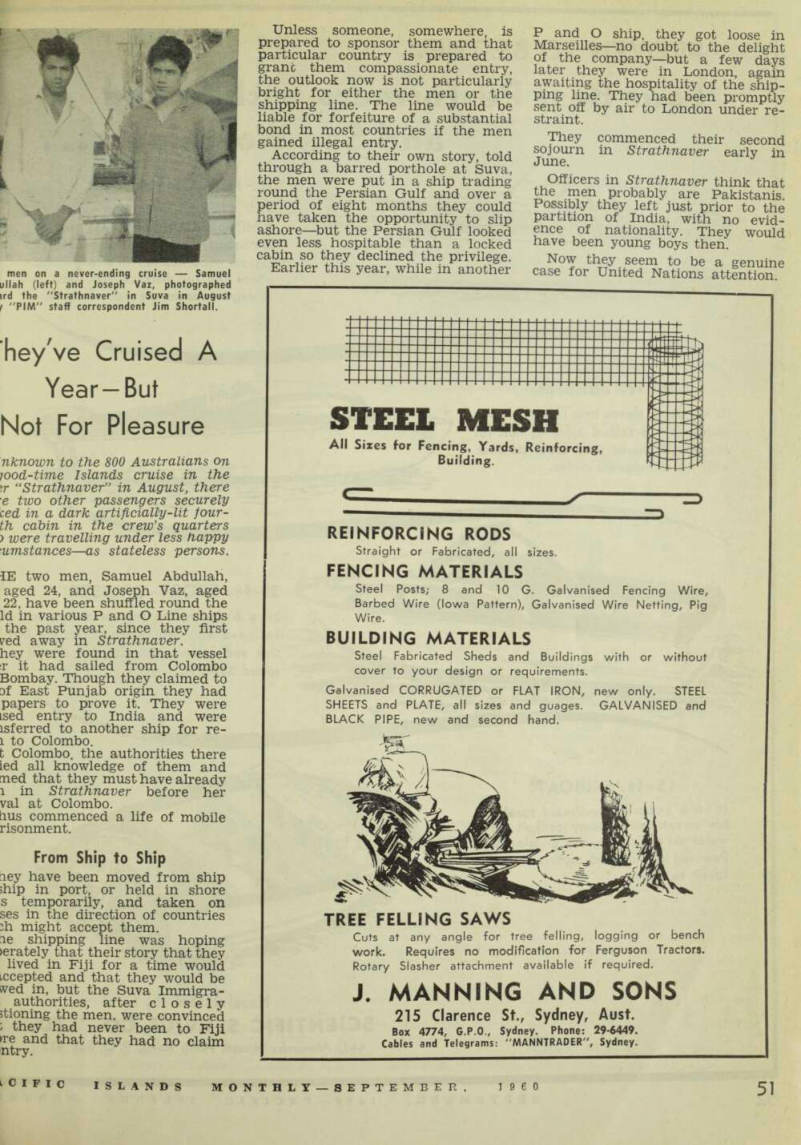 53
53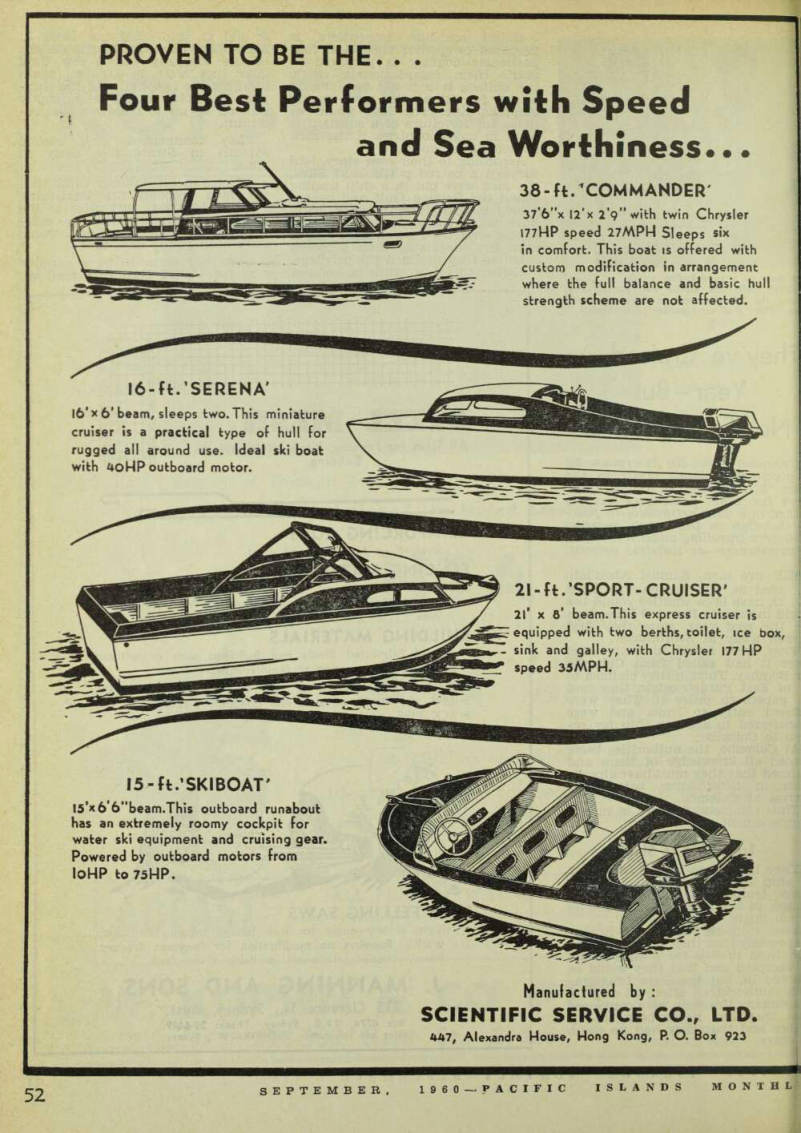 54
54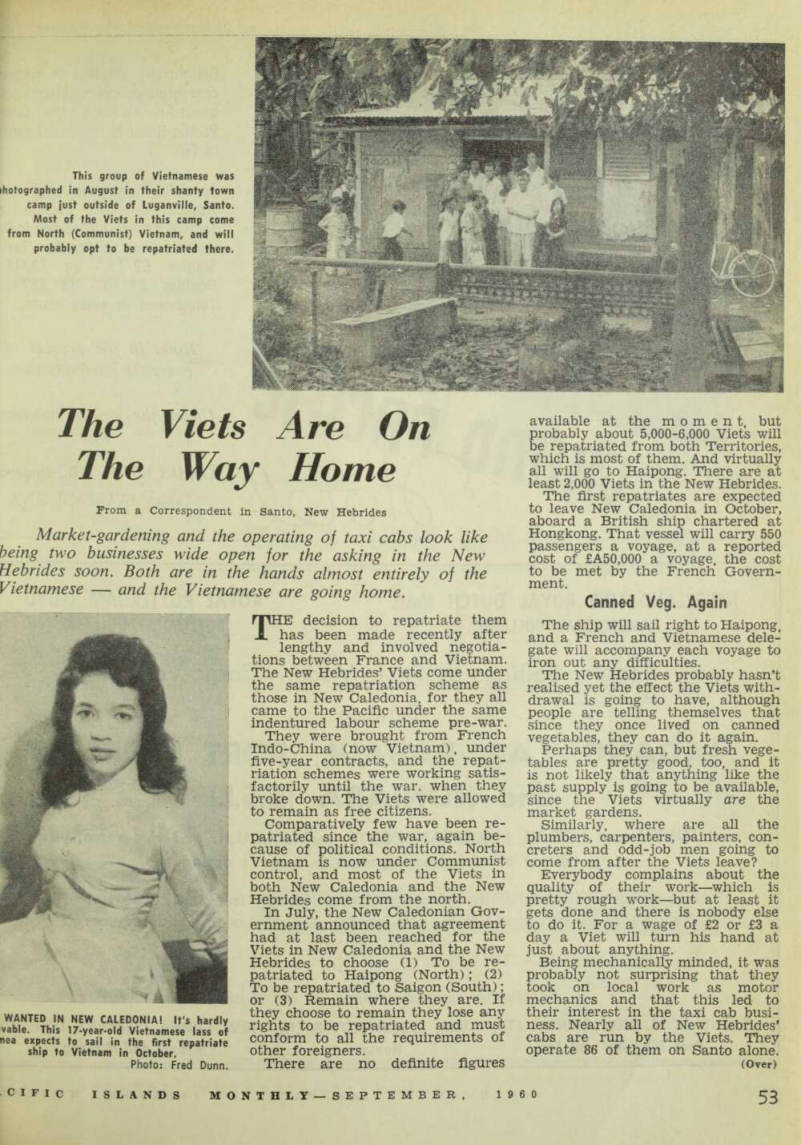 55
55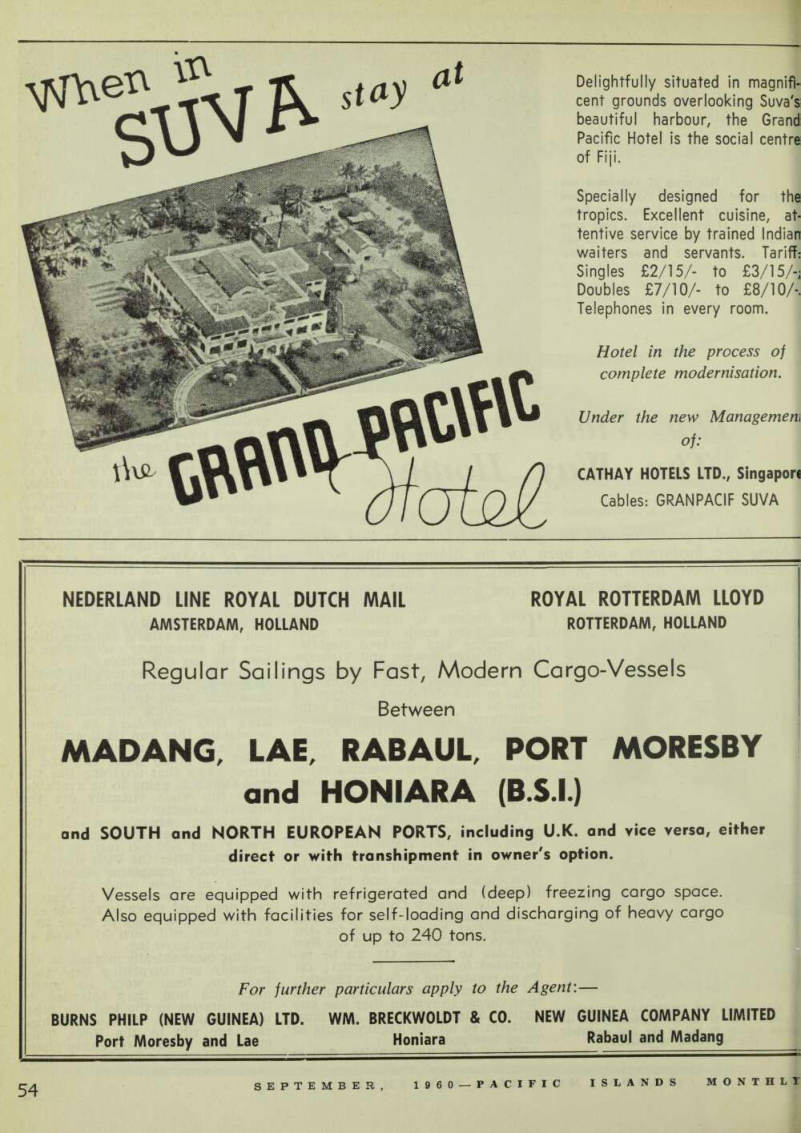 56
56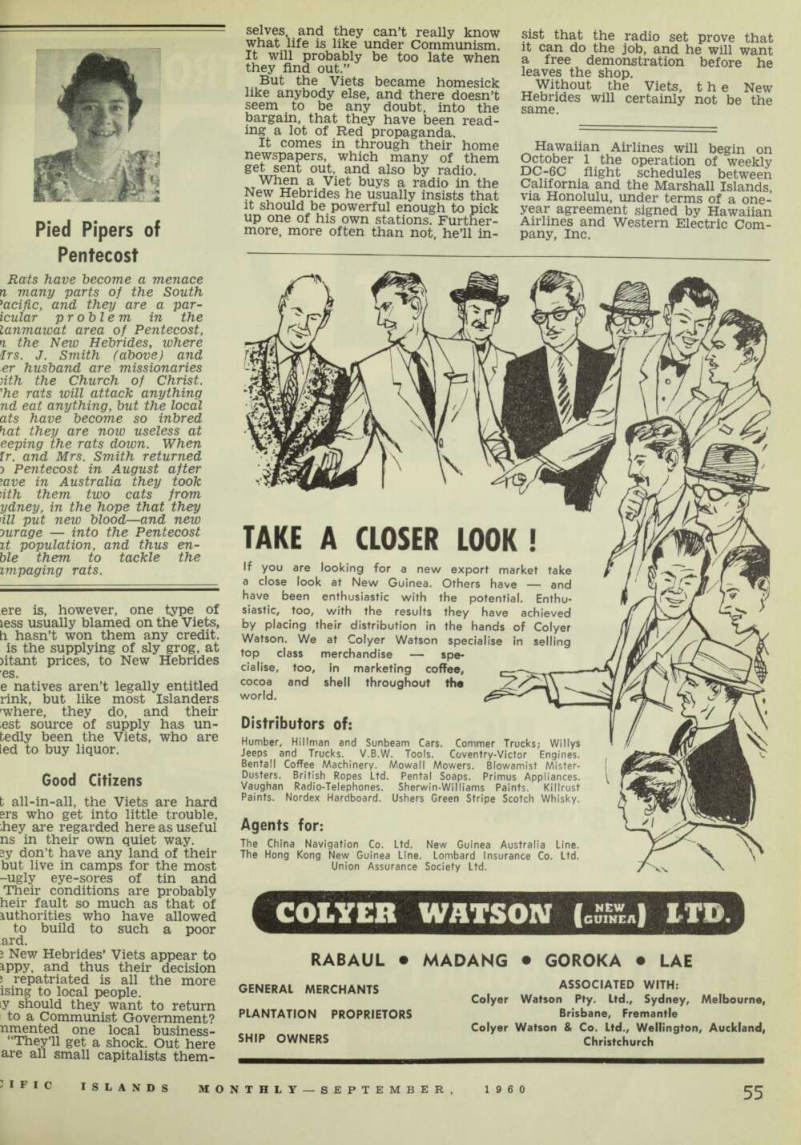 57
57 58
58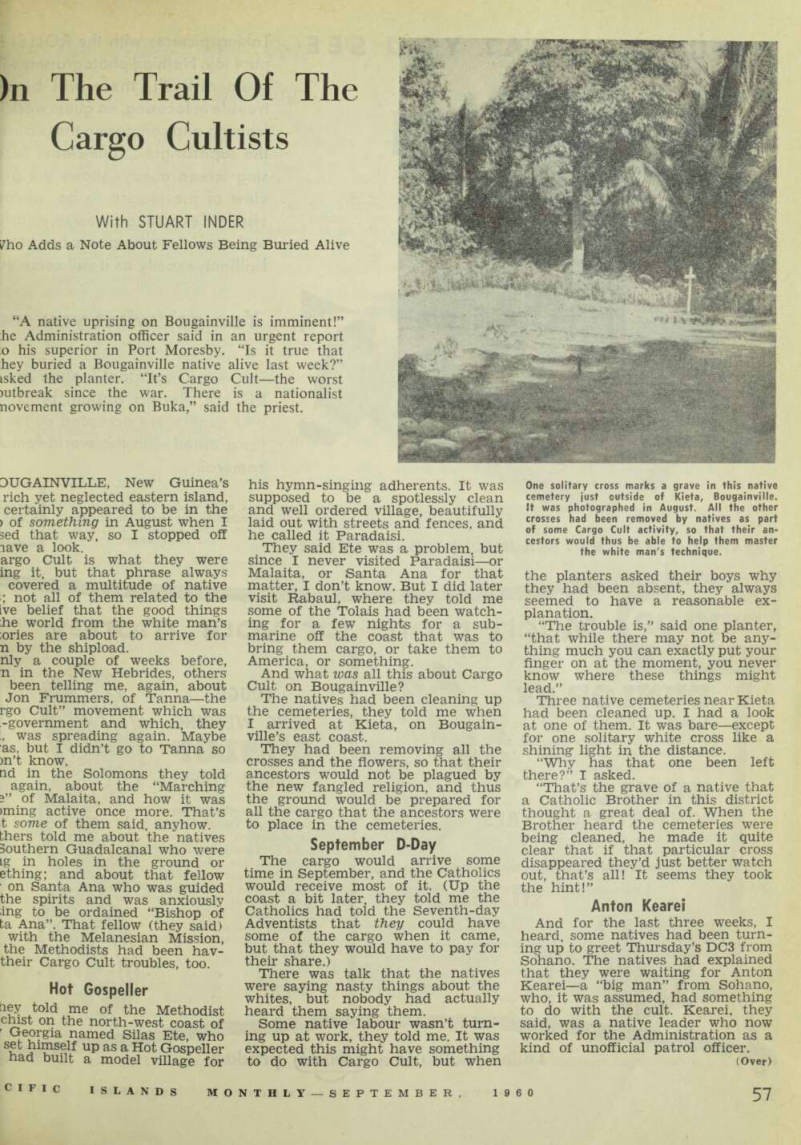 59
59 60
60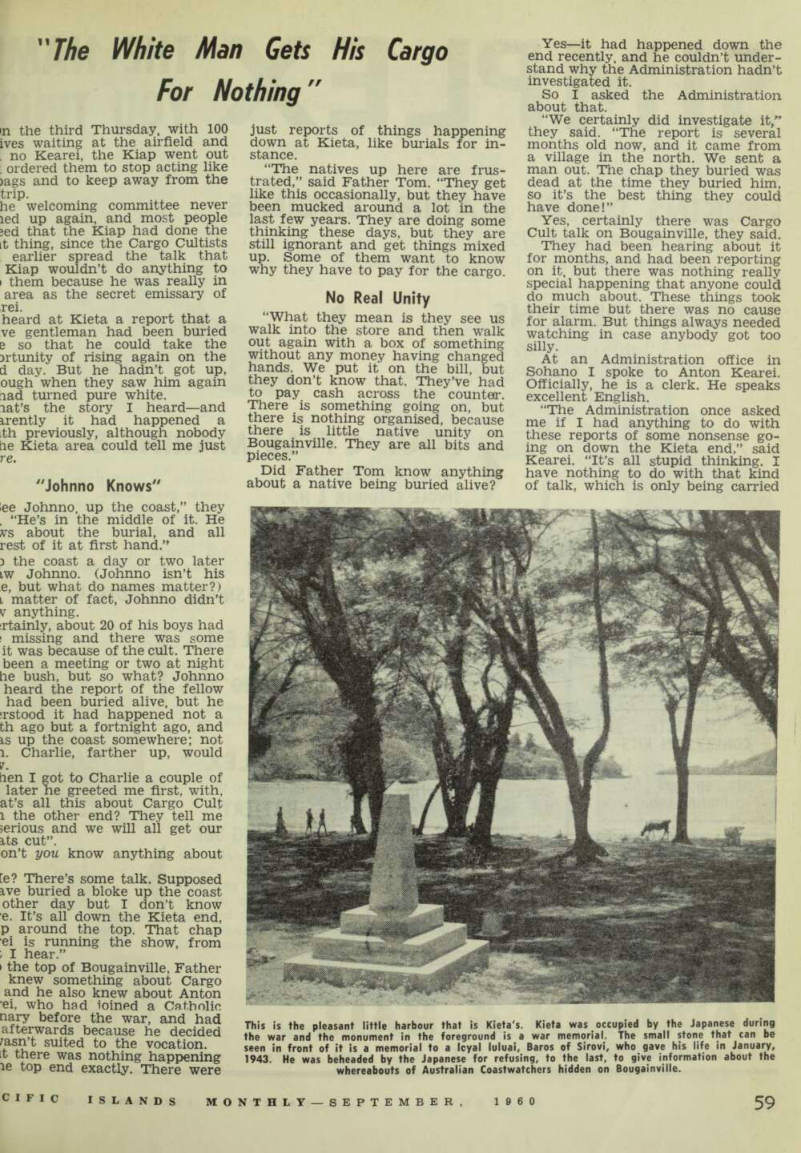 61
61 62
62 63
63 64
64 65
65 66
66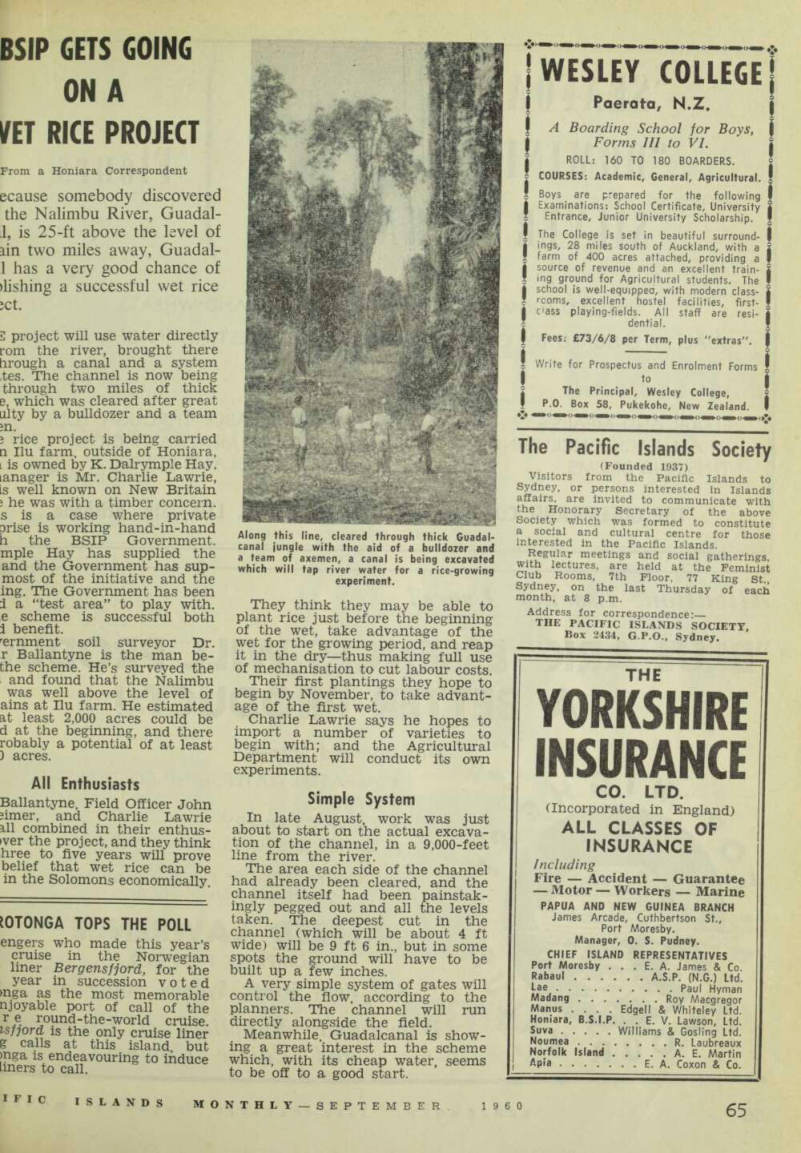 67
67 68
68 69
69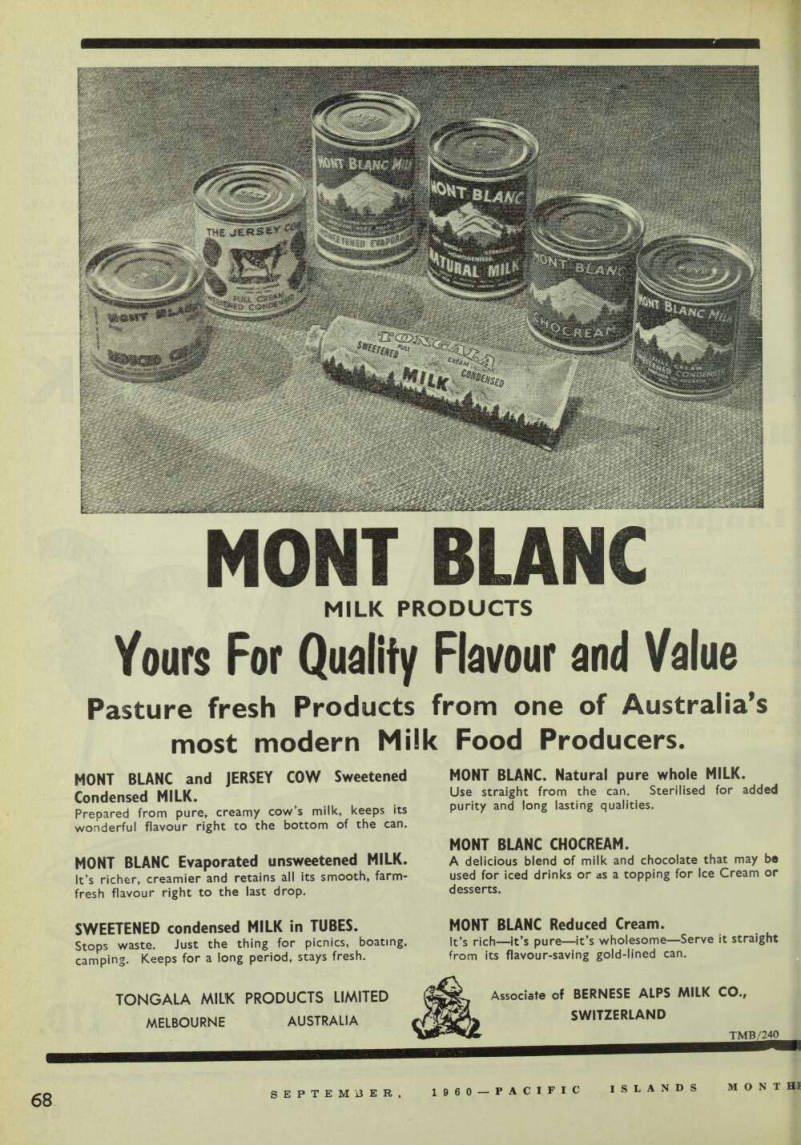 70
70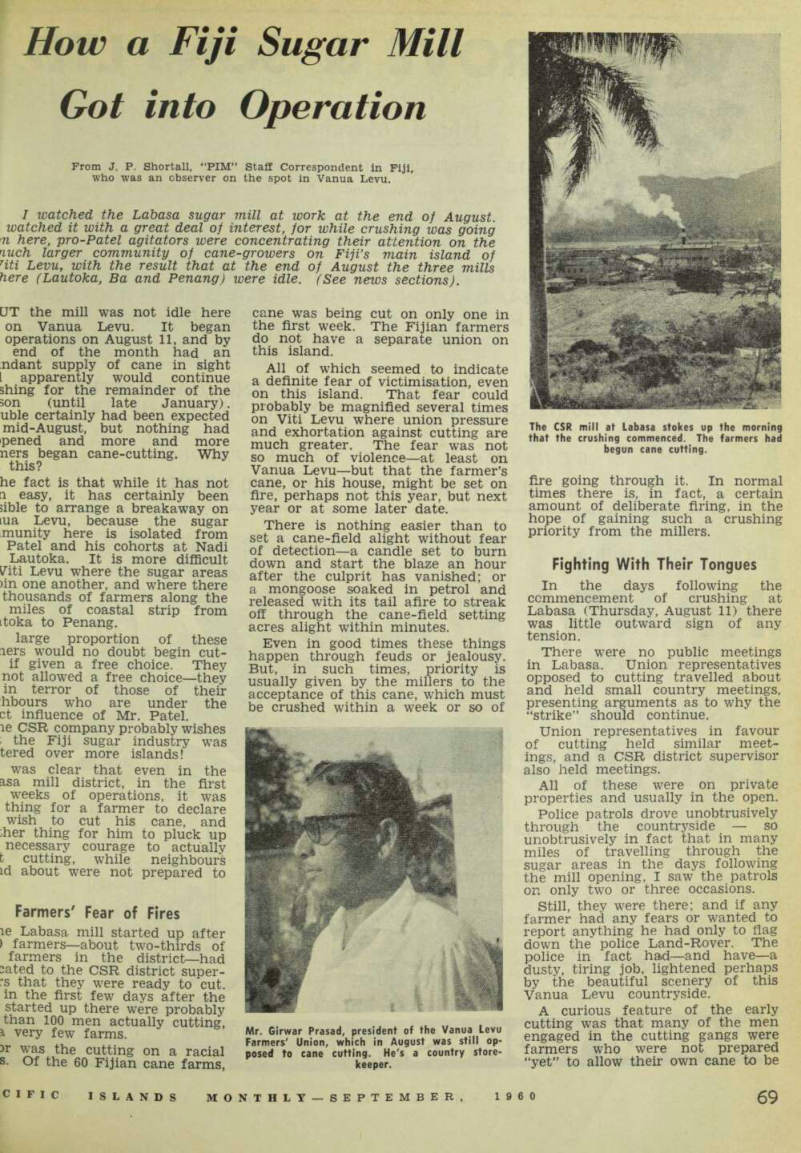 71
71 72
72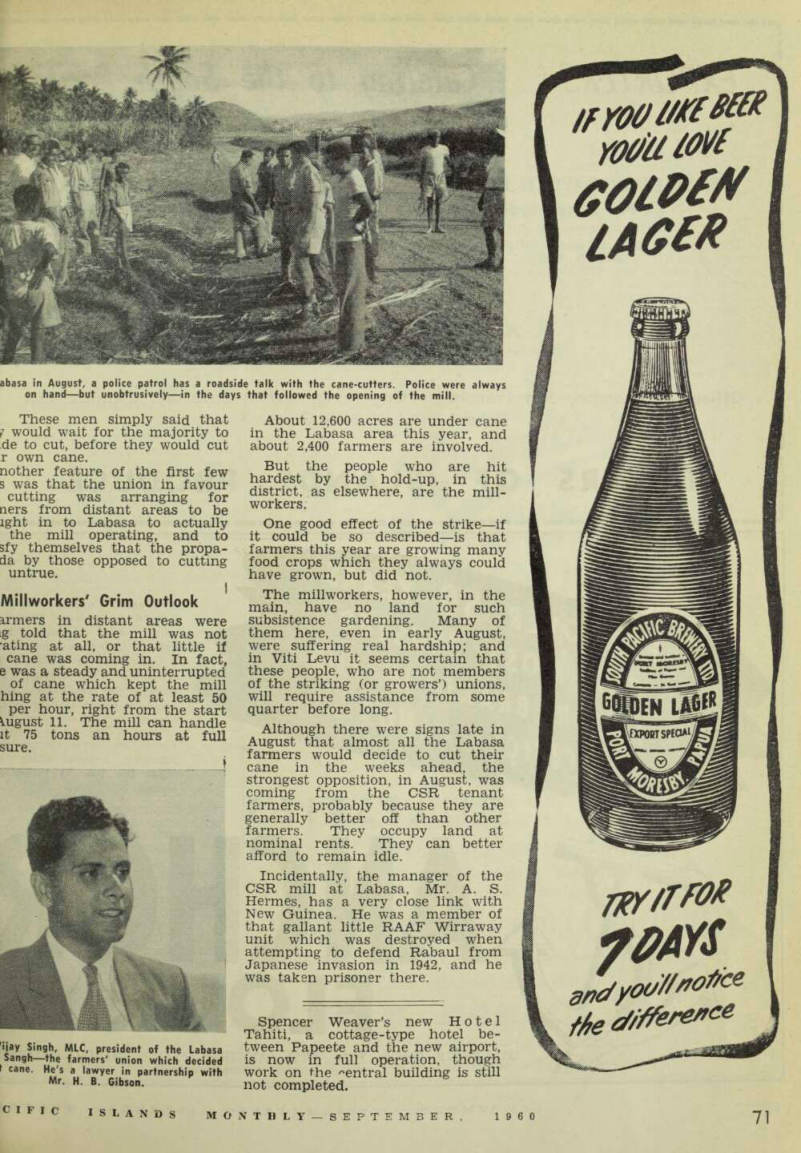 73
73 74
74 75
75 76
76 77
77 78
78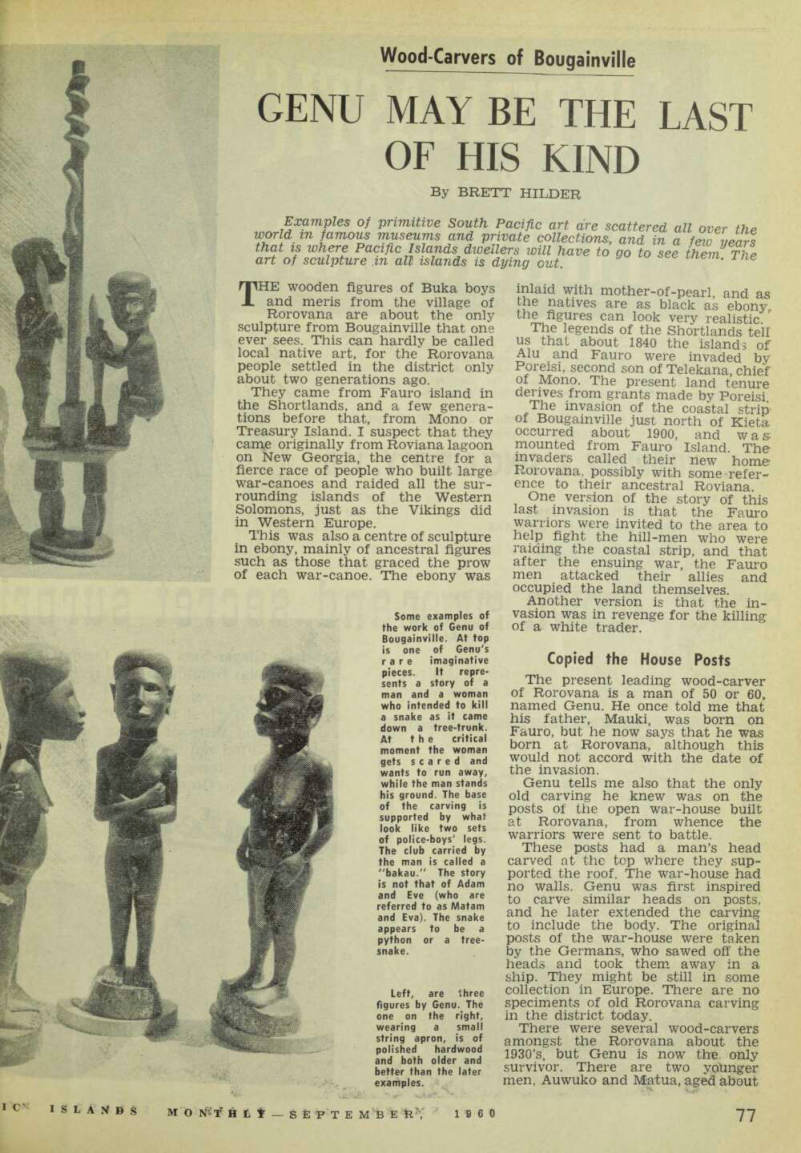 79
79 80
80 81
81 82
82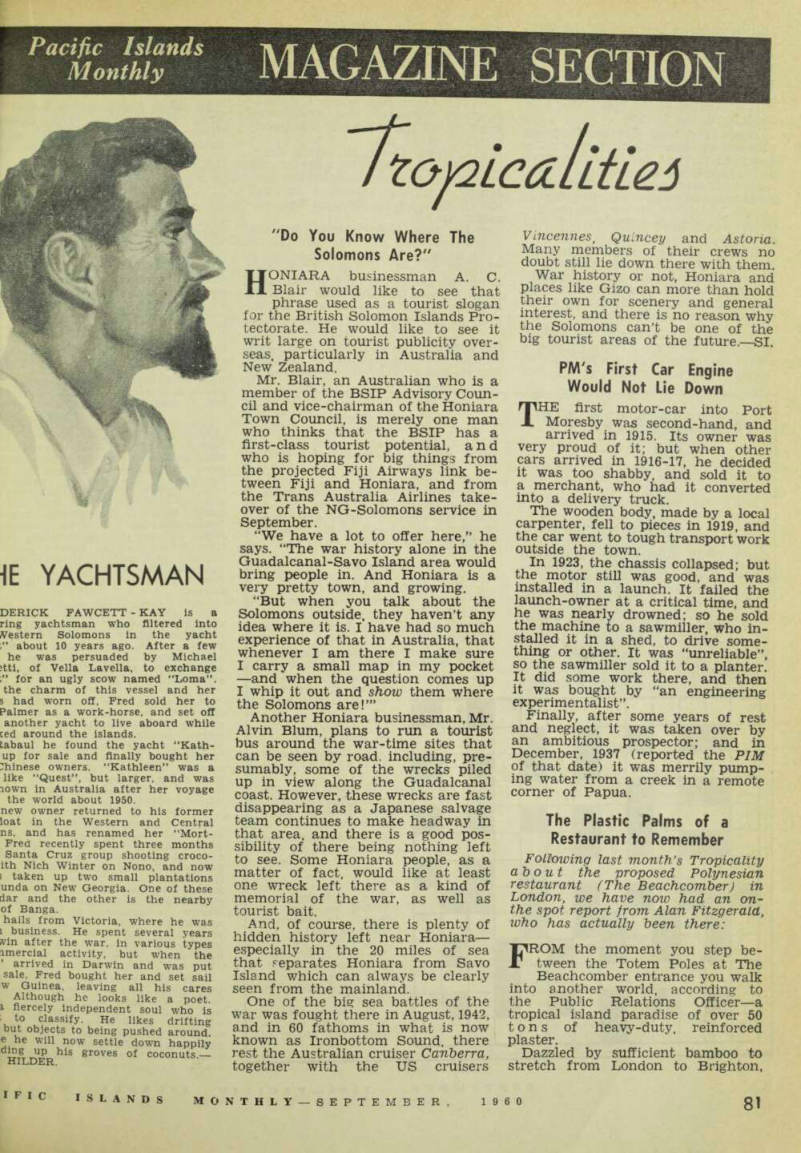 83
83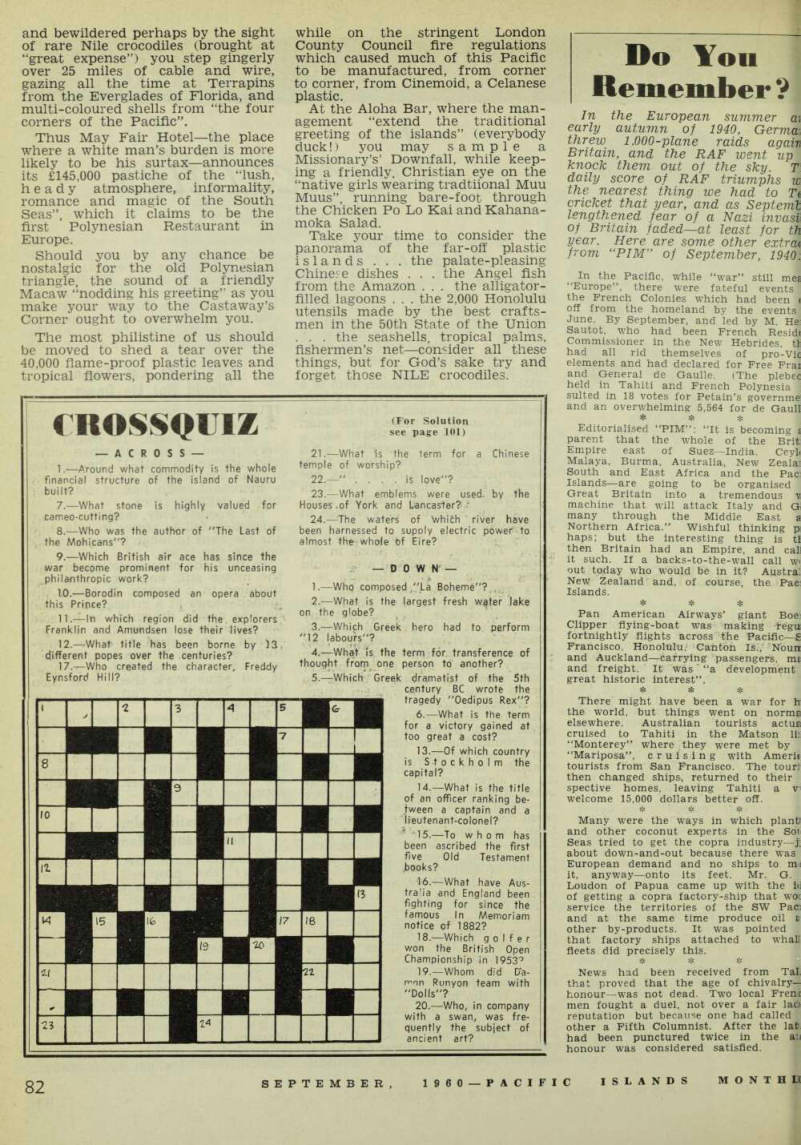 84
84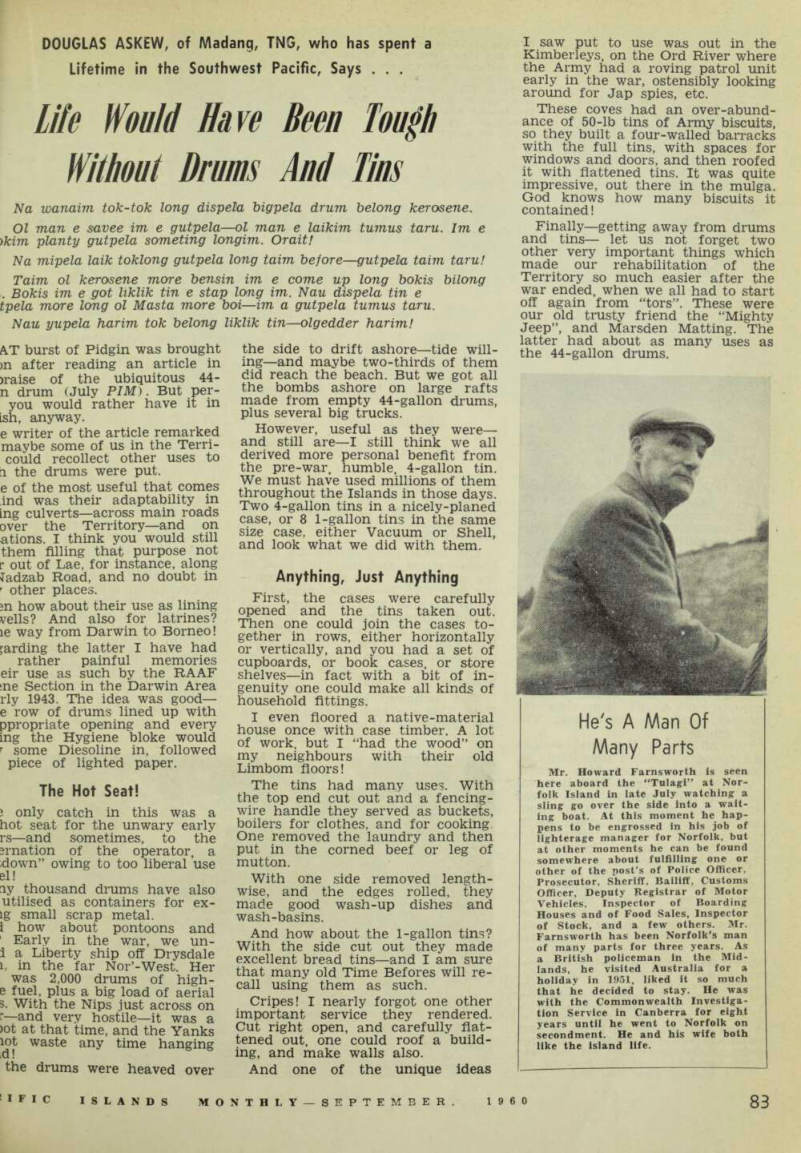 85
85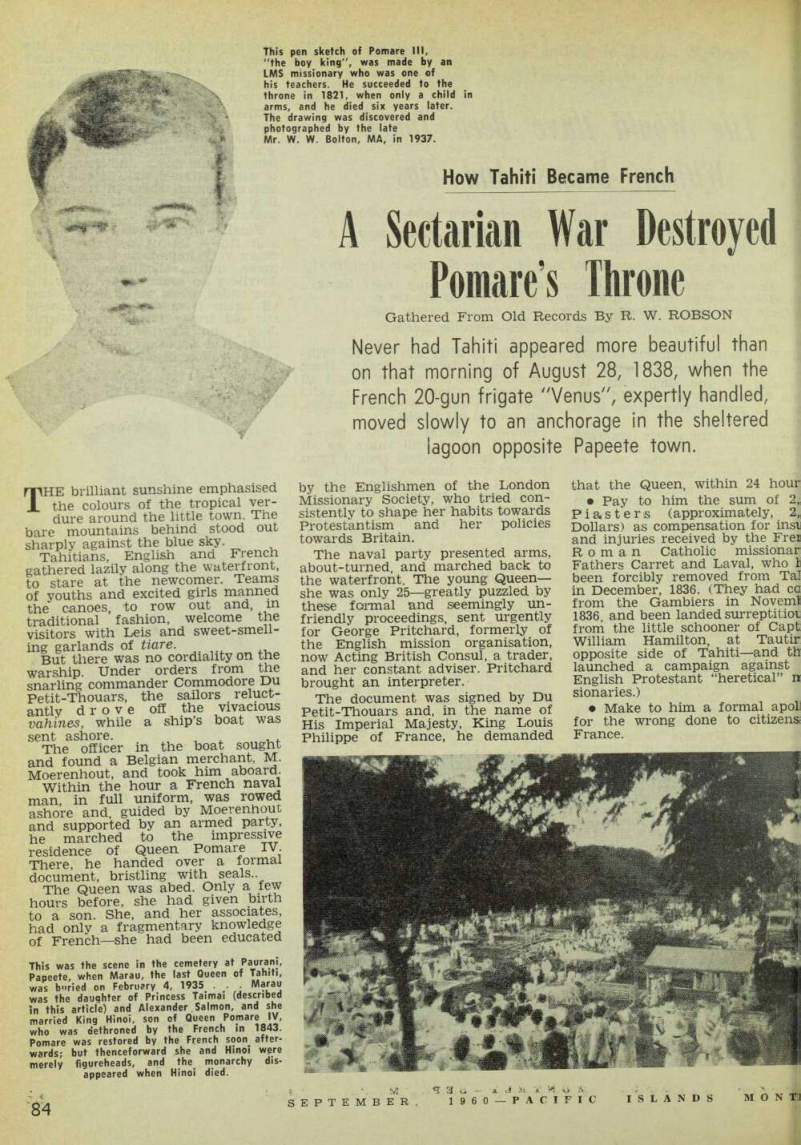 86
86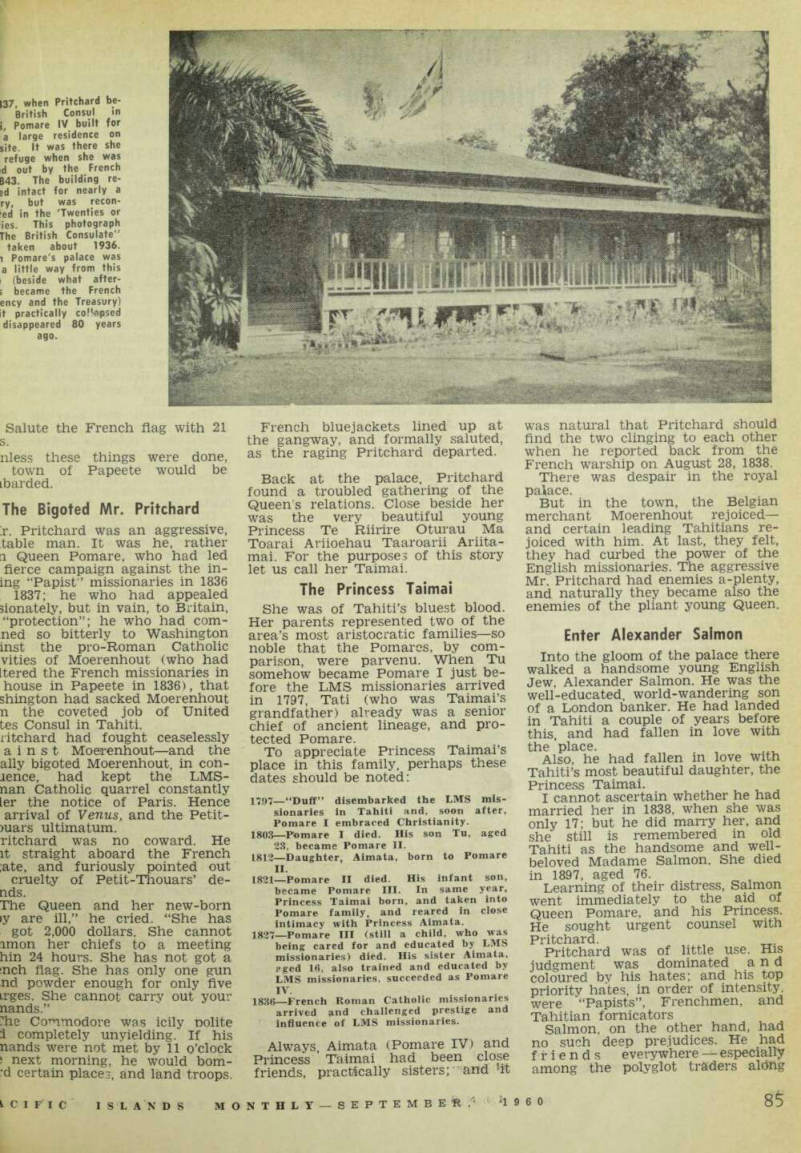 87
87 88
88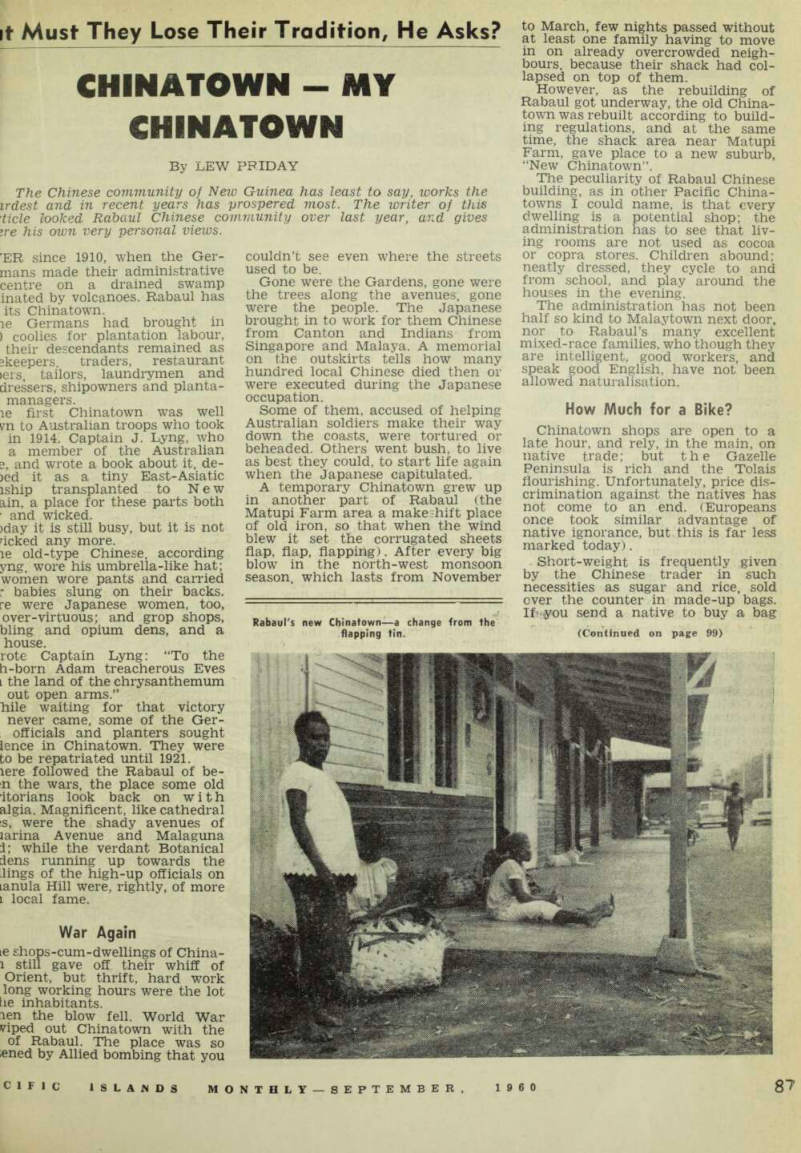 89
89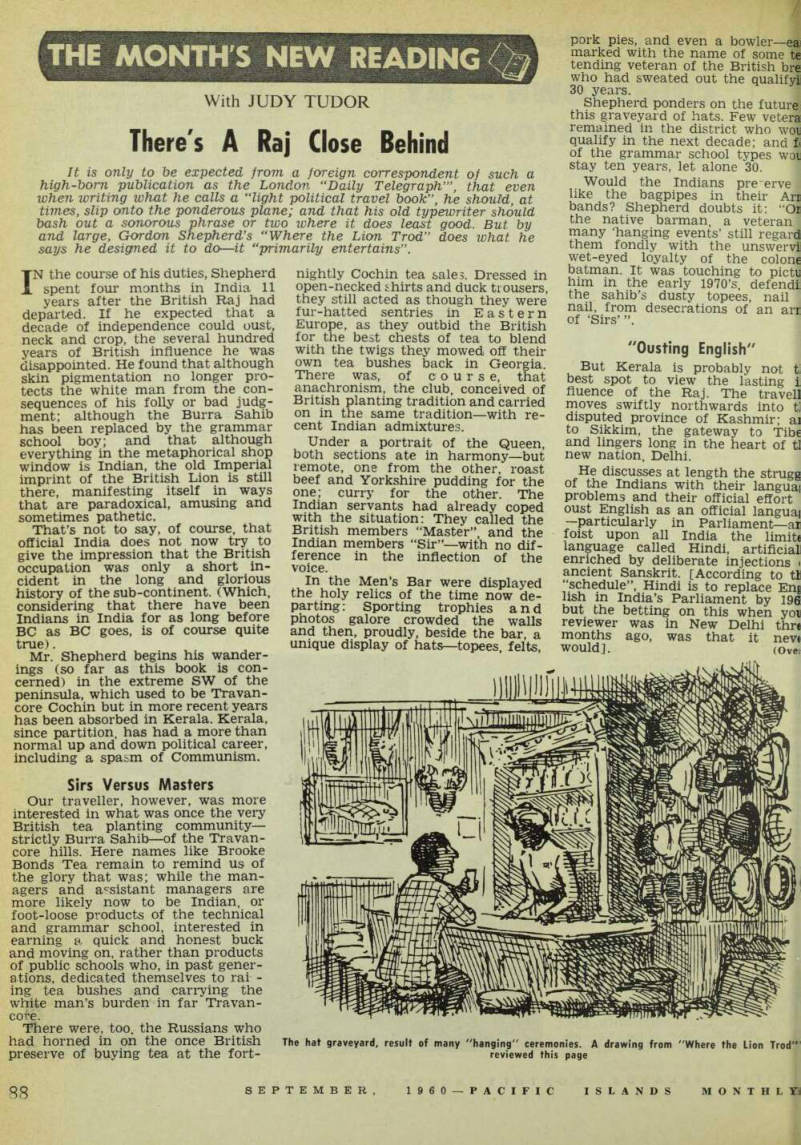 90
90 91
91 92
92 93
93 94
94 95
95 96
96 97
97 98
98 99
99 100
100 101
101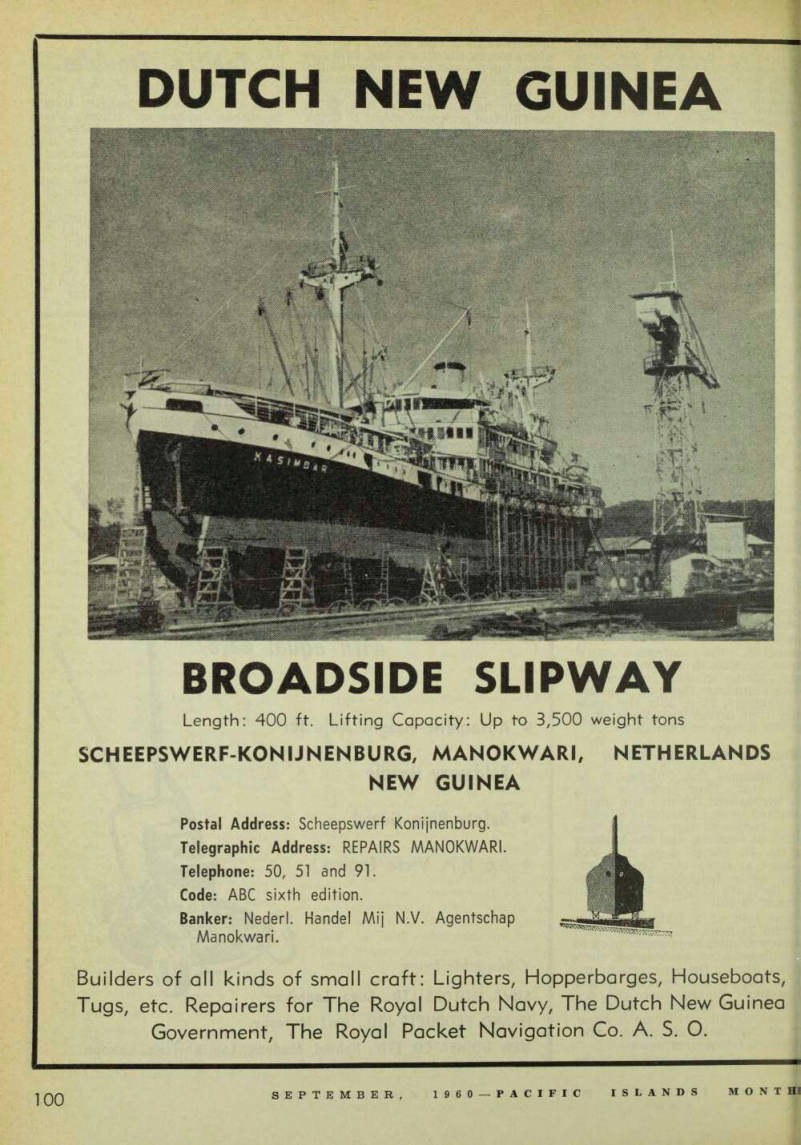 102
102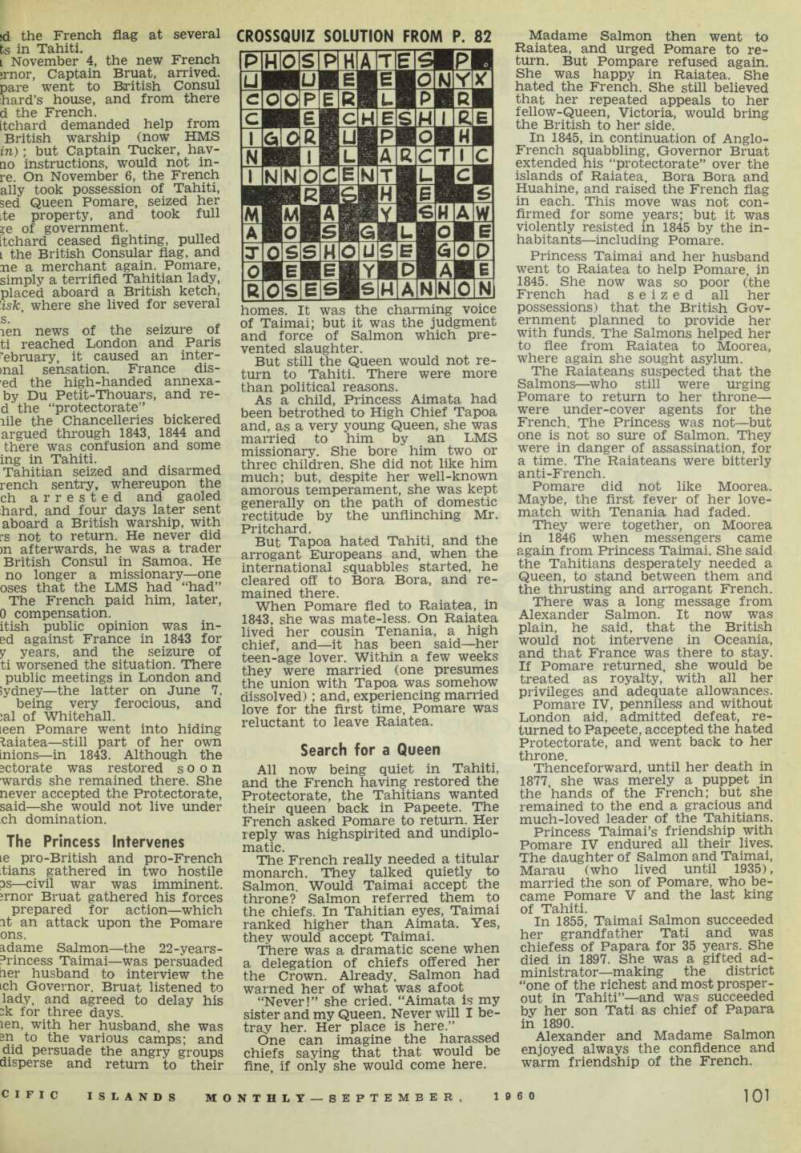 103
103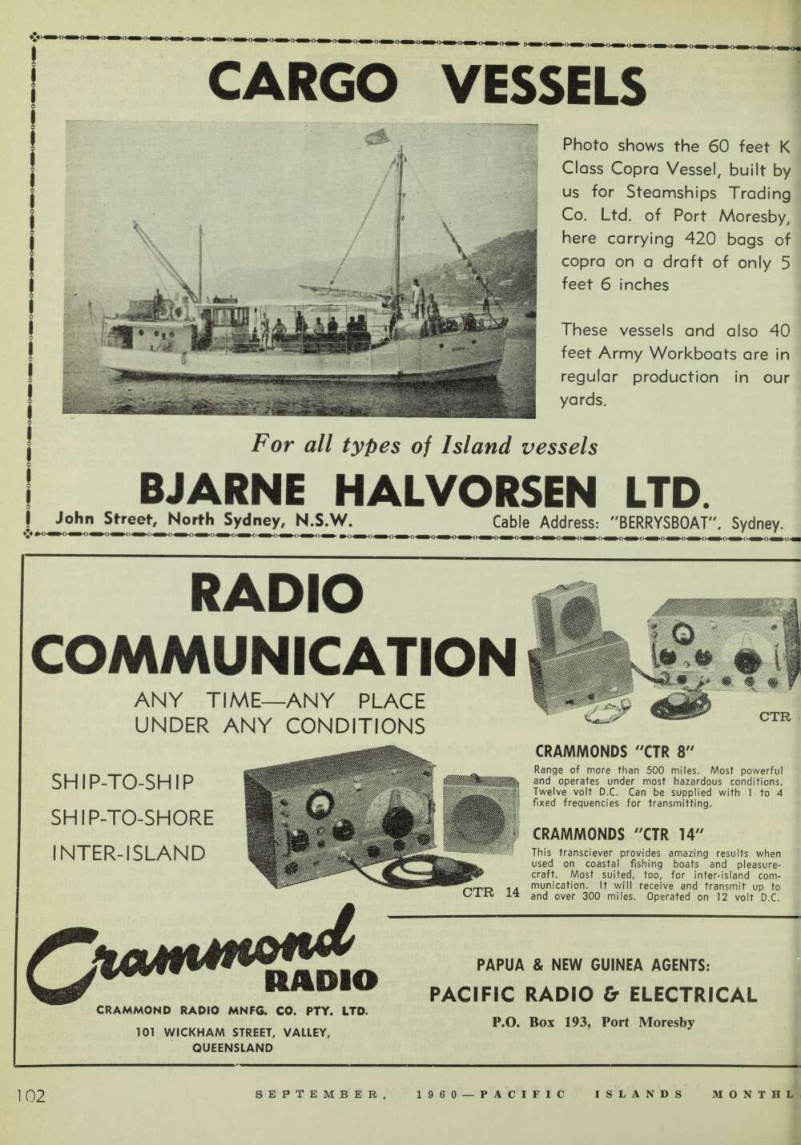 104
104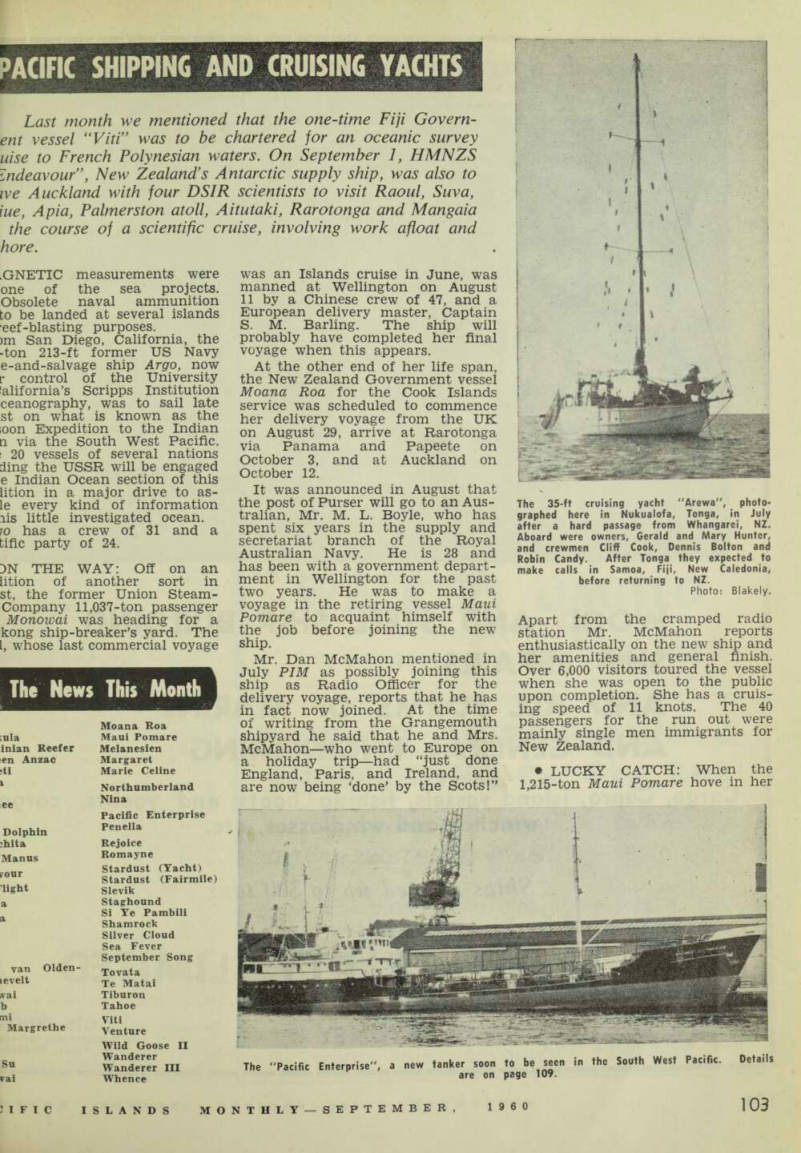 105
105 106
106 107
107 108
108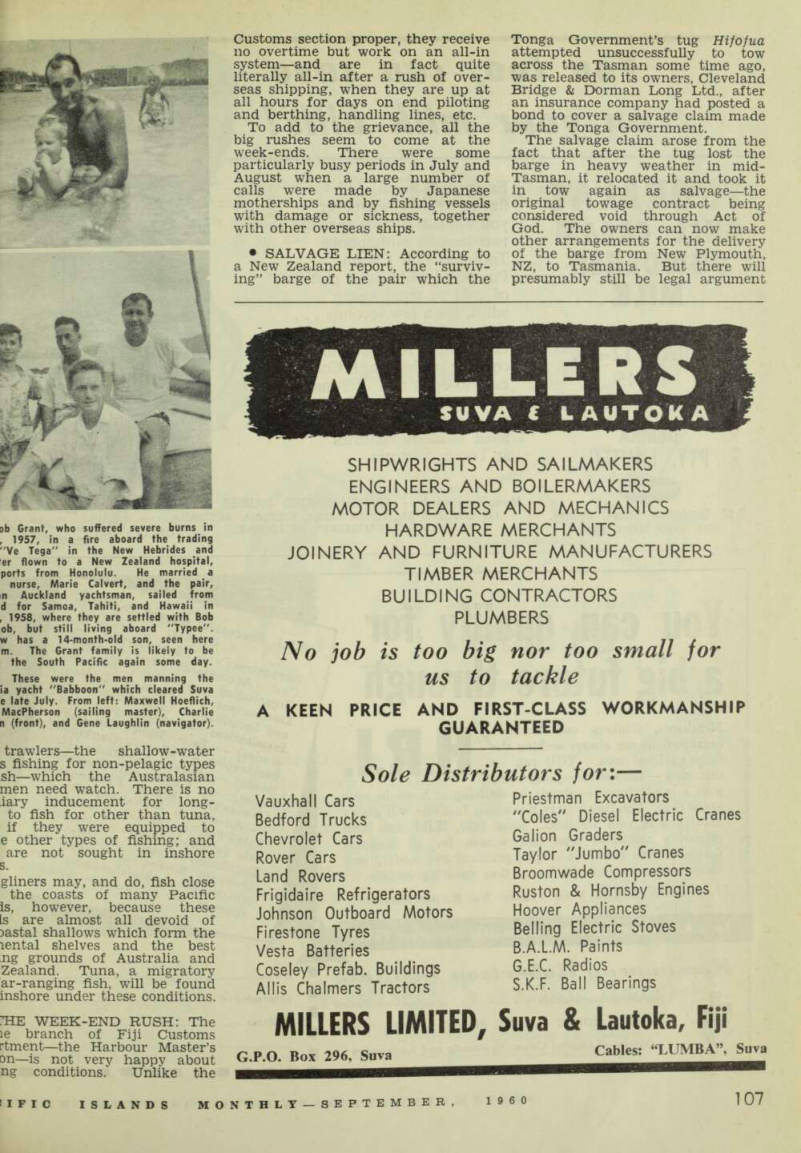 109
109 110
110 111
111 112
112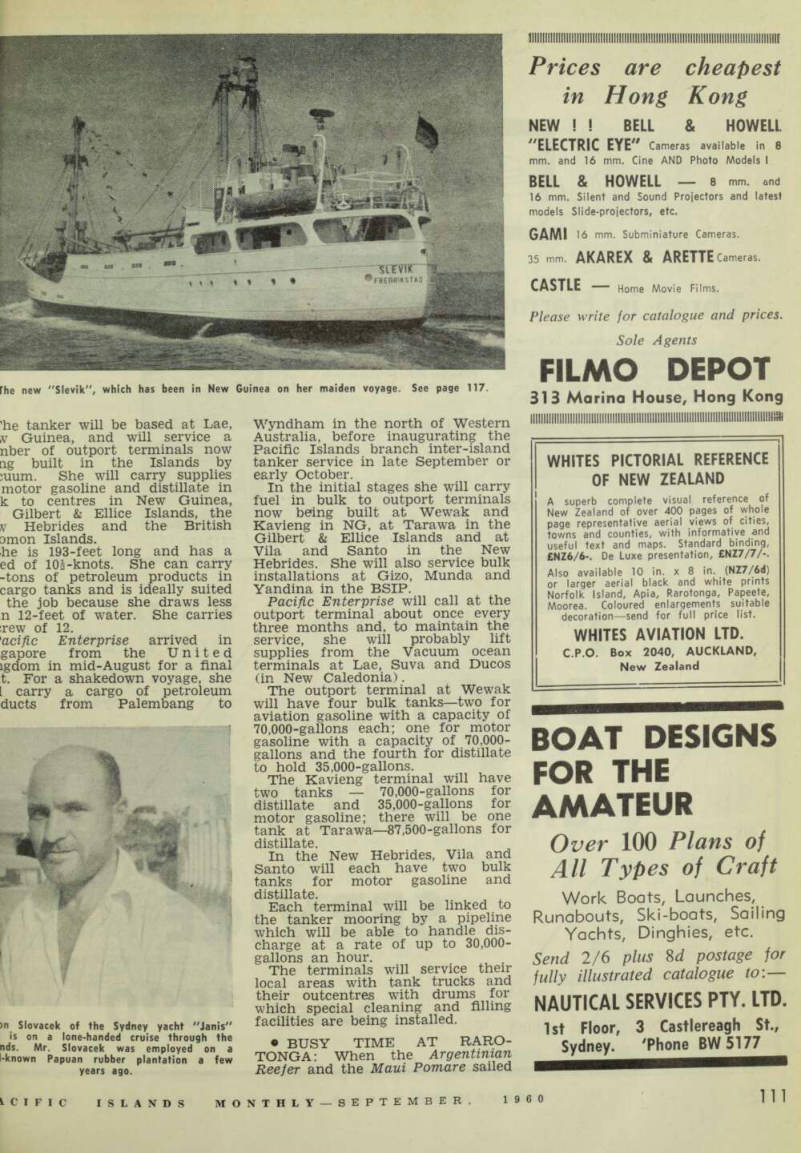 113
113 114
114 115
115 116
116 117
117 118
118 119
119 120
120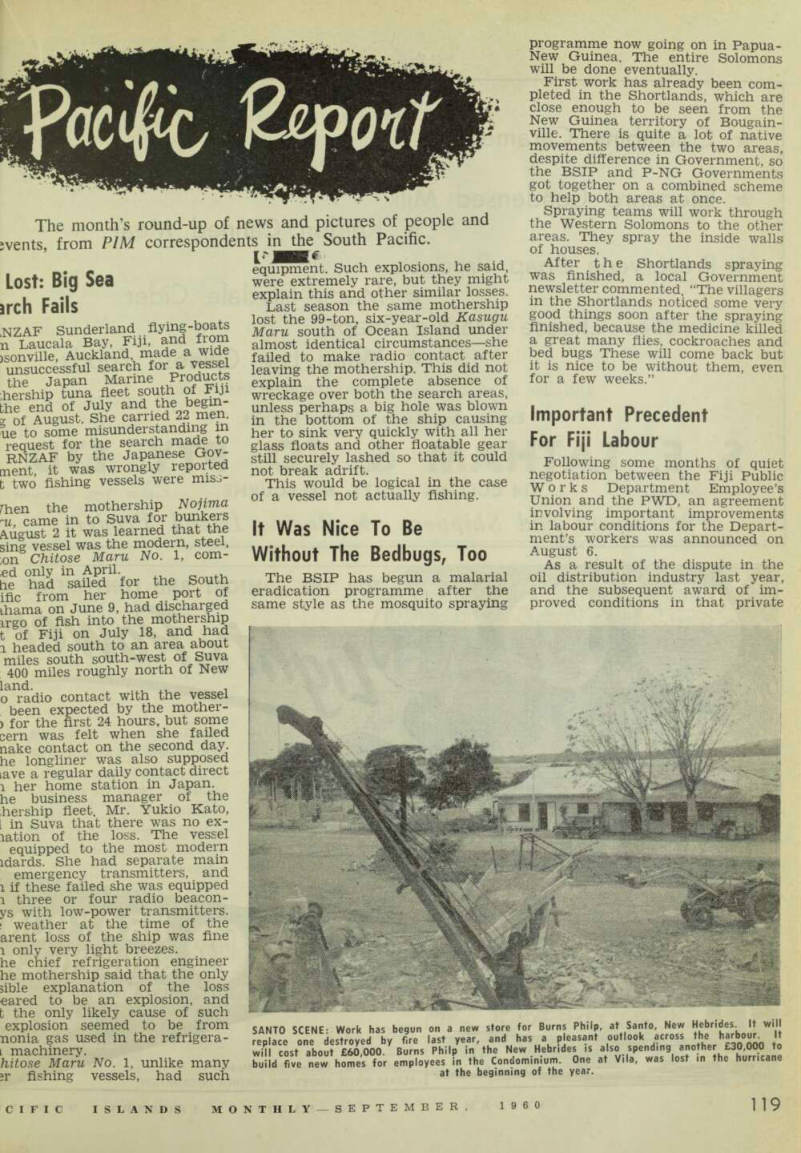 121
121 122
122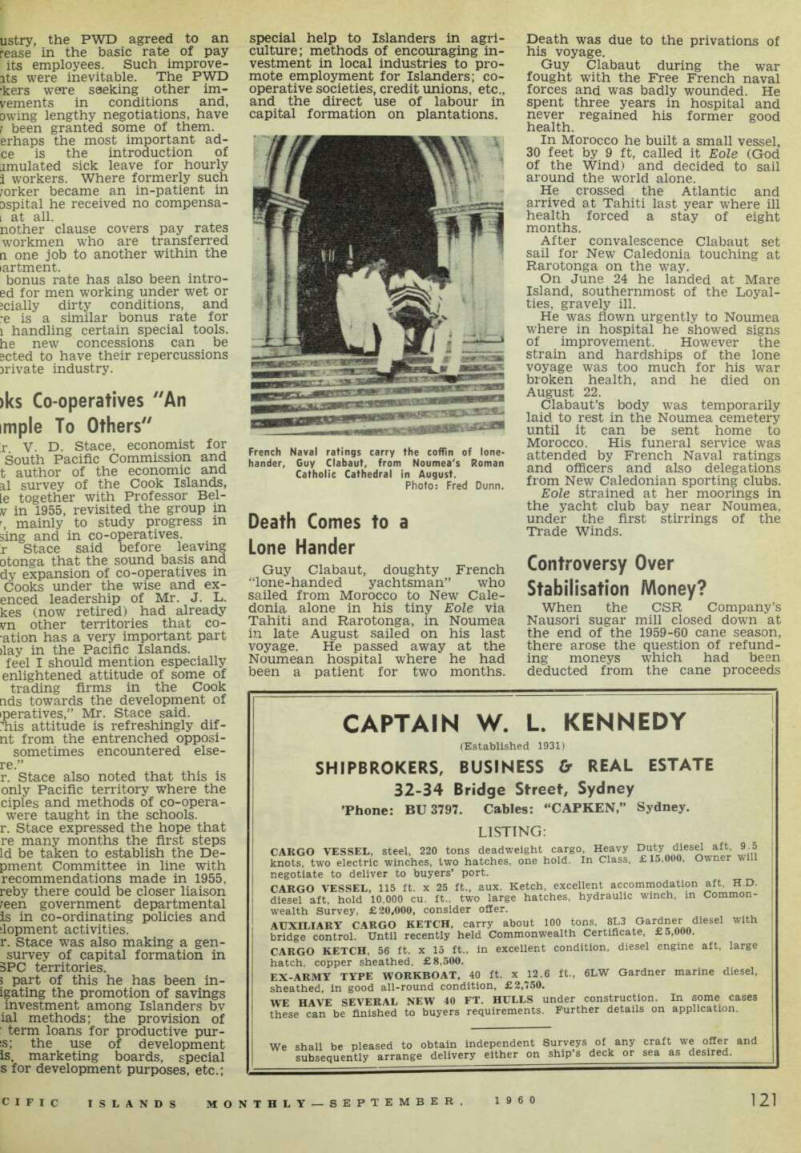 123
123 124
124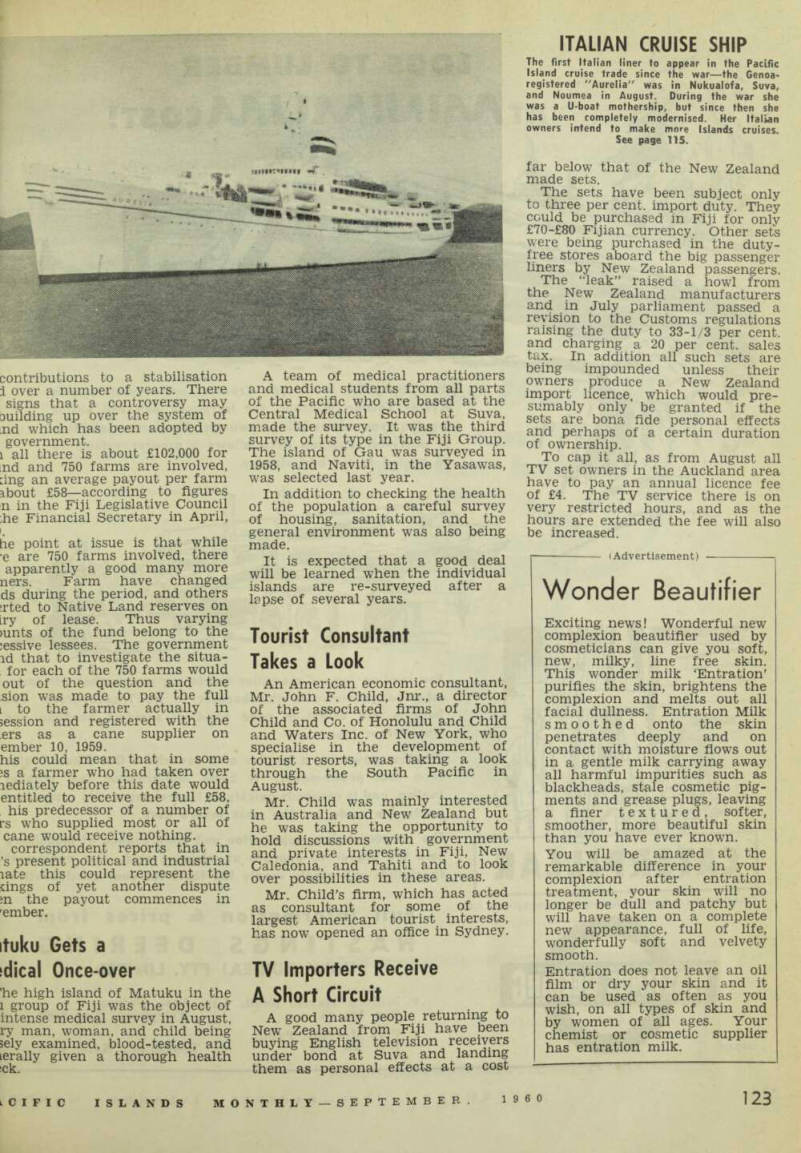 125
125 126
126 127
127 128
128 129
129 130
130 131
131 132
132 133
133 134
134 135
135 136
136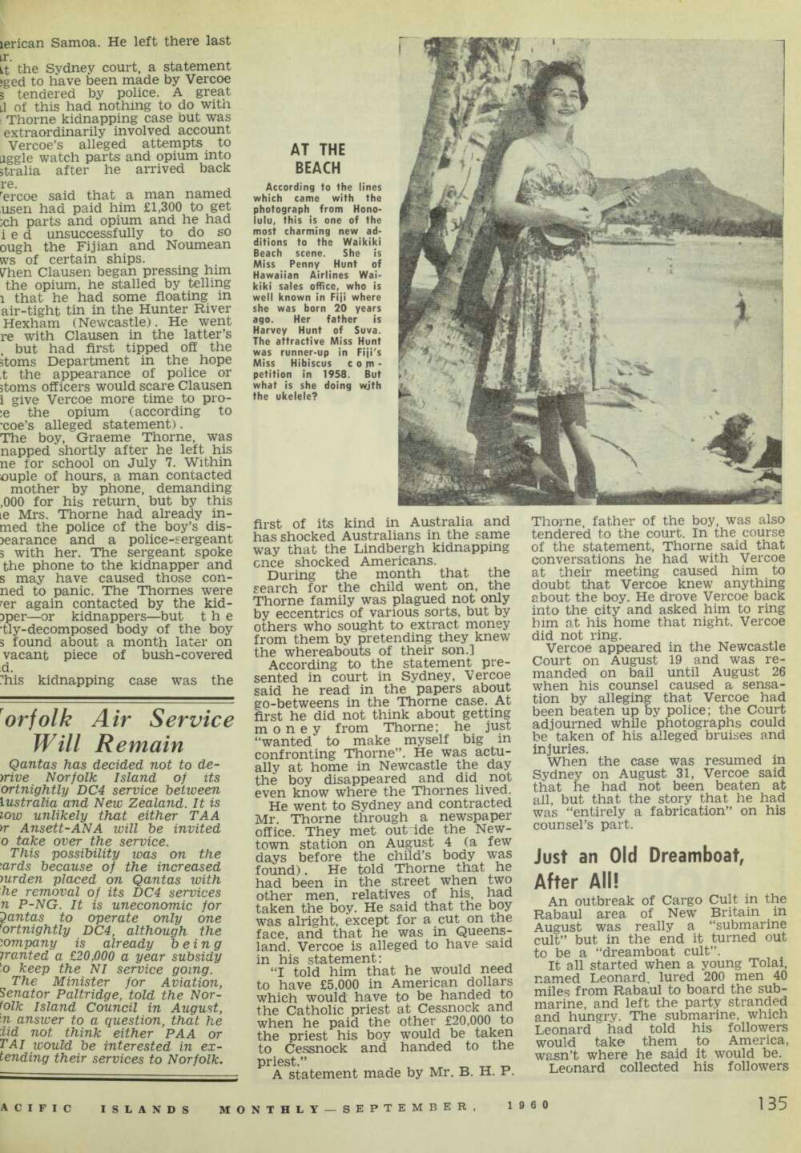 137
137 138
138 139
139 140
140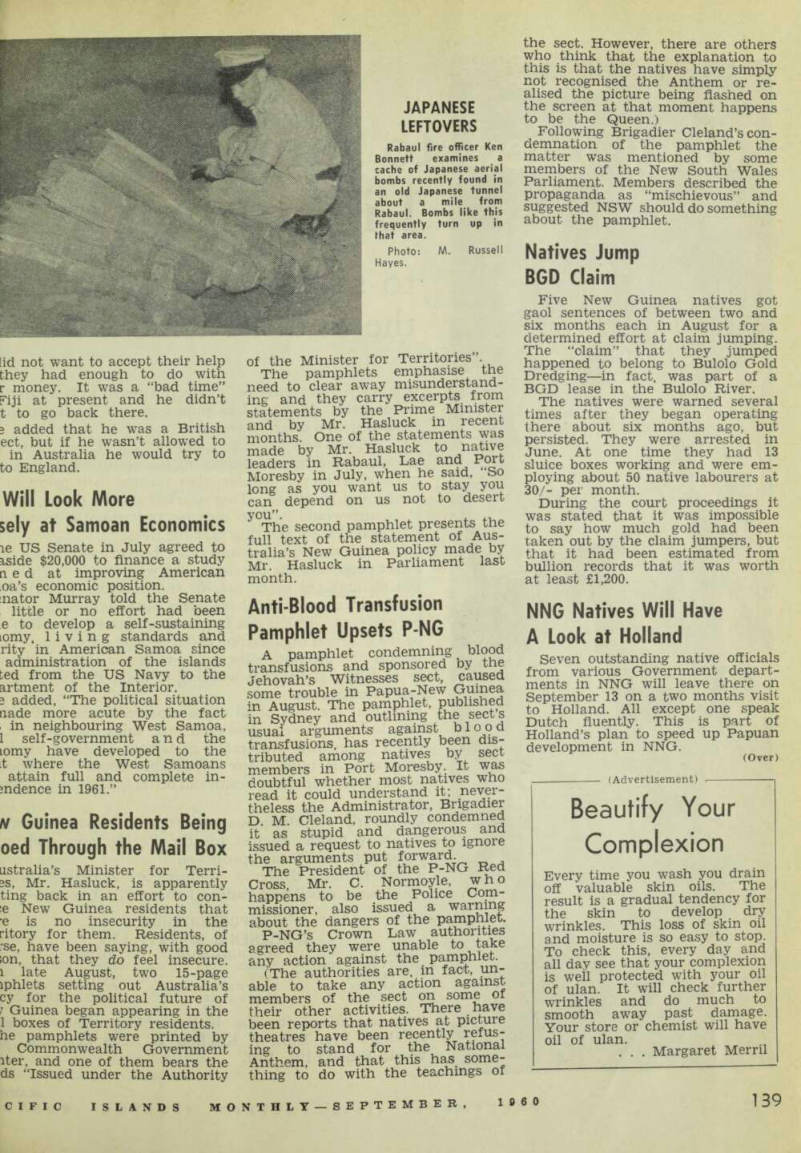 141
141 142
142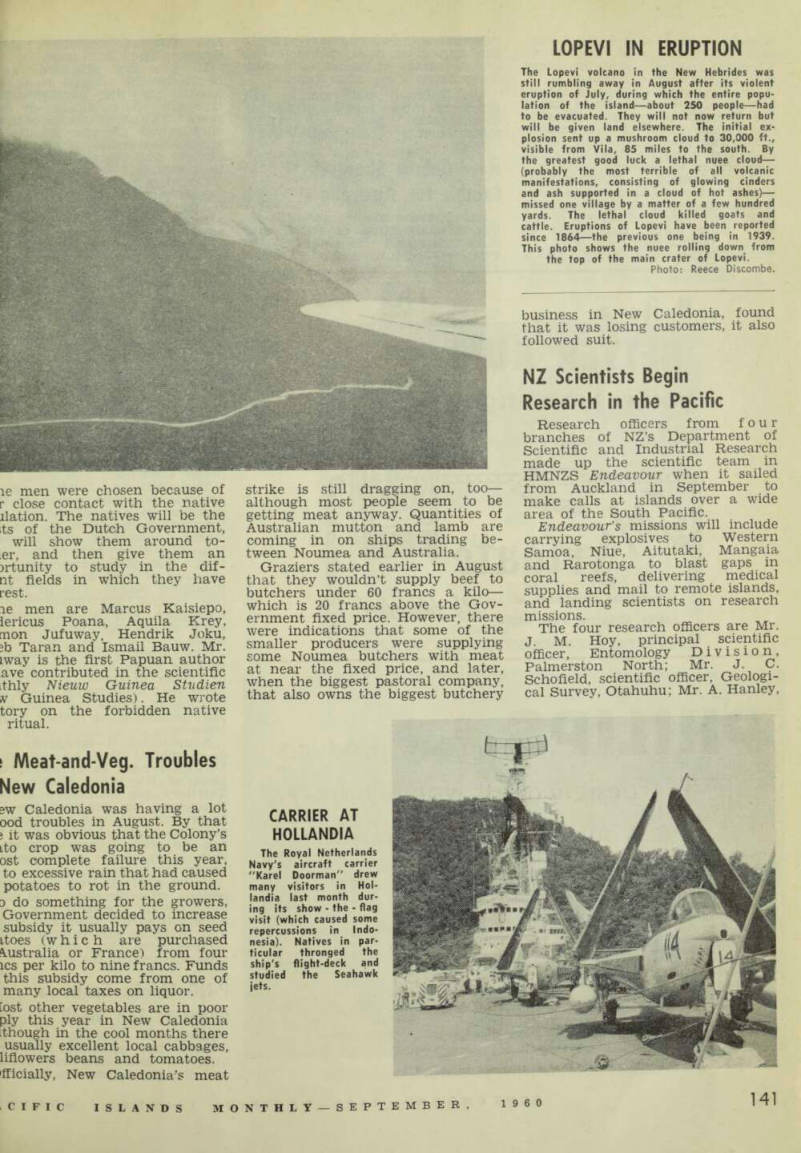 143
143 144
144 145
145 146
146 147
147 148
148 149
149 150
150 151
151 152
152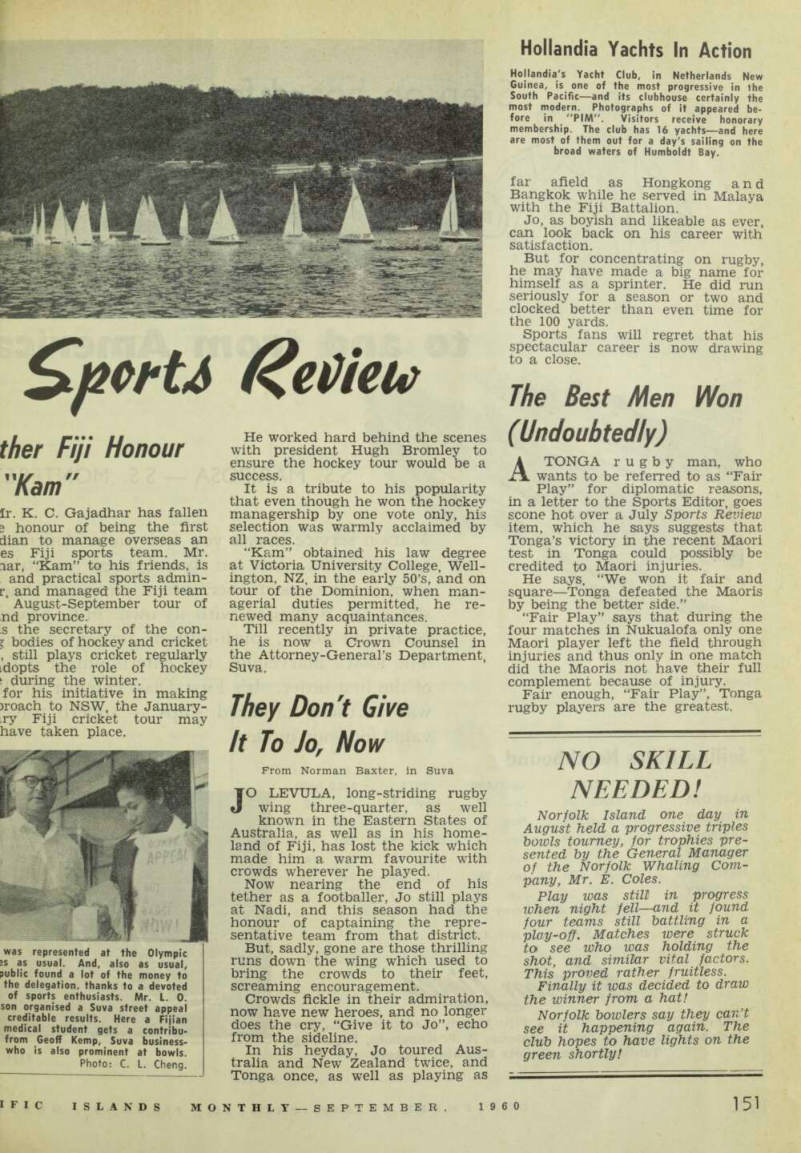 153
153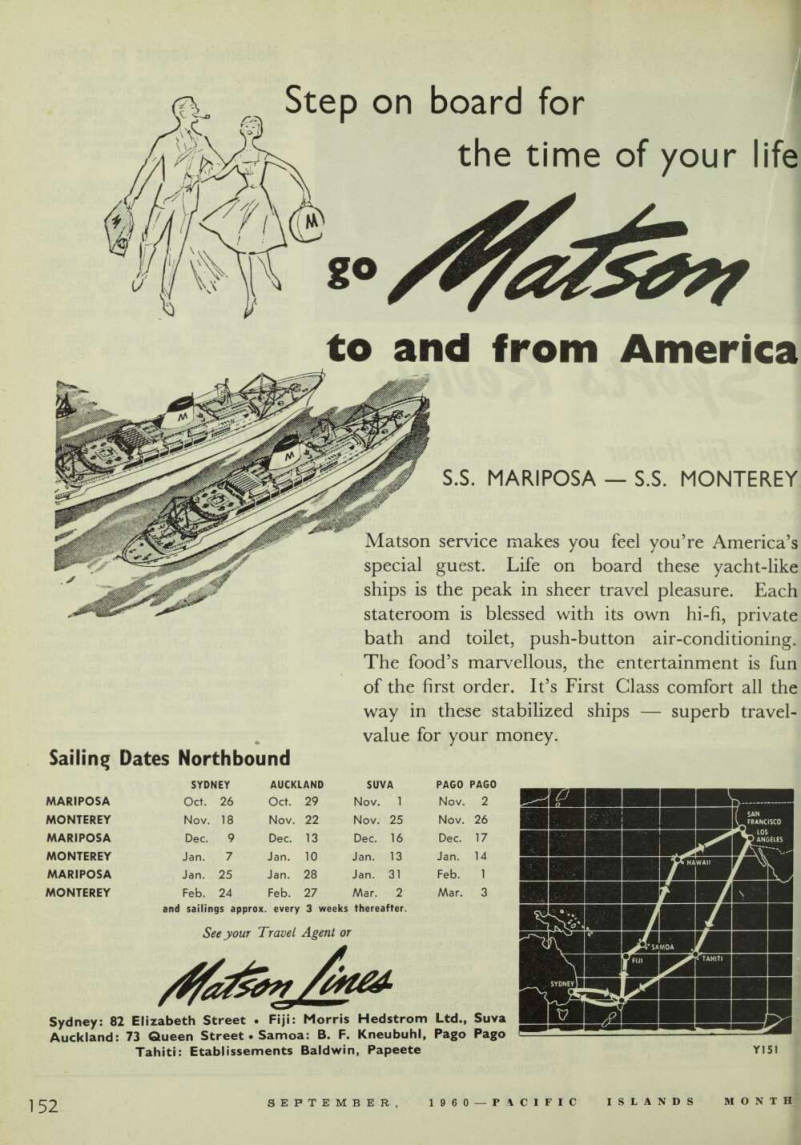 154
154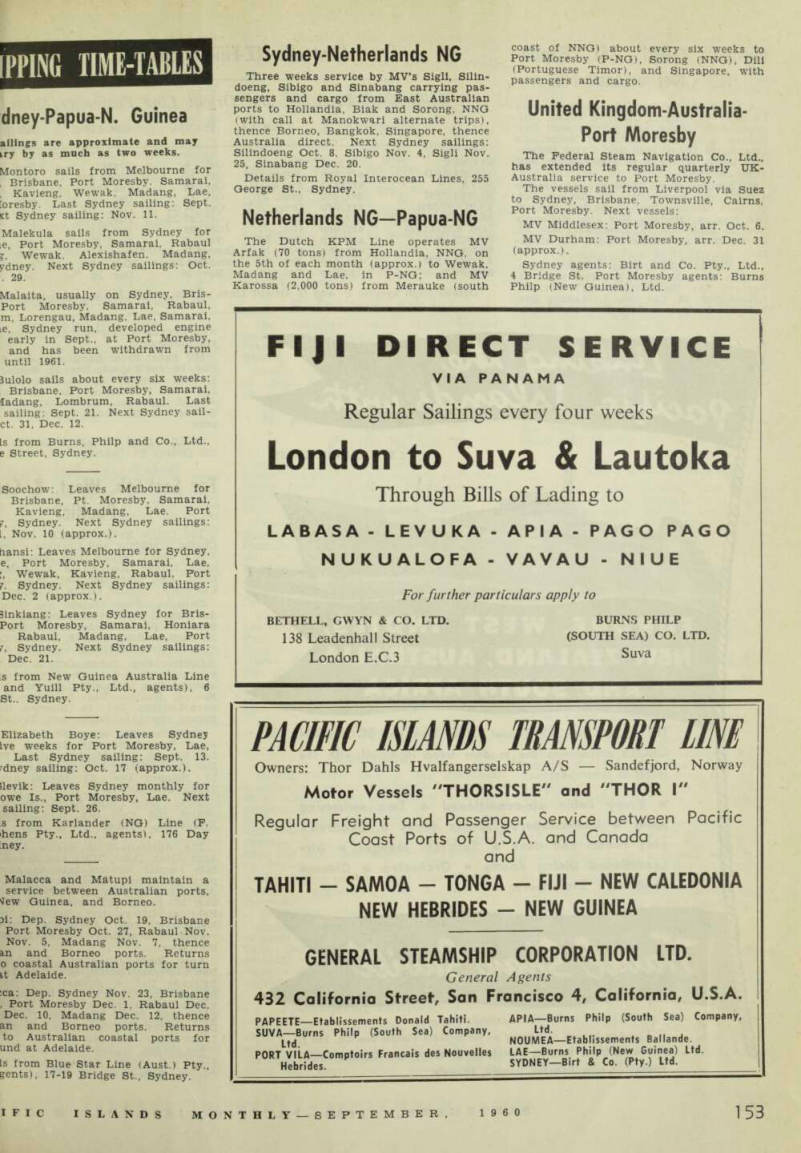 155
155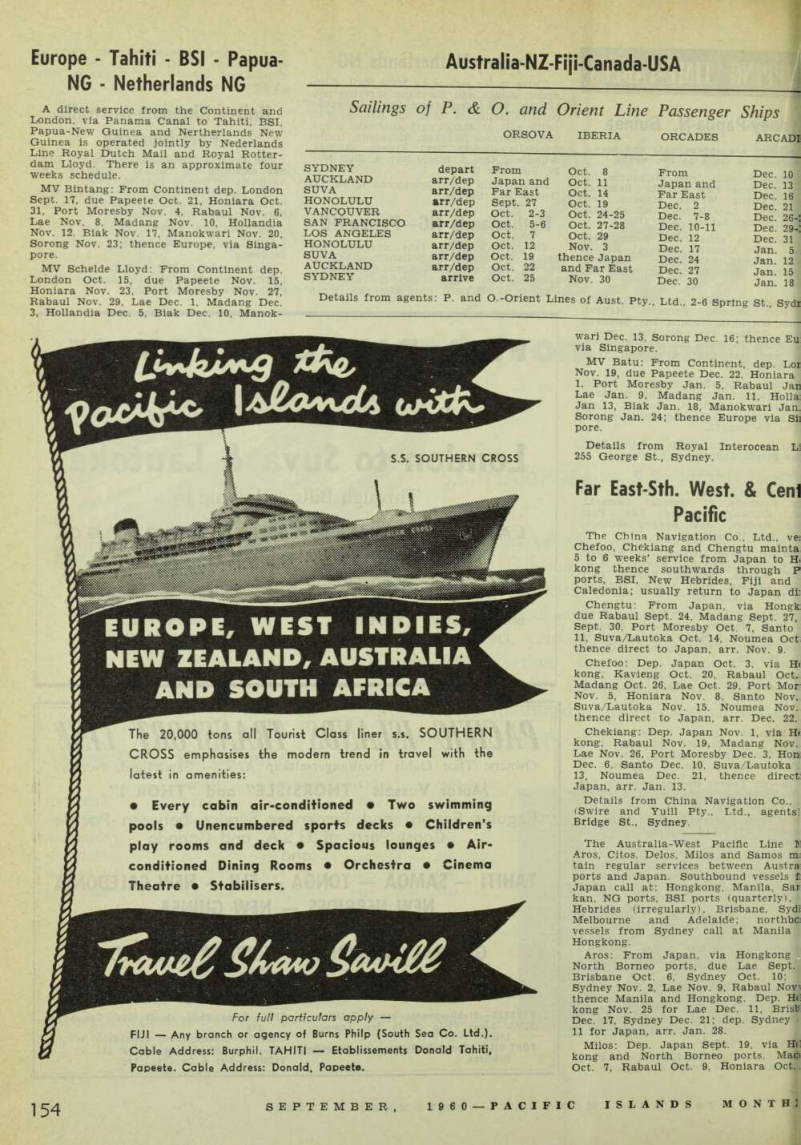 156
156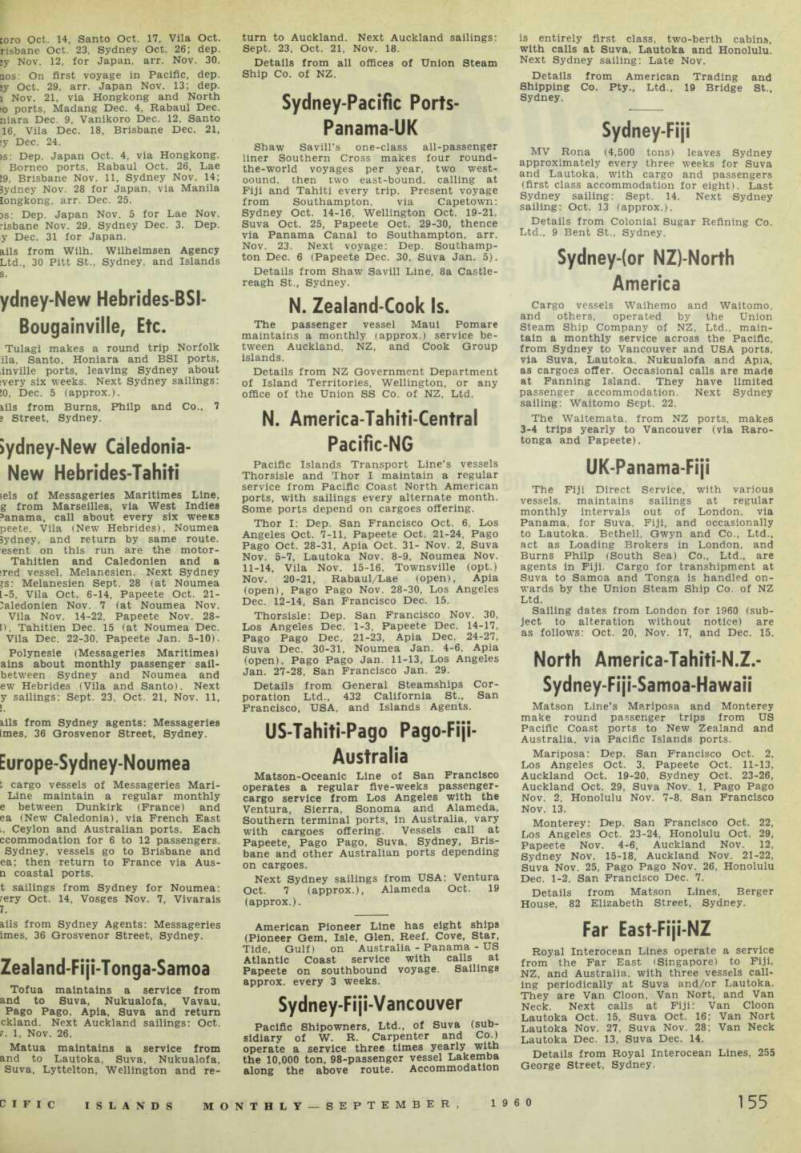 157
157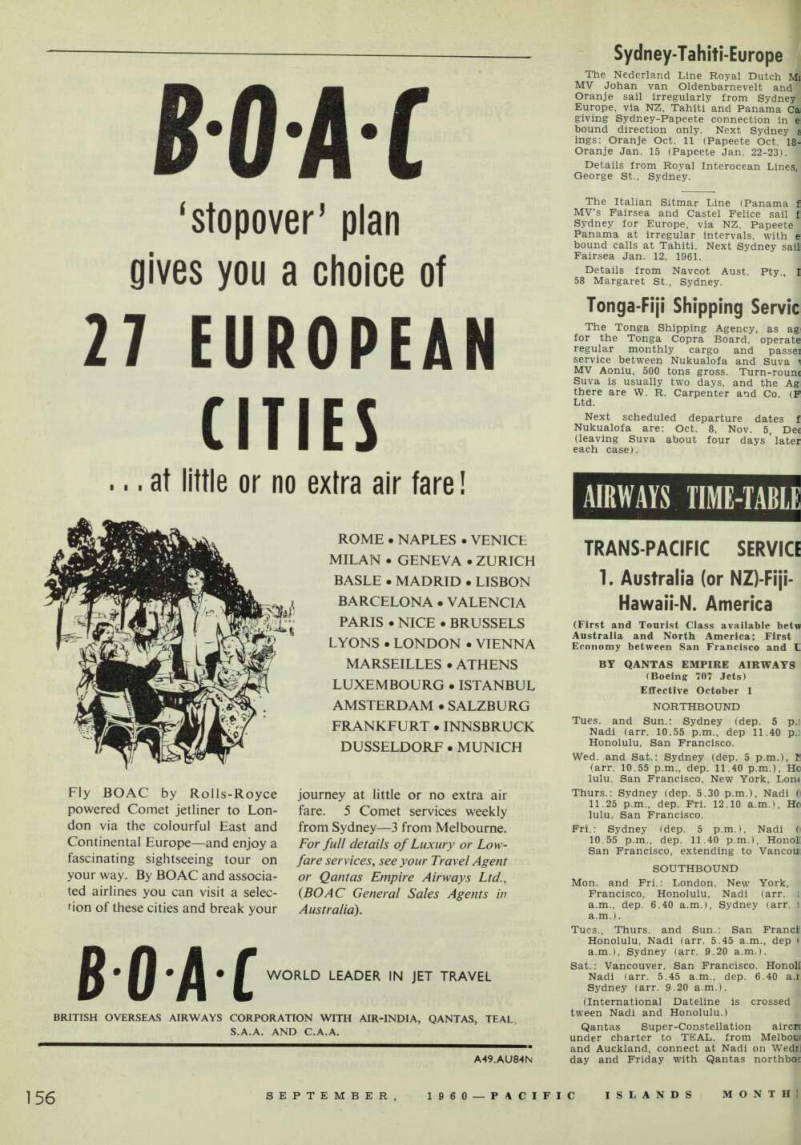 158
158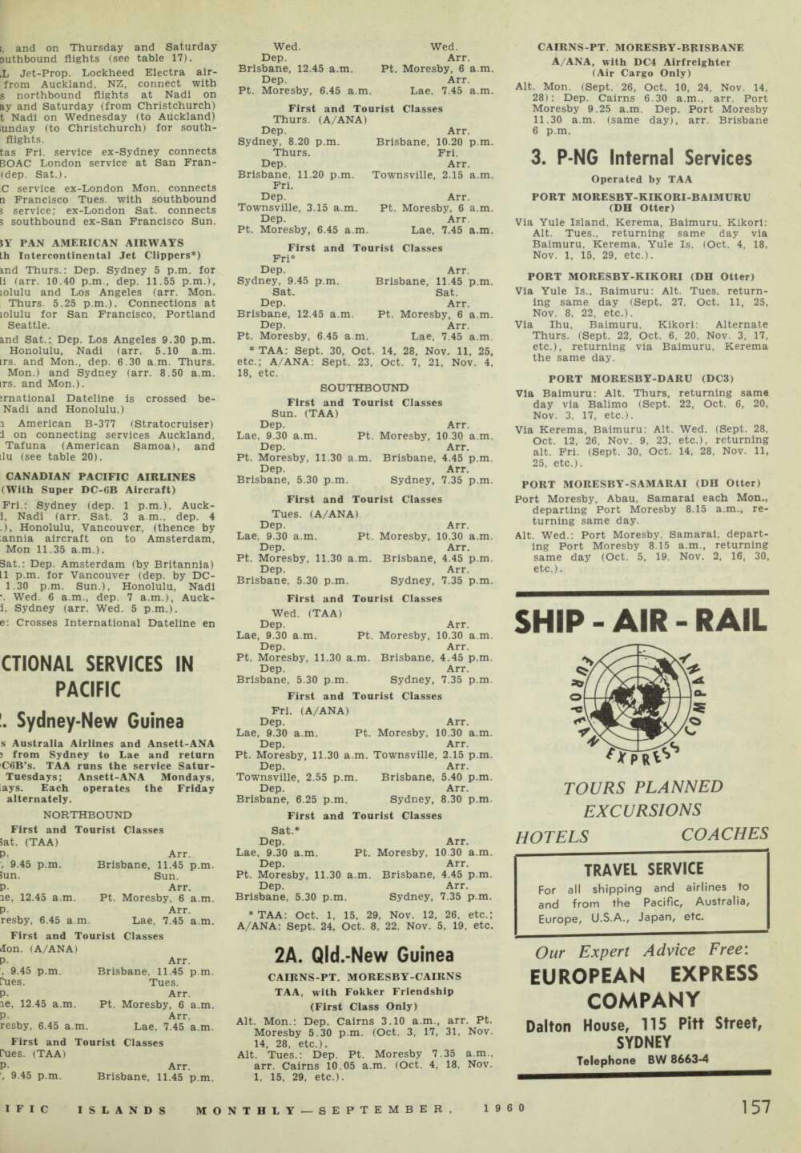 159
159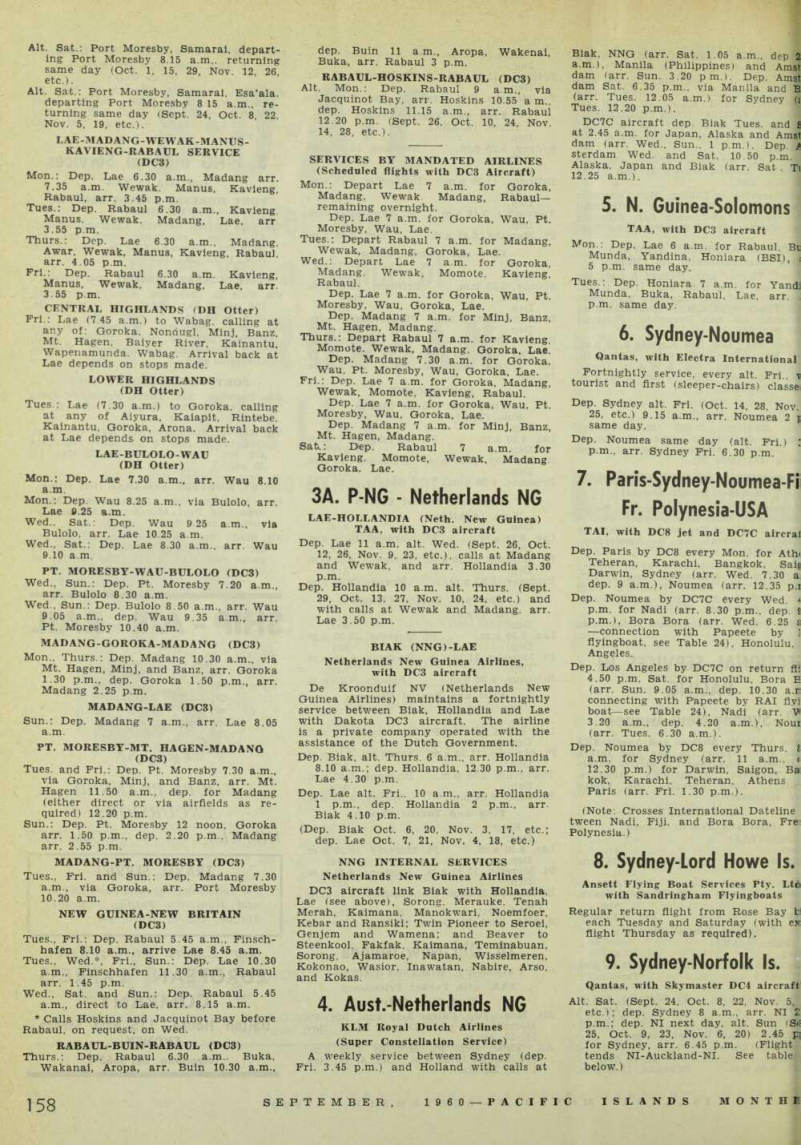 160
160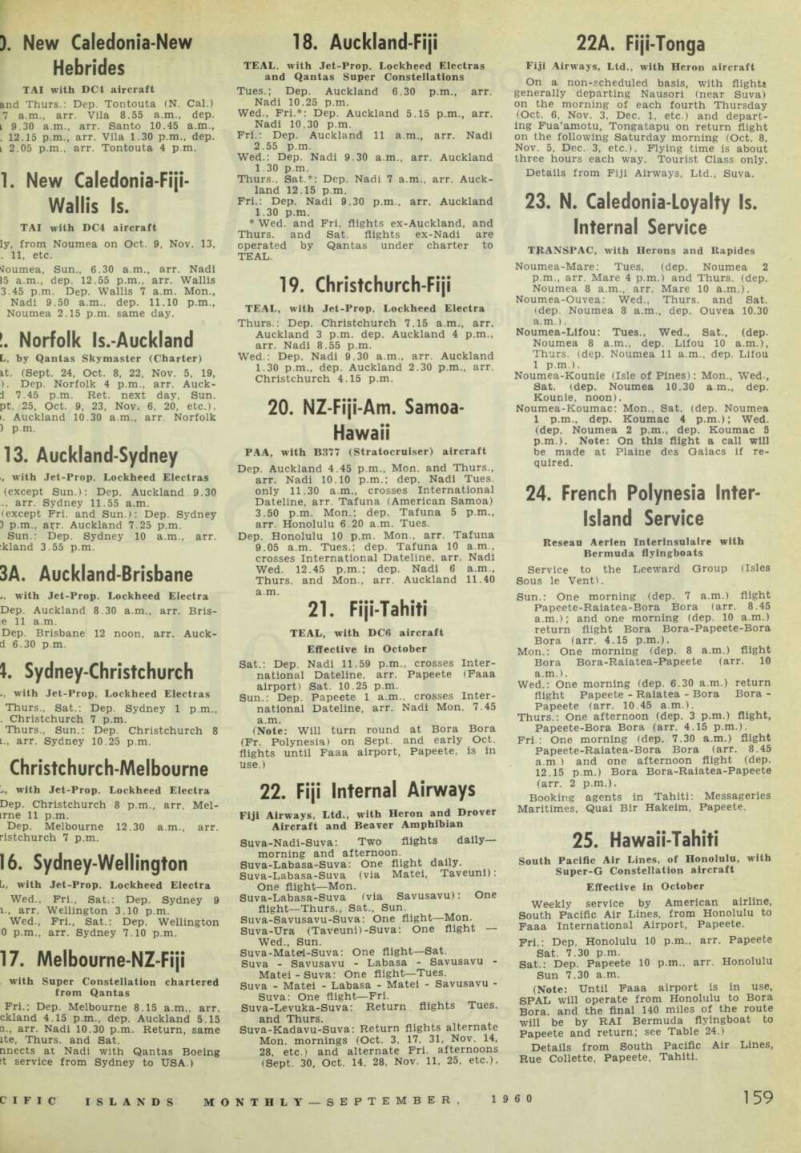 161
161 162
162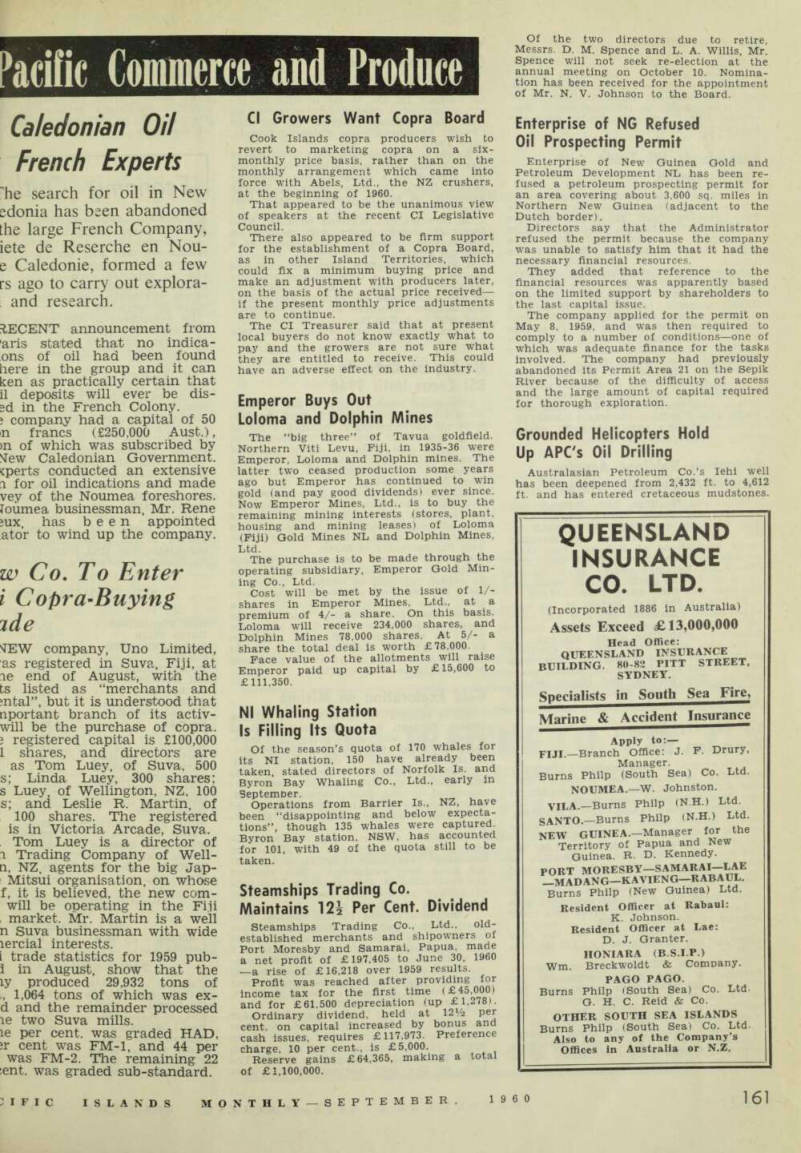 163
163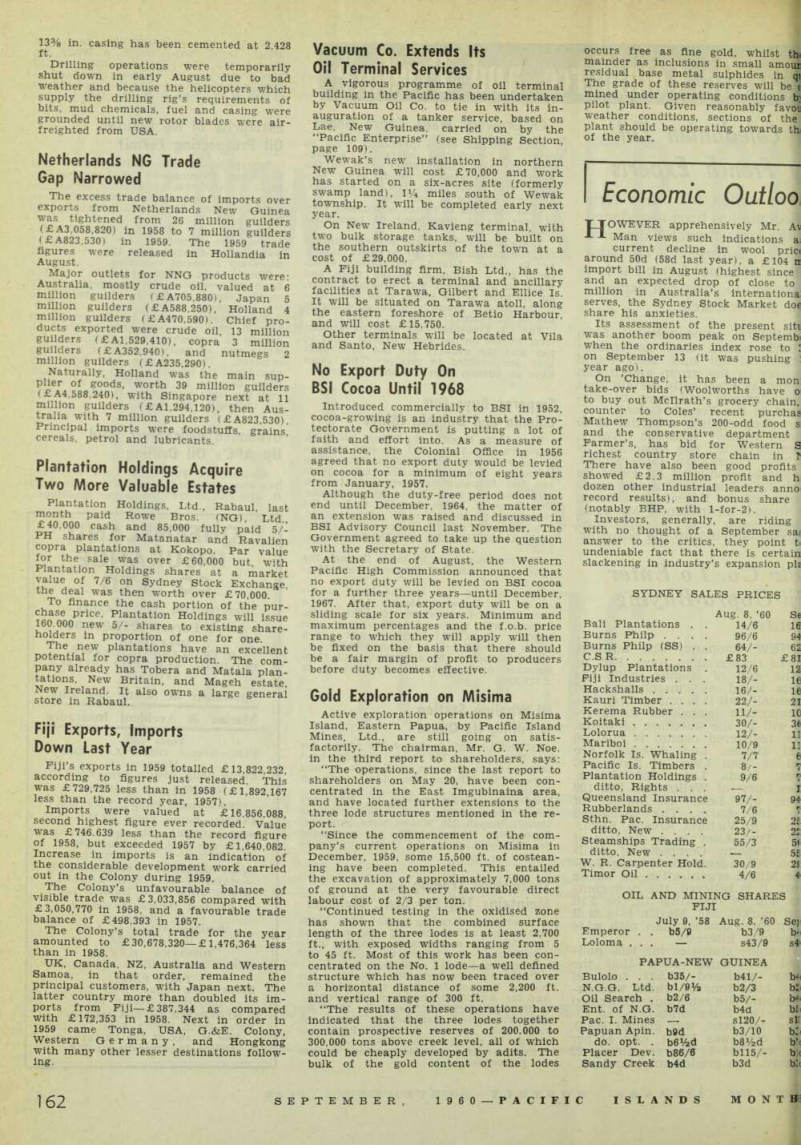 164
164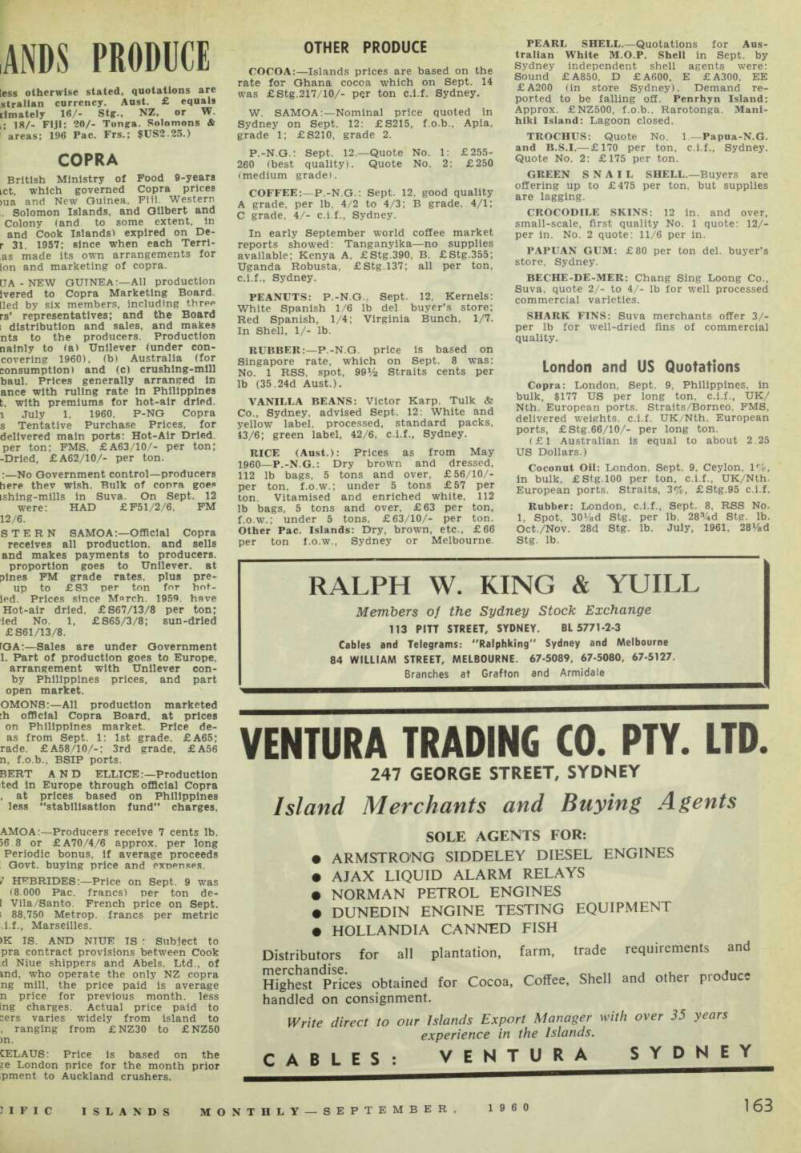 165
165 166
166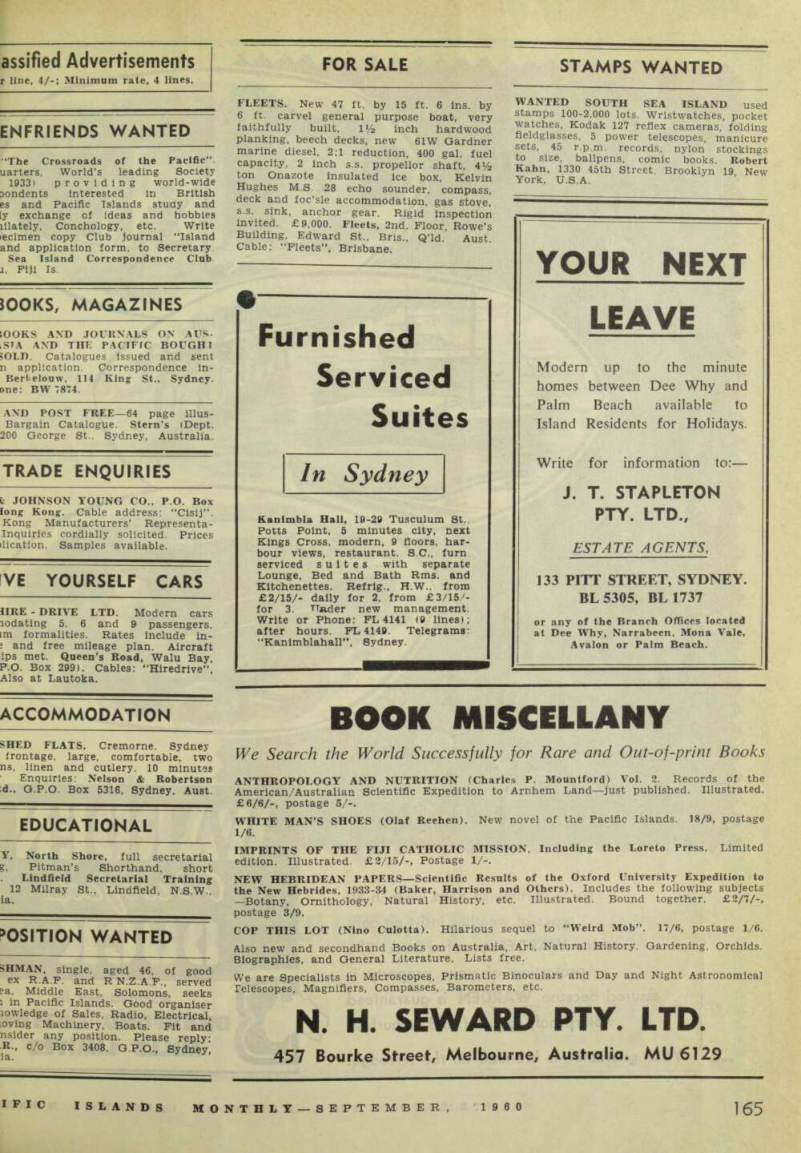 167
167 168
168 169
169 170
170 171
171 172
172