A Sectarian War Destroyed
pp. 86-103 · Read in the full issue
How Tahiti Became French A Sectarian War Destroyed Pomare’s Throne
Gathered From Old Records By R. W. ROBSON Never had Tahiti appeared more beautiful than on that morning of August 28, 1838, when the French 20-gun frigate "Venus", expertly handled, moved slowly to an anchorage in the sheltered lagoon opposite Papeete town.
THE brilliant sunshine emphasised the colours of the tropical ver dure around the little town. The bare mountains behind stood out sharply against the blue sky.
Tahitians, English and French gathered lazily along the waterfront, to stare at the newcomer. Teams of youths and excited girls manned the canoes, to row out and, in traditional fashion, welcome the visitors with Leis and sweet-smell ing garlands of tiare.
But there was no cordiality on the warship. Under orders from the snarling commander Commodore Du Petit-Thouars, the sailors reluct antly drove off the vivacious vahines, while a ship’s boat was sent ashore.
The officer in the boat sought and found a Belgian merchant, M.
Moerenhout, and took him aboard.
Within the hour a French naval man, in full uniform, was rowed ashore and. guided by Moerenhout and supported by an armed party, he marched to the impressive residence of Queen Pomare IV.
There, he handed over a formal document, bristling with seals..
The Queen was abed. Only a few hours before, she had given birth to a son. She, and her associates, had only a fragmentary knowledge of French —she had been educated
by the Englishmen of the London Missionary Society, who tried con sistently to shape her habits towards Protestantism and her policies towards Britain.
The naval party presented arms, about-turned, and marched back to the waterfront. The young Queen— she was only 25—greatly puzzled by these formal and seemingly un friendly proceedings, sent urgently for George Pritchard, formerly of the English mission organisation, now Acting British Consul, a trader, and her constant adviser. Pritchard brought an interpreter.
The document was signed by Du Petit-Thouars and, in the name of His Imperial Majesty, King Louis Philippe of France, he demanded
that the Queen, within 24 hour • Pay to him the sum of 2„ Piasters (approximately, 2„ Dollars) as compensation for insi and injuries received by the Frei Roman Catholic missionar Fathers Garret and Laval, who 1 been forcibly removed from Tal in December, 1836. (They had ca from the Gambiers in NovemU 1836, and been landed surreptitior from the little schooner of Capt William Hamilton, at Tautir opposite side of Tahiti —and th launched a campaign against English Protestant “heretical” n sionaries.) • Make to him a formal apoll for the wrong done to citizens; France.
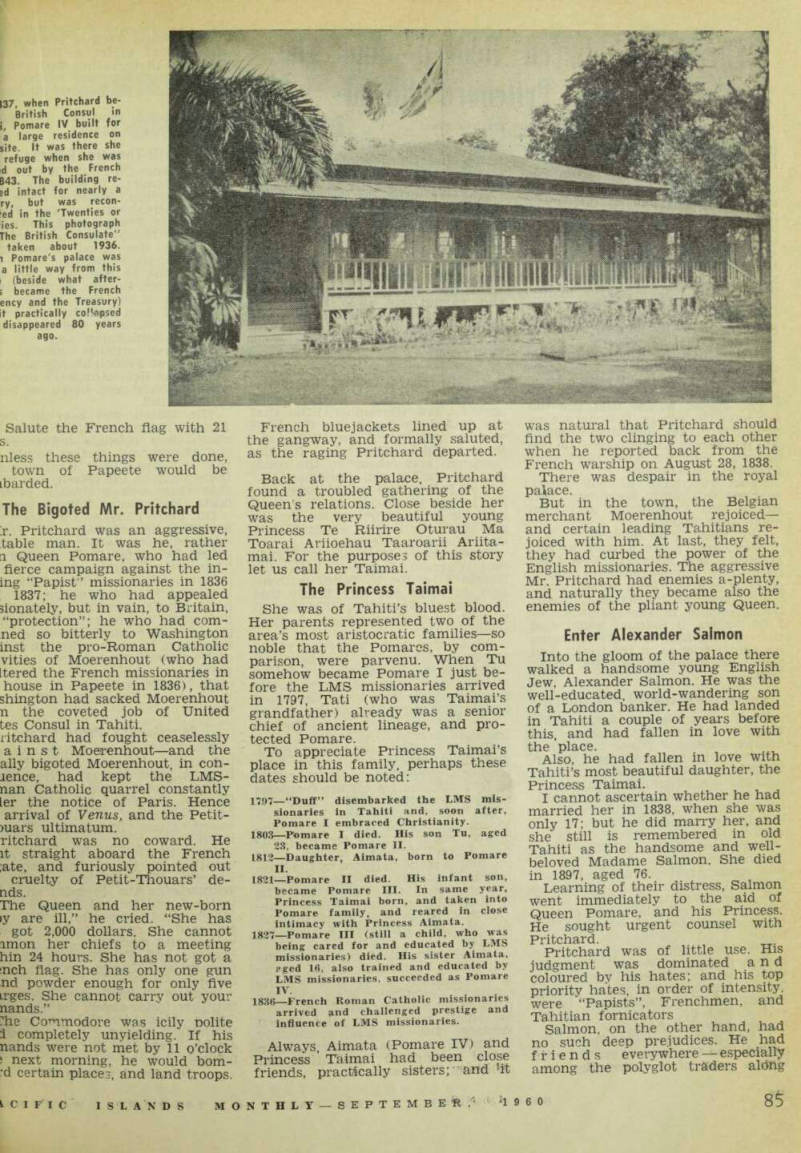
This was the scene in the cemetery at Paurani, Papeete, when Marau, the last Queen of Tahiti, was buried on February 4, 1935 . . Marau was the daughter of Princess Taimai (described in this article) and Alexander Salmon, and she married King Hinoi, son of Queen Pomare IV, who was dethroned by the French in 1843.
Pomare was restored by the French soon after wards; but thenceforward she and Hinoi were merely figureheads, and the monarchy dis appeared when Hinoi died.
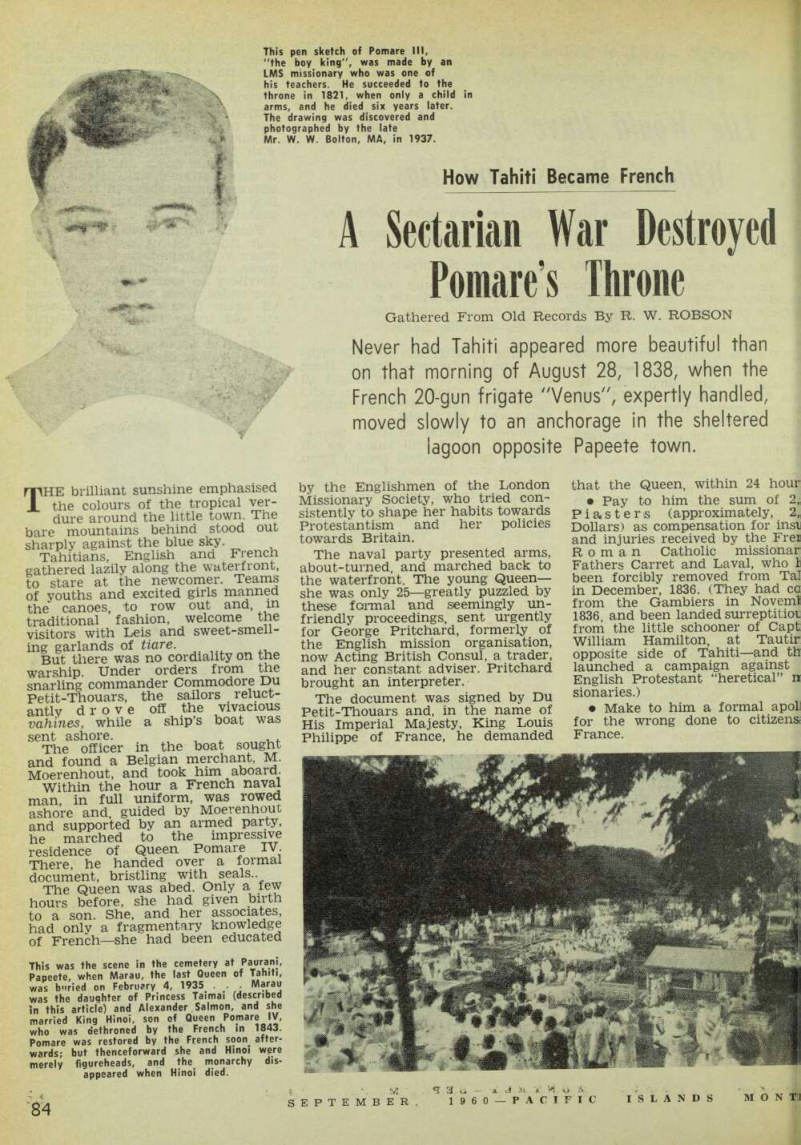
This pen sketch of Pomare III, "the boy king", was made by an IMS missionary who was one of his teachers. He succeeded to the throne in 1821, when only a child in arms, and he died six years later.
The drawing was discovered and photographed by the late Mr. W. W. Bolton, MA, in 1937.
Salute the French flag with 21 s. nless these things were done, town of Papeete would be ibarded.
The Bigoted Mr. Pritchard :r. Pritchard was an aggressive, table man. It was he, rather i Queen Pomare, who had led fierce campaign against the fil ing “Papist” missionaries in 1836 1837; he who had appealed sionately, but in vain, to Britain, “protection”; he who had com ned so bitterly to Washington inst the pro-Roman Catholic vities of Moerenhout (who had [tered the French missionaries in house in Papeete in 1836), that shington had sacked Moerenhout n the coveted job of United tes Consul in Tahiti, ritchard had fought ceaselessly a in s t Moerenhout —and the ally bigoted Moerenhout, in con lence, had kept the LMS nan Catholic quarrel constantly ler the notice of Paris. Hence arrival of Venus, and the Petit mars ultimatum, ritchard was no coward. He it straight aboard the French ;ate, and furiously pointed out cruelty of Petit-Thouars’ de nds.
The Queen and her new-born ly are ill,” he cried. “She has got 2,000 dollars. She cannot imon her chiefs to a meeting hin 24 hours. She has not got a inch flag. She has only one gun nd powder enough for only five urges. She cannot carry out your nands.” ?he Commodore was icily oolite i completely unyielding. If his nands were not met by 11 o’clock 5 next morning, he would hom 'd certain places, and land troops.
French bluejackets lined up at the gangway, and formally saluted, as the raging Pritchard departed.
Back at the palace. Pritchard found a troubled gathering of the Queen s relations. Close beside her was the very beautiful young Princess Te Riirire Oturau Ma Toarai Ariioehau Taaroarii Ariita mai. For the purposes of this story let us call her Taimai.
The Princess Taimai
She was of Tahiti’s bluest blood.
Her parents represented two of the area’s most aristocratic families —so noble that the Pomares, by com parison, were parvenu. When Tu somehow became Pomare I just be fore the LMS missionaries arrived in 1797, Tati (who was Taimai’s grandfather) already was a senior chief of ancient lineage, and pro tected Pomare.
To appreciate Princess Taimai’s place in this family, perhaps these dates should be noted ; 1797 —“ Duff” disembarked the LMS mis sionaries in Tahiti and, soon after, Pomare I embraced Christianity. 1803—Pomare I died. His son Tu, aged 23. became Pomare 11. 1812—Daughter, Aimata, born to Pomare 11. 1821—Pomare II died. His infant son, became Pomare 111. In same year, Princess Taimai born, and taken into Pomare family, and reared in close intimacy with Princess Aimata. 1827—Pomare 111 (still a child, who was being cared for and educated by LMS missionaries) died. His sister Aimata, pged 16, also trained and educated by LMS missionaries, succeeded as Pomare IV. 1836—French Roman Catholic missionaries arrived and challenged prestige and influence of LMS missionaries.
Always, Aimata (Pomare IV) and Princess Taimai had been close friends, practically sisters; and Mt
was natural that Pritchard should find the two clinging to each other when he reported back from the French warship on August 28, 1838.
There was despair in the royal palace.
But in the town, the Belgian merchant Moerenhout rejoiced— and certain leading Tahitians re joiced with him. At last, they felt, they had curbed the power of the English missionaries. The aggressive Mr. Pritchard had enemies a-plenty, and naturally they became also the enemies of the pliant young Queen.
Enter Alexander Salmon Into the gloom of the palace there walked a handsome young English Jew, Alexander Salmon. He was the well-educated, world-wandering son of a London banker. He had landed in Tahiti a couple of years before this, and had fallen in love with the place.
Also, he had fallen in love with Tahiti’s most beautiful daughter, the Princess Taimai.
I cannot ascertain whether he had married her in 1838, when she was only 17; but he did marry her, and she still is remembered in old Tahiti as the handsome and well beloved Madame Salmon, She died in 1897, aged 76.
Learning of their distress, Salmon went immediately to the aid of Queen Pomare, and his Princess.
He sought urgent counsel with Pritch&i'd Pritchard was of little use. His judgment was dominated and coloured by his hates; and his top priority hates, in order of intensity, were “Papists”, Frenchmen, and Tahitian fornicators Salmon, on the other hand, had no such deep prejudices. He had friends everywhere especially among the polyglot traders along
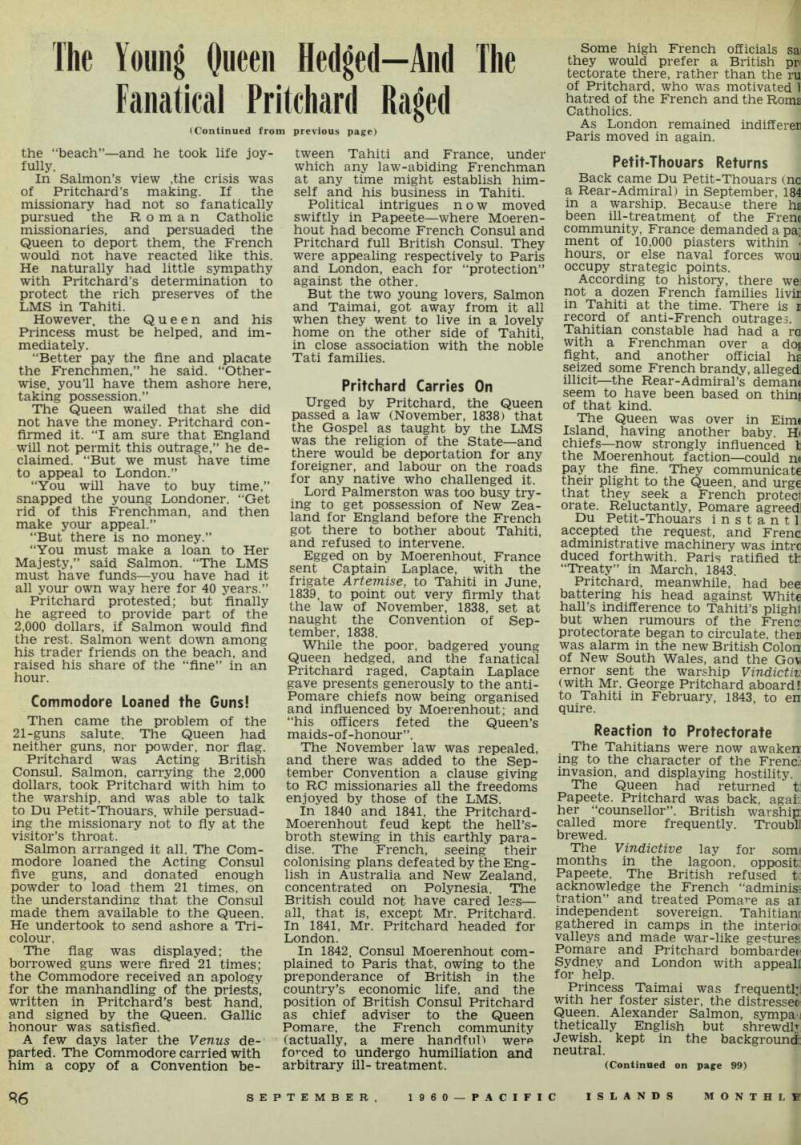
[?]37, when Pritchard be- British Consul in [?]i, Pomare IV built for a large residence on [?]site. It was there she [?] refuge when she was [?]d out by the French [?]843. The building re [?]ed intact for nearly a [?]ry, but was recon [?]led in the 'Twenties or [?]ies. This photograph The British Consulate" taken about 1936. [?] Pomare's palace was [?] a little way from this [?](beside what after [?] became the French ency and the Treasury)
[?]it practically collapsed
disappeared 80 years ago.
the “beach” —and he took life joy fully.
In Salmon’s view ,the crisis was of Pritchard’s making. If the missionary had not so fanatically pursued the Roman Catholic missionaries, and persuaded the Queen to deport them, the French would not have reacted like this.
He naturally had little sympathy with Pritchard’s determination to protect the rich preserves of the LMS in Tahiti.
However, the Queen and his Princess must be helped, and im mediately.
“Better pay the fine and placate the Frenchmen,” he said. “Other wise. you’ll have them ashore here, taking possession.”
The Queen wailed that she did not have the money. Pritchard con firmed it. “I am sure that England will not permit this outrage,” he de claimed. “But we must have time to appeal to London.”
“You will have to buy time,” snapped the young Londoner. “Get rid of this Frenchman, and then make your appeal.”
“But there is no money.”
“You must make a loan to Her Majesty,” said Salmon. “The LMS must have funds —you have had it all your own way here for 40 years.”
Pritchard protested; but finally he agreed to provide part of the 2,000 dollars, if Salmon would find the rest. Salmon went down among his trader friends on the beach, and raised his share of the “fine” in an hour.
Commodore Loaned the Guns!
Then came the problem of the 21-guns salute. The Queen had neither guns, nor powder, nor flag.
Pritchard was Acting British Consul. Salmon, carrying the 2,000 dollars, took Pritchard with him to the warship, and was able to talk to Du Petit-Thouars, while persuad ing the missionary not to fly at the visitor’s throat.
Salmon arranged it all. The Com modore loaned the Acting Consul five guns, and donated enough powder to load them 21 times, on the understanding that the Consul made them available to the Queen.
He undertook to send ashore a Tri colour.
The flag was displayed: the borrowed guns were fired 21 times; the Commodore received an apology for the manhandling of the priests, written in Pritchard’s best hand, and signed by the Queen. Gallic honour was satisfied.
A few days later the Venus de parted. The Commodore carried with him a copy of a Convention be
tween Tahiti and France, under which any law-abiding Frenchman at any time might establish him self and his business in Tahiti.
Political intrigues now moved swiftly in Papeete—where Moeren hout had become French Consul and Pritchard full British Consul. They were appealing respectively to Paris and London, each for “protection” against the other.
But the two young lovers, Salmon and Taimai, got away from it all when they went to live in a lovely home on the other side of Tahiti, in close association with the noble Tati families.
Pritchard Carries On Urged by Pritchard, the Queen passed a law (November, 1838) that the Gospel as taught by the LMS was the religion of the State—and there would be deportation for any foreigner, and labour on the roads for any native who challenged it.
Lord Palmerston was too busy try ing to get possession of New Zea land for England before the French got there to bother about Tahiti, and refused to intervene.
Egged on by Moerenhout, France sent Captain Laplace, with the frigate Artemise, to Tahiti in June, 1839, to point out very firmly that the law of November, 1838, set at naught the Convention of Sep tember, 1838.
While the poor, badgered young Queen hedged, and the fanatical Pritchard raged, Captain Laplace gave presents generously to the anti- Pomare chiefs now being organised and influenced by Moerenhout; and “his officers feted the Queen’s maids-of-honour”.
The November law was repealed, and there was added to the Sep tember Convention a clause giving to RC missionaries all the freedoms enjoyed by those of the LMS.
In 1840 and 1841, the Pritchard- Moerenhout feud kept the hell’s broth stewing in this earthly para dise. The French, seeing their colonising plans defeated by the Eng lish in Australia and New Zealand, concentrated on Polynesia. The British could not have cared less— all, that is, except Mr. Pritchard.
In 1841, Mr. Pritchard headed for London.
In 1842. Consul Moerenhout com plained to Paris that, owing to the preponderance of British in the country’s economic life, and the position of British Consul Pritchard as chief adviser to the Queen Pomare, the French community (actually, a mere handful) were forced to undergo humiliation and arbitrary ill- treatment.
Some high French officials sa; they would prefer a British pn tectorate there, rather than the ru of Pritchard, who was motivated 1 hatred of the French and the Roms Catholics.
As London remained indifferen Paris moved in again.
Petit-Thouars Returns
Back came Du Petit-Thouars (nc a Rear-Admiral) in September, 184 in a warship. Because there hs been ill-treatment of the Frenc community, France demanded a pa; ment of 10,000 piasters within < hours, or else naval forces woui occupy strategic points.
According to history, there we; not a dozen French families livir in Tahiti at the time. There is i record of anti-French outrages.
Tahitian constable had had a ra with a Frenchman over a dog fight, and another official hs seized some French brandy, alleged] illicit—the Rear-Admiral’s demanc seem to have been based on thing of that kind.
The Queen was over in Eimc Island, having another baby. Hi chiefs—now strongly influenced I the Moerenhout faction—could no pay the fine. They communicate their plight to the Queen, and urge that they seek a French protect orate. Reluctantly, Pomare agreed!
Du Petit-Thouars instant! accepted the request, and Frenc administrative machinery was intro duced forthwith. Paris ratified th “Treaty” in March, 1843.
Pritchard, meanwhile, had bee battering his head against White hall’s indifference to Tahiti’s plight but when rumours of the Frenc: protectorate began to circulate, then was alarm in the new British Colon of New South Wales, and the Gov ernor sent the warship Vindictiv (with Mr. George Pritchard aboard! to Tahiti in February, 1843, to en quire.
Reaction to Protectorate The Tahitians were now awaken ing to the character of the Trend; invasion, and displaying hostility.
The Queen had returned tj Papeete. Pritchard was back, agai:: her “counsellor”. British warship called more frequently. Troubll brewed.
The Vindictive lay for somi months in the lagoon, opposite Papeete. The British refused t: acknowledge the French “adminis tration” and treated Pomare as ai independent sovereign. Tahitianr gathered in camps in the interioc valleys and made war-like gestures; Pomare and Pritchard bombardec Sydney and London with appeall for help.
Princess Taimai was frequentl:! with her foster sister, the distressed Queen. Alexander Salmon, sympaj thetically English but shrewdly Jewish, kept in the background: neutral.
(Continued on page 99)
in the absence of positive moves by either France or Britain, there were many incidents, and increasing hostility between the French and British communities. The majority of Tahitians were with the Queen, pro-British. A small minority sup ported the anti-Pomare (actually, anti-Pritchard) chiefs, Du Petit-Thouars, in Valparaiso, learned in October, 1843, that his “Treaty” had been ratified by France He dropped anchor at Papeete on November 1, and on No vember 3, defying the Queen and the British warship lying there, he
id the French flag at several bs in Tahiti. l November 4, the new French ;rnor, Captain Bruat, arrived, pare went to British Consul hard’s house, and from there d the French. itchard demanded help from British warship (now HMS in) ; but Captain Tucker, hav tio instructions, would not in re. On November 6, the French ally took possession of Tahiti, sed Queen Pomare, seized her ,te property, and took full of government, itchard ceased fighting, pulled i the British Consular flag, and ne a merchant again. Pomare, simply a terrified Tahitian lady, placed aboard a British ketch, '.isk, where she lived for several s. len news of the seizure of ti reached London and Paris 'ebruary, it caused an inter nal sensation. France dis ced the high-handed annexa by Du Petit-Thouars, and re d the “protectorate” file the Chancelleries bickered argued through 1843, 1844 and there was confusion and some ing in Tahiti.
Tahitian seized and disarmed rench sentry, whereupon the ch arrested and gaoled hard, and four days later sent aboard a British warship, with rs not to return. He never did m afterwards, he was a trader British Consul in Samoa. He no longer a missionary—one oses that the LMS had “had”
The French paid him, later, 0 compensation, itish public opinion was hi ed against France in 1843 for y years, and the seizure of ti worsened the situation. There public meetings in London and jydney—the latter on June 7, being very ferocious, and sal of Whitehall, leen Pomare went into hiding laiatea —still part of her own inions—in 1843. Although the ectorate was restored soon wards she remained there. She never accepted the Protectorate, said—she would not live under ch domination.
The Princess Intervenes
ie pro-British and pro-French tians gathered in two hostile is—civil war was imminent, jrnor Bruat gathered his forces prepared for action—which it an attack upon the Pomare ons. adame Salmon—the 22-years- Princess Taimai—was persuaded tier husband to interview the ich Governor. Bruat listened to lady, and agreed to delay his :k for three days, len, with her husband, she was 3n to the various camps; and did persuade the angry groups disperse and return to their
homes. It was the charming voice of Taimai; but it was the judgment and force of Salmon which pre vented slaughter.
But still the Queen would not re turn to Tahiti. There were more than political reasons.
As a child, Princess Aimata had been betrothed to High Chief Tapoa and, as a very young Queen, she was married to him by an LMS missionary. She bore him two or three children. She did not like him much; but, despite her well-known amorous temperament, she was kept generally on the path of domestic rectitude by the unflinching Mr.
Pritchard But Tapoa hated Tahiti, and the arrogant Europeans and, when the international squabbles started, he cleared off to Bora Bora, and re mained there.
When Pomare fled to Raiatea, in 1843, she was mate-less. On Raiatea lived her cousin Tenania, a high chief, and—it has been said—her teen-age lover. Within a few weeks they were married (one presumes the union with Tapoa was somehow dissolved); and, experiencing married love for the first time, Pomare was reluctant to leave Raiatea.
Search for a Queen
All now being quiet in Tahiti, and the French having restored the Protectorate, the Tahitians wanted their queen back in Papeete. The French asked Pomare to return. Her reply was highspirited and undiplo matic.
The French really needed a titular monarch. They talked quietly to Salmon. Would Taimai accept the throne? Salmon referred them to the chiefs. In Tahitian eyes, Taimai ranked higher than Aimata. Yes, they would accept Taimai.
There was a dramatic scene when a delegation of chiefs offered her the Crown. Already, Salmon had warned her of what was afoot “Never!” she cried. “Aimata is my sister and my Queen. Never will I be tray her. Her place is here.”
One can imagine the harassed chiefs saying that that would be fine, if only she would come here.
Madame Salmon then went to Raiatea, and urged Pomare to re turn. But Pompare refused again.
She was happy in Raiatea. She hated the French. She still believed that her repeated appeals to her fellow-Queen, Victoria, would bring the British to her 1 side.
In 1845, in continuation of Anglo- French squabbling, Governor Bruat extended his “protectorate” over the islands of Raiatea. Bora Bora and Huahine, and raised the French flag in each. This move was not con firmed for some years; but it was violently resisted in 1845 by the in
habitants—including Pomare.
Princess Taimai and her husband went to Raiatea to help Pomare, in 1845. She now was so poor (the French had seized all her possessions) that the British Gov ernment planned to provide her with funds. The Salmons helped her to flee from Raiatea to Moorea, where again she sought asylum.
The Raiateans suspected that the Salmons—who still were urging Pomare to return to her throne— were under-cover agents for the French. The Princess was not—but one is not so sure of Salmon, They were in danger of assassination, for a time. The Raiateans were bitterly anti-French.
Pomare did not like Moorea.
Maybe, the first fever of her love match with Tenania had faded.
They were together, on Moorea in 1846 when messengers came again from Princess Taimai. She said the Tahitians desperately needed a Queen, to stand between them and the thrusting and arrogant French.
There was a long message from Alexander Salmon. It now was plain, he said, that the British would not intervene in Oceania, and that France was there to stay.
If Pomare returned, she would be treated as royalty, with all her privileges and adequate allowances.
Pomare IV, penniless and without London aid, admitted defeat, re turned to Papeete, accepted the hated Protectorate, and went back to her throne.
Thenceforward, until her death in 1877. she was merely a puppet in the hands of the French; but she remained to the end a gracious and much-loved leader of the Tahitians.
Princess Taimai’s friendship with Pomare IV endured all their lives.
The daughter of Salmon and Taimai, Marau (who lived until 1935), married the son of Pomare, who be came Pomare V and the last king of Tahiti.
In 1855, Taimai Salmon succeeded her grandfather Tati and was chiefess of Papara for 35 years. She died in 1897. She was a gifted ad ministrator —making the district “one of the richest and most prosper out in Tahiti” —and was succeeded by her son Tati as chief of Papara in 1890.
Alexander and Madame Salmon enjoyed always the confidence and warm friendship of the French.