Bsip Gets Going
p. 67 · Read in the full issue
On A
[?] Vet Rice Project
From a Honiara Correspondent
ecause somebody discovered
the Nalimbu River, Guadal l, is 25-ft above the level of lin two miles away, Guadal- I has a very good chance of dishing a successful wet rice JCt.
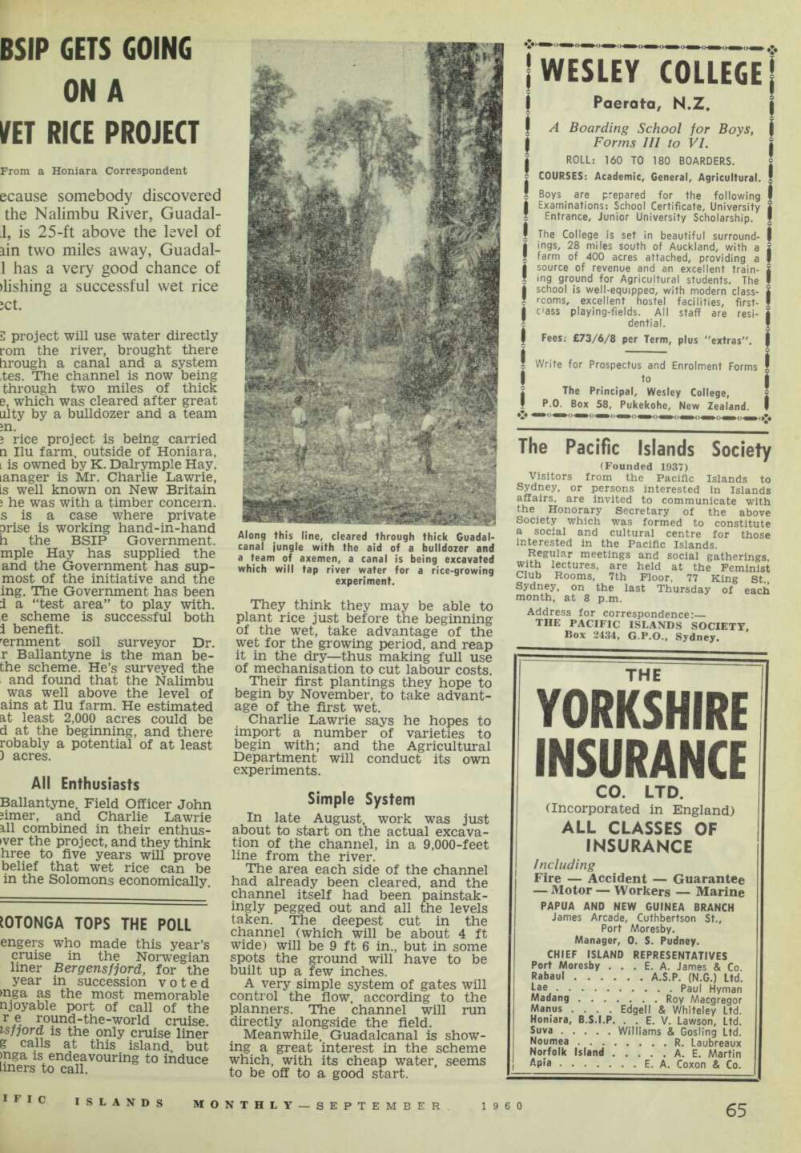
II project will use water directly rom the river, brought there brough a canal and a system ,tes. The channel is now being through two miles of thick e, which was cleared after great alty by a bulldozer and a team m. j rice project is being carried q Ilu farm, outside of Honiara, l is owned by K. Dalrymple Hay. tanager is Mr. Charlie Lawrie, is well known on New Britain he was with a timber concern, s is a case where private prise is working hand-in-hand h the BSIP Government, mple Hay has supplied the and the Government has sup most of the initiative and the ing. The Government has been i a “test area” to play with, e scheme is successful both 1 benefit. r ernment soil surveyor Dr. r Ballantyne is the man be the scheme. He’s surveyed the and found that the Nalimbu was well above the level of ains at Ilu farm. He estimated at least 2,000 acres could be d at the beginning, and there robably a potential of at least ) acres.
All Enthusiasts
Ballantyne, Field Officer John fimer, and Charlie Lawrie all combined in their enthus ►ver the project, and they think hree to five years will prove belief that wet rice can be in the Solomons economically.
They think they may be able to plant rice just before the beginning of the wet, take advantage of the wet for the growing period, and reap it in the dry—thus making full use of mechanisation to cut labour costs.
Their first plantings they hope to begin by November, to take advant age of the first wet.
Charlie Lawrie says he hopes to import a number of varieties to begin with; and the Agricultural Department will conduct its own experiments.
Simple System
In late August, work was just about to start on the actual excava tion of the channel, in a 9,000-feet line from the river.
The area each side of the channel had already been cleared, and the channel itself had been painstak ingly pegged out and all the levels taken. The deepest cut in the channel (which will be about 4 ft wide) will be 9 ft 6 in., but in some spots the ground will have to be built up a few inches.
A very simple system of gates will control the flow, according to the planners. The channel will run directly alongside the field.
Meanwhile. Guadalcanal is show ing a great interest in the scheme which, with its cheap water, seems to be off to a good start.
Along this line, cleared through thick Guadal canal jungle with the aid of a bulldozer and a team of axemen, a canal is being excavated which will tap river water for a rice-growing experiment.