Got into Operation
pp. 71-73 · Read in the full issue
How a Fiji Sugar Mill Got into Operation
From J. P. Shortall, “PIM” Staff Correspondent in Fiji, who was an observer on the spot in Vanua Levu.
I watched the Labasa sugar mill at work at the end of August, watched it with a great deal of interest, for while crushing was going n here, pro-Patel agitators were concentrating their attention on the ’inch larger community of cane-growers on Fiji’s main island of T iti Levu, with the result that at the end of August the three mills here (Lautoka, Ba and Penang) were idle. (See news sections).
UT the mill was not idle here on Vanua Levu. It began operations on August 11, and by end of the month had an ndant supply of cane in sight I apparently would continue shing for the remainder of the son (until late January). üble certainly had been expected mid-August, but nothing had pened and more and more ners began cane-cutting. Why this? he fact is that while it has not i easy, it has certainly been able to arrange a breakaway on lua Levu, because the sugar munity here is isolated from Patel and his cohorts at Nadi Lautoka. It is more difficult Viti Levu where the sugar areas )in one another, and where there thousands of farmers along the miles of coastal strip from itoka to Penang. large proportion of these lers would no doubt begin cut if given a free choice. They not allowed a free choice—they in terror of those of their hbours who are under the ct influence of Mr. Patel, le CSR company probably wishes - the Fiji sugar industry was tered over more islands! was clear that even in the asa mill district, in the first weeks of operations, it was thing for a farmer to declare wish to cut his cane, and ;her thing for him to pluck up necessary courage to actually b cutting, while neighbours id about were not prepared to Farmers 7 Fear of Fires ie Labasa mill started up after ) farmers—about two-thirds of farmers in the district>-had sated to the CSR district super 's that they were ready to cut. in the first few days after the started up there were probably than 100 men actually cutting, i very few farms. 3r was the cutting on a racial s. Of the 60 Fijian cane farms,
cane was being cut on only one in the first week. The Fijian farmers do not have a separate union on this island.
All of which seemed to indicate a definite fear of victimisation, even on this island. That fear could probably be magnified several times on Viti Levu where union pressure and exhortation against cutting are much greater. The fear was not so much of violence—at least on Vanua Levu —but that the farmer’s cane, or his house, might be set on fire, perhaps not this year, but next year or at some later date.
There is nothing easier than to set a cane-field alight without fear of detection—a candle set to burn down and start the blaze an hour after the culprit has vanished; or a mongoose soaked in petrol and released with its tail afire to streak off through the cane-field setting acres alight within minutes.
Even in good times these things happen through feuds or jealousy.
But, in such times, priority is usually given by the millers to the acceptance of this cane, which must be crushed within a week or so of
fire going through it. In normal times there is, in fact, a certain amount of deliberate firing, in the hope of gaining such a crushing priority from the millers.
Fighting With Their Tongues
In the days following the commencement of crushing at Labasa (Thursday, August 11) there was little outward sign of any tension.
There were no public meetings in Labasa. Union representatives opposed to cutting travelled about and held small country meetings, presenting arguments as to why the “strike” should continue.
Union representatives in favour of cutting held similar meet ings, and a CSR district supervisor also held meetings.
All of these were on private properties and usually in the open.
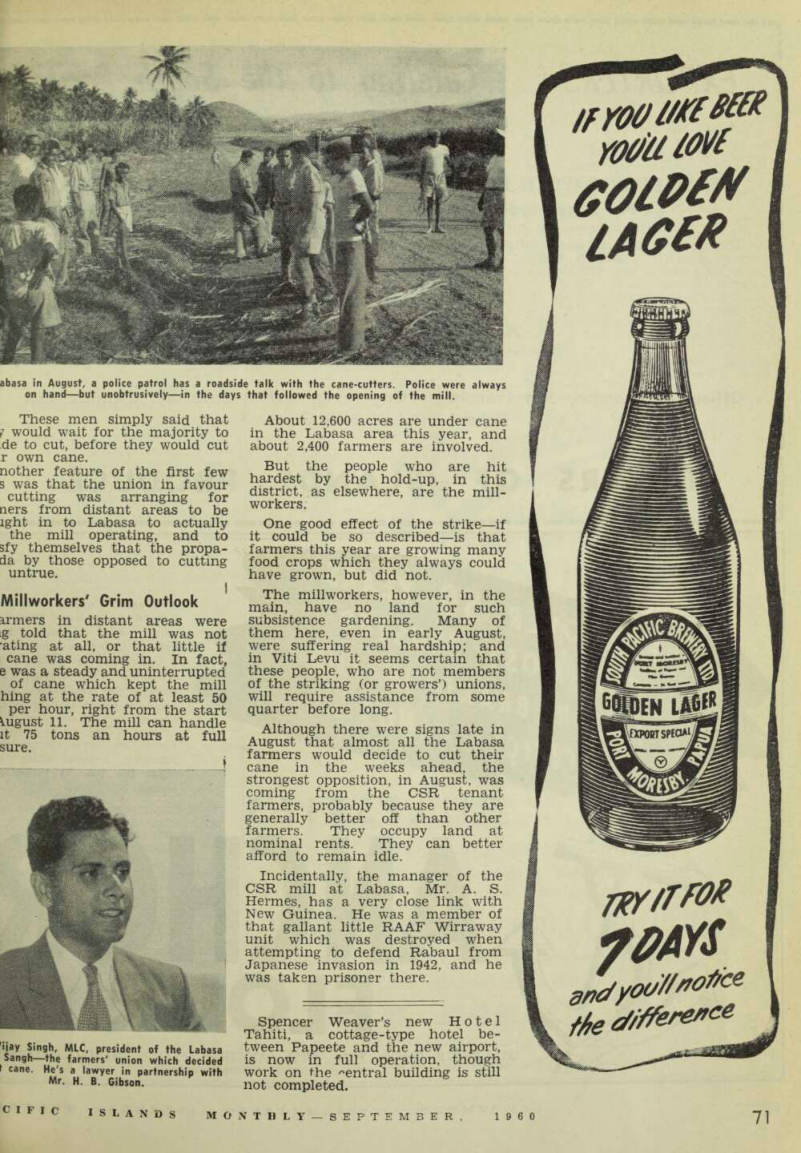
Police patrols drove unobtrusively through the countryside so unobtrusively in fact that in many miles of travelling through the sugar areas in the days following the mill opening, I saw the patrols on only two or three occasions.
Still, they were there; and if any farmer had any fears or wanted to report anything he had only to flag down the police Land-Rover. The police in fact had—and have—a dusty, tiring job, lightened perhaps by the beautiful scenery of this Vanua Levu countryside.
A curious feature of the early cutting was that many of the men engaged in the cutting gangs were farmers who were not prepared “yet” to allow their own cane to be
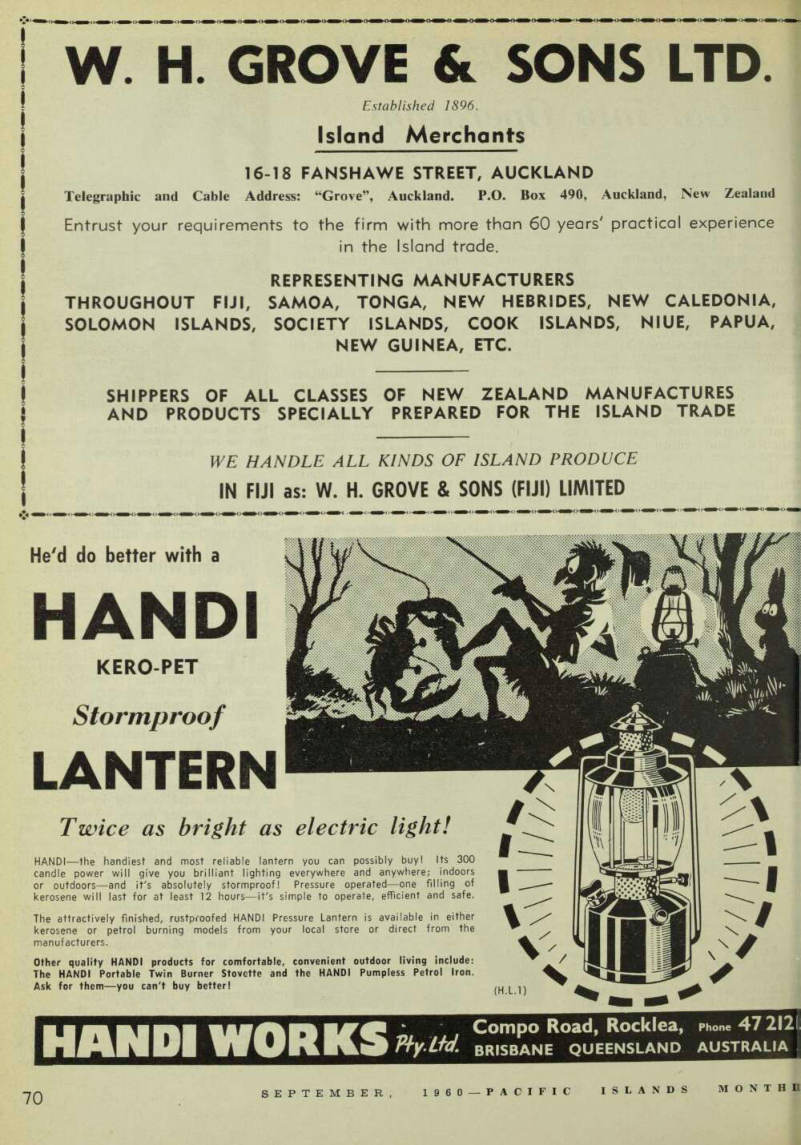
Mr. Girwar Prasad, president of the Vanua Levu Farmers' Union, which in August was still op posed to cane cutting. He's a country store keeper.
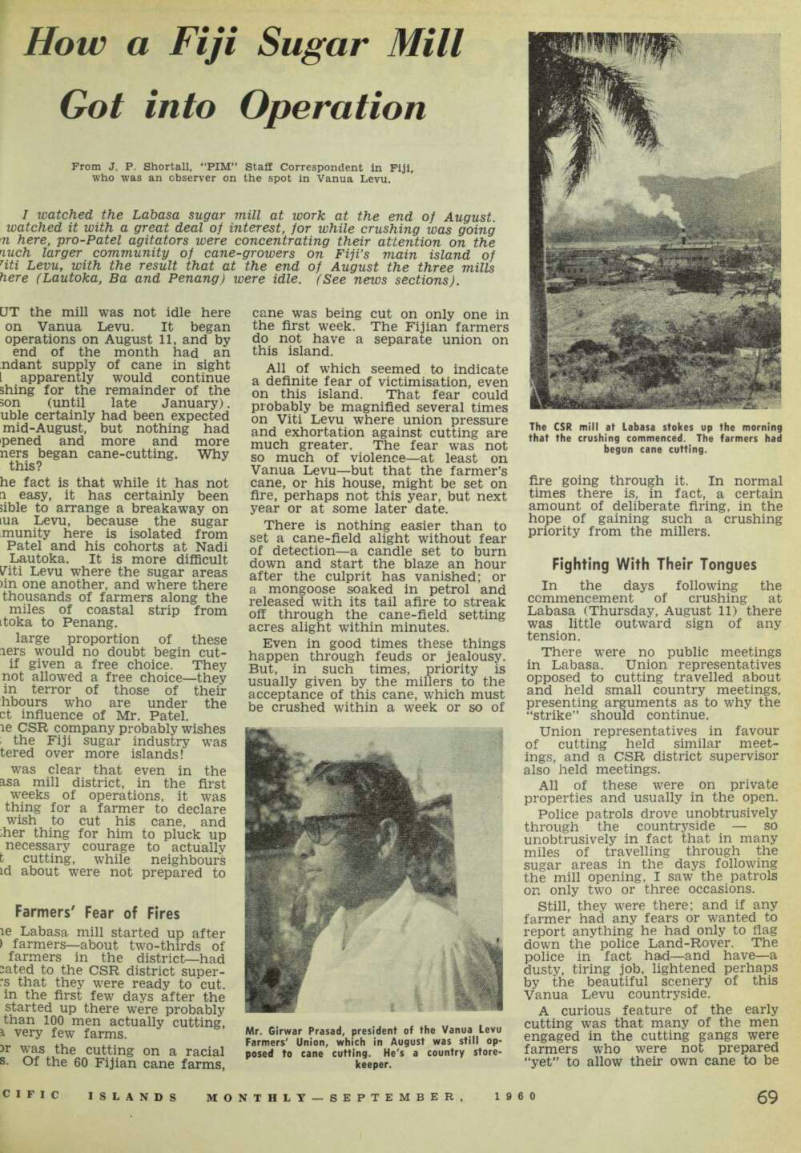
The CSR mill at Labasa stokes up the morning that the crushing commenced. The farmers had begun cane cutting.
These men simply said that i 7 would wait for the majority to de to cut, before they would cut r own cane. nother feature of the first few s was that the union in favour cutting was arranging for tiers from distant areas to be ight in to Labasa to actually the mill operating, and to sfy themselves that the propa da by those opposed to cutting untrue.
Millworkers' Grim Outlook axmers in distant areas were g told that the mill was not •ating at all, or that little if cane was coming in. In fact, e was a steady and uninterrupted of cane which kept the mill hing at the rate of at least 50 per hour, right from the start August 11. The mill can handle it 75 tons an hours at full sure.
About 12,600 acres are under cane in the Labasa area this year, and about 2,400 farmers are involved.
But the people who are hit hardest by the hold-up, in this district, as elsewhere, are the mill workers.
One good effect of the strike—if it could be so described—is that farmers this year are growing many food crops which they always could have grown, but did not.
The millworkers, however, in the main, have no land for such subsistence gardening. Many of them here, even in early August, were suffering real hardship; and in Viti Levu it seems certain that these people, who are not members of the striking (or growers’) unions, will require assistance from some quarter before long.
Although there were signs late in August that almost all the Labasa farmers would decide to cut their cane in the weeks ahead, the strongest opposition, in August, was coming from the CSR tenant farmers, probably because they are generally better off than other farmers. They occupy land at nominal rents. They can better afford to remain idle.
Incidentally, the manager of the CSR mill at Labasa, Mr. A. S.
Hermes, has a very close link with New Guinea. He was a member of that gallant little RAAF Wirraway unit which was destroyed when attempting to defend Rabaul from Japanese invasion in 1942, and he was taken prisoner there.
Spencer Weaver’s new Hotel Tahiti, a cottage-type hotel be tween Papeete and the new airport, is now in full operation, though work on the central building is still not completed.
[?]abasa in August, a police patrol has a roadside talk with the cane-cutters. Police were always on hand—but unobtrusively—in the days that followed the opening of the mill.
[?]ijay Singh, MIC, president of the Labasa Sangh—the farmers' union which decided [?] cane - He ' s a lawyer in partnership with Mr. H. B. Gibson.