Cargo Cultists
pp. 59-65 · Read in the full issue


On The Trail Of The Cargo Cultists
With Stuart Inder
/ho Adds a Note About Fellows Being Buried Alive “A native uprising on Bougainville is imminent!” he Administration officer said in an urgent report o his superior in Port Moresby. “Is it true that hey buried a Bougainville native alive last week?” isked the planter. “It’s Cargo Cult—the worst mtbreak since the war. There is a nationalist novement growing on Buka,” said the priest.
DUGAINVILLE, New Guinea’s rich yet neglected eastern island, certainly appeared to be in the > of something in August when I sed that way, so I stopped off lave a look. argo Cult is what they were ing it, but that phrase always covered a multitude of native ; not all of them related to the ive belief that the good things he world from the white man’s ;ories are about to arrive for n by the shipload, nly a couple of weeks before, n in the New Hebrides, others been telling me, again, about Jon Frummers, of Tanna —the rgo Cult” movement which was -government and which, they was spreading again. Maybe as, but I didn’t go to Tanna so m’t know. nd in the Solomons they told again, about the “Marching 3” of Malaita, and how it was uning active once more. That’s t some of them said, anyhow, thers told me about the natives Southern Guadalcanal who were ig in holes in the ground or ething; and about that fellow ■ on Santa Ana who was guided the spirits and was anxiously ■ing to be ordained “Bishop of ta Ana”. That fellow (they said) with the Melanesian Mission, the Methodists had been hav their Cargo Cult troubles, too.
Hot Gospeller
hey told me of the Methodist chist on the north-west coast of r Georgia named Silas Ete, who i 11 ? 1861 * up as a Hot Gospeller had built a model village for
his hymn-singing adherents. It was supposed to be a spotlessly clean and well ordered village, beautifully laid out with streets and fences, and he called it Paradaisi.
They said Ete was a problem, but since I never visited Paradaisi —or Malaita, or Santa Ana for that matter, I don’t know. But I did later visit Rabaul, where they told me some of the Tolais had been watch ing for a few nights for a sub marine off the coast that was to bring them cargo, or take them to America, or something.
And what was all this about Cargo Cult on Bougainville?
The natives had been cleaning up the cemeteries, they told me when I arrived at Kieta, on Bougain ville’s east coast.
They had been removing all the crosses and the flowers, so that their ancestors would not be plagued by the new fangled religion, and thus the ground would be prepared for all the cargo that the ancestors were to place in the cemeteries.
September D-Day
The cargo would arrive some time in September, and the Catholics would receive most of it. (Up the coast a bit later, they told me the Catholics had told the Seventh-day Adventists that they could have some of the cargo when it came, but that they would have to pay for their share) There was talk that the natives were saying nasty things about the whites, but nobody had actually heard them saying them.
Some native labour wasn’t turn ing up at work, they told me. It was expected this might have something to do with Cargo Cult, but when
the planters asked their boys why they had been absent, they always seemed to have a reasonable ex planation.
“The trouble is,” said one planter, “that while there may not be any thing much you can exactly put your finger on at the moment, you never know where these things might lead.”
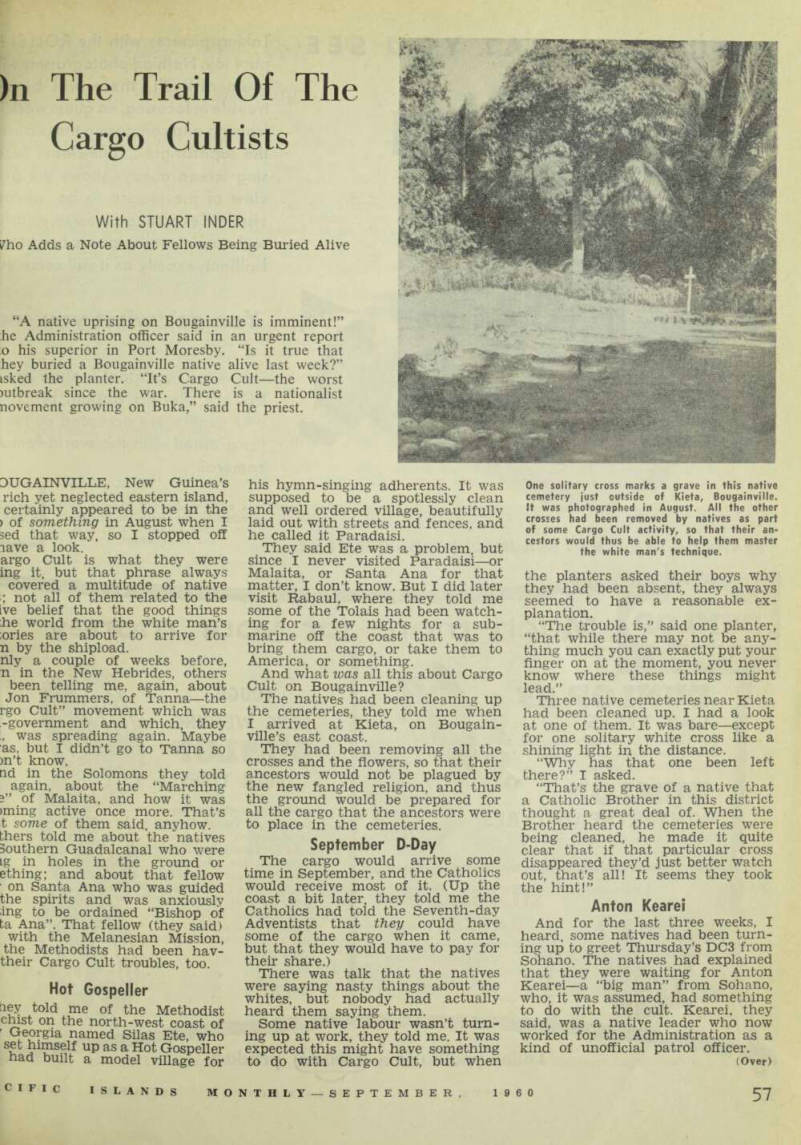
Three native cemeteries near Kieta had been cleaned up. I had a look at one of them. It was bare —except for one solitary white cross like a shining light in the distance.
“Why has that one been left there?” I asked.
“That’s the grave of a native that a Catholic Brother in this district thought a great deal of. When the Brother heard the cemeteries were being cleaned, he made it quite clear that if that particular cross disappeared they’d just better watch out, that’s all! It seems they took the hint!”
Anton Kearei
And for the last three weeks, I heard, some natives had been turn ing up to greet Thursday’s DC3 from Sohano. The natives had explained that they were waiting for Anton Kearei —a “big man” from Sohano, who, it was assumed, had something to do with the cult. Kearei, they said, was a native leader who now worked for the Administration as a kind of unofficial patrol officer. (Over)
One solitary cross marks a grave in this native cemetery just outside of Kieta, Bougainville.
It was photographed in August. All the other crosses had been removed by natives as part of some Cargo Cult activity, so that their an cestors would thus be able to help them master the white man's technique.
"The White Man Gets His Cargo For Nothing"
>n the third Thursday, with 100 ives waiting at the airfield and . no Kearei, the Kiap went out ordered them to stop acting like >ags and to keep away from the trip. he welcoming committee never led up again, and most people ;ed that the Kiap had done the it thing, since the Cargo Cultists earlier spread the talk that Kiap wouldn’t do anything to i them because he was really in area as the secret emissary of rei. heard at Kieta a report that a ve gentleman had been buried e so that he could take the jrtunity of rising again on the d day. But he hadn’t got up, ough when they saw him again lad turned pure white, lat’s the story I heard —and irently it had happened a th previously, although nobody be Kieta area could tell me just re.
"Johnno Knows" lee Johnno, up the coast,” they . “He’s in the middle of it. He vs about the burial, and all rest of it at first hand.” d the coast a day or two later iw Johnno. (Johnno isn’t his e, but what do names matter?) l matter of fact, Johnno didn’t v anything. irtainly, about 20 of his boys had ! missing and there was some it was because of the cult. There been a meeting or two at night be bush, but so what? Johnno heard the report of the fellow had been buried alive, but he irstood it had happened not a th ago but a fortnight ago, and is up the coast somewhere; not i. Charlie, farther up, would v. ben I got to Charlie a couple of later he greeted me first, with, at’s all this about Cargo Cult i the other end? They tell me serious and we will all get our its cut”. on’t you know anything about [e? There’s some talk. Supposed ive buried a bloke up the coast other day but I don’t know e. It’s all down the Kieta end, p around the top. That chap ei is running the show, from i I hear.” i the top of Bougainville, Father knew something about Cargo and he also knew about Anton •ei, who had ioined a Catholic nary before the war, and had afterwards because he decided wasn’t suited to the vocation, it there was nothing happening ie top end exactly. There were
just reports of things happening down at Kieta, like burials for in stance.
“The natives up here are frus trated,” said Father Tom. “They get like this occasionally, but they have been mucked around a lot in the last few years. They are doing some thinking these days, but they are still ignorant and get things mixed up. Some of them want to know why they have to pay for the cargo.
No Real Unity “What they mean is they see us walk into the store and then walk out again with a box of something without any money having changed hands. We put it on the bill, but they don’t know that. They’ve had to pay cash across the counter.
There is something going on, but there is nothing organised, because there is little native unity on Bougainville. They are all bits and pieces.”
Did Father Tom know anything about a native being buried alive?
Yes—it had happened down the end recently, and he couldn’t under stand why the Administration hadn’t investigated it.
So I asked the Administration about that.
“We certainly did investigate it,” they said. “The report is several months old now, and it came from a village in the north. We sent a man out. The chap they buried was dead at the time they buried him, so it’s the best thing they could have done!”
Yes, certainly there was Cargo Cult talk on Bougainville, they said.
They had been hearing about it for months, and had been reporting on it. but there was nothing really special happening that anyone could do much about. These things took their time but there was no cause for alarm. But things always needed watching in case anybody got too silly.
At an Administration office in Sohano I spoke to Anton Kearei.
Officially, he is a clerk. He speaks excellent English.
“The Administration once asked me if I had anything to do with these reports of some nonsense go ing on down the Kieta end,” said Kearei. “It’s all stupid thinking. I have nothing to do with that kind of talk, which is only being carried
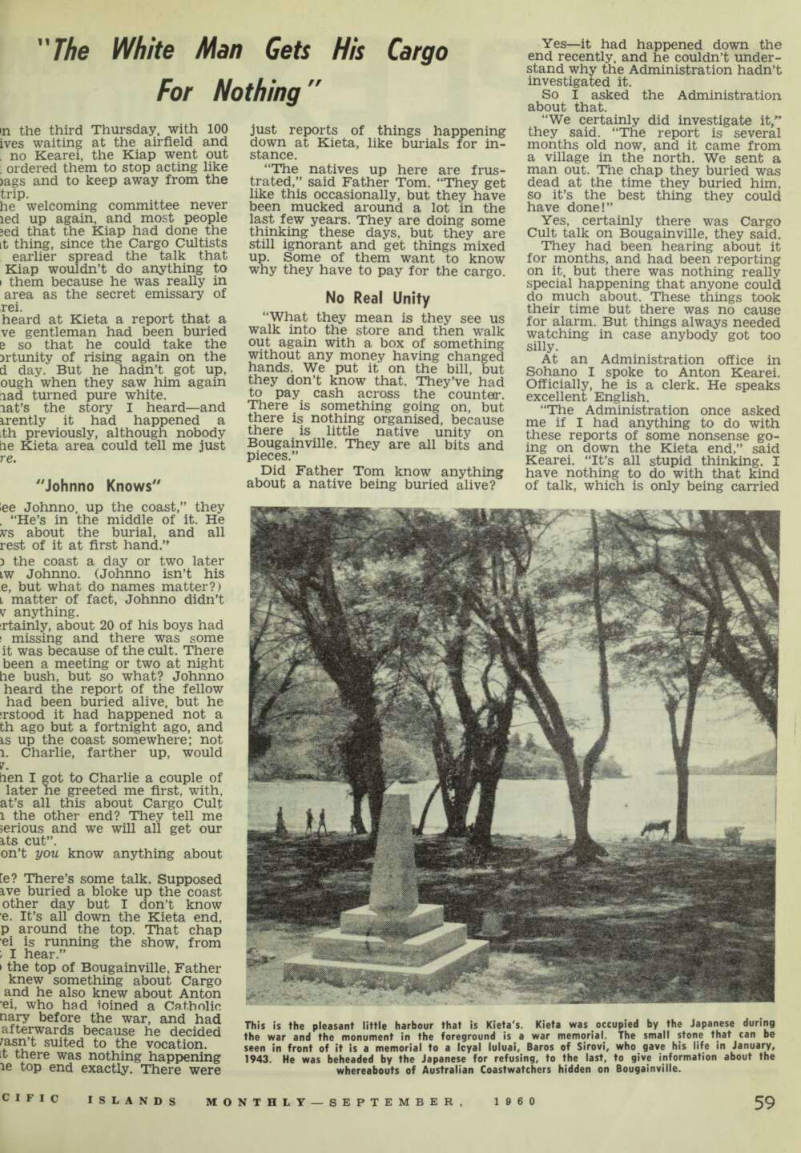
This is the pleasant little harbour that is Kieta's. Kieta was occupied by the Japanese during the war and the monument in the foreground is a war memorial. The small stone that can be seen in front of it is a memorial to a loyal luluai, Baros of Sirovi, who gave his life in January, 1943. He was beheaded by the Japanese for refusing, to the last, to give information about the whereabouts of Australian Coastwatchers hidden on Bougainville.
•y a few people anyhow. Most e laugh about it,”
Lopped Their Heads 'ing the Pacific War, added si. there had been an outbreak irgo Cult on Buka. But the lese had fixed that, ey brought the ringleaders over ;o Sohano and beheaded them.
Buka people haven’t forgotten on Kearei is an interesting lality. One way or another we i hear more of him. rlabaul a few days later a man tad heard I had just come from unville grabbed me by the arm xclaimed, “I heard they buried ive alive over there the other jVill they slit all our throats e other day!” I exclaimed. they have been burying s alive on Bougainville for is now—from one end of the to the other!” didn’t take me seriously. This just how ignorant some are. yn Hinina Kearei is a Buka, village of Lonahwn, inville and is probably aged mid-thirties. s married, with two children, 7, and Bruno. 2, and is em . as a clerk with the P-NG istration at Sohano, Bougain- Ithough he says, “I don’t think The idea is to get iking hke a patrol officer ”
Guinea officially has no native whivi? rs ’ althou gh conditions hmS SOme n i lay be appointed hortly expected to be an
nounced. but Kearei certainly does a certain amount of field liaison work for the Administration, contactmg and addressing native groups and generally, assisting European patrol officers in the advanced Buka I j n • .
Trained as Priest He has been doing this work since the beginning of 1959, and it is his second appointment with the Administration—his first being not long after the war. g nou long He originally trained for the priesthood. He began his education as a h°y in 1938 with the Chabai Catholic Mission, Bougainville and went to the Vunapope Sacred Heart
mission near Rabaul in iqai With war that tear anH th£ h ToJvfS? occunation
s£nt the n?xt fewve£s
at the minion. y ’ “ 945 ' They were not allowed to move about much, but there was little or 0I^ C ® him or the 27
Vunapope^wa^^n^thi lll S ecaUse
t ration n? d 2 - tl i e adrmms a7 ° f , German Priests, A war’s end he went to a buThe n ° U^ainvUle ' ios« -ff er * t J le f °Uowmg year, ffis tri 6 iiiing thoUt havmg completed “t 1 decided 1 dldn t llke it,” he says. (Over)
(earei —a leader of the Bukas. See below.
is a hard life and I wasn’t ed. Priests have nothing to do i the world.” y that, he means he could not >me reconciled to life without len. earei went back to his village, in 1947 he began work as an linistration clerk with the gainville education officer, Mr. ik Boisen, who for many years has been in Rabaul. ! helped Boisen produce a roneoed spaper in pidgin for Buka natives )rk which interested Kearei a t deal and he says he is hopeful vill get the opportunity to pro • something of the sort in the re.
Need for News 'he native people need to be ” he says. “They read what they in the New Guinea newspapers, listen to the radio, but they t hear enough. Sometimes they and read things which they ;onfused or distorted. They have y wrong ideas.” larei, one imagines would like much to become a publicist to correct these wrong ideas, already has a “name” in Buka, ictivities there over the last few 5, between his two periods with Administration, have won him . followers and enemies. Un tedly he has more followers enemies. was involved at one stage with organisation of a kind of un al native co-operative, which through and he was also said \ m the background of some le on Buka a couple of years vhen some villages refused to .axes to the Government.
Still Sensitive
s matter was fixed but be of this and other reasons is still regarded by the Ad tration as a sensitive area and ildom has been adopting a policy of hastening slowly. :a natives are shrewd and in ;nt. Although the New Britain ; are roost often publicised as the shrewdest and most ad d (and thus being a potential !al problem) the Buka natives i many ways their equals and ie cases superiors and as Buka >, so thinks Bougainville iy Catholic priests and many ts on Bougainville make no to conceal their belief that ire not happy about the in e that Kea^ e L got with his r§S as V+- 1 ? d J' lla t they distrust (The attitude of the priests, er, seems to have mellowed rin?i^-cf oth^ rs w - h 0 insist dmimstration is taking too hi* ai L m £ erest in Kearei, and cThcvi because some senior in him taken a P ers onal in
iously the Administration is
many taKthatSSrt tes. » hal given him a seat on the Bougainwas also one of the native delegates who spoke to the Territories Min- Iftf r » ?£• Hasluck. recently about
Tw Ui 5 ea-
uvearei says ms view is that New SKioW 6 in the f ands of the Australian Government for many years yet, because it is not nearly
for self-government, and won’t be for a long time.) The fact is that Anton Kearei is a man in transition.
Nobody—private or official—really knows what the future holds for him, and that—at the moment—in cludes Kearei himself.
The Cook Islands—with a popula tion of 18,000—had £237,000 in 8,000 separate accounts in its Post Office Savings Bank at the end of last June. There are no trading banks in the Cooks.