A Mission To The Happy Atolls
pp. 67-73 · Read in the full issue


NZ's Flying-Boats Still Do A Vital Job
To the residents of Suva the big Sunderland flying-boats of the Royal New Zealand Air Force are a familiar enough sight overhead and not much notice is taken of their comings and goings. A good deal more notice is taken of them, however, at the far end of their journeyings from Laucala Bay.
By J. P. Shortall
WHETHER the visit is because of some distressed mariner, some island with an urgent medical case, or some community threatened by an erupting volcano or stricken by a hurricane, all would sorely miss the RNZAF flying-boats if they were withdrawn. And there is a strong feeling in the RNZAF that, whatever new aircraft New Zealand may adopt as a main replacement for the obsolete Sunderlands, one or two of them will continue in service for just such jobs as these.
In July I was the guest of the RNZAF on one of its more routine missions—the quarterly communica tions flight to New Zealand’s most distant tropical outliers, the Tokelau Islands, 300 miles north of Western Samoa, where the Sunder lands provide a regular means of official contact between visits of the government-chartered ship.
The operation began with a “briefing” on the day preceding departure from Laucala Bay, and reporting time was set at 6 a.m. next day, take-off time 7 a.m.
In fact, aircraft “Tango” was off the water at 6.57 a.m. with me,
tricked out in an inflatable life jacket, firmly braced in a midships position between captain and co
pilot on the flight-deck, and mulling over the significance of a notice sewn on the captain’s back. It read: “No. 49 Laucala Bay, Flight-Lieutenant Potts, date due 30/7/60”, but it turned out that it was the Mae West, and not Flight- Lieutenant Graham Potts, that was “due” on the said date—for routine inspection, nothing more.
The air speed indicators settled at 125 knots, confirming that speed is not one of the Sunderland’s attributes. The course on the gyro compass was 070 degrees, with north point of Nairai Island below at 7.25 ajm., simultaneously with coffee on the flight-deck. Next, the Matson liner Monterey below to starboard at 9.12 a.m. northbound, having left Suva at 5.45 p.m. the previous day.
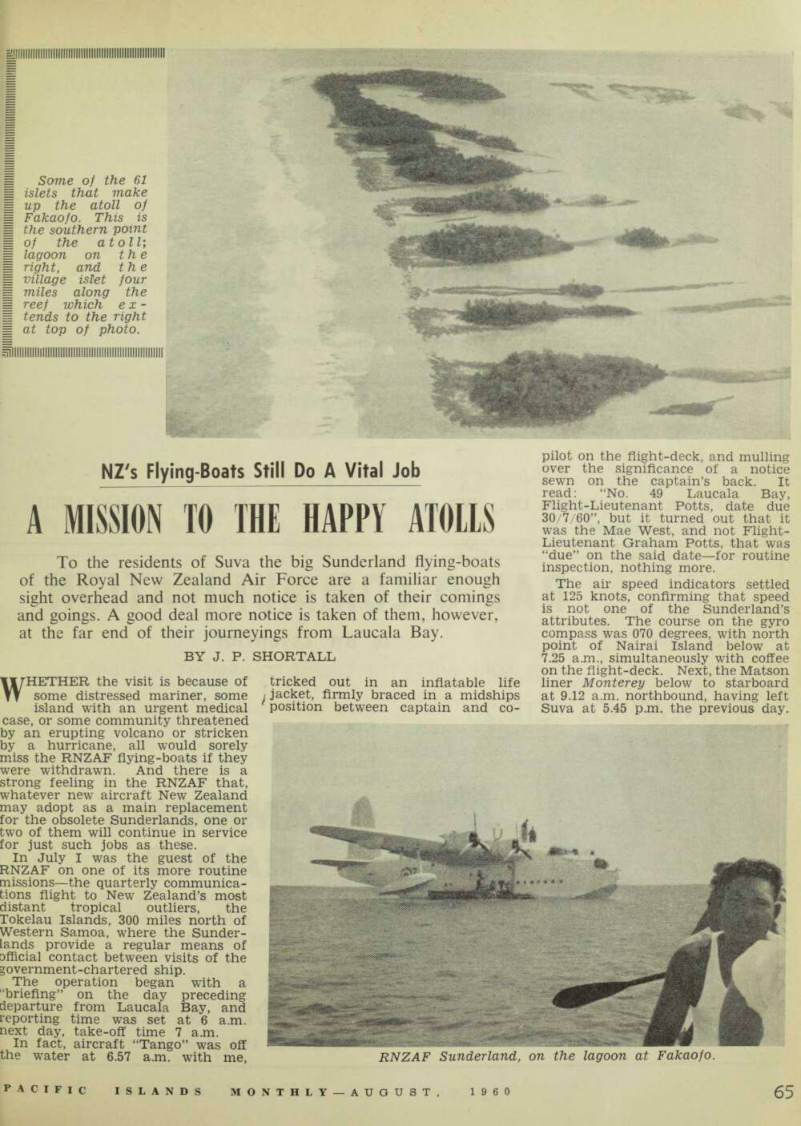
Some of the 61 islets that make up the atoll of Fakaofo. This is the southern point of the atoll ; lagoon on the right, and the village islet four miles along the reef which ex tends to the right at top of photo.
RNZAF Sunderland, on the lagoon at Fakaofo.
Tonga’s volcanic Niuafo’ou—better known to some as Tin Can Island —with its elevated crater lake (which could accommodate a Sunderland at a pinch) below at 9.45 a.m., a spectacular sight from the air.
An hour later, Saturday changed back to Friday as the invisible International Date Line was crossed somewhere near ITil degrees West longitude, and we were on the water at Satapuala at the western end of Upolu, Western Samoa, at 11.42 a.m.
High Commissioners and
Mooring Buoys
Two days later we were airborne again at 7.20 a.m., on the real purpose of our mission. With 1,800 gallons of gasoline in her tanks the Sunderland was ready for the round trip to the Tokelaus. She carried a 600 lbs replacement aircraft moor ing buoy, about 500 lbs of freight, and a lot of sundry luggage in her bomb bay, and an official party in the small ward-room.
The party was made up of New Zealand’s High Commissioner in Western Samoa, Mr. J. B. Wright; the District Officer for the Tokelaus, Mr. H. L, Webber, who has his headquarters in Apia; a surgeon specialist; a Samoan Medical Prac titioner; the Director of Education in Western Samoa, Mr. Leggart; Radio Technician Peterson of the Western Samoa Post and Telegraph Department: and the Rev. Father L. Lemay, SM, Provincial of the Marist Fathers in the South Pacific Area (and lately named Bishop of the Northern Solomons to replace Bishop Wade).
The Tokelaus are politically a part of New Zealand, the Western Samoa Government having no jurisdiction whatever over them.
But as a matter of administrative convenience, the Governor General has delegated his authority to the High Commissioner of Western Samoa as a separate function.
Under his control is the District Officer, Tokelaus, who handles the external business of the three atolls. Again as a matter of con venience his office is located at Apia rather than in the Tokelaus, but he visits the group with every ship or aircraft that goes there.
Coral Circlets, Happy People
The islands each have their own entirely native administration, and all three are of equal status. There is no central native government for the entire group; each is its own self-centred little community, and enly in its dealings with the outside world —the sale of copra and woven pods, and the purchase of manu factured goods, and in the admini stration of services supplied by New Zealand—does the District Officer come into the picture. r JP 10 Happy Atolls would be a fitting title for the three little
circlets of coral, sand, and palmcovered islets which form this group There are other atolls as beautiful as these, when seen from the air on a bright sunny day, but there are none with a happier or more contented population.
When New Zealand’s Governor General paid a visit some time ago the people took the opportunity to make it clear that they were seeking no independence, whatever Samoa might be doing in that respect.
The RNZAF has laid a buoyed aircraft-mooring in Nukunono lagoon a quarter of a mile from the village and has beaconed the coral heads in the vicinity of the landing area. At Fakaofo and Atafu there are no moorings. Coral heads are beaconed but the aircraft must use
its own anchor, and the only suit able anchorages are a mile or more from the villages, with the local canoes providing the transport Marnin fnr Frrnr INO mar 9 ,n for trror The two latter lagoons, smaller than Nukunono, contain numerous coral heads, and at Atafu especially the landing area is fairly restricted, These coral heads are clear enough from a thousand feet up, but are often invisible to the pilot once he comes in low for a landing, so he must get his bearings clearly estab lished before he sets down, or he could quickly find himself on a reef —as happened at Nukunono with a taxi-ing Sunderland two years ago.
It was beached and repaired and flown out some weeks later. (Over)
“Tango” was on the water at [ukunono at 9.20 a.m. after several ircuits, and a double canoe (with mat-covered platform and two fhite-covered armchairs) manned y chanting paddlers garlanded in reenery, and escorted by three ther craft similarly manned, was oon heading out from the shore.
With this flotilla went the High Commissioner for a quick pre iminary official welcome at the
landing point, while the aircraft disgorged the 600 lbs mooring buoy plus one man from the RNZAF Marine Section to attach it to its chain.
At 10.35 a.m. “Tango” was air borne again and 25 minutes later we were anchoring in Fakaofo lagoon. Ashore there was the official welcome and a meeting of the Island Council with the Ad ministrative visitors.
Doctor and education officer made their rounds, while the aircrew settled down to the business of bartering for mats, hats, fans, carved model canoes, carved trinket boxes, and shells. The favoured currency: khaki shorts, cigarettes, nylon fishing lines and hooks, lengths of lavalava material, and soap.
As the single official store at each island appeared to be out of all these items, and as no new supplies could arrive before the next ship in September, goods rated much higher than cash in trading value.
Trading a-la-Tokelau is a sort of house-to-house social occasion, with good feelings and swarms of bright eyed children all around, drinking nuts to the fore, and even the well used sleeping mats whisked to the
ABOVE: Going ashore in a big canoe at Fakaofo. The High Com missioner is second from right.
AT LEFT, UPPER: All that re mains of the former American LORAN radio-navigation station at Atatu —the concrete water tank and catchment-roof.
LOWER: Pigs keep to the right— that islet is reserved for them. If one is allowed to cross over the bridge to the village islet on the left, its owner is fined 4/-.
bartering area if the buyer looks like a sucker who will fall for a less-than-new mat when supplies of new ones are short.
There are howls of mirth and no hard feelings if the visitor spots the ruse and turns thumbs down.
No Co-operation from the Rats
It was from Fakaofo that the New Zealand Government, intent on im proving the lot of the people, launched a scheme to shift some of the 700 inhabitants to another roomier nearby islet a mile along the reef. But it hasn’t been a success. Polynesian like, everyone is quite happy where he is, thank you! The other islets will do for copra making.
Only Europeans from the world outside feel cramped on the few acres of the existing residential islet. Water is a problem at the other islets —but the people just like living together in any case.
Rats cause serious copra losses and it was hoped that a project to progressively band each palm with a broad aluminium band would meet the problem, but that project hasn’t proved quite so simple, either.
The palm tops are close together and the rats, which often live up there permanently, leap from palm-top to palm-top. If all the rats could somehow be grounded, while all the palms were banded, the scheme might work—but the rats won’t co-operate.
If plane-day is an exciting time for the Tokelau children, it’s a busy one for the three Catholic Sisters who run one of the two schools at Nukunono where the flying-boat returns for the night.
They provide the breakfasts and the evening dinners for visitors and aircrew, from food mainly brought in the aircraft.
All hands are quartered in the mission priest’s residence, a quarter of a mile away, and all the cooked food is sent along there by runners.
The priest, at present is Father P.
Desrosiers, SM, of Canada.
WHO Is There Here at Nukunono, and at neighbouring Atafu, the World Health Organisation has been con ducting an interesting experiment in mosquito control. At Nukunono a fungus brought in from Singapore has been scattered round the 30 islets, and at Atafu an insecticide has been used in a special way.
Dieldrin powder, cement and sand were mixed and formed into half inch cubes. These cubes have been scattered in water holes to slowly exude their dieldrin at a rate sufficient to kill all mosquito larvae over a long period.
Dr. Marshall Laird of New Zealand, npw of McGill University, Canada, initiated the experiment in 1958 and he was back early this year to check on results. He found
that the cubes are retaining their activity for longer than estimated and that the results at both atolls appear very satisfactory.
Most, if not all, of the Nukunono population start the day right at the sound of the church bell at 5.30 a.m. and the same bell sees that aircrews are up, fed, and off to a bright and early start for Atafu where a woman awaits the services of the visiting sugeon.
Off the water at 8.28 a.m. and down on Atafu at 9.3 a.m. Canoe ashore to the smiling welcome, and the round of official business.
There’s time, too, to take a look at
what once was a US Navy LORAN radio-navigation station. Twelve years ago I called there in the schooner Tagua, and there was then the usual impressive American lay out of buildings. The station was dismantled in 1952—and today the whole area is thickly overgrown with quite large trees and under growth. Three of the four tall pole masts still stand (the other was chopped down and taken to the village as a flag pole). Only a few concrete emplacements, the out line of a tennis court, and a roofed over concrete water tank, remain to tell the tale.