And Who Were The
pp. 75-77 · Read in the full issue

More Light on the Sacrifice of Civilians In Rabaul in 1942
And Who Were The Guilty Men ?
Recently, “PIM” had access to official records nearly 20 years old; and now we can say positively something we had always suspected namely, that in jew places in Australian history are there worse examples of sheer, bumbling incompe tence than the way in which certain high officials of Canberra ( Administration ) and Melbourne (Army) directed operations in New Guinea and Papua between December, 1941, and February, 1942, when the Japs invaded.
By R. W. Robson
AS the result of this stupidity and inefficiency, hundreds of good men many of them my personal friends—were sacrificed, Their lives were literally thrown away.
Here is the picture as we knew it in 1942-43.
The Japs’ air force came down upon Rabaul on January 21, 1942; and on January 23, the Jap army landed.
By late December, 1941, it had Deen quite clear that they were Doming, and that their style of mak- :ng war was a style peculiar to the Dreed—namely, they treated war- Dnsoners with bestial cruelty, and ;hey tortured and murdered their civilian prisoners.
Australia had nothing in the way )f armaments in New Guinea to ippose the Asians. Her fighting livisions were away in the Middle iast. In Rabaul there were eight Wirraway training planes; half-alozen old-style guns at Praed omt; one battalion of Australian citizen Forces, half-trained and ill- ’Quipped Most of the women and children vere removed from the area, to Australia. But most of the male sivmans remained; and the adminiitrative officials and the “armed lervices were ordered by the fire- Generals and Colonels of n t T S^ay posts”.
Why? No one ever has explained .•... „ „ , , Administration of Rabaul area vas taken over by Mr. Harold Page, Tovernment Secretary, in Decern- Administrator, sir Walter JcNicoll, was lying in Lae, very u *
Under Page’s direction, the Rabaul community did the best it could, When the Japs came in, and simply wiped out the defences in an hour or two, Page assembled the civil community (which in eluded many Chinese women and children) in a valley at Namanula, near Rabaul, got some supplies together, and quietly surrendered to the enemy commander. At first, there were in the prison camp at Namanula 900 soldiers, 100 ad ministrative officials, 250 civilians and 350 mission people.
Hundreds of soldiers and civilians however, rather than submit to the tender mercies of the Asians preferred to make a break for it’ and scattered into the inhospitable] hopeless jungles of New Britain westward of Rabaul. The Japs hunted them down without merev —134 of them were systematically slaughtered where trapped in one angle of the South Coast. That was the massacre of Tol Plantation, a thing of infamy which forever can be quoted against the so-called “gentlemen of Japan”.
Of the Rabaul civilians placed in prison camps, a few were murdered, but the great majority were shipped away north in the Montevideo Maru; and all died when the Jap ship was torpedoed off the Philip pines by an American submarine.
They included many of Rabaul’s best known citizens of 1941.
Down here in Aust. we got little authentic information about events in Rabaul until the Japs had been rooted out; but late in 1943 and in 1944, as PIM began to assemble the stories of New Guinea survivors, we began to ask how it came about
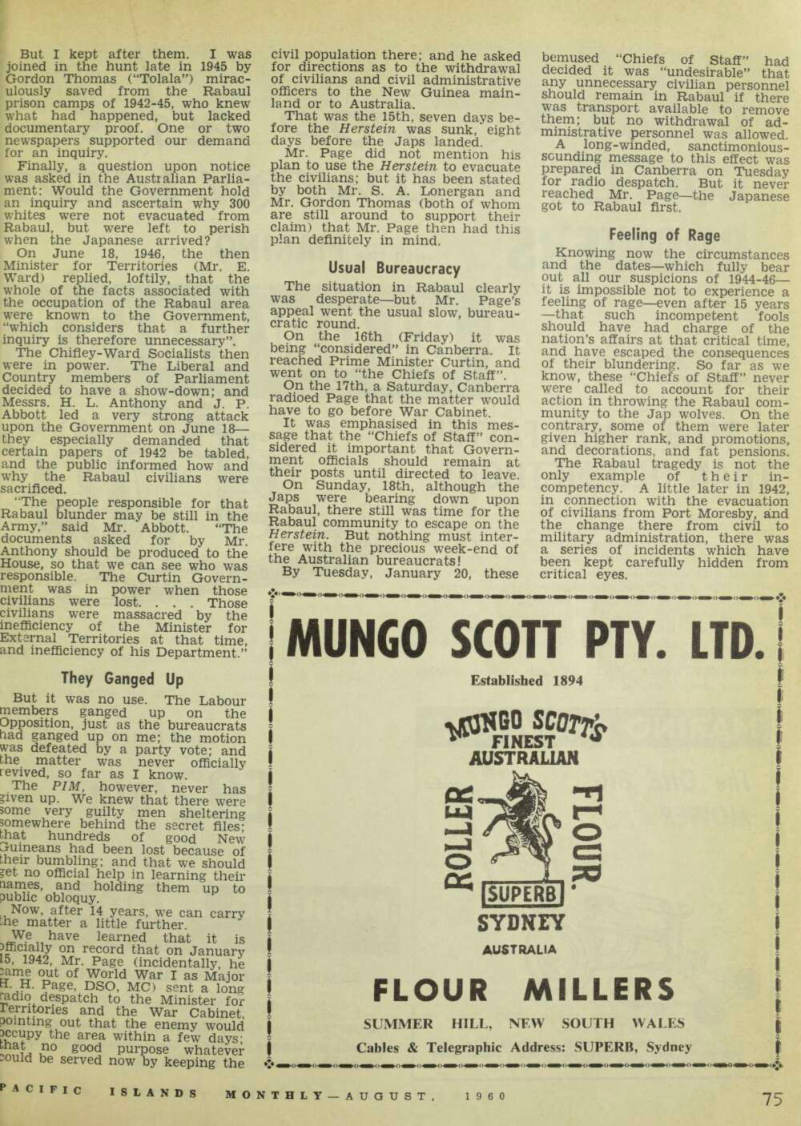
that so many civilians were left in Rabaul, to fall helplessly into Jap hands. It was not like Harold Page to let that happen—he was a man of strength and purpose—and so were R. L. Clark and other civilians of his type.
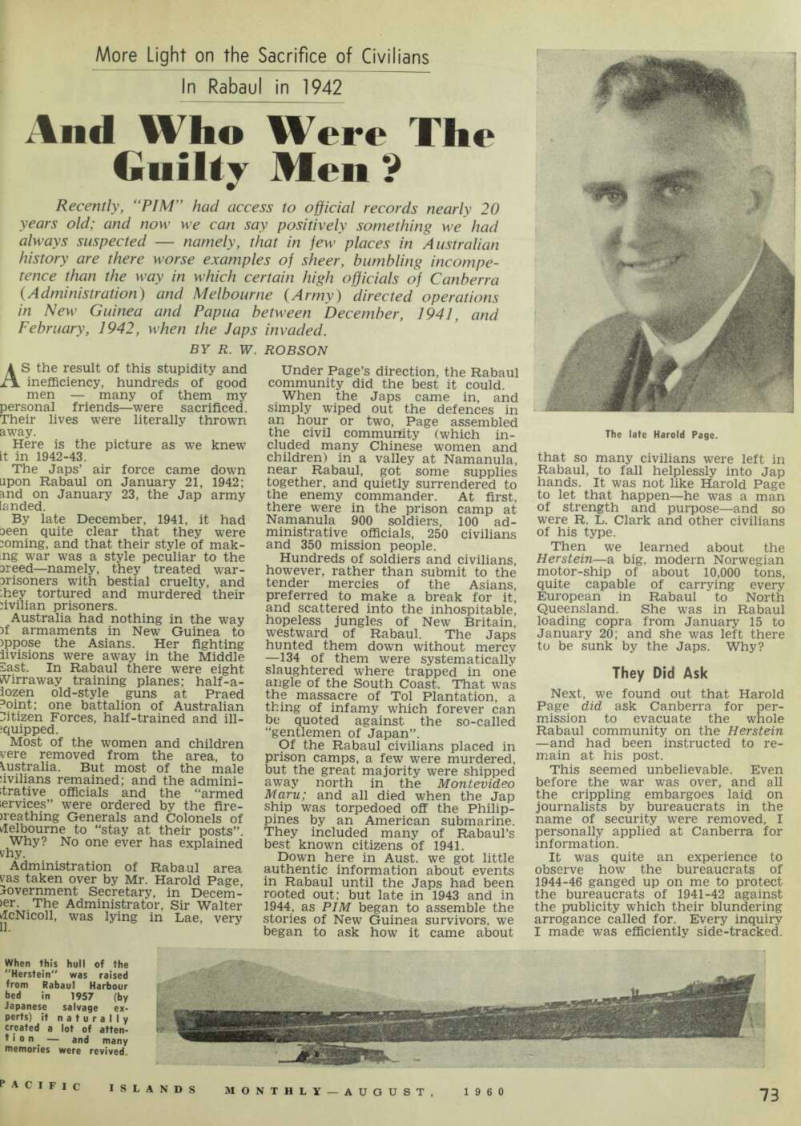
Then we learned about the Herstein —a big, modern Norwegian motor-ship of about 10,000 tons, quite capable of carrying every European in Rabaul to North Queensland. She was in Rabaul loading copra from January 15 to January 20; and she was left there to be sunk by the Japs. Why?
They Did Ask
Next, we found out that Harold Page did ask Canberra for per mission to evacuate the whole Rabaul community on the Herstein —and had been instructed to re main at his post.
This seemed unbelievable. Even before the war was over, and all the crippling embargoes laid on journalists by bureaucrats in the name of security were removed, I personally applied at Canberra for information.
It was quite an experience to observe how the bureaucrats of 1944-46 ganged up on me to protect the bureaucrats of 1941-42 against the publicity which their blundering arrogance called for. Every inquiry I made was efficiently side-tracked.
When this hull of the "Herstein" was raised from Rabaul Harbour bed in 1957 (by Japanese salvage ex perts) it naturally created a lot of atten tion and many memories were revived.
The late Harold Page.
But I kept after them. I was joined in the hunt late in 1945 by Gordon Thomas (“Tolala”) mirac ulously saved from the Rabaul prison camps of 1942-45, who knew what had happened, but lacked documentary proof. One or two newspapers supported our demand for an inquiry.
Finally, a question upon notice was asked in the Australian Parlia ment: Would the Government hold an inquiry and ascertain why 300 whites were not evacuated from Rabaul, but were left to perish when the Japanese arrived?
On June 18, 1946, the then Minister for Territories (Mr. E.
Ward) replied, loftily, that the whole of the facts associated with the occupation of the Rabaul area were known to the Government, “which considers that a further inquiry is therefore unnecessary”.
The Chifley-Ward Socialists then were in power. The Liberal and Country members of Parliament decided to have a show-down; and Messrs. H. L. Anthony and J. P.
Abbott led a very strong attack upon the Government on June 18— they especially demanded that certain papers of 1942 be tabled, and the public informed how and why the Rabaul civilians were sacrificed.
“The people responsible for that Rabaul blunder may be still in the Army,” said Mr. Abbott. “The documents asked for by Mr Anthony should be produced to the House, so that we can see who was responsible. The Curtin Govern ment was in power when those civilians were lost. . . . Those civilians were massacred by the inefficiency of the Minister for External Territories at that time, and inefficiency of his Department.”
They Ganged Up
But it was no use. The Labour members ganged up on the Opposition, just as the bureaucrats bad ganged up on me; the motion was defeated by a party vote; and the matter was never officially revived, so far as I know.
The PIM, however, never has =iven up. We knew that there were some very guilty men sheltering somewhere behind the secret files that hundreds of good New Guineans had been lost because of their bumbling; and that we should ?et no official help in learning their names, and holding them up to
public obloquy.
Now, after 14 years, we can carry the matter a little further.
W e have learned that it is ° n recor d that on January 15, 1942, Mr. Page (incidentally, he 3ame out of World War I as Major Page, DSO, MC) sent a long radio despatch to the Minister for rerritones and the War Cabinet, pointing out that the enemy would occupy the area within a few days; “° g°°d purpose whatever .ould be served now by keeping the
civil population there; and he asked to r directions as to the withdrawal nffipir? l^ S f£ nd Tsji Vll adl n lnistrat . ive officers to the New Guinea mam- U Seven ? ays was t su s k j, eight d< ATr J r? P f S land ® d - . . v.o IC L n( ? • m . entlon h , ls to evacuate St 6 wv! 13 ?/’ l S lt h r S been stated by both Mr. S. A. Lonergan and Mr. Gordon Thomas (both of whom are still around to support their claim) that Mr. Page then had this plan definitely in mind.
Usual Bureaucracy
™„ , 7 The situation in Rabaul clearly was desperate—but Mr. Page’s appeal went the usual slow, bureau- Cr r^ C f£ Und icfv, On the 16th (Friday) it was bem l? considered hi Canberra. It reached Prime Minister Curtin, and went on to the Chiefs of Staff”.
On the 17th, a Saturday, Canberra radioed Page that the matter would have to go before War Cabinet. !t was emphasised in this message that the “Chiefs of Staff” considered it important that Government officials should remain at their posts until directed to leave.
On Sunday, 18th, although the Japs were bearing down upon Rabaul, there still was time for the Rabaul community to escape on the Herstein. But nothing must intertere with the precious week-end of the Australian bureaucrats!
By Tuesday, January 20, these
bemused “Chiefs of Staff” had decided it was “undesirable” that unnecessary civilian personnel should remain in Rabaul if there as trans P° r t available to remove them : but no withdrawal of ad ministrative personnel was allowed.
A long-winded, sanctimonious sounding message to this effect was prepared in Canberra on Tuesday fo r radio despatch. But it never reached Mr Paee the Tananp«?P got to Rabaul first Ja P anese Foollnn nt
Peeling of Rage
Knowing now the circumstances and the dates—which fully bear out all our suspicions of 1944-46 it is impossible not to experience a feeling of rage—even after 15 years —that such incompetent fools should have had charge of the nation’s affairs at that critical time. and have escaped the consequences of their blundering. So far as we know, these “Chiefs of Staff” never were called to account for their action in throwing the Rabaul com munity to the Jap wolves. On the contrary, some of them were later given higher rank, and promotions, and decorations, and fat pensions, The Rabaul tragedy is not the only example of their in competency. A little later in 1942, in connection with the evacuation of civilians from Port Moresby, and the change there from civil to military administration, there was a series of incidents which have been kept carefully hidden from critical eyes.