When Bill Cameron
pp. 61-65 · Read in the full issue
A Tribute
Was Salamaua
By Eric Feldt
William Wallace Cameron died in T ictoria on July 10, and his death ' reported elsewhere. In the worldly ense, he never became either rich r famous, but to old-timers of the arly Morobe Goldfields, NG, he will Iways remain one of the best loved f them all . This is a tribute from ne of his mates of that time be mg before.
IALAMAUA, New Guinea, 30 years 5 ago. A narrow strip of sand just above sea-level connecting le hilly peninsula with the main nd, and inhabited by less than a undred whites. With the Govern ient buildings, the Bank, Car mters and BP Stores, the pub, a :w Chinese trade stores, and then line of saksak huts along the ia-beach where the isthmus idened; native labour quarters on ie harbour side, opposite, separated r swamp.
Not a promising setting, and life as crude and primitive, without nenities but, by God, it was leerful. To the old-timers who fed there, it was a place with more ippiness per head of population an any other ever had.
The secret? We were all young.
Salamaua began as a burning, fly tten, mosquito-ridden beach where mers were dumped ashore, and am where those with labour set r for Edie Creek. Those without uted in frustration and dis •pointment.
But when the transients had ne, and those who worked out one nm quickly had returned to other cupations, established miners re amed and made good money, ilamaua was then the port which
supplied them End to which they came for a spell on the beach.
Its permanent inhabitants were not in the big money—they worked m jobs, and most worked hard, but they were hugely cheerful. Who, then, would epitomise Salamaua?
The Onlv Job Available ° Availab,e JNOt the heads of the mining companics who passed through; nor of the trading firms; nor the Government. It was the barman at the pub—Bill Cameron, He was one of those whom history does not record but whose influence was felt right through the community, for he was a Personality in his own right.
Bill Cameron arrived in Salamaua in 1928, with no money and no
prospects and took tbp rmi-u rm
fngfSln at the pSh^e
then in his late twenties and hp had been many things his first iob was “making Irish confetti” as he called making bricks And when he left the brickworks, he did many jobs all the while teaching himself juggling and finally travelled Aus traha and New Zealand on the halls u , ntil the growing popularity of films closed the act. (In the bar, he would slide a glass along the counter so that it wobbled to rest before a customer, sometimes to the customer’s horror if he were a miner down from the Creek slaking a thirst.) Bu t he was more than a juggler
(Continued on page 6i)
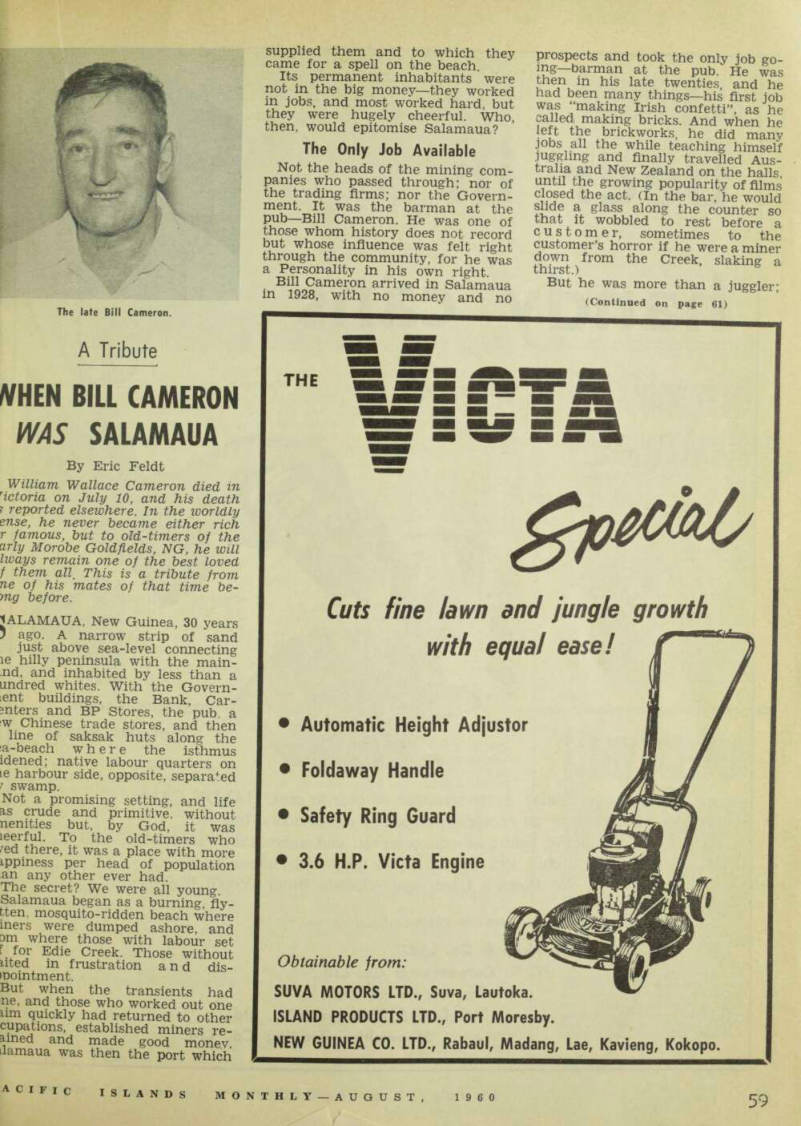
The late Bill Cameron.
le was a crowd entertainer with a eady wit and a cheerful outlook on ife. There was no club in Salamaua, md it would have been cheaper to irink at home, but we all went to he pub for it was the club and the mblic forum and Bill was its master )f ceremonies.
His was the personality that drew ill together after work, while we lad a beer and talked of this and hat—mostly that, as it was a virtu dly womanless community then.
Stories of Bill are numberless, lis was not the brilliant wit of Tesey Browne (who was in world lass —all types come to a goldfield) •ut he had a ready and copious low of good-natured witticism, pliced with commonsense.
Anecdotes lose their flavour in the etching; the good natured raillery f the voice is lost and the atmos phere cannot be reproduced. But rhen, say, the Ashton brothers, formic Neal, Vesey Browne and a bw others were down from the ireek, life was high, wide and hand 3me: No one was exempt from de ation at Bill’s hands and, as Kiap, took my share. I remember re larking once when I was about ) go on long leave, that I would o a trip to the East and might T to get some tiger shooting.
“Do the tigers hang around the ntrances to the bars and other laces of entertainment?” Bill asked.
“No,” I replied.
“Then why shoot them?”
For five years, Bill was in the a r an d the bar was the centre f the town. Then he left, saying
that if he didn’t, he would be a barman all his life, and the bar thenceforth became just a drab drinking place, without the sparkle and good fellowship it had had.
With Ernie Bowden, Bill went goldmining. There was no good ground left by then, and they worked on poor ground and the bills came in regularly. Once, a note on their account asked for an early settle ment. Bill wrote back that things were tough and that when they got their bills, they put them in a hat and paid the one that was drawn out first. “And,” Bill wrote, “if BP’s got nasty, their name would not go in the hat.”
The partners struggled on, then Bill acquired two small leases on Edie Creek just where it falls into the gorge. It was not rich ground— there were many big boulders in it and it was hard to work —but it was a good living and a bit more.
Beer at 3d per Litre Bill had a car, a wreck with no mudguards and no muffler, in which he drove along the Edie Road, a fearsome experience. One night, with Allingham alongside him, the lights failed. Bill drove on slowly, then there was a bump, the car stopped and they got out gingerly and found one wheel over a deep drop.
“You were nearly the late Mr.
Allingham then,” said Bill cheer fully, and backed the car on to the road again.
He prospered sufficiently to go to the Olympic Games in Berlin. On his return, his tales were colourful.
He had been at the opening, and watched the heavy, black clouds
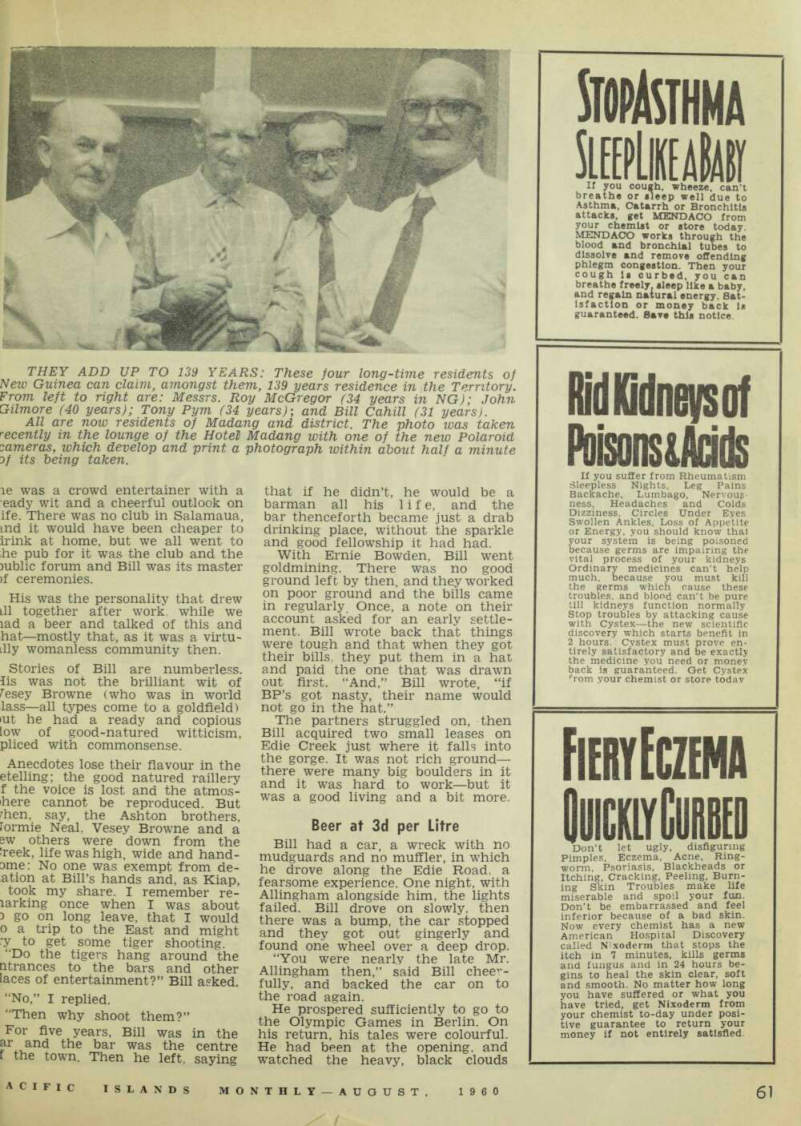
THEY ADD UP TO 139 YEARS: These four long-time residents of New Guinea can claim, amongst them, 139 years residence in the Territory.
From left to right are: Messrs. Roy McGregor (34 years in NG); John Gilmore (40 years); Tony Pym (34 years); and Bill Cahill (31 years).
All are now residents of Madang and district. The photo was taken recently in the lounge of the Hotel Madang with one of the new Polaroid cameras, which develop and print a photograph within about half a minute of its being taken.
lowering over the arena while wait ing for Hitler to declare the Games open. Bill turned to the American friend alongside him. “Adolf is go ing to get a wet arse, same as us,” he said.
A German behind him tapped his shoulder: “The Fuhrer gets what ever weather he wants,” he told Bill.
“And sure enough,” Bill told us, “the clouds broke up and the sun came through. I began to wonder about Hitler myself.”
Hitler was then regarded as just a big-mouthed rabble-rouser; per haps it would have been better if responsible statesmen had shared Bill’s dubiousness about him.
But Munich made up for Berlin.
In a beer garden, Bill found the best beer he had ever tasted, at threepence a litre. He settled him self down.
“What time do you close?” he asked the waiter.
“We stay open all night,” the waiter told him. “Then, when does your licence expire?’’ Bill asked.
But perhaps the highlight of his by TP?S ft S• f ° r a commission in the RAF which he signed, de- Ownir-? hlmself as GOld Mlne ° Back on the Edle, Bill showed signs of going the way of most bachelors. We wondered how he would ever conform to the discipline of matrimony but in Dorothy he had the right partner.
All seemed set fair when the war came. Bill joined ANGAU and served as a Warrant Officer on the carrying lines and when the war ended, went back to the Edie.
But a cliff had broken awnv onri a landslide covered the wash on his claim. He tried to workTt agafn but the slip and rising costs beat him ’ and moved to g Wau he worked while trying to plant up some land. His health was now fail- At the last, he tod a Tob at WaS toally Sent SoUth to » . f A fJ d . now he 18 g° ne > as Salamaua w!* 18 gone ’, and there are few - elt A 0 rem ember him as he was
Jf 1 . frand old days—young,
bng , ht and full of life, not the pale weak man he was at the last, But we few will think of him first, when we recall old days in Salamaua. y
When Mr. and Mrs. Bill Fleming, above, left Lae, New Guinea, early in July, they took with them many good wishes and many memories.
Mr. Fleming went from Rabaul to Lae in June, 1941, and was in charge of Public Works, constructing new buildings for the new capital, as Lae was to be.
His wife followed later, arriving in Lae three days before Pearl Harbour. She was all set to go to work for Sir Ramsay McNicoll when the news came, but was evacuated to Australia a week later.
Mr. Fleming stayed on in Lae, and later walked up the Markham to Bulolo and Wau with other civilians. With two companions he then walked to Bulldog, and blazed the trail for the rest who got themselves out from Wau, after air trans port stopped. From Bulldog he rafted to Motu Motu in Papua, and finally finished up in Port Moresby where he was dis charged from the NGVR and evacuated to Australia for two months' rest, after which he joined the RAAF.
He served with No. 2 ACS squadron at Port Moresby, Nadzab, Morotai and Borneo. After discharge he went back with civil administration in January, 1946, for about 12 months, when he was seconded to Commonwealth Works, with which he remained until his recent retirement.
Photo: Pat Robertson.