Are Being Spoiled
pp. 59-60 · Read in the full issue
ills Ideas Differ Front Those Of The Australian Experts
How And Why The NG Natives Are Being Spoiled
4 LL this nonsense that is being \ broadcast by wandering visionaries, visiting politicians nd sensation-seeking reporters bout the natives’ supposed craving )r self-government is building a ackground of native restlessness lat could become dangerous.
With practically all the old isciplines withdrawn, and these literate, often insolent, and merally undependable urbanised atives left to develop socially in ay way they please, we are getting a increasing community of blacks ho are openly hostile to the whites.
Top Administration panders more ad more to the Canberra Thinkers, ho want to break down every cial and cultural barrier between aropean and Native.
Thus encouraged, insufficiently :perienced patrol officers who do ost of the field work nowadays in U show increasing hostility to iropean private enterprise. They ve us the impression that they fait the day when the last of the anters and storekeepers and con actors will be driven out and they the products of the School of icific Administration—can be left one to run the country for the dives.
We Old-Timers watch all this img on with increasing anxiety, id wonder where it will end.
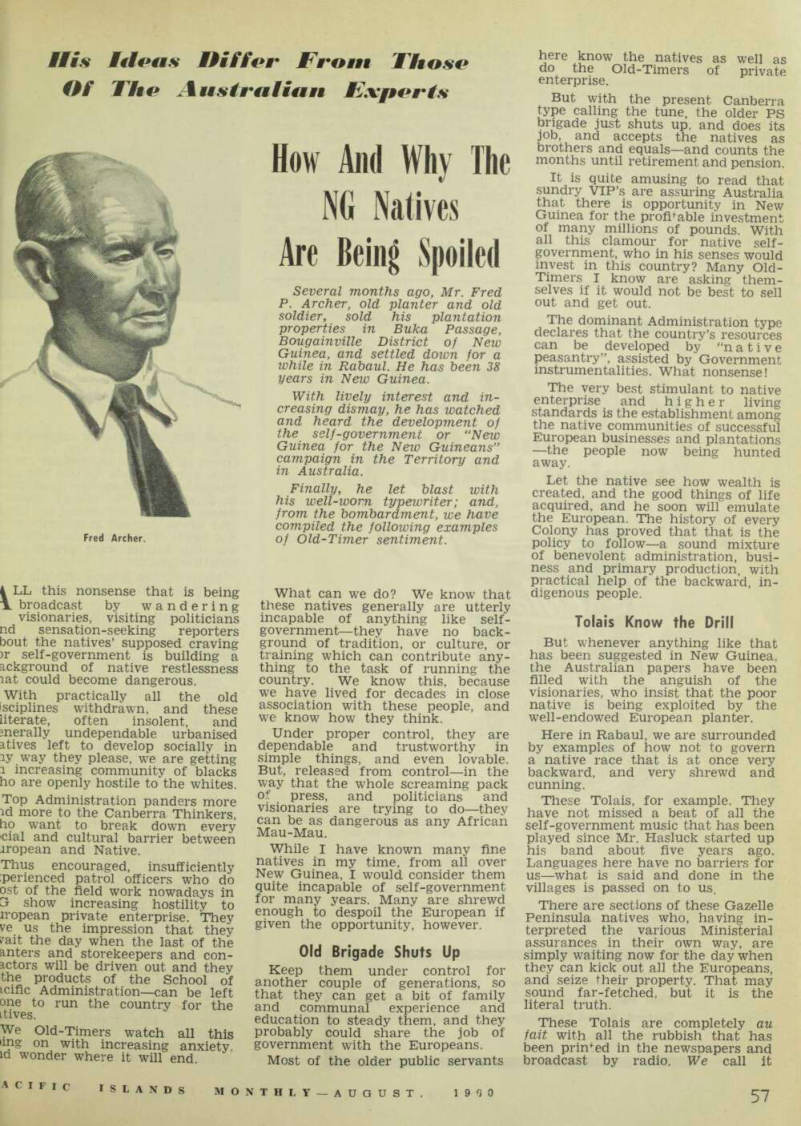
Several months ago, Mr. Fred P. Archer, old planter and old soldier, sold his plantation properties in Buka Passage, Bougainville District of New Guinea, and settled down for a while in Rabaul. He has been 38 years in New Guinea.
With lively interest and in creasing dismay, he has watched and heard the development of the self-government or “New Guinea for the New Guineans” campaign in the Territory and in Australia.
Finally, he let blast with his well-worn typewriter; and, from the bombardment, we have compiled the following examples of Old-Timer sentiment.
What can we do? We know that these natives generally are utterly incapable of anything like self government—they have no back ground of tradition, or culture, or training which can contribute any thing to the task of running the country. We know this, because we have lived for decades in close association with these people, and we know how they think.
Under proper control, they are dependable and trustworthy in simple things, and even lovable.
But, released from control—in the way that the whole screaming pack of press, and politicians and visionaries are trying to do —they can be as dangerous as any African Mau-Mau.
While I have known many fine natives in my time, from all over New Guinea, I would consider them quite incapable of self-government for many years. Many are shrewd enough to despoil the European if given the opportunity, however.
Old Brigade Shuts Up
Keep them under control for another couple of generations, so that they can get a bit of family and communal experience and education to steady them, and they probably could share the job of government with the Europeans.
Most of the older public servants
here know the natives as well as do the Old-Timers of private enterprise.
But with the present Canberra type calling the tune, the older PS brigade just shuts up, and does its job, and accepts the natives as brothers and equals—and counts the months until retirement and pension.
It is quite amusing to read that sundry VlP’s are assuring Australia that there is opportunity in New Guinea for the profitable investment of many millions of pounds. With all this clamour for native self government, who in his senses would invest in this country? Many Old- Timers I know are asking them selves if it would not be best to sell out and get out.
The dominant Administration type declares that the country’s resources can be developed by “native peasantry”, assisted by Government instrumentalities. What nonsense!
The very best stimulant to native enterprise and higher living standards is the establishment among the native communities of successful European businesses and plantations —the people now being hunted away.
Let the native see how wealth is created, and the good things of life acquired, and he soon will emulate the European. The history of every Colony has proved that that is the policy to follow—a sound mixture of benevolent administration, busi ness and primary production, with practical help of the backward, in digenous people.
Tolais Know the Drill But whenever anything like that has been suggested in New Guinea, the Australian papers have been filled with the anguish of the visionaries, who insist that the poor native is being exploited by the well-endowed European planter.
Here in Rabaul, we are surrounded by examples of how not to govern a native race that is at once very backward, and very shrewd and cunning.
These Tolais, for example. They have not missed a beat of all the self-government music that has been played since Mr. Hasluck started up his band about five years ago.
Languages here have no barriers for us—what is said and done in the villages is passed on to us.
There are sections of these Gazelle Peninsula natives who, having in terpreted the various Ministerial assurances in their own way, are simply waiting now for the day when they can kick out all the Europeans, and seize their property. That may sound far-fetched, but it is the literal truth.
These Tolais are completely au fait with all the rubbish that has been prin f ed in the newspapers and broadcast by radio. We call it
Fred Archer.
rubbish; but the Tolais accept it at its face value.
How else do you explain all these incidents the defiant rooting-out of surveyor’s pegs, the apparently irresponsible claims to plantation land, this refusal to sell or lease land for the Rapindik airstrip, these refusals to pay tax, this final suc cessful appeal of the Tolais against the imposition of village taxes?
Both Minister and Administrator were asked publicly here by a certain native how much longer the Aus tralians would be here —said they’d been here 50 years now, which in his opinion was too long. From
my sources of information in Matupi village, I can say that this question was organised and asked quite seriously, because certain village “shrewdies” really want to know when the Australians are leav ing, and how soon they can move into well-paid Government jobs, Certain high officials in Moresby seem to be greatly impressed with a n East Coast Buka native named Anton Kiari, and he has been made a member of the local District Advisory Council, and a sort of un official patrol officer—with power to report! Anton had quite an mter view with Mr. Hasluck. Those who
have known him for some years often wonder whose side he is on!
Great care should be exercised wher such appointments as this are con templated. All along the East Coast of Small Buka is touchy country where Cargo Cult seems to thrive and where Sorcery is believed in bj the locals. For some time after the war the natives were pro-Jap anc anti-European.
Many Native Affairs officials very little of the native communities they are supposed to influence ano direct. Patrols among the native:: are far too infrequent and to« hurried. Without properly conducteo patrols it is quite impossible t» know what goes on.
Then there is too much changin? round of officials in the Districts Much of what the officials do knov is rusty, old-time stuff—they ar out of touch with these dangerous sentiments seeping through t h whole native population as a resull of Canberra weakness and news paper sensationalism.
Most of the news they now ge from the outside districts come; from immature patrol officers, wlk race through their patrols, gathe only a little down-to-earth infon mation, but write voluminous re ports of the trip, spiced with highr sounding anthropological notes. Som of the stories about these yoimr gents out in the outer districts male me tired. .
No, the picture is not pretty. To many good men are packing up an leaving, and taking with them m only their money but their exper," ence of this country and the;j prestige among the natives. The are being replaced by Chinese am itinerant company managers.
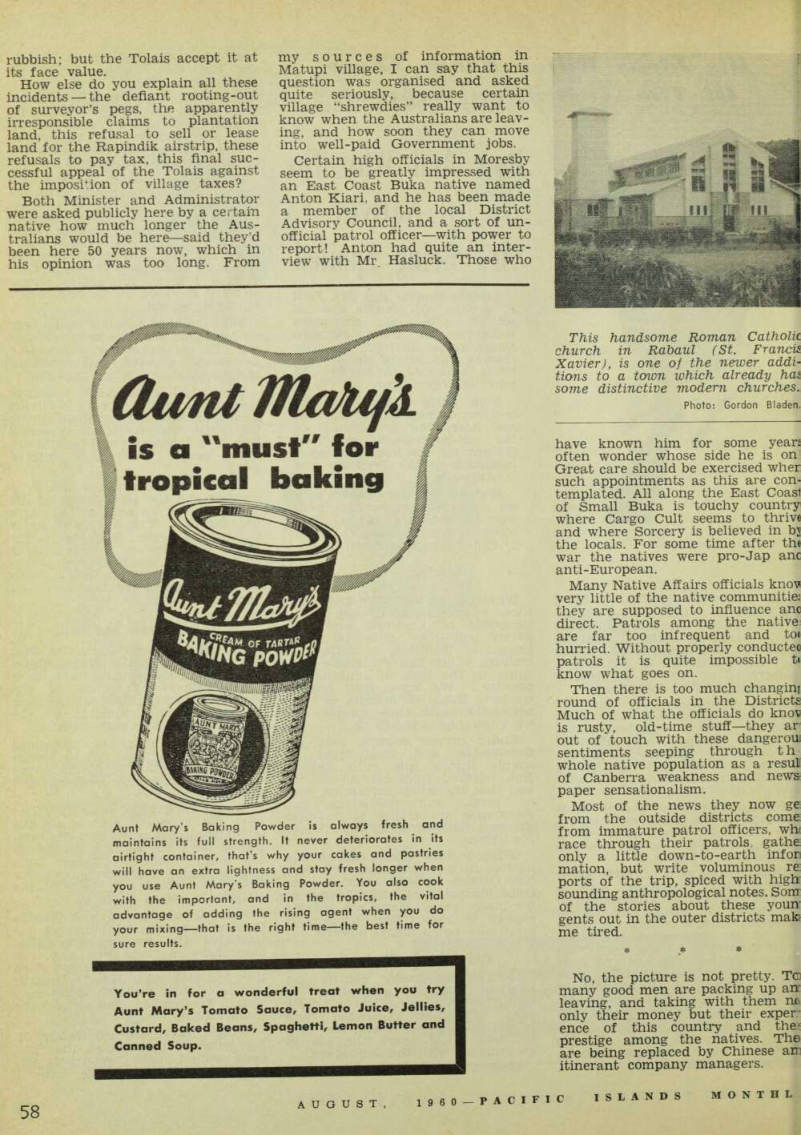
This handsome Roman Catholic[?] church in Rahaul (St. Francis.
Xavier), is one of the newer addi tions to a town which already has some distinctive modem churches ., Photo: Gordon Bladen.