Rossel Waters Were Tabu
p. 73 · Read in the full issue
The Rev H. K. Bartlett, now State Secretary of Methodist Over seas Missions in South Australia, spent 14 years in South East Papua as a missionary and as such was interested in Mr Hugh Osbornes account of Rossel Island in August “PIM” —particularly as that acccmn. referred to the murder of a European diver who had been exploring Yongga Bay for shell.
HE says that the murder doesn’t surprise him, as these waters were highly tabu and would not be much doubt about the fate of a foreigner who broke the rules” half a century ago.
The tabu stemmed from the two types of local shell money—Ndap and Nko—which are supposed to have been in existence “since the gods first discovered the island”.
There were 22 main values of Ndap, Mr. Bartlett says; these were roughly triangular. Variation in colour indicated value. Nko was a shell disc perforated and strung on a piece of creeper. The intricate monetary system of these people has been described by W. E. Armstrong in his book, Rossel Island, which was published in 1928.
Mr. Bartlett continues.
“Some of the Islanders claim that the god Wonajo, who sailed in a wooden dish from Sudest to Rossel, found a bivalve in Yongga Bay. He used one valve to fashion Ndap and from the other he made Nko. Yongga Bay then became a powerful Yaba — an extremely tabu spot. Others contend that Ndap came from Yongga and that Nko was fashioned from Wolunga Bay shell. Potent Yaba is found there, also.
“All agree that the “coins” are very old, and that the shells from which they are made are not found on Rossel today. I was shown a single worm-eaten valve of an unidentified giant spondylus which the owner (not a Rossel man) stated was Nko. Being a keen shell collector, as well as an amateur anthropologist, I tried to secure some specimens from Yongga Bay. Nothing that I could offer would induce
the local people to dive there. One
no-one
Bay and Uye Even if by acc ident, a an fell from a C anoe he could not escape the penalty, “j s this the explanation of the murder of that intrepid European diver in the early days of the century?
Chinese Relics?
“i have visited Rossel many times. often Ernest (Dick) Whitehouse — senior European Medical Assistant —travelled with me. After a visit to an inland village, Whitehouse told me that he had noticed some Chinese characteristics in the buildings which, he said, showed a distinct departure from the traditional Rossel Island design. He was in trigued with the remains of some huge earthworks, which appeared to have been formed for purposes of defence. These were situated beside the track on a high ridge between Dyindyo village and Abaleti, Harry Osborne’s home. I was never able to inspect the site which might pro vide some interesting evidence of the fate of some of the St. Pauls crew.
“I recall seeing numerous old coins (European, not shell) that had been found on the island. The Rev. Ern.
Clarke, Methodist Missionary to Rossel in 1928, had a silver dollar (Spanish or Mexican) stamped with Chinese characters. The late Jack Hides gathered some ancient Spanish dubloons found at Dyindyo, and from the same village I had a sovereign of 1843 in almost mint condition. The finder claimed that he had got it in the soil clinging to a taro root.”
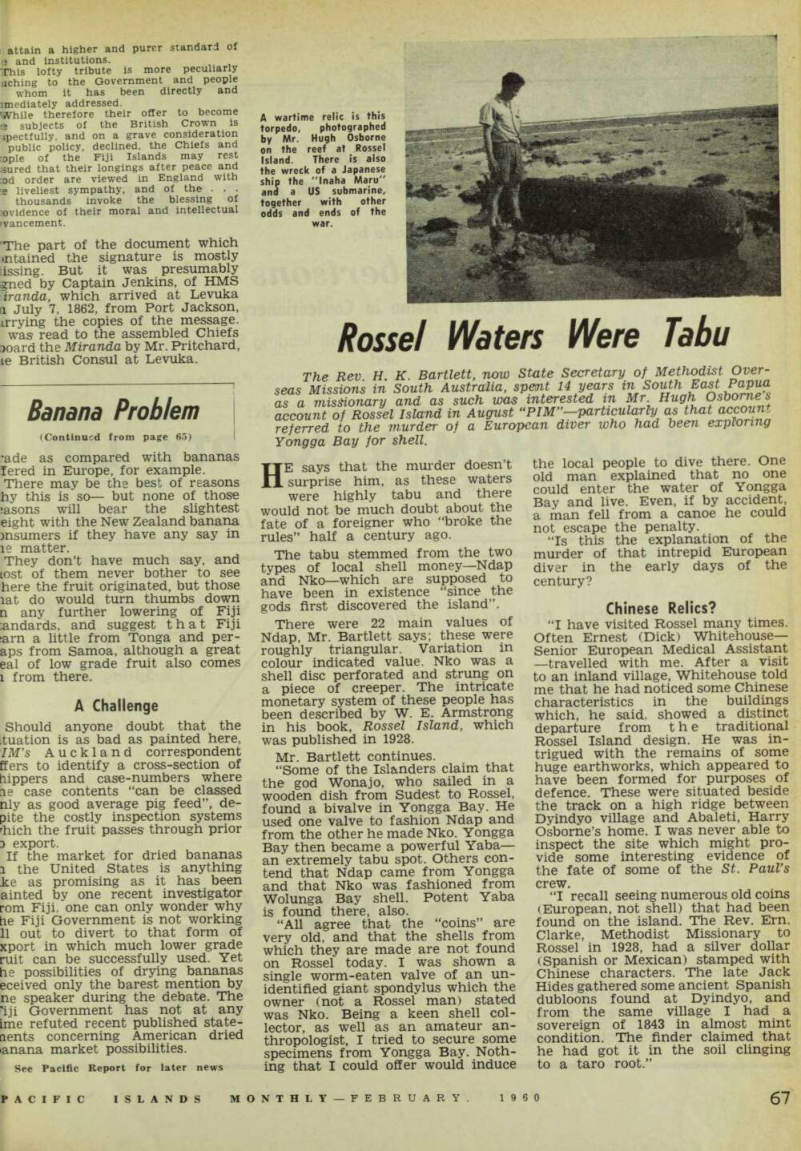
A wartime relic is this
torpedo, photographed
by Mr. Hugh Osborne on the reef at Rossel Island. There is also the wreck of a Japanese ship the "Inaha Maru" and a US submarine, together with other odds and ends of the war.