Literacy In English —
pp. 75-81 · Read in the full issue


P-Ng's Most Acute Education Problem
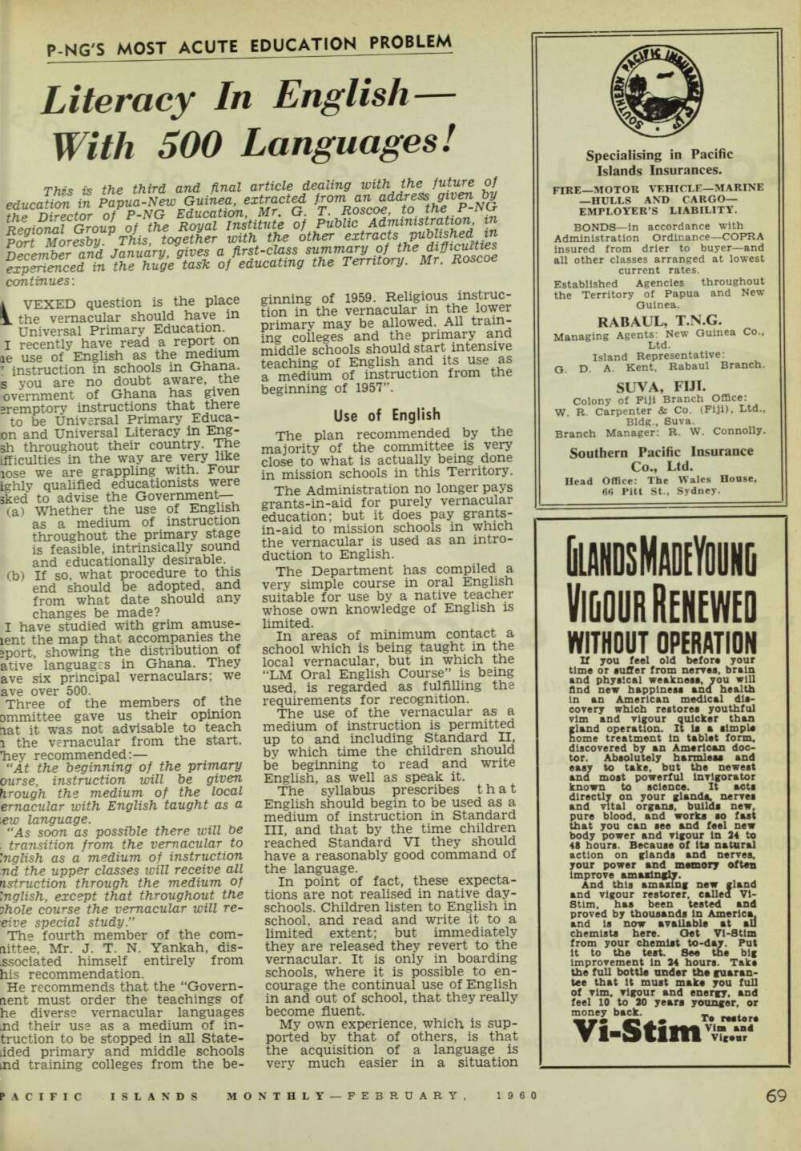
Literacy In English — With 500 Languages!
This is the third and final article dealing hi education in Papua-New Guinea extracted + ho niroMor nf P-NG Education, Mr. G. T. Koscoe, zo irus r P^ o lSorfsb 0 y UP T°L th together Mh'the continues:
k VEXED question is the place \ the vernacular should have in Universal Primary Education.
I recently have read a report on ne use of English as the medium : instruction in schools in Ghana, s you are no doubt aware, the overnment of Ghana has given a remptory instructions that there to be Universal Primary Educa on and Universal Literacy in Eng sh throughout their country. The ifficulties in the way are very like lose we are grappling with. Four ighly qualified educationists were sked to advise the Government— (a) Whether the use of English as a medium of instruction throughout the primary stage is feasible, intrinsically sound and educationally desirable. (b) If so, what procedure to this end should be adopted, and from what date should any changes be made?
I have studied with grim amuse lent the map that accompanies the sport, showing the distribution of ative languages in Ghana. They ave six principal vernaculars; we ave over 500.
Three of the members of the ommittee gave us their opinion aat it was not advisable to teach i the vernacular from the start. liey recommended: — “At the beginning of the primary ourse, instruction will be given hrough the medium of the local ernacular with English taught as a ,ew language.
“As soon as possible there will be . transition from the vernacular to ’nghsh as a medium of instruction nd the upper classes will receive all nstruction through the medium of :nglish, except that throughout the ohole course the vernacular will re eive special study.”
The fourth member of the com aittee, Mr, J. T. N. Yankah, dis .ssociated himself entirely from his recommendation.
He recommends that the “Govern aent must order the teachings of he diverse vernacular languages md their use as a medium of in duction to be stopped in all State dded primary and middle schools md training colleges from the be
ginning of 1959. Religious instruc tion in the vernacular in the lower primary may be allowed. All train ing colleges and the primary and middle schools should start intensive teaching of English and its use as a medium of instruction from the beginning of 1957”.
Use of English The plan recommended by the majority of the committee is very close to what is actually being done in mission schools in this Territory.
The Administration no longer pays grants-in-aid for purely vernacular education; but it does pay grants in-aid to mission schools in which the vernacular is used as an intro duction to English.
The Department has compiled a very simple course in oral English suitable for use by a native teacher whose own knowledge of English is limited.
In areas of minimum contact a school which is being taught in the local vernacular, but in which the “LM Oral English Course” is being used, is regarded as fulfilling the requirements for recognition.
The use of the vernacular as a medium of instruction is permitted up to and including Standard 11, by which time the children should be beginning to read and write English, as well as speak it.
The syllabus prescribes that English should begin to be used as a medium of instruction in Standard 111, and that by the time children reached Standard VI they should have a reasonably good command of the language.
In point of fact, these expecta tions are not realised in native day schools. Children listen to English in school, and read and write it to a limited extent; but immediately they are released they revert to the vernacular. It is only in boarding schools, where it is possible to en courage the continual use of English in and out of school, that they really become fluent.
My own experience, which is sup ported by that of others, is that the acquisition of a language is very much easier in a situation
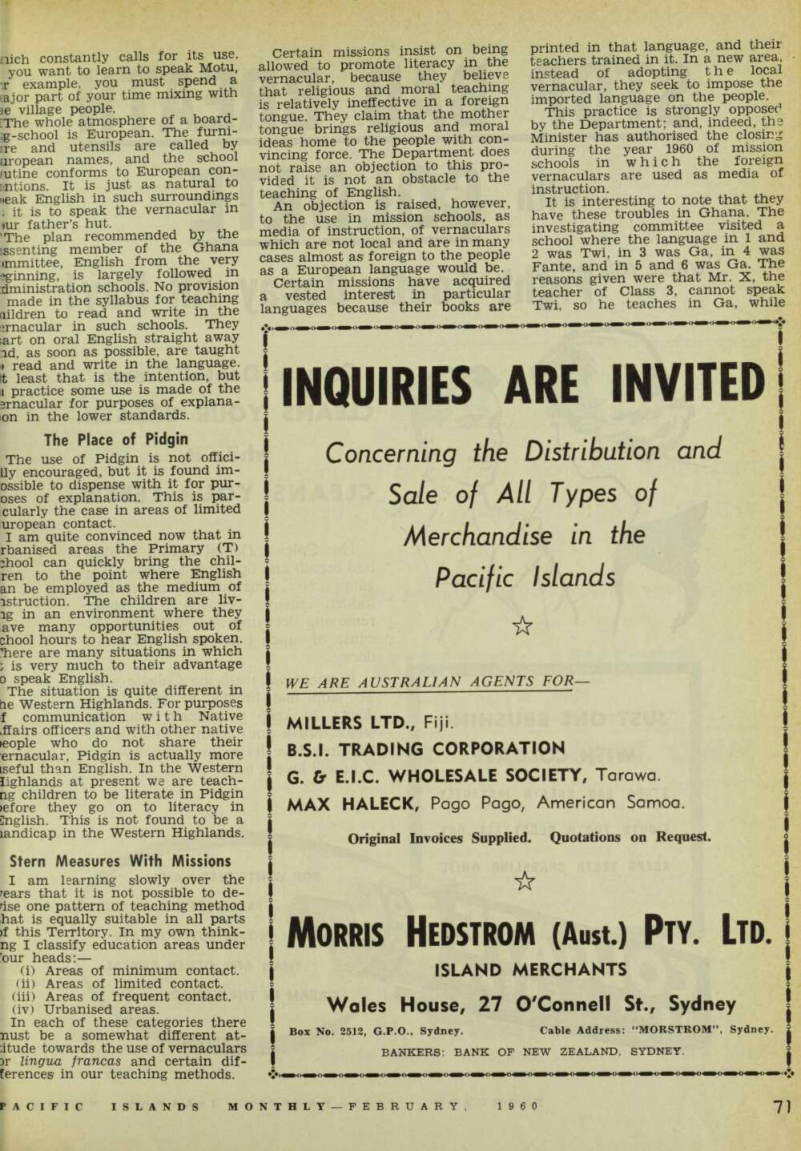
nich constantly calls for its use. you want to learn to speak Motu, r example, you must spend a Eajor part of your time mixing with ie village people.
"The whole atmosphere of a board :g-school is European. The furm ire and utensils are called by uropean names, and the school rutine conforms to European con ations. It is just as natural to ►teak English in such surroundings i it is to speak the vernacular in mr father’s hut.
'The plan recommended by the issenting member of the Ghana unmittee, English from the very eginning, is largely followed in dministration schools. No provision made in the syllabus for teaching nildren to read and write in the urnacular in such schools. They art on oral English straight away id, as soon as possible, are taught « read and write in the language.
It least that is the intention, but ii practice some use is made of the srnacular for purposes of explana on in the lower standards.
The Place of Pidgin The use of Pidgin is not offici- Qy encouraged, but it is found im ossible to dispense with it for pur oses of explanation. This is par cularly the case in areas of limited uropean contact.
I am quite convinced now that in rbanised areas the Primary (T) 3hool can quickly bring the chil ren to the point where English an be employed as the medium of istruction. The children are liv ig in an environment where they ave many opportunities out of chool hours to hear English spoken, 'here are many situations in which ; is very much to their advantage o speak English.
The situation is quite different in be Western Highlands. For purposes f communication with Native affairs officers and with other native icople who do not share their ernacular, Pidgin is actually more iseful than English. In the Western lighlands at present we are teachi ng children to be literate in Pidgin >efore they go on to literacy in English. This is not found to be a landicap in the Western Highlands.
Stern Measures With Missions I am learning slowly over the rears that it is not possible to de nse one pattern of teaching method hat is equally suitable in all parts if this Territory. In my own think ng I classify education areas under ’our heads:— (i) Areas of minimum contact. (ii) Areas of limited contact. (hi) Areas of frequent contact, (iv) Urbanised areas.
In each of these categories there nust be a somewhat different at ;itude towards the use of vernaculars Dr lingua francas and certain dif ferences in our teaching methods.
Certain missions insist on being allowed to promote literacy in the vernacular because they believe that religious and moral teaching is relatively ineffective in a foreign tongue. Thev claim that the mother tongue brings religious and moral ideas home to the people with convincing force. The Department does not raise an objection to this provided it is not an obstacle to the of English.
An objection is raised, however, to the use in mission schools, as media of instruction, of vernaculars which are not local and are in many cases almost as foreign to the people as a European language would be.
Certain missions have acquired a vested interest in particular languages because their books are -
printed in that language, and their teachers trained in it. In a new area, instead of adopting the local vernacular, they seek to impose the imported language on the people.
This practice is strongly opposed by the Department; and, indeed, the Minister has authorised the closing during the year 1960 of mission schools in which the foreign vernaculars are used as media of instruction.
It is interesting to note that they have these troubles in Ghana. The investigating committee visited a school where the language in 1 and 2 was Twi, in 3 was Ga, in 4 was Fante, and in 5 and 6 was Ga. The reasons given were that Mr. X, the teacher of Class 3, cannot speak Twi, so he teaches in Ga, while
Hiss Y cannot speak Twi, so she caches in Fante.
One final point I might make in egard to the vernacular is that it as been found in some schools, There children were taught to read nd write in English and not in the ernacular, that later on, of their wn accord, they wrote letters in he vernacular, spelt phonetically, jid did quite well; and, further, irtien for the first time they were onfronted with their mother tongue n print, they had no difficulty in ■eading and understanding it.
Three Main Difficulties
The difficulties with which we are aced in the development of universal jducation in this Territory are of ;hree kinds.
The first are technical problems, nostly concerned with teaching nethod. We have to find out the aiost effective approach to English in different places, sound methods Df teaching arithmetic to children In whose culture number plays an insignificant part, ways of illus trating social studies lessons to children who have met few Euro peans and have never seen the sea.
These problems are difficult, but we can cope with them.
The second type of difficulty is connected with lack of resources in staff, buildings, transport and material. The problem of staff re cruitment is not one that concerns the Department alone. All depart ments find it difficult to obtain qualified recruits from Australia.
Our main trouble at the present time is that very few male teachers in Australia are applying for appointment to the Territory ser vice. We can actually recruit young women to the limit of the quota allowed in the Estimates, but what we need most of all are single young men who are qualified teachers and have the spirit of pioneers. I do not know whether such young men are in short supply in Australia, or whether it is that our methods of
advertising are not sufficiently attractive A proposal is at present under for the ex-
r^rsel°co r u^r C S itlnß
‘ lick of resources in buildings, transport and material basically arise P from limited finance. in mir parlier part of this paper
I $ fhe
Avtpnt tn which we can expect constantlv increasing financial ai d from the Commonwealth of Australia It is extremely important that the native people as soon as possible" should 6 come to make the maximum contribution to the cost nf pdiicatine - their children.
To give them credit where it is due they have generally been willing ’to provide temporary buildings of bush material for the establishment of primary schools wherever
the Department could provide teachers. The trouble about tem porary buildings of bush material is that their life is so limited.
Local Government Council areas are prepared to devote a consider able portion of their revenue from local taxes to the construction of permanent school buildings. In fact they are doing this to such an ex tent that the Department is em barrassed because we cannot provide them with trained native teachers.
The Department plans an emerg ency programme of teacher-training in 1960 to provide the maximum possible number of “A” certificated teachers to staff such schools. The “A” certificate is the lowest quali fication we recognise and I am not at all happy at having to devote so much of our teacher training potential to preparing people who
will not be competent to teach classes higher than Standard IV.
It has to be accepted, however, that in the initial stages Universal Primary Education will be lower Primary, Standards I to IV, for the great majority of pupils.
There is no doubt of the willing ness of the native people to tax themselves and contribute gener ously for the Department of Educa tion.
At present the revenues of Local Government councils are limited by the low level of taxable income of most native people. Every step forward in native economic develop ment makes possible an advance in Primary education.
"Prejudices and Attitudes"
The third kind of difficulty with which the Department has to grapple is psychological.
There are obstacles which consist of prejudices' and attitudes in the minds of people whose co-operation we need in order to carry out our task. Particularly do we need the co-operation of officers of other de partments.
There are some public servants who are familiar with outine pro cedure but who have an imperfect appreciation of policy, especially the policy of departments other than their own. Such officers at times can be obstructive.
Public Service procedure has a natural tendency to become more complicated and new developments render old procedures obsolescent.
All officers need to be reminded that
it is not the holicy of the Public Service to inefficient and nntmnripd nrocedures Any officer sef a way of streamlining business 1 is encouraged to submit suggestions for which, if accepted, suggestions recede an ’ appropriate award.
Even in the regulations as they stand, there is often a provision for exceptional circumstances, and permission can be obtained from a competent authority to take short cuts where necessary.
In the past our Department has encountered obstruction from officers who have a preventive, rather than a Degressive attitude; but I can Ly with ''truth that during the past twelve months, the officers of my
Department have reported receiving more co-operation from other de partments than we have ever had before. I put this down to a better knowledge and understanding of education policy and objectives in the Public Service generally.
The Department of Education faces up to jt s task in a spirit of optimism tempered with realism. I do not k no w whether Universal primary Education in this country really be achieved. All I know i s that the director and his officers are united in their determination to spare no effort to achieve it, and, with the assistance of other public servants, the missionaries, the gen eral public, and the native people themselves, we can go a long way.