When Britain Rejected Fiji
pp. 71-73 · Read in the full issue
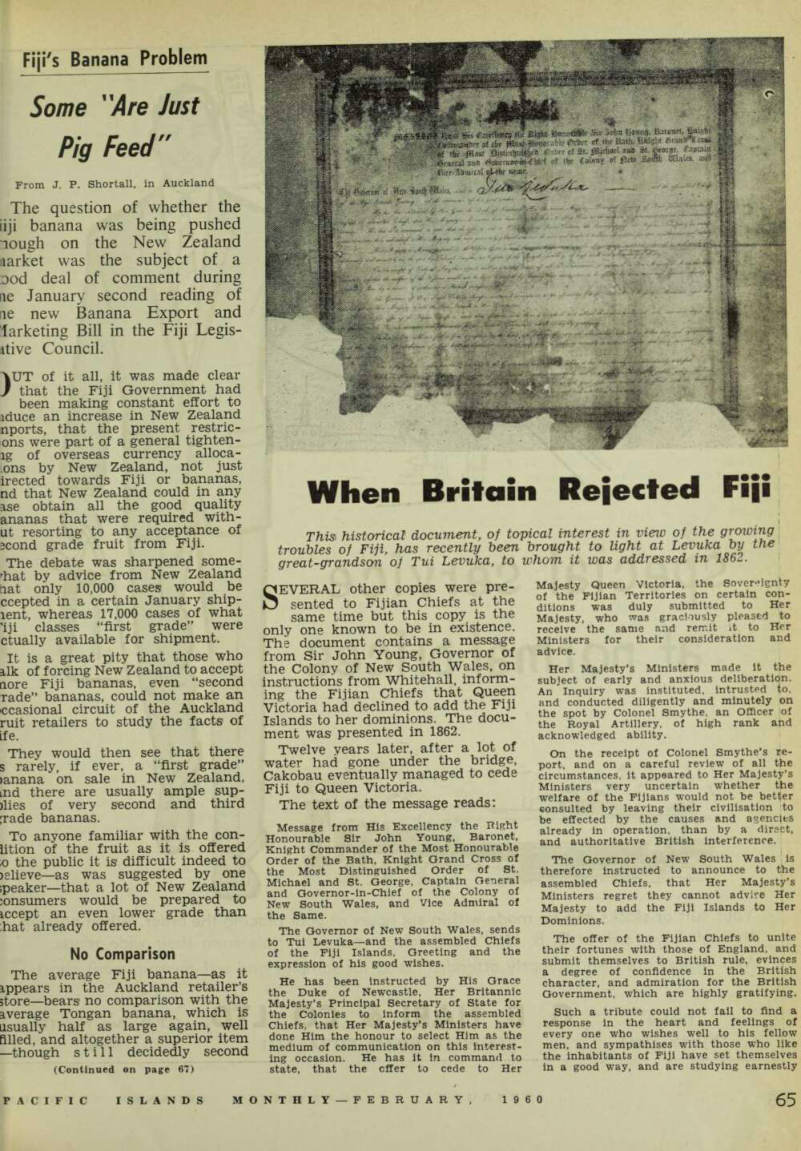
This historical document, of topical interest in view of the growing troubles of Fiji, has recently been brought to light at Levuka by the great-grandson of Tui Levuka, to whom it was addressed in 1862.
STTT7’Tr , ‘R AI nfhpr rnnips were nre- EVERAL other copies were pre sented to Fijian Chiefs at the same time but this copy IS the only one known to be in existence.
The document contains a message from Sir John Young, Governor of the Colony of New South Wales, on instructions from Whitehall, informine the Fijian Chiefs that Queen •WiM-nria haH HpHinpH to add the Fiji Victoria had[ decimea toaaa [inerw Islands to her dominions. The docu ment was presented m 1862.
Twelve years later, after a water had gone under the bridge, Cakobau eventually managed to cede Fiji to Queen Victoria. , . - m .j c .
The text Of the message reads.
„ „ „ f Message from His Excellency the Bight Honourable Sir John Young, Baronet, Knight Commander of the Most Honourable Order of the Bath. Knight Grand Cross of the Most Distinguished Order of St.
Michael and St. George. Captain General and Governor-in-Chief of the Colony of New South Wales, and Vice Admiral of the Same.
The Governor of New South Wales, sends to Tui Levuka—and the assembled Chiefs of the Fiji Islands, Greeting and the expression of his good wishes.
He has been Instructed by His Grace the Duke of Newcastle, Her Britannic Majesty’s Principal Secretary of State for the Colonies to inform the assembled Chiefs, that Her Majesty’s Ministers have done Him the honour to select Him as the medium of communication on this interesting occasion. He has it in command to state, that the offer to cede to Her
Majesty Queen Victoria, the Sovereignly J th / pljlan Terri t o ries on certain con ditions was duly submitted to Her Majesty, who was graciously pleased to receive the same and remit it to Her Ministers for their consideration and advice.
Her Majesty’s Ministers made It the subject of early and anxious deliberation, An inquiry was instituted intrusted to. and conducted diligently and minutely on the spQt by Colonel Smythe an officer of the Roya i Artillery, of high rank and acknowledged ability.
On the receipt of Colonel Smythe’s re port and on a care f U i review of ail the Circumstances, it appeared to Her Majesty’s Ministers very uncertain whether the welfare of the Fijians would not be better consulted by leaving their civilisation to be effected by the causes and agencies already in operation, than by a direct, & nd authoritative British interference.
The Governor of New South Wales is therefore Instructed to announce to the assembled Chiefs, that Her Majesty’s Ministers regret they cannot advice Her Majesty to add the Fiji Islands to Her Dominions. . . ..
The offer of the Fijian Chiefs to unite their fortunes with those of England, and submit themselves to British rule, evinces a degree of confidence in the British character, and admiration for the British Government, which are highly gratifying.
Such a tribute could not fail to find a response in the heart and feelings of every one who wishes well to his fellow men, and sympathises with those who like the inhabitants of Fiji have set themselves in a good way, and are studying earnestly
attain a higher and purer standard of «» and institutions.
This lofty tribute is more peculiarly aching to the Government and people whom it has been directly and mediately addressed.
While therefore their offer to become ;s subjects of the British Crown is .jpectfully, and on a grave consideration public policy, declined, the Chiefs and tuple of the Fiji Islands may rest isured that their longings after peace and :od order are viewed in England with =e liveliest sympathy, and of the . . thousands invoke the blessing of evidence of their moral and intellectual rvancement.
'The part of the document which mtained the signature is mostly iissing. But it was presumably gned by Captain Jenkins, of HMS iranda, which arrived at Levuka ii July 7, 1862, from Port Jackson, irrying the copies of the message, was read to the assembled Chiefs
uoard the Miranda by Mr. Pritchard,
te British Consul at Levuka.