Dangerous
p. 75 · Read in the full issue
Gph's New Manager
She Was Too Dangerous For The Japs
From a Staff Writer in Suva
Taking over a big hotel in a
istant country is no simple task
- especially when there is a
jssibility of all the furnishings hng whisked away at short no
:e if negotiations for their pur
lase from the previous tenant
eak down.
IHAT was the situation when I called on Mrs. Margaret Webb, MBE, manageress of Suva’s •and Pacific Hotel, early in May. it that sort of situation is well thin Mrs. Webb’s capabilities and perience.
Born in Kuching, Sarawak, Mrs. ebb is a third-generation mem r of the Brodie family, founders the major export-import Borneo mpany. She was educated in rneo and at Singapore and speaks ir dialects of Chinese—Cantonese 3 spoken by most South Pacific inese), Hakka, Hokien, and ochew —as well as Malayan. Her sband, Mr. G. W. Webb, has re itly retired after 29 years in the ilayan Civil Service. r or many years Mrs. Webb was retary of the women’s and girls’ tion of Singapore’s government nal Welfare Service, The un tried mothers, the abandoned )hans, and the girl delinquents re her care and Interest.
Vhen war broke out she was man ng the government home for )hans. Had she fled when the lanese Army arrived, most of ise orphans would have starved death, as the Japanese weren’t erested in them, and made no vision for their care. They seemed spared, however, to let Mrs. Webb lain in the home, and to tramp i city begging food —which was perately short from business ns, produce vendors, or whoever ild help.
Driven Out loon she was joined at the home three Irish nuns of the Good jpherd Order who had been yen out of their own orphanage, aring identifying arm-bands, s. Webb’s indicating that she 3 an enemy internee, and the ih Sisters’ indicating that they *e neutrals, the group would pre t themselves to a Japanese cer each day to get a permit to •chase rice for the home, or to
obtain possession of other foodstuffs.
They were invariably made to wait outside the office for two hours or more, then, when admitted, to stand for another quarter-hour while the officer studied papers on his desk and ignored them.
If they were lucky they might get the permit—but they still had to find the means of obtaining the
food, which was never sufficient.
Even when canned milk could be obtained for the infants, the neces sity of using different brands and grades was the cause of constant digestive ailments and, indirectly, the death of many young babies.
After ten months of this the Japanese declared Mrs. Webb to be “too dangerous”, mainly through her linguistic abilities, so she spent the remainder of the war as an in mate of Changi Gaol and Sime Road internment camp.
When released, she got busy once again reorganising the women’s and girls’ section of Social Services, continuing in that work until 1952.
In 1948, Mrs. Webb was awarded the MBE, the first women in Singa pore to receive this honour post war, for distinguished social ser vice. In 1954 her husband was transferred to Penang, and later to Kuala Lumpur and she went with him. It was in 1956 that she was offered the management of the 62room Ocean Park Hotel in Singapore —one of the two hotels owned there by the Cathay organisation. From there she comes to what will soon be Suva’s largest hotel —when the planned extensions to the famous old GPH have been completed.
Late in May, Mr. Webb, and daughters Margaret, 17, Rosemary, 12, and Eleanor, 8, will arrive in Suva to settle —but the responsibility of managing the famous GPH will rest with Mrs. Margaret Webb, MBE.
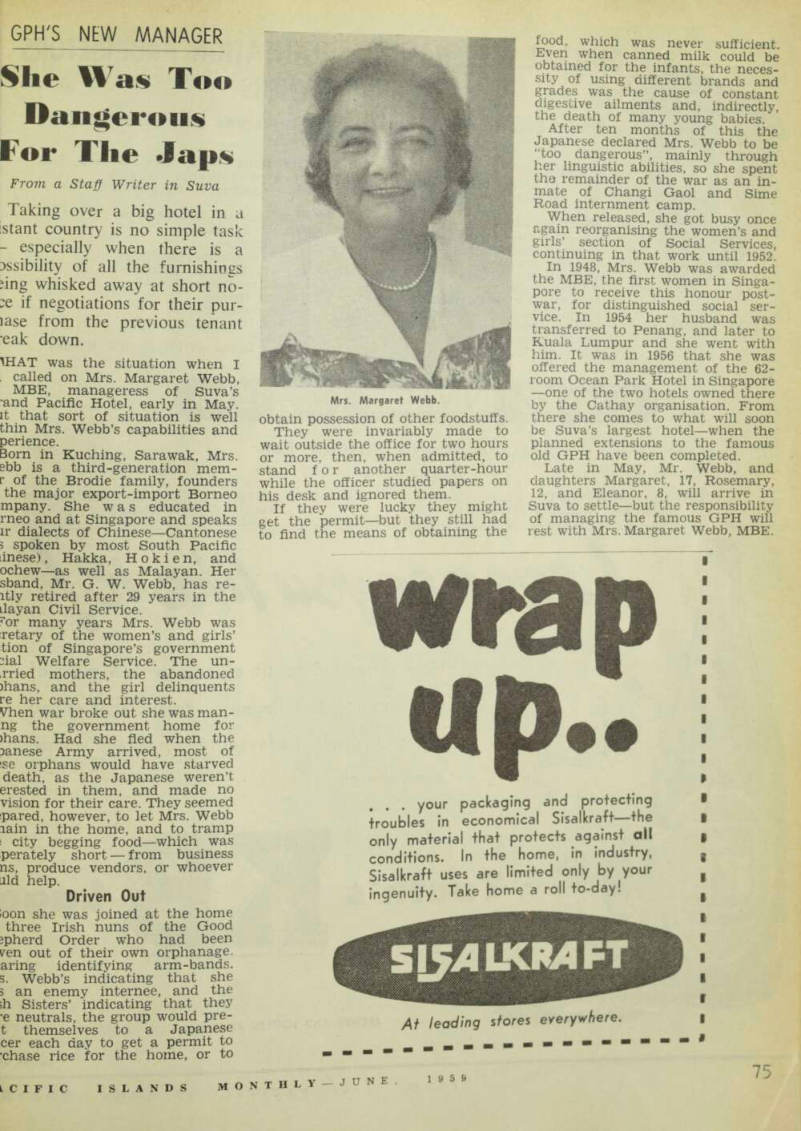
Mrs. Margaret Webb.