Fiji Industry
pp. 77-79 · Read in the full issue

Trays, Bowls And Totem Poles
Problems Of A New Fiji Industry
From a Staff Correspondent in Suva u s , a un iq ue dollar-earning industry struggling along here in Fiji that might one day help make Fijian arts and crafts famous that is, if Japanese competition doesn’t beat it at its own game.
rT all started when the late Harold L Gatty, always interested in new business enterprises, saw the ossibility of establishing an ex ert trade in wooden trays, fruit awls, salad bowls and servers, coffee ibles, and other items manu ictured from attractive timbers.
During his visits to Hawaii he had oted the brisk tourist trade in lese lines, manufactured from the mber of what is known there as le Monkeypod tree, and he had a unch that this same tree, under n alias, might be found in Fiji.
He took careful note of the variety -there are several —being used in onolulu, and he discussed the pos bility of supplying the Honolulu arket from Fiji with Mr. Lawrence [. Judd, Jr., the “king-pin” in this idustry in Hawaii.
Back in Fiji, Gatty spotted a stand ' the trees, known to the Fijians > Vaivai-ni-vavalagi (“tree of the hite man” —or non-indigenous ee) and to Europeans as Rain ree, at Navuso Methodist Mission ?ar Nausori.
Which Were They?
But which of the two common pes were they; the yellow flowered, the desirable pink flowered -riety? Mr. John McFadyen, who id been associated with Gatty in s earlier fishing ventures, was legated to keep a watch on the ses, which eventually flowered one ovem be r and proved to be •parently identical to those on fich the Hawaiian industry was sed.
This small stand of trees was quired and felled—but no local ill would handle them. They were 1 logs, with knarled and twisted ain, and they had grown over a rbed-wire fence with strands of re embedded deep in their trunks.
So they had to be pit-sawed by nd on the spot, and the slabs ire shipped off to Lawrence M. dd, Jr.’s Hawaiian Lumber Com ny for a report on their texture, could have been that these trees, Dwn in a somewhat different mate to that of Hawaii, might t have all the same desirable aracteristics in their timber.
Fhe shipping of these slabs con lued through 1955-56, and mean
while Gatty organised an aerial search of Viti Levu for more such trees. Originally from India, their dark green wide-spread ing branches above very irregularly shaped trunks, are fairly easily identified from the air. A mature tree averages about five feet in diameter.
Tests Satisfactory
The Honolulu tests of the timber proved satisfactory and late in 1956 Fiji Woods Ltd. was registered in Suva. It was substantially owned by Hawaiian Lumber Company, which then sent down the machinery for a mill established at Lami, near Suva.
When Harold Gatty died in August, 1957, his death slowed up the establishment of the industry.
What interest he had in Fiji Woods Ltd. was taken over by the Hono lulu company which, early in 1958, judged that the time had come to establish the manufacturing side of
the business in Fiji and not merely the milling of the logs.
Machines—lathes, routers, and sanders, and the various special tools required—were shipped in to Lami early in 1958, and late in 1958 Mr Paul A. Blackford, an American, better known in PIM’S yachting news columns as a former owner of the yacht then called Kona, be came managing director of Fill Woods Ltd.
Training Craftsmen
With the arrival of the special tools the work of training crafts men is now continuing. This side of the business is not something that can be handled quickly, even with the full play of American efficiency —for the men on this work are craftsmen with an artistic sense as well as with skill of hand and eye.
Some men have proved quite un suitable. All racial groups—Chinese, Indian, Fijian, and other Islanders —have tried their hand.
Some have been skilled cabinet makers, but they all find this type of work very different, and more exacting. So the period of training will be prolonged, and to keep the kettle boiling slabs of timber are still being shipped out to Honolulu.
Japanese Competition
Another major problem for the company has been that the trees are mostly in very small stands in widely scattered areas, which means that their felling and hauling out is costly. At present, most logs are coming from the Tailevu area. Rain often halts the bush work, the ground being too soft for hauling out work.
And now, as a further problem.
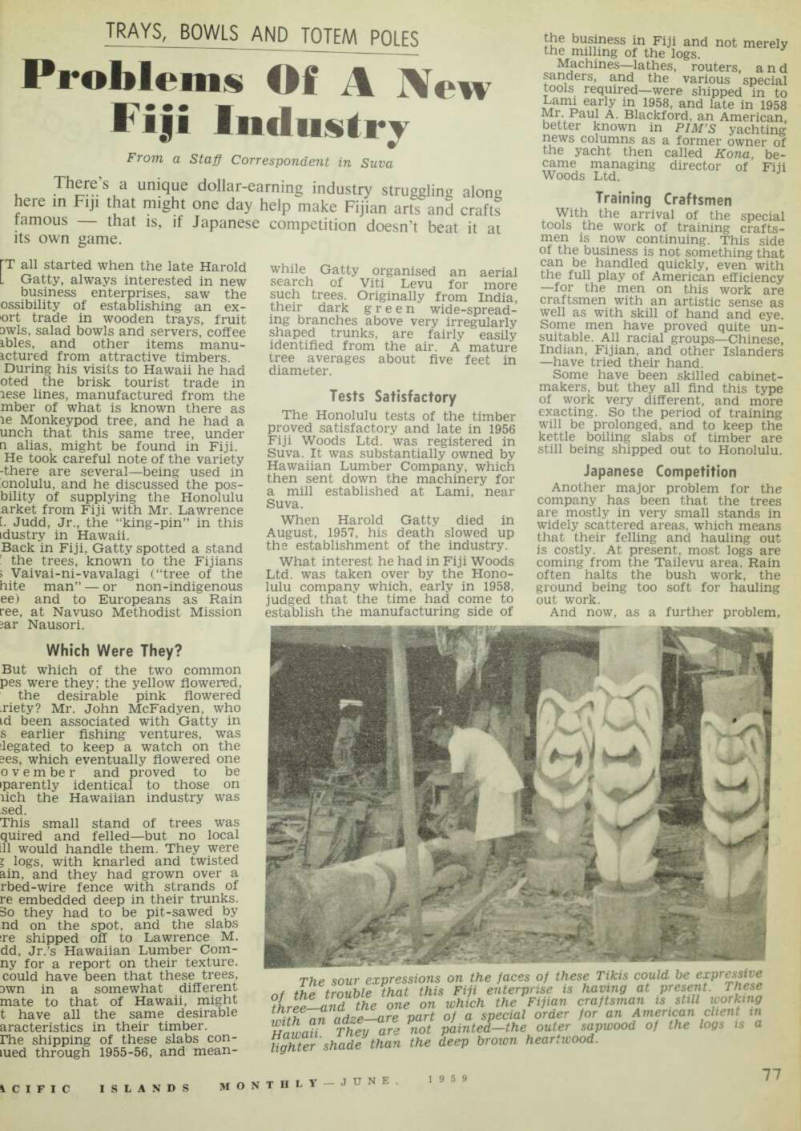
The sour expressions on the faces of these Tikis could be expressive of the trouble that this Fiji enterprise is having at present. These three—and the one on which the Fijian craftsman is still working with an adze-are part of a special order for an American client in Hawaii. They are not painted-the outer sapwood of the logs is a lighter shade than the deep brown heartwood.
lother company has entered the g market, sending the logs to ipan as the raw material for a nilar industry there, which may ?11 compete with the Fiji industry.
The price of the logs has gone ), Fiji Woods at present pay g 40/- per 100 superficial feet for r ,s delivered to the Lami mill. Only ghtly over half of this quantity of nber Is usable.
The company is now seeking from e government some kind of pro jtion from the Japanese competi m, maintaining that the industry, lich currently employs about 25 m at Lami and others in the Id, could develop into a greatly panded dollar earner once crafts ;n have been found and trained, tere is also the claim that the pply of logs in Fiji is limited.
Fhe form of protection that could given poses something of a Dblem. If the export of unsawn ;s was prohibited the other ex rters would, no doubt, saw the :s into slabs before shipment, d if the export of slabs was aned this would deprive Fiji )ods of much needed income from waii during the training period, fo further aid in keeping the npany on its feet in this costly tial stage it has taken a contract make fabricated buildings for the atoka wharf contractors in asso tion with another company, Beco i., which is owned by Mrs. Black d, and in association with Mr.
S. Herrington, another American merly connected with the United mber Co. of Suva. Beco is also )plying shingle to the Nadi Air t and Lautoka wharf contractors, n May, Lawrence M. Judd, Jr., expected in Suva to discuss the •blems of Fiji Woods with the i Government. It would be a y if this promising industry is )wed to die after all the hard :k that has been put into it.