fiji talanoa
pp. 69-73 · Read in the full issue
Vakatawa Talks Of This And That
After years of complaint that the shortage of hotels has been crippling the tourist trade, the recent sequence of events left Fiji somewhat staggered.
>LANS for an expanded Grand Pacific Hotel at Suva; plans for a new tourist hotel at maka to replace the Fiji Mocambo Nadi Airport: plans for a new mry resort hotel (with cheaper stages for Fiji people with modest rses); revived plans for a hotel Saweni beach—all were an unced within a few days of each ler. Then a week or two later, Australian group arrived with scheme for another Suva city
tel, incorporating the Waimanu
ilding, opposite the Lilac theatre.
Cathay Hotels Ltd., who have :en over the GPH, have long been ablished in Singapore and one of i terms for the tender for the *H, acceptance of which triggered the Saweni beach hotel project, h promise of more to come, was it the immigration authorities re to allow the company to bring inese from Singapore to fill key its, and to train local staff, rhe idea of a hotel at Saweni ,ch (about half-way between itoka and Nadi airport) is not v. Last year, a group of indus il consultants visited Fiji and pared detailed plans for the Gen eration of potential investors in lada. But things moved slowly, I when Cathay showed interest, Northern Club, of Lautoka, ich held the lease of an essential tion of the beach, was able to nsfer negotiations from the ladians to the Singapore com iy.
Tie sale of the lease is a wind for the club. There were iodical murmurs from some mbers in past years that the se—which was designed to give club a beach recreation spot— ; an unnecessary luxury. Now an sxpected £B,OOO is added to the d’s assets and a long-talked-of mming pool at the club house
omes a possibility.
■he price paid by Cathay puts lew value on the lease of the ch and the Fijian owners will efit by getting a higher rent in ire.
Hotel Drought
Becomes Hotel Flood Hotels of the Crown Colony of Fiji Ltd. were among the unsuc cessful tenderers for the Grand Pacific Hotel. They had planned a three-link chain—the GPH at Suva, a resort hotel at Yanuca Island, Cuvu, near Sigatoka, and a hotel at Namaka, overlooking Nadi Airport.
Not getting the GPH did not affect the plans for the other two hotels.
The Namaka project is designed to fill the gap which will be left when passenger accommodation is no longer available on Nadi Airport.
The Fiji Mocambo, converted from the war-time officers’ quarters, has provided food and bed for many thousands of travellers through the airport, but it was never intended to be a permanent affair. With the
conversion of Nadi into a jet handling airport and the construc tion of a new terminal building, the Mocambo group of buildings will go.
Mr. Barry Philp, who has had the Mocambo concession for most of the post-war years, has had in mind for a long time a hotel on Namaka hill.
He is associated with an American financial group assembled by Mr.
Carl Rehnborg, head of the Nutrilite Corporation, who fell in love with the South Pacific on a visit to Tahiti, bought Les Tropiques hotel, and conceived the idea of a chain of hotels from Tahiti to the New Hebrides.
This plan hung fire for a time, but has moved into new life with the Fiji scheme for Namaka and Yanuca Island.
Yanuca is one of those lovely palm-covered islands with reef fringed white beaches that bring moon, soon and swoon to Tin Pan Alley lips, and Paradise to the pens of the writers of South Seas travel folders.
It has some special advantages.
It is separated from the Queen’s Road section of the main Viti Levu highway by only 100 yds. of reef and easily-bridged sea. It has sheltered waters for swimming and boating and it is on a coastal strip that has one of the best climates in Fiji.
Korolevu, in the same strip and with similar attractions of reef and beach, has earned a world-wide reputation which keeps a steady
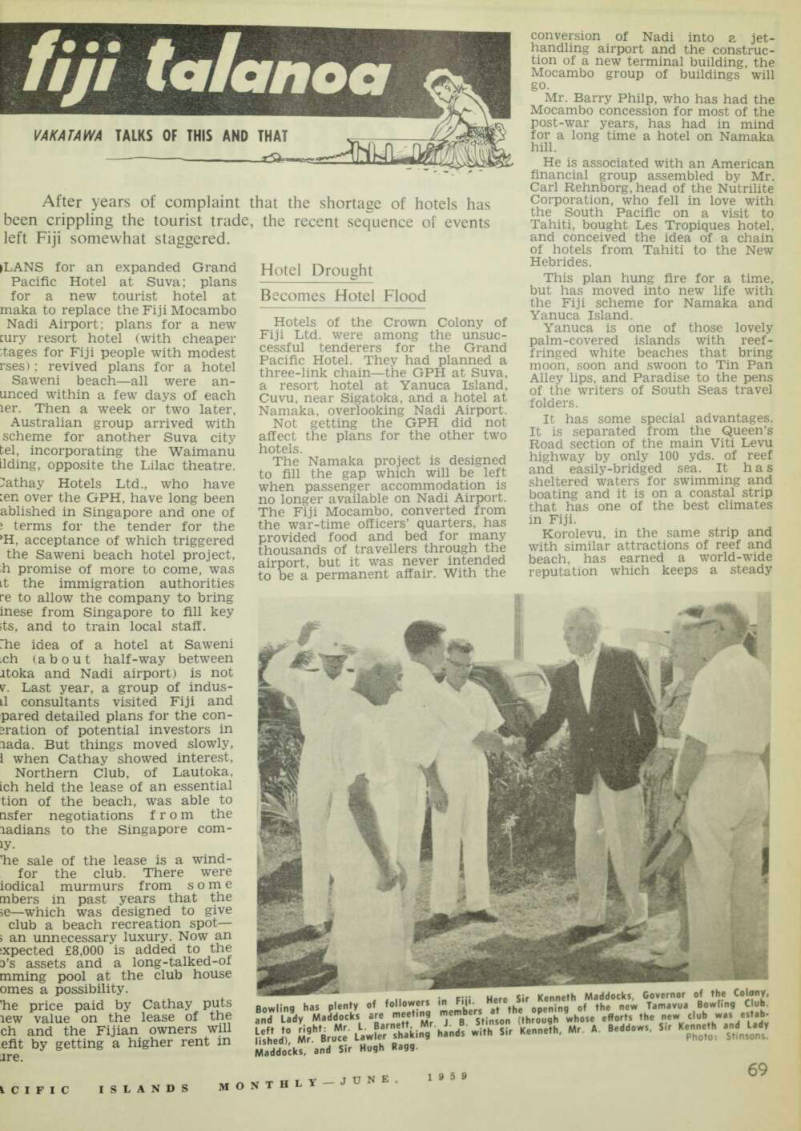
Bowling has plenty of followers in Fiji. Here Sir Kenneth Maddocks, Governor of the Colany, and Lady Maddocks are meeting members at the opening of the new Tamavua Bowling Club.
Left to reght: Mr. L. Barnett, Mr. J. B. Stinson (through whose efforts the new club was estab lished), Mr. Bruce Lawler shaking hands with Sir Kenneth, Mr. A. Beddows, Sir Kenneth and Lady Maddocks, and Sir Hugh Ragg.
tream of visitors flowing into that otel, even in the off-season.
If the prophets are right and if tie jet age is going to bring »urists to the South Pacific in ever icreasing numbers in the next few ears, if Fiji has a permanent jurist future—then the faith of the lanners of the new hotels and the lith of Sir Hugh Ragg, who, by loughing back Northern Hotels rofits year after year has built a lain of well-run, comfortable hotels jund Viti Levu, will be more than istified.
But all this is high-priced, tourist jcommodation. There are plenty of sople—and I’m one of them—who )are a sigh for the old days when iu could get full board in Suva for » a month! igh Cost of
he Right Thing
The recommendations of the cDougall report on the finances of ie Fijian administrative system ive now nearly all been translated to law.
The central purpose is clear. To rengthen the finances of the jian administration, and in par ;ular to open the way for Fijian •ovinces to control their own fairs.
Since the war, the Fijians have come used to the special copra x of £lO a ton, from which the jian Development Fund has been lit up. This fund has given in ridual Fijians, and Fijian com unities in the copra areas, cash sources of a size they seldom inaged to accumulate previously.
Following a McDougall recom mdation, and with the agreement the Council of Chiefs and all the ovincial Councils, the scheme has w been extended to enable taxes be levied on practically all forms agricultural produce, including ?ar cane and bananas, and on iber royalties and the rent of tive land. [t is undoubtedly a good thing ■ any local body—and Fijian mcils occupy a position roughly livalent to County Councils ever ts —to be financially self-support- But anything which requires re money from Fijians in general, irs with particular force on wage •ners —and particularly the lower ge earners—in the main towns, rhe gifts in kind, demanded by ian custom for the entertain nt of guests or for such things funerals, were in simpler days >vided from food gardens or the Jow, when a call comes from a ne village or from a family in i name of custom it has to be >wered in the form of expensive ►ds bought from shops—kerosene, p, flour and the like. 7he call cannot be denied, but for family man with few, or no, ings it is difficult to meet. A
solution is found usually by borrow mg from employers or friends, or at high rates from a money-lender, but there seems little doubt that at least some of the periodical cases of embezzlement have their origin in the heavy financial demands of custom.
An introduced custom which is becoming a particularly heavy drain on Fijian cash resources is that of the expensive wedding. It is not hard for the number of guests at a Fijian wedding to reach out of hand proportions, and when food—and sometimes drink—has to be bought for the occasion the cost can be come a very great burden.
Recent reports from India have told of a move by some of the younger men and women to do away with elaborate weddings and so cut down the heavy financial load forced on families in the past by age old custom.
There is something there for the younger Fijian people to ponder.
All His
Own Work
It is sometimes possible to point to an institution or organisation and say, “That is the work of one man’’. This can be said of the newly formed Fiji Crippled Chil dren’s Society.
The “onlie begetter” is Dr. A. H.
Sahu Khan, of Lautoka, a nomin ated member of the Legislative Council.
He has had the idea of such a society in mind for over a year.
His enthusiasm has been infecti ous and so he gathered a strong committee together. His planning has been thorough and so the society should be effective.
The need for such a society was made clearer by the poliomyelitis epidemic last year, which increased the number of crippled or partially crippled children in hospital. (Over)
Dr. Sahu Khan has pointed out, )wever, that there are many more villages scattered throughout Fiji a number of them possibly stims of earlier epidemics which tracted little notice because edical services and news services jre not as well organised as they e today. ranHfather’c icuiuidinci s idAcs ii 7 ii * t j ,
5 Well As Todays
For more than 70 years, merchants id others engaged in various mey-making occupations in Fiji ,ve been paying fees each year for siness licences. The rates have en changed from time to time, t the general distinction between ose for “town” and “country” has en preserved.
Meanwhile, Suva has become a ;y; towns and townships have tne into being in the former isuntiy”; and local rates have en added to Colony-wide taxes.
Apparently, nobody has thought asking why the business licence stem has been continued—nobody, at is, until Mr. Jim Crawford, co- Dprietor of the Phoenix Theatre Suva wrote to the Fiji Times a >nth or two ago and enquired why ms had to pay for business ences when they already paid micipal rates on their property d income taxes on their profits.
Te asked what special services re rendered in return for the ence fee, and, as an afterthought, asked who started this licence siness anyhow, and why. rhere has since been resolute mce from the Government Buildr ,s, but rumour reports that a irch is going further and further zk into the archives to discover iy a baker, a butcher, an aerated
water manufacturer, a chemist, a cinematograph theatre owner, a pawnbroker, a tailor, a surveyor, a photographer, an architect, an auctioneer, a waterman, a keeper of a kava saloon or a hop beer saloon; an operator of a shooting gallery or a public billiards table should have to pay widely varying rates to carry on business.
There is the Q uestion - too > as to why a h aw ker (general) is charged three times as much as a hawker (wild birds).
In 30 years of moving about Fiji i have not seen a hawker of wild birds nor a hop beer saloon and the formal trade of waterman is no t the most widely practised in the Group. jt seems pretty obvious that the business licence system is a sur- V ival of the days of Fiji’s com mercial and fiscal youth, when there were watermen and hawkers of wild birds, and when revenue was raised through specific fees instead 0 f the more flexible modern forms of taxation based on income or the value of property, One licence which causes con stantly recurring irritation is tnax payable by an agent for a foreign firm. Business men coming to Fiji to explore the possibility of expana ing the Colony’s overseas trade, fina it particularly annoying to oe greeted at airport or customs with a sudden den J a J™.n^hiisiness for the privilege of doing business in Fiji. „ ornl Qnpnt offices in Agents with p pe ™ a r e|son wS. if the Colony see fees these short they havei to Jpay these snor
period
This an• y mo re reasonable P oin L°* V would be that posed by qu es tion f d “Why should an inform of taxation be con arehaic form oi tinned at an.
w. R. Carpenter and Co. (Fiji), Ltd., moved into their new Suva headquarters in Rodwell Road in May. The building is a handsome addition to Suva's many new buildings. The street-level finish is red tiling and glass with timber panels in natural finish. Above the verandah are vertical blue sunshade louvres on the Rodwell Road frontage. The upper portions are in pastel shades of pale green and grey-blue. Photo: Stinsons.