What Future For West Samoa?
p. 21 · Read in the full issue
From a Special Correspondent
New York, Sept. 20
Some of us here were deeply interested in the discussions "between the Trusteeship Council and the delegation from Western Samoa, con sisting of the High Commissioner and the High Chiefs of Western Samoa.
THERE was a welter of words — but the issue was quite clear.
Will the United Nations agree to the abrogation of the Trustee ship Agreement at an early date, so that Samoa can take another step forward towards national in-
dependence? I think considerable progress was made.
Many of the delegates at the Council knew a good deal more about Samoa than we had expected; and thus the Samoans secured the appointment of that Special Mis sion, which will go out to Samoa in 1959 and report upon matters connected with the termination of the Agreement.
It already is clear that the Coun cil will encourage Samoa’s ambition to achieve complete self-govern ment. But which system will the Special Mission favour:— • Release from the Trusteeship, so that Samoa may have full self government under New Zealand protection, based initially on the Matai (family group) system, and not on universal suffrage; or • Insistence by United Nations on complete independence and uni versal suffrage before freeing Samoa from the Trusteeship.
Informed observers here are in favour of the former; and political developments in other South Pacific Territories, especially Fiji, Tahiti, New Caledonia and perhaps Papua and New Guinea—suggest that they should be most interested in this Matai system of electing an As sembly.
It is clear that universal suffrage —especially the system of lumping different racial groups together in one common roll—is unworkable in the majority of South Pacific Islands at this stage of their de velopment.
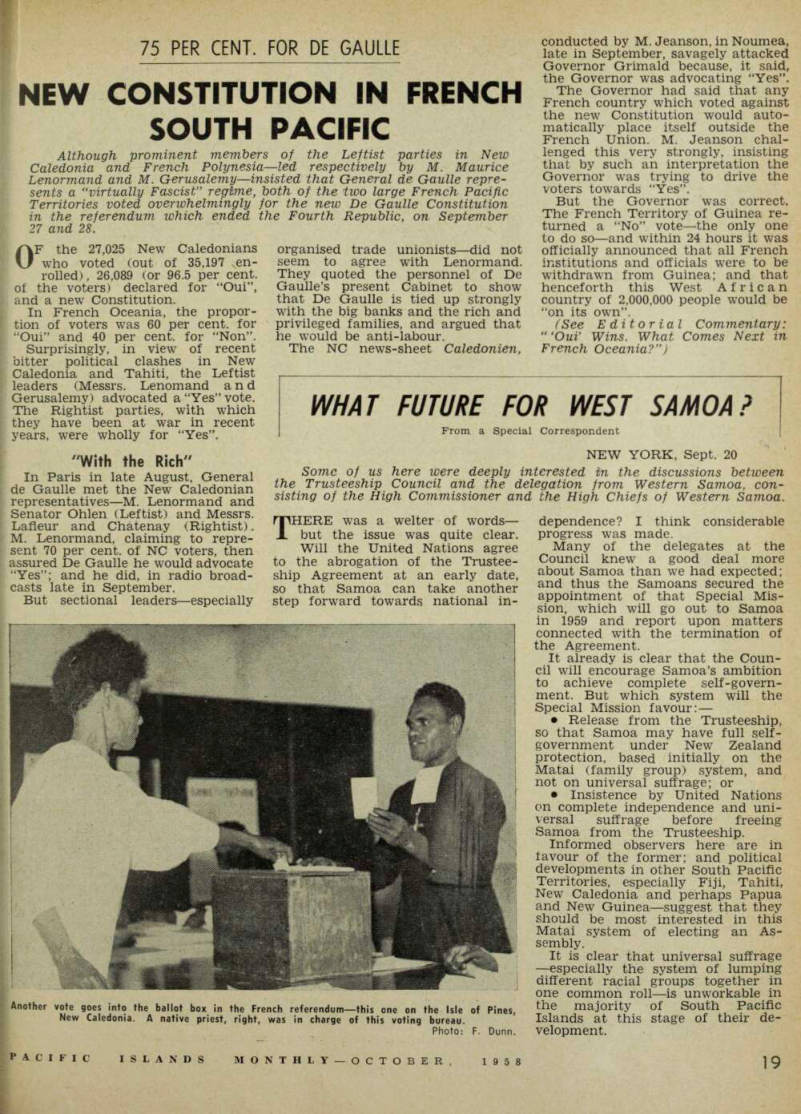
Another vote goes into the ballot box in the French referendum—this one on the Isle of Pines, New Caledonia. A native priest, right, was in charge of this voting bureau.
Photo: F. Dunn.