It's The Mixture As
p. 22 · Read in the full issue
P-NG Copra Plan
It's The Mixture As Before For 1959
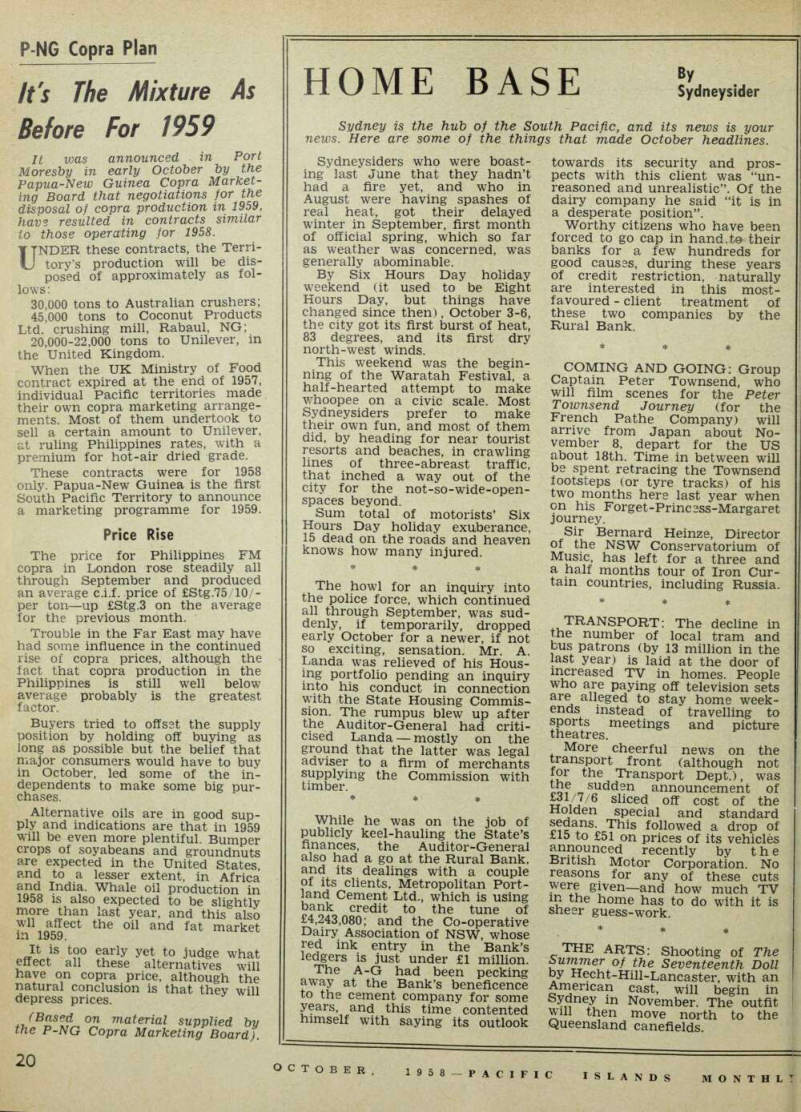
It ums announced in Port Moresby in early October by the Papua-New Guinea Copra Market ing Board that negotiations for the disposal of copra production in 1959, have resulted in contracts similar to those operating for 1958.
UNDER these contracts, the Terri tory’s production will be dis posed of approximately as fol lows: 30,000 tons to Australian crushers; 45,000 tons to Coconut Products Ltd. crushing mill, Rabaul, NG; 20,000-22,000 tons to Unilever, in the United Kingdom.
When the UK Ministry of Food contract expired at the end of 1957, individual Pacific territories made their own copra marketing arrange ments, Most of them undertook to sell a certain amount to Unilever, at ruling Philippines rates, with a premium for hot-air dried grade.
These contracts were for 1958 only. Papua-New Guinea is the first South Pacific Territory to announce a marketing programme for 1959.
Price Rise The price for Philippines FM copra in London rose steadily all through September and produced an average c.i.f. price of £Stg.7s/10/per ton—up £Stg.3 on the average for the previous month.
Trouble in the Far East may have had some influence in the continued rise of copra prices, although the fact that copra production in the Philippines is still well below average probably is the greatest factor.
Buyers tried to offset the supply position by holding off buying as long as possible but the belief that major consumers would have to buy in October, led some of the in dependents to make some big pur chases.
Alternative oils are in good sup ply and indications are that in 1959 will be even more plentiful. Bumper crops of soyabeans and groundnuts are expected in the United States, and to a lesser extent, in Africa and India. Whale oil production in 1958 is also expected to be slightly more than last year, and this also wll affect the oil and fat market in 1959.
It is too early yet to judge what effect all these alternatives will have on copra price, although the natural conclusion is that they will depress prices. (Based on material supplied by the P-NG Copra Marketing Board).