New Constitution In French
p. 21 · Read in the full issue
75 Per Cent. For De Gaulle
South Pacific
Although prominent members of the Leftist parties in New Caledonia and French Polynesia—led respectively by M. Maurice Lenormand and M. Gerusalemy—insisted that General de Gaulle repre sents a “virtually Fascist” regime, both of the two large French Pacific Territories voted overwhelmingly for the new De Gaulle Constitution in the referendum which ended the Fourth Republic, on September 27 and 28.
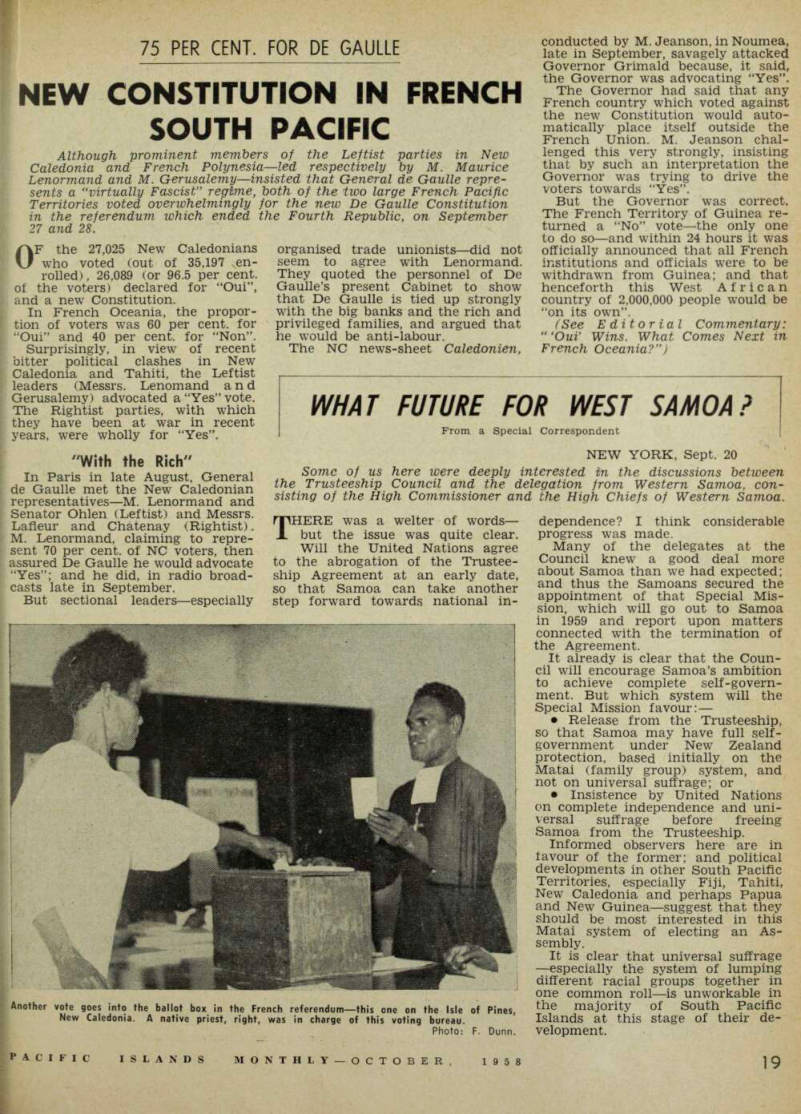
OF the 27,025 New Caledonians who voted (out of 35,197 en rolled) , 26,089 (or 96.5 per cent, of the voters) declared for “Oui”, and a new Constitution.
In French Oceania, the propor tion of voters was 60 per cent, for “Oui” and 40 per cent, for “Non”.
Surprisingly, in view of recent bitter political clashes in New Caledonia and Tahiti, the Leftist leaders (Messrs. Lenomand and Gerusalemy) advocated a “Yes” vote.
The Rightist parties, with which they have been at war in recent years, were wholly for “Yes”.
"With the Rich"
In Paris in late August, General de Gaulle met the New Caledonian representatives—M. Lenormand and Senator Ohlen (Leftist) and Messrs.
Lafleur and Chatenay (Rightist).
M. Lenormand, claiming to repre sent 70 per cent, of NC voters, then assured De Gaulle he would advocate “Yes”; and he did, in radio broad casts late in September.
But sectional leaders —especially
organised trade unionists—did not seem to agree with Lenormand.
They quoted the personnel of De Gaulle’s present Cabinet to show that De Gaulle is tied up strongly with the big banks and the rich and privileged families, and argued that he would be anti-labour.
The NC news-sheet Caledonien,
conducted by M. Jeanson, in Noumea, late in September, savagely attacked Governor Grimald because, it said, the Governor was advocating “Yes”, The Governor had said that any French country which voted against the new Constitution would auto matically place itself outside the French Union. M. Jeanson chal lenged this very strongly, insisting that by such an interpretation the Governor was trying to drive the voters towards “Yes”.
But the Governor was correct.
The French Territory of Guinea re turned a “No” vote—the only one to do so—and within 24 hours it was officially announced that all French institutions and officials were to be withdrawn from Guinea; and that henceforth this West African country of 2,000,000 people would be “on its own”. (See Editorial Commentary: “ ‘Oui’ Wins. What Comes Next in French Oceania?”)