For Another To Fill
pp. 51-53 · Read in the full issue
Mr. W. C. Groves Leaves New Guinea
A Man Of Many Parts Looks
Probably no Public Servant ever left the Territory of Papua-New Guinea so inundated with expressions of goodwill from every section of the community as did retiring P-NG Director of Education, Mr.
W. C. Groves. He retired on August 8 and with Mrs. Groves, who also received her own share of good wishes as a tireless worker for the community, left Port Moresby on the Bulolo.
YET strangely enough (or perhaps not so strangely) Mr. Groves regards the period he spent in the Solomons in 1939-40, as Adviser on Education to the Protectorate Government, as the most satisfying of his Pacific service In this special job, he says, he experienced the breadth of mind of the British Colonial Office, which selects the man it feels is qualified to do the work, and then leaves him alone to carry it out.
Latfpr-Dav Pnhlir Servant taner uay ruonc servant Bill Groves has been in and out of the New Guinea and other South West Pacific territories so often since 1922 that most present-day Territorians regarded him as a NG public servant from “along before”, This was not so.
He joined the P-NG Public Service only in 1946, when he became Director of Education. All his previous appearances in the Territory were as an officer of the Victorian Department of Education,
on secondment to New Guinea (and later Nauru and BSIP).
In 1922, when Australia had lately acquired the Mandate of New Guinea, he got the job of ofncer in-charge of Education (on loan from the Victorian Dept.) because, he says, he knew German. During the years 1922-25 he estabhshed the school at Malaguna but in 1926 re turned to Victoria, where he became lecturer in Social Studies for the
Education Department.
It was 1931 before he was back in th e Territory again; by this time he was a Resea rch Fellow m Anthropology, Australian National Research Council. A Rockefeller grant provided the finance for field work in New Ireland on “culture contacts”—a new term then, but something that now has become part of anthropological jargon.
He made three trips to New Guinea between 1931 and hwj>— taking in Tabar and Finschhaien as well as New Ireland—and in was Australia’s representative at the Carnegie-Yale Semmar-ton
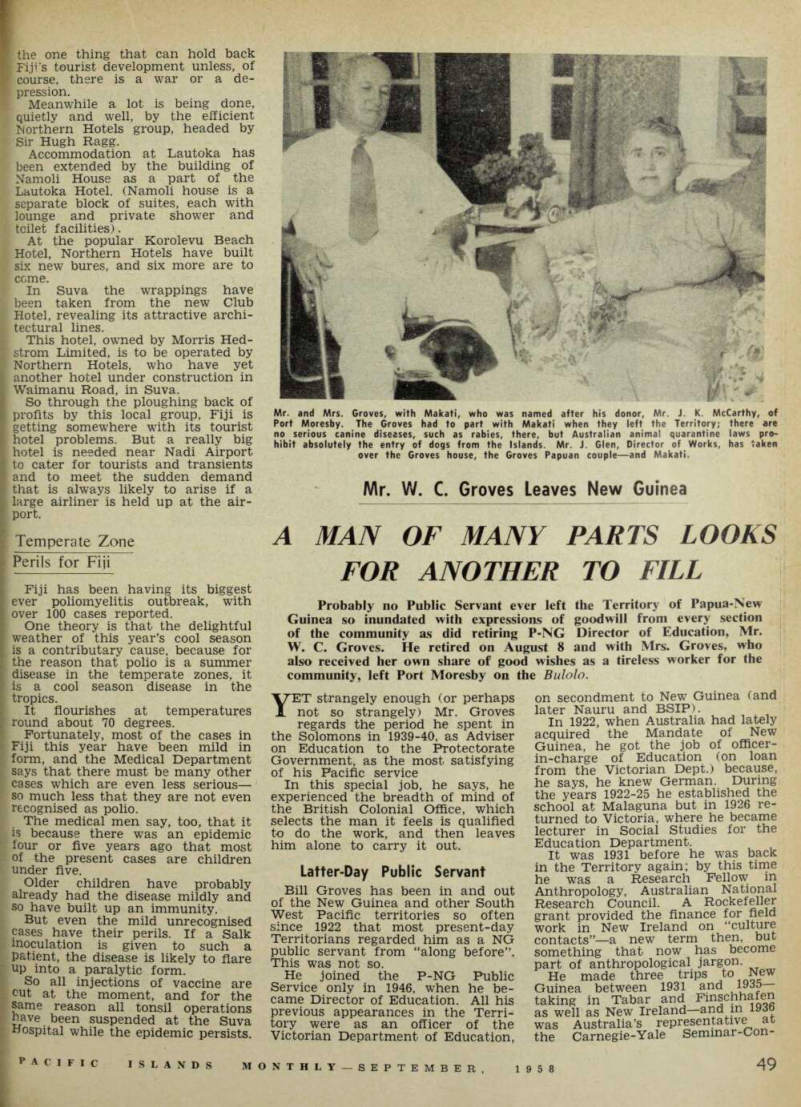
Mr. and Mrs. Groves, with Makati, who was named after his donor, Mr. J. K. McCarthy, of Port Moresby. The Groves had to part with Makati when they left the Territory; there are no serious canine diseases, such as rabies, there, but Australian animal quarantine laws pro hibit absolutely the entry of dogs from the Islands. Mr. J. Glen, Director of Works, has taken over the Groves house, the Groves Papuan couple—and Makati.
ference on Education in Pacific Countries, in Honolulu.
In 1937-38 he was “on loan” again—this time to Nauru as Director of Education and Adviser on Native Affairs. In 1939-40 he went to the Solomons but the Vic torian government got him back briefly in 1941-42 when he was lecturer in Social Studies, Mel bourne Teachers’ College.
ROW in First, PRO in Second
Bill Groves served as an infantry man in the Ist AIF, in Egypt and the Western Front, where he was taken prisoner in 1917. Being a POW improved his German, if it did little else for him, and as a result he was on the staff of the Inter-Allied Commission for Re patriation of POW in Germany, and did not return until 1919.
In the Second War he joined up again—Staff Captain (Administra tive) and later Major in Australian Army Education Service. He was sent to Moresby where he was, amongst other things, the Army’s first PRO, mothering war corres pondents who congregated there in the Kokoda Trail days. He also edited the Moresby Army News Sheet. In 1944 he was a special investigator into the welfare of aborigines in North Australia.
In 1945 he thought he was finished with New Guinea, and had returned contentedly, at last, to an admini strative job in the long-suffering Victorian Department of Education.
Back to the Territory
Then in 1946, the Department of Territories, Canberra, offered him the post of Director of Education, P-NG. He wasn’t keen, but agreed to go and look it over.
The Victorian Education Depart ment said, “Right—but this is the last time we loan you. Six weeks, no more. If you join this P-NG Administration, you leave us, finish”.
And that is how William Charles Groves, BA, Dip. Ed., came to join the P-NG Public Service.
If every official appointment, every Board and Council to which he has been chairman or a member, were catalogued it would fill a column of type: Member of the Legislative and Executive Councils, Education Boards, Health Boards, Advisor to Australian delegation, to inter national conferences, member of the South Pacific Commission Re search Council—he’s been the lot.
And in a private capacity, as a Territorian, he has been a lot more; ~me* Scout Commissioner for Loo ’ vice-president of the RSSAILA, Port Moresby sub branch; etc., etc.
So many and various were the farewells to the Groves couple in Port Moresby in August that the social calendar seems to have been devoted to little else. They were jarewelied at Sogeri, and by the Education Advisory Board, and by
the Legislative Council at a dinner at Government House; by the RSL (which made Mr. Groves a lifemember); by the Hanuabadan villagers (several parties); Scouts (who lit a chain of bonfires all over the Territory in farewell); Masons; Church of England, Historical and Scientific Societies.
The Groves received many gifts but it was left for members of Mr.
Groves’ own department to signify the degree of affection in which their retiring Director was held.
It is not usually regarded as etiquette to mention cold cash on such occasions, but as we have never heard before of a public servant receiving, from his own staff, a wallet containing almost £5OO, we mention it here.
And what of the future? Mr. and Mrs, Groves now have left Sydney for Melbourne where they will probably spend some months, Mr. Groves has already spared a passing thought or two to short term UNESCO jobs in Ethiopia and British Cameroons, but he says, “not until after Christmas”.
One thing is certain, however: No man who has devoted 35 years to native problems is going to give up so easily, even if he has reached the official retiring age. He reckons he could spare another couple of years, at least, to the cause—and then, if he must, he might be pre pared to sit quietly at some other task—such as producing supple mentary readers for natives literate in simple English.