Fiji Talanoa
pp. 47-51 · Read in the full issue

Vakatawa Talks
Of This And That
The South Pacific Island custom of closing up business in the middle of the day and going home to lunch is disappearing in Suva where a number of businesses now keep open all day.
FROM time immemorial it has been the custom for the bigger stores and nearly all offices to close for lunch between 1 p.m. and 2 p.m. The custom is perhaps the equivalent of the siesta.
Overseas visitors frequently com ment on it, especially when they are in the Colony for only a few hours in a passing ship, and find their shopping period curtailed.
Burns Philp in Suva have cut the first prop from under the custom. From the beginning of Sep tember their store is to remain open from 8 a.m to 4.30 p.m.
Other stores are following suit.
Whether Government offices will do likewise remains to be seen.
The Passing
of the Bure A scheme to provide houses for Fiji’s lower paid workers is under way.
It is another of those delayed things.
Mr. J. N. Falvey took the initiative in Legislative Council over two years ago and a Housing Authority was set up. But there the situation rested. The Authority had no money, no office and no staff.
Then this year things began to move. Mr. K. R. Bain, an Adminis trative Officer, was sent to the West Indies to see how the problem was tackled there.
He has now been appointed Executive Secretary of the Com mission, and Mr. Falvey has agreed to be Chairman. The Government has given land for the first batch of houses in Suva, an architect has been engaged as a technical adviser, and the commission is ready to go.
Houses of various types are already competing, not only for the Com mission’s attention, but also for that of the Fijian authorities and the people of Fijian villages.
The “igloo” described in last month’s PIM is now being produced in Suva. The “Dovi” type house —a wood and iron structure reduced to its simplest form—is already in many Fijian villages.
The “Uniport”, an English pre fabricated house of either steel or aluminium, is also on sale.
These, and others which may appear on the market or which may be developed by the Commission, seem likely to replace the “Nettle ton” house, which has been used in
the past four or five years for smaller Government quarters and in the Nabua Fijian settlement near Suva, This last house, which was de signed by a former government architect, is based on concrete slabs which slide in the grooves of con crete pillars.
The principle is simple enough, and is common in children’s con struction toys, but in practice it has been found that a good deal of skill is required to erect the houses and this has helped to de feat the “low cost” aim.
The romantic may mourn, but it does seem inevitable that houses of timber or steel or aluminium or concrete will gradually replace the thatched bures of many Fijian villages.
The bure is pleasing to the eye and cool to live in, but building and maintenance take up an inordinate amount of time of Fijian men, and as more land is brought under culti vation the materials for building bures are becoming harder to get and more costly to transport to village sites.
Dogs a “Grave
Social Menace”
The August PIM told of the dog nuisance in the Cook Islands and New Guinea.
Fiji residents who are kept awake by yowling packs, or farmers whose animals are destroyed or maimed by wild dogs, also have strong feel ings on the subjects.
The trouble in Fiji is that no par ti cul a r Government department acknowledges responsibility for de stroying stray dogs.
The Suva City Council does a fairly good job, but can’t cope with animals coming into the city from the outside. Another difficulty is that Council has power to destroy only unregistered dogs, and ones which cause the trouble are very often registered, but allowed by their owners to run loose.
The biggest problem of all arises from the refusal by many Indians, for religious reasons, to kill un wanted puppies.
A certain nicety of interpretation of religious practice comes into play here. The puppies may not be drowned at birth, but many of them are abandoned on the road-side or in the bush to starve, or dropped into someone else’s property in the hope that the owner of the property will either adopt the animals or at tend to their destruction.
Other dogs struggle to maturity and then, through being unfed at home, became an uncontrolled, scavenging nuisance.
In the war years and after, a one woman war was waged on neglected dogs at Ba and later Lautoka, by Mrs. Kirk. (Over)
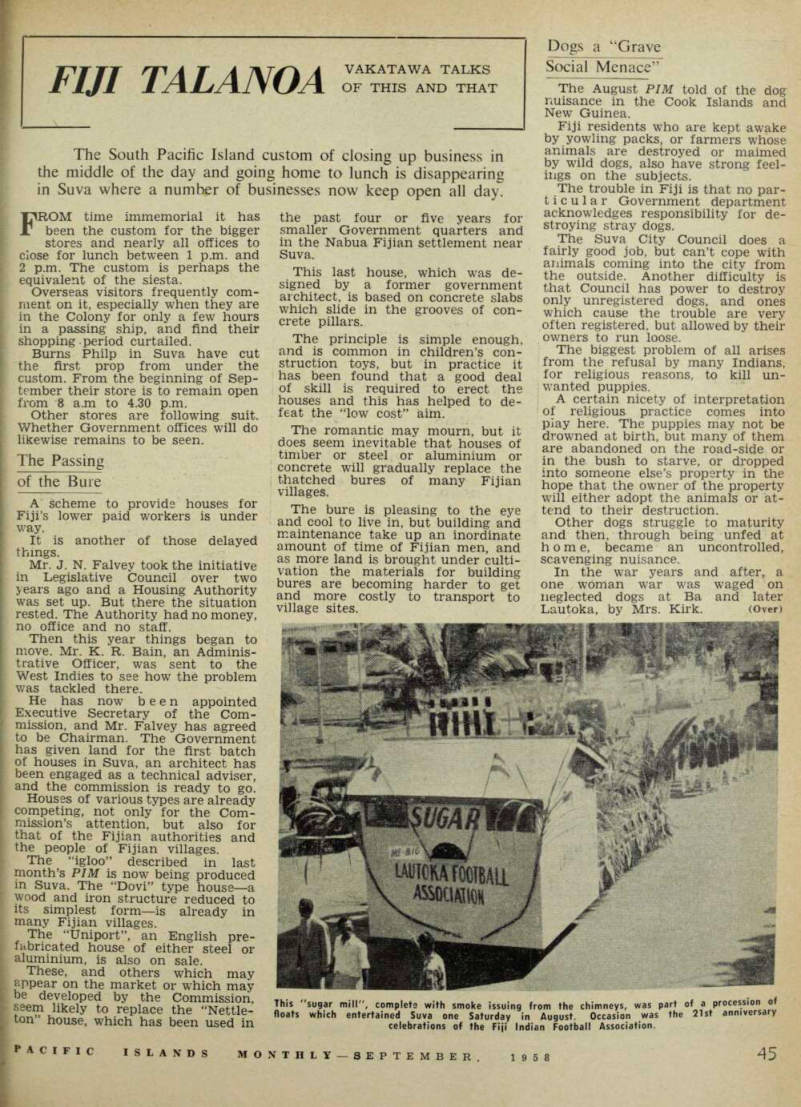
This "sugar mill", complete with smoke issuing from the chimneys, was part of a procession of floats which entertained Suva one Saturday in August. Occasion was the 21st anniversary celebrations of the Fiji Indian Football Association.
She was one of the pioneers of the SPCA in Fiji and the society has played its part from time to time in the war against the dog menace. But funds are limited, and it is not particularly desirable for such a body to have as its principal occupation the hunting down and destruction of animals.
Early this year a high-powered committee, bristling with mayors and legislative council members and senior Government Officers, was set up to examine the problem.
They produced a report which twice uses the words “grave social menace”, to describe the dog situ ation, a description that seems to oe overdoing it a bit.
The result of their report is likely to be that the job of control will be passed on to the police.
The Committee came to the con clusion that the only practical way of dealing with roving packs of dogs which invade town areas is to lay poison baits, and they recom mend this despite the objections ex pected from those who think the use of poison inhumane.
Some Movement
on the Hotel Front Things are moving a little on the Fiji hotel front.
Information is scarce about the pians of the Rehnborg group, who Tw e i go i ng buy the Grand Pacific Hotei, Suva, and/or build on the adjommg and at the same n? 16 *! 0111 xJ 1 a *? otel build ing venture Nadi h Airpo?t maka hM OVerlooking
But representatives of the group have been visiting Tahiti again and Mr. Harvey Hunt, who is a director of the company formed to control the Fiji activities, says that present plans are to concentrate on Tahiti and to spread westward, later.
The group already owns Les Tropiques hotel in Tahiti.
Meanwhile, a Canadian group of investors have interested themselves in Saweni Beach, near Lautoka.
One of them saw the beach with Mr. C. A. (Gerry) Adams several years ago and when the question of hotel accommodation of Canadian Pacific Airlines passengers using Nadi airport came up he remembered this beach, which is only a few miles from the airport.
He wrote to Mr. Adams, and shortly afterwards sent a team of consultants to Fiji to draw up a hotel scheme and to look into such matters as the acquisition of land and the provision of services. [Details of their scheme are given elsewhere in this issue.] So many new hotels in Fiji have got to the stage of plans and pro posals—but no further —that the people of the colony are a bit cautious in their approach to any new one.
But in this case they have their fingers crossed, and hope very much that the hotel will be built—and that the Rehnborg group plans will bear fruit, too.
Hotel accommodation seems to be
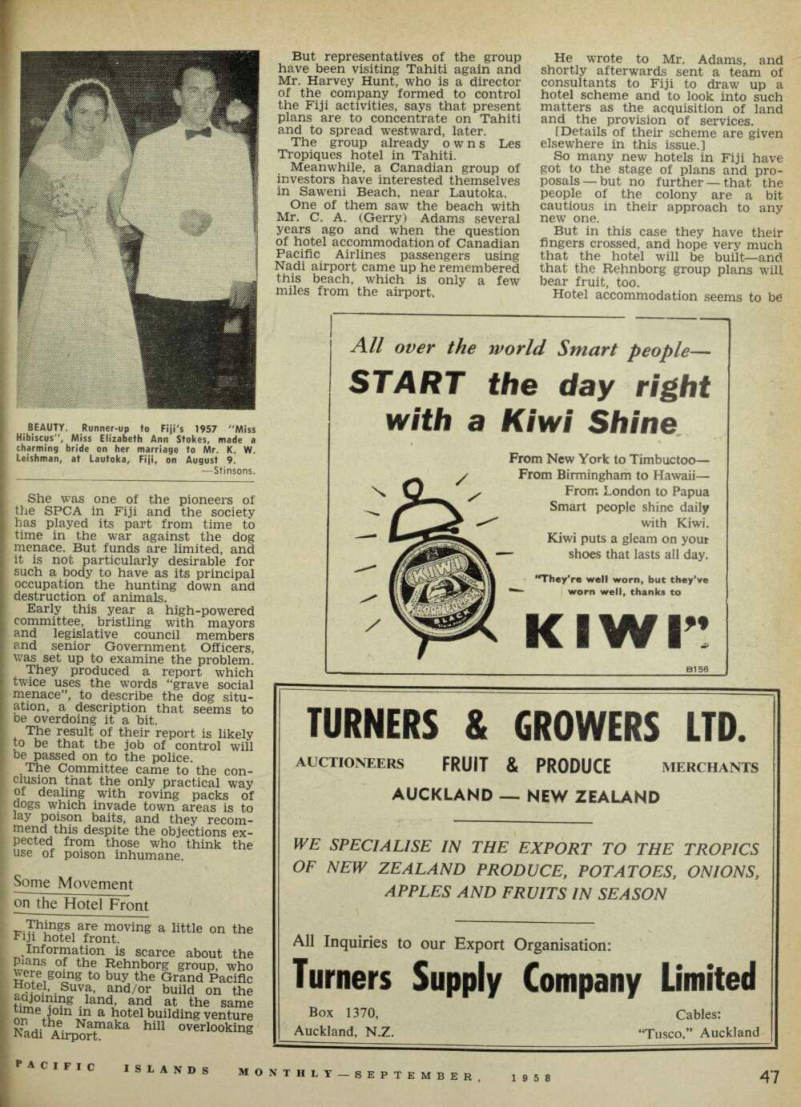
BEAUTY. Runner-up to Fiji's 1957 "Miss Hibiscus", Miss Elizabeth Ann Stokes, made a charming bride on her marriage to Mr. K. W.
Leishman, at Lautoka, Fiji, on August 9. —Stinsons.
the one thing that can hold back Fiji’s tourist development unless, of course, there is a war or a de
pression.
Meanwhile a lot is being done, quietly and well, by the efficient Northern Hotels group, headed by Sir Hugh Ragg.
Accommodation at Lautoka has been extended by the building of Namoli House as a part of the Lautoka Hotel. (Namoli house is a separate block of suites, each with lounge and private shower and toilet facilities).
At the popular Korolevu Beach Hotel, Northern Hotels have built six new bures, and six more are to come.
In Suva the wrappings have been taken from the new Club Hotel, revealing its attractive archi tectural lines.
This hotel, owned by Morris Hed strom Limited, is to be operated by Northern Hotels, who have yet another hotel under construction in Waimanu Road, in Suva.
So through the ploughing back of profits by this local group, Fiji is getting somewhere with its tourist hotel problems. But a really big hotel is needed near Nadi Airport to cater for tourists and transients and to meet the sudden demand that is always likely to arise if a large airliner is held up at the air port.
Temperate Zone
Perils for Fiji
Fiji has been having its biggest ever poliomyelitis outbreak, with over 100 cases reported.
One theory is that the delightful weather of this year’s cool season is a contributary cause, because for the reason that polio is a summer disease in the temperate zones, it is a cool season disease in the tropics.
It flourishes at temperatures round about 70 degrees.
Fortunately, most of the cases in Fiji this year have been mild in form, and the Medical Department says that there must be many other cases which are even less serious— so much less that they are not even recognised as polio.
The medical men say, too, that it is because there was an epidemic four or five years ago that most of the present cases are children under five.
Older children have probably already had the disease mildly and so have built up an immunity.
But even the mild unrecognised cases have their perils. If a Salk inoculation is given to such a patient, the disease is likely to flare up into a paralytic form.
So all injections of vaccine are out at the moment, and for the same reason all tonsil operations have been suspended at the Suva Hospital while the epidemic persists.