Everything Is Getting Bigger
pp. 55-57 · Read in the full issue
Latest on Pacific Air Services
And Better All The Time
Next year. 1959. is going to be a big year in Pacific aviation. It will see the first pure jet aircraft running on the Sydney-North America services; and something better than Skymasters on the Sydney-Port Moresby service. But aviation is not just standing still waiting; there is plenty going on in the Pacific area, right now. This month Pan American introduces new planes to their trans-Pacific service; and next month, TAI will begin its new Paris-Papeete service.
IN October, for the first time in history, French Oceania residents are going to have the choice of two air services out of Papeete: Tasman Empire Airways Ltd., whose service was due for full funeral rites in July but was revived in mid-August; and a new service by the French airline, Transports Aeriens Intercontinentaux, which will connect this French Colony directly with Paris—also for the first time in history.
TEAL will be back on the job on September 18 with a Solent, flying again the Suva-Satapuala (W.
Samoa) Aitutaki (Cook Is.) Papeete route, and making the Fiji-Auckland link with DC6 air craft.
TAI will be using DC6B aircraft as far as Bora Bora, and the Bermuda flying-boat the company recently purchased from Sir Gordon Taylor, to ferry passengers from there to Papeete—about 60 miles. (Papeete has not yet made a start 9 n its long-discussed aerodrome, but if anything is likely to get it going, it is the decision of the big French airline to begin this new service).
This TAI service will be in addition to the service which now leaves Paris on Sundays and flies via the Middle East route to Darwin, Brisbane, Noumea and terminates in Auckland.
A Brand New Service The new French Polynesia service will follow the same route to Darwin then will fly Noumea-Nadi (Fiji)— Bora Bora.
Exact details of the times of arrival and departure at the various points have yet to be worked out.
A proving-flight was being made by the company in late August; another such flight will be made, probably in September, and the real service will begin from Paris on September 28, leaving Noumea on the Pacific leg of the journey on October 2.
With the other TAI flight already extending to Auckland, it might, of course, be a temptation to New to desert their own for the delights of foreign travel—if they can get sufficient currency to get out of God’s Own Country, in the first place.
As things are at the moment, for a passenger poised in Auckland, advantages and disadvantages are just about evenly balanced between the French and the New Zealand company.
Teal V. Tai
By the French airline, our passenger would have to break his journey in Noumea and change
planes, and again in Bora Bora, from which point he would have to make the last lap in a flying-boat.
By TEAL, he would have to fly to Nadi by landplane, then take the small Fiji Airways plane, or bus or car, for the 100 miles to Suva, where he would join the Solent.
The DC6B planes are modern, fast and pressurised. The Solents are slow, seeing their last service days, and unpressurised. But as opposed to that, the TEAL traveller would get a chance to see Aitutaki and Samoa—and there are still a lot of people who find the spaciousness of the flying-boat, and its gait, much to their liking.
New Planes for Pan-Am
At the end of this month new planes will be introduced to the trans-Pacific service by Pan American World Airways.
These new DC7C’s are con ventional piston aircraft—but they are bigger and faster than the
Boeing Stratoclippers now used by PAA, and will cut seven hours off the Sydney-San Francisco flight.
They can accommodate from 48 to 105 passengers—depending upon whether it is economy Tourist class or luxury First-class. These planes have a range of 5,000 miles—if necessary. On their new schedules they will overfly Canton Island — which will be used merely as an alternative if Fiji is closed.
But good as they are, the DCTC’s will be replaced at the end of 1959 on the Pacific route by DCS jets.
Qantas also will have jets—Boeing 707’s—on the Pacific route next year.
Work currently being done on Nadi airport has temporarily closed one runway. Qantas aircraft on southbound trans-Pacific flights will now call at Canton (they usually overfly this stop) and refuel. This will allow them to fly to within 45 minutes of Nadi, and then if the one serviceable airstrip is closed by weather, to have ample reserves to return to Canton.
New Deal for NG Papua-New Guinea folk will be getting a new air travel deal in 1959, also—at least on the Australia- Port Moresby section.
It is expected that the new Port Moresby airstrip will be ready for Super Constellations in early January—although there are still,
apparently, some problems to be ironed out about taxi-ways and hard-standing. Maybe, at first, Moresby will have to adopt the European system of driving passengers out in buses to the ain-, craft—waiting on or near the run ways—instead of having them walk out of the terminal building right onto the plane.
The Super Constellations on the Port Moresby service will carry round about 60 passengers, in what are called “standard” seating arrangements.
A Super Constellation can carry over 80 passengers on Tourist services, and as few as 40-odd on luxury all first-class services. With 60 seats for passengers, New Guinea travellers are going to come some
where between the two extremes They will probably have a bit more room for their legs than the travellers on the present Skymaster services—and that is going to be a very good (and necessary) thing But they aren’t going to get as much room as the first-class travellers on the UK and US services who have about an acre of space apiece—and pay for it.
Seating arrangements in airplanes are a matter of book-keeping. An airline operator expects to get a certain return from any one journey of any one plane. If there are seats for only 40 in that plane they are going to have to pay more per seat than if there are 60 seats and 60 paying passengers to take the strain.
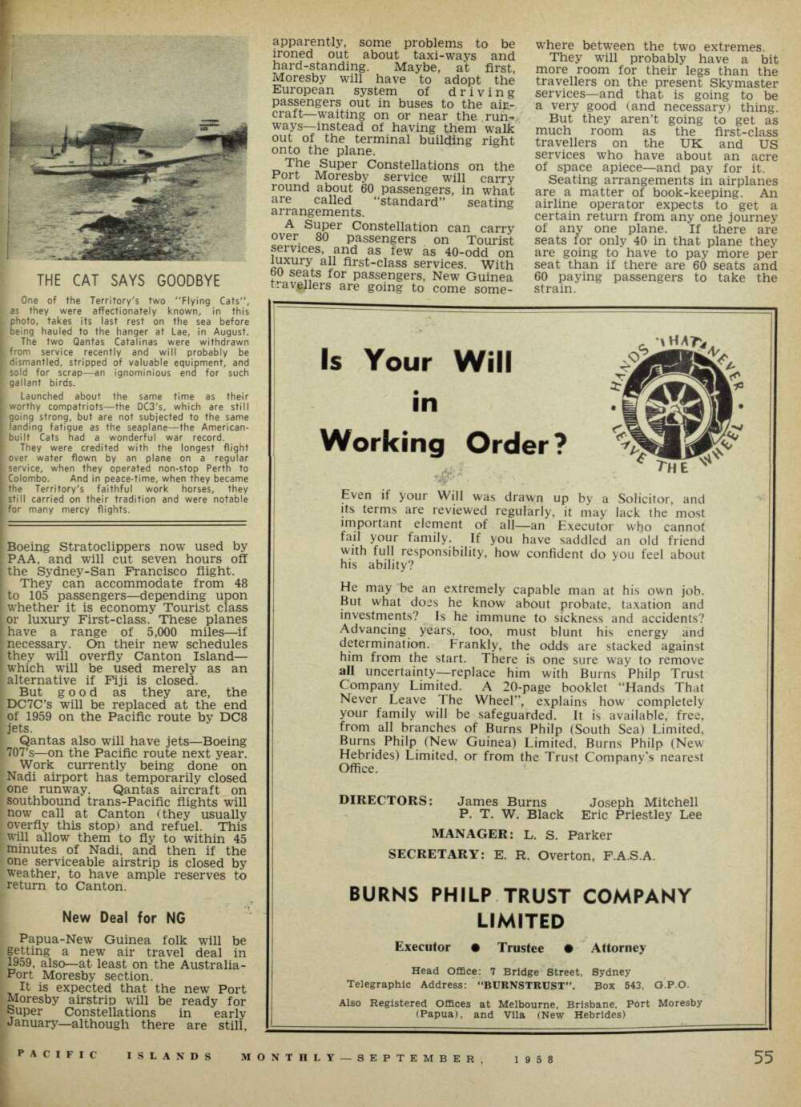
The Cat Says Goodbye
One of the Territory's two “Flying Cats", as they were affectionately known, in this photo, takes its last rest on the sea before being hauled to the hanger at Lae, in August.
The two Qantas Catalinas were withdrawn from service recently and will probably be dismantled, stripped of valuable equipment, and sold for scrap—an ignominious end for such gallant birds.
Launched about the same time as their worthy compatriots—the DC3's, which are still going strong, but are not subjected to the same landing fatigue as the seaplane—the American built Cats had a wonderful war record.
They were credited with the longest flight over water flown by an plane on a regular service, when they operated non-stop Perth to Colombo. And in peace-time, when they became the Territory's faithful work horses, they still carried on their tradition and were notable for many mercy flights.