He Likes It There!
pp. 92-93 · Read in the full issue
Samoa for Nino
TWO years ago, when I left Sydney, it was raining, and had been raining for weeks.
Mould and mildew and musty smells were an integral part of suburban life.
Today, as I write, it is raining, and has been raining for weeks, and mould and mildew and musty smells are an integral part of life at Moto’otua, under cloud-crowned Mount Vaea, on top of which Robert Louis Stevenson “lies where he longed to be”, with a block of concrete to keep him down.
Beads of moisture gleam in the fly wire, paper and typewriter are damp, perspiration runs down my shirtless chest and dampens the waist of my lavalava, and small red ants investigate my toes.
But I wouldn’t be anywhere else.
Even at the end of the wet season, in March the month of storms, Samoa is beautiful.
James A. Michener says of part of it, the road from Faleolo airport to Apia, that no more beautiful drive can be found anywhere in the South Pacific. This statement could be applied to any road on Upolu, the most beautiful of the w«tern ea s!i l £i islands that are Western Samoa Roads and villages around the coast, mountains and waterfalls
inland, and white water foaming on the reefs around them all. - . c n . D .
Trade Winds, Four Poster Beds a lovely, generous, lazy land, where food grows on trees, nothing matters, nothing is ever urgent, and the Trade Winds come in April, A land where the old Polynesian way of life has scarcely changed in centuries. Outside commercial Apia, a few refrigerators, a few radios, an occasional ancient four-poster bed remind us of other lands and other ways.
Lavalavas made of imported cloth are we lcome additions to the ancient as is imported pisupo —any of m 9 a i' in tins. An addition the ancient games is kilikiti, but tn< r gentlemen of the MCC would n °t recognise it.
British and Americans and Germans have come and gone, New Zealanders are going after 1960, and language and the customs nave survived them all. English taught in all schools, and many Bamoans speak it, but none to each other, . .. xl ...
Da( o Mum, the Kids — Plus „ The United Nations Trusteeship Council expects New Zealand to deliver an independent democratic Samoa by November, 1960. It is a
thankless task, and I think a hope less one. The basic principles of democracy are universal suffrage and the right of private property.
Samoans flatly refuse to accept either principle. The basic unit of their society is the family.
Not “mum an’ dad an’ the kids” as we know such a unit, but blood relations, adopteds, and volunteers serving an autocratic family head, who is elected. Being elected, he can also be deposed, but this is rare, as his potential leadership is well known before his election.
What the AAatai Say, Goes These family heads are known as matai. They administer the com munal land and its products on behalf of the family. Their duty is to serve the family; the duty of the family is 1 to obey them. Under the old system, the matai elected the village chiefs, the village chiefs elected the faipule —h ea d s of traditional political districts —and the faipule governed the country.
The first major step towards democratic government, as we know it, was taken last November, when a Legislative Assembly was elected, consisting of 41 Samoans, five Euro peans and two appointed official members (the Attorney-General and the Financial Secretary).
“Universal suffrage” elected the five Europeans, but the matai alone elected the Samoan representatives.
Foreign goods are earned by the export of cocoa, copra and bananas.
There is a strong objection to tourism, and to foreign capital.
Basically, the matai rule the country, but since they are elected, the system could be called “voluntary feudalism”.
The literary surprise of the year was to find that “Nino Culotta”, author of the Aus tralian best-seller, “They're a Weird Mob”, was really an Australian with the un-Italian name of John O’Grady, who was doing a term as pharma cist at the Apia Hospital, Western Samoa. He is now writing a boqjx about Samoans, and if this article on his re actions to the Territory is a fair sample, the result is again going to be orright mate.
It is published here by courtesy of the Australian quarterly “Quadrant”, in whose Winter issue it recently appeared.
Samoans are Christians. There' are no exceptions. Every Samoan belongs to one of the established Churches. The London Missionary Society has the largest memberships closely followed by the Catholics’ with Methodists, Mormons ano Seventh Day Adventists bringing urrj the rear. There is a small band ac Anglicans, mainly Europeans.
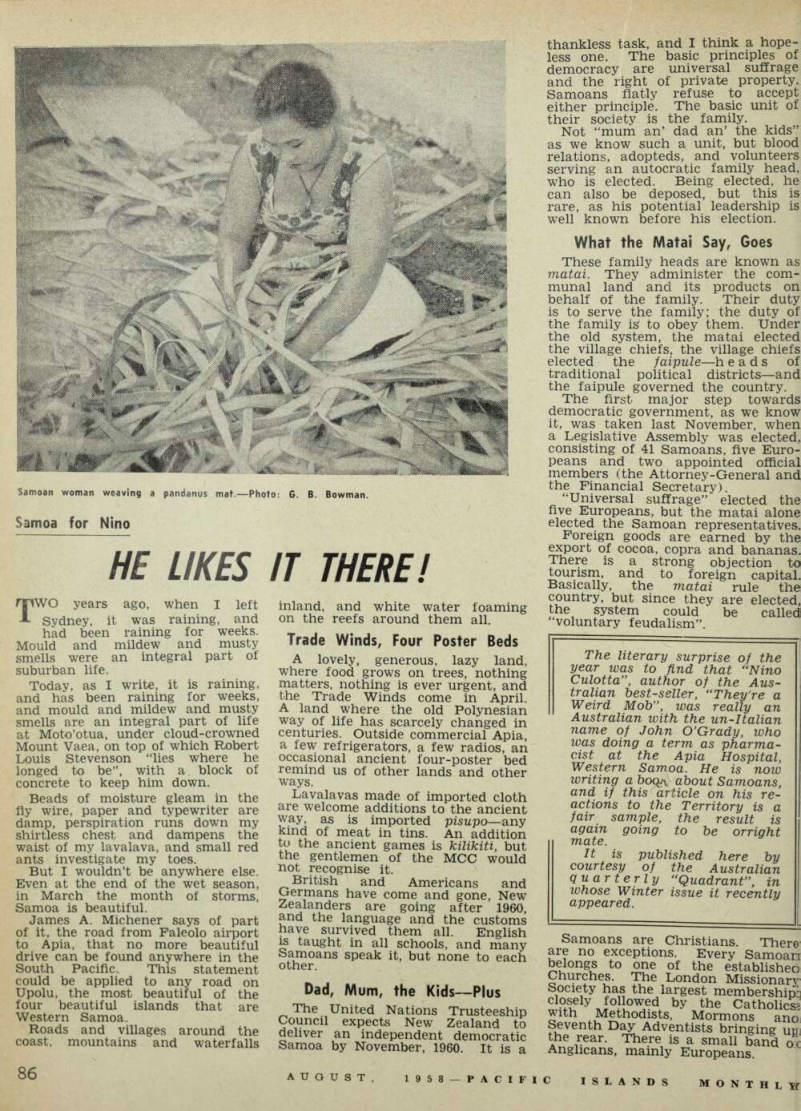
Samoan woman weaving a pandanus mat.—Photo: G. B. Bowman.
Everything stops on Sunday.
Sunday is a day for dressing in white, going to Church, gossiping, visiting and sleeping.
They are a fun-loving people, and although Sunday is a day of no work, it is not a day of no laughter.
Laughter is the sound most often heard in the land. It is heard loudest when somebody falls flat on his face in the mud.
Young men are broad-shouldered and powerfully muscled, but the corpulence and slow-moving dignity of middle age command great respect.
From middle-aged men is ex pected dignity, courtesy, knowledge of ceremonial customs and forms of social politeness, firmness of authority and decision.
The elderly provide wisdom and advice, and receive high honour.
The young work, and are expected to “walk lightly and speak softly”.
Rudeness, brusqueness and lack of consideration for others are prac tically unknown. Samoan social civilisation is highly evolved, and makes at least one Sydneysider humbly conscious of his past deficiencies in tendering full and due courtesy to his fellows.
Of course, with no trains to catch, or timetables to keep, there is never need for haste, and haste is the breeder of most of our dis courtesies.
How to Manage Children
Population? A census in Sep tember, 1956, showed just under 100,000, of whom 45 per cent, were under 15 years of age. As well as being a land of laughter, it’s a land of children. The birthrate is around the four per cent. mark.
And the behaviour of the children is something we can really envy.
Children must not annoy adults, and each is guarded by one a little older. Should the younger annoy, the older gets beaten. The result of this is that the younger, to quieten him, is given everything he wants. But before he can acquire delusions of grandeur, he in turn has a young one to keep quiet. . There is no stigma attached to illegitimacy—all children are wel come. They swell the family ranks, and increase the importance of the Tnatai. They live wherever they wish, within the family—not necessarily with their mothers.
The mothers are probably God’s most graceful creations. They wear what is called pea —an ankle length skirt and a hip length, short sleeved upper garment. None wears shoes.
To see a Samoan woman walking is to see mobile poetry.
To see one sitting cross-legged, arranging flowers, her hair in a bun on the back of her neck, her face composed, her graceful hands flowing slowly with no wasted movement, is to see a living Gauguin
canvas. Even the younger ones have the natural grace inseparable from slow movement.
Shirt-an-hour Houseqirl
3 My housegirl, with a red hibiscus flower above her ear, is ironing, She sits down to do this. She is completing a shirt per hour, and singing softly to herself. She is decorative and flirtatious. It is rumoured that she has many “husbands”.
She rules my household very firmly, with much tongue-clicking over cigarette ash on the floor; or mountain-climbing boots left uncleaned; or the frightful expense of our egg-eating habits.
Samoans do not eat eggs. There is only one mouthful in an egg, whereas if left under the hen it will become a chicken, and in a few month a chicken is many monthfuls.
The chicken birthrate is probably higher than the human. Hens become broody after laying anything from six to a dozen eggs. They range freely, and foragi for their own food, returning to their birthplace to sleep. Since they also fly like starlings, the catching and killing is generally done at night Cooked in banana leaves over hot stones, they are certainly delicious, but I still like eggs for breakfast, beautiful bare-footed beflowered provocative tonguef- ema i is goil i g st °P me from eating them as I please.
The islands are self-supporting, and there is no public debt. The small European community likes potatoes and frozen mutton, but the Samoan is content to eat local food, supplemented by occasional pisupo.
Beef is slaughtered twice weekly,
There are about 12,000 head of cattle grazing amongst the coconut trees, Hospitality is both a pleasure and an obligation, and a journey around outlying villages is a gastronomical ordeal. a food mat for one Aussie visitor will contain taro, ta’amu and ufi (root vegetables), a whole roast chicken, a large fish baked in a wrapping of coconut leaves, small fish, crabs, breadfruit, a couple of palusami (coconut cream and young taro shoots mixed with seawater and cooked in a breadfruit leaf), and a wild pigeon.
There will be young coconuts for drinking, and a young girl sitting opposite to fan away flies. There are plenty of young girls, and not many flies. A guest’s uneaten food is presented to him, to sustain his poor, famished body over the next few miles,
Its a Terrible Life
T .. Q ?£o^rr.?,^ Val T f H™ largest island of the group. I have ° n * y . recovered from the hospitality of a week spent over F SIX • I^lon^h s a &°- 15 a tougher island, more recently volcanic, with large lava fields and fewer people-27.000.
They are extremely fond of eating, an d entertaining visitors. And they like to provide girls to massage the legs of the weary walker. It’s a terrible life.
I miss the pleasures of the 8.10 a nd the 5.15, and hanging on by my eyebrows in the middle of the jostling, swaying, irritable mob, and fighting for a beer, and wondering if there’s enough food in the house for the guest I’m bringing home, But you can’t have everything. can you?