The Month's New Reading
pp. 94-103 · Read in the full issue
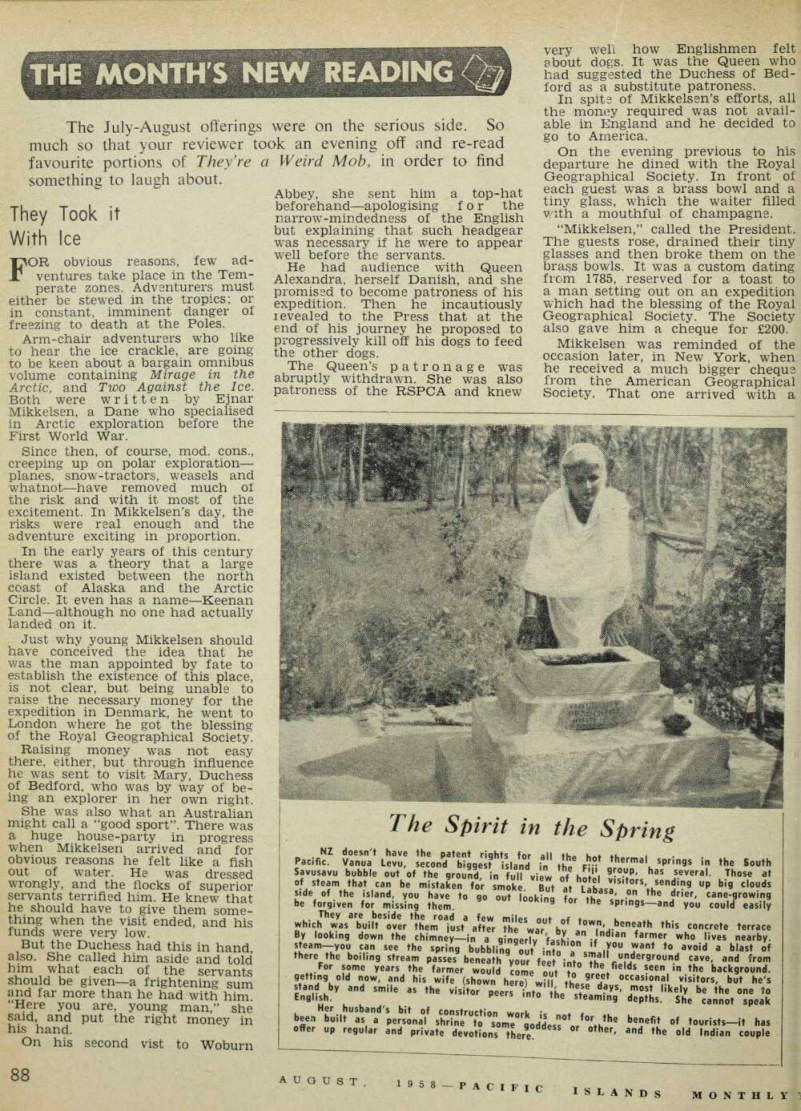

The July-August offerings were on the serious side. So much so that your reviewer took an evening off and re-read favourite portions of They’re a Weird Mob, in order to find
something to laugh about.
They Took it
With Ice
FOR obvious reasons, few ad ventures take place in the Tem perate zones. Adventurers must either be stewed in the tropics; or in constant, imminent danger of freezing to death at the Poles.
Arm-chair adventurers who like to hear the ice crackle, are going to be keen about a bargain omnibus volume containing Mirage in the Arctic, and Two Against the Ice.
Both were written by Ejnar Mikkelsen, a Dane who specialised in Arctic exploration before the First World War.
Since then, of course, mod. cons., creeping up on polar exploration— planes, snow-tractors, weasels and whatnot—have removed much of the risk and with it most of the excitement. In Mikkelsen’s day, the risks were real enough and the adventure exciting in proportion.
In the early years of this century there was a theory that a large island existed between the north coast of Alaska and the Arctic Circle. It even has a name—Keenan Land—although no one had actually landed on it.
Just why young Mikkelsen should have conceived the idea that he was the man appointed by fate to establish the existence of this place, is not clear, but being unable to raise the necessary money for the expedition in Denmark, he went to London where he got the blessing of the Royal Geographical Society.
Raising money was not easy there, either, but through influence he was sent to visit Mary, Duchess of Bedford, who was by way of be ing an explorer in her own right.
She was also what an Australian might call a “good sport”. There was a huge house-party in progress when Mikkelsen arrived and for obvious reasons he felt like a fish out of water. He was dressed wrongly, and the flocks of superior servants terrified him. He knew that he should have to give them some thing when the visit ended, and his funds were very low.
But the Duchess had this in hand also. She called him aside and told him what each of the servants should be given—a frightening sum and far more than he had with him “Here you are, young man,” she said, and put the right money in his hand.
On his second vist to Woburn
Abbey, she sent him a top-hat beforehand—apologising for the narrow-mindedness of the English but explaining that such headgear was necessary if he were to appear well before the servants.
He had audience with Queen Alexandra, herself Danish, and she promissd to become patroness of his expedition. Then he incautiously levealed to the Press that at the end of his journey he proposed to progressively kill off his dogs to feed the other dogs.
The Queen’s patronage was abruptly withdrawn. She was also patroness of the RSPCA and knew
very well how Englishmen felt about dogs. It was the Queen who had suggested the Duchess of Bed ford as a substitute patroness.
In spite of Mikkelssn’s efforts, all the money required was not avail able in England and he decided to go to America.
On the evening previous to his departure he dined with the Royal Geographical Society. In front of each guest was a brass bowl and a tiny glass, which the waiter filled with a mouthful of champagne.
“Mikkelsen,” called the President.
The guests rose, drained their tiny glasses and then broke them on the brass bowls. It was a custom dating from 1785, reserved for a toast to a man setting out on an expedition which had the blessing of the Royal Geographical Society. The Society also gave him a cheque for £2OO.
Mikkelsen was reminded of the occasion later, in New York, when he received a much bigger cheque from the American Geographical Society. That one arrived with a
formal letter —and a receipt form was attached!
Writes Mikkelsen: “The language was the same, more or less; the people the same, more or less; but the difference in the way things were done, seemingly so small as it was, cried to high heaven of a new people, great and rich, yet lacking something of that which sheds sun shine and warmth over the greater poverty of life in the old world”.
Mikkelsen and his first lieutenant ind friend, Ernest de Koven Leffing well, finally bought a Canadian schooner, which they called Duchess Bedford, and got away North in 1906. The Alaska gold rush was at ts peak, and not a little of their Subsequent adventures concerned niners and the gold fever that was ibroad in those days.
Everything went wrong with the ‘xpedition. The vessel leaked and inally got stuck in the ice; the dogs fot rabies; and Mikkelsen was orced to do a 2,500-mile sledge ourney back through Alaska.
This is adventure reading at its >est: a story of individual enterprise ind endurance plus fascinating flimpses of life in a tantalising part )i the world, at a time when men cok what they wanted of the wealth and condemned the rest to lerdition.
The second story, Two Against he Ice, describes Mikkelsen’s search, yith another companion, for three nembers of the Danish expedition vhich perished on the east coast if Greenland in 1908. (MIRAGE IN THE ARCTIC and TWO AGAINST 'HE ICE, published by Rupert Hart Davies.
Australian price, 7/6.)
Wore Mixed-up
\mericans
[T has become accepted as a self evident truth that the majority of Americans are “mixed-up”— About the darnedest things.
This particular lot, in When the Sough Breaks (by Otis Carney, a lew-comer to book-length fiction) s complexed about security.
When the novel appeared in its Vmerican edition last year, it be came a best seller, and as Americans ike to psycho-analyse themselves, it s presumably close to a good pic ure of life in Country Club, middle
;lass society.
It certainly sounds like hell, as Vlr. Carney describes life in Crystal lock, an exclusive estate suburb milt in a horse-shoe around the Country Club and golf course.
A few years after marriage, in Crystal Rock, the interests of lusband and wife start to diverge, kpart from producing the necessary lumber of children, she becomes swamped in community work, the iadies golf team, bridge parties and keeping the family’s social end up.
He concentrates on wearing the right kind of collegiate clothes, playing golf with the right guys, and patterning himself on the already successful in Big Business.
TTnr in AmmM tn qnrrppd in business is everything. It you cannot sell as many mechanical ice-boxes, or chromium-plated limousines as everyone else, life is fruitless. You are a no-hoper, a parasite, you’re not pulling your weight in the community Essentiauy this is the story of Bud ond Debbie and the American brand security that threatens to undo them. But there is Alec, who provides the alternative to success, the brilliant dilettante who becomes the classical example Of the no-hoper;
and the eccentric, Bud’s father, Lee Floyd, with the character two sizes bigger than normal, who had man aged to succeed in business in spite of being a top grade non-conforming individualist. It was living in Lee’s shadow that gave Bud his complex, Otis Carney, evidently no re spector of the American social pattern or its great god, Security, uses his novel excellently as a vehicle for pointed satire and cynical wit. And 15 est reac * Wlt^
§ ““th to iTi
in \ he established social order, it j S likely merely to lead to consider able disrespect for the great Ameri can way of life, (when the bough breaks. Published by Hodder and Stoughton. Australian price, 20/6.)
Antics and Ethics
AFTER a bakers dozen of novels, and twice that number of years in the writing business, A. J.
Cronin still remains more in sorrow than in anger with life.
In The Northern Light, he comes to grips with one of the phenomena of our time —the rapaciousness of the sensational Press. The situation he presents—the small provincial family newspaper in danger of be ing swallowed whole by the pur veyors of sex, gore and sensation — is common enough.
What does not ring particularly true is Cronin’s evident determina tion that virtue will triumph. In this kind of all-in wrestling match it very seldom does.
But the reader need not run away with the notion that this tome has a happy ending. There is not so much as a giggle in the whole length of it, but if you like to be depressed occasionally by life in our times, [this is as good a way as any to do it.
Henry Page inherited The Northern Light from his father, who was a tough gentleman, but a good man for all that. Henry was of softer fibre —with ideals, a sense of family tradition, a belief in people.
In any circumstances he would have had a bad time running a news paper. But when it became known fhat Henry’s provincial town in the north of England was to become a site of a nuclear reactor, the owner of a string of metropolitan journals with a circulation of millions, set his minions to run Henry’s news paper into the earth and take over in its place. [ What follows is somewhat harrow ing. But that is the way Cronin sees it —as through a glass, darkly.
I (THE NORTHERN LIGHT. Published in Aus tralia by Angus and Robertson, Ltd. Australian •price, 18/9.)
For Boys, Only
LITTLE girls must be supposed, by book writers, to stay at home and watch TV. It is a fact that ;most of the juvenile books that come our way are designed for little (or middling-sized) boys. So is Leathers Again —an adventure story for boys, written by Edward M.
Chrystie and set in Southern Rhodesia.
The hero, with the remarkable name of Leathers Auckland, is a secret agent for the Foreign Office.
He and his chief, Colonel Randall, are in Rhodesia to investigate the illegal sale of guns to the natives.
The arch-enemy is a master-mind with the not very unusual South African name of Van der Horst.
Edward M. Chrystie once served in the Intelligence Corps, and is now a journalist in South Africa.
He should, therefore, have all the gen. ; (LEATHERS AGAIN. Published by Hodder and (Stoughton. Australian price, 10/9.)
Who Would Be
A Voortrekker
FEW people make such a fetish of being cross-grained, un gracious and sour as the Afrikaans section of South Africans.
Even Australians —and most Aus tralians can make a pretty fair show of being bad-mannered, them selves, when put to it—don’t have to do much more than ride in a Durban tram to discover that.
Maybe within themselves, the Afrikaaners are happy with their ancestor worship of the Voortrekkers, but it is no hilarious type of happi ness and it doesn’t show.
The casual visitor is bewildered by South Africa at first, until he sorts out the fact that, while he will be welcomed by the “English”
part of the populace, he will likely be regarded with deep suspicion by fully 60 per cent, of the people with whom he comes in contact—people who speak English with what he at first might think is a German accent.
The intending visitor to South Africa might do well, then, to read Stuart Cloete’s The Mask, which continues the story of the van der Berg family that he began in earlier novels, Turning Wheels and Watch for the Dawn. It may not make you love the Afrikaaners you meet any more: but it will help you to under stand that they were an odd lot, even away back.
The Mask is a grim story, brutal in its starkness at times, based on history and its author’s deep know ledge of his subject.
The man who wore the mask was Schalk Fourie, who had his face
bitten off by a hyena while asleep beside his camp fire. When he had struggled back to the homestead (somewhere close to the Great Fish River) his wife Jacoba dealt with the situation in her own way.
She decided he would be better dead (and, in this event, she would have the sole control of the farms).
She ties him down, gets a feather mattress, places it over his head and orders their son’s fat wife to sit on it.
The fat wife apparently does not sit as well as she might. When they leave him for dead, Schalk’s bush man servant rescues him and eventually he recovers. He covers his hideous lack of face with a leather mask, and with his youngest daughter, who has remained faithful to him, and his youngest son, who does not see eye to eye with Mama, either, they leave for the frontier. ■ The frontier was then 1,000 miles to the north, and most of the action ,of the story takes place in the [area between the Limpopo River and the Zoutpansberg Mountains.
Tourists may see something of this [country if they enter Kruger Park by its Northern Gate.
I All this was over 100 years ago— and about 15 years before gold was pound on the Rand, which history has shown was a further bone of [contention between the Boers and the English.
I It is not suggested that the Afrikaaners of today smother their unwanted spouses in feather beds, even if they sometime look as they would like to do so with their visitors. And perhaps ■there is sufficient in their history to give them excuse for dourness, suspicion, and all the complexes in Mr. Freud’s book.
I (THE MASK. Published by Wm. Collins, Ltd.
Australian price, 18/9.)
Teaching Islanders
How and Why
THE belief that the Pacific Islander knows all there is to know about his environment and can bend it to his will, is a fallacy that has been exploded many times. That he can learn more from Nature is the belief of the Islands Education section of the New Zealand Depart ment of Education, which has re centry produced a handsome hand book called Nature Study.
Primarily, this book is designed to assist Islands teachers—many of them islanders who are not always conversant with English idiom them selves. The text, therefore, has been [kept to very simple English but the subject matter ranges wide over every plant, animal, fish or insect, natural or introduced, that is likely to be encountered by an Islands
; child.
. New Zealand is naturally interested jn the education field, in Cook Samoa, Niue and Fiji, and the local names in these languages
are usually given at the beginning of each item, but there seems little reason why this excellent book should not have a wider audience and benefit Papua-New Guinea and those Solomons schools where Eng lish is the medium of instruction.
Nature study is a pre-requisite for the study of agriculture, and on agriculture must the great majority of Islands people continue to de pend for their livelihood.
Methods of creating interest in the subject and other aids to teach ing methods, plus reading lists for further study and research are an important part of this book, which is illustrated with hundreds of line drawings, diagrams and photographs.
Although designed for Islanders, it contains much that is interesting to European islands dwellers. But it is apparently not to be released for general distribution. (NATURE STUDY. Our copy direct from the Islands Education Officer, of the NZ Department of Education.)
Texan's Family
Goes to Sea
THERE is little in taking three infants under four years on a 9,000-mile voyage across the bouncing Pacific, in a 36-ft yacht, according to Texan John Caldwell — although some men who have reck lessly taken mum and the kids for a caravan holiday during the two weeks “annual”, might think that he exaggerates.
Not everyone has a caravanning temperament; and fewer still, what it takes to live on a small boat.
Those who crave family nautical ex periments would do well, therefore, to be warned before they read Caldwell’s Family At Sea —in case it gets them in.
As a literary achievement, Family At Sea is like the curate’s egg— good in spots.
Probably its patchiness is due to a too conscious desire to produce good writing, when, as an account of family life on a small vessel, it would stand on it own merits. In this department it is quite adequate —although, as we have already hinted, probably a trap for suburban dads who wonder: “Why can’t we do that?”
To these we say, “THINK!” One reason for so-doing is that they are not married to Mary Caldwell, who can sit for hours with a sick bucket between her knees but still manage the tiller.
That the Caldwells collectively have the necessary small-boat temperament is proved by the fact that they are currently on the eve of setting off from Sydney on another world-girdling yacht ad venture. (Something about them and their new ship appeared in the July PIM, p. 41).
This is John Caldwell’s second book. The first ( Desperate Voyage) covered his lone-hand effort in
Pagan from Panama to the Lau Islands of Fiji, where Pagan was wrecked in 1946. After that episode he returned to America with his Australian wife, Mary. In mid-1952, they left in Tropic Seas for Aus tralia via French Oceania, Samoa, Fiji and New Caledonia. They got to Sydney late in 1953, having paused awhile in Papeete while Mary produced Roger, and after having survived storms and domestic rear-tragedies innumerable, and the freak seismic wave at Suva on September 14, 1953. Family At Sea is a story of that voyage. (FAMILY AT SEA. English edition published by Robert Hale, Ltd. Australian price, 22/6.) Reviewed Briefly . . .
The Ten Thousand Things,
by Maria Dermout, a somewhat extraordinary novel, translated from the Dutch. The author began this, her first novel, at the age of 68, and it has been hailed as some sort of literary triumph. Unfortunately, like most literary masterpieces, it is above the heads of the average reader. It is a story of the former Dutch East Indies —now Indonesia. (Published by Seeker and Warburg. Aus tralian price, 22/6.)
Girl With A Monkey: A
promising first novel by an Aus tralian girl, Thea Astley, which has nothing to do with monkeys. A young school-teacher, out of bore dom in a small Queensland town, begins an affair with a road labourer.
The story deals with the short period when, having decided to break the
attachment, she is preparing to leave the town. (Published by Angus and Robertson, Ltd.
Australian price, 13/6.) THE BRAVADOS, by Frank O’Rouke. A Western by any other name is still a Western even though it has been filmed in Cinemascope with Gregory Peck and Joan Collins.
This one is set in New Mexico. It has horse thieves, sheriffs, murderers and people who are in gaol just be cause they’ve been framed. It also has a little sex interest. But not much. Regulation Western fare — although it is billed as a Western with a difference. (Published by Heinemann. Australian price, [l7/-.)
What's New in
Paper Jackets
THE FALL OF THE SPARROW, by Nigel Balchin. This can be described best as typical Balchin. whose novels refuse to conform to most of the stereotyped cate gories, although psychological novel is about the most convenient label. This is the story of Jason, the son of a so-called ‘‘distinguished soldier”, who finally ended in gaol for selling the furniture in the flat loaned him by a friend. But was Jason corrupt? Balchin seems by no means sure himself. (Fontana).
STRANGE INHERITANCE: A translation of a story by French novelist Georges Simeonon. Gilles Mauvoisin returns home to France at 19, sole heir to the fortune left by Uncle Octave, and finds himself in a nest of family intrigue; the mystery of what secrets lie in Uncle Octave’s safe, which no one can open; and the greater mystery of the power Uncle had ap parently had over friends and relatives. (Great Pan).
The Perennial Philosophy. By
Aldous Huxley. A reprint of the work, first published in 1946, by the eminent British novelist and philosopher. Mr. Huxley quotes widely from all the philosophers— Brahmin, Christian, Buddist, Mohammedan —and then comments on the extracts, elucidating and developing them. (Fon tana).
Tomorrow Is Theirs. By Anne
Duffield. There is not much similarity between this author and the previous one—except that they both use English.
Miss Duffield’s novel is set in the Southern States of America, which is a change in geography if not a change in style. It is all about love. (Great Pan).
Straight And Crooked Think
ING, by Robert H. Thouless. This book by a famous Cambridge psychologist ran into 10 editions when first published in 1930. Since then it has been revised and brought up to date, in the light of de velopments in the atomic age. Its purpose is to aid you to think and reason more clearly, especially when discussing contro versial subjects with friends, or in the course of business. (Great Pan).
THE SILVER COBWEB, by Ben Benson.
A young policeman captures the murderer of an innocent young girl and buys him self a lot of trouble. “A sizzling inside story of the American State Police”. (Fon tana).
Miss Silver Comes To Stay, By
Patricia Wentworth. A more subtle con tribution to crime fiction, in the English tradition. W’hat American cops achieve
by rushing around in high-powered cars and making a great big noise, gentle, old, English ladies pull off by sitting home attending to their tatting. One of the best of the Miss Silver series. (Great Pan).
Sex, Love And Marriage A
Christian Survey, by Ronald H. Bainton.
The burden of the reverend gentleman’s song seems to be that sex is very well, if you are married first. This piece of advice most people learn at their mother’s knee, but it doesn’t solve anything for anyone when they get out in the world and encounter the facts of life. Dr. Bainton, who is a famous Church historian, cata logues the attitude of society and the church to marriage, divorce and related matters, through the ages. In spite of its title, it is no marriage-guidance manual. (Fontana).
Our copies from Wm. Collins (Over seas). Ltd. Australian prices: Pan, 3/-; Great Pan, 3/6; Pan Giant, 5/-; Fontana. 3/-: 3/6; and 5/-.