How Abbe Rougier Got
pp. 90-105 · Read in the full issue
The Whole Pacific Was Involved
How Abbe Rougier Got His Coconut Empire
Written from Notes given to R. W. Robson about 25 years ago by the late Mr. Walter H. Gors, well known as a South Seas merchant . • In 1857, an American whaler dumped a Scot named Grieg on an equatorial atoll, and thus got rid of one who had fought his shipmates, defied the officers and annoyed the skipper beyond endurance. • In 1864, a lively, squalling infant was christened Petrico Emmanuel Rougier, in Auvergne, France, and dedicated to the Church. • About 1880, a young Frenchman of good family, named Cecil, was found guilty of offences concerned with ownership of property, and sentenced to long imprisonment in the penal colony of New Caledonia.
Those events seem widely disconnected; but Fate wove them together in a way that supplied us with one of the remarkable romances of the South Pacific Islands.
THE Ayrshire Scot, William Grieg, was big and bellicose and sick of the discomforts of a whaling ship. The promise of various recreations, while the ship was re-provisioning in Hawaii, did not quieten his spirit. So he was put ashore on a handy atoll, right under the equator, with some food, some simple tools and a few fowls.
Grieg was alone there for some time, and sustained life well enough.
It was a lovely atoll, nine miles long and, almost circular, it en closed a magnificent lagoon. The islets were covered with coconuts and pandanus.
He did not know it at the time, but it was the fertile island of Fanning, named in 1798, by Captain Edmund Fanning, in the ship Betsy.
Grieg found signs that it once had native inhabitants, and that ships called there sometimes. We know now that English Harbour, Fanning Island, was a favourite resort for sailors seeking refreshment and carousal.
Evidently, sailors thereabouts were at a discount. A few weeks after Grieg arrived, another ship lay off Fanning long enough to launch a boat—then sailed away. Within the beat was one man, and some meagre supplies. He joined Grieg. His name was King.
Grieg and King later had oppor tunities to get away from Fanning by casual ships, but decided to settle there. They sailed their boat across to the well-populated Ellice group and returned with a party of Pplynesians—including bright young wives for both Grieg and King.
Sons and Coconuts !n the ensuing 30 years, they thoroughly colonised Fanning Grieg had several sons; King, only one.
They planted a lot of coconuts and produced a variety of food stuffs, and sold coconut oil, fish,
pearl-shell and food to the ships which came occasionally into English Harbour. They got certain trading firms interested in the guano deposits. Then, both passed on.
Grieg’s eldest son, George, took charge. He was energetic and capable, devoted himself to copra production and its sale in San Francisco, bought a small ship for the ’Frisco-Fanning traffic, brought prosperity to the little Fanning community.
Young King was a moody, melancholy fellow. Nominally, he owned half the island. Actually, everything was handled by George, who became known as “King Grieg” —a play upon the facts that it was a King-Grieg partnership, but George was the boss.
King finally left on a trading ship.
He got a job in a Honolulu timber yard, found a wife and happiness; and flatly refused a return to
Fanning.
Enter a Lawyer
George carried on. He planted up Washington Island, only 75 miles away, with coconuts, and took possession.
Then costs got out of control.
George wrote to King that, as King had enjoyed past profits, he now could share in the losses. King’s reply was ferocious, and unprint able.
There now entered this page of history a Mr. Humphrey Berkeley, a lawyer, of Suva, famous for his cleverness, good fellowship and social charm. He was born in 1860 in the West Indies, educated in England, admitted a barrister of the Inner Temple in 1883; and began the practice of the law in Fiji in 1892.
He became famous through his npht againse the British Colonial Office on behalf of the Fiji chiefs who objected to punitive land tax ation; and he went to London and
won their case—although he wa embarrassed by the fact that hi elder brother, Sir Henry Berkeley was at that time (soon after th turn of the century) Chief Justic in Fiij.
Berkeley was a shrewd practitionei and made much money out of pri vate trading. But because he als: was a free spender, and loved life’ good things, he was often short c money.
Somehow, Berkeley heard of th split between the acknowledge; owners of valuable Fanning Island He communicated with King, L Honolulu, and urged him to holl on to his half-share of Fanning an/ Washington.
King replied sourly that h wished no further association witJ either Fanning Island, or the family.
Berkeley offered King £5,000 fo his share of Fanning (and Wash mgton)—£soo down and the balano spread over several years Kim accepted.
Berkeley put it all into legal shap: through the British Commission fo the Western Pacific (Britain has annexed Fanning in 1888); am thenceforward Berkeley and th Gnegs carried on the Fanning am Washington plantation in partner snip.
Enter the Old Firm
But inevitably, the time cam ® he , n Berkeley’s h.c.l. had him reatt m trouble, and he borrowed £5 0(( on his half-share in Fanning. Pro 5 1S re “P a y m ents failed, an the lenders put the pressure 0n..: Walter Gors was Burns Phir manager in Suva. To him went tl: distressed Berkeley.
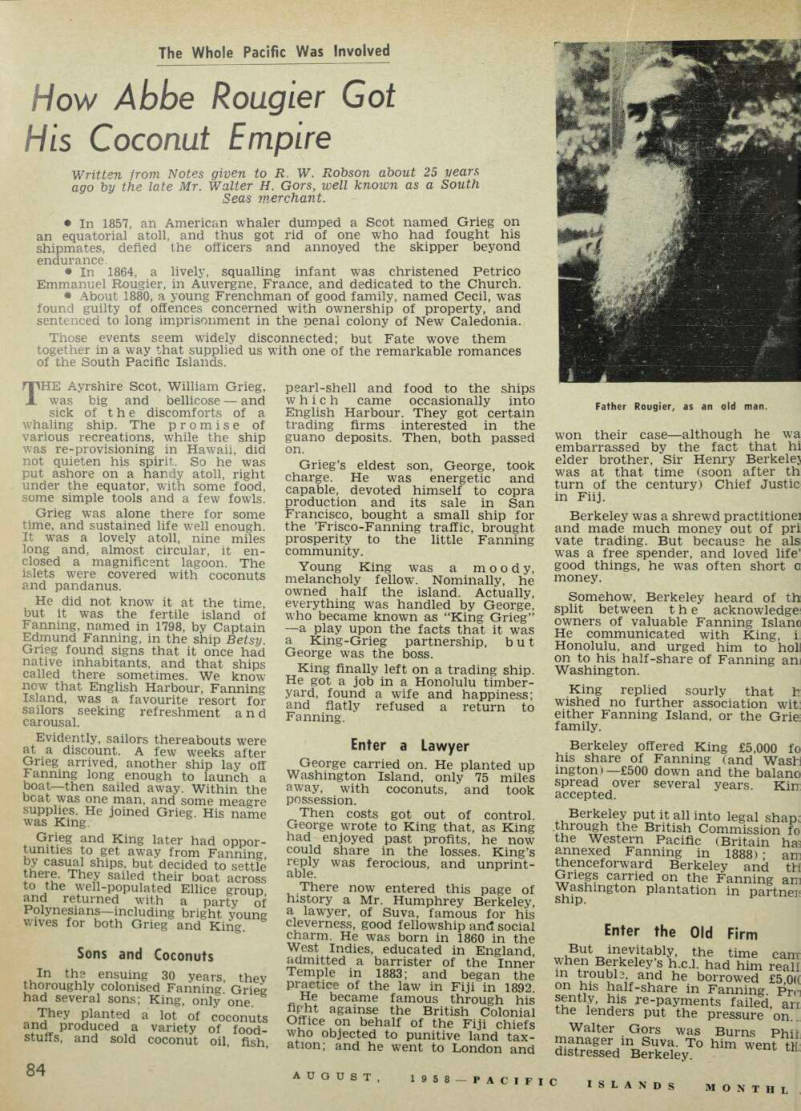
Father Rougier, as an old man.
Burns Philp loaned Berkeley £5,000, on condition that BP became managing-agents for Fanning and Washington, bought the produce, and supplied all stores.
The Griegs agreed, and the new arrangement was established.
But there was more trouble.
Berkeley’s need for money was in satiable. He fought with BP over the disposal of the receipts from copra.
A little barque, the Volador, was loading copra at Fanning. Berkeley sent instructions to the captain to take no more orders from BP. The puzzled skipper brought his ship to Levuka. There she was promptly seized for debt.
BP paid off the debts, and got possession of the ship.
Then BP took action against Berkeley in the High Commission Court, for repayment of the £5,000 loaned. They got a verdict for the full amount, plus £2,000, assessed by the court as damages and costs.
Berkeley now was in a critical situation. Help came unexpectedly, like manna from heaven.
Two Frenchmen Join the Cast
Pere Emmanuel Rougier, born in Francs in 1868, was now about 40 years old. We have told in PIM before of how this lively personality became a Marist missionary priest; established his station at Naililili, on the Rewa River, in Fiji, about 1892; and took great joy in snatch ing converts from the nearby station of the serious-minded Methodists.
He was an energetic missionary, and a notable builder of churches, but he was a great trouble to his Bishop, who did not quite subscribe to the Rougier brand of humour and enterprise.
Late in 1904, a whaleboat drifted into the Fiji Islands, between Vanua Levu and Viti Levu, and the Fijians who received it found in it a more dead-than-alive Frenchman.
He was an aristocrat, named Cecil, who had been sent out from France about 20 years before, to be punished in New Caledonia for some minor crime.
Somehow, he go?* way from the penal settlement —hie had been freed from prison, but was forbidden to leave the Colony—and crossed hundreds of miles of sea to Fiji.
He was taken to Levuka, given medical treatment and care, and handed over to his fellow-country man, Father Rougier.
The two got on well together. The Frenchman helped the missionary in many ways. A Fijian girl became friendly with the ex-convict. Father Rougier, again defying his Bishop, married them.
Father Rougier had inquiries made in France on behalf of M.
Cecil. It was discovered in 1906 that he had fallen heir to a small fortune.
The Frenchman could not have cared less. Broken in health and spirit by 20 years in New Caledonia, he wanted only to live there in Fiji,
in peace and quiet, with his native wife. He asked the missionary to take charge of the money, and use it how he liked —but to see that he and his Fijian wife were provided for.
All this involved considerable legal work. It was carried out by aforesaid Humphrey Berkeley. All that Rougier did was orderly and legal.
These considerable funds had been finally settled in the hands of Father Rougier just about the time that BP got the verdict against Berkeley.
Father Rougier loaned Berkeley £7,000; Berkeley paid over the £7,000 to BP, and snapped his fingers under the nose of the very in dignant Mr. Gors; and the Fanning - Washington plantations were again carried on under the erratic financial management of Mr. Berkeley.
Bargain Sale Price
Within a year, brawls developed between Berkeley and Father Rougier, who wanted his loan pro perly protected, and between Berkeley and the Griegs, who were most unhappy about Berkeley’s financial management.
The Griegs wanted funds for the further development of their now valuable estate. They could get nothing out of Berkeley—not even enough for sustenance. Who was their partner, anyway—Berkeley or Rougier?
It was evident that Berkeley was trying to get full control of the two islands.
Finally, in 1909, there came the show-down. George and William Grieg went to Levuka and to Suva and interviewed Berkeley. They achieved nothing.
Then they appealed to the High Commissioner for the Western
Pacific, Sir Everard im Thurn; and the latter finally ordered that the complicated dispute about owner sh i p—worked up by the clever lawyer, Berkeley—should be resolved by the sale of the two islands, at auction.
Berkeley was pleased. With Father Rougier’s help, he could carry out his plan, he thought.
That sale caused a stir. Most people knew the value—actual and potential—of those two atolls. Mr, Gors put it at over £lOO,OOO, and in those pre-war days, that was big money.
Mr. Gors urged Burns Philp to bid; but the copra market just then had a hole in its bottom, and Fanning seemed unattractive.
Gors and a small group of friends started the bidding at £5,000 and carried it along under competi tion to £lO,OOO.
Berkeley and Father Rouger were there, interested spectators.
At £lO,OOO, the Gors group dropped out. A rival group bid £10,250 —and it seemed the last bid. Then Father
(Continued on page 99)
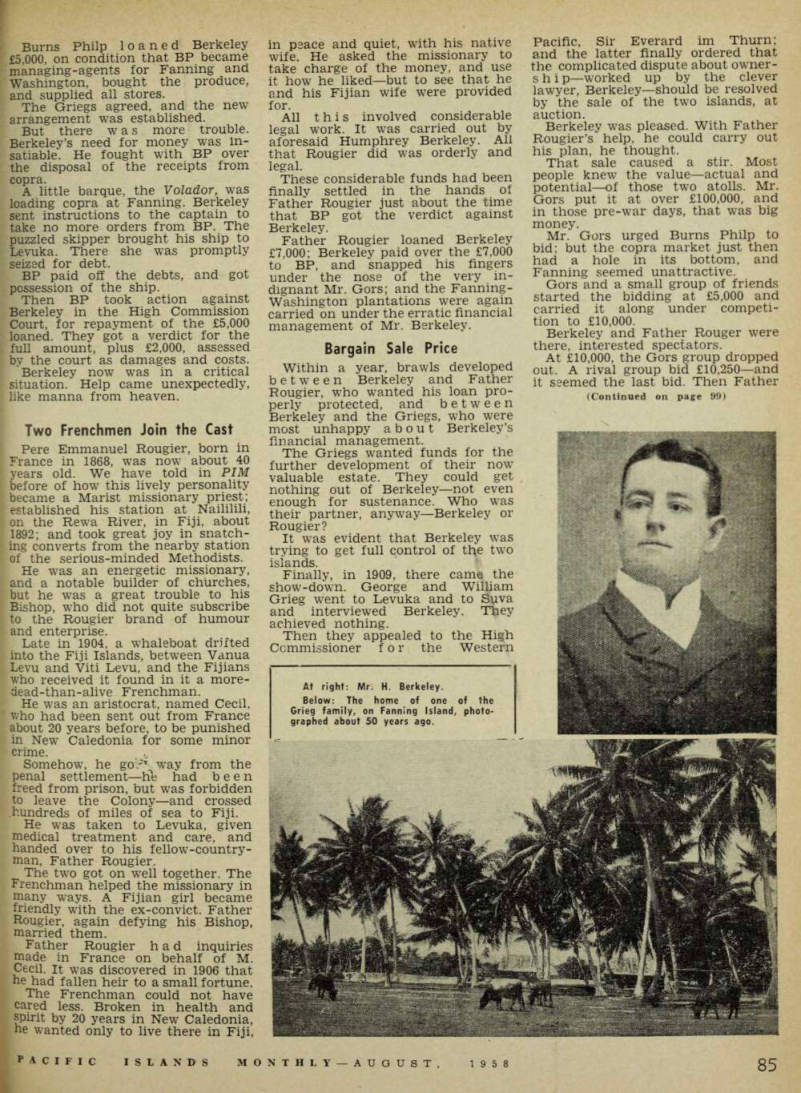
At right: Mr. H. Berkeley.
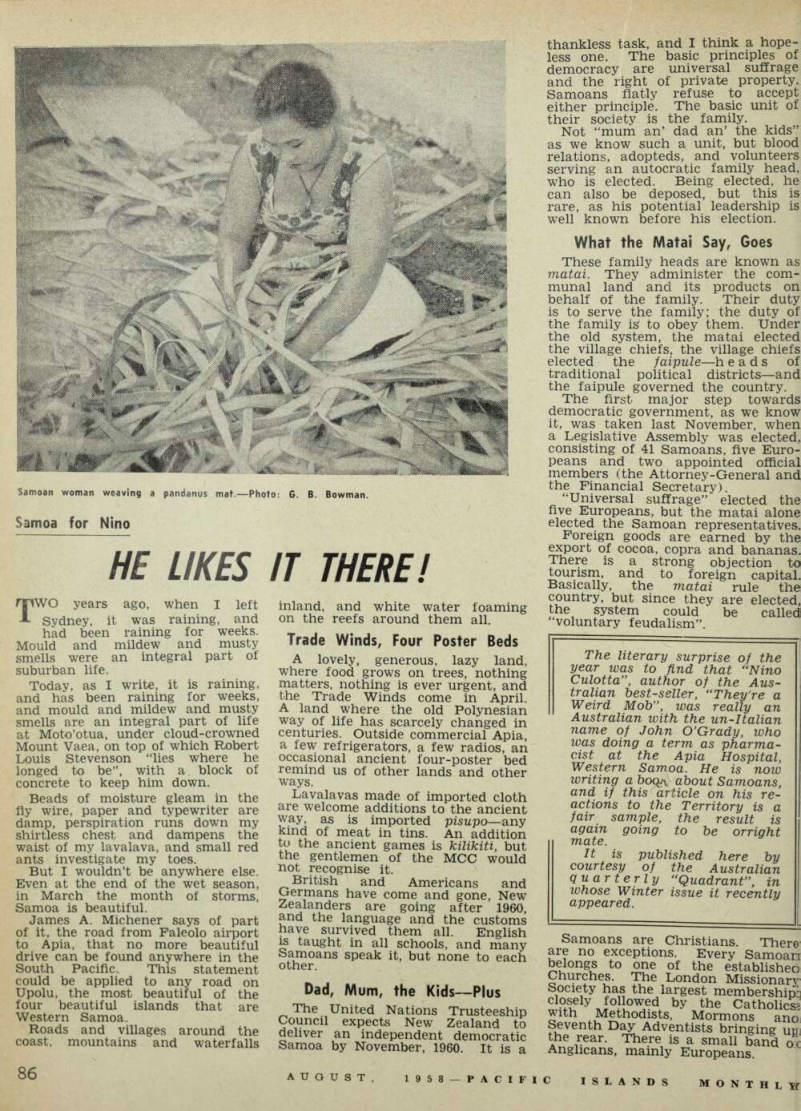
Below; The home of one of the Grieg family, on Fanning island, photo graphed about 50 years ago.
Rougier raised his hand. “Eleven thousand pounds,” he called.
That was the end of it—Fanning and Washington Islands were knocked down to Rougier. It was presumed that the lawyer and the missionary would enter into a formal partnership—Bishop Vidal permit ting.
“As we left the rooms, the missionary and Berkeley were just ahead of me,” said Gors, about 1934, when recalling the scene to me.
“Berkeley, in the way so character istic of him, put his arm around Rougier’s shoulders.
“ ‘Now, dear old Father, let’s go down to my office and fix up this agreement’, he said.
“ ‘What agreement?’ asked the missionary.
“ ‘Why, you know, dear old Father, that it was understood, if you got the property, you would transfer a half-share to me.’
“ ‘Oh, no, that is not so. I bought it for myself. I shall keep it,’ said Father Rougier.
“That is all I heard,” said Mr.
Gors. “They stood there in the street, arguing. Berkeley seemed very upset and excited. But that was how Father Rougier became owner of Fanning and Washington Islands.”
Missionary into Planter The rest is history. Bishop Vidal had expressed very strong dis approval of Father Rougier’s con duct in various incidents; and the strong-minded Rougier knew he must give up his missionary work, or give up the Cecil fortune.
He left his mission-station on the Rewa, and went to France, taking Madame Cecil with him. It is be lieved that, at the headquarters of his Order, he challenged the decision of the Bishop to remove him from his missionary work.
However, he never returned to the mission. But he did remain in Holy Orders, to the end of his life.
When he returned from Europe, Father Rougier formed and registered a company called Fan ning Island Limited; and he carried on the plantations on Fanning and Washington, in conjuction with the Griegs.
Berkeley owed Rougier £7,000, and Berkeley, after the auction sale in Suva, in 1909, became entitled to £5,500 (being half the sum paid by Rougier at auction for the two islands). I never found out whether Berkeley paid Rougier the balance of £1,500 —but probablv not. The Grieg family got the other £5,500.
According to the old records, the Lever interests had planted up Christmas Island with coconuts, but were dissatisfied with the pro perty; and in 1913 they sold Christmas to Rougier.
Thus, he had possession of Fan
ning, Washington (75 miles north of Fanning) and Christmas (170 miles south of Fanning)—all three atolls lying just north of the equator.
Within a year (on October 27, 1914) Rougier transferred Christmas to Central Pacific Coconut Planta tions Ltd., registered in London, which he had formed.
A copra boom followed World War I; and Rougier, owner of the three atolls, made a great deal of money.
He settled in Tahiti, and cruised aiound at first in his schooner Luka, and then he bought the well known three-master Marechal Foch.
An article in an American news paper in 1931 described how the handsome Abbe, with the big red beard, turning grey, travelled in luxury in his big ship among his tropical islands. They called him “the King of Christmas Island”.
Abbe Rougier was held in esteem in Tahiti, and regarded as a pious and charitable man. He died there on December 16, 1932. He left most of his wealth to his nephew.
Monsieur Rougier also lived in Tahiti—but he was almost ruined in the great Kong Ah swindle, in the ’Thirties.
Rougier was a large depositor in the Bank of Chin Foo, Kong Ah was a big trading concern, and many leading people in Tahiti were in it.
It got into difficulties, and Kong Ah shareholders induced the Chin Foo Bank to make big loans to Kong Ah.
When a crash seemed inevitable, a number of Chin Foo Bank depositors were tipped off, and quietly with drew their funds. Rougier was among the unlucky ones, and most of the late Abbe’s wealth went down the drain in the Chin Foo-Kong Ah crash.
In 1935, Burns Philp interests bought Fanning and Washington Islands, and transferred them to Fanning Island Plantations Ltd.
Because of its small rainfall, Christmas was not such a valuable copra-producer as Fanning and Washington. It became a US air base during the Pacific War, and when the US withdrew, the planta tion was acquired by the Gilbert & Ellice Is. Colony. Christmas now is in the limelight as a site of H bomb experiments.
The French ex-convict, Cecil, appears to have died in Fiji be tween 1908 and 1913, and —it is said —he left his estate to Rougier. The Fijian girl, Madame Cecil, after a memorable visit to France, returned to and cared for her invalid husband.
Rougier saw that she was provided for. A few years ago, she still was alive, in the Rewa district of Fiji.
I never knew what became of Humphrey Berkeley—he seems to have disappeared about World War I from Suva, where once he was so much a social ornament.