One Memorable Night Among The New Britain Cannibals
pp. 82-83 · Read in the full issue
New Britain Cannibals
And an Historic Photograph...
• The 'publisher-editor of the “Paci fic Islands Monthly”, in January, 1951, received a small packet from Count Goedicke van Asten, then over 90 years of age, and a resident of Auckland. He was German horn ; had wandered all over the world; had spent the latter part of his life in Tonga, and always had kept a diary.
There was this note: “This is based on my personal diary. I call it, ‘How I spent two nights with cannibals in New Britain’. It is a very horrible story, but I should like it to he published, just to show the kind of people wno lived there in those days. I send it therefore to my old friend, the editor of the ‘Pacific Islands Monthly’, on the condition that it is not published until after I am dead”.
The “little Count” —as we knew him —died a couple of years ago.
The following is his own account of what appears to have been an un forgettable experience. rN 1884 (73 years ago), I was man -1 aging a trading-station for the DH & PG (once a famous Ger man trading company), at Kabaira, in New Britain. [Kabaira is a place on Ataliklikun Bay, about seven miles from Rabaul.] Close to my station, there was a large native house. It was about 40 feet long, and it had neither doors nor windows. There was a space, about two feet high, between the ground and the bottom of the wall.
I never saw anyone near this place in the daytime, but at nights I sometimes saw peo p le creeping through that opening.
I learned that my cookboy, Tobilau, went there to sleep: so one aay I asked him what they did in that house.
Tobilau informed me that he could not tell me anything about that house. If he did, maggots would eat him alive, his body would burn like fire, and somebody’s grandmother would slit open his belly.
I was young and inquisitive, and plied him with questions. So he said he would tell the headman about my desire for information.
Two days later Tomarkete, a petty chief, came to my station, and told me that he was the leader of what he called the young men’s society.
These were young men, he said, who were not able to buy a wife for themselves —they did not have shell money (divara), or a canoe, or an
artifact, and some still were work ing in the gardens of their future fathers-in-law.
I became friendly with Tomarkete, and he said that if I wished it, he could admit me as a member of the society. I was young, and full of eagerness and curiosity, so I agreed to become a member of this young men’s club.
In due course, I went through a ceremony of inauguration. It was not a nice experience, and not one of which I am proud. The less said about it the better.
But I then was allowed to spend the night in the big house —and I spent two nights there. They warned me of the things that would happen to me if ever I disclosed the secrets of that house —and although I am no believer in sorcery, I still am un willing that it should be described, while I am alive.
Nothing much happened that first night. Some 30 men stretched out
on the ground. Others were sitting up cross-legged. All were smoking clay pipes. They appeared to talk mostly about fishing, and about catching a large ground-frog.
At sunrise next morning, they all left the house.
When I went in there the next night, there were only some 20 pre sent. They told me the other ten had gone to Bainingen (presumably what we now call The Bainings).
I lay down to sleep. I wondered why I had been warned about the things that happened there, and that I must not tell anyone what 1 saw and heard.
But about midnight there was a sudden stirring. The missing ten men came in. They had been away on a raiding expedition—and they were dragging along with them a young girl, whom they had seized from a village somewhere.
She was young, and quite small.
The scenes which followed were
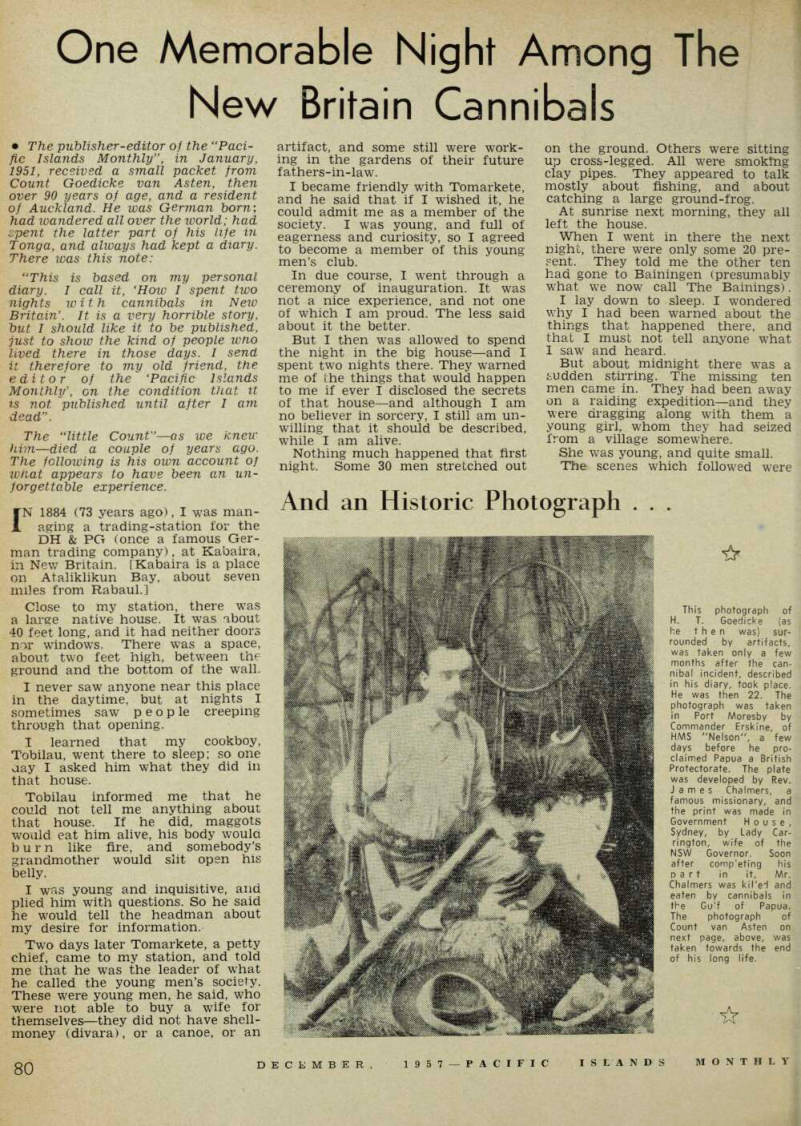
This photograph of H. T. Goedicke (as he then was) sur rounded by artifacts, was taken only a few months after the can nibal incident, described in his diary, took place.
He was then 22. The photograph was taken in Port Moresby by Commander Erskine, of HMS "Nelson", a few days before he pro claimed Papua a British Protectorate. The plate was developed by Rev.
James Chalmers, a famous missionary, and the print was made in Government House, Sydney, by Lady Car rington, wife of the NSW Governor. Soon after comp[?]eting his part in it, Mr.
Chalmers was kil[?]ed and eaten by cannibals in the Gu[?]f of Papua.
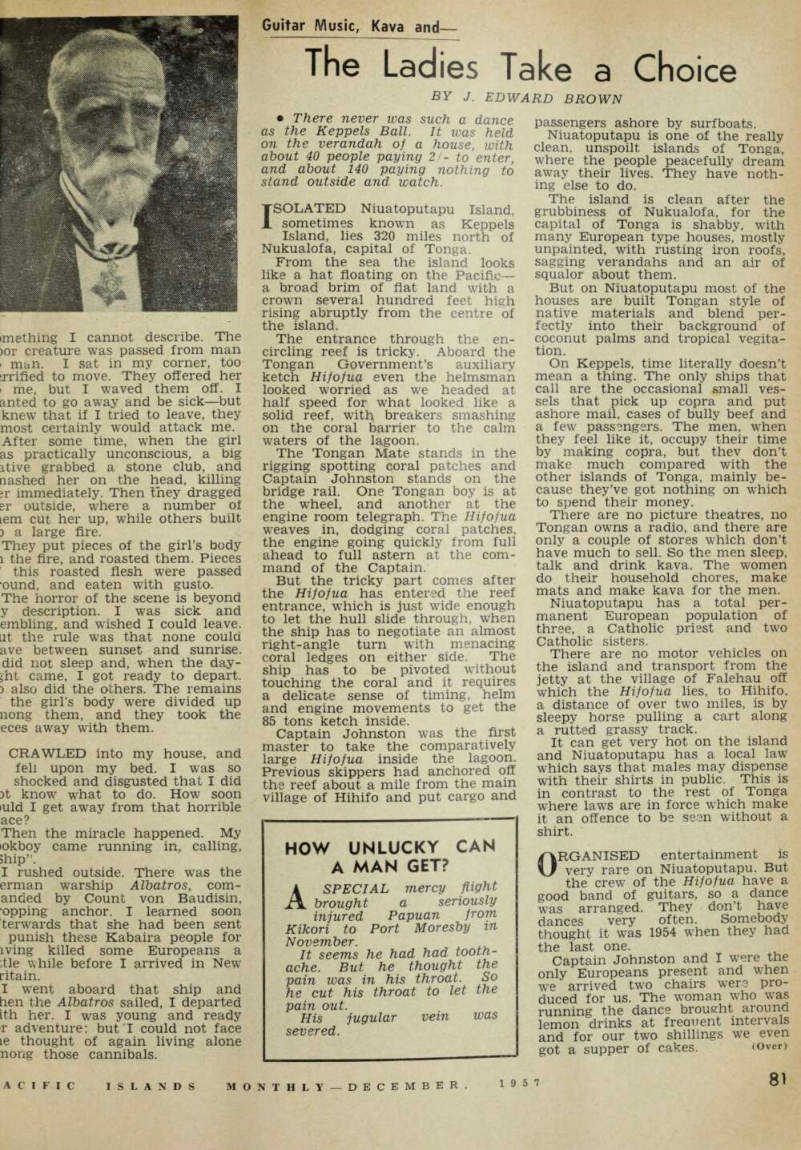
The photograph of Count van Asten on next page, above, was taken towards the end of his long life.
imething I cannot describe. The )or creature was passed from man ■ man. I sat in my corner, too Trifled to move. They offered her i me, but I waved them off. I anted to go away and be sick —but knew that if I tried to leave, they most certainly would attack me.
After some time, when the girl as practically unconscious, a big itive grabbed a stone club, and cashed her on the head, killing jr immediately. Then they dragged er outside, where a number of iem cut her up, while others built ) a large fire.
They put pieces of the girl’s body i the fire, and roasted them. Pieces this roasted flesh were passed •ound, and eaten with gusto.
The horror of the scene is beyond y description. I was sick and embling, and wished I could leave, at the rule was that none could ave between sunset and sunrise, did not sleep and, when the day ;ht came, I got ready to depart. ) also did the others. The remains the girl’s body were divided up nong them, and they took the eces away with them.
CRAWLED into my house, and fell upon my bed. I was so shocked and disgusted that I did 5t know what to do. How soon mid I get away from that horrible ace?
Then the miracle happened. My •okboy came running in, calling, Ship”.
I rushed outside. There was the erman warship Albatros, com anded by Count von Baudisin, •opping anchor. I learned soon terwards that she had been sent punish these Kabaira people for iving killed some Europeans a :tle while before I arrived in New ritain.
I went aboard that ship and hen the Albatros sailed, I departed ith her. I was young and ready r adventure: but I could not face le thought of again living alone nong those cannibals.