The Ladies Take a Choice
pp. 83-84 · Read in the full issue
Guitar Music, Kava and— The Ladies Take a Choice
By J. Edward Brown
• There never was such a dance as the Keppels Ball. It was held on the verandah of a house, with about 40 people paying 21- to enter, and about 140 paying nothing to stand outside and watch.
ISOLATED Niuatoputapu Island, sometimes known as Keppels Island, lies 320 miles north of Nukualofa, capital of Tonga.
From the sea the island looks like a hat floating on the Pacific— a broad brim of flat land with a crown several hundred feet high rising abruptly from the centre of the island.
The entrance through the en circling reef is tricky. Aboard the Tongan Government’s auxiliary ketch Hifofua even the helmsman looked worried as we headed at half speed for what looked like a solid reef, with breakers smashing on the coral barrier to the calm waters of the lagoon.
The Tongan Mate stands in the rigging spotting coral patches and Captain Johnston stands on the bridge rail. One Tongan boy is at the wheel, and another at the engine room telegraph. The Hifofua weaves in, dodging coral patches, the engine going quickly from full ahead to full astern at the com mand of the Captain.
But the tricky part comes after the Hifofua has entered the reef entrance, which is just wide enough to let the hull slide through, when the ship has to negotiate an almost right-angle turn with menacing coral ledges on either side. The ship has to be pivoted without touching the coral and it requires a delicate sense of timing, helm and engine movements to get the 85 tons ketch inside.
Captain Johnston was the first master to take the comparatively large Hifofua inside the lagoon.
Previous skippers had anchored off the reef about a mile from the main village of Hihifo and put cargo and
passengers ashore by surfboats.
Niuatoputapu is one of the really clean, unspoilt islands of Tonga, where the people peacefully dream away their lives. They have noth ing else to do.
The island is clean after the grubbiness of Nukualofa, for the capital of Tonga is shabby, with many European type houses, mostly unpainted, with rusting iron roofs, sagging verandahs and an air of squalor about them.
But on Niuatoputapu most of the houses are built Tongan style of native materials and blend per fectly into their background of coconut palms and tropical vegita tion.
On Keppels, time literally doesn’t mean a thing. The only ships that call are the occasional small ves sels that pick up copra and put ashore mail, cases of bully beef and a few passengers. The men, when they feel like it, occupy their time by making copra, but thev don’t make much compared with the other islands of Tonga, mainly be cause they’ve got nothing on which to spend their money.
There are no picture theatres, no Tongan owns a radio, and there are only a couple of stores which don’t have much to sell. So the men sleep, talk and drink kava. The women do their household chores, make mats and make kava for the men.
Niuatoputapu has a total per manent European population of three, a Catholic priest and two Catholic sisters.
There are no motor vehicles on the island and transport from the jetty at the village of Falehau off which the Hifofua lies, to Hihifo, a distance of over two miles, is by sleepy horse pulling a cart along a rutted grassy track.
It can get very hot on the island and Niuatoputapu has a local law which says that males may dispense with their shirts in public. This is in contrast to the rest of Tonga where laws are in force which make it an offence to be seen without a shirt.
ORGANISED entertainment is very rare on Niuatoputapu. But the crew of the Hifofua have a good band of guitars, so a dance was arranged. They don’t have dances very often. Somebody thought it was 1954 when they had the last one.
Captain Johnston and I were the only Europeans present and when we arrived two chairs were pro duced for us. The woman who was running the dance brought around lemon drinks at freauent intervals and for our two shillings we even got a supper of cakes. (Over)
There was a hole in the dance floor where a board had collapsed, but nobody minded, as they danced around it. The girls were dressed in their best frocks, but one male wore about three weeks’ growth of beard, a white shirt, a once white pair of drill trousers and bare feet.
And the most dashing male present was dressed in a white shirt, white drill trousers rolled up to just below his knees, and sandshoes. Excellent for dancing.
One young man was nicely dressed in a vala, the Tongan male skirt like garment, a nylon shirt, and his cheeks were brightly rouged—quite a common custom with Tongan males, who don’t see anything pe culiar in it.
All the dances were “ladies choice”. There was a reason. The woman who was running the dance had her eye on the Captain, and before every dance she called out gaily that it was a “ladies choice” and dived at him.
AT 12.30 a.m., the band tired, so the dance finished, and the men scattered around the village to drink kava for several hours.
We walked through the village in the moonlight, past Tongan houses in darkness, to a house where Gus, a part-Tongan and one of the Hifofua’s passengers, knew there was a girl willing to make kava for us.
The house was in darkness, put Gus called through the door and awakened somebody. They got up and lit a lamp and we entered, taking off our shoes.
We sat on mats on the floor, while the girl woke her sister, and after they’d got dressed they came out from behind the curtain which screened off one end of the hut.
The lozenge shaped hut was divided into three sections, its two ends curtained off. A glimpse be hind one curtain showed sleeping forms prostrate on the floor under hanging mosquito nets. The queru lous voice of a sleeping woman was raised and one of the girls replied
sharply.
The walls were decorated with pictures cut from magazines show ing film stars and royalty, and flamboyant film posters of yester years advertising Tom Mix, inter spersed with many yellowed snap shots.
The elaborate wooden kava bowl, with its patina of age and much use, was brought out, as were the stone pounders and a piece of can vas to place under the stone to catch the pieces of kava root. One of the girls went to fill the water bucket. The canvas was spread out and the big piece of stone placed on it. Gus tore off a piece of the kava root we had brought with us, took up the small stone pounder and smashed it to small pieces. It was tipped into the bowl and water was added. The girl mixed it with her hands, adding more water until the root was thoroughly dissolved.
Then she took up a mass of fibre, called fau, and drew it through the muddy-looking water to strain off pieces of the kava root.
She wrung out the fau in the bowl and flicked the mass of fibre on to the large piece of canvas. Wet pieces of kava root rained on the canvas. The performance was re peated until the liquid in the bowl was free from pieces of undissolved kava.
Then she lifted the fau and let the kava drip back into the bowl. It was ready.
We had each been given a coco nut shell bowl and a small mat on which it was placed, face down.
The bowls were passed to the kava maker who lifted the mass of fau and squeezed a measure of kava into each bowl.
We sat there crosslegged, talking and flirting mildly with the girls.
From a hut not so far away came the pounding of stone against stone.
Somebody else was having a kava session.
Every quarter of an hour or so we drank again, till after several hours of pleasant talk, the kava root had been completely used. It was time to go. We said goodnight, nut on our shoes and stepped out into the night.
As soon as we left, the door was closed and light extinguished. For if anybody else had walked in, the girls, according to island custom, could not have refused to make kava for them, although they were tired and wished to sleep.
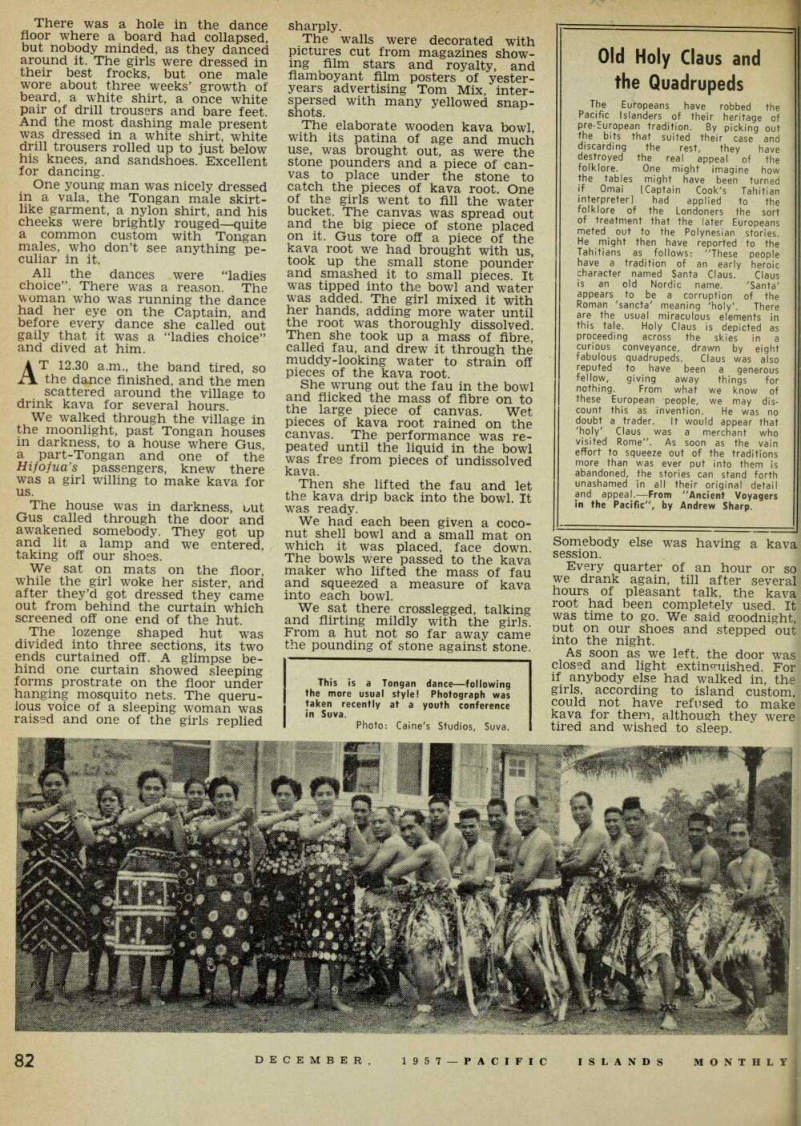
This is a Tongan dance—following the more usual style! Photograph was taken recently at a youth conference in Suva.
Photo: Caine's Studios, Suva.