Expert on Coastwatching and Coconuts
p. 81 · Read in the full issue
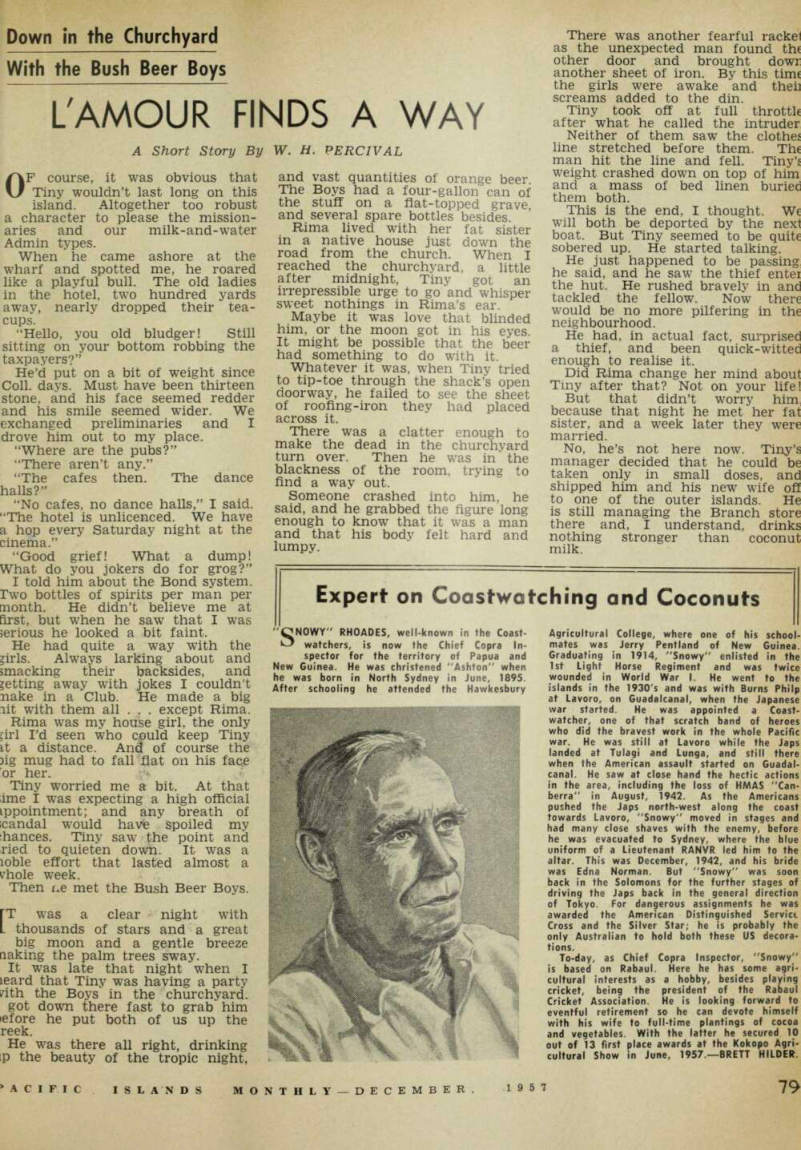
SNOWY" RHOADES, well-known in the Coast watchers, is now the Chief Copra In spector for the territory of Papua and New Guinea. He was christened "Ashton" when he was born in North Sydney in June, 1895.
After schooling he attended the Hawkesbury
Agricultural College, where one of his school mates was Jerry Pentland of New Guinea.
Graduating in 1914, "Snowy" enlisted in the Ist Light Horse Regiment and was twice wounded in World War I. He went to the islands in the 1930's and was with Burns Phiip at Lavoro, on Guadalcanal, when the Japanese war started. He was appointed a Coast watcher, one of that scratch band of heroes who did the bravest work in the whole Pacific war. He was still at Lavoro while the Japs landed at Tulagi and Lunga, and still there when the American assault started on Guadal canal. He saw at close hand the hectic actions in the area, including the loss of HMAS "Can berra" in August, 1942. As the Americans pushed the Japs north-west along the coast towards Lavoro, "Snowy" moved in stages and had many close shaves with the enemy, before he was evacuated to Sydney, where the blue uniform of a Lieutenant RANVR led him to the altar. This was December, 1942, and his bride was Edna Norman. But "Snowy" was soon back in the Solomons for the further stages of driving the Japs back in the general direction of Tokyo. For dangerous assignments he was awarded the American Distinguished Service Cross and the Silver Star; he is probably the only Australian to hold both these US decora tions.
To-day, as Chief Copra Inspector, "Snowy" is based on Rabaul. Here he has some agri cultural interests as a hobby, besides playing cricket, being the president of the Rabaul Cricket Association. He is looking forward to eventful retirement so he can devote himself with his wife to full-time plantings of cocoa and vegetables. With the latter he secured 10 out of 13 first place awards at the Kokopo Agri cultural Show in June, 1957. —BRETT HILDER.