[?] Buried Treasure
p. 85 · Read in the full issue
[?]olved Mystery:
Hat Island
By Frank Ryan
|IEN Edgar Paul Thompson [died on Hat Island, one of the Lau Islands of Fiji, on Decem -12. 1908, did he leave behind him rge store of sovereigns? Some le in Suva are asking this ques as the story of hidden treasure Tatu Vara, to give the Island roper name, is being told again \ very many years, ring a lonely life with him on island was his wife Mary, de ed in an American paper as kelau woman, but according to old identity in Suva, from ihiki. e was with him when he died e age of 71. He was insane and lere were buried treasure he the secret with him. ,ry buried him in a shallow 5. She herself was very ill and )est she could do was to scoop ive a few feet deep. b story which was believed in ka at the time was that ipson and two companions the only survivors of the t of a schooner en route to •alia via South America. The ner was said to have carried and bullion and the wreck red near Vatu Vara. The three s divided the coins and bullion managed to reach Vatu Vara, agreed that each man was to his share of the treasure in place unknown to the others. ;y then engaged a Fijian man to take them to Levuka ; they parted, promising to at Port Jackson on a certain and hire a vessel to take them to the Island. ording to Mr. R. A. Derrick, or of the Fiji Museum, pson and a companion arrived yuka in 1863.
EN the others failed to keep he apnointment at Port Jack ion, Thompson returned to nd purchased the island from ive chief for 200 dollars. This efore Cession when land could ught from the natives, fever, when the Land Claims lission was afterwards set up, nfirmed his title by Crown i No. 1 issued on May 10, 1877. fact that he paid for the in gold and made other pur ! with sovereigns lends colour ’ story of the treasure. Stup ed sailors do not usually get
around with their pockets full of sovereigns.
Thompson was a sailor of only about two years standing, and a sailor only so far as it allowed him to escape punishment for desertion from the United States Army.
It was recorded at the time that “he had a seemingly endless supply of gold coins, the source of which he could never be induced to divulge.”
But his companions were, no doubt, old salts. Before them would be the allure of Sydney Town and all that meant to a sailor at sea for a long time, and it is hardly likely that they would sail away leaving their precious sovereigns lying in the precarious sands of Hat Island. That they failed to meet Thompson at the appointed time or place was of no particular significance considering the times, and the circumstances.
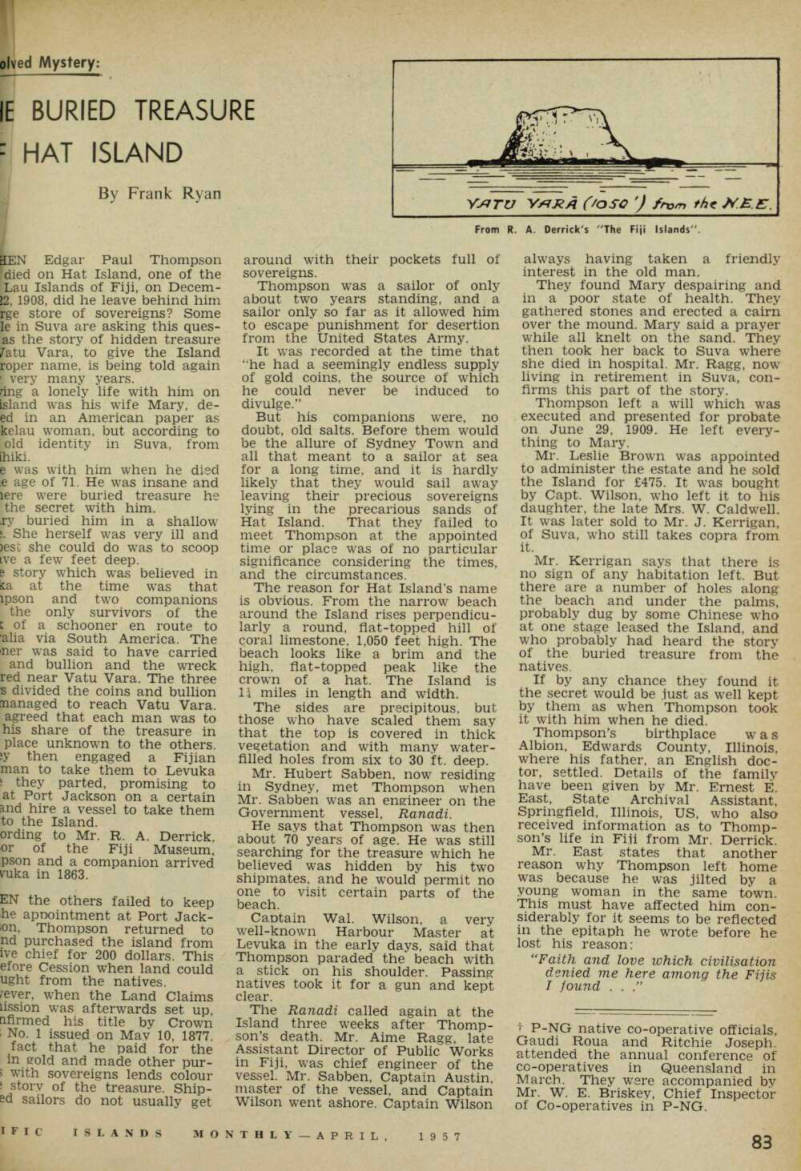
The reason for Hat Island’s name is obvious. From the narrow beach around the Island rises perpendicu larly a round, flat-topped hill of coral limestone, 1,050 feet high. The beach looks like a brim and the high, flat-topped peak like the crown of a hat. The Island is U miles in length and width.
The sides are precipitous, but those who have scaled them say that the top is covered in thick vegetation and with many water filled holes from six to 30 ft. deep.
Mr. Hubert Sabben, now residing in Sydney, met Thompson when Mr. Sabben was an engineer on the Government vessel, Ranadi.
He says that Thompson was then about 70 years of age. He was still searching for the treasure which he believed was hidden by his two shipmates, and he would permit no one to visit certain parts of the beach.
Cantain Wal. Wilson, a very well-known Harbour Master at Levuka in the early days, said that Thompson paraded the beach with a stick on his shoulder. Passing natives took it for a gun and kept clear.
The Ranadi called again at the Island three weeks after Thomp son’s death. Mr. Aime Ragg, late Assistant Director of Public Works in Fiji, was chief engineer of the vessel. Mr. Sabben, Captain Austin, master of the vessel, and Captain Wilson went ashore. Captain Wilson
always having taken a friendly interest in the old man.
They found Mary despairing and in a poor state of health. They gathered stones and erected a cairn over the mound. Mary said a prayer while all knelt on the sand. They then took her back to Suva where she died in hospital. Mr. Ragg, now living in retirement in Suva, con firms this part of the story.
Thompson left a will which was executed and presented for probate on June 29, 1909. He left every thing to Mary.
Mr. Leslie Brown was appointed to administer the estate and he sold the Island for £475. It was bought by Capt. Wilson, who left it to his daughter, the late Mrs. W. Caldwell.
It was later sold to Mr. J. Kerrigan, of Suva, who still takes copra from it.
Mr. Kerrigan says that there is no sign of any habitation left. But there are a number of holes along the beach and under the palms, probably dug by some Chinese who at one stage leased the Island, and who probably had heard the story of the buried treasure from the natives.
If by any chance they found it the secret would be .iust as well kept by them as when Thompson took it with him when he died.
Thompson’s birthplace was Albion, Edwards County, Illinois, where his father, an English doc tor, settled. Details of the family have been given by Mr. Ernest E.
East, State Archival Assistant, Springfield, Illinois, US, who also received information as to Thomp son’s life in Fiji from Mr. Derrick.
Mr. East states that another reason why Thompson left home was because he was jilted by a young woman in the same town.
This must have affected him con siderably for it seems to be reflected in the epitaph he wrote before he lost his reason: “Faith and love which civilisation denied me here among the Fijis I found . . .” t P-NG native co-operative officials, Gaudi Roua and Ritchie Joseph, attended the annual conference of co-operatives in Queensland in March. They were accompanied by Mr. W. E. Briskey, Chief Inspector of Co-operatives in P-NG.
From R. A. Derrick's "The Fiji Islands".