Christmas Island Awaits The Birth Of The Bom[?]
pp. 82-84 · Read in the full issue
Preview:
By Captain Brett Hilder
W7UDR 179 years after Captain I? Cook discovered and named Christmas Island, this large ud-Pacific atoll caused no news iUper headlines. But in the 180 th near all that was changed when he United Kingdom government decided to test a made-in-Britain H-Bomb.
The decision was announced in early 1956 and testing will com mence in April, 1957. continuing hrough to August possibly.
One of the last non-service ves sels to visit Christmas Island be fore the tests began, was the Burns philp islands motor-vessel “Tulagi”, which, commanded by Captain Brett Milder, was making one of the company's periodical visits to the Bine Islands to change over the labour force of several plantations.
After his visit, Captain Milder wrote this account for us, and also supplied the illustrations.
I spent an instructive eight hours on the island, and for this I must thank the Government of the Gilbert & Ellice Islands Colony, who administer Christmas as one of the Line Islands: Burns Philp and Company, who were kind enough to place one of their newest ships at my disposal; and the Dis trict Officer, who endangered his good name by introducing me to the chiefs of the Army, Navy and
Air Force establishments on the island. The latter personally showed me “nearly everything” there was to see—they even pointed out the building in which the H-bomb was “being nailed together”.
I managed to refrain from asking to see the bomb itself. I did see two reinforced tanks containing very destructive fluids, one labelled “Mild” and the other “Bitter”— but these were only the ingre dients of an insecticide being sprayed over the camp areas by an Auster aircraft. The idea is to keep down the flies. There were some larger aircraft as well, a squadron of Avro-Shackletons for reconnais sance and air-sea-rescue, and a fleet of Dakotas for ferrying per sonnel to and from England.
The strip is now 7,000 feet long, and beautifully surfaced, the work having been done, in addition to the construction of camps and buildings for 2,000 men, by a regi ment of Field Engineers under the command of Colonel Woollett, QBE. MC. The uniform of this ingenious officer consisted of mili tary boots, shorts, a washable hat and a walking stick.
He wore also, a complete coat of sun-tan, and a fine coating of white dust from the pulverised coral of which the whole island is formed. The Air Force chief is Air Commodore C. T. Weir, DFC; one
of his officers is Wing-Commae D. Bower, MBE, AFC, whose n is well known in the specialist d of navigation.
The main body of the armyy be flown out in March as t work is completed, but a campq been prepared for about 600 0 perts and scientific officers whoo attend the birth of the bomb.d The main army and air t camps are four miles from the s which is towards the north-easf corner of the island. There constant sea-breeze as the camn close to the beach, and whin was there the air force was asaj the army to build a wind-brea'js the wind was so tiresome.
The camp suffers from the 9 tense glare from the white o sand, but it has some amenio including a club run by two Is! of the Women’s Voluntary Av iary. There are no other femalel the establishment.
Dominating the beach are or five smoke-stacks, to remindb troops of Birmingham. They \ the water distillers, veteranssi many former wars. There is a £ rainfall on the island and wv is far more precious than pea( The stores landed for the buiLli of the base have amountedh 18,000 tons to date, includingg acre of petrol in jerry-cans.
The roads have been surffl-
;h mud dredged from the lagoon, all the stores have been trans •ted from the port, which is >ut 15 miles away. The port is i old settlement of London, where i Royal Navy is in command, un i Commander Ford; but the only ts of the fleet present at the ie we were there were some pal Fleet Auxiliaries which have ught the supplies, and small ft for port work. ’he cargo handling has been S by Docks Companies of the iy, and they have a large line freezers in which goods are kept [immediate use. Some of the ply ships remain at the moor buoys for months, discharging 50 as required; a boring job. etween the the Army and the
/y the total popu on of the Port of idon was about Both the Air ce and Navy are ie built up before bomb-test, i much more ior officers taking t the commands, oth Valiant and
berra bombers
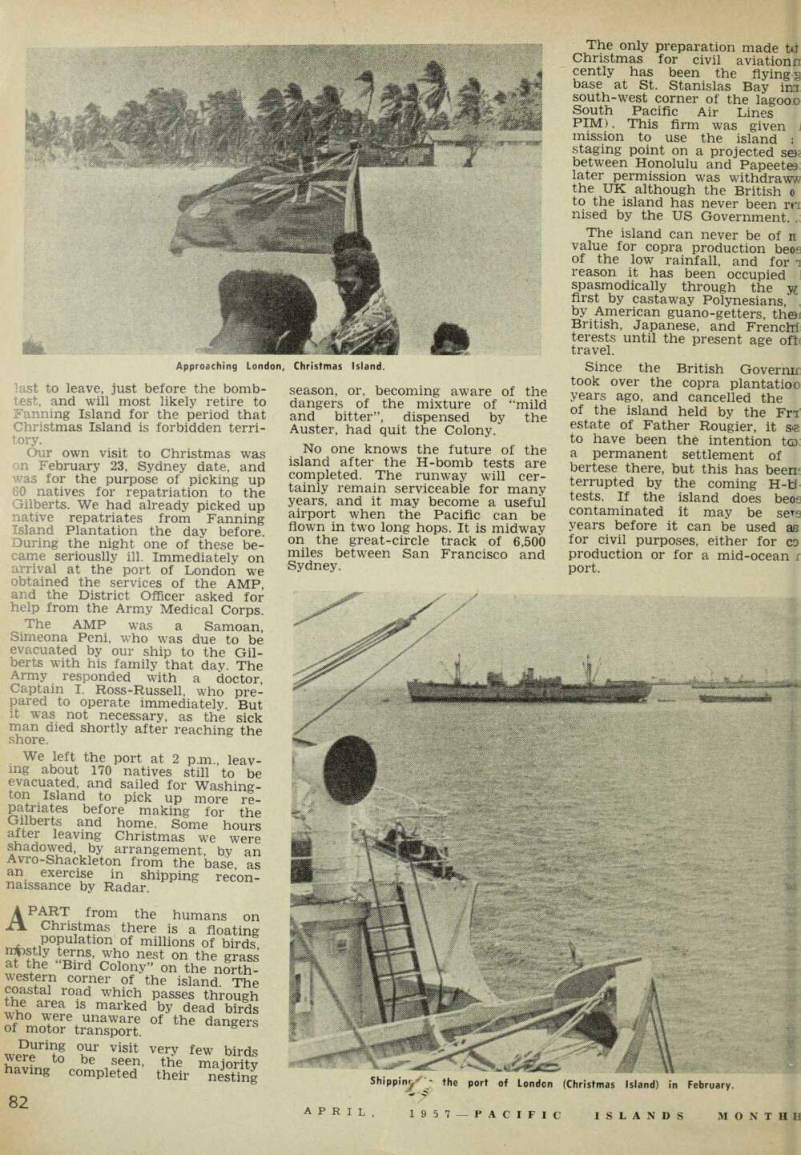
due to arrive, and ous naval vessels, he H-bomb is ex ;ed to be carried me of four Vali >, and to be )ped from 40,000 and to burst at 3 feet. The ex ion is expected to heard over a us of 1,000 miles, the most likely et appears to be den Island, h e airstrip o n den has been in lately, so there ild be no dif :ty in getting rds from the et area after the osion, which is icted to equal a t of 10 million of TNT. le danger from lie fall-out is de ni in e d by the Is, which at the of the explosion, likely to be ESE i the surface up 5,000 feet; and ly Westerly from height right up
he stratosphere.
>r these reasons e should be no ;er at Penryhn id, 350 miles t h of Malden, same cannot be for Jarvis Island, ?ite of its being r n isolated from
the danger area on the map. Jarvis is regarded as defacto American, and it was proposed that it be occupied during the International Geophysical Year (commencing July this year) for magnetic research.
Jarvis has had some visitors lately, both British from Christmas Island, and American scientists. The only island not mentioned at all is Star buck, about 100 miles from Malden.
The danger of radio-activity on Christmas Island is apparently ac cepted as a calculated risk, for I suppose the essential forces on the island at the time of the test would be 3,000 men. Apart from the armed services and scientists there will be no one else on the island at that time.
During the last ten years the only
occupants have been the personnel of the Government-owned copra plantation, called Christmas Island Plantation, under the charge of a manager, who is also the District Officer.
The plantation consists of scat tered groves of coconut palms in many parts of the large island and it requires a lot of motor transport to work it on a large scale. The District Officer is normally the only European resident, the others being natives of the Gilberts recruited for the plantation.
The island had no permanent native population, and all the Gil bertese are being repatriated to their home islands in the Gilberts.
The District Officer will be the
Map of the area most concerned with "Operation Grapple" (the H-Bomb test); official danger area is shaded The range-rings are centred on Malden, the island over which the bomb will likely be dropped
last to leave, just before the bomb test, and will most likely retire to Fanning Island for the period that Christmas Island is forbidden terri tory.
Our own visit to Christmas was on February 23, Sydney date, and was for the purpose of picking up 60 natives for repatriation to the Gilberts. We had already picked up native repatriates from Fanning Island Plantation the day before.
During the night one of these be came seriouslly ill. Immediately on arrival at the port of London we obtained the services of the AMP, and the District Officer asked for help from the Army Medical Corps.
The AMP was a Samoan, Simeona Peni, who was due to be evacuated by our ship to the Gil berts with his family that day. The Army responded with a doctor, Captain I, Ross-Russell, who pre pared to operate immediately. But it was not necessary, as the sick man died shortly after reaching the shore.
We left the port at 2 p.m., leav ing about 170 natives still to be evacuated, and sailed for Washing ton Island to pick up more re patriates before making for the Gilberts and home. Some hours after leaving Christmas we were shadowed, by arrangement, by an Avro-Shackleton from the base, as an exercise in shipping recon naissance by Radar.
APART from the humans on Christmas there is a floating popuiation of millions of birds nystly terns, who nest on the grass at the Bird Colony” on the north western corner of the island. The coastal road which passes through “}f_ area 18 marked by dead birds who were unaware of the dangers of motor transport. 8 5 we?e ri to hi r Visit ve JJ few birds were to be seen, the maioritv having completed their nesting
season, or, becoming aware of the dangers of the mixture of “mild and bitter”, dispensed by the Auster, had quit the Colony.
No one knows the future of the island after the H-bomb tests are completed. The runway will cer tainly remain serviceable for many years, and it may become a useful airport when the Pacific can be flown in two long hops. It is midway on the great-circle track of 6,500 miles between San Francisco and Sydney.
The only preparation made td Christmas for civil aviationn cently has been the flyings base at St. Stanislas Bay inru south-west corner of the lagooo South Pacific Air Lines PIM). This firm was given j mission to use the island j staging point on a projected so? between Honolulu and Papeete9: later permission was withdraww the UK although the British o to the island has never been rn nised by the US Government. .; The island can never be of n value for copra production beos of the low rainfall, and for i reason it has been occupied i spasmodically through the y£ first by castaway Polynesians, t by American guano-getters, thoi British, Japanese, and Frenchl; terests until the present age oflc travel.
Since the British Governir took over the copra plantation years ago, and cancelled the of the island held by the Fn' estate of Father Rougier, it s« to have been the intention too: a permanent settlement of bertese there, but this has beens terrupted by the coming H-tt tests. If the island does beoa contaminated it may be sere years before it can be used as for civil purposes, either for cd production or for a mid-ocean r port.
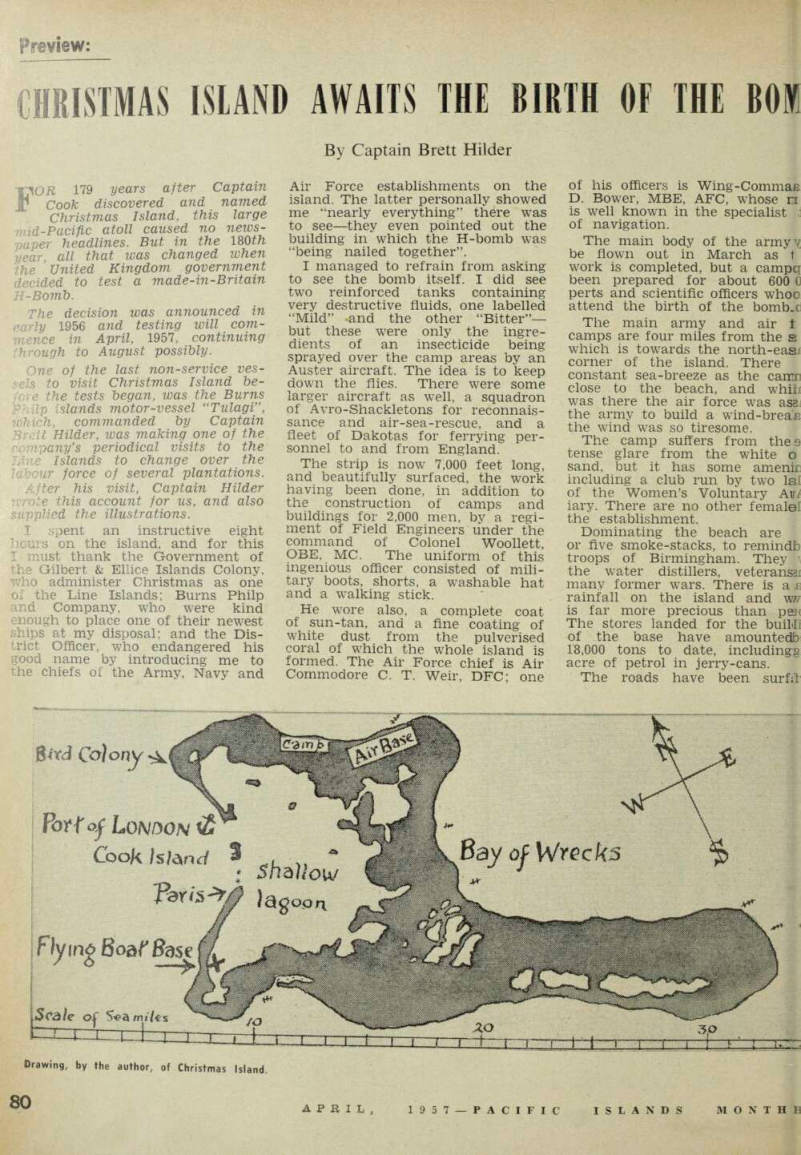
Approaching London, Christmas Island.
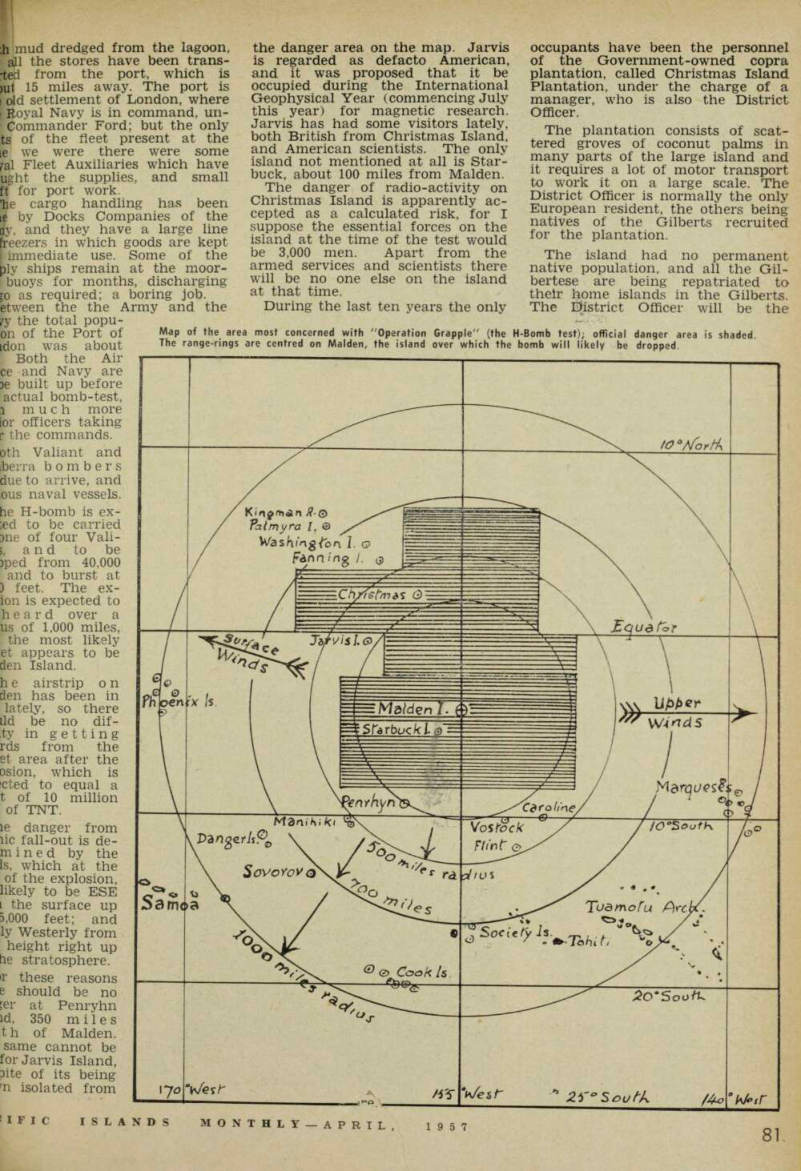
Shipping[?] - the port of London (Christmas Island) in February.