A Costume Of The First Class
pp. 81-97 · Read in the full issue
played the [?]d in—
By Sir George Joy, Kbe, Cmg.
WAS appointed to govern the Colony of St. Helena just after the war and having paid my call His late Majesty I asked my ors about the special uniform of first class, complete with feather, ich all Excellencies are entitled wear. ■he head of the firm told me that vas quite impossible to produce h a uniform, as the silver scrolls [ what-nots had been fashioned gentlemen from south-east ope, all of whom were locked up ing the war and sent packing le afterwards. ow this was a sad state of Its, though in the normal course svents it would not have greatly tered as such uniforms could be lined second-hand from several •ces well known to members of Service. But this was not the i after the war. ; the commencement of hostilities, Excellencies who were time red and anxious to settle them es comfortably in the garden of land to write ttheir memoirs,
sent “most immediate” telegrams to the Secretary of State placing their further services at his disposal, and such patriotic offers could not easily be refused. The effect on the trade in second-hand uniforms was there fore widespread.
Nor did the position improve quickly after the war. The Colonies required rehabilitation and who could do it better than those who had manned the ramparts during hostilities? No Secretary of State with a heart could have sent out the edict known to our French friends as “Le bon salutation aux heros” when the dust and smoke of battle had barely lifted from our Colonial shores. Thus the uniform market remained tight.
Now, although Excellencies are also Commanders-in-Chief or Cap tains-General, it is not customary for them to be killed in battle and it remains unproven that any have passed out from alcoholic poisoning, so no uniforms could be anticipated under that count.
Then a friend of a friend of mine
who was in show business suggested that I might be able to get what I required from one of the theatrical dress agencies and I went along to a firm well known among devotees of the histrionic art. I was met by a gentleman in pre-war Foreign Office outfit plus bow-tie who in q u i r e d my pleasure.
I said I wanted a Governor’s uni form and he directed me to a hall in the base ment. Along the sides on stands were costumes and uniforms arranged in groups accord ing to the period, e.g., circa 1600 and all that. It re minded me vary much of Madame Tussaud’s except that there were no wax figures and the lighting was poor. I waited at the foot of the
stairs to get my bearings, / and ah assistant, stout and short of stature, with a swarthy complexion and a strong foreign accent inquired what I wanted.
I told M. Dubois (as I shall call him) that I wanted a Governor’s uniform. Together we made an in spection of the stands but I could not see what I required.
Said M. Dubois: “We-have-many costume-Lieut.-Governor-and-Lord- Lieutenant-would-that-do?”
I replied I thought not, and after a look backstage M. Dubois burst out: “We-have-costume-Governor- General - would-you - wish-for-Gov ernor-General?”
Now, I have always admired that extra piece of silver lace on the uniform of a Governor-General but I hesitated only a second. After a distinguished career, far be it from me, I thought, to cause heartburn in the hierarchy, so I told M. Dubois that I would not wish for Governor- General.
By this time we had been joined by two gesticulating characters in fancy dress (M. Dubois explained that one wanted a camel cloak for the part of a shepherd in a biblical play, while the other was a soldier of fortune in an 18th century fantasy) and I again had to explain that I was not interested in a period costume but wanted a modern uniform for a present-day Governor.
M. Dubois then disappeared into what I suppose was the 20th century department and brought back a uniform that looked to me the right thing. It was. I inspected the tag sewn into the inside coat pocket.
It had been made by a Savile Row tailor for a very distinguished Gov ernor and looked as if it had never been worn. We got down to the business of trying it on.
The cutter was called and after slitting it here and pinning it there, he said I could have the first fit ting in a fortnight. I replied that I must have it completed within ten days at the latest, whereupon M.
Dubois said: “What-time-your-first rehearsal?”
I said that there was no question of a rehearsal, that I was the Gov ernor-designate of St. Helena. M.
Dubois and the cutter looked at one another and nodded their heads in a manner which could only mean that they thought I ought not to be out alone, but to humour me, per haps, they said that I could have a fitting in a week.
The cutter then left us with the remark: “That’ll be all for to-day, thank you,’’—a remark that I was to hear many times before I was through.
After several fittings, the great day arrived to try on the completed outfit. By that time I was well
(Continued on Page 95)
T his story by a member of the Colonial Service, well-known in the South Pacific, first appeared in "Corona" and is reprinted here with the permission of Her Majesty's Stationery Office.
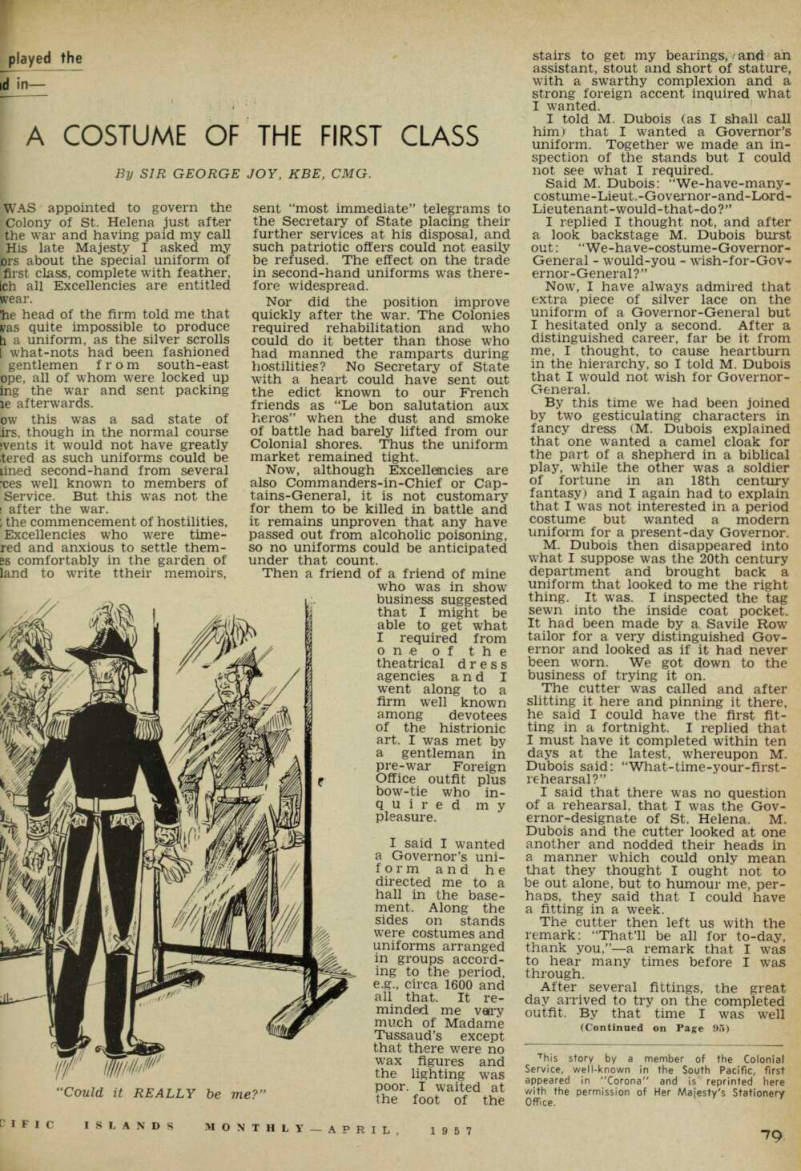
“Could it REALLY he me?”
lualnted with the Commissionaire, 0 greeted me with a salute as I ered the swing doors, hoping per ps for a free ticket for a show m a distinguished patron. M. bois had collected all the essential outrements that made up the endour, and in the dressing room assisted me into the Wellington >ts and overalls, then the coat is called a coatee—why, heaven >ws) and finally the sword-belt 1 sword. The former required siderable adjustment as my waist is that of a model, hen the cocked hat; all was well e for one item—there was no [her in the hat. I pointed to hat and said to M. Dubois, “I it a feather.” [e returned with a magnificent mage of off-white and scarlet I this I fitted into the hat. I ( now complete. M. Dubois sug ted that I should step outside I admire myself from all angles the long mirror, I expected to , a little ethereal, with a sug aon of floating to a more rarefied losphere. On the contrary, I felt heavy as a lump of lead and Id hardly move one foot from floor, but the noise of the gling spurs and the sword trail on the ground awoke me to lities, and with as much dignity possible I took myself to the ror. fas it really me, I thought! i the hall a photographer was ing pictures of the sets of umes for publication in the fazine known as Costumes and sses for the Stage. I watched with interest for a few seconds, m, with a bright smile, M. lois looked at me and said:
u-wish-photograph? We-make
glossy-photo-all-same-stars.”
Brtainly, I did not want any
tograph—no one would recognise
anyway, except possibly one or of the Under-Secretaries in at Smith Street. il was now over and Ift. Dubois iuced a heavy steel trunk in 3h to pack the uniform, while I be out the cheque which ran well • three figures. He took my iue to the cashier but Returned i no receipt and asked if I Id step upstairs and see that ;leman. ae cashier was bald, wore steel ned spectacles on the end of his i and had a large walrus stache. b was holding my cheque in one d and a copy of some theatrical 5w in the other. He looked at and said: ‘‘You play Governor omething?” I replied that I was playing anything and that I the Governor-designate of St. ina. lever ’eard of it,” he said, “its ’ere,” and pointed to the re r. Still looking suspiciously at cheque he inquired whether I
wanted to take the “costume” away.
As it appeared to weigh at least a quarter of a ton in its steel trunk and would require the service of the British Transport Commission to remove it, I replied facetiously that I could hardly carry it under my arm.
“Very well,” he said, “that’ll be all for to-day,” and handed me my receipt. I pushed through the swing doors for the last time, took a cab to my Club and indulged in strong drink.
THE great day arrived. I landed in my costume, stood obediently on the chalk mark at the salute while the band played the first four bars, mounted the rostrum, said my piece and was driven to Plantation House. I sat down with difficulty,
It was a beautiful island and through the French windows I could discern the blue of the sea. It was also very warm.
Everything looked wonderful. I thought of the Cote d’Azur which in some ways it resembled. I was tired, hungry and very thirsty. What I wanted at that moment was “un menu gastronomique a deux mille francs avec un bon bouteille de Blanc de Blanc.”
My reverie was broken by the ADC. “Will that be all, Your Ex cellency?” he said. Almost mechanic -1 replied: “That’ll be all for * han Jv. y £ U fi as 1 P resse d the hell for the butler, As I sipped my orangeade I re fleeted how truly it is written that the meek shall inherit the earth.